EP1627668A1 - Dünnflüssige Pickering-Emulsion - Google Patents
Dünnflüssige Pickering-Emulsion Download PDFInfo
- Publication number
- EP1627668A1 EP1627668A1 EP05106046A EP05106046A EP1627668A1 EP 1627668 A1 EP1627668 A1 EP 1627668A1 EP 05106046 A EP05106046 A EP 05106046A EP 05106046 A EP05106046 A EP 05106046A EP 1627668 A1 EP1627668 A1 EP 1627668A1
- Authority
- EP
- European Patent Office
- Prior art keywords
- emulsion
- weight
- oil
- concentration
- cosmetic
- Prior art date
- Legal status (The legal status is an assumption and is not a legal conclusion. Google has not performed a legal analysis and makes no representation as to the accuracy of the status listed.)
- Withdrawn
Links
- 239000000839 emulsion Substances 0.000 title claims abstract description 37
- 238000002360 preparation method Methods 0.000 claims abstract description 41
- 239000002537 cosmetic Substances 0.000 claims abstract description 24
- 239000002904 solvent Substances 0.000 claims abstract description 12
- 150000001875 compounds Chemical class 0.000 claims description 12
- 239000001993 wax Substances 0.000 claims description 12
- 239000004359 castor oil Substances 0.000 claims description 7
- 235000019438 castor oil Nutrition 0.000 claims description 7
- ZEMPKEQAKRGZGQ-XOQCFJPHSA-N glycerol triricinoleate Natural products CCCCCC[C@@H](O)CC=CCCCCCCCC(=O)OC[C@@H](COC(=O)CCCCCCCC=CC[C@@H](O)CCCCCC)OC(=O)CCCCCCCC=CC[C@H](O)CCCCCC ZEMPKEQAKRGZGQ-XOQCFJPHSA-N 0.000 claims description 7
- 239000002245 particle Substances 0.000 claims description 4
- 229910052582 BN Inorganic materials 0.000 claims description 3
- PZNSFCLAULLKQX-UHFFFAOYSA-N Boron nitride Chemical compound N#B PZNSFCLAULLKQX-UHFFFAOYSA-N 0.000 claims description 3
- 229920002642 Polysorbate 65 Polymers 0.000 claims description 3
- 235000012216 bentonite Nutrition 0.000 claims description 3
- 229940074046 glyceryl laurate Drugs 0.000 claims description 3
- 239000000049 pigment Substances 0.000 claims description 3
- 239000001816 polyoxyethylene sorbitan tristearate Substances 0.000 claims description 3
- 235000010988 polyoxyethylene sorbitan tristearate Nutrition 0.000 claims description 3
- 229940099511 polysorbate 65 Drugs 0.000 claims description 3
- ARIWANIATODDMH-UHFFFAOYSA-N rac-1-monolauroylglycerol Chemical compound CCCCCCCCCCCC(=O)OCC(O)CO ARIWANIATODDMH-UHFFFAOYSA-N 0.000 claims description 3
- VBICKXHEKHSIBG-UHFFFAOYSA-N 1-monostearoylglycerol Chemical compound CCCCCCCCCCCCCCCCCC(=O)OCC(O)CO VBICKXHEKHSIBG-UHFFFAOYSA-N 0.000 claims description 2
- 229940075529 glyceryl stearate Drugs 0.000 claims description 2
- RUOJZAUFBMNUDX-UHFFFAOYSA-N propylene carbonate Chemical compound CC1COC(=O)O1 RUOJZAUFBMNUDX-UHFFFAOYSA-N 0.000 claims description 2
- YJIXVMRMRLFWEE-UHFFFAOYSA-N 28-hydroxyoctacosyl 2-hydroxyoctadecanoate Chemical class CCCCCCCCCCCCCCCCC(O)C(=O)OCCCCCCCCCCCCCCCCCCCCCCCCCCCCO YJIXVMRMRLFWEE-UHFFFAOYSA-N 0.000 claims 1
- 230000000694 effects Effects 0.000 abstract description 3
- 230000010534 mechanism of action Effects 0.000 abstract 1
- 239000003921 oil Substances 0.000 description 21
- 235000019198 oils Nutrition 0.000 description 21
- 150000002148 esters Chemical class 0.000 description 17
- -1 aluminum silicates Chemical class 0.000 description 15
- 229920000435 poly(dimethylsiloxane) Polymers 0.000 description 14
- 239000000203 mixture Substances 0.000 description 13
- 229920001296 polysiloxane Polymers 0.000 description 13
- 239000003963 antioxidant agent Substances 0.000 description 12
- 235000006708 antioxidants Nutrition 0.000 description 12
- 235000013870 dimethyl polysiloxane Nutrition 0.000 description 12
- 239000012071 phase Substances 0.000 description 12
- 239000000126 substance Substances 0.000 description 12
- PEDCQBHIVMGVHV-UHFFFAOYSA-N Glycerine Chemical compound OCC(O)CO PEDCQBHIVMGVHV-UHFFFAOYSA-N 0.000 description 11
- OSCJHTSDLYVCQC-UHFFFAOYSA-N 2-ethylhexyl 4-[[4-[4-(tert-butylcarbamoyl)anilino]-6-[4-(2-ethylhexoxycarbonyl)anilino]-1,3,5-triazin-2-yl]amino]benzoate Chemical compound C1=CC(C(=O)OCC(CC)CCCC)=CC=C1NC1=NC(NC=2C=CC(=CC=2)C(=O)NC(C)(C)C)=NC(NC=2C=CC(=CC=2)C(=O)OCC(CC)CCCC)=N1 OSCJHTSDLYVCQC-UHFFFAOYSA-N 0.000 description 10
- LFQSCWFLJHTTHZ-UHFFFAOYSA-N Ethanol Chemical compound CCO LFQSCWFLJHTTHZ-UHFFFAOYSA-N 0.000 description 9
- DNIAPMSPPWPWGF-UHFFFAOYSA-N Propylene glycol Chemical compound CC(O)CO DNIAPMSPPWPWGF-UHFFFAOYSA-N 0.000 description 9
- 239000004205 dimethyl polysiloxane Substances 0.000 description 9
- 229920002545 silicone oil Polymers 0.000 description 9
- 239000004480 active ingredient Substances 0.000 description 7
- 229940008099 dimethicone Drugs 0.000 description 7
- 229920001971 elastomer Polymers 0.000 description 7
- 239000000806 elastomer Substances 0.000 description 7
- XLYOFNOQVPJJNP-UHFFFAOYSA-N water Substances O XLYOFNOQVPJJNP-UHFFFAOYSA-N 0.000 description 7
- GVJHHUAWPYXKBD-UHFFFAOYSA-N (±)-α-Tocopherol Chemical compound OC1=C(C)C(C)=C2OC(CCCC(C)CCCC(C)CCCC(C)C)(C)CCC2=C1C GVJHHUAWPYXKBD-UHFFFAOYSA-N 0.000 description 6
- KFZMGEQAYNKOFK-UHFFFAOYSA-N Isopropanol Chemical compound CC(C)O KFZMGEQAYNKOFK-UHFFFAOYSA-N 0.000 description 6
- KPUWHANPEXNPJT-UHFFFAOYSA-N disiloxane Chemical class [SiH3]O[SiH3] KPUWHANPEXNPJT-UHFFFAOYSA-N 0.000 description 6
- 239000007788 liquid Substances 0.000 description 6
- LYCAIKOWRPUZTN-UHFFFAOYSA-N Ethylene glycol Chemical compound OCCO LYCAIKOWRPUZTN-UHFFFAOYSA-N 0.000 description 5
- 150000001298 alcohols Chemical class 0.000 description 5
- 125000004122 cyclic group Chemical group 0.000 description 5
- 125000001495 ethyl group Chemical group [H]C([H])([H])C([H])([H])* 0.000 description 5
- 238000009472 formulation Methods 0.000 description 5
- 229920006395 saturated elastomer Polymers 0.000 description 5
- UFHFLCQGNIYNRP-UHFFFAOYSA-N Hydrogen Chemical compound [H][H] UFHFLCQGNIYNRP-UHFFFAOYSA-N 0.000 description 4
- 239000004909 Moisturizer Substances 0.000 description 4
- VYPSYNLAJGMNEJ-UHFFFAOYSA-N Silicium dioxide Chemical compound O=[Si]=O VYPSYNLAJGMNEJ-UHFFFAOYSA-N 0.000 description 4
- 230000003078 antioxidant effect Effects 0.000 description 4
- 125000004432 carbon atom Chemical group C* 0.000 description 4
- 239000003995 emulsifying agent Substances 0.000 description 4
- 235000011187 glycerol Nutrition 0.000 description 4
- JVTAAEKCZFNVCJ-UHFFFAOYSA-N lactic acid Chemical compound CC(O)C(O)=O JVTAAEKCZFNVCJ-UHFFFAOYSA-N 0.000 description 4
- 230000001333 moisturizer Effects 0.000 description 4
- 230000003020 moisturizing effect Effects 0.000 description 4
- 125000001997 phenyl group Chemical group [H]C1=C([H])C([H])=C(*)C([H])=C1[H] 0.000 description 4
- 235000013772 propylene glycol Nutrition 0.000 description 4
- 150000003839 salts Chemical class 0.000 description 4
- 230000037303 wrinkles Effects 0.000 description 4
- NIQCNGHVCWTJSM-UHFFFAOYSA-N Dimethyl phthalate Chemical compound COC(=O)C1=CC=CC=C1C(=O)OC NIQCNGHVCWTJSM-UHFFFAOYSA-N 0.000 description 3
- 229930003427 Vitamin E Natural products 0.000 description 3
- 239000002253 acid Substances 0.000 description 3
- 239000003795 chemical substances by application Substances 0.000 description 3
- 239000006071 cream Substances 0.000 description 3
- 239000000284 extract Substances 0.000 description 3
- WIGCFUFOHFEKBI-UHFFFAOYSA-N gamma-tocopherol Natural products CC(C)CCCC(C)CCCC(C)CCCC1CCC2C(C)C(O)C(C)C(C)C2O1 WIGCFUFOHFEKBI-UHFFFAOYSA-N 0.000 description 3
- 150000004676 glycans Chemical class 0.000 description 3
- 229930195733 hydrocarbon Natural products 0.000 description 3
- 239000001257 hydrogen Substances 0.000 description 3
- 229910052739 hydrogen Inorganic materials 0.000 description 3
- 125000002496 methyl group Chemical group [H]C([H])([H])* 0.000 description 3
- OQILCOQZDHPEAZ-UHFFFAOYSA-N octyl palmitate Chemical compound CCCCCCCCCCCCCCCC(=O)OCCCCCCCC OQILCOQZDHPEAZ-UHFFFAOYSA-N 0.000 description 3
- BARWIPMJPCRCTP-CLFAGFIQSA-N oleyl oleate Chemical compound CCCCCCCC\C=C/CCCCCCCCOC(=O)CCCCCCC\C=C/CCCCCCCC BARWIPMJPCRCTP-CLFAGFIQSA-N 0.000 description 3
- 229920005862 polyol Polymers 0.000 description 3
- 150000003077 polyols Chemical class 0.000 description 3
- 229920001282 polysaccharide Polymers 0.000 description 3
- 239000005017 polysaccharide Substances 0.000 description 3
- 125000001436 propyl group Chemical group [H]C([*])([H])C([H])([H])C([H])([H])[H] 0.000 description 3
- 239000005871 repellent Substances 0.000 description 3
- 230000002940 repellent Effects 0.000 description 3
- 239000007787 solid Substances 0.000 description 3
- PRAKJMSDJKAYCZ-UHFFFAOYSA-N squalane Chemical compound CC(C)CCCC(C)CCCC(C)CCCCC(C)CCCC(C)CCCC(C)C PRAKJMSDJKAYCZ-UHFFFAOYSA-N 0.000 description 3
- 125000000391 vinyl group Chemical group [H]C([*])=C([H])[H] 0.000 description 3
- 229920002554 vinyl polymer Polymers 0.000 description 3
- 235000019165 vitamin E Nutrition 0.000 description 3
- 229940046009 vitamin E Drugs 0.000 description 3
- 239000011709 vitamin E Substances 0.000 description 3
- YBJHBAHKTGYVGT-ZKWXMUAHSA-N (+)-Biotin Chemical compound N1C(=O)N[C@@H]2[C@H](CCCCC(=O)O)SC[C@@H]21 YBJHBAHKTGYVGT-ZKWXMUAHSA-N 0.000 description 2
- KAZSKMJFUPEHHW-UHFFFAOYSA-N (2E)-3-[5-(1,1-dimethyl-2-propenyl)-4-hydroxy-2-methoxyphenyl]-1-(4-hdyroxyphenyl)-2-propen-1-one Natural products COC1=CC(O)=C(C(C)(C)C=C)C=C1C=CC(=O)C1=CC=C(O)C=C1 KAZSKMJFUPEHHW-UHFFFAOYSA-N 0.000 description 2
- KIUKXJAPPMFGSW-DNGZLQJQSA-N (2S,3S,4S,5R,6R)-6-[(2S,3R,4R,5S,6R)-3-Acetamido-2-[(2S,3S,4R,5R,6R)-6-[(2R,3R,4R,5S,6R)-3-acetamido-2,5-dihydroxy-6-(hydroxymethyl)oxan-4-yl]oxy-2-carboxy-4,5-dihydroxyoxan-3-yl]oxy-5-hydroxy-6-(hydroxymethyl)oxan-4-yl]oxy-3,4,5-trihydroxyoxane-2-carboxylic acid Chemical compound CC(=O)N[C@H]1[C@H](O)O[C@H](CO)[C@@H](O)[C@@H]1O[C@H]1[C@H](O)[C@@H](O)[C@H](O[C@H]2[C@@H]([C@@H](O[C@H]3[C@@H]([C@@H](O)[C@H](O)[C@H](O3)C(O)=O)O)[C@H](O)[C@@H](CO)O2)NC(C)=O)[C@@H](C(O)=O)O1 KIUKXJAPPMFGSW-DNGZLQJQSA-N 0.000 description 2
- OIQXFRANQVWXJF-QBFSEMIESA-N (2z)-2-benzylidene-4,7,7-trimethylbicyclo[2.2.1]heptan-3-one Chemical class CC1(C)C2CCC1(C)C(=O)\C2=C/C1=CC=CC=C1 OIQXFRANQVWXJF-QBFSEMIESA-N 0.000 description 2
- DURPTKYDGMDSBL-UHFFFAOYSA-N 1-butoxybutane Chemical compound CCCCOCCCC DURPTKYDGMDSBL-UHFFFAOYSA-N 0.000 description 2
- FPIPGXGPPPQFEQ-UHFFFAOYSA-N 13-cis retinol Natural products OCC=C(C)C=CC=C(C)C=CC1=C(C)CCCC1(C)C FPIPGXGPPPQFEQ-UHFFFAOYSA-N 0.000 description 2
- YVLPJIGOMTXXLP-UHFFFAOYSA-N 15-cis-phytoene Chemical compound CC(C)=CCCC(C)=CCCC(C)=CCCC(C)=CC=CC=C(C)CCC=C(C)CCC=C(C)CCC=C(C)C YVLPJIGOMTXXLP-UHFFFAOYSA-N 0.000 description 2
- MEZZCSHVIGVWFI-UHFFFAOYSA-N 2,2'-Dihydroxy-4-methoxybenzophenone Chemical compound OC1=CC(OC)=CC=C1C(=O)C1=CC=CC=C1O MEZZCSHVIGVWFI-UHFFFAOYSA-N 0.000 description 2
- KXTAOXNYQGASTA-UHFFFAOYSA-N 2-benzylidenepropanedioic acid Chemical compound OC(=O)C(C(O)=O)=CC1=CC=CC=C1 KXTAOXNYQGASTA-UHFFFAOYSA-N 0.000 description 2
- CZVOIAOPRGNENY-UHFFFAOYSA-N 2-butyloctyl 2-hydroxybenzoate Chemical compound CCCCCCC(CCCC)COC(=O)C1=CC=CC=C1O CZVOIAOPRGNENY-UHFFFAOYSA-N 0.000 description 2
- VSXIZXFGQGKZQG-UHFFFAOYSA-N 2-cyano-3,3-diphenylprop-2-enoic acid Chemical compound C=1C=CC=CC=1C(=C(C#N)C(=O)O)C1=CC=CC=C1 VSXIZXFGQGKZQG-UHFFFAOYSA-N 0.000 description 2
- BANXPJUEBPWEOT-UHFFFAOYSA-N 2-methyl-Pentadecane Chemical compound CCCCCCCCCCCCCC(C)C BANXPJUEBPWEOT-UHFFFAOYSA-N 0.000 description 2
- LEACJMVNYZDSKR-UHFFFAOYSA-N 2-octyldodecan-1-ol Chemical compound CCCCCCCCCCC(CO)CCCCCCCC LEACJMVNYZDSKR-UHFFFAOYSA-N 0.000 description 2
- CIWBSHSKHKDKBQ-JLAZNSOCSA-N Ascorbic acid Chemical compound OC[C@H](O)[C@H]1OC(=O)C(O)=C1O CIWBSHSKHKDKBQ-JLAZNSOCSA-N 0.000 description 2
- JMGZEFIQIZZSBH-UHFFFAOYSA-N Bioquercetin Natural products CC1OC(OCC(O)C2OC(OC3=C(Oc4cc(O)cc(O)c4C3=O)c5ccc(O)c(O)c5)C(O)C2O)C(O)C(O)C1O JMGZEFIQIZZSBH-UHFFFAOYSA-N 0.000 description 2
- LSNNMFCWUKXFEE-UHFFFAOYSA-M Bisulfite Chemical compound OS([O-])=O LSNNMFCWUKXFEE-UHFFFAOYSA-M 0.000 description 2
- 241000723346 Cinnamomum camphora Species 0.000 description 2
- ACTIUHUUMQJHFO-UHFFFAOYSA-N Coenzym Q10 Natural products COC1=C(OC)C(=O)C(CC=C(C)CCC=C(C)CCC=C(C)CCC=C(C)CCC=C(C)CCC=C(C)CCC=C(C)CCC=C(C)CCC=C(C)CCC=C(C)C)=C(C)C1=O ACTIUHUUMQJHFO-UHFFFAOYSA-N 0.000 description 2
- XMSXQFUHVRWGNA-UHFFFAOYSA-N Decamethylcyclopentasiloxane Chemical compound C[Si]1(C)O[Si](C)(C)O[Si](C)(C)O[Si](C)(C)O[Si](C)(C)O1 XMSXQFUHVRWGNA-UHFFFAOYSA-N 0.000 description 2
- DHMQDGOQFOQNFH-UHFFFAOYSA-N Glycine Chemical compound NCC(O)=O DHMQDGOQFOQNFH-UHFFFAOYSA-N 0.000 description 2
- DGAQECJNVWCQMB-PUAWFVPOSA-M Ilexoside XXIX Chemical compound C[C@@H]1CC[C@@]2(CC[C@@]3(C(=CC[C@H]4[C@]3(CC[C@@H]5[C@@]4(CC[C@@H](C5(C)C)OS(=O)(=O)[O-])C)C)[C@@H]2[C@]1(C)O)C)C(=O)O[C@H]6[C@@H]([C@H]([C@@H]([C@H](O6)CO)O)O)O.[Na+] DGAQECJNVWCQMB-PUAWFVPOSA-M 0.000 description 2
- 239000004166 Lanolin Substances 0.000 description 2
- KAZSKMJFUPEHHW-DHZHZOJOSA-N Licochalcone A Chemical compound COC1=CC(O)=C(C(C)(C)C=C)C=C1\C=C\C(=O)C1=CC=C(O)C=C1 KAZSKMJFUPEHHW-DHZHZOJOSA-N 0.000 description 2
- IUCVKTHEUWACFB-UHFFFAOYSA-N Licochalcone A Natural products COC1=CC=C(C(C)(C)C=C)C=C1C=CC(=O)C1=CC=C(O)C=C1 IUCVKTHEUWACFB-UHFFFAOYSA-N 0.000 description 2
- 241001465754 Metazoa Species 0.000 description 2
- MMOXZBCLCQITDF-UHFFFAOYSA-N N,N-diethyl-m-toluamide Chemical compound CCN(CC)C(=O)C1=CC=CC(C)=C1 MMOXZBCLCQITDF-UHFFFAOYSA-N 0.000 description 2
- SBLKVIQSIHEQOF-UPHRSURJSA-N Octadec-9-ene-1,18-dioic-acid Chemical compound OC(=O)CCCCCCC\C=C/CCCCCCCC(O)=O SBLKVIQSIHEQOF-UPHRSURJSA-N 0.000 description 2
- ZLMJMSJWJFRBEC-UHFFFAOYSA-N Potassium Chemical compound [K] ZLMJMSJWJFRBEC-UHFFFAOYSA-N 0.000 description 2
- XUIMIQQOPSSXEZ-UHFFFAOYSA-N Silicon Chemical group [Si] XUIMIQQOPSSXEZ-UHFFFAOYSA-N 0.000 description 2
- FAPWRFPIFSIZLT-UHFFFAOYSA-M Sodium chloride Chemical compound [Na+].[Cl-] FAPWRFPIFSIZLT-UHFFFAOYSA-M 0.000 description 2
- 229920002125 Sokalan® Polymers 0.000 description 2
- XSQUKJJJFZCRTK-UHFFFAOYSA-N Urea Chemical compound NC(N)=O XSQUKJJJFZCRTK-UHFFFAOYSA-N 0.000 description 2
- FPIPGXGPPPQFEQ-BOOMUCAASA-N Vitamin A Natural products OC/C=C(/C)\C=C\C=C(\C)/C=C/C1=C(C)CCCC1(C)C FPIPGXGPPPQFEQ-BOOMUCAASA-N 0.000 description 2
- 150000007513 acids Chemical class 0.000 description 2
- 239000013543 active substance Substances 0.000 description 2
- 125000001931 aliphatic group Chemical group 0.000 description 2
- 125000003342 alkenyl group Chemical group 0.000 description 2
- FPIPGXGPPPQFEQ-OVSJKPMPSA-N all-trans-retinol Chemical compound OC\C=C(/C)\C=C\C=C(/C)\C=C\C1=C(C)CCCC1(C)C FPIPGXGPPPQFEQ-OVSJKPMPSA-N 0.000 description 2
- 230000001153 anti-wrinkle effect Effects 0.000 description 2
- BTFJIXJJCSYFAL-UHFFFAOYSA-N arachidyl alcohol Natural products CCCCCCCCCCCCCCCCCCCCO BTFJIXJJCSYFAL-UHFFFAOYSA-N 0.000 description 2
- 125000003118 aryl group Chemical group 0.000 description 2
- 150000008366 benzophenones Chemical class 0.000 description 2
- UCMIRNVEIXFBKS-UHFFFAOYSA-N beta-alanine Chemical compound NCCC(O)=O UCMIRNVEIXFBKS-UHFFFAOYSA-N 0.000 description 2
- UFVWHIGSVGIZRQ-UHFFFAOYSA-N bis(2-ethylhexyl) naphthalene-2,6-dicarboxylate Chemical compound C1=C(C(=O)OCC(CC)CCCC)C=CC2=CC(C(=O)OCC(CC)CCCC)=CC=C21 UFVWHIGSVGIZRQ-UHFFFAOYSA-N 0.000 description 2
- 229940085262 cetyl dimethicone Drugs 0.000 description 2
- 235000017471 coenzyme Q10 Nutrition 0.000 description 2
- ACTIUHUUMQJHFO-UPTCCGCDSA-N coenzyme Q10 Chemical compound COC1=C(OC)C(=O)C(C\C=C(/C)CC\C=C(/C)CC\C=C(/C)CC\C=C(/C)CC\C=C(/C)CC\C=C(/C)CC\C=C(/C)CC\C=C(/C)CC\C=C(/C)CCC=C(C)C)=C(C)C1=O ACTIUHUUMQJHFO-UPTCCGCDSA-N 0.000 description 2
- 229940110767 coenzyme Q10 Drugs 0.000 description 2
- 239000008271 cosmetic emulsion Substances 0.000 description 2
- CVSVTCORWBXHQV-UHFFFAOYSA-N creatine Chemical compound NC(=[NH2+])N(C)CC([O-])=O CVSVTCORWBXHQV-UHFFFAOYSA-N 0.000 description 2
- DDRJAANPRJIHGJ-UHFFFAOYSA-N creatinine Chemical compound CN1CC(=O)NC1=N DDRJAANPRJIHGJ-UHFFFAOYSA-N 0.000 description 2
- 235000014113 dietary fatty acids Nutrition 0.000 description 2
- HEAHZSUCFKFERC-UHFFFAOYSA-N ecamsule Chemical compound CC1(C)C2CCC1(CS(O)(=O)=O)C(=O)C2=CC(C=C1)=CC=C1C=C1C(=O)C2(CS(O)(=O)=O)CCC1C2(C)C HEAHZSUCFKFERC-UHFFFAOYSA-N 0.000 description 2
- UVCJGUGAGLDPAA-UHFFFAOYSA-N ensulizole Chemical compound N1C2=CC(S(=O)(=O)O)=CC=C2N=C1C1=CC=CC=C1 UVCJGUGAGLDPAA-UHFFFAOYSA-N 0.000 description 2
- 150000002170 ethers Chemical class 0.000 description 2
- 239000003925 fat Substances 0.000 description 2
- 235000019197 fats Nutrition 0.000 description 2
- 239000000194 fatty acid Substances 0.000 description 2
- 229930195729 fatty acid Natural products 0.000 description 2
- 210000004209 hair Anatomy 0.000 description 2
- 229920002674 hyaluronan Polymers 0.000 description 2
- 229960003160 hyaluronic acid Drugs 0.000 description 2
- 150000002430 hydrocarbons Chemical class 0.000 description 2
- XUGNVMKQXJXZCD-UHFFFAOYSA-N isopropyl palmitate Chemical compound CCCCCCCCCCCCCCCC(=O)OC(C)C XUGNVMKQXJXZCD-UHFFFAOYSA-N 0.000 description 2
- 239000004310 lactic acid Substances 0.000 description 2
- 235000014655 lactic acid Nutrition 0.000 description 2
- 235000019388 lanolin Nutrition 0.000 description 2
- AGBQKNBQESQNJD-UHFFFAOYSA-N lipoic acid Chemical compound OC(=O)CCCCC1CCSS1 AGBQKNBQESQNJD-UHFFFAOYSA-N 0.000 description 2
- MJVGBKJNTFCUJM-UHFFFAOYSA-N mexenone Chemical compound OC1=CC(OC)=CC=C1C(=O)C1=CC=C(C)C=C1 MJVGBKJNTFCUJM-UHFFFAOYSA-N 0.000 description 2
- 239000002480 mineral oil Substances 0.000 description 2
- 235000010446 mineral oil Nutrition 0.000 description 2
- CXQXSVUQTKDNFP-UHFFFAOYSA-N octamethyltrisiloxane Chemical class C[Si](C)(C)O[Si](C)(C)O[Si](C)(C)C CXQXSVUQTKDNFP-UHFFFAOYSA-N 0.000 description 2
- DXGLGDHPHMLXJC-UHFFFAOYSA-N oxybenzone Chemical compound OC1=CC(OC)=CC=C1C(=O)C1=CC=CC=C1 DXGLGDHPHMLXJC-UHFFFAOYSA-N 0.000 description 2
- 239000002304 perfume Substances 0.000 description 2
- 229920000058 polyacrylate Polymers 0.000 description 2
- 229920000098 polyolefin Polymers 0.000 description 2
- 239000011591 potassium Substances 0.000 description 2
- 229910052700 potassium Inorganic materials 0.000 description 2
- 239000000843 powder Substances 0.000 description 2
- 230000005855 radiation Effects 0.000 description 2
- YGSDEFSMJLZEOE-UHFFFAOYSA-N salicylic acid Chemical compound OC(=O)C1=CC=CC=C1O YGSDEFSMJLZEOE-UHFFFAOYSA-N 0.000 description 2
- 239000000377 silicon dioxide Substances 0.000 description 2
- 230000009759 skin aging Effects 0.000 description 2
- 239000011734 sodium Substances 0.000 description 2
- 229910052708 sodium Inorganic materials 0.000 description 2
- 125000004079 stearyl group Chemical group [H]C([*])([H])C([H])([H])C([H])([H])C([H])([H])C([H])([H])C([H])([H])C([H])([H])C([H])([H])C([H])([H])C([H])([H])C([H])([H])C([H])([H])C([H])([H])C([H])([H])C([H])([H])C([H])([H])C([H])([H])C([H])([H])[H] 0.000 description 2
- 150000003458 sulfonic acid derivatives Chemical class 0.000 description 2
- 230000000475 sunscreen effect Effects 0.000 description 2
- 239000000516 sunscreening agent Substances 0.000 description 2
- XOAAWQZATWQOTB-UHFFFAOYSA-N taurine Chemical compound NCCS(O)(=O)=O XOAAWQZATWQOTB-UHFFFAOYSA-N 0.000 description 2
- 239000002562 thickening agent Substances 0.000 description 2
- 125000003944 tolyl group Chemical group 0.000 description 2
- 235000013311 vegetables Nutrition 0.000 description 2
- 235000019155 vitamin A Nutrition 0.000 description 2
- 239000011719 vitamin A Substances 0.000 description 2
- 229940045997 vitamin a Drugs 0.000 description 2
- NOOLISFMXDJSKH-UTLUCORTSA-N (+)-Neomenthol Chemical compound CC(C)[C@@H]1CC[C@@H](C)C[C@@H]1O NOOLISFMXDJSKH-UTLUCORTSA-N 0.000 description 1
- PUPZLCDOIYMWBV-UHFFFAOYSA-N (+/-)-1,3-Butanediol Chemical compound CC(O)CCO PUPZLCDOIYMWBV-UHFFFAOYSA-N 0.000 description 1
- HEOCBCNFKCOKBX-RELGSGGGSA-N (1s,2e,4r)-4,7,7-trimethyl-2-[(4-methylphenyl)methylidene]bicyclo[2.2.1]heptan-3-one Chemical compound C1=CC(C)=CC=C1\C=C/1C(=O)[C@]2(C)CC[C@H]\1C2(C)C HEOCBCNFKCOKBX-RELGSGGGSA-N 0.000 description 1
- OIQXFRANQVWXJF-ACCUITESSA-N (2e)-2-benzylidene-4,7,7-trimethylbicyclo[2.2.1]heptan-3-one Chemical compound CC1(C)C2CCC1(C)C(=O)\C2=C\C1=CC=CC=C1 OIQXFRANQVWXJF-ACCUITESSA-N 0.000 description 1
- PDHSAQOQVUXZGQ-JKSUJKDBSA-N (2r,3s)-2-(3,4-dihydroxyphenyl)-3-methoxy-3,4-dihydro-2h-chromene-5,7-diol Chemical compound C1([C@H]2OC3=CC(O)=CC(O)=C3C[C@@H]2OC)=CC=C(O)C(O)=C1 PDHSAQOQVUXZGQ-JKSUJKDBSA-N 0.000 description 1
- MEJYDZQQVZJMPP-ULAWRXDQSA-N (3s,3ar,6r,6ar)-3,6-dimethoxy-2,3,3a,5,6,6a-hexahydrofuro[3,2-b]furan Chemical compound CO[C@H]1CO[C@@H]2[C@H](OC)CO[C@@H]21 MEJYDZQQVZJMPP-ULAWRXDQSA-N 0.000 description 1
- AALXZHPCKJILAZ-UHFFFAOYSA-N (4-propan-2-ylphenyl)methyl 2-hydroxybenzoate Chemical compound C1=CC(C(C)C)=CC=C1COC(=O)C1=CC=CC=C1O AALXZHPCKJILAZ-UHFFFAOYSA-N 0.000 description 1
- XHTIJBPVFRWDPT-UHFFFAOYSA-N (5-hydroxy-3-methylpentan-2-yl) piperidine-1-carboxylate Chemical compound OCCC(C)C(C)OC(=O)N1CCCCC1 XHTIJBPVFRWDPT-UHFFFAOYSA-N 0.000 description 1
- YYGNTYWPHWGJRM-UHFFFAOYSA-N (6E,10E,14E,18E)-2,6,10,15,19,23-hexamethyltetracosa-2,6,10,14,18,22-hexaene Chemical compound CC(C)=CCCC(C)=CCCC(C)=CCCC=C(C)CCC=C(C)CCC=C(C)C YYGNTYWPHWGJRM-UHFFFAOYSA-N 0.000 description 1
- DNIAPMSPPWPWGF-GSVOUGTGSA-N (R)-(-)-Propylene glycol Chemical compound C[C@@H](O)CO DNIAPMSPPWPWGF-GSVOUGTGSA-N 0.000 description 1
- DSSYKIVIOFKYAU-XCBNKYQSSA-N (R)-camphor Chemical compound C1C[C@@]2(C)C(=O)C[C@@H]1C2(C)C DSSYKIVIOFKYAU-XCBNKYQSSA-N 0.000 description 1
- PHIQHXFUZVPYII-ZCFIWIBFSA-O (R)-carnitinium Chemical compound C[N+](C)(C)C[C@H](O)CC(O)=O PHIQHXFUZVPYII-ZCFIWIBFSA-O 0.000 description 1
- SBLKVIQSIHEQOF-OWOJBTEDSA-N (e)-octadec-9-enedioic acid Chemical compound OC(=O)CCCCCCC\C=C\CCCCCCCC(O)=O SBLKVIQSIHEQOF-OWOJBTEDSA-N 0.000 description 1
- WBYWAXJHAXSJNI-VOTSOKGWSA-M .beta-Phenylacrylic acid Natural products [O-]C(=O)\C=C\C1=CC=CC=C1 WBYWAXJHAXSJNI-VOTSOKGWSA-M 0.000 description 1
- NKJOXAZJBOMXID-UHFFFAOYSA-N 1,1'-Oxybisoctane Chemical compound CCCCCCCCOCCCCCCCC NKJOXAZJBOMXID-UHFFFAOYSA-N 0.000 description 1
- 125000001140 1,4-phenylene group Chemical group [H]C1=C([H])C([*:2])=C([H])C([H])=C1[*:1] 0.000 description 1
- OVYMWJFNQQOJBU-UHFFFAOYSA-N 1-octanoyloxypropan-2-yl octanoate Chemical compound CCCCCCCC(=O)OCC(C)OC(=O)CCCCCCC OVYMWJFNQQOJBU-UHFFFAOYSA-N 0.000 description 1
- LALVCWMSKLEQMK-UHFFFAOYSA-N 1-phenyl-3-(4-propan-2-ylphenyl)propane-1,3-dione Chemical compound C1=CC(C(C)C)=CC=C1C(=O)CC(=O)C1=CC=CC=C1 LALVCWMSKLEQMK-UHFFFAOYSA-N 0.000 description 1
- YVLPJIGOMTXXLP-UUKUAVTLSA-N 15,15'-cis-Phytoene Natural products C(=C\C=C/C=C(\CC/C=C(\CC/C=C(\CC/C=C(\C)/C)/C)/C)/C)(\CC/C=C(\CC/C=C(\CC/C=C(\C)/C)/C)/C)/C YVLPJIGOMTXXLP-UUKUAVTLSA-N 0.000 description 1
- YVLPJIGOMTXXLP-BAHRDPFUSA-N 15Z-phytoene Natural products CC(=CCCC(=CCCC(=CCCC(=CC=C/C=C(C)/CCC=C(/C)CCC=C(/C)CCC=C(C)C)C)C)C)C YVLPJIGOMTXXLP-BAHRDPFUSA-N 0.000 description 1
- 229940043268 2,2,4,4,6,8,8-heptamethylnonane Drugs 0.000 description 1
- JNAYPSWVMNJOPQ-UHFFFAOYSA-N 2,3-bis(16-methylheptadecanoyloxy)propyl 16-methylheptadecanoate Chemical compound CC(C)CCCCCCCCCCCCCCC(=O)OCC(OC(=O)CCCCCCCCCCCCCCC(C)C)COC(=O)CCCCCCCCCCCCCCC(C)C JNAYPSWVMNJOPQ-UHFFFAOYSA-N 0.000 description 1
- PFPQMWRASYNLMZ-LGIMBNBCSA-N 2-(3,4-dihydroxyphenyl)-3-[(2s,3r,4r,5s,6r)-3,4-dihydroxy-5-[(2r,3r,4s,5s,6r)-3,4,5-trihydroxy-6-(hydroxymethyl)oxan-2-yl]oxy-6-[[(2r,3r,4r,5r,6s)-3,4,5-trihydroxy-6-methyloxan-2-yl]oxymethyl]oxan-2-yl]oxy-5,7-dihydroxychromen-4-one Chemical compound O[C@@H]1[C@H](O)[C@@H](O)[C@H](C)O[C@H]1OC[C@@H]1[C@@H](O[C@@H]2[C@@H]([C@@H](O)[C@H](O)[C@@H](CO)O2)O)[C@H](O)[C@@H](O)[C@H](OC=2C(C3=C(O)C=C(O)C=C3OC=2C=2C=C(O)C(O)=CC=2)=O)O1 PFPQMWRASYNLMZ-LGIMBNBCSA-N 0.000 description 1
- IYAZLDLPUNDVAG-UHFFFAOYSA-N 2-(benzotriazol-2-yl)-4-(2,4,4-trimethylpentan-2-yl)phenol Chemical compound CC(C)(C)CC(C)(C)C1=CC=C(O)C(N2N=C3C=CC=CC3=N2)=C1 IYAZLDLPUNDVAG-UHFFFAOYSA-N 0.000 description 1
- ZGGHMDBVRJATBC-UHFFFAOYSA-N 2-butyloctyl benzoate Chemical compound CCCCCCC(CCCC)COC(=O)C1=CC=CC=C1 ZGGHMDBVRJATBC-UHFFFAOYSA-N 0.000 description 1
- RRSYNAMOFATAOU-UHFFFAOYSA-N 2-cyano-3-(2-octan-3-ylphenyl)-3-phenylprop-2-enoic acid Chemical compound CCCCCC(CC)C1=CC=CC=C1C(=C(C#N)C(O)=O)C1=CC=CC=C1 RRSYNAMOFATAOU-UHFFFAOYSA-N 0.000 description 1
- NFIHXTUNNGIYRF-UHFFFAOYSA-N 2-decanoyloxypropyl decanoate Chemical compound CCCCCCCCCC(=O)OCC(C)OC(=O)CCCCCCCCC NFIHXTUNNGIYRF-UHFFFAOYSA-N 0.000 description 1
- LWLRMRFJCCMNML-UHFFFAOYSA-N 2-ethylhexyl dodecanoate Chemical compound CCCCCCCCCCCC(=O)OCC(CC)CCCC LWLRMRFJCCMNML-UHFFFAOYSA-N 0.000 description 1
- NOHJFYGTUUDDTG-UHFFFAOYSA-N 2-hexadecyl-2,30-dihydroxytriacontanoic acid Chemical class CCCCCCCCCCCCCCCCC(O)(C(O)=O)CCCCCCCCCCCCCCCCCCCCCCCCCCCCO NOHJFYGTUUDDTG-UHFFFAOYSA-N 0.000 description 1
- MWKPHOIHTLQZIY-UHFFFAOYSA-N 2-hexyldecyl octadecanoate Chemical compound CCCCCCCCCCCCCCCCCC(=O)OCC(CCCCCC)CCCCCCCC MWKPHOIHTLQZIY-UHFFFAOYSA-N 0.000 description 1
- WSSJONWNBBTCMG-UHFFFAOYSA-N 2-hydroxybenzoic acid (3,3,5-trimethylcyclohexyl) ester Chemical compound C1C(C)(C)CC(C)CC1OC(=O)C1=CC=CC=C1O WSSJONWNBBTCMG-UHFFFAOYSA-N 0.000 description 1
- KIHBGTRZFAVZRV-UHFFFAOYSA-N 2-hydroxyoctadecanoic acid Chemical compound CCCCCCCCCCCCCCCCC(O)C(O)=O KIHBGTRZFAVZRV-UHFFFAOYSA-N 0.000 description 1
- BJRXGOFKVBOFCO-UHFFFAOYSA-N 2-hydroxypropyl 16-methylheptadecanoate Chemical compound CC(C)CCCCCCCCCCCCCCC(=O)OCC(C)O BJRXGOFKVBOFCO-UHFFFAOYSA-N 0.000 description 1
- QWGRWMMWNDWRQN-UHFFFAOYSA-N 2-methylpropane-1,3-diol Chemical compound OCC(C)CO QWGRWMMWNDWRQN-UHFFFAOYSA-N 0.000 description 1
- RUDXBXPTJPNTSO-UHFFFAOYSA-N 2-octyldodecyl hexadecanoate Chemical compound CCCCCCCCCCCCCCCC(=O)OCC(CCCCCCCC)CCCCCCCCCC RUDXBXPTJPNTSO-UHFFFAOYSA-N 0.000 description 1
- BGRXBNZMPMGLQI-UHFFFAOYSA-N 2-octyldodecyl tetradecanoate Chemical compound CCCCCCCCCCCCCC(=O)OCC(CCCCCCCC)CCCCCCCCCC BGRXBNZMPMGLQI-UHFFFAOYSA-N 0.000 description 1
- UIVPNOBLHXUKDX-UHFFFAOYSA-N 3,5,5-trimethylhexyl 3,5,5-trimethylhexanoate Chemical compound CC(C)(C)CC(C)CCOC(=O)CC(C)CC(C)(C)C UIVPNOBLHXUKDX-UHFFFAOYSA-N 0.000 description 1
- AGNTUZCMJBTHOG-UHFFFAOYSA-N 3-[3-(2,3-dihydroxypropoxy)-2-hydroxypropoxy]propane-1,2-diol Chemical class OCC(O)COCC(O)COCC(O)CO AGNTUZCMJBTHOG-UHFFFAOYSA-N 0.000 description 1
- PBFGMXZRJIUGKU-UHFFFAOYSA-N 3-decanoyloxybutyl decanoate Chemical compound CCCCCCCCCC(=O)OCCC(C)OC(=O)CCCCCCCCC PBFGMXZRJIUGKU-UHFFFAOYSA-N 0.000 description 1
- FGGSPCRNKDZEKY-UHFFFAOYSA-N 3-hexoxypentane-1,2,3-triol Chemical compound CCCCCCOC(O)(CC)C(O)CO FGGSPCRNKDZEKY-UHFFFAOYSA-N 0.000 description 1
- LFESLSYSZQYEIZ-UHFFFAOYSA-N 3-octanoyloxybutyl octanoate Chemical compound CCCCCCCC(=O)OCCC(C)OC(=O)CCCCCCC LFESLSYSZQYEIZ-UHFFFAOYSA-N 0.000 description 1
- CYDQOEWLBCCFJZ-UHFFFAOYSA-N 4-(4-fluorophenyl)oxane-4-carboxylic acid Chemical compound C=1C=C(F)C=CC=1C1(C(=O)O)CCOCC1 CYDQOEWLBCCFJZ-UHFFFAOYSA-N 0.000 description 1
- KKJKXQYVUVWWJP-UHFFFAOYSA-N 4-[(4,7,7-trimethyl-3-oxo-2-bicyclo[2.2.1]heptanylidene)methyl]benzenesulfonic acid Chemical compound CC1(C)C2CCC1(C)C(=O)C2=CC1=CC=C(S(O)(=O)=O)C=C1 KKJKXQYVUVWWJP-UHFFFAOYSA-N 0.000 description 1
- 150000005418 4-aminobenzoic acid derivatives Chemical class 0.000 description 1
- HIQIXEFWDLTDED-UHFFFAOYSA-N 4-hydroxy-1-piperidin-4-ylpyrrolidin-2-one Chemical compound O=C1CC(O)CN1C1CCNCC1 HIQIXEFWDLTDED-UHFFFAOYSA-N 0.000 description 1
- ODHCTXKNWHHXJC-VKHMYHEASA-N 5-oxo-L-proline Chemical compound OC(=O)[C@@H]1CCC(=O)N1 ODHCTXKNWHHXJC-VKHMYHEASA-N 0.000 description 1
- SJIDAAGFCNIAJP-UHFFFAOYSA-N 6-methylheptyl octadecanoate Chemical compound CCCCCCCCCCCCCCCCCC(=O)OCCCCCC(C)C SJIDAAGFCNIAJP-UHFFFAOYSA-N 0.000 description 1
- XUVVLJKRLAXOKZ-UHFFFAOYSA-N 7-methyloctyl octadecanoate Chemical compound CCCCCCCCCCCCCCCCCC(=O)OCCCCCCC(C)C XUVVLJKRLAXOKZ-UHFFFAOYSA-N 0.000 description 1
- 241000238876 Acari Species 0.000 description 1
- 239000004910 After sun product Substances 0.000 description 1
- 235000019489 Almond oil Nutrition 0.000 description 1
- 241000239290 Araneae Species 0.000 description 1
- 239000004215 Carbon black (E152) Substances 0.000 description 1
- QRYRORQUOLYVBU-VBKZILBWSA-N Carnosic acid Natural products CC([C@@H]1CC2)(C)CCC[C@]1(C(O)=O)C1=C2C=C(C(C)C)C(O)=C1O QRYRORQUOLYVBU-VBKZILBWSA-N 0.000 description 1
- 108010087806 Carnosine Proteins 0.000 description 1
- 229920001661 Chitosan Polymers 0.000 description 1
- WBYWAXJHAXSJNI-SREVYHEPSA-N Cinnamic acid Chemical compound OC(=O)\C=C/C1=CC=CC=C1 WBYWAXJHAXSJNI-SREVYHEPSA-N 0.000 description 1
- 235000000638 D-biotin Nutrition 0.000 description 1
- 239000011665 D-biotin Substances 0.000 description 1
- SHZGCJCMOBCMKK-UHFFFAOYSA-N D-mannomethylose Natural products CC1OC(O)C(O)C(O)C1O SHZGCJCMOBCMKK-UHFFFAOYSA-N 0.000 description 1
- NOOLISFMXDJSKH-UHFFFAOYSA-N DL-menthol Natural products CC(C)C1CCC(C)CC1O NOOLISFMXDJSKH-UHFFFAOYSA-N 0.000 description 1
- 241000255925 Diptera Species 0.000 description 1
- PNNNRSAQSRJVSB-SLPGGIOYSA-N Fucose Natural products C[C@H](O)[C@@H](O)[C@H](O)[C@H](O)C=O PNNNRSAQSRJVSB-SLPGGIOYSA-N 0.000 description 1
- 239000004471 Glycine Substances 0.000 description 1
- 244000068988 Glycine max Species 0.000 description 1
- 235000010469 Glycine max Nutrition 0.000 description 1
- 241001278898 Glycyrrhiza inflata Species 0.000 description 1
- 241000238631 Hexapoda Species 0.000 description 1
- CMBYOWLFQAFZCP-UHFFFAOYSA-N Hexyl dodecanoate Chemical compound CCCCCCCCCCCC(=O)OCCCCCC CMBYOWLFQAFZCP-UHFFFAOYSA-N 0.000 description 1
- 206010020751 Hypersensitivity Diseases 0.000 description 1
- SHZGCJCMOBCMKK-DHVFOXMCSA-N L-fucopyranose Chemical compound C[C@@H]1OC(O)[C@@H](O)[C@H](O)[C@@H]1O SHZGCJCMOBCMKK-DHVFOXMCSA-N 0.000 description 1
- 235000018330 Macadamia integrifolia Nutrition 0.000 description 1
- 240000000912 Macadamia tetraphylla Species 0.000 description 1
- 235000003800 Macadamia tetraphylla Nutrition 0.000 description 1
- XUMBMVFBXHLACL-UHFFFAOYSA-N Melanin Chemical class O=C1C(=O)C(C2=CNC3=C(C(C(=O)C4=C32)=O)C)=C2C4=CNC2=C1C XUMBMVFBXHLACL-UHFFFAOYSA-N 0.000 description 1
- CQOVPNPJLQNMDC-UHFFFAOYSA-N N-beta-alanyl-L-histidine Natural products NCCC(=O)NC(C(O)=O)CC1=CN=CN1 CQOVPNPJLQNMDC-UHFFFAOYSA-N 0.000 description 1
- WYWZRNAHINYAEF-UHFFFAOYSA-N Padimate O Chemical compound CCCCC(CC)COC(=O)C1=CC=C(N(C)C)C=C1 WYWZRNAHINYAEF-UHFFFAOYSA-N 0.000 description 1
- 235000019482 Palm oil Nutrition 0.000 description 1
- 239000005662 Paraffin oil Substances 0.000 description 1
- 235000019483 Peanut oil Nutrition 0.000 description 1
- 239000004264 Petrolatum Substances 0.000 description 1
- 206010063493 Premature ageing Diseases 0.000 description 1
- 208000032038 Premature aging Diseases 0.000 description 1
- 208000003251 Pruritus Diseases 0.000 description 1
- 235000019484 Rapeseed oil Nutrition 0.000 description 1
- 229910004298 SiO 2 Inorganic materials 0.000 description 1
- 235000019486 Sunflower oil Nutrition 0.000 description 1
- 206010043189 Telangiectasia Diseases 0.000 description 1
- BHEOSNUKNHRBNM-UHFFFAOYSA-N Tetramethylsqualene Natural products CC(=C)C(C)CCC(=C)C(C)CCC(C)=CCCC=C(C)CCC(C)C(=C)CCC(C)C(C)=C BHEOSNUKNHRBNM-UHFFFAOYSA-N 0.000 description 1
- GAMYVSCDDLXAQW-AOIWZFSPSA-N Thermopsosid Natural products O(C)c1c(O)ccc(C=2Oc3c(c(O)cc(O[C@H]4[C@H](O)[C@@H](O)[C@H](O)[C@H](CO)O4)c3)C(=O)C=2)c1 GAMYVSCDDLXAQW-AOIWZFSPSA-N 0.000 description 1
- 235000018936 Vitellaria paradoxa Nutrition 0.000 description 1
- 241001135917 Vitellaria paradoxa Species 0.000 description 1
- BZUVPTAFNJMPEZ-CLFAGFIQSA-N [(z)-docos-13-enyl] (z)-docos-13-enoate Chemical compound CCCCCCCC\C=C/CCCCCCCCCCCCOC(=O)CCCCCCCCCCC\C=C/CCCCCCCC BZUVPTAFNJMPEZ-CLFAGFIQSA-N 0.000 description 1
- TXZRBCSUYLEATA-GALHSAGASA-N [(z)-docos-13-enyl] (z)-octadec-9-enoate Chemical compound CCCCCCCC\C=C/CCCCCCCCCCCCOC(=O)CCCCCCC\C=C/CCCCCCCC TXZRBCSUYLEATA-GALHSAGASA-N 0.000 description 1
- SZAMSYKZCSDVBH-CLFAGFIQSA-N [(z)-octadec-9-enyl] (z)-docos-13-enoate Chemical compound CCCCCCCC\C=C/CCCCCCCCCCCC(=O)OCCCCCCCC\C=C/CCCCCCCC SZAMSYKZCSDVBH-CLFAGFIQSA-N 0.000 description 1
- 238000007259 addition reaction Methods 0.000 description 1
- 239000000654 additive Substances 0.000 description 1
- 239000002671 adjuvant Substances 0.000 description 1
- 150000004347 all-trans-retinol derivatives Chemical class 0.000 description 1
- 208000026935 allergic disease Diseases 0.000 description 1
- 239000008168 almond oil Substances 0.000 description 1
- 229910052782 aluminium Inorganic materials 0.000 description 1
- UBNYRXMKIIGMKK-UHFFFAOYSA-N amiloxate Chemical compound COC1=CC=C(C=CC(=O)OCCC(C)C)C=C1 UBNYRXMKIIGMKK-UHFFFAOYSA-N 0.000 description 1
- 230000000844 anti-bacterial effect Effects 0.000 description 1
- 239000008346 aqueous phase Substances 0.000 description 1
- 235000010323 ascorbic acid Nutrition 0.000 description 1
- 229960005070 ascorbic acid Drugs 0.000 description 1
- 239000011668 ascorbic acid Substances 0.000 description 1
- XNEFYCZVKIDDMS-UHFFFAOYSA-N avobenzone Chemical compound C1=CC(OC)=CC=C1C(=O)CC(=O)C1=CC=C(C(C)(C)C)C=C1 XNEFYCZVKIDDMS-UHFFFAOYSA-N 0.000 description 1
- 239000003899 bactericide agent Substances 0.000 description 1
- 230000004888 barrier function Effects 0.000 description 1
- 230000003796 beauty Effects 0.000 description 1
- 235000013871 bee wax Nutrition 0.000 description 1
- 239000012166 beeswax Substances 0.000 description 1
- SRSXLGNVWSONIS-UHFFFAOYSA-N benzenesulfonic acid Chemical compound OS(=O)(=O)C1=CC=CC=C1 SRSXLGNVWSONIS-UHFFFAOYSA-N 0.000 description 1
- 229940092714 benzenesulfonic acid Drugs 0.000 description 1
- 239000012965 benzophenone Substances 0.000 description 1
- 235000021028 berry Nutrition 0.000 description 1
- 229940000635 beta-alanine Drugs 0.000 description 1
- 230000008827 biological function Effects 0.000 description 1
- DODLBEDXTHPKOW-UHFFFAOYSA-N bis(2,3-dihydroxypropyl) butanedioate Chemical compound OCC(O)COC(=O)CCC(=O)OCC(O)CO DODLBEDXTHPKOW-UHFFFAOYSA-N 0.000 description 1
- DTVQVQGCVNNOSX-UHFFFAOYSA-N bis(2-ethylhexyl) 2-[(4-methoxyphenyl)methylidene]propanedioate Chemical compound CCCCC(CC)COC(=O)C(C(=O)OCC(CC)CCCC)=CC1=CC=C(OC)C=C1 DTVQVQGCVNNOSX-UHFFFAOYSA-N 0.000 description 1
- FQUNFJULCYSSOP-UHFFFAOYSA-N bisoctrizole Chemical compound N1=C2C=CC=CC2=NN1C1=CC(C(C)(C)CC(C)(C)C)=CC(CC=2C(=C(C=C(C=2)C(C)(C)CC(C)(C)C)N2N=C3C=CC=CC3=N2)O)=C1O FQUNFJULCYSSOP-UHFFFAOYSA-N 0.000 description 1
- 238000009395 breeding Methods 0.000 description 1
- 230000001488 breeding effect Effects 0.000 description 1
- 235000014121 butter Nutrition 0.000 description 1
- ULBTUVJTXULMLP-UHFFFAOYSA-N butyl octadecanoate Chemical compound CCCCCCCCCCCCCCCCCC(=O)OCCCC ULBTUVJTXULMLP-UHFFFAOYSA-N 0.000 description 1
- 229940114374 butylene glycol dicaprylate Drugs 0.000 description 1
- 229940110975 butyloctyl benzoate Drugs 0.000 description 1
- 229960000846 camphor Drugs 0.000 description 1
- 229930008380 camphor Natural products 0.000 description 1
- 239000004202 carbamide Substances 0.000 description 1
- 150000004649 carbonic acid derivatives Chemical class 0.000 description 1
- 229960004203 carnitine Drugs 0.000 description 1
- CQOVPNPJLQNMDC-ZETCQYMHSA-N carnosine Chemical compound [NH3+]CCC(=O)N[C@H](C([O-])=O)CC1=CNC=N1 CQOVPNPJLQNMDC-ZETCQYMHSA-N 0.000 description 1
- 229940044199 carnosine Drugs 0.000 description 1
- 150000001746 carotenes Chemical class 0.000 description 1
- 235000005473 carotenes Nutrition 0.000 description 1
- 229930016911 cinnamic acid Natural products 0.000 description 1
- 235000013985 cinnamic acid Nutrition 0.000 description 1
- 238000004140 cleaning Methods 0.000 description 1
- 229940071160 cocoate Drugs 0.000 description 1
- 239000003240 coconut oil Substances 0.000 description 1
- 235000019864 coconut oil Nutrition 0.000 description 1
- 229910052681 coesite Inorganic materials 0.000 description 1
- 239000003086 colorant Substances 0.000 description 1
- 238000004040 coloring Methods 0.000 description 1
- 239000000470 constituent Substances 0.000 description 1
- 238000001816 cooling Methods 0.000 description 1
- 239000013256 coordination polymer Substances 0.000 description 1
- 238000005336 cracking Methods 0.000 description 1
- 229960003624 creatine Drugs 0.000 description 1
- 239000006046 creatine Substances 0.000 description 1
- 229940109239 creatinine Drugs 0.000 description 1
- 229910052906 cristobalite Inorganic materials 0.000 description 1
- 229920006037 cross link polymer Polymers 0.000 description 1
- 229940086555 cyclomethicone Drugs 0.000 description 1
- FBYYWBUKHICADY-UHFFFAOYSA-N decanoic acid;2-[[3-hydroxy-2,2-bis(hydroxymethyl)propoxy]methyl]-2-(hydroxymethyl)propane-1,3-diol;octanoic acid;pentanoic acid Chemical compound CCCCC(O)=O.CCCCCCCC(O)=O.CCCCCCCCCC(O)=O.OCC(CO)(CO)COCC(CO)(CO)CO FBYYWBUKHICADY-UHFFFAOYSA-N 0.000 description 1
- 230000003247 decreasing effect Effects 0.000 description 1
- SASYSVUEVMOWPL-NXVVXOECSA-N decyl oleate Chemical compound CCCCCCCCCCOC(=O)CCCCCCC\C=C/CCCCCCCC SASYSVUEVMOWPL-NXVVXOECSA-N 0.000 description 1
- 230000007812 deficiency Effects 0.000 description 1
- 150000001983 dialkylethers Chemical class 0.000 description 1
- NZZIMKJIVMHWJC-UHFFFAOYSA-N dibenzoylmethane Chemical class C=1C=CC=CC=1C(=O)CC(=O)C1=CC=CC=C1 NZZIMKJIVMHWJC-UHFFFAOYSA-N 0.000 description 1
- 229960001673 diethyltoluamide Drugs 0.000 description 1
- 230000010339 dilation Effects 0.000 description 1
- FBSAITBEAPNWJG-UHFFFAOYSA-N dimethyl phthalate Natural products CC(=O)OC1=CC=CC=C1OC(C)=O FBSAITBEAPNWJG-UHFFFAOYSA-N 0.000 description 1
- 229960001826 dimethylphthalate Drugs 0.000 description 1
- PKPOVTYZGGYDIJ-UHFFFAOYSA-N dioctyl carbonate Chemical compound CCCCCCCCOC(=O)OCCCCCCCC PKPOVTYZGGYDIJ-UHFFFAOYSA-N 0.000 description 1
- 150000002009 diols Chemical class 0.000 description 1
- GLCJMPWWQKKJQZ-UHFFFAOYSA-L disodium;2-[4-(4,6-disulfonato-1h-benzimidazol-2-yl)phenyl]-1h-benzimidazole-4,6-disulfonate;hydron Chemical compound [Na+].[Na+].C1=C(S(O)(=O)=O)C=C2NC(C3=CC=C(C=C3)C3=NC4=C(C=C(C=C4N3)S(=O)(=O)O)S([O-])(=O)=O)=NC2=C1S([O-])(=O)=O GLCJMPWWQKKJQZ-UHFFFAOYSA-L 0.000 description 1
- 238000009826 distribution Methods 0.000 description 1
- DLAHAXOYRFRPFQ-UHFFFAOYSA-N dodecyl benzoate Chemical compound CCCCCCCCCCCCOC(=O)C1=CC=CC=C1 DLAHAXOYRFRPFQ-UHFFFAOYSA-N 0.000 description 1
- 239000000975 dye Substances 0.000 description 1
- 239000003792 electrolyte Substances 0.000 description 1
- 239000010696 ester oil Substances 0.000 description 1
- 229960004756 ethanol Drugs 0.000 description 1
- GJQLBGWSDGMZKM-UHFFFAOYSA-N ethylhexyl palmitate Chemical compound CCCCCCCCCCCCCCCC(=O)OC(CC)CCCCC GJQLBGWSDGMZKM-UHFFFAOYSA-N 0.000 description 1
- 235000008524 evening primrose extract Nutrition 0.000 description 1
- 239000010475 evening primrose oil Substances 0.000 description 1
- 229940089020 evening primrose oil Drugs 0.000 description 1
- 230000002349 favourable effect Effects 0.000 description 1
- 229930003944 flavone Natural products 0.000 description 1
- 235000011949 flavones Nutrition 0.000 description 1
- 239000004872 foam stabilizing agent Substances 0.000 description 1
- 238000005187 foaming Methods 0.000 description 1
- 229930182470 glycoside Natural products 0.000 description 1
- 239000008169 grapeseed oil Substances 0.000 description 1
- KWLMIXQRALPRBC-UHFFFAOYSA-L hectorite Chemical compound [Li+].[OH-].[OH-].[Na+].[Mg+2].O1[Si]2([O-])O[Si]1([O-])O[Si]([O-])(O1)O[Si]1([O-])O2 KWLMIXQRALPRBC-UHFFFAOYSA-L 0.000 description 1
- 229910000271 hectorite Inorganic materials 0.000 description 1
- PMMXXYHTOMKOAZ-UHFFFAOYSA-N hexadecyl 7-methyloctanoate Chemical compound CCCCCCCCCCCCCCCCOC(=O)CCCCCC(C)C PMMXXYHTOMKOAZ-UHFFFAOYSA-N 0.000 description 1
- RAMRROOXFMYSNA-UHFFFAOYSA-N hexadecyl benzoate Chemical compound CCCCCCCCCCCCCCCCOC(=O)C1=CC=CC=C1 RAMRROOXFMYSNA-UHFFFAOYSA-N 0.000 description 1
- HTDJPCNNEPUOOQ-UHFFFAOYSA-N hexamethylcyclotrisiloxane Chemical compound C[Si]1(C)O[Si](C)(C)O[Si](C)(C)O1 HTDJPCNNEPUOOQ-UHFFFAOYSA-N 0.000 description 1
- 229960004881 homosalate Drugs 0.000 description 1
- 239000003906 humectant Substances 0.000 description 1
- 230000036571 hydration Effects 0.000 description 1
- 238000006703 hydration reaction Methods 0.000 description 1
- 150000002431 hydrogen Chemical class 0.000 description 1
- 229920006007 hydrogenated polyisobutylene Polymers 0.000 description 1
- 239000001866 hydroxypropyl methyl cellulose Substances 0.000 description 1
- UFVKGYZPFZQRLF-UHFFFAOYSA-N hydroxypropyl methyl cellulose Chemical compound OC1C(O)C(OC)OC(CO)C1OC1C(O)C(O)C(OC2C(C(O)C(OC3C(C(O)C(O)C(CO)O3)O)C(CO)O2)O)C(CO)O1 UFVKGYZPFZQRLF-UHFFFAOYSA-N 0.000 description 1
- 235000010979 hydroxypropyl methyl cellulose Nutrition 0.000 description 1
- 229920003088 hydroxypropyl methyl cellulose Polymers 0.000 description 1
- 230000009610 hypersensitivity Effects 0.000 description 1
- 239000004615 ingredient Substances 0.000 description 1
- 239000003112 inhibitor Substances 0.000 description 1
- 229930013032 isoflavonoid Natural products 0.000 description 1
- 150000003817 isoflavonoid derivatives Chemical class 0.000 description 1
- 235000012891 isoflavonoids Nutrition 0.000 description 1
- 229940100554 isononyl isononanoate Drugs 0.000 description 1
- KUVMKLCGXIYSNH-UHFFFAOYSA-N isopentadecane Natural products CCCCCCCCCCCCC(C)C KUVMKLCGXIYSNH-UHFFFAOYSA-N 0.000 description 1
- 229960004592 isopropanol Drugs 0.000 description 1
- 229940089456 isopropyl stearate Drugs 0.000 description 1
- 230000007803 itching Effects 0.000 description 1
- 229940119170 jojoba wax Drugs 0.000 description 1
- 229940001447 lactate Drugs 0.000 description 1
- 150000003893 lactate salts Chemical class 0.000 description 1
- 229940039717 lanolin Drugs 0.000 description 1
- 239000000787 lecithin Substances 0.000 description 1
- 235000010445 lecithin Nutrition 0.000 description 1
- 229940069445 licorice extract Drugs 0.000 description 1
- 235000019136 lipoic acid Nutrition 0.000 description 1
- 239000007791 liquid phase Substances 0.000 description 1
- 229940041616 menthol Drugs 0.000 description 1
- 238000000034 method Methods 0.000 description 1
- WBYWAXJHAXSJNI-UHFFFAOYSA-N methyl p-hydroxycinnamate Natural products OC(=O)C=CC1=CC=CC=C1 WBYWAXJHAXSJNI-UHFFFAOYSA-N 0.000 description 1
- 235000013336 milk Nutrition 0.000 description 1
- 239000008267 milk Substances 0.000 description 1
- 210000004080 milk Anatomy 0.000 description 1
- JXTPJDDICSTXJX-UHFFFAOYSA-N n-Triacontane Natural products CCCCCCCCCCCCCCCCCCCCCCCCCCCCCC JXTPJDDICSTXJX-UHFFFAOYSA-N 0.000 description 1
- 239000010466 nut oil Substances 0.000 description 1
- 239000007764 o/w emulsion Substances 0.000 description 1
- 229940116918 octadecenedioic acid Drugs 0.000 description 1
- HMMGMWAXVFQUOA-UHFFFAOYSA-N octamethylcyclotetrasiloxane Chemical compound C[Si]1(C)O[Si](C)(C)O[Si](C)(C)O[Si](C)(C)O1 HMMGMWAXVFQUOA-UHFFFAOYSA-N 0.000 description 1
- AXIUTKTZNZMMSI-UHFFFAOYSA-N octan-3-yl 2-cyano-3,3-diphenylprop-2-enoate Chemical compound C=1C=CC=CC=1C(=C(C#N)C(=O)OC(CC)CCCCC)C1=CC=CC=C1 AXIUTKTZNZMMSI-UHFFFAOYSA-N 0.000 description 1
- WWZKQHOCKIZLMA-UHFFFAOYSA-N octanoic acid Chemical compound CCCCCCCC(O)=O WWZKQHOCKIZLMA-UHFFFAOYSA-N 0.000 description 1
- YBGZDTIWKVFICR-UHFFFAOYSA-N octinoxate Chemical compound CCCCC(CC)COC(=O)C=CC1=CC=C(OC)C=C1 YBGZDTIWKVFICR-UHFFFAOYSA-N 0.000 description 1
- 125000002347 octyl group Chemical group [H]C([*])([H])C([H])([H])C([H])([H])C([H])([H])C([H])([H])C([H])([H])C([H])([H])C([H])([H])[H] 0.000 description 1
- 229940073665 octyldodecyl myristate Drugs 0.000 description 1
- BARWIPMJPCRCTP-UHFFFAOYSA-N oleic acid oleyl ester Natural products CCCCCCCCC=CCCCCCCCCOC(=O)CCCCCCCC=CCCCCCCCC BARWIPMJPCRCTP-UHFFFAOYSA-N 0.000 description 1
- 229940120511 oleyl erucate Drugs 0.000 description 1
- 239000004006 olive oil Substances 0.000 description 1
- 235000008390 olive oil Nutrition 0.000 description 1
- 230000036542 oxidative stress Effects 0.000 description 1
- 125000004430 oxygen atom Chemical group O* 0.000 description 1
- 239000005022 packaging material Substances 0.000 description 1
- 238000004806 packaging method and process Methods 0.000 description 1
- LXTZRIBXKVRLOA-UHFFFAOYSA-N padimate a Chemical compound CCCCCOC(=O)C1=CC=C(N(C)C)C=C1 LXTZRIBXKVRLOA-UHFFFAOYSA-N 0.000 description 1
- 239000002540 palm oil Substances 0.000 description 1
- FJKROLUGYXJWQN-UHFFFAOYSA-N papa-hydroxy-benzoic acid Natural products OC(=O)C1=CC=C(O)C=C1 FJKROLUGYXJWQN-UHFFFAOYSA-N 0.000 description 1
- 244000045947 parasite Species 0.000 description 1
- 235000011837 pasties Nutrition 0.000 description 1
- 244000052769 pathogen Species 0.000 description 1
- 239000000312 peanut oil Substances 0.000 description 1
- 229940066842 petrolatum Drugs 0.000 description 1
- 235000019271 petrolatum Nutrition 0.000 description 1
- 229940057874 phenyl trimethicone Drugs 0.000 description 1
- 235000011765 phytoene Nutrition 0.000 description 1
- 230000019612 pigmentation Effects 0.000 description 1
- 239000000419 plant extract Substances 0.000 description 1
- 229920003216 poly(methylphenylsiloxane) Polymers 0.000 description 1
- 229920001281 polyalkylene Polymers 0.000 description 1
- 229920000642 polymer Polymers 0.000 description 1
- 238000004321 preservation Methods 0.000 description 1
- 239000003755 preservative agent Substances 0.000 description 1
- PZQSQRCNMZGWFT-QXMHVHEDSA-N propan-2-yl (z)-octadec-9-enoate Chemical compound CCCCCCCC\C=C/CCCCCCCC(=O)OC(C)C PZQSQRCNMZGWFT-QXMHVHEDSA-N 0.000 description 1
- ZPWFUIUNWDIYCJ-UHFFFAOYSA-N propan-2-yl octadecanoate Chemical compound CCCCCCCCCCCCCCCCCC(=O)OC(C)C ZPWFUIUNWDIYCJ-UHFFFAOYSA-N 0.000 description 1
- 229940079889 pyrrolidonecarboxylic acid Drugs 0.000 description 1
- 229960004889 salicylic acid Drugs 0.000 description 1
- 238000005204 segregation Methods 0.000 description 1
- 229940057910 shea butter Drugs 0.000 description 1
- 229910052710 silicon Inorganic materials 0.000 description 1
- 239000010703 silicon Substances 0.000 description 1
- 206010040882 skin lesion Diseases 0.000 description 1
- 231100000444 skin lesion Toxicity 0.000 description 1
- 239000011780 sodium chloride Substances 0.000 description 1
- 239000001540 sodium lactate Substances 0.000 description 1
- 229940005581 sodium lactate Drugs 0.000 description 1
- 235000011088 sodium lactate Nutrition 0.000 description 1
- 239000003549 soybean oil Substances 0.000 description 1
- 235000012424 soybean oil Nutrition 0.000 description 1
- 229940032094 squalane Drugs 0.000 description 1
- 229940031439 squalene Drugs 0.000 description 1
- TUHBEKDERLKLEC-UHFFFAOYSA-N squalene Natural products CC(=CCCC(=CCCC(=CCCC=C(/C)CCC=C(/C)CC=C(C)C)C)C)C TUHBEKDERLKLEC-UHFFFAOYSA-N 0.000 description 1
- 230000000087 stabilizing effect Effects 0.000 description 1
- ABTZKZVAJTXGNN-UHFFFAOYSA-N stearyl heptanoate Chemical compound CCCCCCCCCCCCCCCCCCOC(=O)CCCCCC ABTZKZVAJTXGNN-UHFFFAOYSA-N 0.000 description 1
- 229940098758 stearyl heptanoate Drugs 0.000 description 1
- 229910052682 stishovite Inorganic materials 0.000 description 1
- 230000035882 stress Effects 0.000 description 1
- CXVGEDCSTKKODG-UHFFFAOYSA-N sulisobenzone Chemical compound C1=C(S(O)(=O)=O)C(OC)=CC(O)=C1C(=O)C1=CC=CC=C1 CXVGEDCSTKKODG-UHFFFAOYSA-N 0.000 description 1
- 230000037072 sun protection Effects 0.000 description 1
- 239000002600 sunflower oil Substances 0.000 description 1
- 210000004243 sweat Anatomy 0.000 description 1
- 229920001059 synthetic polymer Polymers 0.000 description 1
- 229940095064 tartrate Drugs 0.000 description 1
- 229960003080 taurine Drugs 0.000 description 1
- 208000009056 telangiectasis Diseases 0.000 description 1
- 229960002663 thioctic acid Drugs 0.000 description 1
- 239000010496 thistle oil Substances 0.000 description 1
- 150000003918 triazines Chemical class 0.000 description 1
- 150000003852 triazoles Chemical class 0.000 description 1
- 229940093609 tricaprylin Drugs 0.000 description 1
- GKAVWWCJCPVMNR-UHFFFAOYSA-N tridecyl octadecanoate Chemical compound CCCCCCCCCCCCCCCCCC(=O)OCCCCCCCCCCCCC GKAVWWCJCPVMNR-UHFFFAOYSA-N 0.000 description 1
- 229910052905 tridymite Inorganic materials 0.000 description 1
- GSEJCLTVZPLZKY-UHFFFAOYSA-O triethanolammonium Chemical class OCC[NH+](CCO)CCO GSEJCLTVZPLZKY-UHFFFAOYSA-O 0.000 description 1
- 229940098385 triisostearin Drugs 0.000 description 1
- LINXHFKHZLOLEI-UHFFFAOYSA-N trimethyl-[phenyl-bis(trimethylsilyloxy)silyl]oxysilane Chemical compound C[Si](C)(C)O[Si](O[Si](C)(C)C)(O[Si](C)(C)C)C1=CC=CC=C1 LINXHFKHZLOLEI-UHFFFAOYSA-N 0.000 description 1
- VLPFTAMPNXLGLX-UHFFFAOYSA-N trioctanoin Chemical compound CCCCCCCC(=O)OCC(OC(=O)CCCCCCC)COC(=O)CCCCCCC VLPFTAMPNXLGLX-UHFFFAOYSA-N 0.000 description 1
- SMYKBXMWXCZOLU-UHFFFAOYSA-N tris-decyl benzene-1,2,4-tricarboxylate Chemical compound CCCCCCCCCCOC(=O)C1=CC=C(C(=O)OCCCCCCCCCC)C(C(=O)OCCCCCCCCCC)=C1 SMYKBXMWXCZOLU-UHFFFAOYSA-N 0.000 description 1
- 230000002792 vascular Effects 0.000 description 1
- 229940099259 vaseline Drugs 0.000 description 1
- 229940088594 vitamin Drugs 0.000 description 1
- 229930003231 vitamin Natural products 0.000 description 1
- 239000011782 vitamin Substances 0.000 description 1
- 235000013343 vitamin Nutrition 0.000 description 1
- 150000003722 vitamin derivatives Chemical class 0.000 description 1
- VHBFFQKBGNRLFZ-UHFFFAOYSA-N vitamin p Natural products O1C2=CC=CC=C2C(=O)C=C1C1=CC=CC=C1 VHBFFQKBGNRLFZ-UHFFFAOYSA-N 0.000 description 1
- 239000007762 w/o emulsion Substances 0.000 description 1
- 238000005406 washing Methods 0.000 description 1
- 239000010497 wheat germ oil Substances 0.000 description 1
- 230000037373 wrinkle formation Effects 0.000 description 1
- 239000000230 xanthan gum Substances 0.000 description 1
- 229920001285 xanthan gum Polymers 0.000 description 1
- 235000010493 xanthan gum Nutrition 0.000 description 1
- 229940082509 xanthan gum Drugs 0.000 description 1
Classifications
-
- A—HUMAN NECESSITIES
- A61—MEDICAL OR VETERINARY SCIENCE; HYGIENE
- A61K—PREPARATIONS FOR MEDICAL, DENTAL OR TOILETRY PURPOSES
- A61K8/00—Cosmetics or similar toiletry preparations
- A61K8/02—Cosmetics or similar toiletry preparations characterised by special physical form
- A61K8/04—Dispersions; Emulsions
- A61K8/06—Emulsions
-
- A—HUMAN NECESSITIES
- A61—MEDICAL OR VETERINARY SCIENCE; HYGIENE
- A61K—PREPARATIONS FOR MEDICAL, DENTAL OR TOILETRY PURPOSES
- A61K8/00—Cosmetics or similar toiletry preparations
- A61K8/18—Cosmetics or similar toiletry preparations characterised by the composition
- A61K8/30—Cosmetics or similar toiletry preparations characterised by the composition containing organic compounds
- A61K8/49—Cosmetics or similar toiletry preparations characterised by the composition containing organic compounds containing heterocyclic compounds
- A61K8/4973—Cosmetics or similar toiletry preparations characterised by the composition containing organic compounds containing heterocyclic compounds with oxygen as the only hetero atom
-
- A—HUMAN NECESSITIES
- A61—MEDICAL OR VETERINARY SCIENCE; HYGIENE
- A61K—PREPARATIONS FOR MEDICAL, DENTAL OR TOILETRY PURPOSES
- A61K8/00—Cosmetics or similar toiletry preparations
- A61K8/18—Cosmetics or similar toiletry preparations characterised by the composition
- A61K8/72—Cosmetics or similar toiletry preparations characterised by the composition containing organic macromolecular compounds
- A61K8/84—Cosmetics or similar toiletry preparations characterised by the composition containing organic macromolecular compounds obtained by reactions otherwise than those involving only carbon-carbon unsaturated bonds
- A61K8/86—Polyethers
-
- A—HUMAN NECESSITIES
- A61—MEDICAL OR VETERINARY SCIENCE; HYGIENE
- A61K—PREPARATIONS FOR MEDICAL, DENTAL OR TOILETRY PURPOSES
- A61K8/00—Cosmetics or similar toiletry preparations
- A61K8/18—Cosmetics or similar toiletry preparations characterised by the composition
- A61K8/92—Oils, fats or waxes; Derivatives thereof, e.g. hydrogenation products thereof
- A61K8/922—Oils, fats or waxes; Derivatives thereof, e.g. hydrogenation products thereof of vegetable origin
-
- A—HUMAN NECESSITIES
- A61—MEDICAL OR VETERINARY SCIENCE; HYGIENE
- A61Q—SPECIFIC USE OF COSMETICS OR SIMILAR TOILETRY PREPARATIONS
- A61Q17/00—Barrier preparations; Preparations brought into direct contact with the skin for affording protection against external influences, e.g. sunlight, X-rays or other harmful rays, corrosive materials, bacteria or insect stings
- A61Q17/02—Barrier preparations; Preparations brought into direct contact with the skin for affording protection against external influences, e.g. sunlight, X-rays or other harmful rays, corrosive materials, bacteria or insect stings containing insect repellants
-
- A—HUMAN NECESSITIES
- A61—MEDICAL OR VETERINARY SCIENCE; HYGIENE
- A61Q—SPECIFIC USE OF COSMETICS OR SIMILAR TOILETRY PREPARATIONS
- A61Q19/00—Preparations for care of the skin
-
- A—HUMAN NECESSITIES
- A61—MEDICAL OR VETERINARY SCIENCE; HYGIENE
- A61Q—SPECIFIC USE OF COSMETICS OR SIMILAR TOILETRY PREPARATIONS
- A61Q19/00—Preparations for care of the skin
- A61Q19/04—Preparations for care of the skin for chemically tanning the skin
-
- A—HUMAN NECESSITIES
- A61—MEDICAL OR VETERINARY SCIENCE; HYGIENE
- A61Q—SPECIFIC USE OF COSMETICS OR SIMILAR TOILETRY PREPARATIONS
- A61Q19/00—Preparations for care of the skin
- A61Q19/08—Anti-ageing preparations
-
- A—HUMAN NECESSITIES
- A61—MEDICAL OR VETERINARY SCIENCE; HYGIENE
- A61K—PREPARATIONS FOR MEDICAL, DENTAL OR TOILETRY PURPOSES
- A61K2800/00—Properties of cosmetic compositions or active ingredients thereof or formulation aids used therein and process related aspects
- A61K2800/20—Chemical, physico-chemical or functional or structural properties of the composition as a whole
- A61K2800/30—Characterized by the absence of a particular group of ingredients
- A61K2800/33—Free of surfactant
Definitions
- the present invention relates to a cosmetic Pickering emulsion containing hydrophilic solubilizers having an HLB value of greater than or equal to 11 in a concentration of 0.1 to 5% by weight based on the total weight of the emulsion and the use of hydrophilic solubilizers with an HLB Value of greater than or equal to 11 in a concentration of 0.1 to 5% by weight, based on the total weight of the preparation, in cosmetic Pickering emulsions to reduce the viscosity of the preparation.
- Cleansing of the skin serves to remove dirt, sweat and remnants of dead skin particles, which form an ideal breeding ground for pathogens and parasites of all kinds.
- Skin care products are usually used to moisten and restore the skin. Often, agents that regenerate the skin and, for example, prevent and reduce their premature aging (e.g., wrinkles, wrinkles) are added to them.
- Emulsions are generally understood to mean heterogeneous systems which consist of two liquids which are immiscible or only to a limited extent miscible with one another, which are usually referred to as phases and in which one of the two liquids is dispersed in the form of very fine droplets in the other liquid. Viewed externally and with the naked eye, emulsions appear homogeneous.
- O / W emulsion oil-in-water emulsion
- the basic character of an O / W emulsion is characterized by the water.
- a water-in-oil emulsion (W / O emulsion, eg butter) is the reverse principle, with the basic character being determined by the oil.
- Emulsifiers are usually molecules with a polar, hydrophilic structural element and a nonpolar, lipophilic structural element.
- preparations are also known which are stabilized with the aid of fine-grained solids.
- Pickering emulsions the solid particles are located at the interface between the two liquid phases and thus form a mechanical barrier against the union of the liquid droplets.
- Solid state emulsions of the prior art have the disadvantage that they are highly viscous and therefore difficult to remove from the packaging container and spread on the skin.
- the prior art Pickering emulsions show viscosities in excess of 4000 mPas.
- viscosity values of the preparations and individual substances listed in the present specification were determined with the aid of a Viskotester VT 02 viscometer from Haake (temperature: 25 ° C., spindle diameter 23 mm, rotor speed 62.5 1 / min).
- a cosmetic Pickering emulsion comprising hydrophilic solubilizers having an HLB value of greater than or equal to 11 in a concentration of 0.1 to 5% by weight, based on the total weight of the emulsion, as well as by the use of hydrophilic solubilizers having an HLB value of greater than or equal to 11 in a concentration of 0.1 to 5% by weight, based on the total weight of the preparation, in cosmetic Pickering emulsions for reducing the viscosity of the preparation.
- the emulsion has a viscosity of 200 to 4000 mPas at 25 ° C.
- hydrophilic solubilizers according to the invention having the HLB values according to the invention can be found in the known tables (for example Fiedler, Lexikon der Hilfsstoffe für Pharmazie, Kosmetik und Nachbar withe, Editio Cantor Verlag, Aulendorf, 5th edition, 2002).
- the cosmetic Pickering emulsion preferably contains hydrophilic solubilizers having an HLB value of greater than or equal to 11 in a concentration of 0.25 to 2.5% by weight and particularly preferably in a concentration of about 1% by weight, based in each case on the total weight of the emulsion
- Emulsions or uses which are advantageous according to the invention are characterized in that one or more compounds selected from the group of the compounds PEG-40 hydrogenated castor oil, PEG-60 hydrogenated castor oil, PEG-8, PEG-20 glyceryl laurate, PEG-30 glyceryl stearate, polysorbate 65 and / or propylene carbonate are used.
- PEG-40 hydrogenated castor oil is preferred according to the invention.
- Embodiments of the present invention that are advantageous according to the invention are characterized in that boron nitride having an average particle size of 2 to 10 ⁇ m is used as the Pickering pigment.
- Embodiments of the present invention that are advantageous according to the invention are further characterized in that they contain one or more compounds from the group of hectorites and / or bentonites in a concentration of 0.5 to 4% by weight and preferably in a concentration of 1.5 to 2, 5% by weight, based in each case on the total weight of the preparation.
- Embodiments of the present invention that are advantageous according to the invention are characterized in that distectorate hectorite is used as the compound from the group of hectorites and / or bentonites.
- the aqueous phase of the preparations according to the invention optionally contains, in addition to water, alcohols, diols or polyols of low C number, and their ethers, preferably ethanol, isopropanol, propylene glycol, glycerol, ethylene glycol, ethylene glycol monoethyl or monobutyl ether, propylene glycol monomethyl, monoethyl or monobutyl ether , Diethylenglykolmonomethyl- or -monoethylether and analogous products, furthermore low C-number alcohols, eg Ethanol, isopropanol, 1,2-propanediol, 2-methyl-1,3-propanediol, glycerol, and in particular one or more thickening agents which may be advantageously selected from the group consisting of silica, aluminum silicates, polysaccharides or their derivatives, e.g.
- Hyaluronic acid, xanthan gum, hydroxypropylmethylcellulose particularly advantageous from the group of polyacrylates, preferably a polyacrylate from the group of so-called Carbopols, for example Carbopols types 980, 981, 1382, 2984, 5984, each individually or in combination.
- Carbopols for example Carbopols types 980, 981, 1382, 2984, 5984, each individually or in combination.
- the oil phase of the preparation according to the invention is advantageously selected from the group of polar oils, for example from the group of lecithins and fatty acid triglycerides, namely the triglycerol esters of saturated and / or unsaturated, branched and / or unbranched alkanecarboxylic acids having a chain length of 8 to 24, in particular 12 to 18 C atoms.
- the fatty acid triglycerides can be selected, for example, advantageously from the group of synthetic, semi-synthetic and natural oils, such as.
- Cocoglyceride olive oil, sunflower oil, soybean oil, peanut oil, rapeseed oil, almond oil, palm oil, coconut oil, castor oil, wheat germ oil, grapeseed oil, thistle oil, evening primrose oil, macadamia nut oil and the like.
- Also advantageous according to the invention are z.
- natural waxes of animal and vegetable origin such as beeswax and other insect waxes and berry wax, shea butter and / or lanolin (wool wax).
- further advantageous polar oil components can furthermore be selected from the group of esters of saturated and / or unsaturated, branched and / or unbranched alkanecarboxylic acids having a chain length of 3 to 30 carbon atoms and saturated and / or unsaturated, branched and / or or unbranched alcohols having a chain length of 3 to 30 carbon atoms and from the group of esters of aromatic carboxylic acids and saturated and / or unsaturated, branched and / or unbranched alcohols having a chain length of 3 to 30 carbon atoms.
- ester oils can then advantageously be selected from the group octyl palmitate, octyl cocoate, octyl isostearate, octyl dodecyl myristate, octyl dodecanol, cetearyl isononanoate, isopropyl myristate, isopropyl palmitate, isopropyl stearate, isopropyl oleate, n-butyl stearate, n-hexyl laurate, n-decyl oleate, isooctyl stearate, isononyl stearate, isononyl isononanoate, Ethylhexyl palmitate, 2-ethylhexyl laurate, 2-hexyldecyl stearate, 2-octyl dodecyl palmitate, stearyl heptanoate, oleyl
- the oil phase can be advantageously selected from the group of dialkyl ethers and dialkyl carbonates, advantageous z.
- dialkyl ethers and dialkyl carbonates advantageous z.
- dicaprylyl ether (Cetiol OE) and / or dicaprylyl carbonate for example, available under the trade name Cetiol CC. From the company Cognis.
- Advantageous oil components are also z. Butyloctyl salicylate (for example, that available under the trade name Hallbrite BHB from the company CP Hall), hexadecyl benzoate and Butyl octyl benzoate and mixtures thereof (Hallstar AB) and / or diethylhexyl naphthalate (Hallbrite TQ or Corapan TQ from H & R).
- Hallbrite BHB hexadecyl benzoate
- Butyl octyl benzoate and mixtures thereof Hallstar AB
- Hallbrite TQ or Corapan TQ from H & R diethylhexyl naphthalate
- the oil phase may also advantageously contain non-polar oils, for example those which are selected from the group of branched and unbranched hydrocarbons and waxes, in particular mineral oil, Vaseline (petrolatum), paraffin oil, squalane and squalene, polyolefins, hydrogenated polyisobutenes and isohexadecane.
- non-polar oils for example those which are selected from the group of branched and unbranched hydrocarbons and waxes, in particular mineral oil, Vaseline (petrolatum), paraffin oil, squalane and squalene, polyolefins, hydrogenated polyisobutenes and isohexadecane.
- non-polar oils for example those which are selected from the group of branched and unbranched hydrocarbons and waxes, in particular mineral oil, Vaseline (petrolatum), paraffin oil, squalane and squalene, polyolefins, hydrogenated polyisobutene
- the oil phase may further comprise a content of cyclic or linear silicone oils or consist entirely of such oils, although it is preferred to use an additional content of other oil phase components in addition to the silicone oil or silicone oils.
- Silicone oils are high molecular weight synthetic polymeric compounds in which silicon atoms via oxygen atoms chain and / or net-like linked and the remaining valences of silicon by hydrocarbon radicals (usually methyl, more rarely ethyl, propyl, phenyl groups, etc.) are saturated , Systematically, the silicone oils are called polyorganosiloxanes.
- the methyl-substituted polyorganosiloxanes which are the quantitatively most important compounds of this group and are characterized by the following structural formula are also referred to as polydimethylsiloxane or dimethicone (INCI). Dimethicones are available in different chain lengths or with different molecular weights.
- Particularly advantageous polyorganosiloxanes in the context of the present invention are, for example, dimethylpolysiloxanes [poly (dimethylsiloxane)], which are obtainable, for example, under the trade names Abil 10 to 10000 from Th. Goldschmidt.
- Further Phenylmethylpolysiloxanes (INCI: phenyl dimethicone, phenyl trimethicone) are advantageous, cyclic silicones (octamethylcyclotetrasiloxane or decamethylcyclopentasiloxane), which are also referred to as cyclomethicones according to INCI, amino-modified silicones (INCI: amodimethicones) and silicone waxes, eg.
- polysiloxane-polyalkylene copolymers ICI: stearyl dimethicone and cetyl dimethicone
- dialkoxydimethylpolysiloxanes stearoxy dimethicones and behenoxy stearyl dimethicone
- other silicone oils are also advantageous for the purposes of the present invention, for example cetyl dimethicone, hexamethylcyclotrisiloxane, polydimethylsiloxane, poly (methylphenylsiloxane).
- siloxane elastomers are those with the INCI name dimethicone / vinyl dimethicone crosspolymer, for example that available from DOW CORNING under the trade names DOW CORNING 9506 Powder available.
- siloxane elastomer is used in combination with oils of hydrocarbons of animal and / or vegetable origin, synthetic oils, synthetic esters, synthetic ethers or mixtures thereof.
- siloxane elastomer is used in combination with unbranched silicone oils or cyclic silicone oils or mixtures thereof which are liquid or pasty at room temperature.
- organopolysiloxane elastomers with the INCI name dimethicone / polysilicone-11, in particular the Gransil types available from Grant Industries Inc. GCM, GCM-5, DMG-6, CSE gel, PM gel, LTX, ININ gel, AM-18 Gel and / or DMCM-5.
- the cosmetic and dermatological preparations according to the invention may comprise cosmetic adjuvants such as are conventionally used in such preparations, e.g. Preservatives, bactericides, perfumes, foaming inhibitors, colorants, pigments having a coloring effect, thickeners, surface-active substances, emulsifiers, softening, moisturizing and / or moisturizing substances, fats, oils, waxes or other conventional ingredients of a cosmetic or dermatological formulation such as alcohols, polyols, polymers, foam stabilizers, electrolytes.
- cosmetic adjuvants such as are conventionally used in such preparations, e.g. Preservatives, bactericides, perfumes, foaming inhibitors, colorants, pigments having a coloring effect, thickeners, surface-active substances, emulsifiers, softening, moisturizing and / or moisturizing substances, fats, oils, waxes or other conventional ingredients of a cosmetic or dermatological formulation such as alcohols, polyols, polymers,
- preparations according to the invention also contain active substances which lead to a cooling effect on the skin, for example menthol, camphor, ethanol or isopropanol.
- compositions according to the invention can also advantageously contain substances which absorb UV radiation in the UVB range, the total amount of the filter substances being, for example, from 0.1% by weight to 30% by weight, preferably from 0.5 to 10% by weight, in particular 1.0 to 6.0 wt .-%, based on the total weight of the preparations, in order to provide cosmetic preparations that protect the hair or the skin from the entire range of ultraviolet radiation. They can also serve as a sunscreen for hair.
- UVB filters which can be used in combination with the active compound combinations according to the invention should of course not be limiting.
- the invention also provides the use of a combination of the emulsions used according to the invention with at least one UVB filter as antioxidant or the use of a combination of the active compound combinations used according to the invention with at least one UVB filter as antioxidant in a cosmetic or dermatological preparation.
- UVA filters that are commonly included in cosmetic preparations. These substances are preferably derivatives of dibenzoylmethane, in particular 1- (4'-tert-butylphenyl) -3- (4'-methoxyphenyl) -propane-1,3-dione and 1-phenyl-3- ( 4'-isopropylphenyl) propane-1,3-dione.
- UVA filters are derived from the group of triazines, e.g. the 2,4-bis - ⁇ [4- (2-ethyl-hexyloxy) -2-hydroxy] -phenyl ⁇ -6- (4-methoxyphenyl) -1,3,5-triazine (trade name Tinosorb® S) and the Group of triazoles, such as the 2,2'-methylenebis [6-2H-benzotriazol-2yl] -4- (1,1,3,3-tetramethylbutyl) phenol) (trade name Tinosorb® M).
- An advantageous water-soluble UVA filter is the 2'-bis (1,4-phenylene) -1H-benzimidazole-4,6-disulfonic acid sodium salt (trade name Neo Heliopan AP®).
- the amounts used for the UVB combination can be used.
- the preparations according to the invention may also advantageously contain self-tanning substances, for example dihydroxyactone and / or melanin derivatives in concentrations of 1% by weight up to 10% by weight, based on the total weight of the preparation.
- self-tanning substances for example dihydroxyactone and / or melanin derivatives in concentrations of 1% by weight up to 10% by weight, based on the total weight of the preparation.
- the preparations according to the invention may also advantageously contain repellents for protection against mosquitoes, ticks and spiders and the like.
- repellents for protection against mosquitoes, ticks and spiders and the like.
- Advantageous z. N, N-diethyl-3-methylbenzamide (trade name: meta-delphphene, "DEET"), dimethyl phthalate (trade name: Palatinol M, DMP), 1-piperidinecarboxylic acid 2- (2-hydroxyethyl) -1-methylpropyl ester, and especially Ethyl 3- (Nn-butyl-N-acetyl-amino) -propionate (available under the tradename Insekt Repellent® 3535 from Merck).
- the repellents can be used both individually and in combination.
- moisturizers As skin moisturizers (humectants, engl. Moisturizers) substances or mixtures of substances which impart to cosmetic preparations the property, after the application or distribution on the skin surface, the release of moisture in the horny layer (also called t rans e pidermal w ater l oss (TEWL)) reduce and / or positively affect the hydration of the horny layer.
- t rans e pidermal w ater l oss TEWL
- Advantageous skin moisturizing agents for the purposes of the present invention are, for example, glycerol, lactic acid and / or lactates, in particular sodium lactate, butylene glycol, propylene glycol, biosaccharide gum-1, glycine soya, ethylhexyloxyglycerol, pyrrolidonecarboxylic acid and urea. Furthermore, it is particularly advantageous to use polymeric moisturizers from the group of water-soluble and / or water-swellable and / or water-gellable polysaccharides.
- the preparation according to the invention contains one or more skin moisturizing agents in a total concentration of up to% by weight and preferably in a total concentration of 0.5 to 15% by weight, based in each case on the total weight of the preparation.
- compositions are also obtained when antioxidants are used as additives or active ingredients.
- the preparations advantageously contain one or more antioxidants.
- antioxidants all suitable or common for cosmetic applications antioxidants can be used.
- water-soluble antioxidants can be used, such as vitamins, eg. As ascorbic acid and its derivatives.
- antioxidants are vitamin E and its derivatives as well as vitamin A and its derivatives.
- the amount of the antioxidants (one or more compounds) in the preparations is preferably 0.001 to 30 wt .-%, particularly preferably 0.05 to 20 wt .-%, in particular 0.1 to 10 wt .-%, based on the total weight the preparation.
- vitamin E and / or its derivatives represent the antioxidant (s)
- vitamin A or vitamin A derivatives, or carotenes or derivatives thereof are the antioxidant (s), it is advantageous if their respective concentrations are in the range from 0.001 to 10% by weight, based on the total weight of the formulation choose.
- the cosmetic preparations according to the present invention contain cosmetic active ingredients, where preferred active ingredients are antioxidants which can protect the skin against oxidative stress.
- active ingredients in the context of the present invention are natural active ingredients and / or derivatives thereof, such as.
- Licocalchone can also be used advantageously as a constituent of plant extracts, in particular of aqueous radix Glycyrrhizae inflatae .
- the cosmetic preparations contain 0.001 to 10% by weight, in particular 0.05 to 5% by weight, very particularly 0.01 to 2% by weight of an extract of Radix Glycyrrhizae inflatae , in each case on the total weight of the preparation.
- Inventive formulations which z. B. known anti-wrinkle active ingredients such as flavone glycosides (especially ⁇ -glycosyl rutin), coenzyme Q10, vitamin E and / or derivatives and the like, are particularly advantageous for protection against aesthetically unattractive skin lesions, as described for.
- Skin aging such as dryness, roughness, dryness wrinkles, itching, decreased refatting (eg, after washing), visible vascular dilation (telangiectasia, cuperosis), slackness and wrinkle and wrinkle formation, localized hypersensitivity).
- Hypo and false pigmentation eg, age spots
- increased susceptibility to mechanical stress eg, cracking
- they are advantageously suitable against the appearance of dry or rough skin.
- Embodiments of the present invention which are advantageous according to the invention are characterized in that they contain oil-phase-stabilizing waxes in a total concentration of 0.1 to 10% by weight, preferably in a concentration of 1 to 3% by weight and more preferably of 2% by weight, based in each case on the total weight of the preparation. It is inventively preferred to use hydroxyoctacosanylhydroxystearates as oil phase stabilizing waxes.
- compositions for the care of the skin they can the cosmetic sunscreen, as well as make-up product in the decorative Cosmetics serve.
- Another advantageous embodiment of the present invention is after-sun products.
- cosmetic compositions according to the present invention for example, be used as skin protection cream, day cream or night cream, etc.
- Also according to the invention is the process for the preparation of a solid-stabilized, cosmetic emulsion according to the invention, which is characterized in that the solubilizer according to the invention is incorporated into the water phase and stirred at 78 ° C in the fat under energy entry phase.
Landscapes
- Health & Medical Sciences (AREA)
- Life Sciences & Earth Sciences (AREA)
- Public Health (AREA)
- Veterinary Medicine (AREA)
- General Health & Medical Sciences (AREA)
- Animal Behavior & Ethology (AREA)
- Dermatology (AREA)
- Epidemiology (AREA)
- Birds (AREA)
- Chemical & Material Sciences (AREA)
- Oil, Petroleum & Natural Gas (AREA)
- Pest Control & Pesticides (AREA)
- Plant Pathology (AREA)
- Gerontology & Geriatric Medicine (AREA)
- Dispersion Chemistry (AREA)
- Cosmetics (AREA)
Abstract
Description
- Die vorliegende Erfindung betrifft eine kosmetische Pickering-Emulsion enthaltend hydrophile Lösungsvermittler mit einem HLB-Wert von größer/gleich 11 in einer Konzentration von 0,1 bis 5 Gewichts-%, bezogen auf das Gesamtgewicht der Emulsion und die Verwendung von hydrophilen Lösungsvermittlern mit einem HLB-Wert von größer/gleich 11 in einer Konzentration von 0,1 bis 5 Gewichts-%, bezogen auf das Gesamtgewicht der Zubereitung, in kosmetischen Pickering-Emulsionen zur Verringerung der Viskosität der Zubereitung.
- Der Wunsch, schön und attraktiv auszusehen, ist von Natur aus im Menschen verwurzelt. Auch wenn das Schönheitsideal im Laufe der Zeit Wandlungen erfahren hat, so ist das Streben nach einem makellosen Äußeren immer das Ziel der Menschen gewesen. Einen wesentlichen Anteil an einem schönen und attraktiven Äußeren hat dabei der Zustand und das Aussehen der Haut.
- Damit die Haut ihre biologischen Funktionen im vollen Umfang erfüllen kann, bedarf sie der regelmäßigen Reinigung und Pflege. Die Reinigung der Haut dient dabei der Entfernung von Schmutz, Schweiß und Resten abgestorbener Hautpartikel, die einen idealen Nährboden für Krankheitserreger und Parasiten aller Art bilden. Hautpflegeprodukte dienen meist der Befeuchtung und Rückfettung der Haut. Häufig sind ihnen Wirkstoffe zugesetzt, welche die Haut regenerieren und beispielsweise ihre vorzeitige Alterung (z.B. das Entstehen von Fältchen, Falten) verhindern und vermindern sollen.
- Hautpflegeprodukte bestehen in der Regel aus Emulsionen. Unter Emulsionen versteht man im allgemeinen heterogene Systeme, die aus zwei nicht oder nur begrenzt miteinander mischbaren Flüssigkeiten bestehen, die üblicherweise als Phasen bezeichnet werden und bei denen eine der beiden Flüssigkeiten in Form feinster Tröpfchen in der anderen Flüssigkeit dispergiert ist. Äußerlich und mit bloßem Auge betrachtet erscheinen Emulsionen homogen.
- Sind die beiden Flüssigkeiten Wasser und Öl und liegen Öltröpfchen fein verteilt in Wasser vor, so handelt es sich um eine ÖI-in-Wasser-Emulsion (O/W-Emulsion, z. B. Milch). Der Grundcharakter einer O/W-Emulsion ist durch das Wasser geprägt. Bei einer Wasser-in-ÖI-Emulsion (W/O-Emulsion, z. B. Butter) handelt es sich um das umgekehrte Prinzip, wobei der Grundcharakter hier durch das ÖI bestimmt wird.
- Um Emulsionen über einen längeren Zeitraum stabil zu halten und eine Entmischung der Phasen zu verhindern, werden ihnen sogenannte Emulgatoren zugesetzt. Bei Emulgatoren handelt es sich in der Regel um Moleküle mit einem polaren, hydrophilen Strukturelement und einem unpolaren, lipophilen Strukturelement. Neben den "klassischen" Emulgatoren, die in einer der beiden Phasen gelöst vorliegen, sind auch Zubereitungen bekannt, die mit Hilfe von feinkörnigen Feststoffen stabilisiert werden. Bei diesen feststoffstabilisierten Emulsionen, auch Pickering-Emulsionen genannt, befinden sich die Feststoffpartikel an der Grenzfläche zwischen den beiden flüssigen Phasen und bilden damit eine mechanische Barriere gegen die Vereinigung der Flüssigkeitströpfchen.
- Der Stand der Technik kennt eine Reihe kosmetischer Pickering-Emulsionen. So Beschreiben beispielsweise die DE 199 39 139, DE 198 34 819, DE 198 820, 198 42 669 und DE 198 42 744 feststoffstabilisierte kosmetische Emulsionen.
- Feststoffstabilisierte Emulsionen des Standes der Technik weisen jedoch den Nachteil auf, dass sie hoch viskos sind und sich daher nur schwer dem Verpackungsbehälnis entnehmen und auf der Haut verteilen lassen. Die Pickering-Emulsionen des Standes der Technik zeigen Viskositäten von über 4000 mPas.
- Es war daher die Aufgabe der vorliegenden Erfindung, diesen Mangel des Standes der Technik zu beseitigen und niederviskose oder dünnflüssige Pickering-Emulsionen mit einer Viskosität von unter 4000 mPas zu entwickeln.
- Die im Rahmen der vorliegenden Schrift aufgeführten Viskositätswerte der Zubereitungen und Einzelsubstanzen wurden mit Hilfe eines Viskosimeters des Typs Viskotester VT 02 der Gesellschaft Haake ermittelt (Temperatur: 25°C, Spindeldurchmesser 23 mm, Rotorgeschwindigkeit 62.5 1/min).
- Überraschend gelöst wird die Aufgabe durch eine kosmetische Pickering-Emulsion enthaltend hydrophile Lösungsvermittler mit einem HLB-Wert von größer/gleich 11 in einer Konzentration von 0,1 bis 5 Gewichts-%, bezogen auf das Gesamtgewicht der Emulsion, sowie
durch die Verwendung von hydrophilen Lösungsvermittlern mit einem HLB-Wert von größer/gleich 11 in einer Konzentration von 0,1 bis 5 Gewichts-%, bezogen auf das Gesamtgewicht der Zubereitung, in kosmetischen Pickering-Emulsionen zur Verringerung der Viskosität der Zubereitung. - Dabei ist es erfindungsgemäß bevorzugt, wenn die Emulsion bei 25 °C eine Viskosität von 200 bis 4000 mPas aufweist.
- Die erfindungsgemäßen hydrophilen Lösungsvermittler mit den erfindungsgemäßen HLB-Werten können den dabei den bekannten Tabellenwerken (z.B. Fiedler, Lexikon der Hilfsstoffe für Pharmazie, Kosmetik und angrenzende Gebiete, Editio Cantor Verlag, Aulendorf, 5. Auflage, 2002) entnommen werden.
- Erfindungsgemäß bevorzugt enthält die kosmetische Pickering-Emulsion hydrophile Lösungsvermittler mit einem HLB-Wert von größer/gleich 11 in einer Konzentration von 0,25 bis 2,5 Gewichts-% und besonders bevorzugt in einer Konzentration von etwa 1 Gewichts-%, jeweils bezogen auf das Gesamtgewicht der Emulsion
- Erfindungsgemäß vorteilhafte Emulsionen oder Verwendungen sind dadurch gekennzeichnet, dass als Lösungsvermittler eine oder mehrere Verbindungen gewählt aus der Gruppe der Verbindungen PEG-40 hydriertes Rizinusöl, PEG-60 hydriertes Rizinusöl, PEG-8, PEG-20 Glyceryllaurat, PEG-30 Glycerylstearat, Polysorbat 65 und/oder Propylencarbonat eingesetzt werden.
- Dabei ist der Einsatz von PEG-40 hydriertes Rizinusöl erfindungsgemäß bevorzugt.
- Erfindungsgemäß vorteilhafte Ausführungsformen der vorliegenden Erfindung sind dadurch gekennzeichnet, dass als Pickering-Pigment Bornitrid mit einer durchschnittlichen Partikelgröße von 2 bis 10 µm eingesetzt wird.
- Erfindungsgemäß vorteilhafte Ausführungsformen der vorliegenden Erfindung sind ferner dadurch gekennzeichnet, dass sie eine oder mehrere Verbindungen aus der Gruppe der Hectorite und/oder Bentonite in einer Konzentration von 0,5 bis 4 Gewichts-% und bevorzugt in einer Konzentration 1,5 von bis 2,5 Gewichts-%, jeweils bezogen auf das Gesamtgewicht der Zubereitung, enthalten.
- Erfindungsgemäß vorteilhafte Ausführungsformen der vorliegenden Erfindung sind dadurch gekennzeichnet, dass als Verbindung aus der Gruppe der Hectorite und/oder Bentonite Disteardimonium Hectorit eingesetzt wird.
- Die wässrige Phase der erfindungsgemäßen Zubereitungen enthält gegebenenfalls vorteilhaft neben Wasser Alkohole, Diole oder Polyole niedriger C-Zahl, sowie deren Ether, vorzugsweise Ethanol, Isopropanol, Propylenglykol, Glycerin, Ethylenglykol, Ethylenglykolmonoethyl- oder - monobutylether, Propylenglykolmonomethyl, -monoethyl- oder -monobutylether, Diethylenglykolmonomethyl- oder -monoethylether und analoge Produkte, ferner Alkohole niedriger C-Zahl, z.B. Ethanol, Isopropanol, 1,2-Propandiol, 2-Methyl-1,3-Propandiol, Glycerin sowie insbesondere ein oder mehrere Verdickungsmittel, welches oder welche vorteilhaft gewählt werden können aus der Gruppe Siliciumdioxid, Aluminiumsilikate, Polysaccharide bzw. deren Derivate, z.B. Hyaluronsäure, Xanthangummi, Hydroxypropylmethylcellulose, besonders vorteilhaft aus der Gruppe der Polyacrylate, bevorzugt ein Polyacrylat aus der Gruppe der sogenannten Carbopole, beispielsweise Carbopole der Typen 980, 981, 1382, 2984, 5984, jeweils einzeln oder in Kombination.
- Die Ölphase der erfindungsgemäßen Zubereitung wird vorteilhaft gewählt aus der Gruppe der polaren Öle, beispielsweise aus der Gruppe der Lecithine und der Fettsäuretriglyceride, namentlich der Triglycerinester gesättigter und/oder ungesättigter, verzweigter und/oder unverzweigter Alkancarbonsäuren einer Kettenlänge von 8 bis 24, insbesondere 12 bis 18 C-Atomen. Die Fettsäuretriglyceride können beispielsweise vorteilhaft gewählt werden aus der Gruppe der synthetischen, halbsynthetischen und natürlichen Öle, wie z. B. Cocoglycerid, Olivenöl, Sonnenblumenöl, Sojaöl, Erdnußöl, Rapsöl, Mandelöl, Palmöl, Kokosöl, Rizinusöl, Weizenkeimöl, Traubenkernöl, Distelöl, Nachtkerzenöl, Macadamianußöl und dergleichen mehr.
- Erfindungsgemäß vorteilhaft sind ferner z. B. natürliche Wachse tierischen und pflanzlichen Ursprungs, wie beispielsweise Bienenwachs und andere Insektenwachse sowie Beerenwachs, Sheabutter und/oder Lanolin (Wollwachs).
- Weitere vorteilhafte polare Ölkomponenten können im Sinne der vorliegenden Erfindung ferner gewählt werden aus der Gruppe der Ester aus gesättigten und/oder ungesättigten, verzweigten und/oder unverzweigten Alkancarbonsäuren einer Kettenlänge von 3 bis 30 C-Atomen und gesättigten und/oder ungesättigten, verzweigten und/oder unverzweigten Alkoholen einer Kettenlänge von 3 bis 30 C-Atomen sowie aus der Gruppe der Ester aus aromatischen Carbonsäuren und gesättigten und/oder ungesättigten, verzweigten und/oder unverzweigten Alkoholen einer Kettenlänge von 3 bis 30 C-Atomen. Solche Esteröle können dann vorteilhaft gewählt werden aus der Gruppe Octylpalmitat, Octylcocoat, Octylisostearat, Octyldodeceylmyristat, Octyldodekanol, Cetearylisononanoat, Isopropylmyristat, Isopropylpalmitat, lsopropylstearat, Isopropyloleat, n-Butylstearat, n-Hexyllaurat, n-Decyloleat, Isooctylstearat, Isononylstearat, Isononylisononanoat, 2-Ethylhexylpalmitat, 2-Ethylhexyllaurat, 2-Hexyldecylstearat, 2-Octyldodecylpalmitat, Stearylheptanoat, Oleyloleat, Oleylerucat, Erucyloleat, Erucylerucat, Tridecylstearat, Tridecyltrimellitat, sowie synthetische, halbsynthetische und natürliche Gemische solcher Ester, wie z. B. Jojobaöl.
- Ferner kann die Ölphase vorteilhaft gewählt werden aus der Gruppe der Dialkylether und Dialkylcarbonate, vorteilhaft sind z. B. Dicaprylylether (Cetiol OE) und/oder Dicaprylylcarbonat, beispielsweise das unter der Handelsbezeichnung Cetiol CC bei der Fa. Cognis erhältliche.
- Es ist ferner bevorzugt, das oder die Ölkomponenten aus der Gruppe Isoeikosan, Neopentylglykoldiheptanoat, Propylenglykoldicaprylat/dicaprat, Caprylic/Capric/Diglycerylsuccinat, Butylenglykol Dicaprylat/Dicaprat, C12-13-Alkyllactat, Di-C12-13-Alkyltartrat, Triisostearin, Dipentaerythrityl Hexacaprylat/Hexacaprat, Propylenglykolmonoisostearat, Tricaprylin, Dimethylisosorbid. Es ist insbesondere vorteilhaft, wenn die Ölphase der erfindungsgemäßen Formulierungen einen Gehalt an C12-15-Alkylbenzoat aufweist oder vollständig aus diesem besteht.
- Vorteilhafte Ölkomponenten sind ferner z. B. Butyloctylsalicylat (beispielsweise das unter der Handelsbezeichnung Hallbrite BHB bei der Fa. CP Hall erhältliche), Hexadecylbenzoat und Butyloctylbenzoat und Gemische davon (Hallstar AB) und/oder Diethylhexylnaphthalat (Hallbrite TQ oder Corapan TQ von H&R).
- Auch beliebige Abmischungen solcher Öl- und Wachskomponenten sind vorteilhaft im Sinne der vorliegenden Erfindung einzusetzen.
- Ferner kann die Ölphase ebenfalls vorteilhaft auch unpolare Öle enthalten, beispielsweise solche, welche gewählt werden aus der Gruppe der verzweigten und unverzweigten Kohlenwasserstoffe und -wachse, insbesondere Mineralöl, Vaseline (Petrolatum), Paraffinöl, Squalan und Squalen, Polyolefine, hydrogenierte Polyisobutene und Isohexadecan. Unter den Polyolefinen sind Polydecene die bevorzugten Substanzen.
- Vorteilhaft kann die Ölphase ferner einen Gehalt an zyklischen oder linearen Silikonölen aufweisen oder vollständig aus solchen Ölen bestehen, wobei allerdings bevorzugt wird, außer dem Silikonöl oder den Silikonölen einen zusätzlichen Gehalt an anderen Ölphasenkomponenten zu verwenden.
- Silikonöle sind hochmolekulare synthetische polymere Verbindungen, in denen SiliciumAtome über Sauerstoff-Atome ketten- und/oder netzartig verknüpft und die restlichen Valenzen des Siliciums durch Kohlenwasserstoff-Reste (meist Methyl-, seltener Ethyl-, Propyl-, Phenyl-Gruppen u. a.) abgesättigt sind. Systematisch werden die Silikonöle als Polyorganosiloxane bezeichnet. Die methylsubstituierten Polyorganosiloxane, welche die mengenmäßig bedeutendsten Verbindungen dieser Gruppe darstellen und sich durch die folgende Strukturformel auszeichnen

- Besonders vorteilhafte Polyorganosiloxane im Sinne der vorliegenden Erfindung sind beispielsweise Dimethylpolysiloxane [Poly(dimethylsiloxan)], welche beispielsweise unter den Handelsbezeichnungen Abil 10 bis 10000 bei Th. Goldschmidt erhältlich sind. Ferner vorteilhaft sind Phenylmethylpolysiloxane (INCI: Phenyl Dimethicone, Phenyl Trimethicone), zyklische Silikone (Octamethylcyclotetrasiloxan bzw. Decamethylcyclopentasiloxan), welche nach INCI auch als Cyclomethicone bezeichnet werden, aminomodifizierte Silikone (INCI: Amodimethicone) und Silikonwachse, z. B. Polysiloxan-Polyalkylen-Copolymere (INCI: Stearyl Dimethicone und Cetyl Dimethicone) und Dialkoxydimethylpolysiloxane (Stearoxy Dimethicone und Behenoxy Stearyl Dimethicone), welche als verschiedene Abil-Wax-Typen bei Th. Goldschmidt erhältlich sind. Aber auch andere Silikonöle sind vorteilhaft im Sinne der vorliegenden Erfindung zu verwenden, beispielsweise Cetyldimethicon, Hexamethylcyclotrisiloxan, Polydimethylsiloxan, Poly(methylphenylsiloxan).
- Die erfindungsgemäßen Zubereitungen können ferner vorteilhaft eine oder mehrere Substanzen aus der folgenden Gruppe der Siloxanelastomere enthalten, beispielsweise um die Wasserfestigkeit und/oder den Lichtschutzfaktor der Produkte zu steigern:
- (a) Siloxanelastomere, welche die Einheiten R2SiO und RSiO1,5 und/oder R3SiO0,5 und/oder SiO2 enthalten,
wobei die einzelnen Reste R jeweils unabhängig voneinander Wasserstoff, C1-24-Alkyl (wie beispielsweise Methyl, Ethyl, Propyl) oder Aryl (wie beispielsweise Phenyl oder Tolyl), Alkenyl (wie beispielsweise Vinyl) bedeuten und das Gewichtsverhältnis der Einheiten R2SiO zu RSiO1,5 aus dem Bereich von 1 : 1 bis 30 : 1 gewählt wird; - (b) Siloxanelastomere, welche in Silikonöl unlöslich und quellfähig sind, die durch die Additionsreaktion eines Organopolysiloxans (1), das siliciumbebundenen Wasserstoff enthält, mit einem Organopolysiloxan (2), das ungesättigte aliphatische Gruppen enthält, erhältlich sind,
wobei die verwendeten Mengenateile so gewählt werden, dass die Menge des Wasserstoffes des Organopolysiloxans (1) oder der ungesättigten aliphatischen Gruppen des Organopolysiloxans (2)- im Bereich von 1 bis 20 mol-% liegt, wenn das Organopolysiloxan nicht zyklisch ist und
- im Bereich von 1 bis 50 mol-% liegt, wenn das Organopolysiloxan zyklisch ist.
- Erfindungsgemäß vorteilhafte in Form sphärischer Puder vorliegende Siloxanelastomere sind die mit der INCI-Bezeichnung Dimethicone / Vinyl Dimethicone Crosspolymer, beispielsweise das von DOW CORNING unter der Handelsbezeichnungen DOW CORNING 9506 Powder erhältliche.
- Besonders bevorzugt ist es, wenn das Siloxanelastomer in Kombination mit Ölen aus Kohlenwasserstoffen tierischer und/oder pflanzlicher Herkunft, synthetischen Ölen, synthetischen Estern, synthetischen Ethern oder deren Gemischen verwendet wird.
- Ganz besonders bevorzugt ist es, wenn das Siloxanelastomer in Kombination mit unverzweigten bei Raumtemperatur flüssigen oder pastösen Silikonölen oder zyklischen Silikonölen oder deren Gemischen verwendet wird. Insbesondere vorteilhaft sind Organopolysiloxanelastomere mit der INCI-Bezeichnung Dimethicone / Polysilicone-11, ganz besonders die von der Grant Industries Inc. erhältlichen Gransil-Typen GCM, GCM-5, DMG-6, CSE Gel, PM-Gel, LTX, ININ Gel, AM-18 Gel und/oder DMCM-5.
- Die erfindungsgemäßen kosmetischen und dermatologischen Zubereitungen können kosmetische Hilfsstoffe enthalten, wie sie üblicherweise in solchen Zubereitungen verwendet werden, z.B. Konservierungsmittel, Bakterizide, Parfume, Substanzen zum Verhindern des Schäumens, Farbstoffe, Pigmente, die eine färbende Wirkung haben, Verdickungsmittel, oberflächenaktive Substanzen, Emulgatoren, weichmachende, anfeuchtende und/oder feucht haltende Substanzen, Fette, Öle, Wachse oder andere übliche Bestandteile einer kosmetischen oder dermatologischen Formulierung wie Alkohole, Polyole, Polymere, Schaumstabilisatoren, Elektrolyte.
- Erfindungsgemäß besonders bevorzugt können Farbstoffe eingesetzt werden, die kosmetischen Zubereitungen eine grüne, rote oder blaue Farbe verleihen.
- Vorteilhaft enthalten erfindungsgemäße Zubereitungen ebenfalls Wirkstoffe, die auf der Haut zu einem Kühleffekt führen, beispielsweise Menthol, Campher, Ethanol oder Isopropanol.
- Vorteilhaft können erfindungsgemäße Zubereitungen außerdem Substanzen enthalten, die UV-Strahlung im UVB-Bereich absorbieren, wobei die Gesamtmenge der Filtersubstanzen z.B. 0,1 Gew.-% bis 30 Gew.-%, vorzugsweise 0,5 bis 10 Gew.-%, insbesondere 1,0 bis 6,0 Gew.-% beträgt, bezogen auf das Gesamtgewicht der Zubereitungen, um kosmetische Zubereitungen zur Verfügung zu stellen, die das Haar bzw. die Haut vor dem gesamten Bereich der ultravioletten Strahlung schützen. Sie können auch als Sonnenschutzmittel fürs Haar dienen.
- Enthalten die erfindungsgemäßen Zubereitungen UVB-Filtersubstanzen, können diese öllöslich oder wasserlöslich sein. Erfindungsgemäß vorteilhafte öllösliche UVB-Filter sind z.B.:
- 3-Benzylidencampher-Derivate, vorzugsweise 3-(4-Methylbenzyliden)campher, 3-Benzylidencampher;
- 4-Aminobenzoësäure-Derivate, vorzugsweise 4-(Dimethylamino)-benzoësäure(2-ethylhexyl)ester, 4-(Dimethylamino)benzoësäureamylester;
- Ester der Zimtsäure, vorzugsweise 4-Methoxyzimtsäure(2-ethylhexyl)ester, 4-Methoxyzimtsäureisopentylester;
- Ester der Salicylsäure, vorzugsweise Salicylsäure(2-ethylhexyl)ester, Salicylsäure(4-isopropylbenzyl)ester, Salicylsäurehomomenthylester,
- Derivate des Benzophenons, vorzugsweise 2-Hydroxy-4-methoxybenzophenon, 2-Hydroxy-4-methoxy-4'-methylbenzophenon, 2,2'-Dihydroxy-4-methoxybenzophenon;
- Ester der Benzalmalonsäure, vorzugsweise 4-Methoxybenzalmalonsäuredi(2-ethylhexyl)ester,
- Ester der 2-Cyano-3,3-Diphenylacrylsäure, bevorzugt Ethylhexyl-2-cyano-3,3-diphenylacrylat,
- Diethylhexyl-butamidotriazon, 2,4,6-Trianilino-(p-carbo-2'-ethyl-1'-hexyloxy) -1,3,5-triazin.
- Vorteilhafte wasserlösliche UVB-Filter sind z.B.:
- Salze der 2-Phenylbenzimidazol-5-sulfonsäure wie ihr Natrium-, Kalium- oder ihr Triethanolammonium-Salz, sowie die Sulfonsäure selbst;
- Sulfonsäure-Derivate von Benzophenonen, vorzugsweise 2-Hydroxy-4-methoxybenzophenon-5-sulfonsäure und ihre Salze;
- Sulfonsäure-Derivate des 3-Benzylidencamphers, wie z.B. 4-(2-Oxo-3-bornylidenmethyl)benzolsulfonsäure, 2-Methyl-5-(2-oxo-3-bornylidenmethyl)sulfonsäure und ihre Salze sowie das 1,4-di(2-oxo-10-Sulfo-3-bornylidenmethyl)-Benzol und dessen Salze (die entprehenden 10-Sulfato-verbindungen, beispielsweise das entsprechende Natrium-, Kalium- oder Triethanolammonium-Salz), auch als Benzol-1,4-di(2-oxo-3-bornylidenmethyl-10-Sulfonsäure bezeichnet
- Die Liste der genannten UVB-Filter, die in Kombination mit den erfindungsgemäßen Wirkstoffkombinationen verwendet werden können, soll selbstverständlich nicht limitierend sein.
- Gegenstand der Erfindung ist auch die Verwendung einer Kombination der erfindungsgemäß verwendeten Emulsionen mit mindestens einem UVB-Filter als Antioxidans bzw. die Verwendung einer Kombination der erfindungsgemäß verwendeten Wirkstoffkombinationen mit mindestens einem UVB-Filter als Antioxidans in einer kosmetischen oder dermatologischen Zubereitung.
- Es kann auch von Vorteil sein, UVA-Filter einzusetzen, die üblicherweise in kosmetischen Zubereitungen enthalten sind. Bei diesen Substanzen handelt es sich vorzugsweise um Derivate des Dibenzoylmethans, insbesondere um 1-(4'-tert.Butylphenyl)-3-(4'-methoxyphenyl)-propan-1,3-dion und um 1-Phenyl-3-(4'-isopropylphenyl)propan-1,3-dion.
- Weiterhin vorteilhafte UVA-Filter entstammen der Gruppe der Triazine, so z.B. das 2,4-Bis-{[4-(2-Ethyl-hexyloxy)-2-hydroxy]-phenyl}-6-(4-methoxyphenyl)-1,3,5-triazin (Handelsbezeichnung Tinosorb® S) sowie der Gruppe der Triazole, wie z.B. das 2,2'-Methylen-bis- [6-2H-benzotriazol-2yl]-4-(1,1,3,3-tetramethylbutyl)phenol) (Handels-bezeichnung Tinosorb® M). Ein vorteilhafter wasserlöslicher UVA-Filter stellt das 2'-bis-(1,4-Phenylen)-1H-benzimidazol-4,6-disulfonsäure-Natriumsalz dar (Handelsbezeichnung Neo Heliopan AP®).
- Es können die für die UVB-Kombination verwendeten Mengen eingesetzt werden.
- Die erfindungsgemäßen Zubereitungen können ferner vorteilhaft auch Selbstbräunungssubstanzen enthalten, wie beispielsweise Dihydroxyacteon und/oder Melaninderivate in Konzentrationen von 1 Gew.-% bis zu 10 Gew.-%, bezogen auf das Gesamtgewicht der Zubereitung.
- Ferner vorteilhaft können die erfindungsgemäßen Zubereitungen auch Repellentien zum Schutz vor Mücken, Zecken und Spinnen und dergleichen enthalten. Vorteilhaft sind z. B. N,N-Diethyl-3-methylbenzamid (Handelsbezeichnung: Meta-delphene, "DEET"), Dimethylphtalat (Handelsbezeichnung: Palatinol M, DMP), 1-Piperidincarbonsäure-2-(2-hydroxyethyl)-1-methylpropylester sowie insbesondere 3-(N-n-Butyl-N-acetyl-amino)-propionsäureethylester (unter dem Handelsnamen Insekt Repellent® 3535 bei der Fa. Merck erhältlich). Die Repellentien können sowohl einzeln als auch in Kombination eingesetzt werden.
- Als Hautbefeuchtungsmittel (Feuchthaltemittel, engl. Moisturizer) werden Stoffe oder Stoffgemische bezeichnet, welche kosmetischen Zubereitungen die Eigenschaft verleihen, nach dem Auftragen bzw. Verteilen auf der Hautoberfläche die Feuchtigkeitsabgabe der Hornschicht (auch transepidermal water loss (TEWL) genannt) zu reduzieren und/oder die Hydratation der Hornschicht positiv zu beeinflussen.
- Vorteilhafte Hautbefeuchtungsmittel im Sinne der vorliegenden Erfindung sind beispielsweise Glycerin, Milchsäure und/oder Lactate, insbesondere Natriumlactat, Butylenglykol, Propylenglykol, Biosaccaride Gum-1, Glycine Soja, Ethylhexyloxyglycerin, Pyrrolidoncarbonsäure und Harnstoff. Ferner ist es insbesondere von Vorteil, polymere Moisturizer aus der Gruppe der wasserlöslichen und/oder in Wasser quellbaren und/oder mit Hilfe von Wasser gelierbaren Polysaccharide zu verwenden. Insbesondere vorteilhaft sind beispielsweise Hyaluronsäure, Chitosan und/oder ein fucosereiches Polysaccharid, welches in den Chemical Abstracts unter der Registraturnummer 178463-23-5 abgelegt und z. B. unter der Bezeichnung Fucogel®1000 von der Gesellschaft SOLABIA S.A. erhältlich ist. Moisturizer können vorteilhaft auch als Antifaltenwirkstoffe zum Schutz vor Hautveränderungen, wie sie z. B. bei der Hautalterung auftreten, verwendet werden.
- Es ist vorteilhaft im Sinne der vorliegenden Erfindung, wenn die erfindungsgemäße Zubereitung ein oder mehrere Hautbefeuchtungsmittel in einer Gesamtkonzentration von bis Gewichts-% und bevorzugt in einer Gesamtkonzentration von 0,5 bis 15 Gewichts-%, jeweils bezogen auf das Gesamtgewicht der Zubereitung, enthält.
- Besonders vorteilhafte Zubereitungen werden ferner erhalten, wenn als Zusatz- oder Wirkstoffe Antioxidantien eingesetzt werden. Erfindungsgemäß enthalten die Zubereitungen vorteilhaft eines oder mehrere Antioxidantien. Als günstige, aber dennoch fakultativ zu verwendende Antioxidantien können alle für kosmetische Anwendungen geeigneten oder gebräuchlichen Antioxidantien verwendet werden.
- Besonders vorteilhaft im Sinne der vorliegenden Erfindung können wasserlösliche Antioxidantien eingesetzt werden, wie beispielsweise Vitamine, z. B. Ascorbinsäure und deren Derivate.
- Bevorzugte Antioxidantien sind ferner Vitamin E und dessen Derivate sowie Vitamin A und dessen Derivate.
- Die Menge der Antioxidantien (eine oder mehrere Verbindungen) in den Zubereitungen beträgt vorzugsweise 0,001 bis 30 Gew.-%, besonders bevorzugt 0,05 bis 20 Gew.-%, insbesondere 0,1 bis 10 Gew.-%, bezogen auf das Gesamtgewicht der Zubereitung.
- Sofern Vitamin E und/oder dessen Derivate das oder die Antioxidantien darstellen, ist vorteilhaft, deren jeweilige Konzentrationen aus dem Bereich von 0,001 bis 10 Gew.-%, bezogen auf das Gesamtgewicht der Formulierung, zu wählen.
- Sofern Vitamin A bzw. Vitamin-A-Derivate, bzw. Carotine bzw. deren Derivate das oder die Antioxidantien darstellen, ist vorteilhaft, deren jeweilige Konzentrationen aus dem Bereich von 0,001 bis 10 Gew.-%, bezogen auf das Gesamtgewicht der Formulierung, zu wählen.
- Es ist insbesondere vorteilhaft, wenn die kosmetischen Zubereitungen gemäß der vorliegenden Erfindung kosmetische Wirkstoffe enthalten, wobei bevorzugte Wirkstoffe Antioxidantien sind, welche die Haut vor oxidativer Beanspruchung schützen können.
- Weitere vorteilhafte Wirkstoffe im Sinne der vorliegenden Erfindung sind natürliche Wirkstoffe und/oder deren Derivate, wie z. B. alpha-Liponsäure, Phytoen, D-Biotin, Coenzym Q10, alpha-Glucosylrutin, Carnitin, Carnosin, natürliche und/oder synthetische Isoflavonoide, Kreatin, Kreatinin, Taurin und/oder β-Alanin sowie 8-Hexadecen-1,16-dicarbonsäure (Dioic acid, CAS-Nummer 20701-68-2; vorläufige INCI-Bezeichnung Octadecendioic acid) und/oder Licochalcon A, welches sich durch die folgende Strukturformel auszeichnet:
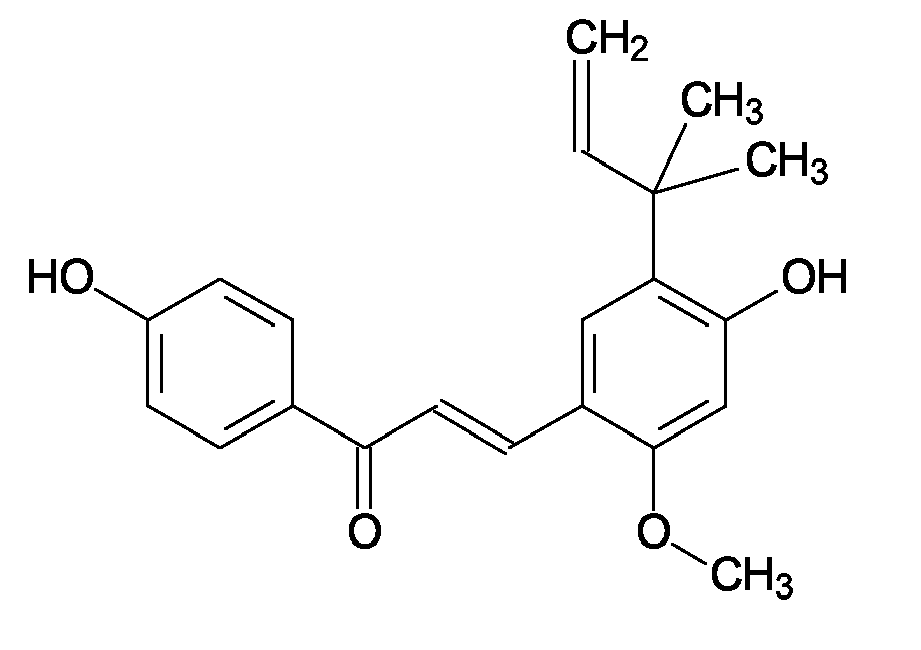
- Licocalchon kann vorteilhaft auch als Bestandteil von pflanzlichen Extrakten, insbesondere von wäßrigen Radix Glycyrrhizae inflatae, eingesetzt werden.
- Es ist erfindungsgemäß vorteilhaft, wenn die kosmetischen Zubereitungen 0,001 bis 10 Gew.-%, insbesondere 0,05 bis 5 Gew.-%, ganz besonders 0,01 bis 2 Gew.-% an einem Extrakt aus Radix Glycyrrhizae inflatae enthalten, jeweils bezogen auf das Gesamtgewicht der Zubereitung.
- Ganz besonders vorteilhaft ist es, von einem Extrakt auszugehen, der unter der Bezeichnung Polyol Soluble Licorice Extract PU (INCI-Bezeichnung Glycyrrhiza Inflata) von der Firma Maruzen zu erhalten ist. Der Extrakt aus Radix Glycyrrhizae inflatae enthält einen Anteil von ca. 25 % Licochalcone A.
- Erfindungsgemäße Rezepturen, welche z. B. bekannte Antifaltenwirkstoffe wie Flavonglycoside (insbesondere α-Glycosylrutin), Coenzym Q10, Vitamin E und/oder Derivate und dergleichen enthalten, eignen sich insbesondere vorteilhaft zum Schutz vor ästhetisch unattraktiven Hautveränderungen, wie sie z. B. bei der Hautalterung auftreten (wie beispielsweise Trockenheit, Rauhigkeit und Ausbildung von Trockenheitsfältchen, Juckreiz, verminderte Rückfettung (z. B. nach dem Waschen), sichtbare Gefäßerweiterungen (Teleangiektasien, Cuperosis), Schlaffheit und Ausbildung von Falten und Fältchen, lokale Hyper-, Hypo- und Fehlpigmentierungen (z. B. Altersflecken), vergrößerte Anfälligkeit gegenüber mechanischem Stress (z. B. Rissigkeit) und dergleichen). Weiterhin vorteilhaft eignen sie sich gegen das Erscheinungsbild der trockenen bzw. rauhen Haut.
- Erfindungsgemäß vorteilhafte Ausführungsformen der vorliegenden Erfindung sind dadurch gekennzeichnet, dass sie ölphasenstabilisierende Wachse in einer Gesamtkonzentration von 0,1 bis 10 Gewichts-%, bevorzugt in einer Konzentration von 1 bis 3 Gewichts-% und besonders bevorzugt von 2 Gewichts-%, jeweils bezogen auf das Gesamtgewicht der Zubereitung, enthalten. Dabei ist es erfindungsgemäß bevorzugt als ölphasenstabilisierenden Wachse Hydroxyoctacosanylhydroxystearate einzusetzen.
- Vorteilhaft im Sinne der vorliegenden Erfindung sind Zubereitungen zur Pflege der Haut: sie können dem kosmetischen Lichtschutz, ferner als Schminkprodukt in der dekorativen Kosmetik dienen. Eine weitere vorteilhafte Ausführungsform der vorliegenden Erfindung besteht in After-Sun-Produkten.
- Entsprechend ihrem Aufbau können kosmetische Zusammensetzungen im Sinne der vorliegenden Erfindung, beispielsweise verwendet werden als Hautschutzcrème, Tages- oder Nachtcrème usw.
- Erfindungsgemäß ist auch das Verfahren zur Herstellung einer erfindungsgemäßen Feststoff-stabilisierten, kosmetischen Emulsion, welches dadurch gekennzeichnet ist, dass die erfindungsgemäßen Lösungsvermittler in die Wasser- Phase eingearbeitet wird und bei 78°C in die Fett- unter Energie- Eintrag Phase eingerührt wird.
- Die nachfolgenden Beispiele sollen die vorliegende Erfindung verdeutlichen, ohne sie einzuschränken. Alle Mengenangaben, Anteile und Prozentanteile sind, soweit nicht anders angegeben, auf das Gewicht und die Gesamtmenge bzw. auf das Gesamtgewicht der Zubereitungen bezogen.
-
Wasser Ad 100 Ad 100 Ad 100 Ad 100 Ad 100 Ad 100 Ad 100 Glycerin 10 0 5 12,5 7,5 15 10 Konservierung 0,5 0,5 0,5 0,5 0,5 0,5 0,5 Cyclomethicon 20 0 0 0 5 10 20 Mineralöl 0 22 0 0 5 2 5 Octyldodecanol 0 0 30 0 5 2 0 Isopropylpalmitat 0 0 0 27 5 2 2 Hydroxyoctacosanyl 2 2,5 1,5 1 2,2 1,25 2 Hydroxystearat Milchsäure 0,21 0,25 0,1 0,25 0,22 0,15 0,21 Natriumchlorid 1 1,5 1,75 0,8 0,75 0,3 1 Disteardimoniumhectorit 2 1 1,5 0,75 2,5 4 2 Isodecylneopentanoat 12 10 0 5 12 21 5 PEG-20 Glyceryllaurat 1 0 0 0,5 0,5 0,25 0 PEG-40 hydriertes Rizinusöl 0 1 0 0,5 0 0,25 2,5 Polysorbat 65 0 0 1 0 0,5 0,5 0 Parfum 0,5 0,5 0,5 0,5 0,5 0,5 0,5 Bornitrid 2 1,75 1 3,5 2,15 2,5 2
Claims (8)
- Kosmetische Pickering-Emulsion enthaltend hydrophile Lösungsvermittler mit einem HLB-Wert von größer/gleich 11 in einer Konzentration von 0,1 bis 5 Gewichts-%, bezogen auf das Gesamtgewicht der Emulsion.
- Verwendung von hydrophilen Lösungsvermittlern mit einem HLB-Wert von größer/gleich 11 in einer Konzentration von 0,1 bis 5 Gewichts-%, bezogen auf das Gesamtgewicht der Zubereitung, in kosmetischen Pickering-Emulsionen zur Verringerung der Viskosität der Zubereitung.
- Emulsion nach Anspruch 1 oder Verwendung nach Anspruch 2, dadurch gekennzeichnet, dass die Emulsion bei 25 °C eine Viskosität von 200 bis 4000 mPas aufweist.
- Emulsion oder Verwendung nach einem der vorhergehenden Ansprüche, dadurch gekennzeichnet, dass als Lösungsvermittler eine oder mehrere Verbindungen gewählt aus der Gruppe der Verbindungen PEG-40 hydriertes Rizinusöl, PEG-60 hydriertes Rizinusöl, PEG-8, PEG-20 Glyceryllaurat, PEG-30 Glycerylstearat, Polysorbat 65 und/oder Propylencarbonat eingesetzt werden.
- Emulsion oder Verwendung nach einem der vorhergehenden Ansprüche, dadurch gekennzeichnet, dass als Pickering-Pigment Bornitrid mit einer durchschnittlichen Partikelgröße von 2 bis 10 µm eingesetzt wird.
- Emulsion oder Verwendung nach einem der vorhergehenden Ansprüche, dadurch gekennzeichnet, dass sie eine oder mehrere Verbindungen aus der Gruppe der Hectorite und/oder Bentonite in einer Konzentration von 0,5 bis 4 Gewichts-%, bezogen auf das Gesamtgewicht der Zubereitung, enthält.
- Emulsion oder Verwendung nach einem der vorhergehenden Ansprüche, dadurch gekennzeichnet, dass sie ölphasenstabilisierende Wachse in einer Gesamtkonzentration von 0,1 bis 10 Gewichts-%, bezogen auf das Gesamtgewicht der Zubereitung, enthält.
- Emulsion oder Verwendung nach einem der vorhergehenden Ansprüche, dadurch gekennzeichnet, dass als ölphasenstabilisierenden Wachse Hydroxyoctacosanylhydroxystearate eingesetzt werden.
Applications Claiming Priority (1)
| Application Number | Priority Date | Filing Date | Title |
|---|---|---|---|
| DE200410032843 DE102004032843A1 (de) | 2004-07-07 | 2004-07-07 | Dünnflüssige Pickering-Emulsion |
Publications (1)
| Publication Number | Publication Date |
|---|---|
| EP1627668A1 true EP1627668A1 (de) | 2006-02-22 |
Family
ID=35058283
Family Applications (1)
| Application Number | Title | Priority Date | Filing Date |
|---|---|---|---|
| EP05106046A Withdrawn EP1627668A1 (de) | 2004-07-07 | 2005-07-04 | Dünnflüssige Pickering-Emulsion |
Country Status (2)
| Country | Link |
|---|---|
| EP (1) | EP1627668A1 (de) |
| DE (1) | DE102004032843A1 (de) |
Cited By (7)
| Publication number | Priority date | Publication date | Assignee | Title |
|---|---|---|---|---|
| EP1908451A3 (de) * | 2006-10-07 | 2009-09-30 | Beiersdorf AG | Kosmetische Zubereitungen mit naphthenarmen Mineralölen |
| DE102008049522A1 (de) | 2008-09-17 | 2010-04-15 | Universität Tübingen | Granulat, insbesondere als pharmazeutisches Vehikel für lipophile Arzneistoffe |
| WO2014184660A2 (en) | 2013-05-17 | 2014-11-20 | L'oreal | Emulsion stabilization |
| US9433578B2 (en) | 2013-05-17 | 2016-09-06 | L'oreal | Stable bubbles via particle absorption by electrostatic interaction |
| US9452406B2 (en) | 2013-05-17 | 2016-09-27 | L'oreal | Bubble encapsulation via silicilic acid complexation |
| US10028895B2 (en) | 2013-05-17 | 2018-07-24 | L'oreal | Emulsion stabilization via silicilic acid complexation |
| US10596079B2 (en) | 2015-09-24 | 2020-03-24 | Deckner Consulting Services, Llc | High efficiency sunscreen composition |
Citations (6)
| Publication number | Priority date | Publication date | Assignee | Title |
|---|---|---|---|---|
| DE19933463A1 (de) * | 1998-07-10 | 2000-01-13 | Beiersdorf Ag | W/O-Emulsionen mit einem Gehalt an Ectoinen |
| EP1055414A1 (de) * | 1999-05-22 | 2000-11-29 | Beiersdorf Aktiengesellschaft | Kosmetische oder dermatologische Lichtschutzzubereitungen mit einem Gehalt an Bornitrid und sulfonierten UV-Filtersubstanzen sowie die Verwendung von Bornitrid zur Stabilisierung von Emulsionen, die einen Gehalt an Elektrolyten, insbesondere einen Gehalt an sulfonierten UV-Filtersubstanzen, aufweisen |
| EP1310235A2 (de) * | 2001-11-09 | 2003-05-14 | Beiersdorf AG | Emulgatorfreie kosmetische und dermatologische Lichtschutzformulierungen mit einem Gehalt an Hydroxybenphenonen |
| DE20314969U1 (de) * | 2003-09-26 | 2003-12-04 | Beiersdorf Ag | Lichtschutzzubereitung mit einem Gehalt an reflektierenden Pigmenten (Mikrospiegeln) |
| DE10238649A1 (de) * | 2002-08-23 | 2004-03-11 | Beiersdorf Ag | Dünnflüssige kosmetische oder dermatologische Zubereitungen von Typ Öl-in Wasser |
| EP1477159A1 (de) * | 2003-05-12 | 2004-11-17 | Beiersdorf AG | Stabilisierung von Selbstbräunungsprodukten durch Schichtsilikate |
Family Cites Families (3)
| Publication number | Priority date | Publication date | Assignee | Title |
|---|---|---|---|---|
| DE10224025A1 (de) * | 2002-05-31 | 2003-12-11 | Beiersdorf Ag | Pflegendes Haarshampoo |
| DE10231062A1 (de) * | 2002-07-10 | 2004-01-22 | Beiersdorf Ag | Kosmetische und dermatologische Lichtschutzformulierungen mit einem Gehalt an hydrophobisierten Acrylamidomethylpropylsulfonsäure-Polymeren |
| DE10230969A1 (de) * | 2002-07-10 | 2004-01-22 | Beiersdorf Ag | Selbstwärmendes Kosmetikum |
-
2004
- 2004-07-07 DE DE200410032843 patent/DE102004032843A1/de not_active Withdrawn
-
2005
- 2005-07-04 EP EP05106046A patent/EP1627668A1/de not_active Withdrawn
Patent Citations (6)
| Publication number | Priority date | Publication date | Assignee | Title |
|---|---|---|---|---|
| DE19933463A1 (de) * | 1998-07-10 | 2000-01-13 | Beiersdorf Ag | W/O-Emulsionen mit einem Gehalt an Ectoinen |
| EP1055414A1 (de) * | 1999-05-22 | 2000-11-29 | Beiersdorf Aktiengesellschaft | Kosmetische oder dermatologische Lichtschutzzubereitungen mit einem Gehalt an Bornitrid und sulfonierten UV-Filtersubstanzen sowie die Verwendung von Bornitrid zur Stabilisierung von Emulsionen, die einen Gehalt an Elektrolyten, insbesondere einen Gehalt an sulfonierten UV-Filtersubstanzen, aufweisen |
| EP1310235A2 (de) * | 2001-11-09 | 2003-05-14 | Beiersdorf AG | Emulgatorfreie kosmetische und dermatologische Lichtschutzformulierungen mit einem Gehalt an Hydroxybenphenonen |
| DE10238649A1 (de) * | 2002-08-23 | 2004-03-11 | Beiersdorf Ag | Dünnflüssige kosmetische oder dermatologische Zubereitungen von Typ Öl-in Wasser |
| EP1477159A1 (de) * | 2003-05-12 | 2004-11-17 | Beiersdorf AG | Stabilisierung von Selbstbräunungsprodukten durch Schichtsilikate |
| DE20314969U1 (de) * | 2003-09-26 | 2003-12-04 | Beiersdorf Ag | Lichtschutzzubereitung mit einem Gehalt an reflektierenden Pigmenten (Mikrospiegeln) |
Cited By (7)
| Publication number | Priority date | Publication date | Assignee | Title |
|---|---|---|---|---|
| EP1908451A3 (de) * | 2006-10-07 | 2009-09-30 | Beiersdorf AG | Kosmetische Zubereitungen mit naphthenarmen Mineralölen |
| DE102008049522A1 (de) | 2008-09-17 | 2010-04-15 | Universität Tübingen | Granulat, insbesondere als pharmazeutisches Vehikel für lipophile Arzneistoffe |
| WO2014184660A2 (en) | 2013-05-17 | 2014-11-20 | L'oreal | Emulsion stabilization |
| US9433578B2 (en) | 2013-05-17 | 2016-09-06 | L'oreal | Stable bubbles via particle absorption by electrostatic interaction |
| US9452406B2 (en) | 2013-05-17 | 2016-09-27 | L'oreal | Bubble encapsulation via silicilic acid complexation |
| US10028895B2 (en) | 2013-05-17 | 2018-07-24 | L'oreal | Emulsion stabilization via silicilic acid complexation |
| US10596079B2 (en) | 2015-09-24 | 2020-03-24 | Deckner Consulting Services, Llc | High efficiency sunscreen composition |
Also Published As
| Publication number | Publication date |
|---|---|
| DE102004032843A1 (de) | 2006-02-16 |
Similar Documents
| Publication | Publication Date | Title |
|---|---|---|
| DE102004047286B4 (de) | Kosmetische Lichtschutzzubereitung auf Basis von Mikropigmenten | |
| EP1923045B1 (de) | Kosmetische Formulierung mit Glucosylglyceriden und Puderrohstoffen | |
| EP1796619A1 (de) | O/w-emulsion mit anorganischen uv-lichtschutzfilterpigmenten und alkylsufat | |
| WO2003020233A2 (de) | Stabilisierung uv-empfindlicher wirkstoffe | |
| EP1819315B1 (de) | 2-phenylethylbenzoat in kosmetischen öl-in-wasser-uv-lichtschutzemulsionen | |
| DE19933463A1 (de) | W/O-Emulsionen mit einem Gehalt an Ectoinen | |
| EP1476130B1 (de) | Verwendung von bestimmten diolen zur reduzierung der viskosität von kosmetischen und/oder dermatologischen zubereitungenm | |
| EP2907497B1 (de) | Kosmetische Emulgatorkombination | |
| WO2003039506A2 (de) | Kosmetische und dermatologische lichtschutzformulierungen mit einem gehalt an hydroxybenzophenonen und alkylnaphthalaten | |
| EP1451242B1 (de) | Wasser-in-silikon-emulsionen | |
| EP1857096B1 (de) | Sprühbares Sonnenschutzmittel | |
| EP1423088A2 (de) | Stabilisierung oxidations- und/oder uv-empfindlicher wirkstoffe | |
| DE202006011472U1 (de) | Kosmetische Formulierung mit (2-Hydroxyethyl)harnstoff und einem Wirkstoffkomplex | |
| WO2008058681A1 (de) | Kosmetische formulierung mit glucosylglyceriden und harnstoff | |
| DE102004032843A1 (de) | Dünnflüssige Pickering-Emulsion | |
| EP2114354B1 (de) | Lichtschutzzubereitung mit einer kombination von mikropigmenten | |
| WO2005117825A1 (de) | 2-phenylethylbenzoat in kosmetischen wasser-in-öl-emulsionen | |
| WO2003020317A2 (de) | Kosmetische und dermatologische lichtschutzformulierungen mit einem gehalt an wasserlöslichen uv-filtersubstanzen und alkylnaphthalaten | |
| WO2004058208A1 (de) | Stabile zinkoxidhaltige öl-in-wasser-emulsionen | |
| EP1958609A1 (de) | Kosmetische Zubereitung mit wasserlöslichem UV-Lichtschutzfilter und Vinylpyrrolidon/Acrylsäure-Copolymer | |
| EP1634623A2 (de) | Fließfähige kosmetische Zubereitung mit Lichtschutzfiltern | |
| DE102004032842A1 (de) | Silikonhaltige, feststoffstabilisierte Emulsion | |
| DE202006005804U1 (de) | Zubereitung mit hydriertem Pflanzenöl | |
| WO2008058718A1 (de) | Emulsion mit dimethyldioctadecylammoniumchlorid | |
| DE102005005176A1 (de) | W/O-Emulsionen mit festen Dialkylethern bzw. Dialkylcarbonaten |
Legal Events
| Date | Code | Title | Description |
|---|---|---|---|
| PUAI | Public reference made under article 153(3) epc to a published international application that has entered the european phase |
Free format text: ORIGINAL CODE: 0009012 |
|
| AK | Designated contracting states |
Kind code of ref document: A1 Designated state(s): AT BE BG CH CY CZ DE DK EE ES FI FR GB GR HU IE IS IT LI LT LU LV MC NL PL PT RO SE SI SK TR |
|
| AX | Request for extension of the european patent |
Extension state: AL BA HR MK YU |
|
| RIN1 | Information on inventor provided before grant (corrected) |
Inventor name: SCHWANKE, FRANK Inventor name: STILLER, SABINE Inventor name: SYSKOWSKI, BORIS |
|
| 17P | Request for examination filed |
Effective date: 20060822 |
|
| AKX | Designation fees paid |
Designated state(s): AT BE BG CH CY CZ DE DK EE ES FI FR GB GR HU IE IS IT LI LT LU LV MC NL PL PT RO SE SI SK TR |
|
| 17Q | First examination report despatched |
Effective date: 20060927 |
|
| STAA | Information on the status of an ep patent application or granted ep patent |
Free format text: STATUS: THE APPLICATION IS DEEMED TO BE WITHDRAWN |
|
| 18D | Application deemed to be withdrawn |
Effective date: 20070411 |