EP1622294A2 - Unterschiedliche Aktualisierung zum Datenrundfunk - Google Patents
Unterschiedliche Aktualisierung zum Datenrundfunk Download PDFInfo
- Publication number
- EP1622294A2 EP1622294A2 EP05014371A EP05014371A EP1622294A2 EP 1622294 A2 EP1622294 A2 EP 1622294A2 EP 05014371 A EP05014371 A EP 05014371A EP 05014371 A EP05014371 A EP 05014371A EP 1622294 A2 EP1622294 A2 EP 1622294A2
- Authority
- EP
- European Patent Office
- Prior art keywords
- broadcast
- document
- data
- information
- version
- Prior art date
- Legal status (The legal status is an assumption and is not a legal conclusion. Google has not performed a legal analysis and makes no representation as to the accuracy of the status listed.)
- Ceased
Links
Images


Classifications
-
- H—ELECTRICITY
- H04—ELECTRIC COMMUNICATION TECHNIQUE
- H04H—BROADCAST COMMUNICATION
- H04H60/00—Arrangements for broadcast applications with a direct linking to broadcast information or broadcast space-time; Broadcast-related systems
- H04H60/25—Arrangements for updating broadcast information or broadcast-related information
-
- H—ELECTRICITY
- H04—ELECTRIC COMMUNICATION TECHNIQUE
- H04N—PICTORIAL COMMUNICATION, e.g. TELEVISION
- H04N21/00—Selective content distribution, e.g. interactive television or video on demand [VOD]
- H04N21/20—Servers specifically adapted for the distribution of content, e.g. VOD servers; Operations thereof
- H04N21/25—Management operations performed by the server for facilitating the content distribution or administrating data related to end-users or client devices, e.g. end-user or client device authentication, learning user preferences for recommending movies
-
- H—ELECTRICITY
- H04—ELECTRIC COMMUNICATION TECHNIQUE
- H04H—BROADCAST COMMUNICATION
- H04H60/00—Arrangements for broadcast applications with a direct linking to broadcast information or broadcast space-time; Broadcast-related systems
- H04H60/29—Arrangements for monitoring broadcast services or broadcast-related services
- H04H60/32—Arrangements for monitoring conditions of receiving stations, e.g. malfunction or breakdown of receiving stations
-
- H—ELECTRICITY
- H04—ELECTRIC COMMUNICATION TECHNIQUE
- H04H—BROADCAST COMMUNICATION
- H04H2201/00—Aspects of broadcast communication
- H04H2201/30—Aspects of broadcast communication characterised by the use of a return channel, e.g. for collecting users' opinions, for returning broadcast space/time information or for requesting data
- H04H2201/33—Aspects of broadcast communication characterised by the use of a return channel, e.g. for collecting users' opinions, for returning broadcast space/time information or for requesting data via the broadcast channel
Definitions
- the described subject matter relates to electronic communication, and more particularly to differential updates for data broadcasting
- data broadcasting refers generally to the widespread distribution of the same content to a plurality (typically a large number) of subscriber units
- Advances in electronic computing and communication technology, particularly wireless communication technology have enabled data broadcasting techniques to be applied in wireless communication markets to service mobile subscriber units Examples of such technologies include Digital Audio Broadcast, or Digital Video Broadcast
- the content is broadcast to multiple clients simultaneously using the same physical channel (e g, the same time slot or frequency), thereby efficiently using network resources Regardless of the number of subscriber units, the server only sends one copy of the content, thus minimizing the impact in the server's capacity
- Bandwidth limitations in the wireless communication channel(s) available to data broadcasting services establish a real physical limit to the amount of content that a data broadcasting service can distribute in a given time period
- Improved content distribution schemes would enable data broadcasting services to manage limited bandwidth more effectively and to provide improved services to customers.
- Implementations described and claimed herein provide systems and methods for performing differential updates for data broadcasting
- one or more computing devices associated with a data broadcasting system maintains profile data records for subscribers to the data broadcasting system
- the allocation of content m the broadcast carousel for a broadcast region may be adjusted in response to version information for specific documents among subscribers in the broadcast region.
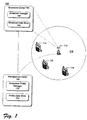
- Fig 1 is a schematic illustration of an exemplary implementation of a data broadcasting network
- Fig 2 is a schematic depiction of an exemplary system for intelligent data broadcasting.
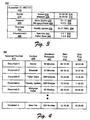
- Fig 3 is an illustration of an exemplary data structure for holding subscnber profile information
- Fig 4 is an illustration of a data structure representing a data broadcasting carousel
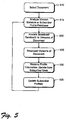
- Fig 5 is a flowchart illustrating operations m an exemplary method for performing differential updates in data broadcasting
- Fig 6 is a schematic illustration of an exemplary computing device
- techniques can utilize subscriber preference and/or location information to adjust the data broadcast content within a specific data broadcast region
- a network management system can adjust data broadcast content on one or more data broadcasting regions in a dynamic fashion in response to changes in the distribution of subscriber preferences in the region
- Fig. 1 is a schematic illustration of an exemplary implementation of a data broadcasting environment 100 in which the subject matter described herein may be implemented It will be appreciated that the environment 100 depicted m Fig 1 is merely an exemplary environment and is not intended to suggest any limitation as to particular uses or functionality
- the subject matter described herem may be implemented in a wide variety of data distribution environments including, but not limited to, radio, television, and satellite networks, digital radio systems, broadcast disk systems, publish/subscribe systems, Internet-based broadcasting systems, and the like
- the environment 100 includes at least a head end 112 that broadcasts data throughout a broadcast region 110 to one or more subscriber units 114 that subscribe to a data broadcasting service transmitted from head end 112
- broadcast and its derivatives should be construed broadly to encompass any form of modulating, coding, and/or transmitting of a communication signal across a communication medium, wired or wireless
- subscnbe should be construed broadly to encompass any form of receiving, demodulating, and/or decoding of data broadcast head end 112
- the broadcast environment 100 includes a single broadcast region 110 which includes a head end 112, which broadcasts data throughout its broadcast region
- Fig 1 illustrates three a single head end 112 defining a single broadcast region 110
- the specific number of regions is not important, and may vary depending upon, e g, the geographic size of the operating environment, transmission power constraints, and interference and/or obstructions of the signal(s) broadcast from the head end 112
- Head end 112 further includes infrastructure necessary for broadcasting a data signal
- such infrastructure may include equipment for encoding, modulating, and transmitting or transceiving a radio frequency (RF) signal at a specific frequency (or frequencies), or in accordance with a specific multi-frequency protocol
- RF radio frequency
- Such equipment is readily commercially available, and is known to those skilled in the art The particular encoding, modulating, and/or transmission scheme is not important
- the broadcast environment 100 further includes a plurality of subscriber units 114, 116, 118, which may be embodied as wireless communication devices such as, e g , personal computers (PCs), laptop computers, personal digital assistants (PDAs), mobile phones, or the like
- subscriber units 114, 116, 118 which may be embodied as wireless communication devices such as, e g , personal computers (PCs), laptop computers, personal digital assistants (PDAs), mobile phones, or the like
- the head end 112 may be assigned a unique identifier within broadcast environment 100
- a head end 112 may be identified by a network address, station name, a carrier frequency, or other distinct designation
- a data broadcast from a head end 112 to a subscriber unit 114, 116, 118 takes place over a communication channel
- the communication channel(s) may be defined by modulating a carrier wave m accordance with any conventional RF broadcasting technique such as, e g , TDMA, FDMA, CDMA, or the like
- the transmitted content may include various forms of data including, e g , text, audio, video, and may also include control signals including, e g, timing signals, power signals, location signals, etc Control signals may be broadcast in-band, or on a separate control channel
- the communication channel may comprise an uplink channel that may be implemented over a wired network such as, e g, the internet, or a wireless network, or combinations thereof
- Broadcast environment 100 further includes a broadcast center 140 for managing the broadcast operations of head ends 112 and a management center 150 for managing subscriber profile information and other network management information
- Broadcast center 140 includes a broadcast manager 142 and a broadcast data store 144
- Management center 150 includes a subscriber profile manager 152 and a subscriber data profile 154
- the broadcast center 140 cooperates with the management center 150 to manage subscriber information, network information, and data broadcasting from one or more of the respective head ends 112 of the operating environment 100
- broadcast center 140 and management center 150 may reside on a single computing device such as, e g , a server computer associated with broadcasting environment 100
- the responsibility for broadcast management and subscriber profile management may be distributed between the head ends and the management center 150 in a different manner, or may be consolidated in either the management center 150 or the head ends 112
- the environment 100 may include a single management center 150, but the head end 112 may include a broadcast center 140
- the head end 112 cooperates with the management center 150 to implement a data broadcast network that may cover a geographic region ranging in size from a region as small as a specific building or a corporate or academic campus to a region as large an entire country or continent
- the head end 112 cooperates with the management center 150 to manage subscriber information, network information, and data broadcasting
- Communication sessions between the subscriber units 114, 116 and the management center 150 may be initiated over the wireless link on an ad-hoc basis or in a structured fashion such as, e g , during a synchronization procedure
- Fig. 2 is a schematic illustration of an exemplary computer system 200 adapted to include a broadcast center 140 and a management center 150
- This computer system 200 includes a display 202 having a screen 204, one or more user-input devices 206, and a computer 208
- the user-input devices 206 can include any device allowing a computer to receive a developer's input, such as a keyboard 210, other device(s) 212, and a mouse 214
- the other device(s) 212 can include a touch screen, a voice-activated input device, a track ball, and any other device that allows the system 200 to receive input from a developer
- the computer 208 includes a processing unit 216 and random access memory and/or read-only memory 218
- Memory 218 includes an operating system 220 for managing operations of computer 208
- one or more application programs executable on the processing unit 216 reside m memory 218, including a profile manager 222 and a broadcast manager 224
- Memory 218 further includes one or more data files including user profile data files 228 and data broadcast files 230 Operation of the system 200 is explamed in greater detail below
- Fig. 3 is an illustration of an exemplary data structure for subscriber profile information
- a subscriber to the data broadcasting system maintains a subscriber profile including a subscriber identity and specifying particular categories of information of interest to the subscriber
- This information may be stored in a suitable memory location such as, e g, the user profile data files 228 stored in the memory 218 of computer 208
- the file may be embodied as, e g, a relational database
- the subscriber profile information may also be stored in the memory 318 of the data broadcasting subscriber unit, e g, m the user profile data files 328
- the subscriber profile mformation data structure includes a subscriber ID data field 300 and one or more categories of information of interest
- the categories of interest include sports 310, finance 320, business 330, and entertainment 340
- Each category may include sub-categones specifying in further detail information of interest to the subscriber identified by subscriber ID 300
- the sports category 300 includes a soccer sub-category 312 and a baseball sub-category 314
- the finance category 320 includes a stock quotes sub-category 322 and a mortgage rates sub-category 324
- the business category 330 includes a weekly update sub-category 332, and the entertainment category includes a new hits sub-category 342 and a fallen stars sub-category 344
- the data structure depicted in Fig 3 may be expanded to include additional layers of sub-categories further detailing information of interest to a subscriber
- the soccer sub-category may be expanded to include additional layers of sub-categories further detailing information of interest to a subscriber
- the subscriber profiles may be specific to the respective broadcast region in which the subscriber device is operating
- a subscriber may be interested in a particular set of information when the subscriber is in broadcast region 110 and a different set of information when the subscriber is in a different broadcast region
- the subscriber profile may be modified to include a data broadcast region indicator and corresponding data of interest for the particular broadcast region(s)
- Fig 4 is an illustration of a data structure representing a data broadcasting schedule 400 for data broadcasting system 100
- the data broadcasting schedule 400 may be stored m the broadcast data store 144, e g, as one of the broadcast data files 230 stored in the memory 218 of computer 208
- the data broadcasting schedule 400 may be represented m tabular format as a series of documents 410 for broadcast, each of which is identified by a content identifier 420 that describes the content of the document
- the broadcast schedule 400 further includes a broadcast periodicity 530 associated with the document that defines the periodicity with which the document is broadcast
- the broadcast schedule further includes a start time 440 and a stop time 450 for each document
- the broadcast schedule depicted in Fig 4 reflects that document number 1 in the broadcast schedule includes soccer information, and is broadcast every sixty minutes beginning at 06 00 00 and terminating at 06 05 00
- the data broadcast manager 224 maintains the data broadcast schedule 400
- the data broadcast manager 224 may include a user interface that permits a user to add documents to or delete documents from the data broadcast schedule 400, and/or to modify the periodicity with which documents are broadcast
- the broadcast duration is a function of the amount of data to be broadcast and the bandwidth available to the data broadcasting system 100
- the broadcast manager 224 may update the start time 440 and stop time 450 to reflect the next broadcast of the document
- the data broadcast files 230 may also include the content to be broadcast
- the soccer document may include scores and other information about soccer teams
- the stock quotes may document may include current quotes for particular stocks
- This information may be updated periodically by the data broadcast manager 224 or by another application program executing on the processing unit 216 of computer 208
- the broadcast manager retrieves the document from the data broadcast files 230 and broadcast the document over from one or more head ends 112 in the system 100
- the broadcast schedule may be specific to a head end 112, such that the broadcast schedule is unique to a broadcast region 110
- an exemplary implementation entries in the subscriber profile may also include a data field that identifies the document stored in the memory of the device
- the entry may include a time stamp such as time stamp 316 or 318 that identifies a time at which the document was downloaded
- the entry may include a version number such as version number 326, 328, 346, and 348 that uniquely identifies the version of the document stored in the user's device
- the entry may include a date stamp that identifies the date of the document stored in the user's device
- documents are transmitted to the subscriber unit over a wireless communication channel between a head end 112 and a subscriber unit 114, 116, 118
- documents may also be transmitted to the subscriber unit over a wired connection, e g , such as a data network, when a subscriber unit is positioned in its cradle for charging
- a confirmation message back to the management center 150
- the confirmation message includes information identifying the version of the document stored in the memory of the subscriber unit 114, 116, 118 This version information may be stored m the subscriber profile 300
- the broadcast manager(s) 224 cooperate with the profile manager(s) 222 to manage the data broadcast in an intelligent manner which reflects the aggregate version information of documents for the subscribers in the broadcast region
- Fig 5 is a flowchart illustrating operations in an exemplary method for intelligent data broadcasting
- the operations of Fig 5 may be implemented by the data broadcast manager 224 of computer 208
- certain of the operations may be performed by the profile manager module 222 of computer 208
- the broadcast manager and the profile manager may be centrally located in a single computer
- each head end 112 may maintain an independent broadcast manager and/or profile manager, which may communicate as necessary to implement intelligent broadcast operations
- the broadcast manager 224 selects a document, e g , from the broadcast schedule 400, for analysis
- the broadcast manager analyzes version statistics in the subscriber profile database for the document
- the analysis involves retrieving from the subscriber profile version information from each subscriber profile such as profile 300 in the subscriber profile database and creating a histogram representing the number of subscriber units that possess specific versions of a document
- broadcast bandwidth is allocated to the versions of the document
- broadcast bandwidth for each version of the document may be allocated in proportion to the number of subscriber units who require the differential information in a version to bring the version of the document stored on the subscriber unit up to date
- document number 4 may include a large amount of business data compiled during the course of the previous week, and which is updated on a periodic basis If ninety percent of the subscriber units in a broadcast region have stored in their respective memory modules a version of the document that is twenty-four hours old, and only ten percent of the subscriber units have stored in their respective memory modules a version of the document that is a week old, then broadcast bandwidth for the document may be allocated in a manner that updates ninety percent of the users first The broadcast manager can queue for broadcasting a document that represents the incremental information required to update the ninety percent of subscriber units The full document may be allocated relatively less broadcast bandwidth At operation 525 the document is broadcast
- the subscriber unit can optionally execute a routine to determine whether the document should be committed to memory
- the document may include an identifier that includes information that permits the subscriber unit to make this determination
- the document may include a version number, and the subscriber unit may commit the document to memory only if the version number of the received document corresponds to a predetermined version numbering scheme If the subscriber unit commits the document to memory, then the subscriber unit may transmit a confirmation message to the subscriber profile manager 152 indicating that the document has been committed to memory
- the subscriber profile manager 152 may receive the profile information update from subscriber units (operation 530) and then update the subscriber profile associate with the subscriber unit to reflect receipt of the document (operation 535) Control may then pass back to operation 515, and the broadcast manager can continue processing other documents m the queue
- the broadcast manager can allocate the broadcast bandwidth between various versions of documents m the broadcast carousel in a manner that uses the bandwidth to efficiently update subscriber units that have the document in their respective profiles It will be appreciated that the process can be repeated for all documents in the broadcast carousel to allocate the broadcast bandwidth further, it will be appreciated that the subscriber modules may obtain content from sources other than the data broadcast such as, e g , wired networks, magnetic or optical media, etc
- FIG. 6 shows components of typical example of such a computer, referred by to reference numeral 600
- the components shown in Fig 6 are only examples, and are not intended to suggest any limitation as to the scope of the functionality of the invention, the invention is not necessarily dependent on the features shown in Fig 6
- program modules include routines, programs, objects, components, data structures, etc that perform particular tasks or implement particular abstract data types Tasks might also be performed by remote processing devices that are linked through a communications network
- program modules may be located in both local and remote computer storage media
- the instructions and/or program modules are stored at different times in the various computer-readable media that are either part of the computer or that can be read by the computer
- Programs are typically distributed, for example, on floppy disks, CD-ROMs, DVD, or some form of communication media such as a modulated signal From there, they are installed or loaded into the secondary memory of a computer At execution, they are loaded at least partially into the computer's primary electronic memory
- the invention described herein includes these and other various types of computer-readable media when such media contain instructions programs, and/or modules for implementing the steps described below in conjunction with a microprocessor or other data processors
- the invention also includes the computer itself when programmed according to the methods and techniques described below
- the components of computer 600 may include, but are not limited to, a processing unit 604, a system memory 606, and a system bus 608 that couples various system components including the system memory to the processing unit 604
- the system bus 608 may be any of several types of bus structures including a memory bus or memory controller, a peripheral bus, and a local bus using any of a variety of bus architectures
- bus architectures include Industry Standard Architecture (ISA) bus, Micro Channel Architecture (MCA) bus, Enhanced ISA (EISAA) bus, Video Electronics Standards Association (VESA) local bus, and Peripheral Component Interconnect (PGI) bus also known as the Mezzanine bus
- Computer 600 typically includes a variety of computer-readable media
- Computer-readable media can be any available media that can be accessed by computer 600 and includes both volatile and nonvolatile media, removable and non-removable media
- Computer-readable media may comprise computer storage media and communication media
- Computer storage media includes volatile and nonvolatile, removable and non-removable media implemented in any method or technology for storage of information such as computer-readable instructions, data structures, program modules, or other data
- Computer storage media includes, but is not limited to, RAM, ROM, EEPROM, flash memory or other memory technology, CD-ROM, digital versatile disks (DVD) or other optical disk storage, magnetic cassettes, magnetic tape, magnetic disk storage or other magnetic storage devices, or any other medium which can be used to store the desired information and which can be accessed by computer 600
- Communication media typically embodies computer-readable instructions, data structures, program modules or other data in a modulated data signal such as a carrier wave or other transport mechanism and includes any information delivery media
- modulated data signal means a signal
- the system memory 606 includes computer storage media in the form of volatile and/or nonvolatile memory such as read only memory (ROM) 610 and random access memory (RAM) 612
- ROM read only memory
- RAM random access memory
- RAM 612 typically contains data and/or program modules that are immediately accessible to and/or presently being operated on by processing unit 604
- Fig 6 illustrates operating system 616, application programs 618, other program modules 620, and program data 622
- the computer 600 may also include other removable/non-removable, volatile/nonvolatile computer storage media
- Fig 6 illustrates a hard disk drive 624 that reads from or writes to non-removable, nonvolatile magnetic media, a magnetic disk drive 626 that reads from or writes to a removable, nonvolatile magnetic disk 628, and an optical disk drive 630 that reads from or writes to a removable, nonvolatile optical disk 632 such as a CD ROM or other optical media
- Other removable/non-removable, volatile/nonvolatile computer storage media that can be used in the exemplary operating environment include, but are not limited to, magnetic tape cassettes, flash memory cards, digital versatile disks, digital video tape, solid state RAM, solid state ROM, and the like
- the hard disk drive 624 is typically connected to the system bus 608 through a non-removable memory interface such as data media interface 634, and magnetic disk drive 626 and optical disk drive 630 are typically connected to the system bus 608 by a removable
- hard disk drive 624 is illustrated as storing operating system 616', application programs 618', other program modules 620', and program data 622' Note that these components can either be the same as or different from operating system 616, application programs 618, other program modules 620, and program data 622 Operating system 616, application programs 618, other program modules 620, and program data 622 are given different numbers here to illustrate that, at a minimum, they are different copies
- input devices such as a keyboard 636, a mouse, trackball, or touch pad
- Other input devices may include a microphone, joystick, game pad, satellite dish, scanner, or the like
- I/O input/output
- the computer may operate in a networked environment using logical connections to one or more remote computers, such as a remote computing device 650
- the remote computing device 650 may be a personal computer, a server, a router, a network PC, a peer device or other common network node, and typically includes many or all of the elements described above relative to computer 600
- the logical connections depicted in Fig 6 include a local area network (LAN) 652 and a wide area network (WAN) 654
- LAN local area network
- WAN wide area network
- the WAN 654 shown in Fig 6 is the Internet, the WAN 654 may also include other networks
- Such networking environments are commonplace in offices, enterpnse-wide computer networks, intranets, and the like
- the computer 600 When used in a LAN networking environment, the computer 600 is connected to the LAN 652 through a network interface or adapter 656 When used in a WAN networking environment, the computer 600 typically includes a modem 658 or other means for establishing communications over the Internet 654
- the modem 658 which may be internal or external, may be connected to the system bus 608 via the I/O interface 642, or other appropriate mechanism
- program modules depicted relative to the computer 600, or portions thereof may be stored in the remote computing device 650
- Fig 6 illustrates remote application programs 660 as residing on remote computing device 650 It will be appreciated that the network connections shown are exemplary and other means of establishing a communications link between the computers may be used
Landscapes
- Engineering & Computer Science (AREA)
- Signal Processing (AREA)
- Databases & Information Systems (AREA)
- Multimedia (AREA)
- Data Exchanges In Wide-Area Networks (AREA)
- Two-Way Televisions, Distribution Of Moving Picture Or The Like (AREA)
- Mobile Radio Communication Systems (AREA)
Applications Claiming Priority (1)
| Application Number | Priority Date | Filing Date | Title |
|---|---|---|---|
| US10/899,990 US7653018B2 (en) | 2004-07-27 | 2004-07-27 | Differential update for data broadcasting |
Publications (2)
| Publication Number | Publication Date |
|---|---|
| EP1622294A2 true EP1622294A2 (de) | 2006-02-01 |
| EP1622294A3 EP1622294A3 (de) | 2010-09-01 |
Family
ID=35219699
Family Applications (1)
| Application Number | Title | Priority Date | Filing Date |
|---|---|---|---|
| EP05014371A Ceased EP1622294A3 (de) | 2004-07-27 | 2005-07-01 | Unterschiedliche Aktualisierung zum Datenrundfunk |
Country Status (5)
| Country | Link |
|---|---|
| US (1) | US7653018B2 (de) |
| EP (1) | EP1622294A3 (de) |
| JP (1) | JP4851135B2 (de) |
| KR (1) | KR101120687B1 (de) |
| CN (1) | CN1728699B (de) |
Cited By (6)
| Publication number | Priority date | Publication date | Assignee | Title |
|---|---|---|---|---|
| US10013815B2 (en) | 2006-12-13 | 2018-07-03 | Crown Equipment Corporation | Information system for industrial vehicles |
| US11225404B2 (en) | 2006-12-13 | 2022-01-18 | Crown Equipment Corporation | Information system for industrial vehicles |
| CN115484551A (zh) * | 2021-05-31 | 2022-12-16 | 比亚迪股份有限公司 | 广播系统控制方法、装置、设备及存储介质 |
| US11823502B2 (en) | 2006-12-13 | 2023-11-21 | Crown Equipment Corporation | Impact sensing usable with fleet management system |
| US11947361B2 (en) | 2006-12-13 | 2024-04-02 | Crown Equipment Corporation | Fleet management system |
| US12380373B2 (en) | 2009-09-01 | 2025-08-05 | Crown Equipment Corporation | Information system for industrial vehicles including cyclical recurring vehicle information message |
Families Citing this family (12)
| Publication number | Priority date | Publication date | Assignee | Title |
|---|---|---|---|---|
| US8141118B2 (en) * | 2004-07-26 | 2012-03-20 | Microsoft Corporation | Data broadcasting receiver power management |
| US8127041B2 (en) * | 2008-05-09 | 2012-02-28 | Roundbox, Inc. | Datacasting system with automatic delivery of service mangement capability |
| US8780885B2 (en) | 2007-07-09 | 2014-07-15 | Qualcomm Incorporated | Synchronization of a peer-to-peer communication network |
| US7983702B2 (en) * | 2007-07-09 | 2011-07-19 | Qualcomm Incorporated | Synchronization of a peer-to-peer communication network |
| US8811372B2 (en) * | 2007-07-09 | 2014-08-19 | Qualcomm Incorporated | Synchronization of a peer-to-peer communication network |
| GB0820108D0 (en) * | 2008-11-03 | 2008-12-10 | Levi Russell | Method of operating a wireless access point for providing access to a network |
| CN101783907B (zh) * | 2010-03-10 | 2012-02-08 | 青岛海信电器股份有限公司 | 电视机更新网络数据的方法和装置 |
| JP2012134676A (ja) * | 2010-12-20 | 2012-07-12 | Samsung Electronics Co Ltd | 表示制御装置、表示制御方法およびプログラム |
| CN102158741B (zh) * | 2011-01-20 | 2013-04-17 | 深圳市龙视传媒有限公司 | 数字电视数据广播系统及数据广播方法 |
| CN102404632A (zh) * | 2011-12-08 | 2012-04-04 | 四川长虹电器股份有限公司 | 智能电视的信息推送方法及应用 |
| CN113572554A (zh) * | 2021-07-22 | 2021-10-29 | 北京铁道工程机电技术研究所股份有限公司 | 一种动车组检修库的广播方法、装置、电子设备及介质 |
| US12067001B2 (en) * | 2022-06-30 | 2024-08-20 | Atlassian Pty Ltd. | Deferred computation of entity states in a software platform |
Citations (4)
| Publication number | Priority date | Publication date | Assignee | Title |
|---|---|---|---|---|
| US5835911A (en) * | 1994-02-08 | 1998-11-10 | Fujitsu Limited | Software distribution and maintenance system and method |
| WO2001058131A2 (en) * | 2000-02-03 | 2001-08-09 | Bandwiz, Inc. | Broadcast system |
| US20030041335A1 (en) * | 1999-12-30 | 2003-02-27 | Nadine Patry | Method for downloading data preceded by information signals |
| US20030163551A1 (en) * | 2002-02-27 | 2003-08-28 | Kenneth Riordan | Software content downloading methods in radio communication networks |
Family Cites Families (30)
| Publication number | Priority date | Publication date | Assignee | Title |
|---|---|---|---|---|
| US6760840B1 (en) * | 1994-03-15 | 2004-07-06 | Kabushiki Kaisha Toshiba | File editing system and shared file editing system with file content secrecy, file version management, and asynchronous editing |
| JP3361997B2 (ja) * | 1998-05-07 | 2003-01-07 | 松下電器産業株式会社 | 放送送信装置及び放送送信方法 |
| US6324544B1 (en) * | 1998-10-21 | 2001-11-27 | Microsoft Corporation | File object synchronization between a desktop computer and a mobile device |
| US6560777B2 (en) * | 1999-04-07 | 2003-05-06 | Webtv Networks, Inc. | Broadcast enhancement trigger addressed to multiple uniquely addressed information resources |
| US6986156B1 (en) * | 1999-06-11 | 2006-01-10 | Scientific Atlanta, Inc | Systems and methods for adaptive scheduling and dynamic bandwidth resource allocation management in a digital broadband delivery system |
| JP2001024995A (ja) * | 1999-07-07 | 2001-01-26 | Sony Corp | 放送装置、放送方法、及び受信装置 |
| US7039656B1 (en) * | 1999-10-20 | 2006-05-02 | Yodlee.Com, Inc. | Method and apparatus for synchronizing data records between a remote device and a data server over a data-packet-network |
| BR0015030A (pt) * | 1999-10-28 | 2002-06-18 | Ncube Corp | Sistema de largura de banda adaptativo e método para transmitir dados |
| US6934723B2 (en) * | 1999-12-23 | 2005-08-23 | International Business Machines Corporation | Method for file system replication with broadcasting and XDSM |
| US6711572B2 (en) * | 2000-06-14 | 2004-03-23 | Xosoft Inc. | File system for distributing content in a data network and related methods |
| GB0016061D0 (en) * | 2000-06-30 | 2000-08-23 | Koninkl Philips Electronics Nv | Efficient recording of object carousels |
| JP2002094965A (ja) | 2000-09-12 | 2002-03-29 | Uniden Corp | Catvインターネットを用いた情報配信システム及び情報配信方法 |
| JP2002259282A (ja) * | 2001-02-27 | 2002-09-13 | Matsushita Electric Ind Co Ltd | データ放送スケジュールシステムおよび、それに関する、装置または方法または記録媒体またはプログラム |
| US20040024910A1 (en) * | 2001-06-01 | 2004-02-05 | Marl Coyle B. | Adaptive synchronization of service data |
| US6463265B1 (en) * | 2001-06-05 | 2002-10-08 | International Business Machines Corp. | Data source hand-off in a broadcast-based data dissemination environment |
| US7305011B2 (en) * | 2001-06-14 | 2007-12-04 | International Business Machines Corporation | Periodic broadcast and location of evolving media content with application to seminar and stroke media |
| US7043560B2 (en) * | 2001-06-19 | 2006-05-09 | Nokia, Inc. | Dynamic probing and reporting of bit rate information |
| US6868264B2 (en) * | 2001-12-13 | 2005-03-15 | International Business Machines Corporation | Method and apparatus for managing audio broadcasts in an automobile |
| US20030163528A1 (en) * | 2002-02-27 | 2003-08-28 | International Business Machines Corporation | Multicasting system and method for providing personalized content |
| US7606881B2 (en) * | 2002-04-25 | 2009-10-20 | Oracle International Corporation | System and method for synchronization of version annotated objects |
| US6996584B2 (en) * | 2002-05-14 | 2006-02-07 | Pervasive Software, Inc. | System and method of maintaining functional client side data cache coherence |
| US7370092B2 (en) * | 2002-09-12 | 2008-05-06 | Computer Sciences Corporation | System and method for enhanced software updating and revision |
| US7290018B2 (en) * | 2002-10-23 | 2007-10-30 | Sap Aktiengesellschaft | Change-driven replication of data |
| US7281024B1 (en) * | 2002-11-12 | 2007-10-09 | Cisco Technology, Inc. | Approach for propagating changes from a database to a client |
| US7320010B2 (en) * | 2002-11-18 | 2008-01-15 | Innopath Software, Inc. | Controlling updates of electronic files |
| US7162472B2 (en) * | 2003-06-24 | 2007-01-09 | Microsoft Corporation | System and method for database change notification |
| US7472254B2 (en) * | 2003-10-10 | 2008-12-30 | Iora, Ltd. | Systems and methods for modifying a set of data objects |
| DE112004002233B4 (de) * | 2003-11-19 | 2018-07-12 | Nimcat Networks Inc. | Zeit- und Datensynchronisation zwischen Netzwerkeinrichtungen |
| US20050125525A1 (en) * | 2003-12-09 | 2005-06-09 | International Business Machines | Method, system, and storage medium for providing intelligent distribution of software and files |
| US8103651B2 (en) * | 2004-04-13 | 2012-01-24 | Hewlett-Packard Development Company, L.P. | Auto-updating reader program for document files |
-
2004
- 2004-07-27 US US10/899,990 patent/US7653018B2/en not_active Expired - Fee Related
-
2005
- 2005-07-01 EP EP05014371A patent/EP1622294A3/de not_active Ceased
- 2005-07-20 KR KR1020050065959A patent/KR101120687B1/ko not_active Expired - Fee Related
- 2005-07-22 CN CN2005100893445A patent/CN1728699B/zh not_active Expired - Fee Related
- 2005-07-27 JP JP2005217237A patent/JP4851135B2/ja not_active Expired - Fee Related
Patent Citations (4)
| Publication number | Priority date | Publication date | Assignee | Title |
|---|---|---|---|---|
| US5835911A (en) * | 1994-02-08 | 1998-11-10 | Fujitsu Limited | Software distribution and maintenance system and method |
| US20030041335A1 (en) * | 1999-12-30 | 2003-02-27 | Nadine Patry | Method for downloading data preceded by information signals |
| WO2001058131A2 (en) * | 2000-02-03 | 2001-08-09 | Bandwiz, Inc. | Broadcast system |
| US20030163551A1 (en) * | 2002-02-27 | 2003-08-28 | Kenneth Riordan | Software content downloading methods in radio communication networks |
Cited By (7)
| Publication number | Priority date | Publication date | Assignee | Title |
|---|---|---|---|---|
| US10013815B2 (en) | 2006-12-13 | 2018-07-03 | Crown Equipment Corporation | Information system for industrial vehicles |
| US11225404B2 (en) | 2006-12-13 | 2022-01-18 | Crown Equipment Corporation | Information system for industrial vehicles |
| US11823502B2 (en) | 2006-12-13 | 2023-11-21 | Crown Equipment Corporation | Impact sensing usable with fleet management system |
| US11947361B2 (en) | 2006-12-13 | 2024-04-02 | Crown Equipment Corporation | Fleet management system |
| US12210353B2 (en) | 2006-12-13 | 2025-01-28 | Crown Equipment Corporation | Fleet management system |
| US12380373B2 (en) | 2009-09-01 | 2025-08-05 | Crown Equipment Corporation | Information system for industrial vehicles including cyclical recurring vehicle information message |
| CN115484551A (zh) * | 2021-05-31 | 2022-12-16 | 比亚迪股份有限公司 | 广播系统控制方法、装置、设备及存储介质 |
Also Published As
| Publication number | Publication date |
|---|---|
| US20060023730A1 (en) | 2006-02-02 |
| JP2006042358A (ja) | 2006-02-09 |
| KR20060053955A (ko) | 2006-05-22 |
| EP1622294A3 (de) | 2010-09-01 |
| JP4851135B2 (ja) | 2012-01-11 |
| KR101120687B1 (ko) | 2012-03-23 |
| US7653018B2 (en) | 2010-01-26 |
| CN1728699B (zh) | 2011-01-26 |
| CN1728699A (zh) | 2006-02-01 |
Similar Documents
| Publication | Publication Date | Title |
|---|---|---|
| US7580668B2 (en) | Intelligent data broadcasting | |
| US7653018B2 (en) | Differential update for data broadcasting | |
| US8141118B2 (en) | Data broadcasting receiver power management | |
| US9513893B2 (en) | Scheduled downloads: enabling background processes to receive broadcast data | |
| US9503834B2 (en) | Application catalog on an application server for wireless devices | |
| CN101023668B (zh) | 用于向内容服务器提供内容信息的方法和装置 | |
| EP1107624A2 (de) | Drahtlose Software und Konfigurationsparameteränderung für mobile elektronische Geräte | |
| CN102118210A (zh) | 在内容发布广播系统中从客户向服务器发送反馈的方法和装置 | |
| US20050055447A1 (en) | Contents providing device, contents providing method, receiving device, receiving method, communication system, and communication method | |
| US20110078116A1 (en) | Method for controlling the distribution of data blocks and apparatus for the same | |
| WO2016125415A1 (ja) | 体感品質最適化システム、体感品質最適化装置、レコメンド要求装置、体感品質最適化方法、レコメンド要求方法及びプログラム | |
| CN103327121A (zh) | 一种p2p网络资源传输方法和装置 | |
| US20090182886A1 (en) | Delivery and display of information over a digital broadcast network | |
| CN113228595A (zh) | 传输记录的方法和装置 | |
| US20060036684A1 (en) | Document broadcasting utilizing hashcodes | |
| JP2006236002A (ja) | コンテンツ配信装置,コンテンツ配信プログラム及びコンテンツ配信方法 | |
| US8019376B2 (en) | Method and system for loop data distribution general field of invention and state of the art | |
| CN102238424A (zh) | 广播式播出的音视频节目点播方法及服务器 | |
| CN1777279A (zh) | 一种自动为用户选定节目的方法及系统 |
Legal Events
| Date | Code | Title | Description |
|---|---|---|---|
| PUAI | Public reference made under article 153(3) epc to a published international application that has entered the european phase |
Free format text: ORIGINAL CODE: 0009012 |
|
| AK | Designated contracting states |
Kind code of ref document: A2 Designated state(s): AT BE BG CH CY CZ DE DK EE ES FI FR GB GR HU IE IS IT LI LT LU LV MC NL PL PT RO SE SI SK TR |
|
| AX | Request for extension of the european patent |
Extension state: AL BA HR MK YU |
|
| PUAL | Search report despatched |
Free format text: ORIGINAL CODE: 0009013 |
|
| AK | Designated contracting states |
Kind code of ref document: A3 Designated state(s): AT BE BG CH CY CZ DE DK EE ES FI FR GB GR HU IE IS IT LI LT LU LV MC NL PL PT RO SE SI SK TR |
|
| AX | Request for extension of the european patent |
Extension state: AL BA HR MK YU |
|
| 17P | Request for examination filed |
Effective date: 20110301 |
|
| AKX | Designation fees paid |
Designated state(s): AT BE BG CH CY CZ DE DK EE ES FI FR GB GR HU IE IS IT LI LT LU LV MC NL PL PT RO SE SI SK TR |
|
| 17Q | First examination report despatched |
Effective date: 20110811 |
|
| RAP1 | Party data changed (applicant data changed or rights of an application transferred) |
Owner name: MICROSOFT TECHNOLOGY LICENSING, LLC |
|
| 18R | Application refused |
Effective date: 20180915 |