EP1621330B1 - Selbstklebende Luftpolsterfolie als Schutz für frische Lacke bei der Fahrzeugmontage und Verfahren zur Herstellung - Google Patents
Selbstklebende Luftpolsterfolie als Schutz für frische Lacke bei der Fahrzeugmontage und Verfahren zur Herstellung Download PDFInfo
- Publication number
- EP1621330B1 EP1621330B1 EP05014645A EP05014645A EP1621330B1 EP 1621330 B1 EP1621330 B1 EP 1621330B1 EP 05014645 A EP05014645 A EP 05014645A EP 05014645 A EP05014645 A EP 05014645A EP 1621330 B1 EP1621330 B1 EP 1621330B1
- Authority
- EP
- European Patent Office
- Prior art keywords
- self
- adhesive
- film
- weight
- air cushion
- Prior art date
- Legal status (The legal status is an assumption and is not a legal conclusion. Google has not performed a legal analysis and makes no representation as to the accuracy of the status listed.)
- Expired - Lifetime
Links
Images
Classifications
-
- B—PERFORMING OPERATIONS; TRANSPORTING
- B29—WORKING OF PLASTICS; WORKING OF SUBSTANCES IN A PLASTIC STATE IN GENERAL
- B29C—SHAPING OR JOINING OF PLASTICS; SHAPING OF MATERIAL IN A PLASTIC STATE, NOT OTHERWISE PROVIDED FOR; AFTER-TREATMENT OF THE SHAPED PRODUCTS, e.g. REPAIRING
- B29C65/00—Joining or sealing of preformed parts, e.g. welding of plastics materials; Apparatus therefor
- B29C65/02—Joining or sealing of preformed parts, e.g. welding of plastics materials; Apparatus therefor by heating, with or without pressure
- B29C65/10—Joining or sealing of preformed parts, e.g. welding of plastics materials; Apparatus therefor by heating, with or without pressure using hot gases (e.g. combustion gases) or flames coming in contact with at least one of the parts to be joined
-
- B—PERFORMING OPERATIONS; TRANSPORTING
- B29—WORKING OF PLASTICS; WORKING OF SUBSTANCES IN A PLASTIC STATE IN GENERAL
- B29C—SHAPING OR JOINING OF PLASTICS; SHAPING OF MATERIAL IN A PLASTIC STATE, NOT OTHERWISE PROVIDED FOR; AFTER-TREATMENT OF THE SHAPED PRODUCTS, e.g. REPAIRING
- B29C51/00—Shaping by thermoforming, i.e. shaping sheets or sheet like preforms after heating, e.g. shaping sheets in matched moulds or by deep-drawing; Apparatus therefor
- B29C51/18—Thermoforming apparatus
- B29C51/20—Thermoforming apparatus having movable moulds or mould parts
- B29C51/22—Thermoforming apparatus having movable moulds or mould parts rotatable about an axis
- B29C51/225—Thermoforming apparatus having movable moulds or mould parts rotatable about an axis mounted on a vacuum drum
-
- B—PERFORMING OPERATIONS; TRANSPORTING
- B29—WORKING OF PLASTICS; WORKING OF SUBSTANCES IN A PLASTIC STATE IN GENERAL
- B29C—SHAPING OR JOINING OF PLASTICS; SHAPING OF MATERIAL IN A PLASTIC STATE, NOT OTHERWISE PROVIDED FOR; AFTER-TREATMENT OF THE SHAPED PRODUCTS, e.g. REPAIRING
- B29C66/00—General aspects of processes or apparatus for joining preformed parts
- B29C66/01—General aspects dealing with the joint area or with the area to be joined
- B29C66/05—Particular design of joint configurations
- B29C66/10—Particular design of joint configurations particular design of the joint cross-sections
- B29C66/11—Joint cross-sections comprising a single joint-segment, i.e. one of the parts to be joined comprising a single joint-segment in the joint cross-section
- B29C66/112—Single lapped joints
- B29C66/1122—Single lap to lap joints, i.e. overlap joints
-
- B—PERFORMING OPERATIONS; TRANSPORTING
- B29—WORKING OF PLASTICS; WORKING OF SUBSTANCES IN A PLASTIC STATE IN GENERAL
- B29C—SHAPING OR JOINING OF PLASTICS; SHAPING OF MATERIAL IN A PLASTIC STATE, NOT OTHERWISE PROVIDED FOR; AFTER-TREATMENT OF THE SHAPED PRODUCTS, e.g. REPAIRING
- B29C66/00—General aspects of processes or apparatus for joining preformed parts
- B29C66/40—General aspects of joining substantially flat articles, e.g. plates, sheets or web-like materials; Making flat seams in tubular or hollow articles; Joining single elements to substantially flat surfaces
- B29C66/41—Joining substantially flat articles ; Making flat seams in tubular or hollow articles
- B29C66/43—Joining a relatively small portion of the surface of said articles
- B29C66/438—Joining sheets for making hollow-walled, channelled structures or multi-tubular articles
-
- B—PERFORMING OPERATIONS; TRANSPORTING
- B29—WORKING OF PLASTICS; WORKING OF SUBSTANCES IN A PLASTIC STATE IN GENERAL
- B29C—SHAPING OR JOINING OF PLASTICS; SHAPING OF MATERIAL IN A PLASTIC STATE, NOT OTHERWISE PROVIDED FOR; AFTER-TREATMENT OF THE SHAPED PRODUCTS, e.g. REPAIRING
- B29C66/00—General aspects of processes or apparatus for joining preformed parts
- B29C66/40—General aspects of joining substantially flat articles, e.g. plates, sheets or web-like materials; Making flat seams in tubular or hollow articles; Joining single elements to substantially flat surfaces
- B29C66/41—Joining substantially flat articles ; Making flat seams in tubular or hollow articles
- B29C66/45—Joining of substantially the whole surface of the articles
-
- B—PERFORMING OPERATIONS; TRANSPORTING
- B29—WORKING OF PLASTICS; WORKING OF SUBSTANCES IN A PLASTIC STATE IN GENERAL
- B29C—SHAPING OR JOINING OF PLASTICS; SHAPING OF MATERIAL IN A PLASTIC STATE, NOT OTHERWISE PROVIDED FOR; AFTER-TREATMENT OF THE SHAPED PRODUCTS, e.g. REPAIRING
- B29C66/00—General aspects of processes or apparatus for joining preformed parts
- B29C66/70—General aspects of processes or apparatus for joining preformed parts characterised by the composition, physical properties or the structure of the material of the parts to be joined; Joining with non-plastics material
- B29C66/71—General aspects of processes or apparatus for joining preformed parts characterised by the composition, physical properties or the structure of the material of the parts to be joined; Joining with non-plastics material characterised by the composition of the plastics material of the parts to be joined
-
- B—PERFORMING OPERATIONS; TRANSPORTING
- B29—WORKING OF PLASTICS; WORKING OF SUBSTANCES IN A PLASTIC STATE IN GENERAL
- B29C—SHAPING OR JOINING OF PLASTICS; SHAPING OF MATERIAL IN A PLASTIC STATE, NOT OTHERWISE PROVIDED FOR; AFTER-TREATMENT OF THE SHAPED PRODUCTS, e.g. REPAIRING
- B29C66/00—General aspects of processes or apparatus for joining preformed parts
- B29C66/70—General aspects of processes or apparatus for joining preformed parts characterised by the composition, physical properties or the structure of the material of the parts to be joined; Joining with non-plastics material
- B29C66/72—General aspects of processes or apparatus for joining preformed parts characterised by the composition, physical properties or the structure of the material of the parts to be joined; Joining with non-plastics material characterised by the structure of the material of the parts to be joined
- B29C66/723—General aspects of processes or apparatus for joining preformed parts characterised by the composition, physical properties or the structure of the material of the parts to be joined; Joining with non-plastics material characterised by the structure of the material of the parts to be joined being multi-layered
- B29C66/7234—General aspects of processes or apparatus for joining preformed parts characterised by the composition, physical properties or the structure of the material of the parts to be joined; Joining with non-plastics material characterised by the structure of the material of the parts to be joined being multi-layered comprising a barrier layer
-
- B—PERFORMING OPERATIONS; TRANSPORTING
- B29—WORKING OF PLASTICS; WORKING OF SUBSTANCES IN A PLASTIC STATE IN GENERAL
- B29C—SHAPING OR JOINING OF PLASTICS; SHAPING OF MATERIAL IN A PLASTIC STATE, NOT OTHERWISE PROVIDED FOR; AFTER-TREATMENT OF THE SHAPED PRODUCTS, e.g. REPAIRING
- B29C66/00—General aspects of processes or apparatus for joining preformed parts
- B29C66/70—General aspects of processes or apparatus for joining preformed parts characterised by the composition, physical properties or the structure of the material of the parts to be joined; Joining with non-plastics material
- B29C66/73—General aspects of processes or apparatus for joining preformed parts characterised by the composition, physical properties or the structure of the material of the parts to be joined; Joining with non-plastics material characterised by the intensive physical properties of the material of the parts to be joined, by the optical properties of the material of the parts to be joined, by the extensive physical properties of the parts to be joined, by the state of the material of the parts to be joined or by the material of the parts to be joined being a thermoplastic or a thermoset
- B29C66/739—General aspects of processes or apparatus for joining preformed parts characterised by the composition, physical properties or the structure of the material of the parts to be joined; Joining with non-plastics material characterised by the intensive physical properties of the material of the parts to be joined, by the optical properties of the material of the parts to be joined, by the extensive physical properties of the parts to be joined, by the state of the material of the parts to be joined or by the material of the parts to be joined being a thermoplastic or a thermoset characterised by the material of the parts to be joined being a thermoplastic or a thermoset
- B29C66/7392—General aspects of processes or apparatus for joining preformed parts characterised by the composition, physical properties or the structure of the material of the parts to be joined; Joining with non-plastics material characterised by the intensive physical properties of the material of the parts to be joined, by the optical properties of the material of the parts to be joined, by the extensive physical properties of the parts to be joined, by the state of the material of the parts to be joined or by the material of the parts to be joined being a thermoplastic or a thermoset characterised by the material of the parts to be joined being a thermoplastic or a thermoset characterised by the material of at least one of the parts being a thermoplastic
-
- B—PERFORMING OPERATIONS; TRANSPORTING
- B29—WORKING OF PLASTICS; WORKING OF SUBSTANCES IN A PLASTIC STATE IN GENERAL
- B29C—SHAPING OR JOINING OF PLASTICS; SHAPING OF MATERIAL IN A PLASTIC STATE, NOT OTHERWISE PROVIDED FOR; AFTER-TREATMENT OF THE SHAPED PRODUCTS, e.g. REPAIRING
- B29C66/00—General aspects of processes or apparatus for joining preformed parts
- B29C66/80—General aspects of machine operations or constructions and parts thereof
- B29C66/83—General aspects of machine operations or constructions and parts thereof characterised by the movement of the joining or pressing tools
- B29C66/834—General aspects of machine operations or constructions and parts thereof characterised by the movement of the joining or pressing tools moving with the parts to be joined
- B29C66/8341—Roller, cylinder or drum types; Band or belt types; Ball types
- B29C66/83411—Roller, cylinder or drum types
- B29C66/83413—Roller, cylinder or drum types cooperating rollers, cylinders or drums
-
- B—PERFORMING OPERATIONS; TRANSPORTING
- B32—LAYERED PRODUCTS
- B32B—LAYERED PRODUCTS, i.e. PRODUCTS BUILT-UP OF STRATA OF FLAT OR NON-FLAT, e.g. CELLULAR OR HONEYCOMB, FORM
- B32B25/00—Layered products comprising a layer of natural or synthetic rubber
- B32B25/18—Layered products comprising a layer of natural or synthetic rubber comprising butyl or halobutyl rubber
-
- B—PERFORMING OPERATIONS; TRANSPORTING
- B32—LAYERED PRODUCTS
- B32B—LAYERED PRODUCTS, i.e. PRODUCTS BUILT-UP OF STRATA OF FLAT OR NON-FLAT, e.g. CELLULAR OR HONEYCOMB, FORM
- B32B27/00—Layered products comprising a layer of synthetic resin
- B32B27/06—Layered products comprising a layer of synthetic resin as the main or only constituent of a layer, which is next to another layer of the same or of a different material
- B32B27/08—Layered products comprising a layer of synthetic resin as the main or only constituent of a layer, which is next to another layer of the same or of a different material of synthetic resin
-
- B—PERFORMING OPERATIONS; TRANSPORTING
- B32—LAYERED PRODUCTS
- B32B—LAYERED PRODUCTS, i.e. PRODUCTS BUILT-UP OF STRATA OF FLAT OR NON-FLAT, e.g. CELLULAR OR HONEYCOMB, FORM
- B32B27/00—Layered products comprising a layer of synthetic resin
- B32B27/18—Layered products comprising a layer of synthetic resin characterised by the use of special additives
-
- B—PERFORMING OPERATIONS; TRANSPORTING
- B32—LAYERED PRODUCTS
- B32B—LAYERED PRODUCTS, i.e. PRODUCTS BUILT-UP OF STRATA OF FLAT OR NON-FLAT, e.g. CELLULAR OR HONEYCOMB, FORM
- B32B27/00—Layered products comprising a layer of synthetic resin
- B32B27/18—Layered products comprising a layer of synthetic resin characterised by the use of special additives
- B32B27/20—Layered products comprising a layer of synthetic resin characterised by the use of special additives using fillers, pigments, thixotroping agents
-
- B—PERFORMING OPERATIONS; TRANSPORTING
- B32—LAYERED PRODUCTS
- B32B—LAYERED PRODUCTS, i.e. PRODUCTS BUILT-UP OF STRATA OF FLAT OR NON-FLAT, e.g. CELLULAR OR HONEYCOMB, FORM
- B32B27/00—Layered products comprising a layer of synthetic resin
- B32B27/30—Layered products comprising a layer of synthetic resin comprising vinyl (co)polymers; comprising acrylic (co)polymers
- B32B27/306—Layered products comprising a layer of synthetic resin comprising vinyl (co)polymers; comprising acrylic (co)polymers comprising vinyl acetate or vinyl alcohol (co)polymers
-
- B—PERFORMING OPERATIONS; TRANSPORTING
- B32—LAYERED PRODUCTS
- B32B—LAYERED PRODUCTS, i.e. PRODUCTS BUILT-UP OF STRATA OF FLAT OR NON-FLAT, e.g. CELLULAR OR HONEYCOMB, FORM
- B32B27/00—Layered products comprising a layer of synthetic resin
- B32B27/32—Layered products comprising a layer of synthetic resin comprising polyolefins
-
- B—PERFORMING OPERATIONS; TRANSPORTING
- B32—LAYERED PRODUCTS
- B32B—LAYERED PRODUCTS, i.e. PRODUCTS BUILT-UP OF STRATA OF FLAT OR NON-FLAT, e.g. CELLULAR OR HONEYCOMB, FORM
- B32B3/00—Layered products comprising a layer with external or internal discontinuities or unevennesses, or a layer of non-planar shape; Layered products comprising a layer having particular features of form
- B32B3/26—Layered products comprising a layer with external or internal discontinuities or unevennesses, or a layer of non-planar shape; Layered products comprising a layer having particular features of form characterised by a particular shape of the outline of the cross-section of a continuous layer; characterised by a layer with cavities or internal voids ; characterised by an apertured layer
- B32B3/28—Layered products comprising a layer with external or internal discontinuities or unevennesses, or a layer of non-planar shape; Layered products comprising a layer having particular features of form characterised by a particular shape of the outline of the cross-section of a continuous layer; characterised by a layer with cavities or internal voids ; characterised by an apertured layer characterised by a layer comprising a deformed thin sheet, i.e. the layer having its entire thickness deformed out of the plane, e.g. corrugated, crumpled
-
- B—PERFORMING OPERATIONS; TRANSPORTING
- B32—LAYERED PRODUCTS
- B32B—LAYERED PRODUCTS, i.e. PRODUCTS BUILT-UP OF STRATA OF FLAT OR NON-FLAT, e.g. CELLULAR OR HONEYCOMB, FORM
- B32B38/00—Ancillary operations in connection with laminating processes
- B32B38/12—Deep-drawing
-
- B—PERFORMING OPERATIONS; TRANSPORTING
- B32—LAYERED PRODUCTS
- B32B—LAYERED PRODUCTS, i.e. PRODUCTS BUILT-UP OF STRATA OF FLAT OR NON-FLAT, e.g. CELLULAR OR HONEYCOMB, FORM
- B32B7/00—Layered products characterised by the relation between layers; Layered products characterised by the relative orientation of features between layers, or by the relative values of a measurable parameter between layers, i.e. products comprising layers having different physical, chemical or physicochemical properties; Layered products characterised by the interconnection of layers
- B32B7/04—Interconnection of layers
- B32B7/12—Interconnection of layers using interposed adhesives or interposed materials with bonding properties
-
- C—CHEMISTRY; METALLURGY
- C09—DYES; PAINTS; POLISHES; NATURAL RESINS; ADHESIVES; COMPOSITIONS NOT OTHERWISE PROVIDED FOR; APPLICATIONS OF MATERIALS NOT OTHERWISE PROVIDED FOR
- C09J—ADHESIVES; NON-MECHANICAL ASPECTS OF ADHESIVE PROCESSES IN GENERAL; ADHESIVE PROCESSES NOT PROVIDED FOR ELSEWHERE; USE OF MATERIALS AS ADHESIVES
- C09J7/00—Adhesives in the form of films or foils
- C09J7/20—Adhesives in the form of films or foils characterised by their carriers
- C09J7/22—Plastics; Metallised plastics
-
- C—CHEMISTRY; METALLURGY
- C09—DYES; PAINTS; POLISHES; NATURAL RESINS; ADHESIVES; COMPOSITIONS NOT OTHERWISE PROVIDED FOR; APPLICATIONS OF MATERIALS NOT OTHERWISE PROVIDED FOR
- C09J—ADHESIVES; NON-MECHANICAL ASPECTS OF ADHESIVE PROCESSES IN GENERAL; ADHESIVE PROCESSES NOT PROVIDED FOR ELSEWHERE; USE OF MATERIALS AS ADHESIVES
- C09J7/00—Adhesives in the form of films or foils
- C09J7/20—Adhesives in the form of films or foils characterised by their carriers
- C09J7/29—Laminated material
-
- C—CHEMISTRY; METALLURGY
- C09—DYES; PAINTS; POLISHES; NATURAL RESINS; ADHESIVES; COMPOSITIONS NOT OTHERWISE PROVIDED FOR; APPLICATIONS OF MATERIALS NOT OTHERWISE PROVIDED FOR
- C09J—ADHESIVES; NON-MECHANICAL ASPECTS OF ADHESIVE PROCESSES IN GENERAL; ADHESIVE PROCESSES NOT PROVIDED FOR ELSEWHERE; USE OF MATERIALS AS ADHESIVES
- C09J7/00—Adhesives in the form of films or foils
- C09J7/30—Adhesives in the form of films or foils characterised by the adhesive composition
- C09J7/38—Pressure-sensitive adhesives [PSA]
-
- B—PERFORMING OPERATIONS; TRANSPORTING
- B29—WORKING OF PLASTICS; WORKING OF SUBSTANCES IN A PLASTIC STATE IN GENERAL
- B29C—SHAPING OR JOINING OF PLASTICS; SHAPING OF MATERIAL IN A PLASTIC STATE, NOT OTHERWISE PROVIDED FOR; AFTER-TREATMENT OF THE SHAPED PRODUCTS, e.g. REPAIRING
- B29C2791/00—Shaping characteristics in general
- B29C2791/001—Shaping in several steps
-
- B—PERFORMING OPERATIONS; TRANSPORTING
- B29—WORKING OF PLASTICS; WORKING OF SUBSTANCES IN A PLASTIC STATE IN GENERAL
- B29C—SHAPING OR JOINING OF PLASTICS; SHAPING OF MATERIAL IN A PLASTIC STATE, NOT OTHERWISE PROVIDED FOR; AFTER-TREATMENT OF THE SHAPED PRODUCTS, e.g. REPAIRING
- B29C66/00—General aspects of processes or apparatus for joining preformed parts
- B29C66/50—General aspects of joining tubular articles; General aspects of joining long products, i.e. bars or profiled elements; General aspects of joining single elements to tubular articles, hollow articles or bars; General aspects of joining several hollow-preforms to form hollow or tubular articles
- B29C66/51—Joining tubular articles, profiled elements or bars; Joining single elements to tubular articles, hollow articles or bars; Joining several hollow-preforms to form hollow or tubular articles
- B29C66/53—Joining single elements to tubular articles, hollow articles or bars
- B29C66/534—Joining single elements to open ends of tubular or hollow articles or to the ends of bars
- B29C66/5346—Joining single elements to open ends of tubular or hollow articles or to the ends of bars said single elements being substantially flat
- B29C66/53461—Joining single elements to open ends of tubular or hollow articles or to the ends of bars said single elements being substantially flat joining substantially flat covers and/or substantially flat bottoms to open ends of container bodies
-
- B—PERFORMING OPERATIONS; TRANSPORTING
- B29—WORKING OF PLASTICS; WORKING OF SUBSTANCES IN A PLASTIC STATE IN GENERAL
- B29C—SHAPING OR JOINING OF PLASTICS; SHAPING OF MATERIAL IN A PLASTIC STATE, NOT OTHERWISE PROVIDED FOR; AFTER-TREATMENT OF THE SHAPED PRODUCTS, e.g. REPAIRING
- B29C66/00—General aspects of processes or apparatus for joining preformed parts
- B29C66/70—General aspects of processes or apparatus for joining preformed parts characterised by the composition, physical properties or the structure of the material of the parts to be joined; Joining with non-plastics material
- B29C66/72—General aspects of processes or apparatus for joining preformed parts characterised by the composition, physical properties or the structure of the material of the parts to be joined; Joining with non-plastics material characterised by the structure of the material of the parts to be joined
- B29C66/723—General aspects of processes or apparatus for joining preformed parts characterised by the composition, physical properties or the structure of the material of the parts to be joined; Joining with non-plastics material characterised by the structure of the material of the parts to be joined being multi-layered
- B29C66/7232—General aspects of processes or apparatus for joining preformed parts characterised by the composition, physical properties or the structure of the material of the parts to be joined; Joining with non-plastics material characterised by the structure of the material of the parts to be joined being multi-layered comprising a non-plastics layer
- B29C66/72327—General aspects of processes or apparatus for joining preformed parts characterised by the composition, physical properties or the structure of the material of the parts to be joined; Joining with non-plastics material characterised by the structure of the material of the parts to be joined being multi-layered comprising a non-plastics layer consisting of natural products or their composites, not provided for in B29C66/72321 - B29C66/72324
- B29C66/72328—Paper
-
- B—PERFORMING OPERATIONS; TRANSPORTING
- B29—WORKING OF PLASTICS; WORKING OF SUBSTANCES IN A PLASTIC STATE IN GENERAL
- B29K—INDEXING SCHEME ASSOCIATED WITH SUBCLASSES B29B, B29C OR B29D, RELATING TO MOULDING MATERIALS OR TO MATERIALS FOR MOULDS, REINFORCEMENTS, FILLERS OR PREFORMED PARTS, e.g. INSERTS
- B29K2023/00—Use of polyalkenes or derivatives thereof as moulding material
- B29K2023/04—Polymers of ethylene
- B29K2023/06—PE, i.e. polyethylene
-
- B—PERFORMING OPERATIONS; TRANSPORTING
- B29—WORKING OF PLASTICS; WORKING OF SUBSTANCES IN A PLASTIC STATE IN GENERAL
- B29K—INDEXING SCHEME ASSOCIATED WITH SUBCLASSES B29B, B29C OR B29D, RELATING TO MOULDING MATERIALS OR TO MATERIALS FOR MOULDS, REINFORCEMENTS, FILLERS OR PREFORMED PARTS, e.g. INSERTS
- B29K2023/00—Use of polyalkenes or derivatives thereof as moulding material
- B29K2023/04—Polymers of ethylene
- B29K2023/08—Copolymers of ethylene
- B29K2023/083—EVA, i.e. ethylene vinyl acetate copolymer
-
- B—PERFORMING OPERATIONS; TRANSPORTING
- B29—WORKING OF PLASTICS; WORKING OF SUBSTANCES IN A PLASTIC STATE IN GENERAL
- B29L—INDEXING SCHEME ASSOCIATED WITH SUBCLASS B29C, RELATING TO PARTICULAR ARTICLES
- B29L2024/00—Articles with hollow walls
-
- B—PERFORMING OPERATIONS; TRANSPORTING
- B29—WORKING OF PLASTICS; WORKING OF SUBSTANCES IN A PLASTIC STATE IN GENERAL
- B29L—INDEXING SCHEME ASSOCIATED WITH SUBCLASS B29C, RELATING TO PARTICULAR ARTICLES
- B29L2031/00—Other particular articles
- B29L2031/721—Vibration dampening equipment, e.g. shock absorbers
-
- B—PERFORMING OPERATIONS; TRANSPORTING
- B32—LAYERED PRODUCTS
- B32B—LAYERED PRODUCTS, i.e. PRODUCTS BUILT-UP OF STRATA OF FLAT OR NON-FLAT, e.g. CELLULAR OR HONEYCOMB, FORM
- B32B2250/00—Layers arrangement
- B32B2250/05—5 or more layers
-
- B—PERFORMING OPERATIONS; TRANSPORTING
- B32—LAYERED PRODUCTS
- B32B—LAYERED PRODUCTS, i.e. PRODUCTS BUILT-UP OF STRATA OF FLAT OR NON-FLAT, e.g. CELLULAR OR HONEYCOMB, FORM
- B32B2250/00—Layers arrangement
- B32B2250/24—All layers being polymeric
-
- B—PERFORMING OPERATIONS; TRANSPORTING
- B32—LAYERED PRODUCTS
- B32B—LAYERED PRODUCTS, i.e. PRODUCTS BUILT-UP OF STRATA OF FLAT OR NON-FLAT, e.g. CELLULAR OR HONEYCOMB, FORM
- B32B2264/00—Composition or properties of particles which form a particulate layer or are present as additives
- B32B2264/10—Inorganic particles
- B32B2264/102—Oxide or hydroxide
-
- B—PERFORMING OPERATIONS; TRANSPORTING
- B32—LAYERED PRODUCTS
- B32B—LAYERED PRODUCTS, i.e. PRODUCTS BUILT-UP OF STRATA OF FLAT OR NON-FLAT, e.g. CELLULAR OR HONEYCOMB, FORM
- B32B2270/00—Resin or rubber layer containing a blend of at least two different polymers
-
- B—PERFORMING OPERATIONS; TRANSPORTING
- B32—LAYERED PRODUCTS
- B32B—LAYERED PRODUCTS, i.e. PRODUCTS BUILT-UP OF STRATA OF FLAT OR NON-FLAT, e.g. CELLULAR OR HONEYCOMB, FORM
- B32B2307/00—Properties of the layers or laminate
- B32B2307/70—Other properties
- B32B2307/724—Permeability to gases, adsorption
- B32B2307/7242—Non-permeable
-
- B—PERFORMING OPERATIONS; TRANSPORTING
- B32—LAYERED PRODUCTS
- B32B—LAYERED PRODUCTS, i.e. PRODUCTS BUILT-UP OF STRATA OF FLAT OR NON-FLAT, e.g. CELLULAR OR HONEYCOMB, FORM
- B32B2307/00—Properties of the layers or laminate
- B32B2307/70—Other properties
- B32B2307/748—Releasability
-
- B—PERFORMING OPERATIONS; TRANSPORTING
- B32—LAYERED PRODUCTS
- B32B—LAYERED PRODUCTS, i.e. PRODUCTS BUILT-UP OF STRATA OF FLAT OR NON-FLAT, e.g. CELLULAR OR HONEYCOMB, FORM
- B32B2310/00—Treatment by energy or chemical effects
- B32B2310/04—Treatment by energy or chemical effects using liquids, gas or steam
- B32B2310/0445—Treatment by energy or chemical effects using liquids, gas or steam using gas or flames
- B32B2310/0454—Hot air
-
- B—PERFORMING OPERATIONS; TRANSPORTING
- B32—LAYERED PRODUCTS
- B32B—LAYERED PRODUCTS, i.e. PRODUCTS BUILT-UP OF STRATA OF FLAT OR NON-FLAT, e.g. CELLULAR OR HONEYCOMB, FORM
- B32B2405/00—Adhesive articles, e.g. adhesive tapes
-
- B—PERFORMING OPERATIONS; TRANSPORTING
- B32—LAYERED PRODUCTS
- B32B—LAYERED PRODUCTS, i.e. PRODUCTS BUILT-UP OF STRATA OF FLAT OR NON-FLAT, e.g. CELLULAR OR HONEYCOMB, FORM
- B32B2553/00—Packaging equipment or accessories not otherwise provided for
- B32B2553/02—Shock absorbing
- B32B2553/023—Shock absorbing for use in loose form, e.g. dunnage
-
- B—PERFORMING OPERATIONS; TRANSPORTING
- B32—LAYERED PRODUCTS
- B32B—LAYERED PRODUCTS, i.e. PRODUCTS BUILT-UP OF STRATA OF FLAT OR NON-FLAT, e.g. CELLULAR OR HONEYCOMB, FORM
- B32B2553/00—Packaging equipment or accessories not otherwise provided for
- B32B2553/02—Shock absorbing
- B32B2553/026—Bubble films
-
- B—PERFORMING OPERATIONS; TRANSPORTING
- B32—LAYERED PRODUCTS
- B32B—LAYERED PRODUCTS, i.e. PRODUCTS BUILT-UP OF STRATA OF FLAT OR NON-FLAT, e.g. CELLULAR OR HONEYCOMB, FORM
- B32B2605/00—Vehicles
- B32B2605/08—Cars
-
- B—PERFORMING OPERATIONS; TRANSPORTING
- B32—LAYERED PRODUCTS
- B32B—LAYERED PRODUCTS, i.e. PRODUCTS BUILT-UP OF STRATA OF FLAT OR NON-FLAT, e.g. CELLULAR OR HONEYCOMB, FORM
- B32B37/00—Methods or apparatus for laminating, e.g. by curing or by ultrasonic bonding
- B32B37/04—Methods or apparatus for laminating, e.g. by curing or by ultrasonic bonding characterised by the partial melting of at least one layer
-
- B—PERFORMING OPERATIONS; TRANSPORTING
- B32—LAYERED PRODUCTS
- B32B—LAYERED PRODUCTS, i.e. PRODUCTS BUILT-UP OF STRATA OF FLAT OR NON-FLAT, e.g. CELLULAR OR HONEYCOMB, FORM
- B32B37/00—Methods or apparatus for laminating, e.g. by curing or by ultrasonic bonding
- B32B37/14—Methods or apparatus for laminating, e.g. by curing or by ultrasonic bonding characterised by the properties of the layers
- B32B37/15—Methods or apparatus for laminating, e.g. by curing or by ultrasonic bonding characterised by the properties of the layers with at least one layer being manufactured and immediately laminated before reaching its stable state, e.g. in which a layer is extruded and laminated while in semi-molten state
- B32B37/153—Methods or apparatus for laminating, e.g. by curing or by ultrasonic bonding characterised by the properties of the layers with at least one layer being manufactured and immediately laminated before reaching its stable state, e.g. in which a layer is extruded and laminated while in semi-molten state at least one layer is extruded and immediately laminated while in semi-molten state
-
- C—CHEMISTRY; METALLURGY
- C09—DYES; PAINTS; POLISHES; NATURAL RESINS; ADHESIVES; COMPOSITIONS NOT OTHERWISE PROVIDED FOR; APPLICATIONS OF MATERIALS NOT OTHERWISE PROVIDED FOR
- C09J—ADHESIVES; NON-MECHANICAL ASPECTS OF ADHESIVE PROCESSES IN GENERAL; ADHESIVE PROCESSES NOT PROVIDED FOR ELSEWHERE; USE OF MATERIALS AS ADHESIVES
- C09J2301/00—Additional features of adhesives in the form of films or foils
- C09J2301/10—Additional features of adhesives in the form of films or foils characterized by the structural features of the adhesive tape or sheet
- C09J2301/16—Additional features of adhesives in the form of films or foils characterized by the structural features of the adhesive tape or sheet by the structure of the carrier layer
- C09J2301/162—Additional features of adhesives in the form of films or foils characterized by the structural features of the adhesive tape or sheet by the structure of the carrier layer the carrier being a laminate constituted by plastic layers only
-
- C—CHEMISTRY; METALLURGY
- C09—DYES; PAINTS; POLISHES; NATURAL RESINS; ADHESIVES; COMPOSITIONS NOT OTHERWISE PROVIDED FOR; APPLICATIONS OF MATERIALS NOT OTHERWISE PROVIDED FOR
- C09J—ADHESIVES; NON-MECHANICAL ASPECTS OF ADHESIVE PROCESSES IN GENERAL; ADHESIVE PROCESSES NOT PROVIDED FOR ELSEWHERE; USE OF MATERIALS AS ADHESIVES
- C09J2423/00—Presence of polyolefin
- C09J2423/006—Presence of polyolefin in the substrate
-
- C—CHEMISTRY; METALLURGY
- C09—DYES; PAINTS; POLISHES; NATURAL RESINS; ADHESIVES; COMPOSITIONS NOT OTHERWISE PROVIDED FOR; APPLICATIONS OF MATERIALS NOT OTHERWISE PROVIDED FOR
- C09J—ADHESIVES; NON-MECHANICAL ASPECTS OF ADHESIVE PROCESSES IN GENERAL; ADHESIVE PROCESSES NOT PROVIDED FOR ELSEWHERE; USE OF MATERIALS AS ADHESIVES
- C09J2431/00—Presence of polyvinyl acetate
-
- Y—GENERAL TAGGING OF NEW TECHNOLOGICAL DEVELOPMENTS; GENERAL TAGGING OF CROSS-SECTIONAL TECHNOLOGIES SPANNING OVER SEVERAL SECTIONS OF THE IPC; TECHNICAL SUBJECTS COVERED BY FORMER USPC CROSS-REFERENCE ART COLLECTIONS [XRACs] AND DIGESTS
- Y10—TECHNICAL SUBJECTS COVERED BY FORMER USPC
- Y10T—TECHNICAL SUBJECTS COVERED BY FORMER US CLASSIFICATION
- Y10T428/00—Stock material or miscellaneous articles
- Y10T428/28—Web or sheet containing structurally defined element or component and having an adhesive outermost layer
Definitions
- the invention relates to a self-adhesive bubble wrap as protection for fresh paints in vehicle assembly, method for manufacturing and uses of the same.
- Self-adhesive air bubble films as packaging for sensitive goods are known per se.
- a particularly preferred quality which is characterized by longevity of the air cushion and also by a back cover foil for the air cushion, so that the carrier film does not remain between the pads without cushioning effect, is known under the brand name AirCap® Sealed Air.
- This bubble wrap is characterized in that a three-layered structure of the polyethylene / barrier layer / polyethylene film prevents leakage of air from the individual nubs of the film.
- Self-adhesive foils which are to be stuck on freshly painted bodies and in extreme cases through the entire assembly of the vehicle and the entire transport route up to the dealer, who may prepare the vehicle after some time of storage for the exhibition or handover to the buyer may remain on the paint without causing irreversible paint deformations or discolorations are known per se.
- a preferred embodiment is manufactured by tesa AG and marketed under the brand name tesa® Bodyguard.
- a paint protection film based on polyethylene vinyl acetate (EVA) may be mentioned, which is described in US Pat DE 195 32 220 A1 is described.
- EVA polyethylene vinyl acetate
- This system achieves good adhesion values after only a short time and ensures a high degree of bonding security against unwanted self-detachment during transport.
- the disadvantage sometimes experienced by the user is the strong wind-up, which with a mixture of different copolymers of EVA as in DE 100 50 499 A1 described can be mitigated.
- the bubble wrap consists of a pimple forming layer which rests on an underlying foil only. This film is provided with an adhesive on the free side opposite the puddle-forming layer. The layer forming the pebbles is fixed in position to, for example, the automobile by adhering a cover film finished with an adhesive to the film so that the knob-forming layer lies between the cover foil and the foil, the latter sticking to the automobile.
- the object of the invention is to combine a bubble wrap and paint protection film to a product in a cost-effective manner by a modification of the paint protection film is used integrally in the production of bubble wrap as a back cover film.
- the invention relates to a self-adhesive bubble wrap for temporary protection of fresh paint surfaces of vehicles such as automobiles and freshly painted vehicle parts with a first carrier film on which a nub forming second carrier film is present, the nubs are filled in particular with air on the nubs at least partially a film of polyethylene applied insoluble and applied to the film, a self-adhesive layer.
- a bonding agent layer is present between the film and the adhesive layer.
- first carrier film, the second carrier film and / or the film may preferably contain at least one light stabilizer in an amount of at least 0.15% by weight and / or titanium dioxide, preferably in an amount of from 5 to 15% by weight ,
- the second carrier film has a three-layer structure of polyethylene film / barrier layer / polyethylene film.
- the first carrier film may consist of polyolefins such as polyethylene, polypropylene and mixtures or copolymers thereof.
- the first carrier film may also be formed as a foam layer. Furthermore, it is within the scope of the invention to carry out the first carrier film as a polyethylene-coated paper carrier.
- the film is preferably applied to the film in basis weights of between 3 and 35 g / m 2 , preferably between 8 and 20 g / m 2 .
- the application can be made from solution, for example hexane or gasoline, but also from the melt.
- the self-adhesive composition consists of butyl rubber, wherein the isoprene content in the butyl rubber is preferably up to 1.2 mole percent, more preferably up to 1.8 mole percent.
- Butyl rubbers are copolymers of isobutene and isoprene, which are prepared by cationic polymerization in solution.
- the isoprene content typically varies between 0.5 and 5 mole percent.
- the isoprene is usually incorporated in 1,4-addition, so that this copolymer has double bonds in the main chain in contrast to the polyisobutylene homopolymer. It thus represents a link between a pure poly-cis-isoprene or natural rubber and a polyisobutylene homopolymer .
- Another group of butyl rubbers is that of the starbranched types, in which a more intensive branching is achieved by comonomers such as divinylbenzene.
- butyl rubbers with pendant double bonds are known (1,2- or 3,4-addition of isoprene) and suitable according to the invention.
- Manufacturers of such products are in particular the companies Bayer (Bayer Butyl) and Exxon (Exxon Butyl).
- the molecular weight of advantageously at least part of the polyisobutylenes used is relatively large, generally at least 200,000 g / mol (number average M n ).
- the adhesive of the protective film according to the invention can still be blended advantageous with one or more additives.
- additives may include tackifiers (tackifier-tackifying adhesives), plasticizers, inorganic or organic fillers, pigments, light stabilizers, inter alia in the form of UV-absorbing hindered amine (HALS), anti-aging agents in the form of, for example, lactones, primary and secondary antioxidants, or other elastomers be.
- HALS hindered amine
- crosslinking agents and crosslinking promoters can be added to the self-adhesive. A detailed selection of crosslinking agents and crosslinking promoters are described in Ullmann's Encyclopedia of Industrial Chemistry (6th Edition, 2003), "Rubber, 4th Chemicals and Additives" and “Manual for Rubber Industry", Bayer AG (1995).
- Possible elastomers for modifying the self-adhesive composition are, for example, polyisobutylenes, polyolefin copolymers such as EPM or EPDM, polybutenes, hydrogenated block copolymers of styrene and dienes or acrylate copolymers. These elastomers are used in Range of 0 to 20 parts by weight, preferably less than 10 parts by weight based on 100 parts by weight of butyl rubber used.
- tackifiers are synthetic hydrocarbon resins (for example from C 5 or C 9 monomers), natural resins, polyterpene resins based on ⁇ , ⁇ -pinene or ⁇ -limonene, rosin and rosin derivatives and others as listed in Ullmann's Encyclopedia of Industrial Chemistry (6th edition, 2003), chapter "Resins-Synthetic” and "Resins-Natural”. Primarily, more age-stable, hydrogenated or partially hydrogenated resins are used.
- the adhesive of the protective film according to the invention preferably 0 to 50 parts by weight, in particular 0 to 20 parts by weight of a tackifier based on 100 parts by weight of base polymer are used.
- plasticizers for the self-adhesive composition are aliphatic, cycloaliphatic and aromatic mineral oils, di- or polyesters of phthalic acid, trimellitic acid or adipic acid, liquid rubbers (for example nitrile or polyisoprene rubbers), liquid polymers (of isobutene or ethylene / propylene), acrylic esters , Polyvinyl ethers, liquid and soft resins based on the raw materials of adhesive resins, wool wax and other waxes or liquid silicones. Particularly suitable are age-stable plasticizers without olefinic double bond. Preferably, 0 to 40 parts by weight, in particular 0 to 10 parts by weight of a plasticizer based on 100 parts by weight of base polymer are used.
- the non-polar component B may be present in a weight fraction of from 1 to 50% and may consist of copolymers of alpha-olefins of from 2 to 12 carbon atoms and nonconjugated dienes.
- EVAc Ethylene-vinyl acetate types
- PIB polyisobutylene
- PB poly-1-butene
- EPM ethylene-propylene copolymers
- EPDM ethylene-propylene-diene terpolymers
- the nonpolar polymers can be mixed to achieve optimum properties.
- the self-adhesive may be applied to the film from the solution or from the melt.
- the self-adhesive layers can advantageously be blended with one or more additives, such as tackifiers, plasticizers, inorganic or organic fillers, pigments, light stabilizers, preferably in the form of UV-absorbing sterically hindered amines (HALS), aging inhibitors, preferably in the form of lactones, primary and secondary antioxidants, crosslinking agents and / or crosslinking promoters.
- additives such as tackifiers, plasticizers, inorganic or organic fillers, pigments, light stabilizers, preferably in the form of UV-absorbing sterically hindered amines (HALS), aging inhibitors, preferably in the form of lactones, primary and secondary antioxidants, crosslinking agents and / or crosslinking promoters.
- the self-adhesive bubble wrap thus produced can be passed through a perforation station for better processing, in which perforations are introduced into the bubble wrap at a distance of 250 mm, for example, so that it can be torn off by hand.
- the self-adhesive bubble wrap can be trimmed at the production edges, divided into narrower tracks and wound to roll.
- the bubble wrap according to the invention in the assembly of vehicle manufacturers without further tools or devices to use directly.
- the inventive bubble wrap on freshly painted surfaces of automobiles or automotive parts can be used as mounting and / or transport protection as ever to protect sensitive paint, metal, wood, plastic or glass surfaces.
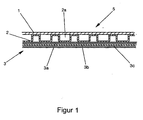
- the self-adhesive bubble wrap 5 consists of a first carrier film 1, here a polyethylene film, on which a nub 2a forming the second carrier film 2 is present, wherein the nubs 2a are filled with air.
- a multilayer film 3 is connected to the crests of the dimples 2a, a film of polyethylene 3a being applied inextricably to the crests of the dimples 2a.
- the polyethylene film 3a is provided with a self-adhesive coating 3c, wherein a bonding agent layer 3b is present between the film 3a and the adhesive 3c.
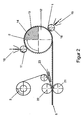
- FIG. 2 shows the manufacturing process of the bubble wrap according to the invention FIG. 1 .
- the second carrier film 2 is poured onto a transfer roller 11 through a nozzle 10.
- the transfer roller 11 applies the second carrier film 2 to a thermoforming roller 12, in which there are nubbed depressions 13 and in which a vacuum region 14 which extends over a quarter of the thermoforming roller 12 (90 °) is present.
- the second carrier film 2 is drawn into the depressions 13 of the deep-drawing roller 12 and thus forms the air-filled nubs 2a.
- the first carrier film 1 Immediately after leaving the vacuum part 14 of the deep-drawing roller 12 is also coming from an extruder through a nozzle 15, the first carrier film 1 to another Transfer roller 16 and applied by this on the deep-drawn second carrier film 2.
- the sheet 3 of polyethylene provided with a self-adhesive layer, is applied to the nubs 2a of the second carrier film 2 in a laminating station consisting of two rollers 21,22, using pressure flattening the air-filled nubs 2a at the top but not compressing and using heat by passing hot air at about 180 ° C via a hot air nozzle 23 into the gap formed by the film 3 and the second carrier film 2 in their combination, so that the film 3 with the Knolls of nubs 2a permanently welded.
Landscapes
- Engineering & Computer Science (AREA)
- Mechanical Engineering (AREA)
- Chemical & Material Sciences (AREA)
- Organic Chemistry (AREA)
- Combustion & Propulsion (AREA)
- Adhesives Or Adhesive Processes (AREA)
- Adhesive Tapes (AREA)
- Laminated Bodies (AREA)
Description
- Die Erfindung betrifft eine selbstklebende Luftpolsterfolie als Schutz für frische Lacke bei der Fahrzeugmontage, Verfahren zur Herstellung und Verwendungsmöglichkeiten derselben.
- Selbstklebende Luftpolsterfolien als Verpackungsmittel für empfindliche Güter sind an sich bekannt. Eine besonders bevorzugte Qualität, die sich durch Langlebigkeit der Luftpolster und außerdem durch eine rückseitige Abdeckungsfolie für die Luftpolster auszeichnet, so dass die Trägerfolie nicht zwischen den Polstern ohne Polsterwirkung bleibt, ist unter dem Markennamen AirCap® der Firma Sealed Air bekannt.
Diese Luftpolsterfolie zeichnet sich dadurch aus, dass ein dreischichtiger Aufbau der Folie aus Polyethylen/Sperrschicht/Polyethylen ein Austritt von Luft aus den einzelnen Noppen der Folie verhindert. - Selbstklebend ausgerüstete Luftpolsterfolien auf frisch lackierten Karossen in der Fahrzeug-, insbesondere der Pkw-Herstellung anzuwenden, birgt das Risiko, dass die Lacke, die unmittelbar nach ihrer Trocknung noch nicht ihren Endzustand erreicht haben und die dadurch weich sind und möglicherweise auch noch Kondensate von der Vernetzung gasförmig absondern, sich unter der Klebmasse der selbstklebenden Luftpolsterfolie irreversibel verformen und/oder verfärben.
- Selbstklebende Folien, die auf frisch lackierte Karosserien zu kleben sind und die im Extremfall durch die gesamte Montage des Fahrzeugs und den gesamten Transportweg bis zum Händler, der das Fahrzeug gegebenenfalls nach einiger Zeit der Lagerung für die Ausstellung beziehungsweise die Übergabe an den Käufer vorbereitet, auf dem Lack verbleiben dürfen, ohne irreversible Lackverformungen oder -verfärbungen hervorzurufen, sind an sich bekannt. Eine bevorzugte Ausführungsform wird von der tesa AG hergestellt und unter dem Markennamen tesa® Bodyguard vertrieben.
- Beispielsweise sei eine Lackschutzfolie auf Basis Polyethylenvinylacetat (EVA) erwähnt, die in
DE 195 32 220 A1 beschrieben ist. Dieses System erreicht bereits nach kurzer Zeit gute Verklebungswerte und gewährleistet eine große Verklebungssicherheit gegen unerwünschtes selbsttätiges Ablösen während des Transportes. Als nachteilig wird vom Anwender mitunter das starke Aufziehen empfunden, das mit einer Mischung verschiedener Copolymere des EVA wie inDE 100 50 499 A1 beschrieben gemildert werden kann. - Derartige selbstklebende Schutzfolien haben aber für die Praxis der Fahrzeugmontage häufig zu wenig Schutzwirkung gegen mechanische Einwirkungen und sie werden häufig unter selbstklebende Luftpolsterfolien, Hartschalen, Polsterdecken geklebt, um deren Einwirkung auf den frischen Lack zu vermeiden. Das bedeutet zusätzliche Arbeitsschritte und damit Kosten in der Fahrzeugherstellung sowohl bei der Applikation als auch bei der Entfernung der Montageschutzmaßnahmen.
- Aus der
US 6,093,466 A ist eine selbstklebende Luftpolsterfolie bekannt. Die Luftpolsterfolie besteht aus einer Noppen ausbildenden Schicht, die auf einer darunter liegenden Folie nur aufliegt. Diese Folie ist auf der freien, der der Noppen ausbildenden Schicht gegenüber liegenden Seite mit einer Klebemasse ausgerüstet Die die Noppen ausbildende Schicht wird auf zum Beispiel dem Automobil in ihrer Lage festgelegt, indem eine mit einer Klebemasse ausgerüstete Deckelfolie mit der Folie verklebt wird, so dass die Noppen ausbildende Schicht zwischen Deckelfolie und Folie liegt, wobei letztere auf dem Automobil klebt. - Aufgabe der Erfindung ist es, eine Luftpolsterfolie und Lackschutzfolie zu einem Produkt zu kombinieren und zwar in einer kostengünstigen Weise, indem eine Modifikation der Lackschutzfolie integral bei der Herstellung der Luftpolsterfolie als rückseitige Abdeckungsfolie eingesetzt wird.
- Gelöst wird diese Aufgabe durch eine selbstklebende Luftpolsterfolie, wie sie gemäß Hauptanspruch beschrieben ist. Gegenstand der Unteransprüche sind besonders vorteilhafte Ausführungsformen des Erfindungsgegenstands sowie besonders vorteilhafte Verwendungen und Herstellungsverfahren der erfindungsgemäßen Luftpolsterfolie.
- Demgemäß betrifft die Erfindung eine selbstklebende Luftpolsterfolie zum temporären Schutz von frischen Lackoberflächen von Fahrzeugen wie Automobilen und frisch lackierten Fahrzeugteilen mit einem ersten Trägerfilm, auf dem ein Noppen bildender zweiter Trägerfilm vorhanden ist, wobei die Noppen insbesondere mit Luft gefüllt sind, auf die Noppen zumindest partiell eine Folie aus Polyethylen unlösbar aufgebracht und auf der Folie eine Selbstklebeschicht aufgebracht ist.
- In einer ersten vorteilhaften Ausführungsform der Erfindung ist zwischen der Folie und der Kleberschicht einer Haftvermittlerschicht vorhanden.
- Des Weiteren können vorzugsweise der erste Trägerfilm, der zweite Trägerfilm und/oder die Folie mindestens ein Lichtschutzmittel in einer Menge von mindestens 0,15 Gew.-% und/oder Titandioxid, vorzugsweise in einer Menge von 5 bis 15 Gew.-%, enthalten.
- In einer vorteilhaften Ausführungsform weist der zweite Trägerfilm einen dreischichtigen Aufbau aus Polyethylenfolie/Sperrschicht/Polyethylenfolie auf.
- Der erste Trägerfilm kann aus Polyolefinen bestehen wie Polyethylen, Polypropylen sowie deren Mischungen oder Copolymeren. Der erste Trägerfilm kann auch als Schaumschicht ausgebildet sein. Des Weiteren liegt innerhalb des Erfindungsgedankens, den ersten Trägerfilm als mit Polyethylen beschichteten Papierträger auszuführen.
- Für die Selbstklebemasse können unterschiedliche Kleber eingesetzt werden, ohne dass die Einsatzmöglichkeit der Folie beschränkt ist.
- Sie wird vorzugsweise in Flächengewichten zwischen 3 und 35 g/m2, bevorzugt zwischen 8 und 20 g/m2 auf die Folie aufgetragen. Die Auftragung kann aus Lösung, zum Beispiel Hexan oder Benzin, erfolgen, aber auch aus der Schmelze.
- In einer weiteren bevorzugten Ausführungsform besteht die Selbstklebemasse aus Butylkautschuk, wobei der Isoprenanteil im Butylkautschuk bevorzugt bis zu 1,2 Molprozent, besonders bevorzugt bis zu 1,8 Molprozent beträgt.
- Butylkautschuke sind Copolymere aus Isobuten und Isopren, die durch kationische Polymerisation in Lösung hergestellt werden. Der Isoprenanteil variiert typischerweise zwischen 0,5 und 5 Molprozent. Das Isopren wird normalerweise in 1,4-Addition eingebaut, so dass dieses Copolymer im Gegensatz zum Polyisobutylenhomopolymer Doppelbindungen in der Hauptkette aufweist. Es stellt also ein Bindeglied zwischen einem reinen Poly-cis-Isopren respektive Naturkautschuk und einem Polyisobutylenhomopolymer dar. Eine weitere Gruppe von Butylkautschuken ist die der starbranched Typen, bei denen eine intensivere Verzweigung durch Comonomere wie Divinylbenzol erreicht wird. Neuerdings sind auch Butylkautschuke mit seitenständigen Doppelbindungen bekannt (1,2- beziehungsweise 3,4-Addition des Isoprens) und erfindungsgemäß geeignet. Hersteller solcher Produkte sind insbesondere die Firmen Bayer (Bayer Butyl) und Exxon (Exxon Butyl).
- Um eine ausreichende Kohäsion für eine Klebmasseanwendung insbesondere bei erhöhten Temperaturen zu erzielen, ist die Molmasse vorteilhafterweise mindestens eines Teils der eingesetzten Polyisobutylene relativ groß, in der Regel mindestens 200.000 g/mol (Zahlenmittel Mn).
- Zwar sind die Butylkautschuke, ähnlich wie Polyisobutylene mittleren Molekulargewichts, inhärent klebrig. Zur Optimierung der Eigenschaften, insbesondere des Klebeverhaltens, kann die Klebmasse der erfindungsgemäßen Schutzfolie dennoch vorteilhaft mit einem oder mehreren Additiven abgemischt werden. Solche Additive können Klebrigmacher (Haftklebeeigenschaften optimierende Klebharze), Weichmacher, anorganische oder organische Füllstoffe, Pigmente, Lichtschutzmittel unter anderem in Form von UV-absorbierenden sterisch gehinderten Aminen (HALS), Alterungsschutzmittel in Form von zum Beispiel Lactonen, primären und sekundären Antioxidantien oder weitere Elastomere sein. Optional können der Selbstklebemasse Vernetzungsmittel und Vernetzungspromotoren zugesetzt werden. Eine ausführliche Auswahl von Vernetzungsmittel und Vernetzungspromotoren sind in Ullmann's Encyclopedia of Industrial Chemistry (6. Auflage, 2003), Kapitel "Rubber, 4. Chemicals and additives" und "Manual for Rubber Industry", Bayer AG (1995) beschrieben.
- Mögliche Elastomere zur Modifizierung der Selbstklebemasse sind zum Beispiel Polyisobutylene, Polyolefincopolymere wie EPM oder EPDM, Polybutene, hydrierte Blockcopolymere aus Styrol und Dienen oder Acrylatcopolymere. Diese Elastomere werden im Bereich von 0 bis 20 Gewichtsanteile, vorzugsweise unter 10 Gewichtsanteilen bezogen auf 100 Gewichtsanteile Butylkautschuk eingesetzt.
- Geeignete Klebrigmacher sind beispielsweise synthetische Kohlenwasserstoffharze (zum Beispiel aus C5- oder C9-Monomeren), Naturharze, Polyterpenharze auf Basis von α-, β-Pinen oder δ-Limonen, Kolophonium und Kolophoniumderivate sowie weitere, wie sie aufgeführt sind in Ullmann's Encyclopedia of Industrial Chemistry (6. Auflage, 2003), Kapitel "Resins-Synthetic" und "Resins-Natural". Vorrangig werden alterungsstabilere, hydrierte oder teilhydrierte Harze verwendet. In der Klebmasse der erfindungsgemäßen Schutzfolie werden bevorzugt 0 bis 50 Gewichtsteile, insbesondere 0 bis 20 Gewichtsteile eines Klebrigmachers bezogen auf 100 Gewichtsteile Basispolymer verwendet.
- Geeignete Weichmacher für die Selbstklebemasse sind beispielsweise aliphatische, cycloaliphatische und aromatische Mineralöle, Di- oder Poly-Ester der Phthalsäure, Trimellitsäure oder Adipinsäure, flüssige Kautschuke (zum Beispiel Nitril- oder Polyisoprenkautschuke), flüssige Polymerisate (aus Isobuten oder Ethylen/Propylen), Acrylsäureester, Polyvinylether, Flüssig- und Weichharze auf Basis der Rohstoffe von Klebharzen, Wollwachs und andere Wachse oder flüssige Silikone. Besonders geeignet sind alterungsstabile Weichmacher ohne olefinische Doppelbindung. Bevorzugt werden 0 bis 40 Gewichtsteile, insbesondere 0 bis 10 Gewichtsteile eines Weichmachers bezogen auf 100 Gewichtsteile Basispolymer verwendet.
- In einer weiteren vorteilhaften Ausführungsform besteht die Kleberschicht aus einer Mischung von Synthesekautschuken, wobei
- a) die Kleberschicht aus einer polaren Komponente A und einer unpolaren Komponente B besteht,
- b) wobei die polare Komponente A zu einem Gewichtsanteil von 50 bis 99 % vorliegt und aus einem oder einer Mischung von Copolymeren aus Ethylen und Vinylacetat besteht, dessen Vinylacetatgehalt zwischen 40 Gew.-% und 80 Gew.-% beträgt, und
- c) die unpolare Komponente B zu einem Gewichtsanteil von 1 bis 50 % vorliegt und aus einem oder einer Mischung von schwachkristallinen oder amorphen in der Hauptkette gesättigten Homo- oder Copolymeren aus α-Olefinen mit 2 bis 12 Kohlenstoffatomen besteht.
- Alternativ kann die unpolare Komponente B zu einem Gewichtsanteil von 1 bis 50 % vorliegen und aus Copolymeren aus α-Olefinen 2 bis 12 Kohlenstoffatomen und nichtkonjugierten Dienen bestehen.
- Für die polare Komponente der Klebmasse eignen sich Ethylenvinylacetat-Typen (EVAc), deren VAc-Anteil zwischen 40 und 80 Gew.-% liegt, vorzugsweise zwischen 50 und 70 Gew.-%. Es können auch unterschiedliche EVAc-Typen gemischt werden. Für die unpolare Komponente eignen sich Poly-α-olefine wie Polyisobutylen (PIB), Poly-1-buten (PB), Ethylenpropylencopolymere (EPM), Ethylenpropylendienterpolymere (EPDM), wobei das Dien nichtkonjuguiert ist, Poly-1-hexen, Poly-1-octen und andere schwachkristalline oder amorphe Copolymere von Ethylen und α-Olefinen mit 4-12 Kohlenstoffatomen. Auch die unpolaren Polymere können zur Erzielung optimaler Eigenschaften gemischt werden.
- In einer weiteren vorteilhaften Ausführungsform besteht die Selbstklebemasse aus Polyethylenvinylacetat bei einem Vinylacetatgehalt von 40 Gew.-% bis 80 Gew.-%, insbesondere 70 Gew.-%, und mit einem Verlustwinkel tan δ von 0,6 bis 1,0, gemessen bei einer Temperatur von 60 °C und einer Frequenz von 10-2 Hz, und von 0,4 bis 0,7, gemessen bei einer Temperatur von 60 °C und einer Frequenz von 10 Hz, die angestrebten Eigenschaften.
Die Selbstklebemasse kann auf die Folie aus der Lösung oder aus der Schmelze aufgetragen werden. - Die Selbstklebeschichten, wie sie vorstehend näher erläutert sind, können vorteilhaft mit einem oder mehreren Additiven abgemischt sein wie Klebrigmachern, Weichmachern, anorganischen oder organischen Füllstoffen, Pigmenten, Lichtschutzmitteln, vorzugsweise in Form von UV-absorbierenden sterisch gehinderten Aminen (HALS), Alterungsschutzmitteln, vorzugsweise in Form von Lactonen, primären und sekundären Antioxidantien, Vernetzungsmitteln und/oder Vernetzungspromotoren.
- Besonders vorteilhaft lässt sich die erfindungsgemäße selbstklebende Luftpolsterfolie herstellen durch folgendes Verfahren:
- Aus einem Extruder kommend wird durch eine Düse der zweite Trägerfilm auf eine Übertragungswalze gegossen.
- Die Übertragungswalze legt den zweiten Trägerfilm auf eine Tiefziehwalze auf, in der noppenförmige Vertiefungen und in der ein Vakuumbereich vorhanden sind.
- Beim Durchlaufen des Vakuumbereichs der Tiefziehwalze wird der zweite Trägerfilm in die Vertiefungen der Tiefziehwalze hineingezogen und bildet so die mit Luft gefüllten Noppen.
- Unmittelbar nach Verlassen des Vakuumteils der Tiefziehwalze wird ebenfalls aus einem Extruder kommend durch eine Düse auf eine weitere Übertragungswalze der erste Trägerfilm aufgebracht und von der Übertragungswalze auf den tiefgezogenen zweiten Trägerfilm übertragen.
- Schließlich wird die mit einer Selbstklebeschicht ausgerüstete Folie aus Polyethylen in einer aus zwei Walzen bestehenden Kaschierstation auf die Noppen des zweiten Trägerfilms aufgebracht, und zwar unter Anwendung von Druck, der die Luft gefüllten Noppen an der Kuppe abflacht, sie aber nicht zusammendrückt, und unter Anwendung von Hitze, indem heiße Luft mit ungefähr 180 °C über eine Heißluftdüse in den Spalt, den die Folie und der zweite Trägerfilm bei ihrer Zusammenführung bilden, geleitet wird, so dass die Folie mit den Kuppen der Noppen unlösbar verschweißt.
- Gemäß weiteren Varianten des Herstellungsverfahrens kann die so erzeugte selbstklebende Luftpolsterfolie zur besseren Verarbeitung durch eine Perforationsstation geleitet werden, in der beispielsweise in einem Abstand von 250 mm Perforationen in der Luftpolsterfolie eingebracht werden, so dass diese von Hand abreißbar ist.
Weiter optional kann die selbstklebende Luftpolsterfolie an den Produktionskanten besäumt, in schmalere Bahnen aufgeteilt und zur Rolle gewickelt werden. - Insbesondere in dieser Form ist die erfindungsgemäße Luftpolsterfolie in der Montage von Fahrzeugherstellern ohne weitere Werkzeuge oder Vorrichtungen unmittelbar einzusetzen.
- Besonders vorteilhaft lässt sich die erfindungsgemäße Luftpolsterfolie auf frisch lackierten Oberflächen von Automobilen oder Automobilteilen als Montage- und/oder Transportschutz verwenden so wie überhaupt zum Schutz von empfindlichen Lack-, Metall-, Holz-, Kunststoff- oder Glasoberflächen.
- Anhand der nachfolgend beschriebenen Figuren wird die erfindungsgemäße Luftpolsterfolie in einer besonders vorteilhaften Ausführung sowie ein Verfahren zur Herstellung derselben näher erläutert, ohne damit die Erfindung unnötig einschränken zu wollen. Es zeigen
- Figur 1
- die erfindungsgemäße Luftpolsterfolie und
- Figur 2
- ein Verfahren zur Herstellung der erfindungsgemäßen Luftpolsterfolie nach
Figur 1 . - Nach
Figur 1 besteht die selbstklebende Luftpolsterfolie 5 aus einem ersten Trägerfilm 1, hier eine Polyethylenfolie, auf der ein Noppen 2a bildender zweiter Trägerfilm 2 vorhanden ist, wobei die Noppen 2a mit Luft gefüllt sind.
Mit den Kuppen der Noppen 2a ist eine mehrschichtige Folie 3 verbunden, wobei eine Folie aus Polyethylen 3a unlösbar auf den Kuppen der Noppen 2a aufgebracht ist. Die Polyethylenfolie 3a ist mit einer selbstklebenden Beschichtung 3c ausgerüstet, wobei zwischen Folie 3a und Kleber 3c eine Haftvermittlerschicht 3b vorhanden ist. -
Figur 2 zeigt das Herstellungsverfahren der erfindungsgemäßen Luftpolsterfolie nachFigur 1 .
Aus einem Extruder kommend wird durch eine Düse 10 der zweite Trägerfilm 2 auf eine Übertragungswalze 11 gegossen.
Die Übertragungswalze 11 legt den zweiten Trägerfilm 2 auf eine Tiefziehwalze12 auf, in der noppenförmige Vertiefungen 13 und in der ein Vakuumbereich 14, der sich über ein Viertel der Tiefziehwalze 12 erstreckt (90°), vorhanden sind.
Beim Durchlaufen des Vakuumbereichs 14 der Tiefziehwalze 12 wird der zweite Trägerfilm 2 in die Vertiefungen 13 der Tiefziehwalze 12 hineingezogen und bildet so die mit Luft gefüllten Noppen 2a.
Unmittelbar nach Verlassen des Vakuumteils 14 der Tiefziehwalze 12 wird ebenfalls aus einem Extruder kommend durch eine Düse 15 der erste Trägerfilm 1 auf eine weitere Übertragungswalze 16 und von dieser auf den tiefgezogenen zweiten Trägerfilm 2 aufgebracht.
Schließlich wird die mit einer Selbstklebeschicht ausgerüstete Folie 3 aus Polyethylen in einer aus zwei Walzen 21, 22 bestehenden Kaschierstation auf die Noppen 2a des zweiten Trägerfilms 2 aufgebracht, und zwar unter Anwendung von Druck, der die Luft gefüllten Noppen 2a an der Kuppe abflacht, sie aber nicht zusammendrückt, und unter Anwendung von Hitze, indem heiße Luft mit ungefähr 180 °C über eine Heißluftdüse 23 in den Spalt, den die Folie 3 und der zweite Trägerfilm 2 bei ihrer Zusammenführung bilden, geleitet wird, so dass die Folie 3 mit den Kuppen der Noppen 2a unlösbar verschweißt.
Claims (14)
- Selbstklebende Luftpolsterfolie (5) zum temporären Schutz von frischen Lackoberflächen von Fahrzeugen wie Automobilen und frisch lackierten Fahrzeugteilen mit einem ersten Trägerfilm (1), auf dem ein Noppen bildender zweiter Trägerfilm (2) vorhanden ist, wobei die Noppen (2a) insbesondere mit Luft gefüllt sind,
dadurch gekennzeichnet, dass,
auf die Noppen (2a) zumindest partiell eine Folie (3a) aus Polyethylen unlösbar aufgebracht und auf der Folie (3a) eine Selbstklebeschicht (3c) aufgebracht ist. - Selbstklebende Luftpolsterfolie (5) nach Anspruch 1, dadurch gekennzeichnet, dass zwischen der Folie (3a) und der Kleberschicht (3c) eine Haftvermittlerschicht (3b) vorhanden ist.
- Selbstklebende Luftpolsterfolie (5) nach Anspruch 1 oder 2, dadurch gekennzeichnet, dass
der erste Trägerfilm (1), der zweite Trägerfilm (2) und/oder die Folie (3a) mindestens ein Lichtschutzmittel in einer Menge von mindestens 0,15 Gew.-% und/oder Titandioxid, vorzugsweise in einer Menge von 5 bis 15 Gew.-%, enthalten: - Selbstklebende Luftpolsterfolie (5) nach zumindest einem der Ansprüche 1 bis 3, dadurch gekennzeichnet, dass
der zweite Trägerfilm (2) einen dreischichtigen Aufbau aus Polyethylenfolie/SperrschichtlPolyethylenfolie aufweist. - Selbstklebende Luftpolsterfolie (5) nach mindestens einem der vorhergehenden Ansprüche, dadurch gekennzeichnet, dass
der erste Trägerfilm (1) aus Polyolefinen besteht wie Polyethylen, Polypropylen sowie deren Mischungen oder Copolymeren. - Selbstklebende Luftpolsterfolie (5) nach mindestens einem der vorhergehenden Ansprüche, dadurch gekennzeichnet, dass
die Selbstklebemasse (3c) aus Butylkautschuk besteht, wobei der Isoprengehalt im Butylkautschuk bis zu 1,8 Molprozent, bevorzugt bis zu 1,2 Molprozent beträgt. - Selbstklebende Luftpolsterfolie (5) nach mindestens einem der vorhergehenden Ansprüche, dadurch gekennzeichnet, dass
die Selbstklebeschicht (3c) mit Elastomeren abgemischt ist wie Polyisobutylenen, Polyolefincopolymeren wie EPM oder EPDM, Polybutenen, hydrierten Blockcopolymeren aus Styrol und Dienen oder Acrylatcopolymeren, wobei die Elastomere vorzugsweise im Bereich von 0 bis 20 Gewichtsanteilen, besonders vorzugsweise unter 10 Gewichtsanteilen bezogen auf 100 Gewichtsanteile Butylkautschuk eingesetzt werden - Selbstklebende Luftpolsterfolle (5) nach mindestens einem der vorhergehenden Ansprüche, dadurch gekennzeichnet, dass
die Selbstklebemasse (3c) aus einer polaren Komponente A und einer unpolaren Komponente B besteht, wobei die polare Komponente A zu einem Gewichtsanteil von 50 bis 99 % vorliegt und aus einem oder einer Mischung von Copolymeren aus Ethylen und Vinylacetat besteht, dessen Vinylacetatgehalt zwischen 40 Gew.-% und 80 Gew.-% beträgt, und die unpolare Komponente B zu einem Gewichtsanteil von 1 bis 50 % vorliegt und aus einem oder einer Mischung von schwachkristalünen oder amorphen in der Hauptkette gesättigten Homo- oder Copolymeren aus α-Olefinen mit 2 bis 12 Kohlenstoffatomen besteht. - Selbstklebende Luftpolsterfolie (5) nach mindestens einem der vorhergehenden Ansprüche, dadurch gekennzeichnet, dass
die Selbstklebenasse (3c) aus einer polaren Komponente A und einer unpolaren Komponente B besteht, wobei die polare Komponente A zu einem Gewichtsanteil von 50 bis 99 % vorliegt und aus einem oder einer Mischung von Copolymeren aus Ethylen und Vinylacetat besteht, dessen Vinylacetatgehalt zwischen 40 Gew.-% und 80 Ges.-% beträgt, und die unpolare Komponente B zu einem Gewichtsanteil von 1 bis 50 % vorliegt und aus Copolymeren aus α-Olefinen 2 bis 12 Kohlenstoffatomen und nichtkonjugierten Dienen besteht. - Selbstklebende Luftpolsterfolie (5) nach mindestens einem der vorhergehenden Ansprüche, dadurch gekennzeichnet, dass
die Selbstklebemasse (3c) aus Polyethylenvinylacetat bei einem Vinylacetatgehalt von 40 Ges.-% bis 80 Gew.%, insbesondere 70 Gew.-%, und mit einem Verlustwinkel tan δ von 0,6 bis 1,0, gemessen bei einer Temperatur von 60°C und einer Frequenz von 10-2 Hz, und von 0,4 bis 0,7, gemessen bei einer Temperatur von 60 °C und einer Frequenz von 10 Hz, besteht. - Selbstklebende Luftpolsterfolle (5) nach mindestens einem der vorhergehenden Ansprüche, dadurch gekennzeichnet, dass
die Selbstklebeschicht (3c) mit einem oder mehreren Additiven abgemischt ist wie Klebrigmachern, Weichmachern, anorganischen oder organischen Füllstoffen, Pigmenten, Lichtschutzmitteln, vorzugsweise in Form von UV-absorbierenden sterisch gehinderten Aminen (HALS), Alterungsschutzmitteln, vorzugsweise in Form von Lactonen, primären und sekundären Antioxidantien, Vernetzungsmitteln und/oder Vemetzungspromotoren. - Verfahren zur Herstellung einer selbstklebenden Luflpolsterfolie (5) nach mindestens einem der vorhergehenden Ansprüche, dadurch gekennzeichnet, dass
aus einem Extruder kommend durch eine Düse der zweite Trägerfilm (2) auf eine Übertragungswalze gegossen werden,
die Übertragungswalze den zweiten Trägerfilm (2) auf eine Tiefziehwalze auflegt, in der Tiefziehwalze noppenförmige Vertiefungen und ein Vakuumbereich vorhanden sind,
beim Durchlaufen des Vakuumbereichs der Tiefziehwalze der zweite Trägerfilm (2) in die Vertiefungen der Tiefziehwalze hineingezogen wird und so die Noppen (2a) bildet,
unmittelbar nach Verlassen des Vakuumteils der Tiefziehwalze ebenfalls aus einem eines Extruder kommend durch eine Düse der erste Trägerfilm (1) auf eine weitere Übertragungswalze und von dieser auf den tiefgezogenen zweiten Trägerfilm (2) aufgebracht wird,
die mit einer Selbstklebeschicht (3c) ausgerüstete Folie (3a) aus Polyethylen in einer aus Walzen bestehenden Kaschierstation auf die Noppen (2a) des zweiten Trägerfilms (2) aufgebracht wird, und zwar unter Anwendung von Druck, der die Luft gefüllten Noppen (2a) an der Kuppe abflacht, sie aber nicht zusammendrückt, und unter Anwendung von Hitze, indem heiße Luft mit ungefähr 180 °C über eine Heißluftdüse in den Spalt, den die Folie (3a) und der zweite Trägerfilm (2) bei ihrer Zusammenführung bilden, geleitet wird, so dass die Folie (3a) mit den Kuppen der Noppen (2a) unlösbar verschweißt. - Verwendung einer Luftpolsterfolie (5) nach zumindest einem der vorhergehenden Ansprüche auf frisch lackierten Oberflächen von Automobilen oder Automobilteilen als Montage- und/oder Transportschutz.
- Verwendung einer Luftpolsterfolie (5) nach zumindest einem der vorhergehenden Ansprüche zum Schutz von empfindlichen Lack-, Metall-, Holz-, Kunststoff- oder Glasoberflächen.
Applications Claiming Priority (1)
| Application Number | Priority Date | Filing Date | Title |
|---|---|---|---|
| DE102004036417A DE102004036417A1 (de) | 2004-07-27 | 2004-07-27 | Selbstklebende Luftpolsterfolie als Schutz für frische Lacke bei der Fahrzeugmontage und Verfahren zur Herstellung |
Publications (2)
| Publication Number | Publication Date |
|---|---|
| EP1621330A1 EP1621330A1 (de) | 2006-02-01 |
| EP1621330B1 true EP1621330B1 (de) | 2009-04-15 |
Family
ID=35197889
Family Applications (1)
| Application Number | Title | Priority Date | Filing Date |
|---|---|---|---|
| EP05014645A Expired - Lifetime EP1621330B1 (de) | 2004-07-27 | 2005-07-06 | Selbstklebende Luftpolsterfolie als Schutz für frische Lacke bei der Fahrzeugmontage und Verfahren zur Herstellung |
Country Status (4)
| Country | Link |
|---|---|
| US (1) | US20060024495A1 (de) |
| EP (1) | EP1621330B1 (de) |
| DE (2) | DE102004036417A1 (de) |
| ES (1) | ES2323375T3 (de) |
Cited By (2)
| Publication number | Priority date | Publication date | Assignee | Title |
|---|---|---|---|---|
| DE102020110433B3 (de) | 2020-04-16 | 2021-07-22 | Adler Pelzer Holding Gmbh | Vollumschließende Motor- oder Aggregate-Kapsel eines Kraftfahrzeugs mit einer Luftpolsterfolie |
| DE102021108579A1 (de) | 2021-04-07 | 2022-10-13 | Adler Pelzer Holding Gmbh | Schallisolation mit integrierter Luftpolsterfolien-Schicht |
Families Citing this family (11)
| Publication number | Priority date | Publication date | Assignee | Title |
|---|---|---|---|---|
| DE102008035474A1 (de) | 2008-08-09 | 2010-02-11 | Tesa Se | Selbstklebende Luftpolsterfolie als Schutz für frische Lacke bei der Fahrzeugmontage und Verfahren zur Herstellung |
| US9623622B2 (en) | 2010-02-24 | 2017-04-18 | Michael Baines | Packaging materials and methods |
| SA115370037B1 (ar) | 2010-04-15 | 2017-11-15 | تترا لافال هولدينجز اند فاينانس اس.ايه | أسطوانة ترقيق، طريقة لتزويد لدينة تغليف رقائقية، ولدينة تغليف رقائقية |
| JP5946305B2 (ja) * | 2012-03-28 | 2016-07-06 | 宇部エクシモ株式会社 | 中空構造板の製造方法及び製造装置 |
| JP6624381B2 (ja) * | 2016-01-08 | 2019-12-25 | キョーラク株式会社 | 積層体 |
| WO2017119478A1 (ja) * | 2016-01-08 | 2017-07-13 | キョーラク株式会社 | 積層構造体の製造方法、積層構造体 |
| JP6669550B2 (ja) * | 2016-03-25 | 2020-03-18 | キョーラク株式会社 | 積層構造体の製造方法 |
| DE102016003818A1 (de) | 2016-03-26 | 2017-09-28 | Walter Schopf | Magnetfeldtherapieeinrichtung in Kraftfahrzeugen |
| CN107244133A (zh) * | 2017-06-24 | 2017-10-13 | 佛山市南海赋盈塑料有限公司 | 一种利于塑料膜或片粘合排气的涂胶方法及应用 |
| WO2019142172A1 (en) * | 2018-01-22 | 2019-07-25 | 3M Innovative Properties Company | Improved packaging constructions, materials, and methods |
| CN117532989B (zh) * | 2023-10-20 | 2026-01-23 | 南安市万航包装科技有限公司 | 抗压复合包装材料及其制备方法 |
Family Cites Families (7)
| Publication number | Priority date | Publication date | Assignee | Title |
|---|---|---|---|---|
| US4412879A (en) * | 1981-11-02 | 1983-11-01 | Ranpak Corp. | Cushioning dunnage apparatus and method |
| JP2832565B2 (ja) * | 1991-06-19 | 1998-12-09 | 関西ペイント株式会社 | 自動車塗膜保護用シート |
| DE19532220A1 (de) | 1995-09-01 | 1997-03-06 | Beiersdorf Ag | Selbstklebende Schutzfolie |
| DE19730193A1 (de) * | 1997-07-15 | 1999-01-21 | Beiersdorf Ag | Selbstklebende Schutzfolie |
| US6093466A (en) * | 1997-11-25 | 2000-07-25 | Sealed Air Corporation | Automobile protective masking material |
| DE10004499A1 (de) | 2000-02-02 | 2001-08-16 | Basf Coatings Ag | Physikalisch, thermisch oder thermisch und mit aktinischer Strahlung härtbarer wässriger Beschichtungsstoff und seine Verwendung |
| WO2002031074A1 (de) * | 2000-10-12 | 2002-04-18 | Tesa Ag | Oberflächenschutzfolie für frische automobillackflächen mit einem mehrkomponent enkleber |
-
2004
- 2004-07-27 DE DE102004036417A patent/DE102004036417A1/de not_active Withdrawn
-
2005
- 2005-07-06 EP EP05014645A patent/EP1621330B1/de not_active Expired - Lifetime
- 2005-07-06 DE DE502005007072T patent/DE502005007072D1/de not_active Expired - Lifetime
- 2005-07-06 ES ES05014645T patent/ES2323375T3/es not_active Expired - Lifetime
- 2005-07-26 US US11/189,355 patent/US20060024495A1/en not_active Abandoned
Cited By (4)
| Publication number | Priority date | Publication date | Assignee | Title |
|---|---|---|---|---|
| DE102020110433B3 (de) | 2020-04-16 | 2021-07-22 | Adler Pelzer Holding Gmbh | Vollumschließende Motor- oder Aggregate-Kapsel eines Kraftfahrzeugs mit einer Luftpolsterfolie |
| WO2021209522A1 (de) | 2020-04-16 | 2021-10-21 | Adler Pelzer Holding Gmbh | VOLLUMSCHLIEßENDE MOTOR- ODER AGGREGATE-KAPSEL EINES KRAFTFAHRZEUGS MIT EINER LUFTPOLSTERFOLIE |
| DE102021108579A1 (de) | 2021-04-07 | 2022-10-13 | Adler Pelzer Holding Gmbh | Schallisolation mit integrierter Luftpolsterfolien-Schicht |
| WO2022214234A1 (de) | 2021-04-07 | 2022-10-13 | Adler Pelzer Holding Gmbh | Schallisolation mit integrierter luftpolsterfolien-schicht |
Also Published As
| Publication number | Publication date |
|---|---|
| US20060024495A1 (en) | 2006-02-02 |
| EP1621330A1 (de) | 2006-02-01 |
| ES2323375T3 (es) | 2009-07-14 |
| DE102004036417A1 (de) | 2006-03-23 |
| DE502005007072D1 (de) | 2009-05-28 |
Similar Documents
| Publication | Publication Date | Title |
|---|---|---|
| DE69603850T2 (de) | Schutzhaftgegenstand | |
| EP1469054B1 (de) | Selbstklebende Schutzfolie zum Temporären Schutz von Fahrzeuglacken | |
| EP2220186B1 (de) | Coextrudierbarer schmelzklebstoff | |
| EP1621330A1 (de) | Selbstklebende Luftpolsterfolie als Schutz für frische Lacke bei der Fahrzeugmontage und Verfahren zur Herstellung | |
| EP2917296B1 (de) | Reaktiver polyolefin-heissschmelzklebstoff mit geringer haftung zu nichtbeschichteten aluminiumwerkzeugen und dessen verwendung als kaschier-hotmelt | |
| EP0658139B1 (de) | Polypropylenfolie-haftvermittler-metall-verbund sowie dessen verwendung zur herstellung von verpackungsbehältern | |
| EP0905209B1 (de) | Selbstklebende Schutzfolie mit Olefinkautschuk-Kleber | |
| EP1098763B1 (de) | Mehrschichtige, symmetrische, rollneigungsfreie, coextrudierte tiefziehfolie | |
| EP1264871A1 (de) | Selbstklebender Schutzartikel für mechanisch stark beanspruchte lackierte Automobilteile | |
| EP2389256B1 (de) | Verfahren zur korrosionsschutzbehandlung | |
| DE102008026672A1 (de) | Klebstoff aus Polypropylenharz | |
| EP3334789B1 (de) | Korrosionsschutzzusammensetzung umfassend mindestens eine erste verbindung und mindestens eine zweite verbindung | |
| EP3183316B1 (de) | Korrosionsschutzzusammensetzung | |
| EP0892026A2 (de) | Selbstklebende Schutzfolie | |
| EP3334791B1 (de) | Korrosionsschutzzusammensetzung umfassend polyisobutylene | |
| WO2012150099A1 (de) | Klebebandsystem zur bildung eines aufreissstreifens | |
| DE10141379A1 (de) | Oberflächenschutzfolie für lackierte Flächen mit einem Kleber auf Basis von hydrierten Blockcopolymeren | |
| EP1425361B1 (de) | Oberflächenschutzfolie für lackierte flächen mit einem kleber auf basis von hydrierten blockcopolymeren | |
| EP1247855B1 (de) | Selbstklebefolie zum Schutz von Fahrzeuglacken | |
| DE102016106927A1 (de) | Haftvermittlungszusammensetzung für ein Korrosionsschutzprodukt | |
| EP2154218A2 (de) | Selbstklebende Luftpolsterfolie als Schutz für frische Lacke bei der Fahrzeugmontage und Verfahren zur Herstellung | |
| DE2530726A1 (de) | Verwendung von gepfropften olefincopolymeren als schmelzklebstoffmassen | |
| EP1404773B1 (de) | Klebeband insbesondere zu verpackungszwecken | |
| DE102008026670A1 (de) | Klebstoff aus isotaktischem 1-Butenharz | |
| DE10116771A1 (de) | Selbstklebefolie zum Schutz von Fahrzeuglacken |
Legal Events
| Date | Code | Title | Description |
|---|---|---|---|
| PUAI | Public reference made under article 153(3) epc to a published international application that has entered the european phase |
Free format text: ORIGINAL CODE: 0009012 |
|
| AK | Designated contracting states |
Kind code of ref document: A1 Designated state(s): AT BE BG CH CY CZ DE DK EE ES FI FR GB GR HU IE IS IT LI LT LU LV MC NL PL PT RO SE SI SK TR |
|
| AX | Request for extension of the european patent |
Extension state: AL BA HR MK YU |
|
| 17P | Request for examination filed |
Effective date: 20060801 |
|
| AKX | Designation fees paid |
Designated state(s): DE ES FR GB IT |
|
| 17Q | First examination report despatched |
Effective date: 20060912 |
|
| GRAP | Despatch of communication of intention to grant a patent |
Free format text: ORIGINAL CODE: EPIDOSNIGR1 |
|
| GRAS | Grant fee paid |
Free format text: ORIGINAL CODE: EPIDOSNIGR3 |
|
| GRAA | (expected) grant |
Free format text: ORIGINAL CODE: 0009210 |
|
| AK | Designated contracting states |
Kind code of ref document: B1 Designated state(s): DE ES FR GB IT |
|
| REG | Reference to a national code |
Ref country code: GB Ref legal event code: FG4D Free format text: NOT ENGLISH |
|
| RAP2 | Party data changed (patent owner data changed or rights of a patent transferred) |
Owner name: SEALED AIR VERPACKUNGEN GMBH Owner name: TESA SE |
|
| REF | Corresponds to: |
Ref document number: 502005007072 Country of ref document: DE Date of ref document: 20090528 Kind code of ref document: P |
|
| REG | Reference to a national code |
Ref country code: ES Ref legal event code: FG2A Ref document number: 2323375 Country of ref document: ES Kind code of ref document: T3 |
|
| REG | Reference to a national code |
Ref country code: GB Ref legal event code: 732E Free format text: REGISTERED BETWEEN 20090618 AND 20090624 |
|
| REG | Reference to a national code |
Ref country code: ES Ref legal event code: PC2A |
|
| PLBE | No opposition filed within time limit |
Free format text: ORIGINAL CODE: 0009261 |
|
| STAA | Information on the status of an ep patent application or granted ep patent |
Free format text: STATUS: NO OPPOSITION FILED WITHIN TIME LIMIT |
|
| 26N | No opposition filed |
Effective date: 20100118 |
|
| REG | Reference to a national code |
Ref country code: DE Ref legal event code: R081 Ref document number: 502005007072 Country of ref document: DE Owner name: SEALED AIR VERPACKUNGEN GMBH, DE Free format text: FORMER OWNERS: SEALED AIR VERPACKUNGEN GMBH, 36304 ALSFELD, DE; TESA SE, 20253 HAMBURG, DE Ref country code: DE Ref legal event code: R081 Ref document number: 502005007072 Country of ref document: DE Owner name: TESA SE, DE Free format text: FORMER OWNERS: SEALED AIR VERPACKUNGEN GMBH, 36304 ALSFELD, DE; TESA SE, 20253 HAMBURG, DE |
|
| REG | Reference to a national code |
Ref country code: FR Ref legal event code: PLFP Year of fee payment: 12 |
|
| PGFP | Annual fee paid to national office [announced via postgrant information from national office to epo] |
Ref country code: GB Payment date: 20160721 Year of fee payment: 12 Ref country code: DE Payment date: 20160722 Year of fee payment: 12 Ref country code: IT Payment date: 20160725 Year of fee payment: 12 |
|
| PGFP | Annual fee paid to national office [announced via postgrant information from national office to epo] |
Ref country code: FR Payment date: 20160721 Year of fee payment: 12 |
|
| PGFP | Annual fee paid to national office [announced via postgrant information from national office to epo] |
Ref country code: ES Payment date: 20160715 Year of fee payment: 12 |
|
| REG | Reference to a national code |
Ref country code: FR Ref legal event code: CA Effective date: 20170201 |
|
| REG | Reference to a national code |
Ref country code: DE Ref legal event code: R119 Ref document number: 502005007072 Country of ref document: DE |
|
| GBPC | Gb: european patent ceased through non-payment of renewal fee |
Effective date: 20170706 |
|
| REG | Reference to a national code |
Ref country code: FR Ref legal event code: ST Effective date: 20180330 |
|
| PG25 | Lapsed in a contracting state [announced via postgrant information from national office to epo] |
Ref country code: GB Free format text: LAPSE BECAUSE OF NON-PAYMENT OF DUE FEES Effective date: 20170706 Ref country code: DE Free format text: LAPSE BECAUSE OF NON-PAYMENT OF DUE FEES Effective date: 20180201 |
|
| PG25 | Lapsed in a contracting state [announced via postgrant information from national office to epo] |
Ref country code: FR Free format text: LAPSE BECAUSE OF NON-PAYMENT OF DUE FEES Effective date: 20170731 |
|
| PG25 | Lapsed in a contracting state [announced via postgrant information from national office to epo] |
Ref country code: IT Free format text: LAPSE BECAUSE OF NON-PAYMENT OF DUE FEES Effective date: 20170706 |
|
| REG | Reference to a national code |
Ref country code: ES Ref legal event code: FD2A Effective date: 20181106 |
|
| PG25 | Lapsed in a contracting state [announced via postgrant information from national office to epo] |
Ref country code: ES Free format text: LAPSE BECAUSE OF NON-PAYMENT OF DUE FEES Effective date: 20170707 |