EP1615397B1 - Vorrichtung zu einer Multikriterien Lastverteilung für ein Peripheriegerät in einem etikettenvermittelten Netz - Google Patents
Vorrichtung zu einer Multikriterien Lastverteilung für ein Peripheriegerät in einem etikettenvermittelten Netz Download PDFInfo
- Publication number
- EP1615397B1 EP1615397B1 EP05102866A EP05102866A EP1615397B1 EP 1615397 B1 EP1615397 B1 EP 1615397B1 EP 05102866 A EP05102866 A EP 05102866A EP 05102866 A EP05102866 A EP 05102866A EP 1615397 B1 EP1615397 B1 EP 1615397B1
- Authority
- EP
- European Patent Office
- Prior art keywords
- paths
- processing means
- network
- ler
- switched
- Prior art date
- Legal status (The legal status is an assumption and is not a legal conclusion. Google has not performed a legal analysis and makes no representation as to the accuracy of the status listed.)
- Expired - Lifetime
Links
Images

Classifications
-
- H—ELECTRICITY
- H04—ELECTRIC COMMUNICATION TECHNIQUE
- H04L—TRANSMISSION OF DIGITAL INFORMATION, e.g. TELEGRAPHIC COMMUNICATION
- H04L45/00—Routing or path finding of packets in data switching networks
- H04L45/52—Multiprotocol routers
-
- H—ELECTRICITY
- H04—ELECTRIC COMMUNICATION TECHNIQUE
- H04L—TRANSMISSION OF DIGITAL INFORMATION, e.g. TELEGRAPHIC COMMUNICATION
- H04L45/00—Routing or path finding of packets in data switching networks
-
- H—ELECTRICITY
- H04—ELECTRIC COMMUNICATION TECHNIQUE
- H04L—TRANSMISSION OF DIGITAL INFORMATION, e.g. TELEGRAPHIC COMMUNICATION
- H04L45/00—Routing or path finding of packets in data switching networks
- H04L45/24—Multipath
- H04L45/243—Multipath using M+N parallel active paths
Definitions
- the invention relates to the field of label switching networks, and more particularly the load distribution devices (or traffic) used in such networks.
- LSRs Label Switched Routers
- LSRs refer to two types of router or switch coupled together: Peripheral Routers (or LERs for "Label Edge Routers"), responsible for establishing a Label Switched Path (LSP) for each the data flows they receive when requested by the network manager, and core routers (LCRs), which are solely responsible for switching data flows and transmitting information data. network.
- Peripheral Routers or LERs for "Label Edge Routers”
- LSP Label Switched Path
- LCRs core routers
- the establishment of a switching path consists of adding to the data of a stream a tag associated with the path to follow and reserving the resources necessary for routing the stream, from the source node (LER) to the node of destination (LER), taking into account the type of service (or ToS for "Type of Service”) and / or the quality of service (or QoS for "Quality of Service”) that is (are) associated with it. flux.
- each stream In order for each source LER to establish a path, each stream must be associated with a source LER and a destination LER, with a transmission equivalence class (or FEC). for "Forwarding Equivalence Class") and a set of service data defining the type of service (or ToS) and / or the quality of service (or QoS).
- the calculation of an LSP switching path is made either from the determination of the shortest path between the start and destination nodes, or from the enumeration of a set of nodes that it must obligatorily include.
- a so-called signaling process establishes the switching path after having validated the steps taking into account constraints related to the QoS and / or ToS required for the flow.
- An LSP switching path can be seen as a sequence of links established between pairs of neighboring LSRs, starting at a source LER and terminating at a destination LER. Such a path is generally calculated using software for calculating LSPs switching paths, so as to support a traffic chosen according to criterion (s), such as the available bandwidth, the number of jumps (or links ), transfer time and administrative cost.
- s criterion
- congestion As known to those skilled in the art, a link that is shared by several LSP switching paths, borrowed by different traffic, can be overloaded, called congestion.
- load distribution devices or traffic have been proposed. They all aim to reduce the traffic on a congested link by distributing a portion of the traffic between alternative LSP switching paths having the same source LERs and destination LERs as the congested link, so as to ensure continuity of service.
- a first load balancing device called MPLS-OMP (for "MPLS Optimized Multi-Path"), is an adaptation of the OSPF-OMP device to MPLS networks, in which, on the one hand, the load information concerns all LSP switching paths and not links alone, and secondly, the establishment of an initial LSP switching path is based on a transfer time and the alternative LSP switching paths are generated by an SPF algorithm from the set of uncongested links. If only one alternative LSP switching path is generated, no load balancing is performed. Moreover, the generation of alternative LSP switching paths is done by relaxation of a single optimization criterion, such as the length of the path.
- this MPLS-OMP device allows the forced use of an LSP switching path that has not been selected by OSPF-OMP.
- This MPLS-OMP device has at least two disadvantages: the path selection is based on a single criterion, which is not optimal, and, although it rejects the paths with congested links, it does not select the paths of alternative LSP switching taking into consideration their respective loads.
- a second load distribution device called MATE (for "Multi-Path Adaptive Traffic Engineering"), implements an adaptive and distributed load distribution algorithm, designed to try to overcome the aforementioned drawbacks of the first device.
- MATE Multi-Path Adaptive Traffic Engineering
- This device is based on the assumption that several LSP switching paths are already available between a given source LER and destination LER.
- the congested links are detected using an active measurement mechanism of periodically transmitting probe packets between the source LER and the destination LER in both directions in order to have the transmission delay and the loss rate.
- the traffic is distributed between LSP switching paths by optimizing a scalar cost function under constraints representative of the total incoming traffic by the source and outgoing LER by the destination LER and the traffic rate using a given LSP switching path. Since the cost function takes into account transfer times and marginal loss rates, no synchronization and no direct measurement of traffic is required.
- This MATE device has at least three disadvantages: the use of probe packets in a dense MPLS network to detect congestion LSPs are assumed to have been previously computed based on a long-term criterion, so that their performance may not be the best possible when the device is triggered and may have links become congested in the meantime, and no traffic stabilization mechanism (in terms of progressive shifting) is planned.
- a load balancing device for a label switching communications network comprising a set of tag switching peripheral nodes (or LERs).
- the invention also relates to network peripheral equipment, such as a tag switching router, defining a peripheral node for a tag switched communications network and comprising a load balancing device of the type presented. above.
- the invention is particularly well suited to MPLS-type label switching communications networks (“MultiProtocol Label Switching") that processes asynchronous packet or data cell (GMPLS) flows (“Generalized MPLS”). which processes flows consisting not only of asynchronous data packets or cells but also synchronous frames or "light streams”.
- MPLS MPLS-type label switching communications networks
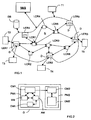
- FIG. 1 describes a non-limiting example of a label switched communications network (or "Label Switched Network”) comprising network equipment (LERn, LCRm) defining nodes and each provided with a load distribution device according to the invention.
- Label Switched Network or "Label Switched Network”
- IP MPLS Internet Protocol MultiProtocol Label Switching
- GMPLS IP Generalized MultiProtocol Label Switching
- An MPLS IP network generally comprises a multiplicity of label switching routers (or LSRs) linked together.
- LSRs label switching routers
- LER routers are responsible for establishing switching paths within the network while LCR routers are responsible for switching.
- link means a connection between two LSR routers
- path (or route) LSP a path between a source LER peripheral router and a destination LER peripheral router, defined by a sequence of links.
- node (or router) that follows another node within an LSP path is usually called “next hop” (or “next hop”). Therefore, the number of hops in an LSP path defines its length.
- An LSP path is typically calculated to optimize the transmission of traffic between a source LER peripheral router and a destination LER peripheral router.
- each peripheral router LER is arranged, when it constitutes a source (LER S ), so as to calculate the best LSP path for transferring the data streams it receives to the destination peripheral router LER ( LER D ), considering the service associated with the flows, the current topology of the network and the current loads of the links.
- the MPLS IP network generally includes a DB database in which the current topology of the network and the current loads of the links are stored.
- the peripheral routers LER are thus coupled to this database DB, which is preferably TE-LSA type (for "Traffic Engineering - Link State Advertisement"), and with which they communicate according to an extension link-state routing protocol. of type "TE” (or “Link State Routing Protocol - Traffic Engineering”) such as "OSPF-TE".
- the IP MPLS network also includes a network management system or NMS responsible for transmitting data to the LSR routers and extracting data from the latter in order to allow management of the network by an administrator (or manager).
- NMS network management system
- the LER destination router of an LSP path is the last router to which a tagged packet is transmitted within a zone (or domain), but not the destination address of said tagged packet.
- the terminals Ti are mobile stations, such as mobile phones (or cellular). But, it could be any type of communication terminal capable of exchanging data with other terminals or network equipment, such as for example fixed telephones, fax machines, personal digital assistants (or PDAs for "personal”). Digital Assistant "), desktop or portable computers, or content provider (or ASP) servers.
- the invention is intended to allow the distribution of load (or traffic) within a network with label switching (here IP MPLS type).
- the invention proposes for this purpose to implement, preferably in each peripheral router LERn of the network, a load distribution device (or traffic) D.
- This device D is not only responsible for calculating the best LSR paths for transmitting data streams received to a destination LER router, but also for resolving (or resorbing) the link congestion by means of a distribution mechanism. charge.
- the load distribution is triggered responsively in each source LER peripheral router that receives traffic and is momentarily connected to a destination peripheral router LER via at least one critical link. But, alternatively or in addition, it can also be triggered in preventive mode so to obey the instructions of the network administrator.
- the device D first comprises a first processing module PM1 responsible for determining equivalent tagged data flow switching paths (or LSP paths) between a source LER peripheral router and each destination LER peripheral router of the network (or domain) considered, taking into account a multiplicity of criteria associated with respective weights and a designation of critical links within the network.
- Each LSP equivalent path is issued with an associated cost value that allows its rank to be set relative to the other LSP equivalent paths delivered.
- This first PM1 processing module is preferably that which is known by the acronym MCLC (for "Multi-Criteria LSP Calculation"), which is described in particular in the patent document bearing the deposit number. FR 02 15966 and whose contents are included here by reference.
- MCLC Multi-Criteria LSP Calculation
- the first processing module PM1 is an MCLC module. The latter being fully described in the aforementioned patent document, it will not be described in detail below.
- an MCLC module simultaneously uses several criteria associated with relative weights (defining a cost vector), in order to determine the values of the links and to deliver LSP paths with equivalent performance (i.e. pareto-optimal) for each destination LER peripheral router of the network (or domain) considered.
- These delivered LSP paths can thus be classified according to a cost value based on the priority (or the relative weight) of each chosen criterion and the deviation from the highest value observed.
- the criteria used by such a MCLC module are preferably chosen from a group comprising at least the available bandwidth, the number of jumps, the transfer time and the administrative cost.
- the choice of criteria and their respective initial relative weight depends on the network administrator.
- Such an MCLC module is preferably interfaced to a OSPF-TE link state routing protocol.
- Each device D also comprises a second processing module PM2 coupled to the first processing module PM1 and responsible for the dynamic distribution of charge in reactive mode and / or in preventive mode.
- a second processing module PM2 coupled to the first processing module PM1 and responsible for the dynamic distribution of charge in reactive mode and / or in preventive mode.
- the device D operates both in reactive mode and in preventive mode.
- the second processing module PM2 is preferably interfaced to an OSPF-TE type link-state routing protocol.
- the second processing module PM2 of its device D firstly by selecting a set of K LSP paths equivalent and alternative to the initial LSP path, among the equivalent LSP paths that are delivered by the first processing module PM1.
- the first processing module PM1 delivers equivalent LSP paths starting from its source LER router and each terminating at one of the destination LER routers of the network (or domain) concerned.
- the second processing module PM2 determines an unequal distribution of the traffic to take the initial LSP path between the equivalent and alternative LSP paths P k of the game, according to their respective cost values M k .
- the device D can be triggered either in reactive mode or in preventive mode.
- the MPLS IP network administrator sends instructions to the relevant source LER router, via the NMS and the network, with the associated criteria and relative weights to be used by the first PM1 module, and the designation (or the identity) of one or more critical links, which can be represented by an administrative cost.
- the relevant source LER router via the NMS and the network, with the associated criteria and relative weights to be used by the first PM1 module, and the designation (or the identity) of one or more critical links, which can be represented by an administrative cost.
- other parameters specifying for example the date and / or time and / or the duration during which the device D must perform a dynamic load distribution can also be transmitted to the source LER router concerned. This preventive mode will be detailed later.
- the device D In the reactive mode, the device D is triggered when it receives the (or) designation (s) (or identity (s)) of one or more critical links whose congestion has been detected by a detection module DM1 when a verification (TE-LSA) of the contents of the DB database.
- a detection module DM1 can be either an external module connected to the source LER router, or a module internal to the device D, for example integrated in the first processing module PM1 as illustrated in FIG. 2.
- the optimal LSP path can be calculated either by the first PM1 processing module (MCLC module) in its standard operation, or by another LSP path calculation module that the first PM1 processing module.
- This other calculation module can be for example Dijkstra type. But, if the second PM2 processing module must intervene, the first PM1 processing module must be used.
- the detection module DM1 When the detection module DM1 detects congestion during a verification phase (TE-LSA), it triggers the first PM1 and second PM2 processing modules. More precisely, the first processing module PM1 comprises a management module MM coupled to the detection module DM1 and responsible for interrupting the timers controlling the computation of regular LSP paths in order to replace them with link charge counters, of elapsed time and load variation. Counters of this type are described, for example, in C. Villamizar's "OSPF Optimized Multipath (OSPF-OMP)", IETF draft, draft-ietf_ospf-omp-03, january 2002.
- OSPF-OMP OSPF Optimized Multipath
- the first processing module PM1 comprises an adaptation module AM coupled to the management module MM and responsible for determining a new weight for at least one of the criteria used in the absence of congestion. Since the main cause of congestion of a link is its overload, it is the weight W BW of the available bandwidth criterion that is preferentially modified, and more precisely increased (unless the network administrator does not refuse this option). The other (regular) criteria are retained (this is usually the theoretical transfer time, path length, load and / or administrative cost).
- the adaptation module AM After increasing the relative weight w BW of the available bandwidth criterion, using a predetermined formula, the adaptation module AM adjusts the respective weights w q (q ⁇ WB) of the other (regular) criteria so that that the sum total of all the relative weights is equal to 1 and that the predefined proportions between the weights w q are respected.
- w BW + (1 - w BW ) / R B , where w BW + is the updated weight and R B is a value greater than 1, and preferably greater than or equal to 2 by default, and representative of the relative weight increment ratio of the bandwidth criterion.
- a calculation module CM1 of the first processing module PM1 calculates all the equivalent LSP paths P k , which can respectively be established between its source LER router (LER S ) and each of the destination routers LER D of the network (or domain ) concerned, and the associated cost values M k , as described in the aforementioned patent document. It uses the criteria and their new relative weights provided by the AM adaptation module, as well as the information coming from the DB database (in particular those concerning the current topology of the network, the current loads of the links and congested links). The equivalent LSP paths P k can thus be classified according to their associated cost values M k .
- the best path LSP is for example referenced P 1 and associated with the cost value M 1 the best (M 1 ⁇ M 2 ... ⁇ M k , where M k is the worst value).
- the second processing module PM2 comprises a calculation module CM2 responsible for receiving the definitions of the K equivalent LSP paths P k , and the associated cost values M k , delivered by the first processing module PM1, in order to determine the dynamic distribution of charge.
- This dynamic load distribution first starts with a pre-selection among the K equivalent LSP paths P k of the equivalent LSP paths that have in common the destination LER router (LER D ), to which must be transmitted the received stream.
- This pre-selection provides K 'LSP paths equivalent and alternative to the LSP path initially provided and having at least one congested link.
- the initial LSP path passes through the source router LER1, the router LCR1, the router LCR5 and the destination router LER3, and the link between the routers LCR1 and LCR5 is congested.
- the dynamic load distribution is continued by selecting, from among the K 'preselected LSP paths, a set of L paths LSP equivalent P I and alternative to the initial path LSP congested.
- the path LSP P 1 goes through the source router LER1, the router LCR1, the router LCR4, the router LCR5 and the destination router LER3
- the path LSP P 2 goes through the source router LER1, the router LCR1, the LCR3 router, the LCR6 router and the destination router LER3
- the LSP path P 3 passes through the source router LER1, the router LCR2, the router LCR3, the router LCR5 and the destination router LER3.
- the calculation module CM2 determines the proportion Q I of the traffic that can be assigned to each selected LSP path P I , given its cost value M I.
- the calculation module CM2 feeds, in traffic allocation proportions Q l and multicore coefficients C l, a distribution module DM2 that comprises the second processing module PM2.
- the DM2 distribution module located in the source LER router, is responsible for distributing the data packets of the received traffic flows and to be transferred to the destination LER router concerned.
- FEC transmission forward equivalence classes
- a stream is identified by an FEC, which drives all the data of this stream on the same single LSP path.
- the association of a stream to be switched to an FEC is performed by the source LER router.
- the FEC I corresponds to the selected LSP P I path, which must carry IQ% of the received stream, to be transferred.
- the distribution module DM2 then preferably performs a dynamic hashing so as to unequally distribute (or distribute) the data streams received by its source LER router, as illustrated in FIG. 3.
- the distribution of traffic in MPLS is naturally of type "flow” (or “flow-based”).
- flow interrupts can be minimized by using a dynamic flow identifier hashing scheme.
- the data streams are represented by bytes including the protocol identifier, the source and destination MPLS ports, and the source and destination IP addresses, as well as other characteristics, for example related to quality of service (QoS).
- QoS quality of service
- the assignment of the data streams can proceed as follows.
- the acronyms LS1 to LS3 denote the three outgoing links used. This is only an illustrative example, since the number of outgoing links may indeed be less than or equal to the number of FECs j .
- This assignment represents the objective that the DM2 distribution module must reach in a given time interval and by means of an incremental data flow offset of the initial LSP path (including the critical link) to the different selected LSP P I paths. .
- the distribution module DM2 preferentially interrupts the data flow offset to a selected LSP path P I when the target proportion of the traffic Q which has been affected is reached.
- the distribution module DM2 preferably shifts the traffic progressively from one selected LSP path to the other according to a chosen shift rate (or "pace shifting") and / or a chosen shift speed.
- the offset rate can be finely tuned by means of mechanisms of the type used in the OSPF-OMP algorithm (for example defining the elementary quantity of flows to be shifted at the same time and the number of quantities and rules for decide when the offset rhythm should be adjusted).
- the distribution module DM2 may be arranged to implement a stabilization mechanism (or hysteresis thresholding) for distributing the allocated flow to a selected LSP path when its load exceeds a chosen threshold (for example equal to 50%), and to interrupt this distribution when its load is less than or equal to said threshold minus another chosen threshold (for example equal to 30%).
- a stabilization mechanism or hysteresis thresholding
- the second PM2 processing module preferentially updates the database DB and the routing table which is stored in a dedicated memory of its source LER router.
- a first difference comes from the triggering mode of the management module MM of the first processing module PM1. This is indeed triggered when it receives instructions from the administrator of the IP MPLS network, as indicated above.
- the MM management module interrupts the timers that control the computation of regular LSP paths, as in the reactive mode.
- the adaptation module AM increases (or modifies) the weight of at least one of the criteria used in the absence of congestion (for example the weight W BW of the available bandwidth criterion), in accordance with the instructions received from the network administrator.
- the AM adaptation module then adjusts the respective weights w q (q ⁇ WB) of the other criteria (regular), as in the reactive mode.
- the adaptation module AM then queries the database DB in order to obtain the information relating to the topology of the current network and the current loads of the links. It then provides all this information to the CM1 calculation module as well as the associated criteria and relative weights to use.
- the calculation performed by the calculation module CM1 is then identical to that described above with reference to the reactive mode. Furthermore, the load distribution performed by the second processing module is almost identical to that described above with reference to the reactive mode. The difference may indeed come from the fact that the calculation module CM2 may be compelled to calculate the rate and / or the offset speed according to the instructions received from the administrator of the IP MPLS network.
- the charge distribution devices D can be implemented in the form of electronic circuits, software (or computer) modules, or a combination of circuits and software.
- the invention provides distributed load balancing devices in each LER peripheral router, thereby enabling dynamic and fast congestions processing.
- the invention is suitable both for long-term congestions (of the order of the hour) and short-term congestions (of the order of one minute).
- the alternative LSP paths are calculated when the device is triggered, so they are determined based on updated network information, which ensures the exclusion of LSP paths with congested links.
- the invention makes it possible to increase the robustness and stability because the traffic distribution remains unchanged throughout each alternative LSP path.
Landscapes
- Engineering & Computer Science (AREA)
- Computer Networks & Wireless Communication (AREA)
- Signal Processing (AREA)
- Data Exchanges In Wide-Area Networks (AREA)
- Small-Scale Networks (AREA)
- Computer And Data Communications (AREA)
- Branching, Merging, And Special Transfer Between Conveyors (AREA)
- Making Paper Articles (AREA)
Claims (15)
- Vorrichtung zur Lastverteilung (D) in einem etikettenvermittelten Netz, welches eine Gruppe von etikettenvermittelten Peripherieknoten (oder LER) aufweist, umfassend i) erste Verarbeitungsmittel (PM1), dazu angeordnet, gleichwertige Vermittlungspfade für etikettierte Datenflüsse zwischen einem so genannten Quell-Peripherieknoten (LERS) und jedem so genannten Ziel-Peripherieknoten (LERD) der Gruppe zu bestimmen, dadurch gekennzeichnet, dass die Pfade bestimmt werden unter Berücksichtigung einer Vielzahl von Kriterien, denen jeweils Gewichtungen zugeordnet sind, und einer Bezeichnung jeder kritischen Verbindung innerhalb des Netzes, wobei die gleichwertigen Vermittlungspfade in Abhängigkeit von zugeordneten Kostenwerten geordnet werden, sowie dadurch, dass die Vorrichtung umfasst: ii) zweite Verarbeitungsmittel (PM2), dazu angeordnet, unter den von den ersten Verarbeitungsmitteln (PM1) bestimmten gleichwertigen Vermittlungspfaden einen Satz von Vermittlungspfaden auszuwählen, die gleichwertig und alternativ zu einem anfänglichen Vermittlungspfad sind, der zwischen einem Quell-Peripherieknoten (LERS) und einem Ziel-Peripherieknoten (LERD) aufgebaut wurde und eine kritische Verbindung umfasst, und anschließend eine Verteilung zwischen den gleichwertigen und alternativen Vermittlungspfaden dieses Satzes in Abhängigkeit von ihren jeweiligen Kostenwerten für einen Verkehr zu bestimmen, der dem anfänglichen Vermittlungspfad folgen soll.
- Vorrichtung nach Anspruch 1, dadurch gekennzeichnet, dass das Kriterium aus einer Gruppe gewählt wird, die mindestens die verfügbare Bandbreite, die Anzahl der Teilstrecken, die Übertragungsdauer und/oder die Verwaltungskosten umfasst.
- Vorrichtung nach einem der Ansprüche 1 und 2, dadurch gekennzeichnet, dass die ersten Verarbeitungsmittel (PM1) so angeordnet sind, dass sie die Vermittlungspfade beim Empfang von Anweisungen des Netzes bestimmen, welche die Kriterien und die dazugehörigen Gewichtungen sowie die Bezeichnungen der kritischen Verbindung umfassen.
- Vorrichtung nach einem der Ansprüche 1 bis 3, dadurch gekennzeichnet, dass die ersten Verarbeitungsmittel (PM1) so angeordnet sind, dass sie die Vermittlungspfade im Fall des Empfangs von Informationen bestimmen, die mindestens eine kritische Verbindung innerhalb des Netzes bezeichnen.
- Vorrichtung nach Anspruch 4, dadurch gekennzeichnet, dass sie Erkennungsmittel (DM1) umfasst, die so angeordnet sind, dass sie die von einem Stau betroffenen kritischen Verbindungen erkennen und an die ersten Verarbeitungsmittel (PM1) Informationen liefern, die die mindestens eine der erkannten, von einem Stau betroffenen kritischen Verbindungen bezeichnen.
- Vorrichtung nach einem der Ansprüche 4 und 5, dadurch gekennzeichnet, dass die ersten Verarbeitungsmittel (PM1) so angeordnet sind, dass sie die Vermittlungspfade bestimmen, nachdem sie die den Kriterien zugeordneten Gewichtungen geändert haben.
- Vorrichtung nach der Kombination der Ansprüche 2 und 6, dadurch gekennzeichnet, dass die ersten Verarbeitungsmittel (PM1) so angeordnet sind, dass sie die dem Kriterium der Bandbreite zugeordnete Gewichtung erhöhen und anschließend die Gewichtungen der anderen Kriterien in Abhängigkeit von dieser Erhöhung so anpassen, dass die Summe der Gewichtungen der verwendeten Kriterien gleich 1 ist und dass die Verhältnisse zwischen den Gewichtungen eingehalten werden.
- Vorrichtung nach einem der Ansprüche 3 bis 7, dadurch gekennzeichnet, dass die ersten Verarbeitungsmittel (PM1) so angeordnet sind, dass sie Vermittlungspfade ausgehend von aktualisierten Werten der Bandbreiten der Verbindungen und von der aktuellen Topologie des Netzes bestimmen.
- Vorrichtung nach einem der Ansprüche 1 bis 8, dadurch gekennzeichnet, dass die zweiten Verarbeitungsmittel (PM2) so angeordnet sind, um i) die vom Quell-Peripherieknoten empfangenen und durch Parameter des Quellnetzes, des Zielnetzes, des Quellanschlusses und des Zielanschlusses definierten Datenflüsse einer dynamischen Zerhackerfunktion unterwerfen, um eine gewählte Anzahl von Werteintervailbereichen zu liefern, und um ii) die Werteintervallbereiche, die für die empfangenen Datenflüsse repräsentativ sind, den gleichwertigen Vermittlungspfaden des Satzes in Abhängigkeit von ihren jeweiligen Kostenwerten zuzuordnen.
- Vorrichtung nach Anspruch 9, dadurch gekennzeichnet, dass die zweiten Verarbeitungsmittel (PM2) so angeordnet sind, dass sie die empfangenen Datenflüsse während eines gewählten Zeitintervalls und entsprechend einer inkrementellen Flussverschiebung jedem der gleichwertigen und alternativen Vermittlungspfade des Satzes zuweisen, wobei die Flussverschiebung auf einem der Pfade unterbrochen wird, wenn die zugehörige Verkehrsverteilung in Abhängigkeit von ihrem Kostenwert erreicht ist.
- Vorrichtung nach Anspruch 10, dadurch gekennzeichnet, dass die zweiten Verarbeitungsmittel (PM2) so angeordnet sind, dass sie die Flussverschiebung fortschreitend in Abhängigkeit vom gewählten Verschiebungstakt und/oder von einer gewählten Verschiebungsgeschwindigkeit vornehmen.
- Vorrichtung nach einem der Ansprüche 1 bis 11, dadurch gekennzeichnet, dass die zweiten Verarbeitungsmittel (PM2) so angeordnet sind, dass sie eine Routingtabelle eines Quell-Peripherieknotens (LERS) aktualisieren, nachdem sie die gleichwertigen und alternativen Vermittlungspfade des Satzes und die Verkehrsverteilung bestimmt haben.
- Vorrichtung nach einem der Ansprüche 1 bis 12, dadurch gekennzeichnet, dass die ersten (PM1) und die zweiten (PM2) Verarbeitungsmittel über eine Schnittstelle zu einem Routingprotokoll mit erweiterter Berücksichtigung des Verbindungsstatus des Typs "TE" und insbesondere des Typs "OSPF-TE" verfügen.
- Peripheriegerät des Netzes (LER), welches einen Peripherieknoten für ein etikettenvermitteltes Kommunikationsnetz (N) definiert, dadurch gekennzeichnet, dass es eine Lastverteilungsvorrichtung (D) nach einem der Ansprüche 1 bis 13 umfasst.
- Peripheriegerät nach Anspruch 14, dadurch gekennzeichnet, dass es einen etikettenvermittelten Peripherierouter ["Label Edge Router"] darstellt.
Applications Claiming Priority (1)
| Application Number | Priority Date | Filing Date | Title |
|---|---|---|---|
| FR0450821A FR2869746B1 (fr) | 2004-04-29 | 2004-04-29 | Dispositif de repartition de charge, multi-criteres, pour un equipement peripherique d'un reseau de comminications a commutation d'etiquettes |
Publications (2)
| Publication Number | Publication Date |
|---|---|
| EP1615397A1 EP1615397A1 (de) | 2006-01-11 |
| EP1615397B1 true EP1615397B1 (de) | 2007-10-17 |
Family
ID=34946755
Family Applications (1)
| Application Number | Title | Priority Date | Filing Date |
|---|---|---|---|
| EP05102866A Expired - Lifetime EP1615397B1 (de) | 2004-04-29 | 2005-04-12 | Vorrichtung zu einer Multikriterien Lastverteilung für ein Peripheriegerät in einem etikettenvermittelten Netz |
Country Status (5)
| Country | Link |
|---|---|
| US (1) | US20050243723A1 (de) |
| EP (1) | EP1615397B1 (de) |
| AT (1) | ATE376307T1 (de) |
| DE (1) | DE602005002877T2 (de) |
| FR (1) | FR2869746B1 (de) |
Families Citing this family (27)
| Publication number | Priority date | Publication date | Assignee | Title |
|---|---|---|---|---|
| EP1626339B1 (de) * | 2004-08-13 | 2016-02-24 | Sap Se | Datenverarbeitungssystem und -verfahren zur Verteilung von Objekten auf Prozessoreinheiten |
| US7978611B2 (en) * | 2005-09-06 | 2011-07-12 | At&T Intellectual Property I, L.P. | Systems and methods to determine network routes based on transmission medium length |
| FR2899415B1 (fr) * | 2006-04-03 | 2008-09-26 | Alcatel Sa | Procede de routage multichemin avec controle mutuel, et routeur pour un reseau de telecommunication |
| US7532583B2 (en) * | 2006-05-30 | 2009-05-12 | International Business Machines Corporation | Method for integrating downstream performance and resource usage statistics into load balancing weights |
| US8976672B2 (en) * | 2006-10-03 | 2015-03-10 | Cisco Technology, Inc. | Efficiently decoupling reservation and data forwarding of data flows in a computer network |
| ES2582884T3 (es) * | 2007-10-31 | 2016-09-15 | Telefonaktiebolaget Lm Ericsson (Publ) | Redes que tienen rutas múltiples entre nodos y nodos para tal red |
| US8498207B2 (en) * | 2008-06-26 | 2013-07-30 | Reverb Networks | Dynamic load balancing |
| EP2161877B1 (de) * | 2008-09-04 | 2012-01-25 | Alcatel Lucent | Vorrichtung und Verfahren zur automatischen Bestimmung eines Netzwerkelements zum Ersetzen eines fehlerhaften Netzwerkelements |
| CN101583057B (zh) * | 2009-06-11 | 2013-08-07 | 中兴通讯股份有限公司 | 网络选路方法及装置 |
| US9826416B2 (en) * | 2009-10-16 | 2017-11-21 | Viavi Solutions, Inc. | Self-optimizing wireless network |
| US20110090820A1 (en) * | 2009-10-16 | 2011-04-21 | Osama Hussein | Self-optimizing wireless network |
| US8385900B2 (en) | 2009-12-09 | 2013-02-26 | Reverb Networks | Self-optimizing networks for fixed wireless access |
| FR2960369B1 (fr) * | 2010-05-20 | 2013-03-01 | Bull Sas | Procede d'optimisation de routage dans un cluster comprenant des liens de communication statiques et programme d'ordinateur mettant en oeuvre ce procede |
| US8489031B2 (en) | 2011-05-18 | 2013-07-16 | ReVerb Networks, Inc. | Interferer detection and interference reduction for a wireless communications network |
| US8509762B2 (en) | 2011-05-20 | 2013-08-13 | ReVerb Networks, Inc. | Methods and apparatus for underperforming cell detection and recovery in a wireless network |
| EP2754271B1 (de) | 2011-09-09 | 2019-11-13 | Reverb Networks Inc. | Verfahren und vorrichtung zur implementierung eines selbstorganisierenden und -optimierenden netzwerkmanagers |
| US9258719B2 (en) | 2011-11-08 | 2016-02-09 | Viavi Solutions Inc. | Methods and apparatus for partitioning wireless network cells into time-based clusters |
| US8897135B2 (en) * | 2012-02-10 | 2014-11-25 | Cisco Technology, Inc. | Recursive load balancing in a loop-free routing topology using routing arcs |
| US9008722B2 (en) | 2012-02-17 | 2015-04-14 | ReVerb Networks, Inc. | Methods and apparatus for coordination in multi-mode networks |
| US9113353B1 (en) | 2015-02-27 | 2015-08-18 | ReVerb Networks, Inc. | Methods and apparatus for improving coverage and capacity in a wireless network |
| US10298488B1 (en) * | 2016-09-30 | 2019-05-21 | Juniper Networks, Inc. | Path selection and programming of multiple label switched paths on selected paths of multiple computed paths |
| US10148564B2 (en) | 2016-09-30 | 2018-12-04 | Juniper Networks, Inc. | Multiple paths computation for label switched paths |
| US10148551B1 (en) | 2016-09-30 | 2018-12-04 | Juniper Networks, Inc. | Heuristic multiple paths computation for label switched paths |
| CN108075980A (zh) * | 2016-11-17 | 2018-05-25 | 中兴通讯股份有限公司 | 一种转发路径的控制方法、装置及控制设备 |
| US10965602B2 (en) * | 2019-03-14 | 2021-03-30 | Intel Corporation | Software assisted hashing to improve distribution of a load balancer |
| CN112887345A (zh) * | 2019-11-29 | 2021-06-01 | 上海交通大学 | 边缘计算环境的节点负载均衡调度方法 |
| US11290379B2 (en) * | 2020-03-18 | 2022-03-29 | Verizon Patent And Licensing Inc. | Egress traffic steering controller |
Family Cites Families (9)
| Publication number | Priority date | Publication date | Assignee | Title |
|---|---|---|---|---|
| US6996065B2 (en) * | 2000-07-06 | 2006-02-07 | Lucent Technologies Inc. | Dynamic backup routing of network tunnel paths for local restoration in a packet network |
| WO2002087175A1 (en) * | 2001-04-19 | 2002-10-31 | Fujitsu Limited | Restoration/protection method and apparatus |
| US6895441B1 (en) * | 2001-07-30 | 2005-05-17 | Atrica Ireland Ltd. | Path rerouting mechanism utilizing multiple link bandwidth allocations |
| JP3875107B2 (ja) * | 2002-01-10 | 2007-01-31 | 株式会社エヌ・ティ・ティ・ドコモ | パケット交換システム、パケット交換方法、ルーティング装置、パケットデータ及びその生成方法 |
| US6778492B2 (en) * | 2002-01-17 | 2004-08-17 | Cisco Technology, Inc. | Load balancing for fast reroute backup tunnels |
| FR2836313A1 (fr) * | 2002-02-21 | 2003-08-22 | France Telecom | Methode de protection locale de chemins a commutation d'etiquettes avec partage de ressources |
| US7352747B2 (en) * | 2002-07-31 | 2008-04-01 | Lucent Technologies Inc. | System and method of network traffic assignment on multiple parallel links between IP/MPLS routers |
| US7451340B2 (en) * | 2003-03-31 | 2008-11-11 | Lucent Technologies Inc. | Connection set-up extension for restoration path establishment in mesh networks |
| US20050007954A1 (en) * | 2003-07-11 | 2005-01-13 | Nokia Corporation | Network device and method for categorizing packet data flows and loading balancing for packet data flows |
-
2004
- 2004-04-29 FR FR0450821A patent/FR2869746B1/fr not_active Expired - Fee Related
-
2005
- 2005-04-12 EP EP05102866A patent/EP1615397B1/de not_active Expired - Lifetime
- 2005-04-12 DE DE602005002877T patent/DE602005002877T2/de not_active Expired - Lifetime
- 2005-04-12 AT AT05102866T patent/ATE376307T1/de not_active IP Right Cessation
- 2005-04-27 US US11/115,209 patent/US20050243723A1/en not_active Abandoned
Also Published As
| Publication number | Publication date |
|---|---|
| FR2869746A1 (fr) | 2005-11-04 |
| FR2869746B1 (fr) | 2006-07-28 |
| EP1615397A1 (de) | 2006-01-11 |
| DE602005002877D1 (de) | 2007-11-29 |
| US20050243723A1 (en) | 2005-11-03 |
| ATE376307T1 (de) | 2007-11-15 |
| DE602005002877T2 (de) | 2008-07-24 |
Similar Documents
| Publication | Publication Date | Title |
|---|---|---|
| EP1615397B1 (de) | Vorrichtung zu einer Multikriterien Lastverteilung für ein Peripheriegerät in einem etikettenvermittelten Netz | |
| US9306831B2 (en) | Technique for efficient load balancing of TE-LSPs | |
| EP1820119B1 (de) | Technik zur auswahl eines pfadberechnungselements | |
| US10721156B2 (en) | Technique for selecting a path computation element based on response time delay | |
| Singh et al. | A survey on internet multipath routing and provisioning | |
| EP1854021B1 (de) | Berechnung des kürzesten te-lsp zwischen domänen in mehreren autonomen systemen | |
| US7995461B2 (en) | Efficient constrained shortest path first optimization technique | |
| US7646719B2 (en) | Inter-domain TE-LSP selection | |
| US8976672B2 (en) | Efficiently decoupling reservation and data forwarding of data flows in a computer network | |
| CN101099351B (zh) | 用于触发对路径计算请求进行打包的方法和装置 | |
| US20020150041A1 (en) | Method and system for providing an improved quality of service for data transportation over the internet | |
| US20060209682A1 (en) | Algorithm for backup PE selection | |
| US20040042473A1 (en) | Method for providing QoS (quality of service) - guaranteeing multi-path and method for providing disjoint path using the same | |
| Rexford | Route optimization in IP networks | |
| Doverspike et al. | Structural overview of ISP networks | |
| EP1432184B1 (de) | Vorrichtung zur Ermittlung eines Nachrichtenpfades in einem etikettvermittelndem Kommunikationsnetzwerk mit vorhandenen Auswahlattributen | |
| EP2332293B1 (de) | Verteilung von routen in einem netzwerk von routern | |
| EP1796333B1 (de) | Verfahren zum Aufbau einer Verbindung zwischen Teile einer Anwendung, die in Knoten verteilt ist, die zu einem über einem GMPLS Kontrollebene verfügten Kommunikationsnetzwerk gehören. | |
| Shihoub et al. | A Study Analysis of VoIP Traffic Between RIP and OSPF Using OPNET | |
| Sa-Ngiamsk et al. | A bandwidth-based constraint routing algorithm for multi-protocol label switching networks | |
| Guedrez | Enabling traffic engineering over segment routing | |
| Vasseur | The Path Computation Element (PCE) for MPLS networks and its application to the Internet of Things (IoT) | |
| Kulkarni et al. | Recent research and comparison of QoS Routing algorithms for MPLS Networks | |
| Kulkarni et al. | New dynamic QoS routing algorithm for optical networks based on MPLS with delay and Bandwidth as constraints | |
| Rossini | Design and analysis of forwarding strategies for host and content centric networking |
Legal Events
| Date | Code | Title | Description |
|---|---|---|---|
| PUAI | Public reference made under article 153(3) epc to a published international application that has entered the european phase |
Free format text: ORIGINAL CODE: 0009012 |
|
| AK | Designated contracting states |
Kind code of ref document: A1 Designated state(s): AT BE BG CH CY CZ DE DK EE ES FI FR GB GR HU IE IS IT LI LT LU MC NL PL PT RO SE SI SK TR |
|
| AX | Request for extension of the european patent |
Extension state: AL BA HR LV MK YU |
|
| 17P | Request for examination filed |
Effective date: 20060711 |
|
| AKX | Designation fees paid |
Designated state(s): AT BE BG CH CY CZ DE DK EE ES FI FR GB GR HU IE IS IT LI LT LU MC NL PL PT RO SE SI SK TR |
|
| 17Q | First examination report despatched |
Effective date: 20060825 |
|
| RAP1 | Party data changed (applicant data changed or rights of an application transferred) |
Owner name: ALCATEL LUCENT |
|
| GRAP | Despatch of communication of intention to grant a patent |
Free format text: ORIGINAL CODE: EPIDOSNIGR1 |
|
| GRAS | Grant fee paid |
Free format text: ORIGINAL CODE: EPIDOSNIGR3 |
|
| GRAA | (expected) grant |
Free format text: ORIGINAL CODE: 0009210 |
|
| AK | Designated contracting states |
Kind code of ref document: B1 Designated state(s): AT BE BG CH CY CZ DE DK EE ES FI FR GB GR HU IE IS IT LI LT LU MC NL PL PT RO SE SI SK TR |
|
| REG | Reference to a national code |
Ref country code: GB Ref legal event code: FG4D Free format text: NOT ENGLISH |
|
| REG | Reference to a national code |
Ref country code: CH Ref legal event code: EP |
|
| REG | Reference to a national code |
Ref country code: IE Ref legal event code: FG4D Free format text: LANGUAGE OF EP DOCUMENT: FRENCH |
|
| REF | Corresponds to: |
Ref document number: 602005002877 Country of ref document: DE Date of ref document: 20071129 Kind code of ref document: P |
|
| GBT | Gb: translation of ep patent filed (gb section 77(6)(a)/1977) |
Effective date: 20080116 |
|
| NLV1 | Nl: lapsed or annulled due to failure to fulfill the requirements of art. 29p and 29m of the patents act | ||
| PG25 | Lapsed in a contracting state [announced via postgrant information from national office to epo] |
Ref country code: ES Free format text: LAPSE BECAUSE OF FAILURE TO SUBMIT A TRANSLATION OF THE DESCRIPTION OR TO PAY THE FEE WITHIN THE PRESCRIBED TIME-LIMIT Effective date: 20080128 Ref country code: NL Free format text: LAPSE BECAUSE OF FAILURE TO SUBMIT A TRANSLATION OF THE DESCRIPTION OR TO PAY THE FEE WITHIN THE PRESCRIBED TIME-LIMIT Effective date: 20071017 Ref country code: SE Free format text: LAPSE BECAUSE OF FAILURE TO SUBMIT A TRANSLATION OF THE DESCRIPTION OR TO PAY THE FEE WITHIN THE PRESCRIBED TIME-LIMIT Effective date: 20080117 |
|
| PG25 | Lapsed in a contracting state [announced via postgrant information from national office to epo] |
Ref country code: PT Free format text: LAPSE BECAUSE OF FAILURE TO SUBMIT A TRANSLATION OF THE DESCRIPTION OR TO PAY THE FEE WITHIN THE PRESCRIBED TIME-LIMIT Effective date: 20080317 Ref country code: SI Free format text: LAPSE BECAUSE OF FAILURE TO SUBMIT A TRANSLATION OF THE DESCRIPTION OR TO PAY THE FEE WITHIN THE PRESCRIBED TIME-LIMIT Effective date: 20071017 Ref country code: BG Free format text: LAPSE BECAUSE OF FAILURE TO SUBMIT A TRANSLATION OF THE DESCRIPTION OR TO PAY THE FEE WITHIN THE PRESCRIBED TIME-LIMIT Effective date: 20080117 Ref country code: LT Free format text: LAPSE BECAUSE OF FAILURE TO SUBMIT A TRANSLATION OF THE DESCRIPTION OR TO PAY THE FEE WITHIN THE PRESCRIBED TIME-LIMIT Effective date: 20071017 Ref country code: PL Free format text: LAPSE BECAUSE OF FAILURE TO SUBMIT A TRANSLATION OF THE DESCRIPTION OR TO PAY THE FEE WITHIN THE PRESCRIBED TIME-LIMIT Effective date: 20071017 Ref country code: IS Free format text: LAPSE BECAUSE OF FAILURE TO SUBMIT A TRANSLATION OF THE DESCRIPTION OR TO PAY THE FEE WITHIN THE PRESCRIBED TIME-LIMIT Effective date: 20080217 |
|
| REG | Reference to a national code |
Ref country code: IE Ref legal event code: FD4D |
|
| PG25 | Lapsed in a contracting state [announced via postgrant information from national office to epo] |
Ref country code: AT Free format text: LAPSE BECAUSE OF FAILURE TO SUBMIT A TRANSLATION OF THE DESCRIPTION OR TO PAY THE FEE WITHIN THE PRESCRIBED TIME-LIMIT Effective date: 20071017 |
|
| PG25 | Lapsed in a contracting state [announced via postgrant information from national office to epo] |
Ref country code: DK Free format text: LAPSE BECAUSE OF FAILURE TO SUBMIT A TRANSLATION OF THE DESCRIPTION OR TO PAY THE FEE WITHIN THE PRESCRIBED TIME-LIMIT Effective date: 20071017 Ref country code: CZ Free format text: LAPSE BECAUSE OF FAILURE TO SUBMIT A TRANSLATION OF THE DESCRIPTION OR TO PAY THE FEE WITHIN THE PRESCRIBED TIME-LIMIT Effective date: 20071017 |
|
| PLBE | No opposition filed within time limit |
Free format text: ORIGINAL CODE: 0009261 |
|
| STAA | Information on the status of an ep patent application or granted ep patent |
Free format text: STATUS: NO OPPOSITION FILED WITHIN TIME LIMIT |
|
| PG25 | Lapsed in a contracting state [announced via postgrant information from national office to epo] |
Ref country code: SK Free format text: LAPSE BECAUSE OF FAILURE TO SUBMIT A TRANSLATION OF THE DESCRIPTION OR TO PAY THE FEE WITHIN THE PRESCRIBED TIME-LIMIT Effective date: 20071017 Ref country code: RO Free format text: LAPSE BECAUSE OF FAILURE TO SUBMIT A TRANSLATION OF THE DESCRIPTION OR TO PAY THE FEE WITHIN THE PRESCRIBED TIME-LIMIT Effective date: 20071017 |
|
| 26N | No opposition filed |
Effective date: 20080718 |
|
| BERE | Be: lapsed |
Owner name: ALCATEL LUCENT Effective date: 20080430 |
|
| PG25 | Lapsed in a contracting state [announced via postgrant information from national office to epo] |
Ref country code: IE Free format text: LAPSE BECAUSE OF FAILURE TO SUBMIT A TRANSLATION OF THE DESCRIPTION OR TO PAY THE FEE WITHIN THE PRESCRIBED TIME-LIMIT Effective date: 20071017 |
|
| PG25 | Lapsed in a contracting state [announced via postgrant information from national office to epo] |
Ref country code: MC Free format text: LAPSE BECAUSE OF NON-PAYMENT OF DUE FEES Effective date: 20080430 |
|
| PG25 | Lapsed in a contracting state [announced via postgrant information from national office to epo] |
Ref country code: EE Free format text: LAPSE BECAUSE OF FAILURE TO SUBMIT A TRANSLATION OF THE DESCRIPTION OR TO PAY THE FEE WITHIN THE PRESCRIBED TIME-LIMIT Effective date: 20071017 Ref country code: GR Free format text: LAPSE BECAUSE OF FAILURE TO SUBMIT A TRANSLATION OF THE DESCRIPTION OR TO PAY THE FEE WITHIN THE PRESCRIBED TIME-LIMIT Effective date: 20080118 |
|
| PG25 | Lapsed in a contracting state [announced via postgrant information from national office to epo] |
Ref country code: FI Free format text: LAPSE BECAUSE OF FAILURE TO SUBMIT A TRANSLATION OF THE DESCRIPTION OR TO PAY THE FEE WITHIN THE PRESCRIBED TIME-LIMIT Effective date: 20071017 |
|
| PG25 | Lapsed in a contracting state [announced via postgrant information from national office to epo] |
Ref country code: BE Free format text: LAPSE BECAUSE OF NON-PAYMENT OF DUE FEES Effective date: 20080430 |
|
| PG25 | Lapsed in a contracting state [announced via postgrant information from national office to epo] |
Ref country code: CY Free format text: LAPSE BECAUSE OF FAILURE TO SUBMIT A TRANSLATION OF THE DESCRIPTION OR TO PAY THE FEE WITHIN THE PRESCRIBED TIME-LIMIT Effective date: 20071017 |
|
| REG | Reference to a national code |
Ref country code: CH Ref legal event code: PL |
|
| PG25 | Lapsed in a contracting state [announced via postgrant information from national office to epo] |
Ref country code: CH Free format text: LAPSE BECAUSE OF NON-PAYMENT OF DUE FEES Effective date: 20090430 Ref country code: LI Free format text: LAPSE BECAUSE OF NON-PAYMENT OF DUE FEES Effective date: 20090430 |
|
| PG25 | Lapsed in a contracting state [announced via postgrant information from national office to epo] |
Ref country code: LU Free format text: LAPSE BECAUSE OF NON-PAYMENT OF DUE FEES Effective date: 20080412 Ref country code: HU Free format text: LAPSE BECAUSE OF FAILURE TO SUBMIT A TRANSLATION OF THE DESCRIPTION OR TO PAY THE FEE WITHIN THE PRESCRIBED TIME-LIMIT Effective date: 20080418 |
|
| PG25 | Lapsed in a contracting state [announced via postgrant information from national office to epo] |
Ref country code: TR Free format text: LAPSE BECAUSE OF FAILURE TO SUBMIT A TRANSLATION OF THE DESCRIPTION OR TO PAY THE FEE WITHIN THE PRESCRIBED TIME-LIMIT Effective date: 20071017 |
|
| PG25 | Lapsed in a contracting state [announced via postgrant information from national office to epo] |
Ref country code: IT Free format text: LAPSE BECAUSE OF NON-PAYMENT OF DUE FEES Effective date: 20080430 |
|
| REG | Reference to a national code |
Ref country code: FR Ref legal event code: GC Effective date: 20131018 |
|
| REG | Reference to a national code |
Ref country code: FR Ref legal event code: RG Effective date: 20141016 |
|
| REG | Reference to a national code |
Ref country code: FR Ref legal event code: PLFP Year of fee payment: 11 |
|
| REG | Reference to a national code |
Ref country code: FR Ref legal event code: CA Effective date: 20150521 |
|
| REG | Reference to a national code |
Ref country code: FR Ref legal event code: CA Effective date: 20150521 |
|
| REG | Reference to a national code |
Ref country code: FR Ref legal event code: PLFP Year of fee payment: 12 |
|
| PGFP | Annual fee paid to national office [announced via postgrant information from national office to epo] |
Ref country code: DE Payment date: 20160421 Year of fee payment: 12 Ref country code: GB Payment date: 20160421 Year of fee payment: 12 |
|
| PGFP | Annual fee paid to national office [announced via postgrant information from national office to epo] |
Ref country code: FR Payment date: 20160421 Year of fee payment: 12 |
|
| REG | Reference to a national code |
Ref country code: DE Ref legal event code: R119 Ref document number: 602005002877 Country of ref document: DE |
|
| GBPC | Gb: european patent ceased through non-payment of renewal fee |
Effective date: 20170412 |
|
| REG | Reference to a national code |
Ref country code: FR Ref legal event code: ST Effective date: 20171229 |
|
| PG25 | Lapsed in a contracting state [announced via postgrant information from national office to epo] |
Ref country code: DE Free format text: LAPSE BECAUSE OF NON-PAYMENT OF DUE FEES Effective date: 20171103 Ref country code: FR Free format text: LAPSE BECAUSE OF NON-PAYMENT OF DUE FEES Effective date: 20170502 |
|
| PG25 | Lapsed in a contracting state [announced via postgrant information from national office to epo] |
Ref country code: GB Free format text: LAPSE BECAUSE OF NON-PAYMENT OF DUE FEES Effective date: 20170412 |