EP1607642B1 - Antriebswelle - Google Patents
Antriebswelle Download PDFInfo
- Publication number
- EP1607642B1 EP1607642B1 EP05010745A EP05010745A EP1607642B1 EP 1607642 B1 EP1607642 B1 EP 1607642B1 EP 05010745 A EP05010745 A EP 05010745A EP 05010745 A EP05010745 A EP 05010745A EP 1607642 B1 EP1607642 B1 EP 1607642B1
- Authority
- EP
- European Patent Office
- Prior art keywords
- shaft
- extension
- edge
- boot mounting
- intermediate portion
- Prior art date
- Legal status (The legal status is an assumption and is not a legal conclusion. Google has not performed a legal analysis and makes no representation as to the accuracy of the status listed.)
- Ceased
Links
- 238000010438 heat treatment Methods 0.000 description 23
- 230000006698 induction Effects 0.000 description 9
- 230000005540 biological transmission Effects 0.000 description 4
- 230000009467 reduction Effects 0.000 description 4
- 229910000851 Alloy steel Inorganic materials 0.000 description 3
- 239000000463 material Substances 0.000 description 3
- 230000003068 static effect Effects 0.000 description 3
- 230000002411 adverse Effects 0.000 description 1
- 230000015572 biosynthetic process Effects 0.000 description 1
- 239000012141 concentrate Substances 0.000 description 1
- 239000011347 resin Substances 0.000 description 1
- 229920005989 resin Polymers 0.000 description 1
- 238000007789 sealing Methods 0.000 description 1
- XLYOFNOQVPJJNP-UHFFFAOYSA-N water Substances O XLYOFNOQVPJJNP-UHFFFAOYSA-N 0.000 description 1
Images


Classifications
-
- F—MECHANICAL ENGINEERING; LIGHTING; HEATING; WEAPONS; BLASTING
- F16—ENGINEERING ELEMENTS AND UNITS; GENERAL MEASURES FOR PRODUCING AND MAINTAINING EFFECTIVE FUNCTIONING OF MACHINES OR INSTALLATIONS; THERMAL INSULATION IN GENERAL
- F16C—SHAFTS; FLEXIBLE SHAFTS; ELEMENTS OR CRANKSHAFT MECHANISMS; ROTARY BODIES OTHER THAN GEARING ELEMENTS; BEARINGS
- F16C3/00—Shafts; Axles; Cranks; Eccentrics
- F16C3/02—Shafts; Axles
-
- F—MECHANICAL ENGINEERING; LIGHTING; HEATING; WEAPONS; BLASTING
- F16—ENGINEERING ELEMENTS AND UNITS; GENERAL MEASURES FOR PRODUCING AND MAINTAINING EFFECTIVE FUNCTIONING OF MACHINES OR INSTALLATIONS; THERMAL INSULATION IN GENERAL
- F16D—COUPLINGS FOR TRANSMITTING ROTATION; CLUTCHES; BRAKES
- F16D3/00—Yielding couplings, i.e. with means permitting movement between the connected parts during the drive
- F16D3/84—Shrouds, e.g. casings, covers; Sealing means specially adapted therefor
- F16D3/843—Shrouds, e.g. casings, covers; Sealing means specially adapted therefor enclosed covers
- F16D3/845—Shrouds, e.g. casings, covers; Sealing means specially adapted therefor enclosed covers allowing relative movement of joint parts due to the flexing of the cover
Definitions
- the present invention relates to a drive shaft used in an automotive drive train or the like, and more particularly, relates to a drive shaft comprising a shaft and a constant velocity joint.
- a power transmission device for automobiles or the like normally transmits a driving force through a drive shaft comprising a shaft portion and a constant velocity joint.
- the shaft portion undergoes induction heat treatment or the like to increase its strength, which results in the formation of a hardened layer up to a certain depth from the surface while leaving a non-hardened portion at the shaft core.
- Both ends thereof are in splined engagement with interior members of the constant velocity joint (for an example, refer to Japanese Patent Laid-Open Publication No. 2000-240669 , paragraphs 2 to 10 and FIG. 1 ).
- FIG. 3 shows an example of such a drive train, wherein a shaft portion 1 has boot mounting parts 3, 5 and extensions 4, 6 respectively connected and coaxially formed with both ends of a shaft body 2.
- the inboard-side extension 4 of the shaft portion 1, for example, is connected to a driving-side member of a side gear or the like in a differential, via a tripod-type sliding constant velocity joint 30.
- the outboard-side extension 6, for example, is connected to a driven-side member of a hub or the like in a driven wheel, via a ball-type fixed constant velocity joint 35.
- Boots 33, 38 made from soft rubber, resin or the like are provided in order to seal the interiors of the constant velocity joints 30, 35 against dirt, water and so forth from outside. More specifically, the boots 33, 38 are respectively provided between the constant velocity joints 30, 35 and the boot mounting parts 3, 5 on both ends of the shaft body 2 of the shaft portion 1.
- each of the boots 33, 38 overlay an opening on each of exterior members 31, 36 of the constant velocity joints 30, 35, and is attached using bands 34a, 39a so as to form an airtight seal. Another end is attached via the boot mounting parts 3,5 using bands 34b, 39b so as to form an airtight seal as well.
- boot grooves 3a, 5a are formed on the boot mounting parts 3, 5.
- the inboard-side extension 4 comprises a cylindrical intermediate portion 4a, as well as an end 4b in spline engagement with an interior member 32a of the constant velocity joint 30.
- the intermediate portion 4a has an outer diameter smaller than the boot mounting part 3 and the end 4b. Both ends of the intermediate portion 4a are connected to the boot mounting part 3 and the end 4b by tapered portions 4c, 4d.
- the value for the outer diameter of the intermediate portion 4a of the extension 4 is the minimum necessary for obtaining a required transmitted torque.
- Formed on an opening-side of the inner surface of the exterior member 31 of the constant velocity joint 30 is a flank 31a that faces outward and leaves a slight clearance with the intermediate portion 4a.
- the flank 31a is formed in order to avoid interference with the intermediate portion 4a of the extension 4 at a maximum shaft intersection angle between the extension 4 and the exterior member 31.
- the outboard-side extension 6 comprises a cylindrical intermediate portion 6a, as well as an end 6b in spline engagement with an interior member 37 of the constant velocity joint 35.
- the intermediate portion 6a has a diameter smaller than the boot mounting part 5 and the end 6b. Both ends of the intermediate portion 6a are connected to the boot mounting part 5 and the end 6b by tapered portions 6c, 6d.
- the value for the outer diameter of the intermediate portion 6a of the extension 6 is the minimum necessary in terms of strength.
- Formed on an opening-side of the inner surface of the exterior member 36 of the constant velocity joint 35 is a flank 36a that faces outward, and also leaves a slight clearance with the intermediate portion 6a at a maximum shaft intersection angle.
- the position of a boundary between the intermediate portions 4a, 6a and the base side of tapered portions 4c, 6c at the maximum shaft intersection angle is set somewhat apart from outer edges 31b, 36b of the flanks 31a, 36a of the constant velocity joints 30, 35 and set towards the boot mounting parts 3, 5 sides.
- a hardened layer is formed up to a certain depth from the surface while leaving a non-hardened portion at the shaft core to increase the strength of the shaft in the drive shaft.
- the depth of heat treatment, t/R (where, t: depth of hardened layer, and R: radius of heat treated member), must be set to a certain optimum value.
- alloy steel used in the shaft differs depending on the material, but the optimum heat treatment depth t/R is within the range of 0.55 to 0.8.
- the static torsional strength improves as the heat treatment depth t/R increases; although the fatigue torsional strength falls once the heat treatment depth t/R exceeds a certain limit.
- the heat treatment depth t/R must be set to a value smaller than 0.8.
- the outer diameters of the intermediate portions 4a, 6a of the extensions 4, 6 are set to the minimum values necessary for obtaining the required transmitted torque.
- the boot grooves 3a, 5a are formed on the boot mounting parts 3, 5 to attach the boots 33, 38, and making the outer diameter of the bottom portion of the boot grooves 3a, 5a smaller than the outer diameter of the intermediate portions 4a, 6a would adversely affect strength.
- the outer diameters of the boot mounting parts 3, 5 forming both sides of the boot grooves 3a, 5a are larger than the outer diameters of the intermediate portions 4a, 6a, which results in an outer diameter of the shaft portion 1 that varies among the intermediate portions 4a, 6a and the boot mounting parts 3, 5.
- splines formed on the ends 4b, 6b necessitate an outer diameter larger than that of the intermediate portions 4a, 6a for the sake of ensuring strength, which also means the outer diameter of the shaft portion 1 varies among the intermediate portions 4a, 6a and the ends 4b, 6b as well.
- a drive shaft is described in US-B1-6 319 337 , wherein the drive shaft is made by induction hardening in order to achieve higher strength. In this induction hardening, the ratio of the material components of the shaft is specifically adjusted.
- the drive shaft in this example shows a conventional structure of a drive shaft with a long intermediate portion between short tapered portions on each constant velocity side of the shaft.
- An induction heat treatment device is used to harden this type of shaft, and adjustment of the heat treatment depth t/R is performed by adjusting the magnitude of high frequency output, coil shape and frequency.
- variations in the outer diameter of the shaft portion 1 among the intermediate portions 4a, 6a and the boot mounting parts 3, 5 also vary the heat capacity per unit length, thus making it difficult to control the heat treatment depth t/R in the surrounding vicinity. This is due to sudden changes in the outer diameter at the tapered portions 4c, 4d, despite performing induction hardening on the shaft aiming for the optimum value. Consequently, the heat treatment depth t/R misses the target value, thereby lowering the strength in this vicinity.
- the drive shaft according to the present invention has a shaft body; a shaft portion provided with a boot mounting part coaxially formed on an end thereof, a coaxially formed extension subsequent to the boot mounting part; and a constant velocity joint attached to an end of the extension via an interior member.
- the extension has an intermediate portion with a cylindrical shape and an outer diameter smaller than that of the boot mounting part and the end of the extension.
- the constant velocity joint has an interior sealed from the outside by an end of a boot that is attached to the boot mounting part so as to form an airtight seal.
- the constant velocity joint is provided on an opening-side of an inner surface of an exterior member thereof with a flank that faces outward and leaves a slight clearance with the intermediate portion at a maximum shaft intersection angle between the extension and the exterior member.
- the intermediate portion has a first edge on the boot mounting part side that is positioned closer to the boot mounting part side than a position corresponding to an outer edge of the flank at the maximum shaft intersection angle or a position in a vicinity thereof.
- the boot mounting part is connected to the first edge by a tapered portion of the shaft body.
- the intermediate portion has a first edge on the boot mounting part side that is positioned at a position corresponding to an outer edge of the flank at the maximum shaft intersection angle, and the boot mounting part is connected to the first edge by a tapered portion of the shaft body.
- the tapered portion is set to a maximum length. This in turn moderates variations in the outer diameter of the shaft portion between the intermediate portion and the boot mounting part, whereby variations in the heat capacity per unit length therebetween are moderated as well. Consequently, controlling the heat treatment depth t/R therebetween becomes easier, making it possible to obtain a heat treatment depth t/R at or near an optimum value in the range of the boot mounting part and the intermediate portion in the extension of the drive shaft. Reductions in local strength resulting from the shape-changing rate of the shaft portion can also be greatly improved.
- the intermediate portion prefferably has a second edge on the end side that is positioned closer to the end side than a position corresponding to an inner edge of the flank at the maximum shaft intersection angle or a position in a vicinity thereof. It is also preferable for the end of the extension to be connected to the second edge by a tapered portion on the end side of the shaft body.
- the intermediate portion has a second edge on the end side that is positioned closer to the end side than a position corresponding to an inner edge of the flank at the maximum shaft intersection angle or a position in a vicinity thereof; and the end of the extension is connected to the second edge by a tapered portion on the end side of the shaft body. Therefore, variations in the outer diameter of the drive shaft between the intermediate portion and the end are moderated, whereby variations in the heat capacity per unit length therebetween are moderated as well. Consequently, it is possible to obtain a heat treatment depth t/R at or near an optimum value in the range between the end and the intermediate portion in the extension of the drive shaft. Reductions in local strength resulting from the shape-changing rate of the shaft portion can also be further improved.
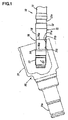
- FIG. 1 a preferred embodiment of a drive shaft according to the present invention will be described based upon an embodiment shown in FIG. 1 .
- This embodiment applies the present invention to a power transmission device connecting a differential and a drive wheel of an automobile.
- the power transmission device is similar in practice to related art shown in FIG. 3 , except for the shape of an extension on both ends of the drive shaft.
- a shaft portion 10 in the embodiment comprises a shaft body 11 formed from alloy steel; boot mounting parts 12, 13 coaxially and integrally formed on ends thereof; and extensions 15, 20 coaxially and integrally formed subsequent to the boot mounting parts.
- a tripod-type sliding constant velocity joint 30 is connected to an end 17 of an inboard-side extension (extension) 15, whereas a ball-type fixed constant velocity joint 35 is connected to an end 22 of an outboard-side extension (extension) 20.
- Respective ends of boots 33, 38 also similar to that in the related art shown in FIG 3 overlay an opening in each of exterior members 31, 36 of the constant velocity joints 30, 35, and are attached using bands 34a, 39a so as to form an airtight seal. Other ends are attached to form an airtight seal using bands 34b, 39b via the boot mounting parts 12, 13 on which boot grooves 12a, 13a are formed.
- FIG. 1 is an enlarged view including the inboard-side extension 15 of the shaft portion 10 according to the embodiment.
- An intermediate portion 16 of the inboard-side extension 15 has a cylindrical shape with a fixed diameter. Based upon the same reason explained in the related art, the major diameter is smaller than the outer diameter of the boot mounting part 12 and the end 17.
- An edge 16a (that corresponds to a first edge in the claims) of the intermediate portion 16 is connected to the boot mounting part 12 by a tapered portion 18, whereas an edge 16b (that corresponds to a second edge in the claims) is connected to the end 17 by a tapered portion 19 on the end side.
- the outer diameter of the shaft body 11 is smaller than the outer diameter of the boot mounting part 12, and larger than the diameter of the intermediate portion 16.
- the tripod-type constant velocity joint 30 comprises an exterior member 31, a tripod 32, and three rollers 32c.
- the tripod 32 is formed with three trunnions 32b projecting from an interior member 32a at regular intervals in the circumferential direction.
- the rollers 32c are rotatably supported by each trunnion 32b, in addition to being guided and supported within the guiding grooves 31d of the exterior member 31.
- In spline engagement are the interior member 32a of the constant velocity joint 30 and the end 17 of the inboard-side extension 15.
- the inboard-side extension 15 in which the end 17 is in spline engagement with the interior member 32a is capable of freely swiveling around a center point O1 of the interior member 32a.
- the center point O1 is movable in the center axis direction of the exterior member 31.
- a flank 31a is formed on an opening side of the inner surface on the exterior member 31 of the tripod-type constant velocity joint 30.
- the flank 31a comprises a portion of a conical surface extending outward at a position in the circumferential direction between the guiding grooves 31d.
- the flank 31a is formed such that a slight clearance is created with the intermediate portion 16 of the inboard-side extension 15 at the maximum shaft intersection angle of the exterior member 31 and the inboard-side extension 15, with the center point O1 at the farthest inward position with respect to the exterior member 31.
- edge 16a on the boot mounting part 12 side of the intermediate portion 16 of the inboard-side extension 15 is at a position corresponding to an outer edge 31b of the flank 31a on the exterior member 31 at the maximum shaft intersection angle.
- another edge 16b on the end 17 side of the intermediate portion 16 is positioned closer to the end 17 side than a position corresponding to an inner edge 31c of the flank 31a on the exterior member 31.
- FIG. 2 shows an enlarged view including the outboard-side extension 20 of the shaft portion 10 according to the embodiment.
- an intermediate portion 21 of the outboard-side extension 20 Similar to the inboard-side extension 15, an intermediate portion 21 of the outboard-side extension 20 also has a cylindrical shape. The major diameter thereof is smaller than the outer diameter of the boot mounting part 13 and an end 22. An edge 21a of the intermediate portion 21 is connected to the boot mounting part 13 by a tapered portion 23, whereas another edge 21b is connected to the end 22 by a tapered portion 24 on the end side.
- the intermediate portion 21 has a diameter substantially identical to that of the intermediate portion 16 of the inboard-side extension 15, and which is smaller than that of the shaft body 11.
- the ball-type constant velocity joint 35 comprises an exterior member 36 and an interior member 37, in addition to six balls 37a.
- the exterior member 36 and the interior member 37 are respectively formed at regular intervals in the circumferential direction.
- the balls 37a roll within the ball grooves 36d, 37b.
- spline engagement are the interior member 37 of the constant velocity joint 35 and the end 22 of the outboard-side extension 20.
- a shaft 36e coaxially projecting from the exterior member 36 in the axis direction and a hub of a drive wheel.
- the outboard-side extension 20 in which the end 22 is in spline engagement with the interior member 37 is capable of freely swiveling around a center point 02 of the interior member 37.
- a conical flank 36a extending outward is formed on an opening side of the inner surface on the exterior member 36 of the ball-type constant velocity joint 35.
- the flank 36a is formed such that a slight clearance is created with the intermediate portion 21 of the outboard-side extension 20 at the maximum shaft intersection angle of the exterior member 36 and the outboard-side extension 20.
- the edge 21a on the boot mounting part 13 side of the intermediate portion 21 of the outboard-side extension 20 is in the vicinity of a position corresponding to an outer edge 36b of the flank 36a on the exterior member 36, but positioned closer to the boot mounting part 13 side to a certain extent.
- another edge 21b on the end 22 side of the intermediate portion 21 is in the vicinity of a position corresponding to an inner edge 36c of the flank 36a on the exterior member 36, but positioned closer to the end 22 side to a certain extent.
- the boot mounting parts 12, 13 and the extensions 15, 20 are coaxially formed integral with both ends of the shaft body 11.
- induction heat treatment is performed on the shaft portion 10 with a target value set such that a heat treatment depth t/R reaches an optimum value (0.55 to 0.8, although it may vary for alloy steel depending on the material).
- the edge 16a on the boot mounting part 12 side of the intermediate portion 16 is positioned corresponding to the outer edge 31b of the flank 31a at the maximum shaft intersection angle, with the center point O1 at the farthest position inward with respect to the exterior member 31.
- the length of the tapered portion 18 connecting the edge 16a and the boot mounting part 12 is set to a maximum length.
- This in turn moderates variations in the outer diameter of the shaft portion 10 between the intermediate portion 16 and the boot mounting part 12, whereby variations in the heat capacity per unit length therebetween are moderated as well. Accordingly, fluctuations in the heat treatment depth t/R therebetween are also reduced. Consequently, it is possible to obtain a heat treatment depth t/R at or near the target value in the range between the boot mounting part 12 and the intermediate portion 16 in the extension 15 of the shaft portion 10.
- Fig. 2 showing an example of a drive shaft not falling under the scope of the invention
- Fig. 3 local strength is greatly reduced.
- the edge 21a on the boot mounting part 13 side of the intermediate portion 21 is positioned in the vicinity of a position corresponding to the outer edge 36b of the flank 36a at the maximum shaft intersection angle.
- the edge 21a and the boot mounting part 13 are connected by the tapered portion 23. Therefore, similar to the inboard-side extension 15, variations in the outer diameter of the shaft portion 10 between the intermediate portion 21 and the boot mounting part 13 are moderated, thereby moderating variations in the heat capacity per unit length therebetween as well. In addition, concentration of the magnetic field during induction hardening is also suppressed.
- Another edge 21b on the end 22 side of the intermediate portion 21 in the outboard-side extension 20 is positioned closer to the end 22 side than the vicinity of a position corresponding to the inner edge 36c of the flank 36a at the maximum shaft intersection angle.
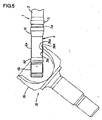
- the other edge 21b and the end 22 are connected by the tapered portion 24 on the end side. Therefore, variations in the outer diameter of the shaft portion 10 between the intermediate portion 21 and the end 22 are moderated, whereby variations in the heat capacity per unit length therebetween are moderated as well. Consequently, controlling the heat treatment depth t/R therebetween becomes easier, making it possible to further improve reductions in local strength compared to related art as shown in FIG 5 , similar to the tapered portion 23 and boot mounting part 13 side. Moreover, there is an increase in strength corresponding to the increase in the length of the tapered portion compared to the conventional length, because the intermediate portion with a small diameter is shortened.
- Test 1 Static torsional strength (average) 1.00 1.11 (Using Test 1 as a reference set to 1.0)
- a drive shaft is configured from a shaft body, a shaft portion provided with extensions and boot mounting parts coaxially and integrally formed on ends thereof, and constant velocity joints attached to ends of the extensions via interior members.
- the outer diameter of intermediate portions of the extensions is smaller than that of the ends and the boot mounting parts.
- Formed on the opening-sides of the inner surfaces of the exterior members of the constant velocity joints are flanks that face outward and leave a slight clearance with the intermediate portions.
- Edges forming the boot mounting part sides of the intermediate portions are set to positions corresponding to outer edges of the flanks, and tapered portions connect the edges and the boot mounting parts.
Landscapes
- Engineering & Computer Science (AREA)
- General Engineering & Computer Science (AREA)
- Mechanical Engineering (AREA)
- Ocean & Marine Engineering (AREA)
- Shafts, Cranks, Connecting Bars, And Related Bearings (AREA)
- Sealing Devices (AREA)
Claims (2)
- Antriebswelle mit:einem Wellenkörper (11);einem Wellenabschnitt (10), der mit einem Faltenbalgmontageteil (12; 13), das an einem Ende davon koaxial ausgebildet ist, einer koaxial ausgebildeten Erweiterung (15; 20) auf das Faltenbalgmontageteil (12; 13) folgend bereitgestellt ist; undeinem Konstantgeschwindigkeitsgelenk (30; 35), das an einem Ende (17; 22) der Erweiterung (15; 20) über ein Innenelement angebracht ist, wobeidie Erweiterung (15; 20) einen Zwischenabschnitt (16; 21) mit einer zylindrischen Form und einem Außendurchmesser kleiner als dem des Faltenbalgmontageteils (12; 13) und dem des Endes der Erweiterung (15; 20) aufweist,das Konstantgeschwindigkeitsgelenk (30; 35) ein Inneres von außen durch das Ende eines Faltenbalgs (33; 38) abgedichtet aufweist, der an dem Faltenbalgmontageteil (12; 13) angebracht ist, um eine luftdichte Dichtung auszubilden,das Konstantgeschwindigkeitsgelenk (30; 35) an einer Öffnungsseite einer Innenfläche eines äußeren Elements (31; 36) davon mit einer Freifläche (31a; 36a) bereitgestellt ist, die nach außen gerichtet ist und einen geringen Freiraum mit dem inneren Abschnitt (16; 21) unter einem maximalen Wellenschnittwinkel zwischen der Erweiterung (15; 20) und dem äußeren Element (31; 36) lässt,der Zwischenabschnitt (16; 21) eine erste Kante (16a; 21a) an der Seite des Faltenbalgmontageteils aufweist, unddas Faltenbalgmontageteil (12; 13) mit der ersten Kante (16a; 21a) durch einen abgeschrägten Abschnitt (18; 23) des Wellenkörpers (11) verbunden ist,dadurch gekennzeichnet, dass
die erste Kante (16a; 21a) des Zwischenabschnitts (16; 21) an dem maximalen Wellenschnittwinkel entsprechend dem einer äußeren Kante (31b; 36b) der Freifläche (31a; 36a) positioniert ist. - Antriebswelle nach Anspruch 1, wobei
der Zwischenabschnitt (16; 21) eine zweite Kante (16b; 21b) an der End- (17; 22) Seite aufweist, die näher an der End- (17; 22) Seite positioniert ist als eine Position entsprechend einer Innenkante (31c; 36c) der Freifläche (31a; 36a) oder einer Position in der Nähe davon an dem maximalen Wellenschnittwinkel; und
das Ende der Erweiterung (15; 20) durch einen abgeschrägten Abschnitt (19; 24) an der End- (17; 22) Seite des Wellenkörpers (11) mit der zweiten Kante (16b; 21b) verbunden ist.
Applications Claiming Priority (2)
| Application Number | Priority Date | Filing Date | Title |
|---|---|---|---|
| JP2004176115 | 2004-06-14 | ||
| JP2004176115A JP4725039B2 (ja) | 2004-06-14 | 2004-06-14 | ドライブシャフト |
Publications (2)
| Publication Number | Publication Date |
|---|---|
| EP1607642A1 EP1607642A1 (de) | 2005-12-21 |
| EP1607642B1 true EP1607642B1 (de) | 2012-12-26 |
Family
ID=34936635
Family Applications (1)
| Application Number | Title | Priority Date | Filing Date |
|---|---|---|---|
| EP05010745A Ceased EP1607642B1 (de) | 2004-06-14 | 2005-05-18 | Antriebswelle |
Country Status (3)
| Country | Link |
|---|---|
| US (1) | US7435182B2 (de) |
| EP (1) | EP1607642B1 (de) |
| JP (1) | JP4725039B2 (de) |
Families Citing this family (7)
| Publication number | Priority date | Publication date | Assignee | Title |
|---|---|---|---|---|
| US7793953B2 (en) * | 2006-08-15 | 2010-09-14 | Ride The Ducks International, Llc | Steering knuckle boot |
| WO2015153431A2 (en) | 2014-04-04 | 2015-10-08 | Dana Automotive Systems Group, Llc | Constant velocity joint assembly |
| US11053985B2 (en) | 2016-02-10 | 2021-07-06 | Dana Automotive Systems Group, Llc | Direct pinion mount constant velocity joint |
| WO2017196962A1 (en) | 2016-05-10 | 2017-11-16 | Dana Automotive Systems Group, Llc | Boot assembly for a constant velocity joint |
| CN110691918B (zh) | 2017-03-31 | 2022-04-15 | 德纳汽车系统集团有限责任公司 | 等速接头组件 |
| US12247621B2 (en) * | 2017-10-24 | 2025-03-11 | Ntn Corporation | Wheel bearing device |
| USD987697S1 (en) * | 2021-05-14 | 2023-05-30 | Zhejiang Precise Driveline Machinery Co., Ltd | Protective cover for drive shaft |
Family Cites Families (13)
| Publication number | Priority date | Publication date | Assignee | Title |
|---|---|---|---|---|
| JPS594823A (ja) * | 1982-06-29 | 1984-01-11 | Hitachi Ltd | 低カロリ−ガス焚ガスタ−ビン燃焼器 |
| JPS60129519A (ja) * | 1983-12-14 | 1985-07-10 | Hitachi Zosen Corp | 排ガス除塵方法 |
| JPH0612258Y2 (ja) * | 1987-04-30 | 1994-03-30 | 本田技研工業株式会社 | スライド式自在継手におけるインナ部材のストツパ装置 |
| JPH01303319A (ja) * | 1988-05-30 | 1989-12-07 | Toyoda Mach Works Ltd | 等速ジョイント |
| NL8801394A (nl) * | 1988-05-31 | 1989-12-18 | Skf Ind Trading & Dev | Homokinetische koppeling. |
| KR940007396A (ko) * | 1992-09-30 | 1994-04-27 | 스마 요시츠기 | 교차 홈 타입의 등속회전 조인트 |
| JPH11101256A (ja) * | 1997-09-29 | 1999-04-13 | Ntn Corp | 等速ジョイント |
| JP2000065083A (ja) * | 1998-08-24 | 2000-03-03 | Nippon Seiko Kk | 等速ジョイント |
| JP2000240669A (ja) | 1999-02-18 | 2000-09-05 | Ntn Corp | 動力伝達軸 |
| US6319337B1 (en) * | 1999-02-10 | 2001-11-20 | Ntn Corporation | Power transmission shaft |
| DE19938771C2 (de) * | 1999-08-16 | 2002-01-31 | Gkn Loebro Gmbh | Gelenkwelle mit Anpassung an eine bevorzugte Drehmomentübertragungsrichtung |
| JP2001323945A (ja) * | 2000-05-15 | 2001-11-22 | Ntn Corp | 等速ジョイント |
| JP4219583B2 (ja) * | 2001-10-26 | 2009-02-04 | Ntn株式会社 | 固定型等速自在継手 |
-
2004
- 2004-06-14 JP JP2004176115A patent/JP4725039B2/ja not_active Expired - Lifetime
-
2005
- 2005-05-18 EP EP05010745A patent/EP1607642B1/de not_active Ceased
- 2005-05-26 US US11/137,578 patent/US7435182B2/en not_active Expired - Fee Related
Also Published As
| Publication number | Publication date |
|---|---|
| JP4725039B2 (ja) | 2011-07-13 |
| JP2005351465A (ja) | 2005-12-22 |
| EP1607642A1 (de) | 2005-12-21 |
| US20050277479A1 (en) | 2005-12-15 |
| US7435182B2 (en) | 2008-10-14 |
Similar Documents
| Publication | Publication Date | Title |
|---|---|---|
| US4950206A (en) | Constant velocity ratio universal joints | |
| US8047724B2 (en) | Bearing device for wheel | |
| EP1607642B1 (de) | Antriebswelle | |
| EP2937587A1 (de) | Herstellungsverfahren für äusseres gelenkelement eines gleichlaufgelenks und äusseres gelenkelement | |
| US10962063B2 (en) | Fixed constant velocity universal joint | |
| JP4076818B2 (ja) | 等速自在継手 | |
| US7217194B2 (en) | Constant velocity universal joint | |
| EP3309420B1 (de) | Aussengelenkelement für ein universelles gleichlaufgelenk | |
| EP2136094B1 (de) | Kardangelenk | |
| US11840114B2 (en) | Wheel bearing unit for a motor vehicle as well as method for producing a wheel bearing unit | |
| JP4279301B2 (ja) | 駆動車輪用軸受装置 | |
| EP3159564B1 (de) | Herstellungsverfahren für äusseres verbindungsglied eines gleichlaufgelenks und äusseres verbindungsglied | |
| WO2023026831A1 (ja) | 摺動式等速自在継手 | |
| US7568977B2 (en) | Shaft for constant velocity universal joint | |
| KR101389193B1 (ko) | 등속조인트용 샤프트의 제조방법 | |
| JP2006064060A5 (de) | ||
| CN120720340A (zh) | 等速万向联轴器用外侧联轴器构件以及具备该构件的固定式等速万向联轴器 | |
| JP2006064060A (ja) | 等速自在継手 | |
| US20030224860A1 (en) | Constant velocity joints | |
| WO2025205018A1 (ja) | 等速自在継手の外側継手部材 | |
| KR101621179B1 (ko) | 아우터 롤러, 스파이더 어셈블리 및 트라이포드 등속조인트 | |
| JP2007224981A (ja) | 等速自在継手の外方部材及びその製造方法 | |
| JP2024132440A (ja) | トリポード型等速自在継手 | |
| JP2513762Y2 (ja) | 等速ジョイント | |
| WO2025047345A1 (ja) | 摺動式等速自在継手及びこれを備えた車輪駆動装置 |
Legal Events
| Date | Code | Title | Description |
|---|---|---|---|
| PUAI | Public reference made under article 153(3) epc to a published international application that has entered the european phase |
Free format text: ORIGINAL CODE: 0009012 |
|
| AK | Designated contracting states |
Kind code of ref document: A1 Designated state(s): AT BE BG CH CY CZ DE DK EE ES FI FR GB GR HU IE IS IT LI LT LU MC NL PL PT RO SE SI SK TR |
|
| AX | Request for extension of the european patent |
Extension state: AL BA HR LV MK YU |
|
| 17P | Request for examination filed |
Effective date: 20060619 |
|
| AKX | Designation fees paid |
Designated state(s): DE |
|
| RAP1 | Party data changed (applicant data changed or rights of an application transferred) |
Owner name: JTEKT CORPORATION |
|
| 17Q | First examination report despatched |
Effective date: 20061027 |
|
| RIN1 | Information on inventor provided before grant (corrected) |
Inventor name: NISHI, KOJIJTEKT CORPORATION Inventor name: ICHIKAWA, KAZUYUKIJTEKT CORPORATION Inventor name: INAGAKI, YUJIJTEKT CORPORATION |
|
| GRAP | Despatch of communication of intention to grant a patent |
Free format text: ORIGINAL CODE: EPIDOSNIGR1 |
|
| GRAS | Grant fee paid |
Free format text: ORIGINAL CODE: EPIDOSNIGR3 |
|
| GRAA | (expected) grant |
Free format text: ORIGINAL CODE: 0009210 |
|
| AK | Designated contracting states |
Kind code of ref document: B1 Designated state(s): DE |
|
| REG | Reference to a national code |
Ref country code: DE Ref legal event code: R096 Ref document number: 602005037558 Country of ref document: DE Effective date: 20130307 |
|
| PLBE | No opposition filed within time limit |
Free format text: ORIGINAL CODE: 0009261 |
|
| STAA | Information on the status of an ep patent application or granted ep patent |
Free format text: STATUS: NO OPPOSITION FILED WITHIN TIME LIMIT |
|
| 26N | No opposition filed |
Effective date: 20130927 |
|
| REG | Reference to a national code |
Ref country code: DE Ref legal event code: R097 Ref document number: 602005037558 Country of ref document: DE Effective date: 20130927 |
|
| PGFP | Annual fee paid to national office [announced via postgrant information from national office to epo] |
Ref country code: DE Payment date: 20190508 Year of fee payment: 15 |
|
| REG | Reference to a national code |
Ref country code: DE Ref legal event code: R119 Ref document number: 602005037558 Country of ref document: DE |
|
| PG25 | Lapsed in a contracting state [announced via postgrant information from national office to epo] |
Ref country code: DE Free format text: LAPSE BECAUSE OF NON-PAYMENT OF DUE FEES Effective date: 20201201 |