EP1604973A1 - Bistropylidendiamine und deren Verwendung - Google Patents
Bistropylidendiamine und deren Verwendung Download PDFInfo
- Publication number
- EP1604973A1 EP1604973A1 EP05011538A EP05011538A EP1604973A1 EP 1604973 A1 EP1604973 A1 EP 1604973A1 EP 05011538 A EP05011538 A EP 05011538A EP 05011538 A EP05011538 A EP 05011538A EP 1604973 A1 EP1604973 A1 EP 1604973A1
- Authority
- EP
- European Patent Office
- Prior art keywords
- formula
- alkyl
- aryl
- compounds
- arylalkyl
- Prior art date
- Legal status (The legal status is an assumption and is not a legal conclusion. Google has not performed a legal analysis and makes no representation as to the accuracy of the status listed.)
- Withdrawn
Links
Classifications
-
- C—CHEMISTRY; METALLURGY
- C07—ORGANIC CHEMISTRY
- C07C—ACYCLIC OR CARBOCYCLIC COMPOUNDS
- C07C211/00—Compounds containing amino groups bound to a carbon skeleton
- C07C211/33—Compounds containing amino groups bound to a carbon skeleton having amino groups bound to carbon atoms of rings other than six-membered aromatic rings
- C07C211/39—Compounds containing amino groups bound to a carbon skeleton having amino groups bound to carbon atoms of rings other than six-membered aromatic rings of an unsaturated carbon skeleton
- C07C211/41—Compounds containing amino groups bound to a carbon skeleton having amino groups bound to carbon atoms of rings other than six-membered aromatic rings of an unsaturated carbon skeleton containing condensed ring systems
- C07C211/42—Compounds containing amino groups bound to a carbon skeleton having amino groups bound to carbon atoms of rings other than six-membered aromatic rings of an unsaturated carbon skeleton containing condensed ring systems with six-membered aromatic rings being part of the condensed ring systems
-
- B—PERFORMING OPERATIONS; TRANSPORTING
- B01—PHYSICAL OR CHEMICAL PROCESSES OR APPARATUS IN GENERAL
- B01J—CHEMICAL OR PHYSICAL PROCESSES, e.g. CATALYSIS OR COLLOID CHEMISTRY; THEIR RELEVANT APPARATUS
- B01J31/00—Catalysts comprising hydrides, coordination complexes or organic compounds
- B01J31/16—Catalysts comprising hydrides, coordination complexes or organic compounds containing coordination complexes
- B01J31/18—Catalysts comprising hydrides, coordination complexes or organic compounds containing coordination complexes containing nitrogen, phosphorus, arsenic or antimony as complexing atoms, e.g. in pyridine ligands, or in resonance therewith, e.g. in isocyanide ligands C=N-R or as complexed central atoms
- B01J31/1805—Catalysts comprising hydrides, coordination complexes or organic compounds containing coordination complexes containing nitrogen, phosphorus, arsenic or antimony as complexing atoms, e.g. in pyridine ligands, or in resonance therewith, e.g. in isocyanide ligands C=N-R or as complexed central atoms the ligands containing nitrogen
-
- C—CHEMISTRY; METALLURGY
- C07—ORGANIC CHEMISTRY
- C07B—GENERAL METHODS OF ORGANIC CHEMISTRY; APPARATUS THEREFOR
- C07B53/00—Asymmetric syntheses
-
- C—CHEMISTRY; METALLURGY
- C07—ORGANIC CHEMISTRY
- C07C—ACYCLIC OR CARBOCYCLIC COMPOUNDS
- C07C211/00—Compounds containing amino groups bound to a carbon skeleton
- C07C211/62—Quaternary ammonium compounds
- C07C211/63—Quaternary ammonium compounds having quaternised nitrogen atoms bound to acyclic carbon atoms
-
- B—PERFORMING OPERATIONS; TRANSPORTING
- B01—PHYSICAL OR CHEMICAL PROCESSES OR APPARATUS IN GENERAL
- B01J—CHEMICAL OR PHYSICAL PROCESSES, e.g. CATALYSIS OR COLLOID CHEMISTRY; THEIR RELEVANT APPARATUS
- B01J2231/00—Catalytic reactions performed with catalysts classified in B01J31/00
- B01J2231/60—Reduction reactions, e.g. hydrogenation
- B01J2231/64—Reductions in general of organic substrates, e.g. hydride reductions or hydrogenations
- B01J2231/641—Hydrogenation of organic substrates, i.e. H2 or H-transfer hydrogenations, e.g. Fischer-Tropsch processes
- B01J2231/643—Hydrogenation of organic substrates, i.e. H2 or H-transfer hydrogenations, e.g. Fischer-Tropsch processes of R2C=O or R2C=NR (R= C, H)
-
- B—PERFORMING OPERATIONS; TRANSPORTING
- B01—PHYSICAL OR CHEMICAL PROCESSES OR APPARATUS IN GENERAL
- B01J—CHEMICAL OR PHYSICAL PROCESSES, e.g. CATALYSIS OR COLLOID CHEMISTRY; THEIR RELEVANT APPARATUS
- B01J2231/00—Catalytic reactions performed with catalysts classified in B01J31/00
- B01J2231/60—Reduction reactions, e.g. hydrogenation
- B01J2231/64—Reductions in general of organic substrates, e.g. hydride reductions or hydrogenations
- B01J2231/641—Hydrogenation of organic substrates, i.e. H2 or H-transfer hydrogenations, e.g. Fischer-Tropsch processes
- B01J2231/645—Hydrogenation of organic substrates, i.e. H2 or H-transfer hydrogenations, e.g. Fischer-Tropsch processes of C=C or C-C triple bonds
-
- B—PERFORMING OPERATIONS; TRANSPORTING
- B01—PHYSICAL OR CHEMICAL PROCESSES OR APPARATUS IN GENERAL
- B01J—CHEMICAL OR PHYSICAL PROCESSES, e.g. CATALYSIS OR COLLOID CHEMISTRY; THEIR RELEVANT APPARATUS
- B01J2531/00—Additional information regarding catalytic systems classified in B01J31/00
- B01J2531/80—Complexes comprising metals of Group VIII as the central metal
- B01J2531/82—Metals of the platinum group
- B01J2531/822—Rhodium
-
- B—PERFORMING OPERATIONS; TRANSPORTING
- B01—PHYSICAL OR CHEMICAL PROCESSES OR APPARATUS IN GENERAL
- B01J—CHEMICAL OR PHYSICAL PROCESSES, e.g. CATALYSIS OR COLLOID CHEMISTRY; THEIR RELEVANT APPARATUS
- B01J2531/00—Additional information regarding catalytic systems classified in B01J31/00
- B01J2531/80—Complexes comprising metals of Group VIII as the central metal
- B01J2531/82—Metals of the platinum group
- B01J2531/827—Iridium
-
- C—CHEMISTRY; METALLURGY
- C07—ORGANIC CHEMISTRY
- C07B—GENERAL METHODS OF ORGANIC CHEMISTRY; APPARATUS THEREFOR
- C07B2200/00—Indexing scheme relating to specific properties of organic compounds
- C07B2200/07—Optical isomers
Definitions
- the present invention relates to bistropylidenediamines, a process for their preparation and their use in catalysis.
- stereoisomerically enriched in the context of the invention, stereoisomerically pure (enantiomerically pure or diastereomerically pure) compounds or mixtures of stereoisomers (enantiomers or Diastereomers) in which a stereoisomeric (enantiomer or diastereomer) in one greater proportion than another or the other.
- Stereoisomerically enriched means for example and preferably a content of a stereoisomer of 50% to 100% by weight, particularly preferably 70% to 100% by weight and very particularly preferably 90 to 100% by weight, based on the sum of the respective stereoisomers.
- Aryl is in the context of the invention, unless specified separately, for carbocyclic aromatic radicals such as preferably phenyl, naphthyl, phenanthrenyl and anthracenyl, or for heteroaromatic radicals in which none, one, two or three skeletal carbon atoms per cycle, in the entire molecule at least one Skeletal carbon atom are substituted by heteroatoms selected from the group nitrogen, sulfur or oxygen, such as preferably pyridinyl, oxazolyl, thiophen-yl, benzofuranyl, benzothiophen-yl, dibenzofuranyl, dibenzothiophen-yl, furanyl, indolyl, pyridazinyl, pyrazinyl, imidazolyl, Pyrimidinyl and quinolinyl.
- carbocyclic aromatic radicals such as preferably phenyl, naphthyl, phenanthrenyl and anthracenyl
- carbocyclic, aromatic radicals or heteroaromatic radicals with be substituted by up to five identical or different substituents per cycle.
- the substituents are selected from the group of bromine, fluorine, chlorine, nitro, cyano, free or protected formyl, free or protected hydroxy, C 1 -C 12 alkyl, C 1 -C 12 haloalkyl, C 1 -C 12 alkoxy, C 1 -C 12 haloalkoxy, C 4 -C 14 aryl such as phenyl, C 5 -C 15 arylalkyl such as benzyl, di (C 1 -C 12 alkyl) amino, ( C 1 -C 12 alkyl) amino, CO (C 1 -C 12 alkyl), OCO (C 1 -C 12 alkyl), NHCO (C 1 -C 12 alkyl), N (C 1 -C 8- alkyl) CO (C 1 -C 12 -alkyl), CO (C 4 -C 14 -aryl), OCO (C 4 -C 14 -aryl), NHCO (C 4 -C 4 -C
- aryl is phenyl or naphthyl, which may be further substituted by one, one, two or three radicals per cycle, which are selected from the group fluorine, chlorine, cyano, C 1 -C 8 -alkyl, C 1 - C 8 perfluoroalkyl, C 1 -C 8 alkoxy, phenyl, benzyl, di (C 1 -C 12 alkyl) amino, CO (C 1 -C 12 alkyl), COO (C 1 -C 12 -) Alkyl), CON (C 1 -C 12 -alkyl) 2 or SO 2 N (C 1 -C 12 -alkyl) 2 .
- radicals per cycle which are selected from the group fluorine, chlorine, cyano, C 1 -C 8 -alkyl, C 1 - C 8 perfluoroalkyl, C 1 -C 8 alkoxy, phenyl, benzyl, di (C 1 -C 12 alkyl) amino
- Aryl is particularly preferably phenyl, which may be further substituted by one, one or two radicals per cycle, which are selected from the group of fluorine, chlorine, cyano, C 1 -C 4 -alkyl, C 1 -C 4 -perfluoroalkyl, C 1 -C 4 alkoxy, phenyl or SO 2 N (C 1 -C 4 alkyl) 2 .
- Protected formyl in the context of the invention is a formyl radical which is protected by conversion into an aminal, acetal or a mixed aminal acetal, where the aminals, acetals and mixed aminal acetals may be acyclic or cyclic.
- protected formyl is a 1,1- (2,4-dioxycyclopentanediyl) radical.
- Protected hydroxy is in the context of the invention, unless specified separately, for a hydroxy radical which is protected by conversion into a ketal, acetal or a mixed aminal acetal, wherein the acetals and mixed Aminalacetale can be acyclic or cyclic.
- protected hydroxy is a tetrahydropyranyl radical (O-THP).
- Alkyl or alkylene, or alkoxy or alkenyl or alkenylene is in the context of the invention, unless specified separately, for a straight-chain, cyclic, branched or unbranched alkyl or alkylene or alkoxy or alkenyl or Alkenylene radical which may optionally be further substituted by C 1 -C 4 alkoxy in the way that each carbon atom of the alkyl or alkylene, or alkoxy or alkenyl or alkenylene radical at most one heteroatom selected from the group carries oxygen, nitrogen or sulfur.
- C 1 -C 4 -alkyl is preferably methyl, ethyl, 2-ethoxyethyl, n-propyl, isopropyl, n-butyl, tert-butyl, C 1 -C 8 -alkyl, moreover, for example, n -Pentyl, cyclohexyl, n-hexyl, n-heptyl, n-octyl or iso-octyl, C 1 -C 12 -alkyl, further in addition, for example, norbornyl, adamantyl, n-decyl and n-dodecyl and C 1 -C 18 alkyl even further for n-hexadecyl and n-octadecyl.
- C 1 -C 8 -alkylene is preferably methylene, 1,1-ethylene, 1,2-ethylene, 1,1-propylene, 1,2-propylene, 1,3-propylene, 1,1 Butylene, 1,2-butylene, 2,3-butylene and 1,4-butylene, 1,5-pentylene, 1,6-hexylene, 1,1-cyclohexylene, 1,4-cyclohexylene, 1,2-cyclohexylene and 1,8-octylene.
- C 1 -C 4 -alkoxy preferably represents methoxy, ethoxy, isopropoxy, n-propoxy, n-butoxy and tert-butoxy
- C 1 -C 8 -alkoxy furthermore represents cyclohexyloxy.
- C 2 -C 8 -alkenyl is preferably allyl, 3-propenyl and 4-butenyl.
- C 3 -C 8 -alkenylene is preferably 2-butenediyl.
- Haloalkyl or haloalkoxy is within the scope of the invention, unless stated separately; for a straight-chain, cyclic, branched or unbranched alkyl or alkoxy radical which is monosubstituted, polysubstituted or completely substituted by halogen atoms. Radicals which are completely substituted by fluorine are termed perfluoroalkyl or perfluoroalkoxy .
- C 1 -C 12 -haloalkyl is trifluoromethyl, 2,2,2-trifluoroethyl, chloromethyl, fluoromethyl, bromomethyl, 2-bromoethyl, 2-chloroethyl, nonafluorobutyl, n-perfluorooctyl or n-perfluorododecyl.
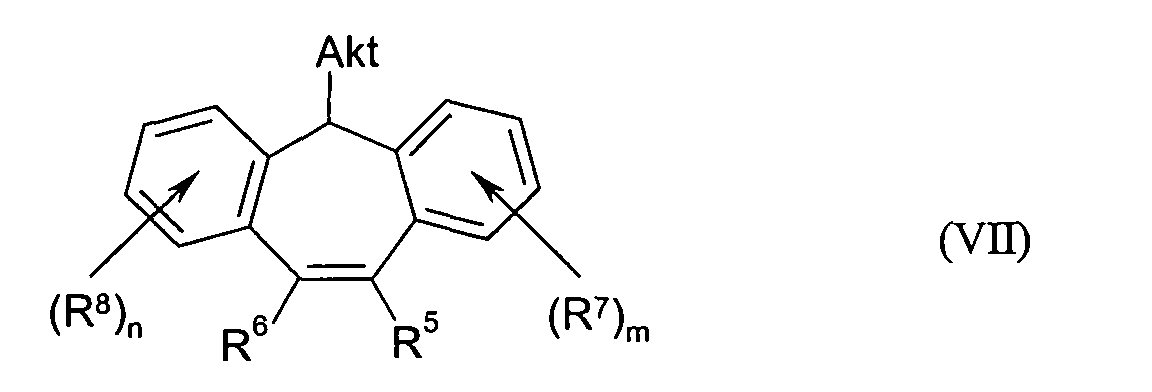
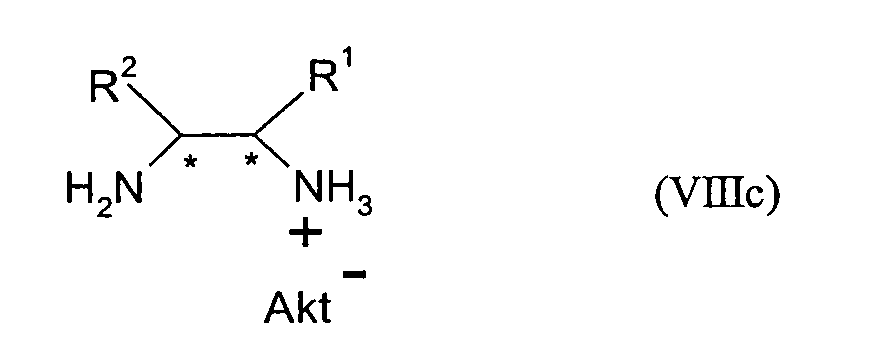
- the procedure is preferably such that compounds of the formula (VI) in which R 1 and R 2 have the abovementioned meaning optionally in the presence of organic solvent with compounds of formula (VII) are reacted, in which R 5 , R 6 , R 7 , R 8 , n and m have the abovementioned meanings and Akt is chlorine, bromine, iodine, trifluoroacetyl or a sulphonyloxy radical, the resulting ammonium salts of the formulas (VIIIa) and / or (VIIIIb) and / or (VIIIc) in the presence of base either in situ or in a subsequent reaction step in compounds of formula (I) are converted.
- Suitable bases are, for example: alkaline earth metal or alkali metal hydrides, hydroxides, amides, alkyl-substituted-disilylamides, -dialkylamides, -alcoholates, or -carbonates such as Sodium hydride, sodium amide, lithium diethylamide, sodium methylate, sodium bis-trimethylsilylamide, Sodium ethylate, potassium tert-butoxide, sodium hydroxide, potassium hydroxide, Sodium carbonate and potassium carbonate, tertiary amines, such as trimethylamine, triethylamine, tributylamine, Trioctylamine, di-isopropyl-ethylamine, tetramethylguanidine, N, N-dimethylaniline, diazabicyclooctane (DABCO), diazabicyclononene (DBN) or diazabicycloundecene (DBU), piperidine and
- the invention also includes transition metal complexes of compounds of formula (I) and catalysts which contain the transition metal complexes of Compounds of formula (I) included.
- transition metal complexes are transition metal complexes of ruthenium, osmium, Cobalt, rhodium, iridium, nickel, palladium, platinum and copper, preferably those of Ruthenium, rhodium, iridium, nickel, palladium and platinum, more preferably those of Rhodium and iridium.
- isolated transition metal complexes can be used as catalysts, which is produced, for example, from the compounds of the formula (I) and a metal compound or transition metal complexes which consist of the compounds of the formula (I) and a Metal compound can be generated in the reaction medium of catalysis.
- metal compounds for example, Ni (1,5-cyclooctadiene) 2 , Pd 2 (dibenzylideneacetone) 3 , Pd [PPh 3 ] 4 cyclopentadienyl 2 Ru, Rh (acac) (CO) 2 , [RhCl (CO) 2 ]; Ir (pyridine) 2 (1,5-cyclooctadiene), Ir (acac) (CO) 2 , [IrCl (CO) 2 ], Cu (phenyl) Br, Cu (phenyl) Cl, Cu (phenyl) I, Cu ( PPh 3 ) 2 Br, [Cu (CH 3 CN) 4 ] BF 4 and [Cu (CH 3 CN) 4 ] PF 6 or polynuclear bridged complexes such as [Rh (COD) Cl] 2 and [Rh (COD) Br ] 2 , [Rh (ethene) 2 Cl] 2 , [Rh (cyclo
- the amount of the metal compound used may, for example, based on the metal content 25 to 200 mol% relative to the compound of the formula (I) used, are preferred are 80 to 140 mol%, more preferably 90 to 120 mol% and even more preferred 95 to 105 mol%.
- the catalysts, the in situ generated transition metal complexes or isolated transition metal complexes are particularly suitable for use in the homogeneous Catalysis.
- the catalysts according to the invention are preferably used for hydrogenations, particularly preferred for asymmetric hydrogenations, provided that the compounds under initially described are chiral conditions.
- the hydrogenation is in the presence of a Hydrogen donor molecule and optionally carried out a base.
- Hydrogen donor molecules are, for example, molecular hydrogen, formic acid, Ethanol or isopropanol, bases, for example, alcoholates or tertiary amines.
- bases for example, alcoholates or tertiary amines.
- Especially preferred mixtures of hydrogen donor molecule and base are mixtures of Formic acid and triethylamine, in particular the azeotropic mixture thereof, and Mixtures of potassium isopropylate and isopropanol.
- the amount of metal compound or transition metal complex used can, based on the respective metal content, for example 0.001 to 20 mol%, based on the amount of substrate used, preferably 0.001 to 2 mol%, most preferably 0.001 to 1 mol%.
- asymmetric hydrogenations may be, for example be carried out so that the catalyst in situ from a metal compound and a Compound of formula (I) optionally in a suitable organic solvent is generated, the substrate is added and the reaction mixture at reaction temperature either pressurized with hydrogen or with a mixture of another Hydrogen donor molecule and a base is added.
- the catalysts of the invention are particularly suitable in a process for Production of active ingredients of pharmaceuticals and agrochemicals, or intermediates of these two classes.
- the advantage of the present invention is that using simple available and safely manageable connections a whole class more powerful Catalysts can be produced.
- IR: ⁇ 3271 m, 3171 w, 3020 w, 1975 vs (CO), 1489 m, 1454 m, 1422 W, 1260 W, 1084 W, 987 m, 936 m, 797 m, 732 s.
Landscapes
- Chemical & Material Sciences (AREA)
- Organic Chemistry (AREA)
- Inorganic Chemistry (AREA)
- Engineering & Computer Science (AREA)
- Materials Engineering (AREA)
- Chemical Kinetics & Catalysis (AREA)
- Organic Low-Molecular-Weight Compounds And Preparation Thereof (AREA)
- Catalysts (AREA)
Abstract
Description

- *
- ein stereogenes Kohlenstoffatom markiert, das (S)- oder (R)-konfiguriert sein kann
- R1 und R2
- jeweils unabhängig voneinander ausgewählt sind aus der Gruppe C1-C12-Alkyl, C1-C12-Alkoxy, C1-C12-Halogenalkoxy, C1-C12-Halogenalkyl, C4-C14-Aryl, C5-C15 -Arylalkyl oder zusammen stehen für C3-C12-Alkylen oder C3-C12-Alkenylen,
- R3 und R4
- jeweils unabhängig voneinander für Reste der Formel (II) stehen
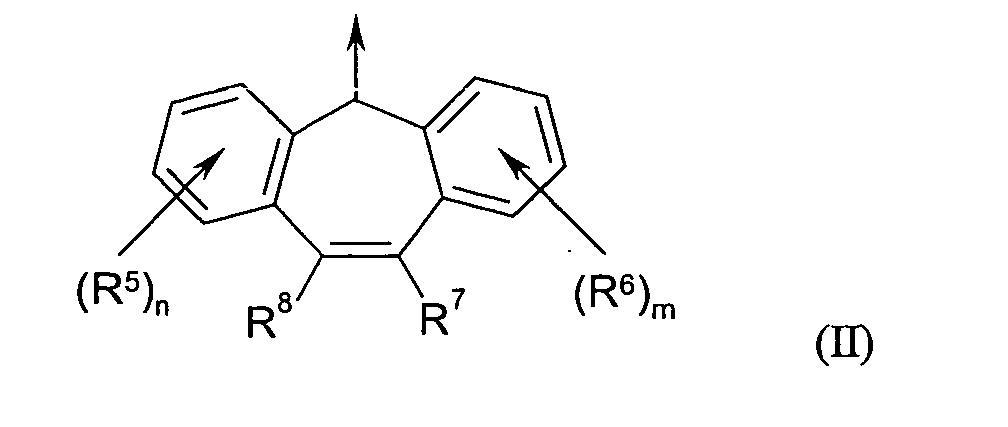
- die Pfeile
- jeweils die Bindung des gesamten Restes zum Stickstoffatom anzeigen oder, sofern sie in die Mitte eines aromatischen Systems zeigen, eine Bindung der jeweiligen Reste zum aromatischen Gerüst in beliebiger Position,
- R5 und R6
- jeweils unabhängig voneinander ausgewählt sind aus der Gruppe Fluor, Chlor,
Brom, Iod, Nitro, freies oder geschütztes Formyl, C1-C12-Alkyl, C1-C12-Alkoxy,
C1-C12-Halogenalkoxy, C1-C12-Halogenalkyl, C4-C14-Aryl, C5-C15-Arylalkyl oder
Resten der Formel (IV),
- L
- fehlt oder für C1-C8-Alkylen oder C2-C8-Alkenylen steht und
- Q
- fehlt oder für Sauerstoff, Schwefel oder NR9 steht,
- T
- für eine Carbonyl-Gruppe steht und
- W
- für R9, OR9, NHR9 oder N(R10)2 steht,
L-W (Va) L-SO2-W (Vb) L-NR12SO2R12 (Vc) L-SO3Z (Vd) L-PO3Z2 (Ve) L-COZ (Vf) L-CN (Vg) - R7 und R8
- jeweils unabhängig voneinander stehen für Wasserstoff, Cyano, Fluor, Chlor,
Brom, Iod, C1-C18-Alkyl, C4-C24-Aryl, C5-C25-Arylalkyl, CO2M, wobei M für ein
Alkalimetallion oder ein gegebenenfalls organisches Ammoniumion stehen kann,
CONH2, SO2N(R9)2, wobei R9 für Wasserstoff, C1-C12-Alkyl, C4-C14-Aryl oder
C5-C15-Arylalkyl steht, SO3M oder für Reste der Formel (III),
- T
- T fehlt oder für Carbonyl steht,
- H
- Het für Sauerstoff oder NR9 steht,
- R10
- für C1-C18-Alkyl, C4-C24-Aryl oder C5-C25-Arylalkyl oder N(R10)2 als Ganzes für einen 5 oder 6 gliedrigen cyclischen Aminorest steht und
- n und m
- jeweils unabhängig voneinander für 0, 1, 2 oder 3 stehen.
- *
- bezeichnet bevorzugt jeweils identisch konfigurierte stereogene Kohlenstoffatome d.h. eine (S),(S)- oder (R),(R)-Konfiguration.
- R1 und R2
- sind bevorzugt jeweils unabhängig voneinander ausgewählt aus der Gruppe C1-C12-Alkyl, C4-C14-Aryl oder stehen zusammen für C3-C12-Alkylen und sind besonders bevorzugt identisch ausgewählt aus der Gruppe C1-C4-Alkyl, Phenyl oder stehen zusammen für 1,4-Butylen.
- R3 und R4
- stehen bevorzugt jeweils unabhängig voneinander für Reste der Formel (II), in
der
R5 und R6 jeweils unabhängig voneinander für Wasserstoff, Fluor, Iod, C1-C12 -Alkyl, C1-C12-Alkoxy, C4-C10-Aryl oder für Reste der Formel (IV) stehen, in der wiederum T für Carbonyl und Het für Sauerstoff oder NR9 steht und
in der
n und m jeweils unabhängig voneinander für 0 oder 1 stehen und in der
R7 und R8 jeweils unabhängig voneinander ausgewählt sind aus der Gruppe Fluor, Brom, Nitro, C1-C4-Alkyl, C1-C4-Alkoxy oder Resten der Formeln (Vb) und (Vg), - R3 und R4
- stehen besonders bevorzugt für einen Rest der Formel (II), in der
R5 und R6 jeweils unabhängig voneinander für Wasserstoff, C1-C12-Alkyl, C1-C12-Alkoxy, C4-C10-Aryl
n und m jeweils identisch für 0 oder 1 stehen und
R7 und R8 jeweils identisch ausgewählt sind aus der Gruppe Fluor oder Resten der Formeln (Vb) und (Vg), - R3 und R4
- stehen ganz besonders bevorzugt für einen Rest der Formel (II), in der
R5 und R6 jeweils unabhängig voneinander für Wasserstoff, C1-C12-Alkyl, C1-C12-Alkoxy oder C4-C10-Aryl und
n und m jeweils für 0 stehen.
10-Cyano-5H-dibenzo[a,d]cyclohepten-5-yl (CNtrop), 5H-dibenzo[a,d]cyclohepten-5-yl (trop), 10-Methyl-5H-dibenzo[a,d]cylohepten-5-yl (Metrop),10-Methoxy-5H dibenzo[a,d]cyclohepten-5-yl (MeOtrop), 10-Phenyl-5H-dibenzo[a,d]cyclohepten-5-yl (Phtrop), 10,11-Diphenyl-5H-dibenzo[a,d]cyclohepten-5-yl (Ph2trop) [(5S)-10-[(-)-Menthyloxy]-5H-dibenzo[a,d]cyclohepten-5-yl], (S-Menthyloxytrop) und [(5R)-10-[(-)-Menthyloxy]-5H-dibenzo[a,d]cyclohepten-5-yl] (R-Menthyloxytrop).

gegebenenfalls in Gegenwart von organischem Lösungsmittel mit Verbindungen der Formel (VII) umgesetzt werden,

- M1
- für Ruthenium, Rhodium, Iridium, Nickel, Palladium, Platin oder Kupfer und
- Y1
- für Chlorid, Bromid, Acetat, Nitrat, Methansulfonat, Trifluormethansulfonat oder Acetylacetonat und
- p
- im Falle von Ruthenium, Rhodium und Iridium für 3, im Falle von Nickel, Palladium und Platin für 2 und im Falle von Kupfer für 1 steht,
- Y2
- für ein Anion wie z.B. Chlorid, Bromid, Acetat, Methansulfonat, Trifluormethansulfonat, Tetrafluoroborat, Hexafluorophosphat, Perchlorat, Hexafluoroantimonat, Tetra(bis-3,5 trifluormethylphenyl)borat oder Tetraphenylborat steht und
- p
- im Falle von Rhodium und Iridium für 1, im Falle von Nickel, Palladium, Platin und Ruthenium für 2 und im Falle von Kupfer für 1 steht,
- B1
- jeweils für ein C2-C12-Alken wie beispielsweise Ethylen oder Cycloocten, oder ein Nitril wie beispielsweise Acetonitril, Benzonitril oder Benzylnitril steht, oder
- B1 2
- zusammen für ein (C4-C12)-Dien wie beispielsweise Norbornadien oder 1,5-Cyclooctadien steht
- M2
- für Ruthenium und
- B2
- für Arylreste wie zum Beispiel Cymol, Mesityl, Phenyl oder Cyclooctadien, Norbornadien oder Methylallyl steht
- M3
- für Palladium, Nickel, Iridium oder Rhodium und
- Y3
- für Chlorid oder Bromid steht und
- Me
- für Lithium, Natrium, Kalium, Ammonium oder organisches Ammonium steht und
- p
- im Falle von Rhodium und Iridium 3, im Falle von Nickel, Palladium und Platin für 2 steht,
- M4
- für Iridium oder Rhodium und
- B3
- für ein (C4-C12)-Dien wie beispielsweise Norbornadien oder 1,5-Cyclooctadien steht
- An
- für ein nicht oder schwach koordinierendes Anion wie zum Beispiel Methansulfonat, Trifluormethansulfonat, Tetrafluoroborat, Hexafluorophosphat, Perchlorat, Hexafluoroantimonat, Tetra(bis-3,5-trifluormethylphenyl)borat oder Tetraphenylborat steht.
[Rh(COD)Cl]2, [Rh(COD)2Br], [Rh(COD)2]ClO4, [Rh(COD)2]BF4, [Rh(COD)2]PF6, [Rh(COD)2]OTf, [Rh(COD)2]BAr4 (Ar = 3,5-bistrifluormethylphenyl) [Rh(COD)2]SbF6 RuCl2(COD), [(Cymol)RuCl2]2, [(Benzol)RuCl2]2, [(Mesitylen)RuCl2]2, [(Cymol)RuBr2]2, [(Cymol)RuI2]2, [(Cymol)Ru(BF4)2]2, [(Cymol)Ru(PF6)2]2, [(Cymol)Ru(BAr4)2]2, (Ar = 3,5-bistrifluormethylphenyl), [(Cymol)Ru(SbF6)2]2, [Ir(cod)2Cl]2, [Ir(COD)2]PF6, [Ir(COD)2]ClO4, [Ir(COD)2]SbF6 [Ir(COD)2]BF4, [Ir(COD)2]OTf, [Ir(COD)2]BAr4 (Ar = 3,5-bistrifluormethylphenyl), RuCl3, NiCl2, RhCl3, PdCl2, PdBr2, Pd(OAc)2, Pd2(dibenzylidenaceton)3, Pd(acetylacetonat)2, Rh(acetylacetonat)(CO)2, [RhCl(CO)2]; Ir(pyridin)2(1,5-Cyclooctadien), Ir(acetylacetonat)(CO)2, [IrCl(CO)2] [Rh(nbd)Cl]2, [Rh(nbd)2Br], [Rh(nbd)2]ClO4, [Rh(nbd)2]BF4, [Rh(nbd)2]PF6, [Rh(nbd)2]OTf, [Rh(nbd)2]BAr4 (Ar = 3,5-bistrifluormethylphenyl) [Rh(nbd)2]SbF6 RuCl2(nbd), [Ir(nbd)2]PF6, [Rh(nbd)2]ClO4, [Rh(nbd)2]BF4, [Rh(nbd)2]PF6, [Rh(nbd)2]OTf, (Ar = 3,5-bistrifluormethylphenyl), Ir(pyridin)2(nbd), [Ru(DMSO)4Cl2], [Ru(CH3CN)4Cl2], [Ru(PhCN)4Cl2], [Ru(COD)Cl2]n, [Ru(COD)(Methallyl)2], [Ru(acetylacetonat)3]
- M5
- für Rhodium oder Iridium
- (I)
- für eine Verbindung der Formel (I)
- Diolefin
- für ein Dien wie beispielsweise 1,5-Cyclooctadien oder Norbornadien und
- An
- ohne Rücksicht auf mögliche Koordination an das Metallatom für ein Anion wie beispielsweise Chlorid, Bromid, Iodid, Methansulfonat, Trifluormethansulfonat, Tetrafluoroborat, Hexafluorophosphat, Perchlorat, Hexafluoroantimonat, Tetra(bis-3,5-trifluormethylphenyl)borat oder Tetraphenylborat und
- Hal
- für Chlorid, Bromid oder Iodid steht.
Claims (9)
- Verbindungen der Formel (I),in der

- *
- ein stereogenes Kohlenstoffatom markiert, das (S)- oder (R)-konfiguriert sein kann
- R1 und R2
- jeweils unabhängig voneinander ausgewählt sind aus der Gruppe C1-C12-Alkyl, C1-C12-Alkoxy, C1-C12-Halogenalkoxy, C1-C12-Halogenalkyl, C4 -C14-Aryl, C5-C15-Arylalkyl oder zusammen stehen für C3-C12-Alkylen oder C3-C12-Alkenylen,
- R3 und R4
- jeweils unabhängig voneinander für Reste der Formel (II) stehen
wobei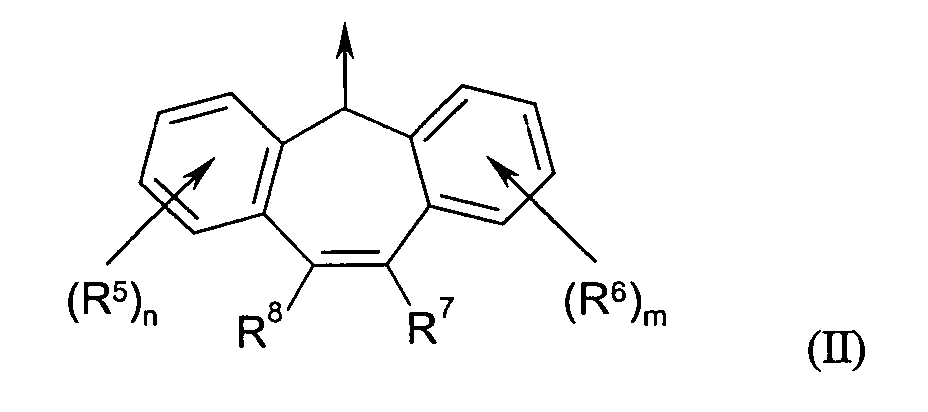
- die Pfeile
- jeweils die Bindung des gesamten Restes zum Stickstoffatom anzeigen oder, sofern sie in die Mitte eines aromatischen Systems zeigen, eine Bindung der jeweiligen Reste zum aromatischen Gerüst in beliebiger Position,
- R5 und R6
- jeweils unabhängig voneinander ausgewählt sind aus der Gruppe Fluor,
Chlor, Brom, Iod, Nitro, freies oder geschütztes Formyl, C1-C12-Alkyl,
C1-C12-Alkoxy, C1-C12-Halogenalkoxy, C1-C12-Halogenalkyl, C4-C14-Aryl,
C5-C15-Arylalkyl oder Resten der Formel (IV),
- L
- fehlt oder für C1-C8-Alkylen oder C2-C8-Alkenylen steht und
- Q
- fehlt oder für Sauerstoff, Schwefel oder NR9 steht,
- T
- für eine Carbonyl-Gruppe steht und
- W
- für R9, OR9, NHR9 oder N(R10)2 steht,
wobei N(R10)2 weiterhin als Ganzes für einen 5 oder 6 gliedrigen cyclischen Aminorest stehen kann
oder Resten der Formeln (Va-g)L-W (Va) L-SO2-W (Vb) L-NR12SO2R12 (Vc) L-SO3Z (Vd) L-PO3Z2 (Ve) L-COZ (Vf) L-CN (Vg) - R7 und R8
- jeweils unabhängig voneinander stehen für Wasserstoff, Cyano, Fluor,
Chlor, Brom, Iod, C1-C18-Alkyl, C4-C24-Aryl, C5-C25-Arylalkyl, CO2M,
wobei M für ein Alkalimetallion oder ein gegebenenfalls organisches
Ammoniumion stehen kann, CONH2, SO2N(R9)2, wobei R9 für
Wasserstoff, C1-C12-Alkyl, C4-C14-Aryl oder C5-C15-Arylalkyl steht,
SO3M oder für Reste der Formel (III),
- T
- fehlt oder für Carbonyl steht,
- H
- et für Sauerstoff oder NR9 steht,
- R10
- für C1-C18-Alkyl, C4-C24-Aryl oder C5-C25-Arylalkyl oder N(R10)2 als Ganzes für einen 5 oder 6 gliedrigen cyclischen Aminorest steht und
- n und m
- jeweils unabhängig voneinander für 0, 1, 2 oder 3 stehen.
- Verfahren zur Herstellung von Verbindungen nach Anspruch 1, dadurch gekennzeichnet, dass Verbindungen der Formel (VI)in der R1 und R2 die im Anspruch 1 genannte Bedeutung besitzen
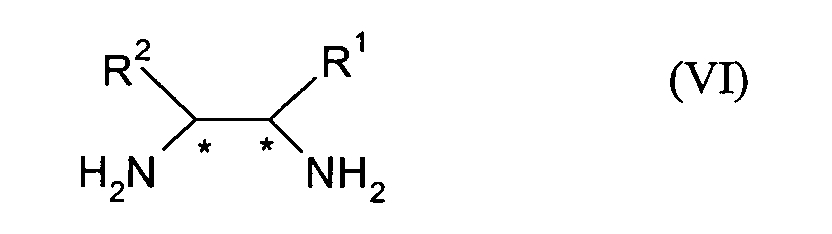
mit Verbindungen der Formel (VII) umgesetzt werden,in der R5, R6, R7, R8, n und m im Anspruch 1 genannten Bedeutungen besitzen und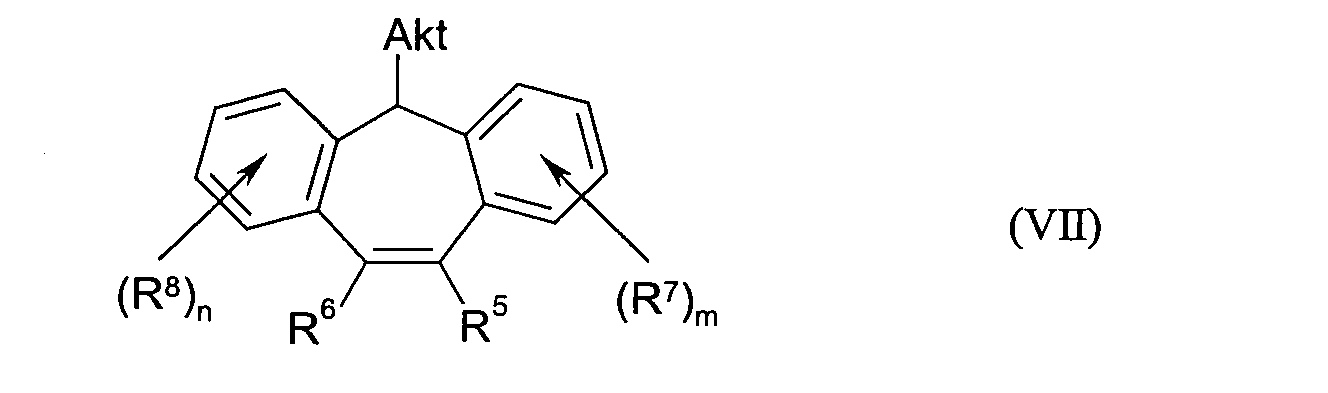
Akt für Chlor, Brom, Iod, Trifluoracetyl oder einen Sulfonyloxy-Rest steht,
die dabei entstehenden Ammoniumsalze der Formeln (VIIIa) und/oder (VIIIb) und/oder (VIIIc) in Gegenwart von Base entweder in situ oder in einem nachgeschalteten Reaktionsschritt in Verbindungen der Formel (I) gemäß Anspruch 1 überführt werden.
- Verbindungen der Formeln (VIIIa), (VIIIb) und (VIIIc) gemäß Anspruch 2.
- Übergangsmetallkomplexe von Verbindungen der Formel (I) gemäß Anspruch 1.
- Übergangsmetallkomplexe gemäß Anspruch 4, dadurch gekennzeichnet, dass es Übergangsmetallkomplexe von Ruthenium, Osmium, Cobalt, Rhodium, Iridium, Nickel, Palladium, Platin und Kupfer sind.
- Übergangsmetallkomplexe gemäß Anspruch 4 oder 5, dadurch gekennzeichnet, dass sie aus Verbindungen der Formel (I) gemäß Anspruch 1 und einer Metallverbindung erzeugt wurden, oder Übergangsmetallkomplexe, die aus den Verbindungen der Formel (I) und einer Metallverbindung im Reaktionsmedium erzeugt werden.
- Übergangsmetallkomplexe gemäß Anspruch 4, 5 oder 6, dadurch gekennzeichnet, dass sie der Formel (Xa), (Xb) oder(Xc) gehorchen
- M5
- für Rhodium oder Iridium
- (I)
- für eine Verbindung der Formel (I)
- Diolefin
- für ein Dien wie beispielsweise 1,5-Cyclooctydien oder Norbornadien und
- An
- ohne Rücksicht auf mögliche Koordination an das Metallatom für ein Anion und
- Hal
- für Chlorid, Bromid oder Iodid steht.
- Katalysatoren enthaltend Übergangsmetallkomplexe gemäß Ansprüchen 4, 5, 6 oder 7.
- Verwendung von Katalysatoren gemäß Anspruch 8 für Hydrogenierungen.
Applications Claiming Priority (2)
| Application Number | Priority Date | Filing Date | Title |
|---|---|---|---|
| DE102004027772 | 2004-06-08 | ||
| DE102004027772A DE102004027772A1 (de) | 2004-06-08 | 2004-06-08 | Bistropylidenamine und deren Verwendung |
Publications (1)
| Publication Number | Publication Date |
|---|---|
| EP1604973A1 true EP1604973A1 (de) | 2005-12-14 |
Family
ID=34937023
Family Applications (1)
| Application Number | Title | Priority Date | Filing Date |
|---|---|---|---|
| EP05011538A Withdrawn EP1604973A1 (de) | 2004-06-08 | 2005-05-27 | Bistropylidendiamine und deren Verwendung |
Country Status (5)
| Country | Link |
|---|---|
| US (1) | US20050283014A1 (de) |
| EP (1) | EP1604973A1 (de) |
| JP (1) | JP2006008683A (de) |
| CN (1) | CN1706806A (de) |
| DE (1) | DE102004027772A1 (de) |
Citations (1)
| Publication number | Priority date | Publication date | Assignee | Title |
|---|---|---|---|---|
| WO2003048175A1 (de) * | 2001-12-01 | 2003-06-12 | Eidgenössische Technische Hochschule Zürich Ethz | Liganden zur anwendung in katalytischen prozessen |
Family Cites Families (1)
| Publication number | Priority date | Publication date | Assignee | Title |
|---|---|---|---|---|
| CN1649847A (zh) * | 2002-03-12 | 2005-08-03 | 武田药品工业株式会社 | 制备旋光亚砜衍生物的方法 |
-
2004
- 2004-06-08 DE DE102004027772A patent/DE102004027772A1/de not_active Withdrawn
-
2005
- 2005-05-27 EP EP05011538A patent/EP1604973A1/de not_active Withdrawn
- 2005-06-06 US US11/145,839 patent/US20050283014A1/en not_active Abandoned
- 2005-06-07 JP JP2005167426A patent/JP2006008683A/ja active Pending
- 2005-06-08 CN CNA2005100837430A patent/CN1706806A/zh active Pending
Patent Citations (1)
| Publication number | Priority date | Publication date | Assignee | Title |
|---|---|---|---|---|
| WO2003048175A1 (de) * | 2001-12-01 | 2003-06-12 | Eidgenössische Technische Hochschule Zürich Ethz | Liganden zur anwendung in katalytischen prozessen |
Non-Patent Citations (5)
| Title |
|---|
| AERTS, J.: "An improved molecular modeling method for the prediction of enantioselectivity", JOURNAL OF COMPUTATIONAL CHEMISTRY , 16(7), 914-22 CODEN: JCCHDD; ISSN: 0192-8651, 1995, XP008050845 * |
| DEBLON S ET AL: "HIGHLY DISTORTED D8-RHODIUM(+I) AND D10-RHODIUM(-I) COMPLEXES: SYNTHESIS, REACTIVITY, AND STRUCTURES IN SOLUTION AND SOLID STATE", NEW JOURNAL OF CHEMISTRY, CNRS-GAUTHIER-VILLARS, MONTROUGE, FR, vol. 25, no. 1, 2001, pages 83 - 92, XP008015055, ISSN: 1144-0546 * |
| REETZ, M. T. ET AL: "Enantiotopic Group Recognition: Direct Evidence for Selective Complexation of Enantiotopic Groups by a Chiral Host", JOURNAL OF THE AMERICAN CHEMICAL SOCIETY , 118(18), 4494-5 CODEN: JACSAT; ISSN: 0002-7863, 1996, XP002339935 * |
| THOMAIER J ET AL: "DIBENZOTROPYLIDENE PHOSPHANES (TROPPS): SYNTHESIS AND COINAGE METAL COMPLEXES", NEW JOURNAL OF CHEMISTRY, CNRS-GAUTHIER-VILLARS, MONTROUGE, FR, vol. 22, no. 9, 1998, pages 947 - 958, XP008015151, ISSN: 1144-0546 * |
| TURECEK, F.: "Stereochemical interactions in ammonium dications, hypervalent diammonium cation-radicals and ammonium radicals. A B3-MP2 computational study", EUROPEAN JOURNAL OF MASS SPECTROMETRY , 9(4), 267-277 CODEN: EJMSCL; ISSN: 1469-0667, 2003, XP008050841 * |
Also Published As
| Publication number | Publication date |
|---|---|
| DE102004027772A1 (de) | 2006-01-05 |
| JP2006008683A (ja) | 2006-01-12 |
| US20050283014A1 (en) | 2005-12-22 |
| CN1706806A (zh) | 2005-12-14 |
Similar Documents
| Publication | Publication Date | Title |
|---|---|---|
| DE69518497T2 (de) | Verfahren zur Herstellung eines Alkohols | |
| EP3994117B1 (de) | Hydrierung von estern zu alkoholen in gegenwart eines ru-pnn-komplexes | |
| DE69921588T2 (de) | Aminophosphin-Metallkomplex für asymmetrische Reaktionen | |
| DE69521605T2 (de) | Optisch aktive diphosphine und herstellungsverfahren durch auftrennung der racematmischung | |
| EP0844994B1 (de) | Verfahren zur herstellung von butyrolactonen | |
| EP0218970B1 (de) | Chirale Rhodium-diphosphinkomplexe für asymmetrische Hydrierungen | |
| EP1394168B1 (de) | Verfahren zur Herstellung von Phosphiten und Übergangsmetallkomplexen | |
| DE102007022389A1 (de) | Ruthenium-Komplexe mit (P-P)-koordinierten Ferrocenyl-diphosphinliganden, Verfahren zu ihrer Herstellung sowie ihre Anwendung in der homogenen Katalyse | |
| DE102004027772A1 (de) | Bistropylidenamine und deren Verwendung | |
| DE19816479A1 (de) | Verfahren zur Herstellung von Enaminen, Iminen, Indolen und Diaminen aus Alkinen | |
| EP1692151B1 (de) | Ferrocenyl-1, 2-diphosphine, deren herstellung und deren verwendung | |
| EP1298136A2 (de) | Chirale Monophosphorverbindungen | |
| EP0695756A1 (de) | Verbindung aus der Reihe der Phosphane, Verfahren zu ihrer Herstellung sowie ihre Verwendung | |
| DE602004012755T2 (de) | Phosphor-enthaltende imidazoline und metallkomplexe davon | |
| DE10339790A1 (de) | Rhodium(I)-Dien-Bis-Aqua-Komplexe, Verfahren zu deren Herstellung und deren Verwendung | |
| EP1614674A2 (de) | Tropylidenamine und deren Verwendung | |
| EP1398319B1 (de) | Chirale Monophosphorverbindungen und deren Übergangsmetallkomplexe | |
| EP1636243B1 (de) | Chirale liganden zur anwendung in asymmetrischen synthesen | |
| WO2004104014A2 (de) | Chirale liganden und deren übergangsmetallkomplexe | |
| EP2220100A2 (de) | Chirale cycloplatinierte komplexe, herstellungsverfahren sowie deren verwendung in medizin und katalyse | |
| EP1469006A2 (de) | Verfahren zur Reduktion von Ketocarbonsäureestern | |
| EP1800747A1 (de) | Übergangsmetallkatalysatoren | |
| DE10327109A1 (de) | Liganden zur Anwendung in stereoselektiven Synthesen | |
| EP1475384A1 (de) | Verfahren zur Herstellung von Phosphorverbindungen | |
| EP1491548A1 (de) | Verfahren zur Reduktion von Ketocarbonsäureestern |
Legal Events
| Date | Code | Title | Description |
|---|---|---|---|
| PUAI | Public reference made under article 153(3) epc to a published international application that has entered the european phase |
Free format text: ORIGINAL CODE: 0009012 |
|
| AK | Designated contracting states |
Kind code of ref document: A1 Designated state(s): AT BE BG CH CY CZ DE DK EE ES FI FR GB GR HU IE IS IT LI LT LU MC NL PL PT RO SE SI SK TR |
|
| AX | Request for extension of the european patent |
Extension state: AL BA HR LV MK YU |
|
| 17P | Request for examination filed |
Effective date: 20060614 |
|
| RAP1 | Party data changed (applicant data changed or rights of an application transferred) |
Owner name: SALTIGO GMBH |
|
| AKX | Designation fees paid |
Designated state(s): AT BE BG CH CY CZ DE DK EE ES FI FR GB GR HU IE IS IT LI LT LU MC NL PL PT RO SE SI SK TR |
|
| RAP1 | Party data changed (applicant data changed or rights of an application transferred) |
Owner name: SALTIGO GMBH |
|
| 17Q | First examination report despatched |
Effective date: 20071214 |
|
| STAA | Information on the status of an ep patent application or granted ep patent |
Free format text: STATUS: THE APPLICATION IS DEEMED TO BE WITHDRAWN |
|
| 18D | Application deemed to be withdrawn |
Effective date: 20080415 |