EP1602750A1 - SURFACE-TREATED Al SHEET EXCELLENT IN SOLDERABILITY, HEAT SINK USING THE SAME, AND METHOD FOR PRODUCING SURFACE-TREATED Al SHEET EXCELLENT IN SOLDERABILITY - Google Patents
SURFACE-TREATED Al SHEET EXCELLENT IN SOLDERABILITY, HEAT SINK USING THE SAME, AND METHOD FOR PRODUCING SURFACE-TREATED Al SHEET EXCELLENT IN SOLDERABILITY Download PDFInfo
- Publication number
- EP1602750A1 EP1602750A1 EP04702436A EP04702436A EP1602750A1 EP 1602750 A1 EP1602750 A1 EP 1602750A1 EP 04702436 A EP04702436 A EP 04702436A EP 04702436 A EP04702436 A EP 04702436A EP 1602750 A1 EP1602750 A1 EP 1602750A1
- Authority
- EP
- European Patent Office
- Prior art keywords
- layer
- sheet
- treated
- plating
- heat sink
- Prior art date
- Legal status (The legal status is an assumption and is not a legal conclusion. Google has not performed a legal analysis and makes no representation as to the accuracy of the status listed.)
- Withdrawn
Links
Images
Classifications
-
- C—CHEMISTRY; METALLURGY
- C23—COATING METALLIC MATERIAL; COATING MATERIAL WITH METALLIC MATERIAL; CHEMICAL SURFACE TREATMENT; DIFFUSION TREATMENT OF METALLIC MATERIAL; COATING BY VACUUM EVAPORATION, BY SPUTTERING, BY ION IMPLANTATION OR BY CHEMICAL VAPOUR DEPOSITION, IN GENERAL; INHIBITING CORROSION OF METALLIC MATERIAL OR INCRUSTATION IN GENERAL
- C23C—COATING METALLIC MATERIAL; COATING MATERIAL WITH METALLIC MATERIAL; SURFACE TREATMENT OF METALLIC MATERIAL BY DIFFUSION INTO THE SURFACE, BY CHEMICAL CONVERSION OR SUBSTITUTION; COATING BY VACUUM EVAPORATION, BY SPUTTERING, BY ION IMPLANTATION OR BY CHEMICAL VAPOUR DEPOSITION, IN GENERAL
- C23C28/00—Coating for obtaining at least two superposed coatings either by methods not provided for in a single one of groups C23C2/00 - C23C26/00 or by combinations of methods provided for in subclasses C23C and C25C or C25D
- C23C28/02—Coating for obtaining at least two superposed coatings either by methods not provided for in a single one of groups C23C2/00 - C23C26/00 or by combinations of methods provided for in subclasses C23C and C25C or C25D only coatings only including layers of metallic material
- C23C28/021—Coating for obtaining at least two superposed coatings either by methods not provided for in a single one of groups C23C2/00 - C23C26/00 or by combinations of methods provided for in subclasses C23C and C25C or C25D only coatings only including layers of metallic material including at least one metal alloy layer
-
- C—CHEMISTRY; METALLURGY
- C23—COATING METALLIC MATERIAL; COATING MATERIAL WITH METALLIC MATERIAL; CHEMICAL SURFACE TREATMENT; DIFFUSION TREATMENT OF METALLIC MATERIAL; COATING BY VACUUM EVAPORATION, BY SPUTTERING, BY ION IMPLANTATION OR BY CHEMICAL VAPOUR DEPOSITION, IN GENERAL; INHIBITING CORROSION OF METALLIC MATERIAL OR INCRUSTATION IN GENERAL
- C23C—COATING METALLIC MATERIAL; COATING MATERIAL WITH METALLIC MATERIAL; SURFACE TREATMENT OF METALLIC MATERIAL BY DIFFUSION INTO THE SURFACE, BY CHEMICAL CONVERSION OR SUBSTITUTION; COATING BY VACUUM EVAPORATION, BY SPUTTERING, BY ION IMPLANTATION OR BY CHEMICAL VAPOUR DEPOSITION, IN GENERAL
- C23C18/00—Chemical coating by decomposition of either liquid compounds or solutions of the coating forming compounds, without leaving reaction products of surface material in the coating; Contact plating
- C23C18/16—Chemical coating by decomposition of either liquid compounds or solutions of the coating forming compounds, without leaving reaction products of surface material in the coating; Contact plating by reduction or substitution, e.g. electroless plating
- C23C18/1601—Process or apparatus
- C23C18/1633—Process of electroless plating
- C23C18/1646—Characteristics of the product obtained
- C23C18/165—Multilayered product
- C23C18/1653—Two or more layers with at least one layer obtained by electroless plating and one layer obtained by electroplating
-
- C—CHEMISTRY; METALLURGY
- C23—COATING METALLIC MATERIAL; COATING MATERIAL WITH METALLIC MATERIAL; CHEMICAL SURFACE TREATMENT; DIFFUSION TREATMENT OF METALLIC MATERIAL; COATING BY VACUUM EVAPORATION, BY SPUTTERING, BY ION IMPLANTATION OR BY CHEMICAL VAPOUR DEPOSITION, IN GENERAL; INHIBITING CORROSION OF METALLIC MATERIAL OR INCRUSTATION IN GENERAL
- C23C—COATING METALLIC MATERIAL; COATING MATERIAL WITH METALLIC MATERIAL; SURFACE TREATMENT OF METALLIC MATERIAL BY DIFFUSION INTO THE SURFACE, BY CHEMICAL CONVERSION OR SUBSTITUTION; COATING BY VACUUM EVAPORATION, BY SPUTTERING, BY ION IMPLANTATION OR BY CHEMICAL VAPOUR DEPOSITION, IN GENERAL
- C23C18/00—Chemical coating by decomposition of either liquid compounds or solutions of the coating forming compounds, without leaving reaction products of surface material in the coating; Contact plating
- C23C18/54—Contact plating, i.e. electroless electrochemical plating
-
- C—CHEMISTRY; METALLURGY
- C23—COATING METALLIC MATERIAL; COATING MATERIAL WITH METALLIC MATERIAL; CHEMICAL SURFACE TREATMENT; DIFFUSION TREATMENT OF METALLIC MATERIAL; COATING BY VACUUM EVAPORATION, BY SPUTTERING, BY ION IMPLANTATION OR BY CHEMICAL VAPOUR DEPOSITION, IN GENERAL; INHIBITING CORROSION OF METALLIC MATERIAL OR INCRUSTATION IN GENERAL
- C23C—COATING METALLIC MATERIAL; COATING MATERIAL WITH METALLIC MATERIAL; SURFACE TREATMENT OF METALLIC MATERIAL BY DIFFUSION INTO THE SURFACE, BY CHEMICAL CONVERSION OR SUBSTITUTION; COATING BY VACUUM EVAPORATION, BY SPUTTERING, BY ION IMPLANTATION OR BY CHEMICAL VAPOUR DEPOSITION, IN GENERAL
- C23C2/00—Hot-dipping or immersion processes for applying the coating material in the molten state without affecting the shape; Apparatus therefor
- C23C2/04—Hot-dipping or immersion processes for applying the coating material in the molten state without affecting the shape; Apparatus therefor characterised by the coating material
- C23C2/12—Aluminium or alloys based thereon
-
- C—CHEMISTRY; METALLURGY
- C23—COATING METALLIC MATERIAL; COATING MATERIAL WITH METALLIC MATERIAL; CHEMICAL SURFACE TREATMENT; DIFFUSION TREATMENT OF METALLIC MATERIAL; COATING BY VACUUM EVAPORATION, BY SPUTTERING, BY ION IMPLANTATION OR BY CHEMICAL VAPOUR DEPOSITION, IN GENERAL; INHIBITING CORROSION OF METALLIC MATERIAL OR INCRUSTATION IN GENERAL
- C23C—COATING METALLIC MATERIAL; COATING MATERIAL WITH METALLIC MATERIAL; SURFACE TREATMENT OF METALLIC MATERIAL BY DIFFUSION INTO THE SURFACE, BY CHEMICAL CONVERSION OR SUBSTITUTION; COATING BY VACUUM EVAPORATION, BY SPUTTERING, BY ION IMPLANTATION OR BY CHEMICAL VAPOUR DEPOSITION, IN GENERAL
- C23C2/00—Hot-dipping or immersion processes for applying the coating material in the molten state without affecting the shape; Apparatus therefor
- C23C2/26—After-treatment
-
- C—CHEMISTRY; METALLURGY
- C23—COATING METALLIC MATERIAL; COATING MATERIAL WITH METALLIC MATERIAL; CHEMICAL SURFACE TREATMENT; DIFFUSION TREATMENT OF METALLIC MATERIAL; COATING BY VACUUM EVAPORATION, BY SPUTTERING, BY ION IMPLANTATION OR BY CHEMICAL VAPOUR DEPOSITION, IN GENERAL; INHIBITING CORROSION OF METALLIC MATERIAL OR INCRUSTATION IN GENERAL
- C23C—COATING METALLIC MATERIAL; COATING MATERIAL WITH METALLIC MATERIAL; SURFACE TREATMENT OF METALLIC MATERIAL BY DIFFUSION INTO THE SURFACE, BY CHEMICAL CONVERSION OR SUBSTITUTION; COATING BY VACUUM EVAPORATION, BY SPUTTERING, BY ION IMPLANTATION OR BY CHEMICAL VAPOUR DEPOSITION, IN GENERAL
- C23C28/00—Coating for obtaining at least two superposed coatings either by methods not provided for in a single one of groups C23C2/00 - C23C26/00 or by combinations of methods provided for in subclasses C23C and C25C or C25D
-
- C—CHEMISTRY; METALLURGY
- C23—COATING METALLIC MATERIAL; COATING MATERIAL WITH METALLIC MATERIAL; CHEMICAL SURFACE TREATMENT; DIFFUSION TREATMENT OF METALLIC MATERIAL; COATING BY VACUUM EVAPORATION, BY SPUTTERING, BY ION IMPLANTATION OR BY CHEMICAL VAPOUR DEPOSITION, IN GENERAL; INHIBITING CORROSION OF METALLIC MATERIAL OR INCRUSTATION IN GENERAL
- C23C—COATING METALLIC MATERIAL; COATING MATERIAL WITH METALLIC MATERIAL; SURFACE TREATMENT OF METALLIC MATERIAL BY DIFFUSION INTO THE SURFACE, BY CHEMICAL CONVERSION OR SUBSTITUTION; COATING BY VACUUM EVAPORATION, BY SPUTTERING, BY ION IMPLANTATION OR BY CHEMICAL VAPOUR DEPOSITION, IN GENERAL
- C23C28/00—Coating for obtaining at least two superposed coatings either by methods not provided for in a single one of groups C23C2/00 - C23C26/00 or by combinations of methods provided for in subclasses C23C and C25C or C25D
- C23C28/02—Coating for obtaining at least two superposed coatings either by methods not provided for in a single one of groups C23C2/00 - C23C26/00 or by combinations of methods provided for in subclasses C23C and C25C or C25D only coatings only including layers of metallic material
- C23C28/023—Coating for obtaining at least two superposed coatings either by methods not provided for in a single one of groups C23C2/00 - C23C26/00 or by combinations of methods provided for in subclasses C23C and C25C or C25D only coatings only including layers of metallic material only coatings of metal elements only
-
- C—CHEMISTRY; METALLURGY
- C23—COATING METALLIC MATERIAL; COATING MATERIAL WITH METALLIC MATERIAL; CHEMICAL SURFACE TREATMENT; DIFFUSION TREATMENT OF METALLIC MATERIAL; COATING BY VACUUM EVAPORATION, BY SPUTTERING, BY ION IMPLANTATION OR BY CHEMICAL VAPOUR DEPOSITION, IN GENERAL; INHIBITING CORROSION OF METALLIC MATERIAL OR INCRUSTATION IN GENERAL
- C23C—COATING METALLIC MATERIAL; COATING MATERIAL WITH METALLIC MATERIAL; SURFACE TREATMENT OF METALLIC MATERIAL BY DIFFUSION INTO THE SURFACE, BY CHEMICAL CONVERSION OR SUBSTITUTION; COATING BY VACUUM EVAPORATION, BY SPUTTERING, BY ION IMPLANTATION OR BY CHEMICAL VAPOUR DEPOSITION, IN GENERAL
- C23C28/00—Coating for obtaining at least two superposed coatings either by methods not provided for in a single one of groups C23C2/00 - C23C26/00 or by combinations of methods provided for in subclasses C23C and C25C or C25D
- C23C28/02—Coating for obtaining at least two superposed coatings either by methods not provided for in a single one of groups C23C2/00 - C23C26/00 or by combinations of methods provided for in subclasses C23C and C25C or C25D only coatings only including layers of metallic material
- C23C28/023—Coating for obtaining at least two superposed coatings either by methods not provided for in a single one of groups C23C2/00 - C23C26/00 or by combinations of methods provided for in subclasses C23C and C25C or C25D only coatings only including layers of metallic material only coatings of metal elements only
- C23C28/025—Coating for obtaining at least two superposed coatings either by methods not provided for in a single one of groups C23C2/00 - C23C26/00 or by combinations of methods provided for in subclasses C23C and C25C or C25D only coatings only including layers of metallic material only coatings of metal elements only with at least one zinc-based layer
-
- C—CHEMISTRY; METALLURGY
- C23—COATING METALLIC MATERIAL; COATING MATERIAL WITH METALLIC MATERIAL; CHEMICAL SURFACE TREATMENT; DIFFUSION TREATMENT OF METALLIC MATERIAL; COATING BY VACUUM EVAPORATION, BY SPUTTERING, BY ION IMPLANTATION OR BY CHEMICAL VAPOUR DEPOSITION, IN GENERAL; INHIBITING CORROSION OF METALLIC MATERIAL OR INCRUSTATION IN GENERAL
- C23C—COATING METALLIC MATERIAL; COATING MATERIAL WITH METALLIC MATERIAL; SURFACE TREATMENT OF METALLIC MATERIAL BY DIFFUSION INTO THE SURFACE, BY CHEMICAL CONVERSION OR SUBSTITUTION; COATING BY VACUUM EVAPORATION, BY SPUTTERING, BY ION IMPLANTATION OR BY CHEMICAL VAPOUR DEPOSITION, IN GENERAL
- C23C28/00—Coating for obtaining at least two superposed coatings either by methods not provided for in a single one of groups C23C2/00 - C23C26/00 or by combinations of methods provided for in subclasses C23C and C25C or C25D
- C23C28/02—Coating for obtaining at least two superposed coatings either by methods not provided for in a single one of groups C23C2/00 - C23C26/00 or by combinations of methods provided for in subclasses C23C and C25C or C25D only coatings only including layers of metallic material
- C23C28/028—Including graded layers in composition or in physical properties, e.g. density, porosity, grain size
-
- C—CHEMISTRY; METALLURGY
- C25—ELECTROLYTIC OR ELECTROPHORETIC PROCESSES; APPARATUS THEREFOR
- C25D—PROCESSES FOR THE ELECTROLYTIC OR ELECTROPHORETIC PRODUCTION OF COATINGS; ELECTROFORMING; APPARATUS THEREFOR
- C25D5/00—Electroplating characterised by the process; Pretreatment or after-treatment of workpieces
- C25D5/34—Pretreatment of metallic surfaces to be electroplated
- C25D5/42—Pretreatment of metallic surfaces to be electroplated of light metals
- C25D5/44—Aluminium
-
- F—MECHANICAL ENGINEERING; LIGHTING; HEATING; WEAPONS; BLASTING
- F28—HEAT EXCHANGE IN GENERAL
- F28F—DETAILS OF HEAT-EXCHANGE AND HEAT-TRANSFER APPARATUS, OF GENERAL APPLICATION
- F28F21/00—Constructions of heat-exchange apparatus characterised by the selection of particular materials
- F28F21/08—Constructions of heat-exchange apparatus characterised by the selection of particular materials of metal
- F28F21/081—Heat exchange elements made from metals or metal alloys
- F28F21/084—Heat exchange elements made from metals or metal alloys from aluminium or aluminium alloys
-
- F—MECHANICAL ENGINEERING; LIGHTING; HEATING; WEAPONS; BLASTING
- F28—HEAT EXCHANGE IN GENERAL
- F28F—DETAILS OF HEAT-EXCHANGE AND HEAT-TRANSFER APPARATUS, OF GENERAL APPLICATION
- F28F3/00—Plate-like or laminated elements; Assemblies of plate-like or laminated elements
- F28F3/02—Elements or assemblies thereof with means for increasing heat-transfer area, e.g. with fins, with recesses, with corrugations
-
- H—ELECTRICITY
- H10—SEMICONDUCTOR DEVICES; ELECTRIC SOLID-STATE DEVICES NOT OTHERWISE PROVIDED FOR
- H10W—GENERIC PACKAGES, INTERCONNECTIONS, CONNECTORS OR OTHER CONSTRUCTIONAL DETAILS OF DEVICES COVERED BY CLASS H10
- H10W40/00—Arrangements for thermal protection or thermal control
- H10W40/20—Arrangements for cooling
- H10W40/25—Arrangements for cooling characterised by their materials
- H10W40/258—Metallic materials
-
- Y—GENERAL TAGGING OF NEW TECHNOLOGICAL DEVELOPMENTS; GENERAL TAGGING OF CROSS-SECTIONAL TECHNOLOGIES SPANNING OVER SEVERAL SECTIONS OF THE IPC; TECHNICAL SUBJECTS COVERED BY FORMER USPC CROSS-REFERENCE ART COLLECTIONS [XRACs] AND DIGESTS
- Y10—TECHNICAL SUBJECTS COVERED BY FORMER USPC
- Y10T—TECHNICAL SUBJECTS COVERED BY FORMER US CLASSIFICATION
- Y10T428/00—Stock material or miscellaneous articles
- Y10T428/12—All metal or with adjacent metals
- Y10T428/12493—Composite; i.e., plural, adjacent, spatially distinct metal components [e.g., layers, joint, etc.]
- Y10T428/12736—Al-base component
Definitions
- the invention relates to a surface-treated Al sheet, particularly relates to a surface-treated Al sheet which has excellent solder wettability or soldering strength, and has large heat conductivity or thermal emissivity, and can be preferably used for a heat sink that can be soldered and is required to have excellent heat radiation; a heat sink using the sheet; and a method for manufacturing the surface-treated Al sheet.
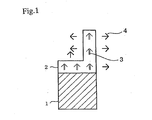
- a substrate attached with a heat sink for heat radiation is used.
- the heat sink is adherently provided on at least one side of a heating element 1 such as printed circuit board. Heat conduction becomes larger with larger adhesion area.
- a material for use in the heat sink a material having excellent heat conductance is preferably used so that heat can be quickly absorbed from the heating element.
- a surface of the heat sink preferably has excellent thermal emission.
- an arrow 3 indicates a direction of heat conduction
- an arrow 4 indicates a direction of heat emission.
- the heat sink can be joined to the printed circuit board by direct soldering.
- a material based on Al having more excellent heat conductance than that of steel sheet is preferably used as a heat sink.
- a special pin is attached to the Al-based heat sink, and the heat sink is soldered to the printed circuit board via the pin.
- JP-A-05-345969 discloses an Al-based alloy metal sheet having excellent solderability and plating adhesion, in which a Sn plating layer is formed on an Al sheet or an Al-based alloy metal material via a Ni-based plating layer.
- a substrate such as a hot dip Al-plated steel sheet is subjected to Ni plating using vacuum deposition, subsequently subjected to Sn plating.
- the vacuum deposition is used for the Ni and Sn plating, and large-scale equipment such as vacuum equipment is needed, in addition, a deposition rate is small and thus productivity is low, therefore, the sheet is hard to be manufactured at low cost.
- JP-A-09-291394 discloses an aluminum material coated with a tin or tin alloy layer having excellent solderability characterized in that the tin or tin alloy layer is coated on an aluminum substrate with a tin-concentration gradient layer being formed at an interface between the aluminum substrate and the tin or tin alloy layer.
- an aluminum alloy sheet is electroplated with tin and then heated, or the aluminum alloy sheet is run through melted tin alloy, thereby the sheet is tinned with the tin-concentration gradient layer being formed at an interface between the aluminum substrate and the tin or tin alloy layer, however, the material has a disadvantage that adhesion between the aluminum substrate and the tinning layer is insufficient, and particularly when bending is performed, a tinning film is easily separated from the aluminum substrate.
- the invention intends to provide a surface-treated Al sheet which has excellent adhesion with a plating layer, solder wettability, and soldering strength, and large heat conductivity or thermal emissivity, and can be preferably used for a heat sink that can be soldered and has excellent heat emission; a heat sink using the sheet; and a method for manufacturing the surface-treated Al sheet at low cost.
- a surface-treated Al sheet of the invention for achieving the object is characterized in that a Zn layer, Ni layer and Sn layer are sequentially formed on a surface of an Al substrate from a substrate surface side.
- the A1 substrate is not limited to a pure Al sheet, and may be an Al alloy sheet.
- the Zn layer is provided at a coating level of 5 to 500 mg/m 2 , and a layer for improving heat emission is further formed on the Sn layer.
- a heat sink of the invention for achieving the object is characterized in that it is formed using the surface-treated Al sheet in which the Zn layer, Ni layer, and Sn layer are sequentially formed on the surface of the Al substrate from a substrate surface side, or a surface-treated Al sheet where the Zn layer is provided at the coating level of 5 to 500 mg/m 2 in the above surface-treated Al sheet, wherein heat conductivity is desirably 60 W/m•K or more.
- another heat sink of the invention is characterized in that it is formed using a surface-treated Al sheet where a layer for improving heat emission is further formed on the Sn layer of the surface-treated Al sheet, wherein heat emmisivity is desirably 0.2 to 0.9.
- a method for manufacturing the surface-treated Al sheet of the invention is characterized in that an Al substrate is subjected to displacement plating of Zn, then subjected to Ni plating, and then subjected to Sn plating; wherein it is desirable that a layer for improving thermal emission is further formed after the Sn plating.
- the layer for improving thermal emission can be formed by, for example, coating and drying aqueous resin containing black pigment and aqueous rosin on the surface-treated Al sheet.
- Al sheet that is a substrate of a surface-treated Al sheet of the invention
- a pure Al sheet and any of Al alloy sheets of 1000 series, 2000 series, 3000 series, 5000 series, 6000 series and 7000 series of JIS standard can be used.
- the Al alloy sheets are degreased, then subj ected to acid etching, and then subjected to desmutting, and then subjected to displacement plating of Zn.
- the displacement plating of Zn is performed through steps of dipping in nitric acid treatment, first Zn substitution treatment, zinc-nitrate separation treatment, and second zinc substitution treatment. In this case, rinsing is performed after the treatment in each step.
- a coating level of the Zn layer is preferably 5 to 500 mg/m 2 in a condition after Ni plating, and more preferably 30 to 300 mg/m 2 .
- the coating level is adjusted by appropriately selecting concentration of Zn ions in a processing liquid and dipping time in the processing liquid in the second Zn substitution treatment.
- concentration of Zn ions in a processing liquid and dipping time in the processing liquid in the second Zn substitution treatment When the coating level is less than 5 mg/m 2 , adhesion with a Ni plating layer formed on the Zn layer is insufficient, and the plating layer is easily separated when bending is performed.
- the coating level is more than 500 mg/m 2 , Ni plating becomes uneven, resulting in reduction in soldering strength.
- the Ni plating layer may be formed using either of electroplating and electroless plating.
- electroless plating since a P compound or a B compound is used as a deoxidizer, a Ni plating film is formed as a film comprising a Ni-P alloy or a Ni-B alloy, however similarly to a film comprising pure nickel formed by the electroplating, excellent adhesion of the plating film to the Al substrate, excellent solder wettability and soldering strength are obtained.
- the Ni layer obtained in this way preferably has a coating level of 0.2 to 50 g/m 2 , and more preferably 1 to 10 g/m 2 .
- the coating level is less than 0.2 g/m 2 , since the Ni layer can not evenly cover the entire surface of the Zn layer, sufficient soldering strength can not be obtained. On the other hand, when the coating level is more than 50 g/m 2 , effects of improving solder wettability and soldering strength are saturated, causing disadvantage in cost.
- the Sn plating layer may be formed using either plating method of electroplating and electroless plating.
- the Sn layer preferably has a coating level of 0.2 to 20 g/m 2 , and more preferably 1 to 10 g/m 2 .
- the coating level is less than 0.2 g/m 2 , solder is hard to be wetted when inactive flux is used.
- the coating level is more than 20 g/m 2 , effects of improving solder wettability and soldering strength are saturated, causing disadvantage in cost.
- the Zn layer, Ni layer and Sn layer are formed on the Al sheet in this way, thereby the surface-treated Al sheet of the invention is obtained.
- the surface-treated Al sheet is heated in such a degree that the uppermost Sn layer on the Al sheet is not entirely lost by alloying with the underlying Ni layer or Al substrate and free Sn is remained, so that the Al substrate and Zn layer, the Zn layer and Ni layer, and the Ni layer and Sn layer are diffused into each other, or the Al substrate, Zn layer, and Ni layer, and the Zn layer, Ni layer, and Sn layer are diffused into one another, thereby adhesion strength between the Al substrate and the plating layers, and adhesion strength among respective plating layers can be improved.
- the surface-treated Al sheet of the invention has a heat conductivity of 60 W/m•K or more, and can preferably absorb heat from a heating element and radiate the heat as a heat sink having excellent heat conductance, a layer for improving thermal emission is provided on the Sn layer, thereby heat radiation can be further improved.
- thermal emissivity of the surface-treated Al sheet of the invention is about 0.05 to 0.1, the thermal emissivity can be improved to about 0.2 to 0.9 by providing the layer for improving thermal emission.
- the layer for improving thermal emission is formed on the Sn layer as follows.
- aqueous acrylic resin containing the black pigment and the aqueous rosin is coated and dried, thereby a processing film is formed.
- the processing film has a flux effect, and improves solder wettability.
- Concentration of the aqueous resin is preferably 100 to 900 g/L, and the black pigment is preferably contained at 50 percent by weight or less against solid contents of the resin in the resin. When it is contained more than 50 percent by weight, solder wettablility and soldering strength deteriorate.
- the thickness of the processing film after drying preferablyhas 0.05 to 10 ⁇ m. When it is less than 0.05 ⁇ m, the effect of improving heat radiation is small, and when it is more than 10 ⁇ m, heat conductance is degraded and heat radiation can not be improved. In this way, the layer for improving thermal emission is provided on the Sn layer, thereby heat radiation of the heat sink can be improved.
- An Al alloy sheet (JIS 5052H19, thickness of 0.5 mm), which was used as a plating substrate, was degreased in an alkaline solution, then subjected to etching in sulfate acid, and then subjected to desmutting in nitric acid, and then subjected to first Zn substitution treatment by dipping in a processing liquid containing sodium hydroxide of 150 g/L, Rochelle salt of 50 g/L, zinc oxide of 25 g/L, and ferrous chloride of 1.5 g/L, and then dipped in a nitric-acid solution of 400 g/L to remove electrolytically replaced Zn, and then subjected to second Zn substitution treatment by dipping in the same processing liquid as used in the first Zn substitution treatment.
- dipping time was variously changed, and Zn-plated Al sheets on which Zn layers with coating levels as shown in Table 1 were formed were obtained.
- Ni-12wt% P alloy plating films were formed on the Zn layers with coating levels as shown in Table 1 by electroless plating.
- Sn plating films were formed on the Ni layers with coating levels as shown in Table 1 by electroplating, thereby test sheets were formed.
- diffusion heat treatment was performed after these plating, wherein the plates were heated to 280°C, thereby the Sn layers were melted, and the Al substrate and the plating layers were diffused into each other, and respective plating layers were diffused into one another in a degree that the uppermost free Sn was not lost.
- layers for improving thermal emission were formed using processing liquids having liquid compositions as shown in Table 2.
- test sheet in which the Ni plating layer and the Sn plating layer were directly provided on the Al alloy sheet without providing the Zn displacement plating layer a test sheet in which only the Sn plating layer was provided on the Al alloy sheet without providing the Zn displacement plating layer, and a test plate in which only the Sn plating layer was provided on a low-carbon steel sheet (thickness of 0.5 mm) were prepared.
- Two cutout pieces formed by folding two specimens 7 mm wide and 50 mm long cut out from each of the test materials in an L shape were piled with evaluation surfaces being opposed to form a T shape, and a steel sheet 0.5 mm thick was interposed between vertical bar portions of the T shape, and thus a specimen where a vacant space of 0.5 mm was formed between lower parts of the vertical bars of the T shape was prepared.
- a specimen 15 mm wide and 50 mm long was cut out from each of the test materials, folded at 90 degrees, and a scotch tape was pasted to the folded portion and then peeled off, and then presence of separation of the plating film was observed with the naked eye, and adhesion of the plating film was evaluated according to the following standard. ⁇ : separation is not observed ⁇ : separation is observed
- a specimen 5 mm wide and 10 mm long was cut out from each of the test materials, and heat conductivity was measured using optical AC process thermal constants measuring system (PIT-R2, manufactured by ULVAC-RIKO, Inc.)
- thermal emissivity was measured using emissivity meter (D and S AERD emissivity meter, manufactured by KYOTO ELECTRONICS MANUFACTURING CO., LTD.), and heat radiation was evaluated according to the following standard.
- ⁇ heat conductivity of 60 W/m•K or more and thermal emissivity of 0.20 or more
- ⁇ heat conductivity of 60 W/m•K or more and thermal emissivity of 0.05 or more and less than 0.20
- ⁇ heat conductivity of 40 or more and less than 60 W/m•K
- ⁇ heat conductivity of less than 40 W/m•K
- the surface-treated Al sheet of the invention in which the Zn layer, Ni layer and Sn layer are formed on the Al sheet has excellent solder wettability, high soldering strength, and has large heat conductivity and excellent heat radiation. Moreover, it was confirmed that the layer for improving thermal emission was provided on the Sn layer of the surface-treated Al sheet, thereby heat radiation was further improved. Therefore, the invention can be preferably used for a heat sink that can be soldered and has excellent heat radiation.
- the surface-treated Al sheet of the invention since the Zn layer is formed on the surface of the Al substrate by displacement plating, and the Ni layer and the Sn layer are formed by plating thereon, adhesion between the Al substrate and the plating layers is excellent. Moreover, since the Sn layer is provided as the uppermost surface, excellent solder wettability, and high soldering strength are obtained. Furthermore, since the substrate is the Al sheet, heat conductivity is large, and heat radiation is excellent. Furthermore, the layer which has a soldering flux property and improves thermal emission is provided on the surface-treated Al sheet of the invention, thereby solderability is further improved and heat radiation can be improved. Therefore, the surface-treated Al sheet of the invention can be preferably used for a heat sink that can be soldered and has excellent heat radiation.
Landscapes
- Chemical & Material Sciences (AREA)
- Engineering & Computer Science (AREA)
- Mechanical Engineering (AREA)
- Chemical Kinetics & Catalysis (AREA)
- Materials Engineering (AREA)
- Metallurgy (AREA)
- Organic Chemistry (AREA)
- Thermal Sciences (AREA)
- Physics & Mathematics (AREA)
- General Engineering & Computer Science (AREA)
- Electrochemistry (AREA)
- General Chemical & Material Sciences (AREA)
- Other Surface Treatments For Metallic Materials (AREA)
- Laminated Bodies (AREA)
- Electroplating Methods And Accessories (AREA)
- Application Of Or Painting With Fluid Materials (AREA)
- Chemically Coating (AREA)
- Cooling Or The Like Of Semiconductors Or Solid State Devices (AREA)
Abstract
Description
wherein it is desirable that a layer for improving thermal emission is further formed after the Sn plating. The layer for improving thermal emission can be formed by, for example, coating and drying aqueous resin containing black pigment and aqueous rosin on the surface-treated Al sheet.
○○: less than 5 sec
○: 5 or more and less than 7 sec
Δ: 7 or more and less than 10 sec
×: 10 or more sec
| Preparation Conditions of Test Plates | ||||||||
| Specimen No. | Substrate | Plating layer | Diffusion heat treatment | Processing film for improving heat radiation | classification | |||
| Zn (Mg/m2) | Ni (g/m2) | Sn (g/m2) | type | Thickness (µm) | ||||
| 1 | Al sheet | - | 10 | 10 | Not | - | - | Comparative example |
| 2 | Al sheet | 1000 | 2 | 10 | Not | - | - | Comparative example |
| 3 | Al sheet | 100 | - | 5 | Not | - | - | Comparative example |
| 4 | Al sheet | 5 | 10 | 2 | Not | - | - | The invention |
| 5 | Al sheet | - | - | 10 | Not | - | - | Comparative example |
| 6 | Al sheet | 500 | 5 | 10 | Not | - | - | The invention |
| 7 | Al sheet | 70 | 15 | 0.2 | Not | - | - | The invention |
| 8 | Al sheet | 60 | 3 | 20 | Done | - | - | The invention |
| 9 | Al sheet | 280 | 8 | 4 | Not | A | 0.5 | The invention |
| 10 | Al sheet | 280 | 8 | 4 | Not | B | 0.5 | The invention |
| 11 | Al sheet | 280 | 8 | 4 | Not | C | 3.0 | The invention |
| 12 | Al sheet | 280 | 8 | 4 | Not | D | 5.2 | The invention |
| 13 | Al sheet | 200 | 10 | - | Not | - | - | Comparative example |
| 14 | Al sheet | 170 | 50 | 20 | Not | - | - | The invention |
| 15 | Al sheet | 220 | 0.2 | 10 | Not | - | - | The invention |
| 16 | Steel sheet | - | - | 5 | Not | - | - | Comparative example |
| Compositions of Processing Liquids for Improving Heat Radiation | |||
| Type | Composition of processing liquid for improving heat radiation | ||
| Acrylic resin (g/L) | Aqueous rosin (g/L) | Carbon black (wt%) | |
| A | 600 | 200 | - |
| B | 600 | 200 | 5 |
| C | 600 | 200 | 30 |
| D | 600 | 200 | 50 |
○○: 4 kgf/7mm or more
○: 3 or more and less than 4 kgf/7mm
Δ: 1 or more and less than 3 kgf/7mm
×: less than 1 kgf/7mm
○: separation is not observed
×: separation is observed
○○: heat conductivity of 60 W/m•K or more and thermal emissivity of 0.20 or more
○: heat conductivity of 60 W/m•K or more and thermal emissivity of 0.05 or more and less than 0.20
Δ: heat conductivity of 40 or more and less than 60 W/m•K
×: heat conductivity of less than 40 W/m•K
| Characteristic Evaluation Results | |||||||
| Specimen No. | Characteristic evaluation results | classification | |||||
| Solder wettability | Soldering strength | Adhesion of plating film | Heat radiation | ||||
| Heat conductivity (W/m•K) | Thermal emissivity | Comprehensive evaluation of | |||||
| 1 | × | × | × | 75 | 0.08 | ○ | Comparative example |
| 2 | ○○ | Δ | × | 89 | 0.09 | ○ | Comparative example |
| 3 | × | × | × | 98 | 0.07 | ○ | Comparative example |
| 4 | ○ | ○○ | ○ | 90 | 0.06 | ○ | The invention |
| 5 | × | × | × | 98 | 0.08 | ○ | Comparative example |
| 6 | ○○ | ○○ | ○ | 89 | 0.08 | ○ | The invention |
| 7 | ○○ | ○○ | ○ | 88 | 0.06 | ○ | The invention |
| 8 | ○ | ○ | ○ | 78 | 0.08 | ○ | The invention |
| 9 | ○○ | ○○ | ○ | 96 | 0.20 | ○ | The invention |
| 10 | ○○ | ○○ | ○ | 95 | 0.29 | ○○ | The invention |
| 11 | ○○ | ○○ | ○ | 96 | 0.68 | ○○ | The invention |
| 12 | ○○ | ○○ | ○ | 94 | 0.90 | ○○ | The invention |
| 13. | × | × | ○ | 92 | 0.05 | ○ | Comparative example |
| 14 | ○○ | ○ | ○ | 74 | 0.08 | ○ | The invention |
| 15 | ○○ | ○○ | ○ | 90 | 0.09 | ○ | The invention |
| 16 | ○○ | ○○ | ○ | 42 | 0.07 | Δ | Comparative example |
Claims (10)
- A surface-treated Al sheet in which a Zn layer, Ni layer, and Sn layer are sequentially formed on a surface of an Al substrate from a substrate surface side.
- The surface-treated Al sheet according to claim 1,
wherein the Zn layer is provided at a coating level of 5 to 500 mg/m2. - The surface-treated Al sheet according to claim 1 or 2,
wherein a layer for improving thermal emission is further formed on the Sn layer. - A heat sink using the surface-treated Al sheet according to claim 1 or 2.
- The heat sink according to claim 4, wherein heat conductivity is 60 W/m•K or more.
- A heat sink using the surface-treated Al sheet according to claim 3.
- The heat sink according to claim 6, wherein the thermal emission is 0.2 to 0.9.
- A method for manufacturing a surface-treated Al sheet,
characterized in that an Al substrate is subjected to displacement plating of Zn, then subjected to Ni plating, and then subjected to Sn plating. - The method for manufacturing the surface-treated Al sheet according to claim 8, characterized in that after the Sn plating, a layer for improving thermal emission is further formed.
- The method for manufacturing the surface-treated Al sheet according to claim 9, wherein the layer for improving thermal emission is formed by coating and drying aqueous resin containing black pigment and aqueous resin on the surface-treated Al sheet.
Applications Claiming Priority (3)
| Application Number | Priority Date | Filing Date | Title |
|---|---|---|---|
| JP2003049689 | 2003-02-26 | ||
| JP2003049689A JP4159897B2 (en) | 2003-02-26 | 2003-02-26 | Surface-treated Al plate excellent in solderability, heat sink using the same, and method for producing surface-treated Al plate excellent in solderability |
| PCT/JP2004/000222 WO2004076724A1 (en) | 2003-02-26 | 2004-01-15 | SURFACE-TREATED Al SHEET EXCELLENT IN SOLDERABILITY, HEAT SINK USING THE SAME, AND METHOD FOR PRODUCING SURFACE-TREATED Al SHEET EXCELLENT IN SOLDERABILITY |
Publications (2)
| Publication Number | Publication Date |
|---|---|
| EP1602750A1 true EP1602750A1 (en) | 2005-12-07 |
| EP1602750A4 EP1602750A4 (en) | 2007-03-14 |
Family
ID=32923317
Family Applications (1)
| Application Number | Title | Priority Date | Filing Date |
|---|---|---|---|
| EP04702436A Withdrawn EP1602750A4 (en) | 2003-02-26 | 2004-01-15 | SURFACE-TREATED ALUMINUM SHEET HAVING EXCELLENT WELDABILITY, THERMAL DISSIPATOR USING THE SAME, AND PROCESS FOR PRODUCING SURFACE-TREATED ALUMINUM SHEET HAVING EXCELLENT WELDABILITY |
Country Status (7)
| Country | Link |
|---|---|
| US (1) | US20070071994A1 (en) |
| EP (1) | EP1602750A4 (en) |
| JP (1) | JP4159897B2 (en) |
| KR (1) | KR20050103511A (en) |
| CN (1) | CN100482866C (en) |
| MX (1) | MXPA05009116A (en) |
| WO (1) | WO2004076724A1 (en) |
Cited By (1)
| Publication number | Priority date | Publication date | Assignee | Title |
|---|---|---|---|---|
| WO2014019906A1 (en) * | 2012-08-03 | 2014-02-06 | Robert Bosch Gmbh | Press-in contact |
Families Citing this family (19)
| Publication number | Priority date | Publication date | Assignee | Title |
|---|---|---|---|---|
| JP3766411B2 (en) * | 2003-08-20 | 2006-04-12 | 東洋鋼鈑株式会社 | Surface-treated Al plate excellent in solderability, heat sink using the same, and method for producing surface-treated Al plate excellent in solderability |
| JP5004414B2 (en) * | 2004-10-12 | 2012-08-22 | 東洋鋼鈑株式会社 | Surface-treated Al plate excellent in solderability, heat sink using the same, and method for producing surface-treated Al plate excellent in solderability |
| JP4888992B2 (en) * | 2005-01-27 | 2012-02-29 | 東洋鋼鈑株式会社 | Method for producing surface-treated Al plate |
| JP5101798B2 (en) * | 2005-02-14 | 2012-12-19 | 東洋鋼鈑株式会社 | Surface treatment Al plate |
| JP2006291340A (en) * | 2005-04-14 | 2006-10-26 | Toshiyuki Arai | Surface treated aluminum sheet, electric conductor and heat sink using the surface treated aluminum sheet, and method for producing surface treated aluminum sheet |
| JP2006322665A (en) * | 2005-05-19 | 2006-11-30 | Toyo Kohan Co Ltd | Hollow laminated body, plate-type cooling member using the same, and electronic device using the same |
| JP2006342369A (en) * | 2005-06-07 | 2006-12-21 | Toyo Kohan Co Ltd | SURFACE TREATED Al SHEET |
| JP2006342395A (en) * | 2005-06-09 | 2006-12-21 | Toyo Kohan Co Ltd | Resin-coated plated metal sheet having excellent solderability |
| KR100950916B1 (en) * | 2008-05-06 | 2010-04-01 | 삼성전기주식회사 | Method of manufacturing printed circuit board and printed circuit board manufactured thereby |
| JP2008223147A (en) * | 2008-06-13 | 2008-09-25 | Toyo Kohan Co Ltd | SURFACE-TREATED Al SHEET HAVING EXCELLENT SOLDERABILITY AND METHOD FOR PRODUCING THE SAME |
| CN103205744B (en) * | 2012-01-12 | 2015-08-19 | 江苏嘉和热系统股份有限公司 | A kind of process of surface treatment of radiator aluminum alloy |
| JP2014040649A (en) * | 2012-08-24 | 2014-03-06 | Auto Network Gijutsu Kenkyusho:Kk | Plated terminal for connector and method of manufacturing plated terminal for connector |
| JP5965418B2 (en) * | 2014-01-09 | 2016-08-03 | 株式会社日立金属ネオマテリアル | Chassis and mobile devices |
| CN106029922B (en) | 2014-05-30 | 2017-11-21 | 东洋铝株式会社 | Aluminum foil, electronic component wiring board using the same, and method for producing aluminum foil |
| KR102010769B1 (en) * | 2017-03-03 | 2019-08-14 | 한국해양대학교 산학협력단 | Tin/magnesium thin film formed on zinc plated layer and manufacturing method thereof |
| DE102017125096B4 (en) * | 2017-10-26 | 2022-05-19 | Hanon Systems | Method of making a scroll compressor and scroll compressor made with the method |
| JP6871524B1 (en) * | 2020-03-23 | 2021-05-12 | 千住金属工業株式会社 | Laminated bonding materials, semiconductor packages and power modules |
| US20230223317A1 (en) * | 2022-01-13 | 2023-07-13 | Mitsubishi Electric Corporation | Resin-sealed semiconductor device |
| US20240015932A1 (en) * | 2022-07-08 | 2024-01-11 | Holding Zero, LLC | Composite thermal control substrate |
Family Cites Families (15)
| Publication number | Priority date | Publication date | Assignee | Title |
|---|---|---|---|---|
| US3150342A (en) * | 1960-02-10 | 1964-09-22 | Morganite Resistors Ltd | Non-linear resistors |
| US3915667A (en) * | 1973-09-20 | 1975-10-28 | Westinghouse Electric Corp | Abrasion resistant coating for aluminum base alloy and method |
| JPS5429555A (en) * | 1977-08-09 | 1979-03-05 | Toshiba Corp | Heat sink constituent |
| JPH0641789B2 (en) * | 1982-02-22 | 1994-06-01 | トヨタ自動車株式会社 | Sliding member |
| JPS59208094A (en) * | 1983-05-13 | 1984-11-26 | Mitsubishi Chem Ind Ltd | Product having bronze-like specular surface |
| JPS6130673A (en) * | 1984-07-23 | 1986-02-12 | Mitsubishi Alum Co Ltd | Formation of zinc film onto aluminum material |
| CN85105468B (en) * | 1985-07-18 | 1988-11-30 | 交通部公路科学研究所 | Brush plating solution for pretreating hard-to-braze metal |
| HU202936B (en) * | 1987-07-07 | 1991-04-29 | Orion Radio | Process for producing more-layer metal coating on surface of objects made of aluminium- or aluminium alloy |
| JPH05345969A (en) * | 1992-06-12 | 1993-12-27 | Kobe Steel Ltd | Al series alloy metallic material excellent in solderability and plating adhesion |
| CA2107866A1 (en) * | 1992-10-13 | 1994-04-14 | Sue Troup-Packman | Iron-plated aluminum alloy parts and method for plating the same |
| JPH0734254A (en) * | 1993-07-19 | 1995-02-03 | Okuno Chem Ind Co Ltd | Electroless plating method to aluminum material |
| JP3435925B2 (en) * | 1995-08-25 | 2003-08-11 | ソニー株式会社 | Semiconductor device |
| US6796484B2 (en) * | 2001-02-02 | 2004-09-28 | Corus Aluminum Walzprodukte Gmbh | Nickel-plated brazing product having improved corrosion performance |
| JP2003077451A (en) * | 2001-08-30 | 2003-03-14 | Rohm Co Ltd | Battery protection module connection structure |
| JP3949505B2 (en) * | 2002-04-26 | 2007-07-25 | シャープ株式会社 | CONNECTION TERMINAL, ITS MANUFACTURING METHOD, SEMICONDUCTOR DEVICE, AND ITS MANUFACTURING METHOD |
-
2003
- 2003-02-26 JP JP2003049689A patent/JP4159897B2/en not_active Expired - Fee Related
-
2004
- 2004-01-15 US US10/547,087 patent/US20070071994A1/en not_active Abandoned
- 2004-01-15 KR KR1020057016071A patent/KR20050103511A/en not_active Ceased
- 2004-01-15 MX MXPA05009116A patent/MXPA05009116A/en unknown
- 2004-01-15 WO PCT/JP2004/000222 patent/WO2004076724A1/en not_active Ceased
- 2004-01-15 CN CNB2004800053484A patent/CN100482866C/en not_active Expired - Fee Related
- 2004-01-15 EP EP04702436A patent/EP1602750A4/en not_active Withdrawn
Cited By (2)
| Publication number | Priority date | Publication date | Assignee | Title |
|---|---|---|---|---|
| WO2014019906A1 (en) * | 2012-08-03 | 2014-02-06 | Robert Bosch Gmbh | Press-in contact |
| US9455502B2 (en) | 2012-08-03 | 2016-09-27 | Robert Bosch Gmbh | Press-in contact |
Also Published As
| Publication number | Publication date |
|---|---|
| JP2004263210A (en) | 2004-09-24 |
| MXPA05009116A (en) | 2006-01-27 |
| KR20050103511A (en) | 2005-10-31 |
| US20070071994A1 (en) | 2007-03-29 |
| CN1754010A (en) | 2006-03-29 |
| WO2004076724A1 (en) | 2004-09-10 |
| CN100482866C (en) | 2009-04-29 |
| EP1602750A4 (en) | 2007-03-14 |
| JP4159897B2 (en) | 2008-10-01 |
Similar Documents
| Publication | Publication Date | Title |
|---|---|---|
| EP1602750A1 (en) | SURFACE-TREATED Al SHEET EXCELLENT IN SOLDERABILITY, HEAT SINK USING THE SAME, AND METHOD FOR PRODUCING SURFACE-TREATED Al SHEET EXCELLENT IN SOLDERABILITY | |
| TWI449809B (en) | Electrical and electronic components for the use of composite materials and electrical and electronic components | |
| CN103221583A (en) | Surface treated copper foil | |
| JP2013007092A (en) | Multilayer-plated aluminum or aluminum alloy foil | |
| JP4626390B2 (en) | Copper foil for printed wiring boards in consideration of environmental protection | |
| WO2002066705A1 (en) | Environmentally friendly surface treated steel sheet for electronic parts excellent in soldering wettability and resistance to rusting and formation of whisker | |
| JP5075099B2 (en) | Surface-treated copper foil, surface treatment method thereof, and laminated circuit board | |
| JP5101798B2 (en) | Surface treatment Al plate | |
| JP6268408B2 (en) | Plating material manufacturing method and plating material | |
| MX2007007955A (en) | Method of electroplating and pre-treating aluminium workpieces. | |
| JPH11279791A (en) | Method for forming tin-indium solder alloy plating layer | |
| JP3766411B2 (en) | Surface-treated Al plate excellent in solderability, heat sink using the same, and method for producing surface-treated Al plate excellent in solderability | |
| JP2006342369A (en) | SURFACE TREATED Al SHEET | |
| JP4339669B2 (en) | Colored surface treatment aluminum plate | |
| JP4888992B2 (en) | Method for producing surface-treated Al plate | |
| MXPA05001021A (en) | Brazing product and method of manufacturing a brazing product. | |
| JPH0219994B2 (en) | ||
| JP2006206977A (en) | SURFACE-TREATED Al SHEET HAVING EXCELLENT SOLDERABILITY | |
| JP5004414B2 (en) | Surface-treated Al plate excellent in solderability, heat sink using the same, and method for producing surface-treated Al plate excellent in solderability | |
| JP2006124747A (en) | SURFACE-TREATED Al SHEET SUPERIOR IN SOLDERABILITY, HEAT SINK USING IT, AND METHOD FOR MANUFACTURING SURFACE-TREATED Al SHEET SUPERIOR IN SOLDERABILITY | |
| JP2006342395A (en) | Resin-coated plated metal sheet having excellent solderability | |
| JP2008223147A (en) | SURFACE-TREATED Al SHEET HAVING EXCELLENT SOLDERABILITY AND METHOD FOR PRODUCING THE SAME | |
| JP2006142708A (en) | Surface treated al plate excellent in soldering property, heat sink using the same and manufacturing method of surface treated al plate excellent in soldering property | |
| US20060240276A1 (en) | Underlayer for reducing surface oxidation of plated deposits | |
| JP2006111897A (en) | Material for terminal |
Legal Events
| Date | Code | Title | Description |
|---|---|---|---|
| PUAI | Public reference made under article 153(3) epc to a published international application that has entered the european phase |
Free format text: ORIGINAL CODE: 0009012 |
|
| 17P | Request for examination filed |
Effective date: 20050902 |
|
| AK | Designated contracting states |
Kind code of ref document: A1 Designated state(s): AT BE BG CH CY CZ DE DK EE ES FI FR GB GR HU IE IT LI LU MC NL PT RO SE SI SK TR |
|
| AX | Request for extension of the european patent |
Extension state: AL LT LV MK |
|
| DAX | Request for extension of the european patent (deleted) | ||
| RBV | Designated contracting states (corrected) |
Designated state(s): BE DE FR GB IT NL |
|
| A4 | Supplementary search report drawn up and despatched |
Effective date: 20070208 |
|
| RIC1 | Information provided on ipc code assigned before grant |
Ipc: H01L 23/373 20060101ALI20070202BHEP Ipc: C23C 2/12 20060101AFI20070202BHEP |
|
| STAA | Information on the status of an ep patent application or granted ep patent |
Free format text: STATUS: THE APPLICATION HAS BEEN WITHDRAWN |
|
| 18W | Application withdrawn |
Effective date: 20091103 |