EP1602672A1 - Propylene copolymer, composition comprising the same and method for producing the same - Google Patents
Propylene copolymer, composition comprising the same and method for producing the same Download PDFInfo
- Publication number
- EP1602672A1 EP1602672A1 EP04712709A EP04712709A EP1602672A1 EP 1602672 A1 EP1602672 A1 EP 1602672A1 EP 04712709 A EP04712709 A EP 04712709A EP 04712709 A EP04712709 A EP 04712709A EP 1602672 A1 EP1602672 A1 EP 1602672A1
- Authority
- EP
- European Patent Office
- Prior art keywords
- propylene
- polymer
- group
- acid
- based polymer
- Prior art date
- Legal status (The legal status is an assumption and is not a legal conclusion. Google has not performed a legal analysis and makes no representation as to the accuracy of the status listed.)
- Withdrawn
Links
Classifications
-
- C—CHEMISTRY; METALLURGY
- C09—DYES; PAINTS; POLISHES; NATURAL RESINS; ADHESIVES; COMPOSITIONS NOT OTHERWISE PROVIDED FOR; APPLICATIONS OF MATERIALS NOT OTHERWISE PROVIDED FOR
- C09J—ADHESIVES; NON-MECHANICAL ASPECTS OF ADHESIVE PROCESSES IN GENERAL; ADHESIVE PROCESSES NOT PROVIDED FOR ELSEWHERE; USE OF MATERIALS AS ADHESIVES
- C09J151/00—Adhesives based on graft polymers in which the grafted component is obtained by reactions only involving carbon-to-carbon unsaturated bonds; Adhesives based on derivatives of such polymers
- C09J151/06—Adhesives based on graft polymers in which the grafted component is obtained by reactions only involving carbon-to-carbon unsaturated bonds; Adhesives based on derivatives of such polymers grafted on to homopolymers or copolymers of aliphatic hydrocarbons containing only one carbon-to-carbon double bond
-
- C—CHEMISTRY; METALLURGY
- C08—ORGANIC MACROMOLECULAR COMPOUNDS; THEIR PREPARATION OR CHEMICAL WORKING-UP; COMPOSITIONS BASED THEREON
- C08F—MACROMOLECULAR COMPOUNDS OBTAINED BY REACTIONS ONLY INVOLVING CARBON-TO-CARBON UNSATURATED BONDS
- C08F255/00—Macromolecular compounds obtained by polymerising monomers on to polymers of hydrocarbons as defined in group C08F10/00
-
- C—CHEMISTRY; METALLURGY
- C08—ORGANIC MACROMOLECULAR COMPOUNDS; THEIR PREPARATION OR CHEMICAL WORKING-UP; COMPOSITIONS BASED THEREON
- C08F—MACROMOLECULAR COMPOUNDS OBTAINED BY REACTIONS ONLY INVOLVING CARBON-TO-CARBON UNSATURATED BONDS
- C08F255/00—Macromolecular compounds obtained by polymerising monomers on to polymers of hydrocarbons as defined in group C08F10/00
- C08F255/02—Macromolecular compounds obtained by polymerising monomers on to polymers of hydrocarbons as defined in group C08F10/00 on to polymers of olefins having two or three carbon atoms
-
- C—CHEMISTRY; METALLURGY
- C08—ORGANIC MACROMOLECULAR COMPOUNDS; THEIR PREPARATION OR CHEMICAL WORKING-UP; COMPOSITIONS BASED THEREON
- C08F—MACROMOLECULAR COMPOUNDS OBTAINED BY REACTIONS ONLY INVOLVING CARBON-TO-CARBON UNSATURATED BONDS
- C08F290/00—Macromolecular compounds obtained by polymerising monomers on to polymers modified by introduction of aliphatic unsaturated end or side groups
- C08F290/02—Macromolecular compounds obtained by polymerising monomers on to polymers modified by introduction of aliphatic unsaturated end or side groups on to polymers modified by introduction of unsaturated end groups
- C08F290/04—Polymers provided for in subclasses C08C or C08F
- C08F290/042—Polymers of hydrocarbons as defined in group C08F10/00
-
- C—CHEMISTRY; METALLURGY
- C08—ORGANIC MACROMOLECULAR COMPOUNDS; THEIR PREPARATION OR CHEMICAL WORKING-UP; COMPOSITIONS BASED THEREON
- C08L—COMPOSITIONS OF MACROMOLECULAR COMPOUNDS
- C08L51/00—Compositions of graft polymers in which the grafted component is obtained by reactions only involving carbon-to-carbon unsaturated bonds; Compositions of derivatives of such polymers
- C08L51/06—Compositions of graft polymers in which the grafted component is obtained by reactions only involving carbon-to-carbon unsaturated bonds; Compositions of derivatives of such polymers grafted on to homopolymers or copolymers of aliphatic hydrocarbons containing only one carbon-to-carbon double bond
Definitions
- the present invention relates to a polypropylene copolymer which has good compatibility with polar resins and which is useful for use as a surface treating agent, an adhesive, or a paint, etc. against crystalline olefin-based polymers, a composition containing the same and a process for producing the same.
- propylene polymers and propylene/ ⁇ -olefin copolymers are not only inexpensive but also excellent in mechanical physical properties, heat resistance, chemical resistance, water resistance, etc., they are used over wide fields.
- propylene-based polymers do not have a polar group in the molecule thereof, they are generally low in polarity and involve a drawback that painting or adhesion is difficult.
- various measures such as chemical treatment of the surface of a molded article of the subject propylene polymer with a chemical and oxidation treatment of the surface of the molded article by means of corona discharge treatment, plasma treatment, flame treatment, etc. Nevertheless, according to these methods, not only special units are required, but also it cannot be said that an improving effect of painting properties or adhesion properties is satisfactory.
- JP-A-3-229772 a resin obtained by graft copolymerizing a reactive unsaturated compound having at least one of a hydroxyl group, a glycidyl group, and an amino group on an acid-modified propylene/ ⁇ -olefin copolymer is shown as a resin having improved compatibility, and a coating composition for polyolefin-based resin containing this resin is also disclosed.
- this composition is improved with respect to the solubility and compatibility by applying modification such as copolymerization with an ⁇ -olefin copolymer, acid modification, and grafting of a polar resin to the resin to be contained therein, there is pointed out a problem that it is inferior in adhesion.
- the invention is to provide a polypropylene copolymer which is able to impart satisfactory adhesion properties and painting properties to crystalline propylene-based polymers and which is excellent in solubility and compatibility with polar resins, a process for producing the same and a composition containing the subject polypropylene copolymer, especially an aqueous dispersion.
- the gist of the invention resides in a polypropylene copolymer, which is characterized by having a polymer principal chain (A) derived from a propylene-based polymer having the following characteristics (1) and (2) and a side chain containing a polymer chain (B) which is different from the principal chain, with a weight ratio of (A)/(B) being in the range of from 20/1 to 1/20, and a process for producing the subject copolymer.
- A polymer principal chain
- B polymer chain
- Another gist of the invention resides in the foregoing polypropylene copolymer, which is characterized by having the following characteristics (a) to (c) and a composition and an aqueous dispersion each containing the subject copolymer.
- the polymer principal chain (A) is derived from a polypropylene-based polymer having specific physical properties expressed by the foregoing characteristics (1) and (2); and for example, it is derived from a modified propylene-based polymer resulting from modification of a propylene-based polymer having the characteristics (1) and (2) but not having a functional group with an acid, etc., or a propylene-based polymer having the characteristics (1) and (2) and having a functional group, such as copolymers of propylene and a functional group-containing monomer, and preferably one derived from a propylene-based polymer modified with an acid, etc.
- the propylene-based polymer which does not have a functional group to be modified may be a propylene homopolymer or a copolymer with other monomer.
- examples of other monomer include olefinic hydrocarbons such as ethylene, butene, 1-pentene, 1-hexene, and 1-octene.
- propylene-based polymer having a functional group inclusive of copolymers examples include copolymers of propylene with a monomer having a group such as a carboxyl group, a hydroxyl group, an amino group, an epoxy group, and an isocyanate group.
- a monomer having a group such as a carboxyl group, a hydroxyl group, an amino group, an epoxy group, and an isocyanate group.
- examples of such a monomer include (meth)acrylic acid, 2-hydroxyethyl (meth)acrylate, glycidyl (meth)acrylate, (meth)acrylamide, (dimethylamino) ethyl (meth) acrylate, (2-isocyanato) ethyl (meth)acrylate, and maleic anhydride.
- the propylene content of the propylene-based polymer in the invention is preferably 80 % by mole or more, more preferably 90 % by mole or more, further preferably 95 % by mole or more, and most preferably 98 % by mole or more.
- the propylene content in the propylene-based polymer is less than 80 % by mole, there may be the case where adhesion to a crystalline propylene-based resin as a substrate is reduced.
- the propylene-based polymer in the invention has a weight average molecular weight Mw, as measured by GPC (Gel Permeation Chromatography), of from 5,000 to 200,000.
- Mw weight average molecular weight
- GPC Gel Permeation Chromatography
- the Mw exceeds 200,000, though there is no serious problem with respect to the film forming properties and stickiness, when the polymer is dissolved in a solvent, the viscosity becomes too high so that inconvenience is generated on the production or handling of a polymer solution, and therefore, such is not preferable.
- the range of the weight average molecular weight Mw is from 5,000 to 200,000, it is preferably from 10,000 to 180,000, and more preferably from 20,000 to 150,000.
- the measurement of GPC can be carried out by conventionally known methods by using o-dichlorobenzene, etc. as a solvent and polystyrene as a standard sample and using a commercially available unit.
- the molecular weight distribution of the propylene-based polymer in the invention is not particularly limited, it is desired to avoid the excessively broad molecular weight distribution because it is meant that the content of low-molecular weight components is inevitably high.
- Mw/Mn which is a ratio of the weight average molecular weight Mw to the number average molecular weight Mn is employed as an index of the molecular weight distribution
- Mw/Mn is preferably less than 20, more preferably less than 10, and most preferably less than 5 are suitably used.
- the characteristic features of the propylene-based polymer in the invention there can be enumerated the matters that a highly crystalline block and a highly amorphous block are copresent in the principal chain thereof and that the highly crystalline block is of a structure which is rich in isotacticity.
- the content of the highly crystalline block is too high, the solubility in a solvent becomes worse, and therefore, the balance between the highly crystalline block and the highly amorphous block is important.
- a requirement to be defined by the 13 C-NMR spectrum is applied as a part of the index expressing this balance and this requirement meets the foregoing prescribed ranges, an excellent structural characteristic is revealed.
- the measurement method of the 13 C-NMR spectrum in the invention is as follows.
- a sample of 350 to 500 mg is completely dissolved by using about 2.2 mL of o-dichlorobenzene in a 10-mm ⁇ sample tube for NMR.
- about 0.2 mL of deuterobenzene is added as a lock solvent, and after homogenization, the measurement is carried out at 130°C by a proton complete decoupling method.
- the measurement condition is set up such that a flip angle is 90° and that a pulse separation is 5T 1 or more (T 1 stands for the longest value with respect to the spin-lattice relaxation time of the methyl group).
- the spin-lattice relaxation time of the methylene group and methine group is shorter than that of the methyl group, and therefore, recovery of the magnetization of all carbons is 99 % or more under this measurement condition.
- a chemical shift of a peak based on the third methyl group of the propylene unit pentad sequences expressed by (mmmm), that is, the absolute configurations of the methyl branch are all identical, is defined as 21.8 ppm, and chemical shifts of other carbon peaks are determined based on this.
- the chemical shifts are approximately determined as follows. That is, mmmr: 21.5 to 21.7 ppm, rmmr: 21.3 to 21.5 ppm, mmrr: 21.0 to 21.1 ppm, mmrm and rmrr: 20.8 to 21.0 ppm, rmrm: 20.6 to 20.8 ppm, rrrr: 20.3 to 20.5 ppm, rrrm: 20.1 to 20.3 ppm, and mrrm: 19.9 to 20.1 ppm.
- BI isotactic block index
- BI is 5. Accordingly, it is meant by ⁇ 4 + 2 [mmmm] / [mmmr] > 5 ⁇ that the average sequence length of the isotactic block to be contained in the polymer is longer than that of the atactic polypropylene.
- the requirement (4 + 2S 1 /S 2 ) in the propylene-based polymer according to the invention is not completely identical with the foregoing BI, it is approximately corresponding thereto. Accordingly, it is meant by the requirement ⁇ (4 + 2S 1 /S 2 ) > 5 ⁇ that the polymer of the invention is different from the atactic polypropylene and contains an isotactic block having a crystallizable sequence length. Furthermore, the isotactic block is present which means that a block comprising a sequence of disordered stereospecificity is also simultaneously present in the principal chain.
- the propylene-based polymer of the invention has a peculiar structure in which a crystalline block and an amorphous block are copresent in the principal chain thereof, and the crystalline block is formed of an isotactic block having a relatively long average sequence length and is of a structure which is rich in isotactic block properties.
- the (4 + 2S 1 /S 2 ) is more than 5, it is preferably more than 6 and less than 25, and more preferably more than 7 and less than 10.
- the propylene-based polymer of the invention is required such that its melting point [Tm] as measured by a differential scanning calorimeter is not higher than 100°C, or its crystal melting heat does not stand at 5 J/g or more.
- the melting point is related to the matter that the crystalline block structure and the amorphous block structure are uniform and are randomly present.
- the solubility of a propylene copolymer formed of the propylene-based polymer in a solvent is good so that it is easy to form a coating solution, and in forming an aqueous dispersion, it is easy to achieve mechanical emulsification or phase inversion emulsification from a solution or a melt.
- [Tm] exceeds 100°C is not preferable in view of the solubility in a solvent, etc. because the crystallinity is too high.
- any production process may be employed so far as it is possible to produce a polymer which can meet the requirements of the invention.
- Examples thereof include a method for carrying out polymerization by a Ziegler-Natta catalyst; a method for carrying out polymerization by a single site catalyst or a Kaminsky catalyst; and a method for achieving epimerization of highly stereospecific isotactic polypropylene using a Pd/C catalyst in the presence of hydrogen.
- the preferred production process there can be enumerated a production process by a single site catalyst.
- a single site catalyst can control microtacticity by means of a design of ligand; polymers having a relatively low molecular weight can be easily produced; and in particular, the molecular weight distribution or stereospecificity distribution is sharp.
- the molecular weight distribution or stereospecificity distribution is irregular, a difference in the solubility is revealed, whereby partially unnecessary materials are possibly formed.
- a metallocene catalyst is suitably used because it can precisely control the microtacticity.
- a metallocene catalyst containing a metallocene compound (component [A]) and a cocatalyst (component [B]) as essential components is preferably used.
- a transition metal-containing C 1 -symmetric ansa-metallocene having a crosslinking group is preferable.
- a non-crosslinked metallocene is applicable to the production of the propylene-based polymer of the invention, since the ansa-metallocene having a crosslinking group is generally excellent in heat stability, etc., it is preferable especially from the industrial viewpoint.
- the transition metal-containing ansa-metallocene having a crosslinking group which is used in the invention is a C 1 -symmetric metallocene of a crosslinked transition metal compound of the group 4 having a conjugated 5-membered ring ligand.
- a transition metal compound is known, and it is also known that it is used as a catalyst component for polymerization of an ⁇ -olefin.
- the metallocene compound as the component [A] is a compound represented by the following general formula (1) and having C 1 -symmetric properties. Furthermore, a mixture of a plurality of metallocene compounds represented by the subject general formula may be used. Q(C 5 H 4-a R 2 a ) (C 5 H 4-b R 3 b )MXY
- Q represents a binding group which crosslinks two conjugated 5-membered ring ligands
- M represents a transition metal of the group 4 of the periodic table
- X and Y each independently represents hydrogen, a halogen, a hydrocarbon group having from 1 to 20 carbon atoms, an oxygen-containing hydrocarbon group having from 1 to 20 carbon atoms, a nitrogen-containing hydrocarbon atoms having from 1 to 20 carbon atoms, a phosphorus-containing hydrocarbon group having from 1 to 20 carbon atoms, or a silicon-containing hydrocarbon group having from 1 to 20 carbon atoms
- R 2 and R 3 each independently represents a hydrocarbon group having from 1 to 20 carbon atoms, a halogen, a halogen-containing hydrocarbon group having from 1 to 20 carbon atoms, an alkoxy group, an aryloxy group, a silicon-containing hydrocarbon group, a phosphorus-containing hydrocarbon group, a nitrogen-containing hydrocarbon group, or a boron-containing hydrocarbon group
- R 2 s and/or R 3 s may be respectively taken together to form a 4-membered to 10-membered ring.
- a and b each independently represents an integer which is satisfied with 0 ⁇ a ⁇ 4 and 0 ⁇ b ⁇ 4, respectively.
- dichloro[dimethylsilylene(cyclopentadienyl)(2,4-dimethyl-4H-1-azulenyl)]halfnium is the most preferable among the metallocene compounds represented by the foregoing general formula (1).
- Dichloro[dimethyl-germylene(cyclopentadienyl)(2,4-dimethyl-4H-1-azulenyl)]-halfnium and dichloro[dimethylsilylene(2-methyl-1-indenyl)(2,4-dimethyl-4H-1-azulenyl)]halfnium are also suitable catalysts.
- a mixture of plural compounds having a different structure may be used as the metallocene compound, and a combination of two or more kinds thereof may be used. It is also possible to auxiliarily use a known solid catalyst containing a titanium trichloride as the major component or a carrier supporting type catalyst containing magnesium, titanium, and a halogen as essential components. Also, the component [A] may be newly supplemented and used at the time of completion of the first stage of the polymerization or prior to start of the polymerization of the second stage.
- an organoaluminum compound may be used as an optional component [C] in addition to the cocatalyst as the component [B].
- the organoaluminum compound is a trialkylaluminum, a halogen- or alkoxy-containing alkylaluminum, or a hydrogen-containing organoaluminum compound.
- trialkylaluminums such as trimethylaluminum, triethylaluminum, tripropylaluminum, and triisobutylaluminum are especially preferable.
- a combination of two or more kinds of these optional components may be used.
- the optional component [C] may be newly supplemented after start of the polymerization, etc.
- the metallocene-based catalyst is obtained by contact of the component [A], the component [B], and the optional component [C], but its contact method is not particularly limited. This contact may be achieved not only at the time of preparation of the catalyst but also at the time of prepolymerization or polymerization of propylene.
- the propylene polymer and a solid of an inorganic oxide such as silica and alumina may be made copresent or brought into contact with each other at the time or after the contact of the respective catalyst components.
- the contact may be carried out in an inert gas such as nitrogen or in an inert hydrocarbon solvent such as n-pentane, n-hexane, n-heptane, toluene, and xylene.
- an inert gas such as nitrogen
- an inert hydrocarbon solvent such as n-pentane, n-hexane, n-heptane, toluene, and xylene.
- n-pentane n-hexane
- n-heptane toluene
- xylene xylene
- the contact temperature is from -20°C to the boiling point of the solvent to be used, and especially preferably from room temperature to the boiling point of the solvent to be used.
- the use amounts of the respective catalyst components are not particularly limited.
- the use amount of the component [A] is from 0.0001 to 10 mmoles, and preferably from 0.001 to 5 mmoles
- the use amount of the component [C] is from 0 to 10,000 mmoles, and preferably from 0.01 to 100 mmoles per gram of the component [B].
- an atomic ratio of the transition metal in the component [A] to aluminum in the component [C] is controlled at from 1/0 to 1/1,000,000, and preferably from 1/0.1 to 1/100,000.
- the thus obtained catalyst may be washed with an inert hydrocarbon solvent such as n-pentane, n-hexane, n-heptane, toluene, and xylene and then used, or may be used without being washed.
- an inert hydrocarbon solvent such as n-pentane, n-hexane, n-heptane, toluene, and xylene
- the component [C] may be newly combined and used as the need arises.
- the amount of the component [C] which is used in washing is preferably controlled such that an atomic ratio of aluminum in the component [C] to the transition metal in the component [A] is from 1/0 to 1/10,000.
- a compound prepared by subjecting propylene to prepolymerization and washing, if desired, can also be used as a catalyst.
- This prepolymerization may be carried out in an inert gas such as nitrogen or in an inert hydrocarbon solvent such as n-pentane, n-hexane, n-heptane, toluene, and xylene.
- the polymerization reaction of propylene is carried out in the presence or absence of a liquid, for example, an inert hydrocarbon such as propane, n-butane, n-hexane, n-heptane, toluene, xylene, cyclohexane, and methylcyclohexane, or liquefied propylene.
- a liquid for example, an inert hydrocarbon such as propane, n-butane, n-hexane, n-heptane, toluene, xylene, cyclohexane, and methylcyclohexane, or liquefied propylene.
- an inert hydrocarbon such as propane, n-butane, n-hexane, n-heptane, toluene, xylene, cyclohexane, and methylcyclohexane, or liquefied propylene.
- the propylene polymer is produced in the presence of the component [A] and the component [B], or in the presence of the component [A], the component [B] and the component [C].
- the polymerization temperature, the polymerization pressure, and the polymerization time are not particularly limited, they are usually optimally set up within the following ranges while taking into consideration the productivity and process ability.
- the polymerization temperature is selected within the range of usually from 0 to 150°C, and preferably from 20 to 100°C;
- the polymerization pressure is selected within the range of from 0.1 to 100 MPa, preferably from 0.3 to 10 MPa, and more preferably from 0.5 to 4 MPa;
- the polymerization time is selected within the range of from 0.1 to 10 hours, preferably from 0.3 to 7 hours, and more preferably from 0.5 to 6 hours.
- the weight average molecular weight Mw of the propylene-based polymer falls within the range of from 5,000 to 200,000.
- conventionally known methods can be employed for regulating the molecular weight of the polymer. That is, there are enumerated a method for controlling the polymerization temperature to regulate the molecular weight, a method for controlling the monomer concentration to regulate the molecular weight, and a method for using a chain transfer agent to regulate the molecular weight. In the case of using a chain transfer agent, hydrogen is preferable.
- the propylene-based polymer as produced by controlling the stereoselectivity of the propylene unit sequence segment comprising a head to tail bond as described previously, it is required that when a peak derived from a carbon atom of a methyl group of a propylene unit sequence segment comprising a head to tail bond is observed by 13 C-NMR and a chemical shift of a peak top of a peak assigned to a pentad expressed by (mmmm) is defined as 21.8 ppm, a ratio (S 1 /S) of an area S 1 of a peak whose peak top appears at 21.8 ppm to an area S of peaks of all pentads appearing in the range of from 19.8 ppm to 22.2 ppm is from 20 % to 60 %; and when an area of a peak (mmmr) whose peak top appears at from about 21.5 to 21.7 ppm is defined as S 2 , there is the relationship of ⁇ (4 + S 1 /S 2 )
- the method for controlling the stereoselectivity regarding such characteristics of the propylene-based polymer is not particularly limited. However, in general, there are enumerated a method for controlling it by the structure of the catalyst and a method for controlling it by controlling the polymerization condition. In the case where the stereoselectivity is controlled by controlling the polymerization condition, by controlling the polymerization temperature or monomer concentration and optionally, further controlling the structure of the foregoing catalyst, it is possible to obtain a propylene-based polymer having desired stereospecificity.
- the polymer principal chain (A) of the propylene copolymer of the invention is derived from the propylene-based polymer having the foregoing characteristics.
- the propylene-based polymer is a polymer which does not have a functional group (this polymer will be sometimes referred to as "non-functional propylene-based polymer”), such as a propylene homopolymer or a copolymer with an olefinic hydrocarbon, etc.
- the polymer principal chain (A) is derived from the propylene-based polymer which has been modified with an acid, etc.; and in the case where the propylene-based polymer is a polymer having a functional group (this polymer will be sometimes referred to as "functional propylene-based polymer"), such as a copolymer of propylene and a functional group-containing monomer
- the polymer principal chain (A) can be derived as it is without being modified.
- the modified propylene-based polymer which is used in the invention is a modified polymer which has the foregoing specific properties (1) and (2) and which can be obtained by graft copolymerizing, for example, a reactive group-containing radical polymerizable unsaturated compound on a non-functional propylene-based polymer, thereby introducing the reactive group into the propylene-based polymer.
- the reactive group to be introduced include a carboxyl group, an acid group of a dicarboxylic acid anhydride group, a hydroxyl group, an amino group, an epoxy group, and an isocyanate group. Of these, a carboxyl group and a dicarboxylic acid anhydride group are preferable.
- specific examples of ones having a carboxyl group or a dicarboxylic acid anhydride group include (meth)acrylic acid, fumaric acid, maleic acid, maleic anhydride, itaconic acid, itaconic anhydride, crotonic acid, crotonic anhydride, citraconic acid, and citraconic anhydride; specific examples of ones having a hydroxyl group include 2-hydroxyethyl (meth)acrylate and 2-hydroxypropyl (meth) acrylate; specific examples of ones having an amino group include (meth)acrylamide and (dimethylamino) ethyl (meth)acrylate; specific examples of ones having an epoxy group include glycidyl (meth)acrylate; and specific examples of ones having an isocyanate group include (2-isocyanato)ethyl (meth)acrylate. Of these, maleic anhydride is preferable.
- graft copolymerization component the foregoing polymerizable unsaturated compound to be graft copolymerized (hereinafter sometimes referred to as "graft copolymerization component") and a radical polymerization initiator are added, and the mixture is heated with stirring, thereby achieving a graft copolymerization reaction
- graft copolymerization component the foregoing polymerizable unsaturated compound to be graft copolymerized
- radical polymerization initiator a radical polymerization initiator
- a grafting rate of the graft copolymerization component by the carboxyl group-containing radical polymerizable unsaturated compound in the modified propylene-based polymer, namely the content thereof in the modified propylene-based polymer is preferably from 0.01 to 5 % by weight, and more preferably from 0.1 to 3 % by weight.
- the grafting rate is not more than 0.01 % by weight, the polypropylene copolymer derived from this modified propylene polymer becomes worse in adhesion to a primer such as a top coating paint.
- adhesion to a crystalline polyolefin becomes worse.
- a use proportion of the radical polymerization initiator to the graft copolymerization component at the time of modification is usually in the range of from 1/100 to 2/1, and preferably from 1/20 to 1/1 in terms of a molar ratio.
- the reaction temperature is 50°C or higher, and especially suitably in the range of from 80 to 200°C; and the reaction time is from about 2 to 10 hours.
- the radical polymerization initiator which is used in the foregoing graft copolymerization can be properly selected and used among usual radical initiators, and examples thereof include organic peroxides and azonitriles.
- organic peroxides include diisopropyl peroxide, di(t-butyl) peroxide, t-butyl hydroperoxide, benzoyl peroxide, dicumyl peroxide, cumyl hydroperoxide, dilauroyl peroxide, dibenzoyl peroxide, methyl ethyl ketone peroxide, cyclohexanone peroxide, cumene hydroperoxide, t-butyl peroxyisopropyl monocarbonate, diisopropyl peroxycarbonate, and dicyclohexyl peroxycarbonate.
- azonitriles examples include azobisbutyronitrile and azobisisopropylnitrile. Of these, t-butyl peroxyisopropyl monocarbonate, benzoyl peroxide, and dicumyl peroxide are preferable.
- the organic solvent include aromatic hydrocarbons such as benzene, toluene, and xylene; aliphatic hydrocarbons such as n-hexane, n-heptane, n-octane, and n-decane; and halogenated hydrocarbons such trichloroethylene, perchloroethylene, chlorobenzene, and o-dichlorobenzene.
- aromatic hydrocarbons and halogenated hydrocarbons are preferable; and toluene, xylene, and chlorobenzene are especially preferable.
- the acid-modified propylene-based polymer in the invention has a weight average molecular weight Mw as measured by GPC of from 5,000 to 200,000.
- the weight average molecular weight Mw is preferably from 10,000 to 180,000, and more preferably from 20,000 to 150,000.
- the polypropylene copolymer of the invention is a polypropylene copolymer having a polymer principal chain (A) derived from a propylene-based polymer having the foregoing characteristics (1) and (2) and a side chain containing a polymer chain (B) which is different from the principal chain in a specific proportion.
- polymer principal chain (A) is derived from a modified polymer of a non-functional propylene-based polymer or a functional propylene-based polymer, it is preferably derived from an acid-modified propylene-based polymer as modified with an acid having a carboxyl group or a dicarboxylic acid anhydride group; and the polymer chain (B) of the side chain is preferably a polymer chain in which a repeating unit thereof is formed by addition reaction, ester bond, or ether bond.
- the "polymer chain in which a repeating unit thereof is formed by addition reaction, ester bond, or ether bond” as referred to herein means a (meth)acrylic polymer chain, a polyester-based polymer chain, or a polyether-based polymer chain.
- the (meth)acrylic polymer chain is specifically a polymer chain as formed by radical polymerizing (meth)acrylic acid and/or a derivative thereof.
- the polypropylene copolymer of the invention is preferably a polypropylene copolymer having a polymer principal chain (A) comprising an acid-modified propylene-based polymer as modified with an acid having a carboxyl group or a dicarboxylic acid anhydride group and a side chain containing a polymer chain (B) which is connected via covalent bond or ionic bond with a group capable of reacting with the subject carboxyl group or dicarboxylic acid anhydride group and in which a repeating unit thereof is formed by addition reaction, ester bond, or ether bond.
- A polymer principal chain
- B side chain containing a polymer chain
- Examples of a method in which a side chain containing the poly(meth)acrylic polymer chain (B) is connected to the polymer principal chain (A) comprising a functional group-containing propylene-based polymer, especially an acid-modified propylene-based polymer as modified with an acid having a carboxyl group or a dicarboxylic acid anhydride group via binding with a group capable of reacting with the subject carboxyl group or dicarboxylic acid anhydride group include the following methods (1) and (2), and the binding may be formed by any of these methods.
- a radical polymerizable unsaturated compound (C2) containing at least (meth)acrylic acid and/or a derivative thereof (for example, esters) thereon.
- Examples of the group capable of reacting with the carboxyl group or dicarboxylic acid anhydride group of the acid-modified propylene which the radical polymerizable unsaturated bond-containing compound (C1) has include an amino group, a hydroxyl group, an epoxy group, and an isocyanate group.
- Examples of the reaction between such a group and the carboxyl group or dicarboxylic acid anhydride group include an esterification reaction between a carboxylic acid and a hydroxyl group, a ring opening reaction between a carboxylic acid and an epoxy group, an amidation reaction between a carboxylic acid and a primary or secondary amino group, a quaternary ammonification reaction between a carboxylic acid and a tertiary amino group, and a urethanation reaction between a carboxylic acid and an isocyanate group.
- the acid-modified propylene-based polymer is a modified polymer with a dicarboxylic acid anhydride
- that acid-modified polymer may be used in a state that it has been subjected to ring opening with water or esterification with an alcohol.
- Examples of the compound (C1) having a group capable of reacting with the carboxyl group or dicarboxylic acid anhydride group of the acid-modified propylene-based polymer and a radical polymerizable unsaturated bond in the molecule thereof include the following compounds.
- hydroxyl group-containing radical polymerizable unsaturated compound examples include hydroxyalkyl (meth)acrylates such as 2-hydroxyethyl (meth)acrylate, 2-hydroxypropyl (meth)acrylate, and 2-hydroxybutyl (meth)-acrylate; (meth)acrylamide N-methylol; (meth)acrylic acid 2-hydroxyethyl-6-hexanolide addition polymers; alkenyl alcohols such as 2-propen-1-ol; alkynyl alcohols such as 2-propyn-1-ol; and hydroxyvinyl ether.
- hydroxyalkyl (meth)acrylates such as 2-hydroxyethyl (meth)acrylate, 2-hydroxypropyl (meth)acrylate, and 2-hydroxybutyl (meth)-acrylate
- (meth)acrylamide N-methylol examples include hydroxyalkyl (meth)acrylates such as 2-hydroxyethyl (meth)acrylate, 2-hydroxypropyl (meth)acrylate,
- Examples of an epoxy group-containing radical polymerizable unsaturated compound include unsaturated carboxylic acid glycidyl esters such as glycidyl (meth)-acrylate, mono- and diglycidyl esters of maleic acid, mono- and diglycidyl esters of itaconic acid, and mono- and diglycidyl esters of allylsuccinic acid; glycidyl esters of a p-styrene carboxylic acid; glycidyl ethers such as allyl glycidyl ether, 2-methylallyl glycidyl ether, and styrene-p-glycidyl ether; p-glycidylstyrene; epoxy olefins such as 3,4-epoxy-1-butene and 3,4-epoxy-3-methyl-1-butene; and vinylcyclohexene monoxide.
- Examples of an isocyanate group-containing radical polymerizable unsaturated compound include 2-isocyanatoethyl (meth)acrylate and methacryloyl isocyanate.
- Examples of a primary or secondary amino group-containing radical polymerizable unsaturated compound include (meth)acrylamides.
- Examples of a tertiary amino group-containing radical polymerizable unsaturated compound include dimethylaminoethyl (meth)acrylate and diethylaminoethyl (meth)acrylate.
- an initiator or a chain transfer agent each having a functional group which can be bound with the reactive group of the propylene-based polymer in the molecule thereof in place of C1.
- the functional group which can be bound include a hydroxyl group, a glycidyl group, a carboxyl group, and an amino group.
- Specific examples of the initiator include 2,2'-azobis(2-methyl-N-[1,1-bis-(hydroxymethyl)-2-hydroxyethyl]propionamide and 2,2'-azo-bis(2-methyl-N-[2-(hydroxyethyl)-propionamide.
- Specific examples of the chain transfer agent include 2-mercaptoethanol.
- the radical polymerizable compound (C2) is a radical polymerizable compound which can be copolymerized with the compound (C1) having a group capable of reacting with the carboxyl group or dicarboxylic acid anhydride group of the acid-modified propylene-based polymer and a radical polymerizable unsaturated bond in the molecule thereof, and preferably contains at least one of (meth)acrylic acid and/or its derivatives.
- (meth)acrylic acid or its derivatives (esters) include (meth)acrylic acid; and (meth)acrylic ester-based monomers having an alkyl group having from 1 to 12 carbon atoms, for example, methyl (meth) acrylate, ethyl (meth)-acrylate, n-propyl (meth)acrylate, isopropyl (meth)-acrylate, n-butyl (meth)acrylate, isobutyl (meth)acrylate, t-butyl (meth)acrylate, pentyl (meth)acrylate, hexyl (meth) acrylate, cyclohexyl (meth) acrylate, octyl (meth) - acrylate, hexyl 2-ethylhexyl (meth)acrylate, nonyl (meth)-acrylate, decyl (meth)acrylate
- (meth)acrylic ester monomers having an aryl group or an arylalkyl group each having from 1 to 12 carbon atoms, for example, phenyl (meth) acrylate, toluyl (meth) acrylate, and benzyl (meth)-acrylate; (meth)acrylic ester monomers having a hetero atom-containing alkyl group having from 1 to 20 carbon atoms, for example, hydroxyethyl (meth)acrylate, dimethylaminoethyl (meth) acrylate, diethylaminoethyl (meth)acrylate, 2-aminoethyl (meth)acrylate, 2-methoxyethyl (meth)acrylate, 3-methoxypropyl (meth)-acrylate, glycidyl (meth) acrylate, and a (meth) acrylic acid ethylene oxide adduct; (meth)acrylic ester monomers having an aryl group or an
- radical polymerizable compound (C2) which can be used jointly with (meth)acrylic acid or its derivative, etc.
- examples of monoolefin dicarboxylic acids or acid anhydrides thereof and monoalkyl esters of a monoolefin dicarboxylic acid include maleic acid, chloromaleic acid, citraconic acid, itaconic acid, gluconic acid, and acid anhydrides thereof, and monoesters of such an acid and a lower alkyl such as methyl and ethyl.
- urethane-modified polyhydric acrylates having a (meth)acryloyl group in one molecule thereof, vinyl acetate, ethyl vinyl ether, butyl vinyl ether, and hexyl vinyl ether.
- the reaction in which after binding the compound (C1) having a radical polymerizable unsaturated bond with the acid-modified propylene-based polymer, the radical polymerizable unsaturated compound (C2) containing at least (meth)acrylic acid and/or its derivative is graft copolymerized, for the purpose of preventing the formation of a homopolymer of the subject radical polymerizable compound (C1) or (C2) in the reaction, it is preferable that the reaction is carried out under an oxygen or air atmosphere and that an adequate amount of a polymerization inhibitor such as hydroquinone, hydroquinone monomethyl ether, and phenothiazine is added in the reaction system.
- a polymerization inhibitor such as hydroquinone, hydroquinone monomethyl ether, and phenothiazine is added in the reaction system.
- the reaction temperature is usually from 20 to 180°C, and preferably from 50 to 150°C.
- acids or basic compounds for example, p-toluenesulfonic acid, zinc chloride, pyridine, triethylamine, dimethylbenzylamine, tetramethylammonium bromide, 1,8-diazabicyclo[5.4.0]-7-undecene (DBU), and 4-dimethylaminopyridine (DMAP) may be used in the esterification reaction; and dibutylsilver dilaurate, etc. may be used in the urethanation reaction.
- acids or basic compounds for example, p-toluenesulfonic acid, zinc chloride, pyridine, triethylamine, dimethylbenzylamine, tetramethylammonium bromide, 1,8-diazabicyclo[5.4.0]-7-undecene (DBU), and 4-dimethylaminopyridine (DMAP) may be used in the esterification reaction; and dibutylsilver dilaurate, etc. may be used
- the molar ratio of the carboxyl group of the acid-modified propylene-based polymer to the reactive group which the foregoing compound (C1) having a radical polymerizable unsaturated bond or the formed copolymer between the subject compound (C1) and the radical polymerizable unsaturated compound (C2) has, namely an amino group, a hydroxyl group, an epoxy group, or an isocyanate group, is in the range of from 5/1 to 1/5, and preferably in the range of from 2/1 to 1/2.
- reaction conditions as used in the methods (1) and (2) including the radical polymerization initiator, reaction temperature and reaction time those as described in the foregoing method for graft copolymerizing the carboxyl group-containing radical polymerizable unsaturated compound on the propylene-based polymer can be properly employed.
- the use proportion of the radical polymerization initiator to the sum of the radical polymerizable unsaturated compounds (C1) and (C2) is usually in the range of from 1/500 to 1/10, and preferably from 1/200 to 1/20 in terms of a molar ratio.
- a chain transfer agents such as alcohols may be used.
- the organic solvent include aromatic hydrocarbons such as benzene, toluene, and xylene; aliphatic hydrocarbons such as n-hexane and n-heptane; alicyclic aliphatic hydrocarbons such as cyclohexane and methylcyclohexane; halogenated hydrocarbons such as perchloroethylene, chlorobenzene, and o-dichlorobenzene; carboxylic acid esters such as methyl acetate and ethyl acetate; and alcohols such as ethanol and isopropanol. They can be used singly or as a mixed solvent.
- the polypropylene copolymer as obtained in the foregoing methods has a polymer principal chain (A) comprising an acid-modified propylene-based polymer and a side chain containing at least a (meth)acrylic polymer chain (B).
- a polymer principal chain (A) comprising an acid-modified propylene-based polymer
- at least the (meth)acrylic polymer chain (B) is connected to a side chain as bound via a reactive group such as a carboxyl group in the polymer principal chain (A) comprising an acid-modified polypropylene-based polymer.
- a ratio of (A)/(B) which is a ratio of the polymer principal chain (A) comprising an acid-modified polypropylene-based polymer to the (meth)-acrylic polymer chain (B) is in the range of from 20/1 to 1/20, preferably 10/1 to 1/10, more preferably from 4/1 to 1/4, and especially preferably from 3/1 to 1/3 in terms of a weight ratio.
- the "weight of the (meth) acrylic polymer chain (B)" as referred to herein shows the weight as occupied by the (meth) acrylic monomer (C2) in the (meth) acrylic polymer chain.
- the weight ratio of (A)/(B) exceeds the range of from 20/1 to 1/20, i.e., (A) is too large while (B) is too small, compatibility with a polar resin is low so that separation is caused.
- (A) is too small while (B) is too large, adhesion to a crystalline polypropylene-based resin becomes poor, and therefore, such is not preferable.
- the "polar resin” as referred to herein is one as used in general-purpose paints, primers, inks, etc., and examples thereof include poly(meth)acrylate resins, polyester resins, polyether resins, polycarbonate resins, polyurethane resins, melamine resins, and alkyd resins.
- the (meth)acrylic polymer chain (B) has a Tg preferably in the range of from 30 to 100°C, and more preferably from 50 to 90°C.
- the Tg exceeds 100°C, the hardness increases so that cracking possibly occurs, while when it is lower than 30°C, sticking is often observed.
- the Tg is preferably in the range of from -50 to 30°C, and more preferably from -20 to 10°C.
- adhesion is possibly lowered, while it is lower than -50°C, a cohesive power is lowered so that adhesion is possibly lowered.
- the polypropylene copolymer having a polymer principal chain (A) comprising a modified propylene polymer and a side chain containing a polymer chain (B) in which a repeating unit thereof is formed by ester bond is a polypropylene copolymer having a side chain containing a polyester-based polymer chain.
- This polypropylene copolymer containing a polyester-based polymer chain in the side chain thereof refers to a polymer having a reactive group-containing propylene-based polymer and a polyester or a polyester polyol bound therein, and preferably a polypropylene copolymer in which an acid-modified propylene-based polymer having a carboxyl group, etc. and a polyester polyol are subjected to dehydration condensation to introduce a polyester side chain.
- the polyester or polyester polyol which is used in the invention can be obtained by polycondensation of the following polyhydric alcohol and a polybasic acid by a known method or ring opening polymerization of an aliphatic lactone.
- polyhydric alcohol one or more kinds of aliphatic polyhydric alcohols such as ethylene glycol, diethylene glycol, polyethylene glycol, propylene glycol, dipropylene glycol, polypropylene glycol, neopentyl glycol, 1,2-, 1,3-, 1,4- or 2,3-butanediol, 1,5-pentanediol, 3-methyl-1,5-pentanediol, and 1,6-hexanediol can be combined and used.
- aliphatic polyhydric alcohols such as ethylene glycol, diethylene glycol, polyethylene glycol, propylene glycol, dipropylene glycol, polypropylene glycol, neopentyl glycol, 1,2-, 1,3-, 1,4- or 2,3-butanediol, 1,5-pentanediol, 3-methyl-1,5-pentanediol, and 1,6-hexanediol can be combined and used
- polybasic acid one or more kinds of polybasic acids such as aliphatic or aromatic dicarboxylic acids, for example, maleic acid, fumaric acid, succinic acid, itaconic acid, adipic acid, azelaic acid, sebacic acid, phthalic acid, isophthalic acid, terephthalic acid, tetrahydrophthalic acid, hexahydrophthalic acid, methyltetrahydrophthalic acid, and acid anhydrides thereof; and aromatic polyhydric carboxylic acids such as trimellitic acid, pyromellitic acid, and acid anhydrides thereof can be combined and used.
- polybasic acids such as aliphatic or aromatic dicarboxylic acids, for example, maleic acid, fumaric acid, succinic acid, itaconic acid, adipic acid, azelaic acid, sebacic acid, phthalic acid, isophthalic acid, terephthalic acid, tetrahydrophthalic acid, hex
- aliphatic lactone one or more kinds of saturated aliphatic lactones such as ⁇ -caprolactone, ⁇ -caprolactone, ⁇ -caprolactone, ⁇ -valerolactone, ⁇ -valerolactone, ⁇ -valerolactone, and ⁇ -methyl- ⁇ -valerolactone can be combined and used.
- the polyester polyol suitably has a hydroxyl group value of from 30 to 250 KOH-mg/g.
- a hydroxyl group value of from 30 to 250 KOH-mg/g.
- polyester polyol polyester polyols having an average molecular weight of from 300, to 100,000 can be used.
- a ratio of (A)/(B) which is a ratio of the polymer principal chain (A) comprising an acid-modified polypropylene-based polymer to the polyester-based polymer chain (B) is in the range of from 20/1 to 1/20, preferably 10/1 to 1/10, more preferably from 4/1 to 1/4, and especially preferably from 3/1 to 1/3 in terms of a weight ratio.
- the polyester polyol can be introduced by esterification or an ester exchange reaction with the carboxyl group or dicarboxylic acid anhydride group which the acid-modified propylene-based polymer has.
- introduction method any of a method for melting by heating at the melting point or higher to achieve the reaction (melting method) or a method for dissolution in an organic solvent such as toluene and xylene to achieve the reaction (solution method) may be employed.
- the solution method is preferable while taking into consideration the point that the reaction can be uniformly carried out.
- the introduction by the melt method, it is possible to achieve the introduction by using a device such as a Banbury mixer, a kneader, and an extruder.
- a device such as a Banbury mixer, a kneader, and an extruder.
- the reaction time is suitably from 10 minutes to 3 hours.
- the reaction temperature is in the range of from 20 to 160°C, and the reaction time is suitably from 1 to 5 hours.
- the solvent it is possible to use a solvent the same as that at the time of binding the (meth)acrylate polymer chain.
- the catalyst for promoting the esterification reaction it is possible to similarly use a catalyst compound as enumerated as the catalyst which can be used at the time of binding the compound (C1) having a group capable of reacting with the carboxyl group or dicarboxylic acid anhydride group of the acid-modified propylene-based polymer and a radical polymerizable unsaturated bond in the molecule thereof or the (meth)acrylate-based polymer chain (B) with the principal chain of the acid-modified polypropylene-based polymer.
- the polypropylene copolymer having a polymer principal chain (A) which is derived from a modified propylene-based polymer and a side chain containing a polymer chain (B) in which a repeating unit thereof is formed by ether bond is a polypropylene copolymer having a side chain containing a polyether-based polymer chain.
- This polypropylene copolymer containing a polyether-based polymer chain in the side chain thereof refers to a polymer having a reactive group-containing modified propylene-based polymer and a polyether polyol bound therein, and preferably a polypropylene copolymer in which an acid-modified propylene-based polymer having a carboxyl group, etc. and a polyether polyol are subjected to dehydration condensation to introduce a polyether side chain.
- the polyether polyol which is used in the invention can be obtained by, for example, subjecting the following cyclic alkylene oxide to ring opening polymerization by a known method.
- cyclic alkylene oxide examples include ethylene oxide, propylene oxide, trimethylene oxide, and tetrahydrofuran.
- polyether polyol examples include ones obtained by ring opening polymerization of the foregoing cyclic alkylene oxide, such as polyethylene glycol, polypropylene glycol, and polytetramethylene glycol.
- the polyether polyol suitably has a hydroxyl group value of from 30 to 250 KOH-mg/g. When the hydroxyl group value exceeds 250 KOH-mg/g, water resistance of the resulting polymer is lowered, and therefore, such is not preferable.
- polyether polyol polyether polyols having an average molecular weight of from 300 to 100,000 can be used.
- a ratio of (A)/(B) which is a ratio of the polymer principal chain (A) comprising an acid-modified polypropylene-based polymer to the polyether-based polymer chain (B) is in the range of from 20/1 to 1/20, preferably 10/1 to 1/10, more preferably from 4/1 to 1/4, and especially preferably from 3/1 to 1/3 in terms of a weight ratio.
- the weight ratio of (A)/(B) exceeds the range of from 20/1 to 1/20, i.e., (A) is too large while (B) is too small, compatibility with a polar resin is low so that separation is caused.
- adhesion to a crystalline polypropylene-based resin becomes poor, and therefore, such is not preferable.
- the polypropylene copolymer of the invention is not only excellent in compatibility with a polar resin but also extremely good in solubility in a variety of solvents and has the following characteristics (a) to (c).
- the polypropylene copolymer of the invention is excellent in compatibility with a polar resin such as acrylic resins. Its characteristic is such that (a) when dissolved in toluene at 25°C together with an acrylic resin in a weight ratio of 50/50 and in a concentration of solids of 12 % by weight, its transmittance (at 650 nm) is 80 % or more, preferably 85 % or more, and more preferably 90 % or more.
- HITALOID 3904 as manufactured by Hitachi Chemical Co., Ltd. was used as the acrylic resin.
- a method for measuring the compatibility there is employed a method in which a solution containing the copolymer of the invention and the polar resin whose concentration has been adjusted at the foregoing concentration is charged in a quartz cell having a width of 10 mm, and its transmittance is measured by light having a prescribed wavelength.
- solubility of the polypropylene copolymer of the invention is very excellent as compared with usual highly stereospecific isotactic polypropylene modified materials. Its solubility is such that (b) when dissolved in toluene at 25°C in a concentration of 10 % by weight, the content of an insoluble matter is not more than 1 % by weight, and preferably not more than 0.1 % by weight based on the whole of polymers, and it is preferable that no insoluble matter is contained.
- a method for measuring the solubility for example, there is employed a method in which a solution having been dissolved at a prescribed temperature and in a prescribed concentration is filtered at a temperature in the vicinity of that temperature (in the case of a high temperature, filtration under heating), a filter paper or SUS-made wire net (the 11406 weight is previously measured) as used at that time is dried, and the weight of an insoluble matter is measured.
- the propylene copolymer of the invention is excellent in adhesion to a polypropylene molded article, and its adhesion is such that (c) adhesion by an adhesion test (cross-cut tape test) to a polypropylene substrate is 50/100 or more, preferably 80/100 or more, and more preferably 100/100.
- the adhesion of the propylene copolymer in the invention is one according to the following adhesion test method.
- a cut penetrating into a coating film of a specimen and reaching the base surface is provided in a cross-cut form, an adhesive tape is applied on the cross-cuts, and after peeling away the adhesive tape, the adhesion state of the coating film is visually observed.
- a sample prepared by coating one surface of a specimen by a method as defined in the product standards of sample according to JIS K5400 3.3, drying and then standing for 24 hours in the standard state is used.
- the evaluation is carried out as follows.
- crystalline polypropylene As the polypropylene substrate which is used in the adhesion test of the invention, crystalline polypropylene is used.
- crystalline polypropylene there are enumerated a propylene homopolymer and/or a propylene ⁇ ethylene block copolymer comprising a propylene homopolymer segment and a propylene-ethylene copolymer segment. Above all, it is preferred to use a propylene homopolymer having an MFR (at 230°C under a load of 21.18 N) of from 5 to 30 (g/10 min).
- the polypropylene copolymer of the invention is excellent in compatibility with a polar resin such as acrylic resins and has good solubility in a solvent, it can be dissolved in a variety of solvents.
- the solvent include aromatic hydrocarbons such as benzene, toluene, and xylene; aliphatic hydrocarbons such as n-pentane, n-hexane, n-heptane, n-octane, and n-decane; alicyclic aliphatic hydrocarbons such as cyclohexane, methylcyclohexane, ethylcyclohexane, dimethylcyclohexane, and decalin; halogenated hydrocarbons such as methylene chloride, carbon tetrachloride, trichloroethylene, perchloroethylene, chlorobenzene, and o-dichlorobenzene; esters such as n-e
- the polypropylene copolymer of the invention is soluble in a variety of solvents, it is possible to coat a coating composition having the subject polypropylene copolymer dissolved in a solvent on a molded article (substrate) of a crystalline olefin-based polymer, thereby forming a coating film. Moreover, the coating film is excellent in adhesion to the substrate and can be used as an adhesive.
- the olefin-based polymer as the substrate examples include olefin-based polymers such as high pressure process polyethylene, polyethylene from medium or low pressure polymerization process, polypropylene, poly-4-methyl-1-pentene, poly-1-butene, and polystyrene; and olefin copolymers such as an ethylene-propylene copolymer, an ethylene-butene copolymer, and a propylene-butene copolymer. Of these olefin copolymers, propylene-based polymers are preferably used.
- the polypropylene copolymer of the invention can be used for surface treatment in molded articles made of polypropylene and a synthetic rubber, molded articles made of a polyamide resin, an unsaturated polyester resin, a polybutylene terephthalate resin, a polycarbonate resin, etc., molded articles, for example, automobile bumpers, and steel plates or steel plates for electrodeposition treatment, and the like.
- molded articles for example, automobile bumpers, and steel plates or steel plates for electrodeposition treatment, and the like.
- the polypropylene copolymer of the invention is undercoated on the surface having been coated with a paint, a primer, an adhesive, etc.
- a polyurethane resin containing, as the major component, a polyurethane resin, a fatty acid-modified polyester resin, an oil-free polyester resin, a melamine resin, an epoxy resin, a polycarbonate resin, a polyamide resin, a phenol resin, an alkyd resin, a polyether resin, an acrylic resin, etc.
- a coating film having improved adhesion of the paint, etc. to that surface and having excellent distinctness of image and low-temperature impact resistance, etc.
- a blend of the resin of the invention with an unmodified polypropylene resin, a polymer of a conjugated diene such as butadiene and isoprene or a hydrogenated material thereof, a chlorinated polyolefin such as chlorinated polyethylene, chlorinated polypropylene, and chlorinated polyethylenepropylene, a chlorosulfonated polyolefin, an ethylene ⁇ vinyl acetate copolymer or a chlorinated material or chlorosulfonated material thereof, etc. as the need arises.
- an unmodified polypropylene resin a polymer of a conjugated diene such as butadiene and isoprene or a hydrogenated material thereof, a chlorinated polyolefin such as chlorinated polyethylene, chlorinated polypropylene, and chlorinated polyethylenepropylene, a chlorosulfonated polyolefin, an ethylene ⁇ vinyl acetate copolymer or a
- a reactive group such as a hydroxyl group, an epoxy group, an amino group, a carboxyl group, and an isocyanate group is present in the polymer principal chain (A) derived from a propylene-based polymer or the polymer chain (B)
- A polymer principal chain
- B polymer chain
- a hydroxy group-, epoxy group-, amino group-, carboxyl group- or isocyanate group-containing compound capable of causing crosslinking reaction with such a reactive group at the time of molding a coating film it is also possible to enhance coating film performance.
- the polypropylene copolymer of the invention can also be used as an aqueous dispersion.
- the aqueous dispersion of the invention contains a polypropylene copolymer and a surfactant in an aqueous medium and further contains a variety of additives which are added as need arises.
- nonionic surfactants include polyoxyethylene alkyl ethers, polyoxyethylene alkylphenyl ethers, polyoxyethylene fatty acid esters, polyoxyethylene sorbitan fatty acid esters, polyoxyethylene sorbitol fatty acid esters, polyoxyethylene polyoxypropylene block polymers, sorbitan fatty acid esters, polyoxyalkylene alkyl ethers, glycerin fatty acid esters, polyoxyethylene alkylamines, and alkyl alkanolamides.
- anionic surfactants include fatty acid salts, alkylsulfuric acid ester salts, polyoxyethylene alkyl ether sulfuric acid ester salts, sodium alkylbenzenesulfonates, sodium alkylnaphthalenesulfonates, alkylsulfosuccinic acid salts, alkyl diphenyl ether disulfonic acid salts, alkyl phosphoric acid salts, and naphthalene sulfonic acid formalin condensates.
- These surfactants can be used singly or in admixture of two or more kinds thereof.
- the surfactant is used usually in a proportion of from 1 to 100 parts by weight, and preferably from 3 to 50 parts by weight based on 100 parts by weight of the polypropylene copolymer.
- a basic substance is present in the aqueous dispersion of the invention.
- the basic substance include inorganic bases such as sodium hydroxide, potassium hydroxide, and sodium carbonate; ammonia; and amines such as methylamine, dimethylamine, trimethylamine, ethanolamine, diethanolamine, triethanolamine, and 2-ethyl-2-aminopropanol. Of these, amines are preferable.
- the basic substance is used in a proportion of from 0.01 to 10 parts by weight, and preferably from 0.1 to 5 parts by weight based on 100 parts by weight of the polypropylene copolymer.
- aqueous dispersion of the polypropylene copolymer of the invention when it is used for applications such as a primer and a paint, for the purpose of increasing the drying speed or obtaining a surface with good finish feeling, it is possible to blend a hydrophilic organic solvent other than water.
- the hydrophilic organic solvent include alcohols such as methanol and ethanol; ketones such as acetone and methyl ethyl ketone; and glycols such as ethylene glycol and propylene glycols and ethers thereof.
- aqueous dispersion of the invention with other aqueous resin such as aqueous acrylic resins, aqueous urethane resins, aqueous epoxy resins, aqueous alkyd resins, aqueous phenol resins, aqueous amino resins, aqueous polybutadiene resins, and aqueous silicone resins.
- aqueous acrylic resins such as acrylic resins, aqueous urethane resins, aqueous epoxy resins, aqueous alkyd resins, aqueous phenol resins, aqueous amino resins, aqueous polybutadiene resins, and aqueous silicone resins.
- aqueous acrylic resins such as aqueous acrylic resins, aqueous urethane resins, aqueous epoxy resins, aqueous alkyd resins, aqueous phenol resins, aqueous amino resins, aqueous polybutadiene resins, and
- the polypropylene copolymer of the invention can be used as an adhesive resin to the subject olefin-based polymer.
- heating is carried out after coating. While the heating temperature is not particularly limited, it is preferably from 50 to 150°C, and more preferably from 60 to 130°C while taking into consideration practical use.
- a method for coating the coating composition is not particularly limited, and conventionally known methods such as a coating method by spraying, a coating method using a roll, and a coating method using a brush can be employed.
- spray coating is suitable, and for example, the aqueous dispersion is sprayed on the surface of the molded article by using a spray gun.
- Coating on the molded article may be carried out at an ordinary temperature, and after coating, it is possible to form a dried coating film by an adequate method such as spontaneous drying and thermally forced drying.
- the paint may be applied as a single layer coating film or a multilayered coating film by wet-on-wet coating.
- the coating film is cured by a usual heating method by a nichrome wire, infrared light, high frequency, etc., whereby a molded article having a desired coating film on the surface thereof can be obtained.
- a method for curing the coating film is properly chosen depending upon the material quality and shape of the molded article, properties of the paint to be used, and the like.
- the coating composition or aqueous dispersion of the invention By coating the coating composition or aqueous dispersion of the invention on the surface of a molded article made of an ⁇ -olefin copolymer as the major component or other copolymer, it is possible to use the coating composition or aqueous dispersion of the invention as a primer, etc. for improving adhesion of the paint onto that surface and coating film performance such as water resistance and gasoline resistance. It is also possible to apply the coating composition or aqueous dispersion of the invention to a wide range of utilities other than the foregoing utility as a primer of the molded article while making the most of excellent characteristic features in adhesion, peeling strength and water resistance. For example, the coating composition or aqueous dispersion of the invention can be applied to utilities such as an additive for adhesives or paints and a compatibilizing agent between a polyolefin and a polar resin.
- the coating composition or aqueous dispersion of the invention may be blended with a variety of stabilizers such as antioxidants, weathering stabilizers, and heat resistant preventives; coloring agents such as titanium oxide and organic pigments; and a variety of additives such as conductivity imparting agents such as carbon black and ferrite, antiseptics, fungicides, and rust preventives and provided for use.
- stabilizers such as antioxidants, weathering stabilizers, and heat resistant preventives
- coloring agents such as titanium oxide and organic pigments
- additives such as conductivity imparting agents such as carbon black and ferrite, antiseptics, fungicides, and rust preventives and provided for use.
- a tackifier and a defoaming agent may be added in the aqueous dispersion, and for the purpose of improving wettability with the substrate to be coated, a small amount of an organic solvent may be added, if desired.
- a molded article to which the composition of the invention is applied may be one prepared by molding the foregoing every kind of polymer or resin by any of known methods such as injecting molding, compression molding, blow molding, extrusion molding, and rotational molding.
- a molded article on which the coating composition or aqueous dispersion of the invention is coated may contain various stabilizers and ultraviolet absorbers and the like in addition to the foregoing materials.
- the stabilizer which is preferably used include phenol-based stabilizers such as 2,6-di-t-butyl-4-methylphenol, tetrakis[methylene(3,5-di-4-hydroxyhydro-cinnamato)]methane, m-octadecyl-3-(4'-hydroxy-3,5-di-t-butyl-phenyl)propionate, 2,2'-methylenebis(4-methyl-6-t-butyl-phenol), 4,4'-butylidenebis(3-methyl-6-t-butylphenol), 2,2-thiobis(4-methyl-6-t-butylphenol), 1,3,5-trimethyl-2,4,6-tris(3,5-di-t-butyl-4-hydroxybenzyl)benzene, and 1,3,5-tris(2-methyl-4-hydroxy-5-t-butylphenol)butane; sulfur-based stabilizers such as dilaurylthio dipropionate and distearyl
- examples of the ultraviolet absorber which is used include 2-hydroxy-4-octoxybenzophenone, 2-ethylhexyl-2-cyano-3,3-diphenyl acrylate, and p-octylphenyl salicylate.
- a catalyst synthesis step and a polymerization step were all carried out in a purified nitrogen atmosphere; and a solvent was used after dehydrating by a molecular sieve (MS-4A) and then bubbling with purified nitrogen to achieve deaerating.
- MS-4A molecular sieve
- a sample (about 5 to 10 mg) was melted at 200°C for 3 minutes; the temperature was dropped to 30°C at a rate of 10 °C/min and then elevated to 200°C at 10 °C/min, thereby obtaining a melting curve; and a peak top temperature of a main heat absorption peak in the final temperature elevation stage was determined as a melting point.
- 2-Methylazulene (4.01 g) was dissolved in tetrahydrofuran (56 mL), and after cooling at 0°C on an ice bath, methyllithium (a diethyl ether solution (1.14 moles/L), 24.8 mL) was added dropwise at that temperature. After completion of the dropwise addition, the ice bath was removed, and the mixture was stirred for 2 hours. This solution was gradually added dropwise in a tetrahydrofuran solution (140 mL) of dimethylsilyl dichloride (34.0 mL, 0.280 moles) as cooled at 0°C on an ice bath.
- the ligand (6.29 g) as obtained in (1)-1 was dissolved in tetrahydrofuran (100 mL) and cooled at 0°C on an ice bath. An n-hexane solution of n-butyllithium (1.56 moles/L, 28.4 mL) was gradually added dropwise thereto at that temperature. After completion of the dropwise addition, the ice bath was removed, the mixture was stirred for 3 hours, and the solvent was distilled off in vacuo. After the distillation, toluene (60 mL) was added to the resulting residue, and the mixture was then cooled to -78°C.
- the recovered cake was again slurried with desalted water (500 mL) in a 1,000-mL round bottom flask and then filtered. This operation was repeated twice. The ultimately obtained cake was dried at 110°C overnight in a nitrogen atmosphere, thereby obtaining chemically treated montmorillonite (13.3 g).
- a toluene solution of triethylaluminum (0.4 mmoles/mL, 4.0 mL) was added to the chemically treated montmorillonite (0.88 g) as obtained in Production Example 1(2), and the mixture was stirred at room temperature for one hour.
- Toluene (16 mL) was added to this suspension, and after stirring, a supernatant was removed. This operation was repeated twice, and toluene was then added to obtain a clay slurry (slurry concentration 99 mg-clay/mL).
- 2-Fluoro-4-bromobiphenyl (6.35 g, 25.3 mmoles) was dissolved in a mixed solvent of diethyl ether (50 mL) and n-hexane (50 mL), to which was then added dropwise an n-pentane solution of t-butyllithium (33 mL, 50.6 mmoles, 1.54 N) at -78°C.
- the mixture was stirred at -10°C for 2 hours, 2-ethylazulene (3.55 g, 22.8 mmoles) was added to this solution, and the mixture was stirred at room temperature for 2 hours.
- n-Hexane (30 mL) was added, and a supernatant was removed by decantation. In addition, this operation was repeated once more. n-Hexane (30 mL) and tetrahydrofuran (40 mL) were added to the resulting yellow precipitate at 0°C. Next, N-methyl imidazole (50 mL) and dimethyl dichlorosilane (1.4 mL, 11.4 mmoles) were added, the temperature was elevated to room temperature, and the mixture was stirred at room temperature for one hour. Thereafter, dilute hydrochloric acid was added, and after liquid separation, the organic phase was dried over magnesium sulfate.
- the thus obtained racemic/meso mixture (4.5 g) was suspended in dichloromethane (35 mL) and irradiated with light for one hour by using a high pressure mercury vapor lamp (100 W).
- the solvent was distilled off in vacuo, toluene (25 mL) and dichloromethane (11 mL) were added to the resulting solid, and the mixture was heated at 60°C to obtain a uniform solution.
- the dichloromethane was distilled off in vacuo, a crystal was deposited.
- the resulting crystal was filtered, washed twice with hexane (5 mL), and then dried in vacuo to obtain a racemate (1.79 g).
- the toluene was taken out from the slurry (containing 914.2 mg of the solid content) as obtained in Production Example 3(2), thereby regulating the amount of residual toluene at 1.0 mL.
- a toluene solution of triisobutylaluminum (0.5 mmoles/mL, 0.5 mL) was added to this slurry, to which was then further added a toluene solution of the racemate of dichloro ⁇ 1,1'-dimethylsilyl-enebis[2-ethyl-4-(2-fluoro-4-biphenylyl)-4H-azulenyl] ⁇ hafnium (3.0 mmoles/mL, 9.2 mL) as synthesized in Production Example 3(1), and the mixture was stirred at room temperature for one hour to obtain a catalyst slurry.
- toluene (1,100 mL) , triisobutylaluminum (0.13 mmoles), liquefied propylene (264 mL), and 1-hexene (0.60 moles, 50 g) were introduced in an induction stirring type autoclave having an internal volume of 2 liters.
- the whole amount of the foregoing catalyst slurry was introduced at room temperature, the temperature was elevated to 80°C, and stirring was continued at that temperature for one hour while keeping the entire pressure at the time of polymerization constantly at 0.85 MPa. After completion of stirring, the unreacted propylene was purged, thereby stopping the polymerization.
- a coating composition was obtained by following the same operations as in Example 1, except for using the maleic anhydride-modified propylene polymer as synthesized in Production Example 6.
- a coating composition was obtained by following the same operations as in Example 1, except for using the maleic anhydride-modified polypropylene as synthesized in Production Example 7.
- a coating composition was obtained by following the same operations as in Example 1, except for using the maleic anhydride-modified polypropylene as synthesized in Production Example 8.
- Example 9 The same operations as in Example 1 were followed, except for using the maleic anhydride-modified polypropylene as synthesized in Production Example 9. However, a formed polymer was not dissolved in toluene and became a swollen material so that coating could not be achieved.
- a coating composition was obtained by following the same operations as in Example 1, except for using the maleic anhydride-modified polypropylene as synthesized in Production Example 10.
- Example 11 The same operations as in Example 1 were followed, except for using the maleic anhydride-modified polypropylene as synthesized in Production Example 11. However, a formed polymer was not dissolved in toluene and became a swollen material so that coating could not be achieved.
- a coating composition was obtained by following the same operations as in Example 1, except for using the maleic anhydride-modified polypropylene as synthesized in Production Example 12.
- a coating composition was obtained by following the same operations as in Example 1, except for using the maleic anhydride-modified propylene/1-hexene copolymer as synthesized in Production Example 14.
- Example 10 The coating composition as produced in Example 10 was used and evaluated as a coating material. The results are shown in Table 4.
- Polypropylene MA3U (propylene homopolymer, MFR 15 g/10 min (at 230°C under a load of 21.18 N)) as manufactured by Japan Polychem Corporation was molded into a test substrate having a wall thickness of 3 mm and a size of 150 mm ⁇ 70 mm at a molding temperature of 240°C by using a screw in-line injection molding machine.
- a solubility test was determined by the following method.
- the solution (coating composition) as prepared in each of the Examples is heated for one hour in a thermostat at 50°C and after spontaneously cooling to room temperature, is allowed to stand for one hour and then filtered by an SUS-made wire net of No. 400.
- a material remaining on the wire net is defined as an insoluble matter, and a material passing therethrough as a solution is defined as a soluble matter, and the both are dried at 80°C under not higher than 1 mmHg for 4 hours by using a vacuum dryer. Weighing is carried out, and a fraction of the insoluble matter is calculated.
- the coating composition was charged in a sample bottle and allowed to stand in a low-temperature incubator set up at -10°C, and the state after elapsing for one week was observed.
- the coating composition as obtained in each of the Examples and Comparative Examples was spray coated on the injection molded substrate (the surface of which had been cleaned up with isopropyl alcohol) as prepared in the Substrate Example. Incidentally, the coating amount was regulated at 3 to 5 g/m 2 . Next, the molded substrate after coating was allowed to stand at 25°C for 10 minutes and then dried at 80°C for 30 minutes in a Safe Van dryer.
- a base coat as prepared by blending an acrylic polyol urethane paint RETAN PG80III (a trade name, manufactured by Kansai Paint Co., Ltd.) with a prescribed amount of a curing agent and adjusting the viscosity thereof at 12 to 13 seconds with an exclusive thinner by using a No. 4 Ford cup was spray coated on the coating film in a coating amount after drying of from 50 to 60 g, followed by baking at 100°C for 30 minutes in a Safe Van dryer. The baked article was further allowed to stand at 25°C for 24 hours and then subjected to interlaminar adhesion test.
- the coating composition as obtained in each of the Examples and Comparative Examples was spray coated on the injection molded substrate (the surface of which had been cleaned up with isopropyl alcohol) as prepared in the Substrate Example. Incidentally, the coating amount was regulated at 10 to 20 g/m 2 . Next, the molded substrate after coating was allowed to stand at 25°C for 10 minutes and then dried at 80°C for 30 minutes in a Safe Van dryer.
- the interlaminar adhesion test was carried out according to a cross-cut test as described in JIS K5400, i.e., a specimen provided with cross-cuts was prepared, CELLOTAPE (a trade name) as manufactured by Nichiban Co., Ltd. was stuck onto the cross-cuts of the specimen and then rapidly drawn and peeled away in the vertical direction, and the number of cross-cuts which had not been peeled away among 100 cross-cuts was counted and defined as an index of the adhesion.
- CELLOTAPE a trade name
- each of the coating compositions was used as a primer, and a base coat was coated on the coating film and baked, followed by ageing at room temperature, thereby obtaining a coated material.
- the coated material was dipped in warm water kept at 40°C for 10 days and then subjected to a peeling test in the same manner as in the foregoing adhesion test.
- the non-tackiness was evaluated by a finger tackiness test.
- HITALOID 3904 manufactured by Hitachi Chemical Co., Ltd. (viscosity: 3,400 mPa ⁇ s (resin concentration: 50 % by weight, xylene: 40 % by weight, butyl acetate: 10 % by weight, temperature: 25°C), solubility parameter: 10.3 (cal/cm 3 ) 1/2 ) as an acrylic resin was diluted with toluene such that the solid content became 20 %. This diluted solution and the coating composition were mixed in a solution weight ratio of 1/1, thereby preparing a solution. This solution was scooped up by a spatula while mixing and thinly coated on a glass plate. After drying at room temperature, the state of the film was visually observed.
- HITALOID 3904 manufactured by Hitachi Chemical Co., Ltd. as an acrylic resin was diluted with toluene such that the solid content became 12 %. This diluted solution and the coating composition were mixed in a solution weight ratio of 1/1, thereby preparing a solution. A transmittance (at 650 nm) of the solution was measured.
- the polypropylene copolymer of the invention has good compatibility with polar resins and excellent adhesion to crystalline polyolefin-based polymers, it can be used as a surface treating agent, an adhesive, a paint, a compatibilizing agent between a polyolefin and a polar resin, etc. and is extremely useful.
Landscapes
- Chemical & Material Sciences (AREA)
- Chemical Kinetics & Catalysis (AREA)
- Organic Chemistry (AREA)
- Health & Medical Sciences (AREA)
- Medicinal Chemistry (AREA)
- Polymers & Plastics (AREA)
- Addition Polymer Or Copolymer, Post-Treatments, Or Chemical Modifications (AREA)
Abstract
Description
(2) A method for copolymerizing a compound (C1) having a group capable of reacting with the carboxyl group or dicarboxylic acid anhydride group of the acid-modified propylene-based polymer and a radical polymerizable unsaturated bond in the molecule thereof and a radical polymerizable unsaturated compound (C2) containing at least (meth)acrylic acid and/or a derivative thereof (for example, esters) and reacting a formed copolymer with the acid-modified propylene-based polymer.
1H-NMR (CDCl3) : δ0.85 (s, 3H), 0.86 (s, 3H), 1.47 (d, J = 7.1 Hz, 3H), 2.25 (s, 3H), 3.42 to 3.52 (m, 1H), 5.42 (dd, J = 4.7, 10.1 Hz, 1H), 5.80 to 5.85 (m, 2H), 5. 90 to 5.95 (m, 1H), 6.16 to 6.20 (m, 2H), 6.65 (d, J = 11.4 H), 6.80 to 6.85 (m, 1H), 6.98 to 7.02 (m, 1H)
MFR: 15,000
Tm: 154.9
Mw: 37,000
Mn: 18,000
Mw/Mn: 2.1
[mmmm] : 98.4 %, [mmmr] : 0.0 %, [rmrm]: 0.1 %, [rrrr] : 0.2 %
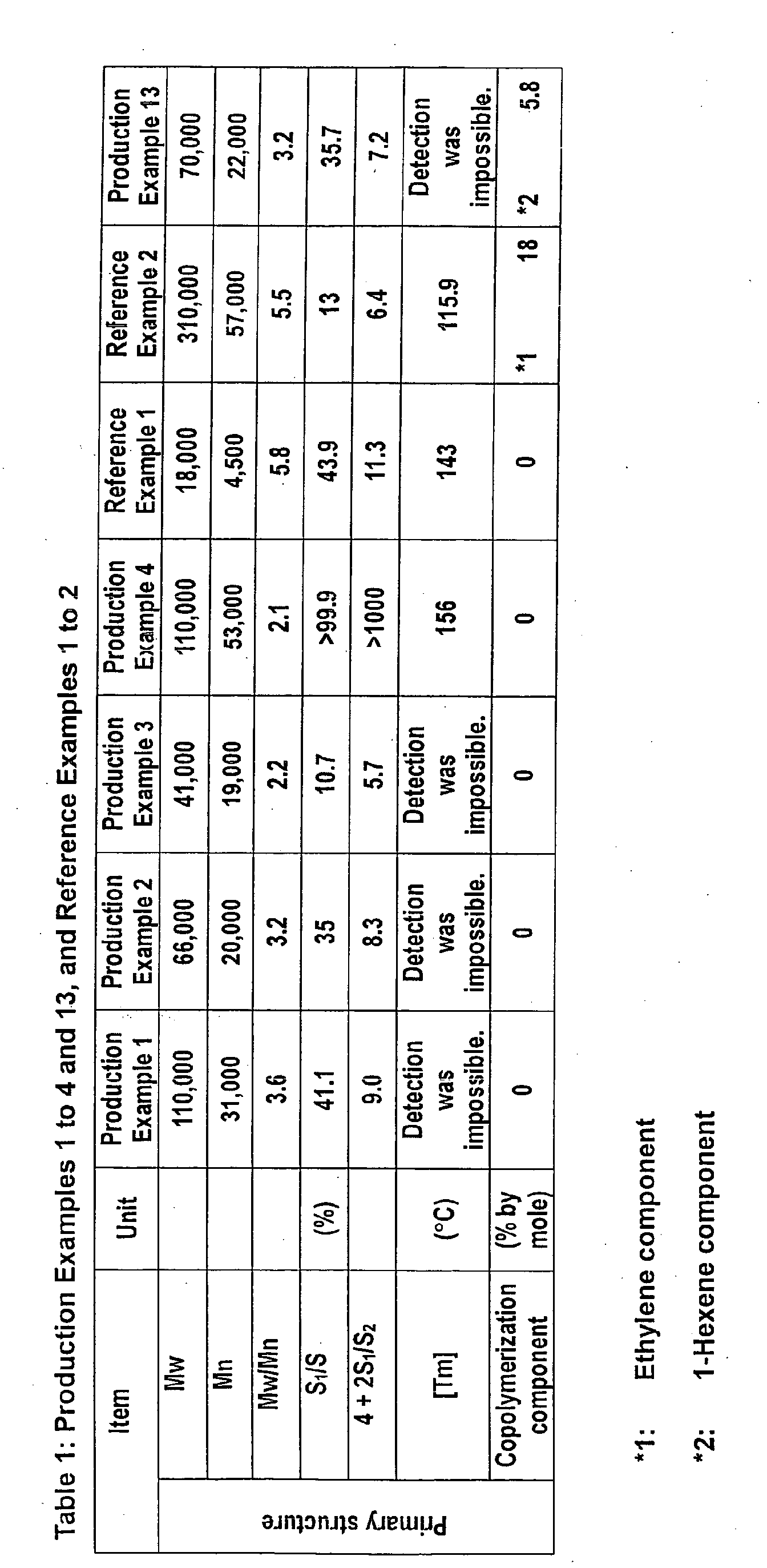
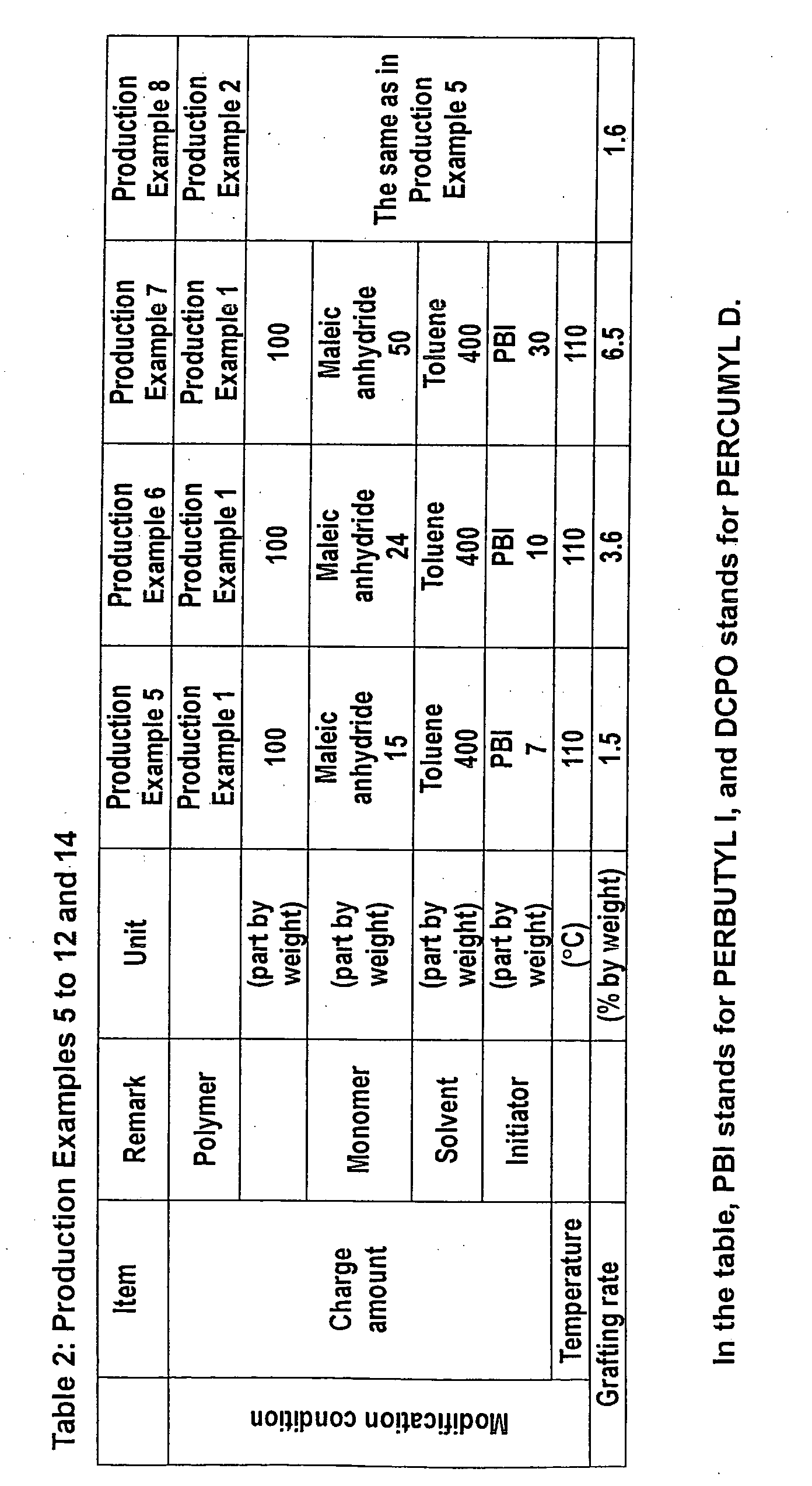
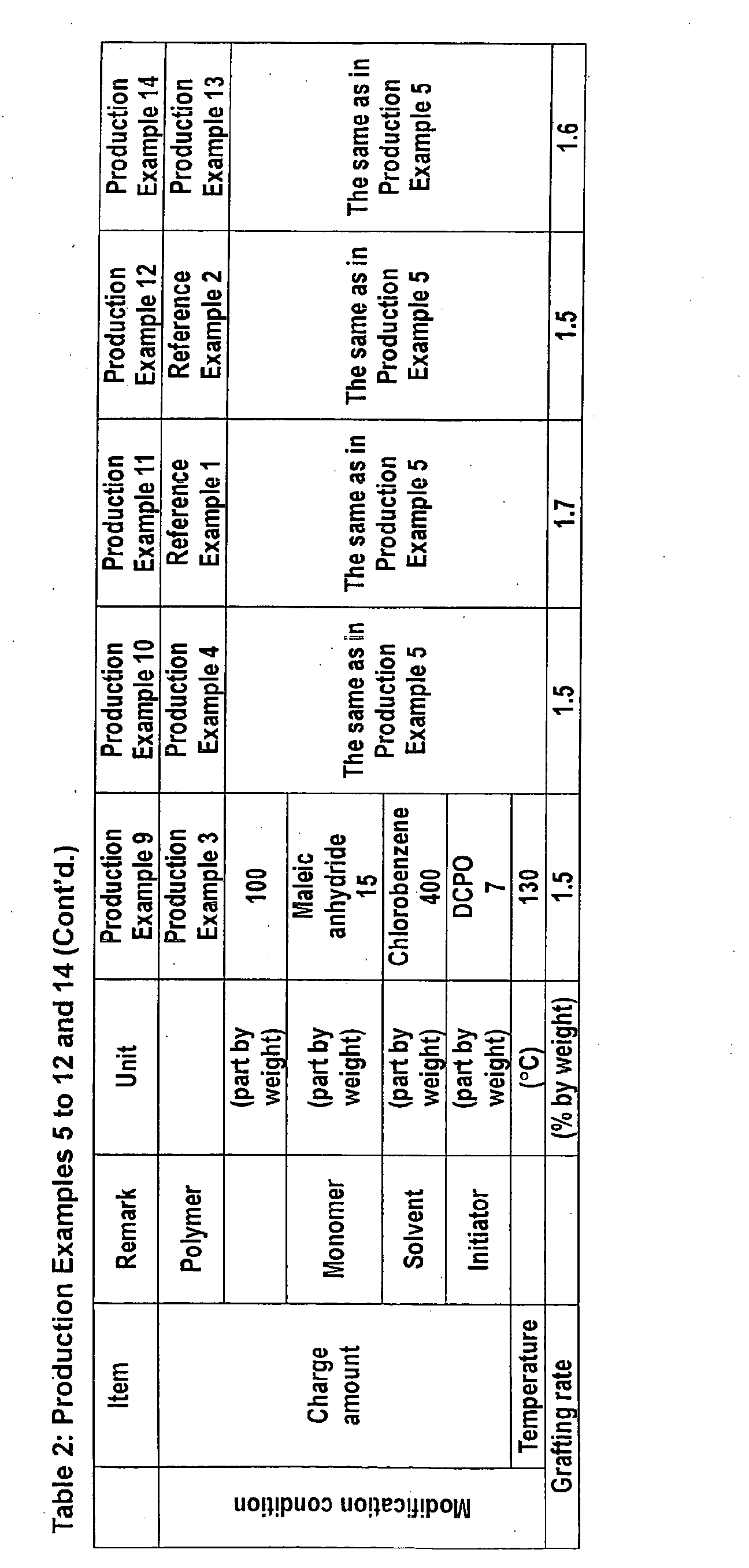


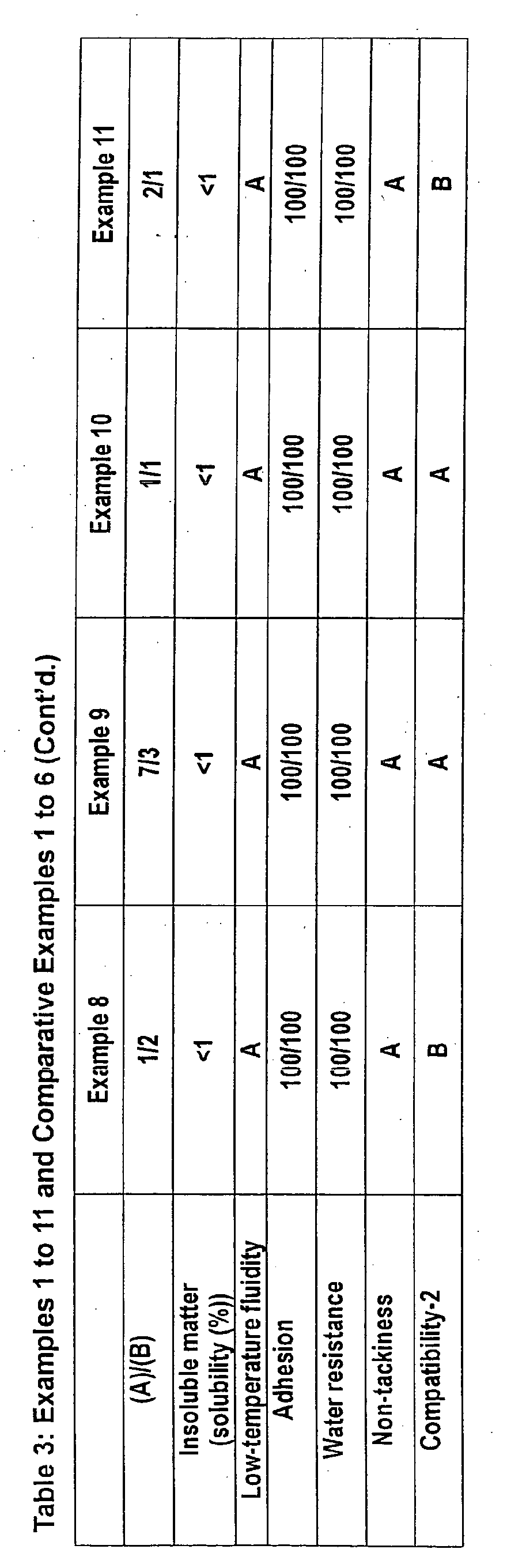
| Example 12 and Comparative Example 7 | ||
| Example 12 | Comparative Example 7 | |
| (A)/(B) | 1/1 | 1/0 |
| Adhesion-2 | 100/100 | 100/100 |
| Non-tackiness | A | B |
Claims (17)
- A polypropylene copolymer, which is characterized by having a polymer principal chain (A) derived from a propylene-based polymer having the following characteristics (1) and (2) and a side chain containing a polymer chain (B) which is different from the principal chain, with a weight ratio of (A) / (B) being in the range of from 20/1 to 1/20:(1) when a peak derived from a carbon atom of a methyl group of a propylene unit sequence segment comprising a head to tail bond is observed by 13C-NMR and a chemical shift of a peak top of a peak assigned to a pentad expressed by (mmmm) is defined as 21.8 ppm, a ratio of an area S1 of a peak whose peak top appears at 21.8 ppm to a total area S of peaks appearing at from 19.8 ppm to 22.2 ppm (S1/S) is from 20 % to 60 %; and when an area of a peak (mmmr) whose peak top appears at from about 21.5 to 21.7 ppm is defined as S2, there is the relationship of { (4 + S1/S2) > 5}, and(2) a melting point [Tm] of the propylene-based polymer as measured by a differential scanning calorimeter is not higher than 100°C, or a crystal melting heat does not stand at 5 J/g or more.
- The polypropylene copolymer according to claim 1, characterized in that the polymer principal chain (A) comprises a propylene-based polymer having said characteristics (1) and (2) and having a functional group.
- The polypropylene copolymer according to claim 1 or 2, characterized in that the functional group-containing propylene-based polymer comprises a modified propylene-based polymer of a propylene-based polymer having said characteristics (1) and (2) and not having a functional group.
- The polypropylene copolymer according to any one of claims 1 to 3, characterized in that the modified propylene-based polymer is an acid-modified propylene-based polymer as modified with an acid having a carboxyl group or a dicarboxylic acid anhydride group.
- The polypropylene copolymer according to any one of claims 1 to 4, characterized in that the polymer chain (B) of the side chain is a polymer chain in which a repeating unit thereof is formed by addition reaction, ester bond, or ether bond.
- The polypropylene copolymer according to claim 1 or 5, characterized in that the polymer chain (B) of the side chain contains a (meth)acrylic polymer chain.
- The polypropylene copolymer according to claim 4 or 6, characterized in that the polymer principal chain (A) comprises an acid-modified propylene-based polymer as modified with an acid having a carboxyl group or a dicarboxylic acid anhydride group; and that the side chain containing the (meth) acrylic polymer chain (B) is connected via covalent bond or ionic bond with a group capable of reacting with said carboxyl group or dicarboxylic acid anhydride group.
- The polypropylene copolymer according to any one of claims 1 to 4, characterized in that the propylene-based polymer is produced by a single site catalyst.
- A process for producing the polypropylene copolymer according to any one of claims 2 to 8, which is characterized by reacting a compound (C1) having a group capable of reacting with the functional group of the functional group-containing propylene-based polymer according to claim 2 and a radical polymerizable unsaturated bond in the molecule thereof with said propylene-based polymer' and then graft copolymerizing (meth)acrylic acid and/or a derivative thereof (C2).
- A process for producing the polypropylene copolymer according to any one of claims 3 to 8, which is characterized by reacting a compound (C1) having a group' capable of reacting with a carboxyl group or a dicarboxylic acid anhydride group of the acid-modified propylene-based polymer and a radical polymerizable unsaturated bond in the molecule thereof with the acid-modified propylene polymer and then graft copolymerizing (meth)acrylic acid and/or a derivative thereof (C2).
- A process for producing the polypropylene copolymer according to any one of claims 2 to 8, which is characterized by reacting a copolymer of a compound (C1) having a group capable of reacting with the functional group of the functional group-containing propylene-based polymer according to claim 2 and a radical polymerizable unsaturated bond in the molecule thereof and (meth)acrylic acid and/or a derivative thereof (C2) with said propylene-based polymer.
- A process for producing the polypropylene copolymer according to any one of claims 2 to 8, which is characterized by reacting a copolymer of a compound (C1) having a group capable of reacting with a carboxyl group or a dicarboxylic acid anhydride group of an acid-modified propylene-based polymer and a radical polymerizable unsaturated bond in the molecule thereof and (meth)acrylic acid and/or a derivative thereof (C2) with the acid-modified propylene-based polymer.
- The polypropylene copolymer and the process for producing the same according to any one of claims 7, 10 and 12, which is characterized in that the group capable of reacting with a carboxyl group or a dicarboxylic acid anhydride group of the acid-modified propylene polymer is a group selected from an amino group, a hydroxyl group, an epoxy group, and an isocyanate group.
- The polypropylene copolymer and the process for producing the same according to any one of claims 4, 7, 10 and 12, which is characterized in that the acid-modified propylene polymer has an acid content (grafting rate) of from 0.01 % by weight to 5 % by weight.
- The polypropylene copolymer according to any one of claims 1 to 8, which is characterized by having the following characteristics (a) to (c):(a) when dissolved in toluene at 25°C together with an acrylic resin in a weight ratio of 50/50 and in a concentration of solids of 12 % by weight, transmittance (at 650 nm) is 80 % or more,(b) when dissolved in toluene at 25°C in a concentration of 10 % by weight, the content of an insoluble matter is not more than 1 % by weight based on the whole of polymers, and(c) adhesion by an adhesion test (cross-cut tape test) to a polypropylene substrate is 50/100 or more.
- A coating composition containing the polypropylene copolymer according to claim 15.
- An aqueous dispersion containing the polypropylene copolymer according to claim 15, a surfactant, and water.
Applications Claiming Priority (3)
| Application Number | Priority Date | Filing Date | Title |
|---|---|---|---|
| JP2003043675 | 2003-02-21 | ||
| JP2003043675 | 2003-02-21 | ||
| PCT/JP2004/001879 WO2004074338A1 (en) | 2003-02-21 | 2004-02-19 | Propylene copolymer, composition comprising the same and method for producing the same |
Publications (2)
| Publication Number | Publication Date |
|---|---|
| EP1602672A1 true EP1602672A1 (en) | 2005-12-07 |
| EP1602672A4 EP1602672A4 (en) | 2007-04-04 |
Family
ID=32905433
Family Applications (1)
| Application Number | Title | Priority Date | Filing Date |
|---|---|---|---|
| EP04712709A Withdrawn EP1602672A4 (en) | 2003-02-21 | 2004-02-19 | COPOLYMER OF PROPYLENE, COMPOSITION CONTAINING THE SAME, AND PROCESS FOR PRODUCING THE SAME |
Country Status (4)
| Country | Link |
|---|---|
| US (1) | US7304111B2 (en) |
| EP (1) | EP1602672A4 (en) |
| CN (1) | CN100402569C (en) |
| WO (1) | WO2004074338A1 (en) |
Cited By (3)
| Publication number | Priority date | Publication date | Assignee | Title |
|---|---|---|---|---|
| WO2006118272A1 (en) | 2005-04-28 | 2006-11-09 | Mitsubishi Chemical Corporation | Acid-modified polypropylene resin, method for producing same, and resin composition using same |
| EP1887026A4 (en) * | 2005-06-03 | 2012-11-14 | Mitsubishi Chem Corp | AQUEOUS RESIN DISPERSION, METHOD FOR PRODUCING THE DISPERSION, COATING MATERIAL AND MULTILAYER ARTICLES |
| EP3395840B1 (en) * | 2015-12-22 | 2026-05-27 | Nippon Paper Industries Co., Ltd. | Modified polyolefin resin |
Families Citing this family (16)
| Publication number | Priority date | Publication date | Assignee | Title |
|---|---|---|---|---|
| US7700707B2 (en) | 2002-10-15 | 2010-04-20 | Exxonmobil Chemical Patents Inc. | Polyolefin adhesive compositions and articles made therefrom |
| US7550528B2 (en) | 2002-10-15 | 2009-06-23 | Exxonmobil Chemical Patents Inc. | Functionalized olefin polymers |
| WO2005108442A1 (en) | 2002-10-15 | 2005-11-17 | Exxonmobil Chemical Patents Inc. | Polyolefin adhesive compositions and articles made therefrom |
| JP5148474B2 (en) * | 2006-02-16 | 2013-02-20 | 関西ペイント株式会社 | Aqueous primer composition and method for coating plastic molded article using the composition |
| WO2007105344A1 (en) * | 2006-03-10 | 2007-09-20 | Mitsubishi Chemical Corporation | Resin dispersion, coating materials, laminates, and processes for production of the same |
| US7906599B2 (en) * | 2006-04-19 | 2011-03-15 | Japan Polypropylene Corporation | Transition metal compound, catalyst for olefin polymerization containing the same, and method for producing propylene/ethylene-α-olefin block copolymer by using the catalyst |
| CN101117479B (en) * | 2006-07-31 | 2010-09-22 | 本田技研工业株式会社 | Aqueous primer coating composition and coating film forming method |
| JP5060202B2 (en) * | 2007-08-09 | 2012-10-31 | 本田技研工業株式会社 | Method for forming glitter coating film |
| US10107475B2 (en) * | 2013-09-12 | 2018-10-23 | Quarkstar Llc | Light-emitting device and luminaire incorporating same |
| CN104795171B (en) * | 2014-05-28 | 2018-05-01 | 安徽天星光纤通信设备有限公司 | A kind of ship communication cable |
| CN106832358B (en) * | 2017-03-06 | 2019-03-15 | 中国科学院化学研究所 | A kind of acrylic polymer nanoparticle and preparation method thereof |
| CN109206550B (en) * | 2017-06-30 | 2022-09-09 | 厦门天策材料科技有限公司 | Hybrid supermolecule dynamic polymer |
| JP2020100715A (en) | 2018-12-21 | 2020-07-02 | 日本製紙株式会社 | Modified polyolefin resin |
| CN115181518B (en) * | 2022-07-19 | 2023-11-07 | 广东汇齐新材料有限公司 | Heat-resistant composite film for shoe soles and preparation method thereof |
| EP4538324A1 (en) * | 2023-10-10 | 2025-04-16 | Dow Global Technologies LLC | Polyolefin compositions |
| CN117209807B (en) * | 2023-11-09 | 2024-02-02 | 国家电投集团氢能科技发展有限公司 | Method for improving solubility of heterocyclic aromatic polymer and application thereof |
Family Cites Families (20)
| Publication number | Priority date | Publication date | Assignee | Title |
|---|---|---|---|---|
| JPS60233131A (en) * | 1984-05-04 | 1985-11-19 | Toagosei Chem Ind Co Ltd | Modifier for polyolefinic resin |
| NO902455L (en) * | 1989-06-05 | 1990-12-06 | Mitsui Toatsu Chemicals | NEW POLY-ALFA OLEFINES. |
| US6001933A (en) * | 1989-11-28 | 1999-12-14 | Idemitsupetrochemical Co., Ltd. | Flexible polypropylene resins, propylene based elastomer compositions and process for production of olefin polymers |
| JP2697934B2 (en) | 1989-12-08 | 1998-01-19 | 積水化学工業株式会社 | Method for producing radically polymerizable polyolefin |
| JPH0747705B2 (en) * | 1990-02-01 | 1995-05-24 | 日本製紙株式会社 | Coating composition for polyolefin resin |
| DE69130403T2 (en) * | 1990-04-18 | 1999-04-15 | Mitsui Chemicals, Inc., Tokio/Tokyo | Syndiotactic propylene copolymer, preparation thereof and composition containing this copolymer |
| TW203083B (en) * | 1990-05-11 | 1993-04-01 | Sumitomo Chemical Co | |
| JP2921027B2 (en) | 1990-05-14 | 1999-07-19 | 三菱化学株式会社 | Primer composition for fluororesin |
| JPH06239946A (en) * | 1993-02-16 | 1994-08-30 | Dainippon Ink & Chem Inc | Method for producing chlorinated polyolefin-modified polyurethane resin |
| US5783630A (en) | 1993-07-13 | 1998-07-21 | Huntsman Petrochemical Corporation | Polyether amine modification of polypropylene |
| US6031048A (en) | 1993-07-13 | 2000-02-29 | Huntsman Petrochemical Corporation | Polyether amine modification of polypropylene |
| AT403583B (en) * | 1993-07-26 | 1998-03-25 | Danubia Petrochem Polymere | MODIFIED ELASTOMER POLYPROPYLENE |
| JP3522349B2 (en) * | 1994-08-22 | 2004-04-26 | 関西ペイント株式会社 | Resin composition for water-based paint |
| JP3570772B2 (en) * | 1995-04-12 | 2004-09-29 | 三井化学株式会社 | Sealant |
| JP2805004B2 (en) * | 1996-04-24 | 1998-09-30 | 三洋化成工業株式会社 | Modifier for resin |
| EP1424348B1 (en) | 2001-08-24 | 2005-11-02 | Mitsubishi Chemical Corporation | Propylene polymer |
| DE60237851D1 (en) * | 2001-11-01 | 2010-11-11 | Mitsubishi Chem Corp | Modified propylene polymer, composition containing the same and their use |
| EP1860129A1 (en) | 2002-01-31 | 2007-11-28 | Mitsubishi Chemical Corporation | Soft propylene-based resin composition |
| US20050124753A1 (en) | 2002-04-26 | 2005-06-09 | Mitsubishi Chemical Corporation | Polypropylene type aqueous dispersion, polypropylene type composite aqueous emulsion composition and its use |
| JP4122829B2 (en) * | 2002-05-01 | 2008-07-23 | 三菱化学株式会社 | Primer composition for polyolefin coating |
-
2004
- 2004-02-19 WO PCT/JP2004/001879 patent/WO2004074338A1/en not_active Ceased
- 2004-02-19 EP EP04712709A patent/EP1602672A4/en not_active Withdrawn
- 2004-02-19 CN CNB2004800046298A patent/CN100402569C/en not_active Expired - Lifetime
-
2005
- 2005-08-22 US US11/207,932 patent/US7304111B2/en not_active Expired - Lifetime
Cited By (5)
| Publication number | Priority date | Publication date | Assignee | Title |
|---|---|---|---|---|
| WO2006118272A1 (en) | 2005-04-28 | 2006-11-09 | Mitsubishi Chemical Corporation | Acid-modified polypropylene resin, method for producing same, and resin composition using same |
| EP1876191A4 (en) * | 2005-04-28 | 2008-11-26 | Mitsubishi Chem Corp | ACID-MODIFIED POLYPROPYLENE RESIN, PROCESS FOR PRODUCING THE SAME, AND RESIN COMPOSITION USING SAME |
| US7989083B2 (en) | 2005-04-28 | 2011-08-02 | Mitsubishi Chemical Corporation | Acid-modified polypropylene resin, method for producing same, and resin composition using same |
| EP1887026A4 (en) * | 2005-06-03 | 2012-11-14 | Mitsubishi Chem Corp | AQUEOUS RESIN DISPERSION, METHOD FOR PRODUCING THE DISPERSION, COATING MATERIAL AND MULTILAYER ARTICLES |
| EP3395840B1 (en) * | 2015-12-22 | 2026-05-27 | Nippon Paper Industries Co., Ltd. | Modified polyolefin resin |
Also Published As
| Publication number | Publication date |
|---|---|
| US20060025535A1 (en) | 2006-02-02 |
| CN1751076A (en) | 2006-03-22 |
| WO2004074338A1 (en) | 2004-09-02 |
| EP1602672A4 (en) | 2007-04-04 |
| US7304111B2 (en) | 2007-12-04 |
| CN100402569C (en) | 2008-07-16 |
Similar Documents
| Publication | Publication Date | Title |
|---|---|---|
| JP4788102B2 (en) | Polypropylene copolymer, composition containing the same and process for producing the same | |
| US7304111B2 (en) | Polypropylene containing copolymer composition and process for producing the same | |
| US7122604B2 (en) | Modified propylene polymer, composition containing the same and use thereof | |
| US8530582B2 (en) | Modified polyolefins with an exceptional profile of properties, process for preparation thereof and use thereof | |
| JP2004115712A (en) | Polypropylene-based composite aqueous emulsion composition | |
| KR20030076921A (en) | Polypropylene-based adhesive compositions | |
| EP2272933A2 (en) | Modified polyolefins with particular characteristic profile, method for producing same and use of same | |
| JP4142390B2 (en) | PROPYLENE POLYMER, COMPOSITION CONTAINING THE SAME, AND USE | |
| EP2270111A2 (en) | Modified polyolefins with particular characteristic profile, method for producing same and use of same | |
| JP5014579B2 (en) | Solvent dispersion of composite resin and use thereof | |
| CN102725362A (en) | Resin composition for coating and molded resin product obtained therefrom | |
| JP2004035623A (en) | Modified polypropylene and method for producing the same | |
| JP2005126615A (en) | Modified propylene polymer aqueous dispersion and use thereof | |
| US12479946B2 (en) | Polyacrylate-based graft copolymer | |
| JP2005126483A (en) | (Meth) acrylic modified polyolefin resin, production method and composition thereof | |
| JPWO2012124345A1 (en) | Reactive polyolefin, process for producing the same, and composition containing the same | |
| JP4635449B2 (en) | COATING COMPOSITION CONTAINING PROPYLENE POLYMERS AND METHOD OF USE | |
| JP4076397B2 (en) | Polypropylene paint molding | |
| US12612529B2 (en) | Ethylene/alpha-olefin copolymer composition and application thereof | |
| JP4116379B2 (en) | Polypropylene paint molding | |
| JP2004107539A (en) | Polypropylene resin molded body | |
| JP4076395B2 (en) | Polypropylene paint molding | |
| JP4076396B2 (en) | Polypropylene paint molding | |
| GB2456828A (en) | Emulsion of maleic anhydride grafted propylene based elastomer | |
| JP6270558B2 (en) | Coating agent |
Legal Events
| Date | Code | Title | Description |
|---|---|---|---|
| PUAI | Public reference made under article 153(3) epc to a published international application that has entered the european phase |
Free format text: ORIGINAL CODE: 0009012 |
|
| 17P | Request for examination filed |
Effective date: 20050919 |
|
| AK | Designated contracting states |
Kind code of ref document: A1 Designated state(s): AT BE BG CH CY CZ DE DK EE ES FI FR GB GR HU IE IT LI LU MC NL PT RO SE SI SK TR |
|
| AX | Request for extension of the european patent |
Extension state: AL LT LV MK |
|
| DAX | Request for extension of the european patent (deleted) | ||
| RAP1 | Party data changed (applicant data changed or rights of an application transferred) |
Owner name: MITSUBISHI CHEMICAL CORPORATION |
|
| RIN1 | Information on inventor provided before grant (corrected) |
Inventor name: HATA, KAZUYUKI,C/O JAPAN EPOXY RESINS CO., LTD. Inventor name: ONOE, MASATO,C/O MITSUBISHI CHEMICAL CORP. |
|
| A4 | Supplementary search report drawn up and despatched |
Effective date: 20070305 |
|
| RIC1 | Information provided on ipc code assigned before grant |
Ipc: C09J 151/06 20060101ALI20070227BHEP Ipc: C08L 51/06 20060101ALI20070227BHEP Ipc: C08F 255/02 20060101ALI20070227BHEP Ipc: C08G 81/02 20060101ALI20070227BHEP Ipc: C08F 290/12 20060101AFI20040906BHEP |
|
| 17Q | First examination report despatched |
Effective date: 20081217 |
|
| STAA | Information on the status of an ep patent application or granted ep patent |
Free format text: STATUS: THE APPLICATION IS DEEMED TO BE WITHDRAWN |
|
| 18D | Application deemed to be withdrawn |
Effective date: 20090630 |