EP1599366B1 - Method for firing restraining means - Google Patents
Method for firing restraining means Download PDFInfo
- Publication number
- EP1599366B1 EP1599366B1 EP03770901A EP03770901A EP1599366B1 EP 1599366 B1 EP1599366 B1 EP 1599366B1 EP 03770901 A EP03770901 A EP 03770901A EP 03770901 A EP03770901 A EP 03770901A EP 1599366 B1 EP1599366 B1 EP 1599366B1
- Authority
- EP
- European Patent Office
- Prior art keywords
- algorithm
- crash
- measure
- algorithms
- severity
- Prior art date
- Legal status (The legal status is an assumption and is not a legal conclusion. Google has not performed a legal analysis and makes no representation as to the accuracy of the status listed.)
- Revoked
Links
- 238000000034 method Methods 0.000 title claims description 42
- 230000000452 restraining effect Effects 0.000 title description 6
- 238000010304 firing Methods 0.000 title 1
- 239000011159 matrix material Substances 0.000 claims description 8
- 230000001960 triggered effect Effects 0.000 claims description 5
- 238000006073 displacement reaction Methods 0.000 claims description 3
- 230000001133 acceleration Effects 0.000 description 5
- 238000010586 diagram Methods 0.000 description 4
- 238000011156 evaluation Methods 0.000 description 4
- 230000008901 benefit Effects 0.000 description 3
- 230000014759 maintenance of location Effects 0.000 description 3
- 238000002604 ultrasonography Methods 0.000 description 3
- 230000006835 compression Effects 0.000 description 2
- 238000007906 compression Methods 0.000 description 2
- 230000009467 reduction Effects 0.000 description 2
- 230000006978 adaptation Effects 0.000 description 1
- 238000004364 calculation method Methods 0.000 description 1
- 230000008859 change Effects 0.000 description 1
- 230000001419 dependent effect Effects 0.000 description 1
- 238000001514 detection method Methods 0.000 description 1
- 230000008569 process Effects 0.000 description 1
- 239000004065 semiconductor Substances 0.000 description 1
- 230000001629 suppression Effects 0.000 description 1
Images

Classifications
-
- B—PERFORMING OPERATIONS; TRANSPORTING
- B60—VEHICLES IN GENERAL
- B60R—VEHICLES, VEHICLE FITTINGS, OR VEHICLE PARTS, NOT OTHERWISE PROVIDED FOR
- B60R21/00—Arrangements or fittings on vehicles for protecting or preventing injuries to occupants or pedestrians in case of accidents or other traffic risks
- B60R21/01—Electrical circuits for triggering passive safety arrangements, e.g. airbags, safety belt tighteners, in case of vehicle accidents or impending vehicle accidents
- B60R21/015—Electrical circuits for triggering passive safety arrangements, e.g. airbags, safety belt tighteners, in case of vehicle accidents or impending vehicle accidents including means for detecting the presence or position of passengers, passenger seats or child seats, and the related safety parameters therefor, e.g. speed or timing of airbag inflation in relation to occupant position or seat belt use
- B60R21/01558—Electrical circuits for triggering passive safety arrangements, e.g. airbags, safety belt tighteners, in case of vehicle accidents or impending vehicle accidents including means for detecting the presence or position of passengers, passenger seats or child seats, and the related safety parameters therefor, e.g. speed or timing of airbag inflation in relation to occupant position or seat belt use monitoring crash strength
-
- B—PERFORMING OPERATIONS; TRANSPORTING
- B60—VEHICLES IN GENERAL
- B60R—VEHICLES, VEHICLE FITTINGS, OR VEHICLE PARTS, NOT OTHERWISE PROVIDED FOR
- B60R21/00—Arrangements or fittings on vehicles for protecting or preventing injuries to occupants or pedestrians in case of accidents or other traffic risks
- B60R21/01—Electrical circuits for triggering passive safety arrangements, e.g. airbags, safety belt tighteners, in case of vehicle accidents or impending vehicle accidents
- B60R2021/01034—Controlling a plurality of restraint devices
-
- B—PERFORMING OPERATIONS; TRANSPORTING
- B60—VEHICLES IN GENERAL
- B60R—VEHICLES, VEHICLE FITTINGS, OR VEHICLE PARTS, NOT OTHERWISE PROVIDED FOR
- B60R21/00—Arrangements or fittings on vehicles for protecting or preventing injuries to occupants or pedestrians in case of accidents or other traffic risks
- B60R21/01—Electrical circuits for triggering passive safety arrangements, e.g. airbags, safety belt tighteners, in case of vehicle accidents or impending vehicle accidents
- B60R21/013—Electrical circuits for triggering passive safety arrangements, e.g. airbags, safety belt tighteners, in case of vehicle accidents or impending vehicle accidents including means for detecting collisions, impending collisions or roll-over
Definitions
- the invention is based on a method for triggering retaining means according to the preamble of the independent claim.
- the invention also relates to an apparatus for carrying out the method for triggering restraint means.
- the inventive method for triggering restraint means with the features of the independent claim has the advantage that the evaluation of various algorithms of the sensor signals a more optimal determination of the tripping time and the retention means to be used is made possible.
- the inventive method is so scalable and modular, so that any algorithms can be linked together.
- the triggering time and which restraint means must be triggered how strongly. This achieves a better adaptation to the crash and the persons who are in the vehicle.
- a measure is used which is common to all algorithms. On the basis of this measure, each algorithm can then calculate its own value. The resulting tripping time can then be calculated from the results of the algorithms. Because the measure is common to all algorithms, arbitrary algorithms can be linked together. The overall algorithm becomes scalable and modular in structure. Such a measure common to all algorithms can be, for example, the crash severity. This can be expressed for example by the speed reduction, the forward displacement or the compression of the vehicle. Another possible measure may be the trip time itself, which is specifically calculated for the particular restraint. Alternatively, it is possible, other z. B. abstract dimensions to use.
- the method and dimension described below should enable the tripping time optimized for the standard occupant in the standard seating position to be adapted to the specific occupant in the current sitting position.
- all information provided by the passenger compartment sensor systems about the respective occupants is also taken into account here (for example, strapped, unguided, belt extension length, age of the person, pregnant woman, child seat recognition, etc.).
- the at least one sensor signal originates from precrash sensors such as radar, ultrasound or video sensors and crash sensors, that is to say in particular acceleration sensors located in the control unit for the retaining means and outside the control unit, for example as upfront sensors located on the radiator or as side impact sensors in the sides of the vehicle.
- precrash sensors such as radar, ultrasound or video sensors and crash sensors
- acceleration sensors located in the control unit for the retaining means and outside the control unit
- upfront sensors located on the radiator or as side impact sensors in the sides of the vehicle.
- Both Side impact sensors are also such sensors such as pressure sensors or other deformation sensors used.
- a precrash algorithm that is to say the algorithm which evaluates the precrash signals of radar and video and ultrasound sensors
- a central algorithm which thus evaluates the sensor signals in the central control unit
- a side impact algorithm that is, those sensor signals which are suitable for a Side impact are relevant
- an upfront algorithm which is the algorithm that evaluates the sensor signals of the upfront sensors
- a rollover algorithm that evaluates a rollover process, for example, by sensor signals from acceleration and yaw rate sensors.
- Other algorithms are conceivable here.
- the crash severity may be in the form of a scalar value, a vector or a matrix to determine the common measure.
- the crash severity can refer to the crash type, ie frontal, offset, side, rear or rollover, or to the restraint, so belt tensioner, front airbag, side airbag.
- a device for carrying out the method, that is to say a control unit with processor and the necessary sensors as well as the control for the retaining means and the retaining means themselves.
- the restraining means are airbags, roll bars and belt tensioners.
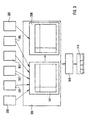
- FIG. 1 shows a block diagram of the device according to the invention
- FIG. 2 shows a flow chart of the method according to the invention
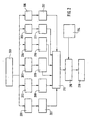
- FIG. 3 shows a block diagram of the method according to the invention.
- the frontal algorithms are based on a special sensor, eg. B. the central acceleration sensor, the Upfront- or the pre-crash sensor, and are referred to according to the associated sensors. If only a frontal algorithm is used, the tripping time can be calculated directly. If a combination with other algorithms is used, the tripping time can be determined by a logic specially adapted to this combination. This logic determines which algorithm decides whether to trigger or not trigger the restraint.
- the triggering times refer to standardized persons, the 50% man, in a standardized sitting position. The trip times are thus defined solely by vehicle-related characteristics and not by personal or seat position-related characteristics.
- a method for triggering restraints is presented, which is scalable and modular, so that any algorithms can be linked together.
- a measure is defined which is common to all algorithms, the central, the upfront, the precrash, the side, the rollover or occupant algorithm, and which allows the resulting tripping time to be calculated from the partial results.
- the optimized for the standard occupant in the standard seating position tripping time on the special occupants in the current seating position to be adjusted.
- all information about the occupants of the interior sensors must be provided. Such information includes the state of the belt, the length of the belt, and possibly the age of the person, the person is pregnant and may receive a signal from a child seat recognition.
- the aim is therefore to develop a method which allows a modular and scalable algorithm to determine the final triggering time for the individual occupant in his individual sitting position from the results calculated by the subalgorithms.
- the core of the method is that a measure is calculated that is common to all subalgorithms and that allows to calculate the resulting trip time. This will be done in two steps. First, this measure is based only on the vehicle. So it is based on a standard occupant in the standard seating position of the calculation. In the second step, the current ones Interior information, so for example, sitting position and size or weight, taken into account. In the end, therefore, this method provides a vehicle and an occupant-related measure.
- the advantage is that the entire algorithm for controlling the restraint systems can be modular and scalable and the current situation of the person to be protected is taken into account. Thus, the person to be protected stands with their individual characteristics in their current situation in the center of the triggering decision to be determined.
- the measure must be computable by all algorithms, regardless of whether it is a front, side, or blind algorithm, for example, and they all have something in common. Since the crash severity is best used as the basis for determining the trip time, it can be used as this measure, for example.
- the crash severity can be expressed by the speed reduction, the forward displacement or the compression of the vehicle.
- Another measure may be the trip time itself, which has been calculated for the respective restraint means. Alternatively, it is possible to use other abstract dimensions as well.
- the crash severity can be either a scalar number, a vector or a matrix. It is a vector or a matrix when viewed in different ways. One aspect could be, for example, which crash severity the individual algorithms have determined.
- the crash severity refers to, e.g. B. on a front or side impact or a rollover.
- the crash severity can also be related specifically to a specific restraining means, for example the side airbag, the front airbag or the belt tensioner. If several aspects are considered simultaneously, a corresponding multi-dimensional matrix results.
- the crash severity can also be recorded as a scalar number. Then all aspects must be combined into one value.
- crash severity which relates specifically to the vehicle and only to a standard occupant
- crash severity which adapts the vehicle-related crash severity to the individual occupant in his current situation.
- This crash severity is referred to as occupant-related crash severity.
- all available information from the interior of the occupants must be consulted. This can be, for example, the sitting position, the weight or the size of the occupant.
- the tripping decision for the various restraining means is determined from the crash-heavy matrix.
- a high crash severity of one algorithm and a low of another algorithm can cause the triggering of one restraint and the suppression of another restraint.
- restraining means can also be ignited if the precrash sensor system does not detect an object, the precrash algorithm has not been activated, but the crash has been detected by the central acceleration sensor system. If, for example, the center-sensitive algorithm determines a significantly higher crash severity than the pre-crash algorithm, then the corresponding restraint means can nevertheless be triggered. Thus, it is possible to build a fallback strategy.
- FIG. 1 shows a block diagram of the device according to the invention.
- a crash sensor 1 and a precrash sensor 2 are each connected to a control unit 3 for retaining means.
- the crash sensor 1 represents here outsourced crash sensors such as acceleration, deformation or indirect deformation sensors such as pressure sensors. These sensors may be present in the sides of the vehicle and also on the radiator as upfront sensors. Further crash sensors are included in the control unit 3 itself for plausibility or crash detection.
- the precrash sensor 2 here represents radar or other environment sensors such as video or ultrasonic sensors. These are usually attached to the front of the vehicle or at the rear of the vehicle. Via a third data input, an interior sensor 4 is connected to the control unit 3.
- the interior sensors 4 are preferably weight-based sensors, such as force measuring bolts, which are attached to the seat, or a seat mat or wave-based sensors, which examine the person in question on the seat, for example with infrared, ultrasound or radar. Further sensor principles, which are known from the literature, can be used here. The important thing here is to recognize the person as such, who is classified by their weight, and their seating position.
- the control unit 3 is located next to the already mentioned crash sensor and an evaluation, which is realized by a processor and redundant evaluation modules.
- Such redundant evaluation modules such as a security semiconductor, can evaluate the sensor signals independently of the processor and thus lead to a plausibility check and redundancy to the actual processor, which usually a microcontroller is through.
- control unit 3 on a Zündnikan Kunststoffung for retaining means 5 in order to control these retaining means 5 accordingly.
- the control unit 3 also has interface modules to the individual sensors 1, 2 and 4 as well as to the retaining means 5. These interface modules can realize point-to-point connections or bus connections. Then the interface blocks are bus controllers.
- control unit 3 evaluates the sensor signals of the sensor systems 1, 2 and 4 in such a way that it calculates different algorithms with the sensor signals in order to then combine the values of these individual algorithms to a degree that then depends on a signal from the interior sensor system 4 is changed, in order then to control the retaining means 5 as a function of the changed measure. The measure then determines when and which retention means are triggered.
- FIG. 2 shows in a flowchart the sequence of the method according to the invention.
- the sensor signals of the sensors 1, 2 and 4 are generated.
- the front algorithm is calculated with these sensor signals and then supplies the value 207 as a function of this sensor signal.
- the value 207 represents the crash severity here as well as the other values of the other algorithms.
- the upfront algorithm that returns the value 208 is calculated.
- the side impact algorithm that returns the value 209 is calculated.
- the rear impact algorithm is calculated, which supplies the value 210.
- the rollover algorithm is calculated, which outputs the value 211, and in method step 206, the precrash algorithm that returns the value 212 is calculated.
- these values are combined, for example by a weighted sum, to determine, for example, crash severity as the measure.
- This measure is then changed in method step 215 as a function of the signal from the interior sensor system 4 in order to adapt the measure to the current seating position and the person per se.
- a control of the retaining means 5 is then carried out as a function of the dimension changed in this way.
- the measure determines the triggering time and which retention means are triggered.
- FIG. 3 shows a block diagram of the method according to the invention.
- a central algorithm 300, an upfront algorithm 301, a precrash algorithm 302, a side impact algorithm 303 and a rollover algorithm 304 are used in method step 306 by means of a crash severity determination matrix 307.
- This matrix is then changed in method step 308 as a function of the signal of the interior sensor sensor algorithm.
- the crash severity thus forms a measure which is supplied in step 309 to a logic which, depending on this measure, leads in step 310 to a triggering decision of the respective restraining means.
Landscapes
- Engineering & Computer Science (AREA)
- Mechanical Engineering (AREA)
- Air Bags (AREA)
- Automotive Seat Belt Assembly (AREA)
Description
Die Erfindung geht aus von einem Verfahren zur Auslösung von Rückhaltemitteln nach der Gattung des unabhängigen Patentanspruchs.The invention is based on a method for triggering retaining means according to the preamble of the independent claim.
Die Erfindung betrifft ebenfalls eine Vorrichtung zur Durchführung des Verfahrens zur Auslösung von Rückhaltemitteln.The invention also relates to an apparatus for carrying out the method for triggering restraint means.
Aus der Anmeldung
Das erfindungsgemäße Verfahren zur Auslösung von Rückhaltemitteln mit den Merkmalen des unabhängigen Patentanspruchs hat demgegenüber den Vorteil, dass durch die Auswertung verschiedener Algorithmen der Sensorsignale eine optimalere Bestimmung der Auslösezeit und der einzusetzenden Rückhaltemittel ermöglicht wird. Insbesondere ist das erfindungsgemäße Verfahren derart skalierbar und modular aufgebaut, sodass beliebige Algorithmen miteinander verknüpft werden können. Damit ist das Verändern des erfindungsgemäßen Verfahrens einfach und robust, da eine Änderung des Verfahrens, beispielsweise die Hinzunahme eines Algorithmus, nicht die Folge hat, dass das ganze Verfahren geändert werden muss.The inventive method for triggering restraint means with the features of the independent claim has the advantage that the evaluation of various algorithms of the sensor signals a more optimal determination of the tripping time and the retention means to be used is made possible. In particular, the inventive method is so scalable and modular, so that any algorithms can be linked together. Thus, changing the method according to the invention is simple and robust, since a change of the method, for example the addition of an algorithm, does not have the consequence that the entire method has to be changed.
Durch die in den abhängigen Ansprüchen angegebenen Maßnahmen und Weiterbildungen sind vorteilhafte Verbesserungen des im unabhängigen Patentanspruch angegebenen Verfahrens zur Auslösung von Rückhaltemitteln möglich.By the measures and refinements recited in the dependent claims advantageous improvements of the independent claim specified method for triggering restraints are possible.
Besonders vorteilhaft ist, dass in Abhängigkeit von dem Maß, das von den einzelnen Algorithmen bestimmt wird, die Auslösezeit und welche Rückhaltemittel wie stark ausgelöst werden müssen, bestimmt wird. Damit wird eine bessere Adaptation an den Crash und die Personen, die sich im Fahrzeug befinden, erreicht.It is particularly advantageous that, depending on the measure which is determined by the individual algorithms, the triggering time and which restraint means must be triggered how strongly. This achieves a better adaptation to the crash and the persons who are in the vehicle.
Vorteilhafterweise wird ein Maß benutzt, das allen Algorithmen gemeinsam ist. Auf der Basis dieses Maßes kann dann jeder Algorithmus den eigenen Wert berechnen. Aus den Ergebnissen der Algorithmen kann dann die resultierende Auslösezeit berechnet werden. Dadurch, dass das Maß allen Algorithmen gemeinsam ist, können beliebige Algorithmen miteinander verknüpft werden. Der Gesamtalgorithmus wird dadurch skalierbar und modular aufbaubar. Ein solches allen Algorithmen gemeinsames Maß kann beispielsweise die Crashchwere sein. Diese kann beispielsweise durch den Geschwindigkeitsabbau, die Vorverlagerung oder die Stauchung des Fahrzeugs ausgedrückt werden. Ein anderes mögliches Maß kann die Auslösezeit selbst sein, die für das jeweilige Rückhaltemittel speziell berechnet wird. Alternativ ist es möglich, auch andere z. B. abstrakte Maße zu verwenden.Advantageously, a measure is used which is common to all algorithms. On the basis of this measure, each algorithm can then calculate its own value. The resulting tripping time can then be calculated from the results of the algorithms. Because the measure is common to all algorithms, arbitrary algorithms can be linked together. The overall algorithm becomes scalable and modular in structure. Such a measure common to all algorithms can be, for example, the crash severity. This can be expressed for example by the speed reduction, the forward displacement or the compression of the vehicle. Another possible measure may be the trip time itself, which is specifically calculated for the particular restraint. Alternatively, it is possible, other z. B. abstract dimensions to use.
Vorteilhafterweise soll weiterhin das im Folgenden beschriebene Verfahren und Maß es ermöglichen, daß die für den Standardinsassen in Standardsitzposition optimierte Auslösezeit auf den speziellen Insassen in der aktuellen Sitzposition angepasst wird. Dabei erweist es sich als vorteilhaft, daß hier sämtliche über den jeweiligen Insassen von den Innenraumsensorsystemen zur Verfügung gestellten Informationen mitberücksichtigt werden (z. B. gegurtet, ungegurtet, Gurtauszugslänge, Alter der Person, Schwangeren-, Kindersitzerkennung, etc.).Advantageously, furthermore, the method and dimension described below should enable the tripping time optimized for the standard occupant in the standard seating position to be adapted to the specific occupant in the current sitting position. In this case, it proves to be advantageous that all information provided by the passenger compartment sensor systems about the respective occupants is also taken into account here (for example, strapped, unguided, belt extension length, age of the person, pregnant woman, child seat recognition, etc.).
Weiterhin ist es von Vorteil, dass das wenigstens eine Sensorsignal von Precrashsensoren stammt wie Radar-, Ultraschall- oder Videosensoren und von Crashsensoren, also insbesondere Beschleunigungssensoren, die sich im Steuergerät für die Rückhaltemittel und außerhalb des Steuergeräts beispielsweise als Upfrontsensoren, die sich am Kühler befinden oder als Seitenaufprallsensoren in den Seiten des Fahrzeugs. Bei den Seitenaufprallsensoren sind auch solche Sensoren wie Drucksensoren oder andere Verformungssensoren einsetzbar. Als Algorithmen werden hier folgende eingesetzt: ein Precrashalgorithmus, also der Algorithmus, der die Precrashsignale von Radar- und Video- und Ultraschallsensoren auswertet, ein Zentralalgorithmus, der also die Sensorsignale im zentralen Steuergerät auswertet, ein Seitenaufprallalgorithmus, der also solche Sensorsignale, die für einen Seitenaufprall relevant sind, auswertet, ein Upfrontalgorithmus, das ist der Algorithmus, der die Sensorsignale der Upfrontsensoren auswertet und ein Überrollalgorithmus, der einen Überrollvorgang auswertet, beispielsweise durch Sensorsignale von Beschleunigungs- und Drehratensensoren. Weitere Algorithmen sind hier denkbar.Furthermore, it is advantageous that the at least one sensor signal originates from precrash sensors such as radar, ultrasound or video sensors and crash sensors, that is to say in particular acceleration sensors located in the control unit for the retaining means and outside the control unit, for example as upfront sensors located on the radiator or as side impact sensors in the sides of the vehicle. Both Side impact sensors are also such sensors such as pressure sensors or other deformation sensors used. The following are used as algorithms: a precrash algorithm, that is to say the algorithm which evaluates the precrash signals of radar and video and ultrasound sensors, a central algorithm, which thus evaluates the sensor signals in the central control unit, a side impact algorithm, that is, those sensor signals which are suitable for a Side impact are relevant, an upfront algorithm, which is the algorithm that evaluates the sensor signals of the upfront sensors and a rollover algorithm that evaluates a rollover process, for example, by sensor signals from acceleration and yaw rate sensors. Other algorithms are conceivable here.
Vorteilhafterweise kann die Crashschwere als skalarer Wert, als Vektor oder als Matrix vorliegen, um das gemeinsame Maß zu bestimmen. Die Crashschwere kann sich dabei auf den Crashtyp, also frontal, Offset, Seite, Heck oder Überroll, oder auf das Rückhaltemittel, also Gurtstraffer, Frontairbag, Seitenairbag beziehen.Advantageously, the crash severity may be in the form of a scalar value, a vector or a matrix to determine the common measure. The crash severity can refer to the crash type, ie frontal, offset, side, rear or rollover, or to the restraint, so belt tensioner, front airbag, side airbag.
Vorteilhafterweise ist zur Durchführung des Verfahrens eine Vorrichtung vorgesehen, also ein Steuergerät mit Prozessor und die notwendigen Sensoren sowie die Ansteuerung für die Rückhaltemittel und die Rückhaltemittel selbst. Unter den Rückhaltemitteln werden Airbags, Überrollbügel und Gurtstraffer verstanden.Advantageously, a device is provided for carrying out the method, that is to say a control unit with processor and the necessary sensors as well as the control for the retaining means and the retaining means themselves. The restraining means are airbags, roll bars and belt tensioners.
Ausführungsbeispiele der Erfindung sind in der Zeichnung dargestellt und werden in der nachfolgenden Beschreibung näher erläutert.Embodiments of the invention are illustrated in the drawings and are explained in more detail in the following description.
Es zeigen Figur 1 ein Blockschaltbild der erfindungsgemäßen Vorrichtung, Figur 2 ein Flussdiagramm des erfindungsgemäßen Verfahrens und Figur 3 ein Blockdiagramm des erfindungsgemäßen Verfahrens.1 shows a block diagram of the device according to the invention, FIG. 2 shows a flow chart of the method according to the invention, and FIG. 3 shows a block diagram of the method according to the invention.
Bisher wurde zur Bestimmung der Auslöseentscheidung von Rückhaltemitteln in einem Fahrzeug entweder nur ein einziger Frontalgorithmus benutzt oder dieser individuell mit weiteren Algorithmen, z. B. zur Sensierung eines Überschlags oder eines Seitencrashs, kombiniert. Die Frontalgorithmen basieren dabei auf einem speziellen Sensor, z. B. dem zentralen Beschleunigungssensor, dem Upfront- oder dem Precrashsensor, und werden entsprechend der zugehörigen Sensorik bezeichnet. Falls nur ein Frontalgorithmus eingesetzt wird, kann die Auslösezeit direkt berechnet werden. Falls eine Kombination mit anderen Algorithmen benutzt wird, kann die Auslösezeit durch eine speziell auf diese Kombination angepasste Logik ermittelt werden. Diese Logik befindet darüber, welcher Algorithmus über Auslösung bzw. Nichtauslösung des Rückhaltemittels entscheidet. Des Weiteren beziehen sich die Auslösezeiten auf standardisierte Personen, den 50%-Mann, in einer standardisierten Sitzposition. Die Auslösezeiten definieren sich also ausschließlich aus fahrzeugbezogenen Eigenschaften und nicht aus personen- bzw. sitzpositionsbezogenen Eigenschaften.So far, only a single frontal algorithm was used to determine the trigger decision of restraints in a vehicle or this individually with other algorithms, eg. To sense a rollover or a side crash, combined. The frontal algorithms are based on a special sensor, eg. B. the central acceleration sensor, the Upfront- or the pre-crash sensor, and are referred to according to the associated sensors. If only a frontal algorithm is used, the tripping time can be calculated directly. If a combination with other algorithms is used, the tripping time can be determined by a logic specially adapted to this combination. This logic determines which algorithm decides whether to trigger or not trigger the restraint. Furthermore, the triggering times refer to standardized persons, the 50% man, in a standardized sitting position. The trip times are thus defined solely by vehicle-related characteristics and not by personal or seat position-related characteristics.
Erfindungsgemäß wird ein Verfahren zur Auslösung von Rückhaltemitteln vorgestellt, das skalierbar und modular aufgebaut ist, sodass beliebige Algorithmen miteinander verknüpft werden können. Dazu wird ein Maß definiert, das allen Algorithmen, dem Zentral-, dem Upfront-, dem Precrash-, dem Seiten-, dem Rollover- bzw. Insassenalgorithmus gemeinsam ist und das erlaubt, aus den Teilergebnissen die resultierende Auslösezeit zu berechnen. Des Weiteren soll die für den Standardinsassen in der Standardsitzposition optimierte Auslösezeit auf den speziellen Insassen in der aktuellen Sitzposition angepasst werden. An dieser Stelle müssen sämtliche Informationen über den Insassen von der Innenraumsensorik zur Verfügung gestellt werden. Zu solchen Informationen zählen der Gurtzustand, die Gurtauszugslänge, gegebenenfalls das Alter der Person, ist die Person schwanger und gegebenenfalls ein Signal von einer Kindersitzerkennung. So sollte beispielsweise der Airbag bei einem leichten Crash bei einer kleinen Person, die weit nach vorne gelehnt ist, nicht zünden. Ziel ist es also, ein Verfahren zu entwickeln, welches es einem modularen und skalierbaren Algorithmus erlaubt, für den individuellen Insassen in seiner individuellen Sitzposition aus den sich von den Teilalgorithmen berechneten Ergebnissen die endgültige Auslösezeit zu ermitteln.According to the invention, a method for triggering restraints is presented, which is scalable and modular, so that any algorithms can be linked together. For this purpose, a measure is defined which is common to all algorithms, the central, the upfront, the precrash, the side, the rollover or occupant algorithm, and which allows the resulting tripping time to be calculated from the partial results. Furthermore, the optimized for the standard occupant in the standard seating position tripping time on the special occupants in the current seating position to be adjusted. At this point, all information about the occupants of the interior sensors must be provided. Such information includes the state of the belt, the length of the belt, and possibly the age of the person, the person is pregnant and may receive a signal from a child seat recognition. For example, should the airbag in a light crash in a small person who is leaning far forward, not ignite. The aim is therefore to develop a method which allows a modular and scalable algorithm to determine the final triggering time for the individual occupant in his individual sitting position from the results calculated by the subalgorithms.
Der Kern des Verfahrens besteht darin, dass ein Maß berechnet wird, das allen Teilalgorithmen gemeinsam ist und das es ermöglicht, die sich ergebende Auslösezeit zu berechnen. Dazu wird in zwei Schritten vorgegangen. Zunächst wird dieses Maß nur auf das Fahrzeug bezogen. Es wird also ein Standardinsasse in der Standardsitzposition der Berechnung zugrundegelegt. Im zweiten Schritt werden die aktuellen Innenrauminformationen, also beispielsweise Sitzposition und Größe bzw. Gewicht, mitberücksichtigt. Am Ende stellt also dieses Verfahren ein fahrzeug- und ein insassenbezogenes Maß zur Verfügung. Der Vorteil besteht darin, dass der gesamte Algorithmus zur Steuerung der Rückhaltesysteme modular und skalierbar aufgebaut werden kann und die aktuelle Situation der zu schützenden Person mitberücksichtigt wird. Damit steht die zu schützende Person mit ihren individuellen Eigenschaften in ihrer aktuellen Situation im Zentrum der zu bestimmenden Auslöseentscheidung.The core of the method is that a measure is calculated that is common to all subalgorithms and that allows to calculate the resulting trip time. This will be done in two steps. First, this measure is based only on the vehicle. So it is based on a standard occupant in the standard seating position of the calculation. In the second step, the current ones Interior information, so for example, sitting position and size or weight, taken into account. In the end, therefore, this method provides a vehicle and an occupant-related measure. The advantage is that the entire algorithm for controlling the restraint systems can be modular and scalable and the current situation of the person to be protected is taken into account. Thus, the person to be protected stands with their individual characteristics in their current situation in the center of the triggering decision to be determined.
Das Maß muss von allen Algorithmen unabhängig davon, ob es sich beispielsweise um einen Front-, Seiten- oder Rolloveralgorithmus handelt, berechnet werden können und ihnen allen gemeinsam sein. Da die Crashschwere am besten als Basis zur Ermittlung der Auslösezeit dient, kann sie beispielsweise als dieses Maß benutzt werden. Die Crashschwere kann dabei durch den Geschwindigkeitsabbau, die Vorverlagerung oder die Stauchung des Fahrzeugs ausgedrückt werden. Ein anderes Maß kann die Auslösezeit selbst sein, die für das jeweilige Rückhaltemittel berechnet worden ist. Alternativ ist es möglich, auch andere abstrakte Maße zu verwenden. Die Crashschwere kann dabei entweder eine skalare Zahl, ein Vektor oder eine Matrix sein. Ein Vektor oder eine Matrix ist sie dann, wenn sie unter verschiedenen Aspekten betrachtet wird. Ein Aspekt könnte beispielsweise sein, welche Crashschwere die einzelnen Algorithmen ermittelt haben. Ein anderer Aspekt könnte sein, worauf sich die Crashschwere bezieht, z. B. auf einen Front- bzw. Seitenaufprall oder einen Überschlag. Die Crashschwere kann aber auch konkret auf ein bestimmtes Rückhaltemittel bezogen werden, beispielsweise den Seitenairbag, den Frontairbag oder den Gurtstraffer. Werden mehrere Aspekte gleichzeitig betrachtet, ergibt sich eine entsprechend mehrdimensionale Matrix. Die Crashschwere kann aber auch als eine skalare Zahl erfasst werden. Dann müssen alle Aspekte zu einem Wert zusammengefasst werden.The measure must be computable by all algorithms, regardless of whether it is a front, side, or blind algorithm, for example, and they all have something in common. Since the crash severity is best used as the basis for determining the trip time, it can be used as this measure, for example. The crash severity can be expressed by the speed reduction, the forward displacement or the compression of the vehicle. Another measure may be the trip time itself, which has been calculated for the respective restraint means. Alternatively, it is possible to use other abstract dimensions as well. The crash severity can be either a scalar number, a vector or a matrix. It is a vector or a matrix when viewed in different ways. One aspect could be, for example, which crash severity the individual algorithms have determined. Another aspect could be what the crash severity refers to, e.g. B. on a front or side impact or a rollover. However, the crash severity can also be related specifically to a specific restraining means, for example the side airbag, the front airbag or the belt tensioner. If several aspects are considered simultaneously, a corresponding multi-dimensional matrix results. The crash severity can also be recorded as a scalar number. Then all aspects must be combined into one value.
Des Weiteren muss zwischen der Crashschwere unterschieden werden, die sich speziell auf das Fahrzeug und nur auf einen Standardinsassen bezieht und der Crashschwere, die die fahrzeugbezogene Crashschwere dem individuellen Insassen in seiner aktuellen Situation anpasst. Diese Crashschwere wird als insassenbezogene Crashschwere bezeichnet. Hierzu müssen alle zur Verfügung stehenden Informationen aus dem Innenraum über den Insassen mit herangezogen werden. Dies kann beispielsweise die Sitzposition, das Gewicht oder die Größe des Insassen sein.Furthermore, a distinction must be made between the crash severity, which relates specifically to the vehicle and only to a standard occupant, and the crash severity, which adapts the vehicle-related crash severity to the individual occupant in his current situation. This crash severity is referred to as occupant-related crash severity. For this purpose, all available information from the interior of the occupants must be consulted. This can be, for example, the sitting position, the weight or the size of the occupant.
Mittels einer Auslöselogik wird aus der Crashschwerematrix die Auslöseentscheidung für die verschiedenen Rückhaltemittel bestimmt. Dadurch kann beispielsweise eine hohe Crashschwere des einen Algorithmus und eine niedrige eines anderen Algorithmus die Auslösung des einen Rückhaltemittels und die Unterdrückung eines anderen Rückhaltemittels bewirken.By means of a tripping logic, the tripping decision for the various restraining means is determined from the crash-heavy matrix. As a result, for example, a high crash severity of one algorithm and a low of another algorithm can cause the triggering of one restraint and the suppression of another restraint.
Durch diese Auslöselogik können beispielsweise auch Rückhaltemittel gezündet werden, falls die Precrashsensorik ein Objekt nicht erfasst, der Precrashalgorithmus nicht aktiviert worden ist, aber der Crash durch die zentrale Beschleunigungssensorik erfasst worden ist. Falls also beispielsweise der zentralsensierende Algorithmus eine wesentlich höhere Crashschwere ermittelt als der Precrashalgorithmus, dann können trotzdem die entsprechenden Rückhaltemittel ausgelöst werden. Somit ist es möglich, eine Rückfallstrategie aufzubauen.By means of this tripping logic, for example, restraining means can also be ignited if the precrash sensor system does not detect an object, the precrash algorithm has not been activated, but the crash has been detected by the central acceleration sensor system. If, for example, the center-sensitive algorithm determines a significantly higher crash severity than the pre-crash algorithm, then the corresponding restraint means can nevertheless be triggered. Thus, it is possible to build a fallback strategy.
Figur 1 zeigt in einem Blockschaltbild die erfindungsgemäße Vorrichtung. Eine Crashsensorik 1 und eine Precrashsensorik 2 sind jeweils an ein Steuergerät 3 für Rückhaltemittel angeschlossen. Die Crashsensorik 1 repräsentiert hier ausgelagerte Crashsensoren wie Beschleunigungs-, Verformungs- oder indirekte Verformungssensoren wie Drucksensoren. Diese Sensoren können in den Seiten des Fahrzeugs und auch am Kühler als Upfrontsensoren vorhanden sein. Weitere Crashsensoren sind im Steuergerät 3 selbst enthalten zur Plausibilisierung oder zur Crasherkennung. Die Precrashsensorik 2 repräsentiert hier Radar- oder andere Umfeldsensoren wie Video- oder Ultraschallsensoren. Diese sind meist an der Fahrzeugfront oder am Fahrzeugheck angebracht. Über einen dritten Dateneingang ist eine Innenraumsensorik 4 an das Steuergerät 3 angeschlossen. Bei der Innenraumsensorik 4 handelt es sich vorzugsweise um gewichtsbasierte Sensoren wie Kraftmessbolzen, die am Sitz angebracht sind, oder eine Sitzmatte oder wellenbasierte Sensoriken, die beispielsweise mit Infrarot, Ultraschall oder Radar die betreffende Person auf dem Sitz untersuchen. Weitere Sensorprinzipien, die aus der Literatur bekannt sind, sind hier einsetzbar. Wichtig ist hier, die Person an sich, die über ihr Gewicht klassifiziert wird, und ihre Sitzposition zu erkennen. Im Steuergerät 3 befindet sich neben der bereits angesprochenen Crashsensorik auch eine Auswerteelektronik, die durch einen Prozessor und redundante Auswertebausteine realisiert ist. Solche redundanten Auswertebausteine wie beispielsweise ein Sicherheitshalbleiter können unabhängig von dem Prozessor die Sensorsignale auswerten und führen so eine Plausibilisierung und Redundanz zum eigentlichen Prozessor, der meist ein Mikrocontroller ist, durch. Weiterhin weist das Steuergerät 3 eine Zündkreisansteuerung für Rückhaltemittel 5 auf, um diese Rückhaltemittel 5 entsprechend anzusteuern. Das Steuergerät 3 weist weiterhin Schnittstellenbausteine zu den einzelnen Sensoren 1, 2 und 4 sowie zu den Rückhaltemitteln 5 auf. Diese Schnittstellenbausteine können Punkt-zu-Punkt-Verbindungen realisieren oder auch Busverbindungen. Dann handelt es sich bei den Schnittstellenbausteinen um Buscontroller.FIG. 1 shows a block diagram of the device according to the invention. A
Erfindungsgemäß wertet nun das Steuergerät 3 die Sensorsignale der Sensoriken 1, 2 und 4 derart aus, dass es unterschiedliche Algorithmen mit den Sensorsignalen rechnet, um dann die Werte dieser einzelnen Algorithmen zu einem Maß zu kombinieren, das dann in Abhängigkeit von einem Signal der Innenraumsensorik 4 verändert wird, um dann in Abhängigkeit von dem veränderten Maß die Rückhaltemittel 5 anzusteuern. Das Maß bestimmt dann, wann und welche Rückhaltemittel ausgelöst werden.According to the invention, the control unit 3 evaluates the sensor signals of the
Figur 2 zeigt in einem Flussdiagramm den Ablauf des erfindungsgemäßen Verfahrens. In Verfahrensschritt 200 werden die Sensorsignale der Sensoriken 1, 2 und 4 erzeugt. Im Verfahrensschritt 201 wird mit diesen Sensorsignalen der Frontalgorithmus berechnet und liefert dann den Wert 207 in Abhängigkeit von diesem Sensorsignal. Der Wert 207 repräsentiert hier die Crashschwere wie auch die übrigen Werte der anderen Algorithmen. In Verfahrensschritt 202 wird der Upfrontalgorithmus durchgerechnet, der den Wert 208 liefert. In Verfahrensschritt 203 wird der Seitenaufprallalgorithmus durchgerechnet, der den Wert 209 liefert. In Verfahrensschritt 204 wird der Heckaufprallalgorithmus durchgerechnet, der den Wert 210 liefert. In Verfahrensschritt 205 wird der Überrollalgorithmus durchgerechnet, der den Wert 211 ausgibt und in Verfahrensschritt 206 wird der Precrashalgorithmus durchgerechnet, der den Wert 212 liefert. In Verfahrensschritt 213 werden diese Werte miteinander kombiniert, beispielsweise durch eine gewichtete Summe, um die zum Beispiel Crashschwere als das Maß zu bestimmen. Dieses Maß wird dann in Verfahrensschritt 215 in Abhängigkeit vom Signal von der Innenraumsensorik 4 verändert, um das Maß an die aktuelle Sitzposition und die Person an sich anzupassen. In Verfahrensschritt 216 wird dann in Abhängigkeit von dem so veränderten Maß eine Ansteuerung der Rückhaltemittel 5 durchgeführt. Letztlich bestimmt dann das Maß die Auslösezeit und welche Rückhaltemittel ausgelöst werden.FIG. 2 shows in a flowchart the sequence of the method according to the invention. In
Figur 3 zeigt ein Blockdiagramm des erfindungsgemäßen Verfahrens. Ein Zentralalgorithmus 300, ein Upfrontalgorithmus 301, ein Precrashalgorithmus 302, ein Seitenaufprallalgorithmus 303 und ein Überrollalgorithmus 304 werden in Verfahrensschritt 306 mittels einer Matrix 307 zur Crashschwerebestimmung herangezogen. Diese Matrix wird dann in Verfahrensschritt 308 in Abhängigkeit vom Signal des Innenraumsensorikalgorithmus verändert. Die Crashschwere bildet damit ein Maß, das in Verfahrensschritt 309 einer Logik zugeführt wird, die in Abhängigkeit von diesem Maß in Verfahrensschritt 310 zu einer Auslöseentscheidung der jeweiligen Rückhaltemittel führt.FIG. 3 shows a block diagram of the method according to the invention. A
Claims (10)
- Method for triggering restraint means (5), characterized in that various algorithms (201-206, 300-304) determine, as a function of at least one sensor signal, values (207-212) which are logically combined to form a measure, and in that the restraint means (5) are triggered as a function of the measure which is influenced by at least one signal from a passenger compartment sensor signal (4).
- Method according to Claim 1, characterized in that the triggering time and the type and method of the restraint means are determined as a function of the measure.
- Method according to Claim 1 or 2, characterized in that the algorithms (201-206, 300-304) use a common measure.
- Method according to Claim 3, characterized in that the measure is a degree of severity of a crash.
- Method according to Claim 4, characterized in that the degree of severity of a crash is determined as a reduced velocity or as a forward displacement.
- Method according to one of the preceding claims, characterized in that the at least one sensor signal is generated by a precrash sensor system (2) and/or a crash sensor system (1).
- Method according to one of the preceding claims, characterized in that the various algorithms are at least two of the following algorithms: precrash algorithm (302), frontal algorithm, side impact algorithm (303), upfront algorithm (301) and/or rollover algorithm (304).
- Method according to Claim 4, characterized in that the severity of a crash is used in a scalar fashion or as a vector or as a matrix (307).
- Method according to Claim 4 or 8, characterized in that the severity of a crash is related to the algorithm or to the type of crash or to the restraint means.
- Device for carrying out the method according to one of Claims 1 to 9, characterized in that the device has a control device (3) with a processor, a precrash sensor system (2), a crash sensor system (4), a passenger compartment sensor system (4), an ignition circuit actuation means for the restraint means (5) and the restraint means (5).
Applications Claiming Priority (3)
| Application Number | Priority Date | Filing Date | Title |
|---|---|---|---|
| DE10303147A DE10303147A1 (en) | 2003-01-28 | 2003-01-28 | Method of triggering restraint system of vehicle, employs algorithms to determine sensor signal combinations used when triggering restraint system |
| DE10303147 | 2003-01-28 | ||
| PCT/DE2003/003306 WO2004069604A1 (en) | 2003-01-28 | 2003-10-06 | Method for firing restraining means |
Publications (2)
| Publication Number | Publication Date |
|---|---|
| EP1599366A1 EP1599366A1 (en) | 2005-11-30 |
| EP1599366B1 true EP1599366B1 (en) | 2007-07-11 |
Family
ID=32602968
Family Applications (1)
| Application Number | Title | Priority Date | Filing Date |
|---|---|---|---|
| EP03770901A Revoked EP1599366B1 (en) | 2003-01-28 | 2003-10-06 | Method for firing restraining means |
Country Status (5)
| Country | Link |
|---|---|
| US (1) | US20060173598A1 (en) |
| EP (1) | EP1599366B1 (en) |
| CN (1) | CN100396518C (en) |
| DE (2) | DE10303147A1 (en) |
| WO (1) | WO2004069604A1 (en) |
Families Citing this family (7)
| Publication number | Priority date | Publication date | Assignee | Title |
|---|---|---|---|---|
| JP4614050B2 (en) * | 2004-04-27 | 2011-01-19 | アイシン精機株式会社 | Vehicle occupant protection device |
| DE102004046360B4 (en) | 2004-09-24 | 2014-03-27 | Daimler Ag | Motor vehicle with a preventive protection system |
| DE102005017218A1 (en) * | 2005-04-14 | 2006-10-19 | Conti Temic Microelectronic Gmbh | Method for controlling a safety unit of a vehicle comprises forming a starting signal of a crash sensor from a first trigger algorithm based on a neuronal network to form a first control signal and further processing |
| US20080191854A1 (en) * | 2007-02-14 | 2008-08-14 | Littlejohn Deron C | Low cost method of vehicle pre-crash detection |
| DE102007052159A1 (en) * | 2007-10-31 | 2009-07-30 | Robert Bosch Gmbh | Method for detection of type or severity of collision of vehicle, involves forming characteristics from signal, which sets scaled parameter in delivery, and detection is carried out depending on scaled parameters |
| DE102016205800A1 (en) * | 2016-04-07 | 2017-10-12 | Robert Bosch Gmbh | A method for changing a forward displacement of an occupant of a vehicle when braking the vehicle and the control unit |
| US12252087B1 (en) * | 2023-11-01 | 2025-03-18 | Fca Us Llc | Method and system to control airbag deployment for a pregnant occupant |
Family Cites Families (11)
| Publication number | Priority date | Publication date | Assignee | Title |
|---|---|---|---|---|
| US5626359A (en) * | 1993-12-02 | 1997-05-06 | Trw Vehicle Safety Systems, Inc. | Method and apparatus for controlling an actuatable restraining device in response to discrete control zones |
| US5835007A (en) * | 1997-02-10 | 1998-11-10 | Delco Electronics Corporation | Method and apparatus for crash sensing using anticipatory sensor inputs |
| DE19724101A1 (en) * | 1997-06-07 | 1998-12-10 | Bayerische Motoren Werke Ag | Process for controlling occupant safety devices as required |
| US6186539B1 (en) * | 1998-07-01 | 2001-02-13 | Trw Inc. | Method and apparatus for controlling an actuatable restraint device using crash severity indexing and crush zone sensor |
| US6341252B1 (en) * | 1999-12-21 | 2002-01-22 | Trw Inc. | Method and apparatus for controlling an actuatable occupant protection device |
| DE10049905A1 (en) * | 2000-10-10 | 2001-10-25 | Bosch Gmbh Robert | Controller for restraining system, has arrangement for pre-processing sensor values and arrangement for transmitting pre-processed sensor values to other vehicle systems over bus |
| DE10059426A1 (en) * | 2000-11-30 | 2002-06-13 | Bosch Gmbh Robert | Method for triggering restraint devices in a motor vehicle |
| DE10107215A1 (en) * | 2001-02-16 | 2002-09-12 | Bosch Gmbh Robert | Method for controlling and evaluating a sensor device used jointly by several applications |
| US6295495B1 (en) * | 2001-04-24 | 2001-09-25 | Ford Global Technologies, Inc. | Method for multi-directional anticipatory arming of vehicle restraints |
| DE10231364A1 (en) * | 2002-07-11 | 2004-01-22 | Robert Bosch Gmbh | Arrangement for controlling restraint devices |
| US7236865B2 (en) * | 2004-09-08 | 2007-06-26 | Ford Global Technologies, Llc | Active adaptation of vehicle restraints for enhanced performance robustness |
-
2003
- 2003-01-28 DE DE10303147A patent/DE10303147A1/en not_active Withdrawn
- 2003-10-06 CN CNB2003801004476A patent/CN100396518C/en not_active Expired - Fee Related
- 2003-10-06 US US10/543,821 patent/US20060173598A1/en not_active Abandoned
- 2003-10-06 DE DE50307674T patent/DE50307674D1/en not_active Revoked
- 2003-10-06 WO PCT/DE2003/003306 patent/WO2004069604A1/en not_active Ceased
- 2003-10-06 EP EP03770901A patent/EP1599366B1/en not_active Revoked
Non-Patent Citations (1)
| Title |
|---|
| None * |
Also Published As
| Publication number | Publication date |
|---|---|
| CN100396518C (en) | 2008-06-25 |
| CN1692039A (en) | 2005-11-02 |
| DE10303147A1 (en) | 2004-07-29 |
| EP1599366A1 (en) | 2005-11-30 |
| US20060173598A1 (en) | 2006-08-03 |
| DE50307674D1 (en) | 2007-08-23 |
| WO2004069604A1 (en) | 2004-08-19 |
Similar Documents
| Publication | Publication Date | Title |
|---|---|---|
| EP1536992B1 (en) | Method for controlling the preload device of a two-level belt | |
| EP1380474B1 (en) | Control arrangement for restraining means | |
| EP0827464B1 (en) | Passive restraining system for motor vehicles and air bag module useful as restraining element | |
| EP1542890B1 (en) | Device for determining the overall mass of a vehicle | |
| DE19945923B4 (en) | A method and apparatus for sensing side impact crash conditions using an enhanced save function | |
| EP1339572B1 (en) | Method and system for triggering retaining means in a motor vehicle | |
| DE10246055A1 (en) | Protection device for a vehicle occupant | |
| EP1034985B1 (en) | Method and apparatus for controlling a passive restraint system of a vehicle | |
| EP2504201B1 (en) | Method and control unit for recognising the width of a crasharea of a vehicles front. | |
| DE102011087698B4 (en) | Method for activating an occupant protection device in a vehicle and control device | |
| WO2010142380A1 (en) | Method for controlling a restraint device for occupants of a vehicle | |
| DE102005059255B4 (en) | Method and apparatus for determining symmetric and asymmetric crash events with improved malfunction tolerances | |
| DE10109043C1 (en) | Automobile passenger airbag release method has second release stage of 2-stage release dependent on at least 2 acceleration sensor criteria | |
| EP2504200A1 (en) | Control unit for setting a device for the adaptive absorption of crash energy for a vehicle, device for the adaptive absorption of crash energy for a vehicle, and method for setting a device for the adaptive absorption of crash energy for a vehicle | |
| DE102015116057A1 (en) | Occupant protection device for a vehicle | |
| DE102017204390A1 (en) | Method for triggering safety functions | |
| DE102008002243B4 (en) | Method, control device and computer program product for determining an acceleration of an occupant of a vehicle | |
| DE102006002746B4 (en) | Device and method for controlling personal protection devices | |
| EP1599366A1 (en) | Method for firing restraining means | |
| DE102006021822B4 (en) | Method and apparatus for controlling an actuatable restraint using XY crush zone satellite accelerometers | |
| DE102005013164A1 (en) | Method and device for controlling a passive restraint system | |
| DE19909296A1 (en) | Motor vehicle occupant protection system | |
| DE102004045813B4 (en) | System and method for anticipating an accident hazard situation | |
| EP2222511B1 (en) | Method and control unit for actuating personal means of protection for a vehicle | |
| EP1633604B1 (en) | Device for triggering restraint means |
Legal Events
| Date | Code | Title | Description |
|---|---|---|---|
| PUAI | Public reference made under article 153(3) epc to a published international application that has entered the european phase |
Free format text: ORIGINAL CODE: 0009012 |
|
| 17P | Request for examination filed |
Effective date: 20050829 |
|
| AK | Designated contracting states |
Kind code of ref document: A1 Designated state(s): AT BE BG CH CY CZ DE DK EE ES FI FR GB GR HU IE IT LI LU MC NL PT RO SE SI SK TR |
|
| AX | Request for extension of the european patent |
Extension state: AL LT LV MK |
|
| DAX | Request for extension of the european patent (deleted) | ||
| RBV | Designated contracting states (corrected) |
Designated state(s): DE FR GB |
|
| 17Q | First examination report despatched |
Effective date: 20061124 |
|
| GRAP | Despatch of communication of intention to grant a patent |
Free format text: ORIGINAL CODE: EPIDOSNIGR1 |
|
| GRAS | Grant fee paid |
Free format text: ORIGINAL CODE: EPIDOSNIGR3 |
|
| GRAA | (expected) grant |
Free format text: ORIGINAL CODE: 0009210 |
|
| AK | Designated contracting states |
Kind code of ref document: B1 Designated state(s): DE FR GB |
|
| REG | Reference to a national code |
Ref country code: GB Ref legal event code: FG4D Free format text: NOT ENGLISH |
|
| REF | Corresponds to: |
Ref document number: 50307674 Country of ref document: DE Date of ref document: 20070823 Kind code of ref document: P |
|
| GBT | Gb: translation of ep patent filed (gb section 77(6)(a)/1977) |
Effective date: 20071017 |
|
| ET | Fr: translation filed | ||
| PLBI | Opposition filed |
Free format text: ORIGINAL CODE: 0009260 |
|
| PLAX | Notice of opposition and request to file observation + time limit sent |
Free format text: ORIGINAL CODE: EPIDOSNOBS2 |
|
| 26 | Opposition filed |
Opponent name: CONTINENTAL AUTOMOTIVE GMBH Effective date: 20080410 |
|
| PLBB | Reply of patent proprietor to notice(s) of opposition received |
Free format text: ORIGINAL CODE: EPIDOSNOBS3 |
|
| PGFP | Annual fee paid to national office [announced via postgrant information from national office to epo] |
Ref country code: FR Payment date: 20081021 Year of fee payment: 6 |
|
| PGFP | Annual fee paid to national office [announced via postgrant information from national office to epo] |
Ref country code: DE Payment date: 20081222 Year of fee payment: 6 |
|
| PGFP | Annual fee paid to national office [announced via postgrant information from national office to epo] |
Ref country code: GB Payment date: 20081024 Year of fee payment: 6 |
|
| RDAF | Communication despatched that patent is revoked |
Free format text: ORIGINAL CODE: EPIDOSNREV1 |
|
| RDAG | Patent revoked |
Free format text: ORIGINAL CODE: 0009271 |
|
| STAA | Information on the status of an ep patent application or granted ep patent |
Free format text: STATUS: PATENT REVOKED |
|
| 27W | Patent revoked |
Effective date: 20090724 |
|
| GBPR | Gb: patent revoked under art. 102 of the ep convention designating the uk as contracting state |
Effective date: 20090724 |