EP1599096B1 - Heterosubstituierte natriumkanalblocker - Google Patents
Heterosubstituierte natriumkanalblocker Download PDFInfo
- Publication number
- EP1599096B1 EP1599096B1 EP04712289A EP04712289A EP1599096B1 EP 1599096 B1 EP1599096 B1 EP 1599096B1 EP 04712289 A EP04712289 A EP 04712289A EP 04712289 A EP04712289 A EP 04712289A EP 1599096 B1 EP1599096 B1 EP 1599096B1
- Authority
- EP
- European Patent Office
- Prior art keywords
- compound
- chor
- het
- formula
- represented
- Prior art date
- Legal status (The legal status is an assumption and is not a legal conclusion. Google has not performed a legal analysis and makes no representation as to the accuracy of the status listed.)
- Expired - Lifetime
Links
- 0 CSC(*)=NC(c1nc(*)c(*)nc1*)=O Chemical compound CSC(*)=NC(c1nc(*)c(*)nc1*)=O 0.000 description 14
Classifications
-
- A—HUMAN NECESSITIES
- A61—MEDICAL OR VETERINARY SCIENCE; HYGIENE
- A61K—PREPARATIONS FOR MEDICAL, DENTAL OR TOILETRY PURPOSES
- A61K31/00—Medicinal preparations containing organic active ingredients
- A61K31/33—Heterocyclic compounds
- A61K31/395—Heterocyclic compounds having nitrogen as a ring hetero atom, e.g. guanethidine or rifamycins
- A61K31/495—Heterocyclic compounds having nitrogen as a ring hetero atom, e.g. guanethidine or rifamycins having six-membered rings with two or more nitrogen atoms as the only ring heteroatoms, e.g. piperazine or tetrazines
- A61K31/4965—Non-condensed pyrazines
-
- C—CHEMISTRY; METALLURGY
- C07—ORGANIC CHEMISTRY
- C07D—HETEROCYCLIC COMPOUNDS
- C07D241/00—Heterocyclic compounds containing 1,4-diazine or hydrogenated 1,4-diazine rings
- C07D241/02—Heterocyclic compounds containing 1,4-diazine or hydrogenated 1,4-diazine rings not condensed with other rings
- C07D241/10—Heterocyclic compounds containing 1,4-diazine or hydrogenated 1,4-diazine rings not condensed with other rings having three double bonds between ring members or between ring members and non-ring members
- C07D241/14—Heterocyclic compounds containing 1,4-diazine or hydrogenated 1,4-diazine rings not condensed with other rings having three double bonds between ring members or between ring members and non-ring members with hetero atoms or with carbon atoms having three bonds to hetero atoms with at the most one bond to halogen, e.g. ester or nitrile radicals, directly attached to ring carbon atoms
- C07D241/20—Nitrogen atoms
-
- A—HUMAN NECESSITIES
- A61—MEDICAL OR VETERINARY SCIENCE; HYGIENE
- A61K—PREPARATIONS FOR MEDICAL, DENTAL OR TOILETRY PURPOSES
- A61K31/00—Medicinal preparations containing organic active ingredients
- A61K31/33—Heterocyclic compounds
- A61K31/395—Heterocyclic compounds having nitrogen as a ring hetero atom, e.g. guanethidine or rifamycins
- A61K31/495—Heterocyclic compounds having nitrogen as a ring hetero atom, e.g. guanethidine or rifamycins having six-membered rings with two or more nitrogen atoms as the only ring heteroatoms, e.g. piperazine or tetrazines
- A61K31/4965—Non-condensed pyrazines
- A61K31/497—Non-condensed pyrazines containing further heterocyclic rings
-
- A—HUMAN NECESSITIES
- A61—MEDICAL OR VETERINARY SCIENCE; HYGIENE
- A61P—SPECIFIC THERAPEUTIC ACTIVITY OF CHEMICAL COMPOUNDS OR MEDICINAL PREPARATIONS
- A61P1/00—Drugs for disorders of the alimentary tract or the digestive system
-
- A—HUMAN NECESSITIES
- A61—MEDICAL OR VETERINARY SCIENCE; HYGIENE
- A61P—SPECIFIC THERAPEUTIC ACTIVITY OF CHEMICAL COMPOUNDS OR MEDICINAL PREPARATIONS
- A61P1/00—Drugs for disorders of the alimentary tract or the digestive system
- A61P1/02—Stomatological preparations, e.g. drugs for caries, aphtae, periodontitis
-
- A—HUMAN NECESSITIES
- A61—MEDICAL OR VETERINARY SCIENCE; HYGIENE
- A61P—SPECIFIC THERAPEUTIC ACTIVITY OF CHEMICAL COMPOUNDS OR MEDICINAL PREPARATIONS
- A61P1/00—Drugs for disorders of the alimentary tract or the digestive system
- A61P1/10—Laxatives
-
- A—HUMAN NECESSITIES
- A61—MEDICAL OR VETERINARY SCIENCE; HYGIENE
- A61P—SPECIFIC THERAPEUTIC ACTIVITY OF CHEMICAL COMPOUNDS OR MEDICINAL PREPARATIONS
- A61P11/00—Drugs for disorders of the respiratory system
-
- A—HUMAN NECESSITIES
- A61—MEDICAL OR VETERINARY SCIENCE; HYGIENE
- A61P—SPECIFIC THERAPEUTIC ACTIVITY OF CHEMICAL COMPOUNDS OR MEDICINAL PREPARATIONS
- A61P11/00—Drugs for disorders of the respiratory system
- A61P11/02—Nasal agents, e.g. decongestants
-
- A—HUMAN NECESSITIES
- A61—MEDICAL OR VETERINARY SCIENCE; HYGIENE
- A61P—SPECIFIC THERAPEUTIC ACTIVITY OF CHEMICAL COMPOUNDS OR MEDICINAL PREPARATIONS
- A61P11/00—Drugs for disorders of the respiratory system
- A61P11/06—Antiasthmatics
-
- A—HUMAN NECESSITIES
- A61—MEDICAL OR VETERINARY SCIENCE; HYGIENE
- A61P—SPECIFIC THERAPEUTIC ACTIVITY OF CHEMICAL COMPOUNDS OR MEDICINAL PREPARATIONS
- A61P11/00—Drugs for disorders of the respiratory system
- A61P11/08—Bronchodilators
-
- A—HUMAN NECESSITIES
- A61—MEDICAL OR VETERINARY SCIENCE; HYGIENE
- A61P—SPECIFIC THERAPEUTIC ACTIVITY OF CHEMICAL COMPOUNDS OR MEDICINAL PREPARATIONS
- A61P15/00—Drugs for genital or sexual disorders; Contraceptives
- A61P15/02—Drugs for genital or sexual disorders; Contraceptives for disorders of the vagina
-
- A—HUMAN NECESSITIES
- A61—MEDICAL OR VETERINARY SCIENCE; HYGIENE
- A61P—SPECIFIC THERAPEUTIC ACTIVITY OF CHEMICAL COMPOUNDS OR MEDICINAL PREPARATIONS
- A61P17/00—Drugs for dermatological disorders
-
- A—HUMAN NECESSITIES
- A61—MEDICAL OR VETERINARY SCIENCE; HYGIENE
- A61P—SPECIFIC THERAPEUTIC ACTIVITY OF CHEMICAL COMPOUNDS OR MEDICINAL PREPARATIONS
- A61P27/00—Drugs for disorders of the senses
- A61P27/02—Ophthalmic agents
-
- A—HUMAN NECESSITIES
- A61—MEDICAL OR VETERINARY SCIENCE; HYGIENE
- A61P—SPECIFIC THERAPEUTIC ACTIVITY OF CHEMICAL COMPOUNDS OR MEDICINAL PREPARATIONS
- A61P27/00—Drugs for disorders of the senses
- A61P27/16—Otologicals
-
- A—HUMAN NECESSITIES
- A61—MEDICAL OR VETERINARY SCIENCE; HYGIENE
- A61P—SPECIFIC THERAPEUTIC ACTIVITY OF CHEMICAL COMPOUNDS OR MEDICINAL PREPARATIONS
- A61P29/00—Non-central analgesic, antipyretic or antiinflammatory agents, e.g. antirheumatic agents; Non-steroidal antiinflammatory drugs [NSAID]
-
- A—HUMAN NECESSITIES
- A61—MEDICAL OR VETERINARY SCIENCE; HYGIENE
- A61P—SPECIFIC THERAPEUTIC ACTIVITY OF CHEMICAL COMPOUNDS OR MEDICINAL PREPARATIONS
- A61P37/00—Drugs for immunological or allergic disorders
- A61P37/02—Immunomodulators
-
- A—HUMAN NECESSITIES
- A61—MEDICAL OR VETERINARY SCIENCE; HYGIENE
- A61P—SPECIFIC THERAPEUTIC ACTIVITY OF CHEMICAL COMPOUNDS OR MEDICINAL PREPARATIONS
- A61P43/00—Drugs for specific purposes, not provided for in groups A61P1/00-A61P41/00
-
- A—HUMAN NECESSITIES
- A61—MEDICAL OR VETERINARY SCIENCE; HYGIENE
- A61P—SPECIFIC THERAPEUTIC ACTIVITY OF CHEMICAL COMPOUNDS OR MEDICINAL PREPARATIONS
- A61P7/00—Drugs for disorders of the blood or the extracellular fluid
- A61P7/10—Antioedematous agents; Diuretics
-
- A—HUMAN NECESSITIES
- A61—MEDICAL OR VETERINARY SCIENCE; HYGIENE
- A61P—SPECIFIC THERAPEUTIC ACTIVITY OF CHEMICAL COMPOUNDS OR MEDICINAL PREPARATIONS
- A61P9/00—Drugs for disorders of the cardiovascular system
- A61P9/12—Antihypertensives
-
- A—HUMAN NECESSITIES
- A61—MEDICAL OR VETERINARY SCIENCE; HYGIENE
- A61P—SPECIFIC THERAPEUTIC ACTIVITY OF CHEMICAL COMPOUNDS OR MEDICINAL PREPARATIONS
- A61P9/00—Drugs for disorders of the cardiovascular system
- A61P9/14—Vasoprotectives; Antihaemorrhoidals; Drugs for varicose therapy; Capillary stabilisers
-
- C—CHEMISTRY; METALLURGY
- C07—ORGANIC CHEMISTRY
- C07D—HETEROCYCLIC COMPOUNDS
- C07D241/00—Heterocyclic compounds containing 1,4-diazine or hydrogenated 1,4-diazine rings
- C07D241/02—Heterocyclic compounds containing 1,4-diazine or hydrogenated 1,4-diazine rings not condensed with other rings
- C07D241/10—Heterocyclic compounds containing 1,4-diazine or hydrogenated 1,4-diazine rings not condensed with other rings having three double bonds between ring members or between ring members and non-ring members
- C07D241/14—Heterocyclic compounds containing 1,4-diazine or hydrogenated 1,4-diazine rings not condensed with other rings having three double bonds between ring members or between ring members and non-ring members with hetero atoms or with carbon atoms having three bonds to hetero atoms with at the most one bond to halogen, e.g. ester or nitrile radicals, directly attached to ring carbon atoms
- C07D241/16—Halogen atoms; Nitro radicals
-
- C—CHEMISTRY; METALLURGY
- C07—ORGANIC CHEMISTRY
- C07D—HETEROCYCLIC COMPOUNDS
- C07D241/00—Heterocyclic compounds containing 1,4-diazine or hydrogenated 1,4-diazine rings
- C07D241/02—Heterocyclic compounds containing 1,4-diazine or hydrogenated 1,4-diazine rings not condensed with other rings
- C07D241/10—Heterocyclic compounds containing 1,4-diazine or hydrogenated 1,4-diazine rings not condensed with other rings having three double bonds between ring members or between ring members and non-ring members
- C07D241/14—Heterocyclic compounds containing 1,4-diazine or hydrogenated 1,4-diazine rings not condensed with other rings having three double bonds between ring members or between ring members and non-ring members with hetero atoms or with carbon atoms having three bonds to hetero atoms with at the most one bond to halogen, e.g. ester or nitrile radicals, directly attached to ring carbon atoms
- C07D241/24—Carbon atoms having three bonds to hetero atoms with at the most one bond to halogen, e.g. ester or nitrile radicals
- C07D241/26—Carbon atoms having three bonds to hetero atoms with at the most one bond to halogen, e.g. ester or nitrile radicals with nitrogen atoms directly attached to ring carbon atoms
-
- C—CHEMISTRY; METALLURGY
- C07—ORGANIC CHEMISTRY
- C07D—HETEROCYCLIC COMPOUNDS
- C07D405/00—Heterocyclic compounds containing both one or more hetero rings having oxygen atoms as the only ring hetero atoms, and one or more rings having nitrogen as the only ring hetero atom
- C07D405/02—Heterocyclic compounds containing both one or more hetero rings having oxygen atoms as the only ring hetero atoms, and one or more rings having nitrogen as the only ring hetero atom containing two hetero rings
- C07D405/12—Heterocyclic compounds containing both one or more hetero rings having oxygen atoms as the only ring hetero atoms, and one or more rings having nitrogen as the only ring hetero atom containing two hetero rings linked by a chain containing hetero atoms as chain links
-
- C—CHEMISTRY; METALLURGY
- C07—ORGANIC CHEMISTRY
- C07D—HETEROCYCLIC COMPOUNDS
- C07D405/00—Heterocyclic compounds containing both one or more hetero rings having oxygen atoms as the only ring hetero atoms, and one or more rings having nitrogen as the only ring hetero atom
- C07D405/14—Heterocyclic compounds containing both one or more hetero rings having oxygen atoms as the only ring hetero atoms, and one or more rings having nitrogen as the only ring hetero atom containing three or more hetero rings
Definitions
- the present invention relates to sodium channel blockers.
- the present invention also includes a variety of uses of these inventive sodium channel blockers.
- the mucosal surfaces at the interface between the environment and the body have evolved a number of "innate defense", i.e., protective mechanisms.
- a principal form of such innate defense is to cleanse these surfaces with liquid.
- the quantity of the liquid layer on a mucosal surface reflects the balance between epithelial liquid secretion, often reflecting anion (Cl - and/or HCO 3 - ) secretion coupled with water (and a cation counter-ion), and epithelial liquid absorption, often reflecting Na + absorption, coupled with water and counter anion (Cl - and/or HCO 3 - ).
- ENaC epithelial Na + channel
- the present invention describes diseases characterized by too little liquid on mucosal surfaces and "topical" sodium channel blockers designed to exhibit the increased potency, reduced mucosal absorption, and slow dissociation ("unbinding" or detachment) from ENaC required for therapy of these diseases.
- Chronic bronchitis including the most common lethal genetic form of chronic bronchitis, cystic fibrosis (CF), are diseases that reflect the body's failure to clear mucus normally from the lungs, which ultimately produces chronic airways infection.
- CB chronic bronchitis
- CF cystic fibrosis
- chronic bronchitis the primary defense against chronic intrapulmonary airways infection
- This function in health effectively removes from the lung potentially noxious toxins and pathogens.
- Recent data indicate that the initiating problem, i.e., the "basic defect," in both CB and CF is the failure to clear mucus from airway surfaces.
- ASL airway surface liquid
- PCL peripheral liquid
- the current afflicted population in the U.S. is 12,000,000 patients with the acquired (primarily from cigarette smoke exposure) form of chronic bronchitis and approximately 30,000 patients with the genetic form, cystic fibrosis. Approximately equal numbers of both populations are present in Europe. In Asia, there is little CF but the incidence of CB is high and, like the rest of the world, is increasing.
- a major unmet therapeutic need for both CB and CF lung diseases is an effective means of re-hydrating airway mucus (i.e., restoring/expanding the volume of the ASL) and promoting its clearance, with bacteria, from the lung.
- R.C. Boucher in U.S. 6,264,975 , describes the use of pyrazinoylguanidine sodium channel blockers for hydrating mucosal surfaces.
- These compounds typified by the well-known diuretics amiloride, benzamil, and phenamil, are effective.
- these compounds suffer from the significant disadvantage that they are (1) relatively impotent, which is important because the mass of drug that can be inhaled by the lung is limited; (2) rapidly absorbed, which limits the half-life of the drug on the mucosal surface; and (3) are freely dissociable from ENaC.
- the sum of these disadvantages embodied in these well known diurectics produces compounds with insufficient potency and/or effective half-life on mucosal surfaces to have therapeutic benefit for hydrating mucosal surfaces.
- mucosal surfaces in and on the body exhibit subtle differences in the normal physiology of the protective surface liquids on their surfaces but the pathophysiology of disease reflects a common theme, i.e., too little protective surface liquid.
- xerostomia dry mouth
- the oral cavity is depleted of liquid due to a failure of the parotid sublingual and submandibular glands to secrete liquid despite continued Na + (ENaC) transport mediated liquid absorption from the oral cavity.
- keratoconjunctivitis sira dry eye is caused by failure of lacrimal glands to secrete liquid in the face of continued Na + dependent liquid absorption on conjunctional surfaces.
- novel sodium channel blockers of this invention can be designed to target the kidney and as such they may be used as diuretics for the treatment of hypertension, congestive heart failure (CHF) and other cardiovascular diseases.
- CHF congestive heart failure
- new agents may be used alone or in combination with beta-blockers, ACE inhibitors, HMGCoA reductase inhibitors, calcium channel blockers and other cardiovascular agents.
- US-3,313,813 A1 discloses (3-amino-6,6-disubstituted-pyrazinoyl)-guanidines and represents the general background of the invention.
- US-6,475,509 B1 discloses conjugates of sodium channel blockers representing the general background of the claims of the invention.
- WO 03/070182 A2 was published after the date of priority claimed in the present application and is therefore opposable to the novelty of the invention such as claimed, only.
- WO 03/07184 A2 discloses sodium channel blockers and represents the general background of the invention disclosed herein.
- compositions which contain a compound described above.
- the present invention also provides the use of an effective amount of a compound represented by formula (I) in the manufacture of a pharmaceutical composition for promoting hydration of mucosal surfaces. Also disclosed is that the pharmaceutical composition is applied on the mucosal surface.
- the present invention also provides the use of an effective amount of a compound represented by formula (I) in the manufacture of a pharmaceutical composition for restoring mucosal defense. Also disclosed is that the pharmaceutical composition is topically applied to the mucosal surface.
- the present invention also provides the use of an effective amount of a compound represented by formula (I) in the manufacture of a pharmaceutical composition for blocking ENaC by contacting the sodium channels with this pharmaceutical composition.
- the present invention also provides the use of an effective amount of a compound represented by formula (I) in the manufacture of a pharmaceutical composition for promoting mucus clearance in mucosal surfaces. Also disclosed is that this pharmaceutical composition is applied on the mucosal surface.
- the present invention also provides the use of an effective amount of a compound represented by formula (I) in the manufacture of a pharmaceutical composition for treating chronic bronchitis.
- the present invention also provides the use of an effective amount of a compound represented by formula (I) in the manufacture of a pharmaceutical composition for treating cystic fibrosis.
- the present invention also provides the use of an effective amount of a compound represented by formula (I) in the manufacture of a pharmaceutical composition for treating rhinosinusitis.
- the present invention also provides the use of an effective amount of a compound represented by formula (I) in the manufacture of a pharmaceutical composition for treating nasal dehydration. Also disclosed is that, the pharmaceutical composition is introduced in the nasal passages.
- nasal dehydration is brought on by administering dry oxygen to the subject.
- the present invention also provides the use of an effective amount of a compound represented by formula (I) in the manufacture of a medicament for treating sinusitis.
- the present invention also provides the use of an effective amount of a compound represented by formula (I) in the manufacture of a pharmaceutical composition for treating pneumonia.
- the present invention also provides the use of an effective amount of a compound represented by formula (I) in the manufacture of a pharmaceutical composition for preventing ventilator-induced pneumonia. Also disclosed is that the pharmaceutical composition is applied by means of a ventilator.
- the present invention also provides the use of an effective amount of a compound represented by formula (I) in the manufacture of a pharmaceutical composition for treating asthma.
- the present invention also provides the use of an effective amount of a compound represented by formula (I) in the manufacture of a pharmaceutical composition for treating primary ciliary dyskinesia.
- the present invention also provides the use of an effective amount of a compound represented by formula (I) in the manufacture of a pharmaceutical composition for treating otitis media.
- the present invention also provides the use of an effective amount of a compound represented by formula (I) in the manufacture of a pharmaceutical composition for inducing sputum.
- the sputum is induced for diagnostic purposes.
- the present invention also provides the use of an effective amount of a compound represented by formula (I) in the manufacture of a medicament for treating chronic obstructive pulmonary disease.
- the present invention also provides the use of an effective amount of a compound represented by formula (I) in the manufacture of a pharmaceutical composition for treating emphysema.
- the present invention also provides the use of an effective amount of a compound represented by formula (I) in the manufacture of a pharmaceutical composition for treating dry eye. Also disclosed is that the pharmaceutical composition is applied to the eye.
- the present invention also provides the use of an effective amount of a compound represented by formula (I) in the manufacture of a pharmaceutical composition for promoting ocular hydration. Also disclosed is that the pharmaceutical composition is applied to the eye.
- the present invention also provides the use of an effective amount of a compound represented by formula (I) in the manufacture of a pharmaceutical composition for promoting corneal hydration. Also disclosed is that the pharmaceutical composition is applied to the eye.
- the present invention also provides the use of an effective amount of a compound represented by formula (I) in the manufacture of a pharmaceutical composition for treating Sjögren's disease.
- the present invention also provides the use of an effective amount of a compound represented by formula (I) in the manufacture of a pharmaceutical composition for treating vaginal dryness. Also disclosed is that the pharmaceutical composition is applied to the vaginal tract.
- the present invention also provides the use of an effective amount of a compound represented by formula (I) in the manufacture of a pharmaceutical composition for treating dry skin. Also disclosed is that the pharmaceutical composition is applied to the skin.
- the present invention also provides the use of an effective amount of a compound represented by formula (I) in the manufacture of a pharmaceutical composition for treating dry mouth (xerostomia). Also disclosed is that the pharmaceutical composition is applied to the mouth.
- the present invention also provides the use of an effective amount of a compound represented by formula (I) in the manufacture of a pharmaceutical composition for treating distal intestinal obstruction syndrome.
- the present invention also provides the use of an effective amount of a compound represented by formula (I) in the manufacture of a pharmaceutical composition for treating esophagitis.
- the present invention also provides the use of an effective amount of a compound represented by formula (I) in the manufacture of a pharmaceutical composition for treating constipation.
- the pharmaceutical composition is administered either orally or via a suppository or enema.
- the present invention also provides the use of an effective amount of a compound represented by formula (I) in the manufacture of a pharmaceutical composition for treating chronic diverticulitis.
- the present invention also provides the use of an effective amount of a compound represented by formula (I) in the manufacture of a pharmaceutical composition for treating hypertension.
- the present invention also provides the use of an effective amount of a compound represented by formula (I) in the manufacture of a pharmaceutical composition for reducing blood pressure.
- the present invention also provides the use of an effective amount of a compound represented by formula (I) in the manufacture of a pharmaceutical composition for treating edema.
- the present invention also provides the use of an effective amount of a compound represented by formula (I) in the manufacture of a pharmaceutical composition for promoting diuresis.
- the present invention also provides the use of an effective amount of a compound represented by formula (I) in the manufacture of a pharmaceutical composition for promoting natriuresis.
- the present invention also provides the use of an effective amount of a compound represented by formula (I) in the manufacture of a pharmaceutical composition for of promoting saluresis.
- the present invention is based on the discovery that the compounds of formula (I) are more potent and/or, absorbed less rapidly from mucosal surfaces, especially airway surfaces, and/or less reversible from interactions with ENaC as compared to compounds such as amiloride, benzamil, and phenamil. Therefore, the compounds of formula (I) have a longer half-life on mucosal surfaces as compared to these compounds.
- the present invention is also based on the discovery that certain compounds embraced by formula (I) are converted in vivo into metabolic derivitives thereof that have reduced efficacy in blocking sodium channels as compared to the parent administered compound, after they are absorbed from mucosal surfaces after administration. This important property means that the compounds will have a lower tendency to cause undesired side-effects by blocking sodium channels located at untargeted locations in the body of the recipient, e.g., in the kidneys.
- the present invention is also based on the discovery that certain compounds embraced by formula (1) target the kidney and thus may be used as cardiovascular agents.
- X may be hydrogen, halogen, trifluoromethyl, lower alkyl, lower cycloalkyl, unsubstituted or substituted phenyl, lower alkyl-thio, phenyl-lower alkyl-thio, lower alkyl-sulfonyl, or phenyl-lower alkyl-sulfonyl. Halogen is preferred.
- halogen examples include fluorine, chlorine, bromine, and iodine. Chlorine and bromine are the preferred halogens. Chlorine is particularly preferred. This description is applicable to the term "halogen" as used throughout the present disclosure.
- lower alkyl means an alkyl group having less than 8 carbon atoms. This range includes all specific values of carbon atoms and subranges there between, such as 1 ,2, 3, 4, 5, 6, and 7 carbon atoms.
- alkyl embraces all types of such groups, e.g., linear, branched, and cyclic alkyl groups. This description is applicable to the term “lower alkyl” as used throughout the present disclosure. Examples of suitable lower alkyl groups include methyl, ethyl, propyl, cyclopropyl, butyl, isobutyl.
- Substituents for the phenyl group include halogens. Particularly preferred halogen substituents are chlorine and bromine.
- Y may be hydrogen, hydroxyl, mercapto, lower alkoxy, lower alkyl-thio, halogen, lower alkyl, lower cycloalkyl, mononuclear aryl, or -N(R 2 ) 2 .
- the alkyl moiety of the lower alkoxy groups is the same as described above.
- mononuclear aryl include phenyl groups.
- the phenyl group may be unsubstituted or substituted as described above.
- the preferred identity of Y is -N(R 2 ) 2 . Particularly preferred are such compounds where each R 2 is hydrogen.
- R 1 may be hydrogen or lower alkyl. Hydrogen is preferred for R 1 .
- R 8 groups when two -CH 2 OR 8 groups are located 1,2- or 1,3- with respect to each other the R 8 groups may be joined to form a cyclic mono- or di-substituted 1,3-dioxane or 1,3-dioxolane.
- Hydrogen and lower alkyl, particularly C 1 -C 3 alkyl are preferred for R 2 . Hydrogen is particularly preferred.
- R 3 and R 4 may be, independently, hydrogen, a group represented by formula (A), lower alkyl, hydroxy lower alkyl, phenyl, phenyl-lower alkyl, (halophenyl)-lower alkyl, lower-(alkylphenylalkyl), lower (alkoxyphenyl)-lower alkyl, naphthyl-lower alkyl, or pyridyl-lower alkyl, provided that at least one of R 3 and R 4 is a group represented by formula (A).
- Preferred compounds are those where one of R 3 and R 4 is hydrogen and the other is represented by formula (A).
- the moiety -(C(R L ) 2 ) o -x-(C(R L ) 2 ) p - defines an alkylene group bonded to the aromatic ring.
- the variables o and p may each be an integer from 0 to 10, subject to the proviso that the sum of o and p in the chain is from 1 to 10.
- o and p may each be 0, 1, 2, 3, 4, 5, 6, 7, 8, 9, or 10.
- the sum of o and p is from 2 to 6. In a particularly preferred embodiment, the sum of o and p is 4.
- the alkylene chain bonded to the ring is represented by the formula -(C(R L ) 2 ) o+p -, in which the sum o+p is from 1 to 10.
- Each R L may be, independently, -R 7 , -(CH 2 ) n -OR 8 , -O-(CH 2 ) m -OR 8 , -(CH 2 ) n -NR 7 R 10 , -O-(CH 2 ) m -NR 7 R 10 , -(CH 2 ) n (CHOR 8 )(CHOR 8 ) n -CH 2 OR 8 , -O-(CH 2 ) m (CHOR 8 )(CHOR 8 ) n -CH 2 OR 8 , -(CH 2 CH 2 O) m -R 8 , -O-(CH 2 CH 2 O) m -R 8 , -(CH 2 CH 2 O) m -CH 2 CH 2 NR 7 R 10 , -O-(CH 2 CH 2 O) m -CH 2 CH 2 NR 7 R 10 , -O-(CH 2 CH 2 O) m -CH 2 CH 2 NR 7
- R L when two -CH 2 OR 8 groups are located 1,2- or 1,3- with respect to each other the R 8 groups may be joined to form a cyclic mono- or di-substituted 1,3-dioxane or 1,3-dioxolane.
- the preferred R L groups include -H, -OH, -N(R 7 ) 2 , especially where each R 7 is hydrogen.
- the alkylene chain in formula (A) it is preferred that when one R L group bonded to a carbon atoms is other than hydrogen, then the other R L bonded to that carbon atom is hydrogen, i.e., the formula -CHR L -. It is also preferred that at most two R L groups in an alkylene chain are other than hydrogen, where in the other R L groups in the chain are hydrogens. Even more preferably, only one R L group in an alkylene chain is other than hydrogen, where in the other R L groups in the chain are hydrogens. In these embodiments, it is preferable that x represents a single bond.
- all of the R L groups in the alkylene chain are hydrogen.
- the alkylene chain is represented by the formula -(CH 2 ) o -x-(CH 2 ) p -.
- Each R 5 is independently, -(CH 2 ) n -NR 12 R 12 , -O-(CH 2 ) m -NR 12 R 12 , -O-(CH 2 ) n -NR 12 R 12 , -O-(CH 2 ) m -(Z) g R 12 , -(CH 2 ) n NR 11 R 11 , -O-(CH 2 ) m NR 11 R 11 , -(CH 2 ) n -N ⁇ -(R 11 ) 3 , -O-(CH 2 ) m -N ⁇ -(R 11 ) 3 , -(CH 2 ) n -(Z) g -(CH 2 ) m -NR 10 R 10 , -O-(CH 2 ) m -(Z) g -(CH 2 ) m -NR 10 R 10 , -O-(CH 2 ) m -(Z) g -(
- R 5 Preferred examples of R 5 include:
- R 6 groups present on the ring in formula (A).
- Each R 6 may be each, independently, R 5 as described above, -R 7 , -OR 8 , -N(R 7 ) 2 , -(CH 2 ) m -OR 8 , -O-(CH 2 ) m -OR 8 ,-(CH 2 )n-NR 7 R 10 , -O-(CH 2 ) m -NR 7 R 10 , -(CH 2 ) n (CHOR 8 )(CHOR 8 ) n -CH 2 OR 8 , -O-(CH 2 ) m (CHOR 8 )(CHOR 8 ) n -CH 2 OR 8 , -(CH 2 CH 2 O) m -R 8 , -O-(CH 2 CH 2 O) m -R 8 , -(CH 2 CH 2 O) m -CH 2 CH 2 NR 7 R 10 , -O-(CH 2 CH 2 O)
- the alkyl moieties of the two R 6 groups may be bonded together to form a methylenedioxy group, i.e., a group of the formula -O-CH 2 -O-.
- the R 8 groups may be joined to form a cyclic mono- or di-substituted 1,3-dioxane or 1,3-dioxolane.
- R 6 may be hydrogen. Therefore, 1, 2, 3, or 4 R 6 groups may be other than hydrogen. Preferably at most 3 of the R 6 groups are other than hydrogen.
- each g is, independently, an integer from 1 to 6. Therefore, each g may be 1, 2, 3, 4, 5, or 6.
- each m is an integer from 1 to 7. Therefore, each m may be 1, 2, 3, 4, 5, 6, or 7.
- each n is an integer from 0 to 7. Therefore, each n maybe 0, 1, 2, 3, 4, 5, 6, or 7.
- Each Q in formula (A) is C-R 5 , C-R 6 , or a nitrogen atom, where at most three Q in a ring are nitrogen atoms. Thus, there may be 1, 2, or 3 nitrogen atoms in a ring. Preferably, at most two Q are nitrogen atoms. More preferably, at most one Q is a nitrogen atom. In one particular embodiment, the nitrogen atom is at the 3-position of the ring. In another embodiment of the invention, each Q is either C-R 5 or C-R 6 , i.e., there are no nitrogen atoms in the ring.
- Y is -NH 2 .
- R 2 is hydrogen
- R 1 is hydrogen
- X is chlorine
- R 3 is hydrogen
- R L is hydrogen
- o is 4.
- p is 0.
- the sum of o and p is 4.
- x represents a single bond.
- R 6 is hydrogen
- At most one Q is a nitrogen atom.
- no Q is a nitrogen atom.
- R 5 in the embodiments described above include:
- Examples of compounds of the present invention include the following:
- the compounds of formula (I) may be prepared and used as the free base. Alternatively, the compounds may be prepared and used as a pharmaceutically acceptable salt.
- Pharmaceutically acceptable salts are salts that retain or enhance the desired biological activity of the parent compound and do not impart undesired toxicological effects.
- salts are (a) acid addition salts formed with inorganic acids, for example, hydrochloric acid, hydrobromic acid, sulfuric acid, phosphoric acid, nitric acid; (b) salts formed with organic acids such as, for example, acetic acid, oxalic acid, tartaric acid, succinic acid, maleic acid, fumaric acid, gluconic acid, citric acid, malic acid, ascorbic acid, benzoic acid, tannic acid, palmitic acid, alginic acid, polyglutamic acid, naphthalenesulfonic acid, methanesulfonic acid, p-toluenesulfonic acid, naphthalenedisulfonic acid, polygalacturonic acid, malonic acid, sulfosalicylic acid, glycolic acid, 2-hydroxy-3-naphthoate, pamoate, salicylic acid, stearic acid, phthalic acid, mandelic acid, lactic acid,
- the compounds of formula (I) function in vivo as sodium channel blockers.
- the compounds of formula (I) reduce the absorption of water by the mucosal surfaces. This effect increases the volume of protective liquids on mucosal surfaces, rebalances the system, and thus treats disease.
- the present invention also provides pharmaceutical compositions that take advantage of the properties of the compounds of formula (I) discussed above.
- subjects that may be treated by the pharmaceutical compositons of the present invention include patients afflicted with cystic fibrosis, primary ciliary dyskinesia, chronic bronchitis, chronic obstructive airway disease, artificially ventilated patients, patients with acute pneumonia.
- the present invention may be used to obtain a sputum sample from a patient by administering the active compounds to at least one lung of a patient, and then inducing or collecting a sputum sample from that patient.
- the invention will be administered to respiratory mucosal surfaces via aerosol (liquid or dry powders) or lavage.
- Subjects that may be treated by the present invention also include patients being administered supplemental oxygen nasally (a regimen that tends to dry the airway surfaces); patients afflicted with an allergic disease or response (e.g., an allergic response to pollen, dust, animal hair or particles, insects or insect particles) that affects nasal airway surfaces; patients afflicted with a bacterial infection e.g., staphylococcus infections such as Staphylococcus aureus infections, Hemophilus influenza infections, Streptococcus pneumoniae infections, Pseudomonas aeuriginosa infections) of the nasal airway surfaces; patients afflicted with an inflammatory disease that affects nasal airway surfaces; or patients afflicted with sinusitis (wherein the active agent or agents are administered to promote drainage of congested mucous secretions in the sinuses by administering an amount effective to promote drainage of congested fluid in the sinuses), or combined, Rhinosinusitis.
- the invention may be administered to rhino-sinal surfaces by topic
- the present invention may be used to hydrate mucosal surfaces other than airway surfaces.
- mucosal surfaces include gastrointestinal surfaces, oral surfaces, genito-urethral surfaces, ocular surfaces or surfaces of the eye, the inner ear and the middle ear.
- the active compounds of the present invention may be administered by any suitable means, including locally/topically, orally, or rectally, in an effective amount.
- the compounds of the present invention are also useful for treating a variety of functions relating to the cardiovascular system.
- the compounds of the present invention are useful for use as antihypertensive agents.
- the compounds may also be used to reduce blood pressure and to treat edema.
- the compounds of the present invention are also useful for promoting diuresis, natriuresis, and saluresis.
- the compounds may be used alone or in combination with beta blockers, ACE inhibitors, HMGCoA reductase inhibitors, calcium channel blockers and other cardiovascular agents to treat hypertension, congestive heart failure and reduce cardiovascular mortality.
- the present invention is concerned primarily with the treatment of human subjects, but may also be employed for the treatment of other mammalian subjects, such as dogs and cats, for veterinary purposes.
- the compounds used to prepare the compositions of the present invention may be in the form of a pharmaceutically acceptable free base. Because the free base of the compound is generally less soluble in aqueous solutions than the salt, free base compositions are employed to provide more sustained release of active agent to the lungs. An active agent present in the lungs in particulate form which has not dissolved into solution is not available to induce a physiological response, but serves as a depot of bioavailable drug which gradually dissolves into solution.
- compositions comprising a compound of formula (I) in a pharmaceutically acceptable carrier (e.g., an aqueous carrier solution).
- a pharmaceutically acceptable carrier e.g., an aqueous carrier solution.
- the compound of formula (I) is included in the composition in an amount effective to inhibit the reabsorption of water by mucosal surfaces.
- the compounds of the present invention may also be used in conjunction with a P2Y2 receptor agonist or a pharmaceutically acceptable salt thereof (also sometimes referred to as an "active agent” herein).
- the composition may further comprise a P2Y2 receptor agonist or a pharmaceutically acceptable salt thereof (also sometimes referred to as an "active agent” herein).
- the P2Y2 receptor agonist is typically included in an amount effective to stimulate chloride and water secretion by airway surfaces, particularly nasal airway surfaces. Suitable P2Y2 receptor agonists are described in columns 9-10 of U.S. 6,264,975 , U.S. 5,656,256 , and U.S. 5,292,498 .
- Bronchodiloators can also be used in combination with compounds of the present invention.
- These bronchodilators include ⁇ -adrenergic agonists including epinephrine, isoproterenol, fenoterol, albutereol, terbutalin, pirbuterol, bitolterol, metaproterenol, iosetharine, salmeterol xinafoate, as well as anticholinergic agents including ipratropium bromide, as well as compounds such as theophylline and aminophylline.
- ⁇ -adrenergic agonists including epinephrine, isoproterenol, fenoterol, albutereol, terbutalin, pirbuterol, bitolterol, metaproterenol, iosetharine, salmeterol xinafoate, as well as anticholinergic agents including ipratropium bromide
- Another aspect of the present invention is a pharmaceutical formulation, comprising an active compound as described above in a pharmaceutically acceptable carrier (e.g., an aqueous carrier solution).
- a pharmaceutically acceptable carrier e.g., an aqueous carrier solution.
- the active compound is included in the composition in an amount effective to treat mucosal surfaces, such as inhibiting the reabsorption of water by mucosal surfaces, including airway and other surfaces.
- the active compounds disclosed herein may be administered to mucosal surfaces by any suitable means, including topically, orally, rectally, vaginally, ocularly and dermally.
- the active compounds may be administered orally or rectally to the gastrointestinal mucosal surface.
- the active compound may be combined with a pharmaceutically acceptable carrier in any suitable form, such as sterile physiological or dilute saline or topical solution, as a droplet, tablet for oral administration, as a suppository for rectal or genito-urethral administration. Excipients may be included in the formulation to enhance the solubility of the active compounds, as desired.
- the active compounds disclosed herein may be administered to the airway surfaces of a patient by any suitable means, including as a spray, mist, or droplets of the active compounds in a pharmaceutically acceptable carrier such as physiological or dilute saline solutions or distilled water.
- a pharmaceutically acceptable carrier such as physiological or dilute saline solutions or distilled water.
- the active compounds may be prepared as formulations and administered as described in U.S. Patent No. 5,789,391 to Jacobus .
- Solid or liquid particulate active agents prepared for practicing the present invention could, as noted above, include particles of respirable or non-respirable size; that is, for respirable particles, particles of a size sufficiently small to pass through the mouth and larynx upon inhalation and into the bronchi and alveoli of the lungs, and for non-respirable particles, particles sufficiently large to be retained in the nasal airway passages rather than pass through the larynx and into the bronchi and alveoli of the lungs.
- particles ranging from about 1 to 5 microns in size (more particularly, less than about 4.7 microns in size) are respirable.
- Particles of non-respirable size are greater than about 5 microns in size, up to the size of visible droplets.
- a particle size in the range of 10-500 ⁇ m may be used to ensure retention in the nasal cavity.
- active agents or the physiologically acceptable salts or free bases thereof are typically admixed with, inter alia, an acceptable carrier.
- the carrier must be compatible with any other ingredients in the formulation and must not be deleterious to the patient.
- the carrier must be solid or liquid, or both, and is preferably formulated with the compound as a unit-dose formulation, for example, a capsule, that may contain 0.5% to 99% by weight of the active compound.
- One or more active compounds may be incorporated in the formulations of the invention, which formulations may be prepared by any of the well-known techniques of pharmacy consisting essentially of admixing the components.
- compositions containing respirable or non-respirable dry particles of micronized active agent may be prepared by grinding the dry active agent with a mortar and pestle, and then passing the micronized composition through a 400 mesh screen to break up or separate out large agglomerates.
- the particulate active agent composition may optionally contain a dispersant which serves to facilitate the formulation of an aerosol.
- a suitable dispersant is lactose, which may be blended with the active agent in any suitable ratio (e.g., a 1 to 1 ratio by weight).
- Active compounds disclosed herein may be administered to airway surfaces including the nasal passages, sinuses and lungs of a subject by a suitable means know in the art, such as by nose drops, mists. Also disclosed is that, the active compounds of the present invention are administered by transbronchoscopic lavage. Also disclosed is that the active compounds of the present invention are deposited on lung airway surfaces by administering an aerosol suspension of respirable particles comprised of the active compound, which the subject inhales. The respirable particles may be liquid or solid. Numerous inhalers for administering aerosol particles to the lungs of a subject are known.
- Inhalers such as those developed by Inhale Therapeutic Systems, Palo Alto, California, USA, may be employed, including those disclosed in U.S. Patents Nos. 5,740,794 ; 5,654,007 ; 5,458,135 ; 5,775,320 ; and 5,785,049 .
- Inhalers such as those developed by Dura Pharmaceuticals, Inc., San Diego, California, USA, may also be employed, including those disclosed in U.S. Patents Nos. 5,622,166 ; 5,577,497 ; 5,645,051 ; and 5,492,112 .
- inhalers such as those developed by Aradigm Corp., Hayward, California, USA, may be employed, including those disclosed in U.S. Patents Nos. 5,826,570 ; 5,813,397 ; 5,819,726 ; and 5,655,516 .
- These apparatuses are particularly suitable as dry particle inhalers.
- Aerosols of liquid particles comprising the active compound may be produced by any suitable means, such as with a pressure-driven aerosol nebulizer or an ultrasonic nebulizer. See, e.g., U.S. Patent No. 4,501,729 .
- Nebulizers are commercially available devices which transform solutions or suspensions of the active ingredient into a therapeutic aerosol mist either by means of acceleration of compressed gas, typically air or oxygen, through a narrow venturi orifice or by means of ultrasonic agitation.
- Suitable formulations for use in nebulizers consist of the active ingredient in a liquid carrier, the active ingredient comprising up to 40% w/w of the formulation, but preferably less than 20% w/w.
- the carrier is typically water (and most preferably sterile, pyrogen-free water) or dilute aqueous alcoholic solution. Perfluorocarbon carriers may also be used.
- Optional additives include preservatives if the formulation is not made sterile, for example, methyl hydroxybenzoate, antioxidants, flavoring agents, volatile oils, buffering agents, and surfactants.
- Aerosols of solid particles comprising the active compound may likewise be produced with any solid particulate medicament aerosol generator.
- Aerosol generators for administering solid particulate medicaments to a subject produce particles which are respirable, as explained above, and generate a volume of aerosol containing predetermined metered dose of medicament at a rate suitable for human administration.
- One illustrative type of solid particulate aerosol generator is an insufflator.
- Suitable formulations for administration by insufflation include finely comminuted powders which may be delivered by means of an insufflator or taken into the nasal cavity in the manner of a snuff.
- the powder e.g., a metered dose thereof effective to carry out the treatments described herein
- the powder is contained in capsules or cartridges, typically made of gelatin or plastic, which are either pierced or opened in situ and the powder delivered by air drawn through the device upon inhalation or by means of a manually-operated pump.
- the powder employed in the insufflator consists either solely of the active ingredient or of powder blend comprising the active ingredient, a suitable powder diluent, such as lactose, and an optional surfactant.
- the active ingredient typically comprises of 0.1 to 100% w/w of the formulation.
- a second type of illustrative aerosol generator comprises a metered dose inhaler.
- Metered dose inhalers are pressurized aerosol dispensers, typically containing a suspension or solution formulation of active ingredient in a liquified propellant. During use, these devices discharge the formulation through a valve adapted to deliver a metered volume, typically from 10 to 150 ⁇ l, to produce a fine particle spray containing the active ingredient.
- Suitable propellants include certain chlorofluorocarbon compounds, for example, dichlorodifluoromethane, trichlorofluoromethane, dichlorotetrafluoroethane and mixtures thereof.
- the formulation may additionally contain one of more co-solvents, for example, ethanol, surfactants, such as oleic acid or sorbitan trioleate, antioxidants and suitable flavoring agents.
- the aerosol may be produced by the aerosol generator at a rate of from about 10 to 150 liters per minute, more preferable from 30 to 150 liters per minute, and most preferably about 60 liters per minute. Aerosols containing greater amounts of medicament may be administered more rapidly.
- the dosage of the active compounds disclosed herein will vary depending on the condition being treated and the state of the subject, but generally may be from about 0.01, 0.03, 0.05, 0.1 to 1, 5, 10 or 20 mg of the pharmaceutic agent, deposited on the airway surfaces.
- the daily dose may be divided among one or multiple unit dose administrations.
- the goal is to achieve a concentration of the pharmaceutic agents on lung airway surfaces of between 10 -9 - 10 4 M.
- respirable or non-respirable particles preferably non-respirable particles
- active compound which the subject inhales through the nose.
- the respirable or non-respirable particles may be liquid or solid.
- the quantity of active agent included may be an amount of sufficient to achieve dissolved concentrations of active agent on the airway surfaces of the subject of from about 10 -9 , 10 -8 , or 10 -7 to about 10 -3 , 10 -2 , 10 -1 moles/liter, and more preferably from about 10 -9 to about 10 -4 moles/liter.
- the dosage of active compound will vary depending on the condition being treated and the state of the subject, but generally may be an amount sufficient to achieve dissolved concentrations of active compound on the nasal airway surfaces of the subject from about 10 -9 , 10 -8 , or 10 -7 to about 10 -3 , 10 -2 , or 10 -1 Moles/liter, and more preferably from about 10 -7 to about 10 -4 Moles/liter.
- the daily dose may be divided among one or several unit dose administrations.
- the daily dose by weight may range from about 0.01, 0.03, 0.1, 0.5 or 1.0 to 10 or 20 milligrams of active agent particles for a human subject, depending upon the age and condition of the subject.
- a currently preferred unit dose is about 0.5 milligrams of active agent given at a regimen of 2-10 administrations per day.
- the dosage may be provided as a prepackaged unit by any suitable means (e.g., encapsulating a gelatin capsule).
- the particulate active agent composition may contain both a free base of active agent and a pharmaceutically acceptable salt to provide both early release and sustained release of active agent for dissolution into the mucus secretions of the nose.
- a composition serves to provide both early relief to the patient, and sustained relief over time. Sustained relief, by decreasing the number of daily administrations required, is expected to increase patient compliance with the course of active agent treatments.
- compositions suitable for airway administration include formulations of solutions, emulsions, suspensions and extracts. See generally, J. Naim, Solutions, Emulsions, Suspensions and Extracts, in Remington: The Science and Practice of Pharmacy, chap. 86 (19th ed 1995 ).
- Pharmaceutical formulations suitable for nasal administration may be prepared as described in U.S. Patents Nos. 4,389,393 to Schor ; 5,707,644 to Illum ; 4,294,829 to Suzuki ; and 4,835,142 to Suzuki .
- Mists or aerosols of liquid particles comprising the active compound may be produced by any suitable means, such as by a simple nasal spray with the active agent in an aqueous pharmaceutically acceptable carrier, such as a sterile saline solution or sterile water. Administration may be with a pressure-driven aerosol nebulizer or an ultrasonic nebulizer. See e.g. U.S. Patent No. 4,501,729 and 5,656,256 . Suitable formulations for use in a nasal droplet or spray bottle or in nebulizers consist of the active ingredient in a liquid carrier, the active ingredient comprising up to 40% w/w of the formulation, but preferably less than 20% w/w.
- the carrier is water (and most preferably sterile, pyrogen-free water) or dilute aqueous alcoholic solution, preferably made in a 0.12% to 0.8% solution of sodium chloride.
- Optional additives include preservatives if the formulation is not made sterile, for example, methyl hydroxybenzoate, antioxidants, flavoring agents, volatile oils, buffering agents, osmotically active agents (e.g. mannitol, xylitol, erythritol) and surfactants.
- compositions containing respirable or non-respirable dry particles of micronized active agent may be prepared by grinding the dry active agent with a mortar and pestle, and then passing the micronized composition through a 400 mesh screen to break up or separate out large agglomerates.
- the particulate composition may optionally contain a dispersant which serves to facilitate the formation of an aerosol.
- a suitable dispersant is lactose, which may be blended with the active agent in any suitable ratio (e.g., a 1 to 1 ratio by weight).
- the compounds of formula (I) may be synthesized according to procedures known in the art.
- a representative synthetic procedure is shown in the scheme below. These procedures are described in, for example, E.J. Cragoe, "The Synthesis of Amiloride and Its Analogs" (Chapter 3) in Amiloride and Its Analogs, pp. 25-36 .
- Other methods of preparing the compounds are described in, for example, U.S. 3,313,813 . See in particular Methods A, B, C, and D described in U.S. 3,313,813 .
- One assay used to assess mechanism of action and/or potency of the compounds of the present invention involves the determination of lumenal drug inhibition of airway epithelial sodium currents measured under short circuit current (I SC ) using airway epithelial monolayers mounted in Ussing chambers.
- I SC short circuit current
- Cells obtained from freshly excised human, dog, sheep or rodent airways are seeded onto porous 0.4 micron Snapwell TM Inserts (CoStar), cultured at air-liquid interface (ALI) conditions in hormonally defined media, and assayed for sodium transport activity (I SC ) while bathed in Krebs Bicarbonate Ringer (KBR) in Using chambers.
- All test drug additions are to the lumenal bath with half-log dose addition protocols (from 1 x 10 -11 M to 3 x 10 -5 M), and the cumulative change in I SC (inhibition) recorded.
- All drugs are prepared in dimethyl sulfoxide as stock solutions at a concentration of 1 x 10 -2 M and stored at -20° C. Eight preparations are typically run in parallel; two preparations per run incorporate amiloride and/or benzamil as positive controls. After the maximal concentration (5 x 10 -5 M) is administered, the lumenal bath is exchanged three times with fresh drug-free KBR solution, and the resultant I SC measured after each wash for approximately 5 minutes in duration. Reversibility is defined as the percent return to the baseline value for sodium current after the third wash. All data from the voltage clamps are collected via a computer interface and analyzed off-line.
- IC 50 values, maximal effective concentrations, and reversibility are calculated and compared to amiloride and benzamil as positive controls.
- Bronchial cells (dog, human, sheep, or rodent cells) are seeded at a density of 0.25 x 10 6 /cm 2 on a porous Transwell-Col collagen-coated membrane with a growth area of 1.13 cm 2 grown at an air-liquid interface in hormonally defined media that promotes a polarized epithelium. From 12 to 20 days after development of an air-liquid interface (ALI) the cultures are expected to be > 90% ciliated, and mucins will accumulate on the cells. To ensure the integrity of primary airway epithelial cell preparations, the transepithelial resistance (R t ) and transepithelial potential differences (PD), which are indicators of the integrity of polarized nature of the culture, are measured.
- R t transepithelial resistance
- PD transepithelial potential differences
- the disappearance assay is conducted under conditions that mimic the "thin" films in vivo ( ⁇ 25 ⁇ l) and is initiated by adding experimental sodium channel blockers or positive controls (amiloride, benzamil, phenamil) to the apical surface at an initial concentration of 10 ⁇ M.
- a series of samples (5 ⁇ l volume per sample) is collected at various time points, including 0, 5, 20, 40, 90 and 240 minutes. Concentrations are determined by measuring intrinsic fluorescence of each sodium channel blocker using a Fluorocount Microplate Flourometer or HPLC. Quantitative analysis employs a standard curve generated from authentic reference standard materials of known concentration and purity. Data analysis of the rate of disappearance is performed using nonlinear regression, one phase exponential decay ("Prism V 3.0").
- Airway epithelial cells have the capacity to metabolize drugs during the process of transepithelial absorption. Further, although less likely, it is possible that drugs can be metabolized on airway epithelial surfaces by specific ectoenzyme activities. Perhaps more likely as an ecto-surface event, compounds may be metabolized by the infected secretions that occupy the airway lumens of patients with lung disease, e.g. cystic fibrosis. Thus, a series of assays is performed to characterize the compound metabolism that results from the interaction of test compounds with human airway epithelia and/or human airway epithelial lumenal products.
- test compounds in KBR as an "ASL" stimulant are applied to the apical surface of human ariway epithelial cells grown in the T-Col insert system.
- metabolism generation of new species
- HPLC high performance liquid chromatography
- a test solution 25 ⁇ l KBR, containing 10 ⁇ M test compound is placed on the epithelial lumenal surface.
- Sequential 5 to 10 ⁇ l samples are obtained from the lumenal and serosal compartments for HPLC analysis of (1) the mass of test compound permeating from the lumenal to serosal bath and (2) the potential formation of metabolites from the parent compound.
- radiolabeled compounds are used for these assays.
- the rate of disappearance and/or formation of novel metabolite compounds on the lumenal surface and the appearance of test compound and/or novel metabolite in the basolateral solution is quantitated.
- the data relating the chromatographic mobility of potential novel metabolites with reference to the parent compound are also quantitated.
- Typical studies of compound metabolism by CF sputum involve the addition of known masses of test compound to "neat" CF sputum and aliquots of CF sputum "supernatant" incubated at 37 °C, followed by sequential sampling of aliquots from each sputum type for characterization of compound stability/metabolism by HPLC analysis as described above. As above, analysis of compound disappearance, rates of formation of novel metabolities, and HPLC mobilities of novel metabolites are then performed.
- MCC mucociliary clearance
- GC-analysis was performed on a Shimadzu GC-17 equipped with a Heliflex Capillary Column (Alltech); Phase: AT-1, Length: 10 meters, ID: 0.53 mm, Film: 0.25 micrometers.
- GC Parameters Injector at 320 °C, Detector at 320 °C, FID gas flow: H 2 at 40 ml/min., Air at 400 ml/min.
- Carrier gas Split Ratio 16:1, N 2 flow at 15 ml/min., N 2 velocity at 18 cm/sec.
- the temperature program is 70 °C for 0-3 min, 70-300 °C from 3-10 min, 300 °C from 10-15 min.
- HPLC analysis was performed on a Gilson 322 Pump, detector UV/Vis-156 at 360 nm, equipped with a Microsorb MV C8 column, 100 A, 25 cm.
- N,N '-Dicyclohexylcarbodiimide (DCC) (0.69 g, 3.36 mmol) was added to a cold (0 °C) methylene chloride solution of 31 (1 g, 3.05 mmol) and I-hydroxybenzotriazole (HOBt) (0.41 g, 3.05 mmol) under a nitrogen atmosphere.
- the reaction mixture was then stirred at room temperature overnight. A white precipitate was formed.
- the solvent was removed under reduced pressure and the residue was separated by Flash TM (BIOTAGE, Inc) (90 g silica gel cartridge 40M, 3:2 methylene chloride/ethyl acetate) to provide 32 (0.9 g, 63%) as a white solid.
- Triethylamine (0.34 mL, 2.44 mmol) was added into a suspension of 35 in methanol (25 mL). The reaction mixture was stirred at room temperature for 20 min; at which time the suspension became a clear solution. N,N '-di-( tert -butoxycarbonyl)- N''- trifluoromethansulfonylguanidine (Goodman's reagent) (0.193 g, 0.489 mmol) was added into the reaction.
- reaction mixture was stirred at room temperature for additional 6 h, after that the solvent was removed under reduced pressure and the residue was purified by Flash TM (BIOTAGE, Inc) (90 g silica gel cartridge 40M, 6:1:0.1 chloroform/ethanol/concentrated ammonium hydroxide) to provide 36 (0.18 g, 80%) as a yellow solid.
- Flash TM BIOTAGE, Inc
- the compound 41 was prepared in a similar manner to the synthesis of compound 25, starting from compound 40 (0.75 g, 2.03 mmol). It was purified by Flash TM (BIOTAGE, Inc) (90 g silica gel cartridge 40M, 2:1 hexane/ ethyl acetate) as a white solid (0.8 g, 83%).
- Compound 43 was prepared in a similar manner to the synthesis of compound 29, starting from compound 42 (0.46 g, 1.36 mmol). It was purified by Flash TM (BIOTAGE, Inc) (90 g silica gel cartridge 40M, 6:1:0.1 chloroform/ethanol/concentrated ammonium hydroxide) as a yellow solid (0.37 g, 57%).
- Flash TM BIOTAGE, Inc
- the free base of compound 44 was prepared in a similar manner to the synthesis of the compound 28, starting from the compound 43 (0.18 g, 0.33 mmol) and purified by Flash TM (BIOTAGE, Inc) (90 g silica gel cartridge 40M, 2:1:0.1 chloroform/ethanol/concentrated ammonium hydroxide) to afford the product free base as a yellow solid. It was then treated with 3% HCl. The solvent was evaporated, and the residue was dried in vacuum to afford 0.125 g (73%) of the compound 44.
- Flash TM BIOTAGE, Inc
- Triethylamine (0.30 mL, 2.14 mmol) was added into a solution of 44 in methanol (10 mL) followed by the addition of N,N '-di-( tert -butoxycarbonyl)- N'' -trifluoromethansulfonyl-guanidine (Goodman's reagent) (0.169 g, 0.4295 mmol). The reaction mixture was stirred at room temperature for 2 h.
- Compound 54 (0.095 g, 0.296 mmol) was mixed with ethanol (5 mL). The mixture was heated at 65 °C for 15 min to achieve complete dissolution. To the clear solution were sequentially added diisopropylethylamine (0.26 mL, 1.48 mmol) and 1-(3,5-diamino-6-chloropyrazinoyl)-2-methylisothiourea hydriodide (0.127 g, 0.326 mmol). The mixture was heated at the same temperature for an additional 1.5 hours, and subsequently concentrated under vacuum.
- Trifluoroacetic acid (2 mL) was added to the protected guanidine 66 (0.092 g, 0.13 mmol). The reaction mixture was stirred at room temperature for 15 min. The solvent was removed under reduced pressure and the residue was washed with ethyl acetate (2 x 1 mL) and dried in vacuum. The obtained dry solid was treated with an aqueous solution of ammonium hydroxide (15%, 1 mL). The formed precipitate was collected by centrifugation and washed with cold water (1 mL). The remaining solid was dissolved in 10% hydrochloric acid, and the solvent was then removed under reduced pressure. The resulting yellow solid was dried in vacuum to give compound 67 (0.055 g, 82%).
- N -trityl- L -serine methyl ester (1.60 g, 5.34 mmol) was combined with triphenylphosphine (1.28 g, 4.88 mmol) and [4-(4-hydroxyphenyl)butyl]carbamic acid benzyl ester (2.0 g, 6.68 mmol) in benzene (40 mL) at room temperature.
- Diisopropyl azodicarboxylate 0.58 mL, 4.86 mmol
- 2-Amino-4-hydroxybutyric acid methyl ester hydrochloride (70) was suspended in anhydrous THF (15 mL) and placed in an ice bath.
- Diisopropylethylamine (2.92 mL, 16.8 mmol) was added via syringe, followed by the addition of DMAP (205 mg, 1.68 mmol) and Boc 2 O (3.85 g, 17.6 mmol).
- the mixture was stirred at 0 °C for 10 min and at room temperature for 14 h. Solvent was removed under reduced pressure and residue was taken up by ethyl acetate (100 mL), washed with water (30 mL ⁇ 2) and brine (40 mL), dried over sodium sulfate, and concentrated.
- N -Boc amine 120 (318 mg, 0.873 mmol) and diisopropylethylamine (0.30 mL, 1.75 mmol) in absolute ethanol (8 mL) was stirred at 70 °C for 5 min, after which 1-(3,5-diamino-6-chloropyrazine-2-carbonyl)-2-methylisothiourea hydriodide (441 mg, 1.13 mmol) was added in one portion. The reaction mixture was stirred at that temperature for 2.5 h and cooled to room temperature.
- the resulting residue was diluted with water (1 mL), acidified to pH 2 with 1N aqueous HCl, and purified through a DOWEX 50WX 8-200 ion exchange resin eluting with 10% aqueous ammonium hydroxide.
- the desired product was obtained as a yellow solid (75 mg, 70 % yield).
- N-Cbz amide 170 (94 mg, 0.150 mmol) was dissolved in methanol (5 mL) and dichloromethane (5 mL) and the solution was purged with nitrogen. Pearlman's catalyst (palladium hydroxide on carbon, 26 mg) was added and the reaction mixture was stirred under a hydrogen atmosphere at room temperature for 16 h. Catalyst was filtered off over Celite and the filtrate was concentrated to give the desired product 180 as a white solid (73 mg, 99% crude yield) and was used for next step without further purification. m / z (ESI) 495 [C 25 H 42 N 4 O 6 + H] + .
- the catalyst dichlorobis(triphenylphosphine)palladium(II) (0.09 g, 0.128 mmol) was added into the mixture under Argon protection. The mixture was further stirred at room temperature for 30 min.
- the other starting material 220, 2- tert -butoxycarbonylamino-pent-4-ynoic acid methyl ester (0.32 g, 1.412 mmol), dissolved in THF (4 mL) was added dropwise over 15 min. The newly formed reaction mixture was further stirred overnight at room temperature. The solid in the reaction mixture was vacuum filtered. The filtrate was concentrated.
- the flask was then evacuated and re-filled with nitrogen. The procedure was repeated three times.
- the catalyst was then filtered under vacuum and washed with ethanol (2 x 5 mL). The filtrate and washings were combined and concentrated under reduced pressure.
- the residue was chromatographed over silica gel, eluting with a mixture of methanol (0-12%), ammonium hydroxide (0-1.2%) and di-chloromethane (100-86.8%), to afford two products, the desired product 240 (0.045 g, 17%, a colorless, glass-like solid) and its protected form 250 (0.218 m, 60%, a yellowish solid).
- the compound 250 was resubmitted to hydrogenation to remove the benzyloxycarbonyl protecting group.
- the procedure was performed as follows: the compound 250 (0.218 g, 0.425 mmol) was dissolved in ethanol (10 mL). The solution was purged with nitrogen both before and after the palladium catalyst (0.10 g, 10% on charcoal, 50% wet) was added, and subjected to hydrogenation for two hours under atmospheric hydrogen. The catalyst was vacuum filtered and washed with ethanol (2x5 mL). The filtrate and washings were combined and concentrated under vacuum.
- the compound 280 (0.077 g, 0.211 mmol) was mixed with ethanol (5 mL). The mixture was heated at 65 °C for 15 min to achieve complete dissolution. To the clear solution were sequentially added diisopropylethylamine (0.184 mL, 1.056 mmol) and 1-(3,5-diamino-6-chloropyrazinoyl)-2-methylisothiourea hydriodide (0.99 g, 0.254 mmol). The mixture was heated at 65 °C for an additional three hours. It was then concentrated under vacuum.
- But-3-ynyl-carbamic acid benzyl ester (0.94 g, 4.6 mmol) and copper iodide (0.14 g, 0.768 mmol) were then added and the reaction was further stirred at room temperature for 18 hours.
- the solvent was evaporated in vacuo.
- the residue was dissolved in dichloromethane (100 mL) and washed with water (3 x 150 mL). The organic layer was dried over sodium sulfate and then concentrated in vacuo.
- the residue was purified by flash chromatography (silica gel, 1:1, v/v hexanes/ethyl acetate) to provide 320 (1.91 g, still a mixture, but used as it was without further purification).
- the residue was purified by flash chromatography (silica gel, 2:1:0.15 to 1:1:0.4, chloroform/methanol/concentrated ammonium hydroxide, v/v). Purity of the product was 84%. The product was further purified by preparative HPLC to provide the desired product as a free base (0.05 g, 35%).
- the dihydrochloride salt was prepared by adding 12N HCl (40 ⁇ L) to a solution of the product in methanol (1 mL) which was subsequently poured into ethyl acetate (10 mL). The resulting precipitate was filtered and dried under vacuum to provide 380 as a yellow solid.
- the chromatography was repeated to provide the freebase (0.12 g, 32%) as a yellow solid.
- the salt was prepared by adding 1 drop of concentrated HCl to a solution of 2-(4- ⁇ 4-[ N '-(3,5-diamino-6-chloropyrazine-2-carbonyl)-uanidino]butyl ⁇ -phenylamino)acetamide (40 mg) in methanol (0.5 mL). The solution was then poured into ethyl acetate (20 mL). The resulting precipitate was filtered, and then taken up in water and evaporated to provide 410 (0.031 g) as a yellow solid.
- 1 H NMR 300 MHz, CD 3 OD
- the salt was prepared by adding 12N HCl (18.4 ⁇ L) to a solution of 4-(4- ⁇ 4-[ N '-(3,5-diamino-6-chloropyrazine-2-carbonyl)guanidino]butyl ⁇ -phenylamino)butyramide (50 mg) in methanol (1.0 mL) which was then poured into diethyl ether. The solid was separated by decanting off the clear liquid, and then taken up in water. Removal of all liquid under reduced pressure provided 450 (0.05 g) as a yellow solid.
- the residue was washed with water and then purified by flash chromatography (silica gel, 20-10:1:0-0.2 dichloromethane/methanol/concentrated ammonium hydroxide, v/v) to provide 510 (0.1 g, 64%) as a yellow solid.
- the dihydrochloride salt was prepared by adding 4N HCl (3 drops) to a solution of the product (40 mg) in methanol (2 mL). Some decomposition was observed by HPLC analysis. The product was thus re-purified by a preparative TLC plate (developed with 10:2:0.2 dichloromethane/methanol/concentrated ammonium hydroxide, v/v) to provide 510 (20 mg) as a yellow solid.
- N- ⁇ 4 ⁇ 4-[(Dimethythiocarbamoyloxy)phenyl]butyl ⁇ phthalimide 520 (2.1 g, 5.4 mmol) was placed in preheated sand bath at 230 °C. The temperature was raised to 280 °C and the melted compound was kept at this temperature for 2 h in argon atmosphere. The mixture was cooled and the residue was purified by flash chromatography over silica gel (dichloromethane/hexane/ethyl acetate,10:1:0.2, v/v) to give 530 (1.2 g, 57%) as a white powder.
- Phthalimide 530 (1.1 g, 2.8 mmol) was dissolved in a solution containing 6.6 % methylamine in ethanol (100 mL) and allowed to stir at room temperature overnight. The solvent was removed under reduced pressure and the residue was purified by flash chromatotography (silica gel, chloroform/methanol/ammonium hydroxide, 10:1:0.1, v/v) to afford the free amine 540 (0.31 g, 42%) as a white powder.
- 1 H NMR 300 MHz, CD 3 OD
- N - tert -Butoxycarbonyl- ⁇ 4-[4-(dimethylcarbamoylthio)phenyl]butylamine 550 (0.35 g, 1.02 mmol) was dissolved in MeOH (8 mL).
- KOH (0.19 g, 3.4 mmol) dissolved in water (2 ml) was added. The mixture was stirred under reflux for 6 h and cooled to room temperature. The solvent was removed under reduced pressure. The residue was dissolved in water and acidified with 5% aqueous HCl to pH ⁇ 5.
- the protected amine 570 was dissolved in THF (5 mL) and 4N HCl in dioxane (5 mL) was added. The mixture was stirred at room temperature for 6 h. The solvent was removed under reduced pressure and the residue was dried in vacuum to give the dihydrochloride salt 580 (0.11 g, 100%) as a white powder.
- the protected diamine 600 (0.315 g, 0.71 mmol) was stirred at room temperature for 4 h in methanol (25 mL) with 10% Pd/C (137 mg, 50% wet) under atmospheric hydrogen. The catalyst was filtered off and the solvent was removed under reduced pressure to give amine 610 (0.21 g, 96%) as a clear oil.
- the protected guanidine 620 was dissolved in a mixture of methanol (7 mL) and 4N HCl in dioxane (12 mL). The mixture was stirred at room temperature for 2.5 h . The formed precipitate was collected by centrifugation and dried under vacuum. The dry yellow powder was dissolved in aqueous HCl (5%) and the solvent was evaporated to give the dihydrochloride salt 630 (0.14 g, 75%) as a yellow powder.
- 1 H NMR 300 MHz, CD 3 OD) ⁇ 1.74 (m, 4H), 2.77 ( m, 2H), 3.39 (m, 4H), 3.73 (m, 2H), 7.47 (d, 2H), 7.58 (d, 2H).
- Triethylamine 0.5 mL, 3.6 mmol
- [1-(3,5-diamino-6-chloropyrazine)-2-methylisothiourea hydriodide 0.20 g, 0.52 mmol
- 680 0.31 g, 0.40 mmol
- the reaction mixture was stirred at 70 °C (oil bath) for 2.5 h and then at room temperature overnight.
- PSA EC 50 (nM) Fold Amiloride** (PSA 4022 100) N Mean S.D. N Mean S.D. 10316 6 9,56 5,09 6 132 71 10735 5 24,2 6,0 5 46,5 22,4 10940 1 26,2 1 63,6 10941 10 32,1 15,4 10 30,0 7,7 11041 3 32,0 24,4 3 38,6 21,4 11180 3 14,6 7,9 3 66,8 18,2 11223 4 14,7 3,5 4 79,6 22,2 11698 4 5,82 2,35 4 136 51 11833 2 12,3 1,3 2 58,6 29,0 11834 6 3,68 2,33 6 276 133 11975 6 4,85 2,45 6 287 134 11976 2 401 158 2 3,0 1,3 12218 3 312 268 3 5,6 5,6 14568 2 3,92 0,00 2 131 10 14984 2 3,27 0,68 2 268 56 15104 3 19,1 7,0 3 26,4 10,6 16311 4 33,2 14,7 4 25,6 11,
Landscapes
- Health & Medical Sciences (AREA)
- Chemical & Material Sciences (AREA)
- Organic Chemistry (AREA)
- Veterinary Medicine (AREA)
- Life Sciences & Earth Sciences (AREA)
- Public Health (AREA)
- General Health & Medical Sciences (AREA)
- Pharmacology & Pharmacy (AREA)
- Medicinal Chemistry (AREA)
- Animal Behavior & Ethology (AREA)
- General Chemical & Material Sciences (AREA)
- Bioinformatics & Cheminformatics (AREA)
- Nuclear Medicine, Radiotherapy & Molecular Imaging (AREA)
- Chemical Kinetics & Catalysis (AREA)
- Engineering & Computer Science (AREA)
- Epidemiology (AREA)
- Pulmonology (AREA)
- Immunology (AREA)
- Cardiology (AREA)
- Heart & Thoracic Surgery (AREA)
- Dermatology (AREA)
- Otolaryngology (AREA)
- Pain & Pain Management (AREA)
- Rheumatology (AREA)
- Vascular Medicine (AREA)
- Hematology (AREA)
- Diabetes (AREA)
- Ophthalmology & Optometry (AREA)
- Gynecology & Obstetrics (AREA)
- Endocrinology (AREA)
- Reproductive Health (AREA)
- Pharmaceuticals Containing Other Organic And Inorganic Compounds (AREA)
- Medicines That Contain Protein Lipid Enzymes And Other Medicines (AREA)
- Plural Heterocyclic Compounds (AREA)
- Nitrogen Condensed Heterocyclic Rings (AREA)
Claims (75)
- Pyrazinoylguanidin-Verbindung, dadurch gekennzeichnet, dass sie durch die Formel (I)
 X Wasserstoff, Halogen, Trifluormethyl, Niederalkyl, unsubstituiertes oder substituiertes Phenyl, Niederalkylthio, Phenyl-niederalkylthio, Niederalkylsulfonyl oder Phenylniederalkylsulfonyl ist;Y Wasserstoff, Hydroxyl, Mercapto, Niederalkoxy, Niederalkylthio, Halogen, Niederalkyl, unsubstituiertes oder substituiertes einringiges Aryl oder -N(R2)2 ist;R1 Wasserstoff oder Niederalkyl ist;jedes R2 unabhängig -R7, -(CH2)m-OR8, -(CH2)m-NR7R10, - (CH2)n(CHOR8) (CHOR8)n-CH2OR8, -(CH2CH2O)m-R8, - (CH2CH2O)m-CH2CH2NR7R10, -(CH2)n-C(=O)NR7R10, -(CH2)n-Zg-R7, - (CH2)m-NR10-CH2(CHOR8)(CHOR8)n-CH2OR8, -(CH2)n-CO2R7 oder
 worin, wenn zwei Gruppen -CH2OR8 1,2- oder 1,3- bezüglich einander lokalisiert sind, die R3-Gruppen unter Bildung eines cyclischen mono- oder disubstituierten 1,3-Dioxans oder 1,3-Dioxolans verbunden sein können;R3 und R4 jeweils unabhängig Wasserstoff, eine Gruppe, dargestellt durch die Formel (A), Niederalkyl, Hydroxyniederalkyl, Phenyl-niederalkyl, (Halogenphenyl)-niederalkyl, Nieder-(alkylphenylalkyl), Nieder-(alkoxyphenyl)-niederalkyl, Naphthyl-niederalkyl oder Pyridyl-niederalkyl sind, mit der Maßgabe, dass mindestens eines von R3 und R4 eine Gruppe ist, dargestellt durch die Formel (A):
 worin- jedes RL unabhängig -R7, -(CH2)n-OR8, -O-(CH2)m-OR8, -(CH2)n-NR7R10, -O-(CH2)m-NR7R10, -(CH2)n(CHOR8) (CHOR8)n-CH2OR8, -O-(CH2)m(CHOR8) (CHOR8)n-CH2OR8, -(CH2CH2O)m-R8, -O- (CH2CH2O)m-R8, - (CH2CH2O)m-CH2CH2NR7R10, -O- (CH2CH2O)m-CH2CH2NR7R10, - (CH2)n-C(=O)NR7R10, -O-(CH2)m-C(=O)NR7R10, - (CH2)n-(Z)g-R7, -O-(CH2)m-(Z)g-R7, - (CH2)n-NR10-CH2(CHOR8) (CHOR8)n-CH2OR8, -O-(CH2)m-NR10-CH2(CHOR8) (CHOR8)n-CH2OR8, -(CH2)n-CO2R7, -O-(CH2)m-CO2R7, -OSO3H, -O-Glucuronid, -O-Glucose.
 worin, wenn zwei Gruppen -CH2OR8 1,2- oder 1,3- bezüglich einander lokalisiert sind, die R8-Gruppen unter Bildung eines cyclischen mono- oder disubstituierten 1,3-Dioxans oder 1,3-Dioxolans verbunden sein können;jedes O unabhängig eine ganze Zahl von 0 bis 10 ist;jedes p eine ganze Zahl von 0 bis 10 ist;mit der Maßgabe, dass die Summe von o und p in jeder zusammenhängenden Kette von 1 bis 10 ist;jedes x unabhängig O, NR10, C(=O), CHOH, C(=N-R10), CHNR7R10 ist oder eine Einfachbindung darstellt;jedes R5 unabhängig -(CH2)n-NR12R12, -O-(CH2)m-NR12R12, -O-(CH2)m-(Z)gR12, -(CH2)nNR11R11, -O-(CH2)mNR11R11, -(CH2)n-N⊕, (R11)3, -O-(CH2)m-N⊕-(R11)3, -(CH2)n-(Z)g-(CH2)m-NR10R10, -O-(CH2)m-(Z)g-(CH2)m-NR10R10, -(CH2CH2O)m-CH2CH2NR12R12, -O-(CH2CH2O)m-CH2CH2NR12R12, -(CH2)n-(C=O)NR12R12, -O-(CH2)m-(C=O)NR12R12, -O-(CH2)m-(CHOR8)mCH2NR10-(Z)g-R10, -(CH2)n-(CHOR8)mCH2-NR10-(Z)g-R10, -(CH2)nNR10-(CH2)m(CHOR8)nCH2NR10-(Z)g-R10, -O(CH2)m-NR10-(CH2)m-(CHOR8)nCH2NR10-(Z)g-R10, -(Het)-(CH2)mOR8, -(Het)-(CH2)m-NR7R10, -(Het)-(CH2)2-7(CHOR8) (CHOR8)n-CH2OR8, -(Het)-(CH2CH2O)m-R8, -(Het)-(CH2CH2O)m-CH2CH2NR7R10, -(Het)-(CH2)m-C(=O)NR7R10, -(Het)-(CH2)m-(Z)g-R7, -(Het)-(CH2)m-NR10-CH2(CHOR8)(CHOR8)n-CH2OR8, -(Het)-(CH2)m-CO2R7, -(Het)-(CH2)mNR12R12, -(Het)-(CH2)n-NR12R12, (Het)-(CH2)m-(Z)gR12, (Het)-(CH2)m-NR11R11, -(Het)-(CH2)m-N⊕-(R11)3, -(Het)-(CH2)m-(Z)g-(CH2)m-NR10R10, -(Het)-(CH2CH2O)m-CH2CH2NR12R12, -(Het)-(CH2)m- (C=O)NR12R12, -(Het)-(CH2)m-(CHOR8)mCH2NR10-(Z)g-R10, -(Het)-(CH2)m-NR10-(CH2)m-(CHOR8)nCH2NR10-(Z)g-R10, -C(=O)NH-(CH2)m-NH-C(=NH)-N(R7)2 oder -NH-C(=O)-(CH2)mNH-C(=NH)-N(R10)2, worin, wenn zwei Gruppen -CH2OR8 1,2- oder 1-3- bezüglich einander lokalisiert sind, die R8-Gruppen unter Bildung eines cyclischen mono- oder disubstituierten 1,3-Dioxans oder 1,3-Dixolans verbunden sein können,
-(CH2)n(CHOR8)(CHOR8)n-CH2OR8, mit der Maßgabe, dass mindestens zwei -CH2OR8 benachbart zueinander lokalisiert sind und die R8-Gruppen unter Bildung eines cyclischen mono- oder disubstituierten 1,3-Dioxans oder 1,3-Dioxolans verbunden sind,
-O-(CH2)m(CHOR8)(CHOR8)n-CH2OR8, mit der Maßgabe, dass mindestens zwei -CH2OR8 benachbart zueinander lokalisiert sind und die R8-Gruppen unter Bildung eines cyclischen mono- oder disubstituierten 1,3-Dioxans oder 1,3-Dioxolans verbunden sind,
- (CH2)n-NR10-CH2(CHOR8) (CHOR8)n-CH2OR8, mit der Maßgabe, dass mindestens zwei -CH2OR8 benachbart zueinander lokalisiert sind und die R8-Gruppen unter Bildung eines cyclischen mono- oder disubstituierten 1,3-Dioxans oder 1,3-Dioxolans verbunden sind,
-0- (CH2)m-NR10-CH2(CHOR8) (CHOR8)n-CH2OR8, mit der Maßgabe, dass mindestens zwei -CH2OR8 benachbart zueinander lokalisiert sind und die R8-Gruppen unter Bildung eines cyclischen mono- oder disubstituierten 1,3-Dioxans oder 1,3-Dioxolans verbunden sind, ist;jedes R6 unabhängig -R5, -R7, -OR8, -N(R7)2,-(CH2)m-OR8, -O-(CH2)m-OR8, -(CH2)n-NR7R10, -O-(CH2)m-NR7R10, -(CH2)n(CHOR8) (CHOR8)n-CH2OR8, -O- (CH2)m(CHOR8) (CHOR8)n-CH2OR8, -(CH2CH2O)m-R8, -O-(CH2CH2O)m-R8. -(CH2CH2O)m-CH2CH2NR7R10, -O-(CH2CH2O)m-CH2CH2NR7R10, -(CH2)n-C(=O)NR7R10, -O-(CH2)m-C(=O)NR7R10, -(CH2)n-(Z)g-R7, -O- (CH2)m-(Z)g-R7, - (CH2)n-NR10-CH2 (CHOR)8 (CHOR8)n-CH2OR8, -O- (CH2)m-NR10-CH2(CHOR8) (CHOR8)n-CH2OR8, - (CH2)n-CO2R7, -O-(CH2)m-CO2R7, -OSO3H, -O-Glucuronid, -0-Glucose, worin, wenn zwei R6 -OR11 sind und an einem Phenylring zueinander benachbart lokalisiert sind, die Alkylgruppierungen der zwei R6 unter Bildung einer Methylendioxygruppe miteinander verbunden sein können, undworin, wenn zwei Gruppen -CH2OR8 1,2- oder 1,3- bezüglich einander lokalisiert sind, die R8- Gruppen unter Bildung eines cyclischen mono- oder disubstituierten 1,3-Dioxans oder 1,3-Dioxolans verbunden sein können;jedes R7 unabhängig Wasserstoff oder Niederalkyl ist;jedes R8 unabhängig Wasserstoff, Niederalkyl, -C(=O)-R11, Glucuronid, 2-Tetrohydropyranyl oder
 jedes R9 unabhängig -CO2R7, -CON (R7)2, -SO2CH3 oder -C(=O)R7 ist;jedes R10 unabhängig -H, -SO2CH3, -CO2R7, -C(=O)NR7R9, -C(=O)R7 oder -CH2-(CHOH)n-CH2OH ist;jedes Z unabhängig CHOH, C(=O), CHNR7R10, C=NR10 oder NR10 ist;jedes R11 unabhängig Niederalkyl ist;jedes R12 unabhängig -SO2CH3, -CO2R7, -C(=O)NR7R9, -C(=O)R7 oder -CH2-(CHOH)n-CH2OH ist;jedes Het unabhängig -NR7, -NR10, -S-, -SO- oder -SO2- ist;jedes g unabhängig eine ganze Zahl von 1 bis 6 ist;jedes m unabhängig eine ganze Zahl von 1 bis 7 ist;jedes n unabhängig eine ganze Zahl von 0 bis 7 ist;jedes Q unabhängig C-R5, C-R6 oder ein Stickstoffatom ist, wobei höchstens 3 Q in einem Ring Stickstoffatome sind; oder ein pharmazeutisch verträgliches Salz davon und einschließlich aller Enantiomere, Diastereomere und racemischen Gemische davon.
 - Verbindung nach Anspruch 1, worin R5 ausgewählt ist aus der Gruppe, bestehend aus:-(CH2)n-N(SO2R7)2, -O-(CH2)m-N(SO2R7)2, -(CH2)n-CHNHBocCO2R7 (α), -O-(CH2)m-CHNHBOCCO2R7 (α), -(CH2)n-N(R11)2, -O-(CH2)m-N(R11)2, -(CH2)n-CHNH2CO2CH3 (α), -O-(CH2)m-CHNH2CO2R7 (α), -O-(CH2)m-N+(R11)3, -(Z)g-(CH2)m-N(R10)2[-(Z)g-(CH2)m-N(R11)2], -C(=O)NH-(CH2)m-N(R7)2, -NHC(=O) (CH2)m-N(R7)2, -C(=O)NH-(CH2)m-NH-C(=NH)-N(R7)2, -NH-C(=O)-(CH2)mNH-C(=NH)-N(R7)2, - (CH2)n-NH-C (=Nboc)-NHBoc, -O-CH2-CHOH-CH2-NH-C(=NBoc)-Nboc, - (CH2)n-NR10CH2(CHOR8)n-(Zg)-R7 und -O(CH2)mNR10CH2(CHOR8)n-(Z)g-R7.
- Verbindung nach Anspruch 2, worin R5 -(CH2)mNR10CH2(CHOR8)n-(Z)g-R7 ist und worin die Verbindung dargestellt ist durch die folgende Formel:

- Verbindung nach Anspruch 1, worin Y -NH2 ist.
- Verbindung nach Anspruch 4, worin R2 Wasserstoff ist.
- Verbindung nach Anspruch 5, worin R1 Wasserstoff ist.
- Verbindung nach Anspruch 6, worin X Chlor ist.
- Verbindung nach Anspruch 7, worin R3 Wasserstoff ist.
- Verbindung nach Anspruch 8, worin RL Wasserstoff ist.
- Verbindung nach Anspruch 9, worin O 4 ist.
- Verbindung nach Anspruch 10, worin p 0 ist.
- Verbindung nach Anspruch 11, worin x eine Einfachbindung darstellt.
- Verbindung nach Anspruch 12, worin jedes R6 Wasserstoff ist.
- Verbindung nach Anspruch 13, worin höchstens ein Q ein Stickstoffatom ist.
- Verbindung nach Anspruch 14, worin R5 -(CH2)n-NR12R12 ist.
- Verbindung nach Anspruch 15, worin R5 -(CH2)n-N(SO2R7)2 ist.
- Verbindung nach Anspruch 16, welche dargestellt ist durch die Formel:

- Verbindung nach Anspruch 14, worin R5 ausgewählt ist aus der Gruppe, bestehend aus: -O-(CH2)m-NR12R12.
- Verbindung nach Anspruch 14, worin R5 -O-(CH2)m-N(SO2R7)2 ist.
- Verbindung nach Anspruch 14, worin R5 -O- (CH2)m-(Z)gR12 ist.
- Verbindung nach Anspruch 20, welche durch die folgende Formel dargestellt ist:

- Verbindung nach Anspruch 20, welche durch die folgende Formel dargestellt ist:

- Verbindung nach Anspruch 14, worin R5 -(CH2)n-CHNHBocCO2R7 (α) ist.
- Verbindung nach Anspruch 23, worin R5 -O-(CH2)m-CHNHBocCO2R7 (α) ist.
- Verbindung nach Anspruch 24, welche durch die folgende Formel dargestellt ist:

- Verbindung nach Anspruch 14, worin R5 -(CH2)n-N(R11)2 ist.
- Verbindung nach Anspruch 14, worin R5 -O-(CH2)m-N(R11)2 ist.
- Verbindung nach Anspruch 27, welche durch die folgende Formel dargestellt ist:

- Verbindung nach Anspruch 14, worin R5 -(CH2)n-CHNH2CO2R7 (α) ist.
- Verbindung nach Anspruch 29, welche durch die folgende Formel dargestellt ist:

- Verbindung nach Anspruch 29, welche durch die folgende Formel dargestellt ist:

- Verbindung nach Anspruch 14, worin R5 -O-(CH2)m-CHNH2CO2R7 (α) ist.
- Verbindung nach Anspruch 32, welche durch die folgende Formel dargestellt ist:

- Verbindung nach Anspruch 32, welche durch die folgende Formel dargestellt ist:

- Verbindung nach Anspruch 14, worin R5 -O-(CH2)m-N+(R11)3 ist.
- Verbindung nach Anspruch 35, welche durch die folgende Formel dargestellt ist:

- Verbindung nach Anspruch 14, worin R5 -(CH2)n-(Z)g-(CH2)m-NR10R10 ist.
- Verbindung nach Anspruch 37, worin R5 -C(=O)NH-(CH2)m-N(R10)2 ist.
- Verbindung nach Anspruch 38, welche durch die folgende Formel dargestellt ist:

- Verbindung nach Anspruch 37, worin R5 -NHC(=O)(CH2)m-N(R10)2 ist.
- Verbindung nach Anspruch 40, welche durch die folgende Formel dargestellt ist:

- Verbindung nach Anspruch 1, worin R5 -C(=O)NH-(CH2)m-NH-C(=NH)-N(R7)2 ist.
- Verbindung nach Anspruch 42, welche durch die folgende Formel dargestellt ist:

- Verbindung nach Anspruch 37, worin R5 -NH-C(=O)-(CH2)mNH-C(=NH)-N(R10)2 ist.
- Verbindung nach Anspruch 44, welche durch die folgende Formel dargestellt ist:

- Verbindung nach Anspruch 14, worin R5 -O-(cm2)m-(CHOR8)mCH2NR10-(Z)g-R10 ist.
- Verbindung nach Anspruch 46, welche durch die folgende Formel dargestellt ist:

- Verbindung nach Anspruch 14, worin R5 ausgewählt ist aus der Gruppe, bestehend aus:- (CH2)n-(CHOR8)mCH2-NR10-(Z)g-R10,- (CH2)nNR10-(CH2)m(CHOR8)nCH2NR10-(Z)g-R10,- O(CH2)m-NR10-(CH2)m-(CHOR8)nCH2NR10-(Z)g-R10,- (CH2CH2O)m-CH2CH2NR12R12, -O-(CH2CH2O)m-CH2CH2NR12R12,- (CH2)n- (C=O)NR12R12 und -O- (CH2)m-(C=O)NR12R12.
- Verbindung nach Anspruch 48, worin R5 -O-(CH2)m-(C=O)NR12R12 ist und worin die Verbindung dargestellt ist durch die folgende Formel:

- Verbindung nach Anspruch 14, worin R5 -(Het)-(CH2)m-OR8 ist.
- Verbindung nach Anspruch 14, worin R5 -(Het)-(CH2)m-NR7R10 ist.
- Verbindung nach Anspruch 51, welche durch die folgende Formel dargestellt ist:

- Verbindung nach Anspruch 14, worin R5 ausgewählt ist aus der Gruppe, bestehend aus:- (Het)-(CH2)2-7(CHOR8)(CHOR8)n-CH2OR8, -(Het)-(CH2CH2O)m-R8,- (Het)-(CH2CH2O)m-CH2CH2NR7R10 und -(Het)-(CH2)m-C(=O)NR10R10.
- Verbindung nach Anspruch 53, worin R5 -(Het)-(CH2)m-C(=O)NR10 ist und wobei die Verbindung durch eine der folgenden sechs Formeln dargestellt ist:


- Verbindung nach Anspruch 14, worin R5 -(Het)-(CH2)m-(Z)g-R7 ist.
- Verbindung nach Anspruch 55, welche durch die folgende Formel dargestellt ist:

- Verbindung nach Anspruch 14, worin R5 -(Het)-(CH2)m-NR10 -CH2(CHOR8)(CHOR8)n-CH2OR8 ist.
- Verbindung nach Anspruch 57, welche durch eine der folgenden vier Formeln dargestellt ist:


- Verbindung nach Anspruch 14, worin R5 -(Het)-(CH2)m-CO2R7 ist.
- Verbindung nach Anspruch 59, welche durch die folgende Formel dargestellt ist:

- Verbindung nach Anspruch 14, worin R5 ausgewählt ist aus der Gruppe, bestehend aus:- (Het)-(CH2)m-NR12R12, (Het)-(CH2)N-NR12R12,- (Het)-(CH2)m-(Z)gR12, -(Het)-(CH2)mNR11R11,- (Het)-(CH2)-N⊕-(R11)3, -(Het)-(CH2)m-(Z)g-(CH2)m-NR10R10,- (Het)-(CH2CH2O)m-CH2CH2NR12R12, -(Het)-(CH2)m-(C=O)NR12R12,- (Het)-(CH2)m-(CHOR8)mCH2NR10-(Z)g-R10 und- (Het)- (CH2)m-NR10-(CH2)m-(CHOR8)nCH2NR10-(Z)g-R10.
- Verbindung nach Anspruch 14, worin R5 -(CH2)n(CHOR8)(CHOR8)n-CH2OR8 ist, mit der Maßgabe, dass mindestens zwei -CH2OR8 benachbart zueinander lokalisiert sind und die R8-Gruppen unter Bildung eines cyclischen mono- oder disubstituierten 1,3-Dioxans oder 1,3-Dioxolans verbunden sind.
- Verbindung nach Anspruch 14, worin R5 -(CH2)n-NR10-CH2(CHOR8)(CHOR8)n-CH2OR8 ist, mit der Maßgabe, dass mindestens zwei -CH2OR8 benachbart zueinander lokalisiert sind und die R8-Gruppen unter Bildung eines cyclischen mono- oder disubstituierten 1,3-Dioxans oder 1,3-Dioxolans verbunden sind.
- Verbindung nach Anspruch 14, worin R5 -O-(CH2)m-NR10-CH2(CHOR8)(CHOR8)n-CH2OR8 ist, mit der Maßgabe, dass mindestens zwei -CH2OR8 benachbart zueinander lokalisiert sind und die R8-Gruppen unter Bildung eines cyclischen mono- oder disubstituierten 1,3-Dioxans oder 1,3-Dioxolans verbunden sind.
- Verbindung nach Anspruch 14, worin R5 -O-(CH2)m(CHOR8) (CHOR8)n-CH2OR8 ist, mit der Maßgabe, dass mindestens zwei -CH2OR8 benachbart zueinander lokalisiert sind und die R8-Gruppen unter Bildung eines cyclischen mono- oder disubstituierten 1,3-Dioxans oder 1,3-Dioxolans verbunden sind.
- Verbindung nach Anspruch 1, welche durch eine der folgenden sechs Formeln dargestellt ist:


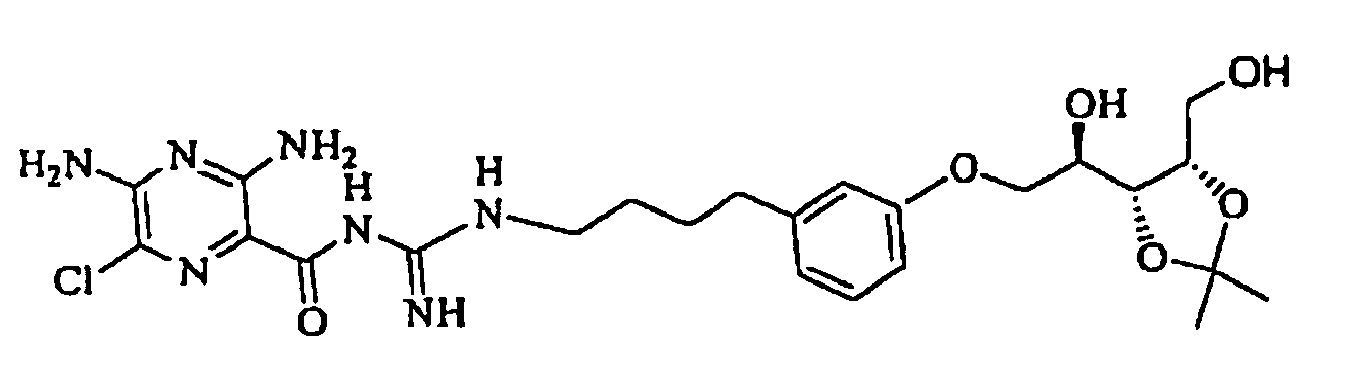
- Verbindung nach Anspruch 1, worin
X Halogen ist;
Y -N(R7)2 ist;
R1 Wasserstoff oder C1-C3-Alkyl ist;
R2 -R7, -(CH2)m-OR8 oder -(CH2)n-CO2R7 ist;
R3 eine Gruppe, dargestellt durch Formel (A), ist; und
R4 Wasserstoff, eine Gruppe, dargestellt durch Formel (A), oder Niederalkyl ist. - Verbindung nach Anspruch 60, worin
X Chlor oder Brom ist;
Y -N(R7)2 ist;
R2 Wasserstoff oder C1-C3-Alkyl ist;
höchstens drei R6 etwas anderes als Wasserstoff, wie oben definiert, sind;
höchstens drei RL etwas anderes als Wasserstoff, wie oben definiert, sind; und
höchstens 2 Q Stickstoffatome sind. - Verbindung nach Anspruch 61, worin R5 -(Het)-(CH2)m-NR12R12 ist und worin Y -NH2 ist.
- Verbindung nach Anspruch 61, worin R5 -(Het)-(CH2)n-NR12R12 ist und worin R4 Wasserstoff ist;
höchstens ein RL etwas anderes als Wasserstoff, wie oben definiert, ist;
höchstens zwei R6 etwas anderes als Wasserstoff, wie oben definiert, sind; und
höchstens 1 Q ein Stickstoffatom ist. - Verbindung nach Anspruch 14, worin R5 -(Het)-(CH2)m-(Z)g-(CH2)m-NR10R10 ist.
- Pharmazeutische Zusammensetzung, dadurch gekennzeichnet, dass sie die Verbindung gemäß einem der vorhergehenden Ansprüche und einer pharmazeutisch verträglichen Trägers umfasst.
- Zusammensetzung gemäß Anspruch 72, wobei sie weiterhin einen P2Y2-Inhibitor umfasst.
- Zusammensetzung gemäß Anspruch 72, wobei sie weiterhin einen Bronchodilatator umfasst.
- Verwendung einer wirksamen Menge der Verbindung gemäß einem der Ansprüche 1 bis 71 bei der Herstellung einer pharmazeutischen Zusammensetzung zum Blockieren von Natriumkanälen.
Priority Applications (2)
| Application Number | Priority Date | Filing Date | Title |
|---|---|---|---|
| SI200431075T SI1599096T1 (sl) | 2003-02-19 | 2004-02-18 | Hetero-substituirani blokatorji natrijevega kanala |
| CY20091100323T CY1108917T1 (el) | 2003-02-19 | 2009-03-23 | Ετερο υποκατεστημενοι αναστολεις διαυλου νατριου |
Applications Claiming Priority (3)
| Application Number | Priority Date | Filing Date | Title |
|---|---|---|---|
| US367947 | 2003-02-19 | ||
| US10/367,947 US6903105B2 (en) | 2003-02-19 | 2003-02-19 | Sodium channel blockers |
| PCT/US2004/004451 WO2004073629A2 (en) | 2003-02-19 | 2004-02-18 | Hetero substitued sodium channel blockers |
Publications (3)
| Publication Number | Publication Date |
|---|---|
| EP1599096A2 EP1599096A2 (de) | 2005-11-30 |
| EP1599096A4 EP1599096A4 (de) | 2006-03-22 |
| EP1599096B1 true EP1599096B1 (de) | 2008-12-24 |
Family
ID=32850057
Family Applications (1)
| Application Number | Title | Priority Date | Filing Date |
|---|---|---|---|
| EP04712289A Expired - Lifetime EP1599096B1 (de) | 2003-02-19 | 2004-02-18 | Heterosubstituierte natriumkanalblocker |
Country Status (14)
| Country | Link |
|---|---|
| US (7) | US6903105B2 (de) |
| EP (1) | EP1599096B1 (de) |
| JP (1) | JP4679505B2 (de) |
| KR (1) | KR100984374B1 (de) |
| AT (1) | ATE418266T1 (de) |
| AU (1) | AU2004212962B2 (de) |
| CA (1) | CA2509981C (de) |
| CY (1) | CY1108917T1 (de) |
| DE (1) | DE602004018615D1 (de) |
| DK (1) | DK1599096T3 (de) |
| ES (1) | ES2321100T3 (de) |
| PT (1) | PT1599096E (de) |
| SI (1) | SI1599096T1 (de) |
| WO (1) | WO2004073629A2 (de) |
Families Citing this family (49)
| Publication number | Priority date | Publication date | Assignee | Title |
|---|---|---|---|---|
| US6858614B2 (en) * | 2002-02-19 | 2005-02-22 | Parion Sciences, Inc. | Phenolic guanidine sodium channel blockers |
| US6858615B2 (en) * | 2002-02-19 | 2005-02-22 | Parion Sciences, Inc. | Phenyl guanidine sodium channel blockers |
| US6903105B2 (en) * | 2003-02-19 | 2005-06-07 | Parion Sciences, Inc. | Sodium channel blockers |
| US7399853B2 (en) * | 2003-04-28 | 2008-07-15 | Isis Pharmaceuticals | Modulation of glucagon receptor expression |
| SI1663235T1 (sl) * | 2003-08-18 | 2013-12-31 | Parion Sciences, Inc. | Zaščiteni pirazinoilgvanidinski blokatorji natrijevega kanala |
| KR20060115348A (ko) * | 2003-08-18 | 2006-11-08 | 패리온 사이언스 인코퍼레이티드 | 지방족 피라지노일구아니딘 나트륨 채널 차단제 |
| US20050090505A1 (en) * | 2003-08-18 | 2005-04-28 | Johnson Michael R. | Methods of reducing risk of infection from pathogens |
| AU2004264441A1 (en) * | 2003-08-18 | 2005-02-24 | Parion Sciences, Inc. | Cyclic pyrazinoylguanidine sodium channel blockers |
| US20090253714A1 (en) * | 2003-08-20 | 2009-10-08 | Johnson Michael R | Methods of reducing risk of infection from pathogens |
| US7745442B2 (en) | 2003-08-20 | 2010-06-29 | Parion Sciences, Inc. | Methods of reducing risk of infection from pathogens |
| US7399766B2 (en) * | 2004-08-18 | 2008-07-15 | Parion Sciences, Inc. | Soluble amide & ester pyrazinoylguanidine sodium channel blockers |
| CA2575680A1 (en) * | 2004-08-18 | 2006-03-02 | Michael R. Johnson | Cyclic amide & ester pyrazinoylguanidine sodium channel blockers |
| KR20070059063A (ko) * | 2004-08-18 | 2007-06-11 | 마이클 알 존슨. | 지방족 아미드 및 에스테르 피라지노일구아니딘 나트륨채널 차단제 |
| US20070021439A1 (en) * | 2005-07-25 | 2007-01-25 | Parion Sciences, Inc. | Methods of reducing risk of infection from pathogens with soluble amide and ester pyrazinoylguanidine sodium channel blockers |
| US7807834B2 (en) * | 2005-08-03 | 2010-10-05 | Parion Sciences, Inc. | Capped pyrazinoylguanidine sodium channel blockers |
| GB0526240D0 (en) * | 2005-12-22 | 2006-02-01 | Novartis Ag | Organic compounds |
| US8324218B2 (en) * | 2006-06-09 | 2012-12-04 | Parion Sciences, Inc. | Aliphatic pyrazinoylguanidine sodium channel blockers with beta agonist activity |
| WO2007146870A1 (en) * | 2006-06-09 | 2007-12-21 | Parion Sciences, Inc. | Cyclic substituted pyrazinoylguanidine sodium channel blockers possessing beta agonist activity |
| PL2035004T3 (pl) * | 2006-06-09 | 2013-01-31 | Parion Sciences Inc | Podstawione fenylem pirazynoiloguanidynowe blokery kanału sodowego o aktywności beta-agonistycznej |
| US7981898B2 (en) * | 2006-09-07 | 2011-07-19 | Parion Sciences, Inc. | Methods of enhancing mucosal hydration and mucosal clearance by treatment with sodium channel blockers and osmolytes |
| EP2059237A4 (de) * | 2006-09-07 | 2010-06-30 | Parion Sciences Inc | Verfahren für erhöhte schleimhydrierung und schleimlösung mittels behandlung mit natrium-kanal-blockern und osmolyten |
| US8288391B2 (en) * | 2007-04-03 | 2012-10-16 | Parion Sciences, Inc. | Pyrazinoylguanidine compounds for use as taste modulators |
| US20080293740A1 (en) * | 2007-04-03 | 2008-11-27 | Parion Sciences, Inc. | Method of treating acid-sensing ion channel mediated pain, cough suppression, and central nervous system disorders |
| EP2211956A4 (de) | 2007-10-10 | 2014-07-09 | Parion Sciences Inc | Abgabe von osmolyten mit einer nasenkanüle |
| AU2009246799B2 (en) | 2008-02-26 | 2014-02-27 | Parion Sciences, Inc. | Poly aromatic pyrazinoylguanidine sodium channel blockers |
| US20100074881A1 (en) * | 2008-07-11 | 2010-03-25 | Parion Sciences, Inc. | Multiple nebulizer systems |
| WO2011143106A1 (en) | 2010-05-10 | 2011-11-17 | Gilead Sciences, Inc. | Bi - functional pyrazolopyridine compounds |
| NZ603136A (en) | 2010-05-10 | 2014-11-28 | Gilead Sciences Inc | Bifunctional quinoline derivatives |
| US8945605B2 (en) | 2011-06-07 | 2015-02-03 | Parion Sciences, Inc. | Aerosol delivery systems, compositions and methods |
| US8778383B2 (en) | 2011-06-07 | 2014-07-15 | Parion Sciences, Inc. | Methods of treatment |
| PL2723176T3 (pl) | 2011-06-27 | 2018-01-31 | Parion Sciences Inc | Chemicznie i metabolicznie stabilny dipeptyd o silnej aktywności blokera kanału sodowego |
| AR086745A1 (es) | 2011-06-27 | 2014-01-22 | Parion Sciences Inc | 3,5-diamino-6-cloro-n-(n-(4-(4-(2-(hexil(2,3,4,5,6-pentahidroxihexil)amino)etoxi)fenil)butil)carbamimidoil)pirazina-2-carboxamida |
| CA2872029A1 (en) | 2012-05-29 | 2013-12-05 | Parion Sciences, Inc. | Dendrimer like amino amides possessing sodium channel blocker activity for the treatment of dry eye and other mucosal diseases |
| MX2015007797A (es) | 2012-12-17 | 2015-10-05 | Parion Sciences Inc | Compuestos de 3,5-diamino-6-cloro-n-(n-(4-fenilbutil) carbamimidoil) pirazin-2-carboxamida. |
| PE20151054A1 (es) | 2012-12-17 | 2015-08-07 | Parion Sciences Inc | Derivados de cloro-pirazin carboxamida con actividad bloqueadora sobre los canales de sodio epiteliales |
| CA2896686A1 (en) | 2012-12-17 | 2014-06-26 | Parion Sciences, Inc. | 3,5-diamino-6-chloro-n-(n-(4-phenylbutyl)carbamimidoyl) pyrazine-2- carboxamide compounds |
| JP6461134B2 (ja) | 2013-07-15 | 2019-01-30 | ベーリンガー インゲルハイム インターナショナル ゲゼルシャフト ミット ベシュレンクテル ハフツング | 新規ベンゾイミダゾリウム化合物 |
| WO2015007517A1 (en) * | 2013-07-15 | 2015-01-22 | Boehringer Ingelheim International Gmbh | Novel tetra- and pentasubstituted benzimidazolium compounds |
| US9346753B2 (en) | 2013-08-23 | 2016-05-24 | Parion Sciences, Inc. | Dithiol mucolytic agents |
| US9102633B2 (en) | 2013-12-13 | 2015-08-11 | Parion Sciences, Inc. | Arylalkyl- and aryloxyalkyl-substituted epithelial sodium channel blocking compounds |
| UY36034A (es) | 2014-03-18 | 2015-09-30 | Astrazeneca Ab | Derivados de 3,5-diamino-6-cloro-pirazina-2-carboxamida y sales farmaceuticamente aceptables de estos |
| EP3137084B1 (de) * | 2014-05-02 | 2019-12-25 | The Board of Trustees of the Leland Stanford Junior University | Benzyl amilorid zur behandlung von psoriasis |
| US20150376145A1 (en) | 2014-06-30 | 2015-12-31 | Parion Sciences, Inc. | Stable sodium channel blockers |
| CN112321472A (zh) | 2015-01-30 | 2021-02-05 | 帕里昂科学公司 | 新型单硫醇粘液溶解剂 |
| JP2018520986A (ja) | 2015-04-30 | 2018-08-02 | パリオン・サイエンシィズ・インコーポレーテッド | ジチオール粘液溶解剤の新規なプロドラッグ |
| GB201610854D0 (en) | 2016-06-21 | 2016-08-03 | Entpr Therapeutics Ltd | Compounds |
| GB201619694D0 (en) | 2016-11-22 | 2017-01-04 | Entpr Therapeutics Ltd | Compounds |
| GB201717051D0 (en) | 2017-10-17 | 2017-11-29 | Enterprise Therapeutics Ltd | Compounds |
| GB201808093D0 (en) | 2018-05-18 | 2018-07-04 | Enterprise Therapeutics Ltd | Compounds |
Family Cites Families (233)
| Publication number | Priority date | Publication date | Assignee | Title |
|---|---|---|---|---|
| US336517A (en) * | 1886-02-16 | Haemon h | ||
| US3133813A (en) * | 1960-08-30 | 1964-05-19 | Teves Kg Alfred | Process for the manufacture of cast iron having an eutectic graphite formation |
| US3268406A (en) | 1961-10-12 | 1966-08-23 | Merck & Co Inc | Compositions and method of using (3-amino-pyrazinoyl) guanidines |
| BE639386A (de) * | 1962-10-30 | |||
| US3316266A (en) * | 1964-03-31 | 1967-04-25 | Merck & Co Inc | 3-aminopyrazinoic acid derivatives and process for their preparation |
| NL6409714A (de) | 1962-10-30 | 1965-10-01 | ||
| NL6409716A (de) | 1962-10-30 | 1965-10-01 | ||
| DK109779C (da) | 1962-10-30 | 1968-07-01 | Merck & Co Inc | Fremgangsmåde til fremstilling af 3-aminopyrazinamidoguanidinforbindelser eller syreadditionssalte heraf. |
| BE639393A (de) * | 1962-10-30 | |||
| US3274191A (en) | 1963-11-15 | 1966-09-20 | Merck & Co Inc | N-(3-aminopyrazinoyl) benzamidines and process for preparing |
| US3240780A (en) * | 1963-12-23 | 1966-03-15 | Merck & Co Inc | Amino-pyrazinoyl guanidines |
| DE1245967B (de) | 1964-03-31 | 1967-08-03 | Merck &. Co., Inc., Rahway, N.J. (V. St. A.) | Verfahren zur Herstellung von S.S-Diamino-o-chlor-pyrazincarbonsäurealkylestern |
| NL6501301A (de) * | 1964-04-03 | 1965-10-04 | ||
| US3249610A (en) * | 1964-09-08 | 1966-05-03 | Merck & Co Inc | Synthesis of 3-amino, 5-chloro, 6-substituted-pyrazinoates |
| DE1281818B (de) * | 1965-07-17 | 1968-10-31 | Rheinische Kalksteinwerke | Verfahren zum gleichzeitigen Mahlen mehrerer Rohstoffe unterschiedlicher Mahlbarkeit |
| US3274192A (en) | 1965-10-04 | 1966-09-20 | Merck & Co Inc | Derivatives of pyrazine and a method for their preparation |
| US3341540A (en) | 1965-10-04 | 1967-09-12 | Merck & Co Inc | 3-amino-6-halopyrazinonitriles and their syntheses |
| US3361748A (en) * | 1965-11-22 | 1968-01-02 | Merck & Co Inc | Process for the preparation of pteridinones |
| US3305552A (en) * | 1965-11-22 | 1967-02-21 | Merck & Co Inc | 3-aminopyrazinoic acids and process for their preparation |
| FR1525670A (fr) * | 1966-08-25 | 1968-05-17 | Merck & Co Inc | Procédé de fabrication de guanidines substituées |
| FR1525671A (fr) * | 1966-08-25 | 1968-05-17 | Merck & Co Inc | Procédé de préparation de (3, 5 - diamino - 6 - halogéno - pyrazinoyl) - guanidines et de (3, 5 - diamino - 6 - halogéno -pyrazinamido) guanidines |
| US3660400A (en) * | 1966-11-17 | 1972-05-02 | Merck & Co Inc | Lower alkyl 3-hydroxy and 3-mercaptopyrazinoates |
| US3472848A (en) | 1966-11-17 | 1969-10-14 | Merck & Co Inc | 3-hydroxy and 3-mercapto-pyrazinoyl-guanidines,corresponding ethers and thioethers and processes for their preparation |
| US3527758A (en) | 1967-04-13 | 1970-09-08 | Merck & Co Inc | Process for the preparation of pyrazinoylguanidines from a pyrazinoic azide and a guanidine |
| US3507865A (en) * | 1967-04-27 | 1970-04-21 | Merck & Co Inc | 3-hydroxy- and 3-mercaptopyrazinamidoguanidines the corresponding ethers and thioethers and processes for their preparation |
| US3507866A (en) * | 1967-08-08 | 1970-04-21 | Merck & Co Inc | 1h - imidazo(4,5-b)pyrazin - 2 - one and processes for their preparation |
| US3487082A (en) | 1967-09-28 | 1969-12-30 | Merck & Co Inc | 2,4 - diamino - 6 - halopteridines and processes for their preparation |
| US3503973A (en) * | 1967-11-07 | 1970-03-31 | Merck & Co Inc | Process for preparation of pyrazinoylguanidines |
| US3515723A (en) | 1967-11-14 | 1970-06-02 | Merck & Co Inc | 2 - (5 - amino - 1h - 1,2,4 - triazol - 3 - yl)- 3-aminopyrazines and processes for their preparation |
| US3531484A (en) | 1968-02-14 | 1970-09-29 | Merck & Co Inc | 1-(3-aminopyrazinoyl)-4,5,5-trisubstituted biguanide products |
| US3461123A (en) | 1968-04-12 | 1969-08-12 | Merck & Co Inc | 1h-imidazo(4,5-b)pyrazin-2-ones and processes for their preparation |
| US3506662A (en) * | 1968-04-30 | 1970-04-14 | Merck & Co Inc | Process for preparation of pyrazinoyland pyrazinamidoguanidines |
| US3625950A (en) | 1968-07-03 | 1971-12-07 | Merck & Co Inc | Certain halophenoxy alkanamides, hydrazides and derivatives thereof |
| US3575975A (en) * | 1968-07-25 | 1971-04-20 | Merck & Co Inc | Process for the preparation of 3-aminopyrazinoylureas |
| US3544571A (en) | 1968-09-04 | 1970-12-01 | Merck & Co Inc | Process for making pyrazinoylthiourea compounds |
| US3555024A (en) * | 1968-11-13 | 1971-01-12 | Merck & Co Inc | 1-(3-aminopyrazinoyl)semicarbazides,1-(3-aminopyrazinoyl) - thiosemicarbazides,and method for their preparation |
| US3555023A (en) * | 1968-11-13 | 1971-01-12 | Merck & Co Inc | 1-(3 - aminopyrazinoyl) - 3 - substituted-3-thioisosemicarbazides and method for preparation |
| US3668241A (en) | 1968-11-25 | 1972-06-06 | Merck & Co Inc | Substituted 1-oxoinden-5-yloxy alkanoic acids |
| US3586688A (en) | 1968-12-18 | 1971-06-22 | Merck & Co Inc | Certain aminopyridinecarbonyl guanidines |
| US3573305A (en) * | 1968-12-30 | 1971-03-30 | Merck & Co Inc | (3-amino-pyrazinoyl)sulfamides and their preparation |
| US3577418A (en) * | 1969-02-12 | 1971-05-04 | Merck & Co Inc | Pyrazinamide derivatives and processes for their preparation |
| US3573306A (en) * | 1969-03-05 | 1971-03-30 | Merck & Co Inc | Process for preparation of n-substituted 3,5-diamino-6-halopyrazinamides |
| US3544568A (en) | 1969-03-18 | 1970-12-01 | Merck & Co Inc | 3-amino-5,6-substituted pyrazinamides |
| US3660397A (en) * | 1970-04-17 | 1972-05-02 | Merck & Co Inc | Imidazo(4 5-b)pyrazines |
| US3864401A (en) * | 1970-12-23 | 1975-02-04 | Merck & Co Inc | Substituted 2-aminomethyl-4,6-dihalophenols |
| US3794734A (en) * | 1971-03-03 | 1974-02-26 | Merck & Co Inc | Methods of treating edema and hypertension using certain 2-aminoethylphenols |
| BE791201A (fr) * | 1971-11-12 | 1973-05-10 | Merck & Co Inc | Indanyloxytetrazoles |
| US3953476A (en) * | 1971-12-27 | 1976-04-27 | Merck & Co., Inc. | 3-Amino-5-sulfonylbenzoic acids |
| US4081554A (en) * | 1972-10-13 | 1978-03-28 | Merck & Co., Inc. | 1-oxo-2,2-disubstituted-5-indanyloxy(or thio)alkano acids |
| US4085219A (en) * | 1972-10-13 | 1978-04-18 | Merck & Co., Inc. | 1-Oxo-2,2-disubstituted-5-indanyloxy(or thio)alkanoic acids |
| US3976686A (en) | 1972-10-13 | 1976-08-24 | Merck & Co., Inc. | [1-Oxo-2,3-hydrocarbylene-5-indanyloxy(or thio)]alkanoic acids |
| US3984465A (en) | 1972-10-13 | 1976-10-05 | Merck & Co., Inc. | 1-Oxo-2,2-disubstituted-5-indanyloxy(or thio)alkanoic acids |
| US4066692A (en) * | 1972-10-30 | 1978-01-03 | Merck & Co., Inc. | 11,12-secoprostaglandins |
| US4092356A (en) * | 1972-10-30 | 1978-05-30 | Merck & Co., Inc. | 11,12-Secoprostaglandins |
| US4055597A (en) | 1973-01-26 | 1977-10-25 | Merck & Co., Inc. | 10-Aza-11,12-secoprostaglandins |
| US3987091A (en) | 1973-04-12 | 1976-10-19 | Merck & Co., Inc. | 11,12-secoprostaglandins |
| US4033996A (en) | 1973-04-25 | 1977-07-05 | Merck & Co., Inc. | 8-Aza-9-oxo(and dioxo)-thia-11,12-secoprostaglandins |
| US4091107A (en) * | 1973-04-25 | 1978-05-23 | Merck & Co., Inc. | 8-Aza-9-oxo(and dioxo)-thia-11,12-secoprostaglandins |
| US3894065A (en) | 1973-04-27 | 1975-07-08 | Merck & Co Inc | Aryl-oxo-alkanoic acids |
| US4182764A (en) * | 1973-10-11 | 1980-01-08 | Merck & Co., Inc. | Tetrazole derivatives of [1-oxo-2-aryl or thienyl-2-substituted-5-indanyloxy(or thio)]alkanoic acids |
| US4177285A (en) | 1973-10-11 | 1979-12-04 | Merck & Co., Inc. | [1-Oxo-2-thienyl-2-substituted-5-indanyloxy (or thio)]alkanoic acids and derivatives thereof |
| US3966966A (en) | 1973-10-12 | 1976-06-29 | Merck & Co., Inc. | Pharmaceutical compositions and method of treatment employing 1,3-dioxo-2,2-disubstituted indanyloxy alkanoic acids |
| US4006180A (en) * | 1973-10-12 | 1977-02-01 | Merck & Co., Inc. | [1,3-Dihydroxy-2-substituted and 2,2-disubstituted-indanyloxy(or thio)]alkanoic acids |
| US3929872A (en) | 1973-10-12 | 1975-12-30 | Merck & Co Inc | Indanacetic acid compounds |
| US4012524A (en) * | 1973-10-12 | 1977-03-15 | Merck & Co., Inc. | [1-Hydroxy-5-indanyloxy (or thio)]-alkanoic acids |
| US3976681A (en) | 1973-10-12 | 1976-08-24 | Merck & Co., Inc. | [1,3-Dioxo-2-substituted and 2,2-disubstituted- indanyloxy (or thio] alkanoic acids |
| US4003927A (en) * | 1973-10-12 | 1977-01-18 | Merck & Co., Inc. | (1-Oxo-7,8-disubstituted-1,2,3,4-tetrahydro-6-naphthyloxy)- and (3,4-disubstituted-5-oxo-6,7,8,9-tetrahydro-5H-benzocycloheptene-2-yloxy) acetic acids and derivatives |
| US3989749A (en) | 1973-10-17 | 1976-11-02 | Merck & Co., Inc. | 11,12-Secoprostaglandins |
| US3991087A (en) | 1973-12-13 | 1976-11-09 | Merck & Co., Inc. | 8-Halo-11,12-secoprostaglandins |
| US3979361A (en) | 1974-02-20 | 1976-09-07 | Merck & Co., Inc. | 2-Aminomethyl-6-trihalo-methylphenols |
| US3914253A (en) | 1974-03-04 | 1975-10-21 | Merck & Co Inc | 5-Oxo-6-substituted-cyclopent-{8 f{9 -indole-2-carboxylic acids |
| US3931239A (en) * | 1974-04-03 | 1976-01-06 | Merck & Co., Inc. | 6-Oxo-7-substituted-6H-indeno-[5,4-b]furan(and thiophene)-carboxylic acids |
| US3958004A (en) * | 1974-04-23 | 1976-05-18 | Merck & Co., Inc. | Phenoxyacetic acid derivatives as uricosuric agents |
| US3928624A (en) | 1974-04-25 | 1975-12-23 | Merck & Co Inc | Phenol compounds in treating pain, fever and inflammation |
| US3956374A (en) * | 1974-05-03 | 1976-05-11 | Merck & Co., Inc. | Aryl-oxo-heptenoic acids |
| US3974212A (en) | 1974-05-22 | 1976-08-10 | Merck & Co., Inc. | [1-Hydroximino-2,2-disubstituted-5-indanyloxy-(or thio)]alkanoic acids |
| AT351182B (de) * | 1974-06-25 | 1979-07-10 | Merck & Co Inc | Verfahren zur herstellung von neuen 9-thia-, 9-oxothia- und 9-dioxothia- 11,12-secoprosta- glandinen |
| PL98342B1 (pl) | 1974-07-30 | 1978-04-29 | Sposob wytwarzania kwasu 1-keto-2-arylo-/lub tienylo/-2-podstawionego-indanyloksy-/lub tio/-5-alkanokarboksylowego | |
| US4020177A (en) * | 1974-08-30 | 1977-04-26 | Merck & Co., Inc. | Substituted phenoxy-tridecanoic acids |
| US3991106A (en) | 1974-09-13 | 1976-11-09 | Merck & Co., Inc. | 16-Ethers of 8-aza-9-dioxothia-11,12-seco-prostaglandins |
| US4055596A (en) | 1974-09-13 | 1977-10-25 | Merck & Co., Inc. | 11,12-Seco-prostaglandins |
| US3984552A (en) | 1975-02-24 | 1976-10-05 | Merck & Co., Inc. | 6-Oxo-7-substituted and 7,7-disubstituted-6H-indeno-[5,4-b]furan (and thiophene) carboxylic acids |
| JPS51116341A (en) | 1975-04-04 | 1976-10-13 | Automob Antipollut & Saf Res Center | Detection apparatus for oil pressure |
| US4018802A (en) * | 1975-04-09 | 1977-04-19 | Merck & Co., Inc. | 9-Thia- and oxothia- and 9-dioxothia-11,12-seco-prostaglandins and processes |
| US4097504A (en) | 1975-04-23 | 1978-06-27 | Merck & Co., Inc. | 11,12-Secoprostaglandins |
| US4092414A (en) * | 1975-04-25 | 1978-05-30 | Merck & Co., Inc. | 3,4-Dihydrospiro-2H-1,3-benzoxazines and their use in treating edema, abnormal electrolyte retention, and inflammation |
| US4059602A (en) | 1975-06-06 | 1977-11-22 | Merck & Co., Inc. | 8-Methyl-, phenyl-, or substituted phenyl-11,12-secoprostaglandins |
| US4059601A (en) | 1975-06-06 | 1977-11-22 | Merck & Co., Inc. | 8-Halo-11,12-secoprostaglandins |
| US4061643A (en) | 1975-06-18 | 1977-12-06 | Merck & Co., Inc. | Certain 16-aryloxy-11,12-seco-prostaglandins |
| US4296122A (en) | 1975-07-09 | 1981-10-20 | Merck & Co., Inc. | 2,3-Dihydro-6,7-disubstituted-5-(acyl)benzofuran-2-carboxylic acids |
| US4087542A (en) | 1975-07-09 | 1978-05-02 | Merck & Co., Inc. | 2,3-Dihydro-6,7-disubstituted-5-acyl benzofuran-2-carboxylic acids |
| US4181727A (en) * | 1975-07-09 | 1980-01-01 | Merck & Co., Inc. | 2,3-Dihydro-6,7-disubstituted-5-acyl benzofuran-2-carboxylic acids |
| US4044153A (en) | 1975-08-01 | 1977-08-23 | Merck & Co., Inc. | Antiinflammatory 2-aminomethyl-6-trihalomethylphenols |
| US4203988A (en) * | 1975-11-12 | 1980-05-20 | Merck & Co., Inc. | Pyridinyl ureas and pharmaceutical use |
| US4029816A (en) | 1975-11-25 | 1977-06-14 | Merck & Co., Inc. | Substituted 2-aminomethyl-6-iodophenols |
| US4025626A (en) * | 1975-12-09 | 1977-05-24 | Smithkline Corporation | 7-Acyl-3-(ureidoalkyl substituted tetrazolylthiomethyl)-cephalosporins |
| US4085211A (en) * | 1975-12-15 | 1978-04-18 | Merck & Co., Inc. | Pyrazinecarboxamides and processes for preparing same |
| US4070464A (en) * | 1976-02-19 | 1978-01-24 | Merck & Co., Inc. | Method of treating autoimmune diseases |
| US4085125A (en) * | 1976-03-22 | 1978-04-18 | Merck & Co., Inc. | 9-Thia-, 9-oxothia-, and 9-dioxothia-11,12-seco-prostaglandins and processes |
| US4128564A (en) | 1976-03-22 | 1978-12-05 | Merck & Co., Inc. | 9-Thia- and oxothia- and 9-dioxothia-11,12-seco-prostaglandins |
| US4181661A (en) * | 1976-05-03 | 1980-01-01 | Merck & Co., Inc. | Derivatives of 2-iminothiazolidines and thiazolines |
| US4029803A (en) | 1976-05-03 | 1977-06-14 | Merck & Co., Inc. | Method of treatment with 2-iminothiazolidines and thiazolines |
| US4022794A (en) * | 1976-05-24 | 1977-05-10 | Merck & Co., Inc. | Novel analogs of prostaglandins with 4-oxo-thiazolidinyl nucleus and method of preparation thereof |
| US4059587A (en) | 1976-05-24 | 1977-11-22 | Merck & Co., Inc. | Certain thiazolidine compounds |
| NL7705652A (nl) * | 1976-06-15 | 1977-12-19 | Merck & Co Inc | 2-imino-3-aminothiazolidinen. |
| US4025625A (en) | 1976-06-15 | 1977-05-24 | Merck & Co., Inc. | Imidazothiazines |
| US4054652A (en) | 1976-06-15 | 1977-10-18 | Merck & Co., Inc. | Dihydro- and tetrahydro- iminothiazines |
| US4087526A (en) * | 1976-07-23 | 1978-05-02 | Merck & Co., Inc. | (3-Amino-5-substituted-6-fluoropyrazinoyl or pyrazamido)-guanidines and their derivatives bearing substituents on the guanidino nitrogens |
| US4111877A (en) | 1976-07-29 | 1978-09-05 | Air Products & Chemicals, Inc. | Allyl esters of n-alkyl-omega-(alkyleneureido) amic acids and their synthesis and use in aqueous emulsion polymer systems |
| US4067980A (en) * | 1976-08-16 | 1978-01-10 | Merck & Co., Inc. | Spirobenzoxazinium salts, method of use and compositions thereof as antihypertensive agents |
| US4085117A (en) * | 1976-10-18 | 1978-04-18 | Merck & Co., Inc. | 6,7-Disubstituted-5-(acyl)benzofuran-2-carboxylic acids |
| US4100294A (en) | 1976-12-06 | 1978-07-11 | Merck & Co., Inc. | 5-(Hydroxy (substituted) methyl)-2,3-dihydrobenzo furan-2-carboxylic acid and its derivatives |
| US4175203A (en) | 1976-12-17 | 1979-11-20 | Merck & Co., Inc. | Interphenylene 11,12-secoprostaglandins |
| US4150235A (en) * | 1976-12-17 | 1979-04-17 | Merck & Co., Inc. | Interphenylene 11,12-secoprostaglandins |
| US4105769A (en) | 1977-01-24 | 1978-08-08 | Merck & Co., Inc. | Inhibition of indoleamine-N-methyl transferase by 2-iminopyridines |
| US4087435A (en) * | 1977-02-17 | 1978-05-02 | Merck & Co., Inc. | 8-Aza-9-dioxothiaprostanoic acids |
| US4115573A (en) | 1977-03-04 | 1978-09-19 | Merck & Co., Inc. | N-pyrazinecarbonyl-N'-substituted-sulfamoylguanidine and processes for preparing same |
| US4208413A (en) | 1977-03-04 | 1980-06-17 | Merck & Co., Inc. | N-Pyrazinecarbonyl-N'-alkoxycarbonyl and N',N"-bis(alkoxycarbonyl)guanidines and processes for preparing same |
| US4112236A (en) | 1977-04-04 | 1978-09-05 | Merck & Co., Inc. | Interphenylene 8-aza-9-dioxothia-11,12-secoprostaglandins |
| US4115402A (en) | 1977-06-17 | 1978-09-19 | Merck & Co., Inc. | 2,3-Dichloro-4-[(substituted-sulfonyl)-phenoxy]-acetic acids |
| US4196292A (en) * | 1977-06-29 | 1980-04-01 | Merck & Co., Inc. | 6-Substituted amiloride derivatives |
| US4229456A (en) | 1977-07-18 | 1980-10-21 | Merck & Co., Inc. | Substituted naphthyridinones and processes for their preparations |
| US4133885A (en) * | 1977-07-18 | 1979-01-09 | Merck & Co., Inc. | Substituted naphthyridinones |
| US4536507A (en) | 1977-07-26 | 1985-08-20 | Merck & Co., Inc. | Prostaglandin antagonists |
| US4093728A (en) | 1977-08-18 | 1978-06-06 | E. R. Squibb & Sons, Inc. | Triazoloisoindoles |
| US4140776A (en) * | 1977-09-16 | 1979-02-20 | Merck & Co., Inc. | N-pyrazinecarbonyl-N'-acylguanidines |
| US4130566A (en) | 1977-10-27 | 1978-12-19 | Sumitomo Chemical Company, Limited | Process for producing 5-carboxy-2-acetylthiophene |
| US4127584A (en) | 1977-11-11 | 1978-11-28 | Merck & Co., Inc. | 2,3-Substituted-1,2,5-thiadiazolium salt antimicrobials |
| US4292430A (en) | 1977-11-23 | 1981-09-29 | Merck & Co., Inc. | 2,3-Substituted-1,2-isothiazolium salt antimicrobials |
| US4159279A (en) | 1977-11-23 | 1979-06-26 | Merck & Co., Inc. | Nuclear substituted 2-hydroxyphenylmethanesulfamic acids |
| US4267341A (en) * | 1977-11-23 | 1981-05-12 | Merck & Co., Inc. | Process for preparing 2,3-substituted-1,2,-isothiazolium salt antimicrobials |
| US4166177A (en) | 1977-12-27 | 1979-08-28 | Merck & Co., Inc. | Substituted 2,2-dioxo-1,2,3-benzoxathiazines |
| US4145551A (en) * | 1978-01-09 | 1979-03-20 | Merck & Co., Inc. | Pyrazine-2-carbonyloxyguanidines |
| US4401669A (en) | 1978-01-27 | 1983-08-30 | Merck & Co., Inc. | 2,3-Dihydro-substituted-5-benzoyl benzofuran-2-carboxylic acids and their use in treating hypertension |
| US4189496A (en) * | 1978-02-16 | 1980-02-19 | Merck & Co., Inc. | 2,3-Dihydro-5-thienylmethyl and furylmethyl-6-substituted and 6,7-disubstituted-benzofuran-2-carboxylic acid |
| US4163781A (en) | 1978-04-17 | 1979-08-07 | Merck & Co., Inc. | 3-Amino-N-[(phosphonoamino)iminomethyl]-6-halopyrazinecarboxamide compounds, compositions and methods of use |
| US4156005A (en) * | 1978-06-21 | 1979-05-22 | Merck & Co., Inc. | Derivatives of 1,2-benzisoxazoles |
| US4394515A (en) | 1978-06-23 | 1983-07-19 | Merck & Co., Inc. | 10,11-Dihydro-11-oxodibenzo[b,f]thiepin compounds |
| US4263207A (en) * | 1978-08-01 | 1981-04-21 | Merck & Co., Inc. | 10,11-Dihydrodibenzo[b,f][1,4]thiazepine carboxylic acids esters and amides thereof |
| US4226867A (en) | 1978-10-06 | 1980-10-07 | Merck & Co., Inc. | 3,3-Substituted spiro-1,2,4-benzothiadiazines |
| US4187315A (en) * | 1978-10-11 | 1980-02-05 | Merck & Co., Inc. | N-alkyl(and cycloalkyl)oxamic acid and derivatives as inhibitors of glycolic acid oxidase |
| US4178386A (en) | 1978-10-11 | 1979-12-11 | Merck & Co., Inc. | Inhibitors of glycolic acid oxidase |
| US4207329A (en) | 1978-10-11 | 1980-06-10 | Merck & Co., Inc. | Derivatives of glycolic and glyoxylic acid as inhibitors of glycolic acid oxidase |
| US4390537A (en) | 1978-11-16 | 1983-06-28 | Merck & Co., Inc. | 1-(Substituted-aminoalkoxyphenyl)-2-methylene-1-alkanones, compositions and use |
| US4342782A (en) | 1978-11-16 | 1982-08-03 | Merck & Co., Inc. | 1-(Substituted-aminoalkoxyphenyl)-2-methylene-1-alkanones, compositions and use thereof |
| US4282365A (en) | 1978-11-24 | 1981-08-04 | Merck & Co., Inc. | Dibenz[b,e]oxepin compounds |
| US4249021A (en) * | 1979-02-26 | 1981-02-03 | Merck & Co., Inc. | Indanacetic acid compounds |
| US4246406A (en) * | 1979-03-27 | 1981-01-20 | Merck & Co., Inc. | Heterocyclic substituted pyrazinoylguanidines |
| US4221790A (en) | 1979-04-16 | 1980-09-09 | Merck & Co., Inc. | Substituted 2,2-dioxo-1,2,3-benzoxathiazines |
| US4233452A (en) | 1979-05-03 | 1980-11-11 | Merck & Co., Inc. | Derivatives of glycolic and glyoxylic acid as inhibitors of glycolic acid oxidase |
| US4220654A (en) | 1979-06-04 | 1980-09-02 | Merck & Co., Inc. | Cyclic imidazole cyanoguanidines |
| US4256758A (en) * | 1979-06-11 | 1981-03-17 | Merck & Co., Inc. | 4-Substituted-3-hydroxy-3-pyrroline-2,5-dione inhibitors of glycolic acid oxidase |
| US4431660A (en) * | 1979-06-11 | 1984-02-14 | Merck & Co., Inc. | (4'-Biphenylyloxy and-thio-oxy)-3-hydroxy-3-pyrroline-2,5-diones and a method of treating calcium oxalate renal lithiasis therewith |
| US4537902A (en) | 1979-06-11 | 1985-08-27 | Merck & Co., Inc. | 4-Substituted-3-hydroxy-3-pyrroline-2,5-dione inhibitors of glycolic acid oxidase |
| US4237130A (en) | 1979-06-21 | 1980-12-02 | Merck & Co., Inc. | 2,3-Dihydro-6,7-disubstituted-5-(substituted sulfonyl)benzofuran-2-carboxylic acids |
| US4237144A (en) | 1979-06-21 | 1980-12-02 | Merck & Co., Inc. | 2,3-Dihydro-2,6,7-trisubstituted-5-acylbenzofurans |
| US4291050A (en) | 1979-06-21 | 1981-09-22 | Merck & Co., Inc. | 6,7-Disubstituted-2 or 2,2-substituted-5-substituted-1-indanones |
| US4459422A (en) | 1979-08-17 | 1984-07-10 | Merck & Co., Inc. | Substituted pyranone inhibitors of cholesterol synthesis |
| US4375475A (en) * | 1979-08-17 | 1983-03-01 | Merck & Co., Inc. | Substituted pyranone inhibitors of cholesterol synthesis |
| US4567289A (en) * | 1979-08-17 | 1986-01-28 | Merck & Co., Inc. | Substituted pyranone inhibitors of cholesterol synthesis |
| US4710513A (en) | 1979-08-17 | 1987-12-01 | Merck & Co., Inc. | Substituted pyranone inhibitors of cholesterol synthesis |
| US4298743A (en) | 1979-09-11 | 1981-11-03 | Merck & Co., Inc. | 4-(Substituted phenyl thiazolyl)-3-hydroxy-3-pyrroline-2,5-diones |
| US4296237A (en) | 1979-09-11 | 1981-10-20 | Merck & Co., Inc. | 4-(Pyridyl, piperazinyl and thiazolyl substituted thiazolyl)-3-hydroxy-3-pyrroline-2,5-diones |
| US4379791A (en) * | 1979-09-11 | 1983-04-12 | Merck & Co., Inc. | 4-(Substituted thiazolyl)-3-hydroxy-3-pyrroline-2,5-dione inhibitors of glycolic acid oxidase |
| US4377588A (en) * | 1979-09-11 | 1983-03-22 | Merck Sharp & Dohme (I.A.) Corp. | 4-(Substituted thiazolyl)-3-hydroxy-3-pyrroline-2,5-dione inhibitors of glycolic acid oxidase |
| US4356313A (en) | 1979-10-19 | 1982-10-26 | Merck & Co., Inc. | [(5,6,9a-substituted-3-oxo-1,2,9,9a-tetrahydro-3H-fluoren-7-yl)oxy]alkanoic and cycloalkanoic acid esters and their analogs, the parent acids and their salts |
| US4317922A (en) * | 1979-10-19 | 1982-03-02 | Merck & Co., Inc. | [(5,6,9a-Substituted-3-oxo-1,2,9,9a-tetrahydro-3H-fluoren-7-yl)oxy]alkanoic and cycloalkanoic acids and their analogs, esters, salts and derivatives |
| US4337354A (en) | 1979-10-19 | 1982-06-29 | Merck & Co., Inc. | [(5,6,9a-Substituted-3-oxo-1,2,9,9a-tetrahydro-3H-fluoren-7-yl)oxy]alkanoic and cycloalkanoic acids, their analogs, esters, salts, and derivatives |
| US4432992A (en) * | 1979-11-05 | 1984-02-21 | Merck & Co., Inc. | 4-[5(and 4)-Substituted-2-thienyl]-3-hydroxy-3-pyrroline-2,5-dione inhibitors of glycolic acid oxidase |
| US4349561A (en) | 1979-11-05 | 1982-09-14 | Merck & Co., Inc. | 4-Substituted-3-hydroxy-3-pyrroline-2,5-dione inhibitors of glycolic acid oxidase |
| US4448786A (en) * | 1979-11-05 | 1984-05-15 | Merck & Co., Inc. | 4-Naphthyl and substituted naphthyl-3-hydroxy-3-pyrroline-2,5-diones and their use as inhibitors of glycolic acid oxidase |
| US4342776A (en) | 1979-11-05 | 1982-08-03 | Merck & Co., Inc. | 4-Substituted-3-hydroxy-3-pyrroline-2,5-dione inhibitors of glycolic acid oxidase |
| US4260771A (en) * | 1979-12-20 | 1981-04-07 | Merck & Co., Inc. | Interphenylene 9-thia-11-oxo-12-azaprostanoic acid compounds |
| US4428959A (en) * | 1980-04-04 | 1984-01-31 | Merck & Co., Inc. | 4-Alkylsubstituted-3-hydroxy-3-pyrroline-2,5-dione inhibitors of glycolic acid oxidase |
| US4362724A (en) | 1980-05-19 | 1982-12-07 | Merck & Co., Inc. | Method of treating edema and hypertension and pharmaceutical composition therefor in which the active ingredient comprises a novel substituted pyrazinyl-1,2,4-oxadiazole and a kaliuretic diuretic |
| US4309540A (en) * | 1980-05-19 | 1982-01-05 | Merck & Co., Inc. | Substituted pyrazinyl-1,2,4-oxadiazoles |
| US4356314A (en) | 1980-06-30 | 1982-10-26 | Merck & Co., Inc. | [5,6,9A-Substituted-3-oxo-1,2,9,9a-tetrahydro-3H-fluoren-7-yl)oxy]alkanoic and cycloalkanoic acids, their analogs, esters, salts, and derivatives |
| US4277602A (en) | 1980-07-02 | 1981-07-07 | Merck & Co., Inc. | 3-Amino-5-substituted-6-halo-N-(3,4-dihydro-6-substituted-1,3,5-truazin-2-yl)2-pyrazinecarboxamides |
| US4317822A (en) * | 1980-07-02 | 1982-03-02 | Merck & Co., Inc. | 3-Amino-5-substituted-6-halo-N-(3,4-dihydro-6-substituted-1,3,5-triazin-2-yl)2-pyrazinecarboxamides |
| US4465850A (en) | 1980-09-02 | 1984-08-14 | Merck & Co., Inc. | Treatment of brain injury due to gray matter edema with (indanyloxy) butanoic acids |
| US4389417A (en) | 1980-09-05 | 1983-06-21 | Merck & Co., Inc. | Treatment of gray matter edema |
| US4394385A (en) | 1980-11-21 | 1983-07-19 | Merck & Co., Inc. | Treatment of gray matter edema |
| US4316043A (en) * | 1980-12-19 | 1982-02-16 | Merck & Co., Inc. | [(5,6,9a-Substituted-3-oxo-1,2,9,9a-tetrahydro-3H-fluoren-7-yl)oxy]alkanoic and cycloalkanoic acids and their analogs, esters, salts and derivatives |
| US4336397A (en) | 1980-12-29 | 1982-06-22 | Merck & Co., Inc. | 2,4-Dioxo-4-substituted-1-butanoic acid derivatives useful in treating urinary tract calcium oxalate lithiasis |
| US4337258A (en) | 1980-12-29 | 1982-06-29 | Merck & Co., Inc. | 2,4-Dioxo-4-substituted-1-butanoic acid derivatives useful in treating urinary tract calcium oxalate lithiasis |
| US4428956A (en) * | 1980-12-29 | 1984-01-31 | Merck & Co., Inc. | 4-Hydroxy-5-substituted-3-(2H)-isothiazolone-1,1-dioxide derivatives useful in treating urinary tract calcium oxalate lithiasis |
| US4431652A (en) * | 1980-12-29 | 1984-02-14 | Merck & Co., Inc. | 4-Hydroxy-5-substituted-3(2H)-isothiazolone-1,1-dioxide derivatives useful in treating urinary tract calcium oxalate lithiasis |
| US4582842A (en) * | 1981-02-25 | 1986-04-15 | Merck & Co., Inc. | Anti-asthmatic 6H-dibenz-[b,e] [1,4]oxathiepin derivatives, compositions, and method of use therefor |
| US4778897A (en) | 1981-02-25 | 1988-10-18 | Merck & Co., Inc. | 6H-dibenz[b,e][1,4]oxathiepin compounds |
| US4454132A (en) | 1981-03-16 | 1984-06-12 | Merck & Co., Inc. | Pharmaceutical compositions of novel substituted pyrazinyl-1,2,4-oxadiazoles useful in the treatment of edema and hypertension |
| US4510322A (en) * | 1981-07-13 | 1985-04-09 | Merck & Co., Inc. | Indacrinone having enhanced uricosuric |
| US4420615A (en) | 1981-08-24 | 1983-12-13 | Merck & Co., Inc. | Substituted pyridopyrimidines as gastric secretion inhibitors |
| US4463208A (en) | 1981-12-30 | 1984-07-31 | Merck & Co., Inc. | Treatment of gray matter edema |
| US4699917A (en) | 1983-09-26 | 1987-10-13 | Merck & Co., Inc. | Anti-asthmatic tetrazolyl 6H-dibenz-[B,E]-[1,4]-oxathiepin derivatives, compositions, and method of use therefor |
| US4605664A (en) | 1984-05-01 | 1986-08-12 | Merck & Co., Inc. | Use of substituted-3-(2,3-dihydro-1H-inden-5-yl)-4-hydroxy-1H-pyrrole-2,5-diones for treatment of grey matter edema |
| US4605663A (en) | 1984-05-01 | 1986-08-12 | Merck & Co., Inc. | Use of substituted-3-(2,3-dihydro-1H-inden-5-yl)-4-hydroxy-1H-pyrrole-2,5-diones, for treatment of grey matter edema |
| US4680414A (en) | 1984-05-01 | 1987-07-14 | Merck & Co., Inc. | Substituted-3-(2,3-dihydro-1H-inden-5-yl)-4-hydroxy-1H-pyrrole-2,5-diones |
| US4604403A (en) | 1984-05-01 | 1986-08-05 | Merck & Co., Inc. | Use of substituted-3(2,3-dihydro-1H-inden-5-yl)-4-hydroxy-1H-pyrrole-2,5-diones for treating grey matter edema |
| US4596821A (en) | 1984-05-01 | 1986-06-24 | Merck & Co., Inc. | Treatment of gray matter edema with 3-(2,3-dihydro-1H-inden-5-yl)-4-hydroxy-1H-pyrrole-2,5-diones |
| US4634717A (en) * | 1984-05-01 | 1987-01-06 | Merck & Co., Inc. | Substituted-3-(2,3-dihydro-1H-inden-5-yl)-4-hydroxy-1H-pyrrole-2,5-diones, useful for treating persons with gray matter edema |
| US4754061A (en) | 1985-06-04 | 1988-06-28 | Merck & Co., Inc. | Substituted (2,3-dihydro-1-oxo-1H-inden-5-yl)alkanoic acids, their derivatives and their salts |
| US4579869A (en) * | 1985-08-02 | 1986-04-01 | Merck & Co., Inc. | Substituted [(2,3-dihydro-1-oxo-1H-inden-5-yl)amino]alkanoic acids, their derivatives and their salts |
| US4654365A (en) * | 1985-09-26 | 1987-03-31 | Merck & Co., Inc. | 2,3-dihydro-5-(3-oxo-2-cyclohexen-1-yl)-2-benzofurancarboxylic acids, and their salts useful in the treatment of brain injury |
| US4604396A (en) | 1985-09-26 | 1986-08-05 | Merck & Co., Inc. | [(2,3,9,9a-tetrahydro-3-oxo-9a-substituted-1H-fluoren-7-yl)oxy]ethanimidamides and [(2,3,9,9a-tetrahydro-3-oxo-9a-substituted-1H-fluoren-7-yl)oxy]ethanimidic acid hydrazides, their derivatives and their salts |
| US4719310A (en) * | 1985-12-23 | 1988-01-12 | Merck & Co., Inc. | Ester and amide substituted (2,3-dihydro-4-(3-oxo-1-cyclohexen-1-yl)phenoxy)alkanoic acids and their salts |
| US4625047A (en) | 1985-12-23 | 1986-11-25 | Merck & Co., Inc. | Substituted (2,3-dihydro-4-(3-oxo-1-cyclohexen-1-yl)phenoxy) alkanoic acids, their derivatives and their salts |
| US4777281A (en) | 1986-03-03 | 1988-10-11 | Merck & Co., Inc. | [3,4-dichloro-6,7,8,8a,9,10-hexahydro-6-oxo-8a-substituted-2-phenanthrenyl)oxy]-alkanoic acids and -ethanimidamides |
| US4731472A (en) * | 1986-03-03 | 1988-03-15 | Merck & Co., Inc. | (5,6-dichloro-3-oxo-9A-propyl-2,3,9,9A-tetrahydrofluoren-7-yl)alkanoic acids and alkanimidamides |
| US4835313A (en) | 1986-03-03 | 1989-05-30 | Merck & Co., Inc. | (5,6-dichloro-3-oxo-9α-propyl-2,3,9,9α-tetrahydrofluoren-7-yl) alkanimidamides |
| US4731473A (en) * | 1986-04-04 | 1988-03-15 | Merck & Co., Inc. | Compounds useful in treating sickle cell anemia |
| US4751244A (en) | 1986-04-04 | 1988-06-14 | Merck & Co., Inc. | Compounds useful in treating sickle cell anemia |
| US4699926A (en) | 1986-04-04 | 1987-10-13 | Merck & Co., Inc. | Compounds useful in treating sickle cell anemia |
| US4731381A (en) * | 1986-04-04 | 1988-03-15 | Merck & Co., Inc. | Method of treating a person for sickle cell anemia |
| US4675341A (en) | 1986-08-13 | 1987-06-23 | Merck & Co., Inc. | [(5,6-dichloro-3-oxo-9a-propyl-2,3,9,9a-tetrahydrofluoren-7-yl)oxy]ethanol and its derivatives |
| US4797391A (en) * | 1986-09-24 | 1989-01-10 | Merck & Co., Inc. | ((5,6-dichloro-3-oxo-9,9a-disubstituted-2,3,9,9a-tetrahydrofluoren-7-yl)oxy)alkanoic acids and alkanimidamides |
| US4769370A (en) | 1986-09-24 | 1988-09-06 | Merck & Co., Inc. | (1,2-dichloro-8-oxo-5a-substituted-5a,6,7,8-tetrahydrodibenzofuran-3-yl)alkanoic acids and alkanimidamides |
| US4731470A (en) * | 1986-11-03 | 1988-03-15 | Merck & Co., Inc. | [(5,6-dichloro-3-oxo-2,9a-alkano-2,3,9,9a-tetrahydro-1H-fluoren-7-yl)oxy]alkanoic acids and alkanimidamides |
| US4731471A (en) * | 1986-11-03 | 1988-03-15 | Merck & Co., Inc. | (5,6-dichloro-3-oxo-2,3,9,9a-tetrahydrofluoren-7-yl)-alkanoic acids and alkanimidamides bearing novel functional 9a-substituents |
| US4782073A (en) | 1986-12-24 | 1988-11-01 | Merck & Co., Inc. | Amides of [(5,6-dichloro-3-oxo-9-alpha-substituted-2,3,9,9-alpha-tetrahydrofluoren-7-yl-oxyl]acetic acids, and pharmaceutical compositions thereof |
| US4775695A (en) | 1987-06-01 | 1988-10-04 | Merck & Co., Inc. | Substituted amidinoalkoxy and amidinoalkylamino indanones and salts thereof |
| US4771076A (en) | 1987-06-01 | 1988-09-13 | Merck & Co., Inc. | [(2-substituted 1,2-dihydro-1-oxo-1H-inden-5-yl)oxy]alkanesulfonic acids and salts thereof |
| US7030114B1 (en) * | 1997-07-31 | 2006-04-18 | Elan Pharmaceuticals, Inc. | Compounds which inhibit leukocyte adhesion mediated by VLA-4 |
| CA2378181A1 (en) * | 1999-07-19 | 2001-01-25 | Richard C. Boucher, Jr. | Conjugates of sodium channel blockers and methods of using the same |
| US6858615B2 (en) | 2002-02-19 | 2005-02-22 | Parion Sciences, Inc. | Phenyl guanidine sodium channel blockers |
| US6858614B2 (en) * | 2002-02-19 | 2005-02-22 | Parion Sciences, Inc. | Phenolic guanidine sodium channel blockers |
| US6903105B2 (en) * | 2003-02-19 | 2005-06-07 | Parion Sciences, Inc. | Sodium channel blockers |
| KR20060115348A (ko) | 2003-08-18 | 2006-11-08 | 패리온 사이언스 인코퍼레이티드 | 지방족 피라지노일구아니딘 나트륨 채널 차단제 |
| AU2004264441A1 (en) | 2003-08-18 | 2005-02-24 | Parion Sciences, Inc. | Cyclic pyrazinoylguanidine sodium channel blockers |
| US20050090505A1 (en) | 2003-08-18 | 2005-04-28 | Johnson Michael R. | Methods of reducing risk of infection from pathogens |
| SI1663235T1 (sl) | 2003-08-18 | 2013-12-31 | Parion Sciences, Inc. | Zaščiteni pirazinoilgvanidinski blokatorji natrijevega kanala |
| US7745442B2 (en) | 2003-08-20 | 2010-06-29 | Parion Sciences, Inc. | Methods of reducing risk of infection from pathogens |
| US7399766B2 (en) | 2004-08-18 | 2008-07-15 | Parion Sciences, Inc. | Soluble amide & ester pyrazinoylguanidine sodium channel blockers |
| US7807834B2 (en) | 2005-08-03 | 2010-10-05 | Parion Sciences, Inc. | Capped pyrazinoylguanidine sodium channel blockers |
-
2003
- 2003-02-19 US US10/367,947 patent/US6903105B2/en not_active Expired - Fee Related
-
2004
- 2004-02-18 AT AT04712289T patent/ATE418266T1/de active
- 2004-02-18 DK DK04712289T patent/DK1599096T3/da active
- 2004-02-18 PT PT04712289T patent/PT1599096E/pt unknown
- 2004-02-18 WO PCT/US2004/004451 patent/WO2004073629A2/en not_active Ceased
- 2004-02-18 KR KR1020057012570A patent/KR100984374B1/ko not_active Expired - Fee Related
- 2004-02-18 JP JP2006503605A patent/JP4679505B2/ja not_active Expired - Fee Related
- 2004-02-18 EP EP04712289A patent/EP1599096B1/de not_active Expired - Lifetime
- 2004-02-18 DE DE602004018615T patent/DE602004018615D1/de not_active Expired - Lifetime
- 2004-02-18 AU AU2004212962A patent/AU2004212962B2/en not_active Ceased
- 2004-02-18 US US10/545,083 patent/US7875619B2/en not_active Expired - Fee Related
- 2004-02-18 SI SI200431075T patent/SI1599096T1/sl unknown
- 2004-02-18 CA CA2509981A patent/CA2509981C/en not_active Expired - Fee Related
- 2004-02-18 ES ES04712289T patent/ES2321100T3/es not_active Expired - Lifetime
- 2004-10-27 US US10/973,474 patent/US7026325B2/en not_active Expired - Fee Related
- 2004-10-27 US US10/973,447 patent/US7030117B2/en not_active Expired - Fee Related
- 2004-10-27 US US10/973,473 patent/US6995160B2/en not_active Expired - Fee Related
-
2005
- 2005-10-31 US US11/261,734 patent/US7345044B2/en not_active Expired - Fee Related
-
2007
- 2007-12-05 US US11/950,674 patent/US7820678B2/en not_active Expired - Fee Related
-
2009
- 2009-03-23 CY CY20091100323T patent/CY1108917T1/el unknown
Also Published As
Similar Documents
| Publication | Publication Date | Title |
|---|---|---|
| US7875619B2 (en) | Hetero substituted sodium channel blockers | |
| EP1485360B1 (de) | Natriumkanalblocker | |
| US20080171879A1 (en) | Soluble amide & ester pyrazinoylguanidine sodium channel blockers | |
| EP1670474A2 (de) | Cyclische pyrazinoylguanidine als natriumkanalblocker | |
| HK1078240B (en) | Hetero substitued sodium channel blockers | |
| HK1070369B (en) | Sodium channel blockers | |
| HK1172333A (en) | Capped pyrazinoylguanidine sodium channel blockers | |
| HK1088531B (en) | Capped pyrazinoylguanidine sodium channel blockers | |
| HK1088531A (en) | Capped pyrazinoylguanidine sodium channel blockers | |
| HK1068609B (en) | Sodium channel blockers | |
| HK1068609A1 (en) | Sodium channel blockers |
Legal Events
| Date | Code | Title | Description |
|---|---|---|---|
| PUAI | Public reference made under article 153(3) epc to a published international application that has entered the european phase |
Free format text: ORIGINAL CODE: 0009012 |
|
| 17P | Request for examination filed |
Effective date: 20050915 |
|
| AK | Designated contracting states |
Kind code of ref document: A2 Designated state(s): AT BE BG CH CY CZ DE DK EE ES FI FR GB GR HU IE IT LI LU MC NL PT RO SE SI SK TR |
|
| AX | Request for extension of the european patent |
Extension state: AL LT LV MK |
|
| REG | Reference to a national code |
Ref country code: HK Ref legal event code: DE Ref document number: 1078240 Country of ref document: HK |
|
| A4 | Supplementary search report drawn up and despatched |
Effective date: 20060203 |
|
| RIC1 | Information provided on ipc code assigned before grant |
Ipc: C07D 251/00 20060101ALI20060130BHEP Ipc: C07D 241/26 20060101ALI20060130BHEP Ipc: C07D 405/14 20060101ALI20060130BHEP Ipc: A61K 31/50 20060101ALI20060130BHEP Ipc: C07D 405/12 20060101ALI20060130BHEP Ipc: A61P 11/08 20060101ALI20060130BHEP Ipc: A01N 43/66 20060101ALI20060130BHEP Ipc: C07D 253/00 20060101ALI20060130BHEP Ipc: C07D 403/00 20060101ALI20060130BHEP Ipc: A01N 43/64 20060101AFI20050117BHEP Ipc: A61K 31/501 20060101ALI20060130BHEP Ipc: C07D 241/00 20060101ALI20060130BHEP Ipc: A61K 31/4965 20060101ALI20060130BHEP Ipc: C07D 401/00 20060101ALI20060130BHEP Ipc: A61K 31/53 20060101ALI20060130BHEP |
|
| DAX | Request for extension of the european patent (deleted) | ||
| 17Q | First examination report despatched |
Effective date: 20070905 |
|
| GRAP | Despatch of communication of intention to grant a patent |
Free format text: ORIGINAL CODE: EPIDOSNIGR1 |
|
| GRAS | Grant fee paid |
Free format text: ORIGINAL CODE: EPIDOSNIGR3 |
|
| GRAA | (expected) grant |
Free format text: ORIGINAL CODE: 0009210 |
|
| AK | Designated contracting states |
Kind code of ref document: B1 Designated state(s): AT BE BG CH CY CZ DE DK EE ES FI FR GB GR HU IE IT LI LU MC NL PT RO SE SI SK TR |
|
| REG | Reference to a national code |
Ref country code: GB Ref legal event code: FG4D |
|
| REG | Reference to a national code |
Ref country code: CH Ref legal event code: EP |
|
| REG | Reference to a national code |
Ref country code: IE Ref legal event code: FG4D |
|
| REF | Corresponds to: |
Ref document number: 602004018615 Country of ref document: DE Date of ref document: 20090205 Kind code of ref document: P |
|
| REG | Reference to a national code |
Ref country code: HK Ref legal event code: GR Ref document number: 1078240 Country of ref document: HK |
|
| REG | Reference to a national code |
Ref country code: CH Ref legal event code: NV Representative=s name: BOVARD AG PATENTANWAELTE |
|
| REG | Reference to a national code |
Ref country code: SE Ref legal event code: TRGR |
|
| REG | Reference to a national code |
Ref country code: GR Ref legal event code: EP Ref document number: 20090400836 Country of ref document: GR |
|
| REG | Reference to a national code |
Ref country code: PT Ref legal event code: SC4A Free format text: AVAILABILITY OF NATIONAL TRANSLATION Effective date: 20090414 |
|
| REG | Reference to a national code |
Ref country code: DK Ref legal event code: T3 |
|
| REG | Reference to a national code |
Ref country code: RO Ref legal event code: EPE |
|
| REG | Reference to a national code |
Ref country code: ES Ref legal event code: FG2A Ref document number: 2321100 Country of ref document: ES Kind code of ref document: T3 |
|
| REG | Reference to a national code |
Ref country code: EE Ref legal event code: FG4A Ref document number: E003015 Country of ref document: EE Effective date: 20090323 |
|
| REG | Reference to a national code |
Ref country code: HU Ref legal event code: AG4A Ref document number: E005324 Country of ref document: HU |
|
| PLBE | No opposition filed within time limit |
Free format text: ORIGINAL CODE: 0009261 |
|
| STAA | Information on the status of an ep patent application or granted ep patent |
Free format text: STATUS: NO OPPOSITION FILED WITHIN TIME LIMIT |
|
| 26N | No opposition filed |
Effective date: 20090925 |
|
| REG | Reference to a national code |
Ref country code: CH Ref legal event code: PFA Owner name: PARION SCIENCES, INC. Free format text: PARION SCIENCES, INC.#2525 MERIDIAN PARKWAY, SUITE 260#DURHAM, NC 27713 (US) -TRANSFER TO- PARION SCIENCES, INC.#2525 MERIDIAN PARKWAY, SUITE 260#DURHAM, NC 27713 (US) |
|
| PGFP | Annual fee paid to national office [announced via postgrant information from national office to epo] |
Ref country code: DK Payment date: 20110224 Year of fee payment: 8 Ref country code: HU Payment date: 20110215 Year of fee payment: 8 Ref country code: MC Payment date: 20110201 Year of fee payment: 8 Ref country code: IE Payment date: 20110223 Year of fee payment: 8 |
|
| PGFP | Annual fee paid to national office [announced via postgrant information from national office to epo] |
Ref country code: IT Payment date: 20110223 Year of fee payment: 8 Ref country code: FI Payment date: 20110225 Year of fee payment: 8 Ref country code: NL Payment date: 20110228 Year of fee payment: 8 Ref country code: EE Payment date: 20110207 Year of fee payment: 8 Ref country code: LU Payment date: 20110307 Year of fee payment: 8 Ref country code: FR Payment date: 20110309 Year of fee payment: 8 Ref country code: AT Payment date: 20110202 Year of fee payment: 8 Ref country code: DE Payment date: 20110225 Year of fee payment: 8 Ref country code: CZ Payment date: 20110204 Year of fee payment: 8 Ref country code: BG Payment date: 20110224 Year of fee payment: 8 Ref country code: CH Payment date: 20110223 Year of fee payment: 8 Ref country code: PT Payment date: 20110204 Year of fee payment: 8 Ref country code: SI Payment date: 20110218 Year of fee payment: 8 Ref country code: SK Payment date: 20110202 Year of fee payment: 8 Ref country code: SE Payment date: 20110225 Year of fee payment: 8 Ref country code: TR Payment date: 20110209 Year of fee payment: 8 Ref country code: RO Payment date: 20110207 Year of fee payment: 8 |
|
| PGFP | Annual fee paid to national office [announced via postgrant information from national office to epo] |
Ref country code: GR Payment date: 20110228 Year of fee payment: 8 |
|
| PGFP | Annual fee paid to national office [announced via postgrant information from national office to epo] |
Ref country code: ES Payment date: 20110224 Year of fee payment: 8 Ref country code: GB Payment date: 20110223 Year of fee payment: 8 Ref country code: BE Payment date: 20110224 Year of fee payment: 8 |
|
| PGFP | Annual fee paid to national office [announced via postgrant information from national office to epo] |
Ref country code: CY Payment date: 20110207 Year of fee payment: 8 |
|
| REG | Reference to a national code |
Ref country code: PT Ref legal event code: MM4A Free format text: LAPSE DUE TO NON-PAYMENT OF FEES Effective date: 20120820 |
|
| BERE | Be: lapsed |
Owner name: PARION SCIENCES, INC. Effective date: 20120228 |
|
| REG | Reference to a national code |
Ref country code: NL Ref legal event code: V1 Effective date: 20120901 |
|
| PG25 | Lapsed in a contracting state [announced via postgrant information from national office to epo] |
Ref country code: MC Free format text: LAPSE BECAUSE OF NON-PAYMENT OF DUE FEES Effective date: 20120229 |
|
| REG | Reference to a national code |
Ref country code: CH Ref legal event code: PL |
|
| REG | Reference to a national code |
Ref country code: EE Ref legal event code: MM4A Ref document number: E003015 Country of ref document: EE Effective date: 20120228 |
|
| GBPC | Gb: european patent ceased through non-payment of renewal fee |
Effective date: 20120218 |
|
| REG | Reference to a national code |
Ref country code: GR Ref legal event code: ML Ref document number: 20090400836 Country of ref document: GR Effective date: 20120905 |
|
| PG25 | Lapsed in a contracting state [announced via postgrant information from national office to epo] |
Ref country code: CZ Free format text: LAPSE BECAUSE OF NON-PAYMENT OF DUE FEES Effective date: 20120218 Ref country code: FI Free format text: LAPSE BECAUSE OF NON-PAYMENT OF DUE FEES Effective date: 20120218 Ref country code: SE Free format text: LAPSE BECAUSE OF NON-PAYMENT OF DUE FEES Effective date: 20120219 Ref country code: CH Free format text: LAPSE BECAUSE OF NON-PAYMENT OF DUE FEES Effective date: 20120229 Ref country code: CY Free format text: LAPSE BECAUSE OF NON-PAYMENT OF DUE FEES Effective date: 20120218 Ref country code: EE Free format text: LAPSE BECAUSE OF NON-PAYMENT OF DUE FEES Effective date: 20120228 Ref country code: LI Free format text: LAPSE BECAUSE OF NON-PAYMENT OF DUE FEES Effective date: 20120229 |
|
| REG | Reference to a national code |
Ref country code: SK Ref legal event code: MM4A Ref document number: E 5456 Country of ref document: SK Effective date: 20120218 |
|
| REG | Reference to a national code |
Ref country code: DK Ref legal event code: EBP |
|
| REG | Reference to a national code |
Ref country code: IE Ref legal event code: MM4A |
|
| REG | Reference to a national code |
Ref country code: FR Ref legal event code: ST Effective date: 20121031 |
|
| PG25 | Lapsed in a contracting state [announced via postgrant information from national office to epo] |
Ref country code: HU Free format text: LAPSE BECAUSE OF NON-PAYMENT OF DUE FEES Effective date: 20120219 Ref country code: PT Free format text: LAPSE BECAUSE OF NON-PAYMENT OF DUE FEES Effective date: 20120820 Ref country code: IT Free format text: LAPSE BECAUSE OF NON-PAYMENT OF DUE FEES Effective date: 20120218 Ref country code: SK Free format text: LAPSE BECAUSE OF NON-PAYMENT OF DUE FEES Effective date: 20120218 Ref country code: GR Free format text: LAPSE BECAUSE OF NON-PAYMENT OF DUE FEES Effective date: 20120905 |
|
| REG | Reference to a national code |
Ref country code: DE Ref legal event code: R119 Ref document number: 602004018615 Country of ref document: DE Effective date: 20120901 |
|
| REG | Reference to a national code |
Ref country code: AT Ref legal event code: MM01 Ref document number: 418266 Country of ref document: AT Kind code of ref document: T Effective date: 20120218 |
|
| PG25 | Lapsed in a contracting state [announced via postgrant information from national office to epo] |
Ref country code: BE Free format text: LAPSE BECAUSE OF NON-PAYMENT OF DUE FEES Effective date: 20120228 |
|
| PG25 | Lapsed in a contracting state [announced via postgrant information from national office to epo] |
Ref country code: NL Free format text: LAPSE BECAUSE OF NON-PAYMENT OF DUE FEES Effective date: 20120901 Ref country code: IE Free format text: LAPSE BECAUSE OF NON-PAYMENT OF DUE FEES Effective date: 20120218 Ref country code: GB Free format text: LAPSE BECAUSE OF NON-PAYMENT OF DUE FEES Effective date: 20120218 Ref country code: FR Free format text: LAPSE BECAUSE OF NON-PAYMENT OF DUE FEES Effective date: 20120229 Ref country code: AT Free format text: LAPSE BECAUSE OF NON-PAYMENT OF DUE FEES Effective date: 20120218 |
|
| REG | Reference to a national code |
Ref country code: SI Ref legal event code: KO00 Effective date: 20121206 |
|
| PG25 | Lapsed in a contracting state [announced via postgrant information from national office to epo] |
Ref country code: SI Free format text: LAPSE BECAUSE OF NON-PAYMENT OF DUE FEES Effective date: 20120219 |
|
| PG25 | Lapsed in a contracting state [announced via postgrant information from national office to epo] |
Ref country code: RO Free format text: LAPSE BECAUSE OF NON-PAYMENT OF DUE FEES Effective date: 20120218 |
|
| PG25 | Lapsed in a contracting state [announced via postgrant information from national office to epo] |
Ref country code: DE Free format text: LAPSE BECAUSE OF NON-PAYMENT OF DUE FEES Effective date: 20120901 |
|
| REG | Reference to a national code |
Ref country code: ES Ref legal event code: FD2A Effective date: 20130708 |
|
| PG25 | Lapsed in a contracting state [announced via postgrant information from national office to epo] |
Ref country code: ES Free format text: LAPSE BECAUSE OF NON-PAYMENT OF DUE FEES Effective date: 20120219 Ref country code: BG Free format text: LAPSE BECAUSE OF NON-PAYMENT OF DUE FEES Effective date: 20121231 |
|
| PG25 | Lapsed in a contracting state [announced via postgrant information from national office to epo] |
Ref country code: DK Free format text: LAPSE BECAUSE OF NON-PAYMENT OF DUE FEES Effective date: 20120229 |
|
| PG25 | Lapsed in a contracting state [announced via postgrant information from national office to epo] |
Ref country code: TR Free format text: LAPSE BECAUSE OF NON-PAYMENT OF DUE FEES Effective date: 20120218 Ref country code: LU Free format text: LAPSE BECAUSE OF NON-PAYMENT OF DUE FEES Effective date: 20120218 |