EP1598413B1 - Process for producing powdered compositions containing highly unsaturated fatty acid esters of ascorbic acid and powdered compositions containing the esters - Google Patents
Process for producing powdered compositions containing highly unsaturated fatty acid esters of ascorbic acid and powdered compositions containing the esters Download PDFInfo
- Publication number
- EP1598413B1 EP1598413B1 EP04715515A EP04715515A EP1598413B1 EP 1598413 B1 EP1598413 B1 EP 1598413B1 EP 04715515 A EP04715515 A EP 04715515A EP 04715515 A EP04715515 A EP 04715515A EP 1598413 B1 EP1598413 B1 EP 1598413B1
- Authority
- EP
- European Patent Office
- Prior art keywords
- fatty acid
- ascorbic acid
- general formula
- polyunsaturated fatty
- acid
- Prior art date
- Legal status (The legal status is an assumption and is not a legal conclusion. Google has not performed a legal analysis and makes no representation as to the accuracy of the status listed.)
- Expired - Lifetime
Links
- 238000000034 method Methods 0.000 title claims abstract description 61
- 230000008569 process Effects 0.000 title claims abstract description 42
- 239000000203 mixture Substances 0.000 title claims abstract description 39
- 150000002148 esters Chemical class 0.000 title claims description 21
- 235000021122 unsaturated fatty acids Nutrition 0.000 title abstract 7
- 150000004670 unsaturated fatty acids Chemical class 0.000 title abstract 5
- 239000000542 fatty acid esters of ascorbic acid Substances 0.000 title abstract 4
- CIWBSHSKHKDKBQ-JLAZNSOCSA-N Ascorbic acid Chemical compound OC[C@H](O)[C@H]1OC(=O)C(O)=C1O CIWBSHSKHKDKBQ-JLAZNSOCSA-N 0.000 claims abstract description 108
- 239000011668 ascorbic acid Substances 0.000 claims abstract description 55
- 229960005070 ascorbic acid Drugs 0.000 claims abstract description 53
- 235000010323 ascorbic acid Nutrition 0.000 claims abstract description 52
- 239000000839 emulsion Substances 0.000 claims abstract description 38
- -1 unsaturated fatty acid ester Chemical class 0.000 claims abstract description 38
- 238000002156 mixing Methods 0.000 claims abstract description 27
- 125000002252 acyl group Chemical group 0.000 claims abstract description 12
- 239000007864 aqueous solution Substances 0.000 claims abstract description 11
- 238000001694 spray drying Methods 0.000 claims abstract description 11
- 125000002887 hydroxy group Chemical group [H]O* 0.000 claims abstract description 6
- 235000020777 polyunsaturated fatty acids Nutrition 0.000 claims description 77
- 239000000843 powder Substances 0.000 claims description 45
- YZXBAPSDXZZRGB-DOFZRALJSA-N arachidonic acid Chemical compound CCCCC\C=C/C\C=C/C\C=C/C\C=C/CCCC(O)=O YZXBAPSDXZZRGB-DOFZRALJSA-N 0.000 claims description 39
- 150000001875 compounds Chemical class 0.000 claims description 35
- 150000004676 glycans Chemical class 0.000 claims description 29
- 239000000546 pharmaceutical excipient Substances 0.000 claims description 29
- 229920001282 polysaccharide Polymers 0.000 claims description 29
- 239000005017 polysaccharide Substances 0.000 claims description 29
- 239000003921 oil Substances 0.000 claims description 27
- 235000019198 oils Nutrition 0.000 claims description 27
- 239000003085 diluting agent Substances 0.000 claims description 24
- 229940114079 arachidonic acid Drugs 0.000 claims description 19
- 235000021342 arachidonic acid Nutrition 0.000 claims description 19
- MBMBGCFOFBJSGT-KUBAVDMBSA-N all-cis-docosa-4,7,10,13,16,19-hexaenoic acid Chemical compound CC\C=C/C\C=C/C\C=C/C\C=C/C\C=C/C\C=C/CCC(O)=O MBMBGCFOFBJSGT-KUBAVDMBSA-N 0.000 claims description 16
- 244000215068 Acacia senegal Species 0.000 claims description 12
- 244000068988 Glycine max Species 0.000 claims description 12
- 235000010469 Glycine max Nutrition 0.000 claims description 12
- 229920000084 Gum arabic Polymers 0.000 claims description 12
- 239000000205 acacia gum Substances 0.000 claims description 12
- 235000010489 acacia gum Nutrition 0.000 claims description 12
- 229920002472 Starch Polymers 0.000 claims description 10
- 235000020669 docosahexaenoic acid Nutrition 0.000 claims description 10
- 239000008107 starch Substances 0.000 claims description 10
- 235000019698 starch Nutrition 0.000 claims description 10
- 239000005913 Maltodextrin Substances 0.000 claims description 8
- 229920002774 Maltodextrin Polymers 0.000 claims description 8
- 235000014113 dietary fatty acids Nutrition 0.000 claims description 8
- 229940090949 docosahexaenoic acid Drugs 0.000 claims description 8
- 239000000194 fatty acid Substances 0.000 claims description 8
- 229930195729 fatty acid Natural products 0.000 claims description 8
- 229940035034 maltodextrin Drugs 0.000 claims description 8
- 125000004432 carbon atom Chemical group C* 0.000 claims description 6
- 150000004665 fatty acids Chemical class 0.000 claims description 6
- HOBAELRKJCKHQD-UHFFFAOYSA-N (8Z,11Z,14Z)-8,11,14-eicosatrienoic acid Natural products CCCCCC=CCC=CCC=CCCCCCCC(O)=O HOBAELRKJCKHQD-UHFFFAOYSA-N 0.000 claims description 5
- HOBAELRKJCKHQD-QNEBEIHSSA-N dihomo-γ-linolenic acid Chemical compound CCCCC\C=C/C\C=C/C\C=C/CCCCCCC(O)=O HOBAELRKJCKHQD-QNEBEIHSSA-N 0.000 claims description 5
- 239000004094 surface-active agent Substances 0.000 claims description 5
- QYDYPVFESGNLHU-UHFFFAOYSA-N elaidic acid methyl ester Natural products CCCCCCCCC=CCCCCCCCC(=O)OC QYDYPVFESGNLHU-UHFFFAOYSA-N 0.000 claims description 4
- QYDYPVFESGNLHU-KHPPLWFESA-N methyl oleate Chemical group CCCCCCCC\C=C/CCCCCCCC(=O)OC QYDYPVFESGNLHU-KHPPLWFESA-N 0.000 claims description 4
- 229940073769 methyl oleate Drugs 0.000 claims description 4
- OYHQOLUKZRVURQ-NTGFUMLPSA-N (9Z,12Z)-9,10,12,13-tetratritiooctadeca-9,12-dienoic acid Chemical compound C(CCCCCCC\C(=C(/C\C(=C(/CCCCC)\[3H])\[3H])\[3H])\[3H])(=O)O OYHQOLUKZRVURQ-NTGFUMLPSA-N 0.000 claims description 3
- LDVVTQMJQSCDMK-UHFFFAOYSA-N 1,3-dihydroxypropan-2-yl formate Chemical compound OCC(CO)OC=O LDVVTQMJQSCDMK-UHFFFAOYSA-N 0.000 claims description 3
- JLPULHDHAOZNQI-ZTIMHPMXSA-N 1-hexadecanoyl-2-(9Z,12Z-octadecadienoyl)-sn-glycero-3-phosphocholine Chemical compound CCCCCCCCCCCCCCCC(=O)OC[C@H](COP([O-])(=O)OCC[N+](C)(C)C)OC(=O)CCCCCCC\C=C/C\C=C/CCCCC JLPULHDHAOZNQI-ZTIMHPMXSA-N 0.000 claims description 3
- 235000021298 Dihomo-γ-linolenic acid Nutrition 0.000 claims description 3
- 239000007788 liquid Substances 0.000 claims description 3
- 150000004668 long chain fatty acids Chemical group 0.000 claims description 3
- 239000004006 olive oil Substances 0.000 claims description 3
- 235000008390 olive oil Nutrition 0.000 claims description 3
- 229940083466 soybean lecithin Drugs 0.000 claims description 3
- WRIDQFICGBMAFQ-UHFFFAOYSA-N (E)-8-Octadecenoic acid Natural products CCCCCCCCCC=CCCCCCCC(O)=O WRIDQFICGBMAFQ-UHFFFAOYSA-N 0.000 claims description 2
- LQJBNNIYVWPHFW-UHFFFAOYSA-N 20:1omega9c fatty acid Natural products CCCCCCCCCCC=CCCCCCCCC(O)=O LQJBNNIYVWPHFW-UHFFFAOYSA-N 0.000 claims description 2
- HOSGXJWQVBHGLT-UHFFFAOYSA-N 6-hydroxy-3,4-dihydro-1h-quinolin-2-one Chemical group N1C(=O)CCC2=CC(O)=CC=C21 HOSGXJWQVBHGLT-UHFFFAOYSA-N 0.000 claims description 2
- QSBYPNXLFMSGKH-UHFFFAOYSA-N 9-Heptadecensaeure Natural products CCCCCCCC=CCCCCCCCC(O)=O QSBYPNXLFMSGKH-UHFFFAOYSA-N 0.000 claims description 2
- 239000005642 Oleic acid Substances 0.000 claims description 2
- ZQPPMHVWECSIRJ-UHFFFAOYSA-N Oleic acid Natural products CCCCCCCCC=CCCCCCCCC(O)=O ZQPPMHVWECSIRJ-UHFFFAOYSA-N 0.000 claims description 2
- QXJSBBXBKPUZAA-UHFFFAOYSA-N isooleic acid Natural products CCCCCCCC=CCCCCCCCCC(O)=O QXJSBBXBKPUZAA-UHFFFAOYSA-N 0.000 claims description 2
- ZQPPMHVWECSIRJ-KTKRTIGZSA-N oleic acid Chemical compound CCCCCCCC\C=C/CCCCCCCC(O)=O ZQPPMHVWECSIRJ-KTKRTIGZSA-N 0.000 claims description 2
- 235000021313 oleic acid Nutrition 0.000 claims description 2
- 238000001035 drying Methods 0.000 abstract description 5
- 238000000227 grinding Methods 0.000 abstract description 5
- 230000000704 physical effect Effects 0.000 abstract description 5
- 239000000945 filler Substances 0.000 abstract 1
- 235000011837 pasties Nutrition 0.000 abstract 1
- 230000003647 oxidation Effects 0.000 description 20
- 238000007254 oxidation reaction Methods 0.000 description 20
- 235000019154 vitamin C Nutrition 0.000 description 17
- 239000011718 vitamin C Substances 0.000 description 17
- UFPPHFKCARFQTB-PCKNPRETSA-N CCCCC\C=C/C\C=C/C\C=C/C\C=C/CCCC(=O)OC[C@H](O)[C@H]1OC(=O)C(O)=C1O Chemical compound CCCCC\C=C/C\C=C/C\C=C/C\C=C/CCCC(=O)OC[C@H](O)[C@H]1OC(=O)C(O)=C1O UFPPHFKCARFQTB-PCKNPRETSA-N 0.000 description 16
- ZZZCUOFIHGPKAK-UHFFFAOYSA-N D-erythro-ascorbic acid Natural products OCC1OC(=O)C(O)=C1O ZZZCUOFIHGPKAK-UHFFFAOYSA-N 0.000 description 16
- 229930003268 Vitamin C Natural products 0.000 description 16
- 150000000996 L-ascorbic acids Chemical class 0.000 description 13
- 235000013305 food Nutrition 0.000 description 10
- 239000003094 microcapsule Substances 0.000 description 9
- 230000015572 biosynthetic process Effects 0.000 description 7
- 239000002537 cosmetic Substances 0.000 description 7
- 230000000694 effects Effects 0.000 description 7
- YMWUJEATGCHHMB-UHFFFAOYSA-N Dichloromethane Chemical compound ClCCl YMWUJEATGCHHMB-UHFFFAOYSA-N 0.000 description 6
- XEKOWRVHYACXOJ-UHFFFAOYSA-N Ethyl acetate Chemical compound CCOC(C)=O XEKOWRVHYACXOJ-UHFFFAOYSA-N 0.000 description 6
- OKKJLVBELUTLKV-UHFFFAOYSA-N Methanol Chemical group OC OKKJLVBELUTLKV-UHFFFAOYSA-N 0.000 description 6
- HEDRZPFGACZZDS-MICDWDOJSA-N Trichloro(2H)methane Chemical compound [2H]C(Cl)(Cl)Cl HEDRZPFGACZZDS-MICDWDOJSA-N 0.000 description 6
- 238000003786 synthesis reaction Methods 0.000 description 6
- 235000016709 nutrition Nutrition 0.000 description 5
- 239000000825 pharmaceutical preparation Substances 0.000 description 5
- 229940127557 pharmaceutical product Drugs 0.000 description 5
- 239000007787 solid Substances 0.000 description 5
- 239000000243 solution Substances 0.000 description 5
- XLYOFNOQVPJJNP-UHFFFAOYSA-N water Substances O XLYOFNOQVPJJNP-UHFFFAOYSA-N 0.000 description 5
- OYHQOLUKZRVURQ-HZJYTTRNSA-N Linoleic acid Chemical compound CCCCC\C=C/C\C=C/CCCCCCCC(O)=O OYHQOLUKZRVURQ-HZJYTTRNSA-N 0.000 description 4
- JAZBEHYOTPTENJ-JLNKQSITSA-N all-cis-5,8,11,14,17-icosapentaenoic acid Chemical compound CC\C=C/C\C=C/C\C=C/C\C=C/C\C=C/CCCC(O)=O JAZBEHYOTPTENJ-JLNKQSITSA-N 0.000 description 4
- 239000003963 antioxidant agent Substances 0.000 description 4
- 235000006708 antioxidants Nutrition 0.000 description 4
- 235000020673 eicosapentaenoic acid Nutrition 0.000 description 4
- JAZBEHYOTPTENJ-UHFFFAOYSA-N eicosapentaenoic acid Natural products CCC=CCC=CCC=CCC=CCC=CCCCC(O)=O JAZBEHYOTPTENJ-UHFFFAOYSA-N 0.000 description 4
- 229960005135 eicosapentaenoic acid Drugs 0.000 description 4
- 235000020778 linoleic acid Nutrition 0.000 description 4
- OYHQOLUKZRVURQ-IXWMQOLASA-N linoleic acid Natural products CCCCC\C=C/C\C=C\CCCCCCCC(O)=O OYHQOLUKZRVURQ-IXWMQOLASA-N 0.000 description 4
- 238000004519 manufacturing process Methods 0.000 description 4
- 230000001766 physiological effect Effects 0.000 description 4
- 238000002360 preparation method Methods 0.000 description 4
- 230000002829 reductive effect Effects 0.000 description 4
- CSCPPACGZOOCGX-UHFFFAOYSA-N Acetone Chemical compound CC(C)=O CSCPPACGZOOCGX-UHFFFAOYSA-N 0.000 description 3
- UHOVQNZJYSORNB-UHFFFAOYSA-N Benzene Chemical compound C1=CC=CC=C1 UHOVQNZJYSORNB-UHFFFAOYSA-N 0.000 description 3
- GNQQEDIXDRYEJU-WNCULLNHSA-N [(2S)-2-[(2R)-3,4-dihydroxy-5-oxo-2H-furan-2-yl]-2-hydroxyethyl] docosa-2,4,6,8,10,12-hexaenoate Chemical compound CCCCCCCCCC=CC=CC=CC=CC=CC=CC(=O)OC[C@H](O)[C@H]1OC(=O)C(O)=C1O GNQQEDIXDRYEJU-WNCULLNHSA-N 0.000 description 3
- 239000002253 acid Substances 0.000 description 3
- 230000003078 antioxidant effect Effects 0.000 description 3
- 229940072107 ascorbate Drugs 0.000 description 3
- KRKNYBCHXYNGOX-UHFFFAOYSA-N citric acid Chemical compound OC(=O)CC(O)(C(O)=O)CC(O)=O KRKNYBCHXYNGOX-UHFFFAOYSA-N 0.000 description 3
- 150000002632 lipids Chemical class 0.000 description 3
- 239000007921 spray Substances 0.000 description 3
- DVSZKTAMJJTWFG-SKCDLICFSA-N (2e,4e,6e,8e,10e,12e)-docosa-2,4,6,8,10,12-hexaenoic acid Chemical compound CCCCCCCCC\C=C\C=C\C=C\C=C\C=C\C=C\C(O)=O DVSZKTAMJJTWFG-SKCDLICFSA-N 0.000 description 2
- LUNBHIQZEFMVER-DOFZRALJSA-N (5z,8z,11z,14z)-1-chloroicosa-5,8,11,14-tetraene Chemical compound CCCCC\C=C/C\C=C/C\C=C/C\C=C/CCCCCl LUNBHIQZEFMVER-DOFZRALJSA-N 0.000 description 2
- VBICKXHEKHSIBG-UHFFFAOYSA-N 1-monostearoylglycerol Chemical compound CCCCCCCCCCCCCCCCCC(=O)OCC(O)CO VBICKXHEKHSIBG-UHFFFAOYSA-N 0.000 description 2
- GZJLLYHBALOKEX-UHFFFAOYSA-N 6-Ketone, O18-Me-Ussuriedine Natural products CC=CCC=CCC=CCC=CCC=CCC=CCCCC(O)=O GZJLLYHBALOKEX-UHFFFAOYSA-N 0.000 description 2
- 102000008186 Collagen Human genes 0.000 description 2
- 108010035532 Collagen Proteins 0.000 description 2
- NBIIXXVUZAFLBC-UHFFFAOYSA-N Phosphoric acid Chemical compound OP(O)(O)=O NBIIXXVUZAFLBC-UHFFFAOYSA-N 0.000 description 2
- QAOWNCQODCNURD-UHFFFAOYSA-N Sulfuric acid Chemical compound OS(O)(=O)=O QAOWNCQODCNURD-UHFFFAOYSA-N 0.000 description 2
- BJEPYKJPYRNKOW-UHFFFAOYSA-N alpha-hydroxysuccinic acid Natural products OC(=O)C(O)CC(O)=O BJEPYKJPYRNKOW-UHFFFAOYSA-N 0.000 description 2
- DTOSIQBPPRVQHS-PDBXOOCHSA-N alpha-linolenic acid Chemical compound CC\C=C/C\C=C/C\C=C/CCCCCCCC(O)=O DTOSIQBPPRVQHS-PDBXOOCHSA-N 0.000 description 2
- HVYWMOMLDIMFJA-DPAQBDIFSA-N cholesterol Chemical compound C1C=C2C[C@@H](O)CC[C@]2(C)[C@@H]2[C@@H]1[C@@H]1CC[C@H]([C@H](C)CCCC(C)C)[C@@]1(C)CC2 HVYWMOMLDIMFJA-DPAQBDIFSA-N 0.000 description 2
- 229920001436 collagen Polymers 0.000 description 2
- 229910003460 diamond Inorganic materials 0.000 description 2
- 239000010432 diamond Substances 0.000 description 2
- KAUVQQXNCKESLC-UHFFFAOYSA-N docosahexaenoic acid (DHA) Natural products COC(=O)C(C)NOCC1=CC=CC=C1 KAUVQQXNCKESLC-UHFFFAOYSA-N 0.000 description 2
- 230000006870 function Effects 0.000 description 2
- 238000004817 gas chromatography Methods 0.000 description 2
- KWGKDLIKAYFUFQ-UHFFFAOYSA-M lithium chloride Chemical compound [Li+].[Cl-] KWGKDLIKAYFUFQ-UHFFFAOYSA-M 0.000 description 2
- 229910052751 metal Inorganic materials 0.000 description 2
- 239000002184 metal Substances 0.000 description 2
- ZAZKJZBWRNNLDS-UHFFFAOYSA-N methyl tetradecanoate Chemical compound CCCCCCCCCCCCCC(=O)OC ZAZKJZBWRNNLDS-UHFFFAOYSA-N 0.000 description 2
- CTSLXHKWHWQRSH-UHFFFAOYSA-N oxalyl chloride Chemical compound ClC(=O)C(Cl)=O CTSLXHKWHWQRSH-UHFFFAOYSA-N 0.000 description 2
- 238000010898 silica gel chromatography Methods 0.000 description 2
- BJZWYCGBXALJPJ-NZQKXSOJSA-N (2r)-3,4-dihydroxy-2-[(1s)-1-hydroxy-2-octadecoxyethyl]-2h-furan-5-one Chemical class CCCCCCCCCCCCCCCCCCOC[C@H](O)[C@H]1OC(=O)C(O)=C1O BJZWYCGBXALJPJ-NZQKXSOJSA-N 0.000 description 1
- BJEPYKJPYRNKOW-REOHCLBHSA-N (S)-malic acid Chemical compound OC(=O)[C@@H](O)CC(O)=O BJEPYKJPYRNKOW-REOHCLBHSA-N 0.000 description 1
- WORJRXHJTUTINR-UHFFFAOYSA-N 1,4-dioxane;hydron;chloride Chemical compound Cl.C1COCCO1 WORJRXHJTUTINR-UHFFFAOYSA-N 0.000 description 1
- NGNBDVOYPDDBFK-UHFFFAOYSA-N 2-[2,4-di(pentan-2-yl)phenoxy]acetyl chloride Chemical compound CCCC(C)C1=CC=C(OCC(Cl)=O)C(C(C)CCC)=C1 NGNBDVOYPDDBFK-UHFFFAOYSA-N 0.000 description 1
- 102000016912 Aldehyde Reductase Human genes 0.000 description 1
- 108010053754 Aldehyde reductase Proteins 0.000 description 1
- 206010003210 Arteriosclerosis Diseases 0.000 description 1
- 229940127291 Calcium channel antagonist Drugs 0.000 description 1
- KRKNYBCHXYNGOX-UHFFFAOYSA-K Citrate Chemical compound [O-]C(=O)CC(O)(CC([O-])=O)C([O-])=O KRKNYBCHXYNGOX-UHFFFAOYSA-K 0.000 description 1
- 102000018832 Cytochromes Human genes 0.000 description 1
- 108010052832 Cytochromes Proteins 0.000 description 1
- 229920001353 Dextrin Polymers 0.000 description 1
- 239000004375 Dextrin Substances 0.000 description 1
- 239000002211 L-ascorbic acid Substances 0.000 description 1
- 235000000069 L-ascorbic acid Nutrition 0.000 description 1
- QAQJMLQRFWZOBN-LAUBAEHRSA-N L-ascorbyl-6-palmitate Chemical group CCCCCCCCCCCCCCCC(=O)OC[C@H](O)[C@H]1OC(=O)C(O)=C1O QAQJMLQRFWZOBN-LAUBAEHRSA-N 0.000 description 1
- GUBGYTABKSRVRQ-QKKXKWKRSA-N Lactose Natural products OC[C@H]1O[C@@H](O[C@H]2[C@H](O)[C@@H](O)C(O)O[C@@H]2CO)[C@H](O)[C@@H](O)[C@H]1O GUBGYTABKSRVRQ-QKKXKWKRSA-N 0.000 description 1
- 239000004367 Lipase Substances 0.000 description 1
- 102000004882 Lipase Human genes 0.000 description 1
- 108090001060 Lipase Proteins 0.000 description 1
- CSNNHWWHGAXBCP-UHFFFAOYSA-L Magnesium sulfate Chemical compound [Mg+2].[O-][S+2]([O-])([O-])[O-] CSNNHWWHGAXBCP-UHFFFAOYSA-L 0.000 description 1
- SECXISVLQFMRJM-UHFFFAOYSA-N N-Methylpyrrolidone Chemical compound CN1CCCC1=O SECXISVLQFMRJM-UHFFFAOYSA-N 0.000 description 1
- 206010051246 Photodermatosis Diseases 0.000 description 1
- ZSJLQEPLLKMAKR-UHFFFAOYSA-N Streptozotocin Natural products O=NN(C)C(=O)NC1C(O)OC(CO)C(O)C1O ZSJLQEPLLKMAKR-UHFFFAOYSA-N 0.000 description 1
- 229930006000 Sucrose Natural products 0.000 description 1
- CZMRCDWAGMRECN-UGDNZRGBSA-N Sucrose Chemical compound O[C@H]1[C@H](O)[C@@H](CO)O[C@@]1(CO)O[C@@H]1[C@H](O)[C@@H](O)[C@H](O)[C@@H](CO)O1 CZMRCDWAGMRECN-UGDNZRGBSA-N 0.000 description 1
- 206010047623 Vitamin C deficiency Diseases 0.000 description 1
- 235000010724 Wisteria floribunda Nutrition 0.000 description 1
- 150000007513 acids Chemical class 0.000 description 1
- 239000000654 additive Substances 0.000 description 1
- 235000020661 alpha-linolenic acid Nutrition 0.000 description 1
- 229910000147 aluminium phosphate Inorganic materials 0.000 description 1
- 230000003288 anthiarrhythmic effect Effects 0.000 description 1
- 230000003266 anti-allergic effect Effects 0.000 description 1
- 230000001093 anti-cancer Effects 0.000 description 1
- 230000003466 anti-cipated effect Effects 0.000 description 1
- 230000003064 anti-oxidating effect Effects 0.000 description 1
- 239000008346 aqueous phase Substances 0.000 description 1
- OFIDNKMQBYGNIW-UHFFFAOYSA-N arachidonic acid methyl ester Natural products CCCCCC=CCC=CCC=CCC=CCCCC(=O)OC OFIDNKMQBYGNIW-UHFFFAOYSA-N 0.000 description 1
- 208000011775 arteriosclerosis disease Diseases 0.000 description 1
- 230000003925 brain function Effects 0.000 description 1
- 239000000480 calcium channel blocker Substances 0.000 description 1
- 230000015556 catabolic process Effects 0.000 description 1
- 239000001913 cellulose Substances 0.000 description 1
- 229920002678 cellulose Polymers 0.000 description 1
- 238000006243 chemical reaction Methods 0.000 description 1
- 235000012000 cholesterol Nutrition 0.000 description 1
- 238000009833 condensation Methods 0.000 description 1
- 230000005494 condensation Effects 0.000 description 1
- 238000006731 degradation reaction Methods 0.000 description 1
- 239000012024 dehydrating agents Substances 0.000 description 1
- 235000019425 dextrin Nutrition 0.000 description 1
- 206010012601 diabetes mellitus Diseases 0.000 description 1
- 235000005911 diet Nutrition 0.000 description 1
- 230000037213 diet Effects 0.000 description 1
- 238000002036 drum drying Methods 0.000 description 1
- 230000009977 dual effect Effects 0.000 description 1
- 230000032050 esterification Effects 0.000 description 1
- 238000005886 esterification reaction Methods 0.000 description 1
- 230000002349 favourable effect Effects 0.000 description 1
- 239000000835 fiber Substances 0.000 description 1
- 239000003205 fragrance Substances 0.000 description 1
- VZCCETWTMQHEPK-UHFFFAOYSA-N gamma-Linolensaeure Natural products CCCCCC=CCC=CCC=CCCCCC(O)=O VZCCETWTMQHEPK-UHFFFAOYSA-N 0.000 description 1
- VZCCETWTMQHEPK-QNEBEIHSSA-N gamma-linolenic acid Chemical compound CCCCC\C=C/C\C=C/C\C=C/CCCCC(O)=O VZCCETWTMQHEPK-QNEBEIHSSA-N 0.000 description 1
- 235000020664 gamma-linolenic acid Nutrition 0.000 description 1
- 229960002733 gamolenic acid Drugs 0.000 description 1
- 239000011521 glass Substances 0.000 description 1
- 125000005456 glyceride group Chemical group 0.000 description 1
- 229940075507 glyceryl monostearate Drugs 0.000 description 1
- 239000007902 hard capsule Substances 0.000 description 1
- 230000007062 hydrolysis Effects 0.000 description 1
- 238000006460 hydrolysis reaction Methods 0.000 description 1
- 230000036737 immune function Effects 0.000 description 1
- 230000008629 immune suppression Effects 0.000 description 1
- XEEYBQQBJWHFJM-UHFFFAOYSA-N iron Substances [Fe] XEEYBQQBJWHFJM-UHFFFAOYSA-N 0.000 description 1
- 229910052742 iron Inorganic materials 0.000 description 1
- 239000008101 lactose Substances 0.000 description 1
- 229960004488 linolenic acid Drugs 0.000 description 1
- 235000019421 lipase Nutrition 0.000 description 1
- 208000019423 liver disease Diseases 0.000 description 1
- 229940049920 malate Drugs 0.000 description 1
- 239000001630 malic acid Substances 0.000 description 1
- 235000011090 malic acid Nutrition 0.000 description 1
- OFIDNKMQBYGNIW-ZKWNWVNESA-N methyl arachidonate Chemical compound CCCCC\C=C/C\C=C/C\C=C/C\C=C/CCCC(=O)OC OFIDNKMQBYGNIW-ZKWNWVNESA-N 0.000 description 1
- 125000002496 methyl group Chemical group [H]C([H])([H])* 0.000 description 1
- 239000000693 micelle Substances 0.000 description 1
- 239000001788 mono and diglycerides of fatty acids Substances 0.000 description 1
- 239000012299 nitrogen atmosphere Substances 0.000 description 1
- 230000035764 nutrition Effects 0.000 description 1
- 239000003960 organic solvent Substances 0.000 description 1
- 239000002245 particle Substances 0.000 description 1
- 150000002978 peroxides Chemical class 0.000 description 1
- 239000008177 pharmaceutical agent Substances 0.000 description 1
- 239000012071 phase Substances 0.000 description 1
- 150000003904 phospholipids Chemical class 0.000 description 1
- 239000012254 powdered material Substances 0.000 description 1
- 230000002035 prolonged effect Effects 0.000 description 1
- 102000004169 proteins and genes Human genes 0.000 description 1
- 108090000623 proteins and genes Proteins 0.000 description 1
- 230000009467 reduction Effects 0.000 description 1
- 150000003839 salts Chemical class 0.000 description 1
- 208000010233 scurvy Diseases 0.000 description 1
- 239000007901 soft capsule Substances 0.000 description 1
- 230000000638 stimulation Effects 0.000 description 1
- 238000003860 storage Methods 0.000 description 1
- ZSJLQEPLLKMAKR-GKHCUFPYSA-N streptozocin Chemical compound O=NN(C)C(=O)N[C@H]1[C@@H](O)O[C@H](CO)[C@@H](O)[C@@H]1O ZSJLQEPLLKMAKR-GKHCUFPYSA-N 0.000 description 1
- 229960001052 streptozocin Drugs 0.000 description 1
- 239000000126 substance Substances 0.000 description 1
- 239000005720 sucrose Substances 0.000 description 1
- 239000003826 tablet Substances 0.000 description 1
- 230000001225 therapeutic effect Effects 0.000 description 1
- 238000001291 vacuum drying Methods 0.000 description 1
- 238000009777 vacuum freeze-drying Methods 0.000 description 1
- 150000003700 vitamin C derivatives Chemical class 0.000 description 1
Images
Classifications
-
- C—CHEMISTRY; METALLURGY
- C11—ANIMAL OR VEGETABLE OILS, FATS, FATTY SUBSTANCES OR WAXES; FATTY ACIDS THEREFROM; DETERGENTS; CANDLES
- C11B—PRODUCING, e.g. BY PRESSING RAW MATERIALS OR BY EXTRACTION FROM WASTE MATERIALS, REFINING OR PRESERVING FATS, FATTY SUBSTANCES, e.g. LANOLIN, FATTY OILS OR WAXES; ESSENTIAL OILS; PERFUMES
- C11B15/00—Solidifying fatty oils, fats, or waxes by physical processes
-
- C—CHEMISTRY; METALLURGY
- C11—ANIMAL OR VEGETABLE OILS, FATS, FATTY SUBSTANCES OR WAXES; FATTY ACIDS THEREFROM; DETERGENTS; CANDLES
- C11C—FATTY ACIDS FROM FATS, OILS OR WAXES; CANDLES; FATS, OILS OR FATTY ACIDS BY CHEMICAL MODIFICATION OF FATS, OILS, OR FATTY ACIDS OBTAINED THEREFROM
- C11C3/00—Fats, oils, or fatty acids by chemical modification of fats, oils, or fatty acids obtained therefrom
- C11C3/04—Fats, oils, or fatty acids by chemical modification of fats, oils, or fatty acids obtained therefrom by esterification of fats or fatty oils
-
- A—HUMAN NECESSITIES
- A23—FOODS OR FOODSTUFFS; TREATMENT THEREOF, NOT COVERED BY OTHER CLASSES
- A23D—EDIBLE OILS OR FATS, e.g. MARGARINES, SHORTENINGS OR COOKING OILS
- A23D9/00—Other edible oils or fats, e.g. shortenings or cooking oils
- A23D9/02—Other edible oils or fats, e.g. shortenings or cooking oils characterised by the production or working-up
- A23D9/04—Working-up
- A23D9/05—Forming free-flowing pieces
-
- C—CHEMISTRY; METALLURGY
- C09—DYES; PAINTS; POLISHES; NATURAL RESINS; ADHESIVES; COMPOSITIONS NOT OTHERWISE PROVIDED FOR; APPLICATIONS OF MATERIALS NOT OTHERWISE PROVIDED FOR
- C09C—TREATMENT OF INORGANIC MATERIALS, OTHER THAN FIBROUS FILLERS, TO ENHANCE THEIR PIGMENTING OR FILLING PROPERTIES ; PREPARATION OF CARBON BLACK ; PREPARATION OF INORGANIC MATERIALS WHICH ARE NO SINGLE CHEMICAL COMPOUNDS AND WHICH ARE MAINLY USED AS PIGMENTS OR FILLERS
- C09C3/00—Treatment in general of inorganic materials, other than fibrous fillers, to enhance their pigmenting or filling properties
Definitions
- the present invention relates to ascorbic acid esters of polyunsaturated fatty acids shown by the following general formula (I): RCO-A (I) (wherein RCO- is an acyl group originating from a polyunsaturated fatty acid; and A is an ascorbic acid residue that is linked via "-O-" originating from the hydroxyl group of ascorbic acid).
- the esters of the present invention serve both as pro-forms of polyunsaturated fatty acids that have an increased stability against oxidation and are converted into polyunsaturated fatty acids once in a body, and as pro-forms of vitamin C, or pro-vitamin C.
- the present invention relates to a process for forming the ascorbic acid ester of polyunsaturated fatty acid into a powder composition that facilitates handling of the compound during its production or use, as well as to a composition containing the powdered esters.
- the present invention relates to a process for forming the ascorbic acid ester of polyunsaturated fatty acid shown by the general formula (I) (which may be referred to as "polyunsaturated fatty acid/ascorbic acid ester,” hereinafter) into a powder composition by mixing the compound, which can be optionally mixed with a diluent, with an aqueous solution of a water-soluble polysaccharide excipient to form an emulsion, and dehydrating/drying the emulsion by spray-drying.
- the present invention further relates to a composition containing the powdered polyunsaturated fatty acid/ascorbic acid ester produced by the above process.
- DHA docosahexaenoic acid
- EPA eicosapentaenoic acid
- DGLA dihomo- ⁇ -lenolenic acid
- arachidonic acid are not only known to play important roles as biological compounds, but also have various useful functions (See, for example, Okuyama Hiromi. ed. , "Brain Functions and Lipids” (1997) Gakkai Center Kansai ; Sato Kiyotaka.
- Vitamin C exhibits various physiological activities: it facilitates synthesis of collagen, the depletion of which causes scurvy; it acts as a biological antioxidant and eliminates free radicals generated in a body; and it is involved in the oxidation/reduction of iron ions of cytochrome C.
- Other important activities of vitamin C include anticancer activity, stimulation of immune functions and suppression of cholesterol synthesis and associating anti-arteriosclerosis activity.
- pro-vitamin C vitamin C
- vitamin C derivatives that are converted to vitamin C once inside a body.
- pro-vitamins C thus far produced are 6-O-palmitoyl- and 6-O-stearyl-ascorbic acid esters, which are antioxidants with high solubility in lipid, 2-O- ⁇ -glucopyranosyl ascorbic acid having increased stability against oxidation, and those with phosphoric acid or sulfuric acid bound to position 2.
- Attempts have also been made to make pro-forms by combining a polyunsaturated fatty acid with vitamin C.
- the ascorbic acid derivatives in which an acyl group originating from a polyunsaturated fatty acid is bound to position 6 via an ester linkage are known to have higher stability against oxidation than the original polyunsaturated fatty acid and are, thus, useful (See, for example, J. Am. Oil Chem. Soc., 78(2001): 823 ).
- these pro-forms of polyunsaturated fatty acid and vitamin C may exhibit completely new properties.
- 6-O-docosahexaenoyl-ascorbate is known to have anti-arrhythmia activity (Japanese Patent Laid-Open Publication No. Hei 10-139664 ), calcium antagonist activity (International Patent Publication No. WO94/20092 ), and anti-allergy activity (Japanese Patent Laid-Open Publication No. Hei 6-122627 ).
- 6-O- ⁇ -linoleyl-ascorbate has proven to have an ability to inhibit aldose reductase ( US Patent No. 6069168 ) and is shown to be effective against streptozotocin-induced diabetes model ( Diabetologia. 39(1996): 1047 ).
- Oils containing polyunsaturated fatty acids are generally provided in the form of liquid oil or semi-solid (paste). These oils are susceptible to oxidation and are therefore difficult to handle.
- linoleic acid is mixed with a water-soluble polysaccharide, such as maltodextrin, gum Arabic and soybean polysaccharide, in the presence of various surfactants, and the mixture is spray-dried to form microcapsules (powderization).
- the resulting linoleic acid powder has higher stability against oxidation than the original linoleic acid (See; for example, J. Agr. Food Chem., 50(2002): 3984 , J. Microencapsulation, 19(2002): 181 ).
- Japanese Patent Laid-Open Publication No. Hei 6-228589 describes a technique for providing a powder that can be preserved stably over a prolonged storage period without forming peroxides, can be readily dispersed in water, and is easy-handling.
- a water-soluble excipient comprising a protein or a polysaccharide or an alkaline metal salt thereof is used to form an O/W type emulsion, which is spray-dried.
- the water-soluble excipient on the surface of the resultant oil powder is modified with an acid or a metal with a valency of 2 into a water-insoluble form, which in turn is dispersed in a solution of water-soluble excipient.
- the solution is then spray-dried to form a water-soluble film on the surface of the oil powder.
- Japanese Patent Laid-Open Publication No. Hei 7-313057 uses defatted soybean to serve as an excipient and is particularly effective in improving the stability of polyunsaturated fatty acids against oxidation.
- Japanese Patent Laid-Open Publication No. Hei 10-99056 describes a technique for providing EPA or DHA-containing powder compositions.
- an oil-in-water-type emulsion is prepared by using DHA, an oil containing 10wt% or more of DHA and/or 5wt% or more of linoleic acid, 2 to 20wt% of diet fiber as an excipient, 10 to 70wt% of hydrolysis product of starch or lower sugar product obtained by reductive degradation of starch, and 0.01 to 5wt% of antioxidant.
- the resulting emulsion is dried under vacuum.
- Japanese Patent Laid-Open Publication No. Hei 9-235584 describes an oil composition obtained by adding 0.0001 to 1 parts by weight of ascorbic acid, along with 0.0001 to 1 parts by weight of at least one selected from citric acid, citrate, malic acid, and malate, to 100 parts by weight of an oil.
- the resulting oil is emulsified to obtain a W/O type emulsion, which in turn is dissolved in an aqueous phase to form a water-in-oil-type emulsion.
- This emulsion is then dried to form a powder.
- EP 1 066 761 A2 describes a process for the manufacture of compositions containing fat-soluble substances, which includes spray-drying.
- the techniques described above are some of the known techniques for making polyunsaturated fatty acid-containing oils into powder. Each of these techniques, however, concerns a polyunsaturated fatty acid-containing oil, which has different physical properties from the ascorbic acid/polyunsaturated fatty acid ester of the present invention. Therefore, each of the above descriptions offers only limited teaching.
- the above-described techniques each have a different purpose for making a powder composition: each involves addition of extra additives or other troublesome complicated processes and thus cannot be directly applied to making the ascorbic acid/polyunsaturated fatty acid ester into powder.
- ascorbic acid esters of polyunsaturated fatty acid of the present invention having 3 or higher degree of unsaturation including DHA, arachidonic acid and DGLA, do not readily crystallize. Rather, they tend to form a paste, making their handling difficult. Such characteristics of the esters also make them unsuitable for use in pharmaceutical or food products.
- preparations and compositions using these compounds have been described in literatures, such as oral preparations using 6-O-docosahexaenoyl-ascorbate described in Japanese Patent Laid-Open Publication No. Hei 10-139664 and International Patent Publication No.
- the present invention comprises the followings:
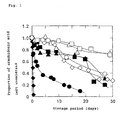
- Fig. 1 is a graph showing the results of Example 4.
- the powdered polyunsaturated fatty acid/ascorbic acid esters provided in accordance with the present invention may be suitably mixed with other components to make tablets, soft or hard capsules, and other preparations and are expected to find practical applications in the fields of pharmaceutical products, food products, and cosmetics.
- the present invention provides an effective process for making the polyunsaturated fatty acid/ascorbic acid ester of the general formula (I) into powder.
- the compound of the general formula (I) has the desirable physiological activities of vitamin C and, at the same time, exhibits the physiological activities of polyunsaturated fatty acids, such as DHA, EPA, and arachidonic acid, each an important biological compound.
- the compound of the general formula (I) can be considered as a "dual pro-form" that serves both as a pro-form of a polyunsaturated fatty acid that has high stability against oxidation and as a pro-vitamin C.
- the compound of the general formula (I) can be formed into powder in a simple fashion by selecting a particular water-soluble polysaccharide serving as an excipient, mixing it with an aqueous solution of the water-soluble polysaccharide to form an emulsion, and spray-drying the emulsion.
- a particular water-soluble polysaccharide serving as an excipient
- mixing it with an aqueous solution of the water-soluble polysaccharide to form an emulsion and spray-drying the emulsion.
- the polyunsaturated fatty acid is significantly more stable against oxidation in the resulting powdered material than in the original paste form of the polyunsaturated fatty acid/ascorbic acid ester. It was these findings that ultimately led to the present invention.
- the ascorbic acid derivatives represented by the general formula (I) in which an acyl group originating from a polyunsaturated fatty acid is bound to position 6 via an ester linkage can be chemically synthesized either by condensation of a polyunsaturated fatty acid with ascorbic acid using a common dehydrating agent such as dicyclohexylisourecarbodiimide or by treating an acid chloride of a polyunsaturated fatty acid with ascorbic acid (See, for example, US Patent No. 6069168 ).
- the ascorbic acid derivatives can be enzymatically synthesized by treating a polyunsaturated fatty acid and ascorbic acid with lipase in an organic solvent such as acetone (See, for example, J. Am. Oil. Chem. Soc. 78(2001): 823 ). If necessary, the resulting compounds may be purified by silica gel chromatography.
- the present invention also provides a second process, wherein the compound is mixed with a diluent, such as a long-chain fatty acid or an ester thereof including methyl oleate, or an oil such as olive oil, prior to mixing with the aqueous solution of the water-soluble polysaccharide to serve as an excipient.
- a diluent such as a long-chain fatty acid or an ester thereof including methyl oleate, or an oil such as olive oil
- the polyunsaturated fatty acid/ascorbic ester compound may be directly mixed with the excipient without using the diluent depending on the property of the compound.
- the resulting mixture is then mixed with the excipient to form an emulsion.
- the excipient used is a water-soluble polysaccharide dissolved in water in advance.
- a water-soluble polysaccharide include, but are not limited to, dextrin, in particular maltodextrin, soluble starch, gum Arabic, or polysaccharides derived from soybean, such as "soyafibe” manufactured and marketed by Fuji Oil, Co., Ltd.
- the mixing ratio (by weight) of the oil mixture, that is, the polyunsaturated fatty acid/ascorbic acid ester compound or the mixture of the polyunsaturated fatty acid/ascorbic acid ester compound with the diluent, to the excipient is in the range of 1 : 1 to 1 : 100, and preferably in the range of 1 : 2 to 1 : 20.
- the resulting mixture is then vigorously stirred to form an emulsion (O/W type emulsion with the dispersed phase being oil droplets).
- the amount of the oil is larger than 1 : 1 in terms of the mixing ratio (by weight) of the polyunsaturated fatty acid/ascorbic acid ester compound or the mixture of the polyunsaturated fatty acid/ascorbic acid ester compound with the diluent, to the excipient, the mixture may not be successfully formed into powder.
- the size of the oil droplets in the emulsion is in the range of 0.1 to 5 ⁇ m. While the oil droplets may be smaller than this range, the droplets equal to, or greater than, 5 ⁇ m in size tend to destabilize the emulsion and are thus not suitable. More preferably, the size of the oil droplets is in the range of 0.01 to 1 ⁇ m since the oil droplets with a smaller size can lead to formation of favorable powder less susceptible to oxidation.
- the resulting emulsion is then dried with a spray drier (100 to 200°C) to give powder of the microcapsulated polyunsaturated fatty acid/ascorbic acid ester. While such a drying process may be carried out using any technique, the spray drying using a spray drier can make the emulsion into powder in a simpler manner as compared to other drying measures, such as drum drying, vacuum freeze drying, and vacuum drying (drum-type and continuous belt-type), and is thus used in the present invention.
- a spray drier 100 to 200°C
- the resulting microcapsulated powder of 6-O-arachidonoyl-ascorbate was left in the air at 37°C and a humidity of 12% for 30 days to determine the stability of the powder against oxidation (See, Example 4 below).
- samples were taken at predetermined intervals and were hydrolyzed into methyl arachidonate, which in turn was subjected to gas chromatography to determine the amount of non-oxidized arachidonic acid.
- the results are shown in Figure 1 .
- the stability of any polysaccharides used was improved by powdering.
- the increase in the stability against oxidation was particularly significant in gum Arabic and soybean polysaccharide.
- the present invention provides a powdering process to improve the physical properties of polyunsaturated fatty acid/ascorbic acid esters that show various physiological activities.
- the polyunsaturated fatty acid/ascorbic acid esters powdered by the process of the present invention proved to be significantly more stable against oxidation as compared to the non-powdered counterparts, which were highly susceptible to oxidation.
- the present invention facilitates the use of the polyunsaturated fatty acid/ascorbic acid esters of the general formula (I) in pharmaceutical products, food products, nutritional products, and cosmetic products.
- Arachidonic acid (2.0 g, 6.6 mmol) was dissolved in benzene (20 ml) .
- oxalyl chloride (5.4 ml, 7.9 mmol) was added and the mixture was stirred at room temperature in a nitrogen atmosphere for 2.5 hours. Subsequently, the mixture was concentrated under reduced pressure to obtain arachidonyl chloride as an oily product.
- L-ascorbic acid (1.4 g, 7.9 mmol) was added to a mixture of N-methylpyrrolidone (15 ml) and 4N-HCl/dioxane (2.4 ml) and the mixture was chilled on ice.
- Example 1 Powderization of 6-O-arachidonoyl-ascorbate using gum Arabic
- Gum Arabic (6.75 g) was dissolved in 45 ml warm water. Meanwhile, 1 part by weight of 6-O-arachidonoyl-ascorbate was uniformly mixed with 4 parts by weight of methyl oleate. The mixture (0.675 g) was added to the solution of gum Arabic (San-eigen, manufactured by FFI) and the mixture was vigorously stirred in a homogenizer (polytron PT20SK, manufactured by KINEMATICA) for 1 min to form an emulsion. The average size of the oil droplets present in the resulting emulsion was 0.48 ⁇ m (determined by particle size analyzer SALD-2100, manufactured by SHIMADZU CORP.).
- the emulsion was atomized by a centrifugal sprayer at 30,000 rpm and was injected into an LB-8 spray drier (manufactured by OOKAWARA) at a rate of 3.0 kg/hr.
- the temperature at the inlet was 200° C and the temperature at the outlet was 100 to 110° C .
- the air flow rate was approximately 7.5 m 2 /min.
- the resulting powder was collected by a cyclone as the desired product.
- soybean starch (6.75g) (Soyafibe ® , available from FUJIOIL), the same procedure was followed as in Example 1 to obtain the desired powder (microcapsule).
- Example 3 Powderization of 6-O-arachidonoyl-ascorbate using maltodextrin
- Example 1 Using maltodextrin (6.75g) (Pinedex #100, manufactured by MATSUTANI KAGAKU), the same procedure was followed as in Example 1 to obtain the desired powder (microcapsule).
- Example 4 Test for the stability against oxidation of arachidonic acid moiety of 6-O-arachidonoyl-ascorbate in microcapsules
- each powder product (microcapsule) obtained in each example was placed in a flat bottom glass container (1.5 cm inner diameter, 3 cm high) .
- the humidity inside the container was maintained at 12% and the powder was stored at 37°C.
- the cup was taken out at predetermined intervals and the 6-O-arachidonoyl-ascorbate encapsulated in the microcapsules was hydrolyzed, followed by esterification with methyl groups.
- the amount of non-oxidized arachidonic acid was determined by gas chromatography (GC-14B, manufactured by SHIMADZU CORP.).
- the samples were analyzed using methyl myristate as an internal standard.
- gum Arabic As a control, gum Arabic, soybean starch (Soyafibe (registered trademark)) and maltodextrin (Pinedex #100) used in the respective examples were used in combination with arachidonic acid to make arachidonic acid powder products (microcapsule), and the powder products were tested in the same manner.
- Non-powdered arachidonic acid and non-powdered 6-O-arachidonoyl-ascorbate were also tested in the same manner.
- the powder composition of the present invention comprising a polyunsaturated fatty acid/ascorbic acid ester shows significantly improved stability against oxidation, so that it finds a wide range of applications in the fields of pharmaceutical products, food products, nutritional products, and cosmetic products.
Landscapes
- Chemical & Material Sciences (AREA)
- Oil, Petroleum & Natural Gas (AREA)
- Life Sciences & Earth Sciences (AREA)
- Engineering & Computer Science (AREA)
- Organic Chemistry (AREA)
- Chemical Kinetics & Catalysis (AREA)
- Wood Science & Technology (AREA)
- Food Science & Technology (AREA)
- General Chemical & Material Sciences (AREA)
- Polymers & Plastics (AREA)
- Medicinal Preparation (AREA)
- Cosmetics (AREA)
- Organic Low-Molecular-Weight Compounds And Preparation Thereof (AREA)
- Fats And Perfumes (AREA)
- Pharmaceuticals Containing Other Organic And Inorganic Compounds (AREA)
- Acyclic And Carbocyclic Compounds In Medicinal Compositions (AREA)
Abstract
Description
- The present invention relates to ascorbic acid esters of polyunsaturated fatty acids shown by the following general formula (I):
RCO-A (I)
(wherein RCO- is an acyl group originating from a polyunsaturated fatty acid; and A is an ascorbic acid residue that is linked via "-O-" originating from the hydroxyl group of ascorbic acid). The esters of the present invention serve both as pro-forms of polyunsaturated fatty acids that have an increased stability against oxidation and are converted into polyunsaturated fatty acids once in a body, and as pro-forms of vitamin C, or pro-vitamin C. More specifically, the present invention relates to a process for forming the ascorbic acid ester of polyunsaturated fatty acid into a powder composition that facilitates handling of the compound during its production or use, as well as to a composition containing the powdered esters. - Even more specifically, the present invention relates to a process for forming the ascorbic acid ester of polyunsaturated fatty acid shown by the general formula (I) (which may be referred to as "polyunsaturated fatty acid/ascorbic acid ester," hereinafter) into a powder composition by mixing the compound, which can be optionally mixed with a diluent, with an aqueous solution of a water-soluble polysaccharide excipient to form an emulsion, and dehydrating/drying the emulsion by spray-drying. The present invention further relates to a composition containing the powdered polyunsaturated fatty acid/ascorbic acid ester produced by the above process.
- Polyunsaturated fatty acids (PUFAs) generally refer to fatty acids that consist of 18 to 22 carbon atoms and have a degree of unsaturation of 2 to 6. Specifically, PUFAs range from linoleic acid (18 carbon atoms, degree of unsaturation = 2) to docosahexaenoic acid (DHA) (22 carbon atoms, degree of unsaturation = 6).
- Of different polyunsaturated fatty acids, docosahexaenoic acid (DHA), eicosapentaenoic acid (EPA), α - or γ-linolenic acid, dihomo-γ -lenolenic acid (DGLA), and arachidonic acid are not only known to play important roles as biological compounds, but also have various useful functions (See, for example, Okuyama Hiromi. ed. , "Brain Functions and Lipids" (1997) Gakkai Center Kansai; Sato Kiyotaka. ed., "Development of Functional Lipids" (1992); Watanabe Akihiro et al., "Hepatic Diseases and Therapeutic Nutrition" (1992) Dai-ichi Shuppan.). Some are already in use as pharmaceutical agents, food and nutritional products. In general, these polyunsaturated fatty acids occur in the form of glycerides or phospholipids rather than in the form of free acids, and are used as oils containing polyunsaturated fatty acids.
- Vitamin C exhibits various physiological activities: it facilitates synthesis of collagen, the depletion of which causes scurvy; it acts as a biological antioxidant and eliminates free radicals generated in a body; and it is involved in the oxidation/reduction of iron ions of cytochrome C. Other important activities of vitamin C include anticancer activity, stimulation of immune functions and suppression of cholesterol synthesis and associating anti-arteriosclerosis activity. The antioxidation activity and the ability to facilitate collagen synthesis, along with the associating anti-photoaging, anti-UV damage and anti-pigmentation activities, make vitamin C a dermatologically important compound suitable for use in cosmetics (See, for example, "Fragrance Journal," vol.25, March (1997) Special edition.). Vitamin C is also added in food and cosmetic products as antioxidant.
- Despite their wide range of applications, polyunsaturated fatty acids and vitamin C are susceptible to oxidation. For this reason, much effort has been devoted to developing pro-forms of vitamin C (pro-vitamin C), vitamin C derivatives that are converted to vitamin C once inside a body. Among pro-vitamins C thus far produced are 6-O-palmitoyl- and 6-O-stearyl-ascorbic acid esters, which are antioxidants with high solubility in lipid, 2-O-α-glucopyranosyl ascorbic acid having increased stability against oxidation, and those with phosphoric acid or sulfuric acid bound to position 2. Attempts have also been made to make pro-forms by combining a polyunsaturated fatty acid with vitamin C. Of such pro-forms, the ascorbic acid derivatives in which an acyl group originating from a polyunsaturated fatty acid is bound to position 6 via an ester linkage are known to have higher stability against oxidation than the original polyunsaturated fatty acid and are, thus, useful (See, for example, J. Am. Oil Chem. Soc., 78(2001): 823).
- Aside from the functions anticipated from the polyunsaturated fatty acid and ascorbic acid, these pro-forms of polyunsaturated fatty acid and vitamin C may exhibit completely new properties. For example, of the ascorbic acid derivatives in which an acyl group originating from a polyunsaturated fatty acid is bound to position 6 via an ester linkage, 6-O-docosahexaenoyl-ascorbate is known to have anti-arrhythmia activity (Japanese Patent Laid-Open Publication No.
Hei 10-139664 WO94/20092 Hei 6-122627 US Patent No. 6069168 ) and is shown to be effective against streptozotocin-induced diabetes model (Diabetologia. 39(1996): 1047). - Oils containing polyunsaturated fatty acids are generally provided in the form of liquid oil or semi-solid (paste). These oils are susceptible to oxidation and are therefore difficult to handle. In one technique to cope with this problem, linoleic acid is mixed with a water-soluble polysaccharide, such as maltodextrin, gum Arabic and soybean polysaccharide, in the presence of various surfactants, and the mixture is spray-dried to form microcapsules (powderization). The resulting linoleic acid powder has higher stability against oxidation than the original linoleic acid (See; for example, J. Agr. Food Chem., 50(2002): 3984, J. Microencapsulation, 19(2002): 181).
- Other techniques for forming polyunsaturated fatty acids into a powder composition have been described in several patent applications. For example, Japanese Patent Laid-Open Publication No.
Hei 6-228589 - A technique described in Japanese Patent Laid-Open Publication No.
Hei 7-313057 Hei 10-99056 - Japanese Patent Laid-Open Publication No.
Hei 9-235584 - Among further prior art,
EP 1 066 761 A2 describes a process for the manufacture of compositions containing fat-soluble substances, which includes spray-drying. - The techniques described above are some of the known techniques for making polyunsaturated fatty acid-containing oils into powder. Each of these techniques, however, concerns a polyunsaturated fatty acid-containing oil, which has different physical properties from the ascorbic acid/polyunsaturated fatty acid ester of the present invention. Therefore, each of the above descriptions offers only limited teaching. The above-described techniques each have a different purpose for making a powder composition: each involves addition of extra additives or other troublesome complicated processes and thus cannot be directly applied to making the ascorbic acid/polyunsaturated fatty acid ester into powder.
- Specifically, ascorbic acid esters of polyunsaturated fatty acid of the present invention having 3 or higher degree of unsaturation, including DHA, arachidonic acid and DGLA, do not readily crystallize. Rather, they tend to form a paste, making their handling difficult. Such characteristics of the esters also make them unsuitable for use in pharmaceutical or food products. Although preparations and compositions using these compounds have been described in literatures, such as oral preparations using 6-O-docosahexaenoyl-ascorbate described in Japanese Patent Laid-Open Publication No.
Hei 10-139664 WO 94/20092 US. Patent No. 6069168 , which describes 6-O-γ-linoleyl-ascorbate, regarding excipients for making tablets containing the compound. Thus, no techniques have thus far been available in this particular technical field for forming a powder composition of polyunsaturated fatty acid/ascorbic acid ester. - Accordingly, it is an objective of the present invention to provide a simple process for making a powder composition comprising a polyunsaturated fatty acid/ascorbic acid ester, which otherwise forms a paste and exhibits undesirable physical properties. It is another objective of the present invention to provide such a powder composition comprising a polyunsaturated fatty acid/ascorbic acid ester.
- Addressing the above-described problems, the present invention comprises the followings:
- (1) A process for making an ascorbic acid ester of a polyunsaturated fatty acid into powder, the ester represented by the following general formula (I):
RCO-A (I)
(wherein RCO- is an acyl group originating from a polyunsaturated fatty acid; and A is an ascorbic acid residue that is linked via "-O-" originating from the hydroxyl group of ascorbic acid), the process comprising:- mixing the ascorbic acid ester of polyunsaturated fatty acid with an aqueous solution of a water-soluble polysaccharide excipient to form an emulsion, wherein the mixing ratio by weight of the compound of the general formula (I) to the water-soluble polysaccharide excipient is in a range of 1 : 1 to 1 : 100; and
- spray-drying the emulsion to dehydrate and dry the emulsion.
- (2) A process for making an ascorbic acid ester of a polyunsaturated fatty acid into powder, the ester represented by the following general formula (I):
RCO-A (I)
(wherein RCO- is an acyl group originating from a polyunsaturated fatty acid having 18 to 22 carbon atoms and a degree of unsaturation of 2 to 6; and A is an ascorbic acid residue that is linked via "-O-" originating from the hydroxyl group of ascorbic acid), the process comprising:- mixing the ascorbic acid ester of polyunsaturated fatty acid with a diluent;
- then, mixing the resulting mixture of the ascorbic acid ester of polyunsaturated fatty acid and the diluent with an aqueous solution of a water-soluble polysaccharide excipient to form an emulsion, wherein the mixing ratio by weight of the compound of the general formula (I) and the diluent to the water-soluble polysaccharide excipient is in a range of 1:1 to 1:100; and
- spray-drying the emulsion to dehydrate and dry the emulsion.
- (3) The process according to (2) above, wherein the mixing ratio by weight of the compound of the general formula (I) and the diluent to the excipient is in the range of 1 : 2 to 1 : 20.
- (4) The process according to (2) or (3) above, wherein the mixing ratio by weight of the compound of the general formula (I) to the diluent is in the range of 1 : 1 to 1 : 100.
- (5) The process according to (2) or (3) above, wherein the mixing ratio by weight of the compound of the general formula (I) to the diluent is in the range of 1 : 3 to 1 : 10.
- (6) The process accordingtoanyoneof (1) to (5) above, wherein the water-soluble polysaccharide is selected from maltodextrin, gum Arabic, soluble starch, and soybean polysaccharide.
- (7) The process accordingtoanyoneof (2) to (6) above, wherein the diluent is a long-chain fatty acid or an ester thereof, a surfactant, or a liquid oil.
- (8) The process according to (7) above, wherein the diluent is selected from methyl oleate, oleic acid, linoleic acid, olive oil, soybean lecithin, a monoglyceride of a fatty acid and a sugar ester of a fatty acid.
- (9) The process according to any one of (1) to (8) above, wherein A in the compound of the general formula (I) is a residue originating from the 6 hydroxyl group of ascorbic acid.
- (10) The process according to any one of (1) to (9) above, wherein RCO- in the compound of the general formula (I) is selected from acyl groups of arachidonic acid, dihomo-γ-linolenic acid, and docosahexaenoic acid.
- (11) A composition containing the powdered compound represented by the general formula (I) and produced by the process according to any one of (1) to (10) above.
-
Fig. 1 is a graph showing the results of Example 4. - The symbols shown in the graph are as follows:
- a blank square indicates the result for a gum Arabic-based powder (microcapsule) of 6-O-arachidonoyl-ascorbate obtained in Example 1;
- a solid square indicates the result for a gum Arabic-based powder of arachidonic acid provided as a control;
- a blank triangle indicates the result for a soybean polysaccharide(Soyafibe (registered trademark))-based powder of 6-O-arachidonoyl-ascorbate obtained in Example 2;
- a solid triangle indicates the result for a soybean polysaccharide(Soyafibe (registered trademark))-based powder of arachidonic acid provided as a control;
- a blank circle indicates the result for maltodextrin (Pinedex #100)-based 6-O-arachidonoyl-ascorbate obtained in Example 3;
- a solid circle indicates the result for a (Pinedex #100) -based powder of arachidonic acid provided as a control;
- a blank diamond indicates the result for non-powdered 6-O-arachidonoyl-ascorbate; and
- a solid diamond indicates the result for non-powdered arachidonic acid.
- As described above, the present invention specifically provides a process that involves mixing the polyunsaturated fatty acid/ascorbic acid ester of the general formula (I) with an aqueous solution of a water-soluble polysaccharide, a type of excipient, to form an emulsion, wherein the mixing ratio of the compound of the general formula (I) to the water-soluble polysaccharide excipient is in a range of 1 : 1 to 1 : 100, and then drying the emulsion by spray-drying. The resulting powdered (microcapsulated) polyunsaturated fatty acid/ascorbic acid ester not only becomes highly handleable, but also shows significantly improved stability against oxidation.
- The powdered polyunsaturated fatty acid/ascorbic acid esters provided in accordance with the present invention may be suitably mixed with other components to make tablets, soft or hard capsules, and other preparations and are expected to find practical applications in the fields of pharmaceutical products, food products, and cosmetics.
- As described above, the present invention provides an effective process for making the polyunsaturated fatty acid/ascorbic acid ester of the general formula (I) into powder. The compound of the general formula (I) has the desirable physiological activities of vitamin C and, at the same time, exhibits the physiological activities of polyunsaturated fatty acids, such as DHA, EPA, and arachidonic acid, each an important biological compound. In other words, the compound of the general formula (I) can be considered as a "dual pro-form" that serves both as a pro-form of a polyunsaturated fatty acid that has high stability against oxidation and as a pro-vitamin C. Thus, there has been a high expectation for the compounds of the general formula (I) to find a wide range of applications in food products,cosmetics,pharmaceutical products,and various other fields. Nonetheless, the compounds of the general formula (I) tend to form a paste, the characteristic that makes the compounds difficult to handle.
- In the course of his study, the present inventor has found that the compound of the general formula (I) can be formed into powder in a simple fashion by selecting a particular water-soluble polysaccharide serving as an excipient, mixing it with an aqueous solution of the water-soluble polysaccharide to form an emulsion, and spray-drying the emulsion. Surprisingly, it has turned out that the polyunsaturated fatty acid is significantly more stable against oxidation in the resulting powdered material than in the original paste form of the polyunsaturated fatty acid/ascorbic acid ester. It was these findings that ultimately led to the present invention.
- The present invention will now be described with reference to specific embodiments, which are not intended to limit the scope of the invention in any way.
- The ascorbic acid derivatives represented by the general formula (I) in which an acyl group originating from a polyunsaturated fatty acid is bound to position 6 via an ester linkage can be chemically synthesized either by condensation of a polyunsaturated fatty acid with ascorbic acid using a common dehydrating agent such as dicyclohexylisourecarbodiimide or by treating an acid chloride of a polyunsaturated fatty acid with ascorbic acid (See, for example,
US Patent No. 6069168 ). Alternatively, the ascorbic acid derivatives can be enzymatically synthesized by treating a polyunsaturated fatty acid and ascorbic acid with lipase in an organic solvent such as acetone (See, for example, J. Am. Oil. Chem. Soc. 78(2001): 823). If necessary, the resulting compounds may be purified by silica gel chromatography. - In making the resulting polyunsaturated fatty acid/ascorbic ester compound of the general formula (I) into powder, the present invention also provides a second process, wherein the compound is mixed with a diluent, such as a long-chain fatty acid or an ester thereof including methyl oleate, or an oil such as olive oil, prior to mixing with the aqueous solution of the water-soluble polysaccharide to serve as an excipient. The polyunsaturated fatty acid/ascorbic ester compound may be directly mixed with the excipient without using the diluent depending on the property of the compound.
- The mixing ratio (by weight) of the ascorbic acid derivative, or polyunsaturated fatty acid/ascorbic acid ester compound, to the diluent is generally in the range of 1 : 1 to 1 : 100, and preferably in the range of 1 : 3 to 1 : 10. Instead of a fatty acid ester or an oil, a surfactant, which can form micelles, may be used as the diluent. Such a surfactant may be glyceryl monostearate, a monoglyceride of a fatty acid for use in food products, or a sugar ester (fatty acid ester of sucrose) or soybean lecithin, and may be used at the same ratio.
- The resulting mixture is then mixed with the excipient to form an emulsion. The excipient used is a water-soluble polysaccharide dissolved in water in advance. Examples of such a water-soluble polysaccharide include, but are not limited to, dextrin, in particular maltodextrin, soluble starch, gum Arabic, or polysaccharides derived from soybean, such as "soyafibe" manufactured and marketed by Fuji Oil, Co., Ltd. The mixing ratio (by weight) of the oil mixture, that is, the polyunsaturated fatty acid/ascorbic acid ester compound or the mixture of the polyunsaturated fatty acid/ascorbic acid ester compound with the diluent, to the excipient is in the range of 1 : 1 to 1 : 100, and preferably in the range of 1 : 2 to 1 : 20. Using a homogenizer, the resulting mixture is then vigorously stirred to form an emulsion (O/W type emulsion with the dispersed phase being oil droplets).
- If the amount of the oil is larger than 1 : 1 in terms of the mixing ratio (by weight) of the polyunsaturated fatty acid/ascorbic acid ester compound or the mixture of the polyunsaturated fatty acid/ascorbic acid ester compound with the diluent, to the excipient, the mixture may not be successfully formed into powder. Preferably, the size of the oil droplets in the emulsion is in the range of 0.1 to 5 µm. While the oil droplets may be smaller than this range, the droplets equal to, or greater than, 5µm in size tend to destabilize the emulsion and are thus not suitable. More preferably, the size of the oil droplets is in the range of 0.01 to 1 µm since the oil droplets with a smaller size can lead to formation of favorable powder less susceptible to oxidation.
- The resulting emulsion is then dried with a spray drier (100 to 200°C) to give powder of the microcapsulated polyunsaturated fatty acid/ascorbic acid ester. While such a drying process may be carried out using any technique, the spray drying using a spray drier can make the emulsion into powder in a simpler manner as compared to other drying measures, such as drum drying, vacuum freeze drying, and vacuum drying (drum-type and continuous belt-type), and is thus used in the present invention.
- The resulting microcapsulated powder of 6-O-arachidonoyl-ascorbate was left in the air at 37°C and a humidity of 12% for 30 days to determine the stability of the powder against oxidation (See, Example 4 below). During the 30-day period, samples were taken at predetermined intervals and were hydrolyzed into methyl arachidonate, which in turn was subjected to gas chromatography to determine the amount of non-oxidized arachidonic acid. The results are shown in
Figure 1 . As shown, the stability of any polysaccharides used was improved by powdering. The increase in the stability against oxidation was particularly significant in gum Arabic and soybean polysaccharide. - As set forth, the present invention provides a powdering process to improve the physical properties of polyunsaturated fatty acid/ascorbic acid esters that show various physiological activities. The polyunsaturated fatty acid/ascorbic acid esters powdered by the process of the present invention proved to be significantly more stable against oxidation as compared to the non-powdered counterparts, which were highly susceptible to oxidation. Thus, the present invention facilitates the use of the polyunsaturated fatty acid/ascorbic acid esters of the general formula (I) in pharmaceutical products, food products, nutritional products, and cosmetic products.
- The present invention will now be described in further detail with reference to Examples, which are provided by way of example only and are not intended to limit the scope of the invention in any way. As a reference, a production process is also presented of an ascorbic acid derivative having an acyl group originating from different polyunsaturated fatty acids bound to the position 6 via an ester linkage.
- Arachidonic acid (2.0 g, 6.6 mmol) was dissolved in benzene (20 ml) . To this solution, oxalyl chloride (5.4 ml, 7.9 mmol) was added and the mixture was stirred at room temperature in a nitrogen atmosphere for 2.5 hours. Subsequently, the mixture was concentrated under reduced pressure to obtain arachidonyl chloride as an oily product. Meanwhile, L-ascorbic acid (1.4 g, 7.9 mmol) was added to a mixture of N-methylpyrrolidone (15 ml) and 4N-HCl/dioxane (2.4 ml) and the mixture was chilled on ice. To this solution, the arachidonyl chloride in methylene chloride (approx. 2 ml) was added, and the mixture was stirred overnight while chilled on ice. Upon completion of the reaction, water was added and the mixture was extracted with ethyl acetate. The ethyl acetate layer was washed with water (twice), was dried over anhydrous magnesium sulfate,and was concentrated under reduced pressure. The resulting residue was purified by silica gel chromatography (eluant = methanol/methylene chloride (1% to 20% methanol gradient)) and was dried under reduced pressure to give the desired product as a paste (2.7 g, 90% yield).
NMR(δ ppm,CDCl3); 0.87(3H, t), 1.2-1.4(6H, m), 1.73(2H, q), 2.0-2.2(4H, m), 2.36(2H, t), 2.8-2.9(6H, 4.2-4.3(3H, m), 4.79(1H, s), 5.36(8H, m). - Using dihomo-γ-linolenic acid (2.0g, 6.6mmol), the same procedure was followed as in Reference Example 1 to give the desired product as a paste (2.43g, 80% yield).
NMR (δ ppm CDCl3); 0.89(3H, t), 1.2-1.4(12H, m),1.63(2H, t), 2.0-2.1 (4H,m),2.39 (2H,t), 2.7-2.9 (4H,m), 4.2-4.3 (3H,m), 4.79 (1H, s), 5.2-5.4(6H, m). - Using docosahexaenoic acid (2.0 g, 6.1 mmol), the same procedure was followed as in Reference Example 1 to give the desired product as a paste (2.5 g, 84% yield).
NMR (δ ppm, CDCl3); 0. 97 (3H, t) , 2.07(2H, q) , 2.43(4H, q), 2.8-2.9(10H, m), 4.76(1H, s), 5.2-5.4(10H, m), 4.2-4.7(3H, m), 4.80(1H, s), 5.2-5.5(12H, m). - Gum Arabic (6.75 g) was dissolved in 45 ml warm water. Meanwhile, 1 part by weight of 6-O-arachidonoyl-ascorbate was uniformly mixed with 4 parts by weight of methyl oleate. The mixture (0.675 g) was added to the solution of gum Arabic (San-eigen, manufactured by FFI) and the mixture was vigorously stirred in a homogenizer (polytron PT20SK, manufactured by KINEMATICA) for 1 min to form an emulsion. The average size of the oil droplets present in the resulting emulsion was 0.48 µm (determined by particle size analyzer SALD-2100, manufactured by SHIMADZU CORP.). While gently stirred, the emulsion was atomized by a centrifugal sprayer at 30,000 rpm and was injected into an LB-8 spray drier (manufactured by OOKAWARA) at a rate of 3.0 kg/hr. The temperature at the inlet was 200° C and the temperature at the outlet was 100 to 110° C . The air flow rate was approximately 7.5 m2/min. The resulting powder (microcapsule) was collected by a cyclone as the desired product.
- Using soybean starch (6.75g) (Soyafibe®, available from FUJIOIL), the same procedure was followed as in Example 1 to obtain the desired powder (microcapsule).
- Using maltodextrin (6.75g) (Pinedex #100, manufactured by MATSUTANI KAGAKU), the same procedure was followed as in Example 1 to obtain the desired powder (microcapsule).
- 240mg of each powder product (microcapsule) obtained in each example was placed in a flat bottom glass container (1.5 cm inner diameter, 3 cm high) . Using an aqueous solution of lithium chloride, the humidity inside the container was maintained at 12% and the powder was stored at 37°C. The cup was taken out at predetermined intervals and the 6-O-arachidonoyl-ascorbate encapsulated in the microcapsules was hydrolyzed, followed by esterification with methyl groups. The amount of non-oxidized arachidonic acid was determined by gas chromatography (GC-14B, manufactured by SHIMADZU CORP.). The samples were analyzed using methyl myristate as an internal standard. The variation of the proportion of the arachidonic acid left unoxidized during the 30-day period was shown in
Fig. 1 (with respect to the amount of arachidonic acid on Day 0 (=1.0)). - As a control, gum Arabic, soybean starch (Soyafibe (registered trademark)) and maltodextrin (Pinedex #100) used in the respective examples were used in combination with arachidonic acid to make arachidonic acid powder products (microcapsule), and the powder products were tested in the same manner. Non-powdered arachidonic acid and non-powdered 6-O-arachidonoyl-ascorbate were also tested in the same manner.
- The results are collectively shown in
Fig. 1 . - As can be seen from the results of
Fig. 1 , as much as 80% of the arachidonic acid of the 6-O-arachidonoyl-ascorbate encapsulated by gum Arabic or soybean starch remained unoxidized after 30 days, whereas only 30% of the non-capsulated 6-O-arachidonoyl-ascorbate remained unoxidized after the same period. This indicates the high stability of microcapsulated 6-O-arachidonoyl-ascorbate against oxidation. In contrast, non-capsulated arachidonic acid disappeared in a few hours. - As set forth, the present invention provides an effective process for making powder products of polyunsaturated fatty acid/ascorbic acid esters, compounds with potential applications in the fields of pharmaceutical products, food products, nutritional products, and cosmetic products. Specifically, the process involves mixing, if necessary, the polyunsaturated fatty acid/ascorbic acid ester with a diluent, mixing the mixture with an aqueous solution of a water-soluble polysaccharide, an excipient, to form an emulsion, and spray-drying the emulsion to obtain a powder product that is easy to handle. Also provided by the present invention are polyunsaturated fatty acid/ascorbic acid ester having improved stability against oxidation and a powder composition comprising such esters.
- The powder composition of the present invention comprising a polyunsaturated fatty acid/ascorbic acid ester shows significantly improved stability against oxidation, so that it finds a wide range of applications in the fields of pharmaceutical products, food products, nutritional products, and cosmetic products.
Claims (11)
- A process for making an ascorbic acid ester of a polyunsaturated fatty acid into powder, the ester represented by the following general formula (I):
RCO-A (I)
(wherein RCO- is an acyl group originating from a polyunsaturated fatty acid having 18 to 22 carbon atoms and a degree of unsaturation of 2 to 6; and A is an ascorbic acid residue that is linked via "-O-" originating from the hydroxyl group of ascorbic acid), the process comprising:mixing the ascorbic acid ester of polyunsaturated fatty acid with an aqueous solution of a water-soluble polysaccharide excipient to form an emulsion, wherein the mixing ratio by weight of the compound of the general formula (I) to the water-soluble polysaccharide excipient is in a range of 1:1 to 1:100; andspray-drying the emulsion to dehydrate and dry the emulsion. - A process for making an ascorbic acid ester of a polyunsaturated fatty acid into powder, the ester represented by the following general formula (I):
RCO-A (I)
(wherein RCO- is an acyl group originating from a polyunsaturated fatty acid having 18 to 22 carbon atoms and a degree of unsaturation of 2 to 6; and A is an ascorbic acid residue that is linked via "-O-" originating from the hydroxyl group of ascorbic acid), the process comprising:mixing the ascorbic acid ester of polyunsaturated fatty acid with a diluent;then, mixing the resulting mixture of the ascorbic acid ester of polyunsaturated fatty acid and the diluent with an aqueous solution of a water-soluble polysaccharide excipient to form an emulsion, wherein the mixing ratio by weight of the compound of the general formula (I) and the diluent to the water-soluble polysaccharide excipient is in a range of 1:1 to 1:100; andspray-drying the emulsion to dehydrate and dry the emulsion. - The process according to claim 2 , wherein the mixing ratio by weight of the mixture of the compound of the general formula (I) and the diluent to the excipient is in a range of 1:2 to 1:20.
- The process according to claim 2 or 3, wherein the mixing ratio by weight of the compound of the general formula (I) to the diluent is in a range of 1 : 1 to 1 : 100.
- The process according to claim 2 or 3, wherein the mixing ratio by weight of the compound of the general formula (I) to the diluent is in a range of 1 : 3 to 1 : 10.
- The process according to any one of claims 1 to 5 , wherein the water-soluble polysaccharide excipient is selected from maltodextrin, gum arabic, soluble starch, and soybean polysaccharide.
- The process according to any one of claims 2 to 6, wherein the diluent is a long-chain fatty acid or an ester thereof, a surfactant, or a liquid oil.
- The process according to claim 7, wherein the diluent is selected from methyl oleate, oleic acid, linoleic acid, olive oil, soybean lecithin, a monoglyceride of a fatty acid, and a sugar ester of a fatty acid.
- The process according to any one of claims 1 to 8, wherein A in the compound of the general formula (I) is a residue originating from the 6-hydroxyl group of ascorbic acid.
- The process according to any one of claims 1 to 9, wherein RCO- in the compound of the general formula (I) is selected from acyl groups originating from arachidonic acid, dihomo-γ-linolenic acid, and docosahexaenoic acid.
- A composition containing the powdered compound represented by the general formula (I) and produced by the process according to any one of claims 1 to 10.
Applications Claiming Priority (3)
| Application Number | Priority Date | Filing Date | Title |
|---|---|---|---|
| JP2003052701 | 2003-02-28 | ||
| JP2003052701A JP4153330B2 (en) | 2003-02-28 | 2003-02-28 | Process for producing powder compositions of ascorbic acid ester compounds of highly unsaturated fatty acids and their compositions |
| PCT/JP2004/002404 WO2004076603A1 (en) | 2003-02-28 | 2004-02-27 | Process for producing powdered compositions containing highly unsaturated fatty acid esters of ascorbic acid and powdered compositions containing the esters |
Publications (3)
| Publication Number | Publication Date |
|---|---|
| EP1598413A1 EP1598413A1 (en) | 2005-11-23 |
| EP1598413A4 EP1598413A4 (en) | 2006-12-27 |
| EP1598413B1 true EP1598413B1 (en) | 2010-03-31 |
Family
ID=32923407
Family Applications (1)
| Application Number | Title | Priority Date | Filing Date |
|---|---|---|---|
| EP04715515A Expired - Lifetime EP1598413B1 (en) | 2003-02-28 | 2004-02-27 | Process for producing powdered compositions containing highly unsaturated fatty acid esters of ascorbic acid and powdered compositions containing the esters |
Country Status (13)
| Country | Link |
|---|---|
| US (1) | US7989642B2 (en) |
| EP (1) | EP1598413B1 (en) |
| JP (1) | JP4153330B2 (en) |
| KR (1) | KR100936651B1 (en) |
| CN (1) | CN1753980B (en) |
| AT (1) | ATE462778T1 (en) |
| AU (1) | AU2004215531B2 (en) |
| CA (1) | CA2517075C (en) |
| DE (1) | DE602004026278D1 (en) |
| DK (1) | DK1598413T3 (en) |
| ES (1) | ES2340680T3 (en) |
| SG (1) | SG114343A1 (en) |
| WO (1) | WO2004076603A1 (en) |
Families Citing this family (8)
| Publication number | Priority date | Publication date | Assignee | Title |
|---|---|---|---|---|
| JP2006056795A (en) * | 2004-08-18 | 2006-03-02 | Suntory Ltd | Skin cosmetic and food and drink comprising 6-o-pufa ascorbic acid ester |
| EP1905310B1 (en) * | 2006-09-22 | 2008-12-03 | Cognis IP Management GmbH | Powder containing polyunsaturated fatty acids |
| US20110151525A1 (en) * | 2009-12-23 | 2011-06-23 | Muhammad Kaiyal | Enzymatic production of unsaturated fatty acids esters of ascorbic acid in solvent-free system |
| JP6095998B2 (en) * | 2013-02-15 | 2017-03-15 | 理研ビタミン株式会社 | Method for producing powdered L-ascorbic acid fatty acid ester preparation |
| WO2014134053A1 (en) * | 2013-02-26 | 2014-09-04 | Jiva Pharma, Inc. | Ascorbate esters of omega-3 fatty acids |
| EP3197857A4 (en) * | 2014-09-23 | 2018-04-18 | Jost Chemical Co. | Fatty acid composition and method for fortifying nutritional products with fatty acids |
| JP7018771B2 (en) * | 2018-01-17 | 2022-02-14 | ミヨシ油脂株式会社 | Powdered fats and oils and manufacturing method of powdered fats and oils |
| JP7690150B1 (en) | 2023-12-13 | 2025-06-10 | 大久保 菜穂子 | Food and drink composition |
Family Cites Families (10)
| Publication number | Priority date | Publication date | Assignee | Title |
|---|---|---|---|---|
| JPH06122627A (en) | 1992-10-13 | 1994-05-06 | Sagami Chem Res Center | Anti-allergic eye drops |
| JPH06228589A (en) | 1993-02-04 | 1994-08-16 | Ueda Seiyu Kk | Powdery fat and oil, and production thereof |
| JPH06263634A (en) | 1993-03-10 | 1994-09-20 | Sagami Chem Res Center | Calcium antagonistic |
| JP3222314B2 (en) | 1994-05-20 | 2001-10-29 | 池田食研株式会社 | Method for producing fat powder containing polyunsaturated fatty acids |
| AU711482B2 (en) * | 1994-06-28 | 1999-10-14 | Scotia Holdings Plc | Compositions for treatment of diabetic complications |
| JP3941073B2 (en) | 1996-03-01 | 2007-07-04 | 日本油脂株式会社 | Oil and fat composition and food containing the same |
| JPH1099046A (en) | 1996-09-30 | 1998-04-21 | Nof Corp | Production of powder composition |
| JPH10139664A (en) | 1996-11-12 | 1998-05-26 | Sagami Chem Res Center | Antiarrhythmic agent |
| DE60014255T2 (en) * | 1999-07-06 | 2005-11-03 | Dsm Ip Assets B.V. | Composition containing fat-soluble substances in a carbohydrate matrix |
| JP2006512102A (en) * | 2002-04-11 | 2006-04-13 | メディミューン・ヴァクシンズ・インコーポレーテッド | Preservation of bioactive materials by spray drying |
-
2003
- 2003-02-28 JP JP2003052701A patent/JP4153330B2/en not_active Expired - Fee Related
-
2004
- 2004-02-27 AT AT04715515T patent/ATE462778T1/en active
- 2004-02-27 CN CN2004800053893A patent/CN1753980B/en not_active Expired - Fee Related
- 2004-02-27 ES ES04715515T patent/ES2340680T3/en not_active Expired - Lifetime
- 2004-02-27 SG SG200505418A patent/SG114343A1/en unknown
- 2004-02-27 KR KR1020057015909A patent/KR100936651B1/en not_active Expired - Fee Related
- 2004-02-27 AU AU2004215531A patent/AU2004215531B2/en not_active Ceased
- 2004-02-27 EP EP04715515A patent/EP1598413B1/en not_active Expired - Lifetime
- 2004-02-27 DE DE602004026278T patent/DE602004026278D1/en not_active Expired - Lifetime
- 2004-02-27 CA CA2517075A patent/CA2517075C/en not_active Expired - Fee Related
- 2004-02-27 DK DK04715515.5T patent/DK1598413T3/en active
- 2004-02-27 US US10/547,259 patent/US7989642B2/en not_active Expired - Fee Related
- 2004-02-27 WO PCT/JP2004/002404 patent/WO2004076603A1/en not_active Ceased
Also Published As
| Publication number | Publication date |
|---|---|
| DE602004026278D1 (en) | 2010-05-12 |
| HK1088924A1 (en) | 2006-11-17 |
| US20060160891A1 (en) | 2006-07-20 |
| ATE462778T1 (en) | 2010-04-15 |
| JP2004263002A (en) | 2004-09-24 |
| CN1753980B (en) | 2013-03-20 |
| AU2004215531B2 (en) | 2009-09-10 |
| AU2004215531A1 (en) | 2004-09-10 |
| WO2004076603A1 (en) | 2004-09-10 |
| CA2517075A1 (en) | 2004-09-10 |
| SG114343A1 (en) | 2008-02-29 |
| CA2517075C (en) | 2011-06-28 |
| DK1598413T3 (en) | 2010-05-25 |
| JP4153330B2 (en) | 2008-09-24 |
| KR20050103967A (en) | 2005-11-01 |
| EP1598413A4 (en) | 2006-12-27 |
| EP1598413A1 (en) | 2005-11-23 |
| ES2340680T3 (en) | 2010-06-08 |
| KR100936651B1 (en) | 2010-01-14 |
| CN1753980A (en) | 2006-03-29 |
| US7989642B2 (en) | 2011-08-02 |
Similar Documents
| Publication | Publication Date | Title |
|---|---|---|
| US5456985A (en) | Microcapsules of oily liquid | |
| EP2852294B1 (en) | Compositions and methods for increasing the stability of food product additives | |
| US20080096964A1 (en) | Food Fortification with Polyunsaturated Fatty Acids | |
| KR100990814B1 (en) | Process for producing fatty acid composition containing DHA | |
| CN102438468A (en) | Compositions rich in omega-3 fatty acids low in phytanic acid | |
| JP2012521774A (en) | Immediate use stable suspension of partially amorphous carotenoid particles | |
| EP1450628A1 (en) | Powder formulation comprising conjugated octadecapolyenic acids | |
| JP2008179619A (en) | Astaxanthin-containing composition | |
| US8617610B2 (en) | Compositions and methods for increasing the stability of food product additives | |
| JPS6322899A (en) | Production of solid containing oil-soluble substance | |
| US7989642B2 (en) | Process for producing powdered compositions containing highly unsaturated fatty acid esters of ascorbic acid and powdered compositions containing the esters | |
| JP2008528774A (en) | Powder composition | |
| EP2010013B1 (en) | Oxidation-stable granulate containing unsaturated fatty acids | |
| WO2012014903A1 (en) | Fat-containing composition and oral formulation containing same | |
| JP2003183692A (en) | Fatty acid powder containing unsaturated fatty acids | |
| CN114158732A (en) | Polyunsaturated fatty acid triglyceride microcapsule powder and preparation method thereof | |
| JP4594489B2 (en) | Specific cancer killing agent and composition comprising the same | |
| HK1088924B (en) | Process for producing powdered compositions containing highly unsaturated fatty acid esters of ascorbic acid and powdered compositions containing the esters | |
| US7456304B2 (en) | Method for improving conversion rate of oil soluble unsaturated lipids into water-soluble lipids | |
| US20150282498A1 (en) | Powder Containing Polyunsaturated Fatty Acids and Process for Making Same | |
| TWI711600B (en) | Antioxidation agent and food containing the same | |
| JP2005264077A (en) | Conjugated trienoic acid-containing fat-and-oil composition and manufacturing method therefor | |
| JP2000072670A (en) | Microcapsules and tablets, food and pharmaceutical ingredients |
Legal Events
| Date | Code | Title | Description |
|---|---|---|---|
| PUAI | Public reference made under article 153(3) epc to a published international application that has entered the european phase |
Free format text: ORIGINAL CODE: 0009012 |
|
| 17P | Request for examination filed |
Effective date: 20050908 |
|
| AK | Designated contracting states |
Kind code of ref document: A1 Designated state(s): AT BE BG CH CY CZ DE DK EE ES FI FR GB GR HU IE IT LI LU MC NL PT RO SE SI SK TR |
|
| AX | Request for extension of the european patent |
Extension state: AL LT LV MK |
|
| DAX | Request for extension of the european patent (deleted) | ||
| A4 | Supplementary search report drawn up and despatched |
Effective date: 20061129 |
|
| 17Q | First examination report despatched |
Effective date: 20071219 |
|
| RAP1 | Party data changed (applicant data changed or rights of an application transferred) |
Owner name: SUNTORY HOLDINGS LIMITED |
|
| GRAP | Despatch of communication of intention to grant a patent |
Free format text: ORIGINAL CODE: EPIDOSNIGR1 |
|
| GRAS | Grant fee paid |
Free format text: ORIGINAL CODE: EPIDOSNIGR3 |
|
| GRAA | (expected) grant |
Free format text: ORIGINAL CODE: 0009210 |
|
| AK | Designated contracting states |
Kind code of ref document: B1 Designated state(s): AT BE BG CH CY CZ DE DK EE ES FI FR GB GR HU IE IT LI LU MC NL PT RO SE SI SK TR |
|
| REG | Reference to a national code |
Ref country code: CH Ref legal event code: EP Ref country code: GB Ref legal event code: FG4D |
|
| REG | Reference to a national code |
Ref country code: CH Ref legal event code: NV Representative=s name: RENTSCH & PARTNER |
|
| REG | Reference to a national code |
Ref country code: IE Ref legal event code: FG4D |
|
| REF | Corresponds to: |
Ref document number: 602004026278 Country of ref document: DE Date of ref document: 20100512 Kind code of ref document: P |
|
| REG | Reference to a national code |
Ref country code: DK Ref legal event code: T3 |
|
| REG | Reference to a national code |
Ref country code: NL Ref legal event code: T3 |
|
| REG | Reference to a national code |
Ref country code: ES Ref legal event code: FG2A Ref document number: 2340680 Country of ref document: ES Kind code of ref document: T3 |
|
| REG | Reference to a national code |
Ref country code: SE Ref legal event code: TRGR |
|
| PG25 | Lapsed in a contracting state [announced via postgrant information from national office to epo] |
Ref country code: FI Free format text: LAPSE BECAUSE OF FAILURE TO SUBMIT A TRANSLATION OF THE DESCRIPTION OR TO PAY THE FEE WITHIN THE PRESCRIBED TIME-LIMIT Effective date: 20100331 Ref country code: SI Free format text: LAPSE BECAUSE OF FAILURE TO SUBMIT A TRANSLATION OF THE DESCRIPTION OR TO PAY THE FEE WITHIN THE PRESCRIBED TIME-LIMIT Effective date: 20100331 |
|
| PG25 | Lapsed in a contracting state [announced via postgrant information from national office to epo] |
Ref country code: EE Free format text: LAPSE BECAUSE OF FAILURE TO SUBMIT A TRANSLATION OF THE DESCRIPTION OR TO PAY THE FEE WITHIN THE PRESCRIBED TIME-LIMIT Effective date: 20100331 Ref country code: CY Free format text: LAPSE BECAUSE OF FAILURE TO SUBMIT A TRANSLATION OF THE DESCRIPTION OR TO PAY THE FEE WITHIN THE PRESCRIBED TIME-LIMIT Effective date: 20100331 Ref country code: RO Free format text: LAPSE BECAUSE OF FAILURE TO SUBMIT A TRANSLATION OF THE DESCRIPTION OR TO PAY THE FEE WITHIN THE PRESCRIBED TIME-LIMIT Effective date: 20100331 Ref country code: SE Free format text: LAPSE BECAUSE OF FAILURE TO SUBMIT A TRANSLATION OF THE DESCRIPTION OR TO PAY THE FEE WITHIN THE PRESCRIBED TIME-LIMIT Effective date: 20100331 |
|
| PG25 | Lapsed in a contracting state [announced via postgrant information from national office to epo] |
Ref country code: CZ Free format text: LAPSE BECAUSE OF FAILURE TO SUBMIT A TRANSLATION OF THE DESCRIPTION OR TO PAY THE FEE WITHIN THE PRESCRIBED TIME-LIMIT Effective date: 20100331 Ref country code: SK Free format text: LAPSE BECAUSE OF FAILURE TO SUBMIT A TRANSLATION OF THE DESCRIPTION OR TO PAY THE FEE WITHIN THE PRESCRIBED TIME-LIMIT Effective date: 20100331 |
|
| PG25 | Lapsed in a contracting state [announced via postgrant information from national office to epo] |
Ref country code: PT Free format text: LAPSE BECAUSE OF FAILURE TO SUBMIT A TRANSLATION OF THE DESCRIPTION OR TO PAY THE FEE WITHIN THE PRESCRIBED TIME-LIMIT Effective date: 20100802 |
|
| PLBE | No opposition filed within time limit |
Free format text: ORIGINAL CODE: 0009261 |
|
| STAA | Information on the status of an ep patent application or granted ep patent |
Free format text: STATUS: NO OPPOSITION FILED WITHIN TIME LIMIT |
|
| 26N | No opposition filed |
Effective date: 20110104 |
|
| REG | Reference to a national code |
Ref country code: CH Ref legal event code: PFA Owner name: SUNTORY HOLDINGS LIMITED Free format text: SUNTORY HOLDINGS LIMITED#1-40, DOJIMAHAMA 2-CHOME,#KITA-KU, OSAKA-SHI, OSAKA 530-8203 (JP) -TRANSFER TO- SUNTORY HOLDINGS LIMITED#1-40, DOJIMAHAMA 2-CHOME,#KITA-KU, OSAKA-SHI, OSAKA 530-8203 (JP) |
|
| PG25 | Lapsed in a contracting state [announced via postgrant information from national office to epo] |
Ref country code: MC Free format text: LAPSE BECAUSE OF NON-PAYMENT OF DUE FEES Effective date: 20110228 |
|
| REG | Reference to a national code |
Ref country code: IE Ref legal event code: MM4A |
|
| PG25 | Lapsed in a contracting state [announced via postgrant information from national office to epo] |
Ref country code: IE Free format text: LAPSE BECAUSE OF NON-PAYMENT OF DUE FEES Effective date: 20110227 |
|
| PGRI | Patent reinstated in contracting state [announced from national office to epo] |
Ref country code: SE Effective date: 20100628 |
|
| PG25 | Lapsed in a contracting state [announced via postgrant information from national office to epo] |
Ref country code: LU Free format text: LAPSE BECAUSE OF NON-PAYMENT OF DUE FEES Effective date: 20110227 |
|
| PG25 | Lapsed in a contracting state [announced via postgrant information from national office to epo] |
Ref country code: BG Free format text: LAPSE BECAUSE OF FAILURE TO SUBMIT A TRANSLATION OF THE DESCRIPTION OR TO PAY THE FEE WITHIN THE PRESCRIBED TIME-LIMIT Effective date: 20100630 Ref country code: TR Free format text: LAPSE BECAUSE OF FAILURE TO SUBMIT A TRANSLATION OF THE DESCRIPTION OR TO PAY THE FEE WITHIN THE PRESCRIBED TIME-LIMIT Effective date: 20100331 |
|
| PG25 | Lapsed in a contracting state [announced via postgrant information from national office to epo] |
Ref country code: HU Free format text: LAPSE BECAUSE OF FAILURE TO SUBMIT A TRANSLATION OF THE DESCRIPTION OR TO PAY THE FEE WITHIN THE PRESCRIBED TIME-LIMIT Effective date: 20100331 |
|
| PG25 | Lapsed in a contracting state [announced via postgrant information from national office to epo] |
Ref country code: GR Free format text: LAPSE BECAUSE OF FAILURE TO SUBMIT A TRANSLATION OF THE DESCRIPTION OR TO PAY THE FEE WITHIN THE PRESCRIBED TIME-LIMIT Effective date: 20100331 |
|
| REG | Reference to a national code |
Ref country code: FR Ref legal event code: PLFP Year of fee payment: 12 |
|
| PGFP | Annual fee paid to national office [announced via postgrant information from national office to epo] |
Ref country code: NL Payment date: 20150110 Year of fee payment: 12 |
|
| PGFP | Annual fee paid to national office [announced via postgrant information from national office to epo] |
Ref country code: CH Payment date: 20150213 Year of fee payment: 12 Ref country code: ES Payment date: 20150113 Year of fee payment: 12 Ref country code: IT Payment date: 20150218 Year of fee payment: 12 Ref country code: DK Payment date: 20150210 Year of fee payment: 12 Ref country code: DE Payment date: 20150224 Year of fee payment: 12 |
|
| PGFP | Annual fee paid to national office [announced via postgrant information from national office to epo] |
Ref country code: SE Payment date: 20150212 Year of fee payment: 12 Ref country code: GB Payment date: 20150225 Year of fee payment: 12 Ref country code: FR Payment date: 20150210 Year of fee payment: 12 Ref country code: AT Payment date: 20150126 Year of fee payment: 12 |
|
| PGFP | Annual fee paid to national office [announced via postgrant information from national office to epo] |
Ref country code: BE Payment date: 20150211 Year of fee payment: 12 |
|
| PG25 | Lapsed in a contracting state [announced via postgrant information from national office to epo] |
Ref country code: BE Free format text: LAPSE BECAUSE OF NON-PAYMENT OF DUE FEES Effective date: 20160229 |
|
| REG | Reference to a national code |
Ref country code: DE Ref legal event code: R119 Ref document number: 602004026278 Country of ref document: DE |
|
| REG | Reference to a national code |
Ref country code: DK Ref legal event code: EBP Effective date: 20160229 |
|
| REG | Reference to a national code |
Ref country code: CH Ref legal event code: PL |
|
| REG | Reference to a national code |
Ref country code: SE Ref legal event code: EUG |
|
| REG | Reference to a national code |
Ref country code: AT Ref legal event code: MM01 Ref document number: 462778 Country of ref document: AT Kind code of ref document: T Effective date: 20160227 |
|
| GBPC | Gb: european patent ceased through non-payment of renewal fee |
Effective date: 20160227 |
|
| PG25 | Lapsed in a contracting state [announced via postgrant information from national office to epo] |
Ref country code: LI Free format text: LAPSE BECAUSE OF NON-PAYMENT OF DUE FEES Effective date: 20160229 Ref country code: CH Free format text: LAPSE BECAUSE OF NON-PAYMENT OF DUE FEES Effective date: 20160229 |
|
| REG | Reference to a national code |
Ref country code: NL Ref legal event code: MM Effective date: 20160301 |
|
| REG | Reference to a national code |
Ref country code: FR Ref legal event code: ST Effective date: 20161028 |
|
| PG25 | Lapsed in a contracting state [announced via postgrant information from national office to epo] |
Ref country code: AT Free format text: LAPSE BECAUSE OF NON-PAYMENT OF DUE FEES Effective date: 20160227 Ref country code: SE Free format text: LAPSE BECAUSE OF FAILURE TO SUBMIT A TRANSLATION OF THE DESCRIPTION OR TO PAY THE FEE WITHIN THE PRESCRIBED TIME-LIMIT Effective date: 20160228 |
|
| PG25 | Lapsed in a contracting state [announced via postgrant information from national office to epo] |
Ref country code: IT Free format text: LAPSE BECAUSE OF NON-PAYMENT OF DUE FEES Effective date: 20160227 |
|
| PG25 | Lapsed in a contracting state [announced via postgrant information from national office to epo] |
Ref country code: GB Free format text: LAPSE BECAUSE OF NON-PAYMENT OF DUE FEES Effective date: 20160227 Ref country code: DK Free format text: LAPSE BECAUSE OF NON-PAYMENT OF DUE FEES Effective date: 20160229 Ref country code: FR Free format text: LAPSE BECAUSE OF NON-PAYMENT OF DUE FEES Effective date: 20160229 Ref country code: NL Free format text: LAPSE BECAUSE OF NON-PAYMENT OF DUE FEES Effective date: 20160301 Ref country code: DE Free format text: LAPSE BECAUSE OF NON-PAYMENT OF DUE FEES Effective date: 20160901 |
|
| PG25 | Lapsed in a contracting state [announced via postgrant information from national office to epo] |
Ref country code: ES Free format text: LAPSE BECAUSE OF NON-PAYMENT OF DUE FEES Effective date: 20160228 |
|
| REG | Reference to a national code |
Ref country code: ES Ref legal event code: FD2A Effective date: 20181205 |