EP1598398A1 - Curable composition - Google Patents
Curable composition Download PDFInfo
- Publication number
- EP1598398A1 EP1598398A1 EP04711746A EP04711746A EP1598398A1 EP 1598398 A1 EP1598398 A1 EP 1598398A1 EP 04711746 A EP04711746 A EP 04711746A EP 04711746 A EP04711746 A EP 04711746A EP 1598398 A1 EP1598398 A1 EP 1598398A1
- Authority
- EP
- European Patent Office
- Prior art keywords
- curable composition
- acrylate
- meth
- cured
- epoxidized
- Prior art date
- Legal status (The legal status is an assumption and is not a legal conclusion. Google has not performed a legal analysis and makes no representation as to the accuracy of the status listed.)
- Granted
Links
Classifications
-
- C—CHEMISTRY; METALLURGY
- C08—ORGANIC MACROMOLECULAR COMPOUNDS; THEIR PREPARATION OR CHEMICAL WORKING-UP; COMPOSITIONS BASED THEREON
- C08L—COMPOSITIONS OF MACROMOLECULAR COMPOUNDS
- C08L63/00—Compositions of epoxy resins; Compositions of derivatives of epoxy resins
- C08L63/08—Epoxidised polymerised polyenes
-
- C—CHEMISTRY; METALLURGY
- C08—ORGANIC MACROMOLECULAR COMPOUNDS; THEIR PREPARATION OR CHEMICAL WORKING-UP; COMPOSITIONS BASED THEREON
- C08F—MACROMOLECULAR COMPOUNDS OBTAINED BY REACTIONS ONLY INVOLVING CARBON-TO-CARBON UNSATURATED BONDS
- C08F2/00—Processes of polymerisation
- C08F2/46—Polymerisation initiated by wave energy or particle radiation
- C08F2/48—Polymerisation initiated by wave energy or particle radiation by ultraviolet or visible light
- C08F2/50—Polymerisation initiated by wave energy or particle radiation by ultraviolet or visible light with sensitising agents
-
- C—CHEMISTRY; METALLURGY
- C08—ORGANIC MACROMOLECULAR COMPOUNDS; THEIR PREPARATION OR CHEMICAL WORKING-UP; COMPOSITIONS BASED THEREON
- C08F—MACROMOLECULAR COMPOUNDS OBTAINED BY REACTIONS ONLY INVOLVING CARBON-TO-CARBON UNSATURATED BONDS
- C08F283/00—Macromolecular compounds obtained by polymerising monomers on to polymers provided for in subclass C08G
- C08F283/10—Macromolecular compounds obtained by polymerising monomers on to polymers provided for in subclass C08G on to polymers containing more than one epoxy radical per molecule
-
- C—CHEMISTRY; METALLURGY
- C08—ORGANIC MACROMOLECULAR COMPOUNDS; THEIR PREPARATION OR CHEMICAL WORKING-UP; COMPOSITIONS BASED THEREON
- C08F—MACROMOLECULAR COMPOUNDS OBTAINED BY REACTIONS ONLY INVOLVING CARBON-TO-CARBON UNSATURATED BONDS
- C08F36/00—Homopolymers and copolymers of compounds having one or more unsaturated aliphatic radicals, at least one having two or more carbon-to-carbon double bonds
- C08F36/02—Homopolymers and copolymers of compounds having one or more unsaturated aliphatic radicals, at least one having two or more carbon-to-carbon double bonds the radical having only two carbon-to-carbon double bonds
- C08F36/04—Homopolymers and copolymers of compounds having one or more unsaturated aliphatic radicals, at least one having two or more carbon-to-carbon double bonds the radical having only two carbon-to-carbon double bonds conjugated
- C08F36/08—Isoprene
-
- C—CHEMISTRY; METALLURGY
- C08—ORGANIC MACROMOLECULAR COMPOUNDS; THEIR PREPARATION OR CHEMICAL WORKING-UP; COMPOSITIONS BASED THEREON
- C08G—MACROMOLECULAR COMPOUNDS OBTAINED OTHERWISE THAN BY REACTIONS ONLY INVOLVING UNSATURATED CARBON-TO-CARBON BONDS
- C08G59/00—Polycondensates containing more than one epoxy group per molecule; Macromolecules obtained by polymerising compounds containing more than one epoxy group per molecule using curing agents or catalysts which react with the epoxy groups
- C08G59/02—Polycondensates containing more than one epoxy group per molecule
- C08G59/027—Polycondensates containing more than one epoxy group per molecule obtained by epoxidation of unsaturated precursor, e.g. polymer or monomer
-
- G—PHYSICS
- G03—PHOTOGRAPHY; CINEMATOGRAPHY; ANALOGOUS TECHNIQUES USING WAVES OTHER THAN OPTICAL WAVES; ELECTROGRAPHY; HOLOGRAPHY
- G03F—PHOTOMECHANICAL PRODUCTION OF TEXTURED OR PATTERNED SURFACES, e.g. FOR PRINTING, FOR PROCESSING OF SEMICONDUCTOR DEVICES; MATERIALS THEREFOR; ORIGINALS THEREFOR; APPARATUS SPECIALLY ADAPTED THEREFOR
- G03F7/00—Photomechanical, e.g. photolithographic, production of textured or patterned surfaces, e.g. printing surfaces; Materials therefor, e.g. comprising photoresists; Apparatus specially adapted therefor
- G03F7/004—Photosensitive materials
- G03F7/038—Macromolecular compounds which are rendered insoluble or differentially wettable
-
- C—CHEMISTRY; METALLURGY
- C08—ORGANIC MACROMOLECULAR COMPOUNDS; THEIR PREPARATION OR CHEMICAL WORKING-UP; COMPOSITIONS BASED THEREON
- C08L—COMPOSITIONS OF MACROMOLECULAR COMPOUNDS
- C08L2201/00—Properties
-
- C—CHEMISTRY; METALLURGY
- C08—ORGANIC MACROMOLECULAR COMPOUNDS; THEIR PREPARATION OR CHEMICAL WORKING-UP; COMPOSITIONS BASED THEREON
- C08L—COMPOSITIONS OF MACROMOLECULAR COMPOUNDS
- C08L2201/00—Properties
- C08L2201/10—Transparent films; Clear coatings; Transparent materials
Definitions
- the present invention relates to a curable composition.
- the curable composition of the invention has excellent compatibility, transparency, flexibility and waterproofness, and is useful for use as adhesives, coating agents, encapsulating materials, inks and sealing materials.
- Curing technology involving activation energy rays such as electron beams and ultraviolet rays is important in the fields of adhesives, coating agents, encapsulating materials, inks and sealing materials from the viewpoints of recent organic solvent emission control and reduction of consumption of production energy.
- the adhesives, coating agents, encapsulating materials and inks used in precision parts such as electric and electronic parts are most often hygroscopic and contain water, so that their use in water-hating precision parts is generally difficult.
- the precision parts are subjected to elevated temperatures of 200°C or above in the soldering or other processing, so that the water contained in the layer of adhesive, coating agent, encapsulating material or ink is rapidly evaporated to cause internal stress, resulting in cracks in the layer of adhesive, coating agent, encapsulating material or ink.
- This evaporation of water in the coating agents, inks and sealing materials is also a cause of cracks and separation of layers in the fields of coating agents, inks and sealing materials for use in other than precision parts. Accordingly, there has been an increasing need for a material having flexibility, high elongation, excellent adhesion to metals and good waterproofness.
- radical photocuring technology in which a monomer or an oligomer being a polyfunctional acrylate or an unsaturated polyester is cured with an activation energy ray such as UV ray in the presence of a radical photopolymerization initiator, or radical heat curing technology in which the above monomer or oligomer is cured by heat in the presence of a thermally decomposable radical polymerization initiator; cationic photocuring technology in which a monomer or an oligomer being an epoxy compound or an oxetane compound is cured with an activation energy ray such as UV ray in the presence of a cationic photopolymerization initiator; and heat curing technology in which the above monomer or oligomer is cured by heating in the presence of an acid anhydride, an amine compound, a phosphine compound or a phenolic resin.
- the radical photocuring technology has characteristics of a high curing rate of composition and a wide variety of applicable monomers and oligomers to permit preparation of cured products with various properties.
- the polymerization is easily inhibited by air oxygen, and the monomers and oligomers used are highly toxic and possess strong odor and skin irritation.
- Characteristics of the cationic photocuring technology include small shrinkage of a composition cured with an activation energy ray such as UV ray, and cured products having good adhesion with metals. However, the curing rate is low and the variety of monomers and oligomers employable is limited.
- the radical heat curing and the heat curing technologies can cure deep inside a composition that the activation energy rays such as UV rays do not reach, but they have a problem of short pot life.
- a curable composition is cured by any single technology of the aforesaid while satisfying two or more of the characteristics of a high curing rate, small shrinkage when cured, and good adhesion with metals.
- a photocurable resin composition for sealing that essentially contains a resin whose main chain skeleton is composed of a butadiene homopolymer or a butadiene copolymer and which has an average of at least 1.5 epoxy groups in a molecular terminal and/or a side chain per molecule, an epoxy resin, an acrylate or a methacrylate, and a photosensitive aromatic onium salt (JP-A-S61-51024); (2) a resin paste composition that contains an acrylate or a methacrylate compound, an epoxidized polybutadiene, a radical initiator, and a filler (JP-A-2000-104035); and (3) an insulating resin composition for multilayer printed wiring board that contains at least: a photocurable resin being a UV curable resin that is obtained by reaction of a reaction product between a bisphenol epoxy resin compound and an unsaturated monocarboxylic acid, with a saturated or unsaturated polybasic acid anhydride
- compositions of (1) to (3) have a common technical idea that flexibility is imparted by the epoxy-modified polybutadiene and the curable resin compositions are curable by two or more curing technologies in combination to achieve combined characteristics of these technologies.
- the curable compositions disclosed possess good adhesion and high curing rate.
- the resin whose main chain skeleton is composed of a butadiene homopolymer or a butadiene copolymer and which has an average of at least 1.5 epoxy groups in a molecular terminal and/or a side chain per molecule, which is disclosed to be substantially useful in (1), is for example an epoxidized polybutadiene (Examples disclose a molecular weight of 1500 and an epoxy oxirane oxygen content of 7.7% (corresponding to an epoxy number of 4.8 meq/g)) that is highly modified or contains an epoxy group at a molecular terminal.
- the epoxidized polybutadiene which is disclosed to be substantially useful in (2), has a preferable epoxy equivalent of 50 to 500 (corresponding to an epoxy number of 20 to 2 meq/g) and is highly modified (Examples disclose epoxy equivalents of 152.4 to 177.8 (corresponding to epoxy numbers of 6.6 to 5.6 meq/g)).
- the polybutadiene in which part of double bonds remaining in the molecule is epoxidized which is disclosed to be substantially useful in (3), has a preferable epoxy equivalent of 150 to 250 (corresponding to an epoxy number of 6.7 to 4 meq/g) and is highly modified.
- the crosslink density is increased and the cured products cannot display adequate flexibility.
- the epoxy-terminated epoxidized polybutadiene which is generally produced by reaction with epichlorohydrin, contains large amounts of impurities such as by-product chloride ions, so that the epoxy resin composition shows lowered humidity resistance and exhibits a corrosive action when used in contact with metal parts.
- the invention provides a curable composition
- a curable composition comprising (A) a (meth)acrylate, (B) a radical polymerization initiator, (C) an epoxidized polyisoprene containing an epoxy group at 0.15 to 2.5 meq/g in the molecule and having a number-average molecular weight of 15000 to 200000 (hereinafter the epoxidized polyisoprene (C)), and (D) a curing accelerator.
- the (meth)acrylate (A) for the curable composition is not particularly limited as long as it is curable by the radical polymerization initiator (B).
- examples thereof include dicyclopentenyl (meth)acrylate, isobornyl (meth)acrylate, 2-hydroxypropyl (meth)acrylate, morpholine (meth)acrylate, phenoxyethyl (meth)acrylate, n-butyl (meth)acxylate and 2-ethylhexyl (meth)acrylate.
- These (meth)acrylates may be used singly or in combination of two or more kinds.
- the radical polymerization initiator (B) for the curable composition is a radical photopolymerization initiator that generates radicals by being decomposed by activation energy rays such as UV rays, or a thermally decomposable radical polymerization initiator that generates radicals by being thermally decomposed.
- the radical photopolymerization initiators include acetophenone derivatives such as 2-hydroxy-2-methylpropiophenone and 1-hydroxycyclohexyl phenyl ketone; acylphosphine oxide derivatives such as bis(2,4,6-trimethylbenzoyl) phenylphosphine oxide; and benzoin ether derivatives such as benzoin methyl ether and benzoin ethyl ether.
- the thermally decomposable radical polymerization initiators include peroxides such as 1,1,3,3-tetramethylbutyl peroxy-2-ethylhexanoate, 1,1-bis(t-butylperoxy)cyclohexane, 1,1-bis(t-butylperoxy)cyclododecane, di-t-butyl peroxyisophthalate, t-butyl peroxybenzoate, dicumyl peroxide, t-butyl cumyl peroxide, 2,5-dimethyl-2,5-di(t-butylperoxy) hexane, 2,5-dimethyl-2,5-di(t-butylperoxy)-3-hexyne and cumene hydroperoxide.
- the amount of the radical polymerization initiator (B) is not particularly restricted, and is preferably in the range of 0.01 to 20 parts by mass per 100 parts by mass of the (meth)acrylate (A).
- the epoxidized polyisoprene (C) for the curable composition is required to contain an epoxy group at 0.15 to 2.5 meq/g in the molecule and have a number-average molecular weight of 15000 to 200000.
- the epoxy group content of the epoxidized polyisoprene (C) is more preferably in the range of 0.15 to 2 meq/g.
- the epoxidized polyisoprene (C) has an epoxy group content of less than 0.15 meq/g, it shows low compatibility with the (meth) acrylate (A), and the composition becomes heterogeneous with phase separation.
- the content exceeding 2.5 meq/g leads to a cured product in which the epoxidized polyisoprene (C) has dense crosslinking points, so that the cured product loses the rubber elasticity and becomes less flexible.
- the number-average molecular weight of the epoxidized polyisoprene (C) is more preferably in the range of 15000 to 50000. When the number-average molecular weight is lower than 15000, the cured product has insufficient flexibility. On the other hand, when the number-average molecular weight exceeds 200000, the viscosity of the epoxidized polyisoprene (C) is so increased that the workability in preparation of the curable composition is deteriorated.
- the number-average molecular weight is in terms of polystyrene according to gel permeation chromatography (GPC).
- the mixing ratio by mass of the (meth)acrylate (A) and the epoxidized polyisoprene (C) is preferably in the range of 10/90 to 90/10, and more preferably in the range of 10/90 to 50/50.
- the (meth)acrylate (A)/epoxidized polyisoprene (C) mixing ratio by mass is not within 10/90, namely, when the epoxidized polyisoprene (C) is used at above 90% by mass, the rubber elasticity tends to be poor.
- the curable composition tends to give a cured product having insufficient elongation properties.
- anionic polymerization and Ziegler processes can be used.
- the anionic polymerization of isoprene may be performed in an inert gas atmosphere such as argon or nitrogen, in a solvent inactive in the polymerization such as hexane, cyclohexane, benzene or toluene, with use of an initiator such as an alkali metal (e.g., metallic sodium or metallic lithium) or an alkyllithium compound (e.g., methyllithium, ethyllithium, n-butyllithium or s-butyllithium), at a polymerization temperature of -100 to 100°C, and over a period of 0.01 to 200 hours.
- an alkali metal e.g., metallic sodium or metallic lithium
- an alkyllithium compound e.g., methyllithium, ethyllithium, n-butyllithium or s-butyllithium
- the process of epoxidation is not particularly limited, and exemplary processes include (i) treatment with a peracid such as peracetic acid (JP-A-H08-134135), (ii) treatment with a molybdenum complex andt-butylhydroperoxide (J. Chem. Soc., Chem. Commun., P.1686 (1989)), (iii) treatment with a tungstic acid catalyst and hydrogen peroxide (J. Polym. Sci., C, Vol.
- a peracid such as peracetic acid (JP-A-H08-134135)
- a molybdenum complex andt-butylhydroperoxide J. Chem. Soc., Chem. Commun., P.1686 (1989)
- tungstic acid catalyst and hydrogen peroxide J. Polym. Sci., C, Vol.
- the curing accelerator (D) for the curable composition is preferably at least one compound selected from the group consisting of acid anhydrides, basic compounds and cationic photopolymerization initiators.
- the curing accelerator as used herein refers to a cationic photopolymerization initiator that generates a strong acid by being decomposed with activation energy rays such as UV rays.
- the acid anhydrides include dodecenyl succinic anhydride, polyadipic anhydride, polyazelaic anhydride, methyltetrahydrophthalic anhydride, hexahydrophthalic anhydride, tetrahydrophthalic anhydride and methylcyclohexenedicarboxylic anhydride.
- the basic compounds include phosphine compounds such as triphenylphosphine, tris(dimethoxyphenyl)phosphine and dibutylphenylphosphine; and amine compounds such as diethylenetriamine, triethylenetetramine and tetraethylenepentamine.
- the cationic photopolymerization initiators include aromatic diazonium salts such as P-33 (trade name, manufactured by ASAHI DENKA CO., LTD.); aromatic iodonium salts such as Rhodorsil-2074 (trade name, manufactured by Rhodia Japan, Ltd.) and CD-1012 (trade name, manufactured by Sartomer Company, Inc.); aromatic sulfonium salts such as FC-512 and FC-509 (trade names, manufactured by 3M Company), CD-1011 (trade name, manufactured by Sartomer Company, Inc.), DAICAT 11 (trade name, manufactured by DAICEL CHEMICAL INDUSTRIES, LTD.) and SP-150 and SP-170 (trade names, manufactured by ASAHI DENKA CO., LTD.); and metallocene compounds such as IRGACURE 261 (trade name, manufactured by CIBA SPECIALTY CHEMICALS). These curing accelerators may be used singly or in combination of two or more kinds.
- the curing accelerator (D) is preferably used in an amount of 0.01 to 20 parts by mass, and more preferably 0.5 to 10 parts by mass per 100 parts by mass of the epoxidized polyisoprene (C). Insufficient curing properties tend to result when the amount of the curing accelerator (D) is less than 0.01 part by mass per 100 parts by mass of the epoxidized polyisoprene (C).
- the use of the curing accelerator in an amount larger than 20 parts by mass does not much improve the curing properties of the curable composition and tends to result in bad economic efficiency.
- the curable composition according to the invention may contain tackifiers, plasticizers, antioxidants, ultraviolet light absorbers, softening agents, anti-foaming agents, pigments, dyes, organic fillers and perfumes, while still satisfying its properties.
- the (meth)acrylate (A), the radical polymerization initiator (B), the epoxidized polyisoprene (C), the curing accelerator (D) and the additives required may be mixed at room temperature using conventional mixing means such as a stirring machine or a kneader.
- the curable composition may be cured by irradiation with activation energy rays, with application of heat during or after the curing as required.
- the activation energy rays include corpuscular beams, electromagnetic waves and combinations thereof.
- the corpuscular beams include electron beams (EB) and ⁇ rays.
- the electromagnetic waves include ultraviolet (UV) rays, visible rays, infrared rays, ⁇ rays and X rays. Of these, electron beams (EB) and ultraviolet (UV) rays are preferable.
- the activation energy rays may be radiated using a known apparatus.
- the electron beams (EB) the accelerating voltage and the irradiation dose are suitably in the range of 0.1 to 10 MeV and 1 to 500 kGy, respectively.
- a 200-450 nm wavelength lamp can be suitably used as an ultraviolet (UV) radiation source.
- the electron beam (EB) sources include tungsten filaments, and the ultraviolet (UV) sources include low-pressure mercury lamps, high-pressure mercury lamps, ultrahigh-pressure mercury lamps, halogen lamps, excimer lamps, carbon arc lamps, xenon lamps, zirconium lamps, fluorescent lamps and sun's ultraviolet rays.
- the curable composition is generally irradiated with the activation energy rays for 0.5 to 300 seconds, although variable depending on the magnitude of the energy.
- the curable composition of the present invention shows high elongation and excellent rubber elasticity even in a cured state and has superior compatibility, transparency, waterproofness and flexibility, so that cracks and separation of cured products are reduced. Accordingly, the composition is suitable for use as adhesives, coating agents, encapsulating materials, inks, sealing materials and the like.
- the applications as adhesives include lamination of optical disks such as digital versatile disks (DVDs); bonding of optical lenses used in cameras and optical heads for playing DVDs and compact disks (CDs); bonding of optical members such as optical fibers; bonding of precision parts such as semiconductors with printed wiring boards; and use as dicing tapes for fixing wafers in the dicing step of semiconductor production.
- the applications as coating agents include coating of automobile head lamps; and coating of optical fibers.
- the applications as encapsulating materials include encapsulation of precision parts such as liquid crystal display elements and semiconductors.
- the applications as inks include resist inks used in the fabrication of semiconductors and printed wiring boards, and printing inks for printing on aluminum foil paper, polyethylene-coated paper, vinyl chloride sheets, polyester sheets, polypropylene sheets, food cans and beverage cans.
- the applications as sealing materials include sealing in automobile bodies and buildings.
- the curable composition provided by the invention can give a cured product that shows excellent rubber elasticity and has superior compatibility, transparency, flexibility and waterproofness.
- Test specimens 3 cm long by 3 cm wide by 0.8 mm thick were prepared from the cured products obtained by removing the polypropylene sheet in [2]. They were vacuum dried at 80°C for 12 hours and were measured for mass. The specimens were then immersed in 25°C water for 24 hours and were taken out, and the water droplets on the surface were all wiped with a towel. The mass was measured again to determine the water absorption based on the mass increase relative to the original.
- FA-511A (trade name, manufactured by HITACHI CHEMICAL CO., LTD.) (dicyclopentenyl acrylate)
- DAROCUR 1173 (trade name, manufactured by CIBA SPECIALTY CHEMICALS) (2-hydroxy-2-methylpropiophenone)
- e-IR-3 an epoxidized polyisoprene
- the back titration of hydrochloric acid was carried out in the same manner as in Reference Example 1 (2), and the epoxy number was determined to be 2.4 meq/g.
- Rhodorsil-2074 (trade name, manufactured by Rhodia Japan, Ltd.)
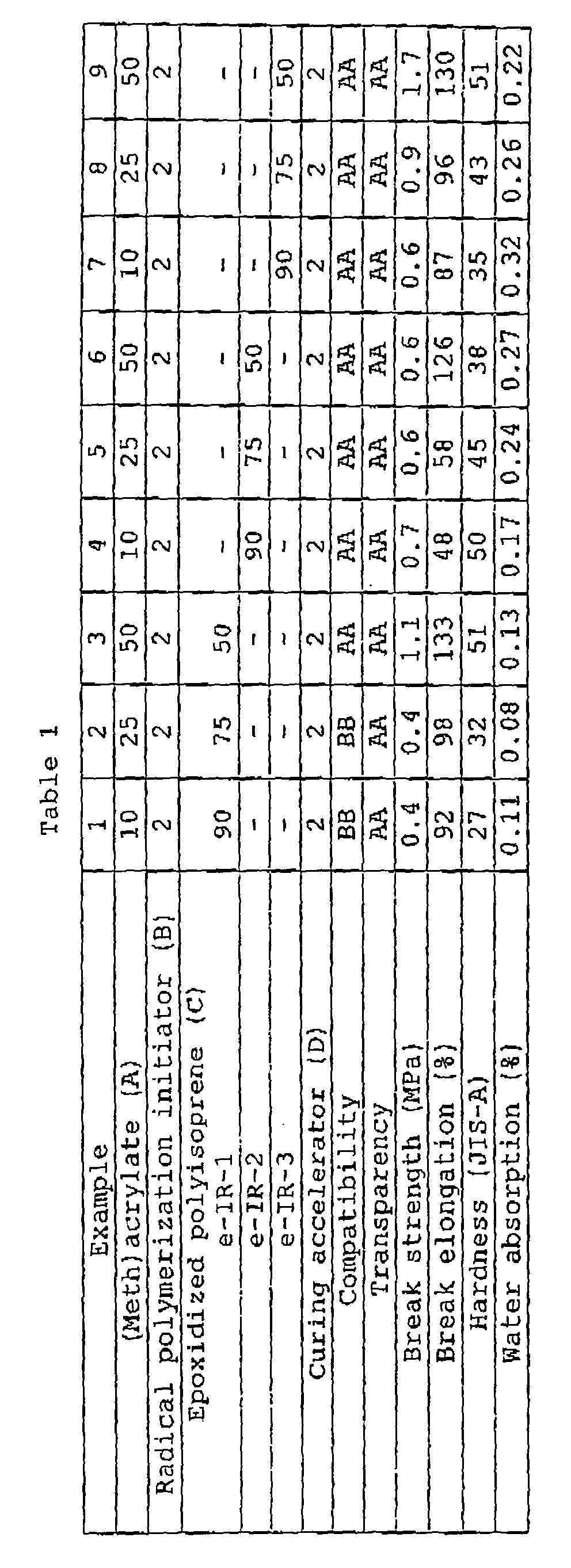
- the (meth)acrylate (A), the radical polymerization initiator (B), e-IR-1 obtained in Reference Example 1, and the curing accelerator (D) were added to a vessel according to the formulation shown in Table 1. They were mixed with a mixing blade at room temperature for 20 minutes to give a curable composition. The curable compositions were evaluated for properties by the aforementioned methods. The results are shown in Table 1.
- the curable composition of the present invention shows high elongation and excellent rubber elasticity even in a cured state and has superior compatibility, transparency, waterproofness and flexibility, so that cracks and separation of cured products are reduced. Accordingly, the composition is suitable for use as adhesives, coating agents, encapsulating materials, inks, sealing materials and the like.
Landscapes
- Chemical & Material Sciences (AREA)
- Organic Chemistry (AREA)
- Health & Medical Sciences (AREA)
- Chemical Kinetics & Catalysis (AREA)
- Medicinal Chemistry (AREA)
- Polymers & Plastics (AREA)
- Physics & Mathematics (AREA)
- General Physics & Mathematics (AREA)
- Spectroscopy & Molecular Physics (AREA)
- Addition Polymer Or Copolymer, Post-Treatments, Or Chemical Modifications (AREA)
- Sealing Material Composition (AREA)
- Macromonomer-Based Addition Polymer (AREA)
- Epoxy Resins (AREA)
- Adhesives Or Adhesive Processes (AREA)
- Structures Or Materials For Encapsulating Or Coating Semiconductor Devices Or Solid State Devices (AREA)
- Glass Compositions (AREA)
- Confectionery (AREA)
- Heterocyclic Carbon Compounds Containing A Hetero Ring Having Oxygen Or Sulfur (AREA)
- Paints Or Removers (AREA)
Abstract
Description
| Comparative Example | 1 | 2 | 3 |
| (Meth)acrylate (A) | 10 | 25 | 50 |
| Radical polymerization initiator (B) | 2 | 2 | 2 |
| Epoxidized polybutadiene | 90 | 75 | 50 |
| Curing accelerator (D) | 2 | 2 | 2 |
| Compatibility | AA | AA | AA |
| Transparency | AA | AA | AA |
| Break strength (MPa) | 17 | 16 | 23 |
| Break elongation (%) | 10 | 11 | 25 |
| Hardness (JIS-A) | 98 | 98 | 81 |
| Water absorption (%) | 0.50 | 0.41 | 0.44 |
Claims (2)
- A curable composition comprising (A) a (meth)acrylate, (B) a radical polymerization initiator, (C) an epoxidized polyisoprene containing an epoxy group at 0.15 to 2.5 meq/g in the molecule and having a number-average molecular weight of 15000 to 200000, and (D) a curing accelerator.
- The curable composition according to claim 1, wherein the curing accelerator (D) is at least one compound selected from the group consisting of acid anhydrides, basic compounds and cationic photopolymerization initiators.
Applications Claiming Priority (5)
| Application Number | Priority Date | Filing Date | Title |
|---|---|---|---|
| JP2003054354 | 2003-02-28 | ||
| JP2003054354 | 2003-02-28 | ||
| JP2003107892 | 2003-04-11 | ||
| JP2003107892 | 2003-04-11 | ||
| PCT/JP2004/001708 WO2004076558A1 (en) | 2003-02-28 | 2004-02-17 | Curable composition |
Publications (3)
| Publication Number | Publication Date |
|---|---|
| EP1598398A1 true EP1598398A1 (en) | 2005-11-23 |
| EP1598398A4 EP1598398A4 (en) | 2006-03-29 |
| EP1598398B1 EP1598398B1 (en) | 2007-05-09 |
Family
ID=32929672
Family Applications (1)
| Application Number | Title | Priority Date | Filing Date |
|---|---|---|---|
| EP04711746A Expired - Lifetime EP1598398B1 (en) | 2003-02-28 | 2004-02-17 | Curable composition |
Country Status (9)
| Country | Link |
|---|---|
| US (1) | US8013075B2 (en) |
| EP (1) | EP1598398B1 (en) |
| JP (1) | JP4489698B2 (en) |
| KR (1) | KR100653149B1 (en) |
| CN (1) | CN1333011C (en) |
| AT (1) | ATE361948T1 (en) |
| CA (1) | CA2515716C (en) |
| DE (1) | DE602004006385T2 (en) |
| WO (1) | WO2004076558A1 (en) |
Families Citing this family (9)
| Publication number | Priority date | Publication date | Assignee | Title |
|---|---|---|---|---|
| CN101219493B (en) * | 2007-09-30 | 2010-09-29 | 林其添 | Method for manufacturing skiving knife |
| KR101034479B1 (en) * | 2008-07-07 | 2011-05-17 | 도레이첨단소재 주식회사 | Thin Film Transistor Liquid Crystal Display Optical Sheet for Backlight Unit and Thin Film Transistor Liquid Crystal Display |
| JP5925123B2 (en) * | 2010-07-30 | 2016-05-25 | デンカ株式会社 | Curable resin composition |
| WO2015172163A1 (en) * | 2014-04-25 | 2015-11-12 | Uni-Pixel Displays, Inc. | Radiation-curable optically clear coating composition for touch sensors |
| WO2016007239A1 (en) * | 2014-04-25 | 2016-01-14 | Uni-Pixel Displays, Inc. | Radiation-curable hard-coat composition |
| WO2015166657A1 (en) * | 2014-05-02 | 2015-11-05 | 三井化学株式会社 | Sealing material and cured product thereof |
| JP2017126595A (en) * | 2016-01-12 | 2017-07-20 | ポリマテック・ジャパン株式会社 | SEALING MATERIAL AND SEALING MATERIAL COMPOSITION |
| KR20180137748A (en) * | 2017-06-19 | 2018-12-28 | 동우 화인켐 주식회사 | Method for Manufacturing Flexible Display Device Comprising Touch Sensor |
| EP4341354A4 (en) * | 2021-05-21 | 2025-02-19 | Henkel AG & Co. KGaA | CURABLE COMPOSITION AND USE THEREOF |
Family Cites Families (17)
| Publication number | Priority date | Publication date | Assignee | Title |
|---|---|---|---|---|
| BE618066A (en) * | 1961-06-01 | |||
| JPS6142504A (en) | 1984-08-03 | 1986-03-01 | Kuraray Co Ltd | Production of epoxidized polymer |
| JPS6151024A (en) | 1984-08-20 | 1986-03-13 | Nippon Soda Co Ltd | Photocurable sealing resin composition |
| JPH0788411B2 (en) | 1987-07-07 | 1995-09-27 | 出光石油化学株式会社 | Liquid polyisoprene hydride and method for producing the same |
| US5358981A (en) * | 1992-12-07 | 1994-10-25 | Shell Oil Company | Solvent-free water-based emulsions of anionically polymerized polymers |
| US5536772A (en) * | 1993-06-18 | 1996-07-16 | Shell Oil Company | Radiation cured conjugated diene block copolymer compositions |
| USH1517H (en) * | 1993-07-12 | 1996-02-06 | Shell Oil Company | Radiation curable printing ink composition |
| US6525142B1 (en) * | 1994-10-11 | 2003-02-25 | Kraton Polymers U.S. Llc | Monohydroxylated diene polymers and epoxidized derivatives thereof |
| JP3522363B2 (en) | 1994-11-11 | 2004-04-26 | ダイセル化学工業株式会社 | Method for producing polyisoprene epoxide |
| WO1998022546A1 (en) * | 1995-05-19 | 1998-05-28 | Daicel Chemical Industries, Ltd. | Resin compositions for coating |
| CN1135239C (en) * | 1995-12-14 | 2004-01-21 | 大赛璐化学工业株式会社 | Thermoplastic resin composition |
| US5922467A (en) * | 1996-10-15 | 1999-07-13 | Shell Oil Company | Method for coating crosslinkable epoxidized monohydroxylated diene polymer coating compositions on primed substrates |
| JPH1180681A (en) * | 1997-09-09 | 1999-03-26 | Sekisui Chem Co Ltd | Foam adhesive tape |
| JPH11214813A (en) | 1998-01-28 | 1999-08-06 | Toppan Printing Co Ltd | Insulating resin composition for multilayer printed wiring boards |
| JP3511129B2 (en) * | 1998-09-28 | 2004-03-29 | 日立化成工業株式会社 | Resin paste composition and semiconductor device using the same |
| WO2001029134A1 (en) * | 1999-10-18 | 2001-04-26 | Kraton Polymers Research B.V | Formulation for strippable adhesive and coating films and high performance adhesives |
| JP3686370B2 (en) | 2000-12-21 | 2005-08-24 | 株式会社クラレ | Method for producing epoxidized polymer |
-
2004
- 2004-02-17 CN CNB2004800049972A patent/CN1333011C/en not_active Expired - Fee Related
- 2004-02-17 EP EP04711746A patent/EP1598398B1/en not_active Expired - Lifetime
- 2004-02-17 CA CA002515716A patent/CA2515716C/en not_active Expired - Fee Related
- 2004-02-17 WO PCT/JP2004/001708 patent/WO2004076558A1/en not_active Ceased
- 2004-02-17 AT AT04711746T patent/ATE361948T1/en not_active IP Right Cessation
- 2004-02-17 KR KR1020057015700A patent/KR100653149B1/en not_active Expired - Fee Related
- 2004-02-17 JP JP2005502836A patent/JP4489698B2/en not_active Expired - Fee Related
- 2004-02-17 US US10/545,807 patent/US8013075B2/en not_active Expired - Fee Related
- 2004-02-17 DE DE602004006385T patent/DE602004006385T2/en not_active Expired - Lifetime
Also Published As
| Publication number | Publication date |
|---|---|
| KR100653149B1 (en) | 2006-12-04 |
| JP4489698B2 (en) | 2010-06-23 |
| JPWO2004076558A1 (en) | 2006-06-08 |
| US8013075B2 (en) | 2011-09-06 |
| EP1598398B1 (en) | 2007-05-09 |
| EP1598398A4 (en) | 2006-03-29 |
| WO2004076558A1 (en) | 2004-09-10 |
| ATE361948T1 (en) | 2007-06-15 |
| CA2515716A1 (en) | 2004-09-10 |
| DE602004006385T2 (en) | 2008-01-10 |
| KR20050107590A (en) | 2005-11-14 |
| CN1333011C (en) | 2007-08-22 |
| CN1753947A (en) | 2006-03-29 |
| US20060194923A1 (en) | 2006-08-31 |
| DE602004006385D1 (en) | 2007-06-21 |
| CA2515716C (en) | 2008-01-08 |
Similar Documents
| Publication | Publication Date | Title |
|---|---|---|
| JP2679586B2 (en) | Active energy ray-curable composition | |
| JP7368348B2 (en) | Resin composition, sealing sheet and sealing body | |
| US7632895B2 (en) | Curable resin composition | |
| CN103525315B (en) | For the adhesive composition of polarization plates, the polarization plates using it and optical element | |
| CN101151726A (en) | Radiation Curable Cycloaliphatic Barrier Sealants | |
| TW201630941A (en) | Modified liquid diene rubber, and resin composition containing said modified liquid diene rubber | |
| CN1599770A (en) | Heat-curable resin composition | |
| US8013075B2 (en) | Curable composition | |
| JP4553572B2 (en) | UV curable adhesive and its adhesive | |
| CN1160413A (en) | Epoxidized monohydroxylated rubber toughening modifier for epoxy resin | |
| WO2017094854A1 (en) | Delayed-curing photocurable resin composition, and sealing material | |
| JP2008305580A (en) | Photo-curable composition, organic electroluminescent device sealing agent, organic electroluminescent display device manufacturing method, and organic electroluminescent display device | |
| CN116981715A (en) | Photocurable adhesive or sealant composition | |
| JP2005213337A (en) | Epoxy resin composition | |
| JP2004161818A (en) | Adhesive composition | |
| JP2003301027A (en) | Photocurable resin composition | |
| JP2013184999A (en) | Curable resin composition for screen printing, and printed wiring board with electrically insulated film formed from the curable resin composition for screen printing | |
| JPH09194573A (en) | Active energy radiation curing-type composition | |
| KR102146536B1 (en) | Pressure-sensitive adhesive composition | |
| CN1753928A (en) | Curable resin composition | |
| JP2006274148A (en) | Photocurable resin composition and prepreg | |
| JP2003183349A (en) | New oligomer-containing epoxy compound, and epoxy resin composition made of it, curable by activating radiation | |
| KR20180021583A (en) | Pressure-sensitive adhesive composition | |
| JP2004161817A (en) | Adhesive composition | |
| KR20180026237A (en) | Pressure-sensitive adhesive composition |
Legal Events
| Date | Code | Title | Description |
|---|---|---|---|
| PUAI | Public reference made under article 153(3) epc to a published international application that has entered the european phase |
Free format text: ORIGINAL CODE: 0009012 |
|
| AK | Designated contracting states |
Kind code of ref document: A1 Designated state(s): AT BE BG CH CY CZ DE DK EE ES FI FR GB GR HU IE IT LI LU MC NL PT RO SE SI SK TR |
|
| AX | Request for extension of the european patent |
Extension state: AL LT LV MK |
|
| 17P | Request for examination filed |
Effective date: 20050916 |
|
| A4 | Supplementary search report drawn up and despatched |
Effective date: 20060215 |
|
| RIC1 | Information provided on ipc code assigned before grant |
Ipc: C09J 163/08 20060101ALI20060209BHEP Ipc: C08L 63/08 20060101AFI20040915BHEP |
|
| DAX | Request for extension of the european patent (deleted) | ||
| GRAP | Despatch of communication of intention to grant a patent |
Free format text: ORIGINAL CODE: EPIDOSNIGR1 |
|
| GRAS | Grant fee paid |
Free format text: ORIGINAL CODE: EPIDOSNIGR3 |
|
| GRAA | (expected) grant |
Free format text: ORIGINAL CODE: 0009210 |
|
| AK | Designated contracting states |
Kind code of ref document: B1 Designated state(s): AT BE BG CH CY CZ DE DK EE ES FI FR GB GR HU IE IT LI LU MC NL PT RO SE SI SK TR |
|
| PG25 | Lapsed in a contracting state [announced via postgrant information from national office to epo] |
Ref country code: FI Free format text: LAPSE BECAUSE OF FAILURE TO SUBMIT A TRANSLATION OF THE DESCRIPTION OR TO PAY THE FEE WITHIN THE PRESCRIBED TIME-LIMIT Effective date: 20070509 Ref country code: CH Free format text: LAPSE BECAUSE OF FAILURE TO SUBMIT A TRANSLATION OF THE DESCRIPTION OR TO PAY THE FEE WITHIN THE PRESCRIBED TIME-LIMIT Effective date: 20070509 Ref country code: LI Free format text: LAPSE BECAUSE OF FAILURE TO SUBMIT A TRANSLATION OF THE DESCRIPTION OR TO PAY THE FEE WITHIN THE PRESCRIBED TIME-LIMIT Effective date: 20070509 |
|
| REG | Reference to a national code |
Ref country code: GB Ref legal event code: FG4D |
|
| REG | Reference to a national code |
Ref country code: CH Ref legal event code: EP |
|
| REG | Reference to a national code |
Ref country code: IE Ref legal event code: FG4D |
|
| REF | Corresponds to: |
Ref document number: 602004006385 Country of ref document: DE Date of ref document: 20070621 Kind code of ref document: P |
|
| PG25 | Lapsed in a contracting state [announced via postgrant information from national office to epo] |
Ref country code: SE Free format text: LAPSE BECAUSE OF FAILURE TO SUBMIT A TRANSLATION OF THE DESCRIPTION OR TO PAY THE FEE WITHIN THE PRESCRIBED TIME-LIMIT Effective date: 20070809 |
|
| PG25 | Lapsed in a contracting state [announced via postgrant information from national office to epo] |
Ref country code: ES Free format text: LAPSE BECAUSE OF FAILURE TO SUBMIT A TRANSLATION OF THE DESCRIPTION OR TO PAY THE FEE WITHIN THE PRESCRIBED TIME-LIMIT Effective date: 20070820 |
|
| NLV1 | Nl: lapsed or annulled due to failure to fulfill the requirements of art. 29p and 29m of the patents act | ||
| ET | Fr: translation filed | ||
| REG | Reference to a national code |
Ref country code: CH Ref legal event code: PL |
|
| PG25 | Lapsed in a contracting state [announced via postgrant information from national office to epo] |
Ref country code: AT Free format text: LAPSE BECAUSE OF FAILURE TO SUBMIT A TRANSLATION OF THE DESCRIPTION OR TO PAY THE FEE WITHIN THE PRESCRIBED TIME-LIMIT Effective date: 20070509 |
|
| PG25 | Lapsed in a contracting state [announced via postgrant information from national office to epo] |
Ref country code: BE Free format text: LAPSE BECAUSE OF FAILURE TO SUBMIT A TRANSLATION OF THE DESCRIPTION OR TO PAY THE FEE WITHIN THE PRESCRIBED TIME-LIMIT Effective date: 20070509 |
|
| PG25 | Lapsed in a contracting state [announced via postgrant information from national office to epo] |
Ref country code: SI Free format text: LAPSE BECAUSE OF FAILURE TO SUBMIT A TRANSLATION OF THE DESCRIPTION OR TO PAY THE FEE WITHIN THE PRESCRIBED TIME-LIMIT Effective date: 20070509 Ref country code: CZ Free format text: LAPSE BECAUSE OF FAILURE TO SUBMIT A TRANSLATION OF THE DESCRIPTION OR TO PAY THE FEE WITHIN THE PRESCRIBED TIME-LIMIT Effective date: 20070509 Ref country code: PT Free format text: LAPSE BECAUSE OF FAILURE TO SUBMIT A TRANSLATION OF THE DESCRIPTION OR TO PAY THE FEE WITHIN THE PRESCRIBED TIME-LIMIT Effective date: 20071009 Ref country code: NL Free format text: LAPSE BECAUSE OF FAILURE TO SUBMIT A TRANSLATION OF THE DESCRIPTION OR TO PAY THE FEE WITHIN THE PRESCRIBED TIME-LIMIT Effective date: 20070509 Ref country code: DK Free format text: LAPSE BECAUSE OF FAILURE TO SUBMIT A TRANSLATION OF THE DESCRIPTION OR TO PAY THE FEE WITHIN THE PRESCRIBED TIME-LIMIT Effective date: 20070509 Ref country code: BG Free format text: LAPSE BECAUSE OF FAILURE TO SUBMIT A TRANSLATION OF THE DESCRIPTION OR TO PAY THE FEE WITHIN THE PRESCRIBED TIME-LIMIT Effective date: 20070809 |
|
| PG25 | Lapsed in a contracting state [announced via postgrant information from national office to epo] |
Ref country code: SK Free format text: LAPSE BECAUSE OF FAILURE TO SUBMIT A TRANSLATION OF THE DESCRIPTION OR TO PAY THE FEE WITHIN THE PRESCRIBED TIME-LIMIT Effective date: 20070509 |
|
| PLBE | No opposition filed within time limit |
Free format text: ORIGINAL CODE: 0009261 |
|
| STAA | Information on the status of an ep patent application or granted ep patent |
Free format text: STATUS: NO OPPOSITION FILED WITHIN TIME LIMIT |
|
| 26N | No opposition filed |
Effective date: 20080212 |
|
| PG25 | Lapsed in a contracting state [announced via postgrant information from national office to epo] |
Ref country code: GR Free format text: LAPSE BECAUSE OF FAILURE TO SUBMIT A TRANSLATION OF THE DESCRIPTION OR TO PAY THE FEE WITHIN THE PRESCRIBED TIME-LIMIT Effective date: 20070810 |
|
| PG25 | Lapsed in a contracting state [announced via postgrant information from national office to epo] |
Ref country code: RO Free format text: LAPSE BECAUSE OF FAILURE TO SUBMIT A TRANSLATION OF THE DESCRIPTION OR TO PAY THE FEE WITHIN THE PRESCRIBED TIME-LIMIT Effective date: 20070509 |
|
| PG25 | Lapsed in a contracting state [announced via postgrant information from national office to epo] |
Ref country code: MC Free format text: LAPSE BECAUSE OF NON-PAYMENT OF DUE FEES Effective date: 20080228 |
|
| PG25 | Lapsed in a contracting state [announced via postgrant information from national office to epo] |
Ref country code: EE Free format text: LAPSE BECAUSE OF FAILURE TO SUBMIT A TRANSLATION OF THE DESCRIPTION OR TO PAY THE FEE WITHIN THE PRESCRIBED TIME-LIMIT Effective date: 20070509 Ref country code: IE Free format text: LAPSE BECAUSE OF NON-PAYMENT OF DUE FEES Effective date: 20080218 |
|
| PG25 | Lapsed in a contracting state [announced via postgrant information from national office to epo] |
Ref country code: CY Free format text: LAPSE BECAUSE OF FAILURE TO SUBMIT A TRANSLATION OF THE DESCRIPTION OR TO PAY THE FEE WITHIN THE PRESCRIBED TIME-LIMIT Effective date: 20070509 |
|
| PG25 | Lapsed in a contracting state [announced via postgrant information from national office to epo] |
Ref country code: HU Free format text: LAPSE BECAUSE OF FAILURE TO SUBMIT A TRANSLATION OF THE DESCRIPTION OR TO PAY THE FEE WITHIN THE PRESCRIBED TIME-LIMIT Effective date: 20071110 Ref country code: LU Free format text: LAPSE BECAUSE OF NON-PAYMENT OF DUE FEES Effective date: 20080217 |
|
| PG25 | Lapsed in a contracting state [announced via postgrant information from national office to epo] |
Ref country code: TR Free format text: LAPSE BECAUSE OF FAILURE TO SUBMIT A TRANSLATION OF THE DESCRIPTION OR TO PAY THE FEE WITHIN THE PRESCRIBED TIME-LIMIT Effective date: 20070509 |
|
| REG | Reference to a national code |
Ref country code: FR Ref legal event code: PLFP Year of fee payment: 13 |
|
| REG | Reference to a national code |
Ref country code: FR Ref legal event code: PLFP Year of fee payment: 14 |
|
| REG | Reference to a national code |
Ref country code: FR Ref legal event code: PLFP Year of fee payment: 15 |
|
| PGFP | Annual fee paid to national office [announced via postgrant information from national office to epo] |
Ref country code: IT Payment date: 20210112 Year of fee payment: 18 Ref country code: FR Payment date: 20210112 Year of fee payment: 18 |
|
| PGFP | Annual fee paid to national office [announced via postgrant information from national office to epo] |
Ref country code: GB Payment date: 20210210 Year of fee payment: 18 Ref country code: DE Payment date: 20210202 Year of fee payment: 18 |
|
| REG | Reference to a national code |
Ref country code: DE Ref legal event code: R119 Ref document number: 602004006385 Country of ref document: DE |
|
| GBPC | Gb: european patent ceased through non-payment of renewal fee |
Effective date: 20220217 |
|
| PG25 | Lapsed in a contracting state [announced via postgrant information from national office to epo] |
Ref country code: FR Free format text: LAPSE BECAUSE OF NON-PAYMENT OF DUE FEES Effective date: 20220228 |
|
| PG25 | Lapsed in a contracting state [announced via postgrant information from national office to epo] |
Ref country code: GB Free format text: LAPSE BECAUSE OF NON-PAYMENT OF DUE FEES Effective date: 20220217 Ref country code: DE Free format text: LAPSE BECAUSE OF NON-PAYMENT OF DUE FEES Effective date: 20220901 |
|
| PG25 | Lapsed in a contracting state [announced via postgrant information from national office to epo] |
Ref country code: IT Free format text: LAPSE BECAUSE OF NON-PAYMENT OF DUE FEES Effective date: 20220217 |