EP1597201B1 - Verfahren zur herstellung von titanoxid - Google Patents
Verfahren zur herstellung von titanoxid Download PDFInfo
- Publication number
- EP1597201B1 EP1597201B1 EP04713732A EP04713732A EP1597201B1 EP 1597201 B1 EP1597201 B1 EP 1597201B1 EP 04713732 A EP04713732 A EP 04713732A EP 04713732 A EP04713732 A EP 04713732A EP 1597201 B1 EP1597201 B1 EP 1597201B1
- Authority
- EP
- European Patent Office
- Prior art keywords
- tail gas
- analyzer
- line
- chlorinator
- burner
- Prior art date
- Legal status (The legal status is an assumption and is not a legal conclusion. Google has not performed a legal analysis and makes no representation as to the accuracy of the status listed.)
- Expired - Lifetime
Links
- GWEVSGVZZGPLCZ-UHFFFAOYSA-N Titan oxide Chemical compound O=[Ti]=O GWEVSGVZZGPLCZ-UHFFFAOYSA-N 0.000 title claims abstract description 51
- 238000000034 method Methods 0.000 title claims abstract description 32
- 239000004408 titanium dioxide Substances 0.000 title claims abstract description 25
- 230000001143 conditioned effect Effects 0.000 claims abstract description 13
- 239000011491 glass wool Substances 0.000 claims abstract description 12
- 239000000126 substance Substances 0.000 claims abstract description 7
- 239000007789 gas Substances 0.000 claims description 106
- ZAMOUSCENKQFHK-UHFFFAOYSA-N Chlorine atom Chemical compound [Cl] ZAMOUSCENKQFHK-UHFFFAOYSA-N 0.000 claims description 40
- 239000000460 chlorine Substances 0.000 claims description 40
- 229910052801 chlorine Inorganic materials 0.000 claims description 39
- QVGXLLKOCUKJST-UHFFFAOYSA-N atomic oxygen Chemical compound [O] QVGXLLKOCUKJST-UHFFFAOYSA-N 0.000 claims description 32
- 239000001301 oxygen Substances 0.000 claims description 32
- 229910052760 oxygen Inorganic materials 0.000 claims description 32
- VEXZGXHMUGYJMC-UHFFFAOYSA-N Hydrochloric acid Chemical compound Cl VEXZGXHMUGYJMC-UHFFFAOYSA-N 0.000 claims description 22
- 229910000041 hydrogen chloride Inorganic materials 0.000 claims description 22
- IXCSERBJSXMMFS-UHFFFAOYSA-N hydrogen chloride Substances Cl.Cl IXCSERBJSXMMFS-UHFFFAOYSA-N 0.000 claims description 22
- XJDNKRIXUMDJCW-UHFFFAOYSA-J titanium tetrachloride Chemical compound Cl[Ti](Cl)(Cl)Cl XJDNKRIXUMDJCW-UHFFFAOYSA-J 0.000 claims description 15
- 239000002245 particle Substances 0.000 claims description 8
- 230000005298 paramagnetic effect Effects 0.000 claims description 2
- 230000008016 vaporization Effects 0.000 claims description 2
- 230000003750 conditioning effect Effects 0.000 abstract description 12
- VEXZGXHMUGYJMC-UHFFFAOYSA-M Chloride anion Chemical compound [Cl-] VEXZGXHMUGYJMC-UHFFFAOYSA-M 0.000 abstract description 9
- IJGRMHOSHXDMSA-UHFFFAOYSA-N Atomic nitrogen Chemical compound N#N IJGRMHOSHXDMSA-UHFFFAOYSA-N 0.000 description 24
- 238000004458 analytical method Methods 0.000 description 14
- 229910052757 nitrogen Inorganic materials 0.000 description 12
- 238000010926 purge Methods 0.000 description 12
- 230000000052 comparative effect Effects 0.000 description 10
- 229920001774 Perfluoroether Polymers 0.000 description 9
- 238000005070 sampling Methods 0.000 description 6
- CURLTUGMZLYLDI-UHFFFAOYSA-N Carbon dioxide Chemical compound O=C=O CURLTUGMZLYLDI-UHFFFAOYSA-N 0.000 description 4
- 239000011152 fibreglass Substances 0.000 description 4
- 239000010802 sludge Substances 0.000 description 4
- UGFAIRIUMAVXCW-UHFFFAOYSA-N Carbon monoxide Chemical compound [O+]#[C-] UGFAIRIUMAVXCW-UHFFFAOYSA-N 0.000 description 3
- 229910002091 carbon monoxide Inorganic materials 0.000 description 3
- 239000007787 solid Substances 0.000 description 3
- OKTJSMMVPCPJKN-UHFFFAOYSA-N Carbon Chemical compound [C] OKTJSMMVPCPJKN-UHFFFAOYSA-N 0.000 description 2
- KZBUYRJDOAKODT-UHFFFAOYSA-N Chlorine Chemical compound ClCl KZBUYRJDOAKODT-UHFFFAOYSA-N 0.000 description 2
- ATUOYWHBWRKTHZ-UHFFFAOYSA-N Propane Chemical compound CCC ATUOYWHBWRKTHZ-UHFFFAOYSA-N 0.000 description 2
- 230000015572 biosynthetic process Effects 0.000 description 2
- 229910052799 carbon Inorganic materials 0.000 description 2
- 229910002092 carbon dioxide Inorganic materials 0.000 description 2
- 239000001569 carbon dioxide Substances 0.000 description 2
- 239000000428 dust Substances 0.000 description 2
- 238000001914 filtration Methods 0.000 description 2
- 239000000446 fuel Substances 0.000 description 2
- 239000012535 impurity Substances 0.000 description 2
- 239000000049 pigment Substances 0.000 description 2
- 238000004886 process control Methods 0.000 description 2
- RZVAJINKPMORJF-UHFFFAOYSA-N Acetaminophen Chemical compound CC(=O)NC1=CC=C(O)C=C1 RZVAJINKPMORJF-UHFFFAOYSA-N 0.000 description 1
- MYMOFIZGZYHOMD-UHFFFAOYSA-N Dioxygen Chemical compound O=O MYMOFIZGZYHOMD-UHFFFAOYSA-N 0.000 description 1
- RTAQQCXQSZGOHL-UHFFFAOYSA-N Titanium Chemical compound [Ti] RTAQQCXQSZGOHL-UHFFFAOYSA-N 0.000 description 1
- 239000000443 aerosol Substances 0.000 description 1
- 239000011230 binding agent Substances 0.000 description 1
- 239000005388 borosilicate glass Substances 0.000 description 1
- NHYCGSASNAIGLD-UHFFFAOYSA-N chlorine monoxide Inorganic materials Cl[O] NHYCGSASNAIGLD-UHFFFAOYSA-N 0.000 description 1
- 239000000571 coke Substances 0.000 description 1
- 238000009833 condensation Methods 0.000 description 1
- 230000005494 condensation Effects 0.000 description 1
- 230000008021 deposition Effects 0.000 description 1
- 238000010586 diagram Methods 0.000 description 1
- 229910001873 dinitrogen Inorganic materials 0.000 description 1
- 238000004821 distillation Methods 0.000 description 1
- 238000005516 engineering process Methods 0.000 description 1
- 239000000835 fiber Substances 0.000 description 1
- NBVXSUQYWXRMNV-UHFFFAOYSA-N fluoromethane Chemical compound FC NBVXSUQYWXRMNV-UHFFFAOYSA-N 0.000 description 1
- 239000011521 glass Substances 0.000 description 1
- 238000010438 heat treatment Methods 0.000 description 1
- 238000005259 measurement Methods 0.000 description 1
- 150000002829 nitrogen Chemical class 0.000 description 1
- 239000003973 paint Substances 0.000 description 1
- 238000005375 photometry Methods 0.000 description 1
- 239000001294 propane Substances 0.000 description 1
- 239000005297 pyrex Substances 0.000 description 1
- 238000004381 surface treatment Methods 0.000 description 1
- 229910052719 titanium Inorganic materials 0.000 description 1
- 239000010936 titanium Substances 0.000 description 1
- 238000004448 titration Methods 0.000 description 1
Images


Classifications
-
- C—CHEMISTRY; METALLURGY
- C01—INORGANIC CHEMISTRY
- C01G—COMPOUNDS CONTAINING METALS NOT COVERED BY SUBCLASSES C01D OR C01F
- C01G23/00—Compounds of titanium
- C01G23/04—Oxides; Hydroxides
- C01G23/047—Titanium dioxide
- C01G23/07—Producing by vapour phase processes, e.g. halide oxidation
-
- C—CHEMISTRY; METALLURGY
- C01—INORGANIC CHEMISTRY
- C01G—COMPOUNDS CONTAINING METALS NOT COVERED BY SUBCLASSES C01D OR C01F
- C01G23/00—Compounds of titanium
- C01G23/04—Oxides; Hydroxides
- C01G23/047—Titanium dioxide
-
- C—CHEMISTRY; METALLURGY
- C22—METALLURGY; FERROUS OR NON-FERROUS ALLOYS; TREATMENT OF ALLOYS OR NON-FERROUS METALS
- C22B—PRODUCTION AND REFINING OF METALS; PRETREATMENT OF RAW MATERIALS
- C22B34/00—Obtaining refractory metals
- C22B34/10—Obtaining titanium, zirconium or hafnium
- C22B34/12—Obtaining titanium or titanium compounds from ores or scrap by metallurgical processing; preparation of titanium compounds from other titanium compounds see C01G23/00 - C01G23/08
- C22B34/1218—Obtaining titanium or titanium compounds from ores or scrap by metallurgical processing; preparation of titanium compounds from other titanium compounds see C01G23/00 - C01G23/08 obtaining titanium or titanium compounds from ores or scrap by dry processes
- C22B34/1222—Obtaining titanium or titanium compounds from ores or scrap by metallurgical processing; preparation of titanium compounds from other titanium compounds see C01G23/00 - C01G23/08 obtaining titanium or titanium compounds from ores or scrap by dry processes using a halogen containing agent
-
- C—CHEMISTRY; METALLURGY
- C22—METALLURGY; FERROUS OR NON-FERROUS ALLOYS; TREATMENT OF ALLOYS OR NON-FERROUS METALS
- C22B—PRODUCTION AND REFINING OF METALS; PRETREATMENT OF RAW MATERIALS
- C22B34/00—Obtaining refractory metals
- C22B34/10—Obtaining titanium, zirconium or hafnium
- C22B34/12—Obtaining titanium or titanium compounds from ores or scrap by metallurgical processing; preparation of titanium compounds from other titanium compounds see C01G23/00 - C01G23/08
- C22B34/1218—Obtaining titanium or titanium compounds from ores or scrap by metallurgical processing; preparation of titanium compounds from other titanium compounds see C01G23/00 - C01G23/08 obtaining titanium or titanium compounds from ores or scrap by dry processes
- C22B34/1227—Obtaining titanium or titanium compounds from ores or scrap by metallurgical processing; preparation of titanium compounds from other titanium compounds see C01G23/00 - C01G23/08 obtaining titanium or titanium compounds from ores or scrap by dry processes using an oxygen containing agent
-
- C—CHEMISTRY; METALLURGY
- C22—METALLURGY; FERROUS OR NON-FERROUS ALLOYS; TREATMENT OF ALLOYS OR NON-FERROUS METALS
- C22B—PRODUCTION AND REFINING OF METALS; PRETREATMENT OF RAW MATERIALS
- C22B34/00—Obtaining refractory metals
- C22B34/10—Obtaining titanium, zirconium or hafnium
- C22B34/12—Obtaining titanium or titanium compounds from ores or scrap by metallurgical processing; preparation of titanium compounds from other titanium compounds see C01G23/00 - C01G23/08
- C22B34/1218—Obtaining titanium or titanium compounds from ores or scrap by metallurgical processing; preparation of titanium compounds from other titanium compounds see C01G23/00 - C01G23/08 obtaining titanium or titanium compounds from ores or scrap by dry processes
- C22B34/1231—Obtaining titanium or titanium compounds from ores or scrap by metallurgical processing; preparation of titanium compounds from other titanium compounds see C01G23/00 - C01G23/08 obtaining titanium or titanium compounds from ores or scrap by dry processes treatment or purification of titanium containing products obtained by dry processes, e.g. condensation
-
- G—PHYSICS
- G01—MEASURING; TESTING
- G01N—INVESTIGATING OR ANALYSING MATERIALS BY DETERMINING THEIR CHEMICAL OR PHYSICAL PROPERTIES
- G01N21/00—Investigating or analysing materials by the use of optical means, i.e. using sub-millimetre waves, infrared, visible or ultraviolet light
- G01N21/17—Systems in which incident light is modified in accordance with the properties of the material investigated
- G01N21/25—Colour; Spectral properties, i.e. comparison of effect of material on the light at two or more different wavelengths or wavelength bands
- G01N21/31—Investigating relative effect of material at wavelengths characteristic of specific elements or molecules, e.g. atomic absorption spectrometry
- G01N21/33—Investigating relative effect of material at wavelengths characteristic of specific elements or molecules, e.g. atomic absorption spectrometry using ultraviolet light
-
- G—PHYSICS
- G01—MEASURING; TESTING
- G01N—INVESTIGATING OR ANALYSING MATERIALS BY DETERMINING THEIR CHEMICAL OR PHYSICAL PROPERTIES
- G01N21/00—Investigating or analysing materials by the use of optical means, i.e. using sub-millimetre waves, infrared, visible or ultraviolet light
- G01N21/17—Systems in which incident light is modified in accordance with the properties of the material investigated
- G01N21/25—Colour; Spectral properties, i.e. comparison of effect of material on the light at two or more different wavelengths or wavelength bands
- G01N21/31—Investigating relative effect of material at wavelengths characteristic of specific elements or molecules, e.g. atomic absorption spectrometry
- G01N21/35—Investigating relative effect of material at wavelengths characteristic of specific elements or molecules, e.g. atomic absorption spectrometry using infrared light
- G01N21/3504—Investigating relative effect of material at wavelengths characteristic of specific elements or molecules, e.g. atomic absorption spectrometry using infrared light for analysing gases, e.g. multi-gas analysis
-
- Y—GENERAL TAGGING OF NEW TECHNOLOGICAL DEVELOPMENTS; GENERAL TAGGING OF CROSS-SECTIONAL TECHNOLOGIES SPANNING OVER SEVERAL SECTIONS OF THE IPC; TECHNICAL SUBJECTS COVERED BY FORMER USPC CROSS-REFERENCE ART COLLECTIONS [XRACs] AND DIGESTS
- Y02—TECHNOLOGIES OR APPLICATIONS FOR MITIGATION OR ADAPTATION AGAINST CLIMATE CHANGE
- Y02P—CLIMATE CHANGE MITIGATION TECHNOLOGIES IN THE PRODUCTION OR PROCESSING OF GOODS
- Y02P10/00—Technologies related to metal processing
- Y02P10/20—Recycling
Definitions
- a source of crude titanium dioxide (for example, rutile ore) from hopper 11 is first reacted with chlorine from chlorine tank 12 and carbon (for example, coke) from carbon hopper 13 in a chlorinator 14 to produce a gaseous stream 15 containing primarily titanium tetrachloride, carbon monoxide and carbon dioxide but also dust particles and other impurities.
- the titanium tetrachloride is condensed from stream 15 by condenser 16, purified by distillation, vaporized and then directed to burner 17 where the titanium tetrachloride is reacted with oxygen from oxygen tank 18 to produce a gaseous stream 19 containing primarily particulate titanium dioxide and chlorine gas.
- a support fuel such as propane gas
- propane gas can also be introduced into the burner 17 to increase the temperature in the burner 17.
- the stream 19 is then cooled in cooler 20 and then the particulate titanium dioxide is separated from the chlorine gas by gas/solids separator 21.
- the particulate titanium dioxide is then directed from gas/solids separator 21 to surface treatment tank 22 for further processing.
- the gaseous chlorine stream 25 from the gas/solids separator 21 is directed to a chlorine compressor 26 for recycle to the chlorinator 14.
- the gaseous chlorine stream 25 is commonly called "burner tail gas".
- the carbon monoxide, carbon dioxide, dust and other impurities from the condenser 16, commonly referred to as "chlorinator tail gas" 23 is treated by treatment system 24 to remove undesirable components (such as residual chlorine and carbon monoxide) and then vented.
- the particulate titanium dioxide produced by the chloride process is used, for example, as a pigment in paints.
- a more detailed discussion of the chloride process for producing titanium dioxide can be found in Volume 24 of the Kirk-Othmer Encyclopedia of Chemical Technology (4th Ed., 1997 ) and in Volume I of the Pigment Handbook, Edited by Lewis (2nd Ed., 1988 ).
- chemical analysis of the chlorinator tail gas 23 for residual chlorine allows for more effective control of the chlorinator 14.
- the chlorinator tail gas 23 will contain relatively high levels of chlorine to be treated by treatment system 24. Consequently, in conventional practice samples ,of the chlorinator tail gas are periodically taken to a laboratory and analyzed for chlorine to better control the chlorinator 14.
- chemical analysis of the burner tail gas 25 for oxygen allows for more effective control of the burner 17. For example, if an excessive amount of oxygen is fed to the burner 17, the excessive oxygen is wasted. Samples of the burner tail gas 25 are for this reason also commonly taken to a laboratory and analyzed for oxygen.
- the burner tail gas 25 can also be analyzed for hydrogen chloride since the hydrogen chloride concentration of the burner tail gas 25 is a function of the amount of support fuel used in the burner 17. Frequent sampling and analysis of the chlorinator tail gas 23 and the burner tail gas 25 are desired for close control of the chlorinator 14 and the burner 17. However, manual sampling and analysis of the chlorinator tail gas 23 and the burner tail gas 25 is labor intensive, relatively expensive and limits process control.
- the instant invention provides an affective solution to the above discussed problems.
- the chlorinator tail gas and preferably the burner tail gas are analyzed on-line, thereby providing continuous automated analysis for better process control, with reduced labor requirements and expense associated with sampling and analysis.
- the instant invention provides an improved process for producing titanium dioxide by reacting a titanium dioxyde ore with chlorine to produce a gaseous stream containing titanium tetrachloride, condensing titanium tetrachloride from the gaseous stream containing titanium tetrachloride to produce chlorinator tail gas, vaporizing the condensed titanium tetrachloride, reacting the vaporized titanium tetrachloride with oxygen to produce a gaseous stream containing titanium dioxide particles and chlorine, separating the titanium dioxide particles from the gaseous stream containing titanium dioxide particles and chlorine to produce burner tail gas, and analyzing the chlorinator tail gas for residual chlorine to control the step of reacting the titanium dioxide ore with chlorine,characterized in that the chlorinator tail gas is analyzed for residual chlorine using an on-line chlorine analyzer.
- the burner tail gas is analyzed for oxygen using an on-line oxygene analyzer to control the step of reacting the vaporized titanium tetrachloride with oxygen.
- the instant invention provides a process for conditioning chlorinator tail gas or burner tail gas from the above-mentioned chloride process for making titanium dioxide.
- Components such as particulates and sludge
- This conditioning process includes three steps. The first step is to flow chlorinator tail gas or burner tail gas from a chloride process for making titanium dioxide through a bed of glass wool to produce a primary treated stream.
- the second step is to flow the primary treated stream through a submicron particulate filter to produce a secondary treated stream.
- the third step is to flow the secondary treated stream through a coalescing filter to produce a conditioned gas stream to be directed to an on-line chemical analyzer(s).
- an apparatus 30 for conditioning chlorinator tail gas or burner tail gas from a chloride process for making titanium dioxide.
- the apparatus 30 includes an enclosure 31.(preferably being a NEMA-4 fiberglass enclosure, Hoffman Co., Anoka, Minnesota USA) heated by a thermostated (at one hundred degrees Fahrenheit (38 degrees Celsius)) four hundred watt electric heater 32 (Hoffman Co.). Chlorinator tail gas or burner tail gas is conducted to the apparatus 30 by way of tubing 33 (preferably 0.375 inch (1 cm) outside diameter, 0.060 inch (0.015 cm) wall thickness, heat traced (at about ninety degrees Celsius) perfluoroalkoxy tubing) .
- tubing 33 preferably 0.375 inch (1 cm) outside diameter, 0.060 inch (0.015 cm) wall thickness, heat traced (at about ninety degrees Celsius) perfluoroalkoxy tubing
- the chlorinator tail gas or burner tail gas is then conducted to a one and one half inch (3.8 cm) diameter by fifteen inch (38 cm) long glass column 34 (part number 5820-53 & 5844-78, Ace Glass Co., Vineland, New Jersey USA) by one quarter inch (0.6 cm) diameter perfluoroalkoxy tubing 35 (part number U-06375-75, Cole Parmer, Vernon Hills, Illinois USA) .
- the column 34 is packed with glass wool 36 (preferably, Pyrex Brand glass wool, product number Z25,589-0 from Sigma Aldrich, St. Louis, Missouri USA).
- the chlorinator tail gas or burner tail gas flows through the glass wool 36 to produce a primary treated stream conducted to a submicron filter 37 by way of one quarter inch (0.6 cm) diameter perfluoroalkoxy tubing 38.
- the glass wool 36 removes the larger particulates from the chlorinator tail gas or burner tail gas stream and provides a high surface area for deposition of sludge.
- the submicron filter 37 is a filter that removes particles from the primary treated stream that are smaller than one micron in size (preferably a United Filtration System, Sterling Heights, Michigan USA, borosilicate glass fiber/fluorocarbon binder submicron filter) to produce a secondary treated stream conducted to a coalescing filter 38a by way of one quarter inch (0.6 cm) diameter perfluoroalkoxy tubing 39.
- the secondary treated stream flows through the coalescing filter 38a (preferably a Genie Brand coalescing filter from A+ Corporation of Prairieville, Louisiana USA) to produce a conditioned gas stream that is flowed to a rotameter 40, through metering valve 43, by way of one quarter inch (0.6 cm) diameter perfluoroalkoxy tubing 41.
- the coalescing filter 38a removes aerosol mists that passed through the glass wool 36 and the submicron filter 37.
- the rotameter 40 (preferably part number U-03216-75 from Cole Parmer, Vernon Hills, Illinois USA) is used to measure the flow rate of the conditioned gas stream. A substantial reduction of the flow rate of the conditioned gas stream probably indicates that the glass wool 36 needs to be replaced (or possibly that the submicron filter 37 needs to be replaced).
- the conditioned gas stream is conducted to an on-line analyzer by way of heat traced (at about ninety degrees Celsius) one quarter inch (0.6 cm) diameter perfluoroalkoxy tubing 42.
- Tubing 44 is used to conduct a nitrogen purge stream into the enclosure 31.
- Tubing 45 is used to conduct the nitrogen purge stream from the enclosure 31.
- the heater 32 is most preferably set to control the temperature in the enclosure 31 to be preferably greater than fifty degrees Fahrenheit (10 degrees Celsius).
- the temperature in the enclosure 31 is set to be more than seventy degrees Fahrenheit (21 degrees Celsius).
- the temperature in the enclosure 31 is set to be in the range of from ninety to one hundred and ten degrees Fahrenheit (32 to 43 degrees Celsius). Heating the enclosure 31 (and thus the conditioning process of the instant invention) helps prevent the formation of sludge and significantly increases the service life of the conditioning system (and, of course, the on-line analyzers) and the need to replace plugged tubing and filters.
- the apparatus 30 can also include a differential pressure transducer(s) (not shown) to measure the pressure drop across the column 34, the submicron filter 37 and/or the coalescing filter 38a to better determine if the column 34, the submicron filter 37 or the coalescing filter 38a are becoming plugged and need replacement.
- a tubing tee and shut-off valve (not shown) are installed in the tubing 35 so that the flow of chlorinator tail gas or burner tail gas can be temporarily shut off so that nitrogen gas can be flowed through the apparatus 30 at a calibrated flow rate.
- a pressure transducer (not shown) can be installed to measure the pressure in the tubing 41. If the conditioned gas stream is to be directed to more than one on-line analyzer, then the conditioned gas stream can be split and a rotameter (or other flow measuring device or no such device or devices if desired) used for each such on-line analyzer.
- the apparatus 50 includes an enclosure 51 (preferably a NEMA-4 fiberglass enclosure, supra).
- Tubing 52 is used to conduct a nitrogen purge stream into the enclosure 51.
- Tubing 53 is used to conduct the nitrogen purge stream from the enclosure 51.
- the enclosure 51 contains a Siemens Oxymat 6F-O 2 paramagnetic oxygen analyzer comprised of an electronics portion 54 and a cell portion 55.
- Tubing 56 is used to conduct a nitrogen purge stream into the electronics portion 54. This nitrogen purge stream then flows through the cell portion 55 and out of the enclosure 51 by way of tubing 57.
- Electrical cable 58 provides power to the electronics portion 54 as well as conducting an analyzer signal from the apparatus 50 which signal is a function of the oxygen concentration in the burner tail gas.
- Conditioned burner tail gas (from the apparatus shown in Fig. 2 ) is conducted to and from the cell portion 55 by way of one quarter inch (0.6 cm) diameter heat traced (at about ninety degrees Celsius) perfluoroalkoxy tubing 59 and 60 respectively.
- FIG. 4 a side view, part in full, part in cross section and part schematic, is shown of an apparatus 70 for on-line analysis of burner tail gas for hydrogen chloride.
- the apparatus 70 includes an enclosure 71 (preferably a NEMA-4 fiberglass enclosure).
- Tubing 72 is used to conduct a nitrogen purge stream into the enclosure 71.
- Tubing 73 is used to conduct the nitrogen purge stream from the enclosure 71.
- the enclosure 71 contains a Servomex Xendos 2500 HCl infrared analyzer (Servomex Company Inc., Sugarland, Texas USA) comprised of a detector portion 74, a cell portion 75 and a source portion 76.
- Tubing 77 is used to conduct a nitrogen purge stream through a boss 75a, then through boss 75b by way of tubing 77a and then out of the enclosure 71 by way of tubing 78.
- the boss portions 75a and 75b of the cell 75 help protect the detector portion 74 and the source portion 76 from leaks.
- Electrical cables 79 and 80 provide power to and conduct an analyzer signal from the apparatus 70, which signal is a function of the hydrogen chloride concentration in the burner tail gas.
- Conditioned burner tail gas (from the apparatus shown in Fig. 2 ) is conducted to and from the cell portion 75 by way of one quarter inch (0.6 cm) diameter heat traced (at about ninety degrees Celsius) perfluoroalkoxy tubing 81 and 82 respectively.
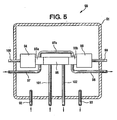
- the apparatus 90 includes an enclosure 91 (preferably a NEMA-4 fiberglass enclosure).
- Tubing 92 is used to conduct a nitrogen purge stream into the enclosure 91.
- Tubing 93 is used to conduct the nitrogen purge stream from the enclosure 91.
- the enclosure 91 contains a Servomex ultraviolet chlorine analyzer (Servomex Company, Inc., Sugarland, Texas USA) comprised of a detector portion 94, a cell portion 95 and a source portion 96.
- Tubing 97 is used to conduct a nitrogen purge stream through a boss 95a, through a boss 95b by way of tubing 97a and then out of the enclosure 91 by way of tubing 98.
- the boss portions 95a and 95b of the cell 95 help protect the detector portion 94 and the source portion 96 from leaks.
- Electrical cables 99 and 100 provide power to and conduct an analyzer signal from the apparatus 90, which signal is a function of the chlorine concentration in the chlorinator tail gas.
- Conditioned chlorinator tail gas (from the apparatus shown in Fig. 2 ) is conducted to and from the cell portion 95 by way of one quarter inch (0.6 cm) diameter heat traced (at about ninety degrees Celsius) perfluoroalkoxy tubing 101 and 102 respectively.
- on-line analyzers relate to specific preferred systems and that the full scope of the instant invention is not limited thereby.
- other components of interest can be analyzed on-line.
- a 500 milliliter gas sample bomb is used to manually withdraw a sample of burner tail gas 25.
- the sample bombs are taken to a laboratory and the burner tail gas is analyzed for oxygen by the Orsat test.
- the results are graphed as oxygen concentration versus time and show an essentially level oxygen concentration of about nine percent oxygen.
- the burner tail gas 25 is flowed through the conditioning apparatus of Fig. 2 and then the on-line analyzer of Fig. 3 for the same twenty four hour period as COMPARATIVE EXAMPLE 1.
- the results are graphed as oxygen concentration versus time and show an essentially level oxygen concentration of about ten percent oxygen but also two peaks of oxygen concentration missed by the manual sampling of COMPARATIVE EXAMPLE 1.
- a 500 milliliter gas sample bomb is used to manually withdraw a sample of burner tail gas 25.
- the sample bombs are taken to a laboratory and the burner tail gas is analyzed for hydrogen chloride by infrared photometry. The results are graphed as hydrogen chloride concentration versus time and show an essentially level hydrogen chloride concentration of about four percent hydrogen chloride.
- the burner tail gas 25 is flowed through the conditioning apparatus of Fig. 2 and then the on-line analyzer of Fig. 4 for the same twenty four hour period as COMPARATIVE EXAMPLE 1.
- the results are graphed as hydrogen chloride concentration versus time and show an essentially level.hydrogen chloride concentration of about four percent hydrogen chloride but also two variations of hydrogen chloride concentration missed by the manual sampling of COMPARATIVE EXAMPLE 2.
- the first variation at 9.6 hours, indicated a hydrogen chloride concentration of about six percent hydrogen chloride for about ten minutes.
- a 500 milliliter gas sample bomb is used to manually withdraw a sample of chlorinator tail gas 23.
- the sample bombs are taken to a laboratory and the chlorinator tail gas is analyzed for chlorine by titration.
- the results are graphed as chlorine concentration versus time and show an essentially level chlorine concentration of about one, one hundredth percent chlorine.
- the chlorinator tail gas 23 is flowed through the conditioning apparatus of Fig. 2 and then the on-line analyzer of Fig. 5 for the same twenty four hour period as COMPARATIVE EXAMPLE 3.
- the results are graphed as chlorine concentration versus time and show an essentially level chlorine concentration of about one, one hundredth percent chlorine but also a peak of chlorine concentration missed by the manual sampling of COMPARATIVE EXAMPLE 3.
Landscapes
- Chemical & Material Sciences (AREA)
- Environmental & Geological Engineering (AREA)
- General Life Sciences & Earth Sciences (AREA)
- Geology (AREA)
- Life Sciences & Earth Sciences (AREA)
- Organic Chemistry (AREA)
- Engineering & Computer Science (AREA)
- Manufacturing & Machinery (AREA)
- Materials Engineering (AREA)
- Mechanical Engineering (AREA)
- Metallurgy (AREA)
- Inorganic Chemistry (AREA)
- Inorganic Compounds Of Heavy Metals (AREA)
- Investigating Or Analysing Materials By Optical Means (AREA)
- Sampling And Sample Adjustment (AREA)
- Catalysts (AREA)
- Investigating Or Analyzing Non-Biological Materials By The Use Of Chemical Means (AREA)
- Glass Melting And Manufacturing (AREA)
- Physical Or Chemical Processes And Apparatus (AREA)
Claims (15)
- Verfahren zur Herstellung von Titandioxid, wobei ein Titandioxid-Erz mit Chlorgas reagiert zur Erzeugung eines Gasstroms, der Titantetrachlorid enthält, wobei das Titantetrachlorid aus dem Gasstrom, der Titantetrachlorid enthält, zur Kondensation gebracht wird, um ein Chlorgas-Gerät-Restgas zu erzeugen, wobei das kondensierte Titantetrachlorid verdampft wird, wobei das verdampfte Titantetrachlorid mit Sauerstoff reagiert zur Erzeugung eines Gasstromes, der Titandioxid-Partikel und Chlor enthält, wobei die Titandioxid-Partikel aus dem Gasstrom, der Titandioxid-Partikel und Chlorgas enthält, herausgetrennt werden, um ein Brennerrestgas zu erzeugen, wobei das Chlorgas-Gerät-Restgas auf Chlorgasrückstände untersucht wird, um den Verfahrensschritt zu überwachen, bei dem das Titandioxid-Erz mit dem Chlor reagiert, dadurch gekennzeichnet, dass das Chlorgas-Gerät-Restgas unter Benutzung eines Echtzeit-Chlor-Messgerätes (94, 95, 96) auf Chlorgasrückstände untersucht wird, wobei das Chlorgas-Gerät-Restgas durch einen Filter und dann durch das Echtzeit-Messgerät geleitet wird und wobei das Chlorgas-Gerät-Restgas und der Filter auf eine Temperatur von mehr als 10° Celsius erhitzt werden.
- Verfahren nach Anspruch 1, wobei das Brennerrestgas zusätzlich auf Sauerstoff untersucht wird, um den Verfahrensschritt zu überwachen, bei dem das verdampfte Titantetrachlorid mit Sauerstoff reagiert, wobei das Brennerrestgas unter Benutzung eines Echtzeit-Sauerstoff-Messgerätes (54, 55) auf Sauerstoff untersucht wird.
- Verfahren nach Anspruch 2, wobei das Echtzeit-Sauerstoff-Messgerät ein angeschlossener paramagnetischer Sauerstoffsensor ist (54, 55).
- Verfahren nach Anspruch 2 oder 3, wobei das Brennerrestgas durch einen Filter und dann durch das Echtzeit-Messgerät geleitet wird.
- Verfahren nach Anspruch 2 oder 3, wobei das Brennerrestgas durch einen Filter und dann durch das Echtzeit-Messgerät geleitet wird und wobei das Brennerrestgas und der Filter auf eine Temperatur von mehr als 10° Celsius erhitzt werden.
- Verfahren nach Anspruch 2 oder 3, wobei das Brennerrestgas durch einen Filter und dann durch das Echtzeit-Messgerät geleitet wird und wobei das Brennerrestgas und der Filter auf eine Temperatur im Bereich von 32 bis 43° Celsius erhitzt werden.
- Verfahren nach einem der Ansprüche 1 bis 6, wobei das Echtzeit-Chlor-Messgerät ein Echtzeit-Photometrie-Messgerät (94, 95, 96) ist.
- Verfahren nach einem der vorhergehenden Ansprüche, mit einem zusätzlichen Verfahrensschritt, bei dem das Brennerrestgas unter Benutzung eines Echtzeit-Chlorwasserstoff-Messgerätes auf Chlorwasserstoff untersucht wird (74, 75, 76).
- Verfahren nach Anspruch 8, wobei das Echtzeit-Chlorwasserstoff-Messgerät ein Echtzeit-Chlorwasserstoff-Photometrie-Messgerät ist (74, 75, 76).
- Verfahren nach einem der vorhergehenden Ansprüche, wobei das Chlorgas-Gerät-Restgas und der Filter (37) auf eine Temperatur im Bereich von 32 bis 43° Celsius erhitzt werden.
- Verfahren nach einem der Ansprüche 1 bis 10, wobei der Verfahrensschritt, bei dem das Chlorgas-Gerät-Restgas durch einen Filter geleitet wird, Folgendes umfasst:(a) Leiten des Chlorgas-Gerät-Restgases durch eine Schicht aus Glaswolle (34, 36), um einen Gasstrom aus primär behandeltem Chlorgas-Gerät-Restgas zu erzeugen, bevor(b) der Gasstrom aus primär behandeltem Chlorgas-Gerät-Restgas durch einen Submikron-Partikel-Filter (37) geleitet wird, um einen Gasstrom aus sekundär behandeltem Chlorgas-Gerät-Restgas zu erzeugen; und(c) Leiten des Gasstroms aus sekundär behandeltem Chlorgas-Gerät-Restgas durch einen Koaleszenz-Filter (38a), um einen Gasstrom aus aufbereitetem Chlorgas-Gerät-Restgas zu erzeugen, der zu besagtem Echtzeit-Chemikalie-Messgerät geleitet wird.
- Verfahren nach einem der Ansprüche 4 bis 6, wobei der Verfahrensschritt, bei dem das Brennerestgas durch einen Filter geleitet wird, Folgendes umfasst:(a) Leiten des Brennerrestgases durch eine Schicht aus Glaswolle (34, 36), um einen Gasstrom aus primär behandeltem Brennerrestgas zu erzeugen;(b) Leiten des Gasstroms aus primär behandeltem Brennerrestgas durch einen Submikron-Partikel-Filter, um einen Gasstrom aus sekundär behandeltem Brennerrestgas zu erzeugen;(c) Leiten des Gasstroms aus sekundär behandeltem Brennerrestgas durch einen Koaleszenz-Filter (38a), um einen Gasstrom aus aufbereitetem Brennerrestgas zu erzeugen, der zu besagtem Echtzeit-Chemikalie-Messgerät geleitet wird.
- Verfahren nach Anspruch 12, wobei die Schritte (a) bis (c) bei einer
Temperatur von mehr als 10° Celsius ausgeführt werden. - Verfahren nach Anspruch 11 oder 12, wobei die Schritte (a) bis (c) bei einer Temperatur von mehr als 21° Celsius ausgeführt werden.
- Verfahren nach Anspruch 11 oder 12, wobei die Schritte (a) bis (c) bei einer Temperatur im Bereich von 32 bis 43° Celsius ausgeführt werden.
Priority Applications (2)
| Application Number | Priority Date | Filing Date | Title |
|---|---|---|---|
| EP10013091A EP2272799B1 (de) | 2003-02-25 | 2004-02-23 | Verfahren zur Herstellung von Titanoxid |
| EP10013090A EP2272798B1 (de) | 2003-02-25 | 2004-02-23 | Verfahren zur Herstellung von Titanoxid |
Applications Claiming Priority (3)
| Application Number | Priority Date | Filing Date | Title |
|---|---|---|---|
| US374266 | 2003-02-25 | ||
| US10/374,266 US7182931B2 (en) | 2003-02-25 | 2003-02-25 | Process for making titanium dioxide |
| PCT/US2004/005251 WO2004076496A2 (en) | 2003-02-25 | 2004-02-23 | Process for making titanium dioxide |
Related Child Applications (4)
| Application Number | Title | Priority Date | Filing Date |
|---|---|---|---|
| EP10013090A Division EP2272798B1 (de) | 2003-02-25 | 2004-02-23 | Verfahren zur Herstellung von Titanoxid |
| EP10013091A Division EP2272799B1 (de) | 2003-02-25 | 2004-02-23 | Verfahren zur Herstellung von Titanoxid |
| EP10013090.5 Division-Into | 2010-10-01 | ||
| EP10013091.3 Division-Into | 2010-10-01 |
Publications (2)
| Publication Number | Publication Date |
|---|---|
| EP1597201A2 EP1597201A2 (de) | 2005-11-23 |
| EP1597201B1 true EP1597201B1 (de) | 2012-01-18 |
Family
ID=32868835
Family Applications (3)
| Application Number | Title | Priority Date | Filing Date |
|---|---|---|---|
| EP10013090A Expired - Lifetime EP2272798B1 (de) | 2003-02-25 | 2004-02-23 | Verfahren zur Herstellung von Titanoxid |
| EP10013091A Expired - Lifetime EP2272799B1 (de) | 2003-02-25 | 2004-02-23 | Verfahren zur Herstellung von Titanoxid |
| EP04713732A Expired - Lifetime EP1597201B1 (de) | 2003-02-25 | 2004-02-23 | Verfahren zur herstellung von titanoxid |
Family Applications Before (2)
| Application Number | Title | Priority Date | Filing Date |
|---|---|---|---|
| EP10013090A Expired - Lifetime EP2272798B1 (de) | 2003-02-25 | 2004-02-23 | Verfahren zur Herstellung von Titanoxid |
| EP10013091A Expired - Lifetime EP2272799B1 (de) | 2003-02-25 | 2004-02-23 | Verfahren zur Herstellung von Titanoxid |
Country Status (14)
| Country | Link |
|---|---|
| US (1) | US7182931B2 (de) |
| EP (3) | EP2272798B1 (de) |
| JP (1) | JP2006519156A (de) |
| KR (1) | KR20050106453A (de) |
| CN (1) | CN100390071C (de) |
| AT (1) | ATE541815T1 (de) |
| AU (1) | AU2004215401B2 (de) |
| BR (1) | BRPI0407535A (de) |
| MX (1) | MXPA05008657A (de) |
| NO (1) | NO20054423L (de) |
| PL (1) | PL378174A1 (de) |
| RU (1) | RU2005129717A (de) |
| TW (1) | TWI255295B (de) |
| WO (1) | WO2004076496A2 (de) |
Families Citing this family (24)
| Publication number | Priority date | Publication date | Assignee | Title |
|---|---|---|---|---|
| US20060178445A1 (en) * | 2004-12-16 | 2006-08-10 | Mcintyre Patrick F | Composition for controlled sustained release of a gas |
| US20080022900A1 (en) * | 2006-07-25 | 2008-01-31 | Venkata Rama Rao Goparaju | Process for manufacturing titanium dioxide pigment |
| AU2011204934B2 (en) * | 2006-10-12 | 2013-01-17 | The Chemours Company Fc,Llc | Process for making titanium dioxide |
| US7638113B2 (en) * | 2006-10-12 | 2009-12-29 | E. I. Du Pont De Nemours And Company | Process for making titanium dioxide |
| CN101825530B (zh) * | 2010-05-10 | 2011-12-14 | 攀钢集团钢铁钒钛股份有限公司 | 钛金属类样品溶液的制备方法以及利用其的检测方法 |
| EP2686458A4 (de) | 2011-03-18 | 2015-04-15 | Orbite Aluminae Inc | Verfahren zur wiedergewinnung von seltenerdelementen aus aluminiumhaltigen materialien |
| JP5894262B2 (ja) | 2011-05-04 | 2016-03-23 | オーバイト アルミナ インコーポレイテッドOrbite Aluminae Inc. | 種々の鉱石から希土類元素を回収する方法 |
| CA2834356C (en) | 2011-06-03 | 2014-11-25 | Orbite Aluminae Inc. | Methods for preparing hematite |
| CA2848751C (en) | 2011-09-16 | 2020-04-21 | Orbite Aluminae Inc. | Processes for preparing alumina and various other products |
| BR112014016732A8 (pt) | 2012-01-10 | 2017-07-04 | Orbite Aluminae Inc | processos para tratar lama vermelha |
| EP2838848B1 (de) | 2012-03-29 | 2019-05-08 | Orbite Technologies Inc. | Verfahren zur behandlung von flugasche |
| MY175471A (en) | 2012-07-12 | 2020-06-29 | Orbite Tech Inc | Processes for preparing titanium oxide and various other products |
| JP2015535886A (ja) | 2012-09-26 | 2015-12-17 | オーバイト アルミナ インコーポレイテッドOrbite Aluminae Inc. | 種々の材料のHCl浸出によるアルミナおよび塩化マグネシウムを調製するためのプロセス |
| WO2014075173A1 (en) | 2012-11-14 | 2014-05-22 | Orbite Aluminae Inc. | Methods for purifying aluminium ions |
| CA2892932C (en) * | 2012-11-30 | 2020-02-04 | Iti Scotland - Scottish Enterprise | Improved vapour phase spectroscopy |
| CN103896333B (zh) * | 2013-12-09 | 2015-11-25 | 云南新立有色金属有限公司 | 制备二氧化钛的方法 |
| CN103880076B (zh) * | 2013-12-09 | 2016-01-20 | 云南新立有色金属有限公司 | 制备二氧化钛的系统 |
| CN106241869B (zh) * | 2016-09-06 | 2019-02-19 | 云南冶金新立钛业有限公司 | 制备二氧化钛的系统 |
| WO2019044917A1 (ja) * | 2017-09-01 | 2019-03-07 | 東邦チタニウム株式会社 | 塩素濃度分析装置、塩素濃度分析方法、四塩化チタンの製造装置及びスポンジチタンの製造方法 |
| CN109704397A (zh) * | 2019-02-15 | 2019-05-03 | 河南佰利联新材料有限公司 | 一种生产高耐候半成品二氧化钛的方法 |
| JP7471978B2 (ja) * | 2020-09-29 | 2024-04-22 | 東邦チタニウム株式会社 | 塩素含有ガス中の酸素ガス濃度測定方法、電流効率の演算方法及び金属マグネシウムの製造方法 |
| CN113184900B (zh) * | 2021-05-12 | 2022-08-12 | 攀钢集团钒钛资源股份有限公司 | 四氯化钛生产方法、系统及原料配比调整方法 |
| CN113651355B (zh) * | 2021-09-13 | 2023-01-24 | 攀钢集团钒钛资源股份有限公司 | 钛白粉生产系统及分配氯气的方法 |
| CN114392712B (zh) * | 2022-02-22 | 2024-08-23 | 拓烯科技(衢州)有限公司 | 一种烯烃模试连续溶液聚合装置和工艺 |
Family Cites Families (16)
| Publication number | Priority date | Publication date | Assignee | Title |
|---|---|---|---|---|
| DE1225624B (de) * | 1958-06-02 | 1966-09-29 | British Titan Products | Abaenderung des Verfahrens zur kontinuierlichen Herstellung von Titantetrachlorid nach dem Wirbelschichtverfahren |
| DE1206399B (de) * | 1963-04-27 | 1965-12-09 | Bayer Ag | Verfahren zur Durchfuehrung von Gasphasenreaktionen |
| FR1456030A (fr) * | 1965-09-06 | 1966-05-20 | Thann Fab Prod Chem | Procédé de fabrication d'oxyde de titane par voie sèche et installations pour l'application de ce procédé |
| US4311485A (en) * | 1980-12-23 | 1982-01-19 | E. I. Du Pont De Nemours And Company | Method and apparatus for photometrically monitoring the concentrations of both chlorine and chlorine dioxide |
| BE893366A (fr) * | 1982-05-28 | 1982-09-16 | Centre Rech Metallurgique | Perfectionnements aux dispositifs de prelevement d'echantillons gazeux |
| DE3339950A1 (de) * | 1983-11-04 | 1985-05-15 | Hartmann & Braun Ag, 6000 Frankfurt | Fotometer zur kontinuierlichen analyse eines mediums (gas oder fluessigkeit) |
| US4647210A (en) * | 1985-06-17 | 1987-03-03 | The Dow Chemical Company | Chlorine analysis using fiber optics |
| DE3940036A1 (de) * | 1989-12-04 | 1991-06-06 | Rosemount Gmbh & Co | Verfahren und vorrichtung zur sauerstoffmessung unter ausnutzung der paramagnetischen eigenschaften des sauerstoffs |
| US5585078A (en) * | 1993-03-08 | 1996-12-17 | E. I. Du Pont De Nemours And Company | Process for reducing carbon monoxide and carbonyl sulfide emissions from a fluidized bed titanium dioxide chlorinator |
| CA2136298A1 (en) * | 1993-11-23 | 1995-05-24 | Vernon D. Gebben | Method and apparatus for enhancing production of tio2 |
| US5670121A (en) * | 1995-05-05 | 1997-09-23 | E. I. Du Pont De Nemours And Company | Process for controlling the temperature of a fluidized bed reactor in the manufacture of titanium tetrachloride |
| ES2147014T3 (es) * | 1996-07-25 | 2000-08-16 | Kerr Mcgee Chemical Llc | Metodo y aparato para producir dioxido de titanio. |
| US5840112A (en) * | 1996-07-25 | 1998-11-24 | Kerr Mcgee Chemical Corporation | Method and apparatus for producing titanium dioxide |
| GB9905051D0 (en) * | 1999-03-05 | 1999-04-28 | Eev Ltd | Chemical sensor systems |
| AU764159B2 (en) * | 1999-07-01 | 2003-08-14 | E.I. Du Pont De Nemours And Company | A process for controlling the passivation of aluminum chloride formed in the chlorination of titanium-containing ores |
| DE10121194A1 (de) * | 2001-04-30 | 2002-10-31 | Basf Ag | Vorrichtung zur Steuerung von chemischen Syntheseprozessen |
-
2003
- 2003-02-25 US US10/374,266 patent/US7182931B2/en not_active Expired - Fee Related
-
2004
- 2004-02-18 TW TW093103923A patent/TWI255295B/zh not_active IP Right Cessation
- 2004-02-23 MX MXPA05008657A patent/MXPA05008657A/es active IP Right Grant
- 2004-02-23 AU AU2004215401A patent/AU2004215401B2/en not_active Ceased
- 2004-02-23 KR KR1020057015664A patent/KR20050106453A/ko not_active Withdrawn
- 2004-02-23 EP EP10013090A patent/EP2272798B1/de not_active Expired - Lifetime
- 2004-02-23 CN CNB2004800038126A patent/CN100390071C/zh not_active Expired - Fee Related
- 2004-02-23 RU RU2005129717/15A patent/RU2005129717A/ru not_active Application Discontinuation
- 2004-02-23 PL PL378174A patent/PL378174A1/pl unknown
- 2004-02-23 JP JP2006503791A patent/JP2006519156A/ja active Pending
- 2004-02-23 EP EP10013091A patent/EP2272799B1/de not_active Expired - Lifetime
- 2004-02-23 AT AT04713732T patent/ATE541815T1/de active
- 2004-02-23 BR BRPI0407535-8A patent/BRPI0407535A/pt not_active Application Discontinuation
- 2004-02-23 EP EP04713732A patent/EP1597201B1/de not_active Expired - Lifetime
- 2004-02-23 WO PCT/US2004/005251 patent/WO2004076496A2/en not_active Ceased
-
2005
- 2005-09-23 NO NO20054423A patent/NO20054423L/no not_active Application Discontinuation
Also Published As
| Publication number | Publication date |
|---|---|
| TWI255295B (en) | 2006-05-21 |
| EP2272798B1 (de) | 2012-10-17 |
| WO2004076496A2 (en) | 2004-09-10 |
| BRPI0407535A (pt) | 2006-02-14 |
| EP2272798A3 (de) | 2011-09-14 |
| TW200500472A (en) | 2005-01-01 |
| ATE541815T1 (de) | 2012-02-15 |
| EP2272799A3 (de) | 2011-09-14 |
| EP2272798A2 (de) | 2011-01-12 |
| KR20050106453A (ko) | 2005-11-09 |
| EP2272799A2 (de) | 2011-01-12 |
| JP2006519156A (ja) | 2006-08-24 |
| NO20054423L (no) | 2005-09-23 |
| EP2272799B1 (de) | 2012-10-10 |
| CN100390071C (zh) | 2008-05-28 |
| EP1597201A2 (de) | 2005-11-23 |
| PL378174A1 (pl) | 2006-03-06 |
| US20040166054A1 (en) | 2004-08-26 |
| RU2005129717A (ru) | 2006-01-27 |
| US7182931B2 (en) | 2007-02-27 |
| AU2004215401B2 (en) | 2009-12-24 |
| CN1747901A (zh) | 2006-03-15 |
| AU2004215401A1 (en) | 2004-09-10 |
| WO2004076496A3 (en) | 2005-03-10 |
| MXPA05008657A (es) | 2006-04-27 |
Similar Documents
| Publication | Publication Date | Title |
|---|---|---|
| EP2272798B1 (de) | Verfahren zur Herstellung von Titanoxid | |
| CN101568832A (zh) | 用于连续测量气流中焦油浓度的装置和方法 | |
| Quann et al. | Mineral matter and trace-element vaporization in a laboratory-pulverized coal combustion system | |
| CN106198886B (zh) | 用于煤炭地下气化工艺的气体在线分析系统与操作方法 | |
| JPH06504614A (ja) | 危険廃棄物煙道ガス測定のための質量分析計に基づく連続放出検知システム | |
| Koch | Process analytical chemistry | |
| ZA200206180B (en) | Sampling device for gas analyses of raw coke oven gases and other contaminated gases and mehtod for analysis thereof. | |
| US6852543B2 (en) | Method and apparatus for measurement of sulfate | |
| JP2749599B2 (ja) | 高熱工程のモニター装置及びモニター方法 | |
| Sweet et al. | Spectrophotometric determination of free silica | |
| US3673854A (en) | Method of operating gas analysis apparatus | |
| US8741656B2 (en) | Process for controlling the flow of titanium bearing material into the fluidized bed reactor in the manufacture of titanium tetrachloride | |
| Eaton et al. | GTS Duratek, Phase I Hanford low-level waste melter tests: 100-kg melter offgas report | |
| CN121347430A (zh) | 一种铜冶炼智能监控系统及其控制方法 | |
| Forrest et al. | Sulphur isotope ratios of some power plant flue gases: A method for collecting the sulphur oxide | |
| Manka | Coke oven gas analysis | |
| Gomes | Assessment of opacimeter calibration on kraft pulp mills | |
| Manka | It is time to examine process stream analysis | |
| KR20040016189A (ko) | 기체 컨디셔너 시스템 | |
| US5241868A (en) | Sample dispersing apparatus and method for use with a pyrolisis furnace | |
| Cartier et al. | Balance carried out on an alpha waste incinerator in order to qualify its filtration system | |
| Stauffer | Comparison of organic constituents found in the condensed andvapor phases of tanks 241-BY-108, 241-BY-110, and 241-C-102 | |
| Lanneau | Continuous Analyzers Applied to Pilot Plant Operations | |
| Colombo | Mixed Media Filters for Aircrew Breathing Systems. | |
| JPS63228052A (ja) | 不純ガスの検知方法 |
Legal Events
| Date | Code | Title | Description |
|---|---|---|---|
| PUAI | Public reference made under article 153(3) epc to a published international application that has entered the european phase |
Free format text: ORIGINAL CODE: 0009012 |
|
| 17P | Request for examination filed |
Effective date: 20050812 |
|
| AK | Designated contracting states |
Kind code of ref document: A2 Designated state(s): AT BE BG CH CY CZ DE DK EE ES FI FR GB GR HU IE IT LI LU MC NL PT RO SE SI SK TR |
|
| AX | Request for extension of the european patent |
Extension state: AL LT LV MK |
|
| DAX | Request for extension of the european patent (deleted) | ||
| RAP1 | Party data changed (applicant data changed or rights of an application transferred) |
Owner name: TRONOX LLC |
|
| RAP1 | Party data changed (applicant data changed or rights of an application transferred) |
Owner name: TRONOX LLC |
|
| GRAP | Despatch of communication of intention to grant a patent |
Free format text: ORIGINAL CODE: EPIDOSNIGR1 |
|
| GRAS | Grant fee paid |
Free format text: ORIGINAL CODE: EPIDOSNIGR3 |
|
| GRAA | (expected) grant |
Free format text: ORIGINAL CODE: 0009210 |
|
| AK | Designated contracting states |
Kind code of ref document: B1 Designated state(s): AT BE BG CH CY CZ DE DK EE ES FI FR GB GR HU IE IT LI LU MC NL PT RO SE SI SK TR |
|
| REG | Reference to a national code |
Ref country code: GB Ref legal event code: FG4D |
|
| REG | Reference to a national code |
Ref country code: CH Ref legal event code: EP |
|
| REG | Reference to a national code |
Ref country code: IE Ref legal event code: FG4D Ref country code: AT Ref legal event code: REF Ref document number: 541815 Country of ref document: AT Kind code of ref document: T Effective date: 20120215 |
|
| REG | Reference to a national code |
Ref country code: NL Ref legal event code: T3 |
|
| REG | Reference to a national code |
Ref country code: DE Ref legal event code: R096 Ref document number: 602004036172 Country of ref document: DE Effective date: 20120315 |
|
| PG25 | Lapsed in a contracting state [announced via postgrant information from national office to epo] |
Ref country code: BG Free format text: LAPSE BECAUSE OF FAILURE TO SUBMIT A TRANSLATION OF THE DESCRIPTION OR TO PAY THE FEE WITHIN THE PRESCRIBED TIME-LIMIT Effective date: 20120418 |
|
| PG25 | Lapsed in a contracting state [announced via postgrant information from national office to epo] |
Ref country code: GR Free format text: LAPSE BECAUSE OF FAILURE TO SUBMIT A TRANSLATION OF THE DESCRIPTION OR TO PAY THE FEE WITHIN THE PRESCRIBED TIME-LIMIT Effective date: 20120419 Ref country code: FI Free format text: LAPSE BECAUSE OF FAILURE TO SUBMIT A TRANSLATION OF THE DESCRIPTION OR TO PAY THE FEE WITHIN THE PRESCRIBED TIME-LIMIT Effective date: 20120118 Ref country code: PT Free format text: LAPSE BECAUSE OF FAILURE TO SUBMIT A TRANSLATION OF THE DESCRIPTION OR TO PAY THE FEE WITHIN THE PRESCRIBED TIME-LIMIT Effective date: 20120518 |
|
| REG | Reference to a national code |
Ref country code: AT Ref legal event code: MK05 Ref document number: 541815 Country of ref document: AT Kind code of ref document: T Effective date: 20120118 |
|
| PG25 | Lapsed in a contracting state [announced via postgrant information from national office to epo] |
Ref country code: CY Free format text: LAPSE BECAUSE OF FAILURE TO SUBMIT A TRANSLATION OF THE DESCRIPTION OR TO PAY THE FEE WITHIN THE PRESCRIBED TIME-LIMIT Effective date: 20120118 Ref country code: MC Free format text: LAPSE BECAUSE OF NON-PAYMENT OF DUE FEES Effective date: 20120229 |
|
| REG | Reference to a national code |
Ref country code: CH Ref legal event code: PL |
|
| PG25 | Lapsed in a contracting state [announced via postgrant information from national office to epo] |
Ref country code: RO Free format text: LAPSE BECAUSE OF FAILURE TO SUBMIT A TRANSLATION OF THE DESCRIPTION OR TO PAY THE FEE WITHIN THE PRESCRIBED TIME-LIMIT Effective date: 20120118 Ref country code: CZ Free format text: LAPSE BECAUSE OF FAILURE TO SUBMIT A TRANSLATION OF THE DESCRIPTION OR TO PAY THE FEE WITHIN THE PRESCRIBED TIME-LIMIT Effective date: 20120118 Ref country code: SI Free format text: LAPSE BECAUSE OF FAILURE TO SUBMIT A TRANSLATION OF THE DESCRIPTION OR TO PAY THE FEE WITHIN THE PRESCRIBED TIME-LIMIT Effective date: 20120118 Ref country code: DK Free format text: LAPSE BECAUSE OF FAILURE TO SUBMIT A TRANSLATION OF THE DESCRIPTION OR TO PAY THE FEE WITHIN THE PRESCRIBED TIME-LIMIT Effective date: 20120118 Ref country code: LI Free format text: LAPSE BECAUSE OF NON-PAYMENT OF DUE FEES Effective date: 20120229 Ref country code: EE Free format text: LAPSE BECAUSE OF FAILURE TO SUBMIT A TRANSLATION OF THE DESCRIPTION OR TO PAY THE FEE WITHIN THE PRESCRIBED TIME-LIMIT Effective date: 20120118 Ref country code: CH Free format text: LAPSE BECAUSE OF NON-PAYMENT OF DUE FEES Effective date: 20120229 Ref country code: SE Free format text: LAPSE BECAUSE OF FAILURE TO SUBMIT A TRANSLATION OF THE DESCRIPTION OR TO PAY THE FEE WITHIN THE PRESCRIBED TIME-LIMIT Effective date: 20120118 |
|
| REG | Reference to a national code |
Ref country code: IE Ref legal event code: MM4A |
|
| PLBE | No opposition filed within time limit |
Free format text: ORIGINAL CODE: 0009261 |
|
| REG | Reference to a national code |
Ref country code: FR Ref legal event code: ST Effective date: 20121031 |
|
| STAA | Information on the status of an ep patent application or granted ep patent |
Free format text: STATUS: NO OPPOSITION FILED WITHIN TIME LIMIT |
|
| PG25 | Lapsed in a contracting state [announced via postgrant information from national office to epo] |
Ref country code: IT Free format text: LAPSE BECAUSE OF FAILURE TO SUBMIT A TRANSLATION OF THE DESCRIPTION OR TO PAY THE FEE WITHIN THE PRESCRIBED TIME-LIMIT Effective date: 20120118 Ref country code: SK Free format text: LAPSE BECAUSE OF FAILURE TO SUBMIT A TRANSLATION OF THE DESCRIPTION OR TO PAY THE FEE WITHIN THE PRESCRIBED TIME-LIMIT Effective date: 20120118 |
|
| 26N | No opposition filed |
Effective date: 20121019 |
|
| PG25 | Lapsed in a contracting state [announced via postgrant information from national office to epo] |
Ref country code: FR Free format text: LAPSE BECAUSE OF NON-PAYMENT OF DUE FEES Effective date: 20120319 Ref country code: IE Free format text: LAPSE BECAUSE OF NON-PAYMENT OF DUE FEES Effective date: 20120223 Ref country code: AT Free format text: LAPSE BECAUSE OF FAILURE TO SUBMIT A TRANSLATION OF THE DESCRIPTION OR TO PAY THE FEE WITHIN THE PRESCRIBED TIME-LIMIT Effective date: 20120118 |
|
| REG | Reference to a national code |
Ref country code: DE Ref legal event code: R097 Ref document number: 602004036172 Country of ref document: DE Effective date: 20121019 |
|
| PG25 | Lapsed in a contracting state [announced via postgrant information from national office to epo] |
Ref country code: ES Free format text: LAPSE BECAUSE OF FAILURE TO SUBMIT A TRANSLATION OF THE DESCRIPTION OR TO PAY THE FEE WITHIN THE PRESCRIBED TIME-LIMIT Effective date: 20120429 |
|
| PG25 | Lapsed in a contracting state [announced via postgrant information from national office to epo] |
Ref country code: TR Free format text: LAPSE BECAUSE OF FAILURE TO SUBMIT A TRANSLATION OF THE DESCRIPTION OR TO PAY THE FEE WITHIN THE PRESCRIBED TIME-LIMIT Effective date: 20120118 |
|
| PG25 | Lapsed in a contracting state [announced via postgrant information from national office to epo] |
Ref country code: LU Free format text: LAPSE BECAUSE OF NON-PAYMENT OF DUE FEES Effective date: 20120223 |
|
| PG25 | Lapsed in a contracting state [announced via postgrant information from national office to epo] |
Ref country code: HU Free format text: LAPSE BECAUSE OF FAILURE TO SUBMIT A TRANSLATION OF THE DESCRIPTION OR TO PAY THE FEE WITHIN THE PRESCRIBED TIME-LIMIT Effective date: 20040223 |
|
| PGFP | Annual fee paid to national office [announced via postgrant information from national office to epo] |
Ref country code: DE Payment date: 20160218 Year of fee payment: 13 |
|
| PGFP | Annual fee paid to national office [announced via postgrant information from national office to epo] |
Ref country code: BE Payment date: 20160217 Year of fee payment: 13 Ref country code: NL Payment date: 20160217 Year of fee payment: 13 Ref country code: GB Payment date: 20160217 Year of fee payment: 13 |
|
| PG25 | Lapsed in a contracting state [announced via postgrant information from national office to epo] |
Ref country code: BE Free format text: LAPSE BECAUSE OF NON-PAYMENT OF DUE FEES Effective date: 20170228 |
|
| REG | Reference to a national code |
Ref country code: DE Ref legal event code: R119 Ref document number: 602004036172 Country of ref document: DE |
|
| REG | Reference to a national code |
Ref country code: NL Ref legal event code: MM Effective date: 20170301 |
|
| GBPC | Gb: european patent ceased through non-payment of renewal fee |
Effective date: 20170223 |
|
| PG25 | Lapsed in a contracting state [announced via postgrant information from national office to epo] |
Ref country code: NL Free format text: LAPSE BECAUSE OF NON-PAYMENT OF DUE FEES Effective date: 20170301 |
|
| PG25 | Lapsed in a contracting state [announced via postgrant information from national office to epo] |
Ref country code: DE Free format text: LAPSE BECAUSE OF NON-PAYMENT OF DUE FEES Effective date: 20170901 |
|
| REG | Reference to a national code |
Ref country code: BE Ref legal event code: MM Effective date: 20170228 |
|
| PG25 | Lapsed in a contracting state [announced via postgrant information from national office to epo] |
Ref country code: GB Free format text: LAPSE BECAUSE OF NON-PAYMENT OF DUE FEES Effective date: 20170223 |