EP1593209B1 - Drahtlose sender-empfänger, verfahren und computerprogrammprodukte zur beschränkung der sendeleistung auf der basis von signal-stör-verhältnissen - Google Patents
Drahtlose sender-empfänger, verfahren und computerprogrammprodukte zur beschränkung der sendeleistung auf der basis von signal-stör-verhältnissen Download PDFInfo
- Publication number
- EP1593209B1 EP1593209B1 EP04708351A EP04708351A EP1593209B1 EP 1593209 B1 EP1593209 B1 EP 1593209B1 EP 04708351 A EP04708351 A EP 04708351A EP 04708351 A EP04708351 A EP 04708351A EP 1593209 B1 EP1593209 B1 EP 1593209B1
- Authority
- EP
- European Patent Office
- Prior art keywords
- sirs
- sync
- threshold
- wireless transceiver
- estimated
- Prior art date
- Legal status (The legal status is an assumption and is not a legal conclusion. Google has not performed a legal analysis and makes no representation as to the accuracy of the status listed.)
- Expired - Lifetime
Links
- 230000005540 biological transmission Effects 0.000 title claims abstract description 70
- 238000000034 method Methods 0.000 title claims abstract description 26
- 238000004590 computer program Methods 0.000 title claims description 9
- 238000001914 filtration Methods 0.000 claims description 10
- 238000004891 communication Methods 0.000 description 22
- 238000010586 diagram Methods 0.000 description 8
- 230000006870 function Effects 0.000 description 6
- NUOYJPPISCCYDH-BYPYZUCNSA-N (2s)-1-(2,2,2-trifluoroacetyl)pyrrolidine-2-carbonyl chloride Chemical compound FC(F)(F)C(=O)N1CCC[C@H]1C(Cl)=O NUOYJPPISCCYDH-BYPYZUCNSA-N 0.000 description 5
- 230000015654 memory Effects 0.000 description 5
- 108010003272 Hyaluronate lyase Proteins 0.000 description 3
- 238000001514 detection method Methods 0.000 description 3
- 230000002452 interceptive effect Effects 0.000 description 3
- 230000001413 cellular effect Effects 0.000 description 2
- 238000006243 chemical reaction Methods 0.000 description 2
- 230000004044 response Effects 0.000 description 2
- 238000012935 Averaging Methods 0.000 description 1
- 230000003247 decreasing effect Effects 0.000 description 1
- 230000001934 delay Effects 0.000 description 1
- 238000004519 manufacturing process Methods 0.000 description 1
- 230000003287 optical effect Effects 0.000 description 1
- 230000008569 process Effects 0.000 description 1
- 230000009467 reduction Effects 0.000 description 1
- 230000035945 sensitivity Effects 0.000 description 1
- 238000012421 spiking Methods 0.000 description 1
- 238000003860 storage Methods 0.000 description 1
Images
Classifications
-
- H—ELECTRICITY
- H04—ELECTRIC COMMUNICATION TECHNIQUE
- H04W—WIRELESS COMMUNICATION NETWORKS
- H04W52/00—Power management, e.g. Transmission Power Control [TPC] or power classes
- H04W52/04—Transmission power control [TPC]
- H04W52/30—Transmission power control [TPC] using constraints in the total amount of available transmission power
- H04W52/36—Transmission power control [TPC] using constraints in the total amount of available transmission power with a discrete range or set of values, e.g. step size, ramping or offsets
- H04W52/367—Power values between minimum and maximum limits, e.g. dynamic range
-
- H—ELECTRICITY
- H04—ELECTRIC COMMUNICATION TECHNIQUE
- H04W—WIRELESS COMMUNICATION NETWORKS
- H04W52/00—Power management, e.g. Transmission Power Control [TPC] or power classes
- H04W52/04—Transmission power control [TPC]
- H04W52/18—TPC being performed according to specific parameters
- H04W52/22—TPC being performed according to specific parameters taking into account previous information or commands
- H04W52/228—TPC being performed according to specific parameters taking into account previous information or commands using past power values or information
-
- H—ELECTRICITY
- H04—ELECTRIC COMMUNICATION TECHNIQUE
- H04W—WIRELESS COMMUNICATION NETWORKS
- H04W52/00—Power management, e.g. Transmission Power Control [TPC] or power classes
- H04W52/04—Transmission power control [TPC]
- H04W52/18—TPC being performed according to specific parameters
- H04W52/28—TPC being performed according to specific parameters using user profile, e.g. mobile speed, priority or network state, e.g. standby, idle or non-transmission
- H04W52/283—Power depending on the position of the mobile
-
- H—ELECTRICITY
- H04—ELECTRIC COMMUNICATION TECHNIQUE
- H04W—WIRELESS COMMUNICATION NETWORKS
- H04W52/00—Power management, e.g. Transmission Power Control [TPC] or power classes
- H04W52/04—Transmission power control [TPC]
- H04W52/18—TPC being performed according to specific parameters
- H04W52/28—TPC being performed according to specific parameters using user profile, e.g. mobile speed, priority or network state, e.g. standby, idle or non-transmission
- H04W52/288—TPC being performed according to specific parameters using user profile, e.g. mobile speed, priority or network state, e.g. standby, idle or non-transmission taking into account the usage mode, e.g. hands-free, data transmission or telephone
Definitions
- the invention disclosed and claimed herein generally relates to wireless transceivers and methods for estimating the signal-to-interference ratios (SIRs) of received signals, and more particularly to restricting changes that are allowed to the transmission power based on the SIR.
- SIRs signal-to-interference ratios
- Power control is important for capacity and efficiency in code division multiple access (CDMA) communication systems. For example, if a mobile terminal is located close to a base station, the power level of signals transmitted from the mobile terminal to the base station, in the absence of power adjustment, would be comparatively high. This could interfere with transmissions from other mobile terminals located farther from the base station. Conversely, the power level of signals transmitted from a mobile terminal which is located far from the base station, in the absence of power adjustment, could be comparatively weak. Accordingly, some communication systems, including, for example, wideband CDMA (WCDMA) systems, provide a transmission power control (TPC) command by which a base station can adjust the transmission power of a mobile terminal.
- WCDMA wideband CDMA
- TPC transmission power control
- Power control can involve the base station estimating the signal-to-interference ratios (SIRs) of received signals, such as, for example, received pilot symbols in a CDMA system. If the SIRs of a received signal are lower than a threshold value, a command or adjustment signal is sent to the transmitting mobile terminal to increase its transmission power. The command is sent on the reverse link, i.e. the down link. When the estimated SIRs are higher than the threshold value, a command to decrease transmission power is sent by the base station to the transmitting mobile terminal. Base station transmission power may also similarly be controlled by the mobile terminal.
- SIRs signal-to-interference ratios
- a mobile terminal should stop transmitting when the quality of the signal received from a transmitting base station falls below a threshold synchronization value, which may indicate that the mobile terminal has become out-of-sync with the transmitting base station. Accordingly, detection of when the mobile terminal is in-sync or out-of-sync with a transmitting base station can be important to avoid unnecessarily dropping calls, or conversely, to avoid continuing to transmit and possibly degrade the capacity of the base station after the mobile station can no longer effectively communicate with the base station.
- 3GPP 3rd Generation Partnership Project
- a mobile terminal is considered to have become out-of-sync, and therefore should stop transmitting, when the Dedicated Physical Channel Signal to Interference Ratios (DPCH-SIR), averaged over 160 milliseconds, is below a threshold value.
- DPCH-SIR Dedicated Physical Channel Signal to Interference Ratios
- the 3GPP standard also provides that a mobile terminal is considered to be in-sync, and may transmit, when the DPCH-SIR, averaged over 160 milliseconds, is above a threshold value.
- a method according to claim 1 is provided.
- a wireless transceiver according to claim 16 is provided.
- a computer program product according to claim 31 is provided.
- Various embodiments of the present invention provide a method for controlling transmission power of a wireless transceiver.
- Signal to interference ratios SIRs
- An out-of-sync condition between the wireless transceiver and the other wireless device is identified based on the SIRs.
- the other wireless device may, for example, be a base station or a mobile terminal. Changes to the transmission power of the wireless transceiver are restricted based on the SIRs and when an out-of-sync condition has not been identified.
- Restricting increase of the transmission power may avoid or prevent the wireless transceiver from unnecessarily increasing or spiking its transmission power, and possibly interfering with communications between other communication devices, after it may have lost its ability to effectively communicate with the other wireless device.
- restricting a decrease of the transmission power may avoid an unnecessarily dropped connection.
- each block of the block diagrams and/or operational illustrations, and combinations of blocks in the block diagrams and/or operational illustrations can be implemented by radio frequency, analog and/or digital hardware, and/or computer program instructions.
- These computer program instructions may be provided to a processor of a general purpose computer, special purpose computer, and/or other programmable data processing apparatus in a mobile terminal, such that the instructions, which execute via the processor of the computer and/or other programmable data processing apparatus, create means for implementing the functions/acts specified in the block diagrams and/or operational block or blocks.
- These computer program instructions may also be stored in a computer-readable memory that can direct a mobile terminal to function in a particular manner, such that the instructions stored in the computer-readable memory produce an article of manufacture including instructions which implement the functions/acts specified in the block diagrams and/or operational block or blocks. It should also be noted that in some alternate implementations, the functions/acts noted in the blocks may occur out of the order noted in the operational illustrations. For example, two blocks shown in succession may in fact be executed substantially concurrently or the blocks may sometimes be executed in the reverse order, depending upon the functionality/acts involved.
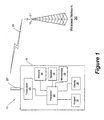
- FIG. 1 illustrates an exemplary wireless communication system that includes a mobile terminal 10 that communicates with a wireless communications network 30 over a radio frequency communication channel 28.
- the wireless communication system is assumed to be a WCDMA system that is compliant with the 3GPP specification.
- the mobile terminal 10 controls its transmission power over the communication channel 28 in response to a transmission power control (TPC) command from the network 30.
- the mobile terminal 10 also controls its transmission power based on the quality of signals received from the network 30. For example, the mobile terminal 10 may stop transmitting when received signal quality falls below a threshold level, which may indicate that the mobile terminal is out-of-sync or that it otherwise may not be able to effectively communicate with the network 30.
- the mobile terminal 10 may determine signal quality by estimating signal to interference ratios (SIRs) from pilot signals received from the network 30.
- SIRs signal to interference ratios
- the mobile terminal 10 stops transmitting, and may thereby avoid interfering with communications between the network 30 and other mobile terminals. Conversely when the estimated SIRs exceed the threshold value, the mobile terminal 10 may begin and/or resume transmission.
- the mobile terminal 10 may remove bias from the SIR estimates according to the various embodiments of the present invention, which may allow more accurate detection of the out-of sync and/or in-sync condition.
- the mobile terminal 10 may also restrict or prevent an increase and/or decrease of its transmission power based on the SIRs and when an out-of-sync condition has not been identified. For example, when the received signal quality (represented by the estimated SIRs) is below a threshold amount, but the mobile terminal 10 determines that it is in-sync such that it can continue transmitting, the mobile terminal 10 may ignore, or may modify its reaction to, a received TPC command that commands an increase or decrease in transmission output power.
- restricting or preventing an increase in transmission output power may avoid or prevent the mobile terminal 10 from unnecessarily interfering with communications between the network 30 and other mobile terminals when the mobile terminal 10 is uncertain about whether the channel conditions are sufficient to continue communication with the network 30.
- restricting decrease in the transmission output power may avoid unnecessarily dropping calls.
- the mobile terminal 10 may include a portable housing 12, a keyboard/keypad 14, a display 16, a speaker 18, a microphone 20, a processor 22, a memory 24, and a transceiver 26.
- the memory 24 may include one or more erasable programmable read-only memories (EPROM or Flash EPROM), battery backed random access memory (RAM), magnetic, optical, or other digital storage device, and may be separate from, or at least partially within, the processor 22.
- the mobile terminal 10 may, thereby, communicate with the network 30 using radio frequency signals.
- the radio frequency signals may be communicated through an antenna 27 over the communication channel 28 with the network 30.
- a "mobile terminal” includes, but is not limited to, a cellular mobile terminal; a personal communication terminal that may combine a cellular mobile terminal with data processing, facsimile and data communications capabilities; a personal data assistance (PDA) that can include a wireless transceiver, pager, Internet/intranet access, local area network interface, wide area network interface, Web browser, organizer, and/or calendar; and a computer or other device that includes a wireless transceiver.
- PDA personal data assistance
- the mobile terminal 10 may be configured to communicate according to one or more wireless communication protocols, including, but not limited to, ANSI-136, GSM, code division multiple access (CDMA), wideband-CDMA, CDMA2000, Enhanced Data Rates for GSM Evolution (EDGE), Universal Mobile Telecommunications System (UMTS), a wireless local area network (WLAN) protocol, including IEEE 802.11b-g, and Bluetooth, satellite protocols, private land mobile radio protocols, including PROJECT-25 and Tetra, and/or other communication protocols.
- Communication protocols as used herein may specify the information communicated, the timing, the frequency, the modulation, and/or the operations for setting-up and/or maintaining a communication connection.
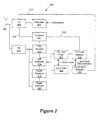
- FIG 2 illustrates a transceiver 200 that may, for example, be used in the mobile terminal 10 shown in Figure 1 according to various embodiments of the present invention.
- Information that is to be transmitted may be modulated by a modulator 202 and transmitted by a transmitter 204 through an antenna 206.
- the transmitter 204 controls its output transmission power based on a power level signal 208 from a combiner 221, and stops transmitting (reduces its transmission power to a very low value or substantially zero) based on a transmission enable signal 210 from an out-of-sync detector 226.
- Signals from the antenna 206 are received by a receiver 212 where they are downconverted and sampled, and then coupled to a transmit power control (TPC) decoder 214, a SIR estimator 216, a RAKE receiver 218, and a delay estimator 220.
- the RAKE receiver 218 has L delay taps or RAKE fingers.
- the delay estimator 220 estimates RAKE delays from the sampled received signal.
- CPICH common pilot channel
- the channel estimates are coupled to the Rake receiver 218 for combining with the received sampled signal, and are coupled to the TPC decoder 214.
- the TPC decoder decodes the received sampled signal to identify a TPC command from the network 30, and uses the TPC command to generate a control signal, which is coupled through the combiner 221 to the transmitter 204, to control the output transmission power of the transmitter 204. Accordingly, the network 30 may transmit a TPC command to the transceiver 200 to control its output transmission power.
- the SIR estimator 216 also generates an estimate of interference in the received signal.
- the interference may be estimated using the CPICH, and may then be transformed to an estimate of the interference in the dedicated physical channel -(DPCH) using a spreading factor difference between the CPICH and the DPCH.
- An estimate of the dedicated signal power may be made using, for example, dedicated pilot channel symbols.
- Signal to interference ratios SIRs may then be estimated using the estimated interference for the DPCH and the estimated dedicated signal power.
- the SIR estimates are coupled to a TX limit filter 222 and a sync filter 224.
- the TX limit filter 222 and the sync filter 224 can remove at least a portion of bias in the SIR estimates based upon the number of dedicated pilot channel symbols (N DPCH ) that are used for channel estimation and/or the number of RAKE fingers used to estimate the SIRs, as will be discussed later herein with regard to further embodiments of the filters.
- N DPCH may be known based on the slot format of the data channel 28 which is provided by the network 30 during the setup of the connection.
- the sync filter 224 generates a filtered SIR signal by, for example, averaging and/or integrating the SIR estimates over a predetermined time.
- the filtered SIR signal is compared by the out-of-sync detector 226 to an out-of-sync threshold.
- the out-of-sync detector 226 determines that an out-of-sync condition has occurred and substantially reduces the output transmission power of the transmitter 204 to, for example, about zero. Accordingly, the transmitter 204 may be substantially turned-off when an out-of-sync condition is detected.
- the transmit (TX) limit filter 222 may operate similar to the sync filter 224, except that it may have a faster response to rapid changes in the SIRs. Accordingly, an abrupt decrease in the received SIR may be indicated earlier by the filtered SIR signal from the TX limit filter 222 than by the filtered SIR signal from the sync filter 224.
- a TX limit detector 228 compares the filtered SIR signal from the TX limit filter 222 to a TX limit threshold. When the filtered SIR signal is below, or satisfies, the TX limit threshold, the TX limit detector 228 restricts or prevents changes in the transmission output power of the transmitter 204.
- the TX limit detector 228 may restrict the transmission power of the transmitter 204 to limited changes and/or may essentially latch (e.g., freeze) the transmission power to a power level, such as a current or previous power level.
- the transmission power level may be latched by, for example, using a limit signal 230 to latch the output power level signal 208 from the combiner 221 to the power level associated with a current TPC command or an earlier TPC command, such as a TPC associated with an earlier slot.
- the transmission power may be restricted to limited changes and/or latched to a power level to preclude such incorrect increase or decrease
- the output transmission power level may continue to be restricted to limited changes and/or latched until the signal quality sufficiently improves as determined by the TX limit detector 228, or until the signal quality sufficiently degrades so that the transmitter is essentially turned-off by the out-of-sync detector 226.
- the threshold values used by the TX limit detector 228 and/or the out-of-sync detector 226 may be based on a desired sensitivity of the transceiver 200 to signal quality conditions where transmission power changes should be restricted or where transmission power should be reduced to about zero.
- Bias or error between the estimated SIRs and the actual SIRs may be at least partially removed by a bias removal module that may be part of the TX limit filter 222 and/or the sync filter 224. Removing bias from the filtered SIR estimates may improve the ability of the TX limit detector 228 and/or the out-of-sync detector 226 to more accurately and/or quickly detect signal quality conditions in which the transmission power should be restricted or turned-off, which may be particularly advantageous for low SIR values.
- the TX limit filter 222 and the sync filter 224 may remove at least a portion of bias in the SIR estimates based upon the number of dedicated pilot channel symbols (N DPCH ) that are used for channel estimation and/or the number of RAKE fingers that are used to estimate the SIRs.
- N DPCH dedicated pilot channel symbols
- Bias may be estimated and at least partially removed from the estimated SIRs as described below.
- n k is the number of fingers used for SIR computation in slot k and ⁇ ⁇ f 2 is the estimate of the interference for finger f (obtained by scaling the CPICH interference estimate).
- Equation (6) shows that the bias term in the SIR estimate depends on the number of fingers n k divided by the number of dedicated pilot symbols N DPCH in the transport format, which changes over time.
- the threshold values that should be used by the TX limit detector 228 and the out-of-sync detector 226 may be determined as described below.
- In-sync and out-of-sync threshold values, Q in and O out , respectively, and the TX limit threshold value ( Q TX_LIMIT ) may be determined based on a relationship between SIR-symbol energy and combined TPC energy. This relationship may depend upon, for example, the number of TPC symbols N TPC , and/or the number of RAKE fingers used to estimate the SIRs.
- these equations for thresholds, Q in , O out , and Q TX_LIMIT may be written to include the above-described bias compensation, and may be based on state information including, for example, whether a mobile terminal is in a soft handover mode or a compressed mode.
- the spreading factor may be reduced by a factor of 2 and the DPCH E c power (where E c is the chip energy) may be doubled.
- Compressed mode may be handled by using slot formats ending with A and B.
- Compressed mode slots may use slot formats ending with a "B", for which the number of DPCH pilot symbols and number of TPC symbols have been doubled to compensate for the spreading factor reduction. Accordingly, the pilot energy and TPC bit energy per time unit may be kept about constant.
- the value N DPCH entering into the filters see Equation (8), may be changed based on the slot format, such as has been described for the non-compressed mode case.
- the thresholds Q in , Q out , and Q TX_LIMIT may be determined with N TPC set to N TPC for slot format A.
- the filtered SIR values from the TX limit filter 222 may be noisier than those of the sync filter 224.
- the TX limit threshold value used by the TX limit detector 228 may be lower than the out-of-sync threshold value used by the out-of-sync detector 226 so as to reduce the occurrence of unwanted restriction of the output transmission power level due to noise fluctuations in the SIRs.
- the TX limit threshold value may be -7dB and the out-of-sync threshold value may be -5dB.
- the transmission power level may be restricted to an earlier output power level of an earlier slot.
- the filtered SIR value from the sync filter 224 is less than an out-of-sync threshold, the transmitter 204 may be effectively turned-off by reducing the transmission power level to essentially zero.
- a transceiver may be provided as shown in Figure 2 except that the TX limit filter 222 may be eliminated and the filtered SIR signal from the sync filter 224 may be coupled to both the TX limit detector 228 and the out-of-sync detector 226.
- the threshold value of the TX limit detector 228 may be based on the threshold value of the out-of-sync detector 226.
- the threshold that may be used to cause restriction of transmission power changes may be set a predetermined amount above the threshold used to identify an out-of-sync condition. Accordingly, a degraded received signal may satisfy the threshold for restricting power changes before it satisfies the threshold for turning off the transmitter 204.
- a base station or another wireless device may restrict changes to its transmission power based on the operations and/or wireless transceiver described herein.
Landscapes
- Engineering & Computer Science (AREA)
- Computer Networks & Wireless Communication (AREA)
- Signal Processing (AREA)
- Mobile Radio Communication Systems (AREA)
- Transmitters (AREA)
Claims (33)
- Ein Verfahren für das Steuern/Regeln der Sende-Leistung eines drahtlosen Sender-Empfängers (200), das Verfahren umfassend:Abschätzen der Signal-zu-Interferenz-Verhältnisse, SIRs, für ein von einer anderen drahtlosen Vorrichtung empfangenes Signal;Identifizieren eines Zustands ohne Synchronisation zwischen dem drahtlosen Sender-Empfänger (200) und der anderen drahtlosen Vorrichtung, basierend auf den abgeschätzten SIRs;dadurch gekennzeichnet, dassdas Identifizieren des Zustands ohne Synchronisation ein erstes Filtern der abgeschätzten SIRs einschließt; und das Verfahren außerdem umfasst:Abbrechen des Sendens, wenn erstmalig gefilterte SIRs unter einen Grenzwert für den Zustand ohne Synchronisation fallen; undEinschränken der Veränderung der Sende-Leistung des drahtlosen Sender-Empfängers (200) basierend auf den geschätzten SIRs und, wenn ein Zustand ohne Synchronisation nicht identifiziert worden ist, durch ein zweites Filtern der abgeschätzten SIRs und Einschränken der Veränderung der Sende-Leistung des drahtlosen Sender-Empfängers (200), wenn die zum zweiten Mal gefilterten SIRs unter einen Leistung-Begrenzungs-Grenzwert fallen.
- Das Verfahren nach Anspruch 1, wobei das Einschränken der Sende-Leistung darauf gegründet ist, dass die abgeschätzten SIRs sich innerhalb einer vorgegebenen Zeitspanne um mehr als einen vorgegebenen Grenzwert verändern.
- Das Verfahren nach Anspruch 1, wobei:das Identifizieren eines Zustands ohne Synchronisation das Vergleichen der erstmalig gefilterten SIRs mit dem Grenzwert für den Zustand ohne Synchronisation umfasst; unddas Einschränken der Sende-Leistung das Vergleichen der zum zweiten Mal gefilterten SIRs mit dem Leistung-Begrenzungs-Grenzwert umfasst.
- Das Verfahren nach Anspruch 3, wobei der Grenzwert für den Zustand ohne Synchronisation größer ist als der Leistung-Begrenzungs-Grenzwert.
- Das Verfahren nach Anspruch 3, wobei der Grenzwert für den Zustand ohne Synchronisation kleiner ist als der Leistung-Begrenzungs-Grenzwert.
- Das Verfahren nach Anspruch 3, wobei zumindest einer von beiden, der Grenzwert für den Zustand ohne Synchronisation und/oder der Leistung-Begrenzungs-Grenzwert auf dem Zeitschlitz('slot')-Format basiert.
- Das Verfahren nach Anspruch 3, wobei zumindest einer von beiden, der Grenzwert für den Zustand ohne Synchronisation und/oder der Leistung-Begrenzungs-Grenzwert darauf basiert, ob der drahtlose Sender-Empfänger (200) sich in Weiterreichung befindet.
- Das Verfahren nach Anspruch 3, wobei zumindest einer von beiden, der Grenzwert für den Zustand ohne Synchronisation und/oder der Leistung-Begrenzungs-Grenzwert, darauf basiert, ob der drahtlose Sender-Empfänger (200) in einem komprimierten Modus ist.
- Das Verfahren nach Anspruch 1, wobei die zum zweiten Mal gefilterten SIRs enger abrupten SIR-Veränderungen folgen als die erstmalig gefilterten SIRs.
- Das Verfahren nach Anspruch 1, außerdem umfassend das Entfernen von zumindest eines Teils der Bias (des Basis-Niveaus) aus den geschätzten SIRs, in der Form des Fehlers zwischen den geschätzten SIRs und den tatsächlichen SIRs.
- Das Verfahren nach Anspruch 10, wobei das Entfernen zumindest eines Teils der Bias aus den geschätzten SIRs vor dem ersten Filtern und dem zweiten Filtern ausgeführt wird.
- Das Verfahren nach Anspruch 10, wobei das Entfernen zumindest eines Teils der Bias aus den geschätzten SIRs nach dem ersten Filtern und dem zweiten Filtern ausgeführt wird.
- Das Verfahren nach Anspruch 1, außerdem umfassend:Einschränken der Veränderung der Sende-Leistung des drahtlosen Sender-Empfängers (200), wenn die erstmalig gefilterten SIRs unter einen Grenzwert fallen, welcher einen vorgegebenen Betrag über dem Grenzwert für den Zustand ohne Synchronisation festgelegt ist.
- Das Verfahren nach Anspruch 10, der drahtlose Sender-Empfänger (200) einschließend einen RAKE-Empfänger (218), aufweisend eine Vielzahl von RAKE-Fingern (Empfangs-Kanälen), und wobei:das Abschätzen der SIRs für ein empfangenes Signal gegründet ist auf eine Anzahl der RAKE-Finger des für das Empfangen des Signals verwendeten RAKE-Empfängers (218); unddas Entfernen von zumindest eines Teils der Bias aus den abgeschätzten SIRs auf der Anzahl der RAKE-Finger basiert.
- Das Verfahren nach Anspruch 10, der drahtlose Sender-Empfänger (200) einschließend einen RAKE-Empfänger (218), und wobei:das Abschätzen der SIRs für ein empfangenes Pilot-Signal gegründet ist auf einer Anzahl von zugehörigen Pilot-Kanal-Symbolen in dem empfangenen Pilot-Signal; unddas Entfernen von zumindest einem Teil der Bias aus den abgeschätzten SIRs auf der Anzahl der zugehörigen Pilot-Signal-Symbole basiert.
- Ein drahtloser Sender-Empfänger (200), umfassend:einen SIR-Abschätzer (216), welcher konfiguriert ist für das Abschätzen von Signal-zu-Interferenz-Verhältnissen, SIRs, für ein von einer anderen drahtlosen Vorrichtung empfangenes Signal;einen Detektor für den Zustand ohne Synchronisation (226), welcher konfiguriert ist für das Identifizieren eines Zustands ohne Synchronisation zwischen dem drahtlosen Sender-Empfänger (200) und der anderen drahtlosen Vorrichtung, basierend auf den abgeschätzten SIRs;ein Sender (204), welcher konfiguriert ist für das Senden auf einem einstellbaren Sende-Leistungs-Niveau; und gekennzeichnet durch außerdem Umfassen:eines Leistung-Begrenzungs-Detektors (228), welcher konfiguriert ist für das Einschränken einer Veränderung des Sende-Leistungs-Niveaus des Senders (204), basierend auf den abgeschätzten SIRs, und wenn ein Zustand ohne Synchronisation nicht festgestellt worden ist;ein Filter für den Zustand ohne Synchronisation (224), welcher konfiguriert ist, um die abgeschätzten SIRs zu filtern, wobei der Detektor für den Zustand ohne Synchronisation (226) außerdem konfiguriert ist für das Steuern/Regeln des Senders, um das Senden abzubrechen, wenn die gefilterten SIRs aus dem Filter für den Zustand ohne Synchronisation (224) unter einen Grenzwert für den Zustand ohne Synchronisation fallen; undein Sende-Begrenzungs-Filter (222), welches konfiguriert ist für das Filtern der abgeschätzten SIRs, wobei der Leistungs-Begrenzungs-Detektor (228) konfiguriert ist, um eine Veränderung des Sende-Leistungs-Niveaus des Senders einzuschränken, wenn die gefilterten SIRs aus dem Sende-Begrenzungs-Filter (222) unter einen Leistung-Begrenzungs-Grenzwert fallen.
- Der drahtlose Sender-Empfänger (200) nach Anspruch 16, wobei der Leistungs-Begrenzungs-Detektor (228) außerdem konfiguriert ist, um eine Veränderung des Sende-Leistungs-Niveaus des Senders (204) einzuschränken, basierend auf der Veränderung der abgeschätzten SIRs um mehr als einen vorgegebenen Grenzwert innerhalb einer vorgegebenen Zeitspanne.
- Der drahtlose Sender-Empfänger (200) nach Anspruch 16, wobei:der Detektor für den Zustand ohne Synchronisation (226) außerdem konfiguriert ist, um die gefilterten SIRs aus dem Filter für den Zustand ohne Synchronisation (224) mit dem Grenzwert für den Zustand ohne Synchronisation zu vergleichen; undder Leistung-Begrenzungs-Detektor (228) außerdem konfiguriert ist, um die gefilterten SIRs aus dem Sende-Begrenzungs-Filter (222) mit dem Leistung-Begrenzungs-Grenzwert zu vergleichen.
- Der drahtlose Sender-Empfänger (200) nach Anspruch 18, wobei der Grenzwert für den Zustand ohne Synchronisation größer ist als der Leistung-Begrenzungs-Grenzwert.
- Der drahtlose Sender-Empfänger (200) nach Anspruch 18, wobei der Grenzwert für den Zustand ohne Synchronisation kleiner ist als der Leistung-Begrenzungs-Grenzwert.
- Der drahtlose Sender-Empfänger (200) nach Anspruch 18, wobei zumindest einer von beiden, der Grenzwert für den Zustand ohne Synchronisation und/oder der Leistung-Begrenzungs-Grenzwert, auf dem Zeitschlitz-Format basiert.
- Der drahtlose Sender-Empfänger (200) nach Anspruch 18, wobei zumindest einer von beiden, der Grenzwert für den Zustand ohne Synchronisation und/oder der Leistung-Begrenzungs-Grenzwert, darauf basiert, ob der drahtlose Sender-Empfänger (200) sich in Weiterreichung befindet.
- Der drahtlose Sender-Empfänger (200) nach Anspruch 18, wobei zumindest einer von beiden, der Grenzwert für den Zustand ohne Synchronisation und/oder der Leistung-Begrenzungs-Grenzwert, darauf basiert, ob sich der drahtlose Sender-Empfänger (200) in einem komprimierten Modus befindet
- Der drahtlose Sender-Empfänger (200) nach Anspruch 16, wobei das Sende-Begrenzungs-Filter (222) so konfiguriert ist, dass die durch das Sende-Begrenzungs-Filter (222) gefilterten SIRs enger abrupten SIR-Veränderungen folgen als die durch das Filter für den Zustand ohne Synchronisation (224) gefilterten SIRs.
- Der drahtlose Sender-Empfänger (200) nach Anspruch 16, außerdem umfassend ein Bias-Entfernungs-Modul, welches konfiguriert ist, um zumindest einen Teil der Bias, in der Form des Fehlers zwischen den abgeschätzten SIRs und den tatsächlichen SIRs, aus den abgeschätzten SIRs zu entfernen.
- Der drahtlose Sender-Empfänger (200) nach Anspruch 25, wobei der Bias-Entfernungs-Modul konfiguriert ist, um zumindest einen Teil der Bias aus den abgeschätzten SIRs zu entfernen, bevor die abgeschätzten SIRs durch den Filter für den Zustand ohne Synchronisation (224) und den Leistungs-Begrenzungs-Filter (222) gefiltert werden.
- Der drahtlose Sender-Empfänger (200) nach Anspruch 25, wobei der Bias-Entfernungs-Modul konfiguriert ist, um zumindest einen Teil der Bias aus den abgeschätzten SIRs zu entfernen, nachdem die abgeschätzten SIRs durch den Filter für den Zustand ohne Synchronisation (224) und den Leistungs-Begrenzungs-Filter (222) gefiltert wurden.
- Der drahtlose Sender-Empfänger (200) nach Anspruch 16, wobei:der Leistungs-Begrenzungs-Detektor (228) konfiguriert ist, um eine Veränderung des Sende-Leistungs-Niveaus des Senders (204) einzuschränken, wenn die gefilterten SIRs aus dem Filter für den Zustand ohne Synchronisation (224) unter einen Grenzwert fallen, welcher einen vorgegebenen Betrag über dem Grenzwert für den Zustand ohne Synchronisation festgesetzt ist.
- Der drahtlose Sender-Empfänger (200) nach Anspruch 25, außerdem umfassend einen RAKE-Empfänger (218), aufweisend eine Vielzahl von RAKE-Fingern, und wobei der SIR-Abschätzer (216) außerdem konfiguriert ist, um SIRs für ein empfangenes Signal, basierend auf einer Anzahl der für das Empfangen verwendeten RAKE-Finger, abzuschätzen und wobei der Bias-Entfernungs-Modul außerdem konfiguriert ist, um zumindest einen Teil der Bias aus den abgeschätzten SIRs, basierend auf der Anzahl von RAKE-Fingern, zu entfernen.
- Der drahtlose Sender-Empfänger (200) nach Anspruch 25, außerdem umfassend einen RAKE-Empfänger (218), und wobei der SIR-Abschätzer (216) außerdem konfiguriert ist, um SIRs für ein empfangenes Signal, basierend auf einer Anzahl von zugehörigen Pilot-Kanal-Symbolen in dem empfangenen Pilot-Signal, abzuschätzen und wobei der Bias-Entfernungs-Modul außerdem konfiguriert ist, um zumindest einen Teil der Bias aus den abgeschätzten SIRs, basierend auf der Anzahl der zugehörigen Pilot-Kanal-Symbole, zu entfernen.
- Ein Computer-Programm-Produkt für das Steuern/Regeln der Sende-Leistung eines drahtlosen Sende-Empfängers (200), der Computer-Programm-Code umfassend:Programm-Code für das Abschätzen der Signal-zu-Interferenz-Verhältnisse, SIRs, für ein von einer anderen drahtlosen Vorrichtung empfangenes Signal:gekennzeichnet durch außerdem Umfassen von:Programm-Code für das Identifizieren eines Zustands ohne Synchronisation zwischen dem drahtlosen Sende-Empfänger (200) und der anderen drahtlosen Vorrichtung, basierend auf den abgeschätzten SIRs; undProgramm-Code für das Einschränken der Sende-Leistung des drahtlosen Sende-Empfängers (200), basierend auf den SIRs und wenn ein Zustand ohne Synchronisation nicht identifiziert worden ist, wobei der Programm-Code für das Identifizieren eines Zustands ohne Synchronisation Programm-Code umfasst für erstes Filtern der abgeschätzten SIRs sowie das Steuern/Regeln des drahtlosen Sende-Empfängers für das Abbrechen des Sendens, falls erstmalig gefilterte SIRs unter einen Grenzwert für den Zustand ohne Synchronisation fallen, und wobeider Programm-Code für das Einschränken der Veränderung der Sende-Leistung Programm-Code umfasst für das zweite Filtern der abgeschätzten SIRs sowie das Einschränken der Veränderung der Sende-Leistung des drahtlosen Sende-Empfängers (200), falls die zum zweiten Mal gefilterten SIRs unter einen Leistungs-Begrenzungs-Grenzwert fallen.
- Das Computer-Programm-Produkt nach Anspruch 31, außerdem umfassend Programm-Code für das Einschränken der Veränderung der Sende-Leistung, basierend darauf, dass die abgeschätzten SIRs sich innerhalb einer vorgegebenen Zeitspanne mehr als um einen vorgegebenen Grenzwert verändern.
- Das Computer-Programm-Produkt nach Anspruch 31, wobei:der Programm-Code für das Identifizieren eines Zustands ohne Synchronisation Programm-Code für das Vergleichen der zum ersten Mal gefilterten SIRs mit dem Grenzwert für den Zustand ohne Synchronisation umfasst; undder Programm-Code für das Einschränken der Veränderung der Sende-Leistung Programm-Code für das Vergleichen der zum zweiten Mal gefilterten SIRs mit dem Leistungs-Begrenzungs-Grenzwert umfasst.
Applications Claiming Priority (5)
| Application Number | Priority Date | Filing Date | Title |
|---|---|---|---|
| US44723803P | 2003-02-13 | 2003-02-13 | |
| US447238P | 2003-02-13 | ||
| US612373 | 2003-07-02 | ||
| US10/612,373 US7149538B2 (en) | 2003-02-13 | 2003-07-02 | Wireless transceivers, methods, and computer program products for restricting transmission power based on signal-to-interference ratios |
| PCT/EP2004/001041 WO2004073204A1 (en) | 2003-02-13 | 2004-02-05 | Wireless transceivers, methods, and computer program products for restricting transmission power based on signal- to-interference ratios |
Publications (2)
| Publication Number | Publication Date |
|---|---|
| EP1593209A1 EP1593209A1 (de) | 2005-11-09 |
| EP1593209B1 true EP1593209B1 (de) | 2007-05-09 |
Family
ID=32872027
Family Applications (1)
| Application Number | Title | Priority Date | Filing Date |
|---|---|---|---|
| EP04708351A Expired - Lifetime EP1593209B1 (de) | 2003-02-13 | 2004-02-05 | Drahtlose sender-empfänger, verfahren und computerprogrammprodukte zur beschränkung der sendeleistung auf der basis von signal-stör-verhältnissen |
Country Status (5)
| Country | Link |
|---|---|
| US (1) | US7149538B2 (de) |
| EP (1) | EP1593209B1 (de) |
| AT (1) | ATE362236T1 (de) |
| DE (1) | DE602004006382D1 (de) |
| WO (1) | WO2004073204A1 (de) |
Families Citing this family (28)
| Publication number | Priority date | Publication date | Assignee | Title |
|---|---|---|---|---|
| US7251497B2 (en) * | 2003-12-31 | 2007-07-31 | Infineon Technologies Ag | Signal-to-interference ratio estimation for CDMA |
| GB0400081D0 (en) * | 2004-01-05 | 2004-02-04 | Nokia Corp | Radio network relocation |
| US7551597B2 (en) * | 2004-05-06 | 2009-06-23 | Telefonaktiebolaget L M Ericsson (Publ) | Methods and apparatus for fast downlink information of uplink out-of-synchronization |
| JP4479360B2 (ja) * | 2004-06-09 | 2010-06-09 | 日本電気株式会社 | 移動通信システム、携帯電話機及びそれに用いる受信電力制御方法並びにそのプログラム |
| US7522682B2 (en) * | 2004-12-29 | 2009-04-21 | Alcatel-Lucent Usa Inc. | Removing bias in a pilot symbol error rate for receivers |
| US20060223446A1 (en) * | 2005-03-29 | 2006-10-05 | Francis Dominique | Methods of detecting mobile stations not following power control commands |
| US20060223447A1 (en) * | 2005-03-31 | 2006-10-05 | Ali Masoomzadeh-Fard | Adaptive down bias to power changes for controlling random walk |
| DE602006001353D1 (de) * | 2006-01-13 | 2008-07-10 | Alcatel Lucent | Adaptive Subträger- Zuteilung zu einer Mobilstation in einem multicell FDM oder OFDM Netzwerk |
| CN101416409B (zh) * | 2006-03-31 | 2013-05-22 | 日本电气株式会社 | 移动通信终端、用于该移动通信终端的同步判断电路、控制方法、以及同步判断控制程序 |
| US7864724B2 (en) * | 2006-05-05 | 2011-01-04 | Nokia Corporation | Enhanced UE out-of-sync behavior with gated uplink DPCCH or gated downlink F-DPCH or DPCCH transmission |
| US8325703B2 (en) * | 2006-08-16 | 2012-12-04 | Nokia Corporation | Multiradio scheduling including clock synchronization validity protection |
| US20080090593A1 (en) * | 2006-10-12 | 2008-04-17 | Innovative Sonic Limited | Method and related apparatus for enhancing paging efficiency in a wireless communications system |
| WO2008076583A1 (en) * | 2006-12-21 | 2008-06-26 | Sony Ericsson Mobile Communications Ab | Power control for compressed mode in wcdma system |
| US7953140B2 (en) * | 2007-08-01 | 2011-05-31 | Broadcom Corporation | Method and apparatus to process dedicated pilot bits from multiple fingers |
| US8160075B2 (en) * | 2007-10-01 | 2012-04-17 | Telefonaktiebolaget Lm Ericsson (Publ) | Downlink out of sync detection in continuous packet connectivity |
| US8458558B2 (en) * | 2008-04-30 | 2013-06-04 | Motorola Mobility Llc | Multi-antenna configuration signaling in wireless communication system |
| US7986758B2 (en) * | 2008-05-30 | 2011-07-26 | Telefonaktiebolaget Lm Ericsson (Publ) | Synchronization detection using bandwidth and antenna configuration |
| US8144712B2 (en) | 2008-08-07 | 2012-03-27 | Motorola Mobility, Inc. | Scheduling grant information signaling in wireless communication system |
| US8279794B2 (en) * | 2008-09-24 | 2012-10-02 | Qualcomm Incorporated | Opportunistic data forwarding and dynamic reconfiguration in wireless local area networks |
| EP2365716A1 (de) * | 2010-03-12 | 2011-09-14 | ST-Ericsson SA | Verfahren und Vorrichtung zur Kommunikation zwischen einer mobilen Station und einer Basisstation |
| US8428080B2 (en) | 2010-09-16 | 2013-04-23 | Apple Inc. | Method to control reconfiguration of multiple radio access bearers in a wireless device |
| EP2549807A1 (de) * | 2011-07-18 | 2013-01-23 | Motorola Mobility LLC | Verfahren zur Ermöglichung der Synchronisation zwischen einem Kommunikationsnetzwerk und einer drahtlosen Kommunikationsvorrichtung in einem CPC-DTX-Modus und drahtlose Kommunikationsvorrichtung |
| GB2493394B (en) * | 2011-08-05 | 2014-01-22 | Renesas Mobile Corp | System and methods for detection of a synchronization condition |
| GB2498800A (en) * | 2012-01-30 | 2013-07-31 | Renesas Mobile Corp | An Interference control mechanism using frequency carrier deactivation in an in-device co-existence scenario |
| US9055537B2 (en) | 2012-06-05 | 2015-06-09 | Qualcomm Incorporated | Methods and apparatus for sire-based DLTPC rejection |
| EP2755428A1 (de) * | 2013-01-09 | 2014-07-16 | Sony Mobile Communications AB | Verfahren zur Reduzierung des Energieverbrauchs einer mobilen Vorrichtung und mobile Vorrichtung |
| US9706421B2 (en) * | 2013-12-06 | 2017-07-11 | Qualcomm Incorporated | Apparatus and method for sire bias compensation |
| US20240205839A1 (en) * | 2022-12-20 | 2024-06-20 | Commscope Technologies Llc | Communication system with time division duplexing access point operation in quasi full duplex mode |
Family Cites Families (13)
| Publication number | Priority date | Publication date | Assignee | Title |
|---|---|---|---|---|
| US6185432B1 (en) | 1997-10-13 | 2001-02-06 | Qualcomm Incorporated | System and method for selecting power control modes |
| JPH11145899A (ja) | 1997-11-10 | 1999-05-28 | Matsushita Electric Ind Co Ltd | 送受信装置及び無線伝送システム |
| JP3621310B2 (ja) | 1999-10-07 | 2005-02-16 | 松下電器産業株式会社 | 無線通信装置及び送信電力制御方法 |
| JP2001186082A (ja) * | 1999-12-24 | 2001-07-06 | Matsushita Electric Ind Co Ltd | Cdma移動通信システム及び方法 |
| JP3545663B2 (ja) * | 2000-01-14 | 2004-07-21 | 松下電器産業株式会社 | Sir測定装置及びsir測定方法 |
| US6456826B1 (en) * | 2000-02-25 | 2002-09-24 | Nokia Mobile Phones Ltd. | User equipment and procedure for handling possible out-of-synchronization condition in UMTS terrestrial radio access network for time division duplexing mode |
| JP3424647B2 (ja) * | 2000-04-04 | 2003-07-07 | 日本電気株式会社 | Cdma送受信機 |
| CN1132357C (zh) | 2000-08-21 | 2003-12-24 | 华为技术有限公司 | 一种信号干扰比的测量方法及装置 |
| JP3559237B2 (ja) * | 2000-11-09 | 2004-08-25 | 松下電器産業株式会社 | 希望波対干渉波電力比測定回路および希望波対干渉波電力比測定方法 |
| US6922389B1 (en) | 2000-11-15 | 2005-07-26 | Qualcomm, Incorporated | Method and apparatus for reducing transmission power in a high data rate system |
| US6725055B2 (en) * | 2001-01-05 | 2004-04-20 | Telefonaktiebolaget Lm Ericsson (Publ) | SIR estimation using delay time of power control commands |
| GB2401288B (en) * | 2001-02-28 | 2005-03-16 | Nec Corp | Receiver and method of operation thereof |
| KR100459573B1 (ko) * | 2001-08-25 | 2004-12-03 | 삼성전자주식회사 | 고속 순방향 패킷 접속 방식을 사용하는 통신 시스템에서역방향 전송 전력 오프셋과 고속 순방향 공통 채널 전력레벨을 송수신하는 장치 및 방법 |
-
2003
- 2003-07-02 US US10/612,373 patent/US7149538B2/en not_active Expired - Fee Related
-
2004
- 2004-02-05 WO PCT/EP2004/001041 patent/WO2004073204A1/en not_active Ceased
- 2004-02-05 DE DE602004006382T patent/DE602004006382D1/de not_active Expired - Lifetime
- 2004-02-05 AT AT04708351T patent/ATE362236T1/de not_active IP Right Cessation
- 2004-02-05 EP EP04708351A patent/EP1593209B1/de not_active Expired - Lifetime
Non-Patent Citations (1)
| Title |
|---|
| None * |
Also Published As
| Publication number | Publication date |
|---|---|
| ATE362236T1 (de) | 2007-06-15 |
| EP1593209A1 (de) | 2005-11-09 |
| WO2004073204A1 (en) | 2004-08-26 |
| US20050075122A1 (en) | 2005-04-07 |
| DE602004006382D1 (de) | 2007-06-21 |
| US7149538B2 (en) | 2006-12-12 |
Similar Documents
| Publication | Publication Date | Title |
|---|---|---|
| EP1593209B1 (de) | Drahtlose sender-empfänger, verfahren und computerprogrammprodukte zur beschränkung der sendeleistung auf der basis von signal-stör-verhältnissen | |
| AU2002353781B2 (en) | Method and apparatus for multi-channel reverse link outer-loop power control | |
| EP2222123B1 (de) | Verfahren, Empfänger und Rechnerprogrammprodukte zur Bestimmung von Bertragungsleistungsbefehlen unter Verwendung von priorisierter Interpretation | |
| EP1062743B1 (de) | Funkkommunikationssystem | |
| EP1348263B1 (de) | Verfahren und vorrichtung zur bestimmung des sollwertes einer geschlossenen leistungsregelungsschleife der abwärtsrichtung in einem drahtlosen paketdaten-kommunikationssystem | |
| US20050164730A1 (en) | Method and apparatus for power control a communication | |
| AU2002353781A1 (en) | Method and apparatus for multi-channel reverse link outer-loop power control | |
| US20090257538A1 (en) | Methods and Apparatus for Fast Downlink Information of Uplink Out-of-Synchronization | |
| US20080064408A1 (en) | Derivation of optimal antenna weights during soft handover | |
| US6804531B2 (en) | Closed loop power control with adjustable width based on channel quality | |
| CN1849793B (zh) | 无线通信设备中的无偏信号干扰比及其方法 | |
| HK1041575A1 (en) | Combined closed loop/open loop power control in a time division duplex communication system | |
| EP2263324B1 (de) | Störungsschätzung für aufwärtsstrecken-tdm in einem drahtlosen system | |
| EP1039657A1 (de) | Verfahren zur Pilotsignalsleistungsregelung in einem CDMA Mobilfunksystem und Basisstation und Mobilstation für ein solches System | |
| CN100481756C (zh) | 使用在功率控制方法中的无偏信干比估计 | |
| JP3430986B2 (ja) | 送信電力制御回路及び制御方法 | |
| JP4192745B2 (ja) | 送信電力制御システム、基地局及びそれらに用いる送信電力制御方法並びにそのプログラム | |
| KR20040027165A (ko) | 이동 통신 시스템의 가변 폐쇄루프 전력제어 방법 | |
| HK1107212B (en) | Cellular system, base station, mobile station, and communication control method |
Legal Events
| Date | Code | Title | Description |
|---|---|---|---|
| PUAI | Public reference made under article 153(3) epc to a published international application that has entered the european phase |
Free format text: ORIGINAL CODE: 0009012 |
|
| 17P | Request for examination filed |
Effective date: 20050722 |
|
| AK | Designated contracting states |
Kind code of ref document: A1 Designated state(s): AT BE BG CH CY CZ DE DK EE ES FI FR GB GR HU IE IT LI LU MC NL PT RO SE SI SK TR |
|
| AX | Request for extension of the european patent |
Extension state: AL LT LV MK |
|
| DAX | Request for extension of the european patent (deleted) | ||
| GRAP | Despatch of communication of intention to grant a patent |
Free format text: ORIGINAL CODE: EPIDOSNIGR1 |
|
| GRAS | Grant fee paid |
Free format text: ORIGINAL CODE: EPIDOSNIGR3 |
|
| GRAA | (expected) grant |
Free format text: ORIGINAL CODE: 0009210 |
|
| AK | Designated contracting states |
Kind code of ref document: B1 Designated state(s): AT BE BG CH CY CZ DE DK EE ES FI FR GB GR HU IE IT LI LU MC NL PT RO SE SI SK TR |
|
| PG25 | Lapsed in a contracting state [announced via postgrant information from national office to epo] |
Ref country code: FI Free format text: LAPSE BECAUSE OF FAILURE TO SUBMIT A TRANSLATION OF THE DESCRIPTION OR TO PAY THE FEE WITHIN THE PRESCRIBED TIME-LIMIT Effective date: 20070509 Ref country code: CH Free format text: LAPSE BECAUSE OF FAILURE TO SUBMIT A TRANSLATION OF THE DESCRIPTION OR TO PAY THE FEE WITHIN THE PRESCRIBED TIME-LIMIT Effective date: 20070509 Ref country code: LI Free format text: LAPSE BECAUSE OF FAILURE TO SUBMIT A TRANSLATION OF THE DESCRIPTION OR TO PAY THE FEE WITHIN THE PRESCRIBED TIME-LIMIT Effective date: 20070509 |
|
| REG | Reference to a national code |
Ref country code: GB Ref legal event code: FG4D |
|
| REG | Reference to a national code |
Ref country code: CH Ref legal event code: EP |
|
| REG | Reference to a national code |
Ref country code: IE Ref legal event code: FG4D |
|
| REF | Corresponds to: |
Ref document number: 602004006382 Country of ref document: DE Date of ref document: 20070621 Kind code of ref document: P |
|
| PG25 | Lapsed in a contracting state [announced via postgrant information from national office to epo] |
Ref country code: SE Free format text: LAPSE BECAUSE OF FAILURE TO SUBMIT A TRANSLATION OF THE DESCRIPTION OR TO PAY THE FEE WITHIN THE PRESCRIBED TIME-LIMIT Effective date: 20070809 |
|
| PG25 | Lapsed in a contracting state [announced via postgrant information from national office to epo] |
Ref country code: ES Free format text: LAPSE BECAUSE OF FAILURE TO SUBMIT A TRANSLATION OF THE DESCRIPTION OR TO PAY THE FEE WITHIN THE PRESCRIBED TIME-LIMIT Effective date: 20070820 |
|
| NLV1 | Nl: lapsed or annulled due to failure to fulfill the requirements of art. 29p and 29m of the patents act | ||
| REG | Reference to a national code |
Ref country code: CH Ref legal event code: PL |
|
| PG25 | Lapsed in a contracting state [announced via postgrant information from national office to epo] |
Ref country code: AT Free format text: LAPSE BECAUSE OF FAILURE TO SUBMIT A TRANSLATION OF THE DESCRIPTION OR TO PAY THE FEE WITHIN THE PRESCRIBED TIME-LIMIT Effective date: 20070509 |
|
| PG25 | Lapsed in a contracting state [announced via postgrant information from national office to epo] |
Ref country code: BE Free format text: LAPSE BECAUSE OF FAILURE TO SUBMIT A TRANSLATION OF THE DESCRIPTION OR TO PAY THE FEE WITHIN THE PRESCRIBED TIME-LIMIT Effective date: 20070509 |
|
| EN | Fr: translation not filed | ||
| PG25 | Lapsed in a contracting state [announced via postgrant information from national office to epo] |
Ref country code: SI Free format text: LAPSE BECAUSE OF FAILURE TO SUBMIT A TRANSLATION OF THE DESCRIPTION OR TO PAY THE FEE WITHIN THE PRESCRIBED TIME-LIMIT Effective date: 20070509 Ref country code: BG Free format text: LAPSE BECAUSE OF FAILURE TO SUBMIT A TRANSLATION OF THE DESCRIPTION OR TO PAY THE FEE WITHIN THE PRESCRIBED TIME-LIMIT Effective date: 20070809 Ref country code: DK Free format text: LAPSE BECAUSE OF FAILURE TO SUBMIT A TRANSLATION OF THE DESCRIPTION OR TO PAY THE FEE WITHIN THE PRESCRIBED TIME-LIMIT Effective date: 20070509 Ref country code: CZ Free format text: LAPSE BECAUSE OF FAILURE TO SUBMIT A TRANSLATION OF THE DESCRIPTION OR TO PAY THE FEE WITHIN THE PRESCRIBED TIME-LIMIT Effective date: 20070509 Ref country code: PT Free format text: LAPSE BECAUSE OF FAILURE TO SUBMIT A TRANSLATION OF THE DESCRIPTION OR TO PAY THE FEE WITHIN THE PRESCRIBED TIME-LIMIT Effective date: 20071009 Ref country code: NL Free format text: LAPSE BECAUSE OF FAILURE TO SUBMIT A TRANSLATION OF THE DESCRIPTION OR TO PAY THE FEE WITHIN THE PRESCRIBED TIME-LIMIT Effective date: 20070509 |
|
| PG25 | Lapsed in a contracting state [announced via postgrant information from national office to epo] |
Ref country code: SK Free format text: LAPSE BECAUSE OF FAILURE TO SUBMIT A TRANSLATION OF THE DESCRIPTION OR TO PAY THE FEE WITHIN THE PRESCRIBED TIME-LIMIT Effective date: 20070509 |
|
| PLBE | No opposition filed within time limit |
Free format text: ORIGINAL CODE: 0009261 |
|
| STAA | Information on the status of an ep patent application or granted ep patent |
Free format text: STATUS: NO OPPOSITION FILED WITHIN TIME LIMIT |
|
| 26N | No opposition filed |
Effective date: 20080212 |
|
| PG25 | Lapsed in a contracting state [announced via postgrant information from national office to epo] |
Ref country code: GR Free format text: LAPSE BECAUSE OF FAILURE TO SUBMIT A TRANSLATION OF THE DESCRIPTION OR TO PAY THE FEE WITHIN THE PRESCRIBED TIME-LIMIT Effective date: 20070810 Ref country code: DE Free format text: LAPSE BECAUSE OF FAILURE TO SUBMIT A TRANSLATION OF THE DESCRIPTION OR TO PAY THE FEE WITHIN THE PRESCRIBED TIME-LIMIT Effective date: 20070810 Ref country code: IT Free format text: LAPSE BECAUSE OF FAILURE TO SUBMIT A TRANSLATION OF THE DESCRIPTION OR TO PAY THE FEE WITHIN THE PRESCRIBED TIME-LIMIT Effective date: 20070509 |
|
| PG25 | Lapsed in a contracting state [announced via postgrant information from national office to epo] |
Ref country code: RO Free format text: LAPSE BECAUSE OF FAILURE TO SUBMIT A TRANSLATION OF THE DESCRIPTION OR TO PAY THE FEE WITHIN THE PRESCRIBED TIME-LIMIT Effective date: 20070509 |
|
| PG25 | Lapsed in a contracting state [announced via postgrant information from national office to epo] |
Ref country code: FR Free format text: LAPSE BECAUSE OF FAILURE TO SUBMIT A TRANSLATION OF THE DESCRIPTION OR TO PAY THE FEE WITHIN THE PRESCRIBED TIME-LIMIT Effective date: 20080104 |
|
| PG25 | Lapsed in a contracting state [announced via postgrant information from national office to epo] |
Ref country code: MC Free format text: LAPSE BECAUSE OF NON-PAYMENT OF DUE FEES Effective date: 20080228 |
|
| PG25 | Lapsed in a contracting state [announced via postgrant information from national office to epo] |
Ref country code: IE Free format text: LAPSE BECAUSE OF NON-PAYMENT OF DUE FEES Effective date: 20080205 Ref country code: EE Free format text: LAPSE BECAUSE OF FAILURE TO SUBMIT A TRANSLATION OF THE DESCRIPTION OR TO PAY THE FEE WITHIN THE PRESCRIBED TIME-LIMIT Effective date: 20070509 |
|
| PGFP | Annual fee paid to national office [announced via postgrant information from national office to epo] |
Ref country code: GB Payment date: 20090227 Year of fee payment: 6 |
|
| PG25 | Lapsed in a contracting state [announced via postgrant information from national office to epo] |
Ref country code: CY Free format text: LAPSE BECAUSE OF FAILURE TO SUBMIT A TRANSLATION OF THE DESCRIPTION OR TO PAY THE FEE WITHIN THE PRESCRIBED TIME-LIMIT Effective date: 20070509 |
|
| PG25 | Lapsed in a contracting state [announced via postgrant information from national office to epo] |
Ref country code: HU Free format text: LAPSE BECAUSE OF FAILURE TO SUBMIT A TRANSLATION OF THE DESCRIPTION OR TO PAY THE FEE WITHIN THE PRESCRIBED TIME-LIMIT Effective date: 20071110 Ref country code: LU Free format text: LAPSE BECAUSE OF NON-PAYMENT OF DUE FEES Effective date: 20080205 |
|
| PG25 | Lapsed in a contracting state [announced via postgrant information from national office to epo] |
Ref country code: TR Free format text: LAPSE BECAUSE OF FAILURE TO SUBMIT A TRANSLATION OF THE DESCRIPTION OR TO PAY THE FEE WITHIN THE PRESCRIBED TIME-LIMIT Effective date: 20070509 |
|
| GBPC | Gb: european patent ceased through non-payment of renewal fee |
Effective date: 20100205 |
|
| PG25 | Lapsed in a contracting state [announced via postgrant information from national office to epo] |
Ref country code: GB Free format text: LAPSE BECAUSE OF NON-PAYMENT OF DUE FEES Effective date: 20100205 |