EP1591850B1 - Numerisch gesteuerte Antriebvorrichtung mit Vorrichtung zur Betriebsfehlererkennung der zufälligen Kollisionserkennung und Verfahren zur Betriebsfehlererkennung der Vorrichtung - Google Patents
Numerisch gesteuerte Antriebvorrichtung mit Vorrichtung zur Betriebsfehlererkennung der zufälligen Kollisionserkennung und Verfahren zur Betriebsfehlererkennung der Vorrichtung Download PDFInfo
- Publication number
- EP1591850B1 EP1591850B1 EP05006084A EP05006084A EP1591850B1 EP 1591850 B1 EP1591850 B1 EP 1591850B1 EP 05006084 A EP05006084 A EP 05006084A EP 05006084 A EP05006084 A EP 05006084A EP 1591850 B1 EP1591850 B1 EP 1591850B1
- Authority
- EP
- European Patent Office
- Prior art keywords
- load
- spatial
- error signals
- movements
- path
- Prior art date
- Legal status (The legal status is an assumption and is not a legal conclusion. Google has not performed a legal analysis and makes no representation as to the accuracy of the status listed.)
- Expired - Lifetime
Links
Images



Classifications
-
- G—PHYSICS
- G05—CONTROLLING; REGULATING
- G05B—CONTROL OR REGULATING SYSTEMS IN GENERAL; FUNCTIONAL ELEMENTS OF SUCH SYSTEMS; MONITORING OR TESTING ARRANGEMENTS FOR SUCH SYSTEMS OR ELEMENTS
- G05B19/00—Program-control systems
- G05B19/02—Program-control systems electric
- G05B19/18—Numerical control [NC], i.e. automatically operating machines, in particular machine tools, e.g. in a manufacturing environment, so as to execute positioning, movement or co-ordinated operations by means of program data in numerical form
- G05B19/406—Numerical control [NC], i.e. automatically operating machines, in particular machine tools, e.g. in a manufacturing environment, so as to execute positioning, movement or co-ordinated operations by means of program data in numerical form characterised by monitoring or safety
- G05B19/4061—Avoiding collision or forbidden zones
-
- G—PHYSICS
- G05—CONTROLLING; REGULATING
- G05B—CONTROL OR REGULATING SYSTEMS IN GENERAL; FUNCTIONAL ELEMENTS OF SUCH SYSTEMS; MONITORING OR TESTING ARRANGEMENTS FOR SUCH SYSTEMS OR ELEMENTS
- G05B19/00—Program-control systems
- G05B19/02—Program-control systems electric
- G05B19/18—Numerical control [NC], i.e. automatically operating machines, in particular machine tools, e.g. in a manufacturing environment, so as to execute positioning, movement or co-ordinated operations by means of program data in numerical form
- G05B19/406—Numerical control [NC], i.e. automatically operating machines, in particular machine tools, e.g. in a manufacturing environment, so as to execute positioning, movement or co-ordinated operations by means of program data in numerical form characterised by monitoring or safety
- G05B19/4062—Monitoring servoloop, e.g. overload of servomotor, loss of feedback or reference
-
- G—PHYSICS
- G05—CONTROLLING; REGULATING
- G05B—CONTROL OR REGULATING SYSTEMS IN GENERAL; FUNCTIONAL ELEMENTS OF SUCH SYSTEMS; MONITORING OR TESTING ARRANGEMENTS FOR SUCH SYSTEMS OR ELEMENTS
- G05B2219/00—Program-control systems
- G05B2219/30—Nc systems
- G05B2219/37—Measurements
- G05B2219/37297—Two measurements, on driving motor and on slide or on both sides of motor
-
- G—PHYSICS
- G05—CONTROLLING; REGULATING
- G05B—CONTROL OR REGULATING SYSTEMS IN GENERAL; FUNCTIONAL ELEMENTS OF SUCH SYSTEMS; MONITORING OR TESTING ARRANGEMENTS FOR SUCH SYSTEMS OR ELEMENTS
- G05B2219/00—Program-control systems
- G05B2219/30—Nc systems
- G05B2219/37—Measurements
- G05B2219/37625—By measuring changing forces in a time window
-
- G—PHYSICS
- G05—CONTROLLING; REGULATING
- G05B—CONTROL OR REGULATING SYSTEMS IN GENERAL; FUNCTIONAL ELEMENTS OF SUCH SYSTEMS; MONITORING OR TESTING ARRANGEMENTS FOR SUCH SYSTEMS OR ELEMENTS
- G05B2219/00—Program-control systems
- G05B2219/30—Nc systems
- G05B2219/37—Measurements
- G05B2219/37626—By measuring changing forces in different position zones
-
- G—PHYSICS
- G05—CONTROLLING; REGULATING
- G05B—CONTROL OR REGULATING SYSTEMS IN GENERAL; FUNCTIONAL ELEMENTS OF SUCH SYSTEMS; MONITORING OR TESTING ARRANGEMENTS FOR SUCH SYSTEMS OR ELEMENTS
- G05B2219/00—Program-control systems
- G05B2219/30—Nc systems
- G05B2219/42—Servomotor, servo controller kind till VSS
- G05B2219/42272—Total movement is divided in several zones with different protection parameters
Definitions
- the present invention relates to a numerically controlled drive device comprising a device for detecting operating anomalies intended for detecting accidental collisions, comprising:
- Comparable drive devices are used in numerous other applications, such as robots, printing machines, equipment for textile production, injection molding machines, stamping and blanking, cranes, satellite antennas, telescopes, etc.
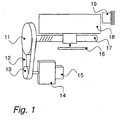
- the position of the motor 14 is measured by means of an encoder 15 so as to control the phase commutations at the correct positions of the rotor of the motor.
- the motor torque is transmitted to the load 18 representing for example the work table or else a spindle fitted with a tool by way of a transmission by pulleys 11 and 13 and belt 12 followed by a ballscrew with nut 17.
- the position of the load 18 is measured by means of a linear rule 16.
- the end of travel is determined by a mechanical stop 19, so as to protect the mechanism in case of a defect with the servodrive software. This stop 19 may serve in a machine preparation phase as absolute reference for the initialization of the spindle.
- an element in motion may collide with another member of the machine, a workpiece to be machined or with a component of the environment.
- the problem to be solved consists in preventing and/or detecting the collision.
- Patent US 4,820,895 proposes an electric touch sensor in the case of an electroerosion machine.
- Such a device can, according to patent DE 40 08 661 A1 , serve in the alignment of a three-dimensional tool on a semifinished workpiece, doing so through its capacity to detect tool-workpiece collisions accurately and without waste.
- the use of an electric touch sensor requires the presence of electrically conducting objects.
- Patent US 5, 119, 006 has proposed that a certain number of criteria being monitored, such as the absolute value of the servodrive motor torque/current.
- criteria being monitored such as the absolute value of the servodrive motor torque/current.
- the procedures described in this patent are restricted to drives with a rigid or very precise transmission, which require mechanical solutions that are needlessly expensive in the case of certain industrial applications for which the introduction of a second rule position sensor makes it possible to implement software procedures for compensating for errors related in particular to flexibility or to homokinetic defects. This compensation may give rise to taxing demands on the motor speed feedback loop, as well as to large speed tracking errors and so to large variations in the motor current.
- Patent US 5,304,906 proposes the construction of a disturbing torque observer based on the parameters of the drive and the filtering parameters intended to reduce the influence of measurement noise at high frequency.
- the method proposed in this Patent US 5,304,906 is limited to a rigid model for the transmission of the drive. The procedure is thus insufficient for drives for which the flexibility of transmission and the homokinetic defects assume considerable significance.
- the knowledge of the parameters such as the inertia and the torque constant of the motor is incompatible with numerous applications such as machine tools where the mass to be driven may easily vary by a factor of 5 during normal use of the installation.
- Patent Application DE 199 60 834 A1 proposes that a rule position be measured on the driven part of the spindle and that this measurement be compared with an indirect measurement taken inside the transmission chain, so as to form an error signal.
- An abrupt increase in the said signal indicates that a collision or an abnormal incident has occurred.
- the problem with this error signal relating to position between motor and driven part is that it is marred by homokinetic errors, which are characteristic of normal operation and again lead to the triggering limit being fixed at an excessive value.
- the solution advocated is unsuitable when it is necessary to violently accelerate large inertias. Such is the case for the X and Y spindles of electroerosion machines, which serve to move the assembly of the workpiece to be machined and the tray filled with dielectric liquid, the driven masses possibly reaching as much as one tonne.
- said transmission assembly possesses a flexibility of transmission which is used by virtue of said error signals as force gauge relating to the driving of the load.
- the means of discrimination comprise at least one restriction of the relevant domain of the data pertaining to the error signals over a limited movement of the load along the path forming at least one spatial window featuring a path traversed by the load devised in such a way as to discriminate between errors due to an accidental collision and those due to at least one other cause.
- the means of discrimination consist of spatial means of filtering adapted for discarding homokinetic errors and/or errors due to thermal variations.
- the means of filtering comprise two circular arrays of data pertaining on the one hand to the movements of the load over said path and on the other hand to the error signals corresponding to these movements and at least one spatial rectangular window comprising the most recent data pertaining to said movements and to said error signals extracted from the two circular arrays.
- the means of filtering comprise at least one spatially invariant linear filter which comprises an exponential spatial window.
- This mode is especially practical, since it makes it possible to obtain fast and dependable detection of anomalies with a calculation unit of smallish size.
- the invention also relates to a method of detecting operating anomalies intended for detecting accidental collisions on numerically controlled drive devices comprising:
- Figure 1 shows a numerically controlled drive device.
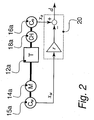
- Figure 2 illustrates a basic diagram of the means for establishing error signals d.
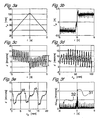
- Figures 3a to 3f illustrate the variations in different signals during a forward and return movement of the load.
- Figure 3a shows the positions x r [mm] occupied by the load as a function of time t[s].
- Figure 3b illustrates the current I M [A] of the motor as a function of time t[s].
- Figure 3c illustrates the variations in the error signal d[microns] as a function of time t[sec].
- Figure 3d shows the variations in the error signal d[microns] as a function of the positions x R [mm] occupied by the load.
- Figure 3e illustrates a magnified part of figure 3d .
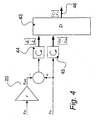
- Figure 4 is a basic diagram of a first mode of execution of the device for detecting accidental collisions.
- Figure 5 shows a diagram of the flows used in the first mode of execution.
- Figures 6a to 6d illustrate the variations in different signals during a movement with a stoppage (collision) of the load.
- Figure 6a is a chart of the positions x R [mm] occupied by the load as a function of time t[s].
- Figure 6b illustrates the current I M [A] of the motor as a function of time t[s].
- Figure 6c shows the variations in the error signal d[microns] as a function of time t[s].
- Figure 6d illustrates the variations in the error signal d[microns] as a function of the positions [x R ] occupied by the load.
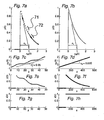
- Figures 7a and 7b are charts of the output signal of the filter y(k) as a function of the positions x R (k) for a fast and slow movement.
- Figures 7c and 7d show the positions x R (k) as a function of the various measurement points k.
- Figures 7e and 7f illustrate the output signal of the filter y(k) as a function of the various measurement points k.
- Figures 7g and 7h correspond to charts of the value of the error signal d(k) of the various measurement points k.
- Figure 8 illustrates a diagram of the flows used in the second mode of execution.
- the numerically controlled drive device of the present invention possesses a general configuration such as illustrated in Figure 2 .
- the motor 14a is associated with a first position sensor 15a providing a first value of position x M and constituting first means of measuring position disposed upstream of a transmission assembly 12a through which the motion is transferred to the load 18a which is moved along a path.
- the position of the load 18a is measured by virtue of a second position sensor 16a providing a second value of position x R .
- the error signal d therefore corresponds to the deviation between the position of the load and the motor position in relation to the load.
- the error d x R - r x M , is the sum of the errors due to the elements of the transmission, that is to say mainly the belt, the contacts between balls and ball raceways, the nut and the screw, which each act with their flexibility and their own kinetics.
- the error signal d illustrated in figures 3c, 3d and 3e relating to a forward and return movement of the load therefore consists of a dynamic contribution associated with the accelerations of the spindle and with the flexibility of the transmission, and a kinetic contribution or homokinetic error associated with manufacturing and assembling defects, respectively with temperature effects that falsify the reduction ratio r by changing the length of the ballscrew.
- the dynamic component of the error signal d is naturally represented in a temporal reference frame, whereas a spatial reference frame is the typical representation of the kinetic component; for example respectively figure 3c as opposed to figure 3d .
- the inertia of the motor 14 equals 0.31 g m 2
- the reduction ratio of the belt transmission 11-13 is 5
- the pitch of the screw 17 is 5 mm/turn
- the mass of the table carrying the workpieces to be machined varies between 620 - 1120 kg
- Figures 3c, 3d and 3e illustrate the signal d of a drive of the type shown in Figure 1 for a large movement and a reversal of direction of velocity.
- the homokinetic error originates from defects of manufacture of the screw and for disturbances generated by the system for recirculating the balls inside the nut.
- a spatial pseudo-period of 7 mm is observed.
- the amplitude of 10 microns in this case typifying this homokinetic defect gives it a predominant character, compels the choice of a spatial reference frame and moreover compels the detection devices to dispense, among other things, with said pseudo-period by means of appropriate filtering.
- the flexibility of transmission is used as force gauge regarding the load which generates said transmission error signal d whose components are discriminated and filtered of the homokinetic defects so as to avoid triggering a false collision alarm in the presence of tolerable defects.
- the spatial increases in the error signal are observed, instead of monitoring its abrupt temporal increases.
- error signals d are processed by analysis means comprising discrimination means devised so as to analyze the error signals obtained in the intervals predetermined as a function of the path x R traversed in a spatial reference frame d, x R with a view to discriminating between errors due to an accidental collision and those due to at least one other cause.
- the influence of homokinetic errors of transmission are dispensed with by means of a restriction of the relevant spatial domain of the data regarding a limited movement by forming at least one spatial window featuring a path traversed by the load devised in such a way as to discriminate between errors due to an accidental collision and those of other causes.
- This restriction of the relevant spatial domain is achieved either by virtue of a rectangular window and a circular array properly managed according to the first mode of execution, or by virtue of one or more exponential windows according to the second mode of execution whose manner of operation associated with the spatially invariant filters (linear space invariant LSI) will be explained hereinbelow.
- the first mode of execution with a rectangular window in space is based on the software architecture illustrated in Figure 4 .
- n for example 50.
- the index 1 denotes the most recent sample recorded. Recording is performed in accordance with a predetermined sampling period, for example 2 msec.
- L d,rel The value of L d,rel will be fixed by observation and analysis of the amplitude and of the shape of the local homokinetic error. It is proposed that the tailoring of the triggering limit L d,rel be based on the empirical properties of the drives concerned.
- the procedure consists in recording the domain of variation of d over the subset D chosen, for a certain number of relevant situations which must not trigger the collision detection, in particular:
- the triggering limit L d,rel is chosen with a sufficient margin, such that L d,rel is fixed at m% of the maximum value of ⁇ d max , m advantageously lying between 120 and 250, very favorably between 140 and 200 and preferably being equal to 150.
- Figure 3f shows such a tailoring graph for a high speed movement, the case identified as being the most critical for the drive concerned.
- the maximum of ⁇ d max at 2 microns, labeled 31 is attained upon reversal of the direction of motion because of the energy recovered upon the reversal of the motion. It has been possible to reduce the influence of the homokinetic defects of the mechanical transmission to 0.8 microns maximum, labeled 32 in this figure.
- the collision detection threshold may therefore be lowered by a factor of six to seven as compared with the known methods.
- the influence of the thermal and homokinetic errors of transmission are dispensed with by means of a restriction of the relevant spatial domain of the data regarding a limited movement; hence the possibility of placing the limit L d,rel at a smaller value allowing better sensitivity.
- the limits of the spatial window of a predetermined length do not generally coincide with the moment of measurement of the samples of pairs of variables x R and d. It is therefore necessary to perform an interpolation which is especially useful in the case of high speed movement when a small number of samples is used, for example 3 samples.
- the most recent spatial limit of the spatial window is not interpolated, whereas the oldest spatial limit furthest from the window by a width L x forms the subject of an interpolation for the value of the error signal d.
- This interpolation value is then stored as oldest sample of the spatial window. No interpolation is necessary if the sampling h is spatial instead of being temporal.
- FIG. 5 shows the diagram of the flows corresponding to this rectangular window-based collision detection method.
- Block 58 detects the collision if over this limit movement L x the value of ⁇ d max is equal to or greater than the threshold value L d, rel .
- This management of the log 51 comprises the following steps:
- Figures 6a, b, c show the evolution, as a function of time, of the position x R , of the motor current I M and of the error signal or kinetic defect d of the spindle.
- Figure 6d represents this error signal d as a function of position x R .
- samplings are generally regulated by a clock, and therefore do not coincide with the relevant spatial bounds for the observation of the phenomenon. This makes it necessary, in particular when the number of samples retained is small, to make corrections by interpolation on the oldest sample, in order to guarantee precision.
- the essence of the operations is contained in the block 81 and consists in carrying out a mapping into the spatial domain of the temporal information of the error signal d(k) regulated by the sampling clock.
- the block 81 contains the blocks 82, 83, 84, 85 for the management of the log of d by means of an LSI characterized by spatial constant x s .
- x s is analogous to the movement L x defining D of the first mode of execution which carries out the restriction of the relevant domain of the data over a limited movement.
- the block 86 detects the collision by performing the comparison with the threshold value L d,rel,Isi .
- the blocks 82 to 85 are similar to the blocks 52 to 57 of Figure 5 and will make it possible to understand the simplification afforded by the second mode of execution.
- ⁇ (k-1) represents the state of ⁇ (k) during the previous calculation loop, that is to say for example 2 msec before the present instant.
- ⁇ (k-1) is the memory of the log of the error signal, comparable to the circular memory 44 of figure 4 of the first mode of execution. It will be noted here that the second mode of execution uses only a single memory location to store the log whereas the first envisaged up to 50 thereof by way of example.
- ⁇ (k) depends, according to the expression of block 84, on the spatial filtering parameters a 1 (k) and b 0 (k) calculated previously at 83 and updated at each calculation cycle, for example, each 2 msec.
- a 1 k exp - ⁇ ⁇ ⁇ R k ⁇ s
- x s [microns] is the space constant of the exponential window, see figures 7a, 7b and its explanation hereinbelow.
- the constant x s is comparable to the width of the rectangular spatial window L x of the first mode of execution corresponding to the restriction of the relevant domain of the data over a limited movement.
- a 1 (k) and b 0 (k) are fixed if the speed of the spindle is constant or if a spatial sampling is carried out directly.
- the expression ⁇ (k) symbolized in the block 84 of figure 8 is a low-pass filter on the error signal d(k).
- ⁇ (k) retains only the components of the error signal that are characterized by low spatial frequencies and correspond in the case represented in figure 3 to the homokinetic defects, more precisely to the pseudo-period of around 7 mm and to the drifts of thermal type.
- This spatial filtering carried out by blocks 84 and 85 therefore makes it possible to dispense with the influence of the homokinetic transmission errors and enables, in the operation
- ⁇ (k-1) is the memory of the log of the error signal, comparable to the circular memory 44 of figure 4 of the first mode of execution; however in this second mode of execution a single memory location is required to store the log.
- ⁇ (k-1) is the memory of the log of the error signal, comparable to the circular memory 44 of figure 4 of the first mode of execution; however in this second mode of execution a single memory location is required to store the log.
- Such a simplification is made possible by virtue of the exponential window principle explained hereinbelow and by the fact that each sample taken into account in the integration participates therein with a weight that is all the lower according to an exponential decay, the further it is from the most recent sample; unlike for the rectangular window of the first mode of execution where the memory of the sample is completely erased beyond a distance away L x .
- Figures 7a to 7h show the characteristics of a spatially invariant filter (LSI) of order 1 realizing an exponential window.
- FIG 7a the succession of the samples is shown with the aid of crosses.
- the zone designated 71 corresponds to a faster movement, conversely in zone 72.
- the instantaneous speed of movement is manifested by the slope of the positions x R (k) as a function of the samples k, which is shown in figure 7c .
- the position x R (k) 2 is overstepped after the 48 th sample.
- the evolution of the input signal, respectively of the output signal of the filter, is plotted in figures 7g and e , respectively.
- Figures 7b, d, f and h are characterized by a larger density of samples on account of the lower average speed.
Landscapes
- Engineering & Computer Science (AREA)
- Human Computer Interaction (AREA)
- Manufacturing & Machinery (AREA)
- Physics & Mathematics (AREA)
- General Physics & Mathematics (AREA)
- Automation & Control Theory (AREA)
- Numerical Control (AREA)
- Testing Of Devices, Machine Parts, Or Other Structures Thereof (AREA)
- Control Of Stepping Motors (AREA)
- Manipulator (AREA)
- Control Of Electric Motors In General (AREA)
- Force Measurement Appropriate To Specific Purposes (AREA)
Claims (23)
- Numerisch gesteuerte Antriebseinrichtung mit einer Einrichtung zum Detektieren von Betriebsanomalien, die dafür bestimmt ist, versehentliche Kollisionen zu detektieren, umfassend:- mindestens einen Motor (14) mit der Fähigkeit zum Antreiben einer Last (18) entlang mindestens eines Pfads mittels einer Baugruppe von Übertragungselementen (T),- erste Mittel zur Messung von Position (15), die aufwärts mindestens eines der Elemente der Baugruppe zur Übertragung zu dem Motor (14) angeordnet sind und dafür bestimmt sind, einen ersten Wert der Position (xM) bereitzustellen,- zweite Mittel zur Messung von Position (16), die abwärts dieses Elements der Baugruppe zur Übertragung zu der Last (18) angeordnet sind und dafür bestimmt sind, einen zweiten Werte der Position (xR) entsprechend der Position der Last auf dem Pfad bereitzustellen,- Mittel zur Berechnung (20) zum Ermitteln von Fehlersignalen (d), die der Differenz des ersten und zweiten Werts der Position entsprechen, in vorbestimmten Intervallen (h) und- Mittel zur Analyse zum Analysieren dieser Fehlersignale, um so versehentliche Kollisionen zu detektieren,wobei die Mittel zur Analyse Unterscheidungsmittel umfassen, die so konzipiert sind, dass die in den vorbestimmten Intervallen erhaltenen Fehlersignale (d) als Funktion des in einem räumlichen Bezugssystem (d, xR) durchquerten Pfads (xR) analysiert werden, um zwischen Fehlern aufgrund einer versehentlichen Kollision und denen aufgrund mindestens einer anderen Ursache zu unterscheiden.
- Einrichtung nach Anspruch 1, wobei die Übertragungsbaugruppe (T) eine Flexibilität der Übertragung besitzt, die vermittels der Fehlersignale (d) als Kraftmesser in Bezug auf den Antrieb der Last (18) verwendet wird.
- Einrichtung nach Anspruch 1 oder 2, wobei die Mittel zur Unterscheidung mindestens eine Beschränkung der relevanten Domäne der Daten umfassen, die die Fehlersignale über eine begrenzte Bewegung der Last entlang des Pfads betreffen, wodurch mindestens ein räumliches Fenster (Lx, xS) gebildet wird, worin ein von der Last durchquerter Pfad auftritt, das so konzipiert ist, dass zwischen Fehlern aufgrund einer versehentlichen Kollision und denen aufgrund mindestens einer anderen Ursache unterschieden wird.
- Einrichtung nach einem der Ansprüche 1 bis 3, wobei die Mittel zur Unterscheidung aus räumlichen Mitteln zum Filtern bestehen, die dafür ausgelegt sind, homokinetische Fehler und/oder Fehler aufgrund von thermischen Schwankungen zu verwerfen.
- Einrichtung nach Anspruch 4, wobei die Mittel zum Filtern Folgendes umfassen: zwei kreisförmige Arrays von Daten (44, 45), die einerseits die Bewegungen (xR) der Last über den Pfad und andererseits die diesen Bewegungen entsprechenden Fehlersignale (d) betreffen, und mindestens ein räumliches rechteckiges Fenster (D), das die neuesten Daten umfasst, die die Bewegungen (xR) und die aus den zwei kreisförmigen Arrays extrahierten Fehlersignale (d) betreffen.
- Einrichtung nach Anspruch 5, wobei die Mittel zum Filtern für Folgendes konzipiert sind:- Aufzeichnen von Abtastwerten von Paaren von Variablen, die die Bewegungen (xR) der Last und die mit diesen Bewegungen assoziierten Fehlersignale (d) betreffen, in den zwei kreisförmigen Arrays, die die Größe n aufweisen, gemäß einer vorbestimmten Abtastperiode (h), um so Paare von Protokollierungsdaten xR(k), d(k) zu bilden, wobei der Index 1 des Koeffizienten k den letzten aufgezeichneten Abtastwert bezeichnet;- Extrahieren einer Teilmenge der neuesten sukzessiven Abtastwerte

für die die Domäne der durch die Last (18) über den Pfad durchquerten Positionen kleiner oder gleich einer ersten festen und vorbestimmten Grenze (Lx) ist, die der räumlichen Breite des rechteckigen Fensters entspricht, dergestalt, dass
gilt, wobei diese Teilmenge sukzessiver Abtastwerte (D) ein räumliches rechteckiges Fenster bildet, in dem als Abszisse die Bewegungen (xR) der Last und als Ordinate die Fehlersignale (d) zu finden sind, wobei der Wert der ersten Grenze (Lx) so vorbestimmt wird, dass er ein Bruchteil einer Periode des Fehlers oder der Fehler, der/die zu verwerfen ist/sind, ist;- Detektieren einer Kollision, die durch das Überschreiten einer zweiten vorbestimmten Grenze (Ld,rel) des Dynamikumfangs des Fehlersignals (d) über die Teilmenge (D) definiert ist, die in dem rechteckigen Fenster gemäß der Operation
gewählt wird, wobei max d(k) bzw. min d(k) der maximale bzw. minimale Wert von d in der Teilmenge D ist. - Einrichtung nach Anspruch 6, wobei die zweite Grenze Ld,rel auf m% des Maximalwerts von Δdmax für Situationen von Bewegungen der Last ohne Kollision festgelegt ist, wobei m vorteilhafterweise zwischen 120 und 250 liegt, sehr günstigerweise zwischen 140 und 200 liegt und vorzugsweise gleich 150 ist.
- Einrichtung nach Anspruch 6 oder 7, wobei die Mittel zum Filtern Interpolationsmittel umfassen, die so konzipiert sind, dass durch Interpolation für die erste Grenze (Lx) des räumlichen rechteckiges Fensters ein Wert der Interpolation des Fehlersignals (d) erhalten wird, wobei diese erste Grenze (Lx) und der Wert der Interpolation als älteste Abtastwerte des räumlichen rechteckigen Fensters gespeichert werden.
- Einrichtung nach Anspruch 4, wobei die Mittel zum Filtern mindestens ein räumlich invariantes Linearfilter umfassen, das ein exponenzielles räumliches Fenster umfasst.
- Einrichtung nach Anspruch 9, wobei die Raumkonstante(n) (xS) des räumlich invarianten Linearfilters oder der Filter gemäß den homokinetischen Defekten, deren Tolerierung man entscheidet, festgelegt wird, bzw. werden.
- Einrichtung nach Anspruch 10, wobei die Mittel zur Filterung für Folgendes konzipiert sind:- Aufzeichnen eines Abtastwerts eines Paars von Variablen XR(k), d(k), die die Bewegung der Last bzw. das assoziierte Fehlersignal betreffen, gemäß einer vorbestimmten Abtastperiode,- Berechnen eines Signals ξ(k) in jeder Abtastperiode gemäß der Gleichung

wobei ξ(k-1) der Speicher der Protokollierung des Fehlersignals ist und wobei

gilt- Berechnen eines Ausgangssignals y(k) gemäß der Gleichung - Detektieren einer Kollision, die durch die Überschreitung einer vorbestimmten Grenze Ld,rel,Isi definiert ist, gemäß der Operation y(k) >Ld,rel,Isi.
 - Verfahren zum Detektieren von Betriebsanomalien, das dafür bestimmt ist, versehentliche Kollisionen in numerisch gesteuerten Antriebseinrichtungen zu detektieren, umfassend:- mindestens einen Motor (14) mit der Fähigkeit zum Antreiben einer Last (18) entlang mindestens eines Pfads mittels einer Baugruppe von Übertragungselementen (T),- erste Mittel zur Messung von Position (15), die aufwärts mindestens eines der Elemente der Baugruppe zur Übertragung zu dem Motor (14) angeordnet sind und dafür bestimmt sind, einen ersten Wert der Position (xM) bereitzustellen,- zweite Mittel zur Messung von Position (16), die abwärts dieses Elements der Baugruppe zur Übertragung zu der Last (18) angeordnet sind und dafür bestimmt sind, einen zweiten Wert der Position (xR) entsprechend der Position der Last auf dem Pfad bereitzustellen,- Mittel zur Berechnung (20) zum Ermitteln von Fehlersignalen (d), die der Differenz des ersten und zweiten Werts der Position entsprechen, in vorbestimmten Intervallen und- Mittel zur Analyse zum Analysieren dieser Fehlersignale, um so versehentliche Kollisionen zu detektieren,wobei Mittel zur Unterscheidung verwendet werden, um die in den vorbestimmten Intervallen erhaltenen Fehlersignale (d) als Funktion des Pfads (xR), der in einem räumlichen Bezugssystem (d, xR) durchquert wird, zu analysieren, um zwischen Fehlern aufgrund einer versehentlichen Kollision und denen aufgrund mindestens einer anderen Ursache zu unterscheiden.
- Verfahren nach Anspruch 12, wobei als Kraftmesser in Bezug auf den Antrieb der Last (18) die Flexibilität der Übertragung der Übertragungsbaugruppe (T) mittels der Fehlersignale (d) benutzt wird.
- Verfahren nach Anspruch 12 oder 13, wobei die Fehlersignale (d) durch die Mittel zur Unterscheidung analysiert werden, indem mindestens eine Beschränkung der relevanten Domäne der Daten durchgeführt wird, die die Fehlersignale über eine begrenzte Bewegung der Last entlang des Pfads betreffen, wodurch mindestens ein räumliches Fenster (Lx, xS) gebildet wird, worin ein von der Last durchquerter Pfad auftritt, das so konzipiert wird, dass zwischen Fehlern aufgrund einer versehentlichen Kollision und denen aufgrund mindestens einer anderen Ursache unterschieden wird.
- Verfahren nach einem der Ansprüche 12 bis 14, wobei Mittel zur Unterscheidung benutzt werden, die räumliche Mittel zur Filterung umfassen, die dafür ausgelegt sind, homokinetische Fehler und/oder Fehler aufgrund thermischer Schwankungen zu verwerfen.
- Verfahren nach Anspruch 15, wobei eine Filterung durch die Mittel zur Filterung durchgeführt wird, die Folgendes umfassen: zwei kreisförmige Arrays von Daten (44, 45), die einerseits die Bewegungen (xR) der Last über den Pfad und andererseits die diesen Bewegungen entsprechenden Fehlersignale (d) betreffen, und mindestens ein räumliches rechteckiges Fenster (D), das die neuesten Daten umfasst, die die Bewegungen (xR) und die aus den zwei kreisförmigen Arrays extrahierten Fehlersignale (d) betreffen.
- Verfahren nach Anspruch 16, das aus Folgendem besteht:- Aufzeichnen von Abtastwerten von Paaren von Variablen, die die Bewegungen (xR) der Last und die mit diesen Bewegungen assoziierten Fehlersignale (d) betreffen, in den zwei kreisförmigen Arrays, die die Größe n aufweisen, gemäß einer vorbestimmten Abtastperiode (h), um so Paare von Protokollierungsdaten xR(k), d(k) zu bilden, wobei der Index 1 des Koeffizienten k den letzten aufgezeichneten Abtastwert bezeichnet;- Extrahieren einer Teilmenge der neuesten sukzessiven Abtastwerte

für die die Domäne der durch die Last (18) über den Pfad durchquerten Positionen kleiner oder gleich einer ersten festen und vorbestimmten Grenze (Lx) ist, die der räumlichen Breite des rechteckigen Fensters entspricht, dergestalt, dass
gilt, wobei diese Teilmenge sukzessiver Abtastwerte (D) ein räumliches rechteckiges Fenster bildet, in dem als Abszisse die Bewegungen (xR) der Last und als Ordinate die Fehlersignale (d) zu finden sind, wobei der Wert der ersten Grenze (Lx) so vorbestimmt wird, dass er ein Bruchteil einer Periode des Fehlers oder der Fehler, der/die zu verwerfen ist/sind, ist;- Detektieren einer Kollision, die durch das Überschreiten einer zweiten vorbestimmten Grenze (Ld,rel) des Dynamikumfangs des Fehlersignals (d) über die Teilmenge (D) definiert ist, die in dem rechteckigen Fenster gemäß der Operation
gewählt wird, wobei maxKED d(k) bzw. minKED d(k) der maximale bzw. minimale Wert von d in der Teilmenge D ist. - Verfahren nach Anspruch 17, wobei die zweite Grenze Ld,rel auf m% des Maximalwerts von Δdmax für Situationen von Bewegungen der Last ohne Kollision festgelegt ist, wobei m vorteilhafterweise zwischen 120 und 250 liegt, sehr günstigerweise zwischen 140 und 200 liegt und vorzugsweise gleich 150 ist.
- Verfahren nach Anspruch 17 oder 18, wobei Mittel zur Interpolation verwendet werden, um so für die erste Grenze (Lx) des räumlichen rechteckigen Fensters einen Wert der Interpolation des Fehlersignals (d) zu berechnen, wobei diese erste Grenze (Lx) und der Wert der Interpolation gespeichert werden als älteste Abtastwerte und die am weitesten von dem räumlichen rechteckigen Fenster entfernt sind.
- Verfahren nach Anspruch 15, wobei eine Filterung durch die Mittel zur Filterung ausgeführt wird, die mindestens ein räumlich invariantes Linearfilter umfassen, das ein exponentielles räumliches Fenster umfasst.
- Verfahren nach Anspruch 20, wobei die Raumkonstante(n) (xS) des räumlich invarianten Linearfilters oder der Filter gemäß den homokinetischen Defekten, deren Tolerierung man entscheidet, festgelegt wird, bzw. werden.
- Verfahren nach Anspruch 21, wobei zwei oder mehr Hochpass-, Tiefpass-, Bandstopp- oder Bandpassfilter kombiniert werden, wobei für jedes dieser ein anderer Wert der räumlichen Konstante gewählt wird, um so genau die tolerierbaren homokinetischen Komponenten des Fehlersignals (d) zu extrahieren.
- Verfahren nach Anspruch 21, das aus Folgendem besteht:- Aufzeichnen eines Abtastwerts eines Paars von Variablen XR(k), d(k), die die Bewegung der Last bzw. das assoziierte Fehlersignal betreffen, gemäß einer vorbestimmten Abtastperiode,- Berechnen eines Signals ξ(k) in jeder Abtastperiode gemäß der Gleichung

wobei ξ(k-1) der Speicher der Protokollierung des Fehlersignals ist und wobei

gilt- Berechnen eines Ausgangssignals y(k) gemäß der Gleichung - Detektieren einer Kollision, die durch die Überschreitung einer vorbestimmten Grenze Ld,rel,Isi definiert ist, gemäß der Operation y(k) >Ld,rel,Iei·
Applications Claiming Priority (2)
| Application Number | Priority Date | Filing Date | Title |
|---|---|---|---|
| CH00735/04A CH697616B1 (fr) | 2004-04-27 | 2004-04-27 | Dispositif d'entraînement à contrôle numérique avec dispositif de détection d'anomalies de fonctionnement destiné à la détection de collisions accidentelles et procédé de détection d'anomalies de fonctionnement pour ce dispositif. |
| CH7352004 | 2004-04-27 |
Publications (3)
| Publication Number | Publication Date |
|---|---|
| EP1591850A2 EP1591850A2 (de) | 2005-11-02 |
| EP1591850A3 EP1591850A3 (de) | 2007-10-17 |
| EP1591850B1 true EP1591850B1 (de) | 2011-08-17 |
Family
ID=34934390
Family Applications (1)
| Application Number | Title | Priority Date | Filing Date |
|---|---|---|---|
| EP05006084A Expired - Lifetime EP1591850B1 (de) | 2004-04-27 | 2005-03-19 | Numerisch gesteuerte Antriebvorrichtung mit Vorrichtung zur Betriebsfehlererkennung der zufälligen Kollisionserkennung und Verfahren zur Betriebsfehlererkennung der Vorrichtung |
Country Status (7)
| Country | Link |
|---|---|
| US (1) | US7310560B2 (de) |
| EP (1) | EP1591850B1 (de) |
| JP (1) | JP2005317014A (de) |
| CN (1) | CN1690898B (de) |
| AT (1) | ATE521025T1 (de) |
| CH (1) | CH697616B1 (de) |
| ES (1) | ES2371755T3 (de) |
Families Citing this family (15)
| Publication number | Priority date | Publication date | Assignee | Title |
|---|---|---|---|---|
| JP2007272720A (ja) * | 2006-03-31 | 2007-10-18 | Fanuc Ltd | 電動機制御装置 |
| JP4955371B2 (ja) * | 2006-11-24 | 2012-06-20 | 三菱電機株式会社 | 数値制御システム |
| WO2010017663A1 (zh) * | 2008-08-15 | 2010-02-18 | 仁安资讯科技股份有限公司 | Cnc数控工具机同步动态干涉验证预测警告防撞方法及其计算机程序产品 |
| CN102184267B (zh) * | 2011-04-14 | 2013-02-13 | 上海同岩土木工程科技有限公司 | 一种自动数据采集系统消除干扰的异常数据过滤方法 |
| US9523979B2 (en) * | 2012-05-09 | 2016-12-20 | Mitsubishi Electric Corporation | Numerical control device |
| CN102980764B (zh) * | 2012-11-29 | 2015-06-17 | 北京卫星环境工程研究所 | 空间环境下的谐波传动机构自动测试系统及测试方法 |
| BR112015025405A2 (pt) * | 2013-04-08 | 2017-07-18 | Mitsubishi Electric Corp | aparelho de controle numérico |
| CN104238433B (zh) * | 2013-06-07 | 2017-04-19 | 台中精机厂股份有限公司 | 工具机碰撞安全防护系统及其监控方法 |
| CN104097110A (zh) * | 2014-07-02 | 2014-10-15 | 无锡烨隆精密机械有限公司 | 一种数控机床防止撞机的控制方法及系统 |
| JP6017096B1 (ja) * | 2015-10-30 | 2016-10-26 | 三菱電機株式会社 | ワイヤ放電加工機、ワイヤ放電加工機の制御装置の制御方法及び位置決め方法 |
| JP6476228B2 (ja) * | 2017-04-14 | 2019-02-27 | オムロン株式会社 | 産業用制御装置、制御方法、プログラム、包装機、および包装機用制御装置 |
| DE102018209136A1 (de) * | 2018-06-08 | 2019-12-12 | Dr. Johannes Heidenhain Gmbh | Positionsmesseinrichtung und Verfahren zum Betreiben einer Positionsmesseinrichtung |
| CN108789498A (zh) * | 2018-08-01 | 2018-11-13 | 珠海格力智能装备有限公司 | 测试机器人的方法及装置、存储介质和处理器 |
| CN117980837A (zh) * | 2021-09-24 | 2024-05-03 | 利乐拉瓦尔集团及财务有限公司 | 用于移动机器部件的状态监测的方法 |
| CN113909713B (zh) * | 2021-11-05 | 2024-03-29 | 泰尔重工股份有限公司 | 一种激光加工的防碰撞保护系统及方法 |
Family Cites Families (12)
| Publication number | Priority date | Publication date | Assignee | Title |
|---|---|---|---|---|
| JPS60135127A (ja) | 1983-12-23 | 1985-07-18 | Fanuc Ltd | 放電加工機の位置出し用電源装置 |
| DE3426863A1 (de) | 1984-07-20 | 1986-01-23 | Siemens AG, 1000 Berlin und 8000 München | Einrichtung zur lagemessung bei einer numerisch gesteuerten werkzeugmaschine oder dergleichen |
| JPH01230107A (ja) | 1988-03-10 | 1989-09-13 | Fanuc Ltd | サーボモータにより駆動される被駆動体の衝突検出方法 |
| JPH0660826B2 (ja) * | 1989-02-07 | 1994-08-10 | 動力炉・核燃料開発事業団 | プラントの異常診断方法 |
| US5304906A (en) | 1989-12-26 | 1994-04-19 | Fanuc Ltd. | Collision detecting method using an observer |
| DE4008661A1 (de) | 1990-03-17 | 1991-09-19 | Nassovia Werkzeugmaschinen Gmb | Verfahren und vorrichtung an einer werkzeugmaschine zum ansteuern einer einrichtposition |
| DE4443669A1 (de) * | 1994-12-08 | 1996-06-13 | Index Werke Kg Hahn & Tessky | Verfahren und Einrichtung zum Überwachen der Bewegung eines Maschinenbauteils |
| US5982124A (en) * | 1995-08-30 | 1999-11-09 | Trw Inc. | Method and apparatus for adaptive control of a vehicle power window |
| DE19539578B4 (de) * | 1995-10-25 | 2007-04-05 | Robert Bosch Gmbh | Verfahren zum Überwachen des Bewegungswegs eines Teils |
| JPH1170445A (ja) * | 1997-08-29 | 1999-03-16 | Nec Kyushu Ltd | 製造プロセス変更管理装置及び製造プロセス変更管理方法 |
| WO2000072436A1 (en) * | 1999-05-21 | 2000-11-30 | Automatic Technology Australia Pty Ltd | Control system and method for an automatic door or gate |
| DE19960834B4 (de) * | 1999-12-16 | 2006-10-26 | Agie S.A., Losone | Verfahren und Vorrichtung zur Störungserfassung, insbesondere zur Kollisionserfassung, im Antriebssystem einer numerisch gesteuerten Werkzeugmaschine |
-
2004
- 2004-04-27 CH CH00735/04A patent/CH697616B1/fr not_active IP Right Cessation
-
2005
- 2005-03-19 ES ES05006084T patent/ES2371755T3/es not_active Expired - Lifetime
- 2005-03-19 AT AT05006084T patent/ATE521025T1/de not_active IP Right Cessation
- 2005-03-19 EP EP05006084A patent/EP1591850B1/de not_active Expired - Lifetime
- 2005-04-25 US US11/114,635 patent/US7310560B2/en not_active Expired - Fee Related
- 2005-04-26 JP JP2005128051A patent/JP2005317014A/ja not_active Withdrawn
- 2005-04-27 CN CN2005100670589A patent/CN1690898B/zh not_active Expired - Fee Related
Also Published As
| Publication number | Publication date |
|---|---|
| US7310560B2 (en) | 2007-12-18 |
| CH697616B1 (fr) | 2008-12-31 |
| ES2371755T3 (es) | 2012-01-09 |
| CN1690898B (zh) | 2010-09-29 |
| CN1690898A (zh) | 2005-11-02 |
| US20050238043A1 (en) | 2005-10-27 |
| ATE521025T1 (de) | 2011-09-15 |
| JP2005317014A (ja) | 2005-11-10 |
| EP1591850A3 (de) | 2007-10-17 |
| EP1591850A2 (de) | 2005-11-02 |
Similar Documents
| Publication | Publication Date | Title |
|---|---|---|
| EP1591850B1 (de) | Numerisch gesteuerte Antriebvorrichtung mit Vorrichtung zur Betriebsfehlererkennung der zufälligen Kollisionserkennung und Verfahren zur Betriebsfehlererkennung der Vorrichtung | |
| US11614728B2 (en) | Machine tool management system that obtains a next maintenance period from a maintenance period model and a refinement algorithm | |
| Altintas | Prediction of cutting forces and tool breakage in milling from feed drive current measurements | |
| JP6140331B1 (ja) | 主軸または主軸を駆動するモータの故障予知を学習する機械学習装置および機械学習方法、並びに、機械学習装置を備えた故障予知装置および故障予知システム | |
| US5819202A (en) | Apparatus for detecting an abnormality of a control system | |
| EP2347309B1 (de) | Verfahren und vorrichtung zur sicheren erfassung einer kinematischen grösse eines manipulators | |
| KR101889248B1 (ko) | 고장 진단 장치 및 고장 진단 방법 | |
| EP1406137A2 (de) | Elektronischer Fingerabdruck zur Maschinensteuerung und Produktionsmaschinen | |
| US7571022B2 (en) | System and method for monitoring machine health | |
| CN107614217A (zh) | 故障诊断装置及故障诊断方法 | |
| Landers et al. | Process monitoring and control of machining operations | |
| US20070088454A1 (en) | System and method for troubleshooting a machine | |
| US7383097B2 (en) | Method for managing machine tool data | |
| DE10348608A1 (de) | Spindelvorrichtung mit Zustandsüberwachung sowie entsprechendes Überwachungsverfahren und -system | |
| JP6966166B2 (ja) | 工作機械の送り軸の稼働状態表示装置及び稼働状態表示方法 | |
| JP7708764B2 (ja) | 異常検知装置 | |
| CN121589663A (zh) | 用于在硬精加工机床上对具有齿轮或轮廓的工件进行硬精加工的方法 | |
| Yamato et al. | Enhancement of sensor-less cutting force estimation by tuning of observer parameters from cutting test | |
| KR101170323B1 (ko) | 주축 구동 모터의 전류값을 이용한 절삭 가공 장치의 상태 모니터링 방법 | |
| JPH068106A (ja) | 適応制御システムおよび状態判定装置 | |
| Quintana et al. | Using kernel data in machine tools for the indirect evaluation of surface roughness in vertical milling operations | |
| CN121173842B (zh) | 基于物联网感知的机床状态监测数据传输系统及方法 | |
| EP4390585B1 (de) | Sensorsystem | |
| Min et al. | Cutting process diagnostics utilising a smart cutting tool | |
| Lindström | Automatic supervision in turning and boring |
Legal Events
| Date | Code | Title | Description |
|---|---|---|---|
| PUAI | Public reference made under article 153(3) epc to a published international application that has entered the european phase |
Free format text: ORIGINAL CODE: 0009012 |
|
| AK | Designated contracting states |
Kind code of ref document: A2 Designated state(s): AT BE BG CH CY CZ DE DK EE ES FI FR GB GR HU IE IS IT LI LT LU MC NL PL PT RO SE SI SK TR |
|
| AX | Request for extension of the european patent |
Extension state: AL BA HR LV MK YU |
|
| PUAL | Search report despatched |
Free format text: ORIGINAL CODE: 0009013 |
|
| AK | Designated contracting states |
Kind code of ref document: A3 Designated state(s): AT BE BG CH CY CZ DE DK EE ES FI FR GB GR HU IE IS IT LI LT LU MC NL PL PT RO SE SI SK TR |
|
| AX | Request for extension of the european patent |
Extension state: AL BA HR LV MK YU |
|
| 17P | Request for examination filed |
Effective date: 20080402 |
|
| AKX | Designation fees paid |
Designated state(s): AT BE BG CH CY CZ DE DK EE ES FI FR GB GR HU IE IS IT LI LT LU MC NL PL PT RO SE SI SK TR |
|
| 17Q | First examination report despatched |
Effective date: 20101008 |
|
| GRAP | Despatch of communication of intention to grant a patent |
Free format text: ORIGINAL CODE: EPIDOSNIGR1 |
|
| RTI1 | Title (correction) |
Free format text: NUMERICALLY CONTROLLED DRIVE DEVICE WITH DEVICE FOR DETECTING OPERATING ANOMALIES INTENDED FOR DETECTING ACCIDENTAL COLLISIONS AND METHOD OF DETECTING OPERATING ANOMALIES FOR THI |
|
| RAP1 | Party data changed (applicant data changed or rights of an application transferred) |
Owner name: AGIE CHARMILLES SA |
|
| GRAS | Grant fee paid |
Free format text: ORIGINAL CODE: EPIDOSNIGR3 |
|
| GRAA | (expected) grant |
Free format text: ORIGINAL CODE: 0009210 |
|
| AK | Designated contracting states |
Kind code of ref document: B1 Designated state(s): AT BE BG CH CY CZ DE DK EE ES FI FR GB GR HU IE IS IT LI LT LU MC NL PL PT RO SE SI SK TR |
|
| REG | Reference to a national code |
Ref country code: GB Ref legal event code: FG4D |
|
| REG | Reference to a national code |
Ref country code: CH Ref legal event code: EP |
|
| REG | Reference to a national code |
Ref country code: IE Ref legal event code: FG4D |
|
| REG | Reference to a national code |
Ref country code: DE Ref legal event code: R096 Ref document number: 602005029520 Country of ref document: DE Effective date: 20111117 |
|
| REG | Reference to a national code |
Ref country code: NL Ref legal event code: VDEP Effective date: 20110817 |
|
| REG | Reference to a national code |
Ref country code: ES Ref legal event code: FG2A Ref document number: 2371755 Country of ref document: ES Kind code of ref document: T3 Effective date: 20120109 |
|
| LTIE | Lt: invalidation of european patent or patent extension |
Effective date: 20110817 |
|
| PG25 | Lapsed in a contracting state [announced via postgrant information from national office to epo] |
Ref country code: LT Free format text: LAPSE BECAUSE OF FAILURE TO SUBMIT A TRANSLATION OF THE DESCRIPTION OR TO PAY THE FEE WITHIN THE PRESCRIBED TIME-LIMIT Effective date: 20110817 Ref country code: FI Free format text: LAPSE BECAUSE OF FAILURE TO SUBMIT A TRANSLATION OF THE DESCRIPTION OR TO PAY THE FEE WITHIN THE PRESCRIBED TIME-LIMIT Effective date: 20110817 Ref country code: IS Free format text: LAPSE BECAUSE OF FAILURE TO SUBMIT A TRANSLATION OF THE DESCRIPTION OR TO PAY THE FEE WITHIN THE PRESCRIBED TIME-LIMIT Effective date: 20111217 Ref country code: NL Free format text: LAPSE BECAUSE OF FAILURE TO SUBMIT A TRANSLATION OF THE DESCRIPTION OR TO PAY THE FEE WITHIN THE PRESCRIBED TIME-LIMIT Effective date: 20110817 Ref country code: SE Free format text: LAPSE BECAUSE OF FAILURE TO SUBMIT A TRANSLATION OF THE DESCRIPTION OR TO PAY THE FEE WITHIN THE PRESCRIBED TIME-LIMIT Effective date: 20110817 Ref country code: PT Free format text: LAPSE BECAUSE OF FAILURE TO SUBMIT A TRANSLATION OF THE DESCRIPTION OR TO PAY THE FEE WITHIN THE PRESCRIBED TIME-LIMIT Effective date: 20111219 |
|
| REG | Reference to a national code |
Ref country code: AT Ref legal event code: MK05 Ref document number: 521025 Country of ref document: AT Kind code of ref document: T Effective date: 20110817 |
|
| PG25 | Lapsed in a contracting state [announced via postgrant information from national office to epo] |
Ref country code: CY Free format text: LAPSE BECAUSE OF FAILURE TO SUBMIT A TRANSLATION OF THE DESCRIPTION OR TO PAY THE FEE WITHIN THE PRESCRIBED TIME-LIMIT Effective date: 20110817 Ref country code: SI Free format text: LAPSE BECAUSE OF FAILURE TO SUBMIT A TRANSLATION OF THE DESCRIPTION OR TO PAY THE FEE WITHIN THE PRESCRIBED TIME-LIMIT Effective date: 20110817 Ref country code: PL Free format text: LAPSE BECAUSE OF FAILURE TO SUBMIT A TRANSLATION OF THE DESCRIPTION OR TO PAY THE FEE WITHIN THE PRESCRIBED TIME-LIMIT Effective date: 20110817 Ref country code: AT Free format text: LAPSE BECAUSE OF FAILURE TO SUBMIT A TRANSLATION OF THE DESCRIPTION OR TO PAY THE FEE WITHIN THE PRESCRIBED TIME-LIMIT Effective date: 20110817 Ref country code: GR Free format text: LAPSE BECAUSE OF FAILURE TO SUBMIT A TRANSLATION OF THE DESCRIPTION OR TO PAY THE FEE WITHIN THE PRESCRIBED TIME-LIMIT Effective date: 20111118 |
|
| PG25 | Lapsed in a contracting state [announced via postgrant information from national office to epo] |
Ref country code: BE Free format text: LAPSE BECAUSE OF FAILURE TO SUBMIT A TRANSLATION OF THE DESCRIPTION OR TO PAY THE FEE WITHIN THE PRESCRIBED TIME-LIMIT Effective date: 20110817 |
|
| PG25 | Lapsed in a contracting state [announced via postgrant information from national office to epo] |
Ref country code: SK Free format text: LAPSE BECAUSE OF FAILURE TO SUBMIT A TRANSLATION OF THE DESCRIPTION OR TO PAY THE FEE WITHIN THE PRESCRIBED TIME-LIMIT Effective date: 20110817 Ref country code: CZ Free format text: LAPSE BECAUSE OF FAILURE TO SUBMIT A TRANSLATION OF THE DESCRIPTION OR TO PAY THE FEE WITHIN THE PRESCRIBED TIME-LIMIT Effective date: 20110817 |
|
| PG25 | Lapsed in a contracting state [announced via postgrant information from national office to epo] |
Ref country code: EE Free format text: LAPSE BECAUSE OF FAILURE TO SUBMIT A TRANSLATION OF THE DESCRIPTION OR TO PAY THE FEE WITHIN THE PRESCRIBED TIME-LIMIT Effective date: 20110817 Ref country code: RO Free format text: LAPSE BECAUSE OF FAILURE TO SUBMIT A TRANSLATION OF THE DESCRIPTION OR TO PAY THE FEE WITHIN THE PRESCRIBED TIME-LIMIT Effective date: 20110817 |
|
| PLBE | No opposition filed within time limit |
Free format text: ORIGINAL CODE: 0009261 |
|
| STAA | Information on the status of an ep patent application or granted ep patent |
Free format text: STATUS: NO OPPOSITION FILED WITHIN TIME LIMIT |
|
| PG25 | Lapsed in a contracting state [announced via postgrant information from national office to epo] |
Ref country code: DK Free format text: LAPSE BECAUSE OF FAILURE TO SUBMIT A TRANSLATION OF THE DESCRIPTION OR TO PAY THE FEE WITHIN THE PRESCRIBED TIME-LIMIT Effective date: 20110817 |
|
| 26N | No opposition filed |
Effective date: 20120521 |
|
| REG | Reference to a national code |
Ref country code: DE Ref legal event code: R097 Ref document number: 602005029520 Country of ref document: DE Effective date: 20120521 |
|
| PG25 | Lapsed in a contracting state [announced via postgrant information from national office to epo] |
Ref country code: MC Free format text: LAPSE BECAUSE OF NON-PAYMENT OF DUE FEES Effective date: 20120331 |
|
| REG | Reference to a national code |
Ref country code: CH Ref legal event code: PL |
|
| REG | Reference to a national code |
Ref country code: IE Ref legal event code: MM4A |
|
| PG25 | Lapsed in a contracting state [announced via postgrant information from national office to epo] |
Ref country code: CH Free format text: LAPSE BECAUSE OF NON-PAYMENT OF DUE FEES Effective date: 20120331 Ref country code: LI Free format text: LAPSE BECAUSE OF NON-PAYMENT OF DUE FEES Effective date: 20120331 Ref country code: IE Free format text: LAPSE BECAUSE OF NON-PAYMENT OF DUE FEES Effective date: 20120319 |
|
| PGFP | Annual fee paid to national office [announced via postgrant information from national office to epo] |
Ref country code: ES Payment date: 20130326 Year of fee payment: 9 |
|
| PG25 | Lapsed in a contracting state [announced via postgrant information from national office to epo] |
Ref country code: BG Free format text: LAPSE BECAUSE OF FAILURE TO SUBMIT A TRANSLATION OF THE DESCRIPTION OR TO PAY THE FEE WITHIN THE PRESCRIBED TIME-LIMIT Effective date: 20111117 |
|
| PG25 | Lapsed in a contracting state [announced via postgrant information from national office to epo] |
Ref country code: TR Free format text: LAPSE BECAUSE OF FAILURE TO SUBMIT A TRANSLATION OF THE DESCRIPTION OR TO PAY THE FEE WITHIN THE PRESCRIBED TIME-LIMIT Effective date: 20110817 |
|
| PGFP | Annual fee paid to national office [announced via postgrant information from national office to epo] |
Ref country code: DE Payment date: 20140328 Year of fee payment: 10 |
|
| PG25 | Lapsed in a contracting state [announced via postgrant information from national office to epo] |
Ref country code: LU Free format text: LAPSE BECAUSE OF NON-PAYMENT OF DUE FEES Effective date: 20120319 |
|
| PGFP | Annual fee paid to national office [announced via postgrant information from national office to epo] |
Ref country code: FR Payment date: 20140319 Year of fee payment: 10 Ref country code: IT Payment date: 20140328 Year of fee payment: 10 |
|
| PGFP | Annual fee paid to national office [announced via postgrant information from national office to epo] |
Ref country code: GB Payment date: 20140319 Year of fee payment: 10 |
|
| PG25 | Lapsed in a contracting state [announced via postgrant information from national office to epo] |
Ref country code: HU Free format text: LAPSE BECAUSE OF FAILURE TO SUBMIT A TRANSLATION OF THE DESCRIPTION OR TO PAY THE FEE WITHIN THE PRESCRIBED TIME-LIMIT Effective date: 20050319 |
|
| REG | Reference to a national code |
Ref country code: DE Ref legal event code: R119 Ref document number: 602005029520 Country of ref document: DE |
|
| GBPC | Gb: european patent ceased through non-payment of renewal fee |
Effective date: 20150319 |
|
| PG25 | Lapsed in a contracting state [announced via postgrant information from national office to epo] |
Ref country code: IT Free format text: LAPSE BECAUSE OF NON-PAYMENT OF DUE FEES Effective date: 20150319 |
|
| REG | Reference to a national code |
Ref country code: FR Ref legal event code: ST Effective date: 20151130 |
|
| PG25 | Lapsed in a contracting state [announced via postgrant information from national office to epo] |
Ref country code: GB Free format text: LAPSE BECAUSE OF NON-PAYMENT OF DUE FEES Effective date: 20150319 Ref country code: DE Free format text: LAPSE BECAUSE OF NON-PAYMENT OF DUE FEES Effective date: 20151001 |
|
| PG25 | Lapsed in a contracting state [announced via postgrant information from national office to epo] |
Ref country code: FR Free format text: LAPSE BECAUSE OF NON-PAYMENT OF DUE FEES Effective date: 20150331 |
|
| REG | Reference to a national code |
Ref country code: ES Ref legal event code: FD2A Effective date: 20160426 |
|
| PG25 | Lapsed in a contracting state [announced via postgrant information from national office to epo] |
Ref country code: ES Free format text: LAPSE BECAUSE OF NON-PAYMENT OF DUE FEES Effective date: 20150320 |