EP1589413B1 - Cryptographic processor - Google Patents
Cryptographic processor Download PDFInfo
- Publication number
- EP1589413B1 EP1589413B1 EP05012165A EP05012165A EP1589413B1 EP 1589413 B1 EP1589413 B1 EP 1589413B1 EP 05012165 A EP05012165 A EP 05012165A EP 05012165 A EP05012165 A EP 05012165A EP 1589413 B1 EP1589413 B1 EP 1589413B1
- Authority
- EP
- European Patent Office
- Prior art keywords
- calculating
- sub
- subunits
- operations
- processor
- Prior art date
- Legal status (The legal status is an assumption and is not a legal conclusion. Google has not performed a legal analysis and makes no representation as to the accuracy of the status listed.)
- Expired - Lifetime
Links
Images



Classifications
-
- H—ELECTRICITY
- H04—ELECTRIC COMMUNICATION TECHNIQUE
- H04L—TRANSMISSION OF DIGITAL INFORMATION, e.g. TELEGRAPHIC COMMUNICATION
- H04L9/00—Cryptographic mechanisms or cryptographic arrangements for secret or secure communications; Network security protocols
-
- G—PHYSICS
- G06—COMPUTING OR CALCULATING; COUNTING
- G06F—ELECTRIC DIGITAL DATA PROCESSING
- G06F9/00—Arrangements for program control, e.g. control units
- G06F9/06—Arrangements for program control, e.g. control units using stored programs, i.e. using an internal store of processing equipment to receive or retain programs
- G06F9/30—Arrangements for executing machine instructions, e.g. instruction decode
- G06F9/38—Concurrent instruction execution, e.g. pipeline or look ahead
- G06F9/3885—Concurrent instruction execution, e.g. pipeline or look ahead using a plurality of independent parallel functional units
- G06F9/3889—Concurrent instruction execution, e.g. pipeline or look ahead using a plurality of independent parallel functional units controlled by multiple instructions, e.g. MIMD, decoupled access or execute
- G06F9/3891—Concurrent instruction execution, e.g. pipeline or look ahead using a plurality of independent parallel functional units controlled by multiple instructions, e.g. MIMD, decoupled access or execute organised in groups of units sharing resources, e.g. clusters
-
- G—PHYSICS
- G06—COMPUTING OR CALCULATING; COUNTING
- G06F—ELECTRIC DIGITAL DATA PROCESSING
- G06F21/00—Security arrangements for protecting computers, components thereof, programs or data against unauthorised activity
- G06F21/70—Protecting specific internal or peripheral components, in which the protection of a component leads to protection of the entire computer
- G06F21/71—Protecting specific internal or peripheral components, in which the protection of a component leads to protection of the entire computer to assure secure computing or processing of information
- G06F21/72—Protecting specific internal or peripheral components, in which the protection of a component leads to protection of the entire computer to assure secure computing or processing of information in cryptographic circuits
-
- G—PHYSICS
- G06—COMPUTING OR CALCULATING; COUNTING
- G06F—ELECTRIC DIGITAL DATA PROCESSING
- G06F21/00—Security arrangements for protecting computers, components thereof, programs or data against unauthorised activity
- G06F21/70—Protecting specific internal or peripheral components, in which the protection of a component leads to protection of the entire computer
- G06F21/71—Protecting specific internal or peripheral components, in which the protection of a component leads to protection of the entire computer to assure secure computing or processing of information
- G06F21/75—Protecting specific internal or peripheral components, in which the protection of a component leads to protection of the entire computer to assure secure computing or processing of information by inhibiting the analysis of circuitry or operation
- G06F21/755—Protecting specific internal or peripheral components, in which the protection of a component leads to protection of the entire computer to assure secure computing or processing of information by inhibiting the analysis of circuitry or operation with measures against power attack
-
- G—PHYSICS
- G06—COMPUTING OR CALCULATING; COUNTING
- G06F—ELECTRIC DIGITAL DATA PROCESSING
- G06F7/00—Methods or arrangements for processing data by operating upon the order or content of the data handled
- G06F7/60—Methods or arrangements for performing computations using a digital non-denominational number representation, i.e. number representation without radix; Computing devices using combinations of denominational and non-denominational quantity representations, e.g. using difunction pulse trains, STEELE computers, phase computers
- G06F7/72—Methods or arrangements for performing computations using a digital non-denominational number representation, i.e. number representation without radix; Computing devices using combinations of denominational and non-denominational quantity representations, e.g. using difunction pulse trains, STEELE computers, phase computers using residue arithmetic
-
- G—PHYSICS
- G06—COMPUTING OR CALCULATING; COUNTING
- G06F—ELECTRIC DIGITAL DATA PROCESSING
- G06F9/00—Arrangements for program control, e.g. control units
- G06F9/06—Arrangements for program control, e.g. control units using stored programs, i.e. using an internal store of processing equipment to receive or retain programs
- G06F9/30—Arrangements for executing machine instructions, e.g. instruction decode
- G06F9/38—Concurrent instruction execution, e.g. pipeline or look ahead
- G06F9/3877—Concurrent instruction execution, e.g. pipeline or look ahead using a secondary processor, e.g. coprocessor
- G06F9/3879—Concurrent instruction execution, e.g. pipeline or look ahead using a secondary processor, e.g. coprocessor for non-native instruction execution, e.g. executing a command; for Java instruction set
-
- G—PHYSICS
- G06—COMPUTING OR CALCULATING; COUNTING
- G06F—ELECTRIC DIGITAL DATA PROCESSING
- G06F9/00—Arrangements for program control, e.g. control units
- G06F9/06—Arrangements for program control, e.g. control units using stored programs, i.e. using an internal store of processing equipment to receive or retain programs
- G06F9/30—Arrangements for executing machine instructions, e.g. instruction decode
- G06F9/38—Concurrent instruction execution, e.g. pipeline or look ahead
- G06F9/3885—Concurrent instruction execution, e.g. pipeline or look ahead using a plurality of independent parallel functional units
-
- G—PHYSICS
- G06—COMPUTING OR CALCULATING; COUNTING
- G06F—ELECTRIC DIGITAL DATA PROCESSING
- G06F2207/00—Indexing scheme relating to methods or arrangements for processing data by operating upon the order or content of the data handled
- G06F2207/72—Indexing scheme relating to groups G06F7/72 - G06F7/729
- G06F2207/7219—Countermeasures against side channel or fault attacks
- G06F2207/7266—Hardware adaptation, e.g. dual rail logic; calculate add and double simultaneously
-
- G—PHYSICS
- G06—COMPUTING OR CALCULATING; COUNTING
- G06F—ELECTRIC DIGITAL DATA PROCESSING
- G06F7/00—Methods or arrangements for processing data by operating upon the order or content of the data handled
- G06F7/60—Methods or arrangements for performing computations using a digital non-denominational number representation, i.e. number representation without radix; Computing devices using combinations of denominational and non-denominational quantity representations, e.g. using difunction pulse trains, STEELE computers, phase computers
- G06F7/72—Methods or arrangements for performing computations using a digital non-denominational number representation, i.e. number representation without radix; Computing devices using combinations of denominational and non-denominational quantity representations, e.g. using difunction pulse trains, STEELE computers, phase computers using residue arithmetic
- G06F7/723—Modular exponentiation
Definitions
- the present invention relates to cryptographic techniques, and more particularly to the architecture of cryptographic processors used for cryptographic applications.
- Cryptographic techniques include on the one hand cryptographic algorithms and on the other hand suitable processor solutions which perform the computations prescribed by the cryptographic algorithms.
- cryptographic algorithms were run on general purpose computers, the cost, computational time, and security against a variety of extraneous attacks did not play such a critical role as they are today, where cryptographic algorithms are increasingly being run on smart cards or special security ICs that have special requirements.
- smart cards have to be reasonably priced because they are mass-produced products, but on the other hand they have a high level of protection against external attacks since they are completely in the power of the potential attacker.
- cryptographic processors must provide a considerable amount of computing power, especially as the security of many cryptographic algorithms, such.
- RSA algorithm depends crucially on the length of the keys used. In other words, this means that as the length of the numbers to be processed increases, so does the security since an attack, the based on trying out all possibilities, made impossible for reasons of computing time.
- processors with integers i. H. Integers, which may have a length of maybe 1024 bits, 2048 bits or maybe even more.
- processors in a standard PC 32-bit and 64-bit integers, respectively.
- a high computational effort also means a high computation time, so that at the same time the essential requirement for cryptographic processors is to achieve a high computational throughput, so that, for example, an identification, access to a building, a payment transaction or a credit card transfer does not take many minutes, which would be very damaging to market acceptance.
- cryptographic processors must be secure, fast, and therefore extremely powerful.
- Fig. 7 shows a computer board 800 on which a CPU 802, a random access memory (RAM) 804, a first coprocessor 806, a second coprocessor 808 and a third coprocessor 810 are arranged.
- the CPU 802 is connected to the three coprocessors 806, 808, 810 via a bus 812.
- a separate memory can be provided for each coprocessor, which serves only for operations of the coprocessor, ie a memory 1 814, a memory 2 816 for the coprocessor 2 and a memory 3 818 for the coprocessor 3.
- every chip on the in Fig. 7 computer circuit board 800 is arranged, supplied via its own power or voltage supply terminal I 1 to I 8 with the required for the functioning of the electronic components within the individual elements electrical power.
- only one power supply can be present for the board, which is then distributed via the board to the individual chips on the board.
- the supply lines to the individual chips are available for an attacker.
- each chip on the computer board 800 has its own power access that is readily accessible by an attacker to access power profiles or power profiles over time. Tapping performance profiles over time is the basis for a multitude of efficient attacks on cryptographic processors. Further backgrounds or a detailed description of various attacks against cryptography processors are available in " Information Leakage Attacks A-gainst Smart Card Implementations of Cryptographic Algorithms and Countermeasures ", Hess et al., Eurosmart Security Conference, June 13 to June 15, 2000 represented. As countermeasures implementations are proposed, which build on the fact that different operations always need the same time, so that an attacker can not see, due to a performance profile, whether the crypto processor has a Multiplication, an addition, or anything else.
- the ZDN method is based on a serial / parallel architecture using parallel executable look-ahead algorithms for multiplication and modular reduction to multiply two binary numbers into an iterative 3-operand addition using look-ahead parameters for multiplication and modular reduction.
- the modular multiplication is decomposed into a serial calculation of partial products.
- two partial products are formed and then added together taking into account the modular reduction, to obtain an intermediate result.
- a further partial product is formed and added back to the intermediate result taking into account the modular reduction.
- a crypto-coprocessor comprises an adder, which in a current iteration step performs the summation of a new partial product to the intermediate result of the preceding iteration step.
- any coprocessor of Fig. 7 be equipped with its own ZDN unit to perform several modular multiplications in parallel to increase throughput for certain applications.
- this solution would again fail because an attacker from each chip individually could elicit power profiles, so that although an increase in throughput has been achieved, but at the expense of the security of the cryptographic computer.
- the U.S. Patent No. 5,752,071 discloses a functional coprocessor that cooperates with a host processor via a coprocessor interface.
- the functional co-processor includes a multiplier / ALU unit, a data / address unit, and an execution unit.
- the data / address unit is coupled to a data memory
- the execution unit is coupled to a program memory.
- n-scaled functional co-processors are provided. This allows MIMD processing in which each sub-processor receives its own set of data to be processed. This collection of independent processors is synchronized with each other at specific points within a command stream of each sub-processor, the synchronization points typically being controlled by software.
- the object of the present invention is to provide a fast and secure cryptography processor.
- the present invention is based on the finding that a fast cryptography processor can only be achieved if a cryptographic computation operation is divided into several sub-operations, and these sub-operations are carried out by sub-arithmetic-logic units.
- security against performance bugging attacks can only be achieved if all sub-processors, including the sub-computer control unit and the central processing unit, are placed on a single chip so that the power inputs to the individual components are not available to an outside attacker.
- the central processing device and the coprocessor which has a single control unit as well as the plurality of sub-processors, are integrated on a single chip. Moreover, this single chip has only a single supply access for powering the plurality of sub-processors, the control unit, and the central processing unit.
- the integration of these components on a chip and supplying the chip with a supply current access has the advantage that superimpose on the power connector of the cryptography processor, the power profiles that are associated with the operations of the sub-computer. For example, if two sub-processors work in parallel, the superimposed Power profiles of these two sub-calculators, such that it is difficult for the attacker to recognize from the power supply profile, which operations with which numbers the two sub-processors perform simultaneously. As the number of sub-calcs increases, the current profile at the single supply terminal also becomes more and more homogeneous. Increasing parallel processing with increasing number of parallel part of calculations, however, also increases the throughput, so that the security increases with increasing throughput in the inventive concept. In the prior art, this was not the case, on the contrary, the security decreased with increasing throughput.
- a limit of parallel processing is achieved when the computational effort in the control unit for distributing the sub-operations to the sub-processors and for driving the individual sub-processors increases greatly. For relatively long-lasting operations, such. As the multiplication of two very long integers, however, the ratio of computing time in a sub-computer to the computing time of the control unit for organizing and management tasks is so large that a considerable degree of parallelism can be achieved without the administrative burden comes in problematic scales ,
- Crypto processors are used for security-critical applications, such as digital signatures, authentication, or encryption tasks. For example, an attacker wants to find out the secret key, thereby breaking the cryptography process.
- Cryptography processors are used for example in smart cards, which, as has already been stated, smart cards or signature cards for a legally binding electronic signature or for home banking or to pay with the mobile phone, etc. include.
- SSL Secure Socket Layer
- Typical physical attacks measure power consumption (SPA, DPA, timing attacks) or electromagnetic radiation.
- SPA power consumption
- DPA timing attacks
- electromagnetic radiation For a more detailed explanation of the attacks refer to the references mentioned above.
- an attack typically measures the power consumption of the entire chip card, including the CPU and coprocessor, which is the sum of the individual power consumptions of, for example, the CPU, the RAM, a ROM, an E 2 PROM, a flash memory, a timing controller, a random number generator (RNG), a DES module, and the crypto-coprocessor.
- the CPU and coprocessor which is the sum of the individual power consumptions of, for example, the CPU, the RAM, a ROM, an E 2 PROM, a flash memory, a timing controller, a random number generator (RNG), a DES module, and the crypto-coprocessor.
- the power consumption of a chip produced, for example, in CMOS technology changes when switching from a "0" to a "1". Therefore, power consumption is data-dependent and dependent on the CPU and crypto-coprocessor instructions used.
- Fig. 1 shows a crypto processor according to the invention for performing operations for cryptographic applications.
- the crypto processor is implemented on a single chip 100 and includes a central processing unit (CPU) 102 and a coprocessor 104.
- the coprocessor 104 is as shown in FIG Fig. 1
- the coprocessor comprises a plurality of sub-processors 106, 108, 110 and 112, each sub-processor 106 to 112 having its own arithmetic unit AU.
- each sub-calculator 106-112 also includes at least one register (REG) besides the AU, as discussed with reference to FIGS Fig. 2 is executed to be able to save intermediate results.
- REG register
- a typical crypto processor will include an input interface 114 and an output interface 116 which are connected to external terminals for data input and output, as well as to the CPU 102.
- the CPU 102 is associated with its own memory 118, which is included in Fig. 1 labeled RAM.
- the cryptoprocessor may also comprise a clock generator 120, further memories, random number generators, etc., which are integrated in Fig. 1 not shown.
- Fig. 1 illustrated elements are implemented on a single chip, which is powered by a single power supply terminal 122 with power.
- the chip 100 internally includes power supply lines to all of Fig. 1 shown elements, which, however, can not be individually monitored for reasons given above. On the other hand, it makes it easy to listen to the power supply terminal 122.
- the voltage applied to the power supply terminal 122 current profile is almost constant or has a homogeneous as possible noise around a constant value. This is because the coprocessor 104, which contributes the most to the power consumption, has a plurality of parallel-arranged sub-processors that independently switch, for example, from "0" to "1" and thus consume power uncorrelatedly.
- the parallel connection of the individual sub-calculators also means that the throughput of the Krypton processor can be increased, so that in the case of execution of a memory on the chip, the concomitant loss of speed, which occur due to different technologies for memory and arithmetic units, can be more than offset.
- two or more sub-calculators can be summarized as so-called clusters, such that z.
- a first cluster performs sub-operations of a first operation while a second cluster performs sub-operations of a second cryptographic operation.
- the first cluster consisting of the partial calculators 106 and 108, e.g. B. perform two modular exponentiations each half the length derived from a single modular full length exponentiation, while the second cluster consisting of the partial calculators 110 and 112 could perform modular multiplication as shown in FIG Fig. 6 is shown.
- one cluster could perform an RSA operation while another cluster performs a DES operation, and another cluster, for example, calculates a hash sum.
- Fig. 2 shows a more detailed representation of the in Fig. 1
- the coprocessor 106 includes, in addition to the arithmetic unit 106a z. B. three registers 106b, 106c, 106d.
- the sub-computer 108 similarly comprises the arithmetic unit 108a as well as, for example, also three registers 108b, 108c, 108d.
- the length of the registers of one sub-computer may differ from the length of the register of another sub-computer, so that operations with numbers of a length L 1 may be performed with the sub-computer 106, while operations with numbers of a length L may be performed with the sub-computer 102 2 can be performed.
- the control unit 105 can, for example, also control the two partial computation units 106 and 108 in such a way that the arithmetic units AU 1 and AU 2 are coupled to one another in this way, that both partial calculators, which then form a cluster, carry out arithmetic operations with numbers of a length L 1 + L 2 .
- the registers of the two sub-processors can thus be interconnected.
- a number of registers can be exclusively assigned to a sub-calculator, which is so large that the operands for a plurality of sub-operations, such.
- the sub-operations may then be modified, for example, by means for varying the order of the same in Fig. 2 200, superimposed or even randomly mixed in order to achieve even more obfuscation of the current profile. This will be particularly advantageous if, for example, only two sub-calculators are present or only two sub-calculators work, while the other sub-calculators of a cryptography processor are just resting.
- control unit 105 further comprises an in Fig. 2 Not shown device for switching off partial computation or registers of partial calculators, if they are not needed, which may be particularly advantageous for battery-powered applications to save the power consumption of the overall circuit.
- CMOS devices require only significant power when switched, they also have a quiescent current consumption, which may be significant if available power is limited.
- a crypto processor has the property that certain sub-operations, such as sub-operations, may be required.
- certain sub-operations such as sub-operations
- the partial calculators are designed such that they can perform such a sub-operation independently without intervention of the control unit 105, after the control unit has issued the required command to the arithmetic unit.
- each sub-computer needs registers to store the intermediate solutions.
- control unit 105 can provide a plurality of individual sub-processors to some extent serially, ie sequentially, with the necessary commands, such that all sub-processors work in parallel, but in a sense staggered to each other.
- the first part of the calculation will be activated at a certain time. If the control unit 105 is done with the activation of the first part of the calculation, so the same immediately performs the activation of the second arithmetic unit, while the first arithmetic unit is already working.
- the third sub-calculation is activated when the activation of the second sub-calculation is completed. This means that during the activation of the third sub-calculation the first and the second sub-calculation already calculate. If this is done for all n sub-calculators, then all sub-calculators work at different times. If all the sub-calculators work in such a way that their sub-operations take the same amount of time, then the first sub-calculation will be finished first.
- the control unit can transmit the results from the first sub-computer to the central processing unit and is ideally ready with this transfer before the second sub-machine is ready.
- the throughput can be substantially increased, whereby an optimal utilization of the computing capacity of the control unit 105 is achieved. If all sub-processors perform identical operations, but still creates a heavily obfuscated power profile, since all sub-processors work at different times. It would be different if all the sub-calculators be activated by the control unit at the same time and work in a sense completely synchronous. Then a non-fogged power profile and even more power profile would result. Therefore, the serial activation of the sub-processors is also advantageous in terms of the security of the cryptographic processor.
- Fig. 3 represents an apparatus for performing a three-operand addition, as shown on the right in FIG Fig. 3 is specified by formula.
- the three-operand addition is performed by means of a three-bit adder which operates without a carry, ie a half adder, and a two-bit adder downstream, which works with carry, ie which is a full adder.
- a three-bit adder which operates without a carry, ie a half adder, and a two-bit adder downstream, which works with carry, ie which is a full adder.
- Fig. 3 shows a so-called bit-slice of such adder.
- the in Fig. 3 shown arrangement for a fully parallel operation 1024 times in the arithmetic unit of an arithmetic unit 106 may be present.
- each sub-computer 106 to 112 (FIG. Fig. 1 ) to perform a modular multiplication using the look-ahead algorithm described in US Pat DE 36 31 992 C2 is set forth.
- a required modular multiplication is based on Fig. 4b explained.
- the task is to multiply the binary numbers "111" and "101".
- this multiplication is carried out analogously to a multiplication of two numbers according to the known "school mathematics", but with a binary number representation.
- the result is first a first partial product "111”.
- This partial product is then moved one place to the left to account for its significance.
- the second partial product "000” is then added to the first partial product shifted to the left, which can be regarded as an intermediate result of a first iteration step, in a second iteration step.
- the result of this addition is then shifted one place to the left again.
- the shifted result of this addition is then the updated intermediate result.
- the last partial product "111” is then added to this updated intermediate result.
- the result obtained is then the final result of the multiplication. It can be seen that the multiplication has been divided into two additions and two shifting operations.
- the multiplicand M represents the partial product if the considered location of the multiplier is a binary "1".
- the partial product is 0 if the considered position of the multiplier is a binary "0".
- the positions or the valences of the partial products are taken into account by the respective displacement operations.
- Fig. 4b this is illustrated by the staggered application of the partial products.
- Hardware is used for the addition of Fig. 4b two registers Z 1 and Z 2 needed. The first partial product could be stored in register Z 1 and then one bit in this register be pushed to the left.
- the second partial product could be stored in register Z 2 .
- the subtotal could then be stored again in the register Z 1 and then pushed back one bit to the left.
- the third partial product would be stored again in register Z 2 .
- the final result would then be in register Z 1 .
- FIG. 4b A schematic flow chart for the in Fig. 4b The method shown can be found in Fig. 4a .
- a step S10 the registers present in a part processor are initialized.
- a step S12 after initialization, a three-operand addition is performed to calculate the first partial product.
- a 1 can be referred to as the first look-ahead parameter.
- a has a value of "1" if the considered location of the multiplier O is a 1.
- a is equal to zero if the considered digit of the multiplier is a zero.
- step S12 The operation shown in block S12 is performed in parallel for all 1024 bits, for example.
- step S14 in the simplest case, a rightward shift operation is performed to consider that the most significant bit of the 2nd partial product is located one digit lower than the most significant bit of the 1st partial product. If several consecutive bits of the multiplier O have a zero, then a shift takes place by several positions to the right.
- step S16 the parallel three-operand addition, for example, using the in Fig. 3 Adder chain shown performed.
- Serial / Parallel means that is, the parallel execution in the block S12 or S16, and the serial processing to successively combine all the partial products.
- Fig. 5 to 7 The following is on the Fig. 5 to 7 to give some examples of how an operation can be split into specific sub-operations.
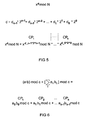
- Is considered in Fig. 5 the operation x d mod N.
- the exponent d is represented in binary notation.
- FIG. 5 This results in a chain of modular multiplications, where, as is also shown in FIG Fig. 5 is shown, each modular single operation can be assigned to each a sub-calculator, such that all modular operations in parallel by the in Fig. 1 executed cryptography processor are executed.
- the intermediate results then obtained, after having been determined in parallel, are multiplied up to obtain the result.
- the control unit 105 controls the division into the individual partial calculation units TRW 1 to TRW k and then the final Aufmultipliring the individual intermediate results.
- Fig. 6 is another example of a division of an operation (a * b) mod c shown in several modular operations.
- the partial calculator TRW 1 can determine a first intermediate result.
- the partial calculators TRW 2 to TRW n also calculate intermediate results, whereupon, after receiving the intermediate results, the control unit 105 controls the multiplication of the intermediate results.
- the control unit controls the summation z. B. so that it selects a partial calculation, which then receives the intermediate results for summation.
- an operation is split into several independent sub-operations.
- FIGS. 5 and 6 serve only to illustrate the possibilities for dividing an operation into a plurality of sub-operations, where more favorable distributions can exist with regard to the achievable performance.
- it is not the performance of the processor that is essential to the examples, but rather that partitions exist so that each sub-computer performs an independent sub-operation, and that a plurality of sub-operations are controlled by a control unit to obtain the most concealed power profile at the power input to the chip ,
Landscapes
- Engineering & Computer Science (AREA)
- Theoretical Computer Science (AREA)
- Physics & Mathematics (AREA)
- Software Systems (AREA)
- General Physics & Mathematics (AREA)
- General Engineering & Computer Science (AREA)
- Computer Hardware Design (AREA)
- Mathematical Physics (AREA)
- Computer Security & Cryptography (AREA)
- Pure & Applied Mathematics (AREA)
- Mathematical Analysis (AREA)
- Mathematical Optimization (AREA)
- Computational Mathematics (AREA)
- Computing Systems (AREA)
- Computer Networks & Wireless Communication (AREA)
- Signal Processing (AREA)
- Advance Control (AREA)
- Storage Device Security (AREA)
- Multi Processors (AREA)
- Power Sources (AREA)
- Microcomputers (AREA)
- Bidet-Like Cleaning Device And Other Flush Toilet Accessories (AREA)
- Preparation Of Compounds By Using Micro-Organisms (AREA)
- Devices For Executing Special Programs (AREA)
- Saccharide Compounds (AREA)
Abstract
Description
Die vorliegende Erfindung bezieht sich auf Kryptographietechniken und insbesondere auf die Architektur von für kryptographische Anwendungen verwendeten Kryptographieprozessoren.The present invention relates to cryptographic techniques, and more particularly to the architecture of cryptographic processors used for cryptographic applications.
Mit zunehmender Verbreitung von bargeldlosem Zahlungsverkehr, elektronischer Datenübertragung über öffentliche Netze, Austausch von Kreditkartennummern über öffentliche Netze und allgemein gesagt der Verwendung von sogenannten Smart Cards für Zahlungs-, Identifikations- oder Zugriffszwecke entsteht ein immer größerer Bedarf nach Kryptographietechniken. Kryptographietechniken umfassen einerseits Kryptographiealgorithmen und andererseits geeignete Prozessorenlösungen, welche die durch die Kryptographiealgorithmen vorgeschriebenen Berechnungen ausführen. Wurden früher Kryptographiealgorithmen mit Allzweckrechnern ausgeführt, so spielten die Kosten, der Rechenzeitbedarf und die Sicherheit gegenüber verschiedenartigsten Fremdattacken keine derart entscheidende Rolle wie heutzutage, wo kryptographische Algorithmen immer mehr auf Chipkarten oder speziellen Sicherheits-ICs ausgeführt werden, für die besondere Anforderungen gelten. So müssen solche Smart Cards einerseits preisgünstig verfügbar sein, da sie Massenprodukte sind, andererseits jedoch eine große Sicherheit gegenüber Fremdattacken aufweisen, da sie vollständig in der Gewalt des potentiellen Angreifers sind.With the proliferation of cashless payment transactions, electronic data transmission over public networks, exchange of credit card numbers over public networks, and more generally the use of so-called smart cards for payment, identification or access purposes, there is an increasing demand for cryptographic techniques. Cryptographic techniques include on the one hand cryptographic algorithms and on the other hand suitable processor solutions which perform the computations prescribed by the cryptographic algorithms. Earlier, when cryptographic algorithms were run on general purpose computers, the cost, computational time, and security against a variety of extraneous attacks did not play such a critical role as they are today, where cryptographic algorithms are increasingly being run on smart cards or special security ICs that have special requirements. On the one hand, such smart cards have to be reasonably priced because they are mass-produced products, but on the other hand they have a high level of protection against external attacks since they are completely in the power of the potential attacker.
Darüber hinaus müssen kryptographische Prozessoren eine beachtliche Rechenleistung zur Verfügung stellen, zumal die Sicherheit von vielen kryptographischen Algorithmen, wie z. B. dem bekannten RSA-Algorithmus, entscheidend von der Länge der verwendeten Schlüssel abhängt. In anderen Worten ausgedrückt bedeutet dies, dass mit zunehmender Länge der zu verarbeitenden Zahlen auch die Sicherheit ansteigt, da ein Angriff, der auf dem Ausprobieren aller Möglichkeiten basiert, aus Rechenzeitgründen unmöglich gemacht wird.In addition, cryptographic processors must provide a considerable amount of computing power, especially as the security of many cryptographic algorithms, such. As the known RSA algorithm depends crucially on the length of the keys used. In other words, this means that as the length of the numbers to be processed increases, so does the security since an attack, the based on trying out all possibilities, made impossible for reasons of computing time.
In Zahlenwerten ausgedrückt bedeutet dies, dass Kryptographieprozessoren mit Integers, d. h. Ganzzahlen, umgehen müssen, welche eine Länge von vielleicht 1024 Bits, 2048 Bits oder vielleicht sogar noch mehr haben können. Zum Vergleich verarbeiten Prozessoren in einem üblichen PC 32-Bit- bzw. 64-Bit-Ganzzahlen.Expressed in numerical terms, this means that cryptographic processors with integers, i. H. Integers, which may have a length of maybe 1024 bits, 2048 bits or maybe even more. For comparison, processors in a standard PC process 32-bit and 64-bit integers, respectively.
Ein hoher Rechenaufwand bedeutet jedoch auch eine hohe Rechenzeit, so dass für Kryptographieprozessoren gleichzeitig auch die wesentliche Anforderung darin besteht, einen hohen Rechendurchsatz zu erreichen, damit beispielsweise eine Identifikation, ein Zugang zu einem Gebäude, eine Bezahlungstransaktion oder eine Kreditkartenübermittlung nicht viele Minuten dauert, was für die Marktakzeptanz sehr schädlich wäre.However, a high computational effort also means a high computation time, so that at the same time the essential requirement for cryptographic processors is to achieve a high computational throughput, so that, for example, an identification, access to a building, a payment transaction or a credit card transfer does not take many minutes, which would be very damaging to market acceptance.
Zusammenfassend lässt sich daher feststellen, dass Kryptographieprozessoren sicher, schnell und daher außerordentlich leistungsstark sein müssen.In summary, therefore, cryptographic processors must be secure, fast, and therefore extremely powerful.
Eine Möglichkeit, um den Durchsatz durch einen Prozessor zu erhöhen, besteht darin, eine zentrale Verarbeitungseinheit mit einem oder mehreren Coprozessoren, welche parallel arbeiten, auszustatten, wie es beispielsweise bei modernen PCs oder aber auch bei modernen Graphikkarten der Fall ist. Ein solches Szenario ist in
Ferner wird jeder Chip, der auf der in
Das in
Des weiteren weist jeder Chip auf der Computerplatine 800 einen eigenen Strom- bzw. Leistungszugang auf, auf den ohne weiteres von einem Angreifer zugegriffen werden kann, um Leistungsprofile oder Stromprofile über der Zeit abzugreifen. Das Abgreifen von Leistungsprofilen über der Zeit ist die Basis für eine Vielzahl von effizienten Attacken gegenüber Kryptographieprozessoren. Weitere Hintergründe bzw. eine detaillierte Darstellung verschiedener Attacken gegen Kryptographieprozessoren sind in "
In "
Das ZDN-Verfahren basiert auf einer Seriell/Parallel-Architektur unter Verwendung von parallel ausführbaren Look-Ahead Algorithmen für die Multiplikation und die modulare Reduktion, um eine Multiplikation zweier Binärzahlen in eine iterative 3-Operanden-Addition unter Verwendung von Look-Ahead-Parametern für die Multiplikation und die modulare Reduktion zu transformieren. Hierzu wird die modulare Multiplikation in eine serielle Berechnung von Partialprodukten zerlegt. Zu Beginn der Iteration werden zwei Partialprodukte gebildet und dann unter Berücksichtigung der modularen Reduktion zusammenaddiert, um ein Zwischenergebnis zu erhalten. Hierauf wird ein weiteres Partialprodukt gebildet und wieder unter Berücksichtigung der modularen Reduktion zu dem Zwischenergebnis hinzuaddiert. Diese Iteration wird fortgesetzt, bis sämtliche Stellen des Multiplikators abgearbeitet sind. Für die Drei-Operanden-Addition umfasst ein Kryptocoprozessor ein Addierwerk, welches in einem aktuellen Iterationsschritt die Summation eines neuen Partialprodukts zu dem Zwischenergebnis des vorausgehenden Iterationsschritts durchführt.The ZDN method is based on a serial / parallel architecture using parallel executable look-ahead algorithms for multiplication and modular reduction to multiply two binary numbers into an iterative 3-operand addition using look-ahead parameters for multiplication and modular reduction. For this purpose, the modular multiplication is decomposed into a serial calculation of partial products. At the beginning of the iteration, two partial products are formed and then added together taking into account the modular reduction, to obtain an intermediate result. Hereupon, a further partial product is formed and added back to the intermediate result taking into account the modular reduction. This iteration continues until all the digits of the multiplier have been completed. For the three-operand addition, a crypto-coprocessor comprises an adder, which in a current iteration step performs the summation of a new partial product to the intermediate result of the preceding iteration step.
So könnte jeder Coprozessor von
Das
Die Aufgabe der vorliegenden Erfindung besteht darin, einen schnellen und sicheren Kryptographieprozessor zu schaffen.The object of the present invention is to provide a fast and secure cryptography processor.
Diese Aufgabe wird durch einen Kryptographieprozessor nach Patentanspruch 1 gelöst.This object is achieved by a cryptography processor according to
Der vorliegenden Erfindung liegt die Erkenntnis zugrunde, dass ein schneller Kryptographieprozessor nur erreicht werden kann, wenn eine Kryptographie-Rechenoperation in mehrere Teiloperationen zerlegt wird, und diese Teiloperationen von parallel angeordneten Teilrechenwerken ausgeführt werden. Andererseits kann eine Sicherheit insbesondere gegen Leistungsabhörattacken nur erreicht werden, wenn sämtliche Teilrechenwerke einschließlich der Steuereinheit für die Teilrechenwerke und der zentralen Verarbeitungseinheit auf einem einzigen Chip angeordnet werden, so dass die Leistungszugänge für die einzelnen Komponenten nicht für einen äußeren Angreifer zur Verfügung stehen.The present invention is based on the finding that a fast cryptography processor can only be achieved if a cryptographic computation operation is divided into several sub-operations, and these sub-operations are carried out by sub-arithmetic-logic units. On the other hand, security against performance bugging attacks can only be achieved if all sub-processors, including the sub-computer control unit and the central processing unit, are placed on a single chip so that the power inputs to the individual components are not available to an outside attacker.
Anders ausgedrückt sind die zentrale Verarbeitungseinrichtung und der Coprozessor, der eine einzige Steuereinheit sowie die Mehrzahl von Teilrechenwerken aufweist, auf einem einzigen Chip integriert. Darüber hinaus weist dieser einzige Chip lediglich einen einzigen Versorgungszugang zum Versorgen der Mehrzahl von Teilrechenwerken, der Steuereinheit und der zentralen Verarbeitungseinheit mit Strom auf.In other words, the central processing device and the coprocessor, which has a single control unit as well as the plurality of sub-processors, are integrated on a single chip. Moreover, this single chip has only a single supply access for powering the plurality of sub-processors, the control unit, and the central processing unit.
Das Integrieren dieser Komponenten auf einem Chip und das Versorgen des Chips mit einem Versorgungsstromzugang hat den Vorteil, dass sich am Stromanschluss des Kryptographieprozessors die Stromprofile, die den Operationen der Teilrechenwerke zugeordnet sind, überlagern. Wenn beispielsweise zwei Teilrechenwerke parallel arbeiten, so überlagern sich die Stromprofile dieser beiden Teilrechenwerke, derart, dass es für den Angreifer schwierig wird, anhand des Leistungsversorgungsprofils zu erkennen, welche Operationen mit welchen Zahlen die beiden Teilrechenwerke gleichzeitig durchführen. Wird die Anzahl der Teilrechenwerke erhöht, so wird auch das Stromprofil an dem einzigen Versorgungsanschluss immer homogener. Durch zunehmende parallele Verarbeitung mit zunehmender Anzahl von parallelen Teilrechenwerken steigt jedoch auch der Durchsatz, so dass sich beim erfindungsgemäßen Konzept mit zunehmendem Durchsatz auch die Sicherheit erhöht. Im Stand der Technik war dies nicht der Fall, ganz im Gegenteil verringerte sich die Sicherheit mit zunehmendem Durchsatz.The integration of these components on a chip and supplying the chip with a supply current access has the advantage that superimpose on the power connector of the cryptography processor, the power profiles that are associated with the operations of the sub-computer. For example, if two sub-processors work in parallel, the superimposed Power profiles of these two sub-calculators, such that it is difficult for the attacker to recognize from the power supply profile, which operations with which numbers the two sub-processors perform simultaneously. As the number of sub-calcs increases, the current profile at the single supply terminal also becomes more and more homogeneous. Increasing parallel processing with increasing number of parallel part of calculations, however, also increases the throughput, so that the security increases with increasing throughput in the inventive concept. In the prior art, this was not the case, on the contrary, the security decreased with increasing throughput.
Eine Grenze der parallelen Verarbeitung ist dann erreicht, wenn der Rechenaufwand in der Steuereinheit zum Verteilen der Teiloperationen auf die Teilrechenwerke und zum Ansteuern der einzelnen Teilrechenwerke stark zunimmt. Für relativ lang dauernde Operationen, wie z. B. die Multiplikation von zwei sehr langen Ganzzahlen, ist jedoch das Verhältnis von Rechenzeit in einem Teilrechenwerk zu der Rechenzeit der Steuereinheit für Organisations- und Verwaltungsaufgaben so groß, dass ein beachtlicher Grad an Parallelität erreicht werden kann, ohne dass der Verwaltungsaufwand in problematische Größenordnungen kommt.A limit of parallel processing is achieved when the computational effort in the control unit for distributing the sub-operations to the sub-processors and for driving the individual sub-processors increases greatly. For relatively long-lasting operations, such. As the multiplication of two very long integers, however, the ratio of computing time in a sub-computer to the computing time of the control unit for organizing and management tasks is so large that a considerable degree of parallelism can be achieved without the administrative burden comes in problematic scales ,
Dieser Grad an Parallelität ist jedoch nötig, um den Durchsatz so weit zu erhöhen, dass Geschwindigkeitsverluste der Logikeinheiten ausgeglichen werden können, welche auftreten, wenn sowohl Logikbausteine als auch Speicherbausteine auf demselben Chip integriert werden. Allgemein besteht die Bestrebung, Logikbausteine und Speicherbausteine auf getrennten Chips anzuordnen, da sich die Technologien für diese beiden Bauelemente unterscheiden. Anders ausgedrückt erlaubt eine Speicher-Technologie, mit der Logikbausteine hergestellt werden, keine so schnellen Logikbausteine, als wenn die Logikbausteine mit einer speziell für Logikbausteine angepassten Technologie hergestellt werden. Daher sind bei dem in
Für eine hohe Sicherheit ist es jedoch gerade wichtig, dass ein Angreifer nicht die Kommunikation zwischen einem Rechenwerk und einem Register abhören kann.However, for high security, it is important that an attacker can not intercept communication between an arithmetic unit and a register.
Bevorzugte Ausführungsbeispiele der vorliegenden Erfindung werden nachfolgend bezugnehmend auf die beiliegenden Zeichnungen detailliert erläutert. Es zeigen:
- Fig. 1
- einen erfindungsgemäßen Kryptoprozessor, der auf einem einzigen Chip integriert ist;
- Fig. 2
- eine detailliertere Darstellung des Coprozessors, welcher verschiedene Teilrechenwerke mit unterschiedlich langen Registern aufweist;
- Fig. 3
- eine detailliertere Darstellung einer Arithmetikeinheit, welche für eine Drei-Operanden-Addition geeignet ist;
- Fig. 4a
- ein schematisches Flussdiagramm zum Durchführen einer modularen Multiplikation auf seriell/parallele Art und Weise;
- Fig. 4b
- ein Zahlenbeispiel zur Veranschaulichung der seriell/parallelen Arbeitsweise einer Arithmetikeinheit am Beispiel einer Multiplikation;
- Fig. 5
- ein Beispiel zum Aufteilen einer modularen Exponentiation in eine Anzahl von modularen Multiplikationen;
- Fig. 6
- ein weiteres Beispiel zum Aufteilen einer modularen Multiplikation auf verschiedene Teilrechenwerke; und
- Fig. 7
- eine Computerplatine mit einer Vielzahl von getrennt versorgten Bauelementen.
- Fig. 1
- a cryptoprocessor according to the invention, which is integrated on a single chip;
- Fig. 2
- a more detailed representation of the coprocessor, which has different sub-calculators with different length registers;
- Fig. 3
- a more detailed representation of an arithmetic unit which is suitable for a three-operand addition;
- Fig. 4a
- a schematic flow diagram for performing a modular multiplication in a serial / parallel manner;
- Fig. 4b
- a numerical example to illustrate the serial / parallel operation of an arithmetic unit using the example of a multiplication;
- Fig. 5
- an example of dividing a modular exponentiation into a number of modular multiplications;
- Fig. 6
- another example of dividing a modular multiplication into different sub-computations; and
- Fig. 7
- a computer board with a plurality of separately powered components.
Bevor detaillierter auf die einzelnen Figuren eingegangen wird, wird im nachfolgenden ausgeführt, weshalb durch Parallelschaltung mehrerer Teilrechenwerke, die auf einem Chip angeordnet sind und durch eine Steuereinheit, die auf demselben Chip angeordnet ist, gesteuert werden, eine höhere Sicherheit erreicht wird.Before discussing the individual figures in more detail, it will be explained below why a higher level of security is achieved by connecting several partial computations, which are arranged on a chip and controlled by a control unit which is arranged on the same chip, in parallel.
Kryptoprozessoren werden für sicherheitskritische Anwendung benutzt, beispielsweise für digitale Signaturen, Authentifikationen oder Verschlüsselungsaufgaben. Ein Angreifer möchte beispielsweise den geheimen Schlüssel herausfinden, um dadurch das Kryptographieverfahren zu brechen. Kryptographie-prozessoren werden beispielsweise in Chipkarten eingesetzt, welche, wie es bereits ausgeführt worden ist, Smart Cards oder Signaturkarten für eine rechtsverbindliche elektronische Unterschrift oder auch für Homebanking oder zum Bezahlen mit dem Mobiltelephon usw. umfassen. Alternativ werden solche Kryptoprozessoren auch in Computern und Servern als Sicherheits-IC eingesetzt, um eine Authentifikation durchzuführen, oder um Verschlüsselungsaufgaben wahrnehmen zu können, welche beispielsweise im sicheren Bezahlen über das Internet, in sogenannten SSL-Sessions (SSL = Secure Socket Layer), d. h. der sicheren Übermittlung von Kreditkartennummern, bestehen können.Crypto processors are used for security-critical applications, such as digital signatures, authentication, or encryption tasks. For example, an attacker wants to find out the secret key, thereby breaking the cryptography process. Cryptography processors are used for example in smart cards, which, as has already been stated, smart cards or signature cards for a legally binding electronic signature or for home banking or to pay with the mobile phone, etc. include. Alternatively, such cryptoprocessors are also used in computers and servers as a security IC in order to perform an authentication or to perform encryption tasks, which, for example, in secure payments over the Internet, in so-called SSL sessions (SSL = Secure Socket Layer), d , H. secure transmission of credit card numbers.
Typische physikalische Angriffe messen den Stromverbrauch (SPA, DPA, Timing-Attacken) oder die elektromagnetische Abstrahlung. Bezüglich einer näheren Erläuterung der Angriffe sei auf die eingangs erwähnten Literaturstellen verwiesen.Typical physical attacks measure power consumption (SPA, DPA, timing attacks) or electromagnetic radiation. For a more detailed explanation of the attacks refer to the references mentioned above.
Da die Angreifer bei der heutigen Halbleitertechnologie, welche Strukturen im Bereich von typischerweise kleiner oder gleich 250 Nanometern erreicht, nur sehr schwer lokale Strommessungen durchführen können, wird bei einem Angriff typischerweise der Stromverbrauch der gesamten Chipkarte einschließlich CPU und Coprozessor gemessen, welcher sich aus der Summe der einzelnen Stromverbräuche von beispielsweise der CPU, dem RAM, einem ROM, einem E2PROM, einem Flash-Memory, einer Zeitsteuereinheit, einem Zufallszahlengenerator (RNG), einem DES-Modul und dem Kryptocoprozessor zusammensetzt.Since today's semiconductor technology, which achieves structures in the range of typically less than or equal to 250 nanometers, makes attackers very difficult to carry out local current measurements, an attack typically measures the power consumption of the entire chip card, including the CPU and coprocessor, which is the sum of the individual power consumptions of, for example, the CPU, the RAM, a ROM, an E 2 PROM, a flash memory, a timing controller, a random number generator (RNG), a DES module, and the crypto-coprocessor.
Da der Kryptocoprozessor typischerweise den größten Stromverbrauch hat, kann ein Angreifer sehen, wann der Kryptocoprozessor zu rechnen beginnt. Um dies zu vermeiden, wäre ein über der Zeit vollständig konstanter Stromverbrauch das Ziel, ein Angreifer würde dann nicht mehr erkennen, wann der Kryptocoprozessor zu rechnen beginnt. Dieses ideale Ziel kann nicht erreicht werden, es wird jedoch durch das erfindungsgemäße Parallelschalten von Teilrechenwerken ein möglichst gleichförmiges "Rauschen" um einen Mittelwert angestrebt.Since the crypto-coprocessor typically has the highest power consumption, an attacker can see when the crypto-coprocessor begins to calculate. To avoid this, a completely constant power consumption over time would be the goal, an attacker would then no longer recognize when the crypto coprocessor begins to calculate. This ideal goal can not be achieved, but it is sought by the inventive parallel switching of partial calculators as uniform as possible "noise" to an average value.
Der Stromverbrauch eines beispielsweise in CMOS-Technologie gefertigten Chips ändert sich bei einer Umschaltung von einer "0" auf eine "1". Daher ist der Stromverbrauch datenabhängig sowie abhängig von den verwendeten Befehlen der CPU und des Kryptocoprozessors.The power consumption of a chip produced, for example, in CMOS technology changes when switching from a "0" to a "1". Therefore, power consumption is data-dependent and dependent on the CPU and crypto-coprocessor instructions used.
Schaltet man nun mehrere Teilrechenwerke parallel und lässt sie mehrere Operationen bzw. Teiloperationen parallel abarbeiten, oder wird eine Operation auf mehrere Teilrechenwerke aufgeteilt, so überlagern sich, wie es ausgeführt worden ist, die Stromprofile, welche durch die Daten- und Befehlsverarbeitung entstehen.If you now switch several sub-processors in parallel and let them execute several operations or sub-operations in parallel, or if an operation is divided among several sub-processors, the current profiles resulting from the data and command processing overlap, as has been explained.
Je mehr Teilrechenwerke parallel arbeiten, desto schwieriger kann auf Daten und Befehle in den einzelnen Teilrechenwerken bzw. in der Steuereinheit zurückgeschlossen werden, da die Daten und Befehle in jedem Teilrechenwerk üblicherweise unterschiedlich sein werden, der Angreifer jedoch nur die Überlagerung unterschiedlicher Befehle sieht.The more sub-calculators work in parallel, the more difficult it is to get data and commands in each sub-calculator or in the control unit because the data and commands will usually be different in each sub-calculator, but the attacker sees only the superposition of different commands.
Ein typischer Kryptoprozessor wird eine Eingangsschnittstelle 114 und eine Ausgangsschnittstelle 116 umfassen, welche mit äußeren Anschlüssen für eine Dateneingabe bzw. eine Datenausgabe sowie mit der CPU 102 verbunden sind. Typischerweise ist der CPU 102 ein eigener Speicher 118 zugeordnet, der in
Es sei darauf hingewiesen, dass sämtliche in
Die Parallelschaltung der einzelnen Teilrechenwerke führt zudem dazu, dass der Durchsatz des Kryptonprozessors erhöht werden kann, so dass im Falle der Ausführung eines Speichers auf dem Chip die damit einhergehenden Geschwindigkeitseinbußen, welche aufgrund unterschiedlicher Technologien für Speicher und Rechenwerke auftreten, mehr als ausgeglichen werden können.The parallel connection of the individual sub-calculators also means that the throughput of the Krypton processor can be increased, so that in the case of execution of a memory on the chip, the concomitant loss of speed, which occur due to different technologies for memory and arithmetic units, can be more than offset.
Gemäß einem bevorzugten Ausführungsbeispiel der vorliegenden Erfindung können zwei oder mehr Teilrechenwerke als sogenannte Cluster zusammengefasst werden, derart, dass z. B. ein erster Cluster Teiloperationen einer ersten Operation durchführt, während ein zweiter Cluster Teiloperationen einer zweiten kryptographischen Operation durchführt. So könnte beispielsweise der erste Cluster, der aus den Teilrechenwerken 106 und 108 besteht, z. B. zwei modulare Exponentiationen mit jeweils der halben Länge durchführen, welche aus einer einzigen modularen Exponentiation mit voller Länge hergeleitet sind, während der zweite Cluster, der aus den Teilrechenwerken 110 und 112 besteht eine modulare Multiplikation durchführen könnte, wie es in
Alternativ könnte ein Cluster eine RSA-Operation durchführen, während ein anderer Cluster eine DES-Operation durchführt, und wieder ein anderer Cluster beispielsweise eine Hash-Summe berechnet.Alternatively, one cluster could perform an RSA operation while another cluster performs a DES operation, and another cluster, for example, calculates a hash sum.
An dieser Stelle sei ausgeführt, dass die angesprochenen Kryptographiealgorithmen in der Literatur bekannt sind und daher nicht näher ausgeführt werden. Lediglich beispielhaft sei darauf hingewiesen, dass beispielsweise bei einer RSA-Verschlüsselung Operanden mit einer Länge von 2048 Bit verarbeitet werden. Bei der Entschlüsselung ist es mit Hilfe des chinesischen Restsatzes (CRT) möglich, mit halb so langen Operanden und zwei Teiloperationen zu arbeiten. Ist ein Kryptographieprozessor lediglich auf einen solchen Algorithmus ausgelegt, so beträgt die Anzahl der Teilrechenwerke 2 und die Länge der arithmetischen Einheiten würde statt 2048 für eine einzige arithmetische Einheit lediglich 1024 betragen. Die Teiloperationen gemäß dem chinesischen Restsatz werden parallel bearbeitet und dann gesteuert durch die Steuereinheit in einem der beiden Teilrechenwerke kombiniert, um das Ergebnis zu erhalten.It should be pointed out here that the mentioned cryptographic algorithms are known in the literature and therefore are not described in detail. For example only, it should be noted that, for example, in an RSA encryption operands are processed with a length of 2048 bits. During decryption, using the Chinese Remainder Theorem (CRT), it is possible to work with half as long operands and two sub-operations. If a cryptography processor is only designed for such an algorithm, the number of sub-arithmetic units would be 2 and the length of the arithmetic units would be only 1024 instead of 2048 for a single arithmetic unit. The sub-operations according to the Chinese remainder theorem are processed in parallel and then combined under control of the control unit in one of the two sub-processors to obtain the result.
Die Steuereinheit 105 kann die beiden Teilrechenwerke 106 und 108 beispielsweise auch derart ansteuern, dass die arithmetischen Einheiten AU1 und AU2 so miteinander verkoppelt werden, dass beide Teilrechenwerke, welche dann einen Cluster bilden, arithmetische Operationen mit Zahlen einer Länge L1 + L2 durchführen. Die Register der beiden Teilrechenwerke können somit zusammengeschaltet werden.The
Alternativ kann einem Teilrechenwerk jedoch auch eine Anzahl von Registern exklusiv zugewiesen werden, welche so groß ist, dass die Operanden für mehrere Teiloperationen, wie z. B. modulare Multiplikationen oder modulare Exponentiationen, ausreichen. Zur Vermeidung von Informationslecks können die Teiloperationen dann beispielsweise durch eine Einrichtung zum Variieren der Reihenfolge derselben, die in
Gemäß einem bevorzugten Ausführungsbeispiel der vorliegenden Erfindung umfasst die Steuereinheit 105 ferner eine in
Wie es bereits ausgeführt worden ist, hat ein Kryptoprozessor aufgrund der langen Zahlen, die er verarbeiten muss, die Eigenschaft, dass bestimmte Teiloperationen, wie z. B. eine Seriell/Parallel-Multiplikation, wie sie bezugnehmend auf die
Bevorzugterweise sind die Teilrechenwerke derart ausgeführt, dass sie eine solche Teiloperation selbständig ohne Eingriffe der Steuereinheit 105 durchführen können, nachdem die Steuereinheit den erforderlichen Befehl an das Rechenwerk abgegeben hat. Hierzu benötigt jedes Teilrechenwerk selbstverständlich Register zum Speichern der Zwischenlösungen.Preferably, the partial calculators are designed such that they can perform such a sub-operation independently without intervention of the
Aufgrund der Tatsache, dass ein Teilrechenwerk ohne Input der Steuereinheit 105 relativ lange arbeitet, kann die Steuereinheit 105 eine Vielzahl von einzelnen Teilrechenwerken gewissermaßen seriell, also nacheinander, mit den nötigen Befehlen versehen, derart, dass sämtliche Teilrechenwerke parallel arbeiten, jedoch gewissermaßen gestaffelt zueinander.Due to the fact that a sub-computer operates relatively long without input of the
Zum Beispiel wird das erste Teilrechenwerk zu einem bestimmten Zeitpunkt aktiviert. Ist die Steuereinheit 105 mit der Aktivierung des ersten Teilrechenwerks fertig, so führt dieselbe unmittelbar die Aktivierung des zweiten Rechenwerks durch, während das erste Rechenwerk bereits arbeitet. Das dritte Teilrechenwerk wird dann aktiviert, wenn die Aktivierung des zweiten Teilrechenwerks vollendet ist. Dies bedeutet, dass während der Aktivierung des dritten Teilrechenwerks das erste und das zweite Teilrechenwerk bereits rechnen. Wenn dies für alle n Teilrechenwerke durchgeführt wird, so arbeiten alle Teilrechenwerke zeitlich versetzt. Wenn alle Teilrechenwerke derart arbeiten, dass ihre Teiloperationen gleich lang dauern, so wird das erste Teilrechenwerk als erstes fertig sein. Nun kann die Steuereinheit die Ergebnisse vom ersten Teilrechenwerk zur zentralen Verarbeitungseinheit übermitteln und ist mit dieser Übermittlung idealerweise fertig, bevor das zweite Teilrechenwerk fertig ist. Damit kann der Durchsatz wesentlich erhöht werden, wobei auch eine optimale Ausnutzung der Rechenkapazität der Steuereinheit 105 erreicht wird. Wenn sämtliche Teilrechenwerke identische Operationen ausführen, so entsteht dennoch ein stark verschleiertes Stromprofil, da sämtliche Teilrechenwerke zeitlich versetzt arbeiten. Anders wäre der Fall, wenn sämtliche Teilrechenwerke durch die Steuereinheit zum gleichen Zeitpunkt aktiviert werden und gewissermaßen vollständig synchron arbeiten. Dann würde ein nicht verschleiertes Stromprofil und sogar noch verstärktes Stromprofil resultieren. Daher ist das serielle Aktivieren der Teilrechenwerke auch im Hinblick auf die Sicherheit des Kryptographieprozessors vorteilhaft.For example, the first part of the calculation will be activated at a certain time. If the
Im nachfolgenden wird auf
Bei einem bevorzugten Ausführungsbeispiel der vorliegenden Erfindung ist jedes Teilrechenwerk 106 bis 112 (
Eine hierfür erforderliche modulare Multiplikation wird anhand von
Es ist ferner zu sehen, daß der Multiplikand M das Partialprodukt darstellt, wenn die betrachtete Stelle des Multiplikators eine binäre "1" ist. Das Partialprodukt ist hingegen 0, wenn die betrachtete Stelle des Multiplikators eine binäre "0" ist. Ferner werden durch die jeweiligen Verschiebungsoperationen die Stellen bzw. die Wertigkeiten der Partialprodukte berücksichtigt. In
Ein schematisches Flussdiagramm für das in
Die in Block S12 dargestellte Operation wird parallel für alle beispielsweise 1024 Bit durchgeführt. Daraufhin wird in einem Schritt S14 im einfachsten Fall eine Verschiebungsoperation um eine Position nach rechts durchgeführt, um zu berücksichtigen, dass das höchstwertige Bit des 2. Partialprodukts eine Stelle niedriger angeordnet ist als das höchstwertige Bit des 1. Partialprodukts. Haben mehrere aufeinanderfolgende Bits des Multiplikators O eine Null, so findet eine Verschiebung um mehrere Positionen nach rechts statt. Schließlich wird in einem Schritt S16 wieder die parallele Drei-Operanden-Addition beispielsweise unter Verwendung der in
Dieses Verfahren wird fortgesetzt, bis alle beispielsweise 1024 Partialprodukte aufaddiert sind. Seriell/Parallel bedeutet also die parallele Durchführung in dem Block S12 oder S16, und das serielle Verarbeiten, um nacheinander alle Partialprodukte miteinander zu kombinieren.This process continues until all, for example, 1024 partial products have been added up. Serial / Parallel means that is, the parallel execution in the block S12 or S16, and the serial processing to successively combine all the partial products.
Im nachfolgenden wird auf die
In
Es sei darauf hingewiesen, dass viele Möglichkeiten bestehen, um die eine oder andere Operation in Teiloperationen aufzuteilen. Die in
Claims (10)
- Cryptography processor for carrying out operations for cryptographic applications, comprising the following:a central processing unit (102) for obtaining commands for executing an operation and for outputting results of an operation;a co-processor (104) coupled to the central processing unit (102), the co-processor being characterized by the following:wherein the control unit (105) is adapteda plurality of calculating subunits (106, 108, 110, 112), each calculating subunit comprising at least one arithmetical unit (AU1, AU2, AU3, AUn); anda single control unit (105) coupled to each of the plurality of calculating subunits and arranged to sub-divide an operation into sub-operations, to distribute the sub-operations among the plurality of calculating subunits and to control the execution of the operation by the plurality of calculating subunits,
to provide the single calculating subunits with instructions in a serial manner,
to activate a first calculating subunit at a certain time instant, and
to activate a second calculating subunit, when the activation of the first calculating subunit is completed, while the first calculating subunit is already in operation, such that the calculating subunits operate in a time staggered manner,
wherein the plurality of calculating subunits (106, 108, 110, 112) and the control unit (105) are integrated on a single chip (100), and
wherein the chip (100) comprises a common supply current access (122) for supplying the plurality of calculating subunits and the control unit with current. - Cryptography processor as claimed in claim 1,
wherein the control unit is further adapted to transfer, when the first calculating subunit is finished, results provided by the first calculating subunit to the central processing unit (102), while the second calculating subunit is still in operation. - Cryptography processor as claimed in claims 1 or 2, wherein the control unit (105) is adapted to activate the calculating subunits such that all calculating subunits operate in a time staggered manner.
- Cryptography processor as claimed in any of the preceding claims, wherein the calculating subunits are adapted such that the executed sub-operations take the same amount of time.
- Cryptography processor as claimed in claim 4,
wherein the control unit is further adapted to transfer, when the first calculating subunit is finished, results provided by the first calculating subunit to the central processing unit (102), while the second calculating subunit is still in operation, and
wherein the control unit (105) is adapted to be finished with the transfer before the second calculating subunit is finished with its sub-operation. - Cryptography processor as claimed in any of the preceding claims, wherein all calculating subunits execute identical operations.
- Cryptography processor as claimed in any of the preceding claims, wherein each calculating subunit further comprises a plurality of registers (106b, 106c, 106d, 108b, 108c, 108d) exclusively assigned to the arithmetical unit (106a, 108a) of the respective calculating subunit.
- Processor as claimed in claim 7,
wherein the length (L1, L2) of the plurality of registers assigned to a calculating subunit, and the length of the plurality of registers associated with another calculating subunit differ, such that the calculating subunits may carry out arithmetical calculations with numbers of differing lengths in each case. - Cryptography processor as claimed in claims 7 or 8, wherein the number of registers associated with a calculating subunit is sufficient so as to hold operands for at least two sub-operations, so that for at least two sub-operations no transferral of operands between the co-processor (104) and the central processing device (102) is necessary.
- Cryptography processor as claimed in claim 9, wherein the control unit (105) further comprises:a device (200) for controlling, in terms of time, the operation of the calculating subunits, such that the order of the at least two sub-operations, the operands of which are stored in the registers of a calculating subunit, is adjustable.
Applications Claiming Priority (3)
| Application Number | Priority Date | Filing Date | Title |
|---|---|---|---|
| DE10061997 | 2000-12-13 | ||
| DE10061997A DE10061997A1 (en) | 2000-12-13 | 2000-12-13 | The cryptographic processor |
| EP01991797.0A EP1342148B9 (en) | 2000-12-13 | 2001-12-06 | Cryptographic processor |
Related Parent Applications (3)
| Application Number | Title | Priority Date | Filing Date |
|---|---|---|---|
| EP01991797.0 Division | 2001-12-06 | ||
| EP01991797.0A Division EP1342148B9 (en) | 2000-12-13 | 2001-12-06 | Cryptographic processor |
| EP01991797.0A Division-Into EP1342148B9 (en) | 2000-12-13 | 2001-12-06 | Cryptographic processor |
Publications (3)
| Publication Number | Publication Date |
|---|---|
| EP1589413A2 EP1589413A2 (en) | 2005-10-26 |
| EP1589413A3 EP1589413A3 (en) | 2007-04-04 |
| EP1589413B1 true EP1589413B1 (en) | 2010-05-05 |
Family
ID=7666917
Family Applications (2)
| Application Number | Title | Priority Date | Filing Date |
|---|---|---|---|
| EP05012165A Expired - Lifetime EP1589413B1 (en) | 2000-12-13 | 2001-12-06 | Cryptographic processor |
| EP01991797.0A Expired - Lifetime EP1342148B9 (en) | 2000-12-13 | 2001-12-06 | Cryptographic processor |
Family Applications After (1)
| Application Number | Title | Priority Date | Filing Date |
|---|---|---|---|
| EP01991797.0A Expired - Lifetime EP1342148B9 (en) | 2000-12-13 | 2001-12-06 | Cryptographic processor |
Country Status (8)
| Country | Link |
|---|---|
| US (2) | US7430293B2 (en) |
| EP (2) | EP1589413B1 (en) |
| KR (1) | KR20030062422A (en) |
| CN (1) | CN1273876C (en) |
| AT (1) | ATE467172T1 (en) |
| AU (1) | AU2002231668A1 (en) |
| DE (2) | DE10061997A1 (en) |
| WO (1) | WO2002048845A2 (en) |
Families Citing this family (35)
| Publication number | Priority date | Publication date | Assignee | Title |
|---|---|---|---|---|
| DE10253285B4 (en) * | 2002-11-15 | 2018-11-15 | Giesecke+Devrient Mobile Security Gmbh | Concealment of a secret value |
| US20040230813A1 (en) * | 2003-05-12 | 2004-11-18 | International Business Machines Corporation | Cryptographic coprocessor on a general purpose microprocessor |
| KR100680025B1 (en) * | 2005-07-05 | 2007-02-07 | 한국전자통신연구원 | Multisession high speed encryption / decryption processing apparatus and method |
| US7916864B2 (en) * | 2006-02-08 | 2011-03-29 | Nvidia Corporation | Graphics processing unit used for cryptographic processing |
| CN100369074C (en) * | 2006-03-02 | 2008-02-13 | 西安西电捷通无线网络通信有限公司 | A Method for Realizing Encryption and Decryption in SMS4 Cipher Algorithm |
| US7826612B2 (en) * | 2006-06-29 | 2010-11-02 | Intel Corporation | System, method and apparatus for an incremental modular process including modular multiplication and modular eduction |
| DE102007007699A1 (en) | 2007-02-09 | 2008-08-14 | IHP GmbH - Innovations for High Performance Microelectronics/Institut für innovative Mikroelektronik | Reduction of page channel information by interacting crypto blocks |
| EP2000936A1 (en) * | 2007-05-29 | 2008-12-10 | Gemplus | Electronic token comprising several microprocessors and method of managing command execution on several microprocessors |
| US8781111B2 (en) * | 2007-07-05 | 2014-07-15 | Broadcom Corporation | System and methods for side-channel attack prevention |
| US7929707B1 (en) * | 2007-09-06 | 2011-04-19 | Elcomsoft Co. Ltd. | Use of graphics processors as parallel math co-processors for password recovery |
| US8670557B2 (en) * | 2007-09-10 | 2014-03-11 | Spansion Llc | Cryptographic system with modular randomization of exponentiation |
| US8139763B2 (en) * | 2007-10-10 | 2012-03-20 | Spansion Llc | Randomized RSA-based cryptographic exponentiation resistant to side channel and fault attacks |
| IL187043A0 (en) * | 2007-10-30 | 2008-02-09 | Sandisk Il Ltd | Secure pipeline manager |
| US20090183161A1 (en) * | 2008-01-16 | 2009-07-16 | Pasi Kolinummi | Co-processor for stream data processing |
| JP5146156B2 (en) * | 2008-06-30 | 2013-02-20 | 富士通株式会社 | Arithmetic processing unit |
| ITMI20082364A1 (en) * | 2008-12-31 | 2010-07-01 | Incard Sa | METHOD TO PROTECT A CRYPTOGRAPHIC DEVICE AGAINST SPA, DPA AND TEMPORAL ATTACKS |
| US20100177889A1 (en) * | 2009-01-15 | 2010-07-15 | Kabushiki Kaisha Toshiba | Image forming apparatus and encryption process control method |
| US20100306553A1 (en) * | 2009-06-01 | 2010-12-02 | Poletti Iii Joseph William | High-throughput cryptographic processing using parallel processing |
| EP2293185A1 (en) * | 2009-09-04 | 2011-03-09 | Thomson Licensing | Exponentiation method resistant against skipping attacks and apparatus for performing the method |
| US20140032917A1 (en) * | 2010-10-29 | 2014-01-30 | Nec Corporation | Group signature processing device for processing a plurality of group signatures simultaneously |
| DE102011007976A1 (en) | 2011-01-03 | 2012-07-05 | Giesecke & Devrient Gmbh | Method for the secure execution of a cryptographic calculation |
| JP5776927B2 (en) * | 2011-03-28 | 2015-09-09 | ソニー株式会社 | Information processing apparatus and method, and program |
| EP2523385B1 (en) * | 2011-05-05 | 2017-07-12 | Proton World International N.V. | Method and circuit for cryptographic operation |
| EP2700256B1 (en) | 2011-05-20 | 2017-11-29 | BlackBerry Limited | Verifying passwords on a mobile device |
| US8958550B2 (en) * | 2011-09-13 | 2015-02-17 | Combined Conditional Access Development & Support. LLC (CCAD) | Encryption operation with real data rounds, dummy data rounds, and delay periods |
| US9773111B2 (en) * | 2012-08-14 | 2017-09-26 | Empire Technology Development Llc | Software-based side-channel attack prevention |
| EP2733654A1 (en) * | 2012-11-20 | 2014-05-21 | Nagravision S.A. | Electronic payment method, system and device for securely exchanging payment information |
| WO2015088525A1 (en) * | 2013-12-12 | 2015-06-18 | Empire Technology Development, Llc | Randomization of processor subunit timing to enhance security |
| WO2015096167A1 (en) | 2013-12-28 | 2015-07-02 | Intel Corporation | Rsa algorithm acceleration processors, methods, systems, and instructions |
| EP3152859A1 (en) | 2014-06-04 | 2017-04-12 | Giesecke & Devrient GmbH | Method for enhanced security of computational device with multiple cores |
| US9798521B2 (en) * | 2014-08-27 | 2017-10-24 | Schlage Lock Company Llc | System, method and apparatus for random number generation |
| EP3279826A1 (en) * | 2016-08-04 | 2018-02-07 | Nagravision SA | Sequence verification |
| CN107294719A (en) * | 2017-06-19 | 2017-10-24 | 北京万协通信息技术有限公司 | A kind of encryption-decryption coprocessor of Bilinear map computing |
| FR3076925B1 (en) | 2018-01-16 | 2020-01-24 | Proton World International N.V. | CRYPTOGRAPHIC FUNCTION |
| WO2022266831A1 (en) * | 2021-06-22 | 2022-12-29 | 华为技术有限公司 | Data processing method and processor |
Family Cites Families (10)
| Publication number | Priority date | Publication date | Assignee | Title |
|---|---|---|---|---|
| GB2130405B (en) | 1980-08-30 | 1984-11-21 | British Aerospace | Electronic calculator |
| EP0239749B1 (en) * | 1986-03-05 | 1990-07-25 | Holger Sedlak | Cryptographic method and processor for carrying out this method |
| DE3631992A1 (en) * | 1986-03-05 | 1987-11-05 | Holger Sedlak | Cryptography method and cryptography processor to carry out the method |
| US5752071A (en) * | 1995-07-17 | 1998-05-12 | Intel Corporation | Function coprocessor |
| DE19539700C1 (en) * | 1995-10-25 | 1996-11-28 | Siemens Ag | Security chip for data protection |
| GB9707861D0 (en) * | 1997-04-18 | 1997-06-04 | Certicom Corp | Arithmetic processor |
| US6219420B1 (en) * | 1998-09-02 | 2001-04-17 | Motorola, Inc. | High assurance encryption system and method |
| US6408075B1 (en) * | 1998-11-30 | 2002-06-18 | Hitachi, Ltd. | Information processing equipment and IC card |
| FR2787900B1 (en) * | 1998-12-28 | 2001-02-09 | Bull Cp8 | INTELLIGENT INTEGRATED CIRCUIT |
| FR2789535B1 (en) * | 1999-02-04 | 2001-09-28 | Bull Cp8 | METHOD FOR SECURING AN ELECTRONIC ASSEMBLY OF SECRET KEY CRYPTOGRAPHY AGAINST ATTACKS BY PHYSICAL ANALYSIS |
-
2000
- 2000-12-13 DE DE10061997A patent/DE10061997A1/en not_active Withdrawn
-
2001
- 2001-12-06 KR KR10-2003-7007883A patent/KR20030062422A/en not_active Abandoned
- 2001-12-06 DE DE50115478T patent/DE50115478D1/en not_active Expired - Lifetime
- 2001-12-06 AU AU2002231668A patent/AU2002231668A1/en not_active Abandoned
- 2001-12-06 EP EP05012165A patent/EP1589413B1/en not_active Expired - Lifetime
- 2001-12-06 EP EP01991797.0A patent/EP1342148B9/en not_active Expired - Lifetime
- 2001-12-06 WO PCT/EP2001/014349 patent/WO2002048845A2/en not_active Ceased
- 2001-12-06 AT AT05012165T patent/ATE467172T1/en not_active IP Right Cessation
- 2001-12-06 CN CNB018205658A patent/CN1273876C/en not_active Expired - Fee Related
-
2003
- 2003-06-13 US US10/461,905 patent/US7430293B2/en not_active Expired - Fee Related
-
2008
- 2008-02-20 US US12/034,252 patent/US8369520B2/en not_active Expired - Fee Related
Also Published As
| Publication number | Publication date |
|---|---|
| US20040105541A1 (en) | 2004-06-03 |
| CN1481524A (en) | 2004-03-10 |
| CN1273876C (en) | 2006-09-06 |
| US7430293B2 (en) | 2008-09-30 |
| AU2002231668A1 (en) | 2002-06-24 |
| WO2002048845A2 (en) | 2002-06-20 |
| EP1589413A3 (en) | 2007-04-04 |
| KR20030062422A (en) | 2003-07-25 |
| ATE467172T1 (en) | 2010-05-15 |
| US20080140739A1 (en) | 2008-06-12 |
| EP1589413A2 (en) | 2005-10-26 |
| DE10061997A1 (en) | 2002-07-18 |
| US8369520B2 (en) | 2013-02-05 |
| EP1342148A2 (en) | 2003-09-10 |
| WO2002048845A3 (en) | 2002-11-14 |
| EP1342148B9 (en) | 2014-02-26 |
| EP1342148B1 (en) | 2013-07-03 |
| DE50115478D1 (en) | 2010-06-17 |
Similar Documents
| Publication | Publication Date | Title |
|---|---|---|
| EP1342148B1 (en) | Cryptographic processor | |
| EP1342154B1 (en) | Cryptographic processor | |
| DE10136335B4 (en) | Processor with several arithmetic units | |
| DE102018115439A1 (en) | Technologies for fault-tolerant calculation of elliptic curve digital signatures | |
| EP1859344A2 (en) | Method and device for calculating a polynom multiplication, in particular for elliptical curve cryptography | |
| DE69737184T2 (en) | CIRCUIT, MICROCOMPUTER AND ELECTRONIC APPARATUS FOR DATA PROCESSING | |
| DE10339999A1 (en) | Pseudorandom number generator | |
| EP1395910B1 (en) | Electronic circuit having peripheral units with asynchronous clock pulses | |
| EP1324188A2 (en) | Method for multiplying two Galois field factors and multiplier for carrying out the method | |
| DE10219158A1 (en) | Device and method for calculating a result of a modular multiplication | |
| EP1046142B1 (en) | Data processing device and method for operating same which prevents a differential current consumption analysis | |
| DE102009017844A1 (en) | Device, systems and methods for the authentication of encryptions | |
| DE10224742B4 (en) | Data processing circuit and method for transmitting data | |
| DE102022131526A1 (en) | PROCESSING CIRCUIT | |
| DE102022129607A1 (en) | CIRCUIT FOR COMBINED KEY-VALUE DEPENDENT EXCHANGE AND RANDOMIZATION OF TWO VALUES | |
| DE10156708B4 (en) | Method and apparatus for multiplying and method and apparatus for adding on an elliptic curve | |
| DE60220793T2 (en) | Scrambling a calculation using a modular function | |
| DE10250831B3 (en) | Device and method for generating a pseudorandom sequence of numbers | |
| EP3504616B1 (en) | Module and method for the secured computation of mathematical operations | |
| DE10219164A1 (en) | Device and method for calculating an integer quotient | |
| DE602004006126T2 (en) | IMPROVED INVESTMENT CALCULATIONS | |
| EP1393164A1 (en) | Processor comprising an internal memory configuration | |
| WO2003098429A2 (en) | Modular inversion that is protected against espionage | |
| DE3924344C2 (en) | ||
| DE102022129606A1 (en) | CIRCUIT FOR COMBINED KEY-VALUE DEPENDENT EXCHANGE AND MULTIPLICATE RANDOMIZATION OF TWO VALUES |
Legal Events
| Date | Code | Title | Description |
|---|---|---|---|
| PUAI | Public reference made under article 153(3) epc to a published international application that has entered the european phase |
Free format text: ORIGINAL CODE: 0009012 |
|
| 17P | Request for examination filed |
Effective date: 20050606 |
|
| AC | Divisional application: reference to earlier application |
Ref document number: 1342148 Country of ref document: EP Kind code of ref document: P |
|
| AK | Designated contracting states |
Kind code of ref document: A2 Designated state(s): AT DE ES FR GB IT |
|
| PUAL | Search report despatched |
Free format text: ORIGINAL CODE: 0009013 |
|
| AK | Designated contracting states |
Kind code of ref document: A3 Designated state(s): AT DE ES FR GB IT |
|
| RIC1 | Information provided on ipc code assigned before grant |
Ipc: G06F 21/00 20060101ALI20070226BHEP Ipc: G06F 7/72 20060101ALI20070226BHEP Ipc: G06F 9/38 20060101AFI20050902BHEP |
|
| AKX | Designation fees paid |
Designated state(s): AT DE ES FR GB IT |
|
| 17Q | First examination report despatched |
Effective date: 20080925 |
|
| GRAP | Despatch of communication of intention to grant a patent |
Free format text: ORIGINAL CODE: EPIDOSNIGR1 |
|
| GRAS | Grant fee paid |
Free format text: ORIGINAL CODE: EPIDOSNIGR3 |
|
| GRAA | (expected) grant |
Free format text: ORIGINAL CODE: 0009210 |
|
| AC | Divisional application: reference to earlier application |
Ref document number: 1342148 Country of ref document: EP Kind code of ref document: P |
|
| AK | Designated contracting states |
Kind code of ref document: B1 Designated state(s): AT DE ES FR GB IT |
|
| REG | Reference to a national code |
Ref country code: GB Ref legal event code: FG4D Free format text: NOT ENGLISH |
|
| RAP2 | Party data changed (patent owner data changed or rights of a patent transferred) |
Owner name: INFINEON TECHNOLOGIES AG |
|
| REF | Corresponds to: |
Ref document number: 50115478 Country of ref document: DE Date of ref document: 20100617 Kind code of ref document: P |
|
| PG25 | Lapsed in a contracting state [announced via postgrant information from national office to epo] |
Ref country code: ES Free format text: LAPSE BECAUSE OF FAILURE TO SUBMIT A TRANSLATION OF THE DESCRIPTION OR TO PAY THE FEE WITHIN THE PRESCRIBED TIME-LIMIT Effective date: 20100816 |
|
| REG | Reference to a national code |
Ref country code: FR Ref legal event code: CA |
|
| PLBE | No opposition filed within time limit |
Free format text: ORIGINAL CODE: 0009261 |
|
| STAA | Information on the status of an ep patent application or granted ep patent |
Free format text: STATUS: NO OPPOSITION FILED WITHIN TIME LIMIT |
|
| PG25 | Lapsed in a contracting state [announced via postgrant information from national office to epo] |
Ref country code: IT Free format text: LAPSE BECAUSE OF FAILURE TO SUBMIT A TRANSLATION OF THE DESCRIPTION OR TO PAY THE FEE WITHIN THE PRESCRIBED TIME-LIMIT Effective date: 20100505 |
|
| 26N | No opposition filed |
Effective date: 20110208 |
|
| REG | Reference to a national code |
Ref country code: DE Ref legal event code: R097 Ref document number: 50115478 Country of ref document: DE Effective date: 20110207 |
|
| PG25 | Lapsed in a contracting state [announced via postgrant information from national office to epo] |
Ref country code: AT Free format text: LAPSE BECAUSE OF NON-PAYMENT OF DUE FEES Effective date: 20101206 |
|
| REG | Reference to a national code |
Ref country code: AT Ref legal event code: MM01 Ref document number: 467172 Country of ref document: AT Kind code of ref document: T Effective date: 20101206 |
|
| REG | Reference to a national code |
Ref country code: FR Ref legal event code: PLFP Year of fee payment: 15 |
|
| REG | Reference to a national code |
Ref country code: FR Ref legal event code: PLFP Year of fee payment: 16 |
|
| PGFP | Annual fee paid to national office [announced via postgrant information from national office to epo] |
Ref country code: DE Payment date: 20170214 Year of fee payment: 16 |
|
| REG | Reference to a national code |
Ref country code: FR Ref legal event code: PLFP Year of fee payment: 17 |
|
| PGFP | Annual fee paid to national office [announced via postgrant information from national office to epo] |
Ref country code: FR Payment date: 20171221 Year of fee payment: 17 |
|
| PGFP | Annual fee paid to national office [announced via postgrant information from national office to epo] |
Ref country code: GB Payment date: 20171221 Year of fee payment: 17 |
|
| REG | Reference to a national code |
Ref country code: DE Ref legal event code: R119 Ref document number: 50115478 Country of ref document: DE |
|
| PG25 | Lapsed in a contracting state [announced via postgrant information from national office to epo] |
Ref country code: DE Free format text: LAPSE BECAUSE OF NON-PAYMENT OF DUE FEES Effective date: 20180703 |
|
| GBPC | Gb: european patent ceased through non-payment of renewal fee |
Effective date: 20181206 |
|
| PG25 | Lapsed in a contracting state [announced via postgrant information from national office to epo] |
Ref country code: FR Free format text: LAPSE BECAUSE OF NON-PAYMENT OF DUE FEES Effective date: 20181231 |
|
| PG25 | Lapsed in a contracting state [announced via postgrant information from national office to epo] |
Ref country code: GB Free format text: LAPSE BECAUSE OF NON-PAYMENT OF DUE FEES Effective date: 20181206 |