EP1589413B1 - Processeur cryptographique - Google Patents
Processeur cryptographique Download PDFInfo
- Publication number
- EP1589413B1 EP1589413B1 EP05012165A EP05012165A EP1589413B1 EP 1589413 B1 EP1589413 B1 EP 1589413B1 EP 05012165 A EP05012165 A EP 05012165A EP 05012165 A EP05012165 A EP 05012165A EP 1589413 B1 EP1589413 B1 EP 1589413B1
- Authority
- EP
- European Patent Office
- Prior art keywords
- calculating
- sub
- subunits
- operations
- processor
- Prior art date
- Legal status (The legal status is an assumption and is not a legal conclusion. Google has not performed a legal analysis and makes no representation as to the accuracy of the status listed.)
- Expired - Lifetime
Links
Images



Classifications
-
- H—ELECTRICITY
- H04—ELECTRIC COMMUNICATION TECHNIQUE
- H04L—TRANSMISSION OF DIGITAL INFORMATION, e.g. TELEGRAPHIC COMMUNICATION
- H04L9/00—Cryptographic mechanisms or cryptographic arrangements for secret or secure communications; Network security protocols
-
- G—PHYSICS
- G06—COMPUTING OR CALCULATING; COUNTING
- G06F—ELECTRIC DIGITAL DATA PROCESSING
- G06F9/00—Arrangements for program control, e.g. control units
- G06F9/06—Arrangements for program control, e.g. control units using stored programs, i.e. using an internal store of processing equipment to receive or retain programs
- G06F9/30—Arrangements for executing machine instructions, e.g. instruction decode
- G06F9/38—Concurrent instruction execution, e.g. pipeline or look ahead
- G06F9/3885—Concurrent instruction execution, e.g. pipeline or look ahead using a plurality of independent parallel functional units
- G06F9/3889—Concurrent instruction execution, e.g. pipeline or look ahead using a plurality of independent parallel functional units controlled by multiple instructions, e.g. MIMD, decoupled access or execute
- G06F9/3891—Concurrent instruction execution, e.g. pipeline or look ahead using a plurality of independent parallel functional units controlled by multiple instructions, e.g. MIMD, decoupled access or execute organised in groups of units sharing resources, e.g. clusters
-
- G—PHYSICS
- G06—COMPUTING OR CALCULATING; COUNTING
- G06F—ELECTRIC DIGITAL DATA PROCESSING
- G06F21/00—Security arrangements for protecting computers, components thereof, programs or data against unauthorised activity
- G06F21/70—Protecting specific internal or peripheral components, in which the protection of a component leads to protection of the entire computer
- G06F21/71—Protecting specific internal or peripheral components, in which the protection of a component leads to protection of the entire computer to assure secure computing or processing of information
- G06F21/72—Protecting specific internal or peripheral components, in which the protection of a component leads to protection of the entire computer to assure secure computing or processing of information in cryptographic circuits
-
- G—PHYSICS
- G06—COMPUTING OR CALCULATING; COUNTING
- G06F—ELECTRIC DIGITAL DATA PROCESSING
- G06F21/00—Security arrangements for protecting computers, components thereof, programs or data against unauthorised activity
- G06F21/70—Protecting specific internal or peripheral components, in which the protection of a component leads to protection of the entire computer
- G06F21/71—Protecting specific internal or peripheral components, in which the protection of a component leads to protection of the entire computer to assure secure computing or processing of information
- G06F21/75—Protecting specific internal or peripheral components, in which the protection of a component leads to protection of the entire computer to assure secure computing or processing of information by inhibiting the analysis of circuitry or operation
- G06F21/755—Protecting specific internal or peripheral components, in which the protection of a component leads to protection of the entire computer to assure secure computing or processing of information by inhibiting the analysis of circuitry or operation with measures against power attack
-
- G—PHYSICS
- G06—COMPUTING OR CALCULATING; COUNTING
- G06F—ELECTRIC DIGITAL DATA PROCESSING
- G06F7/00—Methods or arrangements for processing data by operating upon the order or content of the data handled
- G06F7/60—Methods or arrangements for performing computations using a digital non-denominational number representation, i.e. number representation without radix; Computing devices using combinations of denominational and non-denominational quantity representations, e.g. using difunction pulse trains, STEELE computers, phase computers
- G06F7/72—Methods or arrangements for performing computations using a digital non-denominational number representation, i.e. number representation without radix; Computing devices using combinations of denominational and non-denominational quantity representations, e.g. using difunction pulse trains, STEELE computers, phase computers using residue arithmetic
-
- G—PHYSICS
- G06—COMPUTING OR CALCULATING; COUNTING
- G06F—ELECTRIC DIGITAL DATA PROCESSING
- G06F9/00—Arrangements for program control, e.g. control units
- G06F9/06—Arrangements for program control, e.g. control units using stored programs, i.e. using an internal store of processing equipment to receive or retain programs
- G06F9/30—Arrangements for executing machine instructions, e.g. instruction decode
- G06F9/38—Concurrent instruction execution, e.g. pipeline or look ahead
- G06F9/3877—Concurrent instruction execution, e.g. pipeline or look ahead using a secondary processor, e.g. coprocessor
- G06F9/3879—Concurrent instruction execution, e.g. pipeline or look ahead using a secondary processor, e.g. coprocessor for non-native instruction execution, e.g. executing a command; for Java instruction set
-
- G—PHYSICS
- G06—COMPUTING OR CALCULATING; COUNTING
- G06F—ELECTRIC DIGITAL DATA PROCESSING
- G06F9/00—Arrangements for program control, e.g. control units
- G06F9/06—Arrangements for program control, e.g. control units using stored programs, i.e. using an internal store of processing equipment to receive or retain programs
- G06F9/30—Arrangements for executing machine instructions, e.g. instruction decode
- G06F9/38—Concurrent instruction execution, e.g. pipeline or look ahead
- G06F9/3885—Concurrent instruction execution, e.g. pipeline or look ahead using a plurality of independent parallel functional units
-
- G—PHYSICS
- G06—COMPUTING OR CALCULATING; COUNTING
- G06F—ELECTRIC DIGITAL DATA PROCESSING
- G06F2207/00—Indexing scheme relating to methods or arrangements for processing data by operating upon the order or content of the data handled
- G06F2207/72—Indexing scheme relating to groups G06F7/72 - G06F7/729
- G06F2207/7219—Countermeasures against side channel or fault attacks
- G06F2207/7266—Hardware adaptation, e.g. dual rail logic; calculate add and double simultaneously
-
- G—PHYSICS
- G06—COMPUTING OR CALCULATING; COUNTING
- G06F—ELECTRIC DIGITAL DATA PROCESSING
- G06F7/00—Methods or arrangements for processing data by operating upon the order or content of the data handled
- G06F7/60—Methods or arrangements for performing computations using a digital non-denominational number representation, i.e. number representation without radix; Computing devices using combinations of denominational and non-denominational quantity representations, e.g. using difunction pulse trains, STEELE computers, phase computers
- G06F7/72—Methods or arrangements for performing computations using a digital non-denominational number representation, i.e. number representation without radix; Computing devices using combinations of denominational and non-denominational quantity representations, e.g. using difunction pulse trains, STEELE computers, phase computers using residue arithmetic
- G06F7/723—Modular exponentiation
Definitions
- the present invention relates to cryptographic techniques, and more particularly to the architecture of cryptographic processors used for cryptographic applications.
- Cryptographic techniques include on the one hand cryptographic algorithms and on the other hand suitable processor solutions which perform the computations prescribed by the cryptographic algorithms.
- cryptographic algorithms were run on general purpose computers, the cost, computational time, and security against a variety of extraneous attacks did not play such a critical role as they are today, where cryptographic algorithms are increasingly being run on smart cards or special security ICs that have special requirements.
- smart cards have to be reasonably priced because they are mass-produced products, but on the other hand they have a high level of protection against external attacks since they are completely in the power of the potential attacker.
- cryptographic processors must provide a considerable amount of computing power, especially as the security of many cryptographic algorithms, such.
- RSA algorithm depends crucially on the length of the keys used. In other words, this means that as the length of the numbers to be processed increases, so does the security since an attack, the based on trying out all possibilities, made impossible for reasons of computing time.
- processors with integers i. H. Integers, which may have a length of maybe 1024 bits, 2048 bits or maybe even more.
- processors in a standard PC 32-bit and 64-bit integers, respectively.
- a high computational effort also means a high computation time, so that at the same time the essential requirement for cryptographic processors is to achieve a high computational throughput, so that, for example, an identification, access to a building, a payment transaction or a credit card transfer does not take many minutes, which would be very damaging to market acceptance.
- cryptographic processors must be secure, fast, and therefore extremely powerful.
- Fig. 7 shows a computer board 800 on which a CPU 802, a random access memory (RAM) 804, a first coprocessor 806, a second coprocessor 808 and a third coprocessor 810 are arranged.
- the CPU 802 is connected to the three coprocessors 806, 808, 810 via a bus 812.
- a separate memory can be provided for each coprocessor, which serves only for operations of the coprocessor, ie a memory 1 814, a memory 2 816 for the coprocessor 2 and a memory 3 818 for the coprocessor 3.
- every chip on the in Fig. 7 computer circuit board 800 is arranged, supplied via its own power or voltage supply terminal I 1 to I 8 with the required for the functioning of the electronic components within the individual elements electrical power.
- only one power supply can be present for the board, which is then distributed via the board to the individual chips on the board.
- the supply lines to the individual chips are available for an attacker.
- each chip on the computer board 800 has its own power access that is readily accessible by an attacker to access power profiles or power profiles over time. Tapping performance profiles over time is the basis for a multitude of efficient attacks on cryptographic processors. Further backgrounds or a detailed description of various attacks against cryptography processors are available in " Information Leakage Attacks A-gainst Smart Card Implementations of Cryptographic Algorithms and Countermeasures ", Hess et al., Eurosmart Security Conference, June 13 to June 15, 2000 represented. As countermeasures implementations are proposed, which build on the fact that different operations always need the same time, so that an attacker can not see, due to a performance profile, whether the crypto processor has a Multiplication, an addition, or anything else.
- the ZDN method is based on a serial / parallel architecture using parallel executable look-ahead algorithms for multiplication and modular reduction to multiply two binary numbers into an iterative 3-operand addition using look-ahead parameters for multiplication and modular reduction.
- the modular multiplication is decomposed into a serial calculation of partial products.
- two partial products are formed and then added together taking into account the modular reduction, to obtain an intermediate result.
- a further partial product is formed and added back to the intermediate result taking into account the modular reduction.
- a crypto-coprocessor comprises an adder, which in a current iteration step performs the summation of a new partial product to the intermediate result of the preceding iteration step.
- any coprocessor of Fig. 7 be equipped with its own ZDN unit to perform several modular multiplications in parallel to increase throughput for certain applications.
- this solution would again fail because an attacker from each chip individually could elicit power profiles, so that although an increase in throughput has been achieved, but at the expense of the security of the cryptographic computer.
- the U.S. Patent No. 5,752,071 discloses a functional coprocessor that cooperates with a host processor via a coprocessor interface.
- the functional co-processor includes a multiplier / ALU unit, a data / address unit, and an execution unit.
- the data / address unit is coupled to a data memory
- the execution unit is coupled to a program memory.
- n-scaled functional co-processors are provided. This allows MIMD processing in which each sub-processor receives its own set of data to be processed. This collection of independent processors is synchronized with each other at specific points within a command stream of each sub-processor, the synchronization points typically being controlled by software.
- the object of the present invention is to provide a fast and secure cryptography processor.
- the present invention is based on the finding that a fast cryptography processor can only be achieved if a cryptographic computation operation is divided into several sub-operations, and these sub-operations are carried out by sub-arithmetic-logic units.
- security against performance bugging attacks can only be achieved if all sub-processors, including the sub-computer control unit and the central processing unit, are placed on a single chip so that the power inputs to the individual components are not available to an outside attacker.
- the central processing device and the coprocessor which has a single control unit as well as the plurality of sub-processors, are integrated on a single chip. Moreover, this single chip has only a single supply access for powering the plurality of sub-processors, the control unit, and the central processing unit.
- the integration of these components on a chip and supplying the chip with a supply current access has the advantage that superimpose on the power connector of the cryptography processor, the power profiles that are associated with the operations of the sub-computer. For example, if two sub-processors work in parallel, the superimposed Power profiles of these two sub-calculators, such that it is difficult for the attacker to recognize from the power supply profile, which operations with which numbers the two sub-processors perform simultaneously. As the number of sub-calcs increases, the current profile at the single supply terminal also becomes more and more homogeneous. Increasing parallel processing with increasing number of parallel part of calculations, however, also increases the throughput, so that the security increases with increasing throughput in the inventive concept. In the prior art, this was not the case, on the contrary, the security decreased with increasing throughput.
- a limit of parallel processing is achieved when the computational effort in the control unit for distributing the sub-operations to the sub-processors and for driving the individual sub-processors increases greatly. For relatively long-lasting operations, such. As the multiplication of two very long integers, however, the ratio of computing time in a sub-computer to the computing time of the control unit for organizing and management tasks is so large that a considerable degree of parallelism can be achieved without the administrative burden comes in problematic scales ,
- Crypto processors are used for security-critical applications, such as digital signatures, authentication, or encryption tasks. For example, an attacker wants to find out the secret key, thereby breaking the cryptography process.
- Cryptography processors are used for example in smart cards, which, as has already been stated, smart cards or signature cards for a legally binding electronic signature or for home banking or to pay with the mobile phone, etc. include.
- SSL Secure Socket Layer
- Typical physical attacks measure power consumption (SPA, DPA, timing attacks) or electromagnetic radiation.
- SPA power consumption
- DPA timing attacks
- electromagnetic radiation For a more detailed explanation of the attacks refer to the references mentioned above.
- an attack typically measures the power consumption of the entire chip card, including the CPU and coprocessor, which is the sum of the individual power consumptions of, for example, the CPU, the RAM, a ROM, an E 2 PROM, a flash memory, a timing controller, a random number generator (RNG), a DES module, and the crypto-coprocessor.
- the CPU and coprocessor which is the sum of the individual power consumptions of, for example, the CPU, the RAM, a ROM, an E 2 PROM, a flash memory, a timing controller, a random number generator (RNG), a DES module, and the crypto-coprocessor.
- the power consumption of a chip produced, for example, in CMOS technology changes when switching from a "0" to a "1". Therefore, power consumption is data-dependent and dependent on the CPU and crypto-coprocessor instructions used.
- Fig. 1 shows a crypto processor according to the invention for performing operations for cryptographic applications.
- the crypto processor is implemented on a single chip 100 and includes a central processing unit (CPU) 102 and a coprocessor 104.
- the coprocessor 104 is as shown in FIG Fig. 1
- the coprocessor comprises a plurality of sub-processors 106, 108, 110 and 112, each sub-processor 106 to 112 having its own arithmetic unit AU.
- each sub-calculator 106-112 also includes at least one register (REG) besides the AU, as discussed with reference to FIGS Fig. 2 is executed to be able to save intermediate results.
- REG register
- a typical crypto processor will include an input interface 114 and an output interface 116 which are connected to external terminals for data input and output, as well as to the CPU 102.
- the CPU 102 is associated with its own memory 118, which is included in Fig. 1 labeled RAM.
- the cryptoprocessor may also comprise a clock generator 120, further memories, random number generators, etc., which are integrated in Fig. 1 not shown.
- Fig. 1 illustrated elements are implemented on a single chip, which is powered by a single power supply terminal 122 with power.
- the chip 100 internally includes power supply lines to all of Fig. 1 shown elements, which, however, can not be individually monitored for reasons given above. On the other hand, it makes it easy to listen to the power supply terminal 122.
- the voltage applied to the power supply terminal 122 current profile is almost constant or has a homogeneous as possible noise around a constant value. This is because the coprocessor 104, which contributes the most to the power consumption, has a plurality of parallel-arranged sub-processors that independently switch, for example, from "0" to "1" and thus consume power uncorrelatedly.
- the parallel connection of the individual sub-calculators also means that the throughput of the Krypton processor can be increased, so that in the case of execution of a memory on the chip, the concomitant loss of speed, which occur due to different technologies for memory and arithmetic units, can be more than offset.
- two or more sub-calculators can be summarized as so-called clusters, such that z.
- a first cluster performs sub-operations of a first operation while a second cluster performs sub-operations of a second cryptographic operation.
- the first cluster consisting of the partial calculators 106 and 108, e.g. B. perform two modular exponentiations each half the length derived from a single modular full length exponentiation, while the second cluster consisting of the partial calculators 110 and 112 could perform modular multiplication as shown in FIG Fig. 6 is shown.
- one cluster could perform an RSA operation while another cluster performs a DES operation, and another cluster, for example, calculates a hash sum.
- Fig. 2 shows a more detailed representation of the in Fig. 1
- the coprocessor 106 includes, in addition to the arithmetic unit 106a z. B. three registers 106b, 106c, 106d.
- the sub-computer 108 similarly comprises the arithmetic unit 108a as well as, for example, also three registers 108b, 108c, 108d.
- the length of the registers of one sub-computer may differ from the length of the register of another sub-computer, so that operations with numbers of a length L 1 may be performed with the sub-computer 106, while operations with numbers of a length L may be performed with the sub-computer 102 2 can be performed.
- the control unit 105 can, for example, also control the two partial computation units 106 and 108 in such a way that the arithmetic units AU 1 and AU 2 are coupled to one another in this way, that both partial calculators, which then form a cluster, carry out arithmetic operations with numbers of a length L 1 + L 2 .
- the registers of the two sub-processors can thus be interconnected.
- a number of registers can be exclusively assigned to a sub-calculator, which is so large that the operands for a plurality of sub-operations, such.
- the sub-operations may then be modified, for example, by means for varying the order of the same in Fig. 2 200, superimposed or even randomly mixed in order to achieve even more obfuscation of the current profile. This will be particularly advantageous if, for example, only two sub-calculators are present or only two sub-calculators work, while the other sub-calculators of a cryptography processor are just resting.
- control unit 105 further comprises an in Fig. 2 Not shown device for switching off partial computation or registers of partial calculators, if they are not needed, which may be particularly advantageous for battery-powered applications to save the power consumption of the overall circuit.
- CMOS devices require only significant power when switched, they also have a quiescent current consumption, which may be significant if available power is limited.
- a crypto processor has the property that certain sub-operations, such as sub-operations, may be required.
- certain sub-operations such as sub-operations
- the partial calculators are designed such that they can perform such a sub-operation independently without intervention of the control unit 105, after the control unit has issued the required command to the arithmetic unit.
- each sub-computer needs registers to store the intermediate solutions.
- control unit 105 can provide a plurality of individual sub-processors to some extent serially, ie sequentially, with the necessary commands, such that all sub-processors work in parallel, but in a sense staggered to each other.
- the first part of the calculation will be activated at a certain time. If the control unit 105 is done with the activation of the first part of the calculation, so the same immediately performs the activation of the second arithmetic unit, while the first arithmetic unit is already working.
- the third sub-calculation is activated when the activation of the second sub-calculation is completed. This means that during the activation of the third sub-calculation the first and the second sub-calculation already calculate. If this is done for all n sub-calculators, then all sub-calculators work at different times. If all the sub-calculators work in such a way that their sub-operations take the same amount of time, then the first sub-calculation will be finished first.
- the control unit can transmit the results from the first sub-computer to the central processing unit and is ideally ready with this transfer before the second sub-machine is ready.
- the throughput can be substantially increased, whereby an optimal utilization of the computing capacity of the control unit 105 is achieved. If all sub-processors perform identical operations, but still creates a heavily obfuscated power profile, since all sub-processors work at different times. It would be different if all the sub-calculators be activated by the control unit at the same time and work in a sense completely synchronous. Then a non-fogged power profile and even more power profile would result. Therefore, the serial activation of the sub-processors is also advantageous in terms of the security of the cryptographic processor.
- Fig. 3 represents an apparatus for performing a three-operand addition, as shown on the right in FIG Fig. 3 is specified by formula.
- the three-operand addition is performed by means of a three-bit adder which operates without a carry, ie a half adder, and a two-bit adder downstream, which works with carry, ie which is a full adder.
- a three-bit adder which operates without a carry, ie a half adder, and a two-bit adder downstream, which works with carry, ie which is a full adder.
- Fig. 3 shows a so-called bit-slice of such adder.
- the in Fig. 3 shown arrangement for a fully parallel operation 1024 times in the arithmetic unit of an arithmetic unit 106 may be present.
- each sub-computer 106 to 112 (FIG. Fig. 1 ) to perform a modular multiplication using the look-ahead algorithm described in US Pat DE 36 31 992 C2 is set forth.
- a required modular multiplication is based on Fig. 4b explained.
- the task is to multiply the binary numbers "111" and "101".
- this multiplication is carried out analogously to a multiplication of two numbers according to the known "school mathematics", but with a binary number representation.
- the result is first a first partial product "111”.
- This partial product is then moved one place to the left to account for its significance.
- the second partial product "000” is then added to the first partial product shifted to the left, which can be regarded as an intermediate result of a first iteration step, in a second iteration step.
- the result of this addition is then shifted one place to the left again.
- the shifted result of this addition is then the updated intermediate result.
- the last partial product "111” is then added to this updated intermediate result.
- the result obtained is then the final result of the multiplication. It can be seen that the multiplication has been divided into two additions and two shifting operations.
- the multiplicand M represents the partial product if the considered location of the multiplier is a binary "1".
- the partial product is 0 if the considered position of the multiplier is a binary "0".
- the positions or the valences of the partial products are taken into account by the respective displacement operations.
- Fig. 4b this is illustrated by the staggered application of the partial products.
- Hardware is used for the addition of Fig. 4b two registers Z 1 and Z 2 needed. The first partial product could be stored in register Z 1 and then one bit in this register be pushed to the left.
- the second partial product could be stored in register Z 2 .
- the subtotal could then be stored again in the register Z 1 and then pushed back one bit to the left.
- the third partial product would be stored again in register Z 2 .
- the final result would then be in register Z 1 .
- FIG. 4b A schematic flow chart for the in Fig. 4b The method shown can be found in Fig. 4a .
- a step S10 the registers present in a part processor are initialized.
- a step S12 after initialization, a three-operand addition is performed to calculate the first partial product.
- a 1 can be referred to as the first look-ahead parameter.
- a has a value of "1" if the considered location of the multiplier O is a 1.
- a is equal to zero if the considered digit of the multiplier is a zero.
- step S12 The operation shown in block S12 is performed in parallel for all 1024 bits, for example.
- step S14 in the simplest case, a rightward shift operation is performed to consider that the most significant bit of the 2nd partial product is located one digit lower than the most significant bit of the 1st partial product. If several consecutive bits of the multiplier O have a zero, then a shift takes place by several positions to the right.
- step S16 the parallel three-operand addition, for example, using the in Fig. 3 Adder chain shown performed.
- Serial / Parallel means that is, the parallel execution in the block S12 or S16, and the serial processing to successively combine all the partial products.
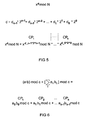
- Fig. 5 to 7 The following is on the Fig. 5 to 7 to give some examples of how an operation can be split into specific sub-operations.
- Is considered in Fig. 5 the operation x d mod N.
- the exponent d is represented in binary notation.
- FIG. 5 This results in a chain of modular multiplications, where, as is also shown in FIG Fig. 5 is shown, each modular single operation can be assigned to each a sub-calculator, such that all modular operations in parallel by the in Fig. 1 executed cryptography processor are executed.
- the intermediate results then obtained, after having been determined in parallel, are multiplied up to obtain the result.
- the control unit 105 controls the division into the individual partial calculation units TRW 1 to TRW k and then the final Aufmultipliring the individual intermediate results.
- Fig. 6 is another example of a division of an operation (a * b) mod c shown in several modular operations.
- the partial calculator TRW 1 can determine a first intermediate result.
- the partial calculators TRW 2 to TRW n also calculate intermediate results, whereupon, after receiving the intermediate results, the control unit 105 controls the multiplication of the intermediate results.
- the control unit controls the summation z. B. so that it selects a partial calculation, which then receives the intermediate results for summation.
- an operation is split into several independent sub-operations.
- FIGS. 5 and 6 serve only to illustrate the possibilities for dividing an operation into a plurality of sub-operations, where more favorable distributions can exist with regard to the achievable performance.
- it is not the performance of the processor that is essential to the examples, but rather that partitions exist so that each sub-computer performs an independent sub-operation, and that a plurality of sub-operations are controlled by a control unit to obtain the most concealed power profile at the power input to the chip ,
Landscapes
- Engineering & Computer Science (AREA)
- Theoretical Computer Science (AREA)
- Physics & Mathematics (AREA)
- Software Systems (AREA)
- General Physics & Mathematics (AREA)
- General Engineering & Computer Science (AREA)
- Computer Hardware Design (AREA)
- Mathematical Physics (AREA)
- Computer Security & Cryptography (AREA)
- Pure & Applied Mathematics (AREA)
- Mathematical Analysis (AREA)
- Mathematical Optimization (AREA)
- Computational Mathematics (AREA)
- Computing Systems (AREA)
- Computer Networks & Wireless Communication (AREA)
- Signal Processing (AREA)
- Advance Control (AREA)
- Storage Device Security (AREA)
- Multi Processors (AREA)
- Power Sources (AREA)
- Microcomputers (AREA)
- Bidet-Like Cleaning Device And Other Flush Toilet Accessories (AREA)
- Preparation Of Compounds By Using Micro-Organisms (AREA)
- Devices For Executing Special Programs (AREA)
- Saccharide Compounds (AREA)
Claims (10)
- Processeur cryptographique pour réaliser des opérations pour des applications cryptographiques, aux caractéristiques suivantes:une unité de traitement centrale (102) destinée à obtenir des commandes pour la réalisation d'une opération et pour la sortie de résultats d'une opération;un co-processeur (104) qui est couplé à l'unité de traitement centrale (102), le co-processeur étant caractérisé par les caractéristiques suivantes:une pluralité d'organes de calcul partiels (106, 108, 110, 112), chaque organe de calcul partiel présentant au moins une unité arithmétique (AU1, AU2, AU3, AUn); etune unité de commande unique (105) qui est couplée à chacun de la pluralité d'organes de calcul partiels et qui est disposée de manière à subdiviser une opération en opérations partielles, à répartir les opérations partielles sur la pluralité d'organes de calcul partiels et à commander la réalisation de l'opération par la pluralité d'organes de calcul partiels,l'unité de commande (105) étant réalisée de manière à,pourvoir les différents organes de calcul partiels en série de commandes,activer un premier organe de calcul partiel à un moment déterminé,lorsque l'activation du premier organe de calcul partiel est terminée, réaliser une activation d'un deuxième organe de calcul partiel, tandis que le premier organe de calcul partiel fonctionne déjà, de sorte que les organes de calcul partielsfonctionnement de manière décalée dans le temps,la pluralité d'organes de calcul partiels (106, 108, 110, 112) et l'unité de commande (105) étant intégrés sur une seule puce (100), etla puce (100) présentant un accès de courant d'alimentation commun (122) destiné à alimenter en courant la pluralité d'organes de calcul partiels et l'unité de commande.
- Processeur cryptographique selon la revendication 1,
dans lequel l'unité de commande est par ailleurs réalisée de manière à transmettre à l'unité de traitement centrale (102), lorsque premier organe de calcul partiel a terminé, les résultats fournis par le premier organe de calcul partiel, tandis que le deuxième organe de calcul partiel fonctionne encore. - Processeur cryptographique selon la revendication 1 ou 2, dans lequel l'unité de commande (105) est réalisée de manière à activer les organes de calcul partiels de sorte que tous les organes de calcul partiels fonctionnent de manière décalée dans le temps.
- Processeur cryptographique selon l'une des revendications précédentes, dans lequel les organes de calcul partiels sont réalisés de sorte que les opérations réalisées aient la même durée.
- Processeur cryptographique selon la revendication 4,
dans lequel l'unité de commande est par ailleurs réalisée de manière à transmettre à l'unité de traitement centrale (102), lorsque premier organe de calcul partiel a terminé, les résultats fournis par le premier organe de calcul partiel, tandis que le deuxième organe de calcul partiel fonctionne encore, et
dans lequel l'unité de commande (105) est réalisée de manière à terminer la transmission avant que le deuxième organe de calcul partiel ne termine son opération partielle. - Processeur cryptographique selon l'une des revendications précédentes, dans lequel tous les organes de calcul partiels réalisent des opérations identiques.
- Processeur cryptographique selon l'une des revendications précédentes, dans lequel chaque organe de calcul partiel présente, par ailleurs, une pluralité de registres (106b, 106c, 106d, 108b, 108c, 108d) qui sont attribués de manière exclusive à l'unité arithmétique (106a, 108a) de l'organe de calcul respectif.
- Processeur selon la revendication 7,
dans lequel la longueur (L1, L2) de la pluralité de registres attribués à un organe de calcul et la longueur de la pluralité de registres associés à un autre organe de calcul diffèrent, de sorte que les organes de calcul partiels puissent réaliser un calcul arithmétique avec des nombres de longueur chaque fois différente. - Processeur selon la revendication 7 ou la revendication 8, dans lequel le registre associé à un organe de calcul partiel est suffisant pour contenir des opérandes pour au moins deux opérations partielles, de sorte qu'il ne soit pas nécessaire de transmission d'opérandes pour au moins deux opérations partielles entre le co-processeur (104) et l'unité de traitement centrale (102).
- Processeur selon la revendication 9, dans lequel l'unité de commande (105) présente par ailleurs la caractéristique suivante:un moyen (200) destiné à commander dans le temps le fonctionnement des organes de calcul partiels, de sorte que puisse être réglée la séquence des au moins deux opérations partielles dont les opérandes sont mémorisés dans les registres d'un organe de calcul partiel.
Applications Claiming Priority (3)
| Application Number | Priority Date | Filing Date | Title |
|---|---|---|---|
| DE10061997 | 2000-12-13 | ||
| DE10061997A DE10061997A1 (de) | 2000-12-13 | 2000-12-13 | Kryptographieprozessor |
| EP01991797.0A EP1342148B9 (fr) | 2000-12-13 | 2001-12-06 | Processeur cryptographique |
Related Parent Applications (3)
| Application Number | Title | Priority Date | Filing Date |
|---|---|---|---|
| EP01991797.0 Division | 2001-12-06 | ||
| EP01991797.0A Division EP1342148B9 (fr) | 2000-12-13 | 2001-12-06 | Processeur cryptographique |
| EP01991797.0A Division-Into EP1342148B9 (fr) | 2000-12-13 | 2001-12-06 | Processeur cryptographique |
Publications (3)
| Publication Number | Publication Date |
|---|---|
| EP1589413A2 EP1589413A2 (fr) | 2005-10-26 |
| EP1589413A3 EP1589413A3 (fr) | 2007-04-04 |
| EP1589413B1 true EP1589413B1 (fr) | 2010-05-05 |
Family
ID=7666917
Family Applications (2)
| Application Number | Title | Priority Date | Filing Date |
|---|---|---|---|
| EP05012165A Expired - Lifetime EP1589413B1 (fr) | 2000-12-13 | 2001-12-06 | Processeur cryptographique |
| EP01991797.0A Expired - Lifetime EP1342148B9 (fr) | 2000-12-13 | 2001-12-06 | Processeur cryptographique |
Family Applications After (1)
| Application Number | Title | Priority Date | Filing Date |
|---|---|---|---|
| EP01991797.0A Expired - Lifetime EP1342148B9 (fr) | 2000-12-13 | 2001-12-06 | Processeur cryptographique |
Country Status (8)
| Country | Link |
|---|---|
| US (2) | US7430293B2 (fr) |
| EP (2) | EP1589413B1 (fr) |
| KR (1) | KR20030062422A (fr) |
| CN (1) | CN1273876C (fr) |
| AT (1) | ATE467172T1 (fr) |
| AU (1) | AU2002231668A1 (fr) |
| DE (2) | DE10061997A1 (fr) |
| WO (1) | WO2002048845A2 (fr) |
Families Citing this family (35)
| Publication number | Priority date | Publication date | Assignee | Title |
|---|---|---|---|---|
| DE10253285B4 (de) * | 2002-11-15 | 2018-11-15 | Giesecke+Devrient Mobile Security Gmbh | Verschleierung eines geheimen Wertes |
| US20040230813A1 (en) * | 2003-05-12 | 2004-11-18 | International Business Machines Corporation | Cryptographic coprocessor on a general purpose microprocessor |
| KR100680025B1 (ko) * | 2005-07-05 | 2007-02-07 | 한국전자통신연구원 | 멀티세션 고속암복호화 처리 장치 및 방법 |
| US7916864B2 (en) * | 2006-02-08 | 2011-03-29 | Nvidia Corporation | Graphics processing unit used for cryptographic processing |
| CN100369074C (zh) * | 2006-03-02 | 2008-02-13 | 西安西电捷通无线网络通信有限公司 | 一种实现sms4密码算法中加解密处理的方法 |
| US7826612B2 (en) * | 2006-06-29 | 2010-11-02 | Intel Corporation | System, method and apparatus for an incremental modular process including modular multiplication and modular eduction |
| DE102007007699A1 (de) | 2007-02-09 | 2008-08-14 | IHP GmbH - Innovations for High Performance Microelectronics/Institut für innovative Mikroelektronik | Reduktion von Seiten-Kanal-Informationen durch interagierende Krypto-Blocks |
| EP2000936A1 (fr) * | 2007-05-29 | 2008-12-10 | Gemplus | Jeton électronique comprenant plusieurs microprocesseurs et procédé pour la gestion de l'exécution de commandes sur plusieurs microprocesseurs |
| US8781111B2 (en) * | 2007-07-05 | 2014-07-15 | Broadcom Corporation | System and methods for side-channel attack prevention |
| US7929707B1 (en) * | 2007-09-06 | 2011-04-19 | Elcomsoft Co. Ltd. | Use of graphics processors as parallel math co-processors for password recovery |
| US8670557B2 (en) * | 2007-09-10 | 2014-03-11 | Spansion Llc | Cryptographic system with modular randomization of exponentiation |
| US8139763B2 (en) * | 2007-10-10 | 2012-03-20 | Spansion Llc | Randomized RSA-based cryptographic exponentiation resistant to side channel and fault attacks |
| IL187043A0 (en) * | 2007-10-30 | 2008-02-09 | Sandisk Il Ltd | Secure pipeline manager |
| US20090183161A1 (en) * | 2008-01-16 | 2009-07-16 | Pasi Kolinummi | Co-processor for stream data processing |
| JP5146156B2 (ja) * | 2008-06-30 | 2013-02-20 | 富士通株式会社 | 演算処理装置 |
| ITMI20082364A1 (it) * | 2008-12-31 | 2010-07-01 | Incard Sa | Metodo per proteggere un dispositivo crittografico contro attacchi spa, dpa e temporali |
| US20100177889A1 (en) * | 2009-01-15 | 2010-07-15 | Kabushiki Kaisha Toshiba | Image forming apparatus and encryption process control method |
| US20100306553A1 (en) * | 2009-06-01 | 2010-12-02 | Poletti Iii Joseph William | High-throughput cryptographic processing using parallel processing |
| EP2293185A1 (fr) * | 2009-09-04 | 2011-03-09 | Thomson Licensing | Procédé de mise à la puissance résistant contre des attaques par surpassement et appareil pour sa mise en oeuvre |
| US20140032917A1 (en) * | 2010-10-29 | 2014-01-30 | Nec Corporation | Group signature processing device for processing a plurality of group signatures simultaneously |
| DE102011007976A1 (de) | 2011-01-03 | 2012-07-05 | Giesecke & Devrient Gmbh | Verfahren zur gesicherten Ausführung einer Kryptographischen Berechnung |
| JP5776927B2 (ja) * | 2011-03-28 | 2015-09-09 | ソニー株式会社 | 情報処理装置及び方法、並びにプログラム |
| EP2523385B1 (fr) * | 2011-05-05 | 2017-07-12 | Proton World International N.V. | Procédé et circuit pour fonctionnement cryptographique |
| EP2700256B1 (fr) | 2011-05-20 | 2017-11-29 | BlackBerry Limited | Vérification de mots de passe sur un dispositif mobile |
| US8958550B2 (en) * | 2011-09-13 | 2015-02-17 | Combined Conditional Access Development & Support. LLC (CCAD) | Encryption operation with real data rounds, dummy data rounds, and delay periods |
| US9773111B2 (en) * | 2012-08-14 | 2017-09-26 | Empire Technology Development Llc | Software-based side-channel attack prevention |
| EP2733654A1 (fr) * | 2012-11-20 | 2014-05-21 | Nagravision S.A. | Procédé de paiement électronique, système et dispositif pour échanger de manière sécurisée des informations de paiement |
| WO2015088525A1 (fr) * | 2013-12-12 | 2015-06-18 | Empire Technology Development, Llc | Randomisation de temporisation de sous-unités de processeur à des fins d'amélioration de la sécurité |
| WO2015096167A1 (fr) | 2013-12-28 | 2015-07-02 | Intel Corporation | Processeurs, procédés, systèmes et instructions d'accélération d'algorithme rsa |
| EP3152859A1 (fr) | 2014-06-04 | 2017-04-12 | Giesecke & Devrient GmbH | Procédé pour une sécurité renforcée d'un dispositif de calcul à c urs multiples |
| US9798521B2 (en) * | 2014-08-27 | 2017-10-24 | Schlage Lock Company Llc | System, method and apparatus for random number generation |
| EP3279826A1 (fr) * | 2016-08-04 | 2018-02-07 | Nagravision SA | Vérification de séquence |
| CN107294719A (zh) * | 2017-06-19 | 2017-10-24 | 北京万协通信息技术有限公司 | 一种双线性对运算的加解密协处理器 |
| FR3076925B1 (fr) | 2018-01-16 | 2020-01-24 | Proton World International N.V. | Fonction cryptographique |
| WO2022266831A1 (fr) * | 2021-06-22 | 2022-12-29 | 华为技术有限公司 | Procédé de traitement de données et processeur |
Family Cites Families (10)
| Publication number | Priority date | Publication date | Assignee | Title |
|---|---|---|---|---|
| GB2130405B (en) | 1980-08-30 | 1984-11-21 | British Aerospace | Electronic calculator |
| EP0239749B1 (fr) * | 1986-03-05 | 1990-07-25 | Holger Sedlak | Procédé cryptographique et processeur cryptographique pour réaliser ce procédé |
| DE3631992A1 (de) * | 1986-03-05 | 1987-11-05 | Holger Sedlak | Kryptographie-verfahren und kryptographie-prozessor zur durchfuehrung des verfahrens |
| US5752071A (en) * | 1995-07-17 | 1998-05-12 | Intel Corporation | Function coprocessor |
| DE19539700C1 (de) * | 1995-10-25 | 1996-11-28 | Siemens Ag | Sicherheitschip |
| GB9707861D0 (en) * | 1997-04-18 | 1997-06-04 | Certicom Corp | Arithmetic processor |
| US6219420B1 (en) * | 1998-09-02 | 2001-04-17 | Motorola, Inc. | High assurance encryption system and method |
| US6408075B1 (en) * | 1998-11-30 | 2002-06-18 | Hitachi, Ltd. | Information processing equipment and IC card |
| FR2787900B1 (fr) * | 1998-12-28 | 2001-02-09 | Bull Cp8 | Circuit integre intelligent |
| FR2789535B1 (fr) * | 1999-02-04 | 2001-09-28 | Bull Cp8 | Procede de securisation d'un ensemble electronique de cryptographie a cle secrete contre les attaques par analyse physique |
-
2000
- 2000-12-13 DE DE10061997A patent/DE10061997A1/de not_active Withdrawn
-
2001
- 2001-12-06 KR KR10-2003-7007883A patent/KR20030062422A/ko not_active Abandoned
- 2001-12-06 DE DE50115478T patent/DE50115478D1/de not_active Expired - Lifetime
- 2001-12-06 AU AU2002231668A patent/AU2002231668A1/en not_active Abandoned
- 2001-12-06 EP EP05012165A patent/EP1589413B1/fr not_active Expired - Lifetime
- 2001-12-06 EP EP01991797.0A patent/EP1342148B9/fr not_active Expired - Lifetime
- 2001-12-06 WO PCT/EP2001/014349 patent/WO2002048845A2/fr not_active Ceased
- 2001-12-06 AT AT05012165T patent/ATE467172T1/de not_active IP Right Cessation
- 2001-12-06 CN CNB018205658A patent/CN1273876C/zh not_active Expired - Fee Related
-
2003
- 2003-06-13 US US10/461,905 patent/US7430293B2/en not_active Expired - Fee Related
-
2008
- 2008-02-20 US US12/034,252 patent/US8369520B2/en not_active Expired - Fee Related
Also Published As
| Publication number | Publication date |
|---|---|
| US20040105541A1 (en) | 2004-06-03 |
| CN1481524A (zh) | 2004-03-10 |
| CN1273876C (zh) | 2006-09-06 |
| US7430293B2 (en) | 2008-09-30 |
| AU2002231668A1 (en) | 2002-06-24 |
| WO2002048845A2 (fr) | 2002-06-20 |
| EP1589413A3 (fr) | 2007-04-04 |
| KR20030062422A (ko) | 2003-07-25 |
| ATE467172T1 (de) | 2010-05-15 |
| US20080140739A1 (en) | 2008-06-12 |
| EP1589413A2 (fr) | 2005-10-26 |
| DE10061997A1 (de) | 2002-07-18 |
| US8369520B2 (en) | 2013-02-05 |
| EP1342148A2 (fr) | 2003-09-10 |
| WO2002048845A3 (fr) | 2002-11-14 |
| EP1342148B9 (fr) | 2014-02-26 |
| EP1342148B1 (fr) | 2013-07-03 |
| DE50115478D1 (de) | 2010-06-17 |
Similar Documents
| Publication | Publication Date | Title |
|---|---|---|
| EP1342148B1 (fr) | Processeur cryptographique | |
| EP1342154B1 (fr) | Processeur cryptographique | |
| DE10136335B4 (de) | Prozessor mit mehreren Rechenwerken | |
| DE102018115439A1 (de) | Technologien zur fehlertoleranten Berechnung von Elliptische-Kurven-Digitalsignaturen | |
| EP1859344A2 (fr) | Procede et dispositif de calcul d'une multiplication polynome, en particulier pour cryptographie curviligne elliptique | |
| DE69737184T2 (de) | Schaltkreis, mikrocomputer und elektronischer apparat für die datenverarbeitung | |
| DE10339999A1 (de) | Pseudozufallszahlengenerator | |
| EP1395910B1 (fr) | Circuit electronique avec unites peripheriques a mode d'impulsions asynchrone | |
| EP1324188A2 (fr) | Procédé de multiplication de deux facteurs dans un champs de Galois et circuit multiplieur pour sa mise en oeuvre | |
| DE10219158A1 (de) | Vorrichtung und Verfahren zum Berechnen eines Ergebnisses einer modularen Multiplikation | |
| EP1046142B1 (fr) | Dispositif de traitement des donnees et son procede de fonctionnement permettant d'empecher toute analyse differentielle de consommation d'energie | |
| DE102009017844A1 (de) | Einrichtung, Systeme und Verfahren zur Authentisierung von Verschlüsselungen | |
| DE10224742B4 (de) | Datenverarbeitungsschaltung und Verfahren zum Übertragen von Daten | |
| DE102022131526A1 (de) | Verarbeitungsschaltung | |
| DE102022129607A1 (de) | Schaltung für kombinierten schlüsselwertabhängigen austausch und randomisierung von zwei werten | |
| DE10156708B4 (de) | Verfahren und Vorrichtung zum Multiplizieren und Verfahren und Vorrichtung zum Addieren auf einer elliptischen Kurve | |
| DE60220793T2 (de) | Verwürfelung bzw. Verschleierung (Scrambling) einer Berechnung, bei welcher eine modulare Funktion zur Anwendung kommt | |
| DE10250831B3 (de) | Vorrichtung und Verfahren zum Erzeugen einer pseudozufälligen Folge von Zahlen | |
| EP3504616B1 (fr) | Module et procédé de calcul sécurisé d'opérations mathématiques | |
| DE10219164A1 (de) | Vorrichtung und Verfahren zum Berechnen eines ganzzahligen Quotienten | |
| DE602004006126T2 (de) | Verbesserte inversionsberechnungen | |
| EP1393164A1 (fr) | Processeur a configuration de memoire interieure | |
| WO2003098429A2 (fr) | Inversion modulaire protegee contre les tentatives d'espionnage | |
| DE3924344C2 (fr) | ||
| DE102022129606A1 (de) | Schaltung für kombinierten schlüsselwertabhängigen austausch und multiplikative randomisierung von zwei werten |
Legal Events
| Date | Code | Title | Description |
|---|---|---|---|
| PUAI | Public reference made under article 153(3) epc to a published international application that has entered the european phase |
Free format text: ORIGINAL CODE: 0009012 |
|
| 17P | Request for examination filed |
Effective date: 20050606 |
|
| AC | Divisional application: reference to earlier application |
Ref document number: 1342148 Country of ref document: EP Kind code of ref document: P |
|
| AK | Designated contracting states |
Kind code of ref document: A2 Designated state(s): AT DE ES FR GB IT |
|
| PUAL | Search report despatched |
Free format text: ORIGINAL CODE: 0009013 |
|
| AK | Designated contracting states |
Kind code of ref document: A3 Designated state(s): AT DE ES FR GB IT |
|
| RIC1 | Information provided on ipc code assigned before grant |
Ipc: G06F 21/00 20060101ALI20070226BHEP Ipc: G06F 7/72 20060101ALI20070226BHEP Ipc: G06F 9/38 20060101AFI20050902BHEP |
|
| AKX | Designation fees paid |
Designated state(s): AT DE ES FR GB IT |
|
| 17Q | First examination report despatched |
Effective date: 20080925 |
|
| GRAP | Despatch of communication of intention to grant a patent |
Free format text: ORIGINAL CODE: EPIDOSNIGR1 |
|
| GRAS | Grant fee paid |
Free format text: ORIGINAL CODE: EPIDOSNIGR3 |
|
| GRAA | (expected) grant |
Free format text: ORIGINAL CODE: 0009210 |
|
| AC | Divisional application: reference to earlier application |
Ref document number: 1342148 Country of ref document: EP Kind code of ref document: P |
|
| AK | Designated contracting states |
Kind code of ref document: B1 Designated state(s): AT DE ES FR GB IT |
|
| REG | Reference to a national code |
Ref country code: GB Ref legal event code: FG4D Free format text: NOT ENGLISH |
|
| RAP2 | Party data changed (patent owner data changed or rights of a patent transferred) |
Owner name: INFINEON TECHNOLOGIES AG |
|
| REF | Corresponds to: |
Ref document number: 50115478 Country of ref document: DE Date of ref document: 20100617 Kind code of ref document: P |
|
| PG25 | Lapsed in a contracting state [announced via postgrant information from national office to epo] |
Ref country code: ES Free format text: LAPSE BECAUSE OF FAILURE TO SUBMIT A TRANSLATION OF THE DESCRIPTION OR TO PAY THE FEE WITHIN THE PRESCRIBED TIME-LIMIT Effective date: 20100816 |
|
| REG | Reference to a national code |
Ref country code: FR Ref legal event code: CA |
|
| PLBE | No opposition filed within time limit |
Free format text: ORIGINAL CODE: 0009261 |
|
| STAA | Information on the status of an ep patent application or granted ep patent |
Free format text: STATUS: NO OPPOSITION FILED WITHIN TIME LIMIT |
|
| PG25 | Lapsed in a contracting state [announced via postgrant information from national office to epo] |
Ref country code: IT Free format text: LAPSE BECAUSE OF FAILURE TO SUBMIT A TRANSLATION OF THE DESCRIPTION OR TO PAY THE FEE WITHIN THE PRESCRIBED TIME-LIMIT Effective date: 20100505 |
|
| 26N | No opposition filed |
Effective date: 20110208 |
|
| REG | Reference to a national code |
Ref country code: DE Ref legal event code: R097 Ref document number: 50115478 Country of ref document: DE Effective date: 20110207 |
|
| PG25 | Lapsed in a contracting state [announced via postgrant information from national office to epo] |
Ref country code: AT Free format text: LAPSE BECAUSE OF NON-PAYMENT OF DUE FEES Effective date: 20101206 |
|
| REG | Reference to a national code |
Ref country code: AT Ref legal event code: MM01 Ref document number: 467172 Country of ref document: AT Kind code of ref document: T Effective date: 20101206 |
|
| REG | Reference to a national code |
Ref country code: FR Ref legal event code: PLFP Year of fee payment: 15 |
|
| REG | Reference to a national code |
Ref country code: FR Ref legal event code: PLFP Year of fee payment: 16 |
|
| PGFP | Annual fee paid to national office [announced via postgrant information from national office to epo] |
Ref country code: DE Payment date: 20170214 Year of fee payment: 16 |
|
| REG | Reference to a national code |
Ref country code: FR Ref legal event code: PLFP Year of fee payment: 17 |
|
| PGFP | Annual fee paid to national office [announced via postgrant information from national office to epo] |
Ref country code: FR Payment date: 20171221 Year of fee payment: 17 |
|
| PGFP | Annual fee paid to national office [announced via postgrant information from national office to epo] |
Ref country code: GB Payment date: 20171221 Year of fee payment: 17 |
|
| REG | Reference to a national code |
Ref country code: DE Ref legal event code: R119 Ref document number: 50115478 Country of ref document: DE |
|
| PG25 | Lapsed in a contracting state [announced via postgrant information from national office to epo] |
Ref country code: DE Free format text: LAPSE BECAUSE OF NON-PAYMENT OF DUE FEES Effective date: 20180703 |
|
| GBPC | Gb: european patent ceased through non-payment of renewal fee |
Effective date: 20181206 |
|
| PG25 | Lapsed in a contracting state [announced via postgrant information from national office to epo] |
Ref country code: FR Free format text: LAPSE BECAUSE OF NON-PAYMENT OF DUE FEES Effective date: 20181231 |
|
| PG25 | Lapsed in a contracting state [announced via postgrant information from national office to epo] |
Ref country code: GB Free format text: LAPSE BECAUSE OF NON-PAYMENT OF DUE FEES Effective date: 20181206 |