EP1585303A2 - Système de gestion d'impression - Google Patents
Système de gestion d'impression Download PDFInfo
- Publication number
- EP1585303A2 EP1585303A2 EP04020558A EP04020558A EP1585303A2 EP 1585303 A2 EP1585303 A2 EP 1585303A2 EP 04020558 A EP04020558 A EP 04020558A EP 04020558 A EP04020558 A EP 04020558A EP 1585303 A2 EP1585303 A2 EP 1585303A2
- Authority
- EP
- European Patent Office
- Prior art keywords
- data
- printed
- client terminal
- ticket
- Prior art date
- Legal status (The legal status is an assumption and is not a legal conclusion. Google has not performed a legal analysis and makes no representation as to the accuracy of the status listed.)
- Withdrawn
Links
Images



Classifications
-
- H—ELECTRICITY
- H04—ELECTRIC COMMUNICATION TECHNIQUE
- H04N—PICTORIAL COMMUNICATION, e.g. TELEVISION
- H04N1/00—Scanning, transmission or reproduction of documents or the like, e.g. facsimile transmission; Details thereof
- H04N1/00002—Diagnosis, testing or measuring; Detecting, analysing or monitoring not otherwise provided for
- H04N1/00026—Methods therefor
- H04N1/00063—Methods therefor using at least a part of the apparatus itself, e.g. self-testing
-
- G—PHYSICS
- G06—COMPUTING OR CALCULATING; COUNTING
- G06F—ELECTRIC DIGITAL DATA PROCESSING
- G06F3/00—Input arrangements for transferring data to be processed into a form capable of being handled by the computer; Output arrangements for transferring data from processing unit to output unit, e.g. interface arrangements
- G06F3/12—Digital output to print unit, e.g. line printer, chain printer
-
- B—PERFORMING OPERATIONS; TRANSPORTING
- B41—PRINTING; LINING MACHINES; TYPEWRITERS; STAMPS
- B41M—PRINTING, DUPLICATING, MARKING, OR COPYING PROCESSES; COLOUR PRINTING
- B41M3/00—Printing processes to produce particular kinds of printed work, e.g. patterns
- B41M3/14—Security printing
-
- H—ELECTRICITY
- H04—ELECTRIC COMMUNICATION TECHNIQUE
- H04N—PICTORIAL COMMUNICATION, e.g. TELEVISION
- H04N1/00—Scanning, transmission or reproduction of documents or the like, e.g. facsimile transmission; Details thereof
- H04N1/00002—Diagnosis, testing or measuring; Detecting, analysing or monitoring not otherwise provided for
-
- H—ELECTRICITY
- H04—ELECTRIC COMMUNICATION TECHNIQUE
- H04N—PICTORIAL COMMUNICATION, e.g. TELEVISION
- H04N1/00—Scanning, transmission or reproduction of documents or the like, e.g. facsimile transmission; Details thereof
- H04N1/00002—Diagnosis, testing or measuring; Detecting, analysing or monitoring not otherwise provided for
- H04N1/00026—Methods therefor
- H04N1/00031—Testing, i.e. determining the result of a trial
-
- H—ELECTRICITY
- H04—ELECTRIC COMMUNICATION TECHNIQUE
- H04N—PICTORIAL COMMUNICATION, e.g. TELEVISION
- H04N1/00—Scanning, transmission or reproduction of documents or the like, e.g. facsimile transmission; Details thereof
- H04N1/00002—Diagnosis, testing or measuring; Detecting, analysing or monitoring not otherwise provided for
- H04N1/00026—Methods therefor
- H04N1/00045—Methods therefor using a reference pattern designed for the purpose, e.g. a test chart
-
- H—ELECTRICITY
- H04—ELECTRIC COMMUNICATION TECHNIQUE
- H04N—PICTORIAL COMMUNICATION, e.g. TELEVISION
- H04N1/00—Scanning, transmission or reproduction of documents or the like, e.g. facsimile transmission; Details thereof
- H04N1/00002—Diagnosis, testing or measuring; Detecting, analysing or monitoring not otherwise provided for
- H04N1/00026—Methods therefor
- H04N1/0005—Methods therefor in service, i.e. during normal operation
-
- H—ELECTRICITY
- H04—ELECTRIC COMMUNICATION TECHNIQUE
- H04N—PICTORIAL COMMUNICATION, e.g. TELEVISION
- H04N1/00—Scanning, transmission or reproduction of documents or the like, e.g. facsimile transmission; Details thereof
- H04N1/00002—Diagnosis, testing or measuring; Detecting, analysing or monitoring not otherwise provided for
- H04N1/00026—Methods therefor
- H04N1/00058—Methods therefor using a separate apparatus
- H04N1/00061—Methods therefor using a separate apparatus using a remote apparatus
-
- H—ELECTRICITY
- H04—ELECTRIC COMMUNICATION TECHNIQUE
- H04N—PICTORIAL COMMUNICATION, e.g. TELEVISION
- H04N1/00—Scanning, transmission or reproduction of documents or the like, e.g. facsimile transmission; Details thereof
- H04N1/00002—Diagnosis, testing or measuring; Detecting, analysing or monitoring not otherwise provided for
- H04N1/00026—Methods therefor
- H04N1/00066—Methods therefor using a program downloaded or received from another apparatus
-
- H—ELECTRICITY
- H04—ELECTRIC COMMUNICATION TECHNIQUE
- H04N—PICTORIAL COMMUNICATION, e.g. TELEVISION
- H04N1/00—Scanning, transmission or reproduction of documents or the like, e.g. facsimile transmission; Details thereof
- H04N1/00002—Diagnosis, testing or measuring; Detecting, analysing or monitoring not otherwise provided for
- H04N1/00071—Diagnosis, testing or measuring; Detecting, analysing or monitoring not otherwise provided for characterised by the action taken
- H04N1/00074—Indicating or reporting
- H04N1/00079—Indicating or reporting remotely
-
- H—ELECTRICITY
- H04—ELECTRIC COMMUNICATION TECHNIQUE
- H04N—PICTORIAL COMMUNICATION, e.g. TELEVISION
- H04N1/00—Scanning, transmission or reproduction of documents or the like, e.g. facsimile transmission; Details thereof
- H04N1/00002—Diagnosis, testing or measuring; Detecting, analysing or monitoring not otherwise provided for
- H04N1/00092—Diagnosis, testing or measuring; Detecting, analysing or monitoring not otherwise provided for relating to the original or to the reproducing medium, e.g. imperfections or dirt
-
- H—ELECTRICITY
- H04—ELECTRIC COMMUNICATION TECHNIQUE
- H04N—PICTORIAL COMMUNICATION, e.g. TELEVISION
- H04N1/00—Scanning, transmission or reproduction of documents or the like, e.g. facsimile transmission; Details thereof
- H04N1/00838—Preventing unauthorised reproduction
- H04N1/0084—Determining the necessity for prevention
-
- H—ELECTRICITY
- H04—ELECTRIC COMMUNICATION TECHNIQUE
- H04N—PICTORIAL COMMUNICATION, e.g. TELEVISION
- H04N1/00—Scanning, transmission or reproduction of documents or the like, e.g. facsimile transmission; Details thereof
- H04N1/00838—Preventing unauthorised reproduction
- H04N1/00856—Preventive measures
Definitions
- the present invention relates to a printing method of electronic document data while preventing their forgery or copy.
- the present invention relates to a forgery preventing technique which prevents the printed matters from being copied in a currently spread printer.
- Patent Document 1 Japanese Patent Laid-open Publication No. 2003-136828
- Patent Document 2 Japanese Patent Laid-open Publication No. 2002-366981
- one continuous gradation image can be printed in a predetermined area.
- two continuous gradation images can be arranged equally in a predetermined area with neither any superimposition on a predetermined area nor any fusion of the mesh points.
- the black (Bk) is a black pigment composed mainly of carbon black, and exhibits an absorption over the whole range from an ultraviolet range to an infrared range.
- the image printed in the black ink (Bk) containing carbon black can be visually recognised by the observation using a survey device such as an infrared camera which observes the absorptivity of the infrared ray.
- a ticket issuing system having a high effect to prevent the counterfeit tickets from being printed by the forgery or copy can be provided merely by installing the ticket image encoding print programs provided by the ticket issuing centre and by using the currently spread system of the terminal and the printer connected with the internet.
- Patent Document 1 makes use of the following facts.
- the black (Bk) is a black pigment composed mainly of carbon black, and exhibits the absorption all over the range from the ultraviolet range to the infrared range, but the combination of the remaining cyan (C), the magenta (M) and the yellow (Y) does not absorb the infrared ray.
- the mesh points composing the continuous gradation image has to be coloured, as designated, in the four colour inks of the cyan (C), the magenta (M), the yellow (Y) and the black (Bk).
- the under-colour removing process In the case of the black ink, the quantity of the black ink is determined, and the quantities of the individual colours are determined to express the remaining colour components
- the duty limiting process The cyan (C) and the magenta (M) are so partially replaced by a light cyan (LC) and a light magenta (LM) as to reduce the graininess within the range of the ink quantities permitted for the individual printing media
- the aforementioned image cannot be printed in the designated ink distribution so that the expected effect cannot be attained.
- the ticket image files are encoded so that they cannot be decoded without using the dedicated programs installed on the user terminal.
- the decoded ticket image files can be printed only in case those dedicated programs are used.
- the dedicated programs transmit the print permitting request message to the ticket issuing server, and this ticket issuing server returns the ticket issue permitting message within a range not exceeding a predetermined print number.
- the dedicated programs at the user terminal perform the printing process only in case they receive the ticket issue permitting message.
- the present invention provides a security printing technique which prevents the forgery or copy of printed matters, at a reasonable cost, such that even in case the printed matters are to be generated through the edition separating process, the images (or invisible images), which cannot be recognised under a visible light, that is, with naked eyes (including the use of spectacles), may be visually recognised when observed by using a survey device capable of observing the difference in the absorptivity of the infrared ray.
- the present invention provides a printed matter issuing system which can prevent not only the print data or electronic information from being forged or copied but also the printing medium such as a paper printed with the data from being forged or copied.
- the present invention provides a ticket issuing system which is enabled, by exemplifying the tickets as the printed matters and by limiting the use of the tickets at a specific place and for a specific time as in the event, not only to make an overlap check (i.e., to check that one ticket has the same identification number) but also to doubly check the ticket such as a traffic ticket to be used at an indefinite place and for an indefinite time.
- an issue server is provided with: a mesh point image data generating unit which generates a mesh point image expressed in mesh points so as to express a continuous gradation image; and an invisible image generating unit which makes the mesh point image invisible with different parameters by holding not only at least two kinds of parameter tables so adjusted in advance in the ink mixing ratios as to form the invisible image in the same colours under the visible light but also one parameter for colouring the mesh point image separately according to a plurality of ink mixing ratios defined in these parameter tables, and by colouring the mesh point image separately with one colouring parameter according to the plurality of mixing ratios on the basis of that parameter.
- a client terminal is provided with: a decoding unit which decodes the encoded printed matter data; a print control unit which prints a permitted number of sheets designated for the printed tickets; and an input/output unit which notifies an acceptance server of the information on the printed results.
- the issue server is further provided with a printing test data generating unit which generates the testing data, and an encoding unit which encodes those data.
- the acceptance server is further provided with a printing state verification unit which verifies the truth of the information on the state of the printed matters, and a printed ticket issuing unit which issues the printed tickets.
- Fig. 1 is a diagram of a system configuration which realises the present embodiment.
- the configuration components of the present embodiment are an acceptance server 100, an issue server 110 and one or more client terminal device (hereinafter, called to as "client") 120.
- the acceptance server 100 and the issue server 110 may be functions to be realised on either physically distant, different information processing devices or an identical information processing device.
- the acceptance server 100, the issue server 110 and the clients (1 to K) are connected through a communication unit 101, a communication unit 111 and communication unit 121, respectively, with each other through an open network 140.
- This network 140 may be public or private circuits or may be wireless or wired.
- a tamper-resisting device such as an IC card or a smart card (hereinafter, called to as "tamper-resisting device”) 130 can be connected with the client terminal 120.
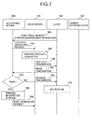
- Fig. 7 shows a processing flow which examines the printing environment of the client 120.
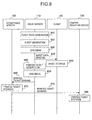
- Fig. 8 shows a processing flow which generates the print data of a ticket.
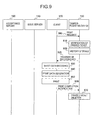
- Fig. 9 shows a processing flow which assures that a predetermined number of tickets were printed.
- the acceptance server 100 receives a ticket issue request of the client 120 (at Step 700), and transmits a request for generating the printing test data to the issue server 110 (at Step 710).
- the issue server 110 generates printing test data 500 at a printing test data generating unit 114 (at Step 720), and transmits the printing test data 500 to the client 120 (at Step 730).
- the client 120 prints the printing test data 500 on a paper sheet by a printer 125, and accepts the input of a print confirmation (at Step 740) at an input/output unit 124 and transmits it to the acceptance server 100.
- the print confirmation at Step 740 can be interactively processed by using the Web browser, for example.
- Figs. 5A and 5B show examples of the printed results of printing test data and ticket data to be generated by the issue server 110.
- a background 510 and an image area 520 are so designated that the filling patterns may be undiscriminatingly drawn under a visible light but according to the ink component percentages to create colours having optical properties different from each other. These component percentages are enumerated in later-described parameter tables. Moreover, the densities of inks used in the image area 520 are so discriminated that a triangular image is filled out in a parameter of a density of 30 %, that a square image is filled out in a parameter of a density of 35 %, and that a round image is filled out in a parameter of a density of 40 %.
- the information for print confirmation (of Step 740) is the image information, on which the user has reported that the image could be read under the visible light such as with the naked eyes when several images had been printed with the printing test data 500 by varying the densities of inks gradually.
- the ticket data 550 is configured to have an area 570 having been subjected to a copy preventing processing, and the remaining area 560. Moreover, the area 570 contains an invisible image 575. This invisible image 575 is hard to be recognised under the visible light but can be visually recognised in case it is observed with an evaluation device (hereinafter, called to as "infrared camera") which observes the absorptivity of an infrared ray.
- an evaluation device hereinafter, called to as "infrared camera” which observes the absorptivity of an infrared ray.
- a portion of the area containing the invisible image 575 is set as a small area 580.
- this small area 580 is configured of an area 585 which is expressed in three colours of cyan (C), a magenta (M) and yellow (Y) and which is recorded with an image visible under the visible light, and an area 590 which is recorded with a continuous gradation image invisible under the visible light.
- the area 590 When the area 590 is further enlarged, there can be observed an area 595 which is filled out with a parameter A in the parameter table, and an area 597 which is filled out with a parameter B.
- the continuous gradation image is recorded in the area 597 and can be observed with the infrared camera.
- a forgery can be made difficult by making the image to be recorded in the area 597, in a continuous gradation (or in grey scale).
- the acceptance server 100 receives the information for the print confirmation (at Step 740), and determines whether the received information is true or not (at Step 750).
- the acceptance server 100 stores the density information on inks corresponding to the kinds of images (at Step 780), and requests the issue server 110 to generate the ticket data and the printing sheet (at Step 790). In the case that the information for the print confirmation is false, the acceptance server 100 returns an error message to the client 120 (at Step 760), and terminates a ticket issuing routine (at Step 770).
- Step 750 The method for generating the printing test data 500 and the method for determining whether it is true or not in Step 750 will be described in detail with reference to Figs. 3A and 3B, Figs. 4A and 4B and Figs. 6A and 6B.
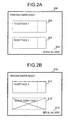
- Figs. 2A and 2B are explanatory diagrams of printed matters showing the relations between the printing paper sheets and the ticket faces printed on the sheets.
- Fig. 8 shows a routine process to be executed subsequent to Step 790 of Fig. 7.
- a ticket data generating unit 115 of the issue server 110 generates the ticket data 550 having been subjected to the copy preventing processing (at Step 800). Moreover, a sheet generating unit 113 generates a printing paper sheet 200 and a printing paper sheet 210, in which the ticket data 550 are arranged, as shown in Figs. 2A and 2B (at Step 810).
- the sheet 200 and the sheet 210 in Figs. 2A and 2B exemplify the case, in which a request for issuing three tickets is made at Step 700 so that the two ticket data 550 are arranged and printed on one printing paper sheet.
- a ticket face 1 (201), a ticket face 2 (202) and a serial number 203 are arranged on the printing paper sheet 200.
- a ticket face 3 (211), an invalid ticket face (212) and a serial number 213 are arranged on the printing paper sheet 210.
- the ticket data 550 are printed on the ticket face 1, the ticket face 2 and the ticket face 3.
- On the invalid ticket face on the other hand, there is printed an invalid mark which indicates that the ticket face area is invalid.
- An encoding unit 112 of the issue server 110 encodes those sheet data (at Step 820), and sends the encoded data to the client 120 (at Step 830).
- this encoding process it is desired that a unique decoding key is made to correspond to each sheet so that the sheet data may be encoded with an encoding key matching the decoding key.
- the client 120 stores the encoding data sent at Step 830 (at Step 835) .
- a printed ticket issuing unit 102 of the issue server 110 generates printed ticket data which is license data permitting the printing of the sheet data (at Step 840).
- the printed ticket issuing unit 102 encodes the printed ticket data with an open key matching a secret key stored in the tamper-resisting device 130 (at Step 850), and sends the encoded data to the acceptance server 100 (at Step 860).
- the acceptance server 100 stores the printed ticket issuing unit 102 with the printed ticket data sent (at Step 870).
- Step 710 to Step 870 has been described as a series of process using the ticket issue request of Step 700 as the trigger.
- the ticket data and the printed ticket data may also be generated in advance so that the encoded ticket data may be stored in the client 120 whereas the encoded printed ticket data may be stored in the acceptance server 100.
- the acceptance server 100 transmits the printed ticket data to the tamper-resisting device 130(at Step 875), and this tamper-resisting device 130 stores the printed ticket data received (at Step 880).
- the protocols which send the printed ticket data from the acceptance server 100 to the tamper-resisting device 130 are identical to the protocols which store the data such as an electronic ticket in the IC card or the like thereby to assure the uniqueness of the printed ticket data.
- the client 120 sends a print request for printing the ticket to the tamper-resisting device 130 (at Step 900), and confirms the validity of the printed ticket data in a printed ticket management unit 131 of the tamper-resisting device 130 (at Step 910).
- the tamper-resisting device 130 stores such history information (e.g., an extracted decoding key) in a history recording unit 132 (at Step 920) as indicates that the printed ticket data have been used.
- the validity confirmation at Step 910 it is verified with an electronic signature that the printed ticket has been issued from the issue server 110, and it is confirmed that the printed ticket data have not been used for the history information.
- the client 120 acquires the decoding key extracted from the tamper-resisting device 130 (at Step 925), and decodes the sheet data at a decoding unit 123 (at Step 930).
- the client 120 generates the print data from the sheet data (at Step 940), and prints them on the paper sheet with the printer 125 (at Step 950). Then, the client 120 sends the print completion notification to the tamper-resisting device 130 (at Step 960).
- the processes of the client 120 thus far described are performed mainly in a print control unit 122.
- the printed ticket management unit 131 of the tamper-resisting device 130 receives the aforementioned print completion notification such as the serial number contained in the sheet data.
- the management unit 131 records the completion notification in the history recording unit 132 and deletes the corresponding printed ticket data (at Step 970).
- the printed ticket is issued as a right to print the sheet data on only one sheet.
- a printed ticket having a right to print data of a plurality of sheets may be issued so that the printed sheet number may be subtracted in the process of Step 970.
- the tamper-resisting device 130 may be provided with a verification unit which verifies the truth of the information for the print confirmation so that the history may be recorded only in case the decision is correct.
- the acceptance server 100, the issue server 110 and the client 120 are exemplified by the so-called personal computer and work station or the like so that the processors working on such computers may execute the programs to realise the aforementioned individual functions.
- the computer of the user should not be limited to the so-called computer device but may be a multi-function mobile terminal, if the computer is provided with a storage device, a display and input/output device, a communication device and a print device and if the processor can execute the programs stored in the storage device.
- the programs may be either stored in advance in the storage device or introduced, if necessary, into the storage device through the storage medium or communication medium (e.g., the communication lines or the carrier waves on the communication lines) which can be used by the computer.
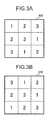
- Figs. 3A and 3B are explanatory diagrams showing the filling patterns necessary for realising the paper copy preventing function
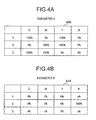
- Figs. 4A and 4B are parameter tables showing ink component percentages corresponding to the individual rectangular areas of the patterns.
- FIGs. 5A and 5B show the examples of printing test data to be generated by the issue server
- Figs. 6A and 6B are explanatory diagrams showing variations of the printing test data.
- a filling pattern 300 in Fig. 3A is a unit pattern which fills the image area 520 and the background 510 of the printing test data.
- the numerals defined in the filling pattern 300 correspond to the row numbers in a parameter A table 400 and a parameter B table 410 shown in Figs. 4A and 4B.
- a rectangular area 2 is filled out, in case it belongs to the background 510, with a mixed colour of M (magenta) of 100 % and Y (yellow) of 100 %, as indicated at the row number 2 in the parameter A table 400, but in case it belongs to the image area 520, with K (black) of 100 %, as indicated at the row number 2 in the parameter B table 410.
- the K (black) is used not in the parameter A table but in the parameter B table so that the image can hardly be discriminated under the visible light but can be discriminated by observing the absorptivity of an infrared ray.
- the filling pattern 300 may be replaced by a pattern 310 or another pattern having a different arrangement. However, the pattern may be arranged evenly having no continuity of the same colour so as to cause no visual disorder.
- the properties, in which the mixed colour of cyan, magenta and yellow lacking K (black) can hardly be discriminated with the visible light from K (black), are applied like the technique of Patent Document 1 so that the mixing ratio can hardly be estimated from the printed matters.
- Printing test data 600 are configured to have a background 610 and several kinds of image areas 620 and 630.
- the image area 620 and the background 610 are filled out with the aforementioned patterns.
- the data in which the mixing ratios a to d of the parameter table 410 are set to slightly different values for the images. With these ink mixing ratios being thus varied, the images which can and cannot be discriminated under the visible light, are formed at the printing time.
- the visually discriminated images or the indiscriminated images are reported, and the ticket data 550 are printed at the ink mixing ratios matching the reports. Then, the copy preventing pattern 575 hidden in the background 570 of the ticket data 550 can be detected with the machine which measures the absorptivity of the infrared ray.
- the combination between the shapes of the images and the ink mixing ratios is made random as shown in the printing test data 650, and the process from Step 710 to Step 740 are repeated several times. Then, whether or not the reported contents are reliable can be decided in a high probability by confirming whether or not the mixing ratio reported as invisible in the first print confirmation of Step 740 is equal to that reported as invisible in the second and subsequent print confirmations.
- the images filled with the aforementioned pattern are contained in the printing test data 600, and the printed results are reported by the user.
- the images may also be contained in the sheet data 200 so that the history may be recorded on the basis of the report of the printed results.
- the printer different from the printer information recorded in a terminal management unit 103 may be connected with the client 120, or an improper ticket may probably have been printed intentionally or carelessly. This information is useful, if recorded in time series in the tamper-resisting device 130, for meeting a claim from the user or for auditing the running of the client 120.
- the system can be provided at a relatively low cost without providing the user environment with any dedicated device or configuring a large-scaled client monitoring system.
Landscapes
- Engineering & Computer Science (AREA)
- Signal Processing (AREA)
- Multimedia (AREA)
- General Health & Medical Sciences (AREA)
- Health & Medical Sciences (AREA)
- Biomedical Technology (AREA)
- Computer Security & Cryptography (AREA)
- Theoretical Computer Science (AREA)
- General Physics & Mathematics (AREA)
- General Engineering & Computer Science (AREA)
- Physics & Mathematics (AREA)
- Human Computer Interaction (AREA)
- Accessory Devices And Overall Control Thereof (AREA)
- Inking, Control Or Cleaning Of Printing Machines (AREA)
- Printing Methods (AREA)
- Editing Of Facsimile Originals (AREA)
Applications Claiming Priority (2)
| Application Number | Priority Date | Filing Date | Title |
|---|---|---|---|
| JP2004094143 | 2004-03-29 | ||
| JP2004094143A JP4360248B2 (ja) | 2004-03-29 | 2004-03-29 | 印刷管理システム |
Publications (2)
| Publication Number | Publication Date |
|---|---|
| EP1585303A2 true EP1585303A2 (fr) | 2005-10-12 |
| EP1585303A3 EP1585303A3 (fr) | 2009-01-21 |
Family
ID=34909423
Family Applications (1)
| Application Number | Title | Priority Date | Filing Date |
|---|---|---|---|
| EP04020558A Withdrawn EP1585303A3 (fr) | 2004-03-29 | 2004-08-30 | Système de gestion d'impression |
Country Status (5)
| Country | Link |
|---|---|
| US (1) | US7270261B2 (fr) |
| EP (1) | EP1585303A3 (fr) |
| JP (1) | JP4360248B2 (fr) |
| KR (1) | KR100635422B1 (fr) |
| CN (1) | CN100514361C (fr) |
Families Citing this family (24)
| Publication number | Priority date | Publication date | Assignee | Title |
|---|---|---|---|---|
| US20050225795A1 (en) * | 2004-04-12 | 2005-10-13 | Jayasimha Nuggehalli | Automatic customization of printer drivers |
| JP4207000B2 (ja) * | 2004-12-28 | 2009-01-14 | ブラザー工業株式会社 | チケット提供システム,クライアントデバイス,確認サーバおよびプログラム |
| US20060215207A1 (en) * | 2005-03-28 | 2006-09-28 | Konica Minolta Systems Laboratory, Inc. | Color and monochrome management printing system |
| US8031348B2 (en) * | 2005-06-08 | 2011-10-04 | Ricoh Company, Ltd. | Approach for securely printing electronic documents |
| US7804612B2 (en) * | 2006-01-31 | 2010-09-28 | Ricoh Company, Ltd. | Network printing with driverless clients |
| US8264715B2 (en) * | 2006-04-25 | 2012-09-11 | Ricoh Company, Ltd. | Approach for implementing locked printing with remote unlock on printing devices |
| JP4844891B2 (ja) * | 2006-11-20 | 2011-12-28 | 独立行政法人 国立印刷局 | 画像表示体 |
| US20080174810A1 (en) * | 2007-01-22 | 2008-07-24 | Ricoh Company, Ltd. | Fault tolerant printing system |
| US8115951B2 (en) | 2007-04-20 | 2012-02-14 | Ricoh Company, Ltd. | Approach for implementing locked printing with unlock via a user input device |
| US8319992B2 (en) * | 2007-07-20 | 2012-11-27 | Ricoh Company, Ltd. | Approach for processing locked print jobs obtained from other printing devices |
| US20090094539A1 (en) * | 2007-08-29 | 2009-04-09 | Yao-Tian Wang | Controlling a computer peripheral device using a universal driver and device-generated user interface information |
| US8214548B2 (en) * | 2007-08-29 | 2012-07-03 | Ricoh Company, Ltd. | Capability-based control device driver of a computer peripheral device |
| US8589866B2 (en) * | 2007-08-29 | 2013-11-19 | Ricoh Company, Ltd. | Automatically generating capability-based computer peripheral device drivers |
| US20090190150A1 (en) * | 2008-01-24 | 2009-07-30 | Selvaraj Senthil K | On-Demand Print Driver |
| US8228538B2 (en) * | 2008-06-23 | 2012-07-24 | Ricoh Company, Ltd. | Performance of a locked print architecture |
| US9411956B2 (en) | 2008-07-02 | 2016-08-09 | Ricoh Company, Ltd. | Locked print with intruder detection and management |
| US8271703B2 (en) * | 2008-10-17 | 2012-09-18 | Ricoh Company, Ltd. | Providing device defined user interface modifiers to a computer system |
| US8427675B2 (en) | 2009-01-27 | 2013-04-23 | Ricoh Company, Ltd. | Automatically updating a printer driver with new printing device features |
| US8520225B2 (en) * | 2009-03-06 | 2013-08-27 | Ricoh Company, Ltd. | Print driver localization support from printing device to support multiple user profiles |
| US8526020B2 (en) * | 2009-03-06 | 2013-09-03 | Ricoh Company, Ltd. | Paper size support for a print system |
| US8773687B2 (en) | 2009-03-06 | 2014-07-08 | Ricoh Company, Ltd. | Driverless architecture for printing systems |
| US8279477B2 (en) * | 2009-07-31 | 2012-10-02 | Xerox Corporation | Print management system and method based on service cost |
| US8405853B2 (en) * | 2009-07-31 | 2013-03-26 | Ricoh Company, Ltd. | Dynamic DEVMODE support |
| US8289551B2 (en) * | 2009-08-03 | 2012-10-16 | Ricoh Company, Ltd. | Approach for processing print data without a client print driver |
Family Cites Families (7)
| Publication number | Priority date | Publication date | Assignee | Title |
|---|---|---|---|---|
| JP3905177B2 (ja) * | 1997-05-15 | 2007-04-18 | 富士フイルム株式会社 | 色変換調整方法 |
| US6832825B1 (en) * | 1999-10-05 | 2004-12-21 | Canon Kabushiki Kaisha | Test pattern printing method, information processing apparatus, printing apparatus and density variation correction method |
| JP2002366981A (ja) * | 2001-06-11 | 2002-12-20 | Canon Inc | チケット発行方法及びそのシステム |
| US7034968B2 (en) * | 2001-08-31 | 2006-04-25 | Hewlett-Packard Development Company, L.P. | Color calibration chart |
| JP3544536B2 (ja) * | 2001-10-30 | 2004-07-21 | 独立行政法人 国立印刷局 | 網点印刷物及びその印刷方法 |
| US6854822B2 (en) * | 2002-01-16 | 2005-02-15 | Canon Kabushiki Kaisha | Ink-jet printing method and apparatus |
| JP3969298B2 (ja) | 2002-12-19 | 2007-09-05 | 株式会社日立製作所 | 証明書データ利用方法 |
-
2004
- 2004-03-29 JP JP2004094143A patent/JP4360248B2/ja not_active Expired - Fee Related
- 2004-08-30 KR KR1020040068373A patent/KR100635422B1/ko not_active Expired - Fee Related
- 2004-08-30 EP EP04020558A patent/EP1585303A3/fr not_active Withdrawn
- 2004-08-31 US US10/929,521 patent/US7270261B2/en not_active Expired - Fee Related
- 2004-09-17 CN CNB2004100739950A patent/CN100514361C/zh not_active Expired - Fee Related
Non-Patent Citations (1)
| Title |
|---|
| None |
Also Published As
| Publication number | Publication date |
|---|---|
| CN100514361C (zh) | 2009-07-15 |
| KR100635422B1 (ko) | 2006-10-18 |
| JP4360248B2 (ja) | 2009-11-11 |
| US7270261B2 (en) | 2007-09-18 |
| EP1585303A3 (fr) | 2009-01-21 |
| JP2005284438A (ja) | 2005-10-13 |
| KR20050096804A (ko) | 2005-10-06 |
| US20050213136A1 (en) | 2005-09-29 |
| CN1677411A (zh) | 2005-10-05 |
Similar Documents
| Publication | Publication Date | Title |
|---|---|---|
| US7270261B2 (en) | Print management system | |
| JP3991030B2 (ja) | 画像形成装置、動作履歴記憶方法およびコンピュータプログラム | |
| JP4974963B2 (ja) | 画像形成装置及びドットパターン較正方法ならびにプログラム | |
| CN1445711B (zh) | 图像读取器和复印机 | |
| US5291243A (en) | System for electronically printing plural-color tamper-resistant documents | |
| JP5147429B2 (ja) | 画像処理装置、画像処理方法及びそのプログラム | |
| US20050171914A1 (en) | Document security management for repeatedly reproduced hardcopy and electronic documents | |
| US8282015B2 (en) | Document with linked viewer file for correlated printing | |
| JP4352168B2 (ja) | 網点画像データの認証用プログラム、網点印刷物の認証システム及び網点画像データの認証システム | |
| US8218178B2 (en) | Image processing apparatus, image processing method, recording medium storing image processing program, and computer data signal embedded in carrier wave | |
| DE60115252T2 (de) | Verfahren und System zum sicheren Ausdrucken von vertraulichen Dokumenten über ein Kommunikationsnetz | |
| US20160214396A1 (en) | Security image printing | |
| US12610019B2 (en) | Halftone screens encoding signatures | |
| JP7508911B2 (ja) | 情報処理システム、画像形成装置、及び方法 | |
| AU2004321079A1 (en) | Full color scanning protection of document | |
| KR20030093610A (ko) | 문서출력시 보안 규칙기반의 접근제어 기능에 의한인증정보의 워터마크 표시 프린트 출력 방법 | |
| KR102406769B1 (ko) | 가변 데이터 벡터 그래픽 패턴 잉크 팬터그래프 | |
| US20070097414A1 (en) | Image processing apparatus, image forming apparatus and related control method | |
| US20070086070A1 (en) | Full Color Scanning Protection of a Document | |
| WO2022173435A1 (fr) | Pavés d'écran en demi-teinte | |
| US20070133023A1 (en) | Document For Determining Interference Scanning Frequencies | |
| US20220398419A1 (en) | Automated calibration and optimized patch set creation for void pantograph | |
| CN115859312A (zh) | 由图像形成设备管理审计信息的方法和图像形成设备 | |
| KR20070014484A (ko) | 화상 형성 기기의 보안 처리 방법 및 그 장치 | |
| KR20040090007A (ko) | 하드카피 복사방지 방법 및 시스템 |
Legal Events
| Date | Code | Title | Description |
|---|---|---|---|
| PUAI | Public reference made under article 153(3) epc to a published international application that has entered the european phase |
Free format text: ORIGINAL CODE: 0009012 |
|
| AK | Designated contracting states |
Kind code of ref document: A2 Designated state(s): AT BE BG CH CY CZ DE DK EE ES FI FR GB GR HU IE IT LI LU MC NL PL PT RO SE SI SK TR |
|
| AX | Request for extension of the european patent |
Extension state: AL HR LT LV MK |
|
| 17P | Request for examination filed |
Effective date: 20060331 |
|
| PUAL | Search report despatched |
Free format text: ORIGINAL CODE: 0009013 |
|
| AK | Designated contracting states |
Kind code of ref document: A3 Designated state(s): AT BE BG CH CY CZ DE DK EE ES FI FR GB GR HU IE IT LI LU MC NL PL PT RO SE SI SK TR |
|
| AX | Request for extension of the european patent |
Extension state: AL HR LT LV MK |
|
| 17Q | First examination report despatched |
Effective date: 20090814 |
|
| AKX | Designation fees paid |
Designated state(s): DE FR GB |
|
| GRAP | Despatch of communication of intention to grant a patent |
Free format text: ORIGINAL CODE: EPIDOSNIGR1 |
|
| RIN1 | Information on inventor provided before grant (corrected) |
Inventor name: TERADA, SHUJI Inventor name: MATSUKI, TAKESHI Inventor name: NOYAMA, HIDEO |
|
| STAA | Information on the status of an ep patent application or granted ep patent |
Free format text: STATUS: THE APPLICATION IS DEEMED TO BE WITHDRAWN |
|
| 18D | Application deemed to be withdrawn |
Effective date: 20110315 |