EP1584357A1 - Dreidimensionales logikpuzzlespiel - Google Patents
Dreidimensionales logikpuzzlespiel Download PDFInfo
- Publication number
- EP1584357A1 EP1584357A1 EP03799239A EP03799239A EP1584357A1 EP 1584357 A1 EP1584357 A1 EP 1584357A1 EP 03799239 A EP03799239 A EP 03799239A EP 03799239 A EP03799239 A EP 03799239A EP 1584357 A1 EP1584357 A1 EP 1584357A1
- Authority
- EP
- European Patent Office
- Prior art keywords
- game
- type
- elements
- playing elements
- playing
- Prior art date
- Legal status (The legal status is an assumption and is not a legal conclusion. Google has not performed a legal analysis and makes no representation as to the accuracy of the status listed.)
- Withdrawn
Links
Images


Classifications
-
- A—HUMAN NECESSITIES
- A63—SPORTS; GAMES; AMUSEMENTS
- A63F—CARD, BOARD, OR ROULETTE GAMES; INDOOR GAMES USING SMALL MOVING PLAYING BODIES; VIDEO GAMES; GAMES NOT OTHERWISE PROVIDED FOR
- A63F9/00—Games not otherwise provided for
- A63F9/06—Patience; Other games for self-amusement
- A63F9/08—Puzzles provided with elements movable in relation, i.e. movably connected, to each other
- A63F9/0826—Three-dimensional puzzles with slidable or rotatable elements or groups of elements, the main configuration remaining unchanged, e.g. Rubik's cube
- A63F9/0861—Three-dimensional puzzles with slidable or rotatable elements or groups of elements, the main configuration remaining unchanged, e.g. Rubik's cube with elements slidably connected to neighbouring elements, e.g. with hollow interior
Definitions
- the present invention relates to puzzle games and can be used for developing logical thinking and spatial imagination of players or as an educational visual aid when teaching geography, combinatorial analysis and other educational disciplines.
- a three-dimensional logic puzzle game (see the USSR I. C. No. 1452535, M. KJI. A63F 9/08 of Nov. 03, 1986, published Jan.23, 1989) made as a sphere comprising game-playing elements of two types which are formed by dissecting the sphere by three planes perpendicular to the vertical axis thereof.
- the sphere is also dissected by meridian planes.
- the game-playing elements of one type are provided with grooves, while the game-playing elements of the second type are provided with projections.
- the known three-dimensional logic puzzle game incorporates a hinging unit allowing the game-playing hemispheres to turn in the meridian plane and featuring a shroud ring with a guiding closed groove made on the interior surface.
- the game-playing elements adjoining the poles have projections which form, when matched, central locating cylinders to interact with the guiding groove of the shroud ring.
- the low fabricability is accounted for by the fact that the process of assembly of the known puzzle game is complicated by presence of the shroud ring. Moreover, the shroud ring that envelopes the sphere covers the game-playing elements, while the game-playing elements can only move in layers about the vertical axis or revolve hemi-spherically in the meridian planes, which requires no high mental strain on the part of the player. This reduces the entertaining potential of the game.
- the closest analog of the claimed three-dimensional logic game is the one described in RF Patent No. 2064315, M. KJI. A63F9/08 of June 02, 1993, published July 27, 1996 and featuring a sphere comprising game-playing elements of two types formed by dissecting the sphere by three planes perpendicular to the vertical axis thereof, and connecting elements, each of which connecting two adjacent playing elements of the same type.
- the sphere is also dissected by meridian planes.
- the adjacent game-playing elements of the first type are interconnected with the aid of connecting elements of the first type, while the connecting elements of the other type are designed to interconnect the adjacent game-playing elements of the second type shaped as spherical parallelograms at the point where these are dissected by a center plane, one such connecting element being rigidly attached with pins to a game-playing element of the second type.
- the game-playing elements of the second type have three types of grooves to connect to the game-playing elements of the first type and to one another, while the geometrical dimensions of these grooves in one hemisphere differ from the geometrical dimensions of the grooves in the other hemisphere.
- the game-playing element of the first type has a T-shaped projection to engage the adjacent game-playing elements of the second type, while the connecting element has two projections, on its one side the T-shaped projection extending through its entire length, while on the other side a narrow projection is provided extending through more than half the element's length and then passing into a T-shaped projection.
- the game-playing elements of the known puzzle game can move in layers with respect to the sphere's vertical axis or rotate hemi-spherically in the meridian planes through an angle of 180° and angles multiple thereof.
- the known three-dimensional logic puzzle game has a complex design, which complicates its fabrication and makes it insufficiently entertaining.
- the known puzzle game has a large number of various assembly units and fasteners. Considering that the diameter of such puzzle games never exceeds 120 mm, the assembly units and, especially, the fasteners are made rather small in size. At the same time, different kinds of grooves and projections provided on the assembly units render them non-exchangeable while requiring high precision of fabrication thereof. Even a smallest deviation from the established dimensions may result in sticking of the game-playing elements. Besides, the use of fasteners, such as pins, and washers impairs reliability of the puzzle game in work and increases consumption of labor on its production.
- the puzzle game thus becomes insufficiently interesting, because the game-playing elements can only be moved layer by layer about the vertical axis or can be rotated hemi-spherically in the meridian planes, which does not require much mental work on the part of the player.
- the task behind the present invention is to improve the three-dimensional logic puzzle game by making its structural elements anew and introducing new ties between the structural members, thus simplifying the design of the game and, as a result, improving its fabricability while simultaneously increasing its entertaining potential.
- a novelty resides in the fact that the game-playing elements are formed by additional dissection of the sphere by three planes perpendicular to one horizontal axis thereof, and by three planes perpendicular to its other horizontal axis, which is perpendicular to the first one, with three of the planes dissecting the sphere being diametrical and six ones cutting off six osculating spherical segments having the same geometrical dimensions, and the game-playing elements of the first type are limited by two rectangular and one convex arc-like sides provided with shaped grooves made therein, while the game-playing elements of the second type are limited by two concave ark
- the claimed three-dimensional logic puzzle game comprises but three types of assembly units, that is, the game-playing elements of the first type, which are limited by two rectangular and one convex arc-like sides, the game-playing elements of the second type limited by three concave arc-like sides, and the connecting elements embodied in the form of two guides linked by a jumper. Due to dissection of the sphere by three center planes and six planes cutting off six osculating spherical segments, twenty four game-playing elements of the first type and eight game-playing elements of the second type are formed.
- All of the six osculating spherical segments have the same geometrical dimensions with the result that all the game-playing elements of the first and second types also have the same geometrical dimensions, which fact makes them interchangeable.
- the connecting elements are designed to connect the game-playing elements to one another.
- the guides of each connecting element are accommodated in the shaped grooves made in the rectangular sides of the adjacent game-playing elements of the first type.
- the game-playing elements of the second type whose projections fit the shaped grooves made in the convex arc-like sides of the game-playing elements of the first type connect the spherical segments together thus forming a sphere.
- the game-playing elements also form, apart from the six osculating spherical segments capable of revolving right and left about their centers, six spherical layers and six spatial hemispheres, which can also rotate around the vertical and two horizontal axes of the sphere.
- the game-playing elements can move in different directions, it is now possible to create a large number of different combinations, which makes the three-dimensional logic puzzle game much more interesting.
- the shaped grooves made in the convex arc-like sides of the game-playing elements of the first type are provided with rounded lugs, while the projections of the game-playing elements of the second type are provided with recesses to match them. This makes correct orientation of the spherical layers and hemispheres easier after these cease to rotate.
- the reliability of orientation of game-playing elements of the first type relative to one another and with respect to connecting elements is assured by the recesses made in lower parts of the jumpers of connecting elements on either side of their longitudinal axes and elastic latches matching these recesses and made in the lower horizontal planes of the shaped grooves made in the rectangular sides of game-playing elements of the first type.
- the recesses provided in the lower part of the jumpers are made in the form of ratchet teeth, while the elastic latches are made as ratchet pawls.
- a ratchet-and-pawl gear is formed wherein a snap latch engages, when the game-playing elements of the first type move in opposite directions, the base of the recess in the lower part of the jumper and interlocks the game-playing elements with respect to connecting elements and to one another.
- Fig. 1 is a general view of the inventive three-dimensional logic puzzle game
- Fig. 2 is a general view of a game-playing element of the first type, showing its rectangular sides
- Fig. 3 is a general view of the same, showing its convex arc-like side
- Fig. 4 is a general view of a game-playing element of the second type
- Fig. 5 is a view of a connecting element
- Fig. 6 is a longitudinal section of the same
- Fig. 7 is a lateral section of the same
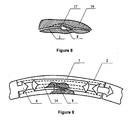
- Fig. 8 shows a scheme of engagement of the elastic latches with recesses made in the lower portion of the jumpers of connecting elements
- Fig. 9 is a diagram showing arrangement of the guides of connecting elements in the shaped grooves of game-playing elements of the first type.
- the three-dimensional logic puzzle game is embodied in the form of hollow sphere 1 and comprises game-playing elements 2 of the first type and game-playing elements 3 of the second type formed by dissection of the sphere by three center planes and by six planes cutting off six osculating spherical segments having the same geometrical dimensions.
- Game-playing elements 2 of the first type have two rectangular sides 4 and one convex arc-like side 5. Rectangular sides 4 have shaped grooves, lower horizontal planes 7 of which mount elastic latches 8.
- Convex arc-like sides 5 of game-playing elements 2 are provided with shaped grooves 9 with rounded lugs 11 in the center.
- Game-playing elements 3 of the second type have each three concave arc-like sides 11 provided with projections 12 to fit shaped grooves 9 made in arc-like sides 5 of game-playing elements 2.
- Projections 12 have, in the center thereof, recesses to fit rounded lugs 10.
- Game-playing elements 2 of the first type and game-playing elements 3 of the second type are connected to one another with use of projections 12, which engage shaped grooves 9.
- Connecting elements 14 connect adjacent game-playing elements 2 together and have two parallel guides 15 linked by jumper 16.
- Jumpers 16 are provided with recesses 17 made in the lower portions and on either side of the longitudinal axes thereof.
- Recesses 17 may be made, for example, in the form of oblique triangular prisms whose bases 18 are set in the middle of jumpers 16 at right angles to the lower surfaces thereof. The apexes of the prisms point in opposite directions and gradually pass into the surface of jumper 16.
- Connecting elements 14 have a bend which matches the bend of game-playing elements 2 of the first type.
- Projections 12 of game-playing elements 3 and guides 15 of connecting elements 14 have the same, say, triangular, shape.
- Facial angles 19 of projections 12 and facial angles 20 of guides 15 are rounded.
- the three-dimensional logic puzzle game works as follows.
- Game-playing elements 2 of the first type and game-playing elements 3 of the second type that form sphere 1 are moved or rotated to restore their position in which a correct image is obtained on sphere 1. Meanwhile, as shown in Fig. 1, each spherical segment formed by four game-playing elements 2 of the first type may rotate right or left relative to its central point.
- the spherical layers each of which being formed by eight game-playing elements 2 of the first type and four game-playing elements 3 of the second type, may successively move in the direction of the inclination of elastic latch 8, which are positioned on lower horizontal planes 7 of the shaped grooves made on rectangular sides 4 of game-playing elements of the first type, and in the opposite direction till elastic latches 8 interlock with bases 18 of prismatic recesses 17 made in the lower portions of jumpers 16 of connecting elements 14.
- Each of the six hemispheres can move in the same direction with respect to the central point of sphere 1.
- Orientation and fixation of game-playing elements 2 of the first type relative to game-playing elements 3 of the second type is assured due to the fact that rounded lugs 10, which are set in the center of shaped grooves 9 made in arc-like sides 5 of game playing element 2 of the first type, enter recesses 13, which are located on projections 12 made in concave arc-like sides 11 of game-playing elements 3 of the second type.
- the spherical layers, spherical segments and hemispheres move on guides 15 of connecting elements 14 and on projections 12 made on concave arc-like sides 11 of game-playing elements 3 of the second type.
- the spherical layers, spherical segments and hemispheres can move and rotate freely thus precluding sticking of the game-playing elements of the three-dimensional logic puzzle game, which ensures freedom of movement for all the elements.
- the inventive three-dimensional logic puzzle game has a stable and reliable design while being simpler in design, more adaptable to fabrication process and more interesting.
- the three-dimensional logic puzzle game may carry a map of the Earth with its continents, oceans, rivers, countries, cities shown on it, which map may be geographic, physical or political. This also may be a map of the lunar surface or the surface of some other planet, or some pattern. Game-playing elements 2 and 3 may also feature mathematical problems with respective solution keys provided, etc.
- the inventive three-dimensional logic puzzle game comprises twenty four game-playing elements 2 of the first type, eight game-playing elements 3 of the second type and twenty four connecting elements 14. All the elements of the puzzle game can be cast from polymers using the existing industrial equipment.
Landscapes
- Engineering & Computer Science (AREA)
- Multimedia (AREA)
- Toys (AREA)
Applications Claiming Priority (3)
| Application Number | Priority Date | Filing Date | Title |
|---|---|---|---|
| UA2107789 | 2002-10-01 | ||
| UA02107789 | 2002-10-01 | ||
| PCT/UA2003/000031 WO2004030776A1 (en) | 2002-10-01 | 2003-09-23 | Three-dimensional logical puzzle game |
Publications (1)
| Publication Number | Publication Date |
|---|---|
| EP1584357A1 true EP1584357A1 (de) | 2005-10-12 |
Family
ID=34910281
Family Applications (1)
| Application Number | Title | Priority Date | Filing Date |
|---|---|---|---|
| EP03799239A Withdrawn EP1584357A1 (de) | 2002-10-01 | 2003-09-23 | Dreidimensionales logikpuzzlespiel |
Country Status (1)
| Country | Link |
|---|---|
| EP (1) | EP1584357A1 (de) |
-
2003
- 2003-09-23 EP EP03799239A patent/EP1584357A1/de not_active Withdrawn
Non-Patent Citations (1)
| Title |
|---|
| See references of WO2004030776A1 * |
Similar Documents
| Publication | Publication Date | Title |
|---|---|---|
| US7108263B2 (en) | Three-dimensional logic puzzle game | |
| US4441715A (en) | Spherical puzzle | |
| US4836549A (en) | Multi-faceted puzzle toy | |
| US4452454A (en) | Manipulatable game | |
| CN104867381B (zh) | 动态形变几何机构 | |
| US5322284A (en) | Changeable configuration puzzle game | |
| US20100301558A1 (en) | Spherical puzzle | |
| US4844467A (en) | Chance selection device | |
| EP3319700A1 (de) | Spielzeugbaukasten | |
| Kopczynski et al. | HyperRogue: Playing with hyperbolic geometry | |
| CY1107031T1 (el) | Κυβικο λογικο παιχνιδι | |
| US20130270768A1 (en) | Device with multi-directional moving members | |
| US5308066A (en) | Spherical puzzle toy | |
| EP1584357A1 (de) | Dreidimensionales logikpuzzlespiel | |
| RU2392026C1 (ru) | Логическая игра-головоломка | |
| US7438290B2 (en) | Sliding shell mechanism for a hollow puzzle | |
| GB2084471A (en) | Logic puzzle | |
| JPS61179183A (ja) | 娯楽用具 | |
| RU2699846C1 (ru) | Головоломка - магнитный конструктор | |
| WO1989003713A1 (en) | Mechanical puzzle | |
| GB2090751A (en) | Puzzle & constructional elements | |
| RU2266148C1 (ru) | Головоломка "тренажер оперативной памяти" | |
| HU189640B (en) | Three-dimensional logic and constructional toy | |
| RU63236U1 (ru) | Объемная логическая головоломка | |
| RU2348445C2 (ru) | Объемная логическая головоломка |
Legal Events
| Date | Code | Title | Description |
|---|---|---|---|
| PUAI | Public reference made under article 153(3) epc to a published international application that has entered the european phase |
Free format text: ORIGINAL CODE: 0009012 |
|
| 17P | Request for examination filed |
Effective date: 20050412 |
|
| AK | Designated contracting states |
Kind code of ref document: A1 Designated state(s): AT BE BG CH CY CZ DE DK EE ES FI FR GB GR HU IE IT LI LU MC NL PT RO SE SI SK TR |
|
| AX | Request for extension of the european patent |
Extension state: AL LT LV MK |
|
| DAX | Request for extension of the european patent (deleted) | ||
| STAA | Information on the status of an ep patent application or granted ep patent |
Free format text: STATUS: THE APPLICATION HAS BEEN WITHDRAWN |
|
| 18W | Application withdrawn |
Effective date: 20061117 |