EP1583018A1 - Verfahren für die Analyse des metabolischen Flusses - Google Patents
Verfahren für die Analyse des metabolischen Flusses Download PDFInfo
- Publication number
- EP1583018A1 EP1583018A1 EP05007197A EP05007197A EP1583018A1 EP 1583018 A1 EP1583018 A1 EP 1583018A1 EP 05007197 A EP05007197 A EP 05007197A EP 05007197 A EP05007197 A EP 05007197A EP 1583018 A1 EP1583018 A1 EP 1583018A1
- Authority
- EP
- European Patent Office
- Prior art keywords
- vector
- vectors
- coefficient
- metabolic flux
- maximum
- Prior art date
- Legal status (The legal status is an assumption and is not a legal conclusion. Google has not performed a legal analysis and makes no representation as to the accuracy of the status listed.)
- Granted
Links
- 230000004907 flux Effects 0.000 title claims abstract description 121
- 230000002503 metabolic effect Effects 0.000 title claims abstract description 86
- 238000000034 method Methods 0.000 title claims abstract description 68
- 239000013598 vector Substances 0.000 claims abstract description 216
- 238000009826 distribution Methods 0.000 claims abstract description 64
- 239000000126 substance Substances 0.000 claims abstract description 51
- 239000011159 matrix material Substances 0.000 claims abstract description 39
- 239000000758 substrate Substances 0.000 claims abstract description 21
- 238000005842 biochemical reaction Methods 0.000 claims abstract description 18
- CURLTUGMZLYLDI-UHFFFAOYSA-N Carbon dioxide Chemical compound O=C=O CURLTUGMZLYLDI-UHFFFAOYSA-N 0.000 claims description 159
- 229910002092 carbon dioxide Inorganic materials 0.000 claims description 74
- 239000000047 product Substances 0.000 claims description 36
- 239000001569 carbon dioxide Substances 0.000 claims description 33
- 239000002028 Biomass Substances 0.000 claims description 24
- 239000006227 byproduct Substances 0.000 claims description 11
- 210000004027 cell Anatomy 0.000 description 42
- 238000004519 manufacturing process Methods 0.000 description 39
- XJLXINKUBYWONI-DQQFMEOOSA-N [[(2r,3r,4r,5r)-5-(6-aminopurin-9-yl)-3-hydroxy-4-phosphonooxyoxolan-2-yl]methoxy-hydroxyphosphoryl] [(2s,3r,4s,5s)-5-(3-carbamoylpyridin-1-ium-1-yl)-3,4-dihydroxyoxolan-2-yl]methyl phosphate Chemical compound NC(=O)C1=CC=C[N+]([C@@H]2[C@H]([C@@H](O)[C@H](COP([O-])(=O)OP(O)(=O)OC[C@@H]3[C@H]([C@@H](OP(O)(O)=O)[C@@H](O3)N3C4=NC=NC(N)=C4N=C3)O)O2)O)=C1 XJLXINKUBYWONI-DQQFMEOOSA-N 0.000 description 35
- WHUUTDBJXJRKMK-UHFFFAOYSA-N Glutamic acid Natural products OC(=O)C(N)CCC(O)=O WHUUTDBJXJRKMK-UHFFFAOYSA-N 0.000 description 34
- 238000006243 chemical reaction Methods 0.000 description 30
- QGZKDVFQNNGYKY-UHFFFAOYSA-N Ammonia Chemical compound N QGZKDVFQNNGYKY-UHFFFAOYSA-N 0.000 description 27
- KDXKERNSBIXSRK-UHFFFAOYSA-N Lysine Natural products NCCCCC(N)C(O)=O KDXKERNSBIXSRK-UHFFFAOYSA-N 0.000 description 26
- 229930027945 nicotinamide-adenine dinucleotide Natural products 0.000 description 26
- QTBSBXVTEAMEQO-UHFFFAOYSA-N Acetic acid Chemical compound CC(O)=O QTBSBXVTEAMEQO-UHFFFAOYSA-N 0.000 description 23
- ZSLZBFCDCINBPY-ZSJPKINUSA-N acetyl-CoA Chemical compound O[C@@H]1[C@H](OP(O)(O)=O)[C@@H](COP(O)(=O)OP(O)(=O)OCC(C)(C)[C@@H](O)C(=O)NCCC(=O)NCCSC(=O)C)O[C@H]1N1C2=NC=NC(N)=C2N=C1 ZSLZBFCDCINBPY-ZSJPKINUSA-N 0.000 description 23
- CKLJMWTZIZZHCS-REOHCLBHSA-N L-aspartic acid Chemical compound OC(=O)[C@@H](N)CC(O)=O CKLJMWTZIZZHCS-REOHCLBHSA-N 0.000 description 20
- 238000004458 analytical method Methods 0.000 description 19
- DTBNBXWJWCWCIK-UHFFFAOYSA-N Phosphoenolpyruvic acid Natural products OC(=O)C(=C)OP(O)(O)=O DTBNBXWJWCWCIK-UHFFFAOYSA-N 0.000 description 18
- BGWGXPAPYGQALX-ARQDHWQXSA-N beta-D-fructofuranose 6-phosphate Chemical compound OC[C@@]1(O)O[C@H](COP(O)(O)=O)[C@@H](O)[C@@H]1O BGWGXPAPYGQALX-ARQDHWQXSA-N 0.000 description 17
- 239000004472 Lysine Substances 0.000 description 16
- 239000002609 medium Substances 0.000 description 15
- BOPGDPNILDQYTO-NNYOXOHSSA-N nicotinamide-adenine dinucleotide Chemical compound C1=CCC(C(=O)N)=CN1[C@H]1[C@H](O)[C@H](O)[C@@H](COP(O)(=O)OP(O)(=O)OC[C@@H]2[C@H]([C@@H](O)[C@@H](O2)N2C3=NC=NC(N)=C3N=C2)O)O1 BOPGDPNILDQYTO-NNYOXOHSSA-N 0.000 description 15
- 235000001014 amino acid Nutrition 0.000 description 14
- 229940024606 amino acid Drugs 0.000 description 14
- 150000001413 amino acids Chemical class 0.000 description 14
- KDYFGRWQOYBRFD-UHFFFAOYSA-N succinic acid Chemical compound OC(=O)CCC(O)=O KDYFGRWQOYBRFD-UHFFFAOYSA-N 0.000 description 14
- WQZGKKKJIJFFOK-GASJEMHNSA-N Glucose Natural products OC[C@H]1OC(O)[C@H](O)[C@@H](O)[C@@H]1O WQZGKKKJIJFFOK-GASJEMHNSA-N 0.000 description 13
- DHMQDGOQFOQNFH-UHFFFAOYSA-N Glycine Chemical compound NCC(O)=O DHMQDGOQFOQNFH-UHFFFAOYSA-N 0.000 description 13
- 230000003834 intracellular effect Effects 0.000 description 13
- 229910000069 nitrogen hydride Inorganic materials 0.000 description 13
- OSJPPGNTCRNQQC-UWTATZPHSA-N 3-phospho-D-glyceric acid Chemical compound OC(=O)[C@H](O)COP(O)(O)=O OSJPPGNTCRNQQC-UWTATZPHSA-N 0.000 description 11
- PQGCEDQWHSBAJP-TXICZTDVSA-N 5-O-phosphono-alpha-D-ribofuranosyl diphosphate Chemical compound O[C@H]1[C@@H](O)[C@@H](O[P@](O)(=O)OP(O)(O)=O)O[C@@H]1COP(O)(O)=O PQGCEDQWHSBAJP-TXICZTDVSA-N 0.000 description 11
- 241000588724 Escherichia coli Species 0.000 description 11
- 229910052799 carbon Inorganic materials 0.000 description 11
- 238000002474 experimental method Methods 0.000 description 11
- OKTJSMMVPCPJKN-UHFFFAOYSA-N Carbon Chemical compound [C] OKTJSMMVPCPJKN-UHFFFAOYSA-N 0.000 description 10
- NGHMDNPXVRFFGS-IUYQGCFVSA-N D-erythrose 4-phosphate Chemical compound O=C[C@H](O)[C@H](O)COP(O)(O)=O NGHMDNPXVRFFGS-IUYQGCFVSA-N 0.000 description 10
- VFRROHXSMXFLSN-UHFFFAOYSA-N Glc6P Natural products OP(=O)(O)OCC(O)C(O)C(O)C(O)C=O VFRROHXSMXFLSN-UHFFFAOYSA-N 0.000 description 10
- AGPKZVBTJJNPAG-WHFBIAKZSA-N L-isoleucine Chemical compound CC[C@H](C)[C@H](N)C(O)=O AGPKZVBTJJNPAG-WHFBIAKZSA-N 0.000 description 9
- 239000008103 glucose Substances 0.000 description 9
- UKAUYVFTDYCKQA-UHFFFAOYSA-N homoserine Chemical compound OC(=O)C(N)CCO UKAUYVFTDYCKQA-UHFFFAOYSA-N 0.000 description 9
- IJGRMHOSHXDMSA-UHFFFAOYSA-N Atomic nitrogen Chemical compound N#N IJGRMHOSHXDMSA-UHFFFAOYSA-N 0.000 description 8
- 101800000628 PDH precursor-related peptide Proteins 0.000 description 8
- 230000001580 bacterial effect Effects 0.000 description 8
- 239000001963 growth medium Substances 0.000 description 8
- 244000005700 microbiome Species 0.000 description 8
- 108090000623 proteins and genes Proteins 0.000 description 8
- DCXYFEDJOCDNAF-REOHCLBHSA-N L-asparagine Chemical compound OC(=O)[C@@H](N)CC(N)=O DCXYFEDJOCDNAF-REOHCLBHSA-N 0.000 description 7
- ROHFNLRQFUQHCH-YFKPBYRVSA-N L-leucine Chemical compound CC(C)C[C@H](N)C(O)=O ROHFNLRQFUQHCH-YFKPBYRVSA-N 0.000 description 7
- COLNVLDHVKWLRT-QMMMGPOBSA-N L-phenylalanine Chemical compound OC(=O)[C@@H](N)CC1=CC=CC=C1 COLNVLDHVKWLRT-QMMMGPOBSA-N 0.000 description 7
- OUYCCCASQSFEME-QMMMGPOBSA-N L-tyrosine Chemical compound OC(=O)[C@@H](N)CC1=CC=C(O)C=C1 OUYCCCASQSFEME-QMMMGPOBSA-N 0.000 description 7
- KRKNYBCHXYNGOX-UHFFFAOYSA-N citric acid Chemical compound OC(=O)CC(O)(C(O)=O)CC(O)=O KRKNYBCHXYNGOX-UHFFFAOYSA-N 0.000 description 6
- 239000002207 metabolite Substances 0.000 description 6
- BDAGIHXWWSANSR-UHFFFAOYSA-N methanoic acid Natural products OC=O BDAGIHXWWSANSR-UHFFFAOYSA-N 0.000 description 6
- 230000001105 regulatory effect Effects 0.000 description 6
- VNOYUJKHFWYWIR-ITIYDSSPSA-N succinyl-CoA Chemical compound O[C@@H]1[C@H](OP(O)(O)=O)[C@@H](COP(O)(=O)OP(O)(=O)OCC(C)(C)[C@@H](O)C(=O)NCCC(=O)NCCSC(=O)CCC(O)=O)O[C@H]1N1C2=NC=NC(N)=C2N=C1 VNOYUJKHFWYWIR-ITIYDSSPSA-N 0.000 description 6
- 235000000346 sugar Nutrition 0.000 description 6
- KZSNJWFQEVHDMF-UHFFFAOYSA-N Valine Chemical compound CC(C)C(N)C(O)=O KZSNJWFQEVHDMF-UHFFFAOYSA-N 0.000 description 5
- 238000004364 calculation method Methods 0.000 description 5
- WQZGKKKJIJFFOK-UKLRSMCWSA-N dextrose-2-13c Chemical compound OC[C@H]1OC(O)[13C@H](O)[C@@H](O)[C@@H]1O WQZGKKKJIJFFOK-UKLRSMCWSA-N 0.000 description 5
- HHLFWLYXYJOTON-UHFFFAOYSA-N glyoxylic acid Chemical compound OC(=O)C=O HHLFWLYXYJOTON-UHFFFAOYSA-N 0.000 description 5
- 230000004108 pentose phosphate pathway Effects 0.000 description 5
- 235000018102 proteins Nutrition 0.000 description 5
- 102000004169 proteins and genes Human genes 0.000 description 5
- 238000011218 seed culture Methods 0.000 description 5
- 102100022734 Acyl carrier protein, mitochondrial Human genes 0.000 description 4
- VZCYOOQTPOCHFL-OWOJBTEDSA-N Fumaric acid Chemical compound OC(=O)\C=C\C(O)=O VZCYOOQTPOCHFL-OWOJBTEDSA-N 0.000 description 4
- 101000678845 Homo sapiens Acyl carrier protein, mitochondrial Proteins 0.000 description 4
- 108020003285 Isocitrate lyase Proteins 0.000 description 4
- -1 Pentose phosphate Chemical class 0.000 description 4
- 101710104378 Putative malate oxidoreductase [NAD] Proteins 0.000 description 4
- LCTONWCANYUPML-UHFFFAOYSA-N Pyruvic acid Chemical compound CC(=O)C(O)=O LCTONWCANYUPML-UHFFFAOYSA-N 0.000 description 4
- 239000002253 acid Substances 0.000 description 4
- QVGXLLKOCUKJST-UHFFFAOYSA-N atomic oxygen Chemical compound [O] QVGXLLKOCUKJST-UHFFFAOYSA-N 0.000 description 4
- RNBGYGVWRKECFJ-ARQDHWQXSA-N beta-D-fructofuranose 1,6-bisphosphate Chemical compound O[C@H]1[C@H](O)[C@@](O)(COP(O)(O)=O)O[C@@H]1COP(O)(O)=O RNBGYGVWRKECFJ-ARQDHWQXSA-N 0.000 description 4
- 239000001257 hydrogen Substances 0.000 description 4
- 229910052739 hydrogen Inorganic materials 0.000 description 4
- 229910052757 nitrogen Inorganic materials 0.000 description 4
- 150000007523 nucleic acids Chemical class 0.000 description 4
- 102000039446 nucleic acids Human genes 0.000 description 4
- 108020004707 nucleic acids Proteins 0.000 description 4
- 238000005457 optimization Methods 0.000 description 4
- 229910052760 oxygen Inorganic materials 0.000 description 4
- 239000001301 oxygen Substances 0.000 description 4
- UCSJYZPVAKXKNQ-HZYVHMACSA-N streptomycin Chemical compound CN[C@H]1[C@H](O)[C@@H](O)[C@H](CO)O[C@H]1O[C@@H]1[C@](C=O)(O)[C@H](C)O[C@H]1O[C@@H]1[C@@H](NC(N)=N)[C@H](O)[C@@H](NC(N)=N)[C@H](O)[C@H]1O UCSJYZPVAKXKNQ-HZYVHMACSA-N 0.000 description 4
- OSWFIVFLDKOXQC-UHFFFAOYSA-N 4-(3-methoxyphenyl)aniline Chemical compound COC1=CC=CC(C=2C=CC(N)=CC=2)=C1 OSWFIVFLDKOXQC-UHFFFAOYSA-N 0.000 description 3
- YPZRHBJKEMOYQH-UYBVJOGSSA-N FADH2 Chemical compound C1=NC2=C(N)N=CN=C2N1[C@@H]([C@H](O)[C@@H]1O)O[C@@H]1COP(O)(=O)OP(O)(=O)OC[C@@H](O)[C@@H](O)[C@@H](O)CN1C(NC(=O)NC2=O)=C2NC2=C1C=C(C)C(C)=C2 YPZRHBJKEMOYQH-UYBVJOGSSA-N 0.000 description 3
- 239000006142 Luria-Bertani Agar Substances 0.000 description 3
- KWYUFKZDYYNOTN-UHFFFAOYSA-M Potassium hydroxide Chemical compound [OH-].[K+] KWYUFKZDYYNOTN-UHFFFAOYSA-M 0.000 description 3
- 235000003704 aspartic acid Nutrition 0.000 description 3
- OQFSQFPPLPISGP-UHFFFAOYSA-N beta-carboxyaspartic acid Natural products OC(=O)C(N)C(C(O)=O)C(O)=O OQFSQFPPLPISGP-UHFFFAOYSA-N 0.000 description 3
- 238000004422 calculation algorithm Methods 0.000 description 3
- 229940041514 candida albicans extract Drugs 0.000 description 3
- 238000010276 construction Methods 0.000 description 3
- 238000012937 correction Methods 0.000 description 3
- 235000019253 formic acid Nutrition 0.000 description 3
- 230000006870 function Effects 0.000 description 3
- 102000010705 glucose-6-phosphate dehydrogenase activity proteins Human genes 0.000 description 3
- 108040005050 glucose-6-phosphate dehydrogenase activity proteins Proteins 0.000 description 3
- HNDVDQJCIGZPNO-UHFFFAOYSA-N histidine Natural products OC(=O)C(N)CC1=CN=CN1 HNDVDQJCIGZPNO-UHFFFAOYSA-N 0.000 description 3
- 125000004435 hydrogen atom Chemical class [H]* 0.000 description 3
- 239000000543 intermediate Substances 0.000 description 3
- 229960000310 isoleucine Drugs 0.000 description 3
- AGPKZVBTJJNPAG-UHFFFAOYSA-N isoleucine Natural products CCC(C)C(N)C(O)=O AGPKZVBTJJNPAG-UHFFFAOYSA-N 0.000 description 3
- 238000013507 mapping Methods 0.000 description 3
- 238000005259 measurement Methods 0.000 description 3
- 239000000203 mixture Substances 0.000 description 3
- 150000007524 organic acids Chemical class 0.000 description 3
- 239000013612 plasmid Substances 0.000 description 3
- 238000011160 research Methods 0.000 description 3
- 230000002441 reversible effect Effects 0.000 description 3
- 230000004102 tricarboxylic acid cycle Effects 0.000 description 3
- 239000012138 yeast extract Substances 0.000 description 3
- WTFXTQVDAKGDEY-UHFFFAOYSA-N (-)-chorismic acid Natural products OC1C=CC(C(O)=O)=CC1OC(=C)C(O)=O WTFXTQVDAKGDEY-UHFFFAOYSA-N 0.000 description 2
- OIXLLKLZKCBCPS-RZVRUWJTSA-N (2s)-2-azanyl-5-[bis(azanyl)methylideneamino]pentanoic acid Chemical compound OC(=O)[C@@H](N)CCCNC(N)=N.OC(=O)[C@@H](N)CCCNC(N)=N OIXLLKLZKCBCPS-RZVRUWJTSA-N 0.000 description 2
- BJEPYKJPYRNKOW-REOHCLBHSA-N (S)-malic acid Chemical compound OC(=O)[C@@H](O)CC(O)=O BJEPYKJPYRNKOW-REOHCLBHSA-N 0.000 description 2
- YVOOPGWEIRIUOX-UHFFFAOYSA-N 2-azanyl-3-sulfanyl-propanoic acid Chemical compound SCC(N)C(O)=O.SCC(N)C(O)=O YVOOPGWEIRIUOX-UHFFFAOYSA-N 0.000 description 2
- KPGXRSRHYNQIFN-UHFFFAOYSA-N 2-oxoglutaric acid Chemical compound OC(=O)CCC(=O)C(O)=O KPGXRSRHYNQIFN-UHFFFAOYSA-N 0.000 description 2
- LXCUAFVVTHZALS-UHFFFAOYSA-N 3-(3-methoxyphenyl)piperidine Chemical compound COC1=CC=CC(C2CNCCC2)=C1 LXCUAFVVTHZALS-UHFFFAOYSA-N 0.000 description 2
- QHKABHOOEWYVLI-UHFFFAOYSA-N 3-methyl-2-oxobutanoic acid Chemical compound CC(C)C(=O)C(O)=O QHKABHOOEWYVLI-UHFFFAOYSA-N 0.000 description 2
- MSTNYGQPCMXVAQ-KIYNQFGBSA-N 5,6,7,8-tetrahydrofolic acid Chemical compound N1C=2C(=O)NC(N)=NC=2NCC1CNC1=CC=C(C(=O)N[C@@H](CCC(O)=O)C(O)=O)C=C1 MSTNYGQPCMXVAQ-KIYNQFGBSA-N 0.000 description 2
- RZVAJINKPMORJF-UHFFFAOYSA-N Acetaminophen Chemical compound CC(=O)NC1=CC=C(O)C=C1 RZVAJINKPMORJF-UHFFFAOYSA-N 0.000 description 2
- DCXYFEDJOCDNAF-UHFFFAOYSA-N Asparagine Natural products OC(=O)C(N)CC(N)=O DCXYFEDJOCDNAF-UHFFFAOYSA-N 0.000 description 2
- WTFXTQVDAKGDEY-HTQZYQBOSA-N Chorismic acid Natural products O[C@@H]1C=CC(C(O)=O)=C[C@H]1OC(=C)C(O)=O WTFXTQVDAKGDEY-HTQZYQBOSA-N 0.000 description 2
- NBSCHQHZLSJFNQ-GASJEMHNSA-N D-Glucose 6-phosphate Chemical compound OC1O[C@H](COP(O)(O)=O)[C@@H](O)[C@H](O)[C@H]1O NBSCHQHZLSJFNQ-GASJEMHNSA-N 0.000 description 2
- LXJXRIRHZLFYRP-VKHMYHEASA-N D-glyceraldehyde 3-phosphate Chemical compound O=C[C@H](O)COP(O)(O)=O LXJXRIRHZLFYRP-VKHMYHEASA-N 0.000 description 2
- 101100465553 Dictyostelium discoideum psmB6 gene Proteins 0.000 description 2
- 239000004471 Glycine Substances 0.000 description 2
- ONIBWKKTOPOVIA-BYPYZUCNSA-N L-Proline Chemical compound OC(=O)[C@@H]1CCCN1 ONIBWKKTOPOVIA-BYPYZUCNSA-N 0.000 description 2
- QNAYBMKLOCPYGJ-REOHCLBHSA-N L-alanine Chemical compound C[C@H](N)C(O)=O QNAYBMKLOCPYGJ-REOHCLBHSA-N 0.000 description 2
- FFEARJCKVFRZRR-BYPYZUCNSA-N L-methionine Chemical compound CSCC[C@H](N)C(O)=O FFEARJCKVFRZRR-BYPYZUCNSA-N 0.000 description 2
- QIVBCDIJIAJPQS-VIFPVBQESA-N L-tryptophane Chemical compound C1=CC=C2C(C[C@H](N)C(O)=O)=CNC2=C1 QIVBCDIJIAJPQS-VIFPVBQESA-N 0.000 description 2
- ROHFNLRQFUQHCH-UHFFFAOYSA-N Leucine Natural products CC(C)CC(N)C(O)=O ROHFNLRQFUQHCH-UHFFFAOYSA-N 0.000 description 2
- 108010048581 Lysine decarboxylase Proteins 0.000 description 2
- 101100276041 Mycolicibacterium smegmatis (strain ATCC 700084 / mc(2)155) ctpD gene Proteins 0.000 description 2
- GLXUWZBUPATPBR-BQBZGAKWSA-N N-succinyl-LL-2,6-diaminopimelic acid Chemical compound OC(=O)[C@@H](N)CCC[C@@H](C(O)=O)NC(=O)CCC(O)=O GLXUWZBUPATPBR-BQBZGAKWSA-N 0.000 description 2
- 229910019142 PO4 Inorganic materials 0.000 description 2
- 108091000041 Phosphoenolpyruvate Carboxylase Proteins 0.000 description 2
- ONIBWKKTOPOVIA-UHFFFAOYSA-N Proline Natural products OC(=O)C1CCCN1 ONIBWKKTOPOVIA-UHFFFAOYSA-N 0.000 description 2
- 101100169519 Pyrococcus abyssi (strain GE5 / Orsay) dapAL gene Proteins 0.000 description 2
- FAPWRFPIFSIZLT-UHFFFAOYSA-M Sodium chloride Chemical compound [Na+].[Cl-] FAPWRFPIFSIZLT-UHFFFAOYSA-M 0.000 description 2
- AYFVYJQAPQTCCC-UHFFFAOYSA-N Threonine Natural products CC(O)C(N)C(O)=O AYFVYJQAPQTCCC-UHFFFAOYSA-N 0.000 description 2
- 239000004473 Threonine Substances 0.000 description 2
- QIVBCDIJIAJPQS-UHFFFAOYSA-N Tryptophan Natural products C1=CC=C2C(CC(N)C(O)=O)=CNC2=C1 QIVBCDIJIAJPQS-UHFFFAOYSA-N 0.000 description 2
- 229940100228 acetyl coenzyme a Drugs 0.000 description 2
- YBCVMFKXIKNREZ-UHFFFAOYSA-N acoh acetic acid Chemical compound CC(O)=O.CC(O)=O YBCVMFKXIKNREZ-UHFFFAOYSA-N 0.000 description 2
- 235000016127 added sugars Nutrition 0.000 description 2
- 238000005273 aeration Methods 0.000 description 2
- 235000004279 alanine Nutrition 0.000 description 2
- BJEPYKJPYRNKOW-UHFFFAOYSA-N alpha-hydroxysuccinic acid Natural products OC(=O)C(O)CC(O)=O BJEPYKJPYRNKOW-UHFFFAOYSA-N 0.000 description 2
- XKMRRTOUMJRJIA-UHFFFAOYSA-N ammonia nh3 Chemical compound N.N XKMRRTOUMJRJIA-UHFFFAOYSA-N 0.000 description 2
- BFNBIHQBYMNNAN-UHFFFAOYSA-N ammonium sulfate Chemical compound N.N.OS(O)(=O)=O BFNBIHQBYMNNAN-UHFFFAOYSA-N 0.000 description 2
- 229910052921 ammonium sulfate Inorganic materials 0.000 description 2
- 235000011130 ammonium sulphate Nutrition 0.000 description 2
- 235000009582 asparagine Nutrition 0.000 description 2
- 229960001230 asparagine Drugs 0.000 description 2
- 101150008667 cadA gene Proteins 0.000 description 2
- 125000004432 carbon atom Chemical group C* 0.000 description 2
- 210000003850 cellular structure Anatomy 0.000 description 2
- 230000008859 change Effects 0.000 description 2
- 238000004891 communication Methods 0.000 description 2
- 101150011371 dapA gene Proteins 0.000 description 2
- 101150073654 dapB gene Proteins 0.000 description 2
- 238000000855 fermentation Methods 0.000 description 2
- 230000004151 fermentation Effects 0.000 description 2
- 239000001530 fumaric acid Substances 0.000 description 2
- 235000013922 glutamic acid Nutrition 0.000 description 2
- 239000004220 glutamic acid Substances 0.000 description 2
- ZDXPYRJPNDTMRX-UHFFFAOYSA-N glutamine Natural products OC(=O)C(N)CCC(N)=O ZDXPYRJPNDTMRX-UHFFFAOYSA-N 0.000 description 2
- 230000034659 glycolysis Effects 0.000 description 2
- 239000007788 liquid Substances 0.000 description 2
- 101150035025 lysC gene Proteins 0.000 description 2
- 239000001630 malic acid Substances 0.000 description 2
- 235000011090 malic acid Nutrition 0.000 description 2
- 239000000463 material Substances 0.000 description 2
- 238000012269 metabolic engineering Methods 0.000 description 2
- 229930182817 methionine Natural products 0.000 description 2
- 238000002156 mixing Methods 0.000 description 2
- 238000012986 modification Methods 0.000 description 2
- 230000004048 modification Effects 0.000 description 2
- 230000037361 pathway Effects 0.000 description 2
- COLNVLDHVKWLRT-UHFFFAOYSA-N phenylalanine Natural products OC(=O)C(N)CC1=CC=CC=C1 COLNVLDHVKWLRT-UHFFFAOYSA-N 0.000 description 2
- 239000010452 phosphate Substances 0.000 description 2
- 230000035479 physiological effects, processes and functions Effects 0.000 description 2
- 230000008569 process Effects 0.000 description 2
- 229940107700 pyruvic acid Drugs 0.000 description 2
- 239000000376 reactant Substances 0.000 description 2
- GHSJKUNUIHUPDF-UHFFFAOYSA-N s-(2-aminoethyl)-l-cysteine Chemical compound NCCSCC(N)C(O)=O GHSJKUNUIHUPDF-UHFFFAOYSA-N 0.000 description 2
- 230000035945 sensitivity Effects 0.000 description 2
- 238000010206 sensitivity analysis Methods 0.000 description 2
- 238000003756 stirring Methods 0.000 description 2
- 229960005322 streptomycin Drugs 0.000 description 2
- 239000001384 succinic acid Substances 0.000 description 2
- VZCYOOQTPOCHFL-UHFFFAOYSA-N trans-butenedioic acid Natural products OC(=O)C=CC(O)=O VZCYOOQTPOCHFL-UHFFFAOYSA-N 0.000 description 2
- 238000012546 transfer Methods 0.000 description 2
- OUYCCCASQSFEME-UHFFFAOYSA-N tyrosine Natural products OC(=O)C(N)CC1=CC=C(O)C=C1 OUYCCCASQSFEME-UHFFFAOYSA-N 0.000 description 2
- NQEQTYPJSIEPHW-MNOVXSKESA-N (1S,2R)-1-C-(indol-3-yl)glycerol 3-phosphate Chemical compound C1=CC=C2C([C@H](O)[C@@H](COP(O)(O)=O)O)=CNC2=C1 NQEQTYPJSIEPHW-MNOVXSKESA-N 0.000 description 1
- GMKMEZVLHJARHF-UHFFFAOYSA-N (2R,6R)-form-2.6-Diaminoheptanedioic acid Natural products OC(=O)C(N)CCCC(N)C(O)=O GMKMEZVLHJARHF-UHFFFAOYSA-N 0.000 description 1
- TZBGSHAFWLGWBO-ABLWVSNPSA-N (2s)-2-[[4-[(2-amino-4-oxo-5,6,7,8-tetrahydro-1h-pteridin-6-yl)methylamino]benzoyl]amino]-5-methoxy-5-oxopentanoic acid Chemical compound C1=CC(C(=O)N[C@@H](CCC(=O)OC)C(O)=O)=CC=C1NCC1NC(C(=O)NC(N)=N2)=C2NC1 TZBGSHAFWLGWBO-ABLWVSNPSA-N 0.000 description 1
- LXJXRIRHZLFYRP-VKHMYHEASA-L (R)-2-Hydroxy-3-(phosphonooxy)-propanal Natural products O=C[C@H](O)COP([O-])([O-])=O LXJXRIRHZLFYRP-VKHMYHEASA-L 0.000 description 1
- UWOCFOFVIBZJGH-YFKPBYRVSA-N (S)-2,3-dihydrodipicolinic acid Chemical compound OC(=O)[C@@H]1CC=CC(C(O)=O)=N1 UWOCFOFVIBZJGH-YFKPBYRVSA-N 0.000 description 1
- 108091000044 4-hydroxy-tetrahydrodipicolinate synthase Proteins 0.000 description 1
- 102100031126 6-phosphogluconolactonase Human genes 0.000 description 1
- 229920001817 Agar Polymers 0.000 description 1
- 108010055400 Aspartate kinase Proteins 0.000 description 1
- 241000193830 Bacillus <bacterium> Species 0.000 description 1
- 241000894006 Bacteria Species 0.000 description 1
- OSSQVWUXYUDQKW-LDUAJXOISA-N C1=CC(C(=O)N[C@@H](CC(C)C(O)=O)C(O)=O)=CC=C1NCC1NC(C(=O)NC(N)=N2)=C2NC1 Chemical compound C1=CC(C(=O)N[C@@H](CC(C)C(O)=O)C(O)=O)=CC=C1NCC1NC(C(=O)NC(N)=N2)=C2NC1 OSSQVWUXYUDQKW-LDUAJXOISA-N 0.000 description 1
- RGJOEKWQDUBAIZ-IBOSZNHHSA-N CoASH Chemical compound O[C@@H]1[C@H](OP(O)(O)=O)[C@@H](COP(O)(=O)OP(O)(=O)OCC(C)(C)[C@@H](O)C(=O)NCCC(=O)NCCS)O[C@H]1N1C2=NC=NC(N)=C2N=C1 RGJOEKWQDUBAIZ-IBOSZNHHSA-N 0.000 description 1
- 241000186031 Corynebacteriaceae Species 0.000 description 1
- 241000186226 Corynebacterium glutamicum Species 0.000 description 1
- GSXOAOHZAIYLCY-UHFFFAOYSA-N D-F6P Natural products OCC(=O)C(O)C(O)C(O)COP(O)(O)=O GSXOAOHZAIYLCY-UHFFFAOYSA-N 0.000 description 1
- FNZLKVNUWIIPSJ-UHNVWZDZSA-N D-ribulose 5-phosphate Chemical compound OCC(=O)[C@H](O)[C@H](O)COP(O)(O)=O FNZLKVNUWIIPSJ-UHNVWZDZSA-N 0.000 description 1
- ODBLHEXUDAPZAU-ZAFYKAAXSA-N D-threo-isocitric acid Chemical compound OC(=O)[C@H](O)[C@@H](C(O)=O)CC(O)=O ODBLHEXUDAPZAU-ZAFYKAAXSA-N 0.000 description 1
- FNZLKVNUWIIPSJ-RFZPGFLSSA-N D-xylulose 5-phosphate Chemical compound OCC(=O)[C@@H](O)[C@H](O)COP(O)(O)=O FNZLKVNUWIIPSJ-RFZPGFLSSA-N 0.000 description 1
- 238000000018 DNA microarray Methods 0.000 description 1
- 108010014468 Dihydrodipicolinate Reductase Proteins 0.000 description 1
- 101100398755 Escherichia coli (strain K12) ldcC gene Proteins 0.000 description 1
- 229930091371 Fructose Natural products 0.000 description 1
- 239000005715 Fructose Substances 0.000 description 1
- RFSUNEUAIZKAJO-ARQDHWQXSA-N Fructose Chemical compound OC[C@H]1O[C@](O)(CO)[C@@H](O)[C@@H]1O RFSUNEUAIZKAJO-ARQDHWQXSA-N 0.000 description 1
- 241000233866 Fungi Species 0.000 description 1
- 229920002527 Glycogen Polymers 0.000 description 1
- UFHFLCQGNIYNRP-UHFFFAOYSA-N Hydrogen Chemical class [H][H] UFHFLCQGNIYNRP-UHFFFAOYSA-N 0.000 description 1
- 102000012011 Isocitrate Dehydrogenase Human genes 0.000 description 1
- 108010075869 Isocitrate Dehydrogenase Proteins 0.000 description 1
- ODBLHEXUDAPZAU-FONMRSAGSA-N Isocitric acid Natural products OC(=O)[C@@H](O)[C@H](C(O)=O)CC(O)=O ODBLHEXUDAPZAU-FONMRSAGSA-N 0.000 description 1
- UKAUYVFTDYCKQA-VKHMYHEASA-N L-homoserine Chemical compound OC(=O)[C@@H](N)CCO UKAUYVFTDYCKQA-VKHMYHEASA-N 0.000 description 1
- 101150007959 Lum gene Proteins 0.000 description 1
- MSFSPUZXLOGKHJ-UHFFFAOYSA-N Muraminsaeure Natural products OC(=O)C(C)OC1C(N)C(O)OC(CO)C1O MSFSPUZXLOGKHJ-UHFFFAOYSA-N 0.000 description 1
- 108010013639 Peptidoglycan Proteins 0.000 description 1
- FNZLKVNUWIIPSJ-UHFFFAOYSA-N Rbl5P Natural products OCC(=O)C(O)C(O)COP(O)(O)=O FNZLKVNUWIIPSJ-UHFFFAOYSA-N 0.000 description 1
- 240000004808 Saccharomyces cerevisiae Species 0.000 description 1
- 101100498625 Selenomonas ruminantium ldc gene Proteins 0.000 description 1
- 229930006000 Sucrose Natural products 0.000 description 1
- CZMRCDWAGMRECN-UGDNZRGBSA-N Sucrose Chemical compound O[C@H]1[C@H](O)[C@@H](CO)O[C@@]1(CO)O[C@@H]1[C@H](O)[C@@H](O)[C@H](O)[C@@H](CO)O1 CZMRCDWAGMRECN-UGDNZRGBSA-N 0.000 description 1
- 230000009471 action Effects 0.000 description 1
- 239000008272 agar Substances 0.000 description 1
- PPQRONHOSHZGFQ-LMVFSUKVSA-N aldehydo-D-ribose 5-phosphate Chemical compound OP(=O)(O)OC[C@@H](O)[C@@H](O)[C@@H](O)C=O PPQRONHOSHZGFQ-LMVFSUKVSA-N 0.000 description 1
- 125000004429 atom Chemical group 0.000 description 1
- WQZGKKKJIJFFOK-VFUOTHLCSA-N beta-D-glucose Chemical compound OC[C@H]1O[C@@H](O)[C@H](O)[C@@H](O)[C@@H]1O WQZGKKKJIJFFOK-VFUOTHLCSA-N 0.000 description 1
- 150000001720 carbohydrates Chemical class 0.000 description 1
- 235000014633 carbohydrates Nutrition 0.000 description 1
- 150000001721 carbon Chemical group 0.000 description 1
- 210000005056 cell body Anatomy 0.000 description 1
- RGJOEKWQDUBAIZ-UHFFFAOYSA-N coenzime A Natural products OC1C(OP(O)(O)=O)C(COP(O)(=O)OP(O)(=O)OCC(C)(C)C(O)C(=O)NCCC(=O)NCCS)OC1N1C2=NC=NC(N)=C2N=C1 RGJOEKWQDUBAIZ-UHFFFAOYSA-N 0.000 description 1
- 239000005516 coenzyme A Substances 0.000 description 1
- 229940093530 coenzyme a Drugs 0.000 description 1
- 150000001875 compounds Chemical class 0.000 description 1
- 210000004748 cultured cell Anatomy 0.000 description 1
- 238000000354 decomposition reaction Methods 0.000 description 1
- 230000002950 deficient Effects 0.000 description 1
- KDTSHFARGAKYJN-UHFFFAOYSA-N dephosphocoenzyme A Natural products OC1C(O)C(COP(O)(=O)OP(O)(=O)OCC(C)(C)C(O)C(=O)NCCC(=O)NCCS)OC1N1C2=NC=NC(N)=C2N=C1 KDTSHFARGAKYJN-UHFFFAOYSA-N 0.000 description 1
- 108010056578 diaminopimelate dehydrogenase Proteins 0.000 description 1
- XPPKVPWEQAFLFU-UHFFFAOYSA-J diphosphate(4-) Chemical compound [O-]P([O-])(=O)OP([O-])([O-])=O XPPKVPWEQAFLFU-UHFFFAOYSA-J 0.000 description 1
- 235000011180 diphosphates Nutrition 0.000 description 1
- 239000002158 endotoxin Substances 0.000 description 1
- 238000006911 enzymatic reaction Methods 0.000 description 1
- 229940096919 glycogen Drugs 0.000 description 1
- 230000003301 hydrolyzing effect Effects 0.000 description 1
- 230000001939 inductive effect Effects 0.000 description 1
- 238000009434 installation Methods 0.000 description 1
- SURQXAFEQWPFPV-UHFFFAOYSA-L iron(2+) sulfate heptahydrate Chemical compound O.O.O.O.O.O.O.[Fe+2].[O-]S([O-])(=O)=O SURQXAFEQWPFPV-UHFFFAOYSA-L 0.000 description 1
- 150000002632 lipids Chemical class 0.000 description 1
- 229920006008 lipopolysaccharide Polymers 0.000 description 1
- 238000004895 liquid chromatography mass spectrometry Methods 0.000 description 1
- 238000009630 liquid culture Methods 0.000 description 1
- WRUGWIBCXHJTDG-UHFFFAOYSA-L magnesium sulfate heptahydrate Chemical compound O.O.O.O.O.O.O.[Mg+2].[O-]S([O-])(=O)=O WRUGWIBCXHJTDG-UHFFFAOYSA-L 0.000 description 1
- 229940061634 magnesium sulfate heptahydrate Drugs 0.000 description 1
- SCVOEYLBXCPATR-UHFFFAOYSA-L manganese(II) sulfate pentahydrate Chemical compound O.O.O.O.O.[Mn+2].[O-]S([O-])(=O)=O SCVOEYLBXCPATR-UHFFFAOYSA-L 0.000 description 1
- 238000004949 mass spectrometry Methods 0.000 description 1
- 239000013028 medium composition Substances 0.000 description 1
- GMKMEZVLHJARHF-SYDPRGILSA-N meso-2,6-diaminopimelic acid Chemical compound [O-]C(=O)[C@@H]([NH3+])CCC[C@@H]([NH3+])C([O-])=O GMKMEZVLHJARHF-SYDPRGILSA-N 0.000 description 1
- 230000004060 metabolic process Effects 0.000 description 1
- 230000037323 metabolic rate Effects 0.000 description 1
- 238000006241 metabolic reaction Methods 0.000 description 1
- 230000000813 microbial effect Effects 0.000 description 1
- 229910000402 monopotassium phosphate Inorganic materials 0.000 description 1
- 235000019796 monopotassium phosphate Nutrition 0.000 description 1
- 125000004430 oxygen atom Chemical group O* 0.000 description 1
- NONJJLVGHLVQQM-JHXYUMNGSA-N phenethicillin Chemical compound N([C@@H]1C(N2[C@H](C(C)(C)S[C@@H]21)C(O)=O)=O)C(=O)C(C)OC1=CC=CC=C1 NONJJLVGHLVQQM-JHXYUMNGSA-N 0.000 description 1
- 150000003904 phospholipids Chemical class 0.000 description 1
- PJNZPQUBCPKICU-UHFFFAOYSA-N phosphoric acid;potassium Chemical compound [K].OP(O)(O)=O PJNZPQUBCPKICU-UHFFFAOYSA-N 0.000 description 1
- FPWMCUPFBRFMLH-HDKIZWTHSA-N prephenic acid Chemical compound O[C@H]1C=C[C@](CC(=O)C(O)=O)(C(O)=O)C=C1 FPWMCUPFBRFMLH-HDKIZWTHSA-N 0.000 description 1
- FPWMCUPFBRFMLH-UHFFFAOYSA-N prephenic acid Natural products OC1C=CC(CC(=O)C(O)=O)(C(O)=O)C=C1 FPWMCUPFBRFMLH-UHFFFAOYSA-N 0.000 description 1
- 238000012545 processing Methods 0.000 description 1
- 230000017854 proteolysis Effects 0.000 description 1
- JDTUMPKOJBQPKX-GBNDHIKLSA-N sedoheptulose 7-phosphate Chemical compound OCC(=O)[C@@H](O)[C@H](O)[C@H](O)[C@H](O)COP(O)(O)=O JDTUMPKOJBQPKX-GBNDHIKLSA-N 0.000 description 1
- JXOHGGNKMLTUBP-HSUXUTPPSA-N shikimic acid Chemical compound O[C@@H]1CC(C(O)=O)=C[C@@H](O)[C@H]1O JXOHGGNKMLTUBP-HSUXUTPPSA-N 0.000 description 1
- JXOHGGNKMLTUBP-JKUQZMGJSA-N shikimic acid Natural products O[C@@H]1CC(C(O)=O)=C[C@H](O)[C@@H]1O JXOHGGNKMLTUBP-JKUQZMGJSA-N 0.000 description 1
- 239000011780 sodium chloride Substances 0.000 description 1
- 238000007619 statistical method Methods 0.000 description 1
- 239000005720 sucrose Substances 0.000 description 1
- 239000000725 suspension Substances 0.000 description 1
- ODBLHEXUDAPZAU-UHFFFAOYSA-N threo-D-isocitric acid Natural products OC(=O)C(O)C(C(O)=O)CC(O)=O ODBLHEXUDAPZAU-UHFFFAOYSA-N 0.000 description 1
- 239000012137 tryptone Substances 0.000 description 1
- WFKWXMTUELFFGS-UHFFFAOYSA-N tungsten Chemical compound [W] WFKWXMTUELFFGS-UHFFFAOYSA-N 0.000 description 1
Images



Classifications
-
- G—PHYSICS
- G16—INFORMATION AND COMMUNICATION TECHNOLOGY [ICT] SPECIALLY ADAPTED FOR SPECIFIC APPLICATION FIELDS
- G16B—BIOINFORMATICS, i.e. INFORMATION AND COMMUNICATION TECHNOLOGY [ICT] SPECIALLY ADAPTED FOR GENETIC OR PROTEIN-RELATED DATA PROCESSING IN COMPUTATIONAL MOLECULAR BIOLOGY
- G16B5/00—ICT specially adapted for modelling or simulations in systems biology, e.g. gene-regulatory networks, protein interaction networks or metabolic networks
-
- Y—GENERAL TAGGING OF NEW TECHNOLOGICAL DEVELOPMENTS; GENERAL TAGGING OF CROSS-SECTIONAL TECHNOLOGIES SPANNING OVER SEVERAL SECTIONS OF THE IPC; TECHNICAL SUBJECTS COVERED BY FORMER USPC CROSS-REFERENCE ART COLLECTIONS [XRACs] AND DIGESTS
- Y10—TECHNICAL SUBJECTS COVERED BY FORMER USPC
- Y10S—TECHNICAL SUBJECTS COVERED BY FORMER USPC CROSS-REFERENCE ART COLLECTIONS [XRACs] AND DIGESTS
- Y10S707/00—Data processing: database and file management or data structures
- Y10S707/99941—Database schema or data structure
- Y10S707/99943—Generating database or data structure, e.g. via user interface
Definitions
- the present invention relates to a method for determining a metabolic flux, a program for executing the determination method and a recording medium storing the program.
- a metabolic flux analysis which is also referred to as a flux balance analysis, is a technique for predicting intracellular metabolic flux distributions by construction of a stoichiometric model of intracellular biochemical reactions and linear optimization. This technique has been used in research into the abilities of biochemical reaction systems in microorganisms or for predicting intracellular metabolic flux distributions under different external conditions (Varma, A. and Palsson, B.O. Appl. Environ. Microbiol. 60:3724-3731, 1994; Schilling, C.H. et al., Biotechnol. Prog., 15:288-295, 1999; Schilling, C.H. et al., Biotechnol. Prog., 15:296-303, 1999).
- WO00/46405 discloses a method for predicting a gene required for growth based on a stoichiometric model.
- WO02/061115 discloses a technique for genetically and evolutionarily changing cells to impart optimal functions to the cells.
- WO02/055995 discloses a method for applying constraints of qualitative kinetic information, constraints of qualitative metabolic regulation information and constraints based on DNA microarray experimental data under different conditions, to a stoichiometric model. Although all of these are methods for predicting more desirable intracellular metabolic flux distributions, no method has been disclosed for calculating all possible flux distributions satisfying constraints of biological experimental data such as a growth rate and a product production rate.
- An object of the present invention is to provide a method for determining all metabolic fluxes from minimum analytical information obtained by analysis of a sample of microorganism or medium under cultivation, a method for obtaining a range within which all the metabolic fluxes may change when errors of input data are permitted by using the determination method, a program for executing the determination method, and a recording medium storing the program.
- the inventors of the present invention conducted various researches. As a result, they found that, if a solution space which a stoichiometric matrix created based on formulas of biochemical reactions from a substrate to a product can have, was obtained, and vectors whose vector elements corresponding to respective data adopted as input data selected from experimental data obtainable from analysis of a sample of microorganism or medium under cultivation were maximum were retrieved from the solution space, and such retrieved vectors are linearly synthesized, a vector of a solution corresponding to the input data (metabolic flux distribution) could be obtained.
- the present invention was accomplished based on this finding, and provides the followings.
- a method for determining metabolic flux distribution of a cell which comprises the steps of:
- a method for determining metabolic flux distribution of a cell which comprises the steps of:
- all metabolic fluxes can be determined from minimum analytical information obtained by analysis of a sample of microorganism or medium under cultivation. Further, by using the determination method, a range within which all the metabolic fluxes may change when errors of input data are permitted can be obtained. Thus, they can be easily determined metabolic fluxes useful for predicting methods of modifying cells effective for improving yield or productivity of an objective product or cells in production of substances, of which representative examples are amino acids and nucleic acids, using cells such as those of microorganisms.
- Fig. 1 shows time-course profiles of lysine production and biomass production in a cultivation experiment.
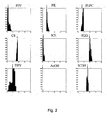
- Fig. 2 shows metabolic flux distribution obtained with a permitted deviation range of 4%.
- Fig. 3 shows metabolic flux distribution obtained with a permitted deviation range of 0%.
- Fig. 4 shows metabolic flux distribution computed based on free flux data obtained after cultivation of 10 hours.
- Fig. 5 shows a flowchart of an embodiment of the program of the present invention.
- Fig. 6 shows a flowchart of another embodiment of the program of the present invention.
- the determination method of the present invention is a method for determining a metabolic flux from only partial analysis information in the substance production using a cell.
- the metabolic flux used in the present invention is expressed as a metabolic reaction rate (flux) derived from a stoichiometric model of intracellular biochemical reactions and the law of mass action between metabolites.
- the metabolic flux distribution is a set of metabolic fluxes and can be represented by a vector in which metabolic fluxes are vector elements.
- the cell used in the present invention is not particularly limited so long as it is used in substance production. Examples thereof include various cultured cells, fungi, yeasts, various bacteria and so forth. It is preferably that of a microorganism having an ability to produce a useful compound, for example, an amino acid, a nucleic acid or an organic acid. As the microorganism having an ability to produce an amino acid, a nucleic acid or an organic acid, Escherichia coli, Bacillus bacteria, coryneform bacteria and so forth are preferably used. A microorganism having an amino acid-producing ability and/or an organic acid-producing ability is more preferred.
- a stoichiometric matrix is created based on the biochemical reaction formulas of a substrate to a desired product.
- the biochemical reactions refer to a process where intracellular metabolites are converted by enzymatic reactions in the cell, and which have been compiled in various databases according to organism type. For example, Kyoto Encyclopedia of Genes and Genomes (KEGG, www.genome.ad.jp/kegg/) can be accessed for reference.
- KEGG Kyoto Encyclopedia of Genes and Genomes
- the substrate is a substance usually used by the cell as a carbon source, and examples thereof include glucose, sucrose, fructose and so forth.
- the substance product includes not only a single kind of metabolite, but also an aggregate of metabolites, such as a biomass (cell body).
- Substance production is usually evaluated as a production rate or yield of a substance.
- the desired substance is a biomass, it is evaluated as a biomass yield.
- the biomass yield represents efficiency of conversion from substrates such as glucose into cell components such as protein, carbohydrate, nucleic acid or lipid.
- the stoichiometric matrix is a matrix usually used in a metabolic flux analysis, and can be created by listing formulas of biochemical reactions of a substrate through a desired product substance by typical methods used in a metabolic flux analysis. Such methods, assuming a quasi-steady state of an intracellular metabolic intermediate, are generally known (Savinell, J.M. and Palsson, B.O.J., Theor. Biol., 154:421-454, 1992; Vallino, J.J. and Stephanopoulos, G., Biotechnol. Bioeng., 41:633-646, 1993).
- reaction pathways may be simplified by assuming a series of reactions without branching as one reaction, or assuming metabolites converted by a reaction at a high metabolic rate before and after the reaction as one metabolite and so forth.
- substance product is a biomass
- a stoichiometric matrix can be described by listing biochemical reactions which lead to cell components.
- a set of vectors of solutions existing in the solution space defined by the aforementioned stoichiometric matrix is computed.
- analysis based on the elementary mode can be used (Klamt S., Shuster S., Gilles E.D., Biotechnology and Bioengineering 77, (7):734-51, 2002).
- An example of the method for obtaining solutions existing in a solution space other than the method mentioned above is a method of selecting independent metabolic fluxes in the same number as the degree of freedom of the defined stoichiometric matrix as free fluxes, producing random combinations of the free fluxes in a number sufficient for a statistical analysis within constraint requirements and computing a solution from each of the produced combinations based on the stoichiometric matrix.
- maximum vectors which are vectors in which vector elements corresponding to respective substances for which input values can be obtained are maximum are selected from the set of vectors of solutions computed in the previous step.
- the input values are not particularly limited, data significantly involved in the carbon balance, for example, analytical data of production rate of an objective product, biomass production rate, carbon dioxide evolution rate etc., are preferred.
- the input values include values computed from analytical values obtained in a cultivation experiment based on theoretical and/or experiential knowledge about substance production using cells. For example, if production rate of an objective product and biomass production rate are already obtained as analytical values, and it is known for the cells that most of the output carbon other than the objective product and the cells consists of carbon dioxide, the carbon dioxide evolution rate can be computed from substrate consumption rate, production rate of the objective product and biomass production rate based on the aforementioned knowledge and included in the input values.
- the input values are preferably selected considering material balance, in particular, carbon balance.
- material balance in particular, carbon balance.
- the precision of the determination of metabolic flux distribution can be thereby improved.
- Examples of the data significantly involved in carbon balance include biomass production rate, carbon dioxide evolution rate and so forth.
- a vector element corresponding to a substance for which input value can be obtained means a vector element representing a production rate of the substance.
- the vectors to be selected are those in which vector elements corresponding to respective substances for which input values can be obtained are maximum.
- the substances for which input values can be obtained are four kinds of substances, an objective product, biomass, carbon dioxide and a byproduct, four kinds of vectors, a vector whose a vector element corresponding to the objective product is maximum, a vector whose a vector element corresponding to the biomass is maximum, a vector whose a vector element corresponding to carbon dioxide is maximum, and a vector whose a vector element corresponding to the byproduct is maximum, are selected.
- the coefficient for obtaining consistency with input value (p in the equations (I) and (II)) is a coefficient for making the vector element corresponding to the substance for which an input value can be obtained coincide with the input value therefor.
- the coefficient is usually equal to a value obtained by dividing the input value with the corresponding vector element, it may be corrected based on theoretical and/or experiential knowledge in substance production using cells. When this coefficient is unnecessary, p takes a value of 1.
- the adjustment vector is used for standardizing the whole system (when it is not required, b takes a value of 0 in the equations (I) and (II)).
- the adjustment vector can be chosen based on theoretical and/or experiential knowledge in substance production using cells, it is usually chosen from an aspect of standardization of the material balance.
- a vector relevant to carbon dioxide evolution is used. More preferably, a maximum vector in which evolution of carbon dioxide is maximum is used. This maximum vector can be obtained as a flux vector obtained with simply presupposing that the incorporated substrate is completely oxidized by the TCA cycle.
- the adjustment vector may also be multiplied by an appropriate coefficient for modification based on theoretical and/or experiential knowledge about substance production using cells (q in the equations (I) and (II)). When this coefficient is unnecessary, q takes a value of 1.
- the vector used for the linear combination is basically a maximum vector, a range of permitted deviation with respect to the maximum vector may be established, and a fluctuation range of a metabolic flux vector can be computed by such an operation. That is, it is also possible that, in the third step, vectors in which a value of any one of vector elements which are the same as the maximum vector elements has a deviation from the corresponding maximum value in the maximum vector within a predetermined range are selected in addition to the maximum vectors whose vector elements corresponding to respective substances for which input values can be obtained are maximum; then linear combination is performed in the same manner as that of the fourth step for each combination of the selected vectors to obtain a vector set representing metabolic flux distribution, and fluxes are determined based on distribution of values of vector elements in the vector set.
- the predetermined range may be suitably selected depending on magnitude of errors of the input data, and examples of the range include 99% or more (permitted deviation range of 1%) and 96% or more (permitted deviation range of 4%).
- the permitted deviation range is usually about 0 to 10%, preferably about 0 to 5%.
- the program of the present invention is a program for determining metabolic flux distribution of a cell, which allows a computer to execute a metabolic flux determination method comprising the procedures of:
- FIG. 5 A flowchart of the program of the present invention is shown in Fig. 5.
- Each procedure is a procedure for executing each of the first to fourth steps of the determination method of the present invention.
- the program for allowing a computer to execute these procedures can be created according to a usual programming method.
- the program according to the present invention can also be stored in a computer-readable recording medium.
- the term "recording medium” used herein includes arbitrary "removable physical media” such as Floppy (registered trade name) disc, magneto-optical disc, ROM, EPROM, EEPROM, CD-ROM, MO and DVD, arbitrary "fixed physical media” such as ROM, RAM and HD built in various computer systems and "communication media” for temporarily storing a program such as communication circuits and carrier waves for transmitting a program via a network represented by LAN, WAN and the Internet.
- program is one for processing data written in an arbitrary language or operation notation, and its format such as source code or binary code is not limited.
- the "program” is not necessarily limited to a single program, and includes a program described in a distributed architecture comprising two or more modules or libraries or achieves its function by cooperating with a separate program represented by Operating System (OS).
- OS Operating System
- Well-known configurations and procedures can be used as specific configurations for reading the program stored in a recording medium, reading procedures, installation procedures after reading and so forth in each device shown in the embodiments.
- composition of amino acids in intracellular proteins was obtained from the concentration ratios of the amino acids obtained by actually hydrolyzing the intracellular proteins.
- the stoichiometric matrix of this model has a degree of freedom of 8, and 7 fluxes other than the sugar consumption rate must be determined to obtain a solution.
- the following 7 fluxes were defined as the free fluxes: bacterial cell production rate, lysine production rate, acetic acid production rate, formic acid production rate, ICL flux, G6PDH flux and malic enzyme flux.
- the results of the cell production rate and various production rates were obtained from the cultivation experiment. Further, the remaining 3 fluxes were determined by an optimization algorithm based on measured values of the isotope distributions in amino acids and so forth (described later).
- the constructed model includes 14 reversible reactions.
- Their reversibilities were defined as exchange coefficients that can be represented by numerical values of 0 to 1 (Dauner et al., Biotechnology and Bioengineering, 76, pp.144-156, 2001; Wiechert and de Graaf, Biotechnology and Bioengineering, 55, pp.101-117, 1997). These exchange coefficients are also variables determined based on the measured values of the isotope distributions as the aforementioned 3 free fluxes. As for neighboring reactions in the glycolysis, pentose phosphate pathway and TCA cycle, the reversibilities were assumed to be equal for simplification. Since the results of sensitivity analysis revealed that the reactions 9, 29 and 30 in the reaction list of Table 2 had little influence on the isotope distributions, the values were assumed to be 0. From the above, reversible reactions of which exchange coefficients were to be determined were 6 reactions.
- IDV isotopomer distribution vectors
- An atom mapping matrix is a matrix representing transfer of carbon atoms from a reactant to a product.
- IMM isotopomer mapping matrix
- the isotopomer balance equation can be solved by using the Gause-Seidel iteration method with the free fluxes and exchange coefficients as inputs.
- a microbial cell takes up carbon dioxide and consumes acetic acid during the growth. Since carbon dioxide is also produced from metabolism of isotope-labeled glucose, some percentages of carbon dioxide consist of 13 C-carbon dioxide. The percentage was calculated according to a carbon dioxide balance equation taking all the reactions producing carbon dioxide into consideration. Although accurate value varies depending on the intracellular metabolic flux distribution, it was generally about 32%. In this calculation, it was assumed that carbon dioxide from air was not consumed.
- MDV mass distribution vector
- a program was constructed in which MDV was calculated by using the isotopomer balance equation with free fluxes and exchange reaction fluxes as input values, and the previously inputted values of free fluxes and exchange reaction fluxes were optimized by the evolutionary algorithm (Stephani et al, Journal of theoretical Biology, 199, pp.45-61, 1999) so that the sum of squares of the difference from the MDV obtained by the experiment should be minimized.
- the variables to be optimized were fluxes of ICL, malic enzyme, pentose phosphate pathway (G6PDH), values of 6 exchange reactions and Pex, which represents exchange reactions of proteins and intracellular amino acid pools.
- the bacterial cell yield and lysine yield were set so that 20% deviation from the input values should be accepted in order to take measurement errors in the experiment into account. To reduce the computation time, some modifications were made in a general evolutionary algorithm. Since 50,000 elements and 200 generations were found to be optimal to search the minimum value in the space of solution as a result of various examinations, these set values were used for analyses.
- the confidence interval of free flux depends not only on variance of measured values, but also on the Jacobian matrix.
- the Jacobian matrix shows degree of how easily each IDV changes when the free flux changes near the optimal value.
- the variance of measured values for amino acids was obtained from values obtained from 3 analyses. Based on these values, a sensitivity matrix was calculated according to the method of Mollney et al. (Biotechnology and Bioengineering, 66, pp.86-103).
- the bacterial strain, the plasmid, the seed culture medium, the main culture medium, and the feeding solution as described in Example 1 (3) below were used.
- Aeration was controlled at 300 ml/min.
- the stirring rate was suitably regulated so that the dissolved oxygen concentration of the culture broth should be always maintained at 5% or higher.
- Feeding of a glucose solution was started at 17 hours after the start of the cultivation.
- the feeding rate was suitably regulated so that the concentration of the remaining sugar in the medium should be 5 g/L or lower.
- a fermentation sample was obtained at 10 hours and at 25 hours after the start of the cultivation.
- the measurement of cell protein-hydrolyzed amino acids was also conducted for each sample for the purpose of correction.
- the measurement of isotope distribution in each amino acid was performed by using LC-MS.
- metabolic fluxes were calculated according to the method of (3) mentioned above.
- a stoichiometric equation for calculating a metabolic flux was constructed by assuming a quasi-steady state of intracellular metabolic intermediates (Savinell, J.M. and Palsson, B.O.J., Theor. Biol., 154:421-454, 1992; Vallino, J.J. and Stephanopoulos, G., Biotechnol. Bioeng., 41:633-646, 1993).
- the reaction formulas included in this model are as shown in Table 6. Descriptions of the abbreviations used in the present invention are listed in Table 5. Some reactions without branching were consolidated to simplify the formulas. Since the pentose phosphate pathway is complicated, it was represented by two formulas.
- WYK050 a strain derived from Escherichia coli wild strain W3110, which is resistant to S-(2-aminoethyl)cysteine and deficient in lysine decomposition genes, ldc and cadA genes (Kikuchi, Y. et al. J. Bacteriol., 179, pp.4486-4492, 1997)
- a bacterial strain obtained by introducing pCAB1 into WYK050 was used for cultivation.
- LB agar medium 1.0% Bacto tryptone, 0.5% Bacto yeast extract, 1% NaCl, 1.5% agar. If necessary, 20 ⁇ g/ml of streptomycin was added.
- Main culture medium 16 g/L of ammonium sulfate, 3 g/L of potassium dihydrogenphosphate, 4 g/L of yeast extract, 10 mg/L of iron sulfate heptahydrate, 10 mg/L of manganese sulfate pentahydrate, 400 mg/L of isoleucine, 40 g/L of glucose, 1 g/L of magnesium sulfate heptahydrate. pH was adjusted to 7.0 with potassium hydroxide. If necessary, 20 ⁇ g/ml of streptomycin was added. The main culture medium was used for liquid culture of Escherichia coli. Feeding solution: 500 g/L of glucose, 80 g/L of ammonium sulfate
- a suspension of cells of the WYK050/pCAB1 strain was streaked on the LB agar medium, and the cells were cultured as stationary culture at 37°C for 24 hours. Cells from two of the stationary culture plates were inoculated into the seed culture medium. The seed culture was terminated when the initially added sugar was completely consumed, and the culture broth was inoculated to the main culture medium to perform the main culture. The same medium composition was used for the seed culture and the main culture, and it was the composition described above as the main culture medium. For the cultivation, a 1-L jar fermenter was used, and glucose was used as the substrate. The initial liquid volume of the cultivation was 300 ml, and the temperature and pH were regulated to be 37°C and 6.7, respectively.
- Ammonia gas was used to regulate pH. Aeration was controlled at 300 ml/min. The stirring rate was suitably regulated so that the dissolved oxygen concentration of the culture broth should be always maintained at 5% or higher. Feeding of a sugar solution (feeding solution) was started at 17 hours after the start of the cultivation. The feeding rate was suitably regulated so that the sugar concentration in the medium should be 5 g/L or lower. Fermentation samples were obtained in suitable intervals. The lysine concentration was measured by using an amino acid analyzer (HITACHI L-8500). As to cell mass, OD at 620 nm was measured. The time-course profiles are shown in Fig. 1.
- a permitted deviation range of 4% with respect to each of the maximum vectors of the vectors used for the linear combination was used to compute possible flux vectors. That is, the linear combination was also performed by using each of vectors of which vector element values had a difference within the permitted deviation range with respect to the maximum fluxes (vector elements) corresponding to the input values, of vectors giving the maximum values, to compute flux vectors.
- the results are shown in Fig. 2, in which fluxes in the computed flux vectors are indicated as distribution.
- the horizontal axis of the graph represents the flux, and the vertical axis represents frequency of appearance.
- the arrows indicate the results obtained by the metabolic flux analysis performed by the method described in Reference Example 1. Further, the results obtained from computation using a permitted deviation range with respect to each maximum vector of 0% are shown in Fig. 3.
Landscapes
- Physics & Mathematics (AREA)
- Health & Medical Sciences (AREA)
- Life Sciences & Earth Sciences (AREA)
- Engineering & Computer Science (AREA)
- Bioinformatics & Cheminformatics (AREA)
- Bioinformatics & Computational Biology (AREA)
- Medical Informatics (AREA)
- Physiology (AREA)
- Biophysics (AREA)
- Biotechnology (AREA)
- Evolutionary Biology (AREA)
- General Health & Medical Sciences (AREA)
- Molecular Biology (AREA)
- Spectroscopy & Molecular Physics (AREA)
- Theoretical Computer Science (AREA)
- Measuring Or Testing Involving Enzymes Or Micro-Organisms (AREA)
- Investigating Or Analysing Biological Materials (AREA)
- Management, Administration, Business Operations System, And Electronic Commerce (AREA)
- Micro-Organisms Or Cultivation Processes Thereof (AREA)
Applications Claiming Priority (2)
| Application Number | Priority Date | Filing Date | Title |
|---|---|---|---|
| JP2004109864 | 2004-04-02 | ||
| JP2004109864A JP4654592B2 (ja) | 2004-04-02 | 2004-04-02 | 代謝フラックスの決定方法 |
Publications (2)
| Publication Number | Publication Date |
|---|---|
| EP1583018A1 true EP1583018A1 (de) | 2005-10-05 |
| EP1583018B1 EP1583018B1 (de) | 2012-10-17 |
Family
ID=34880129
Family Applications (1)
| Application Number | Title | Priority Date | Filing Date |
|---|---|---|---|
| EP05007197A Expired - Lifetime EP1583018B1 (de) | 2004-04-02 | 2005-04-01 | Verfahren für die Analyse des metabolischen Flusses |
Country Status (3)
| Country | Link |
|---|---|
| US (1) | US7555392B2 (de) |
| EP (1) | EP1583018B1 (de) |
| JP (1) | JP4654592B2 (de) |
Families Citing this family (24)
| Publication number | Priority date | Publication date | Assignee | Title |
|---|---|---|---|---|
| ATE502578T1 (de) * | 2001-10-24 | 2011-04-15 | Univ California | Messung der protein-syntheseraten bei menschen und in experimentellen systemen durch verwendung von isotopisch markiertem wasser |
| AU2003217385B2 (en) * | 2002-02-12 | 2008-09-11 | The Regents Of The University Of California | Non-invasive method for measuring rates of biosynthesis of biological molecules by label incorporation |
| EP1546364A4 (de) | 2002-07-30 | 2006-09-06 | Univ California | Verfahren zur automatischen messung im grossmassstab der molekularen flussgeschwindigkeiten des proteoms oder des organoms mittels massenspektrometrie |
| CA2498378C (en) * | 2002-09-13 | 2013-12-17 | The Regents Of The University Of California | Methods for measuring rates of reverse cholesterol transport in vivo, as an index of anti-atherogenesis |
| US20070248540A1 (en) * | 2002-09-16 | 2007-10-25 | The Regents Of The University Of California | Biochemical methods for measuring metabolic fitness of tissues or whole organisms |
| WO2004042360A2 (en) | 2002-11-04 | 2004-05-21 | The Regents Of The Univeristy Of California | Deuterated glucose or fat tolerance tests for high-throughput measurement of the metabolism of sugars or fatty acids in the body |
| US7262020B2 (en) * | 2003-07-03 | 2007-08-28 | The Regents Of The University Of California | Methods for comparing relative flux rates of two or more biological molecules in vivo through a single protocol |
| US20050202406A1 (en) * | 2003-11-25 | 2005-09-15 | The Regents Of The University Of California | Method for high-throughput screening of compounds and combinations of compounds for discovery and quantification of actions, particularly unanticipated therapeutic or toxic actions, in biological systems |
| TW200538738A (en) | 2004-02-20 | 2005-12-01 | Univ California | Molecular flux rates through critical pathways measured by stable isotope labeling in vivo, as biomarkers of drug action and disease activity |
| CA2559095A1 (en) * | 2004-03-11 | 2005-09-22 | The Regents Of The University Of California | Temporal or spatial characterization of biosynthetic events in living organisms by isotopic fingerprinting under conditions of imposed isotopic gradients |
| WO2005094327A2 (en) * | 2004-03-29 | 2005-10-13 | The Regents Of The University Of California | Isolation of epithelial cells or their biochemical contents from excreta after in vivo isotopic labeling |
| JP4118918B2 (ja) * | 2005-02-28 | 2008-07-16 | シャープ株式会社 | 信号品質評価装置、情報記録再生装置、信号品質評価方法、記録条件決定方法、信号品質評価プログラム、信号品質評価プログラムを記録したコンピュータ読み取り可能な記録媒体 |
| TW200711660A (en) * | 2005-06-10 | 2007-04-01 | Univ California | Monitoring two dimensions of diabetes pathogenesis separately or concurrently (insulin sensitivity and beta-cell sufficiency): uses in diagnosis, prognosis, assessment of disease risk, and drug development |
| US8977530B2 (en) | 2005-09-15 | 2015-03-10 | Korea Advanced Institute Of Science And Technology | Method for identifying genes for enhancing the production of useful substances |
| US20090305322A1 (en) * | 2005-11-16 | 2009-12-10 | Hegg Eric L | Isotope Detection and Uses Thereof |
| US7509077B2 (en) * | 2005-11-30 | 2009-03-24 | Eastman Kodak Company | Method and printing machine used for printing with the use of toner |
| KR100727053B1 (ko) * | 2006-05-04 | 2007-06-12 | 한국과학기술원 | 대사산물들의 플럭스 섬 프로파일링을 이용한 생물개량방법 |
| US7827912B2 (en) * | 2006-12-22 | 2010-11-09 | Eastman Kodak Company | Hybrid optical head for direct engraving of flexographic printing plates |
| WO2009105591A2 (en) * | 2008-02-19 | 2009-08-27 | The Regents Of The University Of California | Methods and systems for genome-scale kinetic modeling |
| JP2014526685A (ja) | 2011-09-08 | 2014-10-06 | ザ・リージェンツ・オブ・ザ・ユニバーシティ・オブ・カリフォルニア | 代謝流量測定、画像化、および顕微鏡法 |
| WO2013086070A1 (en) | 2011-12-07 | 2013-06-13 | Glaxosmithkline Llc | Methods for determining total body skeletal muscle mass |
| US9134319B2 (en) | 2013-03-15 | 2015-09-15 | The Regents Of The University Of California | Method for replacing biomarkers of protein kinetics from tissue samples by biomarkers of protein kinetics from body fluids after isotopic labeling in vivo |
| JP7092879B2 (ja) | 2017-12-29 | 2022-06-28 | エフ.ホフマン-ラ ロシュ アーゲー | 細胞培養物の代謝状態の予測 |
| CN116913391B (zh) * | 2023-07-20 | 2024-07-26 | 江南大学 | 一种生物制造过程的代谢通量优化求解方法和系统 |
Citations (1)
| Publication number | Priority date | Publication date | Assignee | Title |
|---|---|---|---|---|
| WO2005010794A2 (en) * | 2003-07-29 | 2005-02-03 | Ajinomoto Co., Inc. | Method for determining metabolic flux affecting substance production |
Family Cites Families (6)
| Publication number | Priority date | Publication date | Assignee | Title |
|---|---|---|---|---|
| AU3482200A (en) | 1999-02-02 | 2000-08-25 | Bernhard Palsson | Methods for identifying drug targets based on genomic sequence data |
| JP4776146B2 (ja) | 2001-01-10 | 2011-09-21 | ザ・ペン・ステート・リサーチ・ファンデーション | 細胞代謝をモデル化する方法及びシステム |
| US7127379B2 (en) | 2001-01-31 | 2006-10-24 | The Regents Of The University Of California | Method for the evolutionary design of biochemical reaction networks |
| WO2003029425A2 (en) * | 2001-10-01 | 2003-04-10 | Diversa Corporation | Whole cell engineering using real-time metabolic flux analysis |
| EP1446495A4 (de) * | 2001-10-01 | 2006-06-07 | Diversa Corp | Konstruktion ganzer zellen unter verwendung einer echtzeitanalyse des metabolischen flusses |
| US7751981B2 (en) * | 2001-10-26 | 2010-07-06 | The Regents Of The University Of California | Articles of manufacture and methods for modeling Saccharomyces cerevisiae metabolism |
-
2004
- 2004-04-02 JP JP2004109864A patent/JP4654592B2/ja not_active Expired - Fee Related
-
2005
- 2005-04-01 EP EP05007197A patent/EP1583018B1/de not_active Expired - Lifetime
- 2005-04-01 US US11/095,521 patent/US7555392B2/en not_active Expired - Fee Related
Patent Citations (1)
| Publication number | Priority date | Publication date | Assignee | Title |
|---|---|---|---|---|
| WO2005010794A2 (en) * | 2003-07-29 | 2005-02-03 | Ajinomoto Co., Inc. | Method for determining metabolic flux affecting substance production |
Non-Patent Citations (6)
| Title |
|---|
| CARLSON ROSS ET AL: "Fundamental Escherichia coli biochemical pathways for biomass and energy production: Creation of overall flux states", BIOTECHNOLOGY AND BIOENGINEERING, vol. 86, no. 2, 20 April 2004 (2004-04-20), pages 149 - 162, XP002333342, ISSN: 0006-3592 * |
| CARLSON ROSS ET AL: "Fundamental Escherichia coli biochemical pathways for biomass and energy production: Identification of reactions.", BIOTECHNOLOGY AND BIOENGINEERING, vol. 85, no. 1, 5 January 2004 (2004-01-05), pages 1 - 19, XP002333341, ISSN: 0006-3592 * |
| KLAMT STEFFEN ET AL: "Calculability analysis in underdetermined metabolic networks illustrated by a model of the central metabolism in purple nonsulfur bacteria", BIOTECHNOLOGY AND BIOENGINEERING, vol. 77, no. 7, 30 March 2002 (2002-03-30), pages 734 - 751, XP002333343, ISSN: 0006-3592 * |
| KLAMT STEFFEN ET AL: "FluxAnalyzer: Exploring structure, pathways, and flux distributions in metabolic networks on interactive flux maps.", BIOINFORMATICS (OXFORD), vol. 19, no. 2, 22 January 2003 (2003-01-22), pages 261 - 269, XP002332882, ISSN: 1367-4803 * |
| SCHILLING C H ET AL: "METABOLIC PATHWAY ANALYSIS: BASIC CONCEPTS AND SCIENTIFIC APPLICATIONS IN THE POST-GENOMIC ERA", BIOTECHNOLOGY PROGRESS, vol. 15, no. 5, 1999, pages 296 - 303, XP000961125, ISSN: 8756-7938 * |
| WIECHERT W: "Modeling and simulation: tools for metabolic engineering", JOURNAL OF BIOTECHNOLOGY, ELSEVIER SCIENCE PUBLISHERS B.V., AMSTERDAM, NL, vol. 94, no. 1, 14 March 2002 (2002-03-14), pages 37 - 63, XP002319416, ISSN: 0168-1656 * |
Also Published As
| Publication number | Publication date |
|---|---|
| US7555392B2 (en) | 2009-06-30 |
| EP1583018B1 (de) | 2012-10-17 |
| US20050221278A1 (en) | 2005-10-06 |
| JP4654592B2 (ja) | 2011-03-23 |
| JP2005293394A (ja) | 2005-10-20 |
Similar Documents
| Publication | Publication Date | Title |
|---|---|---|
| US7555392B2 (en) | Method for determining metabolic flux | |
| EP1562044B1 (de) | Verfahren zur Analyse des intrazellulären metabolischen Flusses unter Verwendung eines mit Isotop markierten Substrates | |
| US20060105322A1 (en) | Intracellular metabolic flux analysis method using substrate labeled with isotope | |
| Zhao et al. | Metabolic flux analysis of Escherichia coli K12 grown on 13C-labeled acetate and glucose using GC-MS and powerful flux calculation method | |
| Leighty et al. | COMPLETE-MFA: complementary parallel labeling experiments technique for metabolic flux analysis | |
| Long et al. | Metabolism of the fast-growing bacterium Vibrio natriegens elucidated by 13C metabolic flux analysis | |
| Nilsson et al. | Metabolic trade-offs in yeast are caused by F1F0-ATP synthase | |
| Emmerling et al. | Metabolic flux responses to pyruvate kinase knockout in Escherichia coli | |
| Bordel et al. | Sampling the solution space in genome-scale metabolic networks reveals transcriptional regulation in key enzymes | |
| US9449144B2 (en) | Flux balance analysis with molecular crowding | |
| US7809511B2 (en) | Method for determining metabolic flux affecting substance production | |
| Waschina et al. | Metabolic network architecture and carbon source determine metabolite production costs | |
| Nicolae et al. | Non-stationary 13C metabolic flux analysis of Chinese hamster ovary cells in batch culture using extracellular labeling highlights metabolic reversibility and compartmentation | |
| Schaub et al. | Metabolic flux analysis in Escherichia coli by integrating isotopic dynamic and isotopic stationary 13C labeling data | |
| Kohlstedt et al. | Metabolic fluxes and beyond—systems biology understanding and engineering of microbial metabolism | |
| Toya et al. | Direct measurement of isotopomer of intracellular metabolites using capillary electrophoresis time-of-flight mass spectrometry for efficient metabolic flux analysis | |
| Borah Slater et al. | One‐shot 13C15N‐metabolic flux analysis for simultaneous quantification of carbon and nitrogen flux | |
| US9037445B2 (en) | Flux balance analysis with molecular crowding | |
| Hiller et al. | Metabolic profiling of Escherichia coli cultivations: evaluation of extraction and metabolite analysis procedures | |
| Schoppel et al. | Metabolic control analysis of L-tryptophan producing Escherichia coli applying targeted perturbation with shikimate | |
| Van Dien et al. | Theoretical analysis of amino acid-producing Escherichia coli using a stoichiometric model and multivariate linear regression | |
| JP4742528B2 (ja) | 同位体で標識された基質を用いた細胞内代謝フラックスの解析方法 | |
| JP4802507B2 (ja) | 同位体で標識された基質を用いた細胞内代謝フラックスの解析方法 | |
| Gheshlaghi et al. | Metabolic flux analysis for optimizing the specific growth rate of recombinant Aspergillus niger | |
| Choi et al. | Incorporating metabolic flux ratios into constraint-based flux analysis by using artificial metabolites and converging ratio determinants |
Legal Events
| Date | Code | Title | Description |
|---|---|---|---|
| PUAI | Public reference made under article 153(3) epc to a published international application that has entered the european phase |
Free format text: ORIGINAL CODE: 0009012 |
|
| AK | Designated contracting states |
Kind code of ref document: A1 Designated state(s): AT BE BG CH CY CZ DE DK EE ES FI FR GB GR HU IE IS IT LI LT LU MC NL PL PT RO SE SI SK TR |
|
| AX | Request for extension of the european patent |
Extension state: AL BA HR LV MK YU |
|
| RIN1 | Information on inventor provided before grant (corrected) |
Inventor name: IWATANI, SHINTARO Inventor name: USUDA, YOSHIHIRO Inventor name: VAN DIEN, STEPHEN C/O AJINMOTO CO., INC. Inventor name: MATSUI, KAZUHIKO |
|
| 17P | Request for examination filed |
Effective date: 20060315 |
|
| AKX | Designation fees paid |
Designated state(s): DE DK FR GB IT NL |
|
| 17Q | First examination report despatched |
Effective date: 20080806 |
|
| GRAP | Despatch of communication of intention to grant a patent |
Free format text: ORIGINAL CODE: EPIDOSNIGR1 |
|
| GRAS | Grant fee paid |
Free format text: ORIGINAL CODE: EPIDOSNIGR3 |
|
| GRAA | (expected) grant |
Free format text: ORIGINAL CODE: 0009210 |
|
| AK | Designated contracting states |
Kind code of ref document: B1 Designated state(s): DE DK FR GB IT NL |
|
| REG | Reference to a national code |
Ref country code: GB Ref legal event code: FG4D |
|
| REG | Reference to a national code |
Ref country code: NL Ref legal event code: T3 |
|
| REG | Reference to a national code |
Ref country code: DE Ref legal event code: R096 Ref document number: 602005036542 Country of ref document: DE Effective date: 20121213 |
|
| PG25 | Lapsed in a contracting state [announced via postgrant information from national office to epo] |
Ref country code: DK Free format text: LAPSE BECAUSE OF FAILURE TO SUBMIT A TRANSLATION OF THE DESCRIPTION OR TO PAY THE FEE WITHIN THE PRESCRIBED TIME-LIMIT Effective date: 20121017 |
|
| PLBE | No opposition filed within time limit |
Free format text: ORIGINAL CODE: 0009261 |
|
| STAA | Information on the status of an ep patent application or granted ep patent |
Free format text: STATUS: NO OPPOSITION FILED WITHIN TIME LIMIT |
|
| PG25 | Lapsed in a contracting state [announced via postgrant information from national office to epo] |
Ref country code: IT Free format text: LAPSE BECAUSE OF FAILURE TO SUBMIT A TRANSLATION OF THE DESCRIPTION OR TO PAY THE FEE WITHIN THE PRESCRIBED TIME-LIMIT Effective date: 20121017 |
|
| 26N | No opposition filed |
Effective date: 20130718 |
|
| REG | Reference to a national code |
Ref country code: DE Ref legal event code: R097 Ref document number: 602005036542 Country of ref document: DE Effective date: 20130718 |
|
| GBPC | Gb: european patent ceased through non-payment of renewal fee |
Effective date: 20130401 |
|
| PG25 | Lapsed in a contracting state [announced via postgrant information from national office to epo] |
Ref country code: GB Free format text: LAPSE BECAUSE OF NON-PAYMENT OF DUE FEES Effective date: 20130401 |
|
| PGFP | Annual fee paid to national office [announced via postgrant information from national office to epo] |
Ref country code: FR Payment date: 20140409 Year of fee payment: 10 Ref country code: NL Payment date: 20140308 Year of fee payment: 10 Ref country code: DE Payment date: 20140417 Year of fee payment: 10 |
|
| REG | Reference to a national code |
Ref country code: DE Ref legal event code: R119 Ref document number: 602005036542 Country of ref document: DE |
|
| REG | Reference to a national code |
Ref country code: NL Ref legal event code: MM Effective date: 20150501 |
|
| PG25 | Lapsed in a contracting state [announced via postgrant information from national office to epo] |
Ref country code: DE Free format text: LAPSE BECAUSE OF NON-PAYMENT OF DUE FEES Effective date: 20151103 |
|
| REG | Reference to a national code |
Ref country code: FR Ref legal event code: ST Effective date: 20151231 |
|
| PG25 | Lapsed in a contracting state [announced via postgrant information from national office to epo] |
Ref country code: FR Free format text: LAPSE BECAUSE OF NON-PAYMENT OF DUE FEES Effective date: 20150430 |
|
| PG25 | Lapsed in a contracting state [announced via postgrant information from national office to epo] |
Ref country code: NL Free format text: LAPSE BECAUSE OF NON-PAYMENT OF DUE FEES Effective date: 20150501 |