EP1581158B1 - Disposable leak-proof containment garment - Google Patents
Disposable leak-proof containment garment Download PDFInfo
- Publication number
- EP1581158B1 EP1581158B1 EP03752287A EP03752287A EP1581158B1 EP 1581158 B1 EP1581158 B1 EP 1581158B1 EP 03752287 A EP03752287 A EP 03752287A EP 03752287 A EP03752287 A EP 03752287A EP 1581158 B1 EP1581158 B1 EP 1581158B1
- Authority
- EP
- European Patent Office
- Prior art keywords
- garment
- shell
- liquid
- wearer
- absorbent
- Prior art date
- Legal status (The legal status is an assumption and is not a legal conclusion. Google has not performed a legal analysis and makes no representation as to the accuracy of the status listed.)
- Expired - Lifetime
Links
- 239000002250 absorbent Substances 0.000 claims abstract description 86
- 230000002745 absorbent Effects 0.000 claims abstract description 86
- 239000007788 liquid Substances 0.000 claims abstract description 35
- 239000000463 material Substances 0.000 claims description 84
- 238000000034 method Methods 0.000 claims description 53
- 238000000465 moulding Methods 0.000 claims description 25
- 239000006260 foam Substances 0.000 claims description 18
- 210000000416 exudates and transudate Anatomy 0.000 claims description 13
- 230000014759 maintenance of location Effects 0.000 claims description 11
- 206010021639 Incontinence Diseases 0.000 claims description 10
- 210000001124 body fluid Anatomy 0.000 claims description 8
- 230000037237 body shape Effects 0.000 claims description 6
- 238000003860 storage Methods 0.000 claims description 6
- 238000007373 indentation Methods 0.000 claims description 5
- 229920001971 elastomer Polymers 0.000 claims description 4
- 238000004519 manufacturing process Methods 0.000 claims description 4
- 230000003014 reinforcing effect Effects 0.000 claims description 4
- 238000000807 solvent casting Methods 0.000 claims description 4
- 239000000806 elastomer Substances 0.000 claims description 3
- 239000011257 shell material Substances 0.000 description 82
- 239000010410 layer Substances 0.000 description 79
- 239000000835 fiber Substances 0.000 description 28
- 239000012530 fluid Substances 0.000 description 28
- 238000012360 testing method Methods 0.000 description 15
- XLYOFNOQVPJJNP-UHFFFAOYSA-N water Chemical compound O XLYOFNOQVPJJNP-UHFFFAOYSA-N 0.000 description 14
- 238000010276 construction Methods 0.000 description 13
- 238000010521 absorption reaction Methods 0.000 description 11
- 238000013461 design Methods 0.000 description 11
- 230000008569 process Effects 0.000 description 10
- 230000004888 barrier function Effects 0.000 description 9
- 230000006870 function Effects 0.000 description 9
- 239000013013 elastic material Substances 0.000 description 8
- 239000004816 latex Substances 0.000 description 8
- 229920000126 latex Polymers 0.000 description 8
- 238000007789 sealing Methods 0.000 description 8
- 229920001410 Microfiber Polymers 0.000 description 6
- 239000003658 microfiber Substances 0.000 description 6
- 229920000642 polymer Polymers 0.000 description 6
- 230000015572 biosynthetic process Effects 0.000 description 5
- 239000002131 composite material Substances 0.000 description 5
- 238000009826 distribution Methods 0.000 description 5
- -1 or retention Substances 0.000 description 5
- 238000013023 gasketing Methods 0.000 description 4
- 239000000203 mixture Substances 0.000 description 4
- 229920002635 polyurethane Polymers 0.000 description 4
- 239000004814 polyurethane Substances 0.000 description 4
- 230000000717 retained effect Effects 0.000 description 4
- 229920002633 Kraton (polymer) Polymers 0.000 description 3
- 238000007598 dipping method Methods 0.000 description 3
- 239000004744 fabric Substances 0.000 description 3
- 239000007791 liquid phase Substances 0.000 description 3
- 238000011084 recovery Methods 0.000 description 3
- 238000005507 spraying Methods 0.000 description 3
- 239000000126 substance Substances 0.000 description 3
- 239000012815 thermoplastic material Substances 0.000 description 3
- 229920002614 Polyether block amide Polymers 0.000 description 2
- 239000004743 Polypropylene Substances 0.000 description 2
- 239000000853 adhesive Substances 0.000 description 2
- 230000001070 adhesive effect Effects 0.000 description 2
- 230000008901 benefit Effects 0.000 description 2
- 229920001400 block copolymer Polymers 0.000 description 2
- 238000005266 casting Methods 0.000 description 2
- 238000001125 extrusion Methods 0.000 description 2
- 238000002347 injection Methods 0.000 description 2
- 239000007924 injection Substances 0.000 description 2
- 230000003993 interaction Effects 0.000 description 2
- 238000005259 measurement Methods 0.000 description 2
- 230000007246 mechanism Effects 0.000 description 2
- 239000004745 nonwoven fabric Substances 0.000 description 2
- 230000035699 permeability Effects 0.000 description 2
- 229920001155 polypropylene Polymers 0.000 description 2
- 230000002787 reinforcement Effects 0.000 description 2
- 238000012546 transfer Methods 0.000 description 2
- 238000007666 vacuum forming Methods 0.000 description 2
- MJBPUQUGJNAPAZ-AWEZNQCLSA-N Butin Natural products C1([C@@H]2CC(=O)C3=CC=C(C=C3O2)O)=CC=C(O)C(O)=C1 MJBPUQUGJNAPAZ-AWEZNQCLSA-N 0.000 description 1
- MJBPUQUGJNAPAZ-UHFFFAOYSA-N Butine Natural products O1C2=CC(O)=CC=C2C(=O)CC1C1=CC=C(O)C(O)=C1 MJBPUQUGJNAPAZ-UHFFFAOYSA-N 0.000 description 1
- 239000004698 Polyethylene Substances 0.000 description 1
- 239000004721 Polyphenylene oxide Substances 0.000 description 1
- 229920005830 Polyurethane Foam Polymers 0.000 description 1
- BZHJMEDXRYGGRV-UHFFFAOYSA-N Vinyl chloride Chemical compound ClC=C BZHJMEDXRYGGRV-UHFFFAOYSA-N 0.000 description 1
- 230000005540 biological transmission Effects 0.000 description 1
- 239000010839 body fluid Substances 0.000 description 1
- 230000008859 change Effects 0.000 description 1
- 238000004891 communication Methods 0.000 description 1
- 230000008602 contraction Effects 0.000 description 1
- 238000013481 data capture Methods 0.000 description 1
- 230000001419 dependent effect Effects 0.000 description 1
- 238000011161 development Methods 0.000 description 1
- 230000000694 effects Effects 0.000 description 1
- 239000013536 elastomeric material Substances 0.000 description 1
- 239000000839 emulsion Substances 0.000 description 1
- 230000007613 environmental effect Effects 0.000 description 1
- 150000002148 esters Chemical class 0.000 description 1
- 239000010408 film Substances 0.000 description 1
- 239000006261 foam material Substances 0.000 description 1
- 230000036541 health Effects 0.000 description 1
- 239000002648 laminated material Substances 0.000 description 1
- 239000002346 layers by function Substances 0.000 description 1
- 239000012071 phase Substances 0.000 description 1
- 229920000570 polyether Polymers 0.000 description 1
- 229920000573 polyethylene Polymers 0.000 description 1
- 239000011496 polyurethane foam Substances 0.000 description 1
- 239000011148 porous material Substances 0.000 description 1
- 230000001105 regulatory effect Effects 0.000 description 1
- 230000002040 relaxant effect Effects 0.000 description 1
- 239000005060 rubber Substances 0.000 description 1
- 238000007493 shaping process Methods 0.000 description 1
- 229920002379 silicone rubber Polymers 0.000 description 1
- 238000004513 sizing Methods 0.000 description 1
- 239000007787 solid Substances 0.000 description 1
- 238000010025 steaming Methods 0.000 description 1
- 229920006132 styrene block copolymer Polymers 0.000 description 1
- 238000004381 surface treatment Methods 0.000 description 1
- 239000004094 surface-active agent Substances 0.000 description 1
- 230000004083 survival effect Effects 0.000 description 1
- 229920001169 thermoplastic Polymers 0.000 description 1
- 239000004416 thermosoftening plastic Substances 0.000 description 1
- 238000012549 training Methods 0.000 description 1
- 125000000391 vinyl group Chemical group [H]C([*])=C([H])[H] 0.000 description 1
- 229920002554 vinyl polymer Polymers 0.000 description 1
- 239000011800 void material Substances 0.000 description 1
- 239000002699 waste material Substances 0.000 description 1
Images


Classifications
-
- A—HUMAN NECESSITIES
- A61—MEDICAL OR VETERINARY SCIENCE; HYGIENE
- A61F—FILTERS IMPLANTABLE INTO BLOOD VESSELS; PROSTHESES; DEVICES PROVIDING PATENCY TO, OR PREVENTING COLLAPSING OF, TUBULAR STRUCTURES OF THE BODY, e.g. STENTS; ORTHOPAEDIC, NURSING OR CONTRACEPTIVE DEVICES; FOMENTATION; TREATMENT OR PROTECTION OF EYES OR EARS; BANDAGES, DRESSINGS OR ABSORBENT PADS; FIRST-AID KITS
- A61F13/00—Bandages or dressings; Absorbent pads
- A61F13/15—Absorbent pads, e.g. sanitary towels, swabs or tampons for external or internal application to the body; Supporting or fastening means therefor; Tampon applicators
- A61F13/45—Absorbent pads, e.g. sanitary towels, swabs or tampons for external or internal application to the body; Supporting or fastening means therefor; Tampon applicators characterised by the shape
- A61F13/49—Absorbent pads, e.g. sanitary towels, swabs or tampons for external or internal application to the body; Supporting or fastening means therefor; Tampon applicators characterised by the shape specially adapted to be worn around the waist, e.g. diapers, nappies
- A61F13/49007—Form-fitting, self-adjusting disposable diapers
- A61F13/49009—Form-fitting, self-adjusting disposable diapers with elastic means
- A61F13/4902—Form-fitting, self-adjusting disposable diapers with elastic means characterised by the elastic material
-
- A—HUMAN NECESSITIES
- A61—MEDICAL OR VETERINARY SCIENCE; HYGIENE
- A61F—FILTERS IMPLANTABLE INTO BLOOD VESSELS; PROSTHESES; DEVICES PROVIDING PATENCY TO, OR PREVENTING COLLAPSING OF, TUBULAR STRUCTURES OF THE BODY, e.g. STENTS; ORTHOPAEDIC, NURSING OR CONTRACEPTIVE DEVICES; FOMENTATION; TREATMENT OR PROTECTION OF EYES OR EARS; BANDAGES, DRESSINGS OR ABSORBENT PADS; FIRST-AID KITS
- A61F13/00—Bandages or dressings; Absorbent pads
- A61F13/15—Absorbent pads, e.g. sanitary towels, swabs or tampons for external or internal application to the body; Supporting or fastening means therefor; Tampon applicators
- A61F13/45—Absorbent pads, e.g. sanitary towels, swabs or tampons for external or internal application to the body; Supporting or fastening means therefor; Tampon applicators characterised by the shape
- A61F13/49—Absorbent pads, e.g. sanitary towels, swabs or tampons for external or internal application to the body; Supporting or fastening means therefor; Tampon applicators characterised by the shape specially adapted to be worn around the waist, e.g. diapers, nappies
- A61F13/496—Absorbent pads, e.g. sanitary towels, swabs or tampons for external or internal application to the body; Supporting or fastening means therefor; Tampon applicators characterised by the shape specially adapted to be worn around the waist, e.g. diapers, nappies in the form of pants or briefs
-
- A—HUMAN NECESSITIES
- A61—MEDICAL OR VETERINARY SCIENCE; HYGIENE
- A61F—FILTERS IMPLANTABLE INTO BLOOD VESSELS; PROSTHESES; DEVICES PROVIDING PATENCY TO, OR PREVENTING COLLAPSING OF, TUBULAR STRUCTURES OF THE BODY, e.g. STENTS; ORTHOPAEDIC, NURSING OR CONTRACEPTIVE DEVICES; FOMENTATION; TREATMENT OR PROTECTION OF EYES OR EARS; BANDAGES, DRESSINGS OR ABSORBENT PADS; FIRST-AID KITS
- A61F13/00—Bandages or dressings; Absorbent pads
- A61F13/15—Absorbent pads, e.g. sanitary towels, swabs or tampons for external or internal application to the body; Supporting or fastening means therefor; Tampon applicators
- A61F13/51—Absorbent pads, e.g. sanitary towels, swabs or tampons for external or internal application to the body; Supporting or fastening means therefor; Tampon applicators characterised by the outer layers of the pads
- A61F13/514—Backsheet, i.e. the impermeable cover or layer furthest from the skin
- A61F13/51456—Backsheet, i.e. the impermeable cover or layer furthest from the skin characterised by its properties
-
- A—HUMAN NECESSITIES
- A61—MEDICAL OR VETERINARY SCIENCE; HYGIENE
- A61F—FILTERS IMPLANTABLE INTO BLOOD VESSELS; PROSTHESES; DEVICES PROVIDING PATENCY TO, OR PREVENTING COLLAPSING OF, TUBULAR STRUCTURES OF THE BODY, e.g. STENTS; ORTHOPAEDIC, NURSING OR CONTRACEPTIVE DEVICES; FOMENTATION; TREATMENT OR PROTECTION OF EYES OR EARS; BANDAGES, DRESSINGS OR ABSORBENT PADS; FIRST-AID KITS
- A61F13/00—Bandages or dressings; Absorbent pads
- A61F13/15—Absorbent pads, e.g. sanitary towels, swabs or tampons for external or internal application to the body; Supporting or fastening means therefor; Tampon applicators
- A61F13/51—Absorbent pads, e.g. sanitary towels, swabs or tampons for external or internal application to the body; Supporting or fastening means therefor; Tampon applicators characterised by the outer layers of the pads
- A61F13/514—Backsheet, i.e. the impermeable cover or layer furthest from the skin
- A61F13/51456—Backsheet, i.e. the impermeable cover or layer furthest from the skin characterised by its properties
- A61F13/51464—Backsheet, i.e. the impermeable cover or layer furthest from the skin characterised by its properties being stretchable or elastomeric
-
- A—HUMAN NECESSITIES
- A61—MEDICAL OR VETERINARY SCIENCE; HYGIENE
- A61F—FILTERS IMPLANTABLE INTO BLOOD VESSELS; PROSTHESES; DEVICES PROVIDING PATENCY TO, OR PREVENTING COLLAPSING OF, TUBULAR STRUCTURES OF THE BODY, e.g. STENTS; ORTHOPAEDIC, NURSING OR CONTRACEPTIVE DEVICES; FOMENTATION; TREATMENT OR PROTECTION OF EYES OR EARS; BANDAGES, DRESSINGS OR ABSORBENT PADS; FIRST-AID KITS
- A61F13/00—Bandages or dressings; Absorbent pads
- A61F13/15—Absorbent pads, e.g. sanitary towels, swabs or tampons for external or internal application to the body; Supporting or fastening means therefor; Tampon applicators
- A61F13/45—Absorbent pads, e.g. sanitary towels, swabs or tampons for external or internal application to the body; Supporting or fastening means therefor; Tampon applicators characterised by the shape
- A61F13/49—Absorbent pads, e.g. sanitary towels, swabs or tampons for external or internal application to the body; Supporting or fastening means therefor; Tampon applicators characterised by the shape specially adapted to be worn around the waist, e.g. diapers, nappies
- A61F13/496—Absorbent pads, e.g. sanitary towels, swabs or tampons for external or internal application to the body; Supporting or fastening means therefor; Tampon applicators characterised by the shape specially adapted to be worn around the waist, e.g. diapers, nappies in the form of pants or briefs
- A61F13/4963—Absorbent pads, e.g. sanitary towels, swabs or tampons for external or internal application to the body; Supporting or fastening means therefor; Tampon applicators characterised by the shape specially adapted to be worn around the waist, e.g. diapers, nappies in the form of pants or briefs characterized by the seam
-
- A—HUMAN NECESSITIES
- A61—MEDICAL OR VETERINARY SCIENCE; HYGIENE
- A61F—FILTERS IMPLANTABLE INTO BLOOD VESSELS; PROSTHESES; DEVICES PROVIDING PATENCY TO, OR PREVENTING COLLAPSING OF, TUBULAR STRUCTURES OF THE BODY, e.g. STENTS; ORTHOPAEDIC, NURSING OR CONTRACEPTIVE DEVICES; FOMENTATION; TREATMENT OR PROTECTION OF EYES OR EARS; BANDAGES, DRESSINGS OR ABSORBENT PADS; FIRST-AID KITS
- A61F13/00—Bandages or dressings; Absorbent pads
- A61F13/15—Absorbent pads, e.g. sanitary towels, swabs or tampons for external or internal application to the body; Supporting or fastening means therefor; Tampon applicators
- A61F13/51—Absorbent pads, e.g. sanitary towels, swabs or tampons for external or internal application to the body; Supporting or fastening means therefor; Tampon applicators characterised by the outer layers of the pads
- A61F13/514—Backsheet, i.e. the impermeable cover or layer furthest from the skin
- A61F13/51401—Backsheet, i.e. the impermeable cover or layer furthest from the skin characterised by the material
- A61F2013/51409—Backsheet, i.e. the impermeable cover or layer furthest from the skin characterised by the material being a film
- A61F2013/51429—Backsheet, i.e. the impermeable cover or layer furthest from the skin characterised by the material being a film being elastomeric or stretchable sheet
-
- A—HUMAN NECESSITIES
- A61—MEDICAL OR VETERINARY SCIENCE; HYGIENE
- A61F—FILTERS IMPLANTABLE INTO BLOOD VESSELS; PROSTHESES; DEVICES PROVIDING PATENCY TO, OR PREVENTING COLLAPSING OF, TUBULAR STRUCTURES OF THE BODY, e.g. STENTS; ORTHOPAEDIC, NURSING OR CONTRACEPTIVE DEVICES; FOMENTATION; TREATMENT OR PROTECTION OF EYES OR EARS; BANDAGES, DRESSINGS OR ABSORBENT PADS; FIRST-AID KITS
- A61F13/00—Bandages or dressings; Absorbent pads
- A61F13/15—Absorbent pads, e.g. sanitary towels, swabs or tampons for external or internal application to the body; Supporting or fastening means therefor; Tampon applicators
- A61F13/51—Absorbent pads, e.g. sanitary towels, swabs or tampons for external or internal application to the body; Supporting or fastening means therefor; Tampon applicators characterised by the outer layers of the pads
- A61F13/514—Backsheet, i.e. the impermeable cover or layer furthest from the skin
- A61F13/51401—Backsheet, i.e. the impermeable cover or layer furthest from the skin characterised by the material
- A61F2013/51439—Backsheet, i.e. the impermeable cover or layer furthest from the skin characterised by the material being foams
Definitions
- top sheet material also referred to as a cover sheet or liner
- absorbent core or pad
- liquid impervious back sheet US 4938757 discloses such an absorbant article. Some may also have a surge layer or other specialized layers between the top sheet and absorbent core. Absorption of fluid, comfort, and avoidance of leakage are the functions desired.
- An ideal incontinence product such as the personal care products discussed herein in conjunction with the present invention, would have no leakage and deliver comfort and discretion to the user.
- Current personal care products may have relatively high leakage and thus offer only modest protection to the consumer.
- Past product design has generally focused on three key causes of leakage: fluid does not absorb into the absorbent, fluid is absorbed into the absorbent but subsequently leaves it, or fluid never contacts the absorbent.
- a product may not have suitable absorption due to localized saturation of the absorbent or insufficient area provided for fluid to contact the absorbent.
- the absorbent may not have a suitable driving force for absorption because its structures do not have the right balance of permeability and capillarity.
- the interfiber spaces may be fully or partially full of fluid. Fluid may contact the absorbent pad and run-off. The fluid may be too viscous or the pores or interfiber spaces are not large enough to allow fluid to pass through a surge layer to a subjacent absorbent layer.
- incontinence products such as diapers or other absorbent garments are often constructed from multiple layers of materials with each layer having a specialized function.
- two common layers are the surge layer, specialized for the rapid uptake and distribution of bodily fluids away from the point of insult to the product and the absorbent layer which is specialized to hold and retain a high volume, or load, of liquid.
- the construction of garments with specialized layers which may be functionally very efficient, may also lead to escalating product costs due to the expense of making and placing the multiple layers together in a garment.
- the fluid handling, or distribution, layer and the fluid absorbent, or retention, layer be easily manufactured and incorporated into a personal care product in an economical fashion.
- the known disposable or limited use garments even when of a shaped or three dimensional design; are manufactured from flat materials such that when the garment is subsequently placed on the body, compromises of the fit between the marginal areas of the garment and the true body shape of the wearer provide avenues for leakage to the outside of the garment. This compromise of fit also affects the absorption and protection functions of the garment because the garment will tend to shift in relation to the body of the wearer when the wearer moves, affecting intended absorbent material placement and disrupting marginal seal placements against the body.
- US 2001/0008027 discloses a survival garment formed from a waterproof laminated material.
- the present invention more closely focuses on the barrier and containment functions of the personal care product in order that exudates do not leave the confines of the garment, whether exudate fluid contacts the absorbents of the garment or not. Special attention is thus given to the overall form of the garment and to the sealing of marginal areas, such as the waist and leg marginal areas.
- the present invention provides a method of manufacturing an incontinence garment as claimed in claim 1.
- the garment has a containment shell made in a substantially humanoid form closely modeling true to life contours and three-dimensional aspects of the human form.
- Marginal seal areas of the product are most desirably formed from an elastic liquid-barrier material rather than having a pretensioned elastic material added thereto.
- the placement of tensioned elastics in past product design has been considered problematic.
- a product formed by the present invention helps alleviate such problems by being formed initially, at least in part, of untensioned elastic or expandable materials. In some aspects of the invention it is desirable that the entire containment shell of the product be formed from
- a disposable, leakproof incontinence garment is formed from a liquid-impermeable shell.
- the garment may have non-prestressed elastic torso and appendage marginal seal areas at its openings to avoid the typical lathering, or shirring, of elastic margins common on current garments.
- the elastic margins are designed to conformably surround the torso and appendages of the wearer and form a tensioned and liquid tight seal against the skin of the wearer when donned.
- the garment is favorably constructed to lessen the burden on, and utilize the full capability of, any absorbent structures placed within the shell. In aspects where the majority of the shell is elastic or expandable, the garment will shift very little when the wearer moves, leading to further efficacy of the containment and absorbent functions.
- the garment may be made in any of a number of manners dependant upon the material selected for the shell. Aspects of the invention embodiments may include materials such as latex, elastomeric polymers, absorbent foams, nonwoven/film laminates, or the like. The chosen material may be selected to be breathable while retaining the liquid barrier function.
- Methods of making the garment will generally be suited to the formation of a three-dimensional containment shell of humanoid shape, of a size and shape designed to substantially conformably fit the wearer shape, and fitting closely at the marginal, e.g., waist and appendage, boundaries of the garment in order to aid in the formation of a leakproof garment with liquid tight seals at the margins of the garment.
- Such methods may include casting, such as solvent casting of polymers onto figured forms, dipping of forms into liquid phase shell material such as a latex, spraying or wrapping the shell material, injection or press molding, vacuum forming, etc., for forming onto a humanoid molding form or modified humanoid molding form, whether positive or negative, in conformance with the shape of intended wearers.
- Biometric data is considered to be sufficiently well established to provide a range of sizes for molds, and hence garments, of the present invention, necessary to accommodate the majority of wearers.
- the shape of the completed garment shell may include pouched areas for the containment and storage of exudate rather than being designed to be 100% conformal to the body.
- Such garments will still be considered to be shaped in substantial conformance with a human body shape according to the present invention.
- the garment may utilize differing amounts or types of materials within a single functional layer, such as having selected regions of thinner or thicker material, or materials of different elastic modulus, with preference being given to placing materials at the waist and appendage margins which allow for good liquid sealing without producing red marks on the wearer.
- Different amounts or types of materials may also be utilized within a garment to provide easier expansion of the garment in selected areas to make pockets for exudate containment.
- the central area of the garment may have a higher elastic modulus than the appendages to maintain the form fitting aspects of the garment.
- additional layers of materials may be added at key locations of the garment to increase the sealing capabilities of the gaskets or restrict the expansion of the body of the product.
- the shell may be made unitary or have one or more seams and may, if desire, have the marginal areas reinforced with an additional application of elastic materials.
- the terms "disposable” and “limited use” mean a product designed to be discarded after a single or limited number of uses. Such products are thus typically light in weight and made with economical materials according to the present invention.
- the terms "elastic” and “elastomeric” when referring to a fiber, film or fabric mean a material which upon application of a biasing force, is stretchable and which will recover at least 50 percent of its elongation upon release of the stretching, biasing force.
- “Expandable”, as used herein, means a fabric which does not necessarily recover to the extent of being elastic, but which will expand and may maintain some contact against the skin of the wearer.
- a "layer” is defined as a generally recognizable combination of similar material types or function existing in the same plane.
- Leakproof and “substantially liquid tight” as used herein, mean the ability to maintain substantially no leakage of a gas against a rise in gas pressure sufficient to visibly increase a volume of space between the containment shell, or garment, and the wearer, or a mannequin representing a wearer; or maintain a gas pressure within the garment above atmosphere during pressure decay conditions after the rise in gas pressure, over a period of at least about 5 seconds.
- "leakproof” may further refer to a product that is able to contain body exudates in such a way as to keep fluid from being expressed out of the boundaries of the absorbent article over that amount of time necessary to allow complete absorption of bodily fluids within the absorbent material.
- microfibers means small diameter fibers having an average diameter not greater than about 75 microns ( ⁇ m), for example, having an average diameter of from about 0.5 microns ( ⁇ m) to about 50 microns ( ⁇ m), or more particularly, microfibers may have an average diameter of from about 2 microns ( ⁇ m) to about 40 microns ( ⁇ m).
- denier is defined as grams per 9000 meters of a fiber and may be calculated as fiber diameter in microns ( ⁇ m) squared, multiplied by the density in grams/cc, multiplied by 0.00707. A lower denier indicates a finer fiber and a higher denier indicates a thicker or heavier fiber.
- the diameter of a polypropylene fiber given as 15 microns ( ⁇ m) may be converted to denier by squaring, multiplying the result by .89 g/cc and multiplying by .00707.
- Meltblown fiber refers to fibers formed by extruding a molten thermoplastic material through a plurality of fine, usually circular, die capillaries as molten threads or filaments into converging high velocity gas (e.g., air) streams which attenuate the filaments of molten thermoplastic material to reduce their diameter, which may be to microfiber diameter. Thereafter, the meltblown fibers are carried by the high velocity gas stream and are deposited on a collecting surface to form a web of randomly dispersed meltblown fibers.
- high velocity gas e.g., air
- Nonwoven refers to webs and layers of material having a structure of individual fibers or filaments which are interlaid, but not in an identifiable manner as in a knitted fabric.
- the terms “fiber” and “filament” may be used interchangeably herein.
- Nonwoven fabrics or webs have been formed from many processes such as, for example, meltblowing processes, spunbonding processes, air laying processes, and bonded carded web processes.
- the basis weight of nonwoven fabrics is usually expressed in ounces of material per square yard (osy) or grams per square meter (gsm) and fiber diameters are usually expressed in microns. (Note that to convert from osy to gsm, multiply osy by 33.91.)
- Personal care products shall include: absorbent articles used to absorb or contain any fluid including human body fluids, such as diapers, adult incontinence garments, training pants, absorbent swim pants, feminine care products, hygienic wipes, absorbent pads and the like; disposable apparel for institutional, industrial and consumer use; disposable health care products that are not intended to be cleaned for reuse, such as caps, gowns, foot wear, masks, drapes, wraps, covers, and the like; that are at least partially disposable.
- spunbond fiber refers to small diameter fibers which are formed by extruding molten thermoplastic material as filaments from a plurality of fine capillaries of a spinnerette having a circular or other configuration, with the diameter of the extruded filaments then being rapidly reduced as taught, for example, in U.S. Patent 4,340,563 to Appel et al. , and U.S. Patent 3,692,618 to Dorschner et al. , U.S. Patent 3,802,817 to Matsuki et al. , U.S. Patents 3,338,992 and 3,341,394 to Kinney , U.S. Patent 3,502,763 to Hartmann , U.S.
- Spunbond fibers are quenched and generally not tacky when they are deposited onto a collecting surface. Spunbond fibers are generally continuous and often have average deniers larger than about 0.3, more particularly, between about 0.6 and 10.
- Substantial conformance with a human body shape as referred to herein means that the shape of the garment is distinctly humanoid in three dimensional curve and contour when a positive pressure differential exists with the inside of the garment being at higher pressure than the outside of the garment.
- Words of degree such as “about”, “substantially”, and the like are used herein in the sense of “at, or nearly at, when given the design, manufacturing and material tolerances inherent in the stated circumstances” and are used to prevent the unscrupulous infringer from unfairly taking advantage of the invention disclosure where exact or absolute words or dimensions are stated as an aid to understanding the invention.
- disposable personal care products and more particularly referred to, without limitation and by way of illustration only, as a disposable incontinence garment. It is, however, readily apparent that the present invention could also be employed to produce other products or garments, such as feminine care articles, medical garments or wraps, and other disposable garments.
- the disposable garments are intended for one-time or limited use, meaning they are not intended to be laundered or otherwise cleaned for reuse. A disposable diaper, for example, is discarded after it has become soiled by the wearer.
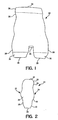
- a front view of a containment shell 22 there is seen a front view of a containment shell 22.
- the containment shell 22 is illustrated in this aspect of the invention as a pant-like garment with a unitary unseamed shell made in substantial conformance with a human body shape.
- the containment shell 22 will include an inside, or body side, surface and an outside surface.
- the containment shell 22 includes marginal seal areas of a non-prestressed elastic material including a torso margin 24 and appendage margins 26, designed for a waist opening and leg openings, respectively.
- the containment shell 22 may have non-prestressed elastic torso and appendage margins at the openings thereof to avoid the typical gathering, or shirring, of elastic margins common on current garments.
- the gaskets, or seals, formed at the garment opening margins are most desirably elastic.
- the elastic margins, or opening areas are designed to conformably surround at least a portion of the torso and appendages of the wearer and form a tensioned and liquid tight seal against the skin of the wearer when donned.
- the margins, or marginal seal areas, 24, 26 may be sized to provide the conforming seal through either of a nominally straight portion 28 having proper sizing for a distinct range of body measurements or may be constructed with flange areas 30 of distinctly reduced or descending diameters over a flange area length of, e.g., about two inches (5 cm), in order to insure a close fit of the marginal seal areas 24, 26 to a wider range of body sizes.
- the elastic materials could be any suitable elastic, including but not limited to: polyurethane, styrenic block copolymers, such as KRATON commercial elastomers from Kraton Polymers of Houston, TX; polyether ester, such as HYTREL from E. I.
- Flange areas 30 could be made of material thicker than the rest of the shell, made of a different material, or have an additional material added to make an effective seal at the flanged or nonflanged marginal seal areas.
- the shell, and all other layers of the garment, excluding absorbent structures will have a basis weight between about 0.1 to about 20.0 osy (3.4 gsm to about 678 gsm).
- the exemplary containment shell 22 further includes a ventral crotch area 32 and a dorsal crotch area 34. While designed to conformably fit the majority of body area which it will surround when donned by the wearer, the containment shell 22 may further have one or more pouch areas 36 that are designed to not conformably surround at least one of a torso and an appendage of the wearer, but are rather made larger than the true-to-life dimensions of the humanoid form in order to provide exudate storage areas within the donned garment. In some aspects of the invention the majority of the containment shell outside of the marginal seal areas may be made larger than the true-to-life dimensions of the humanoid form to hold the exudate while only the seal areas are tight.
- FIGs. 3 and 4 there are seen views of the containment shell 22 illustrated as a pant-like garment having absorbent materials within a unitary unseamed shell made in accordance with the shape and contours of the human form.
- the absorbent materials include waist area absorbents 38 and leg area absorbents 40 applied in bands on the body side, or surface, of the containment shell 22 to encircle the wearer.
- Additional absorbent materials include a ventral crotch area absorbent pad 42 and a dorsal crotch area absorbent pad 44.
- the absorbent materials described herein may be attached to the containment shell 22, integral therewith, or may be designed to be inserted into the containment shell 22, or donned separately and worn next to the skin and then overlaid by the containment shell 22.
- the absorbent materials are envisioned to be shaped substantially in conformance with the body shape, but may also be made substantially flat and yet flexible enough to achieve conformance to the body when held in place on, or by, the containment shell 22.
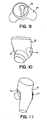
- the containment shell 22 further comprises an integral pocket 70, here shown as comprising a contiguous flap, for surrounding an edge of an absorbent insert (not shown) and holding the absorbent insert in the so-called "target area" most likely to receive insult from bodily exudates:
- the humanoid molding form 72 shows how the flap may be integrally molded with the containment shell by providing the mold 72 with a relief form 74 for molding the pocket 70 in one operation.
- the pocket 70 may also be seen to provide a pouch area not strictly conforming to the body to provide area for the storage of free liquids within the garment.
- a crotch area absorbent 46 is shown as applied over the entire circumference of the body side of the containment shell 22 in the crotch area so as to completely surround the wearer.
- Further absorbent materials may include waist area absorbents 38 and leg area absorbents 40 applied in bands on the body side, or surface, of the containment shell 22 to encircle the wearer, as per the embodiments of Figs. 3 and 4 .
- an absorbent layer 48 is shown as applied over the entire body side surface of the containment shell 22 so as to completely surround the wearer.
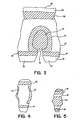
- the most difficult area of the containment shell 22 to seal against fluid transmission may be the back waistband area due to backbone protrusion and indentations lateral thereto of the wearer. Therefore, a compressible, resilient, non-absorbent gasket 51, more readily conformable to the protrusions and indentations of the backbone area maybe added inside of the waistband, and especially at the back, or dorsal, waistband area to further provide a conformable seal in this area.
- the gasket 51 is preferably continuous around the waist to provide a re-enforcement of sealing tension and may take the place of a reinforcement elastic waistband 50 ( Fig. 6 ).
- the gasket 51 may alternatively be a site specific enhancement of material.
- the containment shell 22 may be comprised substantially of an exterior-skinned absorbent foam.
- the foam may be built up in the spinal area, as initially molded, to form an integral gasket and then have a non-absorbent skin applied thereto.
- the gasket 51 may be a compressible, elastic, closed-cell foam such as RESILITEX, available commercially from Foamex International Inc., of Linwood, Penn., or be made from other known polyurethane foams or the like.
- the gasket 51 may be of a variety of shapes such as, e.g., a parallelepiped one inch (2.5 cm) wide and one half to three-eights inch (1.3 to 1.0 cm) thick, or it may be round, half-round, pillowed, or accordion pleated. Alternatively, the gasket 51 may be a fluid inflatable band or the like. It will be appreciated that the described gasketing technique may be used at any desired marginal area of a personal care product.
- a cross section of garment material layers suitable for one aspect of the present invention is provided.
- a liner material 56 having cloth-like feel.
- the material may be a nonwoven spunbond or the like such as is known in the art and deemed suitable for its intended purposes within an embodiment of the present invention. It will be noted that the liner material should not restrict the expansion of the waist or leg opening seal areas.
- the liner material 56 may be elastic or extendable, in one or more directions, and be directly attached to the seal areas.
- the garment may have a non-extendable liner if the garment is designed so the liner is not attached to the marginal seal areas and otherwise does not inhibit the easy extension of the marginal seal areas.
- a surge layer 58 is Subjacent to the liner material 56 layer.
- the material may be any surge material composition and construction such as are known in the art and deemed suitable for its intended purposes within an embodiment of the present invention.
- the surge layer material 58 may, like other layers, be elastic or extendable, in one or more directions, if directly attached to the seal areas, or may be non-extendable if the layer is not attached to the seal areas and otherwise does not inhibit the extension or retraction of the seal areas.
- an absorbent layer 60 is adjacent to the surge layer 58 to provide primary absorption and retention of liquid within the garment.
- the material may be any number of known absorbent foams or a nonwoven web or pulp pad with superabsorbents, or any absorbent material composition and construction such as are known in the art and deemed suitable for its intended purposes within an embodiment of the present invention.
- the absorbent layer may be elastic or expandable and will stretch in one or more directions.
- Subjacent the absorbent layer 60 is an elastic, liquid-impervious film layer 62 which may represent the basic construction and material of the containment shell 22.
- the elastic, liquid-impervious film layer 62 may be constructed from a variety of construction and material choices as mentioned above or as further known in the art or later developed and may include breathable materials which will pass water vapor but present a barrier to liquids.
- Some exemplary breathable, i.e., water vapor permeable, liquid barrier elastic films are described in U.S. Patent 5,883,028, to Morman et al., issued 16 March 1999 , describing inherently breathable films; and U.S. Patent 5,932,497 to Morman, et al., issued 3 August, 1999 , describing microporous breathable films.
- Adjacent the liquid impervious film layer 62 may be a facing material layer 64 to give the exterior surface 66 of the garment a more esthetic look and feel.
- the material may be any material composition and construction such as are known in the art and deemed suitable for its intended purposes within an embodiment of the present invention.
- the liquid impervious film layer 62 and the facing material layer 64 may be provided in some instances as a single laminate which will be the first layer applied to a humanoid molding form in the garment forming process.
- the facing material layer 64 may be the residual parts of a release substance applied to the humanoid molding form prior to application of the liquid impervious film layer 62. It should be considered that economical construction techniques may require that all or several material layers be fusible under heat, pressure, or the like, or otherwise joined as an integral part of the construction process. Alternatively, all layers may be constructed into a single web and then formed against humanoid molding forms if desired.
- each layer is desirably between about 0.1 and about 20.0 osy (3.4 and about 678 gsm).
- the combination of the liquid impervious film layer 62 and the facing material layer 64, or various of the other layers may comprise an elastomeric material such as a neck-bonded laminate (NBL) or stretch-bonded laminate (SBL) material.
- NBL neck-bonded laminate
- SBL stretch-bonded laminate
- Methods of making such are well known to those skilled in the art and are described in U.S. Patent No. 4,663,220 issued May 5, 1987 to Wisneski et al. , U.S. Patent No. 4,741,949 issued May 3, 1988 to Morman et al. , U.S. Patent No. 5,226,992 issued July 13, 1993 to Morman , and European Patent Application No. EP 0 217. 032 published on April 8, 1987 in the names of Taylor et al.
- the elastic film layer 62, or other layers might be expanded, such as with air pressure from inside a molding form, in order to arrange suitable ones of the above combinations of facings and elastic layers.
- stretch bonded refers to an elastic member being bonded to another member while the elastic member is extended at least about 25 percent of its relaxed length.
- Stretch bonded laminate refers to a composite material having at least two layers in which one layer is a gatherable layer and the other layer is an elastic layer. The layers are joined together when the elastic layer is in an extended condition so that upon relaxing the layers, the gatherable layer is gathered. Such a multilayer composite elastic material may be stretched to the extent that the nonelastic material gathered between the bond locations allows the elastic material to elongate.
- One type of stretch bonded laminate is disclosed, for example, by US Patent 4,720,415 to Vander Wielen et al.
- neck bonded refers to an elastic member being bonded to a non-elastic member while the non-elastic member is extended and necked.
- “Neck bonded laminate” refers to a composite material having at least two layers in which one layer is a necked, non-elastic layer and the other layer is an elastic layer. The layers are joined together when the non-elastic layer is in an extended and necked condition. Examples of neck-bonded laminates are such as those described in US Patents 5,226,992 ; 4,981,747 ; 4,965,122 and 5,336,545 to Morman .
- necked stretch bonded refers to an elastic member being bonded to a non-elastic member while the non-elastic member is extended and necked and the elastic member is at least extended.
- “Necked stretch bonded laminate” refers to a composite material having at least two layers in which one layer is a necked, non-elastic layer and the other layer is a stretched, and sometimes necked, elastic layer. The layers are joined together when in their extended (and necked) conditions. Examples of necked stretch bonded laminates are described in US Patents 5,114,781 and 5,116,662 to Morman .
- the liner material 56 might be creped spunbond or a necked spunbond, or both, or an inherently extendable spunbond material such as a crimped bicomponent fiber nonwoven material.
- Other parts of the garment may be elastic, extendable, or non-extendable so long as they do not interfere with the extendibility or retraction of the elastic seals. Care should be taken in the placement of the above-discussed laminates that extendability of the laminate is in a direction or directions suitable for the design of a garment according to the present invention.
- a two-piece standard torso biomorphic, and particularly humanoid, molding form 68 of the positive type which may be utilized in making a containment shell according to one aspect of the invention.
- the halves may be independently used to form a front, or ventral, half of the garment and a back, or dorsal, half of the garment. Upon completion of both halves, the halves may be seamed together, such as by heat or adhesives, to create a leakproof garment.
- the seam areas may be used as a convenient breaking point on the integrity of the garment in order to facilitate removal of the garment from the wearer.
- a one piece humanoid forming mold may be used.
- a mold may contain more than one humanoid form to allow the formation of more than one containment shell at a time in order to reduce trim waste from the process.
- the molds may be of positive or negative humanoid shapes, or both, in some applications such as press molding.
- the molding process is not intended to be limited herein to any one application or method but may utilize whatever system is found to be most convenient or economical to the manufacture of the garment.
- the containment garment will generally be suited to the formation of a three-dimensional humanoid shaped containment shell designed to fit the wearer shape.
- the garment may be constructed to fit closely, i.e., be tensioned, to the wearer over the entire surface of the garment or may include areas of more relaxed fit, i.e., less tensioned or untensioned, which then join to those areas of especially close fit located only at the marginal, e:g., waist and appendage, seal boundaries of the garment in order to form liquid tight seals.
- Methods for construction of the containment shell may include casting, such as solvent casting of polymers, e.g., suitably solvated elastomers, onto figured forms. Solvent casting will often provide the advantages of very even film formation with minimal chance of openings in the shell and a low degree of orientation for the film. Methods for dipping of forms into liquid phase shell material, such as latex, as may be analogous to the making of gloves or the like, may also be used. Spraying of shell material onto the molding form may further be possible, dependent upon the materials used. Spraying may include the placement of thermoplastic microfibers or the like from known extrusion equipment with the fiber layer subsequently heat treated to provide additional integrity to the shell if desired or necessary.
- meltblown polyurethane microfibers may be formed on the garment to make the outside surface of the product. It will be appreciated by the person having ordinary skill in the art that some garments according to the present invention with multiple layers are likely to be made "inside out” with the exterior layers formed closest to the humanoid shaped molding form and applied successively outward until application of the interior layer, at which time the product may be taken off the molding form and inverted for proper donning orientation.
- the containment shell may be comprised substantially of an exterior-skinned absorbent foam.
- a shell may be a known absorbent foam, such as a polyurethane open celled foam, sprayed or otherwise applied onto a humanoid molding form and covered with an exterior layer of compatible liquid barrier film.
- One such suitable absorbent foam may be a surfactant treated hydrophilized polymeric foam material, also termed a "High Internal Phase Emulsion" absorbent foam, such as disclosed in US Patent 5,352,711, to DesMarais .
- a liquid barrier layer may be accomplished by dipping the foam-covered mold into a liquid phase elastic block copolymer such as KRATON, or latex polyurethanes or latex silicone rubbers, or the like. It is envisioned that surface treatment of certain foams, such as by heat, chemical treatment, or the like, may also provide a liquid barrier without the need for additional layers or materials. It will be appreciated that the "exterior" liquid barrier layer may start as a layer closer to a molding form and later be reversed to become the exterior surface of the garment.
- Injection or press molding, vacuum forming, etc. may be used for wrapping or forming pre-made webs of shell material, or entire garment material, onto or into a humanoid molding form or modified humanoid molding form, whether positive or negative, in substantial conformance with the shape of intended wearers.
- the shape of the modified humanoid molding forms may include pouched areas for the containment and storage of exudate within the shape of the shell rather than being designed to be 100% conformal to the body.
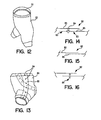
- an embodiment of the containment shell 80 may be seamed, such as by side seams 82 on the right and left legs of the shell in the case of a pant-like garment.
- the seam 82 comprises an overlap 83 of containment shell material 85 reinforced by mechanical fasteners 84, in this case illustrated as snaps. It is desirable that the containment shell material 85 in the seam 82 have a cohesive affinity for itself in order to properly seal the seam 82 from the passage of liquid.
- One such material may be a block co-polymer and polyethylene blend as disclosed in U.S. Patent 6,261,278 to Chen et al.
- seam 32 may comprise an integrally molded resealable seam 86 of polymer-to-polymer tongue and groove construction analogous to those used on known resealable storage bags.
- steaming arrangements as, e.g.
- the polymer-to-polymer tongue and groove construction are also contemplated to allow for the addition of independently provided gasketing materials which might be individually selected by the consumer and applied to waist and appendage margins of a basic containment shell or pant-like garment.
- gasketing materials which might be individually selected by the consumer and applied to waist and appendage margins of a basic containment shell or pant-like garment.
- seam location of a personal care product may be placed according to the dictates of various designs.
- Various bonding, co-extrusion, or sectional molding techniques may be utilized singly or in combination to form a seam of distinct material from that of the other containment shell areas if necessary or desired.
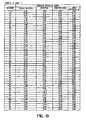
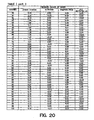
- a containment shell according to aspects of the present invention presents greater fluid sealing and retention properties than three more conventional type diapers.
- Curve 100 represents the data for an unseamed latex containment shell of about 7.96 osy (270 gsm) latex and 23.1 g total weight with margin gasketing similar to Fig. 1 of the present invention.
- Curve 102 represents data for a HUGGIES ULTRATRIM brand commercial diaper available from Kimberly-Clark Corporation in the November/December 2002 timeframe.
- Curve 104 represents data for a PAMPERS PREMIUM brand commercial diaper, UPC code 3700034820, available from Proctor & Gamble Corporation in the November/December 2002 timeframe.
- Curve 106 represents data for an expandable diaper made according to the teachings of PCT Publication WO 02/34184 A1, published 02 May 2002. in the names of Vukos, et al.
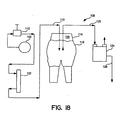
- Fig. 18 shows the fluid sealing and retention test set up 108.
- Air pressure 110 from an air supply 109 is adjusted by the air pressure regulator 112, to below the expected seal capacity of a containment shell of the present invention.
- the regulated fluid (air) enters the garment 118, through the female filling port of a test mannequin or "torso" such as Part No. CLARA MIDI-3MM, available from Courtray Consulting of Douai, France, which the garment has been placed on.
- a "soft" test mannequin 114 such as one having a vinyl chloride surface skin 120, is preferred for simulating the sealing effect of the garments on a human wearer.
- the air supply to the mannequin 114 is then set to a specified flow rate, of e.g., 19,622 ml/min., by the flow meter 122, e.g., a Cole Palmer Model No. 44-40.
- the pressure transducer 124 connected by tubing 125 through the male filling port of the test mannequin, translates a pressure signal into an analog DC voltage signal 126 which is in direct proportion to the air pressure within the garment 118 (relative to the atmospheric reference).
- This DC voltage 126 can be used in a data collecting apparatus (not shown) such as a data logger, or computer device for data capture.
- a data collecting apparatus not shown
- a data logger or computer device for data capture.
- Curve 102 illustrates that a latex containment shell according to aspects of the present invention reached a pressure of 5.75 inches of water (1.43 kPa) at 29 seconds during the air flow cycle and substantially retained this pressure through 47 seconds.
- the exemplar of the present invention dropped in pressure of about 1 inch of water (249 Pa) over each of the next 2 or 3 four-second intervals (4.74 inches of water -1.18 kPa- at 50 seconds, 3.76 inches -0.94 kPa- of water at 54 seconds, 2.86 inches of water -0.71 kPa- at 58 seconds), gradually thereafter declining to 1.01 inches of water (0.25 kPa) pressure at the 72 second mark and reaching 0.10 inches of water (24.9 Pa) pressure at 100 seconds.
- the containment shell example of the present invention was factually inflated during the testing, expanding away from the mannequin form over substantially all but the gasket areas of the shell, thereby visibly distending the shell and increasing volume between the containment shell and the mannequin.
- Curve 106 reached a high of 0.62 inches of water (154 Pa) pressure at 17 seconds and retained that value during the air flow cycle before sharply dropping to zero pressure at 47 seconds. No visible inflation or distension of the expandable diaper type according to PCT Publication WO 02/34184 A1 away from the test mannequin was noted.
- Curve 104 reached a high of 0.31-0.32 inches of water pressure (77.2-79.7 Pa) at 17 seconds and retained that value (during the air flow cycle) before sharply dropping to near zero pressure at 46 seconds. No visible inflation or distension of the PAMPERS diaper type away from the test mannequin was noted.
- Curve 102 reached a high of 0.26-0.27 inches of water pressure (64.8-67.3 Pa) at 17 seconds and retained that value (during the air flow cycle) before sharply dropping to near zero pressure at 48 seconds. No visible inflation or distension of the HUGGIES diaper type away from the test mannequin was noted.
Landscapes
- Health & Medical Sciences (AREA)
- General Health & Medical Sciences (AREA)
- Veterinary Medicine (AREA)
- Biomedical Technology (AREA)
- Heart & Thoracic Surgery (AREA)
- Vascular Medicine (AREA)
- Life Sciences & Earth Sciences (AREA)
- Animal Behavior & Ethology (AREA)
- Epidemiology (AREA)
- Engineering & Computer Science (AREA)
- Public Health (AREA)
- Dermatology (AREA)
- Orthopedics, Nursing, And Contraception (AREA)
- Absorbent Articles And Supports Therefor (AREA)
- Undergarments, Swaddling Clothes, Handkerchiefs Or Underwear Materials (AREA)
- Professional, Industrial, Or Sporting Protective Garments (AREA)
- Packages (AREA)
- Supplying Of Containers To The Packaging Station (AREA)
Applications Claiming Priority (3)
| Application Number | Priority Date | Filing Date | Title |
|---|---|---|---|
| US325875 | 2002-12-20 | ||
| US10/325,875 US7393346B2 (en) | 2002-12-20 | 2002-12-20 | Disposable leak-proof containment garment |
| PCT/US2003/028629 WO2004060234A1 (en) | 2002-12-20 | 2003-09-11 | Disposable leak-proof containment garment |
Publications (2)
| Publication Number | Publication Date |
|---|---|
| EP1581158A1 EP1581158A1 (en) | 2005-10-05 |
| EP1581158B1 true EP1581158B1 (en) | 2010-01-06 |
Family
ID=32593890
Family Applications (1)
| Application Number | Title | Priority Date | Filing Date |
|---|---|---|---|
| EP03752287A Expired - Lifetime EP1581158B1 (en) | 2002-12-20 | 2003-09-11 | Disposable leak-proof containment garment |
Country Status (8)
| Country | Link |
|---|---|
| US (1) | US7393346B2 (enExample) |
| EP (1) | EP1581158B1 (enExample) |
| JP (1) | JP4440117B2 (enExample) |
| AT (1) | ATE454118T1 (enExample) |
| AU (1) | AU2003270583A1 (enExample) |
| DE (1) | DE60330912D1 (enExample) |
| MX (1) | MXPA05005885A (enExample) |
| WO (1) | WO2004060234A1 (enExample) |
Families Citing this family (24)
| Publication number | Priority date | Publication date | Assignee | Title |
|---|---|---|---|---|
| US20040236552A1 (en) * | 2003-05-22 | 2004-11-25 | Kimberly-Clark Worldwide, Inc. | Method of evaluating products using a virtual environment |
| US8211078B2 (en) | 2005-02-17 | 2012-07-03 | The Procter And Gamble Company | Sanitary napkins capable of taking complex three-dimensional shape in use |
| US9579238B2 (en) | 2005-02-17 | 2017-02-28 | The Procter & Gamble Company | Sanitary napkins capable of taking complex three-dimensional shape in use |
| US8118795B2 (en) * | 2005-03-22 | 2012-02-21 | Medindica-Pak, Inc | Disposal chain supply systems method and apparatus |
| US20070293832A1 (en) * | 2006-06-14 | 2007-12-20 | 3M Innovative Properties Company | Absorbent article with waist seal and method of manufacturing |
| DE102010010680A1 (de) * | 2010-03-08 | 2011-09-08 | Karl Hofmann Gmbh + Co Modellia | Inkontinenz-Slip mit Beschichtung |
| US9226862B2 (en) | 2012-07-12 | 2016-01-05 | Kimberly-Clark Worldwide, Inc. | Containment pant with positioning key |
| US9011398B2 (en) | 2012-07-12 | 2015-04-21 | Kimberly-Clark Worldwide, Inc. | Containment system |
| US9192524B2 (en) | 2012-07-12 | 2015-11-24 | Kimberly-Clark Worldwide, Inc. | Absorbent insert with positioning notch |
| US9192526B2 (en) | 2012-07-12 | 2015-11-24 | Kimberly-Clark Worldwide, Inc. | Absorbent insert and containment system |
| US9308131B2 (en) | 2012-07-12 | 2016-04-12 | Kimberly-Clark Worldwide, Inc. | Containment pant |
| US9011403B2 (en) | 2012-07-12 | 2015-04-21 | Kimberly-Clark Worldwide, Inc. | Absorbent insert |
| US9198806B2 (en) | 2012-07-12 | 2015-12-01 | Kimberly-Clark Worldwide, Inc. | Containment pant |
| US9198807B2 (en) | 2012-07-12 | 2015-12-01 | Kimberly-Clark Worldwide, Inc. | Containment pant |
| KR20130028131A (ko) * | 2013-02-21 | 2013-03-18 | 오길영 | 남성용 기능성 팬티 |
| US9696130B1 (en) | 2013-12-06 | 2017-07-04 | Amazon Technologies, Inc. | Garment property determination using robotic mannequin |
| US9554096B1 (en) * | 2013-12-06 | 2017-01-24 | Amazon Technologies, Inc. | Automated garment photography with fit adjustment |
| US9675499B2 (en) | 2014-11-25 | 2017-06-13 | Kimberly-Clark Worldwide, Inc. | Containment pant with attachment mechanisms |
| JP6182700B1 (ja) * | 2016-02-15 | 2017-08-16 | 一夫 有▲吉▼ | 下もれ防止付き介護パンツ |
| US10682283B2 (en) * | 2016-04-07 | 2020-06-16 | James L. Evavold | Wearable soaking garment |
| CA3162293C (en) | 2021-07-08 | 2023-11-28 | Knix Wear Inc. | Garments with moisture capture assemblies and associated methods |
| US12048335B2 (en) | 2022-07-29 | 2024-07-30 | Knix Wear Inc. | Lower body garments with an interior lining and related methods |
| US12097103B1 (en) * | 2023-06-01 | 2024-09-24 | Knix Wear Inc. | Garments with fluid retention assemblies and related methods |
| USD1093811S1 (en) * | 2025-03-15 | 2025-09-23 | Jason S. Hayes | Men's underwear |
Family Cites Families (70)
| Publication number | Priority date | Publication date | Assignee | Title |
|---|---|---|---|---|
| US3338992A (en) * | 1959-12-15 | 1967-08-29 | Du Pont | Process for forming non-woven filamentary structures from fiber-forming synthetic organic polymers |
| US3072123A (en) * | 1961-11-21 | 1963-01-08 | Alice B Davis | Diaper panty |
| US3502763A (en) * | 1962-02-03 | 1970-03-24 | Freudenberg Carl Kg | Process of producing non-woven fabric fleece |
| US3502538A (en) * | 1964-08-17 | 1970-03-24 | Du Pont | Bonded nonwoven sheets with a defined distribution of bond strengths |
| US3341394A (en) * | 1966-12-21 | 1967-09-12 | Du Pont | Sheets of randomly distributed continuous filaments |
| US3542615A (en) * | 1967-06-16 | 1970-11-24 | Monsanto Co | Process for producing a nylon non-woven fabric |
| US3751727A (en) * | 1968-08-05 | 1973-08-14 | Nasa | Space suit |
| US3613687A (en) * | 1969-06-13 | 1971-10-19 | Kendall & Co | Quick-drying, absorbent nether garment |
| DE2048006B2 (de) * | 1969-10-01 | 1980-10-30 | Asahi Kasei Kogyo K.K., Osaka (Japan) | Verfahren und Vorrichtung zur Herstellung einer breiten Vliesbahn |
| DE1950669C3 (de) * | 1969-10-08 | 1982-05-13 | Metallgesellschaft Ag, 6000 Frankfurt | Verfahren zur Vliesherstellung |
| ES188538Y (es) * | 1973-02-09 | 1974-09-16 | Eurocorset, S. A. | Faja-pantalon perfeccionada. |
| US3909847A (en) * | 1974-08-15 | 1975-10-07 | Medalist Ind Inc | Female pelvis and crotch protector |
| US3916900A (en) * | 1974-10-31 | 1975-11-04 | Scott Paper Co | Multilayer one-piece disposable diapers |
| US4084584A (en) * | 1976-10-15 | 1978-04-18 | Detty Garnett E | Knee sleeve |
| US4340563A (en) * | 1980-05-05 | 1982-07-20 | Kimberly-Clark Corporation | Method for forming nonwoven webs |
| JPH0694601B2 (ja) * | 1984-05-16 | 1994-11-24 | ペアウドウス | パンツおよびその製造方法 |
| US4646362A (en) * | 1985-01-10 | 1987-03-03 | Kimberly-Clark Corporation | Disposable underpants, such as child's training pants and the like |
| US4639949A (en) * | 1985-01-10 | 1987-02-03 | Kimberly-Clark Corporation | Elastic form-fitting closure constructions for disposable garments |
| US4663220A (en) * | 1985-07-30 | 1987-05-05 | Kimberly-Clark Corporation | Polyolefin-containing extrudable compositions and methods for their formation into elastomeric products including microfibers |
| US4655760A (en) * | 1985-07-30 | 1987-04-07 | Kimberly-Clark Corporation | Elasticized garment and method of making the same |
| US4657802A (en) * | 1985-07-30 | 1987-04-14 | Kimberly-Clark Corporation | Composite nonwoven elastic web |
| US4720415A (en) * | 1985-07-30 | 1988-01-19 | Kimberly-Clark Corporation | Composite elastomeric material and process for making the same |
| US4652487A (en) * | 1985-07-30 | 1987-03-24 | Kimberly-Clark Corporation | Gathered fibrous nonwoven elastic web |
| US4701175A (en) * | 1985-09-06 | 1987-10-20 | Kimberly-Clark Corporation | Form-fitting self-adjusting disposable garment with elastic waist and legs |
| US4699620A (en) * | 1985-09-06 | 1987-10-13 | Kimberly-Clark Corporation | Form-fitting self-adjusting disposable garment with a multilayered absorbent |
| US4690681A (en) * | 1986-01-23 | 1987-09-01 | Kimberly-Clark Corporation | Disposable leakproof catamenial device |
| US4653487A (en) * | 1986-01-29 | 1987-03-31 | Maale Gerhard E | Intramedullary rod assembly for cement injection system |
| US4789699A (en) * | 1986-10-15 | 1988-12-06 | Kimberly-Clark Corporation | Ambient temperature bondable elastomeric nonwoven web |
| US4741949A (en) * | 1986-10-15 | 1988-05-03 | Kimberly-Clark Corporation | Elastic polyetherester nonwoven web |
| US4781966A (en) * | 1986-10-15 | 1988-11-01 | Kimberly-Clark Corporation | Spunlaced polyester-meltblown polyetherester laminate |
| CA1286052C (en) | 1986-12-31 | 1991-07-16 | David P. Kielpikowski | Disposable absorbent garment having elastic outer cover and integrated absorbent insert structure |
| US4938757A (en) * | 1987-12-16 | 1990-07-03 | Kimberly-Clark Corporation | Disposable training pant or incontinence garment |
| US4938753A (en) * | 1987-12-16 | 1990-07-03 | Kimberly-Clark Corporation | Seam construction in a disposable training pant, incontinence garment, or diaper |
| US4880424A (en) * | 1988-02-04 | 1989-11-14 | Darlington Fabrics Corporation | Protective undergarment for the retention of body fluids |
| US5226992A (en) * | 1988-09-23 | 1993-07-13 | Kimberly-Clark Corporation | Process for forming a composite elastic necked-bonded material |
| US4981747A (en) * | 1988-09-23 | 1991-01-01 | Kimberly-Clark Corporation | Composite elastic material including a reversibly necked material |
| US4965122A (en) * | 1988-09-23 | 1990-10-23 | Kimberly-Clark Corporation | Reversibly necked material |
| US4959047A (en) * | 1989-04-10 | 1990-09-25 | The United States Of America As Represented By The Secretary Of The Air Force | Flexible lower body negative pressure trousers for -Gz acceleration protection |
| US5127896A (en) * | 1989-09-05 | 1992-07-07 | Mcdonnell Douglas Corporation | Anthropomorphic tank suit |
| US5114781A (en) * | 1989-12-15 | 1992-05-19 | Kimberly-Clark Corporation | Multi-direction stretch composite elastic material including a reversibly necked material |
| US5116662A (en) * | 1989-12-15 | 1992-05-26 | Kimberly-Clark Corporation | Multi-direction stretch composite elastic material |
| US5352711A (en) * | 1991-08-12 | 1994-10-04 | The Proctor & Gamble Company | Method for hydrophilizing absorbent foam materials |
| US5217782A (en) * | 1991-11-12 | 1993-06-08 | Moretz Herbert L | Multi-layer moisture management fabric |
| US6168585B1 (en) * | 1993-12-15 | 2001-01-02 | Kimberely-Clark Worldwide, Inc. | Disposable training pant with elastically suspended absorbent assembly |
| US5476458A (en) * | 1993-12-22 | 1995-12-19 | Kimberly-Clark Corporation | Liquid-retaining absorbent garment and method of manufacture |
| US5593400A (en) * | 1994-02-09 | 1997-01-14 | Paragon Trade Brands | Disposable absorbent article with suspended absorbent structure |
| US5593398A (en) * | 1994-05-25 | 1997-01-14 | Weimer; Chester L. | Protective underwear with malodorous flatus filter |
| US5658246A (en) * | 1995-03-30 | 1997-08-19 | Saca; Ricardo E. | Protective garment for the hip |
| JP3084203B2 (ja) * | 1995-04-26 | 2000-09-04 | ユニ・チャーム株式会社 | 使い捨て着用物品 |
| US6336921B1 (en) * | 1995-05-31 | 2002-01-08 | Kimberly-Clark Worldwide, Inc. | Waist elastic system with improved elastic decay properties for a training pant |
| US5685874A (en) * | 1996-02-22 | 1997-11-11 | The Procter & Gamble Company | Disposable pull-on pant |
| US6120487A (en) * | 1996-04-03 | 2000-09-19 | The Procter & Gamble Company | Disposable pull-on pant |
| US6009565A (en) * | 1996-10-29 | 2000-01-04 | Plum Enterprises | Protective garment for the hip area |
| US5957878A (en) * | 1996-11-22 | 1999-09-28 | Gilliam; Phillip L. | Body support garments |
| JP3343198B2 (ja) * | 1997-03-17 | 2002-11-11 | ユニ・チャーム株式会社 | 使い捨ておむつ |
| US5883028A (en) * | 1997-05-30 | 1999-03-16 | Kimberly-Clark Worldwide, Inc. | Breathable elastic film/nonwoven laminate |
| US5932497A (en) * | 1997-09-15 | 1999-08-03 | Kimberly-Clark Worldwide, Inc. | Breathable elastic film and laminate |
| US6261278B1 (en) * | 1997-12-31 | 2001-07-17 | Kimberly-Clark Worldwide, Inc. | Film with improved self-adhesive properties |
| AU7801398A (en) | 1998-05-28 | 1999-12-13 | Procter & Gamble Company, The | Disposable panttype diaper having zone of extensibility |
| US20020099346A1 (en) * | 1998-06-18 | 2002-07-25 | Strobl Frederick T. | Fitted protective hip brief |
| IL125695A0 (en) * | 1998-08-07 | 1999-04-11 | Giloh Tamar | A protective undergarment |
| US6224538B1 (en) * | 1999-07-19 | 2001-05-01 | Jun Ming Wang | Multi-function health device |
| US6041446A (en) * | 1999-07-26 | 2000-03-28 | Ultimair Corporation | Panty with integrated treated crotch |
| GB9929500D0 (en) * | 1999-12-15 | 2000-02-09 | Multifabs Survival Ltd | Survival garment |
| US6414217B1 (en) * | 2000-05-03 | 2002-07-02 | Kimberly-Clark Worldwide, Inc. | Absorbent article having a lateral breathability gradient in use |
| BR0004936A (pt) * | 2000-10-19 | 2002-06-11 | Johnson & Johnson Ind Com | Fralda |
| US6969378B1 (en) | 2000-10-27 | 2005-11-29 | Kimberly-Clark Worldwide, Inc. | Biaxial stretch garment |
| US6582412B2 (en) * | 2000-12-29 | 2003-06-24 | Kimberly-Clark Worldwide, Inc. | Disposable one-piece swimsuit for girls |
| US7047572B2 (en) * | 2001-12-21 | 2006-05-23 | Kimberly-Clark Worldwide, Inc. | Disposable pant having an inward crotch seam and method of making same |
| JP4153725B2 (ja) * | 2002-05-22 | 2008-09-24 | ユニ・チャーム株式会社 | パンツ型おむつ |
-
2002
- 2002-12-20 US US10/325,875 patent/US7393346B2/en not_active Expired - Fee Related
-
2003
- 2003-09-11 MX MXPA05005885A patent/MXPA05005885A/es active IP Right Grant
- 2003-09-11 AU AU2003270583A patent/AU2003270583A1/en not_active Abandoned
- 2003-09-11 DE DE60330912T patent/DE60330912D1/de not_active Expired - Lifetime
- 2003-09-11 AT AT03752287T patent/ATE454118T1/de not_active IP Right Cessation
- 2003-09-11 JP JP2004564708A patent/JP4440117B2/ja not_active Expired - Fee Related
- 2003-09-11 EP EP03752287A patent/EP1581158B1/en not_active Expired - Lifetime
- 2003-09-11 WO PCT/US2003/028629 patent/WO2004060234A1/en not_active Ceased
Also Published As
| Publication number | Publication date |
|---|---|
| WO2004060234A1 (en) | 2004-07-22 |
| ATE454118T1 (de) | 2010-01-15 |
| MXPA05005885A (es) | 2005-08-29 |
| JP2006511286A (ja) | 2006-04-06 |
| EP1581158A1 (en) | 2005-10-05 |
| US7393346B2 (en) | 2008-07-01 |
| JP4440117B2 (ja) | 2010-03-24 |
| AU2003270583A1 (en) | 2004-07-29 |
| DE60330912D1 (de) | 2010-02-25 |
| US20040122393A1 (en) | 2004-06-24 |
Similar Documents
| Publication | Publication Date | Title |
|---|---|---|
| EP1581158B1 (en) | Disposable leak-proof containment garment | |
| JP3622770B2 (ja) | ポンプ及び膨張可能な構成要素を有する使い捨て吸収物品 | |
| KR100263228B1 (ko) | 일회용풀-온팬티 | |
| JP5039040B2 (ja) | 二軸方向伸張可能な内側層を有する使い棄て衣類 | |
| CA1206301A (en) | Incontinent garment with elasticized pouch | |
| RU2505274C2 (ru) | Одноразовая абсорбирующая вставка для двухкомпонентного носимого абсорбирующего изделия | |
| FI94922C (fi) | Imukykyinen kertakäyttötuote | |
| US6582412B2 (en) | Disposable one-piece swimsuit for girls | |
| CN101820839B (zh) | 附着身体的吸收性物品 | |
| MXPA05005747A (es) | Articulos absorbentes desechables con multiples componentes en el nucleo absorbente que incluyen componentes reemplazables. | |
| KR20110107361A (ko) | 신체 접착형 흡수 용품 | |
| KR20110048512A (ko) | 포장된 신체 접착형 흡수 용품 | |
| JP2004305767A (ja) | 引っ張って身に付けるタイプの使い捨て衣類 | |
| CN107427394A (zh) | 具有选择性定位的腰部防漏构件的吸收制品 | |
| DK163909B (da) | Engangsble | |
| KR20050090394A (ko) | 주변 신장 흡수 가먼트 | |
| KR20110046456A (ko) | 신체 접착형 흡수 용품 | |
| HUP0003153A2 (hu) | Lélegző hátlappal ellátott abszorbens cikk | |
| KR20220024804A (ko) | 유체 보유/유지용 패드 | |
| EP0164435B1 (en) | Incontinent garment with elasticized pouch | |
| JP2010509015A (ja) | 流体分割特性を有する吸収性物品、及び該特性を評価する方法 | |
| KR20190104234A (ko) | 연장된 다리 탄성체를 갖는 흡수 용품 | |
| US20050218154A1 (en) | Low Profile Fluid Container | |
| MX2007013517A (es) | Miembros elasticos de cintura para usarse en articulos absorbentes. | |
| AU2010201983A1 (en) | Disposable absorbent articles having multiple absorbent core components including replaceable components |
Legal Events
| Date | Code | Title | Description |
|---|---|---|---|
| PUAI | Public reference made under article 153(3) epc to a published international application that has entered the european phase |
Free format text: ORIGINAL CODE: 0009012 |
|
| 17P | Request for examination filed |
Effective date: 20050712 |
|
| AK | Designated contracting states |
Kind code of ref document: A1 Designated state(s): AT BE BG CH CY CZ DE DK EE ES FI FR GB GR HU IE IT LI LU MC NL PT RO SE SI SK TR |
|
| AX | Request for extension of the european patent |
Extension state: AL LT LV MK |
|
| DAX | Request for extension of the european patent (deleted) | ||
| 17Q | First examination report despatched |
Effective date: 20051103 |
|
| GRAP | Despatch of communication of intention to grant a patent |
Free format text: ORIGINAL CODE: EPIDOSNIGR1 |
|
| GRAS | Grant fee paid |
Free format text: ORIGINAL CODE: EPIDOSNIGR3 |
|
| GRAA | (expected) grant |
Free format text: ORIGINAL CODE: 0009210 |
|
| AK | Designated contracting states |
Kind code of ref document: B1 Designated state(s): AT BE BG CH CY CZ DE DK EE ES FI FR GB GR HU IE IT LI LU MC NL PT RO SE SI SK TR |
|
| REG | Reference to a national code |
Ref country code: GB Ref legal event code: FG4D |
|
| REG | Reference to a national code |
Ref country code: CH Ref legal event code: EP |
|
| REG | Reference to a national code |
Ref country code: IE Ref legal event code: FG4D |
|
| REF | Corresponds to: |
Ref document number: 60330912 Country of ref document: DE Date of ref document: 20100225 Kind code of ref document: P |
|
| REG | Reference to a national code |
Ref country code: NL Ref legal event code: T3 |
|
| PG25 | Lapsed in a contracting state [announced via postgrant information from national office to epo] |
Ref country code: SI Free format text: LAPSE BECAUSE OF FAILURE TO SUBMIT A TRANSLATION OF THE DESCRIPTION OR TO PAY THE FEE WITHIN THE PRESCRIBED TIME-LIMIT Effective date: 20100106 |
|
| PG25 | Lapsed in a contracting state [announced via postgrant information from national office to epo] |
Ref country code: AT Free format text: LAPSE BECAUSE OF FAILURE TO SUBMIT A TRANSLATION OF THE DESCRIPTION OR TO PAY THE FEE WITHIN THE PRESCRIBED TIME-LIMIT Effective date: 20100106 |
|
| PG25 | Lapsed in a contracting state [announced via postgrant information from national office to epo] |
Ref country code: PT Free format text: LAPSE BECAUSE OF FAILURE TO SUBMIT A TRANSLATION OF THE DESCRIPTION OR TO PAY THE FEE WITHIN THE PRESCRIBED TIME-LIMIT Effective date: 20100506 Ref country code: ES Free format text: LAPSE BECAUSE OF FAILURE TO SUBMIT A TRANSLATION OF THE DESCRIPTION OR TO PAY THE FEE WITHIN THE PRESCRIBED TIME-LIMIT Effective date: 20100417 |
|
| PG25 | Lapsed in a contracting state [announced via postgrant information from national office to epo] |
Ref country code: FI Free format text: LAPSE BECAUSE OF FAILURE TO SUBMIT A TRANSLATION OF THE DESCRIPTION OR TO PAY THE FEE WITHIN THE PRESCRIBED TIME-LIMIT Effective date: 20100106 |
|
| PG25 | Lapsed in a contracting state [announced via postgrant information from national office to epo] |
Ref country code: GR Free format text: LAPSE BECAUSE OF FAILURE TO SUBMIT A TRANSLATION OF THE DESCRIPTION OR TO PAY THE FEE WITHIN THE PRESCRIBED TIME-LIMIT Effective date: 20100407 Ref country code: EE Free format text: LAPSE BECAUSE OF FAILURE TO SUBMIT A TRANSLATION OF THE DESCRIPTION OR TO PAY THE FEE WITHIN THE PRESCRIBED TIME-LIMIT Effective date: 20100106 Ref country code: SE Free format text: LAPSE BECAUSE OF FAILURE TO SUBMIT A TRANSLATION OF THE DESCRIPTION OR TO PAY THE FEE WITHIN THE PRESCRIBED TIME-LIMIT Effective date: 20100106 Ref country code: BE Free format text: LAPSE BECAUSE OF FAILURE TO SUBMIT A TRANSLATION OF THE DESCRIPTION OR TO PAY THE FEE WITHIN THE PRESCRIBED TIME-LIMIT Effective date: 20100106 Ref country code: CY Free format text: LAPSE BECAUSE OF FAILURE TO SUBMIT A TRANSLATION OF THE DESCRIPTION OR TO PAY THE FEE WITHIN THE PRESCRIBED TIME-LIMIT Effective date: 20100106 Ref country code: RO Free format text: LAPSE BECAUSE OF FAILURE TO SUBMIT A TRANSLATION OF THE DESCRIPTION OR TO PAY THE FEE WITHIN THE PRESCRIBED TIME-LIMIT Effective date: 20100106 |
|
| PLBE | No opposition filed within time limit |
Free format text: ORIGINAL CODE: 0009261 |
|
| STAA | Information on the status of an ep patent application or granted ep patent |
Free format text: STATUS: NO OPPOSITION FILED WITHIN TIME LIMIT |
|
| PG25 | Lapsed in a contracting state [announced via postgrant information from national office to epo] |
Ref country code: SK Free format text: LAPSE BECAUSE OF FAILURE TO SUBMIT A TRANSLATION OF THE DESCRIPTION OR TO PAY THE FEE WITHIN THE PRESCRIBED TIME-LIMIT Effective date: 20100106 Ref country code: CZ Free format text: LAPSE BECAUSE OF FAILURE TO SUBMIT A TRANSLATION OF THE DESCRIPTION OR TO PAY THE FEE WITHIN THE PRESCRIBED TIME-LIMIT Effective date: 20100106 Ref country code: BG Free format text: LAPSE BECAUSE OF FAILURE TO SUBMIT A TRANSLATION OF THE DESCRIPTION OR TO PAY THE FEE WITHIN THE PRESCRIBED TIME-LIMIT Effective date: 20100406 |
|
| 26N | No opposition filed |
Effective date: 20101007 |
|
| PGFP | Annual fee paid to national office [announced via postgrant information from national office to epo] |
Ref country code: GB Payment date: 20100927 Year of fee payment: 8 |
|
| PG25 | Lapsed in a contracting state [announced via postgrant information from national office to epo] |
Ref country code: DK Free format text: LAPSE BECAUSE OF FAILURE TO SUBMIT A TRANSLATION OF THE DESCRIPTION OR TO PAY THE FEE WITHIN THE PRESCRIBED TIME-LIMIT Effective date: 20100106 |
|
| PGFP | Annual fee paid to national office [announced via postgrant information from national office to epo] |
Ref country code: NL Payment date: 20100924 Year of fee payment: 8 |
|
| PG25 | Lapsed in a contracting state [announced via postgrant information from national office to epo] |
Ref country code: IT Free format text: LAPSE BECAUSE OF FAILURE TO SUBMIT A TRANSLATION OF THE DESCRIPTION OR TO PAY THE FEE WITHIN THE PRESCRIBED TIME-LIMIT Effective date: 20100106 |
|
| PG25 | Lapsed in a contracting state [announced via postgrant information from national office to epo] |
Ref country code: MC Free format text: LAPSE BECAUSE OF NON-PAYMENT OF DUE FEES Effective date: 20100930 |
|
| REG | Reference to a national code |
Ref country code: CH Ref legal event code: PL |
|
| REG | Reference to a national code |
Ref country code: FR Ref legal event code: ST Effective date: 20110531 |
|
| REG | Reference to a national code |
Ref country code: DE Ref legal event code: R119 Ref document number: 60330912 Country of ref document: DE Effective date: 20110401 |
|
| PG25 | Lapsed in a contracting state [announced via postgrant information from national office to epo] |
Ref country code: LI Free format text: LAPSE BECAUSE OF NON-PAYMENT OF DUE FEES Effective date: 20100930 Ref country code: CH Free format text: LAPSE BECAUSE OF NON-PAYMENT OF DUE FEES Effective date: 20100930 Ref country code: DE Free format text: LAPSE BECAUSE OF NON-PAYMENT OF DUE FEES Effective date: 20110401 Ref country code: IE Free format text: LAPSE BECAUSE OF NON-PAYMENT OF DUE FEES Effective date: 20100911 Ref country code: FR Free format text: LAPSE BECAUSE OF NON-PAYMENT OF DUE FEES Effective date: 20100930 |
|
| REG | Reference to a national code |
Ref country code: NL Ref legal event code: V1 Effective date: 20120401 |
|
| GBPC | Gb: european patent ceased through non-payment of renewal fee |
Effective date: 20110911 |
|
| PG25 | Lapsed in a contracting state [announced via postgrant information from national office to epo] |
Ref country code: NL Free format text: LAPSE BECAUSE OF NON-PAYMENT OF DUE FEES Effective date: 20120401 |
|
| PG25 | Lapsed in a contracting state [announced via postgrant information from national office to epo] |
Ref country code: GB Free format text: LAPSE BECAUSE OF NON-PAYMENT OF DUE FEES Effective date: 20110911 |
|
| PG25 | Lapsed in a contracting state [announced via postgrant information from national office to epo] |
Ref country code: HU Free format text: LAPSE BECAUSE OF FAILURE TO SUBMIT A TRANSLATION OF THE DESCRIPTION OR TO PAY THE FEE WITHIN THE PRESCRIBED TIME-LIMIT Effective date: 20100707 Ref country code: LU Free format text: LAPSE BECAUSE OF NON-PAYMENT OF DUE FEES Effective date: 20100911 |
|
| PG25 | Lapsed in a contracting state [announced via postgrant information from national office to epo] |
Ref country code: TR Free format text: LAPSE BECAUSE OF FAILURE TO SUBMIT A TRANSLATION OF THE DESCRIPTION OR TO PAY THE FEE WITHIN THE PRESCRIBED TIME-LIMIT Effective date: 20100106 |