EP1579855A1 - Novel dry powder inhalation system for transpulmonary administration - Google Patents
Novel dry powder inhalation system for transpulmonary administration Download PDFInfo
- Publication number
- EP1579855A1 EP1579855A1 EP03778863A EP03778863A EP1579855A1 EP 1579855 A1 EP1579855 A1 EP 1579855A1 EP 03778863 A EP03778863 A EP 03778863A EP 03778863 A EP03778863 A EP 03778863A EP 1579855 A1 EP1579855 A1 EP 1579855A1
- Authority
- EP
- European Patent Office
- Prior art keywords
- freeze
- air
- dried composition
- vessel
- fine particles
- Prior art date
- Legal status (The legal status is an assumption and is not a legal conclusion. Google has not performed a legal analysis and makes no representation as to the accuracy of the status listed.)
- Withdrawn
Links
Images




Classifications
-
- A—HUMAN NECESSITIES
- A61—MEDICAL OR VETERINARY SCIENCE; HYGIENE
- A61M—DEVICES FOR INTRODUCING MEDIA INTO, OR ONTO, THE BODY; DEVICES FOR TRANSDUCING BODY MEDIA OR FOR TAKING MEDIA FROM THE BODY; DEVICES FOR PRODUCING OR ENDING SLEEP OR STUPOR
- A61M15/00—Inhalators
-
- A—HUMAN NECESSITIES
- A61—MEDICAL OR VETERINARY SCIENCE; HYGIENE
- A61K—PREPARATIONS FOR MEDICAL, DENTAL OR TOILETRY PURPOSES
- A61K9/00—Medicinal preparations characterised by special physical form
- A61K9/0012—Galenical forms characterised by the site of application
- A61K9/007—Pulmonary tract; Aromatherapy
- A61K9/0073—Sprays or powders for inhalation; Aerolised or nebulised preparations generated by other means than thermal energy
- A61K9/0075—Sprays or powders for inhalation; Aerolised or nebulised preparations generated by other means than thermal energy for inhalation via a dry powder inhaler [DPI], e.g. comprising micronized drug mixed with lactose carrier particles
-
- A—HUMAN NECESSITIES
- A61—MEDICAL OR VETERINARY SCIENCE; HYGIENE
- A61K—PREPARATIONS FOR MEDICAL, DENTAL OR TOILETRY PURPOSES
- A61K9/00—Medicinal preparations characterised by special physical form
- A61K9/0012—Galenical forms characterised by the site of application
- A61K9/007—Pulmonary tract; Aromatherapy
- A61K9/0073—Sprays or powders for inhalation; Aerolised or nebulised preparations generated by other means than thermal energy
-
- A—HUMAN NECESSITIES
- A61—MEDICAL OR VETERINARY SCIENCE; HYGIENE
- A61K—PREPARATIONS FOR MEDICAL, DENTAL OR TOILETRY PURPOSES
- A61K9/00—Medicinal preparations characterised by special physical form
- A61K9/14—Particulate form, e.g. powders, Processes for size reducing of pure drugs or the resulting products, Pure drug nanoparticles
- A61K9/19—Particulate form, e.g. powders, Processes for size reducing of pure drugs or the resulting products, Pure drug nanoparticles lyophilised, i.e. freeze-dried, solutions or dispersions
-
- A—HUMAN NECESSITIES
- A61—MEDICAL OR VETERINARY SCIENCE; HYGIENE
- A61M—DEVICES FOR INTRODUCING MEDIA INTO, OR ONTO, THE BODY; DEVICES FOR TRANSDUCING BODY MEDIA OR FOR TAKING MEDIA FROM THE BODY; DEVICES FOR PRODUCING OR ENDING SLEEP OR STUPOR
- A61M11/00—Sprayers or atomisers specially adapted for therapeutic purposes
- A61M11/001—Particle size control
-
- A—HUMAN NECESSITIES
- A61—MEDICAL OR VETERINARY SCIENCE; HYGIENE
- A61M—DEVICES FOR INTRODUCING MEDIA INTO, OR ONTO, THE BODY; DEVICES FOR TRANSDUCING BODY MEDIA OR FOR TAKING MEDIA FROM THE BODY; DEVICES FOR PRODUCING OR ENDING SLEEP OR STUPOR
- A61M11/00—Sprayers or atomisers specially adapted for therapeutic purposes
- A61M11/02—Sprayers or atomisers specially adapted for therapeutic purposes operated by air or other gas pressure applied to the liquid or other product to be sprayed or atomised
-
- A—HUMAN NECESSITIES
- A61—MEDICAL OR VETERINARY SCIENCE; HYGIENE
- A61M—DEVICES FOR INTRODUCING MEDIA INTO, OR ONTO, THE BODY; DEVICES FOR TRANSDUCING BODY MEDIA OR FOR TAKING MEDIA FROM THE BODY; DEVICES FOR PRODUCING OR ENDING SLEEP OR STUPOR
- A61M15/00—Inhalators
- A61M15/0028—Inhalators using prepacked dosages, one for each application, e.g. capsules to be perforated or broken-up
-
- A—HUMAN NECESSITIES
- A61—MEDICAL OR VETERINARY SCIENCE; HYGIENE
- A61M—DEVICES FOR INTRODUCING MEDIA INTO, OR ONTO, THE BODY; DEVICES FOR TRANSDUCING BODY MEDIA OR FOR TAKING MEDIA FROM THE BODY; DEVICES FOR PRODUCING OR ENDING SLEEP OR STUPOR
- A61M15/00—Inhalators
- A61M15/0028—Inhalators using prepacked dosages, one for each application, e.g. capsules to be perforated or broken-up
- A61M15/003—Inhalators using prepacked dosages, one for each application, e.g. capsules to be perforated or broken-up using capsules, e.g. to be perforated or broken-up
- A61M15/0033—Details of the piercing or cutting means
- A61M15/0035—Piercing means
- A61M15/0036—Piercing means hollow piercing means
-
- A—HUMAN NECESSITIES
- A61—MEDICAL OR VETERINARY SCIENCE; HYGIENE
- A61M—DEVICES FOR INTRODUCING MEDIA INTO, OR ONTO, THE BODY; DEVICES FOR TRANSDUCING BODY MEDIA OR FOR TAKING MEDIA FROM THE BODY; DEVICES FOR PRODUCING OR ENDING SLEEP OR STUPOR
- A61M15/00—Inhalators
- A61M15/0028—Inhalators using prepacked dosages, one for each application, e.g. capsules to be perforated or broken-up
- A61M15/003—Inhalators using prepacked dosages, one for each application, e.g. capsules to be perforated or broken-up using capsules, e.g. to be perforated or broken-up
- A61M15/0033—Details of the piercing or cutting means
- A61M15/004—Details of the piercing or cutting means with fixed piercing or cutting means
-
- A—HUMAN NECESSITIES
- A61—MEDICAL OR VETERINARY SCIENCE; HYGIENE
- A61P—SPECIFIC THERAPEUTIC ACTIVITY OF CHEMICAL COMPOUNDS OR MEDICINAL PREPARATIONS
- A61P11/00—Drugs for disorders of the respiratory system
-
- A—HUMAN NECESSITIES
- A61—MEDICAL OR VETERINARY SCIENCE; HYGIENE
- A61P—SPECIFIC THERAPEUTIC ACTIVITY OF CHEMICAL COMPOUNDS OR MEDICINAL PREPARATIONS
- A61P43/00—Drugs for specific purposes, not provided for in groups A61P1/00-A61P41/00
-
- A—HUMAN NECESSITIES
- A61—MEDICAL OR VETERINARY SCIENCE; HYGIENE
- A61P—SPECIFIC THERAPEUTIC ACTIVITY OF CHEMICAL COMPOUNDS OR MEDICINAL PREPARATIONS
- A61P5/00—Drugs for disorders of the endocrine system
- A61P5/48—Drugs for disorders of the endocrine system of the pancreatic hormones
- A61P5/50—Drugs for disorders of the endocrine system of the pancreatic hormones for increasing or potentiating the activity of insulin
-
- A—HUMAN NECESSITIES
- A61—MEDICAL OR VETERINARY SCIENCE; HYGIENE
- A61K—PREPARATIONS FOR MEDICAL, DENTAL OR TOILETRY PURPOSES
- A61K47/00—Medicinal preparations characterised by the non-active ingredients used, e.g. carriers or inert additives; Targeting or modifying agents chemically bound to the active ingredient
- A61K47/06—Organic compounds, e.g. natural or synthetic hydrocarbons, polyolefins, mineral oil, petrolatum or ozokerite
- A61K47/08—Organic compounds, e.g. natural or synthetic hydrocarbons, polyolefins, mineral oil, petrolatum or ozokerite containing oxygen, e.g. ethers, acetals, ketones, quinones, aldehydes, peroxides
- A61K47/10—Alcohols; Phenols; Salts thereof, e.g. glycerol; Polyethylene glycols [PEG]; Poloxamers; PEG/POE alkyl ethers
-
- A—HUMAN NECESSITIES
- A61—MEDICAL OR VETERINARY SCIENCE; HYGIENE
- A61K—PREPARATIONS FOR MEDICAL, DENTAL OR TOILETRY PURPOSES
- A61K47/00—Medicinal preparations characterised by the non-active ingredients used, e.g. carriers or inert additives; Targeting or modifying agents chemically bound to the active ingredient
- A61K47/06—Organic compounds, e.g. natural or synthetic hydrocarbons, polyolefins, mineral oil, petrolatum or ozokerite
- A61K47/08—Organic compounds, e.g. natural or synthetic hydrocarbons, polyolefins, mineral oil, petrolatum or ozokerite containing oxygen, e.g. ethers, acetals, ketones, quinones, aldehydes, peroxides
- A61K47/12—Carboxylic acids; Salts or anhydrides thereof
-
- A—HUMAN NECESSITIES
- A61—MEDICAL OR VETERINARY SCIENCE; HYGIENE
- A61K—PREPARATIONS FOR MEDICAL, DENTAL OR TOILETRY PURPOSES
- A61K47/00—Medicinal preparations characterised by the non-active ingredients used, e.g. carriers or inert additives; Targeting or modifying agents chemically bound to the active ingredient
- A61K47/06—Organic compounds, e.g. natural or synthetic hydrocarbons, polyolefins, mineral oil, petrolatum or ozokerite
- A61K47/16—Organic compounds, e.g. natural or synthetic hydrocarbons, polyolefins, mineral oil, petrolatum or ozokerite containing nitrogen, e.g. nitro-, nitroso-, azo-compounds, nitriles, cyanates
- A61K47/18—Amines; Amides; Ureas; Quaternary ammonium compounds; Amino acids; Oligopeptides having up to five amino acids
- A61K47/183—Amino acids, e.g. glycine, EDTA or aspartame
-
- A—HUMAN NECESSITIES
- A61—MEDICAL OR VETERINARY SCIENCE; HYGIENE
- A61K—PREPARATIONS FOR MEDICAL, DENTAL OR TOILETRY PURPOSES
- A61K47/00—Medicinal preparations characterised by the non-active ingredients used, e.g. carriers or inert additives; Targeting or modifying agents chemically bound to the active ingredient
- A61K47/06—Organic compounds, e.g. natural or synthetic hydrocarbons, polyolefins, mineral oil, petrolatum or ozokerite
- A61K47/20—Organic compounds, e.g. natural or synthetic hydrocarbons, polyolefins, mineral oil, petrolatum or ozokerite containing sulfur, e.g. dimethyl sulfoxide [DMSO], docusate, sodium lauryl sulfate or aminosulfonic acids
-
- A—HUMAN NECESSITIES
- A61—MEDICAL OR VETERINARY SCIENCE; HYGIENE
- A61K—PREPARATIONS FOR MEDICAL, DENTAL OR TOILETRY PURPOSES
- A61K47/00—Medicinal preparations characterised by the non-active ingredients used, e.g. carriers or inert additives; Targeting or modifying agents chemically bound to the active ingredient
- A61K47/06—Organic compounds, e.g. natural or synthetic hydrocarbons, polyolefins, mineral oil, petrolatum or ozokerite
- A61K47/26—Carbohydrates, e.g. sugar alcohols, amino sugars, nucleic acids, mono-, di- or oligo-saccharides; Derivatives thereof, e.g. polysorbates, sorbitan fatty acid esters or glycyrrhizin
-
- A—HUMAN NECESSITIES
- A61—MEDICAL OR VETERINARY SCIENCE; HYGIENE
- A61K—PREPARATIONS FOR MEDICAL, DENTAL OR TOILETRY PURPOSES
- A61K47/00—Medicinal preparations characterised by the non-active ingredients used, e.g. carriers or inert additives; Targeting or modifying agents chemically bound to the active ingredient
- A61K47/30—Macromolecular organic or inorganic compounds, e.g. inorganic polyphosphates
- A61K47/36—Polysaccharides; Derivatives thereof, e.g. gums, starch, alginate, dextrin, hyaluronic acid, chitosan, inulin, agar or pectin
- A61K47/40—Cyclodextrins; Derivatives thereof
-
- A—HUMAN NECESSITIES
- A61—MEDICAL OR VETERINARY SCIENCE; HYGIENE
- A61M—DEVICES FOR INTRODUCING MEDIA INTO, OR ONTO, THE BODY; DEVICES FOR TRANSDUCING BODY MEDIA OR FOR TAKING MEDIA FROM THE BODY; DEVICES FOR PRODUCING OR ENDING SLEEP OR STUPOR
- A61M2202/00—Special media to be introduced, removed or treated
- A61M2202/06—Solids
- A61M2202/064—Powder
-
- A—HUMAN NECESSITIES
- A61—MEDICAL OR VETERINARY SCIENCE; HYGIENE
- A61M—DEVICES FOR INTRODUCING MEDIA INTO, OR ONTO, THE BODY; DEVICES FOR TRANSDUCING BODY MEDIA OR FOR TAKING MEDIA FROM THE BODY; DEVICES FOR PRODUCING OR ENDING SLEEP OR STUPOR
- A61M2205/00—General characteristics of the apparatus
- A61M2205/07—General characteristics of the apparatus having air pumping means
- A61M2205/071—General characteristics of the apparatus having air pumping means hand operated
-
- A—HUMAN NECESSITIES
- A61—MEDICAL OR VETERINARY SCIENCE; HYGIENE
- A61M—DEVICES FOR INTRODUCING MEDIA INTO, OR ONTO, THE BODY; DEVICES FOR TRANSDUCING BODY MEDIA OR FOR TAKING MEDIA FROM THE BODY; DEVICES FOR PRODUCING OR ENDING SLEEP OR STUPOR
- A61M2205/00—General characteristics of the apparatus
- A61M2205/07—General characteristics of the apparatus having air pumping means
- A61M2205/071—General characteristics of the apparatus having air pumping means hand operated
- A61M2205/075—Bulb type
Definitions
- the present invention relates to a novel dry powder inhalation system suitable for transpulmonary administration. More specifically, the present invention relates to a dry powder inhalation system for transpulmonary administration according to which a freeze-dried composition provided housed in a vessel can be prepared into a form suitable for transpulmonary administration by being made into fine particles at the time of use, and administered by inhalation as is.
- the present invention encompasses the following inventions related to the dry powder inhalation system for transpulmonary administration.
- Specific examples of these inventions include a freeze-dried composition which can be made into fine particle powder suitable for transpulmonary administration (dry powdered preparation for transpulmonary administration) at the time of use, a method for producing the dry powdered preparation for transpulmonary administration, a method for transpulmonary administration by inhalation using the freeze-dried composition and use of a freeze-dried composition for preparing a dry powdered preparation for transpulmonary administration at the time of use.
- fine particles includes substances having a fine structure regardless of a form such as a powder (particle powder) form, a needle-like form, a plate-like form and a fibrous form.
- transpulmonary administration it is known that the active ingredient contained in a medicine can be delivered into the lungs efficiently by making the mean particle diameter of the active ingredient be 10 microns or less, preferably 5 microns or less.
- the current situation with conventional inhalations for transpulmonary administration is thus that, to make the medicine have a particle diameter suitable for transpulmonary administration in advance, fine particles are prepared by a spray drying method, a jet milling method or the like, and possibly further processing is carried out, and then the fine particles are provided filled into a dry powder inhaler.
- previously employed preparations include three types of dry powder inhalation, namely (1) a preparation comprising a powder-form composition comprising only medicinal fine particles filled into a suitable vessel, (2) a preparation comprising a powder-form composition in which medicinal fine particles have been granulated gently to form a relatively large particle diameter filled into a suitable vessel, and (3) a preparation comprising a powder-form composition comprising mixed particles in which medicinal fine particles and vehicle particles (lactose etc.) having a particle diameter larger than the medicinal fine particles are mixed together uniformly filled into a suitable vessel (refer to, for example, Japanese Unexamined Patent Publication No. 1999-171760).
- the behavior shown is that with (1) the medicinal fine particles in the composition reach the lower respiratory tract, for example the trachea and the bronchi, and are deposited here, with (2) the granulated medicine separates into fine particles in flight in the respiratory tract, and the medicinal fine particles produced reach the lower respiratory tract, for example the trachea and the bronchi, and are deposited here, and with (3) the vehicle is deposited in the oral cavity, on the pharynx or on the larynx, and the medicinal fine particles only reach the lower respiratory tract, for example the trachea and the bronchi, and are deposited here.
- the ingredient to be inhaled is made into desirable fine particles in advance, and then these fine particles, or else these fine particles further processed by some methods, are filled into a dry powder inhaler, and transpulmonary administration is carried out using this.
- a spray drying method for example, disclosed in Japanese Unexamined Patent Publication No. 1999-171760
- a jet milling method for example, disclosed in Japanese Unexamined Patent Publication No. 2001-151673 or the like is usually used.
- the jet milling method comprises applying an air impact having an air flow rate of at least 1000 L/min and an air speed not less than the sonic speed to a low-molecular-weight drug to make the drug into fine particles. No method is known which makes the drug into fine particles by a low air impact.
- a high-molecular-weight drug such as a peptide or protein
- a spray solution of a medicinal stock liquid containing additives is subjected to spray drying, thus making the stock liquid into fine particles having a mean particle diameter of 5 microns or less in one step, and then these fine particles are filled into a dry powder inhaler
- a method in which a peptide or protein is freeze-dried along with additives, and then the freeze-dried composition is made into fine particles by jet milling or the like, and these fine particles are filled into a dry powder inhaler freeze drying-jet milling method: WO 91/16038) are known.
- the present inventors carried out assiduous studies to attain the above object, and as a result discovered that if a pharmacologically active substance as active ingredients is filled as a liquid into vessels and then freeze-dried, then the non-powder-form freeze-dried composition thus prepared can unexpectedly be made into fine particles by a relatively low air impact while still housed in the vessel.
- the present inventors carried out further studies, and as a result discovered that by using a freeze-dried composition, which has been housed in a non-powder form in a vessel, combined with a device comprising member for introducing air at a prescribed speed and flow rate into the vessel so as to be capable of applying a prescribed air impact to the composition, and member for discharging from the vessel the powdered composition that has been made into fine particles, then the freeze-dried preparation can be prepared into a fine particle powder form suitable for transpulmonary administration easily by a user at the time of use (specifically, at the time of inhalation),and thus, transpulmonary administration can be carried out by administering the fine particle powder as is by inhalation.
- a composition liquid containing pharmacologically active substances to be filled as a liquid into vessels can be prepared as a freeze-dried composition capable of being made into fine particles suitable for transpulmonary administration through a predetermined air impact, and further discovered that this is not limited to the case where the ingredients in particular to be the pharmacologically active substance as an active ingredient are clearly dissolved or mixed in a solvent, and moreover, the ingredients may be not dissolved or only partially dissolved (which state is called as "the non-dissolved form”) in the solvent.
- the above-mentioned transpulmonary administration system of the present invention can be used for transpulmonary administration without the problem of contamination, since it is not necessary to subdivide and fill the powder form freeze-dried composition which was made into fine particles in another device, into vessels.
- the administration system of the present invention is an extremely useful system in particular with pharmacologically active substances such as peptides and proteins that are expensive drugs, since the manufacturing cost can be reduced. More specifically, the administration system of the present invention is economically useful.
- an extremely high fine particle fraction (the amount of the drug reaching the lungs: fine particle fraction, respirable fraction) is obtained, and hence the drug can be delivered into the lungs efficiently.
- the dry powder inhalation system of the present invention is characterized by using a freeze-dried composition in a non-powder cake-like form prepared by subjecting active ingredients-containing composition liquid in the non-dissolved form to freeze-dry as a preparation for transpulmonary administration.
- the dry powder inhalation system of the present invention in which the freeze-dried composition in a cake-like form thus prepared is applied to a dry powder inhaler is capable of achieving a significantly higher fine particle fraction compared to the case where a preparation made into fine particle powder having a size suitable for transpulmonary administration using a method employed for powder inhalants heretofore known, such as a jet milling method or a spray drying method, is applied to a dry powder inhaler of the present invention.
- the dry powder inhalation system of the present invention can be ranked as a high-performance transpulmonary administration system.
- the present invention was developed based on this knowledge, and includes the following items.
- the freeze-dried composition of the present invention is a composition that is prepared in a non-powder dry form by filling composition liquid containing ingredients in the non-dissolved form into a vessel and then freeze-drying the same as is.
- the freeze-dried composition is prepared by freeze-drying composition liquid in the non-dissolved form containing preferably a single or a plurality of effective doses of active ingredients, and in particular, preferably a single dose of effective dose of active ingredients.
- the freeze-dried composition of the present invention is prepared by selecting a composition (types and amounts of active ingredient and carrier used together with the active ingredient) of the composition liquid such that the disintegration index of the freeze-dried composition prepared is 0.05 or more, and thus the freeze-dried composition can be made into fine particles down to a particle diameter suitable for transpulmonary administration in an instant by receiving an impact of external air (air impact, jet pressure) introduced into (flowing into) the vessel.
- disintegration index in the present invention is a value characteristic of the freeze-dried composition that can be obtained by measuring following the undermentioned method.
- 0.2 to 0.5 ml of a mixture containing target components that will constitute the freeze-dried composition is filled into a vessel having a trunk diameter of 18 mm or 23 mm, and freeze-drying is carried out.
- 1.0ml of n-hexane is instilled gently down the wall of the vessel onto the non-powder-form freeze-dried composition obtained.
- Agitation is carried out for about 10 seconds at 3000 rpm, and then the mixture is put into a UV cell of optical path length 1 mm and optical path width 10 mm, and the turbidity is measured immediately at a measurement wavelength of 500 nm using a spectrophotometer.
- the turbidity obtained is divided by the total amount (weight) of the components constituting the freeze-dried composition, and the value obtained is defined as the disintegration index.
- an example of the lower limit of the disintegration index of the freeze-dried composition of the present invention can be given as the above-mentioned 0.05, preferably 0.08, more preferably 0.09, yet more preferably 0.1, still more preferably 0.11, still further preferably 0.12, and in particular 0.13 is preferable.
- the upper limit of the disintegration index of the freeze-dried composition of the present invention there is no particular limitation on the upper limit of the disintegration index of the freeze-dried composition of the present invention, but an example can be given as 1.5, preferably 1, more preferably 0.9, yet more preferably 0.8, and still more preferably 0.7. In particular, 0. 6 is preferable, and 0. 5 is more preferable.
- the freeze-dried composition of the present invention preferably has a disintegration index in a range constituted from a lower limit and an upper limit selected as appropriate from the above, with the proviso that the disintegration index is at least 0.05. Specific examples of the range of the disintegration index are 0.05 to 1.5, 0.08 to 1.5, 0.09 to 1.0, 0.1 to 0.9, 0.10 to 0.8, 0.1 to 0.7, 0.1 to 0.6 and 0.1 to 0.5.
- freeze-dried composition of the present invention in a non-powder cake-like form by freeze-drying.
- 'non-powder-form freeze-dried composition' member a dry solid obtained by freeze-drying a composition liquid containing active ingredients, and is generally called a 'freeze-dried cake'.
- this cake is still included as a non-powder-form freeze-dried composition that is the subject of the present invention, more specifically, as a freeze-dried composition having a non-powder cake like form, provided the effects of the present invention are not impaired.
- the freeze-dried composition of the present invention is prepared by freeze-drying a composition liquid containing ingredients in the non-dissolved form and has a disintegration index of 0.05 or more and a non-powder cake-like form and becomes fine particles having a mean particle diameter of 10 microns or less or a fine particle fraction of 10% or more upon receipt of an air impact having an air speed of at least 1 m/sec and an air flow rate of at least 17 ml/sec, on the basis of properties peculiar to the freeze-dried composition represented by the disintegration index.
- a preferable freeze-dried composition is such that, upon receiving the above air impact, the mean particle diameter becomes 10 microns or less and preferably 5 microns or less or a fine particle fraction of 10% or more, preferably 20% or more, more preferably 25% or more, still more preferably 30% or more, and especially more preferably 35% or more.
- the air impact applied to a freeze-dried composition is not limited, as long as it is generated by air having an air speed of at least 1m/sec and an air flow rate of at least 17 ml/sec.
- Specific examples of an air impact include an impact generated by an air having a speed of 1 m/sec or more, preferably 2 m/sec or more, more preferably 5 m/sec or more and a still more preferably 10 m/sec or more.
- there is no limitation on the upper limit of the air speed but it is generally 300 m/sec, preferably 250 m/sec, more preferably 200 m/sec and yet more preferably 150 m/sec.
- the air speed is not limited as long as it is arbitrary selected from the range extending from a lower limit to an upper limit; however, the ranges of 1 to 300m/sec, 1 to 250 m/sec, 2 to 250 m/sec, 5 to 250 m/sec, 5 to 200 m/sec, 10 to 200 m/sec or 10 to 150 m/sec can be given as examples.
- Examples of the air impact include those generated by air having an air flow rate of generally 17 ml/sec or more, preferably 20 ml/sec or more and more preferably 25 ml/sec or more.
- the air flow rate is generally 900 L/min, preferably 15 L/sec, more preferably 5 L/sec and yet more preferably 4 L/sec.
- 3 L/sec is very preferable.
- the air flow rate is not limited as long as it is selected from the range extending from a lower limit to an upper limit; however, examples of such a range include 17 ml/sec to 15 L/sec, 20 ml/sec to 10L/sec, 20 ml/sec to 5 L/sec, 20 ml/sec to 4 L/sec, 20 ml/sec to 3 L/sec and 25 ml/sec to 3 L/sec.
- active ingredients used in the present invention there is no particular limitation on the active ingredients used in the present invention, provided it is a substance having some pharmacological activities (pharmacologically active substance: hereinafter, simply referred to as a drug) that can be used as ingredients for a powdered inhalation for transpulmonary administration; nevertheless, low-molecular-weight drugs and high-molecular-weight drugs can be given as specific examples.
- high-molecular weight drugs include physiologically active substances such as proteins (including peptides or polypeptides), for example, enzymes, hormones, antibodies, etc., nucleic acids (including genes and cDNA), RNA, and the like.
- both whole body treatment and local treatment can be envisaged, depending on the case.
- low-molecular-weight drugs include, for example, hydrocortisone, prednisolone, triamcinolone, dexamethasone, betamethasone, beclometasone, fluticasone, mometasone, budesonide, salbutamol, salmeterol, procaterol, buprenorphine hydrochloride, apomorphine, taxol, and antibiotics such as tobramycin.
- high-molecular-weight drugs include, for example, interferons ( ⁇ , ⁇ , ⁇ ), interleukins (for example, interleukin-1, 2, 3, 4, 5, 6, 7, 8, 9, 10, 11, 12, 13, 14, 15, 16, 17, 18, etc.), anti-interleukin-1 ⁇ antibody, interleukin-1 receptor, interleukin receptor antagonist, interleukin-4 receptor, anti-interleukin-2 antibody, anti-interleukin-6 receptor antibody, interleukin-4 antagonist, interleukin-6 antagonist, anti-interleukin-8 antibody, chemokine receptor antagonist, anti-interleukin-7 receptor, anti-interleukin-7 antibody, anti-interleukin-5 antibody, interleukin-5 receptor, anti-interleukin-9 antibody, interleukin-9 receptor, anti-interleukin-10 antibody, interleukin-10 receptor, anti-interleukin-14 antibody, interleukin-14 receptor, anti-interleukin-15 antibody, interleukin-15 receptor, interleukin-15 receptor, interleukin-15 receptor, interle
- One of these active ingredients can be used alone, or two or more can be used in combination.
- the various peptides above encompass natural polypeptides, gene recombinant polypeptides,chemically synthesized polypeptides and so on.
- active ingredients can be used in free form or in salt form, alternatively, they can be used in a form such that they are bound by various types of hosts.
- hosts are not particularly limited insofar as active ingredients (for example, high-molecular-weight drugs such as proteins and nucleic acids, etc., low-molecular weight drugs) can be bound by various forms of adhesion/presence (adsorption, absorption, clathration, ionic interactions, etc.).
- Specific examples of hosts include lipid-membrane structures, microcapsules, cyclodextrins, dendrimers, microsperes, nanocapsules, nanosperes, etc.
- Lipid-membrane structures include liposomes such as single membrane liposomes, multilayer lipospmes, etc.; emulsions such as the O/W-type or W/O/W-type etc., spherical micelles, corded micelles, layer structural substance, etc.
- dendrimers are molecules with a three-dimensional form such that molecule chains regularly branch outwardly from a core regularly based on a predetermined rule.
- Dendrimers generally have a spherical structure with voids for encapsulting drugs therein, and thus can serve as nanocapsules.
- the following methods are known for encapsulting drugs in dendrimers: (1) utilizing interactions between the dendrimer interior and drugs (hydrophobic interactions, electrostatic interactions, etc.) or (2) forming a dense shell structure at the dendrimer surface to physically entrap drugs (Kenji Kawano: Drug Delivery System, 17-6, 462-470(2002)).
- SuperFect employed in Examples is composed of activated dendrimer molecules of a predetermined form (Tang.
- hosts include liposomes, dendrimers, retrovirus vectors, adenovirus vectors, adeno-associated virus vectors, lentivirus, herpes simplex virus vector, HVJ (Sendai Virus) - liposome (for example, HVJ Envelope VECTOR KIT), etc.
- retrovirus vectors for example, adenovirus vectors, adeno-associated virus vectors, lentivirus, herpes simplex virus vector, HVJ (Sendai Virus) - liposome (for example, HVJ Envelope VECTOR KIT), etc.
- HVJ Sendai Virus
- Liposomes for gene transfer and dendrimers for gene transfer can also be used in the present invention in the same manner, and are available commercially.
- Particle diameter (geometric mean particle diameter: Dynamic light scattering or Laser diffraction/ scattering) of the hosts is not particularly limited insofar as it is 10 ⁇ m or less, and 5 ⁇ m or less is preferred.
- liposomes or emulsions have for example, a particle diameter (geometric mean particle diameter: Dynamic light scattering or Laser diffraction/ scattering) of 50 nm to a few micrometers, and spherical micelles have a particle diameter of 5 to 50 nm.
- dynamic light scattering is used for distribution of particles with the size range of several tens of nanometers and laser diffraction/scattering is used for ten or more microns.
- laser diffraction/scattering is used for ten or more microns.
- either method may be used for distribution of particles with the size in the range of hundreds of nanometers to several microns.
- the manner of binding active ingredients is not particularly limited.
- active ingredients for example, nucleic acids such as genes, etc.
- active ingredients are adhered to/present in the membrane, the membrane surface, the membrane interior, the lipid layer inside or the lipid layer surface of the membrane structure.
- Examples of methods for obtaining the bound forms include the method of adding aqueous solvent to a dried mixture of the host such as a lipid membrane structure, etc., and the active ingredients (genes, etc.), and then emulsifying them with an emulsifier such as a homogenizer or the like; the method of dissolving a host such as a membrane structure with an organic solvent, and evaporating the solvent to obtain a dried substance, and further adding aqueous solvent including genes to the dried substance obtained and emulsifying the mixture; the method of adding aqueous solvent including active ingredients (genes, etc.) to hosts such as membrane structure substances dispersed in the aqueous solvent; and a method for adding aqueous solvent including active ingredients (genes, etc.) to a dried substance obtained by dispersing hosts such as a membrane structural substance into aqueous solvent and then drying them (Japanese Unexamined Published Patent No. 2001-02592).
- the size (particle diameter) can be controlled by a method for carrying out extrusion (extrusion-filtration) under high pressure with a membrane filter having the uniform pore diameter, or by a method using an Extruder (Japanese Unexamined Patent Publication No. 1994-238142).
- the freeze-dried composition of the present invention is prepared by freeze-drying a composition liquid containing ingredients (including the above-mentioned active ingredients)in the non-dissolvedform.
- a composition liquid containing ingredients including the above-mentioned active ingredients
- 'the non-dissolved form' indicates a state where ingredients are neither clearly dissolved nor mixed in a solvent constituting a composition liquid.
- Such 'non-dissolved form' includes a state where solids in the solvent can be detected by various methods.
- the case can be mentioned where solids having the geometric mean particle diameter (Dynamic light scattering or Laser diffraction/scattering) of 0.01 ⁇ m or more, preferably 0.05 ⁇ m or more, more preferably 0.1 ⁇ m or more, still more preferably 0.2 ⁇ m or more, still further preferably 0. 5 ⁇ m or more can be detected.
- the geometric mean particle diameter (Dynamic light scattering or Laser diffraction/ scattering) of these solids are determined so that the upper limit thereof is 20 ⁇ m or less, preferably 15 ⁇ m or less, more preferably 10 ⁇ m or less.
- the 'non-dissolved form' of the present invention includes a state where solids having the geometric mean particle diameter (Dynamic light scattering or Laser diffraction/ scattering) having 0.01 to 20 ⁇ m, 0.05 to 15 ⁇ m, 0.1 to 15 ⁇ m, 0.2 to 15 ⁇ m, 0.5 to 15 ⁇ m, 0.05 to 10 ⁇ m , 0.1 to 10 ⁇ m, or 0.2 to 10 ⁇ m are present in the solvent and can be detected by various methods.
- the geometric mean particle diameter Dispere.g., 0.05 to 15 ⁇ m, 0.1 to 15 ⁇ m, 0.2 to 15 ⁇ m, 0.5 to 15 ⁇ m, 0.05 to 10 ⁇ m , 0.1 to 10 ⁇ m, or 0.2 to 10 ⁇ m
- the 'non-dissolved form' includes the following examples: a state where ingredients are not completely dissolved into the solvent, and are supersaturated; and a state where ingredients are not dissolved in the solvent, and more specifically, active ingredients which are not dissolved or are hard to dissolve into the solvent are suspended or mudded in the solvent.
- the non-dissolved form can be typically evaluated by measuring the turbidity of the sample, but can also be evaluated by methods for measuring the particle size distribution of the non-dissolved substances in the solvent with an apparatus for particle size distribution measurement.
- ingredients in the non-dissolved form specifies not only the case where the active ingredients or the carrier, which will be described later, themselves are not dissolved in the solvent, but also the case where the active ingredients are dissolved in the solvent and bound by a host such as the above-mentioned liposomes, microcapsules, cyclodextrins, dendrimers, etc., while the host such as liposome, etc., is not dissolved in the solvent.
- the type of ingredients is not particularly limited insofar as the ingredients are in the dissolved-form, and may be active ingredients, hosts which are mixed in the composition liquid with active ingredients or another ingredient (which will be described later).
- the solvent constituting the composition liquid with the ingredients are not particularly limited, and can include isotonic solutions such as water, physical saline, etc., culture medium, buffer solutions, etc.
- Organic solvents may be contained in the solvent provided that the end product (freeze-dried composition for transpulmonary administration) adversely affects human body.
- Such organic solvents include methanol, ethanol, isopropanol, acetone, ethylene glycol, and the like.
- the freeze-dried composition of the present invention may comprise the active ingredient alone or the active ingredient and the host, as long as the end products satisfy the above-mentioned disintegration index, or a suitable carrier may be admixed.
- a suitable carrier in addition to the active ingredient, there are no particular limitations on the type and amount of carrier used, so long as the final freeze-dried composition containing the carrier with active ingredients which is prepared by freeze-drying the composition liquid in the non-dissolved form satisfies the following properties (i) to (iii):
- the carrier include hydrophobic amino acids such as valine, leucine, isoleucine and phenylalanine, and salts and amides thereof; hydrophilic amino acids such as glycine, proline, alanine, arginine and glutamic acid, and salts and amides thereof; derivatives of amino acids; and dipeptides, tripeptides or the like having two or more of the same one or different ones of the above-mentioned amino acids, and salts and amides thereof. One of these can be used alone, or two or more can be used in combination.
- examples of salts of the amino acid or peptide include salts with an alkali metal such as sodium or potassium or an alkaline earth metal such as calcium, and addition salts with an inorganic acid such as phosphoric acid or hydrochloric acid or an organic acid such as sulfonic acid, while examples of amides include L-leucine amide hydrochloride.
- an amino acid other than an ⁇ -amino acid can be used in as a carrier. Examples of such an amino acid include ⁇ -alanine, ⁇ -aminobutyric acid, homoserine and taurine.
- carriers include monosaccharides such as glucose; disaccharides such as saccharose, maltose, lactose and trehalose; sugar alcohols such as mannitol; oligosaccharides such as cyclodextrin; polysaccharides such as dextran 40 and pullulan; polyhydric alcohols such as polyethylene glycol; and fatty acid sodium salts such as sodium caprate.
- monosaccharides such as glucose
- disaccharides such as saccharose, maltose, lactose and trehalose
- sugar alcohols such as mannitol
- oligosaccharides such as cyclodextrin
- polysaccharides such as dextran 40 and pullulan
- polyhydric alcohols such as polyethylene glycol
- fatty acid sodium salts such as sodium caprate.
- One of these carriers may be used alone, or two or more may be used in combination.
- hydrophobic amino acids such as isoleucine, valine, leucine and phenylalanine, and salts and amides thereof
- hydrophobic dipeptides such as leucyl-valine, leucyl-phenylalanine and phenylalanyl-isoleucine
- hydrophobic tripeptides such as leucyl-leucyl-leucine and leucyl-leucyl-valine.
- interferon ⁇ it is preferable to use basic amino acids, and salts and amides thereof, basic dipeptides and basic tripeptides in combination of hydrophobic amino acids, and salts and amides thereof, hydrophobic dipeptides, and hydrophobic tripeptides in view of making into fine particles and preparation stability.
- the basic amino acids include arginine, lysine, histidine and salts thereof.
- Thecombination of phenylalanine and arginine hydrochloride or the combination of phenylalanine, leucine and arginine hydrochloride is preferable.
- the proportion of the active ingredient(s) (drug(s)) mixed into the freeze-dried composition are 20mg or less, preferably 10mg or less, more preferably 5mg or less, yet more preferably 2mg or less, particularly preferably 1mg or less.
- the freeze-dried composition that is the subject of the present invention may have mixed therein various additives, for example for stabilizing the active ingredient(s) in solution before drying, for stabilizing the active ingredient (s) after drying, or for preventing the active ingredient(s) from sticking to the vessel, provided that the above-mentioned properties (i) to (iii) is satisfied and the effects of the present invention are not impaired.
- the freeze-dried composition may contain human serum albumin, inorganic salts, surfactants, buffering agents and so on.
- surfactants can be used, regardless of whether they are anionic surfactants, cationic surfactants or nonionic surfactants, provided that they are surfactants that are generally used in medicines.
- nonionic surfactants such as polyoxyethylene sorbitan fatty acid esters (for example Tween type surfactants) and sorbitan trioleate.
- the method of freeze-drying a composition liquid which contains such active ingredients and other ingredients is not particularly limited, and a freeze-drying method commonly used in preparing a usual freeze-dried preparation (freeze-dried composition), such as an injection which is dissolved at the time of usage can be employed. There is no limitation, and a quick freeze-drying method, if required, may be carried out by appropriately varying freeze-drying conditions.
- the freeze-dried composition of the present invention can be pulverized into fine particles suitable for transpulmonary administration by applying an air impact of a predetermined value.
- the freeze-dried composition of the present invention can be served as a so-called pre-preparation for a powder preparation for transpulmonary administration, which is suitable for providing a powder preparation for transpulmonary administration (a freeze-dried composition for providing a powder preparation for transpulmonary administration).
- freeze-dried composition for use in the present invention encompasses the specific embodiments defined in the following items:
- the present invention relates to a method of manufacturing a dry powdered preparation comprising fine particles with a particle diameter suitable for transpulmonary administration (dry powdered preparation for transpulmonary administration) by inhalation, by making a freeze-dried composition that has been housed in a non-powder form in a vessel into fine particles.
- the manufacturing method can be implemented in the vessel housing the non-powder form freeze-dried composition by applying a predetermined air impact.
- the method of manufacturing the dry powder preparation of the present invention can be carried out by applying an air impact having an air speed of at least 1 m/sec and an air flow rate of at least 17 ml/sec to the non-powder form freeze-dried composition of the present invention having a disintegration index of at lest 0.05 which is prepared by freeze-drying the composition liquid containing ingredients in the non-dissolved form as described in detail in the above section (1).
- the non-powder form freeze-dried composition can be made into a dry powdered preparation having a mean particle diameter of 10 microns or less, preferably 5 microns or less or a fine particle fraction of 10% or more, preferably 20% or more, more preferably 25% or more, still more preferably 30% or more, and in particular 35% or more.
- the mean particle diameter of fine particles indicates a mean particle diameter usually adopted in the industry relating to inhalants.
- the mean particle diameter is not a geometric mean particle diameter, but an aerodynamic mean particle diameter (mass median aerodynamic diameter, MMAD) unless otherwise specified.
- the aerodynamic mean particle diameter can be measured by a conventional method.
- the mass median aerodynamic diameter can be measured using a dry particle size distribution meter fitted with an Aerobreather, which is an artificial lung model (manufactured by Amherst Process Instrument, Inc., USA), a twin impinger (G.W. Hall worth and D.G. Westmoreland: J. Pharm. Pharmacol., 39, 966-972 (1987), U.S. Patent No.
- B. Olsson et al. have reported that delivery of the particles into the lungs increases at the proportion of particles having a mass median aerodynamic diameter of 5 ⁇ m or less increases (B. Olsson et al. : Respiratory Drug Delivery V, 273-281 (1996)).
- the fine particle fraction, fine particle dose or the like as measured by a twin impinger, a multi-stage liquid impinger, a Marple-Miller impactor, an Andersen cascade impactor or the like acts as a method of estimating the amount that can be delivered into the lungs.
- the manufacturing method of the present invention can be implemented by filling into a vessel the composition liquid containing ingredients in the non-dissolved form, generating the non-powder form freeze-dried composition by freeze-drying the composition liquid in the non-dissolved form, and applying the air impact defined in the above to the generated freeze-dried composition by introducing air into the vessel housing the generated composition.
- freeze-drying process and a process for making a powder into a preparation can be carried out using the same vessel, which can avoid a loss or contamination resulting from subdividing.
- the method of applying the air impact to the freeze-dried composition is not limited; however, a dry powder inhaler which will be described in the section (3) below is preferably used.
- the method of manufacturing the dry powdered preparation for transpulmonary administration of the present invention is also characterized in that a patient administering the dry powdered preparation can prepare by him/herself the powdered preparation for transpulmonary administration at the time of use (inhalation) by making the freeze-dried composition housed in a vessel into fine particles having a particle diameter suitable for transpulmonary administration.
- the dry powder inhaler used suitably for manufacturing a dry powdered preparation for transpulmonary administration of the present invention is a device used for breaking down a freeze-dried preparation (freeze-dried composition) that has been housed in a non-powder form in a vessel into fine particles in the vessel, and further allowing a user to inhale the dry powdered preparation.
- the device can carry out both breaking down of the freeze-dried composition into fine particles and administration of the powdered composition to a user by inhalation.
- the member 1 ⁇ can also appreciated as a member for introducing air having the above-mentioned air impact into the vessel housing the freeze-dried composition.
- the member 2 ⁇ can also appreciated as a member for discharging out of the vessel the powdered preparation that has been made into fine particles in the vessel.
- a dry powder inhalation system of the present invention as long as the device comprises these members, either a conventional publicly-known device or a device which will be developed in the future can also be used.
- the member 1 ⁇ can be realized by introducing air capable of applying an air impact as above into the vessel housing the freeze-dried composition.
- the member 1 ⁇ can be altered into a member capable of applying an air impact having an air speed of at least 1 m/sec and an air flow rate of at least 17 ml/sec to the freeze-dried composition in the vessel.
- the dry powdered preparation which has been prepared into a form suitable for transpulmonary administration, can be administered by inhalation to the user such as patient.
- a chamber or a flow path such that the composition is made into fine particles or scattered may be further provided in the member 2 ⁇ .
- the device in question encompasses jet type dry powder inhalers as in (a) below and self-inhaling type dry powder inhalers as in (b) below.
- the member for introducing air into the vessel may be a member for introducing air from the outside at normal pressure. It is not necessary to use compressed air from a jet mill or the like. There are no limitations on the member for introducing air from the outside.
- a member for artificially introducing external air into the vessel by jetting can be employed.
- the self-inhaling type dry powder inhaler a member for naturally introducing outside air into the vessel by suction through negative pressure formed in the vessel when the user inhales can be employed.
- the method of introducing external air into the vessel by jetting artificially may be manual or may be a method that is carried out automatically using a machine.
- the dry powder inhaler of the present invention regardless of the type of the inhaler, whether it is an active powder inhaler or a passive powder inhaler, is capable of breaking down the freeze-dried composition that has been stored in non-powder form in the vessel into fine particles using an impact (jet pressure) of external air introduced into (flowing into) the vessel by the air introduction member.
- a vessel, used for freeze-drying can be used here, with no limitations on the material, shape etc.
- a plastic mainly including a polyolefin such as polyethylene, polypropylene or polystyrene, glass, aluminum and the like can be given as examples.
- a circular cylinder, a cup shape, and a polygonal prism (polygonal pyramid) such as a triangular prism (triangular pyramid), a square prism (square pyramid), a hexagonal prism (hexagonal pyramid) or an octagonal prism (octagonal pyramid) can be given as examples.
- the volume of the vessel housing the freeze-dried composition is in a range of 0.2 to 50ml, preferably 0.2 to 25ml and more preferably 1 to 15ml.
- the trunk inside diameter of the vessel be 2 to 100mm, preferably 2 to 75mm, more preferably 2 to 50mm.
- the amount of the freeze-dried composition housed in the vessel is preferably an amount containing a unit dose (single dose) or a plurality of doses, specifically 2 to 3 doses, of the active ingredient. More preferably, it is an amount containing a unit dose (single dose) of the active ingredient.
- the specific amount of the freeze-dried composition will vary according to the type and content of the active ingredient contained in the freeze-dried composition, and is selected as appropriate from amounts that can be inhaled, with there being no particular limitation; nevertheless, the amount is generally 30mg or less, preferably 20mg or less, more preferable 10mg or less, particularly preferably 5mg or less.
- the air impact generated by the outside air introduced into the vessel is stipulated through the air flow rate at which air flows into the vessel through at least one or a plurality of inhalations of a person or the air speed thus generated.
- the air flow rate for one inhalation of a person is 5 to 300 L/min, more specifically 10 to 200 L/min.
- a device can be used such that the amount of air jetted each time is 5 to 100ml, preferably 10 to 50ml.
- adjustment can be carried out such that an air impact generated through an air speed of at least 1 m/sec is applied to the surface of the freeze-dried composition filled in the vessel.
- a more preferable air impact is an impact generated by an air speed of at least 2 m/sec
- a yet more preferable one is an impact generated by an air speed of at least 5 m/sec
- a still more preferable one is an impact generated by an air speed of at least 10 m/sec.
- the upper limit of the air impact there is no particular limitation on the upper limit of the air impact, but an impact generated by an air speed of 300 m/sec can be given as an example.
- the upper limit is preferably an impact generated through an air speed 250 m/sec, more preferably an impact generated through an air speed 200 m/sec, yet more preferably an impact generated through an air speed 150 m/sec.
- the air impact there is no particular limitation on the air impact as long as it is generated by air having an air speed arbitrarily selected from the range extending from a lower limit to an upper limit.
- Specific examples are impacts generated through an air speed in a range of 1 to 300 m/sec, 1 to 250 m/sec, 2 to 250 m/sec, 5 to 250 m/sec, 5 to 200 m/sec, 10 to 200 m/sec or 10 to 150 m/sec.
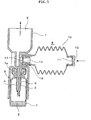
- the speed of the air applied to the freeze-dried composition can be measured as follows. That is, with the jet type dry powder inhaler shown later as Embodiment 1, a mechanism is adopted in which air stored in a bellows body 10 is forcibly introduced onto the freeze-dried composition (cake-like freeze-dried composition: hereinafter also referred to as 'freeze-dried cake') that has been filled into the vessel from an air jet flow path 3, thus applying an air impact, and discharging the resulting fine particles from a discharge flow path 4.
- the flow rate of the air flowing through the air jet flow path 3 can be calculated by dividing the amount of air stored in the bellows body 10 by the time over which the air is fed into the vessel.
- the flow rate of the air flowing through the air introduction flow path 17 can be measured by installing the dry powder inhaler including the vessel in the slot part of apparatus A (a twin impinger: manufactured by Copley, UK) as mentioned in the European Pharmacopoeia (Third Edition Supplement 2001, p113-115), and using a flow meter (KOFLOC DPM-3).
- At least 17 ml/sec can be given as an example of the flow rate of the air applied to the freeze-dried composition filled in the vessel.
- the air flow rate is preferably at least 20 ml/sec, more preferably at least 25 ml/sec.
- the upper limit of the air flow rate there is no particular limitation on the upper limit of the air flow rate, but an example of 900 L/min can be given. This upper limit is preferably 15L/sec, more preferably 10 L/sec, yet more preferably 5 L/sec, still more preferably 4 L/sec, particularly preferably 3 L/sec.
- the flow rate should be in a range constituted from a lower limit and an upper limit selected as appropriate from the above, with there being no particular limitation; nevertheless, 17 ml/sec to 15 L/sec, 20 ml/sec to 10 L/sec, 20 ml/sec to 5L/sec, 20 ml/sec to 4 L/sec, 20 ml/sec to 3 L/sec, and 25 ml/sec to 3 L/sec, can be given as examples of the range.
- the dry powder inhaler used in the present invention can have a mamber for discharging air from a discharge port, as explained in detail below, preferably with a small bore, of a flow path close to the freeze-dried composition housed at the bottom of the vessel, for example a needle part having an air introduction flow path or an air jet flow path as described later in the embodiments.
- the bore of the discharge port of the flow path the preferable range varies according to the size of the vessel and so on, with there being no particular limitations; nevertheless, the bore can be in a range of 0.3 to 10mm, preferably 0.5 to 5mm, more preferably 0.8 to 5mm, much more preferably 1 to 4mm.
- the freeze-dried composition housed in a non-powder form in the vessel can be made into fine particles by introducing air into the vessel.
- the extent of making into fine particles should be such that the particle diameter is suitable for transpulmonary administration; a particle diameter of 10 ⁇ m or less, preferably 5 ⁇ m or less, can be given as an example.
- the dry powder inhaler for use in the present invention encompasses the specific embodiments defined in the following items:
- the dry powder inhalation system for transpulmonary administration of the present invention is a system that combines a freeze-dried composition having a composition such that, by applying an air impact to the freeze-dried composition which exists in a non-powder form having been freeze-dried in a vessel and not subjected to processing such as pulverization, the freeze-dried composition can be made into fine particles having a mean particle diameter of 10 microns or less or a fine particle fraction of 10% or more in the vessel, and a inhaling device comprising prescribed member.
- a user him/herself can prepare the freeze-dried composition which has been provided in a non-powder form into a powdered preparation comprising fine particles having a mean particle diameter of 10 microns or less or a fine particle fraction of 10% or more, which is a preparation suitable for transpulmonary administration, at the time of use (the time of inhalation), and administer (take) the powdered preparation.
- freeze-dried composition which is prepared by freeze-drying a composition liquid containing ingredients in the non-dissolved form and is endowed with the following properties (i) to (iii):
- the freeze-dried composition is subjected to a freeze-drying process in the vessel and it is to be housed therein.
- the amount of the freeze-dried composition housed in the vessel is preferably an amount containing a unit dose (single dose) or a plurality of doses, specifically 2 to 3 doses, of the active ingredients. More preferably, it is an amount containing a unit dose (single dose) of the active ingredient.
- the specific amount of the freeze-dried composition to be housed in the vessel will vary according to the type and content of the active ingredient contained in the freeze-dried composition, and is selected as appropriate from amounts that can be inhaled, with there being no particular limitation; nevertheless, the amount is generally 30 mg or less, preferably 20 mg or less, more preferably 10 mg or less, particularly preferably 5 mg or less.
- the dry powder inhaler it is preferable to adopt a device comprising 1 ⁇ a member for applying an air impact (or a member for introducing air) and 2 ⁇ a member for discharging fine particles (or a member for administering by inhalation), in which, by a member for introducing air (member 1 ⁇ ) air is introduced into (inflow) a vessel which houses the non-powder-form freeze-dried composition and the freeze-dried composition is pulverized into fine particles using the impact (jet pressure) of the air that has been introduced into (flowed into) the vessel, and then, using the member 2 ⁇ for discharging fine particles, the dried powder composition made into fine particles by the member 1 ⁇ is discharged from the vessel. Then, the fine particles are directly administered to a user.
- the dry powder inhalation system suitable for transpulmonary administration according to the present invention includes a vessel housing the freeze-dried composition of the present invention and a dry powder inhaler of the present invention used in combination at the time of inhalation.
- the dry powder inhalation system of the present invention at least when used for inhalation, comprises the vessel housing the freeze-dried composition of the present invention and the dry powder inhaler of the present invention.
- the system of the present invention by introducing air into the vessel housing the freeze-dried composition of the present invention using the dry powder inhaler for applying an air impact having an air speed of at least 1 m/sec and an air flow rate of at least 17 ml/sec to the freeze-dried composition in the vessel.
- the dry powder inhaler for applying an air impact having an air speed of at least 1 m/sec and an air flow rate of at least 17 ml/sec to the freeze-dried composition in the vessel.
- the particle diameter suitable for transpulmonary administration by inhalation examples include the mean particle diameter, more specifically, an aerodynamic mean particle diameter (mass median aerodynamic diameter, MMAD) is 10 microns or less, preferably 5 microns or less.
- the effective particle proportion (fine particle fraction) used efficiently for transpulmonary administration by inhalation is at least 10%, preferably at least 20%, more preferably 25%, yet more preferably at least 30%, and in particular preferably at least 35%.
- the dry powder inhalation system for transpulmonary administration of the present invention is a system for producing a dry powdered preparation suitable for transpulmonary administration and, at the same time, a system for transpulmonarily administering the dry powder preparation to a user.
- the dry powder inhalation system for transpulmonary administration of the present invention encompasses the specific embodiments defined in the following items:
- the present invention further provides a transpulmonary administration method comprising making a freeze-dried composition in a non-powder form into fine particles suitable for transpulmonary administration at the time of usage (administration), and administering the resulting preparation in a powder form with fine particles by inhalation.
- the transpulmonary administration method can be carried out using the dry powder inhalation system for transpulmonary administration of the present invention described in detail in the section (4), and preferably using the dry powder inhalation system for transpulmonary administration comprising the vessel which houses the freeze-dried composition of the present invention described in detail in the section (1), which is prepared by freeze-drying the composition liquid containing ingredients in the non-dissolved form and a dry powder inhaler described in the section (3).
- transpulmonary administration method of the present invention encompasses the specific embodiments defined in the following items:
- the present invention also provides use of a freeze-dried composition in a non-powder form for the transpulmonary administration by inhalation.
- the use encompasses the specific embodiments defined in the following items:
- the present invention provides use of a freeze-dried composition in a non-powder form for manufacture of a dry powdered preparation for transpulmonary administration by inhalation.
- the use encompasses the specific embodiments defined in the following items:
- the present invention relates to a use of a composition liquid containing ingredients in the non-dissolved form for manufacture of a freeze-dried powdered composition for preparing a dry powder preparation for transpulmonary administration.
- composition in the non-dissolved form containing ingredients for manufacture of a freeze-dried composition a preparation method thereof, a preparation method of a freeze-dried composition using the same, a method of using the freeze-dried composition obtained (a preparation method of a freeze-dried preparation for transpulmonary administration) are as described in the above.
- the disintegration index of the non-powder-form freeze-dried composition (freeze-dried cake) of the present invention was calculated in accordance with the following methods.
- n-hexane 1.0 ml of n-hexane is instilled gently down the wall of the vessel into the prepared non-powder-form freeze-dried composition (freeze-dried cake), and agitation is carried out for about 10 seconds at 3,000 rpm using an Automatic Lab-Mixer NS-8 (manufactured by Pasolina).
- the mixture obtained is put into a UV cell (manufactured by Shimadzu GLC Center) of optical path length 1mm and optical path width 10mm, and then the turbidity of the mixture is measured immediately at a measurement wavelength of 500nm using a spectrophotometer (UV-240, manufactured by Shimadzu Corporation).
- the value obtained by dividing the turbidity obtained by the total formulation amount (the total amount (weight) of the active ingredient and the carrier) is taken as the disintegration index.
- a vessel filled with the prepared non-powder-form freeze-dried composition is installed into the dry powder inhaler, and using the device a prescribed air impact is applied on the composition, and the fine powdered preparation thus produced is discharged directly into apparatus A (a twin impinger: manufactured by Copley, UK) as mentioned in the European Pharmacopoeia (Third Edition Supplement 2001, p113-115).
- apparatus A a twin impinger: manufactured by Copley, UK
- the solvents in stage 1 and stage 2 of the apparatus are respectively collected, and the active ingredient contained in each solvent in the stage 1 or stage 2 is assayed using an appropriate method in accordance with the type of active ingredient in the freeze-dried composition, for example a bioassay method or HPLC (see the report of Lucas et al. (Pharm.
- the fraction that can be expected to be delivered into the lungs is that in stage 2 (the aerodynamic diameter of particles recovered in this fraction is 6.4 ⁇ m or less); the proportion of the active ingredient that reaches stage 2 and is recovered here is generally called the fine particle fraction (the amount that can be expected to reach the lungs), and is taken as a yardstick for evaluating the suitability as an inhalation for transpulmonary administration.
- stage 1 and stage 2 the active ingredients contained in stage 1 and stage 2 were quantitated, and the weight amount of the active ingredient in stage 2 was divided by the total weight amount of the active ingredients jetted out (the total weight amount of the active ingredients contained in stage 1 and stage 2: hereinafter also referred to as "Stage 1 + Stage 2") to calculate fine particles fraction.
- Stage 1 + Stage 2 the total weight amount of the active ingredients contained in stage 1 and stage 2: hereinafter also referred to as "Stage 1 + Stage 2”
- suction is carried out at an air suction flow rate of 60 L/min, i.e. 1 L/sec, and hence in the Examples and Comparative Examples below this was followed.
- the dry powder inhaler is an air jet type apparatus for breaking down into fine particles and delivering into the lungs a unit or a plurality of doses of a non-powder-form freeze-dried composition 2 housed at the bottom of a vessel 1, and comprises a needle 5 that has an air jet flow path 3 and a discharge flow path 4, an air intake member 7 that has an inhalation port 6 and is attached to a base end of the needle part 5, a tubular safety cover 8 that surrounds the needle part 5 and also holds the vessel 1, and air pressure-feeding member 9.
- the air pressure-feeding member 9 is manually operated and comprises a tubular bellows body 10.
- An intake port 12 equipped with an intake valve 11, and a discharge port 14 equipped with a discharge valve 13 are provided in the bellows body 10.
- the discharge port 14 is attached to a connecting port 15 formed at the base end of the air jet flow path 3 of the needle part 5, and communicates with the air jet flow path 3.
- the bellows body 10 expands due to the elastic restoring force of the bellows body 10, and in a state in which the discharge valve 13 is closed, the intake valve 11 opens, and air is introduced into the bellows body 10.
- the vessel 1 When using the dry powder inhaler, as shown in Fig. 1, the vessel 1 is inserted into the tubular safety cover 8, and a stopper 1a of the vessel 1 is pierced by the needle part 5, thus communicating the air jet flow path 3 and the discharge flow path 4 with the inside of the vessel 1.
- the bellows body 10 of the air pressure-feeding member 9 is contracted to discharge air from the discharge port 14, then this air passes through the air jet flow path 3 and is jetted out from the tip of the needle part 5 towards the freeze-dried composition 2 in the vessel, and due to the resulting air impact the freeze-dried composition 2 becomes fine particles, which then pass through the discharge flow path 4 of the needle part 5 and are discharged from the inhalation port 6 of the air intake member 7.
- the user (patient) inhales these fine particles from the inhalation port 6 of the air intake member, whereupon the fine particles of the freeze-dried composition 2 are delivered into the lungs of the user (patient).
- the material of the stopper of the vessel for use in the invention is not limited, and can be selected from materials usually used for a stopper of a vessel for holding a drug or compound, such as rubber, plastic, aluminum or the like.
- the air jet amount is set to be about 20 ml, the volume of the vessel about 5 ml, the bore (diameter) of the air jet flow path 3 about 1.2 mm, and the bore (diameter) of the discharge flow path 4 about 1.8 mm.
- the preferable range for the bores of the air jet flow path 3 and the discharge flow path 4 varies according to the size of the vessel and so on. These bores can be selected as appropriate from a range of 0.3 to 10 mm, preferably 0.3 to 7 mm, more preferably 0.5 to 5 mm.
- the discharge amount of fine particles required for administration by inhalation can be adjusted by adjusting the speed of compression of the bellows body 10. Adjustment can also be carried out by such air jet such that most of the freeze-dried composition 2 is broken down into fine particles.
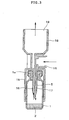
- the dry powder inhaler shown in Fig. 2 comprises a needle part 5 having a suction flow path 16 and an air introduction flow path 17, a tubular safety cover 8, and an air intake member 19 that has an inhalation port 18 and communicates with the suction flow path 16.
- the air intake member 19 is connected to the base end of the suction flow path 16 of the needle part 5.
- the vessel 1 When using the dry powder inhaler, as shown in Fig. 2, the vessel 1 is inserted into the tubular safety cover 8, and an stopper 1a of the vessel 1 is pierced by the needle part 5, thus communicating the suction flow path 16 and the air introduction flow path 17 with the inside of the vessel 1.
- air in the vessel 1 is sucked in from the inhalation port 18 via the suction flow path 16, and at the same time outside air flows into the vessel 1, which is now at a negative pressure, from the air introduction flow path 17.
- the freeze-dried composition 2 is made into fine particles through the air impact acting on the freeze-dried composition 2, and the fine particles produced are delivered into the user's (patient's) lungs from the inhalation port 18 via the suction flow path 16.
- the air flow rate of one inhalation of the user (patient) is 5 to 300 L/min, preferably 10 to 200 L/min, more preferably 10 to 100 L/min, but the design of the self-inhaling type dry powder inhaler of the present invention is modified as appropriate in accordance with the respiratory ability of the user (patient) using the device.
- the volume of the vessel has been set to about 10ml, and the bores of the air introduction flow path 17 and the suction flow path 16 to about 1.5mm.
- the settings are such that the freeze-dried composition 2 is made into fine particles and discharged from the inhalation port 18 with virtually none left behind through one inhalation of the user (patient).
- FIG. 3 A description of an embodiment (second embodiment) of the self-inhaling type dry powder inhaler used in the present invention will now be given using Fig. 3.
- the dry powder inhaler shown in Fig. 3 is the same as the jet type dry powder inhaler shown in Fig. 1 with the bellows body 10 used for pressure-feeding air removed from the connecting port 15.
- the discharge flow path 4 of the jet type dry powder inhaler of Fig. 1 corresponds to a suction flow path 16, the air jet flow path 3 to an air introduction flow path 17, and the air intake member 7 having the inhalation port 6 to an air intake member 19 having an inhalation port 18.
- the main points are the same as with the dry powder inhaler shown in Fig. 2.
- air in the vessel 1 is sucked in from the inhalation port 18 via the suction flow path 16, and at the same time outside air flows into the vessel 1, which is now at a negative pressure, from the air introduction flow path 17.
- the freeze-dried composition 2 is made into fine particles through the air impact produced accompanying this inflow of air.
- the fine particles produced are then delivered into the user (patient's) lungs from the inhalation port 18.
- the air flow rate for one inhalation of the user (patient) is generally in a range of 5 to 300 L/minute; however, with the dry powder inhaler shown in Fig. 3, in accordance with the respiratory ability of the user (patient) in question, the volume of the vessel was set to about 5 ml, the bore (diameter) of the air introduction flow path 17 to about 1.2 mm, and the bore (diameter) of the suction flow path 16 to about 1.8 mm. As a result, the settings are such that most of the freeze-dried composition 2 is made into fine particles and discharged from the inhalation port 18 through one inhalation of the user (patient).
- the self-inhaling type dry powder inhaler is constituted in this way, then by detachably installing air pressure-feeding member 9 such as a bellows body 10 into the connecting port 15, the self-inhaling type dry powder inhaler can be changed into a jet type.
- a single dry powder inhaler can thus be used as either a self-inhaling type or a jet type as desired.
- Each of the above dry powder inhalers of the present invention regardless of whether it is a self-inhaling type or a jet type, can be constituted such that it is possible to select and set the size of the air impact such that the freeze-dried composition becomes fine particles of mean particle diameter 10 microns or less, preferably 5 microns or less, and flies out with almost none left behind.
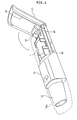
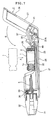
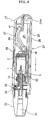
- Fig. 4 is a perspective view showing the dry powder inhaler
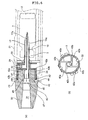
- Fig. 5 is a cross section showing the dry powder inhaler
- Fig. 6 (a) is a partial cross section showing a needle part 5 and a suction port 31 of the dry powder inhaler
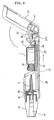
- Figs. 7 to 10 are cross sections for explaining the operation of the dry powder inhaler.
- the dry powder inhaler comprises a needle part 5 in which are formed a suction flow path 16 and an air introduction flow path 17, a holder part 22 for holding a vessel 1, a housing chamber 20 for housing the vessel 1 via the holder part 22, a guide part 23 provided in the housing chamber 20 for guiding the holder part 22 in the axial direction of the needle part 5, and a holder operating part 24 for advancing and retreating the holder part 22 along the guide part 23; these are all housed in a tubular housing 21.
- a mouthpiece 32 that has a suction port 31 and communicates with the suction flow path 16 of the needle part 5 is provided at a tip of the housing 21.
- the housing 21 is formed from a housing main body 26 in which is formed a removal/insertion port 25 in a position in which the holder part 22 is retreated, and a lid 27 that opens and closes the removal/insertion port 25.
- the lid 27 is connected to the housing main body 26 by a hinge 21A, and a window 28 for verifying whether the vessel 1 has been loaded is provided in the lid 27.
- An introduction port 29 for introducing outside air is provided in a wall of the housing 21, and a check valve 30 is installed at the introduction port 29.
- the mouthpiece 32 is provided at the tip of the housing 21.
- the suction port 31 of the mouthpiece 32 is covered by a cap 32a when the dry powder inhaler is not being used.
- a flange-shaped partition part 33 is formed at the base end of the needle part 5, and an end of the air introduction flow path 17 passes through the partition part 33 and opens out in an outer peripheral direction of the partition part 33.
- a peripheral wall part 34 extends from an outer rim part of the partition part 33 towards the suction port 31 of the mouthpiece 32.
- the needle part 5 is installed into the housing 21 by fitting the partition part 33 into the tip part of the housing 21. Through this installation, the axial direction of the housing 21 and the axial direction of the needle part 5 are aligned with one another.
- a remover 35 for lifting the vessel 1 from the base of the holder part 22 and removing the vessel 1 is attached to the holder part 22, and a lever 36 for lifting the vessel 1 up is formed on the remover 35.
- the holder operating part 24 comprises a mechanism part 37 for moving the holder part 22 back and forth along the axial direction of the housing 21, and an operating lever for operating the mechanism part 37.
- the mechanism part 37 comprises a connector 39.
- One end of the connector 39 is connected to the holder part 22 by a hinge 40, and the other end of the connector 39 is connected to the lid 27 by a hinge 41.
- the lid 27 is also used as the above-mentioned operating lever. By opening and closing the lid 27, the holder part 22 is advanced and retreated along the guide part 23.
- the point of action of the force for pushing down the lid 27 is shown by the arrow C in Fig. 7. That is, the distance from the hinge 21A to the point of action is made to be longer than the distance from the hinge 21A to the hinge 41.
- the lid (operating lever) 27 can be operated by a force smaller than the force necessary to pierce the stopper 1a of the vessel 1 with the needle part 5.
- second introduction paths 42 for supplementary introduction of air are formed in the dry powder inhaler.
- the dry powder inhaler can be used without imposing a burden even by a user (patient) having reduced pulmonary capacity or a child patient.
- the second introduction paths 42 may be omitted.
- Introduction grooves 42a are provided in the partition part 33 of the needle part 5 and introduction grooves 42b are provided in the peripheral wall part 34.
- a slight gap 43 is formed between the mouthpiece 32 and the housing 21, and one end 44 of the second introduction paths 42 opens out to the outside via the gap 43, while the other end 45 of the second introduction paths 42 opens out into the suction port 31 of the mouthpiece 32.
- a wall 47 having vent holes 46 is provided in the suction port 31. Consequently, even in the case that the air impact applied to the freeze-dried composition 2 is small due to a lack of suction force or the like, and part of the freeze-dried composition 2 is not made into a powder, the non-powder part can be made into a powder when passing through the vent holes 46 of the wall 47.
- a tip opening 17a of the air introduction flow path 17 of the needle part 5 is made to be closer to the freeze-dried composition 2 than a tip opening 16a of the suction flow path 16.
- dropping of the flow speed of the air that flows into the vessel 1 from the tip opening 17a of the air introduction flow path 17 can be suppressed as much as possible, and hence an effective air impact can be applied to the freeze-dried composition 2.
- the tip opening 16a of the suction flow path 16 of the needle part 5 is further from the freeze-dried composition 2 than the tip opening 17a of the air introduction flow path 17, making of the freeze-dried composition 2 can be made to into a fine powder in the vessel 1 as much as possible before being sucked into the air introduction flow path 16 of the needle part 5.
- the dry powder inhaler is used as follows. Firstly, the lid 27 is lifted up to open the removal/insertion port 25 of the housing 21 as in Fig. 7, whereby the holder part 22 is pulled backwards to reach the removal/insertion port 25 of the housing 21. Next, the vessel 1 is installed in the holder part 22 with the stopper 1a facing forwards. Next, the lid 27 is pushed down to close the removal/insertion port 25 of the housing 21 as in Fig. 8, whereby the holder part 22 is pushed towards the needle part 5 by the connector 39, and the stopper 1a of the vessel 1 is pierced by the tip of the needle part 5, thus communicating the suction flow path 16 and the air introduction flow path 17 of the needle part 5 with the inside of the vessel 1.
- the air flow rate of one inhalation of the user (patient) is generally in a range of 5 to 300 L/min, but with the dry powder inhaler shown in Figs. 4 to 10, in accordance with the respiratory ability of the user (patient), the volume of the vessel 1 has been set to about 5 ml, the bore (diameter) of the air introduction flow path 17 to about 2.5 mm, and the bore (diameter) of the suction flow path 16 to about 2.5 mm.
- the settings are such that most of the freeze-dried composition 2 is made into fine particles and discharged from the suction port 31 through one inhalation of the user (patient).
- an operating member 48 is provided so as to be freely rotatable in the circumferential direction of the housing 21 as shown by the arrow.
- the mechanism part of the holder operating part which is not shown in the drawing, comprises a spiral groove and a follower that engages into the same; when the operating member 48 is rotated, this rotation is converted to linear movement of the holder part 22 in the axial direction of the needle part 5. Note that the angle of rotation of the operator 48 is about 180o.
- annular operating member 4 9 is installed so as to be freely rotatable in the housing 21.
- the mechanism part of the holder operating part which is not shown in the drawing, comprises a feed screw; when the operating member 49 is rotated, this rotation is converted to linear movement of the holder part 22 in the axial direction of the needle part 5.
- the holder part 22 can be withdrawn from the back of the housing 21.
- 'LipofectAMINE 2000' which is a cationic gene transfer liposome (manufactured by Invitrogen Corporation) and 24 ⁇ g of pEGFP-C2, which is a plasmid DNA (manufactured by Clontech), were blended into 1,200 ⁇ l of OPTI-MEM I Reduced Serum Medium (manufactured by Invitrogen Corporation, modified Eagle's minimum essential medium), and the resultant was mixed and suspended to form a complex in the Medium.
- OPTI-MEM I Reduced Serum Medium manufactured by Invitrogen Corporation, modified Eagle's minimum essential medium
- the geometric mean particle diameter of the complex formed was measured with a Dynamic Light Scattering Particle Size Analyzer (Electrophoretic Light Scattering Spectrophotometer, ELS-8000, manufactured by Otsuka Electronics Co., Ltd.) Subsequently, 100 ⁇ l of suspension containing the complex formed was added and mixed to 400 ⁇ l of aqueous L-leucine solution (5 mg/ml) in which the L-leucine was dissolved in water in advance, which aqueous solution was contained in a vessel (trunk diameter of 18 mm), and 10 samples were prepared in this manner. Thereafter, freeze-drying was carried out using a shelf-type freeze-dryer (Lyovac GT-4, manufactured by Leybold).
- the disintegration index of the non-powder-form (cake-like) freeze-dried composition (freeze-dried cake) obtained was calculated.
- a vessel containing the non-powder-form freeze-dried composition (freeze-dried cake) obtained was installed in a jet type dry powder inhaler (having a bellows body 10 capable of supplying an amount of air of about 20ml; Embodiment 1, Fig. 1) designed such that the bore of the air jet flow path 3 was 1.2 mm and the bore of the discharge flow path 4 was 1.8 mm.
- the geometric mean particle diameter of particles contained in the suspension in the suspended-form, the disintegration index, and the mass median aerodynamic diameter ( ⁇ m ⁇ SD) of the fine particles jetted out from the inhaler are shown in Table 1 for each of the freeze-dried compositions. Freeze-dried composition Geometric mean particle diameter ( ⁇ m) Disintegration index Mass median aerodynamic diameter ( ⁇ m ⁇ SD, MMAD) LipofectAmine 2000+pEGFP-C2+Leucine 0.827 0.186 1.762 ⁇ 1.491
- the non-powder-form freeze-dried cake having a disintegration index of 0.186 was disintegrated by the air impact arising through an air speed of about 35 m/sec and an air flow rate of about 40 ml/sec, becoming a fine-particle-form powdered preparation of mass median aerodynamic diameter of 5 ⁇ m or less suitable for transpulmonary administration. Consequently, it was verified that a sample before freeze-drying, even in a non-dissolved form (here, in the suspension form), can be provided as a freeze-dried composition which can be made into fine-particle-form dried powder suitable for transpulmonary administration by the specific air impact defined in the present invention.
- the sample before freeze-drying can be used for the dry powder inhaler for transpulmonary administration of the present invention, and thus transpulmonary administration can be efficiently carried out.
- genes or antisense molecules capable of offering therapeutic effects by transpulmonary administration can be introduced into a body by employing a cancer suppression gene p53 or a cystic fibrosis transmembrane conductance regulator (CFTR) instead of the plasmid DNA (pEGFP-C2) employed in the present Example.
- CFTR cystic fibrosis transmembrane conductance regulator
- 'LipofectAMINE 2000' which is a cationic gene transfer liposome (manufactured by Invitrogen corporation) and 10 ⁇ g of Oligo-RNA (manufactured by Otsuka Pharmaceutical Co., Ltd.) were mixed and suspended in the presence of OPTI-MEM I Reduced Serum Medium (manufactured by Invitrogen corporation, modified Eagle's minimum essential medium), to form a complex.
- the geometric mean particle diameter of the complex formed was measured with a Dynamic Light Scattering Particle Size Analyzer (Electrophoretic Light Scattering Spectrophotometer, ELS-8000, manufactured by Otsuka Electronics Co., Ltd.).
- Example 2 100 ⁇ l of suspension containing the complex formed was added to 400 ⁇ l of aqueous L-leucine solution (5 mg/ml) prepared by dissolving L-leucine into water in advance, which aqueous solution was contained in a vessel (trunk diameter of 18 mm), and 10 samples were prepared in the same manner, to prepare samples for freeze-drying (Example 2).
- aqueous L-leucine solution 5 mg/ml
- dextran 40 instead of L-leucine aqueous solution employed in the above was used for preparing samples for freeze-drying (10 samples) in the same manner as in the above (Comparative Example 1).
- freeze-drying was carried out using a shelf-type freeze-dryer (Lyovac GT- 4, manufactured by Leybold).
- the disintegration index of the non-powder-form (cake-like) freeze-dried composition (freeze-dried cake) obtained was calculated.
- a vessel containing the non-powder-form freeze-dried composition (freeze-dried cake) obtained was installed in a jet type dry powder inhaler (having a bellows body 10 capable of supplying an amount of air of about 20ml; Embodiment1, Fig. 1) designed such that the bore of the air jet flow path 3 was 1.2 mm and the bore of the discharge flow path 4 was 1.8 mm.
- the fine particles were collected using a particle size distribution meter (Aerosizer: manufactured by Amherst Process Instrument, Inc., USA) fitted with an Aerobreather (manufactured by Amherst Process Instrument, Inc., USA) (measurement conditions: breath rate: 60 L/min, breath volume: 1L, acceleration: 19), and the particle size distribution of the fine particles that had been made was thus measured, and the mass median aerodynamic diameter ( ⁇ m ⁇ SD) was calculated from the particle size distribution.
- the freeze-dried composition of Comparative Example 1 was not dispersed by the air impact arising through an air speed of about 35 m/sec and an air flow rate of about 40 ml/sec, and hence a mass median aerodynamic diameter could not be calculated.
- the geometric mean particle diameter of particles contained in the suspension in the suspended-form, the disintegration index, and the mass median aerodynamic diameter ( ⁇ m ⁇ SD) of the fine particles jetted out from the inhaler are shown in Table 2 for each of the freeze-dried compositions (Example 2, Comparative Example 1). Freeze-dried composition Geometric mean particle diameter ( ⁇ m) Disintegration index Mass median aerodynamic diameter ( ⁇ m ⁇ SD, MMAD) Example 2) LipofectAMINE 2000 + Oligo-RNA + Leucine 1.19 0.165 1.633 ⁇ 1.496 Comparative Example 1) LipofectAMINE 2000 + Oligo-RNA + Dextran 40 1.19 0.002 not dispersed and thus unmeasureable
- the non-powder-form freeze-dried cake having a disintegration index of 0.165 was disintegrated by the air impact arising through an air speed of about 35 m/sec and an air flow rate of about 40 ml/sec, becoming a fine-particle-form powdered preparation of mass median aerodynamic diameter of 5 ⁇ m or less suitable for transpulmonary administration even if the sample before freeze-drying was in the non-dissolved form (here, in the suspension form) as in Example 1.
- non-powder-form freeze-dried cake having a disintegration index of 0.002 was neither dispersed nor made into fine particles by the air impact, and hence was not suitable for providing a dry powder preparation for transpulmonary administration.
- 'Superfect' which is an activate dendrimer molecule (cationic polymer) for gene transfer (manufactured by Qiagen) and 5 ⁇ g of Oligo-RNA (manufactured by Otsuka Pharmaceutical Co., Ltd.) (Example 3, Comparative Example 2) or 24 ⁇ g of pEGFP-C2 (manufactured by Clontech) which is a plasmid DNA (Examples 4 and 5) were mixed and suspended in the presence of 1,200 ⁇ g of OPTI-MEM I Reduced Serum Medium (manufactured by Invitrogen corporation, modified Eagle's minimum essential medium), to form a complex.
- OPTI-MEM I Reduced Serum Medium manufactured by Invitrogen corporation, modified Eagle's minimum essential medium
- the geometric mean particle diameter of the complex formed was measured with a Dynamic Light Scattering Particle Size Analyzer (Electrophoretic Light Scattering Spectrophotometer, ELS-8000, Otsuka Electronics Co., Ltd.) or a Laser Diffraction/Scattering Particle Size Distribution Analyzer (Laser Diffraction Particle Size Analyzer, SALD-3000J, Shimadzu Corporation).
- a Dynamic Light Scattering Particle Size Analyzer Electrophoretic Light Scattering Spectrophotometer, ELS-8000, Otsuka Electronics Co., Ltd.
- Laser Diffraction/Scattering Particle Size Distribution Analyzer Laser Diffraction Particle Size Analyzer, SALD-3000J, Shimadzu Corporation.
- Example 2 As a Comparative Example, 400 ⁇ l of aqueous dextran 40-dissolved solution (5 mg/ml) instead of the aqueous L-leucine-dissolved solution employed in Example 3 was used to prepare samples for freeze-drying (10 samples) in the same manner (Comparative Example 2).
- freeze-drying was carried out using a shelf-type freeze-dryer (Lyovac GT-4, manufactured by Leybold).
- the disintegration index of the non-powder-form (cake-like) freeze-dried composition (freeze-dried cake) obtained was calculated.
- a vessel containing the non-powder-form freeze-dried composition (freeze-dried cake) obtained was installed in a jet type dry powder inhaler (having a bellows body 10 capable of supplying an amount of air of about 20ml; Embodiment 1, Fig. 1) designed such that the bore of the air jet flow path 3 was 1.2 mm and the bore of the discharge flow path 4 was 1.8 mm.
- freeze-dried composition obtained according to Examples 3, 4, and 5 it was verified that, by introducing an amount of air of about 20 ml from the dry powder inhaler into the vessel (giving an air impact arising through an air speed of about 35 m/sec and an air flow rate of about 40 ml/sec), the non-powder-form freeze-dried cake in the vessel was made into fine particles, and the fine particles were jetted out from the vessel via the discharge flow path 4 in an instant.
- the fine particles were collected using a particle size distribution meter (Aerosizer: manufactured by Amherst Process Instrument, Inc., USA) fitted with an Aerobreather (manufactured by Amherst Process Instrument, Inc., USA) (measurement conditions: breath rate: 60 L/min, breath volume: 1 L, acceleration: 19); the particle size distribution of the fine particles that had been made was thus measured, and the mass median aerodynamic diameter ( ⁇ m ⁇ SD) was calculated from the particle size distribution in the same manner as in Example 1.
- the non-powder-form freeze-dried cakes having a disintegration index of 0.080 to 0.225, that is, 0.05 or more, were disintegrated by the air impact arising through an air speed of about 35 m/sec and an air flow rate of about 40 ml/sec, becoming a fine-particle-form powdered preparations of mass median aerodynamic diameter of 5 ⁇ m or less suitable for transpulmonary administration even if the sample before freeze-dried was in the non-dissolved form (here, in the suspension form) as in Example 1 and particles contained therein had the geometric mean particle diameter of 11 ⁇ m and thus were prone to aggregate.
- the non-powder-form freeze-dried cake having the disintegration index of 0.003 was neither dispersed nor made into fine particles by the air impact, hence was not suitable for preparing a dry powder preparation for transpulmonary administration.
- the samples before freeze-drying, even in the non-dissolved form can be provided as afreeze-dried compositions which can be made into fine-particle-form dried powders suitable for transpulmonary administration by the specific air impact defined in the present invention. More specifically, the samples before freeze-drying, even in the non-dissolved form, can be used for the dry powder inhaler for transpulmonary administration of the present invention, and thus transpulmonary administration can be efficiently carried out.
- genes or antisense molecules capable of offering curative effects by transpulmonary administration can be introduced into a body by employing a cancer suppression gene p53 or a cystic fibrosis transmembrane conductance regulator (CFTR) instead of the plasmid DNA (pEGFP-C2) employed in the present Example.
- CFTR cystic fibrosis transmembrane conductance regulator
- Oligo-RNA is a kind of RNAi (RNA interference) and is a RNA duplex applicable to RNAi technology
- a short duplex RNA may thus be introduced corresponding to a target gene, whereby a function of a messenger RNA of the target gene can be specifically controlled (suppressed), and hence is applicable to a therapy for lung cancer.
- dry powder inhalation system of the present invention can be efficiently utilized for gene therapy.
- 'Superfect' which is an activate dendrimer molecule for gene transfer (manufactured by Qiagen), and 5 ⁇ g of Oligo-RNA (manufactured by Otsuka Pharmaceutical Co., Ltd.) were mixed and suspended in the presence of 1,200 ⁇ g of OPTI-MEM I Reduced Serum Medium (manufactured by Invitrogen corporation, modified Eagle's minimum essential medium), to form a complex.
- the geometric mean particle diameter of the complex formed was measured with a Laser Diffraction/Scattering Particle Size Distribution Analyzer (Laser Diffraction Particle Size Analyzer, SALD-3000J, Shimadzu Corporation).
- a vessel containing the non-powder-form freeze-dried composition (freeze-dried cake) obtained was installed in a jet type dry powder inhaler (having a bellows body 10 capable of supplying an amount of air of about 20ml; Embodiment 1, Fig. 1) designed such that the bore of the air jet flow path 3 was 1.2 mm and the bore of the discharge flow path 4 was 1.8 mm.
- a jet type dry powder inhaler having a bellows body 10 capable of supplying an amount of air of about 20ml; Embodiment 1, Fig. 1
- Example 6 It was verified that, by introducing an amount of air of about 20 ml from the dry powder inhaler into the vessel (giving an air impact arising through an air speed of about 35 m/sec and an air flow rate of about 40 ml/sec), the freeze-dried composition of Example 6 was made into fine particles, and the fine particles were jetted out from the vessel via the discharge flow path 4 in an instant.
- the fine particles were collected using a particle size distribution meter (Aerosizer: manufactured by Amherst Process Instrument, Inc., USA) fitted with an Aerobreather (manufactured by Amherst Process Instrument, Inc., USA (measurement conditions: breath rate: 60 L/min, breath volume: 1 L, acceleration: 19); the particle size distribution of the fine particles that had been made was thus measured, and the mass median aerodynamic diameter ( ⁇ m ⁇ SD) was calculated from the particle size distribution in the same manner as in Example 1.
- the geometric mean particle diameter of particles contained in the suspension in the suspended-form, the disintegration index, and the mass median aerodynamic diameter ( ⁇ m ⁇ SD) of the fine particles jetted out from the inhaler are shown in Table 4 for each of the freeze-dried compositions. Freeze-dried composition Geometric mean particle diameter ( ⁇ m) Disintegration index Mass median aerodynamic diameter ( ⁇ m ⁇ SD, MMAD) 6) Superfect + Oligo-RNA + Valine 13.9 0.275 1.589 ⁇ 1.553
- the non-powder-form freeze-dried cake having a disintegration index of 0.275 was disintegrated by the air impact arising through an air speed of about 35 m/sec and an air flow rate of about 40 ml/sec, becoming a fine-particle-form powdered preparation of mass median aerodynamic diameter of 5 ⁇ m or less suitable for transpulmonary administration even if the sample before freeze-dried was in the non-dissolved form (here, in the suspension form) as in Example 1 and particles contained therein had the geometric mean particle diameter of about 14 ⁇ m and thus were prone to aggregate.
- the samples before freeze-drying can be provided as a freeze-dried composition which can be made into fine-particle-form dried powder suitable for transpulmonary administration by the specific air impact defined in the present invention. More specifically, the freeze-dried composition containing ingredients can be used for the dry powder inhaler for transpulmonary administration of the present invention even when the ingredients are not dissolved or are difficult to dissolve into the solvent, and thus transpulmonary administration can be efficiently carried out.
- a solution obtained by dissolving insulin (0.2 mg in Example 7 and 1 mg in Example 8) (Recombinant Human Insulin Crystal, manufactured by Biobras, Brazil; relative activity: 26.4U/mg) into hydrochloric acid solution, and a solution obtained by dissolving various carriers as shown in Table 5 into purified water were separately prepared, and these solutions were mixed at the proportion shown in Table 5, to form various suspensions in the suspended form.
- the geometric mean particle diameter of particles contained in the suspensions was measured with a Laser Diffraction/Scattering Particle Size Distribution Analyzer (Laser Diffraction Particle Size Analyzer, SALD-3000J, Shimadzu Corporation).
- the fine particle fraction (%) was calculated with a twin impinger (manufactured by Copley, UK) (applying an air impact arising through an air speed of about 95 m/sec and an air flow rate of about 295 ml/sec to the freeze-dried cake).
- the geometric mean particle diameter of particles contained in the suspension in the suspended-form, the disintegration index and the fine particle fraction (%) are shown for each of the freeze-dried compositions in Table 5.
- the non-powder-form freeze-dried compositions (freeze-dried cakes), which showed a disintegration index of at least 0.238, were easily made into fine particles in the vessel by the above-mentioned air impact, even though the sample before freeze-drying was in the form of containing an active ingredient (insulin) in the non-dissolved form, and it was possible to produce a powdered preparation suitable for transpulmonary administration.
- a solution obtained by dissolving 1 mg of insulin (Recombinant Human Insulin Crystal, manufactured by Biobras, Brazil; relative activity: 26.4 U/mg) into hydrochloric acid solution, and a solution obtained by dissolving 0.5 mg of phenylalanine into purified water were separately prepared. These solutions were mixed, and then the pH was adjusted with sodium hydroxide, to form various suspensions in the suspended form. The geometric mean particle diameter of particles contained in the suspensions was measured with a Laser Diffraction/Scattering Particle Size Distribution Analyzer (Laser Diffraction Particle Size Analyzer, SALD-3000J, manufactured by Shimadzu Corporation).
- the various suspensions were filled into vessels (trunk diameter 18 mm), and freeze-drying was carried out using a shelf-type freeze-dryer (Lyovac GT-4, manufactured by Leybold).
- the disintegration index of the non-powder-form freeze-dried compositions (freeze-dried cake) obtained was calculated.
- a vessel (trunk diameter 18mm) filled with each non-powder-form freeze-dried composition obtained was installed in a jet-type dry powder inhaler (having a bellows body capable of supplying an amount of air of about 20 ml) configured such that the bore of the air introduction flow path was 1.2 mm and the bore of the suction flow path was 1.8 mm.
- the fine particle fraction (%) was calculated with a twin impinger (manufactured by Copley, UK) (applying an air impact arising through an air speed of about 35 m/sec and an air flow rate of about 40 ml/sec to the freeze-dried cake).
- the geometric mean particle diameter of particles contained in the suspension in the suspended-form, the disintegration index and the fine particle fraction (%) are shown for each of the freeze-dried compositions in Table 6.
- the non-powder-form freeze-dried compositions (freeze-dried cakes), which showed a disintegration index of at least 0.36, were easily made into fine particles in the vessel by the above-mentioned air impact, even though the sample before freeze-drying was in the form of containing an active ingredient (insulin) in the non-dissolved form, and it was possible to produce a powdered preparation suitable for transpulmonary administration.
- a solution obtained by dissolving 0.1 mg of insulin (Recombinant Human Insulin Crystal, manufactured by Biobras, Brazil; relative activity: 26.4 U/mg) into hydrochloric acid solution, and a solution obtained by dissolving various carriers as shown in Table 7 into purified water were separately prepared. These solutions were mixed, and then the pH was adjusted with sodium hydroxide, to form various suspensions in the suspended form.
- the geometric mean particle diameter of particles contained in the suspensions was measured with a Laser Diffraction/Scattering Particle Size Distribution Analyzer (Laser Diffraction Particle Size Analyzer, SALD-3000J, Shimadzu Corporation).
- the fine particle fraction (%) was calculated with a twin impinger (manufactured by Copley, UK) (applying an air impact arising through an air speed of about 95 m/sec and an air flow rate of about 295 ml/sec to the freeze-dried cake).
- the geometric mean particle diameter of particles contained in the suspension in the suspended-form, the disintegration index and the fine particle fraction (%) are shown for each of the freeze-dried compositions in Table 7.
- the non-powder-form freeze-dried compositions (freeze-dried cakes), which showed a disintegration index of at least 0.051, were easily made into fine particles in the vessel by the above-mentioned air impact, even though the sample before freeze-drying was in the form of containing an active ingredient (insulin) in the non-dissolved form, and it was possible to produce a powdered preparation suitable for transpulmonary administration.
- a solution obtained by dissolving 0.1 mg of insulin (Recombinant Human Insulin Crystal, manufactured by Biobras, Brazil; relative activity: 26.4 U/mg) into hydrochloric acid solution, and a solution obtained by dissolving valine into purified water were separately prepared. These solutions were mixed, and then the pH was adjusted to pH 6.5 with sodium hydroxide, to form various suspensions in the suspended form.
- the geometric mean particle diameter of particles contained in the suspensions was measured with a Laser Diffraction/Scattering Particle Size Distribution Analyzer (Laser Diffraction Particle Size Analyzer, SALD-3000J, Shimadzu Corporation).
- an air impact arising through an air speed of about 1 m/sec and an air flow rate of about 17 ml/sec is applied to the non-powder form freeze-dried composition (freeze-dried cake) contained in the vessel, and fine particles generated were directly jetted from the inhaler to an Aerosizer (manufactured by Amherst Process Instrument, Inc., USA) fitted with an Aerobreather (manufactured by Amherst Process Instrument, Inc., USA: measurement conditions: breath rate: 1 L/min, breath volum: 0.1 L), which is an artificial lung model capable of directly measuring the particle size distribution of the jetted particles; the particle size distribution of the fine particles was thus measured.
- an Aerosizer manufactured by Amherst Process Instrument, Inc., USA
- Aerobreather manufactured by Amherst Process Instrument, Inc., USA: measurement conditions: breath rate: 1 L/min, breath volum: 0.1 L
- the mass median aerodynamic diameter ( ⁇ m ⁇ SD) of the jetted fine particles was calculated.
- the geometric mean particle diameter of particle contained in the suspension in non-suspended form, the disintegration index for each of the freeze-dried compositions and the mass median aerodynamic diameter of the particles jetted out from the inhaler are shown in Table 8. Freeze-dried composition Geometric mean particle diameter ( ⁇ m) Disintegration index Mass median aerodynamic diameter ( ⁇ m ⁇ SD, MMAD) 14) 0.1 mg insulin + 0.5 mg Valine 0.57 0.221 1.875 ⁇ 1.384
- the non-powder-form freeze-dried compositions (freeze-dried cakes), which showed a disintegration index of 0.221, were easily made into fine particles in the vessel by the above-mentioned air impact, even though the sample before freeze-drying was in the form of containing an active ingredient (insulin) in the non-dissolved form, and it was possible to produce a powdered preparation suitable for transpulmonary administration.
- Insulin Recombinant Human Insulin Crystal, manufactured by Biobras, Brazil; relative activity: 26.4U/mg (1mg, 2mg), or insulin and any of various carriers as shown in Table 6, was/were made up to 0.2ml by dissolving in injection distilled water containing hydrochlolic acid, this was filled into vessels (trunk diameter 18 mm), and freeze-drying was carried out using a shelf-type freeze-dryer (Lyovac GT-4, manufactured by Leybold). The disintegration index of the non-powder-form freeze-dried composition (freeze-dried cake) obtained was calculated.
- a vessel (trunk diameter 18mm) filled with the non-powder-form freeze-dried composition obtained was installed in a self-inhaling type dry powder inhaler (Embodiment 3, Figure 3) designed such that the bore of the air introduction flow path 17 was 1.99mm and the bore of the suction flow path 16 was 1.99mm (Embodiment 3, Figure 3).
- the fine particle fraction (%) was calculated with a twin impinger (manufactured by Copley, UK) (applying an air impact arising through an air speed of about 95 m/sec and an air flow rate of about 295 ml/sec to the freeze-dried cake).
- the disintegration index and the fine particle fraction (%) are shown in Table 9 for each of the freeze-dried compositions.
- Freeze-dried composition Disintegration index Fine particle fraction (%) Ref. 1) 1mg insulin 0.159 75.0 Ref. 2) 1mg insulin + 1.4mg leucine 0.145 80.7 Ref. 3) 1mg insulin + 1.0mg valine 0.110 79.4 Ref. 4) 2mg insulin 0.177 42.4 Ref. 5) 2mg insulin + 1.4mg leucine 0.137 65.1
- a vessel (trunk diameter 18 mm) filled with the non-powder-form freeze-dried composition obtained was installed in a jet type dry powder inhaler (having a bellows body capable of supplying an amount of air of about 20 ml, Embodiment 1, Figure 1) designed such that the bore of the air jet flow path was 1.2 mm and the bore of the discharge flow path was 1.8 mm.
- a jet type dry powder inhaler having a bellows body capable of supplying an amount of air of about 20 ml, Embodiment 1, Figure 1
- an air impact arising through an air speed of about 35 m/sec and an air flow rate of about 40 ml/sec is applied to the non-powder form freeze-dried composition (freeze-dried cake) contained in the vessel, and fine particles generated were directly jetted from the inhaler to an Aerosizer (manufactured by Amherst Process Instrument, Inc., USA) fitted with an Aerobreather (manufactured by Amherst Process Instrument, Inc., USA: measurement conditions: breath rate: 60 L/min, breath volume: 1 L), which is an artificial lung model capable of directly measuring the particle size distribution of the jetted particles; the particle size distribution of the fine particles was thus measured. From the results, the mass median aerodynamic diameter ( ⁇ m ⁇ SD) of the jetted fine particles was calculated.
- a vessel (trunk diameter 18mm) filled with the non-powder-form freeze-dried composition obtained was installed in a self-inhaling type dry powder inhaler designed such that the bore of the air introduction flow path was 1.99 mm and the bore of the suction flow path was 1.99 mm (Embodiment 3, Figure 3).
- the fine particle fraction (%) was calculated with a twin impinger (manufactured by Copley, UK) (applying an air impact arising through an air speed of about 95 m/sec and an air flow rate of 295 ml/sec to the freeze-dried cake).
- the disintegration index, the mass median aerodynamic diameter ( ⁇ m ⁇ SD) of the fine particles jetted out from the jet type dry powder inhaler, and the fine particle fraction (%) of the fine particles obtained by the self-inhaling type dry powder inhaler are shown in Table 10 for each of the freeze-dried compositions.
- the non-powder-form freeze-dried compositions (freeze-dried cakes), which showed a disintegration index of 0.124 or more, were easily made into fine particles in the vessel by the air impact arising through an air speed of about 35 m/sec and an air flow rate of about 40 ml/sec or the air impact arising through an air speed of about 95 m/sec and an air flow rate of 295 ml/sec.
- the mean particle diameter of the fine particles manufactured by the air impact arising through an air speed of about 95 m/sec and an air flow rate of 295 ml/sec was 5 ⁇ m or less, and hence it was possible to produce a powdered preparation suitable for transpulmonary administration.
- a freeze-dried composition can be made into fine particles down to a size necessary for delivery into the lungs, and moreover administration of the fine particles into the lungs through inhalation is possible. That is, according to the dry powder inhalation system for transpulmonary administration of the present invention, a freeze-dried composition that has been prepared in a non-powder form can be made into fine particles at the time of use (the time of administration), and administered through inhalation at the same time, and hence a special operation for making the preparation into fine particles becomes unnecessary.
- the dry powder inhalation system for transpulmonary administration (preparation system) of the present invention, there is no risk of loss during the manufacturing process (deactivation of the drug or collection loss through a filling operation) or loss during storage (for example deactivation of the drug due to being stored in a fine particle form), or contamination with impurities during the manufacturing process; a desired fixed amount can thus be administered stably.
- This is useful in particular with preparations having as an active ingredient a generally expensive pharmacologically active substance such as a protein or a peptide.
- the proportion of effective particles (fine particle fraction) attained by the dry powder inhalation system for transpulmonary administration of the invention is at least 10%, and can be increased to at least 20%, at least 25%, at least 30% or at least 35%.
- U.S. Patent No. 6153224 indicates that, with many of prior art dry powder inhalers, the proportion of the active ingredient (particles) to adhere to the lower portions of the lungs is only about 10% of the amount of the active ingredient inhaled.
- Japanese Unexamined Patent Publication No. 2001-151673 states that the amount of an inhalation powder preparation reaching the lungs (lung reaching proportion) is generally about 10% of the drug discharged from the preparation. Therefore, the dry powder inhalation system of the invention is valuable in that it is capable of achieving a higher proportion of effective particles (fine particle fraction) than prior art powder inhalation preparations.
- the freeze-dried composition can be made into fine particles merely by jetting air into the vessel from the air jet flow path using the air pressure-feeding means and thus applying a slight air impact to the freeze-dried composition.
- the making into fine particles can thus be carried out at the time of use with an dry powder inhaler having a simple structure and moreover with simple handling.
- the dry powder inhaler has a simple structure, it can be produced with a low manufacturing cost, and hence mass distribution is possible.
- the jet type dry powder inhaler by adjusting the speed of compression of the air pressure-feeding means such as a bellows body, the amount sucked in of the aerosol (powdered preparation) can be adjusted in accordance with the respiratory ability of the user. Moreover, by using a single integrated needle part, the operation of piercing the stopper of the vessel with the needle part becomes simple.
- the freeze-dried composition can be made into an aerosol (made into fine particles) through an air impact being generated by the inhalation pressure of the user, and hence the making into fine particles and administration into the lungs of the freeze-dried composition can be carried out at the same time as the user inhaling, and thus it can be expected that the drug will be administered in a stable amount with no loss.
- a separate special operation for making into an aerosol (making into fine particles) is unnecessary, and hence handling is easy.
- the operation of piercing the elastic port stopper of the vessel with the needle part becomes simple.
- the dry powder inhaler of the present invention by piercing the stopper of the vessel with the tip of the needle part having the suction flow path and the air introduction flow path, and air in the vessel then being sucked in from the suction port by the inhalation pressure of the user (patient), air can be made to flow into the vessel from the air introduction flow path of the needle part, thus applying an air impact to the freeze-dried composition, and the freeze-dried composition that has been made into a powder can be sucked in from the vessel.
- the cross-sectional areas of the suction flow path and the air introduction flow path must be made large, and hence the diameter of the needle part must be made large.
- the dry powder inhaler of the present invention thus has a holder part that holds the vessel, a guide part of the holder part, and a holder operating part having a mechanism part and an operating member that operates the mechanism part. Therefore, by holding the vessel with the holder part, moving the vessel along the axis of the needle part following the guide part towards the needle tip, and operating the operating member, it is thus possible to pierce the needle part through the stopper of the vessel using a relatively low force.
- the stopper of the vessel can be pierced by the needle part easily and reliably.
- the suction port is formed at a tip part of the housing
- a housing chamber for the vessel is formed in the housing
- the needle part is disposed in the housing so that the needle tip points towards the housing chamber
- an introduction port for introducing outside air that communicates with the air introduction flow path of the needle part is provided in a wall of the housing
- the holder part is advanced and retreated in the axial direction of the housing in the housing chamber using the holder operating part, then a pencil-shaped dry powder inhaler can be formed, which is easy to use and conveniently portable.
- the holder operating part has a mechanism part which moves the holder part forwards when the lid is pushed down and the removal/insertion port closed, and moves the holder part backwards when the lid is lifted up and the removal/insertion port opened, and the lid is used as the operating member of the mechanism part, then the mechanism part of the holder operating part can be simplified and in the manufacturing cost.
- the removal/insertion port of the vessel can be closed at the same time as piercing the stopper of the vessel with the needle tip, and hence use becomes easier.
Landscapes
- Health & Medical Sciences (AREA)
- Engineering & Computer Science (AREA)
- Life Sciences & Earth Sciences (AREA)
- Veterinary Medicine (AREA)
- Public Health (AREA)
- General Health & Medical Sciences (AREA)
- Animal Behavior & Ethology (AREA)
- Bioinformatics & Cheminformatics (AREA)
- Pulmonology (AREA)
- Biomedical Technology (AREA)
- Heart & Thoracic Surgery (AREA)
- Hematology (AREA)
- Anesthesiology (AREA)
- Medicinal Chemistry (AREA)
- Pharmacology & Pharmacy (AREA)
- Chemical & Material Sciences (AREA)
- Epidemiology (AREA)
- Otolaryngology (AREA)
- General Chemical & Material Sciences (AREA)
- Chemical Kinetics & Catalysis (AREA)
- Nuclear Medicine, Radiotherapy & Molecular Imaging (AREA)
- Organic Chemistry (AREA)
- Diabetes (AREA)
- Endocrinology (AREA)
- Medicinal Preparation (AREA)
- Medical Preparation Storing Or Oral Administration Devices (AREA)
- Pharmaceuticals Containing Other Organic And Inorganic Compounds (AREA)
Abstract
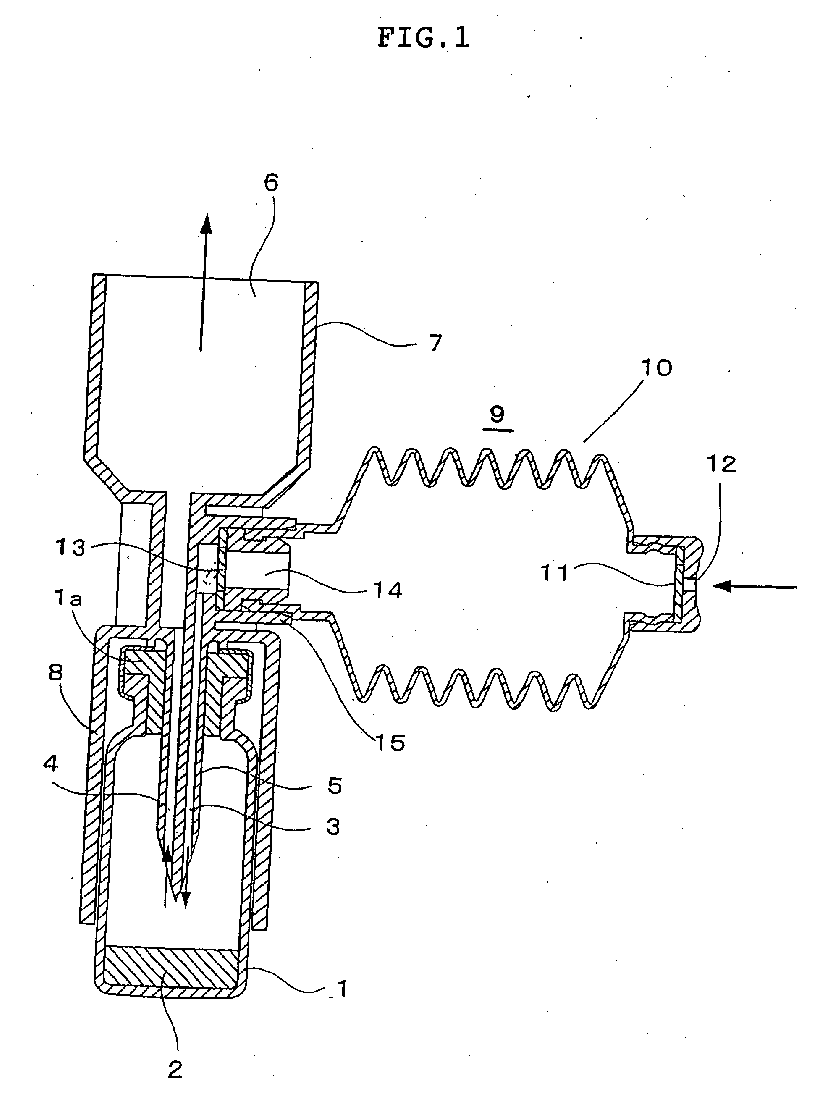
Description
comprising a needle part having an air jet flow path, a needle part having a discharge flow path, air pressure-feeding member for feeding air into the air jet flow path of said needle part, and an inhalation port that communicates with the discharge flow path of said needle part,
and characterized by being constituted such that a stopper that seals up said vessel is pierced by said needle parts, thus communicating the air jet flow path and the discharge flow path with the inside of said vessel, and air is jetted into said vessel through said air jet flow path using said air pressure-feeding member, thus pulverizing said freeze-dried composition into fine particles by the impact of the jetted air, and discharging the fine particles obtained from the inhalation port via said discharge flow path, or
comprising a needle part having a suction flow path, a needle part having an air introduction flow path, and an inhalation port that communicates with said suction flow path,
and characterized by being constituted such that, in a state in which a stopper sealing up said vessel has been pierced by said needle parts, through the inhalation pressure of the user, air in said vessel is inhaled from said inhalation port, and at the same time outside air flows into said vessel, at a negative pressure, through said air introduction flow path, and as a result said freeze-dried composition is pulverized into fine particles by the impact of the air flowing in, and the fine particles obtained are discharged from the inhalation port through said suction flow path.
comprising a needle part having an air jet flow path, a needle part having a discharge flow path, air pressure-feeding member for feeding air into the air jet flow path of said needle part, and an inhalation port that communicates with the discharge flow path of said needle part,
and characterized by being constituted such that a stopper that seals up said vessel is pierced by said needle parts, thus communicating the air jet flow path and the discharge flow path with the inside of said vessel, and air is jetted into said vessel through said air jet flow path using said air pressure-feeding member, thus pulverizing said freeze-dried composition into fine particles by the impact of the jetted air, and discharging the fine particles obtained from the inhalation port via said discharge flow path, or
comprising a needle part having a suction flow path, a needle part having an air introduction flow path, and an inhalation port that communicates with said suction flow path,
and characterized by being constituted such that, in a state in which a stopper sealing up said vessel has been pierced by said needle parts, through the inhalation pressure of the user, air in said vessel is inhaled from said inhalation port, and at the same time outside air flows into said vessel, at a negative pressure, through said air introduction flow path, and as a result said freeze-dried composition is pulverized into fine particles by the impact of the air flowing in, and the fine particles obtained are discharged from the inhalation port through said suction flow path.
comprising a needle part having an air jet flow path, a needle part having a discharge flow path, air pressure-feeding member for feeding air into the air jet flow path of said needle part, and an inhalation port that communicates with the discharge flow path of said needle part,
and characterized by being constituted such that a stopper that seals up said vessel is pierced by said needle parts, thus communicating the air jet flow path and the discharge flow path with the inside of said vessel, and air is jetted into said vessel through said air jet flow path using said air pressure-feeding member, thus pulverizing said freeze-dried composition into fine particles by the impact of the jetted air, and discharging the fine particles obtained from the inhalation port via said discharge flow path, or
comprising a needle part having a suction flow path, a needle part having an air introduction flow path, and an inhalation port that communicates with said suction flow path,
and characterized by being constituted such that, in a state in which a stopper sealing up said vessel has been pierced by said needle parts, through the inhalation pressure of the user, air in said vessel is inhaled from said inhalation port, and at the same time outside air flows into said vessel, at a negative pressure, through said air introduction flow path, and as a result said freeze-dried composition is pulverized into fine particles by the impact of the air flowing in, and the fine particles obtained are discharged from the inhalation port through said suction flow path.
the freeze-dried composition prepared by freeze-drying a composition liquid containing ingredients in a non-dissolved form and having the following properties:
the freeze-dried composition having the following properties:
and being used by forming into fine particles having said mean particle diameter or said fine particle fraction at the time of use.
Moreover, the meanings of the various reference numerals are as follows: 1. vessel, 1a. stopper, 2. freeze-dried composition, 3. air jet flow path, 4. discharge flow path, 5. needle part, 6. inhalation port, 7. air intake member, 8. tubular safety cover, 9. air pressure-feeding member, 10. bellows body, 11. intake valve, 12. intake port, 13. discharge valve, 14. discharge port, 15. connecting port (likewise in Figs. 2 to 11 below).
Agitation is carried out for about 10 seconds at 3000 rpm, and then the mixture is put into a UV cell of optical path length 1 mm and optical path width 10 mm, and the turbidity is measured immediately at a measurement wavelength of 500 nm using a spectrophotometer. The turbidity obtained is divided by the total amount (weight) of the components constituting the freeze-dried composition, and the value obtained is defined as the disintegration index.
comprising a needle part having an air jet flow path, a needle part having a discharge flow path, air pressure-feeding member for feeding air into the air jet flow path of the needle part, and an inhalation port that communicates with the discharge flow path, and
being constituted such that a stopper that seals up the vessel is pierced by the needle parts, thus communicating the air jet flow path and the discharge flow path with the inside of the vessel, and air is jetted into the vessel from the air jet flow path using the air pressure-feeding member, thus breaking down the freeze-dried composition into fine particles by the impact of the jetted air, and discharging the fine particles obtained out from the inhalation port via the discharge flow path.
comprising a needle part having a suction flow path, a needle part having an air introduction flow path, and an inhalation port that communicates with the suction flow path,
and being constituted such that, in a state in which a stopper that seals up the vessel has been pierced by the needle parts, through the inhalation pressure of a user, air in the vessel is inhaled from the inhalation port, and at the same time outside air flows into the vessel, which is now at a negative pressure, through the air introduction flow path, and as a result the freeze-dried composition is broken down into fine particles by the impact of the air flowing in, and the fine particles obtained are discharged from the inhalation port through the suction flow path.
comprising a needle part having an air jet flow path, a needle part having a discharge flow path, air pressure-feeding member for feeding air into the air jet flow path of said needle part, and an inhalation port that communicates with the discharge flow path of said needle part,
and characterized by being constituted such that a stopper that seals up said vessel is pierced by said needle parts, thus communicating the air jet flow path and the discharge flow path with the inside of said vessel, and air is jetted into said vessel through said air jet flow path using said air pressure-feeding member, thus pulverizing said freeze-dried composition into fine particles by the impact of the jetted air, and discharging the fine particles obtained from the inhalation port via said discharge flow path.
comprising a needle part having a suction flow path, a needle part having an air introduction flow path, and an inhalation port that communicates with said suction flow path,
and characterized by being constituted such that, in a state in which a stopper sealing up said vessel has been pierced by said needle parts, through the inhalation pressure of the user, air in said vessel is inhaled from said inhalation port, and at the same time outside air flows into said vessel, at a negative pressure, through said air introduction flow path, and as a result said freeze-dried composition is pulverized into fine particles by the impact of the air flowing in, and the fine particles obtained are discharged from the inhalation port through said suction flow path.
and the dry powder inhaler is constituted such that said holder part is advanced and retreated in the axial direction of said housing in said housing chamber using said holder operating part.
and the dry powder inhaler is constituted such that said holder operating part has said mechanism part which advances said holder part towards the needle tip of the needle part when said lid is pushed down to close said removal/insertion port, and retreats said holder part away from said needle tip when said lid is lifted up to open said removal/insertion port, and said lid is used as the operating member of said mechanism part.
comprising a needle part having an air jet flow path, a needle part having a discharge flow path, air pressure-feeding member for feeding air into the air jet flow path of said needle part, and an inhalation port that communicates with the discharge flow path of said needle part,
and characterized by being constituted such that a stopper that seals up said vessel is pierced by said needle parts, thus communicating the air jet flow path and the discharge flow path with the inside of said vessel, and air is jetted into said vessel through said air jet flow path using said air pressure-feeding member, thus pulverizing said freeze-dried composition into fine particles by the impact of the jetted air, and discharging the fine particles obtained from the inhalation port via said discharge flow path, or
comprising a needle part having a suction flow path, a needle part having an air introduction flow path, and an inhalation port that communicates with said suction flow path,
and characterized by being constituted such that, in a state in which a stopper sealing up said vessel has been pierced by said needle parts, through the inhalation pressure of the user, air in said vessel is inhaled from said inhalation port, and at the same time outside air flows into said vessel, at a negative pressure, through said air introduction flow path, and as a result said freeze-dried composition is pulverized into fine particles by the impact of the air flowing in, and the fine particles obtained are discharged from the inhalation port through said suction flow path.
the freeze-dried composition prepared by freeze-drying a composition liquid containing ingredients in the non-dissolved form and having the following properties:
the freeze-dried composition having the following properties:
| Freeze-dried composition | Geometric mean particle diameter (µm) | Disintegration index | Mass median aerodynamic diameter (µm ± SD, MMAD) |
| LipofectAmine 2000+pEGFP-C2+Leucine | 0.827 | 0.186 | 1.762±1.491 |
| Freeze-dried composition | Geometric mean particle diameter (µm) | Disintegration index | Mass median aerodynamic diameter (µm±SD, MMAD) |
| Example | |||
| 2) LipofectAMINE 2000 + Oligo-RNA + Leucine | 1.19 | 0.165 | 1.633±1.496 |
| Comparative Example | |||
| 1) LipofectAMINE 2000 + Oligo-RNA + Dextran 40 | 1.19 | 0.002 | not dispersed and thus unmeasureable |
| Freeze-dried composition | Geometric mean particle diameter (µm) | Disintegration index | Mass median aerodynamic diameter (µm±SD, MMAD) |
| Example | |||
| 3) Superfect + Oligo-RNA + Leucine | 11.12 | 0.225 | 1.578±1.403 |
| 4) Superfect + pEGFP-C2 + Leucine | 3.74 | 0.189 | 1.646±1.420 |
| 5) Superfect + pEGFP-C2 + Lactose | 3.74 | 0.080 | 2.848±1.873 |
| Comparative Example | |||
| 2) Superfect + Oligo-RNA + Dextran 40 | 11.12 | 0.003 | not dispersed and thus unmeasureable |
| Freeze-dried composition | Geometric mean particle diameter (µm) | Disintegration index | Mass median aerodynamic diameter (µm±SD, MMAD) |
| 6) Superfect + Oligo-RNA + Valine | 13.9 | 0.275 | 1.589±1.553 |
| Freeze-dried composition | Geometric mean particle diameter (µm) | Disintegration index | Fine particle fraction (%) |
| Example | |||
| 7) 0.2 mg insulin + 0.1 mg leucine + 0.042 mg arginine (pH 6.5) | 0.52 | 0.292 | 95.3% |
| 8) 1 mg insulin + 0.6 mg phenylalanine + 0.11 mg arginine (pH 6.4) | 0.63 | 0.238 | 57.9% |
| Freeze-dried composition | Geometric mean particle diameter (µm) | Disintegration index | Fine particle fraction (%) |
| Example | |||
| 9) 1 mg insulin + 0.5 mg phenylalanine (pH 6.0) | 3.10 | 0.39 | 69.3% |
| 10) 1 mg insulin + 0.5 mg phenylalanine (pH 6.4) | 0.55 | 0.39 | 75.1% |
| 11) 1 mg insulin + 0.5 mg phenylalanine (pH 6.6) | 0.61 | 0.36 | 72.0% |
| Freeze-dried composition | Geometric mean particle diameter (µm) | Disintegration index | Fine particle fraction (%) |
| Example | |||
| 12) 0.1 mg insulin + 0.5 mg Leucyl-valine (pH 6.4) | 0.54 | 0.115 | 68.7% |
| 13) 0.1 mg insulin + 1.5 mg Leucyl-valine (pH 6.5) | 0.67 | 0.051 | 58.9% |
| Freeze-dried composition | Geometric mean particle diameter (µm) | Disintegration index | Mass median aerodynamic diameter (µm±SD, MMAD) |
| 14) 0.1 mg insulin + 0.5 mg Valine | 0.57 | 0.221 | 1.875±1.384 |
| Freeze-dried composition | Disintegration index | Fine particle fraction (%) | |
| Ref. 1) | 1mg insulin | 0.159 | 75.0 |
| Ref. 2) | 1mg insulin + 1.4mg leucine | 0.145 | 80.7 |
| Ref. 3) | 1mg insulin + 1.0mg valine | 0.110 | 79.4 |
| Ref. 4) | 2mg insulin | 0.177 | 42.4 |
| Ref. 5) | 2mg insulin + 1.4mg leucine | 0.137 | 65.1 |
| Freeze-dried composition fraction(%) | Disintegration index | Mass median diameter (µm±SD, MMAD) | Fine particle aerodynamic | |
| Reference Examples | ||||
| 6) | Insulin + isoleucine | 0.124 | 1.759±1.425 | 71.1 |
| 7) | Insulin + leucine | 0.250 | 1.954±1.454 | 74.1 |
| 8) | Insulin + valine | 0.124 | 2.007±1.438 | 72.1 |
| 9) | Insulin + phenylalanine | 0.204 | 1.872±1.477 | 62.0 |
| 10) | Insulin + D-mannitol | 0.160 | 2.239±1.435 | 61.2 |
Claims (22)
- A freeze-dried composition for transpulmonary administration prepared by freeze-drying a composition liquid containing ingredients in a non-dissolved form which has the following properties (i) to (iii):(i) a non-powder cake-like form,(ii) a disintegration index of 0.05 or more, and(iii) becoming fine particles having a mean particle diameter (mass median aerodynamic diameter) of 10 microns or less or a fine particle fraction of 10% or more upon receipt of an air impact having an air speed of at least 1m/sec and an air flow rate of at least 17ml/sec.
- The freeze-dried composition according to Claim 1, wherein a high-molecular-weight drug is contained as an active ingredient.
- A method of manufacturing a dry powdered preparation for transpulmonary administration, comprising:introducing air into a vessel to apply to a freeze-dried composition an air impact having an air speed of at least 1m/sec and an air flow rate of at least 17ml/sec using a device capable of applying said air impact to the freeze-dried composition in the vessel,thereby making said freeze-dried composition into fine particles having a mean particle diameter (mass median aerodynamic diameter) of 10 microns or less or a fine particle fraction of 10% or more;the freeze-dried composition prepared by freeze-drying a composition liquid containing ingredients in a non-dissolved form and having the following properties:(i) a non-powder cake-like form,(ii) a disintegration index of 0.05 or more, and(iii) becoming fine particles having a mean particle diameter of 10 microns or less or a fine particle fraction of 10% or more upon receipt of the air impact.
- The method of manufacturing a dry powdered preparation for transpulmonary administration according to Claim 3, wherein the freeze-dried composition contains a high-molecular-weight drug as an active ingredient.
- The method of manufacturing a dry powdered preparation for transpulmonary administration according
to Claim 3 comprising pulverizing a freeze-dried composition into fine particles using a dry powder inhaler described under item (A) or (B) as a device:(A) a dry powder inhaler for transpulmonary administration, being a device used for making a freeze-dried composition that has been housed in non-powder form in a vessel into fine particles, and administering the resulting fine particles to a user by inhalation,
comprising a needle part having an air jet flow path, a needle part having a discharge flow path, air pressure-feeding member for feeding air into the air jet flow path of said needle part, and an inhalation port that communicates with the discharge flow path of said needle part,
and characterized by being constituted such that a stopper that seals up said vessel is pierced by said needle parts, thus communicating the air jet flow path and the discharge flow path with the inside of said vessel, and air is jetted into said vessel through said air jet flow path using said air pressure-feeding member, thus pulverizing said freeze-dried composition into fine particles by the impact of the jetted air, and discharging the fine particles obtained from the inhalation port via said discharge flow path, or(B) a dry powder inhaler for transpulmonary administration, being a device used for making a freeze-dried composition that has been housed in non-powder form in a vessel into fine particles, and administering the resulting fine particles to a user by inhalation,
comprising a needle part having a suction flow path, a needle part having an air introduction flow path, and an inhalation port that communicates with said suction flow path,
and characterized by being constituted such that, in a state in which a stopper sealing up said vessel has been pierced by said needle parts, through the inhalation pressure of the user, air in said vessel is inhaled from said inhalation port, and at the same time outside air flows into said vessel, at a negative pressure, through said air introduction flow path, and as a result said freeze-dried composition is pulverized into fine particles by the impact of the air flowing in, and the fine particles obtained are discharged from the inhalation port through said suction flow path. - A dry powder inhalation system for transpulmonary administration, using a combination of:(1) a vessel housing a freeze-dried composition prepared by freeze-drying a composition liquid containing ingredients in a non-dissolved form, and has:(i) a non-powder cake-like form,(ii) a disintegration index of 0.05 or more, and(iii) a property of becoming fine particles having a mean particle diameter (mass median aerodynamic diameter) of 10 microns or less or a fine particle fraction of 10% or more upon receiving an air impact having an air speed of at least 1 m/sec and an air flow rate of at least 17 ml/sec; and(2) a device comprising a member capable of applying said air impact to the freeze-dried composition in said vessel, and a member for discharging the powder-form freeze-dried composition that has been made into fine particles.
- The dry powder inhalation system for transpulmonary administration according to Claim 6, wherein the vessel and the device are used in combination at the time of inhalation.
- The dry powder inhalation system for transpulmonary administration according to Claim 6, wherein the freeze-dried composition contains a high-molecular-weight drug as an active ingredient.
- The dry powder inhalation system for transpulmonary administration according to Claim 6, wherein the device is:A) a dry powder inhaler for transpulmonary administration, being a device used for making a freeze-dried composition that has been housed in non-powder form in a vessel into fine particles, and administering the resulting fine particles to a user by inhalation,
comprising a needle part having an air jet flow path, a needle part having a discharge flow path, air pressure-feeding member for feeding air into the air jet flow path of said needle part, and an inhalation port that communicates with the discharge flow path of said needle part,
and characterized by being constituted such that a stopper that seals up said vessel is pierced by said needle parts, thus communicating the air jet flow path and the discharge flow path with the inside of said vessel, and air is jetted into said vessel through said air jet flow path using said air pressure-feeding member, thus pulverizing said freeze-dried composition into fine particles by the impact of the jetted air, and discharging the fine particles obtained from the inhalation port via said discharge flow path, orB) a dry powder inhaler for transpulmonary administration, being a device used for making a freeze-dried composition that has been housed in non-powder form in a vessel into fine particles, and administering the resulting fine particles to a user by inhalation,
comprising a needle part having a suction flow path, a needle part having an air introduction flow path, and an inhalation port that communicates with said suction flow path,
and characterized by being constituted such that, in a state in which a stopper sealing up said vessel has been pierced by said needle parts, through the inhalation pressure of the user, air in said vessel is inhaled from said inhalation port, and at the same time outside air flows into said vessel, at a negative pressure, through said air introduction flow path, and as a result said freeze-dried composition is pulverized into fine particles by the impact of the air flowing in, and the fine particles obtained are discharged from the inhalation port through said suction flow path. - A transpulmonary administration method comprising:making a freeze-dried composition into fine particles having a mean particle diameter of 10 microns or less or a fine particle fraction of 10% or more by applying an air impact having an air speed of at least 1 m/sec and an air flow rate of at least 17 ml/sec to the freeze-dried composition at the time of use, andadministering the resulting fine particle powder to a user by inhalation;the freeze-dried composition being prepared by freeze-drying a composition liquid containing ingredients in a non-dissolved form and having the following properties:(i) a non-powder cake-like form,(ii) a disintegration index of 0.05 or more, and(iii) becoming fine particles having a mean particle diameter of 10 microns or less or a fine particle fraction of 10% or more upon receipt of the air impact.
- The transpulmonary administration method according to Claim 10, wherein the freeze-dried composition is housed in a vessel, and the fine particle powder are prepared using a device comprising a member capable of applying the air impact to the freeze-dried composition in the vessel and a member for discharging the resulting fine particle powder-form freeze-dried composition out of the vessel.
- The transpulmonary administration method according to Claim 10, wherein the freeze-dried composition contains a high-molecular-weight drug as an active ingredient.
- The transpulmonary administration method according to Claim 11, using a dry powder inhaler described under item (A) or (B) as the device:(A) a dry powder inhaler for transpulmonary administration, being a device used for making a freeze-dried composition that has been housed in non-powder form in a vessel into fine particles, and administering the resulting fine particles to a user by inhalation,
comprising a needle part having an air jet flow path, a needle part having a discharge flow path, air pressure-feeding member for feeding air into the air jet flow path of said needle part, and an inhalation port that communicates with the discharge flow path of said needle part,
and characterized by being constituted such that a stopper that seals up said vessel is pierced by said needle parts, thus communicating the air jet flow path and the discharge flow path with the inside of said vessel, and air is jetted into said vessel through said air jet flow path using said air pressure-feeding member, thus pulverizing said freeze-dried composition into fine particles by the impact of the jetted air, and discharging the fine particles obtained from the inhalation port via said discharge flow path, or(B) a dry powder inhaler for transpulmonary administration, being a device used for making a freeze-dried composition that has been housed in non-powder form in a vessel into fine particles, and administering the resulting fine particles to a user by inhalation,
comprising a needle part having a suction flow path, a needle part having an air introduction flow path, and an inhalation port that communicates with said suction flow path,
and characterized by being constituted such that, in a state in which a stopper sealing up said vessel has been pierced by said needle parts, through the inhalation pressure of the user, air in said vessel is inhaled from said inhalation port, and at the same time outside air flows into said vessel, at a negative pressure, through said air introduction flow path, and as a result said freeze-dried composition is pulverized into fine particles by the impact of the air flowing in, and the fine particles obtained are discharged from the inhalation port through said suction flow path. - Use of a freeze-dried composition for transpulmonary administration by inhalation,
the freeze-dried composition prepared by freeze-drying a composition liquid containing ingredients in a non-dissolved form and having the following properties:(i) a non-powder cake-like form,(ii) a disintegration index of 0.05 or more, and(iii) becoming fine particles having a mean particle diameter of 10 microns or less or a fine particle fraction of 10% or more upon receipt of an air impact having an air speed of at least 1 m/sec and an air flow rate of at least 17 ml/sec, and being used by forming into fine particles having said mean particle diameter or said fine particle fraction. - The use of a freeze-dried composition for transpulmonary administration according to Claim 14, wherein the freeze-dried composition is housed in a vessel, and the fine particles are prepared using a device comprising a member capable of applying the air impact to the freeze-dried composition in the vessel and a member for discharging the resulting fine particle powder-form freeze-dried composition out of the vessel.
- The use of a freeze-dried composition for transpulmonary administration according to Claim 14, wherein the freeze-dried composition contains a high-molecular-weight drug as an active ingredient.
- Use of a freeze-dried composition for manufacture of a dry powdered preparation for transpulmonary administration by inhalation,
the freeze-dried composition having the following properties:and being used by forming into fine particles having said mean particle diameter or said fine particle fraction at the time of use.(i) being prepared by freeze drying a composition liquid containing ingredients in the non-dissolved form,(ii) a non-powder cake-like form,(iii) a disintegration index of 0.05 or more, and(iv) becoming fine particles having a mean particle diameter of 10 microns or less or a fine particle fraction of 10% or more upon receipt of an air impact having an air speed of at least 1 m/sec and an air flow rate of at least 17 ml/sec, - The use of a freeze-dried composition for manufacture of a dry powdered preparation for transpulmonary administration by inhalation according to Claim 17, wherein the freeze-dried composition contains a high-molecular-weight drug as an active ingredient.
- The use of a freeze-dried composition for manufacture of a dry powdered preparation for transpulmonary administration according to Claim 17, wherein the freeze-dried composition is housed in a vessel, and the fine particles are prepared by using a device comprising a member for applying a prescribed air impact to the freeze-dried composition housed in the vessel and a member for discharging the resulting fine particle powder form freeze-dried composition out of the vessel.
- Use of a composition liquid containing ingredients in the non-dissolved form for manufacture of a freeze-dried composition having the following properties, which is used for manufacture of dry powdered preparation for transpulmonary administration:(i) a non-powder cake-like form,(ii) a disintegration index of 0.05 or more, and(iii) becoming fine particles having a mean particle diameter of 10 microns or less or a fine particle fraction of 10% or more upon receipt of an air impact having an air speed of at least 1 m/sec and an air flow rate of at least 17 ml/sec, and being used by forming into fine particles having said mean particle diameter or said fine particle fraction at the time of use.
- The use of a composition liquid containing ingredients in the non-dissolved form according to Claim 20, wherein the freeze-dried composition contains a high-molecular-weight drug as an active ingredient
- The use of a composition liquid containing ingredients in the non-dissolved form according to Claim 20, wherein the freeze-dried composition is housed in a vessel, and the fine particles are prepared by using a device comprising a member for applying a prescribed air impact to the freeze-dried composition housed in the vessel and a member for discharging the resulting fine particle powder form freeze-dried composition out of the vessel.
Applications Claiming Priority (6)
| Application Number | Priority Date | Filing Date | Title |
|---|---|---|---|
| JP2001182504 | 2001-06-15 | ||
| JP2001400871 | 2001-12-28 | ||
| JP2002111131 | 2002-04-12 | ||
| JP2002363158 | 2002-12-13 | ||
| JP2002363158 | 2002-12-13 | ||
| PCT/JP2003/015931 WO2004054555A1 (en) | 2001-06-15 | 2003-12-12 | Novel dry powder inhalation system for transpulmonary administration |
Publications (2)
| Publication Number | Publication Date |
|---|---|
| EP1579855A1 true EP1579855A1 (en) | 2005-09-28 |
| EP1579855A4 EP1579855A4 (en) | 2009-11-04 |
Family
ID=32931499
Family Applications (4)
| Application Number | Title | Priority Date | Filing Date |
|---|---|---|---|
| EP06010993A Withdrawn EP1688134A3 (en) | 2001-06-15 | 2002-06-14 | Dry powder inhaler for transpulmonary administration |
| EP06010991A Withdrawn EP1688133A1 (en) | 2001-06-15 | 2002-06-14 | Freeze-dried composition for transpulmonary administration |
| EP02736105A Expired - Lifetime EP1402913B1 (en) | 2001-06-15 | 2002-06-14 | Dry powder inhalation system for transpulmonary administration, method of manufacturing a dry powdered preparation, and use of a freeze dried composition |
| EP03778863A Withdrawn EP1579855A4 (en) | 2001-06-15 | 2003-12-12 | Novel dry powder inhalation system for transpulmonary administration |
Family Applications Before (3)
| Application Number | Title | Priority Date | Filing Date |
|---|---|---|---|
| EP06010993A Withdrawn EP1688134A3 (en) | 2001-06-15 | 2002-06-14 | Dry powder inhaler for transpulmonary administration |
| EP06010991A Withdrawn EP1688133A1 (en) | 2001-06-15 | 2002-06-14 | Freeze-dried composition for transpulmonary administration |
| EP02736105A Expired - Lifetime EP1402913B1 (en) | 2001-06-15 | 2002-06-14 | Dry powder inhalation system for transpulmonary administration, method of manufacturing a dry powdered preparation, and use of a freeze dried composition |
Country Status (32)
| Country | Link |
|---|---|
| US (4) | US7448379B2 (en) |
| EP (4) | EP1688134A3 (en) |
| JP (1) | JP3635353B2 (en) |
| KR (3) | KR100906754B1 (en) |
| CN (2) | CN100427077C (en) |
| AP (1) | AP1861A (en) |
| AT (1) | ATE336989T1 (en) |
| AU (3) | AU2002311213B2 (en) |
| BG (1) | BG108517A (en) |
| BR (2) | BR0210425B1 (en) |
| CA (2) | CA2449954C (en) |
| CY (1) | CY1105755T1 (en) |
| CZ (1) | CZ200470A3 (en) |
| DE (1) | DE60214184T2 (en) |
| DK (1) | DK1402913T3 (en) |
| EA (1) | EA005025B1 (en) |
| EE (1) | EE04956B1 (en) |
| EG (2) | EG24184A (en) |
| ES (1) | ES2271266T3 (en) |
| HR (2) | HRP20040033B8 (en) |
| HU (1) | HU227300B1 (en) |
| IL (1) | IL159080A0 (en) |
| MA (1) | MA27131A1 (en) |
| MX (1) | MXPA05006322A (en) |
| NO (2) | NO334652B1 (en) |
| NZ (2) | NZ530044A (en) |
| PL (2) | PL205104B1 (en) |
| PT (1) | PT1402913E (en) |
| SI (1) | SI1402913T1 (en) |
| TW (1) | TW570819B (en) |
| UA (1) | UA81280C2 (en) |
| WO (2) | WO2002102445A1 (en) |
Cited By (1)
| Publication number | Priority date | Publication date | Assignee | Title |
|---|---|---|---|---|
| DE102005016230A1 (en) * | 2005-04-08 | 2006-10-19 | Altana Pharma Ag | Device for dry fogging |
Families Citing this family (92)
| Publication number | Priority date | Publication date | Assignee | Title |
|---|---|---|---|---|
| US9006175B2 (en) | 1999-06-29 | 2015-04-14 | Mannkind Corporation | Potentiation of glucose elimination |
| EG24184A (en) * | 2001-06-15 | 2008-10-08 | Otsuka Pharma Co Ltd | Dry powder inhalation system for transpulmonary |
| GB2380410B (en) * | 2001-10-05 | 2003-11-19 | Alchemy Healthcare Ltd | Apparatus for the nasal or oral delivery of a medicament |
| EP1494732B1 (en) | 2002-03-20 | 2008-01-30 | MannKind Corporation | Inhalation apparatus |
| USD514698S1 (en) * | 2002-10-07 | 2006-02-07 | Cadila Healthcare Limited | Inhalation device for the delivery and storage of powdered medicaments |
| JP4562528B2 (en) * | 2002-12-13 | 2010-10-13 | 大塚製薬株式会社 | Inhalation device for pulmonary administration |
| TW200418521A (en) * | 2002-12-13 | 2004-10-01 | Otsuka Pharma Co Ltd | Interforon-γ freezy-drying composition for pulmonary administration and inhalation system thereof |
| US20040187866A1 (en) * | 2003-03-31 | 2004-09-30 | Nathaniel Hughes | Liquid medicament delivery system |
| GB0313604D0 (en) * | 2003-06-12 | 2003-07-16 | Britannia Pharmaceuticals Ltd | Delivery device for powdered medicament |
| WO2005061088A1 (en) * | 2003-12-22 | 2005-07-07 | Finlay Warren H | Powder formation by atmospheric spray-freeze drying |
| EP1593376A1 (en) * | 2004-05-04 | 2005-11-09 | Warner-Lambert Company LLC | Improved pullulan capsules |
| US20060021613A1 (en) * | 2004-08-02 | 2006-02-02 | Robert Overlander | Accessory for nebulizer inhaler system |
| DK1786784T3 (en) | 2004-08-20 | 2011-02-14 | Mannkind Corp | Catalysis of diketopiperazine synthesis |
| CN104436170B (en) | 2004-08-23 | 2018-02-23 | 曼金德公司 | Diketopiperazine salt for drug delivery |
| JP5188183B2 (en) * | 2004-11-10 | 2013-04-24 | シプラ・リミテッド | Inhaler |
| FR2877925B1 (en) * | 2004-11-16 | 2008-09-19 | Valois Sas | DEVICE FOR DISPENSING FLUID PRODUCT. |
| EP1901793A1 (en) * | 2005-07-13 | 2008-03-26 | Cipla Ltd. | Inhaler device |
| DE102005038619A1 (en) * | 2005-08-16 | 2007-02-22 | Pari GmbH Spezialisten für effektive Inhalation | An inhalation therapy device with an ampoule for storing a medicament to be nebulised |
| AU2006290227B2 (en) | 2005-09-14 | 2012-08-02 | Mannkind Corporation | Method of drug formulation based on increasing the affinity of crystalline microparticle surfaces for active agents |
| KR100777249B1 (en) * | 2006-02-14 | 2007-11-28 | (주)바이오니아 | Dry oligonucleotide composition and preparation method thereof |
| KR20080096809A (en) | 2006-02-22 | 2008-11-03 | 맨카인드 코포레이션 | Method for Improving Pharmaceutical Properties of Microparticles Containing Diketopiperazine and Active Agents |
| DE102006010089A1 (en) * | 2006-02-24 | 2007-10-18 | Aha-Kunststofftechnik Gmbh | The dry powder inhaler |
| JP5188991B2 (en) * | 2006-03-03 | 2013-04-24 | エスティーシー.ユーエヌエム | Dry powder inhaler with aeroelastic distribution mechanism |
| US8360057B2 (en) * | 2006-03-10 | 2013-01-29 | Dose One, Llc | Medication inhaler for dispensing multiple capsules |
| US7832399B2 (en) * | 2006-03-10 | 2010-11-16 | One Dose, Llc | Medication inhaler |
| EP2043717A1 (en) * | 2006-07-14 | 2009-04-08 | Astra Zeneca AB | Inhalation system and delivery device for the administration of a drug in the form of dry powder |
| DE102006047668B3 (en) * | 2006-09-28 | 2008-04-24 | Ing. Erich Pfeiffer Gmbh | inhalator |
| MY149924A (en) * | 2007-03-09 | 2013-10-31 | Otsuka Pharma Co Ltd | Lyophilized preparation comprising influenza vaccine, and method for preparation thereof |
| ES2394589T3 (en) | 2007-12-14 | 2013-02-04 | Aerodesigns, Inc | Supply of food products transformable in aerosol |
| CN101939040B (en) | 2007-12-20 | 2014-11-05 | 阿斯利康(瑞典)有限公司 | Apparatus and method for deagglomerating powder |
| SG10201507036TA (en) | 2008-06-13 | 2015-10-29 | Mannkind Corp | A dry powder inhaler and system for drug delivery |
| US8485180B2 (en) | 2008-06-13 | 2013-07-16 | Mannkind Corporation | Dry powder drug delivery system |
| USD605752S1 (en) | 2008-06-13 | 2009-12-08 | Mannkind Corporation | Dry powder inhaler |
| USD635241S1 (en) | 2008-06-13 | 2011-03-29 | Mannkind Corporation | Dry powder inhaler |
| EP2609954B1 (en) | 2008-06-20 | 2021-12-29 | MannKind Corporation | An interactive apparatus for real-time profiling of inhalation efforts |
| TWI614024B (en) | 2008-08-11 | 2018-02-11 | 曼凱公司 | Ultra-fast use of insulin |
| US8314106B2 (en) | 2008-12-29 | 2012-11-20 | Mannkind Corporation | Substituted diketopiperazine analogs for use as drug delivery agents |
| MX2011009251A (en) * | 2009-03-04 | 2011-11-18 | Mannkind Corp | An improved dry powder drug delivery system. |
| MX2011009512A (en) | 2009-03-11 | 2011-11-29 | Mannkind Corp | Apparatus, system and method for measuring resistance of an inhaler. |
| CN101884593B (en) * | 2009-05-14 | 2013-09-18 | 许清萍 | Method for preparing liquid preparation from high-dose freeze-dried preparation |
| US8118777B2 (en) * | 2009-05-29 | 2012-02-21 | Cook Medical Technologies Llc | Systems and methods for delivering therapeutic agents |
| MY157166A (en) | 2009-06-12 | 2016-05-13 | Mankind Corp | Diketopiperazine microparticles with defined specific surface areas |
| AU2010266754B2 (en) | 2009-07-01 | 2013-12-05 | Astrazeneca Ab | Dispenser and method for entraining powder in an airflow |
| CA2778698A1 (en) | 2009-11-03 | 2011-05-12 | Mannkind Corporation | An apparatus and method for simulating inhalation efforts |
| CA2779488A1 (en) | 2009-11-12 | 2011-05-19 | Stc.Unm | Dry powder inhaler with flutter dispersion member |
| CA2784207C (en) | 2009-12-14 | 2018-06-05 | Chiesi Farmaceutici S.P.A. | Antibiotic microparticles for inhalation |
| IL223742A (en) | 2010-06-21 | 2016-06-30 | Mannkind Corp | Dry powder inhaler and composition therefor |
| JP6050758B2 (en) | 2010-12-07 | 2016-12-21 | レスピラ セラピューティクス インコーポレイテッドRespira Therapeutics,Inc. | Dry powder inhaler and method of operating the same |
| EP2694402B1 (en) | 2011-04-01 | 2017-03-22 | MannKind Corporation | Blister package for pharmaceutical cartridges |
| WO2012174472A1 (en) | 2011-06-17 | 2012-12-20 | Mannkind Corporation | High capacity diketopiperazine microparticles |
| PL2739268T3 (en) * | 2011-08-01 | 2019-07-31 | Monash University | Inhalation method and formulation |
| HK1200318A1 (en) | 2011-10-24 | 2015-08-07 | 曼金德公司 | Methods and compositions for treating pain |
| US10463815B2 (en) | 2012-02-21 | 2019-11-05 | Respira Therapeutics, Inc. | Inhaler to deliver substances for prophylaxis or prevention of disease or injury caused by the inhalation of biological or chemical agents |
| DE102012103000A1 (en) * | 2012-04-05 | 2013-10-10 | Rpc Formatec Gmbh | Dispenser for applying a particular granular or powdery substance and method for emptying a substance intake |
| EP2872205B1 (en) | 2012-07-12 | 2017-02-08 | MannKind Corporation | Dry powder drug delivery systems |
| EP2708219A1 (en) * | 2012-09-12 | 2014-03-19 | PARI Pharma GmbH | Opening element for opening an ampoule in an aerosol generation device and aerosol generation device comprising the opening element |
| US10159644B2 (en) | 2012-10-26 | 2018-12-25 | Mannkind Corporation | Inhalable vaccine compositions and methods |
| WO2014089174A2 (en) * | 2012-12-06 | 2014-06-12 | Aerodesigns, Inc. | Aerosol dispenser with edible cartridge |
| CN103110611A (en) * | 2012-12-11 | 2013-05-22 | 苏州惠仁生物科技有限公司 | Inhalant, preparation method thereof, and application of inhalantas inhalant carrier with pullulan |
| WO2014144895A1 (en) | 2013-03-15 | 2014-09-18 | Mannkind Corporation | Microcrystalline diketopiperazine compositions and methods |
| KR102465025B1 (en) | 2013-07-18 | 2022-11-09 | 맨카인드 코포레이션 | Heat-stable dry powder pharmaceutical compositions and methods |
| EP3030294B1 (en) | 2013-08-05 | 2020-10-07 | MannKind Corporation | Insufflation apparatus |
| US10307464B2 (en) | 2014-03-28 | 2019-06-04 | Mannkind Corporation | Use of ultrarapid acting insulin |
| DE102014215064A1 (en) | 2014-07-31 | 2016-02-04 | Pari GmbH Spezialisten für effektive Inhalation | nebulizer |
| US10561806B2 (en) | 2014-10-02 | 2020-02-18 | Mannkind Corporation | Mouthpiece cover for an inhaler |
| AU2015338717B2 (en) | 2014-10-31 | 2018-12-20 | Glaxosmithkline Intellectual Property Development Limited | Powder formulation |
| CN107427650A (en) | 2015-01-14 | 2017-12-01 | 瑞必治公司 | Powder process for dispersing and device |
| EP3302660A1 (en) * | 2015-06-04 | 2018-04-11 | Lameplast S.P.A. | Device for the spray dispensing of a liquid product |
| JP7077219B2 (en) * | 2015-09-09 | 2022-05-30 | ノバルティス アーゲー | Targeted delivery of spray-dried product to the lungs |
| CN105616390B (en) * | 2016-03-24 | 2019-07-23 | 李浩莹 | The application of pulullan polysaccharide and derivative in preparation slow release drug granule |
| US10898494B2 (en) | 2016-05-05 | 2021-01-26 | Liquidia Technologies, Inc. | Dry powder treprostinil for the treatment of pulmonary hypertension |
| EP3548188B1 (en) * | 2016-12-05 | 2024-09-18 | Microbase Technology Corp. | Aerosol generating apparatus with replaceable parts |
| EP3559016A1 (en) * | 2016-12-23 | 2019-10-30 | University of Copenhagen | A co-amorphous form of a substance and a dipeptide |
| ES2684403B1 (en) * | 2017-03-31 | 2019-07-09 | Farm Rovi Lab Sa | PROCEDURE FOR GRAVIMETRIC FILLING IN STERILE SOLID CONDITIONS IN A PHARMACEUTICAL CONTAINER AND PHARMACEUTICAL CONTAINER USED IN THE SAME |
| FI3612262T3 (en) * | 2017-04-18 | 2024-01-16 | Inspiring Pty Ltd | Dry powder inhaler and spacer device for a dry powder inhaler |
| US10252283B2 (en) * | 2017-07-17 | 2019-04-09 | Yoanna Gouchtchina | Dermal spray apparatus and method |
| US11951036B2 (en) | 2017-11-02 | 2024-04-09 | Hoffmann-La Roche Inc. | Droplet dispensing device and system |
| JP6489669B1 (en) * | 2018-10-30 | 2019-03-27 | ルアン株式会社 | Squeeze container |
| CN109954200A (en) * | 2019-04-16 | 2019-07-02 | 郑州大学第一附属医院 | A kind of drug delivery device for respiratory medicine nursing |
| US20220091089A1 (en) * | 2019-04-25 | 2022-03-24 | Agco Corporation | Apparatus and methods for measuring soil conditions |
| CN112237668A (en) * | 2019-07-17 | 2021-01-19 | 杭州亿脑创新工场有限公司 | Multi-dose powder drug delivery device and drug combination suitable for same |
| WO2021207425A1 (en) | 2020-04-07 | 2021-10-14 | Yoanna Gouchtchina | Dermal spray apparatus and method |
| WO2021211624A1 (en) * | 2020-04-14 | 2021-10-21 | Qool Therapeutics, Inc. | Frozen particle generator using liquid micro-dispenser |
| US20220184325A1 (en) * | 2020-12-15 | 2022-06-16 | Sanara Medtech Inc. | Powder applicator |
| TWI763510B (en) * | 2021-05-28 | 2022-05-01 | 林錫璋 | Powder medicine delivery device |
| US12376665B2 (en) | 2021-10-14 | 2025-08-05 | Kozhya LLC Sp. z o.o. | Dermal spray apparatus with disposable cartrdige and method |
| USD1033635S1 (en) | 2022-05-09 | 2024-07-02 | Quantum Skin SP Z O.O | Dermal spray nozzle |
| USD1035867S1 (en) | 2022-05-09 | 2024-07-16 | Kozhya LLC Sp. z o.o. | Dermal spray apparatus |
| USD1038383S1 (en) | 2022-05-09 | 2024-08-06 | Kozhya LLC Sp. z o.o. | Dermal spray apparatus |
| USD1046122S1 (en) | 2022-05-09 | 2024-10-08 | Quantum Skin Limited Liability Company | Dermal spray cartridge |
| CN116350607A (en) * | 2023-04-11 | 2023-06-30 | 胡崇茂 | A kind of stem cell inhalation composition and its preparation method and application |
| WO2025225923A1 (en) * | 2024-04-25 | 2025-10-30 | 주식회사 리센스메디컬 | Composition spraying device and spraying system including same |
Family Cites Families (71)
| Publication number | Priority date | Publication date | Assignee | Title |
|---|---|---|---|---|
| US1950926A (en) * | 1932-10-05 | 1934-03-13 | Lobl Frederick | Nasal inhaler |
| GB1479283A (en) * | 1973-07-23 | 1977-07-13 | Bespak Industries Ltd | Inhaler for powdered medicament |
| US3874381A (en) * | 1974-05-28 | 1975-04-01 | Smithkline Corp | Dual nozzle intranasal delivery device |
| GB1521000A (en) * | 1975-06-13 | 1978-08-09 | Syntex Puerto Rico Inc | Inhalation device |
| JPS58152498A (en) * | 1982-03-06 | 1983-09-10 | Terumo Corp | Production of low-molecular peptide mixture |
| WO1984002274A1 (en) | 1982-12-09 | 1984-06-21 | Hafsten Raymond J Jr | Activated, stabilized enzymes useful for wound healing |
| EP0133767B1 (en) | 1983-08-04 | 1991-04-03 | The Green Cross Corporation | Gamma interferon composition |
| JPS6052847A (en) | 1983-09-01 | 1985-03-26 | Konishiroku Photo Ind Co Ltd | Method for developing photosensitive silver halide material |
| EP0168008A3 (en) | 1984-07-10 | 1986-12-30 | Takeda Chemical Industries, Ltd. | Stable composition of gamma-interferon |
| DE3729863A1 (en) * | 1987-09-05 | 1989-03-16 | Boehringer Mannheim Gmbh | STABILIZED ERYTHROPOIETIN LYOPHILISATES |
| JPH01116045A (en) * | 1987-10-29 | 1989-05-09 | Toshiba Corp | Corrosion-resistant zirconium alloy |
| EP0360340A1 (en) | 1988-09-19 | 1990-03-28 | Akzo N.V. | Composition for nasal administration containing a peptide |
| JPH07116022B2 (en) | 1989-04-18 | 1995-12-13 | 三共株式会社 | Freeze-dried preparation process |
| ES2060040T5 (en) * | 1989-05-31 | 1999-09-16 | Fisons Plc | DEVICE AND FORMULATION OF INHALATION OF MEDICINAL PRODUCT. |
| FR2649323B1 (en) | 1989-07-04 | 1995-06-30 | Valois | DEVICE FOR SPRAYING AND SPRAYING A DOSE OF A DIVIDABLE PRODUCT |
| JPH0341033A (en) | 1989-07-07 | 1991-02-21 | Kyowa Hakko Kogyo Co Ltd | Stable preparation containing motilins |
| DK544589D0 (en) * | 1989-11-01 | 1989-11-01 | Novo Nordisk As | MANUALLY OPERATED DEVICE FOR DISPENSING A PRESCRIBED QUANTITY OF A POWDER-SHAPED SUBSTANCE |
| KR910014122A (en) | 1990-01-19 | 1991-08-31 | 디께다 가즈히꼬 | Lyophilized Formulation of Etoposide-2-dimethylamino Compound |
| JPH05963A (en) | 1990-04-13 | 1993-01-08 | Toray Ind Inc | Polypeptides composition |
| JPH0464878A (en) * | 1990-07-04 | 1992-02-28 | Mitsubishi Heavy Ind Ltd | Absorber for absorption refrigerating machine |
| GB9027234D0 (en) | 1990-12-15 | 1991-02-06 | Harris Pharma Ltd | An inhalation device |
| EP0578823B1 (en) | 1991-04-08 | 2002-01-23 | Sumitomo Pharmaceuticals Company, Limited | Porous solid preparation containing physiologically active protein substance |
| JP3131271B2 (en) | 1992-03-24 | 2001-01-31 | 住友ゴム工業株式会社 | Anti-vibration bearing |
| US6582728B1 (en) | 1992-07-08 | 2003-06-24 | Inhale Therapeutic Systems, Inc. | Spray drying of macromolecules to produce inhaleable dry powders |
| US5785049A (en) * | 1994-09-21 | 1998-07-28 | Inhale Therapeutic Systems | Method and apparatus for dispersion of dry powder medicaments |
| JPH06186141A (en) * | 1992-12-16 | 1994-07-08 | Hitachi Ltd | Remaining stress prediction method |
| CA2152088C (en) * | 1992-12-18 | 1999-12-07 | Thomas J. Ambrosio | Inhaler for powdered medications |
| JPH0652847U (en) | 1992-12-28 | 1994-07-19 | セントラル自動車株式会社 | Conveyor with fire shutter |
| US5354934A (en) * | 1993-02-04 | 1994-10-11 | Amgen Inc. | Pulmonary administration of erythropoietin |
| JP3007785B2 (en) | 1993-03-16 | 2000-02-07 | 旭化成工業株式会社 | Thrombomodulin composition and method for preventing denaturation thereof |
| US5533502A (en) * | 1993-05-28 | 1996-07-09 | Vortran Medical Technology, Inc. | Powder inhaler with aerosolization occurring within each individual powder receptacle |
| WO1994028876A1 (en) | 1993-06-07 | 1994-12-22 | Advanced Therapies, Inc. | Liposome powders |
| US5349947A (en) * | 1993-07-15 | 1994-09-27 | Newhouse Michael T | Dry powder inhaler and process that explosively discharges a dose of powder and gas from a soft plastic pillow |
| NZ285664A (en) | 1994-05-18 | 1998-07-28 | Inhale Therapeutic Syst | Dry powder interferon composition adapted for pulmonary delivery |
| CN1318104C (en) | 1994-09-21 | 2007-05-30 | 耐科塔医药公司 | Method for spraying dried powder medicine and its equipment |
| US6117455A (en) | 1994-09-30 | 2000-09-12 | Takeda Chemical Industries, Ltd. | Sustained-release microcapsule of amorphous water-soluble pharmaceutical active agent |
| JPH08103499A (en) | 1994-10-04 | 1996-04-23 | Unisia Jecs Corp | Inhaler |
| GB9501841D0 (en) | 1995-01-31 | 1995-03-22 | Co Ordinated Drug Dev | Improvements in and relating to carrier particles for use in dry powder inhalers |
| US5654007A (en) | 1995-06-07 | 1997-08-05 | Inhale Therapeutic Systems | Methods and system for processing dispersible fine powders |
| JP3317823B2 (en) * | 1995-08-11 | 2002-08-26 | 株式会社ユニシアジェックス | Dosing device |
| DE19536902A1 (en) | 1995-10-04 | 1997-04-10 | Boehringer Ingelheim Int | Miniature fluid pressure generating device |
| JP3317827B2 (en) * | 1995-10-09 | 2002-08-26 | 株式会社ユニシアジェックス | Dosing device |
| US20030138402A1 (en) * | 1995-12-25 | 2003-07-24 | Otsuka Pharmaceutical Co., Ltd. | Dry compositions |
| TW403653B (en) * | 1995-12-25 | 2000-09-01 | Otsuka Pharma Co Ltd | Dry compositions |
| JP3328132B2 (en) * | 1996-03-21 | 2002-09-24 | 株式会社ユニシアジェックス | Inhaler type dispenser |
| US5875776A (en) * | 1996-04-09 | 1999-03-02 | Vivorx Pharmaceuticals, Inc. | Dry powder inhaler |
| US5826633A (en) | 1996-04-26 | 1998-10-27 | Inhale Therapeutic Systems | Powder filling systems, apparatus and methods |
| AUPN976496A0 (en) * | 1996-05-10 | 1996-05-30 | Glaxo Wellcome Australia Ltd | Unit dose dispensing device |
| US5663492A (en) * | 1996-06-05 | 1997-09-02 | Alapati; Rama Rao | System for continuous analysis and modification of characteristics of a liquid hydrocarbon stream |
| DK1014943T3 (en) * | 1997-02-05 | 2002-10-14 | Jago Res Ag | Medical aerosol formulations |
| DE19704849B4 (en) * | 1997-02-08 | 2011-02-17 | Ing. Erich Pfeiffer Gmbh | Discharge device for media |
| US6503537B2 (en) * | 1997-03-20 | 2003-01-07 | Schering Corporation | Preparation of powder agglomerates |
| US6394085B1 (en) * | 1997-09-25 | 2002-05-28 | Norton Healthcare Ltd. | Inhaler spacer |
| CA2301569A1 (en) | 1997-10-08 | 1999-04-15 | Martin P. Redmon | Dosage form for aerosol administration |
| US5954047A (en) * | 1997-10-17 | 1999-09-21 | Systemic Pulmonary Development, Ltd. | Methods and apparatus for delivering aerosolized medication |
| JP4266399B2 (en) | 1997-12-04 | 2009-05-20 | 帝人株式会社 | Pharmaceutical composition for inhalation in powder form |
| KR20010041623A (en) | 1998-03-05 | 2001-05-25 | 니뽄 신야쿠 가부시키가이샤 | Fat emulsions for inhalational administration |
| JP3547612B2 (en) * | 1998-03-20 | 2004-07-28 | 株式会社日立ユニシアオートモティブ | Inhalation type dispenser |
| US6284282B1 (en) * | 1998-04-29 | 2001-09-04 | Genentech, Inc. | Method of spray freeze drying proteins for pharmaceutical administration |
| MA25590A1 (en) * | 1998-09-14 | 2002-12-31 | Inhale Therapeutic Syst | ACTIVE AGENT FOR DRY POWDER DELIVERY |
| US5952232A (en) | 1998-09-17 | 1999-09-14 | Rothman; James Edward | Expandible microparticle intracellular delivery system |
| US6745763B2 (en) * | 1998-10-27 | 2004-06-08 | Garth T. Webb | Vaporizing device for administering sterile medication |
| JP2000233023A (en) | 1999-02-15 | 2000-08-29 | Hiroshi Matsuzawa | Nasal cavity washer |
| GB2353222B (en) * | 1999-06-23 | 2001-09-19 | Cambridge Consultants | Inhalers |
| GB9919693D0 (en) * | 1999-08-19 | 1999-10-20 | Rhone Poulenc Rorer Ltd | Process |
| JP2001151673A (en) | 1999-09-06 | 2001-06-05 | Nikken Chem Co Ltd | Method for producing powder formulation for inhalation |
| MXPA02004193A (en) * | 1999-10-29 | 2002-12-13 | Inhale Therapeutic Syst | Dry powder compositions having improved dispersivity. |
| JP4931282B2 (en) * | 2000-10-02 | 2012-05-16 | 日本ケミカルリサーチ株式会社 | Bioactive peptide-containing powder |
| JP3943845B2 (en) * | 2001-02-15 | 2007-07-11 | 芳枝 米谷 | Liposome vector |
| EG24184A (en) * | 2001-06-15 | 2008-10-08 | Otsuka Pharma Co Ltd | Dry powder inhalation system for transpulmonary |
| JP4562528B2 (en) * | 2002-12-13 | 2010-10-13 | 大塚製薬株式会社 | Inhalation device for pulmonary administration |
-
2002
- 2002-06-12 EG EG2002060661A patent/EG24184A/en active
- 2002-06-14 HU HU0400217A patent/HU227300B1/en not_active IP Right Cessation
- 2002-06-14 BR BRPI0210425-3A patent/BR0210425B1/en not_active IP Right Cessation
- 2002-06-14 DK DK02736105T patent/DK1402913T3/en active
- 2002-06-14 ES ES02736105T patent/ES2271266T3/en not_active Expired - Lifetime
- 2002-06-14 EA EA200400045A patent/EA005025B1/en not_active IP Right Cessation
- 2002-06-14 AU AU2002311213A patent/AU2002311213B2/en not_active Ceased
- 2002-06-14 EP EP06010993A patent/EP1688134A3/en not_active Withdrawn
- 2002-06-14 CZ CZ200470A patent/CZ200470A3/en unknown
- 2002-06-14 US US10/170,339 patent/US7448379B2/en not_active Expired - Fee Related
- 2002-06-14 PT PT02736105T patent/PT1402913E/en unknown
- 2002-06-14 HR HR20040033A patent/HRP20040033B8/en not_active IP Right Cessation
- 2002-06-14 DE DE60214184T patent/DE60214184T2/en not_active Expired - Lifetime
- 2002-06-14 TW TW091112991A patent/TW570819B/en not_active IP Right Cessation
- 2002-06-14 EE EEP200400011A patent/EE04956B1/en not_active IP Right Cessation
- 2002-06-14 AT AT02736105T patent/ATE336989T1/en active
- 2002-06-14 CN CNB02811941XA patent/CN100427077C/en not_active Expired - Fee Related
- 2002-06-14 EP EP06010991A patent/EP1688133A1/en not_active Withdrawn
- 2002-06-14 SI SI200230430T patent/SI1402913T1/en unknown
- 2002-06-14 KR KR1020077009246A patent/KR100906754B1/en not_active Expired - Fee Related
- 2002-06-14 AP APAP/P/2003/002945A patent/AP1861A/en active
- 2002-06-14 EP EP02736105A patent/EP1402913B1/en not_active Expired - Lifetime
- 2002-06-14 PL PL367161A patent/PL205104B1/en unknown
- 2002-06-14 JP JP2003505028A patent/JP3635353B2/en not_active Expired - Fee Related
- 2002-06-14 KR KR1020077009245A patent/KR100907333B1/en not_active Expired - Fee Related
- 2002-06-14 WO PCT/JP2002/005955 patent/WO2002102445A1/en not_active Ceased
- 2002-06-14 NZ NZ530044A patent/NZ530044A/en not_active IP Right Cessation
- 2002-06-14 IL IL15908002A patent/IL159080A0/en active IP Right Grant
- 2002-06-14 CA CA2449954A patent/CA2449954C/en not_active Expired - Fee Related
-
2003
- 2003-12-12 CA CA2507766A patent/CA2507766C/en not_active Expired - Fee Related
- 2003-12-12 BR BR0316754-2A patent/BR0316754A/en not_active Application Discontinuation
- 2003-12-12 UA UAA200506798A patent/UA81280C2/en unknown
- 2003-12-12 NZ NZ540935A patent/NZ540935A/en not_active IP Right Cessation
- 2003-12-12 EP EP03778863A patent/EP1579855A4/en not_active Withdrawn
- 2003-12-12 NO NO20035554A patent/NO334652B1/en not_active IP Right Cessation
- 2003-12-12 PL PL377554A patent/PL209876B1/en unknown
- 2003-12-12 US US10/538,837 patent/US7735485B2/en not_active Expired - Fee Related
- 2003-12-12 WO PCT/JP2003/015931 patent/WO2004054555A1/en not_active Ceased
- 2003-12-12 CN CNB2003801058762A patent/CN1323658C/en not_active Expired - Fee Related
- 2003-12-12 MX MXPA05006322A patent/MXPA05006322A/en active IP Right Grant
- 2003-12-12 HR HR20050639A patent/HRP20050639A2/en not_active Application Discontinuation
- 2003-12-12 KR KR1020057010714A patent/KR101049914B1/en not_active Expired - Fee Related
- 2003-12-12 AU AU2003289051A patent/AU2003289051B2/en not_active Ceased
-
2004
- 2004-01-08 BG BG108517A patent/BG108517A/en unknown
- 2004-01-15 MA MA27481A patent/MA27131A1/en unknown
-
2005
- 2005-06-13 EG EGNA2005000290 patent/EG23775A/en active
- 2005-07-05 NO NO20053300A patent/NO20053300L/en not_active Application Discontinuation
-
2006
- 2006-11-02 CY CY20061101585T patent/CY1105755T1/en unknown
-
2008
- 2008-02-07 AU AU2008200583A patent/AU2008200583B2/en not_active Ceased
- 2008-08-30 US US12/202,220 patent/US8443799B2/en not_active Expired - Fee Related
- 2008-10-10 US US12/202,221 patent/US8333193B2/en not_active Expired - Fee Related
Cited By (1)
| Publication number | Priority date | Publication date | Assignee | Title |
|---|---|---|---|---|
| DE102005016230A1 (en) * | 2005-04-08 | 2006-10-19 | Altana Pharma Ag | Device for dry fogging |
Also Published As
Similar Documents
| Publication | Publication Date | Title |
|---|---|---|
| US7735485B2 (en) | Dry powder inhalation system for transpulmonary administration | |
| NO20131597L (en) | Dry powder inhalation system for transpulmonary administration | |
| US20060057106A1 (en) | Freeze-dried interferon-y composition for transpulmonary administration and inhalation system therefor | |
| JP4822709B2 (en) | A new dry powder inhalation system for pulmonary administration | |
| HK1127567B (en) | Dry powder inhalation system for transpulmonary administration |
Legal Events
| Date | Code | Title | Description |
|---|---|---|---|
| PUAI | Public reference made under article 153(3) epc to a published international application that has entered the european phase |
Free format text: ORIGINAL CODE: 0009012 |
|
| AK | Designated contracting states |
Kind code of ref document: A1 Designated state(s): AT BE BG CH CY CZ DE DK EE ES FI FR GB GR HU IE IT LI LU MC NL PT RO SE SI SK TR |
|
| AX | Request for extension of the european patent |
Extension state: AL LT LV MK |
|
| 17P | Request for examination filed |
Effective date: 20050708 |
|
| RIN1 | Information on inventor provided before grant (corrected) |
Inventor name: FUKUNAGA, YUICHIRO,RICCHI DE KITAJIMA 505 Inventor name: AKAGI, AKITSUNA Inventor name: YAMASHITA, CHIKAMASA |
|
| A4 | Supplementary search report drawn up and despatched |
Effective date: 20091005 |
|
| 17Q | First examination report despatched |
Effective date: 20130531 |
|
| GRAP | Despatch of communication of intention to grant a patent |
Free format text: ORIGINAL CODE: EPIDOSNIGR1 |
|
| INTG | Intention to grant announced |
Effective date: 20150318 |
|
| STAA | Information on the status of an ep patent application or granted ep patent |
Free format text: STATUS: THE APPLICATION IS DEEMED TO BE WITHDRAWN |
|
| 18D | Application deemed to be withdrawn |
Effective date: 20150729 |