JP4266399B2 - Pharmaceutical composition for inhalation in powder form - Google Patents
Pharmaceutical composition for inhalation in powder form Download PDFInfo
- Publication number
- JP4266399B2 JP4266399B2 JP33414297A JP33414297A JP4266399B2 JP 4266399 B2 JP4266399 B2 JP 4266399B2 JP 33414297 A JP33414297 A JP 33414297A JP 33414297 A JP33414297 A JP 33414297A JP 4266399 B2 JP4266399 B2 JP 4266399B2
- Authority
- JP
- Japan
- Prior art keywords
- drug
- excipient
- pharmaceutical composition
- lactose
- inhalation
- Prior art date
- Legal status (The legal status is an assumption and is not a legal conclusion. Google has not performed a legal analysis and makes no representation as to the accuracy of the status listed.)
- Expired - Fee Related
Links
Images


Landscapes
- Medicinal Preparation (AREA)
- Pharmaceuticals Containing Other Organic And Inorganic Compounds (AREA)
Description
【0001】
【発明の属する技術分野】
本発明は薬物の肺内沈着量が増加した新規な粉末状吸入用医薬品組成物に関する。更に詳しくは薬物微粒子を球形に成型することにより薬物微粒子と賦形剤との付着力が調節され、その結果吸入された後の薬物微粒子の肺内沈着量が増加した新規な粉末状吸入用医薬品組成物に関する。
【0002】
【従来の技術】
吸入剤とは、口腔あるいは鼻腔から、気管、気管支、肺胞などの主に下気道へ薬物を投与することを目的とした製剤である。ここでいう下気道とは気道のうち、気管、気管支、細気管支、肺胞等と定義される。
【0003】
吸入剤は、喘息、気管支炎、肺気腫等の胸部疾患に対する局所投与製剤として実用化されており、また近年生理活性ペプチド類、蛋白質等を肺胞から全身血流へ移行させる投与法としても注目を集めている。
【0004】
このような吸入剤の剤型として、吸入液剤、フロンまたは代替フロン製剤、粉末吸入剤の3つがある。吸入液剤は通常薬物の水溶液であり、ネブライザーにより霧化されて微少の液滴となって患者の自発呼吸下で吸入され、気道内に液滴の形で沈着する。フロンまたは代替フロン製剤は、フロンまたは代替フロンに加圧下で薬物が分散または溶解された製剤であり、加圧式定量噴霧吸入器(Metered Dose Inhaler; MDI)と呼ばれる加圧容器に充填されて用いられる。投与時は、加圧下のMDIから開放されるとフロンまたは代替フロンが気化し、溶解・分散していた薬物が通常薬物の微粒子粉末となって気道内に沈着する。また、粉末吸入剤は薬物を主とする微粒子粉末を例えば粉末状組成物として賦形剤などとともにブリスター等の容器に充填し、通常患者自身の吸気により適当な投与器から該容器内の微粒子粉末が粉末エアロゾル化されて吸入され、薬物粉末として気道内に沈着する。
【0005】
これらの吸入剤の剤型のうち、吸入液剤は一般に高価で大きく重いネブライザーでの投与がのため、また薬液をネブライザーに充填する際に細菌等の混入の危険があるため、医療機関以外で患者自身が投与するには適さない。フロンまたは代替フロン製剤は、投与器であるMDIが軽量で携帯性がよく、また密封された容器に製剤が充填されいるが、フロンはオゾン層破壊、代替フロンは温室効果の要因であり、地球環境を考える上ではその使用は控えられるべきである。これらに対して粉末吸入剤は、一般にその投与器は軽量で携帯性がよく、また細菌等の混入を防ぐように構成されており、製剤中に環境破壊に関わるような成分を含まないことから、理想的な吸入剤の剤型であると考えられている。
【0006】
さらに粉末吸入剤には次の3種がある。
(1)薬物微粒子と乳糖等から選ばれる該薬物微粒子より粒径の大きい賦形剤粒子とが均一に混合された混合粒子が適当な容器から気道内に投与されると、賦形剤は口腔、咽頭あるいは喉頭に沈着するが薬物微粒子のみ気管、気管支等の下気道にまで到達、沈着する粉末状組成物。
【0007】
(2)薬物微粒子どうしが柔らかく造粒されて比較的大きな粒径となっている粉末状製剤が、適当な容器から気道内に投与されると飛行中に構成薬物微粒子に解離され、生成した薬物微粒子が気管、気管支等の下気道に到達、沈着する粉末状組成物。
【0008】
(3)薬物微粒子のみからなる粉末状製剤で、適当な容器から気道内に投与されると該薬物微粒子が気管、気管支等の下気道にまで到達、沈着する粉末状組成物。
これらの中でも薬物量が少ない場合は1回分投与量の粉末状薬物を分割することが困難であるために(1)のような薬物と賦形剤との粉末状組成物が使用されることが多い。
【0009】
前述したように(1)のような粉末状組成物は、吸入された後賦形剤と薬物とが分離しより大きい粒径の賦形剤は口腔、咽喉に沈着し、より小さい粒径の薬物のみが気管、気管支、肺にまで到達して沈着し局所で薬効を発揮するか、あるいは肺から血中に吸収されて全身作用を発揮することが期待されている。しかし、粒径の小さい薬物は薬物同士が凝集して粒径の大きい二次粒子を生成することが知られており、吸入されても気管、気管支、肺に到達せず口腔、咽喉に沈着してしまうことがある。この現象は脂溶性の高い薬物で特に多く認められる。また更に、粒径の小さい薬物粒子は粒径の大きい賦形剤表面に付着することが知られており、この付着力が強すぎると薬物は吸入操作中に賦形剤から分離せず口腔、咽喉に沈着してしまい期待された薬効を発揮することができない。一方、この付着力が弱すぎると混合粉体を製造する過程で薬物が混合容器に付着してしまい損失することなどがおきる。特に脂溶性の高い薬物の場合薬物の混合容器への付着は顕著に認められる。
【0010】
【発明が解決しようとする課題】
本発明の目的は、薬物微粒子と賦形剤粒子との間の付着力を最適に設定し、製造効率及び薬効を最大にした粉末状吸入用医薬品組成物を提供することにある。
【0011】
【課題を解決するための手段】
本発明者らは鋭意研究した結果、薬物微粒子を球形に成型することにより薬物微粒子同士の凝集及び薬物微粒子と賦形剤との付着を最適化することに成功し本発明に到達した。
【0012】
【発明の実施の形態】
本発明で「球形」とは、Wadellの球形度ψS(=πxv 2 / S)で粒子を評価して0.90以上のものをいう。なお xvは球体積相当径であるが、本発明では実用上フラウンホーファー回折の原理に基づくレーザー回折型粒度分布測定装置で得られる体積平均径を用いる。Sは粒子の表面積であって、空気透過法またはガス透過法により測定される比表面積から換算する。
また、本発明で「滑らか」とは、空気透過法またはガス透過法により測定される比表面積S0(単位重量あたり)が1.75以下のものをいう。
【0013】
粒子間の相互作用を最小にするために粒子の表面積を最小にすることは当該業者であれば容易に到達する手段である。従って薬物粒子を球形に成型すること自体は新規ではない。例えば、WO96/09814号明細書において「少なくとも90%以上が1から10μmの空力学的平均径を有する球形で滑らかな水溶性材料による治療・診断用マイクロパーティクル」がクレームされている。しかし該特許においては球形であることの定義もなく、また球形であることの効果について明らかにする実施例等の記載もない。粉末状吸入剤において球形に成型された薬物粒子がその気管、気管支、肺への沈着効率を上昇させることは本発明者らによりはじめて知見された。
【0014】
本発明の球形の薬物粒子は気管、気管支、肺に沈着するためにその粒径が0.5-10μmの範囲にある必要から通常の造粒では製造できず、噴霧乾燥法、晶析法、超臨界流体再結晶化法などで製造することができる。この中でも噴霧乾燥法がもっとも一般的である。噴霧乾燥法による本発明の薬物微粒子は、プロピオン酸ベクロメタゾン(以下BDPとする)10gを無水エタノール500mLに溶解してサンプル溶液を調製し、噴霧乾燥機としてGS-31(ヤマトラボテック(株))を用い、ノズル径:0. 4 mm、入口温度:105℃、出口温度:70-80℃、送液速度:6.5g/min、熱風風量:0.6 m3/ min、噴霧圧力:2.5 kg/ cm2、の条件で上記サンプル溶液を噴霧乾燥して製造することが出来る。(製造例1)
このようにして製造された粉体粒子は回収率50%で得られ、図1に示す走査型電子顕微鏡像に見られる球形粒子(ψS>0.90)であり、平均径 1.5μm、85%以上が0.5-10μmの範囲であった。
【0015】
本発明に用いられる薬物は原則としては吸入薬として使用されるものであれば特に限定されないが、特に粒子同士が凝集しやすいものが挙げられる。そのような例としては脂溶性の高い薬物、あるいは特異的に凝集性が高い薬物が挙げられる。
脂溶性の高い薬物としては副腎皮質ホルモン類、性ホルモン類、活性型ビタミンD3類、プロスタグランジン類などが挙げられる。副腎皮質ホルモン類としては、プロピオン酸ベクロメタゾン、酢酸トリアムシノロン、フルニソリド、ブデソニドおよびプロピオン酸フルチカゾンなど、性ホルモン類としては、テストステロン、エストロジェンおよびエストラジオールなど、活性型ビタミンD3類としては、1α, 24-ジヒドロキシビタミンD3、1α, 25-ジヒドロキシビタミンD3(カルシフェロール)、カルシポトリオール、1α-ヒドロキシ- 24-オキソビタミンD3、1α, 25-ジヒドロキシビタミンD3-26,23-ラクトン、1α, 25-ジヒドロキシビタミンD3-26,23-パーオキシラクトンおよび26,26,26,27,27,27-ヘキサフルオロ-1α, 25-ジヒドロキシビタミンD3など、プロスタグランジン類としては、プロスタグランジンE1(アルプロスタジル)、プロスタグランジンF2 α(ジノプロスト)、プロスタグランジンI2(エポプロステノール)、ベラプロストおよびクリンプロストなどをが挙げられる。
特異的に凝集性が高い薬物の例としてはインスリン、カルシトニンなどの高分子量ペプチド類が挙げられる。
【0016】
本発明の賦形剤としては通常吸入剤の賦形剤として使用されるものであれば特に限定されないが、例えば乳糖、ブドウ糖、マンニトール、果糖、蔗糖、アラビノース、キシリトール、デキストロース、麦芽糖およびトレハロースおよびこれらの1水和物や、デキストラン、デキストリン等多糖類が挙げられる。これらの中でも乳糖が最も一般的に使用される。
【0017】
本発明で使用される賦形剤の形状は原則としては口腔、咽喉内に沈着するような粒径であればいずれの形状でもよく、95重量%以上の粒径が、30-150μmの範囲であることが好ましい。つまり、薬物微粒子と同様に球形として成型する場合には薬物微粒子と同様な噴霧乾燥法や特表平4−504427号公報に記載されているような特定の条件での析出法などで造粒される。また、球形に成型しない場合には通常の機械的粉砕法で大きな粒子から所望の範囲の粒径に調製される。しかし、賦形剤が特表平4−504427号公報に記載された表面よりも滑らかでなく、表面にある程度の平面構造を持っていたり、あるいは多孔状で表面積が大きい形状の方がより気管、気管支、肺への沈着率が向上することが本発明者らにより知見されている。
【0018】
本発明で使用される薬物量は薬物の薬効の強さにより変わり、1回分の製剤単位に有効な量が含有される。
【0019】
本発明の薬物と賦形剤との重量比は0.1:99.9-50:50の範囲内であり、この割合は薬物量によって変化する。従って本発明で使用される賦形剤量は薬物量により変化するが、おおよそ10ng-5mgの範囲内である。
【0020】
本発明の医薬品組成物は、上記の製造例1により得たBDP微粒子 1.0g、および微粉砕乳糖(一水和物;Pharmatose 200M; DMV社)を100メッシュパス、400メッシュオンに篩い分けたもの(以下100-400M乳糖)61.5gを、V型混合機にて3.5時間混合して製造することが出来る。(製造例2)このようにして得られた組成物から無作為に30サンプルを抽出してそのBDP含量を測定した結果、CV値が3.1%とほぼ均一に混合されていた。製造された組成物の走査型電子顕微鏡像を図2に示す。
【0021】
【発明の効果】
かくして本発明により気管、気管支、肺への沈着率が良好な粉末吸入用医薬品組成物が提供され、その意義は高い。
【0022】
【実施例】
以下、実施例により本発明を詳述するが、これらは本発明を説明するものであって本発明を限定するものではない。
【0023】
[実施例1]
プロピオン酸ベクロメタゾン球形微粒子製剤の吸入効率評価
本実施例は、製造例1にて得られた球形に成型されたプロピオン酸ベクロメタゾン(以下球形BDP)と100-400M乳糖(比表面積S0>1.75)を含んでなる混合粉体(1)の吸入送達上の効果を、以下の対照製剤との比較評価を実施したものである。
(1) 球形BDP+100-400M乳糖(本発明製剤1)
(2) 球形BDP+吸入用乳糖(本発明製剤2)
(3) 粉砕BDP+100-400M乳糖(対照製剤1)
(4) 粉砕BDP+吸入用乳糖(対照製剤2)
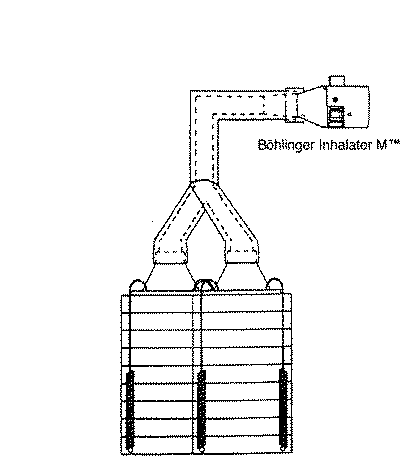
ここでいう粉砕BDPとは日本薬局方BDP(藤川(株))であり、また吸入用乳糖(Pharmatose 325M, DMV社)とは再結晶された乳糖一水和物であって、滑らかな表面(S0<1.75)を有している。(2)から(4)までの製剤は、製造例2に準じてBDP1.0gと乳糖61. 5gをV型混合機にて3-4時間混合することにより得た。これらをゼラチン3号カプセル(各製剤について)30個に、5mgずつ充填した。アンダーセンカスケードインパクター2台に、上記カプセルを充填した投与器Inhalater MTM(ベーリンガー・インゲルハイム社)を2股の インダクションポートを介して据え付けた図3に示す装置を用いて、それぞれのカスケードインパクターを1CFM(=28.3L/min)流量で吸引しながら、15秒間隔で各製剤あたり30個のカプセルを吸引させ評価した。各製剤ごとに、BDPについて、投与器残存量、カプセル残存量、インダクションポート付着量、インパクターのプレセパレーター、プレート沈着量、バックアップフィルター(BUF)沈着量を高速液体クロマトグラフィーにて定量した。
評価の結果を表1・2に示す。なおこの評価は25℃、40%RHの条件で実施した(実施例2〜3も同じ)。得られた値は30カプセルの合計値であり、フラクション(括弧内のカプセル充填量に対する%値)は30カプセルの平均値とみなすことができる。0.65〜5.8μm (Stage2-6)のフラクションは、製剤中含量に対する臨床における下気道沈着分に相当する。このフラクションについては本発明製剤である(1)および(2)は同等であり、これらは対照製剤である(3)および(4)に対して有意に高い値(約1.4倍)を示した。
カプセル残存のフラクションについて(1)および(2)の製剤は、(3)および(4)の製剤より有意に低く、しかも(1)<(2)という結果であった。また、特にカプセル中残存分の粉体の走査型電子顕微鏡観察において、(1)と(2)の製剤では多くの場合、薬物BDP微粒子と乳糖とが分散して存在していたのに対して、(3)および(4)の製剤では薬物微粒子が乳糖に付着したままの粉体、および薬物微粒子同士が凝集している粉体が多くみられた。
【0024】
【表1】
【表2】
[実施例2]
プロスタグランジンE1球形微粒子製剤の吸入効率評価
プロスタグランジンE1(アルプロスタジル;以下PGE1)をBDPと同じ条件で噴霧乾燥し、球形粒子(ψS>0.9)を得た。対照粒子としてPGE1を酢酸エチル / ヘプタンに溶解させて再結晶させ、得られた結晶を乳鉢で粉砕して球形粒子と同等の粒径(1.9〜2.0μm)の粒子を得た。実施例1と同様に、球形または粉砕したPGE1粒子と100-400M乳糖または吸入用乳糖を、重量比0.4:99.6でV型混合器にて1-2時間混合し、以下の製剤を調製した。
(1) 球形PGE1+100-400M乳糖(本発明製剤3)
(2) 球形PGE1+吸入用乳糖球形乳糖(本発明製剤4)
(3) 粉砕PGE1+100-400M乳糖(対照製剤3)
(4) 粉砕PGE1+吸入用乳糖(対照製剤4)
実施例1と同様に、これら製剤をゼラチン3号カプセル(各製剤について)90個に、5mgずつ充填した。上記カプセルを充填した投与器Inhalater MTM(ベーリンガー・インゲルハイム社)を据え付けた図3に示す装置を用いて、それぞれのカスケードインパクターを1CFM(=28.3L/min)流量で吸引しながら、15秒間隔で各製剤あたり90個のカプセルを吸引させ評価した。各製剤ごとに、各部分でのPGE1定量を高速液体クロマトグラフィーにて実施した。
評価の結果を表3・4に示す。0.65〜5.8μm (Stage2-6)のフラクションは本発明製剤である(1)および(2)は同等であり、これらは対照製剤(3)および(4)に対して有意に高い値を示した。カプセル残存のフラクションについても実施例1と同傾向であり、(1)および(2)の製剤は(3)および(4)の製剤より有意に低く、しかも(1)<(2)という結果であった。
【0027】
【表3】
【表4】
[実施例3]
BDP球形微粒子製剤のステンレス缶器壁への付着量評価
直径58mm、高さ750mmの円柱状のステンレス缶(円柱の底面の一方は開放されている)に、製造例および実施例1で製造した、(1)球形BDP+100-400M乳糖(本発明製剤1)、(2)球形BDP+吸入用乳糖(本発明製剤2)を各々1. 5gをとり、2時間振盪機によって底面直径方向に振盪した。振盪中はフタをして粉体の飛散を防いだ。振盪後フタをとり、内容物を取り出した。さらにステンレス缶をスパーテルで軽くたたくなどして粉末製剤を排出した。取り出した(排出した)粉体を電子天秤にて正確に秤量して、ステンレス缶への仕込み量から粉体付着・吸着率を算出した。またステンレス缶を5mLのアセトニトリルにて抽出して高速液体クロマトグラフィーにて定量し、同様に仕込み量から付着・吸着率を算出した。重量および抽出により算出した値は同等であり、(1)9%、(2)16%であった。これより球形乳糖より通常の乳糖を用いたほうが、材料への付着が少ないことが示された。
【図面の簡単な説明】
【図1】製造例1で製造したBDP球形微粒子の透過型電子顕微鏡写真を示す。
【図2】製造例2で製造したBDP球形微粒子 / 吸入用乳糖(重量比 1:61.5)の透過型電子顕微鏡写真を示す。
【図3】実施例1〜2で用いた吸入効率評価装置を示す。[0001]
BACKGROUND OF THE INVENTION
The present invention relates to a novel powdery pharmaceutical composition for inhalation with an increased amount of drug deposited in the lung. More specifically, a novel powder for inhalation powder in which the adhesion between the drug fine particles and the excipient is adjusted by molding the drug fine particles into a spherical shape, and as a result, the amount of drug fine particles deposited in the lung after inhalation is increased. Relates to the composition.
[0002]
[Prior art]
An inhalant is a preparation intended to administer a drug from the oral cavity or nasal cavity mainly into the lower respiratory tract such as the trachea, bronchi, and alveoli. The lower respiratory tract here is defined as the trachea, bronchi, bronchiole, alveoli, etc. of the airways.
[0003]
Inhalants have been put to practical use as topical preparations for breast diseases such as asthma, bronchitis, and emphysema. In recent years, inhalants have attracted attention as administration methods for transferring bioactive peptides and proteins from the alveoli to the systemic bloodstream. Collecting.
[0004]
There are three types of inhalant dosage forms: inhalant solution, chlorofluorocarbon or alternative chlorofluorocarbon preparation, and powder inhalant. An inhalation solution is usually an aqueous solution of a drug, which is atomized by a nebulizer to form fine droplets that are inhaled under the patient's spontaneous breathing and deposited in the form of droplets in the airway. Fluorocarbon or alternative chlorofluorocarbon preparations are drugs in which drugs are dispersed or dissolved under pressure in chlorofluorocarbons or alternative chlorofluorocarbons. They are filled in a pressurized container called a pressurized metered dose inhaler (MDI). . At the time of administration, when released from the MDI under pressure, the chlorofluorocarbon or alternative chlorofluorocarbon vaporizes, and the dissolved / dispersed drug usually becomes a fine particle powder of the drug and is deposited in the airway. In addition, the powder inhaler fills a container such as a blister with a fine particle powder mainly composed of a drug, for example, as a powder composition together with excipients, etc. Is inhaled as a powder aerosol and deposited in the respiratory tract as a drug powder.
[0005]
Of these inhalant dosage forms, inhalant solutions are generally expensive and heavy and are administered in nebulizers, and there is a risk of contamination with bacteria when filling the nebulizer with medicinal solutions. Not suitable for own administration. Fluorocarbon or alternative chlorofluorocarbon products are light and portable, and the container is filled with the formulation, but chlorofluorocarbons are ozone depleting, chlorofluorocarbon alternatives are greenhouse effect factors, In consideration of the environment, its use should be refrained. In contrast, powder inhalers are generally lightweight and portable, and are configured to prevent contamination by bacteria, etc., and they do not contain ingredients related to environmental destruction. It is considered the ideal inhalant dosage form.
[0006]
Furthermore, there are three types of powder inhalants:
(1) When mixed particles, in which excipient particles having a particle size larger than the drug particles selected from drug particles and lactose are uniformly mixed, are administered into an airway from an appropriate container, the excipient is A powdered composition that deposits in the pharynx or larynx but only drug particles reach the lower respiratory tract such as the trachea and bronchi.
[0007]
(2) When a powdery formulation in which drug fine particles are softly granulated to have a relatively large particle size is administered into an airway from an appropriate container, it is dissociated into component drug fine particles during flight, and the produced drug A powdered composition in which fine particles reach and deposit in the lower respiratory tract such as the trachea and bronchi.
[0008]
(3) A powdery composition consisting of only drug fine particles, and the drug fine particles reach the lower respiratory tract such as trachea and bronchus and deposit when administered into a respiratory tract from a suitable container.
Among these, when the amount of the drug is small, it is difficult to divide the powdered drug of a single dose, and therefore, a powdered composition of the drug and excipient as in (1) may be used. Many.
[0009]
As described above, in the powdered composition as in (1), after inhalation, the excipient and the drug are separated, and the excipient with a larger particle size is deposited in the oral cavity and throat, It is expected that only the drug reaches the trachea, bronchi and lungs and deposits to exert local medicinal effects, or is absorbed into the blood from the lungs to exert systemic effects. However, drugs with a small particle size are known to aggregate together to form secondary particles with a large particle size, and even if inhaled, they do not reach the trachea, bronchus, and lungs, but deposit in the oral cavity and throat. May end up. This phenomenon is particularly common in drugs with high fat solubility. Furthermore, it is known that drug particles with a small particle size adhere to the surface of an excipient with a large particle size, and if this adhesion force is too strong, the drug does not separate from the excipient during the inhalation operation, It is deposited in the throat and cannot exhibit the expected medicinal effects. On the other hand, if the adhesive force is too weak, the drug may adhere to the mixing container and be lost in the process of producing the mixed powder. In particular, in the case of a drug having high fat solubility, the adhesion of the drug to the mixing container is noticeable.
[0010]
[Problems to be solved by the invention]
An object of the present invention is to provide a powdery pharmaceutical composition for inhalation in which the adhesive force between drug fine particles and excipient particles is optimally set to maximize production efficiency and medicinal effect.
[0011]
[Means for Solving the Problems]
As a result of diligent research, the present inventors have succeeded in optimizing the aggregation of drug fine particles and the adhesion between the drug fine particles and the excipient by molding the drug fine particles into a spherical shape, thereby reaching the present invention.
[0012]
DETAILED DESCRIPTION OF THE INVENTION
In the present invention, the term “spherical” means a particle having a Wadell sphericity ψ S (= πx v 2 / S) of 0.90 or more. Note that xv is a spherical volume equivalent diameter, but in the present invention, a volume average diameter obtained by a laser diffraction type particle size distribution measuring apparatus based on the principle of Fraunhofer diffraction is used in practice. S is the surface area of the particle, and is converted from the specific surface area measured by the air permeation method or the gas permeation method.
In the present invention, the term “smooth” means that the specific surface area S 0 (per unit weight) measured by the air permeation method or gas permeation method is 1.75 or less.
[0013]
Minimizing the surface area of the particles to minimize the interaction between the particles is a means easily reached by those skilled in the art. Therefore, molding the drug particles into a spherical shape is not new. For example, WO96 / 09814 claims “therapeutic / diagnostic microparticles using at least 90% or more spherical and smooth water-soluble materials having an aerodynamic average diameter of 1 to 10 μm”. However, in this patent, there is no definition of being spherical, and there is no description of an example or the like that clarifies the effect of being spherical. It has been found for the first time by the present inventors that drug particles formed into a spherical shape in a powdered inhalant increase the deposition efficiency in the trachea, bronchi and lungs.
[0014]
Since the spherical drug particles of the present invention are deposited in the trachea, bronchi, and lungs, the particle size must be in the range of 0.5-10 μm, so it cannot be produced by ordinary granulation, spray drying, crystallization, supercritical It can be produced by a fluid recrystallization method or the like. Of these, the spray drying method is the most common. The drug fine particles of the present invention by the spray drying method are prepared by dissolving 10 g of beclomethasone propionate (hereinafter referred to as BDP) in 500 mL of absolute ethanol to prepare a sample solution, and using GS-31 (Yamatrabotech Co., Ltd.) as a spray dryer. Used, nozzle diameter: 0.4 mm, inlet temperature: 105 ° C., outlet temperature: 70-80 ° C., liquid feeding speed: 6.5 g / min, hot air flow rate: 0.6 m 3 / min, spraying pressure: 2.5 kg / cm 2 The sample solution can be produced by spray drying under the above conditions. (Production Example 1)
The powder particles produced in this way were obtained with a recovery rate of 50%, and are spherical particles (ψ S > 0.90) as seen in the scanning electron microscope image shown in FIG. 1, with an average diameter of 1.5 μm and 85% or more. Was in the range of 0.5-10 μm.
[0015]
In principle, the drug used in the present invention is not particularly limited as long as it is used as an inhalation drug, and in particular, those in which particles tend to aggregate are mentioned. Examples thereof include drugs with high fat solubility or drugs with high specific aggregation properties.
Examples of highly fat-soluble drugs include corticosteroids, sex hormones, active vitamin D 3 and prostaglandins. The adrenal cortex hormones, beclomethasone propionate, triamcinolone acetate, flunisolide, such as budesonide and fluticasone propionate, the sex hormones, testosterone, such estrogen and estradiol, as the active vitamin D 3 compounds, l [alpha], 24- dihydroxy Vitamin D 3 , 1α, 25-dihydroxyvitamin D 3 (calciferol), calcipotriol, 1α-hydroxy-24-oxovitamin D 3 , 1α, 25-dihydroxyvitamin D 3 -26,23-lactone, 1α, 25 Prostaglandins such as -dihydroxyvitamin D 3 -26,23-peroxylactone and 26,26,26,27,27,27-hexafluoro-1α, 25-dihydroxyvitamin D 3 1 (alprostadil), prostaglandin F 2 α (dinoprost), Purosutagura Jin I 2 (epoprostenol), and a like beraprost and Clean Prost.
Examples of the drug having a particularly high aggregation property include high molecular weight peptides such as insulin and calcitonin.
[0016]
The excipient of the present invention is not particularly limited as long as it is usually used as an excipient for inhalants. For example, lactose, glucose, mannitol, fructose, sucrose, arabinose, xylitol, dextrose, maltose and trehalose and these And monosaccharides such as dextran and dextrin. Of these, lactose is most commonly used.
[0017]
The shape of the excipient used in the present invention may in principle be any shape as long as it is a particle size that deposits in the oral cavity and throat, and a particle size of 95% by weight or more is in the range of 30-150 μm. Preferably there is. That is, when it is molded into a spherical shape like the drug fine particles, it is granulated by a spray drying method similar to the drug fine particles or a precipitation method under specific conditions as described in JP-A-4-504427. The In addition, when it is not molded into a spherical shape, it is prepared from a large particle to a desired particle size by an ordinary mechanical pulverization method. However, the excipient is not smoother than the surface described in JP-T-4-504427, and has a certain planar structure on the surface, or is more porous and has a larger surface area than the trachea. It has been found by the present inventors that the deposition rate on bronchi and lungs is improved.
[0018]
The amount of the drug used in the present invention varies depending on the strength of the drug, and an effective amount is contained in a single preparation unit.
[0019]
The weight ratio of the drug of the present invention to the excipient is in the range of 0.1: 99.9-50: 50, and this ratio varies with the amount of drug. Therefore, the amount of excipient used in the present invention varies depending on the amount of drug, but is approximately in the range of 10 ng-5 mg.
[0020]
The pharmaceutical composition of the present invention is obtained by sieving 1.0 g of BDP fine particles obtained in Production Example 1 and finely ground lactose (monohydrate; Pharmatose 200M; DMV) into 100 mesh pass and 400 mesh on. 61.5 g (hereinafter referred to as 100-400M lactose) can be produced by mixing in a V-type mixer for 3.5 hours. (Production Example 2) As a result of randomly extracting 30 samples from the composition thus obtained and measuring their BDP content, the CV value was almost uniformly mixed with 3.1%. A scanning electron microscope image of the manufactured composition is shown in FIG.
[0021]
【The invention's effect】
Thus, the present invention provides a pharmaceutical composition for powder inhalation having a good deposition rate on the trachea, bronchi and lung, and its significance is high.
[0022]
【Example】
EXAMPLES Hereinafter, although an Example demonstrates this invention in detail, these illustrate this invention and do not limit this invention.
[0023]
[Example 1]
Evaluation of Inhalation Efficiency of Beclomethasone Propionate Spherical Fine Particle Formulation In this example, beclomethasone propionate (hereinafter referred to as spherical BDP) obtained in Production Example 1 and 100-400M lactose (specific surface area S 0 > 1.75) were used. The effect of the mixed powder (1) comprising the effect on inhalation delivery was evaluated by comparison with the following control preparation.
(1) Spherical BDP + 100-400M lactose (Preparation 1)
(2) Spherical BDP + lactose for inhalation (formulation 2 of the present invention)
(3) Ground BDP + 100-400M lactose (control formulation 1)
(4) Ground BDP + lactose for inhalation (control preparation 2)
The pulverized BDP here is the Japanese Pharmacopoeia BDP (Fujikawa Co., Ltd.), and the lactose for inhalation (Pharmatose 325M, DMV) is the recrystallized lactose monohydrate with a smooth surface ( S 0 <1.75). The preparations (2) to (4) were obtained by mixing 1.0 g of BDP and 61.5 g of lactose in a V-type mixer for 3-4 hours according to Production Example 2. These were filled in 30 mg of gelatin No. 3 capsules (for each formulation) by 5 mg. Using the apparatus shown in FIG. 3 in which two Andersen cascade impactors are equipped with the administration device Inhalater M TM (Boehringer Ingelheim) filled with the above capsules via the bifurcated induction port, each cascade impactor is used. While aspirating at a flow rate of 1 CFM (= 28.3 L / min), 30 capsules were aspirated and evaluated at 15-second intervals. For each formulation, the BDP residual quantity, capsule residual quantity, induction port adhesion quantity, impactor pre-separator, plate deposition quantity, and backup filter (BUF) deposition quantity were quantified by high performance liquid chromatography.
The evaluation results are shown in Tables 1 and 2. This evaluation was performed under the conditions of 25 ° C. and 40% RH (the same applies to Examples 2 to 3). The obtained value is the total value of 30 capsules, and the fraction (% value with respect to the capsule filling amount in parentheses) can be regarded as the average value of 30 capsules. The fraction between 0.65 and 5.8 μm (Stage 2-6) corresponds to the clinical lower airway deposition relative to the content in the formulation. With respect to this fraction, the preparations (1) and (2) of the present invention were equivalent, and these showed significantly higher values (about 1.4 times) than the control preparations (3) and (4).
Regarding the remaining capsule fraction, the preparations of (1) and (2) were significantly lower than the preparations of (3) and (4), and (1) <(2). In addition, especially in the scanning electron microscope observation of the powder remaining in the capsule, in the preparations (1) and (2), in many cases, the drug BDP fine particles and lactose were dispersed and existed. In the preparations (3) and (4), many powders in which the drug fine particles were adhered to lactose and powders in which the drug fine particles were aggregated were observed.
[0024]
[Table 1]
[Table 2]
[Example 2]
Evaluation of inhalation efficiency of prostaglandin E 1 spherical fine particle formulation Prostaglandin E 1 (alprostadil; hereinafter referred to as PGE 1 ) was spray-dried under the same conditions as BDP to obtain spherical particles (ψ S > 0.9). As control particles, PGE 1 was dissolved in ethyl acetate / heptane and recrystallized, and the obtained crystals were pulverized in a mortar to obtain particles having the same particle diameter (1.9 to 2.0 μm) as spherical particles. As in Example 1, spherical or crushed PGE 1 particles and 100-400M lactose or lactose for inhalation were mixed in a V-type mixer at a weight ratio of 0.4: 99.6 for 1-2 hours to prepare the following preparations. .
(1) Spherical PGE 1 + 100-400M lactose (formulation 3 of the present invention)
(2) Spherical PGE 1 + lactose spherical lactose for inhalation (formulation 4 of the present invention)
(3) Ground PGE 1 + 100-400M lactose (control formulation 3)
(4) Pulverized PGE 1 + lactose for inhalation (control formulation 4)
As in Example 1, 5 mg of these preparations were filled into 90 gelatin 3 capsules (for each preparation). Using the apparatus shown in FIG. 3 equipped with the administration device Inhalater M ™ (Boehringer Ingelheim Co.) filled with the capsules, each cascade impactor was aspirated at a flow rate of 1 CFM (= 28.3 L / min). For evaluation, 90 capsules were aspirated for each preparation at intervals of seconds. For each formulation, PGE 1 quantification at each part was performed by high performance liquid chromatography.
The results of evaluation are shown in Tables 3 and 4. The fraction of 0.65 to 5.8 μm (Stage2-6) is equivalent to the preparations of the present invention (1) and (2), which showed significantly higher values than the control preparations (3) and (4) . The fraction remaining in the capsule is also in the same tendency as in Example 1. The preparations (1) and (2) are significantly lower than the preparations (3) and (4), and (1) <(2) there were.
[0027]
[Table 3]
[Table 4]
[Example 3]
The amount of adhesion of the BDP spherical fine particle preparation to the stainless steel can wall was manufactured in a manufacturing example and Example 1 in a cylindrical stainless steel can having a diameter of 58 mm and a height of 750 mm (one of the bottom surfaces of the cylinder was open). 1.5 g each of (1) spherical BDP + 100-400M lactose (formulation 1 of the present invention) and (2) spherical BDP + lactose for inhalation (formulation 2 of the present invention) were taken and shaken in the bottom diameter direction by a shaker for 2 hours. During shaking, the lid was covered to prevent the powder from scattering. After shaking, the lid was removed and the contents were taken out. Furthermore, the powder formulation was discharged by tapping a stainless steel can with a spatula. The taken out (discharged) powder was accurately weighed with an electronic balance, and the powder adhesion / adsorption rate was calculated from the amount charged into the stainless steel can. The stainless steel can was extracted with 5 mL of acetonitrile and quantified by high performance liquid chromatography. Similarly, the adhesion / adsorption rate was calculated from the charged amount. The values calculated by weight and extraction were equivalent, (1) 9% and (2) 16%. From this, it was shown that adhesion to the material was less when normal lactose was used than spherical lactose.
[Brief description of the drawings]
1 shows a transmission electron micrograph of BDP spherical fine particles produced in Production Example 1. FIG.
FIG. 2 shows a transmission electron micrograph of BDP spherical fine particles / lactose for inhalation (weight ratio 1: 61.5) produced in Production Example 2.
FIG. 3 shows an inhalation efficiency evaluation apparatus used in Examples 1 and 2.
Claims (5)
薬物は、プロピオン酸ベクロメタゾン、またはプロスタグランジンE 1 であり、
賦形剤の95重量%以上は、30-150μmの範囲の粒子径を有し、
賦形剤は、比表面積S0>1.75の滑らかな表面でない、粉末状吸入用医薬品組成物。 Comprising fine drug particles composed only of a drug molded to a sphericity of 0.90 or more, and an excipient,
Drug is beclomethasone dipropionate or prostaglandin E 1,,
95% by weight or more of the excipient has a particle size in the range of 30-150 μm,
The excipient is a powdery inhalable pharmaceutical composition having a specific surface area S 0 > 1.75 and not a smooth surface.
Priority Applications (1)
| Application Number | Priority Date | Filing Date | Title |
|---|---|---|---|
| JP33414297A JP4266399B2 (en) | 1997-12-04 | 1997-12-04 | Pharmaceutical composition for inhalation in powder form |
Applications Claiming Priority (1)
| Application Number | Priority Date | Filing Date | Title |
|---|---|---|---|
| JP33414297A JP4266399B2 (en) | 1997-12-04 | 1997-12-04 | Pharmaceutical composition for inhalation in powder form |
Publications (2)
| Publication Number | Publication Date |
|---|---|
| JPH11171760A JPH11171760A (en) | 1999-06-29 |
| JP4266399B2 true JP4266399B2 (en) | 2009-05-20 |
Family
ID=18274007
Family Applications (1)
| Application Number | Title | Priority Date | Filing Date |
|---|---|---|---|
| JP33414297A Expired - Fee Related JP4266399B2 (en) | 1997-12-04 | 1997-12-04 | Pharmaceutical composition for inhalation in powder form |
Country Status (1)
| Country | Link |
|---|---|
| JP (1) | JP4266399B2 (en) |
Families Citing this family (7)
| Publication number | Priority date | Publication date | Assignee | Title |
|---|---|---|---|---|
| GB0004827D0 (en) * | 2000-02-29 | 2000-04-19 | Quadrant Holdings Cambridge | Compositions |
| WO2002043703A1 (en) * | 2000-11-29 | 2002-06-06 | Itoham Foods Inc. | Powdery preparations and proecss for producing the same |
| EG24184A (en) | 2001-06-15 | 2008-10-08 | Otsuka Pharma Co Ltd | Dry powder inhalation system for transpulmonary |
| JPWO2004087146A1 (en) * | 2003-03-31 | 2006-06-29 | 協和醗酵工業株式会社 | Method for producing fine particle mixture |
| HUE058227T2 (en) * | 2004-04-23 | 2022-07-28 | Cydex Pharmaceuticals Inc | Dpi formulation containing sulfoalkyl ether cyclodextrin |
| US7629331B2 (en) | 2005-10-26 | 2009-12-08 | Cydex Pharmaceuticals, Inc. | Sulfoalkyl ether cyclodextrin compositions and methods of preparation thereof |
| CA3083757A1 (en) * | 2017-11-27 | 2019-05-31 | Aska Pharmaceutical Co., Ltd. | Powder preparation for nasal administration |
-
1997
- 1997-12-04 JP JP33414297A patent/JP4266399B2/en not_active Expired - Fee Related
Also Published As
| Publication number | Publication date |
|---|---|
| JPH11171760A (en) | 1999-06-29 |
Similar Documents
| Publication | Publication Date | Title |
|---|---|---|
| KR100277622B1 (en) | Inhalation ultrafine powder and its manufacturing method | |
| JP4378057B2 (en) | Flow resistance controlled aerosolized active drug delivery | |
| US6989155B1 (en) | Powders | |
| US6509006B1 (en) | Devices compositions and methods for the pulmonary delivery of aerosolized medicaments | |
| US7097827B2 (en) | Devices, compositions and methods for the pulmonary delivery of aerosolized medicaments | |
| US6780508B1 (en) | Powder particles with smooth surface for use in inhalation therapy | |
| CN104257610A (en) | Process For Preparing Carrier Particles For Dry Powders For Inhalation | |
| JP2005507881A (en) | Dry powder pharmaceutical formulation | |
| JP4266399B2 (en) | Pharmaceutical composition for inhalation in powder form | |
| CN111358773B (en) | Peramivir dry powder inhalant and preparation method thereof | |
| JP3888753B2 (en) | Sustainable powder inhalation pharmaceutical composition | |
| EP2340817A1 (en) | Drug carrier manufacturing method | |
| JP2907551B2 (en) | Ultrafine particle powder for inhalation and production method thereof | |
| JPWO1993025198A1 (en) | Ultrafine particle powder for inhalation and its manufacturing method | |
| MXPA01003614A (en) | Flow resistance modulated aerosolized active agent delivery | |
| MXPA01002649A (en) | Dry powder active agent pulmonary delivery |
Legal Events
| Date | Code | Title | Description |
|---|---|---|---|
| A621 | Written request for application examination |
Free format text: JAPANESE INTERMEDIATE CODE: A621 Effective date: 20040831 |
|
| A131 | Notification of reasons for refusal |
Free format text: JAPANESE INTERMEDIATE CODE: A131 Effective date: 20080422 |
|
| A521 | Written amendment |
Free format text: JAPANESE INTERMEDIATE CODE: A523 Effective date: 20080619 |
|
| A131 | Notification of reasons for refusal |
Free format text: JAPANESE INTERMEDIATE CODE: A131 Effective date: 20080715 |
|
| A521 | Written amendment |
Free format text: JAPANESE INTERMEDIATE CODE: A523 Effective date: 20080911 |
|
| A131 | Notification of reasons for refusal |
Free format text: JAPANESE INTERMEDIATE CODE: A131 Effective date: 20081111 |
|
| A521 | Written amendment |
Free format text: JAPANESE INTERMEDIATE CODE: A523 Effective date: 20081222 |
|
| TRDD | Decision of grant or rejection written | ||
| A01 | Written decision to grant a patent or to grant a registration (utility model) |
Free format text: JAPANESE INTERMEDIATE CODE: A01 Effective date: 20090127 |
|
| A01 | Written decision to grant a patent or to grant a registration (utility model) |
Free format text: JAPANESE INTERMEDIATE CODE: A01 |
|
| A61 | First payment of annual fees (during grant procedure) |
Free format text: JAPANESE INTERMEDIATE CODE: A61 Effective date: 20090217 |
|
| R150 | Certificate of patent or registration of utility model |
Free format text: JAPANESE INTERMEDIATE CODE: R150 |
|
| FPAY | Renewal fee payment (event date is renewal date of database) |
Free format text: PAYMENT UNTIL: 20120227 Year of fee payment: 3 |
|
| FPAY | Renewal fee payment (event date is renewal date of database) |
Free format text: PAYMENT UNTIL: 20120227 Year of fee payment: 3 |
|
| FPAY | Renewal fee payment (event date is renewal date of database) |
Free format text: PAYMENT UNTIL: 20130227 Year of fee payment: 4 |
|
| LAPS | Cancellation because of no payment of annual fees |