EP1578706B1 - Herstellung von trialkylaluminiumverbindungen und alpha-alkoholen - Google Patents
Herstellung von trialkylaluminiumverbindungen und alpha-alkoholen Download PDFInfo
- Publication number
- EP1578706B1 EP1578706B1 EP02790087A EP02790087A EP1578706B1 EP 1578706 B1 EP1578706 B1 EP 1578706B1 EP 02790087 A EP02790087 A EP 02790087A EP 02790087 A EP02790087 A EP 02790087A EP 1578706 B1 EP1578706 B1 EP 1578706B1
- Authority
- EP
- European Patent Office
- Prior art keywords
- bound
- carbon group
- hydrogen
- mixture
- ring atom
- Prior art date
- Legal status (The legal status is an assumption and is not a legal conclusion. Google has not performed a legal analysis and makes no representation as to the accuracy of the status listed.)
- Expired - Lifetime
Links
- 0 C=*[N+]1N=NN=N[N-]1 Chemical compound C=*[N+]1N=NN=N[N-]1 0.000 description 3
Classifications
-
- C—CHEMISTRY; METALLURGY
- C07—ORGANIC CHEMISTRY
- C07C—ACYCLIC OR CARBOCYCLIC COMPOUNDS
- C07C2/00—Preparation of hydrocarbons from hydrocarbons containing a smaller number of carbon atoms
- C07C2/02—Preparation of hydrocarbons from hydrocarbons containing a smaller number of carbon atoms by addition between unsaturated hydrocarbons
- C07C2/04—Preparation of hydrocarbons from hydrocarbons containing a smaller number of carbon atoms by addition between unsaturated hydrocarbons by oligomerisation of well-defined unsaturated hydrocarbons without ring formation
- C07C2/06—Preparation of hydrocarbons from hydrocarbons containing a smaller number of carbon atoms by addition between unsaturated hydrocarbons by oligomerisation of well-defined unsaturated hydrocarbons without ring formation of alkenes, i.e. acyclic hydrocarbons having only one carbon-to-carbon double bond
- C07C2/08—Catalytic processes
- C07C2/26—Catalytic processes with hydrides or organic compounds
- C07C2/32—Catalytic processes with hydrides or organic compounds as complexes, e.g. acetyl-acetonates
-
- C—CHEMISTRY; METALLURGY
- C07—ORGANIC CHEMISTRY
- C07C—ACYCLIC OR CARBOCYCLIC COMPOUNDS
- C07C29/00—Preparation of compounds having hydroxy or O-metal groups bound to a carbon atom not belonging to a six-membered aromatic ring
- C07C29/48—Preparation of compounds having hydroxy or O-metal groups bound to a carbon atom not belonging to a six-membered aromatic ring by oxidation reactions with formation of hydroxy groups
- C07C29/50—Preparation of compounds having hydroxy or O-metal groups bound to a carbon atom not belonging to a six-membered aromatic ring by oxidation reactions with formation of hydroxy groups with molecular oxygen only
- C07C29/54—Preparation of compounds having hydroxy or O-metal groups bound to a carbon atom not belonging to a six-membered aromatic ring by oxidation reactions with formation of hydroxy groups with molecular oxygen only starting from compounds containing carbon-to-metal bonds and followed by conversion of the -O- metal to -OH groups
-
- C—CHEMISTRY; METALLURGY
- C07—ORGANIC CHEMISTRY
- C07F—ACYCLIC, CARBOCYCLIC OR HETEROCYCLIC COMPOUNDS CONTAINING ELEMENTS OTHER THAN CARBON, HYDROGEN, HALOGEN, OXYGEN, NITROGEN, SULFUR, SELENIUM OR TELLURIUM
- C07F5/00—Compounds containing elements of Groups 3 or 13 of the Periodic Table
- C07F5/06—Aluminium compounds
- C07F5/061—Aluminium compounds with C-aluminium linkage
- C07F5/062—Al linked exclusively to C
Definitions
- ⁇ -Olefins are manufactured by oligomerizing ethylene using a transition metal containing catalyst, the ⁇ -olefins are converted to trialkylaluminum compounds by contacting them with aluminum and hydrogen with heat and pressure.
- the trialkylaluminum compounds which are formed may be reacted with oxygen to form the corresponding trialkoxyaluminum compounds, which can be hydrolyzed to form ⁇ -alcohols.
- HTAC Higher trialkylaluminum compounds
- R 31 3 Al (I) in which the alkyl groups contain more than 4 carbon atoms, are useful particularly as chemical intermediates for the synthesis of ⁇ -alcohols of the formula R 32 R 33 CHCH 2 OH (II) wherein R 32 is hydrogen or alkyl and R 33 is alkyl.
- ⁇ -Alcohols containing 10 to 20 carbon atoms are useful as intermediates for the synthesis of detergents and other surfactants. Therefore improved methods of making (I) and/or (II) are commercial interest.
- linear ⁇ -alcohols are often made utilizing the following steps, see for instance B. Elvers, et al., Ed., Ullmann's Encyclopedia of Industrial Chemistry, 5th Ed., Vol. A28, 1996, p. 505-508 and references therein, and J. I. Kroschwitz, et al., Ed, Encyclopedia of Chemical Technology, 4th Ed., Vol. 1, John Wiley & Sons, New York, p. 894-903 and references therein, both of which are hereby included by reference.
- This invention concerns, a process for the manufacture of higher trialkylaluminum compounds, comprising, forming an ⁇ -olefin or mixture of ⁇ -olefins by oligomerization of ethylene using a transition metal containing oligomerization catalyst system, then contacting said ⁇ -olefin or said mixture of ⁇ -olefins with aluminum metal, hydrogen and a trialkylaluminum compound at a sufficient temperature and pressure, for a sufficient amount of time, to form a higher trialkylaluminum compound.
- This invention also concerns a process for the manufacture of ⁇ -alcohols, comprising:
- HTAC higher trialkylaluminum compound
- R 31 3 Al (I) a compound of the formula R 31 3 Al (I), in which each of R 31 contains 4 or more carbon atoms, preferably 6 or more carbon atoms, each R 1 is independently R 32 R 33 CHCH 2 - wherein R 32 is hydrogen or alkyl, R 33 is alkyl, and each R 31 contains an even number of carbon atoms.
- R 32 is hydrogen and/or R 33 is n-alkyl.
- the HTAC may contain impurities such as hydrogen bound to aluminum or alkyl groups having less than 4 carbon atoms bound to aluminum, but at least 50 mole percent, more preferably at least 75 mole percent, and especially preferably at least 90 mole percent of the groups bound to aluminum are R 31 -.
- HTAC higher trialkoxyaluminum compound
- R 31 O 3 Al
- each of R 31 contains 4 or more carbon atoms, preferably 6 or more carbon atoms
- each R 31 is independently R 32 R 33 CHCH 2 - wherein R 32 is hydrogen or alkyl, R 33 is alkyl, and each R 31 contains an even number of carbon atoms.
- R 32 is hydrogen and/or R 33 is n-alkyl.
- the higher trialkoxyaluminum compound(s) may contain impurities such as alkoxy groups having less than 4 carbon atoms bound to aluminum, but at least 50 mole percent, more preferably at least 75 mole percent, and especially preferably at least 90 mole percent of the groups bound to aluminum are R 31 O-.
- an ⁇ -alcohol is meant a compound of the formula R 2 R 3 CHCH 2 OH (II), wherein R 32 is hydrogen or alkyl, R 33 is alkyl, and (II) contains an even number of carbon atoms.
- R 32 is hydrogen and/or R 33 is n-alkyl.
- transition metal containing ethylene oligomerization catalyst a catalyst system which contains an element of Groups 3-12 (IUPAC notation) in the catalyst system, and which is capable of oligomerizing ethylene to an ⁇ -olefin.
- Transition metal containing "inert" supports are not considered part of the catalyst system.
- inert in this context is meant that the support is believed to function merely as a physical support and does not actually take part chemically in the oligomerization process.
- Transition metal containing catalysts that oligomerize ethylene to ⁇ -olefins may be divided into two classes, those that produce a mixture of ⁇ -olefins and those that produce (mostly) a single ⁇ -olefin.
- the former are exemplified by those catalysts found in U.S. Patents 6,103,946 , 2,787,626 , 3,032,574 , 3,207,770 , 3,644,564 , 3,647,915 and 3,647,915 , all of which are hereby included by reference.
- These oligomerizations herein may be run under conditions described in these references and in other references for other such types of catalysts.
- these catalysts produce a homologous series of ⁇ -olefins that differ by two carbon atoms.
- the amounts of each olefin in the homologous series typically follow a so-called Schulz-Flory distribution, which uses a factor K from the Schulz-Flory theory (see for instance B. Elvers, et al., Ed. Ullmann's Encyclopedia of Industrial Chemistry, Vol. A13, VCH Verlagsgesellschaft mbH, Weinheim, 1989, p. 243-247 and 275-276 , which is hereby included by reference).
- K n ⁇ C n + 2 olefin / n C n olefin wherein n(C n olefin) is the number of moles of olefin containing n carbon atoms, and n(C n+2 olefin) is the number of moles of olefin containing n+2 carbon atoms, or in other words the next higher oligomer of C n olefin. From this can be determined the weight (mass) fractions of the various olefins in the resulting oligomeric reaction product mixture.
- the K factor is preferred to be in the range of about 0.6 to about 0.8
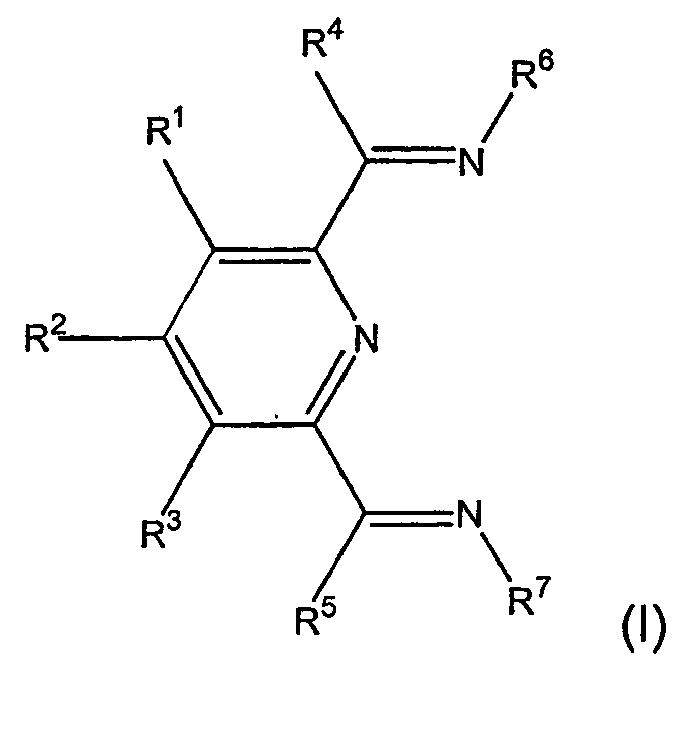
- ethylene oligomerization catalyst A preferred type of ethylene oligomerization catalyst is described in U.S. Patent 6,103,946 and World Patent Applications 01/58874 , 00/42123 , 00/76659 and 01/19513 , all of which are hereby included by reference, and similar iron tridentate catalysts which result in the formation of ⁇ -olefins. These catalysts utilize selected diimines of 2,6-diacylpyridines or 2,6-pyridinedicarboxaldehydes as part of the ethylene oligomerization catalyst system, particularly as iron complexes.
- Such a preferred active ethylene oligomerization catalyst comprises an iron complex of a compound of the formula wherein:
- hydrocarbyl group is a univalent group containing only carbon and hydrogen.
- hydrocarbyls may be mentioned unsubstituted alkyls, cycloalkyls and aryls. If not otherwise stated, it is preferred that hydrocarbyl groups (and alkyl groups) herein contain 1 to about 30 carbon atoms.
- substituted hydrocarbyl herein is meant a hydrocarbyl group that contains one or more substituent groups which are inert under the process conditions to which the compound containing these groups is subjected (e.g., an inert functional group, see below).
- the substituent groups also do not substantially detrimentally interfere with the oligomerization process or operation of the oligomerization catalyst system.
- substituted hydrocarbyl groups herein contain 1 to about 30 carbon atoms. Included in the meaning of "substituted” are rings containing one or more heteroatoms, such as nitrogen, oxygen and/or sulfur. In a substituted hydrocarbyl, all of the hydrogens may be substituted, as in trifluoromethyl.
- (inert) functional group herein is meant a group, other than hydrocarbyl or substituted hydrocarbyl, which is inert under the process conditions to which the compound containing the group is subjected.
- the functional groups also do not substantially deleteriously interfere with any process described herein that the compound in which they are present may take part in.
- Examples of functional groups include halo (fluoro, chloro, bromo and iodo), and ether such as -OR 50 wherein R 50 is hydrocarbyl or substituted hydrocarbyl.
- the functional group alone should not coordinate to the metal atom more strongly than the groups in those compounds that are shown as coordinating to the metal atom, that is they should not displace the desired coordinating group.
- a “primary carbon group” herein is meant a group of the formula -CH 2 ---, wherein the free valence --- is to any other atom, and the bond represented by the solid line is to a ring atom of a substituted aryl to which the primary carbon group is attached.
- the free valence --- may be bonded to a hydrogen atom, a halogen atom, a carbon atom, an oxygen atom, a sulfur atom, etc.
- the free valence --- may be to hydrogen, hydrocarbyl, substituted hydrocarbyl or a functional group.
- Examples of primary carbon groups include -CH 3 , -CH 2 CH(CH 3 ) 2 , -CH 2 Cl, -CH 2 C 6 H 5 , -OCH 3 and -CH 2 OCH 3 .
- a secondary carbon group is meant the group wherein the bond represented by the solid line is to a ring atom of a substituted aryl to which the secondary carbon group is attached, and both free bonds represented by the dashed lines are to an atom or atoms other than hydrogen. These atoms or groups may be the same or different. In other words the free valences represented by the dashed lines may be hydrocarbyl, substituted hydrocarbyl or inert functional groups.
- tertiary carbon group a group of the formula wherein the bond represented by the solid line is to a ring atom of a substituted aryl to which the tertiary carbon group is attached, and the three free bonds represented by the dashed lines are to an atom or atoms other than hydrogen.
- the bonds represented by the dashed lines are to hydrocarbyl, substituted hydrocarbyl or inert functional groups.
- aryl is meant a monovalent aromatic group in which the free valence is to the carbon atom of an aromatic ring.
- An aryl may have one or more aromatic rings which may be fused, connected by single bonds or other groups.
- substituted aryl is meant a monovalent aromatic group substituted as set forth in the above definition of “substituted hydrocarbyl”. Similar to an aryl, a substituted aryl may have one or more aromatic rings which may be fused, connected by single bonds or other groups; however, when the substituted aryl has a heteroaromatic ring, the free valence in the substituted aryl group can be to a heteroatom (such as nitrogen) of the heteroaromatic ring instead of a carbon.
- first ring atom in R 6 and R 7 bound to an imino nitrogen atom is meant the ring atom in these groups bound to an imino nitrogen shown in (I), for example the atoms shown in the 1-position in the rings in (II) and (III) are the first ring atoms bound to an imino carbon atom (other groups which may be substituted on the aryl groups are not shown).
- Ring atoms adjacent to the first ring atoms are shown, for example, in (IV) and (V), where the open valencies to these adjacent atoms are shown by dashed lines (the 2,6-positions in (IV) and the 2,5-positions in (V)).
- R 6 is and R 7 is wherein:
- R 8 corresponds to the second ring atom adjacent to the first ring atom bound to the imino nitrogen
- R 12 , R 13 and R 17 correspond to the other ring atoms adjacent to the first ring atom.
- R 1 , R 2 and R 3 are hydrogen; and/or R 4 and R 5 are methyl. It is further preferred that:
- R 6 and R 7 are, respectively wherein:
- R 18 corresponds to the second ring atom adjacent to the first ring atom bound to the imino nitrogen
- R 21 , R 22 and R 25 correspond to the other ring atoms adjacent to the first ring atom.
- R 1 , R 2 and R 3 are hydrogen; and/or R 4 and R 5 are methyl. It is further preferred that:
- ethylene olgimerization catalyst is typified by that described in U.S. Patent 5,382,738 .
- these types of catalysts produce (predominantly) a single olefin having a relatively low number of carbon atoms, such as 1-hexene or 1-octene.
- These types of catalysts may also be used in the present processes to oligomerize ethylene as described in the references concerning these catalysts.
- the production of the HTAC from hydrogen, aluminum and the ⁇ -olefin(s) can be carried out by methods known in the art, see for instance U.S. Patents 2,787,626 , 3,032,574 , 3,207,770 and 3,960,912 and W. Gerhartz, et al., Ed., Ullmann's Encyclopedia of Industrial Chemistry, 5th Ed., Vol. A1, VCH Verlagsgesellschaft mbH, Weinheim, 1985, p. 545-549 , which is hereby included by reference.
- the process may be carried out in a single reactor or in a series of reactors as in U.S. Patent 3,960,912 .
- HTAC trialkylaluminum compound
- HTAC HTAC or mixtures thereof which are meant to be produced in the process.
- some of the product HTAC will likely be recycled back to the reactor making the HTAC, and some will be taken off as product.
- the ⁇ -olefin(s) from the ethylene oligomerization reaction undergo little or no purification before being put into the process to make the HTAC. If a mixture of ⁇ -olefins are produced they are preferably not separated.
- the ethylene oligomerization catalyst may be deactivated or not (if present it may be deactivated by the usually higher temperatures of the HTAC forming process).
- a solvent may be used in the ethylene oligomerization reaction, and preferably it does not contain active hydrogen compounds such as water, alcohols or carboxylic acids. If the solvent does not contain active hydrogen compounds it does not need to be separated before the reactions to form the HTAC.
- Preferred solvent in the oligomerization reaction are nonolefinic hydrocarbons such as toluene, xylene, octane, cyclohexane, and the like.
- the composition of the HTAC(s) produced will depend on the composition of the ⁇ -olefin (mixture) added to the HTAC forming reaction.
- Reaction of the HTAC(s) with oxygen or other oxidizing agent to form higher trialkoxyaluminum compounds can be carried out as known in the art, see for instance . Elvers, et al., Ed., Ullmann's Encyclopedia of Industrial Chemistry, 5th Ed., Vol. A28, VCH Verlagsgesellschaft mbH, Weinheim, 1996, p. 505-508 and references therein, and U.S. Patent 5,278,330 which is hereby included by reference.
- the hydrolysis of the higher trialkoxyaluminum compound to form ⁇ -alcohols may be carried out by methods known in the literature, see for instance Elvers, et al., Ed., Ullmann's Encyclopedia of Industrial Chemistry, 5th Ed., Vol.
- the present process form making the HTAC(s) and/or ⁇ -alcohols result in less handling of pyrophoric alkylaluminum compounds at high temperatures and/or pressure, thereby making the process safer and/or lowering operating cost, and/or lowering investment need for the plant, when compared to the conventional methods of manufacturing these types of compounds.
- the product mixture resulting, for example, from making ⁇ -alcohols may be similar to that obtained with current manufacturing methods.
Landscapes
- Chemical & Material Sciences (AREA)
- Organic Chemistry (AREA)
- Chemical Kinetics & Catalysis (AREA)
- Organic Low-Molecular-Weight Compounds And Preparation Thereof (AREA)
- Low-Molecular Organic Synthesis Reactions Using Catalysts (AREA)
- Transition And Organic Metals Composition Catalysts For Addition Polymerization (AREA)
Claims (7)
- Verfahren zur Herstellung höherer Trialkylaluminium-Verbindungen, umfassend das Erzeugen eines α-Olefins oder Mischung von α-Olefinen durch Oligomerisierung von Ethylen unter Anwendung eines ein Übergangsmetall enthaltenden Katalysatorsystems zur Oligomerisierung und anschließend Kontaktieren des α-Olefins oder der Mischung von α-Olefinen mit Aluminiummetall, Wasserstoff und einer Trialkylaluminium-Verbindung bei ausreichender Temperatur und Druck für eine ausreichende Zeitdauer, um eine höhere Trialkylaluminium-Verbindung zu erzeugen.
- Verfahren zur Herstellung von α-Alkoholen, umfassend:(1) Erzeugen eines α-Olefins oder Mischung von α-Olefinen durch Oligomerisierung von Ethylen unter Anwendung eines ein Übergangsmetall enthaltenden Katalysatorsystems zur Oligomerisierung;(2) sodann Kontaktieren des α-Olefins oder der Mischung von α-Olefinen mit Aluminiummetall, Wasserstoff und einer Trialkylaluminium-Verbindung bei ausreichender Temperatur und Druck für eine ausreichende Zeitdauer um eine höhere Trialkylaluminium-Verbindung oder eine Mischung davon zu erzeugen;(3) Kontaktieren der höheren Trialkylaluminium-Verbindung oder einer Mischung davon mit Sauerstoff oder mit einem anderen geeigneten Mittel zum Oxidieren, um eine höhere Trialkoxyaluminium-Verbindung oder eine Mischung davon zu erzeugen;(4) Hydrolysieren der höheren Trialkoxyaluminium-Verbindung oder einer Mischung davon, um einen α-Alkohol oder eine Mischung davon zu erzeugen.
- Verfahren nach Anspruch 1 oder 2, wobei die Mischung von Olefinen verwendet wird und eine homologe Reihe von α-Olefinen ist.
- Verfahren nach Anspruch 1 oder 2, wobei die homologe Reihe von α-Olefinen in einer Reaktion der Oligomerisierung erzeugt wird, die eine Schulz-Flory-Konstante von etwa 0,6 bis etwa 0,8 hat.
- Verfahren nach Anspruch 1, 2, 3 oder 4, wobei das ein Übergangsmetall enthaltende Katalysatorsystem zur Oligomerisierung einen Eisen-Komplex eines Diimins eines 2,6-Diacylpyridins oder eines 2,6-Pyridindicarboxaldehyds aufweist.
- Verfahren nach Anspruch 5, wobei der Eisen-Komplex eine Verbindung der Formel ist:
 R1, R2 und R3 jeweils unabhängig Wasserstoff sind, Hydrocarbyl, substituiertes Hydrocarbyl oder eine inerte funktionelle Gruppe mit der Maßgabe, dass jeweils zwei von R1, R2 und R3 zueinander in Nachbarstellung zusammengenommen einen Ring bilden können;R4 und R5 jeweils unabhängig Wasserstoff sind, Hydrocarbyl, substituiertes Hydrocarbyl oder eine inerte funktionelle Gruppe;R6 und R7 jeweils unabhängig ein substituiertes Aryl sind, die ein erstes Ringatom an dem Imino-Stickstoff gebunden haben mit der Maßgabe, dass:in R6 ein zweites Ringatom in Nachbarstellung zu dem ersten Ringatom an einem Halogen, einer primären Kohlenstoffgruppe, einer sekundären Kohlenstoffgruppe oder einer tertiären Kohlenstoffgruppe gebunden ist, und ferner mit der Maßgabe, dassin R6, wenn das zweite Ringatom an einem Halogen oder einer primären Kohlenstoffgruppe gebunden ist, keines, ein oder zwei der anderen Ringatome in R6 und R7 in Nachbarstellung zu dem ersten Ringatom an einem Halogen oder an einer primären Kohlenstoffgruppe gebunden sind und der Rest der Ringatome in Nachbarstellung zu dem ersten Ringatom an einem Wasserstoffatom gebunden ist; oderin R6, wenn das zweite Ringatom an einer sekundären Kohlenstoffgruppe gebunden ist, keines, ein oder zwei der anderen Ringatome in R6 und R7 in Nachbarstellung zu dem ersten Ringatom an einem Halogen oder an einer primären Kohlenstoffgruppe oder einer sekundären Kohlenstoffgruppe gebunden sind und der Rest der Ringatome in Nachbarstellung zu dem ersten Ringatom an einem Wasserstoffatom gebunden ist; oderin R6, wenn das zweite Ringatom an einer tertiären Kohlenstoffgruppe gebunden ist, keines order ein der anderen Ringatome in R6 und R7 in Nachbarstellung zu dem ersten Ringatom an einer tertiären Kohlenstoffgruppe gebunden sind und der Rest der Ringatome in Nachbarstellung zu dem ersten Ringatom an einem Wasserstoffatom gebunden ist.
 - Verfahren nach Anspruch 1 oder 2, worin ein einziges α-Olefin verwendet wird.
Applications Claiming Priority (3)
| Application Number | Priority Date | Filing Date | Title |
|---|---|---|---|
| US34044401P | 2001-12-12 | 2001-12-12 | |
| US340444P | 2001-12-12 | ||
| PCT/US2002/039636 WO2003053889A2 (en) | 2001-12-12 | 2002-12-12 | Manufacture of trialkylaluminum compounds and alpha-alcohols |
Publications (3)
| Publication Number | Publication Date |
|---|---|
| EP1578706A2 EP1578706A2 (de) | 2005-09-28 |
| EP1578706A4 EP1578706A4 (de) | 2007-08-15 |
| EP1578706B1 true EP1578706B1 (de) | 2009-01-21 |
Family
ID=23333378
Family Applications (1)
| Application Number | Title | Priority Date | Filing Date |
|---|---|---|---|
| EP02790087A Expired - Lifetime EP1578706B1 (de) | 2001-12-12 | 2002-12-12 | Herstellung von trialkylaluminiumverbindungen und alpha-alkoholen |
Country Status (8)
| Country | Link |
|---|---|
| US (1) | US6822108B2 (de) |
| EP (1) | EP1578706B1 (de) |
| JP (1) | JP2005514395A (de) |
| CN (1) | CN1612882A (de) |
| AT (1) | ATE421520T1 (de) |
| AU (1) | AU2002353112A1 (de) |
| DE (1) | DE60231011D1 (de) |
| WO (1) | WO2003053889A2 (de) |
Families Citing this family (3)
| Publication number | Priority date | Publication date | Assignee | Title |
|---|---|---|---|---|
| DE60204455T2 (de) * | 2001-05-10 | 2006-03-23 | Univation Technologies, LLC, Houston | Einen pyrrolbisiminliganden enthaltende katalysatoren zur polymerisierung von olefinen |
| KR101579880B1 (ko) * | 2012-05-10 | 2016-01-04 | 주식회사 엘지화학 | 에틸렌 올리고머화 방법 |
| US10894842B2 (en) * | 2016-08-30 | 2021-01-19 | Eneos Corporation | Method for producing oligomer and catalyst |
Family Cites Families (20)
| Publication number | Priority date | Publication date | Assignee | Title |
|---|---|---|---|---|
| BE535235A (de) * | 1954-02-01 | |||
| NL109047C (de) * | 1955-04-01 | |||
| US2787626A (en) * | 1955-06-07 | 1957-04-02 | Ethyl Corp | Manufacture of triethylaluminum |
| US3487097A (en) * | 1962-10-30 | 1969-12-30 | Ethyl Corp | Process for producing trialkyl aluminum and aluminum trialkoxides |
| US3388143A (en) * | 1964-11-23 | 1968-06-11 | Continental Oil Co | Growth reaction |
| US3474122A (en) * | 1965-09-01 | 1969-10-21 | Sumitomo Chemical Co | Process for producing higher alkylaluminums |
| US3494948A (en) * | 1965-12-21 | 1970-02-10 | Sumitomo Chemical Co | Process for producing higher alkylaluminums |
| US3775456A (en) * | 1969-08-04 | 1973-11-27 | Continental Oil Co | Control of distribution of aluminum alkyls and products derived therefrom |
| US3644564A (en) * | 1969-12-19 | 1972-02-22 | Shell Oil Co | Ethylene oligomerization in the presence of complex nickel-fluorine-containing catalysts |
| US3829520A (en) * | 1972-05-15 | 1974-08-13 | Continental Oil Co | Inhibition of olefin isomerization and reverse displacement in catalytic displacement reactions |
| DE2361988C3 (de) * | 1973-12-13 | 1982-06-16 | Schering Ag, 1000 Berlin Und 4619 Bergkamen | Verfahren zur Herstellung von Aluminiumtrialkylen |
| US4689437A (en) * | 1986-07-21 | 1987-08-25 | Union Carbide Corporation | Oligomerization to alpha-olefins |
| US5210338A (en) * | 1991-10-25 | 1993-05-11 | Ethyl Corporation | Catalyzed chain growth process |
| US5438027A (en) * | 1991-12-13 | 1995-08-01 | Phillips Petroleum Company | Chromium compounds and uses thereof |
| US5276220A (en) * | 1992-06-18 | 1994-01-04 | Ethyl Corporation | Actinide catalyzed chain growth process |
| US5430165A (en) * | 1992-06-29 | 1995-07-04 | Albemarle Corporation | Method of oxidizing aluminum alkyls |
| US5233103A (en) * | 1992-06-29 | 1993-08-03 | Ethyl Corporation | Preparation of organoaluminum compounds and linear alcohols derived therefrom |
| US5536859A (en) * | 1995-02-27 | 1996-07-16 | Amoco Corporation | Alpha-olefin catalyst and process |
| US6103859A (en) * | 1997-04-09 | 2000-08-15 | Eastman Chemical Company | Late addition of supplemental ethylene glycol in the preparation of copolyesters |
| US6103946A (en) | 1997-07-15 | 2000-08-15 | E. I. Du Pont De Nemours And Company | Manufacture of α-olefins |
-
2002
- 2002-12-12 EP EP02790087A patent/EP1578706B1/de not_active Expired - Lifetime
- 2002-12-12 JP JP2003554606A patent/JP2005514395A/ja active Pending
- 2002-12-12 DE DE60231011T patent/DE60231011D1/de not_active Expired - Lifetime
- 2002-12-12 AU AU2002353112A patent/AU2002353112A1/en not_active Abandoned
- 2002-12-12 US US10/494,061 patent/US6822108B2/en not_active Expired - Fee Related
- 2002-12-12 WO PCT/US2002/039636 patent/WO2003053889A2/en not_active Ceased
- 2002-12-12 CN CNA028250184A patent/CN1612882A/zh active Pending
- 2002-12-12 AT AT02790087T patent/ATE421520T1/de not_active IP Right Cessation
Also Published As
| Publication number | Publication date |
|---|---|
| US6822108B2 (en) | 2004-11-23 |
| DE60231011D1 (de) | 2009-03-12 |
| AU2002353112A8 (en) | 2003-07-09 |
| AU2002353112A1 (en) | 2003-07-09 |
| EP1578706A4 (de) | 2007-08-15 |
| ATE421520T1 (de) | 2009-02-15 |
| WO2003053889A2 (en) | 2003-07-03 |
| EP1578706A2 (de) | 2005-09-28 |
| WO2003053889A3 (en) | 2006-09-21 |
| US20040210073A1 (en) | 2004-10-21 |
| CN1612882A (zh) | 2005-05-04 |
| JP2005514395A (ja) | 2005-05-19 |
Similar Documents
| Publication | Publication Date | Title |
|---|---|---|
| EP1311464B1 (de) | Verfahren zur herstellung von alpha-olefinen | |
| EP0994831B1 (de) | Verfahren zur herstellung von alpha-olefinen | |
| CN1022989C (zh) | 生产α-烯烃的齐聚催化剂 | |
| KR100220825B1 (ko) | 올레핀 생성 및 올레핀 생성 촉매 시스템 안정화 | |
| EP2994445B1 (de) | Oligomerisierung von ethylen in mischungen von 1-hexen und 1-octen | |
| JP5363814B2 (ja) | オレフィンモノマーの接触オリゴマー化 | |
| JP5443762B2 (ja) | オレフィンモノマーのオリゴマー化のための接触プロセス | |
| US6555723B2 (en) | Continuous manufacturing process for alpha-olefins | |
| JP5036701B2 (ja) | オレフィンモノマーの接触三量化および四量化 | |
| US6777584B2 (en) | Selective coupling of terminal olefins with ethylene to manufacture linear α-olefins | |
| US5210338A (en) | Catalyzed chain growth process | |
| JPH05221882A (ja) | エチレンの低重合 | |
| US6740715B2 (en) | Manufacture of alpha-olefins | |
| JP5421118B2 (ja) | オレフィンモノマーのオリゴマー化用配位子及び触媒 | |
| JP4857269B2 (ja) | 線状アルファオレフィンの調製方法 | |
| US20110213190A1 (en) | Process for oligomerization of olefins that uses a catalytic composition that comprises an organometallic complex that contains a phenoxy ligand that is functionalized by a heteroatom | |
| CA2560564C (en) | Transition metal complexes | |
| US20040143147A1 (en) | Process for producing alpha-olefins | |
| US6822108B2 (en) | Manufacture of trialkylaluminum compounds and α-alcohols | |
| US6861545B2 (en) | Manufacture of trialkylaluminum compounds and α-alcohols | |
| US7982085B2 (en) | In-line process for generating comonomer | |
| EP1305271B1 (de) | Kontinuierliches verfahren zur herstellung von alpha-olefinen | |
| IE65953B1 (en) | Process for making alkyl arsine compounds | |
| JP2010189297A (ja) | エチレンの三量化および/または四量化による1−ヘキセンおよび/または1−オクテンの製造方法 | |
| JP2000264919A (ja) | α−オレフィンの製造方法 |
Legal Events
| Date | Code | Title | Description |
|---|---|---|---|
| PUAI | Public reference made under article 153(3) epc to a published international application that has entered the european phase |
Free format text: ORIGINAL CODE: 0009012 |
|
| 17P | Request for examination filed |
Effective date: 20040607 |
|
| AK | Designated contracting states |
Kind code of ref document: A2 Designated state(s): AT BE BG CH CY CZ DE DK EE ES FI FR GB GR IE IT LI LU MC NL PT SE SI SK TR |
|
| AX | Request for extension of the european patent |
Extension state: AL LT LV MK RO |
|
| PUAK | Availability of information related to the publication of the international search report |
Free format text: ORIGINAL CODE: 0009015 |
|
| RIC1 | Information provided on ipc code assigned before grant |
Ipc: C07C 27/00 20060101ALI20061031BHEP Ipc: C07F 5/06 20060101AFI20061031BHEP |
|
| A4 | Supplementary search report drawn up and despatched |
Effective date: 20070713 |
|
| GRAP | Despatch of communication of intention to grant a patent |
Free format text: ORIGINAL CODE: EPIDOSNIGR1 |
|
| DAX | Request for extension of the european patent (deleted) | ||
| GRAS | Grant fee paid |
Free format text: ORIGINAL CODE: EPIDOSNIGR3 |
|
| GRAA | (expected) grant |
Free format text: ORIGINAL CODE: 0009210 |
|
| AK | Designated contracting states |
Kind code of ref document: B1 Designated state(s): AT BE BG CH CY CZ DE DK EE ES FI FR GB GR IE IT LI LU MC NL PT SE SI SK TR |
|
| REG | Reference to a national code |
Ref country code: GB Ref legal event code: FG4D |
|
| REG | Reference to a national code |
Ref country code: CH Ref legal event code: EP |
|
| REG | Reference to a national code |
Ref country code: IE Ref legal event code: FG4D |
|
| REF | Corresponds to: |
Ref document number: 60231011 Country of ref document: DE Date of ref document: 20090312 Kind code of ref document: P |
|
| PG25 | Lapsed in a contracting state [announced via postgrant information from national office to epo] |
Ref country code: NL Free format text: LAPSE BECAUSE OF FAILURE TO SUBMIT A TRANSLATION OF THE DESCRIPTION OR TO PAY THE FEE WITHIN THE PRESCRIBED TIME-LIMIT Effective date: 20090121 |
|
| NLV1 | Nl: lapsed or annulled due to failure to fulfill the requirements of art. 29p and 29m of the patents act | ||
| PG25 | Lapsed in a contracting state [announced via postgrant information from national office to epo] |
Ref country code: ES Free format text: LAPSE BECAUSE OF FAILURE TO SUBMIT A TRANSLATION OF THE DESCRIPTION OR TO PAY THE FEE WITHIN THE PRESCRIBED TIME-LIMIT Effective date: 20090502 Ref country code: SI Free format text: LAPSE BECAUSE OF FAILURE TO SUBMIT A TRANSLATION OF THE DESCRIPTION OR TO PAY THE FEE WITHIN THE PRESCRIBED TIME-LIMIT Effective date: 20090121 Ref country code: FI Free format text: LAPSE BECAUSE OF FAILURE TO SUBMIT A TRANSLATION OF THE DESCRIPTION OR TO PAY THE FEE WITHIN THE PRESCRIBED TIME-LIMIT Effective date: 20090121 |
|
| PG25 | Lapsed in a contracting state [announced via postgrant information from national office to epo] |
Ref country code: SE Free format text: LAPSE BECAUSE OF FAILURE TO SUBMIT A TRANSLATION OF THE DESCRIPTION OR TO PAY THE FEE WITHIN THE PRESCRIBED TIME-LIMIT Effective date: 20090421 Ref country code: PT Free format text: LAPSE BECAUSE OF FAILURE TO SUBMIT A TRANSLATION OF THE DESCRIPTION OR TO PAY THE FEE WITHIN THE PRESCRIBED TIME-LIMIT Effective date: 20090622 Ref country code: AT Free format text: LAPSE BECAUSE OF FAILURE TO SUBMIT A TRANSLATION OF THE DESCRIPTION OR TO PAY THE FEE WITHIN THE PRESCRIBED TIME-LIMIT Effective date: 20090121 |
|
| PG25 | Lapsed in a contracting state [announced via postgrant information from national office to epo] |
Ref country code: BE Free format text: LAPSE BECAUSE OF FAILURE TO SUBMIT A TRANSLATION OF THE DESCRIPTION OR TO PAY THE FEE WITHIN THE PRESCRIBED TIME-LIMIT Effective date: 20090121 |
|
| PG25 | Lapsed in a contracting state [announced via postgrant information from national office to epo] |
Ref country code: DK Free format text: LAPSE BECAUSE OF FAILURE TO SUBMIT A TRANSLATION OF THE DESCRIPTION OR TO PAY THE FEE WITHIN THE PRESCRIBED TIME-LIMIT Effective date: 20090121 Ref country code: CZ Free format text: LAPSE BECAUSE OF FAILURE TO SUBMIT A TRANSLATION OF THE DESCRIPTION OR TO PAY THE FEE WITHIN THE PRESCRIBED TIME-LIMIT Effective date: 20090121 Ref country code: EE Free format text: LAPSE BECAUSE OF FAILURE TO SUBMIT A TRANSLATION OF THE DESCRIPTION OR TO PAY THE FEE WITHIN THE PRESCRIBED TIME-LIMIT Effective date: 20090121 |
|
| PLBE | No opposition filed within time limit |
Free format text: ORIGINAL CODE: 0009261 |
|
| STAA | Information on the status of an ep patent application or granted ep patent |
Free format text: STATUS: NO OPPOSITION FILED WITHIN TIME LIMIT |
|
| PG25 | Lapsed in a contracting state [announced via postgrant information from national office to epo] |
Ref country code: SK Free format text: LAPSE BECAUSE OF FAILURE TO SUBMIT A TRANSLATION OF THE DESCRIPTION OR TO PAY THE FEE WITHIN THE PRESCRIBED TIME-LIMIT Effective date: 20090121 |
|
| 26N | No opposition filed |
Effective date: 20091022 |
|
| PG25 | Lapsed in a contracting state [announced via postgrant information from national office to epo] |
Ref country code: BG Free format text: LAPSE BECAUSE OF FAILURE TO SUBMIT A TRANSLATION OF THE DESCRIPTION OR TO PAY THE FEE WITHIN THE PRESCRIBED TIME-LIMIT Effective date: 20090421 |
|
| PGFP | Annual fee paid to national office [announced via postgrant information from national office to epo] |
Ref country code: GB Payment date: 20091209 Year of fee payment: 8 |
|
| PGFP | Annual fee paid to national office [announced via postgrant information from national office to epo] |
Ref country code: DE Payment date: 20091222 Year of fee payment: 8 |
|
| PG25 | Lapsed in a contracting state [announced via postgrant information from national office to epo] |
Ref country code: MC Free format text: LAPSE BECAUSE OF NON-PAYMENT OF DUE FEES Effective date: 20100701 |
|
| REG | Reference to a national code |
Ref country code: CH Ref legal event code: PL |
|
| REG | Reference to a national code |
Ref country code: FR Ref legal event code: ST Effective date: 20100831 |
|
| REG | Reference to a national code |
Ref country code: IE Ref legal event code: MM4A |
|
| PG25 | Lapsed in a contracting state [announced via postgrant information from national office to epo] |
Ref country code: FR Free format text: LAPSE BECAUSE OF NON-PAYMENT OF DUE FEES Effective date: 20091231 Ref country code: CH Free format text: LAPSE BECAUSE OF NON-PAYMENT OF DUE FEES Effective date: 20091231 Ref country code: LI Free format text: LAPSE BECAUSE OF NON-PAYMENT OF DUE FEES Effective date: 20091231 Ref country code: IE Free format text: LAPSE BECAUSE OF NON-PAYMENT OF DUE FEES Effective date: 20091212 Ref country code: GR Free format text: LAPSE BECAUSE OF FAILURE TO SUBMIT A TRANSLATION OF THE DESCRIPTION OR TO PAY THE FEE WITHIN THE PRESCRIBED TIME-LIMIT Effective date: 20090422 |
|
| PG25 | Lapsed in a contracting state [announced via postgrant information from national office to epo] |
Ref country code: IT Free format text: LAPSE BECAUSE OF FAILURE TO SUBMIT A TRANSLATION OF THE DESCRIPTION OR TO PAY THE FEE WITHIN THE PRESCRIBED TIME-LIMIT Effective date: 20090121 |
|
| PG25 | Lapsed in a contracting state [announced via postgrant information from national office to epo] |
Ref country code: LU Free format text: LAPSE BECAUSE OF NON-PAYMENT OF DUE FEES Effective date: 20091212 |
|
| GBPC | Gb: european patent ceased through non-payment of renewal fee |
Effective date: 20101212 |
|
| PG25 | Lapsed in a contracting state [announced via postgrant information from national office to epo] |
Ref country code: TR Free format text: LAPSE BECAUSE OF FAILURE TO SUBMIT A TRANSLATION OF THE DESCRIPTION OR TO PAY THE FEE WITHIN THE PRESCRIBED TIME-LIMIT Effective date: 20090121 |
|
| PG25 | Lapsed in a contracting state [announced via postgrant information from national office to epo] |
Ref country code: CY Free format text: LAPSE BECAUSE OF FAILURE TO SUBMIT A TRANSLATION OF THE DESCRIPTION OR TO PAY THE FEE WITHIN THE PRESCRIBED TIME-LIMIT Effective date: 20090121 |
|
| REG | Reference to a national code |
Ref country code: DE Ref legal event code: R119 Ref document number: 60231011 Country of ref document: DE Effective date: 20110701 |
|
| PG25 | Lapsed in a contracting state [announced via postgrant information from national office to epo] |
Ref country code: GB Free format text: LAPSE BECAUSE OF NON-PAYMENT OF DUE FEES Effective date: 20101212 Ref country code: DE Free format text: LAPSE BECAUSE OF NON-PAYMENT OF DUE FEES Effective date: 20110701 |