EP1577688A1 - Chromatic dispersion-compensating optical fibre in the S-band using a higher order mode - Google Patents
Chromatic dispersion-compensating optical fibre in the S-band using a higher order mode Download PDFInfo
- Publication number
- EP1577688A1 EP1577688A1 EP05075590A EP05075590A EP1577688A1 EP 1577688 A1 EP1577688 A1 EP 1577688A1 EP 05075590 A EP05075590 A EP 05075590A EP 05075590 A EP05075590 A EP 05075590A EP 1577688 A1 EP1577688 A1 EP 1577688A1
- Authority
- EP
- European Patent Office
- Prior art keywords
- index
- dispersion
- optical fibre
- compensating optical
- wavelength
- Prior art date
- Legal status (The legal status is an assumption and is not a legal conclusion. Google has not performed a legal analysis and makes no representation as to the accuracy of the status listed.)
- Ceased
Links
- 239000013307 optical fiber Substances 0.000 title claims abstract description 118
- 239000006185 dispersion Substances 0.000 claims abstract description 113
- 230000002093 peripheral effect Effects 0.000 claims description 59
- 238000005253 cladding Methods 0.000 claims description 54
- 230000005540 biological transmission Effects 0.000 claims description 18
- 238000005452 bending Methods 0.000 claims description 3
- 230000001186 cumulative effect Effects 0.000 claims description 2
- 230000003287 optical effect Effects 0.000 abstract description 23
- 230000003595 spectral effect Effects 0.000 abstract description 17
- 239000000835 fiber Substances 0.000 description 4
- 230000007547 defect Effects 0.000 description 2
- 230000001747 exhibiting effect Effects 0.000 description 2
- 230000000644 propagated effect Effects 0.000 description 2
- 230000002939 deleterious effect Effects 0.000 description 1
- 230000000694 effects Effects 0.000 description 1
- 238000004519 manufacturing process Methods 0.000 description 1
- 238000011144 upstream manufacturing Methods 0.000 description 1
Images

Classifications
-
- G—PHYSICS
- G02—OPTICS
- G02B—OPTICAL ELEMENTS, SYSTEMS OR APPARATUS
- G02B6/00—Light guides; Structural details of arrangements comprising light guides and other optical elements, e.g. couplings
- G02B6/02—Optical fibres with cladding with or without a coating
- G02B6/036—Optical fibres with cladding with or without a coating core or cladding comprising multiple layers
- G02B6/03616—Optical fibres characterised both by the number of different refractive index layers around the central core segment, i.e. around the innermost high index core layer, and their relative refractive index difference
- G02B6/03688—Optical fibres characterised both by the number of different refractive index layers around the central core segment, i.e. around the innermost high index core layer, and their relative refractive index difference having 5 or more layers
-
- G—PHYSICS
- G02—OPTICS
- G02B—OPTICAL ELEMENTS, SYSTEMS OR APPARATUS
- G02B6/00—Light guides; Structural details of arrangements comprising light guides and other optical elements, e.g. couplings
- G02B6/02—Optical fibres with cladding with or without a coating
- G02B6/02004—Optical fibres with cladding with or without a coating characterised by the core effective area or mode field radius
- G02B6/02009—Large effective area or mode field radius, e.g. to reduce nonlinear effects in single mode fibres
- G02B6/02014—Effective area greater than 60 square microns in the C band, i.e. 1530-1565 nm
-
- G—PHYSICS
- G02—OPTICS
- G02B—OPTICAL ELEMENTS, SYSTEMS OR APPARATUS
- G02B6/00—Light guides; Structural details of arrangements comprising light guides and other optical elements, e.g. couplings
- G02B6/02—Optical fibres with cladding with or without a coating
- G02B6/02004—Optical fibres with cladding with or without a coating characterised by the core effective area or mode field radius
- G02B6/02009—Large effective area or mode field radius, e.g. to reduce nonlinear effects in single mode fibres
- G02B6/02023—Based on higher order modes, i.e. propagating modes other than the LP01 or HE11 fundamental mode
-
- G—PHYSICS
- G02—OPTICS
- G02B—OPTICAL ELEMENTS, SYSTEMS OR APPARATUS
- G02B6/00—Light guides; Structural details of arrangements comprising light guides and other optical elements, e.g. couplings
- G02B6/02—Optical fibres with cladding with or without a coating
- G02B6/02047—Dual mode fibre
-
- G—PHYSICS
- G02—OPTICS
- G02B—OPTICAL ELEMENTS, SYSTEMS OR APPARATUS
- G02B6/00—Light guides; Structural details of arrangements comprising light guides and other optical elements, e.g. couplings
- G02B6/02—Optical fibres with cladding with or without a coating
- G02B6/02214—Optical fibres with cladding with or without a coating tailored to obtain the desired dispersion, e.g. dispersion shifted, dispersion flattened
- G02B6/02219—Characterised by the wavelength dispersion properties in the silica low loss window around 1550 nm, i.e. S, C, L and U bands from 1460-1675 nm
- G02B6/02252—Negative dispersion fibres at 1550 nm
- G02B6/02261—Dispersion compensating fibres, i.e. for compensating positive dispersion of other fibres
-
- H—ELECTRICITY
- H04—ELECTRIC COMMUNICATION TECHNIQUE
- H04B—TRANSMISSION
- H04B10/00—Transmission systems employing electromagnetic waves other than radio-waves, e.g. infrared, visible or ultraviolet light, or employing corpuscular radiation, e.g. quantum communication
- H04B10/25—Arrangements specific to fibre transmission
- H04B10/2507—Arrangements specific to fibre transmission for the reduction or elimination of distortion or dispersion
- H04B10/2513—Arrangements specific to fibre transmission for the reduction or elimination of distortion or dispersion due to chromatic dispersion
- H04B10/2525—Arrangements specific to fibre transmission for the reduction or elimination of distortion or dispersion due to chromatic dispersion using dispersion-compensating fibres
-
- G—PHYSICS
- G02—OPTICS
- G02B—OPTICAL ELEMENTS, SYSTEMS OR APPARATUS
- G02B6/00—Light guides; Structural details of arrangements comprising light guides and other optical elements, e.g. couplings
- G02B6/02—Optical fibres with cladding with or without a coating
- G02B6/02214—Optical fibres with cladding with or without a coating tailored to obtain the desired dispersion, e.g. dispersion shifted, dispersion flattened
- G02B6/02285—Characterised by the polarisation mode dispersion [PMD] properties, e.g. for minimising PMD
Definitions
- the invention relates to the field of chromatic dispersion-compensating optical fibres for a wavelength multiplexing transmission system.
- the function of the dispersion-compensating optical fibre is to compensate for the chromatic dispersion of a so-called line fibre.
- the invention relates more precisely to an chromatic dispersion-compensating optical fibre in the S-band for use in compensating for the chromatic dispersion of either a standard SMF optical fibre or of an NZ-DSF optical fibre, where the line optical fibre carries an optical signal in the spectral band in use, which is the S-band extending from 1460 nm to 1530 nm.
- a dispersion-compensating optical fibre for a wavelength multiplexing transmission system comprising, from the centre towards the periphery, a core having a variable index profile then a cladding of constant index, wherein, the chromatic dispersion is less than - 150 ps/nm.km, the chromatic dispersion slope is strictly negative, and the effective area is greater than 40 ⁇ m 2 .
- the difference between the wavelength corresponding to the overall minimum chromatic dispersion and the wavelength corresponding to an upper limit of an operating spectral range greater than 30 nm is greater than 35 nm, and the relative variation of the dispersion slope over said operating spectral range has an absolute value less than 30 %.
- a limited mode dispersion compensating optical fiber supporting at least one high order spatial mode comprising: a plurality of core areas, the refractive index profile of which are selected to result in an optical waveguide providing in the LP 02 mode: dispersion more negative than -300 ps/nm/km at a representative wavelength, designated ⁇ 0 , within an operative waveband; projected zero dispersion less than ( ⁇ 0 -75 nm), where projected zero dispersion is defined as ⁇ 0 -Dispersion ( ⁇ 0 )/Slope ( ⁇ 0 ); and third order dispersion less than 2 % over the operative waveband, where third order dispersion is defined as the maximum deviation from a best line fit for dispersion divided the best fit dispersion at ⁇ 0 , said best fit line chosen to minimize said maximum deviation.
- the solution proposed by the invention accordingly relates to an H0M dispersion-compensating optical fibre in the S-band exhibiting as small variations as possible in the chromatic dispersion slope in order to enable effective compensation for chromatic dispersion and for the chromatic dispersion slope across the entire S-band.
- the minimum chromatic dispersion wavelength is selected from a narrow and optimum spectral range in order to ensure a good compromise between the low level of variation in the chromatic dispersion slope in the S-band, the high value for effective area, the very negative chromatic dispersion value, and a chromatic dispersion to chromatic dispersion slope ratio that is as close as possible to that of the line optical fibre to be compensated.
- the optimum range for the minimum chromatic dispersion wavelength and the compromise between the parameters and optical properties being sought are slightly different.
- an chromatic dispersion-compensating optical fibre in the spectral band S extending from 1460 nm to 1530 nm for a wavelength multiplexing transmission system, comprising successively, from the centre to the periphery, a core having a variable index profile and then a cladding of constant index, enabling the propagation, at a wavelength of 1495 nm, in addition to the fundamental mode LP 01 , of at least one higher order mode, the index profile of the core being determined in such a manner that, for said higher mode, on the one hand at a wavelength of 1495 nm, firstly the chromatic dispersion is less than -150 ps/nm-km, secondly the chromatic dispersion to chromatic dispersion slope ratio is between 200 nm and 300 nm, and thirdly the effective area is greater than 60 ⁇ m 2 and, on the other hand, the wavelength
- the index profile of the core is determined in such a manner that, for said higher mode, at a wavelength of 1495 nm, the chromatic dispersion to chromatic dispersion slope ratio is between 200 nm and 250 nm.
- the index profile of the core is determined in such a manner that, for said higher mode, at a wavelength of 1495 nm, the wavelength corresponding to the global chromatic dispersion minimum is between 1570 nm and 1590 nm.
- the index profile of the core is determined in such a manner that, for said higher mode, at a wavelength of 1495 nm, the effective area is greater than 70 ⁇ m 2 , and preferably greater than 80 ⁇ m 2 .
- the maximum index difference ⁇ n 1 between the index of the central slice and the index of the cladding is between 20.10 -3 and 32.10 -3 and the outer radius r 1 of the central slice is between 3 ⁇ m and 4.5 ⁇ m.
- the value of the integral of the index difference relative to the cladding, between a zero radius and the radius r 1 of the portion of the central slice having an index higher than the index of the cladding is between 100.10 -3 and 115.10 -3 ⁇ m.
- the value of twice the integral of the product of the index difference relative to the cladding times the radius, between a zero radius and the radius r 1 of the portion of the central slice having an index higher than the index of the cladding is between 325.10 -3 ⁇ m 2 and 475.10 -3 ⁇ m 2 .
- the value of twice the integral of the product of the index difference relative to the cladding times the radius, between a zero radius and the radius r 3 of the second peripheral slice is between 400.10 -3 ⁇ m 2 and 800.10 -3 ⁇ m 2 .
- the index difference ⁇ n 2 between the index of the first peripheral slice and the index of the cladding is between -4.10 -3 and 5.10 -3 and the outer radius r 2 of the first peripheral slice is between 5 ⁇ m and 11 ⁇ m.
- the index difference ⁇ n 3 between the index of the second peripheral slice and the index of the cladding is between -5.10 -3 and 5.10 -3 and the outer radius r 3 of the second peripheral slice is between 8 ⁇ m and 15 ⁇ m.
- the index difference ⁇ n 4 between the index of the third peripheral slice and the index of the cladding is between -5.10 -3 and 5.10 -3 and the outer radius r 4 of the third peripheral slice is between 11 ⁇ m and 17 ⁇ m.
- the index difference ⁇ n 5 between the index of the fourth peripheral slice and the index of the cladding is between 0 and 10.10 -3 and the outer radius r 5 of the fourth peripheral slice is between 14 ⁇ m and 17 ⁇ m.
- an chromatic dispersion-compensating optical fibre in the spectral band S extending from 1460 nm to 1530 nm, for a wavelength multiplexing transmission system, comprising successively, from the centre to the periphery, a core having a variable index profile and then a cladding of constant index, enabling the propagation, at a wavelength of 1495 nm, in addition to the fundamental mode LP 01 , of at least one higher order mode, the index profile of the core being determined in such a manner that, for said higher mode, on the one hand at a wavelength of 1495 nm, firstly the chromatic dispersion is lower than -150 ps/nm-km, secondly the chromatic dispersion to chromatic dispersion slope ratio is less than 130 nm and thirdly the effective area is greater than 50 ⁇ m 2 and, on the other hand, the wavelength corresponding to the global
- the index profile of the core is determined in such a manner that, for said higher mode, at a wavelength of 1495 nm, the chromatic dispersion to chromatic dispersion slope ratio is between 90 nm and 110 nm.
- the index profile of the core is determined in such a manner that, for said higher mode, at a wavelength of 1495 nm, the wavelength corresponding to the global chromatic dispersion minimum is between 1540 nm and 1560 nm.
- the index profile of the core is determined in such a manner that, for said higher mode, at a wavelength of 1495 nm, the effective area is greater than 65 ⁇ m 2 , preferably greater than 80 ⁇ m 2 .
- the maximum index difference ⁇ n 1 between the index of the central slice and the index of the cladding is between 15.10 -3 and 30.10 -3 and the outer radius r 1 of the central slice is between 3.5 ⁇ m and 5 ⁇ m.
- the value of twice the integral of the product of the index difference relative to the cladding times the radius, between a zero radius and the radius r 1 of the portion of the central slice having an index higher than the index of the cladding is between 375.10 -3 ⁇ m 2 and 525.10 -3 ⁇ m 2 .
- the value of twice the integral of the product of the index difference relative to the cladding times the radius, between a zero radius and the radius r 3 of the second peripheral slice is between 400.10 -3 ⁇ m 2 and 700.10 -3 ⁇ m 2 .
- the index difference ⁇ n 2 between the index of the first peripheral slice and the index of the cladding is between -7.10 -3 and 5.10 -3 and the outer radius r 2 of the first peripheral slice is between 5 ⁇ m and 10 ⁇ m.
- the index difference ⁇ n 3 between the index of the second peripheral slice and the index of the cladding is between -5.10 -3 and 5.10 -3 and the outer radius r 3 of the second peripheral slice is between 7 ⁇ m and 15 ⁇ m.
- the index difference ⁇ n 4 between the index of the third peripheral slice and the index of the cladding is between -5.10 -3 and 5.10 -3 and the outer radius r 4 of the third peripheral slice is between 10 ⁇ m and 16 ⁇ m.
- the index difference ⁇ n 5 between the index of the fourth peripheral slice and the index of the cladding is between 0 and 10.10 -3 and the outer radius r 5 of the fourth peripheral slice is between 14 ⁇ m and 17 ⁇ m.
- the optical fibre preferably has the following advantageous characteristics.
- the higher order mode is the mode LP 02 , for which mode chromatic dispersion-compensating optical fibres exhibiting very negative chromatic dispersions can readily be obtained, and which mode is not very sensitive to defects in the circular geometry of the fibre, which defects are responsible for the polarisation problems.
- Other higher order modes are, however, possible, such as for example the mode LP 11 or the mode LP 03 .
- the index profile of the core is determined in such a manner that, for said higher mode, at a wavelength of 1495 nm, the chromatic dispersion is less than -200 ps/nm-km, preferably less than -250 ps/nm-km, advantageously less than -300 ps/nm-km, which makes it possible, for a given line optical fibre, to reduce the length of the compensation optical fibre to be used.
- the operational spectral band used is the S-band from 1460 nm to 1530 nm.
- An optical fibre wavelength multiplexing transmission system described in greater detail hereinafter, integrating an H0M type dispersion-compensating optical fibre according to the invention will preferably have an absolute value for cumulative chromatic dispersion for each wavelength between 1460 nm and 1530 nm of less than 30 ps/nm on average over 100 km of transmission.
- the index profile of the core comprises at least four slices.
- the index profile of the core advantageously comprises at least five slices.
- the more negative the chromatic dispersion the higher the number of slices in the index profile of the core required to obtain good linearity of the curve for the chromatic dispersion as a function of the wavelength for the H0M type dispersion-compensating optical fibre according to the invention. That high number of slices makes it possible to obtain an H0M type chromatic dispersion-compensating optical fibre that, whilst enabling very good compensation for chromatic dispersion, does not have too serious an effect on the other properties of said H0M type chromatic dispersion-compensating optical fibre.
- the shape of the slices is, for example, rectangular, but it may also be triangular, trapezoidal or alpha-shaped.
- the H0M type chromatic dispersion-compensating optical fibre comprises a variable index profile of a core having four slices.
- the variable index profile of the core thus comprises successively, from the centre to the periphery, a central slice having a maximum index higher than the index of the cladding, a first peripheral slice having a maximum index less than the maximum index of the central slice, a second peripheral slice having a maximum index less than the maximum index of the central slice, and a third peripheral slice having a maximum index less than the maximum index of the central slice.
- the H0M type optical fibre providing dispersion compensation comprises a variable index profile of a core having five slices.
- the variable index profile of the core accordingly comprises successively, from the centre to the periphery, a central slice having a maximum index higher than the index of the cladding, a first peripheral slice having a maximum index less than the maximum index of the central slice, a second peripheral slice having a maximum index less than the maximum index of the central slice, a third peripheral slice having a maximum index less than the maximum index of the central slice, and a fourth peripheral slice having a maximum index less than the maximum index of the central slice.
- the invention relates also to a chromatic dispersion compensation module integrating an H0M type chromatic dispersion-compensating optical fibre according to the invention.
- a chromatic dispersion compensation module integrating an H0M type chromatic dispersion-compensating optical fibre according to the invention.
- that module comprises successively in series a first mode converter capable of converting the fundamental mode to the higher order mode, an dispersion-compensating optical fibre according to the invention and a second mode converter capable of converting the higher order mode back to the fundamental mode.
- That module may be integrated in an optical fibre wavelength multiplexing transmission system, which system accordingly comprises successively in series a line optical fibre and a compensation module according to the invention.
- the ratio between the length of the line optical fibre and the length of the dispersion compensation optical fibre is preferably more or less the inverse of the absolute value of the ratio between the chromatic dispersion of the line optical fibre at a wavelength of 1495 nm and the chromatic dispersion of the chromatic dispersion compensation optical fibre at a wavelength of 1495 nm, in order to enable optimised compensation.
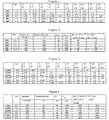
- Figure 1 is a table giving the values of radii and index differences for some examples of profiles of H0M type dispersion-compensating optical fibres according to the invention for use in compensating a standard SMF optical fibre.
- the left-hand column shows the denomination of the profiles from H0M1 to H0M5.
- the second column indicates the number of slices that the core index profile of the example under consideration comprises.
- the next five columns give radii of the core variable index profile in ⁇ m.
- the last five columns give the index differences relative to the cladding of constant index multiplied by a thousand (no units). Not all the boxes in the Table have been completed, since the profiles do not all have the same number of slices.
- Figure 2 is a table giving other properties of the profiles of H0M type chromatic dispersion-compensating optical fibres according to the invention shown in Figure 1 for the mode LP 02 .
- the left-hand column gives the denomination of the profiles already explained above.
- the next column indicates the number of slices that each profile under consideration comprises. For each profile under consideration, the other columns give properties of the slice of optical fibre corresponding to the profile under consideration.
- the next column gives the chromatic dispersion in ps/nm-km at a wavelength of 1495 nm.
- the next column gives the chromatic dispersion to chromatic dispersion slope ratio in nm at a wavelength of 1495 nm.
- the next column gives the effective area A eff in ⁇ m 2 at a wavelength of 1495 nm.
- the next column gives the minimum chromatic dispersion wavelength ⁇ min in nm.
- the last two columns give the maximum relative variations in chromatic dispersion slope as a %, respectively, for operational spectral ranges from 1475 nm to 1515 nm and from 1465 nm to 1525 nm.
- the relative variation in the dispersion slope over an operational spectral range corresponds to the quotient between, on the one hand, the difference between the maximum chromatic dispersion slope over said operational spectral range and the minimum chromatic dispersion slope over said operational spectral range and, on the other hand, the mean chromatic dispersion slope for said operational spectral range.
- Optical fibres having four slices and preferably five slices make it possible to achieve better compromises between the most negative chromatic dispersion possible, the greatest effective area possible and the most linear chromatic dispersion slope possible over the operational spectral range under consideration.
- a minimum dispersion wavelength in the preferred narrow range of from 1570 nm to 1590 nm also makes it possible to improve the compromise.
- Figure 3 is a table giving the values of radii and index differences for some examples of profiles of H0M type chromatic dispersion-compensating optical fibres according to the invention for use in compensating an NZ-DSF optical fibre.
- Figure 3 is similar to Figure 1, but the left-hand column gives the denomination of the profiles from H0M7 to H0M12.
- Figure 4 is a table giving other properties of the profiles of H0M type chromatic dispersion-compensating optical fibres according to the invention shown in Figure 3 for the mode LP 02 .
- Optical fibres having four slices and preferably five slices make it possible to achieve better compromises between the most negative chromatic dispersion possible, the greatest effective area possible and the most linear chromatic dispersion slope possible over the operational spectral range under consideration.
- a minimum dispersion wavelength within the preferred narrow range of from 1540 nm to 1560 nm also makes it possible to improve the compromise.
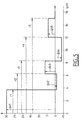
- Figure 5 shows diagrammatically a five-slice profile type of an H0M type chromatic dispersion-compensating optical fibre according to the invention.
- Plotted along the abscissa are the radii in ⁇ m.
- Plotted along the ordinate are the index differences multiplied by a thousand without units.
- the first slice called the central slice, has a maximum index difference ⁇ n 1 with the constant index of the cladding and an outer radius r 1 .
- the maximum index difference ⁇ n 1 is positive.
- the index is preferably constant.
- the second slice called the first peripheral slice, has an index difference ⁇ n 2 with the constant index of the cladding and an outer radius r 2 .
- the index difference ⁇ n 2 can be positive or negative.
- a negative index difference corresponds to a buried slice.
- the index is preferably constant between radius r 1 and radius r 2 .
- the third slice called the second peripheral slice, has an index difference ⁇ n 3 with the constant index of the cladding and an outer radius r 3 .
- the index difference ⁇ n 3 can be positive or negative.
- the index is preferably constant between radius r 2 and radius r 3 .
- the fourth slice called the third peripheral slice, has an index difference ⁇ n 4 with the constant index of the cladding and an outer radius r 4 .
- the index difference ⁇ n 4 can be positive or negative.
- the index is preferably constant between radius r 3 and radius r 4 .
- the fifth slice has an index difference ⁇ n 5 with the constant index of the cladding and an outer radius r 5 .
- the index difference ⁇ n 5 can be positive or negative.
- the index is preferably constant between radius r 4 and radius r 5 .
- Beyond the radius r 5 is the cladding of constant index.
- the cladding of constant index starts from the radius r 4 .
- the cladding of constant index starts from the radius r 3 .
- Figure 6 shows diagrammatically an optical fibre wavelength multiplexing transmission system according to the invention.
- the transmission system comprises successively in series the following elements, viewed from upstream to downstream from the point of view of the propagation of the light signal: a line optical fibre 1 followed by a compensation module 3 which comprises first of all a mode converter 2 that converts most of the light energy being propagated according to the fundamental mode LP 01 to a higher order mode, for example LP 02 , and then an H0M type chromatic dispersion-compensating optical fibre 4 according to the invention, compensating for the chromatic dispersion of the line optical fibre 1 but in the higher order mode LP 02 , and then a mode converter 5 that converts most of the light energy being propagated according to the higher order mode LP 02 back to the fundamental mode LP 01 .
- the transmission system according to the invention may also comprise other elements not shown in Figure 6 for reasons of clarity, such as transmitters, receivers, amplifiers, and/or may contain the sequence of elements shown in Figure 6 several times.
- the losses caused by bending for a radius of 10 mm, at a wavelength of 1495 nm are less than 100 dB/m, advantageously less than 50 dB/m.
- the attenuation, at a wavelength of 1495 nm is less than 1.5 dB/km, advantageously less than 1 dB/km.
- the polarisation mode dispersion, at a wavelength of 1495 nm, is less than 0.5 ps/km 1/2 , advantageously less than 0.2 ps/km 1/2 .
Landscapes
- Physics & Mathematics (AREA)
- General Physics & Mathematics (AREA)
- Optics & Photonics (AREA)
- Chemical & Material Sciences (AREA)
- Dispersion Chemistry (AREA)
- Electromagnetism (AREA)
- Engineering & Computer Science (AREA)
- Computer Networks & Wireless Communication (AREA)
- Signal Processing (AREA)
- Optical Communication System (AREA)
- Optical Fibers, Optical Fiber Cores, And Optical Fiber Bundles (AREA)
Applications Claiming Priority (2)
| Application Number | Priority Date | Filing Date | Title |
|---|---|---|---|
| FR0450525A FR2867865B1 (fr) | 2004-03-16 | 2004-03-16 | Fibre optique a compensation de dispersion chromatique en bande utilisant un mode d'ordre superieur |
| FR0450525 | 2004-03-16 |
Publications (1)
| Publication Number | Publication Date |
|---|---|
| EP1577688A1 true EP1577688A1 (en) | 2005-09-21 |
Family
ID=34834278
Family Applications (1)
| Application Number | Title | Priority Date | Filing Date |
|---|---|---|---|
| EP05075590A Ceased EP1577688A1 (en) | 2004-03-16 | 2005-03-10 | Chromatic dispersion-compensating optical fibre in the S-band using a higher order mode |
Country Status (5)
| Country | Link |
|---|---|
| US (2) | US7369732B2 (enExample) |
| EP (1) | EP1577688A1 (enExample) |
| JP (1) | JP2005266808A (enExample) |
| CN (1) | CN100397118C (enExample) |
| FR (1) | FR2867865B1 (enExample) |
Families Citing this family (3)
| Publication number | Priority date | Publication date | Assignee | Title |
|---|---|---|---|---|
| FR2867865B1 (fr) * | 2004-03-16 | 2008-05-30 | Cit Alcatel | Fibre optique a compensation de dispersion chromatique en bande utilisant un mode d'ordre superieur |
| CN101688949B (zh) * | 2007-02-05 | 2012-01-18 | Ofs菲特尔有限责任公司 | 防止光纤中的电介质击穿 |
| JP7095473B2 (ja) * | 2018-08-07 | 2022-07-05 | 日本電信電話株式会社 | モード間損失差補償用ファイバ、および光増幅器 |
Citations (3)
| Publication number | Priority date | Publication date | Assignee | Title |
|---|---|---|---|---|
| EP1202088A1 (fr) * | 2000-10-26 | 2002-05-02 | Alcatel | Fibre optique pour la compensation en ligne de la dispersion chromatique d'une fibre optique à dispersion chromatique positive |
| US20030185531A1 (en) * | 2002-03-26 | 2003-10-02 | Michael Lysiansky | High order mode dispersion compensating fiber |
| EP1351417A1 (fr) * | 2002-04-05 | 2003-10-08 | Alcatel | Fibre de compensation de dispersion utilisant un mode d'ordre supérieur |
Family Cites Families (13)
| Publication number | Priority date | Publication date | Assignee | Title |
|---|---|---|---|---|
| FR1351417A (fr) * | 1962-09-26 | 1964-02-07 | Palme de natation articulée | |
| FR2815419B1 (fr) * | 2000-10-16 | 2003-10-03 | Cit Alcatel | Fibre pour la compensation de dispersion chromatique en bande d'une fibre monomode |
| JP2002258090A (ja) * | 2001-02-27 | 2002-09-11 | Furukawa Electric Co Ltd:The | 低損失光ファイバ |
| JP2002341157A (ja) * | 2001-03-15 | 2002-11-27 | Fujikura Ltd | 波長多重伝送路およびこれに用いる分散補償光ファイバ |
| FR2828939B1 (fr) * | 2001-08-27 | 2004-01-16 | Cit Alcatel | Fibre optique pour un systeme de transmission a multiplexage en longueurs d'onde |
| AU2003210934A1 (en) * | 2002-02-15 | 2003-09-09 | Corning Incorporated | Low slope dispersion shifted optical fiber |
| US20030185331A1 (en) * | 2002-03-28 | 2003-10-02 | Adc Telecommunications Israel Ltd. | Synchronization module and method |
| US6931186B2 (en) * | 2002-04-05 | 2005-08-16 | Alcatel | Chromatic dispersion compensation module |
| US6856743B2 (en) * | 2002-12-02 | 2005-02-15 | Corning Incorporated | NZDSF optical fiber with low dispersion zero and low slope |
| US7103251B2 (en) * | 2002-12-31 | 2006-09-05 | Corning Incorporated | Dispersion flattened NZDSF fiber |
| US6952519B2 (en) * | 2003-05-02 | 2005-10-04 | Corning Incorporated | Large effective area high SBS threshold optical fiber |
| FR2867865B1 (fr) * | 2004-03-16 | 2008-05-30 | Cit Alcatel | Fibre optique a compensation de dispersion chromatique en bande utilisant un mode d'ordre superieur |
| US7082243B2 (en) * | 2004-04-05 | 2006-07-25 | Corning Incorporated | Large effective area high SBS threshold optical fiber |
-
2004
- 2004-03-16 FR FR0450525A patent/FR2867865B1/fr not_active Expired - Fee Related
-
2005
- 2005-03-10 EP EP05075590A patent/EP1577688A1/en not_active Ceased
- 2005-03-11 US US11/077,116 patent/US7369732B2/en not_active Expired - Fee Related
- 2005-03-11 JP JP2005068908A patent/JP2005266808A/ja not_active Withdrawn
- 2005-03-16 CN CNB2005100555862A patent/CN100397118C/zh not_active Expired - Fee Related
-
2006
- 2006-10-11 US US11/548,502 patent/US7336876B2/en not_active Expired - Fee Related
Patent Citations (3)
| Publication number | Priority date | Publication date | Assignee | Title |
|---|---|---|---|---|
| EP1202088A1 (fr) * | 2000-10-26 | 2002-05-02 | Alcatel | Fibre optique pour la compensation en ligne de la dispersion chromatique d'une fibre optique à dispersion chromatique positive |
| US20030185531A1 (en) * | 2002-03-26 | 2003-10-02 | Michael Lysiansky | High order mode dispersion compensating fiber |
| EP1351417A1 (fr) * | 2002-04-05 | 2003-10-08 | Alcatel | Fibre de compensation de dispersion utilisant un mode d'ordre supérieur |
Non-Patent Citations (1)
| Title |
|---|
| PANDE KAMNA ET AL: "Design optimization of a dual-core dispersion-compensating fiber with a high figure of merit and a large effective area for dense wavelength-division multiplexed transmission through standard G.655 fibers", APPLIED OPTICS, vol. 42, no. 19, 1 July 2003 (2003-07-01), pages 3785 - 3791 * |
Also Published As
| Publication number | Publication date |
|---|---|
| US20070092190A1 (en) | 2007-04-26 |
| JP2005266808A (ja) | 2005-09-29 |
| CN1670553A (zh) | 2005-09-21 |
| US20050213909A1 (en) | 2005-09-29 |
| FR2867865A1 (fr) | 2005-09-23 |
| FR2867865B1 (fr) | 2008-05-30 |
| US7369732B2 (en) | 2008-05-06 |
| US7336876B2 (en) | 2008-02-26 |
| CN100397118C (zh) | 2008-06-25 |
Similar Documents
| Publication | Publication Date | Title |
|---|---|---|
| USRE37680E1 (en) | Dispersion shifted optical waveguide fiber | |
| US6263138B1 (en) | Optical fiber for compensating chromatic dispersion of a positive chromatic dispersion optical fiber | |
| EP2362252B1 (en) | Optical fiber and optical communication system including same | |
| EP1149479B1 (en) | Optical system and method having low loss and non-linear effects | |
| US6819850B2 (en) | Optical fiber for a wavelength division multiplex transmission system | |
| KR20010101071A (ko) | 광 파이버 및 이를 포함하는 광 전송 시스템 | |
| CN105683791A (zh) | 空分复用所用的少模光纤链路 | |
| EP1072909A2 (en) | Dispersion compensating optical fiber and optical transmission line | |
| US6510268B1 (en) | Optical fiber for compensating the chromatic dispersion of an optical fiber having positive chromatic dispersion | |
| EP1814246A2 (en) | Optical fiber and optical transmission path | |
| US20020054743A1 (en) | Optical fiber for wavelength division multiplex transmission systems | |
| US20010022883A1 (en) | Monomode optical fiber for optical fiber cable transmission networks with wavelength division multiplexing | |
| US7327921B2 (en) | Chromatic dispersion compensating optical fibre | |
| EP1577688A1 (en) | Chromatic dispersion-compensating optical fibre in the S-band using a higher order mode | |
| JP4548998B2 (ja) | 光ファイバ伝送システムにおける波長分散補償及び補償ファイバ | |
| US7171092B2 (en) | Optical fiber with chromatic dispersion compensation in the S band | |
| EP1575196A1 (en) | Dispersion compensating fiber module | |
| US20030185531A1 (en) | High order mode dispersion compensating fiber | |
| EP1259840B1 (en) | Optical fiber for wdm transmission | |
| US6556756B2 (en) | Dispersion shifted optical waveguide fiber | |
| US6707971B2 (en) | Dispersion management optical transmission system and optical transmission line | |
| US7046889B2 (en) | Dispersion-shifted fiber | |
| US20030044145A1 (en) | Fiber with continuously changing chromatic dispersion | |
| JP2005266808A5 (enExample) | ||
| EP1653262A2 (en) | Optical system and method having low loss and non-linear effects |
Legal Events
| Date | Code | Title | Description |
|---|---|---|---|
| PUAI | Public reference made under article 153(3) epc to a published international application that has entered the european phase |
Free format text: ORIGINAL CODE: 0009012 |
|
| AK | Designated contracting states |
Kind code of ref document: A1 Designated state(s): AT BE BG CH CY CZ DE DK EE ES FI FR GB GR HU IE IS IT LI LT LU MC NL PL PT RO SE SI SK TR |
|
| AX | Request for extension of the european patent |
Extension state: AL BA HR LV MK YU |
|
| RIN1 | Information on inventor provided before grant (corrected) |
Inventor name: SILLARD, PIERRE Inventor name: DE MONTMORILLON, LOUIS-ANNE Inventor name: MOLIN, DENIS Inventor name: GORLIER, MAXIME |
|
| RIN1 | Information on inventor provided before grant (corrected) |
Inventor name: SILLARD, PIERRE Inventor name: DE MONTMORILLON, LOUIS-ANNE Inventor name: MOLIN, DENIS Inventor name: GORLIER, MAXIME |
|
| 17P | Request for examination filed |
Effective date: 20060125 |
|
| AKX | Designation fees paid |
Designated state(s): AT BE BG CH CY CZ DE DK EE ES FI FR GB GR HU IE IS IT LI LT LU MC NL PL PT RO SE SI SK TR |
|
| 17Q | First examination report despatched |
Effective date: 20060707 |
|
| RAP1 | Party data changed (applicant data changed or rights of an application transferred) |
Owner name: DRAKA COMTEQ B.V. |
|
| RAP1 | Party data changed (applicant data changed or rights of an application transferred) |
Owner name: DRAKA COMTEQ B.V. |
|
| STAA | Information on the status of an ep patent application or granted ep patent |
Free format text: STATUS: THE APPLICATION HAS BEEN REFUSED |
|
| 18R | Application refused |
Effective date: 20090205 |