EP1577619B1 - Kühlsystem, system unter verwendung von nichtazeotroper kühlflüssigkeit und für das system verwendete nichtazeotrope kühlflüssigkeit für sehr niedrigen temperaturbereich - Google Patents
Kühlsystem, system unter verwendung von nichtazeotroper kühlflüssigkeit und für das system verwendete nichtazeotrope kühlflüssigkeit für sehr niedrigen temperaturbereich Download PDFInfo
- Publication number
- EP1577619B1 EP1577619B1 EP02781884.8A EP02781884A EP1577619B1 EP 1577619 B1 EP1577619 B1 EP 1577619B1 EP 02781884 A EP02781884 A EP 02781884A EP 1577619 B1 EP1577619 B1 EP 1577619B1
- Authority
- EP
- European Patent Office
- Prior art keywords
- refrigerant
- pressure
- mixture
- gas
- butane
- Prior art date
- Legal status (The legal status is an assumption and is not a legal conclusion. Google has not performed a legal analysis and makes no representation as to the accuracy of the status listed.)
- Expired - Lifetime
Links
- 239000003507 refrigerant Substances 0.000 title claims description 202
- 239000000203 mixture Substances 0.000 claims description 189
- TXEYQDLBPFQVAA-UHFFFAOYSA-N tetrafluoromethane Chemical compound FC(F)(F)F TXEYQDLBPFQVAA-UHFFFAOYSA-N 0.000 claims description 129
- 239000005977 Ethylene Substances 0.000 claims description 35
- VGGSQFUCUMXWEO-UHFFFAOYSA-N Ethene Chemical compound C=C VGGSQFUCUMXWEO-UHFFFAOYSA-N 0.000 claims description 34
- OTMSDBZUPAUEDD-UHFFFAOYSA-N Ethane Chemical compound CC OTMSDBZUPAUEDD-UHFFFAOYSA-N 0.000 claims description 25
- NNPPMTNAJDCUHE-UHFFFAOYSA-N isobutane Chemical compound CC(C)C NNPPMTNAJDCUHE-UHFFFAOYSA-N 0.000 claims description 24
- 239000001273 butane Substances 0.000 claims description 20
- IJDNQMDRQITEOD-UHFFFAOYSA-N n-butane Chemical compound CCCC IJDNQMDRQITEOD-UHFFFAOYSA-N 0.000 claims description 20
- OFBQJSOFQDEBGM-UHFFFAOYSA-N n-pentane Natural products CCCCC OFBQJSOFQDEBGM-UHFFFAOYSA-N 0.000 claims description 20
- 238000000034 method Methods 0.000 claims description 13
- 239000001282 iso-butane Substances 0.000 claims description 12
- 239000007789 gas Substances 0.000 description 118
- 238000002156 mixing Methods 0.000 description 50
- 238000009835 boiling Methods 0.000 description 40
- 230000000694 effects Effects 0.000 description 34
- JRPSMDMQPAEKFW-UHFFFAOYSA-N butane;ethene Chemical group C=C.CCCC JRPSMDMQPAEKFW-UHFFFAOYSA-N 0.000 description 33
- 238000002474 experimental method Methods 0.000 description 24
- YHUDMVREXDHCSA-UHFFFAOYSA-N butane ethane Chemical compound CC.CCCC.CCCC YHUDMVREXDHCSA-UHFFFAOYSA-N 0.000 description 23
- 230000003247 decreasing effect Effects 0.000 description 17
- 239000007791 liquid phase Substances 0.000 description 17
- AWYJSPNZIOCLAG-UHFFFAOYSA-N ethene;2-methylpropane Chemical group C=C.CC(C)C AWYJSPNZIOCLAG-UHFFFAOYSA-N 0.000 description 13
- 239000012071 phase Substances 0.000 description 13
- SDAJIOQLJUVSNP-UHFFFAOYSA-N ethane;2-methylpropane Chemical compound CC.CC(C)C SDAJIOQLJUVSNP-UHFFFAOYSA-N 0.000 description 11
- 238000001704 evaporation Methods 0.000 description 11
- 238000007710 freezing Methods 0.000 description 9
- 230000008014 freezing Effects 0.000 description 9
- KDKYADYSIPSCCQ-UHFFFAOYSA-N but-1-yne Chemical group CCC#C KDKYADYSIPSCCQ-UHFFFAOYSA-N 0.000 description 8
- 229930195733 hydrocarbon Natural products 0.000 description 8
- 150000002430 hydrocarbons Chemical class 0.000 description 8
- 238000009833 condensation Methods 0.000 description 7
- 230000005494 condensation Effects 0.000 description 7
- 238000010587 phase diagram Methods 0.000 description 7
- 238000012790 confirmation Methods 0.000 description 6
- 239000007788 liquid Substances 0.000 description 6
- LVGUZGTVOIAKKC-UHFFFAOYSA-N 1,1,1,2-tetrafluoroethane Chemical compound FCC(F)(F)F LVGUZGTVOIAKKC-UHFFFAOYSA-N 0.000 description 5
- 238000001816 cooling Methods 0.000 description 5
- NBVXSUQYWXRMNV-UHFFFAOYSA-N fluoromethane Chemical compound FC NBVXSUQYWXRMNV-UHFFFAOYSA-N 0.000 description 5
- VXNZUUAINFGPBY-UHFFFAOYSA-N 1-Butene Chemical compound CCC=C VXNZUUAINFGPBY-UHFFFAOYSA-N 0.000 description 4
- 239000004215 Carbon black (E152) Substances 0.000 description 4
- 230000006835 compression Effects 0.000 description 4
- 238000007906 compression Methods 0.000 description 4
- 230000007423 decrease Effects 0.000 description 4
- ZZUFCTLCJUWOSV-UHFFFAOYSA-N furosemide Chemical compound C1=C(Cl)C(S(=O)(=O)N)=CC(C(O)=O)=C1NCC1=CC=CO1 ZZUFCTLCJUWOSV-UHFFFAOYSA-N 0.000 description 4
- 239000000463 material Substances 0.000 description 4
- 230000007613 environmental effect Effects 0.000 description 3
- 230000008020 evaporation Effects 0.000 description 3
- 238000000926 separation method Methods 0.000 description 3
- 125000000383 tetramethylene group Chemical group [H]C([H])([*:1])C([H])([H])C([H])([H])C([H])([H])[*:2] 0.000 description 3
- VQTUBCCKSQIDNK-UHFFFAOYSA-N Isobutene Chemical compound CC(C)=C VQTUBCCKSQIDNK-UHFFFAOYSA-N 0.000 description 2
- 230000002411 adverse Effects 0.000 description 2
- WXCZUWHSJWOTRV-UHFFFAOYSA-N but-1-ene;ethene Chemical group C=C.CCC=C WXCZUWHSJWOTRV-UHFFFAOYSA-N 0.000 description 2
- 150000001875 compounds Chemical class 0.000 description 2
- 238000010276 construction Methods 0.000 description 2
- -1 fluorocarbon ethers Chemical class 0.000 description 2
- 238000002309 gasification Methods 0.000 description 2
- 229920006395 saturated elastomer Polymers 0.000 description 2
- DDMOUSALMHHKOS-UHFFFAOYSA-N 1,2-dichloro-1,1,2,2-tetrafluoroethane Chemical compound FC(F)(Cl)C(F)(F)Cl DDMOUSALMHHKOS-UHFFFAOYSA-N 0.000 description 1
- CURLTUGMZLYLDI-UHFFFAOYSA-N Carbon dioxide Chemical compound O=C=O CURLTUGMZLYLDI-UHFFFAOYSA-N 0.000 description 1
- ZAMOUSCENKQFHK-UHFFFAOYSA-N Chlorine atom Chemical compound [Cl] ZAMOUSCENKQFHK-UHFFFAOYSA-N 0.000 description 1
- VOPWNXZWBYDODV-UHFFFAOYSA-N Chlorodifluoromethane Chemical compound FC(F)Cl VOPWNXZWBYDODV-UHFFFAOYSA-N 0.000 description 1
- CBENFWSGALASAD-UHFFFAOYSA-N Ozone Chemical compound [O-][O+]=O CBENFWSGALASAD-UHFFFAOYSA-N 0.000 description 1
- 238000010521 absorption reaction Methods 0.000 description 1
- IAQRGUVFOMOMEM-UHFFFAOYSA-N butene Natural products CC=CC IAQRGUVFOMOMEM-UHFFFAOYSA-N 0.000 description 1
- 239000000460 chlorine Substances 0.000 description 1
- 229910052801 chlorine Inorganic materials 0.000 description 1
- IAQRGUVFOMOMEM-ARJAWSKDSA-N cis-but-2-ene Chemical compound C\C=C/C IAQRGUVFOMOMEM-ARJAWSKDSA-N 0.000 description 1
- 230000001276 controlling effect Effects 0.000 description 1
- 230000002596 correlated effect Effects 0.000 description 1
- 230000000875 corresponding effect Effects 0.000 description 1
- 230000001747 exhibiting effect Effects 0.000 description 1
- 235000013305 food Nutrition 0.000 description 1
- 239000000446 fuel Substances 0.000 description 1
- 230000012447 hatching Effects 0.000 description 1
- 230000017525 heat dissipation Effects 0.000 description 1
- 230000007774 longterm Effects 0.000 description 1
- 238000012423 maintenance Methods 0.000 description 1
- 239000000126 substance Substances 0.000 description 1
- IAQRGUVFOMOMEM-ONEGZZNKSA-N trans-but-2-ene Chemical compound C\C=C\C IAQRGUVFOMOMEM-ONEGZZNKSA-N 0.000 description 1
- 238000002054 transplantation Methods 0.000 description 1
- 238000010792 warming Methods 0.000 description 1
Images





Classifications
-
- C—CHEMISTRY; METALLURGY
- C09—DYES; PAINTS; POLISHES; NATURAL RESINS; ADHESIVES; COMPOSITIONS NOT OTHERWISE PROVIDED FOR; APPLICATIONS OF MATERIALS NOT OTHERWISE PROVIDED FOR
- C09K—MATERIALS FOR MISCELLANEOUS APPLICATIONS, NOT PROVIDED FOR ELSEWHERE
- C09K5/00—Heat-transfer, heat-exchange or heat-storage materials, e.g. refrigerants; Materials for the production of heat or cold by chemical reactions other than by combustion
- C09K5/02—Materials undergoing a change of physical state when used
- C09K5/04—Materials undergoing a change of physical state when used the change of state being from liquid to vapour or vice versa
- C09K5/041—Materials undergoing a change of physical state when used the change of state being from liquid to vapour or vice versa for compression-type refrigeration systems
- C09K5/042—Materials undergoing a change of physical state when used the change of state being from liquid to vapour or vice versa for compression-type refrigeration systems comprising compounds containing carbon and hydrogen only
-
- C—CHEMISTRY; METALLURGY
- C09—DYES; PAINTS; POLISHES; NATURAL RESINS; ADHESIVES; COMPOSITIONS NOT OTHERWISE PROVIDED FOR; APPLICATIONS OF MATERIALS NOT OTHERWISE PROVIDED FOR
- C09K—MATERIALS FOR MISCELLANEOUS APPLICATIONS, NOT PROVIDED FOR ELSEWHERE
- C09K5/00—Heat-transfer, heat-exchange or heat-storage materials, e.g. refrigerants; Materials for the production of heat or cold by chemical reactions other than by combustion
- C09K5/02—Materials undergoing a change of physical state when used
- C09K5/04—Materials undergoing a change of physical state when used the change of state being from liquid to vapour or vice versa
- C09K5/041—Materials undergoing a change of physical state when used the change of state being from liquid to vapour or vice versa for compression-type refrigeration systems
- C09K5/044—Materials undergoing a change of physical state when used the change of state being from liquid to vapour or vice versa for compression-type refrigeration systems comprising halogenated compounds
- C09K5/045—Materials undergoing a change of physical state when used the change of state being from liquid to vapour or vice versa for compression-type refrigeration systems comprising halogenated compounds containing only fluorine as halogen
-
- F—MECHANICAL ENGINEERING; LIGHTING; HEATING; WEAPONS; BLASTING
- F25—REFRIGERATION OR COOLING; COMBINED HEATING AND REFRIGERATION SYSTEMS; HEAT PUMP SYSTEMS; MANUFACTURE OR STORAGE OF ICE; LIQUEFACTION SOLIDIFICATION OF GASES
- F25B—REFRIGERATION MACHINES, PLANTS OR SYSTEMS; COMBINED HEATING AND REFRIGERATION SYSTEMS; HEAT PUMP SYSTEMS
- F25B40/00—Subcoolers, desuperheaters or superheaters
-
- F—MECHANICAL ENGINEERING; LIGHTING; HEATING; WEAPONS; BLASTING
- F25—REFRIGERATION OR COOLING; COMBINED HEATING AND REFRIGERATION SYSTEMS; HEAT PUMP SYSTEMS; MANUFACTURE OR STORAGE OF ICE; LIQUEFACTION SOLIDIFICATION OF GASES
- F25B—REFRIGERATION MACHINES, PLANTS OR SYSTEMS; COMBINED HEATING AND REFRIGERATION SYSTEMS; HEAT PUMP SYSTEMS
- F25B9/00—Compression machines, plants or systems, in which the refrigerant is air or other gas of low boiling point
- F25B9/002—Compression machines, plants or systems, in which the refrigerant is air or other gas of low boiling point characterised by the refrigerant
- F25B9/006—Compression machines, plants or systems, in which the refrigerant is air or other gas of low boiling point characterised by the refrigerant the refrigerant containing more than one component
-
- C—CHEMISTRY; METALLURGY
- C09—DYES; PAINTS; POLISHES; NATURAL RESINS; ADHESIVES; COMPOSITIONS NOT OTHERWISE PROVIDED FOR; APPLICATIONS OF MATERIALS NOT OTHERWISE PROVIDED FOR
- C09K—MATERIALS FOR MISCELLANEOUS APPLICATIONS, NOT PROVIDED FOR ELSEWHERE
- C09K2205/00—Aspects relating to compounds used in compression type refrigeration systems
- C09K2205/10—Components
- C09K2205/12—Hydrocarbons
-
- C—CHEMISTRY; METALLURGY
- C09—DYES; PAINTS; POLISHES; NATURAL RESINS; ADHESIVES; COMPOSITIONS NOT OTHERWISE PROVIDED FOR; APPLICATIONS OF MATERIALS NOT OTHERWISE PROVIDED FOR
- C09K—MATERIALS FOR MISCELLANEOUS APPLICATIONS, NOT PROVIDED FOR ELSEWHERE
- C09K2205/00—Aspects relating to compounds used in compression type refrigeration systems
- C09K2205/34—The mixture being non-azeotropic
-
- F—MECHANICAL ENGINEERING; LIGHTING; HEATING; WEAPONS; BLASTING
- F25—REFRIGERATION OR COOLING; COMBINED HEATING AND REFRIGERATION SYSTEMS; HEAT PUMP SYSTEMS; MANUFACTURE OR STORAGE OF ICE; LIQUEFACTION SOLIDIFICATION OF GASES
- F25B—REFRIGERATION MACHINES, PLANTS OR SYSTEMS; COMBINED HEATING AND REFRIGERATION SYSTEMS; HEAT PUMP SYSTEMS
- F25B2500/00—Problems to be solved
- F25B2500/01—Geometry problems, e.g. for reducing size
Definitions
- the present invention relates to single-stage refrigerating systems, each having a single compressor and condenser, which are operable in room temperature by utilizing characteristics of a non-azeotropic refrigerant mixture as defined in the claims.
- the present invention relates to a refrigerant mixture as defined in the claims which cools a system to an ultra-low temperature, below -40°C, especially, below -60°C.
- azeotropic refrigerant mixtures showing a constant boiling point are restricted in both combination and composition. Unlike single-component refrigerant gases that are widely used, many of the refrigerant mixtures composed of two or more components show a non-azeotropic characteristic.
- non-azeotropic refrigerant mixtures are different from refrigerants of single components or azeotropic refrigerant mixtures in that they can be given required intermediate characteristics deduced from properties of individual gases by selecting the ratio of these gases.
- the composition in a gas phase and the composition in a liquefied or condensed phase are different from each other under conditions in which both a liquid phase and a gas phase are present. Therefore, during the condensing processes, these refrigerant mixtures cannot be condensed at constant temperatures and pressures, resulting in unstable operation of the refrigerating systems.
- Japanese Unexamined Patent Application Publication No. 51-83258 and Japanese Examined Patent Publication No. 5-45867 disclose refrigerating systems using non-azeotropic refrigerant mixtures.
- the temperature and pressure in each refrigerating system are controlled through an expansion valve depending on the evaporating pressure of the non-azeotropic refrigerant mixture and the corresponding saturation temperature, and alerting means is operated when the controlled conditions deviate from predetermined ranges.
- the latter discloses heat exchange between a lower-temperature inlet refrigerant in a path from an evaporator to a compressor and a pressured refrigerant in a path from the compressor to the evaporator.
- Each of these refrigerating systems uses a combination of refrigerant components, i.e. refrigerant R-22 having a low boiling point and refrigerant R-114 having a high boiling point. Since the respective normal boiling points are -40.8°C and 3.85°C, the difference between the dew point and the boiling point specific to the non-azeotropic refrigerant mixture is large. Therefore, problems such as absorption of the liquefied refrigerant by the compressor occur. Such a problem is avoided by the control of the refrigerating system.
- refrigerant components used in examples are fluorocarbons, i.e. R-32, R-125, and R-134a, and their normal boiling points are -51.7°C, -48.5°C, and -26.5°C, respectively.
- a non-azeotropic refrigerant mixture composed of these refrigerants is not liquefied until the mixture is cooled to a temperature significantly lower than room temperature.
- a refrigerating system including a compressor, a condenser, a receiver, a decompressor, and an evaporator is further provided with a heat exchanger exchanging heat between the refrigerant flowing from the condenser to the receiver and the refrigerant flowing from the evaporator to the compressor.
- the difference in boiling point between these refrigerants is small, namely, the above-mentioned problem is avoided by using a refrigerant mixture having a small difference between a dew point and a boiling point.
- US 5,337,572 teaches a closed cycle refrigerating system for cryogenic temperatures using a single stage compressor and a refrigerant comprising a gas mixture.
- the refrigerating system includes a heat exchanger with a throttling orifice for providing cooling temperatures below 150 K.
- the used refrigerant comprises a mixture of at least one cryogenic gas having a normal boiling temperature below 130 K and at least two other gases that are different from each other and have normal boiling point temperatures below 300 K.
- An amount of high-boiling refrigerant components within the refrigerant mixture ranges between 20% and 45%.
- a freezing machine system uses a non-azeotropic refrigerant mixture containing two or more refrigerant components.
- the freezing machine comprises a compressor, a condenser, a throttle valve, an evaporator and a heat exchanger, wherein the heat exchanger is designed to lower the temperature and vapour pressure of the refrigerant mixture so that the operating pressure of the freezing machine can be lowered.
- WO 94/17153 teaches a non-azeotropic refrigerant composition
- a first component which is a low boiling refrigerant comprising at least one compound selected from the group consisting of the (hydro)fluorocarbons, (hydro)fluorocarbon ethers, hydrocarbons and CO2
- a second component which is a high boiling refrigerant comprising at least one compound selected from the group consisting of the (hydro)fluorocarbons and (hydro) fluorocarbon ethers, wherein the first component and the second component have boiling points which are separated from each other by at least 20 °C.
- the present invention provides a single-stage refrigerating system using a non-azeotropic refrigerant mixture as defined in the claims.
- the non-azeotropic refrigerant mixture includes a refrigerant having a high-boiling point and a low-boiling point refrigerant.
- the refrigerating system is a single-stage refrigerating system including a compressor, a condenser, an evaporator, and a heat exchanger for exchanging heat between a refrigerant in a path from the evaporator to the compressor and a refrigerant in another path from the condenser to the evaporator.
- a dew point of the refrigerant mixture at a pressure in the condensing process after the compression is above room temperature, and the refrigerating system is operated in the range in which the boiling point is higher than the dew point at a pressure in the lower-pressure region in the path from the evaporator to the compressor.
- the present invention further provides a non-azeotropic refrigerant mixture as defined in the claims for ultra-low temperature as a suitable refrigerant for this system.
- a dew point of the refrigerant mixture at a pressure in the condensing process after the compression is above room temperature, and the boiling point is higher than the dew point at a pressure in the lower-pressure region in the path from the evaporator to the compressor.
- the high-boiling-point gas having a boiling point of approximately room temperature is butane or isobutane and the low-boiling-point gas having a boiling point below -60°C is ethane or ethylene, in combination with R-14 (perfluoromethane) and thus has improved characteristics.
- the non-azeotropic refrigerant mixture, as defined in the claims, for ultra-low temperature is improved in the characteristics due to the following features:
- the inventors discovered a non-azeotropic refrigerant mixture which can be used in room temperature during the processes of searching for chlorine-free hydrocarbon azeotropic refrigerants for ultra-low temperature.
- the non-azeotropic refrigerant mixture is prepared by mixing a hydrocarbon having a high boiling point as defined in the claims with hydrocarbons having a low boiling point as defined in the claims.
- a non-azeotropic refrigerant mixture can be condensed in the compressing process at approximately room temperature or if a non-azeotropic refrigerant mixture can be condensed during cooling by heat exchanging with a refrigerant from the evaporator as described above, a complicated structure for gas-liquid separation is unnecessary even in a non-azeotropic refrigerant mixture.
- the system can be simplified. Specifically, the above-mentioned unstable operation of the refrigerator, which is caused by characteristics inherent in a non-azeotropic refrigerant mixture having a boiling point and a dew point separated from each other, can be resolved.
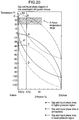
- Fig. 20 schematically shows a phase diagram of a non-azeotropic refrigerant mixture composed of butane and ethylene as an example.
- phase diagram at a higher pressure in a condensing process by a compressor and a phase diagram at a lower pressure in the evaporating process are indicated by alternate long and short dashed lines and broken lines, respectively.
- the phase diagrams shit from the phase diagram at atmospheric pressure substantially in the vertical direction.
- phase diagrams remarkably incline from a high boiling point to a low boiling point as shown in the drawing.
- a slight change in the composition significantly varies the boiling points and dew points.
- the liquid-phase line of the higher-pressure region must lie above this temperature range for being operable at these temperatures.
- the gas-phase line of the lower-pressure region must lie below a refrigerant temperature when the suction into a compressor occurs so as to avoid the hydraulic compression by the compressor.
- the range for satisfying the former conditions is a composition of E0 (%) or less.
- the E0 (%) is defined by a perpendicular line from point A' at which a horizontal line at 35°C intersects the liquid phase line of the higher-pressure region.
- this system is necessary to be operated in the temperature range in the left side of point A'' and above the gas-phase line of the lower-pressure region, the perpendicular line intersecting the gas-phase line of the lower-pressure region at point A''.
- the refrigerating system can have a simplified structure.
- the system is required to be operated in the temperature range above the gas phase line of the lower-pressure region. This cannot be readily achieved because the refrigerant temperature after the evaporating process is low. Therefore, as described above, heat exchange between the refrigerants of the lower-pressure region and the higher-pressure region is performed and condensation at the higher-pressure region is also accelerated.
- the inventors have found that the problems inherent in the non-azeotropic refrigerant mixture can be resolved by utilizing the difference between the dew point and the boiling point in the heat exchange conditions.
- the composition range in which the dew point is present above room temperature is moderately broad. Therefore, in this range, a refrigerating system can dissipate the heat to the outside of the system, i.e. to ambient atmosphere.
- the gases at the higher-pressure region are entirely condensed and liquefied by heat exchange and that the refrigerant mixture at the lower-pressure region is entirely gasified.
- the single-stage refrigerating system must dissipate heat quantity taken into the system by the condenser at the environmental temperature.
- a possible lowest freezing temperature is determined by a boiling point of the refrigerant mixture condensable during the condensing process.
- phase diagram of the non-azeotropic refrigerant mixture indicates that the conditions are achieved by the refrigerant mixture having the liquid-phase line of the higher-pressure region lying above the gas-phase line of the lower-pressure region.
- the high-boiling-point gases being used according to the present invention are butane and isobutane.
- High-boiling-point gases which can additionally be used are butene (C 4 H 8 ) isomers, ethylacetylene (C 4 H 6 ), and R-134a (CH 2 FCF 3 ).
- the low-boiling-point gases used for achieving ultra-low temperature according to the present invention are ethane and ethylene.
- Low-boiling-point gases which can additionally be used are chlorine-free fluorocarbons such as R-14 (perfluoromethane).
- the mixture In order to achieve ultra-low temperature by a mixture of these gases, the mixture is required to contain a large amount of the low-boiling-point gas.
- the amounts of gases according to the invention are defined in the claims. As a result, the pressure during the condensation becomes significantly high.
- both the gas and liquid phases of the non-azeotropic refrigerant mixture can be present over wide ranges of temperature and pressure, a liquid phase containing a large amount of the high-boiling-point component after the evaporation process certainly remains.
- the condensing process is accelerated below 15 atmospheres, which is an actually applicable range to the compressor (maximum: 20 atmospheres).
- the ultra-low temperature by operating a single-stage refrigerating system can be achieved.
- refrigerant gases suitable for the present invention and characteristics of these refrigerants are cited below.
- Table 1 Physical characteristics of high-boiling-point and low-boiling-point gases Chemical Formula Boiling Point (°C, 1 atm) Critical Temperature (°C) Vapor Pressure (MPa) Butane C 4 H 10 -0.5 153.2 0.11 (21°C) Isobutane C 4 H 10 -11.7 135.0 0.22 (21°C) 1-butene* 1-C 4 H 8 -6.26 146 0.17 (21°C) Cis-2-butene* Cis-2-C 4 H 8 3.72 155 0.1 (21°C) Trans-2-butene* Trans-2-C 4 H 8 0.89 155 0.1 (21°C) Isobutene* i-C 4 H 8 -6.9 145 0.17 (21°C) Ethylacetylene* C 4 H 6 8.1 191 0.05 (21°C) R-134a* CH 2 FCF 3
- Butane and isobutane cited above which are hydrocarbons widely used as fuel, are used as high-boiling-point gas components of non-azeotropic refrigerant mixtures according to the present invention.
- Butane and isobutane have boiling points approximately room temperature, i.e. at -0.5°C and -11.7°C, respectively, as shown above, and have very low vapor pressures. Therefore, they can be liquefied at comparatively low pressure.
- Butenes, ethylacetylene, and R-134a also have similar characteristics.
- Ethane, ethylene, and R-14 which is a component added to a refrigerant mixture thereof, shown in the above table, are low-boiling-point components for achieving ultra-low temperature. All of these components have normal boiling points of lower than -60°C, which is effective for achieving ultra-low temperature. However, their critical temperatures are low and their vapor pressures are high. Hence, these gases cannot be readily condensed at an ambient temperature environment. Especially, R-14 cannot be alone used for a single-stage refrigerating system. R-14, however, can be used in a combination with a high-boiling-point component having a low vapor pressure for raising the liquefaction/condensation temperature and reducing the vapor pressure.
- This refrigerant is cooled by heat exchanging. Namely, the refrigerant at high temperature and high pressure flowing from a compressor to an evaporator is cooled by the refrigerant at low temperature flowing from the evaporator to the compressor.
- the condensation and liquefaction of this refrigerant can be performed at a pressure in the range of 15 to 20 atmospheres (1.5 MPa to 2.0 MPa), which is applicable to general compressors.
- this single-stage refrigerating system can be operated.
- the freezing ability of the system is maintained by dissipating the latent heat of the refrigerant mixture containing a large amount of high-boiling-point component and having a low-vapor pressure through the condenser.
- the high-boiling-point component is liquefied at an ambient-temperature environment and that the refrigerant system has a large volume of charged refrigerant and a high-capacity condenser for dissipating a sufficient amount of latent heat.
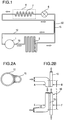
- Fig. 1 schematically shows a refrigerating system used in examples according to the present invention.
- reference numeral 1 represents a compressor.
- a refrigerant gas dissipated from the compressor flows in a forward piping 10 to a condenser 2, a heat exchanger 50, and then a throttle valve (capillary tube) 6 where the gas is decompressed.
- the refrigerant gas is then gasified at an evaporator 7 in a refrigerator 8 to cool the interior of the refrigerator.
- the backward gas generated in the evaporator returns via a backward piping 12 to the compressor after cooling the forward refrigerant at the heat exchanger 50.
- the composition of the refrigerant mixture which is decompressed at the evaporator is composed of a gas phase containing a large amount of low-boiling-point component and a condensed liquid phase containing a large amount of high-boiling-point component, as the pressure decreases.
- Such refrigerant is sent to the suction side of the compressor as a wet gas, but the suction of this condensed liquid is undesirable for the compressor. Therefore, in the above-mentioned known technique, the backward refrigerant is operated under a condition in which the condensed phase is not generated or the backward refrigerant is separated into gas and liquid phases by an accumulator.
- the present invention takes advantages of such characteristics of the non-azeotropic refrigerant mixture, which cause troubles during the operation of conventional refrigerators. Namely, in the heat exchanging between the backward refrigerant and the refrigerant at the higher-pressure region (forward refrigerant), the gas at the higher-pressure region is thoroughly condensed by the latent heat from the condensed liquid phase of the backward refrigerant and the liquid phase of the backward refrigerant is thoroughly gasified. Thus, the initial composition of the refrigerant gas mixture can be maintained through circulation in the system to achieve stably operating conditions.
- the function of the heat exchanger is important.
- any type of heat exchanger having high heat-exchange ability can be used.
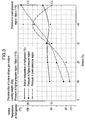
- the structure of the heat exchanger according to the present invention is shown in Fig. 2 .
- the forward piping 10 from the compressor and the backward piping 12 from the evaporator are soldered (shown as 15) and the length L of the heat exchanger is 3 m in order to provide the heat exchange condition according to the present invention as described above.
- a refrigerating system used in experiments is as follows:
- Table 2 Temperature distribution in heat exchanger (room temperature: 30°C) Experiment No. 1 2 Interior Temperature of Refrigerator (°C) -74.6 -81.8 Pressure in Higher-Pressure Region (MPa) 0.9 1.5 Pressure in Lower-Pressure Region (MPa) 0.02 0.02 Inlet of Lower-Pressure Region (°C) -49.5 -38.0 Outlet of Lower-Pressure Region (°C) 9.2 12.2 Inlet of Higher-Pressure Region (°C) 29.4 27.8 Outlet of Higher-Pressure Region (°C) -38.8 -31.6
- the inlet temperatures of the higher-pressure region were lower than room temperature. This is because the wall temperatures of the heat exchanger were measured. The wall temperatures were influenced by the heat-exchanging opponents. Therefore, the actual temperatures were slightly higher than the observed data, i.e. all of them were higher than room temperature. Similarly, the actual temperatures at the outlet in the higher-pressure region were lower than the observed temperatures. The temperatures at the lower-pressure regions showed similar differences between the actual and observed temperatures.
- the backward gas at the suction side of the compressor was almost the same temperature as room temperature, and the temperature of the refrigerant toward the evaporator was lower than the boiling point on such a high-pressure occasion. Therefore, the above-mentioned conditions are achieved.
- Tables 3 and 4 show the relation between the pressure and temperature of refrigerants at the high- and lower-pressure regions which were achieved in the heat exchanger when R-14 of 0 to 3.85% were added to butane-ethylene refrigerant mixtures (mixing ratio: 90/10 or 85/15).
- a desired refrigerator for ultra-low temperature must be operated at an interior temperature of -60°C or less and more preferably -80°C or less.
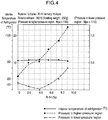
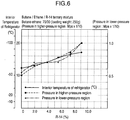
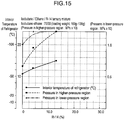
- the interior temperature of the refrigerator decreased to about -60°C at an ethane content between about 20% and about 30%, but the temperature was almost constant in such an ethane content and its vicinities.
- the effect of the refrigerant mixture gently decreased as the ethane content changed towards 10% or 40%, the temperatures were still maintained about -55°C.
- the interior temperature of the refrigerator decreased again at ethane content above 40%. However, the pressure in the higher-pressure region steeply increased. Therefore, such ethane contents were not applicable.
- R-14 gas was added to the butane-ethane refrigerant gas mixture of which the mixing ratio were 90/10, 80/20, 70/30, or 60/40, i.e. ethane contents of 10%, 20%, 30%, and 40%, respectively.
- the changes in characteristics depending on the amount of R-14 were observed. The results are shown below.
- the target characteristics of a refrigerant mixture according to the present invention are achieved by a butane-ethane refrigerant mixture containing ethane of between above 10% and below 40%, i.e. the butane-ethane mixing ratio from 90/10 to 60/40, and containing R-14 of between above 0% and 9%.
- the ternary non-azeotropic refrigerant mixture can maintain stable conditions over broad ranges of the pressures in the higher- and lower-pressure regions and the interior temperature of the refrigerator.
- ethylene has an extremely low boiling point and characteristics suitable as a refrigerant for ultra-low temperature, it has an extremely high evaporating pressure and cannot be applied to a refrigerating system which is operated at room temperature (see Table 1).
- a refrigerant gas mixture was mixed with ethylene to prepare a refrigerant gas mixture.
- the characteristics of the gas mixture were identified and searched for a mixing ratio usable as a refrigerant mixture for a refrigerating system which is operated at room temperature.
- R-14 perfluoromethane
- the characteristics and composition ratio of this refrigerant mixture were identified for achieving a target interior temperature of the refrigerator below -60°C further an ultra-low temperature of -80°C or less by a refrigerating system operated at room temperature without using a complicated double-stage refrigerating system.
- the operating conditions such as the refrigerating system are the same as above.
- an interior temperature of the refrigerator be below -60°C and more preferably below -80°C.
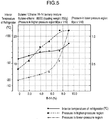
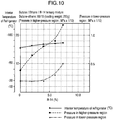
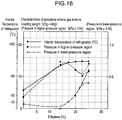
- the interior temperature of the refrigerator decreased to below -60°C at an ethylene content of 6% or more, and further decreased to -70°C, but then showed a plateau at a higher ethylene content.
- the interior temperature of the refrigerator decreased to below -70°C at about 30% ethylene.
- the experimental operation of the system was unstable and the experiment cannot be conducted at a higher ethylene content exceeding 35%.
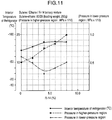
- R-14 The effects of R-14 were observed by adding a predetermined amount of R-14 at an increment of 5 g to 250 g of a butane-ethylene mixture having a mixing ratio of 80/20.
- Table 13 Effects of addition of R-14 to butane-ethylene mixture having a mixing ratio of 80/20 R-14 (%) Pressure in Higher-Pressure Region (MPa ⁇ 10 -1 ) Pressure in Lower-Pressure Region (MPa ⁇ 10 -1 ) Interior Temperature of Refrigerator (°C) 0 10.0 0.6 -71.5 1.96 11.5 0.5 -78.0 3.85 15.0 0.3 -86.0 5.66 16.5 0.4 -86.8 7.41 19.8 0.5 -86.0
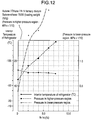
- R-14 The effects of R-14 were observed by adding a predetermined amount of R-14 at an increment of 5 g to 250 g of a butane-ethylene mixture having a mixing ratio of 70/30.
- Table 14 Effects of addition of R-14 to butane-ethylene mixture having a mixing ratio of 70/30 R-14 (%) Pressure in Higher-Pressure Region (MPa ⁇ 10 -1 ) Pressure in Lower-Pressure Region (MPa ⁇ 10 -1 ) Interior Temperature of Refrigerator (°C) 0 12.0 0.4 -81.2 1.96 18.0 1.50 -76.0 3.85 21.0 1.6 -76.3 5.66 25.0 2.0 -76.0 7.41 27.5 4.0 -74.0
- the data of Table 14 was plotted and represented graphically in Fig. 12 .
- the interior temperature of the refrigerator adversely increased by the addition of R-14 and the target effects were not achieved.
- the pressure in the higher-pressure region steeply increased with the content of R-14 and reached the upper limit of practical operation at an R-14 content of about 14.6%.
- the gauge pressure in the lower-pressure region was high and showed the upper limit in actual use at an R-14 content that was slightly higher than 1%. Effects as a refrigerant were not achieved.
- a refrigerant mixture according to the present invention is achieved by a butane-ethylene refrigerant mixture containing 10% to 30% ethylene and 7.5% or less of R-14.
- the ternary non-azeotropic refrigerant mixture can maintain stable conditions over broad ranges of the pressures in the higher- and lower-pressure regions and the interior temperature of the refrigerator.
- isobutane the isomer of butane
- isobutane can provide a non-azeotropic refrigerant mixture having similar characteristics in the case of using butane.
- the structure of the refrigerating system was the same as above (1) and (2), but a refrigerator NLE6F (Danforth Corp., brand-name: FB-75) was used.
- the loading weight of refrigerant gases was decreased to about a half, i.e. 100 g to 125 g. Since the capacity was small, the freezing ability such as the interior temperature of the refrigerator was slightly decreased.
- Table 15 Characteristics of isobutane-ethane gas mixture (loading weight: 100 g) Ethane (%) Pressure in Higher-Pressure Region (MPa ⁇ 10 -1 ) Pressure in Lower-Pressure Region (MPa ⁇ 10 -1 ) Interior Temperature of Refrigerator (°C) 10 6.5 0.3 -47.0 30 13.5 1.0 -54.0 40 23.0 0.3 -68.0
- Table 16 Effects of addition of R-14 to isobutane-ethane mixture having a mixing ratio of 90/10 (loading weight: 100 g to 130 g) R-14 (%) Pressure in Higher-Pressure Region (MPa ⁇ 10 -1 ) Pressure in Lower-Pressure Region (MPa ⁇ 10 -1 ) Interior Temperature of Refrigerator (°C) 0 6.5 0.3 -47 4 11.0 0.0 -62.5 13 18.0 0.2 -65.4 23 25.0 0.7 -70.5
- Table 17 Effects of addition of R-14 to isobutane-ethane mixture having a mixing ratio of 70/
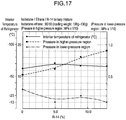
- R-14 to the isobutane-ethane gas mixture was effective in the range of a mixing ratio of 90/10 to 70/30 even if the amount of R-14 was small.
- the pressure in the higher-pressure region steeply increased, especially as the ethane content increased.
- the isobutane-ethane mixing ratio of 70/30 was almost the limitation.
- the addition of about 15% R-14 was the upper limit in actual use.
- the structure of the refrigerating system was the same as above (1) to (3), but a refrigerator GL-99EJ (Unidat Corp., brand-name: F-14L) was used for confirmation of the characteristics of isobutane-ethylene gas mixtures (loading weight: 120 g to 160 g).
- Other experiments were conducted by using NLE6F (Danforth Corp., brand-name: FB-75).
- the loading weight of the refrigerant mixture was decreased to about a half, i.e. 100 g to 125 g. Since the capacity was small, the freezing ability such as the interior temperature of the refrigerator was slightly decreased.
- Table 18 Characteristics of isobutane-ethylene gas mixture (loading weight: 120 g to 140 g) Ethylene (%) Pressure in Higher-Pressure Region (MPa ⁇ 10 -1 ) Pressure in Lower-Pressure Region (MPa ⁇ 10 -1 ) Interior Temperature of Refrigerator (°C) 0 3.75 0.07 -28.8 14.3 12.3 0 -68.3 17.2 12.0 0.1 -72.0 20.0 11.0 0.2 -73.2 22.6 10.5 0.4 -73.8 25.0 12 to 10.8 0.4 to 0.6 -73.9 Notes: the gauge pressures at 25% ethylene were unstable.
- Table 19 Effects of addition of R-14 to isobutane-ethylene mixture having a mixing ratio of 90/10 (loading weight: 100 g to 130 g) R-14 (%) Pressure in Higher-Pressure Region (MPa ⁇ 10 -1 ) Pressure in Lower-Pressure Region (MPa ⁇ 10 -1 ) Interior Temperature of Refrigerator (°C) 0 10.5 0.3 -62.8 5 12.5 0.1 -70.5 9 16.5 0.2 -66.3 13 18.5 0.1 -66.0
- Table 20 Effects of addition of R-14 to isobutane-ethylene mixture having a mixing ratio of 80/20 (loading weight: 100 g to 130 g) R-14 (%) Pressure in Higher-Pressure Region (MPa ⁇ 10 -1 ) Pressure in Lower-Pressure Region (MPa ⁇ 10 -1 ) Interior Temperature of Refrigerator (°C) 0 9.5 0.1 -68.8 5 14.0 0.1 -79.9 9 17.0 0.1 -86.4 13 25.0 0.05 -78.0
- Table 21 Effects of addition
- the interior temperatures of the refrigerator were slightly higher than those in the butane-ethylene gas mixture and the pressures in both the higher- and lower-pressure regions were higher than those of the butane-ethylene gas mixture.
- the pressure in the lower-pressure region which is highly correlated to the interior temperature of the refrigerator, was high. Since the capacity of the refrigerator was small, as in Experiment (3), the characteristics as a refrigerant gas are probably the same as those of the butane-ethylene refrigerant mixture.
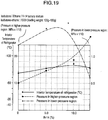
- R-14 A small amount of addition of R-14 to the isobutane-ethylene gas mixture having the mixture range of 90/10 to 80/20 is effective.
- the pressure in the higher-pressure region increased with the R-14 content, but the interior temperature of the refrigerator did not so significantly decreased.
- the effects were saturated at about 10%.
- a non-azeotropic refrigerant mixture can achieve ultra-low temperature such as -40°C, particularly -60°C, by a single-stage refrigerating system at room-temperature atmosphere.
- the non-azeotropic refrigerant mixture includes a gas which has a boiling point at approximately room temperature and a low evaporating pressure and a low-boiling-point gas which is necessary for achieving ultra-low temperature.
- the heat in the system is dissipated to the outside of the system by condensing a gas component containing a large amount of high-boiling-point gas in the compressed refrigerant gas by a condenser. Then, heat is exchanged between the refrigerant gas after the dissipation of the heat by the condenser and a refrigerant gas from an evaporator.
- the present invention provides a refrigerant system exhibiting a maximum ability of a non-azeotropic refrigerant mixture.
- the maximum ability is achieved by a combination of the above-mentioned heat exchanging system and characteristics of the non-azeotropic refrigerant mixture.
- the present invention further provides a non-azeotropic refrigerant mixture suitable for the system. As shown in the characteristics of gases and observed in experiments regarding the behavior of the gases, it is clear that a combination of a high-boiling-point gas and at least two low-boiling-point gases has an optimum mixing ratio region.
- Refrigerants other than the examples shown in the experiments can achieve a low interior temperature of the refrigerator.
- a 1-butene-ethylene refrigerant mixture shown in Table 1 achieved an interior temperature of the refrigerator of -74.5°C (pressure in the higher-pressure region: 1.2 MPa, pressure in the lower-pressure region: 0.1 MPa, gauge pressure each, and the same hereinafter) at a mixing ratio of 70/30.
- 1-butene-ethylene refrigerant mixtures containing 5% and 10% R-14 achieved interior temperatures of the refrigerator of -77°C (pressure in the higher-pressure region: 1.4 MPa, pressure in the lower-pressure region: 0.13 MPa) and -88°C (pressure in the higher-pressure region: 2.0 MPa, pressure in the lower-pressure region: 0.17 MPa), respectively.
- butenes, ethylacetylene, and R-134a shown in Table 1 are applicable due to their characteristics.
- a similar combination of a high-boiling-point material having a low-evaporating pressure and a low-boiling-point material can be applied to the present invention without limitation.
- a refrigerating system having a simple structure can be stably operated over a long period of time. Since the refrigerating system has the simple structure and uses inexpensive materials, the maintenance works can be conducted at a low cost without a large change in the temperature condition of the refrigerator.
- a non-azeotropic refrigerant mixture for ultra-low temperature is defined in the claims and is composed of inexpensive gases and can readily achieve an ultra-low temperature below -60°C, specifically can stably maintain a ultra-low temperature below -80°C. Therefore, the non-azeotropic refrigerant mixture not only can be used for storage of foods as usual but also can be broadly used for long-term storage of biological tissues, specifically, valuable biological tissues used in transplantation or tissue culture.
- the present invention contributes toward developing the biological industries by meeting the needs of these industries.
- the freezing ability is effectively improved. Since the fluorocarbon is used at a very low content, environmental disruption such as a greenhouse effect is very low.
Landscapes
- Engineering & Computer Science (AREA)
- Chemical & Material Sciences (AREA)
- Physics & Mathematics (AREA)
- Thermal Sciences (AREA)
- Chemical Kinetics & Catalysis (AREA)
- General Engineering & Computer Science (AREA)
- Mechanical Engineering (AREA)
- Combustion & Propulsion (AREA)
- Materials Engineering (AREA)
- Organic Chemistry (AREA)
- Compression-Type Refrigeration Machines With Reversible Cycles (AREA)
- Organic Low-Molecular-Weight Compounds And Preparation Thereof (AREA)
- Lubricants (AREA)
Claims (3)
- Nicht-azeotropisches Kühlmittelgemisch, umfassend ein hochsiedendes Kühlmittelgas und ein niedrigsiedendes Kühlmittelgas, wobei(I) das hochsiedende Kühlmittelgas Butan ist; und das niedrigsiedende Kühlmittelgas Ethan und R-14 ist;
dadurch gekennzeichnet, dass
das Butan/Ethan-Gasverhältnis in dem Bereich von 90/10 bis 60/40 liegt; und
der Gehalt an R-14 in dem nicht-azeotropischen Kühlmittelgemisch mehr als 0% und nicht mehr als 9% beträgt; oder(II) das hochsiedende Kühlmittelgas Butan ist und das niedrigsiedende Kühlmittelgas Ethylen und R-14 ist;
dadurch gekennzeichnet, dass
das Butan/Ethylen-Verhältnis in dem Bereich von 90/10 bis 70/30 liegt; und
der Gehalt an R-14 in dem nicht-azeotropischen Kühlmittelgemisch mehr als 0% und nicht mehr als 7,5% beträgt; oder(III) das hochsiedende Kühlmittelgas Isobutan ist und das niedrigsiedende Kühlmittelgas Ethylen und R-14 ist;
dadurch gekennzeichnet, dassdas Isobutan/Ethylen-Verhältnis in dem Bereich von 90/10 bis 80/20 liegt; undder Gehalt an R-14 in dem nicht-azeotropischen Kühlmittelgemisch mehr als 0% und nicht mehr als 10% beträgt. - Verfahren zum Betreiben eines einstufigen Kühlsystems, umfassend einen Kompressor (1), einen Kondensator (2), einen Verdampfer (7) und einen Wärmetauscher (50) zum Austauschen von Wärme zwischen einem Kühlmittel, welches von dem Verdampfer (7) zu dem Kompressor (1) fließt, und einem Kühlmittel, welches von dem Kondensator (2) zu dem Verdampfer (7) fließt, dadurch gekennzeichnet, dass
das Kühlmittel ein nicht-azeotropisches Kühlmittelgemisch, wie in Anspruch 1 definiert, ist. - Einstufiges Kühlsystem, umfassend einen Kompressor (1), einen Kondensator (2), einen Verdampfer (7) und einen Wärmetauscher (50) zum Austauschen von Wärme zwischen einem Kühlmittel, welches von dem Verdampfer (7) zu dem Kompressor (1) fließt, und einem Kühlmittel, welches von dem Kondensator (2) zu dem Verdampfer (7) fließt, dadurch gekennzeichnet, dass
das Kühlmittel, das in dem einstufigen Kühlsystem enthalten ist, ein nicht-azeotropisches Kühlmittelgemisch, wie in Anspruch 1 definiert, ist.
Applications Claiming Priority (1)
| Application Number | Priority Date | Filing Date | Title |
|---|---|---|---|
| PCT/JP2002/012685 WO2004051155A1 (ja) | 2002-12-03 | 2002-12-03 | 非共沸冷媒を用いた冷凍機システム及びそのシステムに用いる超低温用非共沸冷媒 |
Publications (3)
| Publication Number | Publication Date |
|---|---|
| EP1577619A1 EP1577619A1 (de) | 2005-09-21 |
| EP1577619A4 EP1577619A4 (de) | 2010-06-23 |
| EP1577619B1 true EP1577619B1 (de) | 2017-04-19 |
Family
ID=32448995
Family Applications (1)
| Application Number | Title | Priority Date | Filing Date |
|---|---|---|---|
| EP02781884.8A Expired - Lifetime EP1577619B1 (de) | 2002-12-03 | 2002-12-03 | Kühlsystem, system unter verwendung von nichtazeotroper kühlflüssigkeit und für das system verwendete nichtazeotrope kühlflüssigkeit für sehr niedrigen temperaturbereich |
Country Status (7)
| Country | Link |
|---|---|
| US (1) | US7299653B2 (de) |
| EP (1) | EP1577619B1 (de) |
| JP (1) | JP3934140B2 (de) |
| CN (1) | CN100491864C (de) |
| AU (1) | AU2002349758A1 (de) |
| TW (1) | TWI269017B (de) |
| WO (1) | WO2004051155A1 (de) |
Families Citing this family (16)
| Publication number | Priority date | Publication date | Assignee | Title |
|---|---|---|---|---|
| JP2007071468A (ja) * | 2005-09-08 | 2007-03-22 | Dairei:Kk | 非共沸冷媒を用いた冷凍機制御システム |
| KR100785116B1 (ko) * | 2006-01-03 | 2007-12-11 | 엘지전자 주식회사 | 냉장고 |
| JP2009540262A (ja) * | 2006-06-15 | 2009-11-19 | エルコールド フライシア ホブロ エーピーエス | 冷媒および冷凍システム |
| CN101225292B (zh) * | 2007-12-29 | 2013-07-31 | 龙志刚 | 一种适用于-105℃~ -125℃制冷温区的混合制冷剂 |
| CN101225291B (zh) * | 2007-12-29 | 2013-10-30 | 龙志刚 | 一种适用于-90℃~-100℃制冷温区的混合制冷剂 |
| KR101861832B1 (ko) | 2011-11-04 | 2018-05-29 | 엘지전자 주식회사 | 진공 공간부를 구비하는 냉장고 |
| KR20130050639A (ko) * | 2011-11-08 | 2013-05-16 | 삼성전자주식회사 | 비공비 혼합 냉매사이클 및 냉장고 |
| US20150329757A1 (en) * | 2014-05-19 | 2015-11-19 | James B. Tieken | Reducing flammability of hydrocarbon refrigerants while maintaining refrigerating capacity |
| CN104729134A (zh) * | 2015-04-07 | 2015-06-24 | 合肥华凌股份有限公司 | 用于冰箱的制冷系统和具有其的冰箱 |
| DK3299433T3 (da) | 2015-05-18 | 2021-01-04 | Nihon Freezer Co Ltd | Ikke-azeotropisk kølemiddel til ultra-lav temperatur |
| DE112017000376T5 (de) | 2016-01-15 | 2018-09-27 | Lg Electronics Inc. | Tiefkühlschrank |
| WO2018148096A1 (en) * | 2017-02-08 | 2018-08-16 | The Delfield Company, Llc | Small refrigerant receiver for use with thermostatic expansion valve refrigeration system |
| KR102363407B1 (ko) * | 2017-07-05 | 2022-02-16 | 엘지전자 주식회사 | 냉장고 |
| KR102765184B1 (ko) * | 2019-08-21 | 2025-02-06 | 엘지전자 주식회사 | 비공비혼합냉매 및 그 냉매를 사용하는 냉장고 |
| KR20210022932A (ko) * | 2019-08-21 | 2021-03-04 | 엘지전자 주식회사 | 비공비혼합냉매를 사용하는 냉동시스템 |
| CN112940682B (zh) * | 2021-02-04 | 2022-02-01 | 青岛万宝压缩机有限公司 | 一种适用于Linde-Hampson型节流制冷机的压缩机 |
Citations (1)
| Publication number | Priority date | Publication date | Assignee | Title |
|---|---|---|---|---|
| SU1089099A1 (ru) * | 1981-08-31 | 1984-04-30 | Предприятие П/Я Р-6028 | Холодильный агент |
Family Cites Families (13)
| Publication number | Priority date | Publication date | Assignee | Title |
|---|---|---|---|---|
| JPS5183258A (ja) | 1975-01-20 | 1976-07-21 | Mitsubishi Heavy Ind Ltd | Johatsukyobochobennoseigyoho |
| JP3208151B2 (ja) * | 1991-05-28 | 2001-09-10 | 三洋電機株式会社 | 冷凍装置 |
| JPH0545867A (ja) | 1991-08-08 | 1993-02-26 | Konica Corp | 湿し水不要感光性平版印刷版の製版方法 |
| WO1993011201A1 (en) * | 1991-12-03 | 1993-06-10 | United States Environmental Protection Agency | Refrigerant compositions and processes for using same |
| CA2153072A1 (en) | 1993-01-20 | 1994-08-04 | Imperial Chemical Industries Plc | Refrigerant compositions |
| US5337572A (en) | 1993-05-04 | 1994-08-16 | Apd Cryogenics, Inc. | Cryogenic refrigerator with single stage compressor |
| EP0685692B1 (de) * | 1994-05-30 | 2004-06-09 | Mitsubishi Denki Kabushiki Kaisha | Kühlmittelumlaufsystem |
| JPH08166172A (ja) | 1994-12-14 | 1996-06-25 | Sanyo Electric Co Ltd | 冷凍装置 |
| US5827446A (en) * | 1996-01-31 | 1998-10-27 | E. I. Du Pont De Nemours And Company | Nonafluoromethoxybutane compositions |
| US6261472B1 (en) * | 1996-11-04 | 2001-07-17 | E. I. Du Pont De Nemours And Company | Azeotrope-like compositions containing fluoroethane |
| JP3819979B2 (ja) | 1997-01-16 | 2006-09-13 | 松下電器産業株式会社 | 冷凍サイクル装置 |
| JP2001099498A (ja) * | 1999-09-30 | 2001-04-13 | Dairei:Kk | 非共沸系混合冷媒を用いた冷凍システム |
| CN1124326C (zh) * | 2001-09-11 | 2003-10-15 | 顾雏军 | 在热力循环中使用的改进的非共沸工作介质 |
-
2002
- 2002-12-03 CN CNB028299140A patent/CN100491864C/zh not_active Expired - Lifetime
- 2002-12-03 EP EP02781884.8A patent/EP1577619B1/de not_active Expired - Lifetime
- 2002-12-03 US US10/537,261 patent/US7299653B2/en not_active Expired - Lifetime
- 2002-12-03 JP JP2004556800A patent/JP3934140B2/ja not_active Expired - Lifetime
- 2002-12-03 WO PCT/JP2002/012685 patent/WO2004051155A1/ja not_active Ceased
- 2002-12-03 AU AU2002349758A patent/AU2002349758A1/en not_active Abandoned
-
2003
- 2003-11-07 TW TW092131343A patent/TWI269017B/zh not_active IP Right Cessation
Patent Citations (1)
| Publication number | Priority date | Publication date | Assignee | Title |
|---|---|---|---|---|
| SU1089099A1 (ru) * | 1981-08-31 | 1984-04-30 | Предприятие П/Я Р-6028 | Холодильный агент |
Non-Patent Citations (1)
| Title |
|---|
| DATABASE WPI Week 198449, Derwent World Patents Index; AN 1984-306233 * |
Also Published As
| Publication number | Publication date |
|---|---|
| EP1577619A1 (de) | 2005-09-21 |
| TWI269017B (en) | 2006-12-21 |
| US7299653B2 (en) | 2007-11-27 |
| JP3934140B2 (ja) | 2007-06-20 |
| JPWO2004051155A1 (ja) | 2006-04-06 |
| EP1577619A4 (de) | 2010-06-23 |
| WO2004051155A1 (ja) | 2004-06-17 |
| TW200516222A (en) | 2005-05-16 |
| HK1082790A1 (zh) | 2006-06-16 |
| AU2002349758A1 (en) | 2004-06-23 |
| US20060065013A1 (en) | 2006-03-30 |
| CN1723372A (zh) | 2006-01-18 |
| CN100491864C (zh) | 2009-05-27 |
Similar Documents
| Publication | Publication Date | Title |
|---|---|---|
| EP1577619B1 (de) | Kühlsystem, system unter verwendung von nichtazeotroper kühlflüssigkeit und für das system verwendete nichtazeotrope kühlflüssigkeit für sehr niedrigen temperaturbereich | |
| KR0184669B1 (ko) | 3 성분 혼합냉매 충전장치 및 충전방법 | |
| CN107041145B (zh) | 超低温用非共沸冷媒 | |
| US6018952A (en) | Method for charging refrigerant blend | |
| US5538660A (en) | Nonazeotropic mixtures containing difluoromethane and 1,1,1,2-tetrafluoroethane, and their applications as refrigerant fluids in air conditioning | |
| US6058717A (en) | Method for charging refrigerant blend | |
| US4057974A (en) | Constant boiling mixtures of 1-chloro-2,2,2-trifluoroethane and octafluorocyclobutane | |
| EP0821046B1 (de) | Anlage mit kühlkreislauf mit difluormethan/kohlenwasserstoff-kühlmittelmischung | |
| EP1123959B1 (de) | Kühlmittel für super tieftemperaturkühlung | |
| US4057973A (en) | Constant boiling mixtures of 1-chloro-2,2,2-trifluoroethane and 2-chloroheptafluoropropane | |
| US4054036A (en) | Constant boiling mixtures of 1,1,2-trichlorotrifluoroethane and cis-1,1,2,2-tetrafluorocyclobutane | |
| EP0598907B1 (de) | Azeotrope Mischungen von Fluoroalkanen | |
| JP2007085729A (ja) | 非共沸冷媒を用いた冷凍機システム | |
| US4101436A (en) | Constant boiling mixtures of 1-chloro-2,2,2-trifluoroethane and hydrocarbons | |
| CN114058334A (zh) | 混合制冷剂及制冷系统 | |
| JPWO1999064536A1 (ja) | 超低温用冷媒 | |
| US4055054A (en) | Constant boiling mixtures of dichloromonofluoromethane and 1-chloro-2,2,2-trifluoroethane | |
| EP4419616A1 (de) | Wärmeübertragungszusammensetzungen mit niedrigem gwp-wert | |
| JPH0617040A (ja) | 冷凍機用冷媒 | |
| JP2005264070A (ja) | 超低温度用非共沸冷媒 | |
| KR100833696B1 (ko) | 비공비 냉매를 이용한 냉동기 시스템 및 그 시스템을이용하는 초 저온용 비공비 냉매 | |
| EP0564653A1 (de) | Fluoralkanmischung | |
| CA2148698A1 (en) | Azeotrope-like compositions of difluoromethane, pentafluoroethane and 1,1,1-trifluoroethane | |
| US5723057A (en) | Pseudo-azeotropic mixture of chlorodifluoromethane, 1,1,1-trifluoroethane and pentafluoroethane, and its application as a refrigerant in low-temperature refrigeration | |
| HK1082790B (en) | Non-azeotropic mixed refrigerant for ultra-low temperature |
Legal Events
| Date | Code | Title | Description |
|---|---|---|---|
| PUAI | Public reference made under article 153(3) epc to a published international application that has entered the european phase |
Free format text: ORIGINAL CODE: 0009012 |
|
| 17P | Request for examination filed |
Effective date: 20050622 |
|
| AK | Designated contracting states |
Kind code of ref document: A1 Designated state(s): AT BE BG CH CY CZ DE DK EE ES FI FR GB GR IE IT LI LU MC NL PT SE SI SK TR |
|
| AX | Request for extension of the european patent |
Extension state: AL LT LV MK RO |
|
| DAX | Request for extension of the european patent (deleted) | ||
| RBV | Designated contracting states (corrected) |
Designated state(s): CH DE DK GB LI |
|
| A4 | Supplementary search report drawn up and despatched |
Effective date: 20100521 |
|
| 17Q | First examination report despatched |
Effective date: 20120613 |
|
| REG | Reference to a national code |
Ref country code: DE Ref legal event code: R079 Ref document number: 60248831 Country of ref document: DE Free format text: PREVIOUS MAIN CLASS: F25B0001000000 Ipc: C09K0005040000 |
|
| GRAP | Despatch of communication of intention to grant a patent |
Free format text: ORIGINAL CODE: EPIDOSNIGR1 |
|
| RIC1 | Information provided on ipc code assigned before grant |
Ipc: C09K 5/04 20060101AFI20160914BHEP Ipc: F25B 9/00 20060101ALI20160914BHEP |
|
| INTG | Intention to grant announced |
Effective date: 20161012 |
|
| GRAS | Grant fee paid |
Free format text: ORIGINAL CODE: EPIDOSNIGR3 |
|
| STAA | Information on the status of an ep patent application or granted ep patent |
Free format text: STATUS: GRANT OF PATENT IS INTENDED |
|
| GRAJ | Information related to disapproval of communication of intention to grant by the applicant or resumption of examination proceedings by the epo deleted |
Free format text: ORIGINAL CODE: EPIDOSDIGR1 |
|
| GRAL | Information related to payment of fee for publishing/printing deleted |
Free format text: ORIGINAL CODE: EPIDOSDIGR3 |
|
| STAA | Information on the status of an ep patent application or granted ep patent |
Free format text: STATUS: EXAMINATION IS IN PROGRESS |
|
| GRAR | Information related to intention to grant a patent recorded |
Free format text: ORIGINAL CODE: EPIDOSNIGR71 |
|
| STAA | Information on the status of an ep patent application or granted ep patent |
Free format text: STATUS: GRANT OF PATENT IS INTENDED |
|
| GRAA | (expected) grant |
Free format text: ORIGINAL CODE: 0009210 |
|
| STAA | Information on the status of an ep patent application or granted ep patent |
Free format text: STATUS: THE PATENT HAS BEEN GRANTED |
|
| INTC | Intention to grant announced (deleted) | ||
| INTG | Intention to grant announced |
Effective date: 20170309 |
|
| AK | Designated contracting states |
Kind code of ref document: B1 Designated state(s): CH DE DK GB LI |
|
| REG | Reference to a national code |
Ref country code: GB Ref legal event code: FG4D |
|
| REG | Reference to a national code |
Ref country code: CH Ref legal event code: EP |
|
| REG | Reference to a national code |
Ref country code: DK Ref legal event code: T3 Effective date: 20170522 |
|
| REG | Reference to a national code |
Ref country code: DE Ref legal event code: R096 Ref document number: 60248831 Country of ref document: DE |
|
| REG | Reference to a national code |
Ref country code: DE Ref legal event code: R097 Ref document number: 60248831 Country of ref document: DE |
|
| PLBE | No opposition filed within time limit |
Free format text: ORIGINAL CODE: 0009261 |
|
| STAA | Information on the status of an ep patent application or granted ep patent |
Free format text: STATUS: NO OPPOSITION FILED WITHIN TIME LIMIT |
|
| 26N | No opposition filed |
Effective date: 20180122 |
|
| PGFP | Annual fee paid to national office [announced via postgrant information from national office to epo] |
Ref country code: DK Payment date: 20211220 Year of fee payment: 20 Ref country code: GB Payment date: 20211019 Year of fee payment: 20 |
|
| PGFP | Annual fee paid to national office [announced via postgrant information from national office to epo] |
Ref country code: CH Payment date: 20211215 Year of fee payment: 20 |
|
| PGFP | Annual fee paid to national office [announced via postgrant information from national office to epo] |
Ref country code: DE Payment date: 20211223 Year of fee payment: 20 |
|
| REG | Reference to a national code |
Ref country code: DE Ref legal event code: R071 Ref document number: 60248831 Country of ref document: DE |
|
| REG | Reference to a national code |
Ref country code: DK Ref legal event code: EUP Expiry date: 20221203 |
|
| REG | Reference to a national code |
Ref country code: CH Ref legal event code: PL |
|
| REG | Reference to a national code |
Ref country code: GB Ref legal event code: PE20 Expiry date: 20221202 |
|
| PG25 | Lapsed in a contracting state [announced via postgrant information from national office to epo] |
Ref country code: GB Free format text: LAPSE BECAUSE OF EXPIRATION OF PROTECTION Effective date: 20221202 |