EP1577427B1 - Procédé de fabrication de fibres de particules de carbone - Google Patents
Procédé de fabrication de fibres de particules de carbone Download PDFInfo
- Publication number
- EP1577427B1 EP1577427B1 EP05250869A EP05250869A EP1577427B1 EP 1577427 B1 EP1577427 B1 EP 1577427B1 EP 05250869 A EP05250869 A EP 05250869A EP 05250869 A EP05250869 A EP 05250869A EP 1577427 B1 EP1577427 B1 EP 1577427B1
- Authority
- EP
- European Patent Office
- Prior art keywords
- fiber
- carbon
- carbon particles
- mixture
- tapering tube
- Prior art date
- Legal status (The legal status is an assumption and is not a legal conclusion. Google has not performed a legal analysis and makes no representation as to the accuracy of the status listed.)
- Expired - Lifetime
Links
Images
Classifications
-
- D—TEXTILES; PAPER
- D01—NATURAL OR MAN-MADE THREADS OR FIBRES; SPINNING
- D01F—CHEMICAL FEATURES IN THE MANUFACTURE OF ARTIFICIAL FILAMENTS, THREADS, FIBRES, BRISTLES OR RIBBONS; APPARATUS SPECIALLY ADAPTED FOR THE MANUFACTURE OF CARBON FILAMENTS
- D01F1/00—General methods for the manufacture of artificial filaments or the like
- D01F1/02—Addition of substances to the spinning solution or to the melt
- D01F1/10—Other agents for modifying properties
-
- D—TEXTILES; PAPER
- D01—NATURAL OR MAN-MADE THREADS OR FIBRES; SPINNING
- D01F—CHEMICAL FEATURES IN THE MANUFACTURE OF ARTIFICIAL FILAMENTS, THREADS, FIBRES, BRISTLES OR RIBBONS; APPARATUS SPECIALLY ADAPTED FOR THE MANUFACTURE OF CARBON FILAMENTS
- D01F9/00—Artificial filaments or the like of other substances; Manufacture thereof; Apparatus specially adapted for the manufacture of carbon filaments
- D01F9/08—Artificial filaments or the like of other substances; Manufacture thereof; Apparatus specially adapted for the manufacture of carbon filaments of inorganic material
- D01F9/12—Carbon filaments; Apparatus specially adapted for the manufacture thereof
-
- B—PERFORMING OPERATIONS; TRANSPORTING
- B82—NANOTECHNOLOGY
- B82Y—SPECIFIC USES OR APPLICATIONS OF NANOSTRUCTURES; MEASUREMENT OR ANALYSIS OF NANOSTRUCTURES; MANUFACTURE OR TREATMENT OF NANOSTRUCTURES
- B82Y30/00—Nanotechnology for materials or surface science, e.g. nanocomposites
-
- D—TEXTILES; PAPER
- D01—NATURAL OR MAN-MADE THREADS OR FIBRES; SPINNING
- D01F—CHEMICAL FEATURES IN THE MANUFACTURE OF ARTIFICIAL FILAMENTS, THREADS, FIBRES, BRISTLES OR RIBBONS; APPARATUS SPECIALLY ADAPTED FOR THE MANUFACTURE OF CARBON FILAMENTS
- D01F6/00—Monocomponent artificial filaments or the like of synthetic polymers; Manufacture thereof
- D01F6/44—Monocomponent artificial filaments or the like of synthetic polymers; Manufacture thereof from mixtures of polymers obtained by reactions only involving carbon-to-carbon unsaturated bonds as major constituent with other polymers or low-molecular-weight compounds
- D01F6/52—Monocomponent artificial filaments or the like of synthetic polymers; Manufacture thereof from mixtures of polymers obtained by reactions only involving carbon-to-carbon unsaturated bonds as major constituent with other polymers or low-molecular-weight compounds of polymers of unsaturated carboxylic acids or unsaturated esters
Definitions
- This invention relates to carbon particles such as carbon nanotube molecules and carbon fibrils, and more particularly, to the art of assembling carbon particles into fibers in which the carbon particles are aligned.
- Carbon particles such as carbon nanotube molecules and carbon fibrils, have an array of properties, including electrical, mechanical, and heat conducting properties, that are highly desirable.
- the particles are relatively short, e.g., the longest ones are on the order of a few microns. Unfortunately, such lengths are generally unsuitable for applications in which the properties of the carbon particles can prove beneficial.
- carbon particles such as, carbon fibrils and carbon nanotube molecules
- aligned fibers using processes derived from the processes used to manufacture optical fiber. More particularly, the carbon particles are embedded in glass, which is then drawn to align them.
- aligned it is meant that the axis along the longest dimension of each of the various particles in a local vicinity are substantially parallel.
- a resulting fiber typically retains a certain amount of glass content. Such glass content may enhance the strength of the fiber. Nevertheless, it may be desirable to eliminate or substantially reduce the fiber's glass content, e.g., to achieve greater elasticity. This is often referred to in the literature as "strength" versus "toughness". Furthermore, the length of fiber that may be produced is limited by the size of the initial body from which the fiber is drawn. Additionally, it would be desirable to be able to form fibers at room temperatures using as simple a process as possible.
- WO 01/12700 A1 corresponding to United States Patent No. 6,299,812, discloses a method for forming fibers/composite material having an anisotropic structure, comprising the steps of mixing an effective amount of fibers with a matrix material to form a deformable mixture containing less than about 96 weight percent of the fibers to about parts per billion of the fibers and wherein the fibers are randomly oriented in the deformable mixture.
- the deformable mixture can be extruded, stretched or otherwise deformed to form an extrudate. Pressure is applied about the extrudate to substantially compress the fibers in the extrudate to provide the fibers/composite material having an anisotropic structure.
- carbon particles such as, carbon fibrils and carbon nanotube molecules
- the curable liquid is cured, at least in part, through the use of ultraviolet light.
- various optional steps may be employed, either individually or in combination, to further process the solidified mixture.
- Such optional steps include d) heating the fiber so as to cause the volatile elements of the solidified curable liquid portion to substantially dissipate from the fiber, e) twisting the fiber to increase its density, f) heating the fiber to sinter the carbon particles within the fiber, and g) cladding the fiber.
- the order for performing any of the optional steps is dependent upon the desired properties for the fiber being made.
- the resulting fiber may then be spooled onto a take-up drum.
- the curing step may be performed, at least in part, while the mixture of carbon particles and curable liquid is still within the tapering tube.
- the tapering tube may have at least a section that passes a sufficient amount of ultraviolet light so as to cure the mixture the desired amount.
- the curing step is performed only after the carbon particles within the curable liquid exit from the tapering tube.
- the carbon particles are either carbon fibrils or carbon nanotube molecules.
- both carbon fibrils and carbon nanotube molecules are employed to make up a single fiber.
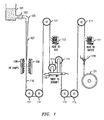
- FIG. 1 shows a graphical representation of an exemplary process, in accordance with the principles of the invention, for assembling carbon particles, such as, carbon fibrils and carbon nanotube molecules, into aligned fibers.
- aligned it is meant that the axis along the longest dimension of each of the various particles in a local vicinity are substantially parallel.
- FIG. 1 Shown in FIG. 1 are a) beaker 101, b) pump 103, c) supply outlet 105, d) tapering tube 107, e) ultraviolet curing lamp 109, f) pulleys 111, g) heater 113, h) twisting platform 115, i) heater 117, j) cladding applicator 119, and k) take-up drum 121.
- the carbon particles e.g., carbon nanotube molecules, carbon fibrils, or a combination thereof, are dispersed within an ultraviolet curable liquid contained in beaker 101.
- the curable liquid is cured, at least in part, through the use of ultraviolet light.
- the ultraviolet curable liquid is a copolymer of methylmethacrylate (95%) with the ester (5%) of methacrylic acid and anthacenyl methanol.
- Such an ultraviolet curable liquid cures in the presence of ultraviolet light, e.g., 350 nm light.
- the polymer can be diluted with the solvent toluene to control its flow properties.
- the ultraviolet curable liquid may be PS2067 which is commercially available from United Chemical Technologies.
- tapering tube 107 need not be a single unitary piece but may be made in sections and the sections may be made of different materials.
- Various properties of tapering tube 107 such as its length, orifice sizes, and taper rate affect the degree of alignment of the carbon particles, and hence the final properties of the resulting fiber.
- the flow tube is a 20cm length of quartz tubing with an inlet diameter of 5 mm and an outlet diameter of 100 microns.
- the concentration of the carbon particles within the curable liquid and flow velocity also affect the degree of alignment of the carbon particles, and hence the final properties of the resulting fiber.
- the flowing mixture of curable liquid is cured by shining thereon ultraviolet light from ultraviolet curing lamp 109 in the general vicinity of the end of the tapering tube, thereby forming a fiber.
- ultraviolet curing lamp 109 may be a 500 W high-pressure ultraviolet lamp giving off 350 nm light.
- the curing step may be performed, at least in part, while the flowing mixture of ultraviolet curable liquid is still tapering tube 107.
- tapering tube 107 may have at least a section that passes a sufficient amount of ultraviolet light to permit some curing.
- a portion of tapering tube 107 may be made of amorphous quartz which is ultraviolet transparent.
- the curing is performed only after the flowing mixture of ultraviolet curable liquid exits from tapering tube 107.
- liquids curable at least in part through the application of factors other than ultraviolet light may, alternatively or additionally, be employed. Means for applying such other factors may be substituted for, or supplement, ultraviolet curing lamp 109.
- resulting fiber 110 may continue to travel, e.g., from its momentum or due to the force of gravity. Additional optional processing of the fiber may be undertaken.
- the fiber may be routed around pulleys 111 and directed toward heater 113, which heats the fiber so as to cause the volatile elements of the solidified curable liquid portion to substantially dissipate from the fiber.
- the fiber is substantially made up of only carbon.
- Additional pulleys 111 mounted on twisting platform may be employed to twist the fiber to increase its density.
- the fiber may then be routed past optional heater 117, which heats the fiber to sinter the carbon particles within the fiber. It may be advantageous to sinter the fiber after twisting, because twisting causes the carbon particles with in the fiber to be closer together.
- Cladding applicator 119 may coat the fiber with an optional cladding. For example, it may be advantageous to coat the fiber with a nonconducting cladding for use in electrical applications. On the other hand, for use in applications such as bullet-proof vests, no cladding may be desired.
- any heating, twisting, sintering, and cladding is at the discretion of the implementor and is only dependent upon the desired properties for the fiber being made.
- the final fiber may then be spooled onto take-up drum 121.
- aligned carbon particle fibers are produced which are substantially free of any noncarbon impurities.
Landscapes
- Engineering & Computer Science (AREA)
- Chemical & Material Sciences (AREA)
- Textile Engineering (AREA)
- General Chemical & Material Sciences (AREA)
- Chemical Kinetics & Catalysis (AREA)
- Nanotechnology (AREA)
- General Physics & Mathematics (AREA)
- Crystallography & Structural Chemistry (AREA)
- Materials Engineering (AREA)
- Physics & Mathematics (AREA)
- Condensed Matter Physics & Semiconductors (AREA)
- Composite Materials (AREA)
- Manufacturing & Machinery (AREA)
- Artificial Filaments (AREA)
- Inorganic Fibers (AREA)
- Carbon And Carbon Compounds (AREA)
- Chemical Or Physical Treatment Of Fibers (AREA)
- Resistance Heating (AREA)
- Compositions Of Macromolecular Compounds (AREA)
- Processes Of Treating Macromolecular Substances (AREA)
Claims (14)
- Procédé d'assemblage de particules de carbone en au moins une fibre, le procédé comprenant les étapes de :alignement desdites particules de carbone par écoulement d'un mélange desdites particules de carbone et d'un liquide durcissable vers le bas d'un tube conique en partant d'une première extrémité dudit tube conique ;le procédé étant CARACTERISE par l'étape de :durcissement dudit mélange circulant au moins près d'une deuxième extrémité dudit tube conique par lequel une fibre est formée.
- Procédé selon la revendication 1 comprenant en outre l'étape de dispersion desdites particules de carbone à l'intérieur dudit liquide durcissable pour former ledit mélange.
- Procédé selon la revendication 1 dans lequel ledit liquide durcissable durcit, au moins en partie, en présence d'un rayonnement ultraviolet.
- Procédé selon la revendication 1 comprenant en outre l'étape de chauffage de ladite fibre de manière à forcer au moins certains éléments volatils à l'intérieur à s'en dissiper substantiellement.
- Procédé selon la revendication 1 comprenant en outre l'étape de torsion de ladite fibre pour augmenter sa densité.
- Procédé selon la revendication 1 comprenant l'étape de chauffage de ladite fibre pour fritter lesdites particules de carbone à l'intérieur de ladite fibre.
- Procédé selon la revendication 1 comprenant l'étape de gainage de ladite fibre.
- Procédé selon la revendication 1 dans lequel les particules de carbone comprennent substantiellement l'un au moins de l'ensemble consistant en :(i) des molécules de nanotubes de carbone,(ii) des fibrilles de carbone.
- Procédé selon la revendication 1 dans lequel ladite étape de durcissement est exécutée, au moins en partie, par braquage d'un rayonnement ultraviolet sur ledit mélange.
- Procédé selon la revendication 1 dans lequel ledit durcissement est réalisé au moins en partie tandis que ledit mélange demeure à l'intérieur dudit tube conique.
- Procédé selon la revendication 1 dans lequel ledit durcissement est réalisé au moins en partie après que ledit mélange est sorti dudit tube conique.
- Fibre de particules de carbone comprenant des particules de carbone qui ont été alignées au moins en partie par :alignement desdites particules de carbone par écoulement d'un mélange desdites molécules de carbone et d'un liquide durcissable vers le bas d'un tube conique en partant d'une première extrémité dudit tube conique ;durcissement dudit mélange circulant au moins près d'une deuxième extrémité dudit tube conique à l'aide d'un rayonnement ultraviolet par lequel une fibre est formée ;chauffage de ladite fibre de manière à forcer tous les éléments volatils provenant dudit liquide durcissable solidifié à se dissiper substantiellement de ladite fibre ;torsion de ladite fibre pour augmenter sa densité ; etchauffage de ladite fibre pour fritter lesdites particules de carbone à l'intérieur de ladite fibre.
- Fibre de particules de carbone selon la revendication 12 comprenant en outre une gaine autour de ladite fibre.
- Fibre de particules selon la revendication 12 dans laquelle lesdites particules de carbone comprennent substantiellement l'un au moins de l'ensemble consistant en :(i) des molécules de nanotubes de carbone,(ii) des fibrilles de carbone.
Applications Claiming Priority (2)
| Application Number | Priority Date | Filing Date | Title |
|---|---|---|---|
| US789154 | 2004-02-27 | ||
| US10/789,154 US7399443B2 (en) | 2004-02-27 | 2004-02-27 | Carbon particle fiber assembly technique |
Publications (2)
| Publication Number | Publication Date |
|---|---|
| EP1577427A1 EP1577427A1 (fr) | 2005-09-21 |
| EP1577427B1 true EP1577427B1 (fr) | 2007-05-23 |
Family
ID=34838850
Family Applications (1)
| Application Number | Title | Priority Date | Filing Date |
|---|---|---|---|
| EP05250869A Expired - Lifetime EP1577427B1 (fr) | 2004-02-27 | 2005-02-15 | Procédé de fabrication de fibres de particules de carbone |
Country Status (6)
| Country | Link |
|---|---|
| US (1) | US7399443B2 (fr) |
| EP (1) | EP1577427B1 (fr) |
| JP (1) | JP4969788B2 (fr) |
| KR (1) | KR101161566B1 (fr) |
| CN (1) | CN100488750C (fr) |
| DE (1) | DE602005001161T2 (fr) |
Families Citing this family (10)
| Publication number | Priority date | Publication date | Assignee | Title |
|---|---|---|---|---|
| US7744793B2 (en) | 2005-09-06 | 2010-06-29 | Lemaire Alexander B | Apparatus and method for growing fullerene nanotube forests, and forming nanotube films, threads and composite structures therefrom |
| WO2008060336A2 (fr) * | 2006-06-09 | 2008-05-22 | Cleveland State University | Matériaux composites à résistance élevée, et procédés associés |
| CN101676452B (zh) * | 2008-09-19 | 2011-11-30 | 清华大学 | 碳纳米管纱的制备方法 |
| GB201009276D0 (en) * | 2010-06-03 | 2010-07-21 | Devan Chemicals Nv | Coated fibres,yarns and textiles |
| JP5863814B2 (ja) * | 2010-10-26 | 2016-02-17 | ユニバーシティ オブ セントラル フロリダ リサーチ ファウンデーション,インコーポレイテッド | 追加されたコア分解プロセスを有する熱ファイバ線引き(tfd)およびそれから得られる粒子 |
| JP5832754B2 (ja) | 2011-02-03 | 2015-12-16 | 国立大学法人信州大学 | 糸状カーボンナノ構造物の製造方法 |
| JP2012162811A (ja) * | 2011-02-03 | 2012-08-30 | Shinshu Univ | カーボンナノ構造物含有糸の製造方法 |
| CN102205633B (zh) * | 2011-05-09 | 2013-02-06 | 华东理工大学 | 纤维增强热塑性聚合物两步法缠绕成型的加热装置 |
| JP6462458B2 (ja) * | 2015-03-31 | 2019-01-30 | 日立造船株式会社 | カーボンナノチューブ集合体の製造方法 |
| CN107002306B (zh) * | 2015-07-24 | 2020-05-12 | Lg化学株式会社 | 用于制造碳纳米管纤维的装置 |
Family Cites Families (20)
| Publication number | Priority date | Publication date | Assignee | Title |
|---|---|---|---|---|
| GB1174959A (en) | 1966-09-16 | 1969-12-17 | Carborundum Co | Whisker Orientation and Shaped Bodies containing Uniaxially Oriented Whiskers |
| DE2806560B2 (de) * | 1978-02-16 | 1981-05-07 | Kabel- und Metallwerke Gutehoffnungshütte AG, 3000 Hannover | Verfahren zur kontinuierlichen Herstellung wärmeisolierter Leitungsrohre |
| JPS6119805A (ja) * | 1984-07-03 | 1986-01-28 | Asahi Chem Ind Co Ltd | 高速度湿式紡糸方法およびその装置 |
| JP2862578B2 (ja) * | 1989-08-14 | 1999-03-03 | ハイピリオン・カタリシス・インターナシヨナル・インコーポレイテツド | 樹脂組成物 |
| US6106745A (en) * | 1995-11-30 | 2000-08-22 | Akzo Nobel Nv | Method of making graded index polymeric optical fibers |
| US6683783B1 (en) * | 1997-03-07 | 2004-01-27 | William Marsh Rice University | Carbon fibers formed from single-wall carbon nanotubes |
| EP1054036A1 (fr) * | 1999-05-18 | 2000-11-22 | Fina Research S.A. | Polymères renforcées |
| US6299812B1 (en) * | 1999-08-16 | 2001-10-09 | The Board Of Regents Of The University Of Oklahoma | Method for forming a fibers/composite material having an anisotropic structure |
| WO2001030694A1 (fr) * | 1999-10-27 | 2001-05-03 | William Marsh Rice University | Ensemble ordonne macroscopique de nanotubes de carbone |
| FR2805179B1 (fr) * | 2000-02-23 | 2002-09-27 | Centre Nat Rech Scient | Procede d'obtention de fibres et de rubans macroscopiques a partir de particules colloidales, et notamment de nanotubes de carbone |
| US6682677B2 (en) * | 2000-11-03 | 2004-01-27 | Honeywell International Inc. | Spinning, processing, and applications of carbon nanotube filaments, ribbons, and yarns |
| US6921462B2 (en) * | 2001-12-17 | 2005-07-26 | Intel Corporation | Method and apparatus for producing aligned carbon nanotube thermal interface structure |
| AU2003202949A1 (en) * | 2002-01-11 | 2003-07-30 | Ali Alwattari | Methods and apparatus for spinning spider silk protein |
| US6934600B2 (en) * | 2002-03-14 | 2005-08-23 | Auburn University | Nanotube fiber reinforced composite materials and method of producing fiber reinforced composites |
| US6852410B2 (en) * | 2002-07-01 | 2005-02-08 | Georgia Tech Research Corporation | Macroscopic fiber comprising single-wall carbon nanotubes and acrylonitrile-based polymer and process for making the same |
| US20060099135A1 (en) * | 2002-09-10 | 2006-05-11 | Yodh Arjun G | Carbon nanotubes: high solids dispersions and nematic gels thereof |
| US20050061496A1 (en) * | 2003-09-24 | 2005-03-24 | Matabayas James Christopher | Thermal interface material with aligned carbon nanotubes |
| US20050228110A1 (en) * | 2003-12-24 | 2005-10-13 | Ko Frank K | Continuous organic and inorganic matrix composite fibrils and methods for their production from carbon nanotubes |
| US7628041B2 (en) * | 2004-02-27 | 2009-12-08 | Alcatel-Lucent Usa Inc. | Carbon particle fiber assembly technique |
| US7803262B2 (en) * | 2004-04-23 | 2010-09-28 | Florida State University Research Foundation | Alignment of carbon nanotubes using magnetic particles |
-
2004
- 2004-02-27 US US10/789,154 patent/US7399443B2/en not_active Expired - Fee Related
-
2005
- 2005-02-15 EP EP05250869A patent/EP1577427B1/fr not_active Expired - Lifetime
- 2005-02-15 DE DE602005001161T patent/DE602005001161T2/de not_active Expired - Lifetime
- 2005-02-18 KR KR1020050013492A patent/KR101161566B1/ko not_active Expired - Fee Related
- 2005-02-25 JP JP2005049997A patent/JP4969788B2/ja not_active Expired - Lifetime
- 2005-02-25 CN CNB200510052421XA patent/CN100488750C/zh not_active Expired - Fee Related
Non-Patent Citations (1)
| Title |
|---|
| None * |
Also Published As
| Publication number | Publication date |
|---|---|
| DE602005001161D1 (de) | 2007-07-05 |
| DE602005001161T2 (de) | 2008-01-24 |
| CN100488750C (zh) | 2009-05-20 |
| EP1577427A1 (fr) | 2005-09-21 |
| JP4969788B2 (ja) | 2012-07-04 |
| JP2005240269A (ja) | 2005-09-08 |
| US7399443B2 (en) | 2008-07-15 |
| US20050189671A1 (en) | 2005-09-01 |
| KR101161566B1 (ko) | 2012-07-03 |
| CN1661141A (zh) | 2005-08-31 |
| KR20060042976A (ko) | 2006-05-15 |
Similar Documents
| Publication | Publication Date | Title |
|---|---|---|
| US9233492B2 (en) | Composite materials reinforced with carbon nanotube yarns | |
| KR100695185B1 (ko) | 콜로이드 입자, 특히 탄소 나노튜브로부터 거시적 섬유 및스트립을 얻는 방법 | |
| CN1660710A (zh) | 结合碳颗粒纤维的方法及含有碳颗粒的玻璃纤维 | |
| CN103987762B (zh) | 不对称纤维增强聚合物带材 | |
| WO1984000216A1 (fr) | Fibre optique enduite | |
| KR20100108540A (ko) | 멀티필라멘트 얀으로부터의 가요성 연속 테이프 및 이의 제조방법 | |
| US12350882B2 (en) | Print head for the additive manufacturing of fibre reinforced materials | |
| US7399443B2 (en) | Carbon particle fiber assembly technique | |
| CN113737512A (zh) | 微流体涂层技术制备弹性导电纤维的方法及弹性导电纤维 | |
| JP3058897B2 (ja) | 繊維強化硬化性樹脂製細線条物の製造方法 | |
| Kim et al. | Large variation in Young's modulus of carbon nanotube yarns with different diameters | |
| TW200912406A (en) | Methods of forming composite optical film | |
| JP2024500619A5 (fr) | ||
| JPH06509031A (ja) | ポリマー粉体分散液からの複合体の製造 | |
| CN113737341B (zh) | 弹性皮芯纤维及其制备方法 | |
| US6495204B1 (en) | Methods for modifying monofilaments, bundles of monofilaments, and fibrous structural material | |
| EP0287016A2 (fr) | Guide d'ondes optique à trois couches protectrices en plastique et sa méthode de fabrication | |
| KR101859638B1 (ko) | 열가소성 탄소섬유 복합소재의 제조방법 | |
| KR102202383B1 (ko) | 섬유 강화 복합재의 제조방법 | |
| KR20230121604A (ko) | 콘크리트 보강을 위한 유리-수지 복합 섬유의 사용 | |
| EP4269671A1 (fr) | Filage humide à base microfluidique de fibres polymères solides individuelles | |
| Cech et al. | A fiber-bundle pull-out test for surface-modified glass fibers in GF/polyester composite | |
| CN1890590A (zh) | 引入线光缆用frp制抗张力体 | |
| DE102022133282B3 (de) | Drehungsfreies Hybridgarn aufweisend Hochleistungsfasern und Thermoplastfasern, Verfahren und Vorrichtung zum Herstellen dergleichen | |
| US20250171310A1 (en) | Process for Manufacture of Carbon Nanotube Tape-Like Prepeg for Enhanced Composite Properties |
Legal Events
| Date | Code | Title | Description |
|---|---|---|---|
| PUAI | Public reference made under article 153(3) epc to a published international application that has entered the european phase |
Free format text: ORIGINAL CODE: 0009012 |
|
| 17P | Request for examination filed |
Effective date: 20050310 |
|
| AK | Designated contracting states |
Kind code of ref document: A1 Designated state(s): AT BE BG CH CY CZ DE DK EE ES FI FR GB GR HU IE IS IT LI LT LU MC NL PL PT RO SE SI SK TR |
|
| AX | Request for extension of the european patent |
Extension state: AL BA HR LV MK YU |
|
| AKX | Designation fees paid |
Designated state(s): DE FR GB |
|
| GRAP | Despatch of communication of intention to grant a patent |
Free format text: ORIGINAL CODE: EPIDOSNIGR1 |
|
| GRAS | Grant fee paid |
Free format text: ORIGINAL CODE: EPIDOSNIGR3 |
|
| GRAA | (expected) grant |
Free format text: ORIGINAL CODE: 0009210 |
|
| AK | Designated contracting states |
Kind code of ref document: B1 Designated state(s): DE FR GB |
|
| REG | Reference to a national code |
Ref country code: GB Ref legal event code: FG4D |
|
| REF | Corresponds to: |
Ref document number: 602005001161 Country of ref document: DE Date of ref document: 20070705 Kind code of ref document: P |
|
| ET | Fr: translation filed | ||
| PLBE | No opposition filed within time limit |
Free format text: ORIGINAL CODE: 0009261 |
|
| STAA | Information on the status of an ep patent application or granted ep patent |
Free format text: STATUS: NO OPPOSITION FILED WITHIN TIME LIMIT |
|
| 26N | No opposition filed |
Effective date: 20080226 |
|
| REG | Reference to a national code |
Ref country code: GB Ref legal event code: 732E Free format text: REGISTERED BETWEEN 20131128 AND 20131204 |
|
| REG | Reference to a national code |
Ref country code: FR Ref legal event code: CD Owner name: ALCATEL-LUCENT USA INC. Effective date: 20131122 |
|
| REG | Reference to a national code |
Ref country code: FR Ref legal event code: GC Effective date: 20140410 |
|
| REG | Reference to a national code |
Ref country code: FR Ref legal event code: RG Effective date: 20141015 |
|
| REG | Reference to a national code |
Ref country code: FR Ref legal event code: PLFP Year of fee payment: 11 |
|
| REG | Reference to a national code |
Ref country code: FR Ref legal event code: PLFP Year of fee payment: 12 |
|
| REG | Reference to a national code |
Ref country code: FR Ref legal event code: PLFP Year of fee payment: 13 |
|
| REG | Reference to a national code |
Ref country code: FR Ref legal event code: PLFP Year of fee payment: 14 |
|
| PGFP | Annual fee paid to national office [announced via postgrant information from national office to epo] |
Ref country code: GB Payment date: 20190213 Year of fee payment: 15 Ref country code: FR Payment date: 20190111 Year of fee payment: 15 Ref country code: DE Payment date: 20190205 Year of fee payment: 15 |
|
| REG | Reference to a national code |
Ref country code: DE Ref legal event code: R119 Ref document number: 602005001161 Country of ref document: DE |
|
| GBPC | Gb: european patent ceased through non-payment of renewal fee |
Effective date: 20200215 |
|
| PG25 | Lapsed in a contracting state [announced via postgrant information from national office to epo] |
Ref country code: FR Free format text: LAPSE BECAUSE OF NON-PAYMENT OF DUE FEES Effective date: 20200229 Ref country code: GB Free format text: LAPSE BECAUSE OF NON-PAYMENT OF DUE FEES Effective date: 20200215 Ref country code: DE Free format text: LAPSE BECAUSE OF NON-PAYMENT OF DUE FEES Effective date: 20200901 |