EP1577212B1 - Profil aérodynamique avec un dispositif de régulation d'écoulement - Google Patents
Profil aérodynamique avec un dispositif de régulation d'écoulement Download PDFInfo
- Publication number
- EP1577212B1 EP1577212B1 EP04022521A EP04022521A EP1577212B1 EP 1577212 B1 EP1577212 B1 EP 1577212B1 EP 04022521 A EP04022521 A EP 04022521A EP 04022521 A EP04022521 A EP 04022521A EP 1577212 B1 EP1577212 B1 EP 1577212B1
- Authority
- EP
- European Patent Office
- Prior art keywords
- aerofoil
- passage
- inlet
- fitting
- outlet
- Prior art date
- Legal status (The legal status is an assumption and is not a legal conclusion. Google has not performed a legal analysis and makes no representation as to the accuracy of the status listed.)
- Expired - Lifetime
Links
- 239000000463 material Substances 0.000 claims description 11
- 238000005553 drilling Methods 0.000 claims description 7
- 230000003628 erosive effect Effects 0.000 claims description 7
- 238000000034 method Methods 0.000 claims description 7
- 238000004519 manufacturing process Methods 0.000 claims description 3
- 239000000853 adhesive Substances 0.000 description 6
- 230000001070 adhesive effect Effects 0.000 description 6
- 238000000465 moulding Methods 0.000 description 5
- 229920002635 polyurethane Polymers 0.000 description 2
- 239000004814 polyurethane Substances 0.000 description 2
- 239000012779 reinforcing material Substances 0.000 description 2
- 239000011347 resin Substances 0.000 description 2
- 229920005989 resin Polymers 0.000 description 2
- 230000015572 biosynthetic process Effects 0.000 description 1
- 150000001875 compounds Chemical class 0.000 description 1
- 239000004033 plastic Substances 0.000 description 1
- 229920003023 plastic Polymers 0.000 description 1
Images
Classifications
-
- B—PERFORMING OPERATIONS; TRANSPORTING
- B64—AIRCRAFT; AVIATION; COSMONAUTICS
- B64C—AEROPLANES; HELICOPTERS
- B64C27/00—Rotorcraft; Rotors peculiar thereto
- B64C27/32—Rotors
- B64C27/46—Blades
-
- B—PERFORMING OPERATIONS; TRANSPORTING
- B64—AIRCRAFT; AVIATION; COSMONAUTICS
- B64C—AEROPLANES; HELICOPTERS
- B64C2230/00—Boundary layer controls
- B64C2230/04—Boundary layer controls by actively generating fluid flow
-
- B—PERFORMING OPERATIONS; TRANSPORTING
- B64—AIRCRAFT; AVIATION; COSMONAUTICS
- B64C—AEROPLANES; HELICOPTERS
- B64C2230/00—Boundary layer controls
- B64C2230/20—Boundary layer controls by passively inducing fluid flow, e.g. by means of a pressure difference between both ends of a slot or duct
-
- B—PERFORMING OPERATIONS; TRANSPORTING
- B64—AIRCRAFT; AVIATION; COSMONAUTICS
- B64C—AEROPLANES; HELICOPTERS
- B64C2230/00—Boundary layer controls
- B64C2230/22—Boundary layer controls by using a surface having multiple apertures of relatively small openings other than slots
-
- B—PERFORMING OPERATIONS; TRANSPORTING
- B64—AIRCRAFT; AVIATION; COSMONAUTICS
- B64C—AEROPLANES; HELICOPTERS
- B64C2230/00—Boundary layer controls
- B64C2230/28—Boundary layer controls at propeller or rotor blades
-
- Y—GENERAL TAGGING OF NEW TECHNOLOGICAL DEVELOPMENTS; GENERAL TAGGING OF CROSS-SECTIONAL TECHNOLOGIES SPANNING OVER SEVERAL SECTIONS OF THE IPC; TECHNICAL SUBJECTS COVERED BY FORMER USPC CROSS-REFERENCE ART COLLECTIONS [XRACs] AND DIGESTS
- Y02—TECHNOLOGIES OR APPLICATIONS FOR MITIGATION OR ADAPTATION AGAINST CLIMATE CHANGE
- Y02T—CLIMATE CHANGE MITIGATION TECHNOLOGIES RELATED TO TRANSPORTATION
- Y02T50/00—Aeronautics or air transport
- Y02T50/10—Drag reduction
Definitions
- This invention related to an aerofoil having a flow control device commonly known as an air jet vortex generator or AJVG.
- An AJVG typically includes a passage within the aerofoil, the passage opening at an upper aerofoil surface of the aerofoil, whereby in use, air from the passage passes through the opening to affect airflow over the upper surface of the aerofoil over at least a range of incidence angles. Examples are illustrated in US-A-6283406 , US-A-05813625 and in JP-A-07300098 .
- An AJVG may be provided to energise boundary airflow over the upper aerofoil surface, to assist the airflow in overcoming a large pressure gradient, which particularly but not exclusively may be encountered at high incidence angles.
- an AJVG may be used to delay stalling, to increase lift and reduce drag on the aerofoil as the aerofoil moves through the air.
- the invention has particularly but not exclusively been developed for use on an aircraft wing, which may be either a fixed wing or a rotating wing such as a helicopter blade.
- the position and shape of the opening in the upper aerofoil surface is critical.
- Helicopter blades at least, typically are fabricated by moulding in compound materials typically including resin and reinforcing materials. Such materials do not readily lend themselves to the formation of accurately shaped openings, and moreover, the provision of a discontinuity such as an opening, can lead to erosion and other undesirable aerofoil wear, particularly in the region of the opening.
- a discontinuity such as an opening
- the fitting may be made in a durable material which is more resistant to erosion than the materials of the body, and fitted to the aerofoil surface so that the interface between the fitting and the upper aerofoil surface is smooth, i.e. so that no or a minimal discontinuity is provided.
- the invention has particularly but not exclusively been developed for a so-called passive AJVG, i.e. the device includes an inlet opening for air at or closely adjacent to a lower aerofoil surface, the air passing into the inlet opening of the passage and flowing to the passage outlet at the upper aerofoil surface afforded by the outlet fitting, by the movement of the aerofoil through the air.
- the flow control device includes an inlet fitting which is secured relative to the aerofoil, desirably at an inlet position at or closely adjacent the lower aerofoil surface, the inlet fitting including a surface part which lies contiguously with the surrounding lower aerofoil surface so there is no or only a minimal discontinuity where the surface part and the surrounding lower aerofoil surface interface, the surface part of the inlet fitting further including an inlet opening which communicates with the passage within the body of the aerofoil.
- a desired shape of inlet opening too may be provided and the inlet fitting may again be made in a durable material which is resistant to erosion, i.e. is more durable than the material of the body, and fitted to the aerofoil surface so that the interface between the fitting and the adjacent aerofoil surface is smooth, i.e. so that no or a minimal discontinuity is provided.
- the passage in the aerofoil is provided subsequent to moulding the aerofoil, e.g. by drilling.
- the drilling process may provide a pair of passage parts which intersect non co-axially. Thus air flowing through the passage needs to undergo an abrupt change of direction which is undesirable.
- the aerofoil of the invention includes a flexible conduit within the passage, the conduit extending to the passage outlet.
- the outlet fitting and the flexible conduit may be monolithic, alternatively these may be interconnected.
- the flexible conduit may have a cross section which is ideal for the most efficient air flow through the passage, such as round, whilst the outlet provided by the outlet fitting may be of an alternative desired shape to achieve an optimum affect on the airflow over the upper aerofoil surface.
- the flexible conduit which may be a plastic such as polyurethane, thus will allow optimised airflow through the passage, as the conduit may smooth any otherwise abrupt changes of direction of the airflow.
- the flexible conduit may be integral with the inlet fitting or connected to the inlet fitting as desired.
- the outlet fitting includes a surface part shaped so that when the fitting is secured relative to the upper surface of the aerofoil, the surface part lies substantially contiguously with the surrounding aerofoil upper surface, and a hollow spigot part which extends into the passage for interconnection to the flexible conduit
- the inlet fitting includes a surface part which when the inlet fitting is secured at or adjacent to the lower aerofoil surface, lies substantially contiguously with the surrounding aerofoil surface, and a hollow spigot part which extends into the passage for connection to the flexible conduit.
- the aerofoil may be a fixed wing of an aircraft or a rotor blade of a main sustaining or tail rotor of a helicopter.
- a plurality of flow control devices are provided along a -leading edge of the aerofoil.
- the aerofoil of the second aspect of the invention may have any of the features of the aerofoil of the first aspect of the invention.
- the method may include providing both the inlet and outlet fittings and providing between the inlet and outlet fittings, a flexible conduit which is integral or connected to one or each of the inlet and outlet fittings.
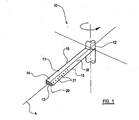
- a main sustaining rotor assembly 10 of a helicopter has four blades, one of which is shown at 11, and the positions of the other blades being indicated by lines.
- the blade 11 is an aerofoil over which in use, air flows to provide lift.
- the rotor blade 11 extends from a root end 12 which typically is a rotor head or hub, outwardly along a blade span to a tip which is indicated at 13.
- a tip 13 In practice the tip 13 would be of a complex configuration but is shown in figure 1 schematically only to indicate the aerofoil cross section.
- the blade 11 has an aerofoil body 14, with a leading edge 15, a trailing edge 16, an upper aerofoil surface 14 between the leading and trailing edges 15, 16, and a lower aerofoil surface 20 between the leading and trailing edges 15, 16.
- the blade 11 may be feathered about a blade axis A and thus the angle of incidence of the blade 11 to the air through which the blade 11 in use moves, may vary.
- a plurality of flow control devices namely passive AJVGs.
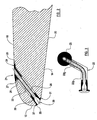
- Each of these includes a passage 22 within the aerofoil body 14, the passage 22 opening at the upper aerofoil surface 18 of the aerofoil 11, air in use, from the passage 22 passing through an outlet opening 21 to affect airflow over the upper surface 18 of the aerofoil 11 over at least a range of incidence angles.
- the flow control devices each include an outlet fitting 24 which in this example includes a surface part 25 with the outlet opening 21 provided therein, the outlet opening 21 communicating with the passage 22 via a hollow spigot part 26 of the outlet fitting 24.
- the outlet fitting 24 is made in a material which is resistant to erosion or other wear at least at the outlet opening 21, and is secured relative to the upper surface 18 of the aerofoil 11, e.g. by adhesive.
- the surface part 25 is configured so that it lies contiguously with the surrounding upper aerofoil surface 18 so there is no or only a minimal discontinuity where the surface part 25 and the surrounding aerofoil surface 18 interface, indicated at 27.
- the spigot part 26 receives within it, an end of a flexible conduit 28 which will be discussed in more detail below.
- the passive AJVG flow control device includes an inlet opening 30 for air, which is positioned at or closely adjacent to the lower aerofoil surface 20, in this example closely adjacent the leading edge 15 of the blade 11.
- the flow control device includes an inlet fitting 31 which in this example includes a surface part 35 and a hollow spigot part 36.
- the inlet opening 30 is provided in the surface part 35 and communicates with the passage 22 via the hollow spigot part 36 of the inlet fitting 31.
- the inlet fitting 31 is made in a material which is resistant to erosion or other wear at the inlet opening 30, and is secured relative to the inlet position at or closely adjacent to the lower surface 20 of the aerofoil 11, e.g. by adhesive.
- the surface part 35 of the inlet fitting 31 is configured so that it lies contiguously with the surrounding aerofoil surface 20 so there is no or only a minimal discontinuity where the surface part 35 and the surrounding lower aerofoil surface 20 interface, indicated at 37.
- the spigot part 36 of the inlet fitting 31 is connected to the flexible conduit 28.
- the aerofoil body 14 in this example is made by moulding in resin and reinforcing materials.
- the passage 22 is provided subsequent to moulding, e.g. by drilling.
- the passage 22 typically is not straight, but has two parts 22a and 22b, which are not co-axial, but are inclined, necessarily so that the passage 22 can extend from a desired inlet position 30 to a desired outlet position 21, and each passage part 22a, 22b may be straight and may be provided by drilling.
- airflow through the passage 22 from the inlet 30 to the outlet 21 would involve an abrupt change of direction where the passage parts 22a, 22b intersect.
- the provision of the flexible conduit 28 smooths the intersection for the airflow, thus reducing losses and improving efficiency.
- the spigot part 26 of the outlet fitting 24 receives the end of the flexible conduit 28 within, as does the spigot part 36 of the inlet fitting 31, although the inlet fitting 31 has an inner abutment so that the position of the flexible conduit 28 relative to the inlet fitting 31 may be fixed.
- the flexible conduit 28 may be connected to the respective inlet and outlet fittings 31, 24 otherwise, although a method of installing the flow control device will be described for the particular configuration as seen in the drawings.
- the passage 22 may be provided by drilling the respective passage parts 22b, 22a from the upper aerofoil surface outlet position 21, and from the inlet position 30 at or adjacent the lower aerofoil surface 20, respectively.
- the aerofoil surface 18, 20 around the respective passage outlet 21 and inlet 30 is then cut away to produce a respective recess to receive the respective surface part 25 of the outlet fitting 24 and surface part 35 of the inlet fitting 31, so that the surface parts 25, 35 can be secured, e.g. by adhesive, so as to lie contiguously with the surrounding aerofoil surface 18, 20.
- the flexible conduit 28 may be already secured to the spigot part 36 of the inlet fitting 31 or may be subsequently secured, e.g. by adhesive, after feeding into the passage 28 from the outlet opening 21.
- the flexible conduit 28 may extend outwardly of the upper surface 18 of the aerofoil 11 at this time.
- outlet fitting 21 is passed over the flexible conduit, which is then connected inside the spigot part 26 of the outlet fitting 24, e.g. by adhesive, and the outlet fitting 24 is secured relative to the upper surface 18 of the aerofoil 11 as shown, again, desirably by adhesive.
- the flexible conduit 28 in this example may be of polyurethane for example, and of round cross section for most efficient airflow through the passage 22.
- the inlet opening 30 provided through the hollow spigot 36 may be of larger cross section than the flexible conduit 28 as shown, but the cross section of the actual opening 30 in the surface part 35 of the inlet fitting 31 need not be circular but may be of any desired shape for most efficient passage of air into the opening 30.
- the actual outlet opening 21 formed in the surface part 25 of the outlet fitting 24 may typically be a slot or other shape as desired for affecting the airflow over the upper aerofoil surface 18, optimally.
- the flexible conduit 28 may be integral or monolithic with at least one of the inlet 31 and outlet 24 fittings.
- Flow control devices may be retro-fitted to existing aerofoils, or provided during aerofoil fabrication, subsequent to moulding the aerofoil body 14.
Landscapes
- Engineering & Computer Science (AREA)
- Mechanical Engineering (AREA)
- Aviation & Aerospace Engineering (AREA)
- Structures Of Non-Positive Displacement Pumps (AREA)
- Air-Flow Control Members (AREA)
Claims (16)
- Profil aérodynamique (11) ayant un corps (14), et au moins un dispositif de commande d'écoulement, le dispositif de commande d'écoulement incluant un passage (22) dans le corps (14) du profil aérodynamique (11), et une sortie de passage (21) au niveau d'une surface supérieure (18) du profil aérodynamique (11), grâce à quoi, en fonctionnement, de l'air provenant du passage (22) traverse la sortie (21) du passage pour affecter l'écoulement d'air sur la surface supérieure (18) du profil aérodynamique (11) sur au moins une plage d'angles d'incidence, caractérisé en ce qu'il est prévu un raccord de sortie qui comporte une partie de surface (25) avec une ouverture traversante, et le raccord de sortie avec la partie de surface (25) et l'ouverture traversante étant immobilisé par rapport à la surface supérieure (18) du profil aérodynamique (11) de sorte que la partie de surface (25) se trouve de façon contiguë à la surface supérieure environnante (18) du profil aérodynamique de façon qu'il n'y ait aucune discontinuité ou seulement une discontinuité minimale lorsque la partie de surface (25) et la surface supérieure environnante (18) du profil aérodynamique se relient (27) et que l'ouverture traversante du raccord de sortie communique avec le passage (22) dans le corps (14) du profil aérodynamique (11) et fournit la sortie (21) du passage.
- Profil aérodynamique (11) selon la revendication 1, caractérisé en ce que le raccord est réalisé en une matière durable qui est plus résistante vis-à-vis de l'érosion que la matière du corps (14), et est monté sur la surface supérieure (18) du profil aérodynamique (11) de sorte que l'interface entre le raccord et la surface supérieure (18) du profil aérodynamique est lisse.
- Profil aérodynamique selon la revendication 1 ou la revendication 2, caractérisé en ce que le dispositif de commande d'écoulement comporte une entrée de passage (30) pour de l'air au niveau d'une surface (20) ou étroitement adjacente à une surface (20) du profil aérodynamique, l'air passant dans l'entrée (30) du passage et s'écoulant vers l'ouverture (21) au niveau de la surface supérieure (18) du profil aérodynamique fournie par le raccord de sortie, par le mouvement du profil aérodynamique (11) dans l'air.
- Profil aérodynamique selon la revendication 3, caractérisé en ce que le dispositif de commande d'écoulement comporte un raccord d'entrée qui est immobilisé par rapport au profil aérodynamique (11) à une position d'entrée (31) au niveau de la surface inférieure (20) ou étroitement adjacente à la surface inférieure (20) du profil aérodynamique, le raccord d'entrée comportant une partie de surface (35) qui se trouve de façon contiguë à la surface inférieure environnante (20) du profil aérodynamique de façon qu'il n'y ait aucune discontinuité ou seulement une discontinuité minimale lorsque la partie de surface (35) et la surface inférieure environnante (20) du profil aérodynamique se relient, la partie de surface (35) du raccord d'entrée comportant de plus une ouverture d'entrée (30) qui communique avec le passage (22) dans le corps (14) du profil aérodynamique (11).
- Profil aérodynamique (11) selon la revendication 4, caractérisé en ce que le raccord d'entrée est réalisé en une matière durable qui est résistante vis-à-vis de l'érosion, et est monté sur la surface inférieure (20) du profil aérodynamique de sorte que l'interface entre le raccord et la surface inférieure (20) du profil aérodynamique est lisse.
- Profil aérodynamique selon une quelconque des revendications précédentes, caractérisé en ce qu'un conduit souple (28) est prévu à l'intérieur du passage (22), le conduit (28) s'étendant jusqu'à la sortie (21) du passage.
- Profil aérodynamique selon la revendication 6, caractérisé en ce que le raccord de sortie et le conduit souple (28) sont conjugués et/ou le conduit souple est relié au raccord d'entrée lorsque est prévu.
- Profil aérodynamique selon la revendication 6 ou la revendication 7, caractérisé en ce que le raccord de sortie comporte une partie d'emboîtement ou de centrage creuse (36) à travers laquelle s'étend l'ouverture traversante, la partie d'emboîtement (36) se trouvant dans le passage (22) pour la liaison au conduit souple (28).
- Profil aérodynamique selon une quelconque des revendications 6 à 8 lorsqu'elle dépend de la revendication 4, caractérisé en ce que le raccord d'entrée comporte une partie d'emboîtement creuse (36) qui se trouve dans le passage (22) pour la liaison au conduit souple (28).
- Profil aérodynamique selon une quelconque des revendications précédentes qui est une aile fixe d'un aéronef ou une pale de rotor d'un rotor de sustentation principale ou d'un rotor de queue d'un hélicoptère.
- Profil aérodynamique selon la revendication 10, caractérisé en ce que plusieurs dispositifs de commande d'écoulement sont prévus le long d'un bord d'attaque (15) du profil aérodynamique (11).
- Profil aérodynamique ayant un corps (14), et au moins un dispositif de commande d'écoulement, le dispositif de commande d'écoulement comportant un passage (22) dans le corps (14) du profil aérodynamique (11), et une entrée de passage (30) à une position au niveau d'une surface inférieure (20) ou adjacente à une surface inférieure (20) du profil aérodynamique (11), grâce à quoi, en fonctionnement, de l'air passe dans l'entrée (30) du passage et s'écoule vers une sortie (21) sur une surface supérieure (18) du profil aérodynamique pour affecter l'écoulement d'air sur la surface supérieure (18) du profil aérodynamique (11) sur au moins une plage d'angles d'incidence, caractérisé en ce qu'il est prévu un raccord d'entrée qui comporte une partie de surface (35) avec une ouverture traversante, et le raccord d'entrée avec la partie de surface (35) et l'ouverture traversante étant immobilisé au niveau de la position d'entrée (30) de sorte que la partie de surface (35) se trouve de façon contiguë à la surface inférieure environnante (20) du profil aérodynamique de façon qu'il n'y ait aucune discontinuité ou seulement une discontinuité minimale lorsque la partie de surface (35) et la surface inférieure environnante (20) du profil aérodynamique se relient (37), et l'ouverture traversante du raccord d'entrée communique avec le passage (22) dans le corps (14) du profil aérodynamique (11) et fournit l'entrée (30) du passage.
- Aéronef ayant un profil aérodynamique (11) caractérisé en ce que le profil aérodynamique (11) est en conformité avec l'une quelconque des revendications précédentes.
- Procédé pour réaliser un profil aérodynamique (11) conformément à l'une quelconque des revendications précédentes, caractérisé en ce que le procédé comporte les étapes de prévoir un passage (22) dans un corps (14) du profil aérodynamique comportant une surface supérieure (18) du profil aérodynamique et une surface inférieure (20) du profil aérodynamique, le passage (22) s'étendant depuis une position d'entrée (30) au niveau de la surface inférieure (20) ou adjacent à la surface inférieure (20) du profil aérodynamique et une sortie de passage (21) au niveau de la surface supérieure (18) du profil aérodynamique, et l'une ou les deux d'immobiliser par rapport à la surface supérieure (18) du profil aérodynamique (11) un raccord de sortie et d'immobiliser au niveau de la position d'entrée (30) à la surface inférieure (20) ou adjacent à la surface inférieure (20) du profit aérodynamique, un raccord d'entrée, et le raccord de sortie comportant une partie de surface (25) qui, quand elle est immobilisée par rapport à la surface supérieure (18) du profil aérodynamique (11), se trouve de manière contiguë à la surface supérieure environnante (18) du profil aérodynamique de façon qu'il n'y ait aucune discontinuité ou seulement une discontinuité minimale lorsque la partie de surface (25) et la surface supérieure environnante (18) du profil aérodynamique se relient (27), la partie de surface (25) du raccord de sortie comportant de plus une ouverture traversante qui communique avec le passage (22) dans le corps (14) du profil aérodynamique (11) de sorte que, quand le raccord de sortie est immobilisé, l'ouverture traversante fournit la sortie (21) du passage, et le raccord d'entrée, quand il est immobilise par rapport à la surface inférieure (20) du profil aérodynamique, comportant une partie de surface (35) qui se trouve de manière contiguë la surface inférieure environnante (20) du profil aérodynamique de façon qu'il n'y ait aucune discontinuité ou seulement une discontinuité minimale lorsque la partie de surface (35) et la surface inférieure environnante (20) du profil aérodynamique se relient (37), la partie de surface (35) du raccord d'entrée comportant de plus une ouverture traversante qui communique avec le passage (22) dans le corps (14) du profil aérodynamique (11) de sorte que, quand le raccord d'entrée est immobilisé, l'ouverture traversante fournit l'entrée (30) du passage.
- Procédé selon la revendication 14, caractérisé en ce que le procédé consiste à prévoir à la fois des raccords d'entrée et de sortie et à prévoir entre les raccords d'entrée et de sortie, un conduit souple (18) qui est intégré ou relié à l'un ou à chacun des raccords d'entrée et de sortie.
- Procédé selon la revendication 14 ou la revendication 15, qui comprend les étapes de prévoir une première partie de passage (22a) en perçant depuis la surface inférieure (20) du profil aérodynamique, et de prévoir une seconde partie de passage (22b) en perçant depuis une surface supérieure (20) du profil aérodynamique, et lesdites première et seconde parties (22a, 22b) étant relativement inclinées et se coupant.
Applications Claiming Priority (2)
| Application Number | Priority Date | Filing Date | Title |
|---|---|---|---|
| GB0405843 | 2004-03-16 | ||
| GBGB0405843.4A GB0405843D0 (en) | 2004-03-16 | 2004-03-16 | Improvements in or relating to aerofoils |
Publications (3)
| Publication Number | Publication Date |
|---|---|
| EP1577212A2 EP1577212A2 (fr) | 2005-09-21 |
| EP1577212A3 EP1577212A3 (fr) | 2005-12-21 |
| EP1577212B1 true EP1577212B1 (fr) | 2008-05-07 |
Family
ID=32117749
Family Applications (1)
| Application Number | Title | Priority Date | Filing Date |
|---|---|---|---|
| EP04022521A Expired - Lifetime EP1577212B1 (fr) | 2004-03-16 | 2004-09-22 | Profil aérodynamique avec un dispositif de régulation d'écoulement |
Country Status (6)
| Country | Link |
|---|---|
| US (1) | US7264444B2 (fr) |
| EP (1) | EP1577212B1 (fr) |
| JP (1) | JP4713160B2 (fr) |
| CA (1) | CA2484787C (fr) |
| DE (1) | DE602004013535D1 (fr) |
| GB (1) | GB0405843D0 (fr) |
Families Citing this family (17)
| Publication number | Priority date | Publication date | Assignee | Title |
|---|---|---|---|---|
| DE102006058650B4 (de) * | 2006-12-11 | 2009-11-19 | Eads Deutschland Gmbh | Tragflügel eines Flugzeugs |
| US7748958B2 (en) * | 2006-12-13 | 2010-07-06 | The Boeing Company | Vortex generators on rotor blades to delay an onset of large oscillatory pitching moments and increase maximum lift |
| US8746624B2 (en) | 2008-05-23 | 2014-06-10 | David Birkenstock | Boundary layer control system and methods thereof |
| US8651813B2 (en) * | 2009-05-29 | 2014-02-18 | Donald James Long | Fluid dynamic body having escapelet openings for reducing induced and interference drag, and energizing stagnant flow |
| US8449255B2 (en) * | 2010-03-21 | 2013-05-28 | Btpatent Llc | Wind turbine blade system with air passageway |
| US8016560B2 (en) | 2010-09-17 | 2011-09-13 | General Electric Company | Wind turbine rotor blade with actuatable airfoil passages |
| US8128364B2 (en) * | 2010-12-07 | 2012-03-06 | General Electric Company | Wind turbine rotor blade with porous window and controllable cover member |
| US8240993B2 (en) * | 2011-01-04 | 2012-08-14 | General Electric Company | System and method of manipulating a boundary layer across a rotor blade of a wind turbine |
| GB201103122D0 (en) * | 2011-02-23 | 2011-04-06 | Airbus Uk Ltd | Composite structure |
| EP2549097A1 (fr) * | 2011-07-20 | 2013-01-23 | LM Wind Power A/S | Pale d'éolienne dotée de moyens de régulation de la portance |
| US8960609B2 (en) | 2011-12-15 | 2015-02-24 | Lockheed Martin Corporation | Minimally intrusive wingtip vortex wake mitigation using inside-mold-line surface modifications |
| US20140215998A1 (en) * | 2012-10-26 | 2014-08-07 | Honeywell International Inc. | Gas turbine engines with improved compressor blades |
| GB2517124B (en) * | 2013-05-13 | 2015-12-09 | Ge Aviat Systems Ltd | Method for diagnosing a trailing edge flap fault |
| HUP1600523A2 (en) * | 2016-09-07 | 2018-03-28 | Attila Nyiri | Regulation of blades for airscrew, blower or wind turbine by holes, slots and notches |
| US11912395B2 (en) * | 2016-09-07 | 2024-02-27 | Attila NYIRI | Propeller and propeller blade |
| HU231494B1 (hu) * | 2020-10-14 | 2024-04-28 | Róbert 40% Círus | Légcsavar és széles légcsavar-lapát |
| CN112722248A (zh) * | 2021-02-22 | 2021-04-30 | 上海交通大学 | 一种机翼无气源振荡射流流动控制装置 |
Family Cites Families (20)
| Publication number | Priority date | Publication date | Assignee | Title |
|---|---|---|---|---|
| GB304973A (en) | 1928-05-08 | 1929-01-31 | Edouard Ferdinand Albert | Improvements in wings for aeroplanes and like aircraft |
| US1887148A (en) * | 1930-05-02 | 1932-11-08 | Ganahl Carl De | Aeroplane propulsion |
| GB510546A (en) | 1938-02-07 | 1939-08-03 | Alfred Richard Weyl | Improvements relating to high-lift aerofoils |
| GB573555A (en) | 1943-05-19 | 1945-11-26 | Giles Eyre Blake | Improvements in airscrews |
| US3512414A (en) | 1968-05-23 | 1970-05-19 | Rosemount Eng Co Ltd | Slotted airfoil sensor housing |
| US3767322A (en) * | 1971-07-30 | 1973-10-23 | Westinghouse Electric Corp | Internal cooling for turbine vanes |
| US4169567A (en) * | 1974-12-13 | 1979-10-02 | Tamura Raymond M | Helicopter lifting and propelling apparatus |
| DE3241456A1 (de) | 1982-11-10 | 1984-05-10 | Messerschmitt-Bölkow-Blohm GmbH, 8000 München | Einrichtung zur verminderung von boeenlasten |
| DE3345154C2 (de) | 1983-12-14 | 1987-02-12 | Messerschmitt-Bölkow-Blohm GmbH, 8012 Ottobrunn | Tragflügel für Luftfahrzeuge |
| DE3629910A1 (de) * | 1986-09-03 | 1988-03-17 | Mtu Muenchen Gmbh | Metallisches hohlbauteil mit einem metallischen einsatz, insbesondere turbinenschaufel mit kuehleinsatz |
| JPH07300098A (ja) * | 1994-05-06 | 1995-11-14 | Mitsubishi Heavy Ind Ltd | 低騒音型ブレード |
| US5479400A (en) | 1994-06-06 | 1995-12-26 | Metricom, Inc. | Transceiver sharing between access and backhaul in a wireless digital communication system |
| US6142425A (en) * | 1995-08-22 | 2000-11-07 | Georgia Institute Of Technology | Apparatus and method for aerodynamic blowing control using smart materials |
| US5813625A (en) * | 1996-10-09 | 1998-09-29 | Mcdonnell Douglas Helicopter Company | Active blowing system for rotorcraft vortex interaction noise reduction |
| US6109566A (en) | 1999-02-25 | 2000-08-29 | United Technologies Corporation | Vibration-driven acoustic jet controlling boundary layer separation |
| GB9911924D0 (en) | 1999-05-21 | 1999-07-21 | Adaptive Broadband Ltd | A method and system for wireless connection to a wide area network |
| US6283406B1 (en) * | 1999-09-10 | 2001-09-04 | Gte Service Corporation | Use of flow injection and extraction to control blade vortex interaction and high speed impulsive noise in helicopters |
| US6654616B1 (en) | 1999-09-27 | 2003-11-25 | Verizon Laboratories Inc. | Wireless area network having flexible backhauls for creating backhaul network |
| US6728514B2 (en) | 2000-09-08 | 2004-04-27 | Wi-Lan Inc. | Scalable wireless network topology systems and methods |
| JP4171869B2 (ja) | 2001-09-05 | 2008-10-29 | ソニー株式会社 | ヘテロダイン受信機 |
-
2004
- 2004-03-16 GB GBGB0405843.4A patent/GB0405843D0/en not_active Ceased
- 2004-09-22 DE DE602004013535T patent/DE602004013535D1/de not_active Expired - Lifetime
- 2004-09-22 EP EP04022521A patent/EP1577212B1/fr not_active Expired - Lifetime
- 2004-10-06 US US10/958,589 patent/US7264444B2/en not_active Expired - Lifetime
- 2004-10-14 CA CA2484787A patent/CA2484787C/fr not_active Expired - Lifetime
-
2005
- 2005-01-06 JP JP2005001808A patent/JP4713160B2/ja not_active Expired - Lifetime
Also Published As
| Publication number | Publication date |
|---|---|
| US7264444B2 (en) | 2007-09-04 |
| US20050207895A1 (en) | 2005-09-22 |
| DE602004013535D1 (de) | 2008-06-19 |
| GB0405843D0 (en) | 2004-04-21 |
| JP4713160B2 (ja) | 2011-06-29 |
| CA2484787C (fr) | 2012-05-15 |
| JP2005263201A (ja) | 2005-09-29 |
| EP1577212A3 (fr) | 2005-12-21 |
| EP1577212A2 (fr) | 2005-09-21 |
| CA2484787A1 (fr) | 2005-09-16 |
Similar Documents
| Publication | Publication Date | Title |
|---|---|---|
| EP1577212B1 (fr) | Profil aérodynamique avec un dispositif de régulation d'écoulement | |
| KR101950862B1 (ko) | 윈드 터빈 회전자 블레이드 | |
| US8579594B2 (en) | Wind turbine blade with submerged boundary layer control means | |
| US8469672B2 (en) | Blade for a wind turbine rotor | |
| EP2198153B1 (fr) | Pale d'éolienne avec un moyen de contrôle de couche limite immergée comprenant des sous-canaux de croisement | |
| EP3137291B1 (fr) | Pale d'éolienne et procédé de fabrication associé | |
| CN106471246B (zh) | 用于空气动力学壳体扩展件的附接的型材楔形件 | |
| CN102865188B (zh) | 风力涡轮机叶片 | |
| CN109642541A (zh) | 风力涡轮机叶片上的涡流发生器装置的真空辅助安装 | |
| EP3027892B1 (fr) | Pale pour turbine éolienne et procédé pour fabriquer une pale pour turbine éolienne | |
| EP3317180B1 (fr) | Hélicoptère à système anti-couple, kit et procédés associés | |
| US7891610B2 (en) | Rotary flap | |
| WO2013020959A1 (fr) | Pale pour un rotor de turbine éolienne, et turbine éolienne | |
| CN208593491U (zh) | 一种降低桨涡干扰效应的桨叶前缘开孔装置 | |
| EP3176425A1 (fr) | Ensemble de corps en forme de surface portante et de dentelure réduisant le bruit et éolienne fournie de la sorte | |
| CN102257269A (zh) | 风力涡轮机控制表面铰链 | |
| KR101620924B1 (ko) | 풍력 발전기용 결합형 블레이드 | |
| GB2588258A (en) | Wind turbine blade with a flow controlling element |
Legal Events
| Date | Code | Title | Description |
|---|---|---|---|
| PUAI | Public reference made under article 153(3) epc to a published international application that has entered the european phase |
Free format text: ORIGINAL CODE: 0009012 |
|
| AK | Designated contracting states |
Kind code of ref document: A2 Designated state(s): AT BE BG CH CY CZ DE DK EE ES FI FR GB GR HU IE IT LI LU MC NL PL PT RO SE SI SK TR |
|
| AX | Request for extension of the european patent |
Extension state: AL HR LT LV MK |
|
| PUAL | Search report despatched |
Free format text: ORIGINAL CODE: 0009013 |
|
| AK | Designated contracting states |
Kind code of ref document: A3 Designated state(s): AT BE BG CH CY CZ DE DK EE ES FI FR GB GR HU IE IT LI LU MC NL PL PT RO SE SI SK TR |
|
| AX | Request for extension of the european patent |
Extension state: AL HR LT LV MK |
|
| 17P | Request for examination filed |
Effective date: 20060315 |
|
| AKX | Designation fees paid |
Designated state(s): DE FR GB IT |
|
| 17Q | First examination report despatched |
Effective date: 20060407 |
|
| GRAP | Despatch of communication of intention to grant a patent |
Free format text: ORIGINAL CODE: EPIDOSNIGR1 |
|
| GRAS | Grant fee paid |
Free format text: ORIGINAL CODE: EPIDOSNIGR3 |
|
| GRAA | (expected) grant |
Free format text: ORIGINAL CODE: 0009210 |
|
| AK | Designated contracting states |
Kind code of ref document: B1 Designated state(s): DE FR GB IT |
|
| REG | Reference to a national code |
Ref country code: GB Ref legal event code: FG4D |
|
| REF | Corresponds to: |
Ref document number: 602004013535 Country of ref document: DE Date of ref document: 20080619 Kind code of ref document: P |
|
| PLBE | No opposition filed within time limit |
Free format text: ORIGINAL CODE: 0009261 |
|
| STAA | Information on the status of an ep patent application or granted ep patent |
Free format text: STATUS: NO OPPOSITION FILED WITHIN TIME LIMIT |
|
| 26N | No opposition filed |
Effective date: 20090210 |
|
| REG | Reference to a national code |
Ref country code: FR Ref legal event code: PLFP Year of fee payment: 12 |
|
| REG | Reference to a national code |
Ref country code: FR Ref legal event code: PLFP Year of fee payment: 13 |
|
| REG | Reference to a national code |
Ref country code: FR Ref legal event code: PLFP Year of fee payment: 14 |
|
| REG | Reference to a national code |
Ref country code: FR Ref legal event code: PLFP Year of fee payment: 15 |
|
| REG | Reference to a national code |
Ref country code: DE Ref legal event code: R081 Ref document number: 602004013535 Country of ref document: DE Owner name: LEONARDO UK LTD, GB Free format text: FORMER OWNER: WESTLAND HELICOPTERS LTD., YEOVIL, SOMERSET, GB |
|
| REG | Reference to a national code |
Ref country code: GB Ref legal event code: 732E Free format text: REGISTERED BETWEEN 20220609 AND 20220615 |
|
| P01 | Opt-out of the competence of the unified patent court (upc) registered |
Effective date: 20230530 |
|
| PGFP | Annual fee paid to national office [announced via postgrant information from national office to epo] |
Ref country code: IT Payment date: 20230921 Year of fee payment: 20 Ref country code: GB Payment date: 20230801 Year of fee payment: 20 |
|
| PGFP | Annual fee paid to national office [announced via postgrant information from national office to epo] |
Ref country code: FR Payment date: 20230928 Year of fee payment: 20 Ref country code: DE Payment date: 20230920 Year of fee payment: 20 |
|
| REG | Reference to a national code |
Ref country code: DE Ref legal event code: R071 Ref document number: 602004013535 Country of ref document: DE |
|
| PG25 | Lapsed in a contracting state [announced via postgrant information from national office to epo] |
Ref country code: GB Free format text: LAPSE BECAUSE OF EXPIRATION OF PROTECTION Effective date: 20240921 |
|
| REG | Reference to a national code |
Ref country code: GB Ref legal event code: PE20 Expiry date: 20240921 |
|
| PG25 | Lapsed in a contracting state [announced via postgrant information from national office to epo] |
Ref country code: GB Free format text: LAPSE BECAUSE OF EXPIRATION OF PROTECTION Effective date: 20240921 |