EP1576144B1 - Proteorhodopsinmutanten mit verbesserten optischen eigenschaften - Google Patents
Proteorhodopsinmutanten mit verbesserten optischen eigenschaften Download PDFInfo
- Publication number
- EP1576144B1 EP1576144B1 EP03811664A EP03811664A EP1576144B1 EP 1576144 B1 EP1576144 B1 EP 1576144B1 EP 03811664 A EP03811664 A EP 03811664A EP 03811664 A EP03811664 A EP 03811664A EP 1576144 B1 EP1576144 B1 EP 1576144B1
- Authority
- EP
- European Patent Office
- Prior art keywords
- proteorhodopsin
- seq
- amino acid
- mutant
- dna
- Prior art date
- Legal status (The legal status is an assumption and is not a legal conclusion. Google has not performed a legal analysis and makes no representation as to the accuracy of the status listed.)
- Expired - Lifetime
Links
- 108090000431 Proteorhodopsin Proteins 0.000 title claims abstract description 279
- 230000003287 optical effect Effects 0.000 title claims abstract description 60
- 230000035772 mutation Effects 0.000 claims abstract description 24
- 125000000539 amino acid group Chemical group 0.000 claims abstract description 21
- 125000000487 histidyl group Chemical group [H]N([H])C(C(=O)O*)C([H])([H])C1=C([H])N([H])C([H])=N1 0.000 claims abstract description 20
- 235000001014 amino acid Nutrition 0.000 claims description 108
- 150000001413 amino acids Chemical class 0.000 claims description 108
- 229940024606 amino acid Drugs 0.000 claims description 106
- 108091028043 Nucleic acid sequence Proteins 0.000 claims description 88
- 238000000034 method Methods 0.000 claims description 43
- NCYCYZXNIZJOKI-OVSJKPMPSA-N Retinaldehyde Chemical compound O=C\C=C(/C)\C=C\C=C(/C)\C=C\C1=C(C)CCCC1(C)C NCYCYZXNIZJOKI-OVSJKPMPSA-N 0.000 claims description 29
- NCYCYZXNIZJOKI-UHFFFAOYSA-N vitamin A aldehyde Natural products O=CC=C(C)C=CC=C(C)C=CC1=C(C)CCCC1(C)C NCYCYZXNIZJOKI-UHFFFAOYSA-N 0.000 claims description 29
- HNDVDQJCIGZPNO-UHFFFAOYSA-N histidine Natural products OC(=O)C(N)CC1=CN=CN1 HNDVDQJCIGZPNO-UHFFFAOYSA-N 0.000 claims description 20
- KDXKERNSBIXSRK-UHFFFAOYSA-N Lysine Natural products NCCCCC(N)C(O)=O KDXKERNSBIXSRK-UHFFFAOYSA-N 0.000 claims description 14
- DCXYFEDJOCDNAF-UHFFFAOYSA-N Asparagine Natural products OC(=O)C(N)CC(N)=O DCXYFEDJOCDNAF-UHFFFAOYSA-N 0.000 claims description 12
- DCXYFEDJOCDNAF-REOHCLBHSA-N L-asparagine Chemical compound OC(=O)[C@@H](N)CC(N)=O DCXYFEDJOCDNAF-REOHCLBHSA-N 0.000 claims description 12
- 239000004472 Lysine Substances 0.000 claims description 12
- 235000009582 asparagine Nutrition 0.000 claims description 12
- 229960001230 asparagine Drugs 0.000 claims description 12
- ZDXPYRJPNDTMRX-UHFFFAOYSA-N glutamine Natural products OC(=O)C(N)CCC(N)=O ZDXPYRJPNDTMRX-UHFFFAOYSA-N 0.000 claims description 12
- 235000004554 glutamine Nutrition 0.000 claims description 12
- ZDXPYRJPNDTMRX-VKHMYHEASA-N L-glutamine Chemical compound OC(=O)[C@@H](N)CCC(N)=O ZDXPYRJPNDTMRX-VKHMYHEASA-N 0.000 claims description 10
- KDXKERNSBIXSRK-YFKPBYRVSA-N L-lysine Chemical compound NCCCC[C@H](N)C(O)=O KDXKERNSBIXSRK-YFKPBYRVSA-N 0.000 claims description 10
- WHUUTDBJXJRKMK-UHFFFAOYSA-N Glutamic acid Natural products OC(=O)C(N)CCC(O)=O WHUUTDBJXJRKMK-UHFFFAOYSA-N 0.000 claims description 8
- QIVBCDIJIAJPQS-VIFPVBQESA-N L-tryptophane Chemical compound C1=CC=C2C(C[C@H](N)C(O)=O)=CNC2=C1 QIVBCDIJIAJPQS-VIFPVBQESA-N 0.000 claims description 8
- QIVBCDIJIAJPQS-UHFFFAOYSA-N Tryptophan Natural products C1=CC=C2C(CC(N)C(O)=O)=CNC2=C1 QIVBCDIJIAJPQS-UHFFFAOYSA-N 0.000 claims description 8
- 235000003704 aspartic acid Nutrition 0.000 claims description 8
- OQFSQFPPLPISGP-UHFFFAOYSA-N beta-carboxyaspartic acid Natural products OC(=O)C(N)C(C(O)=O)C(O)=O OQFSQFPPLPISGP-UHFFFAOYSA-N 0.000 claims description 8
- 235000013922 glutamic acid Nutrition 0.000 claims description 8
- 239000004220 glutamic acid Substances 0.000 claims description 8
- CKLJMWTZIZZHCS-REOHCLBHSA-N L-aspartic acid Chemical compound OC(=O)[C@@H](N)CC(O)=O CKLJMWTZIZZHCS-REOHCLBHSA-N 0.000 claims description 7
- 210000000170 cell membrane Anatomy 0.000 claims description 7
- 229910052739 hydrogen Inorganic materials 0.000 claims description 7
- 239000001257 hydrogen Substances 0.000 claims description 7
- WHUUTDBJXJRKMK-VKHMYHEASA-N L-glutamic acid Chemical compound OC(=O)[C@@H](N)CCC(O)=O WHUUTDBJXJRKMK-VKHMYHEASA-N 0.000 claims description 6
- 150000007523 nucleic acids Chemical group 0.000 claims description 5
- 239000000049 pigment Substances 0.000 claims description 5
- 239000004475 Arginine Substances 0.000 claims description 4
- ODKSFYDXXFIFQN-BYPYZUCNSA-P L-argininium(2+) Chemical compound NC(=[NH2+])NCCC[C@H]([NH3+])C(O)=O ODKSFYDXXFIFQN-BYPYZUCNSA-P 0.000 claims description 4
- ODKSFYDXXFIFQN-UHFFFAOYSA-N arginine Natural products OC(=O)C(N)CCCNC(N)=N ODKSFYDXXFIFQN-UHFFFAOYSA-N 0.000 claims description 4
- 230000005281 excited state Effects 0.000 claims description 4
- 238000002741 site-directed mutagenesis Methods 0.000 claims description 4
- MTCFGRXMJLQNBG-REOHCLBHSA-N (2S)-2-Amino-3-hydroxypropansäure Chemical compound OC[C@H](N)C(O)=O MTCFGRXMJLQNBG-REOHCLBHSA-N 0.000 claims description 3
- OUYCCCASQSFEME-QMMMGPOBSA-N L-tyrosine Chemical compound OC(=O)[C@@H](N)CC1=CC=C(O)C=C1 OUYCCCASQSFEME-QMMMGPOBSA-N 0.000 claims description 3
- MTCFGRXMJLQNBG-UHFFFAOYSA-N Serine Natural products OCC(N)C(O)=O MTCFGRXMJLQNBG-UHFFFAOYSA-N 0.000 claims description 3
- 230000000284 resting effect Effects 0.000 claims description 3
- 235000004400 serine Nutrition 0.000 claims description 3
- 235000002374 tyrosine Nutrition 0.000 claims description 3
- OUYCCCASQSFEME-UHFFFAOYSA-N tyrosine Natural products OC(=O)C(N)CC1=CC=C(O)C=C1 OUYCCCASQSFEME-UHFFFAOYSA-N 0.000 claims description 3
- AYFVYJQAPQTCCC-GBXIJSLDSA-N L-threonine Chemical compound C[C@@H](O)[C@H](N)C(O)=O AYFVYJQAPQTCCC-GBXIJSLDSA-N 0.000 claims description 2
- AYFVYJQAPQTCCC-UHFFFAOYSA-N Threonine Natural products CC(O)C(N)C(O)=O AYFVYJQAPQTCCC-UHFFFAOYSA-N 0.000 claims description 2
- 239000004473 Threonine Substances 0.000 claims description 2
- 239000011159 matrix material Substances 0.000 claims description 2
- 235000008521 threonine Nutrition 0.000 claims description 2
- 230000002378 acidificating effect Effects 0.000 abstract description 60
- 230000003595 spectral effect Effects 0.000 abstract description 44
- 125000003275 alpha amino acid group Chemical group 0.000 abstract description 33
- 238000010521 absorption reaction Methods 0.000 abstract description 23
- 125000000637 arginyl group Chemical group N[C@@H](CCCNC(N)=N)C(=O)* 0.000 abstract 1
- 241000894006 Bacteria Species 0.000 description 194
- 108020004414 DNA Proteins 0.000 description 120
- 210000004027 cell Anatomy 0.000 description 76
- 108090000623 proteins and genes Proteins 0.000 description 47
- 235000018102 proteins Nutrition 0.000 description 45
- 102000004169 proteins and genes Human genes 0.000 description 45
- 238000005086 pumping Methods 0.000 description 32
- 239000012528 membrane Substances 0.000 description 29
- 229920001184 polypeptide Polymers 0.000 description 24
- 102000004196 processed proteins & peptides Human genes 0.000 description 24
- 108090000765 processed proteins & peptides Proteins 0.000 description 24
- 238000005286 illumination Methods 0.000 description 19
- 102220519288 Conserved oligomeric Golgi complex subunit 3_H75N_mutation Human genes 0.000 description 17
- 102220592128 LIM homeobox transcription factor 1-beta_H77Q_mutation Human genes 0.000 description 17
- 230000008859 change Effects 0.000 description 17
- 238000001228 spectrum Methods 0.000 description 17
- 108010082845 Bacteriorhodopsins Proteins 0.000 description 15
- 238000002835 absorbance Methods 0.000 description 15
- 230000001419 dependent effect Effects 0.000 description 15
- 239000002773 nucleotide Substances 0.000 description 14
- 125000003729 nucleotide group Chemical group 0.000 description 14
- 241000588724 Escherichia coli Species 0.000 description 13
- 239000013612 plasmid Substances 0.000 description 13
- HNDVDQJCIGZPNO-YFKPBYRVSA-N L-histidine Chemical compound OC(=O)[C@@H](N)CC1=CN=CN1 HNDVDQJCIGZPNO-YFKPBYRVSA-N 0.000 description 12
- 102220592127 LIM homeobox transcription factor 1-beta_H77N_mutation Human genes 0.000 description 12
- 239000000872 buffer Substances 0.000 description 12
- 238000004519 manufacturing process Methods 0.000 description 11
- 102220535078 Lysophospholipase_H75Q_mutation Human genes 0.000 description 10
- 239000010408 film Substances 0.000 description 10
- 239000000463 material Substances 0.000 description 10
- 239000011347 resin Substances 0.000 description 10
- 229920005989 resin Polymers 0.000 description 10
- 238000004448 titration Methods 0.000 description 10
- 238000000862 absorption spectrum Methods 0.000 description 9
- 108091033319 polynucleotide Proteins 0.000 description 9
- 102000040430 polynucleotide Human genes 0.000 description 9
- 239000002157 polynucleotide Substances 0.000 description 9
- 239000013615 primer Substances 0.000 description 9
- 239000007993 MOPS buffer Substances 0.000 description 8
- 108010083204 Proton Pumps Proteins 0.000 description 8
- 238000006243 chemical reaction Methods 0.000 description 8
- 239000000543 intermediate Substances 0.000 description 8
- 239000000523 sample Substances 0.000 description 8
- 239000000126 substance Chemical class 0.000 description 8
- 230000032258 transport Effects 0.000 description 8
- 102220557845 26S proteasome regulatory subunit 8_D97N_mutation Human genes 0.000 description 7
- NLEBIOOXCVAHBD-QKMCSOCLSA-N dodecyl beta-D-maltoside Chemical compound O[C@@H]1[C@@H](O)[C@H](OCCCCCCCCCCCC)O[C@H](CO)[C@H]1O[C@@H]1[C@H](O)[C@@H](O)[C@H](O)[C@@H](CO)O1 NLEBIOOXCVAHBD-QKMCSOCLSA-N 0.000 description 7
- 238000003860 storage Methods 0.000 description 7
- KCXVZYZYPLLWCC-UHFFFAOYSA-N EDTA Chemical compound OC(=O)CN(CC(O)=O)CCN(CC(O)=O)CC(O)=O KCXVZYZYPLLWCC-UHFFFAOYSA-N 0.000 description 6
- 241000192128 Gammaproteobacteria Species 0.000 description 6
- WQZGKKKJIJFFOK-GASJEMHNSA-N Glucose Natural products OC[C@H]1OC(O)[C@H](O)[C@@H](O)[C@@H]1O WQZGKKKJIJFFOK-GASJEMHNSA-N 0.000 description 6
- 102100032709 Potassium-transporting ATPase alpha chain 2 Human genes 0.000 description 6
- FAPWRFPIFSIZLT-UHFFFAOYSA-M Sodium chloride Chemical compound [Na+].[Cl-] FAPWRFPIFSIZLT-UHFFFAOYSA-M 0.000 description 6
- HEMHJVSKTPXQMS-UHFFFAOYSA-M Sodium hydroxide Chemical compound [OH-].[Na+] HEMHJVSKTPXQMS-UHFFFAOYSA-M 0.000 description 6
- FPPNZSSZRUTDAP-UWFZAAFLSA-N carbenicillin Chemical compound N([C@H]1[C@H]2SC([C@@H](N2C1=O)C(O)=O)(C)C)C(=O)C(C(O)=O)C1=CC=CC=C1 FPPNZSSZRUTDAP-UWFZAAFLSA-N 0.000 description 6
- 229960003669 carbenicillin Drugs 0.000 description 6
- 239000013613 expression plasmid Substances 0.000 description 6
- 239000008103 glucose Substances 0.000 description 6
- 230000008569 process Effects 0.000 description 6
- 238000005119 centrifugation Methods 0.000 description 5
- 239000003599 detergent Substances 0.000 description 5
- 230000006870 function Effects 0.000 description 5
- 230000007935 neutral effect Effects 0.000 description 5
- 230000002207 retinal effect Effects 0.000 description 5
- 239000002253 acid Substances 0.000 description 4
- WIIZWVCIJKGZOK-RKDXNWHRSA-N chloramphenicol Chemical compound ClC(Cl)C(=O)N[C@H](CO)[C@H](O)C1=CC=C([N+]([O-])=O)C=C1 WIIZWVCIJKGZOK-RKDXNWHRSA-N 0.000 description 4
- 229960005091 chloramphenicol Drugs 0.000 description 4
- 238000010367 cloning Methods 0.000 description 4
- 230000005284 excitation Effects 0.000 description 4
- 239000013604 expression vector Substances 0.000 description 4
- 150000002411 histidines Chemical group 0.000 description 4
- 150000002500 ions Chemical class 0.000 description 4
- BPHPUYQFMNQIOC-NXRLNHOXSA-N isopropyl beta-D-thiogalactopyranoside Chemical compound CC(C)S[C@@H]1O[C@H](CO)[C@H](O)[C@H](O)[C@H]1O BPHPUYQFMNQIOC-NXRLNHOXSA-N 0.000 description 4
- 239000000203 mixture Substances 0.000 description 4
- 238000002360 preparation method Methods 0.000 description 4
- 230000002441 reversible effect Effects 0.000 description 4
- 102200028556 rs61754449 Human genes 0.000 description 4
- 230000000638 stimulation Effects 0.000 description 4
- TYIRBZOAKBEYEJ-UHFFFAOYSA-N 2-(1,3-dimethyl-2,6-dioxopurin-7-yl)ethyl 2-[1-methyl-5-(4-methylbenzoyl)pyrrol-2-yl]acetate Chemical compound C1=CC(C)=CC=C1C(=O)C(N1C)=CC=C1CC(=O)OCCN1C(C(=O)N(C)C(=O)N2C)=C2N=C1 TYIRBZOAKBEYEJ-UHFFFAOYSA-N 0.000 description 3
- SOFRHZUTPGJWAM-UHFFFAOYSA-N 3-hydroxy-4-[(2-methoxy-5-nitrophenyl)diazenyl]-N-(3-nitrophenyl)naphthalene-2-carboxamide Chemical compound COc1ccc(cc1N=Nc1c(O)c(cc2ccccc12)C(=O)Nc1cccc(c1)[N+]([O-])=O)[N+]([O-])=O SOFRHZUTPGJWAM-UHFFFAOYSA-N 0.000 description 3
- 239000008000 CHES buffer Substances 0.000 description 3
- 102100024692 Double-stranded RNA-specific editase B2 Human genes 0.000 description 3
- PEDCQBHIVMGVHV-UHFFFAOYSA-N Glycerine Chemical compound OCC(O)CO PEDCQBHIVMGVHV-UHFFFAOYSA-N 0.000 description 3
- 101000686486 Homo sapiens Double-stranded RNA-specific editase B2 Proteins 0.000 description 3
- 101000574982 Homo sapiens Mediator of RNA polymerase II transcription subunit 25 Proteins 0.000 description 3
- 101001033395 Homo sapiens Mediator of RNA polymerase II transcription subunit 9 Proteins 0.000 description 3
- UFHFLCQGNIYNRP-UHFFFAOYSA-N Hydrogen Chemical compound [H][H] UFHFLCQGNIYNRP-UHFFFAOYSA-N 0.000 description 3
- 102100025548 Mediator of RNA polymerase II transcription subunit 25 Human genes 0.000 description 3
- 102000008300 Mutant Proteins Human genes 0.000 description 3
- 108010021466 Mutant Proteins Proteins 0.000 description 3
- MKWKNSIESPFAQN-UHFFFAOYSA-N N-cyclohexyl-2-aminoethanesulfonic acid Chemical compound OS(=O)(=O)CCNC1CCCCC1 MKWKNSIESPFAQN-UHFFFAOYSA-N 0.000 description 3
- 108091005804 Peptidases Proteins 0.000 description 3
- 101000686495 Platymeris rhadamanthus Venom redulysin 2 Proteins 0.000 description 3
- 239000004365 Protease Substances 0.000 description 3
- 102100037486 Reverse transcriptase/ribonuclease H Human genes 0.000 description 3
- 238000000692 Student's t-test Methods 0.000 description 3
- 208000034953 Twin anemia-polycythemia sequence Diseases 0.000 description 3
- 238000003556 assay Methods 0.000 description 3
- 230000006399 behavior Effects 0.000 description 3
- ONTQJDKFANPPKK-UHFFFAOYSA-L chembl3185981 Chemical compound [Na+].[Na+].CC1=CC(C)=C(S([O-])(=O)=O)C=C1N=NC1=CC(S([O-])(=O)=O)=C(C=CC=C2)C2=C1O ONTQJDKFANPPKK-UHFFFAOYSA-L 0.000 description 3
- 238000013500 data storage Methods 0.000 description 3
- 238000001514 detection method Methods 0.000 description 3
- 238000011534 incubation Methods 0.000 description 3
- 238000005259 measurement Methods 0.000 description 3
- 238000000746 purification Methods 0.000 description 3
- WPPDXAHGCGPUPK-UHFFFAOYSA-N red 2 Chemical compound C1=CC=CC=C1C(C1=CC=CC=C11)=C(C=2C=3C4=CC=C5C6=CC=C7C8=C(C=9C=CC=CC=9)C9=CC=CC=C9C(C=9C=CC=CC=9)=C8C8=CC=C(C6=C87)C(C=35)=CC=2)C4=C1C1=CC=CC=C1 WPPDXAHGCGPUPK-UHFFFAOYSA-N 0.000 description 3
- -1 retinal Schiff-base Chemical class 0.000 description 3
- 239000011780 sodium chloride Substances 0.000 description 3
- 238000012360 testing method Methods 0.000 description 3
- 230000009466 transformation Effects 0.000 description 3
- 239000013598 vector Substances 0.000 description 3
- XLYOFNOQVPJJNP-UHFFFAOYSA-N water Substances O XLYOFNOQVPJJNP-UHFFFAOYSA-N 0.000 description 3
- QTBSBXVTEAMEQO-UHFFFAOYSA-M Acetate Chemical compound CC([O-])=O QTBSBXVTEAMEQO-UHFFFAOYSA-M 0.000 description 2
- 206010001497 Agitation Diseases 0.000 description 2
- CURLTUGMZLYLDI-UHFFFAOYSA-N Carbon dioxide Chemical compound O=C=O CURLTUGMZLYLDI-UHFFFAOYSA-N 0.000 description 2
- 108020004705 Codon Proteins 0.000 description 2
- 241000588722 Escherichia Species 0.000 description 2
- DHMQDGOQFOQNFH-UHFFFAOYSA-N Glycine Chemical compound NCC(O)=O DHMQDGOQFOQNFH-UHFFFAOYSA-N 0.000 description 2
- 102220480540 Glycogen synthase kinase-3 beta_R96A_mutation Human genes 0.000 description 2
- 101000955282 Homo sapiens Mediator of RNA polymerase II transcription subunit 27 Proteins 0.000 description 2
- TWRXJAOTZQYOKJ-UHFFFAOYSA-L Magnesium chloride Chemical compound [Mg+2].[Cl-].[Cl-] TWRXJAOTZQYOKJ-UHFFFAOYSA-L 0.000 description 2
- 102100039001 Mediator of RNA polymerase II transcription subunit 27 Human genes 0.000 description 2
- 108010052285 Membrane Proteins Proteins 0.000 description 2
- 108091034117 Oligonucleotide Proteins 0.000 description 2
- 102000006270 Proton Pumps Human genes 0.000 description 2
- 102220477122 Putative uncharacterized protein PP632_R96E_mutation Human genes 0.000 description 2
- 241000607142 Salmonella Species 0.000 description 2
- 239000002262 Schiff base Substances 0.000 description 2
- JLCPHMBAVCMARE-UHFFFAOYSA-N [3-[[3-[[3-[[3-[[3-[[3-[[3-[[3-[[3-[[3-[[3-[[5-(2-amino-6-oxo-1H-purin-9-yl)-3-[[3-[[3-[[3-[[3-[[3-[[5-(2-amino-6-oxo-1H-purin-9-yl)-3-[[5-(2-amino-6-oxo-1H-purin-9-yl)-3-hydroxyoxolan-2-yl]methoxy-hydroxyphosphoryl]oxyoxolan-2-yl]methoxy-hydroxyphosphoryl]oxy-5-(5-methyl-2,4-dioxopyrimidin-1-yl)oxolan-2-yl]methoxy-hydroxyphosphoryl]oxy-5-(6-aminopurin-9-yl)oxolan-2-yl]methoxy-hydroxyphosphoryl]oxy-5-(6-aminopurin-9-yl)oxolan-2-yl]methoxy-hydroxyphosphoryl]oxy-5-(6-aminopurin-9-yl)oxolan-2-yl]methoxy-hydroxyphosphoryl]oxy-5-(6-aminopurin-9-yl)oxolan-2-yl]methoxy-hydroxyphosphoryl]oxyoxolan-2-yl]methoxy-hydroxyphosphoryl]oxy-5-(5-methyl-2,4-dioxopyrimidin-1-yl)oxolan-2-yl]methoxy-hydroxyphosphoryl]oxy-5-(4-amino-2-oxopyrimidin-1-yl)oxolan-2-yl]methoxy-hydroxyphosphoryl]oxy-5-(5-methyl-2,4-dioxopyrimidin-1-yl)oxolan-2-yl]methoxy-hydroxyphosphoryl]oxy-5-(5-methyl-2,4-dioxopyrimidin-1-yl)oxolan-2-yl]methoxy-hydroxyphosphoryl]oxy-5-(6-aminopurin-9-yl)oxolan-2-yl]methoxy-hydroxyphosphoryl]oxy-5-(6-aminopurin-9-yl)oxolan-2-yl]methoxy-hydroxyphosphoryl]oxy-5-(4-amino-2-oxopyrimidin-1-yl)oxolan-2-yl]methoxy-hydroxyphosphoryl]oxy-5-(4-amino-2-oxopyrimidin-1-yl)oxolan-2-yl]methoxy-hydroxyphosphoryl]oxy-5-(4-amino-2-oxopyrimidin-1-yl)oxolan-2-yl]methoxy-hydroxyphosphoryl]oxy-5-(6-aminopurin-9-yl)oxolan-2-yl]methoxy-hydroxyphosphoryl]oxy-5-(4-amino-2-oxopyrimidin-1-yl)oxolan-2-yl]methyl [5-(6-aminopurin-9-yl)-2-(hydroxymethyl)oxolan-3-yl] hydrogen phosphate Polymers Cc1cn(C2CC(OP(O)(=O)OCC3OC(CC3OP(O)(=O)OCC3OC(CC3O)n3cnc4c3nc(N)[nH]c4=O)n3cnc4c3nc(N)[nH]c4=O)C(COP(O)(=O)OC3CC(OC3COP(O)(=O)OC3CC(OC3COP(O)(=O)OC3CC(OC3COP(O)(=O)OC3CC(OC3COP(O)(=O)OC3CC(OC3COP(O)(=O)OC3CC(OC3COP(O)(=O)OC3CC(OC3COP(O)(=O)OC3CC(OC3COP(O)(=O)OC3CC(OC3COP(O)(=O)OC3CC(OC3COP(O)(=O)OC3CC(OC3COP(O)(=O)OC3CC(OC3COP(O)(=O)OC3CC(OC3COP(O)(=O)OC3CC(OC3COP(O)(=O)OC3CC(OC3COP(O)(=O)OC3CC(OC3COP(O)(=O)OC3CC(OC3CO)n3cnc4c(N)ncnc34)n3ccc(N)nc3=O)n3cnc4c(N)ncnc34)n3ccc(N)nc3=O)n3ccc(N)nc3=O)n3ccc(N)nc3=O)n3cnc4c(N)ncnc34)n3cnc4c(N)ncnc34)n3cc(C)c(=O)[nH]c3=O)n3cc(C)c(=O)[nH]c3=O)n3ccc(N)nc3=O)n3cc(C)c(=O)[nH]c3=O)n3cnc4c3nc(N)[nH]c4=O)n3cnc4c(N)ncnc34)n3cnc4c(N)ncnc34)n3cnc4c(N)ncnc34)n3cnc4c(N)ncnc34)O2)c(=O)[nH]c1=O JLCPHMBAVCMARE-UHFFFAOYSA-N 0.000 description 2
- 238000007792 addition Methods 0.000 description 2
- 238000004458 analytical method Methods 0.000 description 2
- 210000004436 artificial bacterial chromosome Anatomy 0.000 description 2
- 238000013528 artificial neural network Methods 0.000 description 2
- 230000015572 biosynthetic process Effects 0.000 description 2
- 239000002131 composite material Substances 0.000 description 2
- 230000009089 cytolysis Effects 0.000 description 2
- 230000002950 deficient Effects 0.000 description 2
- 238000012217 deletion Methods 0.000 description 2
- 230000037430 deletion Effects 0.000 description 2
- 238000010790 dilution Methods 0.000 description 2
- 239000012895 dilution Substances 0.000 description 2
- 230000000694 effects Effects 0.000 description 2
- 238000002474 experimental method Methods 0.000 description 2
- 239000011521 glass Substances 0.000 description 2
- 125000000404 glutamine group Chemical group N[C@@H](CCC(N)=O)C(=O)* 0.000 description 2
- 238000005305 interferometry Methods 0.000 description 2
- 238000002955 isolation Methods 0.000 description 2
- 230000031700 light absorption Effects 0.000 description 2
- 150000002632 lipids Chemical class 0.000 description 2
- 238000012986 modification Methods 0.000 description 2
- 230000004048 modification Effects 0.000 description 2
- 238000002703 mutagenesis Methods 0.000 description 2
- 231100000350 mutagenesis Toxicity 0.000 description 2
- 239000000137 peptide hydrolase inhibitor Substances 0.000 description 2
- 238000012545 processing Methods 0.000 description 2
- 239000000047 product Substances 0.000 description 2
- KCXFHTAICRTXLI-UHFFFAOYSA-N propane-1-sulfonic acid Chemical compound CCCS(O)(=O)=O KCXFHTAICRTXLI-UHFFFAOYSA-N 0.000 description 2
- 238000012552 review Methods 0.000 description 2
- 102220068478 rs797044707 Human genes 0.000 description 2
- 238000000527 sonication Methods 0.000 description 2
- 238000006467 substitution reaction Methods 0.000 description 2
- 239000006228 supernatant Substances 0.000 description 2
- 230000002194 synthesizing effect Effects 0.000 description 2
- 239000010409 thin film Substances 0.000 description 2
- 238000000954 titration curve Methods 0.000 description 2
- 239000011534 wash buffer Substances 0.000 description 2
- NCYCYZXNIZJOKI-IOUUIBBYSA-N 11-cis-retinal Chemical compound O=C/C=C(\C)/C=C\C=C(/C)\C=C\C1=C(C)CCCC1(C)C NCYCYZXNIZJOKI-IOUUIBBYSA-N 0.000 description 1
- SXGZJKUKBWWHRA-UHFFFAOYSA-N 2-(N-morpholiniumyl)ethanesulfonate Chemical compound [O-]S(=O)(=O)CC[NH+]1CCOCC1 SXGZJKUKBWWHRA-UHFFFAOYSA-N 0.000 description 1
- 241001135756 Alphaproteobacteria Species 0.000 description 1
- CKLJMWTZIZZHCS-UHFFFAOYSA-N Aspartic acid Chemical compound OC(=O)C(N)CC(O)=O CKLJMWTZIZZHCS-UHFFFAOYSA-N 0.000 description 1
- KRKNYBCHXYNGOX-UHFFFAOYSA-K Citrate Chemical compound [O-]C(=O)CC(O)(CC([O-])=O)C([O-])=O KRKNYBCHXYNGOX-UHFFFAOYSA-K 0.000 description 1
- 241001112695 Clostridiales Species 0.000 description 1
- 239000003155 DNA primer Substances 0.000 description 1
- 241000607473 Edwardsiella <enterobacteria> Species 0.000 description 1
- 241000588914 Enterobacter Species 0.000 description 1
- 241000588921 Enterobacteriaceae Species 0.000 description 1
- 230000005526 G1 to G0 transition Effects 0.000 description 1
- 239000004471 Glycine Substances 0.000 description 1
- 241000205062 Halobacterium Species 0.000 description 1
- 101000574992 Homo sapiens Mediator of RNA polymerase II transcription subunit 26 Proteins 0.000 description 1
- 241000588748 Klebsiella Species 0.000 description 1
- XUJNEKJLAYXESH-REOHCLBHSA-N L-Cysteine Chemical compound SC[C@H](N)C(O)=O XUJNEKJLAYXESH-REOHCLBHSA-N 0.000 description 1
- ONIBWKKTOPOVIA-BYPYZUCNSA-N L-Proline Chemical compound OC(=O)[C@@H]1CCCN1 ONIBWKKTOPOVIA-BYPYZUCNSA-N 0.000 description 1
- QNAYBMKLOCPYGJ-REOHCLBHSA-N L-alanine Chemical compound C[C@H](N)C(O)=O QNAYBMKLOCPYGJ-REOHCLBHSA-N 0.000 description 1
- AGPKZVBTJJNPAG-WHFBIAKZSA-N L-isoleucine Chemical compound CC[C@H](C)[C@H](N)C(O)=O AGPKZVBTJJNPAG-WHFBIAKZSA-N 0.000 description 1
- ROHFNLRQFUQHCH-YFKPBYRVSA-N L-leucine Chemical compound CC(C)C[C@H](N)C(O)=O ROHFNLRQFUQHCH-YFKPBYRVSA-N 0.000 description 1
- FFEARJCKVFRZRR-BYPYZUCNSA-N L-methionine Chemical compound CSCC[C@H](N)C(O)=O FFEARJCKVFRZRR-BYPYZUCNSA-N 0.000 description 1
- COLNVLDHVKWLRT-QMMMGPOBSA-N L-phenylalanine Chemical compound OC(=O)[C@@H](N)CC1=CC=CC=C1 COLNVLDHVKWLRT-QMMMGPOBSA-N 0.000 description 1
- KZSNJWFQEVHDMF-BYPYZUCNSA-N L-valine Chemical compound CC(C)[C@H](N)C(O)=O KZSNJWFQEVHDMF-BYPYZUCNSA-N 0.000 description 1
- ROHFNLRQFUQHCH-UHFFFAOYSA-N Leucine Natural products CC(C)CC(N)C(O)=O ROHFNLRQFUQHCH-UHFFFAOYSA-N 0.000 description 1
- 102100025546 Mediator of RNA polymerase II transcription subunit 26 Human genes 0.000 description 1
- 102000018697 Membrane Proteins Human genes 0.000 description 1
- 102000016943 Muramidase Human genes 0.000 description 1
- 108010014251 Muramidase Proteins 0.000 description 1
- 108010062010 N-Acetylmuramoyl-L-alanine Amidase Proteins 0.000 description 1
- 101000774651 Naja atra Zinc metalloproteinase-disintegrin-like kaouthiagin-like Proteins 0.000 description 1
- 108091005461 Nucleic proteins Proteins 0.000 description 1
- 108700026244 Open Reading Frames Proteins 0.000 description 1
- 238000013494 PH determination Methods 0.000 description 1
- ONIBWKKTOPOVIA-UHFFFAOYSA-N Proline Natural products OC(=O)C1CCCN1 ONIBWKKTOPOVIA-UHFFFAOYSA-N 0.000 description 1
- 229940124158 Protease/peptidase inhibitor Drugs 0.000 description 1
- 241000588769 Proteus <enterobacteria> Species 0.000 description 1
- 108091027981 Response element Proteins 0.000 description 1
- 102100040756 Rhodopsin Human genes 0.000 description 1
- 108090000820 Rhodopsin Proteins 0.000 description 1
- 241000293869 Salmonella enterica subsp. enterica serovar Typhimurium Species 0.000 description 1
- 150000004753 Schiff bases Chemical class 0.000 description 1
- 241000607720 Serratia Species 0.000 description 1
- 241000607768 Shigella Species 0.000 description 1
- 108010006785 Taq Polymerase Proteins 0.000 description 1
- KZSNJWFQEVHDMF-UHFFFAOYSA-N Valine Natural products CC(C)C(N)C(O)=O KZSNJWFQEVHDMF-UHFFFAOYSA-N 0.000 description 1
- 241000700605 Viruses Species 0.000 description 1
- 241000607734 Yersinia <bacteria> Species 0.000 description 1
- 239000000654 additive Substances 0.000 description 1
- 238000013019 agitation Methods 0.000 description 1
- 235000004279 alanine Nutrition 0.000 description 1
- 230000004075 alteration Effects 0.000 description 1
- 230000003321 amplification Effects 0.000 description 1
- 238000000149 argon plasma sintering Methods 0.000 description 1
- 239000000823 artificial membrane Substances 0.000 description 1
- 125000000613 asparagine group Chemical group N[C@@H](CC(N)=O)C(=O)* 0.000 description 1
- 150000001540 azides Chemical class 0.000 description 1
- 230000008901 benefit Effects 0.000 description 1
- 239000012620 biological material Substances 0.000 description 1
- 230000005540 biological transmission Effects 0.000 description 1
- 239000005388 borosilicate glass Substances 0.000 description 1
- 210000004899 c-terminal region Anatomy 0.000 description 1
- 239000001569 carbon dioxide Substances 0.000 description 1
- 229910002092 carbon dioxide Inorganic materials 0.000 description 1
- 230000001413 cellular effect Effects 0.000 description 1
- 230000007248 cellular mechanism Effects 0.000 description 1
- 230000036755 cellular response Effects 0.000 description 1
- 210000003850 cellular structure Anatomy 0.000 description 1
- 210000000349 chromosome Anatomy 0.000 description 1
- 239000003086 colorant Substances 0.000 description 1
- 150000001875 compounds Chemical class 0.000 description 1
- 239000012141 concentrate Substances 0.000 description 1
- 230000003750 conditioning effect Effects 0.000 description 1
- 230000021615 conjugation Effects 0.000 description 1
- XUJNEKJLAYXESH-UHFFFAOYSA-N cysteine Natural products SCC(N)C(O)=O XUJNEKJLAYXESH-UHFFFAOYSA-N 0.000 description 1
- 235000018417 cysteine Nutrition 0.000 description 1
- 238000007405 data analysis Methods 0.000 description 1
- 238000009795 derivation Methods 0.000 description 1
- 238000010612 desalination reaction Methods 0.000 description 1
- 238000011033 desalting Methods 0.000 description 1
- 238000000502 dialysis Methods 0.000 description 1
- 229940042399 direct acting antivirals protease inhibitors Drugs 0.000 description 1
- 230000005684 electric field Effects 0.000 description 1
- 230000005611 electricity Effects 0.000 description 1
- 239000012149 elution buffer Substances 0.000 description 1
- 230000007613 environmental effect Effects 0.000 description 1
- 229940088598 enzyme Drugs 0.000 description 1
- 238000001976 enzyme digestion Methods 0.000 description 1
- CCIVGXIOQKPBKL-UHFFFAOYSA-M ethanesulfonate Chemical compound CCS([O-])(=O)=O CCIVGXIOQKPBKL-UHFFFAOYSA-M 0.000 description 1
- 229940071106 ethylenediaminetetraacetate Drugs 0.000 description 1
- 238000001914 filtration Methods 0.000 description 1
- 125000000524 functional group Chemical group 0.000 description 1
- 230000002068 genetic effect Effects 0.000 description 1
- 239000001307 helium Substances 0.000 description 1
- 229910052734 helium Inorganic materials 0.000 description 1
- SWQJXJOGLNCZEY-UHFFFAOYSA-N helium atom Chemical compound [He] SWQJXJOGLNCZEY-UHFFFAOYSA-N 0.000 description 1
- 238000005210 holographic interferometry Methods 0.000 description 1
- 238000001093 holography Methods 0.000 description 1
- 238000009396 hybridization Methods 0.000 description 1
- 230000002209 hydrophobic effect Effects 0.000 description 1
- 238000003384 imaging method Methods 0.000 description 1
- 239000012535 impurity Substances 0.000 description 1
- 230000010365 information processing Effects 0.000 description 1
- 238000003780 insertion Methods 0.000 description 1
- 230000037431 insertion Effects 0.000 description 1
- 239000002198 insoluble material Substances 0.000 description 1
- AGPKZVBTJJNPAG-UHFFFAOYSA-N isoleucine Natural products CCC(C)C(N)C(O)=O AGPKZVBTJJNPAG-UHFFFAOYSA-N 0.000 description 1
- 229960000310 isoleucine Drugs 0.000 description 1
- 239000006166 lysate Substances 0.000 description 1
- 125000003588 lysine group Chemical group [H]N([H])C([H])([H])C([H])([H])C([H])([H])C([H])([H])C([H])(N([H])[H])C(*)=O 0.000 description 1
- 239000012139 lysis buffer Substances 0.000 description 1
- 229960000274 lysozyme Drugs 0.000 description 1
- 239000004325 lysozyme Substances 0.000 description 1
- 235000010335 lysozyme Nutrition 0.000 description 1
- 229910001629 magnesium chloride Inorganic materials 0.000 description 1
- 230000007246 mechanism Effects 0.000 description 1
- 229930182817 methionine Natural products 0.000 description 1
- 238000010369 molecular cloning Methods 0.000 description 1
- 238000003199 nucleic acid amplification method Methods 0.000 description 1
- 102000039446 nucleic acids Human genes 0.000 description 1
- 108020004707 nucleic acids Proteins 0.000 description 1
- 230000003204 osmotic effect Effects 0.000 description 1
- 238000003909 pattern recognition Methods 0.000 description 1
- 239000008188 pellet Substances 0.000 description 1
- COLNVLDHVKWLRT-UHFFFAOYSA-N phenylalanine Natural products OC(=O)C(N)CC1=CC=CC=C1 COLNVLDHVKWLRT-UHFFFAOYSA-N 0.000 description 1
- 108010030416 proteoliposomes Proteins 0.000 description 1
- 230000005855 radiation Effects 0.000 description 1
- 238000000611 regression analysis Methods 0.000 description 1
- 238000011160 research Methods 0.000 description 1
- 108091008146 restriction endonucleases Proteins 0.000 description 1
- 210000001525 retina Anatomy 0.000 description 1
- 150000003726 retinal derivatives Chemical class 0.000 description 1
- 239000013535 sea water Substances 0.000 description 1
- 238000002864 sequence alignment Methods 0.000 description 1
- 238000012163 sequencing technique Methods 0.000 description 1
- 230000035939 shock Effects 0.000 description 1
- 239000008223 sterile water Substances 0.000 description 1
- 239000013589 supplement Substances 0.000 description 1
- 239000004094 surface-active agent Substances 0.000 description 1
- 238000012353 t test Methods 0.000 description 1
- 230000002277 temperature effect Effects 0.000 description 1
- 230000026683 transduction Effects 0.000 description 1
- 238000010361 transduction Methods 0.000 description 1
- 238000001890 transfection Methods 0.000 description 1
- 238000012546 transfer Methods 0.000 description 1
- 102000035160 transmembrane proteins Human genes 0.000 description 1
- 108091005703 transmembrane proteins Proteins 0.000 description 1
- GPRLSGONYQIRFK-MNYXATJNSA-N triton Chemical compound [3H+] GPRLSGONYQIRFK-MNYXATJNSA-N 0.000 description 1
- 239000004474 valine Substances 0.000 description 1
- 230000000007 visual effect Effects 0.000 description 1
- 238000005406 washing Methods 0.000 description 1
Images































Classifications
-
- C—CHEMISTRY; METALLURGY
- C07—ORGANIC CHEMISTRY
- C07H—SUGARS; DERIVATIVES THEREOF; NUCLEOSIDES; NUCLEOTIDES; NUCLEIC ACIDS
- C07H21/00—Compounds containing two or more mononucleotide units having separate phosphate or polyphosphate groups linked by saccharide radicals of nucleoside groups, e.g. nucleic acids
- C07H21/04—Compounds containing two or more mononucleotide units having separate phosphate or polyphosphate groups linked by saccharide radicals of nucleoside groups, e.g. nucleic acids with deoxyribosyl as saccharide radical
-
- C—CHEMISTRY; METALLURGY
- C12—BIOCHEMISTRY; BEER; SPIRITS; WINE; VINEGAR; MICROBIOLOGY; ENZYMOLOGY; MUTATION OR GENETIC ENGINEERING
- C12N—MICROORGANISMS OR ENZYMES; COMPOSITIONS THEREOF; PROPAGATING, PRESERVING, OR MAINTAINING MICROORGANISMS; MUTATION OR GENETIC ENGINEERING; CULTURE MEDIA
- C12N15/00—Mutation or genetic engineering; DNA or RNA concerning genetic engineering, vectors, e.g. plasmids, or their isolation, preparation or purification; Use of hosts therefor
- C12N15/01—Preparation of mutants without inserting foreign genetic material therein; Screening processes therefor
-
- C—CHEMISTRY; METALLURGY
- C07—ORGANIC CHEMISTRY
- C07K—PEPTIDES
- C07K14/00—Peptides having more than 20 amino acids; Gastrins; Somatostatins; Melanotropins; Derivatives thereof
- C07K14/195—Peptides having more than 20 amino acids; Gastrins; Somatostatins; Melanotropins; Derivatives thereof from bacteria
-
- C—CHEMISTRY; METALLURGY
- C07—ORGANIC CHEMISTRY
- C07K—PEPTIDES
- C07K14/00—Peptides having more than 20 amino acids; Gastrins; Somatostatins; Melanotropins; Derivatives thereof
- C07K14/435—Peptides having more than 20 amino acids; Gastrins; Somatostatins; Melanotropins; Derivatives thereof from animals; from humans
- C07K14/705—Receptors; Cell surface antigens; Cell surface determinants
-
- G—PHYSICS
- G11—INFORMATION STORAGE
- G11B—INFORMATION STORAGE BASED ON RELATIVE MOVEMENT BETWEEN RECORD CARRIER AND TRANSDUCER
- G11B7/00—Recording or reproducing by optical means, e.g. recording using a thermal beam of optical radiation by modifying optical properties or the physical structure, reproducing using an optical beam at lower power by sensing optical properties; Record carriers therefor
- G11B7/24—Record carriers characterised by shape, structure or physical properties, or by the selection of the material
- G11B7/241—Record carriers characterised by shape, structure or physical properties, or by the selection of the material characterised by the selection of the material
- G11B7/242—Record carriers characterised by shape, structure or physical properties, or by the selection of the material characterised by the selection of the material of recording layers
- G11B7/244—Record carriers characterised by shape, structure or physical properties, or by the selection of the material characterised by the selection of the material of recording layers comprising organic materials only
- G11B7/245—Record carriers characterised by shape, structure or physical properties, or by the selection of the material characterised by the selection of the material of recording layers comprising organic materials only containing a polymeric component
-
- G—PHYSICS
- G11—INFORMATION STORAGE
- G11B—INFORMATION STORAGE BASED ON RELATIVE MOVEMENT BETWEEN RECORD CARRIER AND TRANSDUCER
- G11B7/00—Recording or reproducing by optical means, e.g. recording using a thermal beam of optical radiation by modifying optical properties or the physical structure, reproducing using an optical beam at lower power by sensing optical properties; Record carriers therefor
- G11B7/24—Record carriers characterised by shape, structure or physical properties, or by the selection of the material
- G11B7/241—Record carriers characterised by shape, structure or physical properties, or by the selection of the material characterised by the selection of the material
- G11B7/242—Record carriers characterised by shape, structure or physical properties, or by the selection of the material characterised by the selection of the material of recording layers
- G11B7/244—Record carriers characterised by shape, structure or physical properties, or by the selection of the material characterised by the selection of the material of recording layers comprising organic materials only
- G11B7/246—Record carriers characterised by shape, structure or physical properties, or by the selection of the material characterised by the selection of the material of recording layers comprising organic materials only containing dyes
-
- G—PHYSICS
- G11—INFORMATION STORAGE
- G11B—INFORMATION STORAGE BASED ON RELATIVE MOVEMENT BETWEEN RECORD CARRIER AND TRANSDUCER
- G11B7/00—Recording or reproducing by optical means, e.g. recording using a thermal beam of optical radiation by modifying optical properties or the physical structure, reproducing using an optical beam at lower power by sensing optical properties; Record carriers therefor
- G11B7/24—Record carriers characterised by shape, structure or physical properties, or by the selection of the material
- G11B7/241—Record carriers characterised by shape, structure or physical properties, or by the selection of the material characterised by the selection of the material
- G11B7/252—Record carriers characterised by shape, structure or physical properties, or by the selection of the material characterised by the selection of the material of layers other than recording layers
- G11B7/253—Record carriers characterised by shape, structure or physical properties, or by the selection of the material characterised by the selection of the material of layers other than recording layers of substrates
- G11B7/2531—Record carriers characterised by shape, structure or physical properties, or by the selection of the material characterised by the selection of the material of layers other than recording layers of substrates comprising glass
-
- G—PHYSICS
- G11—INFORMATION STORAGE
- G11B—INFORMATION STORAGE BASED ON RELATIVE MOVEMENT BETWEEN RECORD CARRIER AND TRANSDUCER
- G11B7/00—Recording or reproducing by optical means, e.g. recording using a thermal beam of optical radiation by modifying optical properties or the physical structure, reproducing using an optical beam at lower power by sensing optical properties; Record carriers therefor
- G11B7/24—Record carriers characterised by shape, structure or physical properties, or by the selection of the material
- G11B7/241—Record carriers characterised by shape, structure or physical properties, or by the selection of the material characterised by the selection of the material
- G11B7/252—Record carriers characterised by shape, structure or physical properties, or by the selection of the material characterised by the selection of the material of layers other than recording layers
- G11B7/253—Record carriers characterised by shape, structure or physical properties, or by the selection of the material characterised by the selection of the material of layers other than recording layers of substrates
- G11B7/2532—Record carriers characterised by shape, structure or physical properties, or by the selection of the material characterised by the selection of the material of layers other than recording layers of substrates comprising metals
-
- G—PHYSICS
- G11—INFORMATION STORAGE
- G11B—INFORMATION STORAGE BASED ON RELATIVE MOVEMENT BETWEEN RECORD CARRIER AND TRANSDUCER
- G11B7/00—Recording or reproducing by optical means, e.g. recording using a thermal beam of optical radiation by modifying optical properties or the physical structure, reproducing using an optical beam at lower power by sensing optical properties; Record carriers therefor
- G11B7/24—Record carriers characterised by shape, structure or physical properties, or by the selection of the material
- G11B7/241—Record carriers characterised by shape, structure or physical properties, or by the selection of the material characterised by the selection of the material
- G11B7/252—Record carriers characterised by shape, structure or physical properties, or by the selection of the material characterised by the selection of the material of layers other than recording layers
- G11B7/253—Record carriers characterised by shape, structure or physical properties, or by the selection of the material characterised by the selection of the material of layers other than recording layers of substrates
- G11B7/2533—Record carriers characterised by shape, structure or physical properties, or by the selection of the material characterised by the selection of the material of layers other than recording layers of substrates comprising resins
-
- G—PHYSICS
- G11—INFORMATION STORAGE
- G11B—INFORMATION STORAGE BASED ON RELATIVE MOVEMENT BETWEEN RECORD CARRIER AND TRANSDUCER
- G11B7/00—Recording or reproducing by optical means, e.g. recording using a thermal beam of optical radiation by modifying optical properties or the physical structure, reproducing using an optical beam at lower power by sensing optical properties; Record carriers therefor
- G11B7/24—Record carriers characterised by shape, structure or physical properties, or by the selection of the material
- G11B7/241—Record carriers characterised by shape, structure or physical properties, or by the selection of the material characterised by the selection of the material
- G11B7/252—Record carriers characterised by shape, structure or physical properties, or by the selection of the material characterised by the selection of the material of layers other than recording layers
- G11B7/253—Record carriers characterised by shape, structure or physical properties, or by the selection of the material characterised by the selection of the material of layers other than recording layers of substrates
- G11B7/2533—Record carriers characterised by shape, structure or physical properties, or by the selection of the material characterised by the selection of the material of layers other than recording layers of substrates comprising resins
- G11B7/2539—Record carriers characterised by shape, structure or physical properties, or by the selection of the material characterised by the selection of the material of layers other than recording layers of substrates comprising resins biodegradable polymers, e.g. cellulose
Definitions
- This present invention relates to the composition and use of proteorhodopsin mutants with improved optical characteristics.
- the proteorhodopsin mutants have a mutation at a conserved amino acid residue of a naturally occurring proteorhodopsin variant or its equivalent sharing high identity.
- proteorhodopsins are integral membrane proteins; they are isolated from uncultivated marine eubacteria and function as light-driven proton pumps. Upon absorption of light by the all-trans-retinal co-factor, proteorhodopsin goes through a photocycle with a number of intermediates. It is believed that upon excitation of the proteorhodopsin molecule by light stimulation, a proteorhodopsin/retinal complex is excited to an unstable intermediate energy state.
- Proteorhodopsin progresses through a series of unstable energy states that can vary in terms of energy plateaus or intermediates, e.g., an "M-like state” or “M-state”, a “K-like state” or “K-state”, an "N-like state” or “N-state”, or an “O-like state” or “O-state”. Subsequently, the complex reverts to a more stable basal state concomitant with transportation of a proton.
- Proteorhodopsin and bacteriorhodopsin have some shared characteristics, but also have clearly different properties. Proteorhodopsins are more advantageous to use in some technical applications than bacteriorhodopsins because of the ease of expressing and producing proteorhodopsins. However, the conditions where the proteorhodopsins can be used in different applications are limited because wild-type proteorhodopsins exist in two distinct spectral forms depending on the extra-cellular pH. A basic form, which is a spectral form at a higher pH, is able to achieve an M-state of excitation and transport a proton upon exposure to an optical stimulation. An acidic form, which is a spectral form at a lower pH, is unable to exhibit the M-state of excitation and does not transport a proton upon exposure to an optical stimulation.
- the properties of the two distinct pH-dependent spectral forms of the Bac31A8 proteorhodopsin have been characterized to some extent ( Dioumaev, et al., Biochem. 41:5348-58, 2002 ; Krebs, et al., BMC Physiol. 2:1-8, 2002 ; Fredrich, et al., J. Mol. Biol. 321, 821-838, 2002 ).
- the D97 residue in the Bac31A8 proteorhodopsin was previously identified (Dioumaev, et al., 2002) as being part of the titratable group(s) involved in the pH dependent change in spectral and photochemical properties.
- Bac31A8 D97N mutant protein appears only to exist as a single spectral form, the acidic form.
- An analysis of the photocycle intermediates of the Bac31A8 proteorhodopsin at different pH values showed that only the high pH ("basic") form exhibits the photocycle wherein protons are pumped across the membrane.
- this Bac31A8 D97N mutant is not very useful for most applications because the protein is unable to pump protons and form an M-state.
- proteorhodopsin genes from various sources.
- the proteorhodopsin variants appear to belong to an extensive family of globally distributed proteorhodopsin variants that maximally absorb light at different wavelengths.
- WO 01/83701 discloses specific proteorhodopsin gene and protein sequences retrieved from naturally occurring bacteria; the reference also discloses the use of these proteorhodopsin variants in a light-driven energy generation system.
- Dioumaev, et al. (Biochem. 41:5348-58 ); Krebs, et al. (BMC Physiol. 2:1-8, 2002 ); and Friedrich, et al ( J. Mol. Biol. 321, 821-38, 2002 ) disclose the properties of two distinct pH-dependent spectral forms of the Bac3 1 A8 proteorhodopsin.
- Dioumaev, et al. also disclose that essentially only the acidic form is present in the Bac31A8 D97N mutant since the N residue is non-protonatable.
- Dioumaev, et al. disclose that the D97E mutant causes minor changes in the absorbance maximum of the acidic and basic forms.
- An E108Q mutant causes the decay of the M-like state intermediate to be a hundred fold slower. Both the D97E and E108Q mutants have pH titration similar to that of the wild-type protein.
- Varo, et al. describe the results of a thorough analysis of the photocyle of the wildtype Bac31A8 proteorhodopsin; the spectral properties and lifetimes of different intermediates in the photocycles are characterized.
- WO 02/10207 discloses proton-translocating retinal protein, such as a Halobacterium salinarim bacteriorhodopsin, in which one or more positions of the amino acids that participate in proton-translocation, from the group of amino acid residues D38, R82, D85, D96, D102, D104, E194 and E204 are modified; such proton-translocating retinal proteins have a slower photocycle in comparison to with the wild-type proteins.
- proton-translocating retinal protein such as a Halobacterium salinarim bacteriorhodopsin, in which one or more positions of the amino acids that participate in proton-translocation, from the group of amino acid residues D38, R82, D85, D96, D102, D104, E194 and E204 are modified; such proton-translocating retinal proteins have a slower photocycle in comparison to with the wild-type proteins.
- the present invention is directed to a proteorhodopsin mutant having improved optical characteristics; the mutant comprises a mutation in a conserved residue such as a histidine residue of a proteorhodopsin variant.
- One improved optical characteristic of the mutant is having a lower pH (p K rh ), at which equal concentrations of the acidic and basic spectral form of the proteorhodopsin molecules are present.
- Another improved optical characteristic of the mutant is having a smaller difference in maximum absorption wavelength between the basic and the acidic form.
- the present invention also provides proteorhodopsin mutants comprising specific amino acid sequences.
- a conserved histidine residue is at, for example, amino acid position 75 of Bac31A8, or position 77 of Hot75ml, or its equivalent position of a proteorhodopsin variant. Mutations according to the present invention are substituting histidine with asparagine, glutamine, lysine, tryptophan, aspartic acid, or glutamic acid.
- the present invention also provides an isolated nucleic acid sequence encoding the proteorhodopsin mutant.
- the present invention further provides a method for preparing a proteorhodopsin mutant having improved optical characteristics.
- polypeptide may include a plurality of polypeptides.
- derived shall encompass derivation by information alone.
- an amino acid sequence can be derived from a wild-type protein by using the information of the known amino acid sequence of the wild-type protein to chemically synthesize the amino acid sequence.
- proteorhodopsin variants encompasses various naturally occurring proteorhodopsins and their homologues, either know or unknown, which are able to undergo a photocycle containing an "M-state” or "M- like state.”
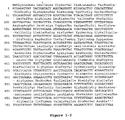
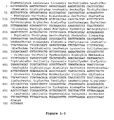
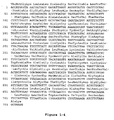
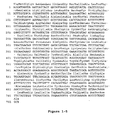
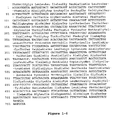
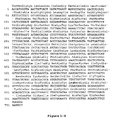
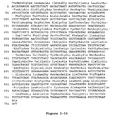
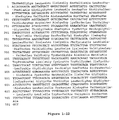
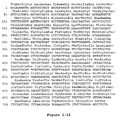
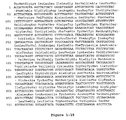
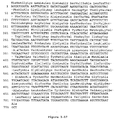
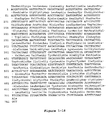
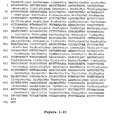
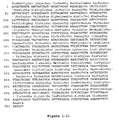
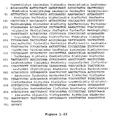
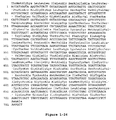
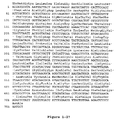
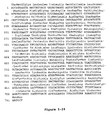
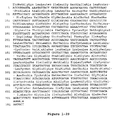
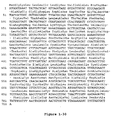
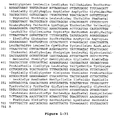
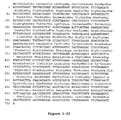
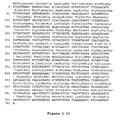
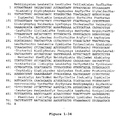
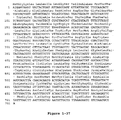
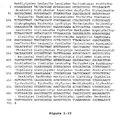
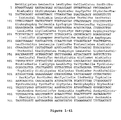
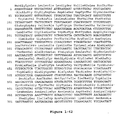
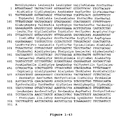
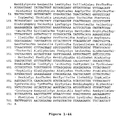
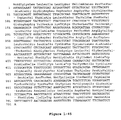
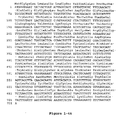
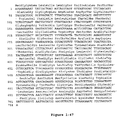
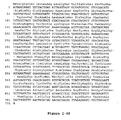
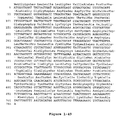
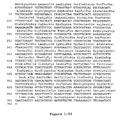
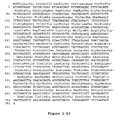
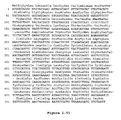
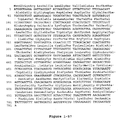
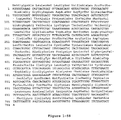
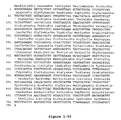
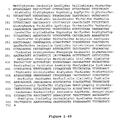
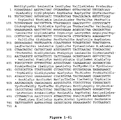
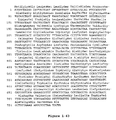
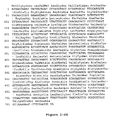
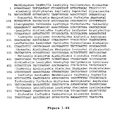
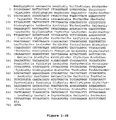
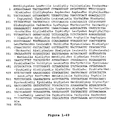
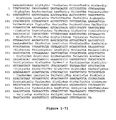
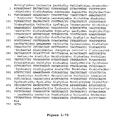
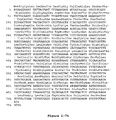
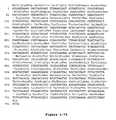
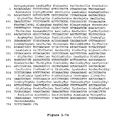
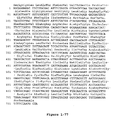
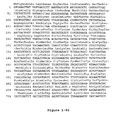
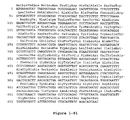
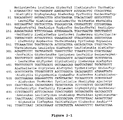
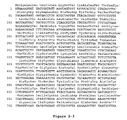
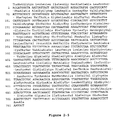
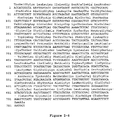
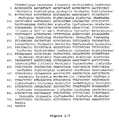
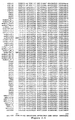
- FIGURES 1-1 to 1-81 provide the nucleotide and amino acid sequences of 81 proteorhodopsin variants; these proteorhodopsin variants show between 53 to 99.6% amino acid sequence identity to each other.
- proteorhodopsin variant includes proteins having an amino acid sequence that is at least 53%, preferably 90%, more preferably 95%, most preferably 97 or 98%, identical to that of any proteorhodopsin variant described in FIGURES 1-1 to 1-81 .
- proteorhodopsin variant also encompasses fused proteorhodopsin constructed by fusing the amino acid sequences from two or more different naturally found proteorhodopsins, so that each amino acid sequence occupies an equivalent position in the resulting proteorhodopsin (even if these fused proteorhodopsin are not naturally occurring).
- proteorhodopsin mutant refers to a proteorhodopsin variant comprising one or more mutations that substitutes one or more amino acid residues and/or nucleotides by different amino acids and/or nucleotide sequences.
- basal state or “B-state” or B-like state” refers to the basal state of the photocycle of a proteorhodopsin molecule without light excitation; the basal absorption maxima of proteorhodopsin variants are in general between 480 nm and 530 nm, often between 488 and 526 nm.
- M-state refers to an excited spectral state in a photocycle as compared with the basal state; the absorption maxima of the M-state of proteorhodopsin variants in general are between 350 nm and 450 nm, often about 410 nm.
- the M-state is distinguished from other identified spectral states, the K-, N- and O-like states, which all have red-shifted absorbtion spectra (e.g. >530 nm) compared with the basal state.
- p K rh refers to the pH at which equal concentrations of the acidic and basic spectral forms of the proteorhodopsin molecule are present. Applicants derive this term from p K a , which is a term that identifies the pH at which equal concentrations of the acidic and basic forms of the molecule are present. If the p K rh of that particular proteorhodopsin is determined to be a specific value, that specific value is the pH where the basic and acidic form are present in equal concentrations. Shifting the pH of the environment relative to the p K rh will increase the concentration of the basic or acidic form present, depending upon the direction (more acidic or more basic) and the pH units shifted.
- wavelength maximum for the purpose of this application, is the wavelength of maximum absorbance for proteorhodopsin at a specific pH.
- the E. coli containing plasmid PalE6 (assigned ATCC No. PTA-3250), the E. coli containing the plasmid Hot0m1 (assigned ATCC No. PTA-3251), and the E. coli containing the plasmid Hot75m4 (assigned ATCC No. PTA-3252) were deposited with the ATCC Patent Depository (10801 University Boulevard., Manassas, VA 20110, U.S.A.) on March 30, 2001.
- the present invention is directed to a proteorhodopsin mutant having an improved optical characteristic.
- the mutant comprises a mutation in a conserved amino acid residue of a proteorhodopsin variant, which causes the spectral shifts.
- the improved optical characteristics include having a lower p K rh or a smaller difference in maximum absorption wavelength between the basic and the acidic form, in comparison with the proteorhodopsin variant from which the mutant is derived.
- Proteorhodopsin is a trans-membrane protein with a structure of seven lipid membrane-spanning ⁇ -helices which form a generally cylinder shaped channel. When folded correctly and supplied with all-trans-retinal, the seven ⁇ -helices of proteorhodpsin are arranged as a cage surrounding the all-trans-retinal. A properly folded proteorhodopsin has the property of being able to bind all-trans-retinal and undergo a photocycle wherein a proton is transported.
- the source of all-trans-retinal includes chromophore retinal and chemical derivatives of all-trans-retinal.
- Chemical derivatives of retinal include, but are not limited to, 3-methyl-5-(1-pyryl)-2E,4E-pentadienal, 3,7-dimethyl-9-(1-pyryl)-2E,4E,6E,8E-nonatetraenal, all-trans-9-(4-azido-2,3,5,6-tetrafluorophenyl)-3,7-dimethyl-2,4,6,8-nonatetraenal, 2,3-dehydro-4-oxoretinal, and like compounds.
- Proteorhodopsin is a light-activated proton pump.
- Proteorhodopsin binds all-trans-retinal to form a pigment that absorbs in the visible wavelength range of light.
- An all-trans-retinal covalently attached to a conserved lysine (K231 in Bac31A8 and K234 in Hot75M1) by a Schiff-base linkage contributes to the visible light chromophore of proteorhodopsin.
- the absorbance of light energy by this chromophore is converted through a photocycle into mechanical energy that pumps a proton from the interior to the exterior of the cellular host through the all-trans-retinal binding pocket.
- the resulting proton imbalance is then used by the cell as chemical energy.
- Proteorhodopsin has two distinct pH-dependent spectral forms: a basic form and an acidic form.
- the basic form can undergo a photocycle that includes the excited M-state (or the M intermediate) and pump a proton, H + , across the proteorhodopsin-containing membrane, from inside the cell to outside the cell.
- the basic form has a rapid photocycle and is able to transport protons out of a cell or cell vesicle.
- an excited energy state e.g. an M-state
- it proceeds back into the more basal energy or resting state, where upon it transports a proton.
- the charge or proton is transported thereby, pumping a proton through the membrane and out of the cell during this process.
- the acidic form of proteorhodopsin is unable to undergo a photocycle that includes the M-state, and is unable to pump protons.
- Spectroscopic titration curves, plotting wavelength against absorbance in buffers of different pH indicate that the concentration of the acidic form and the basic form of some wild-type proteorhodopsins are about equal at a pH range about 7-8 (i.e. p K rh is about 7- 8).
- Hot75m1 in intact cells has a p K rh value of about 8.2.
- Hot75m1 exhibits a shift in the absorption maxima of about 45 nm when the pH is changed from 4.9 to 9.1. Because only one form, the basic form, gives a productive photocycle, the formation of different spectral forms limits the conditions where the proteorhodopsins can be used for certain applications.
- Different naturally occurring proteorhodopsin variants have different absoption maxima wavelengths.
- the absorption maxima wavelengths when the proteorhodopsin is in an acidic form range from about 534 to about 570 nm.
- the maximum wavelength when the proteorhodopsin is in a basic form falls within two groups: those that range from about 488 to about 494 nm, and those that range from about 516 to about 528 nm.
- Different naturally occurring proteorhodopsin variants also have different p K rh values, ranging from about 7.1 to about 8.6.
- the photochemical property of proteorhodopsin can be altered by, either one or a combination of, the pH, presence of an amphipathic molecule (such as a surfactant detergent), temperature of the environment, the presence of chemical additives in the environment (such as azide or glycerol or the like), and the water content of the medium containing the photeorhodopsin.
- an amphipathic molecule such as a surfactant detergent
- temperature of the environment such as a surfactant detergent
- chemical additives in the environment such as azide or glycerol or the like
- proteorhodopsin As described above, a useful and productive form of proteorhodopsin is the basic form. To achieve a predominantly basic spectral form of a proteorhodopsin population with a p K rh of 8.0, a two or more pH unit shift to pH 10.0 or more is contemplated to exhibit an increased relative amount of the basic form versus the acidic form.
- a basic environment is not an optimal pH for proteorhodopsins, since proteins in general tend to denature at such a high pH. Therefore, a proteorhodopsin mutant having a low p K th value is desirable.
- the proteorhodopsin mutant of the present invention preferably has an altered p K rh value that is lower (more acidic) than that of the naturally occurring proteorhodopsin.
- the proteorhodopsin mutant has a p K rh value that is lower than neutral pH. This is because at near neutral pH, the polypeptide is more stable and has a longer shelf life.
- the p K rh value of the proteorhodopsin mutant should be reduced as much as possible so that the basic form can predominate at near a neutral pH range, for example, about 5.5-9.0, or about 6.0-9.0, or about 7.1 - 8.6.
- the p K rh value of the proteorhodopsin mutant is reduced in comparison with that of the proteorhodopsin variant from which the mutant is derived.
- the p K rh value is reduced by at least 1.0, preferably, 2.0, and more preferably, 3.0 pH units.
- the value of the p K rh of proteorhodopsin mutant is reduced to lower than 7.0, preferably 6.0, more preferably 5.0, more preferably 4.0, and even more preferably 3.0.
- a proteorhodopsin mutant in general has a broad range of pH in which the basic form predominates.
- the p K rh value of the proteorhodopsin mutant is low enough such that essentially only the basic form is present in the useful pH range.
- the proteorhodopsin mutant predominates in the basic form under all pH conditions.
- the proteorhodopsin mutant has a smaller difference in maximum absorption wavelength between the basic and the acidic form, in comparison with the proteorhodopsin variant from which the mutant is derived.
- Such mutants of which the basic and acidic absorption maxima are closer to each other, are useful in applications where the environmental pH is close to the p K rh value. In such applications, both spectral forms will be present.
- a large difference in the absorption maxima of the acidic and basic forms will result in a broad composite absorption spectra (broader spectral width) because the acidic and basic absorption spectra are superimposed.
- the composite absorption spectra will be narrower (smaller peak width).
- the proteorhodopsin mutant has a difference in maximum absorption wavelength between the basic and the acidic form of less than 25 nm, preferably less than 20 nm, more preferably less than 15 nm, and most preferably, less than 10 nm.
- a proteorhodopsin variant that the mutant is derived from can be any naturally occurring proteorhodopsin.
- Proteorhodopsin variants, and nucleic acid sequences encoding thereof, have been obtained from naturally occurring members of the domain bacteria. Such members include marine bacteria, such as bacteria from the SAR86 group.
- Proteorhodopsin variants useful in the present invention include those derived from marine bacteria, as well as those derived or obtained from non-marine bacteria. There are many variant forms of proteorhodopsin; all of which can be used for the present invention.
- MED208 (SEQ ID NO: 77), REDA9 (SEQ ID NOs: 79), REDB9 (SEQ ID NO: 81), REDF9 (SEQ ID NO: 83), RED19 (SEQ ID NO: 85), RED2 (SEQ ID NO: 87), RED23 (SEQ ID NO: 89), RED27 (SEQ ID NO: 91), RED30 (SEQ ID NO: 93), RED4 (SEQ ID NO: 95), RED5 (SEQ ID NO: 97), REDr6a5a14 (SEQ ID NO: 99), and REDr6a5a6 (SEQ ID NO: 101).
- REDr7_1_4 SEQ ID NO: 103
- REDs3_7 SEQ ID NO: 105
- REDr7_1_15 SEQ ID NO: 107
- REDs3_15 SEQ ID NO: 109
- medA15r8ex6 SEQ ID NO: 111
- REDr7_1_16 SEQ ID NO: 113
- medA15r11b9 SEQ ID NO: 115
- medA15r9b5 SEQ ID NO: 117
- medA15r8b3 SEQ ID NO: 119
- medA15r11b3 SEQ ID NO: 121
- medA15_r8_1 SEQ ID NO: 123
- medA17R9_1 SEQ ID NO: 125
- medA15r8b9 SEQ ID NO: 127
- medA19_R8_16 SEQ ID NO: 129
- medA19_R8_19 SEQ ID NO: 131
- the proteorhodopsin variant, from which the mutant is derived can be a naturally occurring proteorhodopsin variant, including but not limited to those of SEQ ID NOs: 1, 3, 5, 7, 9, 11, 13, 15, 17, 19, 21, 23, 25, 27, 29, 31, 33, 35, 37, 39, 41, 43, 45, 47, 49, 51, 53, 55, 57, 59, 61, 63, 65, 67, 69, 71, 73, 75, 77, 79, 81, 83, 85, 87, 89, 91, 93, 95, 97, 99, 101, 103, 105, 107, 109, 111, 113, 115, 117, 119, 121, 123, 125, 127, 129, 131, 133, 135, 137, 139, 141, 143, 145, 147, 149, 151, 153,155, 157, 159, and 161, or other proteorhodopsin variants sharing at least 70%, or
- nucleotide and amino acid sequences of the 81 proteorhodopsin variants can be used to prepare mutants for this invention.
- nucleotide and amino acid sequences of the 81 proteorhodopsin variants can be altered by substitutions, additions or deletions to provide functionally equivalent molecules, which are suitable for preparing mutants for this invention.
- other DNA sequences that encode substantially the same amino acid sequence as depicted in figures 1-1 through 1-81 can be used in the practice of the present invention.
- the DNA sequence can be altered by a substitution of a different codon that encodes the same or a functionally equivalent amino acid residue within the sequence, thus producing a silent change.
- an amino acid residue within the sequence can be substituted by another amino acid of a similar polarity, or a similar class.
- Non-polar (hydrophobic) amino acids include alanine, leucine, isoleucine, valine, proline, phenylalanine, tryptophan, glycine and methionine.
- Polar neutral amino acids include serine, threonine, cysteine, tyrosine, asparagine, and glutamine.
- Positively charged (basic) amino acids include arginine, lysine, and histidine.
- Negatively charged (acidic) amino acids include aspartic and glutamic acid.
- a proteorhodopsin mutant comprises the amino acid sequence of Bac31A8 H75K (SEQ ID NO: 163), Bac31A8 H75N (SEQ ID NO: 165), Bac31A8 H75Q (SEQ ID NO: 167), Hot75ml H77K (SEQ ID NO: 169), Hot75ml H77N (SEQ ID NO: 171), Hot75ml H77Q (SEQ ID NO: 173), Hot 75ml H77E (SEQ ID NO: 175), Hot75ml H77W (SEQ ID NO: 177).
- Naturally occurring proteorhodopsin variants have about 234 to 249 amino acids. Comparing the amino acid sequence of different forms of proteorhodopsins, while contrasting their physical, or chemical properties, can reveal specific target regions that are likely to produce useful mutant proteins, and direct the creation of new mutants with deliberately modified functions.
- sequences determined for proteorhodopsins Bac31A8 and/or Hot75m1 are compared with sequences of known proteorhodopsins (see figures 1-1 through 1-81 ) or newly discovered proteorhodpsins in order to deduce sites for desirable mutations. To do this, the closeness of relation of the proteorhodopsins being compared is first determined.
- Closeness of relation can be measured by comparing of amino-acid sequences.
- aligning protein sequences There are many methods of aligning protein sequences. Methods defining relatedness are described in Atlas of Protein Sequence and Structure, Margaret O. Dayhoff editor, vol. 5, supplement 2, 1976, National Biomedical Research Foundation, Georgetown University Medical Center, Washington, D.C., p. 3 ff ., entitled SEARCH and ALIGN.
- related proteins can differ in the number of amino acids as well as the identity of each amino acid along the chain. That is, there can be deletions or insertions when two structures are aligned for maximum identity. For example, proteorhodopsin Bac31A8 has only 249 amino acids while proteorhodopsin Hot75m1 has 252 amino acids.
- the conserved amino acid D97 (Asp97) in the Bac31A8 proteorhodopsin is the amino acid residue that donates a proton to the retinal Schiff-base during the photocycle.
- the Bac31A8 D97N proteorhodopsin mutant is locked in the acidic form and is therefore incapable of pumping protons or undergoing a complete photocycle (Dioumaev, et al .) .
- the Bac31A8 D97E proteorhodopsin mutant which has a conserved amino acid replacement, has different wavelength spectra at acidic and basic pH compared with those of the wild-type Bac31A8 proteorhodopsin.
- Bac31A8 D97E mutant has a similar pH dependent spectral change and a similar p K rh value compared with that of wild-type Bac31A8 proteorhodopsin (Dioumaev, et al. ).
- a conservative replacement in the Asp97 position causes spectral changes, but not a change in the p K rh value. Since the nature and position of the proton-donating group is important for the proper functioning of the proteorhodopsin photocycle, it is unlikely that changes in D97 of Bac31A8 proteorhodopsin will allow for alteration of the p K rh value without disrupting the pumping of protons or the photocycle.
- the present invention provides a mutant proteorhodopsin wherein said proteorhodopsin has one or more mutations in a conserved amino acid residue, wherein said one or more mutations cause said proteorhodopsin to have an altered photochemical property, wherein said mutant proteorhodopsin, when optically stimulated, undergoes a photocycle in which a proton is transported.
- the proteorhodopsin mutant of this invention has an improved optical characteristic in comparison with the proteorhodopsins variant.
- the improved optical characteristic is a lower p K rh value or a smaller difference in maximum absorption wavelength between a basic and an acidic form.
- the present invention has identified a number of conserved amino acid residues that may interact with the proton transported during the photocycle, thus altering the pH at which the basic form of the proteorhodopsin appears, and/or altering the spectrophotometic properties of the proteorhodopsin as compared with that of the wild-type.
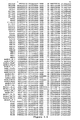
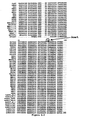
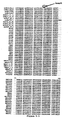
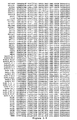
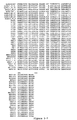
- a conserved amino acid residue of proteorhodopsin is an amino acid that is found in the equivalent position of the 81 proteorhodopsins as depicted in FIGURE 3 .
- a conserved amino acid residue which alters the photochemical property of the proteorhodopsin when substituted with a different amino acid, is important for this invention.
- FIGURE 3 shows the alignment of amino acid sequences of 81 natural proteorhodopsin variants. Examples of conserved amino acid residues (H75, R94, D227 of BAC31A8) are shown in FIGURE 3 .
- conserved amino acid residues can affect the conformation of the protein and the positioning of the all-trans-retinal molecule in relation to the proteorhodopsin protein.
- the present invention identifies that the conserved histidine of a proteorhodopsin variant is important for the proton transport during a photocycle.
- the conserved histidine residue (for example, H75 in Bac31A8 and H77 in Hot75ml) is purportedly located near both the D97 residue and the all-trans-retinal molecule. This residue in proteorhodopsin interact with D97 or with another amino acid or a water molecule that interacts with D97, but do not interact directly with all trans-retinal.
- the conserved histidine is likely to be part of the hydrogen bondable groups responsible for the spectral change at different pH values.
- Proteorhodopsin mutants which have the conserved histidine substituted with an amino acid capable of forming a hydrogen bond, have an altered photochemical property that shifts the p K rh to a lower pH (more acidic) value than the wild-type proteorhodopsin. For example, mutations at H75 in Bac31A8 proteorhodopsin and at H77 in Hot75m1 proteorhodopsin lower the p K rh value of proteorhodopsin and expand the pH range of the basic form. In some H75 or H77 proteorhodopsin mutants, only the basic form exists in the pH range tested (such as pH 4.9-9.1).
- Amino acids capable of forming a hydrogen bond and suitable for substituting histidine in this invention include asparagine, glutamine, lysine, arginine, serine, theonine, tyrosine, aspartic acid (in its protonated state at acid pH), glutamic acid (in its protonated state at acidic pH), tryptophan, and any synthetic amino acid that has a functional group that is able to contribute a hydrogen to form a hydrogen bond.
- Preferred proteorhopsin mutants have the conserved histidine residue substituted with glutamine (Q), asparagine (N), glutamic acid (E), lysine (K), aspartic acid (D), and tryptophan (W).
- the altered photochemical property of proteorhodopsin mutants can be identified by measuring the spectral shift of the proteorhodopsin in intact or whole cells, wherein the proteorhodopsin is present in the cytoplasmic membrane, or in a solubilized polypeptide form stabilized by an amphipathic molecule, or in a pure polypeptide form.
- the altered photochemical property can be identified by measuring the spectral shift of the proteorhodopsin in a membrane preparation, including but not limited to crude or partly purified membranes.
- Membrane preparations contain lipids and potentially membrane proteins other than proteorhodopsin.
- the present invention provides a method for preparing a proteorhodopsin mutant having improved optical characteristics.
- the method comprises the steps of: (a) identifying a conserved amino acid residue of a wild-type proteorhodopsin variant, (b) mutagenizing the conserved amino acid residue and obtaining proteorhodopsin mutants, (c) determining the optical characteristics of the proteorhodopsin mutants, and (d) selecting the proteorhodopsin mutant having improved optical characteristics.
- the conserved amino acid residue for example, is a histidine residue.
- the wild-type proteorhodopsin variant can by mutagenized by any method, including but not limited to site-directed mutagenisis, known to a skilled person.
- the nucleotide and amino acid sequences of various proteorhodopsin variants are deposited with Genbank under accession numbers AF349976-AF350003 and AF279106 (which contains the nucleotide sequence of a 105 kilobase genomic region that includes the gene encoding the Bac31A8 proteorhodopsin).
- the nucleotide and amino acid sequences of newly isolated proteorhodopsin variants ( Figures 1-30 to 1-51 ) are deposited with Genbank under accession numbers AY210898-AY210919.
- nucleotide and amino acid sequences of newly isolated proteorhodopsin variants are deposited with Genbank under accession numbers AY250714-AY250741.
- nucleotide and amino acid sequences of newly isolated proteorhodopsin variants are deposited with Genbank under accession numbers AY372453 and AY372455. All these sequences are specifically incorporated herein by reference in this application. Any of these natural proteorhodopsin amino acid sequences can be used to make the proteorhodopsin mutants.
- the natural proteorhodopsin variant include Hot75ml, Bac31A8, Bac40E8, Bac41B4, Bac64A5, Hot0m1, Hot75m3, Hot75m4, Hot75m8, MB0m1, MB0m2, MB20m2, MB20m5, MB20m12, MB40m1, MB40m5, MB100m5, MB100m7, MB100m9, MB100m10, PalB1, PalB2, PalB5, PalB7, PalB6, PalB8, PalE1, PalE6, PalE7, MED 26, MED27, NMD36, MED101, MED102, MED106, MED25, MED202, MED204.
- MED208 REDA9, REDB9, REDF9, RED19, RED2, RED23, RED27, RED30, RED4, RED5, REDr6a5a14, REDr6a5a6, REDr7_1_4, REDs3_7, REDr7_1_15, REDs3_15, medA15r8ex6, REDr7_1_16, medA15r11b9, medA15r9b5, medA15r8b3, medA15r11b3, medA15_r8_1, medA17R9_1, medA15r8b9, medA19_R8_16, medA19_R8_19, medA17_R8_6, medA15r9b7, medA15_R8_3, medA15r10b5, medA19_r9_9, medA15_r8ex7, medA19_R8_20, medA15
- the nucleotide sequence of any of the above proteorhodopsin genes can be obtained or derived using the method of Béjà, et al. (2000) or WO 01/83701 .
- An example of a gene encoding a proteorhodopsin variant is the bacterioplankton Bacterial Artificial Chromosome (BAC) clone Bac31A8 (also known as EBAC31A08) (see WO 01/83701 ).
- BAC Bacterial Artificial Chromosome
- One skilled in the art can obtain other genes encoding different proteorhodopsin variants using the identical techniques described above.
- One skilled in the art can also obtain or clone proteorhodopsin genes from organisms obtained from natural habitats by designing primers and using degenerate PCR, heterologous hybridization, or random sequencing of DNA.
- the proteorhodopsin is capable of proper folding and integrating into a membrane when expressed or synthesized in a suitable host.
- a suitable host is a cell that naturally expresses proteorhodopsin, such as the SAR 86 strain.
- a suitable host can also be a cell that naturally does not express proteorhodopsin.
- a suitable host includes a marine and a non-marine bacteria.
- a suitable host is deficient in any outer-membrane protease, either naturally or constructed not to express such protease.
- An example of a suitable host is an eubacteria cell; preferably, a Gram-negative bacteria; for example, a proteobacteria such as a gamma-proteobacteria.
- the gamma-proteobacteria can belong to the Enterobacteriaceae family; such as Escherichia, Edwardsiella, Citrobactor, Salmonella, Shigella, Klebsiella, Enterobacter, Serratia, Proteus, and Yersinia.
- the gamma-proteobacteria belonging to the Salmonella genus is Salmonella typhimurium.
- the gamma-proteobacteria belonging to the Escherichia genus is Escherichia coli.
- the polypeptide is expressed or synthesized in a strain that is an outer membrane protease-deficient strain.
- suitable strains include the E. coli strains: UT5600 (as disclosed by Béjà, et al. (2000), and Dioumaev, et al. ) and BL21-Codonplus-RIL.
- the gamma-proteobacteria is the SAR86 strain.
- the present invention also provides for a host cell comprising a polynucleotide encoding the proteorhodopsin mutant.
- the suitable host cell is capable of expressing or synthesizing a functional proteorhodopsin from the polynucleotide.
- a functional proteorhodopsin is a polypeptide capable of undergoing a photocycle in a suitable environment.
- the one or more mutations can be constructed by site-directed mutagenesis of a cloned proteorhodopsin gene. Specific designed mutations can be constructed or variability can be introduced to produce a variety of mutants. Such mutagenesis and other methods for manipulation of the nucleic acid and protein are well known to one skilled in the art and are described by Sambrook, et al. ( Molecular cloning: a laboratory manual. 3d ed. Cold Spring Harbor Laboratory Press, Cold Spring harbor, NY).
- the present invention provides a polynucleotide encoding the proteorhodopsin mutant.
- One skilled in the art is able to construct a nucleotide sequence using the information of the amino acid sequence of the polypeptide, based on the universal genetic code.
- the polynucleotide optionally comprises a promoter operatively linked 5' to the open reading frame encoding the polynucleotide.
- the polynucleotide further comprises appropriate promoter control, translational control and stop and other necessary sequences in order to express that polypeptide in a suitable host.
- the polynucleotide can be a chromosome, an episome, a plasmid, or any suitable expression vector.
- the polynucleotide is capable of amplification in a host cell.
- a wide variety of expression vectors can be used for introduction by transformation, conjugation, transduction or transfection of the polynucleotide into the eubactaerial host cell.
- Vectors include plasmids, such as pBR322, pMB9, pBAD-TOPO ® (from the pBAD TOPO ® TA Expression Kit, Invitrogen, La Jolla, CA), pTrcHis2-TOPO ® (from the pTrcHis2-TOPO ® TA Expression Kit, Invitrogen, La Jolla, CA) and the like; cosmids, such as pVK100, and the like; and viruses such as P22, and the like.
- plasmids such as pBR322, pMB9
- pBAD-TOPO ® from the pBAD TOPO ® TA Expression Kit, Invitrogen, La Jolla, CA
- pTrcHis2-TOPO ® from the pTrcHis2-TOPO ® TA Expression Kit, Invitrogen, La Jolla, CA
- cosmids such as pVK100, and the like
- viruses such
- proteorhodopsin polypeptide can be purified from a host cell using a variety of methods, which follow a general scheme:
- Methods of purification can differ for each intended use of the protein since requirements of yield and purity differ in each application.
- Lysis can be carried out by sonication, osmotic shock, freeze thaw or French press or a combination of above methods.
- a preferred method of lysis is freeze-thaw followed by French press.
- Insoluble materials are removed by centrifugation (e.g. 1500 xg, 30 min.) and the supernatant collected. The supernatant is further centrifuged (e.g. 150,000 xg. 1 hour) and the pellet containing primarily membrane material is collected.
- the membrane material can be solubilized with detergent.
- useful detergents include, but are not limited to, dodecyl- ⁇ -maltoside, octyl- ⁇ -glucoside, or Triton ® X-100. Dodecyl- ⁇ -maltoside (2%) is a preferred detergent.
- the solubilized membrane material is incubated with His-tag affinity resin.
- His-tag affinity resin For example, the solubilized membrane material is incubated with Talon TM resin from Clontech (Palo Alto, CA) overnight at 4 °C with gentle agitation.
- the solubilized membrane material is purified from contaminating proteins by washing the resin, for example, with three column volumes of buffer containing 0.1 % dodecyl- ⁇ -maltoside three times.
- the purified polypeptide can be removed from His-tag purification resins by a variety of methods including, but not limited to, incubation with EDTA, incubation in acidic pH, or incubation at high temperature.
- a preferred method is to incubate the resin with a buffer containing 0.5 M EDTA.
- the buffer can be exchanged by a variety of methods including, but not limited to, concentration and dilution using membrane based concentrators, dialysis, or desalting columns.
- concentration and dilution using membrane based concentrators, dialysis, or desalting columns.
- the protein is concentrated using a membrane based centrifugation concentrator device and then diluted into a desired buffer. The process is repeated to completely exchange the buffer. Then the protein is concentrated again using the same concentrator device.
- the proteorhodopsin mutant is derived from Hot75ml proteorhodopsin variant with the conserved histidine substituted with a glutamine residue.
- the polypeptide is expressed from an E. coli host cell. When analyzed for its absorbance behavior in the membrane of intact cells, the mutant polypeptide exhibits a spectral shift with the p K rh value of less than about 5.8 (as compared with 7.2 of the wild-type proteorhodopsin). The shift of p K rh is about 1.4 units.
- the proteorhodopsin mutant is derived from Hot75ml proteorhodopsin variant with the conserved histidine substituted with an asparagine residue.
- the polypeptide is expressed from an E. coli host cell. When analyzed for its absorbance behavior in the membrane of intact cells, the polypeptide exhibits a spectral shift with the p K rh value of less than about 5.1. The shift in the p K rh is about 2.1 units.
- the proteorhodopsin mutant is derived from Hot75ml proteorhodopsin variant with the conserved histidine substituted with a lysine residue.
- the polypeptide is expressed from an E. coli host cell. When analyzed for its absorbance behavior in the membrane of intact cells, the polypeptide does not exhibit a spectral shift (or does not titrate) when analyzed at a pH range from 4.9 to 9.1.
- the shape of the curves obtained for this mutant proteorhodopsin when absorbance of the polypeptide is plotted against the wavelength of the light source, is similar to the shape for the curve obtained from the basic form of the wild-type Hot75ml proteorhodopsin.
- this mutant proteorhodopsin is much closer to the maxima of absorbance for the basic form of Hot75ml (about 490 nm) than the acidic form of Hot75ml (about 540 nm). Based on this reasoning, this mutant proteorhodopsin is likely in its basic form when the pH of its environment is from 4.9 to 9.1. It is likely that the p K rh of this mutant is shifted to a pH much lower than pH 4.9.
- proteorhodopsin mutants taught herewith have many technical applications.
- the proteohodopsin mutant can be incorporated into instruments or devices having photochromic applications, photoelectric applications, and/or phototransport applications.
- the polypeptide can be used for its light absorption properties for optical data storage, interferometry and/or photonics.
- Photochromic applications include, but are not limited to, holographic film.
- the proteorhodopsin mutant can be used as a photochromic all-trans-retinal protein for optical data storage devices.
- the proteorhodopsin mutant can be used in a device for information storage, such as 2-D storage, 3-D storage, holographic storage, associative storage, or the like.
- the proteorhodopsin mutant can be used in a device for information processing, such as optical bistability/light switching, optical filtering, signal conditioning, neural networks, spatial light modulators, phaseconjugation, pattern recognition, interferometry, or the like.
- the present invention also provides a method of storing and retrieving optical data using the proteorhodopsin mutant of the invention.
- a method of storing and retrieving optical data comprises the steps of: (a) providing a film comprising the proteorhodopsin mutant immobilized in a matrix; (b) recording the optical data by exposing the film to light of a wavelength that is absorbed by the proteorhodopsin mutant in a predetermined pattern and selectively converting portions of the film to an excited state; (c) exposing the film of step (b) to light of a wavelength that is absorbed either by the basal or the excited state of the proteorhodopsin mutant; (d) detecting the optical data by an optical recording device.
- the detecting of step (d) can be conducted by any optical recording device.
- the optical recording device can be a video camera, which can be a charged coupled device (CCD).
- CCD charged coupled device
- the proteorhodopsin mutant can be used in devices for its light-induced changes in electric fields caused by proton transport, such as in ultrafast light detection, artifical retina, and/or light/motion detectors.
- the proteorhodopsin mutant can be used for its light-induced proton transport across a membrane, such as photovoltaic device.
- a photovoltaic device is a light-driven energy generator comprising the polypeptide, whereby light energy can be converted to chemical energy.
- the manufacture and use of such a light-driven energy generator is disclosed in WO 01/83701 .
- the proteorhodopsin mutant can also be used in devices for ATP generation in reactors, desalination of seawater, and/or conversion of sunlight into electricity.
- the present invention provides for a light-driven energy generator comprising the use of the proteorhodopsin mutant.
- a light-driven energy generator comprises: (a) the proteorhodopsin mutant of the present invention, (b) a cell membrane, (c) a source of all-trans-retinal, and (d) a light source, wherein the proteorhodopsin mutant integrates within the cell membrane to produce an integrated proteorhodopsin mutant, and the integrated proteorhodopsin mutant binds covalently to all-trans-retinal to produce a light absorbing pigment.
- Light-driven energy generators as applied to natural proteorhodopsin variants are disclosed by WO 01/83701 , and can be modified by replacing the proteorhodopsin with the proteorhodopsin mutants.
- the light-driven generator utilizes the proteorhodopsin mutant to convert light-energy into biochemical energy.
- the light-driven energy generator takes advantages of the functional properties of a proteorhodopsin mutant, which is expressed and correctly folded in a suitable host cell.
- the proteorhodopsin mutant can also be used in devices for 2D harmonic generation, radiation detection, biosensor applications, or the like.
- Hampp Chem . Rev .,100: 1755-76 (2000) discloses various uses and instruments and devices that utilize the photochemical properties of bacteriorhodopsin. Proteorhodopsin mutants of this invention can be used in the analogous manner as described by Hampp, which is specifically incorporated by reference.
- proteorhodopsin mutants can be used to replace bacteriorhodopsin (BR) for a variety of devices/processes that utilize bacteriorhodopsin, for example, in the following list of patents (Table 1), which are incorporated herein by reference. TABLE 1.
- Priority Patent No(s) Subject Inatomi and Isoda 26 APR 1983 JP 59197849 Photosensor Isoda 02 MAR 1984 JP 60185228 Recording and reproducing method of information Isoda and Daimon 02 MAR 1984 JP 60184246 Light recording medium Inatomi 19 NOV 1984 JP 61124384 ATP reproduction bioreactor Hikima, et al.
- 08 MAR 1990 EP 445758 Methods for improving the signal-to-noise ratio in holography when using br-based recording media US 5223355 Oyama, et al. 13 APR 1990 JP 3295278 Photoelectric conversion element Miyasaka 25 APR 1990 JP 4006420 Photoelectric conversion element Miyasaka and Kitaguchi 25 APR 1990 JP 4009400 Fixation of photosensitive chromoprotein Saito, et al. 08 JUN 1990 JP 4042585 Photoresponsive excitable synthetic membrane and its manufacture Saito, et al.
- EXAMPLE 1 Cloning of Proteorhodopsins Into Expression Vector.
- a total of 21 of the 81 known natural proteorhodopsin genes were cloned in the pTrcHis2 expression vector.
- Different natural proteorhodopsin genes were PCR amplified using Taq DNA Polymerase (Roche Applied Science) as described by the manufacturer.
- the primers used to amplify all proteorhodopsin variants were PR-u4 and PR-d2 (see Table 2) and the templates were pCR2.1 containing the relevant proteorhodopsin (Béjà, et al., 2000; Béjà, et al., 2001).
- the PCR products were cloned in the pTrcHis2 vector using the pTrcHis2 TOPO TA Expression Kit (Invitrogen, Carlsbad, CA), as described by the manufacturer. Restriction enzyme digestions of the plasmids were used to identify clones containing the insert in the correct orientation.
- the plasmids were sequenced using the primers pTrcHis Forward and pTrcHis Reverse to ensure that no sequence variations were introduced during the PCR and cloning procedure.
- the plasmids contain the pTrc promoter transcribing the proteorhodopsin gene with a C-terminal extension containing a myc epitope and six histidine residues.
- FIGURE 4 A map of one of the expression plasmids is shown in FIGURE 4 .
- PR-u4 SEQ. ID NO : 185) AAATTATTACTGATATTAGGTAGTG PR-d2 (SEQ ID NO : 186) AGCATTAGAAGATTCTTTAACAGC pTrcHis Forward (SEQ ID NO : 187) GAGGTATATATTAATGTATCG pTrcHis Reverse (SEQ ID NO : 188) GATTTAATCTGTATCAGG 31A8-m6A (SEQ ID NO : 189) TGTTACTGGTATTGCTTTCTGG aAT TACATGTACATGAGAGGGGT 31A8-m6B (SEQ ID NO : 190) ACCCCTCTCATGTACATGTA ATt CCAGAAAGCAATACCAGTAACA 31A8-m7A (SEQ ID NO : 191) TGTTACTGGT
- pTrcHis Forward and pTrcHis Reverse oligonucleotides were obtained from Invitrogen, the rest of the oligonucleotides were purchased from Operon, the primers used for site-directed mutagenesis were PAGE purified.
- Bold letters indicate the histidine or arginine codons that were mutated, lowercase letters indicate nucleotides that were changed compared to the wild-type sequence.
- proteorhodopsin expression plasmids and the control plasmid pTrcHis2-LacZ were transformed into competent cells of the strain BL21-Codonplus-RIL (Stratagene) as described by the manufacturer.
- the transformed cells were plated on LA + 0.5% glucose + 100 ⁇ g/ml carbenicillin + 25 ⁇ g/ml chloramphenicol plates and incubated overnight at 37°C. Cells from these plates were grown in 6 ml LB + 0.5% glucose + 100 ⁇ g/ml carbenicillin + 25 ⁇ g/ml chloramphenicol + 10 ⁇ M all-trans-retinal medium in glass tubes at at 37°C for 6 hours, where the cells reached early stationary phase.
- the cells constitutively express proteorhodopsins from the uninduced pTrc promoter.
- the cells were collected by centrifugation at 4,500xg for 6 minutes, the medium was discarded and the cells were resuspended in 5 ml sterile water.
- a 900 ⁇ l sample of cells were added to a 100 ⁇ l aliquot of concentrated buffer (1.0 M acetate (pH 4.9), 1.0 M MES (pH 5.8), 1.0 M MOPS (pH 6.7), 1.0 M TAPS (pH 8.1), or 1.0 M CHES (pH 9.1)).
- the spectra of the 21 natural proteorhodopsins were measured in intact cells at five different extracellular pH values using a spectrophotometer (On-Line Instrument Systems, Inc.) adapted for use with turbid samples by placing the photomultiplier detector adjacent to the sample cuvette.
- the absorption from a strain containing a control plasmid (pTrcHis2-LacZ) was subtracted from proteorhodopsin containing samples.
- pTrcHis2-LacZ plasmid
- a linear baseline determined by least-squares fitting of the first ten and last ten wavelength and absorbance values in each spectrum was subtracted from each spectrum. The spectra were then adjusted to the same minimum value by subtracting the differences in minimum values.
- Typical proteorhodopsin spectra such as Bac31A8 and Hot75ml inside intact cells at different pH values, can be constructed by plotting absorbance vs. wavelength. Two different spectral forms of the proteorhodopsin variants (Bac31A8 and Hot75ml) are observed under acidic conditions (pH 4.9) and basic conditions (pH 9.1). At intermediate pH values, spectra representing a mixture of the acidic and basic forms are observed.
- Abs Acidic and Abs Basic-Acidic were fitted at each wavelength, but the same value of p K rh was fitted for data at all wavelengths.
- the values AbsA cidic and Abs Basic- Acidic were used to reconstruct wavelength spectra for Acidic and Basic forms of proteorhodopsin and from this data the wavelength maximum at acidic and basic pH were determined (Table 3).
- the wild-type Bac31A8 proteorhodopsin in intact cells had absorbance maximum at 538 nm at acidic conditions and at 519 nm at basic conditions.
- the p K rh value of the titratable group(s) responsible for the spectral shift was determined to be 7.6.
- the wild-type Hot75ml proteorhodopsin had absorbance maximum at 546 nm at acidic conditions and at 493 nm at basic conditions.
- the value of the p K rh of the titratable group(s) responsible for the spectral shift was determined to be 8.2.
- Table 4 summarizes the templates and primers used to construct the different mutants. TABLE 4. Templates and Primers Used to Construct Mutants Mutant Name of expression plasmid Template used Primers used Bac31A8 H75N pTrcHis2-Bac31A8 H75N pTrcHis2-Bac31A8 31A8-m6A and 31A8-m6B Bac31A8 H75Q pTrcHis2-Bac31A8H75Q pTrcHis2-Bac31A8 31A8-m7A and 31A8-m7B Bac31A8 H75K pTrcHis2-Bac31A8 H75K pTrcHis2-Bac31A8 31A8-m8A and 31A8-m8B Hot75M1 H77N pTrcHis2-Hot75M1 H77N pTrcHis2-Hot75M1 H75m1-m2A and H75m1-
- the plasmids were sequenced using the pTrcHis Forward primer (Invitrogen) to ensure that the desired mutations had been introduced into the plasmids.
- proteorhodopsin mutants were expressed; their spectra in intact cells at different pH values were measured and the p K rh values were calculated as described above.
- Table 5 summarizes the p K rh values and the absorption maxima of the acidic and basic spectra of the wild-type and mutants of Bac31 A8. TABLE 5.
- p K rh and Absorption Maxima of BAC31A8 Mutants Protein p K rh Basic Max (nm) Acidic Max (nm) Bac31A8 7.6 519 538 Bac31A8 H75Q 6.0 518 540 Bac31A8 H75N NA 521 - Bac31A8 H75K NA 522 - Note: "NA” means that no significant pH titration is observed, so a p K rh value cannot be determined. "-” means that only a single absorption maximum can be reported because of the lack of titration in the pH range tested.
- the Bac31A8 H75Q mutant has a p K rh value of 6.0 compared with 7.6 observed with the wild-type protein.
- Both the Bac31A8 H75N and Bac31A8 H75K mutants show no or very little pH dependent change in spectral properties, the mutant proteins appear to be only in the basic form in the pH range tested here. It is likely caused by the p K th , value being shifted so much to be outside the pH range of 4.9-9.1.
- the p K rh value of the Bac31A8 H75N mutant could not be determined accurately from these data, but is estimated to be 5.8 or lower.
- FIGURE 5 shows the pH-dependent change in absorption spectra of the acid and the basic form of wild-type Hot75m1 and mutant Hot75m1 H77Q.
- the p K rh of the wild type is 8.2, which is lowered to 5.8 in the mutant.
- FIGURE 6 shows the fraction of the acid form of Hot75m1 and Hot75m1 H77Q at different pH.
- the basic form clearly predominates at pH 9 and above for the wild-type Hot75m1 protein and at pH 7 and above for the Hot75m1 H77Q protein.
- Table 6 summarizes the p K rh value and the maxima of the acidic and basic absorption spectra of the wild-type and six mutants. TABLE 6. p K rh and Absorption Maxima of Hot75M1 Mutants Protein p K rh Basic Max (nm) Acidic Max (nm) Hot75M1 8.2 493 546 Hot75M1 H77Q 5.8 487 516 Hot75M1 H77N 5.5 487 497 Hot75M1 H77K NA 500 - Hot75M1 H77D NA 515 - Hot75M1 H77E 5.3 487 529 Hot75M1 H77W 5.8 486 529 Note: "NA” means that no significant pH titration is observed, so a p K rh value cannot be determined. "-” means that only a single absorption maximum can be reported because of the lack of titration in the pH range tested.
- Hot75m1 H77K and Hot75m1 H77D mutants where the histidine is changed to lysine or aspartic acid, respectively, show no or very little pH dependent change in spectral properties and appear to be only in the basic form in the pH range tested here. It is likely caused by the p K rh value being shifted so much to be outside the pH range of 4.9-9.1.
- proteorhodopsins in intact cells, where the protein is present in the cytoplasmic membrane.
- proteorhodopsins in intact cells, where the protein is present in the cytoplasmic membrane.
- proteorhodopsin (wild-type or mutant) expression plasmids were transformed into competent cells of the strain BL21-Codonplus-RIL (Stcatagene) as described by the manufacturer.
- the transformed cells were plated on LA + 0.5% glucose + 100 ⁇ g/ml carbenicillin + 25 ⁇ g/ml chloramphenicol plates and incubated overnight at 37°C. Cells from these plates were grown in 200 ml LB + 0.5% glucose + 104 ⁇ g/ml carbenicillin + 10 ⁇ M all-trans-retinal medium at 37°C in baffled 500 ml shakeflasks. The cultures were inoculated directly from fresh transformation plates.
- Proteorhodopsin expression in the different cultures were induced when the OD 600 of the cultures were approximately 0.8 (after 4 hours growth) by adding 0.5 mM IPTG + 10 ⁇ M all-trans-retinal and the cultures were incubated for additional 4 hours at 37°C. The cells were harvested by centrifugation at 3,500xg for 10 minutes and stored at -80°C.
- Cells were resuspended in lysis buffer containing 40 mM MOPS pH 7.0, 20 mM MgCl 2 , 0.2 mg/ml lysozyme, 0.2 mg/ml DnaseI, 2% dodecyl- ⁇ -D-maltoside, and protease inhibitors (Complete, EDTA-free Protease Inhibitor Cocktail Tablets from Roche Applied Science; and lysed at 0°C by sonication.
- the lysates were incubated 16 hours with the resin in Talon spin columns (Clontech) that had been equilibrated with 1 ml wash buffer containing 40 mM MOPS, pH 7.0 and 0.5% dodecyl- ⁇ -D-maltoside.
- the resin was washed three times with 1 ml wash buffer containing 40 mM MOPS, pH 7.0 and 0.5% dodecyl- ⁇ -D-maltoside.
- Proteorhodopsins were eluted from the resin two times with 0.5 ml elution buffer containing 40 mM MOPS pH 7.0, 0.5% dodecyl- ⁇ -D-maltoside and 250 mM EDTA.
- the two elutates were pooled and EDTA was removed by three successive ten-fold concentrations using a Microcon YM-10 centrifugal filter unit (Millipore) and dilutions with a buffer contained 40 mM MOPS, pH 7.0 as described by the manufacturer.
- the proteorhodopsin samples were then concentrated ten-fold and stored at 4 °C.
- the purified Bac31A8 H75K mutant where the histidine is changed to lysine, shows no or very little pH dependent change in spectral properties, the protein appears to be locked in the basic form in the pH (pH 4.9-9.1) range tested here.
- Table 9 summarizes the p K rh value and the maxima of the acidic and basic absorption spectra of different variants. TABLE 9. p K rh and Absorption Maxima of Hot75M1 MUTANTS Protein P K rh Basic Max (nm) Acidic Max (nm) Hot75M1 8.4 504 538 Hot75M1 H77Q 6.3 508 531 Hot75M1 H77N 6.5 496 523 Hot75M1 H77K NA 521 - Note: “NA” means that no significant pH titration is observed, so a p K rh value cannot be determined. "-” means that only a single absorption maximum can be reported because of the lack of titration in the pH range tested.
- Hot75m1 proteorhodopsins show that when the conserved H77 histidine residue of Hot75m1 is changed to asparagine or glutamine, the p K rh value was significantly shifted towards the acidic pH.
- Purified Hot75m1 H77Q has a value of the p K rh of 6.3 and purified Hot75m1 H77N has a p K rh value of 6.5, compared with 8.4 of the wild-type protein.
- the purified Hot75m1 H77K mutant where the histidine is changed to lysine shows no or very little pH dependent change in spectral properties in the pH range (pH 4.9-9.1) tested here, and appears to have only one basic form.
- proteorhodopsin can undergo a photocycle that includes the formation of the excited M-state (or M-like state) and pumping of a proton across the proteorhodopsin-containing membrane from inside the cell to outside the cell.
- a photocycle that includes the formation of the excited M-state (or M-like state) and pumping of a proton across the proteorhodopsin-containing membrane from inside the cell to outside the cell.
- Proton pumping was measured as a change of the extracellular pH with illumination of cells expressing proteorhodopsin, caused by pumping of protons from inside the cells to the extracellular medium.
- proteorhodopsin (wild-type or mutant) expression plasmids were transformed into competent cells of the strain BL21-Codonplus-RIL (Stratagene) as described by the manufacturer.
- the transformed cells were plated on LA + 0.5% glucose + 100 ⁇ g/ml carbenicillin + 25 ⁇ g/ml chloramphenicol plates and incubated overnight at 37°C.
- Cells from these plates were grown in 50 ml LB + 0.5% glucose + 100 ⁇ g/ml carbenicillin + 10 ⁇ M all-trans-retinal medium at 37°C in baffled 250 ml shakeflasks. The cultures were inoculated directly from fresh transformation plates.
- Proteorhodopsin expression in different cultures was induced when the OD 600 of the cultures was approximately 0.8 (after 4 hours growth) by adding 0.1 mM IPTG + 10 ⁇ M all-trans-retinal, and the cultures were incubated for additional 4 hours at 37°C. The cells were harvested by centrifugation at 3,500xg for 10 minutes and stored at -80°C.
- Cells were thawed and suspended in 150 mM NaCl without buffer (sparged with helium to remove carbon dioxide). Cells were washed an additional three times with 150 mM NaCl without buffer. The cells were suspended to an OD 600 of 2.0 in 150 mM NaCl. Cell samples were adjusted to between pH 7.5 and 8.5 with 0.5 M HCl or 0.5% NaOH.
- Cell samples were magnetically stirred and were illuminated from two sides by split fiber-optic cables attached to a 150-watt illuminator (Fiber-Lite A3200) from Dolan-Jenner Industries (Lawrence, MA) with an infrared filter (03FC569) from Melles Griot (Irvine, CA) and a 450 nm cut-on colored-glass filter (51284) from Oriel Instruments (Stratford, CT).
- the manual opening and closing of a shutter controlled light.
- the incident angle of light was held constant by the use of a custom-built cell holder.
- the pH of the cell sample was determined during the 3 minutes of constant illumination.
- the pH of the cell sample was then measured for 3 minutes after illumination was stopped. This process was repeated two more times for each cell sample resulting in three repeated measurements of each cell sample.
- FIGURE 7-1 shows that the pH of the cells expressing Bac31A8 wild-type, which is an active proton pump, drifted slowly over time without illumination. However, a rapid (within a few seconds) change in pH occurred following illumination. After illumination was ended, the pH value of the cell samples returns to that before illumination. This pH change is a result of cellular mechanisms that control membrane potential.
- FIGURE 7-2 shows that the pH of cells expressing a LacZ control protein also drifted slowly over time without illumination. With illumination, the pH shifted slowly (over the entire 3 minutes) and minimally (at most 0.05 pH units), presumably from a temperature change at the pH probe. This temperature effect was reduced dramatically by the addition of the infrared filter, but it could not be completely eliminated.
- ⁇ pH max ⁇ k for cells expressing a proteorhodopsin variant is compared using the student-t test to the value of ⁇ pH max ⁇ k determined for cells expressing a LacZ control.
- the degrees of freedom, n, and the results of the student-t test at 60-99% confidence are given in Table 10. This test indicates whether a particular proteorhodopsin mutant is a proton pump at a given confidence. The negative result of this test does not indicate that a given proteorhodopsin mutant is not a proton pump; it only indicates that the assay is not sensitive enough to detect pumping by that mutant. TABLE 10.
- Proton pumping by the Bac31A8 E108Q where the photocycle is more than a hundred fold slower than that of the wild-type protein mutant, was not detected. Proton pumping was detected for Bac31A8 wild-type, H75K, H75N, and H75Q; and Hot75m1 wild-type, H77K, H77N, H77Q, H77E and H77W, which indicates that these proteins, when exposed to light, undergo a productive photocycle that includes proton pumping.
- proteorhodopsins with mutations in the conserved histidine residue are expected to be better proton pumps at low pH than wildtype proteorhodopsin, since the lower p K rh value of the mutants results in a larger fraction of the protein in a productive basic form at low pH.
- FIGURE 7-3 displays the dependence of proton-pumping rate on the extracellular pH for the Bac31A8 wild-type and the H75N mutant.
- the results show that the Bac31A8 H75N mutant is a better proton pump than the Bac31A8 wild-type at acidic pH.
- the results confirm that a mutation lowering the p K rh value results in a proteorhodopsin mutant having an extended pH range where a productive photocycle is present.
Landscapes
- Chemical & Material Sciences (AREA)
- Health & Medical Sciences (AREA)
- Life Sciences & Earth Sciences (AREA)
- Organic Chemistry (AREA)
- Genetics & Genomics (AREA)
- Biochemistry (AREA)
- Molecular Biology (AREA)
- General Health & Medical Sciences (AREA)
- Biophysics (AREA)
- Engineering & Computer Science (AREA)
- Proteomics, Peptides & Aminoacids (AREA)
- Zoology (AREA)
- Biotechnology (AREA)
- Medicinal Chemistry (AREA)
- Gastroenterology & Hepatology (AREA)
- Bioinformatics & Cheminformatics (AREA)
- Cell Biology (AREA)
- Wood Science & Technology (AREA)
- Biomedical Technology (AREA)
- Toxicology (AREA)
- General Engineering & Computer Science (AREA)
- Immunology (AREA)
- Plant Pathology (AREA)
- Physics & Mathematics (AREA)
- Microbiology (AREA)
- Peptides Or Proteins (AREA)
- Preparation Of Compounds By Using Micro-Organisms (AREA)
- Micro-Organisms Or Cultivation Processes Thereof (AREA)
- Compositions Of Macromolecular Compounds (AREA)
Claims (10)
- Proteorhodopsinmutante mit verbesserten optischen Eigenschaften, wobei die Mutante eine Mutation im konservierten Histidinrest einer Wildtyp-Proteorhodopsinvariante umfasst, wobei der konservierte Histidinrest zu einer wasserstoffbrückenbildendenden Aminosäure mutiert ist, die aus der Gruppe ausgewählt ist, die aus Asparagin, Glutamin, Lysin, Arginin, Tryptophan, Serin, Threonin, Tyrosin, Asparaginsäure und Glutaminsäure besteht, wobei der konservierte Histidinrest an der Aminosäureposition vorhanden ist, die zur Position 77 der SEQ ID NO: 1 oder zur Position 75 der SEQ ID NO: 3 äquivalent ist, wenn die Proteorhodopsinvariante zur SEQ ID NO: 1 oder 3 auf die jeweils maximale Identität ausgerichtet wird, und wobei die Proteorhodopsinmutante im Vergleich zur Wildtyp-Proteorhodopsinvariante einen niedrigeren pKrh hat.
- Proteorhodopsinmutante gemäß Anspruch 1, wobei die Wildtyp-Proteorhodopsinvariante eine natürlich vorkommende Proteorhodopsinvariante der SEQ ID NO: 1, 3, 5, 7, 9, 11, 13, 15, 17, 19, 21, 23, 25, 27, 29, 31, 33, 35, 37, 39, 41, 43, 45, 47, 49, 51, 53, 55, 57, 59, 61, 63, 65, 67, 69, 71, 73, 75, 77, 79, 81, 83, 85, 87, 89, 91, 93, 95, 97, 99, 101, 103, 105, 107, 109, 111, 113, 115, 117, 119, 121, 123, 125, 127, 129, 131, 133, 135, 137, 139, 141, 143, 145, 147, 149, 151, 153, 155, 157, 159 oder 161 ist oder andere Proteorhodopsinvarianten, die eine Aminosäureidentität von mindestens 90% dazu aufweisen.
- Proteorhodopsinmutante gemäß Anspruch 1, wobei die Aminosäure, die dazu fähig ist, Wasserstoffbrücken zu bilden, Asparagin, Glutamin, Lysin, Tryptophan, Asparaginsäure oder Glutaminsäure ist.
- Proteorhodopsinmutante gemäß Anspruch 1, umfassend eine Aminosäuresequenz, ausgewählt aus der Gruppe bestehend aus SEQ ID NOs: 163, 165, 167, 169, 171, 173, 175 und 177.
- Nukleinsäuresequenz, die für die Proteorhodopsinmutante gemäß einem der Ansprüche 1 bis 4 kodiert,
- Nukleinsäuresequenz gemäß Anspruch 5, ausgewählt aus der Gruppe, bestehend aus SEQ ID NOs: 164, 166, 168, 170, 172, 174, 176 und 178.
- Verfahren zur Herstellung der Proteorhodopsinmutante mit verbesserten optischen Eigenschaften gemäß einem der Ansprüche 1 bis 4, die Schritte umfassend:(a) Identifizieren eines konservierten Histidinaminosäurerests einer Wildtyp-Proteorhodopsinvariante,(b) Mutagenisieren des konservierten Histidinaminosäurerests und Gewinnen von Proteorhodopsinmutanten,(c) Bestimmen der optischen Eigenschaften der Proteorhodopsinmutanten, und(d) Auswählen der Proteorhodopsinmutanten mit verbesserten optischen Eigenschaften.
- Verfahren gemäß Anspruch 7, wobei der konservierte Aminosäurerest durch ortsspezifische Mutagenese mutagenisiert ist.
- Verfahren zur Speicherung und Abrufung optischer Daten, die Schritte umfassend:(a) Bereitstellen eines Films, der eine Matrix mit der darin immobilisierten Proteorhodopsinmutante gemäß einem der Ansprüche 1 bis 4 umfasst,(b) Belichten des Films mit Licht einer Wellenlänge, das von der Proteorhodopsinmutante in einem Ruhezustand in einem festgelegten Muster absorbiert wird,(c) Umwandeln ausgewählter Bereiche des Films zu einem angeregten Zustand und darin Speichern der optischen Daten,(d) Belichten des Films aus Schritt (c) mit Licht einer Wellenlänge, das von der Proteorhodopsinmutante entweder in einem Ruhezustand oder in einem angeregten Zustand absorbiert wird, und(e) Detektieren der gespeicherten optischen Daten über eine optische Aufzeichnungseinrichtung.
- Lichtgetriebener Energiegenerator umfassend:(a) Proteorhodopsinmutante gemäß einem der Ansprüche 1 bis 4,(b) Zellmembran,(c) Quelle von all-trans-Retinal,(d) Lichtquelle, wobei die Proteorhodopsinmutante innerhalb der Zellmembran integriert ist, um eine integrierte Proteorhodopsinmutante herzustellen und, wobei die integrierte Proteorhodopsinmutante kovalent an all-trans-Retinal bindet, um ein lichtabsorbierendes Pigment herzustellen.
Applications Claiming Priority (3)
| Application Number | Priority Date | Filing Date | Title |
|---|---|---|---|
| US42951802P | 2002-11-26 | 2002-11-26 | |
| US429518P | 2002-11-26 | ||
| PCT/US2003/038194 WO2004063326A2 (en) | 2002-11-26 | 2003-11-26 | Proteorhodopsin mutants with improved optical characteristics |
Publications (3)
| Publication Number | Publication Date |
|---|---|
| EP1576144A2 EP1576144A2 (de) | 2005-09-21 |
| EP1576144A4 EP1576144A4 (de) | 2007-02-14 |
| EP1576144B1 true EP1576144B1 (de) | 2010-07-14 |
Family
ID=40834426
Family Applications (1)
| Application Number | Title | Priority Date | Filing Date |
|---|---|---|---|
| EP03811664A Expired - Lifetime EP1576144B1 (de) | 2002-11-26 | 2003-11-26 | Proteorhodopsinmutanten mit verbesserten optischen eigenschaften |
Country Status (10)
| Country | Link |
|---|---|
| US (1) | US7501488B2 (de) |
| EP (1) | EP1576144B1 (de) |
| JP (1) | JP4448776B2 (de) |
| KR (1) | KR101179086B1 (de) |
| AT (1) | ATE474050T1 (de) |
| AU (1) | AU2003302734C1 (de) |
| CA (1) | CA2506987A1 (de) |
| DE (1) | DE60333388D1 (de) |
| NZ (1) | NZ540563A (de) |
| WO (1) | WO2004063326A2 (de) |
Families Citing this family (11)
| Publication number | Priority date | Publication date | Assignee | Title |
|---|---|---|---|---|
| WO2004063326A2 (en) | 2002-11-26 | 2004-07-29 | Genencor International, Inc. | Proteorhodopsin mutants with improved optical characteristics |
| AU2003298777B2 (en) * | 2002-11-26 | 2009-10-01 | Danisco Us Inc. | Optical information carrier comprising immobilized proteorhodopsin |
| EP1753448B1 (de) | 2004-06-10 | 2012-04-25 | Danisco US Inc. | Zusammensetzungen mit verschiedenen proteorhodopsinen und/oder bakteriorhodopsinen und deren verwendung |
| US20090233342A1 (en) * | 2007-08-23 | 2009-09-17 | Asuncion Martinez | Heterologous expression of proteorhodopsin photosystem |
| US9207237B2 (en) | 2010-08-23 | 2015-12-08 | President And Fellows Of Harvard College | Systems, methods, and workflows for optogenetics analysis |
| CA2838330C (en) | 2010-08-23 | 2021-01-26 | President And Fellows Of Harvard College | Optogenetic probes for measuring membrane potential |
| EP3158338B1 (de) | 2014-06-18 | 2020-03-11 | President and Fellows of Harvard College | Optogenetische sonden zur messung des membranpotenzials |
| WO2016115333A1 (en) | 2015-01-15 | 2016-07-21 | President And Fellows Of Harvard College | Optical selection of cells |
| KR101843840B1 (ko) | 2015-02-10 | 2018-03-30 | 경북대학교 산학협력단 | 비광합성 미생물에서 광구동 에너지 대사회로 이용을 위한 코돈 최적화된 프로테오로돕신 및 그의 이용 |
| CN110483645B (zh) * | 2018-05-14 | 2023-05-12 | 郑州大学第一附属医院 | 线粒体定位质子泵型视紫红质、其突变蛋白及其应用 |
| US20230265417A1 (en) * | 2021-10-08 | 2023-08-24 | Shizuoka Prefectural University Corporation | Novel rhodopsin mutants |
Family Cites Families (5)
| Publication number | Priority date | Publication date | Assignee | Title |
|---|---|---|---|---|
| US5825725A (en) * | 1997-05-06 | 1998-10-20 | The State Of Oregon Acting By And Through The State Board Of Higher Education On Behalf Of The University Of Oregon | Method and apparatus for reversible optical data storage |
| US20110093981A9 (en) * | 1999-05-06 | 2011-04-21 | La Rosa Thomas J | Nucleic acid molecules and other molecules associated with transcription in plants and uses thereof for plant improvement |
| US7253268B2 (en) | 2000-05-03 | 2007-08-07 | Monterey Bay Aquarium Research Institute | Light-driven energy generation using proteorhodopsin |
| AU2001282037A1 (en) | 2000-07-27 | 2002-02-13 | Mib Munich Innovative Biomaterials Gmbh | Proton-translocating retinal protein |
| WO2004063326A2 (en) | 2002-11-26 | 2004-07-29 | Genencor International, Inc. | Proteorhodopsin mutants with improved optical characteristics |
-
2003
- 2003-11-26 WO PCT/US2003/038194 patent/WO2004063326A2/en not_active Ceased
- 2003-11-26 JP JP2004566503A patent/JP4448776B2/ja not_active Expired - Fee Related
- 2003-11-26 EP EP03811664A patent/EP1576144B1/de not_active Expired - Lifetime
- 2003-11-26 NZ NZ540563A patent/NZ540563A/en not_active IP Right Cessation
- 2003-11-26 KR KR1020057009587A patent/KR101179086B1/ko not_active Expired - Fee Related
- 2003-11-26 CA CA002506987A patent/CA2506987A1/en not_active Abandoned
- 2003-11-26 DE DE60333388T patent/DE60333388D1/de not_active Expired - Lifetime
- 2003-11-26 AU AU2003302734A patent/AU2003302734C1/en not_active Ceased
- 2003-11-26 US US10/724,264 patent/US7501488B2/en not_active Expired - Fee Related
- 2003-11-26 AT AT03811664T patent/ATE474050T1/de not_active IP Right Cessation
Also Published As
| Publication number | Publication date |
|---|---|
| WO2004063326A2 (en) | 2004-07-29 |
| JP2006516389A (ja) | 2006-07-06 |
| JP4448776B2 (ja) | 2010-04-14 |
| EP1576144A4 (de) | 2007-02-14 |
| US7501488B2 (en) | 2009-03-10 |
| ATE474050T1 (de) | 2010-07-15 |
| WO2004063326A3 (en) | 2006-02-16 |
| AU2003302734A1 (en) | 2004-08-10 |
| US20050095605A1 (en) | 2005-05-05 |
| DE60333388D1 (de) | 2010-08-26 |
| AU2003302734C1 (en) | 2010-01-14 |
| AU2003302734B2 (en) | 2009-03-26 |
| CA2506987A1 (en) | 2004-07-29 |
| KR101179086B1 (ko) | 2012-09-07 |
| KR20050101536A (ko) | 2005-10-24 |
| EP1576144A2 (de) | 2005-09-21 |
| NZ540563A (en) | 2008-03-28 |
Similar Documents
| Publication | Publication Date | Title |
|---|---|---|
| Stiel et al. | 1.8 Å bright-state structure of the reversibly switchable fluorescent protein Dronpa guides the generation of fast switching variants | |
| US7501488B2 (en) | Proteorhodopsin mutants with improved optical characteristics | |
| Schulz et al. | Prototype of a heme chaperone essential for cytochrome c maturation | |
| Trautner et al. | The sll1951 gene encodes the surface layer protein of Synechocystis sp. strain PCC 6803 | |
| Kufryk et al. | Association of small CAB-like proteins (SCPs) of Synechocystis sp. PCC 6803 with Photosystem II | |
| Yorimitsu et al. | The conserved charged residues of the C-terminal region of FliG, a rotor component of the Na+-driven flagellar motor | |
| Kim et al. | Architecture of the flagellar switch complex of Escherichia coli: conformational plasticity of FliG and implications for adaptive remodeling | |
| Henderson et al. | Proton-solute coupling mechanism of the maltose transporter from Saccharomyces cerevisiae | |
| Kojima et al. | Mutations targeting the C-terminal domain of FliG can disrupt motor assembly in the Na+-driven flagella of Vibrio alginolyticus | |
| US7265205B2 (en) | Monomeric streptavidin muteins | |
| US20080213801A1 (en) | Monomeric streptavidin muteins | |
| US6632937B1 (en) | Nucleic acids and proteins from Cenarchaeum symbiosum | |
| JP2006516389A5 (de) | ||
| JP2002355035A (ja) | スフィンゴミエリン検出プローブ | |
| Ranaghan et al. | Photochemical and thermal stability of green and blue proteorhodopsins: implications for protein-based bioelectronic devices | |
| Thornton et al. | Purification, characterization, and crystallization of the distal BRCT domain of the human XRCC1 DNA repair protein | |
| Liauw et al. | Cloning, expression, crystallization and preliminary X-ray studies of a superfolder GFP fusion of cyanobacterial Psb32 | |
| US20050148762A1 (en) | Rapid and inexpensive method for the purification of proteorhodopsin | |
| Linhartová | Function of the Type IV pili proteins in the cyanobacterium Synechocystis sp. PCC 6803. | |
| Feng et al. | Genetic cloning and functional expression in Escherichia coli of an archaerhodopsin gene from Halorubrum xinjiangense | |
| Sedelnikova et al. | Crystals of protein S6 from the 30 S ribosomal subunit of Thermus thermophilus | |
| AU2002301732B2 (en) | Novel PRO362 polypeptides and nucleic acids encoding same | |
| Schroeder | Phycobiliproteins: Biosynthesis and applications | |
| AU2003204360B2 (en) | Further pro polypeptides and sequences thereof | |
| Schwabe | Untersuchungen zur Biogenese und Dynamik des Membranproteinkomplexes Photosystem I aus Cyanobakterien |
Legal Events
| Date | Code | Title | Description |
|---|---|---|---|
| PUAI | Public reference made under article 153(3) epc to a published international application that has entered the european phase |
Free format text: ORIGINAL CODE: 0009012 |
|
| 17P | Request for examination filed |
Effective date: 20050602 |
|
| AK | Designated contracting states |
Kind code of ref document: A2 Designated state(s): AT BE BG CH CY CZ DE DK EE ES FI FR GB GR HU IE IT LI LU MC NL PT RO SE SI SK TR |
|
| AX | Request for extension of the european patent |
Extension state: AL LT LV MK |
|
| PUAK | Availability of information related to the publication of the international search report |
Free format text: ORIGINAL CODE: 0009015 |
|
| DAX | Request for extension of the european patent (deleted) | ||
| RIC1 | Information provided on ipc code assigned before grant |
Ipc: C07K 14/195 20060101AFI20060418BHEP |
|
| RIC1 | Information provided on ipc code assigned before grant |
Ipc: G11C 13/04 20060101ALI20061013BHEP Ipc: G11B 20/10 20060101ALI20061013BHEP Ipc: C12N 15/31 20060101AFI20061013BHEP Ipc: C07K 14/195 20060101ALI20061013BHEP Ipc: G11B 7/24 20060101ALI20061013BHEP |
|
| A4 | Supplementary search report drawn up and despatched |
Effective date: 20070111 |
|
| 17Q | First examination report despatched |
Effective date: 20070622 |
|
| GRAP | Despatch of communication of intention to grant a patent |
Free format text: ORIGINAL CODE: EPIDOSNIGR1 |
|
| GRAC | Information related to communication of intention to grant a patent modified |
Free format text: ORIGINAL CODE: EPIDOSCIGR1 |
|
| GRAS | Grant fee paid |
Free format text: ORIGINAL CODE: EPIDOSNIGR3 |
|
| GRAA | (expected) grant |
Free format text: ORIGINAL CODE: 0009210 |
|
| AK | Designated contracting states |
Kind code of ref document: B1 Designated state(s): AT BE BG CH CY CZ DE DK EE ES FI FR GB GR HU IE IT LI LU MC NL PT RO SE SI SK TR |
|
| REG | Reference to a national code |
Ref country code: GB Ref legal event code: FG4D |
|
| REG | Reference to a national code |
Ref country code: CH Ref legal event code: EP |
|
| RAP2 | Party data changed (patent owner data changed or rights of a patent transferred) |
Owner name: DANISCO US INC. |
|
| REG | Reference to a national code |
Ref country code: IE Ref legal event code: FG4D |
|
| REF | Corresponds to: |
Ref document number: 60333388 Country of ref document: DE Date of ref document: 20100826 Kind code of ref document: P |
|
| REG | Reference to a national code |
Ref country code: CH Ref legal event code: NV Representative=s name: ING. MARCO ZARDI C/O M. ZARDI & CO. S.A. |
|
| REG | Reference to a national code |
Ref country code: NL Ref legal event code: VDEP Effective date: 20100714 |
|
| PG25 | Lapsed in a contracting state [announced via postgrant information from national office to epo] |
Ref country code: FI Free format text: LAPSE BECAUSE OF FAILURE TO SUBMIT A TRANSLATION OF THE DESCRIPTION OR TO PAY THE FEE WITHIN THE PRESCRIBED TIME-LIMIT Effective date: 20100714 Ref country code: AT Free format text: LAPSE BECAUSE OF FAILURE TO SUBMIT A TRANSLATION OF THE DESCRIPTION OR TO PAY THE FEE WITHIN THE PRESCRIBED TIME-LIMIT Effective date: 20100714 Ref country code: NL Free format text: LAPSE BECAUSE OF FAILURE TO SUBMIT A TRANSLATION OF THE DESCRIPTION OR TO PAY THE FEE WITHIN THE PRESCRIBED TIME-LIMIT Effective date: 20100714 |
|
| PG25 | Lapsed in a contracting state [announced via postgrant information from national office to epo] |
Ref country code: SI Free format text: LAPSE BECAUSE OF FAILURE TO SUBMIT A TRANSLATION OF THE DESCRIPTION OR TO PAY THE FEE WITHIN THE PRESCRIBED TIME-LIMIT Effective date: 20100714 Ref country code: PT Free format text: LAPSE BECAUSE OF FAILURE TO SUBMIT A TRANSLATION OF THE DESCRIPTION OR TO PAY THE FEE WITHIN THE PRESCRIBED TIME-LIMIT Effective date: 20101115 Ref country code: CY Free format text: LAPSE BECAUSE OF FAILURE TO SUBMIT A TRANSLATION OF THE DESCRIPTION OR TO PAY THE FEE WITHIN THE PRESCRIBED TIME-LIMIT Effective date: 20100714 Ref country code: BG Free format text: LAPSE BECAUSE OF FAILURE TO SUBMIT A TRANSLATION OF THE DESCRIPTION OR TO PAY THE FEE WITHIN THE PRESCRIBED TIME-LIMIT Effective date: 20101014 |
|
| PG25 | Lapsed in a contracting state [announced via postgrant information from national office to epo] |
Ref country code: SE Free format text: LAPSE BECAUSE OF FAILURE TO SUBMIT A TRANSLATION OF THE DESCRIPTION OR TO PAY THE FEE WITHIN THE PRESCRIBED TIME-LIMIT Effective date: 20100714 Ref country code: BE Free format text: LAPSE BECAUSE OF FAILURE TO SUBMIT A TRANSLATION OF THE DESCRIPTION OR TO PAY THE FEE WITHIN THE PRESCRIBED TIME-LIMIT Effective date: 20100714 Ref country code: GR Free format text: LAPSE BECAUSE OF FAILURE TO SUBMIT A TRANSLATION OF THE DESCRIPTION OR TO PAY THE FEE WITHIN THE PRESCRIBED TIME-LIMIT Effective date: 20101015 |
|
| PG25 | Lapsed in a contracting state [announced via postgrant information from national office to epo] |
Ref country code: DK Free format text: LAPSE BECAUSE OF FAILURE TO SUBMIT A TRANSLATION OF THE DESCRIPTION OR TO PAY THE FEE WITHIN THE PRESCRIBED TIME-LIMIT Effective date: 20100714 |
|
| PLBE | No opposition filed within time limit |
Free format text: ORIGINAL CODE: 0009261 |
|
| STAA | Information on the status of an ep patent application or granted ep patent |
Free format text: STATUS: NO OPPOSITION FILED WITHIN TIME LIMIT |
|
| PG25 | Lapsed in a contracting state [announced via postgrant information from national office to epo] |
Ref country code: IT Free format text: LAPSE BECAUSE OF FAILURE TO SUBMIT A TRANSLATION OF THE DESCRIPTION OR TO PAY THE FEE WITHIN THE PRESCRIBED TIME-LIMIT Effective date: 20100714 Ref country code: SK Free format text: LAPSE BECAUSE OF FAILURE TO SUBMIT A TRANSLATION OF THE DESCRIPTION OR TO PAY THE FEE WITHIN THE PRESCRIBED TIME-LIMIT Effective date: 20100714 Ref country code: CZ Free format text: LAPSE BECAUSE OF FAILURE TO SUBMIT A TRANSLATION OF THE DESCRIPTION OR TO PAY THE FEE WITHIN THE PRESCRIBED TIME-LIMIT Effective date: 20100714 Ref country code: RO Free format text: LAPSE BECAUSE OF FAILURE TO SUBMIT A TRANSLATION OF THE DESCRIPTION OR TO PAY THE FEE WITHIN THE PRESCRIBED TIME-LIMIT Effective date: 20100714 Ref country code: EE Free format text: LAPSE BECAUSE OF FAILURE TO SUBMIT A TRANSLATION OF THE DESCRIPTION OR TO PAY THE FEE WITHIN THE PRESCRIBED TIME-LIMIT Effective date: 20100714 |
|
| 26N | No opposition filed |
Effective date: 20110415 |
|
| PG25 | Lapsed in a contracting state [announced via postgrant information from national office to epo] |
Ref country code: ES Free format text: LAPSE BECAUSE OF FAILURE TO SUBMIT A TRANSLATION OF THE DESCRIPTION OR TO PAY THE FEE WITHIN THE PRESCRIBED TIME-LIMIT Effective date: 20101025 Ref country code: MC Free format text: LAPSE BECAUSE OF NON-PAYMENT OF DUE FEES Effective date: 20101130 |
|
| REG | Reference to a national code |
Ref country code: DE Ref legal event code: R097 Ref document number: 60333388 Country of ref document: DE Effective date: 20110415 |
|
| REG | Reference to a national code |
Ref country code: FR Ref legal event code: ST Effective date: 20110801 |
|
| PG25 | Lapsed in a contracting state [announced via postgrant information from national office to epo] |
Ref country code: IE Free format text: LAPSE BECAUSE OF NON-PAYMENT OF DUE FEES Effective date: 20101126 Ref country code: FR Free format text: LAPSE BECAUSE OF NON-PAYMENT OF DUE FEES Effective date: 20101130 |
|
| PG25 | Lapsed in a contracting state [announced via postgrant information from national office to epo] |
Ref country code: LU Free format text: LAPSE BECAUSE OF NON-PAYMENT OF DUE FEES Effective date: 20101126 Ref country code: HU Free format text: LAPSE BECAUSE OF FAILURE TO SUBMIT A TRANSLATION OF THE DESCRIPTION OR TO PAY THE FEE WITHIN THE PRESCRIBED TIME-LIMIT Effective date: 20110115 |
|
| PG25 | Lapsed in a contracting state [announced via postgrant information from national office to epo] |
Ref country code: TR Free format text: LAPSE BECAUSE OF FAILURE TO SUBMIT A TRANSLATION OF THE DESCRIPTION OR TO PAY THE FEE WITHIN THE PRESCRIBED TIME-LIMIT Effective date: 20100714 |
|
| PGFP | Annual fee paid to national office [announced via postgrant information from national office to epo] |
Ref country code: DE Payment date: 20141118 Year of fee payment: 12 Ref country code: GB Payment date: 20141126 Year of fee payment: 12 Ref country code: CH Payment date: 20141112 Year of fee payment: 12 |
|
| REG | Reference to a national code |
Ref country code: DE Ref legal event code: R119 Ref document number: 60333388 Country of ref document: DE |
|
| REG | Reference to a national code |
Ref country code: CH Ref legal event code: PL |
|
| GBPC | Gb: european patent ceased through non-payment of renewal fee |
Effective date: 20151126 |
|
| PG25 | Lapsed in a contracting state [announced via postgrant information from national office to epo] |
Ref country code: LI Free format text: LAPSE BECAUSE OF NON-PAYMENT OF DUE FEES Effective date: 20151130 Ref country code: CH Free format text: LAPSE BECAUSE OF NON-PAYMENT OF DUE FEES Effective date: 20151130 |
|
| PG25 | Lapsed in a contracting state [announced via postgrant information from national office to epo] |
Ref country code: DE Free format text: LAPSE BECAUSE OF NON-PAYMENT OF DUE FEES Effective date: 20160601 Ref country code: GB Free format text: LAPSE BECAUSE OF NON-PAYMENT OF DUE FEES Effective date: 20151126 |