EP1576000B1 - Verfahren zur herstellung von dem bicyclischen hexapeptide nepadutant - Google Patents
Verfahren zur herstellung von dem bicyclischen hexapeptide nepadutant Download PDFInfo
- Publication number
- EP1576000B1 EP1576000B1 EP03782304A EP03782304A EP1576000B1 EP 1576000 B1 EP1576000 B1 EP 1576000B1 EP 03782304 A EP03782304 A EP 03782304A EP 03782304 A EP03782304 A EP 03782304A EP 1576000 B1 EP1576000 B1 EP 1576000B1
- Authority
- EP
- European Patent Office
- Prior art keywords
- formula
- group
- process according
- compound
- solvent
- Prior art date
- Legal status (The legal status is an assumption and is not a legal conclusion. Google has not performed a legal analysis and makes no representation as to the accuracy of the status listed.)
- Expired - Lifetime
Links
- 0 CC(C)CC(C(*)=O)I(C)N Chemical compound CC(C)CC(C(*)=O)I(C)N 0.000 description 6
Classifications
-
- C—CHEMISTRY; METALLURGY
- C07—ORGANIC CHEMISTRY
- C07K—PEPTIDES
- C07K7/00—Peptides having 5 to 20 amino acids in a fully defined sequence; Derivatives thereof
- C07K7/50—Cyclic peptides containing at least one abnormal peptide link
- C07K7/54—Cyclic peptides containing at least one abnormal peptide link with at least one abnormal peptide link in the ring
- C07K7/56—Cyclic peptides containing at least one abnormal peptide link with at least one abnormal peptide link in the ring the cyclisation not occurring through 2,4-diamino-butanoic acid
-
- C—CHEMISTRY; METALLURGY
- C07—ORGANIC CHEMISTRY
- C07K—PEPTIDES
- C07K1/00—General methods for the preparation of peptides, i.e. processes for the organic chemical preparation of peptides or proteins of any length
- C07K1/06—General methods for the preparation of peptides, i.e. processes for the organic chemical preparation of peptides or proteins of any length using protecting groups or activating agents
-
- C—CHEMISTRY; METALLURGY
- C07—ORGANIC CHEMISTRY
- C07K—PEPTIDES
- C07K7/00—Peptides having 5 to 20 amino acids in a fully defined sequence; Derivatives thereof
- C07K7/04—Linear peptides containing only normal peptide links
- C07K7/22—Tachykinins, e.g. Eledoisins, Substance P; Related peptides
-
- C—CHEMISTRY; METALLURGY
- C07—ORGANIC CHEMISTRY
- C07K—PEPTIDES
- C07K9/00—Peptides having up to 20 amino acids, containing saccharide radicals and having a fully defined sequence; Derivatives thereof
Definitions
- the present invention relates to a new process for the preparation of bicyclic peptide compounds of formula. (I) hereinafter reported, useful as intermediates in the preparation of pharmacologically active compounds, and in particular in the preparation of bicyclic glycopeptides of formula (I-A) hereinafter reported, which possess antagonist activity of the tachykinin NK2 receptor.
- the Applicant has now surprisingly found a new and more efficient process for the preparation of bicyclic peptide compounds of formula (I) hereinafter reported, useful as intermediates for preparing compounds with pharmacological activity.
- the new process is carried out entirely in solution rather than in solid phase and allows products with high purity and high yields to be obtained.
- the compounds of formula (I) can be used for example for the preparation of bicyclic glycopeptide compounds of formula (I-A) hereinafter reported, which possess a powerful antagonist activity towards the tachykinin NK 2 receptor; the Applicant has found a new preparation process, whereby a glycosidic pendant is introduced into compounds of formula (I) by a reaction carried out in solution, and the purification of the final product by HPLC is not necessary, so that large scale production of these compounds can be achieved at decidedly lower costs than those of the current production process.
- a further subject of the present invention is a process for the preparation of bicyclic glycopeptide compounds of formula (I-A) (SEQ. ID. 5) wherein R 1 , R 2 and R 3 , equal or different from each other, can be hydrogen or an oxygen protecting group, comprising the following steps:
- R is selected from the group consisting of benzotriazole, possibly substituted with a halogen, azabenzotriazole and succinimidyl;
- R, R 1 . R 2 and R 3 are as defined above and wherein said bicyclic peptide compounds of formula (I) are prepared by the process described above.
- a further subject of the invention is a process for preparing the compound of formula (1-A) starting from the compounds of formula (II) and formula (III), passing via the formation of the compound of formula (I) as described in the two aforementioned processes.
- the nitrogen protecting groups used in the present processes can be chosen from any of the protecting groups that can be used for peptide synthesis such as those reported in M. Bodansky, "Peptide Chemistry", Springer Verlag 1988 or in J. Jones, “The Chemical Synthesis of Peptides”, Clarendon Press. Oxford 1994 .
- the nitrogen protecting groups are preferably selected from the group consisting of benzyloxycarbonyl and alkoxy carbonyl in which the alkyl part comprises a linear or branched C1-C4 group; more preferably they are chosen from t-butoxycarbonyl (Boc) and benzyloxycarbonyl (Z).
- R 8 is a residual group deriving from an activation procedure, preferably chosen from the group consisting of benzyloxycarbonyl, alkoxycarbonyl comprising in the alkyl part a linear or branched C1-C4 group, succinimidyl, benzotriazole possibly substituted by a halogen, and azabenzotriazole.
- linear peptides of formula (II) can be prepared by one of the following strategies:
- lower alkoxyl groups refers to those alkoxyl groups in which the alkyl part comprises a linear or branched C1-C4 group, preferably selected from the group consisting of methyl, ethyl, propyl, butyl, isopropyl and t-butyl.
- alkyloxycarbonyl groups of the invention in which the alkyl part comprises a linear or branched C1-C4 group, preferably selected from the group consisting of methyl, ethyl, propyl, butyl, isopropyl and t-butyl.
- the coupling agent can be chosen from any one of those more commonly used in peptide synthesis, so as to generate an activated amino acid derivative such as those reported for example in M. Bodansky, "Peptide Chemistry", Springer Verlag 1988 or in J. Jones, “The Chemical Synthesis of Peptides”, Clarendon Press. Oxford 1994 .
- the activated derivatives can be prepared separately or in situ by reaction between an amino acid or a peptide and one or more of the numerous known coupling agents, such as isobutyl chloroformate (IBCF), a carbodiimide selected from dicyclohexylcarbodiimide (DCC) and 1-ethyl-3-(3-dimethylaminopropyl)carbodiimide hydrochloride (EDAC.HCl) possibly in combination with a hydroxyderivative selected from 1-hydroxybenzotriazole (HOBt), 1-hydroxy-7-azabenzotriazole (HOAt), 6-chloro-1-hydroxybenzotriazole (Cl-HOBt) and hydroxysuccinimide (HOSu); a phosphonium salt, N-oxide guanidine salt or uronium salt, such as (Benzotriazol-1-yloxy)tri(dimethylamino)phosphonium hexafluorophosphate (IBCF), a car
- the coupling reaction is carried out immediately afterwards by adding the other reagent, which obviously, in the case of intramolecular cyclizations, corresponds to the free amine end present in the molecule itself.
- the coupling reaction is usually carried out in the presence of a tertiary amine such as N-methylmorpholine (NMM), triethylamine (TEA) or diisopropylethylamine (DIPEA) in an organic solvent chosen from those generally used for peptide synthesis.
- a tertiary amine such as N-methylmorpholine (NMM), triethylamine (TEA) or diisopropylethylamine (DIPEA)
- organic solvent chosen from those generally used for peptide synthesis Preferred solvents for the coupling reaction are ethyl acetate (AcOEt), dimethylformamide (DMF) and N-methylpyrrolidone (NMP).
- the coupling reactions can be carried out at a temperature that would not cause degradations or render the reaction too slow, the temperature being preferably comprised between -20 and +50°C.
- the deprotections in the processes of the invention are achieved by the appropriate methods for groups to be removed and compatible with the groups to be retained; generally the present deprotection reactions are carried out by means of catalytic hydrogenation or by acid or base treatments.
- the catalyst can be chosen from those varieties of catalysts which are available and suitable for this purpose; 5% or 10% Palladium are preferred.
- the solvent for the deprotection reactions by catalytic hydrogenation can be chosen from those that dissolve the compounds in reaction, excluding ketones such as acetone, the solvents which poison the catalyst and those that react with the components of the reaction themselves. DMF, NMP, organic acids such as acetic acid and p-toluene sulfonic acid (PTSA), and alcohols such as methanol, ethanol, and isopropanol, or mixtures thereof, are the preferred reaction solvents.
- the hydrogenation reaction temperature is comprised between -20 and +50°C.
- mineral acids are preferably used, such as hydrochloric acid, or organic acids, such as trifluoroacetic acid or formic acid, which can be used alone or mixed with other solvents.
- the temperature is between -20 and +50°C.
- hydroxides of alkali metals and alkaline earth metals are preferably used in the presence of a solvent such as water, dioxane, acetonitrile, methanol, ethanol, isopropanol, or mixtures thereof; the temperature is comprised between -20 and +50°C.
- oxygen protecting group refers to a protecting group selected from those commonly used for the protection of -OH groups and well known to any person skilled in the art, selected for example from the group consisting of -COR 4 wherein R 4 is a linear or branched alkyl group, with from 1 to 4 carbon atoms, the phenyl being possibly substituted by a halogen atom, benzyl or benzoyl; the oxygen protecting group is preferably acetyl.
- the glycopeptide compounds of formula (I-A) can be obtained by reacting a glycosidic derivative of formula (III-A) with an activated peptide derivative of formula (II-A), obtained by an activation reaction or generated in situ by a compound of formula (I). Therefore, in the preparation process of bicyclic glycopeptide compounds of formula (1-A), the glycosidic group is introduced not in the linear peptide, but in the bicyclic peptide compound.
- glycosidic compounds of formula (III-A) preferably used in the process of the invention are selected from the group consisting of 2-acetamide-2-deoxy- ⁇ -D-glucopyranosylamine and 2-acetamide-3,4,6-tri-O-acetyl-2-deoxy- ⁇ -D-glucopyranosylamine, which are known in the literature and can be prepared for example as described respectively in I. Shin et al., Tetrahedron Letters, 42 (2001) 1325-1328 and D. Macmillan et al., Organic Letters, Vol. 4, N° 9, 2002 .
- Scheme 1 indicates the synthesis path which, starting from the compounds of formula (II) leads to those of formula (I-A), whereas schemes 2-4 show the three different strategies for preparing the compounds of formula (II).
- the protecting groups shown as examples are t-butoxycarbonyl (BOC) and benzyloxycarbonyl (Z) for the amino extremities and methylester and t-butylester for the carboxyl extremities.
- reaction mixture is evaporated under reduced pressure and the residue is redissolved with a 8:2 CH 3 CN - H 2 O mixture.
- the suspension is cooled to 15-20°C and the pH is corrected to 6 by adding a 20% aqueous NMM solution.
- the acetonitrile is evaporated under reduced pressure and the resulting suspension is filtered.
- a cloudy solution containing 77 mmol/; of in a 8:2 dioxane - H 2 0 mixture is heated to 35°C and maintained at pH 12.0 - 12.5 by slowly and continuously adding 1.5 N NaOH.
- the cloudy solution is brought to pH 9 by adding 6N HCl, clarified by filtration on a co-adjuvant filtration bed and acidified to pH 3 by again adding 6N HCl.
- the solution is concentrated under reduced pressure until a filterable solution is obtained.
- a 66 mmol/l solution of in DMF is hydrogenated at room temperature in the presence of 1 equivalent of NMM and catalytic quantities of 10% Pd/C, at 50% wetness.
- a 47 mmol/l solution of in DMF is hydrogenated at room temperature, in the presence of 1 equivalent of DIPEA and catalytic quantities of 10% Pd/C at 50% wetness.
- Leu-OH is obtained to which 1.4 equivalents of DIPEA and 1.2 equivalents of HATU are added.
- reaction mixture is evaporated under reduced pressure until a dense residue is obtained which is redissolved in H 2 O.
- the resulting suspension is filtered and the white solid obtained is washed with TBME and dried under vacuum at 35-40°C, providing a yield equal to 94.8%.
- the resulting suspension is filtered and the solid obtained is washed sequentially with 0.5 N NaHCO 3 , a 2:1 H 2 O- DMF mixture and water, then dried under vacuum at 30-40°C, providing a yield equal to 93%.
- the compound was obtained from the protected derivative from Example 11, according to the method in Example 10, using DMF as the solvent.
- the compound was prepared using the method in Example 9 from the tripeptide of Example 12 and using Z-Trp-OH or by coupling the two dipeptides Z-Trp-Phe-OH and H-Dpr(BOC)-Leu-OMe, obtained as described in Examples 17 and 10 respectively.
- the compound was obtained from the protected derivative of Example 13, according to the method given in Example 10, using NMP as solvent.
- reaction mixture After stirring for about 2 hours the reaction mixture is diluted with a 0.5M aqueous solution of NaHCO 3 .
- the resulting suspension is filtered and the solid obtained is washed sequentially with H 2 O a 3:4 DMF - 0.5 M NaHCO 3 mixture in H 2 O, H 2 O and then dried under vacuum at 30-40°C providing a yield of 84.4%.
- the compound was prepared from the protected derivative of Example 17, in accordance with the method of Example 10, using acetic acid as solvent.
- Example 15 The compound was prepared in accordance with the method of Example 15 (method a) from the dipeptide of Example 18.
Landscapes
- Chemical & Material Sciences (AREA)
- Organic Chemistry (AREA)
- Molecular Biology (AREA)
- Proteomics, Peptides & Aminoacids (AREA)
- Biophysics (AREA)
- General Health & Medical Sciences (AREA)
- Genetics & Genomics (AREA)
- Medicinal Chemistry (AREA)
- Health & Medical Sciences (AREA)
- Biochemistry (AREA)
- Life Sciences & Earth Sciences (AREA)
- Analytical Chemistry (AREA)
- Peptides Or Proteins (AREA)
- Medicines That Contain Protein Lipid Enzymes And Other Medicines (AREA)
- Organic Low-Molecular-Weight Compounds And Preparation Thereof (AREA)
- Saccharide Compounds (AREA)
Claims (24)
- Verfahren zur Herstellung bicyclischer Peptid-Verbindungen der Formel (I) in flüssiger Phase:
 1) Schutzgruppen-Entfernung von dem linearen Pentapeptid der Formel (II) in Gegenwart eines Lösungsmittels unter Erhalt der Verbindung der Formel (III):
 2) intramolekulare Cyclisierung der Verbindung der Formel (III), die bei Schritt 1) heraus kommt, in Gegenwart eines Lösungsmittels und eines geeigneten Kupplungsmittels unter Erhalt der Verbindung der Formel (IV):
 3) Schutzgruppen-Entfernung von der Verbindung der Formel (IV), die aus Schritt 2) heraus kommt, in Gegenwart eines Lösungsmittels unter Erhalt der Verbindung der Formel (V):
 4) Kuppeln zwischen der Verbindung der Formel (V), die aus Schritt 3) heraus kommt, und einer geschützten Aminosäure der Formel (VIa) in Gegenwart eines Lösungsmittels unter Erhalt von Verbindungen der Formel (VII):
 5) Schutzgruppen-Entfernung von der Verbindung der Formel (VII), die aus Schritt 4) heraus kommt, in Gegenwart eines Lösungsmittels unter Erhalt einer Verbindung der Formel (VIII):
 6) intramolekulare Cyclisierung, in Gegenwart eines Lösungsmittels und eines geeigneten Kupplungsmittels, der Verbindung der Formel (VIII), die aus Schritt 5) heraus kommt, unter Erhalt einer bicyclischen Verbindung der Formel (IX):
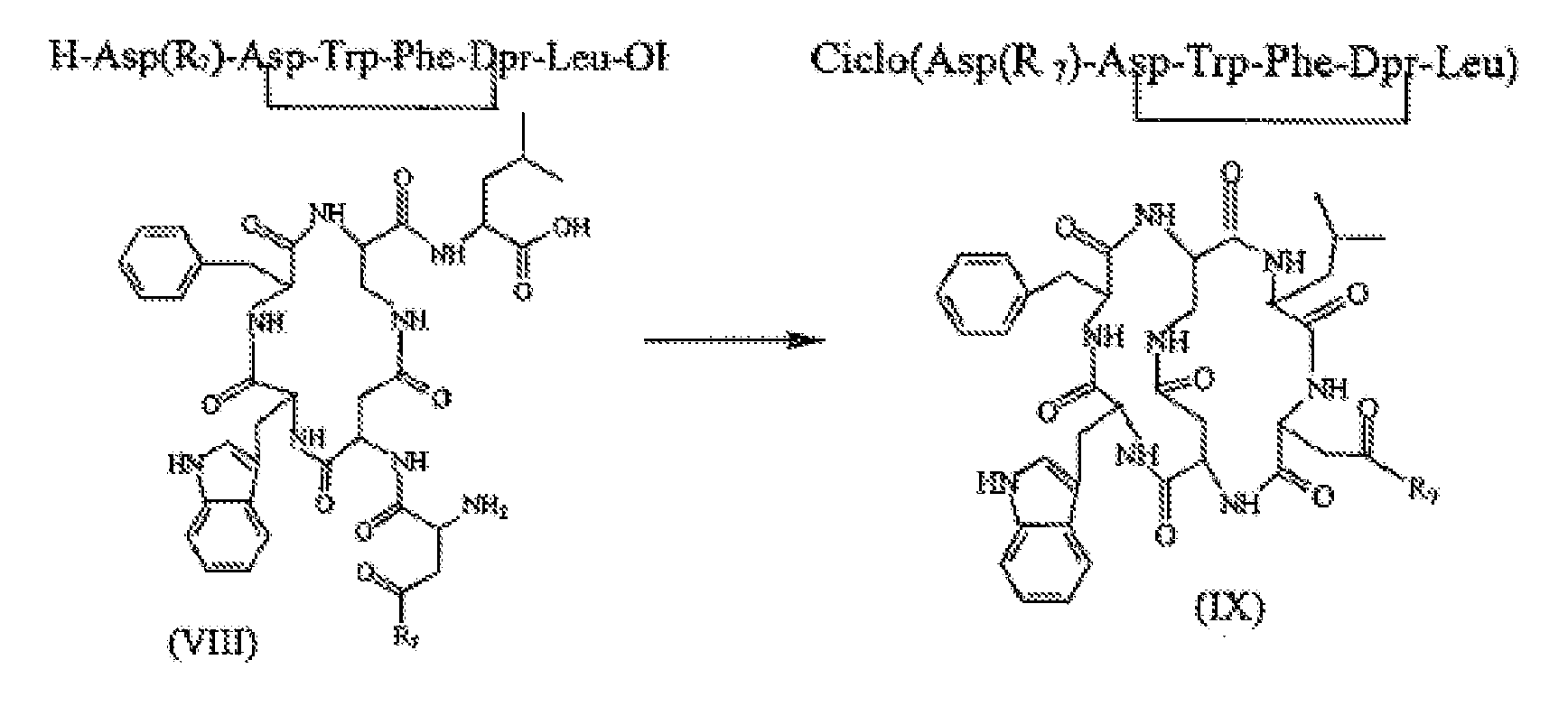 7) Schutzgruppen-Entfernung von der bicyclischen Verbindung der Formel (IX), die aus Schritt 6) heraus kommt, in Gegenwart eines Lösungsmittels unter Erhalt der Verbindung der Formel (I):worin R7 wie oben definiert ist.
- Verfahren nach Anspruch 1, worin die linearen Peptide der Formel (II) erhalten werden mittels einer sequenziellen Kupplungs-Strategie geeigneter Aminosäuren, ausgehend von einem Derivat der Aminosäure Dpr der Formel (X), geschützt an Stickstoff, und hergestellt getrennt oder erzeugt in situ:

A2 und A4 verschieden voneinander sind und Stickstoff schützende Gruppen sind;
R9 eine Rest-Gruppe ist, die sich von einem Aktivierungsverfahren ableitet, vorzugsweise gewählt aus der Gruppe, die besteht aus den Gruppen Benzyloxycarbonyl, Alkoxycarbonyl, umfassend eine lineare oder verzweigte C1- bis C4-Gruppe in dem Alkyl-Teil, und Succinimidyl; gemäß den folgenden Schritten:- Reaktion des Derivats der Formel (X) wie oben angegeben in Gegenwart eines Lösungsmittels mit einem Leu-Ester der Formel (XI):worin R5 wie in Anspruch 1 definiert ist, unter Erhalt des Dipeptids A4-Dpr(A2)-Leu-R5, Schutzgruppen-Entfernung von dem Dipeptid A4-Dpr(A2)-Leu-R5 unter Erhalt des Dipeptids H-Dpr(A2)-Leu-R5, von dem eine Schutzgruppe entfernt wurde;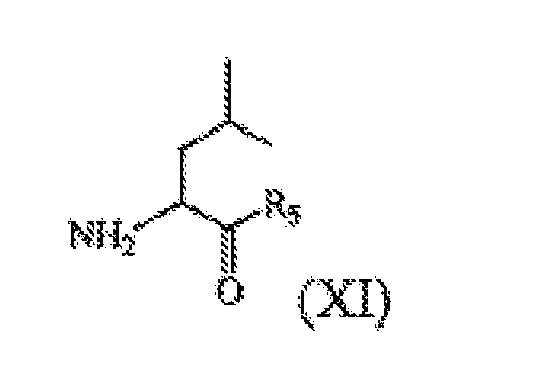 - Kuppeln des Dipeptids H-Dpr(A2)-Leu-R5, von dem eine Schutzgruppe entfernt wurde, mit dem aktivierten Ester der anschließenden Aminosäure Phe und danach sukzessive mit Trp und Asp, bis die Verbindungen der Formel (II) erhalten werden.
 - Verfahren nach Anspruch 1, worin die linearen Peptide der Formel (II) erhalten werden mittels einer Synthese-Strategie, die die folgenden Schritte umfasst:- Kuppeln des Dipeptids H-Dpr(A2)-Leu-R5, von dem eine Schutzgruppe entfernt wurde, erhalten wie in Anspruch 2 beschrieben, mit einem aktivierten Derivat des Dipeptids der folgenden Formel (XII):worin A2 und A5, die voneinander verschieden sind, Stickstoff schützende Gruppen sind, hergestellt getrennt oder erzeugt in situ durch Kuppeln eines aktivierten Esters eines Trp, das am Stickstoff geschützt ist getrennt hergestellt oder in situ erzeugt wird, mit einem Phe-Ester und anschließende Hydrolyse der Ester-Gruppe unter Erhalt des Tetrapeptids A5-Trp-Phe-Dpr(A2)-Leu-R5;
A5-Trp-Phe-OH (XII)
- geeignete Entfernung der Schutzgruppe von dem Tetrapeptid A5-Trp-Phe-Dpr(A2)-Leu-R5 von der Gruppe, die an den Stickstoff von Trp gebunden ist;- Kuppeln des Tetrapeptids, von dem die Schutzgruppe entfernt wurde, mit einer Verbindung der Formel (VIb):worin A1, R6 und R8 wie in Anspruch 1 definiert sind
- Verfahren nach Anspruch 1, worin die linearen Peptide der Formel (II) erhalten werden mittels einer Synthese-Strategie des 3+2-Typs, die einschließt ein Kuppeln des Tripeptids A1-Asp(R6)-Trp-Phe-OH erhalten durch Entfernen der Stickstoff-Schutzgruppe von den Verbindungen der Formel (XII), die oben angegeben wurden, anschließendes Kuppeln mit einer Verbindung der Formel (VIb), wie sie oben angegeben wurde, und danach weiteres Kuppeln mit dem Dipeptid H-Dpr-(A2)-Leu-R5, von dem eine Schutzgruppe entfernt wurde, hergestellt wie in Patentanspruch 2 beschrieben.
- Verfahren nach Anspruch 1, worin die Stickstoff-Schutzgruppen gewählt sind aus der Gruppe, die besteht aus den Gruppen Benzyloxycarbonyl und Alkoxycarbonyl, in denen der Alkyl-Teil eine lineare oder verzweigte ruppe C1-bis C4-Gruppe umfasst.
- Verfahren nach Anspruch 5, worin die Stickstoff-Schutzgruppen gewählt sind aus t-Butoxycarbonyl und Benzyloxycarbonyl.
- Verfahren nach Anspruch 1, worin die R8-Gruppe gewählt ist aus der Gruppe, die besteht aus Benzyloxycarbonyl, Alkyloxycarbonyl, umfassend eine lineare oder verzweigte C1- bis C4-Gruppe in dem Alkyl-Teil, Succinimidyl, Benzotriazol, das möglicherweise durch ein Halogen substituiert ist, und Azabenzotriazol.
- Verfahren nach den Ansprüchen 1 bis 7, worin die lineare oder verzweigte C1-bis C4-Gruppe gewählt ist aus der Gruppe, die besteht aus Methyl, Ethyl, Propyl, Butyl, Isopropyl und t-Butyl.
- Verfahren zur Herstellung einer bicyclischen Glycopeptid-Verbindung der Formel (I-A):
 1A) Aktivierung der bicyclischen Peptid-Verbindungen der Formel (I) mit einem geeigneten Kupplungsmittel unter Erhalt eines Derivats der Formel (II-A):
 2A) Reagieren der Verbindung der Formel (II-A), die sich aus Schritt 1A) ableitet, in Gegenwart eines Lösungsmittels mit dem glycosidischen Derivat der Formel (III-A):
dadurch gekennzeichnet, dass die bicyclischen Peptid-Verbindungen der Formel (I) durch das Verfahren gemäß Anspruch 1 hergestellt werden. - Verfahren nach Anspruch 9, worin die Verbindungen der Formel (I-A), worin R1, R2 und R3 verschieden von H sind, in die entsprechende Verbindungen der Formel (I-A) überführt werden, worin R1=R2=R3=H sind, durch eine Schutzgruppen-Entfernungs-Reaktion in Gegenwart eines Lösungsmittels.
- Verfahren nach Anspruch 9, worin die Sauerstoff-Schutzgruppen gewählt sind aus der Gruppe, die besteht aus -COR4, worin R4 eine lineare oder verzweigte C1- bis C4-Alkyl-Gruppe ist, Phenyl, das möglicherweise mit einem HalogenAtom substituiert ist, Benzyl oder Benzoyl.
- Verfahren nach Anspruch 11, worin die C1- bis C4-Alkyl-Gruppe gewählt ist aus der Gruppe, die besteht aus Methyl, Ethyl, Propyl, Butyl, Isopropyl und t-Butyl.
- Verfahren nach Anspruch 12, worin die C1- bis C4-Alkyl-Gruppe Methyl ist.
- Verfahren nach Anspruch 9, worin die glycosidischen Derivate der Formel (III-A) gewählt sind aus der Gruppe, die besteht aus 2-Acetamid-2-deoxy-β-D-glucopyranosylamin und 2-Acetamid-3,4,6-tri-O-acetyl-2-deoxy-β-D-gluco-pyranosylamin.
- Verfahren nach den Ansprüchen 1 oder 9, worin das Kupplungsmittel gewählt ist aus der Gruppe, die besteht aus Isobutylchlorformiat, einem Carbodiimid, möglicherweise in Kombination mit einem Hydroxy-Derivat, Phosphoniumsalzen, N-Oxid-Guanidinsalzen und Uronium-Salzen.
- Verfahren nach Anspruch 15, worin die Carbodiimide gewählt sind aus Dicyclohexylcarbodiimid und 1-Ethyl-3-(3-dimethylaminopropyl-)carbodiimid-hydrochlorid, das Hydroxy-Derivat gewählt ist aus 1-Hydroxybenzotriazol, 6-Chlor-1-hydroxybenzotriazol, Hydroxysuccinimid und 1-Hydroxy-7-azabenzotriazol, die Phosphonium-Salze, N-Oxid-Guanidin-Salze und Uronium-Salze gewählt sind aus (Benzotriazol-1-yloxy-)tri(dimethylamino-)phospho-niumhexafluorphosphat, (Benzotriazol-1-yloxy-)tripyrrolidin-phosphonium-hexafluorposphat, 1-[Bis-(dimethylamino-)methylen]-1H-benzotriazolium-3-oxid-hexafluorphosphat, 1-[Bis(dimethylamino-)methylen-]5-chlor-1H-benzo-triazolium-3-oxid-hexafluorphosphat, 1-[Bis(dimethylamino-)methylen-]1H-benzotriazolium-3-oxid-tetrafluorborat, 1-[Bis(dimethylamino-)methylen-]-1H-1,2,3-triazol-[4,5-b]pyridinium-3-oxid-hexafluorphosphat, 1-[Bis(dimethyl-amino-)methylen-]5-chlor-1H-benzotriazolium-3-oxid-tetrafluorborat, O-[(Ethoxycarbonyl-)cyanomethylenamino-]N,N,N',N'-tetramethyluronium-tetrafluorborat, O-(Bicyclo2.2. 1]hept-5-en-2,3-dicarboximido-)N,N,N',N'-tetramethyluroniumtetrafluorborat und O-(N-succinimidyl-)N,N,N',N'-tetramethyluroniumtetrafluorborat.
- Verfahren nach den Ansprüchen 1 oder 9, worin die Kupplungs-Reaktionen durchgeführt werden in Gegenwart eines tertiären Amins in einem organischen Lösungsmittel bei einer Temperatur, die liegt zwischen -20 und +50 °C.
- Verfahren nach Anspruch 17, worin das tertiäre Amin gewählt ist aus der Gruppe, die besteht aus N-Methylmorpholin, Triethylamin und Diisopropylethyl-amin, und das organische Lösungsmittel gewählt ist aus der Gruppe, die besteht aus Ethylacetat, Dimethylformamid und N-Methylpyrrolidon.
- Verfahren nach den Ansprüchen 1 oder 10, worin die Schutzgruppen-Entfernungs-Reaktionen durchgeführt werden mittels Hydrierung in Gegenwart eines Katalysators in einem Lösungsmittel, das gewählt ist aus Lösungsmitteln, die Komponenten der Reaktion lösen, ohne mit ihnen zu reagieren, ausschließend Ketone und Lösungsmittel, die den Katalysator vergiften, bei einer Temperatur, die zwischen -20 und +50 °C liegt.
- Verfahren nach Anspruch 19, worin der Katalysator gewählt ist aus 5 % und 10 % Palladium, und das Lösungsmittel gewählt ist aus Dimethylformamid, N-Methylpyrrolidon, Essigsäure, p-Toluolsulfonsäure, Methanol, Ethanol, Isopropanol und Mischungen daraus.
- Verfahren nach den Ansprüchen 1 oder 10, worin die Schutzgruppen-Entfernungs-Reaktionen durchgeführt werden mittels einer Säure-Behandlung mit reinen Säuren oder mit Säuren, die mit anderen Lösungsmitteln gemischt sind, bei einer Temperatur, die zwischen -20 und +50 °C liegt.
- Verfahren nach Anspruch 21, worin die Säuren gewählt sind aus Chlorwasserstoffsäure, Trifluoressigsäure und Ameisensäure.
- Verfahren nach den Ansprüchen 1 oder 10, worin die Schutzgruppen-Entfernungs-Reaktionen durchgeführt werden mittels einer Behandlung mit einer Basen-Verbindung in Gegenwart eines Lösungsmittels bei einer Temperatur, die zwischen -20 und +50 °C liegt.
- Verfahren nach Anspruch 23, worin die Basen-Verbindung gewählt ist aus Hydroxiden von Alkalimetallen oder Erdalkalimetallen, und das Lösungsmittel gewählt ist aus der Gruppe, die besteht aus Wasser, Dioxan, Acetonitril, Methanol, Ethanol, Isopropanol und Mischungen davon.
Applications Claiming Priority (3)
| Application Number | Priority Date | Filing Date | Title |
|---|---|---|---|
| ITFI20020239 | 2002-12-06 | ||
| IT000239A ITFI20020239A1 (it) | 2002-12-06 | 2002-12-06 | Processo per la preparazione di composti peptidici biciclici. |
| PCT/EP2003/013696 WO2004052923A2 (en) | 2002-12-06 | 2003-12-04 | Process for the preparation of bicyclic hexa-peptide nepadutant |
Publications (2)
| Publication Number | Publication Date |
|---|---|
| EP1576000A2 EP1576000A2 (de) | 2005-09-21 |
| EP1576000B1 true EP1576000B1 (de) | 2009-08-19 |
Family
ID=32500550
Family Applications (1)
| Application Number | Title | Priority Date | Filing Date |
|---|---|---|---|
| EP03782304A Expired - Lifetime EP1576000B1 (de) | 2002-12-06 | 2003-12-04 | Verfahren zur herstellung von dem bicyclischen hexapeptide nepadutant |
Country Status (16)
| Country | Link |
|---|---|
| US (1) | US7999068B2 (de) |
| EP (1) | EP1576000B1 (de) |
| JP (1) | JP4593284B2 (de) |
| KR (1) | KR101081256B1 (de) |
| CN (1) | CN1318445C (de) |
| AT (1) | ATE440105T1 (de) |
| AU (1) | AU2003289958A1 (de) |
| BR (1) | BR0317029A (de) |
| CA (1) | CA2508696C (de) |
| DE (1) | DE60328915D1 (de) |
| ES (1) | ES2330102T3 (de) |
| IT (1) | ITFI20020239A1 (de) |
| MX (1) | MXPA05005969A (de) |
| PL (1) | PL207850B1 (de) |
| RU (1) | RU2330045C9 (de) |
| WO (1) | WO2004052923A2 (de) |
Families Citing this family (3)
| Publication number | Priority date | Publication date | Assignee | Title |
|---|---|---|---|---|
| EP1996609B1 (de) * | 2006-03-22 | 2016-08-03 | The Scripps Research Institute | Verfahren zur herstellung von glycopeptiden |
| CN103864901B (zh) * | 2012-12-17 | 2017-02-08 | 深圳翰宇药业股份有限公司 | 一种制备奈帕坦特及其中间体的方法及所述中间体 |
| CN109503698B (zh) * | 2018-12-13 | 2021-01-01 | 无限极(中国)有限公司 | 一种多肽及其制备方法与应用 |
Family Cites Families (1)
| Publication number | Priority date | Publication date | Assignee | Title |
|---|---|---|---|---|
| IT1277835B1 (it) * | 1995-03-13 | 1997-11-12 | Menarini Farma Ind | Composti biciclici, loro preparazione ed uso in composizioni farmaceutiche |
-
2002
- 2002-12-06 IT IT000239A patent/ITFI20020239A1/it unknown
-
2003
- 2003-12-04 EP EP03782304A patent/EP1576000B1/de not_active Expired - Lifetime
- 2003-12-04 US US10/537,731 patent/US7999068B2/en not_active Expired - Fee Related
- 2003-12-04 KR KR1020057009808A patent/KR101081256B1/ko not_active Expired - Fee Related
- 2003-12-04 RU RU2005117345/04A patent/RU2330045C9/ru not_active IP Right Cessation
- 2003-12-04 PL PL377635A patent/PL207850B1/pl unknown
- 2003-12-04 CA CA2508696A patent/CA2508696C/en not_active Expired - Fee Related
- 2003-12-04 CN CNB200380105180XA patent/CN1318445C/zh not_active Expired - Fee Related
- 2003-12-04 BR BR0317029-2A patent/BR0317029A/pt unknown
- 2003-12-04 MX MXPA05005969A patent/MXPA05005969A/es unknown
- 2003-12-04 DE DE60328915T patent/DE60328915D1/de not_active Expired - Lifetime
- 2003-12-04 AT AT03782304T patent/ATE440105T1/de not_active IP Right Cessation
- 2003-12-04 AU AU2003289958A patent/AU2003289958A1/en not_active Abandoned
- 2003-12-04 WO PCT/EP2003/013696 patent/WO2004052923A2/en not_active Ceased
- 2003-12-04 ES ES03782304T patent/ES2330102T3/es not_active Expired - Lifetime
- 2003-12-04 JP JP2004557990A patent/JP4593284B2/ja not_active Expired - Fee Related
Also Published As
| Publication number | Publication date |
|---|---|
| AU2003289958A8 (en) | 2004-06-30 |
| ATE440105T1 (de) | 2009-09-15 |
| RU2330045C9 (ru) | 2008-11-20 |
| KR101081256B1 (ko) | 2011-11-08 |
| CN1318445C (zh) | 2007-05-30 |
| KR20050089966A (ko) | 2005-09-09 |
| CA2508696C (en) | 2014-05-06 |
| JP4593284B2 (ja) | 2010-12-08 |
| WO2004052923A3 (en) | 2005-02-24 |
| US20090163695A1 (en) | 2009-06-25 |
| DE60328915D1 (de) | 2009-10-01 |
| JP2006520743A (ja) | 2006-09-14 |
| PL377635A1 (pl) | 2006-02-06 |
| RU2330045C2 (ru) | 2008-07-27 |
| AU2003289958A1 (en) | 2004-06-30 |
| CN1720260A (zh) | 2006-01-11 |
| BR0317029A (pt) | 2005-10-25 |
| PL207850B1 (pl) | 2011-02-28 |
| ITFI20020239A1 (it) | 2004-06-07 |
| MXPA05005969A (es) | 2005-11-17 |
| WO2004052923A2 (en) | 2004-06-24 |
| RU2005117345A (ru) | 2006-02-27 |
| EP1576000A2 (de) | 2005-09-21 |
| CA2508696A1 (en) | 2004-06-24 |
| US7999068B2 (en) | 2011-08-16 |
| ES2330102T3 (es) | 2009-12-04 |
Similar Documents
| Publication | Publication Date | Title |
|---|---|---|
| EP0300785B1 (de) | Cyclosporine | |
| AU2011322618B2 (en) | Process for the manufacture of degarelix and its intermediates | |
| CA3017926A1 (en) | Methods for synthesizing .alpha.4.beta.7 peptide antagonists | |
| US5977302A (en) | Liquid phase process for the preparation of GnRH peptides | |
| CA2466430A1 (en) | Process for the preparation of cyclic peptides | |
| EP0300784B1 (de) | Peptide | |
| GB2216529A (en) | Peptides useful as tachykinin antagonists | |
| KESSLER et al. | Cyclic hexapeptides derived from the human thymopoietin III | |
| CA2848584C (en) | Template-fixed peptidomimetics as inhibitors of fpr1 | |
| Titlestad | Cyclic peptides of sarcosine. syntheses and conformation | |
| US5331089A (en) | Peptides useful as tachykinin agonists | |
| CA2508696C (en) | Process for the preparation of bicyclic peptide compounds | |
| US3971736A (en) | Cathepsin in D inhibitors | |
| WO2017175233A1 (en) | Process for large scale liquid phase synthesis of carbetocin and its novel intermediates | |
| Obrecht et al. | Design and synthesis of novel nonpolar host peptides for the determination of the 310‐and α‐helix compatibilities of α‐amino acid buildig blocks: An assessment of α, α‐disubstituted glycines | |
| Hu et al. | Cyclosporin analogs modified in the 3, 7, 8-positions: substituent effects on peptidylprolyl isomerase inhibition and immunosuppressive activity are nonadditive | |
| EP3992187A1 (de) | Verfahren zur herstellung einer peptidverbindung, reagens zur bildung einer schutzgruppe und kondensierte polycyclische verbindung | |
| GB1587427A (en) | Polypeptide derivatives | |
| Yoshiya et al. | Isopeptide method: development of S‐acyl isopeptide method for the synthesis of difficult sequence‐containing peptides | |
| Bouillon et al. | Solid-phase synthesis of hydrazinopeptides in Boc and Fmoc strategies monitored by HR-MAS NMR | |
| Mulder et al. | Synthesis and evaluation of novel macrocyclic antifungal peptides | |
| Nishino et al. | Cyclo (-arginyl-sarcosyl-aspartyl-phenylglycyl-) 2. Simple synthesis of an RGD-related peptide with inhibitory activity for platelet aggregation | |
| Ryakhovsky et al. | Study of intramolecular aminolysis in peptides containing N-alkylamino acids at position 2 | |
| Nishiyama et al. | Amino acids and peptides. Part 42. Application of the 2-adamantyloxycarbonyl (2-Adoc) group to the protection of the imidazole function of histidine in peptide synthesis | |
| AU2004201899A1 (en) | Process for the preparation of clyclic peptides |
Legal Events
| Date | Code | Title | Description |
|---|---|---|---|
| PUAI | Public reference made under article 153(3) epc to a published international application that has entered the european phase |
Free format text: ORIGINAL CODE: 0009012 |
|
| 17P | Request for examination filed |
Effective date: 20050705 |
|
| AK | Designated contracting states |
Kind code of ref document: A2 Designated state(s): AT BE BG CH CY CZ DE DK EE ES FI FR GB GR HU IE IT LI LU MC NL PT RO SE SI SK TR |
|
| AX | Request for extension of the european patent |
Extension state: AL LT LV MK |
|
| RAX | Requested extension states of the european patent have changed |
Extension state: LV Payment date: 20050705 Extension state: LT Payment date: 20050705 |
|
| 17Q | First examination report despatched |
Effective date: 20060317 |
|
| GRAP | Despatch of communication of intention to grant a patent |
Free format text: ORIGINAL CODE: EPIDOSNIGR1 |
|
| GRAS | Grant fee paid |
Free format text: ORIGINAL CODE: EPIDOSNIGR3 |
|
| GRAA | (expected) grant |
Free format text: ORIGINAL CODE: 0009210 |
|
| AK | Designated contracting states |
Kind code of ref document: B1 Designated state(s): AT BE BG CH CY CZ DE DK EE ES FI FR GB GR HU IE IT LI LU MC NL PT RO SE SI SK TR |
|
| AX | Request for extension of the european patent |
Extension state: LT LV |
|
| REG | Reference to a national code |
Ref country code: GB Ref legal event code: FG4D |
|
| REG | Reference to a national code |
Ref country code: CH Ref legal event code: EP |
|
| REG | Reference to a national code |
Ref country code: IE Ref legal event code: FG4D |
|
| REF | Corresponds to: |
Ref document number: 60328915 Country of ref document: DE Date of ref document: 20091001 Kind code of ref document: P |
|
| REG | Reference to a national code |
Ref country code: ES Ref legal event code: FG2A Ref document number: 2330102 Country of ref document: ES Kind code of ref document: T3 |
|
| LTIE | Lt: invalidation of european patent or patent extension |
Effective date: 20090819 |
|
| PG25 | Lapsed in a contracting state [announced via postgrant information from national office to epo] |
Ref country code: AT Free format text: LAPSE BECAUSE OF FAILURE TO SUBMIT A TRANSLATION OF THE DESCRIPTION OR TO PAY THE FEE WITHIN THE PRESCRIBED TIME-LIMIT Effective date: 20090819 Ref country code: FI Free format text: LAPSE BECAUSE OF FAILURE TO SUBMIT A TRANSLATION OF THE DESCRIPTION OR TO PAY THE FEE WITHIN THE PRESCRIBED TIME-LIMIT Effective date: 20090819 Ref country code: SE Free format text: LAPSE BECAUSE OF FAILURE TO SUBMIT A TRANSLATION OF THE DESCRIPTION OR TO PAY THE FEE WITHIN THE PRESCRIBED TIME-LIMIT Effective date: 20090819 |
|
| NLV1 | Nl: lapsed or annulled due to failure to fulfill the requirements of art. 29p and 29m of the patents act | ||
| PG25 | Lapsed in a contracting state [announced via postgrant information from national office to epo] |
Ref country code: SI Free format text: LAPSE BECAUSE OF FAILURE TO SUBMIT A TRANSLATION OF THE DESCRIPTION OR TO PAY THE FEE WITHIN THE PRESCRIBED TIME-LIMIT Effective date: 20090819 Ref country code: NL Free format text: LAPSE BECAUSE OF FAILURE TO SUBMIT A TRANSLATION OF THE DESCRIPTION OR TO PAY THE FEE WITHIN THE PRESCRIBED TIME-LIMIT Effective date: 20090819 |
|
| PG25 | Lapsed in a contracting state [announced via postgrant information from national office to epo] |
Ref country code: BG Free format text: LAPSE BECAUSE OF FAILURE TO SUBMIT A TRANSLATION OF THE DESCRIPTION OR TO PAY THE FEE WITHIN THE PRESCRIBED TIME-LIMIT Effective date: 20091119 Ref country code: PT Free format text: LAPSE BECAUSE OF FAILURE TO SUBMIT A TRANSLATION OF THE DESCRIPTION OR TO PAY THE FEE WITHIN THE PRESCRIBED TIME-LIMIT Effective date: 20091221 Ref country code: CY Free format text: LAPSE BECAUSE OF FAILURE TO SUBMIT A TRANSLATION OF THE DESCRIPTION OR TO PAY THE FEE WITHIN THE PRESCRIBED TIME-LIMIT Effective date: 20090819 |
|
| PG25 | Lapsed in a contracting state [announced via postgrant information from national office to epo] |
Ref country code: CZ Free format text: LAPSE BECAUSE OF FAILURE TO SUBMIT A TRANSLATION OF THE DESCRIPTION OR TO PAY THE FEE WITHIN THE PRESCRIBED TIME-LIMIT Effective date: 20090819 Ref country code: RO Free format text: LAPSE BECAUSE OF FAILURE TO SUBMIT A TRANSLATION OF THE DESCRIPTION OR TO PAY THE FEE WITHIN THE PRESCRIBED TIME-LIMIT Effective date: 20090819 Ref country code: EE Free format text: LAPSE BECAUSE OF FAILURE TO SUBMIT A TRANSLATION OF THE DESCRIPTION OR TO PAY THE FEE WITHIN THE PRESCRIBED TIME-LIMIT Effective date: 20090819 Ref country code: DK Free format text: LAPSE BECAUSE OF FAILURE TO SUBMIT A TRANSLATION OF THE DESCRIPTION OR TO PAY THE FEE WITHIN THE PRESCRIBED TIME-LIMIT Effective date: 20090819 |
|
| PG25 | Lapsed in a contracting state [announced via postgrant information from national office to epo] |
Ref country code: SK Free format text: LAPSE BECAUSE OF FAILURE TO SUBMIT A TRANSLATION OF THE DESCRIPTION OR TO PAY THE FEE WITHIN THE PRESCRIBED TIME-LIMIT Effective date: 20090819 |
|
| PLBE | No opposition filed within time limit |
Free format text: ORIGINAL CODE: 0009261 |
|
| STAA | Information on the status of an ep patent application or granted ep patent |
Free format text: STATUS: NO OPPOSITION FILED WITHIN TIME LIMIT |
|
| PG25 | Lapsed in a contracting state [announced via postgrant information from national office to epo] |
Ref country code: BE Free format text: LAPSE BECAUSE OF FAILURE TO SUBMIT A TRANSLATION OF THE DESCRIPTION OR TO PAY THE FEE WITHIN THE PRESCRIBED TIME-LIMIT Effective date: 20090819 |
|
| 26N | No opposition filed |
Effective date: 20100520 |
|
| PG25 | Lapsed in a contracting state [announced via postgrant information from national office to epo] |
Ref country code: MC Free format text: LAPSE BECAUSE OF NON-PAYMENT OF DUE FEES Effective date: 20100701 |
|
| REG | Reference to a national code |
Ref country code: CH Ref legal event code: PL |
|
| PG25 | Lapsed in a contracting state [announced via postgrant information from national office to epo] |
Ref country code: GR Free format text: LAPSE BECAUSE OF FAILURE TO SUBMIT A TRANSLATION OF THE DESCRIPTION OR TO PAY THE FEE WITHIN THE PRESCRIBED TIME-LIMIT Effective date: 20091120 Ref country code: CH Free format text: LAPSE BECAUSE OF NON-PAYMENT OF DUE FEES Effective date: 20091231 Ref country code: LI Free format text: LAPSE BECAUSE OF NON-PAYMENT OF DUE FEES Effective date: 20091231 Ref country code: IE Free format text: LAPSE BECAUSE OF NON-PAYMENT OF DUE FEES Effective date: 20091204 |
|
| PG25 | Lapsed in a contracting state [announced via postgrant information from national office to epo] |
Ref country code: IT Free format text: LAPSE BECAUSE OF FAILURE TO SUBMIT A TRANSLATION OF THE DESCRIPTION OR TO PAY THE FEE WITHIN THE PRESCRIBED TIME-LIMIT Effective date: 20090819 |
|
| PG25 | Lapsed in a contracting state [announced via postgrant information from national office to epo] |
Ref country code: LU Free format text: LAPSE BECAUSE OF NON-PAYMENT OF DUE FEES Effective date: 20091204 |
|
| PG25 | Lapsed in a contracting state [announced via postgrant information from national office to epo] |
Ref country code: HU Free format text: LAPSE BECAUSE OF FAILURE TO SUBMIT A TRANSLATION OF THE DESCRIPTION OR TO PAY THE FEE WITHIN THE PRESCRIBED TIME-LIMIT Effective date: 20100220 |
|
| PG25 | Lapsed in a contracting state [announced via postgrant information from national office to epo] |
Ref country code: TR Free format text: LAPSE BECAUSE OF FAILURE TO SUBMIT A TRANSLATION OF THE DESCRIPTION OR TO PAY THE FEE WITHIN THE PRESCRIBED TIME-LIMIT Effective date: 20090819 |
|
| REG | Reference to a national code |
Ref country code: FR Ref legal event code: PLFP Year of fee payment: 13 |
|
| REG | Reference to a national code |
Ref country code: DE Ref legal event code: R082 Ref document number: 60328915 Country of ref document: DE Representative=s name: SCHWABE SANDMAIR MARX PATENTANWAELTE RECHTSANW, DE |
|
| REG | Reference to a national code |
Ref country code: FR Ref legal event code: PLFP Year of fee payment: 14 |
|
| PGFP | Annual fee paid to national office [announced via postgrant information from national office to epo] |
Ref country code: DE Payment date: 20161129 Year of fee payment: 14 Ref country code: GB Payment date: 20161130 Year of fee payment: 14 Ref country code: FR Payment date: 20161111 Year of fee payment: 14 |
|
| PGFP | Annual fee paid to national office [announced via postgrant information from national office to epo] |
Ref country code: ES Payment date: 20161111 Year of fee payment: 14 |
|
| REG | Reference to a national code |
Ref country code: DE Ref legal event code: R119 Ref document number: 60328915 Country of ref document: DE |
|
| GBPC | Gb: european patent ceased through non-payment of renewal fee |
Effective date: 20171204 |
|
| REG | Reference to a national code |
Ref country code: FR Ref legal event code: ST Effective date: 20180831 |
|
| PG25 | Lapsed in a contracting state [announced via postgrant information from national office to epo] |
Ref country code: FR Free format text: LAPSE BECAUSE OF NON-PAYMENT OF DUE FEES Effective date: 20180102 Ref country code: DE Free format text: LAPSE BECAUSE OF NON-PAYMENT OF DUE FEES Effective date: 20180703 |
|
| PG25 | Lapsed in a contracting state [announced via postgrant information from national office to epo] |
Ref country code: GB Free format text: LAPSE BECAUSE OF NON-PAYMENT OF DUE FEES Effective date: 20171204 |
|
| REG | Reference to a national code |
Ref country code: ES Ref legal event code: FD2A Effective date: 20190702 |
|
| PG25 | Lapsed in a contracting state [announced via postgrant information from national office to epo] |
Ref country code: ES Free format text: LAPSE BECAUSE OF NON-PAYMENT OF DUE FEES Effective date: 20171205 |