EP1575964B1 - "n-(benzyl)aminoalkyl carboxylate, phosphinate, phosphonate und tetrazole als edg rezeptoragonisten" - Google Patents
"n-(benzyl)aminoalkyl carboxylate, phosphinate, phosphonate und tetrazole als edg rezeptoragonisten" Download PDFInfo
- Publication number
- EP1575964B1 EP1575964B1 EP03702110A EP03702110A EP1575964B1 EP 1575964 B1 EP1575964 B1 EP 1575964B1 EP 03702110 A EP03702110 A EP 03702110A EP 03702110 A EP03702110 A EP 03702110A EP 1575964 B1 EP1575964 B1 EP 1575964B1
- Authority
- EP
- European Patent Office
- Prior art keywords
- alkyl
- nmr
- mhz
- mmol
- phenyl
- Prior art date
- Legal status (The legal status is an assumption and is not a legal conclusion. Google has not performed a legal analysis and makes no representation as to the accuracy of the status listed.)
- Expired - Lifetime
Links
- 0 C*C(*)(C(C)(C)*)C(C)(C)NC(*)c1ccccc1 Chemical compound C*C(*)(C(C)(C)*)C(C)(C)NC(*)c1ccccc1 0.000 description 16
- UIUJMOHCDNHZCY-UHFFFAOYSA-N C=CCCCCc(cc1)ccc1-c1ccc(CCCCCP(N)(N=O)=O)cc1 Chemical compound C=CCCCCc(cc1)ccc1-c1ccc(CCCCCP(N)(N=O)=O)cc1 UIUJMOHCDNHZCY-UHFFFAOYSA-N 0.000 description 1
- TXFPEBPIARQUIG-UHFFFAOYSA-N CC(c(cc1)ccc1O)=O Chemical compound CC(c(cc1)ccc1O)=O TXFPEBPIARQUIG-UHFFFAOYSA-N 0.000 description 1
- ITKXIZZXYKCBIF-UHFFFAOYSA-N CC1(CC(CNCc2ccc(CCCCCCCC#N)cc2)c2ccccc2)C=[O]CC1 Chemical compound CC1(CC(CNCc2ccc(CCCCCCCC#N)cc2)c2ccccc2)C=[O]CC1 ITKXIZZXYKCBIF-UHFFFAOYSA-N 0.000 description 1
- RYXRRJLVERNHOU-UHFFFAOYSA-N CCCCCCC(c1cccc(-c(cc2)ccc2C(N)=O)c1)O Chemical compound CCCCCCC(c1cccc(-c(cc2)ccc2C(N)=O)c1)O RYXRRJLVERNHOU-UHFFFAOYSA-N 0.000 description 1
- UWFLNTQMHMYDGI-UHFFFAOYSA-N CCCCCCCCOC1C(O)=CC(CO)=CC1 Chemical compound CCCCCCCCOC1C(O)=CC(CO)=CC1 UWFLNTQMHMYDGI-UHFFFAOYSA-N 0.000 description 1
- UZJPAZPYGOMSDE-UHFFFAOYSA-N CCCCCCCCOc(c([O]=C)c1)c(C)cc1C(N)=O Chemical compound CCCCCCCCOc(c([O]=C)c1)c(C)cc1C(N)=O UZJPAZPYGOMSDE-UHFFFAOYSA-N 0.000 description 1
- MZLSNIREOQCDED-UHFFFAOYSA-N Cc(c(F)ccc1)c1F Chemical compound Cc(c(F)ccc1)c1F MZLSNIREOQCDED-UHFFFAOYSA-N 0.000 description 1
- QNENNHJQTVYVRY-UHFFFAOYSA-N NC(c1cc(OCCc2ccccc2)ccc1)=O Chemical compound NC(c1cc(OCCc2ccccc2)ccc1)=O QNENNHJQTVYVRY-UHFFFAOYSA-N 0.000 description 1
- KEBOFPCXLHRSEG-UHFFFAOYSA-N O=Nc(cc1)ccc1Br Chemical compound O=Nc(cc1)ccc1Br KEBOFPCXLHRSEG-UHFFFAOYSA-N 0.000 description 1
Classifications
-
- C—CHEMISTRY; METALLURGY
- C07—ORGANIC CHEMISTRY
- C07D—HETEROCYCLIC COMPOUNDS
- C07D413/00—Heterocyclic compounds containing two or more hetero rings, at least one ring having nitrogen and oxygen atoms as the only ring hetero atoms
- C07D413/02—Heterocyclic compounds containing two or more hetero rings, at least one ring having nitrogen and oxygen atoms as the only ring hetero atoms containing two hetero rings
- C07D413/04—Heterocyclic compounds containing two or more hetero rings, at least one ring having nitrogen and oxygen atoms as the only ring hetero atoms containing two hetero rings directly linked by a ring-member-to-ring-member bond
-
- A—HUMAN NECESSITIES
- A61—MEDICAL OR VETERINARY SCIENCE; HYGIENE
- A61P—SPECIFIC THERAPEUTIC ACTIVITY OF CHEMICAL COMPOUNDS OR MEDICINAL PREPARATIONS
- A61P1/00—Drugs for disorders of the alimentary tract or the digestive system
- A61P1/04—Drugs for disorders of the alimentary tract or the digestive system for ulcers, gastritis or reflux esophagitis, e.g. antacids, inhibitors of acid secretion, mucosal protectants
-
- A—HUMAN NECESSITIES
- A61—MEDICAL OR VETERINARY SCIENCE; HYGIENE
- A61P—SPECIFIC THERAPEUTIC ACTIVITY OF CHEMICAL COMPOUNDS OR MEDICINAL PREPARATIONS
- A61P1/00—Drugs for disorders of the alimentary tract or the digestive system
- A61P1/18—Drugs for disorders of the alimentary tract or the digestive system for pancreatic disorders, e.g. pancreatic enzymes
-
- A—HUMAN NECESSITIES
- A61—MEDICAL OR VETERINARY SCIENCE; HYGIENE
- A61P—SPECIFIC THERAPEUTIC ACTIVITY OF CHEMICAL COMPOUNDS OR MEDICINAL PREPARATIONS
- A61P11/00—Drugs for disorders of the respiratory system
- A61P11/06—Antiasthmatics
-
- A—HUMAN NECESSITIES
- A61—MEDICAL OR VETERINARY SCIENCE; HYGIENE
- A61P—SPECIFIC THERAPEUTIC ACTIVITY OF CHEMICAL COMPOUNDS OR MEDICINAL PREPARATIONS
- A61P17/00—Drugs for dermatological disorders
- A61P17/06—Antipsoriatics
-
- A—HUMAN NECESSITIES
- A61—MEDICAL OR VETERINARY SCIENCE; HYGIENE
- A61P—SPECIFIC THERAPEUTIC ACTIVITY OF CHEMICAL COMPOUNDS OR MEDICINAL PREPARATIONS
- A61P21/00—Drugs for disorders of the muscular or neuromuscular system
-
- A—HUMAN NECESSITIES
- A61—MEDICAL OR VETERINARY SCIENCE; HYGIENE
- A61P—SPECIFIC THERAPEUTIC ACTIVITY OF CHEMICAL COMPOUNDS OR MEDICINAL PREPARATIONS
- A61P27/00—Drugs for disorders of the senses
- A61P27/02—Ophthalmic agents
-
- A—HUMAN NECESSITIES
- A61—MEDICAL OR VETERINARY SCIENCE; HYGIENE
- A61P—SPECIFIC THERAPEUTIC ACTIVITY OF CHEMICAL COMPOUNDS OR MEDICINAL PREPARATIONS
- A61P29/00—Non-central analgesic, antipyretic or antiinflammatory agents, e.g. antirheumatic agents; Non-steroidal antiinflammatory drugs [NSAID]
-
- A—HUMAN NECESSITIES
- A61—MEDICAL OR VETERINARY SCIENCE; HYGIENE
- A61P—SPECIFIC THERAPEUTIC ACTIVITY OF CHEMICAL COMPOUNDS OR MEDICINAL PREPARATIONS
- A61P3/00—Drugs for disorders of the metabolism
- A61P3/08—Drugs for disorders of the metabolism for glucose homeostasis
- A61P3/10—Drugs for disorders of the metabolism for glucose homeostasis for hyperglycaemia, e.g. antidiabetics
-
- A—HUMAN NECESSITIES
- A61—MEDICAL OR VETERINARY SCIENCE; HYGIENE
- A61P—SPECIFIC THERAPEUTIC ACTIVITY OF CHEMICAL COMPOUNDS OR MEDICINAL PREPARATIONS
- A61P35/00—Antineoplastic agents
-
- A—HUMAN NECESSITIES
- A61—MEDICAL OR VETERINARY SCIENCE; HYGIENE
- A61P—SPECIFIC THERAPEUTIC ACTIVITY OF CHEMICAL COMPOUNDS OR MEDICINAL PREPARATIONS
- A61P35/00—Antineoplastic agents
- A61P35/02—Antineoplastic agents specific for leukemia
-
- A—HUMAN NECESSITIES
- A61—MEDICAL OR VETERINARY SCIENCE; HYGIENE
- A61P—SPECIFIC THERAPEUTIC ACTIVITY OF CHEMICAL COMPOUNDS OR MEDICINAL PREPARATIONS
- A61P37/00—Drugs for immunological or allergic disorders
- A61P37/02—Immunomodulators
-
- A—HUMAN NECESSITIES
- A61—MEDICAL OR VETERINARY SCIENCE; HYGIENE
- A61P—SPECIFIC THERAPEUTIC ACTIVITY OF CHEMICAL COMPOUNDS OR MEDICINAL PREPARATIONS
- A61P37/00—Drugs for immunological or allergic disorders
- A61P37/02—Immunomodulators
- A61P37/06—Immunosuppressants, e.g. drugs for graft rejection
-
- C—CHEMISTRY; METALLURGY
- C07—ORGANIC CHEMISTRY
- C07C—ACYCLIC OR CARBOCYCLIC COMPOUNDS
- C07C229/00—Compounds containing amino and carboxyl groups bound to the same carbon skeleton
- C07C229/02—Compounds containing amino and carboxyl groups bound to the same carbon skeleton having amino and carboxyl groups bound to acyclic carbon atoms of the same carbon skeleton
- C07C229/04—Compounds containing amino and carboxyl groups bound to the same carbon skeleton having amino and carboxyl groups bound to acyclic carbon atoms of the same carbon skeleton the carbon skeleton being acyclic and saturated
- C07C229/06—Compounds containing amino and carboxyl groups bound to the same carbon skeleton having amino and carboxyl groups bound to acyclic carbon atoms of the same carbon skeleton the carbon skeleton being acyclic and saturated having only one amino and one carboxyl group bound to the carbon skeleton
- C07C229/10—Compounds containing amino and carboxyl groups bound to the same carbon skeleton having amino and carboxyl groups bound to acyclic carbon atoms of the same carbon skeleton the carbon skeleton being acyclic and saturated having only one amino and one carboxyl group bound to the carbon skeleton the nitrogen atom of the amino group being further bound to acyclic carbon atoms or to carbon atoms of rings other than six-membered aromatic rings
- C07C229/14—Compounds containing amino and carboxyl groups bound to the same carbon skeleton having amino and carboxyl groups bound to acyclic carbon atoms of the same carbon skeleton the carbon skeleton being acyclic and saturated having only one amino and one carboxyl group bound to the carbon skeleton the nitrogen atom of the amino group being further bound to acyclic carbon atoms or to carbon atoms of rings other than six-membered aromatic rings to carbon atoms of carbon skeletons containing rings
-
- C—CHEMISTRY; METALLURGY
- C07—ORGANIC CHEMISTRY
- C07C—ACYCLIC OR CARBOCYCLIC COMPOUNDS
- C07C229/00—Compounds containing amino and carboxyl groups bound to the same carbon skeleton
- C07C229/02—Compounds containing amino and carboxyl groups bound to the same carbon skeleton having amino and carboxyl groups bound to acyclic carbon atoms of the same carbon skeleton
- C07C229/04—Compounds containing amino and carboxyl groups bound to the same carbon skeleton having amino and carboxyl groups bound to acyclic carbon atoms of the same carbon skeleton the carbon skeleton being acyclic and saturated
- C07C229/20—Compounds containing amino and carboxyl groups bound to the same carbon skeleton having amino and carboxyl groups bound to acyclic carbon atoms of the same carbon skeleton the carbon skeleton being acyclic and saturated the carbon skeleton being further substituted by halogen atoms or by nitro or nitroso groups
-
- C—CHEMISTRY; METALLURGY
- C07—ORGANIC CHEMISTRY
- C07C—ACYCLIC OR CARBOCYCLIC COMPOUNDS
- C07C229/00—Compounds containing amino and carboxyl groups bound to the same carbon skeleton
- C07C229/02—Compounds containing amino and carboxyl groups bound to the same carbon skeleton having amino and carboxyl groups bound to acyclic carbon atoms of the same carbon skeleton
- C07C229/04—Compounds containing amino and carboxyl groups bound to the same carbon skeleton having amino and carboxyl groups bound to acyclic carbon atoms of the same carbon skeleton the carbon skeleton being acyclic and saturated
- C07C229/22—Compounds containing amino and carboxyl groups bound to the same carbon skeleton having amino and carboxyl groups bound to acyclic carbon atoms of the same carbon skeleton the carbon skeleton being acyclic and saturated the carbon skeleton being further substituted by oxygen atoms
-
- C—CHEMISTRY; METALLURGY
- C07—ORGANIC CHEMISTRY
- C07D—HETEROCYCLIC COMPOUNDS
- C07D333/00—Heterocyclic compounds containing five-membered rings having one sulfur atom as the only ring hetero atom
- C07D333/02—Heterocyclic compounds containing five-membered rings having one sulfur atom as the only ring hetero atom not condensed with other rings
- C07D333/04—Heterocyclic compounds containing five-membered rings having one sulfur atom as the only ring hetero atom not condensed with other rings not substituted on the ring sulphur atom
- C07D333/06—Heterocyclic compounds containing five-membered rings having one sulfur atom as the only ring hetero atom not condensed with other rings not substituted on the ring sulphur atom with only hydrogen atoms, hydrocarbon or substituted hydrocarbon radicals, directly attached to the ring carbon atoms
- C07D333/14—Radicals substituted by singly bound hetero atoms other than halogen
- C07D333/16—Radicals substituted by singly bound hetero atoms other than halogen by oxygen atoms
-
- C—CHEMISTRY; METALLURGY
- C07—ORGANIC CHEMISTRY
- C07F—ACYCLIC, CARBOCYCLIC OR HETEROCYCLIC COMPOUNDS CONTAINING ELEMENTS OTHER THAN CARBON, HYDROGEN, HALOGEN, OXYGEN, NITROGEN, SULFUR, SELENIUM OR TELLURIUM
- C07F9/00—Compounds containing elements of Groups 5 or 15 of the Periodic Table
- C07F9/02—Phosphorus compounds
- C07F9/28—Phosphorus compounds with one or more P—C bonds
- C07F9/30—Phosphinic acids [R2P(=O)(OH)]; Thiophosphinic acids ; [R2P(=X1)(X2H) (X1, X2 are each independently O, S or Se)]
- C07F9/301—Acyclic saturated acids which can have further substituents on alkyl
-
- C—CHEMISTRY; METALLURGY
- C07—ORGANIC CHEMISTRY
- C07F—ACYCLIC, CARBOCYCLIC OR HETEROCYCLIC COMPOUNDS CONTAINING ELEMENTS OTHER THAN CARBON, HYDROGEN, HALOGEN, OXYGEN, NITROGEN, SULFUR, SELENIUM OR TELLURIUM
- C07F9/00—Compounds containing elements of Groups 5 or 15 of the Periodic Table
- C07F9/02—Phosphorus compounds
- C07F9/28—Phosphorus compounds with one or more P—C bonds
- C07F9/30—Phosphinic acids [R2P(=O)(OH)]; Thiophosphinic acids ; [R2P(=X1)(X2H) (X1, X2 are each independently O, S or Se)]
- C07F9/307—Acids containing the structure -C(=X)-P(=X)(R)(XH) or NC-P(=X)(R)(XH), (X = O, S, Se)
-
- C—CHEMISTRY; METALLURGY
- C07—ORGANIC CHEMISTRY
- C07F—ACYCLIC, CARBOCYCLIC OR HETEROCYCLIC COMPOUNDS CONTAINING ELEMENTS OTHER THAN CARBON, HYDROGEN, HALOGEN, OXYGEN, NITROGEN, SULFUR, SELENIUM OR TELLURIUM
- C07F9/00—Compounds containing elements of Groups 5 or 15 of the Periodic Table
- C07F9/02—Phosphorus compounds
- C07F9/28—Phosphorus compounds with one or more P—C bonds
- C07F9/38—Phosphonic acids [RP(=O)(OH)2]; Thiophosphonic acids ; [RP(=X1)(X2H)2(X1, X2 are each independently O, S or Se)]
- C07F9/3804—Phosphonic acids [RP(=O)(OH)2]; Thiophosphonic acids ; [RP(=X1)(X2H)2(X1, X2 are each independently O, S or Se)] not used, see subgroups
- C07F9/3808—Acyclic saturated acids which can have further substituents on alkyl
-
- C—CHEMISTRY; METALLURGY
- C07—ORGANIC CHEMISTRY
- C07F—ACYCLIC, CARBOCYCLIC OR HETEROCYCLIC COMPOUNDS CONTAINING ELEMENTS OTHER THAN CARBON, HYDROGEN, HALOGEN, OXYGEN, NITROGEN, SULFUR, SELENIUM OR TELLURIUM
- C07F9/00—Compounds containing elements of Groups 5 or 15 of the Periodic Table
- C07F9/02—Phosphorus compounds
- C07F9/28—Phosphorus compounds with one or more P—C bonds
- C07F9/48—Phosphonous acids [RP(OH)2] including [RHP(=O)(OH)]; Thiophosphonous acids including [RP(SH)2], [RHP(=S)(SH)]; Derivatives thereof
- C07F9/4808—Phosphonous acids [RP(OH)2] including [RHP(=O)(OH)]; Thiophosphonous acids including [RP(SH)2], [RHP(=S)(SH)]; Derivatives thereof the acid moiety containing a substituent or structure which is considered as characteristic
- C07F9/4816—Acyclic saturated acids or derivatices which can have further substituents on alkyl
-
- C—CHEMISTRY; METALLURGY
- C07—ORGANIC CHEMISTRY
- C07F—ACYCLIC, CARBOCYCLIC OR HETEROCYCLIC COMPOUNDS CONTAINING ELEMENTS OTHER THAN CARBON, HYDROGEN, HALOGEN, OXYGEN, NITROGEN, SULFUR, SELENIUM OR TELLURIUM
- C07F9/00—Compounds containing elements of Groups 5 or 15 of the Periodic Table
- C07F9/02—Phosphorus compounds
- C07F9/547—Heterocyclic compounds, e.g. containing phosphorus as a ring hetero atom
- C07F9/553—Heterocyclic compounds, e.g. containing phosphorus as a ring hetero atom having one nitrogen atom as the only ring hetero atom
- C07F9/576—Six-membered rings
- C07F9/59—Hydrogenated pyridine rings
-
- C—CHEMISTRY; METALLURGY
- C07—ORGANIC CHEMISTRY
- C07F—ACYCLIC, CARBOCYCLIC OR HETEROCYCLIC COMPOUNDS CONTAINING ELEMENTS OTHER THAN CARBON, HYDROGEN, HALOGEN, OXYGEN, NITROGEN, SULFUR, SELENIUM OR TELLURIUM
- C07F9/00—Compounds containing elements of Groups 5 or 15 of the Periodic Table
- C07F9/02—Phosphorus compounds
- C07F9/547—Heterocyclic compounds, e.g. containing phosphorus as a ring hetero atom
- C07F9/6553—Heterocyclic compounds, e.g. containing phosphorus as a ring hetero atom having sulfur atoms, with or without selenium or tellurium atoms, as the only ring hetero atoms
- C07F9/655345—Heterocyclic compounds, e.g. containing phosphorus as a ring hetero atom having sulfur atoms, with or without selenium or tellurium atoms, as the only ring hetero atoms the sulfur atom being part of a five-membered ring
-
- C—CHEMISTRY; METALLURGY
- C07—ORGANIC CHEMISTRY
- C07F—ACYCLIC, CARBOCYCLIC OR HETEROCYCLIC COMPOUNDS CONTAINING ELEMENTS OTHER THAN CARBON, HYDROGEN, HALOGEN, OXYGEN, NITROGEN, SULFUR, SELENIUM OR TELLURIUM
- C07F9/00—Compounds containing elements of Groups 5 or 15 of the Periodic Table
- C07F9/02—Phosphorus compounds
- C07F9/547—Heterocyclic compounds, e.g. containing phosphorus as a ring hetero atom
- C07F9/6558—Heterocyclic compounds, e.g. containing phosphorus as a ring hetero atom containing at least two different or differently substituted hetero rings neither condensed among themselves nor condensed with a common carbocyclic ring or ring system
- C07F9/65586—Heterocyclic compounds, e.g. containing phosphorus as a ring hetero atom containing at least two different or differently substituted hetero rings neither condensed among themselves nor condensed with a common carbocyclic ring or ring system at least one of the hetero rings does not contain nitrogen as ring hetero atom
Definitions
- the present invention is related to compounds that are S1P 1 /Edg1 receptor agonists and thus have immunosuppressive activities by producing lymphocyte sequestration in secondary lymphoid tissues.
- the invention is also directed to pharmaceutical compositions containing such compounds and their use in treatment or prevention.
- Immunosuppressive agents have been shown to be useful in a wide variety of autoimmune and chronic inflammatory diseases, including systemic lupus erythematosis, chronic rheumatoid arthritis, type I diabetes mellitus, inflammatory bowel disease, biliary cirrhosis, uveitis, multiple sclerosis and other disorders such as Crohn's disease, ulcerative colitis, bullous pemphigoid, sarcoidosis, psoriasis, autoimmune myositis, Wegener's granulomatosis, ichthyosis, Graves ophthalmopathy, atopic dermatitis and asthma. They have also proved useful as part of chemotherapeutic regimens for the treatment of cancers, lymphomas and leukemias.
- each of these conditions may be quite different, they have in common the appearance of a variety of autoantibodies and/or self-reactive lymphocytes. Such self-reactivity may be due, in part, to a loss of the homeostatic controls under which the normal immune system operates.
- the host lymphocytes recognize the foreign tissue antigens and begin to produce both cellular and humoral responses including antibodies, cytokines and cytotoxic lymphocytes which lead to graft rejection.
- autoimmune or a rejection process tissue destruction caused by inflammatory cells and the mediators they release.
- Antiinflammatory agents such as NSAIDs act principally by blocking the effect or secretion of these mediators but do nothing to modify the immunologic basis of the disease.
- cytotoxic agents such as cyclophosphamide, act in such a nonspecific fashion that both the normal and autoimmune responses are shut off. Indeed, patients treated with such nonspecific immunosuppressive agents are as likely to succumb to infection as they are to their autoimmune disease.
- Cyclosporin A is a drug used to prevent rejection of transplanted organs.
- FK-506 is another drug approved for the prevention of transplant organ rejection, and in particular, liver transplantation. Cyclosporin A and FK-506 act by inhibiting the body's immune system from mobilizing its vast arsenal of natural protecting agents to reject the transplant's foreign protein. Cyclosporin A was approved for the treatment of severe psoriasis and has been approved by European regulatory agencies for the treatment of atopic dermatitis.
- Cyclosporin A and FK-506 are known to cause several undesirable side effects including nephrotoxicity, neurotoxicity, and gastrointestinal discomfort. Therefore, an immunosuppressant without these side effects still remains to be developed and would be highly desirable.
- the immunosuppressive compound FTY720 is a lymphocyte sequestration agent currently in clinical trials.
- FTY720 is metabolized in mammals to a compound that is a potent agonist of sphingosine 1-phosphate receptors.
- Agonism of sphingosine 1-phosphate receptors induces the sequestration of lymphocytes (T-cells and B-cells) in lymph nodes and Peyer's patches without lymphodepletion.
- lymphocytes T-cells and B-cells
- Such immunosuppression is desirable to prevent rejection after organ transplantation and in the treatment of autoimmune disorders.
- Sphingosine 1-phosphate is a bioactive sphingolipid metabolite that is secreted by hematopoietic cells and stored and released from activated platelets.
- Five sphingosine 1-phosphate receptors have been identified (S1P 1 , S1P 2 , S1P 3 , S1P 4 , and S1P 5 , also known as endothelial differentiation genes Edg1, Edg5, Edg3, Edg6, Edg8), that have widespread cellular and tissue distribution and are well conserved in human and rodent species (see Table). Binding to S1P receptors elicits signal transduction through Gq-, Gi/o, G12-, G13-, and Rho-dependent pathways.
- Ligand-induced activation of S1P 1 and S1P 3 has been shown to promote angiogenesis, chemotaxis, and adherens junction assembly through Rac- and Rho-, see Lee, M.-J., S. Thangada, K.P. Claffey, N. Ancellin, C.H. Liu, M. Kluk, M. Volpi, R.I. Sha'afi, and T. HIa. 1999. Cell. 99:301-12
- agonism of S1P 2 promotes neurite retraction, see Van Brocklyn, J.R., Z. Tu, L.C. Edsall, R.R. Schmidt, and S. Spiegel. 1999. J. Biol. Chem.
- S1P 4 is localized to hematopoietic cells and tissues, see Graeler, M.H., G. Bernhardt, and M. Lipp. 1999. Curr. Top. Microbiol. Immunol. 246:131-6 , whereas S1P 5 is primarily a neuronal receptor with some expression in lymphoid tissue, see Im, D.S., C.E.
- the present invention encompasses compounds which are agonists of the S1P 1 /Edg1 receptor having selectivity over the S1P 3 /Edg3 receptor.
- An S1P 1 /Edg1 receptor selective agonist has advantages over current therapies and extends the therapeutic window of lymphocytes sequestration agents, allowing better tolerability with higher dosing and thus improving efficacy as monotherapy.
- immunosuppressants While the main use for immunosuppressants is in treating bone marrow, organ and transplant rejection, other uses for such compounds include the treatment of arthritis, in particular, rheumatoid arthritis, insulin and non-insulin dependent diabetes, multiple sclerosis, psoriasis, inflammatory bowel disease, Crohn's disease and lupus erythematosis.
- the present invention is focused on providing immunosuppressant compounds that are safer and more effective than prior compound such as those disclosed by kiuchi et al., J. Med. Chem. 2000 43, 2946-61 .
- the present invention encompasses compounds of Formula II : or a pharmaceutically acceptable salt or hydrate thereof, wherein the group -B-C is attached to the phenyl ring at the 3- or 4-position; n is 2, 3 or 4; each R 1 and R 2 is independently selected from the group consisting of: hydrogen, - CO 2 H, hydroxy, halo, C 1-3 alkyl and phenyl, said C1-3alkyl and phenyl optionally substituted with 1-3 halo group; A is selected from the group consisting of: 1 H -tetrazol-5-yl, PO 2 H 2 , PO 3 H 2 , -CO 2 H and PO(R 5 )OH, wherein R5 is selected from the group consisting of: C1-4alkyl, hydroxyC 1-4 alkyl, C(O)-C 1-2 alkoxy and benzyl, wherein both the methyl and phenyl portions of said benzyl are optionally substituted with 1-3 halo or hydroxy groups; R3
- the invention also encompasses these compounds for use in a method of treating an immunoregulatory abnormality in a mammalian patient in need of such treatment comprising administering to said patient a compound of Formula II in an amount that is effective for treating said immunoregulatory abnormality.
- the immunoregulatory abnormality is rheumatoid arthritis.
- immunoregulatory abnormality is rejection of transplanted organ or tissue
- the immunoregulatory abnormality is inflammatory bowel disease.
- the immunoregulatory abnormality is a malignancy of lymphoid origin including acute and chronic lymphocytic leukemias and lymphomas.
- the invention also encompasses said compounds for use in a method of suppressing the immune system in a mammalian patient in need of immunosuppression comprising administering to said patient an immunosuppressing effective amount of a compound of Formula II.
- the invention also encompasses a pharmaceutical composition comprised of a compound of Formula II in combination with a pharmaceutically acceptable carrier.
- Exemplifying the invention are the following compounds: Example Number Structure 1 2 3 4 5 6 7 8 9 11 12 13 14 15 16 17 18 19 20 21 22 23 24 25 26 27 28 29 30 31 32 33 34 35 36 37 38 39 40 41 43 44 45 46 47 48 49 50 51 52 53 54 55 56 57 58 59 60 61 62 63 64 65 66 67 68 69 70 71 72 73 74 75 76 77 78 79 80 81 82 83 84 85 86 87 88 89 90 91 92 93 94 95 96 97 98 99 100 101 102 103 104 105 106 107 108 109 110 111 112 113 114 115 116 117 118 119 120 121 122 123 124 125 126 127 128 129 130 131 132 133 134 135 136 138 139 140 141 142 143 144 145 146 147 149 150
- halogen or halo includes F, Cl, Br, and L
- alkyl means linear or branched structures and combinations thereof, having the indicated number of carbon atoms.
- C 1-6 alkyl includes methyl, ethyl, propyl, 2-propyl, s- and t-butyl, butyl, pentyl, hexyl, and 1,1-dimethylethyl.
- alkoxy means alkoxy groups of a straight or branched configuration having the indicated number of carbon atoms.
- C 1-6 alkoxy for example, includes methoxy, ethoxy, propoxy, and isopropoxy.
- alkylthio means alkylthio groups having the indicated number of carbon atoms of a straight or branched configuration.
- C 1-6 alkylthio for example, includes methylthio, propylthio and isopropylthio.
- treating encompasses not only treating a patient to relieve the patient of the signs and symptoms of the disease or condition but also prophylactically treating an asymptomatic patient to prevent the onset or progression of the disease or condition.
- amount effective for treating* is intended to mean that amount of a drug or pharmaceutical agent that will elicit the biological or medical response of a tissue, a system, animal or human that is being sought by a researcher, veterinarian, medical doctor or other clinician.
- the term also encompasses the amount of a pharmaceutical drug that will prevent or reduce the risk of occurrence of the biological or medical event that is sought to be prevented in a tissue, a system, animal or human by a researcher, veterinarian, medical doctor or other clinician.
- compositions described herein includes pharmaceutically acceptable salts and hydrates.
- Pharmaceutically acceptable salts include both the metallic (inorganic) salts and organic salts; a list of which is given in Remington's Pharmaceutical Sciences, 17th Edition, pg. 1418 (1985 ). It is well known to one skilled in the art that an appropriate salt form is chosen based on physical and chemical stability, flowability, hydroscopicity and solubility.
- pharmaceutically acceptable salts include salts of inorganic acids such as hydrochloride, sulfate, phosphate, diphosphate, hydrobromide, and nitrate or salts of an organic acid such as malate, maleate, fumarate, tartrate, succinate, citrate, acetate, lactate, methanesulfonate, p-toluenesulfonate or pamoate, salicylate and stearate.
- pharmaceutically acceptable cations include sodium, potassium, calcium, aluminum, lithium and ammonium (especially ammonium salts with secondary amines).
- Preferred salts of this invention for the masons cited above include potassium, sodium, calcium and ammonium salts.
- crystal forms, hydrates and solvates of the compounds of Formula II are crystal forms, hydrates and solvates of the compounds of Formula II
- pharmaceutically acceptable hydrate means the compounds of the instant invention crystallized with one or more molecules of water to form a hydrated form.
- the invention also includes the compounds falling within formula II in the form of one or more stereoisomers, in substantially pure form or in the form of a mixture of stereoisomers. All such isomers are encompassed within the present invention.
- the compounds of the present invention are immunoregulatory agents useful for treating or preventing automimmune or chronic inflammatory diseases.
- the compounds of the present invention are useful to suppress the immune system in instances where immunosuppression is in order, such as in bone marrow, organ or transplant rejection, autoimmune and chronic inflammatory diseases, including systemic lupus erythematosis, chronic rheumatoid arthritis, type I diabetes mellitus, inflammatory bowel disease, biliary cirrhosis, uveitis, multiple sclerosis, Crohn's disease, ulcerative colitis, bullous pemphigoid, sarcoidosis, psoriasis, autoimmune myositis, Wegener's granulomatosis, ichthyosis, Graves ophthalmopathy and asthma.
- the compounds of the present invention are useful to treat or prevent a disease or disorder selected from the group consisting of: transplantation of organs or tissue, graft-versus-host diseases brought about by transplantation, autoimmune syndromes including rheumatoid arthritis, systemic lupus erythematosus, Hashimoto's thyroiditis, multiple sclerosis, myasthenia gravis, type I diabetes, uveitis, posterior uveitis, allergic encephalomyelitis, glomerulonephritis, post-infectious autoimmune diseases including rheumatic fever and post-infectious glomerulonephritis, inflammatory and hyperproliferative skin diseases, psoriasis, atopic dermatitis, contact dermatitis, eczematous dermatitis, seborrhoeic dermatitis, lichen planus, pemphigus, bullous pemphigoid, epidermolysis bullosa, urtic
- the invention described herein encompasses the compounds of formula II for use in a method of treating or preventing bone marrow or organ transplant rejection which is comprised of administering to a mammalian patient in need of such treatment or prevention a compound of formula II or a pharmaceutically acceptable salt or hydrate thereof, in an amount that is effective for treating or preventing bone marrow or organ transplant rejection.
- a preferred group of compounds of the present invention are agonists of the S1P 1 /Edg1 receptor having selectivity over S1P 3 /Edg3 receptor
- An Edg1 selective agonist has advantages over current therapies and extends the therapeutic window of lymphocytes sequestration agents, allowing better tolerability with higher dosing and thus improving efficacy as monotherapy.
- the following compounds possesses a selectivity for the S1P1/Edg1 receptor over the S1PR 3 /Edg3 receptor of at least 20 fold as measured by the ratio of EC 50 for the S1P 1 /Edg1 receptor to the EC 50 for the S1P 3 /Edg3 receptor as evaluated is the 35 S-GTP ⁇ S binding assay and possesses an EC 50 for binding to the S1P 1 /Edg1 receptor of 100 nM or less as evaluated by the 35 S-GTP ⁇ S binding assay:
- the present invention also includes a pharmaceutical formulation comprising a pharmaceutically acceptable carrier and the compound of Formula II or a pharmaceutically acceptable salt or hydrate thereof.
- a preferred embodiment of the formulation is one where a second immunosuppressive agent is also included.
- second immunosuppressive agents are azathioprine, brequinar sodium, deoxyspergualin, mizaribine, mycophenolic acid morpholino ester, cyclosporin, FK-506, rapamycin and FTY720.
- the present compounds are useful in the treatment of autoimmune diseases, including the prevention of rejection of bone marrow transplant, foreign organ transplants and/or related afflictions, diseases and illnesses.
- the compounds of this invention can be administered by any means that effects contact of the active ingredient compound with the site of action in the body of a warm-blooded animal.
- administration can be oral, topical, including transdermal, ocular, buccal, intranasal, inhalation, intravaginal, rectal, intracisternal and parenteral.
- parenteral refers to modes of administration which include subcutaneous, intravenous, intramuscular, intraarticular injection or infusion, intrasternal and intraperitoneal.
- the compounds can be administered by any conventional means available for use in conjunction with pharmaceuticals, either as individual therapeutic agents or in a combination of therapeutic agents. They can be administered alone, but are generally administered with a pharmaceutical carrier selected on the basis of the chosen route of administration and standard pharmaceutical practice.
- the dosage administered will be dependent on the age, health and weight of the recipient, the extent of disease, kind of concurrent treatment, if any, frequency of treatment and the nature of the effect desired.
- a daily dosage of active ingredient compound will be from about 0.1-2000 milligrams per day. Ordinarily, from 1 to 100 milligrams per day in one or more applications is effective to obtain desired results.
- These dosages are the effective amounts for the treatment of autoimmune diseases, the prevention of rejection of foreign organ transplants and/or related afflictions, diseases and illnesses.
- the active ingredient can be administered orally in solid dosage forms, such as capsules, tablets, troches, dragées, granules and powders, or in liquid dosage forms, such as elixirs, syrups, emulsions, dispersions, and suspensions.
- the active ingredient can also be administered parenterally, in sterile liquid dosage forms, such as dispersions, suspensions or solutions.
- dosages forms that can also be used to administer the active ingredient as an ointment, cream, drops, transdermal patch or powder for topical administration, as an ophthalmic solution or suspension formation, i.e., eye drops, for ocular administration, as an aerosol spray or powder composition for inhalation or intranasal administration, or as a cream, ointment, spray or suppository for rectal or vaginal administration.
- Gelatin capsules contain the active ingredient and powdered carriers, such as lactose, starch, cellulose derivatives, magnesium stearate and stearic acid. Similar diluents can be used to make compressed tablets. Both tablets and capsules can be manufactured as sustained release products to provide for continuous release of medication over a period of hours. Compressed tablets can be sugar coated or film coated to mask any unpleasant taste and protect the tablet from the atmosphere, or enteric coated for selective disintegration in the gastrointestinal tract.
- powdered carriers such as lactose, starch, cellulose derivatives, magnesium stearate and stearic acid. Similar diluents can be used to make compressed tablets. Both tablets and capsules can be manufactured as sustained release products to provide for continuous release of medication over a period of hours. Compressed tablets can be sugar coated or film coated to mask any unpleasant taste and protect the tablet from the atmosphere, or enteric coated for selective disintegration in the gastrointestinal tract.
- Liquid dosage forms for oral administration can contain coloring and flavoring to increase patient acceptance.
- water a suitable oil, saline, aqueous dextrose (glucose), and related sugar solutions and glycols such as propylene glycol or polyethylene gycols are suitable carriers for parenteral solutions.
- Solutions for parenteral administration preferably contain a water soluble salt of the active ingredient, suitable stabilizing agents, and if necessary, buffer substances.
- Antioxidizing agents such as sodium bisulfite, sodium sulfite, or ascorbic acid, either alone or combined, are suitable stabilizing agents.
- citric acid and its salts and sodium EDTA are also used.
- parenteral solutions can contain preservatives, such as benzalkonium chloride, methyl- or propylparaben, and chlorobutanol.
- Suitable pharmaceutical carriers are described in Remington's Pharmaceutical Sciences , A. Osol, a standard reference text in this field.
- the compounds of the present invention may be conveniently delivered in the form of an aerosol spray presentation from pressurized packs or nebulisers.
- the compounds may also be delivered as powders which may be formulated and the powder composition may be inhaled with the aid of an insufflation powder inhaler device.
- the preferred delivery system for inhalation is a metered dose inhalation (MDI) aerosol, which may be formulated as a suspension or solution of a compound of Formula I in suitable propellants, such as fluorocarbons or hydrocarbons.
- MDI metered dose inhalation
- an ophthalmic preparation may be formulated with an appropriate weight percent solution or suspension of the compounds of Formula I in an appropriate ophthalmic vehicle, such that the compound is maintained in contact with the ocular surface for a sufficient time period to allow the compound to penetrate the corneal and internal regions of the eye.
- Useful pharmaceutical dosage-forms for administration of the compounds of this invention can be illustrated as follows:
- a large number of unit capsules are prepared by filling standard two-piece hard gelatin capsules each with 100 milligrams of powdered active ingredient, 150 milligrams of lactose, 50 milligrams of cellulose, and 6 milligrams magnesium stearate.
- a mixture of active ingredient in a digestible oil such as soybean oil, cottonseed oil or olive oil is prepared and injected by means of a positive displacement pump into gelatin to form soft gelatin capsules containing 100 milligrams of the active ingredient.
- the capsules are washed and dried.
- a large number of tablets are prepared by conventional procedures so that the dosage unit is 100 milligrams of active ingredient, 0.2 milligrams of colloidal silicon dioxide, 5 milligrams of magnesium stearate, 275 milligrams of microcrystalline cellulose, 11 milligrams of starch and 98.8 milligrams of lactose.
- Appropriate coatings may be applied to increase palatability or delay absorption.
- a parenteral composition suitable for administration by injection is prepared by stirring 1.5% by weight of active ingredient in 10% by volume propylene glycol. The solution is made to volume with water for injection and sterilized.
- An aqueous suspension is prepared for oral administration so that each 5 milliliters contain 100 milligrams of finely divided active ingredient, 100 milligrams of sodium carboxymethyl cellulose, 5 milligrams of sodium benzoate, 1.0 grams of sorbitol solution, U.S.P., and 0.025 milliliters of vanillin.
- the same dosage forms can generally be used when the compounds of this invention are administered stepwise or in conjunction with another therapeutic agent.
- the dosage form and administration route should be selected depending on the compatibility of the combined drugs.
- coadministration is understood to include the administration of the two agents concomitantly or sequentially, or alternatively as a fixed dose combination of the two active components.
- aryl aldehyde ii in the presence of an appropriate reducing agent (e.g., sodium cyanoborohydride, sodium triacetoxyborohydride, sodium borohydride) in a compatible solvent (e.g., methanol, ethanol, acetonitrile, methylene chloride) can afford compounds of structure iii .
- an appropriate reducing agent e.g., sodium cyanoborohydride, sodium triacetoxyborohydride, sodium borohydride
- a compatible solvent e.g., methanol, ethanol, acetonitrile, methylene chloride
- intermediates i can be combined with a benzyl halide or sulfonate ester iv in the presence of an appropriate base (e.g., sodium carbonate, potassium carbonate, triethylamine, N,N-diisopropylethylamine) in a compatible solvent solvent (e.g., methanol, ethanol, acetonitrile) at or above room temperature to give compounds of structure iii.
- an appropriate protecting group Greene & Wuts, eds., "Protecting Groups in Organic Synthesis", John Wiley & Sons, Inc.
- iii contains asymmetric centers
- the individual stereoisomers of iii can obtained by methods known to those skilled in the art which include : stereospecific synthesis, resolution of salts of iii or any of the intermediates used in its preparation with enantiopure acids or bases, resolution of iii or any of the intermediates used in its preparation by HPLC employing enantiopure stationary phases.
- an electrophile e.g., an alkyl halide, an alkyl or aryl aldehyde
- benzyl alcohols ( xi ) are commercially available and can be converted to aryl aldehydes ( xii ) using oxidation methods known by those skilled in the art.
- a hydroxy benzaldehyde xiii can be combined with a alkyl halide or sulfonate ester in the presence of an appropriate base (e.g., sodium hydride, sodium carbonate, potassium carbonate, triethylamine, N,N-diisopropylethylamine) in a compatible solvent solvent (e.g., DMF, methanol, ethanol, acetonitrile) at or above room temperature to give compounds of structure xiv .
- an appropriate base e.g., sodium hydride, sodium carbonate, potassium carbonate, triethylamine, N,N-diisopropylethylamine
- a compatible solvent solvent e.g., DMF, methanol, ethanol, acet
- a hydroxy benzaldehyde xiii can be combined with an alcohol, a dialkyl azodicarboxylate (e.g., diethyl azodicarboxylate, diisopropylazodicarboxylate) and triphenylphosphene in an appropriate solvent (THF, toluene, methylene chloride) to give xiv .
- a dialkyl azodicarboxylate e.g., diethyl azodicarboxylate, diisopropylazodicarboxylate
- triphenylphosphene in an appropriate solvent (THF, toluene, methylene chloride)
- THF toluene
- N-hydroxyamidine xv can be treated with an acid chloride in an appropriate solvent (xylenes, toluene) in the presence of an amine base (pyridine, DBU) with heating to give an intermediate xvi .
- xv can be treated with a carboxylic acid, a carbodiimide (e.g., N,N'-dicyclohexylcarbodiimide, 1-[3-(dimethylamino)propyl]-3-ethylcarbodiimide) and 1-hydroxybenzotriazole in an appropriate solvent (xylenes, toluene) to give xvi.
- a carbodiimide e.g., N,N'-dicyclohexylcarbodiimide, 1-[3-(dimethylamino)propyl]-3-ethylcarbodiimide
- 1-hydroxybenzotriazole in an appropriate solvent (xylenes, toluene)
- an aryl 1,4-dialdehyde ( xvii ) can be treated with a limiting amount of an alkyl organometallic reagent (e.g., alkyl magnesium bromide, alkyl lithium) at or below room temperature in an ethereal solvent (e.g., THF, diethyl ether, 1,2-dimethoxyethane) to afford intermediate xviii .
- an alkyl organometallic reagent e.g., alkyl magnesium bromide, alkyl lithium
- an ethereal solvent e.g., THF, diethyl ether, 1,2-dimethoxyethane
- Mild oxidation of xviii e.g., treatment with oxalyl chloride and DMSO at - 78 °C in dichloromethane followed by a trialkylamine base and warming (Swem oxidation); treatment with 4-methylmorpholine N-oxide and catalytic tetrapropylammonium peruthenate in acetonitrile; Dess-Martin reagent in methylene chloride) can give aldehyde xix.
- ii can be prepared by treating an aryl bromide ( xxvi ) with an alkyl lithium (e.g., n-butyllithium, t-butyllithium) in a compatible solvent (e.g., diethyl ether, 1,2-dimethoxyethane, THF) at or below room temperature followed by reacting the formed aryl lithium with N,N-dimethylformamide to give ii .
- a compatible solvent e.g., diethyl ether, 1,2-dimethoxyethane, THF
- Aldehydes (4-34) were prepared using a procedure analogous to that described for Aldehyde 1 substituting A for 1-iodooctane and B for 4-hydroxybenzaldehyde.
- Step B 3'-Chloro-4'-octyloxy-4-biphenylbenzaldehyde
- Aldehydes (41-60) were made using procedures analogous to those described for Aldehyde 40 substituting A for 1-iodooctane and B for 1-bromo-3-chloro-4-hydroxybenzene in Step A Aldehyde A B ESI-MS 41 269.1 42 255.0 43 283.1 44 311.0 45 46 311.3 47 331.1 48 313.2 49 255.1 50 269.2 51 52 N/A 259.0 53 N/A 259.0 54 N/A 267.1 55 297.1 56 N/A 253.2 57 N/A 267.1 58 N/A 59 60
- Aldehydes (63-73) were made using a procedure analogous to that described for Aldehyde 62 substituting A for octylamine.
- Terephthaldicarboxaldehyde (2.00 g, 14.91 mmol) was dissolved in tetrahydrofuran (25 mL) and cooled to 0°C.
- Octylmagnesium chloride (7.5 mL, 2.0M in THF, 15 mmol) was added dropwise. After 15 min, the reaction was quenched with 2N aqueous hydrochloric acid (50 mL) and diluted with ethyl acetate (50 mL). The organic layer was separated, washed with sat'd sodium chloride (50 mL), dried over magnesium sulfate and concentrated in vacuo .
- Dess-Martin periodinane (0.268 g, 0.632 mmol) was added to a solution of Aldehyde 70 (0.125 g, 0.505 mmol) in methylene chloride (3.0 mL). After 1 h, the reaction was filtered and concentrated in vacuo.
- Tetrakis(triphenylphosphine)palladium(0) 50 mg was added to a solution of 4-formylphenylboronic acid (0.50 g, 3.33 mmol), nonanoyl chloride (1.7 mL, 8.33 mmol) and cesium carbonate (2.70 g, 8.33 mmol) in toluene (40 mL) and heated to 80 °C. After stirring overnight, the reaction was diluted with ethyl acetate (50 mL) and washed with 2N hydrochloric acid (50 mL), sat'd sodium chloride (50 mL), dried over magnesium sulfate and concentrated in vacuo .
- Step B 4-(1-Hydroxydec-1-yl)-3-methylbenzyl alcohol
- n-Butyllithium (2.5 M in hexanes, 8.3 mL, 20.7 mmol) was added dropwise to a solution of 4-bromo-3-methylbenzyl alcohol (1.90 g, 9.44 mmol, from Step A) in tetrahydrofuran (25 mL) at -78 °C. After 1 h, n-decanal (2.95 g, 18.89 mmol) was added and the reaction allowed to warm to 0°C. After 30 min, the reaction was quenched with water (25 mL) and diluted with ethyl acetate (25 mL).
- Step C 3-Methyl-4-decanoyl benzaldehyde
- Dess-Martin periodinane (1.00 g, 2.37 mmol) was added to a solution of 4-(1-hydroxydec-1-yl)-3-methylbenzyl alcohol (0.300 g, 1.07 mmol, from Step B) in methylene chloride (5.0 mL). After 20 min, the reaction was filtered and concentrated in vacuo .
- Step B 3'-(1-Hydroxyhept-1-yl)-4-biphenylcarboxaldehyde
- Dess-Martin periodinane (4.40 g, 15% solution in methylene chloride, 1.56 mmol) was added to a solution of 1-bromo-3-(1-hydroxyhept-1-yl)benzene (0.39 g, 1.42 mmol, from Aldehyde 75, Step A). After 1 h, the reaction was quenched by the addition of 1N sodium hydroxide (20 mL). The aqueous layer was separated, washed with methylene chloride (20 mL) and the organic layers combined, dried over magnesium sulfate and concentrated in vacuo .
- Step B 3'-(Heptanoyl)-4-biphenylcarboxaldehyde
- Step A (E/Z)-2-Phenyl-3-chloro-4,4,4-trifluoro-2-butanal
- Phosphorous oxychloride (7.5 mL, 80 mmol) was added to 15 mL of DMF at 0 °C. The resulting mixture was warmed to rt and stirred for 1 h. A solution of 5.0 g (26.6 mmol) of 1,1,1-trifluoromethyl-3-phenyl-2-propanone in 1 mL of DMF was added and the resulting mixture was stirred at 70 °C for 20 h. The reaction mixture was cooled to rt, poured onto 150 g of ice and stirred at ambient temperature for 1 h. The quenched mixture was extracted with 200 mL of ether. The extract was washed with 200 mL of water, dried and concentrated. Chromatography on a Biotage 40 M cartridge using hexanes (4L) as the eluant afforded 5.1 g (82%) of the title compound.
- Step B Ethyl (4-phenyl-5-trifluoromethyl)thiophene-2-carboxylate
- Step D 3-[4-(Carbomethoxy)phenyl]-5-(4-phenyl-5-trifluoromethyl-2-thienyl)-1,2,4-oxadiazole
- Step E 3-[4-(Hydroxymethyl)phenyl]-5-(4-phenyl-5-trifluoromethyl-2-thienyl)-1,2,4-oxadiazole
- Step F 3-[4-(Formyl)phenyl]-5-(4-phenyl-5-trifluoromethyl-2-thienyl)-1,2,4-oxadiazole
- Step B 4-((4-Phenyl-5-trifluoromethyl-2-thienyl)methoxy)benzaldehyde
- 3-Aminopropylphosphonic acid (0.064 g, 0.457 mmol) and tetrabutylammonium hydroxide (1.0M in methanol, 0.46 mL, 0.46 mmol) in methanol (3, mL) were heated at 50 °C for 1 h to dissolve all solids.
- 4-(Decyloxy)benzaldehyde (0.100g, 0.381 mmol) and sodium cyanoborohydride (0.025 g, 0.40 mmol) were added and stirring was continued for 1 h at 50 °C.
- Step A (R/S)-Diethyl 3-benzyloxycarbonylamino-1-hydroxypropylphosphonate
- Step B (R/S)-Diethyl 3-amino-1-hydroxypropylphosphonate
- Step D (R/S)-3-(N-(4-nonylbenzyl)amino-1-hydroxypropylphosphonic acid
- 3-Aminopropylphosphonic acid (0.060 g, 0.436 mmol) and tetrabutylammonium hydroxide (1.0M in methanol, 0.44 mL, 0.43 mmol) in methanol (3 mL) were heated at 50°C for 15 min until all of the solids had dissolved.
- 4-(Nonyl)benzyliodide (0.100 g, 0.291 mmol) and DIEA (0.112 g, 0.872 mmol) were added and stirring was continued for 12 h at 50 °C.
- Step B Ethyl 3-Aminopropyl(diethoxymethyl)phosphinate
- Ethyl (3-(4-nonylbenzyl)amino)propylphosphinic acid A solution of 88 mg (0.26 mmol) of 3-((4-nonylbenzyl)amino)propylphosphinic acid (from EXAMPLE 114) in 1 mL N,N-bis(trimethylsilyl)amine was heated to 100 °C for 8 hr. Upon cooling to rt, 81.1 mg (0.52 mmol) of iodoethane was added, followed by the addition of 67.2 mg (0.52 mmol) of DIEA. The resulting mixture was heated to 60 °C overnight. The reaction mixture was cooled and concentrated.
- S1P 1 /Edg1, S1P 3 ,/Edg3, S1P 2 /Edg5, S1P 4 /Edg6 or S1P 5 /Edg8 activity of the compounds of the present invention can be evaluated using the following assays:
- 33 P-sphingosine-1-phosphate was synthesized enzymatically from ⁇ 33 P-ATP and sphingosine using a crude yeast extract with sphingosine kinase activity in a reaction mix containing 50 mM KH 2 PO 4 , 1 mM mercaptoethanol, 1 mM Na 3 VO 4 , 25 mM KF, 2 mM semicarbazide, 1 mM Na 2 EDTA, 5 mM MgCl 2 , 50 mM sphingosine, 0.1% TritonX-114, and 1 mCi ⁇ 33 P-ATP (NEN; specific activity 3000 Ci/mmol). Reaction products were extracted with butanol and 33 P-sphingosine-1-phosphate was purified by HPLC.
- EDG/S1P receptors were harvested with enzyme-free dissociation solution (Specialty Media, Lavallette, NJ). They were washed once in cold PBS and suspended in binding assay buffer consisting of 50 mM HEPES-Na, pH 7.5, 5mM MgCl 2 , 1mM CaC1 2 , and 0.5% fatty acid-free BSA. 33 P-sphingosine-1-phosphate was sonicated with 0.1 nM sphingosine-1-phosphate in binding assay buffer; 100 ⁇ l of the ligand mixture was added to 100 ⁇ l cells (1 x 10 6 cells/mL) in a 96 well microtiter dish.
- Binding was performed for 60 min at room temperature with gentle mixing. Cells were then collected onto GF/B filter plates with a Packard Filtermate Universal Harvester. After drying the filter plates for 30 min, 40 ⁇ l of Microscint 20 was added to each well and binding was measured on a Wallac Microbeta Scintillation Counter. Non-specific binding was defined as the amount of radioactivity remaining in the presence of 0.5 ⁇ M cold sphingosine-1-phosphate.
- ligand binding assays were performed on membranes prepared from cells expressing Edg/S1P receptors. Cells were harvested with enzyme-free dissociation solution and washed once in cold PBS. Cells were disrupted by homogenization in ice cold 20 mM HEPES pH 7.4, 10 mM EDTA using a Kinematica polytron (setting 5, for 10 seconds). Homogenates were centrifuged at 48,000 x g for 15 min at 4°C and the pellet was suspended in 20 mM HEPES pH 7.4, 0.1 mM EDTA. Following a second centrifugation, the final pellet was suspended in 20 mM HEPES pH 7.4, 100 mM NaCl, 10 mM MgCl 2 . Ligand binding assays were performed as described above, using 0.5 to 2 ⁇ g of membrane protein.
- Agonists and antagonists of Edg/S1P receptors can be identified in the 33 P-sphingosine-1-phosphate binding assay.
- Compounds diluted in DMSO, methanol, or other solvent, were mixed with probe containing 33 P-sphingosine-1-phosphate and binding assay buffer in microtiter dishes.
- Membranes prepared from cells expressing Edg/S1P receptors were added, and binding to 33 P-sphingosine-1-phosphate was performed as described. Determination of the amount of binding in the presence of varying concentrations of compound and analysis of the data by non-linear regression software such as MRLCalc (Merck Research Laboratories) or PRISM (GraphPad Software) was used to measure the affinity of compounds for the receptor.
- MRLCalc Merck Research Laboratories
- PRISM GraphPad Software
- Selectivity of compounds for Edg/S1P receptors was determined by measuring the level of 33 P-sphingosine-1-phosphate binding in the presence of the compound using membranes prepared from cells transfected with each respective receptor (S1P 1 /Edg1, S1P 3 /Edg3, S1P 2 /Edg5, S1P 4 /Edg6, S1P 5 /Edg8).
- Binding was performed for 1 hour at room temperature with gentle mixing, and terminated by harvesting the membranes onto GF/B filter plates with a Packard Filtermate Universal Harvester. After drying the filter plates for 30 min, 40 ⁇ l of Microscint 20 was added to each well and binding was measured on a Wallac Microbeta Scintillation Counter.
- Agonists and antagonists of S1P/Edg receptors can be discriminated in the 35 S-GTP ⁇ S binding assay.
- Compounds diluted in DMSO, methanol, or other solvent, were added to microtiter dishes to provide final assay concentrations of 0.01 nM to 10 ⁇ M.
- Membranes prepared from cells expressing S1P/Edg receptors were added, and binding to 35 S-GTP ⁇ S was performed as described. When assayed in the absence of the natural ligand or other known agonist, compounds that stimulate 35 S-GTP ⁇ S binding above the endogenous level were considered agonists, while compounds that inhibit the endogenous level of 35 S-GTP ⁇ S binding were considered inverse agonists.
- Antagonists were detected in a 35 S-GTP ⁇ S binding assay in the presence of a sub-maximal level of natural ligand or known S1P/Edg receptor agonist, where the compounds reduced the level of 35 S-GTP ⁇ S binding. Determination of the amount of binding in the presence of varying concentrations of compound was used to measure the potency of compounds as agonists, inverse agonists, or antagonists of S1P/Edg receptors. To evaluate agonists, percent stimulation over basal was calculated as binding in the presence of compound divided by binding in the absence of ligand, multiplied by 100.
- Dose response curves were plotted using a non-linear regression curve fitting program MRLCalc (Merck Research Laboratories), and EC 50 values were defined to be the concentration of agonist required to give 50% of its own maximal stimulation.
- Selectivity of compounds for S1P/Edg receptors was determined by measuring the level of 35 S-GTP ⁇ S binding in the presence of compound using membranes prepared from cells transfected with each respective receptor.
- the cells were washed twice with buffer before plating 1.5x10 5 per well (90 ⁇ l) in 96 well polylysine coated black microtiter dishes.
- a 96-well ligand plate was prepared by diluting sphingosine-1-phosphate or other agonists into 200 ⁇ l of assay buffer to give a concentration that was 2-fold the final test concentration.
- the ligand plate and the cell plate were loaded into the FLIPR instrument for analysis. Plates were equilibrated to 37°C.
- the assay was initiated by transferring an equal volume of ligand to the cell plate and the calcium flux was recorded over a 3 min interval. Cellular response was quantitated as area (sum) or maximal peak height (max).
- Antagonists were evaluated in the absence of natural ligand by dilution of compounds into the appropriate solvent and transfer to the Fluo-4 labeled cells. Antagonists were evaluated by pretreating Fluo-4 labeled cells with varying concentrations of compounds for 15 min prior to the initiation of calcium flux by addition of the natural ligand or other S1P/Edg receptor agonist.
- S1P 1 /Edg1, S1P 3 /Edg3, S1P 2 /Edg5, S1P 4 /Edg6 or S1P 5 /Edg8 are examples of procedures. These methods include, but are not limited to, (1) a RACE PCR cloning technique ( Frohman, et al., 1988, Proc. Natl. Acad. Sci. USA 85: 8998-9002 ).
- 5' and/or 3' RACE may be performed to generate a full-length cDNA sequence; (2) direct functional expression of the Edg/S1P cDNA following the construction of an S1P/Edg-containing cDNA library in an appropriate expression vector system; (3) screening an S1P/Edg-containing cDNA library constructed in a bacteriophage or plasmid shuttle vector with a labeled degenerate oligonucleotide probe designed from the amino acid sequence of the S1P/Edg protein; (4) screening an S1P/Edg-containing cDNA library constructed in a bacteriophage or plasmid shuttle vector with a partial cDNA encoding the S1P/Edg protein.
- This partial cDNA is obtained by the specific PCR amplification of S1P/Edg DNA fragments through the design of degenerate oligonucleotide primers from the amino acid sequence known for other proteins which are related to the S1P/Edg protein; (5) screening an S1P/Edg-containing cDNA library constructed in a bacteriophage or plasmid shuttle vector with a partial cDNA or oligonucleotide with homology to a mammalian S1P/Edg protein.
- This strategy may also involve using gene-specific oligonucleotide primers for PCR amplification of S1P/Edg cDNA; or (6) designing 5' and 3' gene specific oligonucleotides using the S1P/Edg nucleotide sequence as a template so that either the full-length cDNA may be generated by known RACE techniques, or a portion of the coding region may be generated by these same known RACE techniques to generate and isolate a portion of the coding region to use as a probe to screen one of numerous types of cDNA and/or genomic libraries in order to isolate a full-length version of the nucleotide sequence encoding S1P/Edg.
- libraries as well as libraries constructed from other cell types-or species types, may be useful for isolating an S1P/Edg-encoding DNA or an S1P/Edg homologue.
- Other types of libraries include cDNA libraries derived from other cells.
- suitable cDNA libraries may be prepared from cells or cell lines which have S1P/Edg activity.
- the selection of cells or cell lines for use in preparing a cDNA library to isolate a cDNA encoding S1P/Edg may be done by first measuring cell-associated S1P/Edg activity using any known assay available for such a purpose.
- cDNA libraries can be performed by standard techniques well known in the art. Well known cDNA library construction techniques can be found for example, in Sambrook et al., 1989, Molecular Cloning: A Laboratory Manual ; Cold Spring Harbor Laboratory, Cold Spring Harbor, New York. Complementary DNA libraries may also be obtained from numerous commercial sources, including Clontech Laboratories, Inc. and Stratagene.
- An expression vector containing DNA encoding an S1P/Edg-like protein may be used for expression of S1P/Edg in a recombinant host cell.
- a recombinant host cell can be cultured under suitable conditions to produce S1P/Edg or a biologically equivalent form.
- Expression vectors may include cloning vectors, modified cloning vectors, specifically designed plasmids or viruses. Commercially available mammalian expression vectors may be suitable for recombinant S1P/Edg expression.
- Recombinant host cells may be prokaryotic or eukaryotic, including bacteria such as E. coli , fungal cells such as yeast, mammalian cells including cell lines of bovine, porcine, monkey and rodent origin; and insect cells including but not limited to Drosophila and silkworm derived cell lines.
- bacteria such as E. coli
- fungal cells such as yeast
- mammalian cells including cell lines of bovine, porcine, monkey and rodent origin
- insect cells including but not limited to Drosophila and silkworm derived cell lines.
- nucleotide sequences for the various S1P/Edg receptors are known in the art. See, for example, the following:
- EDG6 a novel G-protein-coupled receptor related to receptors for bioactive lysophospholipids, is specifically expressed in lymphoid tissue. Genomics 53: 164-169 .
- Rats were instrumented with femoral arterial and venous catheters for measurement of arterial pressure and intravenous compound administration, respectively. Animals were anesthetized with Nembutal (55 mg/kg, ip). Blood pressure and heart rate were recorded on the Gould Po-Ne-Mah data acquisition system. Heart rate was derived from the arterial pulse wave. Following an acclimation period, a baseline reading was taken (approximately 20 minutes) and the data averaged. Compound was administered intravenously (either bolus injection of approximately 5 seconds or infusion of 15 minutes duration), and data were recorded every 1 minute for 60 minutes post compound administration.
- Nembutal 55 mg/kg, ip
- Heart rate was derived from the arterial pulse wave. Following an acclimation period, a baseline reading was taken (approximately 20 minutes) and the data averaged.
- Compound was administered intravenously (either bolus injection of approximately 5 seconds or infusion of 15 minutes duration), and data were recorded every 1 minute for 60 minutes post
- Data are calculated as either the peak change in heart rate or mean arterial pressure or are calculated as the area under the curve for changes in heart rate or blood pressure versus time. Data are expressed as mean ⁇ SEM. A one-tailed Student's paired t-test is used for statistical comparison to baseline values and considered significant at p ⁇ 0.05.
- S1P effects on the rat cardiovascular system are described in Sugiyama, A., N.N. Aye, Y. Yatomi, Y. Ozaki, K. Hashimoto 2000 Effects of Sphingosine-1-Phosphate, a naturally occurring biologically active lysophospholipid, on the rat cardiovascular system. Jpn. J. Pharmacol. 82: 338-342 .
- a single mouse is dosed intravenously (tail vein) with 0.1 mL of test compound dissolved in a non-toxic vehicle and is observed for signs of toxicity. Severe signs may include death, seizure, paralysis or unconciousness. Milder signs are also noted and may include ataxia, labored breathing, ruffling or reduced activity relative to normal.
- the dosing solution is diluted in the same vehicle. The diluted dose is administered in the same fashion to a second mouse and is likewise observed for signs. The process is repeated until a dose is reached that produces no signs. This is considered the estimated no-effect level. An additional mouse is dosed at this level to confirm the absence of signs.
- mice Compounds are administered as described in Measurement of Mouse Acute Toxicity and lymphopenia is assessed in mice at three hours post dose as follows. After rendering a mouse unconscious by CO 2 to effect, the chest is opened, 0.5 mL of blood is withdrawn via direct cardiac puncture, blood is immediately stabilized with EDTA and hematology is evaluated using a clinical hematology autoanalyzer calibrated for performing murine differential counts (H2000, CARESIDE, Culver City CA). Reduction in lymphocytes by test treatment is established by comparison of hematological parameters of three mice versus three vehicle treated mice. The dose used for this evaluation is determined by tolerability using a modification of the dilution method above. For this purpose, no-effect is desirable, mild effects are acceptable and severely toxic doses are serially diluted to levels that produce only mild effects.
Landscapes
- Chemical & Material Sciences (AREA)
- Organic Chemistry (AREA)
- Health & Medical Sciences (AREA)
- General Health & Medical Sciences (AREA)
- Life Sciences & Earth Sciences (AREA)
- Molecular Biology (AREA)
- Biochemistry (AREA)
- Public Health (AREA)
- General Chemical & Material Sciences (AREA)
- Medicinal Chemistry (AREA)
- Nuclear Medicine, Radiotherapy & Molecular Imaging (AREA)
- Chemical Kinetics & Catalysis (AREA)
- Pharmacology & Pharmacy (AREA)
- Animal Behavior & Ethology (AREA)
- Veterinary Medicine (AREA)
- Engineering & Computer Science (AREA)
- Bioinformatics & Cheminformatics (AREA)
- Immunology (AREA)
- Diabetes (AREA)
- Hematology (AREA)
- Pulmonology (AREA)
- Crystallography & Structural Chemistry (AREA)
- Physical Education & Sports Medicine (AREA)
- Dermatology (AREA)
- Rheumatology (AREA)
- Ophthalmology & Optometry (AREA)
- Neurology (AREA)
- Orthopedic Medicine & Surgery (AREA)
- Obesity (AREA)
- Endocrinology (AREA)
- Transplantation (AREA)
- Pain & Pain Management (AREA)
- Emergency Medicine (AREA)
- Oncology (AREA)
- Pharmaceuticals Containing Other Organic And Inorganic Compounds (AREA)
- Organic Low-Molecular-Weight Compounds And Preparation Thereof (AREA)
- Heterocyclic Compounds Containing Sulfur Atoms (AREA)
- Plural Heterocyclic Compounds (AREA)
- Acyclic And Carbocyclic Compounds In Medicinal Compositions (AREA)
- Medicines That Contain Protein Lipid Enzymes And Other Medicines (AREA)
Claims (8)
- Eine Verbindung der Formel II
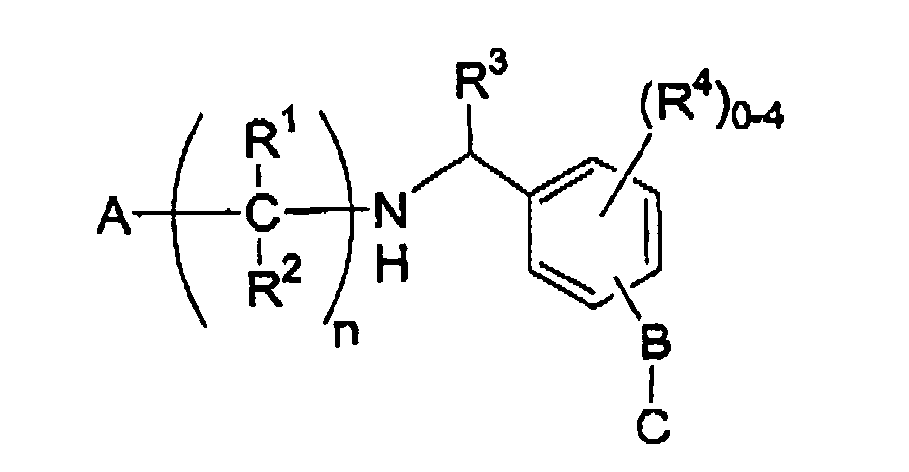
die Gruppe -B-C an den Phenylring in der 3- oder 4-Position gebunden ist,
n 2, 3 oder 4 ist,
jedes R1 und R2 unabhängig ausgewählt ist aus der Gruppe, bestehend aus: Wasserstoff, -CO2H, Hydroxy, Halogen, C1-3-Alkyl und Phenyl, wobei das C1-3-Alkyl und Phenyl gegebenenfalls substituiert sind mit 1-3 Halogengruppen,
A ausgewählt ist aus der Gruppe, bestehend aus: 1H-Tetrazol-5-yl, PO2H2, PO3H2, -CO2H und PO(R5)OH, wobei R5 ausgewählt ist aus der Gruppe, bestehend aus: C1-4-Alkyl, Hydroxy-C1-4-alkyl, C(O)-C1-2-Alkoxy und Benzyl, wobei sowohl der Methyl- als auch der Phenylteil des Benzyls gegebenenfalls substituiert ist mit 1-3 Halogen- oder Hydroxygruppen,
R3 Wasserstoff oder Methyl ist,
jedes R4 unabhängig ausgewählt ist aus der Gruppe, bestehend aus: Halogen, Hydroxy, C1-3-Alkyl, C1-3-Alkoxy, C1-3-Alkylthio, Phenyl, Benzyloxy und Cyclopropyloxy, und
B-C ausgewählt ist aus der Gruppe, bestehend aus:(1) B ist C8-10-Alkyl und C ist nicht vorhanden.(2) B ist C4-11-Alkoxy und C ist nicht vorhanden.(3) B ist Phenyl, gegebenenfalls substituiert mit 1 - 3 Substituenten, unabhängig ausgewählt aus der Gruppe, bestehend aus: Halogen, C1-4-Alkyl und C1-4-Alkoxy, und C ist ausgewählt aus der Gruppe, bestehend aus: Wasserstoff, Phenyl, C1-8-Alkyl, C1-8-Alkoxy, -(C=O)-C1-6-Alkyl und -CHOH-C1-6-Alkyl, wobei das C1-8-Alkyl, C1-8-Alkoxy, -(C=O)-C1-6-Alkyl und -CHOH-C1-6-Alkyl gegebenenfalls mit Phenyl substituiert sind,(4) B ist -CHOH-C6-10-Alkyl, C6-10-Alkylthio, -CH2-C5-9-Alkoxy, -(C=O)-C6-10-Alkyl oder -(C=O)-O-C5-9-Alkyl und C ist nicht vorhanden.(5) B ist C1-6-Alkyl oder C1-5-Alkoxy und C ist Phenyl.(6) B-C ist

- Eine Verbindung gemäß Anspruch 1, wobei A -PO3H2 bedeutet.
- Eine Verbindung gemäß Anspruch 1, wobei A CO2H bedeutet.
- Eine Verbindung, ausgewählt aus der Gruppe, bestehend aus:


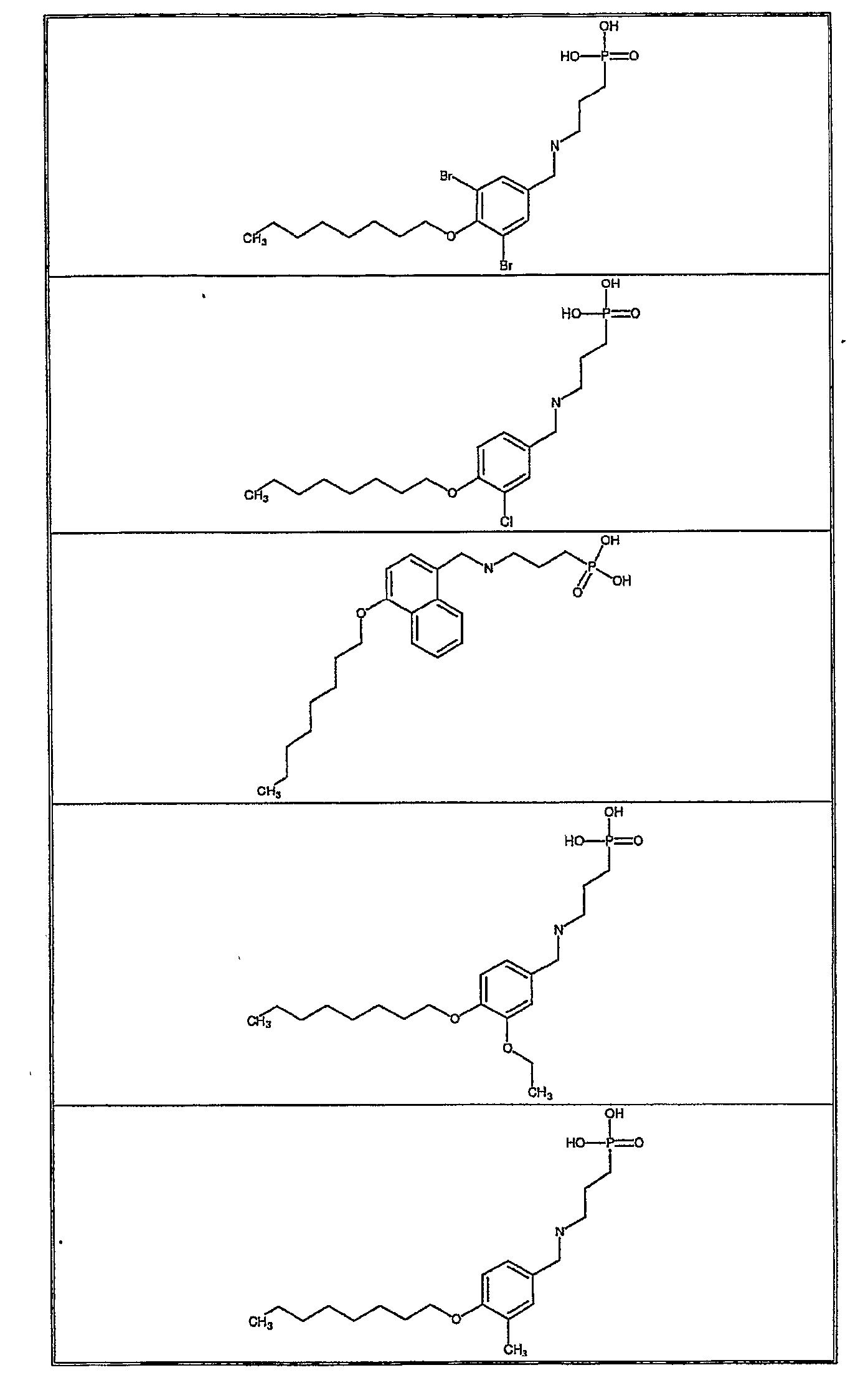


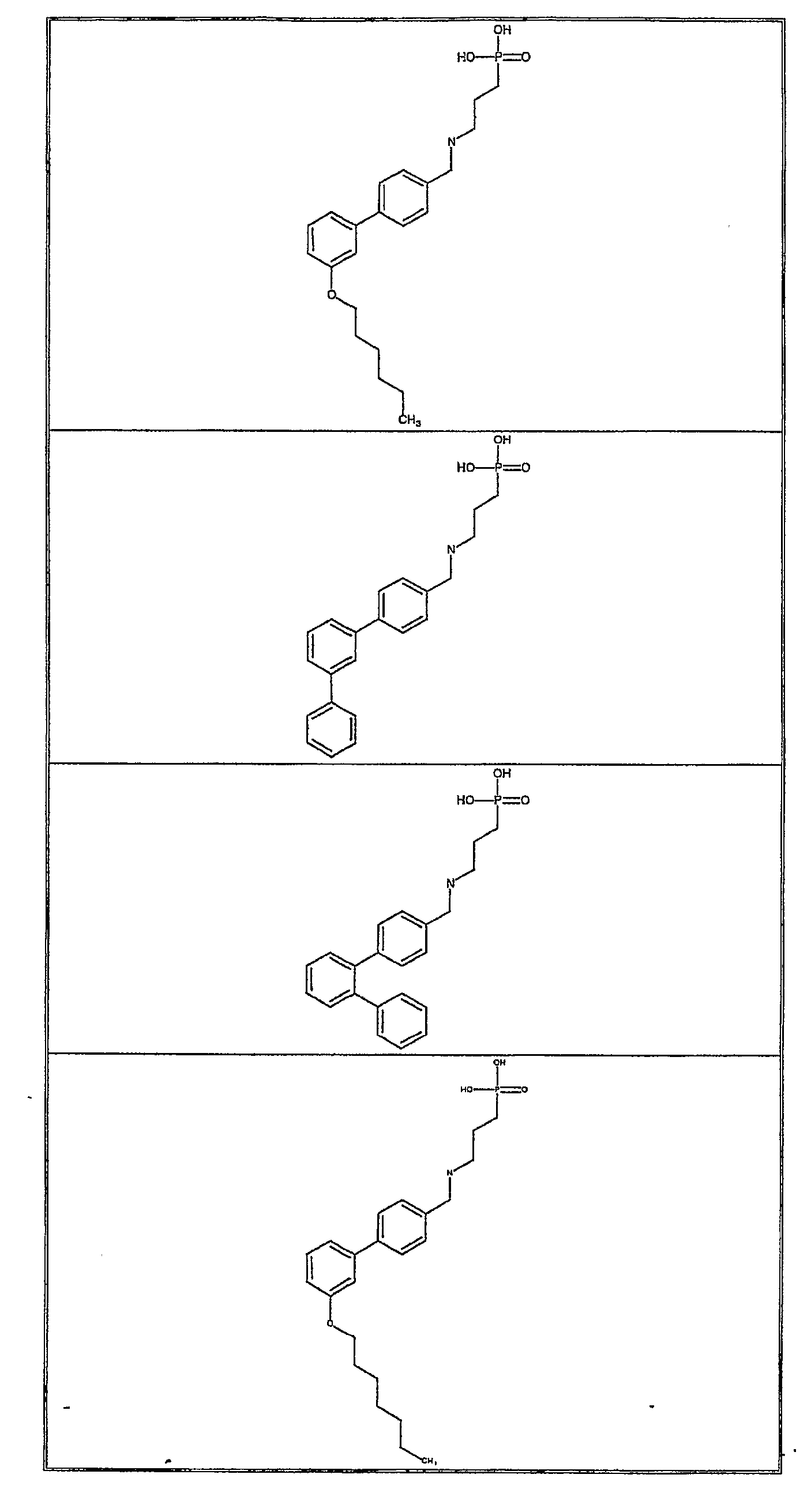


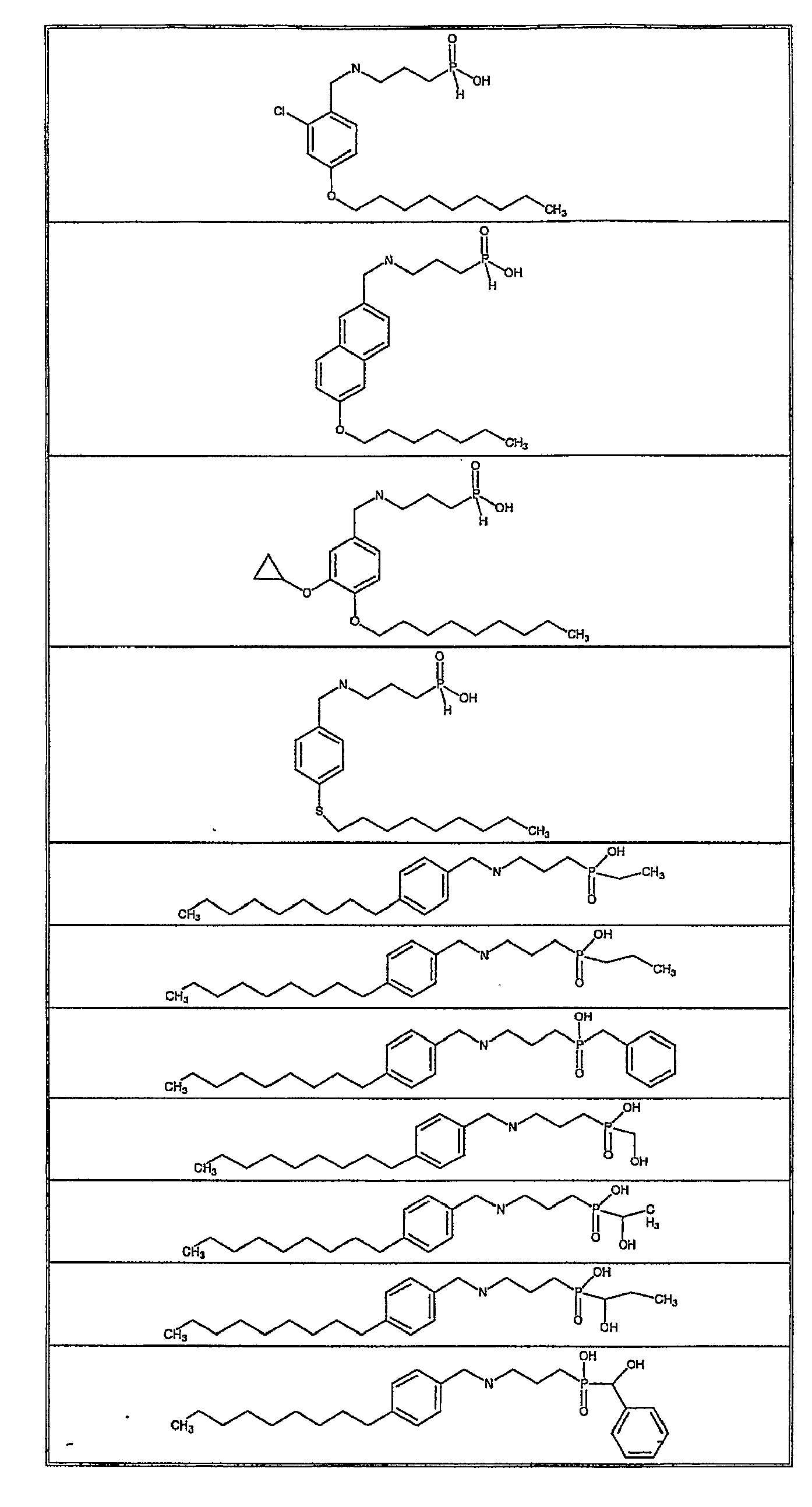


- Verwendung einer Verbindung gemäß einem der Ansprüche 1 - 4 zur Herstellung eines Medikaments zur Unterdrückung des Immunsystems in einem Patienten, der ein Säuger ist.
- Eine Verbindung gemäß einem der Ansprüche 1 - 4 zur Verwendung als ein Immunsuppressivum.
- Eine Verbindung gemäß einem der Ansprüche 1 - 4 zur Verwendung bei der Behandlung eines Zustandes, ausgewählt aus:Abstoßung von transplantiertem Knochenmark, Organ oder Gewebe,Multiple Sklerose,Gelenkrheumatismus,systemischer Lupus erythematodes,Psoriasis,entzündliche Darmerkrankung undakute und chronische lymphozytische Leukämien und Lymphome.
- Eine pharmazeutische Zusammensetzung, die eine Verbindung gemäß einem der Ansprüche 1 - 4 in Kombination mit einem pharmazeutischen Träger beinhaltet.
Applications Claiming Priority (3)
| Application Number | Priority Date | Filing Date | Title |
|---|---|---|---|
| US34999502P | 2002-01-18 | 2002-01-18 | |
| US349995P | 2002-01-18 | ||
| PCT/US2003/001059 WO2003062248A2 (en) | 2002-01-18 | 2003-01-14 | N-(benzyl)aminoalkylcarboxylates, phosphinates, phosphonates and tetrazoles as edg receptor agonists |
Publications (3)
| Publication Number | Publication Date |
|---|---|
| EP1575964A2 EP1575964A2 (de) | 2005-09-21 |
| EP1575964A4 EP1575964A4 (de) | 2007-04-04 |
| EP1575964B1 true EP1575964B1 (de) | 2009-11-11 |
Family
ID=27613352
Family Applications (1)
| Application Number | Title | Priority Date | Filing Date |
|---|---|---|---|
| EP03702110A Expired - Lifetime EP1575964B1 (de) | 2002-01-18 | 2003-01-14 | "n-(benzyl)aminoalkyl carboxylate, phosphinate, phosphonate und tetrazole als edg rezeptoragonisten" |
Country Status (8)
| Country | Link |
|---|---|
| US (1) | US7351725B2 (de) |
| EP (1) | EP1575964B1 (de) |
| JP (1) | JP4709488B2 (de) |
| AT (1) | ATE448193T1 (de) |
| AU (1) | AU2003202994B2 (de) |
| CA (1) | CA2472713C (de) |
| DE (1) | DE60330047D1 (de) |
| WO (1) | WO2003062248A2 (de) |
Families Citing this family (93)
| Publication number | Priority date | Publication date | Assignee | Title |
|---|---|---|---|---|
| JP4430941B2 (ja) * | 2002-01-18 | 2010-03-10 | メルク エンド カムパニー インコーポレーテッド | Edg受容体作動薬 |
| JP4571497B2 (ja) | 2002-09-19 | 2010-10-27 | 杏林製薬株式会社 | アミノアルコール誘導体とその付加塩及び免疫抑制剤 |
| DE60335827D1 (de) * | 2002-12-20 | 2011-03-03 | Merck Sharp & Dohme | 1-(amino)indane als edg-rezeptoragonisten |
| BRPI0407658A (pt) | 2003-02-18 | 2006-02-21 | Kyorin Seiyaku Kk | derivados de ácido aminofosfÈnico, seus sais e hidratos que atuam como moduladores de receptor de s1p e agente farmacêutico |
| PE20130200A1 (es) | 2003-04-08 | 2013-03-09 | Novartis Ag | Composicion farmaceutica que contiene un agonista del receptor s1p y un alcohol de azucar |
| KR20110140139A (ko) | 2003-08-29 | 2011-12-30 | 오노 야꾸힝 고교 가부시키가이샤 | S1p 수용체 결합능을 갖는 화합물 및 그 의약 용도 |
| US7825109B2 (en) | 2003-08-29 | 2010-11-02 | Ono Pharmaceutical Co., Ltd. | Compound capable of binding S1P receptor and pharmaceutical use thereof |
| RU2390519C2 (ru) * | 2003-08-29 | 2010-05-27 | Оно Фармасьютикал Ко., Лтд. | Соединение, способное к связыванию с рецептором s1p, и его фармацевтическое применение |
| GB0320638D0 (en) | 2003-09-03 | 2003-10-01 | Novartis Ag | Organic compounds |
| MXPA06004005A (es) * | 2003-10-08 | 2006-06-28 | Vertex Pharma | Moduladores de transportadores con casete de union con atp. |
| US8053159B2 (en) | 2003-11-18 | 2011-11-08 | Honeywell International Inc. | Antireflective coatings for via fill and photolithography applications and methods of preparation thereof |
| EP1697333A4 (de) * | 2003-12-17 | 2009-07-08 | Merck & Co Inc | (3,4-disubstituierte)propansäurecarboxylate als agonisten des s1p (edg) rezeptors |
| GB0500020D0 (en) | 2005-01-04 | 2005-02-09 | Novartis Ag | Organic compounds |
| AU2005237254B2 (en) | 2004-05-03 | 2010-02-04 | Novartis Ag | Combinations comprising a S1P receptor agonist and a JAK3 kinase inhibitor |
| JP5315611B2 (ja) * | 2004-06-23 | 2013-10-16 | 小野薬品工業株式会社 | S1p受容体結合能を有する化合物およびその用途 |
| CA2572770A1 (en) | 2004-07-08 | 2006-01-19 | Novo-Nordisk A/S | Polypeptide protracting tags comprising a tetrazole moiety |
| US7781617B2 (en) | 2004-07-16 | 2010-08-24 | Kyorin Pharmaceutical Co., Ltd | Effective use method of medicaments and method of preventing expression of side effect |
| WO2006010379A1 (en) | 2004-07-29 | 2006-02-02 | Actelion Pharmaceuticals Ltd. | Novel thiophene derivatives as immunosuppressive agents |
| PL1773307T3 (pl) * | 2004-07-30 | 2015-03-31 | Novartis Ag | Preparaty 2-amino-1,3-propanodioli i ich analogów |
| EP1806338B1 (de) * | 2004-10-12 | 2016-01-20 | Kyorin Pharmaceutical Co., Ltd. | Verfahren zur herstellung von 2-amino-2-[2-[4-(3-benzyloxyphenylthio)-2-chlorphenyl[ethyl]-1,3-propandiolhydrochlorid und hydraten davon, und zwischenprodukte in deren herstellung |
| PL1650186T3 (pl) * | 2004-10-22 | 2008-11-28 | Bioprojet Soc Civ | Nowe pochodne kwasów dikarboksylowych |
| KR20070085465A (ko) | 2004-11-29 | 2007-08-27 | 노파르티스 아게 | S1p 수용체 효능제의 투여 용법 |
| BRPI0519012A2 (pt) * | 2004-12-13 | 2008-12-23 | Ono Pharmaceutical Co | derivado do Ácido aminocarboxÍlico e seu uso medicinal |
| GB0504544D0 (en) | 2005-03-04 | 2005-04-13 | Novartis Ag | Organic compounds |
| KR20080002850A (ko) | 2005-03-23 | 2008-01-04 | 액테리온 파마슈티칼 리미티드 | 신규한 티오펜 유도체 |
| CA2602474C (en) | 2005-03-23 | 2014-06-10 | Actelion Pharmaceuticals Ltd | Hydrogenated benzo (c) thiophene derivatives as immunomodulators |
| US7605269B2 (en) | 2005-03-23 | 2009-10-20 | Actelion Pharmaceuticals Ltd. | Thiophene derivatives as Sphingosine-1-phosphate-1 receptor agonists |
| PL1868980T3 (pl) * | 2005-04-08 | 2011-01-31 | Galderma Res & Dev | Nowy sposób wytwarzania kwasu 6-[3-(1-adamantylo)-4-metoksyfenylo]-2-naftoesowego |
| US7951794B2 (en) | 2005-06-24 | 2011-05-31 | Actelion Pharmaceuticals Ltd. | Thiophene derivatives |
| PL1932522T3 (pl) * | 2005-10-07 | 2012-09-28 | Kyorin Seiyaku Kk | Środek terapeutyczny do leczenia choroby wątroby zawierający jako składnik czynny pochodną 2-amino-1,3-propanodiolu |
| AR057894A1 (es) | 2005-11-23 | 2007-12-26 | Actelion Pharmaceuticals Ltd | Derivados de tiofeno |
| TWI404706B (zh) * | 2006-01-11 | 2013-08-11 | Actelion Pharmaceuticals Ltd | 新穎噻吩衍生物 |
| AU2007209051A1 (en) | 2006-01-24 | 2007-08-02 | Actelion Pharmaceuticals Ltd | Novel pyridine derivatives |
| TWI389683B (zh) * | 2006-02-06 | 2013-03-21 | Kyorin Seiyaku Kk | A therapeutic agent for an inflammatory bowel disease or an inflammatory bowel disease treatment using a 2-amino-1,3-propanediol derivative as an active ingredient |
| EP2007789B1 (de) | 2006-04-11 | 2015-05-20 | Novartis AG | Spirozyklische HCV/HIV-Hemmer und ihre Verwendung |
| GB0612721D0 (en) | 2006-06-27 | 2006-08-09 | Novartis Ag | Organic compounds |
| CA2659598A1 (en) | 2006-08-08 | 2008-02-14 | Kyorin Pharmaceutical Co., Ltd. | Amino phosphate derivative and s1p receptor modulator having same as an active ingredient |
| JP5140593B2 (ja) | 2006-08-08 | 2013-02-06 | 杏林製薬株式会社 | アミノアルコール誘導体及びそれらを有効成分とする免疫抑制剤 |
| JP2009269819A (ja) * | 2006-08-25 | 2009-11-19 | Asahi Kasei Pharma Kk | アミン化合物 |
| AR061841A1 (es) | 2006-09-07 | 2008-09-24 | Actelion Pharmaceuticals Ltd | Derivados de tiofen-oxadiazoles, agonistas del receptor s1p1/edg1, composiciones farmaceuticas que los contienen y usos como agentes inmunomoduladores. |
| PT2069336E (pt) | 2006-09-07 | 2013-03-07 | Actelion Pharmaceuticals Ltd | Derivados de piridin-4-ilo como agentes imunomoduladores |
| PL2069335T3 (pl) | 2006-09-08 | 2013-05-31 | Actelion Pharmaceuticals Ltd | Pochodne pirydyn-3-ylu jako środki immunomodulujące |
| ES2393412T3 (es) | 2006-09-21 | 2012-12-21 | Actelion Pharmaceuticals Ltd. | Derivados de fenilo y su uso como inmunomoduladores |
| US8642246B2 (en) | 2007-02-26 | 2014-02-04 | Honeywell International Inc. | Compositions, coatings and films for tri-layer patterning applications and methods of preparation thereof |
| BRPI0808789A2 (pt) | 2007-03-16 | 2014-08-12 | Actelion Pharmaceuticals Ltd | Compostos e composição farmacêutica de derivados aminopiridina e uso destes |
| PT2195311E (pt) | 2007-08-17 | 2011-05-25 | Actelion Pharmaceuticals Ltd | Derivados de piridina como moduladores do receptor s1p1/edg1 |
| EP3733161A1 (de) | 2007-10-12 | 2020-11-04 | Novartis AG | Zusammensetzung mit sphingosin-1-phosphat (s1p)-rezeptormodulatoren |
| KR20100092473A (ko) | 2007-11-01 | 2010-08-20 | 액테리온 파마슈티칼 리미티드 | 신규한 피리미딘 유도체 |
| MX2010005889A (es) | 2007-12-10 | 2010-06-22 | Actelion Pharmaceuticals Ltd | Derivados de tiofeno como agonistas de s1p1/edg1. |
| AU2008340113B2 (en) * | 2007-12-21 | 2014-01-09 | Merck Serono S.A. | Triazole oxadiazoles derivatives |
| TW200946105A (en) * | 2008-02-07 | 2009-11-16 | Kyorin Seiyaku Kk | Therapeutic agent or preventive agent for inflammatory bowel disease containing amino alcohol derivative as active ingredient |
| CA2715317A1 (en) | 2008-03-07 | 2009-09-11 | Actelion Pharmaceuticals Ltd | Novel aminomethyl benzene derivatives |
| ES2405054T3 (es) | 2009-01-23 | 2013-05-30 | Bristol-Myers Squibb Company | Derivados de pirazol-1,2,4-oxadiazol como agonistas de esfingosina-1-fosfato |
| WO2010085582A1 (en) | 2009-01-23 | 2010-07-29 | Bristol-Myers Squibb Company | Substituted oxadiazole derivatives as s1p agonists in the treatment of autoimmune and inflammatory diseases |
| JP2012515787A (ja) | 2009-01-23 | 2012-07-12 | ブリストル−マイヤーズ スクイブ カンパニー | 自己免疫疾患および炎症性疾患の処置におけるs1pアゴニストとしての置換オキサジアゾール誘導体 |
| EP2241558A1 (de) * | 2009-04-03 | 2010-10-20 | Merck Serono SA | Oxadiazolderivate |
| US20110182850A1 (en) | 2009-04-10 | 2011-07-28 | Trixi Brandl | Organic compounds and their uses |
| US8512690B2 (en) | 2009-04-10 | 2013-08-20 | Novartis Ag | Derivatised proline containing peptide compounds as protease inhibitors |
| US8557877B2 (en) | 2009-06-10 | 2013-10-15 | Honeywell International Inc. | Anti-reflective coatings for optically transparent substrates |
| CA2767585C (en) | 2009-07-16 | 2017-09-26 | Actelion Pharmaceuticals Ltd | Pyridin-4-yl derivatives |
| UA107360C2 (en) | 2009-08-05 | 2014-12-25 | Biogen Idec Inc | Bicyclic aryl sphingosine 1-phosphate analogs |
| US8399451B2 (en) | 2009-08-07 | 2013-03-19 | Bristol-Myers Squibb Company | Heterocyclic compounds |
| US9216972B2 (en) | 2009-10-29 | 2015-12-22 | Bristol-Myers Squibb Company | Tricyclic heterocyclic compounds |
| US8741875B2 (en) | 2009-11-24 | 2014-06-03 | Allergan, Inc. | Compounds as receptor modulators with therapeutic utility |
| MX2012006028A (es) | 2009-11-24 | 2012-06-19 | Allergan Inc | Compuestos novedosos como moduladores de receptor con utilidad terapeutica. |
| ES2548683T3 (es) | 2010-04-23 | 2015-10-20 | Bristol-Myers Squibb Company | Amidas del ácido 4-(5-isoxazolil o 5-pirrazolil-1,2,4-oxadiazol-3-il)-mandélico como agonistas de receptor de esfingosina-1-fosfato 1 |
| US8513220B2 (en) | 2010-05-14 | 2013-08-20 | Allergan, Inc. | Aromatic compounds having sphingosine-1-phosphonate (S1P) receptor activity |
| US8822510B2 (en) | 2010-07-20 | 2014-09-02 | Bristol-Myers Squibb Company | Substituted 3-phenyl-1,2,4-Oxadiazole compounds |
| EP2619190B1 (de) | 2010-09-24 | 2015-08-12 | Bristol-Myers Squibb Company | Substituierte oxadiazolverbindungen und ihre verwendung als s1p1-agonisten |
| JP5909495B2 (ja) | 2010-10-08 | 2016-04-26 | ノバルティス アーゲー | スルファミドns3阻害剤のビタミンe製剤 |
| EP2635573B1 (de) | 2010-11-03 | 2014-10-01 | Bristol-Myers Squibb Company | Heterocyclische verbindungen als s1p1-agonisten zur behandlung von autoimmun- und gefässerkrankungen |
| RU2013128328A (ru) | 2010-11-23 | 2014-12-27 | Аллерган, Инк. | Новые фосфоновые кислоты как модуляторы рецептора s1p |
| MA34910B1 (fr) | 2011-01-19 | 2014-02-01 | Actelion Pharmaceuticals Ltd | Dérivés de 2-methoxy-pyridin-4-yl |
| EA034451B1 (ru) | 2011-02-07 | 2020-02-10 | Байоджен Ма Инк. | Модуляторы s1p |
| US8507686B2 (en) | 2011-04-14 | 2013-08-13 | Allergan, Inc. | Substituted bicyclic methyl azetidines as sphingosine-1 phosphate receptors modulators |
| RU2013150173A (ru) * | 2011-04-14 | 2015-05-20 | Аллерган, Инк. | Метиламинные производные бициклического фенила как модуляторы рецепторов сфингозин-1-фосфата |
| EP2697195A1 (de) | 2011-04-14 | 2014-02-19 | Allergan, Inc. | Bicyclische phenylmethylazetidinderivate als sphingosin-1-phosphatrezeptormodulatoren |
| JP2014518554A (ja) | 2011-04-18 | 2014-07-31 | アラーガン インコーポレイテッド | スフィンゴシン−1リン酸受容体調節剤としての置換二環式メチルアミン誘導体 |
| US8864898B2 (en) | 2011-05-31 | 2014-10-21 | Honeywell International Inc. | Coating formulations for optical elements |
| US20140171393A1 (en) * | 2012-12-13 | 2014-06-19 | Allergan, Inc. | Novel aromatic thio compounds as receptor modulators |
| CA2899322A1 (en) * | 2013-01-29 | 2014-08-07 | Biogen Ma Inc. | S1p modulating agents |
| WO2014130550A1 (en) * | 2013-02-20 | 2014-08-28 | Allergan, Inc. | Substituted diaryl derivatives as sphingosine receptor modulators |
| US9115054B2 (en) | 2013-02-21 | 2015-08-25 | Bristol-Myers Squibb Company | Tetrahydronaphthalenyl compounds useful as sipi agonists |
| WO2015163936A1 (en) * | 2014-04-24 | 2015-10-29 | Allergan, Inc. | Bicyclic derivatives as sphingosine-1 -phosphate receptors modulators |
| MA40082B1 (fr) | 2014-08-20 | 2019-09-30 | Bristol Myers Squibb Co | Nouveau compose de substitution sphingosine phosphate utile traitement maladie rhumatisme |
| CA2962922C (en) | 2014-09-29 | 2021-10-26 | The Scripps Research Institute | Sphingosine-1-phosphate receptor modulators for treatment of cardiopulmonary disorders |
| JP6803842B2 (ja) | 2015-04-13 | 2020-12-23 | ハネウェル・インターナショナル・インコーポレーテッドHoneywell International Inc. | オプトエレクトロニクス用途のためのポリシロキサン製剤及びコーティング |
| PH12017502097B1 (en) | 2015-05-20 | 2023-05-05 | Idorsia Pharmaceuticals Ltd | Crystalline form of the compound (s)-3-{4-[5-(2-cyclopentyl-6-methoxy-pyridin-4-yl)-[1,2,4]oxadiazol-3-yl]-2-ethyl-6-methyl-phenoxy}-propane-1,2-diol |
| EP3190103A1 (de) * | 2016-01-08 | 2017-07-12 | Rijksuniversiteit Groningen | Inhibitoren der pd-1/pd-l1-protein-/proteinwechselwirkung |
| KR102482825B1 (ko) | 2016-09-02 | 2022-12-29 | 브리스톨-마이어스 스큅 컴퍼니 | 치환된 트리시클릭 헤테로시클릭 화합물 |
| US11046646B2 (en) | 2017-08-09 | 2021-06-29 | Bristol-Myers Squibb Company | Alkylphenyl compounds |
| US11059784B2 (en) | 2017-08-09 | 2021-07-13 | Bristol-Myers Squibb Company | Oxime ether compounds |
| WO2019036024A1 (en) | 2017-08-17 | 2019-02-21 | Bristol-Myers Squibb Company | 2- (1,1'-BIPHENYL) -1H-BENZO [D] IMIDAZOLE DERIVATIVES AND RELATED COMPOUNDS AS AGONISTS OF APELIN AND APJ FOR THE TREATMENT OF CARDIOVASCULAR DISEASES |
Family Cites Families (6)
| Publication number | Priority date | Publication date | Assignee | Title |
|---|---|---|---|---|
| US4774251A (en) * | 1984-06-18 | 1988-09-27 | Eli Lilly And Company | Method of inhibiting aromatase |
| AU662404B2 (en) * | 1992-05-08 | 1995-08-31 | Novartis Ag | Novel N-aralkyl- and N-heteroaralkyl-aminoalkanephosphinic acids |
| GB9523946D0 (en) * | 1995-11-23 | 1996-01-24 | Bayer Ag | Leukotriene antagonistic benzoic acid derivatives |
| EP1315735A4 (de) * | 2000-08-31 | 2005-04-06 | Merck & Co Inc | Phosphat-derivate als immunoregulatorische verbindungen |
| ES2316613T3 (es) | 2001-05-10 | 2009-04-16 | Ono Pharmaceutical Co., Ltd. | Derivados de acido crboxilico y composiciones farmaceuticas que contienen los mismos como ingrediente activo. |
| WO2003061567A2 (en) * | 2002-01-18 | 2003-07-31 | Merck & Co., Inc. | Selective s1p1/edg1 receptor agonists |
-
2003
- 2003-01-14 AT AT03702110T patent/ATE448193T1/de not_active IP Right Cessation
- 2003-01-14 WO PCT/US2003/001059 patent/WO2003062248A2/en not_active Ceased
- 2003-01-14 EP EP03702110A patent/EP1575964B1/de not_active Expired - Lifetime
- 2003-01-14 DE DE60330047T patent/DE60330047D1/de not_active Expired - Lifetime
- 2003-01-14 JP JP2003562125A patent/JP4709488B2/ja not_active Expired - Fee Related
- 2003-01-14 AU AU2003202994A patent/AU2003202994B2/en not_active Ceased
- 2003-01-14 US US10/500,811 patent/US7351725B2/en not_active Expired - Fee Related
- 2003-01-14 CA CA2472713A patent/CA2472713C/en not_active Expired - Fee Related
Non-Patent Citations (1)
| Title |
|---|
| NICOLAUS B.J.R.: "Symbiotic approach to drug design", DECISION MAKING IN DRUG RESEARCH, 1983, pages 173 - 186, XP002197412 * |
Also Published As
| Publication number | Publication date |
|---|---|
| ATE448193T1 (de) | 2009-11-15 |
| JP2005527494A (ja) | 2005-09-15 |
| US7351725B2 (en) | 2008-04-01 |
| AU2003202994B2 (en) | 2007-11-22 |
| WO2003062248A3 (en) | 2006-03-02 |
| CA2472713A1 (en) | 2003-07-31 |
| WO2003062248A2 (en) | 2003-07-31 |
| CA2472713C (en) | 2011-07-19 |
| JP4709488B2 (ja) | 2011-06-22 |
| EP1575964A4 (de) | 2007-04-04 |
| EP1575964A2 (de) | 2005-09-21 |
| DE60330047D1 (en) | 2009-12-24 |
| US20050020837A1 (en) | 2005-01-27 |
Similar Documents
| Publication | Publication Date | Title |
|---|---|---|
| EP1575964B1 (de) | "n-(benzyl)aminoalkyl carboxylate, phosphinate, phosphonate und tetrazole als edg rezeptoragonisten" | |
| AU2003216054B2 (en) | Selective S1P1/Edg1 receptor agonists | |
| EP1470137B1 (de) | Edg-rezeptoragonisten | |
| US7309721B2 (en) | Aminoalkylphosphonates and related compounds as Edg receptor agonists | |
| US20040058894A1 (en) | Selective S1P1/Edg1 receptor agonists | |
| EP1581509B1 (de) | 1-(amino)indane als edg-rezeptoragonisten | |
| AU2003202994A1 (en) | N-(benzyl)aminoalkylcarboxylates, phosphinates, phosphonates and tetrazoles as Edg receptor agonists | |
| US20070224263A1 (en) | Aminoalkylphosphonates and related compounds as Edg receptor agonists | |
| AU2003216054A1 (en) | Selective S1P1/Edg1 receptor agonists | |
| AU2003207567A1 (en) | Edg receptor agonists | |
| AU2003276043A1 (en) | 1-((5-aryl-1,2,4-oxadiazol-3-yl)benzyl)azetidine-3-carboxylates and 1-((5-aryl-1,2,4-oxadiazol-3-yl)benzyl)pyrrolidine-3-carboxylates as edg receptor agonists | |
| CA2539438A1 (en) | 3,5-aryl, heteroaryl or cycloalkyl substituted-1,2,4-oxadiazoles as s1p receptor agonists |
Legal Events
| Date | Code | Title | Description |
|---|---|---|---|
| PUAI | Public reference made under article 153(3) epc to a published international application that has entered the european phase |
Free format text: ORIGINAL CODE: 0009012 |
|
| AK | Designated contracting states |
Kind code of ref document: A2 Designated state(s): AT BE BG CH CY CZ DE DK EE ES FI FR GB GR HU IE IT LI LU MC NL PT SE SI SK TR |
|
| AX | Request for extension of the european patent |
Extension state: AL LT LV MK RO |
|
| PUAK | Availability of information related to the publication of the international search report |
Free format text: ORIGINAL CODE: 0009015 |
|
| RIC1 | Information provided on ipc code assigned before grant |
Ipc: A61K 31/44 20060101ALI20060313BHEP Ipc: A61K 31/17 20060101ALI20060313BHEP Ipc: A61K 31/165 20060101ALI20060313BHEP Ipc: A61K 31/16 20060101AFI20060313BHEP Ipc: A61K 31/18 20060101ALI20060313BHEP Ipc: A61K 31/495 20060101ALI20060313BHEP |
|
| 17P | Request for examination filed |
Effective date: 20060904 |
|
| RBV | Designated contracting states (corrected) |
Designated state(s): AT BE BG CH CY CZ DE DK EE ES FI FR GB GR HU IE IT LI LU MC NL PT SE SI SK TR |
|
| A4 | Supplementary search report drawn up and despatched |
Effective date: 20070305 |
|
| DAX | Request for extension of the european patent (deleted) | ||
| 17Q | First examination report despatched |
Effective date: 20071011 |
|
| GRAP | Despatch of communication of intention to grant a patent |
Free format text: ORIGINAL CODE: EPIDOSNIGR1 |
|
| GRAC | Information related to communication of intention to grant a patent modified |
Free format text: ORIGINAL CODE: EPIDOSCIGR1 |
|
| RIC1 | Information provided on ipc code assigned before grant |
Ipc: A61K 31/16 20060101ALI20090421BHEP Ipc: A61K 31/165 20060101ALI20090421BHEP Ipc: C07C 229/14 20060101AFI20090421BHEP Ipc: C07F 9/6558 20060101ALI20090421BHEP Ipc: C07C 229/22 20060101ALI20090421BHEP Ipc: C07F 9/59 20060101ALI20090421BHEP Ipc: A61K 31/495 20060101ALI20090421BHEP Ipc: A61P 37/06 20060101ALI20090421BHEP Ipc: C07F 9/48 20060101ALI20090421BHEP Ipc: C07F 9/6553 20060101ALI20090421BHEP Ipc: C07D 413/04 20060101ALI20090421BHEP Ipc: A61K 31/18 20060101ALI20090421BHEP Ipc: A61K 31/17 20060101ALI20090421BHEP Ipc: C07F 9/38 20060101ALI20090421BHEP Ipc: C07D 333/16 20060101ALI20090421BHEP Ipc: C07C 229/20 20060101ALI20090421BHEP Ipc: A61K 31/44 20060101ALI20090421BHEP Ipc: C07F 9/30 20060101ALI20090421BHEP |
|
| GRAS | Grant fee paid |
Free format text: ORIGINAL CODE: EPIDOSNIGR3 |
|
| GRAA | (expected) grant |
Free format text: ORIGINAL CODE: 0009210 |
|
| AK | Designated contracting states |
Kind code of ref document: B1 Designated state(s): AT BE BG CH CY CZ DE DK EE ES FI FR GB GR HU IE IT LI LU MC NL PT SE SI SK TR |
|
| REG | Reference to a national code |
Ref country code: GB Ref legal event code: FG4D |
|
| REG | Reference to a national code |
Ref country code: CH Ref legal event code: EP |
|
| REG | Reference to a national code |
Ref country code: IE Ref legal event code: FG4D |
|
| REG | Reference to a national code |
Ref country code: CH Ref legal event code: NV Representative=s name: SERVOPATENT GMBH |
|
| REF | Corresponds to: |
Ref document number: 60330047 Country of ref document: DE Date of ref document: 20091224 Kind code of ref document: P |
|
| RAP2 | Party data changed (patent owner data changed or rights of a patent transferred) |
Owner name: MERCK SHARP & DOHME CORP. |
|
| NLV1 | Nl: lapsed or annulled due to failure to fulfill the requirements of art. 29p and 29m of the patents act | ||
| PG25 | Lapsed in a contracting state [announced via postgrant information from national office to epo] |
Ref country code: SE Free format text: LAPSE BECAUSE OF FAILURE TO SUBMIT A TRANSLATION OF THE DESCRIPTION OR TO PAY THE FEE WITHIN THE PRESCRIBED TIME-LIMIT Effective date: 20091111 Ref country code: PT Free format text: LAPSE BECAUSE OF FAILURE TO SUBMIT A TRANSLATION OF THE DESCRIPTION OR TO PAY THE FEE WITHIN THE PRESCRIBED TIME-LIMIT Effective date: 20100311 Ref country code: FI Free format text: LAPSE BECAUSE OF FAILURE TO SUBMIT A TRANSLATION OF THE DESCRIPTION OR TO PAY THE FEE WITHIN THE PRESCRIBED TIME-LIMIT Effective date: 20091111 Ref country code: ES Free format text: LAPSE BECAUSE OF FAILURE TO SUBMIT A TRANSLATION OF THE DESCRIPTION OR TO PAY THE FEE WITHIN THE PRESCRIBED TIME-LIMIT Effective date: 20100222 |
|
| REG | Reference to a national code |
Ref country code: FR Ref legal event code: CD |
|
| PG25 | Lapsed in a contracting state [announced via postgrant information from national office to epo] |
Ref country code: CY Free format text: LAPSE BECAUSE OF FAILURE TO SUBMIT A TRANSLATION OF THE DESCRIPTION OR TO PAY THE FEE WITHIN THE PRESCRIBED TIME-LIMIT Effective date: 20091111 Ref country code: SI Free format text: LAPSE BECAUSE OF FAILURE TO SUBMIT A TRANSLATION OF THE DESCRIPTION OR TO PAY THE FEE WITHIN THE PRESCRIBED TIME-LIMIT Effective date: 20091111 |
|
| PG25 | Lapsed in a contracting state [announced via postgrant information from national office to epo] |
Ref country code: BE Free format text: LAPSE BECAUSE OF FAILURE TO SUBMIT A TRANSLATION OF THE DESCRIPTION OR TO PAY THE FEE WITHIN THE PRESCRIBED TIME-LIMIT Effective date: 20091111 Ref country code: AT Free format text: LAPSE BECAUSE OF FAILURE TO SUBMIT A TRANSLATION OF THE DESCRIPTION OR TO PAY THE FEE WITHIN THE PRESCRIBED TIME-LIMIT Effective date: 20091111 |
|
| PG25 | Lapsed in a contracting state [announced via postgrant information from national office to epo] |
Ref country code: DK Free format text: LAPSE BECAUSE OF FAILURE TO SUBMIT A TRANSLATION OF THE DESCRIPTION OR TO PAY THE FEE WITHIN THE PRESCRIBED TIME-LIMIT Effective date: 20091111 Ref country code: EE Free format text: LAPSE BECAUSE OF FAILURE TO SUBMIT A TRANSLATION OF THE DESCRIPTION OR TO PAY THE FEE WITHIN THE PRESCRIBED TIME-LIMIT Effective date: 20091111 Ref country code: BG Free format text: LAPSE BECAUSE OF FAILURE TO SUBMIT A TRANSLATION OF THE DESCRIPTION OR TO PAY THE FEE WITHIN THE PRESCRIBED TIME-LIMIT Effective date: 20100211 |
|
| PG25 | Lapsed in a contracting state [announced via postgrant information from national office to epo] |
Ref country code: SK Free format text: LAPSE BECAUSE OF FAILURE TO SUBMIT A TRANSLATION OF THE DESCRIPTION OR TO PAY THE FEE WITHIN THE PRESCRIBED TIME-LIMIT Effective date: 20091111 Ref country code: MC Free format text: LAPSE BECAUSE OF NON-PAYMENT OF DUE FEES Effective date: 20100131 Ref country code: CZ Free format text: LAPSE BECAUSE OF FAILURE TO SUBMIT A TRANSLATION OF THE DESCRIPTION OR TO PAY THE FEE WITHIN THE PRESCRIBED TIME-LIMIT Effective date: 20091111 |
|
| REG | Reference to a national code |
Ref country code: CH Ref legal event code: PFA Owner name: MERCK SHARP & DOHME CORP. Free format text: MERCK & CO., INC.#126 EAST LINCOLN AVENUE#RAHWAY, NEW JERSEY 07065-0907 (US) -TRANSFER TO- MERCK SHARP & DOHME CORP.#126 EAST LINCOLN AVENUE#RAHWAY, NJ 07065 (US) |
|
| PLBE | No opposition filed within time limit |
Free format text: ORIGINAL CODE: 0009261 |
|
| STAA | Information on the status of an ep patent application or granted ep patent |
Free format text: STATUS: NO OPPOSITION FILED WITHIN TIME LIMIT |
|
| 26N | No opposition filed |
Effective date: 20100812 |
|
| PG25 | Lapsed in a contracting state [announced via postgrant information from national office to epo] |
Ref country code: GR Free format text: LAPSE BECAUSE OF FAILURE TO SUBMIT A TRANSLATION OF THE DESCRIPTION OR TO PAY THE FEE WITHIN THE PRESCRIBED TIME-LIMIT Effective date: 20100212 |
|
| PG25 | Lapsed in a contracting state [announced via postgrant information from national office to epo] |
Ref country code: IE Free format text: LAPSE BECAUSE OF NON-PAYMENT OF DUE FEES Effective date: 20100114 |
|
| PGFP | Annual fee paid to national office [announced via postgrant information from national office to epo] |
Ref country code: FR Payment date: 20101221 Year of fee payment: 9 |
|
| PG25 | Lapsed in a contracting state [announced via postgrant information from national office to epo] |
Ref country code: IT Free format text: LAPSE BECAUSE OF FAILURE TO SUBMIT A TRANSLATION OF THE DESCRIPTION OR TO PAY THE FEE WITHIN THE PRESCRIBED TIME-LIMIT Effective date: 20091111 |
|
| PGFP | Annual fee paid to national office [announced via postgrant information from national office to epo] |
Ref country code: GB Payment date: 20101215 Year of fee payment: 9 |
|
| PGFP | Annual fee paid to national office [announced via postgrant information from national office to epo] |
Ref country code: CH Payment date: 20110103 Year of fee payment: 9 Ref country code: DE Payment date: 20110131 Year of fee payment: 9 |
|
| REG | Reference to a national code |
Ref country code: CH Ref legal event code: PL |
|
| GBPC | Gb: european patent ceased through non-payment of renewal fee |
Effective date: 20120114 |
|
| PG25 | Lapsed in a contracting state [announced via postgrant information from national office to epo] |
Ref country code: HU Free format text: LAPSE BECAUSE OF FAILURE TO SUBMIT A TRANSLATION OF THE DESCRIPTION OR TO PAY THE FEE WITHIN THE PRESCRIBED TIME-LIMIT Effective date: 20100512 Ref country code: LU Free format text: LAPSE BECAUSE OF NON-PAYMENT OF DUE FEES Effective date: 20100114 Ref country code: NL Free format text: LAPSE BECAUSE OF FAILURE TO SUBMIT A TRANSLATION OF THE DESCRIPTION OR TO PAY THE FEE WITHIN THE PRESCRIBED TIME-LIMIT Effective date: 20091111 |
|
| REG | Reference to a national code |
Ref country code: FR Ref legal event code: ST Effective date: 20120928 |
|
| PG25 | Lapsed in a contracting state [announced via postgrant information from national office to epo] |
Ref country code: TR Free format text: LAPSE BECAUSE OF FAILURE TO SUBMIT A TRANSLATION OF THE DESCRIPTION OR TO PAY THE FEE WITHIN THE PRESCRIBED TIME-LIMIT Effective date: 20091111 Ref country code: DE Free format text: LAPSE BECAUSE OF NON-PAYMENT OF DUE FEES Effective date: 20120801 Ref country code: LI Free format text: LAPSE BECAUSE OF NON-PAYMENT OF DUE FEES Effective date: 20120131 Ref country code: CH Free format text: LAPSE BECAUSE OF NON-PAYMENT OF DUE FEES Effective date: 20120131 Ref country code: GB Free format text: LAPSE BECAUSE OF NON-PAYMENT OF DUE FEES Effective date: 20120114 |
|
| REG | Reference to a national code |
Ref country code: DE Ref legal event code: R119 Ref document number: 60330047 Country of ref document: DE Effective date: 20120801 |
|
| PG25 | Lapsed in a contracting state [announced via postgrant information from national office to epo] |
Ref country code: FR Free format text: LAPSE BECAUSE OF NON-PAYMENT OF DUE FEES Effective date: 20120131 |