EP1574809A1 - Multispektrales Tarnmittel - Google Patents
Multispektrales Tarnmittel Download PDFInfo
- Publication number
- EP1574809A1 EP1574809A1 EP05004782A EP05004782A EP1574809A1 EP 1574809 A1 EP1574809 A1 EP 1574809A1 EP 05004782 A EP05004782 A EP 05004782A EP 05004782 A EP05004782 A EP 05004782A EP 1574809 A1 EP1574809 A1 EP 1574809A1
- Authority
- EP
- European Patent Office
- Prior art keywords
- camouflage
- layer
- multispectral
- multispectral camouflage
- carrier
- Prior art date
- Legal status (The legal status is an assumption and is not a legal conclusion. Google has not performed a legal analysis and makes no representation as to the accuracy of the status listed.)
- Granted
Links
- 230000003595 spectral effect Effects 0.000 claims abstract description 7
- 239000010410 layer Substances 0.000 claims description 23
- 239000006262 metallic foam Substances 0.000 claims description 10
- 239000003795 chemical substances by application Substances 0.000 claims description 8
- 239000000463 material Substances 0.000 claims description 7
- 238000009434 installation Methods 0.000 claims description 5
- 239000007787 solid Substances 0.000 claims description 5
- 239000012212 insulator Substances 0.000 claims description 4
- 239000000919 ceramic Substances 0.000 claims description 3
- 239000002184 metal Substances 0.000 claims description 3
- 238000000034 method Methods 0.000 claims description 3
- 238000010521 absorption reaction Methods 0.000 claims description 2
- 238000004026 adhesive bonding Methods 0.000 claims description 2
- 239000002346 layers by function Substances 0.000 claims description 2
- 239000012811 non-conductive material Substances 0.000 claims description 2
- 230000001681 protective effect Effects 0.000 claims description 2
- 229910000831 Steel Inorganic materials 0.000 claims 1
- 239000012876 carrier material Substances 0.000 claims 1
- 239000010959 steel Substances 0.000 claims 1
- 230000005855 radiation Effects 0.000 abstract description 7
- 239000007789 gas Substances 0.000 description 6
- 230000006978 adaptation Effects 0.000 description 4
- 239000003570 air Substances 0.000 description 4
- 230000000694 effects Effects 0.000 description 4
- 239000011148 porous material Substances 0.000 description 3
- 238000001228 spectrum Methods 0.000 description 3
- OKTJSMMVPCPJKN-UHFFFAOYSA-N Carbon Chemical compound [C] OKTJSMMVPCPJKN-UHFFFAOYSA-N 0.000 description 2
- 241001295925 Gegenes Species 0.000 description 2
- 238000007792 addition Methods 0.000 description 2
- 229910052799 carbon Inorganic materials 0.000 description 2
- 238000010276 construction Methods 0.000 description 2
- 238000001816 cooling Methods 0.000 description 2
- 230000003287 optical effect Effects 0.000 description 2
- 239000006096 absorbing agent Substances 0.000 description 1
- 239000012080 ambient air Substances 0.000 description 1
- 230000015572 biosynthetic process Effects 0.000 description 1
- 238000002485 combustion reaction Methods 0.000 description 1
- 230000002349 favourable effect Effects 0.000 description 1
- 238000010438 heat treatment Methods 0.000 description 1
Images
Classifications
-
- F—MECHANICAL ENGINEERING; LIGHTING; HEATING; WEAPONS; BLASTING
- F41—WEAPONS
- F41H—ARMOUR; ARMOURED TURRETS; ARMOURED OR ARMED VEHICLES; MEANS OF ATTACK OR DEFENCE, e.g. CAMOUFLAGE, IN GENERAL
- F41H3/00—Camouflage, i.e. means or methods for concealment or disguise
-
- F—MECHANICAL ENGINEERING; LIGHTING; HEATING; WEAPONS; BLASTING
- F41—WEAPONS
- F41J—TARGETS; TARGET RANGES; BULLET CATCHERS
- F41J2/00—Reflecting targets, e.g. radar-reflector targets; Active targets transmitting electromagnetic or acoustic waves
- F41J2/02—Active targets transmitting infrared radiation
Definitions
- Camouflage has a high priority especially for military objects. These Camouflage can add visibility or recognizability in multiple radiation spectra, at Noise and other aspects concern.
- the invention relates to multi-spectral camouflage, especially for military movable equipment, such as the camouflage of an armored vehicle, the from the usual parts such as drive motor, gears, wheelsets or chain drive, a crew room and a housing that houses all the additions and additions, composed, and / or fixed installations.
- Known embodiments provide, for example, to make a vehicle as small as possible, among other things to achieve a high camouflage ability.
- This effort has a limit when the vehicle is to be manned, since an operator has a certain Required space in a vehicle according to his height and its intended Activity in the vehicle and an unmanned vehicle is not generally applicable Way out solution. Therefore, a manned vehicle always has a minimum volume and geometric size. Also, a smaller object is in certain To locate spectra well today, so that smallness alone does not protect more generally.
- An infrared warning as another example must be designed so that a vehicle as Heat body no or only a small difference to the surrounding heat radiation shows. This has been tried so far by constructive measures or by passive To achieve additional tanning agent.
- a favorable arrangement of the components of a vehicle in the vehicle can have an effective camouflage effect, for example when infrared camouflage heat-loaded exhaust gases, which are used as exhaust gases of an internal combustion engine or as Cooling exhaust air of a process to be cooled incurred, before delivery to the ambient air Fresh air mixed and then these exhaust gases at the bottom and rear of the vehicle to the environment be dismissed and also generally hot spots outside the vehicle with a high Temperature gradient to the environment completely avoided.
- camouflage means are not sufficiently able to be controlled at different To tailor backgrounds.
- this disadvantage occurs in the thermal Infrared, because in this spectral range the variation of natural backgrounds especially is pronounced.
- the object of the invention is to design and use a camouflage element in the thermal infrared meets a controlled adaptation to the current environment.
- the camouflage is especially intended for all military platforms and installations, such as military and / or mobile equipment and / or a fixed installation, whose Signature in the thermal infrared range (2 to 15 ⁇ m wavelength) through active measures is controlled. The signature in the other spectral ranges is passively reduced.
- the solution consists of a camouflage agent, which rinsed through as a base Core area with thermally coupled outer skin, whose thermodynamic Temperature is forcibly adjusted by heating and / or cooling.
- the adaptation is done by a suitable controller.
- the advantages of the invention are that there is no contradiction between optimal adaptation in the thermal infrared region and the high-frequency radar region.
- the visible spectral range as well as the near infrared range are also good covered with the other spectral ranges for optimal camouflage.
- the multispectral camouflage agent according to the invention based on a in its temperature controlled heat exchanger is characterized in that the heat carrier is gaseous is (for example air) and that the heat exchanger at the same time signature holder in the Spectral ranges visible light (VIS), near infrared (NIR) and thermal infrared (TIR) is. Furthermore, by the same element in addition, the reflection of high-frequency Radar radiation broadband reduced.
- the heat carrier is gaseous is (for example air) and that the heat exchanger at the same time signature holder in the Spectral ranges visible light (VIS), near infrared (NIR) and thermal infrared (TIR) is.
- VIS visible light
- NIR near infrared
- TIR thermal infrared
- a solid support material is formed from a layer structure, the inside with a solid support material starts (typical, but not exclusive strength 2 ... 3 mm), then at least a layer of open-celled metal foam (typical but not exclusive bubble size 6 ... 10 bpi) with a typical but not exclusive thickness of 15 ... 25 mm and then again a solid support is applied.
- the Layer construction made as described, but the top (visible) layer is made high-strength PzStahl manufactured, in order to achieve an increased ballistic protective effect.
- the top (visible) Layer not of metal, but of a non-conductive material is formed by the open-cell metal foam broadband absorption and / or scattering of high-frequency radar radiation.
- This radar-transparent Layer may also consist of ceramic and thus additionally one represent ballistic protection.
- the thermal decoupling of the layer to the original outer wall reinforced by using a heat insulator under the heat exchanger can also be formed as a sufficiently sized layer of air be.
Landscapes
- Engineering & Computer Science (AREA)
- General Engineering & Computer Science (AREA)
- Physics & Mathematics (AREA)
- Electromagnetism (AREA)
- Radar, Positioning & Navigation (AREA)
- Remote Sensing (AREA)
- Laminated Bodies (AREA)
- Aiming, Guidance, Guns With A Light Source, Armor, Camouflage, And Targets (AREA)
- Toys (AREA)
- Air Bags (AREA)
- Physical Or Chemical Processes And Apparatus (AREA)
- Greenhouses (AREA)
Abstract
Description
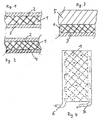
- Figur 1:
- Tarnmittel mit einem offenporigen Metallschaum,
- Figur 2:
- eine Variante des Tarnmittels aus Fig.1,
- Figur 3:
- eine weitere Variante des Tarnmittels,
- Figur 4:
- Draufsicht und Wirkprinzip des Tarnelements
- Figur 1 zeigt das Tarnmittel mit dem offenporigen Metallschaum 1. Der Metallschaum 1 ist eingeschlossen zwischen zwei Trägerschichten 2,3, wobei der hier fahrzeug- bzw. geräteseitige Träger 2 und der außenliegende Träger 3 aus Metall bestehen.
- Figur 2 zeigt ein Tarnmittel, welches wie Fig. 1 aufgebaut ist, wobei jedoch ein außenliegender Träger 4 aus einem Dielektrikum (z.B. Keramik) besteht, der radartransparent ist und einfallende hochfrequente Radarstrahlung durch den offenporigen Metallschaum 1 absorbiert und / oder diffus streut.
- Figur 3 zeigt das Tarnmittel mit einem offenporigen Metallschaum 1 und mit einem außenliegenden Träger 3. Der fahrzeug- bzw. geräteseitige Träger 5 ist hierbei identisch mit der eigentlichen Fahrzeug- bzw. Gerätepanzerung.
- Figur 4 zeigt ein Tarnelement in Draufsicht, wobei der obere, außenliegende Träger nicht dargestellt ist. Der gasförmige Wärmeträger wird durch einen Einlass 6 in das Tarnelement geleitet. Er durchströmt den offenporigen Metallschaum 1 als Wärmetauscher und wird durch einen Auslass 7 wieder abgeführt. Damit der Wärmetauscher möglichst homogen durchspült wird, ist im Bereich des Einlasses 6a und des Auslasses 7a der Schichtaufbau ohne den offenporigen Metallschaum ausgeführt, um als Kanal für den gasförmigen Wärmeträger zu wirken.
Claims (11)
- Multispektrales Tarnmittel, auf der Basis eines in seiner Temperatur gesteuerten Wärmetauschers, dadurch gekennzeichnet, dass der Wärmeträger gasförmig ist, zum Beispiel Luft, und dass der Wärmetauscher gleichzeitig Signaturträger in den Spektralbereichen sichtbares Licht (VIS), nahes Infrarot (NIR) und thermisches Infrarot (TIR) ist.
- Multispektrales Tarnmittel nach Anspruch 1 dadurch gekennzeichnet, dass das gleiche Element zusätzlich die Reflexion von hochfrequenter Radarstrahlung breitbandig reduziert.
- Multispektrales Tarnmittel nach Anspruch 2, dadurch gekennzeichnet, dass das Reduzieren durch Absorption und gestreute Remission erfolgt.
- Multispektrales Tarnelement nach Anspruch 1, dadurch gekennzeichnet dass es aus einem Schichtaufbau gebildet wird, der innen mit einem festen Trägermaterial beginnt, dem dann mindestens eine Schicht eines offenporigen Metallschaums (typische, aber nicht ausschließliche Blasengröße 6...10 bpi) mit typischer, aber nicht ausschließlicher Stärke von 15...25 mm folgt und darauf wieder ein fester Träger.
- Multispektrales Tarnelement nach Anspruch 4, dadurch gekennzeichnet dass das innere Trägermaterial die ursprüngliche Außenwand eines Fahrzeuges, Gerätes oder einer Anlage ist.
- Multispektrales Tarnelement nach einem der oben genannten Ansprüche dadurch gekennzeichnet, dass die funktionalen Lagen durch geeignete Verfahren (z. B. Kleben) thermisch leitend miteinander verbunden werden.
- Multispektrales Tarnelement nach Anspruch 4, dadurch gekennzeichnet dass die oberste (sichtbare) Schicht aus hochhartem PzStahl besteht, um eine erhöhte ballistische Schutzwirkung zu erzielen.
- Multispektrales Tarnelement nach Anspruch 4, dadurch gekennzeichnet dass die oberste (sichtbare) Schicht nicht aus Metall, sondern aus einem nichtleitenden Werkstoff (Dielektrikum) gebildet wird.
- Multispektrales Tarnmaterial nach Anspruch 7, dadurch gekennzeichnet dass die radartransparente Schicht (das Dielektrikum) aus Keramik besteht und damit zusätzlich einen ballistischen Schutz darstellt.
- Multispektrales Tarnmaterial nach Anspruch 3, dadurch gekennzeichnet dass die thermische Abkopplung zum Fahrzeug/Träger hin durch Verwendung eines Wärmeisolators unter dem Wärmetauscher verstärkt wird, wobei der Wärmeisolator auch als ausreichend dimensionierte Luftschicht ausgeformt sein kann.
- Verwendung des Tarnmittels nach einem der Ansprüche 1 bis 10 bei einem militärischen und / oder beweglichen Gerät und / oder einer ortsfesten Anlage.
Priority Applications (1)
| Application Number | Priority Date | Filing Date | Title |
|---|---|---|---|
| PL05004782T PL1574809T3 (pl) | 2004-03-12 | 2005-03-04 | Multispektralny środek maskujący |
Applications Claiming Priority (2)
| Application Number | Priority Date | Filing Date | Title |
|---|---|---|---|
| DE102004012563A DE102004012563A1 (de) | 2004-03-12 | 2004-03-12 | Multispektrales Tarnmittel |
| DE102004012563 | 2004-03-12 |
Publications (2)
| Publication Number | Publication Date |
|---|---|
| EP1574809A1 true EP1574809A1 (de) | 2005-09-14 |
| EP1574809B1 EP1574809B1 (de) | 2010-12-29 |
Family
ID=34813700
Family Applications (1)
| Application Number | Title | Priority Date | Filing Date |
|---|---|---|---|
| EP05004782A Expired - Lifetime EP1574809B1 (de) | 2004-03-12 | 2005-03-04 | Multispektrales Tarnmittel |
Country Status (5)
| Country | Link |
|---|---|
| EP (1) | EP1574809B1 (de) |
| AT (1) | ATE493625T1 (de) |
| DE (2) | DE102004012563A1 (de) |
| ES (1) | ES2357840T3 (de) |
| PL (1) | PL1574809T3 (de) |
Cited By (1)
| Publication number | Priority date | Publication date | Assignee | Title |
|---|---|---|---|---|
| WO2011000679A1 (de) * | 2009-06-30 | 2011-01-06 | Ssz Camouflage Technology Ag | Adaptive tarnung |
Families Citing this family (6)
| Publication number | Priority date | Publication date | Assignee | Title |
|---|---|---|---|---|
| DE102006059955B4 (de) * | 2006-12-19 | 2008-12-04 | Diehl Bgt Defence Gmbh & Co. Kg | Strahlungsfilter |
| DE102013107365C5 (de) | 2013-07-11 | 2021-03-25 | Krauss-Maffei Wegmann Gmbh & Co. Kg | Laserpanzerung |
| DE102013107364B4 (de) * | 2013-07-11 | 2015-01-22 | Krauss-Maffei Wegmann Gmbh & Co. Kg | Laserpanzerung |
| DE102015220797A1 (de) * | 2015-10-23 | 2017-04-27 | Bayerische Motoren Werke Aktiengesellschaft | Kühleinrichtung für ein Kraftfahrzeug |
| DE102019108741B4 (de) * | 2019-04-03 | 2025-02-13 | Dieter Girlich | Rauschunterdrückungsvorrichtung für elektromagnetische Messsysteme, Radarmesssysteme und Verwendung desselben |
| US11987355B2 (en) | 2021-06-09 | 2024-05-21 | Raytheon Company | Method and flexible apparatus permitting advanced radar signal processing, tracking, and classification/identification design and evaluation using single unmanned air surveillance (UAS) device |
Citations (7)
| Publication number | Priority date | Publication date | Assignee | Title |
|---|---|---|---|---|
| DE3148429A1 (de) * | 1981-12-08 | 1983-06-23 | Messerschmitt-Bölkow-Blohm GmbH, 8000 München | Ir-tarnvorrichtung fuer luftfahrzeuge |
| US4473826A (en) * | 1977-11-15 | 1984-09-25 | Gunter Pusch | Arrangement broad-band camouflaging of military targets |
| US5080165A (en) * | 1989-08-08 | 1992-01-14 | Grumman Aerospace Corporation | Protective tarpaulin |
| DE4025540A1 (de) * | 1990-08-11 | 1992-02-13 | Porsche Ag | Schutzeinrichtung zum vermindern einer ir-abstrahlung fuer ein gepanzertes transport-kraftfahrzeug |
| FR2776705A1 (fr) * | 1998-03-26 | 1999-10-01 | Giat Ind Sa | Dispositif de dilution uniforme des gaz d'echappement d'un vehicule militaire |
| US6098402A (en) * | 1989-02-10 | 2000-08-08 | Sawruk; Stephen D. | Infra-red stealth masking device (IRSMD) |
| EP1375855A1 (de) * | 2002-06-28 | 2004-01-02 | Giat Industries | Vorrichtung zur Verringerung der sichtbaren und Infrarotstrahlungssignatur eines Militärfahrzeugs |
-
2004
- 2004-03-12 DE DE102004012563A patent/DE102004012563A1/de not_active Withdrawn
-
2005
- 2005-03-04 ES ES05004782T patent/ES2357840T3/es not_active Expired - Lifetime
- 2005-03-04 DE DE502005010734T patent/DE502005010734D1/de not_active Expired - Lifetime
- 2005-03-04 AT AT05004782T patent/ATE493625T1/de active
- 2005-03-04 PL PL05004782T patent/PL1574809T3/pl unknown
- 2005-03-04 EP EP05004782A patent/EP1574809B1/de not_active Expired - Lifetime
Patent Citations (7)
| Publication number | Priority date | Publication date | Assignee | Title |
|---|---|---|---|---|
| US4473826A (en) * | 1977-11-15 | 1984-09-25 | Gunter Pusch | Arrangement broad-band camouflaging of military targets |
| DE3148429A1 (de) * | 1981-12-08 | 1983-06-23 | Messerschmitt-Bölkow-Blohm GmbH, 8000 München | Ir-tarnvorrichtung fuer luftfahrzeuge |
| US6098402A (en) * | 1989-02-10 | 2000-08-08 | Sawruk; Stephen D. | Infra-red stealth masking device (IRSMD) |
| US5080165A (en) * | 1989-08-08 | 1992-01-14 | Grumman Aerospace Corporation | Protective tarpaulin |
| DE4025540A1 (de) * | 1990-08-11 | 1992-02-13 | Porsche Ag | Schutzeinrichtung zum vermindern einer ir-abstrahlung fuer ein gepanzertes transport-kraftfahrzeug |
| FR2776705A1 (fr) * | 1998-03-26 | 1999-10-01 | Giat Ind Sa | Dispositif de dilution uniforme des gaz d'echappement d'un vehicule militaire |
| EP1375855A1 (de) * | 2002-06-28 | 2004-01-02 | Giat Industries | Vorrichtung zur Verringerung der sichtbaren und Infrarotstrahlungssignatur eines Militärfahrzeugs |
Cited By (2)
| Publication number | Priority date | Publication date | Assignee | Title |
|---|---|---|---|---|
| WO2011000679A1 (de) * | 2009-06-30 | 2011-01-06 | Ssz Camouflage Technology Ag | Adaptive tarnung |
| US9163907B2 (en) | 2009-06-30 | 2015-10-20 | Ssz Camouflage Technology Ag | Adaptive camouflage |
Also Published As
| Publication number | Publication date |
|---|---|
| PL1574809T3 (pl) | 2011-05-31 |
| DE502005010734D1 (de) | 2011-02-10 |
| ES2357840T3 (es) | 2011-05-03 |
| EP1574809B1 (de) | 2010-12-29 |
| ATE493625T1 (de) | 2011-01-15 |
| DE102004012563A1 (de) | 2005-11-10 |
Similar Documents
| Publication | Publication Date | Title |
|---|---|---|
| DE69809422T2 (de) | Wellenleistungs-turbine mit einer abgasdüse zur vermeidung von infrarotstrahlung | |
| DE69802083T2 (de) | Mehrstufige ejektor-mischerdüse zur vermeidung von infrarotstrahlung | |
| DE2750919C1 (de) | Breitbandige Tarnung militaerischer Ziele | |
| DE60016474T2 (de) | Strömungsmaschine mit einem mit einer Abkühlvorrichtung versehenen Untersetzungsgetriebe | |
| DE3618185C2 (de) | Abgasvorrichtung für ein Gasturbinentriebwerk | |
| DE3446950C1 (de) | Steuervorrichtung fuer die Kuehlluft luft-fluessigkeits-gekuehlter Brennkraftmaschinen,insbesondere von Kraftfahrzeugen | |
| DE69604120T2 (de) | Vorkühlungswärmetauscher, integriert mit stromlinienförmiger Befestigungsvorrichtung einer Gasturbine | |
| DE60223979T2 (de) | Vorrichtung zur thermischen Regelung von Personenkraftfahrzeugen | |
| DE60112279T2 (de) | Fahrzeug- temperaturregulierungssystem mit wärmepumpe | |
| DE2941093A1 (de) | Kraftfahrzeug, insbesondere lastkraftwagen, mit einer kuehleinrichtung fuer einen verbrennungsmotor | |
| DE102009013159A1 (de) | Kühler für ein Flugzeugkühlsystem, Flugzeugkühlsystem und Verfahren zum Betreiben eines Flugzeugkühlsystems | |
| DE102010038055A1 (de) | Brennkraftmaschine mit Flüssigkeitskühlung | |
| DE602005004579T2 (de) | Multifunktionales Modul, Fahrzeug enthaltend ein solches Modul und Verfahren zur Herstellung eines solchen Moduls | |
| EP0637728B1 (de) | Belüftungssystem für den Mannschaftsraum eines Kampffahrzeuges | |
| DE102011015126A1 (de) | Flugzeugheckbereich mit einem in dem Flugzeugheckbereich installierten Kühlsystem | |
| DE102018133426A1 (de) | Mehrteiliges multifunktionales batteriegehäuse | |
| EP1574809B1 (de) | Multispektrales Tarnmittel | |
| WO2009083074A1 (de) | Vorrichtung zum kühlen von aus einem flugzeug abzuführendem heissgas | |
| DE102004011783B3 (de) | Vorrichtung zur Belüftung und Kühlung eines Kraftfahrzeuginnenraumes | |
| DE102015110615A1 (de) | Leitschaufel eines Gasturbinentriebwerks, insbesondere eines Flugtriebwerks | |
| EP2408671B1 (de) | Flugzeugkühlsystem und verfahren zum betreiben eines flugzeugkühlsystems | |
| DE102016204917B4 (de) | Fahrzeug mit einem Heckkühler | |
| DE102018206249A1 (de) | Thermische Verkapselungsvorrichtung | |
| DE102004017362A1 (de) | Kraftfahrzeug mit einer schallisolierend gekapselten Brennkraftmaschine | |
| DE69623751T2 (de) | Durchfluss-Steuereinrichtung für Druckausgleichsklappe eines Gasturbinentriebwerkes |
Legal Events
| Date | Code | Title | Description |
|---|---|---|---|
| PUAI | Public reference made under article 153(3) epc to a published international application that has entered the european phase |
Free format text: ORIGINAL CODE: 0009012 |
|
| 17P | Request for examination filed |
Effective date: 20050716 |
|
| AK | Designated contracting states |
Kind code of ref document: A1 Designated state(s): AT BE BG CH CY CZ DE DK EE ES FI FR GB GR HU IE IS IT LI LT LU MC NL PL PT RO SE SI SK TR |
|
| AX | Request for extension of the european patent |
Extension state: AL BA HR LV MK YU |
|
| RAP1 | Party data changed (applicant data changed or rights of an application transferred) |
Owner name: RHEINMETALL LANDSYSTEME GMBH |
|
| AKX | Designation fees paid |
Designated state(s): AT BE BG CH CY CZ DE DK EE ES FI FR GB GR HU IE IS IT LI LT LU MC NL PL PT RO SE SI SK TR |
|
| 17Q | First examination report despatched |
Effective date: 20080115 |
|
| GRAP | Despatch of communication of intention to grant a patent |
Free format text: ORIGINAL CODE: EPIDOSNIGR1 |
|
| GRAS | Grant fee paid |
Free format text: ORIGINAL CODE: EPIDOSNIGR3 |
|
| GRAA | (expected) grant |
Free format text: ORIGINAL CODE: 0009210 |
|
| AK | Designated contracting states |
Kind code of ref document: B1 Designated state(s): AT BE BG CH CY CZ DE DK EE ES FI FR GB GR HU IE IS IT LI LT LU MC NL PL PT RO SE SI SK TR |
|
| REG | Reference to a national code |
Ref country code: GB Ref legal event code: FG4D Free format text: NOT ENGLISH |
|
| REG | Reference to a national code |
Ref country code: CH Ref legal event code: EP |
|
| REG | Reference to a national code |
Ref country code: IE Ref legal event code: FG4D Free format text: LANGUAGE OF EP DOCUMENT: GERMAN |
|
| REF | Corresponds to: |
Ref document number: 502005010734 Country of ref document: DE Date of ref document: 20110210 Kind code of ref document: P |
|
| REG | Reference to a national code |
Ref country code: DE Ref legal event code: R096 Ref document number: 502005010734 Country of ref document: DE Effective date: 20110210 |
|
| REG | Reference to a national code |
Ref country code: CH Ref legal event code: NV Representative=s name: OK PAT AG PATENTE MARKEN LIZENZEN |
|
| REG | Reference to a national code |
Ref country code: NL Ref legal event code: T3 |
|
| REG | Reference to a national code |
Ref country code: SE Ref legal event code: TRGR |
|
| PG25 | Lapsed in a contracting state [announced via postgrant information from national office to epo] |
Ref country code: LT Free format text: LAPSE BECAUSE OF FAILURE TO SUBMIT A TRANSLATION OF THE DESCRIPTION OR TO PAY THE FEE WITHIN THE PRESCRIBED TIME-LIMIT Effective date: 20101229 |
|
| REG | Reference to a national code |
Ref country code: ES Ref legal event code: FG2A Ref document number: 2357840 Country of ref document: ES Kind code of ref document: T3 Effective date: 20110503 |
|
| LTIE | Lt: invalidation of european patent or patent extension |
Effective date: 20101229 |
|
| PG25 | Lapsed in a contracting state [announced via postgrant information from national office to epo] |
Ref country code: BG Free format text: LAPSE BECAUSE OF FAILURE TO SUBMIT A TRANSLATION OF THE DESCRIPTION OR TO PAY THE FEE WITHIN THE PRESCRIBED TIME-LIMIT Effective date: 20110329 Ref country code: CY Free format text: LAPSE BECAUSE OF FAILURE TO SUBMIT A TRANSLATION OF THE DESCRIPTION OR TO PAY THE FEE WITHIN THE PRESCRIBED TIME-LIMIT Effective date: 20101229 Ref country code: SI Free format text: LAPSE BECAUSE OF FAILURE TO SUBMIT A TRANSLATION OF THE DESCRIPTION OR TO PAY THE FEE WITHIN THE PRESCRIBED TIME-LIMIT Effective date: 20101229 |
|
| REG | Reference to a national code |
Ref country code: PL Ref legal event code: T3 |
|
| REG | Reference to a national code |
Ref country code: IE Ref legal event code: FD4D |
|
| PG25 | Lapsed in a contracting state [announced via postgrant information from national office to epo] |
Ref country code: CZ Free format text: LAPSE BECAUSE OF FAILURE TO SUBMIT A TRANSLATION OF THE DESCRIPTION OR TO PAY THE FEE WITHIN THE PRESCRIBED TIME-LIMIT Effective date: 20101229 Ref country code: EE Free format text: LAPSE BECAUSE OF FAILURE TO SUBMIT A TRANSLATION OF THE DESCRIPTION OR TO PAY THE FEE WITHIN THE PRESCRIBED TIME-LIMIT Effective date: 20101229 Ref country code: PT Free format text: LAPSE BECAUSE OF FAILURE TO SUBMIT A TRANSLATION OF THE DESCRIPTION OR TO PAY THE FEE WITHIN THE PRESCRIBED TIME-LIMIT Effective date: 20110429 Ref country code: GR Free format text: LAPSE BECAUSE OF FAILURE TO SUBMIT A TRANSLATION OF THE DESCRIPTION OR TO PAY THE FEE WITHIN THE PRESCRIBED TIME-LIMIT Effective date: 20110330 Ref country code: IS Free format text: LAPSE BECAUSE OF FAILURE TO SUBMIT A TRANSLATION OF THE DESCRIPTION OR TO PAY THE FEE WITHIN THE PRESCRIBED TIME-LIMIT Effective date: 20110429 |
|
| PG25 | Lapsed in a contracting state [announced via postgrant information from national office to epo] |
Ref country code: RO Free format text: LAPSE BECAUSE OF FAILURE TO SUBMIT A TRANSLATION OF THE DESCRIPTION OR TO PAY THE FEE WITHIN THE PRESCRIBED TIME-LIMIT Effective date: 20101229 Ref country code: SK Free format text: LAPSE BECAUSE OF FAILURE TO SUBMIT A TRANSLATION OF THE DESCRIPTION OR TO PAY THE FEE WITHIN THE PRESCRIBED TIME-LIMIT Effective date: 20101229 |
|
| BERE | Be: lapsed |
Owner name: RHEINMETALL LANDSYSTEME G.M.B.H. Effective date: 20110331 |
|
| PG25 | Lapsed in a contracting state [announced via postgrant information from national office to epo] |
Ref country code: IE Free format text: LAPSE BECAUSE OF FAILURE TO SUBMIT A TRANSLATION OF THE DESCRIPTION OR TO PAY THE FEE WITHIN THE PRESCRIBED TIME-LIMIT Effective date: 20101229 Ref country code: DK Free format text: LAPSE BECAUSE OF FAILURE TO SUBMIT A TRANSLATION OF THE DESCRIPTION OR TO PAY THE FEE WITHIN THE PRESCRIBED TIME-LIMIT Effective date: 20101229 Ref country code: MC Free format text: LAPSE BECAUSE OF NON-PAYMENT OF DUE FEES Effective date: 20110331 |
|
| PLBE | No opposition filed within time limit |
Free format text: ORIGINAL CODE: 0009261 |
|
| STAA | Information on the status of an ep patent application or granted ep patent |
Free format text: STATUS: NO OPPOSITION FILED WITHIN TIME LIMIT |
|
| 26N | No opposition filed |
Effective date: 20110930 |
|
| PG25 | Lapsed in a contracting state [announced via postgrant information from national office to epo] |
Ref country code: BE Free format text: LAPSE BECAUSE OF NON-PAYMENT OF DUE FEES Effective date: 20110331 |
|
| REG | Reference to a national code |
Ref country code: DE Ref legal event code: R097 Ref document number: 502005010734 Country of ref document: DE Effective date: 20110930 |
|
| REG | Reference to a national code |
Ref country code: AT Ref legal event code: MM01 Ref document number: 493625 Country of ref document: AT Kind code of ref document: T Effective date: 20110304 |
|
| PG25 | Lapsed in a contracting state [announced via postgrant information from national office to epo] |
Ref country code: AT Free format text: LAPSE BECAUSE OF NON-PAYMENT OF DUE FEES Effective date: 20110304 |
|
| PG25 | Lapsed in a contracting state [announced via postgrant information from national office to epo] |
Ref country code: LU Free format text: LAPSE BECAUSE OF NON-PAYMENT OF DUE FEES Effective date: 20110304 |
|
| PG25 | Lapsed in a contracting state [announced via postgrant information from national office to epo] |
Ref country code: HU Free format text: LAPSE BECAUSE OF FAILURE TO SUBMIT A TRANSLATION OF THE DESCRIPTION OR TO PAY THE FEE WITHIN THE PRESCRIBED TIME-LIMIT Effective date: 20101229 |
|
| REG | Reference to a national code |
Ref country code: FR Ref legal event code: PLFP Year of fee payment: 12 |
|
| REG | Reference to a national code |
Ref country code: FR Ref legal event code: PLFP Year of fee payment: 13 |
|
| REG | Reference to a national code |
Ref country code: FR Ref legal event code: PLFP Year of fee payment: 14 |
|
| REG | Reference to a national code |
Ref country code: DE Ref legal event code: R084 Ref document number: 502005010734 Country of ref document: DE |
|
| REG | Reference to a national code |
Ref country code: CH Ref legal event code: PFUS Owner name: RHEINMETALL LANDSYSTEME GMBH, DE Free format text: FORMER OWNER: RHEINMETALL LANDSYSTEME GMBH, DE |
|
| PGFP | Annual fee paid to national office [announced via postgrant information from national office to epo] |
Ref country code: NL Payment date: 20240320 Year of fee payment: 20 |
|
| PGFP | Annual fee paid to national office [announced via postgrant information from national office to epo] |
Ref country code: FI Payment date: 20240320 Year of fee payment: 20 Ref country code: DE Payment date: 20240320 Year of fee payment: 20 Ref country code: GB Payment date: 20240320 Year of fee payment: 20 |
|
| PGFP | Annual fee paid to national office [announced via postgrant information from national office to epo] |
Ref country code: TR Payment date: 20240223 Year of fee payment: 20 Ref country code: SE Payment date: 20240320 Year of fee payment: 20 Ref country code: PL Payment date: 20240223 Year of fee payment: 20 Ref country code: IT Payment date: 20240329 Year of fee payment: 20 Ref country code: FR Payment date: 20240321 Year of fee payment: 20 |
|
| PGFP | Annual fee paid to national office [announced via postgrant information from national office to epo] |
Ref country code: CH Payment date: 20240401 Year of fee payment: 20 |
|
| PGFP | Annual fee paid to national office [announced via postgrant information from national office to epo] |
Ref country code: ES Payment date: 20240426 Year of fee payment: 20 |
|
| REG | Reference to a national code |
Ref country code: DE Ref legal event code: R071 Ref document number: 502005010734 Country of ref document: DE |
|
| REG | Reference to a national code |
Ref country code: NL Ref legal event code: MK Effective date: 20250303 |
|
| REG | Reference to a national code |
Ref country code: CH Ref legal event code: PL |
|
| REG | Reference to a national code |
Ref country code: GB Ref legal event code: PE20 Expiry date: 20250303 |
|
| REG | Reference to a national code |
Ref country code: ES Ref legal event code: FD2A Effective date: 20250331 |
|
| PG25 | Lapsed in a contracting state [announced via postgrant information from national office to epo] |
Ref country code: ES Free format text: LAPSE BECAUSE OF EXPIRATION OF PROTECTION Effective date: 20250305 |
|
| PG25 | Lapsed in a contracting state [announced via postgrant information from national office to epo] |
Ref country code: GB Free format text: LAPSE BECAUSE OF EXPIRATION OF PROTECTION Effective date: 20250303 |
|
| REG | Reference to a national code |
Ref country code: SE Ref legal event code: EUG |