EP1570976A1 - Processes for converting cyclic oligomers into thermoplastic PBT products - Google Patents
Processes for converting cyclic oligomers into thermoplastic PBT products Download PDFInfo
- Publication number
- EP1570976A1 EP1570976A1 EP04405128A EP04405128A EP1570976A1 EP 1570976 A1 EP1570976 A1 EP 1570976A1 EP 04405128 A EP04405128 A EP 04405128A EP 04405128 A EP04405128 A EP 04405128A EP 1570976 A1 EP1570976 A1 EP 1570976A1
- Authority
- EP
- European Patent Office
- Prior art keywords
- fiber
- polyester
- starting material
- layer
- coated
- Prior art date
- Legal status (The legal status is an assumption and is not a legal conclusion. Google has not performed a legal analysis and makes no representation as to the accuracy of the status listed.)
- Withdrawn
Links
- 125000004122 cyclic group Chemical group 0.000 title claims abstract description 18
- 229920001169 thermoplastic Polymers 0.000 title claims abstract description 11
- 238000000034 method Methods 0.000 title claims description 73
- 239000004416 thermosoftening plastic Substances 0.000 title abstract description 8
- 239000000835 fiber Substances 0.000 claims abstract description 117
- 229920003023 plastic Polymers 0.000 claims abstract description 88
- 239000004033 plastic Substances 0.000 claims abstract description 88
- 239000007858 starting material Substances 0.000 claims abstract description 86
- 229920000728 polyester Polymers 0.000 claims abstract description 62
- 239000011159 matrix material Substances 0.000 claims abstract description 58
- 239000000463 material Substances 0.000 claims abstract description 54
- 239000006260 foam Substances 0.000 claims abstract description 43
- 239000002131 composite material Substances 0.000 claims abstract description 37
- 238000004519 manufacturing process Methods 0.000 claims abstract description 35
- 229920000139 polyethylene terephthalate Polymers 0.000 claims abstract description 30
- 229920002430 Fibre-reinforced plastic Polymers 0.000 claims abstract description 19
- 239000011151 fibre-reinforced plastic Substances 0.000 claims abstract description 19
- 238000003825 pressing Methods 0.000 claims abstract description 9
- 239000002685 polymerization catalyst Substances 0.000 claims abstract description 7
- 230000000379 polymerizing effect Effects 0.000 claims abstract description 5
- 239000000203 mixture Substances 0.000 claims description 36
- 238000000465 moulding Methods 0.000 claims description 14
- 239000007788 liquid Substances 0.000 claims description 12
- 239000012783 reinforcing fiber Substances 0.000 claims description 12
- 239000002985 plastic film Substances 0.000 claims description 11
- 229920006255 plastic film Polymers 0.000 claims description 11
- 239000007787 solid Substances 0.000 claims description 11
- 239000000956 alloy Substances 0.000 claims description 7
- 229910045601 alloy Inorganic materials 0.000 claims description 7
- 239000011888 foil Substances 0.000 claims description 4
- 239000004604 Blowing Agent Substances 0.000 claims description 3
- 239000003292 glue Substances 0.000 claims description 3
- 238000007731 hot pressing Methods 0.000 claims description 2
- 229920005992 thermoplastic resin Polymers 0.000 claims description 2
- 239000003380 propellant Substances 0.000 claims 1
- 229920001707 polybutylene terephthalate Polymers 0.000 abstract description 91
- 239000005020 polyethylene terephthalate Substances 0.000 abstract description 27
- 239000011248 coating agent Substances 0.000 abstract description 17
- 238000000576 coating method Methods 0.000 abstract description 17
- 238000012545 processing Methods 0.000 abstract description 16
- -1 polyethylene terephthalate Polymers 0.000 abstract description 5
- 238000010438 heat treatment Methods 0.000 abstract description 3
- 239000004088 foaming agent Substances 0.000 abstract 1
- 229920002959 polymer blend Polymers 0.000 abstract 1
- 230000002787 reinforcement Effects 0.000 abstract 1
- 239000010410 layer Substances 0.000 description 66
- 239000000843 powder Substances 0.000 description 23
- 239000010408 film Substances 0.000 description 18
- 238000006116 polymerization reaction Methods 0.000 description 10
- 239000011162 core material Substances 0.000 description 9
- 238000001125 extrusion Methods 0.000 description 7
- 238000005470 impregnation Methods 0.000 description 7
- 238000002844 melting Methods 0.000 description 6
- 230000008018 melting Effects 0.000 description 6
- 229920001187 thermosetting polymer Polymers 0.000 description 5
- 238000005516 engineering process Methods 0.000 description 4
- 239000003365 glass fiber Substances 0.000 description 4
- 230000003014 reinforcing effect Effects 0.000 description 4
- 229920000049 Carbon (fiber) Polymers 0.000 description 3
- 230000001070 adhesive effect Effects 0.000 description 3
- 239000004760 aramid Substances 0.000 description 3
- 229920006231 aramid fiber Polymers 0.000 description 3
- 239000004917 carbon fiber Substances 0.000 description 3
- 239000003054 catalyst Substances 0.000 description 3
- 238000011161 development Methods 0.000 description 3
- 230000018109 developmental process Effects 0.000 description 3
- 238000005096 rolling process Methods 0.000 description 3
- 239000004952 Polyamide Substances 0.000 description 2
- 238000005056 compaction Methods 0.000 description 2
- 238000000748 compression moulding Methods 0.000 description 2
- 238000010276 construction Methods 0.000 description 2
- 238000005520 cutting process Methods 0.000 description 2
- 238000013461 design Methods 0.000 description 2
- 238000002347 injection Methods 0.000 description 2
- 239000007924 injection Substances 0.000 description 2
- 239000012784 inorganic fiber Substances 0.000 description 2
- 238000012432 intermediate storage Methods 0.000 description 2
- 239000002184 metal Substances 0.000 description 2
- 229910052751 metal Inorganic materials 0.000 description 2
- 239000004745 nonwoven fabric Substances 0.000 description 2
- 229920002647 polyamide Polymers 0.000 description 2
- 229920000642 polymer Polymers 0.000 description 2
- 238000002360 preparation method Methods 0.000 description 2
- 238000003672 processing method Methods 0.000 description 2
- 238000004064 recycling Methods 0.000 description 2
- 229920005989 resin Polymers 0.000 description 2
- 239000011347 resin Substances 0.000 description 2
- 238000007493 shaping process Methods 0.000 description 2
- 239000000243 solution Substances 0.000 description 2
- 238000005507 spraying Methods 0.000 description 2
- 238000001721 transfer moulding Methods 0.000 description 2
- WSQZNZLOZXSBHA-UHFFFAOYSA-N 3,8-dioxabicyclo[8.2.2]tetradeca-1(12),10,13-triene-2,9-dione Chemical compound O=C1OCCCCOC(=O)C2=CC=C1C=C2 WSQZNZLOZXSBHA-UHFFFAOYSA-N 0.000 description 1
- 229910000831 Steel Inorganic materials 0.000 description 1
- HCHKCACWOHOZIP-UHFFFAOYSA-N Zinc Chemical compound [Zn] HCHKCACWOHOZIP-UHFFFAOYSA-N 0.000 description 1
- 230000002411 adverse Effects 0.000 description 1
- 238000004458 analytical method Methods 0.000 description 1
- 238000010923 batch production Methods 0.000 description 1
- 230000002146 bilateral effect Effects 0.000 description 1
- 230000015572 biosynthetic process Effects 0.000 description 1
- 230000001680 brushing effect Effects 0.000 description 1
- 238000009435 building construction Methods 0.000 description 1
- 239000003795 chemical substances by application Substances 0.000 description 1
- 238000004040 coloring Methods 0.000 description 1
- 238000009500 colour coating Methods 0.000 description 1
- 150000001875 compounds Chemical class 0.000 description 1
- 230000001143 conditioned effect Effects 0.000 description 1
- 238000007596 consolidation process Methods 0.000 description 1
- 238000010924 continuous production Methods 0.000 description 1
- 239000013039 cover film Substances 0.000 description 1
- 238000000354 decomposition reaction Methods 0.000 description 1
- 230000001419 dependent effect Effects 0.000 description 1
- 238000007598 dipping method Methods 0.000 description 1
- 230000000694 effects Effects 0.000 description 1
- 239000004744 fabric Substances 0.000 description 1
- 238000011049 filling Methods 0.000 description 1
- 239000012467 final product Substances 0.000 description 1
- 238000007667 floating Methods 0.000 description 1
- 238000005755 formation reaction Methods 0.000 description 1
- 239000011521 glass Substances 0.000 description 1
- 230000005484 gravity Effects 0.000 description 1
- 230000000977 initiatory effect Effects 0.000 description 1
- 238000009434 installation Methods 0.000 description 1
- 150000003951 lactams Chemical class 0.000 description 1
- 230000000149 penetrating effect Effects 0.000 description 1
- 229920006267 polyester film Polymers 0.000 description 1
- 239000004810 polytetrafluoroethylene Substances 0.000 description 1
- 229920001343 polytetrafluoroethylene Polymers 0.000 description 1
- 239000000047 product Substances 0.000 description 1
- 239000002990 reinforced plastic Substances 0.000 description 1
- 238000009745 resin transfer moulding Methods 0.000 description 1
- 239000011265 semifinished product Substances 0.000 description 1
- 238000005245 sintering Methods 0.000 description 1
- 239000002904 solvent Substances 0.000 description 1
- 238000003892 spreading Methods 0.000 description 1
- 239000010959 steel Substances 0.000 description 1
- 239000000126 substance Substances 0.000 description 1
- 239000002344 surface layer Substances 0.000 description 1
- 239000004753 textile Substances 0.000 description 1
- 239000010409 thin film Substances 0.000 description 1
- 238000012546 transfer Methods 0.000 description 1
- 238000009827 uniform distribution Methods 0.000 description 1
- 238000004804 winding Methods 0.000 description 1
- 229910052725 zinc Inorganic materials 0.000 description 1
- 239000011701 zinc Substances 0.000 description 1
Images

Classifications
-
- B—PERFORMING OPERATIONS; TRANSPORTING
- B29—WORKING OF PLASTICS; WORKING OF SUBSTANCES IN A PLASTIC STATE IN GENERAL
- B29C—SHAPING OR JOINING OF PLASTICS; SHAPING OF MATERIAL IN A PLASTIC STATE, NOT OTHERWISE PROVIDED FOR; AFTER-TREATMENT OF THE SHAPED PRODUCTS, e.g. REPAIRING
- B29C70/00—Shaping composites, i.e. plastics material comprising reinforcements, fillers or preformed parts, e.g. inserts
- B29C70/04—Shaping composites, i.e. plastics material comprising reinforcements, fillers or preformed parts, e.g. inserts comprising reinforcements only, e.g. self-reinforcing plastics
-
- B—PERFORMING OPERATIONS; TRANSPORTING
- B29—WORKING OF PLASTICS; WORKING OF SUBSTANCES IN A PLASTIC STATE IN GENERAL
- B29C—SHAPING OR JOINING OF PLASTICS; SHAPING OF MATERIAL IN A PLASTIC STATE, NOT OTHERWISE PROVIDED FOR; AFTER-TREATMENT OF THE SHAPED PRODUCTS, e.g. REPAIRING
- B29C37/00—Component parts, details, accessories or auxiliary operations, not covered by group B29C33/00 or B29C35/00
- B29C37/0025—Applying surface layers, e.g. coatings, decorative layers, printed layers, to articles during shaping, e.g. in-mould printing
- B29C37/0028—In-mould coating, e.g. by introducing the coating material into the mould after forming the article
- B29C37/0032—In-mould coating, e.g. by introducing the coating material into the mould after forming the article the coating being applied upon the mould surface before introducing the moulding compound, e.g. applying a gelcoat
-
- B—PERFORMING OPERATIONS; TRANSPORTING
- B29—WORKING OF PLASTICS; WORKING OF SUBSTANCES IN A PLASTIC STATE IN GENERAL
- B29C—SHAPING OR JOINING OF PLASTICS; SHAPING OF MATERIAL IN A PLASTIC STATE, NOT OTHERWISE PROVIDED FOR; AFTER-TREATMENT OF THE SHAPED PRODUCTS, e.g. REPAIRING
- B29C44/00—Shaping by internal pressure generated in the material, e.g. swelling or foaming ; Producing porous or cellular expanded plastics articles
- B29C44/20—Shaping by internal pressure generated in the material, e.g. swelling or foaming ; Producing porous or cellular expanded plastics articles for articles of indefinite length
- B29C44/32—Incorporating or moulding on preformed parts, e.g. linings, inserts or reinforcements
- B29C44/321—Incorporating or moulding on preformed parts, e.g. linings, inserts or reinforcements the preformed part being a lining, e.g. a film or a support lining
-
- B—PERFORMING OPERATIONS; TRANSPORTING
- B29—WORKING OF PLASTICS; WORKING OF SUBSTANCES IN A PLASTIC STATE IN GENERAL
- B29C—SHAPING OR JOINING OF PLASTICS; SHAPING OF MATERIAL IN A PLASTIC STATE, NOT OTHERWISE PROVIDED FOR; AFTER-TREATMENT OF THE SHAPED PRODUCTS, e.g. REPAIRING
- B29C44/00—Shaping by internal pressure generated in the material, e.g. swelling or foaming ; Producing porous or cellular expanded plastics articles
- B29C44/20—Shaping by internal pressure generated in the material, e.g. swelling or foaming ; Producing porous or cellular expanded plastics articles for articles of indefinite length
- B29C44/32—Incorporating or moulding on preformed parts, e.g. linings, inserts or reinforcements
- B29C44/326—Joining the preformed parts, e.g. to make flat or profiled sandwich laminates
-
- B—PERFORMING OPERATIONS; TRANSPORTING
- B29—WORKING OF PLASTICS; WORKING OF SUBSTANCES IN A PLASTIC STATE IN GENERAL
- B29C—SHAPING OR JOINING OF PLASTICS; SHAPING OF MATERIAL IN A PLASTIC STATE, NOT OTHERWISE PROVIDED FOR; AFTER-TREATMENT OF THE SHAPED PRODUCTS, e.g. REPAIRING
- B29C67/00—Shaping techniques not covered by groups B29C39/00 - B29C65/00, B29C70/00 or B29C73/00
- B29C67/24—Shaping techniques not covered by groups B29C39/00 - B29C65/00, B29C70/00 or B29C73/00 characterised by the choice of material
- B29C67/246—Moulding high reactive monomers or prepolymers, e.g. by reaction injection moulding [RIM], liquid injection moulding [LIM]
-
- B—PERFORMING OPERATIONS; TRANSPORTING
- B29—WORKING OF PLASTICS; WORKING OF SUBSTANCES IN A PLASTIC STATE IN GENERAL
- B29C—SHAPING OR JOINING OF PLASTICS; SHAPING OF MATERIAL IN A PLASTIC STATE, NOT OTHERWISE PROVIDED FOR; AFTER-TREATMENT OF THE SHAPED PRODUCTS, e.g. REPAIRING
- B29C70/00—Shaping composites, i.e. plastics material comprising reinforcements, fillers or preformed parts, e.g. inserts
- B29C70/04—Shaping composites, i.e. plastics material comprising reinforcements, fillers or preformed parts, e.g. inserts comprising reinforcements only, e.g. self-reinforcing plastics
- B29C70/28—Shaping operations therefor
- B29C70/40—Shaping or impregnating by compression not applied
- B29C70/42—Shaping or impregnating by compression not applied for producing articles of definite length, i.e. discrete articles
- B29C70/46—Shaping or impregnating by compression not applied for producing articles of definite length, i.e. discrete articles using matched moulds, e.g. for deforming sheet moulding compounds [SMC] or prepregs
- B29C70/465—Shaping or impregnating by compression not applied for producing articles of definite length, i.e. discrete articles using matched moulds, e.g. for deforming sheet moulding compounds [SMC] or prepregs and impregnating by melting a solid material, e.g. sheets, powders of fibres
-
- B—PERFORMING OPERATIONS; TRANSPORTING
- B29—WORKING OF PLASTICS; WORKING OF SUBSTANCES IN A PLASTIC STATE IN GENERAL
- B29C—SHAPING OR JOINING OF PLASTICS; SHAPING OF MATERIAL IN A PLASTIC STATE, NOT OTHERWISE PROVIDED FOR; AFTER-TREATMENT OF THE SHAPED PRODUCTS, e.g. REPAIRING
- B29C70/00—Shaping composites, i.e. plastics material comprising reinforcements, fillers or preformed parts, e.g. inserts
- B29C70/04—Shaping composites, i.e. plastics material comprising reinforcements, fillers or preformed parts, e.g. inserts comprising reinforcements only, e.g. self-reinforcing plastics
- B29C70/28—Shaping operations therefor
- B29C70/40—Shaping or impregnating by compression not applied
- B29C70/50—Shaping or impregnating by compression not applied for producing articles of indefinite length, e.g. prepregs, sheet moulding compounds [SMC] or cross moulding compounds [XMC]
- B29C70/504—Shaping or impregnating by compression not applied for producing articles of indefinite length, e.g. prepregs, sheet moulding compounds [SMC] or cross moulding compounds [XMC] using rollers or pressure bands
- B29C70/506—Shaping or impregnating by compression not applied for producing articles of indefinite length, e.g. prepregs, sheet moulding compounds [SMC] or cross moulding compounds [XMC] using rollers or pressure bands and impregnating by melting a solid material, e.g. sheet, powder, fibres
-
- B—PERFORMING OPERATIONS; TRANSPORTING
- B29—WORKING OF PLASTICS; WORKING OF SUBSTANCES IN A PLASTIC STATE IN GENERAL
- B29K—INDEXING SCHEME ASSOCIATED WITH SUBCLASSES B29B, B29C OR B29D, RELATING TO MOULDING MATERIALS OR TO MATERIALS FOR MOULDS, REINFORCEMENTS, FILLERS OR PREFORMED PARTS, e.g. INSERTS
- B29K2067/00—Use of polyesters or derivatives thereof, as moulding material
Definitions
- the invention relates to processes for the production of fiber-reinforced plastic articles, containing PBT or a PBT blend, according to the preamble of the independent claims.
- the invention further relates to fiber-reinforced plastic articles containing PBT or a PBT alloy, according to the preamble of the independent claims.
- thermoplastic systems for manufacturing of fiber-reinforced plastic articles in the processing of thermoset systems, such as RTM processes or prepreg processing, designed manufacturing processes to process.
- the difficulty of processing thermoplastic Plastic systems is inter alia in the provision of a suitable reactive starting material, which is not only chemically stable, but also For further processing in a low viscous state can be transferred.
- thermoplastic resin systems to develop, which process similar to thermosetting plastic systems to let.
- a known such system is based bsp. on a polyamide (PA), like PA-12 with lactam as starting material.
- PA polyamide
- Another promising system based on a polyester, such as polybutylene terephthalate (PBT).
- the reactive starting material for the preparation of the polyester or PBT is in the form of so-called cyclic or macrocyclic oligomers, which with a corresponding Polymerisatons catalyst are mixed.
- the special thing about this system is that the reactive starting material can be converted into a low-viscosity melt, what this for processing by means of an injection method, such. an LCM process, makes it suitable.
- LCM is called "Liquid Composite Molding". Under LCM or LCM technology is understood in this text a method in which the cavity of a multi-part Mold, in particular a two-part mold, with a one- or multi-part fiber blank or fiber structure is charged and into the cavity the closed mold a duro- or thermoplastic plastic matrix is fed or injected, which the fiber blank to form a Flowed fiber composite component and impregnated and the cavity of the mold fills, and after completion of the mold filling the fiber composite component for curing or brought polymerization and then demolded. That said
- LCM method also includes variants with fused cores or permanent nuclei, such as Foam cores, which together with the fiber formations be inserted into the open mold.
- thermoset plastic matrix system is processed in an LCM process
- this is a resin transfer molding (RTM) process.
- the LCM process is therefore to be understood as a superordinate name for the RTM method the injection method described above, which in addition to thermosetting plastic matrix systems also comprises thermoplastic matrix polymer systems.
- the RTM procedure For example, in Kötte, "The Resin Transfer Molding Process - Analysis a Harzinjetechnischsvons ", Verlag TÜV Rheinland, 1991 described in detail.
- thermoplastic matrix systems talked about LCM technology of an RTM process.
- the low-viscosity properties of the cyclic oligomers mentioned are also advantageous for processing in other processes, as the low-viscous, reactive Starting material causes optimal impregnation or impregnation of the fibers, which is especially true for plastic articles with a high fiber content in the form of dense fiber structure is of great importance.
- US 6,369,157 describes a suitable reactive starting material, which process into a PBT plastic or a PBT plastic alloy to let.
- a processing method e.g. Prepreg processes, RTM processes, Pultrusion process, extrusion process and molding process called.
- the object of the present invention is to provide concrete methods for processing PBT plastic systems or the associated reactive PBT starting material based on of cyclic oligomers. Another subject of this The invention also relates to the resulting products containing PBT plastics.
- a reactive starting material as defined below includes, inter alia cyclic or macrocyclic oligomers of the polyester, in particular of the PBT (Called CPBT), which are mixed with a polymerization catalyst. Further for example, a reactive starting material also includes blends (alloys) containing the foregoing Substances which bsp. after completion of the polymerization, a PBT blend (PBT plastic alloy) result.
- PBT Called CPBT
- PBT PBT plastic alloy
- Particularly suitable reactive PBT starting materials in the form of cyclic oligomers are named CBT TM (Cyclic Butylene Terephthalate) manufactured by Cyclics.
- the polymerization catalyst can bsp. a zinc catalyst or other suitable catalyst be.
- Polyesters according to the following definition include, among others, plastics such as PET (polyethylene terephthalate) and associated blends and in particular PBT (polybutylene terephthalate) or PBT blends (PBT plastic alloys).
- plastics such as PET (polyethylene terephthalate) and associated blends and in particular PBT (polybutylene terephthalate) or PBT blends (PBT plastic alloys).
- Fiber structures are sheet-like structures and comprise including textile fabrics, e.g. Nonwovens, "non-wovens", non-weft forming Systems such as tissue, uni- or bi-directional scrims, braids or mats etc. or e.g. stitch forming systems such as knits or knits and embroidered ones Structures.
- textile fabrics e.g. Nonwovens, "non-wovens", non-weft forming Systems such as tissue, uni- or bi-directional scrims, braids or mats etc. or e.g. stitch forming systems such as knits or knits and embroidered ones Structures.
- the fibers of the fiber structures are according to the following definition bsp. Long fibers with Fiber lengths of e.g. 3-150 mm or continuous fibers and are bsp. in the form of rovings processed into fiber structures.
- the fibers may be glass fibers, aramid fibers, carbon fibers, plastic fibers, natural fibers or mixtures thereof.
- Plastic fibers in particular polyester fibers, such as. PET, PBT or PBT blend.
- Glass fibers are preferred because they are in contrast to aramid or Carbon fibers in recycling the fiber reinforced plastic articles with relative little effort can be separated from the plastic matrix and glass fibers also relatively are inexpensive.
- PBT fibers are characterized by the fact that they are conditioned by the manufacturing process have a crystalline orientation in the fiber direction, while the matrix between the fibers have substantially no crystalline orientation, i. amorphous.
- Plate means a flat body with a certain Flexural rigidity and a thickness, which compared to the length and width extent is small.
- the said plates have bsp. a thickness of 0.5 mm or larger, preferably 1 mm or larger, and more preferably 2 mm or larger and of 10 mm or smaller, preferably 6 mm or smaller, and in particular of 4 mm or smaller, up.
- pre-impregnated fiber structures usually fiber mats, until now the fiber structures were impregnated (impregnated) with a reactive plastic matrix or coated with reactive powder, wherein the powder, in particular the heated powder, even has sticky properties and thereby on the fiber structure sticks.
- the reactive starting material i. the cyclic oligomers
- the reactive starting material in Apply film form to the fiber structure, wherein by melting these films an impregnation of the fiber structure thanks to the low-viscous properties of the reactive Starting material takes place in the molten state.
- prepregs are usually sticky, they are on or off according to known technology on both sides with a release layer, so a release film provided.
- a release layer allows the winding of continuously produced prepregs into rolls so-called coils for intermediate storage prior to further processing into fiber-reinforced Plate materials, without them sticking together.
- the release layers are also important in the further processing process, since these in the production of hardened or polymerized plate material, the installations, i.e. protect the presses or rollers from sticking to the prepregs.
- the release layer is removed. So the release layer is not here Part of the final product but only a production aid.
- the idea of the present invention lies in the improvement of the process for the production and further processing of so-called prepreg semi-finished products and further Sense for the production of plate material made of polyester, such as PET and in particular PBT or PBT blend using a reactive starting material.
- fiber structures with the reactive starting material impregnated or coated can do this with a liquid, reactive Starting material to be soaked, bsp. by immersing the fiber structures in a Solution bath, wherein the solvent is removed again after the impregnation.
- the liquid starting material can also by means of spraying, brushing, pouring, Rolling or doctoring be applied to the fiber structure.
- the fibrous structures may in an alternative variant with the reactive starting material be coated in powder or in the form of films, in both cases the reactive starting material in the course of the manufacturing process under impregnation the fiber structure is melted.
- the reactive starting material in Pulverform applied to the fiber structure so this can improve the Heated properties are heated, the powder even soften or melt can.
- the fiber structure can be preheated and be coated with the powder.
- the powder coating can be applied to a horizontal or vertically continuous fiber web, the powder corresponding vertical or horizontally the fiber web is supplied.
- the powder can by gravity and / or supplied by means of gas or air flow.
- the gas or air flow is preferred heated so that the powder when adhering to the fibrous web adhesive properties unfolded.
- the powder can also by means of an electrostatic process be supplied.
- two or more layers of fiber structures such as impregnated or coated as described above and to a multilayer or multilayer Fiber web are merged.
- the plastic film or film is here an integral part of the produced, fiber-reinforced Plate material.
- the plastic film or foil can be made of a thermoplastic or thermosetting Be plastic.
- the cover layer is a polymerized thermoplastic Film of a polyester, such as PET and in particular of a PBT or PBT blend.
- the plastic film has bsp. a thickness of greater thickness 50 microns, in particular of greater than 100 microns and less than 2000 microns, in particular of less than 1000 microns on.
- the plastic film can as a solid, unwound from a roll film or by extrusion as a molten, semi-solid or solid film are applied.
- the cover layer applied to the fibrous web can also be a fiber-reinforced, web-shaped Plastic material with an outer, fiber-free (polymerized) plastic layer be the above composition.
- the fibers of the fibrous web are preferably made of glass or polyester, such as PET and in particular PBT or PBT blend.
- polyester fibers such as PBT fibers a varietal plate material is achieved.
- the prepregs with applied cover layers are pressurized for further processing and heat to a polyester, such as PET and especially PBT or a PBT blend polymerized, wherein the cover layers with the polymerizing polymer matrix of the fiber structure form an intimate bond and the outer layers become an integral part of the plate-shaped fiber composite.
- a polyester such as PET and especially PBT or a PBT blend polymerized
- the melting or decomposition point of the cover layers is higher than the polymerization temperature of the reactive starting material. Thus, the cover layer becomes during the polymerization of the plastic matrix is not affected.
- the reactive starting materials used are the outer layers from PBT films due to the effect of heat when polymerizing the plastic matrix not adversely affected. Cover layers of a polyester, in particular made of PBT, moreover, according to recycling criteria sorted plastic in composite material.
- cover layers has the additional advantage that a high Surface quality of the plate material is achieved because the outer layers no fibers contain.
- the outer layers and the plastic matrix of the fibrous web consist of polymerized Condition preferably made of the same plastic or of closely related plastics or plastic alloys.
- the outer layers can be colored and so the Plate material already give the outer, colored appearance.
- the coloring may be such that the fiber-reinforced layer disposed under the cover layers is no longer visible. As a result, if appropriate, a subsequent color-coating step be saved.
- the production of the inventive plate material takes place from the supply of fiber structures and the starting material until the exit of the finished plate material the press prefers continuously and inline, i. in a production line.
- one or more fiber structures of the processing device are continuous and possibly combined, this bsp. of a web shape Roll unwound and impregnated inline with the reactive starting material or coated become.
- the impregnation or coating can continuously bsp. by means of a dipping bath in a continuous system, a spraying device, a powder spreading device, a device for the electrostatic transfer of the powder to the fiber structures or a device for supplying a liquid, partially solid or solid film from a reactive starting material, e.g. by extrusion or from roll, done.
- a (polymerized) plastic film or film is inline the fibrous web impregnated or coated with the reactive starting material is applied, wherein the plastic film is either unwound from rolls (coils) or directly extruded inline and impregnated in liquid, partially solid or solid state or coated fiber web is applied.
- the composite is subjected to pressure and / or heat polymerized to a fiber reinforced sheet material.
- the pressing process can be done by means of downstream press rolls and / or pressing plates.
- the pressing device can bsp. floating, hydraulically operated lower press plates, which work against an upper rigid press design include.
- a such continuous press is bsp. with bands, such as PTFE bands or steel bands operated and allowed depending on the length of the heating medium to high Throughputs.
- the web-like, polymerized plate material may then be longitudinal and / or transverse cut to the direction of passage to individual plates or strips and batch-wise be stacked. Thanks to the surface layers, the plants are processed further spared the prepregs to plate material.
- the prepregs are after coating with the outer layers not passed through a press but on rollers wound or cut and batch-wise stacked, with the individual plates not stick together thanks to the release function of the cover layers.
- the so the intermediate storage fed prepregs can at a later date as described above be processed into plate material or otherwise processed be, bsp. in compression molding.
- the fiber-reinforced plate material according to the invention is used as a flat Plates or strips.
- the plate material may be thermoformed Articles, bsp. by deep drawing, further processed.
- the said Plate material in the form of flat plates to multilayer composites, in particular to Sandwich compounds, further processed, the other layers bsp. Foams, metal foils or metal plates may include.
- the production of such multilayer composites can also be continuous and inline take place, wherein the other layers, such as foam layers, also continuously be supplied.
- the production of multi-layer composites inline and directly after the production of the fiber-reinforced Plate material instead. If said plate material is further processed into multilayer composites, So it is sufficient in some circumstances that the prepreg material only with a cover layer coated with a permanent plastic film as a release layer while the second surface is coated with a temporary release layer which is removed again for the production of the multi-layer composite.
- the permanent one Plastic film-containing cover layer forms a cover layer of the Multi-layer composite while the second surface of the contact surface to another Composite layers is.
- the said plate material or the composite plates or thermoformed plates made therefrom Find articles Use in transportation, such as road construction (Automobiles, buses, lorries, light vehicles, etc.), rail vehicle construction (railways, Tram, rapid transit railway, maglev trains), aviation (aircraft, aerospace), in marine, boat and shipbuilding as well as in cable car cabins. Furthermore, that finds said plate material use in building construction and civil engineering, interior design and in particular in building technology as well as in the production of sports equipment.
- the present invention also provides unmixed, fiber-reinforced plastic articles, hereinafter referred to as grade plastic articles, which fibers of polyester, such as PET and in particular PBT or a PBT blend, and a plastic matrix also made of polyester, such as PET and in particular PBT or PBT blend.
- the single-grade plastic articles may be, for example, fiber-reinforced plastic plates, which are impregnated or coated with a reactive starting material Prepregs which under pressure and / or heat to fiber-reinforced plastic sheets polymerized are prepared.
- the fiber structures can, for example be coated with the reactive, powdery starting material or with the reactive starting material present in liquid form, optionally in solution be soaked. It is also conceivable that the fiber structure on one or both sides coated with a film of a reactive starting material, wherein the film for the purpose of impregnating the fibers is melted low viscous.
- the fed with the reactive starting material fiber structures can also in a Mold under pressure and heat application and polymerization of the plastic matrix be processed into a molded single-grade plastic article.
- the said plate material can according to the previously described cover sheet method be prepared and in the other a one- or two-sided coating with a cover film of polyester, such as PET and in particular of a PBT or PBT blend, contain.
- the said single-grade, fiber-reinforced one-component plastic articles also by means of a previously described LCM process produced moldings be.
- the reactive starting material is suitably in a with a Fibrous designed mold fed or injected.
- the fibers of the fiber structure consist of a polyester, such as PET and in particular PBT or PBT blend.
- Another processing method is characterized in that the fiber-reinforced Plastic articles made entirely of a polyester, such as PET and in particular of one PBT or PBT blend exists.
- a polyester such as PET and in particular PBT or a PBT blend are polymerized.
- These fibers can also directly from a polyester, such as PET and in particular PBT or PBT blend are produced.
- the fibers are characterized that they have a fiber-oriented crystallinity and therefore good have mechanical properties, such as stiffness and tensile strength.
- the mentioned Fibers become fibrous in a subsequent processing step, as before defined, processed.
- molten Plastic connects the fibers or glued and recrystallized to an intermediate the fibers arranged, preferably solidified isotropic plastic matrix becomes.
- This process step is characterized by the application of pressure and / or heat out.
- Such a procedure can bsp. a hot-pressing or hot-compaction process (hot compaction).
- the result is a compact, self-reinforced plastic article, which in a Plastic matrix contains embedded sorts Eisene plastic fibers.
- the said Plastic article has similar mechanical properties as inorganic Fiber-reinforced plastic articles on. Variety equal or sorted means here that both components are made of a polyester.
- the described polymerized plastic article is characterized by its good Thermoformability, and can be used in downstream forming process of heat and / or pressure further reshape or endforms.
- the said plastic articles hereinafter called one-component plastic articles, can be produced in the form of plates or shaped bodies, the Plates preferably in a corresponding pressing device or rolling device be made continuously, while the shaped body preferably in accordance with designed molds, such as compression molding, are produced piece by piece.
- the subject of the present invention is also a multi-layer composite containing at least a layer of open and / or closed-cell foam.
- the Foam consists of a polyester, such as PET and in particular PBT or PBT blend.
- at least one further layer of the multi-layer composite contains a plastic matrix of a polyester such as PET and in particular PBT or PBT blend.
- the further layer is preferably a fiber-reinforced Plastic plate.
- the aforementioned multi-layer composite with foam layer can bsp.
- the said layers can also be made from one described above Cover sheet method produced plate material.
- the multi-layer composite can bsp. a sandwich element with a foam core from a polyester, such as PET and in particular PBT or PBT blend, as well as bilateral Cover layers of fiber-reinforced plastic plates with a plastic matrix Polyester, such as PET and in particular PBT or a PBT blend.
- a polyester such as PET and in particular PBT or PBT blend
- bilateral Cover layers of fiber-reinforced plastic plates with a plastic matrix Polyester such as PET and in particular PBT or a PBT blend.
- said multilayer composites is a impregnated or coated with a reactive starting material Fiber structure, a so-called prepreg, in a continuous or discontinuous Method (e.g., a batch process) on a (polymerized) foam layer applied, wherein the prepreg using heat and / or pressure to a reinforcing layer is polymerized, which is a permanent connection with the Foam layer is received, wherein the foam layer is a core material.
- a continuous or discontinuous Method e.g., a batch process
- the reinforcing layer can be Excellent apply to the foam layer.
- the polymerization of the matrix material leads to a permanent, strong connection between the Reinforcing layer and the foam layer.
- Multi-layer composites in particular 3-layer sandwich composites can bsp.
- Total layer thicknesses of greater than 3 mm, preferably greater than 5 mm, in particular larger 8 mm and less than 30 cm, preferably less than 20 cm, in particular less than 10 cm, exhibit.
- Another object of the invention is the continuous production of multilayer composites, in particular of sandwich composites.
- continuous Procedures are fiber-reinforced plastic sheets with a plastic matrix from a (polymerized) polyester, such as PET and in particular PBT or PBT blend produced.
- a foamable starting material provided with a blowing agent of a (polymerized) polyester, such as PET and in particular PBT or PBT blend is extruded through one or more dies by means of an extruder.
- the Starting material expands upon exiting the extruder opening under pressure relief to a flat, foamed plastic.
- the starting material is in the form spaghetti-shaped strands extruded through a perforated disc, with the strands at Exiting the extruder opening expand and mutually to a flat, foamed Glue plastic or merge.
- the starting material can also be extruded through a single slot die.
- the foamable starting material can be applied directly to the likewise continuously fed, fiber reinforced sheet material are extruded so that the extruded starting material glued to the plate material and so with this an intimate connection received.
- the foamable (polymerized) starting material extruded on the not yet or only partially polymerized plate material, wherein the reactive starting material by its adhesive properties a intimately connected to the extruded starting material.
- the reactive starting material by its adhesive properties a intimately connected to the extruded starting material.
- the plate material may, for example, according to the cover sheet method described above
- the plate material is expediently only one-sided, i. on its free, uncoated surface with a topcoat of the above Art is coated.
- the cover layer is in particular a plastic film or foil made of a polyester, such as PET and in particular PBT, PBT blend.
- the plate material may also be in the form of the above-described varietal plastic article or one-component plastic article. According to the latter version is a single-variety sandwich composite.
- PBT plastics or its reactive PBT starting material is a hybrid fiber structure containing reinforcing fibers, such as inorganic Fibers, e.g. Glass fibers, carbon fibers or aramid fibers, as well as matrix fibers in the form of plastic fibers of either (a) a polyester such as PET and in particular PBT or PBT blend or (b) from a reactive starting material, such as CBT TM, manufactured.
- the reinforcing and matrix fibers are preferably as possible uniform distribution processed together.
- Matrix and Reinforcing fibers may e.g. woven or intertwined into fiber structures be.
- the plastic articles made from hybrid fibrous webs can be fiber reinforced Be plastic plates, which in a press, in particular continuous press produced become. Furthermore, said plastic articles may be shaped bodies, which in one Mold, in particular a pressing tool, under heat and / or pressure be formed.
- said polyester is merely melted to a plastic matrix and solidified again.
- said polyester becomes the reactive starting material melted, polymerized and solidified to a plastic matrix.
- the reinforcing fibers from a PBT or PBT blend and the matrix fibers of the hybrid fiber structure from said reactive PBT starting material are formed from said reactive PBT starting material. Because the (polymerized) PBT or PBT blend has a higher melting point than the corresponding one reactive PBT starting material, become the reinforcing fibers, when transferring the matrix fibers are not melted into a plastic matrix with polymerization.
- the mold includes at least two tool parts, which forming a cavity representing the outer contour of the shaped body can be brought together to form a closed mold.
- the cavity of the opened Forming tool with fiber structures and with a plastic matrix forming, reactive Feedstock in powder form wherein the introduced amount of powder is tuned to the size of the molded part, so that in the following Forming process if possible no or no excess of matrix material arises.
- the mold is closed, using heat and / or pressure, the powdered, reactive starting material is melted and penetrates into the fiber structure and impregnated.
- the polymerization started the plastic matrix and initiated the consolidation process.
- the Molding is polymerized and solidified almost completely.
- the result is a fiber-reinforced Molded part of a PBT, which demolds on reaching its dimensional stability and may still be tempered.
- Polyester such as PET or a PBT blend or processed their starting materials become.
- the molding tool for the purpose Initiation of the shaping process in several stages, in particular two-stage closed.
- the closing pressure can be gradually reduced, so that continuously molten Powder material can penetrate continuously into the fiber structure, without that the fiber structure when closing the mold under maximum pressure off their intended position to be moved or deformed.
- this allows Multi-stage closure of the mold, the removal of any excess Matrix material from the cavity.
- the reactive PBT starting material also in liquid form into the cavity of the opened mold become.
- the present method has the advantage that it can be injected or injected of the matrix material in liquid form in a separate process step by a separate Device can be dispensed with and therefore with a technically simpler Facility can be produced more cheaply.
- Another aspect is the production of fiber reinforced plastic articles with a Foam core of a polyester, such as PET, PBT or PBT blend by means of a Mold.
- a Foam core of a polyester such as PET, PBT or PBT blend
- one or more separate foam cores with reinforcing fibers wrapped and placed in the mold.
- a reactive starting material in particular PBT starting material, using the molding process described above in its various possible embodiments, e.g. in liquid or powder form fed into the open mold.
- a reactive starting material in particular PBT starting material, in liquid form in a known LCM process in the Mold injected.
- the polymerizing PBT plastic matrix is in this case an intimate connection both with the reinforcing fibers as well as with the suitably identical foam core one.
- Another aspect of the invention relates to the pretreatment of the cavity of a molding tool in an LCM or molding process.
- the cavity comes with a reactive Coated starting material, this in the actual shaping process polymerized to form a polyester, forming the surface of the plastic article, PET and in particular to a PBT or PBT blend polymerized.
- the coating may be in powder form on the, preferably preheated cavity wall of the mold, wherein the powder coating in a sintering process is melted to a thin film.
- the coating can also be in liquid form, e.g. sprayed or brushed on.
- the Coating can also be applied as a solid film.
- the movie can be under softening or melting (for example by heating) to the contour of the cavity wall.
- the film can also be by means of pressure or vacuum or generally by means of mechanical Agents are applied to the cavity wall.
- a (polymerized) Polyester such as PET and in particular a PBT or PBT blend according to one of the above mentioned manner to apply to the wall of the horrkavtician.
- the coating in polymerized form preferably consists of the same or one similar plastic composition as the plastic matrix of the finished molding.
- the coating may for example be greater than 10 microns, preferably greater than 100 ⁇ m, in particular greater than 500 ⁇ m, and less than 5 mm, preferably less than 3 mm, in particular be less than 2 mm.
- the mold Before applying the said coating, the mold can also with a suitable release film are coated, which demoulding the hardened Plastic article facilitates.
- the aim of the said coating with a plastic is to provide a fiber-reinforced Produce plastic articles with a surface of high quality.
- the high surface quality stems, inter alia, that the coating no reinforcing fibers contains.
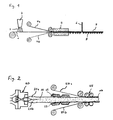
- Fig. 1 shows an apparatus for producing fiber-reinforced plate material a polyester.
- a continuously fed web-shaped fiber structure 1 is by means of a powder coating device 3 with a reactive starting material in Powder form 2 coated.
- the applied to the fiber structure powder can in order Improvement of the adhesive properties are heated.
- the fiber structure preheated and coated with the powder.
- Below are both sides continuous cover layers in the form of polyester films 4a, 4b supplied and on applied the free surfaces of the coated fiber structure.
- a continuous press 5 becomes the reactive starting material to form a plastic matrix and polymerized under intimate connection with the outer layers.
- the solidified plate material is after leaving the continuous press 5 on roller conveyor 8 a Cutting or sawing device 6 and cut to individual plates 7.
- Fig. 2 shows the production of a sandwich composite, wherein through the openings 19th a perforated plate 18 (Fig. 3) of an extrusion device 1 strand-shaped with a Blowing agent provided polyester 21a, 21b is extruded.
- the extruded strands 21a, 21b expand after exiting the perforated plate 18 and bond each other to a plate-shaped foam body 22.
- the still soft foam body 22nd is brought in a straightening device 23 in the desired thickness and width mass.
- the following are sheet-like impregnated with a reactive starting material or coated fiber webs 24a, 24b and onto the free surfaces the foam body 22 applied.
- the layer composite is subsequently in a press or rolling apparatus 25 to polymerize the reactive starting material to a plastic matrix and under intimate connection derselbigen with the Surface of the foam body 22 pressed into a sandwich composite.
- a cutting or sawing device (not shown) Cut to individual sandwich panels 10.
- Said sandwich plate 10 (Fig. 4) consists of a polyester foam core 12 and two arranged on both sides Cover layers 11, 13 of a fiber-reinforced PBT plastic.
Landscapes
- Engineering & Computer Science (AREA)
- Mechanical Engineering (AREA)
- Chemical & Material Sciences (AREA)
- Composite Materials (AREA)
- Casting Or Compression Moulding Of Plastics Or The Like (AREA)
- Reinforced Plastic Materials (AREA)
- Laminated Bodies (AREA)
Abstract
Description
Die Erfindung betrifft Verfahren zur Herstellung von faserverstärkten Kunststoffartikeln, enthaltend PBT oder ein PBT-Blend, nach dem Oberbegriff der unabhängigen Ansprüche. Die Erfindung betrifft ferner faserverstärkte Kunststoffartikel, enthaltend PBT oder eine PBT-Legierung, nach dem Oberbegriff der unabhängigen Ansprüche.The invention relates to processes for the production of fiber-reinforced plastic articles, containing PBT or a PBT blend, according to the preamble of the independent claims. The invention further relates to fiber-reinforced plastic articles containing PBT or a PBT alloy, according to the preamble of the independent claims.
Bis anhin gestaltete es sich schwierig thermoplastische Kunststoffsysteme zwecks Herstellung von faserverstärkten Kunststoffartikeln in den für die Verarbeitung von Duroplastsystemen, wie RTM-Verfahren oder Prepreg-Verarbeitung, ausgelegten Herstellungsprozessen zu verarbeiten. Die Schwierigkeit der Verarbeitung von thermoplastischen Kunststoffsystemen liegt unter anderem in der Bereitstellung eines geeigneten reaktiven Ausgangsmaterials, welches nicht nur chemisch stabil ist, sondern sich auch zur weiteren Verarbeitung in einen niedrig-viskosen Zustand überführen lässt.Until now, it has been difficult to make thermoplastic systems for manufacturing of fiber-reinforced plastic articles in the processing of thermoset systems, such as RTM processes or prepreg processing, designed manufacturing processes to process. The difficulty of processing thermoplastic Plastic systems is inter alia in the provision of a suitable reactive starting material, which is not only chemically stable, but also For further processing in a low viscous state can be transferred.
So werden seit einiger Zeit Anstrengungen unternommen, thermoplastische Kunststoffsysteme zu entwickeln, welche sich ähnlich wie duroplastische Kunststoffsysteme verarbeiten lassen. Ein bekanntes derartiges System basiert bsp. auf einem Polyamid (PA), wie PA-12 mit Laktam als Ausgangsmaterial. Ein weiteres vielversprechendes System basiert auf einem Polyester, wie Polybutylenterephthalat (PBT). Das reaktive Ausgangsmaterial zur Herstellung des Polyesters bzw. PBT liegt in Form sogenannter zyklischer bzw. makrozyklischer Oligomere vor, welche mit einem entsprechenden Polymerisatons-Katalysator vermischt sind. Das besondere an diesem System liegt darin, dass sich das reaktive Ausgangsmaterial in eine niedrig-viskose Schmelze überführen lässt, was dieses für die Verarbeitung mittels eines Injektionsverfahrens, wie z.B. eines LCM-Verfahrens, geeignet macht.Thus, efforts have been made for some time, thermoplastic resin systems to develop, which process similar to thermosetting plastic systems to let. A known such system is based bsp. on a polyamide (PA), like PA-12 with lactam as starting material. Another promising system based on a polyester, such as polybutylene terephthalate (PBT). The reactive starting material for the preparation of the polyester or PBT is in the form of so-called cyclic or macrocyclic oligomers, which with a corresponding Polymerisatons catalyst are mixed. The special thing about this system is that the reactive starting material can be converted into a low-viscosity melt, what this for processing by means of an injection method, such. an LCM process, makes it suitable.
LCM heisst "Liquid Composite Moulding". Unter LCM-Verfahren oder LCM-Technologie wird in diesem Text ein Verfahren verstanden, in welchem der Hohlraum eines mehrteiligen Formwerkzeuges, insbesondere eines zweiteiligen Formwerkzeuges, mit einem ein- oder mehrteiligen Faserrohling oder Fasergebilde beschickt wird und in den Hohlraum des geschlossenen Formwerkzeuges eine duro- oder thermoplastische Kunststoffmatrix eingespeist bzw. injiziert wird, welche den Faserrohling unter Ausbildung eines Faserverbundbauteils durchfliesst und imprägniert und den Hohlraum des Formwerkzeugs füllt, und nach Abschluss der Formfüllung das Faserverbundbauteil zur Aushärtung bzw. Polymerisation gebracht und anschliessend entformt wird. Das besagte LCM is called "Liquid Composite Molding". Under LCM or LCM technology is understood in this text a method in which the cavity of a multi-part Mold, in particular a two-part mold, with a one- or multi-part fiber blank or fiber structure is charged and into the cavity the closed mold a duro- or thermoplastic plastic matrix is fed or injected, which the fiber blank to form a Flowed fiber composite component and impregnated and the cavity of the mold fills, and after completion of the mold filling the fiber composite component for curing or brought polymerization and then demolded. That said
LCM-Verfahren umfasst selbstverständlich auch Varianten mit Schmelzkernen oder permanenten Kernen, wie z.B. Schaumstoffkernen, welche zusammen mit den Fasergebilden in das geöffnete Formwerkzeug eingelegt werden.Of course, LCM method also includes variants with fused cores or permanent nuclei, such as Foam cores, which together with the fiber formations be inserted into the open mold.
Wird in einem LCM-Verfahren ein duroplastisches Kunststoffmatrixsystem verarbeitet, so handelt es sich um ein Resin-Transfer-Molding-(RTM)-Verfahren. Das LCM-Verfahren versteht sich somit als eine dem RTM-Verfahren übergeordnete Bezeichnung für das voran beschriebene Injektions-Verfahren, welches neben duroplastischen Kunststoffmatrixsystemen auch thermoplastische Kunststoffmatrixsysteme umfasst. Das RTM-Verfahren ist beispielsweise in Kötte, "Der Resin-Transfer-Molding-Prozess - Analyse eines Harzinjektionsverfahrens", Verlag TÜV Rheinland, 1991 ausführlich beschrieben.If a thermoset plastic matrix system is processed in an LCM process, this is a resin transfer molding (RTM) process. The LCM process is therefore to be understood as a superordinate name for the RTM method the injection method described above, which in addition to thermosetting plastic matrix systems also comprises thermoplastic matrix polymer systems. The RTM procedure For example, in Kötte, "The Resin Transfer Molding Process - Analysis a Harzinjektionsverfahrens ", Verlag TÜV Rheinland, 1991 described in detail.
Häufig wird jedoch auch bei der Verarbeitung von thermoplastischen Matrixsystemen mittels LCM-Technologie von einem RTM-Verfahren gesprochen.However, it is also common in the processing of thermoplastic matrix systems talked about LCM technology of an RTM process.
Die niedrig-viskosen Eigenschaften der genannten zyklischen Oligomere sind jedoch auch für die Verarbeitung in anderen Verfahren vorteilhaft, da das niedrig-viskose, reaktive Ausgangsmaterial eine optimale Durchtränkung bzw. Imprägnierung der Fasern bewirkt, was insbesondere bei Kunststoffartikeln mit einem hohen Fasergehalt in Form von dichten Fasergebilden von grosser Bedeutung ist.However, the low-viscosity properties of the cyclic oligomers mentioned are Also advantageous for processing in other processes, as the low-viscous, reactive Starting material causes optimal impregnation or impregnation of the fibers, which is especially true for plastic articles with a high fiber content in the form of dense fiber structure is of great importance.
Die US 6,369,157 beschreibt beispielsweise ein geeignetes reaktives Ausgangsmaterial, welches sich zu einem PBT-Kunststoff oder einer PBT-Kunststofflegierung verarbeiten lassen. Als Verarbeitungsverfahren werden z.B. Prepreg-Prozesse, RTM-Verfahren, Pultrusions-Verfahren, Extrusionsverfahren sowie Formpress-Verfahren genannt.For example, US 6,369,157 describes a suitable reactive starting material, which process into a PBT plastic or a PBT plastic alloy to let. As a processing method, e.g. Prepreg processes, RTM processes, Pultrusion process, extrusion process and molding process called.
Aufgabe vorliegender Erfindung ist es, konkrete Verfahren zur Verarbeitung von PBT-Kunststoffsystemen bzw. des dazugehörigen reaktiven PBT-Ausgangsmaterials auf Basis von zyklischen Oligomeren vorzuschlagen. Ein weiterer Gegenstand vorliegender Erfindung sind auch die daraus resultierenden, PBT-Kunststoffe enthaltenden Produkte.The object of the present invention is to provide concrete methods for processing PBT plastic systems or the associated reactive PBT starting material based on of cyclic oligomers. Another subject of this The invention also relates to the resulting products containing PBT plastics.
Erfindungsgemäss wird die Aufgabe durch den kennzeichnenden Teil der unabhängigen Ansprüche gelöst. Weiterbildende Ausführungen werden durch die abhängigen Ansprüche beschrieben, welche hiermit Teil der Beschreibung sind.According to the invention, the object is achieved by the characterizing part of the independent Claims solved. Further developments are given by the dependent claims described, which are hereby part of the description.
Ein reaktives Ausgangsmaterial gemäss nachfolgender Definition umfasst unter anderem zyklische bzw. makrozyklische Oligomere des Polyesters, insbesondere des PBT (CPBT genannt), welche mit einem Polymerisations-Katalysator vermengt sind. Ferner umfasst ein reaktives Ausgangsmaterial auch Blends (Legierungen), enthaltend die vorgenannten Stoffe, welche bsp. nach Abschluss der Polymerisation ein PBT-Blend (PBT-Kunststofflegierung) ergeben. Die genannten reaktiven Ausgangsmaterialien zur Herstellung von Polyestern bzw. PBT-Kunststoffen sind in der US 6,369,157 näher beschrieben, deren Inhalt hiermit Teil der Offenbarung ist. Besonders geeignete reaktive PBT-Ausgangsmaterialien in Form zyklischer Oligomere werden unter dem Namen CBT™ (Cyclic Butylene Terephthalate) von der Firma Cyclics hergestellt. Der Polymerisations-Katalysator kann bsp. ein Zink-Katalysator oder ein anderer geeigneter Katalysator sein.A reactive starting material as defined below includes, inter alia cyclic or macrocyclic oligomers of the polyester, in particular of the PBT (Called CPBT), which are mixed with a polymerization catalyst. Further For example, a reactive starting material also includes blends (alloys) containing the foregoing Substances which bsp. after completion of the polymerization, a PBT blend (PBT plastic alloy) result. The said reactive starting materials for the preparation of polyesters or PBT plastics are described in greater detail in US Pat. No. 6,369,157, the content of which is herewith part of the revelation. Particularly suitable reactive PBT starting materials in the form of cyclic oligomers are named CBT ™ (Cyclic Butylene Terephthalate) manufactured by Cyclics. The polymerization catalyst can bsp. a zinc catalyst or other suitable catalyst be.
Polyester gemäss nachfolgender Definition beinhalten unter anderem Kunststoffe wie PET (Polyethylenterephthalat) sowie dazugehörige Blends und insbesondere PBT (Polybutylenterephthalat) oder PBT-Blends (PBT-Kunststofflegierungen).Polyesters according to the following definition include, among others, plastics such as PET (polyethylene terephthalate) and associated blends and in particular PBT (polybutylene terephthalate) or PBT blends (PBT plastic alloys).
Fasergebilde gemäss nachfolgender Definition sind flächenförmige Gebilde und umfassen unter anderem textile Flächengebilde, z.B. Vliese, "Non-wovens", nicht-maschenbildende Systeme, wie Gewebe, uni- oder bidirektionale Gelege, Geflechte oder Matten usw. oder z.B. maschenbildende Systeme, wie Gestricke oder Gewirke sowie gestickte Strukturen.Fiber structures according to the following definition are sheet-like structures and comprise including textile fabrics, e.g. Nonwovens, "non-wovens", non-weft forming Systems such as tissue, uni- or bi-directional scrims, braids or mats etc. or e.g. stitch forming systems such as knits or knits and embroidered ones Structures.
Die Fasern der Fasergebilde sind gemäss nachfolgender Definition bsp. Langfasern mit Faserlängen von z.B. 3-150 mm oder Endlosfasern und sind bsp. in Form von Rovings zu Fasergebilden verarbeitet.The fibers of the fiber structures are according to the following definition bsp. Long fibers with Fiber lengths of e.g. 3-150 mm or continuous fibers and are bsp. in the form of rovings processed into fiber structures.
Die Fasern können Glasfasern, Aramidfasern, Kohlenstofffasern, Kunststofffasern, Naturfasern oder Gemische davon sein. Kunststofffasern können insbesondere Polyesterfasern, wie z.B. PET, PBT oder PBT-Blend, sein. Hinsichtlich anorganischer Fasern werden bevorzugt Glasfasern verwendet, da sich diese im Gegensatz zu Aramid- oder Kohlenstofffasern beim Wiederverwerten der faserverstärkten Kunststoffartikel mit relativ wenig Aufwand von der Kunststoffmatrix trennen lassen und Glasfasern ferner verhältnismässig kostengünstig sind.The fibers may be glass fibers, aramid fibers, carbon fibers, plastic fibers, natural fibers or mixtures thereof. Plastic fibers, in particular polyester fibers, such as. PET, PBT or PBT blend. With regard to inorganic fibers Glass fibers are preferred because they are in contrast to aramid or Carbon fibers in recycling the fiber reinforced plastic articles with relative little effort can be separated from the plastic matrix and glass fibers also relatively are inexpensive.
PBT-Fasern zeichnen sich dadurch aus, dass diese bedingt durch den Herstellungsprozess eine kristalline Ausrichtung in Faserrichtung aufweisen, während die Matrix zwischen den Fasern weitgehend keine kristalline Ausrichtung aufweist, d.h. amorph ist.PBT fibers are characterized by the fact that they are conditioned by the manufacturing process have a crystalline orientation in the fiber direction, while the matrix between the fibers have substantially no crystalline orientation, i. amorphous.
Platte gemäss nachfolgender Definition bedeutet einen flächigen Körper mit einer gewissen Biegesteifigkeit und einer Dicke, welche im Vergleich zur Längen- und Breitenausdehnung klein ist. Die genannten Platten weisen bsp. eine Dicke von 0.5 mm oder grösser, vorzugsweise von 1 mm oder grösser, und insbesondere von 2 mm oder grösser und von 10 mm oder kleiner, vorzugsweise 6 mm oder kleiner, und insbesondere von 4 mm oder kleiner, auf.Plate according to the following definition means a flat body with a certain Flexural rigidity and a thickness, which compared to the length and width extent is small. The said plates have bsp. a thickness of 0.5 mm or larger, preferably 1 mm or larger, and more preferably 2 mm or larger and of 10 mm or smaller, preferably 6 mm or smaller, and in particular of 4 mm or smaller, up.
Zur Herstellung preimprägnierter Fasergebilde (Prepreg), in der Regel Fasermatten, wurden bis anhin die Fasergebilde mit einer reaktiven Kunststoffmatrix durchtränkt (imprägniert) oder mit reaktivem Pulver beschichtet, wobei das Pulver, insbesondere das erwärmte Pulver, selbst klebrige Eigenschaften hat und dadurch auf dem Fasergebilde haften bleibt.For the production of pre-impregnated fiber structures (prepreg), usually fiber mats, until now the fiber structures were impregnated (impregnated) with a reactive plastic matrix or coated with reactive powder, wherein the powder, in particular the heated powder, even has sticky properties and thereby on the fiber structure sticks.
Es ist auch bekannt, das reaktive Ausgangsmaterial, d.h. die zyklischen Oligomere, in Filmform auf die Fasergebilde aufzubringen, wobei durch Aufschmelzen dieser Filme eine Imprägnierung des Fasergebildes dank der niedrig-viskosen Eigenschaften des reaktiven Ausgangsmaterials im schmelzflüssigen Zustand stattfindet.It is also known that the reactive starting material, i. the cyclic oligomers, in Apply film form to the fiber structure, wherein by melting these films an impregnation of the fiber structure thanks to the low-viscous properties of the reactive Starting material takes place in the molten state.
Da Prepregs in der Regel klebrig sind werden diese nach bekannter Technik ein- oder beidseitig mit einer Release-Layer, also einem Trennfilm, versehen. Eine solche Release-Layer erlaubt das Aufwickeln kontinuierlich produzierter Prepregs zu Rollenware auf sogenannte Coils zur Zwischenlagerung vor der weiteren Verarbeitung zu faserverstärkten Plattenmaterialien, ohne dass diese dabei miteinander verkleben. Andererseits sind die Release-Layer auch im weiteren Verarbeitungsprozess von Bedeutung, da diese bei der Herstellung von gehärtetem, bzw. polymerisiertem Plattenmaterial die Anlagen, d.h. die Pressen oder Walzen vor dem Verkleben mit den Prepregs schützen. Nach Aushärtung bzw. Polymerisation der Prepregs zu einem Plattenmaterial, auch Organic Sheet genannt, wird die Release-Layer entfernt. Die Release-Layer ist hier also nicht Teil des Endproduktes sondern lediglich ein Produktionshilfsmittel.Since prepregs are usually sticky, they are on or off according to known technology on both sides with a release layer, so a release film provided. Such a release layer allows the winding of continuously produced prepregs into rolls so-called coils for intermediate storage prior to further processing into fiber-reinforced Plate materials, without them sticking together. on the other hand the release layers are also important in the further processing process, since these in the production of hardened or polymerized plate material, the installations, i.e. protect the presses or rollers from sticking to the prepregs. To Curing or polymerization of prepregs to a plate material, also Organic Sheet, the release layer is removed. So the release layer is not here Part of the final product but only a production aid.
Die Idee vorliegender Erfindung liegt in der Verbesserung des Verfahrens zur Herstellung und weiteren Verarbeitung von sogenannten Prepreg-Halbfabrikaten und im weiteren Sinn zur Herstellung von Plattenmaterial aus Polyester, wie PET und insbesondere PBT oder PBT-Blend unter Verwendung eines reaktiven Ausgangsmaterials.The idea of the present invention lies in the improvement of the process for the production and further processing of so-called prepreg semi-finished products and further Sense for the production of plate material made of polyester, such as PET and in particular PBT or PBT blend using a reactive starting material.
Dazu werden in einem ersten Schritt Fasergebilde mit dem reaktiven Ausgangsmaterial imprägniert oder beschichtet. Die Fasergebilde können dazu mit einem flüssigen, reaktiven Ausgangsmaterial getränkt werden, bsp. mittels Eintauchen der Fasergebilde in ein Lösungsbad, wobei das Lösungsmittel nach der Imprägnierung wieder entzogen wird. Ferner kann das flüssige Ausgangsmaterial auch mittels Sprühen, Streichen, Giessen, Walzen oder Rakeln auf die Fasergebilde aufgebracht werden.For this purpose, in a first step, fiber structures with the reactive starting material impregnated or coated. The fiber structures can do this with a liquid, reactive Starting material to be soaked, bsp. by immersing the fiber structures in a Solution bath, wherein the solvent is removed again after the impregnation. Furthermore, the liquid starting material can also by means of spraying, brushing, pouring, Rolling or doctoring be applied to the fiber structure.
Die Fasergebilde können in einer alternativen Variante mit dem reaktiven Ausgangsmaterial in Pulverform oder in Form von Folien beschichtet werden, wobei in beiden Fällen das reaktive Ausgangsmaterial im Laufe des Herstellungsverfahrens unter Imprägnierung der Fasergebilde aufgeschmolzen wird. Wird das reaktive Ausgangsmaterial in Pulverform auf das Fasergebilde aufgebracht, so kann dieses zwecks Verbesserung der Hafteigenschaften erwärmt werden, wobei das Pulver sogar erweichen oder anschmelzen kann. Alternativ oder in Kombination dazu kann das Fasergebilde vorgewärmt und mit dem Pulver beschichtet werden. Die Pulverbeschichtung kann auf ein horizontal oder vertikal durchlaufende Faserbahn erfolgen, wobei das Pulver entsprechend vertikal oder horizontal der Faserbahn zugeführt wird. Das Pulver kann hierbei mittels Schwerkraft und/oder mittels Gas- bzw. Luftstrom zugeführt werden. Der Gas- bzw. Luftstrom ist bevorzugt erwärmt, so dass das Pulver beim Auftreffen auf die Faserbahn adhäsive Eigenschaften entfaltet. Ferner kann das Pulver auch mittels eines elektrostatischen Verfahrens zugeführt werden.The fibrous structures may in an alternative variant with the reactive starting material be coated in powder or in the form of films, in both cases the reactive starting material in the course of the manufacturing process under impregnation the fiber structure is melted. Is the reactive starting material in Pulverform applied to the fiber structure, so this can improve the Heated properties are heated, the powder even soften or melt can. Alternatively or in combination, the fiber structure can be preheated and be coated with the powder. The powder coating can be applied to a horizontal or vertically continuous fiber web, the powder corresponding vertical or horizontally the fiber web is supplied. The powder can by gravity and / or supplied by means of gas or air flow. The gas or air flow is preferred heated so that the powder when adhering to the fibrous web adhesive properties unfolded. Furthermore, the powder can also by means of an electrostatic process be supplied.
Im besagten Verfahren können auch zwei oder mehrere Lagen von Fasergebilden wie oben beschrieben imprägniert bzw. beschichtet und zu einer mehrlagigen bzw. mehrschichtigen Faserbahn zusammengeführt werden.In said method, two or more layers of fiber structures such as impregnated or coated as described above and to a multilayer or multilayer Fiber web are merged.
In einem nachfolgenden Schritt wird die mit dem reaktiven Ausgangsmaterial imprägnierte bzw. beschichtete ein- oder mehrlagige Faserbahn ein- oder beidseitig mit einer Deckschicht in Form eines Kunststoff-Films bzw. -Folie beschichtet. Der Kunststoff-Film bzw. -Folie wird hierbei integraler Bestandteil des herzustellenden, faserverstärkten Plattenmaterials.In a subsequent step, the impregnated with the reactive starting material or coated single- or multi-ply fibrous web on one or both sides with a Cover layer coated in the form of a plastic film or film. The plastic film or film is here an integral part of the produced, fiber-reinforced Plate material.
Der Kunststoff-Film bzw. -Folie kann aus einem thermoplastischen oder duroplastischen Kunststoff sein. Vorzugsweise ist die Deckschicht ein polymerisierter thermoplastischer Film aus einem Polyester, wie PET und insbesondere aus einem PBT oder PBT-Blend.The plastic film or foil can be made of a thermoplastic or thermosetting Be plastic. Preferably, the cover layer is a polymerized thermoplastic Film of a polyester, such as PET and in particular of a PBT or PBT blend.
Der Kunststofffilm weist bsp. eine Dicke von grösser Dicke 50 µm, insbesondere von grösser 100 µm und von kleiner 2000 µm, insbesondere von kleiner 1000 µm auf. Durch die klebrigen Eigenschaften des reaktiven Ausgangsmaterials bleibt der Kunsttoff-Film auf dem imprägnierten bzw. beschichteten Fasergebilde haften. Der Kunststofffilm kann als feste, von einer Rolle abgewickelte Folie oder mittels Extrusions als schmelzflüssiger, teilfester oder fester Film aufgetragen werden.The plastic film has bsp. a thickness of greater thickness 50 microns, in particular of greater than 100 microns and less than 2000 microns, in particular of less than 1000 microns on. By the sticky properties of the reactive starting material remain the Kunsttoff film adhere to the impregnated or coated fiber structure. The plastic film can as a solid, unwound from a roll film or by extrusion as a molten, semi-solid or solid film are applied.
Die auf die Faserbahn aufgebrachte Deckschicht kann auch ein faserverstärktes, bahnförmiges Kunststoffmaterial mit einer äusseren, faserfreien (polymerisierten) Kunststoffschicht der oben genannten Zusammensetzung sein.The cover layer applied to the fibrous web can also be a fiber-reinforced, web-shaped Plastic material with an outer, fiber-free (polymerized) plastic layer be the above composition.
Die Fasern der Faserbahn sind bevorzugt aus Glas oder Polyester, wie PET und insbesondere PBT bzw. PBT-Blend. Durch die Verwendung von Polyesterfasern, wie PBT-Fasern wird ein sortenreines Plattenmaterial erreicht.The fibers of the fibrous web are preferably made of glass or polyester, such as PET and in particular PBT or PBT blend. Through the use of polyester fibers, such as PBT fibers a varietal plate material is achieved.
Die Prepregs mit applizierten Deckschichten werden zur Weiterverarbeitung unter Druck und Wärmeeinwirkung zu einem Polyester, wie PET und insbesondere PBT oder einem PBT-Blend polymerisiert, wobei die Deckschichten mit der polymerisierenden Kunststoffmatrix des Fasergebildes einen innigen Verbund eingehen und die Deckschichten integraler Bestandteil des plattenförmigen Faserverbundes werden.The prepregs with applied cover layers are pressurized for further processing and heat to a polyester, such as PET and especially PBT or a PBT blend polymerized, wherein the cover layers with the polymerizing polymer matrix of the fiber structure form an intimate bond and the outer layers become an integral part of the plate-shaped fiber composite.
Der Schmelz- oder Zersetzungspunkt der Deckschichten liegt hierbei höher als die Polymerisationstemperatur des reaktiven Ausgangsmaterials. Somit wird die Deckschicht während des Polymerisationsvorgangs der Kunststoffmatrix nicht beeinträchtigt.The melting or decomposition point of the cover layers is higher than the polymerization temperature of the reactive starting material. Thus, the cover layer becomes during the polymerization of the plastic matrix is not affected.
Da der Schmelzpunkt von PBT (ca. 220°C) höher ist als die Polymerisationstemperatur der eingesetzten reaktiven Ausgangsmaterialien (ca. 180-190°C) werden die Deckschichten aus PBT-Filmen durch die Wärmeeinwirkung beim Polymerisieren der Kunststoffmatrix nicht nachteilig beeinträchtigt. Deckschichten aus einem Polyester, insbesondere aus PBT, ergeben überdies einen nach Recycling-Kriterien sortenreinen Kunststoff im Verbundmaterial. Since the melting point of PBT (about 220 ° C) is higher than the polymerization temperature The reactive starting materials used (about 180-190 ° C) are the outer layers from PBT films due to the effect of heat when polymerizing the plastic matrix not adversely affected. Cover layers of a polyester, in particular made of PBT, moreover, according to recycling criteria sorted plastic in composite material.
Die integrale Applikation von Deckschichten hat den zusätzlichen Vorteil, dass eine hohe Oberflächengüte des Plattenmaterials erreicht wird, da die Deckschichten keine Fasern enthalten.The integral application of cover layers has the additional advantage that a high Surface quality of the plate material is achieved because the outer layers no fibers contain.
Die Deckschichten und die Kunststoffmatrix der Faserbahn bestehen in polymerisiertem Zustand bevorzugt aus demselben Kunststoff bzw. aus einander nahestehenden Kunststoffen oder Kunststofflegierungen.The outer layers and the plastic matrix of the fibrous web consist of polymerized Condition preferably made of the same plastic or of closely related plastics or plastic alloys.
In Weiterbildung der Erfindung können die Deckschichten eingefärbt sein und so dem Plattenmaterial bereits das äussere, farbliche Erscheinungsbild geben. Die Einfärbung kann derart sein, dass die unter den Deckschichten angeordnete faserverstärkte Schicht nicht mehr sichtbar ist. Dadurch kann gegebenenfalls ein nachfolgender Farblackierungsschritt eingespart werden.In a further development of the invention, the outer layers can be colored and so the Plate material already give the outer, colored appearance. The coloring may be such that the fiber-reinforced layer disposed under the cover layers is no longer visible. As a result, if appropriate, a subsequent color-coating step be saved.
Die Produktion des erfindungsgemässen Plattenmaterials erfolgt von der Zufuhr der Fasergebilde und des Ausgangsmaterials bis zum Austritt des fertigen Plattenmaterials aus der Presse bevorzugt kontinuierlich und inline, d.h. in einer Fertigungslinie.The production of the inventive plate material takes place from the supply of fiber structures and the starting material until the exit of the finished plate material the press prefers continuously and inline, i. in a production line.
Hierzu werden ein oder mehrere Fasergebilde der Verarbeitungseinrichtung kontinuierlich zu- und gegebenenfalls zusammengeführt, wobei diese bsp. bahnförmig von einer Rolle abgewickelt und inline mit dem reaktiven Ausgangsmaterial imprägniert bzw. beschichtet werden. Die Imprägnierung bzw. Beschichtung kann kontinuierlich bsp. mittels eines Tauchbades in einer Durchlaufanlage, einer Sprühvorrichtung, einer Pulverstreuvorrichtung, einer Vorrichtung zur elektrostatischen Übertragung des Pulvers auf die Fasergebilde oder einer Vorrichtung zur Zufuhr eines flüssigen, teilfesten oder festen Filmes aus einem reaktiven Ausgangsmaterial, z.B. mittels Extrusion oder ab Rolle, erfolgen.For this purpose, one or more fiber structures of the processing device are continuous and possibly combined, this bsp. of a web shape Roll unwound and impregnated inline with the reactive starting material or coated become. The impregnation or coating can continuously bsp. by means of a dipping bath in a continuous system, a spraying device, a powder spreading device, a device for the electrostatic transfer of the powder to the fiber structures or a device for supplying a liquid, partially solid or solid film from a reactive starting material, e.g. by extrusion or from roll, done.
Danach wird ein- oder beidseitig inline ein (polymerisierter) Kunststofffilm bzw. -Folie auf die mit dem reaktiven Ausgangsmaterial imprägnierte bzw. beschichtete Faserbahn aufgebracht, wobei der Kunststofffilm entweder von Rollen (Coils) abgehaspelt wird oder direkt inline extrudiert und in flüssigem, teilfestem oder festem Zustand auf die imprägnierte bzw. beschichtete Faserbahn aufgebracht wird.Thereafter, one or both sides of a (polymerized) plastic film or film is inline the fibrous web impregnated or coated with the reactive starting material is applied, wherein the plastic film is either unwound from rolls (coils) or directly extruded inline and impregnated in liquid, partially solid or solid state or coated fiber web is applied.
In einer nachfolgenden Durchlaufpresse wird der Verbund unter Druck- und/oder Wärmeeinwirkung zu einem faserverstärkten Plattenmaterial polymerisiert. Der Pressvorgang kann mittels nachgeordneten Presswalzen und/oder mittels Pressplatten erfolgen. Die Press-Vorrichtung kann bsp. schwimmende, hydraulisch betätigte untere Pressenplatten, welche gegen eine obere starre Pressenkonstruktion arbeiten, umfassen. Eine solche Durchlaufpresse wird bsp. mit Bändern, wie PTFE-Bändern oder Stahlbändern betrieben und erlaubt in Abhängigkeit von der Länge der Heizstrecke mittlere bis hohe Durchsätze.In a subsequent continuous press, the composite is subjected to pressure and / or heat polymerized to a fiber reinforced sheet material. The pressing process can be done by means of downstream press rolls and / or pressing plates. The pressing device can bsp. floating, hydraulically operated lower press plates, which work against an upper rigid press design include. A such continuous press is bsp. with bands, such as PTFE bands or steel bands operated and allowed depending on the length of the heating medium to high Throughputs.
Das bahnartige, polymerisierte Plattenmaterial kann anschliessend längs und/oder quer zur Durchlaufrichtung zu einzelnen Platten oder Streifen geschnitten und batch-weise gestapelt werden. Dank den Deckschichten werden die Anlagen bei der Weiterverarbeitung der Prepregs zu Plattenmaterial geschont.The web-like, polymerized plate material may then be longitudinal and / or transverse cut to the direction of passage to individual plates or strips and batch-wise be stacked. Thanks to the surface layers, the plants are processed further spared the prepregs to plate material.
In einer spezifischen Ausführung der Erfindung werden die Prepregs nach dem Beschichten mit den Deckschichten nicht durch eine Presse geführt sondern auf Rollen aufgewickelt oder zugeschnitten und batch-weise gestapelt, wobei die einzelnen Platten dank der Release-Funktion der Deckschichten nicht aneinander haften. Die so der Zwischenlagerung zugeführten Prepregs können zu einem späteren Zeitpunkt wie oben beschrieben zu Plattenmaterial weiterverarbeitet werden oder andersweitig verarbeitet werden, bsp. in Formpressen.In a specific embodiment of the invention, the prepregs are after coating with the outer layers not passed through a press but on rollers wound or cut and batch-wise stacked, with the individual plates not stick together thanks to the release function of the cover layers. The so the intermediate storage fed prepregs can at a later date as described above be processed into plate material or otherwise processed be, bsp. in compression molding.
Das erfindungsgemässe faserverstärkte Plattenmaterial findet Verwendung als flache Platten bzw. Streifenware. Ferner kann das Plattenmaterial zu thermisch umgeformten Artikeln, bsp. mittels Tiefziehen, weiterverarbeitet werden. Weiters kann das besagte Plattenmaterial in Form flacher Platten zu mehrschichtigen Verbunden, insbesondere zu Sandwichverbunden, weiterverarbeitet werden, wobei die weiteren Schichten bsp. Schaumstoffe, Metallfolien oder Metallplatten umfassen können.The fiber-reinforced plate material according to the invention is used as a flat Plates or strips. Furthermore, the plate material may be thermoformed Articles, bsp. by deep drawing, further processed. Furthermore, the said Plate material in the form of flat plates to multilayer composites, in particular to Sandwich compounds, further processed, the other layers bsp. Foams, metal foils or metal plates may include.
Die Herstellung solcher Mehrschichtverbunde kann ebenfalls kontinuierlich und inline erfolgen, wobei die weiteren Schichten, wie Schaumstoffschichten, ebenfalls kontinuierlich zugeführt werden. In bevorzugter Ausführung findet die Herstellung der Mehrschichtverbunde inline und direkt im Anschluss an die Produktion des faserstärkten Plattenmaterials statt. Wird das besagte Plattenmaterial zu Mehrschichtverbunden weiterverarbeitet, so genügt es unter Umständen, dass das Prepreg-Material lediglich mit einer Deckschicht mit einem permanenten Kunststofffilm als Release-Layer beschichtet wird, während die zweite Oberfläche mit einer temporären Release-Layer beschichtet wird, die zur Herstellung des Mehrschichtverbundes wieder entfernt wird. Die den permanenten Kunststofffilm enthaltende Deckschicht bildet dabei eine Deckschicht des Mehrschichtverbundes während die zweite Oberfläche die Kontaktfläche zu weiteren Verbundschichten ist. The production of such multilayer composites can also be continuous and inline take place, wherein the other layers, such as foam layers, also continuously be supplied. In a preferred embodiment, the production of multi-layer composites inline and directly after the production of the fiber-reinforced Plate material instead. If said plate material is further processed into multilayer composites, So it is sufficient in some circumstances that the prepreg material only with a cover layer coated with a permanent plastic film as a release layer while the second surface is coated with a temporary release layer which is removed again for the production of the multi-layer composite. The permanent one Plastic film-containing cover layer forms a cover layer of the Multi-layer composite while the second surface of the contact surface to another Composite layers is.
Das besagte Plattenmaterial oder die daraus hergestellten Verbundplatten oder thermogeformten Artikel finden Verwendung im Transportwesen, wie Strassenfahrzeugbau (Automobile, Busse, Lastkraftwagen, Leichtfahrzeugen etc.), Schienenfahrzeugbau (Eisenbahn, Tram, Schnellbahn, Magnetschwebebahnen), Luftfahrt (Flugzeugbau, Raumfahrt), im Marine-, Boots- und Schiffsbau sowie in Seilbahnkabinen. Ferner findet das besagte Plattenmaterial Verwendung im Hochbau und Tiefbau, Innenausbau und insbesondere in der Gebäudetechnik sowie in der Herstellung von Sportgeräten.The said plate material or the composite plates or thermoformed plates made therefrom Find articles Use in transportation, such as road construction (Automobiles, buses, lorries, light vehicles, etc.), rail vehicle construction (railways, Tram, rapid transit railway, maglev trains), aviation (aircraft, aerospace), in marine, boat and shipbuilding as well as in cable car cabins. Furthermore, that finds said plate material use in building construction and civil engineering, interior design and in particular in building technology as well as in the production of sports equipment.
Gegenstand vorliegender Erfindung sind auch sortenreine, faserverstärkte Kunststoffartikel, nachfolgend sortenrein-Kunststoffartikel genannt, welche Fasern aus Polyester, wie PET und insbesondere PBT oder einem PBT-Blend, und eine Kunststoffmatrix ebenfalls aus Polyester, wie PET und insbesondere PBT oder PBT-Blend, enthalten. Die sortenrein-Kunststoffartikel können beispielsweise faserverstärkte Kunststoffplatten sein, welche aus mit einem reaktiven Ausgangsmaterial imprägnierten bzw. beschichteten Prepregs, welche unter Druck und/oder Wärmeeinwirkung zu faserverstärkten Kunststoffplatten polymerisiert werden, hergestellt sind. Die Fasergebilde können beispielsweise mit dem reaktiven, pulverförmigen Ausgangsmaterial beschichtet sein oder aber mit dem in Flüssigform, gegebenenfalls in Lösung vorliegenden, reaktiven Ausgangsmaterial getränkt sein. Es ist auch denkbar, dass die Fasergebilde ein- oder beidseitig mit einem Film aus einem reaktiven Ausgangsmaterial beschichtet sind, wobei der Film zwecks Imprägnierung der Fasern niedrig-viskos aufgeschmolzen wird.The present invention also provides unmixed, fiber-reinforced plastic articles, hereinafter referred to as grade plastic articles, which fibers of polyester, such as PET and in particular PBT or a PBT blend, and a plastic matrix also made of polyester, such as PET and in particular PBT or PBT blend. The single-grade plastic articles may be, for example, fiber-reinforced plastic plates, which are impregnated or coated with a reactive starting material Prepregs which under pressure and / or heat to fiber-reinforced plastic sheets polymerized are prepared. The fiber structures can, for example be coated with the reactive, powdery starting material or with the reactive starting material present in liquid form, optionally in solution be soaked. It is also conceivable that the fiber structure on one or both sides coated with a film of a reactive starting material, wherein the film for the purpose of impregnating the fibers is melted low viscous.
Unter Druck- und Wärmeeinwirkung wir die Kunststoffmatrix in einer Presseinrichtung unter Ausbildung einer faserverstärkten Kunststoffplatte polymerisiert.Under pressure and heat we use the plastic matrix in a pressing device polymerized to form a fiber-reinforced plastic plate.
Die mit dem reaktiven Ausgangsmaterial beschickten Fasergebilde können auch in einem Formwerkzeug unter Druck- und Wärmeanwendung und Polymerisation der Kunststoffmatrix zu einem geformten sortenrein-Kunststoffartikel verarbeitet werden.The fed with the reactive starting material fiber structures can also in a Mold under pressure and heat application and polymerization of the plastic matrix be processed into a molded single-grade plastic article.
Das besagte Plattenmaterial kann gemäss dem vorgängig beschriebenen Deckfolien-Verfahren hergestellt sein und im weiteren eine ein- oder beidseitige Beschichtung mit einem Deckfilm aus Polyester, wie PET und insbesondere aus einem PBT oder PBT-Blend, enthalten.The said plate material can according to the previously described cover sheet method be prepared and in the other a one- or two-sided coating with a cover film of polyester, such as PET and in particular of a PBT or PBT blend, contain.
Ferner können die besagten sortenreinen, faserverstärkten Einkomponenten-Kunststoff-Artikel auch mittels einem vorgängig beschriebenen LCM-Verfahren hergestellte Formkörper sein. Das reaktive Ausgangsmaterial wird hierzu zweckmässig in ein mit einem Fasergebilde ausgelegten Formwerkzeug eingespeist bzw. injiziert. Die Fasern der Fasergebilde bestehen aus einem Polyester, wie PET und insbesondere PBT oder PBT-Blend.Furthermore, the said single-grade, fiber-reinforced one-component plastic articles also by means of a previously described LCM process produced moldings be. The reactive starting material is suitably in a with a Fibrous designed mold fed or injected. The fibers of the fiber structure consist of a polyester, such as PET and in particular PBT or PBT blend.
Eine weitere Verarbeitungsmethode zeichnet sich dadurch aus, dass der faserverstärkte Kunststoffartikel vollständig aus einem Polyester, wie PET und insbesondere aus einem PBT oder PBT-Blend besteht. Zur Herstellung genannter Kunststoffartikel wird das reaktive Ausgangsmaterial zu linearen Fasern verarbeitet, welche wiederum zu einem Polyester, wie PET und insbesondere PBT oder einem PBT-Blend polymerisiert werden. Alternativ dazu können die Fasern auch direkt aus einem Polyester, wie PET und insbesondere PBT oder PBT-Blend hergestellt werden. Die Fasern zeichnen sich dadurch aus, dass sie eine in Faserrichtung ausgerichtete Kristallinität aufweisen und daher gute mechanische Eigenschaften, wie Steifigkeit und Zugfestigkeit, aufweisen. Die genannten Fasern werden in einem nachfolgenden Verarbeitungsschritt zu Fasergebilden, wie vorgängig definiert, verarbeitet.Another processing method is characterized in that the fiber-reinforced Plastic articles made entirely of a polyester, such as PET and in particular of one PBT or PBT blend exists. For the production of said plastic articles is the reactive Processed starting material to linear fibers, which in turn to a polyester, such as PET and in particular PBT or a PBT blend are polymerized. alternative These fibers can also directly from a polyester, such as PET and in particular PBT or PBT blend are produced. The fibers are characterized that they have a fiber-oriented crystallinity and therefore good have mechanical properties, such as stiffness and tensile strength. The mentioned Fibers become fibrous in a subsequent processing step, as before defined, processed.
In einem nachfolgenden Verfahrensschritt werden wenigstens die Oberflächen der einzelnen Fasern oder Rovings auf- bzw. angeschmolzen, wobei der schmelzflüssige Kunststoff die Fasern verbindet bzw. verklebt und unter Rekristallisation zu einer zwischen den Fasern angeordneten, vorzugsweise isotropen Kunststoffmatrix verfestigt wird. Dieser Verfahrensschritt zeichnet sich durch Anwendung von Druck und/oder Hitze aus. Ein solches Verfahren kann bsp. ein Heiss-Press- bzw. Heiss-Kompaktierungsverfahren (hot compaction) sein.In a subsequent process step, at least the surfaces of the individual Fibers or rovings fused or melted, the molten Plastic connects the fibers or glued and recrystallized to an intermediate the fibers arranged, preferably solidified isotropic plastic matrix becomes. This process step is characterized by the application of pressure and / or heat out. Such a procedure can bsp. a hot-pressing or hot-compaction process (hot compaction).
Das Ergebnis ist ein kompakter, selbstverstärkter Kunststoffartikel, welcher in eine Kunststoffmatrix eingebettete sortengleiche Kunststofffasern enthält. Der besagte Kunststoffartikel weist dabei ähnliche mechanische Eigenschaften wie mit anorganischen Fasergebilden verstärkte Kunststoffartikel auf. Sortengleich oder sortenrein bedeutet hier, dass beide Komponenten aus einem Polyester sind.The result is a compact, self-reinforced plastic article, which in a Plastic matrix contains embedded sortsgleiche plastic fibers. The said Plastic article has similar mechanical properties as inorganic Fiber-reinforced plastic articles on. Variety equal or sorted means here that both components are made of a polyester.
Der beschriebene polymerisierte Kunststoffartikel zeichnet sich durch seine gute Thermoformbarkeit aus, und lässt sich in nachgeschalteten Umformverfahren unter Einsatz von Wärme und/oder Druck weiter umformen bzw. endformen. The described polymerized plastic article is characterized by its good Thermoformability, and can be used in downstream forming process of heat and / or pressure further reshape or endforms.
Die besagten Kunststoffartikel, nachfolgend Einkomponenten-Kunststoffartikel genannt, können in Form von Platten oder geformten Körpern hergestellten werden, wobei die Platten vorzugsweise in einer entsprechenden Presseinrichtung oder Walzvorrichtung kontinuierlich hergestellt werden, während die geformten Körper vorzugsweise in entsprechend gestalteten Formwerkzeugen, wie Formpressen, stückweise gefertigt werden.The said plastic articles, hereinafter called one-component plastic articles, can be produced in the form of plates or shaped bodies, the Plates preferably in a corresponding pressing device or rolling device be made continuously, while the shaped body preferably in accordance with designed molds, such as compression molding, are produced piece by piece.
Gegenstand vorliegender Erfindung ist auch ein Mehrschichtverbund, enthaltend wenigstens eine Schicht aus einem offen- und/oder geschlossenzelligen Schaumstoff. Der Schaumstoff besteht aus einem Polyester, wie PET und insbesondere PBT oder PBT-Blend. In bevorzugter Ausführung enthält wenigstens eine weitere Schicht des Mehrschichtsverbundes eine Kunststoffmatrix aus einem Polyester, wie PET und insbesondere PBT oder PBT-Blend. Die weitere Schicht ist vorzugsweise eine faserverstärkte Kunststoffplatte.The subject of the present invention is also a multi-layer composite containing at least a layer of open and / or closed-cell foam. Of the Foam consists of a polyester, such as PET and in particular PBT or PBT blend. In a preferred embodiment, at least one further layer of the multi-layer composite contains a plastic matrix of a polyester such as PET and in particular PBT or PBT blend. The further layer is preferably a fiber-reinforced Plastic plate.
Der genannte Mehrschichtverbund mit Schaumstoffschicht kann bsp. Schichten, insbesondere ein- oder beidseitige Deckschichten, aus einem Sortenrein-Kunststoffartikel oder einem Einkomponenten-Kunststoffartikel in Plattenform, wie oben beschrieben, enthalten. Ferner können die besagten Schichten auch aus einem gemäss oben beschriebenen Deckfolienverfahren hergestellten Plattenmaterial bestehen.The aforementioned multi-layer composite with foam layer can bsp. Layers, in particular one- or two-sided cover layers, made of a grade pure plastic article or a one-component plastic article in sheet form, as described above, contain. Furthermore, the said layers can also be made from one described above Cover sheet method produced plate material.
Der Mehrschichtverbund kann bsp. ein Sandwichelement mit einem Schaumstoffkern aus einem Polyester, wie PET und insbesondere PBT oder PBT-Blend, sowie beidseitigen Deckschichten aus faserverstärkten Kunststoffplatten mit einer Kunststoffmatrix aus Polyester, wie PET und insbesondere PBT oder einem PBT-Blend sein.The multi-layer composite can bsp. a sandwich element with a foam core from a polyester, such as PET and in particular PBT or PBT blend, as well as bilateral Cover layers of fiber-reinforced plastic plates with a plastic matrix Polyester, such as PET and in particular PBT or a PBT blend.
Gemäss einer spezifischen Ausführungsform zur Herstellung genannter Mehrschichtverbunde wird ein mit einem reaktiven Ausgangsmaterial imprägniertes bzw. beschichtetes Fasergebilde, ein sogenanntes Prepreg, in einem kontinuierlichen oder diskontinuierlichen Verfahren (z.B. ein Batch-Prozess) auf eine (polymerisierte) Schaumstoffschicht appliziert, wobei das Prepreg unter Anwendung von Wärme und/oder Druck zu einer Verstärkungsschicht polymerisiert wird, welche eine dauerhafte Verbindung mit der Schaumstoffschicht eingeht, wobei die Schaumstoffschicht ein Kernmaterial ist.According to a specific embodiment for the production of said multilayer composites is a impregnated or coated with a reactive starting material Fiber structure, a so-called prepreg, in a continuous or discontinuous Method (e.g., a batch process) on a (polymerized) foam layer applied, wherein the prepreg using heat and / or pressure to a reinforcing layer is polymerized, which is a permanent connection with the Foam layer is received, wherein the foam layer is a core material.
Durch die klebrigen Eigenschaften des reaktiven Ausgangsmaterials lässt sich die Verstärkungsschicht ausgezeichnet auf die Schaumstoffschicht applizieren. Die Polymerisation des Matrixmaterials führt zu einer dauerhaften, starken Verbindung zwischen der Verstärkungsschicht und der Schaumstoffschicht.Due to the sticky properties of the reactive starting material, the reinforcing layer can be Excellent apply to the foam layer. The polymerization of the matrix material leads to a permanent, strong connection between the Reinforcing layer and the foam layer.
Mehrschichtverbunde, insbesondere 3-schichtige Sandwichverbunde können bsp. Gesamtschichtdicken von grösser 3 mm, vorzugsweise grösser 5 mm, insbesondere grösser 8 mm und kleiner 30 cm, vorzugsweise kleiner 20 cm, insbesondere kleiner 10 cm, aufweisen.Multi-layer composites, in particular 3-layer sandwich composites can bsp. Total layer thicknesses of greater than 3 mm, preferably greater than 5 mm, in particular larger 8 mm and less than 30 cm, preferably less than 20 cm, in particular less than 10 cm, exhibit.
Ein weiterer Gegenstand der Erfindung ist die kontinuierliche Herstellung von Mehrschichtverbunden, insbesondere von Sandwichverbunden. In einem, vorzugsweise kontinuierlichen Verfahren, werden faserverstärkte Kunststoffplatten mit einer Kunststoffmatrix aus einem (polymerisierten) Polyester, wie PET und insbesondere PBT oder PBT-Blend hergestellt. Ein mit einem Treibmittel versehenes schäumbares Ausgangsmaterial aus einem (Polymerisierten) Polyester, wie PET und insbesondere PBT oder PBT-Blend, wird mittels eines Extruders durch eine oder mehrere Düsen extrudiert. Das Ausgangsmaterial expandiert bei Austritt aus der Extruderöffnung unter Druckentlastung zu einem flächigen, geschäumten Kunststoff.Another object of the invention is the continuous production of multilayer composites, in particular of sandwich composites. In one, preferably continuous Procedures are fiber-reinforced plastic sheets with a plastic matrix from a (polymerized) polyester, such as PET and in particular PBT or PBT blend produced. A foamable starting material provided with a blowing agent of a (polymerized) polyester, such as PET and in particular PBT or PBT blend is extruded through one or more dies by means of an extruder. The Starting material expands upon exiting the extruder opening under pressure relief to a flat, foamed plastic.
In bevorzugter Ausführung des Extrusionsschrittes wird das Ausgangsmaterial in Form spaghetti-förmiger Stränge durch eine Lochscheibe extrudiert, wobei die Stränge bei Austritt aus der Extruderöffnung expandieren und gegenseitig zu einem flächigen, geschäumten Kunststoff verkleben bzw. verschmelzen. Das Ausgangsmaterial kann auch durch eine einzige Schlitzdüse extrudiert werden.In a preferred embodiment of the extrusion step, the starting material is in the form spaghetti-shaped strands extruded through a perforated disc, with the strands at Exiting the extruder opening expand and mutually to a flat, foamed Glue plastic or merge. The starting material can also be extruded through a single slot die.
Das schäumbare Ausgangsmaterial kann direkt auf das ebenfalls kontinuierlich zugeführte, faserverstärkte Plattenmaterial extrudiert werden, so dass das extrudierte Ausgangsmaterial mit dem Plattenmaterial verklebt und so mit diesem eine innige Verbindung eingeht.The foamable starting material can be applied directly to the likewise continuously fed, fiber reinforced sheet material are extruded so that the extruded starting material glued to the plate material and so with this an intimate connection received.
In einer weiteren Ausführung der Erfindung wird das schäumbare (polymerisierte) Ausgangsmaterial auf das noch nicht oder erst teilweise polymerisierte Plattenmaterial aufextrudiert, wobei das reaktive Ausgangsmaterial durch seine Klebeigenschaften eine innige Verbindung mit dem aufextrudierten Ausgangsmaterial eingeht. In einem nachfolgenden Verfahrensschritt wird das Plattenmaterial unter Wärme und/oder Druckeinwirkung vollständig polymerisiert. In a further embodiment of the invention, the foamable (polymerized) starting material extruded on the not yet or only partially polymerized plate material, wherein the reactive starting material by its adhesive properties a intimately connected to the extruded starting material. In a following Process step is the plate material under heat and / or pressure completely polymerized.
Das Plattenmaterial kann beispielsweise nach dem oben beschriebenen Deckfolienverfahren hergestellt werden, wobei das Plattenmaterial zweckmässig nur einseitig, d.h. auf seiner freien, nicht weiter beschichteten Oberfläche mit einer Deckschicht der oben genannten Art beschichtet ist. Die Deckschicht ist insbesondere ein Kunststofffilm bzw. - folie aus einem Polyester, wie PET und insbesondere PBT, PBT-Blend.The plate material may, for example, according to the cover sheet method described above The plate material is expediently only one-sided, i. on its free, uncoated surface with a topcoat of the above Art is coated. The cover layer is in particular a plastic film or foil made of a polyester, such as PET and in particular PBT, PBT blend.
Das Plattenmaterial kann auch in Form des oben beschriebenen Sortenrein-Kunststoffartikels oder Einkomponenten-Kunststoffartikels vorliegen. Gemäss letzterer Ausführung liegt ein sortenreiner Sandwich-Verbund vor.The plate material may also be in the form of the above-described varietal plastic article or one-component plastic article. According to the latter version is a single-variety sandwich composite.
In einer weiteren Anwendung von PBT-Kunststoffen bzw. dessen reaktivem PBT-Ausgangsmaterial wird ein Hybridfasergebilde enthaltend Verstärkungsfasern, wie anorganische Fasern, z.B. Glasfasern, Kohlenstofffasern oder Aramidfasern, sowie Matrixfasern in Form von Kunststofffasern aus entweder (a) einem Polyester, wie PET und insbesondere PBT oder PBT-Blend oder (b) aus einem reaktiven Ausgangsmaterial, wie CBT™, hergestellt. Die Verstärkungs- und Matrixfasern sind vorzugsweise in möglichst gleichmässiger Verteilung miteinander verarbeitet.In a further application of PBT plastics or its reactive PBT starting material is a hybrid fiber structure containing reinforcing fibers, such as inorganic Fibers, e.g. Glass fibers, carbon fibers or aramid fibers, as well as matrix fibers in the form of plastic fibers of either (a) a polyester such as PET and in particular PBT or PBT blend or (b) from a reactive starting material, such as CBT ™, manufactured. The reinforcing and matrix fibers are preferably as possible uniform distribution processed together.
Durch Hitze und/oder Druckanwendung werden die Matrixfasern in einem nachfolgenden Arbeitsschritt aufgeschmolzen und zu einer die Verstärkungsfasern umgebenden bzw. das Fasergebilde aus Verstärkungsfasern durchdringenden Kunststoffmatrix umgebildet, während die Verstärkungsfasern unbeschadet erhalten bleiben. Matrix- und Verstärkungsfasern können z.B. miteinander zu Fasergebilden verwoben oder verflochten sein.By heat and / or pressure application, the matrix fibers in a subsequent Melting step and surrounding the reinforcing fibers or the fiber structure formed of reinforcing fibers penetrating plastic matrix, while the reinforcing fibers are preserved intact. Matrix and Reinforcing fibers may e.g. woven or intertwined into fiber structures be.
Die aus Hybrid-Fasergebilden hergestellten Kunststoffartikel können faserverstärkte Kunststoffplatten sein, welche in einer Presse, insbesondere Durchlaufpresse, hergestellt werden. Ferner können besagte Kunststoffartikel Formkörper sein, welche in einem Formwerkzeug, insbesondere einem Presswerkzeug, unter Wärme- und/oder Druckeinwirkung geformt werden.The plastic articles made from hybrid fibrous webs can be fiber reinforced Be plastic plates, which in a press, in particular continuous press produced become. Furthermore, said plastic articles may be shaped bodies, which in one Mold, in particular a pressing tool, under heat and / or pressure be formed.
Gemäss Variante (a) wird das besagte Polyester lediglich zu einer Kunststoffmatrix aufgeschmolzen und wieder verfestigt. Gemäss Variante (b) wird das reaktive Ausgangsmaterial aufgeschmolzen, polymerisiert und zu einer Kunststoffmatrix verfestigt. According to variant (a) said polyester is merely melted to a plastic matrix and solidified again. According to variant (b) becomes the reactive starting material melted, polymerized and solidified to a plastic matrix.
Durch die niedrig-viskosen Eigenschaften des reaktiven Ausgangsmaterials in schmelzflüssigem Zustand gemäss Variante (b) wird eine gute Imprägnierung der Verstärkungsfasern erreicht.Due to the low-viscous properties of the reactive starting material in molten Condition according to variant (b) is a good impregnation of the reinforcing fibers reached.
In einer spezifischen Weiterentwicklung des Hybrid-Fasergebildes können die Verstärkungsfasern aus einem PBT oder PBT-Blend sein und die Matrix-Fasern des Hybrid-Fasergebildes aus dem genannten reaktiven PBT-Ausgangsmaterial. Da das (polymerisierte) PBT bzw. PBT-Blend einen höheren Schmelzpunkt aufweist als das entsprechende reaktive PBT-Ausgangsmaterial, werden die Verstärkungsfasern, beim Überführen der Matrix-Fasern in eine Kunststoffmatrix unter Polymerisation nicht aufgeschmolzen.In a specific development of the hybrid fiber structure, the reinforcing fibers from a PBT or PBT blend and the matrix fibers of the hybrid fiber structure from said reactive PBT starting material. Because the (polymerized) PBT or PBT blend has a higher melting point than the corresponding one reactive PBT starting material, become the reinforcing fibers, when transferring the matrix fibers are not melted into a plastic matrix with polymerization.
Ein weiteres Verfahren zur Verarbeitung von PBT-Matrixsystemen betrifft die Herstellung von faserverstärkten Formkörpern mittels Formwerkzeugen, nachfolgend Formpressverfahren genannt. Das Formwerkzeug beinhaltet wenigstens zwei Werkzeugteile, welche unter Ausbildung einer die Aussenkontur des Formkörpers wiedergebenden Kavität zu einem geschlossenen Formwerkzeug zusammenführbar sind.Another method of processing PBT matrix systems involves manufacturing of fiber-reinforced moldings by means of molding tools, hereinafter molding called. The mold includes at least two tool parts, which forming a cavity representing the outer contour of the shaped body can be brought together to form a closed mold.
In einer ersten Ausführung des genannten Verfahrens wird die Kavität des geöffneten Formwerkzeugs mit Fasergebilden sowie mit einem die Kunststoffmatrix bildenden, reaktiven Ausgangsmaterial in Pulverform beschickt, wobei die eingebrachte Pulvermenge auf die Grösse des herzustellenden Formteils abgestimmt ist, so dass im nachfolgenden Formgebungsprozess möglichst kein oder überhaupt kein Überschuss an Matrixmaterial entsteht. Das Formwerkzeug wird geschlossen, wobei unter Anwendung von Wärme und/oder Druck das pulverförmige, reaktive Ausgangsmaterial aufgeschmolzen wird und in die Fasergebilde eindringt und diese imprägniert. Gleichzeitig wird die Polymerisation der Kunststoffmatrix in Gang gesetzt und der Konsolidierungsprozess eingeleitet. Das Formteil wird praktisch vollständig polymerisiert und verfestigt. Es entsteht ein faserverstärktes Formteil aus einem PBT, welches bei Erreichen seiner Formstabilität entformt und gegebenenfalls noch getempert werden kann. Anstelle von PBT können auch weitere Polyester, wie PET oder ein PBT-Blend bzw. deren Ausgangsmaterialien verarbeitet werden.In a first embodiment of said method, the cavity of the opened Forming tool with fiber structures and with a plastic matrix forming, reactive Feedstock in powder form, wherein the introduced amount of powder is tuned to the size of the molded part, so that in the following Forming process if possible no or no excess of matrix material arises. The mold is closed, using heat and / or pressure, the powdered, reactive starting material is melted and penetrates into the fiber structure and impregnated. At the same time, the polymerization started the plastic matrix and initiated the consolidation process. The Molding is polymerized and solidified almost completely. The result is a fiber-reinforced Molded part of a PBT, which demolds on reaching its dimensional stability and may still be tempered. In lieu of PBT, more can also be used Polyester, such as PET or a PBT blend or processed their starting materials become.
In spezifischer Ausführung des besagten Verfahrens wird das Formwerkzeug zwecks Einleiten des Formgebungsprozesses mehrstufig, insbesondere zweistufig geschlossen. Dadurch kann der Schliessdruck stufenweise abgebaut werden, so dass fortlaufend aufgeschmolzenes Pulvermaterial kontinuierlich in die Fasergebilde eindringen kann, ohne dass die Fasergebilde beim Schliessen des Formwerkzeugs unter Maximaldruck aus ihrer vorgesehenen Position verschoben oder deformiert werden. Ferner erlaubt das mehrstufige Schliessen des Formwerkzeugs das Abführen von gegebenenfalls überschüssigem Matrixmaterial aus der Kavität.In a specific embodiment of said method, the molding tool for the purpose Initiation of the shaping process in several stages, in particular two-stage closed. Thus, the closing pressure can be gradually reduced, so that continuously molten Powder material can penetrate continuously into the fiber structure, without that the fiber structure when closing the mold under maximum pressure off their intended position to be moved or deformed. Furthermore, this allows Multi-stage closure of the mold, the removal of any excess Matrix material from the cavity.
In einer weiteren Ausführung des besagten Verfahrens kann das reaktive PBT-Ausgangsmaterial auch in Flüssigform in die Kavität des geöffnete Formwerkzeug gegeben werden.In a further embodiment of said process, the reactive PBT starting material also in liquid form into the cavity of the opened mold become.
Das vorliegende Verfahren weist den Vorteil auf, dass auf das Einspeisen bzw. Injizieren des Matrixmaterials in Flüssigform in einem separaten Verfahrensschritt durch eine separate Vorrichtung verzichtet werden kann und daher mit einer technisch einfacheren Einrichtung kostengünstiger produziert werden kann.The present method has the advantage that it can be injected or injected of the matrix material in liquid form in a separate process step by a separate Device can be dispensed with and therefore with a technically simpler Facility can be produced more cheaply.
Ein weiterer Aspekt ist die Herstellung von faserverstärkten Kunststoffartikeln mit einem Schaumstoffkern aus einem Polyester, wie PET, PBT oder PBT-Blend mittels eines Formwerkzeugs. Hierzu werden ein oder mehrere separate Schaumstoffkerne mit Verstärkungsfasern umhüllt und in das Formwerkzeug gelegt.Another aspect is the production of fiber reinforced plastic articles with a Foam core of a polyester, such as PET, PBT or PBT blend by means of a Mold. For this purpose, one or more separate foam cores with reinforcing fibers wrapped and placed in the mold.
In einer ersten Ausführungsvariante wird ein reaktives Ausgangsmaterial, insbesondere PBT-Ausgangsmaterial, unter Anwendung des oben beschriebenen Formpressverfahrens in seinen diversen möglichen Ausführungsvarianten, z.B. in Flüssig- oder Pulverform in das geöffnete Formwerkzeug eingespeist.In a first embodiment, a reactive starting material, in particular PBT starting material, using the molding process described above in its various possible embodiments, e.g. in liquid or powder form fed into the open mold.
In einer zweiten Ausführungsvariante wird ein reaktives Ausgangsmaterial, insbesondere PBT-Ausgangsmaterial, in Flüssigform in einem bekannten LCM-Prozess in das Formwerkzeug injiziert.In a second embodiment, a reactive starting material, in particular PBT starting material, in liquid form in a known LCM process in the Mold injected.
Die polymerisierende PBT-Kunststoffmatrix geht hierbei eine innige Verbindung sowohl mit den Verstärkungsfasern als auch mit dem, zweckmässig sortengleichen Schaumstoffkern ein.The polymerizing PBT plastic matrix is in this case an intimate connection both with the reinforcing fibers as well as with the suitably identical foam core one.
Ein weiterer Aspekt der Erfindung betrifft die Vorbehandlung der Kavität eines Formwerkzeuges in einem LCM- oder Formpress-Verfahren. Die Kavität wird mit einem reaktiven Ausgangsmaterial beschichtet, wobei dieses im eigentlichen Formgebungsprozess polymerisiert unter Ausbildung der Oberfläche des Kunststoffartikels zu einem Polyester, PET und insbesondere zu einem PBT oder PBT-Blend polymerisiert.Another aspect of the invention relates to the pretreatment of the cavity of a molding tool in an LCM or molding process. The cavity comes with a reactive Coated starting material, this in the actual shaping process polymerized to form a polyester, forming the surface of the plastic article, PET and in particular to a PBT or PBT blend polymerized.
Die Beschichtung kann in Pulverform auf die, vorzugsweise vorgewärmte Kavitätwand des Formwerkzeugs aufgebracht werden, wobei die Pulverbeschichtung in einem Sinterprozess zu einem dünnen Film aufgeschmolzen wird. Die Beschichtung kann auch in flüssiger Form aufgebracht, z.B. aufgesprüht oder aufgepinselt werden. Ferner kann die Beschichtung auch als fester Film aufgebracht werden. Der Film kann unter Erweichen oder Anschmelzen (bsp. durch Erwärmen) an die Kontur der Kavitätwand angelegt werden. Ferner kann der Film auch mittels Druck bzw. Vakuum oder allgemein mittels mechanischen Mitteln auf die Kavitätwand aufgebracht werden.The coating may be in powder form on the, preferably preheated cavity wall of the mold, wherein the powder coating in a sintering process is melted to a thin film. The coating can also be in liquid form, e.g. sprayed or brushed on. Furthermore, the Coating can also be applied as a solid film. The movie can be under softening or melting (for example by heating) to the contour of the cavity wall. Furthermore, the film can also be by means of pressure or vacuum or generally by means of mechanical Agents are applied to the cavity wall.
Es ist auch denkbar, anstelle des reaktiven Ausgangsmaterials, ein (polymerisiertes) Polyester wie PET und insbesondere ein PBT oder PBT-Blend gemäss einer der oben genannten Art und Weise auf die Wand der Werkzeugkavität aufzubringen.It is also conceivable, instead of the reactive starting material, a (polymerized) Polyester such as PET and in particular a PBT or PBT blend according to one of the above mentioned manner to apply to the wall of the Werkzeugkavität.
Die Beschichtung in polymerisierter Form besteht vorzugsweise aus derselben oder einer ähnlichen Kunststoffzusammensetzung wie die Kunststoffmatrix des fertigen Formteils. Die Beschichtung kann beispielsweise grösser 10 µm, vorzugsweise grösser 100 µm, insbesondere grösser 500 µm, und kleiner 5 mm, vorzugsweise kleiner 3 mm, insbesondere kleiner 2 mm sein.The coating in polymerized form preferably consists of the same or one similar plastic composition as the plastic matrix of the finished molding. The coating may for example be greater than 10 microns, preferably greater than 100 μm, in particular greater than 500 μm, and less than 5 mm, preferably less than 3 mm, in particular be less than 2 mm.
Vor dem Aufbringen der genannten Beschichtung kann die Werkzeugform überdies mit einem geeigneten Trennfilm beschichtet werden, welches die Entformung des gehärteten Kunststoffartikels erleichtert.Before applying the said coating, the mold can also with a suitable release film are coated, which demoulding the hardened Plastic article facilitates.
Ziel der genannten Beschichtung mit einem Kunststoff ist es, einen faserverstärkten Kunststoffartikel mit einer Oberfläche von hoher Güte herzustellen. Die hohe Oberflächengüte rührt unter anderem daher, dass die Beschichtung keine Verstärkungsfasern enthält.The aim of the said coating with a plastic is to provide a fiber-reinforced Produce plastic articles with a surface of high quality. The high surface quality stems, inter alia, that the coating no reinforcing fibers contains.
Im folgenden wird die Erfindung beispielhaft und mit Bezug auf die beiliegenden Zeichnungen näher erläutert. Es zeigen:
- Fig. 1:
- eine Vorrichtung zur Ausführung eines Deckfolienverfahrens;
- Fig. 2:
- eine Vorrichtung zur Herstellung eines Mehrschichtverbundes;
- Fig. 3:
- eine Lochplatte einer Schaumstoffextrusions-Vorrichtung;
- Fig. 4:
- einen Querschnitt eines Sandwich-Elements.
- Fig. 1:
- an apparatus for performing a cover sheet process;
- Fig. 2:
- an apparatus for producing a multi-layer composite;
- 3:
- a perforated plate of a foam extrusion device;
- 4:
- a cross section of a sandwich element.
Fig. 1 zeigt eine Vorrichtung zur Herstellung von faserverstärktem Plattenmaterial aus
einem Polyester. Ein kontinuierlich zugeführtes bahnförmiges Fasergebilde 1 wird mittels
einer Pulverbeschichtungseinrichtung 3 mit einem reaktiven Ausgangsmaterial in
Pulverform 2 beschichtet. Das auf das Fasergebilde aufgebrachte Pulver kann zwecks
Verbesserung der Hafteigenschaften erwärmt werden. Alternativ dazu kann das Fasergebilde
vorgewärmt und mit dem Pulver beschichtet werden. Nachfolgend werden beidseitig
kontinuierlich Deckschichten in Form von Polyesterfolien 4a, 4b zugeführt und auf
die freien Oberflächen der beschichteten Fasergebilde aufgebracht. In einer Durchlaufpresse
5 wird das reaktive Ausgangsmaterial unter Ausbildung einer Kunststoffmatrix
und unter inniger Verbindung mit den Deckschichten polymerisiert. Das verfestigte Plattenmaterial
wird nach Verlassen der Durchlaufpresse 5 auf Rollenförderer 8 einer
Schneid- oder Sägevorrichtung 6 zugeführt und zu einzelnen Platten 7 abgelängt.Fig. 1 shows an apparatus for producing fiber-reinforced plate material
a polyester. A continuously fed web-shaped fiber structure 1 is by means of
a
Fig. 2 zeigt die Herstellung eines Sandwichverbundes, wobei durch die Öffnungen 19
einer Lochplatte 18 (Fig. 3) einer Extrusionsvorrichung 1 strangförmiges mit einem
Treibmittel versehenes Polyester 21a, 21b extrudiert wird. Die extrudierten Stränge 21a,
21b expandieren nach Austritt aus der Lochplatte 18 und verkleben gegenseitig zu einem
plattenförmigen Schaumstoffkörper 22. Der noch weiche Schaumstoffkörper 22
wird in einer Richtvorrichtung 23 in die gewünschten Dicken- und Breitenmasse gebracht.
Nachfolgend werden bahnförmige, mit einem reaktiven Ausgangsmaterial imprägnierte
oder beschichtete Fasergebilde 24a, 24b zugeführt und auf die freien Oberflächen
des Schaumstoffkörpers 22 aufgebracht. Der Schichtverbund wird anschliessend
in einer Press- oder Walzvorrichtung 25 unter Polymerisation des reaktiven Ausgangsmaterials
zu einer Kunststoffmatrix und unter inniger Verbindung derselbigen mit der
Oberfläche des Schaumstoffkörpers 22 zu einem Sandwichverbund verpresst. Der
Sandwichverbund wird anschliessend an einer Schneid- oder Sägeeinrichtung (nicht gezeigt)
zu einzelnen Sandwichplatten 10 abgelängt. Die genannte Sandwichplatte 10 (Fig.
4) besteht aus einem Polyester-Schaumstoffkern 12 sowie zwei beidseitig angeordneten
Deckschichten 11, 13 aus einem faserverstärktem PBT-Kunststoff.Fig. 2 shows the production of a sandwich composite, wherein through the openings 19th
a perforated plate 18 (Fig. 3) of an extrusion device 1 strand-shaped with a
Blowing agent provided polyester 21a, 21b is extruded. The extruded strands 21a,
21b expand after exiting the
Claims (20)
dadurch gekennzeichnet, dass das oder die Fasergebilde mit einem reaktiven Ausgangsmaterial, enthaltend zyklische oder makrozyklische Oligomere des Polyesters, imprägniert oder beschichtet werden und die Faserbahn enthaltend ein oder mehrere zusammengeführte, imprägnierte oder beschichtete Fasergebilde, ein- oder beidseitig mit einer Deckschicht, enthaltend ein polymerisiertes Polyester, beschichtet wird und die mit der Deckschicht beschichtete Faserbahn in einer Presseinrichtung zu einem Plattenmaterial verpresst wird, wobei das reaktive Ausgangsmaterial in eine die Fasergebilde umgebende und sich mit der Deckschicht dauerhaft verbindende Kunststoffmatrix polymerisiert wird.Process for the production of a fiber-reinforced plate material from a fiber web impregnated with a thermoplastic polymer matrix, comprising at least one flat fiber structure,
characterized in that the one or more fibrous structures are impregnated or coated with a reactive starting material containing cyclic or macrocyclic oligomers of the polyester and the fibrous web containing one or more combined, impregnated or coated fibrous structures, on one or both sides with a topcoat comprising a polymerized Polyester, is coated and the coated with the cover layer fiber web is pressed in a pressing device to a plate material, wherein the reactive starting material is polymerized in a surrounding the fiber structures and permanently connected to the cover layer plastic matrix.
dadurch gekennzeichnet, dass
die Wand der Werkzeugkavität mit einem Film aus einem reaktiven Ausgangstoff enthaltend zyklische oder makrozyklische Oligomere des Polyesters oder einem polymerisierten Polyester, wie PET, PBT oder einem PBT-Blend, beschichtet wird.A process for producing a fiber-reinforced plastic article comprising a fibrous structure embedded in a plastic matrix of a polyester, wherein the cavity of a molding tool is charged with at least one fibrous structure and a reactive starting material containing cyclic or macrocyclic oligomers of the polyester blended with a polymerization catalyst and the mold is closed and polymerizing, using pressure and / or heat, the reactive starting material to a thermoplastic resin matrix,
characterized in that
the wall of the tool cavity is coated with a film of a reactive starting material containing cyclic or macrocyclic oligomers of the polyester or a polymerized polyester, such as PET, PBT or a PBT blend.
dadurch gekennzeichnet, dass
sowohl der Schaumstoff als auch das Plattenmaterial eine Kunststoffmatrix aus einem Polyester enthalten und zur Herstellung des Mehrschichtverbundes eine mit einem reaktiven Ausgangsmaterial, enthaltend zyklische oder makrozyklische Oligomere des Polyesters vermengt mit einem Polymerisationskatalysator, imprägnierte oder beschichtete ein- oder mehrlagige Faserbahn mit einer Schaumstoffschicht aus einem polymerisierten Polyester zu einem Laminat verbunden wird, und das reaktive Ausgangsmaterial unter Ausbildung der Kunststoffmatrix des Plattenmaterials und unter inniger Verbindung mit der Schaumstoffschicht zu einem Polyester polymerisiert wird.Process for producing a multi-layer composite, comprising at least one layer of a foam and a covering layer of a fiber-reinforced sheet material joined thereto
characterized in that
both the foam and the sheet material contain a plastic matrix of a polyester and for the production of the multi-layer composite with a reactive starting material containing cyclic or macrocyclic oligomers of the polyester blended with a polymerization catalyst, impregnated or coated single or multi-layer fiber web with a foam layer of a polymerized Polyester is bonded to a laminate, and the reactive starting material is polymerized to form the plastic matrix of the plate material and in intimate connection with the foam layer to a polyester.
dadurch gekennzeichnet, dass
sowohl der Schaumstoff als auch das Plattenmaterial eine Kunststoffmatrix aus einem Polyester enthalten und zur Herstellung des Mehrschichtverbundes ein mit einem Treibmittel beladenes Ausgangsmaterial auf das Plattenmaterial extrudiert wird, welches unter Druckentlastung zu einer Schaumstoffschicht expandiert und mit dem Plattenmaterial zu einem Mehrschichtverbund zusammengeführt wird. Method for producing a multilayer composite, comprising at least one layer of a foam and a covering layer of a fiber-reinforced board material joined thereto
characterized in that
Both the foam and the plate material containing a plastic matrix of a polyester and extruded for the production of the multi-layer composite, a propellant loaded starting material to the plate material which expands under pressure to a foam layer and is merged with the plate material to form a multi-layer composite.
dadurch gekennzeichnet, dass
sowohl die Verstärkungsfasern des Fasergebildes als auch die Kunststoffmatrix aus einem Polyester bestehen, wobei die Polyester-Fasern mit gerichteter Kristallinität zu einem Fasergebilde verarbeitet werden und das Fasergebilde zu einem eine Kunststoffmatrix ausbildenen, faserverstärkten Kunststoffartikel verarbeitet wird, indem die Oberflächen der Fasern aufgeschmolzen und unter Ausbildung einer den nicht-aufgeschmolzenen Teil der Fasern umgebenden isotropen Kunststoffmatrix verfestigt werden.Method for producing a fiber-reinforced plastic article,
characterized in that
both the reinforcing fibers of the fibrous structure and the plastic matrix are made of a polyester wherein the oriented crystallinity polyester fibers are made into a fibrous structure and the fibrous structure is processed into a plastic matrix fiber reinforced plastic article by fusing and fusing the surfaces of the fibers a solid isotropic plastic matrix surrounding the unfused part of the fibers.
Priority Applications (8)
| Application Number | Priority Date | Filing Date | Title |
|---|---|---|---|
| EP04405128A EP1570976A1 (en) | 2004-03-04 | 2004-03-04 | Processes for converting cyclic oligomers into thermoplastic PBT products |
| PCT/EP2005/001743 WO2005084925A1 (en) | 2004-03-04 | 2005-02-19 | Method for processing cyclic oligomers to thermoplastic pbt plastics |
| EP08013932A EP1995042A1 (en) | 2004-03-04 | 2005-02-19 | Processes for converting cyclic oligomers into thermoplastic PBT products |
| EP08013933A EP1992472A1 (en) | 2004-03-04 | 2005-02-19 | Processes for converting cyclic oligomers into thermoplastic PBT products |
| EP05707530A EP1732748A1 (en) | 2004-03-04 | 2005-02-19 | Method for processing cyclic oligomers to thermoplastic pbt plastics |
| CNA2005800066313A CN1925977A (en) | 2004-03-04 | 2005-02-19 | Method for processing cyclic oligomers to thermoplastic PBT plastics |
| US10/591,111 US20070182047A1 (en) | 2004-03-04 | 2005-02-19 | Processing of cyclic oligomers to form thermoplastic pbt plastics materials |
| JP2007501156A JP2007526375A (en) | 2004-03-04 | 2005-02-19 | Processing cyclic oligomers to form thermoplastic PBT plastic materials |
Applications Claiming Priority (1)
| Application Number | Priority Date | Filing Date | Title |
|---|---|---|---|
| EP04405128A EP1570976A1 (en) | 2004-03-04 | 2004-03-04 | Processes for converting cyclic oligomers into thermoplastic PBT products |
Publications (1)
| Publication Number | Publication Date |
|---|---|
| EP1570976A1 true EP1570976A1 (en) | 2005-09-07 |
Family
ID=34746204
Family Applications (4)
| Application Number | Title | Priority Date | Filing Date |
|---|---|---|---|
| EP04405128A Withdrawn EP1570976A1 (en) | 2004-03-04 | 2004-03-04 | Processes for converting cyclic oligomers into thermoplastic PBT products |
| EP08013932A Withdrawn EP1995042A1 (en) | 2004-03-04 | 2005-02-19 | Processes for converting cyclic oligomers into thermoplastic PBT products |
| EP05707530A Withdrawn EP1732748A1 (en) | 2004-03-04 | 2005-02-19 | Method for processing cyclic oligomers to thermoplastic pbt plastics |
| EP08013933A Withdrawn EP1992472A1 (en) | 2004-03-04 | 2005-02-19 | Processes for converting cyclic oligomers into thermoplastic PBT products |
Family Applications After (3)
| Application Number | Title | Priority Date | Filing Date |
|---|---|---|---|
| EP08013932A Withdrawn EP1995042A1 (en) | 2004-03-04 | 2005-02-19 | Processes for converting cyclic oligomers into thermoplastic PBT products |
| EP05707530A Withdrawn EP1732748A1 (en) | 2004-03-04 | 2005-02-19 | Method for processing cyclic oligomers to thermoplastic pbt plastics |
| EP08013933A Withdrawn EP1992472A1 (en) | 2004-03-04 | 2005-02-19 | Processes for converting cyclic oligomers into thermoplastic PBT products |
Country Status (5)
| Country | Link |
|---|---|
| US (1) | US20070182047A1 (en) |
| EP (4) | EP1570976A1 (en) |
| JP (1) | JP2007526375A (en) |
| CN (1) | CN1925977A (en) |
| WO (1) | WO2005084925A1 (en) |
Cited By (9)
| Publication number | Priority date | Publication date | Assignee | Title |
|---|---|---|---|---|
| DE102006035578A1 (en) * | 2006-07-27 | 2008-01-31 | Deutsches Zentrum für Luft- und Raumfahrt e.V. | Method for producing a fiber-reinforced component and component |
| DE102010006805A1 (en) | 2010-02-04 | 2011-08-04 | Audi Ag, 85057 | Method for manufacturing component e.g. shell part of car body, in automobile industry, involves discontinuously manufacturing complex component from preform, and introducing preform into press, and pressing preform |
| DE102011122070A1 (en) * | 2011-12-22 | 2013-06-27 | Premium Aerotec Gmbh | Applying binder material to a high-performance textile |
| CN103341985A (en) * | 2013-05-21 | 2013-10-09 | 哈尔滨工程大学 | Vacuum-assisted resin diffusion molding method for fiber-reinforced PBT composite material |
| EP2607061A3 (en) * | 2011-12-22 | 2015-07-08 | Johns Manville | Methods of making reactive fiber/flake prepregs and reactive prepregs |
| CN106493972A (en) * | 2016-10-26 | 2017-03-15 | 沈阳航空航天大学 | A kind of fiber reinforcement PBT composite melts the preparation method of jointing |
| EP3133197A4 (en) * | 2014-04-14 | 2017-12-06 | Seiko Epson Corporation | Sheet manufacturing device |
| CN110154421A (en) * | 2019-05-22 | 2019-08-23 | 湖州守真新材料科技有限公司 | The tinuous production and production method of glue-injection box and fiber forced foamed composite material |
| US20230232937A1 (en) * | 2006-05-26 | 2023-07-27 | Dynasty Footwear, Ltd. | Method of making a composite material |
Families Citing this family (29)
| Publication number | Priority date | Publication date | Assignee | Title |
|---|---|---|---|---|
| EP2060378A1 (en) * | 2007-11-14 | 2009-05-20 | Alcan Technology & Management Ltd. | Method for making a composite material |
| GR20080100381A (en) * | 2008-06-04 | 2010-01-27 | Παυλος Νικολαου Μιχελης | A quasi-conical constant shear-stress termination with high fatigue resistance for cables of liquid crystalline fibers. |
| CN101439604B (en) * | 2008-12-10 | 2011-08-31 | 黄云清 | Method for manufacturing light GMT sheet material |
| DE102009043280A1 (en) * | 2009-09-29 | 2011-03-31 | Karl Mayer Malimo Textilmaschinenfabrik Gmbh | Semi-finished and semi-finished composite |
| CN102933640A (en) | 2010-06-11 | 2013-02-13 | 纳幕尔杜邦公司 | Creep-resistant composite structures and processes for their preparation |
| US20110306256A1 (en) * | 2010-06-11 | 2011-12-15 | E. I. Du Pont De Nemours And Company | Creep-resistant composite structures and processes for their preparation |
| CA2799308A1 (en) * | 2010-06-14 | 2011-12-22 | E. I. Du Pont De Nemours And Company | Long-term outdoor exposure resistant polyester composite structures and processes for their preparation |
| US20110306262A1 (en) | 2010-06-14 | 2011-12-15 | E. I. Du Pont De Nemours And Company | Long-term outdoor exposure resistant overmolded polyester composite structures and processes for their preparation |
| DE102011006372A1 (en) | 2011-03-29 | 2012-10-04 | Sgl Carbon Se | Producing prepreg, useful for producing organic sheet or hybrid component, comprises providing textile material, applying reactive thermoplastic precursor and reactive duroplastic precursor on textile material, impregnating textile material |
| DE102011076546A1 (en) | 2011-05-26 | 2012-11-29 | Sgl Carbon Se | Producing prepreg, useful for producing organic sheet or hybrid component, comprises providing textile material, applying reactive thermoplastic precursor and reactive duroplastic precursor on textile material, impregnating textile material |
| WO2012130732A1 (en) | 2011-03-29 | 2012-10-04 | Sgl Carbon Se | Method for producing a prepreg and an organic sheet that can be obtained therefrom |
| WO2012137554A1 (en) | 2011-04-05 | 2012-10-11 | 東レ株式会社 | Composite molded body and method for producing same |
| DE102011117338A1 (en) * | 2011-10-29 | 2013-05-02 | Kraussmaffei Technologies Gmbh | Process for the production of plastic molded parts |
| CN103252891A (en) * | 2012-02-21 | 2013-08-21 | 深圳富泰宏精密工业有限公司 | Making method of shell having braided lines, and shell made through using it |
| GB2511752B (en) * | 2013-03-11 | 2015-08-12 | Gurit Uk Ltd | Sealing foam surfaces |
| US9855680B2 (en) * | 2013-06-11 | 2018-01-02 | Johns Manville | Fiber-reinforced composite articles and methods of making them |
| DE102013215384A1 (en) * | 2013-08-05 | 2015-02-26 | Wobben Properties Gmbh | Process for producing a composite molding, composite molding, sandwich component and rotor blade element and wind turbine |
| NL1040475C2 (en) * | 2013-10-29 | 2015-04-30 | Fits Holding B V | Method and device for manufacturing a sandwich structure comprising a thermoplastic foam layer. |
| US11548245B2 (en) * | 2013-11-22 | 2023-01-10 | Johns Manville | Fiber-containing prepregs and methods and systems of making |
| JP2018507953A (en) * | 2015-02-23 | 2018-03-22 | ビーエーエスエフ ソシエタス・ヨーロピアBasf Se | Manufacturing method of fiber reinforced parts or semi-finished products |
| EP3638492B1 (en) * | 2017-06-14 | 2023-01-11 | PHP Fibers GmbH | Ribbon-shaped composite material |
| DE102017113111A1 (en) * | 2017-06-14 | 2018-12-20 | Klaus Drechsler | Fiber composite material for a component with reduction of the fiber matrix adhesion for the targeted conduction of the structure-borne noise and increase of the damping |
| EP3441156B1 (en) * | 2017-08-09 | 2019-10-09 | FELSS Systems GmbH | Methods for producing a matrix for pressure forming of workpieces |
| CN109540620A (en) * | 2018-11-26 | 2019-03-29 | 镇江立达纤维工业有限责任公司 | A kind of preparation facilities and preparation method of sound-absorbing exemplar |
| DE102019106772A1 (en) * | 2019-03-18 | 2020-09-24 | FOND OF GmbH | Method for producing a self-reinforced thermoplastic composite material |
| DE102019123384A1 (en) | 2019-08-30 | 2021-03-04 | Broetje-Automation Gmbh | Device for the production of preforms |
| DE102020120315A1 (en) | 2020-07-31 | 2022-02-03 | Bayerische Motoren Werke Aktiengesellschaft | Process for the production of a multi-layer plastic component |
| DE102023002270A1 (en) | 2023-06-05 | 2024-12-05 | Mercedes-Benz Group AG | Method for producing a single-variety sandwich composite made of polyethylene terephthalate by means of a production plant, single-variety sandwich composite and production plant for producing a single-variety sandwich composite |
| DE102023119031A1 (en) | 2023-07-19 | 2025-01-23 | REHAU Industries SE & Co. KG | Plastic sandwich panel and process for its production |
Citations (17)
| Publication number | Priority date | Publication date | Assignee | Title |
|---|---|---|---|---|
| NL6915186A (en) * | 1969-10-08 | 1970-10-26 | Extrusion of foam backed oblong objects | |
| US3765998A (en) * | 1971-01-11 | 1973-10-16 | Allied Chem | Shapable fiber-reinforced low molecular weight polyethylene terephthalate |
| US4469543A (en) * | 1978-11-29 | 1984-09-04 | Allied Corporation | Lamination of highly reinforced thermoplastic composites |
| GB2147850A (en) * | 1983-10-12 | 1985-05-22 | Secr Defence | "Fibre-reinforced thermoplastic laminate |
| EP0273145A2 (en) * | 1986-12-29 | 1988-07-06 | General Electric Company | Multilayer composite structure for smooth surfaces |
| EP0383409A1 (en) * | 1989-02-17 | 1990-08-22 | Airex AG | Sandwich panel material, and a method of providing a local reinforcement in a sandwich structure |
| EP0412346A2 (en) * | 1989-08-07 | 1991-02-13 | General Electric Company | Method for producing resin rich surface layer on composite thermoplastic material |
| DE4112532A1 (en) * | 1991-04-17 | 1992-10-22 | Bayer Ag | Flat, fibre-reinforced composites with thermoplast matrix - have thin outer zone of similar but higher mol.wt. thermoplast |
| EP0589640A1 (en) * | 1992-09-24 | 1994-03-30 | General Electric Company | Macrocyclic molding compositions |
| US5389319A (en) * | 1989-12-27 | 1995-02-14 | Sekisui Kaseihin Kogyo Kabushiki Kaisha | Process for producing thermoplastic polyester series resin foamed material |
| EP0653290A1 (en) * | 1993-08-11 | 1995-05-17 | General Electric Company | Process for compression moulding of a multilayer article impregnated by extrusion |
| EP0663420A2 (en) * | 1994-01-18 | 1995-07-19 | General Electric Company | Process for making thermoplastic polyester foams |
| US5866051A (en) * | 1997-04-23 | 1999-02-02 | Industrial Technology Research Institute | Method of making continuous glass fiber-reinforced thermoplastic foam sandwich composites |
| US5876534A (en) * | 1995-10-04 | 1999-03-02 | Isosport Verbundbauteile Gesellschaft M.B.H. | Composite panels and process for manufacturing them |
| JP2002105223A (en) * | 2000-09-29 | 2002-04-10 | Toho Tenax Co Ltd | Paperless prepreg and manufacturing method |
| US6420047B2 (en) * | 2000-01-21 | 2002-07-16 | Cyclics Corporation | Macrocyclic polyester oligomers and processes for polymerizing the same |
| WO2004060640A1 (en) * | 2002-12-23 | 2004-07-22 | Dow Global Technologies Inc. | Method of smc molding |
Family Cites Families (5)
| Publication number | Priority date | Publication date | Assignee | Title |
|---|---|---|---|---|
| US3317363A (en) * | 1963-11-29 | 1967-05-02 | Haveg Industries Inc | Corrugated product |
| DE2727486C2 (en) * | 1977-06-18 | 1982-09-16 | Dynamit Nobel Ag, 5210 Troisdorf | Process for the production of thermoplastic molding compounds |
| FR2594858B1 (en) * | 1986-02-27 | 1988-10-14 | Chomarat & Cie | TEXTILE REINFORCEMENT FOR USE IN THE PRODUCTION OF LAMINATE COMPLEXES |
| WO1996016783A1 (en) * | 1994-11-25 | 1996-06-06 | Asahi Kasei Kogyo Kabushiki Kaisha | Improved injection molding method for producing resin blow molded article and mold used for said method |
| US6369157B1 (en) | 2000-01-21 | 2002-04-09 | Cyclics Corporation | Blend material including macrocyclic polyester oligomers and processes for polymerizing the same |
-
2004
- 2004-03-04 EP EP04405128A patent/EP1570976A1/en not_active Withdrawn
-
2005
- 2005-02-19 WO PCT/EP2005/001743 patent/WO2005084925A1/en not_active Ceased
- 2005-02-19 EP EP08013932A patent/EP1995042A1/en not_active Withdrawn
- 2005-02-19 CN CNA2005800066313A patent/CN1925977A/en active Pending
- 2005-02-19 US US10/591,111 patent/US20070182047A1/en not_active Abandoned
- 2005-02-19 EP EP05707530A patent/EP1732748A1/en not_active Withdrawn
- 2005-02-19 JP JP2007501156A patent/JP2007526375A/en active Pending
- 2005-02-19 EP EP08013933A patent/EP1992472A1/en not_active Withdrawn
Patent Citations (17)
| Publication number | Priority date | Publication date | Assignee | Title |
|---|---|---|---|---|
| NL6915186A (en) * | 1969-10-08 | 1970-10-26 | Extrusion of foam backed oblong objects | |
| US3765998A (en) * | 1971-01-11 | 1973-10-16 | Allied Chem | Shapable fiber-reinforced low molecular weight polyethylene terephthalate |
| US4469543A (en) * | 1978-11-29 | 1984-09-04 | Allied Corporation | Lamination of highly reinforced thermoplastic composites |
| GB2147850A (en) * | 1983-10-12 | 1985-05-22 | Secr Defence | "Fibre-reinforced thermoplastic laminate |
| EP0273145A2 (en) * | 1986-12-29 | 1988-07-06 | General Electric Company | Multilayer composite structure for smooth surfaces |
| EP0383409A1 (en) * | 1989-02-17 | 1990-08-22 | Airex AG | Sandwich panel material, and a method of providing a local reinforcement in a sandwich structure |
| EP0412346A2 (en) * | 1989-08-07 | 1991-02-13 | General Electric Company | Method for producing resin rich surface layer on composite thermoplastic material |
| US5389319A (en) * | 1989-12-27 | 1995-02-14 | Sekisui Kaseihin Kogyo Kabushiki Kaisha | Process for producing thermoplastic polyester series resin foamed material |
| DE4112532A1 (en) * | 1991-04-17 | 1992-10-22 | Bayer Ag | Flat, fibre-reinforced composites with thermoplast matrix - have thin outer zone of similar but higher mol.wt. thermoplast |
| EP0589640A1 (en) * | 1992-09-24 | 1994-03-30 | General Electric Company | Macrocyclic molding compositions |
| EP0653290A1 (en) * | 1993-08-11 | 1995-05-17 | General Electric Company | Process for compression moulding of a multilayer article impregnated by extrusion |
| EP0663420A2 (en) * | 1994-01-18 | 1995-07-19 | General Electric Company | Process for making thermoplastic polyester foams |
| US5876534A (en) * | 1995-10-04 | 1999-03-02 | Isosport Verbundbauteile Gesellschaft M.B.H. | Composite panels and process for manufacturing them |
| US5866051A (en) * | 1997-04-23 | 1999-02-02 | Industrial Technology Research Institute | Method of making continuous glass fiber-reinforced thermoplastic foam sandwich composites |
| US6420047B2 (en) * | 2000-01-21 | 2002-07-16 | Cyclics Corporation | Macrocyclic polyester oligomers and processes for polymerizing the same |
| JP2002105223A (en) * | 2000-09-29 | 2002-04-10 | Toho Tenax Co Ltd | Paperless prepreg and manufacturing method |
| WO2004060640A1 (en) * | 2002-12-23 | 2004-07-22 | Dow Global Technologies Inc. | Method of smc molding |
Non-Patent Citations (2)
| Title |
|---|
| DATABASE WPI Section Ch Week 200262, Derwent World Patents Index; Class A32, AN 2002-577718, XP002293403 * |
| WARD I M ET AL: "NOVEL COMPOSITES BY HOT COMPACTION OF FIBERS", POLYMER ENGINEERING & SCIENCE, WILEY & SONS, BOGNOR REGIS, GB, vol. 37, no. 11, 1 November 1997 (1997-11-01), pages 1809 - 1814, XP000776237, ISSN: 0032-3888 * |
Cited By (13)
| Publication number | Priority date | Publication date | Assignee | Title |
|---|---|---|---|---|
| US20230232937A1 (en) * | 2006-05-26 | 2023-07-27 | Dynasty Footwear, Ltd. | Method of making a composite material |
| US12220018B2 (en) * | 2006-05-26 | 2025-02-11 | Dynasty Footwear, Ltd. | Method of making a composite material |
| DE102006035578A1 (en) * | 2006-07-27 | 2008-01-31 | Deutsches Zentrum für Luft- und Raumfahrt e.V. | Method for producing a fiber-reinforced component and component |
| DE102010006805A1 (en) | 2010-02-04 | 2011-08-04 | Audi Ag, 85057 | Method for manufacturing component e.g. shell part of car body, in automobile industry, involves discontinuously manufacturing complex component from preform, and introducing preform into press, and pressing preform |
| DE102011122070A1 (en) * | 2011-12-22 | 2013-06-27 | Premium Aerotec Gmbh | Applying binder material to a high-performance textile |
| DE102011122070B4 (en) * | 2011-12-22 | 2015-02-19 | Premium Aerotec Gmbh | Applying binder material to a high-performance textile |
| EP2607061A3 (en) * | 2011-12-22 | 2015-07-08 | Johns Manville | Methods of making reactive fiber/flake prepregs and reactive prepregs |
| CN103341985A (en) * | 2013-05-21 | 2013-10-09 | 哈尔滨工程大学 | Vacuum-assisted resin diffusion molding method for fiber-reinforced PBT composite material |
| EP3133197A4 (en) * | 2014-04-14 | 2017-12-06 | Seiko Epson Corporation | Sheet manufacturing device |
| US10358752B2 (en) | 2014-04-14 | 2019-07-23 | Seiko Epson Corporation | Sheet manufacturing apparatus |
| CN106493972A (en) * | 2016-10-26 | 2017-03-15 | 沈阳航空航天大学 | A kind of fiber reinforcement PBT composite melts the preparation method of jointing |
| CN110154421B (en) * | 2019-05-22 | 2023-12-22 | 湖州守真新材料科技有限公司 | Continuous production line and production method of glue-injection box and fiber-reinforced foam composite material |
| CN110154421A (en) * | 2019-05-22 | 2019-08-23 | 湖州守真新材料科技有限公司 | The tinuous production and production method of glue-injection box and fiber forced foamed composite material |
Also Published As
| Publication number | Publication date |
|---|---|
| CN1925977A (en) | 2007-03-07 |
| WO2005084925A1 (en) | 2005-09-15 |
| US20070182047A1 (en) | 2007-08-09 |
| EP1732748A1 (en) | 2006-12-20 |
| EP1992472A1 (en) | 2008-11-19 |
| EP1995042A1 (en) | 2008-11-26 |
| JP2007526375A (en) | 2007-09-13 |
Similar Documents
| Publication | Publication Date | Title |
|---|---|---|
| EP1570976A1 (en) | Processes for converting cyclic oligomers into thermoplastic PBT products | |
| AT401908B (en) | MULTI-LAYERED COMPONENT AND METHOD AND DEVICE FOR ITS PRODUCTION | |
| DE3784836T2 (en) | METHOD FOR PRODUCING LAMINATE PARTS. | |
| DE102013114770A1 (en) | Process for the in situ production of reinforcing fiber reinforced sandwich components | |
| EP1841579A1 (en) | Method and device for forming and coating a substrate | |
| DE102012018801B4 (en) | Planking component for a motor vehicle and method for producing a planking component | |
| EP1299219B1 (en) | Method for producing moulded parts made of particle foam and comprising a covering layer | |
| EP3062994A1 (en) | Continuous production of profiles in a sandwich type of construction with foam cores and rigid-foam-filled profile | |
| DE69107916T2 (en) | Process for molding an article consisting of a foam core and one or more cover layers. | |
| EP1592554B1 (en) | Foam article, especially trimming element for the interior of a motor vehicle, and method for producing the same | |
| EP0994773B1 (en) | Composite material and a method for the production thereof | |
| EP1198348B1 (en) | Method of producing a composite material, composite material produced according to said method, molded articles that consist of such a composite material and method for the production thereof | |
| EP1727665B1 (en) | Method and apparatus for the continuous production of fibre-reinforced plastic plates | |
| DE10007373C1 (en) | Sandwich component manufacture for aerospace products involves injecting resin mixture onto core covered with dry reinforcement, gelling and then finally closing tool | |
| DE102015208945A1 (en) | IMD plastic component and method of making an IMD plastic component | |
| DE102014212287B4 (en) | Process for producing a natural fiber-reinforced plastic component | |
| EP3500420B1 (en) | Method for producing a fiber-reinforced plastic component | |
| EP2732946B1 (en) | Composite, component therefrom and method for producing the same | |
| DE102011082192A1 (en) | Method for manufacturing prepreg used for fiber matrix mats, involves wrapping moistened roving on winding machine for producing wound prepreg on winding machine, and carrying out winding process by cooling wound prepreg | |
| AT413678B (en) | Production of sandwich structures comprises producing pre-molding by enclosing core in foamable fiber-plastic mixture and applying heat or pressure in mold | |
| EP2011633B1 (en) | Method for manufacturing a leafspring from a fibrous compound material with a thermoplast and a leafspring manufactured according to this method | |
| DE2002007A1 (en) | Reinforced thermoplastic panels, sheet, film etc | |
| WO2004014630A1 (en) | Compression molding method for producing a support with a plastic surface film | |
| DE9421206U1 (en) | Multi-layer component | |
| EP3656611B1 (en) | Interior cladding with a moulded fibre part and method for preparation thereof |
Legal Events
| Date | Code | Title | Description |
|---|---|---|---|
| PUAI | Public reference made under article 153(3) epc to a published international application that has entered the european phase |
Free format text: ORIGINAL CODE: 0009012 |
|
| AK | Designated contracting states |
Kind code of ref document: A1 Designated state(s): AT BE BG CH CY CZ DE DK EE ES FI FR GB GR HU IE IT LI LU MC NL PL PT RO SE SI SK TR |
|
| AX | Request for extension of the european patent |
Extension state: AL LT LV MK |
|
| 17P | Request for examination filed |
Effective date: 20060307 |
|
| AKX | Designation fees paid |
Designated state(s): AT BE BG CH CY CZ DE DK EE ES FI FR GB GR HU IE IT LI LU MC NL PL PT RO SE SI SK TR |
|
| AXX | Extension fees paid |
Extension state: MK Payment date: 20060307 Extension state: LV Payment date: 20060307 Extension state: LT Payment date: 20060307 Extension state: AL Payment date: 20060307 |
|
| GRAP | Despatch of communication of intention to grant a patent |
Free format text: ORIGINAL CODE: EPIDOSNIGR1 |
|
| RIC1 | Information provided on ipc code assigned before grant |
Ipc: B29C 67/24 20060101ALI20100420BHEP Ipc: B29C 44/32 20060101ALI20100420BHEP Ipc: B29C 37/00 20060101ALI20100420BHEP Ipc: B29C 70/68 20060101ALI20100420BHEP Ipc: B29C 70/04 20060101ALI20100420BHEP Ipc: B29C 70/02 20060101AFI20100420BHEP |
|
| RAP1 | Party data changed (applicant data changed or rights of an application transferred) |
Owner name: 3A TECHNOLOGY & MANAGEMENT AG |
|
| STAA | Information on the status of an ep patent application or granted ep patent |
Free format text: STATUS: THE APPLICATION IS DEEMED TO BE WITHDRAWN |
|
| 18D | Application deemed to be withdrawn |
Effective date: 20100914 |