EP1569212A2 - Objektivsystem, optisches Abtastgerät und optisches Informationsaufzeichnungs- und -wiedergabegerät - Google Patents
Objektivsystem, optisches Abtastgerät und optisches Informationsaufzeichnungs- und -wiedergabegerät Download PDFInfo
- Publication number
- EP1569212A2 EP1569212A2 EP05251013A EP05251013A EP1569212A2 EP 1569212 A2 EP1569212 A2 EP 1569212A2 EP 05251013 A EP05251013 A EP 05251013A EP 05251013 A EP05251013 A EP 05251013A EP 1569212 A2 EP1569212 A2 EP 1569212A2
- Authority
- EP
- European Patent Office
- Prior art keywords
- lens group
- optical system
- light flux
- objective optical
- protective layer
- Prior art date
- Legal status (The legal status is an assumption and is not a legal conclusion. Google has not performed a legal analysis and makes no representation as to the accuracy of the status listed.)
- Ceased
Links
- 230000003287 optical effect Effects 0.000 title claims abstract description 388
- 230000004075 alteration Effects 0.000 claims abstract description 150
- 230000004907 flux Effects 0.000 claims abstract description 149
- 230000014509 gene expression Effects 0.000 claims abstract description 32
- 239000011241 protective layer Substances 0.000 claims description 81
- 206010010071 Coma Diseases 0.000 claims description 25
- 238000004519 manufacturing process Methods 0.000 description 13
- 230000001105 regulatory effect Effects 0.000 description 7
- 239000004065 semiconductor Substances 0.000 description 7
- 238000007493 shaping process Methods 0.000 description 5
- 239000010410 layer Substances 0.000 description 4
- 238000000034 method Methods 0.000 description 4
- 238000002834 transmittance Methods 0.000 description 3
- 230000015572 biosynthetic process Effects 0.000 description 2
- 230000001276 controlling effect Effects 0.000 description 2
- 230000007423 decrease Effects 0.000 description 2
- 239000006185 dispersion Substances 0.000 description 2
- 230000009471 action Effects 0.000 description 1
- 230000005540 biological transmission Effects 0.000 description 1
- 238000006243 chemical reaction Methods 0.000 description 1
- 238000012790 confirmation Methods 0.000 description 1
- 238000010586 diagram Methods 0.000 description 1
- 239000011521 glass Substances 0.000 description 1
- 230000001678 irradiating effect Effects 0.000 description 1
- 230000008569 process Effects 0.000 description 1
- 239000007787 solid Substances 0.000 description 1
Images




Classifications
-
- G—PHYSICS
- G11—INFORMATION STORAGE
- G11B—INFORMATION STORAGE BASED ON RELATIVE MOVEMENT BETWEEN RECORD CARRIER AND TRANSDUCER
- G11B7/00—Recording or reproducing by optical means, e.g. recording using a thermal beam of optical radiation by modifying optical properties or the physical structure, reproducing using an optical beam at lower power by sensing optical properties; Record carriers therefor
- G11B7/12—Heads, e.g. forming of the optical beam spot or modulation of the optical beam
- G11B7/135—Means for guiding the beam from the source to the record carrier or from the record carrier to the detector
- G11B7/1372—Lenses
- G11B7/1374—Objective lenses
-
- G—PHYSICS
- G11—INFORMATION STORAGE
- G11B—INFORMATION STORAGE BASED ON RELATIVE MOVEMENT BETWEEN RECORD CARRIER AND TRANSDUCER
- G11B7/00—Recording or reproducing by optical means, e.g. recording using a thermal beam of optical radiation by modifying optical properties or the physical structure, reproducing using an optical beam at lower power by sensing optical properties; Record carriers therefor
- G11B7/12—Heads, e.g. forming of the optical beam spot or modulation of the optical beam
- G11B7/135—Means for guiding the beam from the source to the record carrier or from the record carrier to the detector
- G11B7/1365—Separate or integrated refractive elements, e.g. wave plates
- G11B7/1367—Stepped phase plates
-
- G—PHYSICS
- G11—INFORMATION STORAGE
- G11B—INFORMATION STORAGE BASED ON RELATIVE MOVEMENT BETWEEN RECORD CARRIER AND TRANSDUCER
- G11B7/00—Recording or reproducing by optical means, e.g. recording using a thermal beam of optical radiation by modifying optical properties or the physical structure, reproducing using an optical beam at lower power by sensing optical properties; Record carriers therefor
- G11B7/12—Heads, e.g. forming of the optical beam spot or modulation of the optical beam
- G11B7/135—Means for guiding the beam from the source to the record carrier or from the record carrier to the detector
- G11B7/1392—Means for controlling the beam wavefront, e.g. for correction of aberration
- G11B7/13922—Means for controlling the beam wavefront, e.g. for correction of aberration passive
-
- G—PHYSICS
- G11—INFORMATION STORAGE
- G11B—INFORMATION STORAGE BASED ON RELATIVE MOVEMENT BETWEEN RECORD CARRIER AND TRANSDUCER
- G11B7/00—Recording or reproducing by optical means, e.g. recording using a thermal beam of optical radiation by modifying optical properties or the physical structure, reproducing using an optical beam at lower power by sensing optical properties; Record carriers therefor
- G11B2007/0003—Recording, reproducing or erasing systems characterised by the structure or type of the carrier
- G11B2007/0006—Recording, reproducing or erasing systems characterised by the structure or type of the carrier adapted for scanning different types of carrier, e.g. CD & DVD
-
- G—PHYSICS
- G11—INFORMATION STORAGE
- G11B—INFORMATION STORAGE BASED ON RELATIVE MOVEMENT BETWEEN RECORD CARRIER AND TRANSDUCER
- G11B7/00—Recording or reproducing by optical means, e.g. recording using a thermal beam of optical radiation by modifying optical properties or the physical structure, reproducing using an optical beam at lower power by sensing optical properties; Record carriers therefor
- G11B7/12—Heads, e.g. forming of the optical beam spot or modulation of the optical beam
- G11B7/135—Means for guiding the beam from the source to the record carrier or from the record carrier to the detector
- G11B7/1372—Lenses
- G11B2007/13727—Compound lenses, i.e. two or more lenses co-operating to perform a function, e.g. compound objective lens including a solid immersion lens, positive and negative lenses either bonded together or with adjustable spacing
Definitions
- the present invention relates to an objective optical system, an optical pickup apparatus and an optical information recording and reproducing apparatus.
- a laser light source with wavelength 405 nm such as a violet semiconductor laser and a violet SHG laser wherein a wavelength of an infrared semiconductor laser is converted by the use of second harmonic generation, for example, have been put to practical use.
- an optical disk using a violet laser light source and a magneto-optical disk are generically called "a high density optical disc”.
- a common optical system for a high density optical disc and that for DVD and CD even in the optical pickup apparatus having compatibility, and thereby to reduce, to the utmost, the number of optical parts which constitute the optical pickup apparatus.
- Providing common objective optical systems which are arranged to face the optical disk is most advantageous for simplification of the structure of the optical pickup apparatus and for low cost thereof.
- Patent Document 1 there are described an objective optical system which is of the two-group structure having a diffractive structure as a phase structure and can be used commonly for the high density optical disc and for conventional DVD and CD and an optical pickup apparatus that is equipped with the objective optical system.
- the objective optical system which is of the two-group structure described in Patent Document 1 has the structure wherein a working distance for the optical disk having thick protective layer such as DVD and CD is secured by making a light converging element on the optical disk side to shoulder the most of paraxial power, and vignetting of a ray of light by a portion of steps of the diffractive structure is prevented and transmittance is improved by forming, on an aberration correcting element on the light source side, a diffractive structure as a phase structure.
- Patent Document 1 European Patent Application Publication No. 1304689
- the objective optical system described in the Patent Document 1 does not disclose any solution for the problems mentioned above. Therefore, a two-group-structured compatible objective optical system having sufficient performance for plural working wavelengths cannot be manufactured efficiently and at low cost.
- An object of the invention is to provide a two-group-structured objective optical system with a phase structure capable of conducting properly recording and/or reproducing of information for plural optical disks each having a different recording density which can be manufactured efficiently and at low cost to be of an excellent capability for all working wavelengths, an optical pickup apparatus equipped with the objective optical system and an optical information recording and reproducing apparatus.
- an objective optical system includes a first lens group and a second lens group, and the first lens group has therein a phase structure, wherein wavefront aberration W L1 ⁇ 1 of the first lens group for a parallel light flux with wavelength ⁇ 1 , wavefront aberration W L2 ⁇ 1 of the second lens group for the light flux with wavelength ⁇ 1 , magnification M of the second lens group in the case where W L2 ⁇ 1 takes the minimum value, wavefront aberration W L2 ⁇ 2 of the second lens group for a light flux with wavelength ⁇ 2 at magnification M, wavefront aberration W OBJ ⁇ 1 of the objective optical system for a parallel light flux with wavelength ⁇ 1 , and wavefront aberration W OBJ ⁇ 2 of the objective optical system for a parallel light flux with wavelength ⁇ 2 satisfy predetermined expressions.
- an optical disk employing a violet semiconductor laser and a violet SHG laser as a light source for recording and reproducing of information is generically called "a high density disc” which includes also an optical disk (for example, HD DVD) having a standard of protective layer thickness of about 0.6 mm and conducting recording and reproducing of information with an objective optical system having NA of 0.65 - 0.67 in addition to an optical disk (for example, a Blu-ray disc) having a standard of protective layer thickness of about 0.1 mm and conducting recording and reproducing of information with an objective optical system having NA of 0.85.
- an optical disk for example, HD DVD
- an optical disk for example, a Blu-ray disc
- the high density optical disc includes a magneto-optical disk that employs a violet semiconductor laser or a violet SHG laser as a light source for recording and reproducing of information.
- DVD is a general term of an optical disk in DVD series such as DVD-ROM, DVD-Video, DVD-Audio, DVD-RAM, DVD-R, DVD-RW, DVD+R, and DVD+RW
- CD is a general term of an optical disk in CD series such as CD-ROM, CD-Audio, CD-Video, CD-R and CD-RW.
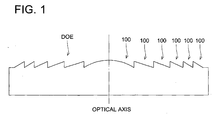
- FIG. 1 (a) and Fig. 1 (b) is a side view showing an example of a diffractive structure.
- FIG. 2 (a) and Fig. 2 (b) is a side view showing an example of a diffractive structure.
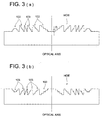
- FIG. 3 (a) and Fig. 3 (b) is a side view showing an example of a diffractive structure.
- FIG. 4 (a) and Fig. 4 (b) is a side view showing an example of a diffractive structure.
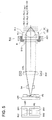
- Fig. 5 is a plan view of primary portions showing the structure of an optical pickup apparatus.
- Fig. 6 (a) is a front view
- Fig. 6 (b) is a side view
- Fig. 6 (c) is a rear view all of an aberration correcting element.
- Fig. 7 (a) is a side view and Fig. 7 (b) is a front view both for illustrating the structure of a positioning mark.
- Fig. 8 is a sectional view of a lens in Example.
- the structure described in Item 1 is an objective optical system for use in an optical pickup apparatus for converging a parallel light flux having a diameter ⁇ 1 and a first wavelength ⁇ 1 on an information recording surface of the first optical disk having a protective layer with a thickness t 1 within numerical aperture NA 1 , and converging a parallel light flux having a diameter ⁇ 2 ( ⁇ 2 > ⁇ 1 ) and a second wavelength ⁇ 2 ( ⁇ 2 > ⁇ 1 ) on an information recording surface of the second optical disk having a protective layer with a thickness t 2 (t 2 > t 1 ) within numerical aperture NA 2 (NA 2 ⁇ NA 1 ), wherein the objective optical system includes the first lens group and the second lens group which are arranged successively in this order from the longer conjugate distance side of the objective optical system, and the first lens group has a phase structure, wherein the following expressions are satisfied when W L1 ⁇ 1 represents the wavefront aberration of the first lens group in the case when a parallel light flux having the diameter ⁇ 1 and the first wavelength ⁇
- the structures as in the description in Items 1 and 2 controls wavefront aberration W L1 ⁇ 1 generated when a parallel light flux having light flux diameter ⁇ 1 and first wavelength ⁇ 1 enters only the first lens group to be 0.05 ⁇ RMS or less, namely to be almost zero, and further controls wavefront aberration W L2 ⁇ 1 generated when a parallel light flux having light flux diameter ⁇ 1 and first wavelength ⁇ 1 enters only the second lens group to be 0.05 ⁇ RMS or less, namely to be almost zero, under the condition before the first lens group and the second lens group are combined.
- a magnification of the second lens group in the case when the wavefront aberration is minimum value W L2 ⁇ 1 is made to be M
- wavelength aberration W L2 ⁇ 2 of the second lens group within numerical aperture NA 2 in the case when the light flux with wavelength ⁇ 2 enters only the second lens group under the magnification M becomes greater to be 0.30 ⁇ RMS or more.
- This aberration is caused by a difference of a protective layer thickness between the first optical disk and the second optical disk, and by correcting this aberration with a phase structure provided on the first lens group, wavefront aberration W OBJ ⁇ 2 within numerical aperture NA 2 in the case when a parallel light flux having light flux diameter ⁇ 2 and second wavelength ⁇ 2 enters objective optical system OBJ can be controlled to 0.05 ⁇ RMS, namely, to substantially zero.
- spherical aberration caused by a difference of a protective layer thickness between the first optical disk and the second optical disk is corrected by a phase structure of the first lens group, and therefore, spherical aberration that cancels the aforementioned spherical aberration is added to the light flux with second wavelength ⁇ 2 that has passed through the first lens group. Accordingly, when the second lens group is decentered from the first lens group, aberration caused for the second wavelength ⁇ 2 grows greater extremely.
- the invention makes it possible to manufacture, efficiently and at low cost, compatible objective optical systems having excellent performances for all working wavelengths.
- a phase structure formed on the first lens group is used to correct spherical aberration caused mainly by a difference of protective layer thickness between the first optical disk and the second optical disk.
- it may further be made to be one that corrects also chromatic aberration caused by a wavelength difference between the first wavelength ⁇ 1 and the second wavelength ⁇ 2 .
- the chromatic aberration mentioned here means a difference of paraxial image point positions (axial chromatic aberration) caused by a wavelength difference and/or spherical aberration caused by a wavelength difference.
- the phase structure mentioned above may either of a diffractive structure and an optical path difference providing structure.
- the diffractive structure includes a structure including plural ring-shaped zones 100 wherein a sectional view including an optical axis is in a form of serration, as shown schematically in Fig. 1(a) and Fig. 1(b), a structure including plural ring-shaped zones 102 in which all of the directions of level difference 101 are the same within an effective diameter wherein a sectional view including an optical axis is in a form of stairs, as shown schematically in Fig. 2(a) and Fig.
- the optical path difference proving structure includes a structure including plural ring-shaped zones 105 in which a direction of level difference 104 is switched on the halfway of an effective diameter wherein a sectional view including an optical axis is in a form of stairs, as shown schematically in Fig. 4(a) and 4(b), and a structure including plural ring-shaped zones 103 in which a stair-structure is formed inside, as shown schematically in Fig. 3(a) and Fig. 3(b).
- the optical path difference proving structure includes a structure including plural ring-shaped zones 105 in which a direction of level difference 104 is switched on the halfway of an effective diameter wherein a sectional view including an optical axis is in a form of stairs, as shown schematically in Fig.
- each of Fig. 1(a) - Fig. 4(b) shows schematically an occasion wherein each phase structure is formed on a plane surface
- each phase structure may also be formed on a spherical surface or on an aspheric surface.
- the structure is one shown in Fig. 4(a) and Fig. 4(b) in all cases of the diffractive structure and the optical path difference providing structure.
- objective optical system means a lens group composed of a light converging element that is arranged at the position to face an optical disk in an optical pickup apparatus and has a function to converge respectively light fluxes each being emitted from a light source and having a different wavelength on information recording surfaces of optical disks each having different recording density and an optical element that is united solidly with the light converging element to be driven by an actuator for tracking and focusing.
- the numerical aperture in the present specification means the numerical aperture stipulated in the standard of optical disks, or an image-side numerical aperture of an objective optical system having diffraction limit power capable of obtaining a spot diameter that is necessary for conducting recording and/or reproducing of information for an optical disk.
- the structure described in Item 3 is the objective optical system for an optical pickup apparatus described in Item 1 or 2, wherein the following expression (7) is satisfied by the ratio of a paraxial power P L1 of the first lens group for the light flux with the first wavelength ⁇ 1 to a paraxial power P L2 of the second lens group for the light flux with the first wavelength ⁇ 1 .
- the second lens group arranged exclusively to be on the optical disk side By causing the second lens group arranged exclusively to be on the optical disk side to have a refracting power for the incident light flux having wavelength ⁇ 1 as described in Item 3, it is possible to secure a working distance for the second optical disk sufficiently. Further, when a diffractive structure having steps in the optical axis direction is formed on the first lens group as a phase structure, a rate of a light flux which does not contribute to formation of a light converging spot with its way through blocked by the steps can be controlled, and a decline of transmittance can be prevented.
- the structure described in Item 4 is the objective optical system for an optical pickup apparatus described in Item 3, wherein the following expressions (8) and (9) are satisfied by a coma amount W C1 of the objective optical system within the numerical aperture NA 1 for the parallel light flux with the first wavelength ⁇ 1 which is measured with the first lens group, the second lens group and the protective layer with a thickness t 1 arranged along one optical axis, a coma amount W C2 of the objective optical system within the numerical aperture NA 1 for the parallel light flux with the first wavelength ⁇ 1 which is measured with the second lens group and the protective layer with a thickness t 1 arranged along one optical axis and with an optical axis of the first lens group shifted 10 ⁇ m to an optical axis of the second lens group, a coma amount W C3 of the objective optical system within the numerical aperture NA 2 for the parallel light flux with the second wavelength ⁇ 2 which is measured with the first lens group, the second lens group and the protective layer with a thickness t 2 arranged along one optical axis
- each of the W S1 and W S2 represents wavefront aberration from which defocus components are eliminated, and the W S1 is to be measured including the thickness t 1 , while, the WS2 is to be measured including the thickness t 2 .
- comatic aberration caused for the first wavelength ⁇ 1 by shifting between lens groups is small, because performance characteristics of each lens group are obtained for the first wavelength ⁇ 1 as stated above.
- comatic aberration caused for the second wavelength ⁇ 2 by shifting between lens groups is large, because of the structure wherein spherical aberration caused by a difference between protective layer thicknesses is corrected by the phase structure. Therefore, if the expressions (8) and (9) are satisfied as described in Item 3, it is possible to judge that each lens group was manufactured to satisfy each of expressions (1) - (3).
- the structure described in Item 5 is the objective optical system for an optical pickup apparatus described in Item 3 or Item 4, the following expressions (10) and (11) are satisfied by a coma amount W C1 of the objective optical system within the numerical aperture NA 1 for the parallel light flux with the first wavelength ⁇ 1 which is measured with the first lens group, the second lens group and the protective layer with a thickness t 1 arranged along one optical axis, a coma amount W C5 of the objective optical system within the numerical aperture NA 1 for the parallel light flux with the first wavelength ⁇ 1 which is measured with the second lens group and the protective layer with a thickness t 1 arranged along one optical axis arranged and with an optical axis of the first lens group tilted 5 minutes to an optical axis of the second lens group, where a coma amount W C3 of the objective optical system within the numerical aperture NA 2 for the parallel light flux with the second wavelength ⁇ 2 which is measured with the first lens group, the second lens group and the protective layer with a thickness t 2 arranged along one
- each of the W T1 and W T2 represents wavefront aberration from which defocus components are removed, and the W T1 is to be measured including the thickness t 1 , while, the W T2 is to be measured including the thickness t 2 .
- the objective optical system of the invention has a structure to make the second lens group on the optical disk side to shoulder the most of paraxial power for securing sufficient working distance for the second optical disk with a thick protective layer, and therefore, the paraxial power of the first lens group is small. Accordingly, comatic aberration caused by tilting between lens groups is small for any wavelength. If expressions (10) and (11) are satisfied, therefore, each lens group can be judged to be manufactured to satisfy expressions (1) - (3).
- the aberration is one caused by shifting between lens groups which are respectively for first wavelength ⁇ 1 and second wavelength ⁇ 2 , and one caused by tilting between lens groups which are respectively for first wavelength ⁇ 1 and second wavelength ⁇ 2 . It lowers manufacturing efficiency conspicuously to assemble by confirming these four types of decentering aberrations, which leads to an increase of manufacturing cost, and causes a fear to preclude mass production.
- the objective optical system of the invention has only to confirm aberration caused by shifting between lens groups for second wavelength ⁇ 2 alone among four types of decentering aberrations, when expressions (8) - (11) are satisfied, which makes it possible to manufacture two-group-structured compatible objective optical systems having sufficient performances for plural working wavelengths, at high efficiency and at low cost.
- the structure described in Item 6 is the objective optical system for an optical pickup apparatus described in any one of Item 1 - Item 5, wherein a positioning mark for aligning optical axes is formed on each of the first lens group and the second lens group, and the first lens group and the second lens group are positioned each other by help of the positioning mark.
- the first lens group and the second lens group can easily be fixed under the condition that optical axes thereof are aligned, by forming a positioning mark for aligning optical axes on each of the first lens group and the second lens group.
- the structure described in Item 7 is the objective optical system for an optical pickup apparatus described in any one of Item 1 - Item 6, wherein the phase structure corrects spherical aberration which is caused in the second lens group due to a difference between a protective layer thickness t 1 of the first optical disk and a protective layer thickness t 2 of the second optical disk.
- the structure described in Item 8 is the objective optical system for an optical pickup apparatus described in any one of Item 1 - Item 7, wherein the phase structure is a diffractive structure or an optical path difference providing structure.
- the structure described in Item 9 is the objective optical system for an optical pickup apparatus described in any one of Item 1 - Item 8, wherein the following expressions (12) - (17) are satisfied by the first wavelength ⁇ 1 , the second wavelength ⁇ 2 , protective layer thickness t 1 of the first optical disk, protective layer thickness t 2 of the second optical disk, the numerical aperture NA 1 and the numerical aperture NA 2 .
- the following expressions (12) - (17) are satisfied by the first wavelength ⁇ 1 , the second wavelength ⁇ 2 , protective layer thickness t 1 of the first optical disk, protective layer thickness t 2 of the second optical disk, the numerical aperture NA 1 and the numerical aperture NA 2 .
- the structure described in Item 10 is an optical pickup apparatus including a first light source for emitting a first parallel light flux with a first wavelength ⁇ 1 and a diameter ⁇ 1 ; a second light source for emitting a second parallel light flux with a second wavelength ⁇ 2 ( ⁇ 2 > ⁇ 1 ) and a diameter ⁇ 2 ( ⁇ 2 ⁇ ⁇ 1 ); and an objective optical system of any one of Items 1 - 9 for converging the first parallel light flux on an information recording surface of a first optical disk having a protective layer with a thickness t 1 within a numerical aperture NA 1 , and for converging the second parallel light flux on an information recording surface of a second optical disk having a protective layer with a thickness t 2 (t 2 > t 1 ) within a numerical aperture NA 2 (NA 2 ⁇ NA 1 ).
- the invention makes it possible to provide an efficient two-group-structured objective optical system having a phase structure and being capable of conducting properly recording and/or reproducing of information for plural optical disks each having different recording density which can be manufactured efficiently and at low cost, an optical pickup apparatus equipped with the aforesaid objective optical system and an optical information recording and reproducing apparatus.
- Fig. 5 is a diagram showing schematically the structure of optical pickup apparatus PU1 capable of conducting recording and reproducing of information properly with a simple structure for any of high density optical disc HD (first optical disk) and DVD (second optical disk).
- Optical pickup apparatus PU1 is composed of laser module LM1 for high density optical disc HD and DVD having therein first luminous point EP1 (first light source) emitting a laser light flux (first light flux) that is emitted when conducting recording and reproducing of information for high density optical disc HD and has wavelength 408 nm, second luminous point EP2 (second light source) emitting a laser light flux (second light flux) that is emitted when conducting recording and reproducing of information for DVD and has wavelength 658 nm, first light-receiving section DS1 that receives reflected light flux coming from information recording surface RL1 of high density optical disc HD, second light-receiving section DS2 that receives reflected light flux coming from information recording surface RL2 of DVD, and prism PS, objective optical system OBJ wherein aberration correcting element L1 (first lens group) on which a diffractive structure serving as a phase structure is formed on its optical surface and light converging element L2 (second lens group) provided on its both sides with asphe
- laser module LM1 for high density optical disc HD and DVD is operated to make the first luminous point EP1 to emit light.
- a divergent light flux emitted from the first luminous point EP1 is reflected by prism PS, then, is transmitted through beam shaping element SH so that its sectional form may be changed from an oval form to a circular form, then, it passes through collimator lens COL to be converted into a parallel light flux, then, it is transmitted through polarizing beam splitter BS and its light flux diameter is regulated to ⁇ 1 by diaphragm STO, then, is transmitted through aperture regulating element AP to become a spot which is formed by objective optical system OBJ on information recording surface RL1 through the first protective layer PL1, as its light path is drawn with solid lines in Fig.
- the objective optical system OBJ conducts focusing and tracking with a help of biaxial actuator AC1 arranged around the objective optical system OBJ.
- the reflected light flux modulated by information pits on the information recording surface RL1 is transmitted again through the objective optical system OBJ, the aperture regulating element AP and the polarizing beam splitter BS, to be converted into a converged light flux by the collimator lens COL, and is reflected twice in the prism PS after being transmitted through the beam shaping element SH, to be converged on light-receiving portion DS1.
- information recorded on high density optical disc HD can be read by the use of signals outputted from the light-receiving portion DS1.
- the collimator lens COL is moved by uniaxial actuator AC2 so that a distance from objective optical system OBJ to the collimator lens COL may be smaller than that in the case of conducting recording and reproducing of information for high density optical disc HD, for the purpose that a second light flux emerges from the collimator lens COL under the condition of its parallel light flux.
- the objective optical system OBJ and first laser module for high density optical disc HD and DVD LM1 are operated to make second luminous point EP2 to emit light.
- a divergent light flux emitted from the second luminous point EP2 is reflected by prism PS and is transmitted through the beam shaping element SH so that its sectional form may be changed from an oval form to a circular form, then, it passes through collimator lens COL to be converted into a parallel light flux, then, it is transmitted through polarizing beam splitter BS and its light flux diameter is regulated to ⁇ 2 ( ⁇ 2 ⁇ ⁇ 1 ) when it is transmitted through aperture regulating element AP to become a spot which is formed by objective optical system OBJ on information recording surface RL2 through the second protective layer PL2, as its light path is drawn with dotted lines in Fig. 5.
- the objective optical system OBJ conducts focusing and tracking with a help of biaxial actuator AC1 arranged around the objective optical system OBJ.
- the reflected light flux modulated by information pits on the information recording surface RL2 is transmitted again through the objective optical system OBJ, the aperture regulating element AP and the polarizing beam splitter BS, to be converted into a converged light flux by the collimator lens COL, and is reflected twice in the prism PS after being transmitted through the beam shaping element SH, to be converged on light-receiving portion DS2.
- information recorded on DVD can be read by the use of signals outputted from the light-receiving portion DS2.
- Aberration correcting element L1 is a plastic lens whose refractive index nd at d line is 1.5091 and Abbe's number ud is 56.5, while, its refractive index for ⁇ 1 is 1.5242 and that for ⁇ 2 is 1.5064. Further, light converging element L2 is a plastic lens whose refractive index nd at d line is 1.5435 and Abbe's number ⁇ d is 56.3.
- flange portions FL1 and FL2 formed to be solid with the optical functional portion, and the optical functional portions are united integrally when a part of the flange portion FL1 and a part of the flange portion FL2 are connected together.
- W L1 ⁇ 1 represents the wavefront aberration of aberration correcting element L1 in the case when a parallel light flux having the diameter ⁇ 1 and the first wavelength ⁇ 1 enters into the aberration correcting element L1
- W L2 ⁇ 1 represents a wavefront aberration of light converging element L2 for a parallel light flux having the diameter ⁇ 1 and the first wavelength ⁇ 1 within the numerical aperture NA 1
- M represents a magnification of light converging element L2 when W L2 ⁇ 1 is the minimum value
- W L2 ⁇ 2 represents the wavefront aberration of light converging element L2 whose magnification is M for a light flux with the second wavelength ⁇ 2 within the numerical aperture NA 2
- W OBJ ⁇ 1 is a wavefront aberration of the objective optical system OBJ within the numerical aperture NA 1 when the parallel light flux with the first wavelength ⁇ 1 enters into the objective optical system OBJ
- W OBJ ⁇ 2 represents the wavefront aberration of the objective optical system OBJ within the numerical aperture NA 2 in the case
- the structure controls wavefront aberration W L1 ⁇ 1 generated when a parallel light flux representing the first light flux having light flux diameter ⁇ 1 enters only the aberration correcting element L1 under the condition before the aberration correcting element L1 and the light converging element L2 are combined, and controls wavefront aberration W L2 ⁇ 1 generated when a parallel light flux representing the first light flux having light flux diameter ⁇ 1 enters only the light converging element L2 to be 0.05 ⁇ RMS or less, namely to be almost zero.
- the wavefront aberration W OBJ ⁇ 1 within numerical aperture NA 1 in the case when a parallel light flux representing the first light flux having light flux diameter ⁇ 1 enters the objective optical system OBJ is controlled to 0.05 ⁇ RMS, namely, to be almost zero, by controlling wavefront aberration W L1 ⁇ 1 generated when a parallel light flux representing the first light flux having light flux diameter ⁇ 1 enters only the aberration correcting element L1 under the condition before the aberration correcting element L1 and the light converging element L2 are combined, and by controlling wavefront aberration W L2 ⁇ 1 generated when a parallel light flux representing the first light flux having light flux diameter ⁇ 1 enters only the light converging element L2 to be 0.05 ⁇ RMS or less, namely to be almost zero.
- a magnification of the light converging element L2 in the case when the wavefront aberration is minimum value W L2 ⁇ 1 is made to be M
- wavelength aberration W L2 ⁇ 2 of the light converging element L2 within numerical aperture NA 2 in the case when the second light flux enters only the light converging element L2 under the condition of the magnification M is 0.03 ⁇ RMS or more.
- optical surface S1 of the aberration correcting element L1 on the semiconductor laser light source side is divided into first area AREA1 corresponding to an area within NA 2 and second area AREA2 corresponding to an area from NA 2 to NA 1 , and in the first area AREA1, there is formed a diffractive structure wherein plural ring-shaped zones each having its center on an optical axis in which a stair-structure is formed inside are formed as shown in Fig. 3(a) and 3(b) (hereinafter, this diffractive structure is called "diffractive structure HOE").
- the diffraction efficiency of the +1 order diffracted light of the second light flux in this case is 87.5%, which means sufficient amount of light for conducting recording and reproducing of information for DVD.
- the value of the aforesaid 1.5064 represents the diffractive index of the aberration correcting element L1 for the second wavelength ⁇ 2 .
- the light converging element L2 is designed so that the wavefront aberration may be the smallest for the combination of the first wavelength ⁇ 1 , the magnification M and the first protective layer PL1, and a thickness difference between the first protective layer PL1 and the second protective layer PL2 makes the spherical aberration of the second light flux which has been transmitted through the light converging element L2 and the second protective layer PL2 to be in the direction of over correction.
- a width of each ring-shaped zone of diffractive structure HOE is established so that spherical aberration in the direction of insufficient correction may be added to +1 st order diffracted light by the diffracting action when the second light flux enters, and the second light flux which has been transmitted through the diffractive structure HOE and the second protective layer PL2 forms an excellent spot on information recording surface RL2 of DVD when an amount of addition of spherical aberration by the diffractive structure HOE and spherical aberration in the direction of over correction caused by a thickness difference between the first protective layer PL1 and the second protective layer PL2 offset each other.
- optical surface S2 of aberration correcting element L1 is divided into third area AREA3 including an optical axis corresponding to an area within NA 2 and fourth area AREA4 corresponding to an area from NA 2 to NA 1 as shown in Figs. 6(a) - 6(c), and diffractive structures (which are called “diffractive structures DOE1 and DOE2" hereafter) each being composed of plural ring-shaped zones whose sectional view including an optical axis shown in Fig. 2(a) is in a stair-form are formed respectively on the third area AREA3 and the fourth area AREA4.
- diffractive structures DOE1 and DOE2 diffractive structures
- the diffractive structures DOE1 and DOE2 are the structures respectively to control axial chromatic aberration of objective optical system OBJ in a violet area and to control spherical aberration changes resulting from changes in incident wavelength.
- These diffractive structures have wavelength-dependency of spherical aberration wherein spherical aberration changes in the direction of insufficient correction when a wavelength of incident light flux is longer and spherical aberration changes in the direction of over correction when a wavelength of incident light flux is shorter, both in a violet area. Owing to this, the tolerance for wavelength errors of first light source EP1 is broadened by canceling spherical aberration changes caused on the light converging element L2 by changes of incident wavelength.
- height d1 of the step that is closest to the optical axis is designed so that the diffraction efficiency may be 100% for wavelength 390 nm (the diffraction efficiency of the aberration correcting element L1 for wavelength 390 nm is 1.5273).
- the diffractive structure DOE2 is optimized for the first wavelength ⁇ 1 , and when the first light flux enters the diffractive structure DOE2, +2 nd order diffracted light is generated at the diffraction efficiency of 100%.
- diffraction efficiency is distributed for the first light flux and the second light flux, by optimizing the diffractive structure DOE1 for the wavelength 390 nm.
- the structure wherein the diffraction efficiency for the first light flux is emphasized by optimizing for the first wavelength ⁇ 1 , even in the diffractive structure DOE1 equally to the diffractive structure DOE2.
- the objective optical system OBJ is made to be of a two-group structure with aberration correcting element L1 and light converging element L2, as stated above, if lens design is performed so that an amount of wavefront aberration of each of the aberration correcting element L1 and light converging element L2 may be within a range that satisfies the aforesaid expressions (1), (2) and (3), it is possible to obtain easily objective optical system OBJ wherein an amount of wavefront aberration is within ranges of expressions (5) and (6), namely, an amount of wavefront aberration is substantially zero.
- a coma amount W C1 of the objective optical system OBJ within the numerical aperture NA 1 for the parallel light flux with the first wavelength ⁇ 1 which is measured with aberration correcting element L1, light converging element L2 and the protective layer with a thickness t 1 arranged along one optical axis a coma amount W C2 of the objective optical system OBJ within the numerical aperture NA 1 for the parallel light flux with the first wavelength ⁇ 1 which is measured with light converging element L2 and the protective layer with a thickness t 1 arranged along one optical axis and with an optical axis of the aberration correcting element L1 shifted 10 ⁇ m to an optical axis of light converging element L2, a coma amount W C3 of the objective optical system OBJ within the numerical aperture NA 2 for the parallel light flux with the second wavelength ⁇ 2 which is measured with aberration correcting element L1, light converging element L2 and the protective layer with a thickness t 2 arranged along one optical axis, a coma amount W C
- each of the W S1 and W S2 represents wavefront aberration from which defocus components are removed, and the W S1 is to be measured including the thickness t 1 , while, the WS2 is to be measured including the thickness t 2 .
- a coma amount W C1 of the objective optical system within the numerical aperture NA 1 for the parallel light flux with the first wavelength ⁇ 1 which is measured with the first lens group, the second lens group and the protective layer with a thickness t 1 arranged along one optical axis a coma amount W C5 of the objective optical system within the numerical aperture NA 1 for the parallel light flux with the first wavelength ⁇ 1 which is measured with the second lens group and the protective layer with a thickness t 1 arranged along one optical axis and with an optical axis of the first lens group tilted 5 minutes to an optical axis of the second lens group, where a coma amount W C3 of the objective optical system within the numerical aperture NA 2 for the parallel light flux with the second wavelength ⁇ 2 which is measured with the first lens group, the second lens group and the protective layer with a thickness t 2 arranged along one optical axis, a coma amount W C6 of the objective optical system within the numerical aperture NA 2 for the parallel light flux with the second wavelength ⁇ 2 which
- each of the W T1 and W T2 represents wavefront aberration from which defocus components are removed, and the W T1 is to be measured including the thickness t 1 , while, the W T2 is to be measured including the thickness t 2 .
- W T1 represent a difference between W C5 and W C1
- W T2 represent a difference between W C6 and W C3 .
- Lens design is performed so that the following expression (7) is satisfied by the ratio of paraxial power P L1 of the aberration correcting element L1 for the first light flux to paraxial power P L2 of the light converging element L2 for the first light flux.
- the diffractive structure having steps in the optical axis direction is formed on the optical surface of the aberration correcting element L1, and therefore, a rate of the light flux whose traveling route is intercepted by the step portion and does not contribute to formation of a light-converged spot can be controlled, and a decline of transmittance can be prevented.
- positioning marks M1 and M2 for aligning optical axes are formed respectively on the aberration correcting element L1 and the light converging element L2.
- protrusions M1 and M2 both representing positioning marks are formed respectively on optical axis 11 of plane of emergence S2 of the aberration correcting element L1 and on optical axis 12 of plane of incidence S1 of the light converging element L2, and by moving the light converging element L2 relatively to the aberration correcting element L1 while confirming visually the protrusions M1 and M2 through the light converging element L2 from the plane of emergence S2 of the light converging element L2, under the state of irradiating light from the side, and by superposing the protrusion M2 on the protrusion M1, thereby, the aberration correcting element L1 and the light converging element L2 can be positioned, under the condition that the optical axis 11 agrees in terms of position with the optical axis 12.
- the positioning marks M1 and M2 formed on optical axes are in sizes having no influence on optical functions of respective optical elements.
- plural positioning marks M1 and plural positioning marks M2 may also be provided respectively on sides of the aberration correcting element L1 and the light converging element L2.
- the optical axis 11 of the aberration correcting element L1 and the optical axis 12 of the light converging element L2 can be made to agree in terms of position, and relative positioning in the circumferential direction having its center on the optical axis is possible.
- the aberration correcting element L1 in the present embodiment has the structure wherein diffractive structure HOE is formed on optical surface S1 on the semiconductor laser light source side and diffractive structure DOE is formed on optical surface S2 on the optical disk side, it is also possible to employ the structure wherein the diffractive structure DOE is formed on the optical surface S1 and the diffractive structure HOE is formed on the optical surface S2, which is opposite to the foregoing.
- the collimator lens COL is constructed so that its position can be moved in the optical axis direction by uniaxial actuator AC2, and chromatic aberration caused between the first wavelength ⁇ 1 and the second wavelength ⁇ 2 is absorbed, and a light flux with any wavelength can emerge from collimator lens COL in the state of a parallel light flux. Further, by moving collimator lens COL in the optical axis direction in the case of conducting recording and reproducing of information for high density optical disc HD, it is possible to correct spherical aberration of the spot formed on information recording surface RL1 of high density optical disc HD, and thereby, excellent recording and reproducing characteristics for the high density optical disc HD can be maintained constantly.
- Causes for generation of spherical aberration that is corrected by positional adjustment of collimator lens COL include, for example, wavelength dispersion caused by errors in manufacture of violet semiconductor laser LD1, changes and distribution of refractive index of objective optical system OBJ caused by temperature changes, focus jump between layers in recording and reproducing for multi-layer disc such as 2-layer disk and 4-layer disk and dispersion and distribution of thickness caused by manufacturing errors for protective layer PL1.
- an optical information recording and reproducing apparatus capable of conducting at least one of recording optical information for an optical disk and reproducing of information recorded on an optical disk, by providing optical pickup apparatus PU1 shown in the embodiment above, a driving and rotating device that holds an optical disk rotatably and a control device that controls driving of these various apparatuses.
- each aspheric surface has a form of aspheric surface expressed by the following Numeral 1, wherein X (mm) represents an amount of deformation from a plane that is tangent to the optical surface at its vertex, h (mm) represents a height in the direction perpendicular to the optical axis, r (mm) represents a paraxial radius of curvature, ⁇ represents a conic constant and A 2i represents an aspheric surface coefficient.
- a diffractive structure formed on an aberration correcting element is expressed by an optical path difference that is added to a transmission wavefront by the diffractive structure.
- the optical path difference of this kind is expressed by optical path difference function ⁇ b (mm) that is defined by the following Numeral 2, when h (mm) represents a height in the direction perpendicular to the optical axis, B 2j represents an optical path difference function coefficient, ⁇ (nm) represents a wavelength of an incident light flux, ⁇ B (nm) represents a manufacture wavelength, and dor represents the diffraction order of diffracted light having the maximum diffraction efficiency among diffracted light generated by the diffractive structure when a light flux having wavelength ⁇ enters.
- the present example is an objective lens unit including an aberration correcting element and a light converging element and having compatibility for high density optical disc and DVD.
- Each of the aberration correcting element and the light converging element is a plastic lens.
- the light converging element is one exclusively for high density optical disc HD.
- Lens data related to the present example are shown in Tables (1-1) and (1-2), and its lens sectional view is shown in Fig. 8.
- E for example, 2.5 E - 03
- 10 for example, 2.5 x 10 -03
- NA 1 represents a numerical aperture of high density optical disc HD
- NA 2 represents a numerical aperture of DVD
- f 1 (mm) represents a focal length for first wavelength ⁇ 1
- f 2 (mm) represents a focal length for second wavelength ⁇ 2
- ⁇ 1 (nm) represents a working wavelength for high density optical disc
- ⁇ 2 (nm) represents a working wavelength for DVD
- M 1 represents a magnification for first wavelength ⁇ 1
- M 2 represents a magnification for second wavelength ⁇ 2
- t 1 (mm) represents a protective layer thickness of high density optical disc HD
- t 2 (mm) represents a protective layer thickness of DVD
- r (mm) represents a paraxial radius of curvature
- d 1 (mm) represents a spacing of planes for first wavelength ⁇ 1
- d 2 (mm) represents a spacing of planes for second wavelength ⁇ 2
- N ⁇ 1 represents a refractive index for first wavelength ⁇ 1
- N ⁇ 2 represents
- the present example is an objective lens unit including an aberration correcting element and a light converging element and having compatibility for high density optical disc HD, DVD and CD.
- the aberration correcting element is a plastic lens and the light converging element is a glass ("BACD5" by HOYA Co.) lens.
- the light converging element is used exclusively for high density optical disc HD.
- Lens data related to the present example are shown in Tables (2-1) and (2-2).
- E for example, 2.5 E - 03
- 10 for example, 2.5 x 10 -03
- NA 1 represents a numerical aperture of high density optical disc HD
- NA 2 represents a numerical aperture of DVD
- NA 3 represents a numerical aperture of CD
- f 1 (mm) represents a focal length for first wavelength ⁇ 1
- f 2 (mm) represents a focal length for second wavelength ⁇ 2
- f 3 (mm) represents a focal length for third wavelength ⁇ 3
- ⁇ 1 (nm) represents a working wavelength for high density optical disc
- ⁇ 2 (nm) represents a working wavelength for DVD
- ⁇ 3 (nm) represents a working wavelength for CD
- M 1 represents a magnification for first wavelength ⁇ 1
- M 2 represents a magnification for second wavelength ⁇ 2
- M 3 represents a magnification for third wavelength ⁇ 3
- t 1 (mm) represents a protective layer thickness of high density optical disc HD
- t 2 (mm) represents a protective layer thickness of DVD
- t 3 (mm) represents a protective layer thickness of CD
- r (mm) represents r
Landscapes
- Physics & Mathematics (AREA)
- Optics & Photonics (AREA)
- Optical Head (AREA)
- Lenses (AREA)
Applications Claiming Priority (2)
| Application Number | Priority Date | Filing Date | Title |
|---|---|---|---|
| JP2004053859 | 2004-02-27 | ||
| JP2004053859 | 2004-02-27 |
Publications (2)
| Publication Number | Publication Date |
|---|---|
| EP1569212A2 true EP1569212A2 (de) | 2005-08-31 |
| EP1569212A3 EP1569212A3 (de) | 2008-01-09 |
Family
ID=34747546
Family Applications (1)
| Application Number | Title | Priority Date | Filing Date |
|---|---|---|---|
| EP05251013A Ceased EP1569212A3 (de) | 2004-02-27 | 2005-02-23 | Objektivsystem, optisches Abtastgerät und optisches Informationsaufzeichnungs- und -wiedergabegerät |
Country Status (2)
| Country | Link |
|---|---|
| US (1) | US7460460B2 (de) |
| EP (1) | EP1569212A3 (de) |
Families Citing this family (3)
| Publication number | Priority date | Publication date | Assignee | Title |
|---|---|---|---|---|
| KR100694097B1 (ko) * | 2005-04-01 | 2007-03-12 | 삼성전자주식회사 | 광픽업 및 이를 사용하는 광 기록 및/또는 재생기기 및트랙킹 에러신호 검출방법 |
| US7542637B2 (en) * | 2006-12-25 | 2009-06-02 | Konica Minolta Opto, Inc. | Coupling optical system, optical element and optical pickup apparatus |
| JP2012053929A (ja) * | 2010-08-31 | 2012-03-15 | Hitachi Media Electoronics Co Ltd | 光ピックアップ |
Citations (4)
| Publication number | Priority date | Publication date | Assignee | Title |
|---|---|---|---|---|
| US6025908A (en) * | 1998-05-18 | 2000-02-15 | Houde-Walter; William R. | Alignment of optical elements in telescopes using a laser beam with a holographic projection reticle |
| EP1001301A2 (de) * | 1998-11-09 | 2000-05-17 | Canon Kabushiki Kaisha | Optisches Element mit Justiermarke und optisches System mit einem solchen Element |
| US6166854A (en) | 1997-12-26 | 2000-12-26 | Fuji Photo Optical Co., Ltd. | Diffraction type filter having an aberration correction function and wave length selectivity |
| EP1422696A2 (de) * | 2002-11-25 | 2004-05-26 | Matsushita Electric Industrial Co., Ltd. | Optische Kopfvorrichtung |
Family Cites Families (58)
| Publication number | Priority date | Publication date | Assignee | Title |
|---|---|---|---|---|
| US571025A (en) * | 1896-11-10 | Removable cover for bicycle handle-bars | ||
| US1008604A (en) * | 1911-07-28 | 1911-11-14 | Golladay Lake | Hand-protector. |
| US1345505A (en) * | 1918-10-19 | 1920-07-06 | Charles A Persons | Handle-grip |
| US1617972A (en) * | 1925-08-26 | 1927-02-15 | Robert S Wallace | Grip for golf clubs |
| US1890037A (en) * | 1930-11-21 | 1932-12-06 | Herbert B Johnson | Rubber covered article |
| US2221421A (en) * | 1938-11-25 | 1940-11-12 | Spalding A G & Bros Inc | Athletic implement and method of making the same |
| US2449575A (en) * | 1945-10-25 | 1948-09-21 | Seymour K Wilhelm | Cushioned knob |
| US2523637A (en) * | 1946-11-15 | 1950-09-26 | Dow F Stanfield | Grip for handles of poles, clubs, and like articles |
| US2690338A (en) * | 1951-06-13 | 1954-09-28 | Brocke Ben Henry De | Golf club grip |
| US2984486A (en) * | 1959-02-05 | 1961-05-16 | Lloyd J Jones | Slip-proof sleeve for a baseball bat handle |
| US3095198A (en) * | 1960-08-02 | 1963-06-25 | Gasche Fred | Swivel grip for golf clubs |
| GB979242A (en) * | 1963-01-03 | 1965-01-01 | John Henry Onions | Improvements relating to grips for the handles or shafts of ball striking devices for use in games |
| US4052061A (en) * | 1975-07-11 | 1977-10-04 | Stewart Samuel F | Racket weighting means |
| US4133529A (en) * | 1977-08-01 | 1979-01-09 | Joseph Gambino | Golf grip |
| US4651991A (en) * | 1985-12-12 | 1987-03-24 | Mcduff Michael A | Handle covering |
| US4765856A (en) * | 1986-03-26 | 1988-08-23 | Doubt Ruxton C | Process for manufacturing custom moldable hand grip |
| US4662415A (en) * | 1986-04-02 | 1987-05-05 | Proutt Gordon R | Cover for a golf club handle |
| AT384554B (de) * | 1986-06-03 | 1987-12-10 | Tyrolia Freizeitgeraete | Skibremse |
| US4919420A (en) * | 1987-08-28 | 1990-04-24 | Daiwa Golf Co., Ltd. | Grip of a golf club and a manufacturing method thereof |
| US4941232A (en) * | 1987-10-07 | 1990-07-17 | Bettcher Industries, Inc. | Slip resistant, cushioning cover for handles |
| US5118107A (en) * | 1990-10-31 | 1992-06-02 | Bucher Inc. | Rain cover for golf club handle |
| US5797813A (en) * | 1991-01-14 | 1998-08-25 | Huang; Ben | Handle grip |
| US5645501A (en) * | 1991-01-14 | 1997-07-08 | Huang; Ben | Grip construction |
| US5671923A (en) * | 1991-01-14 | 1997-09-30 | Huang; Ben | Grip for golf shafts |
| US5730669A (en) * | 1991-01-14 | 1998-03-24 | Huang; Ben | Handle grip and method of making same |
| US5772524A (en) * | 1991-01-14 | 1998-06-30 | Huang; Ben | Water retarding golf club grip |
| US5584482A (en) * | 1995-04-12 | 1996-12-17 | Huang; Ben | Sleeve-type golf club grip |
| US5890972A (en) * | 1991-01-14 | 1999-04-06 | Huang; Ben | Spiral protrusion type handle grip |
| US5123645A (en) * | 1991-03-18 | 1992-06-23 | Macdonald Richard A | Projectile with interiorly weighted flow passage insert |
| US5347684A (en) * | 1992-10-13 | 1994-09-20 | Jackson Linda J | Grip cover |
| US5611533A (en) * | 1994-05-16 | 1997-03-18 | Williams; John P. | Gripping sleeve apparatus and method of using the same |
| US5511445A (en) * | 1994-10-11 | 1996-04-30 | Hildebrandt; Robert C. | Flexible hand grip for handles |
| US5570884A (en) * | 1995-04-10 | 1996-11-05 | Carps; Dan | Ergonomic underlay for hand grips |
| US5754513A (en) * | 1995-04-28 | 1998-05-19 | Konica Corporation | Information pick-up apparatus and optical disk apparatus |
| US5577722A (en) * | 1995-07-07 | 1996-11-26 | Glassberg; Corey | Bat grip device |
| TW351205U (en) * | 1995-09-13 | 1999-01-21 | Ben Huang | Tubular golf club grip |
| US5624116A (en) * | 1995-10-23 | 1997-04-29 | Prince Sports Group, Inc. | Grip for sports racquet |
| US5626527A (en) * | 1995-12-13 | 1997-05-06 | Eberlein; Timothy | Golf grip installable over pre-existing grip |
| US5816933A (en) * | 1995-12-28 | 1998-10-06 | Huang; Ben | Golf club shaft grip |
| US5890260A (en) * | 1996-07-01 | 1999-04-06 | Gaunt; John C. | Hand saver |
| US6558270B2 (en) * | 1997-10-16 | 2003-05-06 | Benjamin J. Kwitek | Grip |
| US6036607A (en) * | 1998-03-02 | 2000-03-14 | Finegan; Christopher H. | Adjustable grip |
| AUPP442798A0 (en) * | 1998-07-01 | 1998-07-23 | Grip Master Company Pty Ltd, The | A grip for a handle or shaft |
| EP1154417B1 (de) | 2000-05-12 | 2012-05-09 | Konica Minolta Opto, Inc. | Optische Abtastvorrichtung |
| TW490589B (en) * | 2000-05-24 | 2002-06-11 | Konishiroku Photo Ind | Optical pickup apparatus, objective lens, apparatus for reproducing and/or recording optical information recording medium |
| US6503153B2 (en) * | 2000-12-21 | 2003-01-07 | High Cedar Enterprise Co., Ltd. | Grip tape having multiple gripping functions |
| US20020107088A1 (en) * | 2001-02-07 | 2002-08-08 | Lamkin Robert E. | Grip for sporting implement |
| US20020142900A1 (en) * | 2001-03-28 | 2002-10-03 | Mao-Hsiu Wang | Handle of exercise device |
| CN1248209C (zh) | 2001-04-05 | 2006-03-29 | 皇家菲利浦电子有限公司 | 光学扫描装置 |
| US6652398B2 (en) * | 2001-08-27 | 2003-11-25 | Innercore Grip Company | Vibration dampening grip cover for the handle of an implement |
| US7206276B2 (en) | 2001-10-12 | 2007-04-17 | Konica Corporation | Objective lens, optical element, optical pick-up apparatus and optical information recording and/or reproducing apparatus equipped therewith |
| TW595498U (en) * | 2001-12-31 | 2004-06-21 | Hice Cedar Entpr Co Ltd | Handle band |
| US6872157B2 (en) * | 2002-02-05 | 2005-03-29 | Sting Free Company | Sting minimizing grip for a hand held swinging athletic contact making article |
| TW535627U (en) * | 2002-05-15 | 2003-06-01 | Hung-Sung Ju | Handle of golf club made of composite material and with sewed anti-slippage surface layer |
| JP2004062971A (ja) * | 2002-07-26 | 2004-02-26 | Konica Minolta Holdings Inc | 対物レンズユニット、光ピックアップ装置、及び光学式情報記録再生装置 |
| TW200502670A (en) | 2002-11-21 | 2005-01-16 | Konica Minolta Holdings Inc | Objective lens, optical system and optical pickup apparatus |
| JP2004293675A (ja) | 2003-03-27 | 2004-10-21 | Pacific Ind Co Ltd | 制御弁及び制御弁の製造方法 |
| US20040213134A1 (en) * | 2003-04-24 | 2004-10-28 | Minolta Co., Ltd. | Optical pickup apparatus |
-
2005
- 2005-02-18 US US11/062,004 patent/US7460460B2/en not_active Expired - Fee Related
- 2005-02-23 EP EP05251013A patent/EP1569212A3/de not_active Ceased
Patent Citations (4)
| Publication number | Priority date | Publication date | Assignee | Title |
|---|---|---|---|---|
| US6166854A (en) | 1997-12-26 | 2000-12-26 | Fuji Photo Optical Co., Ltd. | Diffraction type filter having an aberration correction function and wave length selectivity |
| US6025908A (en) * | 1998-05-18 | 2000-02-15 | Houde-Walter; William R. | Alignment of optical elements in telescopes using a laser beam with a holographic projection reticle |
| EP1001301A2 (de) * | 1998-11-09 | 2000-05-17 | Canon Kabushiki Kaisha | Optisches Element mit Justiermarke und optisches System mit einem solchen Element |
| EP1422696A2 (de) * | 2002-11-25 | 2004-05-26 | Matsushita Electric Industrial Co., Ltd. | Optische Kopfvorrichtung |
Non-Patent Citations (1)
| Title |
|---|
| MAXIM LIADOV: "SONY BDZ-S77 Recorder review", Retrieved from the Internet <URL:http://ixbtlabs.com/articles2/blu-ray/> [retrieved on 20090402] * |
Also Published As
| Publication number | Publication date |
|---|---|
| EP1569212A3 (de) | 2008-01-09 |
| US20050190681A1 (en) | 2005-09-01 |
| US7460460B2 (en) | 2008-12-02 |
Similar Documents
| Publication | Publication Date | Title |
|---|---|---|
| US8077585B2 (en) | Condenser lens for an objective lens system | |
| EP1202259A2 (de) | Objektivlinse, lichtkonvergierendes optisches System, optisches Abtastgerät, und Aufzeichnungs- / Wiedergabegerät | |
| US20080181085A1 (en) | Objective Lens, Optical Element, Optical Pick-up Apparatus and Optical Information Recording and/or Reproducing Apparatus Equipped Therewith | |
| KR20040091553A (ko) | 광 픽업 장치, 광 정보 기록 재생 장치, 익스팬더 렌즈,커플링 렌즈 및 색수차 보정용 광학 소자 | |
| EP1359574A2 (de) | Optisches Aufzeichnungs- und Wiedergabesystem, Objektivlinse und optisches Element zur Aberrationskorrektur | |
| EP1422703A2 (de) | Objektivlinse, optisches System und optisches Abtastgerät | |
| US20050219988A1 (en) | Optical pickup apparatus | |
| EP1447798B1 (de) | Objectivlinse für ein optisches Abtastgerät, optisches Abtastgerät und Informationsaufzeichnungs- und/oder Wiedergabegerät | |
| US7319655B2 (en) | Diffractive optical element, objective optical system, optical pick-up device and optical information recording reproducing apparatus | |
| US20050226123A1 (en) | Multi-focus objective lens, optical pickup apparatus and optical information recording reproducing apparatus | |
| US20070297314A1 (en) | Optical information recording /reproducing device and objective lens for the same | |
| US20050180295A1 (en) | Optical pickup apparatus and diffractive optical element for optical pickup apparatus | |
| US20060092816A1 (en) | Objective optical system and optical pick up apparatus | |
| US8098562B2 (en) | Objective lens comprising a diffraction structure for distributing light in to light of different diffraction orders, optical pickup device, and optical information recording or reproduction apparatus having same | |
| US20040213136A1 (en) | Objective optical element, optical pickup device,and optical information recording and reproducing device | |
| JP2000260056A (ja) | 複合対物レンズ,球面収差補正素子及び光情報記録再生装置 | |
| EP1562187A2 (de) | Optisches Abtastgerät und optisches Informationsaufzeichnungs- und/oder -wiedergabegerät | |
| US20090103419A1 (en) | Optical Pickup Device, Optical Information Recording and Reproducing Device and Design, Method of Optical Element | |
| JP2001194581A (ja) | 対物レンズ及び光ピックアップ装置 | |
| JP2005158089A (ja) | 光ディスク用の対物レンズとそれを用いた光ヘッド装置 | |
| US20050122883A1 (en) | Optical pickup apparatus and optical information recording and/or reproducing apparatus | |
| JP2005259332A (ja) | 光ピックアップ装置及び光ピックアップ装置用回折光学素子 | |
| US7460460B2 (en) | Objective optical system, optical pickup apparatus and optical information recording and reproducing apparatus | |
| EP1580737A2 (de) | Objektivsystem einer optischen Abtastvorrichtung, optische Abtastvorrichtung und optisches Informations-Schreib/Lese-Gerät | |
| US7304935B2 (en) | Optical pickup device and correcting element used in the optical pickup device |
Legal Events
| Date | Code | Title | Description |
|---|---|---|---|
| PUAI | Public reference made under article 153(3) epc to a published international application that has entered the european phase |
Free format text: ORIGINAL CODE: 0009012 |
|
| AK | Designated contracting states |
Kind code of ref document: A2 Designated state(s): AT BE BG CH CY CZ DE DK EE ES FI FR GB GR HU IE IS IT LI LT LU MC NL PL PT RO SE SI SK TR |
|
| AX | Request for extension of the european patent |
Extension state: AL BA HR LV MK YU |
|
| PUAL | Search report despatched |
Free format text: ORIGINAL CODE: 0009013 |
|
| AK | Designated contracting states |
Kind code of ref document: A3 Designated state(s): AT BE BG CH CY CZ DE DK EE ES FI FR GB GR HU IE IS IT LI LT LU MC NL PL PT RO SE SI SK TR |
|
| AX | Request for extension of the european patent |
Extension state: AL BA HR LV MK YU |
|
| 17P | Request for examination filed |
Effective date: 20080613 |
|
| 17Q | First examination report despatched |
Effective date: 20080710 |
|
| AKX | Designation fees paid |
Designated state(s): FR GB |
|
| REG | Reference to a national code |
Ref country code: DE Ref legal event code: 8566 |
|
| STAA | Information on the status of an ep patent application or granted ep patent |
Free format text: STATUS: THE APPLICATION HAS BEEN REFUSED |
|
| 18R | Application refused |
Effective date: 20091018 |