EP1567112B1 - THIAZOLIDIN-4-ONES FOR INHIBITING hYAK3 PROTEINS - Google Patents
THIAZOLIDIN-4-ONES FOR INHIBITING hYAK3 PROTEINS Download PDFInfo
- Publication number
- EP1567112B1 EP1567112B1 EP03796448A EP03796448A EP1567112B1 EP 1567112 B1 EP1567112 B1 EP 1567112B1 EP 03796448 A EP03796448 A EP 03796448A EP 03796448 A EP03796448 A EP 03796448A EP 1567112 B1 EP1567112 B1 EP 1567112B1
- Authority
- EP
- European Patent Office
- Prior art keywords
- ylmethylene
- thiazolidin
- phenylimino
- thiazol
- dihydro
- Prior art date
- Legal status (The legal status is an assumption and is not a legal conclusion. Google has not performed a legal analysis and makes no representation as to the accuracy of the status listed.)
- Expired - Lifetime
Links
- 0 CC1=*c2n[o]nc2*C1 Chemical compound CC1=*c2n[o]nc2*C1 0.000 description 5
- OVHGJDOCDAMKTG-PDGQHHTCSA-N CSc1ccccc1/N=C(/NC1=O)\S/C1=C\c1cc2cccnc2cc1 Chemical compound CSc1ccccc1/N=C(/NC1=O)\S/C1=C\c1cc2cccnc2cc1 OVHGJDOCDAMKTG-PDGQHHTCSA-N 0.000 description 2
- SNSZIIPOTHJQCP-UHFFFAOYSA-N CC(C(N)(OC)OC)=C Chemical compound CC(C(N)(OC)OC)=C SNSZIIPOTHJQCP-UHFFFAOYSA-N 0.000 description 1
- HQPIILKGTFWSDJ-UHFFFAOYSA-N CC(C=C1)=CN(C)C1=O Chemical compound CC(C=C1)=CN(C)C1=O HQPIILKGTFWSDJ-UHFFFAOYSA-N 0.000 description 1
- SOHMZGMHXUQHGE-UHFFFAOYSA-N CC(C=C1)=CNC1=O Chemical compound CC(C=C1)=CNC1=O SOHMZGMHXUQHGE-UHFFFAOYSA-N 0.000 description 1
- SQBHGDSDVWCPHN-UHFFFAOYSA-N CNC(Nc1ccccc1)=O Chemical compound CNC(Nc1ccccc1)=O SQBHGDSDVWCPHN-UHFFFAOYSA-N 0.000 description 1
- NCCHARWOCKOHIH-UHFFFAOYSA-N CNC(c1ccccc1)=O Chemical compound CNC(c1ccccc1)=O NCCHARWOCKOHIH-UHFFFAOYSA-N 0.000 description 1
- XDHFUUVUHNOJEW-UHFFFAOYSA-N Cc1cc2cccnc2[nH]1 Chemical compound Cc1cc2cccnc2[nH]1 XDHFUUVUHNOJEW-UHFFFAOYSA-N 0.000 description 1
- XDQJAYFCPRWDOL-UHFFFAOYSA-N Cc1cc2n[s]nc2cc1 Chemical compound Cc1cc2n[s]nc2cc1 XDQJAYFCPRWDOL-UHFFFAOYSA-N 0.000 description 1
- GYIIMRAUHWVENH-UHFFFAOYSA-N Cc1ccc(-c2ncccc2)[s]1 Chemical compound Cc1ccc(-c2ncccc2)[s]1 GYIIMRAUHWVENH-UHFFFAOYSA-N 0.000 description 1
- HKXHMLKRTGODRT-YBEGLDIGSA-N O=C(/C(/S1)=C/c(cc2C=C3)ccc2OC3=O)N/C1=N/c1ccccc1Cl Chemical compound O=C(/C(/S1)=C/c(cc2C=C3)ccc2OC3=O)N/C1=N/c1ccccc1Cl HKXHMLKRTGODRT-YBEGLDIGSA-N 0.000 description 1
- ITZAWFITFCITSL-BOPFTXTBSA-N OC1N=C(Nc(cccc2)c2Br)S/C1=C\c1ccc2OCCCOc2c1 Chemical compound OC1N=C(Nc(cccc2)c2Br)S/C1=C\c1ccc2OCCCOc2c1 ITZAWFITFCITSL-BOPFTXTBSA-N 0.000 description 1
- AZRXSULNBSVQHE-ZSOIEALJSA-N Oc(ccc(/C=C(/C(N1)=O)\S/C1=N\c(cccc1)c1Cl)c1)c1Cl Chemical compound Oc(ccc(/C=C(/C(N1)=O)\S/C1=N\c(cccc1)c1Cl)c1)c1Cl AZRXSULNBSVQHE-ZSOIEALJSA-N 0.000 description 1
- VIXVBMOJVIWSHX-QPEQYQDCSA-N Oc1ccc(/C=C(/C(N2)=O)\S/C2=N\c(c(Cl)ccc2)c2Cl)cc1F Chemical compound Oc1ccc(/C=C(/C(N2)=O)\S/C2=N\c(c(Cl)ccc2)c2Cl)cc1F VIXVBMOJVIWSHX-QPEQYQDCSA-N 0.000 description 1
Classifications
-
- A—HUMAN NECESSITIES
- A61—MEDICAL OR VETERINARY SCIENCE; HYGIENE
- A61K—PREPARATIONS FOR MEDICAL, DENTAL OR TOILETRY PURPOSES
- A61K31/00—Medicinal preparations containing organic active ingredients
- A61K31/33—Heterocyclic compounds
- A61K31/395—Heterocyclic compounds having nitrogen as a ring hetero atom, e.g. guanethidine or rifamycins
- A61K31/41—Heterocyclic compounds having nitrogen as a ring hetero atom, e.g. guanethidine or rifamycins having five-membered rings with two or more ring hetero atoms, at least one of which being nitrogen, e.g. tetrazole
- A61K31/425—Thiazoles
- A61K31/426—1,3-Thiazoles
-
- C—CHEMISTRY; METALLURGY
- C07—ORGANIC CHEMISTRY
- C07D—HETEROCYCLIC COMPOUNDS
- C07D277/00—Heterocyclic compounds containing 1,3-thiazole or hydrogenated 1,3-thiazole rings
- C07D277/02—Heterocyclic compounds containing 1,3-thiazole or hydrogenated 1,3-thiazole rings not condensed with other rings
- C07D277/20—Heterocyclic compounds containing 1,3-thiazole or hydrogenated 1,3-thiazole rings not condensed with other rings having two or three double bonds between ring members or between ring members and non-ring members
-
- A—HUMAN NECESSITIES
- A61—MEDICAL OR VETERINARY SCIENCE; HYGIENE
- A61P—SPECIFIC THERAPEUTIC ACTIVITY OF CHEMICAL COMPOUNDS OR MEDICINAL PREPARATIONS
- A61P19/00—Drugs for skeletal disorders
-
- A—HUMAN NECESSITIES
- A61—MEDICAL OR VETERINARY SCIENCE; HYGIENE
- A61P—SPECIFIC THERAPEUTIC ACTIVITY OF CHEMICAL COMPOUNDS OR MEDICINAL PREPARATIONS
- A61P35/00—Antineoplastic agents
-
- A—HUMAN NECESSITIES
- A61—MEDICAL OR VETERINARY SCIENCE; HYGIENE
- A61P—SPECIFIC THERAPEUTIC ACTIVITY OF CHEMICAL COMPOUNDS OR MEDICINAL PREPARATIONS
- A61P7/00—Drugs for disorders of the blood or the extracellular fluid
-
- A—HUMAN NECESSITIES
- A61—MEDICAL OR VETERINARY SCIENCE; HYGIENE
- A61P—SPECIFIC THERAPEUTIC ACTIVITY OF CHEMICAL COMPOUNDS OR MEDICINAL PREPARATIONS
- A61P7/00—Drugs for disorders of the blood or the extracellular fluid
- A61P7/04—Antihaemorrhagics; Procoagulants; Haemostatic agents; Antifibrinolytic agents
-
- A—HUMAN NECESSITIES
- A61—MEDICAL OR VETERINARY SCIENCE; HYGIENE
- A61P—SPECIFIC THERAPEUTIC ACTIVITY OF CHEMICAL COMPOUNDS OR MEDICINAL PREPARATIONS
- A61P7/00—Drugs for disorders of the blood or the extracellular fluid
- A61P7/06—Antianaemics
-
- A—HUMAN NECESSITIES
- A61—MEDICAL OR VETERINARY SCIENCE; HYGIENE
- A61P—SPECIFIC THERAPEUTIC ACTIVITY OF CHEMICAL COMPOUNDS OR MEDICINAL PREPARATIONS
- A61P7/00—Drugs for disorders of the blood or the extracellular fluid
- A61P7/08—Plasma substitutes; Perfusion solutions; Dialytics or haemodialytics; Drugs for electrolytic or acid-base disorders, e.g. hypovolemic shock
-
- C—CHEMISTRY; METALLURGY
- C07—ORGANIC CHEMISTRY
- C07D—HETEROCYCLIC COMPOUNDS
- C07D417/00—Heterocyclic compounds containing two or more hetero rings, at least one ring having nitrogen and sulfur atoms as the only ring hetero atoms, not provided for by group C07D415/00
- C07D417/02—Heterocyclic compounds containing two or more hetero rings, at least one ring having nitrogen and sulfur atoms as the only ring hetero atoms, not provided for by group C07D415/00 containing two hetero rings
- C07D417/06—Heterocyclic compounds containing two or more hetero rings, at least one ring having nitrogen and sulfur atoms as the only ring hetero atoms, not provided for by group C07D415/00 containing two hetero rings linked by a carbon chain containing only aliphatic carbon atoms
-
- C—CHEMISTRY; METALLURGY
- C07—ORGANIC CHEMISTRY
- C07D—HETEROCYCLIC COMPOUNDS
- C07D417/00—Heterocyclic compounds containing two or more hetero rings, at least one ring having nitrogen and sulfur atoms as the only ring hetero atoms, not provided for by group C07D415/00
- C07D417/02—Heterocyclic compounds containing two or more hetero rings, at least one ring having nitrogen and sulfur atoms as the only ring hetero atoms, not provided for by group C07D415/00 containing two hetero rings
- C07D417/08—Heterocyclic compounds containing two or more hetero rings, at least one ring having nitrogen and sulfur atoms as the only ring hetero atoms, not provided for by group C07D415/00 containing two hetero rings linked by a carbon chain containing alicyclic rings
-
- C—CHEMISTRY; METALLURGY
- C07—ORGANIC CHEMISTRY
- C07D—HETEROCYCLIC COMPOUNDS
- C07D417/00—Heterocyclic compounds containing two or more hetero rings, at least one ring having nitrogen and sulfur atoms as the only ring hetero atoms, not provided for by group C07D415/00
- C07D417/02—Heterocyclic compounds containing two or more hetero rings, at least one ring having nitrogen and sulfur atoms as the only ring hetero atoms, not provided for by group C07D415/00 containing two hetero rings
- C07D417/10—Heterocyclic compounds containing two or more hetero rings, at least one ring having nitrogen and sulfur atoms as the only ring hetero atoms, not provided for by group C07D415/00 containing two hetero rings linked by a carbon chain containing aromatic rings
-
- C—CHEMISTRY; METALLURGY
- C07—ORGANIC CHEMISTRY
- C07D—HETEROCYCLIC COMPOUNDS
- C07D417/00—Heterocyclic compounds containing two or more hetero rings, at least one ring having nitrogen and sulfur atoms as the only ring hetero atoms, not provided for by group C07D415/00
- C07D417/14—Heterocyclic compounds containing two or more hetero rings, at least one ring having nitrogen and sulfur atoms as the only ring hetero atoms, not provided for by group C07D415/00 containing three or more hetero rings
-
- C—CHEMISTRY; METALLURGY
- C07—ORGANIC CHEMISTRY
- C07D—HETEROCYCLIC COMPOUNDS
- C07D471/00—Heterocyclic compounds containing nitrogen atoms as the only ring hetero atoms in the condensed system, at least one ring being a six-membered ring with one nitrogen atom, not provided for by groups C07D451/00 - C07D463/00
- C07D471/02—Heterocyclic compounds containing nitrogen atoms as the only ring hetero atoms in the condensed system, at least one ring being a six-membered ring with one nitrogen atom, not provided for by groups C07D451/00 - C07D463/00 in which the condensed system contains two hetero rings
- C07D471/04—Ortho-condensed systems
Definitions
- This invention relates to newly identified compounds for inhibiting hYAK3 proteins and methods for treating diseases associated with the imbalance or inappropriate activity of hYAK3 proteins.
- PSTK regulatory protein serine/threonine kinases
- phosphatases regulatory protein serine/threonine kinases
- serine/threonine kinase activity has been implicated or is suspected in a number of pathologies such as rheumatoid arthritis, psoriasis, septic shock, bone loss, many cancers and other proliferative diseases. Accordingly, serine/threonine kinases and the signal transduction pathways which they are part of are potential targets for drug design.
- CDKs cyclindependent kinases
- cyclins cyclindependent kinases
- cyclins are activated by binding to regulatory proteins called cyclins and control passage of the cell through specific cell cycle checkpoints.
- CDK2 complexed with cyclin E allows cells to progress through the G1 to S phase transition.
- the complexes of CDKs and cyclins are subject to inhibition by low molecular weight proteins such as p16 ( Serrano et al, Nature 1993: 366, 704 ), which binds to and inhibits CDK4.
- YAK1 a PSTK with sequence homology to CDKs, was originally identified in yeast as a mediator of cell cycle arrest caused by inactivation of the cAMP-dependent protein kinase PKA ( Garrett et al, Mol Cell Biol. 1991: 11-6045-4052 ).
- YAK1 kinase activity is low in cycling yeast but increases dramatically when the cells are arrested prior to the S-G2 transition. Increased expression of YAK1 causes growth arrest in yeast cells deficient in PKA. Therefore, YAK1 can act as a cell cycle suppressor in yeast.
- hYAK3-2 two novel human homologs of yeast YAK1 termed hYAK3-2, one protein longer than the other by 20 amino acids.
- hYAK3-2 proteins are primarily localized in the nucleus.
- hYAK-2 proteins hereinafter simply referred as hYAK3 or hYAK3 proteins
- hYAK3 or hYAK3 proteins are present in hematopoietic tissues, such as bone marrow and fetal liver, but the RNA is expressed at significant levels only in erythroid or erthropoietin (EPO)-responsive cells.
- EPO erthropoietin
- REDK cDNAs Two forms appear to be alternative splice products.
- Antisense REDK oligonucleotides promote erythroid colony formation by human bone marrow cells, without affecting colony-forming unit (CFU)-GM, CFU-G, or CFU-GEMM numbers. Maximal numbers of CFU-E and burst-forming unit-erythroid were increased, and CFU-E displayed increased sensitivity to suboptimal EPO concentrations. The data indicate that REDK acts as a brake to retard erythropoiesis. Thus inhibitors of hYAK3 proteins are expected to stimulate proliferation of cells in which it is expressed.
- inhibitors of hYAK3 proteins are useful to treat or prevent diseases of the erythroid and hematopoietic systems mediated the imbalance or inappropriate activity of hYAK3 proteins, including but not limited to, anemias due to renal insufficiency or to chronic disease, such as autoimmunity, HIV, or cancer, and drug-induced anemias, myelodysplastic syndrome, aplastic anemia and myelosuppression, and cytopenia.
- the instant invention relates to a medicament such as defined in claim 1 for inhibiting hYAK3 in a mammal; comprising a therapeutically effective amount of a compound of the formula I, or a salt or solvate. thereof in which
- a pharmaceutical composition including a therapeutically effective amount of a compound of formula I or II, or a salt or solvate thereof and one or more of pharmaceutically acceptable carriers, diluents and excipients.
- a compound of formula I or II, or a salt or solvate thereof in the preparation of a medicament for use in the treatment or prevention of a disorder of the erythroid and hematopoietic systems mediated the imbalance or inappropriate activity of hYAK3 proteins, selected from anemias due to renal insufficiency or to chronic disease, such as autoimmunity, HIV, or cancer, and drug-induced anemias, myelodysplastic syndrome, aplastic anemia and myelosuppression, and cytopenia.
- the present invention relates to a medicament for treating or preventing diseases of the erythroid and hematopoietic systems, caused by the hYAK3 imbalance or inappropriate activity selected from anemias due to renal insufficiency or to chronic disease, such as autoimmunity, HIV, or cancer, and drug-induced anemias, myelodysplastic syndrome, aplastic anemia and myelosuppression, and cytopenia; comprising a therapeutically effective amount of a compound of formula I or II, or a salt or solvate thereof and one or more of pharmaceutically acceptable carriers, diluents and excipients.
- the present invention relates to a medicament for treating or preventing anemias due to renal insufficiency or to chronic disease, such as autoimmunity, HIV, or cancer, and drug-induced anemias, myelodysplastic syndrome, aplastic anemia and myelosuppression, and cytopenia; comprising a therapeutically effective amount of a compound of formula I or II, or a salt or solvate a thereof and one or more of pharmaceutically acceptable carriers, diluents and excipients.
- the term "effective amount” means that amount of a drug or pharmaceutical agent that will elicit the biological or medical response of a tissue, system, animal or human that is being sought, for instance, by a researcher or clinician.
- therapeutically effective amount means any amount which, as compared to a corresponding subject who has not received such amount, results in improved treatment, healing, prevention, or amelioration of a disease, disorder, or side effect, or a decrease in the rate of advancement of a disease or disorder.
- the term also includes within its scope amounts effective to enhance normal physiological function.
- alkyl refers to a straight or branched chain hydrocarbon.
- C 1-6 alkyl refers to an alkyl group as defined above containing at least 1, and at most 6, carbon atoms. Examples of branched or straight chained “C 1-6 alkyl” groups useful in the present invention include methyl, ethyl, n-propyl, isopropyl, isobutyl, n-butyl,t-butyl, n-pentyl, n-hexyl, and the like.
- halogen refers to fluorine (F), chlorine (Cl), bromine (Br), or iodine (I).
- C 3-6 cycloalkyl refers to a non-aromatic cyclic hydrocarbon ring having from three to six carbon atoms.
- Exemplary "C 3-6 cycloalkyl” groups include cyclopropyl, cyclobutyl, cyclopentyl, and cyclohexyl.
- the term "optionally” means that the subsequently described event(s) may or may not occur, and includes both event(s), which occur, and events that do not occur.
- the crisscrossed double bond indicated by the symbol " " denotes Z and/or E stereochemistry around the double bond.
- a compound of formula I or II can be either in the Z or E stereochemistry around this double bond, or a compound of formula I or II can also be in a mixture of Z and E stereochemistry around the double bond.
- the preferred compounds have Z stereochemistry around the double bond to which radical Q is attached.
- the compounds of formulas I and II naturally may exist in one tautomeric form or in a mixture of tautomeric forms.
- compounds of formula I and II are expressed in one tautomeric form, usually as an exo form, i.e.
- the present invention contemplates all possible tautomeric forms.
- solvate refers to a complex of variable stoichiometry formed by a solute (in this invention, a compound of formula I or II or a salt or physiologically functional derivative thereof) and a solvent.
- solvents for the purpose of the invention may not interfere with the biological activity of the solute.
- suitable solvents include, but are not limited to, water, methanol, ethanol and acetic acid.
- the solvent used is a pharmaceutically acceptable solvent.
- suitable pharmaceutically acceptable solvents include, without limitation, water, ethanol and acetic acid. Most preferably the solvent used is water.
- substituted refers to substitution with the named substituent or substituents, multiple degrees of substitution being allowed unless otherwise stated.
- Certain compounds described herein may contain one or more chiral atoms, or may otherwise be capable of existing as two enantiomers, or two or more diastereoisomers. Accordingly, the compounds of this invention include mixtures of enantiomers/diastereoisomers as well as purified enantiomers/diastereoisomers or enantiomerically/diastereoisomerically enriched mixtures. Also included within the scope of the invention are the individual isomers of the compounds represented by formula I or II above as well as any wholly or partially equilibrated mixtures thereof. The present invention also covers the individual isomers of the compounds represented by the formulas above as mixtures with isomers thereof in which one or more chiral centers are inverted. Also, as stated above, it is understood that all tautomers and mixtures of tautomers are included within the scope of the compounds of formula I or II.
- the salts of the present invention are pharmaceutically acceptable salts.
- Salts encompassed within the term “pharmaceutically acceptable salts” refer to non-toxic salts of the compounds of this invention.
- Salts of the compounds of the present invention may comprise acid addition salts derived from a nitrogen on a substituent in the compound of formula I or II.
- Representative salts include the following salts: acetate, benzenesulfonate, benzoate, bicarbonate, bisulfate, bitartrate, borate, bromide, calcium edetate, camsylate, carbonate, chloride, clavulanate, citrate, dihydrochloride, edetate, edisylate, estolate, esylate, fumarate, gluceptate, gluconate, glutamate, glycollylarsanilate, hexylresorcinate, hydrabamine, hydrobromide, hydrochloride, hydroxynaphthoate, iodide, isethionate, lactate, lactobionate, laurate, malate, maleate, mandelate, mesylate, methylbromide, methylnitrate, methylsulfate, monopotassium maleate, mucate, napsylate, nitrate, N-methylglucamine, oxa
- compositions which include therapeutically effective amounts of compounds of the formula I or II and salts or solvates thereof, and one or more pharmaceutically acceptable carriers, diluents, or excipients.
- the compounds of the formula I or II and salts or solvates thereof, are as described above.
- the carrier(s), diluent(s) or excipient(s) must be acceptable in the sense of being compatible with the other ingredients of the formulation and not deleterious to the recipient thereof.
- a process for the preparation of a pharmaceutical formulation including admixing a compound of the formula I or II, or salts or solvates thereof, with one or more pharmaceutically acceptable carriers, diluents or excipients.
- compositions may be presented in unit dose forms containing a predetermined amount of active ingredient per unit dose.
- a unit may contain, for example, 0.5mg to 1g, preferably 1mg to 700mg, more preferably 5mg to 100mg of a compound of the formula I or II, depending on the condition being treated, the route of administration and the age, weight and condition of the patient, or pharmaceutical formulations may be presented in unit dose forms containing a predetermined amount, of active ingredient per unit dose.
- Preferred unit dosage formulations are those containing a daily dose or sub-dose, as herein above recited, or an appropriate fraction thereof, of an active ingredient.
- such pharmaceutical formulations may be prepared by any of the methods well known in the pharmacy art.
- compositions may be adapted for administration by any appropriate route, for example by the oral (including buccal or sublingual), rectal, nasal, topical (including buccal, sublingual or transdermal), vaginal or parenteral (including subcutaneous, intramuscular, intravenous or intradermal) route.
- Such formulations may be prepared by any method known in the art of pharmacy, for example by bringing into association the active ingredient with the carrier(s) or excipient(s).
- compositions adapted for oral administration may be presented as discrete units such as capsules or tablets; powders or granules; solutions or suspensions in aqueous or non-aqueous liquids; edible foams or whips; or oil-in-water liquid emulsions or water-in-oil liquid emulsions.
- the active drug component can be combined with an oral, non-toxic pharmaceutically acceptable inert carrier such as ethanol, glycerol, water and the like.
- an oral, non-toxic pharmaceutically acceptable inert carrier such as ethanol, glycerol, water and the like.
- Powders are prepared by comminuting the compound to a suitable fine size and mixing with a similarly comminuted pharmaceutical carrier such as an edible carbohydrate, as, for example, starch or mannitol. Flavoring, preservative, dispersing and coloring agent can also be present.
- Capsules are made by preparing a powder mixture, as described above, and filling formed gelatin sheaths.
- Glidants and lubricants such as colloidal silica, talc, magnesium stearate, calcium stearate or solid polyethylene glycol can be added to the powder mixture before the filling operation.
- a disintegrating or solubilizing agent such as agar-agar, calcium carbonate or sodium carbonate can also be added to improve the availability of the medicament when the capsule is ingested.
- suitable binders include starch, gelatin, natural sugars such as glucose or beta-lactose, corn sweeteners, natural and synthetic gums such as acacia, tragacanth or sodium alginate, carboxymethylcellulose, polyethylene glycol, waxes and the like.
- Lubricants used in these dosage forms include sodium oleate, sodium stearate, magnesium stearate, sodium benzoate, sodium acetate, sodium chloride and the like.
- Disintegrators include, without limitation, starch, methyl cellulose, agar, bentonite, xanthan gum and the like.
- Tablets are formulated, for example, by preparing a powder mixture, granulating or slugging, adding a lubricant and disintegrant and pressing into tablets.
- a powder mixture is prepared by mixing the compound, suitably comminuted, with a diluent or base as described above, and optionally, with a binder such as carboxymethylcellulose, an aliginate, gelatin, or polyvinyl pyrrolidone, a solution retardant such as paraffin, a resorption accelerator such as a quaternary salt and/or an absorption agent such as bentonite, kaolin or dicalcium phosphate.
- a binder such as carboxymethylcellulose, an aliginate, gelatin, or polyvinyl pyrrolidone
- a solution retardant such as paraffin
- a resorption accelerator such as a quaternary salt
- an absorption agent such as bentonite, kaolin or dicalcium phosphate.
- the powder mixture can be granulated by wetting with a binder such as syrup, starch paste, acadia mucilage or solutions of cellulosic or polymeric materials and forcing through a screen.
- a binder such as syrup, starch paste, acadia mucilage or solutions of cellulosic or polymeric materials and forcing through a screen.
- the powder mixture can be run through the tablet machine and the result is imperfectly formed slugs broken into granules.
- the granules can be lubricated to prevent sticking to the tablet forming dies by means of the addition of stearic acid, a stearate salt, talc or mineral oil.
- the lubricated mixture is then compressed into tablets.
- the compounds of the present invention can also be combined with a free flowing inert carrier and compressed into tablets directly without going through the granulating or slugging steps.
- a clear or opaque protective coating consisting of a sealing coat of shellac, a coating of
- Oral fluids such as solution, syrups and elixirs can be prepared in dosage unit form so that a given quantity contains a predetermined amount of the compound.
- Syrups can be prepared by dissolving the compound in a suitably flavored aqueous solution, while elixirs are prepared through the use of a non-toxic alcoholic vehicle.
- Suspensions can be formulated by dispersing the compound in a non-toxic vehicle.
- Solubilizers and emulsifiers such as ethoxylated isostearyl alcohols and polyoxy ethylene sorbitol ethers, preservatives, flavor additive such as peppermint oil or natural sweeteners or saccharin or other artificial sweeteners, and the like can also be added.
- dosage unit formulations for oral administration can be microencapsulated.
- the formulation can also be prepared to prolong or sustain the release as for example by coating or embedding particulate material in polymers, wax or the like.
- the compounds of formula I or II, and salts or solvates thereof, can also be administered in the form of liposome delivery systems, such as small unilamellar vesicles, large unilamellar vesicles and multilamellar vesicles.
- liposomes can be formed from a variety of phospholipids, such as cholesterol, stearylamine or phosphatidylcholines.
- the compounds of formula I or II, and salts or solvates thereof may also be delivered by the use of monoclonal antibodies as individual carriers to which the compound molecules are coupled.
- the compounds may also be coupled with soluble polymers as targetable drug carriers.
- Such polymers can include polyvinylpyrrolidone, pyran copolymer, polyhydroxypropylmethacrylamide -phenol, polyhydroxyethylaspartamidephenol, or polyethyleneoxidepolylysine substituted with palmitoyl residues.
- the compounds may be coupled to a class of biodegradable polymers useful in achieving controlled release of a drug, for example, polylactic acid, polepsilon caprolactone, polyhydroxy butyric acid, polyorthoesters, polyacetals, polydihydropyrans, polycyanoacrylates and cross-linked or amphipathic block copolymers of hydrogels.
- a class of biodegradable polymers useful in achieving controlled release of a drug, for example, polylactic acid, polepsilon caprolactone, polyhydroxy butyric acid, polyorthoesters, polyacetals, polydihydropyrans, polycyanoacrylates and cross-linked or amphipathic block copolymers of hydrogels.
- compositions adapted for transdermal administration may be presented as discrete patches intended to remain in intimate contact with the epidermis of the recipient for a prolonged period of time.
- the active ingredient may be delivered from the patch by iontophoresis as generally described in Pharmaceutical Research, 3(6), 318 (1986 ).
- compositions adapted for topical administration may be formulated as ointments, creams, suspensions, lotions, powders, solutions, pastes, gels, sprays, aerosols or oils.
- the formulations are preferably applied as a topical ointment or cream.
- the active ingredient may be employed with either a paraffinic or a water-miscible ointment base.
- the active ingredient may be formulated in a cream with an oil-in-water cream base or a water-in-oil base.
- compositions adapted for topical administrations to the eye include eye drops wherein the active ingredient is dissolved or suspended in a suitable carrier, especially an aqueous solvent.
- compositions adapted for topical administration in the mouth include lozenges, pastilles and mouth washes.
- compositions adapted for rectal administration may be presented as suppositories or as enemas.
- compositions adapted for nasal administration wherein the carrier is a solid include a coarse powder having a particle size for example in the range 20 to 500 microns which is administered in the manner in which snuff is taken, i.e. by rapid inhalation through the nasal passage from a container of the powder held close up to the nose.
- Suitable formulations wherein the carrier is a liquid, for administration as a nasal spray or as nasal drops, include aqueous or oil solutions of the active ingredient.
- Fine particle dusts or mists which may be generated by means of various types of metered, dose pressurised aerosols, nebulizers or insufflators.
- compositions adapted for vaginal administration may be presented as pessaries, tampons, creams, gels, pastes, foams or spray formulations.
- compositions adapted for parenteral administration include aqueous and non-aqueous sterile injection solutions which may contain anti-oxidants, buffers, bacteriostats and solutes which render the formulation isotonic with the blood of the intended recipient; and aqueous and non-aqueous sterile suspensions which may include suspending agents and thickening agents.
- the formulations may be presented in unit-dose or multi-dose containers, for example sealed ampoules and vials, and may be stored in a freeze-dried (lyophilized) condition requiring only the addition of the sterile liquid carrier, for example water for injections, immediately prior to use.
- Extemporaneous injection solutions and suspensions may be prepared from sterile powders, granules and tablets.
- formulations may include other agents conventional in the art having regard to the type of formulation in question, for example those suitable for oral administration may include flavouring agents.
- a therapeutically effective amount of a compound of the present invention will depend upon a number of factors including, for example, the age and weight of the animal, the precise condition requiring treatment and its severity, the nature of the formulation, and the route of administration, and will ultimately be at the discretion of the attendant physician or veterinarian.
- an effective amount of a compound of formula I or II for the treatment of or prevention of diseases of the erythroid and hematopoietic systems, caused by hYAK3 imbalance or inappropriate activity selected from, neutropenia; cytopenia; anemias, including anemias due to renal insufficiency or to a chronic disease, such as autoimmunity or cancer, and drug-induced anemias; polycythemia; and myelosuppression will generally be in the range of 0.1 to 100 mg/kg body weight of recipient (mammal) per day and more usually in the range of 1 to 10 mg/kg body weight per day.
- the actual amount per day would usually be from 70 to 700 mg and this amount may be given in a single dose per day or more usually in a number (such as two, three, four, five or six) of sub-doses per day such that the total daily dose is the same.
- An effective amount of a salt or solvate thereof may be determined as a proportion of the effective amount of the compound of formula I or II per se. It is envisaged that similar dosages would be appropriate for treatment of the other conditions referred to above.
- the present invention includes both possible stereoisomers and includes not only racemic compounds but the individual enantiomers as well.
- a compound When a compound is desired as a single enantiomer, it may be obtained by stereospecific synthesis or by resolution of the final product or any convenient intermediate. Resolution of the final product, an intermediate, or a starting material may be effected by any suitable method known in the art. See, for example, Stereochemistry of Organic Compounds by E. L. Eliel, S. H. Wilen, and L. N. Mander (Wiley-Interscience, 1994 ).
- the compounds of the formula I can be made by the process of either Scheme A or B or a variant thereof. Any person skilled in the art can readily adapt the process of either A or B, such the stoichemistry of the reagents, temperature, solvents, etc. to optimize the yield of the products desired.
- a mixture of formula III compound, ClCH 2 CO 2 H (1 equivalent), and AcONa (1 equivalent) in AcOH is heated to reflux at around 110 C° for about 4 h.
- the mixture is poured onto water thereby a solid is typically formed, which is isolated by filtration.
- the solid is washed with a solvent such as MeOH to afford a compound of formula IV.
- a mixture of formula IV compound, an aldehyde of formula V (1 equivalent), AcONa (3 equivalent) in AcOH is heated to reflux at about 110 C° for about 10 to 48 hours. After cooling, a small portion of water was added until the solid forms. The solid is filtered and washed with a solvent such as MeOH, followed by desiccation in vacuo to afford a target product of formula I.
- additional compounds of the invention can also be synthesized whereby a compound of formula I are first made by a process of Scheme A or B (or a variant thereof), and Q and R radicals in compounds of formula I thus made are further converted by routine organic reaction techniques into different Q and R groups.
- a process of Scheme A or B or a variant thereof
- Q and R radicals in compounds of formula I thus made are further converted by routine organic reaction techniques into different Q and R groups.
- HEPES (4-(2-hydroxyethyl)-1-piperazine ethane sulfonic acid); DPPA (diphenylphosphoryl azide); fHN03 (fumed HN03); and EDTA (ethylenediaminetetraacetic acid).
- MS mass spectra
- MS-AX505HA a JOEL JMS-AX505HA
- JOEL SX-102 a SCIEX-APIiii spectrometer
- LC-MS were recorded on a micromass 2MD and Waters 2690
- high resolution MS were obtained using a JOEL SX-102A spectrometer.
- All mass spectra were taken under electrospray ionization (ESI), chemical ionization (CI), electron impact (EI) or by fast atom bombardment (FAB) methods.
- ESI electrospray ionization
- CI chemical ionization
- EI electron impact
- FAB fast atom bombardment
- IR Infrared
- Example 63-72 compounds were made according to the process B, analogous to the method described in Example 62.
- HPLC retention times in the following Examples were taken by the method: Agilent Eclipse ODS 4.6 x 250 mm, 1.5 mL/min, 5-95% Water/ACN in 10 min.
- Benzoyl chloride (5.44 g, 38 mmol) was added dropwise to a solution of ammonium thiocyanate (2.55g, 42.6mmol) in acetone. Solution was refluxed for 10 minutes at which time a solution of 2,6-difluoro-aniline (5.0g, 38.8 mmol) in acetone was added dropwise and the solution refluxed for approximately 5 minutes. The solution was then poured into 500mL of water and a resulting solid precipitated out. The separated crystalline solid was collected by filtration and then heated in a NaOH solution (3 g in 50 mL H 2 O). The solution was acidified with conc. HCl, then made slightly basic using conc. NH 4 OH.
- the compounds of the present invention have valuable pharmacological properties due to their potent ability to inhibit the hYAK3 kinase enzyme.
- the source of Ser164 substrate peptide The biotinylated Ser164, S164A peptide(Biotinyl-LGGRDSRAGS*PMARR-OH ), sequence derived from the C-terminus of bovine myelin basic protein (MBP) with Ser162 substituted as Ala162, was purchased from California Peptide Research Inc. (Napa, CA), and its purity was determined by HPLC. Phosphorylation occurs at position 164 (marked S* above). The calculated molecular mass of the peptide was 2166 dalton. Solid sample was dissolved at 10 mM in DMSO, aliquoted, and stored at -20 °C until use.
- hYAK3 Glutathione-S-Transferase (GST)-hYak3-His6 containing amino acid residues 124-526 of human YAK3 (aa 124-526 of SEQ ID NO 2. in US patent no. 6,323,318 ) was purified from baculovirus expression system in Sf9 cells using Glutathione Sepharose 4B column chromatography followed by Ni-NTA-Agarose column chromatography. Purity greater than 65% typically was achieved. Samples, in 50 mM Tris, 150 mM NaCl, 10%glycerol, 0.1% Triton, 250 mM imidazole, 10 mM ⁇ -mercapto ethanol, pH 8.0. were stored at -80 °C until use.
- Kinase assay of purified hYAK3 Assays were performed in 96 well (Costar, Catalog No. 3789) or 384 well plates (Costar, Catalog No. 3705). Reaction (in 20, 25, or 40 ⁇ l volume) mix contained in final concentrations 25 mM Hepes buffer, pH 7.4; 10 mM MgCl 2 ; 10 mM ⁇ -mercapto ethanol; 0.0025% Tween-20; 0.001 mM ATP, 0.1 ⁇ Ci of [ ⁇ - 33 P]ATP; purified hYAK3 (7-14 ng/assay; 4 nM final); and 4 ⁇ M Ser164 peptide.
- the compounds of formula I or II are especially useful in treating diseases of the hematopoietic system, particularly anemias.
- anemias include an anemia selected from the group comprising: aplastic anemia and myelodysplastic syndrome.
- Such anemias also include those wherein the anemia is a consequence of a primary disease selected from the group consisting of: cancer, leukemia and lymphoma.
- Such anemias also include those wherein the anemia is a consequence of a primary disease selected from the group consisting of: renal disease, failure or damage.
- Such anemias include those wherein the anemia is a consequence of chemotherapy or radiation therapy, in particular wherein the chemotherapy is chemotherapy for cancer or AZT treatment for HIV infection.
- Such anemias include those wherein the anemia is a consequence of a bone marrow transplant or a stem cell transplant. Such anemias also include anemia of newborn infants, Such anemias also include those which are a consequence of viral, fungal, microbial or parasitic infection.
- the compounds of formula I or II are also useful for enhancing normal red blood cell numbers. Such enhancement is desirable for a variety of purposes, especially medical purposes such as preparation of a patient for transfusion and preparation of a patient for surgery.
Landscapes
- Chemical & Material Sciences (AREA)
- Organic Chemistry (AREA)
- Health & Medical Sciences (AREA)
- Veterinary Medicine (AREA)
- Public Health (AREA)
- General Health & Medical Sciences (AREA)
- Animal Behavior & Ethology (AREA)
- Life Sciences & Earth Sciences (AREA)
- Medicinal Chemistry (AREA)
- Pharmacology & Pharmacy (AREA)
- Chemical Kinetics & Catalysis (AREA)
- Nuclear Medicine, Radiotherapy & Molecular Imaging (AREA)
- General Chemical & Material Sciences (AREA)
- Bioinformatics & Cheminformatics (AREA)
- Engineering & Computer Science (AREA)
- Hematology (AREA)
- Diabetes (AREA)
- Physical Education & Sports Medicine (AREA)
- Epidemiology (AREA)
- Pharmaceuticals Containing Other Organic And Inorganic Compounds (AREA)
- Plural Heterocyclic Compounds (AREA)
- Medicines That Contain Protein Lipid Enzymes And Other Medicines (AREA)
- Peptides Or Proteins (AREA)
- Thiazole And Isothizaole Compounds (AREA)
- Nitrogen Condensed Heterocyclic Rings (AREA)
Abstract
Description
- This invention relates to newly identified compounds for inhibiting hYAK3 proteins and methods for treating diseases associated with the imbalance or inappropriate activity of hYAK3 proteins.
- A number of polypeptide growth factors and hormones mediate their cellular effects through a signal transduction pathway. Transduction of signals from the cell surface receptors for these ligands to intracellular effectors frequently involves phosphorylation or dephosphorylation of specific protein substrates by regulatory protein serine/threonine kinases (PSTK) and phosphatases. Serine/threonine phosphorylation is a major mediator of signal transduction in multicellular organisms. Receptor-bound, membrane-bound and intracellular PSTKs regulate cell proliferation, cell differentiation and signalling processes in many cell types.
- Aberrant protein serine/threonine kinase activity has been implicated or is suspected in a number of pathologies such as rheumatoid arthritis, psoriasis, septic shock, bone loss, many cancers and other proliferative diseases. Accordingly, serine/threonine kinases and the signal transduction pathways which they are part of are potential targets for drug design.
- A subset of PSTKs are involved in regulation of cell cycling. These are the cyclindependent kinases or CDKs (Peter and Herskowitz, Cell 1994: 79, 181-184). CDKs are activated by binding to regulatory proteins called cyclins and control passage of the cell through specific cell cycle checkpoints. For example, CDK2 complexed with cyclin E allows cells to progress through the G1 to S phase transition. The complexes of CDKs and cyclins are subject to inhibition by low molecular weight proteins such as p16 (Serrano et al, Nature 1993: 366, 704), which binds to and inhibits CDK4. Deletions or mutations in p16 have been implicated in a variety of tumors (Kamb et al, Science 1994: 264, 436-440). Therefore, the proliferative state of cells and diseases associated with this state are dependent on the activity of CDKs and their associated regulatory molecules. In diseases such as cancer where inhibition of proliferation is desired, compounds that inhibit CDKs may be useful therapeutic agents. Conversely, activators of CDKs may be useful where enhancement of proliferation is needed, such as in the treatment of immunodeficiency.
- YAK1, a PSTK with sequence homology to CDKs, was originally identified in yeast as a mediator of cell cycle arrest caused by inactivation of the cAMP-dependent protein kinase PKA (Garrett et al, Mol Cell Biol. 1991: 11-6045-4052). YAK1 kinase activity is low in cycling yeast but increases dramatically when the cells are arrested prior to the S-G2 transition. Increased expression of YAK1 causes growth arrest in yeast cells deficient in PKA. Therefore, YAK1 can act as a cell cycle suppressor in yeast.
- Our
US patent no. 6,323,318 describes two novel human homologs of yeast YAK1 termed hYAK3-2, one protein longer than the other by 20 amino acids. hYAK3-2 proteins (otherwise reported as REDK-L and REDK-S in Blood, 1 May 2000, Vol 95, No. 9, pp2838) are primarily localized in the nucleus. hYAK-2 proteins (hereinafter simply referred as hYAK3 or hYAK3 proteins) are present in hematopoietic tissues, such as bone marrow and fetal liver, but the RNA is expressed at significant levels only in erythroid or erthropoietin (EPO)-responsive cells. Two forms of REDK cDNAs appear to be alternative splice products. Antisense REDK oligonucleotides promote erythroid colony formation by human bone marrow cells, without affecting colony-forming unit (CFU)-GM, CFU-G, or CFU-GEMM numbers. Maximal numbers of CFU-E and burst-forming unit-erythroid were increased, and CFU-E displayed increased sensitivity to suboptimal EPO concentrations. The data indicate that REDK acts as a brake to retard erythropoiesis. Thus inhibitors of hYAK3 proteins are expected to stimulate proliferation of cells in which it is expressed. More particularly, inhibitors of hYAK3 proteins are useful to treat or prevent diseases of the erythroid and hematopoietic systems mediated the imbalance or inappropriate activity of hYAK3 proteins, including but not limited to, anemias due to renal insufficiency or to chronic disease, such as autoimmunity, HIV, or cancer, and drug-induced anemias, myelodysplastic syndrome, aplastic anemia and myelosuppression, and cytopenia. - 4-thiazolidones of the formula I as disclosed in the present invention have already been described in Chemical Abstracts, vol.68, no. 19, 1968, abstract no. 872289 f, but for the treatment of S. aureus.
- In a first aspect, the instant invention relates to a medicament such as defined in claim 1 for inhibiting hYAK3 in a mammal; comprising a therapeutically effective amount of a compound of the formula I, or a salt or solvate. thereof

- R is
- C3-6 cycloalkyl or naphtyl; or
- R is
-

and R2 and R3 are independently hydrogen, halogen, -C1-6 alkyl, -SC1-6alkyl, -OC1-6alkyl, -NO2, -S(=O)-C1-6alkyl, -OH, -CF3, -CN, -CO2H, -CO2C1-6alkyl, -CONH2, -NH2, -OCH2(C=O)OH, -OCH2CH2OCH3,-SO2NH2,
-CH2SO2CH3, -NH(C=NH)CH3; or R2 and R3 can independently be a radical of the formula
- R is
-

- R is
- -(CH2)n-NRkRl in which n is 2 or 3, and Rk and Rl are independently -C1-6alkyl; or -NRkRl together form

- R is
-


- Q is
-


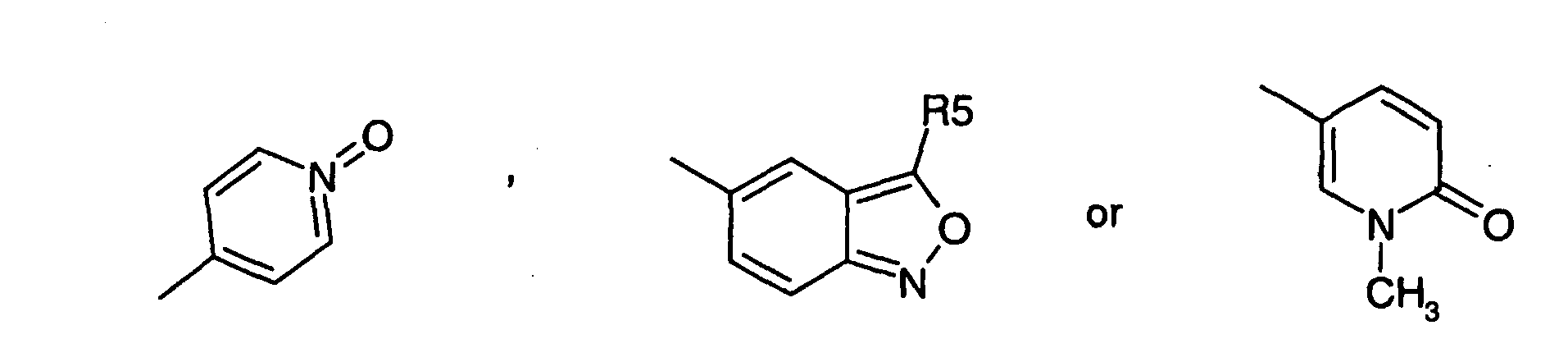
- Q is
-


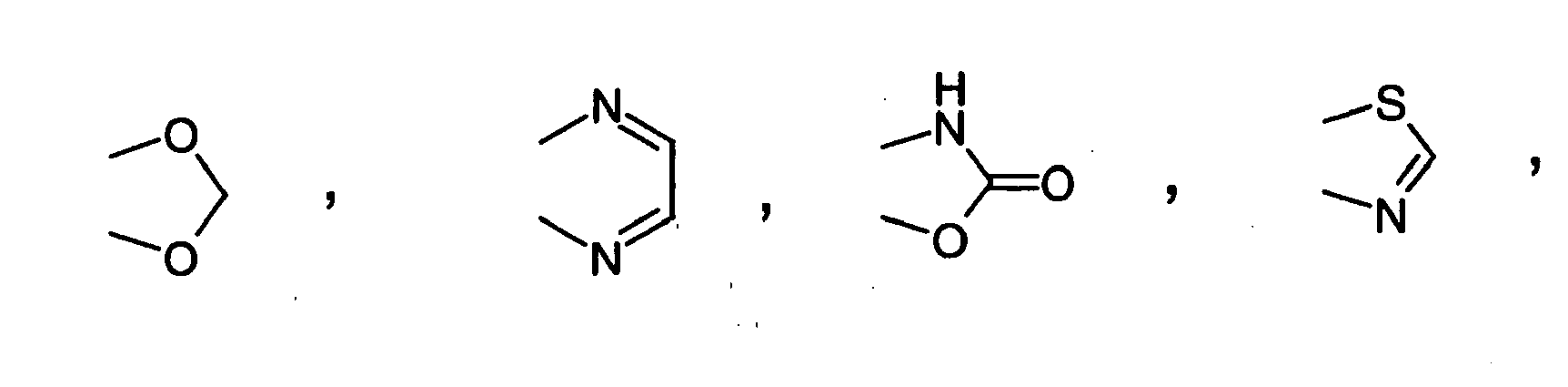

- Q is
-

- In a second aspect of the present invention, there is provided a compound of the formula II, or a salt or solvate thereof

- R is
- C3-6 cycloalkyl or naphtyl; or
- R is
-

-S(=O)-OC1-6alkyl, -OH, -CF3, -CN, -CO2H, -OCF3, or -CO2C1-6alkyl;
and R2 and R3 are independently hydrogen, halogen, -C1-6 alkyl, -SC1-6alkyl, -OC1-6alkyl, -NO2, -S(=O)-C1-6alkyl, -OH, -CF3, -CN, -CO2H, -CO2C1-6alkyl, -CONH2, -NH2, -OCH2(C=O)OH, -OCH2CH2OCH3,-SO2NH2,
-CH2SO2CH3, -NH(C=NH)CH3; or R2 and R3 can independently be a radical of the formula
- R is
-

- R is
- -(CH2)n-NRkRl in which n is 2 or 3, and Rk and Rl are independently -C1-6alkyl; or -NRkRl together form

- R is
-


- Q is
-


- Q is
-


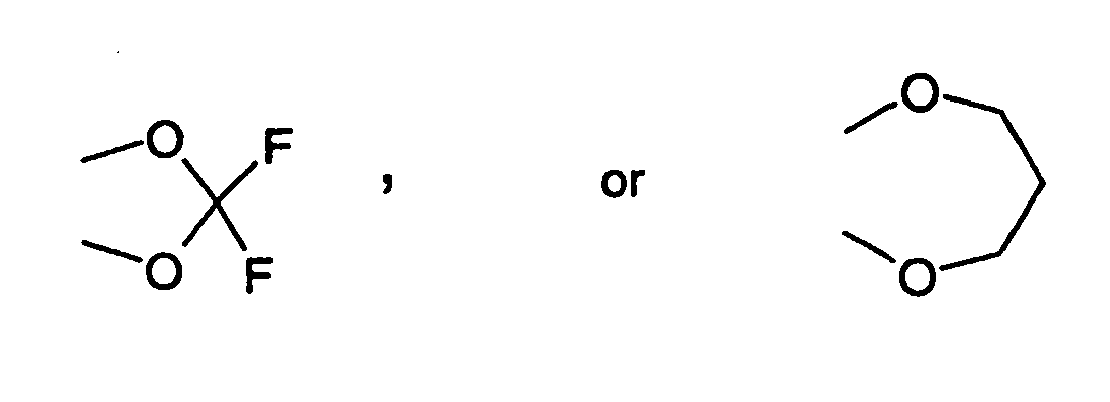
- In one embodiment, in a compound of formula I or II
- R is
- C3-6 cycloalkyl or naphtyl; or
- R is
-

-S(=O)-C1-6alkyl, -OH, -CF3, -CN, -CO2H, -OCF3, or -CO2C1-6alkyl;
and R2 and R3 are independently hydrogen, halogen, -C1-6 alkyl, -SC1-6alkyl, -OC1-6alkyl, -NO2, -S(=O)-C1-6alkyl, -OH, -CF3, -CN, -CO2H, -CO2C1-6alkyl, -CONH2, -NH2, -OCH2(C=O)OH, -OCH2CH2OCH3,-SO2NH2,
-CH2SO2CH3, -NH(C=NH)CH3; or R2 and R3 can independently be a radical of the formula
- R is
-

- R is
- -(CH2)n-NRkRl in which n is 2 or 3, and Rk and Rl are independently -C1-6alkyl; or -NRkRl together form
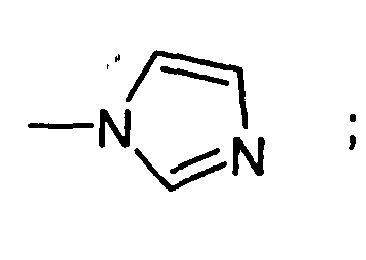
- R is
-


- Q is
-


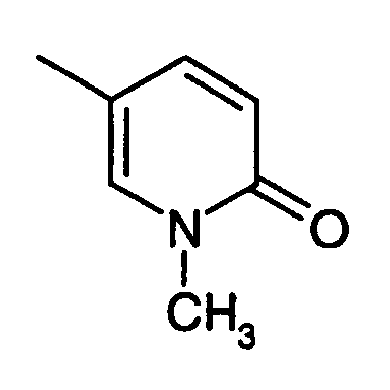
- Q is
-


- In another embodiment, R radical of compounds of formula I and II are

and R2 and R3 are independently hydrogen, halogen, -C1-6 alkyl, -SC1-6alkyl, -OC1-6alkyl, -NO2, -S(=O)-C1-6alkyl, -OH, -CF3, -CN, -CO2H, -CO2C1-6alkyl, -NH2, or -NH(C=NH)CH3;
and - Q is
-

- Q is
-
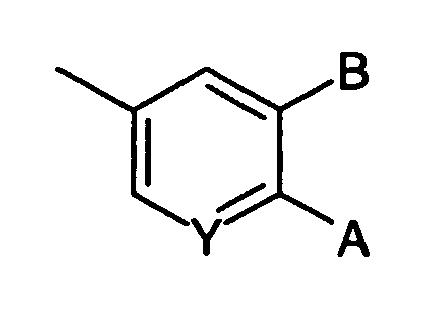
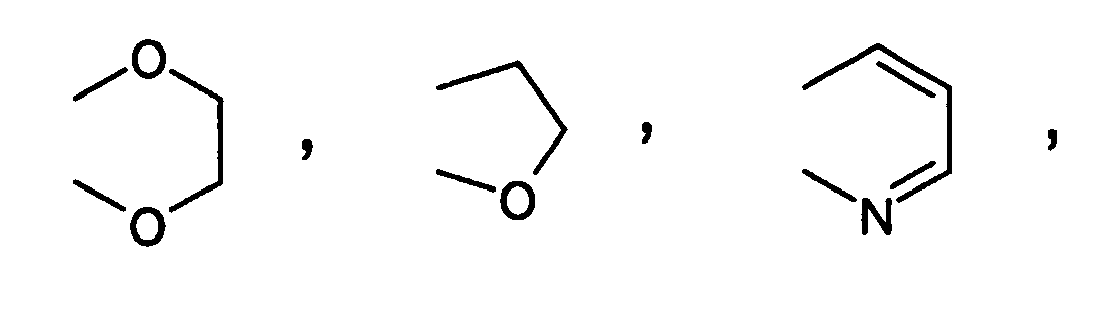

- Yet in another one embodiment, in formula I or II, R is

and R2 and R3 are independently hydrogen, halogen, -C1-6 alkyl, -SC1-6alkyl, -OC1-6alkyl, -NO2, -S(=O)-C1-6alkyl, -OH, -CF3, -CN, -CO2H, -CO2C1-6alkyl, -NH2, or -NH(C=NH)CH3;
and - Q is
-

- Q is
-


- Yet
- in a further embodiment, in a compound of formula I or II,
- R is
-

and R2 and R3 are independently hydrogen, halogen, -C1-6 alkyl, -SC1-6alkyl, -OC1-6alkyl, -NO2, -S(=O)-C1-6alkyl, -OH, -CF3, -CN, -CO2H, -CO2C1-6alkyl, -NH2, or -NH(C=NH)CH3;
and - Q is
-

- Q is
-
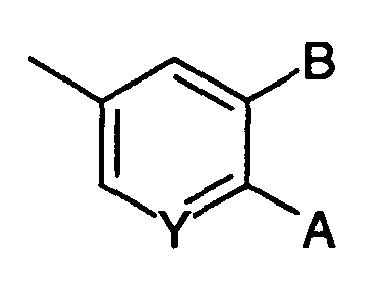

- In a third aspect of the present invention, there is provided a pharmaceutical composition including a therapeutically effective amount of a compound of formula I or II, or a salt or solvate thereof and one or more of pharmaceutically acceptable carriers, diluents and excipients.
- In a fourth aspect of the present invention, there is provided the use of a compound of formula I or II, or a salt or solvate thereof in the preparation of a medicament for use in the treatment or prevention of a disorder of the erythroid and hematopoietic systems mediated the imbalance or inappropriate activity of hYAK3 proteins, selected from anemias due to renal insufficiency or to chronic disease, such as autoimmunity, HIV, or cancer, and drug-induced anemias, myelodysplastic syndrome, aplastic anemia and myelosuppression, and cytopenia.
- In a fifth aspect, the present invention relates to a medicament for treating or preventing diseases of the erythroid and hematopoietic systems, caused by the hYAK3 imbalance or inappropriate activity selected from anemias due to renal insufficiency or to chronic disease, such as autoimmunity, HIV, or cancer, and drug-induced anemias, myelodysplastic syndrome, aplastic anemia and myelosuppression, and cytopenia; comprising a therapeutically effective amount of a compound of formula I or II, or a salt or solvate thereof and one or more of pharmaceutically acceptable carriers, diluents and excipients.
- In a six aspect, the present invention relates to a medicament for treating or preventing anemias due to renal insufficiency or to chronic disease, such as autoimmunity, HIV, or cancer, and drug-induced anemias, myelodysplastic syndrome, aplastic anemia and myelosuppression, and cytopenia; comprising a therapeutically effective amount of a compound of formula I or II, or a salt or solvate a thereof and one or more of pharmaceutically acceptable carriers, diluents and excipients.
- As used herein, the term "effective amount" means that amount of a drug or pharmaceutical agent that will elicit the biological or medical response of a tissue, system, animal or human that is being sought, for instance, by a researcher or clinician. Furthermore, the term "therapeutically effective amount" means any amount which, as compared to a corresponding subject who has not received such amount, results in improved treatment, healing, prevention, or amelioration of a disease, disorder, or side effect, or a decrease in the rate of advancement of a disease or disorder. The term also includes within its scope amounts effective to enhance normal physiological function.
- As used herein, the term "alkyl" refers to a straight or branched chain hydrocarbon. Furthermore, as used herein, the term "C1-6 alkyl" refers to an alkyl group as defined above containing at least 1, and at most 6, carbon atoms. Examples of branched or straight chained "C1-6 alkyl" groups useful in the present invention include methyl, ethyl, n-propyl, isopropyl, isobutyl, n-butyl,t-butyl, n-pentyl, n-hexyl, and the like.
- As used herein, the term "halogen" refers to fluorine (F), chlorine (Cl), bromine (Br), or iodine (I).
- As used herein, the term "C3-6 cycloalkyl" refers to a non-aromatic cyclic hydrocarbon ring having from three to six carbon atoms. Exemplary "C3-6 cycloalkyl" groups include cyclopropyl, cyclobutyl, cyclopentyl, and cyclohexyl.
- As used herein, the term "optionally" means that the subsequently described event(s) may or may not occur, and includes both event(s), which occur, and events that do not occur.
- As used herein, the crisscrossed double bond indicated by the symbol "" denotes Z and/or E stereochemistry around the double bond. In other words a compound of formula I or II can be either in the Z or E stereochemistry around this double bond, or a compound of formula I or II can also be in a mixture of Z and E stereochemistry around the double bond. However, in formulas I and II, the preferred compounds have Z stereochemistry around the double bond to which radical Q is attached.

- The compounds of formulas I and II naturally may exist in one tautomeric form or in a mixture of tautomeric forms. For example, for sake simplicity, compounds of formula I and II are expressed in one tautomeric form, usually as an exo form, i.e.
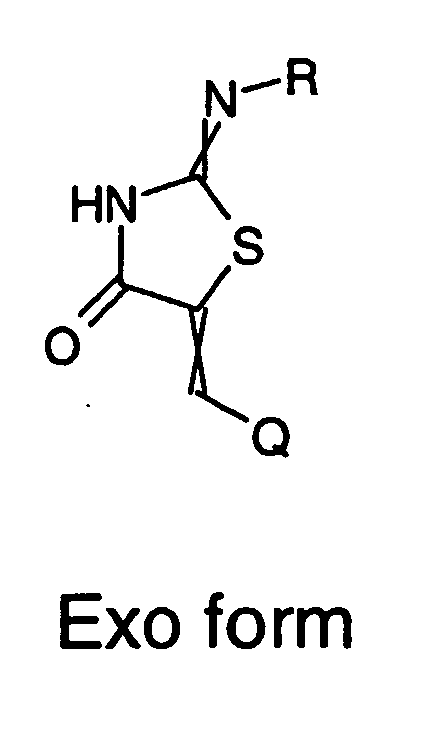
- However, a person of ordinary skill can readily appreciate, the compounds of formulas I and II can also exist in endo forms.

- The present invention contemplates all possible tautomeric forms.
- As used herein, the term "solvate" refers to a complex of variable stoichiometry formed by a solute (in this invention, a compound of formula I or II or a salt or physiologically functional derivative thereof) and a solvent. Such solvents for the purpose of the invention may not interfere with the biological activity of the solute. Examples of suitable solvents include, but are not limited to, water, methanol, ethanol and acetic acid. Preferably the solvent used is a pharmaceutically acceptable solvent. Examples of suitable pharmaceutically acceptable solvents include, without limitation, water, ethanol and acetic acid. Most preferably the solvent used is water.
- As used herein, the term "substituted" refers to substitution with the named substituent or substituents, multiple degrees of substitution being allowed unless otherwise stated.
- Certain compounds described herein may contain one or more chiral atoms, or may otherwise be capable of existing as two enantiomers, or two or more diastereoisomers. Accordingly, the compounds of this invention include mixtures of enantiomers/diastereoisomers as well as purified enantiomers/diastereoisomers or enantiomerically/diastereoisomerically enriched mixtures. Also included within the scope of the invention are the individual isomers of the compounds represented by formula I or II above as well as any wholly or partially equilibrated mixtures thereof. The present invention also covers the individual isomers of the compounds represented by the formulas above as mixtures with isomers thereof in which one or more chiral centers are inverted. Also, as stated above, it is understood that all tautomers and mixtures of tautomers are included within the scope of the compounds of formula I or II.
- Typically, the salts of the present invention are pharmaceutically acceptable salts. Salts encompassed within the term "pharmaceutically acceptable salts" refer to non-toxic salts of the compounds of this invention. Salts of the compounds of the present invention may comprise acid addition salts derived from a nitrogen on a substituent in the compound of formula I or II. Representative salts include the following salts: acetate, benzenesulfonate, benzoate, bicarbonate, bisulfate, bitartrate, borate, bromide, calcium edetate, camsylate, carbonate, chloride, clavulanate, citrate, dihydrochloride, edetate, edisylate, estolate, esylate, fumarate, gluceptate, gluconate, glutamate, glycollylarsanilate, hexylresorcinate, hydrabamine, hydrobromide, hydrochloride, hydroxynaphthoate, iodide, isethionate, lactate, lactobionate, laurate, malate, maleate, mandelate, mesylate, methylbromide, methylnitrate, methylsulfate, monopotassium maleate, mucate, napsylate, nitrate, N-methylglucamine, oxalate, pamoate (embonate), palmitate, pantothenate, phosphate/diphosphate, polygalacturonate, potassium, salicylate, sodium, stearate, subacetate, succinate, tannate, tartrate, teoclate, tosylate, triethiodide, trimethylammonium and valerate. Other salts, which are not pharmaceutically acceptable, may be useful in the preparation of compounds of this invention and these form a further aspect of the invention.
- While it is possible that, for use in therapy, therapeutically effective amounts of a compound of formula I or II, as well as salts or solvates thereof, may be administered as the raw chemical, it is possible to present the active ingredient as a pharmaceutical composition. Accordingly, the invention further provides pharmaceutical compositions (otherwise referred to as pharmaceutical formulations), which include therapeutically effective amounts of compounds of the formula I or II and salts or solvates thereof, and one or more pharmaceutically acceptable carriers, diluents, or excipients. The compounds of the formula I or II and salts or solvates thereof, are as described above. The carrier(s), diluent(s) or excipient(s) must be acceptable in the sense of being compatible with the other ingredients of the formulation and not deleterious to the recipient thereof. In accordance with another aspect of the invention there is also provided a process for the preparation of a pharmaceutical formulation including admixing a compound of the formula I or II, or salts or solvates thereof, with one or more pharmaceutically acceptable carriers, diluents or excipients.
- Pharmaceutical formulations may be presented in unit dose forms containing a predetermined amount of active ingredient per unit dose. Such a unit may contain, for example, 0.5mg to 1g, preferably 1mg to 700mg, more preferably 5mg to 100mg of a compound of the formula I or II, depending on the condition being treated, the route of administration and the age, weight and condition of the patient, or pharmaceutical formulations may be presented in unit dose forms containing a predetermined amount, of active ingredient per unit dose. Preferred unit dosage formulations are those containing a daily dose or sub-dose, as herein above recited, or an appropriate fraction thereof, of an active ingredient. Furthermore, such pharmaceutical formulations may be prepared by any of the methods well known in the pharmacy art.
- Pharmaceutical formulations may be adapted for administration by any appropriate route, for example by the oral (including buccal or sublingual), rectal, nasal, topical (including buccal, sublingual or transdermal), vaginal or parenteral (including subcutaneous, intramuscular, intravenous or intradermal) route. Such formulations may be prepared by any method known in the art of pharmacy, for example by bringing into association the active ingredient with the carrier(s) or excipient(s).
- Pharmaceutical formulations adapted for oral administration may be presented as discrete units such as capsules or tablets; powders or granules; solutions or suspensions in aqueous or non-aqueous liquids; edible foams or whips; or oil-in-water liquid emulsions or water-in-oil liquid emulsions.
- For instance, for oral administration in the form of a tablet or capsule, the active drug component can be combined with an oral, non-toxic pharmaceutically acceptable inert carrier such as ethanol, glycerol, water and the like. Powders are prepared by comminuting the compound to a suitable fine size and mixing with a similarly comminuted pharmaceutical carrier such as an edible carbohydrate, as, for example, starch or mannitol. Flavoring, preservative, dispersing and coloring agent can also be present.
- Capsules are made by preparing a powder mixture, as described above, and filling formed gelatin sheaths. Glidants and lubricants such as colloidal silica, talc, magnesium stearate, calcium stearate or solid polyethylene glycol can be added to the powder mixture before the filling operation. A disintegrating or solubilizing agent such as agar-agar, calcium carbonate or sodium carbonate can also be added to improve the availability of the medicament when the capsule is ingested.
- Moreover, when desired or necessary, suitable binders, lubricants, disintegrating agents and coloring agents can also be incorporated into the mixture. Suitable binders include starch, gelatin, natural sugars such as glucose or beta-lactose, corn sweeteners, natural and synthetic gums such as acacia, tragacanth or sodium alginate, carboxymethylcellulose, polyethylene glycol, waxes and the like. Lubricants used in these dosage forms include sodium oleate, sodium stearate, magnesium stearate, sodium benzoate, sodium acetate, sodium chloride and the like. Disintegrators include, without limitation, starch, methyl cellulose, agar, bentonite, xanthan gum and the like. Tablets are formulated, for example, by preparing a powder mixture, granulating or slugging, adding a lubricant and disintegrant and pressing into tablets. A powder mixture is prepared by mixing the compound, suitably comminuted, with a diluent or base as described above, and optionally, with a binder such as carboxymethylcellulose, an aliginate, gelatin, or polyvinyl pyrrolidone, a solution retardant such as paraffin, a resorption accelerator such as a quaternary salt and/or an absorption agent such as bentonite, kaolin or dicalcium phosphate. The powder mixture can be granulated by wetting with a binder such as syrup, starch paste, acadia mucilage or solutions of cellulosic or polymeric materials and forcing through a screen. As an alternative to granulating, the powder mixture can be run through the tablet machine and the result is imperfectly formed slugs broken into granules. The granules can be lubricated to prevent sticking to the tablet forming dies by means of the addition of stearic acid, a stearate salt, talc or mineral oil. The lubricated mixture is then compressed into tablets. The compounds of the present invention can also be combined with a free flowing inert carrier and compressed into tablets directly without going through the granulating or slugging steps. A clear or opaque protective coating consisting of a sealing coat of shellac, a coating of sugar or polymeric material and a polish coating of wax can be provided. Dyestuffs can be added to these coatings to distinguish different unit dosages.
- Oral fluids such as solution, syrups and elixirs can be prepared in dosage unit form so that a given quantity contains a predetermined amount of the compound. Syrups can be prepared by dissolving the compound in a suitably flavored aqueous solution, while elixirs are prepared through the use of a non-toxic alcoholic vehicle. Suspensions can be formulated by dispersing the compound in a non-toxic vehicle. Solubilizers and emulsifiers such as ethoxylated isostearyl alcohols and polyoxy ethylene sorbitol ethers, preservatives, flavor additive such as peppermint oil or natural sweeteners or saccharin or other artificial sweeteners, and the like can also be added.
- Where appropriate, dosage unit formulations for oral administration can be microencapsulated. The formulation can also be prepared to prolong or sustain the release as for example by coating or embedding particulate material in polymers, wax or the like.
- The compounds of formula I or II, and salts or solvates thereof, can also be administered in the form of liposome delivery systems, such as small unilamellar vesicles, large unilamellar vesicles and multilamellar vesicles. Liposomes can be formed from a variety of phospholipids, such as cholesterol, stearylamine or phosphatidylcholines.
- The compounds of formula I or II, and salts or solvates thereof may also be delivered by the use of monoclonal antibodies as individual carriers to which the compound molecules are coupled. The compounds may also be coupled with soluble polymers as targetable drug carriers. Such polymers can include polyvinylpyrrolidone, pyran copolymer, polyhydroxypropylmethacrylamide -phenol, polyhydroxyethylaspartamidephenol, or polyethyleneoxidepolylysine substituted with palmitoyl residues. Furthermore, the compounds may be coupled to a class of biodegradable polymers useful in achieving controlled release of a drug, for example, polylactic acid, polepsilon caprolactone, polyhydroxy butyric acid, polyorthoesters, polyacetals, polydihydropyrans, polycyanoacrylates and cross-linked or amphipathic block copolymers of hydrogels.
- Pharmaceutical formulations adapted for transdermal administration may be presented as discrete patches intended to remain in intimate contact with the epidermis of the recipient for a prolonged period of time. For example, the active ingredient may be delivered from the patch by iontophoresis as generally described in Pharmaceutical Research, 3(6), 318 (1986).
- Pharmaceutical formulations adapted for topical administration may be formulated as ointments, creams, suspensions, lotions, powders, solutions, pastes, gels, sprays, aerosols or oils.
- For treatments of the eye or other external tissues, for example mouth and skin, the formulations are preferably applied as a topical ointment or cream. When formulated in an ointment, the active ingredient may be employed with either a paraffinic or a water-miscible ointment base. Alternatively, the active ingredient may be formulated in a cream with an oil-in-water cream base or a water-in-oil base.
- Pharmaceutical formulations adapted for topical administrations to the eye include eye drops wherein the active ingredient is dissolved or suspended in a suitable carrier, especially an aqueous solvent.
- Pharmaceutical formulations adapted for topical administration in the mouth include lozenges, pastilles and mouth washes.
- Pharmaceutical formulations adapted for rectal administration may be presented as suppositories or as enemas.
- Pharmaceutical formulations adapted for nasal administration wherein the carrier is a solid include a coarse powder having a particle size for example in the range 20 to 500 microns which is administered in the manner in which snuff is taken, i.e. by rapid inhalation through the nasal passage from a container of the powder held close up to the nose. Suitable formulations wherein the carrier is a liquid, for administration as a nasal spray or as nasal drops, include aqueous or oil solutions of the active ingredient.
- Pharmaceutical formulations adapted for administration by inhalation include fine particle dusts or mists, which may be generated by means of various types of metered, dose pressurised aerosols, nebulizers or insufflators.
- Pharmaceutical formulations adapted for vaginal administration may be presented as pessaries, tampons, creams, gels, pastes, foams or spray formulations.
- Pharmaceutical formulations adapted for parenteral administration include aqueous and non-aqueous sterile injection solutions which may contain anti-oxidants, buffers, bacteriostats and solutes which render the formulation isotonic with the blood of the intended recipient; and aqueous and non-aqueous sterile suspensions which may include suspending agents and thickening agents. The formulations may be presented in unit-dose or multi-dose containers, for example sealed ampoules and vials, and may be stored in a freeze-dried (lyophilized) condition requiring only the addition of the sterile liquid carrier, for example water for injections, immediately prior to use. Extemporaneous injection solutions and suspensions may be prepared from sterile powders, granules and tablets.
- It should be understood that in addition to the ingredients particularly mentioned above, the formulations may include other agents conventional in the art having regard to the type of formulation in question, for example those suitable for oral administration may include flavouring agents.
- A therapeutically effective amount of a compound of the present invention will depend upon a number of factors including, for example, the age and weight of the animal, the precise condition requiring treatment and its severity, the nature of the formulation, and the route of administration, and will ultimately be at the discretion of the attendant physician or veterinarian. However, an effective amount of a compound of formula I or II for the treatment of or prevention of diseases of the erythroid and hematopoietic systems, caused by hYAK3 imbalance or inappropriate activity selected from, neutropenia; cytopenia; anemias, including anemias due to renal insufficiency or to a chronic disease, such as autoimmunity or cancer, and drug-induced anemias; polycythemia; and myelosuppression will generally be in the range of 0.1 to 100 mg/kg body weight of recipient (mammal) per day and more usually in the range of 1 to 10 mg/kg body weight per day. Thus, for a 70kg adult mammal, the actual amount per day would usually be from 70 to 700 mg and this amount may be given in a single dose per day or more usually in a number (such as two, three, four, five or six) of sub-doses per day such that the total daily dose is the same. An effective amount of a salt or solvate thereof, may be determined as a proportion of the effective amount of the compound of formula I or II per se. It is envisaged that similar dosages would be appropriate for treatment of the other conditions referred to above.
- Compounds of general formula I may be prepared by methods known in the art of organic synthesis as set forth in part by the following synthesis schemes. In all of the schemes described below, it is well understood that protecting groups for sensitive or reactive groups are employed where necessary in accordance with general principles of chemistry. Protecting groups are manipulated according to standard methods of organic synthesis (T. W. Green and P. G. M. Wuts (1991) Protecting Groups in Organic Synthesis, John Wiley & Sons). These groups are removed at a convenient stage of the compound synthesis using methods that are readily apparent to those skilled in the art. The selection of processes as well as the reaction conditions and order of their execution shall be consistent with the preparation of compounds of formula I. Those skilled in the art will recognize if a stereocenter exists in compounds of formula I. Accordingly, the present invention includes both possible stereoisomers and includes not only racemic compounds but the individual enantiomers as well. When a compound is desired as a single enantiomer, it may be obtained by stereospecific synthesis or by resolution of the final product or any convenient intermediate. Resolution of the final product, an intermediate, or a starting material may be effected by any suitable method known in the art. See, for example, Stereochemistry of Organic Compounds by E. L. Eliel, S. H. Wilen, and L. N. Mander (Wiley-Interscience, 1994).
- More particularly, the compounds of the formula I can be made by the process of either Scheme A or B or a variant thereof. Any person skilled in the art can readily adapt the process of either A or B, such the stoichemistry of the reagents, temperature, solvents, etc. to optimize the yield of the products desired.

- Briefly in Scheme A, a mixture of aniline derivative of formula II (1 equivalent) and NH4SCN (about 1.3 equivalent) in an acid (typically 4N-HCl) is heated to reflux at about 110 C° for 6 hours. After cooling, the mixture is treated with H2O, which process usually forms a solid, followed by desiccation in vacuo to give a compound of formula III.
- A mixture of formula III compound, ClCH2CO2H (1 equivalent), and AcONa (1 equivalent) in AcOH is heated to reflux at around 110 C° for about 4 h. The mixture is poured onto water thereby a solid is typically formed, which is isolated by filtration. The solid is washed with a solvent such as MeOH to afford a compound of formula IV.
- A mixture of formula IV compound, an aldehyde of formula V (1 equivalent), AcONa (3 equivalent) in AcOH is heated to reflux at about 110 C° for about 10 to 48 hours. After cooling, a small portion of water was added until the solid forms. The solid is filtered and washed with a solvent such as MeOH, followed by desiccation in vacuo to afford a target product of formula I.

- Briefly in Scheme B, a mixture of an aldehyde of formula V (1 equivalent ), Rhodanine (1 equivalent), sodium acetate (about 3 equivalents), and acetic acid was heated at around 110 C° for about 48 h. The reaction mixture is cooled to room temperature to afford a product of formula VII.
- Then, to a room temperature suspension of VII (1 equivalent) in a suitable solvent such as ethanol was added Hunig's base (about 2 equivalents) followed by iodomethane (about 5 equivalents). Stirring the resultant suspension at room temperature for 3.5 h will yield a compound of VIII.
- To a mixture of VIII (1 equivalent) and MS4A powder was added an amine of formula IX (1-2 equivalent) and ethanol (dehydrated). The mixture was heated by microwave (SmithSynthesizer-Personal Chemistry) at about 110 C° for about 1200 seconds. Usually, the desired product of formula I can be obtained in about 20-90% yield after purification.
- In Schemes A and B, the meaning of R and Q are as defined in formula I.
- All the starting materials are either known, commercially available or can be readily made by a routine method. For example, an aldehyde of formula V in which the radical Q is of the formula
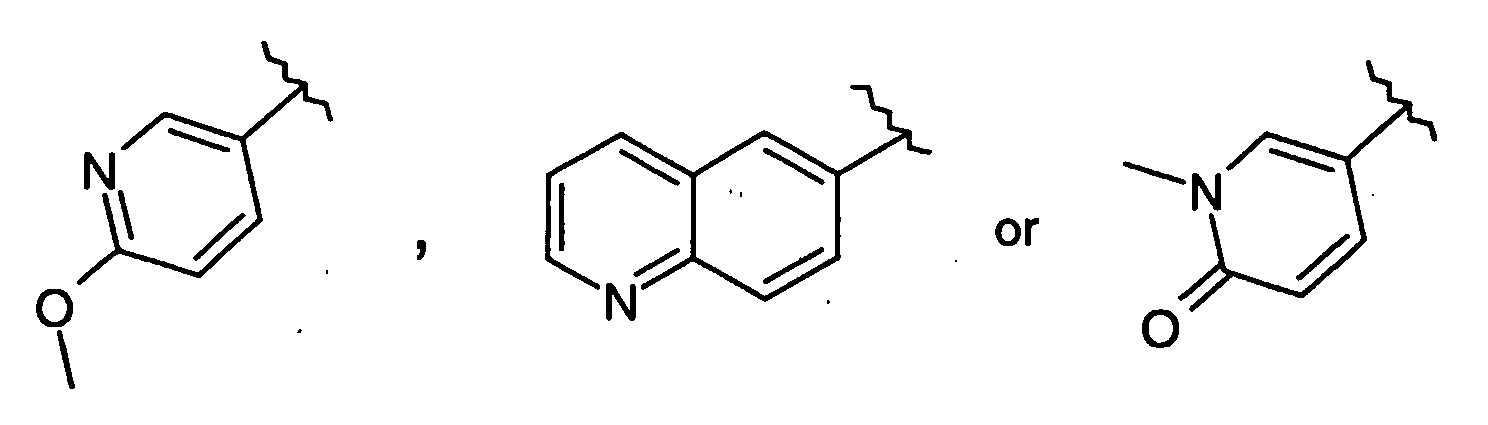

- See Eur. J. Org. Chem.,1999, 2609-2621.

- See J. Med. Chem., 2000, 43, 3878-3894.

- See J. Am. Chem. Soc., 1999, 121-6722-4723.
- In other embodiments, additional compounds of the invention can also be synthesized whereby a compound of formula I are first made by a process of Scheme A or B (or a variant thereof), and Q and R radicals in compounds of formula I thus made are further converted by routine organic reaction techniques into different Q and R groups. For such alterantives, see Schemes C, D and E.
- As used herein the symbols and conventions used in these processes, schemes and examples are consistent with those used in the contemporary scientific literature, for example, the Journal of the American Chemical Society or the Journal of Biological Chemistry. Standard single-letter or three-letter abbreviations are generally used to designate amino acid residues, which are assumed to be in the L-configuration unless otherwise noted. Unless otherwise noted, all starting materials were obtained from commercial suppliers and used without further purification. Specifically, the following abbreviations may be used in the examples and throughout the specification:
g (grams); mg (milligrams); L (liters); mL (milliliters); µL (microliters); psi (pounds per square inch); M (molar); mM (millimolar); i. v. (intravenous); Hz (Hertz); MHz (megahertz); mol (moles); mmol (millimoles); rt (room temperature); min (minutes); h (hours); mp (melting point); TLC (thin layer chromatography); Tr (retention time); RP (reverse phase); MeOH (methanol); i-PrOH (isopropanol); TEA (triethylamine); TFA (trifluoroacetic acid); TFAA (trifluoroacetic anhydride); THF (tetrahydrofuran); DMSO (dimethylsulfoxide); AcOEt (ethyl acetate); DME (1,2-dimethoxyethane); DCM (dichloromethane); DCE (dichloroethane); DMF (N,N-dimethylformamide); DMPU (N,N'-dimethylpropyleneurea); (CDI (1,1-carbonyldiimidazole); IBCF (isobutyl chloroformate); HOAc (acetic acid); HOSu (N-hydroxysuccinimide); HOBT (1-hydroxybenzotriazole); mCPBA (meta-chloroperbenzoic acid; EDC (ethylcarbodiimide hydrochloride); BOC (tert-butyloxycarbonyl); FMOC (9-fluorenylmethoxycarbonyl); DCC (dicyclohexylcarbodiimide); CBZ (benzyloxycarbonyl); Ac (acetyl); atm (atmosphere); TMSE (2-(trimethylsilyl)ethyl); TMS (trimethylsilyl); TIPS (triisopropylsilyl); TBS (t-butyldimethylsilyl); DMAP (4-dimethylaminopyridine); BSA (bovine serum albumin) ATP (adenosine triphosphate); HRP (horseradish peroxidase); DMEM (Dulbecco's modified Eagle medium); HPLC (high pressure liquid chromatography); BOP (bis(2-oxo-3-oxazolidinyl)phosphinic chloride); TBAF (tetra-n-butylammonium fluoride); HBTU (O-Benzotriazole-1-yl-N,N,N',N'- tetramethyluronium hexafluorophosphate). HEPES (4-(2-hydroxyethyl)-1-piperazine ethane sulfonic acid); DPPA (diphenylphosphoryl azide); fHN03 (fumed HN03); and EDTA (ethylenediaminetetraacetic acid). - All references to ether are to diethyl ether; brine refers to a saturated aqueous solution of NaCl. Unless otherwise indicated, all temperatures are expressed in °C (degrees Centigrade). All reactions are conducted under an inert atmosphere at room temperature unless otherwise noted.
- 1H NMR spectra were recorded on a Varian VXR-300, a Varian Unity-300, a Varian Unity-400 instrument, a Brucker AVANCE-400, or a General Electric QE-300. Chemical shifts are expressed in parts per million (ppm, δ units). Coupling constants are in units of hertz (Hz). Splitting patterns describe apparent multiplicities and are designated as s (singlet), d (doublet), t (triplet), q (quartet), quint (quintet), m (multiplet), br (broad).
- Low-resolution mass spectra (MS) were recorded on a JOEL JMS-AX505HA, JOEL SX-102, or a SCIEX-APIiii spectrometer; LC-MS were recorded on a micromass 2MD and Waters 2690; high resolution MS were obtained using a JOEL SX-102A spectrometer. All mass spectra were taken under electrospray ionization (ESI), chemical ionization (CI), electron impact (EI) or by fast atom bombardment (FAB) methods. Infrared (IR) spectra were obtained on a Nicolet 510 FT-IR spectrometer using a 1-mm NaCl cell. Most of the reactions were monitored by thin-layer chromatography on 0.25 mm E. Merck silica gel plates (60F-254), visualized with UV light, 5% ethanolic phosphomolybdic acid or p-anisaldehyde solution. Flash column chromatography was performed on silica gel (230-400 mesh, Merck).
- For ease of illustration, the regiochemistry around the double bonds in the chemical formulas in the Examples are drawn as fixed for ease of representation; however, a skilled in the art will readily appreciate that the compounds will naturally assume more thermodynamically stable structure around the C=N (the imine) double bond if it exits as exo form. Further compounds can also exit in endo form. As stated before, the invention contemplates both endo and exo forms as well as both regioisomers around the exo imine bond. Further it is intended that both E and Z isomers are encompassed around the C=C double bond.
-


- A mixture of 2-chloro-5-fluoroaniline IIa (2.0 g, 13.7 mmol) and 1.7 g of NH4SCN in 4N-HCl (20 mL) was heated to reflux at 110C° for 6 hours. After cooling, it was treated with H2O to form a solid, followed by desiccation in vacuo to give thiourea IIIa (870 mg, 4.3 mmol). A mixture of IIIa (870 mg, 4.3 mmol), ClCH2CO2H (400 mg), and AcONa (350 mg) in AcOH (5 mL) was heated to reflux at 110 C° for 4 h. The mixture was poured onto water and the formed solid was isolated by filtration. It was washed with MeOH to give imino thiazolidinone IVa (456 mg, 1.9 mmol). A mixture of IVa (98 mg, 0.4 mmol), aldehyde Va (60 mg, 0.4 mmol), AcONa (100 mg) in AcOH (2 mL) was heated to reflux at 120 degree for 48 hours. After cooling, a small portion of water was added until the solid forms. It was filtered and washed with MeOH, followed by desiccation in vacuo to afford a target product Ia (61 mg, 0.16 mmol).
1HNMR: (DMSO-d6) δ 3.21 (t, 2H), 4.58 (t, 2H), 6.87 (d, 1H), 7.06 (sbr, 2H), 7.30 (d, 1H), 7.39 (s, 1H), 7.58 (sbr, 2H), 12.60 (sbr, 1H): LC/MS: m/z 375 (M+1), 377 (M+3)
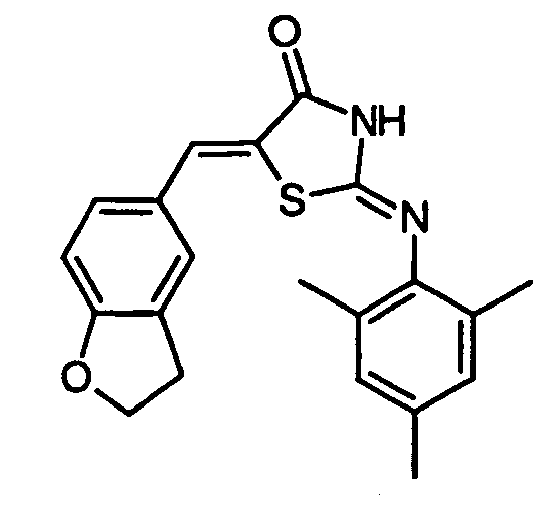
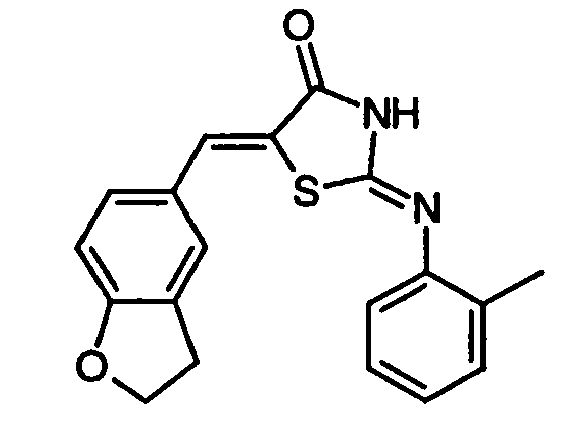
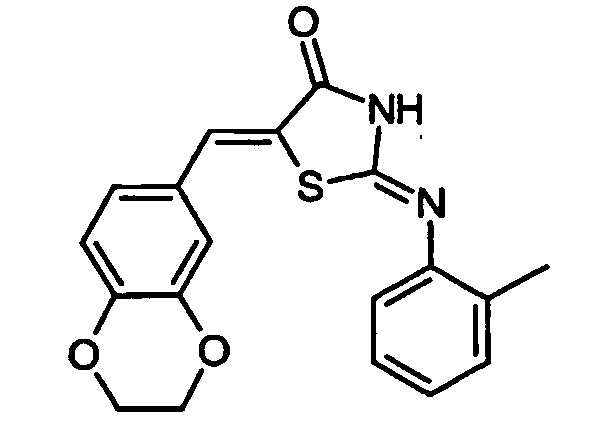
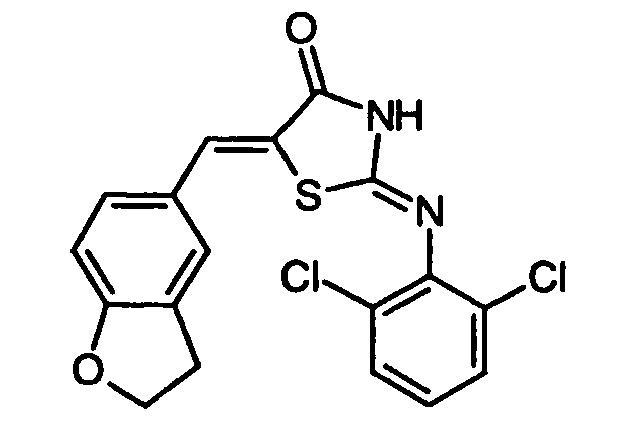
Compounds in Examples 2-61, 73-94, and 96 were made by the process described in Scheme A, analogous to the method described in Example 1. -

-

-

-
-

-

-

-
-
-

-

-

-
-

-

-

-

-

-

-

-

-

-

-

-

-

-

-

-

-

-

-

-

-

-
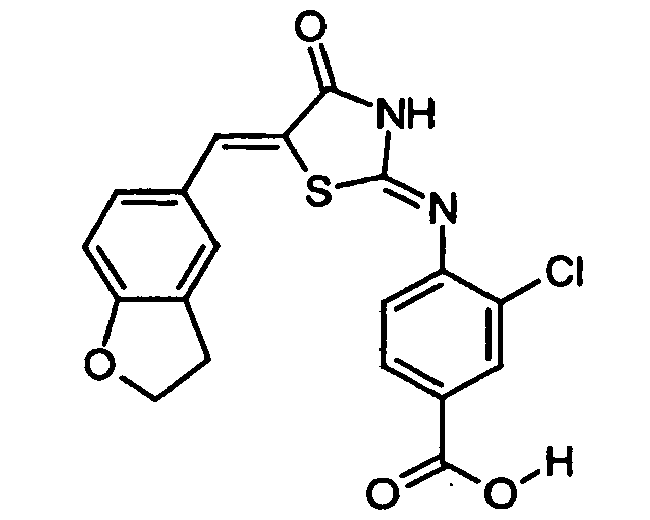
-

-

-

-

-

-
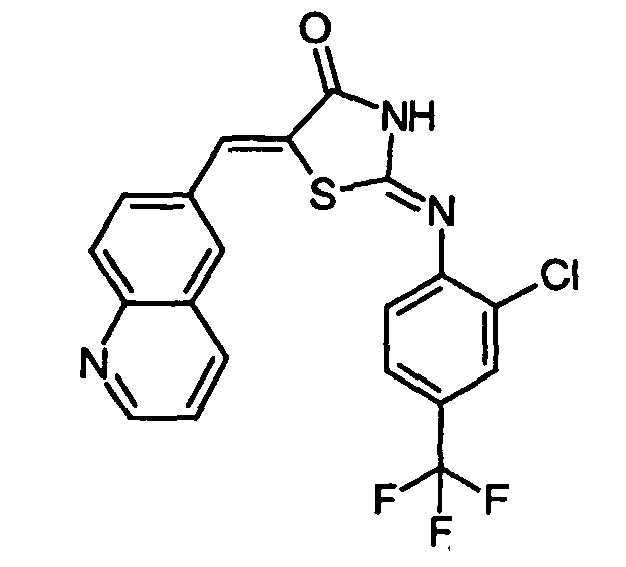
-

-

-

-

-

-

-

-
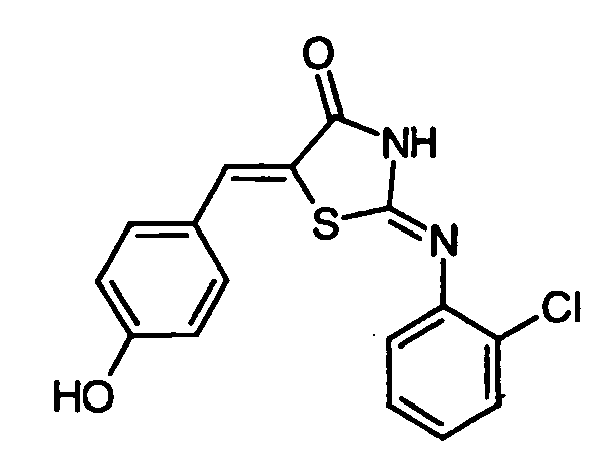
-
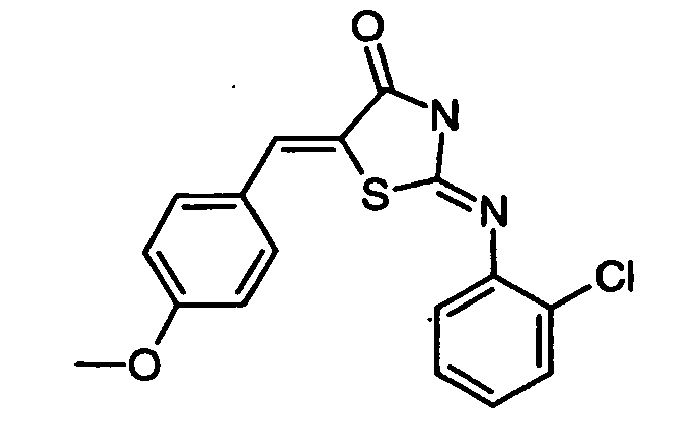
-

-

362 -

-

-
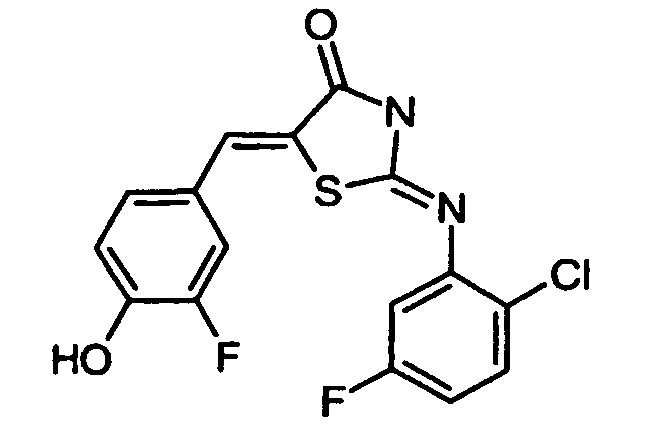
-

-
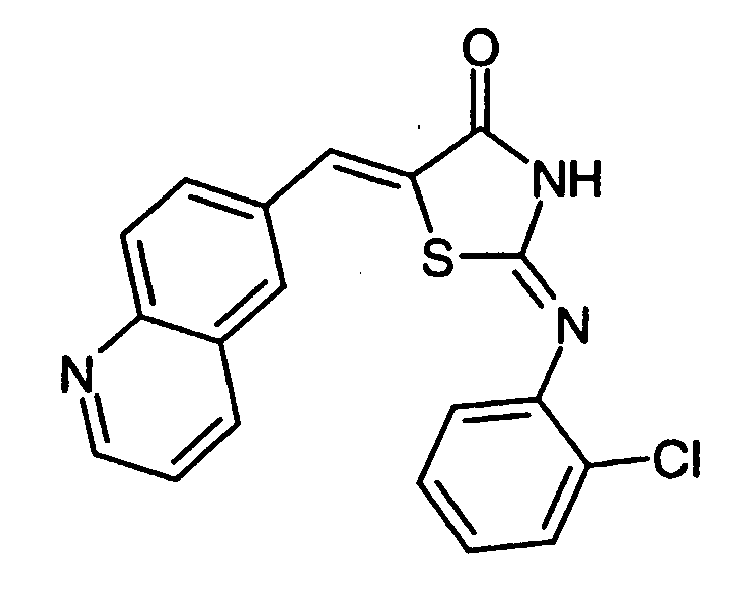
-

-

-

- A mixture of E, Z-isomers(ratio = 3.0/1.0)
1H NMR (400MHz, DMSO-d6) ppm 3.78 (s, 2.25H), 3.90 (s, 0.75H), 6.97-7.28 (m, 3H), 7.56 (m, 0.75H), 7.62 (m, 0.25H), 7.81-7.86 (m, 2H), 7.94-8.24 (m, 3H), 8.42-8.51 (m, 1H), 8.92 (m, 0.75H), 8.96 (m, 0.25H), 12.44 (m, 1H). LC/MS: m/z 362 (M+1)+, 360 (M-1)-. -

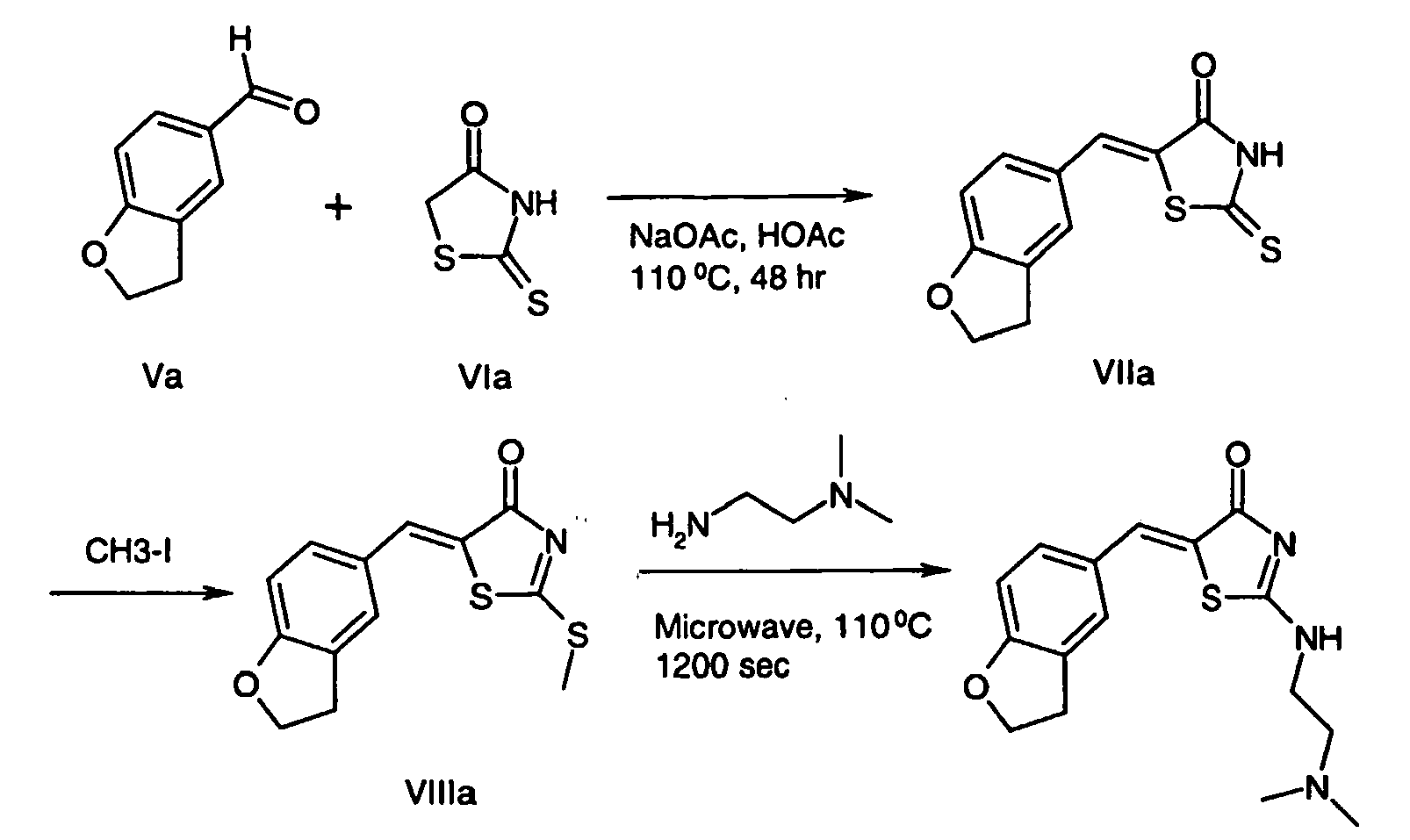
- A mixture of aldehyde of formula Va (10 mmol), Rhodanine VIa (10 mmol), sodium acetate (30 mmol), and 10 mL of acetic acid was heated at 110C° for 48 h. The reaction mixture was cooled to room temperature and filtered to collect the precipitate formed. The precipitate was washed with acetic acid (1 mL), methanol (1 mL) and dried in vaccuo to give compound VIIa 3.9g (14.81 mmol).
- To room a temperature suspension of VIIa (14.81 mmol) in 100 mL ethanol was added Hunig's base (5.2 mL, 29.85 mmol) followed by iodomethane (4.6 mL, 73.9 mmol). After stirring the resultant suspension at room temperature for 3.5 h, the precipitate was filtered and washed with water to afford compound VIIIa 3.12g (11.25 mmol) as a first crop. After evaporating the filtrate, to the residue was added methanol (10 mL) and water (10 mL), and the resultant mixture was subjected to sonication for 1 min. The process yielded the second crop which was filtered. 0.8g (2.89 mmol).
- To a mixture of VIIIa (0.3 mmol) and MS4A (molecular sieve 4 Angstrom powder) (250 mg) was added dimethylaminoethylamine (0.45 mmol) and ethanol (1mL, dehydrated). The mixture was heated by microwave (SmithSynthesizer-Personal Chemistry) at 110 C° for 1200 seconds. The corresponding product was obtained in 65% yield after purification on SCX column.
1H NMR (400MHz, DMSO-d6) ppm 2.18 (s, 6H), 2.44 (t, 2H, J = 6.6 Hz), 3.24 (t, 2H, J = 8.6 Hz), 3.58 (t, 2H, J = 6.6 Hz), 4.60 (t, 2H, J = 8.6 Hz), 6.90 (d, 1H, J = 8.3 Hz), 7.30-7.48 (m, 3H). LC/MS: m/z 318 (M+1)+, 316 (M-1) -. - Example 63-72 compounds were made according to the process B, analogous to the method described in Example 62.
-

-
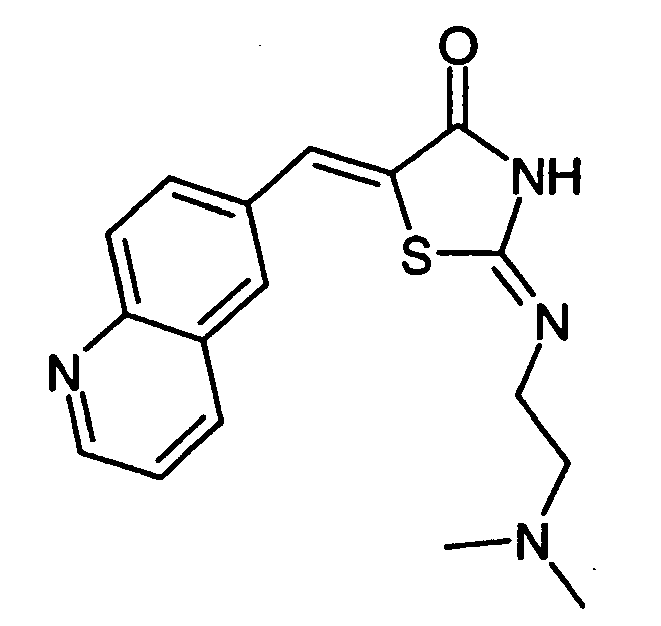
-

-

-

-
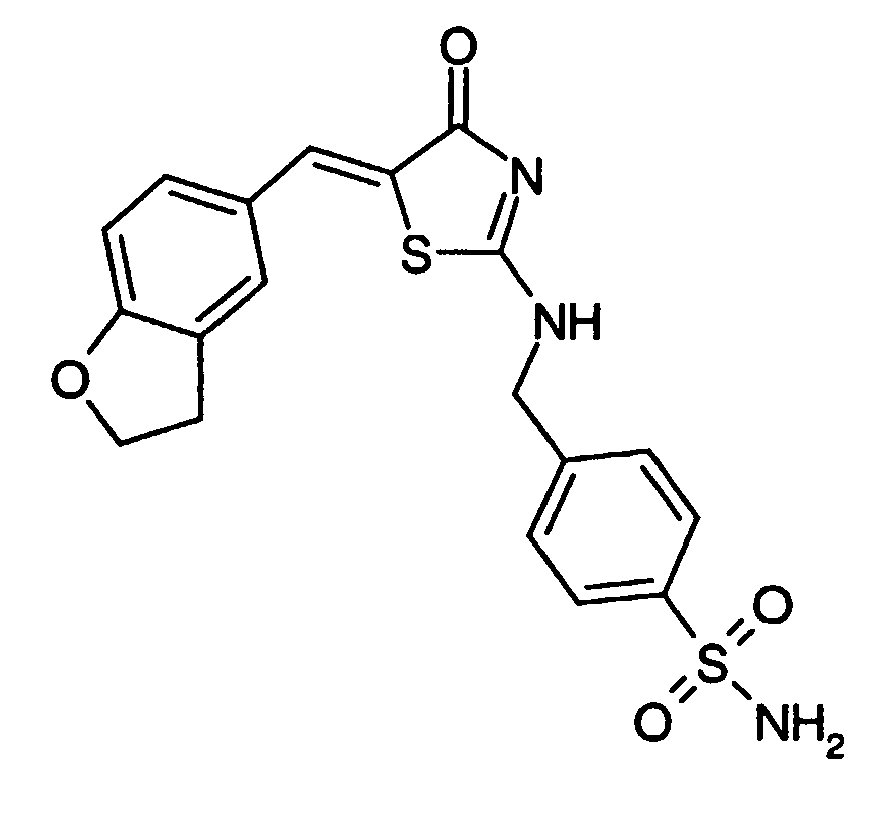
-
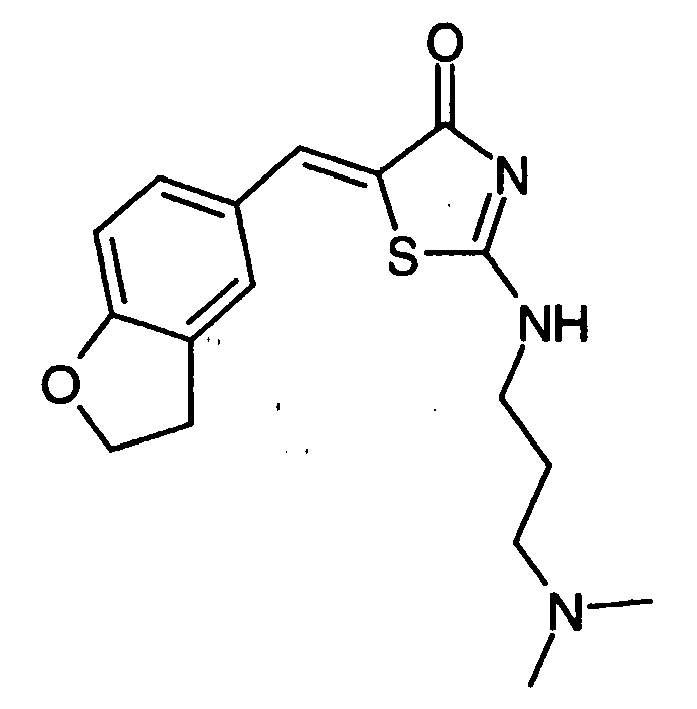
-
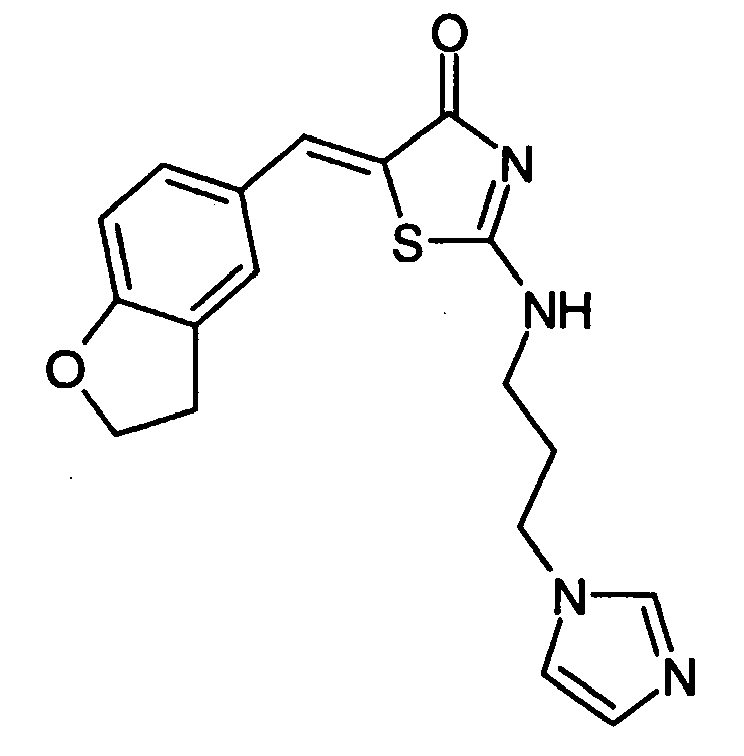
-

-

-
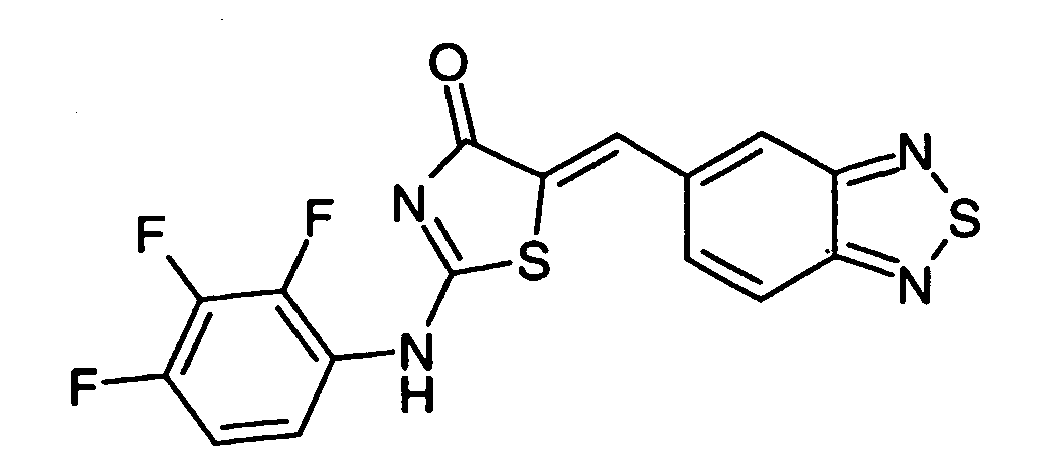
-

-
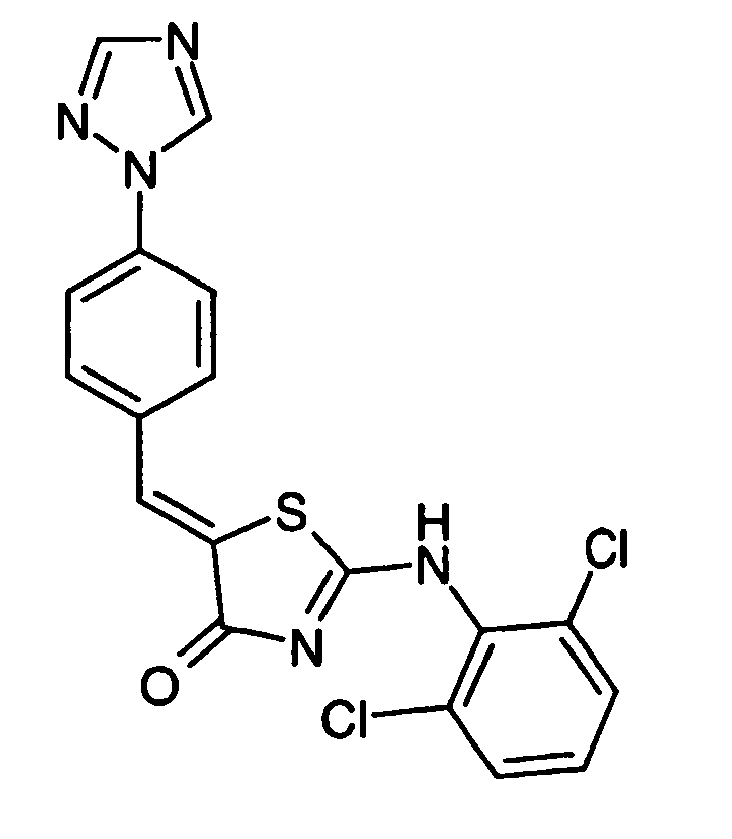
-

-

-

-

-

-

-

-

-

-

-
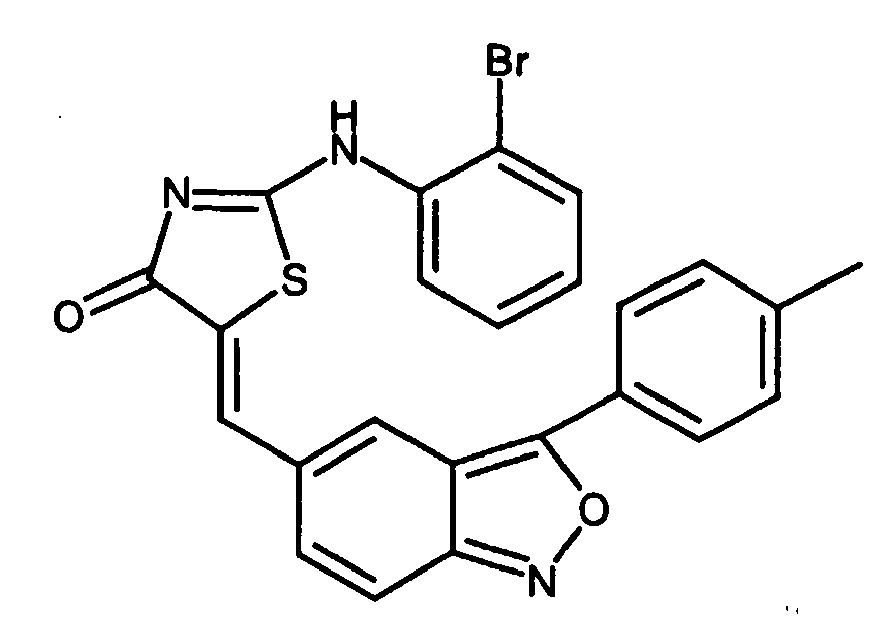
-

-

-
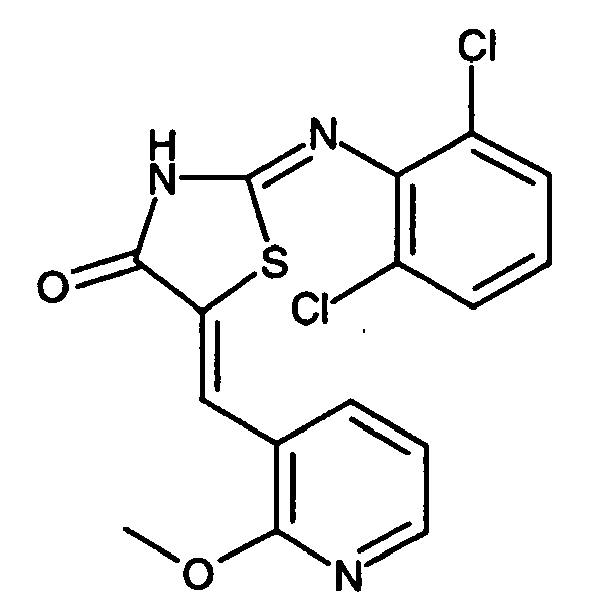
-

-

-
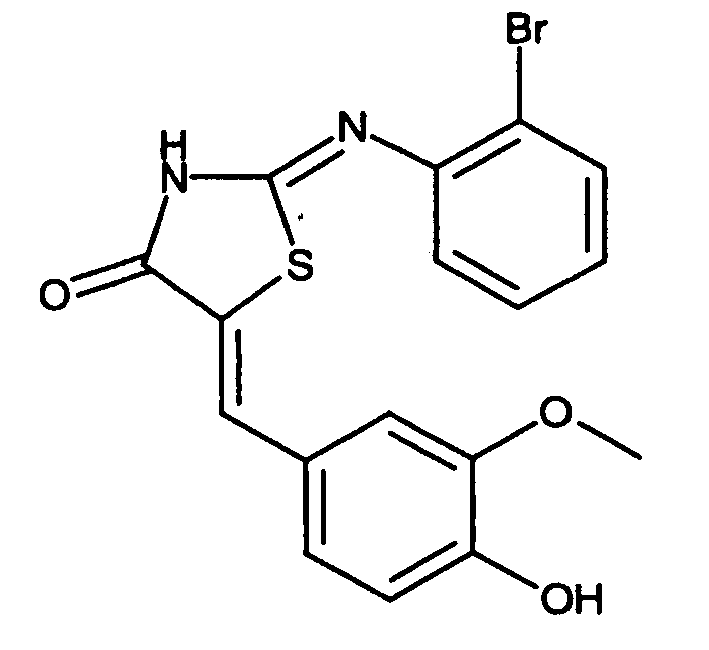
-

-

-

- A mixture of the product of compound of Example 44 (380 mg) and Na2S-9H2O (600 mg) in ethanol was irradiated by a microwave reactor at 120 C° for 5 hours. The mixture was poured onto aq.NH4Cl and the formed orange precipitate was filtrated. Washing with H2O and subsequent desiccation gave compound the title compound.
1H NMR (DMSO-d6) δ 4.68 (sbr, 2H), 5.30 (s, 2H), 6.44-6.55 (m, 3H), 7.04 (m, 2H), 7.29 (s, 1H), 7.33 (t, 1H), 7.61 (d, 1H): LC/MS: m/z 389 (M), 391 (M+2). -

-

-

- A mixture of 2-chloro-5-nitroaniline 1 (5.2g, 30mmol) and benzoyl isothiacyanate 2 (5.4g, 33mmol) in 40ml of acetone was refluxed for 6 hours and then cooled and left to stand at room temperature. The separated crystalline solid was collected by filtration and washed with acetone and dried in vacuo to give benzoyl thiourea 3 (9.4g, 28mmol). 9.0g (26.8mmol) of Benzoyl thiourea 3 was treated with 600ml of 0.1M sodium methoxide solution. The yellow-orange solution formed was left to stand at room temperature overnight, then neutralized with methanolic hydrogen chloride to pH 7. The resulting solution was treated with 100ml of water and the mixture was concentrated to 200ml by vacuum distillation. The separated yellow crystalline solid was collected by filtration. After recrystallization from water-acetone(2:1) 2.77g (11.9mmol)of thiourea 4 was obtained. A mixture of 4 (2.3g, 10mmol) and ClCH2CO2H (1.1g) in AcOH (20mL) was heated at 100 C° for overnight. The mixture was poured onto water and the formed solid was isolated by filtration. It was washed with water to give thiazolidinone 5 (1.65g, 6.1mmol). A mixture of 5 (272 mg, 1.0mmol), aldehyde 6 (157 mg, 1.0mmol) and AcONa (246mg, 3.0mmol) in AcOH (10mL) was heated to reflux at 130 C° for 10days. Generated solid was collected by filtration and washed with AcOH and water, followed by desiccation in vacuo to afford the title product (328mg, 0.80 mmol). 1H NMR(DMSO-d6) δ 12.95(s, 1H), 8.94(m, 1H), 8.45(d, 1H), 8.16(s, 1H), 8.09-8.04(m, 3H), 7.90(s, 1H), 7.90-7.85(m, 2H), 7.57(dd, 1H) : LC/MS: m/z 411 (M+1)
-

- A mixture of 2-(2-chloro-5-nitro-phenylamino)-5-quinolin-6-ylmethylene-thiazol-4-one (100mg, 0.42mmol) and sodium sulfide nonahydrate (350mg, 1-66mmol) in 4ml of EtOH was heated by microwave (SmithSynthesizer-Personal Chemistry) at 130 for 2 hours. The reaction mixture was cooled to room temperature and concentrated by vacuum distillation, then water was added and neutralized with aqueous ammonium chloride. Generated solid was collected by filtration and washed with water, followed by desiccation in vacuo to afford the title product (33mg, 0.086 mmol). 1H NMR(DMSO-d6) δ 12.63(s, 1H) 8.94(m, 1H) 8.47(d, 1H) 4.16(s, 1H) 8.10(d, 1H) 7.87(dd, 1H) 7.84(s, 1H) 7.56(dd, 1H) 7.12(d,1H) 6.40(d, 1H) 6.38(s, 1H) 5.37(s, 2H). : LC/MS: m/z 381 (M+1)
-

- To a stirred, cooled(0 deg.) solution of 2-(5-amino-2-chloro-phenylamino)-5-quinolin-6-ylmethylene-thiazol-4-one (39.7mg, 0.1mmol) in DMF (1ml) was added thioacetimidate hydrochloride 9 (28mg, 0.11mmol). The mixture was warmed to room temperature and stirred for over night. DMF was removed by nitrogen gas blowing and resulting oil was dissolved with methanol. Insoluble solid was collected by filtration and washed with methanol, followed by desiccation in vacuo to afford the title (14mg, 0.031 mmol). 1H NMR(DMSO-d6) δ 12.87(s, 1H) 11.29(s, 1H) 9.55(s, 1H) 8.95(m, 1H) 8.67(s, 1H) 8.44(d, 1H) 8.18(s, 1H) 8.09(s, 1H) 7.89(s, 1H) 7.87(dd, 1H) 7.74(d, 1H) 7.60(dd, 1H) 7.22-7.15(m, 2H) 2.31(s, 3H). LC/MS: m/z 422 (M+1)
- Note: Thioacetimidate hydrochloride 9 was made according to a procedure in Tetrahedron Letters, Vol. 38, No2, pp. 179-182, 1997.

- Compounds of Examples 100 to 109 were made analogous to a process describe in Scheme B and Example 62.
-

-

-

-

-

-

-

- HPLC retention times in the following Examples were taken by the method: Agilent Eclipse ODS 4.6 x 250 mm, 1.5 mL/min, 5-95% Water/ACN in 10 min.
-
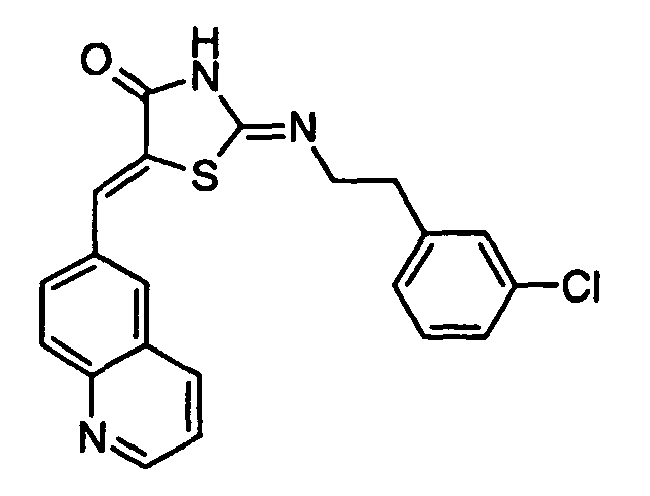
-

-
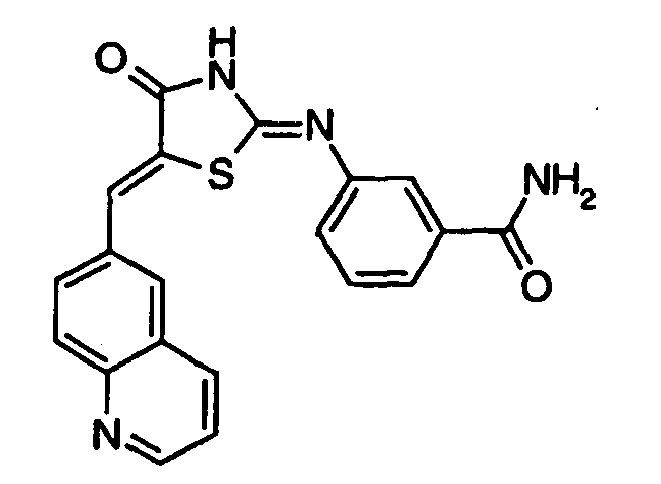
- Compounds in Examples 110 - 115 were made according to Scheme A with modification that a thiourea of formula III was made according to a method described by Walczynski K. et al. in Il Farmaco 55 (2000) 569-574 (Scheme E), or by Rasmussen, F.J. et.al. in Synthesis 1988, 456-459.

-

- Benzoyl chloride (5.44 g, 38 mmol) was added dropwise to a solution of ammonium thiocyanate (2.55g, 42.6mmol) in acetone. Solution was refluxed for 10 minutes at which time a solution of 2,6-difluoro-aniline (5.0g, 38.8 mmol) in acetone was added dropwise and the solution refluxed for approximately 5 minutes. The solution was then poured into 500mL of water and a resulting solid precipitated out. The separated crystalline solid was collected by filtration and then heated in a NaOH solution (3 g in 50 mL H2O). The solution was acidified with conc. HCl, then made slightly basic using conc. NH4OH. Crystalline solid was seen and collected to obtain (2,6-difluoro-phenyl)-thiourea. A mixture of the thiourea (5.7 g, 30.3 mmol), AcONa (2.43 g) and ClCH2CO2H (2.86 g) in AcOH (20mL) was heated to reflux at 130 C° for four hours. The mixture was poured onto water and the formed solid was isolated by filtration. It was washed with water to give the desired thiazolidinone (a compound of formula IV in which R is 2,6-difluorophenyl) (6.75g, 29.6 mmol). A mixture of the thiazolidinone (200 mg, 0.8 mmol), 6-formyl quinoline (137 mg, 0.8 mmol) and AcONa (211mg, 2.4mmol) in AcOH (10mL) was heated to reflux at 130 C° for 2 days. Water was added to the solution and generated a solid that was collected by filtration and washed with water, followed by desiccation in vacuo to afford the title compound as a yellow solid. ES (+/-) MS m/e = 368.0 (M+H). HPLC (rt) - 4.53m
-

- Prepared according to the procedure as in Example 110 above, except using 4-chloro-2-methyl-phenyl)-thiourea (2.00 g, 9.98 mmol; commercially available) as the appropriate thiourea. Title compound was a yellow solid. ES (+/-) MS m/e = 379.8 (M+H). HPLC (rt) - 5.19 m
-

- Prepared according to Example 110, except using commercially available benzoyl isothiocyanate instead of generating in situ. A solid precipitate formed and was collected to afford the title compound as a brownish yellow solid. ES (+/-) MS m/e = 416.0(M+H). HPLC (rt) -5.24m.
-

- Prepared according to Example 110 above, except using commercially available benzoyl isothiocyanate instead of generating it in situ. A solid precipitate formed and was collected to afford the title compound as a yellow solid. ES (+/-) MS m/e = 474.2 (M+H). HPLC (rt) - 5.54m
-

- Prepared according to Example 110, except using commercially available benzoyl isothiocyanate instead of generating it in situ. The thiourea did not crystallize so the solution was removed in vacuo and used in thiazolidinone step. The sodium salts were filtered away during this step while the HOAc solution was still hot. The final step yielded a solid precipitate which was collected to afford the title compound as a white solid. ES (+/-) MS m/e = 410.2 (M+H). HPLC (rt) - 4.12m
-

- Prepared according to Example 110, except using commercially available benzoyl isothiocyanate instead of generating it in situ. The initial aniline, (5-Amino-2,4-dichloro-phenoxy)-acetic acid ethyl ester, was hydrolyzed to an acid by stirring with NaOH. The thiourea did not crystallize so the solution was removed in vacuo and used in thiazolidinone step. The sodium salts were filtered away during this step while the HOAc solution was still hot. The final step yielded a solid precipitate which was collected to afford the title compound as a white solid. ES (+/-) MS m/e = 474.0 (M+H). HPLC (rt) - 4.73m
- As demonstrated by the representative compounds of the present invention in Table 1, the compounds of the present invention have valuable pharmacological properties due to their potent ability to inhibit the hYAK3 kinase enzyme.
- Substrate phosphorylation assays were carried out as follows:
- The source of Ser164 substrate peptide The biotinylated Ser164, S164A peptide(Biotinyl-LGGRDSRAGS*PMARR-OH ), sequence derived from the C-terminus of bovine myelin basic protein (MBP) with Ser162 substituted as Ala162, was purchased from California Peptide Research Inc. (Napa, CA), and its purity was determined by HPLC. Phosphorylation occurs at position 164 (marked S* above). The calculated molecular mass of the peptide was 2166 dalton. Solid sample was dissolved at 10 mM in DMSO, aliquoted, and stored at -20 °C until use.
- hYAK3: Glutathione-S-Transferase (GST)-hYak3-His6 containing amino acid residues 124-526 of human YAK3 (aa 124-526 of SEQ ID NO 2. in
US patent no. 6,323,318 ) was purified from baculovirus expression system in Sf9 cells using Glutathione Sepharose 4B column chromatography followed by Ni-NTA-Agarose column chromatography. Purity greater than 65% typically was achieved. Samples, in 50 mM Tris, 150 mM NaCl, 10%glycerol, 0.1% Triton, 250 mM imidazole, 10 mM β-mercapto ethanol, pH 8.0. were stored at -80 °C until use. - Kinase assay of purified hYAK3: Assays were performed in 96 well (Costar, Catalog No. 3789) or 384 well plates (Costar, Catalog No. 3705). Reaction (in 20, 25, or 40 µl volume) mix contained in final concentrations 25 mM Hepes buffer, pH 7.4; 10 mM MgCl2; 10 mM β-mercapto ethanol; 0.0025% Tween-20; 0.001 mM ATP, 0.1 µCi of [γ-33P]ATP; purified hYAK3 (7-14 ng/assay; 4 nM final); and 4 µM Ser164 peptide. Compounds, titrated in DMSO, were evaluated at concentrations ranging from 50 µM to 0.5 nM. Final assay concentrations of DMSO did not exceed 5%, resulting in less than 15% loss of YAK3 activity relative to controls without DMSO. Reactions were incubated for 2 hours at room temperature and were stopped by a 75 ul addition of 0.19 µg Streptavidin Scintillation Proximity beads (Amersham Pharmacia Biotech, Catalog No. RPNQ 0007) in PBS, pH 7.4, 10 mM EDTA, 0.1% Triton X-100, 1 mM ATP. Under the assay conditions defined above, the Km(apparent) for ATP was determined to be 7.2 +/- 2.4 µM.
Table 1 Example No. compounds pIC50 values 18 ++++ 98 ++++ 58 +++ 13 ++ 64 + -
pIC50 values Symbol 10 - 9 ++++ 8.99 - 8 +++ 7.99 - 7 ++ 6.99 - 6 + pIC50 = -log10(IC50) - The above biological data clearly shows that the compounds of formula I or II are useful for treating or preventing disease states in which hYAK3 proteins are implicated, especially diseases of the erythroid and hematopoietic systems, selected from anemias due to renal insufficiency or to chronic disease, such as autoimmunity, HIV, or cancer, and drug-induced anemias, myelodysplastic syndrome, aplastic anemia, myelosuppression, and cytopenia.
- The compounds of formula I or II are especially useful in treating diseases of the hematopoietic system, particularly anemias. Such anemias include an anemia selected from the group comprising: aplastic anemia and myelodysplastic syndrome. Such anemias also include those wherein the anemia is a consequence of a primary disease selected from the group consisting of: cancer, leukemia and lymphoma. Such anemias also include those wherein the anemia is a consequence of a primary disease selected from the group consisting of: renal disease, failure or damage. Such anemias include those wherein the anemia is a consequence of chemotherapy or radiation therapy, in particular wherein the chemotherapy is chemotherapy for cancer or AZT treatment for HIV infection. Such anemias include those wherein the anemia is a consequence of a bone marrow transplant or a stem cell transplant. Such anemias also include anemia of newborn infants, Such anemias also include those which are a consequence of viral, fungal, microbial or parasitic infection.
- The compounds of formula I or II are also useful for enhancing normal red blood cell numbers. Such enhancement is desirable for a variety of purposes, especially medical purposes such as preparation of a patient for transfusion and preparation of a patient for surgery.
Claims (14)
- Use of a therapeutically effective amount of a compound of the formula I, or a salt or solvate thereof in the manufacture of a medicament for the treatment or prevention of anemia, aplastic anemia, myelodysplastic syndrome, myelosuppression or cytopenia in a mammal.
 R is C3-6 cycloalkyl or naphtyl; orR is
and R2 and R3 are independently hydrogen, halogen, -C1-6 alkyl, -SC1-6alkyl, -OC1-6alkyl, -NO2, -S(=O)-C1-6alkyl, -OH, -CF3, -CN, -CO2H, -CO2C1-6alkyl, -CONH2, -NH2, -OCH2(C=O)OH, -OCH2CH2OCH3, -SO2NH2, -CH2SO2CH3, -NH(C=NH)CH3; or R2 and R3 can independently be a radical of the formula R is
R is R is -(CH2)n-NRkRl in which n is 2 or 3, and Rk and Rl are independently -C1-6alkyl; or -NRkRl together form
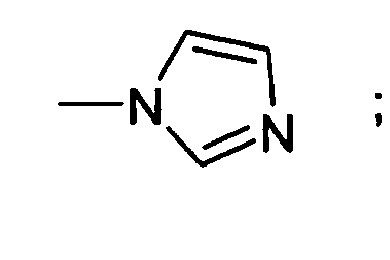 R is
R is
 Q is
Q is
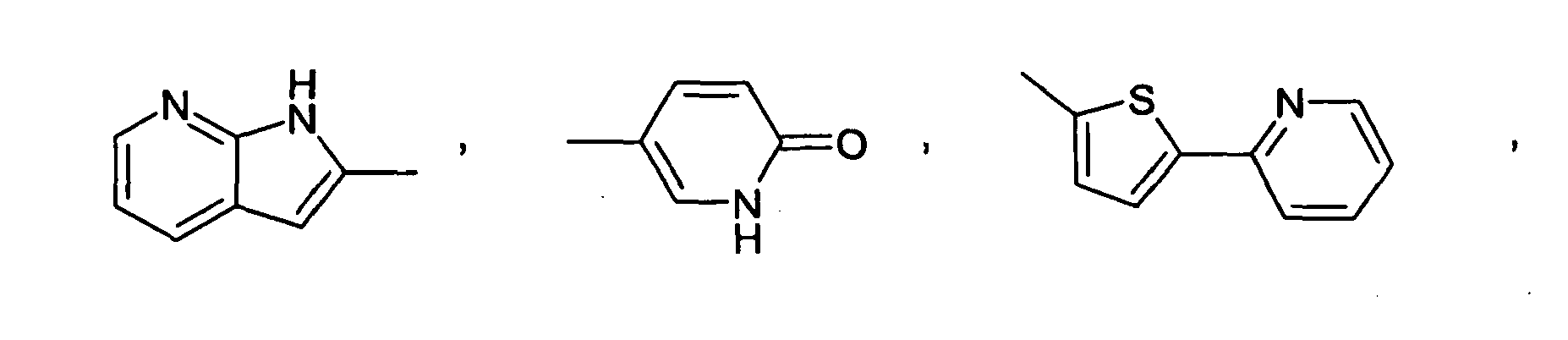
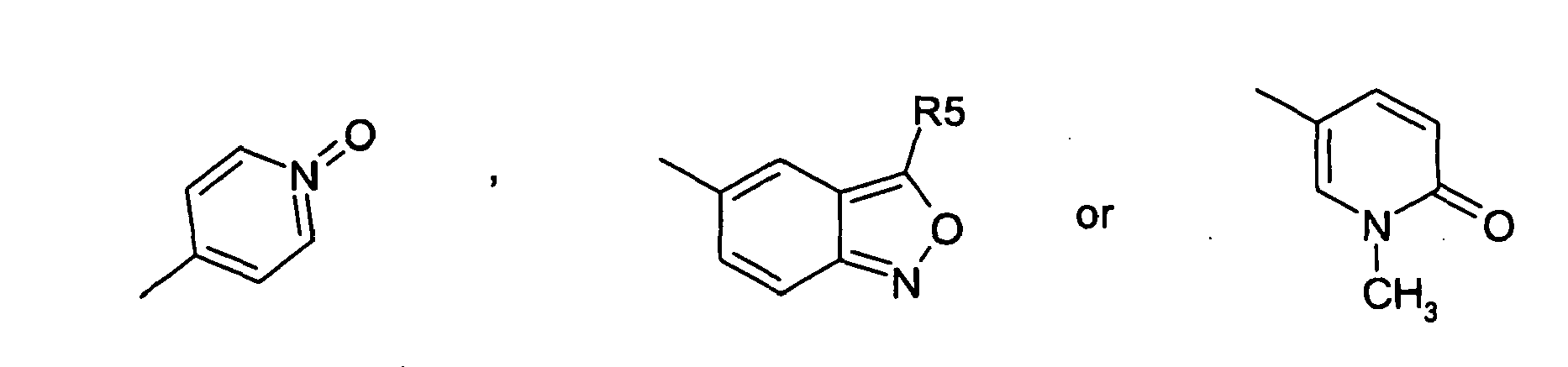 Q is
Q is


 Q is
Q is
- Use of a therapeutically effective amount of a compound of claim 1 and one or more of pharmaceutically acceptable carriers, diluents and excipients in the manufacture of a medicament for treating or preventing anemia, aplastic anemia, myelodysplastic syndrome, myelosuppression, or cytopenia in a mammal, caused by the hYAK3 imbalance or inappropriate activity.
- Use of a therapeutically effective amount of a compound of claim 1 and one or more of pharmaceutically acceptable carriers, diluents and excipients in the manufacture of a medicament for treating or preventing diseases selected from the group consisting of: anemia, aplastic anemia, myelodysplastic syndrome, myelosuppression, and cytopenia;
- Use according to any of claims 1, 2 or 3 in which a compound of formula I is selected from the group consisting of:2-(2-Chloro-5-fluoro-phenylimino)-5-(2,3-dihydro-benzo[1-6]dioxin-6-ylmethylene)-thiazolidin-4-one;2-(2-Chloro-phenylimino)-5-(2-oxo-2H-chromen-6-ylmethylene)-thiazolidin-4-one;2-(2-Chloro-phenylimino)-5-(2-oxo-2H-chromen-6-ylmethylene)-thiazolidin-4-one;2-(2-Chloro-phenylimino)-5-(2-oxo-2H-chromen-6-ylmethylene)-thiazolidin-4-one;5-(2,3-Dihydro-benzofuran-5-ylmethylene)-2-(2,4,6-trimethyl-phenylimino)-thiazolidin-4-one;2-Cyclohexylimino-5-(2,3-dihydro-benzo[1-6]dioxin-6-ylmethylene)-thiazolidin-4-one;2-Cyclohexylimino-5-(2,3-dihydro-benzofuran-5-ylmethylene)-thiazolidin-4-one;5-Benzo[1,3]dioxol-5-ylmethylene-2-(chloro-phenylimino)-thiazolidin-4-one;5-(2,3-Dihydro-benzofuran-5-ylmethylene)-2-o-tolylimino-thiazolidin-4-one;5-(2,3-Dihydro-benzo[1-6]dioxin-6-ylmethylene)-2-o-tolylimino-thiazolidin-4-one;5-[2-(2-Chloro-phenylimino)-4-oxo-thiazolidin-5-ylidenemethyl]-3H-benzooxazol-2-one;2-(2-Trifluoromethyl-phenylimino)-5-(2,3-dihydro-benzofuran-5-ylmethylene)-thiazolidin-4-one;2-(2-Bromo-phenylimino)-5-(2,3-dihydro-benzofuran-5-ylmethylene)-thiazolidin-4-one;2-(2,6-Dichloro-phenylimino)-5-(2,3-dihydro-benzofuran-5-ylmethylene)-thiazolidin-4-one;5-(2,3-Dihydro-benzofuran-5-ylmethylene)-2-(2-methylsulfanyl-phenylimino)-thiazolidin-4-one;5-(2,3-Dihydro-benzofuran-5-ylmethylene)-2-(2-fluoro-phenylimino)-thiazolidin-4-one;2-(2-Methylsulfanyl-phenylimino)-5-(quinolin-6-ylmethylene)-thiazolidin-4-one;2-(2-Bromo-phenylimino)-5-(quinolin-6-ylmethylene)-thiazolidin-4-one;2-(2,3-Dimethyl-phenylimino)-5-(quinolin-6-ylmethylene)-thiazolidin-4-one;2-(Naphthalen-1-ylimino)-5-(quinolin-6-ylmethylene)-thiazolidin-4-one;5-(Quinolin-6-ylmethylene)-2-(2-trifluoromethyl-phenylimino)-thiazolidin-4-one;2-(2-Chloro-5-trifluoromethyl-phenylimino)-5-(quinolin-6-ylmethylene)-thiazolidin-4-one;2-(2,6-Dichloro-phenylimino)-5-8quinolin-6-ylmethylene)-thiazolidin-4-one;2-(2-Bromo-phenylimino)-5-(2,3-dihydro-benzo[1-6]dioxin-6-ylmethylene)-thiazolidin-4-one;5-(Benzo[1,3]dioxol-5-ylmethylene)-2-(2-bromo-phenylimino)-thiazolidin-4-one;2-(2-Chloro-phenylimino)-5-(quinoxalin-6-ylmethylene)-thiazolidin-4-one;2-(2,6-Dichloro-phenylimino)-5-(2,3-dihydro-benzo[1-6]dioxin-6-ylmethylene)-thiazolidin-4-one;5-(2,3-Dihydro-benzo[1-6]dioxin-6-ylmethylene)-2-(2-nitro-phenylimino) -thiazolidin-4-one;5-(2,3-Dihydro-benzofuran-5-ylmethylene)-2-(2-nitro-phenylimino)-thiazolidin-4-one;2-(2-Chloro-4-fluoro-5-methyl-phenylimino)-5-(2,3-dihydro-benzofuran-5-ylmethylene)-thiazolidin-4-one;3-Chloro-4-[5-(2,3-dihydro-benzofuran-5-ylmethylene)-4-oxo-thiazolidin-2-ylideneamino]-benzoic acid methyl ester;2-(2-Chloro-5-fluoro-phenylimino)-5-(2,3-dihydro-benzofuran-5-ylmethylene)-thiazolidin-4-one;2-(2-Chloro-4-trifluoromethyl-phenylimino)-5-(2,3-dihydro-benzofuran-5-ylmethylene)-thiazolidin-4-one;2-(4-Bromo-2-chloro-phenylimino)-5-(2,3-dihydro-benzofuran-5-ylmethylene)-thiazolidin-4-one;5-(2,3-Dihydro-benzofuran-5-ylmethylene)-2-(2-methanesulfinyl-phenylimino)-thiazolidin-4-one;3-Chloro-4-[5-(2,3-dihydro-benzofuran-5-ylmethylene)-4-oxo-thiazolidin-2-ylideneamino]-benzoic acid;5-[2-(2-Chloro-phenylimino)-4-oxo-thiazolidin-5-ylidenemethyl]-1H-pyridin-2-one;2-(2-Methylsulfanyl-phenylimino)-5-(quinolin-6-ylmethylene)-thiazolidin-4-one;2-(2-Chloro-4-fluoro-5-methyl-phenylimino)-5-(quinolin-6-ylmethylene)-thiazolidin-4-one;2-(2-Chloro-5-fluoro-phenylimino)-5-(quinolin-6-ylmethylene)-thiazolidin-4-one;2-(2-Chloro-5-fluoro-phenylimino)-5-(2,3-dihydro-benzo[1-6]dioxin-6-ylmethylene)-thiazolidin-4-one;2-(2-Chloro-4-trifluoromethyl-phenylimino)-5-quinolin-6-ylmethylene-thiazolidin-4-one;5-(Benzothiazol-6-ylmethylene)-2-(2-chloro-phenylimino)-thiazolidin-4-one;5-(Benzo[1,2,5]thiadiazol-5-ylmethylene)-2-(2-bromo-phenylimino)-thiazolidin-4-one;5-(Benzo[1,2,5]thiadiazol-5-ylmethylene)-2-(2-chloro-5-fluoro-phenylimino)-thiazolidin-4-one;5-(Benzothiazol-6-ylmethylene)-2-(2,6-dichloro-phenylimino)-thiazolidin-4-one;2-(2-Chloro-phenylimino)-5-(4-hydroxy-3-nitro-benzylidene)-thiazolidin-4-one;2-(2-Chloro-phenylimino)-5-(4-hydroxy-3-methoxy-benzylidene)-thiazolidin-4-one;2-(2-Chloro-phenylimino)-5-(4-hydroxy-2-methoxy-benzylidene)-thiazolidin-4-one;2-(2-Chloro-phenylimino)-5-(4-hydroxy-benzylidene)-thiazolidin-4-one;2-(2-Chloro-phenylimino)-5-(4-methoxy-benzylidene)-thiazolidin-4-one;5-(3-Chloro-4-hydroxy-benzylidene)-2-(2-chloro-phenylimino)-thiazolidin-4-one;2-(2-Chloro-phenylimino)-5-(3-fluoro-4-methoxy-benzylidene)-thiazolidin-4-one;2-(2,6-Dichloro-phenylimino)-5-(3-fluoro-4-hydroxy-benzylidene)-thiazolidin-4-one;2-(2-Chloro-phenylimino)-5-(3-fluoro-4-hydroxy-benzylidene)-thiazolidin-4-one;2-(2-Chloro-5-fluoro-phenylimino)-5-(3-fluoro-4-hydroxy-benzylidene)-thiazolidin-4-one;5-(3-Fluoro-4-hydroxy-benzylidene)-2-o-tolylimino-thiazolidin-4-one;2-(2-Chloro-phenylimino)-5-quinolin-6-ylmethylene-thiazolidin-4-one;5-Quinolin-6-ylmethylene-2-(2,4,6-trimethyl-phenylimino)-thiazolidin-4-one;5-Quinolin-6-ylmethylene-2-o-tolylimino-thiazolidin-4-one;2-(2-Methoxy-phenylimino)-5-quinolin-6-ylmethylene-thiazolidin-4-one;5-(2,3-Dihydro-benzofuran-5-ylmethylene)-2-(2-dimethylamino-ethylamino)-thiazol-4-one;Benzoic acid N'-(4-oxo-5-quinolin-6-ylmethylene-4,5-dihydro-thiazol-2-yl)-hydrazide;2-(2-Dimethylamino-ethylimino)-5-quinolin-6-ylmethylene-thiazolidin-4-one;5-(2,3-Dihydro-benzofuran-5-ylmethylene)-2-(piperidin-1-ylamino)-thiazol-4-one;2-Benzylamino-5-(2,3-dihydro-benzofuran-5-ylmethylene)-thiazol-4-one;2-(4-tert-Butyl-thiazol-2-ylamino)-5-(2,3-dihydro-benzofuran-5-ylmethylene)-thiazol-4-one;4-{[5-(2,3-Dihydro-benzofuran-5-ylmethylene)-4-oxo-4,5-dihydro-thiazol-2-ylamino]-methyl}-benzenesulfonamide;5-(2,3-Dihydro-benzofuran-5-ylmethylene)-2-(3-dimethylamino-propylamino)-thiazol-4-one;5-(2,3-Dihydro-benzofuran-5-ylmethylene)-2-(3-imidazol-1-yl-propylamino)-thiazol-4-one;Phenyl-carbamic acid N'-[5-(2,3-dihydro-benzofuran-5-ylmethylene)-4-oxo-4,5-dihydrothiazol-2-yl]-hydrazide;Benzoic acid N'-[5-(2,3-dihydro-benzofuran-5-ylmethylene)-4-oxo-4,5-dihydro-thiazol-2-yl]-hydrazide;5-Benzo[1,2,5]thiadiazol-5-ylmethylene-2-(2,3,4-trifluoro-phenylamino)-thiazol-4-one;5-Benzo[1,2,5]oxadiazol-5-ylmethylene-2-(2-nitro-phenylamino)-thiazol-4-one ;2-(2,6-Dichloro-phenylamino)-5-(4-[1,2,4]triazol-1-yl-benzylidene)-thiazol-4-one;2-(2,6-Dichloro-phenylamino)-5-(1H-pyrrolo[2,3-b]pyridin-2-ylmethylene)-thiazol-4-one;5-Benzo[1,2,5]thiadiazol-5-ylmethylene-2-(2,6-dichloro-phenylamino)-thiazol-4-one;5-[2-(2-Methoxy-6-methyl-phenylamino)-4-oxo-4H-thiazol-5-ylidenemethyl]-1H-pyridin-2-one;5-Benzo[1,2,5]thiadiazol-5-ylmethylene-2-(2-nitro-phenylamino)-thiazol-4-one;2-(2-Bromo-6-fluoro-phenylamino)-5-quinolin-6-ylmethylene-thiazol-4-one;2-(2-Methoxy-6-methyl-phenylamino)-5-quinolin-6-ylmethylene-thiazol-4-one;5-Quinolin-6-ylmethylene-2-(2,3,4-trifluoro-phenylamino)-thiazol-4-one;2-(2,6-Dichloro-phenylamino)-5-(2-oxo-2H-chromen-6-ylmethylene)-thiazol-4-one;2-(2-Bromo-phenylamino)-5-(5-pyridin-2-yl-thiophen-2-ylmethylene)-thiazol-4-one;2-(2-Bromo-phenylamino)-5-(1-oxy-pyridin-4-ylmethylene)-thiazol-4-one;2-(2-Bromo-phenylamino)-5-(3-p-tolyl-benzo[c]isoxazol-5-ylmethylene)-thiazol-4-one;2-(2-Bromo-phenylamino)-5-(3,4-dihydro-2H-benzo[b][1-6]dioxepin-7-ylmethylene)-thiazol-4-one;5-Benzo[1,2,5]oxadiazol-5-ylmethylene-2-(2-bromo-phenylamino)-thiazol-4-one;2-(2,6-Dichloro-phenytamino)-5-(2-methoxy-pyridin-3-ylmethylene)-thiazol-4-one;2-(2-Chloro-phenylamino)-5-(6-methoxy-pyridin-3-ylmethylene)-thiazol-4-one;2-(2-Chloro-5-trifluoromethyl-phenylamino)-5-quinolin-6-ylmethylene-thiazol-4-one;2-(2-Bromo-phenylamino)-5-(4-hydroxy-3-methoxy-benzylidene)-thiazol-4-one;5-(2,3-Dihydro-benzofuran-5-ylmethylene)-2-(2-methoxy-phenylamino)-thiazol-4-one;2-(2-Nitro-phenylamino)-5-quinolin-6-ylmethylene-thiazol-4-one;2-(2-Bromo-phenylamino)-5-(3,4-diamino-benzylidene)-thiazol-4-one;5-[2-(2-Chloro-phenylimino)-4-oxo-thiazolidin-5-ylidenemethyl]-1-methyl-1H-pyridin-2-one;2-(2-Chloro-5-nitro-phenylamino)-5-quinolin-6-ylmethylene-thiazol-4-one;2-(5-Amino-2-chloro-phenylamino)-5-quinolin-6-ylmethylene-thiazol-4-one;N-[4-Chloro-3-(4-oxo-5-quinolin-6-ylmethylene-4,5-dihydro-thiazol-2-ylamino)-phenyl]-acetamidine hydrochloride;4-{[4-oxo-5-(6-quinolinylmethylidene)-4,5-dihydro-1,3-thiazol-2-yl]amino}benzamide;3-{[4-oxo-5-(6-quinolinylmethylidene)-4,5-dihydro-1,3-thiazol-2-yl]amino}benzenesulfonamide;4-{[4-oxo-5-(6-quinolinylmethylidene)-4,5-dihydro-1,3-thiazol-2-yl]amino}-N-2-pyridinylbenzenesulfonamide;2-({4-[(4-methyl-1-piperazinyl)methyl]phenyl}amino)-5-(6-quinolinylmethylidene)-1,3-thiazol-4(5H)-one;2-({4-[(methylsulfonyl)methyl]phenyl}amino)-5-(6-quinolinylmethylidene)-1,3-thiazol-4(5H)-one;2-({3-[(methylsulfonyl)methyl]phenyl}amino)-5-(6-quinolinylmethylidene)-1,3-thiazol-4(5H)-one;2-{[4-(4-methyl-1-piperazinyl)phenyl]amino}-5-(6-quinolinylmethylidene)-1,3-thiazol-4(5H)-one;2-{[2-(3-chlorophenyl)ethyl]amino}-5-(6-quinolinylmethylidene)-1,3-thiazol-4(5H)-one;4-(2-{[4-oxo-5-(6-quinolinylmethylidene)-4,5-dihydro-1,3-thiazol-2-yl]amino}ethyl)benzenesulfonamide;3-{[4-oxo-5-(6-quinolinylmethylidene)-4,5-dihydro-1,3-thiazol-2-yl]amino}benzamide;2-[(2,6-Difluoro-phenylamino)-methylene]-5-quinolin-6-ylmethylene-thiazolidin-4-one;2-[(2,6-Difluoro-phenylamino)-methylene]-5-quinolin-6-ylmethylene-thiazolidin-4-one;[2,4-Dichloro-5-(4-oxo-5-quinolin-6-ylmethylene-thiazolidin-2-ylideneamino)-phenoxy]-acetic acid;2-[2,4-Dichloro-5-(2-methoxy-ethoxy)-phenylimino]-5-quinolin-6-ylmethylene-thiazolidin-4-one;4-Chloro-3-(4-oxo-5-quinolin-6-ylmethylene-thiazolidin-2-ylideneamino)-benzoic acid; and[2,4-Dichloro-5-(4-oxo-5-quinolin-6-ylmethylene-thiazolidin-2-ylideneamino)-phenoxy]-acetic acid.
- A compound of the formula II, or a salt or solvate thereof,
 R is C3-6 cycloalkyl or naphtyl; orR is
and R2 and R3 are independently hydrogen, halogen, -C1-6 alkyl, -SC1-6alkyl, -OC1-6alkyl, -NO2, -S(=O)-C1-6alkyl, -OH, -CF3, -CN, -CO2H, -CO2C1-6alkyl, -CONH2, -NH2, -OCH2(C=O)OH, -OCH2CH2OCH3, -SO2NH2, -CH2SO2CH3, -NH(C=NH)CH3; or R2 and R3 can independently be a radical of the formula R is
R is R is -(CH2)n-NRkRl in which n is 2 or 3, and Rk and Rl are independently -C1-6alkyl; or -NRkRl together form
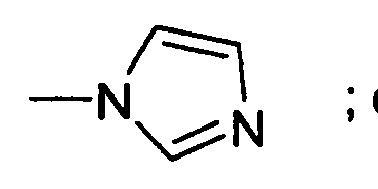 R is
R is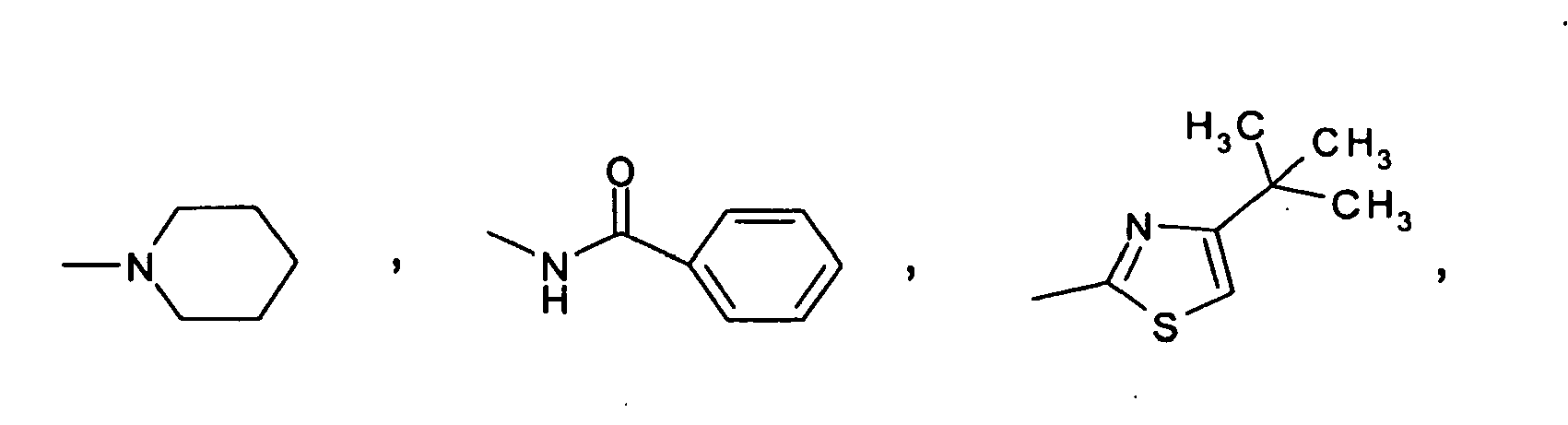
 Q is
Q is

 Q is
Q is


- A compound of formula II of claim 5 in whichR is C3-6 cycloalkyl or naphtyl; orR is

and R2 and R3 are independently hydrogen, halogen, -C1-6 alkyl, -SC1-6alkyl, -OC1-6alkyl, -NO2, -S(=O)-C1-6alkyl, -OH, -CF3, -CN, -CO2H, -CO2C1-6alkyl, -CONH2, -NH2, -OCH2(C=O)OH, -OCH2CH2OCH3, -SO2NH2, -CH2SO2CH3, -NH(C=NH)CH3; or R2 and R3 can independently be a radical of the formula R is
R is R is -(CH2)n-NRkRl in which n is 2 or 3, and Rk and Rl are independently -C1-6alkyl; or -NRkRl together form
 R is
R is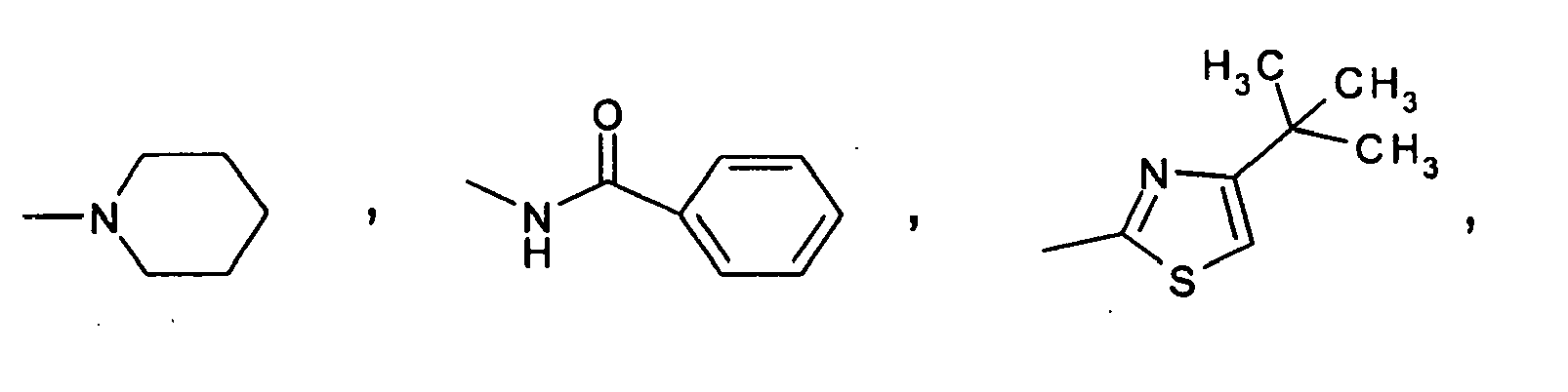
 Q is
Q is
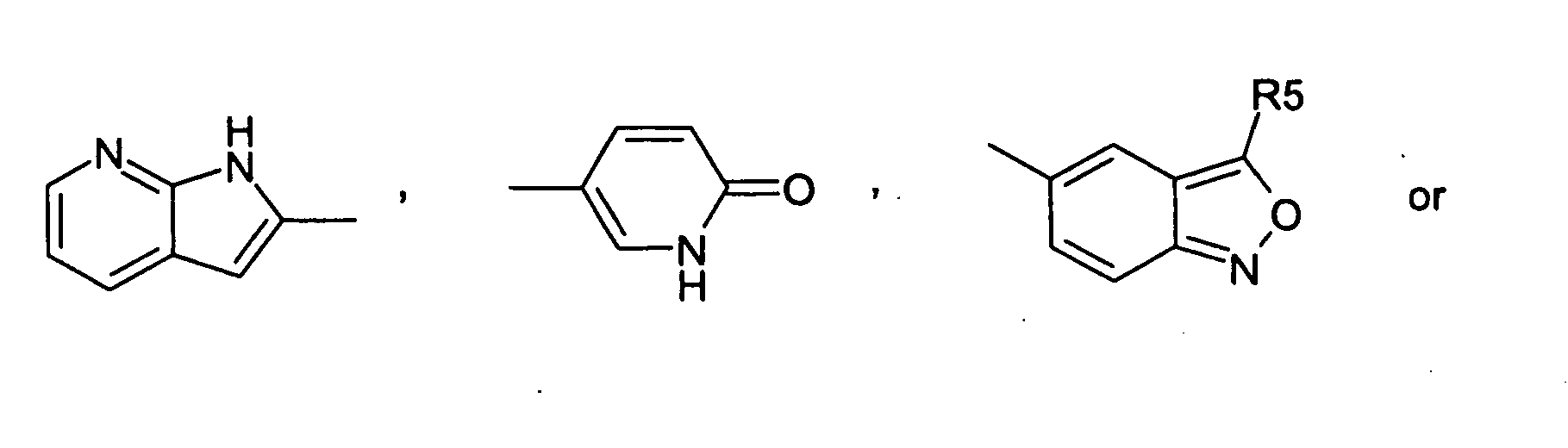
 Q is
Q is


- A compound of formula II of claim 6 in which R is

-SC1-6alkyl, -OC1-6alkyl. -NO2, -S(=O)-C1-6alkyl, -OH, -CF3, -CN, -CO2H, -CO2C1-6alkyl, -NH2, or -NH(C=NH)CH3;
andQ is Q is
Q is

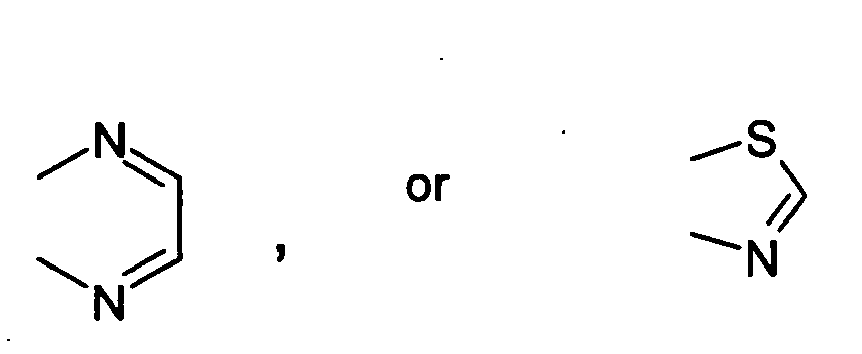
- A compound of formula II of claim 7 in which R is

and R2 and R3 are independently hydrogen, halogen, -C1-6 alkyl, -SC1-6alkyl, -OC1-6alkyl, -NO2, -S(=O)-C1-6alkyl, -OH, -CF3, -CN, -CO2H, -CO2C1-6alkyl, -NH2, or -NH(C=NH)CH3;
andQ is Q is
Q is

- A pharmaceutical composition including a therapeutically effective amount of a compound of claim 5, 6, 7 or 8, and one or more of pharmaceutically acceptable carriers, diluents and excipients.
- A compound selected from the group consisting of:2-(2-Chloro-5-fluoro-phenylimino)-5-(2,3-dihydro-benzo[1-6]dioxin-6-ylmethylene)-thiazolidin-4-one;2-(2-Chloro-phenylimino)-5-(2-oxo-2H-chromen-6-ylmethylene)-thiazolidin-4-one;2-(2-Chloro-phenylimino)-5-(2-oxo-2H-chromen-6-ylmethylene)-thiazolidin-4-one;2-(2-Chloro-phenylimino)-5-(2-oxo-2H-chromen-6-ylmethylene)-thiazolidin-4-one;5-(2,3-Dihydro-benzofuran-5-ylmethylene)-2-(2,4,6-trimethyl-phenylimino)-thiazolidin-4-one;2-Cyclohexylimino-5-(2,3-dihydro-benzo[1-6]dioxin-6-ylmethylene)-thiazolidin-4-one;2-Cyclohexylimino-5-(2,3-dihydro-benzofuran-5-ylmethylene)-thiazolidin-4-one;5-(2,3-Dihydro-benzofuran-5-ylmethylene)-2-o-tolylimino-thiazolidin-4-one;5-(2,3-Dihydro-benzo[1-6]dioxin-6-ylmethylene)-2-o-tolylimino-thiazolidin-4-one;5-[2-(2-Chloro-phenylimino)-4-oxo-thiazolidin-5-ylidenemethyl]-3H-benzooxazol-2-one;2-(2-Trifluoromethyl-phenylimino)-5-(2,3-dihydro-benzofuran-5-ylmethylene)-thiazolidin-4-one;2-(2-Bromo-phenylimino)-5-(2,3-dihydro-benzofuran-5-ylmethylene)-thiazolidin-4-one;2-(2,6-Dichloro-phenylimino)-5-(2,3-dihydro-benzofuran-5-ylmethylene)-thiazolidin-4-one;5-(2,3-Dihydro-benzofuran-5-ylmethylene)-2-(2-methylsulfanyl-phenylimino)-thiazolidin-4-one;5-(2,3-Dihydro-benzofuran-5-ylmethylene)-2-(2-fluoro-phenylimino)-thiazolidin-4-one;2-(2-Methylsulfanyl-phenylimino)-5-(quinolin-6-ylmethylene)-thiazolidin-4-one;2-(2-Bromo-phenylimino)-5-(quinolin-6-ylmethylene)-thiazolidin-4-one;2-(2,3-Dimethyl-phenylimino)-5-(quinolin-6-ylmethylene)-thiazolidin-4-one;2-(Naphthalen-1-ylimino)-5-(quinolin-6-ylmethylene)-thiazolidin-4-one;5-(Quinolin-6-ylmethylene)-2-(2-trifluoromethyl-phenylimino)-thiazolidin-4-one;2-(2-Chloro-5-trifluoromethyl-phenylimino)-5-(quinolin-6-ylmethylene)-thiazolidin-4-one;2-(2,6-Dichloro-phenylimino)-5-8quinolin-6-ylmethylene)-thiazolidin-4-one;2-(2-Bromo-phenylimino)-5-(2,3-dihydro-benzo[1-6]dioxin-6-ylmethylene) -thiazolidin-4-one;2-(2-Chloro-phenylimino)-5-(quinoxalin-6-ylmethylene)-thiazolidin-4-one;2-(2,6-Dichloro-phenylimino)-5-(2,3-dihydro-benzo[1-6]dioxin-6-ylmethylene)-thiazolidin-4-one;5-(2,3-Dihydro-benzo[1-6]dioxin-6-ylmethylene)-2-(2-nitro-phenylimino) -thiazolidin-4-one;5-(2,3-Dihydro-benzofuran-5-ylmethylene)-2-(2-nitro-phenylimino)-thiazolidin-4-one;2-(2-Chloro-4-fluoro-5-methyl-phenylimino)-5-(2,3-dihydro-benzofuran-5-ylmethylene)-thiazolidin-4-one;3-Chloro-4-[5-(2,3-dihydro-benzofuran-5-ylmethylene)-4-oxo-thiazolidin-2-ylideneamino]-benzoic acid methyl ester;2-(2-Chloro-5-fluoro-phenylimino)-5-(2,3-dihydro-benzofuran-5-ylmethylene)-thiazolidin-4-one;2-(2-Chloro-4-trifluoromethyl-phenylimino)-5-(2,3-dihydro-benzofuran-5-ylmethylene)-thiazolidin-4-one;2-(4-Bromo-2-chloro-phenylimino)-5-(2,3-dihydro-benzofuran-5-ylmethylene)-thiazolidin-4-one;5-(2,3-Dihydro-benzofuran-5-ylmethylene)-2-(2-methanesulfinyl-phenylimino)-thiazolidin-4-one;3-Chloro-4-[5-(2,3-dihydro-benzofuran-5-ylmethylene)-4-oxo-thiazolidin-2-ylideneamino]-benzoic acid;5-[2-(2-Chloro-phenylimino)-4-oxo-thiazolidin-5-ylidenemethyl]-1H-pyridin-2-one;2-(2-Methylsulfanyl-phenylimino)-5-(quinolin-6-ylmethylene)-thiazolidin-4-one;2-(2-Chloro-4-fluoro-5-methyl-phenylimino)-5-(quinolin-6-ylmethylene)-thiazolidin-4-one;2-(2-Chloro-5-fluoro-phenylimino)-5-(quinolin-6-ylmethylene)-thiazolidin-4-one;2-(2-Chloro-5-fluoro-phenylimino)-5-(2,3-dihydro-benzo[1-6]dioxin-6-ylmethylene)-thiazolidin-4-one;2-(2-Chloro-4-trifluoromethyl-phenylimino)-5-quinolin-6-ylmethylene-thiazolidin-4-one;5-(Benzothiazol-6-ylmethylene)-2-(2-chloro-phenylimino)-thiazolidin-4-one;5-(Benzo[1,2,5]thiadiazol-5-ylmethylene)-2-(2-bromo-phenylimino)-thiazolidin-4-one;5-(Benzo[1,2,5]thiadiazol-5-ylmethylene)-2-(2-chloro-5-fluoro-phenylimino)-thiazolidin-4-one;5-(Benzothiazol-6-ylmethylene)-2-(2,6-dichloro-phenylimino)-thiazolidin-4-one;2-(2-Chloro-phenylimino)-5-(4-hydroxy-3-nitro-benzylidene)-thiazolidin-4-one;2-(2-Chloro-phenylimino)-5-(4-hydroxy-3-methoxy-benzylidene)-thiazolidin-4-one;2-(2-Chloro-phenylimino)-5-(4-hydroxy-benzylidene)-thiazolidin-4-one;2-(2-Chloro-phenylimino)-5-(4-methoxy-benzylidene)-thiazolidin-4-one;5-(3-Chloro-4-hydroxy-benzylidene)-2-(2-chloro-phenylimino)-thiazolidin-4-one;2-(2-Chloro-phenylimino)-5-(3-fluoro-4-methoxy-benzylidene)-thiazolidin-4-one;2-(2,6-Dichloro-phenylimino)-5-(3-fluoro-4-hydroxy-benzylidene)-thiazolidin-4-one;2-(2-Chloro-phenylimino)-5-(3-fluoro-4-hydroxy-benzylidene)-thiazolidin-4-one;2-(2-Chloro-5-fluoro-phenylimino)-5-(3-fluoro-4-hydroxy-benzylidene)-thiazolidin-4-one;5-(3-Fluoro-4-hydroxy-benzylidene)-2-o-tolylimino-thiazolidin-4-one;2-(2-Chloro-phenylimino)-5-quinolin-6-ylmethylene-thiazolidin-4-one;5-Quinolin-6-ylmethylene-2-(2,4,6-trimethyl-phenylimino)-thiazolidin-4-one;5-Quinolin-6-ylmethylene-2-o-tolylimino-thiazolidin-4-one;2-(2-Methoxy-phenylimino)-5-quinolin-6-ylmethylene-thiazolidin-4-one;5-(2,3-Dihydro-benzofuran-5-ylmethylene)-2-(2-dimethylamino-ethylamino)-thiazol-4-one;Benzoic acid N'-(4-oxo-5-quinolin-6-ylmethylene-4,5-dihydro-thiazol-2-yl)-hydrazide;2-(2-Dimethylamino-ethylimino)-5-quinolin-6-ylmethylene-thiazolidin-4-one;5-(2,3-Dihydro-benzofuran-5-ylmethylene)-2-(piperidin-1-ylamino)-thiazol-4-one;2-Benzylamino-5-(2,3-dihydro-benzofuran-5-ylmethylene)-thiazol-4-one;2-(4-tert-Butyl-thiazol-2-ylamino)-5-(2,3-dihydro-benzofuran-5-ylmethylene)-thiazol-4-one;4-{[5-(2,3-Dihydro-benzofuran-5-ylmethylene)-4-oxo-4,5-dihydro-thiazol-2-ylamino]-methyl}-benzenesulfonamide;5-(2,3-Dihydro-benzofuran-5-ylmethylene)-2-(3-dimethylamino-propylamino)-thiazol-4-one;5-(2,3-Dihydro-benzofuran-5-ylmethylene)-2-(3-imidazol-1-yl-propylamino)-thiazol-4-one;Phenyl-carbamic acid N'-[5-(2,3-dihydro-benzofuran-5-ylmethylene)-4-oxo-4,5-dihydrothiazol-2-yl]-hydrazide;Benzoic acid N'-[5-(2,3-dihydro-benzofuran-5-ylmethylene)-4-oxo-4,5-dihydro-thiazol-2-yl]-hydrazide;5-Benzo[1,2,5]thiadiazol-5-ylmethylene-2-(2,3,4-tifluoro-phenylamino)-thiazol-4-one;5-Benzo[1,2,5]oxadiazol-5-ylmethylene-2-(2-nitro-phenylamino)-thiazol-4-one;2-(2,6-Dichloro-phenylamino)-5-(4-[1,2,4]triazol-1-yl-benzylidene)-thiazol-4-one;2-(2,6-Dichloro-phenylamino)-5-(1H-pyrrolo[2,3-b]pyridin-2-ylmethylene)-thiazol-4-one;5-Benzo[1,2,5]thiadiazol-5-ylmethylene-2-(2,6-dichloro-phenylamino)-thiazol-4-one;5-[2-(2-Methoxy-6-methyl-phenylamino)-4-oxo-4H-thiazol-5-ylidenemethyl]-1H-pyridin-2-one;5-Benzo[1,2,5]thiadiazol-5-ylmethylene-2-(2-nitro-phenylamino)-thiazol-4-one;2-(2-Bromo-6-fluoro-phenylamino)-5-quinolin-6-ylmethylene-thiazol-4-one;2-(2-Methoxy-6-methyl-phenylamino)-5-quinolin-6-ylmethylene-thiazol-4-one;5-Quinolin-6-ylmethylene-2-(2,3,4-trifluoro-phenylamino)-thiazol-4-one;2-(2,6-Dichloro-phenylamino)-5-(2-oxo-2H-chromen-6-ylmethylene)-thiazol-4-one;2-(2-Bromo-phenylamino)-5-(5-pyridin-2-yl-thiophen-2-ylmethylene)-thiazol-4-one;2-(2-Bromo-phenylamino)-5-(1-oxy-pyridin-4-ylmethylene)-thiazol-4-one;2-(2-Bromo-phenylamino)-5-(3-p-tolyl-benzo[c]isoxazol-5-ylmethylene)-thiazol-4-one;2-(2-Bromo-phenylamino)-5-(3,4-dihydro-2H-benzo[b][1-6]dioxepin-7-ylmethylene)-thiazol-4-one;5-Benzo[1,2,5]oxadiazol-5-ylmethylene-2-(2-bromo-phenylamino)-thiazol-4-one;2-(2,6-Dichloro-phenylamino)-5-(2-methoxy-pyridin-3-ylmethylene)-thiazol-4-one;2-(2-Chloro-phenylamino)-5-(6-methoxy-pyridin-3-ylmethylene)-thiazol-4-one;2-(2-Chloro-5-trifluoromethyl-phenylamino)-5-quinolin-6-ylmethylene-thiazol-4-one;2-(2-Bromo-phenylamino)-5-(4-hydroxy-3-methoxy-benzylidene)-thiazol-4-one;5-(2,3-Dihydro-benzofuran-5-ylmethylene)-2-(2-methoxy-phenylamino)-thiazol-4-one;2-(2-Nitro-phenylamino)-5-quinolin-6-ylmethylene-thiazol-4-one;2-(2-Bromo-phenylamino)-5-(3,4-diamino-benzylidene)-thiazol-4-one;5-[2-(2-Chloro-phenylimino)-4-oxo-thiazolidin-5-ylidenemethyl]-1-methyl-1H-pyridin-2-one;2-(2-Chloro-5-nitro-phenylamino)-5-quinolin-6-ylmethylene-thiazol-4-one;2-(5-Amino-2-chloro-phenylamino)-5-quinolin-6-ylmethylene-thiazol-4-one;N-[4-Chloro-3-(4-oxo-5-quinolin-6-ylmethylene-4,5-dihydro-thiazol-2-ylamino)-phenyl]-acetamidine hydrochloride;4-{[4-oxo-5-(6-quinolinylmethylidene)-4,5-dihydro-1,3-thiazol-2-yl]amino}benzamide;3-{[4-oxo-5-(6-quinolinylmethylidene)-4,5-dihydro-1,3-thiazol-2-yl]amino}benzenesulfonamide;4-{[4-oxo-5-(6-quinolinylmethylidene)-4,5-dihydro-1,3-thiazol-2-yl]amino}-N-2-pyridinylbenzenesulfonamide;2-({4-[(4-methyl-1-piperazinyl)methyl]phenyl}amino)-5-(6-quinolinylmethylidene)-1,3-thiazol-4(5H)-one;2-({4-[(methylsulfonyl)methyl]phenyl}amino)-5-(6-quinolinylmethylidene)-1,3-thiazol-4(5H)-one;2-({3-[(methylsulfonyl)methyl]phenyl}amino)-5-(6-quinolinylmethylidene)-1,3-thiazol-4(5H)-one;2-{[4-(4-methyl-1-piperazinyl)phenyl]amino}-5-(6-quinolinylmethylidene)-1,3-thiazol-4(5H)-one;2-{[2-(3-chlorophenyt)ethyl]amino}-5-(6-quinolinylmethylidene)-1,3-thiazol-4(5H)-one;4-(2-{[4-oxo-5-(6-quinolinylmethylidene)-4,5-dihydro-1,3-thiazol-2-yl]amino}ethyl)benzenesulfonamide;3-{[4-oxo-5-(6-quinolinylmethylidene)-4,5-dihydro-1,3-thiazol-2-yl]amino}benzamide;2-[(2,6-Difluoro-phenylamino)-methylene]-5-quinolin-6-ylmethylene-thiazolidin-4-one;2-[(2,6-Difluoro-phenylamino)-methylene]-5-quinolin-6-ylmethylene-thiazolidin-4-one;[2,4-Dichloro-5-(4-oxo-5-quinolin-6-ylmethylene-thiazolidin-2-ylideneamino)-phenoxy]-acetic acid;2-[2,4-Dichloro-5-(2-methoxy-ethoxy)-phenylimino]-5-quinolin-6-ylmethylene-thiazolidin-4-one;4-Chloro-3-(4-oxo-5-quinolin-6-ylmethylene-thiazolidin-2-ylideneamino)-benzoic acid; and[2,4-Dichloro-5-(4-oxo-5-quinolin-6-ylmethylene-thiazolidin-2-ylideneamino)-phenoxy]-acetic acid.
- A compound of formula (I), or a salt or solvate thereof, for the treatment or prevention of anemia, aplastic anemia, myelodysplastic syndrome, myelosuppression or cytopenia in a mammal.
- A compound of claim 11 and one or more of pharmaceutically acceptable carriers, diluents and excipients for treating or preventing anemia, aplastic anemia, myelodysplastic syndrome, myelosuppression, or cytopenia in a mammal, caused by the hYAK3 imbalance or inappropriate activity.
- A compound of claim 11 and one or more of pharmaceutically acceptable carriers, diluents and excipients for treating or preventing diseases selected from the group consisting of: anemia, aplastic anemia, myelodysplastic syndrome, myelosuppression, and cytopenia.
- A compound according to any of claims 11, 12 or 13 in which a compound of formula I is selected from the group consisting of:2-(2-Chloro-5-fluoro-phenylimino)-5-(2,3-dihydro-benzo[1-6]dioxin-6-ylmethylene)-thiazolidin-4-one;2-(2-Chloro-phenylimino)-5-(2-oxo-2H-chromen-6-ylmethylene)-thiazolidin-4-one;2-(2-Chloro-phenylimino)-5-(2-oxo-2H-chromen-6-ylmethylene)-thiazolidin-4-one;2-(2-Chloro-phenylimino)-5-(2-oxo-2H-chromen-6-ylmethylene)-thiazolidin-4-one;5-(2,3-Dihydro-benzofuran-5-ylmethylene)-2-(2,4,6-trimethyl-phenylimino)-thiazolidin-4-one;2-Cyclohexylimino-5-(2,3-dihydro-benzo[1-6]dioxin-6-ylmethylene)-thiazolidin-4-one;2-Cyclohexylimino-5-(2,3-dihydro-benzofuran-5-ylmethylene)-thiazolidin-4-one;5-Benzo[1,3]dioxol-5-ylmethylene-2-(chloro-phenylimino)-thiazolidin-4-one;5-(2,3-Dihydro-benzofuran-5-ylmethylene)-2-o-tolylimino-thiazolidin-4-one;5-(2,3-Dihydro-benzo[1-6]dioxin-6-ylmethylene)-2-o-tolylimino-thiazolidin-4-one;5-[2-(2-Chloro-phenylimino)-4-oxo-thiazolidin-5-ylidenemethyl]-3H-benzooxazol-2-one;2-(2-Trifluoromethyl-phenylimino)-5-(2,3-dihydro-benzofuran-5-ylmethylene)-thiazolidin-4-one;2-(2-Bromo-phenylimino)-5-(2,3-dihydro-benzofuran-5-ylmethylene)-thiazolidin-4-one;2-(2,6-Dichloro-phenylimino)-5-(2,3-dihydro-benzofuran-5-ylmethylene)-thiazolidin-4-one;5-(2,3-Dihydro-benzofuran-5-ylmethylene)-2-(2-methylsulfanyl-phenylimino)-thiazolidin-4-one;5-(2,3-Dihydro-benzofuran-5-ylmethylene)-2-(2-fluoro-phenylimino)-thiazolidin-4-one;2-(2-Methylsulfanyl-phenylimino)-5-(quinolin-6-ylmethylene)-thiazolidin-4-one;2-(2-Bromo-phenylimino)-5-(quinolin-6-ylmethylene)-thiazolidin-4-one;2-(2,3-Dimethyl-phenylimino)-5-(quinolin-6-ylmethylene)-thiazolidin-4-one;2-(Naphthalen-1-ylimino)-5-(quinolin-6-ylmethylene)-thiazolidin-4-one;5-(Quinolin-6-ylmethylene)-2-(2-trifluoromethyl-phenylimino)-thiazolidin-4-one;2-(2-Chloro-5-trifluoromethyl-phenylimino)-5-(quinolin-6-ylmethylene)-thiazolidin-4-one;2-(2,6-Dichloro-phenylimino)-5-8quinolin-6-ylmethylene)-thiazolidin-4-one;2-(2-Bromo-phenylimino)-5-(2,3-dihydro-benzo[1-6]dioxin-6-ylmethylene) -thiazolidin-4-one;5-(Benzo[1,3]dioxol-5-ylmethylene)-2-(2-bromo-phenylimino)-thiazolidin-4-one;2-(2-Chloro-phenylimino)-5-(quinoxalin-6-ylmethylene)-thiazolidin-4-one;2-(2,6-Dichloro-phenylimino)-5-(2,3-dihydro-benzo[1-6]dioxin-6-ylmethylene)-thiazolidin-4-one;5-(2,3-Dihydro-benzo[1-6]dioxin-6-ylmethylene)-2-(2-nitro-phenylimino) -thiazolidin-4-one;5-(2,3-Dihydro-benzofuran-5-ylmethylene)-2-(2-nitro-phenylimino)-thiazolidin-4-one;2-(2-Chloro-4-fluoro-5-methyl-phenylimino)-5-(2,3-dihydro-benzofuran-5-ylmethylene)-thiazolidin-4-one;3-Chloro-4-[5-(2,3-dihydro-benzofuran-5-ylmethylene)-4-oxo-thiazolidin-2-ylideneamino]-benzoic acid methyl ester;2-(2-Chloro-5-fluoro-phenylimino)-5-(2,3-dihydro-benzofuran-5-ylmethylene)-thiazolidin-4-one;2-(2-Chloro-4-trifluoromethyl-phenylimino)-5-(2,3-dihydro-benzofuran-5-ylmethylene)-thiazolidin-4-one;2-(4-Bromo-2-chloro-phenylimino)-5-(2,3-dihydro-benzofuran-5-ylmethylene)-thiazolidin-4-one;5-(2,3-Dihydro-benzofuran-5-ylmethylene)-2-(2-methanesulfinyl-phenylimino)-thiazolidin-4-one;3-Chloro-4-[5-(2,3-dihydro-benzofuran-5-ylmethylene)-4-oxo-thiazolidin-2-ylideneamino]-benzoic acid;5-[2-(2-Chloro-phenylimino)-4-oxo-thiazolidin-5-ylidenemethyl]-1H-pyridin-2-one;2-(2-Methylsulfanyl-phenylimino)-5-(quinolin-6-ylmethylene)-thiazolidin-4-one;2-(2-Chloro-4-fluoro-5-methyl-phenylimino)-5-(quinolin-6-ylmethylene)-thiazolidin-4-one;2-(2-Chloro-5-fluoro-phenylimino)-5-(quinolin-6-ylmethylene)-thiazolidin-4-one;2-(2-Chloro-5-fluoro-phenylimino)-5-(2,3-dihydro-benzo[1-6]dioxin-6-ylmethylene)-thiazolidin-4-one;2-(2-Chloro-4-trifluoromethyl-phenylimino)-5-quinolin-6-ylmethylene-thiazolidin-4-one;5-(Benzothiazol-6-ylmethylene)-2-(2-chloro-phenylimino)-thiazolidin-4-one;5-(Benzo[1,2,5]thiadiazol-5-ylmethylene)-2-(2-bromo-phenylimino)-thiazolidin-4-one;5-(Benzo[1,2,5]thiadiazol-5-ylmethylene)-2-(2-chloro-5-fluoro-phenylimino)-thiazolidin-4-one;5-(Benzothiazol-6-ylmethylene)-2-(2,6-dichloro-phenylimino)-thiazolidin-4-one;2-(2-Chloro-phenylimino)-5-(4-hydroxy-3-nitro-benzylidene)-thiazolidin-4-one;2-(2-Chloro-phenylimino)-5-(4-hydroxy-3-methoxy-benzylidene)-thiazolidin-4-one;2-(2-Chloro-phenylimino)-5-(4-hydroxy-2-methoxy-benzylidene)-thiazolidin-4-one;2-(2-Chloro-phenylimino)-5-(4-hydroxy-benzylidene)-thiazolidin-4-one;2-(2-Chloro-phenylimino)-5-(4-methoxy-benzylidene)-thiazolidin-4-one;5-(3-Chloro-4-hydroxy-benzylidene)-2-(2-chloro-phenylimino)-thiazolidin-4-one;2-(2-Chloro-phenylimino)-5-(3-fluoro-4-methoxy-benzylidene)-thiazolidin-4-one;2-(2,6-Dichloro-phenylimino)-5-(3-fluoro-4-hydroxy-benzylidene)-thiazolidin-4-one;2-(2-Chloro-phenylimino)-5-(3-fluoro-4-hydroxy-benzylidene)-thiazolidin-4-one;2-(2-Chloro-5-fluoro-phenylimino)-5-(3-fluoro-4-hydroxy-benzylidene)-thiazolidin-4-one;5-(3-Fluoro-4-hydroxy-benzylidene)-2-o-tolylimino-thiazolidin-4-one;2-(2-Chloro-phenylimino)-5-quinolin-6-ylmethylene-thiazolidin-4-one;5-Quinolin-6-ylmethylene-2-(2,4,6-trimethyl-phenylimino)-thiazolidin-4-one;5-Quinolin-6-ylmethylene-2-o-tolylimino-thiazolidin-4-one;2-(2-Methoxy-phenylimino)-5-quinolin-6-ylmethylene-thiazolidin-4-one;5-(2,3-Dihydro-benzofuran-5-ylmethylene)-2-(2-dimethylamino-ethylamino)-thiazol-4-one;Benzoic acid N'-(4-oxo-5-quinolin-6-ylmethylene-4,5-dihydro-thiazol-2-yl)-hydrazide;2-(2-Dimethylamino-ethylimino)-5-quinolin-6-ylmethylene-thiazolidin-4-one;5-(2,3-Dihydro-benzofuran-5-ylmethylene)-2-(piperidin-1-ylamino)-thiazol-4-one;2-Benzylamino-5-(2,3-dihydro-benzofuran-5-ylmethylene)-thiazol-4-one;2-(4-tert-Butyl-thiazol-2-ylamino)-5-(2,3-dihydro-benzofuran-5-ylmethylene)-thiazol-4-one;4-{[5-(2,3-Dihydro-benzofuran-5-ylmethylene)-4-oxo-4,5-dihydro-thiazol-2-ylamino]-methyl}-benzenesulfonamide;5-(2,3-Dihydro-benzofuran-5-ylmethylene)-2-(3-dimethylamino-propylamino)-thiazol-4-one;5-(2,3-Dihydro-benzofuran-5-ylmethylene)-2-(3-imidazol-1-yl-propylamino)-thiazol-4-one;Phenyl-carbamic acid N'-[5-(2,3-dihydro-benzofuran-5-ylmethylene)-4-oxo-4,5-dihydrothiazol-2-yl]-hydrazide;Benzoic acid N'-[5-(2,3-dihydro-benzofuran-5-ylmethylene)-4-oxo-4,5-dihydro-thiazol-2-yl]-hydrazide;5-Benzo[1,2,5]thiadiazol-5-ylmethylene-2-(2,3,4-trifluoro-phenylamino)-thiazol-4-one;5-Benzo[1,2,5]oxadiazol-5-ylmethylene-2-(2-nitro-phenylamino)-thiazol-4-one ;2-(2,6-Dichloro-phenylamino)-5-(4-[1,2,4]triazol-1-yl-benzylidene)-thiazol-4-one;2-(2,6-Dichloro-phenylamino)-5-(1H-pyrrolo[2,3-b]pyridin-2-ylmethylene)-thiazol-4-one;5-Benzo[1,2,5]thiadiazol-5-ylmethylene-2-(2,6-dichloro-phenylamino)-thiazol-4-one;5-[2-(2-Methoxy-6-methyl-phenylamino)-4-oxo-4H-thiazol-5-ylidenemethyl]-1H-pyridin-2-one;5-Benzo[1,2,5]thiadiazol-5-ylmethylene-2-(2-nitro-phenylamino)-thiazol-4-one;2-(2-Bromo-6-fluoro-phenylamino)-5-quinolin-6-ylmethylene-thiazol-4-one;2-(2-Methoxy-6-methyl-phenylamino)-5-quinolin-6-ylmethylene-thiazol-4-one;5-Quinolin-6-ylmethylene-2-(2,3,4-trifluoro-phenylamino)-thiazol-4-one;2-(2,6-Dichloro-phenylamino)-5-(2-oxo-2H-chromen-6-ylmethylene)-thiazol-4-one;2-(2-Bromo-phenylamino)-5-(5-pyridin-2-yl-thiophen-2-ylmethylene)-thiazol-4-one;2-(2-Bromo-phenylamino)-5-(1-oxy-pyridin-4-ylmethylene)-thiazol-4-one;2-(2-Bromo-phenylamino)-5-(3-p-tolyl-benzo[c]isoxazol-5-ylmethylene)-thiazol-4-one;2-(2-Bromo-phenylamino)-5-(3,4-dihydro-2H-benzo[b][1-6]dioxepin-7-ylmethylene)-thiazol-4-one;5-Benzo[1,2,5]oxadiazol-5-ylmethylene-2-(2-bromo-phenylamino)-thiazol-4-one;2-(2,6-Dichloro-phenylamino)-5-(2-methoxy-pyridin-3-ylmethylene)-thiazol-4-one;2-(2-Chloro-phenylamino)-5-(6-methoxy-pyridin-3-ylmethylene)-thiazol-4-one;2-(2-Chloro-5-trifluoromethyl-phenylamino)-5-quinolin-6-ylmethylene-thiazol-4-one;2-(2-Bromo-phenylamino)-5-(4-hydroxy-3-methoxy-benzylidene)-thiazol-4-one;5-(2,3-Dihydro-benzofuran-5-ylmethylene)-2-(2-methoxy-phenylamino)-thiazol-4-one;2-(2-Nitro-phenylamino)-5-quinolin-6-ylmethylene-thiazol-4-one;2-(2-Bromo-phenylamino)-5-(3,4-diamino-benzylidene)-thiazol-4-one;5-[2-(2-Chloro-phenylimino)-4-oxo-thiazolidin-5-ylidenemethyl]-1-methyl-1H-pyridin-2-one;2-(2-Chloro-5-nitro-phenylamino)-5-quinolin-6-ylmethylene-thiazol-4-one;2-(5-Amino-2-chloro-phenylamino)-5-quinolin-6-ylmethylene-thiazol-4-one;N-[4-Chloro-3-(4-oxo-5-quinolin-6-ylmethylene-4,5-dihydro-thiazol-2-ylamino)-phenyl]-acetamidine hydrochloride;4-{[4-oxo-5-(6-quinolinylmethylidene)-4,5-dihydro-1,3-thiazol-2-yl]amino}benzamide;3-{[4-oxo-5-(6-quinolinylmethylidene)-4,5-dihydro-1,3-thiazol-2-yl]amino}benzenesulfonamide;4-{[4-oxo-5-(6-quinolinylmethylidene)-4,5-dihydro-1,3-thiazol-2-yl]amino}-N-2-pyridinylbenzenesulfonamide;2-({4-[(4-methyl-1-piperazinyl)methyl]phenyl}amino)-5-(6-quinolinylmethylidene)-1,3-thiazol-4(5H)-one;2-({4-[(methylsulfonyl)methyl]phenyl}amino)-5-(6-quinolinylmethylidene)-1,3-thiazol-4(5H)-one;2-({3-[(methylsulfonyl)methyl]phenyl}amino)-5-(6-quinolinylmethylidene)-1,3-thiazol-4(5H)-one;2-{[4-(4-methyl-1-piperazinyl)phenyl]amino}-5-(6-quinolinylmethylidene)-1,3-thiazol-4(5H)-one;2-{[2-(3-chlorophenyl)ethyl]amino}-5-(6-quinolinylmethylidene)-1,3-thiazol-4(5H)-one;4-(2-{[4-oxo-5-(6-quinolinylmethylidene)-4,5-dihydro-1,3-thiazol-2-yl]amino}ethyl)benzenesulfonamide;3-{[4-oxo-5-(6-quinolinylmethylidene)-4,5-dihydro-1,3-thiazol-2-yl]amino}benzamide;2-[(2,6-Difluoro-phenylamino)-methylene]-5-quinolin-6-ylmethylene-thiazolidin-4-one;2-[(2,6-Difluoro-phenylamino)-methylene]-5-quinolin-6-ylmethylene-thiazolidin-4-one;[2,4-Dichloro-5-(4-oxo-5-quinolin-6-ylmethylene-thiazolidin-2-ylideneamino)-phenoxy]-acetic acid;2-[2,4-Dichloro-5-(2-methoxy-ethoxy)-phenylimino]-5-quinolin-6-ylmethylene-thiazolidin-4-one;4-Chloro-3-(4-oxo-5-quinolin-6-ylmethylene-thiazolidin-2-ylideneamino)-benzoic acid; and[2,4-Dichloro-5-(4-oxo-5-quinolin-6-ylmethylene-thiazolidin-2-ylideneamino)-phenoxy]-acetic acid.
Priority Applications (2)
| Application Number | Priority Date | Filing Date | Title |
|---|---|---|---|
| SI200331463T SI1567112T1 (en) | 2002-11-22 | 2003-11-18 | THIAZOLIDIN-4-ONES FOR INHIBITING hYAK3 PROTEINS |
| CY20081101499T CY1108655T1 (en) | 2002-11-22 | 2008-12-29 | THIOSOLIDIN-4-ONE ON HYAK3 PROTEIN SUSPENSION |
Applications Claiming Priority (3)
| Application Number | Priority Date | Filing Date | Title |
|---|---|---|---|
| US42838402P | 2002-11-22 | 2002-11-22 | |
| US428384P | 2002-11-22 | ||
| PCT/US2003/037658 WO2004047760A2 (en) | 2002-11-22 | 2003-11-18 | Novel chemical compounds |
Publications (3)
| Publication Number | Publication Date |
|---|---|
| EP1567112A2 EP1567112A2 (en) | 2005-08-31 |
| EP1567112A4 EP1567112A4 (en) | 2006-11-15 |
| EP1567112B1 true EP1567112B1 (en) | 2008-10-15 |
Family
ID=32393394
Family Applications (1)
| Application Number | Title | Priority Date | Filing Date |
|---|---|---|---|
| EP03796448A Expired - Lifetime EP1567112B1 (en) | 2002-11-22 | 2003-11-18 | THIAZOLIDIN-4-ONES FOR INHIBITING hYAK3 PROTEINS |
Country Status (30)
| Country | Link |
|---|---|
| US (1) | US7767701B2 (en) |
| EP (1) | EP1567112B1 (en) |
| JP (1) | JP2006509765A (en) |
| KR (1) | KR20050085115A (en) |
| CN (1) | CN100579978C (en) |
| AP (1) | AP1967A (en) |
| AR (1) | AR045407A1 (en) |
| AT (1) | ATE411302T1 (en) |
| AU (1) | AU2003298693B2 (en) |
| BR (1) | BR0316502A (en) |
| CA (1) | CA2507256A1 (en) |
| CY (1) | CY1108655T1 (en) |
| DE (1) | DE60324178D1 (en) |
| DK (1) | DK1567112T3 (en) |
| EA (1) | EA008865B1 (en) |
| EC (1) | ECSP055808A (en) |
| ES (1) | ES2315566T3 (en) |
| IS (1) | IS2659B (en) |
| MA (1) | MA27701A1 (en) |
| MX (1) | MXPA05005406A (en) |
| MY (1) | MY140132A (en) |
| NO (1) | NO20052928L (en) |
| NZ (1) | NZ539873A (en) |
| OA (1) | OA12963A (en) |
| PL (1) | PL377564A1 (en) |
| PT (1) | PT1567112E (en) |
| SI (1) | SI1567112T1 (en) |
| TW (1) | TWI309648B (en) |
| UA (1) | UA80572C2 (en) |
| WO (1) | WO2004047760A2 (en) |
Families Citing this family (36)
| Publication number | Priority date | Publication date | Assignee | Title |
|---|---|---|---|---|
| NZ534069A (en) | 2002-01-22 | 2007-03-30 | Warner Lambert Co | 2-(Pyridin-2-ylamino)-pyrido[2,3-d]pyrimidin-7-ones to be used to treat neurodegenerative disorders, viruses and cancer |
| DE602004017474D1 (en) * | 2003-07-11 | 2008-12-11 | Warner Lambert Co | ISETHIONATE SALT OF A SELECTIVE CDK4 INHIBITOR |
| CA2531140C (en) * | 2003-07-28 | 2013-06-18 | Applied Research Systems Ars Holding N.V. | 2-imino-4-(thio) oxo-5-polycyclovinylazolines for use as pi3 kinase inhibitors |
| BRPI0416752B8 (en) | 2003-11-21 | 2021-05-25 | Actelion Pharmaceuticals Ltd | pharmaceutical composition, use of one or more compounds, and compounds |
| USRE43833E1 (en) | 2003-11-21 | 2012-11-27 | Actelion Pharmaceuticals Ltd. | Thiazolidin-4-one derivatives |
| US20070249599A1 (en) * | 2004-02-25 | 2007-10-25 | Duffy Kevin J | Novel Chemical Compounds |
| TW200616967A (en) | 2004-06-24 | 2006-06-01 | Smithkline Beecham Corp | Novel indazole carboxamides and their use |
| RU2007103709A (en) | 2004-07-01 | 2008-08-10 | Ф.Хоффманн-Ля Рош Аг (Ch) | Thiazolinonequinolines |
| ES2317238T3 (en) * | 2004-07-01 | 2009-04-16 | F. Hoffmann-La Roche Ag | QUINOLINA-TIAZOLINONAS WITH ANTIPROLIFERANT ACTIVITY CDK-1. |
| US7253285B2 (en) * | 2004-09-17 | 2007-08-07 | Hoffmann-La Roche Inc. | Thiazolinone 4-monosubstituted quinolines |
| US7241893B2 (en) * | 2004-09-17 | 2007-07-10 | Hoffman-La Roche Inc. | Thiazolinone 2-substituted quinolines |
| MX2007004302A (en) * | 2004-10-12 | 2007-06-07 | Applied Research Systems | Pi3 kinase gamma inhibitors for the treatment of anaemia. |
| KR20080075235A (en) * | 2004-10-14 | 2008-08-14 | 에프. 호프만-라 로슈 아게 | 1,5-naphthyridine azolidinone with CDX1 antiproliferative activity |
| WO2006040050A1 (en) * | 2004-10-14 | 2006-04-20 | F.Hoffmann-La Roche Ag | Quinazolinylmethylene thiazolinones as cdk1 inhibitors |
| BRPI0518158A (en) * | 2004-10-14 | 2008-11-04 | Hoffmann La Roche | azaindol thiazolinones as anti-cancer agents |
| US7304074B2 (en) * | 2005-04-05 | 2007-12-04 | Hoffmann-La Roche Inc. | Substituted 1,5-naphthyridine azolinones |
| TW200716132A (en) * | 2005-05-03 | 2007-05-01 | Smithkline Beecham Corp | Novel chemical compounds |
| JP2008545690A (en) * | 2005-05-23 | 2008-12-18 | スミスクライン・ビーチャム・コーポレイション | New compounds |
| US20080194466A1 (en) * | 2005-06-08 | 2008-08-14 | Duffy Kevin J | (5Z)-5-(6-Quinoxalinylmethylidene)-2-[(2,4,6-Trichlorophenyl)Amino]-1,3-Thiazol-4(5H)-One |
| TW200716580A (en) * | 2005-06-08 | 2007-05-01 | Smithkline Beecham Corp | (5Z)-5-(6-quinoxalinylmethylidene)-2-[(2,6-dichlorophenyl)amino]-1,3-thiazol-4(5H)-one |
| TW200745066A (en) * | 2005-09-16 | 2007-12-16 | Torrent Pharmaceuticals Ltd | Novel PTP1B inhibitors |
| EP1954136A4 (en) * | 2005-11-08 | 2011-01-05 | Glaxosmithkline Llc | Novel chemical compounds |
| JP2009528386A (en) * | 2006-03-02 | 2009-08-06 | スミスクライン・ビーチャム・コーポレイション | Thiazolones for use as PI3 kinase inhibitors |
| WO2007103754A2 (en) * | 2006-03-02 | 2007-09-13 | Smithkline Beecham Corporation | Thiazolones for use as pi3 kinase inhibitors |
| KR100752757B1 (en) * | 2006-04-05 | 2007-08-29 | 한국과학기술연구원 | Whitening composition comprising 2-phenylimino-1,3-thiazoline |
| AU2007243403A1 (en) * | 2006-04-25 | 2007-11-08 | Northern Arizona University | Anti-viral agents that activate RNase L |
| US8912340B2 (en) | 2006-11-23 | 2014-12-16 | Actelion Pharmaceuticals Ltd. | Process for the preparation of 2-imino-thiazolidin-4-one derivatives |
| DK2094676T3 (en) * | 2006-11-23 | 2013-06-10 | Actelion Pharmaceuticals Ltd | NEW PROCEDURE FOR THE PREPARATION OF 2-IMINOTHIAZOLIDIN-4-ON DERIVATIVES |
| US20100286041A1 (en) * | 2007-03-22 | 2010-11-11 | Smithkline Beecham Corporation | (5z)-5-(6-quinoxalinylmethylidene)-2-[(2,6-dichlorophenyl)amino]-1,3-thiazol-4(5h)-one |
| CN101274918A (en) * | 2007-03-30 | 2008-10-01 | 中国科学院上海药物研究所 | Substitutive five membered heterocyclic compound, preparation and medical use thereof |
| WO2010122979A1 (en) | 2009-04-20 | 2010-10-28 | Sbiバイオテック株式会社 | Thiazolidinone derivative |
| WO2014021337A1 (en) | 2012-07-30 | 2014-02-06 | 国立大学法人京都大学 | Compound and pharmaceutical composition for neuropsychological disorder or malignant tumor |
| HUE050733T2 (en) | 2012-08-17 | 2021-01-28 | Actelion Pharmaceuticals Ltd | Process (2Z, 5Z) -5- (3-chloro-4 - ((R) -2,3-dihydroxypropoxy) benzylidene) -2- (propylimino) -3- (O-tolyl) thiazolidin-4-one and an intermediate used in this process |
| RU2521390C1 (en) * | 2013-03-14 | 2014-06-27 | Общество с ограниченной ответственностью "Тиацен" | Rhodanine derivative and agent for preventing malignant diseases |
| US10155754B2 (en) * | 2014-05-28 | 2018-12-18 | Universitat Bern | Substituted 2-imino-1,3-thiazolidin-4-ones as N-arachidonoylethanolamine cellular uptake inhibitors |
| CN104370852B (en) * | 2014-11-26 | 2016-04-20 | 山东大学 | A kind of thiazolidone compound and the application in the disorderly relative disease medicine of preparation treatment iron thereof |
Family Cites Families (44)
| Publication number | Priority date | Publication date | Assignee | Title |
|---|---|---|---|---|
| FR1604530A (en) * | 1967-06-06 | 1971-11-29 | ||
| JPS5545648A (en) | 1978-09-29 | 1980-03-31 | Teikoku Hormone Mfg Co Ltd | 2-formyldibenzazepin derivative and its preparation |
| HU188852B (en) * | 1983-03-16 | 1986-05-28 | Richter Gedeon Vegyeszeti Gyar Rt,Hu | Process for producing thiazolidine derivatives active against gastric ulcer and intestinal ulcer |
| SU1611216A3 (en) * | 1986-12-29 | 1990-11-30 | Пфайзер Инк (Фирма) | Method of producing derivatives of thiazolidinedion or their pharmaceutically acceptable salts with alkali metals |
| DE3874257T2 (en) | 1987-03-11 | 1993-02-11 | Kanegafuchi Chemical Ind | HYDROXYSTYRENE DERIVATIVES. |
| JPH0197926A (en) | 1987-10-09 | 1989-04-17 | Idemitsu Kosan Co Ltd | Organic nonlinear optical material |
| DD270072A1 (en) | 1988-03-14 | 1989-07-19 | Univ Halle Wittenberg | PROCESS FOR THE PREPARATION OF 5-ARYLIDENE-HIGH 2-THIAZOLIN-4-ONEN |
| US5306822A (en) * | 1988-05-25 | 1994-04-26 | Warner-Lambert Company | Arylmethylenyl derivatives of oxazolidinone |
| US5145753A (en) * | 1989-09-12 | 1992-09-08 | Mitsubishi Jukogyo Kabushiki Kaisha | Solid electrolyte fuel cell |
| US5053420A (en) * | 1989-10-13 | 1991-10-01 | Pershadsingh Harrihar A | Thiazolidine derivatives for the treatment of hypertension |
| GB9004483D0 (en) * | 1990-02-28 | 1990-04-25 | Erba Carlo Spa | New aryl-and heteroarylethenylene derivatives and process for their preparation |
| US5143928A (en) * | 1990-03-27 | 1992-09-01 | Warner-Lambert Company | 3,5-di-tertiarybutyl-4-hydroxyphenylmethylene derivatives of 2-substituted thiazolidinones, oxazolidinones, and imidazolidinones as antiinflammatory agents |
| JPH052200A (en) | 1990-09-28 | 1993-01-08 | Toshiba Corp | Organic nonlinear optical material |
| CA2444071C (en) * | 1991-02-08 | 2008-10-07 | Wellstat Therapeutics Corporation | Oxypurine nucleosides and their congeners, and acyl derivatives thereof, for improvement of hematopoiesis |
| JP3155050B2 (en) | 1991-02-28 | 2001-04-09 | 富士通株式会社 | Exposure method using charged particle beam |
| EP0554834B1 (en) | 1992-02-03 | 1998-06-03 | Fuji Photo Film Co., Ltd. | Process for dispersing dyestuff and silver halide photographic material containing dyestuff |
| JP2835246B2 (en) | 1992-06-02 | 1998-12-14 | 富士写真フイルム株式会社 | Silver halide photographic material |
| CZ181493A3 (en) * | 1992-09-10 | 1994-03-16 | Lilly Co Eli | The use of rhodanine derivative for the preparation of a pharmaceutical composition reducing level of sugar in blood and for treating alzheimer's disease |
| EP0587229B1 (en) | 1992-09-11 | 2002-05-08 | Agfa-Gevaert | Photographic element containing a filter dye for rapid processing applications |
| EP0587230B1 (en) | 1992-09-11 | 2003-11-26 | Agfa-Gevaert | Photographic element containing a filter dye for rapid processing applications |
| JPH06128234A (en) | 1992-10-19 | 1994-05-10 | Fuji Photo Film Co Ltd | A compound having an asymmetric carbon atom and a nonlinear optical material comprising the same |
| US5554767A (en) * | 1993-05-21 | 1996-09-10 | Warner-Lambert Company | Alpha-mercaptoacrylic acid derivatives having calpain inhibitory activity |
| US6251928B1 (en) | 1994-03-16 | 2001-06-26 | Eli Lilly And Company | Treatment of alzheimer's disease employing inhibitors of cathepsin D |
| JP3871354B2 (en) | 1994-07-29 | 2007-01-24 | 株式会社フジモト・コーポレーション | Novel 2- (N-cyanoimino) thiazolidin-4-one derivatives |
| JPH08109176A (en) | 1994-10-07 | 1996-04-30 | Torii Yakuhin Kk | Isorhodanine n acetic acid derivative |
| IL117208A0 (en) | 1995-02-23 | 1996-06-18 | Nissan Chemical Ind Ltd | Indole type thiazolidines |
| EP0848004B1 (en) * | 1995-07-31 | 2003-04-02 | Shionogi & Co., Ltd. | Pyrrolidine derivatives having phospholipase a2 inhibitory activity |
| US5618835A (en) * | 1996-02-01 | 1997-04-08 | The Procter & Gamble Company | Dihydrobenzofuran and related compounds useful as anti-inflammatory agents |
| JPH09255669A (en) | 1996-03-22 | 1997-09-30 | Hisamitsu Pharmaceut Co Inc | New benzylidene derivative |
| US5958957A (en) * | 1996-04-19 | 1999-09-28 | Novo Nordisk A/S | Modulators of molecules with phosphotyrosine recognition units |
| UY24886A1 (en) | 1997-02-18 | 2001-08-27 | Smithkline Beecham Plc | TIAZOLIDINDIONA |
| US6011031A (en) * | 1997-05-30 | 2000-01-04 | Dr. Reddy's Research Foundation | Azolidinediones useful for the treatment of diabetes, dyslipidemia and hypertension: process for their preparation and pharmaceutical compositions containing them |
| US6211209B1 (en) * | 1997-08-08 | 2001-04-03 | Warner-Lambert Company | Method of inhibiting connective tissue degradation |
| AU4005299A (en) | 1998-05-19 | 1999-12-06 | Regents Of The University Of California, The | Thiazolidine and oxazolidine derivatives for the treatment of acute myocardial infarction and inhibition of cardiomyocyte apoptosis |
| WO2000018748A1 (en) | 1998-09-30 | 2000-04-06 | Roche Diagnostics Gmbh | Rhodanine derivatives for the treatment and prevention of metabolic bone disorders |
| US6221613B1 (en) * | 1998-12-31 | 2001-04-24 | Synaptic Pharmaceutical Corporation | DNA encoding a human melanin concentrating hormone receptor (MCH1) and uses thereof |
| US6689491B1 (en) * | 1999-02-08 | 2004-02-10 | Fuji Photo Film Co., Ltd. | Luminescent device material, luminescent device using the same, and amine compound |
| EP1109808A1 (en) | 1999-07-01 | 2001-06-27 | Geron Corporation | Substituted indole compounds and their use for the treatment of cancer |
| JP2001348520A (en) * | 2000-04-03 | 2001-12-18 | Fuji Photo Film Co Ltd | Methine compound, solid microparticle dispersion, recording liquid for ink jet and method for ink jet recording |
| EP1299362A4 (en) | 2000-07-05 | 2004-11-03 | Synaptic Pharma Corp | SELECTIVE ANTAGONISTS OF MELANIN CONCENTRATION HORMONE-1 RECEPTORS (MCH1) AND USE THEREOF |
| US6410734B1 (en) * | 2000-07-17 | 2002-06-25 | Wyeth | 2-substituted thiazolidinones as beta-3 adrenergic receptor agonists |
| DE10115227A1 (en) * | 2001-03-28 | 2002-12-19 | Bayer Ag | Optical data carrier containing a light-absorbing compound in the information layer with several chromophoric centers |
| US6452014B1 (en) | 2000-12-22 | 2002-09-17 | Geron Corporation | Telomerase inhibitors and methods of their use |
| TW200304375A (en) | 2001-12-06 | 2003-10-01 | Maxia Pharmaceuticals Inc | 2-Substituted thiazolidinone and oxazolidinone derivatives for the inhibition of phosphatases and the treatment of cancer |
-
2003
- 2003-11-18 KR KR1020057009243A patent/KR20050085115A/en not_active Ceased
- 2003-11-18 AU AU2003298693A patent/AU2003298693B2/en not_active Ceased
- 2003-11-18 AT AT03796448T patent/ATE411302T1/en active
- 2003-11-18 BR BR0316502-7A patent/BR0316502A/en not_active IP Right Cessation
- 2003-11-18 MX MXPA05005406A patent/MXPA05005406A/en active IP Right Grant
- 2003-11-18 NZ NZ539873A patent/NZ539873A/en not_active IP Right Cessation
- 2003-11-18 US US10/535,690 patent/US7767701B2/en not_active Expired - Fee Related
- 2003-11-18 PL PL377564A patent/PL377564A1/en not_active Application Discontinuation
- 2003-11-18 AP AP2005003304A patent/AP1967A/en active
- 2003-11-18 OA OA1200500154A patent/OA12963A/en unknown
- 2003-11-18 CA CA002507256A patent/CA2507256A1/en not_active Abandoned
- 2003-11-18 JP JP2004555721A patent/JP2006509765A/en not_active Ceased
- 2003-11-18 PT PT03796448T patent/PT1567112E/en unknown
- 2003-11-18 EA EA200500856A patent/EA008865B1/en not_active IP Right Cessation
- 2003-11-18 DK DK03796448T patent/DK1567112T3/en active
- 2003-11-18 UA UAA200504788A patent/UA80572C2/en unknown
- 2003-11-18 CN CN200380109119A patent/CN100579978C/en not_active Expired - Fee Related
- 2003-11-18 DE DE60324178T patent/DE60324178D1/en not_active Expired - Lifetime
- 2003-11-18 EP EP03796448A patent/EP1567112B1/en not_active Expired - Lifetime
- 2003-11-18 WO PCT/US2003/037658 patent/WO2004047760A2/en not_active Ceased
- 2003-11-18 ES ES03796448T patent/ES2315566T3/en not_active Expired - Lifetime
- 2003-11-18 SI SI200331463T patent/SI1567112T1/en unknown
- 2003-11-20 MY MYPI20034473A patent/MY140132A/en unknown
- 2003-11-20 AR ARP030104299A patent/AR045407A1/en not_active Application Discontinuation
- 2003-11-20 TW TW092132476A patent/TWI309648B/en not_active IP Right Cessation
-
2005
- 2005-05-20 EC EC2005005808A patent/ECSP055808A/en unknown
- 2005-05-27 MA MA28303A patent/MA27701A1/en unknown
- 2005-06-02 IS IS7879A patent/IS2659B/en unknown
- 2005-06-15 NO NO20052928A patent/NO20052928L/en not_active Application Discontinuation
-
2008
- 2008-12-29 CY CY20081101499T patent/CY1108655T1/en unknown
Also Published As
Similar Documents
| Publication | Publication Date | Title |
|---|---|---|
| AU2003298693B2 (en) | Novel chemical compounds | |
| US6620831B2 (en) | Indazoles substituted with 1,1-dioxoisothiazolidine useful as inhibitors of cell proliferation | |
| JP4495963B2 (en) | N- (4- (4-methylthiazol-5-yl) pyrimidin-2-yl) -N-phenylamines as antiproliferative compounds | |
| US20070249599A1 (en) | Novel Chemical Compounds | |
| CN108779110A (en) | The novel inhibitors of phosphatidyl-inositol 3-kinase γ | |
| EP1713793A2 (en) | Pyrimidinone compounds useful as kinase inhibitors | |
| US7501512B2 (en) | Chemical compounds | |
| US20080214455A1 (en) | Novel Chemical Compounds | |
| US20090270456A1 (en) | Novel chemical compounds | |
| US7507834B2 (en) | Substituted anilinopyrazoles | |
| US20080261974A1 (en) | Novel Chemical Compounds | |
| HK1083443B (en) | Thiazolidin-4-ones for inhibiting hyak3 proteins | |
| US20090203692A1 (en) | Novel chemical compounds |
Legal Events
| Date | Code | Title | Description |
|---|---|---|---|
| PUAI | Public reference made under article 153(3) epc to a published international application that has entered the european phase |
Free format text: ORIGINAL CODE: 0009012 |
|
| 17P | Request for examination filed |
Effective date: 20050613 |
|
| AK | Designated contracting states |
Kind code of ref document: A2 Designated state(s): AT BE BG CH CY CZ DE DK EE ES FI FR GB GR HU IE IT LI LU MC NL PT RO SE SI SK TR |
|
| AX | Request for extension of the european patent |
Extension state: AL LT LV MK |
|
| RAX | Requested extension states of the european patent have changed |
Extension state: LV Payment date: 20050613 Extension state: LT Payment date: 20050613 |
|
| REG | Reference to a national code |
Ref country code: HK Ref legal event code: DE Ref document number: 1083443 Country of ref document: HK |
|
| A4 | Supplementary search report drawn up and despatched |
Effective date: 20061018 |
|
| RIC1 | Information provided on ipc code assigned before grant |
Ipc: A61P 35/00 20060101ALI20061006BHEP Ipc: C07D 277/20 20060101AFI20061006BHEP Ipc: A61K 6/00 20060101ALI20061006BHEP Ipc: C07D 417/06 20060101ALI20061006BHEP |
|
| 17Q | First examination report despatched |
Effective date: 20070904 |
|
| GRAP | Despatch of communication of intention to grant a patent |
Free format text: ORIGINAL CODE: EPIDOSNIGR1 |
|
| RIC1 | Information provided on ipc code assigned before grant |
Ipc: C07D 277/20 20060101AFI20080407BHEP Ipc: A61P 7/06 20060101ALI20080407BHEP Ipc: C07D 417/06 20060101ALI20080407BHEP Ipc: A61P 7/00 20060101ALI20080407BHEP |
|
| RTI1 | Title (correction) |
Free format text: THIAZOLIDIN-4-ONES FOR INHIBITING HYAK3 PROTEINS |
|
| GRAS | Grant fee paid |
Free format text: ORIGINAL CODE: EPIDOSNIGR3 |
|
| GRAA | (expected) grant |
Free format text: ORIGINAL CODE: 0009210 |
|
| AK | Designated contracting states |
Kind code of ref document: B1 Designated state(s): AT BE BG CH CY CZ DE DK EE ES FI FR GB GR HU IE IT LI LU MC NL PT RO SE SI SK TR |
|
| AX | Request for extension of the european patent |
Extension state: LT LV |
|
| REG | Reference to a national code |
Ref country code: CH Ref legal event code: EP Ref country code: GB Ref legal event code: FG4D |
|
| REG | Reference to a national code |
Ref country code: CH Ref legal event code: NV Representative=s name: E. BLUM & CO. AG PATENT- UND MARKENANWAELTE VSP |
|
| REG | Reference to a national code |
Ref country code: IE Ref legal event code: FG4D |
|
| REF | Corresponds to: |
Ref document number: 60324178 Country of ref document: DE Date of ref document: 20081127 Kind code of ref document: P |
|
| REG | Reference to a national code |
Ref country code: RO Ref legal event code: EPE |
|
| REG | Reference to a national code |
Ref country code: SE Ref legal event code: TRGR |
|
| REG | Reference to a national code |
Ref country code: PT Ref legal event code: SC4A Free format text: AVAILABILITY OF NATIONAL TRANSLATION Effective date: 20081223 |
|
| REG | Reference to a national code |
Ref country code: GR Ref legal event code: EP Ref document number: 20080403607 Country of ref document: GR |
|
| REG | Reference to a national code |
Ref country code: DK Ref legal event code: T3 |
|
| REG | Reference to a national code |
Ref country code: ES Ref legal event code: FG2A Ref document number: 2315566 Country of ref document: ES Kind code of ref document: T3 |
|
| REG | Reference to a national code |
Ref country code: HK Ref legal event code: GR Ref document number: 1083443 Country of ref document: HK |
|
| PLBE | No opposition filed within time limit |
Free format text: ORIGINAL CODE: 0009261 |
|
| STAA | Information on the status of an ep patent application or granted ep patent |
Free format text: STATUS: NO OPPOSITION FILED WITHIN TIME LIMIT |
|
| 26N | No opposition filed |
Effective date: 20090716 |
|
| PGFP | Annual fee paid to national office [announced via postgrant information from national office to epo] |
Ref country code: BG Payment date: 20100921 Year of fee payment: 8 |
|
| PGFP | Annual fee paid to national office [announced via postgrant information from national office to epo] |
Ref country code: AT Payment date: 20101022 Year of fee payment: 8 Ref country code: DK Payment date: 20101026 Year of fee payment: 8 Ref country code: EE Payment date: 20101025 Year of fee payment: 8 Ref country code: FR Payment date: 20101109 Year of fee payment: 8 Ref country code: IE Payment date: 20101028 Year of fee payment: 8 Ref country code: MC Payment date: 20101025 Year of fee payment: 8 Ref country code: NL Payment date: 20101025 Year of fee payment: 8 |
|
| PGFP | Annual fee paid to national office [announced via postgrant information from national office to epo] |
Ref country code: CH Payment date: 20101026 Year of fee payment: 8 Ref country code: CY Payment date: 20101019 Year of fee payment: 8 Ref country code: CZ Payment date: 20101025 Year of fee payment: 8 Ref country code: DE Payment date: 20101130 Year of fee payment: 8 Ref country code: FI Payment date: 20101109 Year of fee payment: 8 Ref country code: HU Payment date: 20101027 Year of fee payment: 8 Ref country code: LU Payment date: 20101111 Year of fee payment: 8 Ref country code: PT Payment date: 20101025 Year of fee payment: 8 Ref country code: RO Payment date: 20101027 Year of fee payment: 8 Ref country code: SI Payment date: 20101117 Year of fee payment: 8 Ref country code: SK Payment date: 20101020 Year of fee payment: 8 |
|
| PGFP | Annual fee paid to national office [announced via postgrant information from national office to epo] |
Ref country code: BE Payment date: 20101116 Year of fee payment: 8 Ref country code: TR Payment date: 20101022 Year of fee payment: 8 Ref country code: SE Payment date: 20101022 Year of fee payment: 8 Ref country code: GB Payment date: 20101022 Year of fee payment: 8 Ref country code: GR Payment date: 20101026 Year of fee payment: 8 Ref country code: IT Payment date: 20101119 Year of fee payment: 8 |
|
| PGFP | Annual fee paid to national office [announced via postgrant information from national office to epo] |
Ref country code: ES Payment date: 20101119 Year of fee payment: 8 |
|
| REG | Reference to a national code |
Ref country code: PT Ref legal event code: MM4A Free format text: LAPSE DUE TO NON-PAYMENT OF FEES Effective date: 20120518 |
|
| BERE | Be: lapsed |
Owner name: SMITHKLINE BEECHAM CORP. Effective date: 20111130 |
|
| REG | Reference to a national code |
Ref country code: NL Ref legal event code: V1 Effective date: 20120601 |
|
| LTLA | Lt: lapse of european patent or patent extension |
Effective date: 20111118 |
|
| PG25 | Lapsed in a contracting state [announced via postgrant information from national office to epo] |
Ref country code: MC Free format text: LAPSE BECAUSE OF NON-PAYMENT OF DUE FEES Effective date: 20111130 |
|
| REG | Reference to a national code |
Ref country code: CH Ref legal event code: PL |
|
| REG | Reference to a national code |
Ref country code: DK Ref legal event code: EBP |
|
| REG | Reference to a national code |
Ref country code: SE Ref legal event code: EUG |
|
| REG | Reference to a national code |
Ref country code: GR Ref legal event code: ML Ref document number: 20080403607 Country of ref document: GR Effective date: 20120605 |
|
| GBPC | Gb: european patent ceased through non-payment of renewal fee |
Effective date: 20111118 |
|
| PG25 | Lapsed in a contracting state [announced via postgrant information from national office to epo] |
Ref country code: CH Free format text: LAPSE BECAUSE OF NON-PAYMENT OF DUE FEES Effective date: 20111130 Ref country code: EE Free format text: LAPSE BECAUSE OF NON-PAYMENT OF DUE FEES Effective date: 20111130 Ref country code: SK Free format text: LAPSE BECAUSE OF NON-PAYMENT OF DUE FEES Effective date: 20111118 Ref country code: LI Free format text: LAPSE BECAUSE OF NON-PAYMENT OF DUE FEES Effective date: 20111130 Ref country code: CZ Free format text: LAPSE BECAUSE OF NON-PAYMENT OF DUE FEES Effective date: 20111118 Ref country code: NL Free format text: LAPSE BECAUSE OF NON-PAYMENT OF DUE FEES Effective date: 20120601 Ref country code: HU Free format text: LAPSE BECAUSE OF NON-PAYMENT OF DUE FEES Effective date: 20111119 |
|
| REG | Reference to a national code |
Ref country code: SI Ref legal event code: KO00 Effective date: 20120628 |
|
| REG | Reference to a national code |
Ref country code: SK Ref legal event code: MM4A Ref document number: E 5270 Country of ref document: SK Effective date: 20111118 |
|
| REG | Reference to a national code |
Ref country code: EE Ref legal event code: MM4A Ref document number: E002717 Country of ref document: EE Effective date: 20111130 |
|
| REG | Reference to a national code |
Ref country code: FR Ref legal event code: ST Effective date: 20120731 |
|
| REG | Reference to a national code |
Ref country code: IE Ref legal event code: MM4A |
|
| PG25 | Lapsed in a contracting state [announced via postgrant information from national office to epo] |
Ref country code: IT Free format text: LAPSE BECAUSE OF NON-PAYMENT OF DUE FEES Effective date: 20111118 Ref country code: FI Free format text: LAPSE BECAUSE OF NON-PAYMENT OF DUE FEES Effective date: 20111118 Ref country code: PT Free format text: LAPSE BECAUSE OF NON-PAYMENT OF DUE FEES Effective date: 20120518 Ref country code: RO Free format text: LAPSE BECAUSE OF NON-PAYMENT OF DUE FEES Effective date: 20111118 Ref country code: GR Free format text: LAPSE BECAUSE OF NON-PAYMENT OF DUE FEES Effective date: 20120605 Ref country code: BE Free format text: LAPSE BECAUSE OF NON-PAYMENT OF DUE FEES Effective date: 20111130 |
|
| REG | Reference to a national code |
Ref country code: DE Ref legal event code: R119 Ref document number: 60324178 Country of ref document: DE Effective date: 20120601 |
|
| PG25 | Lapsed in a contracting state [announced via postgrant information from national office to epo] |
Ref country code: CY Free format text: LAPSE BECAUSE OF NON-PAYMENT OF DUE FEES Effective date: 20111118 |
|
| PG25 | Lapsed in a contracting state [announced via postgrant information from national office to epo] |
Ref country code: SI Free format text: LAPSE BECAUSE OF NON-PAYMENT OF DUE FEES Effective date: 20111119 Ref country code: SE Free format text: LAPSE BECAUSE OF NON-PAYMENT OF DUE FEES Effective date: 20111119 Ref country code: DK Free format text: LAPSE BECAUSE OF NON-PAYMENT OF DUE FEES Effective date: 20111130 Ref country code: GB Free format text: LAPSE BECAUSE OF NON-PAYMENT OF DUE FEES Effective date: 20111118 Ref country code: IE Free format text: LAPSE BECAUSE OF NON-PAYMENT OF DUE FEES Effective date: 20111118 |
|
| REG | Reference to a national code |
Ref country code: AT Ref legal event code: MM01 Ref document number: 411302 Country of ref document: AT Kind code of ref document: T Effective date: 20111118 |
|
| PG25 | Lapsed in a contracting state [announced via postgrant information from national office to epo] |
Ref country code: FR Free format text: LAPSE BECAUSE OF NON-PAYMENT OF DUE FEES Effective date: 20111130 |
|
| PG25 | Lapsed in a contracting state [announced via postgrant information from national office to epo] |
Ref country code: AT Free format text: LAPSE BECAUSE OF NON-PAYMENT OF DUE FEES Effective date: 20111118 |
|
| PG25 | Lapsed in a contracting state [announced via postgrant information from national office to epo] |
Ref country code: LU Free format text: LAPSE BECAUSE OF NON-PAYMENT OF DUE FEES Effective date: 20111118 |
|
| REG | Reference to a national code |
Ref country code: ES Ref legal event code: FD2A Effective date: 20130606 |
|
| PG25 | Lapsed in a contracting state [announced via postgrant information from national office to epo] |
Ref country code: DE Free format text: LAPSE BECAUSE OF NON-PAYMENT OF DUE FEES Effective date: 20120601 |
|
| PG25 | Lapsed in a contracting state [announced via postgrant information from national office to epo] |
Ref country code: ES Free format text: LAPSE BECAUSE OF NON-PAYMENT OF DUE FEES Effective date: 20111119 Ref country code: BG Free format text: LAPSE BECAUSE OF NON-PAYMENT OF DUE FEES Effective date: 20120630 |
|
| PG25 | Lapsed in a contracting state [announced via postgrant information from national office to epo] |
Ref country code: TR Free format text: LAPSE BECAUSE OF NON-PAYMENT OF DUE FEES Effective date: 20111118 |