EP1566795A1 - Warenidentifikationseinrichtung - Google Patents
Warenidentifikationseinrichtung Download PDFInfo
- Publication number
- EP1566795A1 EP1566795A1 EP03774177A EP03774177A EP1566795A1 EP 1566795 A1 EP1566795 A1 EP 1566795A1 EP 03774177 A EP03774177 A EP 03774177A EP 03774177 A EP03774177 A EP 03774177A EP 1566795 A1 EP1566795 A1 EP 1566795A1
- Authority
- EP
- European Patent Office
- Prior art keywords
- voice data
- tag
- section
- replay
- identifying device
- Prior art date
- Legal status (The legal status is an assumption and is not a legal conclusion. Google has not performed a legal analysis and makes no representation as to the accuracy of the status listed.)
- Withdrawn
Links
Images


Classifications
-
- G—PHYSICS
- G06—COMPUTING OR CALCULATING; COUNTING
- G06K—GRAPHICAL DATA READING; PRESENTATION OF DATA; RECORD CARRIERS; HANDLING RECORD CARRIERS
- G06K7/00—Methods or arrangements for sensing record carriers, e.g. for reading patterns
- G06K7/10—Methods or arrangements for sensing record carriers, e.g. for reading patterns by electromagnetic radiation, e.g. optical sensing; by corpuscular radiation
- G06K7/10544—Methods or arrangements for sensing record carriers, e.g. for reading patterns by electromagnetic radiation, e.g. optical sensing; by corpuscular radiation by scanning of the records by radiation in the optical part of the electromagnetic spectrum
- G06K7/10821—Methods or arrangements for sensing record carriers, e.g. for reading patterns by electromagnetic radiation, e.g. optical sensing; by corpuscular radiation by scanning of the records by radiation in the optical part of the electromagnetic spectrum further details of bar or optical code scanning devices
- G06K7/10861—Methods or arrangements for sensing record carriers, e.g. for reading patterns by electromagnetic radiation, e.g. optical sensing; by corpuscular radiation by scanning of the records by radiation in the optical part of the electromagnetic spectrum further details of bar or optical code scanning devices sensing of data fields affixed to objects or articles, e.g. coded labels
-
- G—PHYSICS
- G01—MEASURING; TESTING
- G01V—GEOPHYSICS; GRAVITATIONAL MEASUREMENTS; DETECTING MASSES OR OBJECTS; TAGS
- G01V15/00—Tags attached to, or associated with, an object, in order to enable detection of the object
Definitions
- the present invention relates to an article identifying device capable of reading information on articles through, for example, a wireless tag attached thereto, and providing a user with the information by voice.
- the number of people having weak eyes including the blind amounts to 350,000 in Japan. They live with difficulties and inconveniencies in daily life as a member of society, since most of information from the outside is obtained by visual recognition. To help such people, various studies on information technology (IT)-based support system have been making progress.
- IT information technology
- Japanese Patent Non-Examined Publication No. 2001-350485 discloses a fixed-type wireless article identifying device for supporting such a handicapped person living alone.
- articles to be identified have a wireless tag that contains information on each article.
- information on the article is provided as a voice.
- the identifying device includes a tag reading section for reading information out of a tag; a voice data input section for entering voice data after reading information of a tag; a storage section for storing voice data fed from the voice data input section; and a voice data replay section for replaying voice data stored in the storage section.
- the user can confirm voice data one by one each time depressing the voice data replay section.
- the identifying device includes a tag reading section for reading information out of a tag; a voice data input section for entering voice data; a storage section for storing voice data fed from the voice data input section; and a voice data replay section for replaying voice data stored in the storage section.
- the tag reading section reads a tag with a specific identifier while and/or after the voice data replay section replays voice data stored in the storage section.
- the voice data storage section stores voice data so as to associate with the identifier assigned to each tag.
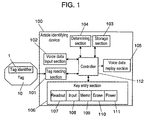
- tag 10 contains a specific identifier (hereinafter referred to as tag identifier).
- Article identifying device 100 can read tag identifier 1 attached to tag 10 via wireless communications.
- Article identifying device 100 is formed of tag reading section 101; voice data input section 102; storage section 103; determining section 104; voice data replay section 105; key entry section 106; and controller 112.
- Tag reading section 101 which is formed of an antenna and the like, reads tag identifier 1 of tag 10.
- Voice data input section 102 inputs voice data after tag 10 is read out.
- Storage section 103 stores voice data fed from input section 102 so as to associate with tag identifier 1 of tag 10.
- Storage 103 contains, as shown in Fig. 2 through Fig.
- tag/address table 103a for storing tag identifier 1 paired with the address of voice data that is associated with tag identifier 1; voice data table 103b for storing voice data, and memo data table 103c for storing memo data as voice message.
- Determining section 104 judges whether or not tag identifier 1 read by tag reading section 101 is retained in storage section 103.
- Voice data replay section 105 replays, according to the result from determining section 104, the voice data associated with the identifier.
- Key entry section 106 which is responsible for operating article identifying device 100, further includes readout key 107 for starting readout of tag identifier 1 of tag 10; data input key 108 for inputting voice data: memo key 109 for replaying memo data stored in memo data table 103c; erase key 110 for erasing information from storage section 103; and power key 111 for turning identifying device 100 ON or OFF.
- depressing power key 111 turns identifying device 100 ON. Further, depressing readout key 107 enables controller 112 to send readout command to tag reading section 101. Receiving the command, tag reading section 101 reads out tag identifier 1 of tag 10 attached with an article. Next, determining section 104 judges whether or not tag identifier 1 read by tag reading section 101 is retained in storage section 103. When tag identifier 1 is found in tag/address table 103a of storage section 103, the voice data associated with tag identifier 1 is fetched from voice data table 103b. The voice data is replayed from voice data replay section 105 as a voice.
- a beep sound by a beeper tells the user that the tag identifier is not stored in article identifying device 100.
- voice message can tell, instead of the beep sound, the absence of the tag identifier.
- controller 112 When the user depresses data input key 108 after tag identifier 1 of tag 10 is read out, controller 112 enables voice data input section 102 into voice data acceptable mode from input disabled mode. While holding input key 108 down, the user can input voice data through voice data input section 102. When the user releases input key 108, controller 112 changes the mode of input section 102 into the input disabled mode.
- an A/D converter built in voice data input section 102 converts the voice data into a digital signal.
- controller 112 sends, to determining section 104, tag identifier 1 read by tag reading section 101 and the voice data entered through voice data input section 102.
- determining section 104 searches storing section 103 for tag identifier 1 that correspond to the tag identifier read by reading section 101. If the search fails to find matching tag identifier 1, storage section 103 newly stores the tag identifier and the voice data associated with the tag identifier.
- storage section 103 stores the voice data so as to associate with tag identifier 1, that is, an existing voice data is overwritten with the voice data just entered.
- depressing readout key 107 enables controller 12 to send readout command to tag reading section 101.
- tag reading section 101 reads out tag identifier 1 of tag 10 attached with an article.
- Determining section 104 judges whether or not tag identifier 1 read by tag reading section 101 is retained in storage section 103.
- tag identifier 1 is found in tag/address table 103a of storage section 103, the voice data associated with tag identifier 1 is fetched from voice data table 103b.
- voice data replay section 105 provides the data with digital-to-analog conversion, so that the data is replayed as a voice.
- controller 112 activates the beeper (not shown) to go off a beep sound, telling the user that there is no record on the voice data.
- storage section 103 contains tag/address table 103a, in which tag identifier 1 is paired with the address of voice data table 103b where the voice data associated with tag identifier 1 is stored. Each time data is entered, the data is stored in tag/address table 103a. Determining section 104 searches tag/address table 103a whether tag identifier 1 is stored or not.
- tag/address table 103a the data is well organized in chronological order, i.e., the older data comes first, as shown in Fig. 2.
- the chronological order of the table can provide the user with an easy understanding of data history when the user confirms, by ears, the data one by one.
- tag identifier 1 to be newly stored is always placed after the most recently stored record even if tag identifier 1 is already exists in tag/address table 103a, and then the older tag identifier 1 is blanked out.
- all the records (each of which includes tag identifier 1 paired with the address data) consecutive to the blanked record are shifted backward in the chronological ordering, as shown in Fig. 4, to eliminate a vacant record in the table.
- tag identifier 1 can be sorted in the order of time sequence, that is, the well-organized data helps the understanding of the user when the user confirms, by ears, the data one by one.
- tag/address table 103a has the contents shown in Fig. 4.
- identifying device 100 should be furnished with the function that can replay the voice data stored in storage section 103 without reading tag 10.
- the structure of the embodiment realizes this by combination of readout key 107 and power key 111; specifically, with readout key 107 held down, turning the power ON by power key 111 allows device 100 to go into the voice-data replay mode.
- depressing readout key 107 enables device 100 to a) read the first record, i.e., the oldest record (in time-sequence) of tag/address table 103a; b) fetch a voice data from voice data table 103b, which is associated with the address stored in the oldest record; and c) replay the voice data as a voice from voice data replay section 105.
- device 100 Each time the user depresses readout key 107, device 100 replays voice data one after another in the chronological order. Besides, when the user depresses key 107 while device 100 is replaying a voice data, device 100 skips the interrupted replay and replays next record. With the "fast forward" operation, the user can quickly confirm the voice data.
- the replay of voice data is provided in the chronological order in the description above, it is not limited thereto; the replay in reverse chronological order, for example, by depressing readout key 107 for a predetermined period may be useful. With such a useful function equipped, device 100 can be user-friendly.
- a replay of a voice data may make the user aware that tag 10 associated with the voice data has been lost or broken.
- the user can depress erase key 110 for a predetermined period (for example, 10 seconds).
- a predetermined period for example, 10 seconds.
- device 100 performs voice data input in communication with tag 10 through following processes: reading tag identifier 1 of tag 10, receiving a voice data through voice data input section 102, and then storing tag identifier 1 and the voice data associated therewith in storage section 103.
- another input process used only device 100, with reference to Fig. 4.
- the user can input, in advance, voice data on articles to article identifying device 100, even if tag 10 is not there.
- the voice data stored in storage section 103 can be associated with tag 10 through the process below.
- Storage section 103 contains memo data table 103c, which is used for the "in-advance" input.
- Table 103c can carry voice data for the duration of about 100 seconds. That is, when 5 seconds is spent for each record, 20 records of voice data (hereinafter referred to as memo) can be stored in table 103c.
- Table 103c provides sequential and cyclic read/write. Suppose that the records of table 103c are allocated to addresses of 1, 2, ... K, K+1, ... N-1, N. When a lot of voice data are stored in table 103c, each data is sequentially allocated at address 1 toward address N. When table 103c is fully occupied with voice data from address 1 to address N, successive data is sequentially overwritten from the record of address 1.
- voice data on articles is fed into article identifying device 100; specifically, holding input key 108 down, the user inputs (at least one piece of) voice data through voice data input section 102.
- the voice data is stored in memo data table 103c.
- voice data replay section 105 replays the voice data of address K where the latest voice data is stored. (If it is the first-time operation for the user and table 103c carries only one voice data, replay section 105 replays the voice data of address 1.) At this time, if the voice data is useless for the user, the user inputs new voice data, holding input key 108 down. In response to the key operation by the user, controller 112 of device 100 overwrites the voice data into memo data table 103c. When voice data is continuously coming through input section 102, controller 112 moves the address pointer to K+1 so that the incoming voice data is stored at the address where "the oldest" data is retained. Since memo data table 103c sequentially and cyclically stores voice data, the record (i.e., of address N+1) next to the record having current voice data (i.e., of address N) carries "the oldest" data.
- depressing memo key 109 allows the user to audibly confirm the voice data stored in memo data table 103c.
- voice data replay section 105 replays the voice data at address K where the latest voice data is retained.
- another depression of key 109 allows the user to obtain the voice data previous to the latest data, i.e., the data at address K ⁇ 1.
- controller 112 controls to move the address pointer in reverse chronological order so that the newer data comes first.
- the user depresses memo key 109 to confirm a voice data stored in memo data table 103c.
- tag reading section 101 reads tag identifier 1 of tag 10 to be associated.
- the voice data is stored in voice data table 103b, while tag identifier 1 and the address, which tells the location in table 103b of the voice data associated with tag identifier 1, is retained in tag/address data table 103a.
- voice data can be entered into device 100 in advance, and then the data can be associated with tag 10.
- the user can conveniently input, as a reminder, voice data on an article purchased during shopping into device 100, and after that, the user can associate the voice data with tag 10.
- the user can audibly confirm the voice data stored in voice data table 103b one by one.
- the confirmation process can be so designed that voice data replay section 105 replays a message notifying no more record on the completion of voice data replay. The user can thus know the end of the voice data replay.
- controller 112 may contains a clock/calendar circuit, with which voice data can be stored with the date in voice data storage section 103. It is convenient for the user, in the voice data confirmation process, that voice data can be obtained together with date/time data on which the voice data is stored.
- the clock/calendar function is exploitable in extracting the voice data stored in a user-specified period of time and replaying them.
- the voice data and the date/time data can be used for tag 10, that is, the user can associate the date/time, on which tag 10 is read, with the voice data illustrating tag 10, so that voice data on tag 10 stored in a user-specified period of time can be obtained in the voice data confirmation process.
- controller 112 controls voice data replay section 105 so as to replay by voice, at the beginning of the replay process, the number of records of the voice data stored in storage section 103.
- voice data entered through voice data input section 102 is converted into a digital signal before storage, it is not limited thereto; the voice data can be stored as the analog form.
- Radio Frequency Identification System (RFID) tag is an example of tag 10 used in the embodiment.
- article identifying device 100 should read/write the RFID tag.
- the article identifying device of the embodiment has high utility, especially for a visually impaired user, it will be a good help in daily life.
- tag 10 The user can make use of tag 10 in distinguishing, for example, books, containers carrying beverages, and bags containing medicines.
- the user can easily confirm the voice data stored in the device, and can erase an undesired data from the device.
- the user can input voice data in the device in advance without a tag. After the input procedure, the user can associate the voice data with a tag.
Landscapes
- Physics & Mathematics (AREA)
- Engineering & Computer Science (AREA)
- Electromagnetism (AREA)
- General Physics & Mathematics (AREA)
- Artificial Intelligence (AREA)
- Toxicology (AREA)
- General Health & Medical Sciences (AREA)
- Computer Vision & Pattern Recognition (AREA)
- Health & Medical Sciences (AREA)
- Theoretical Computer Science (AREA)
- Life Sciences & Earth Sciences (AREA)
- General Life Sciences & Earth Sciences (AREA)
- Geophysics (AREA)
- Control Of Vending Devices And Auxiliary Devices For Vending Devices (AREA)
Applications Claiming Priority (3)
| Application Number | Priority Date | Filing Date | Title |
|---|---|---|---|
| JP2002345479 | 2002-11-28 | ||
| JP2002345479A JP2004177768A (ja) | 2002-11-28 | 2002-11-28 | 物品識別装置 |
| PCT/JP2003/014966 WO2004049301A1 (ja) | 2002-11-28 | 2003-11-25 | 物品識別装置 |
Publications (2)
| Publication Number | Publication Date |
|---|---|
| EP1566795A1 true EP1566795A1 (de) | 2005-08-24 |
| EP1566795A4 EP1566795A4 (de) | 2008-09-17 |
Family
ID=32376009
Family Applications (1)
| Application Number | Title | Priority Date | Filing Date |
|---|---|---|---|
| EP03774177A Withdrawn EP1566795A4 (de) | 2002-11-28 | 2003-11-25 | Warenidentifikationseinrichtung |
Country Status (4)
| Country | Link |
|---|---|
| US (1) | US7164363B2 (de) |
| EP (1) | EP1566795A4 (de) |
| JP (1) | JP2004177768A (de) |
| WO (1) | WO2004049301A1 (de) |
Families Citing this family (9)
| Publication number | Priority date | Publication date | Assignee | Title |
|---|---|---|---|---|
| US20060134586A1 (en) * | 2004-12-21 | 2006-06-22 | International Business Machines Corporation | Tactile interface system |
| JP2007084247A (ja) * | 2005-09-21 | 2007-04-05 | Brother Ind Ltd | 情報読み取り装置及び情報管理システム |
| US7411518B2 (en) * | 2006-02-06 | 2008-08-12 | Novation Science, Llc | Parking location reminder device |
| US20080091719A1 (en) * | 2006-10-13 | 2008-04-17 | Robert Thomas Arenburg | Audio tags |
| JP2008185994A (ja) * | 2007-01-31 | 2008-08-14 | Initus Co Ltd | 音声再生システム |
| KR101514039B1 (ko) * | 2011-03-28 | 2015-04-24 | 주식회사 케이티 | 태그 정보 제공 방법 및 그 시스템 |
| US9836628B1 (en) | 2016-05-24 | 2017-12-05 | International Business Machines Corporation | Object identification through electromagnetic tag signature |
| KR20220020121A (ko) | 2020-08-11 | 2022-02-18 | 삼성전자주식회사 | 컨텐트와 연관된 텍스트를 제공하기 위한 전자 장치 및 그 동작 방법 |
| TWI779517B (zh) * | 2021-03-15 | 2022-10-01 | 凌通科技股份有限公司 | 音樂標籤互動系統以及音樂標籤互動方法 |
Family Cites Families (10)
| Publication number | Priority date | Publication date | Assignee | Title |
|---|---|---|---|---|
| JPH09261139A (ja) | 1996-03-19 | 1997-10-03 | Fujitsu Ltd | 自動説明システム |
| US5963133A (en) * | 1997-07-18 | 1999-10-05 | Monjo; Nicolas | Electronic tag |
| US6295341B1 (en) * | 1998-03-18 | 2001-09-25 | At&T Corp. | Network based voice mail with call screening |
| US6611673B1 (en) * | 1999-07-12 | 2003-08-26 | Oliver T. Bayley | Radio frequency-controlled telecommunication device |
| JP3398126B2 (ja) | 2000-06-05 | 2003-04-21 | 株式会社九北エレクトロニクス | 物品識別装置 |
| JP2002123276A (ja) | 2000-10-17 | 2002-04-26 | Dainippon Printing Co Ltd | 収集を目的とするicタグ付物品、icタグおよびタグリーダ |
| IL141299A0 (en) * | 2001-02-07 | 2002-03-10 | Assistec Ltd | A method and a system for identifying an object and announcing a voice message |
| JP2003006208A (ja) * | 2001-06-20 | 2003-01-10 | Daikin Ind Ltd | 音声記録装置および方法、音声再生装置および方法、音声記録再生システムおよび方法 |
| US20030155413A1 (en) * | 2001-07-18 | 2003-08-21 | Rozsa Kovesdi | System and method for authoring and providing information relevant to a physical world |
| US6977579B2 (en) * | 2003-11-06 | 2005-12-20 | International Business Machines Corporation | Radio frequency identification aiding the visually impaired |
-
2002
- 2002-11-28 JP JP2002345479A patent/JP2004177768A/ja active Pending
-
2003
- 2003-11-25 EP EP03774177A patent/EP1566795A4/de not_active Withdrawn
- 2003-11-25 WO PCT/JP2003/014966 patent/WO2004049301A1/ja not_active Ceased
- 2003-11-25 US US10/497,772 patent/US7164363B2/en not_active Expired - Fee Related
Also Published As
| Publication number | Publication date |
|---|---|
| WO2004049301A1 (ja) | 2004-06-10 |
| JP2004177768A (ja) | 2004-06-24 |
| US7164363B2 (en) | 2007-01-16 |
| US20050067481A1 (en) | 2005-03-31 |
| EP1566795A4 (de) | 2008-09-17 |
Similar Documents
| Publication | Publication Date | Title |
|---|---|---|
| KR0132658B1 (ko) | 정보 관리 장치 | |
| US7164363B2 (en) | Article identification device | |
| US6983124B1 (en) | Radio frequency-controlled telecommunication device | |
| US5971279A (en) | Hand held scanner for the visually impaired | |
| EP0378775A2 (de) | Funktelefon | |
| EP2264991A2 (de) | Informationsverarbeitungsverfahren und Informationsverarbeitungsvorrichtung mit Kommunikationsfunktion | |
| WO2004083981A2 (en) | System and methods for storing and presenting personal information | |
| EP2139209B1 (de) | Kommunikationsausrüstung | |
| JPH07311738A (ja) | 電子手帳 | |
| WO1995025326A1 (en) | Voice/pointer operated system | |
| WO2006121881A2 (en) | Personal information management system | |
| US20010014600A1 (en) | Memory management terminal and method for handling acoustic samples | |
| JP2000196730A (ja) | 無線通信機 | |
| US4542480A (en) | Electronic memoranda device for storing, retrieving, and displaying a schedule of data in records | |
| US8237702B2 (en) | Radio frequency identification (RFID) systems and methods | |
| JP2006160388A (ja) | ピッキングシステム | |
| JP4018579B2 (ja) | 物品管理装置、方法、コンピュータプログラム、及びコンピュータ読み取り可能な記憶媒体 | |
| JP5262745B2 (ja) | 発注管理装置、端末装置及びプログラム | |
| JPH08307545A (ja) | 電話回線を用いた情報伝達システムおよび端末 | |
| HK1039848A1 (en) | Telephone number display method and set | |
| JP2723680B2 (ja) | メッセージ表示機能付き無線選択呼び出し受信機 | |
| JP2002071378A (ja) | 自動集合判別システム | |
| JPH11343012A (ja) | 商品ピッキング方法及び装置 | |
| JPH10315971A (ja) | 列車情報システム | |
| JP2007121143A (ja) | 携帯型端末装置 |
Legal Events
| Date | Code | Title | Description |
|---|---|---|---|
| PUAI | Public reference made under article 153(3) epc to a published international application that has entered the european phase |
Free format text: ORIGINAL CODE: 0009012 |
|
| 17P | Request for examination filed |
Effective date: 20040604 |
|
| AK | Designated contracting states |
Kind code of ref document: A1 Designated state(s): AT BE BG CH CY CZ DE DK EE ES FI FR GB GR HU IE IT LI LU MC NL PT RO SE SI SK TR |
|
| AX | Request for extension of the european patent |
Extension state: AL LT LV MK |
|
| DAX | Request for extension of the european patent (deleted) | ||
| RBV | Designated contracting states (corrected) |
Designated state(s): ES GB |
|
| REG | Reference to a national code |
Ref country code: DE Ref legal event code: 8566 |
|
| A4 | Supplementary search report drawn up and despatched |
Effective date: 20080821 |
|
| STAA | Information on the status of an ep patent application or granted ep patent |
Free format text: STATUS: THE APPLICATION HAS BEEN WITHDRAWN |
|
| 18W | Application withdrawn |
Effective date: 20081014 |
|
| RAP1 | Party data changed (applicant data changed or rights of an application transferred) |
Owner name: PANASONIC CORPORATION |