EP1566435B1 - Rotierendes molekül v1-atpase - Google Patents
Rotierendes molekül v1-atpase Download PDFInfo
- Publication number
- EP1566435B1 EP1566435B1 EP03754061A EP03754061A EP1566435B1 EP 1566435 B1 EP1566435 B1 EP 1566435B1 EP 03754061 A EP03754061 A EP 03754061A EP 03754061 A EP03754061 A EP 03754061A EP 1566435 B1 EP1566435 B1 EP 1566435B1
- Authority
- EP
- European Patent Office
- Prior art keywords
- atpase
- subunit
- molecule
- rotary motor
- atp
- Prior art date
- Legal status (The legal status is an assumption and is not a legal conclusion. Google has not performed a legal analysis and makes no representation as to the accuracy of the status listed.)
- Expired - Lifetime
Links
Images


Classifications
-
- B—PERFORMING OPERATIONS; TRANSPORTING
- B82—NANOTECHNOLOGY
- B82Y—SPECIFIC USES OR APPLICATIONS OF NANOSTRUCTURES; MEASUREMENT OR ANALYSIS OF NANOSTRUCTURES; MANUFACTURE OR TREATMENT OF NANOSTRUCTURES
- B82Y5/00—Nanobiotechnology or nanomedicine, e.g. protein engineering or drug delivery
-
- C—CHEMISTRY; METALLURGY
- C12—BIOCHEMISTRY; BEER; SPIRITS; WINE; VINEGAR; MICROBIOLOGY; ENZYMOLOGY; MUTATION OR GENETIC ENGINEERING
- C12N—MICROORGANISMS OR ENZYMES; COMPOSITIONS THEREOF; PROPAGATING, PRESERVING, OR MAINTAINING MICROORGANISMS; MUTATION OR GENETIC ENGINEERING; CULTURE MEDIA
- C12N9/00—Enzymes; Proenzymes; Compositions thereof; Processes for preparing, activating, inhibiting, separating or purifying enzymes
- C12N9/14—Hydrolases (3)
- C12N9/16—Hydrolases (3) acting on ester bonds (3.1)
-
- C—CHEMISTRY; METALLURGY
- C12—BIOCHEMISTRY; BEER; SPIRITS; WINE; VINEGAR; MICROBIOLOGY; ENZYMOLOGY; MUTATION OR GENETIC ENGINEERING
- C12N—MICROORGANISMS OR ENZYMES; COMPOSITIONS THEREOF; PROPAGATING, PRESERVING, OR MAINTAINING MICROORGANISMS; MUTATION OR GENETIC ENGINEERING; CULTURE MEDIA
- C12N9/00—Enzymes; Proenzymes; Compositions thereof; Processes for preparing, activating, inhibiting, separating or purifying enzymes
- C12N9/14—Hydrolases (3)
Definitions
- the present invention relates to a novel rotary motor molecule V 1 -ATPase useful for a nanoactuator of a micromachine or a nanomachine, or the like.
- micromachine or a nanomachine that mechanically moves according to the size of a molecule. This is because such micromachine or nanomachine is considered useful for, e.g., a molecule robot that lays out the wiring of a molecule computer or a medical robot that works a cure in the body.
- micromachine and a nanomachine For the fabrication of a micromachine and a nanomachine, development of a variety of technologies is required, including individual element devices (a sensor, an actuator and a miniature machine) to processes of assembling them (micromachining and nanomaching).
- microactuators and nanoactuators rotary motors
- micromachine drive devices i.e., micromachine drive devices
- microactuators made by processes to which precise handling technologies are applied are no smaller than about 100 ⁇ m. Further miniaturization of motor apparatuses is being required to install them in micromachines and nanomachines.
- a molecule capable of being a motor needs to satisfy two factors: having a power mechanism that converts outer energy into rotary movement, and achieving rotation in one direction.
- Low molecular organic compounds satisfying such conditions that are known include, for example, (3R,3'R)-(P,P)-trans-1,1',2,2',3,3',4,4'-octahydro-3,3'-dimethyl-4,4'-bipheant hrydiene ( Nature 401: 152-155, 1999 ) and Triptycyl(4)helicene ( Nature 401: 150-152, 1999 ).
- the former has symmetry to the right and to the left of the carbon-carbon double bond, but has a twisted structure due to steric interlocking.
- biomolecules are known that include a flagellum motor ( Microbiol. 6: 1-18, 1967 , Nature 245: 380-382, 1973 ), an ATP synthase ( Nature 386: 299-302, 1997 ), a myosin motor ( Biochem. Biophys. Res. Comm. 199: 1057-1063, 1994 , Curr. Opin. Cell Biol. 7: 89-93, 1995 ), a microtubule-based motor ( Cell 42: 39-50, 1985 ), a motor protein of nucleic acid synthase ( Nature 409: 113-119, 2001 ), and the like.
- a flagellum motor Microbiol. 6: 1-18, 1967 , Nature 245: 380-382, 1973
- an ATP synthase Nature 386: 299-302, 1997
- myosin motor Biochem. Biophys. Res. Comm. 199: 1057-1063, 1994 , Curr. Opin. Cell Biol. 7: 89-93, 1995
- an ATP synthase is a membrane protein present ubiquitous, at such locations as the inner membranes of mitochondria in eukaryotes, thylakoid membranes of chloroplasts, a prokaryote cell membrane, and the like, and synthesizes most ATP consumed in cells.
- An ATP synthase (F 0 F 1 -ATP synthase) is a huge membrane protein complex with molecular weight up to about 500 thousand, and consists of an F 0 portion present inside a membrane and an F 1 portion present outside the membrane.
- the F 0 portion is a passage for a proton (H + ) to pass through the membrane
- the F 1 portion is a catalyst portion that synthesizes and hydrolyzes ATP.
- the molecular weight of the F 1 portion is about 380 thousand, for example, the subunit composition of the F 1 portion in an ATP synthase derived from bacteria is ⁇ 3 ⁇ 3 ⁇ 1 ⁇ 1 .
- ⁇ and ⁇ subunits both have a similar ATP binding portion, but catalyst activity is present in the ⁇ subunit. Both alternately align to form a ring and in the center of this ⁇ 3 ⁇ 3 ring, a ⁇ subunit is present.
- a ⁇ subunit binds to the top of the ⁇ 3 ⁇ 3 ring; an ⁇ subunit that controls ATP hydrolysis activity binds to the ⁇ subunit.
- the F 0 portion has a molecular weight of about 100 thousands, and the amino acid composition contains in quantity glutamic acid and asparaginic acid, necessary for proton movement.
- the subunit composition is a 1 b 2 c 9-12 , "c" subunits are arranged like a ring (the “c” ring) in the membrane, and to the "c" ring are bound subunit "a” and two "b” subunits each having an arm protruding far outside the membrane.
- an F 0 F 1 -ATP synthase has an F 1 portion and an F 0 portion which are bound to each other at two sites: ⁇ ⁇ -"c" ring and ⁇ b 2 .
- a further characteristic is the fact that this F 0 F 1 -ATP synthase molecule has two kinds of torque generating devices.
- One is an ATP driving type device present in the F 1 portion and the other is a proton driving type device present in the F 0 portion. That is, when the F 0 portion takes a proton in the cell membrane, the "c" ring rotates clockwise; when the F 0 portion discharges a proton to the outside of the cell membrane, the "c” ring rotates anticlockwise.
- the F 1 portion rotates clockwise viewing the ⁇ subunit from the F 0 side, and the F 1 portion rotates anticlockwise during ATP decomposition.
- the torque generated by ATP synthase is on the order of tens of piconewton ⁇ nm, and thus the synthase has a sufficient driving force for a molecule motor.
- an ATP synthase acts in a water system and so it is most suitable as an actuator working in the body, and also can manipulate a protein, sugar, a lipid, or a nucleic acid in the body because it has sufficient power for moving actin.
- the inventors of the present invention improved this F 0 F 1 -ATP synthase molecule, and have already invented and filed the invention of a modified F 0 F 1 -ATP synthase molecule capable of controlling over a wide rotation speed range and its utilization (Japanese Patent Application No. 2002-148232; filing date: May 22, 2002 ).
- a rotary motor molecule which is made by incorporating a zinc binding site into an F 1 -ATP synthase molecule and which is capable of controlling the initiation and stop of the rotation by means of the zinc ( Nature Materials 1: 173-177, 2002 ).
- rotary motor molecules are proposed as driving members of a micromachine, a nanomachine, and the like, and the molecules each have characteristics regarding type of rotation, the revolution number, torque, the method of controlling rotation, etc. Accordingly, for actual fabrication of a micromachine or a nanomachine, an appropriate molecule needs to be selected from a variety of candidate molecules depending on its application and machine construction. However, it cannot be said that the rotary motor molecules reported thus far can each be suitable for all the different applications and constructions of a micromachine and a nanomachine. For this reason, upon the development of a micromachine or a nanomachine or the like, each addition of one more to the lineup of rotary motor molecules is greatly desired.
- this application is intended to provide a novel rotary motor molecule that is different in properties from the conventional rotary motor molecules.
- the application also has another subject of providing an improved, novel rotary motor molecule which further smoothens the rotary motion and also adds a means for the molecule to transfer the rotary motion.
- This application provides a variant of a rotary motor molecule V 1 -ATPase rotating in the presence of ATP, which is a complex molecule having three A subunits, three B subunits and one D subunit constituting the V 1 portion of a V 0 V 1 -ATPase, as defined in claim 1.
- the V 1 -ATPase of this invention includes the A subunit as a catalyst portion, A and B subunits are arranged alternately, and from a hexamer cylinder like the ⁇ 3 ⁇ 3 of a V 0 V 1 -ATPase.
- the D subunit is embedded in the central cavity of this A 3 B 3 cylinder, an F subunit is preferably bound to the D subunit, and the D and F subunits act as a rotor (rotary shaft, rotary axis).
- the rotary motor molecule V 1 -ATPase is heat resistant. It is preferred that the V 1 -ATPase is derived from the thermophilic bacteria, Thermus thermophilus .
- the rotary motor molecule V 1 -ATPase derived from the thermophile, Thermus thermophilus is a complex having three peptides of SEQ ID NO:3 corresponding to the A subunit, three peptides of SEQ ID NO:4 corresponding to the B subunit, and one peptide of SEQ ID NO:5 corresponding to the D subunit, wherein the rotary motor molecule V 1 -ATPase has substitutions of Ala residue for the 232nd Ser residue and Ser residue for the 235th Thr residue in SEQ ID NO:3.
- V 1 -ATPase the improvement of the A subunit, the catalyst portion, allows dissolution of MgADP inhibition and acceleration of ATP hydrolysis activity.
- Rotation of a wild type of V 1 -ATPase tends to be suppressed due to MgADP inhibition, and the modified V 1 -ATPase that prevents MgADP inhibition exhibits efficient rotational motion.
- a preferred mode of the present invention is that the rotary motor molecule V 1 -ATPase is an improved molecule in which one or both of the A and B subunits is fixed on a substrate.
- a preferred mode is that the molecule is fixed on the substrate via an His tag bound to the N terminal of the A subunit.
- the rotary motor molecule V 1 -ATPase has a joint bound to the D subunit.
- the joint material is bound to at least one of Cys residue substituted for the 48th Glu residue and Cys residue substituted for the 55th Gln residue in SEQ ID NO:5, and the case where all the Cys residues in the A and B subunits are replaced by non-Cys residues is another preferred mode.
- Rotary motor molecule V 1 -ATPases comprise the V 1 portion (a complex comprised of three A subunits, three B subunits, one D subunit) of V type (tonoplast type) ATPase (V 0 V 1 -ATPase) present in organelles (vacuole, lysosome, Golgi vesicle, cell membrane, coated vesicle, secretory granule, etc) of a bacterium or a eukaryote.
- V type tonoplast type
- V 0 V 1 -ATPase present in organelles (vacuole, lysosome, Golgi vesicle, cell membrane, coated vesicle, secretory granule, etc) of a bacterium or a eukaryote.
- V 1 -ATPase synthase has already known to serve as a rotary motor molecule
- the V 1 portion (V 1 -ATPase) of this V 0 V 1 -ATPase was not known to have rotational motion at all.
- the V 1 -ATPase of this invention is based on the finding that the D subunit located inside a "cylindrical body" comprised of three A subunits and three B subunits a D subunit functions as a rotary shaft.
- V 1 portion of a V 0 V 1 -ATPase preferably has one F subunit bound to the D subunit.
- examples include a variant into which a zinc recognizing portion is incorporated, as disclosed in Nature Materials 1: 173-177, 2002 as noted above.
- the rotary motor molecule V 1 -ATPase of this invention is a variant of the V 1 (V 1 -ATPase) portion of V 0 V 1 -ATPase produced from various bacteria or eukaryotes.
- the V 1 -ATPase can be produced by genetic engineering using a polynucleotide (DNA fragment, RNA fragment, or preferably cDNA fragment). Hereinafter, it may be denoted as "V 1 -ATPase polynucleotide" encoding the V 1 -ATPase.
- Sequences of polynucleotides (cDNA fragment) encoding V 0 V 1 -ATPases are disclosed in many data bases (e.g., GenBank data base: URL: http://www. ncbi. nlm. nih. gov), and using the sequence information in a probe hybridization process or a PCR process, the polynucleotide (cDNA fragment) encoding a V 0 V 1 -ATPase can be readily obtained from existent cDNA libraries, or the like.
- V 1 -ATPase polynucleotide using a well-known genetic engineering process can provide a complex V 1 -ATPase comprised of three A subunits, three B subunits and one D subunit.
- the RNA polymerase promoter can include T7, T3, and SP6.
- V 1 -ATPase polynucleotide examples include pKA1, pCDM8, pT3/T7 18, pT7/3 19, and pBluescript II.
- the expression of a V 1 -ATPase polynucleotide in a suitable host-vector system can produce the rotary motor molecule V 1 -ATPase in a prokaryotic cell such as E. coli., or hay bacillus, a eukaryotic cell such as yeast, an insect cell, a mammal cell, or plant cell, or the like.
- a prokaryotic cell such as E. coli., or hay bacillus
- a eukaryotic cell such as yeast
- an insect cell a mammal cell, or plant cell, or the like.
- a microorganism such as E.
- the polynucleotide is recombined into an expression vector having an origin replicable in the microorganism, a promoter, a ribosome binding portion, a DNA cloning portion, a terminator and the like, to prepare an expression vector which transforms the host cell. Culturing this transformant can produce the target V 1 -ATPase molecules from the culture in quantity.
- expression vector for E. coli include pUC system, pBluescript II, pET expression system, and pGEX expression system.
- the polynucleotide when the polynucleotide is to be expressed in a eukaryotic cell, the polynucleotide is inserted into an expression vector for a eukaryotic cell, the vector having a promoter, a splicing region, poly(A) addition portion and the like, resulting in a recombinant vector. From eukaryotic cells transfected with this vector can be obtained the target V 1 -ATPase molecules.
- the expression vector include pKA1, pCDM8, pSVK3, pMSG, pSVL, pBK-CMV, pBK-RSV, EBV vector, pRS, and pYES2.
- Eukaryotic cells that can be used include mammal culture cells such as human embryo renal cell line HEK293, monkey renal cell line COS7, Chinese hamster ovarian cell line CHO, or primary culture cells isolated from human organ, and the like.
- the eukaryotic cells that can be used also include budding yeast, fission yeast, silkworm cells, and Xenopus egg cells.
- a known method such as electroporation, calcium phosphate method, ribosome method, DEAE dextran method, and the like may be used.
- well known separation operations can be carried out in combination.
- isolation and purification examples include treatment with a modifying agent such as urea or with a surfactant, ultrasonic treatment, enzyme digestion, salting out or the solvent precipitation method, dialysis, centrifugation, ultrafiltration, gel filtration, SDS-PAGE, isoelectric focusing electrophoresis, ion exchange chromatography, hydrophobic chromatography, affinity chromatography, reversed phase chromatography, and the like.
- a modifying agent such as urea or with a surfactant
- ultrasonic treatment enzyme digestion, salting out or the solvent precipitation method
- dialysis centrifugation
- ultrafiltration gel filtration
- SDS-PAGE isoelectric focusing electrophoresis
- ion exchange chromatography hydrophobic chromatography
- affinity chromatography affinity chromatography
- reversed phase chromatography and the like.
- the rotary motor molecule V 1 -ATPase of this invention is a variant of a heat resisting V 1 -ATPase molecule for the sake of industrial utilization, the V 1 -ATPase being obtainable from the thermophile Thermus thermophilus, which is capable of growing even at 70°C or more.
- the V 1 -ATPase polynucleotide derived from Thermus thermophilus has the base sequence of SEQ ID NO: 1.
- the V 1 -ATPase polynucleotide derived from Thermus thermophilus encodes a complex of the polypeptide (F subunit) consisting of the amino acid sequence of SEQ ID NO:2, the polypeptide (A subunit) of SEQ ID NO:3, the polypeptide (B subunit) of SEQ ID NO:4, and the polypeptide (D subunit) of SEQ ID NO:5. Therefore, expressing the 334-4196 nt sequence of SEQ ID NO:1 by means of the aforementioned genetic engineering technology can give a heat resisting V 1 -ATPase comprising of three A subunits, three B subunits and one D subunit. In addition, expressing the 1-4196 nt sequence of SEQ ID NO:1 can provide a heat resisting V 1 -ATPase having one F subunit bound to the D subunit thereof.
- the rotary motor molecule V 1 -ATPase of this invention has substitution of Ala residue for the 232nd Ser residue and a substitution of Ser residue for the 235th Thr residue, in SEQ ID NO:3, (hereinafter, a molecule having both substitutions may be denoted as a "TSSA variant").
- TSSA variant a molecule having both substitutions.
- the reaction of the V 1 -ATPase derived from a bacterium such as T . thermophilus has a tendency to be interrupted during the metabolic turnover of the catalyst due to the so-called MgADP inhibition ( J Biol Chem 273, 20504-20510, 1998 ).
- this ADP restriction appears within 5 minutes after ATP has been added as a substrate, and in about 10 minutes the V 1 -ATPase stops ATP hydrolysis.
- the inventors of this application have prepared some variants and studied the ADP restriction effects. As a result, the inventors have found that the aforementioned TSSA variant continues ATP activity even for one hour after the addition of ATP as a substrate.
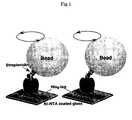
- Still another preferred mode of the rotary motor molecule V 1 -ATPase of this invention is a modified molecule where either the A or B subunit or both is fixed on a substrate. The reason is that this fixation makes it possible to efficiently transmit the rotation of the D subunit. Binding of A and/or B subunit like this on a substrate can be carried out by a variety of methods, for example using covalent bonding, but preferably a method is employed involving bonding His (hectahistidine) tag to the N terminal of A subunit and then bonding this His tag to Ni-NTA slide ( Nature 386: 299-302, 1997 ; FEBS Letters 470: 244-248, 2000 ).
- the D subunit is bound to a joint material.
- joint material in this case means a material for transmitting the rotational motion of the D subunit of the V 1 -ATPase to another component (e.g., a gear or a shaft of a motion engine, or the like).
- this joint material is not for connection to another component, but can also be utilized as a "probe” or a "propeller” for observing the rotation of the V 1 -ATPase.
- joint materials examples include a plurality of previously mentioned beads (microspheres) that are connected as seen in Embodiments described below, and a fine fiber such as actin filament ( Nature 386: 299-302, 1997 ).
- This joint material can be bonded to Cys residue of the D subunit, for example, by maleimide or disulfide bonding or the like.
- the D subunit of the V 1 -ATPase derived from Thermus thermophilus the amino sequence of which was indicated in SEQ ID NO:5, does not have Cys residues, and thus a suitable non-Cys residue needs to be replaced by Cys residue.
- a joint material is preferably bound to Cys residue substituted for the 48th Glu residue or Cys residue substituted for the 55th Gln residue (preferably both) in SEQ ID NO:5.
- Cys residues other than those in D subunit are preferably replaced by other residues (e.g., Ser residues) so that these Cys residues are not bound to the joint material.
- a joint material can be made not to bind to D subunit, but to F subunit which binds to D subunit.
- the 28th Ser and/or the 35th Ser residue is replaced by Cys residue in the amino acid of SEQ ID NO:2, and to these Cys residues can be bound a joint material.
- each of the above-described V 1 -ATPases can be obtained by replacing a triplet encoding the specified amino residue in a V 1 -ATPase polynucleotide by means of a method using a mutation kit or the like, the mutagenesis PCR, or a polynucleotide synthesizing method (e.g., Nucleic Acid Res. 25: 3440-3444, 1997 ), and then expressing this mutated polynucleotide by a genetic engineering process.
- the V 1 -ATPase was expressed through the use of E. Coli BL21-CodonPlus-RP (Stragene) transformed with the plasmid pUCV1 that possessing the DNA sequences encoding each of the A, B, D, and F subunits of the V 1 -ATPase derived from T . thermophilus HB8 under the control of lac promoter. Also, the DNA sequences encoding each of the A, B, D, and F subunits were modified to prepare the following variants (the amino acid positions correspond to SEQ ID NOS:2 to 5).
- V 1 -ATPase The purified V 1 -ATPase was subjected to biotinylation with more than two moles of 6-[N'-[2-(N-maleimido)ethyl]-N-piperazinylamido]hexyl D-biotinamide (biotin-PEAC 5 -malaimide, Dojindo).
- biotin-PEAC 5 -malaimide, Dojindo 6-[N'-[2-(N-maleimido)ethyl]-N-piperazinylamido]hexyl D-biotinamide (biotin-PEAC 5 -malaimide, Dojindo).
- the resulting substance was incubated at 25°C for 15 minutes and then the protein was placed into a PD-10 Column (Amersham) where the unreacted reagents were removed.
- Biotinylation of the D and F subunits was confirmed by the western blotting technique using str
- Flow cell of 5 ⁇ l was fabricated from two cover slips (a spacer with a thickness of 50 nm between them).
- the bottom glass surface was coated with Ni 2+ -nitrilotriacetic acid, and the biotinylated V 1 -ATPase (0.1-1 ⁇ M) contained in the A solution composed of a buffer (50 mM Tris-HCl, pH 8.0, 100 mM KCl, 5 mM MgCl 2 ) and 0.5% (w/v) BSA was poured into the flow cell, and His tags were bound to the glass, thereby fixing the V 1 -ATPase.
- a buffer 50 mM Tris-HCl, pH 8.0, 100 mM KCl, 5 mM MgCl 2
- BSA 0.5%
- the protein concentrations were determined by UV measurement.
- the ATP hydrolytic activity was determined from the oxidation of NADH which couples pyruvate kinase and lactate dehydrogenase.
- the two variants; the V 1 -ATPase (A-His8-tags/ ⁇ Cys/A-S232A/A-T235S/D-E48C/D-Q55C) and the V 1 -ATPase (A-His8-tags/ ⁇ Cys/A-S232A/A-T235S/F-S28C/F-S35C) were observed for the rotation thereof.
- the two variants showed kinetics that follow the Michaelis Menten equation, with the two variants having Km of 0.3 to 0.5 mM and Vmax (turnover rate) of about 10 sec -1 . These values are almost the same as those of the wild type F 0 F 1 -ATP synthase ( J Biol Chem 273, 20504-1014, 1998 ).
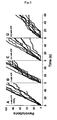
- the rotation was in one direction, in the case of F 1 -ATPase the rotation always counterclockwise viewed from the cell membrane side. In a buffer not containing ATP, one-direction rotation distinguishable from Brownian motion was not observed.
- the average number of revolutions in the presence of 4 mM ATP was about 2.6 rps (revolutions per sec) or fewer.
- the average number of revolutions in the presence of 1 mM ATP was about 2.4 rps or fewer. Assuming that one revolution consumes three molecules of ATP, the revolution speed is in good agreement with the ATP hydrolysis speed observed in the bulk enzyme reaction theory (hydrolysis of about 10 ATPs per sec). Also, at 0.5 mM ATP the average number of revolutions is decreased to about 2.2 rps ( Figure 3C ).
- the invention of this filing provides a variant of a V 1 -ATPase as a novel rotary motor molecule. This will greatly contribute to the fabrication of a micromachine, a nanomachine, and the like.
Landscapes
- Chemical & Material Sciences (AREA)
- Engineering & Computer Science (AREA)
- Life Sciences & Earth Sciences (AREA)
- Health & Medical Sciences (AREA)
- Bioinformatics & Cheminformatics (AREA)
- Zoology (AREA)
- Organic Chemistry (AREA)
- Wood Science & Technology (AREA)
- Genetics & Genomics (AREA)
- General Engineering & Computer Science (AREA)
- Biotechnology (AREA)
- Molecular Biology (AREA)
- Medicinal Chemistry (AREA)
- General Health & Medical Sciences (AREA)
- Nanotechnology (AREA)
- Biochemistry (AREA)
- Biomedical Technology (AREA)
- Microbiology (AREA)
- Biophysics (AREA)
- Medical Informatics (AREA)
- Pharmacology & Pharmacy (AREA)
- Crystallography & Structural Chemistry (AREA)
- Enzymes And Modification Thereof (AREA)
- Preparation Of Compounds By Using Micro-Organisms (AREA)
- Measuring Or Testing Involving Enzymes Or Micro-Organisms (AREA)
- Apparatus Associated With Microorganisms And Enzymes (AREA)
Claims (6)
- Eine Variante einer wärmebeständigen Rotationsmotormolekül-V1-ATPase, die zu einer anhaltenden ATP-Aktivität für wenigstens eine Stunde nach der Zugabe von ATP als Substrat in der Lage ist, wobei die V1-ATPase ein V1-Teil einer V0V1-ATPase ist, erhältlich aus den thermophilen Bakterien Thermus thermophilus, und ein komplexes Molekül mit drei A-Untereinheiten, drei B-Untereinheiten und einer D-Untereinheit ist, welche den V1-Teil einer V0V1-ATPase bilden, wobei in der Variante die A-Untereinheiten einen Ala-Rest als Substituent für den 232. Ser-Rest und einen Ser-Rest als Substituent für den 235. Thr-Rest in SEQ-ID-NR.: 3 besitzen.
- Die Rotationsmotormolekül-V1-ATPase gemäß Anspruch 1, wobei wenigstens eine ihrer A-Untereinheit und B-Untereinheit auf einem Substrat fixiert ist.
- Die Rotationsmotormolekül-V1-ATPase gemäß Anspruch 2, die durch einen an das N-Ende der A-Untereinheit gebundenen His-Tag auf dem Substrat fixiert ist.
- Die Rotationsmotormolekül-V1-ATPase gemäß Anspruch 1, 2 oder 3, an die eine D-Untereinheit mit einem Verbindungsmaterial gebunden ist.
- Die Rotationsmotormolekül-V1-ATPase gemäß Anspruch 4, wobei das Verbindungsglied an wenigstens einen Cys-Rest, ausgewählt aus dem Cys-Rest als Substituent für den 48. Glu-Rest und dem Cys-Rest als Substituent für den 55. Gln-Rest in SEQ-ID-NR.: 5, gebunden ist.
- Die Rotationsmotormolekül-V1-ATPase gemäß Anspruch 5, wobei alle Cys-Reste in der A-Untereinheit und der B-Untereinheit durch Nicht-Cys-Reste ersetzt sind.
Applications Claiming Priority (3)
| Application Number | Priority Date | Filing Date | Title |
|---|---|---|---|
| JP2002337212A JP2004166612A (ja) | 2002-11-20 | 2002-11-20 | 回転モーター分子V1−ATPase |
| JP2002337212 | 2002-11-20 | ||
| PCT/JP2003/012982 WO2004046350A1 (ja) | 2002-11-20 | 2003-10-09 | 回転モーター分子V1−ATPase |
Publications (3)
| Publication Number | Publication Date |
|---|---|
| EP1566435A1 EP1566435A1 (de) | 2005-08-24 |
| EP1566435A4 EP1566435A4 (de) | 2006-02-01 |
| EP1566435B1 true EP1566435B1 (de) | 2010-04-07 |
Family
ID=32321836
Family Applications (1)
| Application Number | Title | Priority Date | Filing Date |
|---|---|---|---|
| EP03754061A Expired - Lifetime EP1566435B1 (de) | 2002-11-20 | 2003-10-09 | Rotierendes molekül v1-atpase |
Country Status (7)
| Country | Link |
|---|---|
| US (1) | US7544658B2 (de) |
| EP (1) | EP1566435B1 (de) |
| JP (1) | JP2004166612A (de) |
| AT (1) | ATE463561T1 (de) |
| DE (1) | DE60332037D1 (de) |
| ES (1) | ES2339763T3 (de) |
| WO (1) | WO2004046350A1 (de) |
Families Citing this family (2)
| Publication number | Priority date | Publication date | Assignee | Title |
|---|---|---|---|---|
| JP4543170B2 (ja) * | 2005-01-28 | 2010-09-15 | 国立大学法人 東京大学 | 標識製造方法 |
| GB2526538A (en) * | 2014-05-23 | 2015-12-02 | Isis Innovation | Rotary DNA Motor |
-
2002
- 2002-11-20 JP JP2002337212A patent/JP2004166612A/ja active Pending
-
2003
- 2003-10-09 WO PCT/JP2003/012982 patent/WO2004046350A1/ja not_active Ceased
- 2003-10-09 ES ES03754061T patent/ES2339763T3/es not_active Expired - Lifetime
- 2003-10-09 DE DE60332037T patent/DE60332037D1/de not_active Expired - Lifetime
- 2003-10-09 AT AT03754061T patent/ATE463561T1/de not_active IP Right Cessation
- 2003-10-09 EP EP03754061A patent/EP1566435B1/de not_active Expired - Lifetime
- 2003-10-09 US US10/535,667 patent/US7544658B2/en not_active Expired - Fee Related
Also Published As
| Publication number | Publication date |
|---|---|
| EP1566435A1 (de) | 2005-08-24 |
| WO2004046350A1 (ja) | 2004-06-03 |
| ATE463561T1 (de) | 2010-04-15 |
| JP2004166612A (ja) | 2004-06-17 |
| US7544658B2 (en) | 2009-06-09 |
| EP1566435A4 (de) | 2006-02-01 |
| ES2339763T3 (es) | 2010-05-25 |
| DE60332037D1 (de) | 2010-05-20 |
| US20080064078A1 (en) | 2008-03-13 |
Similar Documents
| Publication | Publication Date | Title |
|---|---|---|
| Leslie et al. | Structural model of F1–ATPase and the implications for rotary catalysis | |
| EP2534484B1 (de) | Peptidmarkierungssysteme mit spontaner bildung einer irreversiblen verbindung zu proteinpartnern über isopeptidbindungen | |
| US20110059549A1 (en) | Methods and systems for producing nanolipoprotein particles | |
| Keller et al. | Cell free expression and functional reconstitution of eukaryotic drug transporters | |
| Ridder et al. | Tryptophan supports interaction of transmembrane helices | |
| Ito et al. | Highly oriented recombinant glycosyltransferases: site-specific immobilization of unstable membrane proteins by using Staphylococcus aureus sortase A | |
| Schäffer et al. | Novel biocatalysts based on S‐layer self‐assembly of Geobacillus stearothermophilus NRS 2004/3a: a nanobiotechnological approach | |
| EP1566435B1 (de) | Rotierendes molekül v1-atpase | |
| EP1619208B1 (de) | Komplex aus chaperonin und targetprotein, verfahren zu dessen herstellung, verfahren zur stabilisierung des targetproteins, verfahren zur immobilisierung des targetproteins, verfahren zur analyse der struktur des targetproteins, zubereitung mit retardierter freisetzung und verfahren zur herstellung von antikörpern gegen das targetprotein | |
| JP6141205B2 (ja) | 窒化ケイ素(Si3N4)親和性ペプチド、及びその利用 | |
| Hossain et al. | Neither helix in the coiled coil region of the axle of F1-ATPase plays a significant role in torque production | |
| Barrett et al. | Expression and characterization of the isolated glycosyltransferase module of Escherichia coli PBP1b | |
| Thompson et al. | Testing the conservation of the translational machinery over evolution in diverse environments: assaying Thermus thermophilus ribosomes and initiation factors in a coupled transcription–translation system from Escherichia coli | |
| Steiner et al. | Recombinant glycans on an S‐layer self‐assembly protein: a new dimension for nanopatterned biomaterials | |
| JP2004305099A (ja) | 回転モーター分子VoV1−ATPaseとその利用 | |
| KR101998477B1 (ko) | 클로스트리디움 스터코라리움 유래 엘-람노스 이성화효소 변이체 및 이를 이용한 알룰로스로부터 알로스의 생산 방법 | |
| JP3896460B2 (ja) | 非天然蛋白質の製造方法、固定化方法及びキット | |
| JP4878152B2 (ja) | 連結分子モーター及びatpセンサー | |
| US7026452B2 (en) | Human mitochondrial proteins and polynucleotides encoding the proteins | |
| Futai et al. | Proton translocating ATPases: introducing unique enzymes coupling catalysis and proton translocation through mechanical rotation | |
| JP2003334070A (ja) | 改変型FoF1−ATP合成酵素分子とその利用 | |
| Noji et al. | Mechanochemistry of F 1 motor protein | |
| Zhang et al. | Elongation Factor Ts ofChlamydia trachomatis: Structure of the Gene and Properties of the Protein | |
| JP4367825B2 (ja) | 組換えミオシン | |
| EP0837132A2 (de) | Penicillin-bindende Protein aus Streptococcus pneumoniae |
Legal Events
| Date | Code | Title | Description |
|---|---|---|---|
| PUAI | Public reference made under article 153(3) epc to a published international application that has entered the european phase |
Free format text: ORIGINAL CODE: 0009012 |
|
| 17P | Request for examination filed |
Effective date: 20050608 |
|
| AK | Designated contracting states |
Kind code of ref document: A1 Designated state(s): AT BE BG CH CY CZ DE DK EE ES FI FR GB GR HU IE IT LI LU MC NL PT RO SE SI SK TR |
|
| AX | Request for extension of the european patent |
Extension state: AL LT LV MK |
|
| A4 | Supplementary search report drawn up and despatched |
Effective date: 20051220 |
|
| DAX | Request for extension of the european patent (deleted) | ||
| 17Q | First examination report despatched |
Effective date: 20070508 |
|
| GRAP | Despatch of communication of intention to grant a patent |
Free format text: ORIGINAL CODE: EPIDOSNIGR1 |
|
| RTI1 | Title (correction) |
Free format text: ROTARY MOTOR MOLECULE V1-ATPASE |
|
| GRAS | Grant fee paid |
Free format text: ORIGINAL CODE: EPIDOSNIGR3 |
|
| GRAA | (expected) grant |
Free format text: ORIGINAL CODE: 0009210 |
|
| AK | Designated contracting states |
Kind code of ref document: B1 Designated state(s): AT BE BG CH CY CZ DE DK EE ES FI FR GB GR HU IE IT LI LU MC NL PT RO SE SI SK TR |
|
| REG | Reference to a national code |
Ref country code: GB Ref legal event code: FG4D |
|
| REG | Reference to a national code |
Ref country code: CH Ref legal event code: NV Representative=s name: BOHEST AG Ref country code: CH Ref legal event code: EP |
|
| REG | Reference to a national code |
Ref country code: IE Ref legal event code: FG4D |
|
| REF | Corresponds to: |
Ref document number: 60332037 Country of ref document: DE Date of ref document: 20100520 Kind code of ref document: P |
|
| REG | Reference to a national code |
Ref country code: ES Ref legal event code: FG2A Ref document number: 2339763 Country of ref document: ES Kind code of ref document: T3 |
|
| REG | Reference to a national code |
Ref country code: NL Ref legal event code: VDEP Effective date: 20100407 |
|
| REG | Reference to a national code |
Ref country code: SE Ref legal event code: TRGR |
|
| PG25 | Lapsed in a contracting state [announced via postgrant information from national office to epo] |
Ref country code: SI Free format text: LAPSE BECAUSE OF FAILURE TO SUBMIT A TRANSLATION OF THE DESCRIPTION OR TO PAY THE FEE WITHIN THE PRESCRIBED TIME-LIMIT Effective date: 20100407 |
|
| PG25 | Lapsed in a contracting state [announced via postgrant information from national office to epo] |
Ref country code: NL Free format text: LAPSE BECAUSE OF FAILURE TO SUBMIT A TRANSLATION OF THE DESCRIPTION OR TO PAY THE FEE WITHIN THE PRESCRIBED TIME-LIMIT Effective date: 20100407 |
|
| PG25 | Lapsed in a contracting state [announced via postgrant information from national office to epo] |
Ref country code: FI Free format text: LAPSE BECAUSE OF FAILURE TO SUBMIT A TRANSLATION OF THE DESCRIPTION OR TO PAY THE FEE WITHIN THE PRESCRIBED TIME-LIMIT Effective date: 20100407 Ref country code: AT Free format text: LAPSE BECAUSE OF FAILURE TO SUBMIT A TRANSLATION OF THE DESCRIPTION OR TO PAY THE FEE WITHIN THE PRESCRIBED TIME-LIMIT Effective date: 20100407 |
|
| PG25 | Lapsed in a contracting state [announced via postgrant information from national office to epo] |
Ref country code: CY Free format text: LAPSE BECAUSE OF FAILURE TO SUBMIT A TRANSLATION OF THE DESCRIPTION OR TO PAY THE FEE WITHIN THE PRESCRIBED TIME-LIMIT Effective date: 20100421 Ref country code: GR Free format text: LAPSE BECAUSE OF FAILURE TO SUBMIT A TRANSLATION OF THE DESCRIPTION OR TO PAY THE FEE WITHIN THE PRESCRIBED TIME-LIMIT Effective date: 20100708 |
|
| PGFP | Annual fee paid to national office [announced via postgrant information from national office to epo] |
Ref country code: GB Payment date: 20100929 Year of fee payment: 8 |
|
| PG25 | Lapsed in a contracting state [announced via postgrant information from national office to epo] |
Ref country code: PT Free format text: LAPSE BECAUSE OF FAILURE TO SUBMIT A TRANSLATION OF THE DESCRIPTION OR TO PAY THE FEE WITHIN THE PRESCRIBED TIME-LIMIT Effective date: 20100809 Ref country code: DK Free format text: LAPSE BECAUSE OF FAILURE TO SUBMIT A TRANSLATION OF THE DESCRIPTION OR TO PAY THE FEE WITHIN THE PRESCRIBED TIME-LIMIT Effective date: 20100407 Ref country code: EE Free format text: LAPSE BECAUSE OF FAILURE TO SUBMIT A TRANSLATION OF THE DESCRIPTION OR TO PAY THE FEE WITHIN THE PRESCRIBED TIME-LIMIT Effective date: 20100407 |
|
| PLBE | No opposition filed within time limit |
Free format text: ORIGINAL CODE: 0009261 |
|
| STAA | Information on the status of an ep patent application or granted ep patent |
Free format text: STATUS: NO OPPOSITION FILED WITHIN TIME LIMIT |
|
| PG25 | Lapsed in a contracting state [announced via postgrant information from national office to epo] |
Ref country code: CZ Free format text: LAPSE BECAUSE OF FAILURE TO SUBMIT A TRANSLATION OF THE DESCRIPTION OR TO PAY THE FEE WITHIN THE PRESCRIBED TIME-LIMIT Effective date: 20100407 Ref country code: SK Free format text: LAPSE BECAUSE OF FAILURE TO SUBMIT A TRANSLATION OF THE DESCRIPTION OR TO PAY THE FEE WITHIN THE PRESCRIBED TIME-LIMIT Effective date: 20100407 Ref country code: BE Free format text: LAPSE BECAUSE OF FAILURE TO SUBMIT A TRANSLATION OF THE DESCRIPTION OR TO PAY THE FEE WITHIN THE PRESCRIBED TIME-LIMIT Effective date: 20100407 Ref country code: RO Free format text: LAPSE BECAUSE OF FAILURE TO SUBMIT A TRANSLATION OF THE DESCRIPTION OR TO PAY THE FEE WITHIN THE PRESCRIBED TIME-LIMIT Effective date: 20100407 |
|
| PGFP | Annual fee paid to national office [announced via postgrant information from national office to epo] |
Ref country code: DE Payment date: 20101026 Year of fee payment: 8 |
|
| 26N | No opposition filed |
Effective date: 20110110 |
|
| PGFP | Annual fee paid to national office [announced via postgrant information from national office to epo] |
Ref country code: IT Payment date: 20101015 Year of fee payment: 8 |
|
| PG25 | Lapsed in a contracting state [announced via postgrant information from national office to epo] |
Ref country code: MC Free format text: LAPSE BECAUSE OF NON-PAYMENT OF DUE FEES Effective date: 20101031 |
|
| PG25 | Lapsed in a contracting state [announced via postgrant information from national office to epo] |
Ref country code: IE Free format text: LAPSE BECAUSE OF NON-PAYMENT OF DUE FEES Effective date: 20101009 |
|
| PGFP | Annual fee paid to national office [announced via postgrant information from national office to epo] |
Ref country code: ES Payment date: 20111026 Year of fee payment: 9 Ref country code: FR Payment date: 20111103 Year of fee payment: 9 Ref country code: CH Payment date: 20111024 Year of fee payment: 9 Ref country code: SE Payment date: 20111021 Year of fee payment: 9 |
|
| PG25 | Lapsed in a contracting state [announced via postgrant information from national office to epo] |
Ref country code: BG Free format text: LAPSE BECAUSE OF FAILURE TO SUBMIT A TRANSLATION OF THE DESCRIPTION OR TO PAY THE FEE WITHIN THE PRESCRIBED TIME-LIMIT Effective date: 20100407 Ref country code: HU Free format text: LAPSE BECAUSE OF FAILURE TO SUBMIT A TRANSLATION OF THE DESCRIPTION OR TO PAY THE FEE WITHIN THE PRESCRIBED TIME-LIMIT Effective date: 20101008 Ref country code: LU Free format text: LAPSE BECAUSE OF NON-PAYMENT OF DUE FEES Effective date: 20101009 |
|
| PG25 | Lapsed in a contracting state [announced via postgrant information from national office to epo] |
Ref country code: TR Free format text: LAPSE BECAUSE OF FAILURE TO SUBMIT A TRANSLATION OF THE DESCRIPTION OR TO PAY THE FEE WITHIN THE PRESCRIBED TIME-LIMIT Effective date: 20100407 |
|
| REG | Reference to a national code |
Ref country code: CH Ref legal event code: PL |
|
| GBPC | Gb: european patent ceased through non-payment of renewal fee |
Effective date: 20121009 |
|
| REG | Reference to a national code |
Ref country code: FR Ref legal event code: ST Effective date: 20130628 |
|
| PG25 | Lapsed in a contracting state [announced via postgrant information from national office to epo] |
Ref country code: GB Free format text: LAPSE BECAUSE OF NON-PAYMENT OF DUE FEES Effective date: 20121009 Ref country code: SE Free format text: LAPSE BECAUSE OF NON-PAYMENT OF DUE FEES Effective date: 20121010 Ref country code: CH Free format text: LAPSE BECAUSE OF NON-PAYMENT OF DUE FEES Effective date: 20121031 Ref country code: DE Free format text: LAPSE BECAUSE OF NON-PAYMENT OF DUE FEES Effective date: 20130501 Ref country code: LI Free format text: LAPSE BECAUSE OF NON-PAYMENT OF DUE FEES Effective date: 20121031 |
|
| REG | Reference to a national code |
Ref country code: DE Ref legal event code: R119 Ref document number: 60332037 Country of ref document: DE Effective date: 20130501 |
|
| PG25 | Lapsed in a contracting state [announced via postgrant information from national office to epo] |
Ref country code: FR Free format text: LAPSE BECAUSE OF NON-PAYMENT OF DUE FEES Effective date: 20121031 Ref country code: IT Free format text: LAPSE BECAUSE OF NON-PAYMENT OF DUE FEES Effective date: 20121009 |
|
| PG25 | Lapsed in a contracting state [announced via postgrant information from national office to epo] |
Ref country code: BG Free format text: LAPSE BECAUSE OF FAILURE TO SUBMIT A TRANSLATION OF THE DESCRIPTION OR TO PAY THE FEE WITHIN THE PRESCRIBED TIME-LIMIT Effective date: 20100707 |
|
| REG | Reference to a national code |
Ref country code: ES Ref legal event code: FD2A Effective date: 20140207 |
|
| PG25 | Lapsed in a contracting state [announced via postgrant information from national office to epo] |
Ref country code: ES Free format text: LAPSE BECAUSE OF NON-PAYMENT OF DUE FEES Effective date: 20121010 |