EP1564892B1 - Iterative Dekodierung zweidimensionaler Blockkodes - Google Patents
Iterative Dekodierung zweidimensionaler Blockkodes Download PDFInfo
- Publication number
- EP1564892B1 EP1564892B1 EP04290408A EP04290408A EP1564892B1 EP 1564892 B1 EP1564892 B1 EP 1564892B1 EP 04290408 A EP04290408 A EP 04290408A EP 04290408 A EP04290408 A EP 04290408A EP 1564892 B1 EP1564892 B1 EP 1564892B1
- Authority
- EP
- European Patent Office
- Prior art keywords
- dimension
- decoding
- errors
- along
- pattern
- Prior art date
- Legal status (The legal status is an assumption and is not a legal conclusion. Google has not performed a legal analysis and makes no representation as to the accuracy of the status listed.)
- Expired - Lifetime
Links
- 238000012937 correction Methods 0.000 claims abstract description 63
- 238000000034 method Methods 0.000 claims abstract description 48
- 238000001514 detection method Methods 0.000 claims description 7
- 238000004590 computer program Methods 0.000 claims description 6
- 230000000295 complement effect Effects 0.000 claims description 2
- 208000011580 syndromic disease Diseases 0.000 description 9
- 230000005540 biological transmission Effects 0.000 description 1
- 238000010586 diagram Methods 0.000 description 1
- 238000012804 iterative process Methods 0.000 description 1
- 230000008054 signal transmission Effects 0.000 description 1
Images


Classifications
-
- H—ELECTRICITY
- H03—ELECTRONIC CIRCUITRY
- H03M—CODING; DECODING; CODE CONVERSION IN GENERAL
- H03M13/00—Coding, decoding or code conversion, for error detection or error correction; Coding theory basic assumptions; Coding bounds; Error probability evaluation methods; Channel models; Simulation or testing of codes
- H03M13/29—Coding, decoding or code conversion, for error detection or error correction; Coding theory basic assumptions; Coding bounds; Error probability evaluation methods; Channel models; Simulation or testing of codes combining two or more codes or code structures, e.g. product codes, generalised product codes, concatenated codes, inner and outer codes
- H03M13/2948—Iterative decoding
-
- H—ELECTRICITY
- H03—ELECTRONIC CIRCUITRY
- H03M—CODING; DECODING; CODE CONVERSION IN GENERAL
- H03M13/00—Coding, decoding or code conversion, for error detection or error correction; Coding theory basic assumptions; Coding bounds; Error probability evaluation methods; Channel models; Simulation or testing of codes
- H03M13/29—Coding, decoding or code conversion, for error detection or error correction; Coding theory basic assumptions; Coding bounds; Error probability evaluation methods; Channel models; Simulation or testing of codes combining two or more codes or code structures, e.g. product codes, generalised product codes, concatenated codes, inner and outer codes
- H03M13/2906—Coding, decoding or code conversion, for error detection or error correction; Coding theory basic assumptions; Coding bounds; Error probability evaluation methods; Channel models; Simulation or testing of codes combining two or more codes or code structures, e.g. product codes, generalised product codes, concatenated codes, inner and outer codes using block codes
- H03M13/2909—Product codes
-
- H—ELECTRICITY
- H03—ELECTRONIC CIRCUITRY
- H03M—CODING; DECODING; CODE CONVERSION IN GENERAL
- H03M13/00—Coding, decoding or code conversion, for error detection or error correction; Coding theory basic assumptions; Coding bounds; Error probability evaluation methods; Channel models; Simulation or testing of codes
- H03M13/29—Coding, decoding or code conversion, for error detection or error correction; Coding theory basic assumptions; Coding bounds; Error probability evaluation methods; Channel models; Simulation or testing of codes combining two or more codes or code structures, e.g. product codes, generalised product codes, concatenated codes, inner and outer codes
- H03M13/2906—Coding, decoding or code conversion, for error detection or error correction; Coding theory basic assumptions; Coding bounds; Error probability evaluation methods; Channel models; Simulation or testing of codes combining two or more codes or code structures, e.g. product codes, generalised product codes, concatenated codes, inner and outer codes using block codes
- H03M13/2927—Decoding strategies
- H03M13/293—Decoding strategies with erasure setting
-
- H—ELECTRICITY
- H03—ELECTRONIC CIRCUITRY
- H03M—CODING; DECODING; CODE CONVERSION IN GENERAL
- H03M13/00—Coding, decoding or code conversion, for error detection or error correction; Coding theory basic assumptions; Coding bounds; Error probability evaluation methods; Channel models; Simulation or testing of codes
- H03M13/03—Error detection or forward error correction by redundancy in data representation, i.e. code words containing more digits than the source words
- H03M13/05—Error detection or forward error correction by redundancy in data representation, i.e. code words containing more digits than the source words using block codes, i.e. a predetermined number of check bits joined to a predetermined number of information bits
- H03M13/13—Linear codes
- H03M13/15—Cyclic codes, i.e. cyclic shifts of codewords produce other codewords, e.g. codes defined by a generator polynomial, Bose-Chaudhuri-Hocquenghem [BCH] codes
- H03M13/151—Cyclic codes, i.e. cyclic shifts of codewords produce other codewords, e.g. codes defined by a generator polynomial, Bose-Chaudhuri-Hocquenghem [BCH] codes using error location or error correction polynomials
- H03M13/152—Bose-Chaudhuri-Hocquenghem [BCH] codes
Definitions
- the present invention relates to the telecommunication field and more in particular to the art of correction of errors which could be originated during the transmission of signals. Still more in particular, the present invention relates to an improved erasure FEC decoder and an improved method for decoding signals.
- the Forward Error Correction is a technique by means of which redundancy is transmitted together with transported data, using a pre-determined algorithm.
- the receiving device has the capability of detecting and correcting multiple bit errors that could occur during transmission thanks to the redundancy.
- the signal transmitted with FEC is more "robust” thus allowing operators to build up longer distance connections without the deployment of many repeater stations.
- This "decoding BER floor” can be removed by using the information coming together from the two dimensions reaching “the code BER floor” that is intrinsic to the code itself.
- the novel computing structure does not need to compute all syndromes (in all dimensions) at each decoding step.
- syndromes are computed once at the beginning of the decoding step. After that, when a bit is corrected, all the syndromes affected by such a correction are updated.
- the basic idea of the invention disclosed in the parallel patent application is that, from the second iteration up to the n th iteration, only the syndromes with a value different from zero, or the syndromes that have been updated during the previous decoding step, are processed. In this way, the time required by each sub-iteration (from second sub-iteration on) will be progressively reduced.
- the processing of the syndromes is managed by a sequencer which is provided with information about the position of remaining errors at each step of the iterative process.
- a sequencer which is provided with information about the position of remaining errors at each step of the iterative process.
- the iterative n -dimensional decoding of a data structure according to the parallel patent application is highly effective, the above mentioned patterns of errors can not be corrected in any case but the information about the position of errors is already known by the sequencer. This is the basic point to start the erasure alghoritm. When a similar situation arises, an erasure method should be carried out.
- Erasure methods are known. Generally an erasure method allows to remove some of the above-mentioned error patterns. It is based on the fact that the decoder is able to identify all the cells in which there are errored bits. In some cases, however, false corrections are possible.
- the Applicant is aware of more than one theoretical algorithms that allow to solve both the above-mentioned problems in case of two-dimensional codes.
- such methods are difficult to be implemented due to their complexity.
- the already existing erasure algorithms are not able to identify all the cells in case of false corrections.
- the main object of the present invention is providing an erasure method and apparatus which is able to correct erasure-patterns of errors by using the information coming from the sequencer.
- an object of the present invention is providing an erasure method and apparatus which is effective also against false corrections with a very high probability.
- the present invention relates to the fact that, being algebraic codes resolvable by a closed formula up to a fourth grade equation, for a two-dimensional code in which both the dimensions are protected by a algebraic codes (grade ⁇ 4), it is possible to use a novel erasure algorithm that allows removing some common error configurations that are not presently correctable by a known iterative decoding. Indeed, there are many other decoding BER floors but the probability that these kinds of floors occur is so low and so negligible that, in this case, the implementation of a dedicated erasure algorithm is not convenient.
- the erasure method according to the present invention can be divided into an errored cell detection step and into a following correction step.
- the errored cell detection step is a procedure that allows to find the coordinates of cells in which there are errored bits. Such a procedure can be used with a generic two-dimensional code in which both the dimensions are protected by an algebraic code (grade ⁇ 4).
- the correction step is a procedure allowing to correct the errored symbols whose positions are known from the previous errored cell detection step.
- the error correction can be reduced to the solution of a linear system that is complex to be implemented.
- the method and apparatus according to the present invention avoids to solve a linear system, at least in case of BCH two-dimensional codes described before.
- US 2002049947 A relates to a product code based forward error correction system
- Transmitted data is encoded by an encoder in multiple dimensions.
- the decoding of received data by a decoder is performed in multiple passes, with corrected data rewritten into memory.
- the encoder in one embodiment comprises a parallel column decoder and multiple row encoders encoding a (255, 239) BCH code.
- the method and apparatus according to the present invention allows to remove all the most probable patterns of errors also in case a decoder introduces false corrections.
- the present invention provides a method for correcting a pattern of errors according to claim 1.
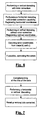
- the method comprises the steps of: i) performing a decoding along said first dimension; ii) performing a full capacity decoding along said second dimension for removing possible false corrections introduced by said decoding performed along said first dimension; iii) performing a reduced-capacity decoding along said first dimension, for identifying errored codewords along said first dimension; iv) performing a full capacity decoding along said second dimension with disabled correction feature for identifying errored codewords along said second dimension; v) detecting the error coordinates of the pattern of errors by combining information from steps iii) and iv); and vi) correcting the detected pattern of errors.
- the step of performing a reduced-capacity decoding along said first dimension is performed at a reduced capacity so that the probability of false corrections is very low.
- said first dimension and said second dimension are the horizontal and the vertical dimensions, respectively.
- the full capacity of the decoding method is three in both the first and second dimensions.
- the step of performing a reduced-capacity decoding along the first dimension comprises the step of performing a decoding at a correction capacity limited to two errors.
- BER_floor with 8, 12 and 15 errors, it is impossible, being the minimum distance for horizontal coding generally equal to 8, to re-introduce any of the false corrections removed by the previous vertical decoding.
- the method is performed by an application-specific integrated circuit, ASIC.
- ASIC application-specific integrated circuit
- the present invention provides an erasure FEC decoder according to claim 7.
- the decoder comprises: first decoding means for performing a full capacity decoding along said second dimension for removing possible false corrections introduced by a previous decoding performed along said first dimension; second decoding means for performing a reduced-capacity decoding along said first dimension, for identifying errored codewords along said first dimension; said first decoding means performing also a full capacity decoding along said second dimension with disabled correction feature for identifying errored codewords along said second dimension; position error detection means for detecting the error coordinates of the pattern of errors by combining information from the first and second decoding means; and correction means for correcting the detected pattern of errors.
- said first dimension and said second dimension are the horizontal and the vertical dimensions, respectively.
- the full capacity of the erasure FEC decoder is three in both the first and second dimensions.
- the second decoding means for performing a reduced-capacity decoding also performs a decoding at a correction capacity limited to two errors.
- BER_floor with 8, 12 and 15 errors, it is impossible, being the minimum distance for horizontal coding generally equal to 8, to re-introduce any of the false corrections removed by the previous vertical decoding.
- the correction means complement all the bits of the pattern and then perform a decoding along at least one between said first and second dimensions.
- the decoding is performed along the first dimension with a full correction capacity.
- the erasure FEC decoder is embodied in an application-specific integrated circuit, ASIC.
- the present invention further provides a telecommunication apparatus, typically a network element, comprising a decoder as set above.
- the present invention further provides a computer program comprising computer program means adapted to perform the method as set above when said program is run on a computer.
- the present invention provides a computer readable medium having a program recorded thereon, said computer readable medium comprising computer program code means adapted to perform the method as set forth above when said program is run on a computer.
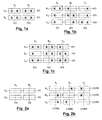
- Each error has been represented by an "X" within a rectangular box representing a pair of bits.
- Each codeword has been indicated by a dotted line and a capital letter provided with a subscript: subscript “H” stands for horizontal and subscript “V” stands for vertical.
- subscript "H” stands for horizontal
- subscript "V” stands for vertical.
- Av represents the vertical codeword A
- C H represents the horizontal codeword C.
- Figure 1a shows, in a diagrammatic form, a possible pattern of errors which is not presently correctable by known methods and decoders having a correction capacity of three (for each codeword of the frame, the highest number of errors that could be corrected is 3).
- Four errors are present both along the horizontal codewords A H , B H and along the vertical codewords Av, Bv.
- the presently available two-dimensional codes could not correct the pattern and issue "KO" indications along all the dimensions.
- a standard decoder declares that the pattern of errors can not be corrected or calls an erasure method.
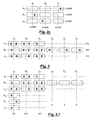
- Figure 3 shows a case in which a false correction has been made by the decoder. Specifically, a horizontal decoding has revealed that codeword A H can not be corrected ("KO” is issued) because the number of errors is five (higher than the correction capability, 3, of the code); the same for C H . On the contrary, codeword B H has been wrongly corrected ("OK” is issued) and false corrections (indicated by "H") have been introduced.
- the FEC erasure method according to the present invention can be divided into an errored cell detection step and into a correction step.
- the detection step comprises the steps of .
- sub-step a a vertical decoding is performed so that false errors "H” are eliminated.
- the syndromes become 0.
- the horizontal decoding may result in vertical false errors "V”.
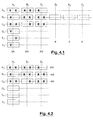
- sub-step b) a further horizontal decoding is carried out but the decoder is set in such a way that the capacity of horizontal correction is limited (in case the full capacity is 3, the decoder could be limited to 2, for instance). In this way, the false errors "V” are eliminated but no further horizontal errors are introduced (see Figure 4.2 ).
- This procedure results in information about the horizontal coordinates of the errored bits.
- the decoder realizes that in codewords A H , B H and C H the number of errors is higher than the highest correction capability of the code (in the case in question, 3).
- step c diagrammatically shown in Figure 4.3 , the correction capability is disabled but a vertical decoding is carried out.
- This step has the only purpose to provide the decoder with information about vertical coordinates of errors. This information is derived by the "KO" issued after vertical decoding.
- the errors of more complex patterns could be detected.
- the coordinates of the errors in the pattern of Figure 5 could be detectable.
- a correction step could be carried out.
- the correction to be performed depends on the code. For instance, for a BCH code, each bit of the pattern is complemented (see Figure 4.4 ). In this way, the wrong bits become corrected and the corrected bits become wrong but the number of errored bits becomes compatible with the capacity of correction of the code. With further reference to Figure 4.4 , one single error (either in the horizontal or vertical codewords) will remain after the complementing step and these errors are easily correctable (CORR) by a horizontal or vertical decoding.
- CORR easily correctable
- Figures 2a and 2b show the error patterns after the bit complementing step. In the case of Figure 2a , all the errors have been removed. In Figure 2b , only two errors are in both vertical and horizontal codewords. These errors could be easily corrected (CORR) by applying a simple vertical or horizontal decoding.
- the method according to the present invention is implemented in connection with the method and decoder of the above mentioned parallel European patent application having title "improved iterative n-dimensional decoding”.
Landscapes
- Physics & Mathematics (AREA)
- Probability & Statistics with Applications (AREA)
- Engineering & Computer Science (AREA)
- Theoretical Computer Science (AREA)
- Error Detection And Correction (AREA)
- Detection And Correction Of Errors (AREA)
Claims (14)
- Ein Verfahren zum Korrigieren eines Fehlermusters in einem zweidimensionalen Code anhand einer zweidimensionalen Decodierung,i) wobei das besagte Fehlermuster ein erstes Codewort in einer ersten Dimension mit einer ersten Anzahl von Fehlern und ein zweites Codewort in einer zweiten Dimension mit einer zweiten Anzahl von Fehlern umfasst; undii) wobei sowohl die besagte erste Anzahl von Fehlern als auch die besagte zweite Anzahl von Fehlern höher ist als eine Fehlerkorrekturleistung der Codewörter, welche den zweidimensionalen Code bilden;wobei das Verfahren die folgenden Schritte umfasst:iii) Durchführen einer Decodierung entlang der besagten ersten Dimension; undiv) Durchführen einer Decodierung bei voller Leistung entlang der besagten zweiten Dimension, um eventuelle durch die besagte Decodierung entlang der besagten ersten Dimension eingeschleuste falsche Korrekturen zu entfernen,und durch die folgenden Schritte gekennzeichnet ist:v) Durchführen einer Decodierung bei reduzierter Leistung entlang der besagten ersten Dimension zum Identifizieren von fehlerbehafteten Codewörtern entlang der besagten ersten Dimension, um ein erneutes Einschleusen von Fehlern zu vermeiden;vi) Durchführen einer Decodierung bei voller Leistung entlang der besagten zweiten Dimension mit deaktivierter Korrekturfunktion zum Identifizieren von fehlerbehafteten Codewörtern entlang der besagten zweiten Dimension;vii) Erkennen der Fehlerkoordinaten des Fehlermusters durch Kombinieren der Informationen aus den Schritten v) und vi); undviii) Korrigieren des erkannten Fehlermusters.
- Das Verfahren nach Anspruch 1, dadurch gekennzeichnet, dass die besagte erste Dimension eine horizontale Dimension und die besagte zweite Dimension eine vertikale Dimension ist.
- Das Verfahren nach Anspruch 1 oder 2, dadurch gekennzeichnet, dass die besagte Fehlerkorrekturleistung in der besagten ersten Dimension drei beträgt und in der besagten zweiten Dimension drei beträgt.
- Das Verfahren nach einem beliebigen der vorstehenden Ansprüche, dadurch gekennzeichnet, dass der Schritt des Durchführens einer Decodierung bei reduzierter Leistung entlang der besagten ersten Dimension den Schritt des Durchführens einer Decodierung bei einer auf zwei Fehler beschränkte Fehlerkorrekturleistung umfasst.
- Das Verfahren nach einem beliebigen der vorstehenden Ansprüche, dadurch gekennzeichnet, dass Schritt viii) die folgenden Schritte umfasst:ix) Ergänzen aller Bits des Musters; und anschließendx) Durchführen einer Decodierung entlang zumindest entweder der besagten ersten Dimension oder der besagten zweiten Dimension, um eventuelle restliche Fehler zu korrigieren.
- Das Verfahren nach Anspruch 5, dadurch gekennzeichnet, dass Schritt x) darin besteht, eine Decodierung bei voller Leistung entlang der besagten ersten Dimension durchzuführen.
- Ein FEC-Löschungscodierer zum Korrigieren eines Fehlermusters in einem zweidimensionalen Code anhand einer zweidimensionalen Decodierung,i) wobei das besagte Fehlermuster ein erstes Codewort in einer ersten Dimension mit einer ersten Anzahl von Fehlern und ein zweites Codewort in einer zweiten Dimension mit einer zweiten Anzahl von Fehlern umfasst; undii) wobei sowohl die besagte erste Anzahl von Fehlern als auch die besagte zweite Anzahl von Fehlern höher ist als eine Fehlerkorrekturleistung der Codewörter, welche den zweidimensionalen Code bilden;wobei der FEC-Löschungscodierer umfasst:iv) Erste Decodiermittel zum Durchführen einer Decodierung bei voller Leistung entlang der besagten zweiten Dimension, um eventuelle von einer zuvor entlang der besagten ersten Dimension durchgeführten Decodierung eingeschleuste falsche Korrekturen zu entfernen,wobei der FEC-Löschungscodierer gekennzeichnet ist durch:v) Zweite Decodiermittel zum Durchführen einer Decodierung bei reduzierter Leistung entlang der besagten ersten Dimension, um ein erneutes Einschleusen von Fehlern zu vermeiden zum Identifizieren von fehlerbehafteten Codewörtern entlang der besagten ersten Dimension;vi) wobei die besagten ersten Decodiermittel ebenfalls eine Decodierung bei voller Leistung entlang der besagten zweiten Dimension mit deaktivierter Korrekturfunktion zum Identifizieren von fehlerbehafteten Codewörtern entlang der besagten zweiten Dimension durchführen;vii) Positionsfehlererkennungsmittel zum Erkennen der Fehlerkoordinaten des Fehlermusters durch Kombinieren der Informationen aus den ersten und zweiten Decodiermitteln, welche jeweils durch die besagte Decodierung bei voller Leistung mit deaktivierter Korrekturfunktion und die besagte Decodierung bei reduzierter Leistung erhalten werden; undviii) Korrekturmittel zum Korrigieren des erkannten Fehlermusters.
- Der Decoder nach Anspruch 7, dadurch gekennzeichnet, dass die besagte erste Dimension eine horizontale Dimension ist und die besagte zweite Dimension eine vertikale Dimension ist.
- Der Decoder nach einem beliebigen der Ansprüche 7 - 8, dadurch gekennzeichnet, dass die besagte Fehlerkorrekturleistung des Decoders in der besagten ersten Dimension drei beträgt und in der besagten zweiten Dimension drei beträgt.
- Der Decoder nach einem beliebigen der Ansprüche 7 - 9, dadurch gekennzeichnet, dass das zweite Decodiermittel zum Durchführen einer Decodierung bei reduzierter Leistung ebenfalls eine Decodierung bei einer auf zwei Fehler beschränkten Fehlerkorrekturleistung durchführt.
- Der Decoder nach einem beliebigen der Ansprüche 7 - 10, dadurch gekennzeichnet, dass die Korrekturmittel alle Bits der Muster ergänzen und anschließend ein Decodieren entlang zumindest entweder der besagten ersten Dimension oder der besagten zweiten Dimension durchführen.
- Eine Telekommunikationsvorrichtung mit einem Decoder gemäß einem beliebigen der Ansprüche 7 - 11.
- Ein Computerprogramm mit Computerprogramm-Mitteln, welche für das Durchführen des Verfahrens nach einem beliebigen der Ansprüche 1 - 6 ausgelegt sind, wenn das besagte Programm auf einem Computer läuft.
- Ein computerlesbares Medium, auf welchem ein Programm gespeichert ist, wobei das besagte computerlesbare Medium Computerprogrammcode-Mittel umfasst, welche für das Durchführen des Verfahrens nach einem beliebigen der Ansprüche 1 - 6 ausgelegt sind, wenn das besagte Programm auf einem Computer läuft.
Priority Applications (5)
| Application Number | Priority Date | Filing Date | Title |
|---|---|---|---|
| EP04290408A EP1564892B1 (de) | 2004-02-13 | 2004-02-13 | Iterative Dekodierung zweidimensionaler Blockkodes |
| AT04290408T ATE490603T1 (de) | 2004-02-13 | 2004-02-13 | Iterative dekodierung zweidimensionaler blockkodes |
| DE602004030313T DE602004030313D1 (de) | 2004-02-13 | 2004-02-13 | Iterative Dekodierung zweidimensionaler Blockkodes |
| CN2004100866710A CN1655461B (zh) | 2004-02-13 | 2004-12-10 | 消除fec解码器和方法 |
| US11/012,302 US7346826B2 (en) | 2004-02-13 | 2004-12-16 | Erasure FEC decoder and method |
Applications Claiming Priority (1)
| Application Number | Priority Date | Filing Date | Title |
|---|---|---|---|
| EP04290408A EP1564892B1 (de) | 2004-02-13 | 2004-02-13 | Iterative Dekodierung zweidimensionaler Blockkodes |
Publications (2)
| Publication Number | Publication Date |
|---|---|
| EP1564892A1 EP1564892A1 (de) | 2005-08-17 |
| EP1564892B1 true EP1564892B1 (de) | 2010-12-01 |
Family
ID=34684787
Family Applications (1)
| Application Number | Title | Priority Date | Filing Date |
|---|---|---|---|
| EP04290408A Expired - Lifetime EP1564892B1 (de) | 2004-02-13 | 2004-02-13 | Iterative Dekodierung zweidimensionaler Blockkodes |
Country Status (5)
| Country | Link |
|---|---|
| US (1) | US7346826B2 (de) |
| EP (1) | EP1564892B1 (de) |
| CN (1) | CN1655461B (de) |
| AT (1) | ATE490603T1 (de) |
| DE (1) | DE602004030313D1 (de) |
Families Citing this family (5)
| Publication number | Priority date | Publication date | Assignee | Title |
|---|---|---|---|---|
| DE102006045311A1 (de) * | 2006-09-26 | 2008-03-27 | Nokia Siemens Networks Gmbh & Co.Kg | Verfahren und Vorrichtung zum Rekonstruieren zumindest eines Datenpaketes |
| JP2010537508A (ja) * | 2007-08-15 | 2010-12-02 | マックス リニアー、インコーポレイテッド | ブロックインタリーブされた符号化信号のデインタリーブ消失情報を保存する方法および装置 |
| WO2012092902A2 (zh) | 2012-02-14 | 2012-07-12 | 华为技术有限公司 | 一种译码方法和译码装置 |
| US11734107B2 (en) * | 2019-03-15 | 2023-08-22 | Kioxia Corporation | Decoding scheme for error correction code structure |
| RU2711035C1 (ru) * | 2019-05-08 | 2020-01-14 | федеральное государственное автономное образовательное учреждение высшего образования "Северо-Кавказский федеральный университет" | Модифицированное устройство коррекции ошибок с учетом сигнала стирания |
Family Cites Families (4)
| Publication number | Priority date | Publication date | Assignee | Title |
|---|---|---|---|---|
| US4653051A (en) * | 1983-09-14 | 1987-03-24 | Matsushita Electric Industrial Co., Ltd. | Apparatus for detecting and correcting errors on product codes |
| JP3154607B2 (ja) * | 1993-12-28 | 2001-04-09 | 三菱電機株式会社 | 誤り訂正復号装置及び誤り訂正復号方法 |
| IL122393A0 (en) * | 1997-12-01 | 1998-06-15 | Ttr Technologies Ltd | A code word for use in digital optical media and a method of generation thereof |
| US6738942B1 (en) * | 2000-06-02 | 2004-05-18 | Vitesse Semiconductor Corporation | Product code based forward error correction system |
-
2004
- 2004-02-13 EP EP04290408A patent/EP1564892B1/de not_active Expired - Lifetime
- 2004-02-13 AT AT04290408T patent/ATE490603T1/de not_active IP Right Cessation
- 2004-02-13 DE DE602004030313T patent/DE602004030313D1/de not_active Expired - Lifetime
- 2004-12-10 CN CN2004100866710A patent/CN1655461B/zh not_active Expired - Fee Related
- 2004-12-16 US US11/012,302 patent/US7346826B2/en not_active Expired - Lifetime
Also Published As
| Publication number | Publication date |
|---|---|
| US20050204254A1 (en) | 2005-09-15 |
| DE602004030313D1 (de) | 2011-01-13 |
| ATE490603T1 (de) | 2010-12-15 |
| CN1655461A (zh) | 2005-08-17 |
| US7346826B2 (en) | 2008-03-18 |
| EP1564892A1 (de) | 2005-08-17 |
| CN1655461B (zh) | 2010-06-23 |
Similar Documents
| Publication | Publication Date | Title |
|---|---|---|
| CN100438346C (zh) | 用于线性分组码的擦除和单错纠正的方法和设备 | |
| US8051363B1 (en) | Absorb decode algorithm for 10GBase-T LDPC decoder | |
| US7171591B2 (en) | Method and apparatus for encoding special uncorrectable errors in an error correction code | |
| US7243293B2 (en) | (18, 9) Error correction code for double error correction and triple error detection | |
| JPH10510689A (ja) | 特質データをメインデータのエラーチェック記号にエンコードおよびデコードするデジタル伝送システム | |
| US20100005364A1 (en) | Encoding method, encoding apparatus, decoding method, and decoding apparatus using block code | |
| US8566679B2 (en) | Error-correcting encoding method with total parity bits, and method for detecting multiple errors | |
| US9015565B2 (en) | Method for recovery of lost data and for correction of corrupted data | |
| JPH0661872A (ja) | 通信システム | |
| EP1564892B1 (de) | Iterative Dekodierung zweidimensionaler Blockkodes | |
| US20050257115A1 (en) | Decoding for algebraic geometric code associated with a fiber product | |
| US6138263A (en) | Error correcting method and apparatus for information data having error correcting product code block | |
| EP0650266B1 (de) | Gerät und Verfahren zur Dekodierung eines Fehlerkorrekturcodes | |
| US8812929B1 (en) | Detecting insertion/deletion using LDPC code | |
| JP5374156B2 (ja) | データを復号化及び符号化するための装置及び方法 | |
| US8572452B2 (en) | Block code decoding method and device thereof | |
| US7392453B2 (en) | Embedding auxiliary data in an information signal | |
| JP2606647B2 (ja) | 誤り訂正方法 | |
| US6199189B1 (en) | Method, system, apparatus, and phone for error control of golay encoded data signals | |
| JP2796291B2 (ja) | 誤り訂正方式 | |
| JP2532258B2 (ja) | 誤り検出方式 | |
| JP2001102938A (ja) | 受信信号の誤り検出方法、誤り訂正方法、及び誤り訂正装置 | |
| EP1146651A1 (de) | Fehlerdetektion für Datenspeicherung und Übertragung | |
| JPH036700B2 (de) | ||
| JP2000148522A (ja) | ユークリッド互除演算回路 |
Legal Events
| Date | Code | Title | Description |
|---|---|---|---|
| PUAI | Public reference made under article 153(3) epc to a published international application that has entered the european phase |
Free format text: ORIGINAL CODE: 0009012 |
|
| AK | Designated contracting states |
Kind code of ref document: A1 Designated state(s): AT BE BG CH CY CZ DE DK EE ES FI FR GB GR HU IE IT LI LU MC NL PT RO SE SI SK TR |
|
| AX | Request for extension of the european patent |
Extension state: AL LT LV MK |
|
| 17P | Request for examination filed |
Effective date: 20060126 |
|
| AKX | Designation fees paid |
Designated state(s): AT BE BG CH CY CZ DE DK EE ES FI FR GB GR HU IE IT LI LU MC NL PT RO SE SI SK TR |
|
| 17Q | First examination report despatched |
Effective date: 20060428 |
|
| RAP1 | Party data changed (applicant data changed or rights of an application transferred) |
Owner name: ALCATEL LUCENT |
|
| GRAJ | Information related to disapproval of communication of intention to grant by the applicant or resumption of examination proceedings by the epo deleted |
Free format text: ORIGINAL CODE: EPIDOSDIGR1 |
|
| GRAP | Despatch of communication of intention to grant a patent |
Free format text: ORIGINAL CODE: EPIDOSNIGR1 |
|
| GRAJ | Information related to disapproval of communication of intention to grant by the applicant or resumption of examination proceedings by the epo deleted |
Free format text: ORIGINAL CODE: EPIDOSDIGR1 |
|
| GRAP | Despatch of communication of intention to grant a patent |
Free format text: ORIGINAL CODE: EPIDOSNIGR1 |
|
| GRAP | Despatch of communication of intention to grant a patent |
Free format text: ORIGINAL CODE: EPIDOSNIGR1 |
|
| GRAS | Grant fee paid |
Free format text: ORIGINAL CODE: EPIDOSNIGR3 |
|
| GRAA | (expected) grant |
Free format text: ORIGINAL CODE: 0009210 |
|
| AK | Designated contracting states |
Kind code of ref document: B1 Designated state(s): AT BE BG CH CY CZ DE DK EE ES FI FR GB GR HU IE IT LI LU MC NL PT RO SE SI SK TR |
|
| REG | Reference to a national code |
Ref country code: GB Ref legal event code: FG4D |
|
| REG | Reference to a national code |
Ref country code: CH Ref legal event code: EP |
|
| REG | Reference to a national code |
Ref country code: IE Ref legal event code: FG4D |
|
| REF | Corresponds to: |
Ref document number: 602004030313 Country of ref document: DE Date of ref document: 20110113 Kind code of ref document: P |
|
| REG | Reference to a national code |
Ref country code: NL Ref legal event code: VDEP Effective date: 20101201 |
|
| PG25 | Lapsed in a contracting state [announced via postgrant information from national office to epo] |
Ref country code: SI Free format text: LAPSE BECAUSE OF FAILURE TO SUBMIT A TRANSLATION OF THE DESCRIPTION OR TO PAY THE FEE WITHIN THE PRESCRIBED TIME-LIMIT Effective date: 20101201 Ref country code: SE Free format text: LAPSE BECAUSE OF FAILURE TO SUBMIT A TRANSLATION OF THE DESCRIPTION OR TO PAY THE FEE WITHIN THE PRESCRIBED TIME-LIMIT Effective date: 20101201 Ref country code: BG Free format text: LAPSE BECAUSE OF FAILURE TO SUBMIT A TRANSLATION OF THE DESCRIPTION OR TO PAY THE FEE WITHIN THE PRESCRIBED TIME-LIMIT Effective date: 20110301 Ref country code: NL Free format text: LAPSE BECAUSE OF FAILURE TO SUBMIT A TRANSLATION OF THE DESCRIPTION OR TO PAY THE FEE WITHIN THE PRESCRIBED TIME-LIMIT Effective date: 20101201 Ref country code: CY Free format text: LAPSE BECAUSE OF FAILURE TO SUBMIT A TRANSLATION OF THE DESCRIPTION OR TO PAY THE FEE WITHIN THE PRESCRIBED TIME-LIMIT Effective date: 20101201 Ref country code: AT Free format text: LAPSE BECAUSE OF FAILURE TO SUBMIT A TRANSLATION OF THE DESCRIPTION OR TO PAY THE FEE WITHIN THE PRESCRIBED TIME-LIMIT Effective date: 20101201 Ref country code: FI Free format text: LAPSE BECAUSE OF FAILURE TO SUBMIT A TRANSLATION OF THE DESCRIPTION OR TO PAY THE FEE WITHIN THE PRESCRIBED TIME-LIMIT Effective date: 20101201 |
|
| PG25 | Lapsed in a contracting state [announced via postgrant information from national office to epo] |
Ref country code: GR Free format text: LAPSE BECAUSE OF FAILURE TO SUBMIT A TRANSLATION OF THE DESCRIPTION OR TO PAY THE FEE WITHIN THE PRESCRIBED TIME-LIMIT Effective date: 20110302 |
|
| PG25 | Lapsed in a contracting state [announced via postgrant information from national office to epo] |
Ref country code: EE Free format text: LAPSE BECAUSE OF FAILURE TO SUBMIT A TRANSLATION OF THE DESCRIPTION OR TO PAY THE FEE WITHIN THE PRESCRIBED TIME-LIMIT Effective date: 20101201 Ref country code: PT Free format text: LAPSE BECAUSE OF FAILURE TO SUBMIT A TRANSLATION OF THE DESCRIPTION OR TO PAY THE FEE WITHIN THE PRESCRIBED TIME-LIMIT Effective date: 20110401 Ref country code: ES Free format text: LAPSE BECAUSE OF FAILURE TO SUBMIT A TRANSLATION OF THE DESCRIPTION OR TO PAY THE FEE WITHIN THE PRESCRIBED TIME-LIMIT Effective date: 20110312 Ref country code: BE Free format text: LAPSE BECAUSE OF FAILURE TO SUBMIT A TRANSLATION OF THE DESCRIPTION OR TO PAY THE FEE WITHIN THE PRESCRIBED TIME-LIMIT Effective date: 20101201 Ref country code: CZ Free format text: LAPSE BECAUSE OF FAILURE TO SUBMIT A TRANSLATION OF THE DESCRIPTION OR TO PAY THE FEE WITHIN THE PRESCRIBED TIME-LIMIT Effective date: 20101201 |
|
| PG25 | Lapsed in a contracting state [announced via postgrant information from national office to epo] |
Ref country code: SK Free format text: LAPSE BECAUSE OF FAILURE TO SUBMIT A TRANSLATION OF THE DESCRIPTION OR TO PAY THE FEE WITHIN THE PRESCRIBED TIME-LIMIT Effective date: 20101201 Ref country code: RO Free format text: LAPSE BECAUSE OF FAILURE TO SUBMIT A TRANSLATION OF THE DESCRIPTION OR TO PAY THE FEE WITHIN THE PRESCRIBED TIME-LIMIT Effective date: 20101201 |
|
| PG25 | Lapsed in a contracting state [announced via postgrant information from national office to epo] |
Ref country code: MC Free format text: LAPSE BECAUSE OF NON-PAYMENT OF DUE FEES Effective date: 20110228 |
|
| REG | Reference to a national code |
Ref country code: CH Ref legal event code: PL |
|
| PLBE | No opposition filed within time limit |
Free format text: ORIGINAL CODE: 0009261 |
|
| STAA | Information on the status of an ep patent application or granted ep patent |
Free format text: STATUS: NO OPPOSITION FILED WITHIN TIME LIMIT |
|
| PG25 | Lapsed in a contracting state [announced via postgrant information from national office to epo] |
Ref country code: DK Free format text: LAPSE BECAUSE OF FAILURE TO SUBMIT A TRANSLATION OF THE DESCRIPTION OR TO PAY THE FEE WITHIN THE PRESCRIBED TIME-LIMIT Effective date: 20101201 Ref country code: LI Free format text: LAPSE BECAUSE OF NON-PAYMENT OF DUE FEES Effective date: 20110228 Ref country code: CH Free format text: LAPSE BECAUSE OF NON-PAYMENT OF DUE FEES Effective date: 20110228 |
|
| 26N | No opposition filed |
Effective date: 20110902 |
|
| REG | Reference to a national code |
Ref country code: IE Ref legal event code: MM4A |
|
| REG | Reference to a national code |
Ref country code: DE Ref legal event code: R097 Ref document number: 602004030313 Country of ref document: DE Effective date: 20110902 |
|
| PG25 | Lapsed in a contracting state [announced via postgrant information from national office to epo] |
Ref country code: IT Free format text: LAPSE BECAUSE OF FAILURE TO SUBMIT A TRANSLATION OF THE DESCRIPTION OR TO PAY THE FEE WITHIN THE PRESCRIBED TIME-LIMIT Effective date: 20101201 |
|
| PG25 | Lapsed in a contracting state [announced via postgrant information from national office to epo] |
Ref country code: IE Free format text: LAPSE BECAUSE OF NON-PAYMENT OF DUE FEES Effective date: 20110213 |
|
| PG25 | Lapsed in a contracting state [announced via postgrant information from national office to epo] |
Ref country code: LU Free format text: LAPSE BECAUSE OF NON-PAYMENT OF DUE FEES Effective date: 20110213 |
|
| PG25 | Lapsed in a contracting state [announced via postgrant information from national office to epo] |
Ref country code: TR Free format text: LAPSE BECAUSE OF FAILURE TO SUBMIT A TRANSLATION OF THE DESCRIPTION OR TO PAY THE FEE WITHIN THE PRESCRIBED TIME-LIMIT Effective date: 20101201 |
|
| PG25 | Lapsed in a contracting state [announced via postgrant information from national office to epo] |
Ref country code: HU Free format text: LAPSE BECAUSE OF FAILURE TO SUBMIT A TRANSLATION OF THE DESCRIPTION OR TO PAY THE FEE WITHIN THE PRESCRIBED TIME-LIMIT Effective date: 20101201 |
|
| REG | Reference to a national code |
Ref country code: FR Ref legal event code: GC Effective date: 20131018 |
|
| REG | Reference to a national code |
Ref country code: FR Ref legal event code: GC Effective date: 20131120 |
|
| REG | Reference to a national code |
Ref country code: FR Ref legal event code: RG Effective date: 20141016 |
|
| REG | Reference to a national code |
Ref country code: FR Ref legal event code: PLFP Year of fee payment: 12 |
|
| REG | Reference to a national code |
Ref country code: FR Ref legal event code: CA Effective date: 20150521 |
|
| REG | Reference to a national code |
Ref country code: FR Ref legal event code: CA Effective date: 20150521 |
|
| REG | Reference to a national code |
Ref country code: FR Ref legal event code: PLFP Year of fee payment: 13 |
|
| REG | Reference to a national code |
Ref country code: FR Ref legal event code: PLFP Year of fee payment: 14 |
|
| PGFP | Annual fee paid to national office [announced via postgrant information from national office to epo] |
Ref country code: FR Payment date: 20170217 Year of fee payment: 14 Ref country code: DE Payment date: 20170217 Year of fee payment: 14 |
|
| PGFP | Annual fee paid to national office [announced via postgrant information from national office to epo] |
Ref country code: GB Payment date: 20170216 Year of fee payment: 14 |
|
| REG | Reference to a national code |
Ref country code: DE Ref legal event code: R119 Ref document number: 602004030313 Country of ref document: DE |
|
| GBPC | Gb: european patent ceased through non-payment of renewal fee |
Effective date: 20180213 |
|
| REG | Reference to a national code |
Ref country code: FR Ref legal event code: ST Effective date: 20181031 |
|
| PG25 | Lapsed in a contracting state [announced via postgrant information from national office to epo] |
Ref country code: DE Free format text: LAPSE BECAUSE OF NON-PAYMENT OF DUE FEES Effective date: 20180901 |
|
| PG25 | Lapsed in a contracting state [announced via postgrant information from national office to epo] |
Ref country code: FR Free format text: LAPSE BECAUSE OF NON-PAYMENT OF DUE FEES Effective date: 20180228 Ref country code: GB Free format text: LAPSE BECAUSE OF NON-PAYMENT OF DUE FEES Effective date: 20180213 |
|
| REG | Reference to a national code |
Ref country code: DE Ref legal event code: R082 Ref document number: 602004030313 Country of ref document: DE Representative=s name: BARKHOFF REIMANN VOSSIUS, DE Ref country code: DE Ref legal event code: R081 Ref document number: 602004030313 Country of ref document: DE Owner name: WSOU INVESTMENTS, LLC, LOS ANGELES, US Free format text: FORMER OWNER: ALCATEL LUCENT, PARIS, FR |