EP1561834A1 - Duplex stainless steel and method for production thereof - Google Patents
Duplex stainless steel and method for production thereof Download PDFInfo
- Publication number
- EP1561834A1 EP1561834A1 EP04748203A EP04748203A EP1561834A1 EP 1561834 A1 EP1561834 A1 EP 1561834A1 EP 04748203 A EP04748203 A EP 04748203A EP 04748203 A EP04748203 A EP 04748203A EP 1561834 A1 EP1561834 A1 EP 1561834A1
- Authority
- EP
- European Patent Office
- Prior art keywords
- less
- stainless steel
- mass
- oxide
- duplex stainless
- Prior art date
- Legal status (The legal status is an assumption and is not a legal conclusion. Google has not performed a legal analysis and makes no representation as to the accuracy of the status listed.)
- Granted
Links
Images

Classifications
-
- C—CHEMISTRY; METALLURGY
- C21—METALLURGY OF IRON
- C21C—PROCESSING OF PIG-IRON, e.g. REFINING, MANUFACTURE OF WROUGHT-IRON OR STEEL; TREATMENT IN MOLTEN STATE OF FERROUS ALLOYS
- C21C7/00—Treating molten ferrous alloys, e.g. steel, not covered by groups C21C1/00 - C21C5/00
- C21C7/04—Removing impurities by adding a treating agent
- C21C7/064—Dephosphorising; Desulfurising
-
- C—CHEMISTRY; METALLURGY
- C22—METALLURGY; FERROUS OR NON-FERROUS ALLOYS; TREATMENT OF ALLOYS OR NON-FERROUS METALS
- C22C—ALLOYS
- C22C38/00—Ferrous alloys, e.g. steel alloys
- C22C38/18—Ferrous alloys, e.g. steel alloys containing chromium
- C22C38/40—Ferrous alloys, e.g. steel alloys containing chromium with nickel
- C22C38/44—Ferrous alloys, e.g. steel alloys containing chromium with nickel with molybdenum or tungsten
-
- C—CHEMISTRY; METALLURGY
- C21—METALLURGY OF IRON
- C21C—PROCESSING OF PIG-IRON, e.g. REFINING, MANUFACTURE OF WROUGHT-IRON OR STEEL; TREATMENT IN MOLTEN STATE OF FERROUS ALLOYS
- C21C7/00—Treating molten ferrous alloys, e.g. steel, not covered by groups C21C1/00 - C21C5/00
- C21C7/0087—Treatment of slags covering the steel bath, e.g. for separating slag from the molten metal
-
- C—CHEMISTRY; METALLURGY
- C21—METALLURGY OF IRON
- C21C—PROCESSING OF PIG-IRON, e.g. REFINING, MANUFACTURE OF WROUGHT-IRON OR STEEL; TREATMENT IN MOLTEN STATE OF FERROUS ALLOYS
- C21C7/00—Treating molten ferrous alloys, e.g. steel, not covered by groups C21C1/00 - C21C5/00
- C21C7/04—Removing impurities by adding a treating agent
- C21C7/06—Deoxidising, e.g. killing
-
- C—CHEMISTRY; METALLURGY
- C22—METALLURGY; FERROUS OR NON-FERROUS ALLOYS; TREATMENT OF ALLOYS OR NON-FERROUS METALS
- C22C—ALLOYS
- C22C38/00—Ferrous alloys, e.g. steel alloys
- C22C38/001—Ferrous alloys, e.g. steel alloys containing N
-
- C—CHEMISTRY; METALLURGY
- C22—METALLURGY; FERROUS OR NON-FERROUS ALLOYS; TREATMENT OF ALLOYS OR NON-FERROUS METALS
- C22C—ALLOYS
- C22C38/00—Ferrous alloys, e.g. steel alloys
- C22C38/02—Ferrous alloys, e.g. steel alloys containing silicon
-
- C—CHEMISTRY; METALLURGY
- C22—METALLURGY; FERROUS OR NON-FERROUS ALLOYS; TREATMENT OF ALLOYS OR NON-FERROUS METALS
- C22C—ALLOYS
- C22C38/00—Ferrous alloys, e.g. steel alloys
- C22C38/04—Ferrous alloys, e.g. steel alloys containing manganese
-
- C—CHEMISTRY; METALLURGY
- C22—METALLURGY; FERROUS OR NON-FERROUS ALLOYS; TREATMENT OF ALLOYS OR NON-FERROUS METALS
- C22C—ALLOYS
- C22C38/00—Ferrous alloys, e.g. steel alloys
- C22C38/18—Ferrous alloys, e.g. steel alloys containing chromium
- C22C38/40—Ferrous alloys, e.g. steel alloys containing chromium with nickel
- C22C38/42—Ferrous alloys, e.g. steel alloys containing chromium with nickel with copper
Definitions
- the present invention relates to duplex stainless steel which is excellent in corrosion resistance in seawater.
- This steel is used for steel pipes, steel plates or the like, such as piping for heat exchange, piping or structures for a chemical plant, line pipes, oil well or gas well casing or tubing, and umbilical tubes (control piping for a submarine oil field).
- Patent Document 1 A so-called super duplex stainless steel which is enhanced in pitting resistance because it contains W in addition to the adjustment of the contents of Cr, Mo and N (nitrogen), which are generally effective for improving the pitting resistance of duplex stainless steel, is disclosed in Patent Document 1. It suggests that an index, showing the pitting resistance of duplex stainless steel, PREW of the following equation (B) containing W, in addition to PRE (pitting resistance equivalent) of the following equation (A).
- the pitting resistance index PRE or PREW is adjusted to not less than 35 in the general duplex stainless steel and to not less than 40 in the super duplex stainless steel. Conventional techniques for improving the pitting resistance were performed based on how much the pitting resistance index PRE or PREW can be increased.
- PRE Cr+3.3Mo+16N (nitrogen)
- PREW Cr+3.3(Mo+0.5W)+16N (nitrogen)
- each chemical symbol shows the content of each element (% by mass).
- Non-Patent Document 1 The influence on the pitting resistance of non-metallic inclusions has not been examined in the duplex stainless steel. However, with respect to the pitting resistance of austenitic stainless steel, it is known that Mn sulfides are most harmful to the pitting resistance, and oxides thereof are harmless as described in Non-Patent Document 1.
- Oxide-based inclusions contained in stainless steels are generally composite oxides composed of oxides such as Al oxide (Al 2 O 3 ), Si oxide (SiO 2 ), Cr oxide (Cr 2 O 3 ). These oxides were assumed to have no influence on pitting because they hardly dissolve in aqueous solutions or so-called insolubility. On the other hand, although Ca and Mg, and further S which are impurity elements in steel product, might be contained in the oxides, the influence of these elements on the pitting resistance have been never examined.
- Patent Document 1 Japanese Patent Laid-Open No. H05-132741
- Non-Patent Document 1 J. E. Castle et al., "Studies by Auger Spectroscopy of Pit Initiation at the site of Inclusions in Stainless Steel", Corrosion Science, Volume 30, No. 4/5, p. 409
- the present invention solves these problems, and it's objective is to provide a duplex stainless steel capable of stably obtaining satisfactory pitting resistance, and a method for producing the same.
- the present inventors found that, in addition to the above-mentioned conventional factor contributing to pitting, even the oxide-based inclusions generated in the steel-making process can significantly affect the pitting resistance, if they contain Ca and Mg, and also if they contain S.
- the knowledge obtained by the studies by the present inventors is as follows.
- Oxide-based inclusions formed in steel with a Ca-content of less than 0.0005 % by mass or a Mg-content of less than 0.0001 % by mass are mainly composed of insoluble Al 2 O 3 , and never cause pitting.
- Oxide-based inclusions formed with a Ca or Mg content exceeding 0.005 % by mass are mainly composed of (Ca,Mg)O, and pitting hardly commences in such oxides.
- oxide-based inclusions formed in steel with a Ca-content of 0.0005 to 0.005 % by mass and a Mg-content of 0.0001 to 0.005 % by mass produce a state where Al 2 O 3 and (Ca,Mg)O are coexistent, and when these oxide-based inclusions are formed adjacently, pitting is apt to commence in such oxides.
- S is an element inevitably present in steel, and it is impossible to entirely remove the content in present steel-making techniques. Although S deteriorates the pitting resistance when contained in the oxide-based inclusions formed in steel in large quantities, it was made clear by the studies by the present inventors that the pitting can be suppressed, even in such oxide-based inclusions, by adjusting the size and number thereof.
- Duplex stainless steel, of a desired oxide-based inclusion state cannot be produced by steel-making or thermal treatment using conventional methods.
- the present inventors found that ( ⁇ ) the slag basicity in reduction, ( ⁇ ) the killing temperature and time in ladle, and ( ⁇ ) the total working ratio after casting are controlled to an optimum combination, whereby a desired oxide-based inclusion state can be obtained, enabling production of unconventional high clean steel.
- the present invention has been completed based on the chemical composition of a steel product which is capable of ensuring the performances of a duplex stainless steel; an oxide-based inclusion state capable of significantly improving the pitting resistance, and a production process for attaining increased cleanness.
- the present invention involves duplex stainless steels shown in the following descriptions (a) and (b), and a method for producing duplex stainless steel shown in the following description (c).
- duplex stainless steel having good pitting resistance can be stably obtained. Therefore, duplex stainless steel most suitable for steel pipes, steel plates or the like, such as piping for heat exchange, piping or structures for chemical plant, line pipes, oil well or gas well casing or tubing, or umbilical tubes (control piping for submarine oil field) can be provided.
- % for content means “% by mass”.
- C is inevitably present in steel.
- carbides are apt to precipitate, resulting in deterioration of pitting resistance. Accordingly, the content of C is set to not more than 0.03%.
- Si is an element effective for deoxidation of steel, and a content of not less than 0.01% is therefor required. However, a content exceeding 2% promotes generation of intermetallic compounds, resulting in deterioration of pitting resistance. Accordingly, the content of Si is set to 0.01 to 2%.
- Mn is effective for stabilization of austenitic phases similar to Ni, and a content of not less than 0.1% is therefor required. On the other hand, a content exceeding 2% leads to deterioration of pitting resistance. Accordingly, the content of Mn is set to 0.1 to 2%.
- P is inevitably present in steel as impurities, and actively dissolves to deteriorate the pitting resistance. Since a content exceeding 0.05% makes this effect remarkable, the content must be set to not more than 0.05%.
- the content of P is desirably as low as possible.
- S is inevitably present in steel similar to P, and deteriorates the pitting resistance by forming sulfides which are easily dissolved.
- a content exceeding 0.001% makes this effect remarkable. Since even a content of not more than 0.001% can assist pitting when contained in oxide-based inclusions, as described later, the content of S is desirably as low as possible within this range.
- Al is an element necessary for deoxidation of steel, and a content of not less than 0.003% is therefor required. On the other hand, an excessive content causes deterioration the pitting resistance because of precipitation of Al nitrides, which absorb N (nitrogen) which is an element effective for improving the pitting resistance. Accordingly the content of Al is set to 0.003 to 0.05%.
- Al means "sol. Al (acid-soluble Al)".
- Ni is an element that stabilizes austenitic phases, and its effect is insufficient within a content of less than 4%.
- a content exceeding 12% causes excessive austenitic phases, resulting in a loss of mechanical properties in duplex stainless steel. Accordingly, the content is set to 4 to 12%.
- Cr is effective for improving the pitting resistance, and a content of less than 18% results in making the pitting resistance insufficient. On the other hand, a content exceeding 32% causes excessive ferritic phases, resulting in a loss of mechanical properties in duplex stainless steel. Accordingly, the content of Cr is set to 18 to 32%.
- Mo is also an element, which can enhance the pitting resistance similarly to Cr, and the effect is not sufficient with a content of less than 0.2%.
- a content exceeding 5% causes precipitation of intermetallic compounds, inversely resulting in deterioration of the pitting resistance. Accordingly, the content of Mo is set to 0.2 to 5%.
- N is an element which effects the stabilizing austenitic phases similar to Ni.
- N (nitrogen) also has the effect of enhancing the pitting resistance similarly to Cr and Mo. However, these effects are insufficient with a content of less than 0.05%. On the other hand, a content exceeding 0.4% causes deterioration of hot workability. Accordingly, the content of N (nitrogen) is set to 0.05 to 0.4%.
- O (Oxygen) is inevitably present in steel similar to S; it is present in an oxide-based inclusion state. These oxides deteriorate the pitting resistance depending on their compositions, because these oxides are the origin of pitting. Particularly when the content exceeds 0.01%, coarse oxides increase which makes this tendency remarkable. Accordingly, O (oxygen) must be limited to not more than 0.01%. The content of O (oxygen) is desirably as low as possible.
- Ca and Mg are elements having the effect of improving hot workability of steel by controlling S as sulfides.
- the pitting resistance is adversely affected. Accordingly, the contents of Ca and Mg are limited to ranges of 0.0005 to 0.005% and 0.0001 to 0.005%, respectively, where the pitting resistance is apt to deteriorate.
- the pitting resistance of the duplex stainless steel of the present invention can be improved by limiting the oxide-based inclusion state as described later.
- the duplex stainless steel of the present invention has the above-mentioned chemical composition, with the balance being Fe and impurities.
- the duplex stainless steel of the present invention may include one or more of Cu, B and W as optional additive elements.
- Cu stabilizes the austenitic phase similar to Ni. It also stabilizes sulfide coatings in a hydrogen sulfide environment which improves the pitting resistance. Therefore, Cu may be added as occasion demands. Although a content of not less than 0.2% is desirable to obtain the above effect, a content exceeding 2% deteriorates the hot workability. Accordingly, when Cu is added, the content is desirably set to 0.2 to 2%.
- B may be added as occasion demands since it is an element effective for improving the hot workability.
- the content is desirably set to not less than 0.001% in order to obtain this effect, the effect is saturated even if the content exceeds 0.01%. Accordingly, when B is added, the content is desirably set to 0.001 to 0.01%.
- W may be added as occasion demands since it is an element effective for improving the pitting resistance similarly to Cr and Mo. This effect becomes remarkable when the content is not less than 0.1%. However, a content exceeding 4% causes precipitation of intermetallic compounds, which somewhat deteriorates the pitting resistance. Accordingly, when W is added, the content is desirably set to 0.1 to 4%.
- the duplex stainless steel of the present invention is desirably a super duplex stainless steel, having the above-mentioned chemical composition and the pitting resistance index, which is defined as follows, is not less than 40 of.
- each chemical symbol represents the content (% by mass) of each element.
- the present inventors examined the influence of oxide-based inclusions on the pitting resistance by the following means.
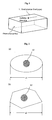
- Molten steels having chemical compositions shown in Tables 3 and 4 were worked in various conditions to produce duplex stainless steel pipes 1.4 to 16 (mm) thick. After these steel pipes were flattened, test pieces of pipe thickness ⁇ 10 mm ⁇ 10 mm were cut out therefrom. The test pieces were mounted in a resin to the cross-sectional ("observation surface" shown in Fig. 1) direction perpendicular to the working direction of each test piece, and this cross section was finished by polishing. The polish-finished surface was observed by a scanning microscope (SEM) to measure a long diameter and the chemical composition of oxide-based inclusions.
- SEM scanning microscope
- the long diameter of oxide-based inclusions means the length (a1 or a2) of the longest straight line of the lines connecting two different points on the interface between a base metal and each inclusion as shown in Fig. 2.
- the vicinity of the center part of the inclusion (b1 or b2 in the example shown in Fig. 2) or the vicinity of the center-of-gravity part of the cross sectional shape of the inclusion was measured by EDX (energy dispersion X-ray spectroscopy) to determine the contents of alloy elements other than O (oxygen).
- the oxide-based inclusions which caused the pitting are composite oxides of Al 2 O 3 and (Ca,Mg)O, in which the portion of (Ca,Mg)O preferentially elutes to form gaps with the base metal, and the gaps developed into pitting.
- Each of the generated oxide-based inclusions was observed by SEM to examine the relationship of the oxide-based inclusions with the presence/absence of pitting.
- ⁇ shows an oxide-based inclusion at which pitting started up
- o shows an oxide-based inclusion at which no pitting commenced.
- the pitting began when the oxides, with a total content of Ca and Mg of 20 to 40% and a long diameter of not less than 7 ⁇ m.
- the pitting did not begin when the oxides, with a total content of Ca and Mg of less than 20% because the oxides are mainly composed of Al oxides, which were difficult to elute.
- oxides with a total content of Ca and Mg exceeding 40% are absolutely eluted, the gaps did not develop into pitting because the effect of the forming of the gaps, with the base metal, are low.
- oxide-based inclusions with a total content of Ca and Mg of 20 to 40%, but a long diameter less than 7 ⁇ m, the gaps did not develop into pitting even by elution of the oxides because the size of the gaps were not sufficient.
- the critical pitting temperature means the highest temperature where no pitting is caused, by immersing in a 6% aqueous solution of ferric chloride of 35 to 80°C with a change in temperature by 5°C for 24 hours.
- the number of oxide-based inclusions having a total content of Ca and Mg of 20-40% and a long diameter of not less than 7 ⁇ m, is set to not more than 10 per 1 mm 2 of the cross section perpendicular to the working direction.
- the occurrence tendency of pitting was organized similar to the case of the Ca and Mg.
- the pitting began with oxide-based inclusions having a content of S of not less than 15% and a long diameter of not less than 1 ⁇ m.
- oxide-based inclusions containing S perfectly eluted after the pitting test, because of minute size, the hydrogen sulfide generated after the elution promoted corrosion and developed into pitting.
- oxide-based inclusions with a long diameter of less than 1 ⁇ m and oxide-based inclusions with a content of S of less than 15% did not cause pitting.
- the same critical pitting temperature as above was therefor examined. As a result, it was found that when the number of these inclusions is not more than 10 per 0.1 mm 2 of the cross section perpendicular to the working direction, the pitting resistance is improved.
- the number of the oxide-based inclusions having a content of S of not less than 15% and a long diameter of not less than 1 ⁇ m is desirably set to not more than 10 per 0.1 mm 2 of the cross section perpendicular to the working direction.
- the production method for controlling the composition of oxide-based inclusions in duplex stainless steel was examined in detail. As a result, it was found that an unprecedented high cleanliness duplex stainless steel can be obtained, particularly, by optimizing respective production processes of ( ⁇ ) reductive treatment, ( ⁇ ) killing and ( ⁇ ) working after casting.
- the respective production processes are described as follows.
- the reductive treatment is carried out in a condition providing a slag basicity, represented by the following equation (2), of 0.5 to 3.0.
- each compound represents the concentration in slag (% by mass) of each compound.
- [Slag Basicity] (CaO+MgO)/(Al 2 O 3 +SiO 2 )
- Stainless crude molten steel obtained by melting a raw material in an electric furnace or the like, is decarburized while blowing oxygen to the molten steel in a secondary refining furnace such as AOD or VOD, and is performed a treatment called reduction which is put a deoxidizing agent, such as metallic aluminum and a desulfurizing agent, such as limestone in order to recover chromium oxidized in the decarburization.
- a deoxidizing agent such as metallic aluminum
- a desulfurizing agent such as limestone in order to recover chromium oxidized in the decarburization.
- the oxygen and sulfur bonded to these agents are removed from the molten steel by transferring as Al 2 O 3 , CaS or the like into the slag.
- the slag basicity represented by the equation (2) must be set to not less than 0.5.
- the slag basicity is desirably set to not less than 1.0.
- an excessively high slag basicity makes the oxide-based inclusions with a total content of Ca and Mg of 20 to 40% easy to be left in the steel, resulting in deterioration of pitting resistance of the steel product, and in addition to that, the flowing property becomes deficient, according to a rise of the melting point. From this point of view, it is required to set the upper limit value to 3.0.
- the slag basicity is desirably set to not more than 2.5.
- the reductive treatment at the above-mentioned slag basicity is performed once in general.
- the reductive stage is desirably repeated twice or more.
- the slag generated by the first reductive treatment is discharged out to the secondary refining furnace prior to execution of the second reduction by inclining the furnace and scratching it out of the furnace by use of a proper tool. This operation is important for enhancing the desulfurizing performance in the second reductive stage by removing the slag containing a large quantity of sulfur generated in the first reductive stage.
- the killing after reductive treatment is performed at a temperature of not lower than 1500 °C for 5 minutes or more.
- the molten steel which finished the secondary refining by a minute adjustment to a predetermined composition, is tapped to a ladle and casted.
- the tapped molten steel is stationarily stood or moved to a casting place so as not to mix again with the slag floating on the molten steel prior to casting.
- This treatment is called killing.
- part of oxides suspended in the molten steel is raised by the specific gravity difference and separately absorbed into the slag.
- it is required to raise and separate coarse oxides. There fore it is important to ensure a killing temperature of not lower than 1500°C and a killing time of not less than 5 minutes.
- a killing temperature of not lower than 1550°C and a killing time of not less than 10 minutes are desired.
- the working after casting is performed in a condition which provides a total working ratio R, represented by the following equation (3), of not less than 10.
- A0 n and A n represent a cross sectional area before deformation in a plastic deformation process and a cross sectional area after deformation in the plastic deformation process, respectively, and each subscript n (1, 2, ... i) represents each stand order in the plastic deformation process.
- the cast blooms are subjected to a hot working such as forging or hot rolling or a cold working such as cold rolling, and then formed into a predetermined product dimension. At this time, the oxide-based inclusions are crushed and fined, according to the working directional deformation of the material by the working.
- the total working ratio R from bloom to final product must be set to not less than 10.
- the plastic deformation process does not include the cutting process and other working processes involving no rolling and drawing. Accordingly, even if a cutting process is contained in the plastic deformation process, the calculation of the equation (3) is performed without considering the change in the cross-sectional area by this cutting process.
- Each duplex stainless steel having a composition shown in Table 1 (super duplex stainless steel with a pitting resistance index PREW of not less than 40) in which 500kg was melted in an induction melting furnace, transferred to an AOD furnace, and then refined again therein.
- the slag basicity of the reductive stage was set to 2.0.
- the slag and the molten steel were sampled after the completion of the reductive stage, respectively.
- the temperature of the molten steel tapped to a ladle was immediately measured by a thermocouple, and the elapsed time up to casting start was measured.
- the ladle is stationary and killed in a given position without producing vibration until it is lifted up by a ladle crane to start casting.
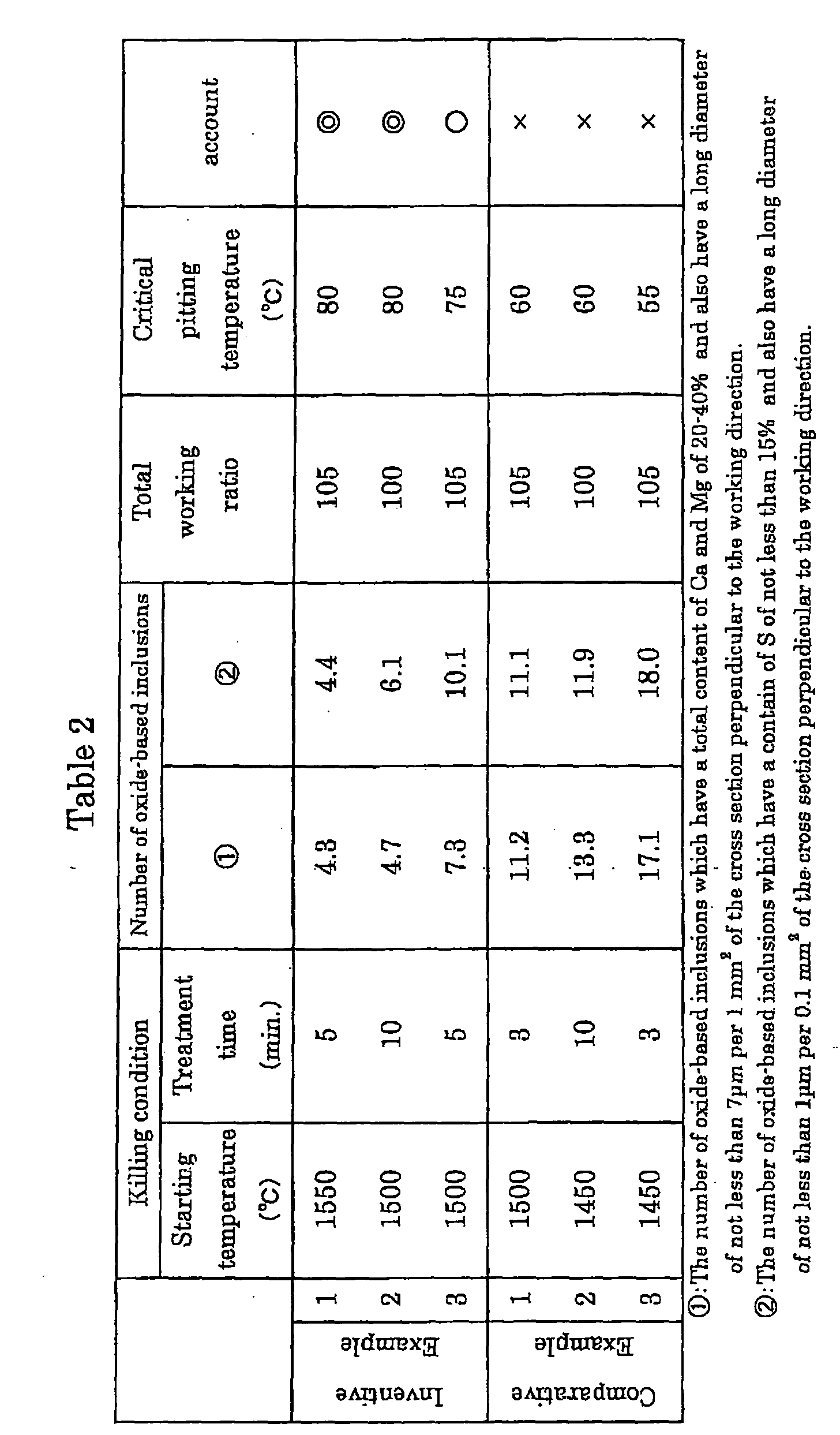
- the killing condition is shown in Table 2.
- the molten steel was casted into a steel ingot, 160 mm on a side by average dimension, by bottom casting or to a round bloom 180 mm in an outer diameter by continuous casting.
- the resulting bloom was variously worked by forging, hot extrusion, or cold rolling and formed into a seamless steel pipe 16-280 mm in outer diameter and 1.4 to 16 mm in thickness.
- the steel pipe was retained at 1100°C for 3 minutes, and then subjected to solution heat treatment by water-cooling.
- test pieces having a dimension of pipe thickness ⁇ 10 mm ⁇ 10 mm each, were cut out.
- the test pieces were mounted in a resin to the pipe sectional direction, and this cross section was then finished by polishing. Thereafter, the oxide-based inclusions of not less than 7 ⁇ m long diameter were observed by SEM for 5 field-of-views each at ⁇ 50 magnification, and the oxide-based inclusions of not less than 1 ⁇ m long diameter for 5 field-of-views each at ⁇ 200 magnification.
- the long diameters of the oxide-based inclusions were measured according to the definition of Fig. 2, and the vicinity of the center part of each oxide-based inclusion (b1 or b2 in Fig. 2) was composition-analyzed by EDX (energy dispersive X-ray spectrometry).
- EDX energy dispersive X-ray spectrometry
- mass ratios of Al, Ca, Mg, S and Mn except O (oxygen) were measured because the measurement value of O (oxygen) is low in reliability of precision.
- the tube material was sectionally cut in a length of 10 mm, the cut end surface was polished with an emery paper No. 600, and provided for a pitting test.
- the cut piece was immersed in a 6% aqueous solution of ferric chloride of 35 to 80 °C, changed in temperature by 5°C for 24 hours, and the highest temperature where no pitting is generated was measured. The measurement was performed by using five test pieces for one test tube, and the lowest value of them was taken as the critical pitting temperature and used as an indication of the pitting resistance.
- the pitting resistance is varied depending on the killing condition. Namely, in Inventive Examples 1 to 3 with a killing starting temperature of 1500°C and a retained time of not less than 5 minutes, the number of oxide-based inclusions with a total content of Ca and Mg of 20 to 40% and a long diameter of not less than 7 ⁇ m was not more than 10 per 1 mm 2 of the cross section perpendicular to the working direction, and satisfactory pitting resistance could be obtained.
- Each duplex stainless steel, having a composition shown in Tables 3 and 4 was melted in a 500 kg-induction melting furnace, transferred to an AOD furnace, and secondarily refined therein. At this time, the slag basicity in the reductive stage was variously changed. The slag and the molten steel were sampled after the end of reductive stage and just after the composition minute adjustment after reduction, respectively, and the composition-analyzed by chemical analysis. The temperature of the molten steel tapped to a ladle was immediately measured by a thermocouple, and the time to casting start was then measured.
- the ladle is stationarily stood and killed in a given position without producing vibration until it is lifted up by a ladle crane to start casting.
- the molten steel was casted to a steel ingot 160 mm on a side by average dimension, by bottom casting or to a round bloom 180 mm in outer diameter, by continuous casting.
- the resulting bloom was variously worked by forging, hot extrusion, or cold rolling and formed into a seamless steel pipe 16-280 mm in outer diameter and 1.4 to 16 mm in thickness.
- the resulting pipe was retained at 1100°C for 3 minutes, and subjected to solution heat treatment by water-cooling.
- the slag basicity of the reductive stage, the killing condition and the total working ratio are shown in Tables 5 and 6.
- test pieces having a dimension of pipe thickness ⁇ 10 mm ⁇ 10mm each, were cut out.
- the test pieces were mounted in a resin to the pipe cross-sectional direction, and this cross section was finished by polishing.
- oxide-based inclusions of not less than 7 ⁇ m long diameter were observed by SEM for 5 field-of-views each at ⁇ 50 magnification, and the oxide-based inclusions of not less than 1 ⁇ m long diameter for 5 field-of-views each, at ⁇ 200 magnification.
- the long diameter of the oxide-based inclusions was measured according to the definition of Fig. 2, and the vicinity of the center part of each oxide-based inclusion (b1 or b2 in Fig.
- the tube material was sectionally cut in a length of 10 mm, the cut end surface was polished with an emery paper No. 600 and subjected to a pitting test.
- the cut piece was immersed in a 6% aqueous solution of ferric chloride of 35 to 80 °C, changed in temperature by 5°C for 24 hours, and the highest temperature where no pitting was generated, was measured. The measurement was performed by using five test pieces for one test tube, and the lowest value of them was taken as the critical pitting temperature and used as an indication of pitting resistance.
- a critical pitting temperature of 35°C is taken for general duplex stainless steel (steels No. 1 to 8, 10, 21 to 27, 42, 43 and 46 shown in Tables 3 and 4) with a pitting resistance index PRE (or PREW) of less than 40, and a critical pitting temperature of 70°C for super duplex stainless steel (steels No. 9, 11 to 20, 28 to 41, 44, 45, 47 and 48 shown in Tables 3 and 4) with a pitting resistance index PRE (or PREW) of not less than 40.
- the result is also shown in Tables 5 and 6.
- Comparative Examples 20 to 31 where the chemical composition was out of the range limited by the present invention sufficient anti-corrosion performance as duplex stainless steel could not be ensured.
- Comparative Examples 4 to 19 where steels have chemical compositions within the range limited by the present invention but production conditions are not proper, pitting resistance is not good because a large quantity of oxide-based inclusions harmful to pitting remained.
- duplex stainless steel having satisfactory pitting resistance, can be stably obtained. Therefore, duplex stainless steel, most suitable for steel pipes, steel plates or the like such as piping for heat exchange, piping or structures for chemical plant, line pipes, oil well or gas well casing or tubing, or umbilical tubes (control piping of submarine oil field) can be provided.
Landscapes
- Chemical & Material Sciences (AREA)
- Engineering & Computer Science (AREA)
- Materials Engineering (AREA)
- Metallurgy (AREA)
- Organic Chemistry (AREA)
- Mechanical Engineering (AREA)
- Analytical Chemistry (AREA)
- Treatment Of Steel In Its Molten State (AREA)
- Cleaning And De-Greasing Of Metallic Materials By Chemical Methods (AREA)
- Heat Treatment Of Steel (AREA)
Abstract
Description





Claims (7)
- A duplex stainless steel containing, by mass %, C: not more than 0.03%, Si: 0.01 to 2%, Mn: 0.1 to 2%, P: not more than 0.05%, S: not more than 0.001%, Al: 0.003 to 0.05%, Ni: 4 to 12%, Cr: 18 to 32%, Mo: 0.2 to 5%, N (nitrogen): 0.05 to 0.4%, O (oxygen): not more than 0.01%, Ca: 0.0005 to 0.005%, Mg: 0.0001 to 0.005%, Cu: 0 to 2%, B: 0 to 0.01%, and W: 0 to 4%, and the balance of Fe and impurities, where a number of oxide-based inclusions, which have a total content of Ca and Mg of 20 to 40 % by mass and also have a long diameter of not less than 7 µm, is not more than a 10 per 1 mm2 of the cross section perpendicular to the working direction.
- A duplex stainless steel containing, by mass %, C: not more than 0.03%, Si: 0.01 to 2%, Mn: 0.1 to 2%, P: not more than 0.05%, S: not more than 0.001%, Al: 0.003 to 0.05%, Ni: 4 to 12%, Cr: 18 to 32%, Mo: 0.2 to 5%, N (nitrogen): 0.05 to 0.4%, O (oxygen): not more than 0.01%, Ca: 0.0005 to 0.005%, Mg: 0.0001 to 0.005%, Cu: 0 to 2%, B: 0 to 0.01%, and W: 0 to 4%, and the balance of Fe and impurities, where a number of oxide-based inclusions, which have a total content of Ca and Mg of 20 to 40 % by mass and also have a long diameter of not less than 7 µm, is not more than a 10 per 1 mm2 of the cross section perpendicular to the working direction, and a number of oxide-based inclusions, which have a content of S of not less than 15% by mass and also have a long diameter of not less than 1 µm, is not more than 10 per 0.1 mm2 of the cross section perpendicular to the working direction.
- The duplex stainless steel according to claim 1 or 2, further containing 0.2 to 2% of Cu by mass.
- The duplex stainless steel according to any one of claims 1 to 3, further containing 0.001 to 0.01% of B by mass.
- The duplex stainless steel according to any one of claims 1 to 4, further containing 0.1 to 4% of W by mass.
- The duplex stainless steel according to any one of claims 1 to 5, characterized in that a pitting resistance index PREW represented by the following equation (1) is not less than 40;
- A method for producing a duplex stainless steel, any one of claims 1 to 6, characterized by reducing the condition that a slag basicity, represented by the following equation (2) is 0.5 to 3.0, killing to tapped molten steel at the temperature not lower than 1500 °C for not less than 5 minutes followed by casting, and forming the resulting bloom on the condition that the total working ratio R, represented by the following equation (3), is not less than 10;wherein each compound in the equation (2) represents the concentration in slag of each compound (% by mass), A0n and An in the equation (3) represent a cross-sectional area before deformation in a plastic deformation process and a cross-sectional area after deformation in the plastic deformation process, respectively, and each subscript n (1, 2, ... i) represents each stand order in the plastic deformation process.

Applications Claiming Priority (3)
| Application Number | Priority Date | Filing Date | Title |
|---|---|---|---|
| JP2003289418 | 2003-08-07 | ||
| JP2003289418 | 2003-08-07 | ||
| PCT/JP2004/011070 WO2005014872A1 (en) | 2003-08-07 | 2004-08-03 | Duplex stainless steel and method for production thereof |
Publications (3)
| Publication Number | Publication Date |
|---|---|
| EP1561834A1 true EP1561834A1 (en) | 2005-08-10 |
| EP1561834A4 EP1561834A4 (en) | 2007-07-11 |
| EP1561834B1 EP1561834B1 (en) | 2011-04-20 |
Family
ID=34131558
Family Applications (1)
| Application Number | Title | Priority Date | Filing Date |
|---|---|---|---|
| EP04748203A Expired - Lifetime EP1561834B1 (en) | 2003-08-07 | 2004-08-03 | Duplex stainless steel and method for production thereof |
Country Status (8)
| Country | Link |
|---|---|
| EP (1) | EP1561834B1 (en) |
| JP (1) | JP4155300B2 (en) |
| KR (1) | KR100661328B1 (en) |
| CN (1) | CN100427627C (en) |
| AU (1) | AU2004262702B2 (en) |
| BR (1) | BRPI0406423B1 (en) |
| NO (1) | NO336117B1 (en) |
| WO (1) | WO2005014872A1 (en) |
Cited By (7)
| Publication number | Priority date | Publication date | Assignee | Title |
|---|---|---|---|---|
| WO2013034804A1 (en) * | 2011-09-07 | 2013-03-14 | Outokumpu Oyj | Duplex stainless steel |
| EP2684974A4 (en) * | 2011-03-10 | 2014-11-05 | Nippon Steel & Sumitomo Metal Corp | STAINLESS STEEL SHEET DUPLEX |
| EP2669397A4 (en) * | 2011-01-27 | 2016-08-10 | Nippon Steel & Sumikin Sst | HOT-LAMINATED HOT-LAMINATED STAINLESS STEEL MATERIAL WITH LOW ALLOY ELEMENT, PLATED STEEL SHEET HAVING DUPLEX STAINLESS STEEL AS CONJUGATION MATERIAL THEREFOR, AND PRODUCTION METHOD THEREOF |
| EP3333275A1 (en) * | 2016-12-07 | 2018-06-13 | Höganäs AB (publ) | Stainless steel powder for producing duplex sintered stainless steel |
| US11692253B2 (en) * | 2014-02-03 | 2023-07-04 | Outokumpu Oyj | Duplex stainless steel |
| US11932926B2 (en) | 2014-06-17 | 2024-03-19 | Outokumpu Oyj | Duplex ferritic austenitic stainless steel composition |
| EP4411002A4 (en) * | 2021-10-01 | 2025-10-22 | Nippon Steel Corp | DUPLEX STAINLESS STEEL PIPE |
Families Citing this family (12)
| Publication number | Priority date | Publication date | Assignee | Title |
|---|---|---|---|---|
| US7662885B2 (en) | 2002-08-12 | 2010-02-16 | Exxonmobil Chemical Patents Inc. | Method to make an article comprising polymer concentrate |
| US8192813B2 (en) | 2003-08-12 | 2012-06-05 | Exxonmobil Chemical Patents, Inc. | Crosslinked polyethylene articles and processes to produce same |
| CN102031461A (en) * | 2010-10-22 | 2011-04-27 | 重庆仪表材料研究所 | Heat-resisting alloy with high yield ratio, high toughness and long-run elasticity stability |
| CN104919072B (en) | 2013-01-15 | 2017-07-14 | 株式会社神户制钢所 | Duplex stainless steel and duplex stainless steel pipe |
| JP6302793B2 (en) * | 2013-09-11 | 2018-03-28 | 株式会社神戸製鋼所 | Duplex stainless steel and duplex stainless steel pipe |
| JP6200851B2 (en) * | 2013-11-05 | 2017-09-20 | 株式会社神戸製鋼所 | Duplex stainless steel and duplex stainless steel pipe |
| JP6303851B2 (en) * | 2014-06-18 | 2018-04-04 | 新日鐵住金株式会社 | Duplex stainless steel pipe |
| KR101668534B1 (en) * | 2014-12-26 | 2016-10-24 | 주식회사 포스코 | Super duplex stainless steel and manufacturing method thereof |
| CN111349847B (en) * | 2018-12-24 | 2022-03-18 | 宝山钢铁股份有限公司 | Seawater corrosion resistant steel and manufacturing method thereof |
| EP4112752A4 (en) * | 2020-02-27 | 2025-06-25 | NIPPON STEEL Stainless Steel Corporation | STAINLESS STEEL WITH SUPERIOR BRIGHTENING CAPABILITY AND PROCESS FOR PRODUCING THE SAME |
| CN115244199B (en) * | 2020-02-27 | 2023-10-20 | 日铁不锈钢株式会社 | Stainless steel, stainless steel materials and methods of manufacturing stainless steel |
| CN115552049B (en) | 2020-06-02 | 2023-10-20 | 杰富意钢铁株式会社 | Duplex stainless steel and duplex stainless steel seamless steel pipe |
Family Cites Families (17)
| Publication number | Priority date | Publication date | Assignee | Title |
|---|---|---|---|---|
| JP2500162B2 (en) * | 1991-11-11 | 1996-05-29 | 住友金属工業株式会社 | High strength duplex stainless steel with excellent corrosion resistance |
| JPH07197205A (en) * | 1993-12-29 | 1995-08-01 | Nkk Corp | Austenitic stainless steel sheet and method for producing the same |
| JP3446294B2 (en) * | 1994-04-05 | 2003-09-16 | 住友金属工業株式会社 | Duplex stainless steel |
| DE69518354T2 (en) * | 1994-05-21 | 2001-04-26 | Yong Soo Park | Stainless duplex steel with high corrosion resistance |
| JPH08170153A (en) * | 1994-12-19 | 1996-07-02 | Sumitomo Metal Ind Ltd | High corrosion resistance duplex stainless steel |
| JP3127822B2 (en) * | 1996-04-10 | 2001-01-29 | 住友金属工業株式会社 | Manufacturing method of seamless stainless steel pipe made of duplex stainless steel |
| JPH1060598A (en) * | 1996-08-19 | 1998-03-03 | Nkk Corp | Precipitation strengthened duplex stainless steel for seawater resistance |
| JPH1060526A (en) * | 1996-08-19 | 1998-03-03 | Nkk Corp | Manufacturing method of precipitation strengthened duplex stainless steel for seawater resistance |
| JP3624732B2 (en) * | 1998-01-30 | 2005-03-02 | 住友金属工業株式会社 | Ferritic stainless steel and ferritic stainless steel casts with excellent formability |
| JP3964537B2 (en) * | 1998-04-08 | 2007-08-22 | 大平洋金属株式会社 | Austenitic stainless steel with excellent hot workability |
| JP3446667B2 (en) * | 1999-07-07 | 2003-09-16 | 住友金属工業株式会社 | Ferritic stainless steel, ferritic stainless steel ingot excellent in workability and toughness, and method for producing the same |
| JP3534032B2 (en) * | 2000-02-03 | 2004-06-07 | 住友金属工業株式会社 | Method for producing duplex stainless steel pipe |
| JP2002194505A (en) * | 2000-12-22 | 2002-07-10 | Sumitomo Metal Ind Ltd | Ferritic stainless steel and method for producing the same |
| JP3758508B2 (en) * | 2001-02-13 | 2006-03-22 | 住友金属工業株式会社 | Manufacturing method of duplex stainless steel pipe |
| JP3939534B2 (en) * | 2001-11-08 | 2007-07-04 | 新日鐵住金ステンレス株式会社 | Duplex stainless steel sheet and manufacturing method thereof |
| JP4080729B2 (en) * | 2001-11-22 | 2008-04-23 | 日本冶金工業株式会社 | Stainless steel for food plant |
| US20050016636A1 (en) * | 2001-11-22 | 2005-01-27 | Yutaka Kobayashi | Stainless steel for use under circumstance where organic acid and saline are present |
-
2004
- 2004-08-03 AU AU2004262702A patent/AU2004262702B2/en not_active Ceased
- 2004-08-03 WO PCT/JP2004/011070 patent/WO2005014872A1/en not_active Ceased
- 2004-08-03 CN CNB2004800009689A patent/CN100427627C/en not_active Expired - Fee Related
- 2004-08-03 KR KR1020057004913A patent/KR100661328B1/en not_active Expired - Fee Related
- 2004-08-03 EP EP04748203A patent/EP1561834B1/en not_active Expired - Lifetime
- 2004-08-03 BR BRPI0406423-2A patent/BRPI0406423B1/en not_active IP Right Cessation
- 2004-08-03 JP JP2005512929A patent/JP4155300B2/en not_active Expired - Lifetime
-
2005
- 2005-05-10 NO NO20052266A patent/NO336117B1/en not_active IP Right Cessation
Cited By (13)
| Publication number | Priority date | Publication date | Assignee | Title |
|---|---|---|---|---|
| US9862168B2 (en) | 2011-01-27 | 2018-01-09 | Nippon Steel & Sumikin Stainless Steel Corporation | Alloying element-saving hot rolled duplex stainless steel material, clad steel plate having duplex stainless steel as cladding material therefor, and production method for same |
| EP2669397A4 (en) * | 2011-01-27 | 2016-08-10 | Nippon Steel & Sumikin Sst | HOT-LAMINATED HOT-LAMINATED STAINLESS STEEL MATERIAL WITH LOW ALLOY ELEMENT, PLATED STEEL SHEET HAVING DUPLEX STAINLESS STEEL AS CONJUGATION MATERIAL THEREFOR, AND PRODUCTION METHOD THEREOF |
| EP2684974A4 (en) * | 2011-03-10 | 2014-11-05 | Nippon Steel & Sumitomo Metal Corp | STAINLESS STEEL SHEET DUPLEX |
| US9512509B2 (en) | 2011-03-10 | 2016-12-06 | Nippon Steel & Sumitomo Metal Corportion | Duplex stainless steel |
| CN103890214A (en) * | 2011-09-07 | 2014-06-25 | 奥托库姆普联合股份公司 | Duplex stainless steel |
| EA024902B1 (en) * | 2011-09-07 | 2016-10-31 | Отокумпу Оюй | Duplex stainless steel |
| WO2013034804A1 (en) * | 2011-09-07 | 2013-03-14 | Outokumpu Oyj | Duplex stainless steel |
| US11555231B2 (en) | 2011-09-07 | 2023-01-17 | Outokumpu Oyj | Duplex stainless steel |
| US11692253B2 (en) * | 2014-02-03 | 2023-07-04 | Outokumpu Oyj | Duplex stainless steel |
| US11932926B2 (en) | 2014-06-17 | 2024-03-19 | Outokumpu Oyj | Duplex ferritic austenitic stainless steel composition |
| EP3333275A1 (en) * | 2016-12-07 | 2018-06-13 | Höganäs AB (publ) | Stainless steel powder for producing duplex sintered stainless steel |
| WO2018104179A1 (en) * | 2016-12-07 | 2018-06-14 | Höganäs Ab (Publ) | Stainless steel powder for producing duplex sintered stainless steel |
| EP4411002A4 (en) * | 2021-10-01 | 2025-10-22 | Nippon Steel Corp | DUPLEX STAINLESS STEEL PIPE |
Also Published As
| Publication number | Publication date |
|---|---|
| BRPI0406423B1 (en) | 2012-12-11 |
| EP1561834B1 (en) | 2011-04-20 |
| AU2004262702B2 (en) | 2007-05-03 |
| NO336117B1 (en) | 2015-05-18 |
| BRPI0406423A (en) | 2005-10-04 |
| CN100427627C (en) | 2008-10-22 |
| EP1561834A4 (en) | 2007-07-11 |
| AU2004262702A1 (en) | 2005-02-17 |
| WO2005014872A1 (en) | 2005-02-17 |
| JP4155300B2 (en) | 2008-09-24 |
| KR100661328B1 (en) | 2006-12-27 |
| CN1701126A (en) | 2005-11-23 |
| NO20052266D0 (en) | 2005-05-10 |
| JPWO2005014872A1 (en) | 2006-10-05 |
| KR20060024316A (en) | 2006-03-16 |
| NO20052266L (en) | 2005-07-06 |
Similar Documents
| Publication | Publication Date | Title |
|---|---|---|
| EP1561834B1 (en) | Duplex stainless steel and method for production thereof | |
| CN101755059B (en) | Process for production of duplex stainless steel tubes | |
| JP5072285B2 (en) | Duplex stainless steel | |
| AU2004315176B2 (en) | Steel product for line pipe excellent in resistance to HIC and line pipe produced by using the steel product | |
| AU2012218660B2 (en) | Duplex stainless steel, and process for production thereof | |
| CN103370435B (en) | Duplex stainless steel | |
| CA3148069C (en) | Duplex stainless steel material | |
| US7396421B2 (en) | Duplex stainless steel and manufacturing method thereof | |
| JP7397375B2 (en) | Martensitic stainless seamless steel pipe | |
| CA2847111A1 (en) | Duplex stainless steel | |
| JP4265605B2 (en) | Duplex stainless steel | |
| JP7633586B1 (en) | Steel | |
| JP2009024231A (en) | Manufacturing method of high alloy pipe | |
| JP2002129278A (en) | High Cr steel slab and seamless steel pipe | |
| RU2221875C2 (en) | Method of production of seamless tubes from carbon steel or low-alloy steel of high corrosion resistance | |
| WO2023054599A1 (en) | Duplex stainless steel pipe | |
| JPH08120413A (en) | Casting member of two-phase stainless steel and its production | |
| CA3241527C (en) | Duplex stainless steel material | |
| JP7243950B1 (en) | duplex stainless steel pipe | |
| JP2005036313A (en) | Duplex stainless steel | |
| WO2025033003A1 (en) | Steel material | |
| WO2025018103A1 (en) | Duplex stainless steel and seamless stainless steel pipe |
Legal Events
| Date | Code | Title | Description |
|---|---|---|---|
| PUAI | Public reference made under article 153(3) epc to a published international application that has entered the european phase |
Free format text: ORIGINAL CODE: 0009012 |
|
| 17P | Request for examination filed |
Effective date: 20050512 |
|
| AK | Designated contracting states |
Kind code of ref document: A1 Designated state(s): AT BE BG CH CY CZ DE DK EE ES FI FR GB GR HU IE IT LI LU MC NL PL PT RO SE SI SK TR |
|
| AX | Request for extension of the european patent |
Extension state: AL HR LT LV MK |
|
| DAX | Request for extension of the european patent (deleted) | ||
| RBV | Designated contracting states (corrected) |
Designated state(s): GB IT SE |
|
| REG | Reference to a national code |
Ref country code: DE Ref legal event code: 8566 |
|
| A4 | Supplementary search report drawn up and despatched |
Effective date: 20070611 |
|
| 17Q | First examination report despatched |
Effective date: 20070914 |
|
| GRAP | Despatch of communication of intention to grant a patent |
Free format text: ORIGINAL CODE: EPIDOSNIGR1 |
|
| GRAS | Grant fee paid |
Free format text: ORIGINAL CODE: EPIDOSNIGR3 |
|
| GRAA | (expected) grant |
Free format text: ORIGINAL CODE: 0009210 |
|
| AK | Designated contracting states |
Kind code of ref document: B1 Designated state(s): GB IT SE |
|
| REG | Reference to a national code |
Ref country code: GB Ref legal event code: FG4D |
|
| REG | Reference to a national code |
Ref country code: SE Ref legal event code: TRGR |
|
| PLBE | No opposition filed within time limit |
Free format text: ORIGINAL CODE: 0009261 |
|
| STAA | Information on the status of an ep patent application or granted ep patent |
Free format text: STATUS: NO OPPOSITION FILED WITHIN TIME LIMIT |
|
| 26N | No opposition filed |
Effective date: 20120123 |
|
| REG | Reference to a national code |
Ref country code: GB Ref legal event code: 732E Free format text: REGISTERED BETWEEN 20131010 AND 20131016 |
|
| PGFP | Annual fee paid to national office [announced via postgrant information from national office to epo] |
Ref country code: GB Payment date: 20200722 Year of fee payment: 17 |
|
| PGFP | Annual fee paid to national office [announced via postgrant information from national office to epo] |
Ref country code: SE Payment date: 20200811 Year of fee payment: 17 Ref country code: IT Payment date: 20200713 Year of fee payment: 17 |
|
| REG | Reference to a national code |
Ref country code: SE Ref legal event code: EUG |
|
| GBPC | Gb: european patent ceased through non-payment of renewal fee |
Effective date: 20210803 |
|
| PG25 | Lapsed in a contracting state [announced via postgrant information from national office to epo] |
Ref country code: SE Free format text: LAPSE BECAUSE OF NON-PAYMENT OF DUE FEES Effective date: 20210804 |
|
| PG25 | Lapsed in a contracting state [announced via postgrant information from national office to epo] |
Ref country code: IT Free format text: LAPSE BECAUSE OF NON-PAYMENT OF DUE FEES Effective date: 20210803 Ref country code: GB Free format text: LAPSE BECAUSE OF NON-PAYMENT OF DUE FEES Effective date: 20210803 |