EP1561765A1 - Radiation curing resin composition and cured product thereof - Google Patents
Radiation curing resin composition and cured product thereof Download PDFInfo
- Publication number
- EP1561765A1 EP1561765A1 EP03810647A EP03810647A EP1561765A1 EP 1561765 A1 EP1561765 A1 EP 1561765A1 EP 03810647 A EP03810647 A EP 03810647A EP 03810647 A EP03810647 A EP 03810647A EP 1561765 A1 EP1561765 A1 EP 1561765A1
- Authority
- EP
- European Patent Office
- Prior art keywords
- radiation
- oligomer
- resin composition
- group
- curable resin
- Prior art date
- Legal status (The legal status is an assumption and is not a legal conclusion. Google has not performed a legal analysis and makes no representation as to the accuracy of the status listed.)
- Withdrawn
Links
Images
Classifications
-
- G—PHYSICS
- G11—INFORMATION STORAGE
- G11B—INFORMATION STORAGE BASED ON RELATIVE MOVEMENT BETWEEN RECORD CARRIER AND TRANSDUCER
- G11B7/00—Recording or reproducing by optical means, e.g. recording using a thermal beam of optical radiation by modifying optical properties or the physical structure, reproducing using an optical beam at lower power by sensing optical properties; Record carriers therefor
- G11B7/24—Record carriers characterised by shape, structure or physical properties, or by the selection of the material
- G11B7/26—Apparatus or processes specially adapted for the manufacture of record carriers
- G11B7/266—Sputtering or spin-coating layers
-
- C—CHEMISTRY; METALLURGY
- C08—ORGANIC MACROMOLECULAR COMPOUNDS; THEIR PREPARATION OR CHEMICAL WORKING-UP; COMPOSITIONS BASED THEREON
- C08F—MACROMOLECULAR COMPOUNDS OBTAINED BY REACTIONS ONLY INVOLVING CARBON-TO-CARBON UNSATURATED BONDS
- C08F290/00—Macromolecular compounds obtained by polymerising monomers on to polymers modified by introduction of aliphatic unsaturated end or side groups
- C08F290/02—Macromolecular compounds obtained by polymerising monomers on to polymers modified by introduction of aliphatic unsaturated end or side groups on to polymers modified by introduction of unsaturated end groups
- C08F290/06—Polymers provided for in subclass C08G
-
- C—CHEMISTRY; METALLURGY
- C08—ORGANIC MACROMOLECULAR COMPOUNDS; THEIR PREPARATION OR CHEMICAL WORKING-UP; COMPOSITIONS BASED THEREON
- C08F—MACROMOLECULAR COMPOUNDS OBTAINED BY REACTIONS ONLY INVOLVING CARBON-TO-CARBON UNSATURATED BONDS
- C08F292/00—Macromolecular compounds obtained by polymerising monomers on to inorganic materials
-
- C—CHEMISTRY; METALLURGY
- C08—ORGANIC MACROMOLECULAR COMPOUNDS; THEIR PREPARATION OR CHEMICAL WORKING-UP; COMPOSITIONS BASED THEREON
- C08F—MACROMOLECULAR COMPOUNDS OBTAINED BY REACTIONS ONLY INVOLVING CARBON-TO-CARBON UNSATURATED BONDS
- C08F299/00—Macromolecular compounds obtained by interreacting polymers involving only carbon-to-carbon unsaturated bond reactions, in the absence of non-macromolecular monomers
-
- C—CHEMISTRY; METALLURGY
- C08—ORGANIC MACROMOLECULAR COMPOUNDS; THEIR PREPARATION OR CHEMICAL WORKING-UP; COMPOSITIONS BASED THEREON
- C08F—MACROMOLECULAR COMPOUNDS OBTAINED BY REACTIONS ONLY INVOLVING CARBON-TO-CARBON UNSATURATED BONDS
- C08F299/00—Macromolecular compounds obtained by interreacting polymers involving only carbon-to-carbon unsaturated bond reactions, in the absence of non-macromolecular monomers
- C08F299/02—Macromolecular compounds obtained by interreacting polymers involving only carbon-to-carbon unsaturated bond reactions, in the absence of non-macromolecular monomers from unsaturated polycondensates
- C08F299/08—Macromolecular compounds obtained by interreacting polymers involving only carbon-to-carbon unsaturated bond reactions, in the absence of non-macromolecular monomers from unsaturated polycondensates from polysiloxanes
-
- C—CHEMISTRY; METALLURGY
- C08—ORGANIC MACROMOLECULAR COMPOUNDS; THEIR PREPARATION OR CHEMICAL WORKING-UP; COMPOSITIONS BASED THEREON
- C08G—MACROMOLECULAR COMPOUNDS OBTAINED OTHERWISE THAN BY REACTIONS ONLY INVOLVING UNSATURATED CARBON-TO-CARBON BONDS
- C08G18/00—Polymeric products of isocyanates or isothiocyanates
- C08G18/06—Polymeric products of isocyanates or isothiocyanates with compounds having active hydrogen
- C08G18/28—Polymeric products of isocyanates or isothiocyanates with compounds having active hydrogen characterised by the compounds used containing active hydrogen
- C08G18/67—Unsaturated compounds having active hydrogen
- C08G18/671—Unsaturated compounds having only one group containing active hydrogen
- C08G18/672—Esters of acrylic or alkyl acrylic acid having only one group containing active hydrogen
-
- C—CHEMISTRY; METALLURGY
- C08—ORGANIC MACROMOLECULAR COMPOUNDS; THEIR PREPARATION OR CHEMICAL WORKING-UP; COMPOSITIONS BASED THEREON
- C08G—MACROMOLECULAR COMPOUNDS OBTAINED OTHERWISE THAN BY REACTIONS ONLY INVOLVING UNSATURATED CARBON-TO-CARBON BONDS
- C08G18/00—Polymeric products of isocyanates or isothiocyanates
- C08G18/06—Polymeric products of isocyanates or isothiocyanates with compounds having active hydrogen
- C08G18/70—Polymeric products of isocyanates or isothiocyanates with compounds having active hydrogen characterised by the isocyanates or isothiocyanates used
- C08G18/72—Polyisocyanates or polyisothiocyanates
- C08G18/74—Polyisocyanates or polyisothiocyanates cyclic
- C08G18/75—Polyisocyanates or polyisothiocyanates cyclic cycloaliphatic
- C08G18/751—Polyisocyanates or polyisothiocyanates cyclic cycloaliphatic containing only one cycloaliphatic ring
- C08G18/752—Polyisocyanates or polyisothiocyanates cyclic cycloaliphatic containing only one cycloaliphatic ring containing at least one isocyanate or isothiocyanate group linked to the cycloaliphatic ring by means of an aliphatic group
- C08G18/753—Polyisocyanates or polyisothiocyanates cyclic cycloaliphatic containing only one cycloaliphatic ring containing at least one isocyanate or isothiocyanate group linked to the cycloaliphatic ring by means of an aliphatic group containing one isocyanate or isothiocyanate group linked to the cycloaliphatic ring by means of an aliphatic group having a primary carbon atom next to the isocyanate or isothiocyanate group
- C08G18/755—Polyisocyanates or polyisothiocyanates cyclic cycloaliphatic containing only one cycloaliphatic ring containing at least one isocyanate or isothiocyanate group linked to the cycloaliphatic ring by means of an aliphatic group containing one isocyanate or isothiocyanate group linked to the cycloaliphatic ring by means of an aliphatic group having a primary carbon atom next to the isocyanate or isothiocyanate group and at least one isocyanate or isothiocyanate group linked to a secondary carbon atom of the cycloaliphatic ring, e.g. isophorone diisocyanate
-
- C—CHEMISTRY; METALLURGY
- C08—ORGANIC MACROMOLECULAR COMPOUNDS; THEIR PREPARATION OR CHEMICAL WORKING-UP; COMPOSITIONS BASED THEREON
- C08G—MACROMOLECULAR COMPOUNDS OBTAINED OTHERWISE THAN BY REACTIONS ONLY INVOLVING UNSATURATED CARBON-TO-CARBON BONDS
- C08G18/00—Polymeric products of isocyanates or isothiocyanates
- C08G18/06—Polymeric products of isocyanates or isothiocyanates with compounds having active hydrogen
- C08G18/70—Polymeric products of isocyanates or isothiocyanates with compounds having active hydrogen characterised by the isocyanates or isothiocyanates used
- C08G18/72—Polyisocyanates or polyisothiocyanates
- C08G18/74—Polyisocyanates or polyisothiocyanates cyclic
- C08G18/75—Polyisocyanates or polyisothiocyanates cyclic cycloaliphatic
- C08G18/758—Polyisocyanates or polyisothiocyanates cyclic cycloaliphatic containing two or more cycloaliphatic rings
-
- C—CHEMISTRY; METALLURGY
- C08—ORGANIC MACROMOLECULAR COMPOUNDS; THEIR PREPARATION OR CHEMICAL WORKING-UP; COMPOSITIONS BASED THEREON
- C08L—COMPOSITIONS OF MACROMOLECULAR COMPOUNDS
- C08L51/00—Compositions of graft polymers in which the grafted component is obtained by reactions only involving carbon-to-carbon unsaturated bonds; Compositions of derivatives of such polymers
- C08L51/08—Compositions of graft polymers in which the grafted component is obtained by reactions only involving carbon-to-carbon unsaturated bonds; Compositions of derivatives of such polymers grafted on to macromolecular compounds obtained otherwise than by reactions only involving unsaturated carbon-to-carbon bonds
- C08L51/085—Compositions of graft polymers in which the grafted component is obtained by reactions only involving carbon-to-carbon unsaturated bonds; Compositions of derivatives of such polymers grafted on to macromolecular compounds obtained otherwise than by reactions only involving unsaturated carbon-to-carbon bonds on to polysiloxanes
-
- C—CHEMISTRY; METALLURGY
- C08—ORGANIC MACROMOLECULAR COMPOUNDS; THEIR PREPARATION OR CHEMICAL WORKING-UP; COMPOSITIONS BASED THEREON
- C08L—COMPOSITIONS OF MACROMOLECULAR COMPOUNDS
- C08L51/00—Compositions of graft polymers in which the grafted component is obtained by reactions only involving carbon-to-carbon unsaturated bonds; Compositions of derivatives of such polymers
- C08L51/10—Compositions of graft polymers in which the grafted component is obtained by reactions only involving carbon-to-carbon unsaturated bonds; Compositions of derivatives of such polymers grafted on to inorganic materials
-
- C—CHEMISTRY; METALLURGY
- C08—ORGANIC MACROMOLECULAR COMPOUNDS; THEIR PREPARATION OR CHEMICAL WORKING-UP; COMPOSITIONS BASED THEREON
- C08L—COMPOSITIONS OF MACROMOLECULAR COMPOUNDS
- C08L75/00—Compositions of polyureas or polyurethanes; Compositions of derivatives of such polymers
- C08L75/04—Polyurethanes
- C08L75/14—Polyurethanes having carbon-to-carbon unsaturated bonds
- C08L75/16—Polyurethanes having carbon-to-carbon unsaturated bonds having terminal carbon-to-carbon unsaturated bonds
-
- G—PHYSICS
- G11—INFORMATION STORAGE
- G11B—INFORMATION STORAGE BASED ON RELATIVE MOVEMENT BETWEEN RECORD CARRIER AND TRANSDUCER
- G11B7/00—Recording or reproducing by optical means, e.g. recording using a thermal beam of optical radiation by modifying optical properties or the physical structure, reproducing using an optical beam at lower power by sensing optical properties; Record carriers therefor
- G11B7/24—Record carriers characterised by shape, structure or physical properties, or by the selection of the material
- G11B7/241—Record carriers characterised by shape, structure or physical properties, or by the selection of the material characterised by the selection of the material
- G11B7/252—Record carriers characterised by shape, structure or physical properties, or by the selection of the material characterised by the selection of the material of layers other than recording layers
- G11B7/254—Record carriers characterised by shape, structure or physical properties, or by the selection of the material characterised by the selection of the material of layers other than recording layers of protective topcoat layers
- G11B7/2542—Record carriers characterised by shape, structure or physical properties, or by the selection of the material characterised by the selection of the material of layers other than recording layers of protective topcoat layers consisting essentially of organic resins
-
- C—CHEMISTRY; METALLURGY
- C08—ORGANIC MACROMOLECULAR COMPOUNDS; THEIR PREPARATION OR CHEMICAL WORKING-UP; COMPOSITIONS BASED THEREON
- C08K—Use of inorganic or non-macromolecular organic substances as compounding ingredients
- C08K9/00—Use of pretreated ingredients
- C08K9/04—Ingredients treated with organic substances
- C08K9/06—Ingredients treated with organic substances with silicon-containing compounds
-
- G—PHYSICS
- G11—INFORMATION STORAGE
- G11B—INFORMATION STORAGE BASED ON RELATIVE MOVEMENT BETWEEN RECORD CARRIER AND TRANSDUCER
- G11B7/00—Recording or reproducing by optical means, e.g. recording using a thermal beam of optical radiation by modifying optical properties or the physical structure, reproducing using an optical beam at lower power by sensing optical properties; Record carriers therefor
- G11B7/24—Record carriers characterised by shape, structure or physical properties, or by the selection of the material
- G11B7/241—Record carriers characterised by shape, structure or physical properties, or by the selection of the material characterised by the selection of the material
- G11B7/242—Record carriers characterised by shape, structure or physical properties, or by the selection of the material characterised by the selection of the material of recording layers
- G11B7/243—Record carriers characterised by shape, structure or physical properties, or by the selection of the material characterised by the selection of the material of recording layers comprising inorganic materials only, e.g. ablative layers
- G11B2007/24302—Metals or metalloids
- G11B2007/24312—Metals or metalloids group 14 elements (e.g. Si, Ge, Sn)
-
- G—PHYSICS
- G11—INFORMATION STORAGE
- G11B—INFORMATION STORAGE BASED ON RELATIVE MOVEMENT BETWEEN RECORD CARRIER AND TRANSDUCER
- G11B7/00—Recording or reproducing by optical means, e.g. recording using a thermal beam of optical radiation by modifying optical properties or the physical structure, reproducing using an optical beam at lower power by sensing optical properties; Record carriers therefor
- G11B7/24—Record carriers characterised by shape, structure or physical properties, or by the selection of the material
- G11B7/241—Record carriers characterised by shape, structure or physical properties, or by the selection of the material characterised by the selection of the material
- G11B7/242—Record carriers characterised by shape, structure or physical properties, or by the selection of the material characterised by the selection of the material of recording layers
- G11B7/243—Record carriers characterised by shape, structure or physical properties, or by the selection of the material characterised by the selection of the material of recording layers comprising inorganic materials only, e.g. ablative layers
- G11B2007/24302—Metals or metalloids
- G11B2007/24314—Metals or metalloids group 15 elements (e.g. Sb, Bi)
-
- G—PHYSICS
- G11—INFORMATION STORAGE
- G11B—INFORMATION STORAGE BASED ON RELATIVE MOVEMENT BETWEEN RECORD CARRIER AND TRANSDUCER
- G11B7/00—Recording or reproducing by optical means, e.g. recording using a thermal beam of optical radiation by modifying optical properties or the physical structure, reproducing using an optical beam at lower power by sensing optical properties; Record carriers therefor
- G11B7/24—Record carriers characterised by shape, structure or physical properties, or by the selection of the material
- G11B7/241—Record carriers characterised by shape, structure or physical properties, or by the selection of the material characterised by the selection of the material
- G11B7/242—Record carriers characterised by shape, structure or physical properties, or by the selection of the material characterised by the selection of the material of recording layers
- G11B7/243—Record carriers characterised by shape, structure or physical properties, or by the selection of the material characterised by the selection of the material of recording layers comprising inorganic materials only, e.g. ablative layers
- G11B2007/24302—Metals or metalloids
- G11B2007/24316—Metals or metalloids group 16 elements (i.e. chalcogenides, Se, Te)
-
- G—PHYSICS
- G11—INFORMATION STORAGE
- G11B—INFORMATION STORAGE BASED ON RELATIVE MOVEMENT BETWEEN RECORD CARRIER AND TRANSDUCER
- G11B7/00—Recording or reproducing by optical means, e.g. recording using a thermal beam of optical radiation by modifying optical properties or the physical structure, reproducing using an optical beam at lower power by sensing optical properties; Record carriers therefor
- G11B7/24—Record carriers characterised by shape, structure or physical properties, or by the selection of the material
- G11B7/241—Record carriers characterised by shape, structure or physical properties, or by the selection of the material characterised by the selection of the material
- G11B7/252—Record carriers characterised by shape, structure or physical properties, or by the selection of the material characterised by the selection of the material of layers other than recording layers
- G11B7/253—Record carriers characterised by shape, structure or physical properties, or by the selection of the material characterised by the selection of the material of layers other than recording layers of substrates
- G11B7/2533—Record carriers characterised by shape, structure or physical properties, or by the selection of the material characterised by the selection of the material of layers other than recording layers of substrates comprising resins
- G11B7/2534—Record carriers characterised by shape, structure or physical properties, or by the selection of the material characterised by the selection of the material of layers other than recording layers of substrates comprising resins polycarbonates [PC]
-
- G—PHYSICS
- G11—INFORMATION STORAGE
- G11B—INFORMATION STORAGE BASED ON RELATIVE MOVEMENT BETWEEN RECORD CARRIER AND TRANSDUCER
- G11B7/00—Recording or reproducing by optical means, e.g. recording using a thermal beam of optical radiation by modifying optical properties or the physical structure, reproducing using an optical beam at lower power by sensing optical properties; Record carriers therefor
- G11B7/24—Record carriers characterised by shape, structure or physical properties, or by the selection of the material
- G11B7/241—Record carriers characterised by shape, structure or physical properties, or by the selection of the material characterised by the selection of the material
- G11B7/252—Record carriers characterised by shape, structure or physical properties, or by the selection of the material characterised by the selection of the material of layers other than recording layers
- G11B7/254—Record carriers characterised by shape, structure or physical properties, or by the selection of the material characterised by the selection of the material of layers other than recording layers of protective topcoat layers
- G11B7/2542—Record carriers characterised by shape, structure or physical properties, or by the selection of the material characterised by the selection of the material of layers other than recording layers of protective topcoat layers consisting essentially of organic resins
- G11B7/2545—Record carriers characterised by shape, structure or physical properties, or by the selection of the material characterised by the selection of the material of layers other than recording layers of protective topcoat layers consisting essentially of organic resins containing inorganic fillers, e.g. particles or fibres
Definitions
- the present invention relates to a radiation-curable resin composition and a process for producing the same, and a cured product thereof. More specifically, it relates to a cured resin product having excellent optical properties, surface curability, and adhesion, as well as a curable composition affording the same by a curing reaction and a process for producing the same.
- Curable resin compositions have been widely used as various coating materials and adhering materials or in optical applications.
- specific examples of the optical applications of curable resin compositions include protective films of information recording layers in optical information recording media, particularly optical recording media.
- there have been conducted investigations on next-generation high-density optical disks using a blue laser cf. Patent Document 1).
- Patent Document 1 a urethane (meth)acrylate is used as a protective layer but since the protective film is formed as a thicker film as compared with conventional ones, hardness is insufficient only with the protective layer. Therefore, by laminating a cured product of colloidal silica fine particles and an ethylenically unsaturated compound thereon as a hard coat layer, strength and shrinkage at curing are balanced. However, such a laminate type protective film is still practically insufficient in view of cost, operability, and the like.
- Patent Document 2 is known as a polyurethane-based organic-inorganic hybrid composition to be used for coating.
- a composition having no radiation-curable group requires a long time of 3 days for curing and thus is not practical.
- a radiation-curable resin composition containing an inorganic component containing a silica particle and a monomer and/or an oligomer thereof, the composition having particular physical properties and a particular composition.
- the gist of the invention lies in the following: a radiation-curable resin composition comprising an inorganic component containing a silica particle composed of a hydrolyzate of an oligomer of an alkoxysilane and a monomer and/or an oligomer thereof, wherein a viscosity at 25°C is from 1,000 to 10,000 centipoises; a radiation-curable resin composition comprising a silica particle composed of a hydrolyzate of an oligomer of an alkoxysilane, a monomer containing a urethane bond or a hydroxyalkylene group and/or an oligomer thereof, and a silane coupling agent; and a radiation-curable resin composition comprising a silica particle and a monomer containing a urethane bond or a hydroxyalkylene group and/or an oligomer thereof, wherein the monomer and/or the oligomer thereof further have an acid group; as well as a radiation-cur
- a curable resin composition having transparency and a high adhesion as the conventional protective films have and also having a sufficient strength and a low shrinkage at curing even when formed as a thick film.
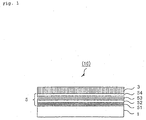
- 1 represents a substrate
- 3 represents a protective layer
- 5 represents a record-retrieving function layer
- 51 represents a reflecting layer
- 52 and 54 each represents a dielectric layer
- 53 represents a recording layer
- 10 represents an optical recording medium.
- the present inventors have found that, when a radiation-curable resin composition containing a silica ultrafine particle synthesized by a particular synthetic method and a monomer and/or an oligomer thereof, viscosity of the composition being a particular value, is cured as a thick film, the cured product obtained has a high transparency, a high hardness, and a low shrinkage.
- a radiation-curable resin composition having a very good dispersibility is obtained by mixing silica particles by a particular synthetic method with a monomer containing a urethane bond or a hydroxyalkylene group and/or an oligomer thereof in the presence of a silane coupling agent having a hydrophilic functional group and a hydrophobic functional group.
- Silica particles are usually hydrophilic, but by making the surface hydrophobic with silane coupling, the dispersibility in the monomer and/or the oligomer thereof which are usually hydrophobic is remarkably enhanced.
- a radiation-curable resin composition having a good adhesion durability to an adherent material is obtained by mixing silica particles by a particular synthetic method with a monomer containing a urethane bond or a hydroxyalkylene group and/or an oligomer thereof.
- the cured product obtained has a high transparency, a high adhesion, a high degree of surface curing, and a hard surface hardness.
- the present cured product is basically colorless, it can be variously colored depending on applications.
- the inventors have also found an excellent process for producing such radiation-curable resin compositions.
- the process includes a series of steps comprising first protecting the surface of silica ultrafine particles synthesized by a particular synthetic method in a liquid medium such as an alcohol-based one or a ketone-based one with a silane coupling agent or the like, then mixing the particles with a monomer and/or an oligomer thereof, and removing the solvent under appropriate conditions.
- a radiation-curable resin composition having a very good dispersibility is obtained even when a large amount of silica is contained.
- the radiation-curable resin composition of the invention contains an inorganic component and a monomer and/or an oligomer thereof.
- the inorganic component contains silica particles.
- silica means generic silicon oxides regardless of the ratio of silicon to oxygen and crystal or amorphous.
- a silica particle derived and synthesized from starting materials such as alkoxysilanes may be mentioned but, in view of easy mixing and dispersion as a radiation-curable resin composition, more preferred are silica particles in a state dispersed in a solvent or silica particles derived and synthesized from starting materials such as alkoxysilanes.
- the silica particle is preferably ultrafine particle and the lower limit value of a number-average particle size is preferably 0.5 nm or more, more preferably 1 nm or more.
- the upper limit value is preferably 50 nm or less, more preferably 40 nm or less, further preferably less than 30 nm, particularly preferably less than 15 nm, most preferably less than 12 nm.
- the silica particles preferably silica particles having a particle size of 30 nm or larger, more preferably silica particles having a particle size of 15 nm or larger are in an amount of preferably 1% by weight or less, further preferably 0.5% by weight or less relative to the radiation-curable resin composition.
- the particles are preferably 1% by volume or less, further preferably 0.5% by weight or less relative to the cured product. When they are contained in a large amount, light scattering increases and hence transmittance decreases, so that the case is not preferred.
- the number-average particle size is calculated, for example, by a known statistical processing method of image data and the number of ultrafine particle images to be used for such a statistical processing is desirably as many as possible.
- the number of the particle images randomly selected is at least 50 or more, preferably 80 or more, further preferably 100 or more.
- the calculation of a volume percentage in the cured product is converted by the volume of a sphere having the particle size determined as above as a diameter.
- a dispersion having solid mass of 10 to 40% by weight can be used.
- the dispersing medium include alcohols such as methyl alcohol, isopropyl alcohol, n-butyl alcohol, and isobutyl alcohol; glycols such as ethylene glycol; esters such as ethyl cellosolve; amides such as dimethylacetamide; hydrocarbons such as xylene; ethers; and mixtures thereof.
- alcohols such as methyl alcohol, isopropyl alcohol, n-butyl alcohol, and isobutyl alcohol
- glycols such as ethylene glycol
- esters such as ethyl cellosolve
- amides such as dimethylacetamide
- hydrocarbons such as xylene
- ethers and mixtures thereof.
- isopropyl alcohol, n-butyl alcohol, isobutyl alcohol, ethyl cellosolve, and mixtures thereof in view of a good compatibility to organic components and transparency of
- silica particles it is possible to use those subjected to surface treatment with a surface treating agent such as a surfactant or a silane coupling agent.
- a surface treating agent such as a surfactant or a silane coupling agent.
- the silica particles are silica particles composed of a hydrolyzate of an oligomer of an alkoxysilane. Since conventional usual silica particles have a broad particle size distribution and usually contain particles having a large particle size, e.g., 50 nm or larger, transparency becomes unsatisfactory in many cases and there is a problem that the particles tend to precipitate. Those from which particles having a large particle size are separated (so-called cut product) are also known, but they tend to secondarily aggregate easily and thus transparency is impaired in most cases.
- silica particles having an extremely small particle size are stably obtained and there is an advantage that a high transparency can be obtained since the silica particles have a difficultly aggregating property.
- the hydrolyzate herein refers to a product obtained by reactions including at least hydrolysis and the reactions may be accompanied by dehydrative condensation. Moreover, the hydrolysis also includes dealcoholation.
- an alkoxysilanes is a compound wherein alkoxy groups are bonded to a silicon atom and the compound forms an alkoxysilane oligomer through hydrolysis and dehydrative condensation (or dealcoholative condensation).
- the alkoxysilane oligomer has compatibility to water or a solvent as mentioned below, the alkyl chain of the alkoxysilane to be used in the invention is preferably not so long, and has usually about 1 to 5 carbon atoms, preferably about 1 to 3 carbon atoms. Specific examples include tetramethoxysilane, tetraethoxysilane, and the like.
- an alkoxysilane oligomer is used as a starting material.
- the reasons why an alkoxysilane monomer is not used as the starting material are that a transparent composition becomes difficult to obtain since there are tendencies that the control of the particle size is difficult, the distribution of the particle size is apt to be broad and the particle size is difficult to be uniform, and the like, as well as the use is not preferred in view of safety and hygienic grounds since some kinds o monomers have toxicity.
- the oligomer can be produced by known processes such as the process described in JP-A-7-48454.
- the alkoxysilane oligomer is hydrolyzed by adding a certain amount of water to the alkoxysilane oligomer in a particular solvent and treating it with a catalyst. By the hydrolysis, silica ultrafine particles can be obtained.
- solvent one or two or more solvents among alcohols, glycols, hydrocarbons, esters, ketones, ethers, and the like can be used singly or in combination. Of these, alcohols and ketones are particularly preferred.
- the alcohols include methanol, ethanol, isopropyl alcohol, n-butyl alcohol, isobutyl alcohol, octanol, n-propyl alcohol, acetylacetone alcohol, and the like.
- Specific examples of the ketones include acetone, methyl ethyl ketone, methyl isobutyl ketone, and the like.
- the alkyl chains of the alcohols or ketones are preferably short.
- Particularly preferred are methanol, ethanol, and acetone.
- acetone has a low boiling point and an advantage that the time required for the step of removing the solvent is relatively short.
- the amount of water required for the hydrolysis of the alkoxysilane oligomer is usually 0.05 equivalent or more, more preferably 0.3 equivalent or more to the mol number of the alkoxy groups contained in the alkoxysilane oligomer.
- the amount of water is usually 0.05 equivalent or more, more preferably 0.3 equivalent or more to the mol number of the alkoxy groups contained in the alkoxysilane oligomer.
- the upper limit value is usually 1 equivalent or less.
- the amount is too large, the alkoxysilane oligomer tends to form gel, so that the case is not preferred.
- the alkoxysilane oligomer of the invention preferably has compatibility to the above solvents and water.
- one or two or more catalysts among metal chelate compounds, organic acids, metal alkoxides, boron compounds, and the like can be used singly or in combination. Particularly, metal chelate compounds and organic acids are preferred.
- metal chelate compounds include aluminum tris(acetylacetonate), titanium tetrakis(acetylacetonate), titanium bis(isopropoxy)bis(acetylacetonate), zirconium tetrakis(acetylacetonate), zirconium bis(butoxy)bis(acetylacetonate), zirconium bis(isopropoxy)bis(acetylacetonate), and the like.
- aluminum tris(acetylacetonate) is preferably used.
- organic acids include formic acid, acetic acid, propionic acid, maleic acid, and the like. Of these, one or two or more acids can be used singly or in combination. Particularly, maleic acid is preferably used. In the case of using maleic acid, the hue of the cured product obtained by radiation-curing is satisfactory and there is an advantage that yellowish coloring tends to be little, so that the case is not preferred.
- the amount of these catalyst components to be added is not particularly limited as far as the amount is in the range where the action is sufficiently exhibited. Usually, the amount is preferably 0.1 part by weight or more, more preferably 0.5 part by weight or more relative to 100 parts by weight of the alkoxysilane oligomer. However, since the action does not vary even when the amount is so much, the amount is usually 10 parts by weight or less, more preferably 5 parts by weight or less.
- silica particles composed of a hydrolyzate of an alkoxysilane oligomer there is an advantage that ultrafine particles having an extremely uniform particle size can be added to a radiation-curable resin composition or a radiation-cured product as compared with the silica particles hitherto commonly used as a filler component.
- the present silica particles also have a difficultly aggregating property, there is an advantage that they can be homogeneously dispersed in a radiation-curable resin composition or a radiation-cured product. Thereby, a radiation-transmitting property is not impaired even when a large amount of silica particles are added, silica particles can be added in a sufficient amount for enhancing dimensional stability and mechanical properties.
- silica particles obtained by such a particular process and surface protection of silica particles, such as a silane coupling agent to be mentioned below, and by adding a monomer and/or an oligomer thereof thereto, there is an advantage that a larger amount of silica particles can be dispersed without aggregation.
- the radiation-cured product obtained according to the invention has an excellent properties including transparency and also dimensional stability, mechanical strength, adhesion, and the like.
- other inorganic components may be incorporated in addition to the silica particles composed of a hydrolyzate of an oligomer of an alkoxysilane.
- the other inorganic components are not particularly limited and, for example, a colorless metal or a colorless metal oxide may be used. Specific examples include silver, palladium, alumina, zirconia, aluminum hydroxide, titanium oxide, zinc oxide, calcium carbonate, clay mineral powders, and the like. Preferred is alumina, zinc oxide, or titanium oxide.
- a process for producing the other inorganic components is not particularly limited but preferred are processes of pulverizing a commercially available product by a pulverizer such as a ball mil; of production by a sol-gel process; and the like, since they can reduce the particle size. Further preferred is a production by a sol-gel process.
- the inorganic component is preferably in the form of ultrafine particles.
- the lower limit value of the number-average particle size is preferably 0.5 nm or more, more preferably 1 nm or more. When the number-average particle size is too small, aggregating property of the ultrafine particles extremely increases and hence transparency and mechanical strength of the cured product extremely lower or properties due to a quantum effect become not remarkable in some cases.
- the upper limit value is preferably 50 nm or less, more preferably 40 nm or less, further preferably less than 30 nm, particularly preferably less than 15 nm, most preferably less than 12 nm.
- the inorganic components preferably inorganic components having a particle size of 30 nm or larger, more preferably inorganic components having a particle size of 15 nm or larger are in an amount of preferably 1% by weight or less, further preferably 0.5% by weight or less relative to the radiation-curable resin composition.
- the components are preferably 1% by volume or less, further preferably 0.5% by weight or less relative to the cured product. When they are contained in a large amount, light scattering increases and hence transmission decreases, so that the case is not preferable.
- the method for determining the number-average particle size the same method as mentioned above may be mentioned.
- the content of the inorganic components in the radiation-curable resin composition of the invention is preferably as large as possible to contain in order to enhance dimensional stability and hardness properties, and is preferably 5% by weight or more, more preferably 10% by weight or more relative to the radiation-curable resin composition.
- the content is preferably 2% by volume or more, more preferably 5% by volume or more.
- the content is not too large, and the content is preferably 60% by weight or less, further preferably 40% by weight or less, more preferably 30% by weight or less relative to the radiation-curable resin composition. Alternatively, the content is preferably 30% by volume or less, more preferably 20% by volume or less, further preferably 15% by volume or less relative to the radiation-cured product.
- the content of the silica particles in the inorganic components is usually 50& by weight or more, preferably 60% by weight or more, more preferably 70% by weight or more.
- the upper limit is 100% by weight or less.
- the inorganic components of the invention can be protected by surface treatment of the particle surface, if necessary.
- the above inorganic components particularly the silica particles formed as mentioned above have strong polarity and they have compatibility to water and alcohols and do not have compatibility to a monomer and/or an oligomer thereof in many cases. Therefore, there is a possibility that aggregation or white turbidity may occur at the time when the monomer and/or the oligomer thereof are added.
- the addition of a dispersant or a surfactant or a method of modifying the surface with a coupling agent are preferably employed.
- the dispersant may be also selected from polymer dispersants used in fine particle dispersions such as various inks, paints, and toners for electrophotography and used.
- a polymer dispersant may be suitably selected from acrylic polymer dispersants, urethane-based polymer dispersants, and the like. Specific examples include, as trade names, EFKA (manufactured by Efka Additives), Disperbyk (manufactured by BYK), Disperon (manufactured by Kusumoto Chemicals, Ltd.), and the like.
- the amount of the dispersant to be used is preferably from 10 to 500% by weight, more preferably from 20 to 300% by weight relative to the inorganic components.
- the surfactant to be used is not particularly limited and can be selected from cationic, anionic, nonionic, or amphoteric polymers or low molecular weight various nonaqueous surfactants.
- sulfonamide-based ones (“Solspers 3000” manufactured by Avecia Pigments & Additives)
- hydrostearic acid-based ones (“Solspers 17000” manufactured by Avecia Pigments & Additives)
- fatty acid amine-based ones ⁇ -caprolactone-based ones
- Solspers 24000 manufactured by Avecia Pigments & Additives
- 1,2-hydroxystearic acid oligomers beef tallow diamine oleate salts
- Duomine manufactured by Lion-Akzo
- the amount of the surfactant to be used is preferably from 10 to 500% by weight, more preferably from 20 to 300% by weight relative to the inorganic components.
- the silica particles are preferably subjected to surface treatment with a silane coupling agent.
- a silane coupling agent is a compound having a structure wherein alkoxy group(s) and alkyl group(s) having functional group(s) are bonded to a silicon atom and plays a role of making the surface of the silica particles hydrophobic.
- the silane coupling agent of the invention is not particularly limited but a trialkoxysilane having a radiation-curable functional group is particularly preferred. Specific examples thereof include epoxycyclohexylethyltrimethoxysilane, glycidoxypropyltrimethoxysilane, vinyltrimethoxysilane, vinyltriethoxysilane, acryloxypropyltrimethoxysilane, methacryloxypropyltrimethoxysilane, mercaptopropyltrimethoxysilane, mercaptopropyltriethoxysilane, and the like.
- an Si-O-Si bond is formed between the alkoxy group of the silane coupling agent and the hydroxyl group on the surface of the silica particles via dealcoholation.
- the amount of the silane coupling agent of the invention to be used is preferably 1% by weight or more, more preferably 3% by weight or more, further preferably 5% by weight or more based on the silica particle.
- the amount of the silane coupling agent to be used is too small, the surface of the silica particle is not sufficiently rendered hydrophobic and a homogeneous mixing with the monomer and/or the oligomer thereof is disturbed in some cases. Contrarily, when the amount is too large, a large amount of the silane coupling agent which is not bonded to the silica particles may contaminated, which may tend to adversely affect on transparency and mechanical properties of the resulting cured product, so that the case is not preferred.
- the amount is preferably 400% by weight or less, more preferably 350% by weight, further preferably 300% by weight.
- the silane coupling agent is partially hydrolyzed at the surface treatment of the silica particles in some cases. Therefore, the composition after the silica particle is subjected to the surface treatment with the silane coupling agent contains the silica particle composed of a hydrolyzate of the oligomer of the alkoxysilane which is surface-treated with the compound selected from the group consisting of the silane coupling agent, hydrolyzates of the silane coupling agent, and the condensate thereof.
- hydrolyzates of the silane coupling agent mean compounds wherein part or all of the alkoxysilane groups contained in the silane coupling agent are converted into a hydroxysilane, i.e., a silanol group.
- the silane coupling agent is epoxycyclohexylethyltrimethoxysilane, epoxycyclohexylethylhydroxydimethoxysilane, epoxycyclohexylethyldihydroxymethoxysilane, and epoxycyclohexylethyltrihydroxysilane correspond to the hydrolyzates.
- the condensates of the silane coupling agents themselves and/or of the silane coupling agent and hydrolyzate thereof mean compounds wherein an alkoxy group forms an Si-O-Si bond via dealcoholation between the alkoxy group and the silanol group or compound wherein a silanol group forms an Si-O-Si bond via dehydration between the silanol group and another silanol group.
- the radiation-curable resin composition of the invention comprises a monomer and/or an oligomer thereof.
- the content of the monomer and/or the oligomer thereof is usually preferably 40% by weight or more, further preferably 50% by weight or more in the radiation-curable resin composition.
- the upper limit is preferably 95% by weight or less, further preferably 90% by weight or less.
- the monomer and/or an oligomer thereof usually have a radiation-curable functional group.
- the radiation-curable functional group is not particularly limited as far as it is a group having curability with a radiation and includes a group having radical reactivity, a group having photo-cationic reactivity, such as a photo-cationically curable glycidyl group, a group having photo-anionic reactivity, and photo-thiol-ene reactivity such as a thiol group. Of these, the group having radical reactivity is preferred.
- Examples of such a functional group having radical reactivity include a (meth)acryloyl group, a vinyl group, and the like. Of these, the (meth)acryloyl group is particularly preferred in view of polymerization rate, transparency, and coating properties. In the case that the (meth)acryloyl group is used, it is sufficient that 50% or more of total number of the radiation-curable functional groups is the (meth)acryloyl group.
- (meth)acrylate herein means either an acrylate or a methacrylate.
- the monomer and/or the oligomer thereof are preferably mainly composed of a compound having two or more radiation-curable groups in one molecule.
- the term "mainly” means 50% by weight or more of all the monomer and/or the oligomer thereof.
- a three-dimensional reticular structure is formed by polymerization with a radiation to afford an insoluble and infusible cured resin product.
- the ultrafine particles can be rapidly cured in a highly dispersed state.
- a radiation such as an active energy ray (e.g., an ultraviolet ray) or an electron beam
- the ultrafine particles can be rapidly cured in a highly dispersed state.
- the radiation curing usually proceeds very rapidly on a second time scale. Therefore, it is possible to prevent unfavorable phenomena such as migration and aggregation of the ultrafine particles during the curing process and hence a cured resin product having a high transparency can be obtained.
- thermal polymerization takes longer time, i.e., several tens minutes to several hours, there is a possibility that the ultrafine particles migrate and aggregate to result in white turbidity, so that the case is not preferred.
- oligomers In the invention, only a monomer may be used, only an oligomer may be used, or a mixture of both may be used. Since most of monomers are liquids having a lower viscosity as compared with oligomers, the former is advantageous in the case that the other components are mixed therewith. Moreover, there is an advantage that coating or molding such as injection molding is easy. However, some monomers are toxic and hence caution should be paid. On the other hand, oligomers generally have high viscosity and handling thereof is difficult in some cases. However, there is a tendency that oligomers are excellent in surface hardness and small in shrinkage at curing and also there is an advantage that most of them are satisfactory in mechanical properties of the cured product, particularly tensile properties and flexure properties.
- the monomer and the oligomer thereof may be hydrophilic but are preferably hydrophobic.
- an oligomer having a relatively high molecular weight is particularly preferred.
- it has a molecular weight of 1,000 or more, more preferably a molecular weight of 2,000 or more.
- the upper limit of the molecular weight of the oligomer is not particularly present but is usually 50,000 or less, preferably 30,000 or less, further preferably 20,000 or less, more preferably 10,000 or less, particularly preferably 5,000 or less.
- oligomer having a relatively high molecular weight By using such an oligomer having a relatively high molecular weight, there is a tendency that the surface hardness and adhesion of the cured product are improved. The reason is not clear but it is presumed that, since a composition containing the oligomer tends to exhibit small shrinkage at curing, an efficient curing due to a relatively small functional group density, a small residual strain at the adhesion interface due to shrinkage at curing, and the like may relates to the enhancement of the surface hardness and adhesion.
- the oligomer having a relatively high molecular weight may be used singly or as a mixture of two or more of the oligomers. In addition, the oligomer may be used in combination with the other monomer or oligomer having a more small molecular weight.
- the viscosity of the composition increases and thus moldability and operability become worse in some cases.
- the defects can be improved by increasing the amount of an oligomer having a low molecular weight, a monomer, or a reactive diluent.
- the monomer and/or the oligomer thereof are not particularly limited but are preferably a monomer having a group capable of forming an intramolecular hydrogen bond or an intermolecular hydrogen bond and/or an oligomer thereof.
- the monomer having a group capable of forming an intramolecular hydrogen bond or an intermolecular hydrogen bond and/or the oligomer thereof is a monomer and/or an oligomer thereof having a group containing an easily freed hydrogen atom in the molecule of the monomer and/or oligomer and capable of forming an intramolecular or intermolecular hydrogen bond with the hydrogen atom.
- Examples of the group containing an easily freed hydrogen atom include a hydroxyl group, a formyl group, a carboxyl group, a mercapto group, a thioformyl group, a thiocarboxyl group, a sulfinyl group, a sulfo group, a sulfamoyl group, a sulfoamino group, an amino group, an imino group, a carbamoyl group, an amido group, and the like. Further preferred are a hydroxyl group and an amido group.
- the monomer and/or the oligomer thereof are more preferably a monomer having a urethane bond or a hydroxyalkylene group and/or an oligomer thereof. Particularly preferred is a monomer having a urethane bond and/or an oligomer thereof.
- the monomer and/or the oligomer thereof are preferably used not singly but in combination with a monomer having a urethane bond or a hydroxyalkylene group and/or an oligomer thereof.
- the reason why the surface hardness is improved when the monomer having a urethane bond or a hydroxyalkylene group and/or oligomer thereof is used is not clear but it is presumed to be a main reason that the aggregation ability of the organic molecules is enhanced and, as a result, free migration of oxygen in the composition is inhibited and the inhibition of the radical polymerization is suppressed since the intramolecular hydrogen bond and intermolecular hydrogen bond derived from the electric polarity of the urethane bond or the hydroxyalkylene group are easily formed in the composition containing a certain amount or more of the monomer having a urethane bond or a hydroxyalkylene group and/or the oligomer thereof.
- the monomer having a urethane bond or a hydroxyalkylene group and/or an oligomer thereof preferably have a radiation-curable functional group.
- the production may be performed in accordance with a known process, for example, a process of reacting a chloroformate ester with ammonia or an amine, a process of reacting an isocyanate with a hydroxyl group-containing compound, a process of reacting urea with a hydroxyl group-containing compound.
- a process of reacting a chloroformate ester with ammonia or an amine a process of reacting an isocyanate with a hydroxyl group-containing compound
- a process of reacting urea with a hydroxyl group-containing compound a process of reacting urea with a hydroxyl group-containing compound.
- the monomer has a reactive group, it can be oligomerized.
- urethane oligomer may be usually produced by adding a compound having two or more isocyanate groups in the molecule with a compound containing a hydroxyl group in accordance with a usual manner.
- Examples of the compound having two or more isocyanate groups in the molecule include polyisocyanates such as tetramethylene diisocyanate, hexamethylene diisocyanate, trimethylhexamethylene diisocyanate, bis(isocyanatomethyl)cyclohexane, cyclohexane diisocyanate, bis(isocyanatocyclohexyl)methane, isophorone diisocyanate, tolylene diisocyanate, xylylene diisocyanate, diphenylmethane diisocyanate, m-phenylene diisocyanate, and naphthalene diisocyanate.
- polyisocyanates such as tetramethylene diisocyanate, hexamethylene diisocyanate, trimethylhexamethylene diisocyanate, bis(isocyanatomethyl)cyclohexane, cyclohexane diisocyanate, bis(isocyana
- a polyol containing two or more hydroxyl groups is preferably used and specific examples thereof include alkyl polyols such as ethylene glycol, propylene glycol, butylene glycol, neopentyl glycol, trimethylolpropane, pentaerythritol, sorbitol, mannitol, and glycerin and polyether polyols which are oligomers thereof, and polyester polyols such as polyester polyols synthesized from these polyols or polyhydric alcohols and polybasic acids and polycaprolactone polyols, and the like.
- alkyl polyols such as ethylene glycol, propylene glycol, butylene glycol, neopentyl glycol, trimethylolpropane, pentaerythritol, sorbitol, mannitol, and glycerin and polyether polyols which are oligomers thereof
- polyester polyols such
- the urethane oligomer thus obtained preferably contains the polyether polyol as the compound containing a hydroxyl group.
- the average content of the constitutive unit derived from the polyether polyol in the urethane oligomer is preferably 20% by weight or more, further preferably 25% by weight or more, particularly preferably 30% by weight or more.
- the upper limit is not particularly limited but is preferably 90% by weight or less, further preferably 80% by weight or less, particularly preferably 70% by weight or less.
- the content of the polyether polyol When the content of the polyether polyol is too small, the cured product becomes brittle, and also the elastic modulus is too high and hence internal stress is apt to occur, which tends to cause deformation. When the content is too large, there is a tendency to cause problems that the surface hardness as the cured product decreases and the product easily get scratched.
- the addition reaction of the isocyanate compound with the hydroxyl compound can be carried out by a known process, for example, by adding dropwise a mixture of a hydroxyl compound and an addition catalyst, e.g., dibutyltin laurate in the presence of an isocyanate compound under a condition of 50 to 90°C.
- an addition catalyst e.g., dibutyltin laurate
- a urethane acrylate oligomer it can be produced by using a compound having both of a hydroxyl group and a (meth)acryloyl group as part of the above compound containing a hydroxyl group.
- the amount thereof to be used is usually from 30 to 70% in all the hydroxyl-containing compounds and the molecular weight of the resulting oligomer can be controlled according to the ratio.
- Examples of the compound having both of a hydroxyl group and a (meth)acryloyl group include hydroxylethyl (meth)acrylate, hydroxypropyl (meth)acrylate, hydroxybutyl (meth)acrylate, addition products of glycidyl ether compounds with (meth)acrylic acid, mono(meth)acrylates of glycol compounds, and the like.
- a urethane oligomer having (meth)acryloyl groups at the both terminals can be produced.
- the urethane oligomer having (meth)acryloyl groups at the both terminals has an advantage that the adhesion and surface hardness of the resulting cured resin product further increase.
- the monomer having a urethane bond and/or the oligomer thereof preferably have further an acid group.
- the presence of the oxygen group results in an advantage that the adhesion with the adherent material is improved even in the passage of time.
- the acid group herein means a functional group having acidity and examples of the acid group include a sulfonic acid group, a phosphoric acid group, a carboxyl group, and neutral salts with a tertiary amine or metal salts thereof.
- compounds having these acid groups may be suitably used but particularly at the production of the oligomer, it is preferred to use a hydroxyl group-containing compound having an acid group among them.
- a polyol containing two or more hydroxyl groups is preferably used as the hydroxyl group-containing compound having an acid group.
- the polyol having an acid group include sulfonate salts and alkali metal salts and amine slats thereof such as 2-sulfo-1,4-butanediol and alkali metal salts thereof including sodium salt, 5-sulfo-di- ⁇ -hydroxyethyl isophthalate and alkali metal salts thereof including sodium salt, N,N-bis(2-hydroxyethyl)aminoethylsulfonic acid and tetramethylammonium salt thereof, tetraethylammonium salt thereof, and benzyltriethylammonium salt thereof; phosphate esters and amine salts and alkali metal salts thereof such as bis(2-hydroxyethyl) phosphate and tetramethylammonium salts thereof and alkali metal salts thereof including sodium salt; al
- the acid group into the monomer having a urethane bond and/or the oligomer thereof in addition to the processes such as use of an isocyanate group-containing compound having an acid group and/or use of a hydroxyl group-containing compound having an acid group, there can be adopted a process of introducing an acid group into the monomer having a urethane bond and/or the oligomer thereof by reacting the monomer having a urethane bond and/or the oligomer thereof with a compound having at least one functional group reactive to an isocyanate group other than a hydroxyl group, such as an amino group, and also having an acid group.
- a compound having at least one functional group reactive to an isocyanate group other than a hydroxyl group such as an amino group, and also having an acid group.
- 1-carboxy-1,5-pentyldiamine, 3,5-diaminobenzoic acid, and the like may be specifically mentioned.
- the content of the acid group in the acid group-containing monomer having a urethane bond and/or the oligomer thereof is preferably 0.5 ⁇ 10 -4 eq/g or more, further preferably 1.5 ⁇ 10 -4 eq/g or more relative to the monomer having a urethane bond and/or the oligomer thereof. Also, the content is preferably 30 ⁇ 10 -4 eq/g or less, further preferably 8 ⁇ 10 -4 eq/g or less.
- the amount of the acid group derived from the monomer having a radiation-curable group and/or the oligomer thereof in the whole composition is preferably controlled so as to be 0.1 ⁇ 10 -4 eq/g or more, and further preferred is 1 ⁇ 10 -4 eq/g or more and particularly preferred is 1.5 ⁇ 10 -4 eq/g or more. Also, the amount is controlled so as to be preferably 13 ⁇ 10 -4 eq/g or less, further preferably 10 ⁇ 10 -4 eq/g or less, particularly preferably 4 ⁇ 10 -4 eq/g or less.
- the hydroxyalkylene group-containing radiation-curable monomer of the invention means mainly a so-called epoxy (meth)acrylate.
- the epoxy (meth)acrylate can be produced by reacting an epoxy compound having at least one epoxy group in one molecule with an unsaturated monobasic acid in the presence of a particular esterification catalyst and a polymerization inhibitor.
- epoxy compound use can be made of an epoxy compound obtained by the reaction of bisphenol A and/or F compound(s) with epichlorohydrin and having an epoxy equivalent of 170 to 2000, preferably an epoxy equivalent of 170 to 1000 which is low in viscosity.
- an epoxy compound obtained by the reaction of a brominated bisphenol A compound with epichlorohydrin an epoxy compound obtained by the reaction of a hydrogenated bisphenol A compound with epichlorohydrin
- further novolak-type epoxy compounds such as phenol novolak-type epoxy compounds and cresol novolak-type epoxy compounds.
- These epoxy compounds can be used singly or as a mixture of two or more of them.
- bisphenol A and/or F compound(s) are preferred owing to the excellent flowability, impact resistance, and boiling resistance and a good adhesion to the adherent material.
- the unsaturated monobasic acid to be reacted with such an epoxy compound is not particularly limited but examples thereof include acrylic acid, methacrylic acid, crotonic acid, cinnamic acid, acrylic acid dimer, and the like. These acids can be used singly or in combination of two or more of them.
- the mixing ratio of the epoxy compound with the unsaturated monobasic acid is usually in the range of 0.9 to 1.2 equivalents of the carboxyl group in the unsaturated monobasic acid to the epoxy group in the epoxy compound, and particularly, the range of 1 ⁇ 0.05 equivalents is preferred in view of obtaining a resin excellent in curability and storage stability.
- the mixing ratio is smaller than the range, the remaining amount of the epoxy group becomes large and hence a side product of the reaction of the epoxy group with the secondary hydroxyl group in the epoxy acrylate forms and also storability remarkably lowers.
- the mixing ratio is larger than the range, the curing time is extremely lengthened, so that the case is not preferred.
- the monomer having a hydroxyalkylene group and/or the oligomer thereof preferably has further an acid group.
- the acid group there may be mentioned those the same as described in the explanation of the acid group to be contained in the above monomer having a urethane bond and/or the oligomer thereof.
- the process for incorporating an acid group into the monomer having a hydroxyalkylene group and/or the oligomer thereof is not particularly limited and a known method may be used.
- a process for introducing a carboxyl group a process of reacting a cyclic acid anhydride with a hydroxyl group may be mentioned.
- maleic anhydride and succinic anhydride are particularly preferred in view of transparency and light resistance.
- a highly transparent material is preferred and, for example, a compound having no aromatic ring is preferred.
- the resulting one is a colored product or is colored or increasingly colored during the storage even when it is not initially colored, that is, there is observed so-called yellowing. It is considered to be the cause thereof that the double bond parts forming the aromatic ring are irreversibly changed in structure by an energy ray.
- the monomer and/or the oligomer thereof exhibit no deterioration of hue and no decrease in light transmittance when they have a structure containing no aromatic ring and hence they are particularly suitable for the application to the uses where colorlessness and transparency are required.
- the monomer having no aromatic ring and/or the oligomer thereof can be produced by subjecting an isocyanate group-containing compound having no aromatic ring and a hydroxyl group-containing compound having no aromatic ring to an addition reaction in the above production process.
- the isocyanate compound it is preferred to use one or two or more of bis(isocyanatomethyl)cyclohexane, cyclohexane diisocyanate, bis(isocyanatocyclohexyl)methane, and isophorone diisocyanate singly or in combination as the isocyanate compound.
- the monomer having no aromatic ring and/or the oligomer thereof can be produced by reacting an epoxy compound having no aromatic ring and an unsaturated monobasic acid having no aromatic ring in the above production process.
- an epoxy compound having no aromatic ring it is preferred to use an epoxy compound obtained by the reaction of an epoxy compound having no aromatic ring, such as a hydrogenated bisphenol A-type epoxy compound, a hydrogenated bisphenol F-type epoxy compound, or 3,4-epoxycyclohexylmethyl-3,4-epoxycyclohexanecarboxylate, with epichlorohydrin.
- the above monomer having a urethane bond or a hydroxyalkylene group and/or the oligomer thereof are used as the monomer and/or the oligomer thereof, they may be mixed with another radiation-curable monomer and/or oligomer thereof, preferably a bifunctional or trifunctional (meth)acrylate compound.
- the amount of the other radiation-curable monomer and/or oligomer thereof to be used is preferably 50% by weight or less, further preferably 30% by weight or less relative to the composition other than the inorganic component.
- bifunctional or trifunctional (meth)acrylate compound there may be mentioned aliphatic poly(meth)acrylates, alicyclic poly(meth)acrylates, and aromatic poly(meth)acrylates.
- trifunctional or higher functional (meth)acrylates are preferably added.
- Specific examples thereof include trifunctional (meth)acrylates having an isocyanurate skeleton in addition to the trimethylolpropane tris(meth)acrylate and the like exemplified in the above.
- a (meth)acrylate compound containing a hydroxyl group is preferably added.
- the compound include hydroxyethyl (meth)acrylate and the like.
- the component A is a bis(meth)acrylate having an alicyclic skeleton represented by the following formula (1).
- R a and R b each independently represents a hydrogen atom or a methyl group
- R c and R d each independently represents an alkylene group having 6 or less carbon atoms
- x represents 1 or 2
- y represents 0 or 1.
- a plurality of these tricyclodecane compounds and pentacyclodecane compounds may be used in combination
- the component B is a bis(meth)acrylate having a sulfur atom represented by the following formula (2).
- R a and R b may be the same as R a and R b in the above general formula (1) and each R e represents an alkylene group having 1 to 6 carbon atoms.
- Each Ar represents an arylene group or an aralkylene group having 6 to 30 carbon atoms and these hydrogen atoms may be substituted by a halogen atom other than a fluorine atom.
- Each X represents an oxygen atom or a sulfur atom.
- each X is all an oxygen atom
- at least one of each Y represents a sulfur atom or a sulfone group (-SO 2 -) and in the case that at least one of each X is a sulfur atom, each Y represents any one of an sulfur atom, a sulfone group, a carbonyl group (-CO-), and an alkylene group, an aralkylene group, an alkylene ether group, an aralkylene ether group, an alkylene thioether group, and an aralkylene thioether group each having 1 to 12 carbon atoms.
- j and p each independently represents an integer of 1 to 5 and k represents an integer of 0 to 10.
- x represents a sulfur atom.
- component B represented by the above general formula (2) examples include ⁇ , ⁇ '-bis[ ⁇ -(meth)acryloyloxyethylthio]-p-xylene, ⁇ , ⁇ '-bis[ ⁇ -(meth)acryloyloxyethylthio]-m-xylene, ⁇ , ⁇ '-bis[ ⁇ -(meth)acryloyloxyethylthio]-2,3,5,6-tetrachloro-p-xylene, 4,4'-bis[ ⁇ -(meth)acryloyloxyethoxy]diphenyl sulfide, 4,4'-bis[ ⁇ -(meth)acryloyloxyethoxy]diphenyl sulfone, 4,4'-bis[ ⁇ -(meth)acryloyloxyethylthio]diphenyl sulfide, 4,4'-bis[ ⁇ -(meth)acryloyloxyethylthio]diphenyl sulfone,
- a reactive diluent may be added to the radiation-curable resin composition of the invention.
- the amount of the reactive diluent to be used is from 0.5 to 80% by weight, preferably from 1 to 50% by weight. When the amount is too small, the effect of dilution is small. On the other hand, when the amount is too large, the cured product is apt to become brittle, mechanical strength tends to be lowered, and shrinkage at curing becomes large. Thus, the cases are not preferred.
- the reactive diluent is a liquid compound having a low viscosity and is usually a monofunctional low-molecular-weight compound. For example, compounds having a vinyl group or a (meth)acryloyl group and mercaptans may be mentioned.
- a compound having a radiation-curable group such as a vinyl group or a (meth)acryloyl group and the like are mentioned as the reactive diluent.
- a compound having a radiation-curable group such as a vinyl group or a (meth)acryloyl group and the like are mentioned as the reactive diluent.
- Specific examples of such a compound include aromatic vinyl monomers, vinyl ester monomers, vinyl ethers, (meth)acrylamides, (meth)acrylate esters, and di(meth)acrylates but preferred are compounds having no aromatic ring in view of hue and light transmission.
- (meth)acryloylmorpholine tetrahydrofurfuryl (meth)acrylate, benzyl (meth)acrylate, a (meth)acrylate having an alicyclic skeleton such as cyclohexyl (meth)acrylate or a (meth)acrylate having a tricyclodecane skeleton, a (meth)acrylamide such as N,N-dimethylacrylamide, an aliphatic (meth)acrylate such as hexanediol di(meth)acrylate or neopentyl glycol di(meth)acrylate in view of good hue and viscosity.
- compounds having both of a hydroxyl group and a (meth)acryloyl group such as hydroxyethyl (meth)acrylate, hydroxypropyl (meth)acrylate, and hydroxybutyl (meth)acrylate can be used for the purpose.
- the case is preferred since adhesion of the composition to glass is improved in some cases.
- a polymerization initiator in order to initiate the polymerization reaction which proceeds with an active energy ray (e.g., an ultraviolet ray).
- a polymerization initiator is generally a radical generator which is a compound having a property of generating a radical by a light, and known such compounds can be employed.
- examples of such a radical generator include benzophenone, benzoin methyl ether, diethoxyacetophenone, 1-hydroxycyclohexyl phenyl ketone, 2,6-dimethylbenzoyldipenylphosphine oxide, 2,4,6-trimethylbenzoyldiphenylphosphine oxide, and the like. A plurality of these compounds may be used in combination. Of these, preferred are 1-hydroxycyclohexyl phenyl ketone, 2,4,6-trimethylbenzoyldiphenylphosphine oxide, and benzophenone.
- the amount of such a polymerization initiator is usually 0.001 part by weight, preferably 0.01 part by weight, further preferably 0.05 part by weight or more relative to 100 parts by weight of total of the monomer having a radiation-curable functional group and/or the oligomer thereof. However, the amount is usually 10 parts by weight or less, preferably 8 parts by weight or less.
- the amount to be added is two large, not only the polymerization reaction proceeds rapidly to result in the increase of optical distortion but also hue deteriorates in some cases. When the amount is too small, the composition cannot be sufficiently cured in some cases.
- the above polymerization initiator can be used but it is preferred to use no polymerization initiator.
- the surface tension adjuster of the invention is used for the purpose of lowering the surface tension of the composition and improving applicability to a substrate.
- low-molecular-weight and high-molecular-weight surfactants and silicone compounds and various modifications thereof include polyether modification, fluorine modification, etc.), sorbitan esters, other various leveling agents, antifoaming agents, rheology controlling agents, releasing agents, and the like.
- silicone compounds such as Polyflow KL510 (manufactured by Kyoeisha Chemical, Co., Ltd.) are particularly preferred and furthermore, polyether-modified silicone compounds such as KF351A (manufactured by Shin-Etsu Chemical Co., Ltd.) and fluorine-modified surfactants are preferred since not only the surface tension can be preferably lowered but also they exhibit a property of hardly causing coating defects and excellent in antifouling property, sliding property, and weather resistance.
- the amount of the surface tension adjuster to be added varies depending on its kind but is usually 5% by weight or less, preferably 3% or less, more preferably in the range of 0.01 to 1% by weight based on the composition.
- a solvent may be used.
- the solvent is preferably colorless and transparent.
- one kind or two or more kinds of alcohols, glycol derivatives, hydrocarbons, esters, ketones, ethers, and the like may be used singly or in combination.
- the alcohols include methanol, ethanol, isopropyl alcohol, n-butyl alcohol, isobutyl alcohol, octanol, n-propyl alcohol, acetylacetone alcohol, and the like.
- Specific examples of the ketones include acetone, methyl ethyl ketone, methyl isobutyl ketone, and the like. Of these, methanol, ethanol, or acetone is particularly preferred.
- the amount of the solvent to be used is preferably as small as possible in view of the operability at curing.
- the amount is preferably 95% or less, further preferably 30% or less, more preferably 20% or less, particularly preferably 10% or less, especially preferably 5% or less based on the composition, and most preferred is no solvent.
- auxiliary components such as additives may be added, if necessary, unless the cured resin product produced does not remarkably deviate the purpose of the invention.
- auxiliary components examples include stabilizers such as antioxidants, heat stabilizers, or light absorbents; fillers such as glass fibers, glass beads, mica, talc, kaolin, metal fibers, and metal powders; carbon materials such as carbon fibers, carbon black, graphite, carbon nanotube, fullerenes including C 60 (fillers, fullerenes, and the like are generally referred to as inorganic filler components); modifiers such as antistatic agents, plasticizers, releasing agents, antifoaming agents, leveling agents, antiprecipitating agents, surfactants, and thixotropic agents; colorants such as pigments, dyes, and hue-adjusting agents; monomers and/or oligomers thereof or curing agents, catalysts, and curing accelerators necessary for the synthesis of inorganic components; and the like.
- stabilizers such as antioxidants, heat stabilizers, or light absorbents
- fillers such as glass fibers, glass beads, mica, talc, kaolin, metal fibers,
- the amount of these auxiliary components is not particularly limited unless the cured resin product produced does not remarkably deviate the purpose of the invention but the amount is usually 20% by weight or less of the radiation-curable resin composition.
- a monomer and/or an oligomer other than the radiation-curable one may be further mixed with the radiation-curable resin composition of the invention.
- the kind of the monomer and/or oligomer is not particularly limited but specifically, a thermoplastic resin or a thermosetting resin monomer and/or an oligomer thereof is used.
- thermoplastic resin examples include polystyrene; polymethyl methacrylate; polyesters such as polyarylate and O-PET (manufactured by Kanebo, Ltd.); polycarbonate; polyether sulfones; cyclic thermoplastic resins such as Zeonex (manufactured by Zeon Corp.) and Arton (manufactured by JSR corp.); cyclic polyolefins such as Apel (manufactured by Mitsui Chemicals, Inc.); and the like. In view of transparency and dimensional stability, polycarbonate or polyether sulfones are preferred.
- the thermoplastic resin is preferably used in an amount of 20% by weight or less relative to the composition other than inorganic components.
- thermosetting resin monomer and/or the oligomer thereof epoxy resins; Ligolite (manufactured by Showa Denko K.K.); and the like. In view of transparency and dimensional stability, highly pure epoxy resins are preferred.
- the thermosetting resin is preferably used in an amount of 50% by weight or less relative to the composition other than inorganic components.
- the radiation-curable resin composition of the invention is characterized by the viscosity at 25°C of 1,000 centipoises or more. Preferred is 2,000 poises or more. Moreover, it is characterized by the viscosity of 10,000 centipoises or less. Preferred is 5,000 centipoises or less. When the viscosity is less than 1,000 centipoises, it is difficult to form a cured product having a thickness of 50 ⁇ m or more and thus it is impossible to use it in applications of information recording media and the like, so that the case is not preferred. Contrarily, when the viscosity is larger than 5,000 centipoises, it is difficult to form a cured product having a smooth surface and hence the case is not preferred.
- the viscosity is suitably measured by means of an E-type viscosimeter, a B-type viscosimeter, or a vibration-type viscosimeter.
- a method for adjusting the viscosity there is a method of the addition of a diluent, the removal of the solvent, the control of the molecular weight of a radiation-curable oligomer, the addition of a thickening agent, the addition of a rheology regulator, or the like.
- the addition of a diluent, the control of the molecular weight of a radiation-curable oligomer, or the addition of a thickening agent is used. More preferably, the addition of a diluent is used.
- the cured product obtained by curing the composition is transparent to such a degree depending on the use thereof and the transparency of the composition itself is not particularly limited but the light transmittance at an optical path length of 0.1 mm at 550 nm is preferably 80% or more, more preferably 85% or more. More preferably, the light transmittance at an optical path length of 0.1 mm at 400 nm is 80% or more, more preferably 85% or more.
- the light transmittance is too low, the transparency at curing tends to be impaired remarkably and read error may increase at reading of recorded information in the case that the cured product is used as an optical recording medium, so that the case is not preferred.
- the radiation-curable resin composition has a surface tension at 25°C of 40 mN/m or less, preferably 35 mN/m or less, more preferably 30 mN/m or less.
- the surface tension is preferably as small as possible but is usually 10 mN/m or more.
- the surface tension is suitably measured by means of a tensiometer (e.g., Model CBVP-A3 manufactured by Kyowa Interface Science Co., Ltd.).
- a tensiometer e.g., Model CBVP-A3 manufactured by Kyowa Interface Science Co., Ltd.
- the radiation-curable resin composition preferably contains substantially no solvent.
- substantially no solvent means a state that the content of so-called organic solvent having volatility or a low boiling point is very small and the content of the solvent in the composition is usually preferably 5% or less, further preferably 3% or less, particularly preferably 1% or less, especially preferably 0.1% or less. Conventionally, it means a state that no odor of the organic solvent is observed.
- the radiation-curable resin composition means no occurrence of bubbles or white turbidity due to the evaporation of the solvent remaining in the cured product after the radiation-curable resin composition is spin-coated at a film thickness of 100 ⁇ 15 ⁇ m and is heated at 70°C for 1 minute and the composition is irradiated with an ultraviolet ray of 3 J/cm 2 or an electron beam of 5 Mrad or is cured until the evaluation by an evaluation method of degree of surface curing reaches a state of ⁇ .
- the radiation-curable resin composition of the invention is not particularly limited as far as the process is a process for homogeneously dispersing and mixing an inorganic component in a monomer and/or an oligomer thereof.
- the process is a process for homogeneously dispersing and mixing an inorganic component in a monomer and/or an oligomer thereof.
- (1) a process of preparing an inorganic particle powder, subjecting it to a suitable surface treatment, and then directly dispersing it in the monomer and/or the oligomer thereof in a suitably liquefied state
- (4) a process of dissolving the monomer and/or oligomer thereof in a liquid
- the process (3) is most preferred since a composition having a high transparency and a good storage stability is easily obtained.
- a radiation-curable resin composition wherein silica ultrafine particles having a uniform particle size are highly dispersed can be easily obtained.
- an oligomer of an alkoxysilane is hydrolyzed in a liquid medium by adding the oligomer of an alkoxysilane, a catalyst, and water to synthesize silica particles.
- the liquid medium is not particularly limited but is preferably a medium compatible to the monomer and/or the oligomer thereof.
- a solvent, a surface treating agent, a diluent, or the like may be used. The surface treating agent and a diluent are as described above.
- an alcohol or a ketone is preferably used and a C 1 -C 4 alcohol, acetone, methyl ethyl ketone, or methyl isobutyl ketone is particularly preferably used.
- the liquid medium is preferably used in an amount of 0.3 to 10 times the amount of the alkoxysilane oligomer.
- a hydrolysis catalyst such as an organic acid such as formic acid or maleic acid; an inorganic acid such as hydrochloric acid, nitric acid, or sulfuric acid; a metal complex compound such as acetylacetone aluminum, dibutyltin dilaurate, or dibutyltin dioctanoate; and the like.
- the amount thereof to be used is preferably from 0.1 to 3% by weight relative to the alkoxysilane oligomer.
- Water is preferably added in an amount of 10 to 50% by weight relative to the alkoxysilane oligomer.
- the hydrolysis is carried out at a temperature of 10 to 100°C.
- the temperature is lower than the range, the reaction of forming silica particles does not sufficiently proceed, so that the case is not preferred. Contrarily, the temperature is too high, gelation of the oligomer tends to occur, so that the case is not preferred.
- the time for the hydrolysis is preferably from 30 minutes to 1 week.
- the above reaction of (b) is a step of protecting the surface of the silica particles.
- a surface protecting agent a surfactant, a dispersant, a silane coupling agent, and the like may be mentioned.
- a surfactant or a dispersant there may be mentioned a method of adding a surface protecting agent and reacting it at a temperature of room temperature to 60°C for about 30 minutes to 2 hours under stirring, a method of aging the product at room temperature for several days after the addition and the reaction, and the like.
- a solvent exhibiting a very high solubility of the surface protecting agent it is important not to select a solvent exhibiting a very high solubility of the surface protecting agent.
- the protection of the inorganic component is not sufficiently performed or a lot of time is required for the protection process, so that the case is not preferred.
- the protection of the inorganic component is sufficiently performed in may cases.
- the surface protecting reaction proceeds at room temperature (25°C). Usually, the reaction is carried out by stirring for 0.5 to 24 hours but heating may be conducted at a temperature of 100°C or lower. Upon heating, the reaction rate increases and thus the reaction can be completed within a short period.
- water may be added. Water is usually added in the amount range necessary for hydrolysis of the alkoxy groups derived from the silane coupling agent and the remaining alkoxy groups derived from the alkoxysilane.
- the silane coupling agent may be added a plurality of times with divided portions. At that time, water may be also added a plurality of times with divided portions and the amount is the same as described in the explanation of the amount of water to be added to the above silane coupling agent.
- the above step of (c) should be performed after thorough completion of the above reaction of (b).
- the confirmation thereof can be achieved by measuring the remaining amount of the silane coupling agent in the reaction solution. Usually, it is the time when the remaining amount of the silane coupling agent in the reaction solution reaches 10% or less relative to the charged amount.
- the monomer and/or the oligomer may be not homogeneously mixed or the composition may become white turbid in a subsequent step, so that the case is not preferred.
- the step of (c) can be performed at room temperature (25°C) but may be conducted under heating at 30 to 90°C in the case that the viscosity of the monomer or oligomer is high or the melting point of the monomer or oligomer is higher than room temperature (25°C).
- the time for mixing is preferably from 30 minutes to 5 hours.
- solvents used as the liquid medium, an alcohol formed by hydrolysis of the alkoxysilane, and the like are removed. However, it is sufficient to remove the solvents within a necessary range and it is not necessary to remove them completely. It is preferred that the solvents are removed to an extent similar to the above composition containing substantially no solvent. In this connection, when the temperature is lower than the described range, the removal of the solvents is not sufficient, so that the case is not preferred. Contrarily, when the temperature is too high, the composition is apt to gelate, so that the case is not preferred.
- the temperature may be controlled stepwise.
- the time for the removal is preferably from 1 to 12 hours. Moreover, it is preferred to remove them under reduced pressure of 20 kPa or less, more preferably 10 kPa or less. Furthermore, it is preferred to remove them at 0.1 kPa or less. The pressure may be gradually reduced.
- the resulting radiation-curable resin composition becomes a composition wherein silica particles are dispersed in an amount sufficient for enhancing dimensional stability and mechanical strength of the resin without impairing radiation transmittance.
- the resulting radiation-cured product obtained by curing it has transparency, high surface hardness, and low shrinkage at curing.
- the cured product has excellent properties of preferably both of dimensional stability and adhesion, further preferably also degree of surface curing, and particularly preferably adhesion durability.
- the cured product of the above radiation-curable resin composition is obtained by so-called "radiation-curing" where a polymerization reaction is initiated by irradiating the composition with a radiation (active energy ray or electron beam).
- the mode of the polymerization reaction is not particularly limited and a known polymerization mode such as radical polymerization, anion polymerization, cation polymerization, or coordination polymerization can be employed.
- a known polymerization mode such as radical polymerization, anion polymerization, cation polymerization, or coordination polymerization.
- most preferred polymerization mode is radical polymerization. The reason is not clear but it is supposed that the reason is due to the homogeneity of the product by the fact that the initiation of the polymerization reaction proceeds homogeneously within a short period in a polymerization system.
- the above radiation is an electromagnetic wave such as a ⁇ -ray, an X-ray, an ultraviolet ray, a visual light, an infrared ray, or a micro wave or a particle beam such as an electron beam, an ⁇ -ray, a neutron radiation, or any of various atomic beams.
- an electromagnetic wave such as a ⁇ -ray, an X-ray, an ultraviolet ray, a visual light, an infrared ray, or a micro wave or a particle beam such as an electron beam, an ⁇ -ray, a neutron radiation, or any of various atomic beams.
- Examples of the radiations preferably used in the invention include preferably an ultraviolet ray, a visual light, and an electron beam, most preferably an ultraviolet ray and an electron beam.
- an ultraviolet ray there is adopted a method of using a photo-radical generator (cf. examples described above) which generates a radical by an ultraviolet ray and using the ultraviolet ray as the radiation.
- a sensitizer may be used in combination, if necessary.
- the above ultraviolet ray has a wavelength of the range of usually 200 to 400 nm, and the wavelength range is preferably from 250 to 400 nm.
- an apparatus for irradiating the ultraviolet ray use can be preferably made of a known apparatus such as a high-pressure mercury lamp, a metal halide lamp, or an ultraviolet lamp having a structure which generates an ultraviolet ray by a microwave.
- the output of the apparatus is usually 10 to 200 W/cm and it is preferred to place the apparatus at a distance of 5 to 80 cm toward a material to be irradiated since photo degradation, heat degradation, heat deformation, and the like are little.
- the composition of the invention can be also preferably cured by an electron beam and a cured product excellent in mechanical properties, especially tensile elongation property can be obtained.
- an electron beam although the source and irradiation apparatus thereof are expensive, the addition of an initiator can be omitted and no polymerization inhibition with oxygen occurs and hence degree of surface curing becomes satisfactory, so that it is preferably used in some cases.
- the mode thereof is not particularly limited and a curtain type, an area beam type, a broad beam type, a pulse beam type, or the like may be mentioned.
- the acceleration voltage at the electron beam irradiation is preferably from 10 to 1000 kV.
- irradiation is performed at an energy of 0.1 J/cm 2 or more, preferably 0.2 J/cm 2 or more. Moreover, irradiation is performed at the energy range of usually 20 J/cm 2 or less, preferably 10 J/cm 2 or less, further preferably 5 J/cm 2 or less, more preferably 3 J/cm 2 or less, particularly preferably 2 J/cm 2 or less.
- the intensity of the radiation can be suitably selected depending on the kind of the radiation-curable resin composition as far as the intensity falls within the range.
- the irradiation intensity of the radiation is preferably 2 J/cm 2 or less.
- the irradiation intensity of the radiation is preferably 3 J/cm 2 or less.
- the irradiation intensity of the radiation or an irradiation time is extraordinarily little, the thermal resistance and mechanical properties of the crosslinked resin composition are not sufficiently exhibited in some cases owing to incomplete polymerization.
- the irradiation time is usually 1 second or more, preferably 10 seconds or more.
- the irradiation time is usually 3 hours or less, preferably about 1 hour or less in view of reaction acceleration and productivity.
- the irradiation of the radiation may be performed at one step or at multi-steps.
- a diverging source from which the radiation diverges in all directions is usually used and the above polymerizable liquid composition shaped in a mold is irradiated in a fixed and standing state or in a state where it is conveyed on a conveyer with a radiation source in a fixed and standing state.
- the above polymerizable liquid composition is formed as a coated liquid film on a suitable substrate (e.g., a resin, a metal, a semi-conductor, glass, paper, etc.) and then the coated liquid film is cured by irradiation with a radiation.
- a suitable substrate e.g., a resin, a metal, a semi-conductor, glass, paper, etc.
- the radiation-cured product of the invention usually shows an insoluble and infusible property in a solvent and preferably possesses an advantageous properties for uses as optical members and excellent in adhesion and degree of surface curing even when formed as a thick film.
- the product preferably shows a low optical distortion (low birefringence), a high light transmittance, dimensional stability, a high adhesion, a high degree of surface curing, and an at least certain level of thermal resistance.
- the smaller shrinkage at curing is preferred.
- the radiation-cured product of the invention usually has a film thickness of 5 cm or less. It is preferably 1 cm or less, further preferably 1 mm or less, more preferably 500 ⁇ m or less. Moreover, the product has a film thickness of usually 1 ⁇ m or more, preferably 10 ⁇ m or more, further preferably 20 ⁇ m or more, more preferably 30 ⁇ m or more, particularly 70 ⁇ m or more, most preferably 85 ⁇ m or more.
- light transmittance at 550 nm per a light path length of 0.1 mm is preferably 80% or more, more preferably 85% or more, further preferably 89% or more.
- light transmittance at 400 nm per a light path length of 0.1 mm is preferably 80% or more, more preferably 85% or more, further preferably 89% or more.
- the product preferably has the above light transmittance per a light path length of 1 mm.
- the light transmittance is suitably measured at room temperature, for example, by an ultraviolet/visible light absorptiometer of Model HP8453 manufactured by Hewlett-Packard Co.
- the radiation-cured product of the invention has a pencil hardness of preferably HB or higher, more preferably F or higher, further preferably H or higher in the pencil hardness test in accordance with JIS K5400. Moreover, 7H or higher is preferred.
- the cured product preferably satisfies the above hardness even in the cured product cured on an inorganic substrate such as an inorganic substrate such as glass or a metal or a resin substrate. Further preferably, it is preferred to satisfy the above hardness even in the cured product cured on a plastic substrate such as polycarbonate. When the hardness is too small, the surface is apt to be scratched, so that the case is not preferred. Too large hardness itself is not problematic but the cured product tends to be brittle and cracks and exfoliation are apt to occur, so that the case is not preferred.
- the shrinkage at curing is preferably as small as possible and is usually 3% by volume or less, more preferably 2% by volume or less.
- it is replaced by the method of applying a radiation-curable resin composition on a substrate and measuring a concave warping amount generated after curing.
- the method of the measurement comprises forming a composition film having a thickness of 100 ⁇ 15 ⁇ m on a round polycarbonate plate having a diameter of 130 mm and a thickness of 1.2 ⁇ 0.2 mm, irradiating it with a prescribed amount of a radiation, and then allowing to stand it on a machine platen. After the standing, concave warping of the polycarbonate plate generated by the shrinkage by curing of the composition is measured.
- the concave warping is preferably 1 mm or less, further preferably 0.1 mm or less.
- a linear expansion coefficient which is a concrete index of thermal expansion is preferably as small as possible and is preferably 13 ⁇ 10 -5 /°C or less, more preferably 12 ⁇ 10 -5 /°C or less, further preferably 10 ⁇ 10 -5 /°C or less, particularly preferably 8 ⁇ 10 -5 /°C or less.
- the linear expansion coefficient is measured, for example, at a weight of 1 g at an elevation rate of 10°C/minute using a plate-shape specimen of 5 mm ⁇ 5 mm ⁇ 1 mm by compression thermomechanometry (TMA; Model SSC/5200; manufactured by Seiko Instruments) and the linear expansion coefficient is evaluated at every 10°C in the range of 40°C to 100°C, the average value being determined as a representative value.
- TMA compression thermomechanometry
- the measuring method thereof comprises dropping the composition in an amount sufficient for the formation of a film on an optical ground glass plate 10 cm square, irradiating it with a prescribed amount of a radiation, and then allowing to stand it at room temperature for 1 hour.
- the evaluation can be performed by cutting the center of the cured composition part by a retractable knife so as to reach the glass surface and, after standing at room temperature for another 14 days, determining whether interface exfoliation between the cured product of the composition and the glass surface at the precut part is visually observed or not.
- the number of samples is 5.
- the degree of surface curing is preferably hard.
- the cured product after irradiation with a prescribed ultraviolet ray is lightly put between forefinger and thumb of the right hand fitted with a rubber glove so that the thumb faces the coated surface side, and then, when the thumb is released from the coated surface, the case that the finger mark is visually not observed is measured as ⁇ , the case that the finger mark is visually observed slightly is measured as ⁇ , and the case that the finger mark is visually observed thickly is measured as ⁇ .
- ⁇ is preferred.
- the radiation-cured product of the invention preferably maintain the adhesion to the adherent material even after the passage of time.
- the ratio of adhesion area relative to the adherent material is preferably maintained 50% or more of the initial adhesion area after a laminate obtained by forming a cured product layer having a film thickness of 100 ⁇ 15 ⁇ m on the adherent material is placed under the environment of 80°C and 85%RH for 100 hours, more preferably 200 hours.
- the ratio is further preferably 80% or more, particularly preferably 100%.
- the adhesion to the adherent material can be determined by applying the radiation-curable composition of the invention on the surface of the adherent material 10 cm square and curing it to form a laminate containing a cured product layer having a film thickness of 100 ⁇ 15 ⁇ m, placing the laminate in a constant-temperature and constant-humidity chamber set at 80°C and 85%RH for 100 hours, then overlaying the taken-out laminate with a transparent film ruled in 2 cm squares, counting the number of the squares where exfoliation area to the adherent material is less than half, and calculating percentage thereof relative to the total number 25, the percentage being determined as the adhesion to the adherent material.
- it can be determined by measuring the weight of the adherent material attached with the composition film before and after the constant-temperature and constant-humidity test.
- the adherent material is not particularly limited and includes resins, glass, ceramics, inorganic crystals, metals, semi-conductors, diamond, organic crystals, paper pulp, wood, and the like.
- it is a plastic substrate such as polycarbonate or a substrate obtainable by laminating an organic substance or an inorganic substance on the plastic substrate.
- a glass transition temperature measured by Differential Scanning Calorimetry (DSC), Thermal Mechanical Analysis (TMA) or dynamic viscoelasticity measurement is preferably 120°C or higher, more preferably 150°C or higher, further preferably 170°C or higher.
- the cured resin product of the invention is preferably not soluble in various solvents.
- solvents such as toluene, chloroform, acetone, and tetrahydrofuran.
- the cured resin product of the invention contains inorganic substance ultrafine particles such as silica particles. Since the fine particles are substance having optical properties different from those of the resin matrix which is an organic substance, the cured resin product as a whole may sometimes have a characteristic of a peculiar balance between refractive index and Abbe number which cannot be realized by a sole organic substance. Such peculiar balance between refractive index and Abbe number is useful in the uses where refraction of light is utilized and small birefringence is desired, such as lenses and prisms in some cases.
- the cured resin product of the invention acquires a characteristic that an increasing rate of birefringence becomes unprecedentedly small as compared with the increase in thickness in some cases. Therefore, as the optical members of the invention to be mentioned below, in the case that the cured resin product of the invention is used as a relatively thick molded article having a thickness of 0.1 mm or more, it is advantageous in view of low birefringence.
- the radiation-cured product of the invention has a little optical distortion represented by birefringence, has a good transparency, and also has functional properties such as excellent dimensional stability and surface hardness, it is excellent as optical materials.
- optical materials herein refers to general molded articles to be used in the uses utilizing the optical properties of the material composing the same, e.g., transparency, absorption/emission properties, difference in refraction index from outside world, small birefringence, the above peculiar balance between refractive index and Abbe number, and the like.
- Specific examples include members for optics and optoelectronics such as display panels, tough panels, lenses, prisms, wave guides, and light amplifiers.
- the optical materials of the invention are roughly classified into two kinds of groups.
- the first optical materials are optical materials which are molded articles of the above cured resin product and the second optical material are optical materials which are molded articles having a thin layer of the above cured resin product as a partial layer. That is, the former are optical materials containing mainly the above cured resin product in addition to any thin film (coat layer) which is other than the cured resin product.
- the latter are optical materials mainly composed of a material which is not necessarily the above cured resin product and having a thin film of the cured resin product as a partial layer. Every optical material may be one molded closely adhered to any solid material substrate such as a resin, glass, a ceramic, an inorganic solid, a metal, a semi-conductor, diamond, an organic crystal, paper pulp, or wood.
- the dimension of the above first optical materials is not limited but the lower limit value of the light path length of the part of the cured resin product is usually 0.01 mm, preferably 0.1 mm, further preferably 0.2 mm in view of mechanical strength of the optical materials.
- the upper limit value is usually 10,000 mm, preferably 5,000 mm, further preferably 1,000 mm in view of attenuation of light intensity.
- the shape of the above first optical materials is not limited and examples thereof include tabular, curved, lens-like (concave lens, convex lens, concavoconvex lens, one-sided concave lens, one-sided convex lens, etc.), prism-like, fibrous, and the like shapes.
- the dimension of the above second optical materials is not limited but the lower limit value of the film thickness of the cured resin product film is usually 0.05 ⁇ m, preferably 0.1 ⁇ m, further preferably 0.5 ⁇ m in view of mechanical strength and optical properties.
- the upper limit value of the film thickness is usually 3,000 mm, preferably 2,000 mm, further preferably 1,000 mm in view of moldability of the thin film and the balance between cost and performance.
- the shape of such a thin film is not limited and the shape is not necessarily a tabular shape and the film may be formed on a substrate having any shape such as a spherical, aspheric curved, cylindrical, conical, or bottle-like shape, for example.
- the optical material of the invention may be a multi-layered structure by providing any cover layers such as a protective layer which prevents mechanical damage of an applied surface by attrition and wear, a light absorbing layer which absorbs light having an undesirable wavelength causing deterioration of semi-conductor crystal particles, substrates, and the like, a permeation shielding layer which suppresses or prevents permeation of reactive low-molecular-weight molecules such as moisture and oxygen gas, an antidazzle layer, an anti-reflecting layer, and a layer of low refractive index, as well as any additional functional layers such as an underlying layer which improves adhesiveness between a substrate and an applied surface, and an electrode layer.
- cover layers such as a protective layer which prevents mechanical damage of an applied surface by attrition and wear, a light absorbing layer which absorbs light having an undesirable wavelength causing deterioration of semi-conductor crystal particles, substrates, and the like, a permeation shielding layer which suppresses or prevents permeation of reactive low-
- any cover layers include transparent conductive films and gas barrier films composed of an inorganic oxide-coating layer, gas barrier films and hard coats composed of an organic oxide-coating layer, and the like.
- a coating method thereof use can be made of a known coating method such as a vacuum deposition method, a CVD method, a sputtering method, a dip coating method, or a spin-coating method.
- optical materials of the invention include various lenses such as spectacle lenses, micro-lenses for light connector, and condensers for light-emitting diode; parts for optical communication such as optical switches, optical fibers, optical branches in optical circuits, junction circuits, photo multi-way branching circuits, and luminous intensity controllers; members for various displays, such as liquid crystal substrates, touch panels, light guide plates, phase-difference plates; memory and recording uses including optical disk substrates and film coating for photo disks, various materials for optical communication, such as optical adhesives; various optical film-coating uses such as functional films, anti-reflecting films, optical multi-layered films (selective reflecting films, selective transmission films, etc.), superresolution films, ultraviolet-absorbing films, reflection-controlling films, light guides, and discrimination function-printed surfaces; and the like.
- parts for optical communication such as optical switches, optical fibers, optical branches in optical circuits, junction circuits, photo multi-way branching circuits, and luminous intensity controllers
- members for various displays such as liquid crystal substrate
- the optical recording medium used in the invention is not particularly limited but a next-generation high-density optical recording medium preferably using a blue laser is preferred.
- the optical recording medium means an optical recording medium obtainable by forming a protective film on a surface where a dielectric film, a recording film, a reflecting film, and the like (hereinafter, these layers are generically referred to as a recording-retrieving function layer) are formed on a substrate, wherein a laser light having a wavelength of 380 to 800 nm, preferably a wavelength of 450 to 350 nm is used.
- the substrate On one main surface of the substrate, convexoconcave grooves for recording and retrieving optical information are provided and are formed by injection molding of an optically transparent resin using a stamper.
- the material for the substrate is not particularly limited.
- thermoplastic resins including polycarbonate resin, polymethacrylate resin, and polyolefin resin, and glass can be used. Among them, polycarbonate resin is most preferable because it is most widely used in CD-ROMs and the like and inexpensive.
- the thickness of the substrate is generally 0.1 mm or more, preferably 0.3 mm or more, more preferably 0.5 mm or more; and 20 mm or less, preferably 15 mm or less, more preferably 3 mm or less. In general, the thickness of the substrate is set to approximately 1.2 ⁇ 0.2 mm.
- the outer diameter of the substrate is generally approximately 130 mm.
- the recording-retrieving function layer is a layer configured to exert a function capable of recording and retrieving information signals or retrieving information signals, and may include a single layer or a plurality of layers. Layer configurations of the recording-retrieving function layer can be selected according to a type of the recording medium, such as the optical recording medium is a read-only medium (ROM medium), a write once medium in which recording is allowed only once (Write Once medium), or a rewritable medium in which recording and erasing can be repeatedly performed (Rewritable medium).
- ROM medium read-only medium
- Write Once medium write once medium in which recording is allowed only once
- Rewritable medium a rewritable medium in which recording and erasing can be repeatedly performed
- the recording-retrieving function layer generally includes a single layer containing metal such as Al, Ag, or Au.
- the recording-retrieving function layer is formed by depositing an Al, Ag, or Au reflecting layer on the substrate by sputtering.
- the recording-retrieving function layer is generally formed by providing a reflecting layer containing metal, such as Al, Ag, or Au, and a recording layer containing an organic dye material in this order on the substrate.
- a reflecting layer containing metal such as Al, Ag, or Au
- a recording layer containing an organic dye material in this order on the substrate.
- a recording-retrieving function layer is formed by providing a reflecting layer containing a metal, such as Al, Ag, or Au, a dielectric layer, a recording layer, and a dielectric layer in this order on a substrate and the dielectric layers and the recording layer contain an inorganic material.
- the reflecting layer, the dielectric layer, the recording layer, and the dielectric layer are generally formed by sputtering.
- the recording-retrieving function layer is generally formed by providing a reflecting layer containing a metal, such as Al, Ag, or Au, a dielectric layer, a recording layer, and a dielectric layer in this order on a substrate.
- the dielectric layers and recording layer generally contain an inorganic material.
- the reflecting layer, the dielectric layers, the recording layer, and the dielectric layer are generally formed by sputtering.
- Other specific examples of rewritable media include a magneto-optical recording medium.
- a recording and retrieving area is set in the recording-retrieving function layer. The recording and retrieving area is generally provided in a region having an inner diameter larger than that of the recording-retrieving function layer and an outer diameter smaller than that of the recording-retrieving function layer.
- FIG. 1 is a diagram for explaining one example of the recording-retrieving function layer 5 in the optical recording medium 10 of a rewritable type.
- the recording-retrieving function layer 5 is composed of a reflecting layer 51 which is provided directly on the substrate 1 and which is formed of a metal material, a recording layer 53 formed of a phase change-type material, two dielectric layers 52 and 54 provided to hold the recording layer 53 therebetween from above and below.
- the material used for the reflecting layer 51 is preferably a material having a large reflectivity.
- a metal such as Au, Ag, or Al, whose heat dissipating effect can be expected, is preferred.
- a small amount of metal such as Ta, Ti, Cr, Mo, Mg, V, Nb, Zr, or Si, may be added thereto.
- the amount of the metal added thereto in a small amount is generally 0.01% atom or more and 20% atm or less.
- aluminum alloys containing Ta and/or Ti at 15% atm or less, particularly the alloys Al ⁇ Ta 1- ⁇ (0 ⁇ 0.15), are excellent in resistance to corrosion, and particularly preferable materials for the reflecting layer in terms of the improvement of reliability of the optical recording medium.
- Ag alloy containing any one of Mg, Ti, Au, Cu, Pd, Pt, Zn, Cr, Si, Ge, a rare-earth element at 0.01% atm or more and 10% atm or less in addition to Ag is preferable because of the high reflectivity, the high heat conductivity, and the excellent heat resistance thereof.
- the thickness of the reflecting layer 51 is generally 40 nm or more, preferably 50 nm or more; and generally 300 nm or less, preferably 200 nm or less.
- the thickness of the reflecting layer 51 is excessively large, the shape of a groove for tracking which is formed in the substrate 1 tends to change. Further, it takes a long time for deposition and material cost tends to increase.
- the thickness of the reflecting layer 51 is excessively small, the reflecting layer 51 may not function as a reflecting layer because light transmission occurs and also, an island structure which is formed in the early stage of deposition is prone to affect on part of the reflecting layer 51, and the reflectivity and the heat conductivity may be reduced.
- the material used for the two dielectric layers 52 and 54 is used to prevent the evaporation and deformation of the recording layer 53 which occurs in case of phase change of the recording layer 53 and to control thermal diffusion at the same time.
- the material for the dielectric layers is determined in consideration of refractive index, heat conductivity, chemical stability, mechanical strength, adhesion, and the like.
- highly transparent and high-melting-point dielectric materials such an oxide, sulfide, nitride, or carbide of metal or semiconductor, or a fluoride of Ca, Mg, Li, or the like, can be used.
- Such an oxide, sulfide, nitride, carbide, or fluoride may not necessarily take a stoichiometric composition. Controlling the composition and using the above-described materials in a mixed state for the control of a refractive index and the like are also effective.
- dielectric materials include, for example, oxides of metals, such as Sc, Y, Ce, La, Ti, Zr, Hf, V, Nb, Ta, Zn, Al, Cr, In, Si, Ge, Sn, Sb, and Te; nitrides of metals, such as Ti, Zr, Hf, V, Nb, Ta, Cr, Mo, W, Zn, B, Al, Ga, In, Si, Ge, Sn, Sb, and Pb; carbides of metals, such as Ti, Zr, Hf, V, Nb, Ta, Cr, Mo, W, Zn, B, Al, Ga, In, and Si; and mixtures thereof.
- oxides of metals such as Sc, Y, Ce, La, Ti, Zr, Hf, V, Nb, Ta, Zn, Al, Cr, In, Si, Ge, Sn, Sb, and Te
- nitrides of metals such as Ti, Zr, Hf, V, Nb, Ta, Cr, Mo, W,
- sulfides of metals such as Zn, Y, Cd, Ga, In, Si, Ge, Sn, Pb, Sb, and Bi; selenides or tellurides; fluorides of Mg, Ca, and the like; and mixtures thereof can be also included therein.
- a mixture of dielectric materials is preferable.
- a mixture of chalcogenide compound, such as ZnS or rare-earth sulfide, and a heat resistant compound, such as oxide, nitride, carbide, or fluoride can be mentioned.
- a mixture containing ZnS as the main component and a heat resistant compound, and a mixture containing rare-earth sulfate, particularly Y 2 O 2 S, as the main component and a heat resistant compound are preferable examples of the composition of a dielectric layer.
- ZnS-SiO 2 SiN, SiO 2 , TiO 2 , CrN, TaS 2 , Y 2 O 2 S, and the like can be mentioned.
- ZnS-SiO 2 is widely used, as the film forming rate is high, the film stress is small, the volume change due to a temperature change is small, and it has excellent weather resistance.
- the thickness of the dielectric layer 52 or 54 is generally 1 nm or more and 500 nm or less. By setting the thickness to 1 nm or more, the effect of preventing the deformation of the substrate and the recording layer can be sufficiently ensured, and the dielectric layer 52 or 54 can sufficiently act as a dielectric layer. Moreover, by setting the thickness to 500 nm or less, it is possible to prevent the occurrence of a crack which is considered to be caused by the internal stress of the dielectric layer itself and by the significant difference in elastic properties between the dielectric layer and the substrate.
- As material used to form the recording layer 53 for example, compounds having the compositions GeSbTe, InSbTe, AgSbTe, AgInSbTe, and the like can be mentioned.
- these materials have an advantage that segregation hardly occurs when overwrite is repeatedly performed, and are therefore most practical materials.
- the film thickness of the recording layer 53 is generally 5 nm or more, preferably 10 nm or more. Within this range, sufficient optical contrast between the amorphous and crystal states can be obtained. Furthermore, the film thickness of the recording layer 53 is usually 30 nm or less, preferably 20 nm or less. Within this range, it is possible to obtain an increase in optical contrast due to the fact that light having passed through the recording layer 53 is reflected by the reflecting layer, and fast recording can also be performed because heat capacity can be adjusted to an appropriate value. In particular, when the film thickness of the recording layer 53 is set to 10 nm or more and 20 nm or less, faster recording and higher optical contrast can be mutually compatible.
- Volume change associated with phase change is reduced by setting the thickness of the recording layer 53 within such a range, thus it is made possible to reduce the influence of volume change repeatedly caused by overwriting, the influence being exerted on the recording layer 53 itself and other layers which are in contact with the top and bottom of the recording layer 53. Furthermore, the accumulation of irreversible microscopic deformation of the recording layer 53 is suppressed, noise is reduced, and overwriting durability is improved.
- the reflecting layer 51, the recording layer 53, and the dielectric layers 52 and 54 are generally formed by sputtering or the like. It is desirable, in terms of the prevention of oxidation and contamination between each layer, to perform film deposition by using in-line equipment in which a target for the recording layer, a target for the dielectric layers, and, if necessary, a target for the reflecting layer, are installed in the vacuum chamber thereof. Moreover, it is also excellent in terms of productivity.
- the protective layer 3 is composed of a cured product obtainable by spin-coating the above radiation-curable resin composition and curing it, and the layer is provided being in contact with the recording-retrieving function layer 5 and has a plane ring shape.
- the protective layer 3 is formed of a material which allows a laser light used for recording and retrieving to pass therethrough.
- the transmittance of the protective layer 3 usually needs to be 80% or more, preferably 85% or more, more preferably 89% or more, at the wavelength of light used for recording and retrieving. Within such a range, loss due to the absorption of light used for recording and retrieving can be minimized. On the other hand, it is most preferable that the transmittance becomes 100%, but the transmittance generally becomes 99% or less because of the performance of a material to be used.
- Such a photo-curable resin is sufficiently transparent to a blue laser light having a wavelength near 405 nm which is used for the recording and retrieving of an optical disk. Furthermore, it is desirable that the curable resin has the property of protecting the recording function layer 53 formed on the substrate 1 from water and dust.
- the surface hardness of the protective film 3 has a pencil hardness of preferably HB or higher, more preferably F or higher, further preferably H or higher in the pencil hardness test in accordance with JIS K5400. Moreover, 7H or higher is preferred.
- the hardness is too small, the surface is apt to be scratched, so that the case is not preferred. Too large hardness itself is not problematic but the cured product tends to be brittle and cracks and exfoliation are apt to occur, so that the case is not preferred.
- adhesion between the protective layer 3 and the recoding retrieving function layer 5 is preferably as high as possible. Moreover, the adhesion durability is also preferably as high as possible. It is preferably retained that the ratio of adhesion area of the protective layer 3 and the recoding retrieving function layer 5 is 50% or more of the initial adhesion area after placed under the environment of 80°C and 85%RH for 100 hours, more preferably 200 hours. The ratio is further preferably 80% or more, particularly preferably 100%.
- the film thickness of the protective layer 3 is usually 10 ⁇ m or more, preferably 20 ⁇ m or more, more preferably 30 ⁇ m or more, further preferably 70 ⁇ m or more, particularly preferably 85 ⁇ m or more.
- the film thickness is usually 300 ⁇ m or less, preferably 130 ⁇ m or less, more preferably 115 ⁇ m or less.
- the protective layer is preferably formed in an even film thickness over the range covering the recoding retrieving function layer 5.
- the optical recording medium obtained as described above may be used as a single plate or as a laminate of two or more of them.
- the medium may be provided with a hub according to need and may be incorporated into a cartridge.
- silica particle obtained by the above operations was added 10 g of acryloxypropyltrimethoxysilane as a silane coupling agent, and the whole was stirred at room temperature for 2 hours to react the surface of the silica particle with the silane coupling agent, whereby 50 g of a solution of silane-treated silica particle was obtained.
- urethane resin composition A was formed.
- silane-treated silica particle To the above solution of silane-treated silica particle were added 38.3 g of the urethane resin composition A and 2.7 g of 1-hydroxycyclohexyl phenyl ketone as a photo radical generator and the whole was stirred at room temperature for 2 hours to obtain a transparent curable resin composition.
- Low-boiling-point components contained in the radiation-curable resin composition were removed by evaporation at 60°C for 1 hour under reduced pressure.
- the product showed properties of high light transmission and surface hardness, low shrinkage at curing and linear expansion coefficient, and excellent degree of surface curing and adhesion.
- the cured resin product was substantially insoluble in any solvent of toluene, chloroform, acetone, and tetrahydrofuran when it was attempted to dissolve therein.
- a cured resin product was obtained in the same manner as in Example 1 except that 280 g of bis(isocyanatocyclohexyl)methane was used instead of 222.3 g of isophoronee diisocyanate in the [d] step.
- Various physical properties of the composition and the cured resin product are shown in Tables 1 and 2.
- the product showed properties of high light transmission and surface hardness, low shrinkage at curing and linear expansion coefficient, and excellent degree of surface curing and adhesion.
- the cured resin product was substantially insoluble in any solvent of toluene, chloroform, acetone, and tetrahydrofuran when it was attempted to dissolve therein.
- a cured resin product was obtained in the same manner as in Example 1 except that 186 g of tetrahydrofurfuryl (meth)acrylate was used instead of 186 g of acryloylmorpholine in the [d] step.
- Various physical properties of the composition and the cured resin product are shown in Tables 1 and 2.
- the product showed properties of high light transmission and surface hardness, low shrinkage at curing and linear expansion coefficient, and excellent degree of surface curing and adhesion.
- the cured resin product was substantially insoluble in any solvent of toluene, chloroform, acetone, and tetrahydrofuran when it was attempted to dissolve therein.
- a cured resin product was obtained in the same manner as in Example 1 except that an electron beam was applied at 2.9 J/cm 2 using an electron beam-irradiating apparatus (manufactured by Iwasaki Denki K.K.; Model CB150/15/10L) instead of ultraviolet irradiation by the high-pressure mercury lamp in the [f] step.
- Various physical properties of the composition and the cured resin product are shown in Tables 1 and 2.
- the product showed properties of high light transmission and surface hardness, low shrinkage at curing and linear expansion coefficient, and excellent degree of surface curing and adhesion.
- the cured resin product was substantially insoluble in any solvent of toluene, chloroform, acetone, and tetrahydrofuran when it was attempted to dissolve therein.
- the product showed properties of low light transmission, shrinkage at curing, and linear expansion coefficient, and an excellent adhesion.
- the cured resin product was substantially insoluble in any solvent of toluene, chloroform, acetone, and tetrahydrofuran when it was attempted to dissolve therein.
- a cured resin product was obtained in the same manner as in Example 1 except that the amount of the alcohol solution of the silica particle was changed to 35.7 g, the amount of the acryloxypropyltrimethoxysilane was changed to 14.3 g, and the reaction temperature with the silane coupling agent was changed to 60°C in the [c] step to obtain a transparent curable resin composition in the [e] step, and low-boiling-point components contained in the curable composition was removed by evaporation at 30°C for 2 hours under reduced pressure after the addition of 2 g of acryloylmorpholine and 0.2 g of an additive KF351A (manufactured by Shin-Etsu Chemical Co., Ltd.).
- Tables 1 and 2 Various physical properties of the composition and the cured resin product are shown in Tables 1 and 2.
- the product showed properties of a good coating-spreading property, high light transmission and surface hardness, low shrinkage at curing and linear expansion coefficient, and excellent degree of surface curing and adhesion.
- the cured resin product was substantially insoluble in any solvent of toluene, chloroform, acetone, and tetrahydrofuran when it was attempted to dissolve therein.
- a cured resin product was obtained in the same manner as in Example 2 except that the amount of the alcohol solution of the silica particle was changed to 35.7 g, the amount of the acryloxypropyltrimethoxysilane was changed to 14.3 g, and the reaction temperature with the silane coupling agent was changed to 60°C in the [c] step to obtain a transparent curable resin composition in the [e] step, and low-boiling-point components contained in the curable composition was removed by evaporation at 30°C for 2 hours under reduced pressure after the addition of 2 g of acryloylmorpholine and 0.2 g of an additive KF351A (manufactured by Shin-Etsu Chemical Co., Ltd.).
- Tables 1 and 2 Various physical properties of the composition and the cured resin product are shown in Tables 1 and 2.
- the product showed properties of a good coating-spreading property, high light transmission and surface hardness, low shrinkage at curing and linear expansion coefficient, and excellent degree of surface curing and adhesion.
- the cured resin product was substantially insoluble in any solvent of toluene, chloroform, acetone, and tetrahydrofuran when it was attempted to dissolve therein.
- a cured resin product was obtained in the same manner as in Example 3 except that the amount of the alcohol solution of the silica particle was changed to 35.7 g, the amount of the acryloxypropyltrimethoxysilane was changed to 14.3 g, and the reaction temperature with the silane coupling agent was changed to 60°C in the [c] step to obtain a transparent curable resin composition in the [e] step, and low-boiling-point components contained in the curable composition was removed by evaporation at 30°C for 2 hours under reduced pressure after the addition of 2 g of acryloylmorpholine and 0.2 g of an additive KF351A (manufactured by Shin-Etsu Chemical Co., Ltd.).
- Tables 1 and 2 Various physical properties of the composition and the cured resin product are shown in Tables 1 and 2.
- the product showed properties of a good coating-spreading property, high light transmission and surface hardness, low shrinkage at curing and linear expansion coefficient, and excellent degree of surface curing and adhesion.
- the cured resin product was substantially insoluble in any solvent of toluene, chloroform, acetone, and tetrahydrofuran when it was attempted to dissolve therein.
- a cured resin product was obtained in the same manner as in Example 4 except that the amount of the alcohol solution of the silica particle was changed to 35.7 g, the amount of the acryloxypropyltrimethoxysilane was changed to 14.3 g, and the reaction temperature with the silane coupling agent was changed to 60°C in the [c] step to obtain a transparent curable resin composition in the [e] step, and low-boiling-point components contained in the curable composition was removed by evaporation at 30°C for 2 hours under reduced pressure after the addition of 2 g of acryloylmorpholine and 0.2 g of an additive KF351A (manufactured by Shin-Etsu Chemical Co., Ltd.).
- compositions and the cured resin product Various physical properties of the composition and the cured resin product are shown in Tables 1 and 2.
- the product showed properties of a good coating-spreading property, high light transmission and surface hardness, low shrinkage at curing and linear expansion coefficient, and excellent degree of surface curing and adhesion.
- the cured resin product was substantially insoluble in any solvent of toluene, chloroform, acetone, and tetrahydrofuran when it was attempted to dissolve therein.
- a cured resin product was obtained in the same manner as in Example 1 except that the amount of the alcohol solution of the silica particle was changed to 35.7 g, the amount of the acryloxypropyltrimethoxysilane was changed to 14.3 g, and the reaction temperature with the silane coupling agent was changed to 60°C in the [c] step to obtain a transparent curable resin composition in the [e] step, and low-boiling-point components contained in the curable composition was removed by evaporation at 30°C for 2 hours under reduced pressure after the addition of 2 g of acryloylmorpholine and 0.2 g of an additive Polyflow KL510 (manufactured by Kyoeisha Chemical Co., Ltd.).
- Tables 1 and 2 Various physical properties of the composition and the cured resin product are shown in Tables 1 and 2.
- the product showed properties of a good coating-spreading property, high light transmission and surface hardness, low shrinkage at curing and linear expansion coefficient, and excellent degree of surface curing and adhesion.
- the cured resin product was substantially insoluble in any solvent of toluene, chloroform, acetone, and tetrahydrofuran when it was attempted to dissolve therein.
- the product showed properties of a good coating-spreading property, high light transmission and surface hardness, low shrinkage at curing and linear expansion coefficient, and excellent degree of surface curing and adhesion.
- the cured resin product was substantially insoluble in any solvent of toluene, chloroform, acetone, and tetrahydrofuran when it was attempted to dissolve therein.
- the product showed properties of a good coating-spreading property, high light transmission and surface hardness, low shrinkage at curing and linear expansion coefficient, and excellent degree of surface curing and adhesion.
- the cured resin product was substantially insoluble in any solvent of toluene, chloroform, acetone, and tetrahydrofuran when it was attempted to dissolve therein.
- a carboxyl group-containing urethane acrylate oligomer (150 g) was obtained in the same manner as in Example 1 except that the reaction temperature with the silane coupling agent was changed to 60°C in the [c] step, and the amount of the isophorone diisocyanate was changed to 60.8 g, the amount of the dibutyltin dilaurate was changed to 10 mg, dimethylolbutanoic acid instead of 1,4-butanediol was used in an amount of 12.2 g, the amount of the polytetramethylene ether glycol was changed to 45.3 g, the temperature is changed to 70°C, the amount of the hydroxyethyl acrylate was changed to 31.8 g, the amount of the methoquinone was changed to 0.1 g, and the stirring time was changed to 15 hours in the [e] step.
- the carboxyl group-containing urethane acrylate oligomer contained 30% by weight of constitution derived from the polytetramethylene ether glycol. Furthermore, 50 g of the carboxyl group-containing urethane acrylate oligomer and 50 g of acryloylmorpholine were added to form a curable composition.
- a curable resin composition and a cured product thereof were obtained by performing the [e] and [f] steps in the same manner as in Example 1 except that the low-boiling-point component-removing temperature was changed to 30°C in the [e] step.
- the content of the carboxyl group in the curable resin composition was 4.11 ⁇ 10 -4 eq/g.
- Various physical properties of the composition and the cured resin product are shown in Tables 1 and 2.
- the product showed properties of high light transmission and surface hardness, low shrinkage at curing and linear expansion coefficient, and excellent degree of surface curing and adhesion. Furthermore, adhesion durability was also good.
- the cured resin product was substantially insoluble in any solvent of toluene, chloroform, acetone, and tetrahydrofuran when it was attempted to dissolve therein.
- a carboxyl group-containing urethane acrylate oligomer (150 g) was obtained in the same manner as in Example 13 except that the amount of the isophorone diisocyanate was changed to 54.1 g, the amount of dimethylolbutanoic acid was changed to 7.2 g, the amount of the polytetramethylene ether glycol was changed to 60.4 g, and the amount of the hydroxyethyl acrylate was changed to 28.2 g in the [d] step.
- the carboxyl group-containing urethane acrylate oligomer contained 40% by weight of constitution derived from the polytetramethylene ether glycol.
- a cured resin composition was obtained by performing in the same manner as in Example 13.
- the content of the carboxyl group in the curable resin composition was 2.44 ⁇ 10 -4 eq/g.
- Various physical properties of the composition and the cured resin product are shown in Tables 1 and 2.
- the product showed properties of high light transmission and surface hardness, low shrinkage at curing and linear expansion coefficient, and excellent degree of surface curing and adhesion. Furthermore, adhesion durability was also good.
- the cured resin film was substantially insoluble in any solvent of toluene, chloroform, acetone, and tetrahydrofuran when it was attempted to dissolve therein.
- a carboxyl group-containing urethane acrylate oligomer (150 g) was obtained in the same manner as in Example 13 except that the amount of the isophorone diisocyanate was changed to 50.0 g, the amount of dimethylolbutanoic acid was changed to 4.2 g, the amount of the polytetramethylene ether glycol was changed to 69.7 g, and the amount of the hydroxyethyl acrylate was changed to 26.1 g in the [d] step.
- the carboxyl group-containing urethane acrylate oligomer contained 47% by weight of constitution derived from the polytetramethylene ether glycol.
- a cured resin composition was obtained by performing in the same manner as in Example 13.
- the content of the carboxyl group in the curable resin composition was 1.41 ⁇ 10 -4 eq/g.
- Various physical properties of the composition and the cured resin product are shown in Tables 1 and 2.
- the product showed properties of high light transmission and surface hardness, low shrinkage at curing and linear expansion coefficient, and excellent degree of surface curing and adhesion. Furthermore, adhesion durability was also good.
- the cured resin film was substantially insoluble in any solvent of toluene, chloroform, acetone, and tetrahydrofuran when it was attempted to dissolve therein.
- a cured resin product was obtained in the same manner as in Example 1 except that an electron beam was applied at 2.9 J/cm 2 using an electron beam-irradiating apparatus (manufactured by Iwasaki Denki K.K.; Model CB150/15/10L) instead of ultraviolet irradiation by the high-pressure mercury lamp in the [f] step.
- Various physical properties of the composition and the cured resin product are shown in Tables 1 and 2.
- the product showed properties of good coating-spreading property, high light transmission and surface hardness, low shrinkage at curing and linear expansion coefficient, and excellent degree of surface curing and adhesion. Furthermore, adhesion durability was also good.
- the cured resin film was substantially insoluble in any solvent of toluene, chloroform, acetone, and tetrahydrofuran when it was attempted to dissolve therein.
- a urethane acrylate oligomer (150 g) containing no acid group was obtained in the same manner as in Example 13 except that the amount of the isophorone diisocyanate was changed to 55.2 g, the amount of 1,4-butanediol used instead of dimethylolbutanoic acid was 4.2 g, the amount of the polytetramethylene ether glycol was changed to 61.6 g, and the amount of the hydroxyethyl acrylate was changed to 28.8 g in the [d] step.
- the urethane acrylate oligomer contained 41% by weight of constitution derived from the polytetramethylene ether glycol.
- a cured resin composition was obtained by performing in the same manner as in Example 13.
- the content of the carboxyl group in the curable resin composition was 1.41 ⁇ 10 -4 eq/g.
- Various physical properties of the composition and the cured resin product are shown in Tables 1 and 2.
- the product showed properties of high light transmission and surface hardness, low shrinkage at curing and linear expansion coefficient, and excellent degree of surface curing and adhesion.
- the cured resin film was substantially insoluble in any solvent of toluene, chloroform, acetone, and tetrahydrofuran when it was attempted to dissolve therein.
- a cured resin composition was obtained by performing in the same manner as in Example 13.
- the content of the hydroxyl group in the curable resin composition was 4.05 ⁇ 10 -4 eq/g.
- Various physical properties of the composition and the cured resin product are shown in Tables 1 and 2.
- the product showed properties of high light transmission and surface hardness, low shrinkage at curing and linear expansion coefficient, and excellent degree of surface curing and adhesion.
- the cured resin film was substantially insoluble in any solvent of toluene, chloroform, acetone, and tetrahydrofuran when it was attempted to dissolve therein.
- a transparent curable resin composition was obtained by adding 38.3 g of the above urethane resin composition A and 2.7 g of 1-hydroxycyclohexyl phenyl ketone as a photo radical generator and stirring the mixture at room temperature for 2 hours. Namely, a curable resin composition having no silica particles was obtained.
- Example 2 It was cured and molded in the same manner as in Example 1 to obtain a cured resin product.
- Various physical properties of the composition and the cured resin product are shown in Tables 1 and 2.
- the product showed a high light transmission but a low surface hardness, a high linear expansion coefficient and a slightly poor dimensional stability, and a slightly poor adhesion. It is supposed that this is because the product does not contain silica particles.
- the cured resin product was substantially insoluble in any solvent of toluene, chloroform, acetone, and tetrahydrofuran when it was attempted to dissolve therein.
- Various physical properties of the composition and the cured resin product are shown in Tables 1 and 2.
- the cured resin product was substantially insoluble in any solvent of toluene, chloroform, acetone, and tetrahydrofuran when it was attempted to dissolve therein.
- a transparent curable resin composition was obtained by adding 2.7 g of a thermal polymerization initiator t-butyl peroxybenzoate instead of 2.7 g of 1-hydroxycyclohexyl phenyl ketone and stirring the whole at room temperature for 2 hours.
- Low-boiling-point components contained in the radiation-curable resin composition were removed by evaporation at 60°C for 1 hour under reduced pressure.
- silane-treated silica particles were added 38.3 g of the urethane resin composition A and 2.7 g of 1-hydroxycyclohexyl phenyl ketone as a photo radical generator, and the whole was stirred at room temperature, whereby the mixture became white turbid and devitrified. Even when it was continued to stir, transparency was not restored, so that the experiment was stopped.
- Example 6 a curable resin composition containing no silica particles was obtained.
- Example 6 It was cured and molded in the same manner as in Example 6 to obtain a cured resin product.
- Various physical properties of the composition and the cured resin product are shown in Tables 1 and 2.
- the product showed a high light transmission but a low surface hardness, a high linear expansion coefficient and a slightly poor dimensional stability, and a slightly poor adhesion. It is supposed that this is because the product does not contain silica particles.
- the cured resin product was substantially insoluble in any solvent of toluene, chloroform, acetone, and tetrahydrofuran when it was attempted to dissolve therein.
- a curable resin composition was obtained in the same manner as in Example 6 except that 8 g of acryloylmorpholine was added in the [e] step.
- the viscosity of the curable composition was as low as 800 cps.
- the thickness of the composition film became very small.
- spin-coating conditions were adjusted but unevenness of the film thickness was not able to control and the thickness did not fall within 100 ⁇ 15 ⁇ m. Since a sample for correctly evaluate shrinkage at curing was not able to obtain, the evaluation of shrinkage at curing was stopped. Evaluation results other than the item are shown in Tables 1 and 2.
- a cured resin product was obtained in the same manner as in Example 6 except that acryloylmorpholine and the additive KF351A were not added in the [e] step.
- the viscosity of the cured product was as high as 11,000 cps. It showed a poor wetting-spreading property and uneven coating occurred.
- a cured resin film was obtained in the same manner as in Example 13 except that the [a], [b], and [c] steps were not performed and 50 g of the solution of silane-treated silica particles was not used in the [e] step.
- Various physical properties of the curable composition and the cured resin film are shown in Tables 1 and 2.
- the product showed a high light transmission but a high linear expansion coefficient and a poor dimensional stability, a small surface hardness, and a poor adhesion. It is supposed that this is because the product does not contain silica particles.
- the cured resin film was substantially insoluble in any solvent of toluene, chloroform, acetone, and tetrahydrofuran when it was attempted to dissolve therein.
- Tables 1 and 2 Various physical properties of the curable composition and the cured resin film are shown in Tables 1 and 2.
- the product showed excellent physical properties such as a high light transmission and a low linear expansion coefficient but surface hardness was poor. This is because the curing conditions were not appropriate.
- the cured resin film was substantially insoluble in any solvent of toluene, chloroform, acetone, and tetrahydrofuran when it was attempted to dissolve therein.
- Example 1 Viscosity (cps) Surface tension (mN/m) Remaining solvent Wetting-spreading property
- Example 2 6900 44 ⁇ ⁇ Example 3 5900 43 ⁇ ⁇ Example 4 6500 45 ⁇ ⁇ Example 5 6500 50 ⁇ ⁇ Example 6 4300 35 ⁇ ⁇ Example 7 4600 34 ⁇ ⁇ Example 8 2800 33 ⁇ ⁇ Example 9 4300 35 ⁇ ⁇ Example 10 4200 38 ⁇ ⁇ Example 11 3700 39 ⁇ ⁇ Example 12 1900 37 ⁇ ⁇ Example 13 7800 44 ⁇ ⁇ Example 14 8300 44 ⁇ ⁇ Example 15 9100 43 ⁇ ⁇ Example 16 7800 44 ⁇ ⁇ Example 17 7400 50 ⁇ ⁇ Example 18 6000 49 ⁇ ⁇ Comparative Example 1 3600 49 ⁇ ⁇ Comparative Example 2 4200 50 ⁇ ⁇ Comparative Example 3 6500 45 ⁇ ⁇ Comparative Example 4 - - ⁇ ⁇ Comparative Example 5 - - ⁇ ⁇ Comparative Example 6 1500 32
- cured products showing a high light transmission, a high surface hardness, a low shrinkage at curing, and an excellent degree of surface curing are obtained. Furthermore, when monomers containing a urethane bond and/or oligomers thereof are used as in Examples 1 to 4, 6 to 10, and 13 to 18, adhesion and shrinkage at curing are improved. In addition, when a monomer containing an acid group and/or an oligomer thereof are used as in Example 13 to 16, adhesion durability is improved. Moreover, in Examples 6 to 12, the addition of a surface tension adjuster results in a low surface tension and a good wetting-spreading property.
- JP-2002-325706 filed on Nov. 8, 2002
- JP-2003-179251 filed on Jun. 24, 2003, and the contents thereof are hereby incorporated by reference.
- a radiation-curable resin composition which has properties such as transparency and a high adhesion as the conventional protective films for information recording media have and also has a sufficient strength and a low shrinkage at curing even when formed as a thick film.
Landscapes
- Chemical & Material Sciences (AREA)
- Health & Medical Sciences (AREA)
- Chemical Kinetics & Catalysis (AREA)
- Medicinal Chemistry (AREA)
- Polymers & Plastics (AREA)
- Organic Chemistry (AREA)
- Inorganic Chemistry (AREA)
- Engineering & Computer Science (AREA)
- Materials Engineering (AREA)
- Manufacturing & Machinery (AREA)
- Macromonomer-Based Addition Polymer (AREA)
- Paints Or Removers (AREA)
- Polymerisation Methods In General (AREA)
Abstract
Description
Specific examples thereof include trifunctional (meth)acrylates having an isocyanurate skeleton in addition to the trimethylolpropane tris(meth)acrylate and the like exemplified in the above.
Specific examples of the compound include hydroxyethyl (meth)acrylate and the like.

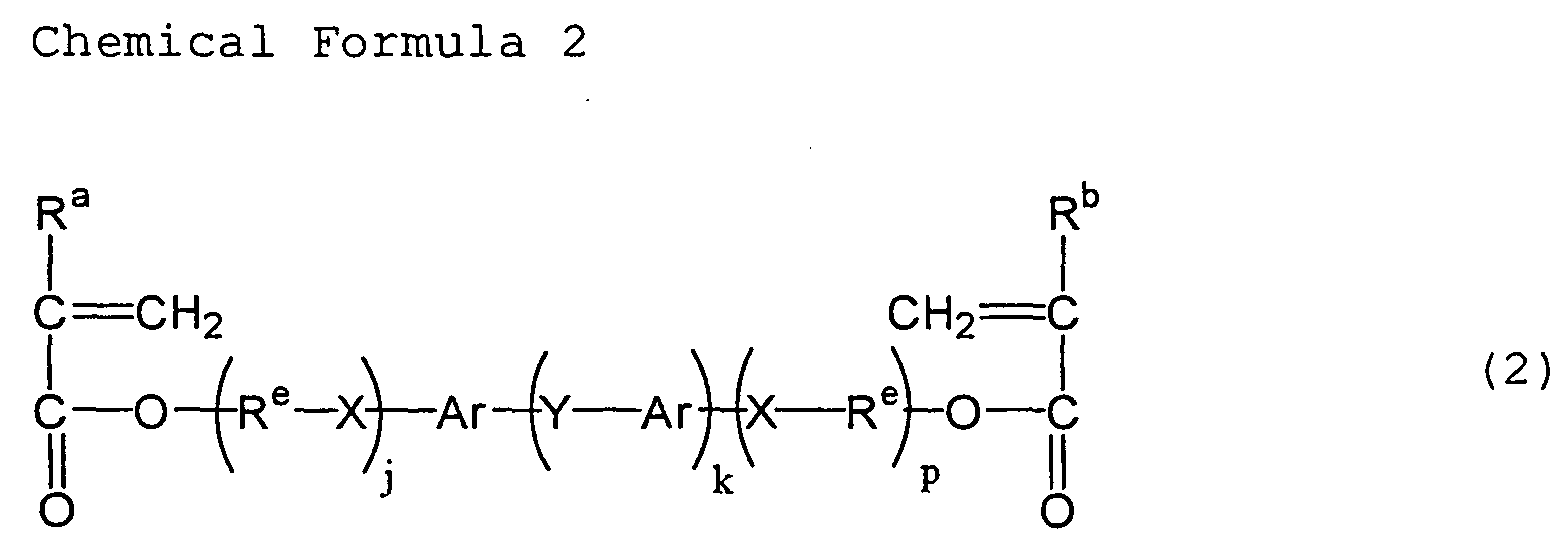
Evaluation results other than the item are shown in Tables 1 and 2.
| Composition | ||||
| Viscosity (cps) | Surface tension (mN/m) | Remaining solvent | Wetting-spreading property | |
| Example 1 | 6500 | 45 | ○ | × |
| Example 2 | 6900 | 44 | ○ | × |
| Example 3 | 5900 | 43 | ○ | × |
| Example 4 | 6500 | 45 | ○ | × |
| Example 5 | 6500 | 50 | ○ | × |
| Example 6 | 4300 | 35 | ○ | ○ |
| Example 7 | 4600 | 34 | ○ | ○ |
| Example 8 | 2800 | 33 | ○ | ○ |
| Example 9 | 4300 | 35 | ○ | ○ |
| Example 10 | 4200 | 38 | ○ | ○ |
| Example 11 | 3700 | 39 | ○ | ○ |
| Example 12 | 1900 | 37 | ○ | ○ |
| Example 13 | 7800 | 44 | ○ | × |
| Example 14 | 8300 | 44 | ○ | × |
| Example 15 | 9100 | 43 | ○ | × |
| Example 16 | 7800 | 44 | ○ | × |
| Example 17 | 7400 | 50 | ○ | × |
| Example 18 | 6000 | 49 | ○ | × |
| Comparative Example 1 | 3600 | 49 | ○ | × |
| Comparative Example 2 | 4200 | 50 | ○ | × |
| Comparative Example 3 | 6500 | 45 | ○ | × |
| Comparative Example 4 | - | - | ○ | × |
| Comparative Example 5 | - | - | ○ | × |
| Comparative Example 6 | 1500 | 32 | ○ | ○ |
| Comparative Example 7 | 800 | 34 | ○ | ○ |
| Comparative Example 8 | 11000 | 45 | ○ | × |
| Comparative Example 9 | 5500 | 49 | ○ | × |
| Comparative Example 10 | 7100 | 50 | ○ | × |
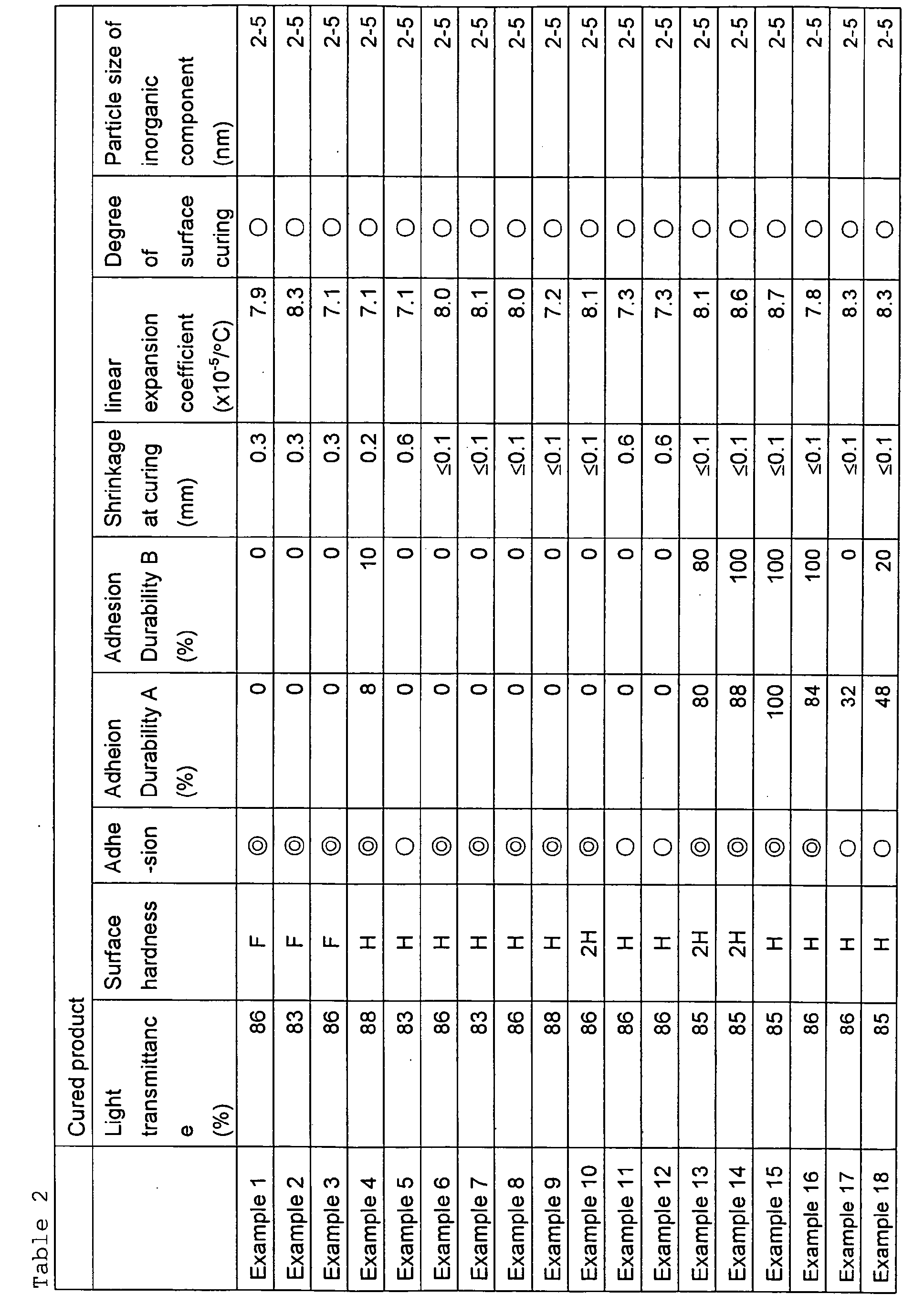

Claims (30)
- A radiation-curable resin composition comprising an inorganic component containing a silica particle composed of a hydrolyzate of an oligomer of an alkoxysilane and a monomer and/or an oligomer thereof,
wherein viscosity at 25°C is from 1,000 to 10,000 centipoises. - The radiation-curable resin composition according to claim 1, wherein a cured product of the composition has a light transmittance of 80% or more at an optical path length of 0.1 mm at 550 nm.
- The radiation-curable resin composition according to claim 1 or 2, wherein surface tension of the composition at 25°C is 40 mN/m or less.
- The radiation-curable resin composition according to any one of claims 1 to 3, which comprises a silica particle composed of a hydrolyzate of an oligomer of an alkoxysilane as the inorganic component, the silica particle being surface-treated with a compound selected from the group consisting of a silane coupling agent, a hydrolyzate of a silane coupling agent, and a condensate thereof.
- The radiation-curable resin composition according to any one of claims 1 to 4, wherein the inorganic component having a particle size larger than 30 nm is 1% by weight or less in the composition.
- The radiation-curable resin composition according to any one of claims 1 to 5, wherein the monomer and/or the oligomer thereof is a monomer having a group capable of forming an intramolecular hydrogen bond or an intermolecular hydrogen bond and/or an oligomer thereof.
- The radiation-curable resin composition according to any one of claims 1 to 6, wherein the monomer and/or the oligomer thereof comprises a monomer having a radiation-curable group and containing a urethane bond or a hydroxyalkylne group and/or an oligomer thereof.
- The radiation-curable resin composition according to claim 7, wherein the monomer having a radiation-curable group and containing a urethane bond or a hydroxyalkylene group and/or the oligomer thereof has an acid group.
- The radiation-curable resin composition according to claim 7 or 8, wherein the content of the acid group derived from the monomer having a radiation-curable group and/or the oligomer thereof in the composition is from 0.1×10⁻⁴ eq/g to 13×10-4 eq/g.
- The radiation-curable resin composition according to claim 8 or 9, wherein the acid group is a carboxyl group.
- The radiation-curable resin composition according to any one of claims 1 to 10, wherein the radiation-curable group is a (meth)acryloyl group.
- A radiation-curable resin composition comprising a silica particle composed of a hydrolyzate of an oligomer of an alkoxysilane, a monomer containing a urethane bond or a hydroxyalkylene group and/or an oligomer thereof, and a silane coupling agent.
- The radiation-curable resin composition according to claim 12, wherein the monomer and/or the oligomer thereof further have an acid group.
- The radiation-curable resin composition according to claim 12 or 13, wherein the content of the acid group derived from the monomer having a radiation-curable group and/or the oligomer thereof in the composition is from 0.1×10⁻⁴ eq/g to 13×10-4 eq/g.
- The radiation-curable resin composition according to claim 13 or 14, wherein the acid group is a carboxyl group.
- The radiation-curable resin composition according to any one of claims 12 to 15, wherein the monomer and/or the oligomer thereof further has a (meth)acryloyl group.
- A radiation-curable resin composition comprising a silica particle and a monomer containing a urethane bond or a hydroxyalkylene group and/or an oligomer thereof,
wherein the monomer and/or the oligomer thereof have an acid group. - The radiation-curable resin composition according to claim 17, wherein the silica particle is obtained by hydrolysis of an oligomer of an alkoxysilane.
- The radiation-curable resin composition according to claim 17 or 18, wherein the content of the acid group derived from the monomer having a radiation-curable group and/or the oligomer thereof in the composition is from 0.1×10⁻⁴ eq/g to 13×10-4 eq/g.
- The radiation-curable resin composition according to any one of claims 17 to 19, wherein the acid group is a carboxyl group.
- The radiation-curable resin composition according to any one of claims 17 to 20, wherein the monomer containing a urethane bond or a hydroxyalkylene group and/or the oligomer thereof further has a (meth)acryloyl group.
- The radiation-curable resin composition according to any one of claims 1 to 21, wherein the monomer and/or the oligomer thereof is a compound having no aromatic ring.
- The radiation-curable resin composition according to any one of claims 1 to 22, wherein the composition substantially does not contain any solvent.
- A process for producing the radiation-curable resin composition according to any one of claims 1 to 16, 22 and 23, wherein the following steps are successively conducted:a step of synthesizing a silica particle by hydrolysis of an oligomer of an alkoxysilane at a temperature of 10 to 100°C in a liquid medium;a step of protecting the surface of the silica particle;a step of mixing the monomer and/or the oligomer thereof; anda step of removing a solvent at a temperature of 10 to 75°C.
- A radiation-curable resin composition, wherein a cured product obtainable by irradiation at a radiation intensity of 0.1 to 3 J/cm2 has the following physical properties a) and b):a) a surface hardness is HB or higher, andb) after a laminate obtained by forming a cured product layer having a film thickness of 100±15 µm on a substrate material made of polycarbonate having a thickness of 1.2±0.2 mm is placed under an environment of 80°C and 85%RH for 100 hours, it is retained that a ratio of adhered area to the adherent material is 50% of initial adhered area.
- A cured product obtainable by curing the curable resin composition according to any one of claims 1 to 23 and 25.
- The cured product according to claim 26, which is used for an optical material.
- A laminate having a layer composed of the cured product according to claim 26 or 27.
- An optical recording medium having a protective layer having a surface hardness of HB or higher and a thickness of 20 µm or more,
wherein it is retained that a ratio of adhered area of a substrate or a substrate having a laminate to the protective layer after placed under an environment of 80°C and 85%RH for 100 hours is 50% or more of initial adhered area. - An optical recording medium having a layer composed of the cured product according to claim 26 or 27.
Applications Claiming Priority (5)
| Application Number | Priority Date | Filing Date | Title |
|---|---|---|---|
| JP2002325706 | 2002-11-08 | ||
| JP2002325706 | 2002-11-08 | ||
| JP2003179251 | 2003-06-24 | ||
| JP2003179251 | 2003-06-24 | ||
| PCT/JP2003/014193 WO2004041888A1 (en) | 2002-11-08 | 2003-11-07 | Radiation curing resin composition and cured product thereof |
Publications (2)
| Publication Number | Publication Date |
|---|---|
| EP1561765A1 true EP1561765A1 (en) | 2005-08-10 |
| EP1561765A4 EP1561765A4 (en) | 2007-07-04 |
Family
ID=32314070
Family Applications (1)
| Application Number | Title | Priority Date | Filing Date |
|---|---|---|---|
| EP03810647A Withdrawn EP1561765A4 (en) | 2002-11-08 | 2003-11-07 | RADIATION-CURABLE RESIN COMPOSITION AND CURED PRODUCT |
Country Status (5)
| Country | Link |
|---|---|
| US (1) | US7569619B2 (en) |
| EP (1) | EP1561765A4 (en) |
| AU (1) | AU2003277605A1 (en) |
| TW (1) | TW200422336A (en) |
| WO (1) | WO2004041888A1 (en) |
Cited By (3)
| Publication number | Priority date | Publication date | Assignee | Title |
|---|---|---|---|---|
| EP1739692A4 (en) * | 2004-04-20 | 2008-03-05 | Takiron Co | Touch panel-use transparent conductive molded product and touch panel |
| US8811790B2 (en) | 2008-04-18 | 2014-08-19 | Sony Dadc Austria Ag | Method for manufacturing an optical waveguide, optical waveguide, and sensor arrangement |
| EP3431512A4 (en) * | 2016-03-18 | 2019-10-30 | Daicel Corporation | CURABLE RESIN COMPOSITION AND OPTICAL ELEMENT |
Families Citing this family (34)
| Publication number | Priority date | Publication date | Assignee | Title |
|---|---|---|---|---|
| KR100470274B1 (en) * | 2002-11-08 | 2005-02-05 | 진 장 | Method of phase transition of amorphous material using a cap layer |
| JP4867217B2 (en) * | 2004-08-19 | 2012-02-01 | 三菱瓦斯化学株式会社 | Curable resin composition and curable film and film |
| EP1811517A1 (en) * | 2004-11-11 | 2007-07-25 | Mitsubishi Kagaku Media Co., Ltd. | Optical recording medium and method for producing same |
| US7491441B2 (en) * | 2004-12-30 | 2009-02-17 | 3M Innovative Properties Company | High refractive index, durable hard coats |
| EP1772471B1 (en) * | 2005-08-24 | 2010-03-03 | Nippon Shokubai Co.,Ltd. | Radiation-curable composition and cured product thereof |
| US20070260008A1 (en) * | 2005-09-21 | 2007-11-08 | Takashi Saito | Silica-Containing Silicone Resin Composition and Its Molded Product |
| WO2007066649A1 (en) * | 2005-12-06 | 2007-06-14 | Mitsubishi Rayon Co., Ltd. | Carbon nanotube-containing composition, composite body, and their production methods |
| JP4817254B2 (en) * | 2006-12-01 | 2011-11-16 | 大日本塗料株式会社 | Zirconium oxide particle dispersion, photocurable composition containing zirconium oxide particles, and cured film |
| JP2008176901A (en) * | 2006-12-19 | 2008-07-31 | Mitsubishi Chemicals Corp | Radiation curing composition for optical recording medium and optical recording medium |
| JP2008192978A (en) * | 2007-02-07 | 2008-08-21 | Shinko Electric Ind Co Ltd | Manufacturing method of semiconductor device |
| JP5198131B2 (en) * | 2007-05-14 | 2013-05-15 | 富士フイルム株式会社 | Barrier film and element |
| JP2009070515A (en) * | 2007-09-14 | 2009-04-02 | Mitsubishi Chemicals Corp | Optical recording medium |
| JP2009098654A (en) * | 2007-09-28 | 2009-05-07 | Dainippon Printing Co Ltd | Optical laminate, polarizing plate, and image display device |
| US20090169870A1 (en) * | 2007-12-27 | 2009-07-02 | Essilor International (Compagnie Generale D'optique) | Carbon Nanotube-Based Curable Coating Composition Providing Antistatic Abrasion-Resistant Coated Articles |
| GB2466251B (en) * | 2008-12-16 | 2011-03-09 | Ind Tech Res Inst | Encapsulant compositions and method for fabricating encapsulant materials |
| JP5372665B2 (en) * | 2009-08-31 | 2013-12-18 | 株式会社日立メディアエレクトロニクス | Photo-curing adhesive, optical pickup device and manufacturing method thereof |
| US9527619B2 (en) | 2009-10-21 | 2016-12-27 | Innovative Bottles, Inc. | Biodegradable pharmacy container and safety cap |
| US8519018B2 (en) * | 2009-10-21 | 2013-08-27 | Innovative Bottles, Llc | Biodegradable material and container for fluids |
| JP5892066B2 (en) * | 2010-08-24 | 2016-03-23 | 日立化成株式会社 | Optical waveguide forming resin composition, optical waveguide forming resin film using the same, and optical waveguide using the same |
| US9396828B2 (en) * | 2010-10-19 | 2016-07-19 | The Boeing Company | Carbon nanotube coated structure and associated method of fabrication |
| US8647471B2 (en) * | 2010-12-22 | 2014-02-11 | Bayer Materialscience Llc | Process for the production of sized and/or wet-strength papers, paperboards and cardboards |
| JP5790023B2 (en) * | 2011-02-25 | 2015-10-07 | 富士通株式会社 | Manufacturing method of electronic parts |
| TWI671799B (en) * | 2011-03-30 | 2019-09-11 | Sumitomo Bakelite Co., Ltd. | Adhesive tape for processing semiconductor wafer or the like |
| CN104303106B (en) * | 2012-05-31 | 2018-08-07 | 日立化成株式会社 | Photosensitive resin composition, photosensitive element, method for forming resist pattern, and method for manufacturing wiring board |
| US9957416B2 (en) | 2014-09-22 | 2018-05-01 | 3M Innovative Properties Company | Curable end-capped silsesquioxane polymer comprising reactive groups |
| KR20170063735A (en) | 2014-09-22 | 2017-06-08 | 쓰리엠 이노베이티브 프로퍼티즈 캄파니 | Curable polymers comprising silsesquioxane polymer core silsesquioxane polymer outer layer, and reactive groups |
| EP3584288B1 (en) | 2016-06-27 | 2021-08-18 | Viavi Solutions Inc. | Magnetic articles |
| JP6837930B2 (en) | 2016-06-27 | 2021-03-03 | ヴァイアヴィ・ソリューションズ・インコーポレイテッドViavi Solutions Inc. | High chromaticity flakes |
| US12187900B2 (en) * | 2016-06-27 | 2025-01-07 | Viavi Solutions Inc. | High chromaticity pigment flakes and foils |
| EP4570863A1 (en) | 2016-06-27 | 2025-06-18 | Viavi Solutions Inc. | Optical devices |
| US20230146407A1 (en) * | 2020-04-09 | 2023-05-11 | Kaneka Americas Holding, Inc. | Curable composition, cured product, and methods thereof |
| WO2022050190A1 (en) * | 2020-09-03 | 2022-03-10 | 住友電気工業株式会社 | Production method for optical fiber base material, and optical fiber base material |
| EP4227334A4 (en) * | 2020-10-05 | 2024-04-03 | Sumitomo Electric Industries, Ltd. | RESIN COMPOSITION, GLASS FIBER AND METHOD FOR PRODUCING A GLASS FIBER |
| CN112649888B (en) * | 2020-11-24 | 2022-08-12 | 东华理工大学 | A Method for Calculating the Quantitative Scale Coefficient of Uranium Ore Based on the Characteristic Spectral Peaks of Energy Spectrum Logging |
Family Cites Families (51)
| Publication number | Priority date | Publication date | Assignee | Title |
|---|---|---|---|---|
| US4348462A (en) * | 1980-07-11 | 1982-09-07 | General Electric Company | Abrasion resistant ultraviolet light curable hard coating compositions |
| US4455205A (en) * | 1981-06-01 | 1984-06-19 | General Electric Company | UV Curable polysiloxane from colloidal silica, methacryloyl silane, diacrylate, resorcinol monobenzoate and photoinitiator |
| JPS62204252A (en) | 1986-03-04 | 1987-09-08 | Mitsubishi Rayon Co Ltd | Liquid photosensitive resin composition |
| JPS62256874A (en) * | 1986-05-01 | 1987-11-09 | Toshiba Silicone Co Ltd | Production of ultraviolet curable composition |
| JPS6374911A (en) * | 1986-09-19 | 1988-04-05 | Shin Etsu Chem Co Ltd | Production of fine spherical silica |
| JP2545867B2 (en) * | 1987-07-15 | 1996-10-23 | 日本合成ゴム株式会社 | Photocurable resin composition |
| JPH0611707Y2 (en) | 1987-07-23 | 1994-03-30 | 大見工業株式会社 | Reamer with a cap for discharging coolant liquid |
| JPH04236266A (en) * | 1991-01-14 | 1992-08-25 | Toagosei Chem Ind Co Ltd | Resin composition and its production |
| JP3072193B2 (en) * | 1991-09-27 | 2000-07-31 | 三菱レイヨン株式会社 | Coating composition and surface-coated article |
| US5209998A (en) * | 1991-11-25 | 1993-05-11 | Xerox Corporation | Colored silica particles |
| US5318850A (en) * | 1991-11-27 | 1994-06-07 | General Electric Company | UV curable abrasion-resistant coatings with improved weatherability |
| JP3096862B2 (en) | 1991-12-02 | 2000-10-10 | 三菱レイヨン株式会社 | Active energy radiation curable coating composition |
| JP2734276B2 (en) * | 1992-01-23 | 1998-03-30 | 信越化学工業株式会社 | Method for forming cured film of photocurable coating composition |
| JPH06295060A (en) * | 1992-10-29 | 1994-10-21 | Ajinomoto Co Inc | Photosensitive resin composition or photosensitive thermosetting resin composition and photo solder resist composition using them |
| CA2111646A1 (en) * | 1992-12-25 | 1994-06-26 | Shin Aihara | Optical recording medium |
| KR0185765B1 (en) * | 1993-04-10 | 1999-04-15 | 가와다 미쓰구 | Optical information medium and method for fabricating same |
| US5800606A (en) | 1993-12-21 | 1998-09-01 | Mitsubishi Chemical Corporation | Ultrafine reactive silica particles, suspension containing the same, and hard coating composition |
| CA2141515A1 (en) | 1994-02-08 | 1995-08-09 | John D. Blizzard | Abrasion-resistant coating |
| US5466491A (en) * | 1994-09-12 | 1995-11-14 | General Electric Company | Radiation curable silicon containing polyarcylate hardcoat compositions, method for making, and use |
| JPH08319456A (en) * | 1995-04-28 | 1996-12-03 | E I Du Pont De Nemours & Co | Aqueous-system-treatable, flexible, optical-image-forming and durable coating material for printed circuit |
| US6160067A (en) * | 1995-10-03 | 2000-12-12 | Dsm N.V. | Reactive silica particles, process for manufacturing the same, use of the same |
| JPH09110984A (en) | 1995-10-13 | 1997-04-28 | Mitsubishi Chem Corp | Silicate cured product and method for producing the same |
| JPH09255873A (en) | 1996-03-26 | 1997-09-30 | Mitsubishi Chem Corp | Curable composition, method for producing the same, and cured product |
| US5990188A (en) * | 1996-08-15 | 1999-11-23 | General Electric Company | Radiation curable coatings with improved weatherability |
| JP3718563B2 (en) * | 1996-09-20 | 2005-11-24 | 三菱レイヨン株式会社 | Resin molded product having coating agent and cured coating film |
| JP3065267B2 (en) | 1997-01-31 | 2000-07-17 | 日本合成化学工業株式会社 | Method for producing resin composition |
| JPH10231339A (en) * | 1997-02-19 | 1998-09-02 | Mitsubishi Rayon Co Ltd | Curable composition |
| JPH10298254A (en) * | 1997-04-23 | 1998-11-10 | Mitsubishi Rayon Co Ltd | Curable composition, method for producing the same, and dental restoration material |
| JPH10298252A (en) * | 1997-04-23 | 1998-11-10 | Mitsubishi Rayon Co Ltd | Curable composition and method for producing the same |
| JPH10298253A (en) * | 1997-04-23 | 1998-11-10 | Mitsubishi Rayon Co Ltd | Curable composition and method for producing the same |
| JP3631878B2 (en) * | 1997-05-01 | 2005-03-23 | 三菱レイヨン株式会社 | Method for producing curable composite composition |
| JP3848434B2 (en) | 1997-05-30 | 2006-11-22 | 株式会社日本触媒 | Curable resin composition |
| JP3889858B2 (en) | 1997-07-25 | 2007-03-07 | 共栄社化学株式会社 | Urethane / unsaturated organooligomer and process for producing the same |
| JP4642165B2 (en) * | 1997-08-07 | 2011-03-02 | 日揮触媒化成株式会社 | Porous silica-based coating solution, coated substrate and short fibrous silica |
| JP4016409B2 (en) | 1997-12-12 | 2007-12-05 | Jsr株式会社 | Liquid curable resin composition |
| JP2000289172A (en) * | 1999-04-05 | 2000-10-17 | Ge Toshiba Silicones Co Ltd | Polycarbonate laminate |
| JP3613086B2 (en) | 1999-08-31 | 2005-01-26 | 荒川化学工業株式会社 | Composition for organic-inorganic hybrid polyurethane and organic-inorganic hybrid polyurethane |
| US6214433B1 (en) * | 1999-10-04 | 2001-04-10 | Dsm N.V. | Radiation-curable coatings for optical discs and optical discs incorporating such coatings |
| JP2001113649A (en) * | 1999-10-19 | 2001-04-24 | Nippon Kayaku Co Ltd | Film having cured film of radiation curable resin composition |
| WO2001042155A1 (en) * | 1999-12-13 | 2001-06-14 | Nippon Sheet Glass Co., Ltd. | Low-reflection glass article |
| JP2001206922A (en) | 2000-01-25 | 2001-07-31 | Daicel Chem Ind Ltd | Water-curable photocurable resin composition |
| JP4623538B2 (en) * | 2000-06-13 | 2011-02-02 | 日本化薬株式会社 | Film having cured film of radiation curable resin composition |
| JP2002012652A (en) * | 2000-06-29 | 2002-01-15 | Yokohama Rubber Co Ltd:The | Epoxy resin composition and prepreg |
| JP2002038028A (en) * | 2000-07-26 | 2002-02-06 | Toagosei Co Ltd | Photocurable resin composition |
| EP1317691A2 (en) * | 2000-09-11 | 2003-06-11 | Showa Denko K.K. | Photosensitive composition, cured article thereof, and printed circuit board using the same |
| JP4611554B2 (en) | 2000-12-01 | 2011-01-12 | 昭和電工株式会社 | Photosensitive composition, cured product thereof, and printed wiring board using the same |
| JP2004510015A (en) | 2000-09-22 | 2004-04-02 | ザ ウェルディング インスティテュート | Coating composition |
| JP3897583B2 (en) | 2000-11-30 | 2007-03-28 | 三菱レイヨン株式会社 | optical disk |
| JP4015471B2 (en) | 2001-06-28 | 2007-11-28 | 大日本印刷株式会社 | Photocurable resin composition, fine uneven pattern transfer foil, optical article, stamper, and method for forming fine uneven pattern |
| JP2003140147A (en) * | 2001-11-02 | 2003-05-14 | Seiko Instruments Inc | A method for forming a front light and an antireflection film of a reflection type liquid crystal display device. |
| JP4437783B2 (en) * | 2003-02-21 | 2010-03-24 | 旭化成株式会社 | Silica-containing laminate |
-
2003
- 2003-11-07 EP EP03810647A patent/EP1561765A4/en not_active Withdrawn
- 2003-11-07 WO PCT/JP2003/014193 patent/WO2004041888A1/en not_active Ceased
- 2003-11-07 AU AU2003277605A patent/AU2003277605A1/en not_active Abandoned
- 2003-11-07 TW TW092131439A patent/TW200422336A/en unknown
-
2005
- 2005-05-06 US US11/123,041 patent/US7569619B2/en not_active Expired - Fee Related
Cited By (5)
| Publication number | Priority date | Publication date | Assignee | Title |
|---|---|---|---|---|
| EP1739692A4 (en) * | 2004-04-20 | 2008-03-05 | Takiron Co | Touch panel-use transparent conductive molded product and touch panel |
| US7956287B2 (en) | 2004-04-20 | 2011-06-07 | Takiron Co., Ltd. | Transparent conductive formed article for a touch panel and touch panel |
| US8811790B2 (en) | 2008-04-18 | 2014-08-19 | Sony Dadc Austria Ag | Method for manufacturing an optical waveguide, optical waveguide, and sensor arrangement |
| EP3431512A4 (en) * | 2016-03-18 | 2019-10-30 | Daicel Corporation | CURABLE RESIN COMPOSITION AND OPTICAL ELEMENT |
| US10988607B2 (en) | 2016-03-18 | 2021-04-27 | Daicel Corporation | Curable resin composition and optical member |
Also Published As
| Publication number | Publication date |
|---|---|
| AU2003277605A1 (en) | 2004-06-07 |
| US20050267230A1 (en) | 2005-12-01 |
| EP1561765A4 (en) | 2007-07-04 |
| US7569619B2 (en) | 2009-08-04 |
| WO2004041888A1 (en) | 2004-05-21 |
| TW200422336A (en) | 2004-11-01 |
Similar Documents
| Publication | Publication Date | Title |
|---|---|---|
| US7569619B2 (en) | Radiation-curable resin composition and cured product thereof | |
| US20080102262A1 (en) | Radiation Curable Composition and Curing Product Thereof, and Laminate Including the Same | |
| JP5187267B2 (en) | Hard coat resin composition, cured film, laminate, optical recording medium, and cured film production method | |
| US7838097B2 (en) | Hardcoat agent composition and optical information medium thereof | |
| JP2004169028A (en) | Radiation-curable resin composition and cured product thereof | |
| JP2006152289A (en) | Radiation curable composition, cured product thereof, and laminate thereof | |
| TWI400702B (en) | Optical recording media | |
| JP2007131698A (en) | Radiation curable composition, cured product thereof, and laminate thereof | |
| JP4249634B2 (en) | Radiation curable resin composition and method for producing radiation curable resin composition | |
| JP2006137795A (en) | Radiation curable composition, cured product thereof, and laminate thereof | |
| JP2006188659A (en) | Radiation curable resin composition and cured product thereof | |
| JP2006161030A (en) | Radiation curable composition, cured product thereof, and laminate thereof | |
| JP2005036184A (en) | Radiation curable resin composition and cured product thereof | |
| US20100067347A1 (en) | Ultraviolet-curable composition for light transmission layer and optical disk using same | |
| Moon et al. | A study on UV-curable coatings for HD-DVD: primer and top coats | |
| JP2005298226A (en) | Silica sol and its manufacturing method | |
| JP2006152273A (en) | Radiation curable composition, cured product thereof, and laminate thereof | |
| JP2005240014A (en) | Radiation curable resin composition, method for producing radiation curable resin composition, cured product, laminate and optical recording medium | |
| CN100437784C (en) | Optical information medium and production method therefor | |
| US20070231527A1 (en) | Optical Recording Medium and Method for Producing Same | |
| JP2007238819A (en) | Radiation curable composition, cured product thereof, and laminate thereof | |
| JP2006152268A (en) | Radiation curable composition, cured product thereof, and laminate thereof | |
| JP2007270119A (en) | Radiation curable composition, cured product thereof, and laminate thereof | |
| JP2006164496A (en) | Optical recording medium and manufacturing method thereof | |
| JP2006070098A (en) | Photocurable composition for recording medium and method for producing the same |
Legal Events
| Date | Code | Title | Description |
|---|---|---|---|
| PUAI | Public reference made under article 153(3) epc to a published international application that has entered the european phase |
Free format text: ORIGINAL CODE: 0009012 |
|
| 17P | Request for examination filed |
Effective date: 20050602 |
|
| AK | Designated contracting states |
Kind code of ref document: A1 Designated state(s): AT BE BG CH CY CZ DE DK EE ES FI FR GB GR HU IE IT LI LU MC NL PT RO SE SI SK TR |
|
| AX | Request for extension of the european patent |
Extension state: AL LT LV MK |
|
| DAX | Request for extension of the european patent (deleted) | ||
| RBV | Designated contracting states (corrected) |
Designated state(s): DE |
|
| RAP1 | Party data changed (applicant data changed or rights of an application transferred) |
Owner name: MITSUBISHI CHEMICAL CORPORATION |
|
| A4 | Supplementary search report drawn up and despatched |
Effective date: 20070601 |
|
| 17Q | First examination report despatched |
Effective date: 20080125 |
|
| STAA | Information on the status of an ep patent application or granted ep patent |
Free format text: STATUS: THE APPLICATION IS DEEMED TO BE WITHDRAWN |
|
| 18D | Application deemed to be withdrawn |
Effective date: 20100202 |