Field of the invention
The present invention relates to a cosmetic composition
useful for antiperspiration.
Background of the invention
In perspiring sites particularly the armpit, stickiness
due to perspiration worsens the skin feel and an unpleasant
smell is generated, and thus cosmetics having an anti-perspiring
effect have been used. Particularly, an aluminum
compound is used as a main component exhibiting an anti-perspiring
effect (JP-A 52-99236). However, sticky feel due
to perspiration remains, and the anti-perspiring effect is not
sufficient.
In order to reduce sticky feel due to perspiration,
accordingly, cosmetics containing an anti-perspiring
component and/or a sterilizing component and a highly
water-absorbing polymer compound (JP-A 3-284617), and then
cosmetics containing a novel aluminum compound as an anti-perspiring
component have been known, but their anti-perspiring
effect are not sufficient, and stickiness due to
perspiration are often felt.
Further, when an antiperspirant based on an aluminum
compound is applied onto the armpit and soap foam is applied
onto the armpit at the time of shaving, the foam is broken thus
causing not only a problem of deterioration in smoothness upon
shaving with a razor, but also a problem that owing to
components in the antiperspirant, soap scum is formed in a large
amount in the armpit, to further deteriorate smoothness upon
shaving with a razor.
Further, cosmetics containing hydrophobated powder and
a water-absorbing polymer (JP-A 4-356415) are known in order
to reduce sticky feel due to perspiration.
Summary of the invention
The present invention relates to a cosmetic composition,
particularly a cosmetic composition for antiperspiration.
The present invention provides a cosmetic composition
containing surface-hydrophobated water-absorbing polymer
particles and an anti-perspiring component.
The present invention provides use of a composition
containing surface-hydrophobated water-absorbing polymer
particles and an anti-perspiring component as cosmetics. The
present invention also provides a method of antiperspiration,
which includes applying a composition containing surface-hydrophobated
water-absorbing polymer particles and an
anti-perspiring component onto the skin.
Detailed description of the invention
The present invention relates to a cosmetic composition
having high anti-perspiring performance and excellent in
smoothness at the time of shaving. The present invention
provides a cosmetic composition preferably containing
water-absorbing polymer particles, an anti-perspiring
component, and at least one member selected from the group
consisting of silicone having a viscosity (25°C) of not higher
than 5 × 10⁻³ m2/s and hydrophobic particles, wherein the content
of the water-absorbing polymer particles is 3 to 95 parts by
weight relative to 100 parts by weight of the anti-perspiring
component.
[Water-absorbing polymer particles]
The shape of the water-absorbing polymer particles in
the present invention is not particularly limited, and may be
not only in the form of sphere, egg or lump, but also in the
form of scale, plate, fiber, fine-powder agglomerate (granule)
or in an amorphous state. Preferably, the water-absorbing
polymer particles are in the form of sphere, egg or lump for
easy availability, more preferably in the form of sphere for
good feeling. These particles may be porous.
When the water-absorbing polymer particles used in the
present invention are in the form of sphere, egg or lump, the
average particle diameter thereof is preferably 0.1 µm or more,
more preferably 0.5 µm or more, and the upper limit is
preferably 50 µm or less, more preferably 20 µm or less, still
more preferably 10 µm or less and even more preferably 5 µm
or less, so that the resulting cosmetics are not remarkable
as white powder, do not cause a sense of incongruity after
absorption of water, have dry feel, and are not easily removed
from the skin. The average particle diameter refers to the
diameter of a particle not swollen with water, determined (in
a cyclohexane solvent) with a light scattering particle-diameter
measuring instrument (for example, LS-230 model
manufactured by Coulter, Inc.).
The amount of water absorbed into the water-absorbing
polymer particles used in the present invention is preferably
not lower than 5 g/g, more preferably not lower than 10 g/g,
to achieve sufficient anti-perspiring performance, and the
upper limit is preferably not higher than 100 g/g, more
preferably not higher than 50 g/g, still more preferably not
higher than 30 g/g, in order to prevent the particles from
giving slimy feel upon absorption of sweat on the skin and to
make them hardly releasable from the skin. The amount of water
absorbed can be determined by adding 1000 ml water to 5 g sample,
then suspending and stirring it for 30 minutes (100 rpm, 25°C),
centrifuging it at 2,000 G for 30 minutes, discarding the
supernatant gently, measuring the weight of the sample, and
determining the amount of water absorbed, on the basis of the
difference of this weight from the initial weight of the sample.
As the polymer used in the water-absorbing polymer
particles of the present invention, a natural polymer, a
semi-synthetic polymer or a synthetic polymer can be used
insofar as it is a polymer having the action of absorbing water.
To attain a water-retaining property, it is preferably a
polymer having a crosslinked structure, and such a polymer is
a (co)polymer crosslinked by a crosslinking method described
later or a (co)polymer having a crosslinkage via a hydrogen
bond or hydrophobic bond, a crosslinkage derived from a partial
crystalline structure or a crosslinkage derived from a helix
structure etc. [(co)polymer means a polymer or copolymer.].
For example, the natural polymer and semi-synthetic
polymer include starch, carrageenan, gelatin, agar,
tragacanth gum, viscose, cellulose (for example, crystalline
cellulose), methyl cellulose, ethyl cellulose, hydroxyethyl
cellulose and carboxymethyl cellulose, or crosslinked
products thereof, for example starch-(meth)acrylate graft
copolymers (or its crosslinked products) [(meth)acrylate
means acrylate, methacrylate or a mixture thereof.].
The synthetic polymer includes a crosslinked product of
a (co)polymer of hydrophilic vinyl monomers such as anionic
monomers or salts thereof, nonionic hydrophilic group-containing
monomers, amino group-containing unsaturated
monomers or neutralized products thereof or quaternarized
products thereof. The hydrophilicity of the hydrophilic vinyl
monomer means that the solubility in 100g of water (20°C) is
preferably 6 weight% or more, more preferably more than 20
weight%. Examples of monomers used in production of the
synthetic polymer include anionic monomers such as
(meth) acrylic acid, maleic acid, fumaric acid, crotonic acid,
itaconic acid, 2-(meth)acryloyl ethane sulfonic acid, 2-(meth)acryloyl
propane sulfonic acid, 2-(meth)acrylamide-2-methyl
propane sulfonic acid, vinyl sulfonic acid and
styrene sulfonic acid or salts thereof; nonionic hydrophilic
group-containing monomers such as (meth)acrylamide, N-substituted
(meth)acrylamide, 2-hydroxyethyl (meth)acrylate,
2-hydroxypropyl (meth)acrylate, methoxypolyethylene glycol
(meth)acrylate, polyethylene glycol(meth)acrylate, N-vinyl
pyrrolidone and N-vinyl acetamide; and amino-group containing
unsaturated monomers such as N,N-dimethylaminoethyl
(meth)acrylate, N,N-dimethylaminopropyl (meth)acrylate and
N, N-dimethylaminopropyl (meth) acrylamide or acid-neutralized
product thereof, or quaternized products thereof. Preferable
examples of the acid used in producing the acid-neutralized
product include hydrochloric acid, sulfuric acid, nitric acid,
acetic acid, formic acid, maleic acid, fumaric acid, citric
acid, tartaric acid, adipic acid, lactic acid etc., and
preferable examples of the quaternizing agent include alkyl
halides such as methyl chloride, ethyl chloride, methyl
bromide and methyl iodide, and standard alkylating agents such
as dimethyl sulfate, diethyl sulfate and di-n-propyl sulfate.
The counterion includes halogen ions such as chlorine and
organic anions such as methosulfate. Unless the
hydrophilicity of the resultant polymer is extremely inhibited,
the hydrophobic vinyl monomers such as acrylates and styrene
or derivatives thereof can also be simultaneously
copolymerized in an amount of preferably 0 to 50% by weight,
more preferably 0 to 20 weight%, of the total monomers.
The hydrophobicity of the hydrophobic vinyl monomer
means that the solubility in 100g of water (20°C) is preferably
less than 6 weight%. No lower limit is provided. It may be
0.01 weight% or more.
As the monomer components used, one or more of those
enumerated above can be selected, but crosslinked (co)polymers
of α,β-unsaturated carboxylic acid monomers such as
(meth) acrylic acid, maleic acid, fumaric acid, crotonic acid,
itaconic acid or salts thereof are preferable because of their
high water-absorbing ability and easy availability. In
addition to the α,β-unsaturated carboxylic acid monomers,
other monomers can also be copolymerized.
To improve the water-absorbing ability, the amount of
the hydrophilic vinyl monomers blended is preferably at least
50% by weight, more preferably at least 70% by weight and
particularly preferably at least 90% by weight of the total
monomers constituting the water-absorbing polymer particles.
The water-absorbing polymer particles are preferably a
crosslinked polymer or copolymer of hydrophilic vinyl monomers
and/or salt thereof, more preferably a crosslinked polymer or
copolymer of α,β-unsaturated carboxylic acid monomers and/or
salts thereof, particularly preferably crosslinked
poly(meth)acrylate. These water-absorbing polymers can be
used alone or in combination thereof.
The "salt" includes e.g. alkali metal salts (sodium salt,
potassium salt, lithium salt etc.), alkaline earth metal salts
(calcium salt, magnesium salt, barium salt etc.) and ammonium
salts (quaternary ammonium salt, quaternary alkyl ammonium
salt etc.). Among these, the sodium salt is even more
inexpensive and preferable. Here, the degree of
neutralization of the water-absorbing polymer particles is
preferably 0.01 to 100%, more preferably 1 to 99% and
particularly preferably 40 to 95% based on the number of moles
of the acid group in the water-absorbing polymer. In the
present invention, the "degree of neutralization" refers to
the ratio (on a molar basis) of the salt-forming acid group
to the acid group in the water-absorbing polymer, that is,
(number of moles of the salt-forming acid group)/(number of
moles of the salt-formable free acid plus the salt-forming acid
group) × 100 (%).
The method of forming the crosslinked (co)polymers
described above involves covalent crosslinking by (a)
self-crosslinking during polymerization, (b)
copolymerization with a multifunctional monomer, and (c)
irradiation with radiation, or ionic crosslinking via (d)
polyvalent metal ion. Among these, (b) is preferable from the
viewpoint of easy production and stability of the crosslinked
structure, and the multifunctional monomer includes a
crosslinking vinyl monomer having at least 2 reactive
unsaturated groups in the molecule and a compound having at
least 2 functional groups other than unsaturated groups in the
molecule (the above crosslinking vinyl monomer and the above
compound are referred to collectively as crosslinking agent) .
Among these crosslinking vinyl monomers having at least
2 reactive unsaturated groups in the molecule, ethylene glycol
di(meth)acrylate, polyethylene glycol di(meth)acrylate,
divinyl benzene, pentaerythritol triallyl ether,
pentaerythritol tetraallyl ether, and methylene bisacrylamide
are preferable.
The compound having at least 2 functional groups other
than unsaturated groups in the molecule is more preferably
ethylene glycol diglycidyl ether or polyethylene glycol
diglycidyl ether.
The amount of the crosslinking agent added is varied
depending on the type of the crosslinking agent and the
crosslinking method, but is preferably 0.001 part by weight
or more, more preferably 0.01 part by weight or more,
particularly preferably 0.1 part by weight or more, relative
to 100 parts by weight of the total monomers constituting the
water-absorbing polymer particles, and the upper limit is
preferably 20 parts by weight or less, more preferably 10 parts
by weight or less, particularly preferably 5 parts by weight
or less. When the amount of the crosslinking agent is 0.001
part by weight or more, the amount of water absorbed can be
maintained due to a lower content of water-soluble components
in the resulting water-absorbing polymer, while when its
amount is 20 parts by weight or less, the density of
crosslinkages is suitable and the amount of water absorbed into
the resultant water-absorbing polymer is sufficient.
The water-absorbing polymer particles used in the
present invention are preferably water-absorbing polymer
particles wherein at least a part of the surfaces of
water-absorbing polymer particles was hydrophobated (referred
to hereinafter as surface-hydrophobated water-absorbing
polymer particles).
Such surface-hydrophobated water-absorbing polymer
particles include, for example, (1) surface-hydrophobated
water-absorbing polymer particles wherein the surfaces of
water-absorbing polymer particles were coated with a silicone
compound having at least one kind of functional group, (2)
surface-hydrophobated water-absorbing polymer particles
wherein the surfaces of water-absorbing polymer particles were
coated with a polymer of a hydrophobic vinyl monomer, (3)
surface-hydrophobated water-absorbing polymer particles
wherein the surfaces of water-absorbing polymer particles were
treated with a fluorine-based surfactant, and (4) surface-hydrophobated
water-absorbing polymer particles wherein the
surfaces of water-absorbing polymer particles were treated
with a silane coupling agent. Among these polymer particles,
the surface-hydrophobated water-absorbing polymer particles
wherein the surfaces of water-absorbing polymer particles were
coated with a silicone compound having at least one kind of
functional group are preferable. Hereinafter, preferable
surface-hydrophobated water-absorbing polymer particles are
specifically described.
(1) Surface-hydrophobated water-absorbing polymer particles
wherein the surfaces of water-absorbing polymer particles were
coated with a silicone compound having at least one kind of
functional group
The silicone compound having at least one kind of
functional group is a silicone compound having at least 2
silicon atoms, having at least one kind of functional group
capable of chemical bonding, preferably covalent bonding
and/or ionic bonding, to the surfaces of water-absorbing
polymer particles.
In the surface-hydrophobated water-absorbing polymer
particles, the surfaces of the water-absorbing polymer
particles have been coated preferably via chemical bonding
with a silicone compound having at least one kind of functional
group. The silicone compound can thereby be stably present
on the surfaces of the water-absorbing polymer particles, even
upon incorporation into cosmetics. The presence of such
chemical bonding can be confirmed by the fact that the silicone
compound is present on the water-absorbing polymer particles
even if the silicon-modified polymer particles (10% by weight
relative to chloroform) are subjected 3 times to a washing step
of treating with chloroform for 2 hours under stirring (30 rpm,
50°C) and then centrifugal separation.
The water-absorbing polymer particles are preferably
coated thereon with the silicone compound to such an extent
that the stickiness of the surfaces of the water-absorbing
swollen particles can be suppressed.
Assuming that the amount of the total polymer particles
(including the silicone compound) is 100 parts by weight, the
lower limit of the amount of the silicone compound having at
least one kind of functional group in the water-absorbing
polymer particles is preferably 0.1 part by weight or more,
more preferably 0.5 part by weight or more, still more
preferably 1 part by weight or more. The upper limit is
preferably 30 parts by weight or less, more preferably 10 parts
by weight or less, still more preferably 5 parts by weight or
less.
To prevent gel blocking among polymer particles or sticky
feeling during use, the silicone compound having at least one
kind of functional group is preferably hydrophobic. In
particular, when the silicone compound is the one having plural
kinds of functional groups and having a functional group not
contributing to the reaction, the silicone compound is
preferably hydrophobic.
As used herein, the hydrophobic silicone compound having
at least one kind of functional group refers to the one whose
solubility in 100 g water at 25°C is not more than 10% by weight,
preferably not more than 1% by weight, more preferably not more
than 0.5% by weight, even more preferably not more than 0.1%
by weight. The lower limit of the solubility is not
particularly present, but may be not less than 0.01% by weight.
The weight average molecular weight of the silicone
compound having at least one kind of functional group is
preferably 1000 to 500,000, more preferably 3000 to 200,000
and particularly preferably 10,000 to 200,000. Measurement
of this weight average molecular weight is conducted by gel
permeation chromatography (GPC), using polystyrene as
standard and chloroform as eluent.
The functional group is preferably at least one kind of
functional group selected from the group consisting of an amino
group, an ammonium group, a carboxy group, a hydroxy group,
an epoxy group and a radical-polymerizable unsaturated group,
more preferably an amino group and/or an ammonium group. These
groups may be located at a side chain, one end and/or both ends
of siloxane, or may be a mixture thereof.
Typical examples of the silicone compound having at least
one kind of functional group used in the present invention are
shown below.
(1-1) Silicone compound having an amino group and/or an
ammonium group (referred to hereinafter as amino-modified
silicone)
The amino-modified silicone is preferably the one having
a polymerizable unit represented by the following general
formula (I):
wherein R
1 represents a hydrogen atom or a C
1-6 hydrocarbon group,
and a plurality of R
1s may be the same or different; R
2 represents
R
1 or X whereupon X is a reactive functional group represented
by -R
3-Z (R
3 represents a direct bond or a C
1-20 divalent
hydrocarbon group, and Z represents a primary to tertiary amino
group-containing group or a quaternary ammonium group-containing
group); and a is a number of 2 or more, and b is
a number of 1 or more.
In the general formula (I), R
1 groups independently
represent a hydrogen atom or a C
1-6 hydrocarbon group, for
example an alkyl group or phenyl group, preferably a methyl
group or ethyl group, more preferably a methyl group. R
3 is
preferably a C
1-6 linear or branched alkylene group, and
includes a methylene group, ethylene group, trimethylene group,
propylene group, tetramethylene group etc., more preferably
a trimethylene group or propylene group. a and b each
represent the number of polymerizing repeating units.
Preferably, a is a number of 2 to 1000, and b is a number of
1 to 50. Z is preferably an amino group- or ammonium
group-containing group represented by the general formula (II)
or (III) below.
wherein R
4 represents ―OCH
2CH
2―,
R
5 and R
6 each represent a hydrogen atom or a monovalent
hydrocarbon group, d and e each represent an integer of 0 to
6, and T
- represents a halogen atom or an organic anion.
In the general formula (III), a plurality of R5s may be
the same or different. Specific examples of T- include halogen
ions such as chlorine, iodine, bromine etc. and organic anions
such as methosulfate, ethosulfate, methophosphate,
ethophosphate etc.
In the general formula (I), the group X is preferably
-(CH2)3-NH2, -(CH2)3-N(CH3)2-, -(CH2)3-NH-(CH2)2-NH2, -(CH2)3-NH-(CH2)2-N(CH3)2,
or -(CH2)3-N+(CH3)3Cl-, more preferably -
(CH2)3-NH-(CH2)2-NH2.
The weight average molecular weight of the amino-modified
silicone is preferably 3000 to 200,000, and for easy
reaction with anionic functional groups of the water-absorbing
polymer and for hydrophobicity of the silicone compound, the
amine equivalent thereof is preferably 250 to 10000 g/mol, more
preferably 1000 to 5000 g/mol. That is, the amount of the amino
group or ammonium group in the polymer is preferably 0.1 to
4 mmol/g, more preferably 0.2 to 1 mmol/g. The amine
equivalent can be measured in a solvent such as ethanol by
titration with hydrochloric acid of known concentration.
(1-2) Silicon compound having a carboxy group (referred to
hereinafter as carboxy-modified silicone)
The carboxy-modified silicone is preferably either a
compound having a silicon atom and carboxy group bound via a
saturated hydrocarbon, or an organosiloxane compound having
a carboxyl group and/or a salt thereof bound to a silicon atom
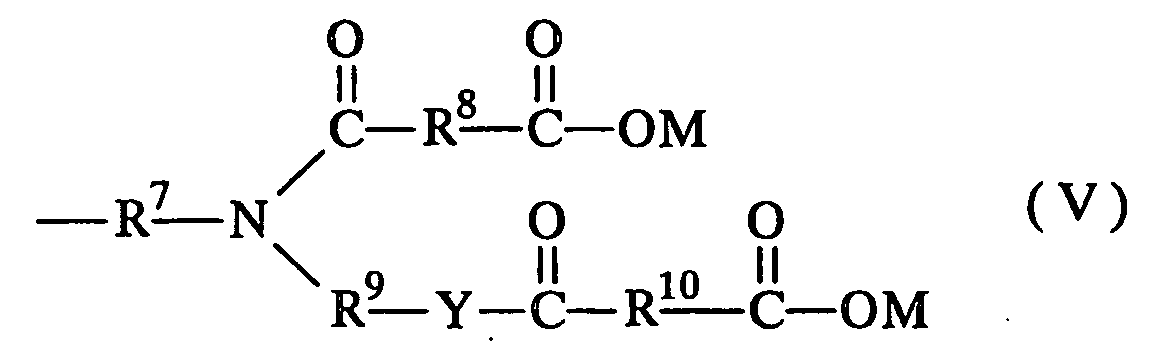
via a structure shown in one of the formulae (IV) and (V), which
is described in JP-A 2002-114849:
wherein R
7, R
8, R
9 and R
10 are the same or different and each
represent a C
2-22 linear or branched alkylene or alkenylene group
or an arylene group, which may have a substituent group
containing a heteroatom; Y represents an -O- or -NH- group;
and M represents a hydrogen atom, a metal, ammonium, C
1-22 alkyl
or alkenyl ammonium, C
1-22 alkyl or alkenyl-substituted
pyridinium, C
1-22 alkanol ammonium, or a basic amino acid.
Further, an amphoteric ionomer siloxane having two
functional groups i.e. a carboxyl group and an ammonium group
described in JP-A 6-1711 can also be preferably used.
The weight average molecular weight of the carboxy-modified
silicone is preferably 3000 to 200,000. For easy
reaction with cationic functional groups of the water-absorbing
polymer and for hydrophobicity of the silicone
compound, the carboxy equivalent thereof is preferably 250 to
10000 g/mol, more preferably 1000 to 5000 g/mol. That is, the
amount of the carboxy group in the polymer is preferably 0.1
to 4 mmol/g, more preferably 0.2 to 1 mmol/g. The carboxy
equivalent can be measured in a solvent such as ethanol by
titration with NaOH of known concentration.
(1-3) Silicone compound having a hydroxyl group
(referred to hereinafter as hydroxyl-modified silicone)
The hydroxy-modified silicone includes the branched
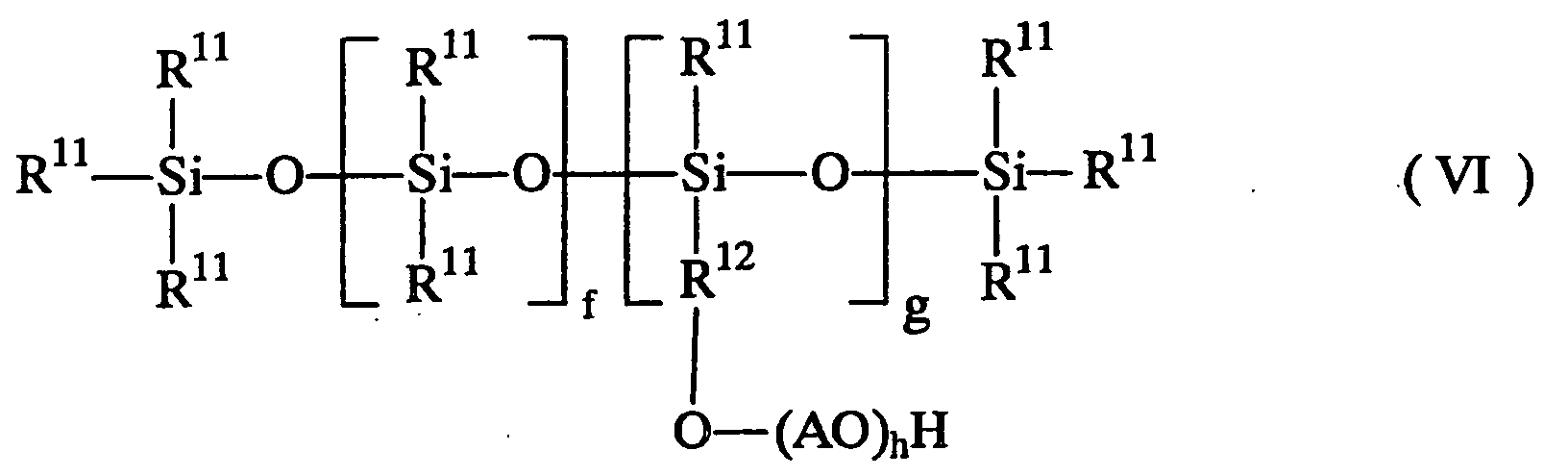
silicone of the general formula (VI), the both-terminal type
silicone of the general formula (VII), the one-terminal type
silicone of the general formula (VIII), and an alkylglyceryl
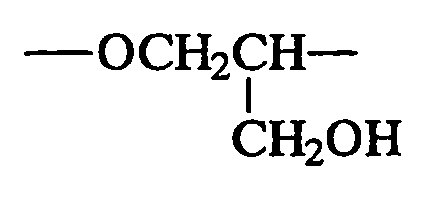
ether-modified silicone disclosed in JP-A 5-112424.
wherein R
11 groups may be the same or different and each
represent a C
1-3 alkyl group, preferably a methyl group; R
12
groups may be the same or different and each represent a C
1-8
alkylene group, preferably a trimethylene group; AO groups may
be the same or different and each represent an ethyleneoxy group
or propyleneoxy group; f and g each are an integer of 1 or more;
and h is an integer of 0 or 1 or more.
The epoxy-modified silicone is preferably a silicone
compound containing an epoxy group at one and/or both ends
represented by the general formula (IX):
wherein R
13 groups are the same or different and each represent
a monovalent hydrocarbon group; R
14 represents an epoxy-containing
group or a monovalent hydrocarbon group; A
represents an epoxy-containing group; and n is a number of 1
to 10000.
The monovalent hydrocarbon group represented by R13
includes an alkyl group such as methyl group and ethyl group,
a cycloalkyl group such as cyclohexyl group, an aryl group such
as phenyl group, and a fluorine atom-substituted alkyl group
such as trifluoropropyl group. All R13 groups may be the same
or different, but all R13 groups are desirably methyl groups.
In the general formula (IX), the epoxy-containing group
represented by A is not particularly limited, and specific
examples include the groups shown in the general formulae (X)
to (XII) :
wherein p and q each are an integer of 1 or more.
wherein r is an integer of 1 or more, and AO groups whose number
is r are the same or different and each represent an ethyleneoxy
group or propyleneoxy group.
In the general formula (IX), when R14 represents the same
group as in R13, the compound is silicone containing an epoxy
group at one end, while when R14 represents the same group as
in A, the compound is silicone containing an epoxy group at
both ends.
The epoxy-modified silicone is preferably silicone
containing an epoxy group at one end, that is, silicone wherein
R14 is the same group as in R13, wherein the hydrocarbon group
is preferably an alkyl group such as methyl group and ethyl
group, a cycloalkyl group such as cyclohexyl group, an aryl
group such as phenyl group, and a fluorine atom-substituted
alkyl group such as trifluoropropyl group, more preferably a
methyl group.
In the general formula (IX), n is preferably 1 to 500,
more preferably 5 to 100 and particularly preferably 10 to 50.
(1-5) Silicone compound having a radical polymerizable
unsaturated group
Preferable examples of the silicone compound having a
radical polymerizable unsaturated group include a
polysiloxane compound having a radical polymerizable group at
one end described in JP-A 11-181003.
(2) Surface-hydrophobated water-absorbing polymer
particles wherein the surfaces of water-absorbing polymer
particles were coated with a polymer of a hydrophobic vinyl
monomer
The surface-hydrophobated water-absorbing polymer
particles are water-absorbing polymer particles wherein the
surfaces of water-absorbing polymer particles were coated with
a polymer of at least one kind of hydrophobic vinyl monomer.
At least a part of the surfaces of the water-absorbing
polymer particles is coated to such an extent as to suppress
the stickiness of the surfaces of the water-absorbing swollen
particles.
The lower limit of the amount of the polymer of
hydrophobic vinyl monomers in the surface-hydrophobated
water-absorbing polymer particles is preferably 1 weight part
or more, more preferably 5 weight parts or more, particularly
preferably 10 weight parts or more, relative to 100 parts by
weight of the water-absorbing polymer particles. The upper
limit is preferably 1000 weight parts or less, more preferably
400 weight parts or less, particularly preferably 200 weight
parts or less. This range is preferable because there is no
sticky feeling after absorption of water, and the speed of
absorption of water is not particularly inhibited.
The hydrophobic vinyl monomer used in the present
invention is a polymerizable monomer giving a hydrophobic
polymer by polymerization, and can be polymerized by a
polymerization method with a general radical polymerization
initiator or irradiation with ultraviolet light.
The hydrophobic vinyl monomer is a monomer having the
hydrophobicity defined above, and a usual radical
polymerizable hydrophobic vinyl monomer is preferably used.
Examples of the monomer include, for example, styrene,
acrylates such as vinyl acetate, divinyl benzene, butyl
acrylate, 2-ethylhexyl acrylate, cyclohexyl acrylate, decyl
acrylate, lauryl acrylate, dodecenyl acrylate, myristyl
acrylate, palmityl acrylate, hexadecenyl acrylate, stearyl
acrylate, octadecenyl acrylate, behenyl acrylate etc.,
methacrylates such as butyl methacrylate, 2-ethylhexyl
methacrylate, cyclohexyl methacrylate, decyl methacrylate,
lauryl methacrylate, dodecenyl methacrylate, myristyl
methacrylate, palmityl methacrylate, hexadecenyl
methacrylate, stearyl methacrylate, octadecenyl methacrylate,
behenyl methacrylate etc., fluorine-based monomers such as
trifluoroethyl methacrylate, silicone macromonomers etc.
These hydrophobic monomers can be used as a mixture of one or
more thereof. Among these monomers, styrene and alkyl
(meth)acrylates having a C1-22 alkyl group are highly
hydrophobic, easily available and preferable.
The weight average molecular weight of the hydrophobic
polymer used in the present invention is preferably 1000 to
500,000, more preferably 3000 to 200,000 and particularly
preferably 10,000 to 200,000. Measurement of this weight
average molecular weight is conducted by gel permeation
chromatography (GPC), using polystyrene as standard. The
column used was Shodex KF-806 manufactured by Showa Denko K.K.
To improve the adhesion of the formed polymer to the
water-adsorbing polymer, the hydrophilic vinyl monomer may be
copolymerized to such an extent that the hydrophobicity of the
resulting polymer is not extremely inhibited.
Such hydrophilic vinyl monomer includes α,β-unsaturated
carboxylic acids such as (meth)acrylic acid, maleic acid,
itaconic acid etc., maleic anhydride, chloromethyl styrene,
glycidyl (meth)acrylate, (meth)acryloyloxyethyl isocyanate,
3-(trimethoxysilyl)propyl (meth)acrylate,
dimethylaminoethyl (meth)acrylate, hydroxyethyl
(meth)acrylate, vinyl pyridine, (meth)acrylamide etc. These
hydrophilic vinyl monomers can be used as a mixture of two or
more thereof. The amount of the hydrophilic vinyl monomer used
is preferably 0 to 50 weight%, more preferably 0 to 20 weight%,
of the total monomers constituting the polymer of the
hydrophobic vinyl monomer.
(3) Surface-hydrophobated water-absorbing polymer
particles wherein the surfaces of water-absorbing polymer
particles were treated with a fluorine-based surfactant
A hydrophilic moiety of the fluorine-based surfactant
can be any of four kinds of moieties, that is, anionic, nonionic,
cationic and amphoteric, while a hydrophobic moiety of the
surfactant can make use of a fluorocarbon chain or a
perfluorocarbon chain. The fluorine-based surfactant
preferably has a functional group capable of reacting with the
surfaces of the water-absorbing particles, and the hydrophobic
moiety is preferably anionic, cationic or amphoteric, more
preferably cationic or amphoteric. The carbon chain in the
hydrophobic moiety may be a linear or branched chain. For
example, the following fluorine-based surfactants can be
mentioned.
Fluoroalkyl (C2 to C10) carboxylic acids, disodium N-perfluorooctane
sulfonyl glutamate, sodium 3- [fluoroalkyl (C6
to C11)oxy]-1-alkyl (C3 to C4) sulfonate, sodium 3-[ω-fluoroalkanoyl
(C6 to C8)-N-ethylamino]-1-propane sulfonate,
N-[3-(perfluorooctanesulfonamide) propyl]-N,N-dimethyl-N-carboxymethylene
ammonium betaine, fluoroalkyl (C11 to C20)
carboxylic acid, perfluoroalkyl carboxylic acid (C7 to C13),
perfluorooctane sulfonic acid diethanol amide, perfluoroalkyl
(C4 to C12) sulfonates (Li, K, Na), N-propyl-N- (2-hydroxyethyl)
perfluorooctane sulfonamide, perfluoroalkyl (C6 to C10)
sulfonamide propyl trimethyl ammonium salt, perfluoroalkyl (C6
to C10)-N-ethyl sulfonyl glycine salt (K), bis(N-perfluorooctylsulfonyl-N-ethylaminoethyl)
phosphate,
monoperfluoroalkyl (C6 to C16) ethyl phosphate, perfluoroalkyl
quaternary ammonium iodide (trade name: Florade FC-135, a
cationic fluorine-based surfactant manufactured by Sumitomo
3M Ltd.), perfluoroalkyl alkoxylate (trade name: Florade
FC-171, a nonionic fluorine-based surfactant manufactured by
Sumitomo 3M Ltd.) and potassium perfluoroalkyl sulfonates
(trade names: Florade FC-95 and FC-98, anionic surfactants
manufactured by Sumitomo 3M Ltd.).
(4) Surface-hydrophobated water-absorbing polymer
particles wherein the surfaces of water-absorbing polymer
particles were treated with a silane coupling agent
As the silane coupling agent, a silane coupling described
in JP-A 61-211305 can be used.
Preferable examples include γ-glycidoxy propyl
trimethoxy silane, γ-glycidoxy propyl methyl diethoxy silane,
γ-(2-aminoethyl)aminopropyl trimethoxy silane, γ-(2-aminoethyl)
aminopropyl methyl diethoxy silane, γ-aminopropyl
triemethoxy silane, γ-chloropropyl trimethoxy silane, γ-chloropropyl
methyl dimethoxy silane etc.
[Method of producing water-absorbing polymer particles]
(1) Method of producing water-absorbing polymer
particles by polymerizing a hydrophilic vinyl monomer
When a polymer of a hydrophilic vinyl monomer is used
in the water-absorbing polymer, the hydrophilic vinyl monomer
and crosslinking agent may be polymerized by any method, but
a method of polymerizing an aqueous solution of the hydrophilic
vinyl monomer (preferably at a concentration of 1 to 70% by
weight) is preferable, and various methods such as aqueous
solution polymerization, reverse phase suspension
polymerization and pearl polymerization can be used. In
particular, aqueous solution polymerization or reverse phase
suspension polymerization is preferable in respect of
operativeness for polymerization and the water-absorbing
performance of the resultant water-absorbing polymer, and
reverse phase suspension polymerization is particularly
preferable in respect of higher water-absorbing performance
of the water-absorbing polymer. The temperature for
polymerization of the hydrophilic vinyl monomer is preferably
20 to 120°C and the polymerization time is preferably 20 to
180 minutes.
As the polymerization initiator, a water-soluble
radical polymerization initiator, for example a peroxide,
hydroperoxide or an azo compound is known in a known amount.
These polymerization initiators can be used as a mixture of
at least two kinds thereof, or can be used as redox type
polymerization initiators by adding chromium ion, sulfite,
hydroxylamine, hydrazine etc. thereto. If necessary, an
oil-soluble radical polymerization initiator, for example a
peroxide type initiator such as benzoyl peroxide, lauroyl
peroxide, tert-butyl peroxy pivalate or diisopropyl peroxy
dicarbonate, or an azo type initiator such as
azobis(isobutyronitrile), azobis(2,4-dimethylvaleronitrile),
azobis(dimethyl isobutyrate) or
azobis(cyclohexane carbonitrile) can also be used.
The amount of the water-soluble polymerization
initiator is preferably 0.03 to 5 weight%, more preferably 0.1
to 2 weight%, based on the amount of the hydrophilic vinyl
monomer.
A dispersant is used to disperse and stabilize the
hydrophilic vinyl monomer stably in the oil phase (solvent).
The dispersant includes a general anionic, cationic, nonionic
or amphoteric surfactant or a natural, semi-synthetic or
synthetic polymer. Examples thereof include an anionic
surfactant such as sodium polyoxyethylene dodecyl ether
sulfate and sodium dodecylether sulfate, a cationic or
amphoteric surfactant such as trimethylstearylammonium
chloride and carboxymethyldimethylcetyl ammonium, a sucrose
fatty ester such as sucrose monostearate and sucrose dilaurate,
a sorbitan ester such as sorbitan monostearate, a nonionic
surfactant such as polyoxyalkylene adducts of sorbitan esters,
such as polyoxyethylenesorbitan monostearate, a natural or
semi-synthetic polymer such as cellulose derivatives such as
starch or derivatives thereof, cellulose ethers such as ethyl
cellulose and cellulose esters such as cellulose acetate, and
a synthetic polymer such as polyvinyl alcohol or derivatives
thereof, maleic group-containing polybutadiene and a
quaternary salt of styrene-dimethylaminoethyl methacrylate.
To produce the surface-hydrophobated water-absorbing
polymer particles, the silicone compound having at least one
kind of functional group or the fluorine-based surfactant is
preferably used as the dispersant. It may be combined with
the other dispersant described above. Among the silicone
compounds, the dispersant is preferably a silicone compound
having at least one kind of functional group selected from the
group consisting of an amino group, an ammonium group, a hydroxy
group and a carboxy group.
The dispersant is present in an amount of preferably 0.5
to 30 parts by weight, more preferably 1 to 10 parts by weight,
still more preferably 1 to 7 parts by weight, relative to 100
parts by weight of the total vinyl monomers constituting the
water-absorbing polymer particles.
The solvent used in reverse phase suspension
polymerization is preferably a hydrocarbon type solvent or
silicone type solvent or a mixture thereof. Examples of the
hydrocarbon type solvent include aliphatic hydrocarbons such
ashexane, heptane, dodecane, cyclohexane, methylcyclohexane,
isooctane and hydrogenated triisobutylene and aromatic
hydrocarbons such as benzene, toluene, xylene and ethyl
benzene, and examples of the silicone type solvent include
octamethyl cyclotetrasiloxane, decamethyl cyclopentasiloxane,
hexamethyl disiloxane and octamethyl trisiloxane. Among
these solvents, hexane and cyclohexane are particularly
preferable.
Before water or solvent in the reaction system is
distilled away after polymerization, the surface of particle
may be crosslinked by adding a crosslinking agent later and
reacting it by heating preferably at 40 to 150°C.
(2) Method of producing surface-hydrophobated water-absorbing
polymer particles from water-absorbing polymer
particles
The surface-hydrophobated water-absorbing polymer
particles can be produced from water-absorbing polymer
particles after polymerization or from previously obtained
water-absorbing polymer particles such as a naturally
occurring polymer.
The method is preferably a production method which
includes heating water-absorbing particles and a silicone
compound having at least one kind of functional group in the
presence of a fluorine-based surfactant or a silane coupling
agent, in the presence of water preferably a solvent, to which
a crosslinking agent and/or a radical polymerization initiator
is added if necessary. By the presence of water, functional
groups in the water-absorbing polymer particles are
dissociated to react readily with functional groups in the
silicone compound having at least one kind of functional group,
in the fluorine-based surfactant or in the silane coupling
agent. The amount of the silicone compound having at least
one kind of functional group, the fluorine-based surfactant
or the silane coupling agent is preferably 0. 001 part by weight
or more, more preferably 0.01 part by weight or more,
particularly preferably 0.1 part by weight or more, relative
to 100 parts by weight of the water-absorbing polymer
(particles), and the upper limit is preferably 20 parts by
weight or less, more preferably 10 parts by weight or less,
particularly preferably 5 parts by weight or less.
As the solvent, the above-mentioned hydrocarbon type
solvent or silicone type solvent or a mixture thereof is
preferably used. The amount of water in the reaction system
is preferably 1 to 200 parts by weight, more preferably 10 to
100 parts by weight, relative to 100 parts by weight of the
water-absorbing polymer (particles). After the reaction, the
water is removed, for example, by distillation. When the
crosslinking agent is used, the crosslinking agent is allowed
to be present in an amount of preferably 0.01 to 10 parts by
weight, more preferably 0.01 to 5 parts by weight, still more
preferably 0.01 to 3 parts by weight, relative to 100 parts
by weight of the water-absorbing polymer (particles).
When the silicone compound having a radically
polymerizable unsaturated group is used, the above-mentioned
oil-soluble radical polymerization initiator is preferably
allowed to be coexistent. The silicone compound having at
least one kind of functional group or the fluorine-based
surfactant can be added directly or as a solution wherein the
silicone compound or the fluorine-based surfactant has been
solubilized or dispersed by emulsification in an organic
solvent, a surfactant or a dispersant, or in the form of a spray
depending on the case. Heating for facilitating surface
treatment is preferably in the range of 40 to 150°C.
The silicone compound having at least one kind of
functional group, the fluorine-based surfactant or the silane
coupling agent may be mixed with the water-absorbing polymer
before or after disruption of the polymer, but it is more
preferable that the water-absorbing polymer is disrupted to
form water-absorbing polymer particles whose water content is
regulated in a suitable range by drying if necessary, and the
water-absorbing polymer particles are mixed, in e.g. a kneader,
with them.
The water-absorbing polymer particles coated with the
polymer of the hydrophobic vinyl monomer is preferably the one
obtained by adding the hydrophobic vinyl monomer and the
above-mentioned oil-soluble polymerization initiator to a
reverse phase suspension polymerization solution during or
after polymerization of the water-absorbing polymer particles,
that is, slurry having the water-absorbing polymer particles
dispersed in a solvent, followed by polymerizing the monomer.
The solvent is preferably the above-mentioned hydrocarbon type
solvent or silicone type solvent or a mixture thereof.
The amount of the water-soluble polymerization
initiator is preferably 0.03 to 5% by weight, more preferably
0.1 to 2% by weight, based on the amount of the hydrophobic
vinyl monomer. The polymerization initiator is previously
mixed with other components and used as a solution, and for
the purpose of reducing the remaining monomer, it may be diluted
with a solvent etc. during polymerization and added all at once
or continuously. The polymerization temperature is
preferably 20 to 120°C, and the polymerization time is
preferably 20 to 180 minutes.
The surface-hydrophobated water-absorbing polymer
particles used in the present invention are preferably those
obtained by polymerization of a hydrophilic vinyl monomer and
a crosslinking agent in the presence of a silicone compound
having at least one kind of functional group or a fluorine-based
surfactant by a reverse phase suspension polymerization method,
those obtained by heating water-absorbing polymer particles,
a silicone compound having at least one kind of functional group,
a fluorine-based surfactant or a silane coupling agent, in the
presence of water, and those obtained by reverse phase
suspension polymerization of a hydrophilic vinyl monomer and
a crosslinking agent in the presence of a water-soluble
polymerization initiator and a dispersant, and during or after
polymerization, adding a hydrophobic vinyl monomer and an
oil-soluble polymerization initiator, followed by
polymerization thereof.
[Anti-perspiring component]
Preferable examples of the anti-perspiring component
include aluminum compounds, zirconium compounds, zinc
compounds and mixtures thereof. Preferable examples include
their sulfates, bromides, chlorides, chlorohydroxides,
lactates etc., specifically aluminum salts such as allantoin
chlorohydroxy aluminum, aluminum chloride, chlorohydroxy
aluminum, allantoin dihydroxy aluminum, aluminum sulfate,
potassium alum and aluminum hydroxide, aluminum-zirconium
complexes such as aluminum zirconium tetrachlorohydroxy
glycine and aluminum zirconium pentachlorohydrate, and zinc
salts such as zinc oxide and zinc p-phenol sulfonate. Among
these, the aluminum compounds and zirconium compounds are
preferable, the aluminum salts and aluminum-zirconium
complexes are more preferable, and the aluminum-zirconium
complexes are particularly preferable.
[Silicone]
Preferably, the cosmetic composition of the present
invention further contains silicone to improve smoothness
during application and shaving. As the viscosity (25°C) of
such silicone is increased by using it in a larger amount, oily
feeling is caused, so that in respect of feeling in use, the
viscosity is preferably not higher than 5 × 10⁻³ m2/s, more
preferably not higher than 5 × 10⁻⁴ m2/s, still more preferably
not higher than 5 × 10⁻⁵ m2/s and even more preferably not higher
than 2 × 10⁻⁵ m2/s. The lower limit is preferably not lower
than 1 × 10⁻⁶ m2/s.
Specific examples of silicone include linear silicones
such as low-polymerized dimethyl polysiloxane and cyclic
silicones such as octamethyl cyclotetrasiloxane, decamethyl
cyclopentasiloxane etc., and one or more of these silicones
can be suitably selected and used.
[Hydrophobic particles]
The cosmetic composition of the present invention
preferably contains hydrophobic particles to further improve
smoothness upon shaving and dry feeling on the skin.
Preferable examples of the hydrophobic particles
include fine polymer particles obtained by suspension
polymerization of a vinyl monomer in a solvent with a
polysiloxane compound having a radical-polymerizable group at
one end as a dispersant, that is, silicone-based resin such
as silicone resin (KMP-590 (manufactured by Shin-Etsu Chemical
Co., Ltd.)), Tospearl 145, Tospearl 2000B (manufactured by GE
Toshiba Silicones Co., Ltd.), Torefil (manufactured by Toray
Industries, Inc.) etc.; fluorine-based resin; particles
obtained by subjecting organic powder such as nylon resin
(SP-500 (manufactured by Toray Industries, Inc.) etc.),
polystyrene-based resin (Fine Pearl (manufactured by Sumitomo
Chemical Co., Ltd.), Techno Polymer SB (manufactured by
Sekisui Plastics Co., Ltd.), Fine Powder SGP (manufactured by
Soken Chemical & Engineering Co., Ltd.) etc.), polyethylene
resin (Flow Beads (manufactured by Sumitomo Seika Co., Ltd.)
etc.), polymethyl methacrylate-based resin (Matsumoto
Microsphere M (manufactured by Matsumoto Oil and Fat Co. , Ltd.),
Tech Polymer MB (manufactured by Sekisui Plastics Co., Ltd.),
Fine Powder MP (manufactured by Soken Chemical & Engineering
Co., Ltd.) etc.), divinyl benzene-based resin,
polyurethane-based resin, benzoguanamine resin, melamine
resin, or phenol-based resin, to hydrophobation treatment such
as silicone treatment (for example, treatment with methyl
hydrogen polysiloxane or dimethyl polysiloxane), fluorine
treatment, metallic soap treatment or fatty acid treatment,
preferably silicone treatment or fluorine treatment; and
particles obtained by subj ecting inorganic powder such as talc,
sericite, mica, kaolin, red oxide, clay, bentonite, silicic
anhydride, biotite or synthetic silica beads, to
hydrophobation treatment such as silicone treatment (for
example, treatment with methyl hydrogen polysiloxane or
dimethyl polysiloxane), fluorine treatment, metallic soap
treatment or fatty acid treatment, preferably silicone
treatment or fluorine treatment.
The shape of the hydrophobic particles may be in the form
of sphere, tube, plate or needle, preferably in the form of
sphere in respect of smoothness. The roundness of the
hydrophobic particles is not particularly limited, but as the
roundness is increased, the dynamic coefficient of friction
is decreased to improve smoothness on the skin, and thus
hydrophobic particles that are as round as possible are
preferably used. The average particle diameter of the
hydrophobic particles is preferably 0.05 to 50 µm, particularly
preferably 0.5 to 50 µm.
[Cosmetic composition]
The cosmetic composition of the present invention may
be any of emulsified cosmetics, oil cosmetics, spray cosmetics,
stick-type cosmetics, powdered cosmetics and roll-on type
cosmetics, and is used preferably for antiperspiration.
The cosmetic composition of the present invention
contains water-absorbing polymer particles, preferably
surface-hydrophobated water-absorbing polymer particles.
The content (content in a state not swollen with water) of the
water-absorbing polymer particles in the composition is
preferably 0.1 to 90% by weight, more preferably 0.5 to 50%
by weight, still more preferably 1 to 20% by weight and even
more preferably 2 to 10% by weight. The polymer particles in
this range are preferable because they can suppress stickiness
after absorption of sweat. Further, the surface-hydrophobated
water-absorbing polymer particles are used
preferably as water-absorbing polymer particles in order to
maintain the dry feel of the particles after absorption of sweat
to enable smooth shaving.
The content of the anti-perspiring component in the
cosmetic composition of the present invention is preferably
0.1 to 90% by weight, more preferably 1 to 70% by weight, still
more preferably 5 to 50% by weight and even more preferably
10 to 30% by weight. The polymer particles in this range are
preferable because of their high anti-perspiring effect.
The amount of the water-absorbing polymer particles is
preferably 3 to 95 parts by weight, more preferably 3 to 50
parts by weight, based on 100 parts by weight of the anti-perspiring
component. The particles in an amount in this range
are preferable because the deterioration in smoothness upon
shaving caused by precipitation of an aluminum salt can be
solved by simultaneously using the water-absorbing polymer
particles in the above range, and both the components can be
maintained at suitable pH value at the time of perspiring.
The content of silicone having a viscosity (25°C) of not
higher than 5 × 10⁻³ m2/s in the cosmetic composition of the
present invention is preferably 0.1 to 90% by weight, more
preferably 0.5 to 50% by weight, still more preferably 1 to
20% by weight and even more preferably 2 to 10% by weight.
The content of the hydrophobic particles in the cosmetic
composition of the present invention is preferably 0.5 to 30%
by weight, more preferably 0.5 to 20% by weight, still more
preferably 0.5 to 10% by weight and even more preferably 1 to
5% by weight.
Particularly, when usual water-absorbing polymer
particles whose surface is not hydrophobated are used, at least
one member selected from the group consisting of silicone
having a viscosity (25°C) of not higher than 5 × 10⁻³ m2/s and
hydrophobic particles is preferably used in order to improve
smoothness in shaving.
Depending on the form, type etc. of the cosmetic
composition of the present invention, other generally used
cosmetic components can be further incorporated into the
cosmetic composition in such a range that the effect of the
present invention is not hindered.
Such cosmetic components include e.g. extender pigments
such as mica, talc, sericite, kaolin, polymethylsilyl
sesquioxane and barium sulfate; inorganic pigments such as
titanium oxide, zinc white and iron oxide; hydrocarbons such
as solid or liquid paraffin, solid paraffin, microcrystalline
wax, vaseline, ceresin, ozokerite and montan wax; vegetable
or animal fats and oils or wax, such as olive, ozokerite,
carnauba wax, lanoline and spermaceti; fatty acids or esters
thereof such as stearic acid, palmitic acid, oleic acid,
glycerine monostearate, glycerine distearate, glycerine
monooleate, isopropyl myristate, isopropyl stearate and butyl
stearate; higher alcohols such as cetyl alcohol, stearyl
alcohol, palmityl alcohol and hexyl dodecyl alcohol;
adsorbents or thickening agents such as cationic cellulose,
carboxybetaine type polymer and cationic silicone; polyhydric
alcohols having a moisture retention action, such as glycol
and sorbitol; efficacious components such as whitening agent,
analgesic antiinflammatory agents, anti-itching agents,
astringents, skin softening agents and hormones; water;
surfactants; W/O or O/W type emulsifying agents; emulsifying
agents for silicone oil, such as polyether-modified silicone,
polyether alkyl-modified silicone and glyceryl ether-modified
silicone; thickening agents such as methyl cellulose, ethyl
cellulose, carboxymethyl cellulose, polyacrylic acid,
tragacanth, agar and gelatin; lower alcohols such as ethanol,
glycerin, 1,3-butylene glycol and propylene glycol; and other
components such as emulsion stabilizers, chelating agents, UV
protecting agents, pH adjusting agents, preservatives,
coloring matters and perfumes.
The cosmetics of the present invention are produced
according to a conventional method.
The cosmetic composition of the present invention
exhibits a high anti-perspiring effect to enable further
smooth shaving. Particularly, the surface-hydrophobated
water-absorbing polymer particles can be used to give highly
dry feel even after perspiring.
Examples
In the following examples, "%" refers to "% by weight"
unless otherwise specified.
Synthesis Example 1
300 g methacrylic acid (Mitsubishi Rayon Co., Ltd.) and
135 g ion-exchange water were placed in a 3-L beaker and then
neutralized to a degree of 75 % by adding 348 g of 30% aqueous
sodium hydroxide solution dropwise thereto under cooling with
stirring, and then a solution of 1.2 g potassium persulfate
(0.4% relative to methacrylic acid) dissolved in 24.3 g
ion-exchange water and a crosslinking agent ethylene glycol
diglycidyl ether (trade name, Denacol EX810, Nagase Kasei Co.,
Ltd.), 15.0 g (5.0% relative to methacrylic acid), were added
thereto, and the mixture was uniformly dissolved. The
resultant solution was added to a solution obtained by
dissolving 15 g amino-modified silicone A (XF42-703 produced
by GE Toshiba Silicones Co., Ltd.; viscosity (25°C), 1 × 10⁻³
m2/s; amine equivalent, 1500 g/mol) in 1500 ml cyclohexane in
a 3-L beaker, and the mixture was stirred vigorously for 5
minutes at a number of revolutions of 10000 rpm in a homomixer
to produce a fine water-in-oil droplet dispersion. Then, 900
ml cyclohexane was introduced into a 5-L stainless steel
reaction vessel equipped with a reflux condenser, then stirred
at 350 rpm, and heated at 75°C in the system, and the atmosphere
was replaced by nitrogen, followed by dropwise addition of the
partially neutralized water-in-oil droplet dispersion of
methacrylic acid to initiate polymerization. The whole of the
droplet dispersion was added dropwise over 1.5 hours, and the
reaction solution was aged for additional 4 hours at the reflux
temperature. Thereafter, a dehydration tube was attached, the
temperature was raised to remove 340 ml water, and the reaction
solution was cooled and filtered to separate polymer particles.
By evaporation into dryness under reduced pressure, 376 g dry
white polymer in the form of fine powder was obtained. The
average particle diameter of the resultant fine polymer
particles was 2.2 µm, and the amount of water absorbed was 15
g/g.
Synthesis Example 2
180 g aqueous solution of a neutralized product
(effective component, 90%) of dimethylaminoethyl methacrylate
with diethylsulfuric acid, 120 g N,N-dimethylacrylamide, 14
g polyethylene glycol dimethacrylate (trade name: NK-14G,
manufactured by ShinNakamura Chemical Co., Ltd.), 5 g
methacrylic acid, 415 g ion-exchange water and 1.2 g potassium
persulfate were introduced into a 3-L beaker and dissolved
uniformly. The obtained solution was added to a solution
obtained by dissolving 15 g amino-modified silicone A
(XF42-703 produced by GE Toshiba Silicones Co., Ltd.;
viscosity (25°C), 1 × 10⁻³ m2/s; amine equivalent, 1500 g/mol)
in 1500 ml cyclohexane in a 3-L beaker. The mixture was stirred
vigorously for 5 minutes at a number of revolutions of 10000
rpm in a homomixer to produce a fine water-in-oil droplet
dispersion. The water-in-oil droplet dispersion was
introduced into a 5-L stainless steel reaction vessel equipped
with a reflux condenser and then stirred at 350 rpm. Purged
by nitrogen gas, it was heated at 75°C and it was kept for 4
hours for polymerization. Thereafter, a dehydration tube was
attached, the temperature was raised to remove 340 ml water
and the reaction solution was cooled and filtered to separate
polymer particles. By evaporation into dryness at a reduced
pressure, 280 g dry white polymer in the form of fine powder
was obtained. The average particle diameter of the resultant
fine polymer particles was 2.5 µm, and the amount of water
absorbed was 18 g/g.
Synthesis Example 3
300 g N,N-dimethylacrylamide, 4.5 g polyethylene glycol
dimethacrylate (trade name: NK-14G, manufactured
ShinNakamura Chemical Co., Ltd.), 5 g methacrylic acid, 400
g ion-exchange water and 1.2 g potassium persulfate were
introduced into a 3-L beaker and dissolved uniformly. The
obtained solution was added to a solution obtained by
dissolving 15 g amino-modified silicone A (XF42-703 produced
by GE Toshiba Silicones Co., Ltd.; viscosity (25°C), 1 × 10⁻³
m2/s; amine equivalent, 1500 g/mol) in 1500 ml of cyclohexane
in a 3-L beaker. The mixture was stirred vigorously for 5
minutes at a number of revolutions of 10000 rpm in a homomixer
to produce a fine water-in-oil droplet dispersion. The
water-in-oil droplet dispersion was introduced into a 5-L
stainless steel reaction vessel equipped with a reflux
condenser and then stirred at 350 rpm. Purged by nitrogen gas,
it was heated at 75°C and it was kept for 4 hours for
polymerization. Thereafter, a dehydration tube was attached,
the temperature was raised to remove 340 ml water and the
reaction solution was cooled and filtered to separate polymer
particles. By evaporation into dryness at a reduced pressure,
290 g dry white polymer in the form of fine powder was obtained.
The average particle diameter of the resultant fine polymer
particles was 2.3 µm, and the amount of water absorbed was 18
g/g.
Synthesis Example 4
300 g methacrylic acid (Mitsubishi Rayon Co., Ltd.) and
135 g ion-exchange water were placed in a 3-L beaker and
neutralized to a degree of 75% by adding 348 g of 30% aqueous
sodium hydroxide solution dropwise thereto under cooling with
stirring, and then a solution of 1.2 g potassium persulfate
(0.4% relative to methacrylic acid) dissolved in 24.3 g
ion-exchange water, and 15. 0 g of a crosslinking agent ethylene
glycol diglycidyl ether (trade name, Denacol EX810, Nagase
Kasei Co., Ltd.) (5.0% relative to methacrylic acid), were
added thereto, and the mixture was uniformly dissolved. The
resultant solution was added to a solution obtained by
dissolving 15 g sugar esters (a mixture of Ryoto Sugar Esters
S570 and S770 (trade name) in equal amounts, Mitsubishi
Shokuhin Co. , Ltd.) (5.0% relative to methacrylic acid) in 1500
ml cyclohexane in a 3-L beaker, and the mixture was stirred
vigorously for 5 minutes at a number of revolutions of 10000
rpm in a homomixer to produce a fine water-in-oil droplet
dispersion. Then, 900 ml cyclohexane was introduced into a
5-L stainless steel reaction vessel equipped with a reflux
condenser, then stirred at 350 rpm, and heated at 75°C in the
system, and the atmosphere was replaced by nitrogen, followed
by dropwise addition of the partially neutralized water-in-oil
droplet dispersion of methacrylic acid to initiate
polymerization. The whole of the droplet dispersion was added
dropwise over 1.5 hours, and the reaction solution was aged
for additional 4 hours at the reflux temperature. Thereafter,
a dehydration tube was attached, the temperature was raised
to remove 340 ml water, further 1300 ml cyclohexane was
distilled away, and the reaction solution was left and cooled
to complete synthesis. By evaporation into dryness under
reduced pressure, 376 g dry white polymer in the form of fine
powder was obtained. The average particle diameter of the
resultant fine polymer particles was 2.2 µm, and the amount
of water absorbed was 12 g/g.
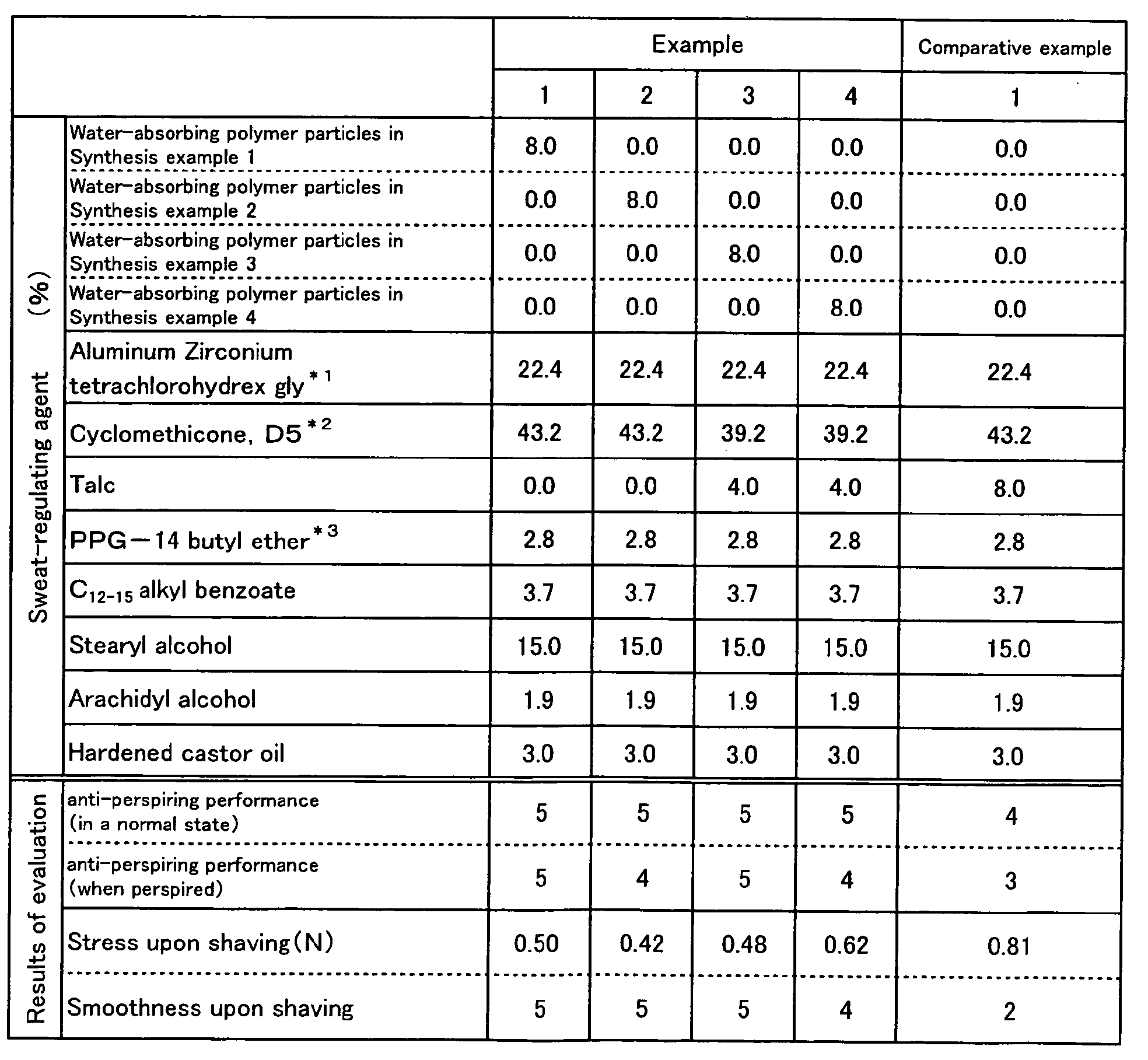
Examples 1 to 4 and Comparative Example 1
The water-absorbing polymer particles obtained in each
of Synthesis Examples 1 to 4 were mixed uniformly under heating
with all the components shown in Table 1, and the resultant
mixture was introduced into a container, then left and cooled
to give a stick-type antiperspirant. The resultant
antiperspirant was evaluated for anti-perspiring performance
and smoothness and stress upon shaving. The results are
collectively shown in Table 1.
<Method of evaluating anti-perspiring performance>
The test sample, 0.3 g, was applied onto one armpit, and
3 hours later, an examinee was allowed to be in a high-temperature
high-humidity room (40°C/80% RH) for 5 minutes,
and just after leaving the room, the examinee herself evaluated
anti-perspiring performance sensorily when perspired.
Subsequently, the degree of wetting on the armpit 3 hours after
leaving the room was evaluated sensorily as anti-perspiring
performance in a normal state by the examinee herself under
the conditions of 25°C/60% RH. The anti-perspiring
performance was evaluated in 5 ranks under the following
criteria.
<Method of evaluating smoothness upon shaving>
Five hours after the above evaluation of anti-perspiring
performance was finished, lather foamed from soap in a bathroom
was applied onto the armpit, and the armpit was shaved with
a commercial razor, and smoothness upon shaving was evaluated
sensorily by the examinee herself in 5 ranks under the following
criteria:
<Measurement of stress upon shaving>
0.3g of the test sample was applied onto one forearm,
and soap made in the US (DAVE manufactured by Unilever) was
applied onto the forearm, and the armpit was shaved with a
commercial razor equipped with a stress meter (Handy Force
Gauge, manufactured by Nippon Keisoku System Co., Ltd.), and
the maximum stress (N) during shaving was measured. The
measurement was conducted 6 times by each of 3 examinees, and
the average value was indicated as stress (N) upon shaving.
Hereinafter, formulation examples are shown.
Formulation Example 1: Powdered antiperspirant
| <Composition> |
| a) Aluminum zirconium pentachlorohydrate |
15.0% |
| b) Trichlosane |
0.01 |
| c) Water-absorbing polymer particles in Synthesis Example 1, |
5.0 |
| d) Talc |
balance |
| e) Perfume |
suitable amount |
Formulation Example 2: Aerosol type antiperspirant
| <Composition> |
| a) Aluminum zirconium pentachlorohydrate |
8.0% |
| b) Water-absorbing polymer particles in Synthesis Example |
1 2.0 |
| c) Acrylic polymer particles* |
1.0 |
| d) Talc |
0.5 |
| e) Isopropyl palmitate |
1.5 |
| f) Perfume |
0.2 |
| g) Isopentane |
10.0 |
| h) Liquefied petroleum gas |
balance |
| *: Matsumoto Microsphere M305 (particle diameter 7 µm) manufactured by Matsumoto Oil and Fat Co., Ltd. |
Formulation Example 3: Non-aqueous roll-on type antiperspirant
| <Composition> |
| a) Octamethyl cyclotetrasiloxane |
67.0% |
| b) Dimethicone 6cs* |
5.0 |
| c) Ethanol |
5.0 |
| d) Water-absorbing polymer particles in Synthesis Example 1 |
3.0 |
| e) Aluminum zirconium pentachlorohydrate |
20.0 |
| *: KF96-6cs manufactured by Shin-Etsu Chemical Co., Ltd. |
Formulation Example 4: Soft solid type antiperspirant
| <Composition> |
| a) Octamethyl cyclotetrasiloxane |
54.0% |
| b) Behenyl alcohol |
6.0 |
| c) Mineral oil |
7.0 |
| d) Water-absorbing polymer particles in Synthesis Example 1 |
3.0 |
| e) Aluminum zirconium pentachlorohydrate |
20.0 |
| f) Alkyl-modified silicone |
2.0 |
| g) Cyclomethicone/dimethiconecross polymer |
1.5 |
| h) Colloidal silica |
2.5 |
| i) Talc |
4.0 |