EP1559858A2 - Charnière de capot de véhicule - Google Patents
Charnière de capot de véhicule Download PDFInfo
- Publication number
- EP1559858A2 EP1559858A2 EP05001203A EP05001203A EP1559858A2 EP 1559858 A2 EP1559858 A2 EP 1559858A2 EP 05001203 A EP05001203 A EP 05001203A EP 05001203 A EP05001203 A EP 05001203A EP 1559858 A2 EP1559858 A2 EP 1559858A2
- Authority
- EP
- European Patent Office
- Prior art keywords
- lever
- hood
- hinge mechanism
- hinge
- coupled
- Prior art date
- Legal status (The legal status is an assumption and is not a legal conclusion. Google has not performed a legal analysis and makes no representation as to the accuracy of the status listed.)
- Withdrawn
Links
Images


Classifications
-
- B—PERFORMING OPERATIONS; TRANSPORTING
- B60—VEHICLES IN GENERAL
- B60R—VEHICLES, VEHICLE FITTINGS, OR VEHICLE PARTS, NOT OTHERWISE PROVIDED FOR
- B60R21/00—Arrangements or fittings on vehicles for protecting or preventing injuries to occupants or pedestrians in case of accidents or other traffic risks
- B60R21/34—Protecting non-occupants of a vehicle, e.g. pedestrians
- B60R21/38—Protecting non-occupants of a vehicle, e.g. pedestrians using means for lifting bonnets
-
- E—FIXED CONSTRUCTIONS
- E05—LOCKS; KEYS; WINDOW OR DOOR FITTINGS; SAFES
- E05D—HINGES OR SUSPENSION DEVICES FOR DOORS, WINDOWS OR WINGS
- E05D11/00—Additional features or accessories of hinges
-
- E—FIXED CONSTRUCTIONS
- E05—LOCKS; KEYS; WINDOW OR DOOR FITTINGS; SAFES
- E05Y—INDEXING SCHEME ASSOCIATED WITH SUBCLASSES E05D AND E05F, RELATING TO CONSTRUCTION ELEMENTS, ELECTRIC CONTROL, POWER SUPPLY, POWER SIGNAL OR TRANSMISSION, USER INTERFACES, MOUNTING OR COUPLING, DETAILS, ACCESSORIES, AUXILIARY OPERATIONS NOT OTHERWISE PROVIDED FOR, APPLICATION THEREOF
- E05Y2900/00—Application of doors, windows, wings or fittings thereof
- E05Y2900/50—Application of doors, windows, wings or fittings thereof for vehicles
- E05Y2900/53—Type of wing
- E05Y2900/536—Hoods
Definitions
- the invention relates to a hinge mechanism for opening a hood, with several levers, the hood by transferring the Hinged mechanism opened from a Normalstellüng in an open position can be.
- the object of the invention is to realize a with little effort Mechanism for lifting a bonnet to create that easy to handle is, but still meets all safety-related requirements.
- a hinge mechanism of the aforementioned type so that he has a power storage and a Trigger element comprises, wherein after an actuation of the trigger element of Hinge mechanism with the help of the energy storage from the normal position is transferred directly to a lifting position, in which the hood a raised position to protect a pedestrian occupies.
- Basic idea of Invention is the pedestrian protection mechanism in the hinge mechanism to integrate for normal opening of the hood.
- the power to Lifting the hood provides the power storage, which is also for the normal Opening operation of the hood can be used. Due to the special design
- the hinge mechanism can be largely based on additional components be waived.
- Hinge mechanism Another important advantage of the invention Hinge mechanism is that required in the event of an imminent accident Components for lifting the bonnet with each normal opening and Close the hood to be moved, so that the risk of jamming or stuck is significantly reduced. A functional check can be made by opening the hood in a simple manner.
- the energy accumulator preferably comprises a spring element, in particular a Spiral spring or a compression spring 56, which provides the necessary force for lifting the Hood without delay can provide and reversible use is.
- a development of the invention provides that the hinge mechanism in a tension position can be brought out of it by a movement of the Hood with simultaneous tensioning of the spring element back into the Normal position can be brought.
- Such an embodiment of the hinge mechanism which ensures the reversibility of the pedestrian protection device, proves to be particularly advantageous because the hinge mechanism after a possible false trip without special effort by the driver himself for another task can be prepared.
- the triggering element is preferably one around a vehicle-fixed fifth Articulated safety lever that engages the neck of the fourth lever.
- the hinge mechanism can also be used as a single link with two Fulcrums and a base plate attached to a body part, a Hood receptacle and a pivot lever may be formed.
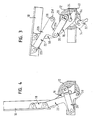
- the hinge mechanism includes in addition to serving as a force storage spring element in Shape of a coil spring 12 and a trigger element in the form of a safety lever 14 a first lever 16, a second lever 18, a third lever 20th and a fourth lever 22 and a first joint 24, a (hidden in Figure 1, however visible in Figure 2) second joint 26, a third joint 28, a fourth Joint 30, a fifth joint 32, a sixth joint 34 and a seventh joint 36th
- the first lever 16 has a first end 16a and a second end 16b a support surface 16c. Between its ends 16a and 16b is the first one Lever 16 rotatably mounted on the vehicle-fixed first hinge 24 and so on the biased coil spring 12 coupled, that he - as shown in Figure 1 - tends to turn in a clockwise direction. At the first end 16a of the first lever 16 is via the second hinge 26, a first end 18 a of the second Levers 18 coupled. The opposite second end 18b of the second lever 18 is coupled via the sixth joint 34 to the hood 10. A first End 20a of the third lever 20 is about that at about the height of the first joint 24 located, in contrast to this but not vehicle-fixed third joint 28th coupled to the first lever 16.
- the fourth lever 22 To the opposite second end 20b of the third lever is about the fourth joint 30, the outer end of the foot section 22a of the T-shaped fourth lever 22 coupled. A first end 22c of the transverse section 22b of the fourth lever 22 is via the seventh hinge 36 to the hood 10 coupled. At the opposite second end 22d of the transverse section 22 b, the fourth lever 22 has a projection 38, on which the safety lever 14 attacks. In the normal position, it holds around the vehicle-fixed fifth joint 32 deflectable safety lever 14, the second end 22 d of the transverse portion 22 b of the fourth lever 22 in the position shown in Figure 1.
- the locking lever 32 When opening the hood 10, the locking lever 32 remains, as in Figure 2, in the same position as in the normal position of the hinge mechanism.
- the first lever 16 is supported by the spring force of Coil spring 12, about the vehicle-fixed first hinge 24 is rotated clockwise, until it with his support surface 16c on a vehicle-fixed contact surface 40 to lie down and rest there.
- the hinge mechanism then takes the in the open position shown in Figure 2, in which the hood 10 against the Is pivoted clockwise.
- the hinge mechanism may be an additional gas spring or the like completely omitted in support of the opening process become.
- the hood 10 In case of imminent accident, the hood 10 from the normal position in the position shown in Figure 3 for the protection of an impacting pedestrian lift, the safety lever 14 via a release mechanism, not shown counterclockwise about the vehicle-fixed fifth joint 32nd deflected so that the projection 38 and thus the second end 22 d of the transverse section 22b of the fourth lever 22 is released.
- the first lever 16 By the force of the spiral spring 12, the first lever 16 is again rotated clockwise until it comes with its support surface 16c on the contact surface 40 comes to rest and there supported. Since the second end 22d of the transverse portion 22b of the fourth lever 22nd is released, the hinge mechanism in the shown in Figure 3 Position converted, in which the hood 10 is a raised, but essentially horizontal position.
- the force of a on the hood 10th bouncing pedestrian can, depending on the design of the coil spring 12 at least partly by itself or by one provided for this purpose be absorbed deformable component.
- the coil spring 12 can again be tense.
- the bonnet becomes 10 counterclockwise in a direction substantially perpendicular to the horizontal Pivoted position so that the hinge mechanism shown in Figure 4 Takes position.
- the hood 10 with its entire weight used as a lever to the first lever 16 counterclockwise rotate and thereby tension the coil spring 12.
- the Safety lever (not shown in Figure 4) for securing the neck 38 and the pivoting back of the hood 10 is the hinge mechanism back in normal position and is ready for another use.
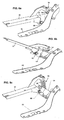
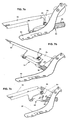
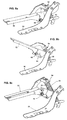
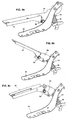
- FIGS. 5a, 5b, 5c to 9a, 9b, 9c show five further embodiments of the hinge mechanism according to the invention, in each case in the normal position (closed engine hood), open position (opened engine hood) and lifting position (pedestrian protection function). All of these embodiments have a base plate 50 which is secured to a fixed body part of the vehicle, and a hood receptacle 52 which is fixedly connected to the hood.
- a shock absorber 54 is provided in each of these embodiments, ie, the force accumulator is designed here as a compression spring 56.
- none of the embodiments is a manual intervention in the hinge mechanism necessary to make it operational again for a lift of the hood.
Landscapes
- Engineering & Computer Science (AREA)
- Mechanical Engineering (AREA)
- Superstructure Of Vehicle (AREA)
Applications Claiming Priority (4)
| Application Number | Priority Date | Filing Date | Title |
|---|---|---|---|
| DE200410004268 DE102004004268A1 (de) | 2004-01-28 | 2004-01-28 | Motorhauben-Scharniermechanismus |
| DE102004004268 | 2004-01-28 | ||
| DE202004017841U | 2004-11-17 | ||
| DE202004017841U DE202004017841U1 (de) | 2004-01-28 | 2004-11-17 | Motorhauben-Scharniermechanismus |
Publications (2)
| Publication Number | Publication Date |
|---|---|
| EP1559858A2 true EP1559858A2 (fr) | 2005-08-03 |
| EP1559858A3 EP1559858A3 (fr) | 2009-06-03 |
Family
ID=34654997
Family Applications (1)
| Application Number | Title | Priority Date | Filing Date |
|---|---|---|---|
| EP05001203A Withdrawn EP1559858A3 (fr) | 2004-01-28 | 2005-01-21 | Charnière de capot de véhicule |
Country Status (1)
| Country | Link |
|---|---|
| EP (1) | EP1559858A3 (fr) |
Cited By (1)
| Publication number | Priority date | Publication date | Assignee | Title |
|---|---|---|---|---|
| EP1752344A1 (fr) * | 2005-08-10 | 2007-02-14 | Bayerische Motoren Werke Aktiengesellschaft | Charnière de capot frontal passive protégeant les piétons |
Family Cites Families (4)
| Publication number | Priority date | Publication date | Assignee | Title |
|---|---|---|---|---|
| DE4240790C1 (de) * | 1992-12-04 | 1994-02-24 | Daimler Benz Ag | Scharnier für eine hochschwenkbare Abdeckhaube eines Kraftwagens |
| JP2002544057A (ja) * | 1999-05-17 | 2002-12-24 | エドシャ・アクチェンゲゼルシャフト | 前方ボンネット構造 |
| DE19957871A1 (de) * | 1999-12-01 | 2001-06-07 | Volkswagen Ag | Sicherheitsanordnung an einem Fahrzeug zum Schutz von Fußgängern |
| DE10136901A1 (de) * | 2001-07-28 | 2003-02-06 | Opel Adam Ag | Karosserie mit einer nachgiebig gelagerten Fronthaube |
-
2005
- 2005-01-21 EP EP05001203A patent/EP1559858A3/fr not_active Withdrawn
Cited By (1)
| Publication number | Priority date | Publication date | Assignee | Title |
|---|---|---|---|---|
| EP1752344A1 (fr) * | 2005-08-10 | 2007-02-14 | Bayerische Motoren Werke Aktiengesellschaft | Charnière de capot frontal passive protégeant les piétons |
Also Published As
| Publication number | Publication date |
|---|---|
| EP1559858A3 (fr) | 2009-06-03 |
Similar Documents
| Publication | Publication Date | Title |
|---|---|---|
| DE10314180B4 (de) | Reversierbarer Fußgängerschutz-Aktuator | |
| DE102007033325B4 (de) | Scharnier | |
| DE102016002523B3 (de) | Klappenscharnier für eine Frontklappe eines Fahrzeugs mit einer verschiebbaren Lagerung eines Hubaktuators | |
| DE602005000040T2 (de) | Vorrichtung zum Anheben einer Motorhaube mit einem Haken als Verriegelungssystem | |
| DE102005006580B4 (de) | Scharnieranordnung | |
| DE102011083262B4 (de) | Motorhaubengelenkanordnung für Fahrzeug | |
| DE102004062105B4 (de) | Vorrichtung zum Schutz von Personen bei einem Frontalaufprall auf ein Kraftfahrzeug durch aktives Aufstellen dessen Fronthaube | |
| EP2704919B1 (fr) | Dispositif de verrouillage et siège de véhicule | |
| EP1716023A1 (fr) | Montage d'un capot avant pourvu d'un levier de reglage | |
| DE102009040413A1 (de) | Fahrzeug-Sicherheitseinrichtung mit einem unteren und oberen Scharnieroberteil | |
| WO2013020612A1 (fr) | Dispositif de verrouillage | |
| DE102015007336A1 (de) | Fahrzeugscharnier und Verfahren zum Anheben einer Fahrzeughaube in einer Unfallsituation | |
| DE102005022924A1 (de) | Frontklappenscharnier mit Fußgängerschutz | |
| EP1160136B1 (fr) | Système de protection pour véhicules en cas de retournement | |
| DE102007002948A1 (de) | Vorrichtung zur Tragflächenentfaltung | |
| DE202015006895U1 (de) | Aufstellbares Klappenscharnier | |
| DE102009040410B4 (de) | Scharnier und Verfahren zum Betreiben eines Scharniers | |
| DE10331047A1 (de) | Frontklappenanordnung an oder für ein Kraftfahrzeug | |
| DE102009040401B4 (de) | Scharnier für ein Fahrzeug | |
| DE102005007903A1 (de) | Scharnierbeschlag für die Frontklappe eines Personenkraftwagens | |
| DE102007025359A1 (de) | Betätigungsvorrichtung für ein Türschloss, insbesondere einer Schiebe- oder Schiebeschwenktür | |
| DE102005037684B4 (de) | Frontklappenanordnung mit einer passiven Verformungseinrichtung | |
| DE102004004268A1 (de) | Motorhauben-Scharniermechanismus | |
| DE10352275B4 (de) | Einrichtung zum Reversieren einer zum Unfallschutz sensorgesteuert aktiv aufgestellten Fronthaube eines Kraftfahrzeuges | |
| DE102005045354A1 (de) | Schließvorrichtung eines bewegbaren Elements einer Fahrzeugkarosserie |
Legal Events
| Date | Code | Title | Description |
|---|---|---|---|
| PUAI | Public reference made under article 153(3) epc to a published international application that has entered the european phase |
Free format text: ORIGINAL CODE: 0009012 |
|
| AK | Designated contracting states |
Kind code of ref document: A2 Designated state(s): AT BE BG CH CY CZ DE DK EE ES FI FR GB GR HU IE IS IT LI LT LU MC NL PL PT RO SE SI SK TR |
|
| AX | Request for extension of the european patent |
Extension state: AL BA HR LV MK YU |
|
| PUAL | Search report despatched |
Free format text: ORIGINAL CODE: 0009013 |
|
| AK | Designated contracting states |
Kind code of ref document: A3 Designated state(s): AT BE BG CH CY CZ DE DK EE ES FI FR GB GR HU IE IS IT LI LT LU MC NL PL PT RO SE SI SK TR |
|
| AX | Request for extension of the european patent |
Extension state: AL BA HR LV MK YU |
|
| AKX | Designation fees paid | ||
| STAA | Information on the status of an ep patent application or granted ep patent |
Free format text: STATUS: THE APPLICATION IS DEEMED TO BE WITHDRAWN |
|
| 18D | Application deemed to be withdrawn |
Effective date: 20091204 |
|
| REG | Reference to a national code |
Ref country code: DE Ref legal event code: 8566 |