EP1559542A1 - Composite of aluminum alloy and resin composition and process for producing the same - Google Patents
Composite of aluminum alloy and resin composition and process for producing the same Download PDFInfo
- Publication number
- EP1559542A1 EP1559542A1 EP03810661A EP03810661A EP1559542A1 EP 1559542 A1 EP1559542 A1 EP 1559542A1 EP 03810661 A EP03810661 A EP 03810661A EP 03810661 A EP03810661 A EP 03810661A EP 1559542 A1 EP1559542 A1 EP 1559542A1
- Authority
- EP
- European Patent Office
- Prior art keywords
- aluminum alloy
- resin composition
- alloy material
- recesses
- shaped aluminum
- Prior art date
- Legal status (The legal status is an assumption and is not a legal conclusion. Google has not performed a legal analysis and makes no representation as to the accuracy of the status listed.)
- Granted
Links
Images



Classifications
-
- B—PERFORMING OPERATIONS; TRANSPORTING
- B32—LAYERED PRODUCTS
- B32B—LAYERED PRODUCTS, i.e. PRODUCTS BUILT-UP OF STRATA OF FLAT OR NON-FLAT, e.g. CELLULAR OR HONEYCOMB, FORM
- B32B15/00—Layered products comprising a layer of metal
- B32B15/04—Layered products comprising a layer of metal comprising metal as the main or only constituent of a layer, which is next to another layer of the same or of a different material
- B32B15/08—Layered products comprising a layer of metal comprising metal as the main or only constituent of a layer, which is next to another layer of the same or of a different material of synthetic resin
-
- B—PERFORMING OPERATIONS; TRANSPORTING
- B29—WORKING OF PLASTICS; WORKING OF SUBSTANCES IN A PLASTIC STATE IN GENERAL
- B29C—SHAPING OR JOINING OF PLASTICS; SHAPING OF MATERIAL IN A PLASTIC STATE, NOT OTHERWISE PROVIDED FOR; AFTER-TREATMENT OF THE SHAPED PRODUCTS, e.g. REPAIRING
- B29C45/00—Injection moulding, i.e. forcing the required volume of moulding material through a nozzle into a closed mould; Apparatus therefor
- B29C45/14—Injection moulding, i.e. forcing the required volume of moulding material through a nozzle into a closed mould; Apparatus therefor incorporating preformed parts or layers, e.g. injection moulding around inserts or for coating articles
- B29C45/14311—Injection moulding, i.e. forcing the required volume of moulding material through a nozzle into a closed mould; Apparatus therefor incorporating preformed parts or layers, e.g. injection moulding around inserts or for coating articles using means for bonding the coating to the articles
-
- B—PERFORMING OPERATIONS; TRANSPORTING
- B32—LAYERED PRODUCTS
- B32B—LAYERED PRODUCTS, i.e. PRODUCTS BUILT-UP OF STRATA OF FLAT OR NON-FLAT, e.g. CELLULAR OR HONEYCOMB, FORM
- B32B15/00—Layered products comprising a layer of metal
- B32B15/04—Layered products comprising a layer of metal comprising metal as the main or only constituent of a layer, which is next to another layer of the same or of a different material
- B32B15/08—Layered products comprising a layer of metal comprising metal as the main or only constituent of a layer, which is next to another layer of the same or of a different material of synthetic resin
- B32B15/09—Layered products comprising a layer of metal comprising metal as the main or only constituent of a layer, which is next to another layer of the same or of a different material of synthetic resin comprising polyesters
-
- B—PERFORMING OPERATIONS; TRANSPORTING
- B32—LAYERED PRODUCTS
- B32B—LAYERED PRODUCTS, i.e. PRODUCTS BUILT-UP OF STRATA OF FLAT OR NON-FLAT, e.g. CELLULAR OR HONEYCOMB, FORM
- B32B15/00—Layered products comprising a layer of metal
- B32B15/20—Layered products comprising a layer of metal comprising aluminium or copper
-
- B—PERFORMING OPERATIONS; TRANSPORTING
- B32—LAYERED PRODUCTS
- B32B—LAYERED PRODUCTS, i.e. PRODUCTS BUILT-UP OF STRATA OF FLAT OR NON-FLAT, e.g. CELLULAR OR HONEYCOMB, FORM
- B32B27/00—Layered products comprising a layer of synthetic resin
- B32B27/36—Layered products comprising a layer of synthetic resin comprising polyesters
-
- B—PERFORMING OPERATIONS; TRANSPORTING
- B32—LAYERED PRODUCTS
- B32B—LAYERED PRODUCTS, i.e. PRODUCTS BUILT-UP OF STRATA OF FLAT OR NON-FLAT, e.g. CELLULAR OR HONEYCOMB, FORM
- B32B3/00—Layered products comprising a layer with external or internal discontinuities or unevennesses, or a layer of non-planar shape; Layered products comprising a layer having particular features of form
- B32B3/26—Layered products comprising a layer with external or internal discontinuities or unevennesses, or a layer of non-planar shape; Layered products comprising a layer having particular features of form characterised by a particular shape of the outline of the cross-section of a continuous layer; characterised by a layer with cavities or internal voids ; characterised by an apertured layer
- B32B3/30—Layered products comprising a layer with external or internal discontinuities or unevennesses, or a layer of non-planar shape; Layered products comprising a layer having particular features of form characterised by a particular shape of the outline of the cross-section of a continuous layer; characterised by a layer with cavities or internal voids ; characterised by an apertured layer characterised by a layer formed with recesses or projections, e.g. hollows, grooves, protuberances, ribs
-
- B—PERFORMING OPERATIONS; TRANSPORTING
- B29—WORKING OF PLASTICS; WORKING OF SUBSTANCES IN A PLASTIC STATE IN GENERAL
- B29C—SHAPING OR JOINING OF PLASTICS; SHAPING OF MATERIAL IN A PLASTIC STATE, NOT OTHERWISE PROVIDED FOR; AFTER-TREATMENT OF THE SHAPED PRODUCTS, e.g. REPAIRING
- B29C45/00—Injection moulding, i.e. forcing the required volume of moulding material through a nozzle into a closed mould; Apparatus therefor
- B29C45/14—Injection moulding, i.e. forcing the required volume of moulding material through a nozzle into a closed mould; Apparatus therefor incorporating preformed parts or layers, e.g. injection moulding around inserts or for coating articles
- B29C45/1418—Injection moulding, i.e. forcing the required volume of moulding material through a nozzle into a closed mould; Apparatus therefor incorporating preformed parts or layers, e.g. injection moulding around inserts or for coating articles the inserts being deformed or preformed, e.g. by the injection pressure
- B29C2045/14286—Injection moulding, i.e. forcing the required volume of moulding material through a nozzle into a closed mould; Apparatus therefor incorporating preformed parts or layers, e.g. injection moulding around inserts or for coating articles the inserts being deformed or preformed, e.g. by the injection pressure means for heating the insert
-
- B—PERFORMING OPERATIONS; TRANSPORTING
- B29—WORKING OF PLASTICS; WORKING OF SUBSTANCES IN A PLASTIC STATE IN GENERAL
- B29C—SHAPING OR JOINING OF PLASTICS; SHAPING OF MATERIAL IN A PLASTIC STATE, NOT OTHERWISE PROVIDED FOR; AFTER-TREATMENT OF THE SHAPED PRODUCTS, e.g. REPAIRING
- B29C45/00—Injection moulding, i.e. forcing the required volume of moulding material through a nozzle into a closed mould; Apparatus therefor
- B29C45/14—Injection moulding, i.e. forcing the required volume of moulding material through a nozzle into a closed mould; Apparatus therefor incorporating preformed parts or layers, e.g. injection moulding around inserts or for coating articles
- B29C2045/1486—Details, accessories and auxiliary operations
- B29C2045/14868—Pretreatment of the insert, e.g. etching, cleaning
-
- B—PERFORMING OPERATIONS; TRANSPORTING
- B29—WORKING OF PLASTICS; WORKING OF SUBSTANCES IN A PLASTIC STATE IN GENERAL
- B29C—SHAPING OR JOINING OF PLASTICS; SHAPING OF MATERIAL IN A PLASTIC STATE, NOT OTHERWISE PROVIDED FOR; AFTER-TREATMENT OF THE SHAPED PRODUCTS, e.g. REPAIRING
- B29C45/00—Injection moulding, i.e. forcing the required volume of moulding material through a nozzle into a closed mould; Apparatus therefor
- B29C45/14—Injection moulding, i.e. forcing the required volume of moulding material through a nozzle into a closed mould; Apparatus therefor incorporating preformed parts or layers, e.g. injection moulding around inserts or for coating articles
- B29C45/14778—Injection moulding, i.e. forcing the required volume of moulding material through a nozzle into a closed mould; Apparatus therefor incorporating preformed parts or layers, e.g. injection moulding around inserts or for coating articles the article consisting of a material with particular properties, e.g. porous, brittle
-
- B—PERFORMING OPERATIONS; TRANSPORTING
- B29—WORKING OF PLASTICS; WORKING OF SUBSTANCES IN A PLASTIC STATE IN GENERAL
- B29K—INDEXING SCHEME ASSOCIATED WITH SUBCLASSES B29B, B29C OR B29D, RELATING TO MOULDING MATERIALS OR TO MATERIALS FOR MOULDS, REINFORCEMENTS, FILLERS OR PREFORMED PARTS, e.g. INSERTS
- B29K2081/00—Use of polymers having sulfur, with or without nitrogen, oxygen or carbon only, in the main chain, as moulding material
- B29K2081/04—Polysulfides, e.g. PPS, i.e. polyphenylene sulfide or derivatives thereof
-
- B—PERFORMING OPERATIONS; TRANSPORTING
- B29—WORKING OF PLASTICS; WORKING OF SUBSTANCES IN A PLASTIC STATE IN GENERAL
- B29K—INDEXING SCHEME ASSOCIATED WITH SUBCLASSES B29B, B29C OR B29D, RELATING TO MOULDING MATERIALS OR TO MATERIALS FOR MOULDS, REINFORCEMENTS, FILLERS OR PREFORMED PARTS, e.g. INSERTS
- B29K2705/00—Use of metals, their alloys or their compounds, for preformed parts, e.g. for inserts
-
- B—PERFORMING OPERATIONS; TRANSPORTING
- B29—WORKING OF PLASTICS; WORKING OF SUBSTANCES IN A PLASTIC STATE IN GENERAL
- B29K—INDEXING SCHEME ASSOCIATED WITH SUBCLASSES B29B, B29C OR B29D, RELATING TO MOULDING MATERIALS OR TO MATERIALS FOR MOULDS, REINFORCEMENTS, FILLERS OR PREFORMED PARTS, e.g. INSERTS
- B29K2705/00—Use of metals, their alloys or their compounds, for preformed parts, e.g. for inserts
- B29K2705/02—Aluminium
-
- B—PERFORMING OPERATIONS; TRANSPORTING
- B32—LAYERED PRODUCTS
- B32B—LAYERED PRODUCTS, i.e. PRODUCTS BUILT-UP OF STRATA OF FLAT OR NON-FLAT, e.g. CELLULAR OR HONEYCOMB, FORM
- B32B2367/00—Polyesters, e.g. PET, i.e. polyethylene terephthalate
-
- Y—GENERAL TAGGING OF NEW TECHNOLOGICAL DEVELOPMENTS; GENERAL TAGGING OF CROSS-SECTIONAL TECHNOLOGIES SPANNING OVER SEVERAL SECTIONS OF THE IPC; TECHNICAL SUBJECTS COVERED BY FORMER USPC CROSS-REFERENCE ART COLLECTIONS [XRACs] AND DIGESTS
- Y10—TECHNICAL SUBJECTS COVERED BY FORMER USPC
- Y10T—TECHNICAL SUBJECTS COVERED BY FORMER US CLASSIFICATION
- Y10T428/00—Stock material or miscellaneous articles
- Y10T428/24—Structurally defined web or sheet [e.g., overall dimension, etc.]
- Y10T428/24355—Continuous and nonuniform or irregular surface on layer or component [e.g., roofing, etc.]
-
- Y—GENERAL TAGGING OF NEW TECHNOLOGICAL DEVELOPMENTS; GENERAL TAGGING OF CROSS-SECTIONAL TECHNOLOGIES SPANNING OVER SEVERAL SECTIONS OF THE IPC; TECHNICAL SUBJECTS COVERED BY FORMER USPC CROSS-REFERENCE ART COLLECTIONS [XRACs] AND DIGESTS
- Y10—TECHNICAL SUBJECTS COVERED BY FORMER USPC
- Y10T—TECHNICAL SUBJECTS COVERED BY FORMER US CLASSIFICATION
- Y10T428/00—Stock material or miscellaneous articles
- Y10T428/31504—Composite [nonstructural laminate]
- Y10T428/31678—Of metal
-
- Y—GENERAL TAGGING OF NEW TECHNOLOGICAL DEVELOPMENTS; GENERAL TAGGING OF CROSS-SECTIONAL TECHNOLOGIES SPANNING OVER SEVERAL SECTIONS OF THE IPC; TECHNICAL SUBJECTS COVERED BY FORMER USPC CROSS-REFERENCE ART COLLECTIONS [XRACs] AND DIGESTS
- Y10—TECHNICAL SUBJECTS COVERED BY FORMER USPC
- Y10T—TECHNICAL SUBJECTS COVERED BY FORMER US CLASSIFICATION
- Y10T428/00—Stock material or miscellaneous articles
- Y10T428/31504—Composite [nonstructural laminate]
- Y10T428/31678—Of metal
- Y10T428/31681—Next to polyester, polyamide or polyimide [e.g., alkyd, glue, or nylon, etc.]
Definitions
- the present invention relates to a composite of an aluminum alloy and a resin composition for use in housings of electronic devices, housings of home electrical devices, structural parts, mechanical parts, etc., and also relates to a production method therefor. More particularly, the present invention relates to a structure having a high-strength thermoplastic resin composition integrated with a shaped aluminum alloy material produced by various machining process. That is, the present invention relates to an aluminum alloy-and-resin composition composite for use in various electronic devices for mobile applications, home electrical products, medical devices, structural parts for vehicles, vehicle-mounted products, construction material parts, structural parts of other equipment, parts for exterior applications, and so forth, and also relates to a production method therefor.
- adhesives are developed in the technical field of adhesives. Their goal is to develop universal and durable adhesives. Therefore, we infer that developers in the technical field of adhesives usually do not consider to develop a metal treating method by conceiving a fine structure of the metal surface that is suitable for bonding, or to improve the resin composition to thereby form a product having a coefficient of linear expansion equal to that of the metal.
- adhesive developers deem that the above-described development and design belong to the fields of metal working and resin manufactures, or they consider that their mission is to diligently develop elastic adhesives, in which they specialize, although it is technically difficult to develop such adhesives.
- fundamental examination of constituent materials of both the metal and the resin composition to be bonded to each other has not heretofore been made among persons skilled in these technical fields.
- a metal-and-resin composite product is formed by insert-molding a metal product [for example, see Japanese Patent Application Unexamined Publication (KOKAI) Nos. 2001-225352, Sho 54-13588, Sho 54-13587, Sho 58-217679, Sho 50-158539, and Hei 5-70969].
- these conventional composite producing methods are for producing electric contacts, aluminum foil, etc., and hence cannot provide firm bonding adequate for mechanical structures that are required to exhibit strong bond strength (adhesion) and rigidity.
- the present inventors further carried out exhaustive researches and development from the viewpoint of finding substances suitable for use as a metal material and a resin material.
- both metal and resin materials should not be very special in order to be usable in practical application.
- the linear expansion coefficient thereof needs to be matched to that of the metal.
- the present inventors selected as a resin composition a polybutylene terephthalate resin (hereinafter referred to as "PBT") exhibiting satisfactory heat resistance and strength and having low hygroscopicity and moderate chemical resistance.
- the linear expansion coefficients of thermoplastic resins are much higher than those of metals.
- PBT has a linear expansion coefficient of 8 to 10 ⁇ 10 -5 °C -1 , which is much higher than those of metals, which are about 1.0 to 2.5 ⁇ 10 -5 °C -1 .
- metals aluminum is one of those having the highest linear expansion coefficients.
- the linear expansion coefficient of an aluminum alloy containing pure aluminum is 2.2 to 2.5 ⁇ 10 -5 °C -1 . Therefore, we selected as a metal an aluminum alloy that has a high coefficient of linear expansion and hence allows the numeral range thereof to be easily matched to that of the resin composition and that enables various physical properties to be obtained by alloying.
- thermoplastic resin composition was compounded with a large amount of fibrous filler, etc., and another polymer was added thereto to form a thermoplastic resin composition.
- JIS Japanese Industrial Standards
- the EPL etching method shown in D2651 of ASTM is a process in which duralumin is washed with an alkaline aqueous solution and thereafter dipped in concentrated sulfuric acid containing chromium, followed by washing with ion-exchange water.
- the duralumin treated by this method is covered at the surface thereof with fine recesses having a diameter of about 0.04 ⁇ m and with small whisker projections extending vertically from the openings of the fine recesses.
- the thickness of the thinnest film portion of the aluminum oxide layer covering the metallic aluminum is said to be about 5 nm.
- the treated duralumin strengthens the interlocking with the adhesive by the surface where recesses and projections coexist with each other.
- ASTM D3933 shows a method wherein an aluminum alloy is anodized in an aqueous phosphoric acid solution. On the surface of the aluminum alloy treated by this method also, deep pores (depth of 0.1 to 0.3 ⁇ m) having a diameter of 0.04 ⁇ m and short whiskers extending vertically from the openings of the pores are observed.
- the thickness of the thinnest film portion of the aluminum oxide layer covering the metallic aluminum is considered to be several nanometers. It should be noted, however, that these methods may be said to be special methods for manufacturing structural materials for aircraft. Because they use a large amount of ion-exchange water, the treatment methods are difficult to adopt for use in ordinary liquid treatment lines, i.e. plating equipment, aluminum anodizing equipment, equipment for caustic treatment of magnesium alloy, etc.
- the thinnest film portion of the aluminum oxide layer covering the metallic aluminum part also must be thin.
- this gives rise to no practical problem because long-term stability is needed regardless of whether the aluminum alloy is used for aircraft or not.
- an excessively finely-etched surface may prevent the resin or the adhesive from sufficiently entering (filling) the pores and recesses formed on the treated surface, resulting in the finely etching process being practically worthless.
- treatment 1 ⁇ aluminum alloy treatment by the above-described simple caustic soda dipping method (hereinafter referred to as "treatment 1 ⁇ ") using the aluminum A5052 alloy (JIS), which is considered to be used for the largest number of applications.
- treatment 2 ⁇ aluminum A5052 alloy
- the aluminum anodizing treatment is usually carried out in the following sequence: degreasing of the aluminum alloy; alkali etching; polishing (acid etching); anodizing; dyeing; and sealing.
- the aluminum surface immediately after the anodizing process has the largest surface area.
- the anodized aluminum surface is closely crowded with cylindrical crystals of aluminum oxide having pores with a diameter of 0.05 to 0.08 ⁇ m and a depth reaching several to 20 ⁇ m.
- the cylindrical crystals form a surface that is crowded with an infinite number of openings.
- the pore diameter of the aluminum oxide is slightly larger and the pore length is much longer than in the case of duralumin treated by ASTM D3933.
- the thickness of the aluminum oxide at the pore bottom that is, the thickness of the thinnest film portion of the aluminum oxide layer covering the metallic aluminum seems to be about 1 nm or more. However, the precise thickness of the thinnest film portion is not clear.
- the present inventors performed various experiments by using test pieces of an aluminum alloy treated by two different processes, i.e. treatment 1 ⁇ and treatment 2 ⁇ , and also using a PBT resin having a coefficient of linear expansion adjusted to the same level as that of the aluminum alloy.
- treatment 1 ⁇ satisfactory strength could not obtained for some integrated articles. Therefore, we found it necessary to further scheme to solve the problem.
- the treatment 2 ⁇ bonding using an adhesive showed excellent results.
- results were worse than those with the treatment 1 ⁇ , which is a simple and easy method.
- the present inventors decided to assume a favorable aluminum alloy surface configuration and to establish an aluminum surface configuration that allows a resin composition and an aluminum alloy to be integrated together excellently.
- An object of the present invention is to obtain an aluminum alloy-and-resin composite wherein a thermoplastic resin composition and a shaped aluminum alloy material are made to adhere to each other so strongly that they will not readily separate from each other by treating the aluminum alloy surface, and also obtain a production method therefor.
- Another object of the present invention is to obtain an aluminum alloy-and-resin composite capable of making housings and parts of various devices, structures, etc. free from problems in terms of configuration, structure and mechanical strength, and also obtain a production method therefor.
- Still another object of the present invention is to obtain an aluminum alloy-and-resin composite useful for reducing the weight of housings and parts of electronic devices, structures, etc. and for simplifying device manufacturing processes, and also obtain a production method therefor.
- An aluminum alloy-and-resin composition composite comprises a shaped aluminum alloy material having a surface with a surface roughness of 5 ⁇ m to 50 ⁇ m and having fine recesses or projections of not larger than 1 ⁇ m on the surface.
- the aluminum alloy-and-resin composition composite further comprises a thermoplastic resin composition fixed to the surface of the shaped aluminum alloy material by entering the recesses or engaging the projections.
- the thermoplastic resin composition contains as a main component a polybutylene terephthalate resin or polyphenylene sulfide having an average coefficient of lengthwise and crosswise linear expansion of 2 to 4 ⁇ 10 -5 °C -1 .
- An aluminum alloy-and-resin composition composite comprises a shaped aluminum alloy material having a surface with a surface roughness of 1 ⁇ m to 10 ⁇ m and having fine recesses or projections of 0.01 ⁇ m to 0.1 ⁇ m in diameter on the surface.
- the surface of the shaped aluminum alloy material is covered with a + trivalent aluminum compound having an average thickness of about 0.001 ⁇ m.
- the aluminum alloy-and-resin composition composite further comprises a thermoplastic resin composition fixed to the surface of the shaped aluminum alloy material by entering the recesses or engaging the projections.
- the thermoplastic resin composition contains as a main component a polybutylene terephthalate resin or polyphenylene sulfide having an average coefficient of lengthwise and crosswise linear expansion of 2 to 4 ⁇ 10 -5 °C -1 .
- an aluminum alloy-and-resin composition composite according to a third feature of the present invention is characterized as follows.
- the recesses or the projections include first recesses or first projections having a first diameter of 0.03 ⁇ m to 0.1 ⁇ m and a depth about equal to or larger than the first diameter.
- the number of first recesses or first projections per 1 ⁇ m square area of the surface is not less than 10.
- the recesses or the projections further include second recesses or second projections having a second diameter of 0.01 ⁇ m to 0.03 ⁇ m and a depth about equal to or larger than the second diameter.
- the number of second recesses or second projections per 1 ⁇ m square area of the surface is not less than 50.
- An aluminum alloy-and-resin composition composite according to a fourth feature of the present invention is characterized as follows.
- the thermoplastic resin composition is fixed to the surface of the shaped aluminum alloy material by bonding using an adhesive.
- An aluminum alloy-and-resin composition composite according to a fifth feature of the present invention is characterized as follows.
- the thermoplastic resin composition is fixed to the surface of the shaped aluminum alloy material by injection molding, heat pressing, or co-extrusion.
- the present invention provides a production method for the aluminum alloy-and-resin composition composite according to one feature selected from the first to third features of the present invention.
- the production method is characterized as follows.
- a coated shaped aluminum alloy material having a thin polyalkylene terephthalate film or polyphenylene sulfide adhering to a surface thereof is produced from the above-described shaped aluminum alloy material and an organic solvent solution of a polyalkylene terephthalate resin or polyphenylene sulfide.
- the coated shaped aluminum alloy material is inserted into an injection mold. Then, the above-described polyalkylene terephthalate resin or polyphenylene sulfide is injected into the injection mold.
- the present invention provides a production method for the aluminum alloy-and-resin composition composite according to one feature selected from the first to third features of the present invention.
- the production method is characterized as follows.
- the above-described shaped aluminum alloy material is coated with a urethane curable or epoxy curable paint or ink. After the paint or ink has been hardened, the coated shaped aluminum alloy material is inserted into an injection mold. Then, the above-described polyalkylene terephthalate resin or polyphenylene sulfide is injected into the injection mold.
- the present invention provides a production method for the aluminum alloy-and-resin composition composite according to one feature selected from the first to third features of the present invention.
- the production method is characterized as follows.
- the above-described shaped aluminum alloy material is heated to not lower than 200°C, and the above-described polyalkylene terephthalate resin or polyphenylene sulfide is melted and brought into contact with the shaped aluminum alloy material under pressure.
- the present invention provides a production method for the aluminum alloy-and-resin composition composite according to one feature selected from the first to third features of the present invention.
- the production method is characterized as follows.
- the above-described shaped aluminum alloy material is dipped in an aqueous solution of at least one selected from the group consisting of hydrazine, ammonia, and an amine compound.
- the dipped shaped aluminum alloy material is inserted into an injection mold.
- the above-described polyalkylene terephthalate resin or polyphenylene sulfide is injected into the injection mold.
- the aluminum alloy it is possible to use various aluminum alloys such as those standardized as “1000 series” to "7000 series” by JIS (Japanese Industrial Standards) and those of die-casting grade.
- the aluminum alloy is formed by various machining process into a configuration necessary for use as an insert in injection molding process to prepare a shaped aluminum alloy material as one of a pair of materials to be bonded together ("fixing” is occasionally used as a synonym for "bonding” in the present invention,).
- the shaped metal material processed into a necessary configuration and structure requires that the surface thereof that is to be bonded should not be oxidized thick and should be free from oil matter or an oxide of oil matter that may be attached to the surface during machining.
- the shaped metal material is subjected to degreasing and cleaning to remove machining oil or other contamination from the surface thereof.
- degreasing commercially available metal degreasing agents are usable, and it is particularly preferable to use them when mass-production is made.
- the shaped aluminum alloy material should preferably be dipped in a water-soluble organic solvent, e.g. acetone, ethanol, or isopropyl alcohol.
- a water-soluble organic solvent e.g. acetone, ethanol, or isopropyl alcohol.
- the shaped aluminum alloy material should preferably be dip-treated, as stated above, under application of ultrasonic waves. In either case, the shaped aluminum alloy material is rinsed with water after the degreasing process.
- the shaped aluminum alloy material is dipped in a 1 to 10% aqueous caustic soda solution for from several tens of seconds to several minutes, followed by rinsing with water.
- this process is referred to as "alkali etching".
- alkali etching the aluminum oxide and aluminum hydroxide layer covering the aluminum alloy surface is dissolved.
- the inside metallic aluminum also dissolves while releasing hydrogen.
- the aluminum alloy surface is roughened to a surface roughness of 5 to 50 ⁇ m even if it is flat before the treatment.
- the surface layer becomes a thin oxidized aluminum layer. It is stated in a document that + trivalent aluminum atoms form AlO(OH) as a main structure. At this stage, even if the aluminum surface is analyzed at a deepened angle by X-ray photoelectron spectroscopy (XPS), only a few metallic aluminum atoms can be detected. XPS is said to be capable of analyzing the aluminum alloy to a depth of about 1 nm from the surface thereof. Therefore, the thickness of the aluminum oxide film is considered to be 1 to 2 nm.
- the alkali etching as pretreatment process enables large recesses or projections to be formed on the aluminum surface and allows the thickness of the aluminum oxide film on the surface to be increased.
- the purpose of this process is to form even finer recesses or projections on the aluminum surface.
- the hydroxide ion concentration is important. The object of this process was almost attained by dipping the aluminum alloy in an aqueous solution of at least one of caustic soda, soda aluminate, soda pyrophosphate, ammonia, hydrazine, and methylamine, which had been adjusted to pH 10.0 to 11.5.
- aqueous ammonia solution containing an ammonia concentration of several percent and several hundred cc of an aqueous caustic soda solution diluted to a caustic soda concentration of not more than 1% are prepared.
- a pH meter is put into the aqueous ammonia solution. While the aqueous ammonia solution is being stirred, the aqueous caustic soda solution is dropped into the aqueous ammonia solution to adjust the pH in the neighborhood of 11.0.
- the aluminum alloy having completed the pretreatment process is dipped in the aqueous solution for from several minutes to several tens of minutes, followed by rinsing with water.
- the dipping in the low base concentration aqueous solution causes the aluminum to dissolve while releasing hydrogen, although the rate of etching is low. As a result, fine recesses having a very small diameter are formed.
- Repeating the aluminum alloy treatment causes the pH to lower. Therefore, caustic soda may be added so that the pH is kept in the range of 10.0 to 11.5.
- Temperature and time are also important factors. Dipping at a higher temperature for a longer period of time causes the recess diameter to be undesirably increased as in the case of the foregoing alkali etching.
- Dipping for several minutes at a temperature in the neighborhood of room temperature is preferable.
- Such a dipping process produces fine recesses of about 0.01 to 0.1 ⁇ m in diameter.
- the density of such recesses is as follows.
- the number of recesses having a diameter of 0.01 to 0.03 ⁇ m per 1 ⁇ m square area of the surface is from 50 to 500.
- the number of recesses having a diameter of 0.03 to 0.1 ⁇ m per 1 ⁇ m square area of the surface is from 10 to 50.
- the aluminum alloy surface is analyzed by XPS, only a very small quantity of zero-valent aluminum can be detected. Most of the detected aluminum is + trivalent aluminum. This fact shows that the aluminum alloy surface is covered with a + trivalent aluminum compound having a thickness of about 1 nm (0.001 ⁇ m), if we must say, from 1 to 2 nm.
- thermoplastic resin composition that is used in the present invention. It is preferable to use a thermoplastic resin composition containing PBT or polyphenylene sulfide (PPS) as a main component. Further, it is necessary to match the coefficient of linear expansion of the thermoplastic resin composition to that of the aluminum alloy. Therefore, it is important for the thermoplastic resin composition to contain a filler. First, it is necessary to use a fibrous filler, for example, glass fiber, carbon fiber, aramid fiber, and other high-strength fibers similar to these. However, if a fibrous filler is added singly, strong directionality appears during injection molding, which is unfavorable depending upon the configuration.
- a fibrous filler for example, glass fiber, carbon fiber, aramid fiber, and other high-strength fibers similar to these. However, if a fibrous filler is added singly, strong directionality appears during injection molding, which is unfavorable depending upon the configuration.
- thermoplastic resin composition containing a fibrous filler and a powder filler such as calcium carbonate, magnesium carbonate, silica, talc, clay, glass, ground carbon fiber, ground aramid fiber, and other resin-filling inorganic fillers similar to them.
- a powder filler such as calcium carbonate, magnesium carbonate, silica, talc, clay, glass, ground carbon fiber, ground aramid fiber, and other resin-filling inorganic fillers similar to them.
- the mold shrinkage factor is also important.
- the mold shrinkage factor should be small.
- thermoplastic resin composition may contain a polycarbonate resin (hereinafter referred to as "PC”), an ABS resin (hereinafter referred to as “ABS”), a polyethylene terephthalate resin (hereinafter referred to as “PET”), or a polystyrene resin (hereinafter referred to as "PS").
- PC polycarbonate resin
- ABS ABS resin
- PET polyethylene terephthalate resin
- PS polystyrene resin
- the coefficient of linear expansion of the aluminum alloy is 2.2 to 2.5 ⁇ 10 -5 °C -1 . Therefore, if the average coefficient of lengthwise and crosswise linear expansion of the thermoplastic resin composition is 2 to 3 ⁇ 10 -5 °C -1 , the thermoplastic resin composition and the aluminum alloy are approximately coincident with each other in terms of the coefficient of linear expansion. Even an average coefficient of lengthwise and crosswise linear expansion of 2 to 4 ⁇ 10 -5 °C -1 is considered to be practically appropriate.
- the thermoplastic resin composition should preferably have a mold shrinkage factor in the range of from 0.4 to 0.5%. It should be noted that the average coefficient of lengthwise and crosswise linear expansion is used for the thermoplastic resin composition for the following reason.
- the coefficient of linear expansion is small in a direction in which the fibers of the resin composition mainly lie side-by-side with each other, but large in a direction perpendicular to the above-mentioned direction. Therefore, the average of the coefficients of linear expansion in the two directions is used as an indication of the linear expansion coefficient of the resin composition.
- the most rational integrating process is as follows. An insert molding mold is prepared, and the aluminum alloy is inserted into the injection mold. Then, the thermoplastic resin composition is injected into the mold. It is preferable that when the molded article is removed from the mold, the aluminum alloy and the thermoplastic resin composition should have already been bonded together into an integrated structure. However, in the ordinary injection molding, the injection mold has been adjusted to a temperature at which the resin is cooled to become solidified, and the inserted metal piece is also at a temperature equal to or lower than the mold temperature. Therefore, the molten resin composition injected into the mold undesirably becomes solidified before entering the fine recesses formed on the aluminum alloy surface.
- the second is a method in which a metal material is previously covered with a resin film having an affinity for PBT. This is inserted into an insert mold, and a resin composition is injected into the mold so as to bond to the metal material.
- a resin composition is injected into the mold so as to bond to the metal material.
- PBT dissolves in o -chlorophenol. Therefore, an organic solvent solution of PBT is prepared and put in a hermetically sealable container.
- the above-described aluminum alloy is dipped in the solution. In this state, the pressure is reduced and raised repeatedly at short intervals, thereby allowing the solution to penetrate into the aluminum alloy surface thoroughly. Thereafter, the aluminum alloy is taken out of the solution and dried by blowing nitrogen thereonto. With this process, an aluminum alloy coated with a thin PBT film can be produced.
- a paint or an ink is applied to a metal and hardened, and a PBT resin is injected onto the coated metal, thereby bonding them to each other.
- the main component of the paint or ink, exclusive of the solvent used therein, may be a urethane curable, epoxy curable or modified alkyd curable material.
- a two-part ink consisting essentially of a polyalcohol and a polyisocyanate, which is a urethane curable ink, is printed on the above-described aluminum alloy and cured under curing conditions specified by the manufacturer of this ink.
- the most direct method may be as follows. An aluminum alloy to be bonded by injection process is previously heated to a temperature close to the melting temperature of a PBT resin to be bonded. Then, the PBT resin is injected onto the heated aluminum alloy. This method needs to cool the whole below the solidification temperature of the resin after the injection process and is therefore regarded as difficult to use from the industrial point of view. However, the method is simple in theory.
- an aluminum alloy At the time of finely etching an aluminum alloy, it is dipped in an aqueous solution of at least one selected from the group consisting of hydrazine, ammonia, and a water-soluble amine compound, thereby treating the aluminum alloy so that it has a surface condition as defined in the present invention.
- the aluminum alloy is rinsed with water and dried with air at a high temperature.
- the aluminum alloy is inserted into an insert mold, and a PBT resin is injected into the mold. By doing so, injection bonding can be effected at the ordinary mold temperature.
- This method can ensure mass productivity, although it has not yet completely been clarified why the molten resin enters the fine recesses while remaining unsolidified (see WO 03/064150 A1).
- a commercially available aluminum alloy plate A5052/H38 with a thickness of 1 mm was purchased.
- the aluminum alloy plate was cut into a rectangular piece of 100 mm by 25 mm.
- the aluminum alloy piece was dipped in 1 liter of ethanol for 10 minutes under application of ultrasonic waves, and then dipped in 4 liters of tap water under stirring. Thereafter, the aluminum alloy piece was put into a plastic basket and washed with running tap water.
- the aluminum alloy piece was dipped in a 2% aqueous caustic soda solution for 2 minutes, followed by rinsing with ion-exchange water.
- the aluminum alloy piece was dipped in a 1% aqueous hydrochloric acid solution for 1 minute to effect neutralization.
- the aluminum alloy piece was dip-washed in 4 liters of ion-exchange water, followed by rinsing with running ion-exchange water.
- One liter of a 2% aqueous ammonia solution was prepared.
- a 1% aqueous caustic soda solution prepared separately was dropped into the aqueous ammonia solution under stirring to adjust the pH to 11.0 at 50°C.
- the aluminum alloy treated as stated above was dipped in the aqueous solution for 2 minutes and then thoroughly washed with ion-exchange water.
- the aluminum alloy was dried with hot air at 60°C for 20 minutes and then stored in dry air.
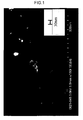
- Fig. 1 shows the conditions of recesses on the aluminum alloy surface observed from the photograph of Fig. 1 and also shows the diameters of the recesses measured by drawing lines along the contours of the recesses. It was observed that there were 3 recesses of 0.03 to 0.1 ⁇ m in diameter and 15 to 20 recesses of 0.01 to 0.03 ⁇ m in diameter per 0.25 ⁇ m square area of the surface on the average. The densities of such recesses were substantially the same at different positions of observation.
- the aluminum alloy surface was observed by using XPS (X-ray Photoelectron Spectroscopy). Only a slight amount of zero-valent aluminum element was detected even when the aluminum alloy was observed at a deepened angle. Most of the detected aluminum was + trivalent aluminum. XPS is said to be capable of analyzing the aluminum alloy to a depth of about 1 nm from the surface thereof. Therefore, the thickness of the aluminum oxide film was considered to be 1 to 2 nm.
- thermoplastic resin composition was prepared by a twin-screw extruder and a pelletizer.
- the thermoplastic resin composition consisted essentially of 60% a polymer alloy containing 80% PBT and 20% PET, 20% glass fiber, and 20% glass powder filler.
- a rectangular molded article of 100 mm by 25 mm having a thickness of 3 mm was obtained by injection molding from a rectangular end.
- the coefficients of linear expansion in the lengthwise and crosswise directions were measured in the temperature range of from 0°C to 60°C.
- the average coefficient of linear expansion in the lengthwise direction was 2.1 to 2.3 ⁇ 10 -5 °C -1 .
- the average coefficient of linear expansion in the crosswise direction was 3.7 to 3.9 ⁇ 10 -5 °C -1 .
- the average of the coefficients of linear expansion in the lengthwise and crosswise directions was 3.0 ⁇ 10 -5 °C -1 .
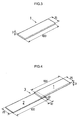
- Injection molding was carried out by using as a raw material the thermoplastic resin composition pellets prepared in Experimental Example 2, thereby obtaining a plate-shaped resin molded article 1 as shown in Fig. 3.
- the resin molded article 1 and an aluminum alloy piece 2 were bonded together with an adhesive to obtain a test piece 3.
- a portion of the resin molded article 1 to be bonded was polished on a flat iron plate with calcium carbonate of 25 ⁇ m in average diameter and a small amount of water.
- the resin molded article 1 was further polished with calcium carbonate of 5 ⁇ m in average diameter and a small amount of water and thoroughly washed with tap water under application of ultrasonic waves. After being placed in an air blast dryer at 50°C for 6 hours, the resin molded article 1 was stored in a desiccator for drying filled with concentrated sulfuric acid.
- the aluminum alloy piece 2 obtained in Experimental Example 1 was also stored in a desiccator for drying.
- the resin molded article 1 and the aluminum alloy piece 2 were stored in the respective desiccators for 1 week.
- a two-part epoxy adhesive "Cemedine 1500 (registered trademark: available from Cemedine Co., Ltd.) was prepared as specified by the manufacturer.
- the adhesive was applied to the aluminum alloy, and the plate-shaped resin molded article was pressed against the adhesive-coated side of the aluminum alloy to bond them into an integrated article. Further, a weight of 15 kg was placed on the integrated article. This was allowed to stand for 2 days. Then, the weight was removed, and the integrated article was allowed to stand for 1 week. Thereafter, both ends of the integrated article were set to a tensile testing machine to measure the tensile shear breaking strength. The average of 10 measured values of the shear breaking strength of the bonded surface was 10.0 MPa (102 kgf per square centimeter).
- a polished plate-shaped molded article made of a resin composition was obtained in the same way as in Experimental Example 2 and stored in a desiccator for drying. Meanwhile, an aluminum alloy plate A5052/H38 with a thickness of 1 mm was cut into a rectangular piece of 100 mm by 25 mm. After being degreased and rinsed with water in the same way as in Experimental Example 1, the aluminum alloy piece was dipped in a 20% aqueous caustic soda solution for 3 minutes and then thoroughly washed with ion-exchange water. Thereafter, the aluminum alloy piece was dried with an air blast at 50°C for 6 hours and then stored in a desiccator for drying. The polished resin molded article and the aluminum alloy piece were stored in the respective desiccators for drying for 1 week.
- One aluminum alloy piece was taken out from the desiccator to measure the surface roughness thereof. Subsequently, the surface condition was analyzed by SEM and XPS. Regarding the surface roughness, 15 ⁇ m was observed for a length of 2 mm. The SEM observation revealed that there were a few irregularities that were regarded as pores or recesses having a diameter of not more than 0.1 ⁇ m, and there were many places where forming lines present on the aluminum alloy surface from the beginning (i.e. fine scratch lines cut on the aluminum alloy surface by a roll during manufacture of the aluminum plate) melted away, resulting in large gentle recesses or projections.
- a polished plate-shaped molded article made of a resin composition was obtained in the same way as in Experimental Example 3 and stored in a desiccator for drying. Meanwhile, an aluminum alloy plate A5052/H38 with a thickness of 1 mm was cut into a rectangular piece of 100 mm by 25 mm and subjected to an aluminum anodizing process. That is, the aluminum alloy piece was dipped in a 20% aqueous solution of a commercially available aluminum degreasing material for 10 minutes, following by rinsing with water. Subsequently, the aluminum alloy piece was dipped in a 20% aqueous caustic soda solution at 90°C for 20 seconds, followed by rinsing with water. Then, the aluminum alloy piece was dipped in a mixed acid liquid of sulfuric acid and phosphoric acid at 100°C for 2 minutes, followed by rinsing with water.
- an electrode was bonded to an end of the aluminum alloy, and anodizing was performed for 20 minutes under application of a voltage of 15 v in a 40% aqueous sulfuric acid solution kept at 20°C, followed by rinsing with running ion-exchange water.
- the anodized aluminum alloy piece was dried with an air blast at 50°C for 6 hours and then stored in a desiccator for drying.
- the polished resin molded article and the aluminum alloy piece were stored in the respective desiccators for drying for 1 week.
- One aluminum alloy piece was taken out from the desiccator to measure the surface roughness thereof. Subsequently, the surface condition was analyzed by SEM and XPS. Regarding the surface roughness, 13 ⁇ m was observed for a length of 2 mm. The SEM observation revealed that the aluminum alloy surface was closely crowded with irregularities regarded as pores and recesses or projections having a diameter of 0.05 to 0.1 ⁇ m. That is, the observed aluminum alloy surface was the same as an anodized aluminum surface before sealing. In the XPS observation, no zero-valent aluminum element was detected even when the aluminum alloy was observed at a deepened angle. The detected aluminum was + trivalent aluminum.
- the remaining aluminum alloy pieces were taken out from the desiccator and bonded to resin molded articles, respectively, with an adhesive to form integrated articles in the same way as in Experimental Example 3. After a while, tensile testing was performed on the integrated articles. Ten integrated articles were tested. The average of 10 measured values of the shear breaking strength of the bonded surface was 90 kgf per square centimeter. This was equal to or slightly lower than the value in Experimental Example 3. The present inventors considered that because the recesses or projections on the aluminum alloy surface were excessively fine, the adhesive could not enter such fine recesses. Therefore, the shear breaking strength weakened undesirably despite the enlarged surface area.
- the aluminum alloy pieces in Experimental Example 1 were transferred to a desiccator for drying. Meanwhile, 5 g of PBT pellets "Tufpet N1000 (available from Mitsubishi Rayon Co., Ltd.) was put into a beaker and dissolved in 200 g of orthochlorophenol added thereto under stirring with a stirrer and a magnetic stirrer. The beaker was put into a large-sized desiccator filled with nitrogen. Further, 5 aluminum alloy pieces were dipped in the solution in the beaker by being stood against the wall of the beaker in such a manner as not to overlap each other.
- the pressure in the desiccator was reduced to 500 mmHg and kept at this level for 1 minute. Then, nitrogen was introduced into the desiccator to return the pressure therein to the ordinary pressure (760 mmHg). After 1 minute, the pressure in the desiccator was reduced again. This pressure reducing process was repeated 10 times. Thereafter, the pressure in the desiccator was returned to the ordinary pressure. After 1 hour, the desiccator was opened, and the aluminum alloy pieces were taken out from it while draining off the liquid, and then dried for 2 hours. Subsequently, the aluminum alloy pieces were placed in an air blast dryer at 50°C for 48 hours. Then, the aluminum alloy pieces were transferred to a desiccator and placed under a reduced pressure of 10 mmHg for 1 hour. Thereafter, the aluminum alloy pieces were placed under a reduced pressure of 1 mmHg for 1 hour and then under a reduced pressure of 0.01 mmHg for 24 hours, thereby allowing the solvent to evaporate.
- An aluminum alloy plate A5052/H38 with a thickness of 1 mm was cut into a rectangular piece of 100 mm by 25 mm. Further, a groove having a width of 0.5 mm and a depth of 0.7 mm was cut longitudinally in the center of the aluminum alloy piece with a length of 5 mm left uncut at an end thereof.
- Ten aluminum alloy pieces prepared in this way were treated in the same way as in Experimental Example 1. The treated aluminum alloy pieces were transferred to a desiccator for drying and allowed to stand for 1 week.
- a movable retainer plate 16 has a part (shaded part) made of a Bakelite material 17.
- the movable retainer plate 16 is provided with electrodes 18 for supplying electric power for heating, a through-opening (not shown) for suction-holding an insert material, a groove (not shown) for fitting a thermocouple, etc.
- a resin is injected into a stationary retainer plate 19.
- the injection mold 23 was heated to 110°C in advance.
- thermocouple (not shown) available from Sukegawa Electric Co., Ltd. was fitted into the groove thereof and locally fixed with a small amount of epoxy adhesive.
- the thermocouple is an alumel-chromel thermocouple inserted into a protecting tube of SUS having an outer diameter of 0.5 mm.
- a surface of the aluminum alloy piece 20 that was to be brought into contact with the electrodes 18 of the injection mold 23 was polished with sandpaper to facilitate the passage of electric current.
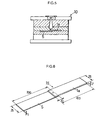
- the aluminum alloy piece 20 with the thermocouple was inserted into the movable retainer plate 16 and secured by using a vacuum. Then, the injection mold 23 was closed (as shown in the sectional view of Fig. 7).
- the aluminum alloy piece 20 was supplied with an electric current while the temperature was being checked with a thermometer connected to the thermocouple (alternatively, the aluminum alloy piece 20 may be heated by heating a heating wire 21 disposed as shown in Fig. 7). When the aluminum alloy piece 20 was going to exceed 200°C, the heating power supply was cut off. At the same time, the thermoplastic resin composition 22 obtained in Experimental Example 2 was injected. 120 seconds after the injection, the injection mold 15 was opened, and a molded article 25 as shown in Fig. 8 was removed from the mold 15. The adhesive was removed with a knife to detach the thermocouple from the molded article. Thereafter, the molded article was handled in the same way as in Experimental Example 5. Finally, the tensile shear breaking strength of the molded article was measured. Ten molded articles were tested. The average of 10 measured values of the shear breaking strength of the bonded surface was 2.3 MPa (23 kgf per square centimeter).
- An aluminum alloy plate A5052/H38 with a thickness of 1 mm was cut into a rectangular piece of 100 mm by 25 mm.
- the aluminum alloy piece was dipped in 1 liter of ethanol for 10 minutes under application of ultrasonic waves, and then dipped in 4 liters of tap water under stirring. Thereafter, the aluminum alloy piece was put into a plastic basket and washed with running tap water.
- the aluminum alloy piece was dipped in a 2% aqueous caustic soda solution for 2 minutes, followed by rinsing with ion-exchange water.
- the aluminum alloy piece was dipped in a 1% aqueous hydrochloric acid solution for 1 minute to effect neutralization.
- the aluminum alloy piece was dip-washed in 4 liters of ion-exchange water, followed by rinsing with running ion-exchange water.
- One liter of a 5% aqueous hydrazine monohydrate solution was prepared and heated to 50°C.
- the pH of the aqueous solution was 11.2.
- the foregoing aluminum alloy piece was dipped in the aqueous solution for 2 minutes and then thoroughly washed with ion-exchange water.
- the aluminum alloy piece was dried with hot air at 60°C for 20 minutes and then stored in dry air.
- the integrated article thus obtained was cut and polished to prepare a sample that enabled a section of the bonded portion to be observed with an SEM.
- An SEM photograph of the section of the bonded portion is shown in Fig. 9. It will be understood from the photograph that the PBT resin entered every corner of the recesses of the aluminum alloy.
- the photograph of Fig. 9 shows that large pores having a diameter of about 0.3 to 0.8 ⁇ m are formed, and small pores are formed in the bottom or side surfaces of the large pores in the shape of inlets.
- the PBT is fixed in such a manner as to fill the large and small pores.
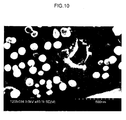
- an aluminum alloy piece that had been subjected to the shear breaking strength test and that had dots of resin attached to the surface thereof was put in 5 liters of a 5% aqueous hydrochloric acid solution and allowed to stand for 1 week. As a result, the aluminum alloy piece was dissolved. The solution was filtered, and the residue was rinsed with water and dried. Then, it was observed with an SEM. An SEM photograph thereof is shown in Fig. 10. The PBT in the recesses were released and semi-dissolved in the shape of spheres by the acid. The diameter of the spheres was from 0.02 to 0.1 ⁇ m. The size of the spheres was closely coincident with the size of the recesses formed on the aluminum alloy surface.
- the integrated article obtained in Experimental Example 7 was subjected to colored aluminum anodizing treatment. That is, the integrated article was dipped in a 20% aqueous solution of a commercially available aluminum degreasing agent for 10 minutes, followed by rinsing with water. Subsequently, the integrated article was dipped in a 20% aqueous caustic soda solution at 60°C for 40 seconds, followed by rinsing with water. Then, the integrated article was dipped in a mixed acid liquid of sulfuric acid and phosphoric acid at 80°C for 2 minutes, followed by rinsing with water.
- an electrode was bonded to an end of the aluminum alloy, and anodizing was performed for 20 minutes under application of a voltage of 15 v in a 40% aqueous sulfuric acid solution kept at 20°C, followed by rinsing with running ion-exchange water. Further, the integrated article was dipped for 3 minutes in water having a dye dissolved therein and kept at 90°C to effect dyeing, followed by rinsing with water. Then, the integrated article was dipped in a 30% aqueous phosphoric acid solution at 100°C for 5 minutes to effect sealing, followed by rinsing with water. Then, the integrated article was dried with hot air at 70°C for 1 hour.
- the aluminum anodizing treatment was performed at a slightly reduced temperature in comparison to the ordinary aluminum anodizing treatment to minimize the damage to the resin, and the dipping time was made longer than in the ordinary aluminum anodizing treatment in compensation for the reduction in temperature.
- the aluminum alloy surface was the same as the ordinary colored anodized aluminum surface.
- the tensile shear breaking strength of the integrated article was measured. Three integrated articles were tested. The average of 3 measured values of the shear breaking strength of the bonded surface was 9.0 MPa (92 kgf per square centimeter). Therefore, we judged that the colored aluminum anodizing treatment did not cause much damage to the bonded surface or the resin.
- This experiment reveals that aluminum anodizing treatment can be performed even after the integrated article has been formed by carrying out the present invention, and it is possible to ensure the same weather resistance as obtained with the conventional procedure for any molded article wherein an aluminum material constitutes the surface layer.
- each aluminum alloy piece was dried in a desiccator for 2 days. Then, the weight of each aluminum alloy piece was measured. After 1 year, each aluminum alloy piece was dried in a desiccator for 2 days, and the weight thereof was measured again. All the three different groups of aluminum alloy pieces weighed around 6.7 g at the beginning and had a similar weight increase of 0.003 g. We considered that the aluminum alloy surface obtained in Experimental Example 1 would not be used as an exterior surface as it was.
- the aluminum alloy surface when used as an exterior surface, the aluminum alloy surface would be anodized as in Experimental Example 8, or the aluminum alloy surface obtained in Experimental Example 1 would be painted. Further, we considered that when used as an interior surface, the aluminum alloy surface would not be painted. This experiment assumes a case where the aluminum alloy surface is not painted. Therefore, we carried out the experiment on the assumption that the aluminum alloy surface would be exposed to air, considered to be the same as the outside air, but not exposed to sunshine nor water. Measurements made in the middle of the experiment, i.e. when 1 year had elapsed, revealed that the measurement results were not different from those of the anodized aluminum products.
- the present invention is industrially applicable in the fields of various electronic devices for mobile applications, home electrical products, medical devices, automotive bodies, vehicle-mounted products, construction material parts, structural parts of various other machines, various parts for interior and exterior applications, and so forth.
Landscapes
- Engineering & Computer Science (AREA)
- Manufacturing & Machinery (AREA)
- Mechanical Engineering (AREA)
- Injection Moulding Of Plastics Or The Like (AREA)
- Laminated Bodies (AREA)
- ing And Chemical Polishing (AREA)
Abstract
Description
Claims (9)
- An aluminum alloy-and-resin composition composite comprising:a shaped aluminum alloy material having a surface with a surface roughness of 5 µm to 50 µm and having fine recesses or projections of not larger than 1 µm on said surface; anda thermoplastic resin composition fixed to the surface of said shaped aluminum alloy material by entering said recesses or engaging said projections, said thermoplastic resin composition containing as a main component a polybutylene terephthalate resin or polyphenylene sulfide having an average coefficient of lengthwise and crosswise linear expansion of 2 to 4 × 10⁻⁵°C-1.
- An aluminum alloy-and-resin composition composite comprising:a shaped aluminum alloy material having a surface with a surface roughness of 1 µm to 10 µm and having fine recesses or projections of 0.01 µm to 0.1 µm in diameter on said surface, said surface being covered with a + trivalent aluminum compound having an average thickness of about 0.001 µm; anda thermoplastic resin composition fixed to the surface of said shaped aluminum alloy material by entering said recesses or engaging said projections, said thermoplastic resin composition containing as a main component a polybutylene terephthalate resin or polyphenylene sulfide having an average coefficient of lengthwise and crosswise linear expansion of 2 to 4 × 10⁻⁵°C-1.
- An aluminum alloy-and-resin composition composite according to claim 1 or 2, wherein said recesses or projections include first recesses or first projections having a first diameter of 0.03 µm to 0.1 µm and a depth about equal to or larger than said first diameter, wherein the number of first recesses or first projections per 1 µm square area of said surface is not less than 10, and said recesses or projections further include second recesses or second projections having a second diameter of 0.01 µm to 0.03 µm and a depth about equal to or larger than said second diameter, wherein the number of second recesses or second projections per 1 µm square area of said surface is not less than 50.
- An aluminum alloy-and-resin composition composite according to any one of claims 1 to 3, wherein said thermoplastic resin composition is fixed to the surface of said shaped aluminum alloy material by bonding using an adhesive.
- An aluminum alloy-and-resin composition composite according to any one of claims 1 to 3, wherein said thermoplastic resin composition is fixed to the surface of said shaped aluminum alloy material by injection molding, heat pressing, or co-extrusion.
- A production method for the aluminum alloy-and-resin composition composite according to any one of claims 1 to 3, said production method comprising the steps of:producing a coated shaped aluminum alloy material having a thin polyalkylene terephthalate film or polyphenylene sulfide adhering to a surface thereof from said shaped aluminum alloy material and an organic solvent solution of a polyalkylene terephthalate resin or polyphenylene sulfide;inserting said coated shaped aluminum alloy material into an injection mold; andinjecting said polyalkylene terephthalate resin or polyphenylene sulfide into said injection mold.
- A production method for the aluminum alloy-and-resin composition composite according to any one of claims 1 to 3, said production method comprising the steps of:coating said shaped aluminum alloy material with a urethane curable or epoxy curable paint or ink and hardening said paint or ink;inserting said coated shaped aluminum alloy material into an injection mold; andinjecting said polyalkylene terephthalate resin or polyphenylene sulfide into said injection mold.
- A production method for the aluminum alloy-and-resin composition composite according to any one of claims 1 to 3, said production method comprising the steps of:heating said shaped aluminum alloy material to not lower than 200°C; andmelting said polyalkylene terephthalate resin or polyphenylene sulfide and bringing it into contact with said shaped aluminum alloy material under pressure.
- A production method for the aluminum alloy-and-resin composition composite according to any one of claims 1 to 3, said production method comprising the steps of:dipping said shaped aluminum alloy material in an aqueous solution of at least one selected from the group consisting of hydrazine, ammonia, and an amine compound;inserting said dipped shaped aluminum alloy material into an injection mold; andinjecting said polyalkylene terephthalate resin or polyphenylene sulfide into said injection mold.
Applications Claiming Priority (3)
| Application Number | Priority Date | Filing Date | Title |
|---|---|---|---|
| JP2002325245 | 2002-11-08 | ||
| JP2002325245 | 2002-11-08 | ||
| PCT/JP2003/014214 WO2004041533A1 (en) | 2002-11-08 | 2003-11-07 | Composite of aluminum alloy and resin composition and process for producing the same |
Publications (3)
| Publication Number | Publication Date |
|---|---|
| EP1559542A1 true EP1559542A1 (en) | 2005-08-03 |
| EP1559542A4 EP1559542A4 (en) | 2011-05-11 |
| EP1559542B1 EP1559542B1 (en) | 2019-08-14 |
Family
ID=32310468
Family Applications (1)
| Application Number | Title | Priority Date | Filing Date |
|---|---|---|---|
| EP03810661.3A Expired - Lifetime EP1559542B1 (en) | 2002-11-08 | 2003-11-07 | Composite of aluminum alloy and resin composition and process for producing the same |
Country Status (7)
| Country | Link |
|---|---|
| US (1) | US20060257624A1 (en) |
| EP (1) | EP1559542B1 (en) |
| JP (1) | JP4292514B2 (en) |
| KR (1) | KR100827916B1 (en) |
| CN (1) | CN1717323B (en) |
| AU (1) | AU2003277618A1 (en) |
| WO (1) | WO2004041533A1 (en) |
Cited By (36)
| Publication number | Priority date | Publication date | Assignee | Title |
|---|---|---|---|---|
| DE202008015400U1 (en) | 2008-11-19 | 2010-04-08 | Lanxess Deutschland Gmbh | dashboard |
| DE202008015392U1 (en) | 2008-11-19 | 2010-04-08 | Lanxess Deutschland Gmbh | pedal structure |
| DE202008015394U1 (en) | 2008-11-19 | 2010-04-08 | Lanxess Deutschland Gmbh | Rail structure |
| DE202008015401U1 (en) | 2008-11-19 | 2010-04-08 | Lanxess Deutschland Gmbh | seat structures |
| DE202008015399U1 (en) | 2008-11-19 | 2010-04-08 | Lanxess Deutschland Gmbh | roof structure |
| DE202008015396U1 (en) | 2008-11-19 | 2010-04-08 | Lanxess Deutschland Gmbh | chassis structure |
| DE202008015398U1 (en) | 2008-11-19 | 2010-04-08 | Lanxess Deutschland Gmbh | oil pan |
| DE202008015391U1 (en) | 2008-11-19 | 2010-04-22 | Lanxess Deutschland Gmbh | Door and flap structures |
| DE202008015395U1 (en) | 2008-11-19 | 2010-04-22 | Lanxess Deutschland Gmbh | Front-end structure |
| DE202008015397U1 (en) | 2008-11-19 | 2010-04-22 | Lanxess Deutschland Gmbh | pillar structure |
| EP2153985A4 (en) * | 2007-05-28 | 2010-07-14 | Taisei Plas Co Ltd | Steel product composite and process for producing the steel product composite |
| EP2127865A4 (en) * | 2007-03-12 | 2012-01-25 | Taisei Plas Co Ltd | ALUMINUM ALLOY COMPOSITE AND BONDING METHOD THEREFOR |
| EP2174766A4 (en) * | 2007-07-17 | 2012-03-21 | Taisei Plas Co Ltd | COMPOSITE OF METAL WITH RESIN AND METHOD OF PRODUCTION |
| EP2064045A4 (en) * | 2006-09-19 | 2013-02-20 | Nokia Corp | HYBRID COMPONENTS RECEIVING PLASTIC |
| EP2497846A3 (en) * | 2011-03-11 | 2013-10-02 | Hon Hai Precision Industry Co., Ltd. | Aluminum alloy-and-resin composite and method for making the same |
| DE102012213676A1 (en) | 2012-08-02 | 2014-02-06 | Robert Bosch Gmbh | Cell connector unit for electrically conductive interconnection of terminals of battery cells of battery used in motor vehicle, has two electrically conductive segments which are held by plastic structure |
| DE102012213871A1 (en) | 2012-08-06 | 2014-02-06 | Robert Bosch Gmbh | Lithium-ion battery cell for e.g. electric vehicle, has plastic sealings cast between electrical conductors and prismatic battery cell housing, and connected with conductors and/or housing in form-fit and/or force-fit manner |
| JP2014051040A (en) * | 2012-09-07 | 2014-03-20 | Daicel Polymer Ltd | Method for manufacturing composite molding |
| JP2015510464A (en) * | 2012-02-24 | 2015-04-09 | シェンゼェン ビーワイディー オート アールアンドディー カンパニーリミテッド | Shell, method of making shell, and application of shell to electronic products |
| WO2015086492A1 (en) | 2013-12-12 | 2015-06-18 | Solvay Specialty Polymers Usa, Llc | Mobile electronic parts |
| WO2015159644A1 (en) * | 2014-04-16 | 2015-10-22 | 住友ベークライト株式会社 | Chassis of power conversion device, thermosetting resin composition and power conversion device |
| DE102014007211A1 (en) | 2014-05-19 | 2015-11-19 | Kraiburg Tpe Gmbh & Co. Kg | Thermoplastic elastomer compositions with adhesion to metallic surfaces |
| WO2015200272A3 (en) * | 2014-06-23 | 2016-03-03 | Sabic Global Technologies B.V. | Filler reinforced thermoplastic compositions with improved bonding strength |
| EP2993023A1 (en) * | 2014-09-04 | 2016-03-09 | Ilkwangpolymer Co., Ltd. | Method of preparing aluminum-resin complex |
| WO2017153290A1 (en) | 2016-03-09 | 2017-09-14 | Solvay Specialty Polymers Usa, Llc | Polyarylether ketone compositions and method of coating a metal surface |
| DE102016104195A1 (en) * | 2016-03-08 | 2017-09-14 | Webasto SE | Method for producing a vehicle roof and a vehicle roof |
| WO2018024744A1 (en) | 2016-08-02 | 2018-02-08 | Solvay Specialty Polymers Usa, Llc | Poly(aryl ether ketone) (paek) compositions including a low molecular weight aromatic compound |
| WO2019034211A1 (en) * | 2017-08-18 | 2019-02-21 | Christian-Albrechts-Universität Zu Kiel | PLASTIC FIBER COMPOSITE ALUMINUM LAMINATE AND MANUFACTURE AND USE |
| WO2019053164A1 (en) | 2017-09-14 | 2019-03-21 | Solvay Specialty Polymers Usa, Llc | Polymer-metal junction |
| WO2019122226A1 (en) | 2017-12-20 | 2019-06-27 | Solvay Specialty Polymers Usa, Llc | A METHOD OF MAKING A PEEK-PEmEK COPOLYMER AND COPOLYMER OBTAINED FROM THE METHOD |
| WO2019219706A1 (en) | 2018-05-15 | 2019-11-21 | Solvay Specialty Polymers Usa, Llc | Polymer-metal junction |
| EP3590677A1 (en) | 2018-07-03 | 2020-01-08 | Solvay Specialty Polymers USA, LLC | Polymer-metal junction |
| WO2020254097A1 (en) | 2019-06-20 | 2020-12-24 | Solvay Specialty Polymers Usa, Llc | A method of making a peek-peoek copolymer and copolymer obtained from the method |
| WO2020254101A1 (en) | 2019-06-20 | 2020-12-24 | Solvay Specialty Polymers Usa, Llc | POLYMER-METAL JUNCTION COMPRISING PEEK-PEoEK COPOLYMER COMPOSITIONS, IN CONTACT WITH A METAL SUBSTRATE |
| WO2021204718A1 (en) | 2020-04-06 | 2021-10-14 | Solvay Specialty Polymers Usa, Llc | Polyarylether ketone polymers |
| US11591451B2 (en) | 2016-08-02 | 2023-02-28 | Solvay Specialty Polymers, Llc | Poly(aryl ether ketone) (PAEK) compositions including a low molecular weight aromatic compound |
Families Citing this family (87)
| Publication number | Priority date | Publication date | Assignee | Title |
|---|---|---|---|---|
| JP4195881B2 (en) * | 2002-11-08 | 2008-12-17 | 大成プラス株式会社 | Aluminum alloy / resin composite and method for producing the same |
| JP4541153B2 (en) * | 2002-12-16 | 2010-09-08 | コロナインターナショナル株式会社 | Manufacturing method of composite material of aluminum material and synthetic resin molding and composite product thereof |
| KR100696788B1 (en) * | 2005-04-26 | 2007-03-19 | 삼성에스디아이 주식회사 | Exterior material of electronic equipment |
| WO2007040245A1 (en) * | 2005-10-04 | 2007-04-12 | Taisei Plas Co., Ltd. | Composite of metal with resin and process for producing the same |
| US8007651B2 (en) * | 2005-10-12 | 2011-08-30 | Transys, Llc | Method for preparing thermally transmissive anodized surface and products therefrom |
| US20080075920A1 (en) * | 2006-09-21 | 2008-03-27 | Yung-Hung Chih | Aluminum alloy housing structure and method making the same |
| WO2008133296A1 (en) * | 2007-04-24 | 2008-11-06 | Taisei Plas Co., Ltd. | Stainless steel complex and its manufacturing method |
| JP4965347B2 (en) * | 2007-06-18 | 2012-07-04 | 大成プラス株式会社 | Tubular composite and manufacturing method thereof |
| TWI331560B (en) * | 2007-08-01 | 2010-10-11 | Lite On Technology Corp | Method and structure for fixing plastic element to aluminum alloy element |
| EP2203305B1 (en) * | 2007-09-20 | 2011-12-07 | Agfa-Gevaert N.V. | Security laminates with interlaminated transparent embossed polymer hologram |
| JP5101983B2 (en) * | 2007-10-23 | 2012-12-19 | 大成プラス株式会社 | Metal coated product and method for producing the same |
| JP5253416B2 (en) * | 2007-12-18 | 2013-07-31 | 大成プラス株式会社 | Metal-resin composite and method for producing the same |
| WO2009084648A1 (en) * | 2007-12-27 | 2009-07-09 | Taisei Plas Co., Ltd. | Composite of steel product and resin and process for producing the composite |
| US20110008644A1 (en) * | 2008-03-17 | 2011-01-13 | Taisei Plas Co., Ltd. | Bonded body of galvanized steel sheet and adherend, and manufacturing method thereof |
| US8715534B2 (en) * | 2008-04-03 | 2014-05-06 | E I Du Pont De Nemours And Company | Method for producing composite member of metal member and resin member |
| CN101578019A (en) * | 2008-05-09 | 2009-11-11 | 富准精密工业(深圳)有限公司 | Electronic device shell and manufacture method thereof |
| US20110111214A1 (en) | 2008-06-12 | 2011-05-12 | Masanori Endo | Integrally injection-molded aluminum/resin article and process for producing the same |
| JP2010076437A (en) * | 2008-08-29 | 2010-04-08 | Toray Ind Inc | Manufacturing method for composite of molding comprising thermoplastic resin composition and metal |
| JP5381687B2 (en) * | 2008-12-29 | 2014-01-08 | 日本軽金属株式会社 | Aluminum alloy member excellent in resin bondability and manufacturing method thereof |
| CN101875251B (en) * | 2009-04-30 | 2013-06-19 | 比亚迪股份有限公司 | Aluminium alloy complex, preparation method thereof and lithium ion battery cover board |
| CN101901882B (en) * | 2009-05-31 | 2012-12-12 | 比亚迪股份有限公司 | Metallic laminate plate, method for preparing same and battery using same |
| CN101931060B (en) * | 2009-06-26 | 2012-12-12 | 比亚迪股份有限公司 | Metal laminate plate, preparation method thereof and battery using metal laminate plate |
| JP2011121309A (en) * | 2009-12-11 | 2011-06-23 | Nippon Light Metal Co Ltd | Aluminum-bonded composite material and method of manufacturing the same |
| JP2011124142A (en) * | 2009-12-11 | 2011-06-23 | Nippon Light Metal Co Ltd | Aluminum/resin/copper composite article, its manufacturing method, and lid member for sealed battery |
| JP5581680B2 (en) * | 2009-12-11 | 2014-09-03 | 日本軽金属株式会社 | Aluminum / resin composite with excellent weather resistance and method for producing the same |
| WO2011087487A1 (en) * | 2009-12-22 | 2011-07-21 | Flextronics Ap Llc | Enclosure of anodized multi-layer metallic shell with molded plastic scaffolding and method of manufacture |
| TW201127656A (en) * | 2010-02-11 | 2011-08-16 | Pao Yi Technology Co Ltd | Composite plate material integrating metal substrate with outer decorative layer and fabrication method thereof |
| CN102189720B (en) * | 2010-03-05 | 2013-10-16 | 铂邑科技股份有限公司 | Composite plate combined with metal substrate and exterior decoration layer and manufacturing method thereof |
| US8858854B2 (en) * | 2010-04-01 | 2014-10-14 | Flextronics Ap, Llc | System and method for plastic overmolding on a metal surface |
| TW201134681A (en) * | 2010-04-02 | 2011-10-16 | Pao Yi Technology Co Ltd | Plastic thin shell part with decorative covering film and manufacturing method thereof |
| TW201134653A (en) * | 2010-04-02 | 2011-10-16 | Pao Yi Technology Co Ltd | Metallic thin shell part with plastic combining members and manufacturing method thereof |
| US8409678B2 (en) | 2010-04-06 | 2013-04-02 | Pao Yi Technology Co., Ltd. | Thin metal casing with plastic part and manufacturing method thereof |
| WO2011152679A2 (en) * | 2010-06-04 | 2011-12-08 | (주)일광폴리머 | Metal resin composite structure integrating different materials and manufacturing method thereof |
| CN102371679A (en) * | 2010-08-19 | 2012-03-14 | 鸿富锦精密工业(深圳)有限公司 | Preparation method of metal-resin complex |
| CN102609032A (en) * | 2011-01-20 | 2012-07-25 | 群达塑胶电子(深圳)有限公司 | Aluminum alloy laptop shell, forming mold, milling fixture and forming method |
| JP5673814B2 (en) * | 2011-05-26 | 2015-02-18 | 日本軽金属株式会社 | Aluminum shape body for manufacturing aluminum / resin injection integrated molded article, aluminum / resin injection integrated molded article using the same, and manufacturing method thereof |
| CN103826824B (en) | 2011-07-27 | 2016-12-21 | 弗莱克斯电子有限责任公司 | The temperature of composite component controls molding |
| US8557158B2 (en) * | 2011-08-23 | 2013-10-15 | Sabic Innovative Plastics Ip B.V. | Molded article having enhanced aesthetic effect and method and system for making the molded article |
| KR20140063838A (en) | 2011-09-20 | 2014-05-27 | 티코나 엘엘씨 | Overmolded composite structure for an electronic device |
| WO2013052269A2 (en) | 2011-09-20 | 2013-04-11 | Ticona Llc | Housing for a portable electronic device |
| CN108102370A (en) | 2011-09-20 | 2018-06-01 | 提克纳有限责任公司 | The polyarylene sulfide composition of the melt-processed of low chlorine filling |
| WO2013101315A1 (en) | 2011-09-20 | 2013-07-04 | Ticona Llc | Low halogen content disulfide washed polyarylene sulfide |
| JP5918855B2 (en) | 2011-09-20 | 2016-05-18 | ティコナ・エルエルシー | Polyarylene sulfide / liquid crystal polymer alloy and composition containing the same |
| CN103826822A (en) * | 2011-09-26 | 2014-05-28 | 日本轻金属株式会社 | Aluminum resin bonded body and method for producing same |
| CN103101189A (en) * | 2011-11-14 | 2013-05-15 | 鸿富锦精密工业(深圳)有限公司 | Composite body and preparation method thereof |
| JP2013111881A (en) * | 2011-11-29 | 2013-06-10 | Polyplastics Co | Method of manufacturing metal component, and composite molding |
| CN103129048B (en) * | 2011-12-02 | 2015-07-29 | 鸿富锦精密工业(深圳)有限公司 | The preparation method of the complex of metal and plastics and complex |
| CN107152617B (en) | 2011-12-16 | 2019-12-03 | 三星电子株式会社 | Heat dissipation structure of lighting device and lighting device |
| CN103287009B (en) * | 2012-02-24 | 2015-03-25 | 比亚迪股份有限公司 | Preparation method of aluminum alloy-resin composite and aluminum alloy-resin composite prepared by using same |
| CN103286908B (en) | 2012-02-24 | 2015-09-30 | 比亚迪股份有限公司 | A kind of metal-resin integrated molding method and a kind of metal-resin composite |
| CN103286910B (en) | 2012-02-24 | 2015-09-30 | 比亚迪股份有限公司 | A kind of metal-resin integrated molding method and a kind of metal-resin composite |
| CN103286909B (en) * | 2012-02-24 | 2015-09-30 | 比亚迪股份有限公司 | A kind of metal-resin integrated molding method and a kind of metal-resin composite |
| CN103286996B (en) * | 2012-02-24 | 2015-03-25 | 比亚迪股份有限公司 | Preparation method of aluminum alloy-resin composite and aluminum alloy-resin composite prepared by using same |
| CN103286995B (en) | 2012-02-24 | 2015-06-24 | 比亚迪股份有限公司 | Preparation method of aluminum alloy-resin composite and aluminum alloy-resin composite prepared by using same |
| US9394430B2 (en) | 2012-04-13 | 2016-07-19 | Ticona Llc | Continuous fiber reinforced polyarylene sulfide |
| KR101346083B1 (en) | 2012-04-26 | 2013-12-31 | 엘지디스플레이 주식회사 | Display Device |
| KR101307960B1 (en) * | 2012-04-26 | 2013-09-12 | 엘지디스플레이 주식회사 | Display device |
| CN103448200B (en) * | 2012-05-28 | 2015-12-09 | 比亚迪股份有限公司 | A kind of preparation method of metal-resin composite and metal-resin composite |
| WO2013178057A1 (en) | 2012-05-28 | 2013-12-05 | Shenzhen Byd Auto R&D Company Limited | Metal composite and method of preparing the same, metal-resin composite and method of preparing the same |
| CN103448201B (en) * | 2012-05-28 | 2016-03-30 | 比亚迪股份有限公司 | A kind of preparation method of metal-resin composite and the metal-resin composite of preparation thereof |
| JP5798535B2 (en) * | 2012-09-07 | 2015-10-21 | ダイセルポリマー株式会社 | Method for producing composite molded body |
| US9655261B2 (en) * | 2013-03-21 | 2017-05-16 | Htc Corporation | Casing of electronic device and method of manufacturing the same |
| WO2015008771A1 (en) * | 2013-07-18 | 2015-01-22 | ダイセルポリマー株式会社 | Composite moulded body |
| US10444799B2 (en) * | 2013-10-30 | 2019-10-15 | Hewlett-Packard Development Company, L.P. | Nanotube coated electronic device housing wall |
| DE112014003587B4 (en) | 2013-12-06 | 2024-05-29 | Kabushiki Kaisha Toyota Chuo Kenkyusho | Aluminum substrate with an aluminum oxide coating, metal-resin composite material comprising an aluminum substrate with an aluminum oxide coating and method for producing the metal-resin composite material |
| CN104746066B (en) | 2013-12-31 | 2017-07-04 | 比亚迪股份有限公司 | Bond material of a kind of metal and plastics and preparation method thereof and the bond material for preparing |
| CN103789763B (en) * | 2014-01-23 | 2016-06-22 | 青岛理工大学 | Preparation method for constructing antifriction and wear-resistant super-hydrophobic film based on hydrazine hydrate treatment |
| DE102014225757A1 (en) * | 2014-12-12 | 2016-06-16 | Robert Bosch Gmbh | Method for producing a tight connection between a metallic component and a plastic covering by means of an intermediate layer |
| JPWO2016117711A1 (en) * | 2015-01-23 | 2017-11-02 | 古河電気工業株式会社 | Composite member of metal member and resin mold, and metal member for forming composite member of resin mold |
| CN104943059B (en) * | 2015-05-18 | 2017-03-15 | 广东兴锐电子科技股份有限公司 | A kind of complex manufacture method of aluminium alloy and plastics |
| EP3307510B1 (en) | 2015-06-10 | 2020-04-08 | SABIC Global Technologies B.V. | Methods of making plastic-metal junctions |
| CN105252701A (en) * | 2015-09-08 | 2016-01-20 | 深圳市华森科技股份有限公司 | Mixing forming method for different materials |
| US10688624B2 (en) * | 2015-09-30 | 2020-06-23 | Apple Inc. | Electronic device structure formed from porous metal bonded to plastic |
| KR101777287B1 (en) * | 2015-11-27 | 2017-09-14 | 덕양산업 주식회사 | Method of insert injection molding between cowl crossbar and plastic component and corporate body by the same |
| EP3638481A1 (en) | 2017-06-14 | 2020-04-22 | DSM IP Assets B.V. | Process for plastic overmolding on a metal surface and plastic-metal hybride part |
| CN110740847A (en) | 2017-06-14 | 2020-01-31 | 帝斯曼知识产权资产管理有限公司 | Method for plastic overmolding on metal surfaces and hybrid plastic-metal component |
| WO2018228982A1 (en) | 2017-06-14 | 2018-12-20 | Dsm Intellectual Property | Process for plastic overmolding on a metal surface and plastic-metal hybride part |
| US10433048B2 (en) | 2017-08-31 | 2019-10-01 | Apple Inc. | Micro speaker having a hermetically sealed acoustic chamber with increased volume |
| JP7040988B2 (en) * | 2018-04-20 | 2022-03-23 | 大成プラス株式会社 | Aluminum alloy and resin complex and its manufacturing method |
| JP6968766B2 (en) * | 2018-08-13 | 2021-11-17 | ポリプラスチックス株式会社 | Laminate |
| US11090876B2 (en) | 2018-09-18 | 2021-08-17 | Flex Ltd. | Assembly of sub-components by compression molding |
| KR102705039B1 (en) | 2018-12-28 | 2024-09-10 | 삼성전자주식회사 | ADHESIVE FILM, SEMICONDUCTOR DEVICE USING THE SAME, and SEMICONDUCTOR PACKAGE INCLUDING THE SAME |
| JP7319610B2 (en) * | 2019-02-15 | 2023-08-02 | 国立大学法人 東京大学 | Composite member manufacturing method and composite member |
| KR102470590B1 (en) * | 2020-07-07 | 2022-11-25 | 주식회사 플라스탈 | Titanium-resin conjugate manufacturing method and titanium treatment solution therefor |
| US11802415B2 (en) | 2020-10-16 | 2023-10-31 | JXR Constructors, Inc. | Continuous composite structural reinforcing device and system |
| US12470645B2 (en) | 2022-07-20 | 2025-11-11 | Apple Inc. | Electronic device enclosure having a molded structure and a porous metallic structure |
| WO2024089807A1 (en) * | 2022-10-26 | 2024-05-02 | 株式会社ジェイテクト | Molding die for composite material and method for producing composite material |
Family Cites Families (14)
| Publication number | Priority date | Publication date | Assignee | Title |
|---|---|---|---|---|
| JPS5546468B2 (en) * | 1974-06-13 | 1980-11-25 | ||
| JPS5858427B2 (en) * | 1976-07-20 | 1983-12-24 | 昭和アルミニウム株式会社 | Method of forming boehmite film on aluminum surface |
| JPS54135364A (en) * | 1978-04-11 | 1979-10-20 | Matsushita Electric Industrial Co Ltd | Printed circuit board |
| JPS58217679A (en) * | 1982-06-09 | 1983-12-17 | Tateyama Alum Kogyo Kk | Laminate treatment of aluminum or aluminum alloy |
| JP2980659B2 (en) * | 1990-09-25 | 1999-11-22 | 大日本印刷株式会社 | Method of manufacturing plastic container body |
| JPH0570969A (en) * | 1991-09-11 | 1993-03-23 | Furukawa Alum Co Ltd | Al alloy coating plate for automobile outside plate excellent in filiform corrosion resistance |
| JPH05311841A (en) * | 1992-05-12 | 1993-11-22 | Natl House Ind Co Ltd | Corner panel |
| JPH0639876A (en) * | 1992-05-22 | 1994-02-15 | Fujitsu Ltd | Method for in-mold molding and thin-wall box using it |
| AU1944597A (en) * | 1996-03-27 | 1997-10-17 | Toyo Kohan Co. Ltd. | Thermoplastic resin coated aluminum alloy sheet, and method and apparatus for production thereof |
| JPH11147280A (en) * | 1997-11-17 | 1999-06-02 | Mitsubishi Alum Co Ltd | Surface treated aluminum laminated sheet excellent in film adhesive property |
| JP3467471B2 (en) * | 1999-12-08 | 2003-11-17 | ポリプラスチックス株式会社 | Manufacturing method of metal insert resin composite molding |
| US20020045042A1 (en) * | 2000-06-06 | 2002-04-18 | Matsushita Electric Works, Ltd. | Laminate |
| JP3680206B2 (en) * | 2000-10-17 | 2005-08-10 | 古河スカイ株式会社 | Aluminum alloy plate for coating with excellent adhesion of coating layer |
| JP2002179895A (en) * | 2000-12-15 | 2002-06-26 | Toyobo Co Ltd | Polyester resin composition |
-
2003
- 2003-11-07 KR KR1020057008195A patent/KR100827916B1/en not_active Expired - Fee Related
- 2003-11-07 AU AU2003277618A patent/AU2003277618A1/en not_active Abandoned
- 2003-11-07 WO PCT/JP2003/014214 patent/WO2004041533A1/en not_active Ceased
- 2003-11-07 CN CN200380104500XA patent/CN1717323B/en not_active Expired - Lifetime
- 2003-11-07 JP JP2004549644A patent/JP4292514B2/en not_active Expired - Fee Related
- 2003-11-07 US US10/534,228 patent/US20060257624A1/en not_active Abandoned
- 2003-11-07 EP EP03810661.3A patent/EP1559542B1/en not_active Expired - Lifetime
Cited By (49)
| Publication number | Priority date | Publication date | Assignee | Title |
|---|---|---|---|---|
| EP2064045A4 (en) * | 2006-09-19 | 2013-02-20 | Nokia Corp | HYBRID COMPONENTS RECEIVING PLASTIC |
| EP2127865A4 (en) * | 2007-03-12 | 2012-01-25 | Taisei Plas Co Ltd | ALUMINUM ALLOY COMPOSITE AND BONDING METHOD THEREFOR |
| EP2153985A4 (en) * | 2007-05-28 | 2010-07-14 | Taisei Plas Co Ltd | Steel product composite and process for producing the steel product composite |
| EP2174766A4 (en) * | 2007-07-17 | 2012-03-21 | Taisei Plas Co Ltd | COMPOSITE OF METAL WITH RESIN AND METHOD OF PRODUCTION |
| DE202008015398U1 (en) | 2008-11-19 | 2010-04-08 | Lanxess Deutschland Gmbh | oil pan |
| DE202008015392U1 (en) | 2008-11-19 | 2010-04-08 | Lanxess Deutschland Gmbh | pedal structure |
| DE202008015400U1 (en) | 2008-11-19 | 2010-04-08 | Lanxess Deutschland Gmbh | dashboard |
| DE202008015391U1 (en) | 2008-11-19 | 2010-04-22 | Lanxess Deutschland Gmbh | Door and flap structures |
| DE202008015395U1 (en) | 2008-11-19 | 2010-04-22 | Lanxess Deutschland Gmbh | Front-end structure |
| DE202008015397U1 (en) | 2008-11-19 | 2010-04-22 | Lanxess Deutschland Gmbh | pillar structure |
| DE202008015399U1 (en) | 2008-11-19 | 2010-04-08 | Lanxess Deutschland Gmbh | roof structure |
| DE202008015401U1 (en) | 2008-11-19 | 2010-04-08 | Lanxess Deutschland Gmbh | seat structures |
| DE202008015394U1 (en) | 2008-11-19 | 2010-04-08 | Lanxess Deutschland Gmbh | Rail structure |
| DE202008015396U1 (en) | 2008-11-19 | 2010-04-08 | Lanxess Deutschland Gmbh | chassis structure |
| EP2497846A3 (en) * | 2011-03-11 | 2013-10-02 | Hon Hai Precision Industry Co., Ltd. | Aluminum alloy-and-resin composite and method for making the same |
| JP2015510464A (en) * | 2012-02-24 | 2015-04-09 | シェンゼェン ビーワイディー オート アールアンドディー カンパニーリミテッド | Shell, method of making shell, and application of shell to electronic products |
| DE102012213676A1 (en) | 2012-08-02 | 2014-02-06 | Robert Bosch Gmbh | Cell connector unit for electrically conductive interconnection of terminals of battery cells of battery used in motor vehicle, has two electrically conductive segments which are held by plastic structure |
| DE102012213871A1 (en) | 2012-08-06 | 2014-02-06 | Robert Bosch Gmbh | Lithium-ion battery cell for e.g. electric vehicle, has plastic sealings cast between electrical conductors and prismatic battery cell housing, and connected with conductors and/or housing in form-fit and/or force-fit manner |
| JP2014051040A (en) * | 2012-09-07 | 2014-03-20 | Daicel Polymer Ltd | Method for manufacturing composite molding |
| WO2015086492A1 (en) | 2013-12-12 | 2015-06-18 | Solvay Specialty Polymers Usa, Llc | Mobile electronic parts |
| WO2015159644A1 (en) * | 2014-04-16 | 2015-10-22 | 住友ベークライト株式会社 | Chassis of power conversion device, thermosetting resin composition and power conversion device |
| JP2015204729A (en) * | 2014-04-16 | 2015-11-16 | 住友ベークライト株式会社 | Housing of electric power conversion system, thermosetting resin composition, and power conversion system |
| DE102014007211A1 (en) | 2014-05-19 | 2015-11-19 | Kraiburg Tpe Gmbh & Co. Kg | Thermoplastic elastomer compositions with adhesion to metallic surfaces |
| WO2015177099A1 (en) | 2014-05-19 | 2015-11-26 | Kraiburg Tpe Gmbh & Co. Kg | Thermoplastic elastomer compositions adhering to metal surfaces |
| WO2015200272A3 (en) * | 2014-06-23 | 2016-03-03 | Sabic Global Technologies B.V. | Filler reinforced thermoplastic compositions with improved bonding strength |
| CN105986271B (en) * | 2014-09-04 | 2019-02-22 | 株式会社日光聚合物 | Method for preparing aluminum-resin composites |
| CN105986271A (en) * | 2014-09-04 | 2016-10-05 | 株式会社日光聚合物 | Method of preparing aluminum-resin complex |
| EP2993023A1 (en) * | 2014-09-04 | 2016-03-09 | Ilkwangpolymer Co., Ltd. | Method of preparing aluminum-resin complex |
| DE102016104195A1 (en) * | 2016-03-08 | 2017-09-14 | Webasto SE | Method for producing a vehicle roof and a vehicle roof |
| US10808143B2 (en) | 2016-03-09 | 2020-10-20 | Solvay Specialty Polymers Usa, Llc | Polyarylether ketone compositions and method of coating a metal surface |
| WO2017153290A1 (en) | 2016-03-09 | 2017-09-14 | Solvay Specialty Polymers Usa, Llc | Polyarylether ketone compositions and method of coating a metal surface |
| WO2018024744A1 (en) | 2016-08-02 | 2018-02-08 | Solvay Specialty Polymers Usa, Llc | Poly(aryl ether ketone) (paek) compositions including a low molecular weight aromatic compound |
| US11591451B2 (en) | 2016-08-02 | 2023-02-28 | Solvay Specialty Polymers, Llc | Poly(aryl ether ketone) (PAEK) compositions including a low molecular weight aromatic compound |
| US11554573B2 (en) | 2017-08-18 | 2023-01-17 | Christian-Albrechts-Universitaet Zu Kiel | Plastic fiber composite material/aluminum laminate, production and use thereof |
| WO2019034211A1 (en) * | 2017-08-18 | 2019-02-21 | Christian-Albrechts-Universität Zu Kiel | PLASTIC FIBER COMPOSITE ALUMINUM LAMINATE AND MANUFACTURE AND USE |
| WO2019053164A1 (en) | 2017-09-14 | 2019-03-21 | Solvay Specialty Polymers Usa, Llc | Polymer-metal junction |
| US11359120B2 (en) | 2017-09-14 | 2022-06-14 | Solvay Specialty Polymers Usa, Llc | Polymer-metal junction |
| US11525033B2 (en) | 2017-12-20 | 2022-12-13 | Solvay Specialty Polymers Usa, Llc | Polymer-metal junction comprising PEEK-PEmEK copolymer compositions, in contact with a metal substrate |
| WO2019122160A1 (en) | 2017-12-20 | 2019-06-27 | Solvay Specialty Polymers Usa, Llc | Polymer-metal junction comprising peek-pemek copolymer compositions, in contact with a metal substrate |
| WO2019122226A1 (en) | 2017-12-20 | 2019-06-27 | Solvay Specialty Polymers Usa, Llc | A METHOD OF MAKING A PEEK-PEmEK COPOLYMER AND COPOLYMER OBTAINED FROM THE METHOD |
| US11773218B2 (en) | 2017-12-20 | 2023-10-03 | Solvay Specialty Polymers Usa, Llc | Method of making a PEEK-PEmEK copolymer and copolymer obtained from the method |
| WO2019219706A1 (en) | 2018-05-15 | 2019-11-21 | Solvay Specialty Polymers Usa, Llc | Polymer-metal junction |
| EP3590677A1 (en) | 2018-07-03 | 2020-01-08 | Solvay Specialty Polymers USA, LLC | Polymer-metal junction |
| WO2020254097A1 (en) | 2019-06-20 | 2020-12-24 | Solvay Specialty Polymers Usa, Llc | A method of making a peek-peoek copolymer and copolymer obtained from the method |
| WO2020254101A1 (en) | 2019-06-20 | 2020-12-24 | Solvay Specialty Polymers Usa, Llc | POLYMER-METAL JUNCTION COMPRISING PEEK-PEoEK COPOLYMER COMPOSITIONS, IN CONTACT WITH A METAL SUBSTRATE |
| US11760899B2 (en) | 2019-06-20 | 2023-09-19 | Solvay Specialty Polymers Usa, Llc | Polymer-metal junction comprising PEEK-PEoEK copolymer compositions, in contact with a metal substrate |
| US11845832B2 (en) | 2019-06-20 | 2023-12-19 | Solvay Specialty Polymers Usa, Llc | Method of making a PEEK-PEoEK copolymer and copolymer obtained from the method |
| WO2021204718A1 (en) | 2020-04-06 | 2021-10-14 | Solvay Specialty Polymers Usa, Llc | Polyarylether ketone polymers |
| US12552899B2 (en) | 2020-04-06 | 2026-02-17 | Syensqo Specialty Polymers Usa, Llc | Polyarylether ketone polymers |
Also Published As
| Publication number | Publication date |
|---|---|
| JPWO2004041533A1 (en) | 2006-03-09 |
| US20060257624A1 (en) | 2006-11-16 |
| EP1559542A4 (en) | 2011-05-11 |
| AU2003277618A1 (en) | 2004-06-07 |
| KR100827916B1 (en) | 2008-05-07 |
| WO2004041533A1 (en) | 2004-05-21 |
| JP4292514B2 (en) | 2009-07-08 |
| KR20050086437A (en) | 2005-08-30 |
| CN1717323A (en) | 2006-01-04 |
| HK1086227A1 (en) | 2006-09-15 |
| CN1717323B (en) | 2010-06-09 |
| EP1559542B1 (en) | 2019-08-14 |
Similar Documents
| Publication | Publication Date | Title |
|---|---|---|
| EP1559542B1 (en) | Composite of aluminum alloy and resin composition and process for producing the same | |
| CN102848517B (en) | The complex of metal and resin | |
| KR101115786B1 (en) | Process for production of highly corrosion-resistant composite | |
| EP2221398B1 (en) | Resin-metal bonded body and method for producing the same | |
| EP1559541B1 (en) | Composite article of aluminum alloy with resin and method for production thereof | |
| JP5581680B2 (en) | Aluminum / resin composite with excellent weather resistance and method for producing the same | |
| CN101313087B (en) | Composite body of metal and resin and manufacturing method thereof | |
| KR101621224B1 (en) | Shell, preparing method and application thereof in electronic product | |
| US20100189958A1 (en) | Metal and resin composite and manufacturing method thereof | |
| EP2298525A1 (en) | Integrally injection-molded aluminum/resin article and process for producing the same | |
| TW201144075A (en) | Aluminum/resin/copper composite article, its manufacturing method, and lid member for sealed battery | |
| JP4112378B2 (en) | Composite of metal and thermoplastic resin composition and method for producing the same | |
| KR20110133119A (en) | Integral metal resin composite structure of different materials and its manufacturing method | |
| HK1086227B (en) | Composite of aluminum alloy and resin composition and process for producing the same | |
| KR20170092210A (en) | Integrally injection-molded aluminum/resin article and process for producing the same | |
| HK1124641B (en) | Composite of metal with resin and process for producing the same |
Legal Events
| Date | Code | Title | Description |
|---|---|---|---|
| PUAI | Public reference made under article 153(3) epc to a published international application that has entered the european phase |
Free format text: ORIGINAL CODE: 0009012 |
|
| 17P | Request for examination filed |
Effective date: 20050506 |
|
| AK | Designated contracting states |
Kind code of ref document: A1 Designated state(s): AT BE BG CH CY CZ DE DK EE ES FI FR GB GR HU IE IT LI LU MC NL PT RO SE SI SK TR |
|
| AX | Request for extension of the european patent |
Extension state: AL LT LV MK |
|
| DAX | Request for extension of the european patent (deleted) | ||
| RBV | Designated contracting states (corrected) |
Designated state(s): DE FR GB IT |
|
| A4 | Supplementary search report drawn up and despatched |
Effective date: 20110407 |
|
| 17Q | First examination report despatched |
Effective date: 20110722 |
|
| GRAP | Despatch of communication of intention to grant a patent |
Free format text: ORIGINAL CODE: EPIDOSNIGR1 |
|
| INTG | Intention to grant announced |
Effective date: 20190228 |
|
| GRAS | Grant fee paid |
Free format text: ORIGINAL CODE: EPIDOSNIGR3 |
|
| GRAA | (expected) grant |
Free format text: ORIGINAL CODE: 0009210 |
|
| AK | Designated contracting states |
Kind code of ref document: B1 Designated state(s): DE FR GB IT |
|
| REG | Reference to a national code |
Ref country code: GB Ref legal event code: FG4D |
|
| REG | Reference to a national code |
Ref country code: DE Ref legal event code: R096 Ref document number: 60352199 Country of ref document: DE |
|
| PG25 | Lapsed in a contracting state [announced via postgrant information from national office to epo] |
Ref country code: IT Free format text: LAPSE BECAUSE OF FAILURE TO SUBMIT A TRANSLATION OF THE DESCRIPTION OR TO PAY THE FEE WITHIN THE PRESCRIBED TIME-LIMIT Effective date: 20190814 |
|
| REG | Reference to a national code |
Ref country code: DE Ref legal event code: R097 Ref document number: 60352199 Country of ref document: DE |
|
| PLBE | No opposition filed within time limit |
Free format text: ORIGINAL CODE: 0009261 |
|
| STAA | Information on the status of an ep patent application or granted ep patent |
Free format text: STATUS: NO OPPOSITION FILED WITHIN TIME LIMIT |
|
| 26N | No opposition filed |
Effective date: 20200603 |
|
| GBPC | Gb: european patent ceased through non-payment of renewal fee |
Effective date: 20191114 |
|
| PG25 | Lapsed in a contracting state [announced via postgrant information from national office to epo] |
Ref country code: FR Free format text: LAPSE BECAUSE OF NON-PAYMENT OF DUE FEES Effective date: 20191130 Ref country code: GB Free format text: LAPSE BECAUSE OF NON-PAYMENT OF DUE FEES Effective date: 20191114 |
|
| PGFP | Annual fee paid to national office [announced via postgrant information from national office to epo] |
Ref country code: DE Payment date: 20211123 Year of fee payment: 19 |
|
| REG | Reference to a national code |
Ref country code: DE Ref legal event code: R119 Ref document number: 60352199 Country of ref document: DE |
|
| PG25 | Lapsed in a contracting state [announced via postgrant information from national office to epo] |
Ref country code: DE Free format text: LAPSE BECAUSE OF NON-PAYMENT OF DUE FEES Effective date: 20230601 |