EP1558013B1 - Verfahren und Terminals für die Emission und den Distanzempfang von Signalen eines Ton- und/oder Bildtelephonats - Google Patents
Verfahren und Terminals für die Emission und den Distanzempfang von Signalen eines Ton- und/oder Bildtelephonats Download PDFInfo
- Publication number
- EP1558013B1 EP1558013B1 EP04293094A EP04293094A EP1558013B1 EP 1558013 B1 EP1558013 B1 EP 1558013B1 EP 04293094 A EP04293094 A EP 04293094A EP 04293094 A EP04293094 A EP 04293094A EP 1558013 B1 EP1558013 B1 EP 1558013B1
- Authority
- EP
- European Patent Office
- Prior art keywords
- videophone
- local wireless
- terminal
- communication
- intercom
- Prior art date
- Legal status (The legal status is an assumption and is not a legal conclusion. Google has not performed a legal analysis and makes no representation as to the accuracy of the status listed.)
- Expired - Lifetime
Links
Images
Classifications
-
- H—ELECTRICITY
- H04—ELECTRIC COMMUNICATION TECHNIQUE
- H04N—PICTORIAL COMMUNICATION, e.g. TELEVISION
- H04N7/00—Television systems
- H04N7/18—Closed-circuit television [CCTV] systems, i.e. systems in which the video signal is not broadcast
- H04N7/183—Closed-circuit television [CCTV] systems, i.e. systems in which the video signal is not broadcast for receiving images from a single remote source
- H04N7/186—Video door telephones
Definitions
- the present invention relates to the field of telecommunications applied to videophone and intercom systems.
- the invention relates more particularly to a method enabling at least one communicating mobile terminal of an occupant being in the zone of influence of a video telephony and / or intercom signal transmitter, with which it has been previously declared , to receive the audio and / or video information corresponding to the signals emitted by the visiophonie system activated by a visitor.
- videophone and / or intercom systems allowing an occupant to be placed in visual and / or auditory contact with a visitor who activated these systems using a switch, for allow an occupant to identify it.
- These systems are present in private individuals or companies and consist of an auxiliary or external device allowing the visitor to activate the system and to identify oneself vocally or visually by sending, via a wired or radio network, visual and / or audio information identifying the visitor to a central or internal device, allowing at least one of the occupants to authenticate the visitor (s) and to (them) open the necessary access to his (their) ) introduction to the premises.
- These videophone and / or intercom systems allow only a very limited mobility of the occupant compared to the internal device. The occupant is obliged to move to the inner device, often unique in the premises, to access the visual and / or auditory information relating to the visitor and authenticate it from this device without being able to move away.
- videophone and / or intercom systems comprising a home mobile telephone equipped with means for receiving video telephony and / or intercom signals and for controlling the functions of the videophone and / or intercom system.
- These systems have the disadvantage of requiring the manufacture of a home mobile phone specific to the videophone and / or intercom system.
- these systems do not allow users equipped with a non-specific communicating mobile terminal video telephony and / or intercom to set their access rights to the functions of the videophone and / or intercom system, for example when they first arrive in the zone of influence of the videophone and / or intercom system.
- the purpose of the present invention is to eliminate the disadvantages of the prior art by proposing a method enabling at least one occupant to receive, remotely, on his communicating mobile terminal, the video and / or audio signals emitted by at least one system. videophone or intercom, when activated by a visitor.
- the step of declaring at least one mobile terminal of at least one occupant, with the communicating video telephony and / or intercom system provided with radiotelephone communication means is carried out thanks to the detection of the mobile terminal in the zone of influence of the local wireless link of the videophone and / or intercom system and is accompanied by a loading step, in the mobile terminal, of an application necessary for the exchange of radiotelephone signals between the mobile terminal and the video telephony and / or intercom system, for access to a control of the videophone and / or intercom system such as a possible deactivation, in said central device, of means for capture and display and / or control means for opening access to the premises protected by said system, in favor of a mobile terminal communicating with at least one occupant, which becomes the main control terminal. the system.
- the communication protocol used for the local wireless link corresponds to the standard of local wireless networks of "Bluetooth" type and the channels dedicated to the transmission of video and audio signals correspond, respectively, to the ACL channels ( Asynchronous Connectionless Link) and SCO (Synchronous Connection Oriented Link).
- the declaration step of the communicating mobile terminals of the occupants is a "scan inquiry" step of the protocols of the "Bluetooth” standard, allowing the system to detect, in its zone of influence, devices provided with radiotelephone communication means of reduced range, for example less than 100 meters, by the "Bluetooth" protocol and establish with them a confidence group defined by the creation of a common encryption key and assign them addresses, clocks and identification keys to allow system dialogue with these devices.
- the declaration step of the communicating mobile terminals of the occupants is associated with a declaration step of the management scenario of the allocation priorities of the master terminal.
- the detection of communicating mobile terminals of the occupants by the videophone and / or intercom system is done according to the "page scan" procedure of the protocols of the "Bluetooth” standard, allowing communicating mobile terminals to interrogate the systems, equipped with means of radiotelephone communication by the protocol "Bluetooth", in the zone of influence of which it entered, on the services which they propose, this procedure requiring the video telephony and / or intercom system to exit the "sleep" mode to enter the "active" mode of transmission control according to the requests and definition of the operations possible by the different devices, then in economy mode " sniff "for saving energy, by allowing said system to communicate, at a reduced frequency, with the communicating mobile terminals, as long as these are in its area of influence and that they can control the operations to to realize according to the choices of the occupants.
- the communication protocol used corresponds to the wireless local network standard type "Wi-Fi”.
- the communication protocol used corresponds to the local wireless network standard of "HyperLAN” type.
- the communication protocol used corresponds to the local wireless network type "HomeRF".
- Another object of the invention is to propose a videophone and / or intercom system and a mobile terminal communicating with at least one occupant, to implement the method and to eliminate the disadvantages of the prior art.
- the invention relates on the one hand to communicating mobile terminals of at least one occupant, for the implementation of the method, comprising processing means, communication means and inputting means, display means and for exchanging audio signals, characterized in that they comprise processing means for transmitting and receiving signals according to a local wireless communication protocol establishing a local wireless link and comprising means for establishing at least one authorization to take control, by said communicating mobile terminals, of at least one videophone and / or intercom system comprising processing means enabling the transmission and reception of signals according to a communication protocol without local wire and allowing control by at least one communicating mobile terminal.
- the communicating mobile terminals comprise a compression / decompression and coding / decoding module making it possible to format the data to be exchanged according to the local wireless communication protocol, establishing a local wireless link.
- the communicating mobile terminals contain a software application, downloaded from the videophone and / or intercom system when they have been previously reported to the latter, stored in a RAM (Random Access Memory) memory. or as a SIM ToolKit application stored in a SIM card (Subscriber Identity Module) of the mobile terminal, executed by a software of said terminal and allowing the interoperability of the videophone and / or intercom system with the communicating mobile terminal.
- a software application downloaded from the videophone and / or intercom system when they have been previously reported to the latter, stored in a RAM (Random Access Memory) memory.
- SIM ToolKit application stored in a SIM card (Subscriber Identity Module) of the mobile terminal, executed by a software of said terminal and allowing the interoperability of the videophone and / or intercom system with the communicating mobile terminal.
- the communication means of the communicating mobile terminals of the occupants comprise an antenna enabling the transmission and reception of the information transmitted on at least one radiotelephone network and adapted in particular to the frequencies used for radiotelephone communications by wireless links. local.
- the invention furthermore relates to a videophone and / or intercom system, for the implementation of the method, composed of at least one of an internal device, called a central device, and at least one external device, said to be annex, said system comprising processing means, communication means and input and display means and being characterized in that the processing means allow the transmission and reception of signals according to a local wireless communication protocol , establishing a local wireless link and comprising means for establishing at least one authorization for taking control of the video telephony and / or intercom system by at least one communicating mobile terminal including processing means enabling transmission and receiving signals according to a local wireless communication protocol establishing a local wireless link and enabling control of at least one video telephony and / or intercom system.
- the processing means comprise a compression / decompression module and coding / decoding for formatting the data to be exchanged by said local wireless link.
- the processing means execute a software application, allowing the interoperability of the videophone and / or intercom system with the communicating mobile terminal.
- the communication means of the videophone and / or intercom system comprise an antenna enabling the transmission and reception of the information transmitted over a radiotelephone network and adapted in particular to the frequencies used for radiotelephone calls by links. wireless local.
- the present invention relates to a method enabling at least one occupant to receive, remotely, on his communicating mobile terminal (master terminal), the video and / or audio signals emitted by at least one videophone or intercom system, when activation of it by a visitor.
- the method according to the invention is implemented by a videophone and / or intercom system protecting the access of a place and by a communicating mobile terminal of at least one occupant of the place.
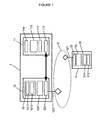
- the communicating mobile terminal (3) of the occupant comprises processing means (31), means (32) for communication and means (33) for capturing, displaying and exchanging audio signals.
- the communicating mobile terminal (3) of the occupant is a mobile phone which is equipped with processing means (31) for transmitting and receiving signals according to a communication protocol. of a local wireless network standard (2), by means (31) for processing comprising a module (311) for compression / decompression and coding / decoding of the signals and for a software application (312) executed by said terminal.
- processing means (31) implemented in the communicating mobile terminal (3) of the occupant, no additional detail will be given on this type of device since it is known from the prior art.
- the communicating mobile terminal of the occupant can also be a laptop, a personal digital assistant (PDA) or any other electronic communication device capable of communicating over a local wireless network.
- the communication protocol advantageously used for the local wireless link can thus correspond, for example, to wireless local network standards of the "bluetooth” type, of the "Wi-Fi” type, of the "HyperLAN” type and of the "HomeRF” type.
- the communicating mobile terminal is therefore equipped with processing means for transmitting and receiving signals according to the radiotelephone communication protocol of the local wireless network standard chosen.
- These protocols enable a communicating mobile terminal to be detected when it enters the zone of influence of a device, for example a videophone and / or intercom system according to the invention, using the same protocol .
- the invention therefore advantageously makes it possible for a communicating mobile terminal (3) to be detected and can be declared by its user to the system (1) of video telephony and / or intercom without requiring any particular modification of the communicating mobile terminal (3).
- the loading in the mobile terminal (3) of a specific application to the control system (1) videophone and / or intercom may allow it to complement the functions of the mobile terminal (3) to it can access the control of the various functions offered by the videophone and / or intercom systems according to the invention.
- the local wireless link corresponds to that defined by the "Bluetooth" standard, allowing the transmission and reception of video and audio signals and the means (32) of communication of the communicating mobile terminal of the occupant are suitable for data exchange via this type of local wireless network (2).
- the system (1) videophone and / or intercom is composed, for example, of an inner device (12), said central, and at least one external device (11), said appendix. It also comprises processing means (121) for transmitting and receiving signals according to a local wireless telephone radiotelephone communication protocol (2), of the "Bluetooth" type in the preferred embodiment.
- the device (11) includes processing means (111), means (112) for acquiring and exchanging video and / or audio signals, means (113) for communication and a switch (114) for call.
- the central device (12) comprises processing means (121) composed of a module (1211) for compression / decompression and coding / decoding of the data, for sending them on a local wireless network (2) and for a software application (1212) allowing the interoperability of the videophone and / or intercom system with devices, provided with means of communication via a local wireless network, compatible and present in the area of influence of the local wireless network (2) of said system.
- the central device (12) also comprises means (122) for capturing and displaying and means (123) for communicating, on the one hand exchanging signals, for example audio and / or video, with the device Annex (11), for example via a wired or high frequency radio network and, on the other hand, the exchange of example audio and / or video on a local wireless network (2), for example type "Bluetooth".
- the central device and the communicating mobile terminals (3) of the occupants have, in their communication means (123 and 32, respectively), antennas (1231 and 321, respectively) adapted to the transmission and reception of information transiting on the local wireless network (2). Note that depending on the type of local network, they may be equipped with an infrared port or any other device necessary for the transmission of data on said network.
- the mobile communicating terminal (3) of the occupant allowing the transmission and reception of signals according to a radiotelephone communication protocol of a local wireless link (2), also comprises means (31) for processing, composed of a module (311) for compressing / decompressing and encoding / decoding the data for sending on a local wireless network (2) and a software application (312) for interoperability with the video telephony system and / or Intercom.
- means (31) for processing composed of a module (311) for compressing / decompressing and encoding / decoding the data for sending on a local wireless network (2) and a software application (312) for interoperability with the video telephony system and / or Intercom.
- the software application (312) of the terminal (3) is downloaded from the video telephony and / or intercom system (1) when said terminal (3) is declared to of said system (1).
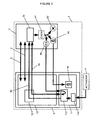
- the implementation of the method according to the invention requires the prior declaration (5) of the communicating mobile terminal (3) to the video telephony and / or intercom system (1), so that said terminal is authorized to control the functions of said system and the prior assignment of allocation priority management rules of the master terminal in case of plurality of communicating mobile terminals of the occupants. Downloading the software application (312), for example during this declaration (5), will allow the terminal (3) to have the functions necessary for processing the data sent to it by said system and for controlling the possible operations of said video telephony and / or intercom system.
- This software application (312) can, for example, be stored in a RAM (Random Access Memory) type working memory of the terminal (3). It can also be stored by example in a physical memory such as a SIM (Subscriber Identity Module) type of proactive chip, allowing "SIM Toolkit” functions, according to which the chip controls the applications of the terminal.
- a RAM Random Access Memory
- SIM Subscriber Identity Module
- the declaration step (5) of the communicating mobile terminals (3) of the occupants is a step of type " scan "protocols of the" Bluetooth "standard. This step enables the system (1) to detect, in the zone of influence of the local wireless network (2) that transmits, the terminals (3) of the occupants and to establish with at least one of these terminals a group of confidence , defined by the creation of a common encryption key.
- the terminals thus declared receive addresses, clocks and identification keys to enable their dialogue with the system (1) and allow their control of the system functions (1).
- Another step following the prior declaration of at least two communicating mobile terminals (3) consists in inputting the allocation management rules of the master terminal to the input means (33) in the case of a plurality of terminals. communicating mobiles. Subsequently, as soon as a declared terminal enters the area of influence of the local wireless network (2) issued by the system (1), it is detected by the system and authorized to control the functions.
- This detection (6) of the communicating mobile terminal (3) of the occupant by the system (1) videophone and / or intercom is done, for example, according to the procedure of "page scan" protocols of the standard " Bluetooth ". This procedure enables the communicating mobile terminals (3) to detect the systems, equipped with means of radiotelephone communication by the "Bluetooth" protocol, in the zone of influence from which it has entered.
- the occupant whose mobile terminal has been identified as a master terminal can then control, according to his choice, the various operations of the system (1) from its communicating mobile terminal (3).
- the terminal (3) of the occupant can become the main control terminal of the system through a possible deactivation, in the central device (12) of the system (1), input and display means and / or means controlling access to the premises protected by said system, for the benefit of the communicating mobile terminal of the occupant (single master terminal).
- the system (1) of videophone and / or intercom allows the deporting its functions to at least one terminal (3) of an occupant.
- a visitor presses the call switch (114) present on the device (11) said schedule of the system, located outside the premises, it activates the system (1).
- This activation (4) is transmitted by the auxiliary device (11), by means of its processing means (111) and its means (113) of communication, to the central device (12) which receives and processes this activation by, respectively, its processing means (121) and its communication means (123).
- the communication between the central and auxiliary devices is provided by a connection system, using, for example, either a wired network between the devices, or radio frequencies.
- the activation (4) of the ancillary device (11) results in the activation of the means (112) for video and / or audio acquisition of the ancillary device (11), which transmits the acquired video and / or audio signals to the device central (12) of the system (1).
- the module (1211) for compression / decompression and coding / decoding of the signals and the software application (1212) of said central device (12) then allow sending (40) video and / or audio signals via the local wireless network (2).
- an alert message sent, together with the video and / or audio signals, on the terminal (3) indicates to the occupant whose terminal has been recognized as single or master, the arrival of a visitor, by a "call" information displayed on the screen and a specific ringtone (pre-programmable or defined).
- the means (31) for processing said master terminal (3) make it possible to read the video and / or audio signals relating to the visitor, by means of the module (311) for compression / decompression and coding / decoding of the signals and for the software application. (312).
- each type of signal (audio and video) is carried on a specifically dedicated channel.
- the Asynchronous Connectionless Link (ACL) channel conveys the video signals compressed by the transmitter and decompressor by the receiver.
- the Synchronous Connection Oriented Link (SCO) channel carries the audio signals.
- the means (33) for capturing, displaying and exchanging audio signals from the terminal (3) enable the occupant to choose the operation to be carried out among the operations proposed following the alert message and the visualization and / or the hearing of the visitor.
- This selection step (41) will consist, for example, in choosing to reject (42) the visitor or to let him in (43) directly.
- the choice of rejection (42) will lead for example to stopping transmissions between the system (1) and the terminal (3), without further warning to the visitor.
- An acceptance choice (43) will result in the opening (46) of the accesses necessary for the introduction of the visitor in the places protected by the system (1).
- This selection step (41) may also consist in answering (44) vocally the visitor by selecting, on said terminal (3), a specific function in the menu generated by the software application (312) downloaded from the system (1) videophone and / or intercom.
- This choice of response (44) to the visitor results in the opening of the SCO connection to allow the connection (45) "full duplex" of the occupant on his terminal (3) with the visitor on the auxiliary device (11). ), that is to say the simultaneous reciprocal hearing of the two interlocutors.
- the selection of a specific function will result in the opening (46) of access to the places protected by said system (1) and the introduction of the visitor in places.
Landscapes
- Engineering & Computer Science (AREA)
- Multimedia (AREA)
- Signal Processing (AREA)
- Mobile Radio Communication Systems (AREA)
- Interconnected Communication Systems, Intercoms, And Interphones (AREA)
- Closed-Circuit Television Systems (AREA)
- Measurement Of Velocity Or Position Using Acoustic Or Ultrasonic Waves (AREA)
- Selective Calling Equipment (AREA)
- Input Circuits Of Receivers And Coupling Of Receivers And Audio Equipment (AREA)
Claims (18)
- Verfahren zum Senden und Empfangen von Bildtelephonie- und/ oder Gegensprechsignalen aus der Ferne, dadurch gekennzeichnet, dass es von mindestens einem mobilen Fernmeldeendgerät (3) mindestens eines Bewohners und mindestens einem Fernmeldesystem (1) für Bildtelephonie und/oder Gegensprechen ausgeführt wird, das mindestens eine der folgenden Vorrichtungen, innere, sogenannte Zentralvorrichtung (12) und mindestens eine äußere, sogenannte Nebenvorrichtung (11), aufweist, und dass es mindestens ein lokales Funkkommunikationsprotokoll verwendet, das eine lokale Funkverbindung (2) zwischen dem mobilen Fernmeldeendgerät (3) und dem System (1) für Bildtelephonie und/oder Gegensprechen herstellt, wobei das Verfahren die folgenden Schritte umfasst:- Feststellung (6) mindestens eines mobilen Fernmeldeendgerätes (3) mindestens eines Bewohners durch das System (1) für Bildtelephonie und/oder Gegensprechen, wenn er in Reichweite der lokalen Funkverbindung (2) des Systems (1) für Bildtelephonie und/oder Gegensprechen kommt;- Anmeldung (5) des mobilen Fernmeldeendgerätes (3) des Bewohners beim System (1) für Bildtelephonie und/oder Gegensprechen, das mit Mitteln (123) für das Funkfernsprechen versehen ist, dann Aufstellen von Regeln für die Kommunikation zwischen dem genannten System (1) für Bildtelephonie und/oder Gegensprechen und dem mobilen Fernmeldeendgerät (3) über die lokale Funkverbindung (2) und Erstellen einer Genehmigung der Übernahme der Kontrolle des Systems (1) für Bildtelephonie und/ oder Gegensprechen durch das mobile Fernmeldeendgerät (3),- eventuell Übernahme der Kontrolle des Systems (1) für Bildtelephonie und/oder Gegensprechen durch das mobile Fernmeldeendgerät (3) des Bewohners, wenn er sich in Reichweite der lokalen Funkverbindung (2) des Systems (1) für Bildtelephonie und/oder Gegensprechen befindet.
- Verfahren nach Patentanspruch 1, dadurch gekennzeichnet, dass der Schritt (5) der Anmeldung des mindestens einen mobilen Fernmeldeendgerätes (3) mindestens eines Bewohners beim System (1) für Bildtelephonie und/oder Gegensprechen, das mit Mitteln (123) für das Funkfernsprechen versehen ist, dank der Feststellung (6) des mobilen Endgerätes (3) in Reichweite der lokalen Funkverbindung (2) des Systems (1) für Bildtelephonie und/oder Gegensprechen erfolgt und von einem Schritt des Ladens einer Anwendung (312) in das mobile Endgerät (3) begleitet wird, die für den Austausch der Funktelephonsignale zwischen dem mobilen Endgerät (3) und dem System (1) für Bildtelephonie und/oder Gegensprechen für den Zugriff auf eine Kontrolle des Systems (1) für Bildtelephonie und/oder Gegensprechen, wie etwa ein eventuelles Abschalten von Eingabe- und Anzeigemitteln (122) und/oder Mitteln zur Kontrolle der Öffnung der Zugänge zu den Räumlichkeiten, die durch das genannte System geschützt werden, in der genannten Zentralvorrichtung (12) zugunsten des mobilen Fernmeldeendgerätes (3) des Bewohners erforderlich ist, das das Hauptendgerät zur Kontrolle des Systems wird und "einziges Hauptendgerät" genannt wird.
- Verfahren nach einem der Patentansprüche 1 und 2, dadurch gekennzeichnet, dass es die folgenden Schritte aufweist:- Betätigung (4) einer Nebenvorrichtung (11) des Systems (1) für Bildtelephonie und/oder Gegensprechen durch einen Besucher mit Hilfe eines Rufschalters (114), der Mittel zur Aufnahme und zum Austausch von Video- und/oder Audiosignalen (112) und Kommunikationsmittel (113) der Nebenvorrichtung (11) aktiviert,- Übertragung der von der Nebenvorrichtung (11) aufgenommenen Video- und/oder Audiosignale zur Zentralvorrichtung (12) des genannte Systems (1), die mit Hilfe eines Moduls (1211) zur Kompression/Dekompression und Codierung/Decodierung von Signalen und eines Anwendungsprogramms (1212), das in Verarbeitungsmitteln (121) enthalten ist, die empfangenen Signale in Signale umwandelt, die über die lokale Funkverbindung (2) des genannten Systems (1) übertragen werden können,- Senden (40) einer Alarmmeldung und der von der Nebenvorrichtung (11) aufgenommenen Video- und/oder Audiosignale an das mobile Fernmeldeendgerät (3) des Bewohners, das vorab als vorranging gegenüber einer Gesamtheit von Endgeräten in Reichweite der lokalen Funkverbindung (2) erklärt wurde und Hauptendgerät genannt wird, durch die Zentralvorrichtung (12) des genannten Systems (1) mit Hilfe von Mitteln (123) zur Kommunikation über die lokale Funkverbindung (2),- Empfang und Anzeige der Alarmmeldung, der Video- und/oder Audiosignale und von Signalen zur Auswahl von Aktionen auf dem mobilen Fernmeldeendgerät (3) mindestens eines Bewohners, Hauptendgerät genannt, mit Hilfe von Anzeigemitteln (33), Kommunikationsmitteln (32) über die genannte lokale Funkverbindung (2) und Verarbeitungsmitteln des genannten Hauptendgerätes, ein Modul (311) zur Kompression/Dekompression und Codierung/Decodierung von Signalen umfassend und ein Anwendungsprogramm (312), wobei die Auswahl an Aktionen aus einer Ablehnung (42) des Besuchers, der zum Abbruch der Übertragungen über die genannte lokale Funkverbindung (2) führt, oder einer Annahme (43) des Besuchers, die zur Öffnung (46) der Zugänge führt, die zum Einlassen des Besuchers in die Räumlichkeiten erforderlich ist, oder auch einer Antwort (44) an den Besucher, die dazu führt, den Bewohner mit dem Besucher über das System (1) für Bildtelephonie und/oder Gegensprechen miteinander in Verbindung zu bringen (45),- eventuelle Herstellung einer wechselseitigen Audio- und/oder Videoverbindung zwischen mindestens einem Bewohner und dem Besucher über fest zugewiesene Kanäle mit Hilfe von Kommunikationsmitteln (32) über die lokale Funkverbindung (2) zwischen dem mobilen Fernmeldeendgerät (3) mindestens eines Bewohners, Hauptendgerät genannt, und dem System (1) für Bildtelephonie und/oder Gegensprechen und Anzeige einer Auswahl von Aktionen auf dem mobilen Endgerät (3) des Bewohners, auszuwählen unter der Ablehnung (42) oder der Annahme (43) des Besuchers, die zum Abbruch der Übertragungen auf dem genannten Netz führt bzw. zur Sendung eines Öffnungsbefehls (46) der Zugänge, die zur Einlassung des Besuchers in die Räumlichkeiten erforderlich sind, die vom genannten System geschützt werden.
- Verfahren nach einem der Patentansprüche 1 bis 3, dadurch gekennzeichnet, dass das für die lokale Funkverbindung (2) verwendete Kommunikationsprotokoll der Norm für lokale Funknetze vom Typ "Bluetooth" entspricht und die der Übertragung der Video- und Audio-Signale dienenden Kanäle den Kanälen ACL, auf englisch "Asynchronous Connectionless Link", bzw. SCO, auf englisch "Synchronous Connection Oriented link", entsprechen.
- Verfahren nach einem der Patentansprüche 1 bis 4, dadurch gekennzeichnet, dass der Anmeldungsschritt (5) der mobilen Fernmeldeendgeräte (3) der Bewohner ein Schritt vom Typ "inquiry scan" der Protokolle nach der "Bluetooth"-Norm ist, die dem System (1) erlaubt, in seiner Reichweite Vorrichtungen festzustellen, die mit Mitteln für das Funkfernsprechen auf geringe Entfernung, beispielsweise weniger als 100 Meter, nach dem Protokoll "Bluetooth" versehen sind, und mit diesen eine "Vertrauensgruppe" zu bilden, die durch die Schaffung eines gemeinsamen Verschlüsselungsschlüssels definiert ist, und ihnen Adressen, Taktsignale und Identifizierungsschlüssel zuzuweisen, um den Dialog des Systems mit diesen Vorrichtungen zu ermöglichen.
- Verfahren nach einem der Patentansprüche 1 bis 5, dadurch gekennzeichnet, dass der Anmeldungsschritt (5) der mobilen Fernmeldeendgeräte (3) der Bewohner mit einem Schritt der Erklärung von Regeln zur Verwaltung der Zuweisung des Hauptendgeräts mit Hilfe von Eingabemitteln (33) verbunden ist, wenn es mehrere mobile Fernmeldeendgeräte gibt.
- Verfahren nach einem der Patentansprüche 1 bis 6, dadurch gekennzeichnet, dass die Feststellung (6) der mobilen Fernmeldeendgeräte (3) der Bewohner durch das System (1) für Bildtelephonie und/oder Gegensprechen nach dem "page scan"-Verfahren der Protokolle der "Bluetooth"-Norm erfolgt, das den mobilen Fernmeldeendgeräten (3) erlaubt, die Systeme, die mit Funkfernsprechmitteln nach dem "Bluetooth"-Protokoll versehen sind, in deren Reichweite sie eingetreten sind, über die Dienstleistungen abzufragen, die sie anbieten, wobei dieses Verfahren das System (1) für Bildtelephonie und/oder Gegensprechen dazu zwingt, den Bereitschaftsmodus zu verlassen, um in den "aktiven" Betriebszustand der Regelung der Übertragungen in Abhängigkeit von den Anfragen und der Bestimmung der den verschiedenen Vorrichtungen möglichen Aktionen einzutreten, dann in den Sparmodus "sniff", der erlaubt, Energie einzusparen, indem er dem System (1) ermöglicht, mit verringerter Häufigkeit mit den mobilen Fernmeldeendgeräten (3) zu kommunizieren, solange diese sich in seiner Reichweite befinden und die Aktionen kontrollieren können, die nach der Auswahl der Bewohner auszuführen sind.
- Verfahren nach einem der Patentansprüche 1 bis 7, dadurch gekennzeichnet, dass das verwendete Kommunikationsprotokoll der Norm für lokale Funknetze "Wi-Fi" entspricht.
- Verfahren nach einem der Patentansprüche 1 bis 7, dadurch gekennzeichnet, dass das verwendete Kommunikationsprotokoll der Norm für lokale Funknetze "HyperLAN" entspricht.
- Verfahren nach einem der Patentansprüche 1 bis 7, dadurch gekennzeichnet, dass das verwendete Kommunikationsprotokoll der Norm für lokale Funknetze "HomeRF" entspricht.
- Mobile Fernmeldeendgeräte (3) mindestens eines Bewohners zur Ausführung des Verfahrens nach einem der Patentansprüche 1 bis 10, Verarbeitungsmittel (31) umfassend, Kommunikationsmittel (32) und Mittel (33) zur Eingabe, Anzeige und zum Austausch von Audiosignalen, dadurch gekennzeichnet, dass sie Verarbeitungsmittel (31) umfassen, die die Sendung und den Empfang von Signalen nach einem Protokoll für die lokale Funkkommunikation erlauben, die eine lokale Funkverbindung (2) herstellen und Mittel zur Erstellung mindestens einer Genehmigung zur Übernahme der Kontrolle mindestens eines Systems (1) für Bildtelephonie und/oder Gegensprechen durch die genannten mobilen Fernmeldeendgeräte (3) aufweisen, das Verarbeitungsmittel (121) aufweist, die die Sendung und den Empfang von Signalen nach einem Protokoll zur lokalen Funkkommunikation erlauben und die Übernahme der Kontrolle über es durch mindestens ein mobiles Fernmeldeendgerät (3).
- Mobile Fernmeldeendgeräte (3) nach Patentanspruch 11, dadurch gekennzeichnet, dass sie ein Modul (311) zur Kompression/ Dekompression und zur Codierung/Decodierung aufweisen, das die Formatierung der auszutauschenden Daten nach dem Protokoll zur lokalen Funkkommunikation ermöglicht, die eine lokale Funkverbindung (2) herstellt.
- Mobile Fernmeldeendgeräte (3) nach einem der Patentansprüche 11 und 12, dadurch gekennzeichnet, dass sie ein Anwendungsprogramm (312) enthalten, das bei ihrer vorhergehenden Anmeldung (5) beim System (1) für Bildtelephonie und/oder Gegensprechen von diesem heruntergeladen wird und das in einem Speicher vom Typ RAM, englisch "Random Access Memory", gespeichert wird oder in Form einer SIM-Toolkit-Anwendung, die in einer SIM-Karte, englisch "Subscriber Identity Module", eines der mobilen Fernmeldeendgeräte (3) gespeichert ist und von einem Programm der genannten mobilen Fernmeldeendgeräte (3) ausgeführt wird, und das die Interoperabilität des Systems (1) für Bildtelephonie und/oder Gegensprechen mit mindestens einem mobilen Fernmeldeendgerät (3) ermöglicht.
- Mobile Fernmeldeendgeräte (3) nach einem der Patentansprüche 11 bis 13, dadurch gekennzeichnet, dass die Kommunikationsmittel (32) der mobilen Fernmeldeendgeräte der Bewohner eine Antenne (321)) umfassen, die die Sendung und den Empfang der Informationen erlaubt, die über mindestens ein Funkfernsprechnetz übertragen werden und insbesondere den Frequenzen angepasst ist, die für die Funkfernsprechverbindungen durch lokale Funkverbindungen (2) verwendet werden.
- System (1) für Bildtelephonie und/oder Gegensprechen zur Ausführung des Verfahrens nach einem der Patentansprüche 1 bis 10, bestehend aus mindestens einer der folgenden Vorrichtungen, innere, sogenannte Zentralvorrichtung (12) und mindestens eine äußere, sogenannte Nebenvorrichtung (11), aufweist, wobei das genannte System (1) Verarbeitungsmittel (121) umfasst, Kommunikationsmittel (123) und Eingabe- und Anzeigemittel (122), dadurch gekennzeichnet, dass die Verarbeitungsmittel (121) die Sendung und den Empfang von Signalen nach einem Protokoll für lokale Funkverbindungen erlauben, eine lokale Funkverbindung (2) herstellen und Mittel zur Erstellung mindestens einer Genehmigung zur Übernahme der Kontrolle des System (1) für Bildtelephonie und/oder Gegensprechen durch mindestens ein mobiles Fernmeldeendgerät (3) umfasst, das Verarbeitungsmittel (31) aufweist, die die Sendung und den Empfang von Signalen nach einem Protokoll für lokale Funkverbindungen erlauben, eine lokale Funkverbindung (2) herstellen und die Übernahme der Kontrolle mindestens eines Systems (1) für Bildtelephonie und/oder Gegensprechen ermöglichen.
- System für Bildtelephonie und/oder Gegensprechen nach Patentanspruch 15, dadurch gekennzeichnet, dass die Verarbeitungsmittel (121) ein Modul (1211) zur Kompression/Dekompression und zur Codierung/Decodierung aufweisen, das die Formatierung der über die genannte lokale Funkverbindung (2) auszutauschenden Daten erlaubt.
- System für Bildtelephonie und/oder Gegensprechen nach einem der Patentansprüche 15 und 16, dadurch gekennzeichnet, dass die Verarbeitungsmittel (121) ein Anwendungsprogramm (1212) ausführen, das die Interoperabilität des Systems (1) für Bildtelephonie und/oder Gegensprechen mit dem mobilen Fernmeldeendgerät (3) ermöglicht.
- System für Bildtelephonie und/oder Gegensprechen nach einem der Patentansprüche 15 bis 17, dadurch gekennzeichnet, dass die Kommunikationsmittel (123) des Systems (1) für Bildtelephonie und/oder Gegensprechen eine Antenne (1231) aufweisen, die die Sendung und den Empfang der Informationen erlaubt, die über ein Funkfernsprechnetz übertragen werden, und die insbesondere an die Frequenzen angepasst ist, die für die Funkfernsprechverbindungen durch lokale Funkverbindungen (2) verwendet werden.
Applications Claiming Priority (2)
| Application Number | Priority Date | Filing Date | Title |
|---|---|---|---|
| FR0315250A FR2864409B1 (fr) | 2003-12-23 | 2003-12-23 | Procede et terminaux communicants pour l'emission et la reception a distance de signaux de visiophonie et/ou d'interphonie |
| FR0315250 | 2003-12-23 |
Publications (2)
| Publication Number | Publication Date |
|---|---|
| EP1558013A1 EP1558013A1 (de) | 2005-07-27 |
| EP1558013B1 true EP1558013B1 (de) | 2008-10-15 |
Family
ID=34630502
Family Applications (1)
| Application Number | Title | Priority Date | Filing Date |
|---|---|---|---|
| EP04293094A Expired - Lifetime EP1558013B1 (de) | 2003-12-23 | 2004-12-22 | Verfahren und Terminals für die Emission und den Distanzempfang von Signalen eines Ton- und/oder Bildtelephonats |
Country Status (7)
| Country | Link |
|---|---|
| EP (1) | EP1558013B1 (de) |
| AT (1) | ATE411703T1 (de) |
| DE (1) | DE602004017116D1 (de) |
| DK (1) | DK1558013T3 (de) |
| ES (1) | ES2315628T3 (de) |
| FR (1) | FR2864409B1 (de) |
| PT (1) | PT1558013E (de) |
Cited By (1)
| Publication number | Priority date | Publication date | Assignee | Title |
|---|---|---|---|---|
| US10171777B2 (en) | 2015-12-31 | 2019-01-01 | Amazon Technologies, Inc. | Streaming and storing video content captured by an audio/video recording and communication device |
Families Citing this family (3)
| Publication number | Priority date | Publication date | Assignee | Title |
|---|---|---|---|---|
| RU2756699C1 (ru) * | 2020-12-30 | 2021-10-04 | Общество с ограниченной ответственностью "Спутник" | Способ настройки домофонной сети и получения данных домофонной сети через bluetooth-модуль |
| CN115442777B (zh) * | 2021-06-03 | 2025-01-17 | Oppo广东移动通信有限公司 | 无线终端中的投屏方法、装置、无线终端及存储介质 |
| CN115509172A (zh) * | 2022-09-27 | 2022-12-23 | 首钢滦南马城矿业有限责任公司 | 一种罐笼自动控制系统 |
Family Cites Families (1)
| Publication number | Priority date | Publication date | Assignee | Title |
|---|---|---|---|---|
| AU2003230229A1 (en) * | 2002-05-09 | 2003-11-11 | Castaldo - Elettronica And Telecomunicazioni | Portable videointercom set |
-
2003
- 2003-12-23 FR FR0315250A patent/FR2864409B1/fr not_active Expired - Fee Related
-
2004
- 2004-12-22 PT PT04293094T patent/PT1558013E/pt unknown
- 2004-12-22 DE DE602004017116T patent/DE602004017116D1/de not_active Expired - Lifetime
- 2004-12-22 DK DK04293094T patent/DK1558013T3/da active
- 2004-12-22 EP EP04293094A patent/EP1558013B1/de not_active Expired - Lifetime
- 2004-12-22 ES ES04293094T patent/ES2315628T3/es not_active Expired - Lifetime
- 2004-12-22 AT AT04293094T patent/ATE411703T1/de not_active IP Right Cessation
Cited By (1)
| Publication number | Priority date | Publication date | Assignee | Title |
|---|---|---|---|---|
| US10171777B2 (en) | 2015-12-31 | 2019-01-01 | Amazon Technologies, Inc. | Streaming and storing video content captured by an audio/video recording and communication device |
Also Published As
| Publication number | Publication date |
|---|---|
| ATE411703T1 (de) | 2008-10-15 |
| DE602004017116D1 (de) | 2008-11-27 |
| ES2315628T3 (es) | 2009-04-01 |
| DK1558013T3 (da) | 2009-02-16 |
| FR2864409A1 (fr) | 2005-06-24 |
| PT1558013E (pt) | 2008-12-29 |
| FR2864409B1 (fr) | 2006-03-03 |
| EP1558013A1 (de) | 2005-07-27 |
Similar Documents
| Publication | Publication Date | Title |
|---|---|---|
| KR102911806B1 (ko) | 지속적 생체 인식 프로파일링을 위한 방법 및 장치 | |
| US9900315B2 (en) | Enabling and inhibiting synchronization of privacy settings | |
| US9769874B2 (en) | Mobile telephone gateway apparatus, communication system, and gateway operating system | |
| KR101054467B1 (ko) | 데이터 스트리밍 및 실시간 서비스에 적합한 단거리 무선단말기 | |
| US9648153B2 (en) | Method and device for incoming call notification | |
| EP1750464B1 (de) | Schutz persönlicher Informationen für ein Multimode-endgerät | |
| US20040023664A1 (en) | Activating an interactive multimedia terminal | |
| EP1601225A2 (de) | Vorrichtung und Verfahren zur gesicherte Vervielfältigung von SIM-Karte-Informationen | |
| US9485650B2 (en) | Configuring a wireless communications device in a mobile communications system | |
| EP3166088A1 (de) | Zugangssteuerungsverfahren zu einem raum | |
| CN107396328B (zh) | 终端的呼叫方法及相关设备 | |
| CN113518336A (zh) | 蓝牙连接的提示方法、装置、终端及存储介质 | |
| US20080195641A1 (en) | Apparatus and method for aggregating and accessing data according to user information | |
| US20080220775A1 (en) | Apparatus, method, and computer-readable medium for securely providing communications between devices and networks | |
| EP0876037A2 (de) | Endgerät, Verfahren für automatisches Rückruf- und Telekommunikationssystem | |
| CN113438372A (zh) | 呼叫功能设置方法、装置、终端设备及存储介质 | |
| CN113595740A (zh) | 数据传输方法及装置、电子设备及存储介质 | |
| US8543098B2 (en) | Apparatus and method for securely providing communications between devices and networks | |
| FR2864409A1 (fr) | Procede et terminaux communicants pour l'emission et la reception a distance de signaux de visiophonie et/ou d'interphonie | |
| KR100994889B1 (ko) | 영상 채팅 시스템 및 영상 채팅 서비스 제공 방법 | |
| CN113543276B (zh) | 网络接入方法、装置、存储介质及电子设备 | |
| KR102194257B1 (ko) | 청각 장애인을 고려한 통화 중계 시스템 | |
| US8533070B2 (en) | Apparatus and method for aggregating and accessing data according to user information | |
| FR2870664A1 (fr) | Procede et dispositif ameliores de traitement des modes de communication d'un terminal de communication mobile | |
| KR20070008955A (ko) | 복합기능을 갖는 홈오토메이션 전화 시스템 본체와 무선단말기 및 그 운영방법 |
Legal Events
| Date | Code | Title | Description |
|---|---|---|---|
| PUAI | Public reference made under article 153(3) epc to a published international application that has entered the european phase |
Free format text: ORIGINAL CODE: 0009012 |
|
| AK | Designated contracting states |
Kind code of ref document: A1 Designated state(s): AT BE BG CH CY CZ DE DK EE ES FI FR GB GR HU IE IS IT LI LT LU MC NL PL PT RO SE SI SK TR |
|
| AX | Request for extension of the european patent |
Extension state: AL BA HR LV MK YU |
|
| AKX | Designation fees paid | ||
| 17P | Request for examination filed |
Effective date: 20060320 |
|
| RBV | Designated contracting states (corrected) |
Designated state(s): AT BE BG CH CY CZ DE DK EE ES FI FR GB GR HU IE IS IT LI LT LU MC NL PL PT RO SE SI SK TR |
|
| REG | Reference to a national code |
Ref country code: DE Ref legal event code: 8566 |
|
| 17Q | First examination report despatched |
Effective date: 20060504 |
|
| RIC1 | Information provided on ipc code assigned before grant |
Ipc: H04M 11/02 20060101ALI20080204BHEP Ipc: H04N 7/18 20060101AFI20080204BHEP |
|
| GRAP | Despatch of communication of intention to grant a patent |
Free format text: ORIGINAL CODE: EPIDOSNIGR1 |
|
| GRAS | Grant fee paid |
Free format text: ORIGINAL CODE: EPIDOSNIGR3 |
|
| GRAA | (expected) grant |
Free format text: ORIGINAL CODE: 0009210 |
|
| AK | Designated contracting states |
Kind code of ref document: B1 Designated state(s): AT BE BG CH CY CZ DE DK EE ES FI FR GB GR HU IE IS IT LI LT LU MC NL PL PT RO SE SI SK TR |
|
| REG | Reference to a national code |
Ref country code: CH Ref legal event code: EP Ref country code: GB Ref legal event code: FG4D Free format text: NOT ENGLISH |
|
| REG | Reference to a national code |
Ref country code: IE Ref legal event code: FG4D Free format text: LANGUAGE OF EP DOCUMENT: FRENCH |
|
| REF | Corresponds to: |
Ref document number: 602004017116 Country of ref document: DE Date of ref document: 20081127 Kind code of ref document: P |
|
| REG | Reference to a national code |
Ref country code: PT Ref legal event code: SC4A Free format text: AVAILABILITY OF NATIONAL TRANSLATION Effective date: 20081217 |
|
| REG | Reference to a national code |
Ref country code: CH Ref legal event code: NV Representative=s name: R. A. EGLI & CO. PATENTANWAELTE |
|
| REG | Reference to a national code |
Ref country code: GR Ref legal event code: EP Ref document number: 20080403370 Country of ref document: GR |
|
| REG | Reference to a national code |
Ref country code: SE Ref legal event code: TRGR |
|
| REG | Reference to a national code |
Ref country code: DK Ref legal event code: T3 |
|
| REG | Reference to a national code |
Ref country code: ES Ref legal event code: FG2A Ref document number: 2315628 Country of ref document: ES Kind code of ref document: T3 |
|
| PG25 | Lapsed in a contracting state [announced via postgrant information from national office to epo] |
Ref country code: LT Free format text: LAPSE BECAUSE OF FAILURE TO SUBMIT A TRANSLATION OF THE DESCRIPTION OR TO PAY THE FEE WITHIN THE PRESCRIBED TIME-LIMIT Effective date: 20081015 Ref country code: BG Free format text: LAPSE BECAUSE OF FAILURE TO SUBMIT A TRANSLATION OF THE DESCRIPTION OR TO PAY THE FEE WITHIN THE PRESCRIBED TIME-LIMIT Effective date: 20090115 |
|
| PG25 | Lapsed in a contracting state [announced via postgrant information from national office to epo] |
Ref country code: PL Free format text: LAPSE BECAUSE OF FAILURE TO SUBMIT A TRANSLATION OF THE DESCRIPTION OR TO PAY THE FEE WITHIN THE PRESCRIBED TIME-LIMIT Effective date: 20081015 Ref country code: IS Free format text: LAPSE BECAUSE OF FAILURE TO SUBMIT A TRANSLATION OF THE DESCRIPTION OR TO PAY THE FEE WITHIN THE PRESCRIBED TIME-LIMIT Effective date: 20090215 Ref country code: SI Free format text: LAPSE BECAUSE OF FAILURE TO SUBMIT A TRANSLATION OF THE DESCRIPTION OR TO PAY THE FEE WITHIN THE PRESCRIBED TIME-LIMIT Effective date: 20081015 |
|
| PG25 | Lapsed in a contracting state [announced via postgrant information from national office to epo] |
Ref country code: EE Free format text: LAPSE BECAUSE OF FAILURE TO SUBMIT A TRANSLATION OF THE DESCRIPTION OR TO PAY THE FEE WITHIN THE PRESCRIBED TIME-LIMIT Effective date: 20081015 Ref country code: RO Free format text: LAPSE BECAUSE OF FAILURE TO SUBMIT A TRANSLATION OF THE DESCRIPTION OR TO PAY THE FEE WITHIN THE PRESCRIBED TIME-LIMIT Effective date: 20081015 |
|
| PLBE | No opposition filed within time limit |
Free format text: ORIGINAL CODE: 0009261 |
|
| STAA | Information on the status of an ep patent application or granted ep patent |
Free format text: STATUS: NO OPPOSITION FILED WITHIN TIME LIMIT |
|
| PG25 | Lapsed in a contracting state [announced via postgrant information from national office to epo] |
Ref country code: CZ Free format text: LAPSE BECAUSE OF FAILURE TO SUBMIT A TRANSLATION OF THE DESCRIPTION OR TO PAY THE FEE WITHIN THE PRESCRIBED TIME-LIMIT Effective date: 20081015 |
|
| 26N | No opposition filed |
Effective date: 20090716 |
|
| PG25 | Lapsed in a contracting state [announced via postgrant information from national office to epo] |
Ref country code: SK Free format text: LAPSE BECAUSE OF FAILURE TO SUBMIT A TRANSLATION OF THE DESCRIPTION OR TO PAY THE FEE WITHIN THE PRESCRIBED TIME-LIMIT Effective date: 20081015 |
|
| PGFP | Annual fee paid to national office [announced via postgrant information from national office to epo] |
Ref country code: AT Payment date: 20091124 Year of fee payment: 6 Ref country code: DK Payment date: 20091125 Year of fee payment: 6 Ref country code: FI Payment date: 20091126 Year of fee payment: 6 Ref country code: SE Payment date: 20091125 Year of fee payment: 6 |
|
| PGFP | Annual fee paid to national office [announced via postgrant information from national office to epo] |
Ref country code: NL Payment date: 20091127 Year of fee payment: 6 |
|
| PGFP | Annual fee paid to national office [announced via postgrant information from national office to epo] |
Ref country code: PT Payment date: 20091209 Year of fee payment: 6 |
|
| PGFP | Annual fee paid to national office [announced via postgrant information from national office to epo] |
Ref country code: GR Payment date: 20091124 Year of fee payment: 6 |
|
| PG25 | Lapsed in a contracting state [announced via postgrant information from national office to epo] |
Ref country code: CY Free format text: LAPSE BECAUSE OF FAILURE TO SUBMIT A TRANSLATION OF THE DESCRIPTION OR TO PAY THE FEE WITHIN THE PRESCRIBED TIME-LIMIT Effective date: 20081015 Ref country code: HU Free format text: LAPSE BECAUSE OF FAILURE TO SUBMIT A TRANSLATION OF THE DESCRIPTION OR TO PAY THE FEE WITHIN THE PRESCRIBED TIME-LIMIT Effective date: 20090416 |
|
| PG25 | Lapsed in a contracting state [announced via postgrant information from national office to epo] |
Ref country code: TR Free format text: LAPSE BECAUSE OF FAILURE TO SUBMIT A TRANSLATION OF THE DESCRIPTION OR TO PAY THE FEE WITHIN THE PRESCRIBED TIME-LIMIT Effective date: 20081015 |
|
| PGFP | Annual fee paid to national office [announced via postgrant information from national office to epo] |
Ref country code: IE Payment date: 20101124 Year of fee payment: 7 |
|
| REG | Reference to a national code |
Ref country code: PT Ref legal event code: MM4A Free format text: LAPSE DUE TO NON-PAYMENT OF FEES Effective date: 20110622 |
|
| REG | Reference to a national code |
Ref country code: NL Ref legal event code: V1 Effective date: 20110701 |
|
| PG25 | Lapsed in a contracting state [announced via postgrant information from national office to epo] |
Ref country code: PT Free format text: LAPSE BECAUSE OF NON-PAYMENT OF DUE FEES Effective date: 20110622 |
|
| REG | Reference to a national code |
Ref country code: DK Ref legal event code: EBP |
|
| PG25 | Lapsed in a contracting state [announced via postgrant information from national office to epo] |
Ref country code: FI Free format text: LAPSE BECAUSE OF NON-PAYMENT OF DUE FEES Effective date: 20101222 Ref country code: AT Free format text: LAPSE BECAUSE OF NON-PAYMENT OF DUE FEES Effective date: 20101222 |
|
| REG | Reference to a national code |
Ref country code: SE Ref legal event code: EUG |
|
| PG25 | Lapsed in a contracting state [announced via postgrant information from national office to epo] |
Ref country code: SE Free format text: LAPSE BECAUSE OF NON-PAYMENT OF DUE FEES Effective date: 20101223 |
|
| PG25 | Lapsed in a contracting state [announced via postgrant information from national office to epo] |
Ref country code: GR Free format text: LAPSE BECAUSE OF NON-PAYMENT OF DUE FEES Effective date: 20110704 |
|
| PG25 | Lapsed in a contracting state [announced via postgrant information from national office to epo] |
Ref country code: NL Free format text: LAPSE BECAUSE OF NON-PAYMENT OF DUE FEES Effective date: 20110701 |
|
| REG | Reference to a national code |
Ref country code: IE Ref legal event code: MM4A |
|
| PG25 | Lapsed in a contracting state [announced via postgrant information from national office to epo] |
Ref country code: IE Free format text: LAPSE BECAUSE OF NON-PAYMENT OF DUE FEES Effective date: 20111222 |
|
| REG | Reference to a national code |
Ref country code: FR Ref legal event code: GC Effective date: 20150310 |
|
| REG | Reference to a national code |
Ref country code: FR Ref legal event code: PLFP Year of fee payment: 12 |
|
| REG | Reference to a national code |
Ref country code: FR Ref legal event code: PLFP Year of fee payment: 13 |
|
| REG | Reference to a national code |
Ref country code: FR Ref legal event code: PLFP Year of fee payment: 14 |
|
| REG | Reference to a national code |
Ref country code: FR Ref legal event code: GC Effective date: 20180111 |
|
| PGFP | Annual fee paid to national office [announced via postgrant information from national office to epo] |
Ref country code: LU Payment date: 20231121 Year of fee payment: 20 |
|
| PGFP | Annual fee paid to national office [announced via postgrant information from national office to epo] |
Ref country code: GB Payment date: 20231124 Year of fee payment: 20 |
|
| PGFP | Annual fee paid to national office [announced via postgrant information from national office to epo] |
Ref country code: MC Payment date: 20231124 Year of fee payment: 20 |
|
| PGFP | Annual fee paid to national office [announced via postgrant information from national office to epo] |
Ref country code: FR Payment date: 20231122 Year of fee payment: 20 Ref country code: DE Payment date: 20231121 Year of fee payment: 20 |
|
| PGFP | Annual fee paid to national office [announced via postgrant information from national office to epo] |
Ref country code: BE Payment date: 20231121 Year of fee payment: 20 |
|
| PGFP | Annual fee paid to national office [announced via postgrant information from national office to epo] |
Ref country code: ES Payment date: 20240102 Year of fee payment: 20 |
|
| PGFP | Annual fee paid to national office [announced via postgrant information from national office to epo] |
Ref country code: CH Payment date: 20240102 Year of fee payment: 20 |
|
| REG | Reference to a national code |
Ref country code: DE Ref legal event code: R071 Ref document number: 602004017116 Country of ref document: DE |
|
| REG | Reference to a national code |
Ref country code: CH Ref legal event code: PL |
|
| REG | Reference to a national code |
Ref country code: ES Ref legal event code: FD2A Effective date: 20250102 |
|
| REG | Reference to a national code |
Ref country code: GB Ref legal event code: PE20 Expiry date: 20241221 |
|
| PG25 | Lapsed in a contracting state [announced via postgrant information from national office to epo] |
Ref country code: GB Free format text: LAPSE BECAUSE OF EXPIRATION OF PROTECTION Effective date: 20241221 |
|
| PG25 | Lapsed in a contracting state [announced via postgrant information from national office to epo] |
Ref country code: ES Free format text: LAPSE BECAUSE OF EXPIRATION OF PROTECTION Effective date: 20241223 |
|
| PG25 | Lapsed in a contracting state [announced via postgrant information from national office to epo] |
Ref country code: GB Free format text: LAPSE BECAUSE OF EXPIRATION OF PROTECTION Effective date: 20241221 Ref country code: ES Free format text: LAPSE BECAUSE OF EXPIRATION OF PROTECTION Effective date: 20241223 |
|
| REG | Reference to a national code |
Ref country code: BE Ref legal event code: MK Effective date: 20241222 |
|
| PGFP | Annual fee paid to national office [announced via postgrant information from national office to epo] |
Ref country code: IT Payment date: 20231121 Year of fee payment: 20 |