EP1558010B1 - Kommunikationsendgerät mit Tastenkennungsübertragung und dazugehöriges Programm - Google Patents
Kommunikationsendgerät mit Tastenkennungsübertragung und dazugehöriges Programm Download PDFInfo
- Publication number
- EP1558010B1 EP1558010B1 EP05000361A EP05000361A EP1558010B1 EP 1558010 B1 EP1558010 B1 EP 1558010B1 EP 05000361 A EP05000361 A EP 05000361A EP 05000361 A EP05000361 A EP 05000361A EP 1558010 B1 EP1558010 B1 EP 1558010B1
- Authority
- EP
- European Patent Office
- Prior art keywords
- string
- key identifier
- character
- key
- communications terminal
- Prior art date
- Legal status (The legal status is an assumption and is not a legal conclusion. Google has not performed a legal analysis and makes no representation as to the accuracy of the status listed.)
- Expired - Lifetime
Links
Images






Classifications
-
- G—PHYSICS
- G06—COMPUTING OR CALCULATING; COUNTING
- G06F—ELECTRIC DIGITAL DATA PROCESSING
- G06F3/00—Input arrangements for transferring data to be processed into a form capable of being handled by the computer; Output arrangements for transferring data from processing unit to output unit, e.g. interface arrangements
- G06F3/01—Input arrangements or combined input and output arrangements for interaction between user and computer
- G06F3/02—Input arrangements using manually operated switches, e.g. using keyboards or dials
- G06F3/023—Arrangements for converting discrete items of information into a coded form, e.g. arrangements for interpreting keyboard generated codes as alphanumeric codes, operand codes or instruction codes
- G06F3/0233—Character input methods
- G06F3/0237—Character input methods using prediction or retrieval techniques
-
- H—ELECTRICITY
- H04—ELECTRIC COMMUNICATION TECHNIQUE
- H04M—TELEPHONIC COMMUNICATION
- H04M1/00—Substation equipment, e.g. for use by subscribers
- H04M1/72—Mobile telephones; Cordless telephones, i.e. devices for establishing wireless links to base stations without route selection
- H04M1/724—User interfaces specially adapted for cordless or mobile telephones
- H04M1/72403—User interfaces specially adapted for cordless or mobile telephones with means for local support of applications that increase the functionality
- H04M1/7243—User interfaces specially adapted for cordless or mobile telephones with means for local support of applications that increase the functionality with interactive means for internal management of messages
- H04M1/72436—User interfaces specially adapted for cordless or mobile telephones with means for local support of applications that increase the functionality with interactive means for internal management of messages for text messaging, e.g. short messaging services [SMS] or e-mails
-
- H—ELECTRICITY
- H04—ELECTRIC COMMUNICATION TECHNIQUE
- H04M—TELEPHONIC COMMUNICATION
- H04M2250/00—Details of telephonic subscriber devices
- H04M2250/58—Details of telephonic subscriber devices including a multilanguage function
-
- H—ELECTRICITY
- H04—ELECTRIC COMMUNICATION TECHNIQUE
- H04M—TELEPHONIC COMMUNICATION
- H04M2250/00—Details of telephonic subscriber devices
- H04M2250/70—Details of telephonic subscriber devices methods for entering alphabetical characters, e.g. multi-tap or dictionary disambiguation
Definitions
- the present invention relates to a communications terminal apparatus and a program for transmitting and receiving text data generated in a key operation.
- text data is represented by a standardized character code string.
- a standardized character code string for example, ASCII (American Standard Code for Information Interchange) is used in English, and Shift-JIS (Japanese Industrial Standards) is used in Japanese. Since a character code corresponds one to one to a character, it is necessary to define codes for the number of types of characters used. For example, English ASCII having a relatively smaller number of types of characters requires 8 bits to represent one character while Japanese Shift-JIS having a larger number of types of characters requires 16 bits.
- a character code string configuring a plurality of character codes is transmitted.
- the amount of information is obtained by a product of the amount of information specific to character code (for example, 8 bits for ASCII) and the number of character codes.
- the communications cost can be reduced. Therefore, the band width which is the resources can be more efficiently used.
- the communications terminal when a character is input by a user from an input interface such as a keyboard, etc., the communications terminal generates a character code string (text data to be transmitted), compresses the character code string in the text data compressing method such as the LZ77 (for example, refer to " A Universal Algorithm for Sequential Data Compression” IEEE Transactions on Information Theory 23 (3):337-343 (1977) by Jacob Ziv, Abraham Lempel ; hereinafter referred to as Reference 1), the BSTW (for example, refer to " A locally adaptive data compression scheme” Communications of the ACM, 29:320-330, 1986 by J.
- LZ77 for example, refer to " A Universal Algorithm for Sequential Data Compression” IEEE Transactions on Information Theory 23 (3):337-343 (1977) by Jacob Ziv, Abraham Lempel ; hereinafter referred to as Reference 1
- the BSTW for example, refer to " A locally adaptive data compression scheme” Communications of the ACM, 29:320-330, 1986 by J.
- Reference 2 Hereinafter referred to as Reference 2
- the receiving communications terminal restores the compressed data to the original character code string in the decompressing method corresponding to the compressing method, and displays the result on the output interface such as a display, etc.
- the compressing methods such as the LZ77, the BSTW, etc. are performed by using the bias of the distribution of the array of code string (frequency and position information about a specific array are defined as a feature amount), and replacing a part of the code string with a smaller number of codes.
- the present invention has been developed to solve the above-mentioned problems, and aims at providing a communications terminal apparatus, a reception apparatus, and a program for enhancing the effect of reducing the amount of information to be transmitted when text data is generated and transmitted.
- a communications terminal apparatus according to claim 1 and a program according to claim 8 is provided, respectively.
- the communications terminal apparatus can generate and transmit the key identifier string of a smaller amount of information by defining a key identifier by the smallest amount of information capable of representing each key when generating and transmitting a key identifier string which is an array of a key identifier uniquely corresponding to an operated key. Therefore, the effect of reducing an amount of information can be enhanced when transmitting text data. Thus, the communications cost can be reduced, and the network resources of a band width, etc. can be used efficiently.
- a character code definition-storage means for storing at least one character code corresponding to each of the plurality of keys; and character string presentation means for presenting a candidate character string represented by a character code string corresponding to a key identifier string stored in the input key identifier storage means and discriminated based on a character code stored in the character code definition-storage means is used such that the communications terminal apparatus presents a candidate character string represented by a character code string corresponding to a key identifier string. Therefore, a user can confirm what type of candidate character string is generated by a key operation.
- the communications terminal apparatus further includes language knowledge storage means for storing language knowledge data for analysis of a character string.
- the character string presentation means further analyzes based on language knowledge data stored in the language knowledge storage means a candidate character string discriminated based on a character code stored in the character code definition-storage means, and presents a corresponding character string as a candidate. Therefore the candidate character string discriminated based on the character code stored in the character code definition-storage means is further analyzed based on the language knowledge data, thereby narrowing candidate character strings.
- the communications terminal apparatus may further include character string determination means for determining one candidate character string to be presented by the character string presentation means.
- the transmission means transmits a key identifier string stored in the input key identifier storage means only when there is one candidate character string to be presented by the character string presentation means.
- the communications terminal apparatus may, therefore, transmit a key identifier string stored in the input key identifier storage means only when there is only one candidate character string to be presented by the character string presentation means. Therefore, when the number of candidate character strings is not one, the transmission of the key identifier string can be suppressed. Therefore, when a receiving apparatus discriminates a character code string from a received key identifier string, the ambiguity due to failure in discrimination of one character code string can be prevented.
- the communications terminal apparatus may be adapted such that the transmitting means transmits a key identifier string stored in the input key identifier storage means after compressing the key identifier string.
- the communications terminal apparatus may transmit a key identifier string after compressing it. Therefore, not only the amount of information about the code itself representing a character can be reduced by using a key identifier, but also the number of codes to be compressed can be reduced. As a result, the amount of information to be transmitted can further be reduced, thereby reducing the text data transmission cost.
- the communications terminal apparatus may be specified in that the plurality of keys include a key for selection of the type of language.
- the communications terminal apparatus may be provided with a key for selection of the type of language. Therefore, the user can input a character with the type of language switched by a key operation. Furthermore, since the key identifier string stored in the input key identifier storage means includes a key identifier corresponding to the key for selection of the type of language, it is possible to discriminate the selected type of language based on the key identifier. Therefore, a key identifier string representing characters of a plurality of languages can be generated with a small amount of information without defining a number of key identifiers depending on the type of language, thereby performing efficient transmission.
- the key identifier may be configured by the amount of information of n (n is a natural number) bits, the number of the plurality of keys is larger than (n-1)th power of 2, and is equal to or smaller than n-th power of 2.
- the key identifier may be configured by the amount of information of n bits. Therefore, the key identifier can be defined by the smallest possible amount of information depending on the number of key, thereby reducing the transmission cost to the minimum value and attaining the highest transmission efficiency.
- the communications terminal apparatus may further include: reception means for receiving the key identifier string from an external device.
- the communications terminal apparatus can present the character code string corresponding to the key identifier string received from the external device after converting it into a character string which can be recognized by a user.
- the communications terminal apparatus generates and transmits a key identifier string which is an array of key identifiers uniquely corresponding to an operated key. Therefore, by defining a key identifier by the smallest amount of information which can represent each key, a key identifier string of a small amount of information can be generated and transmitted, thereby enhancing the effect of reducing the amount of information when text data is transmitted. Thus, the communications cost can be reduced, and the network resources such as a band width, etc. can be efficiently used.
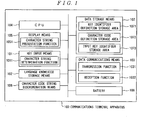
- FIG. 1 shows the configuration of a communications terminal apparatus 100 showing an example of the embodiment of the present invention.
- the communications terminal apparatus 100 shown in FIG. 1 is a PDA (Personal Digital Assistance) with communication facility or a mobile wireless communications equipment such as a mobile telephone, a PHS (Personal Handyphone System), etc.
- the communications terminal apparatus 100 is not limited to wireless communications equipment, but can be cable communications equipment. However, the outstanding advantage of the present invention is reflected on mobile wireless communications equipment indicating a smaller number of input keys.
- the communications terminal apparatus 100 comprises key input means 101, language knowledge storage means 102, data communications means 103, a CPU 104, display means 105, a battery 106, and data storage means 107.
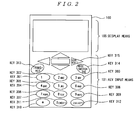
- the key input means 101 is configured by including a keyboard having a plurality of keys.
- one key corresponds to one or more characters (including numbers) and a control command.
- a control command is assumed to be a kind of character.
- a key 301 indicates a character set ⁇ 1, (space) ⁇
- a key 302 indicates a character set ⁇ 2
- a key 303 indicates a character set ⁇ 3, D, E, F ⁇
- a key 304 indicates a character set ⁇ 4, G, H, I ⁇
- a key 305 indicates a character set ⁇ 5, J, K, L ⁇
- a key 306 indicates a character set ⁇ 6, M, N, O ⁇
- a key 307 indicates a character set ⁇ 7
- a key 308 indicates a character set ⁇ 8, T, U, V ⁇
- a key 309 indicates a character set ⁇ 9, W, X, Y, Z ⁇
- a key 310 indicates a character set ⁇ punctu
- NONET is a control command to request a next candidate.
- a candidate character string for conversion is not a desired one, a user operates the key 311 corresponding to the control command (NEXT).
- the CPU 104 of the communications terminal apparatus 100 detects that the key 311 is operated, it issues an instruction to request a next candidate.
- An operation to be detected by the CPU 104 of the communications terminal apparatus 100 can be touching or turning other than pressing a key.
- SELECT is also a control command, and when a candidate character string for conversion is desired by a user, it is used to indicate the request of the user. When (SELECT) is selected, the space indicating a delimiter of a word can be automatically appended to the character string.
- MODE SWITCHING is a control command to issue an instruction to switch an input mode, and is used to switch between a character other than a number and a number.
- a number is excluded in the character set in a normal mode.
- a control command (MODE SWITCHING) is given in the normal mode, a character other than a number is excluded.
- MODE SWITCHING In an input mode in which a character other than a number is excluded, if a control command (MODE SWITCHING) is given, then control is returned to a normal mode.
- CONVERT indicates a delimiter of a word and a phrase, and issues a command to specify the reference of language knowledge data for resolution of ambiguity of an input character string.
- TRANSMIT is a control command to issue an instruction to transmit text data (key identifier string) generated by a key operation.
- the function of determining one candidate character string to be displayed on the display means 105 by issuing a control command such as the above-mentioned (SELECT), (NEXT), and other control commands is referred to as a character string determination function 1011.
- the key array is not limited to the example shown in FIG. 2 , but any other array can be used.
- the correspondence between a key and a character is also not limited to the above-mentioned example, but can be any other correspondences.
- the type of character can be discriminated between an upper case and a lower case, can be a character of a language other than English, or can be a glyph.
- the data storage means 107 shown in FIG. 1 is to store various data, and is configured by a magnetic disk, flash memory, etc.
- the data storage means 107 stores software for control of the communications terminal apparatus 100 such as communications software, an operating system, etc., and software for generation and transmission of the text data relating to the present invention.
- the data storage means 107 also stores a symbol corresponding to a key input by the key input means 101.
- the data storage means 107 comprises a key identifier definition storage area 1071, a character code definition storage area 1072, and a input key identifier storage area 1073 as a storage area specific to the present invention.
- the key identifier definition storage area 1071 stores key identifier definition information for definition of a key identifier uniquely corresponding to each key.
- the character code definition storage area 1072 stores character code definition information for definition of a character code corresponding to each key.
- the character code definition information is configured by a "correspondence table among a key, a key identifier, and a character" and a "correspondence table between a character code and a character”.
- the input key identifier storage area 1073 additionally stores a key identifier corresponding to an operated key as a key identifier string.
- FIG. 3 shows an example of the key identifier definition information stored in the key identifier definition storage area 1071 of the data storage means 107.
- the key identifier defined in the present invention requires only the amount of information with which the number of keys can be represented in binary. For example, when the number of keys is 9 or more and 16 or less, 4 bits are to be defined as the smallest amount of information about the key identifier. In this case, to represent 15 keys of the communications terminal apparatus 100 shown in FIG. 2 , the key identifier is defined by 4 bits.
- FIG. 4 show an example of the correspondence table among a key, a key identifier, and a character stored in the 1072 of the data storage means 107.
- the correspondence between the key identifier and the character can be signal indicated by the correspondence between the key and the character. Therefore, the table shown in FIG. 4 can be transformed into a correspondence table between the key and the character, and can be transformed into a correspondence table between the key identifier and the character.
- the key identifier definition information shown in FIG. 3 can be included in the correspondence table shown in FIG. 4 .
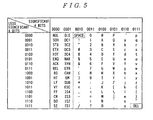
- FIG. 5 shows an example of a correspondence table between a character and a character code in binary notation stored in the character code definition storage area 1072 of the data storage means 107.
- a character code is represented in the ASCII system.
- the character code definition information is represented in a table format as shown in FIGS. 4 and 5 , but the character code definition information only has to be information indicating the correspondence between a key and a character code, and in not limited to the above-mentioned data configuration.
- the input key identifier storage area 1073 sequentially adds and stores a key identifier corresponding to an operated key as a key identifier string until the key 313 corresponding to the control command (TRANSMIT) is operated. That is, when a user operates a key, the key identifier corresponding to the operated key is retrieved and obtained from the key identifier definition information stored in the key identifier definition storage area 1071. When the obtained key identifier does not correspond to the control command (TRANSMIT), the obtained key identifier is added and stored as the trailer of the key identifier string stored in the input key identifier storage area 1073.
- the key identifier "0010" corresponding to the key 303 is added as the trailer of the key identifier string stored in the input key identifier storage area 1073 (hereinafter referred to as "append").
- the language knowledge storage means 102 shown in FIG. 1 stores language knowledge data for resolution of ambiguity of input by the key input means 101, and is configured by a magnetic disk, flash memory, etc.
- the ambiguity of input is explained below.
- the key of the key input means 101 corresponds one to many to characters (they can correspond one to one, but the correspondence of one to one is assumed to be a special case of the correspondence of one to many), it is assumed that a character set is specified including a character desired by the user and a character not desired by the user when the user operates one key.
- a character set is specified including a character desired by the user and a character not desired by the user when the user operates one key.
- FIG. 6 shows a part of language knowledge data.
- an English word list arranged in an alphabetical order is used as language knowledge data.
- the ambiguity of correspondence between an input key and characters can be solved by the conventional technology of excluding what is not registered in the language knowledge data from the candidate character strings which can be generated from an input key. For example, using the methods disclosed by the US Patent No. 5,818,437 and JP11-312046A , the problem can be solved.
- a word list is used as language knowledge data, but the lexicon (word list extended to inflection) can be used as language knowledge data by replacing the word list, and a connective character string (n-gram) can also be used as language knowledge data. Additionally, the entry of each word, lexicon, and connective character string can be assigned an occurrence probability to prioritize a candidate character string matching a higher occurrence probability. Otherwise, the data storage means 107 can also function as the language knowledge storage means 102.
- the data communications means 103 is configured to include an antenna and communications software to communicate data with the communications terminal apparatus 100 which is a communications partner through a wireless network such as a mobile telephone network, a PHS network, a wireless LAN (Local Area Network), etc.
- a wireless network such as a mobile telephone network, a PHS network, a wireless LAN (Local Area Network), etc.
- the data communications means 103 has a transmission function 1031 and a reception function 1032.
- the transmission function 1031 transmits a key identifier string stored in the input key identifier storage area 1073 when it detects a transmit instruction by a key operation of a user.
- the reception function 1032 receives a key identifier string from an external device.
- a character code string discrimination means 108 analyzes an array of key identifiers configuring a received key identifier string from the head when it receives the key identifier string by the reception function 1032 of the data communications means 103, and discriminates a character code string corresponding to the key identifier string.
- the display means 105 is configured by including a liquid crystal display, and is used as means for providing a user interface for display of an input character in the key input means 101 according to the present invention.
- the communications terminal apparatus 100 has a character string presentation function 1051, and using the character string presentation function 1051 a candidate character string is replaced with a corresponding character (font) string, and displayed it on the display means 105.
- a candidate character string input through the key input means 101 is presented to a user by displaying a candidate character string on the display means 105, but the presenting method is not limited to this.
- a presenting method by voice and a character string can be used.
- the CPU 104 performs an arithmetic operation as the communications terminal apparatus 100.
- the battery 106 supplies electric power required to operate the communications terminal apparatus 100.
- FIG. 7 shows an example of a flow of the process from generation to transmission of text data in the communications terminal apparatus 100.
- the initial status of a code string K and a code string C used as variables is a null string.
- the code string K is a variable indicating a string of key identifiers one to one corresponding to key input.
- the code string K is used in transmitting text data, and a device for reducing the amount of information is made.
- the code string C is a variable indicating a string of common character codes. In this example, the ASCII system which is formed by standard character codes is used.
- the code string C is used for a user in presenting text data (candidate character string) input using keys.
- a series of processes shown in FIG. 7 are realized by the CPU 104 performing an arithmetic operation according to the software stored in the data storage means 107.
- the user of the communications terminal apparatus 100 presses the key corresponding to the character configuring the text to be transmitted, or the key corresponding to the control command to be specified using the key input means 101 in step 201.
- step 202 the communications terminal apparatus 100 determines in step 201 whether or not the key pressed by the user corresponds to the control command (TRANSMIT) by referring to the key identifier definition information stored in the key identifier definition storage area 1071 and the character code definition information stored in the character code definition storage area 1072.
- the key 313 since the communications terminal apparatus 100 has the key array as shown in FIG. 2 , the key 313 uniquely corresponds to the control command (TRANSMIT) as shown in FIG. 4 . Therefore, when the key 313 is pressed, control is passed to step 206.
- the communications terminal apparatus 100 obtains the code string K from the input key identifier storage area 1073 of the data storage means 107, and transmits the code string K to the communications terminal which is the communications partner by the transmission function 1031 of the data communications means 103. Then, the communications terminal apparatus 100 initializes the code string K and the code string C to a null string.
- step 203 the communications terminal apparatus 100 obtains a key identifier corresponding to the key pressed by the user in step 201 (in the present embodiment, any of the keys 301 to 315) from the key identifier definition information stored in the key identifier definition storage area 1071.
- the communications terminal apparatus 100 appends the obtained key identifier to the code string K, and stores the code string K in the input key identifier storage area 1073 of the data storage means 107.
- step 204 the communications terminal apparatus 100 determines the code string C corresponding to the code string K by referring to the key identifier definition information stored in the key identifier definition storage area 1071 and the character code definition information stored in the character code definition storage area 1072, and the determined code string C is stored in the data storage means 107.
- the key identifier corresponds one to many to the character codes, a plurality of candidates can be determined as a code string C.
- step 205 the communications terminal apparatus 100 replaces the character code forming the code string C with the corresponding character (font) and displays it on the display means 105 by the character string presentation function 1051.
- step 205 control is returned to step 201.
- step 201 the user presses the key 309 including "Y" in the communications terminal apparatus 100 in the key array shown in FIG. 2 (step 201). Since the key 309 is not a transmit command, the determination in step 202 is NO, and control is passed to step 203.
- the communications terminal apparatus 100 obtains the key identifier "1000" corresponding to the key 309 from the key identifier definition information shown in FIG. 3 stored in the key identifier definition storage area 1071.
- the communications terminal apparatus 100 appends the key identifier "1000" to the code string K, and stores the code string K (at this time, K is "1000") in the input key identifier storage area 1073 of the data storage means 107 (step 203).
- the communications terminal apparatus 100 converts the code string K to the code string C by referring to the key identifier definition information stored in the key identifier definition storage area 1071 and the character code definition information stored in the character code definition storage area 1072.
- the character corresponding to the key identifier "1000" has four candidates ⁇ W, X, Y, Z ⁇ .
- the characters W, X, Y, and Z are represented by 8-bit character codes "01010111", "01011000”, “01011001", and "01011010” respectively. Therefore, the code string C obtained from the code string K can have four candidates ⁇ "01010111", “01011000”, “01011001", “01011010” ⁇ .
- the communications terminal apparatus 100 stores the code string C in the data storage means 107.
- step 205 the communications terminal apparatus 100 generates data (font) for display of characters respectively corresponding to the four character codes forming the code string C by the character string presentation function 1051, and displays the data on the display means 105.
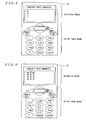
- FIG. 8 shows an example of display on the display means 105 of the communications terminal apparatus 100.
- step 201 the above-mentioned processes are repeated.
- the user presses the key 303 including "E”. Since the key 303 does not indicate a transmit command, the determination in step 202 is NO, thereby passing control to step 203.
- the communications terminal apparatus 100 obtains the key identifier "0010" corresponding to the key 303 according to the key identifier definition information stored in the key identifier definition storage area 1071.
- the communications terminal apparatus 100 appends the obtained key identifier "0010” to the code string K, and stores the code string K (at this time, K is "1000 0010") in the input key identifier storage area 1073 of the data storage means 107 (step 203).
- step 204 the communications terminal apparatus 100 converts the code string K to the code string C.
- the character code corresponding to the key identifier "1000" is stored as the code string C in the data storage means 107. Therefore, it can be easily obtained by referring to the data storage means 107.
- the character corresponding to the key identifier "0010” has three candidates ⁇ D, E, F ⁇ in the normal mode as shown in FIG. 4 .
- character codes D, E, and F are respectively represented by "01000100", “01000101", and "01000110".
- the code string C obtained from the code string K can have 12 candidates ⁇ "01010111 01000100", “01011000 01000100”,”01011001 01000100", “01011010 01000100", “01010111 01000101 ", "01011000 01000101”, “01011001 01000101”, “01011010 01000101”, “01010111 01000110”, “01011000 01000110”, “01011001 01000110”, “01011010 01000110” ⁇ .
- the communications terminal apparatus 100 stores the 12 candidates as the code string C in the data storage means 107.
- step 205 the communications terminal apparatus 100 generates data for display of a character string corresponding to the candidate character code string based on the code string C by the character string presentation function 1051, and displays the data on the display means 105.
- FIG. 9 shows an example of display of the communications terminal apparatus 100 on the display means 105.
- step 201 the above-mentioned processes are repeated.
- step 201 the user presses the key 307 including "S". Since the procedure up to step 205 is the same as that described above, the explanation is omitted, but when the process in step 205 is completed, the code string K is "1000 0010 0110", and the code string C has 48 candidates of ⁇ "01010111 01000100 01010000", "01011000 01000100 01010000", "01011001 01000100 01010000", "01011010 01000100 01010000", "01010111 01000101 01010000", "01011000 01000101 01010000", "01011001 01000101 01010000", "01011010 01000101 01010000", "01010111 01000110 01010000", "01011000 01000110 01010000", "01011000 01000110 01010000", "01011001 01000110 01010000", "01011010 01000110 01010000", "01010111 01000110 01010000", "
- step 201 the user presses the key 315 corresponding to the control command (CONVERT) indicating the delimiter of a word and the language knowledge data. Since the key 315 is not a transmit command, the determination in step 202 is NO, and control is passed to step 203.
- CONVERT control command
- the communications terminal apparatus 100 appends the key identifier "1110" corresponding to the key 315 to the code string K, and stores the code string K (at this time, K is "1000 0010 0110 1110") in the input key identifier storage area 1073 of the data storage means 107 (step 203).
- the communications terminal apparatus 100 converts the code string K to the code string C. Since the trailing 4 bits of the code string K is control command (CONVERT), the ambiguity of the code string C is resolved using the language knowledge data shown in FIG. 6 stored in the language knowledge storage means 102. Although the code string C has 48 candidates for a character string, the communications terminal apparatus 100 determines whether or not each of the candidate character strings matches the entry of the language knowledge data (English word list). If the candidate character string does not match the entry of the language knowledge data, the candidate is deleted from the candidate character strings to mitigate the ambiguity.
- the language knowledge data English word list
- the code string other than the code string "01011001 01000101 01010011" corresponding to "YES” is deleted from the code string C. That is, the code string C is "01011001 01000101 01010011". It is possible that the code string itself is not deleted from the code string C and deletion flag information is added, or selection flag information is added to the candidates.
- the communications terminal apparatus 100 converts the code string C to a character string by the character string presentation function 1051, and displays it on the display means 105.
- FIG. 11 shows an example of display on the display means 105 of the communications terminal apparatus 100. In this example, only "YES" is displayed as a candidate input character, and the user can uniquely obtain a desired character string.
- the candidate character strings are displayed in the registration order of the language knowledge data or in the order of occurrence frequency assigned to language knowledge data. If the first candidate is not a desired character string, the user presses the key 311 in step 201, thereby issuing a (NEXT) command, and selecting a next candidate. The key identifier "0010" corresponding to the (NEXT) is appended to the code string K in step 203. If the next candidate is not a desired character string, the user presses key 311 in step 201, thereby issuing a (NEXT) command.
- step 201 the user presses the key 313 corresponding to (TRANSMIT) to specify the transmission of text data "YES".
- step 202 the determination in step 202 is YES, and control is passed to step 206.
- step 206 the communications terminal apparatus 100 transmits the code string K (at this time, K is "1000 0010 0110 1110") stored in the input key identifier storage area 1073 of the data storage means 107 by the transmission function 1031 of the data communications means 103.
- the flow shown in FIG. 2 terminated.
- the conventional technology transmits character code (in this example, the code string C "01011001 01000101 01010011 ", 24 bits).
- a key identifier in this example, the code string K "1000 0010 0110 1110", 16 bits
- the amount of information of the text data to be transmitted can be reduced, and the transmission efficiency can be enhanced.
- the difference between the character code and the key identifier basically depends on the difference in the amount of information about the code required in representing a character.
- the normally used ASCII requires 8 bits/character.
- the key identifier when the alphabet is input using 15 types of keys can be represented by 4 bits/character. Therefore, the amount of information can be reduced as compared with the conventional technology.
- the number of types of keys can be optionally determined.
- a key identifier in which each key can be represented by a smaller amount of information thereby obtaining advantageous transmission efficiency.
- the number of types of keys are 5 to 8
- 3-bit key identifier is defined
- 4-bit key identifier is defined
- the number of types of keys are 17 to 32
- 5-bit key identifier is defined
- 6-bit key identifier is defined
- the number of types of keys are 65 to 128, 7-bit key identifier is defined.
- the highest transmission efficiency can be obtained. That is, when the number of keys is larger than (n-1)th power of 2, and equal to or less than n-th power of 2 (n is a natural number), the key identifier can be defined to be configured by an amount of information of n bits.
- the key identifier When the number of types of keys is 129 or more, the key identifier of 8 bits or more is required. Therefore, it is not advantageous over the ASCII codes.
- Japanese character code When Japanese text data is to be transmitted, Japanese character code normally requires 16 bits/character as the Shift-JIS code. Therefore, when a key identifier which can be represented by 4-bit/character is used, the difference in transmission efficiency becomes larger, thereby attaining an advantageous function.
- the code string K includes ambiguity of correspondence to character, and it is necessary to use language knowledge data for resolving ambiguity in the communications terminal on the receiving side.
- the transmitter user of the communications terminal apparatus 100
- desired character string can be realized. Therefore, it is necessary to add a key identifier corresponding to a control command such as (CONVERT) to the code string K.
- a key identifier corresponding to a control command such as (CONVERT)
- CONVERT a control command
- the 4-bit key identifier corresponding to the (CONVERT) is added to the code string K, but the total amount of information is smaller than the code string C.
- the communications terminal apparatus 100 generates and transmits a key identifier string which is an array of the key identifier uniquely corresponds to the operated key. Therefore, the key identifier is defined by the smallest amount of information which can represent the number of types of key, thereby generating and transmitting a key identifier of a smaller amount of information. Therefore, the effect of reducing the amount of information when text data is transmitted can be enhanced. Thus, the communications cost can be reduced, and the network resources such as band width, etc. can be efficiently used.
- the compression efficiency of the text data can be improved without forcing the learning of a new input method to a user or without requesting an operation other than text input.
- the flow shown in FIG. 7 can be transformed into a flow including a compressing process as shown in FIG. 12 .
- step 206 shown in FIG. 7 is replaced with steps 1201 and 1202.
- steps 1201 and 1202. Other portions are the same as those shown in FIG. 7 , and the explanation is omitted here.
- step 1201 the communications terminal apparatus 100 converts the code string K configured by a key identifier to a code string K' having a smaller number of codes.
- a conventional text data compression algorithm is described as software and stored it in advance in the data storage means 107 shown in FIG. 1 , and the CPU 104 can perform an arithmetic operation based on the software.
- a conventional text data compression algorithm for example, the algorithm described in the Reference 1.
- the communications terminal apparatus 100 transmits the code string K' by the transmission function 1031 of the data communications means 103.
- the code string K' can include flag information about the compressing process performed to decrease the number of codes by the specific text data compressing algorithm.
- not only the amount of information about the code indicating a character can be reduced by using a key identifier, but also the number of codes can be reduced, thereby largely improving the text data transmission cost.
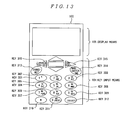
- FIG. 13 shows a variation of the appearance of the communications terminal apparatus 100.
- text in not only English but also Japanese and a combination of English and Japanese can be transmitted with the keys and characters extended correspondingly.
- the key 302 indicates not only English ⁇ A, B, C ⁇ but also Japanese characters of ⁇ KA, KI, KU, KE, KO ⁇ .
- FIG. 14 shows an example of the correspondence among the key, the key identifier, and the character in the key array in FIG. 13 .
- Japanese specific pronunciation is generated by the (CONVERT) command, but a switching control command to generate Japanese specific pronunciation can be specifically defined.
- Katakana and Kanji can be generated by storing language knowledge data in advance and using (CONVERT) command after inputting Hiragana.
- the conversion from Hiragana to Katakana and Kanji can be easily realized using the conventional Kana-Kanji conversion method, for example, the method described in JP54-139356A and JP58-144246A .
- the key 316 corresponds to (JAPANESE/ENGLISH) is a control command for switching input mode between Japanese and English.
- the input mode of the communications terminal apparatus 100 is normally a Japanese input mode.
- the (JAPANESE/ENGLISH) command is issued, the input mode is changed.
- the key identifier corresponding to the (JAPANESE/ENGLISH) command is "1111"
- the key identifier "1111” is appended to the code string K.
- the communications terminal apparatus 100 converts the code string K to the code string C.
- the communications terminal apparatus 100 analyzes the code string K from the leading key identifier to the trailer, and determines the character code corresponding to each key identifier.
- the character to be determined depends on the occurrence of the key identifier "1111" toward the header from the key identifier. If there is no "1111" toward the header from the key identifier to be determined, the candidate character string corresponding to the key identifier cannot obtained from the row of English shown in FIG. 14 (this is referred to as a "masked" status of the English row).
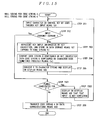
- FIG. 15 is a flow of an example of the flow of the process from the generation of text data to the transmission in the variation 3.
- a variation is explained but the overlapping portion with the explanation of FIG. 7 is omitted.
- step 202 when the user presses the key 313 corresponding to (TRANSMIT) to specify transmission in step 201, the determination in step 202 is YES, and control is passed to step 1501.
- step 1501 the communications terminal apparatus 100 analyzes the code string C stored in the data storage means 107, determines YES when the code string C is configured by a plurality of candidate character strings, and control is passed to step 1502. Otherwise, it is determined NO, and control is passed to step 206.
- Configuring the code string C with a plurality of candidate character string indicates that the input of a character string has not been finished. That is, in step 201, the user pressed the key 313, but it was mistake. Therefore, in step 1502, the communications terminal apparatus 100 displays a message on the display means 105 to notify the user of it, and control is returned to step 201. In this case, it is invalid that the key 313 has been pressed. That is, the code string K is not transmitted, and the code string K and the code string C are in the state before the press of the key 313. The user continues input of a character string in step 201.
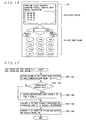
- FIG. 16 shows an example of displaying a message in step 1502.
- the user refers to the message, and determines one candidate by operating a key corresponding to the control command such as (CONVERT), (NEXT), (SELECT), etc by the key input means 101.
- the communications terminal apparatus 100 issues a control command corresponding to an input key in response to the key operation of a user, and determines one candidate by the character string determination function 1011. Thus, one candidate character string can be determined to be displayed on the display means 105.
- step 1501 when the code string C is a null string, the determination YES can be made. With the determination, a null key identifier string which can be issued as a result of wrong input of pressing the key 313 before pressing the key corresponding to a character can be avoided.
- the code string K can be transmitted (it is determined NO in step 1501).
- the communications terminal apparatus 100 shown in FIG. 1 can be an apparatus for receiving a key identifier string.
- FIG. 17 shows a flow of the process performed when the communications terminal apparatus 100 receives a key identifier string, and displays a character string corresponding to the key identifier string.
- the initial status of the code string K and C are null string.
- the code string K is a row of key identifiers
- the code string C is a common character codes (for example, ASCII) indicating variables.
- step 1701 the communications terminal apparatus 100 receives a key identifier string configured by key identifiers by the reception function 1032 of the data communications means 103. Furthermore, the communications terminal apparatus 100 assigns the received key identifier string to the code string K, and stores it in the 1073 of the data storage means 107.
- step 1702 the communications terminal apparatus 100 determines whether or not a compressing process (for example, in the method of the Reference 1) of decreasing the number of codes has been performed on the code string K. This determination can be made by checking whether or not the flag information indicating the compressing process for decreasing the number of codes is performed by the specific text data algorithm is contained in the code string K. If the determination is YES, control is passed to step 1703. If NO, control is passed to step 1704.
- a compressing process for example, in the method of the Reference 1
- step 1703 the communications terminal apparatus 100 expands the code string K in the expanding method corresponding to the text data compression algorithm, and the result is stored as the code string K in the data storage means 107.
- step 1704 the communications terminal apparatus 100 analyzes the code string K from the leading symbol by the character code string discrimination means 108, and converts into the code string C.
- the control command such as (CONVERT), etc.
- a correct data is selected from among a plurality of candidates for characters.
- the language knowledge data is the same as the data used in the communications terminal apparatus 100 on the transmission side.
- the candidate character string is selected by the command (NEXT)
- the same process can be regenerated as in the apparatus in the transmission side, enabling the character string intended by the apparatus in the transmission side to be correctly reproduced.
- the code string C obtained in step 1704 is stored in the 107.
- step 1705 by the character string presentation function 1051, the communications terminal apparatus 100 replaces the character code forming the character code string C with the corresponding character (font) and the result is displayed on the 105.
- the process in step 1705 is completed, the process in FIG. 17 terminates.
- steps 1702 and 1703 shown in FIG. 17 are omitted, and the processes from steps 1701 to 1704 can be performed.
- the key input means 101 shown in FIG. 1 can be simplified not to include a key to input characters.
- the communications terminal apparatus 100 cannot generate a character string, but it can be used as a simple communications terminal capable of receiving data only.
- the present invention is available in an industrial field in which a character can be efficiently input with a smaller number of keys with the effect of reducing the amount of information when text data is transmitted, and efficient data transmission is requested using a communications terminal apparatus such as a mobile terminal, etc. having a relatively smaller number of input keys.
Landscapes
- Engineering & Computer Science (AREA)
- Theoretical Computer Science (AREA)
- General Engineering & Computer Science (AREA)
- Human Computer Interaction (AREA)
- Computer Networks & Wireless Communication (AREA)
- Business, Economics & Management (AREA)
- General Business, Economics & Management (AREA)
- Physics & Mathematics (AREA)
- Signal Processing (AREA)
- General Physics & Mathematics (AREA)
- Telephonic Communication Services (AREA)
- Input From Keyboards Or The Like (AREA)
- Calculators And Similar Devices (AREA)
- Telephone Function (AREA)
- Information Transfer Between Computers (AREA)
- Facsimile Transmission Control (AREA)
- Circuits Of Receivers In General (AREA)
- Mobile Radio Communication Systems (AREA)
Claims (8)
- Kommunikationsendgerät (100), das umfasst:mehrere Tasten (301...316);Tastenidentifiziererdefinitions-Speichermittel (1071), um einen Tastenidentifizierer, der jeder der mehreren Tasten (301...316) eindeutig entspricht, zu speichern;Eingabetastenidentifizierer-Speichermittel (1073), um einen einer Taste (301...316) entsprechenden Tastenidentifizierer, der durch die Tastenidentifiziererdefinitions-Speichermittel (1071) erhalten wird, als eine Tastenidentifizierer-Kette (K) hinzuzufügen und zu speichern, wenn wenigstens eine der mehreren Tasten (301...316) betätigt wird;Übertragungsmittel, um eine in den Eingabetastenidentifizierer-Speichermitteln (1073) gespeicherte Tastenidentifizierer-Kette (K) zu übertragen, wenn ein Übertragungsbefehl erfasst wird,gekennzeichnet durchZeichencodedefinitions-Speichermittel (1072), um wenigstens einen Zeichencode, der jeder der mehreren Tasten (301...316) entspricht, zu speichern;Zeichenketten-Darstellungsmittel, um eine Kandidaten-Zeichenkette, die durch eine Zeichencode-Kette (C) dargestellt wird, die einer in den Eingabetastenidentifizierer-Speichermitteln (1073) gespeicherten Tastenidentifizierer-Kette (K) entspricht, und die anhand eines in den Zeichencodedefinitions-Speichermitteln (1072) gespeicherten Zeichencodes unterschieden wird, darzustellen;Sprachwissen-Speichermittel (102), um Sprachwissensdaten für die Analyse einer Zeichenkette zu speichern, wobeidie Zeichenketten-Darstellungsmittel ferner dazu ausgelegt sind, anhand von in den Sprachwissen-Speichermitteln (102) gespeicherten Sprachwissensdaten eine Kandidaten-Zeichenkette, die anhand eines in den Zeichencodedefinitions-Speichermitteln (1072) gespeicherten Zeichencodes unterschieden wird, zu analysieren, und dazu ausgelegt ist, eine entsprechende Zeichenkette als einen Kandidaten darzustellen;Empfangsmittel, um eine Tastenidentifizierer-Kette (K) zu empfangen; undZeichencodeketten-Unterscheidungsmittel (108), um eine Zeichencode-kette (C), die der Tastenidentifizierer-Kette (K) entspricht, anhand der durch die Empfangsmittel empfangenen Tastenidentifizierer-Kette (K) zu unterscheiden.
- Gerät nach Anspruch 1, die ferner umfasst:Zeichenketten-Bestimmungsmittel, um eine Kandidaten-Zeichenkette, die durch die Zeichenketten-Darstellungsmittel dargestellt werden soll, zu bestimmen, wobeidie Übertragungsmittel dazu ausgelegt sind, eine Tastenidentifizierer-Kette (K), die in den Eingabetastenidentifizierer-Speichermitteln (1073) gespeichert ist, nur dann zu übertragen, wenn eine durch die Zeichenketten-Darstellungsmittel darzustellende Kandidaten-Zeichenkette vorhanden ist.
- Gerät nach Anspruch 1 oder 2, wobei
die Übertragungsmittel dazu ausgelegt sind, eine in den Eingabetastenidentifizierer-Speichermitteln (1073) gespeicherte Tastenidentifizierer-Kette (K) nach dem Komprimieren der Tastenidentifizierer-Kette (K) zu übertragen. - Gerät nach einem der Ansprüche 1 bis 3, wobei
die mehreren Tasten (301...316) eine Taste für die Auswahl des Sprachtyps umfassen. - Gerät nach einem der Ansprüche 1 bis 4, wobei
dann, wenn der Tastenidentifizierer durch eine Informationsmenge aus n Bits konfiguriert ist, wobei n eine natürliche Zahl ist, die Anzahl der mehreren Tasten (301...316) größer als die (n-1)-te Zweierpotenz ist, und gleich oder kleiner als die n-te Zweierpotenz ist. - Gerät nach einem der Ansprüche 1 bis 5, wobei die Tastenidentifizierer-Kette (K) von einer externen Vorrichtung empfangen wird.
- Vorrichtung nach einem der Ansprüche 1 bis 5, wobei die Tastenidentifizierer-Kette (K) von einem weiteren Kommunikationsgerät empfangen wird.
- Computerprogrammprodukt, das Befehle enthält, die dann, wenn sie in einem Computer ausgeführt werden, die folgenden Schritte ausführen:einen Tastenidentifiziererketten-Entscheidungsschritt zum Entscheiden, ob dann, wenn ein Betätigungssignal für eine Taste (301...316) erfasst wird, ein der Taste entsprechender Tastenidentifizierer einen Übertragungsbefehl darstellt;einen Codeketten-Speicherschritt zum Hinzufügen und Speichern des Tastenidentifizierers als eine Tastenidentifizierer-Kette (K) in einem Tastenidentifizierer-Speicherbereich (1073), wenn in dem Tastenidentifiziererketten-Entscheidungsschritt entschieden wird, dass der Tastenidentifizierer keinen Übertragungsbefehl darstellt; undeinen Übertragungsschritt zum Übertragen der Tastenidentifizierer-Kette (K), die in dem Tastenidentifizierer-Speicherbereich (1073) gespeichert ist, wenn in dem Tastenidentifiziererketten-Entscheidungsschritt entschieden wird, dass der Tastenidentifizierer einen Übertragungsbefehl darstellt;einen Zeichencodedefinitions-Speicherschritt zum Speichern wenigstens eines Zeichencodes, der jeder der mehreren Tasten (301...316) entspricht;einen Zeichenketten-Darstellungsschritt zum Darstellen einer Kandidaten-Zeichenkette, die durch eine Zeichencode-Kette (C) darstellt wird, die einer in dem Tastenidentifizierer-Speicherbereich (1073) gespeicherten Tastenidentifizierer-Kette (K) entspricht und die anhand eines in dem Zeichencodedefinitions-Speicherschritt gespeicherten Zeichencodes unterschieden wird; undeinen Sprachwissen-Speicherschritt zum Speichern von Sprachwissensdaten für die Analyse einer Zeichenkette, wobeider Zeichenketten-Darstellungsschritt ferner anhand von in dem Sprachwissen-Speicherschritt gespeicherten Sprachwissensdaten eine Kandidaten-Zeichenkette analysiert, die anhand eines in dem Zeichencodedefinitions-Speicherschritt gespeicherten Zeichencodes unterschieden wird, und eine entsprechende Zeichenkette als einen Kandidaten darstellt,einen Empfangsschritt zum Empfangen der Tastenidentifizierer-Kette (K); undeinen Zeichencodeketten-Unterscheidungsschritt, um eine Zeichencode-Kette (C) zu unterscheiden, die der in dem Empfangsschritt empfangenen Tastenidentifizierer-Kette (K) entspricht.
Applications Claiming Priority (2)
| Application Number | Priority Date | Filing Date | Title |
|---|---|---|---|
| JP2004014599 | 2004-01-22 | ||
| JP2004014599A JP4263627B2 (ja) | 2004-01-22 | 2004-01-22 | 通信端末装置、受信装置、及び、プログラム |
Publications (2)
| Publication Number | Publication Date |
|---|---|
| EP1558010A1 EP1558010A1 (de) | 2005-07-27 |
| EP1558010B1 true EP1558010B1 (de) | 2009-07-08 |
Family
ID=34631932
Family Applications (1)
| Application Number | Title | Priority Date | Filing Date |
|---|---|---|---|
| EP05000361A Expired - Lifetime EP1558010B1 (de) | 2004-01-22 | 2005-01-11 | Kommunikationsendgerät mit Tastenkennungsübertragung und dazugehöriges Programm |
Country Status (8)
| Country | Link |
|---|---|
| US (1) | US7567236B2 (de) |
| EP (1) | EP1558010B1 (de) |
| JP (1) | JP4263627B2 (de) |
| CN (1) | CN1322401C (de) |
| AT (1) | ATE436148T1 (de) |
| DE (1) | DE602005015266D1 (de) |
| ES (1) | ES2327127T3 (de) |
| TW (1) | TWI260531B (de) |
Families Citing this family (7)
| Publication number | Priority date | Publication date | Assignee | Title |
|---|---|---|---|---|
| JP2007011837A (ja) * | 2005-07-01 | 2007-01-18 | Nec Corp | 電子機器、認証情報入力方法及び認証情報入力プログラム |
| US8059801B2 (en) | 2006-01-20 | 2011-11-15 | Preferred Voice, Inc. | Telephone communications system, a method of delivering content to a calling party and a method of distributing information to a calling party |
| KR100803006B1 (ko) * | 2006-09-20 | 2008-02-14 | 삼성전자주식회사 | 휴대단말기의 동적 입력방법 및 장치 |
| EP2132727A4 (de) * | 2007-03-21 | 2012-12-12 | Tegic Communications Inc | Mit variierenden sprachen assoziierte auswechselbare eingabemodule |
| JP5262395B2 (ja) * | 2008-07-25 | 2013-08-14 | 富士通株式会社 | 電子メール送受信装置及び電子メール送受信方法 |
| US8730188B2 (en) * | 2010-12-23 | 2014-05-20 | Blackberry Limited | Gesture input on a portable electronic device and method of controlling the same |
| KR102039553B1 (ko) * | 2012-08-31 | 2019-11-01 | 삼성전자 주식회사 | 사용자 디바이스에서 입력 문자를 이용한 지능형 서비스 제공 방법 및 장치 |
Family Cites Families (8)
| Publication number | Priority date | Publication date | Assignee | Title |
|---|---|---|---|---|
| JPS584378B2 (ja) | 1978-04-21 | 1983-01-26 | 株式会社東芝 | カナ漢字変換装置 |
| US5200988A (en) * | 1991-03-11 | 1993-04-06 | Fon-Ex, Inc. | Method and means for telecommunications by deaf persons utilizing a small hand held communications device |
| US5818437A (en) * | 1995-07-26 | 1998-10-06 | Tegic Communications, Inc. | Reduced keyboard disambiguating computer |
| US5703581A (en) * | 1996-06-14 | 1997-12-30 | Lucent Technologies Inc. | Method and apparatus for data compression and decompression |
| JP3532780B2 (ja) | 1998-01-22 | 2004-05-31 | テジック・コミュニケーションズ・インコーポレーテッド | 音声仮名文字の入力順序を生成するための入力システム |
| CN1259792C (zh) * | 1999-05-21 | 2006-06-14 | 株式会社帝慈汀·美仁美 | 一种服务提供系统和方法及其中使用的移动终端 |
| US6172625B1 (en) | 1999-07-06 | 2001-01-09 | Motorola, Inc. | Disambiguation method and apparatus, and dictionary data compression techniques |
| JP3722359B2 (ja) * | 2001-06-29 | 2005-11-30 | Esmertecエンジニアリングサービス株式会社 | 文字入力システム及び通信端末 |
-
2004
- 2004-01-22 JP JP2004014599A patent/JP4263627B2/ja not_active Expired - Fee Related
- 2004-12-24 TW TW093140632A patent/TWI260531B/zh not_active IP Right Cessation
- 2004-12-29 US US11/023,456 patent/US7567236B2/en not_active Expired - Fee Related
-
2005
- 2005-01-11 EP EP05000361A patent/EP1558010B1/de not_active Expired - Lifetime
- 2005-01-11 AT AT05000361T patent/ATE436148T1/de not_active IP Right Cessation
- 2005-01-11 ES ES05000361T patent/ES2327127T3/es not_active Expired - Lifetime
- 2005-01-11 DE DE602005015266T patent/DE602005015266D1/de not_active Expired - Lifetime
- 2005-01-21 CN CNB2005100056173A patent/CN1322401C/zh not_active Expired - Fee Related
Also Published As
| Publication number | Publication date |
|---|---|
| ATE436148T1 (de) | 2009-07-15 |
| CN1322401C (zh) | 2007-06-20 |
| CN1645300A (zh) | 2005-07-27 |
| JP4263627B2 (ja) | 2009-05-13 |
| US7567236B2 (en) | 2009-07-28 |
| TW200527266A (en) | 2005-08-16 |
| JP2005208926A (ja) | 2005-08-04 |
| ES2327127T3 (es) | 2009-10-26 |
| EP1558010A1 (de) | 2005-07-27 |
| US20050165973A1 (en) | 2005-07-28 |
| DE602005015266D1 (de) | 2009-08-20 |
| TWI260531B (en) | 2006-08-21 |
Similar Documents
| Publication | Publication Date | Title |
|---|---|---|
| US8791905B2 (en) | Handheld electronic device and method for dual-mode disambiguation of text input | |
| US6822585B1 (en) | Input of symbols | |
| US5793381A (en) | Unicode converter | |
| US5682158A (en) | Code converter with truncation processing | |
| US20020126097A1 (en) | Alphanumeric data entry method and apparatus using reduced keyboard and context related dictionaries | |
| EP0989499A2 (de) | Konversion von Unicode-Zeichen in mehrere Kodierungen | |
| US8441449B2 (en) | Handheld electronic device providing a learning function to facilitate correction of erroneous text entry, and associated method | |
| JP2006510989A (ja) | 移動通信端末の予測テキスト入力及びデータ圧縮方法 | |
| US8532680B2 (en) | Apparatus and method for compressing and restoring SMS message | |
| US7567236B2 (en) | Communications terminal apparatus, reception apparatus, and method therefor | |
| JP2003015806A (ja) | 文字入力システム及び通信端末 | |
| WO2007115393A1 (en) | Handheld electronic device providing proposed corrected input in response to erroneous text entry in environment of text requiring multiple sequential actuations of the same key, and associated method | |
| KR100362589B1 (ko) | 이동전화 단말기에서의 초성 자음을 이용한 문자정보서비스 검색방법 | |
| CN111045530B (zh) | 嵌入式条码识读设备模拟多国语言键盘输出的方法及设备 | |
| CN100388827C (zh) | 编码方法 | |
| US20040127236A1 (en) | Method and apparatus for text entry for electronic messaging | |
| JP4602180B2 (ja) | 通信端末装置及び通信プログラム | |
| KR101324765B1 (ko) | 모바일 기기의 중간 내부 치환을 이용한 문자 입출력 방법. | |
| CN107643915A (zh) | 一种智能终端的界面切换方法及界面切换系统 | |
| KR20060068472A (ko) | 이동단말기에서 영문자를 입력하기 위한 방법 및 그 단말기 | |
| KR100716610B1 (ko) | 이동통신단말기를 위한 예측 텍스트 엔트리 및 데이터압축방법 | |
| HK1036547B (en) | Encoding method | |
| EP1843241B1 (de) | Tragbare elektronische Vorrichtung zur Bereitstellung einer vorgeschlagenen korrigierten Eingabe als Antwort auf eine fehlerhafte Texteingabe | |
| JP5261133B2 (ja) | 辞書検索機能付き文字列変換装置 | |
| EP1956467A1 (de) | Tragbare elektronische Vorrichtung und entsprechendes Verfahren zum Erhalten neuer Sprachobjekte für eine Disambiguisierungsroutine in der Vorrichtung |
Legal Events
| Date | Code | Title | Description |
|---|---|---|---|
| PUAI | Public reference made under article 153(3) epc to a published international application that has entered the european phase |
Free format text: ORIGINAL CODE: 0009012 |
|
| AK | Designated contracting states |
Kind code of ref document: A1 Designated state(s): AT BE BG CH CY CZ DE DK EE ES FI FR GB GR HU IE IS IT LI LT LU MC NL PL PT RO SE SI SK TR |
|
| AX | Request for extension of the european patent |
Extension state: AL BA HR LV MK YU |
|
| 17P | Request for examination filed |
Effective date: 20051214 |
|
| AKX | Designation fees paid |
Designated state(s): AT BE BG CH CY CZ DE DK EE ES FI FR GB GR HU IE IS IT LI LT LU MC NL PL PT RO SE SI SK TR |
|
| 17Q | First examination report despatched |
Effective date: 20060201 |
|
| GRAP | Despatch of communication of intention to grant a patent |
Free format text: ORIGINAL CODE: EPIDOSNIGR1 |
|
| RTI1 | Title (correction) |
Free format text: COMMUNICATIONS TERMINAL APPARATUS WITH KEY IDENTIFIER TRANSMISSION AND PROGRAM THEREFOR |
|
| GRAS | Grant fee paid |
Free format text: ORIGINAL CODE: EPIDOSNIGR3 |
|
| GRAA | (expected) grant |
Free format text: ORIGINAL CODE: 0009210 |
|
| AK | Designated contracting states |
Kind code of ref document: B1 Designated state(s): AT BE BG CH CY CZ DE DK EE ES FI FR GB GR HU IE IS IT LI LT LU MC NL PL PT RO SE SI SK TR |
|
| REG | Reference to a national code |
Ref country code: GB Ref legal event code: FG4D |
|
| REG | Reference to a national code |
Ref country code: CH Ref legal event code: EP |
|
| REG | Reference to a national code |
Ref country code: IE Ref legal event code: FG4D |
|
| REF | Corresponds to: |
Ref document number: 602005015266 Country of ref document: DE Date of ref document: 20090820 Kind code of ref document: P |
|
| REG | Reference to a national code |
Ref country code: ES Ref legal event code: FG2A Ref document number: 2327127 Country of ref document: ES Kind code of ref document: T3 |
|
| REG | Reference to a national code |
Ref country code: SE Ref legal event code: TRGR |
|
| PG25 | Lapsed in a contracting state [announced via postgrant information from national office to epo] |
Ref country code: SI Free format text: LAPSE BECAUSE OF FAILURE TO SUBMIT A TRANSLATION OF THE DESCRIPTION OR TO PAY THE FEE WITHIN THE PRESCRIBED TIME-LIMIT Effective date: 20090708 |
|
| NLV1 | Nl: lapsed or annulled due to failure to fulfill the requirements of art. 29p and 29m of the patents act | ||
| PG25 | Lapsed in a contracting state [announced via postgrant information from national office to epo] |
Ref country code: LT Free format text: LAPSE BECAUSE OF FAILURE TO SUBMIT A TRANSLATION OF THE DESCRIPTION OR TO PAY THE FEE WITHIN THE PRESCRIBED TIME-LIMIT Effective date: 20090708 Ref country code: IS Free format text: LAPSE BECAUSE OF FAILURE TO SUBMIT A TRANSLATION OF THE DESCRIPTION OR TO PAY THE FEE WITHIN THE PRESCRIBED TIME-LIMIT Effective date: 20091108 Ref country code: AT Free format text: LAPSE BECAUSE OF FAILURE TO SUBMIT A TRANSLATION OF THE DESCRIPTION OR TO PAY THE FEE WITHIN THE PRESCRIBED TIME-LIMIT Effective date: 20090708 |
|
| PG25 | Lapsed in a contracting state [announced via postgrant information from national office to epo] |
Ref country code: PL Free format text: LAPSE BECAUSE OF FAILURE TO SUBMIT A TRANSLATION OF THE DESCRIPTION OR TO PAY THE FEE WITHIN THE PRESCRIBED TIME-LIMIT Effective date: 20090708 Ref country code: NL Free format text: LAPSE BECAUSE OF FAILURE TO SUBMIT A TRANSLATION OF THE DESCRIPTION OR TO PAY THE FEE WITHIN THE PRESCRIBED TIME-LIMIT Effective date: 20090708 |
|
| PG25 | Lapsed in a contracting state [announced via postgrant information from national office to epo] |
Ref country code: PT Free format text: LAPSE BECAUSE OF FAILURE TO SUBMIT A TRANSLATION OF THE DESCRIPTION OR TO PAY THE FEE WITHIN THE PRESCRIBED TIME-LIMIT Effective date: 20091109 Ref country code: BG Free format text: LAPSE BECAUSE OF FAILURE TO SUBMIT A TRANSLATION OF THE DESCRIPTION OR TO PAY THE FEE WITHIN THE PRESCRIBED TIME-LIMIT Effective date: 20091008 |
|
| PG25 | Lapsed in a contracting state [announced via postgrant information from national office to epo] |
Ref country code: RO Free format text: LAPSE BECAUSE OF FAILURE TO SUBMIT A TRANSLATION OF THE DESCRIPTION OR TO PAY THE FEE WITHIN THE PRESCRIBED TIME-LIMIT Effective date: 20090708 Ref country code: DK Free format text: LAPSE BECAUSE OF FAILURE TO SUBMIT A TRANSLATION OF THE DESCRIPTION OR TO PAY THE FEE WITHIN THE PRESCRIBED TIME-LIMIT Effective date: 20090708 Ref country code: CZ Free format text: LAPSE BECAUSE OF FAILURE TO SUBMIT A TRANSLATION OF THE DESCRIPTION OR TO PAY THE FEE WITHIN THE PRESCRIBED TIME-LIMIT Effective date: 20090708 Ref country code: EE Free format text: LAPSE BECAUSE OF FAILURE TO SUBMIT A TRANSLATION OF THE DESCRIPTION OR TO PAY THE FEE WITHIN THE PRESCRIBED TIME-LIMIT Effective date: 20090708 |
|
| PLBE | No opposition filed within time limit |
Free format text: ORIGINAL CODE: 0009261 |
|
| STAA | Information on the status of an ep patent application or granted ep patent |
Free format text: STATUS: NO OPPOSITION FILED WITHIN TIME LIMIT |
|
| PG25 | Lapsed in a contracting state [announced via postgrant information from national office to epo] |
Ref country code: BE Free format text: LAPSE BECAUSE OF FAILURE TO SUBMIT A TRANSLATION OF THE DESCRIPTION OR TO PAY THE FEE WITHIN THE PRESCRIBED TIME-LIMIT Effective date: 20090708 Ref country code: SK Free format text: LAPSE BECAUSE OF FAILURE TO SUBMIT A TRANSLATION OF THE DESCRIPTION OR TO PAY THE FEE WITHIN THE PRESCRIBED TIME-LIMIT Effective date: 20090708 |
|
| 26N | No opposition filed |
Effective date: 20100409 |
|
| PG25 | Lapsed in a contracting state [announced via postgrant information from national office to epo] |
Ref country code: MC Free format text: LAPSE BECAUSE OF NON-PAYMENT OF DUE FEES Effective date: 20100131 |
|
| REG | Reference to a national code |
Ref country code: CH Ref legal event code: PL |
|
| PG25 | Lapsed in a contracting state [announced via postgrant information from national office to epo] |
Ref country code: LI Free format text: LAPSE BECAUSE OF NON-PAYMENT OF DUE FEES Effective date: 20100131 Ref country code: CH Free format text: LAPSE BECAUSE OF NON-PAYMENT OF DUE FEES Effective date: 20100131 Ref country code: GR Free format text: LAPSE BECAUSE OF FAILURE TO SUBMIT A TRANSLATION OF THE DESCRIPTION OR TO PAY THE FEE WITHIN THE PRESCRIBED TIME-LIMIT Effective date: 20091009 |
|
| PG25 | Lapsed in a contracting state [announced via postgrant information from national office to epo] |
Ref country code: IE Free format text: LAPSE BECAUSE OF NON-PAYMENT OF DUE FEES Effective date: 20100111 |
|
| PG25 | Lapsed in a contracting state [announced via postgrant information from national office to epo] |
Ref country code: CY Free format text: LAPSE BECAUSE OF FAILURE TO SUBMIT A TRANSLATION OF THE DESCRIPTION OR TO PAY THE FEE WITHIN THE PRESCRIBED TIME-LIMIT Effective date: 20090708 |
|
| PG25 | Lapsed in a contracting state [announced via postgrant information from national office to epo] |
Ref country code: HU Free format text: LAPSE BECAUSE OF FAILURE TO SUBMIT A TRANSLATION OF THE DESCRIPTION OR TO PAY THE FEE WITHIN THE PRESCRIBED TIME-LIMIT Effective date: 20100109 Ref country code: LU Free format text: LAPSE BECAUSE OF NON-PAYMENT OF DUE FEES Effective date: 20100111 |
|
| PG25 | Lapsed in a contracting state [announced via postgrant information from national office to epo] |
Ref country code: TR Free format text: LAPSE BECAUSE OF FAILURE TO SUBMIT A TRANSLATION OF THE DESCRIPTION OR TO PAY THE FEE WITHIN THE PRESCRIBED TIME-LIMIT Effective date: 20090708 |
|
| PGFP | Annual fee paid to national office [announced via postgrant information from national office to epo] |
Ref country code: ES Payment date: 20131211 Year of fee payment: 10 |
|
| PGFP | Annual fee paid to national office [announced via postgrant information from national office to epo] |
Ref country code: SE Payment date: 20140113 Year of fee payment: 10 Ref country code: DE Payment date: 20140108 Year of fee payment: 10 Ref country code: FI Payment date: 20140110 Year of fee payment: 10 |
|
| PGFP | Annual fee paid to national office [announced via postgrant information from national office to epo] |
Ref country code: FR Payment date: 20140108 Year of fee payment: 10 Ref country code: IT Payment date: 20140109 Year of fee payment: 10 |
|
| PGFP | Annual fee paid to national office [announced via postgrant information from national office to epo] |
Ref country code: GB Payment date: 20140108 Year of fee payment: 10 |
|
| REG | Reference to a national code |
Ref country code: DE Ref legal event code: R119 Ref document number: 602005015266 Country of ref document: DE |
|
| REG | Reference to a national code |
Ref country code: SE Ref legal event code: EUG |
|
| GBPC | Gb: european patent ceased through non-payment of renewal fee |
Effective date: 20150111 |
|
| PG25 | Lapsed in a contracting state [announced via postgrant information from national office to epo] |
Ref country code: DE Free format text: LAPSE BECAUSE OF NON-PAYMENT OF DUE FEES Effective date: 20150801 Ref country code: FI Free format text: LAPSE BECAUSE OF NON-PAYMENT OF DUE FEES Effective date: 20150111 Ref country code: GB Free format text: LAPSE BECAUSE OF NON-PAYMENT OF DUE FEES Effective date: 20150111 |
|
| REG | Reference to a national code |
Ref country code: FR Ref legal event code: ST Effective date: 20150930 |
|
| PG25 | Lapsed in a contracting state [announced via postgrant information from national office to epo] |
Ref country code: SE Free format text: LAPSE BECAUSE OF NON-PAYMENT OF DUE FEES Effective date: 20150112 Ref country code: FR Free format text: LAPSE BECAUSE OF NON-PAYMENT OF DUE FEES Effective date: 20150202 |
|
| PG25 | Lapsed in a contracting state [announced via postgrant information from national office to epo] |
Ref country code: IT Free format text: LAPSE BECAUSE OF NON-PAYMENT OF DUE FEES Effective date: 20150111 |
|
| REG | Reference to a national code |
Ref country code: ES Ref legal event code: FD2A Effective date: 20160226 |
|
| PG25 | Lapsed in a contracting state [announced via postgrant information from national office to epo] |
Ref country code: ES Free format text: LAPSE BECAUSE OF NON-PAYMENT OF DUE FEES Effective date: 20150112 |