EP1556874B1 - Unterbrecherschalter - Google Patents
Unterbrecherschalter Download PDFInfo
- Publication number
- EP1556874B1 EP1556874B1 EP03769653A EP03769653A EP1556874B1 EP 1556874 B1 EP1556874 B1 EP 1556874B1 EP 03769653 A EP03769653 A EP 03769653A EP 03769653 A EP03769653 A EP 03769653A EP 1556874 B1 EP1556874 B1 EP 1556874B1
- Authority
- EP
- European Patent Office
- Prior art keywords
- circuit breaker
- shield
- arc
- electrodes
- circuit
- Prior art date
- Legal status (The legal status is an assumption and is not a legal conclusion. Google has not performed a legal analysis and makes no representation as to the accuracy of the status listed.)
- Expired - Lifetime
Links
- 239000000463 material Substances 0.000 claims abstract description 13
- 230000007246 mechanism Effects 0.000 claims abstract description 7
- 239000007789 gas Substances 0.000 claims description 60
- 238000002679 ablation Methods 0.000 claims description 20
- CURLTUGMZLYLDI-UHFFFAOYSA-N Carbon dioxide Chemical compound O=C=O CURLTUGMZLYLDI-UHFFFAOYSA-N 0.000 claims description 9
- 229920001343 polytetrafluoroethylene Polymers 0.000 claims description 8
- 239000004810 polytetrafluoroethylene Substances 0.000 claims description 8
- 229910002092 carbon dioxide Inorganic materials 0.000 claims description 6
- IJGRMHOSHXDMSA-UHFFFAOYSA-N Atomic nitrogen Chemical compound N#N IJGRMHOSHXDMSA-UHFFFAOYSA-N 0.000 claims description 5
- XKRFYHLGVUSROY-UHFFFAOYSA-N Argon Chemical compound [Ar] XKRFYHLGVUSROY-UHFFFAOYSA-N 0.000 claims description 4
- 238000000034 method Methods 0.000 claims description 4
- 230000008569 process Effects 0.000 claims description 4
- 239000001569 carbon dioxide Substances 0.000 claims description 3
- 239000003570 air Substances 0.000 claims description 2
- 229910052786 argon Inorganic materials 0.000 claims description 2
- 229910052757 nitrogen Inorganic materials 0.000 claims description 2
- 230000009471 action Effects 0.000 abstract description 3
- 238000010891 electric arc Methods 0.000 abstract 1
- SFZCNBIFKDRMGX-UHFFFAOYSA-N sulfur hexafluoride Chemical compound FS(F)(F)(F)(F)F SFZCNBIFKDRMGX-UHFFFAOYSA-N 0.000 description 16
- 230000008033 biological extinction Effects 0.000 description 13
- 230000000694 effects Effects 0.000 description 7
- 238000012360 testing method Methods 0.000 description 5
- 238000002474 experimental method Methods 0.000 description 4
- 238000010304 firing Methods 0.000 description 4
- 229960000909 sulfur hexafluoride Drugs 0.000 description 4
- 239000000872 buffer Substances 0.000 description 3
- 150000002222 fluorine compounds Chemical class 0.000 description 3
- 238000011084 recovery Methods 0.000 description 3
- 230000002829 reductive effect Effects 0.000 description 3
- 239000013626 chemical specie Substances 0.000 description 2
- 230000003628 erosive effect Effects 0.000 description 2
- 239000000835 fiber Substances 0.000 description 2
- 235000019000 fluorine Nutrition 0.000 description 2
- 239000000203 mixture Substances 0.000 description 2
- 230000003389 potentiating effect Effects 0.000 description 2
- 238000011160 research Methods 0.000 description 2
- 230000002441 reversible effect Effects 0.000 description 2
- 230000003068 static effect Effects 0.000 description 2
- 239000000126 substance Substances 0.000 description 2
- TXEYQDLBPFQVAA-UHFFFAOYSA-N tetrafluoromethane Chemical compound FC(F)(F)F TXEYQDLBPFQVAA-UHFFFAOYSA-N 0.000 description 2
- PXGOKWXKJXAPGV-UHFFFAOYSA-N Fluorine Chemical compound FF PXGOKWXKJXAPGV-UHFFFAOYSA-N 0.000 description 1
- 238000013459 approach Methods 0.000 description 1
- 230000008901 benefit Effects 0.000 description 1
- 238000006243 chemical reaction Methods 0.000 description 1
- 230000003247 decreasing effect Effects 0.000 description 1
- 230000001934 delay Effects 0.000 description 1
- 238000013461 design Methods 0.000 description 1
- 238000001514 detection method Methods 0.000 description 1
- 238000010586 diagram Methods 0.000 description 1
- 239000003989 dielectric material Substances 0.000 description 1
- 238000010494 dissociation reaction Methods 0.000 description 1
- 230000005593 dissociations Effects 0.000 description 1
- 239000012777 electrically insulating material Substances 0.000 description 1
- 230000005611 electricity Effects 0.000 description 1
- 230000007613 environmental effect Effects 0.000 description 1
- 238000000605 extraction Methods 0.000 description 1
- 230000002349 favourable effect Effects 0.000 description 1
- 229910052731 fluorine Inorganic materials 0.000 description 1
- 239000011737 fluorine Substances 0.000 description 1
- 125000001153 fluoro group Chemical group F* 0.000 description 1
- 210000004907 gland Anatomy 0.000 description 1
- 239000005431 greenhouse gas Substances 0.000 description 1
- 238000010438 heat treatment Methods 0.000 description 1
- 238000005259 measurement Methods 0.000 description 1
- 239000002184 metal Substances 0.000 description 1
- 239000000178 monomer Substances 0.000 description 1
- 239000005416 organic matter Substances 0.000 description 1
- -1 polytetrafluoroethylene Polymers 0.000 description 1
- 230000006798 recombination Effects 0.000 description 1
- 238000005215 recombination Methods 0.000 description 1
- 230000004044 response Effects 0.000 description 1
- 238000007789 sealing Methods 0.000 description 1
- 239000007787 solid Substances 0.000 description 1
- 238000000859 sublimation Methods 0.000 description 1
- 230000008022 sublimation Effects 0.000 description 1
- 238000005303 weighing Methods 0.000 description 1
- 230000004580 weight loss Effects 0.000 description 1
Images


Classifications
-
- H—ELECTRICITY
- H01—ELECTRIC ELEMENTS
- H01H—ELECTRIC SWITCHES; RELAYS; SELECTORS; EMERGENCY PROTECTIVE DEVICES
- H01H33/00—High-tension or heavy-current switches with arc-extinguishing or arc-preventing means
- H01H33/70—Switches with separate means for directing, obtaining, or increasing flow of arc-extinguishing fluid
- H01H33/76—Switches with separate means for directing, obtaining, or increasing flow of arc-extinguishing fluid wherein arc-extinguishing gas is evolved from stationary parts; Selection of material therefor
- H01H33/78—Switches with separate means for directing, obtaining, or increasing flow of arc-extinguishing fluid wherein arc-extinguishing gas is evolved from stationary parts; Selection of material therefor wherein the break is in gas
-
- H—ELECTRICITY
- H01—ELECTRIC ELEMENTS
- H01H—ELECTRIC SWITCHES; RELAYS; SELECTORS; EMERGENCY PROTECTIVE DEVICES
- H01H33/00—High-tension or heavy-current switches with arc-extinguishing or arc-preventing means
- H01H33/02—Details
- H01H33/53—Cases; Reservoirs, tanks, piping or valves, for arc-extinguishing fluid; Accessories therefor, e.g. safety arrangements, pressure relief devices
- H01H33/56—Gas reservoirs
- H01H2033/566—Avoiding the use of SF6
-
- H—ELECTRICITY
- H01—ELECTRIC ELEMENTS
- H01H—ELECTRIC SWITCHES; RELAYS; SELECTORS; EMERGENCY PROTECTIVE DEVICES
- H01H33/00—High-tension or heavy-current switches with arc-extinguishing or arc-preventing means
- H01H33/70—Switches with separate means for directing, obtaining, or increasing flow of arc-extinguishing fluid
- H01H33/88—Switches with separate means for directing, obtaining, or increasing flow of arc-extinguishing fluid the flow of arc-extinguishing fluid being produced or increased by movement of pistons or other pressure-producing parts
- H01H33/90—Switches with separate means for directing, obtaining, or increasing flow of arc-extinguishing fluid the flow of arc-extinguishing fluid being produced or increased by movement of pistons or other pressure-producing parts this movement being effected by or in conjunction with the contact-operating mechanism
Definitions
- the present invention relates to circuit breakers.
- Circuit breakers typically utilise a pair of electrical contacts, maintained normally in contact with each other, through which an electrical contact is made.
- one contact is moved relative to the other to separate the two contacts.
- an electrical arc is created.
- high voltages are involved it is necessary to arrange for this arc to be extinguished in order to prevent excessive damage to the circuit breaker and other attendant hazards.
- the effect of the gas is further enhanced by arranging, through a "puffer" arrangement of a piston coupled to the circuit breaker's movable electrode, that as the electrodes are separated a flow of gas passes over them.
- US Patent No. 4339641 (General Electric Corporation) discloses such an arrangement.
- the same document illustrates the provision of a shield or nozzle around the electrodes, formed of dielectric material, by means of which the arc is to some degree confined.
- the design of this component is intended among other objects to maximise gas pressure for arc extraction and minimise ablation of the nozzle material.
- Sulphur hexafluoride is recognised as a highly potent greenhouse gas (several orders of magnitude more potent than carbon dioxide) and there are consequently both official recommendations and important commercial incentives to dispense with it.
- One approach which is the subject of currently active research is to seek a substitute dielectric gas. Such research has been based on the use of elevated pressure, as in the known circuit breakers using sulphur hexafluoride.
- An option known in the literature is to use a proportion of sulphur hexafluoride in combination with some other less harmful gas, but clearly the goal of dispensing with SF 6 is not thereby achieved.
- High voltage circuit breakers which do not utilize a dielectric gas for arc extinction but instead have electrodes in an evacuated housing.
- the electrical arc typically generates temperatures sufficient to cause an undesirable degree of ablation of the electrodes themselves, reducing the electrode's working lifetime.
- US Patent 2167665 assigned to the Detroit Edison Company, describes a circuit breaker in which horn fibre or other organic matter is placed adjacent the arc that is decomposed. It also describes an arrangement in which movement of a rod extension, upon opening of the contacts, tends to create decreased pressure which operates to draw the arc through a space between the rod extension and a fibre tube, helping to confine the arc within an arcing space.
- a circuit breaker comprising first and second electrodes which are contactable with each other to complete an electrical circuit, a withdrawal mechanism for moving one electrode away from the other to break the circuit, and a shield arranged in proximity to the electrodes such as to be subject to ablation by the aforementioned arc, the material and arrangement of the shield being such that its ablation by the arc causes it to release arc-extinguishing gas, the device further comprising means for providing, at least in the vicinity of the electrodes and at the instant of striking of an arc between them during breaking of the circuit, a gas pressure below 101325 Pascals, and being characterised by provision of a sealed enclosure containing the electrode and the shield, the enclosure containing a background gas.
- atmospheric pressure in this context is 101325Pa.
- the shield may form a cavity within which the arcing takes place. In this way the desired ablation and also the arc extinguishing effect of the gas can be increased. Pressure within the cavity may be transiently increased by the effects of the arc, further improving arc extinction.
- the shield comprises electrically insulating material.
- Sub-atmospheric pressure in the vicinity of the electrodes may be provided by providing a suitable gas pressure in the enclosure.
- the background gas need not comprise a dielectric gas such as SF 6 .
- SF 6 dielectric gas
- the favoured gas is nitrogen.
- Argon, carbon dioxide and air are potential alternatives.
- the background gas pressure inside the enclosure is 60 kPa or below. 34 kPa (5psi) is believed to be still more favourable. It is currently believed that a pressure above 7 kPa (1psi) is desirable although the effect of pressures below 7 kPa (1 psi) have to date not been thoroughly studied.
- An alternative, or additional, means for providing the required pressure in the vicinity of the electrodes comprises means for withdrawing gas from this vicinity during the .process of breaking the electrical circuit. Pressure is thus transiently reduced in this vicinity.
- a piston/cylinder arrangement may be used to withdraw the gas.
- a circuit breaker embodying the present invention comprises a tubular static electrode 2 coaxially mounted with a cylindrical movable electrode 4.
- the movable electrode 4 is a sliding fit in the fixed electrode 2.
- Fig. 1 shows the movable electrode to be withdrawn from the fixed electrode, in order to break an associated electrical circuit indicated, purely schematically, at 6. However when (as under normal operating conditions) the circuit breaker is closed, the movable electrode contacts the fixed electrode to complete the circuit 6. More specifically, in the present embodiment, an end portion of the movable electrode 4 is received in and contacted by the fixed electrode 2.
- the movable electrode 4 is coupled to a withdrawal mechanism which is schematically indicated at 8.
- Suitable mechanisms are well known in the art, their function being to rapidly withdraw the movable electrode 4 along the direction of the electrode axis, and will not be described in detail herein beyond noting that a standard type of hydraulic actuator may be used, and that pneumatic or solenoid actuated devices are possible alternatives.
- the electrodes are contained in an enclosure 12, formed in the present embodiment as a metal tube.
- the enclosure serves to maintain around the electrodes a background gas, introduced prior to use of the circuit breaker, whose nature and purpose will be considered below.
- the withdrawal mechanism 8 is in this embodiment disposed outside the enclosure 12, the movable electrode 4 emerging from the enclosure through a sealing gland 14 (whereby passage of gas in this region is prevented) to reach the withdrawal mechanism 8.
- an insulating shield 16 is also disposed within the enclosure 12, and in the vicinity of the electrodes 2, 4, disposed within the enclosure 12, and in the vicinity of the electrodes 2, 4, disposed within the enclosure 12, and in the vicinity of the electrodes 2, 4, disposed within the enclosure 12, and in the vicinity of the electrodes 2, 4, disposed within the enclosure 12, and in the vicinity of the electrodes 2, 4, is an insulating shield 16.
- the shield is an annular body into whose interior the movable electrode 4 extends. When the contact breaker is closed, the movable electrode 4 projects out of the shield 16 to contact the static electrode 2.
- the shield lies closely around one of the electrodes, in the present example the movable electrode 2, which it partly surrounds, and is of a type referred to as a "close proximity shield".
- the background gas of the present exemplary embodiment is nitrogen (N 2 ) at a pressure of 25 kPa (3.7 psi). It is found in experiment that the illustrated circuit breaker performs well despite its lack of a background gas (such as SF 6 ) with high dielectric properties, and the fact that the gas is at low pressure. This is contrary to expectation. It is believed by the inventors that this good performance is due to the presence of both the shield and the sub-atmospheric pressure background gas. The inventors have found that in the illustrated circuit breaker ablation promoted arc extinction is enhanced by reducing the background gas pressure below atmospheric pressure.
- a background gas such as SF 6
- the shield comprises a material which ablates to gaseous form in the presence of an electrical arc.
- the PTFE shield is known to be capable of arc induced ablation and to produce in response fluorines and fluorides with excellent arc extinguishing properties. Chemical reactions produce gases including carbon tetrafluoride (CF 4 ) and C 2 F 6 .
- the process involves sublimation of the PTFE monomers and their dissociation, which processes are in themselves endothermic.
- the inventors have calculated, based on the current and duration of the arc and on the mass ablated from the shield, that roughly 30% of the arc's energy can in experimental examples go into ablation of the shield material, assisting extinguishing of the arc.
- the ablated material also provides a "chemical puff" of arc-extinguishing gas. The effect is to provide effective arc extinction without need of SF 6 as a background gas.
- pressure in the region of the electrodes is temporarily increased by the heat and the ablation products generated by the arc and this increased pressure is also believed to assist arc extinction. Products of the ablation may be vented through the open ends of the shield 16.
- Certain of the gases produced by the arc induced shield ablation are in themselves environmentally undesirable but it is believed that at least some of the chemical species produced by arc ablation re-combine to leave materials that are environmentally non-threatening. That is, the chemical species required for arc extinction are, at least in part, only transiently produced. Following arc extinction and with appropriate delays caused by chemical recombination time scales the chemically reactive fluorine/fluorides recombine to form solid fluorides which do not easily disperse to form an environmental threat as do halogenic gases.
- the illustrated embodiment utilises a "reverse puffer" principle. Piston action of the moving contact 4 within the shield 16 is used, upon withdrawal of the contact 4, to reduce the pressure within the cavity in the shield 16. This enables the ablation to be maximised for the thermal recovery (including ablation enhanced pressurisation) whilst subsequently providing sufficient gas pressure for good dielectric withstand.
- Test results are provided in support of the claim regarding the efficacy of sub-atmospheric pressure operation and of gases other than SF 6 .
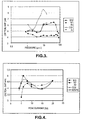
- Figure 3 shows the shortest gap lengths between contacts required to interrupt an alternating fault current of peak value 20kA for various gas pressure in the range 6kPa to 580 kPa (0.8 to 84 psi), the horizontal scale being logarithmic. Results are provided for five different gases - SF 6 , N 2 , air, CO 2 and Ar. Notable features are:
- Fig. 4 shows the results of experiments to examine the effect of peak alternating current on the critical gap length for current interruption at a pressure of 3.7 psi. These show a trend for the interruption performance at lower currents to be approximately as effective as at 20 KA, as judged by the critical gap length criterion.
- the requirement for sub atmospheric pressure gas in the vicinity of the electrode and shield upon striking of the electrical arc may be met, eg. by virtue of the illustrated "reverse puffer" arrangement, without the ambient pressure of background gas in the enclosure 12 being below atmospheric.
- the background gas pressure may be atmospheric (or conceivably even higher) with the required sub-atmospheric pressure around the electrodes being transiently created when the circuit breaker is activated to break the circuit.
Landscapes
- Circuit Breakers (AREA)
- Valve Device For Special Equipments (AREA)
- Control Of Vending Devices And Auxiliary Devices For Vending Devices (AREA)
- Percussive Tools And Related Accessories (AREA)
- Arc-Extinguishing Devices That Are Switches (AREA)
- Keying Circuit Devices (AREA)
Claims (11)
- Schalter, der Folgendes umfasst: eine erste und eine zweite Elektrode (2, 4), die miteinander in Kontakt gebracht werden können, um einen elektrischen Schaltkreis (6) zu schließen, einen Rückzugmechanismus (8) zum Bewegen einer Elektrode von der anderen weg, um den Schaltkreis zu unterbrechen, und eine Abschirmung (12), die in der Nähe der Elektroden angeordnet ist, so dass sie einer Abtragung durch den zuvor genannten Lichtbogen ausgesetzt ist, wobei das Material und die Anordnung der Abschirmung derart beschaffen sind, dass ihre Abtragung durch den Lichtbogen verursacht, dass sie ein lichtbogenlöschendes Gas freigibt, wobei die Vorrichtung des Weiteren Mittel (4, 8, 16) umfasst, um mindestens in der Nähe der Elektroden und zum Zeitpunkt des Überschlagens eines Lichtbogens zwischen diesen während des Unterbrechens des Schaltkreises einen Gasdruck von weniger als 101325 Pascal bereitzustellen, und durch die Bereitstellung einer abgedichteten Einfassung gekennzeichnet ist, die die Elektrode und die Abschirmung enthält, wobei die Einfassung ein Hintergrundgas enthält.
- Schalter nach Anspruch 1, wobei die Abschirmung (12) einen Hohlraum abgrenzt, in dem Lichtbogenbildung stattfindet.
- Schalter nach Anspruch 1 oder Anspruch 2, wobei die Abschirmung (12) ein Polymermaterial umfasst.
- Schalter nach einem der vorhergehenden Ansprüche, wobei die Abschirmung (12) PTFE umfasst.
- Schalter nach einem der vorhergehenden Ansprüche, der Mittel (4, 8, 16) umfasst, um während des Vorgangs des Unterbrechens des elektrischen Schaltkreises (6) der nächsten Umgebung der ersten und zweiten Elektrode (2, 4) Gas zu entziehen, wobei der Druck in dieser Umgebung vorübergehend verringert wird.
- Schalter nach Anspruch 5, wobei die zuvor genannten Mittel zum Entziehen von Gas eine Kolben-Zylinder-Anordnung (4, 16) umfasst.
- Schalter nach Anspruch 6, wobei der Kolben entweder durch die erste oder durch die zweite Elektrode (2, 4) gebildet wird.
- Schalter nach Anspruch 6 oder Anspruch 7, wobei der Zylinder durch die Abschirmung (16) gebildet wird.
- Schalter nach einem der vorhergehenden Ansprüche, wobei der Hintergrundgasdruck unter dem atmosphärischen Druck liegt.
- Schalter nach einem der vorhergehenden Ansprüche, wobei das Hintergrundgas mindestens entweder Stickstoff, Argon, Kohlendioxid oder Luft umfasst.
- Schalter nach einem der vorhergehenden Ansprüche, wobei das Hintergrundgas einen Druck von 60 kPa oder weniger aufweist.
Applications Claiming Priority (3)
| Application Number | Priority Date | Filing Date | Title |
|---|---|---|---|
| GB0225088 | 2002-10-29 | ||
| GBGB0225088.4A GB0225088D0 (en) | 2002-10-29 | 2002-10-29 | circuit breaker |
| PCT/GB2003/004617 WO2004040610A1 (en) | 2002-10-29 | 2003-10-28 | Circuit breaker |
Publications (2)
| Publication Number | Publication Date |
|---|---|
| EP1556874A1 EP1556874A1 (de) | 2005-07-27 |
| EP1556874B1 true EP1556874B1 (de) | 2007-03-28 |
Family
ID=9946740
Family Applications (1)
| Application Number | Title | Priority Date | Filing Date |
|---|---|---|---|
| EP03769653A Expired - Lifetime EP1556874B1 (de) | 2002-10-29 | 2003-10-28 | Unterbrecherschalter |
Country Status (8)
| Country | Link |
|---|---|
| US (1) | US20050247676A1 (de) |
| EP (1) | EP1556874B1 (de) |
| JP (1) | JP2006505108A (de) |
| AT (1) | ATE358327T1 (de) |
| AU (1) | AU2003278343A1 (de) |
| DE (1) | DE60312882T2 (de) |
| GB (1) | GB0225088D0 (de) |
| WO (1) | WO2004040610A1 (de) |
Families Citing this family (2)
| Publication number | Priority date | Publication date | Assignee | Title |
|---|---|---|---|---|
| US20120326323A1 (en) * | 2010-02-09 | 2012-12-27 | Microsemi Corporation | High voltage high package pressure semiconductor package |
| FR2985081B1 (fr) * | 2011-12-21 | 2015-03-06 | Alstom Technology Ltd | Dispositif de protection contre les particules engendrees par un arc electrique de commutation |
Family Cites Families (10)
| Publication number | Priority date | Publication date | Assignee | Title |
|---|---|---|---|---|
| US2167665A (en) * | 1934-11-05 | 1939-08-01 | Detroit Edison Co | Circuit breaker |
| US2156974A (en) * | 1935-06-12 | 1939-05-02 | Gilbert E Doan | Method of and apparatus for nonarcing circuit interruption |
| US3446927A (en) * | 1966-01-10 | 1969-05-27 | Wagner Electric Corp | Disk contacts and flat annular shield arrangement in gas filled switch |
| US3781500A (en) * | 1972-10-02 | 1973-12-25 | Westinghouse Electric Corp | Gas cooled electrical contactor |
| DD108407A1 (de) * | 1973-12-20 | 1974-09-12 | ||
| US4426560A (en) * | 1980-11-13 | 1984-01-17 | Westinghouse Electric Corp. | Reduced pressure electrical switch |
| JPH09231885A (ja) * | 1996-02-22 | 1997-09-05 | Hitachi Ltd | ガス遮断器 |
| US6236010B1 (en) * | 1999-07-14 | 2001-05-22 | Southern States, Inc. | Circuit interrupter including a penetrating electrical contact with grip and release structure |
| FR2809531B1 (fr) * | 2000-05-25 | 2002-07-05 | Alstom | Buse isolante de soufflage pour disjoncteur |
| FR2811137B1 (fr) * | 2000-07-03 | 2002-08-23 | Alstom | Bielle de manoeuvre pour disjoncteur haute tension |
-
2002
- 2002-10-29 GB GBGB0225088.4A patent/GB0225088D0/en not_active Ceased
-
2003
- 2003-10-28 DE DE60312882T patent/DE60312882T2/de not_active Expired - Lifetime
- 2003-10-28 WO PCT/GB2003/004617 patent/WO2004040610A1/en not_active Ceased
- 2003-10-28 EP EP03769653A patent/EP1556874B1/de not_active Expired - Lifetime
- 2003-10-28 AT AT03769653T patent/ATE358327T1/de not_active IP Right Cessation
- 2003-10-28 AU AU2003278343A patent/AU2003278343A1/en not_active Abandoned
- 2003-10-28 JP JP2004547769A patent/JP2006505108A/ja active Pending
-
2005
- 2005-04-28 US US11/119,051 patent/US20050247676A1/en not_active Abandoned
Also Published As
| Publication number | Publication date |
|---|---|
| WO2004040610A1 (en) | 2004-05-13 |
| DE60312882T2 (de) | 2008-01-31 |
| GB0225088D0 (en) | 2002-12-04 |
| ATE358327T1 (de) | 2007-04-15 |
| DE60312882D1 (de) | 2007-05-10 |
| JP2006505108A (ja) | 2006-02-09 |
| AU2003278343A1 (en) | 2004-05-25 |
| US20050247676A1 (en) | 2005-11-10 |
| EP1556874A1 (de) | 2005-07-27 |
Similar Documents
| Publication | Publication Date | Title |
|---|---|---|
| JP5127569B2 (ja) | ガス絶縁開閉器 | |
| CN101047077B (zh) | 气体绝缘开闭器 | |
| US2757261A (en) | Circuit interrupters | |
| US11699559B2 (en) | Device for interrupting non-short circuit currents only, in particular disconnector or earthing switch | |
| US20120228264A1 (en) | Use of specific composite materials as electric arc extinction materials in electrical equipment | |
| US6107590A (en) | Circuit-breaker with an explosive charge ignited during opening operation | |
| EP3477675B1 (de) | Gasisolierter mittelspannungsschalter mit abschirmvorrichtung | |
| CN104054151A (zh) | 气体断路器 | |
| US4110580A (en) | Gas-type circuit-interrupters having admixtures of helium with small concentrations of sulfur-hexafluoride (SF6) gas | |
| JP2004164994A (ja) | 開閉器 | |
| EP1556874B1 (de) | Unterbrecherschalter | |
| CN110556265A (zh) | 一种适用于容性负载投切的真空灭弧室的旋转触头结构 | |
| RU2094886C1 (ru) | Дугогасительное устройство высоковольтного газонаполненного автокомпрессионного выключателя | |
| US20250191862A1 (en) | Metal enclosed circuit breaker | |
| JP2563855B2 (ja) | 高電圧回路遮断器 | |
| KR100345691B1 (ko) | 복합 소호형 가스 차단기 | |
| JP2012054097A (ja) | ガス遮断器 | |
| EP4117006B1 (de) | Gasisolierter hoch- oder mittelspannungsleistungsschalter | |
| Kristoffersen et al. | Puffer-type load break switch for medium voltage gas insulated switchgear filled with dry air | |
| Telfer et al. | A Novel Approach to Power Circuit Breaker Design for Replacement of SF6 | |
| EP3826042A1 (de) | Lichtbogenkontakttulpe mit flussoptimierten schlitzen und integriertem spannungsentlastungsmerkmal | |
| JP2000166034A (ja) | ガス絶縁開閉装置 | |
| JP2002298711A (ja) | ガス遮断器 | |
| Armstrong et al. | Vaccum techniques in modern circuit breakers | |
| JP2001286017A (ja) | 開閉装置 |
Legal Events
| Date | Code | Title | Description |
|---|---|---|---|
| PUAI | Public reference made under article 153(3) epc to a published international application that has entered the european phase |
Free format text: ORIGINAL CODE: 0009012 |
|
| 17P | Request for examination filed |
Effective date: 20050426 |
|
| AK | Designated contracting states |
Kind code of ref document: A1 Designated state(s): AT BE BG CH CY CZ DE DK EE ES FI FR GB GR HU IE IT LI LU MC NL PT RO SE SI SK TR |
|
| AX | Request for extension of the european patent |
Extension state: AL LT LV MK |
|
| DAX | Request for extension of the european patent (deleted) | ||
| 17Q | First examination report despatched |
Effective date: 20060307 |
|
| GRAP | Despatch of communication of intention to grant a patent |
Free format text: ORIGINAL CODE: EPIDOSNIGR1 |
|
| GRAS | Grant fee paid |
Free format text: ORIGINAL CODE: EPIDOSNIGR3 |
|
| GRAA | (expected) grant |
Free format text: ORIGINAL CODE: 0009210 |
|
| AK | Designated contracting states |
Kind code of ref document: B1 Designated state(s): AT BE BG CH CY CZ DE DK EE ES FI FR GB GR HU IE IT LI LU MC NL PT RO SE SI SK TR |
|
| PG25 | Lapsed in a contracting state [announced via postgrant information from national office to epo] |
Ref country code: BE Free format text: LAPSE BECAUSE OF FAILURE TO SUBMIT A TRANSLATION OF THE DESCRIPTION OR TO PAY THE FEE WITHIN THE PRESCRIBED TIME-LIMIT Effective date: 20070328 Ref country code: SI Free format text: LAPSE BECAUSE OF FAILURE TO SUBMIT A TRANSLATION OF THE DESCRIPTION OR TO PAY THE FEE WITHIN THE PRESCRIBED TIME-LIMIT Effective date: 20070328 Ref country code: FI Free format text: LAPSE BECAUSE OF FAILURE TO SUBMIT A TRANSLATION OF THE DESCRIPTION OR TO PAY THE FEE WITHIN THE PRESCRIBED TIME-LIMIT Effective date: 20070328 Ref country code: AT Free format text: LAPSE BECAUSE OF FAILURE TO SUBMIT A TRANSLATION OF THE DESCRIPTION OR TO PAY THE FEE WITHIN THE PRESCRIBED TIME-LIMIT Effective date: 20070328 Ref country code: LI Free format text: LAPSE BECAUSE OF FAILURE TO SUBMIT A TRANSLATION OF THE DESCRIPTION OR TO PAY THE FEE WITHIN THE PRESCRIBED TIME-LIMIT Effective date: 20070328 Ref country code: CH Free format text: LAPSE BECAUSE OF FAILURE TO SUBMIT A TRANSLATION OF THE DESCRIPTION OR TO PAY THE FEE WITHIN THE PRESCRIBED TIME-LIMIT Effective date: 20070328 Ref country code: NL Free format text: LAPSE BECAUSE OF FAILURE TO SUBMIT A TRANSLATION OF THE DESCRIPTION OR TO PAY THE FEE WITHIN THE PRESCRIBED TIME-LIMIT Effective date: 20070328 |
|
| REG | Reference to a national code |
Ref country code: GB Ref legal event code: FG4D |
|
| REG | Reference to a national code |
Ref country code: CH Ref legal event code: EP |
|
| REF | Corresponds to: |
Ref document number: 60312882 Country of ref document: DE Date of ref document: 20070510 Kind code of ref document: P |
|
| REG | Reference to a national code |
Ref country code: IE Ref legal event code: FG4D |
|
| PG25 | Lapsed in a contracting state [announced via postgrant information from national office to epo] |
Ref country code: SE Free format text: LAPSE BECAUSE OF FAILURE TO SUBMIT A TRANSLATION OF THE DESCRIPTION OR TO PAY THE FEE WITHIN THE PRESCRIBED TIME-LIMIT Effective date: 20070628 |
|
| PG25 | Lapsed in a contracting state [announced via postgrant information from national office to epo] |
Ref country code: ES Free format text: LAPSE BECAUSE OF FAILURE TO SUBMIT A TRANSLATION OF THE DESCRIPTION OR TO PAY THE FEE WITHIN THE PRESCRIBED TIME-LIMIT Effective date: 20070709 |
|
| PG25 | Lapsed in a contracting state [announced via postgrant information from national office to epo] |
Ref country code: PT Free format text: LAPSE BECAUSE OF FAILURE TO SUBMIT A TRANSLATION OF THE DESCRIPTION OR TO PAY THE FEE WITHIN THE PRESCRIBED TIME-LIMIT Effective date: 20070828 |
|
| REG | Reference to a national code |
Ref country code: CH Ref legal event code: PL |
|
| NLV1 | Nl: lapsed or annulled due to failure to fulfill the requirements of art. 29p and 29m of the patents act | ||
| EN | Fr: translation not filed | ||
| PG25 | Lapsed in a contracting state [announced via postgrant information from national office to epo] |
Ref country code: SK Free format text: LAPSE BECAUSE OF FAILURE TO SUBMIT A TRANSLATION OF THE DESCRIPTION OR TO PAY THE FEE WITHIN THE PRESCRIBED TIME-LIMIT Effective date: 20070328 |
|
| PG25 | Lapsed in a contracting state [announced via postgrant information from national office to epo] |
Ref country code: RO Free format text: LAPSE BECAUSE OF FAILURE TO SUBMIT A TRANSLATION OF THE DESCRIPTION OR TO PAY THE FEE WITHIN THE PRESCRIBED TIME-LIMIT Effective date: 20070328 Ref country code: CZ Free format text: LAPSE BECAUSE OF FAILURE TO SUBMIT A TRANSLATION OF THE DESCRIPTION OR TO PAY THE FEE WITHIN THE PRESCRIBED TIME-LIMIT Effective date: 20070328 |
|
| PG25 | Lapsed in a contracting state [announced via postgrant information from national office to epo] |
Ref country code: DK Free format text: LAPSE BECAUSE OF FAILURE TO SUBMIT A TRANSLATION OF THE DESCRIPTION OR TO PAY THE FEE WITHIN THE PRESCRIBED TIME-LIMIT Effective date: 20070328 |
|
| PLBE | No opposition filed within time limit |
Free format text: ORIGINAL CODE: 0009261 |
|
| STAA | Information on the status of an ep patent application or granted ep patent |
Free format text: STATUS: NO OPPOSITION FILED WITHIN TIME LIMIT |
|
| 26N | No opposition filed |
Effective date: 20080102 |
|
| PG25 | Lapsed in a contracting state [announced via postgrant information from national office to epo] |
Ref country code: FR Free format text: LAPSE BECAUSE OF FAILURE TO SUBMIT A TRANSLATION OF THE DESCRIPTION OR TO PAY THE FEE WITHIN THE PRESCRIBED TIME-LIMIT Effective date: 20071116 Ref country code: IT Free format text: LAPSE BECAUSE OF FAILURE TO SUBMIT A TRANSLATION OF THE DESCRIPTION OR TO PAY THE FEE WITHIN THE PRESCRIBED TIME-LIMIT Effective date: 20070328 Ref country code: GR Free format text: LAPSE BECAUSE OF FAILURE TO SUBMIT A TRANSLATION OF THE DESCRIPTION OR TO PAY THE FEE WITHIN THE PRESCRIBED TIME-LIMIT Effective date: 20070629 |
|
| PG25 | Lapsed in a contracting state [announced via postgrant information from national office to epo] |
Ref country code: MC Free format text: LAPSE BECAUSE OF NON-PAYMENT OF DUE FEES Effective date: 20071031 |
|
| PG25 | Lapsed in a contracting state [announced via postgrant information from national office to epo] |
Ref country code: IE Free format text: LAPSE BECAUSE OF NON-PAYMENT OF DUE FEES Effective date: 20071030 |
|
| PG25 | Lapsed in a contracting state [announced via postgrant information from national office to epo] |
Ref country code: FR Free format text: LAPSE BECAUSE OF FAILURE TO SUBMIT A TRANSLATION OF THE DESCRIPTION OR TO PAY THE FEE WITHIN THE PRESCRIBED TIME-LIMIT Effective date: 20070328 |
|
| PG25 | Lapsed in a contracting state [announced via postgrant information from national office to epo] |
Ref country code: EE Free format text: LAPSE BECAUSE OF FAILURE TO SUBMIT A TRANSLATION OF THE DESCRIPTION OR TO PAY THE FEE WITHIN THE PRESCRIBED TIME-LIMIT Effective date: 20070328 |
|
| PG25 | Lapsed in a contracting state [announced via postgrant information from national office to epo] |
Ref country code: CY Free format text: LAPSE BECAUSE OF FAILURE TO SUBMIT A TRANSLATION OF THE DESCRIPTION OR TO PAY THE FEE WITHIN THE PRESCRIBED TIME-LIMIT Effective date: 20070328 |
|
| PG25 | Lapsed in a contracting state [announced via postgrant information from national office to epo] |
Ref country code: BG Free format text: LAPSE BECAUSE OF FAILURE TO SUBMIT A TRANSLATION OF THE DESCRIPTION OR TO PAY THE FEE WITHIN THE PRESCRIBED TIME-LIMIT Effective date: 20070628 Ref country code: LU Free format text: LAPSE BECAUSE OF NON-PAYMENT OF DUE FEES Effective date: 20071028 |
|
| PG25 | Lapsed in a contracting state [announced via postgrant information from national office to epo] |
Ref country code: HU Free format text: LAPSE BECAUSE OF FAILURE TO SUBMIT A TRANSLATION OF THE DESCRIPTION OR TO PAY THE FEE WITHIN THE PRESCRIBED TIME-LIMIT Effective date: 20070929 Ref country code: TR Free format text: LAPSE BECAUSE OF FAILURE TO SUBMIT A TRANSLATION OF THE DESCRIPTION OR TO PAY THE FEE WITHIN THE PRESCRIBED TIME-LIMIT Effective date: 20070328 |
|
| PGFP | Annual fee paid to national office [announced via postgrant information from national office to epo] |
Ref country code: DE Payment date: 20121025 Year of fee payment: 10 |
|
| PGFP | Annual fee paid to national office [announced via postgrant information from national office to epo] |
Ref country code: GB Payment date: 20121024 Year of fee payment: 10 |
|
| GBPC | Gb: european patent ceased through non-payment of renewal fee |
Effective date: 20131028 |
|
| PG25 | Lapsed in a contracting state [announced via postgrant information from national office to epo] |
Ref country code: GB Free format text: LAPSE BECAUSE OF NON-PAYMENT OF DUE FEES Effective date: 20131028 |
|
| REG | Reference to a national code |
Ref country code: DE Ref legal event code: R119 Ref document number: 60312882 Country of ref document: DE Effective date: 20140501 |
|
| PG25 | Lapsed in a contracting state [announced via postgrant information from national office to epo] |
Ref country code: DE Free format text: LAPSE BECAUSE OF NON-PAYMENT OF DUE FEES Effective date: 20140501 |