EP1554724B1 - Speichermedium - Google Patents
Speichermedium Download PDFInfo
- Publication number
- EP1554724B1 EP1554724B1 EP03809254A EP03809254A EP1554724B1 EP 1554724 B1 EP1554724 B1 EP 1554724B1 EP 03809254 A EP03809254 A EP 03809254A EP 03809254 A EP03809254 A EP 03809254A EP 1554724 B1 EP1554724 B1 EP 1554724B1
- Authority
- EP
- European Patent Office
- Prior art keywords
- storage medium
- storage
- metal
- previous
- information
- Prior art date
- Legal status (The legal status is an assumption and is not a legal conclusion. Google has not performed a legal analysis and makes no representation as to the accuracy of the status listed.)
- Expired - Lifetime
Links
- 238000003860 storage Methods 0.000 title claims abstract description 94
- 229910021645 metal ion Inorganic materials 0.000 claims abstract description 56
- 239000011232 storage material Substances 0.000 claims abstract description 37
- 239000002923 metal particle Substances 0.000 claims abstract description 25
- 230000005855 radiation Effects 0.000 claims abstract description 24
- 230000002776 aggregation Effects 0.000 claims abstract description 5
- 239000000463 material Substances 0.000 claims description 29
- 239000011521 glass Substances 0.000 claims description 24
- 238000000034 method Methods 0.000 claims description 17
- 230000009467 reduction Effects 0.000 claims description 14
- 238000010438 heat treatment Methods 0.000 claims description 11
- 229920000642 polymer Polymers 0.000 claims description 9
- 229910052751 metal Inorganic materials 0.000 claims description 7
- 239000002184 metal Substances 0.000 claims description 7
- 239000002245 particle Substances 0.000 claims description 7
- 230000001678 irradiating effect Effects 0.000 claims description 6
- 230000015572 biosynthetic process Effects 0.000 claims description 5
- 229910052709 silver Inorganic materials 0.000 claims description 5
- 238000010521 absorption reaction Methods 0.000 claims description 4
- 230000005540 biological transmission Effects 0.000 claims description 4
- BASFCYQUMIYNBI-UHFFFAOYSA-N platinum Chemical compound [Pt] BASFCYQUMIYNBI-UHFFFAOYSA-N 0.000 claims description 4
- 239000004332 silver Substances 0.000 claims description 4
- JPVYNHNXODAKFH-UHFFFAOYSA-N Cu2+ Chemical compound [Cu+2] JPVYNHNXODAKFH-UHFFFAOYSA-N 0.000 claims description 2
- 229910001431 copper ion Inorganic materials 0.000 claims description 2
- 238000012217 deletion Methods 0.000 claims description 2
- 230000037430 deletion Effects 0.000 claims description 2
- PCHJSUWPFVWCPO-UHFFFAOYSA-N gold Chemical compound [Au] PCHJSUWPFVWCPO-UHFFFAOYSA-N 0.000 claims description 2
- 229910052737 gold Inorganic materials 0.000 claims description 2
- 239000010931 gold Substances 0.000 claims description 2
- 229910052697 platinum Inorganic materials 0.000 claims description 2
- 238000002198 surface plasmon resonance spectroscopy Methods 0.000 claims description 2
- 238000004220 aggregation Methods 0.000 claims 3
- 230000003595 spectral effect Effects 0.000 claims 1
- 238000005054 agglomeration Methods 0.000 abstract description 2
- 239000010410 layer Substances 0.000 description 26
- 230000009466 transformation Effects 0.000 description 10
- 230000035508 accumulation Effects 0.000 description 6
- 238000009825 accumulation Methods 0.000 description 6
- 230000008569 process Effects 0.000 description 4
- UFHFLCQGNIYNRP-UHFFFAOYSA-N Hydrogen Chemical compound [H][H] UFHFLCQGNIYNRP-UHFFFAOYSA-N 0.000 description 3
- 239000003638 chemical reducing agent Substances 0.000 description 3
- 239000003989 dielectric material Substances 0.000 description 3
- 239000005357 flat glass Substances 0.000 description 3
- 229910052739 hydrogen Inorganic materials 0.000 description 3
- 239000001257 hydrogen Substances 0.000 description 3
- 230000007774 longterm Effects 0.000 description 3
- 238000004519 manufacturing process Methods 0.000 description 3
- UQSXHKLRYXJYBZ-UHFFFAOYSA-N Iron oxide Chemical compound [Fe]=O UQSXHKLRYXJYBZ-UHFFFAOYSA-N 0.000 description 2
- BQCADISMDOOEFD-UHFFFAOYSA-N Silver Chemical compound [Ag] BQCADISMDOOEFD-UHFFFAOYSA-N 0.000 description 2
- 230000032683 aging Effects 0.000 description 2
- 230000008859 change Effects 0.000 description 2
- 230000000694 effects Effects 0.000 description 2
- 150000002500 ions Chemical class 0.000 description 2
- 229910044991 metal oxide Inorganic materials 0.000 description 2
- 230000003287 optical effect Effects 0.000 description 2
- 230000010355 oscillation Effects 0.000 description 2
- 230000001681 protective effect Effects 0.000 description 2
- 239000011241 protective layer Substances 0.000 description 2
- 238000011946 reduction process Methods 0.000 description 2
- 241000681032 Neobarbella comes Species 0.000 description 1
- ATJFFYVFTNAWJD-UHFFFAOYSA-N Tin Chemical compound [Sn] ATJFFYVFTNAWJD-UHFFFAOYSA-N 0.000 description 1
- 229910052782 aluminium Inorganic materials 0.000 description 1
- XAGFODPZIPBFFR-UHFFFAOYSA-N aluminium Chemical compound [Al] XAGFODPZIPBFFR-UHFFFAOYSA-N 0.000 description 1
- 238000004040 coloring Methods 0.000 description 1
- 239000002131 composite material Substances 0.000 description 1
- 238000004883 computer application Methods 0.000 description 1
- 239000002772 conduction electron Substances 0.000 description 1
- 230000001419 dependent effect Effects 0.000 description 1
- 230000018109 developmental process Effects 0.000 description 1
- 238000009792 diffusion process Methods 0.000 description 1
- 238000002845 discoloration Methods 0.000 description 1
- 238000009826 distribution Methods 0.000 description 1
- 230000005670 electromagnetic radiation Effects 0.000 description 1
- 238000005538 encapsulation Methods 0.000 description 1
- 230000003203 everyday effect Effects 0.000 description 1
- 230000005284 excitation Effects 0.000 description 1
- 150000004706 metal oxides Chemical class 0.000 description 1
- 239000013528 metallic particle Substances 0.000 description 1
- 239000000203 mixture Substances 0.000 description 1
- 230000010363 phase shift Effects 0.000 description 1
- 230000010287 polarization Effects 0.000 description 1
- 230000009993 protective function Effects 0.000 description 1
- 230000035945 sensitivity Effects 0.000 description 1
- 150000003378 silver Chemical group 0.000 description 1
- -1 silver ions Chemical class 0.000 description 1
- 239000000758 substrate Substances 0.000 description 1
- 238000005496 tempering Methods 0.000 description 1
- XOLBLPGZBRYERU-UHFFFAOYSA-N tin dioxide Chemical compound O=[Sn]=O XOLBLPGZBRYERU-UHFFFAOYSA-N 0.000 description 1
- 229910001432 tin ion Inorganic materials 0.000 description 1
- 229910001887 tin oxide Inorganic materials 0.000 description 1
- 238000011144 upstream manufacturing Methods 0.000 description 1
Images
Classifications
-
- G—PHYSICS
- G11—INFORMATION STORAGE
- G11C—STATIC STORES
- G11C13/00—Digital stores characterised by the use of storage elements not covered by groups G11C11/00, G11C23/00, or G11C25/00
- G11C13/04—Digital stores characterised by the use of storage elements not covered by groups G11C11/00, G11C23/00, or G11C25/00 using optical elements ; using other beam accessed elements, e.g. electron or ion beam
-
- B—PERFORMING OPERATIONS; TRANSPORTING
- B82—NANOTECHNOLOGY
- B82Y—SPECIFIC USES OR APPLICATIONS OF NANOSTRUCTURES; MEASUREMENT OR ANALYSIS OF NANOSTRUCTURES; MANUFACTURE OR TREATMENT OF NANOSTRUCTURES
- B82Y10/00—Nanotechnology for information processing, storage or transmission, e.g. quantum computing or single electron logic
-
- C—CHEMISTRY; METALLURGY
- C03—GLASS; MINERAL OR SLAG WOOL
- C03C—CHEMICAL COMPOSITION OF GLASSES, GLAZES OR VITREOUS ENAMELS; SURFACE TREATMENT OF GLASS; SURFACE TREATMENT OF FIBRES OR FILAMENTS MADE FROM GLASS, MINERALS OR SLAGS; JOINING GLASS TO GLASS OR OTHER MATERIALS
- C03C14/00—Glass compositions containing a non-glass component, e.g. compositions containing fibres, filaments, whiskers, platelets, or the like, dispersed in a glass matrix
- C03C14/006—Glass compositions containing a non-glass component, e.g. compositions containing fibres, filaments, whiskers, platelets, or the like, dispersed in a glass matrix the non-glass component being in the form of microcrystallites, e.g. of optically or electrically active material
-
- C—CHEMISTRY; METALLURGY
- C03—GLASS; MINERAL OR SLAG WOOL
- C03C—CHEMICAL COMPOSITION OF GLASSES, GLAZES OR VITREOUS ENAMELS; SURFACE TREATMENT OF GLASS; SURFACE TREATMENT OF FIBRES OR FILAMENTS MADE FROM GLASS, MINERALS OR SLAGS; JOINING GLASS TO GLASS OR OTHER MATERIALS
- C03C21/00—Treatment of glass, not in the form of fibres or filaments, by diffusing ions or metals in the surface
- C03C21/008—Treatment of glass, not in the form of fibres or filaments, by diffusing ions or metals in the surface in solid phase, e.g. using pastes, powders
-
- C—CHEMISTRY; METALLURGY
- C03—GLASS; MINERAL OR SLAG WOOL
- C03C—CHEMICAL COMPOSITION OF GLASSES, GLAZES OR VITREOUS ENAMELS; SURFACE TREATMENT OF GLASS; SURFACE TREATMENT OF FIBRES OR FILAMENTS MADE FROM GLASS, MINERALS OR SLAGS; JOINING GLASS TO GLASS OR OTHER MATERIALS
- C03C23/00—Other surface treatment of glass not in the form of fibres or filaments
- C03C23/0005—Other surface treatment of glass not in the form of fibres or filaments by irradiation
-
- C—CHEMISTRY; METALLURGY
- C03—GLASS; MINERAL OR SLAG WOOL
- C03C—CHEMICAL COMPOSITION OF GLASSES, GLAZES OR VITREOUS ENAMELS; SURFACE TREATMENT OF GLASS; SURFACE TREATMENT OF FIBRES OR FILAMENTS MADE FROM GLASS, MINERALS OR SLAGS; JOINING GLASS TO GLASS OR OTHER MATERIALS
- C03C23/00—Other surface treatment of glass not in the form of fibres or filaments
- C03C23/0005—Other surface treatment of glass not in the form of fibres or filaments by irradiation
- C03C23/0025—Other surface treatment of glass not in the form of fibres or filaments by irradiation by a laser beam
-
- C—CHEMISTRY; METALLURGY
- C03—GLASS; MINERAL OR SLAG WOOL
- C03C—CHEMICAL COMPOSITION OF GLASSES, GLAZES OR VITREOUS ENAMELS; SURFACE TREATMENT OF GLASS; SURFACE TREATMENT OF FIBRES OR FILAMENTS MADE FROM GLASS, MINERALS OR SLAGS; JOINING GLASS TO GLASS OR OTHER MATERIALS
- C03C4/00—Compositions for glass with special properties
- C03C4/04—Compositions for glass with special properties for photosensitive glass
-
- G—PHYSICS
- G11—INFORMATION STORAGE
- G11B—INFORMATION STORAGE BASED ON RELATIVE MOVEMENT BETWEEN RECORD CARRIER AND TRANSDUCER
- G11B7/00—Recording or reproducing by optical means, e.g. recording using a thermal beam of optical radiation by modifying optical properties or the physical structure, reproducing using an optical beam at lower power by sensing optical properties; Record carriers therefor
- G11B7/004—Recording, reproducing or erasing methods; Read, write or erase circuits therefor
- G11B7/0045—Recording
-
- G—PHYSICS
- G11—INFORMATION STORAGE
- G11B—INFORMATION STORAGE BASED ON RELATIVE MOVEMENT BETWEEN RECORD CARRIER AND TRANSDUCER
- G11B7/00—Recording or reproducing by optical means, e.g. recording using a thermal beam of optical radiation by modifying optical properties or the physical structure, reproducing using an optical beam at lower power by sensing optical properties; Record carriers therefor
- G11B7/24—Record carriers characterised by shape, structure or physical properties, or by the selection of the material
- G11B7/24018—Laminated discs
-
- G—PHYSICS
- G11—INFORMATION STORAGE
- G11B—INFORMATION STORAGE BASED ON RELATIVE MOVEMENT BETWEEN RECORD CARRIER AND TRANSDUCER
- G11B7/00—Recording or reproducing by optical means, e.g. recording using a thermal beam of optical radiation by modifying optical properties or the physical structure, reproducing using an optical beam at lower power by sensing optical properties; Record carriers therefor
- G11B7/24—Record carriers characterised by shape, structure or physical properties, or by the selection of the material
- G11B7/2403—Layers; Shape, structure or physical properties thereof
- G11B7/24047—Substrates
-
- G—PHYSICS
- G11—INFORMATION STORAGE
- G11B—INFORMATION STORAGE BASED ON RELATIVE MOVEMENT BETWEEN RECORD CARRIER AND TRANSDUCER
- G11B7/00—Recording or reproducing by optical means, e.g. recording using a thermal beam of optical radiation by modifying optical properties or the physical structure, reproducing using an optical beam at lower power by sensing optical properties; Record carriers therefor
- G11B7/24—Record carriers characterised by shape, structure or physical properties, or by the selection of the material
- G11B7/241—Record carriers characterised by shape, structure or physical properties, or by the selection of the material characterised by the selection of the material
- G11B7/242—Record carriers characterised by shape, structure or physical properties, or by the selection of the material characterised by the selection of the material of recording layers
- G11B7/243—Record carriers characterised by shape, structure or physical properties, or by the selection of the material characterised by the selection of the material of recording layers comprising inorganic materials only, e.g. ablative layers
-
- G—PHYSICS
- G11—INFORMATION STORAGE
- G11B—INFORMATION STORAGE BASED ON RELATIVE MOVEMENT BETWEEN RECORD CARRIER AND TRANSDUCER
- G11B7/00—Recording or reproducing by optical means, e.g. recording using a thermal beam of optical radiation by modifying optical properties or the physical structure, reproducing using an optical beam at lower power by sensing optical properties; Record carriers therefor
- G11B7/24—Record carriers characterised by shape, structure or physical properties, or by the selection of the material
- G11B7/241—Record carriers characterised by shape, structure or physical properties, or by the selection of the material characterised by the selection of the material
- G11B7/242—Record carriers characterised by shape, structure or physical properties, or by the selection of the material characterised by the selection of the material of recording layers
- G11B7/244—Record carriers characterised by shape, structure or physical properties, or by the selection of the material characterised by the selection of the material of recording layers comprising organic materials only
- G11B7/245—Record carriers characterised by shape, structure or physical properties, or by the selection of the material characterised by the selection of the material of recording layers comprising organic materials only containing a polymeric component
-
- G—PHYSICS
- G11—INFORMATION STORAGE
- G11B—INFORMATION STORAGE BASED ON RELATIVE MOVEMENT BETWEEN RECORD CARRIER AND TRANSDUCER
- G11B7/00—Recording or reproducing by optical means, e.g. recording using a thermal beam of optical radiation by modifying optical properties or the physical structure, reproducing using an optical beam at lower power by sensing optical properties; Record carriers therefor
- G11B7/24—Record carriers characterised by shape, structure or physical properties, or by the selection of the material
- G11B7/241—Record carriers characterised by shape, structure or physical properties, or by the selection of the material characterised by the selection of the material
- G11B7/242—Record carriers characterised by shape, structure or physical properties, or by the selection of the material characterised by the selection of the material of recording layers
- G11B7/251—Record carriers characterised by shape, structure or physical properties, or by the selection of the material characterised by the selection of the material of recording layers comprising inorganic materials dispersed in an organic matrix
-
- G—PHYSICS
- G11—INFORMATION STORAGE
- G11B—INFORMATION STORAGE BASED ON RELATIVE MOVEMENT BETWEEN RECORD CARRIER AND TRANSDUCER
- G11B7/00—Recording or reproducing by optical means, e.g. recording using a thermal beam of optical radiation by modifying optical properties or the physical structure, reproducing using an optical beam at lower power by sensing optical properties; Record carriers therefor
- G11B7/24—Record carriers characterised by shape, structure or physical properties, or by the selection of the material
- G11B7/241—Record carriers characterised by shape, structure or physical properties, or by the selection of the material characterised by the selection of the material
- G11B7/252—Record carriers characterised by shape, structure or physical properties, or by the selection of the material characterised by the selection of the material of layers other than recording layers
- G11B7/253—Record carriers characterised by shape, structure or physical properties, or by the selection of the material characterised by the selection of the material of layers other than recording layers of substrates
- G11B7/2531—Record carriers characterised by shape, structure or physical properties, or by the selection of the material characterised by the selection of the material of layers other than recording layers of substrates comprising glass
-
- G—PHYSICS
- G11—INFORMATION STORAGE
- G11B—INFORMATION STORAGE BASED ON RELATIVE MOVEMENT BETWEEN RECORD CARRIER AND TRANSDUCER
- G11B7/00—Recording or reproducing by optical means, e.g. recording using a thermal beam of optical radiation by modifying optical properties or the physical structure, reproducing using an optical beam at lower power by sensing optical properties; Record carriers therefor
- G11B7/24—Record carriers characterised by shape, structure or physical properties, or by the selection of the material
- G11B7/241—Record carriers characterised by shape, structure or physical properties, or by the selection of the material characterised by the selection of the material
- G11B7/252—Record carriers characterised by shape, structure or physical properties, or by the selection of the material characterised by the selection of the material of layers other than recording layers
- G11B7/253—Record carriers characterised by shape, structure or physical properties, or by the selection of the material characterised by the selection of the material of layers other than recording layers of substrates
- G11B7/2533—Record carriers characterised by shape, structure or physical properties, or by the selection of the material characterised by the selection of the material of layers other than recording layers of substrates comprising resins
-
- G—PHYSICS
- G11—INFORMATION STORAGE
- G11B—INFORMATION STORAGE BASED ON RELATIVE MOVEMENT BETWEEN RECORD CARRIER AND TRANSDUCER
- G11B7/00—Recording or reproducing by optical means, e.g. recording using a thermal beam of optical radiation by modifying optical properties or the physical structure, reproducing using an optical beam at lower power by sensing optical properties; Record carriers therefor
- G11B7/24—Record carriers characterised by shape, structure or physical properties, or by the selection of the material
- G11B7/241—Record carriers characterised by shape, structure or physical properties, or by the selection of the material characterised by the selection of the material
- G11B7/252—Record carriers characterised by shape, structure or physical properties, or by the selection of the material characterised by the selection of the material of layers other than recording layers
- G11B7/257—Record carriers characterised by shape, structure or physical properties, or by the selection of the material characterised by the selection of the material of layers other than recording layers of layers having properties involved in recording or reproduction, e.g. optical interference layers or sensitising layers or dielectric layers, which are protecting the recording layers
-
- C—CHEMISTRY; METALLURGY
- C03—GLASS; MINERAL OR SLAG WOOL
- C03C—CHEMICAL COMPOSITION OF GLASSES, GLAZES OR VITREOUS ENAMELS; SURFACE TREATMENT OF GLASS; SURFACE TREATMENT OF FIBRES OR FILAMENTS MADE FROM GLASS, MINERALS OR SLAGS; JOINING GLASS TO GLASS OR OTHER MATERIALS
- C03C2214/00—Nature of the non-vitreous component
- C03C2214/08—Metals
-
- G—PHYSICS
- G11—INFORMATION STORAGE
- G11B—INFORMATION STORAGE BASED ON RELATIVE MOVEMENT BETWEEN RECORD CARRIER AND TRANSDUCER
- G11B7/00—Recording or reproducing by optical means, e.g. recording using a thermal beam of optical radiation by modifying optical properties or the physical structure, reproducing using an optical beam at lower power by sensing optical properties; Record carriers therefor
- G11B7/24—Record carriers characterised by shape, structure or physical properties, or by the selection of the material
- G11B7/241—Record carriers characterised by shape, structure or physical properties, or by the selection of the material characterised by the selection of the material
- G11B7/242—Record carriers characterised by shape, structure or physical properties, or by the selection of the material characterised by the selection of the material of recording layers
- G11B7/243—Record carriers characterised by shape, structure or physical properties, or by the selection of the material characterised by the selection of the material of recording layers comprising inorganic materials only, e.g. ablative layers
- G11B2007/24302—Metals or metalloids
- G11B2007/24306—Metals or metalloids transition metal elements of groups 3-10
-
- G—PHYSICS
- G11—INFORMATION STORAGE
- G11B—INFORMATION STORAGE BASED ON RELATIVE MOVEMENT BETWEEN RECORD CARRIER AND TRANSDUCER
- G11B7/00—Recording or reproducing by optical means, e.g. recording using a thermal beam of optical radiation by modifying optical properties or the physical structure, reproducing using an optical beam at lower power by sensing optical properties; Record carriers therefor
- G11B7/24—Record carriers characterised by shape, structure or physical properties, or by the selection of the material
- G11B7/241—Record carriers characterised by shape, structure or physical properties, or by the selection of the material characterised by the selection of the material
- G11B7/242—Record carriers characterised by shape, structure or physical properties, or by the selection of the material characterised by the selection of the material of recording layers
- G11B7/243—Record carriers characterised by shape, structure or physical properties, or by the selection of the material characterised by the selection of the material of recording layers comprising inorganic materials only, e.g. ablative layers
- G11B2007/24302—Metals or metalloids
- G11B2007/24308—Metals or metalloids transition metal elements of group 11 (Cu, Ag, Au)
-
- Y—GENERAL TAGGING OF NEW TECHNOLOGICAL DEVELOPMENTS; GENERAL TAGGING OF CROSS-SECTIONAL TECHNOLOGIES SPANNING OVER SEVERAL SECTIONS OF THE IPC; TECHNICAL SUBJECTS COVERED BY FORMER USPC CROSS-REFERENCE ART COLLECTIONS [XRACs] AND DIGESTS
- Y10—TECHNICAL SUBJECTS COVERED BY FORMER USPC
- Y10S—TECHNICAL SUBJECTS COVERED BY FORMER USPC CROSS-REFERENCE ART COLLECTIONS [XRACs] AND DIGESTS
- Y10S430/00—Radiation imagery chemistry: process, composition, or product thereof
- Y10S430/146—Laser beam
Definitions
- the invention relates to a storage medium for storing information / data and to a method for storing and / or reading data in connection with such a storage medium.
- Storage media for storing information and data are well known. For archiving larger amounts of data, for example, in computer applications frequently resorted to single or multiple recordable CDs or DVDs whose basic principle is based on the fact that information is written into a dye layer arranged on a carrier disk by means of a laser beam by changing the dye molecules or an inscribed information is read out.
- a serious disadvantage is the fact that the dye composition in the known storage media are not resistant to aging and disintegrate especially under UV light irradiation, for example by incident sunlight, so that over time the stored data of the risk of Loss is subject.
- the object of the invention is to provide a storage medium and an associated method for storing or reading data, which provides a particularly good security against data loss due to mechanical or aging damage and, moreover, provides a high data density.
- a storage medium comprising a dielectric, in particular disc-shaped storage material on which at least one side of a donor medium for metal ions is arranged or attachable.
- a storage medium may preferably be a glass, in particular flat glass.
- metal ion doping preference is given to using silver, gold, platinum or copper ions or any desired combinations thereof.
- These metal ions can be located in a donor medium, which is arranged or attachable on at least one side of the storage medium or storage material, wherein the donor medium can be mounted on the dielectric storage material in any desired manner.
- the storage material it is possible to bond the storage material with a metal-ion-containing film or, for example, to apply the donor medium to the storage medium in the printing process.
- the donor medium can be attached to the storage medium both during the production of the storage medium or later by a user.
- the metal ions can be locally transferred in high concentration from the donor medium into the storage medium at the locations of the local heating, where the metal ions are arranged, in particular, near the surface.
- a storage medium according to the invention which, according to the invention, consists of the absence or presence of a collection of metal ions within the dielectric storage material.
- the information can be e.g. subsequently introduced on a spiral path into the storage medium by local doping.
- the intensity of the doping can be dependent on the intensity and duration of the irradiation.
- the transfer of the metal ions from the donor medium into the storage medium preferably takes place in a low-temperature range, whereby this temperature is determined by temperatures below the transformation temperature of the dielectric material, e.g. a glass, is given.
- the transformation temperature is e.g. of a glass given by the temperature at which the elastic properties of the glass change into viscoelastic properties.
- Below this limit temperature which is for flat glass, for example, at about 530 degrees Celsius, can be effectively doped with the method described above metal ions in the dielectric medium, in particular a glass.
- the information written in the metal consists of area-wise arrangements of metallic clusters with a particular spherical shape within the storage medium.
- the optical properties of the storage medium change both in reflection and transmission, e.g. by discoloration, so that this type of storage can also be used for long-term data archiving since both the above-described metal ion accumulations and the metal atom collections are long-term stable and essentially insensitive to the usual everyday incidence of light.
- the reduction of the metal ions present in a storage material takes place by heating the dielectric material above the transformation temperature, so that this reduction is achieved, for example, by uniform heating, ie tempering of the entire storage medium above it Temperature can be done after a previously made local information transfer in the form of metal ions.
- the metal ions are transferred locally from a donor medium into the storage material and then in a second process step by raising the temperature above the transformation temperature, e.g. by increasing the irradiation intensity, the metal ions are reduced to metal atoms.
- doping and reduction can take place with one and the same beam, for example with a focused laser beam. Both process steps may e.g. take place immediately after the irradiation, in which the storage medium is heated, wherein below the transformation temperature, the doping and after exceeding the transformation temperature, the reduction takes place.
- the method and storage medium described above alternatively or in combination with the aforementioned, it is possible to use a storage medium which already has a particularly uniform metal ion doping, in which case the metal ion doping is introduced into the storage medium during the manufacturing process.
- the donor medium containing the metal ions may be omitted or used additionally.
- the information can be stored, for example, by irradiation, for example with electromagnetic or particle irradiation, in particular with laser radiation, the metal ions uniformly present within the storage material in the area of the local radiation zone in metal particles and / or metal particle accumulations be transferred.
- irradiation for example with electromagnetic or particle irradiation, in particular with laser radiation
- the metal ions uniformly present within the storage material in the area of the local radiation zone in metal particles and / or metal particle accumulations be transferred.
- the radiation used in the region of the desired storage zone causes a local heating of the dielectric storage material is above the transformation temperature or other suitable energy transfer takes place.
- the reduction taking place above the transformation temperature may be due to the metallic oxides, usually present within the glass, e.g. Iron oxide and tin oxide are explained.
- metallic oxides usually present within the glass
- iron oxide and tin oxide are explained.
- lower-valent metal ions are formed, which are able to oxidize the metal ions introduced by the processes described above and thus act as naturally occurring reducing agents.
- This effect is particularly significant in the case of flat glass, which is poured out, for example, on a tin bath and accordingly has a very high tin ion concentration at least on one side.
- any types of radiation can be used, such as electromagnetic radiation, in particular laser radiation, gamma, X-ray, matter, ion radiation, etc.
- CO 2 lasers for writing and reading the information by means of a laser beam
- CO 2 lasers as well as lasers in the visible range, in particular in the blue wavelength range
- the information density is limited by the very long wavelength.
- metal nuclei in particular silver atom nuclei
- metal nuclei can first be formed by local heating of the material due to the above-described reduction process, in which case an accumulation of metal atoms continues to take place after the formation of, in particular, spherical metal particle nuclei.
- the size of such an agglomeration can be influenced in particular by the irradiation duration and intensity.
- the use of a blue laser beam is particularly advantageous since the existence of the spherical metal particle within the storage material causes an optical polarization of these particles, ie the excitation of a collective oscillation of the conduction electrons relative to the atomic bodies within the metal particles.
- These collective oscillations are referred to as surface plasmons, resulting in particular for the metal silver in the blue wavelength range absorption resonances, so that the metal particle formation can be carried out particularly effectively by a resonance absorption of the blue wavelength by such a surface plasmon resonance.
- this is provided at least on one side with a further material layer, for example a polymer.
- a further material layer for example a polymer.
- Such a material layer can serve, for example, as a protective layer.
- the material layer has an optically functional structure.
- information can be provided in the material layer, which information can be used to guide a read-write beam.
- a corresponding device for describing and reading the storage media according to the invention can accordingly guide a writing or reading beam, for example a laser beam, based on the information present in the additional material layer over the surface of the storage medium and in this case write or write data into the medium by the processes described above but also read stored data.
- this metal ion doping is arranged at least on one side, especially near the surface in the memory material, it is recommended in a preferred embodiment that the material layer serve as a protective layer and / or as an additional information layer can, on that surface of the Storage medium is arranged, which has the near-surface metal ion doping. As a result, effective protection of this metal ion doping in the surface of the storage material is simultaneously achieved.
- the arrangement of at least one further material layer on a storage material can preferably take place in that the storage medium has at least two interconnected discs, at least one of which comprises a storage material and another forms a material layer described above.
- Such disks or layers can be stacked in any manner, so that it is also possible to form multilayer storage media that allow storage of information at various depth levels.
- the corresponding read or write level can be selected in particular by a shift of the focus of the radiation used within the storage medium.
- both the near-surface metal ion doping and the optionally functional structure in the material layer may directly oppose each other and thus within the two materials, i. be encapsulated on the one hand the optionally protective material layer and on the other hand the dielectric material. This inner encapsulation provides a particularly good protection against mechanical damage of both the functional structure and the information stored within the doping layer.
- the storage medium has a reflection layer, which is arranged in particular on the material layer, preferably between a material layer and a storage material.
- This reflection layer can Particularly advantageous cover the functional structure, such as guide track for a read or write laser, and so simplify the scanning of this functional structure, while at the same time allows the reflection layer to read the stored information in a reflection arrangement.
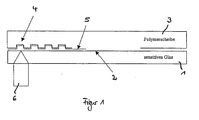
- the FIG. 1 shows a storage medium according to the invention, which can be referred to as a hybrid storage medium and consists of a first disk-shaped sensitive doped glass 1 and a second arranged above it in the laser beam direction behind the glass polymer disk 3.
- the glass pane 1 comprises a metal ion doping which, for example, has already been introduced into the glass in a uniform shape during the production process.
- the polymer disk 3 serves as a protective screen for the metal ion doping arranged close to the surface within the glass pane 1 and furthermore carries on its surface facing the glass pane 1 an optically functional structure in the form of a guide track 4, which extends, for example, spirally with respect to the center of the two disks over the entire interior Surface of the polymer disc 3 extends.
- the inner surface of the polymer disk 3 facing the metal ion-containing surface 2 of the glass further carries a reflection layer 5, e.g. made of aluminum, which extends uniformly over the polymer disk and the functional structure arranged therein.
- the writing laser beam 6 shown here can be guided by the guide track 4, so that the desired information can be stored in a spiral shape within the storage medium, ie in the region of the surface 2 of the glass pane 1.
- the laser beam passes through the glass layer of the storage disk 1, the laser beam is refracted and tuned by the upstream optics so that the focus in the desired writing plane, i. comes to rest near the surface 2 of the storage medium 1.
- the glass surface forms at the point of contact with the polymer, i. at the reflection layer, the desired writing plane. There is also the possibility to move this writing level more in the interior of the glass pane 1.
- the reduction process described above takes place, so that the uniformly present metal ions are reduced locally in the heating area and the information is thereby stored in the storage medium.
- this configuration results from the reduction of the metal ions to metal particles, a coloring of the glass in the region of the focus, which can then be used in reflection or transmission in a simple manner for repeatable reading of the stored information.
Landscapes
- Chemical & Material Sciences (AREA)
- Engineering & Computer Science (AREA)
- General Chemical & Material Sciences (AREA)
- Organic Chemistry (AREA)
- Materials Engineering (AREA)
- Geochemistry & Mineralogy (AREA)
- Life Sciences & Earth Sciences (AREA)
- Chemical Kinetics & Catalysis (AREA)
- Physics & Mathematics (AREA)
- Nanotechnology (AREA)
- Inorganic Chemistry (AREA)
- Crystallography & Structural Chemistry (AREA)
- Mathematical Physics (AREA)
- Toxicology (AREA)
- Dispersion Chemistry (AREA)
- Health & Medical Sciences (AREA)
- Ceramic Engineering (AREA)
- Optics & Photonics (AREA)
- Theoretical Computer Science (AREA)
- Optical Record Carriers And Manufacture Thereof (AREA)
- Optical Recording Or Reproduction (AREA)
- Liquid Crystal (AREA)
- Transition And Organic Metals Composition Catalysts For Addition Polymerization (AREA)
- Plural Heterocyclic Compounds (AREA)
- Pharmaceuticals Containing Other Organic And Inorganic Compounds (AREA)
- Thermal Transfer Or Thermal Recording In General (AREA)
Description
- Die Erfindung betrifft ein Speichermedium zur Speicherung von Informationen/Daten sowie ein Verfahren zum Speichern und/oder Lesen von Daten in Verbindung mit einem solchen Speichermedium.
- Speichermedien zur Speicherung von Informationen und Daten sind hinlänglich bekannt. Zur Archivierung größerer Datenmengen wird in Computeranwendungen beispielsweise häufig auf einfach oder mehrfach beschreibbare CDs oder DVDs zurückgegriffen, deren Grundprinzip darauf beruht, dass in eine auf einer Trägerscheibe angeordneten Farbstoffschicht mittels eines Laserstrahles durch Veränderung der Farbstoffmoleküle eine Information eingeschrieben bzw. eine eingeschriebene Information ausgelesen wird. Neben der technisch begrenzten Speicherkapazität derartiger bekannter Speichermedien ist ein gravierender Nachteil die Tatsache, dass die Farbstoffzusammensetzung bei den bekannten Speichermedien nicht alterungsbeständig sind und insbesondere unter UV-Lichtbestrahlung, beispielsweise durch einfallendes Sonnenlicht zerfallen, so dass im Lauf der Zeit die gespeicherten Daten der Gefahr eines Verlustes unterliegen.
- Darüber hinaus werden als Trägermaterialien für CDs und DVDs häufig Kunststoffscheiben verwendet, die eine besondere Empfindlichkeit gegen Kratzer aufweisen, so dass bei einer unsachgemäßen Handhabung ein Verlust der Daten auch durch mechanische Beschädigung der Speichermedien auftreten kann.
- Aufgabe der Erfindung ist es ein Speichermedium und ein damit verbundenes Verfahren zur Speicherung bzw. zum Auslesen von Daten bereitzustellen, welche eine besonders gute Sicherheit vor Datenverlust aufgrund mechanischer oder Alterungsschäden zur Verfügung stellt und darüber hinaus eine hohe Datendichte zur Verfügung stellt.
- Diese Aufgabe wird erfindungsgemäß durch ein Speichermedium gelöst, welches ein dielektrisches, insbesondere scheibenförmiges Speichermaterial umfasst, auf dem wenigstens einseitig ein Spendermedium für Metallionen angeordnet oder anbringbar ist. Bei einem solchen Speichermedium kann es sich bevorzugt um ein Glas, insbesondere Flachglas handeln.
- Bei einem solchen Speichermedium besteht die Möglichkeit mittels Bestrahlung dieses Speichermediums durch elektromagnetische und/oder Teilchen-Strahlung, insbesondere mittels Laserstrahlung, eine zumindest lokale Dotierung des Speichermediums durch Metallionen hervorzurufen, die aufgrund der Bestrahlung und einer dadurch hervorgerufenen Erwärmung des Speicher- und Spendermediums von dem Spendermedium in das Speichermedium herüberdiffendieren.
- Für diese Art der Metallionendotierung werden bevorzugt Silber-, Gold-, Platin oder Kupferionen oder beliebige Kombinationen hieraus eingesetzt. Diese Metallionen können sich in einem Spendermedium befinden, welches zumindest einseitig auf dem Speichermedium bzw. Speichermaterial angeordnet oder anbringbar ist, wobei das Spendermedium auf beliebige Arten und Weisen auf dem dielektrischen Speichermaterial angebracht sein kann. Beispielsweise besteht die Möglichkeit das Speichermaterial durch eine metallionenhaltige Folie zu bekleben oder aber z.B. im Druckverfahren das Spendermedium auf das Speichermedium aufzubringen.
- Somit kann das Spendermedium sowohl schon bei der Herstellung des Speichermediums oder auch später durch einen Benutzer am Speichermedium angebracht werden.
- Insbesondere bei einer lokal begrenzten Bestrahlung des Speichermediums z.B. mittels einer fokussierten Strahlung, insbesondere mittels fokussierter Laserstrahlung, können an den Orten der lokalen Erwärmung lokal die Metallionen in hoher Konzentration vom Spendermedium in das Speichermedium übertragen werden, wo sich die Metallionen insbesondere oberflächennah anordnen.
- Verglichen mit bekannten Speicherverfahren, beispielsweise bei CDs oder DVDs kann ebenso mit einem derart erfindungsgemäßen Speichermedium eine Information in das dielektrische Medium eingeschrieben werden, die erfindungsgemäß dann aus dem Fehlen oder Vorhandensein einer Ansammlung von Metallionen innerhalb des dielektrischen Speichermaterials besteht. Bei einer z.B. rotierenden Bewegung eines scheibenförmigen Speichermediums unter einem Schreiblesestrahl können die Informationen z.B. nachfolgend auf einer Spiralbahn in das Speichermedium durch lokale Dotierung eingebracht werden.
- Alleine schon die lokal eingebrachten Metallionen, wobei sich der lokale Bereich maßgeblich durch die Fleckgröße des Strahles im Speichermedium am Speicherort bestimmt, stellen eine Information dar, da sich durch die lokale Konzentrationserhöhung an Metallionen der Brechungsindex des Speichermediums an dieser Stelle ändert, so dass eine derart abgespeicherte Information auch auf einfache Art und Weise z.B. durch denselben Schreibstrahl, gegebenenfalls mit einer anderen Intensität ausgelesen werden kann, weil es in Reflektion oder Transmission zu Phasenverschiebungen des Strahles im Bereich der gespeicherten Informationen kommt.
- Hier besteht durch mehr oder weniger starke Dotierung auch die Möglichkeit, nicht nur digital Informationen, sondern auch analoge Informationen zu speichern, da die Stärke der Dotierung z.B. von der Intensität und Dauer der Bestrahlung abhängig gemach werden kann.
- Die Übertragung der Metallionen von dem Spendermedium in das Speichermedium erfolgt bevorzugt in einem Tieftemperaturbereich, wobei dieser durch Temperaturen unterhalb der Transformationstemperatur des dielektrischen Materials, also z.B. eines Glases, gegeben ist. Hierbei ist die Transformationstemperatur z.B. eines Glases gegeben durch die Temperatur, bei der die elastischen Eigenschaften des Glases in viskoelastische Eigenschaften übergehen. Unterhalb dieser Grenztemperatur, die für Flachglas beispielsweise bei ca. 530 Grad Celsius liegt, können effektiv mit der oben beschriebenen Methode Metallionen in das dielektrische Medium, insbesondere ein Glas, dotiert werden.
- In einer weiteren oder alternativen Ausführung besteht die Möglichkeit durch eine lokale oder gleichmäßige Temperaturerhöhung des dielektrischen Speichermateriales oberhalb der Transformationstemperatur eine Reduktion der im Speichermedium vorhandenen Metallionen zu metallischen Partikeln durchzuführen. Nach einer solchen Reduktion besteht dementsprechend die in das Metall eingeschriebenen Informationen aus bereichsweisen Anordnungen von metallischen Clustern mit insbesondere sphärischer Gestalt innerhalb des Speichermediums. Auch durch diese metallischen Clusteranordnungen innerhalb des Speichermediums ändern sich die optischen Eigenschaften des Speichermediums sowohl in Reflektion und Transmission z.B. durch Verfärbung, so dass auch diese Art der Speicherung für eine langlebige Datenarchivierung verwendet werden kann, da sowohl die zuvor beschriebenen Metallionenansammlungen als auch die Metallatomansammlungen langzeitstabil und im Wesentlichen unempfindlich gegen üblichen alltäglichen Lichteinfall sind.
- Allgemein erfolgt die Reduktion der in einem Speichermaterial vorhandenen Metallionen durch eine Erhitzung des dielektrischen Materiales oberhalb der Transformationstemperatur, so dass diese Reduktion z.B. durch eine gleichmäßige Erhitzung, d.h. Temperung des gesamten Speichermediums oberhalb dieser Temperatur nach einer zuvor erfolgten lokalen Informationsübertragung in Form von Metallionen erfolgen kann.
- Alternativ ist es ebenso möglich die Speicherung von Informationen derart durchzuführen, dass in einem ersten Prozess mittels einer elektromagnetischen oder Teilchenbestrahlung die Metallionen aus einem Spendermedium lokal in das Speichermaterial übertragen werden und dann in einem zweiten Verfahrensschritt durch Erhöhung der Temperatur oberhalb der Transformationstemperatur, z.B. durch Erhöhung der Bestrahlungsintensität, die Metallionen zu Metallatomen reduziert werden. Dotierung und Reduzierung kann dementsprechend mit ein- und demselben Strahl, beispielsweise mit einem fokussierten Laserstrahl, erfolgen. Beide Prozeßschritte können z.B. unmittelbar nacheinander bei der Bestrahlung stattfinden, bei der das Speichermedium erwärmt wird, wobei unterhalb der Transformationstemperatur die Dotierung und nach Überschreiten der Transformationstemperatur die Reduktion erfolgt.
- Unabhängig von dem zuvor beschriebenen Verfahren und Speichermedium besteht alternativ oder in Kombination mit dem zuvorgenannten die Möglichkeit ein Speichermedium zu verwenden, welches bereits eine insbesondere gleichmäßige Metallionendotierung aufweist, bei dem also die Metallionendotierung bereits im Herstellungsprozess des Speichermediums in dieses eingebracht wird. Bei einem solchen Speichermedium kann das Spendermedium, welches die Metallionen enthält, in Entfall kommen oder zusätzlich verwendet werden.
- Gemäß einem erfindungsgemäßen Verfahren mit einem solchen Speichermedium kann eine Speicherung der Informationen z.B. dadurch erfolgen, dass durch Bestrahlung, beispielsweise mit elektromagnetischer oder Teilchenbestrahlung, insbesondere mit Laserstrahlung, die z.B. gleichmäßig innerhalb des Speichermaterials vorhandenen Metallionen im Bereich der lokalen Strahlungszone in Metallpartikel und/oder Metallpartikelansammlungen überführt werden. Hierfür ist im Wesentlichen sicherzustellen, dass durch die verwendete Strahlung im Bereich der gewünschten Speicherzone eine lokale Erhitzung des dielektrischen Speichermaterials oberhalb der Transformationstemperatur erfolgt oder eine sonstige geeignete Energieübertragung stattfindet.
- Durch diese dann durchgeführte Reduktion der Metallionen zu Metallpartikeln oder Metallpartikelansammlungen ergibt sich dementsprechend die bereits oben beschriebene Informationsspeicherung innerhalb des Speichermediums.
- Insbesondere in Gläsern als dielektrische Speichermaterialien kann die stattfindende Reduktion oberhalb der Transformationstemperatur durch die üblicherweise innerhalb des Glases vorliegenden metallischen Oxyde, wie z.B. Eisenoxyd und Zinnoxyd erklärt werden. Durch diese im Glas vorkommenden Metalloxyde ergeben sich niederwertige Metallionen, die in der Lage sind die durch die zuvor beschriebenen Prozesse eingebrachten Metallionen zu oxydieren und somit als natürlich vorliegende Reduktionsmittel zu wirken. Dieser Effekt ist insbesondere bei Flachglas signifikant, welches beispielsweise auf einem Zinnbad ausgegossen wird und dementsprechend zumindest auf einer Seite eine sehr hohe Zinnionenkonzentration aufweist.
- Neben der Möglichkeit die Reduktion durch glaseigene Reduktionsmittel und lokale bzw. gleichmäßige Temperaturerhöhung oberhalb der Transformationstemperatur durchzuführen, besteht auch eine Möglichkeit zur Reduktion der Metallionen durch äußere Reduktionsmittel. Insbesondere Silberionen können effektiv in einer Wasserstoffatmosphäre durch die Difusion des Wasserstoffs in das Glas reduziert werden. Es besteht dementsprechend die Möglichkeit in einem Speichermedium, in welchem die Information durch lokale Metallionendotierung vorliegt, durch anschließende Temperung in einer Wasserstoffatmosphäre die lokalen Ionenansammlungen in Metallpartikelansammlungen zu überführen.
- Für die Bestrahlung zur Erzielung der oben genannten Effekte einer lokalen Dotierung bzw. lokalen Reduktion der Metallionen können beliebige Strahlungsarten zum Einsatz kommen, wie z.B. elektromagnetische Strahlung, insbesondere Laserstrahlung, Gamma-, Röntgen-, Materie-, Ionen-Strahlung etc.
- Für das Schreiben und Lesen der Informationen mittels eines Laserstrahls können bevorzugt CO2-Laser wie auch Laser im sichtbaren Bereich, insbesondere im blauen Wellenlängenbereich zum Einsatz kommen. Gerade durch die Bestrahlung eines Speichermediums mit CO2-Laserstrahlung im langwelligen Infrarotbereich können effektiv lokale Erwärmungen des Glases oder allgemein des dielektrischen Mediums erzeugt werden. Jedoch ist im Falle der Verwendung eines CO2-Laserstrahles die Informationsdichte durch die sehr lange Wellenlänge begrenzt.
- Vorteilhafter ist die Verwendung kürzerwelliger Laserstrahlung, die eine höhere Informationsdichte erlaubt, beispielsweise im blauen Wellenlängenbereich. Gerade dieser Wellenlängenbereich bietet sich in idealer Weise an, da zunächst durch eine lokale Erhitzung des Materials Metallkeime, insbesondere Silberatomkeime, ausgebildet werden können aufgrund des voranbeschriebenen Reduktionsprozesses, wobei dann weiterhin nach der Bildung von insbesondere sphärischen Metallpartikelkeimen eine Anhäufung von Metallatomen erfolgt. Die Größe einer solchen Agglomeration kann insbesondere durch die Bestrahlungsdauer und -intensität beeinflusst werden.
- Die Verwendung eines blauen Laserstrahles bietet sich vorliegend besonders an, da durch die Existenz des sphärischen Metallpartikels innerhalb des Speichermaterials eine optische Polarisation dieser Teilchen, d.h. die Anregung einer kollektiven Schwingung der Leitungselektronen gegenüber den Atomrümpfen innerhalb der Metallpartikel hervorgerufen wird. Diese Kollektivschwingungen werden als Oberflächenplasmonen bezeichnet, wobei sich insbesondere für das Metall Silber im blauen Wellenlängenbereich Absorptionsresonanzen ergeben, so dass die Metallpartikelbildung auch durch eine Resonanzabsorption der blauen Wellenlänge durch eine solche Oberflächenplasmonenresonanz besonders effektiv durchgeführt werden kann.
- Durch eine derart resonanzerhöhte Strahlungsabsorption kann dementsprechend nach der Reduktion von Metallionen zu einem Metallpartikelkeim ein solcher Keim zu einer großen Metallpartikelansammlung effektiv anwachsen.
- Nach einer Speicherung gewünschter Informationen kann ebenfalls eine Löschung dieser Informationen nachträglich dadurch erfolgen, dass das Speichermedium in besonderem Maße erhitzt wird und sich somit eine statistische Verteilung der im Speichermaterial vorhandenen Partikel einstellt, die keine weitere Informationswiedergabe ermöglicht.
- In einer bevorzugten Weiterbildung des erfindungsgemäßen Speichermaterials ist dieses zumindest einseitig mit einer weiteren Materialschicht versehen, beispielsweise einem Polymer. Eine solche Materialschicht kann beispielsweise als Schutzschicht dienen.
- Alternativ oder ergänzend zur Schutzfunktion besteht weiterhin die Möglichkeit, dass die Materialschicht eine optisch funktionale Struktur aufweist. Beispielsweise kann in der Materialschicht eine Information vorgesehen sein, die zur Führung eines Schreiblesestrahles eingesetzt werden kann. Eine entsprechende Vorrichtung zum Beschreibung und zum Lesen der erfindungsgemäßen Speichermedien kann dementsprechend einem Schreib- oder Lesestrahl, beispielsweise einem Laserstrahl, anhand der in der zusätzlichen Materialschicht vorhandenen Information über die Oberfläche des Speichermediums führen und hierbei Daten in das Medium durch die zuvor beschriebenen Prozesse einschreiben oder aber auch gespeicherte Daten auslesen.
- Da bei den zuvor beschriebenen Möglichkeiten der lokalen oder auch gleichmäßigen Dotierung eines dielektrischen Speichermateriales mit Metallionen diese Metallionendotierung wenigstens einseitig insbesondere oberflächennah im Speichermaterial angeordnet ist, empfiehlt es sich in einer bevorzugten Ausführung, dass die Materialschicht, die als Schutzschicht und/oder als zusätzliche Informationsschicht dienen kann, auf derjenigen Oberfläche des Speichermediums angeordnet wird, die die oberflächennahe Metallionendotierung aufweist. Hierdurch wird gleichzeitig ein effektiver Schutz dieser Metallionendotierung in der Oberfläche des Speichermaterials erreicht.
- Die Anordnung wenigstens einer weiteren Materialschicht auf einem Speichermaterial kann in bevorzugter Weise dadurch erfolgen, dass das Speichermedium wenigstens zwei miteinander verbundene Scheiben aufweist, von denen wenigstens eine ein Speichermaterial umfasst und eine andere eine oben beschriebene Materialschicht ausbildet. Derartige Scheiben oder Schichten können in beliebiger Weise übereinandergestapelt werden, so dass hierdurch auch mehrschichtige Speichermedien ausgebildet werden können, die eine Abspeicherung von Informationen in verschiedenen tiefen Ebenen erlauben. Hierbei kann die entsprechende Schreib- oder Leseebene insbesondere durch eine Verlagerung des Fokus der verwendeten Strahlung innerhalb des Speichermediums selektiert werden.
- Ein besonderer Schutz ergibt sich bei diesem Schichtaufbau auch dadurch, dass die funktionale Struktur in der Materialschicht auf der dem Speichermaterial zugewandten Seite dieser Materialschicht angeordnet ist. In Verbindung mit der oben beschriebenen bevorzugten Ausführung können dementsprechend sowohl die oberflächennahe Metallionendotierung als auch die gegebenenfalls funktionale Struktur in der Materialschicht einander direkt gegenüberliegen und somit innerhalb der beiden Materialien, d.h. einerseits der gegebenenfalls schützenden Materialschicht und andererseits dem dielektrischen Material eingekapselt sein. Durch diese innere Verkapselung ergibt sich ein besonders guter Schutz gegen mechanische Beschädigung sowohl der funktionalen Struktur als auch der innerhalb der Dotierungsschicht abgelegten Information.
- Insbesondere für ein vereinfachtes Auslesen der gespeicherten Information kann es vorgesehen sein, dass das Speichermedium eine Reflektionsschicht aufweist, die insbesondere an der Materialschicht, bevorzugt zwischen einer Materialschicht und einem Speichermaterial, angeordnet ist. Diese Reflektionsschicht kann besonders vorteilhaft die funktionale Struktur, beispielsweise Führungsspur für ein Schreib- oder Leselaser, bedecken und so die Abtastung dieser funktionalen Struktur vereinfachen, wobei gleichzeitig die Reflektionsschicht ein Auslesen der gespeicherten Information in einer Reflektionsanordnung ermöglicht.
- Ein Ausführungsbeispiel der Erfindung ist in der nachfolgenden Figur näher erläutert.
- Die
Figur 1 zeigt ein erfindungsgemäßes Speichermedium, welches als Hybrid-Speichermedium bezeichnet werden kann und aus einem ersten scheibenförmigen sensitiven dotierten Glas 1 und einer zweiten darüber in Laserstrahlrichtung hinter dem Glas angeordneten Polymerscheibe 3 besteht. Die Glasscheibe 1 umfasst im Bereich ihrer Oberfläche 2 eine Metallionendotierung, die z.B. bereits beim Herstellungsprozess in das Glas in gleichmäßiger Form eingebracht wurde. - Die Polymerscheibe 3 dient als Schutzscheibe für die oberflächennah angeordnete Metallionendotierung innerhalb der Glasscheibe 1 und trägt weiterhin auf ihrer der Glasscheibe 1 zugewandten Oberfläche eine optisch funktionale Struktur in der Form einer Führungsspur 4, die sich beispielsweise spiralförmig bezüglich des Mittelpunktes der beiden Scheiben über die gesamte innere Oberfläche der Polymerscheibe 3 erstreckt. Die innere Oberfläche der Polymerscheibe 3, die der die Metallionen enthaltene Oberfläche 2 des Glases zugewandt ist, trägt weiterhin eine Reflektionsschicht 5, z.B. aus Aluminium, die sich gleichmäßig über die Polymerscheibe und die darin angeordnete funktionale Struktur erstreckt. Hierdurch wird eine besonders einfache Führung eines Schreibleselasers 6 in einer Reflektionskonfiguration, wie Sie beispielsweise auch von üblichen CDs und DVDs bekannt ist, ermöglicht.
- Durch die Tatsache, dass sowohl die die Metallionendotierung aufweisende Oberfläche 2 des Glases als auch die die funktionale Struktur aufweisende Oberfläche der Polymerscheibe aufeinander zugewandt sind und auch die Reflektionsschicht im Inneren dieses Verbundes zu liegen kommt, ergibt sich ein besonders guter Schutz gegen mechanische Beschädigung dieser drei Anordnungen. In einer Aufnahmevorrichtung zur Verwendung eines solchen erfindungsgemäßen Speichermediums kann der hier dargestellte Schreiblaserstrahl 6 anhand der Führungsspur 4 geführt werden, so dass in einer Spiralform die gewünschten Informationen innerhalb des Speichermediums, d.h. im Bereich der Oberfläche 2 der Glasscheibe 1 abgelegt werden können.
- Beim Durchgang des Schreiblaserstrahles durch die Glasschicht der Speicherplatte 1 wird der Laserstrahl gebrochen und durch die vorgeschaltete Optik so abgestimmt, dass der Fokus in der gewünschten Schreibebene, d.h. nahe der Oberfläche 2 des Speichermediums 1 zu liegen kommt. Bevorzugt bildet die Glasoberfläche an der Kontaktstelle zum Polymer, d.h. an der Reflektionsschicht, die gewünschte Schreibebene. Es besteht ebenso die Möglichkeit diese Schreibebene mehr in das Innere der Glasscheibe 1 zu verlegen.
- Durch die lokale Erhitzung des Speichermediums 1 im Bereich der Schreibebene vollzieht sich der oben beschriebene Reduktionsprozess, so dass die gleichmäßig vorliegenden Metallionen lokal im Bereich der Erhitzung reduziert werden und hierdurch die Information im Speichermedium abgelegt wird. Insbesondere bei dieser Konfiguration ergibt sich durch die Reduktion der Metallionen zu Metallpartikeln eine Färbung des Glases im Bereich des Fokus, die dann in Reflektion oder Transmission in einfacher Weise zum wiederholbaren Auslesen der abgelegten Information verwendet werden kann.
- Aufgrund der Unempfindlichkeit sowohl der Metallionen als auch der Metallpartikel nach der Reduktion ergibt sich eine besonders gute Langzeitstabilität, die die Stiblität üblicher farbstoffbasierter Speichermedien bei weitem überschreitet.
Claims (17)
- Speichermedium zur Speicherung von Informationen/Daten dadurch gekennzeichnet dass das Speichermedium ein dielektrisches, scheibenförmiges Speichermaterial (1) umfasst auf dem wenigstens einseitig ein Spendermedium für Metallionen angeordnet ist, wobei durch Bestrahlung des Speichermediums mit Laserstrahlung (6), Metallionen vom Sender medium in das Speichermaterial (1) übertragbar sind.
- Speichermedium zur Speicherung von Informationen/Daten, insbesondere nach Anspruch 1, dadurch gekennzeichnet, dass das Speichermedium ein dielektrisches, scheibenförmiges Speichermaterial (1) umfasst, welches eine zumindest lokale Metallionen-Dotierung aufweist, wobei durch Bestrahlung mit Laserstrahlung (6) die Metallionen in Metallpartikel und oder Metallpartikelansammlungen überführbar sind.
- Speichermedium nach Anspruch 1 oder 2, dadurch gekennzeichnet, dass es sich bei dem Speichermaterial (1) um Glas handelt.
- Speichermedium nach einem der vorherigen Ansprüche, dadurch gekennzeichnet, dass die Metallionendotierung wenigstens einseitig oberflächennah im Speichermaterial (1) angeordnet ist.
- Speichermedium nach einem der vorherigen Ansprüche, dadurch gekennzeichnet, dass die Metalldotierung mit Silber- und/oder Gold- und/oder Platin- und/oder Kupferionen ausgerührt ist.
- Speichermedium nach einem der vorherigen Ansprüche, dadurch gekennzeichnet, dass auf dem Speichermaterial (1) wenigstens einseitig eine Materialschicht (3), insbesondere aus Polymer, angeordnet ist.
- Speichermedium nach einem der vorherigen Ansprüche, dadurch gekennzeichnet, dass die Materialschicht (3) eine optisch funktionale Struktur (4) aufweist, die insbesondere eine Information zur Führung eines Schreib-/Lese-Strahles (6) bildet.
- Speichermedium nach einem der vorherigen Ansprüche, dadurch gekennzeichnet, dass es wenigstens zwei miteinander verbundene Scheiben (1,3) aufweist, von denen wenigstens eine ein Speichermaterial (1) umfasst und eine andere eine Materialschicht (3) ausbildet.
- Speichermedium nach einem der vorherigen Ansprüche, dadurch gekennzeichnet, dass eine oberflächennahe Metallionen-Dotierung auf der der Materialschicht (3) zugewandten Seite eines Speichermateriales (1) angeordnet ist.
- Speichermedium nach einem der vorherigen Ansprüche, dadurch gekennzeichnet, dass die funktionale Struktur (4) in der Materialschich (3) auf der einem Speichermaterial (1) zugewandten Seite angeordnet ist.
- Speichermedium nach einem der vorherigen Ansprüche, dadurch gekennzeichnet, dass es eine Reflexionschicht (5) aufweist, die insbesondere an der Materialschicht (3), bevorzugt zwischen der Materialschicht (3) und dem Speichermaterial (1) angeordnet ist.
- Speichermedium nach einem der vorherigen Ansprüche, dadurch gekennzeichnet, dass die gespeicherten Informationen/Daten aus einer räumlichen Anordnung von Speichermaterialbereichen mit und ohne Metallpartikeln/Metallionen besteht,
- Verfahren zum Speichern und/oder Lesen von Daten mit einem Speichermedium, insbesondere nach einem der vorherigen Ansprüche, dadurch gekennzeichnet, dass mittels Bestrahlung des Speichermediums/- materials durch elektromagnetische und/oder Teilchen-Strahlung eine Dotierung des Speichermediums/-materials (1) durch Metallionen von einem auf dem Speichermedium/-material (1) angeordneten Spendermedium durchgeführt wird.
- Verfahren zum Speichern und/oder Lesen von Daten mit einem Speichermedium, insbesondere nach einem der vorherigen Ansprüche dadurch gekennzeichnet, dass mittels Bestrahlung des Speichermediums/- materials (1) durch elektromagnetische und/oder Teilchen-Strahlung in einem zumindest lokal mit Metallionen dotierten dielektrischen Speichermaterial (1) durch lokale Metallpartikelbildung aus Metallionen eine Information im Speichermaterial (1) gespeichert wird und/oder eine durch lokal gebildete Metallpartikel gespeicherte Information durch Abtastung des Speichermaterials (1) mit der genannten Strahlung in Transmission und/oder Reflexion ausgelesen wird.
- Verfahren nach einem der vorherigen Ansprüche, dadurch gekennzeichnet, dass das Schreiben und Lesen der Informationen mit einem Laserstrah (6) im sichtbaren Spektralbereich, insbesondere im blauen Wellenlängenbereich erfolgt.
- Verfahren nach einem der vorherigen Ansprüche, dadurch gekennzeichnet, dass die Bildung von Metallpartikeln und/oder Metallpartikelansammlungen in einem ersten Schritt bei Bestrahlung durch thermisch induzierte Bildung von Metallpartikelkeimen durch Reduktion von Metallionen erfolgt und in einem zweiten Schritt ein Wachstum der Metallpartikelkeime zu einer Metallpartikelansammlung durch resonanzerhöhte Strahlungsabsorption, insbesondere aufgrund einer Oberflächenplasmonenresonanz, erfolgt.
- Verfahren nach einem der vorherigen Ansprüche, dadurch gekennzeichnet, dass eine Löschung der gespeicherten Informationen/Daten durch eine Erhitzung des Speichermediums (1), erfolgt.
Applications Claiming Priority (3)
| Application Number | Priority Date | Filing Date | Title |
|---|---|---|---|
| DE10249095A DE10249095A1 (de) | 2002-10-21 | 2002-10-21 | Speichermedium |
| DE10249095 | 2002-10-21 | ||
| PCT/EP2003/008920 WO2004038713A1 (de) | 2002-10-21 | 2003-08-12 | Speichermedium |
Publications (2)
| Publication Number | Publication Date |
|---|---|
| EP1554724A1 EP1554724A1 (de) | 2005-07-20 |
| EP1554724B1 true EP1554724B1 (de) | 2009-01-14 |
Family
ID=32049530
Family Applications (1)
| Application Number | Title | Priority Date | Filing Date |
|---|---|---|---|
| EP03809254A Expired - Lifetime EP1554724B1 (de) | 2002-10-21 | 2003-08-12 | Speichermedium |
Country Status (7)
| Country | Link |
|---|---|
| US (1) | US7892721B2 (de) |
| EP (1) | EP1554724B1 (de) |
| JP (1) | JP2006504549A (de) |
| AT (1) | ATE421141T1 (de) |
| AU (1) | AU2003255420A1 (de) |
| DE (2) | DE10249095A1 (de) |
| WO (1) | WO2004038713A1 (de) |
Families Citing this family (5)
| Publication number | Priority date | Publication date | Assignee | Title |
|---|---|---|---|---|
| US7748748B2 (en) * | 2005-04-12 | 2010-07-06 | International Business Machines Corporation | Method and system for generating and authenticating documents having stored electrostatic pattern information |
| DE102005043516A1 (de) * | 2005-09-12 | 2007-03-15 | Boraglas Gmbh | Verfahren zur Herstellung farbiger Strukturen im Glas und dadurch hergestelltes Glas |
| EP1826758A1 (de) * | 2006-02-24 | 2007-08-29 | THOMSON Licensing | Optisches, mehrschichtiges Speichermedium mit Nanopartikeln |
| US8858924B2 (en) * | 2009-03-26 | 2014-10-14 | Warsaw Orthopedic, Inc. | Compositions and methods for treatment of hemorrhage |
| GB201019579D0 (en) * | 2010-11-19 | 2010-12-29 | Lingvitae Holding As | Method and apparatus for direct writing |
Family Cites Families (14)
| Publication number | Priority date | Publication date | Assignee | Title |
|---|---|---|---|---|
| US2732298A (en) * | 1952-12-05 | 1956-01-24 | Method of producing a photograph | |
| USRE31220E (en) * | 1977-11-30 | 1983-04-26 | Ppg Industries, Inc. | Electromigration method for making stained glass photomasks |
| US4304848A (en) * | 1979-07-06 | 1981-12-08 | Drexler Technology Corporation | Method for photographic replication of information on an optical data storage medium |
| US4269917A (en) * | 1979-07-06 | 1981-05-26 | Drexler Technology Corporation | Data storage medium having reflective particulate silver layer |
| US5078771A (en) * | 1989-02-07 | 1992-01-07 | Canyon Materials, Inc. | Method of making high energy beam sensitive glasses |
| US4811289A (en) * | 1985-07-08 | 1989-03-07 | Harry Sadjian | Optical recording device enploying doped crystal for optically storing information |
| US4782006A (en) * | 1985-12-16 | 1988-11-01 | Canon Kabushiki Kaisha | Optical recording employing diacetylene compound and dye to form and visualize a latent image |
| US4762770A (en) * | 1986-04-23 | 1988-08-09 | Drexler Technology Corporation | High contrast optical memory disk |
| US4881289A (en) * | 1988-04-27 | 1989-11-21 | Sunstar Engineering Inc. | Paint-coating brush |
| US4913717A (en) * | 1989-01-23 | 1990-04-03 | Polaroid Corporation | Method for fabricating buried waveguides |
| DE19724214A1 (de) * | 1997-06-09 | 1998-12-10 | Sicrystal Ag | Optisches Datenspeicherelement und Verfahren zur Datenspeicherung unter dessen Verwendung |
| DE19841547B4 (de) | 1998-09-11 | 2004-04-08 | Martin-Luther-Universität Halle-Wittenberg | Gläser mit farbigen Strukturen und Verfahren zu deren Herstellung |
| FR2801302B1 (fr) | 1999-11-22 | 2001-12-21 | Saint Gobain Vitrage | Procede de traitement de substrats en verre et substrats en verre pour la realisation d'ecrans de visualisation |
| DE10119302A1 (de) | 2001-04-19 | 2002-10-31 | Bora Glas Gmbh C O Fachbereich | Verfahren zum laserstrahlgestützten Eintrag von Metallionen in Glas zur Erzeugung von farblosen und farbigen Pixeln |
-
2002
- 2002-10-21 DE DE10249095A patent/DE10249095A1/de active Pending
-
2003
- 2003-08-12 WO PCT/EP2003/008920 patent/WO2004038713A1/de not_active Ceased
- 2003-08-12 US US10/531,962 patent/US7892721B2/en not_active Expired - Fee Related
- 2003-08-12 JP JP2004545754A patent/JP2006504549A/ja active Pending
- 2003-08-12 AT AT03809254T patent/ATE421141T1/de not_active IP Right Cessation
- 2003-08-12 AU AU2003255420A patent/AU2003255420A1/en not_active Abandoned
- 2003-08-12 EP EP03809254A patent/EP1554724B1/de not_active Expired - Lifetime
- 2003-08-12 DE DE50311100T patent/DE50311100D1/de not_active Expired - Lifetime
Also Published As
| Publication number | Publication date |
|---|---|
| AU2003255420A1 (en) | 2004-05-13 |
| US7892721B2 (en) | 2011-02-22 |
| US20060114801A1 (en) | 2006-06-01 |
| DE10249095A1 (de) | 2004-04-29 |
| AU2003255420A8 (en) | 2004-05-13 |
| DE50311100D1 (de) | 2009-03-05 |
| JP2006504549A (ja) | 2006-02-09 |
| ATE421141T1 (de) | 2009-01-15 |
| WO2004038713A1 (de) | 2004-05-06 |
| EP1554724A1 (de) | 2005-07-20 |
Similar Documents
| Publication | Publication Date | Title |
|---|---|---|
| DE3204076C2 (de) | ||
| DE60021968T2 (de) | Optischer Informationsträger und Leseverfahren | |
| DE69313926T2 (de) | Optisches Aufzeichungsmedium und Verfahren zur Herstellung desselben | |
| DE60030791T2 (de) | Phasenwechselaufzeichnung mit Schicht zur Verbesserung der Kristallisation | |
| DE60303065T2 (de) | Optischer Aufzeichnungsträger | |
| DE60311804T2 (de) | Datenaufzeichnungsmedium und herstellungsverfahren hierfür | |
| DE3147472A1 (de) | Informationsspeichereinrichtung | |
| DE69816073T2 (de) | Verfahren zur herstellung eines optischen informationsaufzeichnungsmediums, und durch das verfahren hergestelltes optisches informationsaufzeichnungsmedium | |
| DE69326525T2 (de) | Magnetooptischer Aufzeichnungträger und Verfahren zur Aufzeichnung und Wiedergabe von optischer Information | |
| DE3883174T2 (de) | Optisches Informationsaufzeichnungsmedium. | |
| DE602004010451T2 (de) | Einmal beschreibbarer, mehrmals lesbarer optischer Datenträger und Verfahren zum Beschreiben und Lesen des Datenträgers | |
| DE3802679C2 (de) | ||
| DE4335799A1 (de) | Optisches Aufzeichnungsverfahren und optisches Aufzeichnungsmedium | |
| DE60015829T2 (de) | Optischer Aufzeichnungsträger und Verfahren zu dessen Initialisierung | |
| DE3784227T2 (de) | Medium fuer informationsspeicherung und verfahren zum loeschen von information. | |
| DE69322365T2 (de) | Optisches Aufzeichnungsmedium | |
| DE3832126A1 (de) | Informationsspeichermedium | |
| EP1554724A1 (de) | Speichermedium | |
| DE69204780T2 (de) | Optisches aufzeichnungsmedium. | |
| DE69321643T2 (de) | Optisches Speichermedium und Informationsaufzeichnungsverfahren mit diesem | |
| DE3218157A1 (de) | Fluessigkristall-speichersystem | |
| DE69026910T2 (de) | Verfahren zur Herstellung eines magnetooptischen Speichers | |
| DE60310265T2 (de) | Verwendung eines doppeltschichtigen photolithographischen resists als neues material für optische speicherung | |
| DE3687027T2 (de) | Optischer aufzeichnungstraeger. | |
| DE68925331T2 (de) | Informationsaufzeichnungsdünnschicht und Methode zur Aufnahme und Wiedergabe von Information |
Legal Events
| Date | Code | Title | Description |
|---|---|---|---|
| PUAI | Public reference made under article 153(3) epc to a published international application that has entered the european phase |
Free format text: ORIGINAL CODE: 0009012 |
|
| 17P | Request for examination filed |
Effective date: 20050412 |
|
| AK | Designated contracting states |
Kind code of ref document: A1 Designated state(s): AT BE BG CH CY CZ DE DK EE ES FI FR GB GR HU IE IT LI LU MC NL PT RO SE SI SK TR |
|
| AX | Request for extension of the european patent |
Extension state: AL LT LV MK |
|
| DAX | Request for extension of the european patent (deleted) | ||
| RIN1 | Information on inventor provided before grant (corrected) |
Inventor name: BERG, GUNNAR Inventor name: FEHR, GERHARD Inventor name: BERG, KLAUS-JUERGEN Inventor name: BOREK, REINHARD Inventor name: RAINER, THOMAS Inventor name: SCHNEIDER, JOCHEN Inventor name: CIOC, ALEXANDER |
|
| 17Q | First examination report despatched |
Effective date: 20070319 |
|
| 19U | Interruption of proceedings before grant |
Effective date: 20080201 |
|
| 19W | Proceedings resumed before grant after interruption of proceedings |
Effective date: 20080602 |
|
| GRAP | Despatch of communication of intention to grant a patent |
Free format text: ORIGINAL CODE: EPIDOSNIGR1 |
|
| RAP1 | Party data changed (applicant data changed or rights of an application transferred) |
Owner name: BORAIDENT GMBH Owner name: FUJI MAGNETICS GMBH |
|
| RAP1 | Party data changed (applicant data changed or rights of an application transferred) |
Owner name: BORAIDENT GMBH Owner name: FEHR, GERHARD |
|
| GRAS | Grant fee paid |
Free format text: ORIGINAL CODE: EPIDOSNIGR3 |
|
| GRAA | (expected) grant |
Free format text: ORIGINAL CODE: 0009210 |
|
| AK | Designated contracting states |
Kind code of ref document: B1 Designated state(s): AT BE BG CH CY CZ DE DK EE ES FI FR GB GR HU IE IT LI LU MC NL PT RO SE SI SK TR |
|
| REG | Reference to a national code |
Ref country code: GB Ref legal event code: FG4D Free format text: NOT ENGLISH |
|
| REG | Reference to a national code |
Ref country code: CH Ref legal event code: EP |
|
| REG | Reference to a national code |
Ref country code: IE Ref legal event code: FG4D Free format text: LANGUAGE OF EP DOCUMENT: GERMAN |
|
| REF | Corresponds to: |
Ref document number: 50311100 Country of ref document: DE Date of ref document: 20090305 Kind code of ref document: P |
|
| PG25 | Lapsed in a contracting state [announced via postgrant information from national office to epo] |
Ref country code: NL Free format text: LAPSE BECAUSE OF FAILURE TO SUBMIT A TRANSLATION OF THE DESCRIPTION OR TO PAY THE FEE WITHIN THE PRESCRIBED TIME-LIMIT Effective date: 20090114 |
|
| NLV1 | Nl: lapsed or annulled due to failure to fulfill the requirements of art. 29p and 29m of the patents act | ||
| PG25 | Lapsed in a contracting state [announced via postgrant information from national office to epo] |
Ref country code: SI Free format text: LAPSE BECAUSE OF FAILURE TO SUBMIT A TRANSLATION OF THE DESCRIPTION OR TO PAY THE FEE WITHIN THE PRESCRIBED TIME-LIMIT Effective date: 20090114 Ref country code: FI Free format text: LAPSE BECAUSE OF FAILURE TO SUBMIT A TRANSLATION OF THE DESCRIPTION OR TO PAY THE FEE WITHIN THE PRESCRIBED TIME-LIMIT Effective date: 20090114 Ref country code: ES Free format text: LAPSE BECAUSE OF FAILURE TO SUBMIT A TRANSLATION OF THE DESCRIPTION OR TO PAY THE FEE WITHIN THE PRESCRIBED TIME-LIMIT Effective date: 20090425 |
|
| REG | Reference to a national code |
Ref country code: IE Ref legal event code: FD4D |
|
| PG25 | Lapsed in a contracting state [announced via postgrant information from national office to epo] |
Ref country code: SE Free format text: LAPSE BECAUSE OF FAILURE TO SUBMIT A TRANSLATION OF THE DESCRIPTION OR TO PAY THE FEE WITHIN THE PRESCRIBED TIME-LIMIT Effective date: 20090414 Ref country code: PT Free format text: LAPSE BECAUSE OF FAILURE TO SUBMIT A TRANSLATION OF THE DESCRIPTION OR TO PAY THE FEE WITHIN THE PRESCRIBED TIME-LIMIT Effective date: 20090615 |
|
| PG25 | Lapsed in a contracting state [announced via postgrant information from national office to epo] |
Ref country code: EE Free format text: LAPSE BECAUSE OF FAILURE TO SUBMIT A TRANSLATION OF THE DESCRIPTION OR TO PAY THE FEE WITHIN THE PRESCRIBED TIME-LIMIT Effective date: 20090114 Ref country code: IE Free format text: LAPSE BECAUSE OF FAILURE TO SUBMIT A TRANSLATION OF THE DESCRIPTION OR TO PAY THE FEE WITHIN THE PRESCRIBED TIME-LIMIT Effective date: 20090114 Ref country code: DK Free format text: LAPSE BECAUSE OF FAILURE TO SUBMIT A TRANSLATION OF THE DESCRIPTION OR TO PAY THE FEE WITHIN THE PRESCRIBED TIME-LIMIT Effective date: 20090114 Ref country code: CZ Free format text: LAPSE BECAUSE OF FAILURE TO SUBMIT A TRANSLATION OF THE DESCRIPTION OR TO PAY THE FEE WITHIN THE PRESCRIBED TIME-LIMIT Effective date: 20090114 |
|
| PLBE | No opposition filed within time limit |
Free format text: ORIGINAL CODE: 0009261 |
|
| STAA | Information on the status of an ep patent application or granted ep patent |
Free format text: STATUS: NO OPPOSITION FILED WITHIN TIME LIMIT |
|
| PG25 | Lapsed in a contracting state [announced via postgrant information from national office to epo] |
Ref country code: RO Free format text: LAPSE BECAUSE OF FAILURE TO SUBMIT A TRANSLATION OF THE DESCRIPTION OR TO PAY THE FEE WITHIN THE PRESCRIBED TIME-LIMIT Effective date: 20090114 Ref country code: SK Free format text: LAPSE BECAUSE OF FAILURE TO SUBMIT A TRANSLATION OF THE DESCRIPTION OR TO PAY THE FEE WITHIN THE PRESCRIBED TIME-LIMIT Effective date: 20090114 |
|
| 26N | No opposition filed |
Effective date: 20091015 |
|
| PG25 | Lapsed in a contracting state [announced via postgrant information from national office to epo] |
Ref country code: BG Free format text: LAPSE BECAUSE OF FAILURE TO SUBMIT A TRANSLATION OF THE DESCRIPTION OR TO PAY THE FEE WITHIN THE PRESCRIBED TIME-LIMIT Effective date: 20090414 |
|
| BERE | Be: lapsed |
Owner name: BORAIDENT G.M.B.H. Effective date: 20090831 Owner name: FEHR, GERHARD Effective date: 20090831 |
|
| PG25 | Lapsed in a contracting state [announced via postgrant information from national office to epo] |
Ref country code: MC Free format text: LAPSE BECAUSE OF NON-PAYMENT OF DUE FEES Effective date: 20090831 |
|
| REG | Reference to a national code |
Ref country code: CH Ref legal event code: PL |
|
| GBPC | Gb: european patent ceased through non-payment of renewal fee |
Effective date: 20090812 |
|
| PG25 | Lapsed in a contracting state [announced via postgrant information from national office to epo] |
Ref country code: CH Free format text: LAPSE BECAUSE OF NON-PAYMENT OF DUE FEES Effective date: 20090831 Ref country code: LI Free format text: LAPSE BECAUSE OF NON-PAYMENT OF DUE FEES Effective date: 20090831 |
|
| REG | Reference to a national code |
Ref country code: FR Ref legal event code: ST Effective date: 20100430 |
|
| PG25 | Lapsed in a contracting state [announced via postgrant information from national office to epo] |
Ref country code: BE Free format text: LAPSE BECAUSE OF NON-PAYMENT OF DUE FEES Effective date: 20090831 |
|
| PG25 | Lapsed in a contracting state [announced via postgrant information from national office to epo] |
Ref country code: FR Free format text: LAPSE BECAUSE OF NON-PAYMENT OF DUE FEES Effective date: 20090831 |
|
| PG25 | Lapsed in a contracting state [announced via postgrant information from national office to epo] |
Ref country code: GR Free format text: LAPSE BECAUSE OF FAILURE TO SUBMIT A TRANSLATION OF THE DESCRIPTION OR TO PAY THE FEE WITHIN THE PRESCRIBED TIME-LIMIT Effective date: 20090415 |
|
| PG25 | Lapsed in a contracting state [announced via postgrant information from national office to epo] |
Ref country code: GB Free format text: LAPSE BECAUSE OF NON-PAYMENT OF DUE FEES Effective date: 20090812 Ref country code: AT Free format text: LAPSE BECAUSE OF NON-PAYMENT OF DUE FEES Effective date: 20090812 |
|
| PG25 | Lapsed in a contracting state [announced via postgrant information from national office to epo] |
Ref country code: IT Free format text: LAPSE BECAUSE OF FAILURE TO SUBMIT A TRANSLATION OF THE DESCRIPTION OR TO PAY THE FEE WITHIN THE PRESCRIBED TIME-LIMIT Effective date: 20090114 |
|
| PG25 | Lapsed in a contracting state [announced via postgrant information from national office to epo] |
Ref country code: LU Free format text: LAPSE BECAUSE OF NON-PAYMENT OF DUE FEES Effective date: 20090812 |
|
| PG25 | Lapsed in a contracting state [announced via postgrant information from national office to epo] |
Ref country code: HU Free format text: LAPSE BECAUSE OF FAILURE TO SUBMIT A TRANSLATION OF THE DESCRIPTION OR TO PAY THE FEE WITHIN THE PRESCRIBED TIME-LIMIT Effective date: 20090715 |
|
| PG25 | Lapsed in a contracting state [announced via postgrant information from national office to epo] |
Ref country code: TR Free format text: LAPSE BECAUSE OF FAILURE TO SUBMIT A TRANSLATION OF THE DESCRIPTION OR TO PAY THE FEE WITHIN THE PRESCRIBED TIME-LIMIT Effective date: 20090114 |
|
| PG25 | Lapsed in a contracting state [announced via postgrant information from national office to epo] |
Ref country code: CY Free format text: LAPSE BECAUSE OF FAILURE TO SUBMIT A TRANSLATION OF THE DESCRIPTION OR TO PAY THE FEE WITHIN THE PRESCRIBED TIME-LIMIT Effective date: 20090114 |
|
| REG | Reference to a national code |
Ref country code: DE Ref legal event code: R082 Ref document number: 50311100 Country of ref document: DE Representative=s name: PATENT- UND RECHTSANWAELTE DR. SOLF & ZAPF, DE |
|
| REG | Reference to a national code |
Ref country code: DE Ref legal event code: R082 Ref document number: 50311100 Country of ref document: DE Representative=s name: PATENT- UND RECHTSANWAELTE DR. SOLF & ZAPF, DE Ref country code: DE Ref legal event code: R081 Ref document number: 50311100 Country of ref document: DE Owner name: FEHR, GERHARD, DE Free format text: FORMER OWNERS: BORAIDENT GMBH, 06118 HALLE, DE; FEHR, GERHARD, 47533 KLEVE, DE Ref country code: DE Ref legal event code: R081 Ref document number: 50311100 Country of ref document: DE Owner name: HEGLA BORAIDENT GMBH & CO. KG, DE Free format text: FORMER OWNERS: BORAIDENT GMBH, 06118 HALLE, DE; FEHR, GERHARD, 47533 KLEVE, DE |
|
| PGFP | Annual fee paid to national office [announced via postgrant information from national office to epo] |
Ref country code: DE Payment date: 20180228 Year of fee payment: 15 |
|
| REG | Reference to a national code |
Ref country code: DE Ref legal event code: R119 Ref document number: 50311100 Country of ref document: DE |
|
| PG25 | Lapsed in a contracting state [announced via postgrant information from national office to epo] |
Ref country code: DE Free format text: LAPSE BECAUSE OF NON-PAYMENT OF DUE FEES Effective date: 20190301 |