EP1550678A1 - Resin composition for printed wiring board, and vanish, prepreg and metal-clad laminate using same - Google Patents
Resin composition for printed wiring board, and vanish, prepreg and metal-clad laminate using same Download PDFInfo
- Publication number
- EP1550678A1 EP1550678A1 EP03798536A EP03798536A EP1550678A1 EP 1550678 A1 EP1550678 A1 EP 1550678A1 EP 03798536 A EP03798536 A EP 03798536A EP 03798536 A EP03798536 A EP 03798536A EP 1550678 A1 EP1550678 A1 EP 1550678A1
- Authority
- EP
- European Patent Office
- Prior art keywords
- epoxy resin
- wiring board
- printed wiring
- cyanate ester
- resin composition
- Prior art date
- Legal status (The legal status is an assumption and is not a legal conclusion. Google has not performed a legal analysis and makes no representation as to the accuracy of the status listed.)
- Granted
Links
- 0 C*(*)Oc1c(*)cc(*)cc1* Chemical compound C*(*)Oc1c(*)cc(*)cc1* 0.000 description 12
- JFIGQUDLVNNXHV-WQLSENKSSA-N CCCC/C=C\C(CCC)C1CCCCC1 Chemical compound CCCC/C=C\C(CCC)C1CCCCC1 JFIGQUDLVNNXHV-WQLSENKSSA-N 0.000 description 1
Classifications
-
- C—CHEMISTRY; METALLURGY
- C08—ORGANIC MACROMOLECULAR COMPOUNDS; THEIR PREPARATION OR CHEMICAL WORKING-UP; COMPOSITIONS BASED THEREON
- C08G—MACROMOLECULAR COMPOUNDS OBTAINED OTHERWISE THAN BY REACTIONS ONLY INVOLVING UNSATURATED CARBON-TO-CARBON BONDS
- C08G73/00—Macromolecular compounds obtained by reactions forming a linkage containing nitrogen with or without oxygen or carbon in the main chain of the macromolecule, not provided for in groups C08G12/00 - C08G71/00
- C08G73/06—Polycondensates having nitrogen-containing heterocyclic rings in the main chain of the macromolecule
- C08G73/0622—Polycondensates containing six-membered rings, not condensed with other rings, with nitrogen atoms as the only ring hetero atoms
- C08G73/0638—Polycondensates containing six-membered rings, not condensed with other rings, with nitrogen atoms as the only ring hetero atoms with at least three nitrogen atoms in the ring
- C08G73/065—Preparatory processes
- C08G73/0655—Preparatory processes from polycyanurates
-
- B—PERFORMING OPERATIONS; TRANSPORTING
- B32—LAYERED PRODUCTS
- B32B—LAYERED PRODUCTS, i.e. PRODUCTS BUILT-UP OF STRATA OF FLAT OR NON-FLAT, e.g. CELLULAR OR HONEYCOMB, FORM
- B32B15/00—Layered products comprising a layer of metal
- B32B15/04—Layered products comprising a layer of metal comprising metal as the main or only constituent of a layer, which is next to another layer of the same or of a different material
- B32B15/08—Layered products comprising a layer of metal comprising metal as the main or only constituent of a layer, which is next to another layer of the same or of a different material of synthetic resin
-
- C—CHEMISTRY; METALLURGY
- C08—ORGANIC MACROMOLECULAR COMPOUNDS; THEIR PREPARATION OR CHEMICAL WORKING-UP; COMPOSITIONS BASED THEREON
- C08G—MACROMOLECULAR COMPOUNDS OBTAINED OTHERWISE THAN BY REACTIONS ONLY INVOLVING UNSATURATED CARBON-TO-CARBON BONDS
- C08G59/00—Polycondensates containing more than one epoxy group per molecule; Macromolecules obtained by polymerising compounds containing more than one epoxy group per molecule using curing agents or catalysts which react with the epoxy groups
- C08G59/18—Macromolecules obtained by polymerising compounds containing more than one epoxy group per molecule using curing agents or catalysts which react with the epoxy groups ; e.g. general methods of curing
- C08G59/40—Macromolecules obtained by polymerising compounds containing more than one epoxy group per molecule using curing agents or catalysts which react with the epoxy groups ; e.g. general methods of curing characterised by the curing agents used
- C08G59/4007—Curing agents not provided for by the groups C08G59/42 - C08G59/66
- C08G59/4014—Nitrogen containing compounds
-
- C—CHEMISTRY; METALLURGY
- C08—ORGANIC MACROMOLECULAR COMPOUNDS; THEIR PREPARATION OR CHEMICAL WORKING-UP; COMPOSITIONS BASED THEREON
- C08J—WORKING-UP; GENERAL PROCESSES OF COMPOUNDING; AFTER-TREATMENT NOT COVERED BY SUBCLASSES C08B, C08C, C08F, C08G or C08H
- C08J5/00—Manufacture of articles or shaped materials containing macromolecular substances
- C08J5/24—Impregnating materials with prepolymers which can be polymerised in situ, e.g. manufacture of prepregs
-
- C—CHEMISTRY; METALLURGY
- C08—ORGANIC MACROMOLECULAR COMPOUNDS; THEIR PREPARATION OR CHEMICAL WORKING-UP; COMPOSITIONS BASED THEREON
- C08L—COMPOSITIONS OF MACROMOLECULAR COMPOUNDS
- C08L63/00—Compositions of epoxy resins; Compositions of derivatives of epoxy resins
-
- C—CHEMISTRY; METALLURGY
- C08—ORGANIC MACROMOLECULAR COMPOUNDS; THEIR PREPARATION OR CHEMICAL WORKING-UP; COMPOSITIONS BASED THEREON
- C08L—COMPOSITIONS OF MACROMOLECULAR COMPOUNDS
- C08L79/00—Compositions of macromolecular compounds obtained by reactions forming in the main chain of the macromolecule a linkage containing nitrogen with or without oxygen or carbon only, not provided for in groups C08L61/00 - C08L77/00
- C08L79/04—Polycondensates having nitrogen-containing heterocyclic rings in the main chain; Polyhydrazides; Polyamide acids or similar polyimide precursors
-
- H—ELECTRICITY
- H05—ELECTRIC TECHNIQUES NOT OTHERWISE PROVIDED FOR
- H05K—PRINTED CIRCUITS; CASINGS OR CONSTRUCTIONAL DETAILS OF ELECTRIC APPARATUS; MANUFACTURE OF ASSEMBLAGES OF ELECTRICAL COMPONENTS
- H05K1/00—Printed circuits
- H05K1/02—Details
- H05K1/03—Use of materials for the substrate
- H05K1/0313—Organic insulating material
- H05K1/0353—Organic insulating material consisting of two or more materials, e.g. two or more polymers, polymer + filler, + reinforcement
-
- B—PERFORMING OPERATIONS; TRANSPORTING
- B32—LAYERED PRODUCTS
- B32B—LAYERED PRODUCTS, i.e. PRODUCTS BUILT-UP OF STRATA OF FLAT OR NON-FLAT, e.g. CELLULAR OR HONEYCOMB, FORM
- B32B2363/00—Epoxy resins
Definitions
- a resin composition in which dielectric characteristics at high frequency band region is improved has been proposed as compared to the case where the above-mentioned generally used epoxy resin is utilized by selecting, as an epoxy resin, a specific epoxy resin such as a naphthalene skeleton-containing epoxy resin, an aralkylene skeleton-containing epoxy resin, a lower alkyl group substituted phenol salicylic aldehyde novolac type epoxy resin, and a dicyclopentadiene skeleton-containing epoxy resin, and formulating them with a cyanate ester resin (for example, Japanese Unexamined Patent Publications No. Hei. 8-176273, No. Hei. 8-176274 and No. Hei. 11-60692).
- a specific epoxy resin such as a naphthalene skeleton-containing epoxy resin, an aralkylene skeleton-containing epoxy resin, a lower alkyl group substituted phenol salicylic aldehyde novolac type epoxy resin, and a dicyclopent
- a resin composition having sufficient dielectric characteristics even when an epoxy resin is formulated has been proposed by the present inventors by modifying a cyanate ester resin with a specific monovalent phenol compound to prepare a phenol-modified cyanate ester resin composition, whereby dielectric characteristics possessed by a cyanate ester resin have been more improved (for example, Japanese Unexamined Patent Publication No. 2001-240723).
- temperature of the printed wiring board during opertion of the device sometimes becomes a high temperature of 85 to 90°C, whereby there are possibility of causing significant problems that a dielectric constant is fluctuated due to change in temperature, or mismatching in impedance or transmission error accompanied by increase in transmission loss occurs when a dielectric dissipation factor becomes high. Accordingly, necessity for a resin composition for printed wiring board excellent in dielectric characteristics including temperature-dependency has been increased.
- a resin composition for printed wiring board a resin composition in which a cyanate ester excellent in dielectric characteristics and a polyphenylene ether are mixed and kneaded has been proposed (for example, Japanese Patent Publication Sho. No. 61-18937).
- a dielectric dissipation factor tends to be high relative to the value of the dielectric constant.
- a formulation amount of the polyphenylene ether is increased to lower the dielectric dissipation factor, a melting viscoty of the resin composition becomes high whereby flowability thereof becomes insufficient, so that there are problems that molding property is worsened.
- temperature of the printed wiring board during opertion of the device sometimes becomes a high temperature of 85 to 90°C, whereby there are possibility of causing significant problems that a dielectric constant is fluctuated due to change in temperature, or mismatching in impedance or transmission error accompanied by increase in transmission loss occurs when a dielectric dissipation factor becomes high. Accordingly, necessity for a resin composition for printed wiring board excellent in dielectric characteristics including temperature-dependency has been increased.
- a resin composition excellent in heat resistance, molding property and workability as well as having good dielectric characteristics at high frequency band region has been proposed by the present inventors by modifying a cyanate ester resin with a specific monovalent phenol compound to prepare a phenol-modified cyanate ester resin composition, whereby dielectric characteristics possessed by a cyanate ester resin have been more improved, and further a polyphenylene ether resin is formulated (for example, Japanese Unexamined Patent Publications No. Hei. 11-21452 and No. Hei. 11-21453).
- it has been required to further improve humidity resistance under sever conditions such as a pressure cooker test for a long period of time, etc. while maintaining good dielectric characteristics including temperature-dependency.
- the present invention has been accomplished in view of the above circumstances, and an object thereof is to provide a resin composition for printed wiring board which has the same molding property and workability as those of a thermosetting resin material such as an epoxy resin, etc., and having excellent humidity resistance and heat resistance, and also shows particularly excellent dielectric characteristics at high frequency band and excellent stability of dielectric characteristics against change in temperature, and a varnish, a prepreg and a metal clad laminated board using the same.
- a resin composition for printed wiring board which has the same molding property and workability as those of a thermosetting resin material such as an epoxy resin, etc., and having excellent humidity resistance and heat resistance, and also shows particularly excellent dielectric characteristics at high frequency band and excellent stability of dielectric characteristics against change in temperature, and a varnish, a prepreg and a metal clad laminated board using the same.
- the present inventors have earnestly studied and as a result, they have found that a resin composition for printed wiring board which is improved in humidity resistance and has excellent dielectric characteristics at high frequency band, is a little in drift property against temperathre change in dielectric characteristics, and shows an excellent stability, by using an epoxy resin having a biphenyl structure (hereinafter referred to as an epoxy resin containing a biphenyl structure (Component (B))) in the molecule as at least one kind of an epoxy resin when an epoxy resin is formulated to a cyanate ester resin (Component (A)), to accomplish the present invention.
- an epoxy resin having a biphenyl structure hereinafter referred to as an epoxy resin containing a biphenyl structure (Component (B))
- an isocyanuric ring, an oxazolidinone ring, etc. which have higher porality than a triazine ring are formed other than the triazine ring, so that it can be considered that dielectric characteristics (in particular, dielectric dissipation factor) are worsened.
- dielectric characteristics in particular, dielectric dissipation factor
- a biphenyl group show hydrophobic property and low polarity, so that it can be considered that bad effects caused by using an epoxy resin in combination on dielectric characteristics are reduced than the conventional one.
- a biphenyl skeleton with a brittle structure is introduced into the cured product, so that it can be considered that a temperature-dependency of dielectric characteristics is a little due to low mobility of a molecular chain particularly at a high temperature region.
- the resin composition for printed wiring board of the first invention of the present invention is excellent in heat resistance at the time of absorbing moisture and higher strength and elongation at a glass state region or elongation at a high temperature region as compared with the case where a cyanate ester resin, etc. is used alone or the case where the conventional epoxy resin is used in combination with a cyanate ester resin, so that it is preferred for the uses such as a laminated board to be used for a multilayered printed wiring board of ten-layers or more to which crack resistance at the time of drilling processing or reflow, and severe heat resistance and for a prepreg.
- a resin composition for printed wiring board which can ensure excellent humidity resistance, has excellent dielectric characteristics at high frequency band, is a little in drift property against temperathre change in dielectric characteristics, and shows an excellent stability, by using an epoxy resin having a biphenyl structure (hereinafter referred to as an epoxy resin containing a biphenyl structure (Component (d))) in the molecule as at least one kind of an epoxy resin when an epoxy resin is formulated to a resin composition containing a cyanate ester resin (Component (A)), a monovalent phenol compound (Component (b)) and a polyphenylene ether resin (Component (c)), to accomplish the present invention.
- an epoxy resin having a biphenyl structure hereinafter referred to as an epoxy resin containing a biphenyl structure (Component (d))
- Component (A) a cyanate ester resin
- Component (b) monovalent phenol compound
- Component (c) polyphenylene ether resin
- an isocyanuric ring, an oxazolidinone ring, etc. which have higher porality than a triazine ring are formed other than the triazine ring, so that it can be considered that dielectric characteristics (in particular, dielectric dissipation factor) are worsened.
- dielectric characteristics in particular, dielectric dissipation factor
- a biphenyl group show hydrophobic property and low polarity, so that it can be considered that bad effects caused by using an epoxy resin in combination on dielectric characteristics are reduced than the conventional one.
- biphenyl skeleton with a brittle structure is introduced into the cured product, so that it can be considered that a temperature-dependency of dielectric characteristics is a little due to low mobility of a molecular chain particularly at a high temperature region.
- biphenyl skeleton-introduced system shows high strength and elongation at the glass state region and high elongation at a high temperature region as compared with the system in which the conventional epoxy resin is used in combination, so that a resin cured product excellent in crack resistance and extremely high heat resistance can be obtained.
- the resin compositions for printed wiring board according to the first invention and the second invention of the present invention are excellent in heat resistance under humid conditions and have high strength and elongation at a glass state region or elongation at high temperature region as compared with the case where a cyanate ester resin, etc. has used alone, or the case where a conventional epoxy resin is used in combination with the cyanate ester resin, etc., so that it is preferably used for a multi-layered printed wiring board of 10-layers or more, which is required to have crack resistance at drilling or reflow or to have severe heat resistance, to be used for laminated boards and prepreg use.
- the resin composition for printed wiring board of the present invention relates to a composition comprising a cyanate ester compound having 2 or more cyanate groups in the molecule and/or a prepolymer thereof, and an epoxy resin containing at least one kind of an epoxy resin having a biphenyl structure in the molecule.
- the resin composition for printed wiring board of the present invention relates to a composition comprising a phenol-modified cyanate ester oligomer obtainable by reacting a cyanate ester compound having 2 or more cyanate groups in the molecule and/or a prepolymer thereof, a monovalent phenol compound, and an epoxy resin containing at least one kind of an epoxy resin having a biphenyl structure in the molecule.
- the resin composition for printed wiring board of the present invention relates to a composition comprising a phenol-modified cyanate ester oligomer obtainable by reacting a cyanate ester compound having 2 or more cyanate groups in the molecule and/or a prepolymer thereof a monovalent phenol compound, and an epoxy resin containing at least one kind of an epoxy resin having a biphenyl structure in the molecule, and a monovalent phenol compound.
- the resin composition for printed wiring board of the present invention relates to a composition comprising an epoxy/phenol-modified cyanate ester oligomer obtainable by reacting a cyanate ester compound having 2 or more cyanate groups in the molecule and/or a prepolymer thereof, an epoxy resin containing at least one kind of an epoxy resin having a biphenyl structure in the molecule, and a monovalent phenol compound.
- the resin composition for printed wiring board of the present invention relates to a composition comprising an epoxy/phenol-modified cyanate ester oligomer obtainable by reacting a cyanate ester compound having 2 or more cyanate groups in the molecule and/or a prepolymer thereof, an epoxy resin containing at least one kind of an epoxy resin having a biphenyl structure in the molecule, and a monovalent phenol compound, and a monovalent phenol compound.
- the resin composition for printed wiring board of the present invention relates to a composition obtainable by reacting a phenol-modified cyanate ester oligomer with a cyanate ester compound having 2 or more cyanate groups in the molecule and/or a prepolymer thereof and a monovalent phenol compound in the presence of a polyphenylene ether resin.
- the resin composition for printed wiring board of the present invention relates to a composition obtainable by reacting an epoxy/phenol-modified cyanate ester oligomer with a cyanate ester compound having 2 or more cyanate groups in the molecule and/or a prepolymer thereof, a monovalent phenol compound and an epoxy resin containing at least one kind of an epoxy resin having a biphenyl structure in the molecule in the presence of a polyphenylene ether resin.
- the cyanate ester compound having 2 or more cyanate groups in the molecule and/or the prepolymer thereof is/are Component (A)
- the epoxy resin containing at least one kind of an epoxy resin having a biphenyl structure in the molecule is Component (B)
- the monovalent phenol compound is Component (C).
- the resin composition for printed wiring board which is the first invention of the present invention relates to a composition comprising (A) a cyanate ester compound having 2 or more cyanate groups in the molecule and/or a prepolymer thereof, (B) an epoxy resin containing at least one kind of an epoxy resin having a biphenyl structure in the molecule, and relates to the above-mentioned resin composition for printed wiring board which further comprises (C) a monovalent phenol compound.
- the first invention of the present invention relates to a varnish, a prepreg, and a metal clad laminated board using these resin compositions for printed wiring board.
- the first invention of the present invention relates to the resin composition for printed wiring board comprising a phenol-modified cyanate ester oligomer obtainable by reacting (A) a cyanate ester compound having 2 or more cyanate groups in the molecule and/or a prepolymer thereof and (C) a monovalent phenol compound, and (B) an epoxy resin containing at least one kind of an epoxy resin having a biphenyl structure in the molecule, and a varnish, a prepreg and a metal clad laminated board using the same.
- a phenol-modified cyanate ester oligomer obtainable by reacting (A) a cyanate ester compound having 2 or more cyanate groups in the molecule and/or a prepolymer thereof and (C) a monovalent phenol compound, and (B) an epoxy resin containing at least one kind of an epoxy resin having a biphenyl structure in the molecule, and a varnish, a prepreg and a metal clad
- the first invention of the present invention relates to the resin composition for printed wiring board comprising an epoxy/phenol-modified cyanate ester oligomer obtainable by reacting (A) a cyanate ester compound having 2 or more cyanate groups in the molecule and/or a prepolymer thereof, (B) an epoxy resin containing at least one kind of an epoxy resin having a biphenyl structure in the molecule, and (C) a monovalent phenol compound, and a varnish, a prepreg and a metal clad laminated board using the same.
- an epoxy/phenol-modified cyanate ester oligomer obtainable by reacting (A) a cyanate ester compound having 2 or more cyanate groups in the molecule and/or a prepolymer thereof, (B) an epoxy resin containing at least one kind of an epoxy resin having a biphenyl structure in the molecule, and (C) a monovalent phenol compound, and a varnish, a prepreg and a metal clad
- the first embodiment of the resin composition for printed wiring board of the present invention is a composition comprising (A) a cyanate ester compound having 2 or more cyanate groups in the molecule and/or a prepolymer thereof, and (B) an epoxy resin containing at least one kind of an epoxy resin having a biphenyl structure.
- a prepolymer of the cyanate ester compound having 2 or more cyanate groups in the molecule of Component (A) of the present invention is not specifically limited.
- the prepolymer means a cyanate ester oligomer in which cyanate ester compounds form a triazine ring by cyclization reaction, and may be mentioned mainly 3, 5, 7, 9 and 11-oligomers of the cyanate ester compounds.
- a conversion rate of the cyanate group is not specifically limited, and a prepolymer in which they are converted generally in the range of 20 to 70% is preferably used, more preferably 30 to 65%.
- Component (A) of the present invention may be mentioned 2,2-bis(4-cyanatophenyl)propane, bis(4-cyanatophenyl)ethane, bis(3,5-dimethyl-4-cyanatophenyl)methane, 2,2-bis(4-cyanatophenyl)-1,1,1,3,3,3-hexafluoropropane, ⁇ , ⁇ '-bis(4-cyanatophenyl)-m-diisopropylbenzene, a cyanate ester compound of a phenol-added dicyclopentadiene polymer, a phenol novolac type cyanate ester compound and a cresol novolac type cyanate ester compound, and a prepolymer thereof, etc., and preferably 2,2-bis(4-cyanatophenyl)propane, ⁇ , ⁇ '-bis(4-cyanatophenyl)-m-diisopropylbenzene, bis(3,5-
- the epoxy resin containing at least one kind of (B) an epoxy resin containing a biphenyl structure of the present invention is not specifically limited so long as it contains an epoxy resin containing a biphenyl structure as an essential component.
- it may be either of an epoxy resin comprising one kind of an epoxy resin containing a biphenyl structure, an epoxy resin comprising two or more kinds of epoxy resins containing a biphenyl structure, or an epoxy resin comprising a combination of at least one kind of an epoxy resin containing a biphenyl structure and at least one kind of another epoxy resin.
- an epoxy resin having a biphenyl skeleton and other skeleton is classified into an epoxy resin containing a biphenyl structure in the present invention.
- the epoxy resin containing a biphenyl structure is not specifically limited, and may be mentioned, for example, an epoxy resin represented by the formula (III): wherein R 5 each represent a hydrogen atom or a methyl group, n represents an integer of 0 to 6, and an epoxy resin represented by the formula (IV): wherein p represents an integer of 1 to 5.
- n is preferably 0 to 5, more preferably 0 to 3, more preferably 0 or 1, particularly preferably 0.
- a mixture of epoxy resins of the formula (III) in which values of n are different from each other may be used.
- the epoxy resin represented by the formula (IV) there may be mentioned a biphenyl aralkylene novolac type epoxy resin.
- a mixture of epoxy resins of the formula (IV) in which values of p are different from each other may be used.
- epoxy resins containing a biphenyl structure may be used alone or in combination of two or more kinds.
- the epoxy resin of the formula (III) is more preferred than that of the formula (IV) since the former is advantageous in cost, and strength and dielectric characteristics of the cured product are slightly excellent.
- a phenol novolac type epoxy resin and a cresol novolac type epoxy resin are suitably used in combination in view of high glass transition temperature (Tg) and cost, and for the purpose of providing flame resistance, a brominated bisphenol A type epoxy resin and a brominated phenol novolac type epoxy resin, etc. are suitably used in combination.
- (C) a monovalent phenol compound may be formulated.
- Component (C) an amount of an unreacted cyanate group in the cured product can be reduced, so that it is preferred in the points of humidity resistance and dielectric characteristics.
- Component (C) of the present invention is not specifically limited, and there may be mentioned, for example, a monovalent phenol compound represented by the formula (V): wherein R 6 and R 7 each represent a hydrogen atom or a methyl group, each may be the same or different from each other, and q represents an integer of 1 to 3, and a monovalent phenol compound represented by the formula (VI): wherein R 8 represents a hydrogen atom or a methyl group, R 9 represents and r represents an integer of 1 or 2.
- the monovalent phenol compound represented by the formula (V) there may be mentioned p-( ⁇ -cumyl)phenol, mono-, di- or tri-( ⁇ -methylbenzyl)phenol.
- the monovalent phenol compound represented by the formula (VI) there may be mentioned p-tert-butylphenol, 2,4- or 2,6-di-tert-butylphenol, p-tert-amylphenol and p-tert-octylphenol. These monovalent phenol compounds may be used alone or in combination of two or more kinds.
- a formulation amount of Component (C) of the present invention is preferably in the range of 2 to 60 parts by weight based on 100 parts by weight of Component (A), more preferably 3 to 45 parts by weight, particularly preferably 4 to 30 parts by weight.
- Component (C) is formulated in this range, it is preferred in the point of dielectric characteristics, in particular, a product having a suffice-ently low dielectric dissipation factor particularly at a high frequency band region can tend to be obtained, and sufficient effects can be obtained in the point of humidity resistance, and there is a tendency of not exerting bad effect on heat resistance, etc. at the time of absorbing moisture.
- a metal series catalyst is preferably formulated.
- the metal series catalyst acts as a promoting agent of a self-polymerization reaction of Component (A), and in the reaction of Component (A) and Component (C) when Component (C) is formulated, and as a curing accelerator at the time of producing laminated boards, and there may be mentioned, for example, a metal salt or chelate complex of a transition metal or a metal belonging to Group 12.
- metal there may be mentioned, for example, copper, cobalt, manganese, iron, nickel, zinc, etc., and as the salt thereof, there may be mentioned, for example, a metal salt such as a carboxylate (preferably 2-ethylhexanoate, naphthenate), etc., and as the chelate complex, there may be mentioned, for example, an acetylacetone complex.
- a metal salt such as a carboxylate (preferably 2-ethylhexanoate, naphthenate), etc.
- chelate complex there may be mentioned, for example, an acetylacetone complex.
- these metal series catalysts may be used alone or in combination of two or more kinds.
- the promoting agent in the self-polymerization reaction of Component (A), and in he reaction of Component (A) and Component (C), and the curing accelerator at the time of producing laminated boards may be the same or different metal series catalyst from each other.
- An amount of the metal series catalyst is preferably 1 to 300 ppm based on the amount of Component (A) in terms of weight, more preferably 1 to 200 ppm, particularly preferably 2 to 150 ppm.
- a metal series catalyst is formulated in this range, reactivity and curing property is sufficient, and curing rate is suitable. Addition of the metal series catalyst may be carried out at once or may be divided into a plural number of times.
- a compound which has a catalytic fuction of promoting the reaction of a glycidyl group of Component (B) may be formulated. More specifically, there may be mentioned an alkali metal compound, an alkaline earth metal compound, an imidazole compound, an organic phorsphorus compound, a secondary amine, a tertiary amine, a quaternary ammonium salt and the like. These compounds may be used alone or in combination of two or more kinds.
- an additive such as a flame retardant, a filler, etc. may be formulated in a range which does not worsen dielectric characteristics or characteristics such as heat resistance, etc. of the cured product.
- the flame retardant to be formulated depending on necessity is not specifically limited, and is preferably a flame retardant having no reactivity with a cyanate group.
- the terms having no reactyivity with a cyanate group mean that a flame retardant is added to a resin composition for printed wiring board, even when they are mixed in a range of 300°C or lower, the flame retardant does not react with a cyanate group of the cyanate ester compound and is to be contained in a resin composition for printed wiring board as such in a dispersed or dissolved state. In this reaction, a reaction of a flame retardant when the resin composition is burned under heating is not included.
- production and use of the resin composition for printed wiring board, and the varnish, prepreg, metal clad laminated board, printed wiring board, etc. using the same are carried out in the range of 300°C or lower.
- a flame retardant substantially having no alcoholic hydroxyl group, phenolic hydroxyl group, amino group or maleimide group which are known as a group which reacts with a cyanate group.
- the terms "substantially having no” include the case where the flame retardant never contains these groups and the case where even when the flame retardant contains these groups but there is no interaction with the cyanate ester compound (for example, it is the case where the flame retardant is a polymer having a large molecular weight, and these groups exist at the end of the molecule, so that there is no effect as a functional group).
- a flame retardant classified into an epoxy resin including a brominated epoxy resin such as a brominated bisphenol A type epoxy resin and a brominated phenol novolac type epoxy resin, etc. it is classified in Component (B) in the present invention.
- a flame retardant classified into an epoxy compound having only one glycidyl group reacts with a cyanate ester compound, and can be inserted into a triazine ring or an isocyanuric ring, but if it is a suitable formulation amount, effects on dielectric characteristics are considered to be little so that it may be used as a flame retardant.
- Specific flame retardant may be mentioned, for example, 1,2-dibromo-4-(1,2-dibromoethyl)cyclohexane, tetrabromocyclooctane, hexabromocyclododecane, bis(tri-bromophenoxy)ethane, a brominated polyphenylene ether, brominated polystyrene, and a brominated triphenylcyanurate flame retardant represented by the formula (VII): wherein s, t and u each represent an integer of 1 to 5, and each may by the same value or different from each other, and the like, and in the point of dielectric characteristics, 1,2-dibromo-4-(1,2-dibromoethyl)cyclohexane, tetrabromocyclooctane, hexabromocyclododecane and 2,4,6-tris-(tribromophenoxy)-1,3,5-
- a formulation amount of the flame retardant is preferably set to 5 to 100 parts by weight based on 100 parts by weight of Component (A), Component (B) and Component (C) (when they are formulated) in total, more preferably 5 to 80 parts by weight, particularly preferably 5 to 60 parts by weight. When it is formulated in this range, heat resistance is sufficient in the resin composition, and heat resistance of the cured product is also preferred.
- the filler to be formulated depending on necessity is not specifically limited, it is usually an inorganic filler, and there may be mentioned, for example, alumina, titanium oxide, mica, silica, beryllia, barium titanate, potassium titanate, strontium titanate, calcium titanate, aluminum carbonate, aluminum hydroxide, aluminum silicate, potassium carbonate, calcium silicate, magnesium silicate, silicon nitride, boron nitride, clay (calcined clay, etc.), talc, aluminum borate, aluminum borate, silicon carbide, etc.
- inorganic fillers may be used alone or in combination of two or more kinds. Also, a shape, a particle size, etc.
- the inorganic filler are not specifically limited, and it is usually having a particle size of 0.01 to 50 ⁇ m, preferably those having 0.1 to 15 ⁇ m.
- a formulation amount of these inorganic filler is not specifically limited, and is preferably 1 to 1000 parts by weight based on 100 parts by weight of Component (A), Component (B) and Component (C) (when they are formulated) in total, more preferably 1 to 800 parts by weight.
- the resin composition of the first embodiment can be produced by formulating Component (A), Component (B) and occasionally Component (C) or other additive(s) by the conventionally known method, and mixing.
- the second embodiment of the resin composition for printed wiring board of the present invention comprises a composition containing a phenol-modified cyanate ester oligomer obtained by reacting (A) a cyanate ester compound having 2 or more cyanate groups in the molecule and/or a prepolymer and (C) a monovalent phenol compound, and an epoxy resin containing at least one kind of (B) an epoxy resin containing a biphenyl structure.
- Component (A) with phenol and formulating an epoxy resin which contains an epoxy resin having a biphenyl structure, an amount of the cyanate group remained in the cured product can be reduced, and humidity resistance and dielectric characteristics can be more improved.
- the phenol-modified cyanate oligomer becomes a mixed oligomer comprising, for example, a cyanate ester oligomer in which Component (A) solely forms a triazine ring by cyclization reaction, an imidecarbonated-modified oligomer in which a phenolic hydroxyl group of Component (C) is added to a cyanate group of Component (A), and/or a modified oligomer (in this case, among the three chains extended from the triazine ring, one or two thereof is/are replaced by the molecule derived from Component (C)) in which one or two of Component (C) is introduced into the structure of a triazine ring formed by sole cyclization of Component (A).
- a mixed oligomer comprising, for example, a cyanate ester oligomer in which Component (A) solely forms a triazine ring by cyclization reaction, an imidecarbonated-modified oligo
- Component (C) to be used for formation of the phenol-modified cyanate ester oligomer is preferably within the range of 2 to 60 parts by weight based on 100 parts by weight of Component (A), more preferably 3 to 45 parts by weight, particularly preferably 4 to 30 parts by weight.
- a formulation amount of Component (B) of the present invention is preferably 10 to 250 parts by weight based on 100 parts by weight of Component (A) to be used for formation of the phenol-modified cyanate ester oligomer, more preferably 10 to 150 parts by weight, particularly preferably 10 to 100 parts by weight.
- a ratio of the epoxy resin containing a biphenyl structure in Component (B) is preferably 50 % by weight or more, more preferably 70 % by weight or more, particularly preferably 100 % by weight, i.e., all the Component (B) is the epoxy resin containing a biphenyl structure.
- the resin composition of the second embodiment may further contain Component (C), and in such a case, a sum of said Component (C), and Component (C) to be used for formation of the phenol-modified cyanate ester oligomer is preferably within the range of 2 to 60 parts by weight based on 100 parts by weight of Component (A).
- Component (C) is previously reacted in the range of 0.4 parts by weight or more and less than 60 parts by weight based on 100 parts by weight of Component (A) to prepare a phenol-modified cyanate ester oligomer, and then, Component (C) is additionally formulated so that a sum of the amount thereof with that of Component (C) to be used for formation of the phenol-modified cyanate ester oligomer becomes within the range of 2 to 60 parts by weight.
- Component (C) When Component (C) is previously reacted in the range of 2 to 60 parts by weight based on 100 parts by weight of Component (A) to obtain a phenol-modified cyanate ester oligomer, additional Component (C) may not be formulated, or may be formulated so that a sum of the amount thereof with that of Component (C) to be used for formation of the phenol-modified cyanate ester oligomer becomes within the range of 2 to 60 parts by weight.
- the resin composition of the second embodiment can be obtained by formulating Component (B) to the phenol-modified cyanate ester oligomer obtained as mentioned above, and if necessary, Component (C) is further formulated to the mixture.
- a metal series catalyst similarly as in the resin composition of the first embodiment, a metal series catalyst, a compound having a catalytic function which promotes the reaction of a glycidyl group of the epoxy resin, a flame retardant, a filler, other additives, etc. may be formulated, and with regard to specific examples, preferred examples, formulation amounts, and a preparation method of the resin composition, the descriptions with regard to the first embodiment can be similarly applied to.
- the third embodiment of the resin composition for printed wiring board of the present invention is a composition containing (A) a cyanate ester compound having 2 or more cyanate groups in the molecule and/or a prepolymer thereof, (B) an epoxy resin containing at least one kind of an epoxy resin containing a biphenyl structure, and (C) an epoxy/phenol-modified cyanate ester oligomer obtained by reacting a monovalent phenol compound.
- phenol-modification and epoxy-modification a desired melting viscosity can be provided, an amount of the cyanate group remained in the cured product is reduced, and improvement in humidity resistance and dielectric characteristics can be accomplished.
- Component (A), Component (B) and Component (C) to be used for formation of the epoxy/phenol-modified cyanate ester oligomer
- the descriptions of Component (A), Component (B) and Component (C) with regard to the first embodiment can be applied to.
- Component (B) is preferably 10 to 250 parts by weight based on 100 parts by weight of Component (A), more preferably 10 to 150 parts by weight, particularly preferably 10 to 100 parts by weight.
- a ratio of the epoxy resin containing a biphenyl structure in Component (B) is preferably 50 % by weight or more, more preferably 70 % by weight or more, particularly preferably 100 % by weight, i.e., all the Component (B) is the epoxy resin containing a biphenyl structure.
- Component (C) is preferably within the range of 2 to 60 parts by weight based on 100 parts by weight of Component (A), more preferably 3 to 45 parts by weight, particularly preferably 4 to 30 parts by weight.
- the resin composition of the third embodiment may contain further Component (C), and in such a case, a sum of said Component (C), and Component (C) to be used for formation of the epoxy/phenol-modified cyanate ester oligomer is preferably within the range of 2 to 60 parts by weight based on 100 parts by weight of Component (A).
- Component (C) may be additionally formulated in such an amount that a sum of the same with Component (C) to be used for formation of the epoxy/phenol-modified cyanate ester oligomer becomes within the range of 2 to 60 parts by weight.
- Component (C) to be used for formation of the epoxy/phenol-modified cyanate ester oligomer, and additional Component (C) may be the same or different from each other, and each may be used in combination of two or more kinds in admixture.
- the epoxy/phenol-modified cyanate ester resin composition can be prepared by, for example, dissolving Component (A), Component (B) and Component (C) in a solvent such as toluene, xylene, mesitylene, etc., and heating at 70 to 120°C for 0.5 to 10 hours.
- the metal series catalyst described in the first embodiment may be added. These metal series catalysts are to promote modification by phenol.
- the epoxy/phenol-modified cyanate ester oligomer may be made, for example, a conversion of the initial cyanate group of 20 to 70%, preferably within the range of 30 to 65%.
- a metal series catalyst a compound having a catalytic function which promotes the reaction of a glycidyl group of the epoxy resin, a flame retardant, a filler, other additives, etc. may be formulated, and with regard to specific examples, preferred examples, formulation amounts, and a preparation method of the resin composition, the descriptions with regard to the first embodiment can be similarly applied to.
- the resin composition for printed wiring board of the present invention, and the varnish, prepreg and metal clad laminated board using the same can be used for a printed wiring board which can be used for information communication-related devices (parts such as a filter, VCO, etc. included in mobile communication devices, or signal processor, power amplifier and antenna which constitutes wireless base station equipments, or a high speed computer which exceeds a clock frequency of 1 GHz such as a server, router and microprocessor, etc.) which are required to have higher frequencies and high speed in signals.
- information communication-related devices parts such as a filter, VCO, etc. included in mobile communication devices, or signal processor, power amplifier and antenna which constitutes wireless base station equipments, or a high speed computer which exceeds a clock frequency of 1 GHz such as a server, router and microprocessor, etc.
- a cyanate ester compound having 2 or more cyanate groups in the molecule and/or a prepolymer thereof is/are Component (a), an epoxy resin containing at least one kind of an epoxy resin having a biphenyl structure in the molecule is Component (b), a polyphenylene ether resin is Component (c), a monovalent phenol compound is Component (d), a flame retardant is Component (e), and an antioxidant is Component (f).
- the second invention of the present invention relates to a resin composition for printed wiring board containing a phenol-modified cyanate ester oligomer obtained by reacting Component (a) and Component (b), Component (c), and Component (d), and a varnish, a prepreg and a metal clad laminated board using the same.
- the present invention relates to a resin composition for printed wiring board containing Component (a), an epoxy/phenol-modified cyanate ester oligomer obtained by reacting Component (b) and Component (d), and Component (c), and a varnish, a prepreg and a metal clad laminated board using the same.
- the resin composition for printed wiring board which is the second invention of the present invention relates to a composition obtained by using (a) a cyanate ester compound having 2 or more cyanate groups in the molecule and/or a prepolymer thereof, (b) a monovalent phenol compound, (c) a polyphenylene ether resin, and (d) an epoxy resin containing at least one kind of an epoxy resin having a biphenyl structure in the molecule.
- the first embodiment of the resin composition for printed wiring board according to the present invention is a resin composition for printed wiring board containing Components (a) to (d).
- the cyanate ester compound and a prepolymer thereof represented by the formula (I) of the present invention may be mentioned 2,2-bis(4-cyanatophenyl)propane, bis(4-cyanatophenyl)ethane, bis(3,5-dimethyl-4-cyanatophenyl)-methane, 2,2-bis(4-cyanatophenyl)-1,1,1,3,3,3-hexafluoropropane, ⁇ , ⁇ '-bis(4-cyanatophenyl)-m-diisopropylbenzene, a cyanate ester compound of a phenol-added dicyclopentadiene polymer and a prepolymer thereof, and the cyanate ester compound represented by the formula (II) and a prepolymer thereof may be mentioned a phenol novolac type cyanate ester compound and a cresol novolac type cyanate ester compound and a prepolymer thereof, etc. They may be used alone or in combination
- the monovalent phenol compound of the present invention is not specifically limited.
- a triazine ring can be effectively formed at the time of curing, and the cyanate group remained in the cured product as an unreacted material is imidecarbonated to reduce its polarity, whereby dielectric constant or dielectric dissipation factor of the cured product can be lowered.
- a triazine ring In the curing reaction of a usual cyanate ester sole system, a triazine ring always has three cyanate groups, so that accompanying with the progress of the reaction, the triazine ring becomes necessarily cross-linking point.
- one or two molecules of Component (b) is/are incorporated into a constitutional component of the triazine ring, so that a cyanate group extending from the triazine ring becomes one or two whereby the triazine ring is not necessarily a cross-linking point. That is, as compared with the cured product of the cyanate ester sole system, it becomes a cured product having characteristics that a molecular weight between the cross-linking points is large and a cross-linking density is small.
- the molecular weight between the cross-linking points is large so that mobility of the molecular chain is increased and reactivity of the cyanate group becomes high, and even when the reaction proceeds, increase in viscosity is little. Accordingly, a time until the reaction system lost fluidity becomes long whereby the triazine ring can be effectively formed. As a result, an amount of the cyanate group remained in the cured produce is lowered, so that dielectric characteristics become good.
- Component (b) is not particularly limited so long as it is suitable for this object, and a monovalent phenol compound which is monofunctional, relatively low molecular weight and miscibility with the cyanate ester resin is good is considered to be suitable.
- the polyphenylene ether resin of the present invention is not specifically limited. By formulating Component (c), improvement in dielectric characteristics can be further realized. Incidentally, the cyanate ester compound and the polyphenylene ether resin are inherently immiscible system and a uniform resin can be difficultly obtained, but in the present invention, it is possible to obtain a uniform resin by the so-called "formation of semi-IPN" by presenting a polyphenylene ether at the time of curing, and at the time of modification of Component (a) by Component (b).
- Compatibilization at this time is not to form chemical bond(s) by the respective component(s), but a curing component becomes oligomerization in which a curing component(s) is/are involved in molecular chain(s) of the polymer of the polyphenylene ether resin, and finally existing as resins compatibilized with each other.
- Component (b) is formulated in Component (a), so that the molecular weight between the cross-linking points of the cured product becomes large, and the curing component and the polyphenylene ether are easily involed with each other, whereby improvement in solubility can be found out.
- Component (c) of the present invention may be mentioned, for example, poly(2,6-dimethyl-1,4-phenylene)-ether, an alloy polymer comprising poly(2,6-dimethyl-1,4-phenylene)ether and an alloy polymer comprising polystyrene, poly(2,6-dimethyl-1,4-phenylene)ether and a styrene-butadiene copolymer and the like.
- a formulation amount of Component (b) of the present invention is preferably 2 to 60 parts by weight based on 100 parts by weight of Component (a), more preferably 3 to 45 parts by weight, particularly preferably 4 to 30 parts by weight.
- Component (b) is formulated in this range, in particular, good dielectric characteristics that dielectric dissipation factor at high frequency band region is sufficiently low can be obtained, and, good heat resistance at humidity conditions can be obtained.
- a formulation amount of Component (c) of the present invention is preferably 5 to 300 parts by weight based on 100 parts by weight of Component (a), more preferably 10 to 200 parts by weight, particularly preferably 15 to 100 parts by weight.
- a formulation amount of Component (c) is in this range, sufficient dielectric characteristics can be obtained, and a melt viscosity of the resin is suitable so that a fluidity is sufficient and molding property is good, and there is a tendency that a reactivity of Component (a) is also good.
- a formulation amount of Component (d) of the present invention is preferably 10 to 250 parts by weight based on 100 parts by weight of Component (a) in the points of humidity resistance under severe conditions, heat resistance or strength at the time of humid conditions and improvement in elongation, etc., and dielectric characteristics at high frequency band region.
- a formulation amount of Component (d) is more preferably 10 to 150 parts by weight, particularly preferably 10 to 100 parts by weight.
- a ratio of the epoxy resin containing a biphenyl structure in Component (d) is preferably 50 % by weight or more, more preferably 70 % by weight or more, particularly preferably 100 % by weight, i.e., all the Component (d) is the epoxy resin containing a biphenyl structure.
- a flame retardant can be added to the resin composition of the first embodiment.
- Component (e) is not specifically limited, and a flame retardant having no reactivity with a cyanate group is preferred.
- the terms of having no reactivity with a cyanate group mean that a flame retardant is added to a resin composition for printed wiring board, the flame retardant does not react with the cyanate group of a cyanate ester compound even when they are mixed in the range of 300°C or lower, and contained in a resin composition for printed wiring board as such in the state of a dispersion or dissolution. In this reaction, a reaction(s) of the flame retardant at the time of heating and burning the resin composition is/are not included. In general, production and use of the resin composition for printed wiring board, and the varnish, prepreg, metal clad laminated board and printed wiring board, etc. using the same are carried out within the range of 300°C or lower.
- a flame retardant substantially having no alcoholic hydroxyl group, phenolic hydroxyl group, amino group or maleimide group which are known as a group which reacts with a cyanate group.
- the terms "substantially having no” include the case where the flame retardant never contains these groups and the case where even when the flame retardant contains these groups but there is no interaction with the cyanate ester compound (for example, it is the case where the flame retardant is a polymer having a large molecular weight, and these groups exist at the end of the molecule, so that there is no effect as a functional group).
- a formulation amount of the flame retardant is preferably 5 to 100 parts by weight based on the total amount of Components (a) to (d) as 100 parts by weight, more preferably 5 to 80 parts by weight, particularly preferably 5 to 60 parts by weight. By formulating it in this range, flame resistance is sufficient in the resin composition, and it is preferred for heat resistance of the cured product.
- an antioxidant may be added to the resin composition of the first embodiment.
- an antioxidant By formulating the antioxidant, when the resin composition for printed wiring board is cured and fabricated to laminated boards, etc., occurrence of metal migration can be controlled and further improvement in insulation reliability can be established.
- the phenol type antioxidant may include a monophenol type one such as pyrogallol, butylated hydroxyanisole, 2,6-di-tert-butyl-4-methylphenol, etc., a bisphenol type one such as 2,2'-methylene-bis-(4-methyl-6-tert-butylphenol), 4,4'-butylidenebis(3-bis-6-tert-butylphenol), etc.
- a monophenol type one such as pyrogallol, butylated hydroxyanisole, 2,6-di-tert-butyl-4-methylphenol, etc.
- a bisphenol type one such as 2,2'-methylene-bis-(4-methyl-6-tert-butylphenol), 4,4'-butylidenebis(3-bis-6-tert-butylphenol), etc.
- sulfur series antioxidant may include dilaurylthiodipropionate, distearylthiodipropionate, etc. These antioxidants may be used alone or in admixture of two or more.
- a formulation amount of Component (f) of the present invention is preferably 0.1 to 20 parts by weight based on the total amount of Components (a) to (d) as 100 parts by weight, more preferably 0.1 to 10 parts by weight, particularly preferably 0.1 to 5 parts by weight. If it is formulated in this range, a preferred resin composition for printed wiring board can be obtained in the points of improved effects I insulation reliability of the cured product or laminated boards.
- a metal series catalyst is preferably formulated.
- the metal series catalyst acts as a promoting agent of a self-polymerization reaction of Component (a), in the reaction of Component (a) and Component (b), and in the reaction of Component (a) and Component (d), and as a curing accelerator at the time of producing laminated boards, and there may be mentioned, for example, a metal salt or chelate complex of a transition metal or a metal belonging to Group 12.
- examples of the metal of the metal series catalyst examples of the metal series catalyst and a formulation amount thereof in the second invention of the present invention, descriptions with regard to the metal series catalyst of the first invention according the present invention can be applied to.
- a compound having a catalytic function which promotes the reaction of the glycidyl group of Component (d) can be formulated. More specifically, there may be mentioned, an alkali metal compound, an alkaline earth metal compound, an imidazole compound, an organic phorsphorus compound, a secondary amine, a tertiary amine, a quaternary ammonium salt, etc. These compounds may be used alone or in combination of two or more kinds.
- an additie such as a filler, etc. may be formulated within a range which does not worsen characteristics such as dielectric characteristics or heat resistance, etc. of the cured product.
- the filler to be formulated depending on necessity is not specifically limited, and generally an inorganic filler is suitably used.
- a formulation amount of the inorganic filler is not specifically limited, and is preferably 1 to 1000 parts by weight based on 100 parts by weight of Components (a) to (d) in total, more preferably 1 to 800 parts by weight.
- the resin composition of the first embodiment can be produced by formulating and mixing Components (a) to (d) and other additives by the conventionally known method.
- the second embodiment of the present invention is a composition containing a phenol-modified cyanate ester oligomer obtained by reacting (a) a cyanate ester compound having 2 or more cyanate groups in the molecule and/or a prepolymer and (b) a monovalent phenol compound, (c) a polyphenylene ether resin, and (d) an epoxy resin containing at lest one kind of an epoxy resin containing a biphenyl structure.
- the phenol-modified cyanate oligomer becomes a mixed oligomer comprising, for example, a cyanate ester oligomer in which Component (a) solely forms a triazine ring by cyclization reaction, an imidecarbonated-modified oligomer in which a phenolic hydroxyl group of Component (b) is added to a cyanate group of Component (a), and/or a modified oligomer (in this case, among the three chains extended from the triazine ring, one or two thereof is/are replaced by the molecule derived from Component (b)) in which one or two of Component (b) is introduced into the structure of a triazine ring formed by sole cyclization of Component (a).
- a mixed oligomer comprising, for example, a cyanate ester oligomer in which Component (a) solely forms a triazine ring by cyclization reaction, an imidecarbonated-modified oligo
- Component (b) to be used for formation of the phenol-modified cyanate ester oligomer is preferably 2 to 60 parts by weight based on 100 parts by weight of Component (a), more preferably 3 to 45 parts by weight, particularly preferably 4 to 30 parts by weight.
- a formulation amount of Component (c) of the present invention is preferably 5 to 300 parts by weight based on 100 parts by weight of Component (a) to be used for formation of the phenol-modified cyanate ester oligomer, more preferably 10 to 200 parts by weight, particularly preferably 15 to 100 parts by weight, and a formulation amount of Component (d) is preferably 10 to 250 parts by weight, more preferably 10 to 150 parts by weight, particularly preferably 10 to 100 parts by weight.
- a ratio of the epoxy resin containing a biphenyl structure in Component (d) is preferably 50 % by weight or more, more preferably 70 % by weight or more, particularly preferably 100 % by weight, i.e., all the Component (d) is the epoxy resin containing a biphenyl structure.
- the resin composition of the second embodiment may further contain Component (b), and in such a case, a sum of said Component (b), and Component (b) to be used for formation of the phenol-modified cyanate ester oligomer is preferably within the range of 2 to 60 parts by weight based on 100 parts by weight of Component (a).
- Component (b) is previously reacted in the range of 0.4 parts by weight or more and less than 60 parts by weight based on 100 parts by weight of Component (a) to prepare a phenol-modified cyanate ester oligomer, and then, Component (b) is additionally formulated so that a sum of the amount thereof with that of Component (b) to be used for formation of the phenol-modified cyanate ester oligomer becomes within the range of 2 to 60 parts by weight.
- Component (b) When Component (b) is previously reacted in the range of 2 to 60 parts by weight based on 100 parts by weight of Component (a) to obtain a phenol-modified cyanate ester oligomer, additional Component (b) may not be formulated, or may be formulated so that a sum of the amount thereof with that of Component (b) to be used for formation of the phenol-modified cyanate ester oligomer becomes within the range of 2 to 60 parts by weight.
- Component (b) to be used for formation of the phenol-modified cyanate ester oligomer, and additional Component (b) may be the same or different from each other, and each may be used in combination of two or more kinds in admixture.
- composition (c) is preferably carried out in the presence of Component (c).
- Component (c) can be made a melting product by heating or a solution in which it is dissolved in a solvent. According to this, it is possible to establish the so-called "semi-IPN" in which a phenol-modified cyanate ester oligomer and Component (c) are uniformly compatibilized.
- a solvent such as alcohols such as methanol, ethanol, ethylene glycol, ethylene glycol monomethyl ether, etc., ketones such as acetone, methyl ethyl ketone, methyl isobutyl ketone, cyclohexanone, etc., aromatic hydrocarbons such as toluene, xylene, mesitylene, etc., esters such as methoxyethyl acetate, ethoxyethyl acetate, butoxyethyl acetate, ethyl acetate, etc., amides such as N-methylformamide, N,N-dimethylformamide, N,N-dimethylacetamide, N-methylpyrrolidone, etc.
- aromatic hydrocarbons such as toluene, xylene, mesitylene, etc. are more preferred.
- a flame retardant may be formulated similarly as in the resin composition of the first embodiment.
- an antioxidant may be formulated in the resin composition of the second embodiment.
- examples of Component (f), and a formulation amount thereof descriptions with regard to the resin composition of the first embodiment can be applied to.
- the formulation amounts of the flame retardant and the antioxidant in the sum of Components (a) to (d), Component (a) and Component (b) which are starting materials of the phenol-modified cyanate ester oligomer are to be contained.
- a metal series catalyst a compound having a catalytic function which promotes the reaction of the glycidyl group of an epoxy resin, a filler and the other additives, etc.
- a metal series catalyst a compound having a catalytic function which promotes the reaction of the glycidyl group of an epoxy resin, a filler and the other additives, etc.
- formulation amounts, and the method of producing the resin composition descriptions with regard to the first embodiment can be applied to.
- the formulation amount of the filler in the sum of Components (a) to (d), Component (a) and Component (b) which are starting materials of the phenol-modified cyanate ester oligomer are to be contained.
- the resin composition of the third embodiment is a composition containing an epoxy/phenol-modified cyanate ester oligomer obtained by reacting (a) a cyanate ester compound having 2 or more cyanate groups in the molecule and/or a prepolymer, (b) a monovalent phenol compound and (d) an epoxy resin containing at least one kind of an epoxy resin containing a biphenyl structure, and Component (c).
- Component (a), Component (b) and Component (d) to be used for formation of the epoxy/phenol-modified cyanate ester oligomer
- descriptions of Component (a), Component (b) and Component (d) with regard to the first embodiment can be applied to.
- Component (b) is preferably 2 to 60 parts by weight based on 100 parts by weight of Component (a), more preferably 3 to 45 parts by weight, particularly preferably 4 to 30 parts by weight.
- Component (d) is preferably 10 to 250 parts by weight based on 100 parts by weight of Component (a), more preferably 10 to 150 parts by weight, particularly preferably 10 to 100 parts by weight.
- a ratio of the epoxy resin containing a biphenyl structure in Component (d) is preferably 50 % by weight or more, more preferably 70 % by weight or more, particularly preferably 100 % by weight, i.e., all the Component (d) is the epoxy resin containing a biphenyl structure.
- a formulation amount of Component (c) is preferably 5 to 300 parts by weight based on 100 parts by weight of Component (a) which is used for formation of the epoxy/phenol-modified cyanate ester oligomer, more preferably 10 to 200 parts by weight, particularly preferably 15 to 100 parts by weight.
- the epoxy/phenol-modified cyanate ester oligomer may further contain Component (b), and in such a case, a sum of said Component (b), and Component (b) to be used for formation of the epoxy/phenol-modified cyanate ester oligomer is preferably within the range of 2 to 60 parts by weight based on 100 parts by weight of Component (a).
- Component (b) For example, 0.4 parts by weight or more and less than 60 parts by weight of Component (b), and 10 to 250 parts by weight of Component (d) are previously reacted based on 100 parts by weight of Component (a) to prepare an epoxy/phenol-modified cyanate ester oligomer, and then, Component (b) is additionally formulated so that a sum of the amount thereof with that of Component (b) to be used for formation of the an epoxy/phenol-modified cyanate ester oligomer becomes within the range of 2 to 60 parts by weight.
- Component (b) When 2 to 60 parts by weight of Component (b), and 10 to 250 parts by weight of Component (d) based on 100 parts by weight of Component (a) are provisionally reacted to prepare the epoxy/phenol-modified cyanate ester oligomer, additional Component (b) may not be formulated, or may be formulated so that a sum of the amount thereof with that of Component (b) to be used for formation of the epoxy/phenol-modified cyanate ester oligomer becomes within the range of 2 to 60 parts by weight.
- Component (b) to be used for formation of the epoxy/phenol-modified cyanate ester oligomer, and additional Component (b) may be the same or different from each other, and each may be used in combination of two or more kinds in admixture.
- the phenol-modified cyanate ester oligomer can be prepared, for example, Component (a), and Component (b) and Component (d) are mixed in a solvent such as toluene, xylene, mesitylene, etc., and heating to 70 to 120°C for 0.5 to 10 hours. At this time, the metal series catalyst described in the first embodiment may be added to the mixture.
- the phenol-modified cyanate ester oligomer can be made, for example, a conversion of the initial cyanate group of 20 to 70%, preferably in the range of 30 to 65%.
- epoxy phenol-modified cyanate ester oligomer is preferably carried out in the presence of Component (c).
- Epoxy/phenol-modification can be carried out in a melting product of Component (c) under heating, or in a solution dissolved in a solvent.
- the solvent can be applied to those as mentioned in the second embodiment. According to the above, the so-called "semi-IPN" in which the epoxy/phenol-modified cyanate ester oligomer and Component (c) are uniformly compatibilized can be obtained.
- a flame retardant can be formulated similarly as in the resin composition of the first embodiment.
- an antioxidant can be formulated in the resin composition of the third embodiment.
- examples of Component (f), and a formulation amount thereof descriptions with regard to the resin composition of the first embodiment can be applied to.
- the formulation amounts of the flame retardant and the antioxidant in the sum of Components (a) to (d), Component (a), Component (b) and Component (d) which are starting materials of the phenol-modified cyanate ester oligomer are to be contained.
- a metal series catalyst a compound having a catalytic function which promotes the reaction of the glycidyl group of an epoxy resin, a filler and the other additives, etc.
- formulation amounts and the method of producing the resin composition, descriptions with regard to the first embodiment can be applied to.
- formulation amount of the filler in the sum of Components (a) to (d), Component (a), Component (b) and Component (d) which are starting materials of the epoxy/phenol-modified cyanate ester oligomer are to be contained.
- a prepreg for a printed wiring board or a metal clad laminated board can be produced according to the conventionally known method.
- the resin composition for printed wiring board of the present invention is as such, or in a form of a varnish in which they are dissolved or dispersed in a solvent, impregnated into a substrate such as a glass cloth, etc., and then, drying in a drying oven usually at a temperature of 80 to 200°C (provided that, when a solvent is used, it is set at a temperature capable of volatilizing the solvent or higher), preferably at 100 to 180°C, for 3 to 30 minutes, preferably 3 to 15 minutes to obtain a prepreg.
- this prepreg is laminated with a plural number of sheets, a metal foil(s) is/are provided on one surface or both surfaces thereof, and molding under heating to produce a both surface or one surface metal clad laminated board.
- the solvent to be used in the above-mentioned varnishing treatment is not specifically limited, and there may be mentioned a solvent, for example, alcohols such as methanol, ethanol, ethylene glycol, ethylene glycol monomethyl ether, etc., ketones such as acetone, methyl ethyl ketone, methyl isobutyl ketone, cyclohexanone, etc., aromatic hydrocarbons such as toluene, xylene, mesitylene, etc., esters such as methoxyethyl acetate, ethoxyethyl acetate, butoxyethyl acetate, ethyl acetate, etc., amides such as N-methylformamide, N,N-dimethylformamide, N,N-dimethylacetamide, N-methylpyrrolidone, etc.
- alcohols such as methanol, ethanol, ethylene glycol, ethylene glycol monomethyl ether, etc.
- ketones such as
- aromatic hydrocarbons such as toluene, xylene, mesitylene, etc. are more preferred. They may be used alone or in combination of two or more kinds.
- a viscosity of the varnish can be lowered, so that it is preferred in the point of obtaining a high-concentration varnish.
- a formulation amount of the ketone series solvents is preferably used in an amount of 30 to 300 parts by weight based on 100 parts by weight of the aromatic hydrocarbon series solvents, more preferably 30 to 250 parts by weight, further preferably 30 to 220 parts by weight.
- the resin composition for printed wiring board of the present invention, and the varnish, prepreg and metal clad laminated board using the same can be used for a printed wiring board which can be used for information communication-related devices (parts such as a filter, VCO, etc. included in mobile communication devices, or signal processor, power amplifier and antenna which constitutes wireless base station equipments, or a high speed computer which exceeds a clock frequency of 1 GHz such as a server, router and microprocessor, etc.) which are required to have higher frequencies and high speed in signals.
- information communication-related devices parts such as a filter, VCO, etc. included in mobile communication devices, or signal processor, power amplifier and antenna which constitutes wireless base station equipments, or a high speed computer which exceeds a clock frequency of 1 GHz such as a server, router and microprocessor, etc.
- the first invention of the present invention is explained by referring to the following examples.
- reaction solutoin was cooled, and when the innter temperature reached to 80°C, 457 g of methyl ethyl ketone and 547 g of 3,3',5,5'-tetramethylbiphenol diglycidyl ether (YX-4000, available from Japan Epoxy Resin Co.) were formulated in the mixture under stirring. After confirmation of the dissolution, the mixture was cooled to room temperature, and 92 g of p-( ⁇ -cumyl)phenol and 0.15 g of zinc naphthenate (available from Wako Pure Chemical Industries, Ltd.) as a curing accelerator were formulated in the mixture to prepare a resin varnish having a non-volatile concentration of about 65 % by weight.
- YX-4000 3,3',5,5'-tetramethylbiphenol diglycidyl ether
- Example 4 In the same manner as in Example 4 except for using a biphenyl aralkylene novolac type epoxy resin (NC-3000S-H,available from Nippon Kayaku Co., Ltd.) in place of 3,3',5,5'-tetramethylbiphenol diglycidyl ether (YX-4000, available from Japan Epoxy Resin Co.) and formulating in a formulation amount as shown in Table 1, the procedure was carried out as in Example 4 to prepare a resin varnish.
- NC-3000S-H available from Nippon Kayaku Co., Ltd.
- YX-4000 3,3',5,5'-tetramethylbiphenol diglycidyl ether
- Example 1 In the same manner as in Example 1 except for using a bisphenol A type epoxy resin (DER-331L, available from Dow Chemical) in place of 3,3',5,5'-tetramethylbiphenol diglycidyl ether and formulating in a formulation amount as shown in Table 1, the procedure was carried out as in Example 1 to prepare a resin varnish having a non-volatile concentration of about 65 % by weight.
- DER-331L available from Dow Chemical
- Example 1 In the same manner as in Example 1 except for using a bisphenol A novolac type epoxy resin (N-865, available from Dainippon Ink and Chemicals Incorporated) in place of 3,3',5,5'-tetramethylbiphenol diglycidyl ether and formulating in a formulation amount as shown in Table 1, the procedure was carried out as in Example 1 to prepare a resin varnish having a non-volatile concentration of about 65 % by weight.
- N-865 available from Dainippon Ink and Chemicals Incorporated
- Example 1 In the same manner as in Example 1 except for using a methyl group and tert-butyl group-substitution type phenol salicylic aldehyde novolac type epoxy resin (TMH-574, available from Sumitomo Chemical Co., Ltd.) in place of 3,3',5,5'-tetramethylbiphenol diglycidyl ether and formulating in a formulation amount as shown in Table 1, the procedure was carried out as in Example 1 to prepare a resin varnish having a non-volatile concentration of about 65 % by weight.
- TSH-574 methyl group and tert-butyl group-substitution type phenol salicylic aldehyde novolac type epoxy resin
- Example 1 In the same manner as in Example 1 except for using a dicyclopentadiene skeleton-containing epoxy resin (HP-7200, available from Dainippon Ink and Chemicals Incorporated) in place of 3,3',5,5'-tetramethylbiphenol diglycidyl ether and formulating in a formulation amount as shown in Table 1, the procedure was carried out as in Example 1 to prepare a resin varnish having a non-volatile concentration of about 65 % by weight.
- a dicyclopentadiene skeleton-containing epoxy resin HP-7200, available from Dainippon Ink and Chemicals Incorporated
- Example 1 In the same manner as in Example 1 except for using, a ⁇ -naphtholaralkylene type epoxy resin (ESN-175, available from Nippon Steel Chemical Group) in place of 3,3',5,5'-tetramethylbiphenol diglycidyl ether and formulating in a formulation amount as shown in Table 1, the procedure was carried out as in Example 1 to prepare a resin varnish having a non-volatile concentration of about 65 % by weight.
- ESN-175 available from Nippon Steel Chemical Group
- the resin varnishes obtained in Examples 1 to 5 and Comparative examples 1 to 6 were each impregnated into a glass cloth (E glass) with a thickness of 0.15 mm, and then, the material was dried at 160°C for 5 to 15 minutes to obtain the respective prepregs with a resin solid content of 52% by weight. Then, four sheets of this prepregs were laminated, and copper foils with a thickness of each 18 ⁇ m were provided on the both outermost layers, and molding was carried out under the pressing conditions of 230°C for 70 minutes and 2.5MPa by heating and pressure to prepare a both-surface copper clad laminated board. With regard to the obtained copper clad laminated board, dielectric characteristics, copper foil peeling strength, solder heat resistance, water absorption rate, bending characteristics, thermal expansion coefficient ( ⁇ ) and Tg (glass transition temperature) were evaluated. The evaluation results are shown in Table 2.
- Thermal expansion coefficient ( ⁇ ) and Tg of the copper clad laminated boards were measured by TMA.
- Copper foil peeling strength of the copper clad laminated boards was measured according to the copper clad laminated boards test standard JIS-C-6481.
- Solder heat resistance of the copper clad laminated boards was examined by maintaining in a pressure cooker tester (conditions: 121°C, 2.2 atm) for 1 to 5 hours, then, immersing in a melting solder at 260°C and 288°C for 20 seconds, and the appearance thereof was judged with naked eyes. No abnormality in the table means that there is no occurrence of measling or blister.
- Water absorption rate of the copper clad laminated boards was calculated from a weight difference between the normal state and after maintaining in a pressure cooker tester (conditions: 121°C, 2.2 atm) for 5 hours (unit: % by weight).
- the laminated boards prepared by using varnishes of Examples 1 to 5 are excellent in dielectric characteristics (in particular, dielectric dissipation factor) at room temperature (25°C) and 1 GHz than those of the laminated boards of Comparative examples 1 to 6, in particular, dielectric characteristics of the laminated boards of Examples 3 and 4 in which a monovalent phenol compound was used in combination gave more excellent results.
- dielectric characteristics (in particular, dielectric dissipation factor) of each Example at 90°C are also good, and dependency on temperature change is little.
- the laminated boards of Examples give better results in solder heat resistance (in particular, at 288°C) under humid conditions as compared to the laminated boards of Comparative examples.
- the laminated boards of Examples give higher values in breaking strength and breaking elongation at room temperature (25°C) and yield elongation at high temperature (200°C) than those of the laminated boards of Comparative examples.
- Resin varnishes for metal clad laminated boards were produced according to the formulation amounts as shown in Table 3.
- reaction solution was cooled, and when the inner temperature reached to 80°C, 530 g of methyl ethyl ketone and 308 g of 3,3',5,5'-tetramethylbiphenol diglycidyl ether (a tetramethylbiphenyl type epoxy resin, YX-4000, available from Japan Epoxy Resin Co.) were formulated in the mixture under stirring. Then, after confirmation of dissolution, the mixture was cooled to room temperature, 0.1 g of zinc naphthenate was formulated in the mixture as a curing accelerator to prepare a resin varnish having a non-volatile concentration of about 55% by weight.
- reaction solution was cooled, and when the inner temperature reached to 80°C, 480 g of methyl ethyl ketone and 280 g of a mixed biphenyl type epoxy resin (YL-612H, available from Japan Epoxy Resin Co.) comprising a biphenol diglycidyl ether and of 3,3',5,5'-tetramethylbiphenol diglycidyl ether were formulated in the mixture under stirring. Then, after confirmation of dissolution, the mixture was cooled to room temperature, 0.1 g of zinc naphthenate (available from Wako Pure Chemical Industries, Ltd.) was formulated in the mixture as a curing accelerator to prepare a resin varnish having a non-volatile concentration of about 55% by weight.
- a mixed biphenyl type epoxy resin (YL-612H, available from Japan Epoxy Resin Co.) comprising a biphenol diglycidyl ether and of 3,3',5,5'-tetramethylbiphenol diglycidyl ether were
- reaction solution was cooled, and when the inner temperature reached to 80°C, 520 g of methyl ethyl ketone and 273 g of 3,3',5,5'-tetramethylbiphenol diglycidyl ether (YX-4000, available from Japan Epoxy Resin Co.) were formulated in the mixture under stirring. Then, after confirmation of dissolution and the mixture was cooled to room temperature, 46 g of p-( ⁇ -cumyl)phenol and 0.1 g of zinc naphthenate (available from Wako Pure Chemical Industries, Ltd.) was formulated in the mixture as a curing accelerator to prepare a resin varnish having a non-volatile concentration of about 55% by weight.
- YX-4000 3,3',5,5'-tetramethylbiphenol diglycidyl ether
- ⁇ , ⁇ '-bis(4-cyanatophenyl)-m-diisopropylbenzene (RTX-366, available from Ciba Geigy AG) and 4 g of p-tert-amylphenol (available from Tokyo Kasei Kogyo Co., Ltd.) were charged, after confirmation of dissolution and the liquid temperature was maintained at 110°C, 0.14 g of iron naphthenate (available from Kanto Kagaku) was formulated in the mixture as a reaction promoter, and the mixture was reacted for about 3 hours to synthesize a phenol-modified cyanate ester oligomer solution which is compatibilized with a polyphenylene ether resin.
- RTX-366 available from Ciba Geigy AG
- p-tert-amylphenol available from Tokyo Kasei Kogyo Co., Ltd.
- reaction solution was cooled, and when the inner temperature reached to 80°C, 535 g of methyl ethyl ketone and 330 g of a biphenyl aralkylene novolac type epoxy resin (NC-3000S-H, available from Nippon Kayaku Co., Ltd.) were formulated in the mixture under stirring.
- Nippon Kayaku Co., Ltd. a biphenyl aralkylene novolac type epoxy resin
- a phenol novolac type cyanate ester resin (REX-371, available from Ciba Geigy AG) and 13 g of p-( ⁇ -cumyl)phenol (available from Tokyo Kasei Kogyo Co., Ltd.) were charged, after confirmation of dissolution and the liquid temperature was maintained at 110°C, 0.15 g of manganese naphthenate (available from Wako Pure Chemical Industries, Ltd.) was formulated in the mixture as a reaction promoter, and the mixture was reacted for about 2 hours under heating to synthesize a phenol-modified cyanate ester oligomer solution which is compatibilized with a polyphenylene ether resin.
- REX-371 available from Ciba Geigy AG
- p-( ⁇ -cumyl)phenol available from Tokyo Kasei Kogyo Co., Ltd.
- Example 6 In the same manner as in Example 6 except for removing 3,3',5,5'-tetramethylbiphenol diglycidyl ether (YX-4000), and methyl ethyl ketone was so formulated in a formulation amount that a non-volatile concentration became about 55% by weight, the procedure was carried out as in Example 6 to prepare a resin varnish having the non-volatile concentration of about 55% by weight.
- Example 6 In the same manner as in Example 6 except for formulating a bisphenol A type epoxy resin (DER-331L, available from Dow Chemical) in place of 3,3',5,5'-tetramethylbiphenol diglycidyl ether with a formulation amount as shown in Table 3, and methyl ethyl ketone was so formulated in a formulation amount that a non-volatile concentration became about 55% by weight, the procedure was carried out as in Example 6 to prepare a resin varnish having the non-volatile concentration of about 55% by weight.
- DER-331L available from Dow Chemical
- Example 6 In the same manner as in Example 6 except for formulating p-tert-amylphenol (available from Tokyo Kasei Kogyo Co., Ltd.) in place of p-tert-butylphenol, and a phenol novolac type epoxy resin (N-770, available from Dainippon Ink and Chemicals Incorporated) in place of 3,3',5,5'-tetramethylbiphenol diglycidyl ether with formulation amounts as shown in Table 3, respectively, and methyl ethyl ketone was so formulated in a formulation amount that a non-volatile concentration became about 55% by weight, the procedure was carried out as in Example 6 to prepare a resin varnish having the non-volatile concentration of about 55% by weight.
- p-tert-amylphenol available from Tokyo Kasei Kogyo Co., Ltd.
- N-770 available from Dainippon Ink and Chemicals Incorporated
- Example 7 In the same manner as in Example 7 except for formulating a bisphenol A novolac type epoxy resin (N-865, available from Dainippon Ink and Chemicals Incorporated) in place of a mixed biphenyl type epoxy resin (YL-612H) comprising biphenol diglycidyl ether and 3,3',5,5'-tetramethylbiphenol diglycidyl ether, and zinc naphthenate (available from Wako Pure Chemical Industries, Ltd.) in place of cobalt naphthenate (available from Wako Pure Chemical Industries, Ltd.) with formulation amounts as shown in Table 3, respectively, and methyl ethyl ketone was so formulated in a formulation amount that a non-volatile concentration became about 55% by weight, the procedure was carried out as in Example 7 to prepare a resin varnish having the non-volatile concentration of about 55% by weight.
- N-865 available from Dainippon Ink and Chemicals Incorporated
- YL-612H mixed biphenyl type epoxy
- Example 6 In the same manner as in Example 6 except for formulating p-tert-octylphenol (available from Wako Pure Chemical Industries, Ltd.) in place of p-tert-butylphenol, and a phenol salicylic aldehyde novolac type epoxy resin (EPPN-502H, available from Nippon Kayaku Co., Ltd.) in place of 3,3',5,5'-tetramethylbiphenol diglycidyl ether with formulation amounts as shown in Table 3, respectively, and methyl ethyl ketone was so formulated in a formulation amount that a non-volatile concentration became about 55% by weight, the procedure was carried out as in Example 6 to prepare a resin varnish having the non-volatile concentration of about 55% by weight.
- p-tert-octylphenol available from Wako Pure Chemical Industries, Ltd.
- EPPN-502H available from Nippon Kayaku Co., Ltd.
- Example 10 In the same manner as in Example 10 except for formulating p-( ⁇ -cumyl)phenol(available from Tokyo Kasei Kogyo Co., Ltd.) in place of p-tert-butylphenol, and a dicyclopentadiene skeleton-containing epoxy resin (HP-7200, available from Dainippon Ink and Chemicals Incorporated) in place of a bisphenol A novolac type epoxy resin (N-685) with formulation amounts as shown in Table 3, respectively, and methyl ethyl ketone was so formulated in a formulation amount that a non-volatile concentration became about 55% by weight, the procedure was carried out as in Example 10 to prepare a resin varnish having the non-volatile concentration of about 55% by weight.
- p-( ⁇ -cumyl)phenol available from Tokyo Kasei Kogyo Co., Ltd.
- a dicyclopentadiene skeleton-containing epoxy resin HP-7200, available from Dainippon Ink and Chemicals Incorporated
- Resin varnishes obtained in Examples 6 to 10 and Comparative examples 7 to 12 were each impregnated into a glass cloth (E glass) with a thickness of 0.15 mm, and then, the material was dried at 160°C for 4 to 7 minutes to obtain the respective prepregs with a resin solid content of 52 % by weight. Then, four sheets of this prepregs were laminated, anc copper foils with a thickness of each 18 ⁇ m were provided on the both outermost layers, and molding was carried out under the pressing conditions of 230°C for 70 minutes and 2.5MPa to prepare a both-surface copper clad laminated board. With regard to the obtained copper clad laminated board, dielectric characteristics, copper foil peeling strength, solder heat resistance, water absorption rate, bending characteristics, thermal expansion coefficient ( ⁇ ) and Tg (glass transition temperature) were evaluated. The evaluation results are shown in Table 4.
- the laminated boards prepared by using the varnishes of Examples 6 to 10 are excellent in dielectric characteristics (in particular, dielectric dissipation factor) at room temperature (25°C) and 1 GHz than those of the laminated boards of Comparative examples 8 to 11. Moreover, dielectric characteristics (in particular, dielectric dissipation factor) thereof at 90°C are also good, and dependency on temperature change is little as compared to those of Comparative examples 8 to 12. Also, the laminated boards of Examples show lower water absorption rates as compared to those of the laminated boards of Comparative examples 8 to 12 and give better results in solder heat resistance (in particular, 288°C) under humid conditions as compared to the laminated boards of Comparative examples 7 to 12. In addition, the laminated boards of Examples 6 to 10 have higher breaking strength and breaking elongation at room temperature (25°C) and yield elongation at high temperature (200°C) than those of the laminated boards of Comparative examples 7 to 12.
- Resin varnishes for a metal clad laminated board were produced according to the formulation amounts as shown in Table 5.
- reaction solution was cooled, and when the inner temperature reached to 80°C, 608 g of methyl ethyl ketone, 308 g of 3,3',5,5'-tetramethylbiphenol diglycidyl ether (a tetramethylbiphenyl type epoxy resin, YX-4000, available from Japan Epoxy Resin Co.) and 207 g of brominated polystyrene (PDBS-80, available from Great Lakes) were formulated in the mixture under stirring.
- PDBS-80 brominated polystyrene
- reaction solution was cooled, and when the inner temperature reached to 80°C, 550 g of methyl ethyl ketone, 280 g of a mixed biphenyl type epoxy resin (YL-612H, available from Japan Epoxy Resin Co.) comprising biphenol diglycidyl ether and 3,3',5,5'-tetramethylbiphenol diglycidyl ether, and 178 g of a brominated polyphenylene ether (PO-64P, available from Great Lakes) were formulated in the mixture under stirring.
- a mixed biphenyl type epoxy resin (YL-612H, available from Japan Epoxy Resin Co.) comprising biphenol diglycidyl ether and 3,3',5,5'-tetramethylbiphenol diglycidyl ether, and 178 g of a brominated polyphenylene ether (PO-64P, available from Great Lakes)
- the mixture was cooled to room temperature, and 0.1 g of zinc naphthenate (available from Wako Pure Chemical Industries, Ltd.) was formulated in the mixture as a curing accelerator to prepare a resin varnish having a non-volatile concentration of about 55% by weight.
- zinc naphthenate available from Wako Pure Chemical Industries, Ltd.
- reaction solution was cooled, and when the inner temperature reached to 80°C, 587 g of methyl ethyl ketone, 273 g of 3,3',5,5'-tetramethylbiphenol diglycidyl ether (YX-4000, available from Japan Epoxy Resin Co.) and 172 g of brominated triphenylcyanurate (PYROGUARD SR-245, available from Dai-ich Seiyaku Kogyo Co., Ltd.) were formulated in the mixture under stirring.
- YX-4000 3,3',5,5'-tetramethylbiphenol diglycidyl ether
- PYROGUARD SR-245 brominated triphenylcyanurate
- ⁇ , ⁇ '-bis(4-cyanatophenyl)-m-diisopropylbenzene (RTX-366, available from Ciba Geigy AG) and 4 g of p-tert-amylphenol (available from Tokyo Kasei Kogyo Co., Ltd.) were charged, after confirmation of dissolution and the liquid temperature was maintained at 110°C, iron naphthenate (available from Kanto Kagaku) was formulated in the mixture as a reaction promoter, and the mixture was reacted for about 4 hours to synthesize a phenol-modified cyanate ester oligomer solution which is compatibilized with a polyphenylene ether resin.
- RTX-366 available from Ciba Geigy AG
- p-tert-amylphenol available from Tokyo Kasei Kogyo Co., Ltd.
- reaction solution was cooled, and when the inner temperature reached to 80°C, 600 g of methyl ethyl ketone, 330 g of a biphenyl aralkylene novolac type epoxy resin (NC-3000S-H, available from Nippon Kayaku Co., Ltd.) and 164 g of bis(tribromophenoxy)ethane (FF-680, available from Great Lakes) were formulated in the mixture under stirring.
- N-3000S-H biphenyl aralkylene novolac type epoxy resin
- FF-680 bis(tribromophenoxy)ethane
- the mixture was cooled to room temperature, and 23 g of p-tert-octylphenol (available from Wako Pure Chemical Industries, Ltd.) and 0.1 g of zinc naphthenate (available from Wako Pure Chemical Industries, Ltd.) as a curing accelerator was formulated in the mixture to prepare a resin varnish having a non-volatile concentration of about 55% by weight.
- a phenol novolac type cyanate ester resin (REX-371, available from Ciba Geigy AG) and 13 g of p-( ⁇ -cumyl)phenol(available from Tokyo Kasei Kogyo Co., Ltd.) were charged, after confirmation of dissolution and the liquid temperature was maintained at 110°C, 0.15 g of manganese naphthenate (available from Wako Pure Chemical Industries, Ltd.) was formulated in the mixture as a reaction promoter, and the mixture was reacted for about 3 hours to synthesize a phenol-modified cyanate ester oligomer solution which is compatibilized with a polyphenylene ether resin.
- REX-371 available from Ciba Geigy AG
- p-( ⁇ -cumyl)phenol available from Tokyo Kasei Kogyo Co., Ltd.
- reaction solution was cooled, and when the inner temperature reached to 80°C, 560 g of methyl ethyl ketone, 148 g of 3,3',5,5'-tetramethylbiphenol diglycidyl ether (YX-4000, available from Japan Epoxy Resin Co.), 90 g of a cresol novolac type epoxy resin (ESCN-190-3, available from Sumitomo Chemical Co., Ltd.) and 157 g of hexabromocyclododecane (CD-75P, available from Great Lakes) were formulated in the mixture under stirring.
- YX-4000 3,3',5,5'-tetramethylbiphenol diglycidyl ether
- YX-4000 3,3',5,5'-tetramethylbiphenol diglycidyl ether
- EX-4000 cresol novolac type epoxy resin
- CD-75P hexabromocyclododecane
- a phenol novolac type cyanate ester resin (REX-371, available from Ciba Geigy AG) and 13 g of p-( ⁇ -cumyl)phenol (available from Tokyo Kasei Kogyo Co., Ltd.) were charged, after confirmation of dissolution and the liquid temperature was maintained at 110°C, 0.15 g of manganese naphthenate (available from Wako Pure Chemical Industries, Ltd.) was formulated in the mixture as a reaction promoter, and the mixture was reacted for about 4 hours to synthesize a phenol-modified cyanate ester oligomer solution which is compatibilized with a polyphenylene ether resin.
- REX-371 available from Ciba Geigy AG
- p-( ⁇ -cumyl)phenol available from Tokyo Kasei Kogyo Co., Ltd.
- reaction solution was cooled, and when the inner temperature reached to 80°C, 623 g of methyl ethyl ketone, 160 g of 3,3',5,5'-tetramethylbiphenol diglycidyl ether (YX-4000, available from Japan Epoxy Resin Co.) and 230 g of a brominated bisphenol A type epoxy resin (ESB400T, available from Sumitomo Chemical Co., Ltd.) were formulated in the mixture under stirring.
- YX-4000 3,3',5,5'-tetramethylbiphenol diglycidyl ether
- EBS400T brominated bisphenol A type epoxy resin
- Example 11 In the same manner as in Example 11 except for formulating a bisphenol A type epoxy resin (DER-331L, available from Dow Chemical) in place of 3,3',5,5'-tetramethylbiphenol diglycidyl ether with a formulating amount as shown in Table 5, an changing a formulation amount of the brominated polystyrene (PDBS-80, available from Great Lakes) as shown in Table 5, and methyl ethyl ketone was so formulated in a formulation amount that a non-volatile concentration became about 55% by weight, the procedure was carried out as in Example 11 to prepare a resin varnish having the non-volatile concentration of about 55% by weight.
- PDBS-80 brominated polystyrene
- Example 11 In the same manner as in Example 11 except for formulating p-tert-amylphenol(available from Tokyo Kasei Kogyo Co., Ltd.) in place of p-tert-butylphenol, and a phenol novolac type epoxy resin (N-770, available from Dainippon Ink and Chemicals Incorporated) in place of 3,3',5,5'-tetramethylbiphenol diglycidyl ether, with formulation amounts as shown in Table 5, respectively, changing the formulation amount of the brominated polystyrene (PDBS-80, available from Great Lakes) to that as shown in Table 5, and methyl ethyl ketone was so formulated in a formulation amount that a non-volatile concentration became about 55% by weight, the procedure was carried out as in Example 11 to prepare a resin varnish having the non-volatile concentration of about 55% by weight.
- PDBS-80 brominated polystyrene
- Example 11 In the same manner as in Example 11 except for formulating a brominated bisphenol A (TBA, available from Teijin Chemicals, Ltd.) in place of p-tert-butylphenol, and a phenol salicylic aldehyde novolac type epoxy resin (EPPN-502H, available from Nippon Kayaku Co., Ltd.) in place of 3,3',5,5'-tetramethylbiphenol diglycidyl ether, with formulation amounts as shown in Table 5, respectively, removing the brominated polystyrene (PDBS-80, available from Great Lakes), and methyl ethyl ketone was so formulated in a formulation amount that a non-volatile concentration became about 55% by weight, the procedure was carried out as in Example 11 to prepare a resin varnish having the non-volatile concentration of about 55% by weight.
- TSA brominated bisphenol A
- EPPN-502H available from Nippon Kayaku Co., Ltd.
- Example 16 In the same manner as in Example 16 except for formulating p-( ⁇ -cumyl)phenol (available from Tokyo Kasei Kogyo Co., Ltd.) in place of the brominated bisphenol A (TBA), and a dicyclopentadiene skeleton-containing epoxy resin (HP-7200, available from Dainippon Ink and Chemicals Incorporated) and a polymer type brominated epoxy resin (5203, available from Japan Epoxy Resin Co.) in place of a bisphenol A novolac type epoxy resin (N-685) with formulation amounts as shown in Table 5, respectively, and methyl ethyl ketone was so formulated in a formulation amount that a non-volatile concentration became about 55% by weight, the procedure was carried out as in Example 16 to prepare a resin varnish having the non-volatile concentration of about 55% by weight.
- TSA brominated bisphenol A
- HP-7200 dicyclopentadiene skeleton-containing epoxy resin
- N-685 bisphenol A novolac type
- Resin varnishes obtained in Examples 11 to 16 and Comparative examples 13 to 18 were each impregnated into a glass cloth (E glass) with a thickness of 0.15 mm, and then, the material was dried at 160°C for 4 to 7 minutes to obtain the respective prepregs with a resin solid content of 52 % by weight. Then, four sheets of this prepregs were laminated, anc copper foils with a thickness of each 18 ⁇ m were provided on the both outermost layers, and molding was carried out under the pressing conditions of 230°C for 70 minutes and 2.5MPa to prepare a both-surface copper clad laminated board.
- the laminated boards prepared by using the varnishes of Examples 11 to 16 are excellent in dielectric characteristics (in particular, dielectric dissipation factor) at room temperature (25°C) and 1 GHz than those of the laminated boards of Comparative examples 8 to 12. Moreover, dielectric characteristics (in particular, dielectric dissipation factor) thereof at 90°C are also good, and dependency on temperature change is little as compared to those of Comparative examples 14 to 18. Also, the laminated boards of Examples show lower water absorption rates as compared to those of the laminated boards of Comparative examples 14 to 18 and give better results in solder heat resistance (in particular, 288°C) under humid conditions as compared to the laminated boards of Comparative examples 13 to 18.
- the laminated boards of Examples 11 to 16 have higher breaking strength and breaking elongation at room temperature (25°C) and yield elongation at high temperature (200°C) than those of the laminated boards of Comparative examples 13 to 18. Also, excellent characteristics of the laminated boards of these Examples 11 to 16 are accomplished with ensurance of good flame resistance (V-0).
- Resin varnishes for metal clad laminated boards were produced according to the formulation amounts as shown in Table 7.
- reaction solution was cooled, and when the inner temperature reached to 80°C, 530 g of methyl ethyl ketone and 308 g of 3,3',5,5'-tetramethylbiphenol diglycidyl ether (a tetramethylbiphenyl type epoxy resin, YX-4000, available from Japan Epoxy Resin Co.) were formulated in the mixture under stirring.
- 530 g of methyl ethyl ketone and 308 g of 3,3',5,5'-tetramethylbiphenol diglycidyl ether (a tetramethylbiphenyl type epoxy resin, YX-4000, available from Japan Epoxy Resin Co.) were formulated in the mixture under stirring.
- reaction solution was cooled, and when the inner temperature reached to 80°C, 482 g of methyl ethyl ketone and 280 g of a mixed biphenyl type epoxy resin (YL-612H, available from Japan Epoxy Resin Co.) comprising biphenol diglycidyl ether and of 3,3',5,5'-tetramethylbiphenol diglycidyl ether were formulated in the mixture under stirring.
- a mixed biphenyl type epoxy resin (YL-612H, available from Japan Epoxy Resin Co.) comprising biphenol diglycidyl ether and of 3,3',5,5'-tetramethylbiphenol diglycidyl ether were formulated in the mixture under stirring.
- reaction solution was cooled, and when the inner temperature reached to 80°C, 522 g of methyl ethyl ketone and 273 g of 3,3',5,5'-tetramethylbiphenol diglycidyl ether (YX-4000, available from Japan Epoxy Resin Co.) were formulated in the mixture under stirring.
- YX-4000 3,3',5,5'-tetramethylbiphenol diglycidyl ether
- ⁇ , ⁇ '-bis(4-cyanatophenyl)-m-diisopropylbenzene (RTX-366, available from Ciba Geigy AG) and 4 g of p-tert-amylphenol (available from Tokyo Kasei Kogyo Co., Ltd.) were charged, after confirmation of dissolution and the liquid temperature was maintained at 110°C, of 0.14 g iron naphthenate (available from Kanto Kagaku) was formulated in the mixture as a reaction promoter, and the mixture was reacted for about 3 hours to synthesize a phenol-modified cyanate ester resin-containing solution which is compatibilized with a polyphenylene ether resin.
- RTX-366 available from Ciba Geigy AG
- p-tert-amylphenol available from Tokyo Kasei Kogyo Co., Ltd.
- reaction solution was cooled, and when the inner temperature reached to 80°C, 540 g of methyl ethyl ketone and 330 g of a biphenyl aralkylene novolac type epoxy resin (NC-3000S-H, available from Nippon Kayaku Co., Ltd.) were formulated in the mixture under stirring.
- a biphenyl aralkylene novolac type epoxy resin NC-3000S-H, available from Nippon Kayaku Co., Ltd.
- a phenol novolac type cyanate ester resin (REX-371, available from Ciba Geigy AG) and 13 g of p-( ⁇ -cumyl)phenol (available from Tokyo Kasei Kogyo Co., Ltd.) were charged, after confirmation of dissolution and the liquid temperature was maintained at 110°C, 0.15 g of manganese naphthenate (available from Wako Pure Chemical Industries, Ltd.) was formulated in the mixture as a reaction promoter, and the mixture was reacted for about 2 hours to synthesize a phenol-modified cyanate ester resin-containing solution which is compatibilized with a polyphenylene ether resin.
- REX-371 available from Ciba Geigy AG
- p-( ⁇ -cumyl)phenol available from Tokyo Kasei Kogyo Co., Ltd.
- Example 17 In the same manner as in Example 17 except for removing 3,3',5,5'-tetramethylbiphenol diglycidyl ether (YX-4000) and 2,6-di-tert-butyl-4-methylphenol (TBMP), and methyl ethyl ketone was so formulated in a formulation amount that a non-volatile concentration became about 55% by weight, the procedure was carried out as in Example 17 to prepare a resin varnish having the non-volatile concentration of about 55% by weight.
- YX-4000 3,3',5,5'-tetramethylbiphenol diglycidyl ether
- TBMP 2,6-di-tert-butyl-4-methylphenol
- Example 17 In the same manner as in Example 17 except for removing 2,6-di-tert-butyl-4-methylphenol (TBMP), and formuating a bisphenol A type epoxy resin (DER-331L, available from Dow Chemical) in place of 3,3',5,5'-tetramethylbiphenol diglycidyl ether with a formulation amount as shown in Table 3, and methyl ethyl ketone was so formulated in a formulation amount that a non-volatile concentration became about 55% by weight, the procedure was carried out as in Example 17 to prepare a resin varnish having the non-volatile concentration of about 55% by weight.
- TBMP 2,6-di-tert-butyl-4-methylphenol
- Example 17 In the same manner as in Example 17 except for removing 2,6-di-tert-butyl-4-methylphenol (TBMP), and formuating p-tert-amylphenol(available from Tokyo Kasei Kogyo Co., Ltd.) in place of p-tert-butylphenol, a phenol novolac type epoxy resin (N-770, available from Dainippon Ink and Chemicals Incorporated) in place of 3,3',5,5'-tetramethylbiphenol diglycidyl ether with formulation amounts as shown in Table 7, respectively, and methyl ethyl ketone was so formulated in a formulation amount that a non-volatile concentration became about 55% by weight, the procedure was carried out as in Example 17 to prepare a resin varnish having the non-volatile concentration of about 55% by weight.
- N-770 available from Dainippon Ink and Chemicals Incorporated
- Example 18 In the same manner as in Example 18 except for removing 2,2'-methylene-bis-(4-methyl-6-tert-butylphenol) (MBMTBP), formulating a bisphenol A novolac type epoxy resin (N-865, available from Dainippon Ink and Chemicals Incorporated) in place of the mixed biphenyl type epoxy resin (YL-612H) comprising biphenol diglycidyl ether and 3,3',5,5'-tetramethylbiphenol diglycidyl ether, and zinc naphthenate (available from Wako Pure Chemical Industries, Ltd.) in place of cobalt naphthenate (available from Wako Pure Chemical Industries, Ltd.) with formulation amounts as shown in Table 7, respectively, and methyl ethyl ketone was so formulated in a formulation amount that a non-volatile concentration became about 55% by weight, the procedure was carried out as in Example 18 to prepare a resin varnish having the non-volatile concentration of about 55% by weight.
- N-865
- Example 17 In the same manner as in Example 17 except for removing 2,6-di-tert-butyl-4-methylphenol (TBMP), formulating p-tert-octylphenol (available from Wako Pure Chemical Industries, Ltd.) in place of p-tert-butylphenol, and a phenol salicylic aldehyde novolac type epoxy resin (EPPN-502H, available from Nippon Kayaku Co., Ltd.) in place of 3,3',5,5'-tetramethylbiphenol diglycidyl ether with formulation amounts as shown in Table 7, respectively, and methyl ethyl ketone was so formulated in a formulation amount that a non-volatile concentration became about 55% by weight, the procedure was carried out as in Example 17 to prepare a resin varnish having the non-volatile concentration of about 55% by weight.
- TBMP 2,6-di-tert-butyl-4-methylphenol
- Resin varnishes obtained in Examples 17 to 21 and Comparative examples 19 to 24 were each impregnated into a glass cloth (E glass) with a thickness of 0.15 mm, and then, the material was dried at 160°C for 4 to 7 minutes to obtain the respective prepregs with a resin solid content of 52 % by weight. Then, four sheets of this prepregs were laminated, anc copper foils with a thickness of each 18 ⁇ m were provided on the both outermost layers, and molding was carried out under the pressing conditions of 230°C for 70 minutes and 2.5MPa to prepare a both-surface copper clad laminated board.
- Electrical corrosion resistance of the copper clad laminated boards was carried our by preparing a test pattern wiring board which had been prepared by penetrating through holes with a hole-distance of 350 ⁇ m (drilling conditions; rotation number: 80,000 rpm, feed rate: 2,400 mm/min) to a copper clad laminated board using a drill having a diameter of 0.4 mm, and then, subjecting to through hole plating according to the conventional manner. To the respective test pieces was applied 100 V under 85°C/85% RH atmosphere and a time until connection breakage occurs was measured.
- the laminated boards prepared by using the varnishes of Examples 17 to 21 are excellent in dielectric characteristics (in particular, dielectric dissipation factor) at room temperature (25°C) and 1 GHz than those of the laminated boards of Comparative examples 20 to 23. Moreover, dielectric characteristics (in particular, dielectric dissipation factor) thereof at 90°C are also good, and dependency on temperature change is little as compared to those of Comparative examples 20 to 24. Also, the laminated boards of Examples show lower water absorption rates as compared to those of the laminated boards of Comparative examples 20 to 24 and give better results in solder heat resistance (in particular, 288°C) under humid conditions as compared to the laminated boards of Comparative examples 19 to 24.
- dielectric characteristics in particular, dielectric dissipation factor
- the laminated boards of Examples show lower water absorption rates as compared to those of the laminated boards of Comparative examples 20 to 24 and give better results in solder heat resistance (in particular, 288°C) under humid conditions as compared to the laminated boards
- the laminated boards of Examples 17 to 21 have higher breaking strength and breaking elongation at room temperature (25°C) and yield elongation at high temperature (200°C) than those of the laminated boards of Comparative examples 19 to 24. Also, the laminated boards of Examples 17 to 21 show better electrical corrosion resistance as compared with those of the laminated boards of Comparative example.
- cured products using the resin composition for printed wiring board of the present invention are excellent in dielectric characteristics at high frequency band region, and a drifting property of dielectric characteristics due to change in temperature is also little. Also, they have high bending strength and elongation at glass state region and elongation at high temperatures region.
- the metal clad laminated boards prepared by using the present resin composition for printed wiring board are excellent in humidity and heat resistance under severe conditions using a pressure cooker tester. Accordingly, they can be expected to be members or parts for a printed wiring board to be used for various kinds of electric and electronic devices which treats high frequency signals of 1 GHz or higher.
- the excellent high frequency characteristics and bending characteristics, and high humidity and heat resistance which are characteristics of the resin composition of the present invention are effective for the uses of laminated boards and prepregs to be used for a multi-layered printed wiring board such as a high speed server, router and high speed base station devices, which are reuired to have heat resistance or crack resistance under severe conditions.
- cured products using the resin composition for printed wiring board of the present invention are excellent in dielectric characteristics at high frequency band region, and a drifting property of dielectric characteristics due to change in temperature is also little. Also, they have high bending strength and elongation at glass state region and elongation at high temperatures region. Moreover, the metal clad laminated boards prepared by using the present resin composition for printed wiring board containing a flame retardant gives good flame resistance in addition to these excellent characteristics. Also, the present resin composition for printed wiring board containing an antioxidant gives good electric corrosion resistance in addition to these excellent characteristics.
- the excellent high frequency characteristics and bending characteristics, and high humidity and heat resistance which are characteristics of the resin composition of the present invention are effective for the uses of laminated boards and prepregs to be used for a multi-layered printed wiring board such as a high speed server, router and high speed base station devices, which are reuired to have heat resistance or crack resistance under severe conditions.
Landscapes
- Chemical & Material Sciences (AREA)
- Health & Medical Sciences (AREA)
- Chemical Kinetics & Catalysis (AREA)
- Medicinal Chemistry (AREA)
- Polymers & Plastics (AREA)
- Organic Chemistry (AREA)
- Engineering & Computer Science (AREA)
- Microelectronics & Electronic Packaging (AREA)
- Materials Engineering (AREA)
- Manufacturing & Machinery (AREA)
- Reinforced Plastic Materials (AREA)
- Compositions Of Macromolecular Compounds (AREA)
- Epoxy Resins (AREA)
- Laminated Bodies (AREA)
Abstract
Description
an epoxy resin containing at least one kind of an epoxy resin having a biphenyl structure in the molecule, and
a monovalent phenol compound.
an epoxy resin containing at least one kind of an epoxy resin having a biphenyl structure in the molecule, and
a monovalent phenol compound.
a monovalent phenol compound.


the same or different from each other,
and a cyanate ester compound represented by the formula (II):


methyl group, n represents an integer of 0 to 6, and an epoxy resin represented by the formula (IV):

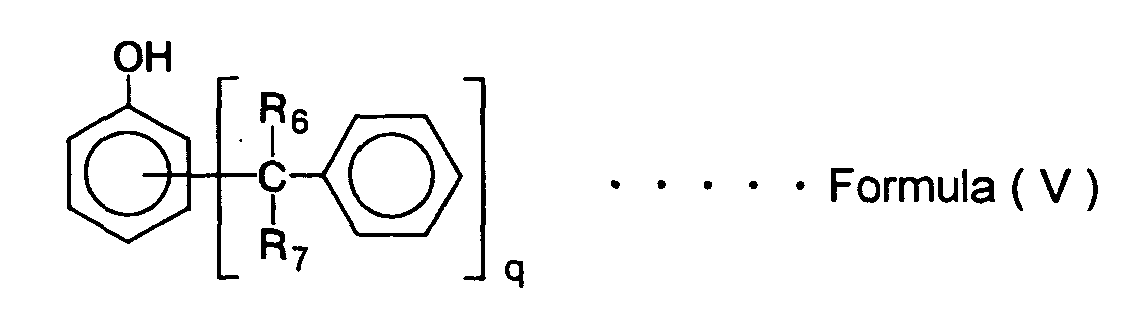
and a monovalent phenol compound represented by the formula (VI):
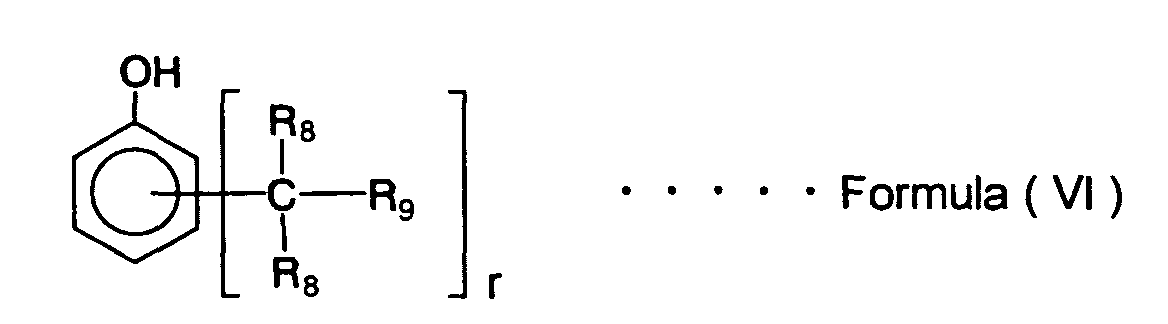


and the like, and in the point of dielectric characteristics, 1,2-dibromo-4-(1,2-dibromoethyl)cyclohexane, tetrabromocyclooctane, hexabromocyclododecane and 2,4,6-tris-(tribromophenoxy)-1,3,5-triazine are preferred.
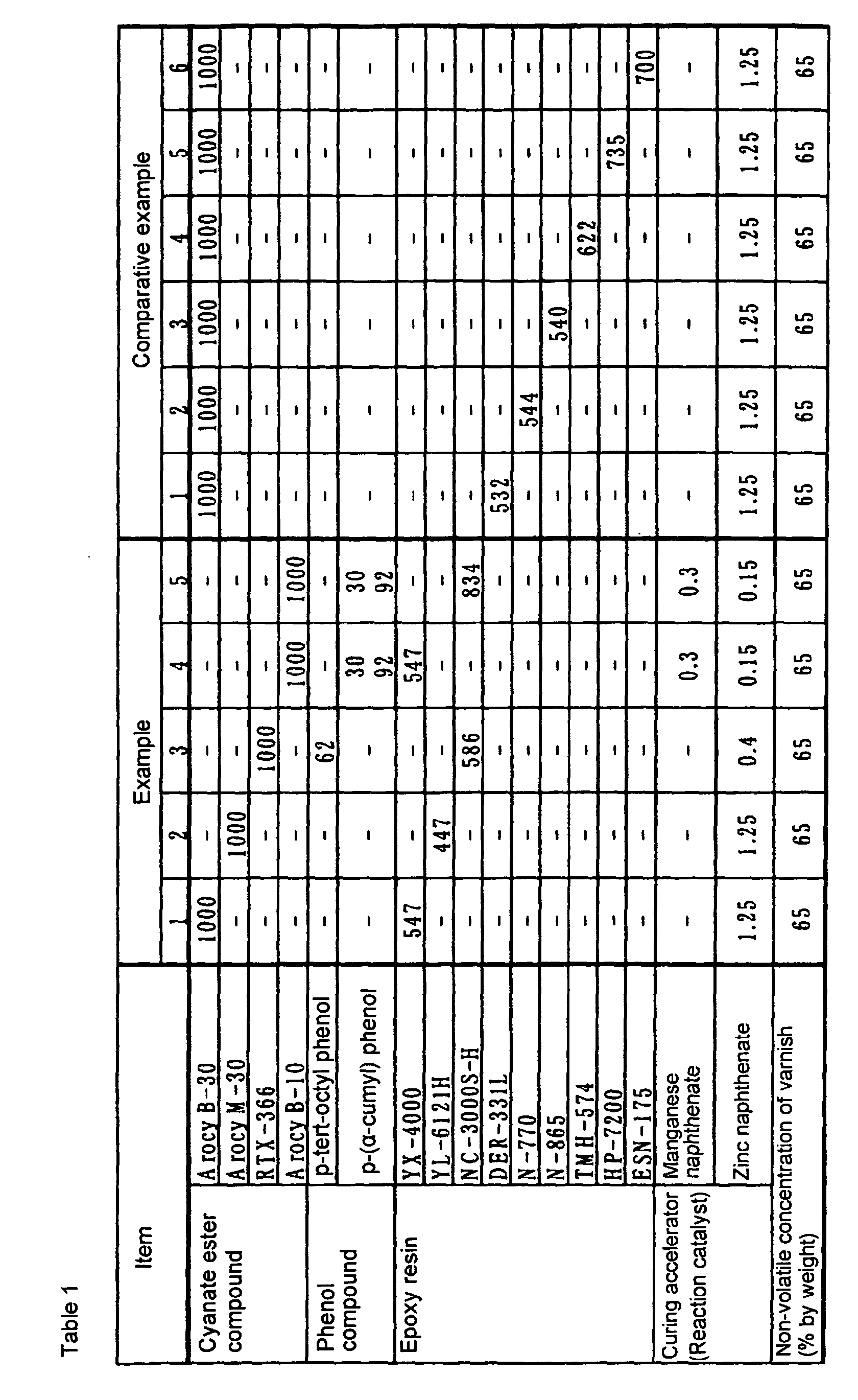
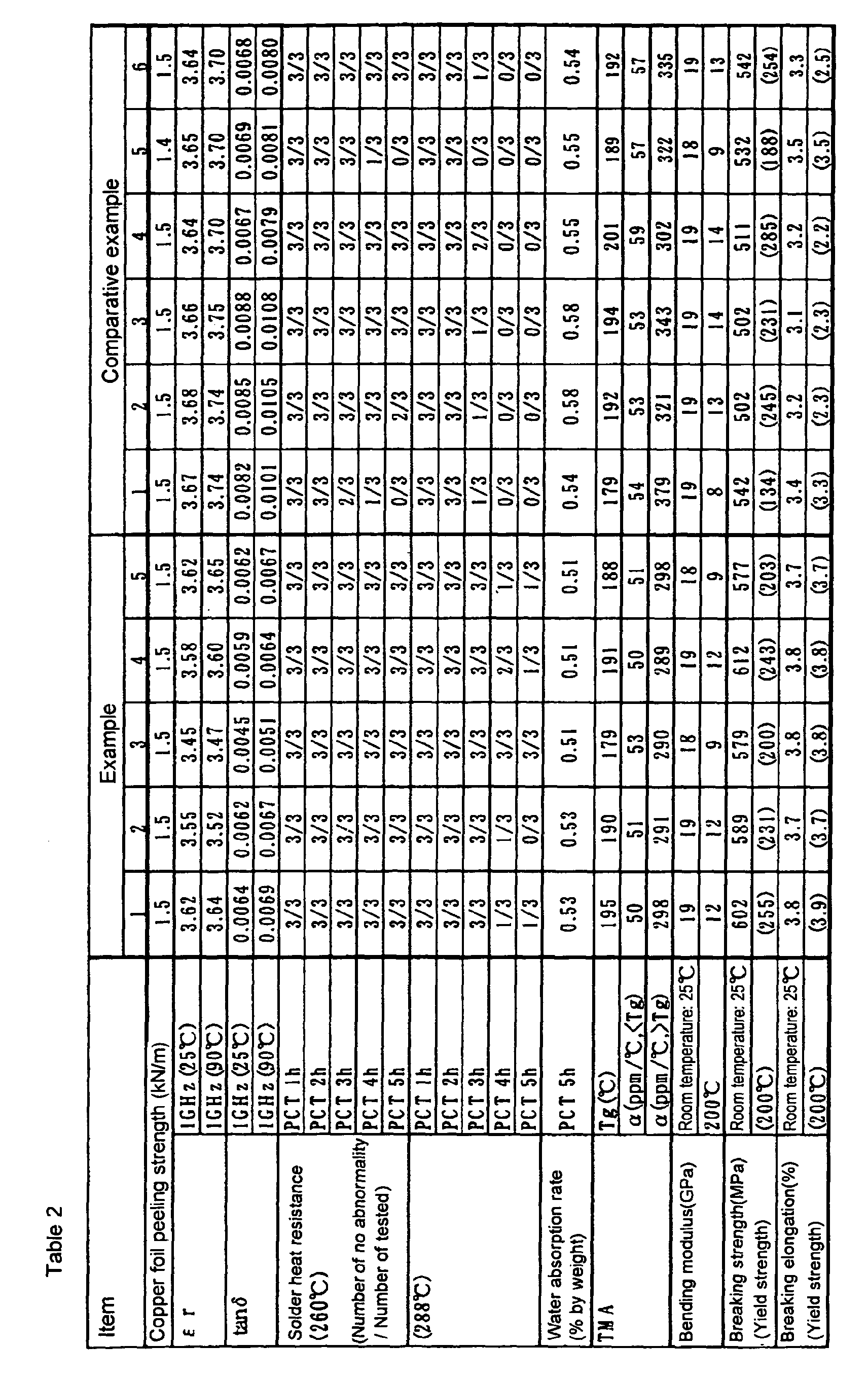

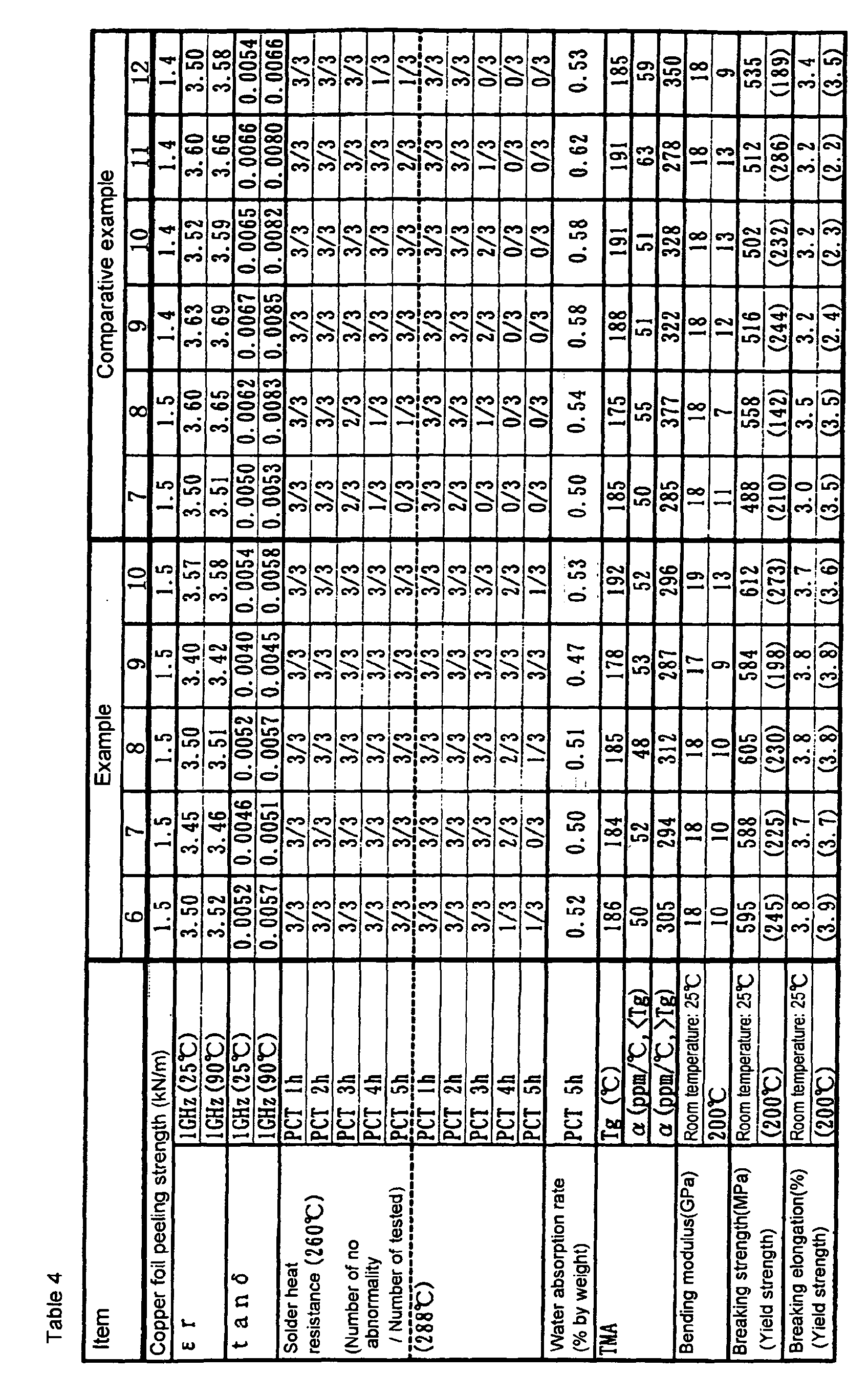
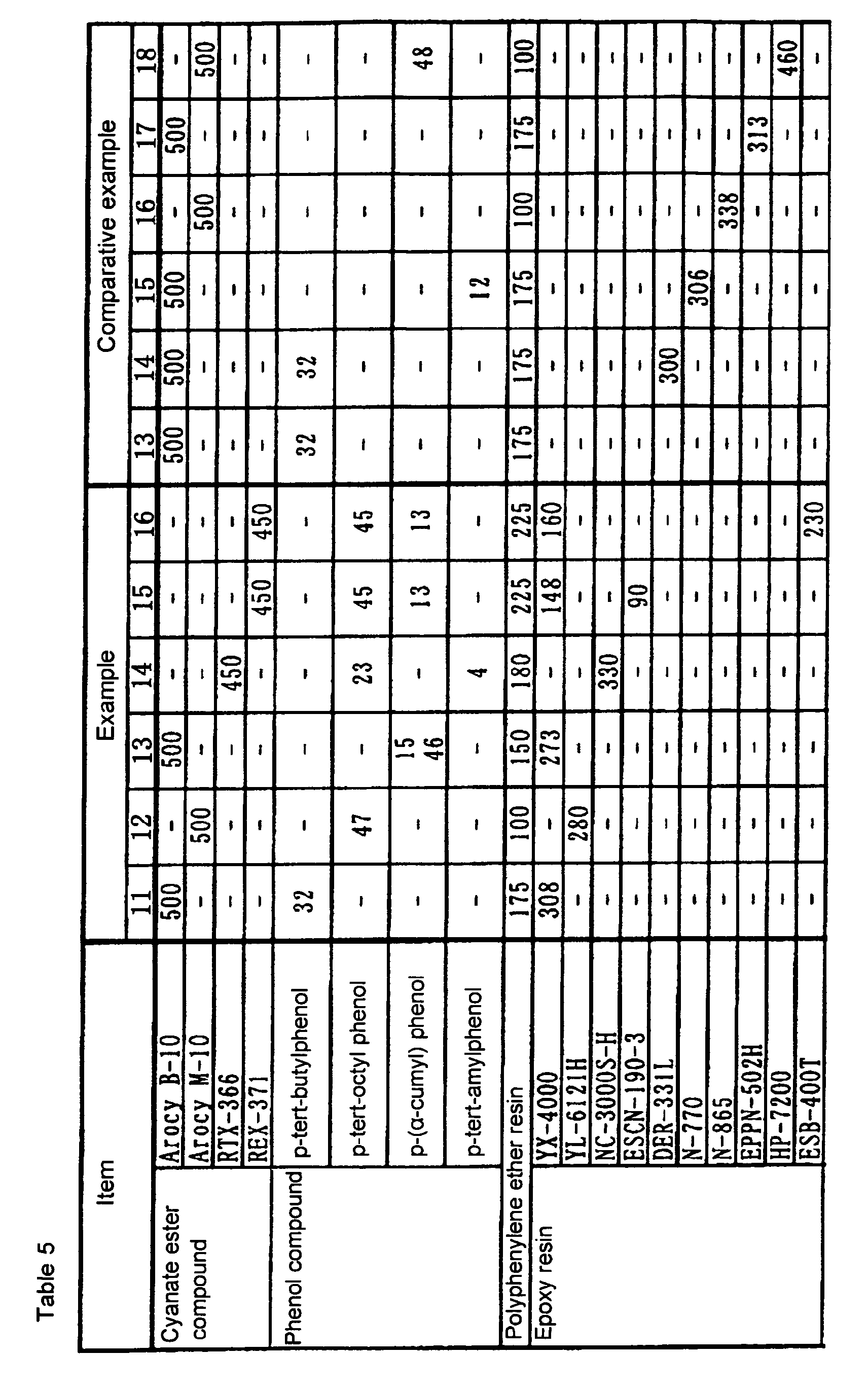
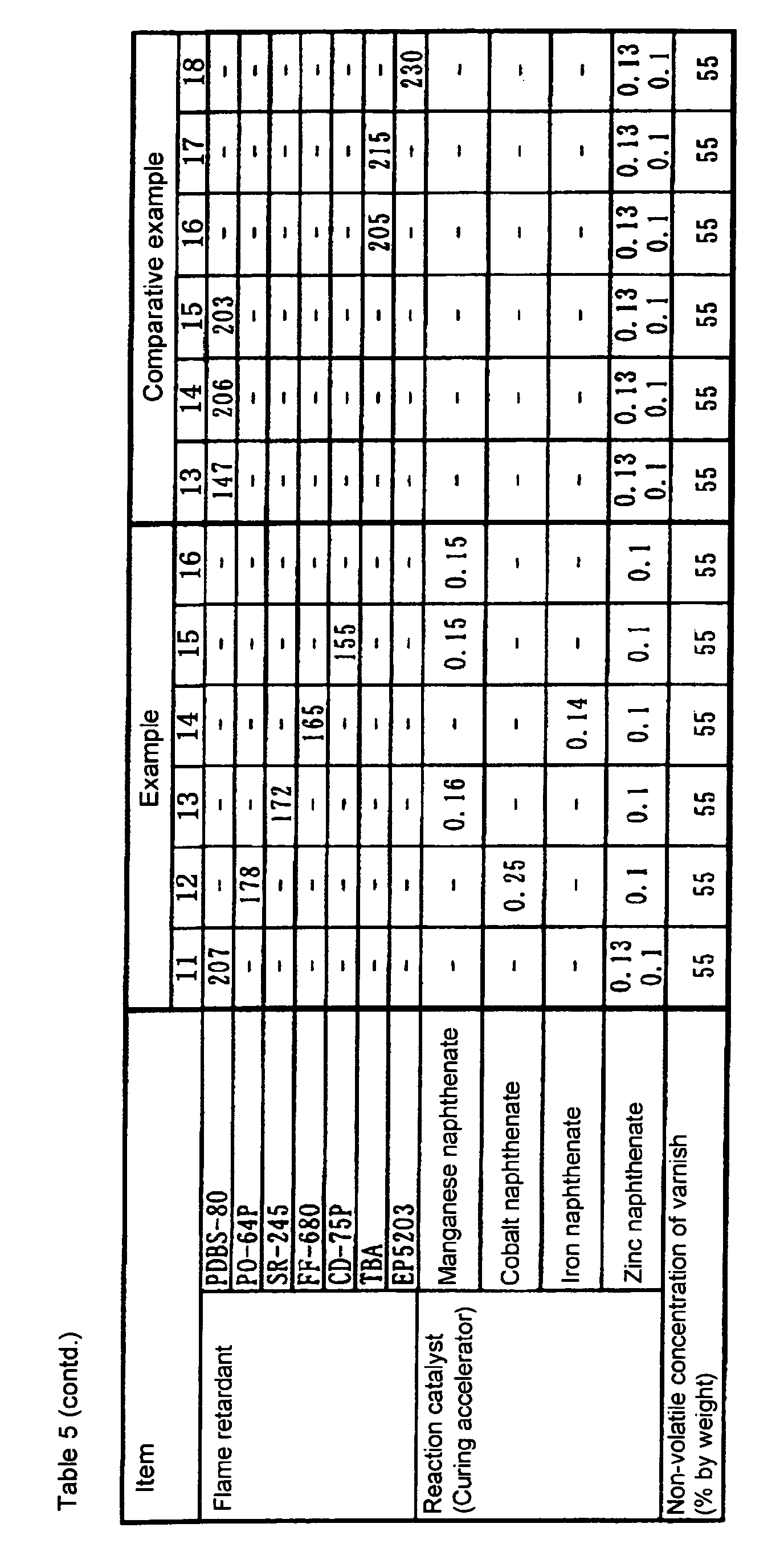


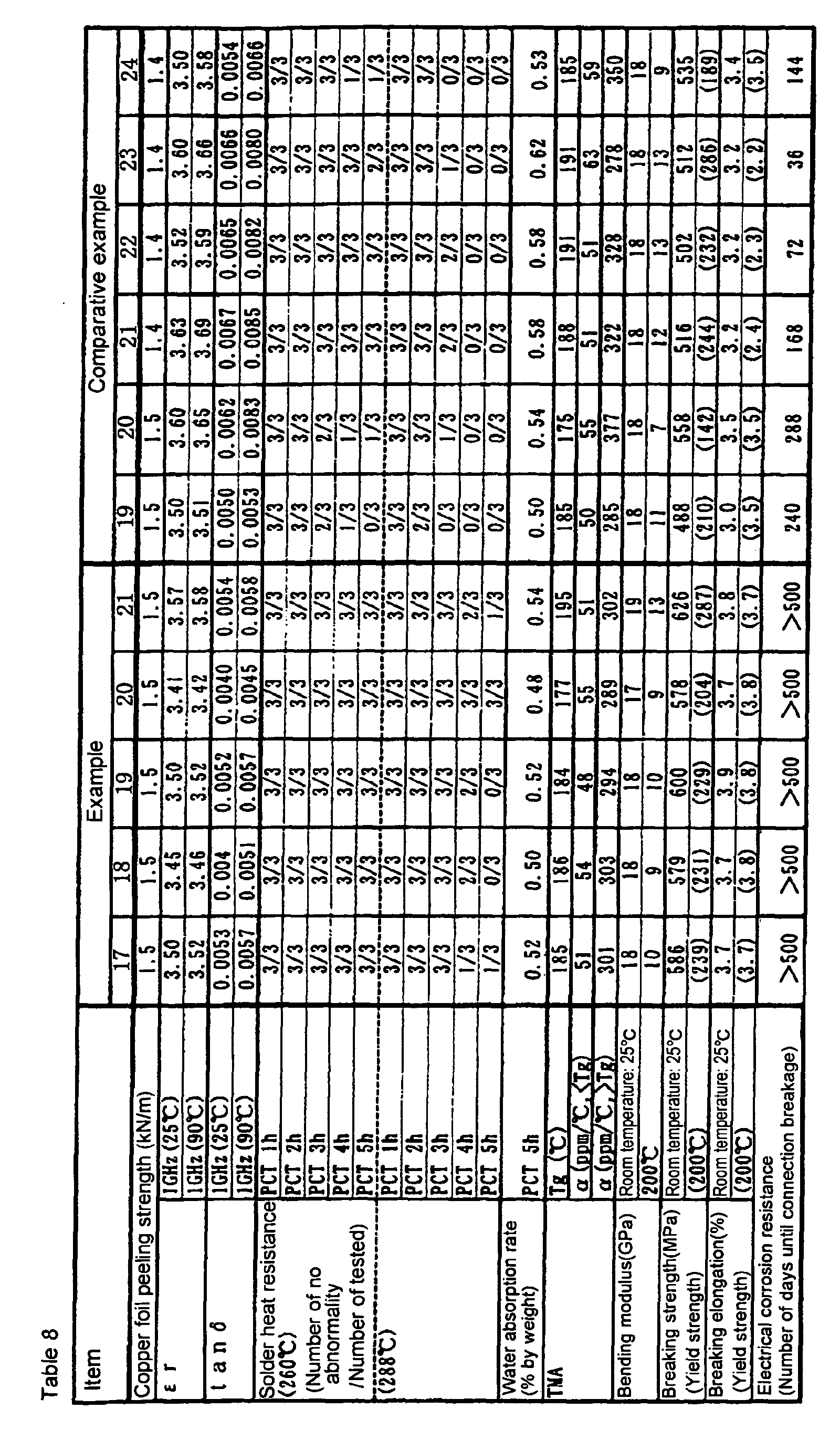
Claims (47)
- A resin composition for printed wiring board which comprises a cyanate ester compound having 2 or more cyanate groups in the molecule and/or a prepolymer thereof, and an epoxy resin containing at least one kind of an epoxy resin having a biphenyl structure in the molecule.
- The resin composition for printed wiring board according to Claim 1, wherein the epoxy resin containing at least one kind of an epoxy resin having a biphenyl structure in the molecule is contained in an amount of 10 to 250 parts by weight based on 100 parts by weight of the cyanate ester compound having 2 or more cyanate groups in the molecule and/or a prepolymer thereof.
- The resin composition for printed wiring board according to Claim 1 or 2, which further comprises a polyphenylene ether resin.
- The resin composition for printed wiring board according to any one of Claims 1 to 3, wherein the cyanate ester compound having 2 or more cyanate groups in the molecule and/or a prepolymer thereof is at least one kind selected from the group consisting of a cyanate ester compound represented by the formula (I):wherein R1 represents
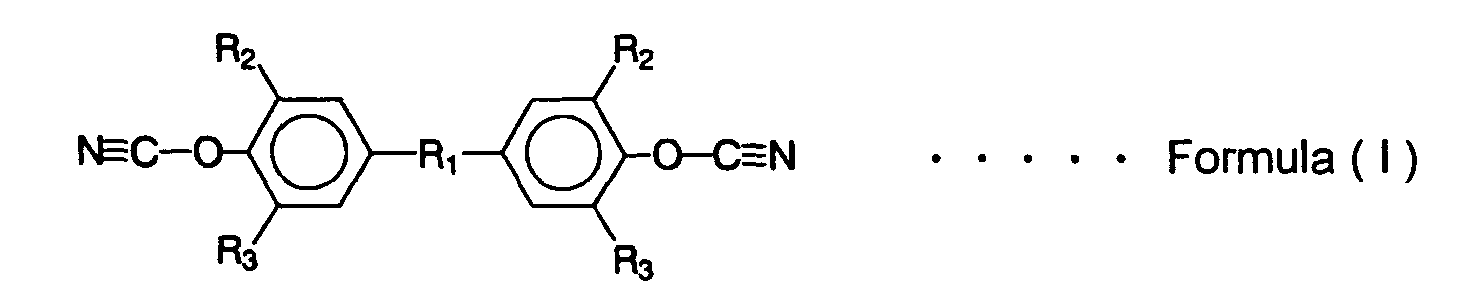 R2 and R3 each represent a hydrogen atom or an alkyl group having 1 to 4 carbon atoms, and each may be the same or different from each other,
and a cyanate ester compound represented by the formula (II) :wherein R4 represents a hydrogen atom or an alkyl group having 1 to 4 carbon atoms, m represents an integer of 1 to 7,
and a prepolymer thereof. - The resin composition for printed wiring board according to any one of Claims 1 to 4, wherein the epoxy resin having a biphenyl structure in the molecule in the epoxy resin containing at least one kind of an epoxy resin having a biphenyl structure in the molecule is at least one selected from the group consisting of an epoxy resin represented by the formula (III):wherein R5 each represent a hydrogen atom or a methyl group, n represents an integer of 0 to 6,

and an epoxy resin represented by the formula (IV):wherein p represents an integer of 1 to 5.
- The resin composition for printed wiring board according to any one of Claims 1 to 5, wherein the composition further comprises, a as a flame retardant, at least one selected from the group consisting of 1,2-dibromo-4-(1,2-dibromoethyl)cyclohexane, tetrabromocyclooctane, hexabromocyclododecane, bis(tribromophenoxy)ethane, a brominated triphenylcyanurate represented by the formula (VII):wherein s, t and u each represent an integer of 1 to 5, and each may by the same value or different from each other,

a brominated polyphenylene ether and a brominated polystyrene. - The resin composition for printed wiring board according to any one of Claims 1 to 6, which further comprises an antioxidant antioxidant.
- A resin composition for printed wiring board which comprises a cyanate ester compound having 2 or more cyanate groups in the molecule and/or a prepolymer thereof,
an epoxy resin containing at least one kind of an epoxy resin having a biphenyl structure in the molecule, and
a monovalent phenol compound. - The resin composition for printed wiring board according to Claim 8, wherein the epoxy resin containing at least one kind of an epoxy resin having a biphenyl structure in the molecule is contained in an amount of 10 to 250 parts by weight based on 100 parts by weight of the cyanate ester compound having 2 or more cyanate groups in the molecule and/or a prepolymer thereof, and the monovalent phenol compound is contained in an amount of 2 to 60 parts by weight based on the same.
- The resin composition for printed wiring board according to Claim 8 or 9, which further comprises a polyphenylene ether resin.
- The resin composition for printed wiring board according to any one of Claims 8 to 10, wherein the cyanate ester compound having 2 or more cyanate groups in the molecule and/or a prepolymer thereof is at least one selected from the group consisting of a cyanate ester compound represented by the formula (I):wherein R1 represents
 R2 and R3 each represent a hydrogen atom or an alkyl group having 1 to 4 carbon atoms, and each may be the same or different from each other,
and a cyanate ester compound represented by the formula (II) :wherein R4 represents a hydrogen atom or an alkyl group having 1 to 4 carbon atoms, m represents an integer of 1 to 7,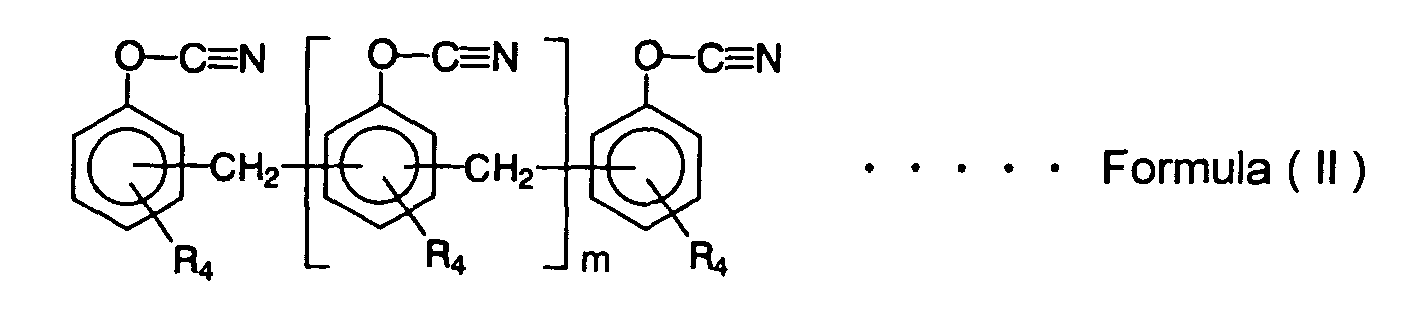
and a prepolymer thereof. - The resin composition for printed wiring board according to any one of Claims 8 to 11, wherein the epoxy resin having a biphenyl structure in the molecule in the epoxy resin containing at least one kind of an epoxy resin having a biphenyl structure in the molecule is at least one selected from the group consisting of an epoxy resin represented by the formula (III):wherein R5 each represent a hydrogen atom or a methyl group, n represents an integer of 0 to 6,
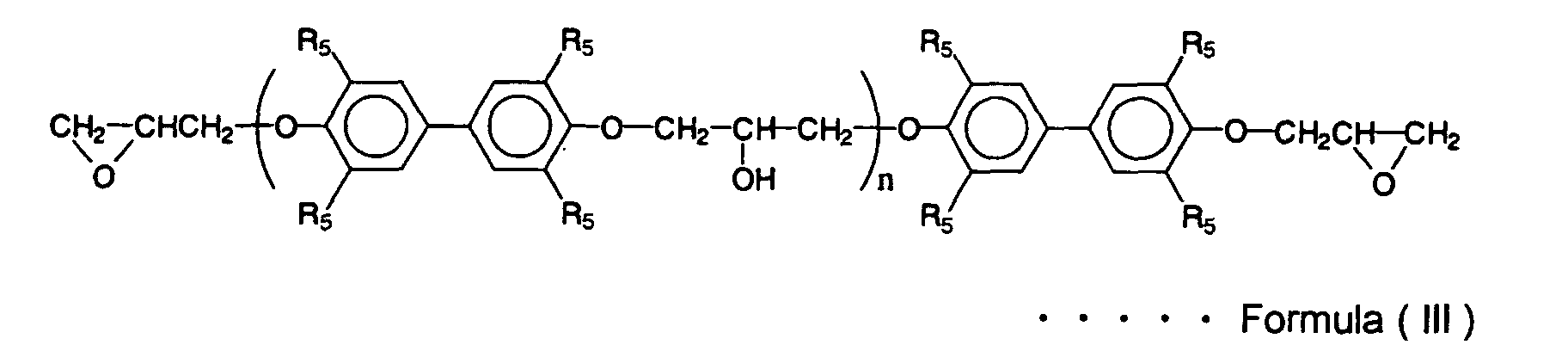
and an epoxy resin represented by the formula (IV):wherein p represents an integer of 1 to 5.
- The resin composition for printed wiring board according to any one of Claims 8 to 12, wherein the composition further comprises, as a flame retardant, at least one selected from the group consisting of 1,2-dibromo-4-(1,2-dibromoethyl)cyclohexane, tetrabromocyclooctane, hexabromocyclododecane , bis(tribromophenoxy)ethane, a brominated triphenylcyanurate represented by the formula (VII):wherein s, t and u each represent an integer of 1 to 5, and each may by the same value or different from each other,
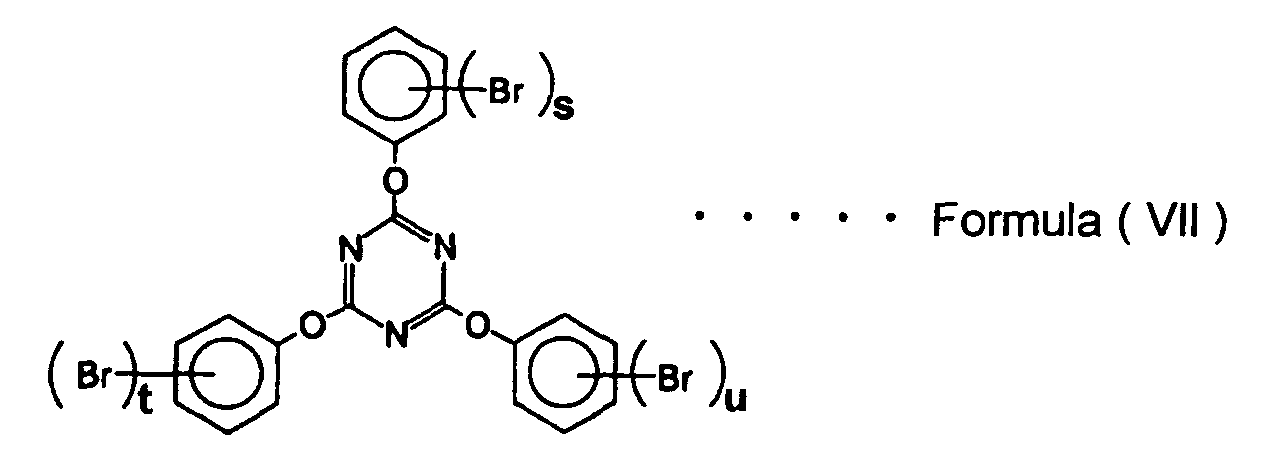
a brominated polyphenylene ether and a brominated polystyrene. - The resin composition for printed wiring board according to any one of Claims 8 to 13, which further comprises antioxidant.
- A resin composition for printed wiring board which comprises a phenol-modified cyanate ester oligomer obtainable by reacting a cyanate ester compound having 2 or more cyanate groups in the molecule and/or a prepolymer thereofa monovalent phenol compound, and
an epoxy resin containing at least one kind of an epoxy resin having a biphenyl structure in the molecule. - The resin composition for printed wiring board according to Claim 15, wherein the phenol-modified cyanate ester oligomer is a phenol-modified cyanate ester oligomer obtainable by reacting 100 parts by weight of Component (A) and 2 to 60 parts by weight of Component (C), and Component (B) is contained in an amount of 10 to 250 parts by weight.
- The resin composition for printed wiring board according to Claim 15 or 16, which further comprises a polyphenylene ether resin.
- The resin composition for printed wiring board according to any one of Claims 15 to 17, wherein the cyanate ester compound having 2 or more cyanate groups in the molecule and/or a prepolymer thereof is at least one selected from the group consisting of a cyanate ester compound represented by the formula (I):wherein R1 represents
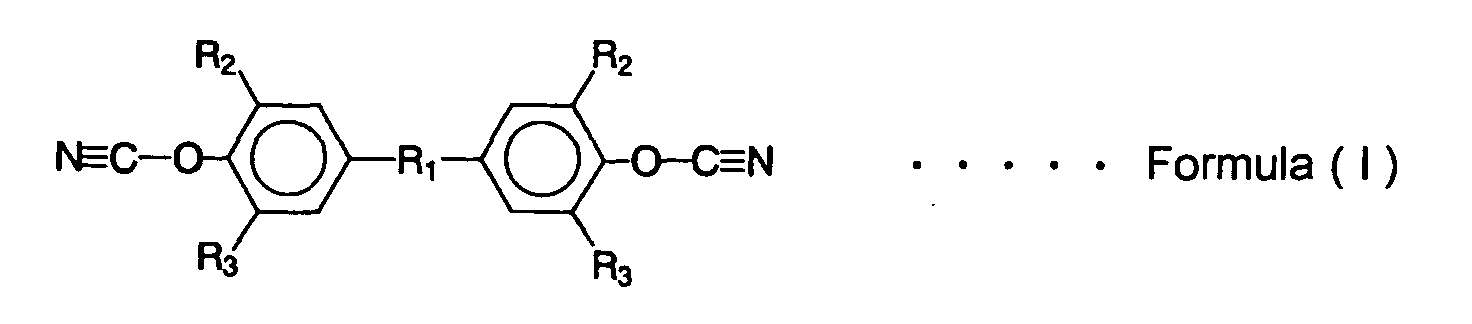 R2 and R3 each represent a hydrogen atom or an alkyl group having 1 to 4 carbon atoms, and each may be the same or different from each other,
and a cyanate ester compound represented by the formula (II) :wherein R4 represents a hydrogen atom or an alkyl group having 1 to 4 carbon atoms, m represents an integer of 1 to 7,
and a prepolymer thereof. - The resin composition for printed wiring board according to any one of Claims 15 to 18, wherein the epoxy resin having a biphenyl structure in the molecule in the epoxy resin containing at least one kind of an epoxy resin having a biphenyl structure in the molecule is at least one selected from the group consisting of an epoxy resin represented by the formula (III):wherein R5 each represent a hydrogen atom or a methyl group, n represents an integer of 0 to 6,

and an epoxy resin represented by the formula (IV):wherein p represents an integer of 1 to 5.
- The resin composition for printed wiring board according to any one of Claims 15 to 19, wherein the composition further comprises at least one selected from the group consisting of 1,2-dibromo-4-(1,2-dibromoethyl)cyclohexane, tetrabromocyclooctane, hexabromocyclododecane, bis(tri-bromophenoxy)ethane, a brominated triphenylcyanurate represented by the formula (VII):wherein s, t and u each represent an integer of 1 to 5, and each may by the same value or different from each other,
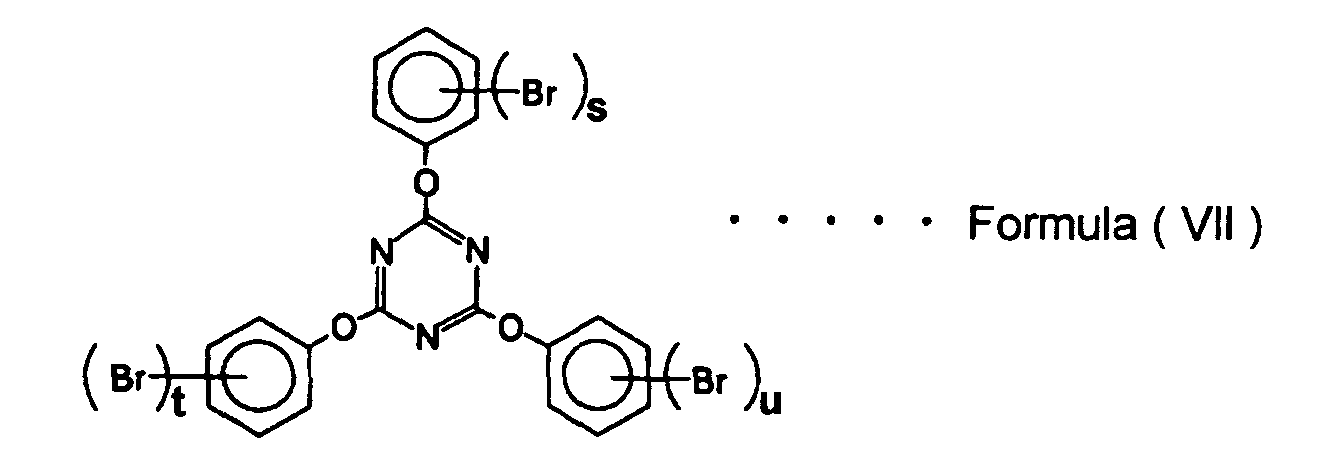
a brominated polyphenylene ether and a brominated polystyrene, as a flame retardant. - The resin composition for printed wiring board according to any one of Claims 15 to 19, which further comprises an antioxidant.
- A resin composition for printed wiring board which comprises a phenol-modified cyanate ester oligomer obtainable by reacting a cyanate ester compound having 2 or more cyanate groups in the molecule and/or a prepolymer thereof a monovalent phenol compound, and
an epoxy resin containing at least one kind of an epoxy resin having a biphenyl structure in the molecule, and
a monovalent phenol compound. - The resin composition for printed wiring board according to Claim 22, wherein the phenol-modified cyanate ester oligomer is a phenol-modified cyanate ester oligomer obtainable by reacting 100 parts by weight of the cyanate ester compound having 2 or more cyanate groups in the molecule and/or a prepolymer thereof, 0.4 parts by weight or more and less than 60 parts by weight of the monovalent phenol compound, and the epoxy resin containing at least one kind of an epoxy resin having a biphenyl structure in the molecule is contained in an amount of 10 to 250 parts by weight, and
the monovalent phenol compound is additionally contained in a total amount of 2 to 60 parts by weight which is the sum of the amount with the monovalent phenol compound to be used for formation of the phenol-modified cyanate ester oligomer. - The resin composition for printed wiring board according to Claim 22 or 23, which further comprises a polyphenylene ether.
- The resin composition for printed wiring board according to any one of Claims 22 to 24, wherein the cyanate ester compound having 2 or more cyanate groups in the molecule and/or a prepolymer thereof is at least one selected from the group consisting of a cyanate ester compound represented by the formula (I):wherein R1 represents
 R2 and R3 each represent a hydrogen atom or an alkyl group having 1 to 4 carbon atoms, and each may be the same or different from each other,
and a cyanate ester compound represented by the formula (II) :wherein R4 represents a hydrogen atom or an alkyl group having 1 to 4 carbon atoms, m represents an integer of 1 to 7,
and a prepolymer thereof. - The resin composition for printed wiring board according to any one of Claims 22 to 25, wherein the epoxy resin having a biphenyl structure in the molecule in the epoxy resin containing at least one kind of an epoxy resin having a biphenyl structure in the molecule is at least one selected from the group consisting of an epoxy resin represented by the formula (III):wherein R5 each represent a hydrogen atom or a methyl group, n represents an integer of 0 to 6,
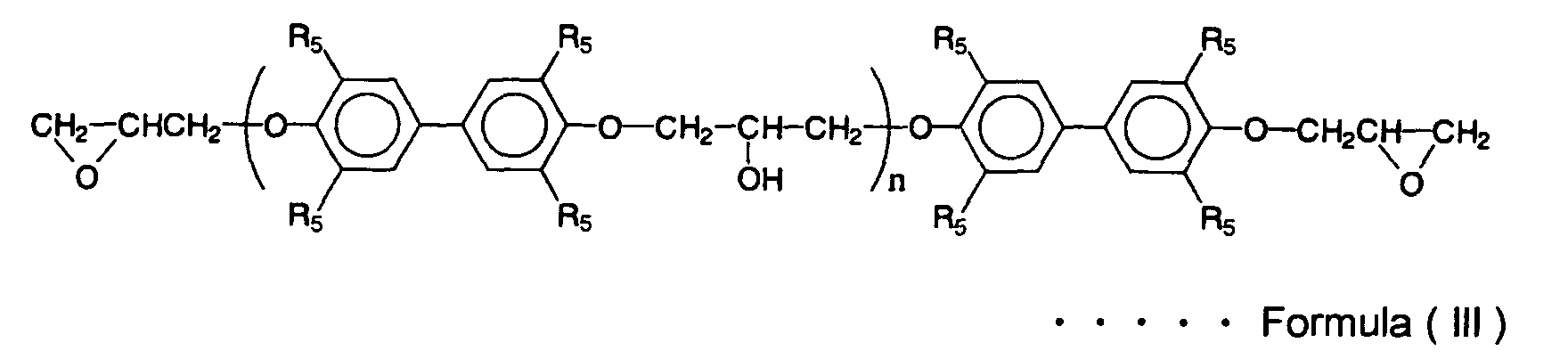
and an epoxy resin represented by the formula (IV):wherein p represents an integer of 1 to 5.
- The resin composition for printed wiring board according to any one of Claims 22 to 26, wherein the composition further comprises, as a flame retardant, at least one selected from the group consisting of 1,2-dibromo-4-(1,2-dibromoethyl)cyclohexane, tetrabromocyclooctane, hexabromocyclododecane, bis(tribromophenoxy)ethane, a brominated triphenylcyanurate represented by the formula (VII):wherein s, t and u each represent an integer of 1 to 5, and each may by the same value or different from each other,

a brominated polyphenylene ether and a brominated polystyrene. - The resin composition for printed wiring board according to any one of Claims 22 to 27, wherein the composition further comprises an antioxidant.
- A resin composition for printed wiring board which comprises an epoxy/phenol-modified cyanate ester oligomer obtained by reacting a cyanate ester compound having 2 or more cyanate groups in the molecule and/or a prepolymer thereof, an epoxy resin containing at least one kind of an epoxy resin having a biphenyl structure in the molecule, and a monovalent phenol compound.
- The resin composition for printed wiring board according to Claim 29, wherein the epoxy/phenol-modified cyanate ester oligomer is an epoxy/phenol-modified cyanate ester oligomer obtained by reacting 100 parts by weight of the cyanate ester compound having 2 or more cyanate groups in the molecule and/or a prepolymer thereof, 10 to 250 parts by weight of the epoxy resin containing at least one kind of an epoxy resin having a biphenyl structure in the molecule, and 2 to 60 parts by weight of the monovalent phenol compound.
- The resin composition for printed wiring board according to Claim 29 or 30, wherein the composition further comprises a polyphenylene ether resin.
- The resin composition for printed wiring board according to any one of Claims 29 to 31, wherein the cyanate ester compound having 2 or more cyanate groups in the molecule and/or a prepolymer thereof is at least one selected from the group consisting of a cyanate ester compound represented by the formula (I):wherein R1 represents
 R2 and R3 each represent a hydrogen atom or an alkyl group having 1 to 4 carbon atoms, and each may be the same or different from each other,
and a cyanate ester compound represented by the formula (II) :wherein R4 represents a hydrogen atom or an alkyl group having 1 to 4 carbon atoms, m represents an integer of 1 to 7,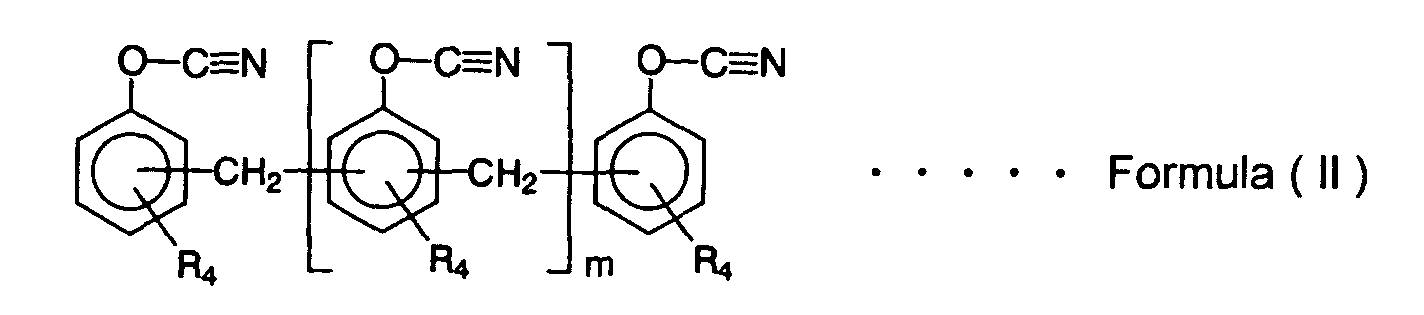
and a prepolymer thereof. - The resin composition for printed wiring board according to any one of Claims 29 to 32, wherein the epoxy resin having a biphenyl structure in the molecule in the epoxy resin containing at least one kind of an epoxy resin having a biphenyl structure in the molecule is at least one selected from the group consisting of an epoxy resin represented by the formula (III):wherein R5 each represent a hydrogen atom or a methyl group, n represents an integer of 0 to 6,
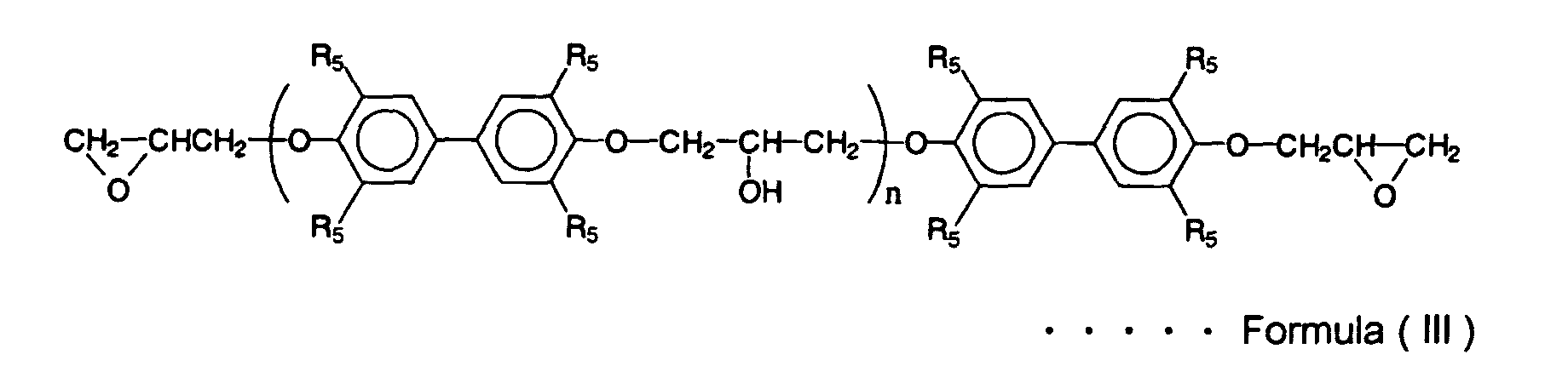
and an epoxy resin represented by the formula (IV):wherein p represents an integer of 1 to 5.
- The resin composition for printed wiring board according to any one of Claims 29 to 33, wherein the composition further comprises, as a flame retardant, at least one selected from the group consisting of 1,2-dibromo-4-(1,2-dibromoethyl)cyclohexane, tetrabromocyclooctane, hexabromocyclododecane, bis(tribromophenoxy)ethane, a brominated triphenylcyanurate represented by the formula (VII):wherein s, t and u each represent an integer of 1 to 5, and each may by the same value or different from each other,
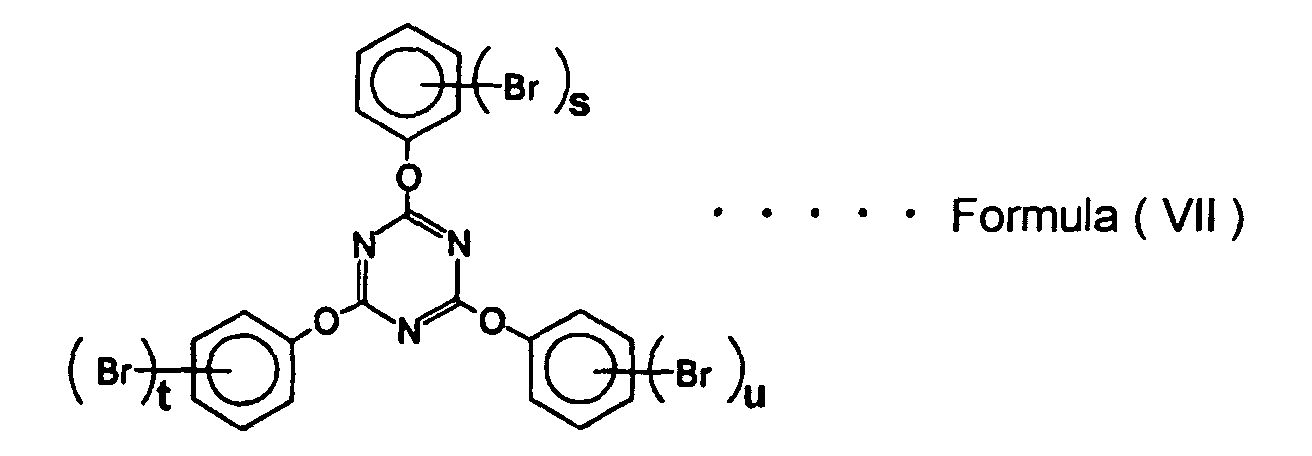
a brominated polyphenylene ether and a brominated polystyrene. - The resin composition for printed wiring board according to any one of Claims 29 to 34, wherein the composition further comprises an antioxidant.
- A resin composition for printed wiring board which comprises an epoxy/phenol-modified cyanate ester oligomer obtained by reacting a cyanate ester compound having 2 or more cyanate groups in the molecule and/or a prepolymer thereof, an epoxy resin containing at least one kind of an epoxy resin having a biphenyl structure in the molecule, and a monovalent phenol compound, and
a monovalent phenol compound. - The resin composition for printed wiring board according to Claim 36, wherein the epoxy/phenol-modified cyanate ester oligomer is an epoxy/phenol-modified cyanate ester oligomer obtained by reacting 100 parts by weight of the cyanate ester compound having 2 or more cyanate groups in the molecule and/or a prepolymer thereof, 10 to 250 parts by weight of the epoxy resin containing at least one kind of an epoxy resin having a biphenyl structure in the molecule, and 0.4 parts by weight or more and less than 60 parts by weight of the monovalent phenol compound, and
the monovalent phenol compound is additionally contained in a total amount of 2 to 60 parts by weight which is the sum of the amount with the monovalent phenol compound to be used for formation of the epoxy/phenol-modified cyanate ester oligomer. - The resin composition for printed wiring board according to Claim 36 or 37, wherein the composition further comprises a polyphenylene ether resin.
- The resin composition for printed wiring board according to any one of Claims 36 to 38, wherein the cyanate ester compound having 2 or more cyanate groups in the molecule and/or a prepolymer thereof is at least one selected from the group consisting of a cyanate ester compound represented by the formula (I):wherein R1 represents
 R2 and R3 each represent a hydrogen atom or an alkyl group having 1 to 4 carbon atoms, and each may be the same or different from each other,
and a cyanate ester compound represented by the formula (II) :wherein R4 represents a hydrogen atom or an alkyl group having 1 to 4 carbon atoms, m represents an integer of 1 to 7,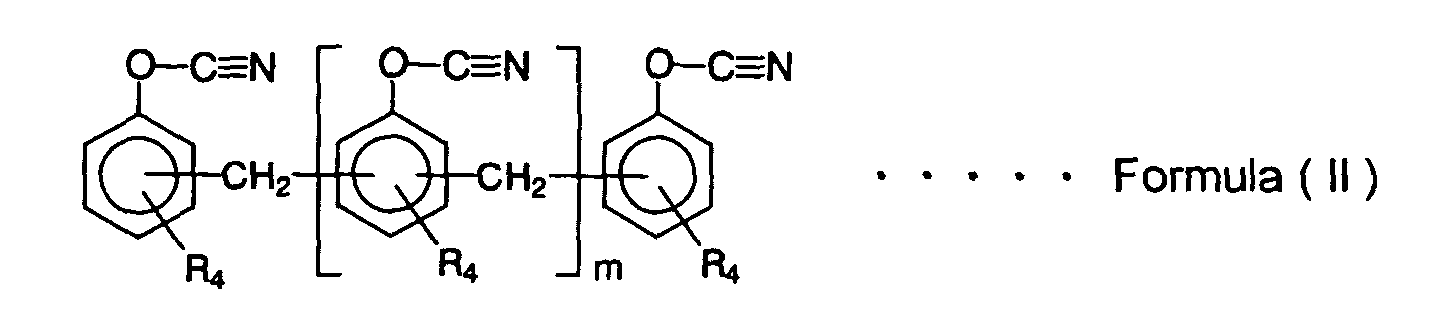
and a prepolymer thereof. - The resin composition for printed wiring board according to any one of Claims 36 to 39, wherein the epoxy resin having a biphenyl structure in the molecule in the epoxy resin containing at least one kind of an epoxy resin having a biphenyl structure in the molecule is at least one selected from the group consisting of an epoxy resin represented by the formula (III):wherein R5 each represent a hydrogen atom or a methyl group, n represents an integer of 0 to 6,

and an epoxy resin represented by the formula (IV):wherein p represents an integer of 1 to 5.
- The resin composition for printed wiring board according to any one of Claims 36 to 40, wherein the composition further comprises, as a flame retardant, at least one selected from the group consisting of 1,2-dibromo-4-(1,2-dibromoethyl)cyclohexane, tetrabromocyclooctane, hexabromocyclododecane, bis(tribromophenoxy)ethane, a brominated triphenylcyanurate represented by the formula (VII):wherein s, t and u each represent an integer of 1 to 5, and each may by the same value or different from each other,
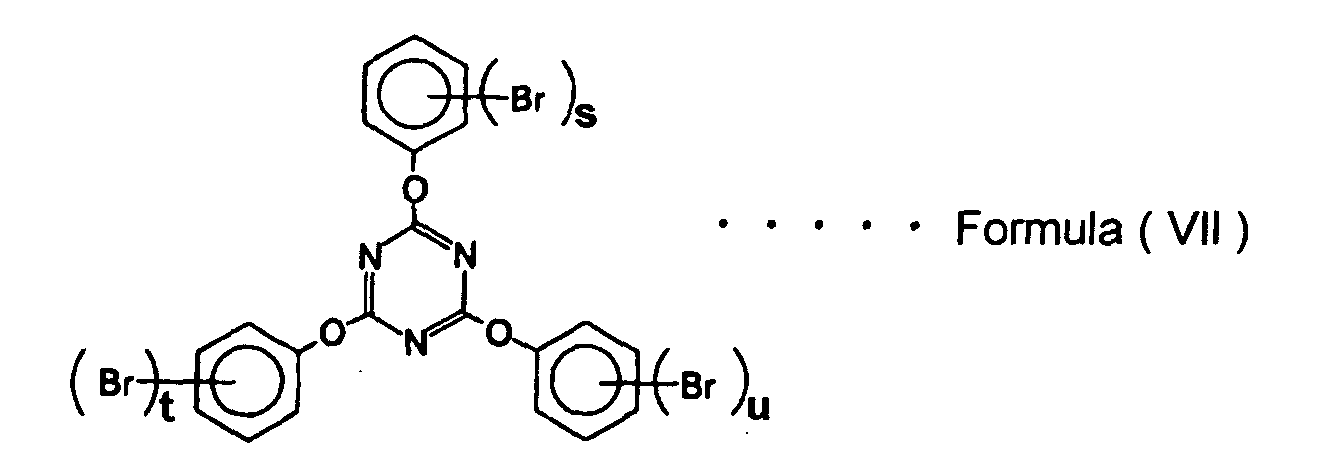
a brominated polyphenylene ether and a brominated polystyrene. - The resin composition for printed wiring board according to any one of Claims 36 to 41, wherein the composition further comprises an antioxidant.
- A resin composition for printed wiring board which comprises a phenol-modified cyanate ester oligomer which is obtained by reacting a cyanate ester compound having 2 or more cyanate groups in the molecule and/or a prepolymer thereof a monovalent phenol compound in the presence of a polyphenylene ether resin.
- A resin composition for printed wiring board which comprises an epoxy/phenol-modified cyanate ester oligomer obtained by reacting a cyanate ester compound having 2 or more cyanate groups in the molecule and/or a prepolymer thereof, a monovalent phenol compound and an epoxy resin containing at least one kind of an epoxy resin having a biphenyl structure in the molecule in the presence of a polyphenylene ether resin.
- A resin varnish for a printed wiring board obtained by dissolving or dispersing the resin composition for printed wiring board according to any one of Claims 1 to 44 in a solvent.
- A prepreg for a printed wiring board which is obtained by impregnating the resin composition for printed wiring board according to any one of Claims 1 to 44 or the resin varnish for a printed wiring board according to Claim 45 into a substrate, and drying at 80 to 200°C.
- A metal clad laminated board which is obtained by laminating one or more of the prepreg for a printed wiring board according to Claim 46, laminating a metal foil on at least one surface thereof and pressurizing under heating.
Applications Claiming Priority (5)
| Application Number | Priority Date | Filing Date | Title |
|---|---|---|---|
| JP2002287071 | 2002-09-30 | ||
| JP2002286878 | 2002-09-30 | ||
| JP2002286878 | 2002-09-30 | ||
| JP2002287071 | 2002-09-30 | ||
| PCT/JP2003/012399 WO2004029127A1 (en) | 2002-09-30 | 2003-09-29 | Resin composition for printed wiring board, and vanish, prepreg and metal-clad laminate using same |
Publications (3)
| Publication Number | Publication Date |
|---|---|
| EP1550678A1 true EP1550678A1 (en) | 2005-07-06 |
| EP1550678A4 EP1550678A4 (en) | 2006-10-11 |
| EP1550678B1 EP1550678B1 (en) | 2008-03-26 |
Family
ID=32044657
Family Applications (1)
| Application Number | Title | Priority Date | Filing Date |
|---|---|---|---|
| EP03798536A Expired - Lifetime EP1550678B1 (en) | 2002-09-30 | 2003-09-29 | Resin composition for printed wiring board, and vanish, prepreg and metal-clad laminate using same |
Country Status (10)
| Country | Link |
|---|---|
| US (1) | US7816430B2 (en) |
| EP (1) | EP1550678B1 (en) |
| JP (5) | JP4639806B2 (en) |
| KR (2) | KR20100094586A (en) |
| CN (1) | CN100528927C (en) |
| AT (1) | ATE390450T1 (en) |
| AU (1) | AU2003266671A1 (en) |
| DE (1) | DE60320004T2 (en) |
| TW (1) | TWI235020B (en) |
| WO (1) | WO2004029127A1 (en) |
Cited By (2)
| Publication number | Priority date | Publication date | Assignee | Title |
|---|---|---|---|---|
| CN104011163A (en) * | 2011-12-12 | 2014-08-27 | 株式会社Lg化学 | Cyanate resin composition for producing circuit boards and flexible metal-clad laminate containing same |
| EP3252101A4 (en) * | 2015-01-30 | 2018-06-27 | Mitsubishi Gas Chemical Company, Inc. | Resin composition for printed wiring board, prepreg, metal foil-clad laminate, resin sheet, and printed wiring board |
Families Citing this family (36)
| Publication number | Priority date | Publication date | Assignee | Title |
|---|---|---|---|---|
| CN100528927C (en) * | 2002-09-30 | 2009-08-19 | 日立化成工业株式会社 | Resin composition for printed wiring board, and varnish, prepreg and metal-clad laminate using same |
| KR100561070B1 (en) * | 2003-09-05 | 2006-03-15 | 주식회사 엘지화학 | Thermosetting resin composition for high speed transmission circuit board |
| US20050186434A1 (en) * | 2004-01-28 | 2005-08-25 | Ajinomoto Co., Inc. | Thermosetting resin composition, adhesive film and multilayer printed wiring board using same |
| TW200602427A (en) * | 2004-03-30 | 2006-01-16 | Taiyo Ink Mfg Co Ltd | Thermosetting resin composition and multilayered printed wiring board comprising the same |
| JP2006131743A (en) * | 2004-11-05 | 2006-05-25 | Hitachi Chem Co Ltd | Thermosetting resin composition and prepreg and metal-clad laminate and printed wiring board using the same |
| JP5335683B2 (en) * | 2007-09-27 | 2013-11-06 | パナソニック株式会社 | Epoxy resin composition, prepreg using the epoxy resin composition, metal-clad laminate, and printed wiring board |
| WO2009040921A1 (en) * | 2007-09-27 | 2009-04-02 | Panasonic Electric Works Co., Ltd. | Epoxy resin composition and, produced therewith, prepreg and metal clad laminate |
| JP5428212B2 (en) * | 2008-06-17 | 2014-02-26 | 住友ベークライト株式会社 | Resin composition, prepreg and printed wiring board using the same |
| KR101109397B1 (en) * | 2009-07-17 | 2012-01-30 | 삼성전기주식회사 | Resin composition for printed circuit board and printed circuit board using same |
| JP5861995B2 (en) * | 2010-07-05 | 2016-02-16 | 住友ベークライト株式会社 | Resin composition, prepreg, resin layer, circuit board, and semiconductor device |
| US10155835B2 (en) | 2011-08-09 | 2018-12-18 | Mitsubishi Gas Chemical Company, Inc. | Cyanate ester compound and method for producing the same, and curable resin composition comprising the compound, and cured product thereof composition |
| US8889770B2 (en) | 2011-08-25 | 2014-11-18 | Chemtura Corporation | Brominated flame retardant, antimony oxide free polymer formulations |
| WO2013047696A1 (en) * | 2011-09-29 | 2013-04-04 | 日立化成株式会社 | Epoxy resin composition and electronic component device |
| CN103131130B (en) * | 2011-11-22 | 2015-01-21 | 台光电子材料股份有限公司 | Epoxy resin composition and low dielectric constant insulating material using it |
| JPWO2013084819A1 (en) | 2011-12-07 | 2015-04-27 | 三菱瓦斯化学株式会社 | Resin composition, prepreg and laminate |
| WO2013097133A1 (en) * | 2011-12-29 | 2013-07-04 | 广东生益科技股份有限公司 | Thermoset resin composition, and prepreg and laminate for printed circuit board manufactured therefrom |
| CN103319853B (en) * | 2012-03-23 | 2016-01-13 | 台光电子材料股份有限公司 | Resin composition for insulating film, insulating film and circuit board containing same |
| US9247636B2 (en) | 2013-03-12 | 2016-01-26 | International Business Machines Corporation | Area array device connection structures with complimentary warp characteristics |
| JP6156075B2 (en) * | 2013-05-17 | 2017-07-05 | 三菱瓦斯化学株式会社 | Resin composition, prepreg, resin sheet, metal foil-clad laminate and printed wiring board |
| JP5881179B2 (en) * | 2013-08-28 | 2016-03-09 | 信越化学工業株式会社 | Semiconductor sealing resin composition and semiconductor device provided with cured product thereof |
| KR101556658B1 (en) * | 2013-11-26 | 2015-10-01 | 주식회사 두산 | Thermoplastic resin composition having excellent heat resistance and low permittivity, prepreg and copper clad laminate using the same |
| DE102014101413A1 (en) * | 2014-02-05 | 2015-08-06 | Fraunhofer-Gesellschaft zur Förderung der angewandten Forschung e.V. | Chemically degradable epoxy resin system |
| DE102014106885B4 (en) | 2014-05-15 | 2022-01-20 | Pictiva Displays International Limited | Method for producing an insulator layer, method for producing an organic optoelectronic component comprising an insulator layer and organic optoelectronic component comprising an insulator layer |
| US9879163B2 (en) | 2014-06-06 | 2018-01-30 | General Electric Company | Composition for bonding windings or core laminates in an electrical machine, and associated method |
| US9911521B2 (en) | 2014-06-06 | 2018-03-06 | General Electric Company | Curable composition for electrical machine, and associated method |
| CN106687869B (en) * | 2014-09-10 | 2019-04-16 | 佳能株式会社 | Electroconductive member and quaternary ammonium salt for electrophotography |
| JP6631834B2 (en) * | 2016-01-26 | 2020-01-15 | パナソニックIpマネジメント株式会社 | Metal-clad laminate, metal member with resin, and wiring board |
| CN107325277B (en) * | 2016-04-28 | 2020-01-03 | 江苏和成新材料有限公司 | Polyphenylene ether resin and use thereof |
| CN106700475B (en) * | 2016-12-28 | 2019-03-19 | 广东生益科技股份有限公司 | A kind of fire-retardant polyphenyl ether resin composition |
| TWI656158B (en) * | 2017-12-25 | 2019-04-11 | 聯茂電子股份有限公司 | Resin composition, film, and copper foil substrate |
| CN110628310A (en) * | 2018-06-22 | 2019-12-31 | 联茂电子股份有限公司 | Multilayer structure and substrate |
| WO2020116408A1 (en) | 2018-12-04 | 2020-06-11 | ナミックス株式会社 | Resin composition for millimeter-wave substrate, adhesive film for millimeter-wave substrate, millimeter-wave substrate, millimeter-wave radar substrate, and semiconductor device |
| CN114685944B (en) * | 2020-12-28 | 2024-01-30 | 陕西生益科技有限公司 | Thermosetting resin composition, prepreg comprising thermosetting resin composition, laminated board and printed circuit board |
| JP7679896B2 (en) * | 2022-02-03 | 2025-05-20 | 味の素株式会社 | resin composition |
| JP7469747B1 (en) | 2023-07-27 | 2024-04-17 | 三菱瓦斯化学株式会社 | Cyanate ester compound, its production method, resin composition, and cured product |
| JP7469748B1 (en) | 2023-07-27 | 2024-04-17 | 三菱瓦斯化学株式会社 | Cyanate ester compound, its production method, resin composition, and cured product |
Family Cites Families (22)
| Publication number | Priority date | Publication date | Assignee | Title |
|---|---|---|---|---|
| JPS57143320A (en) * | 1981-02-28 | 1982-09-04 | Mitsubishi Gas Chem Co Inc | Novel curable resin composition |
| US4477629A (en) | 1983-07-27 | 1984-10-16 | The Dow Chemical Company | Cyanate-containing polymers |
| WO1997001595A1 (en) | 1995-06-27 | 1997-01-16 | Hitachi Chemical Company, Ltd. | Prepreg for printed wiring boards, resin varnish, resin composition, and laminate for printed wiring boards produced by using these substances |
| JP3019758B2 (en) * | 1995-10-02 | 2000-03-13 | 信越化学工業株式会社 | Thermosetting resin composition |
| TW462922B (en) | 1996-03-21 | 2001-11-11 | Hitachi Chemical Co Ltd | Copper-clad laminate, multilayer copper-clad laminate and process for producing the same |
| DE69807793T2 (en) * | 1997-07-04 | 2003-08-14 | Hitachi Chemical Co., Ltd. | Curable resin composition modified with a cyanate ester and varnish made therefrom, prepreg, metal-coated layer plate, film, printed circuit board and multilayer circuit board |
| JP3261076B2 (en) * | 1997-07-04 | 2002-02-25 | 日立化成工業株式会社 | Modified cyanate ester-based curable resin composition for laminate, prepreg and laminate using the same |
| JPH11106613A (en) * | 1997-10-08 | 1999-04-20 | Hitachi Chem Co Ltd | Resin composition for printed wiring board and printed wiring board using the same |
| JPH11228806A (en) * | 1998-02-18 | 1999-08-24 | Hitachi Chem Co Ltd | Cyanate ester resin composition and its production |
| JP2000191776A (en) | 1998-12-24 | 2000-07-11 | Mitsubishi Gas Chem Co Inc | Cyanate ester co-prepolymer |
| JP2000336188A (en) * | 1999-03-23 | 2000-12-05 | Hitachi Chem Co Ltd | Prepreg and laminate |
| JP2000319509A (en) | 1999-05-14 | 2000-11-21 | Hitachi Chem Co Ltd | Production of fire retardant resin composition and laminated sheet |
| JP2001048982A (en) * | 1999-08-09 | 2001-02-20 | Mitsubishi Gas Chem Co Inc | Photosensitive resin. |
| JP2001172473A (en) * | 1999-10-07 | 2001-06-26 | Nitto Denko Corp | Epoxy resin composition for semiconductor encapsulation and semiconductor device using the same |
| JP2001240723A (en) * | 1999-12-22 | 2001-09-04 | Hitachi Chem Co Ltd | Thermosetting resin composition and prepreg, metal-clad laminate, and printed wiring board using the same |
| US7157506B2 (en) * | 2000-03-21 | 2007-01-02 | Hitachi Chemical Co., Ltd. | Resin composition with excellent dielectric characteristics, process for producing resin composition, varnish prepared from the same, process for producing the same, prepeg made with these, and metal-clad laminate |
| JP4872160B2 (en) * | 2000-03-21 | 2012-02-08 | 日立化成工業株式会社 | Resin composition having excellent dielectric properties, varnish produced using the same, varnish production method, prepreg and metal-clad laminate |
| JP2002194121A (en) | 2000-12-26 | 2002-07-10 | Mitsubishi Gas Chem Co Inc | Prepreg and metal foil clad laminated plate |
| JP4738622B2 (en) * | 2001-04-13 | 2011-08-03 | 住友ベークライト株式会社 | Heat resistant resin composition, prepreg and laminate using the same |
| US7022777B2 (en) * | 2001-06-28 | 2006-04-04 | General Electric | Moldable poly(arylene ether) thermosetting compositions, methods, and articles |
| CN100488766C (en) * | 2002-03-05 | 2009-05-20 | 日立化成工业株式会社 | Metal foil with resin attached thereto, metal-clad laminate, printed wiring board using the same, and method for manufacturing the same |
| CN100528927C (en) * | 2002-09-30 | 2009-08-19 | 日立化成工业株式会社 | Resin composition for printed wiring board, and varnish, prepreg and metal-clad laminate using same |
-
2003
- 2003-09-29 CN CNB038233495A patent/CN100528927C/en not_active Expired - Fee Related
- 2003-09-29 AU AU2003266671A patent/AU2003266671A1/en not_active Abandoned
- 2003-09-29 WO PCT/JP2003/012399 patent/WO2004029127A1/en not_active Ceased
- 2003-09-29 KR KR1020107016091A patent/KR20100094586A/en not_active Ceased
- 2003-09-29 JP JP2004539564A patent/JP4639806B2/en not_active Expired - Fee Related
- 2003-09-29 DE DE60320004T patent/DE60320004T2/en not_active Expired - Lifetime
- 2003-09-29 AT AT03798536T patent/ATE390450T1/en active
- 2003-09-29 EP EP03798536A patent/EP1550678B1/en not_active Expired - Lifetime
- 2003-09-29 KR KR1020057005503A patent/KR100990316B1/en not_active Expired - Fee Related
- 2003-09-29 US US10/529,738 patent/US7816430B2/en active Active
- 2003-09-30 TW TW092126958A patent/TWI235020B/en not_active IP Right Cessation
-
2010
- 2010-03-08 JP JP2010050775A patent/JP2010196059A/en active Pending
- 2010-03-08 JP JP2010050777A patent/JP2010189646A/en active Pending
- 2010-03-08 JP JP2010050770A patent/JP2010212689A/en active Pending
- 2010-07-09 JP JP2010157044A patent/JP5605035B2/en not_active Expired - Fee Related
Cited By (2)
| Publication number | Priority date | Publication date | Assignee | Title |
|---|---|---|---|---|
| CN104011163A (en) * | 2011-12-12 | 2014-08-27 | 株式会社Lg化学 | Cyanate resin composition for producing circuit boards and flexible metal-clad laminate containing same |
| EP3252101A4 (en) * | 2015-01-30 | 2018-06-27 | Mitsubishi Gas Chemical Company, Inc. | Resin composition for printed wiring board, prepreg, metal foil-clad laminate, resin sheet, and printed wiring board |
Also Published As
| Publication number | Publication date |
|---|---|
| KR20050055734A (en) | 2005-06-13 |
| CN1684995A (en) | 2005-10-19 |
| DE60320004T2 (en) | 2009-04-16 |
| JP2010189646A (en) | 2010-09-02 |
| JP2011006685A (en) | 2011-01-13 |
| TW200415964A (en) | 2004-08-16 |
| US7816430B2 (en) | 2010-10-19 |
| KR100990316B1 (en) | 2010-10-26 |
| DE60320004D1 (en) | 2008-05-08 |
| US20060167189A1 (en) | 2006-07-27 |
| KR20100094586A (en) | 2010-08-26 |
| JPWO2004029127A1 (en) | 2006-01-26 |
| ATE390450T1 (en) | 2008-04-15 |
| TWI235020B (en) | 2005-06-21 |
| WO2004029127A1 (en) | 2004-04-08 |
| JP4639806B2 (en) | 2011-02-23 |
| JP2010196059A (en) | 2010-09-09 |
| AU2003266671A1 (en) | 2004-04-19 |
| JP2010212689A (en) | 2010-09-24 |
| EP1550678A4 (en) | 2006-10-11 |
| CN100528927C (en) | 2009-08-19 |
| EP1550678B1 (en) | 2008-03-26 |
| JP5605035B2 (en) | 2014-10-15 |
Similar Documents
| Publication | Publication Date | Title |
|---|---|---|
| US7816430B2 (en) | Composition of polycyanate ester and biphenyl epoxy resin | |
| JP6756107B2 (en) | Resin film, resin film with support, prepreg, metal-clad laminate for high multilayer and high multilayer printed wiring board | |
| JP2005248147A (en) | Thermosetting resin composition, and prepreg, metal-laminated lamination plate and printed wire board using the same | |
| JP2018012772A (en) | Resin composition, resin layer-attached support, prepreg, laminate, multilayer printed board and printed wiring board for millimeter wave radar | |
| JP2011006683A (en) | Thermosetting resin composition and prepreg, metal-clad laminate, printed wiring board using the same | |
| JP2007224283A (en) | Resin composition, prepreg and metal foil-clad laminate for print wiring board | |
| JP3261076B2 (en) | Modified cyanate ester-based curable resin composition for laminate, prepreg and laminate using the same | |
| JP3382508B2 (en) | Modified cyanate ester resin varnish for printed wiring boards and method for producing the same | |
| JP2001240723A (en) | Thermosetting resin composition and prepreg, metal-clad laminate, and printed wiring board using the same | |
| JP3261061B2 (en) | Resin composition for laminate, prepreg and laminate using the composition | |
| JPH1121503A (en) | Modified cyanate ester resin varnish for printed wiring boards, and prepreg for laminate and metal-clad laminate using the same | |
| JP3261078B2 (en) | Modified cyanate ester-based curable resin composition for laminate, prepreg and laminate using the same | |
| JP2003332701A (en) | Modified cyanate ester resin varnish for printed wiring boards, and prepreg for laminate and metal-clad laminate using the same | |
| JP3261062B2 (en) | Resin varnish for printed wiring board and method for producing prepreg and metal-clad laminate using the same | |
| JP2001302761A (en) | Thermosetting resin composition, cured product, prepreg for laminated board, and printed wiring board. | |
| JP4154625B2 (en) | Modified cyanate ester resin varnish for printed wiring board and method for producing the same | |
| JPH1121507A (en) | Modified cyanate ester resin varnish for printed wiring boards, prepreg for laminates using the same, and method for producing metal-clad laminates | |
| JP4075449B2 (en) | Modified cyanate ester-based curable resin composition for laminate, prepreg and laminate using the same | |
| JP2000319509A (en) | Production of fire retardant resin composition and laminated sheet | |
| JP4788934B2 (en) | Modified cyanate ester-based curable resin composition for laminate, prepreg and laminate using the same | |
| JPH11106613A (en) | Resin composition for printed wiring board and printed wiring board using the same | |
| JP3968639B2 (en) | Modified cyanate ester resin varnish for printed wiring board, and prepreg for laminate and metal-clad laminate using the same | |
| JPH1121506A (en) | Modified cyanate ester resin varnish for printed wiring boards and method for producing the same | |
| JP2000095938A (en) | Production of flame-retardant resin composition for printed wiring board and such composition obtained thereby | |
| JP2001181388A (en) | Method of manufacturing phenol modified cyanate oligomer composition, phenol modified cyanate oligomer composition to be obtained by its method, and prepreg and metal clad laminated sheet using its composition |
Legal Events
| Date | Code | Title | Description |
|---|---|---|---|
| PUAI | Public reference made under article 153(3) epc to a published international application that has entered the european phase |
Free format text: ORIGINAL CODE: 0009012 |
|
| 17P | Request for examination filed |
Effective date: 20050412 |
|
| AK | Designated contracting states |
Kind code of ref document: A1 Designated state(s): AT BE BG CH CY CZ DE DK EE ES FI FR GB GR HU IE IT LI LU MC NL PT RO SE SI SK TR |
|
| AX | Request for extension of the european patent |
Extension state: AL LT LV MK |
|
| DAX | Request for extension of the european patent (deleted) | ||
| A4 | Supplementary search report drawn up and despatched |
Effective date: 20060911 |
|
| RIC1 | Information provided on ipc code assigned before grant |
Ipc: C08G 73/06 20060101ALI20060906BHEP Ipc: C08G 59/40 20060101AFI20040413BHEP Ipc: C08L 63/00 20060101ALI20060906BHEP |
|
| 17Q | First examination report despatched |
Effective date: 20070112 |
|
| GRAP | Despatch of communication of intention to grant a patent |
Free format text: ORIGINAL CODE: EPIDOSNIGR1 |
|
| GRAS | Grant fee paid |
Free format text: ORIGINAL CODE: EPIDOSNIGR3 |
|
| GRAA | (expected) grant |
Free format text: ORIGINAL CODE: 0009210 |
|
| AK | Designated contracting states |
Kind code of ref document: B1 Designated state(s): AT BE BG CH CY CZ DE DK EE ES FI FR GB GR HU IE IT LI LU MC NL PT RO SE SI SK TR |
|
| REG | Reference to a national code |
Ref country code: GB Ref legal event code: FG4D |
|
| REG | Reference to a national code |
Ref country code: IE Ref legal event code: FG4D Ref country code: CH Ref legal event code: EP |
|
| REF | Corresponds to: |
Ref document number: 60320004 Country of ref document: DE Date of ref document: 20080508 Kind code of ref document: P |
|
| PG25 | Lapsed in a contracting state [announced via postgrant information from national office to epo] |
Ref country code: FI Free format text: LAPSE BECAUSE OF FAILURE TO SUBMIT A TRANSLATION OF THE DESCRIPTION OR TO PAY THE FEE WITHIN THE PRESCRIBED TIME-LIMIT Effective date: 20080326 |
|
| NLV1 | Nl: lapsed or annulled due to failure to fulfill the requirements of art. 29p and 29m of the patents act | ||
| PG25 | Lapsed in a contracting state [announced via postgrant information from national office to epo] |
Ref country code: SI Free format text: LAPSE BECAUSE OF FAILURE TO SUBMIT A TRANSLATION OF THE DESCRIPTION OR TO PAY THE FEE WITHIN THE PRESCRIBED TIME-LIMIT Effective date: 20080326 |
|
| PG25 | Lapsed in a contracting state [announced via postgrant information from national office to epo] |
Ref country code: SE Free format text: LAPSE BECAUSE OF FAILURE TO SUBMIT A TRANSLATION OF THE DESCRIPTION OR TO PAY THE FEE WITHIN THE PRESCRIBED TIME-LIMIT Effective date: 20080626 Ref country code: SK Free format text: LAPSE BECAUSE OF FAILURE TO SUBMIT A TRANSLATION OF THE DESCRIPTION OR TO PAY THE FEE WITHIN THE PRESCRIBED TIME-LIMIT Effective date: 20080326 Ref country code: CZ Free format text: LAPSE BECAUSE OF FAILURE TO SUBMIT A TRANSLATION OF THE DESCRIPTION OR TO PAY THE FEE WITHIN THE PRESCRIBED TIME-LIMIT Effective date: 20080326 Ref country code: ES Free format text: LAPSE BECAUSE OF FAILURE TO SUBMIT A TRANSLATION OF THE DESCRIPTION OR TO PAY THE FEE WITHIN THE PRESCRIBED TIME-LIMIT Effective date: 20080707 Ref country code: PT Free format text: LAPSE BECAUSE OF FAILURE TO SUBMIT A TRANSLATION OF THE DESCRIPTION OR TO PAY THE FEE WITHIN THE PRESCRIBED TIME-LIMIT Effective date: 20080901 |
|
| PG25 | Lapsed in a contracting state [announced via postgrant information from national office to epo] |
Ref country code: NL Free format text: LAPSE BECAUSE OF FAILURE TO SUBMIT A TRANSLATION OF THE DESCRIPTION OR TO PAY THE FEE WITHIN THE PRESCRIBED TIME-LIMIT Effective date: 20080326 Ref country code: RO Free format text: LAPSE BECAUSE OF FAILURE TO SUBMIT A TRANSLATION OF THE DESCRIPTION OR TO PAY THE FEE WITHIN THE PRESCRIBED TIME-LIMIT Effective date: 20080326 |
|
| ET | Fr: translation filed | ||
| PG25 | Lapsed in a contracting state [announced via postgrant information from national office to epo] |
Ref country code: DK Free format text: LAPSE BECAUSE OF FAILURE TO SUBMIT A TRANSLATION OF THE DESCRIPTION OR TO PAY THE FEE WITHIN THE PRESCRIBED TIME-LIMIT Effective date: 20080326 |
|
| PLBE | No opposition filed within time limit |
Free format text: ORIGINAL CODE: 0009261 |
|
| STAA | Information on the status of an ep patent application or granted ep patent |
Free format text: STATUS: NO OPPOSITION FILED WITHIN TIME LIMIT |
|
| 26N | No opposition filed |
Effective date: 20081230 |
|
| PG25 | Lapsed in a contracting state [announced via postgrant information from national office to epo] |
Ref country code: MC Free format text: LAPSE BECAUSE OF NON-PAYMENT OF DUE FEES Effective date: 20080930 Ref country code: EE Free format text: LAPSE BECAUSE OF FAILURE TO SUBMIT A TRANSLATION OF THE DESCRIPTION OR TO PAY THE FEE WITHIN THE PRESCRIBED TIME-LIMIT Effective date: 20080326 Ref country code: BG Free format text: LAPSE BECAUSE OF FAILURE TO SUBMIT A TRANSLATION OF THE DESCRIPTION OR TO PAY THE FEE WITHIN THE PRESCRIBED TIME-LIMIT Effective date: 20080626 |
|
| REG | Reference to a national code |
Ref country code: CH Ref legal event code: PL |
|
| PG25 | Lapsed in a contracting state [announced via postgrant information from national office to epo] |
Ref country code: IE Free format text: LAPSE BECAUSE OF NON-PAYMENT OF DUE FEES Effective date: 20080929 |
|
| PG25 | Lapsed in a contracting state [announced via postgrant information from national office to epo] |
Ref country code: IT Free format text: LAPSE BECAUSE OF FAILURE TO SUBMIT A TRANSLATION OF THE DESCRIPTION OR TO PAY THE FEE WITHIN THE PRESCRIBED TIME-LIMIT Effective date: 20080326 |
|
| PG25 | Lapsed in a contracting state [announced via postgrant information from national office to epo] |
Ref country code: CY Free format text: LAPSE BECAUSE OF FAILURE TO SUBMIT A TRANSLATION OF THE DESCRIPTION OR TO PAY THE FEE WITHIN THE PRESCRIBED TIME-LIMIT Effective date: 20080326 |
|
| PG25 | Lapsed in a contracting state [announced via postgrant information from national office to epo] |
Ref country code: LI Free format text: LAPSE BECAUSE OF NON-PAYMENT OF DUE FEES Effective date: 20080930 Ref country code: CH Free format text: LAPSE BECAUSE OF NON-PAYMENT OF DUE FEES Effective date: 20080930 |
|
| PG25 | Lapsed in a contracting state [announced via postgrant information from national office to epo] |
Ref country code: HU Free format text: LAPSE BECAUSE OF FAILURE TO SUBMIT A TRANSLATION OF THE DESCRIPTION OR TO PAY THE FEE WITHIN THE PRESCRIBED TIME-LIMIT Effective date: 20080927 Ref country code: LU Free format text: LAPSE BECAUSE OF NON-PAYMENT OF DUE FEES Effective date: 20080929 |
|
| PG25 | Lapsed in a contracting state [announced via postgrant information from national office to epo] |
Ref country code: TR Free format text: LAPSE BECAUSE OF FAILURE TO SUBMIT A TRANSLATION OF THE DESCRIPTION OR TO PAY THE FEE WITHIN THE PRESCRIBED TIME-LIMIT Effective date: 20080326 |
|
| PG25 | Lapsed in a contracting state [announced via postgrant information from national office to epo] |
Ref country code: GR Free format text: LAPSE BECAUSE OF FAILURE TO SUBMIT A TRANSLATION OF THE DESCRIPTION OR TO PAY THE FEE WITHIN THE PRESCRIBED TIME-LIMIT Effective date: 20080627 |
|
| REG | Reference to a national code |
Ref country code: FR Ref legal event code: PLFP Year of fee payment: 13 |
|
| PGFP | Annual fee paid to national office [announced via postgrant information from national office to epo] |
Ref country code: DE Payment date: 20150922 Year of fee payment: 13 Ref country code: GB Payment date: 20150917 Year of fee payment: 13 |
|
| PGFP | Annual fee paid to national office [announced via postgrant information from national office to epo] |
Ref country code: BE Payment date: 20150918 Year of fee payment: 13 Ref country code: FR Payment date: 20150922 Year of fee payment: 13 Ref country code: AT Payment date: 20150921 Year of fee payment: 13 |
|
| PG25 | Lapsed in a contracting state [announced via postgrant information from national office to epo] |
Ref country code: BE Free format text: LAPSE BECAUSE OF NON-PAYMENT OF DUE FEES Effective date: 20160930 |
|
| REG | Reference to a national code |
Ref country code: DE Ref legal event code: R119 Ref document number: 60320004 Country of ref document: DE |
|
| REG | Reference to a national code |
Ref country code: AT Ref legal event code: MM01 Ref document number: 390450 Country of ref document: AT Kind code of ref document: T Effective date: 20160929 |
|
| GBPC | Gb: european patent ceased through non-payment of renewal fee |
Effective date: 20160929 |
|
| REG | Reference to a national code |
Ref country code: FR Ref legal event code: ST Effective date: 20170531 |
|
| PG25 | Lapsed in a contracting state [announced via postgrant information from national office to epo] |
Ref country code: DE Free format text: LAPSE BECAUSE OF NON-PAYMENT OF DUE FEES Effective date: 20170401 Ref country code: GB Free format text: LAPSE BECAUSE OF NON-PAYMENT OF DUE FEES Effective date: 20160929 Ref country code: FR Free format text: LAPSE BECAUSE OF NON-PAYMENT OF DUE FEES Effective date: 20160930 |
|
| PG25 | Lapsed in a contracting state [announced via postgrant information from national office to epo] |
Ref country code: AT Free format text: LAPSE BECAUSE OF NON-PAYMENT OF DUE FEES Effective date: 20160929 |
|
| REG | Reference to a national code |
Ref country code: BE Ref legal event code: MM Effective date: 20160930 |