EP1550586B1 - Procédé et dispositif de prévision de chocs d'un véhicule - Google Patents
Procédé et dispositif de prévision de chocs d'un véhicule Download PDFInfo
- Publication number
- EP1550586B1 EP1550586B1 EP04300855A EP04300855A EP1550586B1 EP 1550586 B1 EP1550586 B1 EP 1550586B1 EP 04300855 A EP04300855 A EP 04300855A EP 04300855 A EP04300855 A EP 04300855A EP 1550586 B1 EP1550586 B1 EP 1550586B1
- Authority
- EP
- European Patent Office
- Prior art keywords
- movable body
- pedestrian
- probability
- speed
- change
- Prior art date
- Legal status (The legal status is an assumption and is not a legal conclusion. Google has not performed a legal analysis and makes no representation as to the accuracy of the status listed.)
- Expired - Lifetime
Links
- 238000000034 method Methods 0.000 title claims abstract description 10
- 230000008859 change Effects 0.000 claims abstract description 29
- 230000007704 transition Effects 0.000 claims abstract description 10
- 238000013507 mapping Methods 0.000 claims description 5
- 230000035939 shock Effects 0.000 description 11
- 230000009471 action Effects 0.000 description 3
- 230000000875 corresponding effect Effects 0.000 description 3
- 230000007246 mechanism Effects 0.000 description 3
- 230000001133 acceleration Effects 0.000 description 2
- 238000004088 simulation Methods 0.000 description 2
- 238000006243 chemical reaction Methods 0.000 description 1
- 230000002596 correlated effect Effects 0.000 description 1
- 238000001514 detection method Methods 0.000 description 1
- 238000006073 displacement reaction Methods 0.000 description 1
- 230000005484 gravity Effects 0.000 description 1
- 238000012423 maintenance Methods 0.000 description 1
- 239000003550 marker Substances 0.000 description 1
- 230000003287 optical effect Effects 0.000 description 1
- 238000005192 partition Methods 0.000 description 1
- 239000000725 suspension Substances 0.000 description 1
- 230000002123 temporal effect Effects 0.000 description 1
Images
Classifications
-
- B—PERFORMING OPERATIONS; TRANSPORTING
- B60—VEHICLES IN GENERAL
- B60R—VEHICLES, VEHICLE FITTINGS, OR VEHICLE PARTS, NOT OTHERWISE PROVIDED FOR
- B60R21/00—Arrangements or fittings on vehicles for protecting or preventing injuries to occupants or pedestrians in case of accidents or other traffic risks
- B60R21/01—Electrical circuits for triggering passive safety arrangements, e.g. airbags, safety belt tighteners, in case of vehicle accidents or impending vehicle accidents
- B60R21/013—Electrical circuits for triggering passive safety arrangements, e.g. airbags, safety belt tighteners, in case of vehicle accidents or impending vehicle accidents including means for detecting collisions, impending collisions or roll-over
-
- B—PERFORMING OPERATIONS; TRANSPORTING
- B60—VEHICLES IN GENERAL
- B60R—VEHICLES, VEHICLE FITTINGS, OR VEHICLE PARTS, NOT OTHERWISE PROVIDED FOR
- B60R21/00—Arrangements or fittings on vehicles for protecting or preventing injuries to occupants or pedestrians in case of accidents or other traffic risks
- B60R21/01—Electrical circuits for triggering passive safety arrangements, e.g. airbags, safety belt tighteners, in case of vehicle accidents or impending vehicle accidents
- B60R21/013—Electrical circuits for triggering passive safety arrangements, e.g. airbags, safety belt tighteners, in case of vehicle accidents or impending vehicle accidents including means for detecting collisions, impending collisions or roll-over
- B60R21/0134—Electrical circuits for triggering passive safety arrangements, e.g. airbags, safety belt tighteners, in case of vehicle accidents or impending vehicle accidents including means for detecting collisions, impending collisions or roll-over responsive to imminent contact with an obstacle, e.g. using radar systems
Definitions
- the present invention relates to the field of the shock prediction of a motor vehicle with a movable body, in particular a pedestrian or a bicycle.
- Active hood devices or pedestrian airbags located at the front of a vehicle and provided with a contact sensor for triggering the inflation of an airbag are known.
- EP-A-1 367 410 discloses a method and system for predicting impacts of a vehicle and a moving body, and estimating the space occupied by the moving body over time.
- the Applicant has found that to improve the safety of pedestrians, it was appropriate to focus on a prediction of shocks to then act to avoid shock or reduce the consequences of the shock. There are thus fewer constraints with respect to the duration of tripping of protection systems, and measures can then be taken to reduce the severity of the shock or to attempt an avoidance maneuver.
- the invention provides a shock projection of a vehicle and a movable body, such as a pedestrian, for the purpose of protecting the moving body.
- the method for predicting impacts of a vehicle and a moving body comprises steps of modeling the spatio-temporal behavior of the moving body from a plurality of states of said moving body defined by a minimum duration, a transition time, an average speed and a standard deviation, a probability of change of state and a probability of change of direction, and a step of estimating the space occupied by the moving body at course of time. This takes into account the behavior of the moving body which is likely to change direction and speed.
- the space occupied by the moving body over time is estimated as a function of a behavior model and a model of the bulk of the moving body.
- the moving body states comprise a maximum speed and a minimum speed.
- the size of the moving body is modeled.
- a mapping of the possible positions occupied by the moving body at a given instant is calculated.
- a mapping of the probability of presence of the moving body at a given instant is calculated.
- the invention also relates to a system for predicting the impacts of a vehicle and a moving body, said system comprising a mobile body displacement estimation module and a collision risk estimation module comprising a behavior model.
- spatio-temporal motion of the moving body provided with a plurality of moving body states defined by a minimum duration, a transition time, a mean speed and a standard deviation, a probability of change of state and a probability of change of state direction, to estimate the space occupied by said moving body over time from the behavior model.
- the estimator performs a probabilistic estimation of the space occupied by said moving body over time.
- the estimator may be provided with a computing unit.
- the system further comprises a movable body sensing element.
- the estimation module further comprises a model of the bulk of the moving body.
- the estimator can take into account the congestion model.
- the movable body states can include a maximum speed and a minimum speed.
- the estimator may be able from the clutter model and the behavior model to compute a map of the possible positions occupied by the moving body at a given moment.
- the estimator may be able from the congestion model and the behavior model to compute a mapping of the probability of presence of the moving body at a given moment.
- the estimation module may further comprise a random number generator.
- the movable body is distinct from the vehicle and will generally be a pedestrian but may also be the assembly consisting of a cyclist and a bicycle.
- the invention makes it possible to take into account the behavior of the pedestrian and to evaluate the probability of a collision with said pedestrian for an action that may be a warning to the driver and / or pedestrian, the triggering of a device.
- protection device such as an airbag, intended to prevent a collision between a hard part of the vehicle and the pedestrian, to trigger an emergency braking of the vehicle or to trigger an evasive action. This reduces the number of accidents and the damage caused by the remaining accidents.
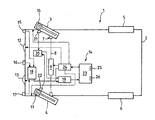
- the vehicle 1 comprises a frame 2, front wheels 3 and 4 and rear wheels 5 and 6, the wheels being connected to the frame 2 by a suspension mechanism, not shown.
- the vehicle 1 is provided with a steering system 7 comprising a rack 8 disposed between the front wheels 3 and 4, a rack actuator 9 adapted to orient the front wheels 3 and 4 by means of the rack 8, in function orders received, mechanically or electrically, from a steering wheel, not shown, available to a driver of the vehicle.
- Disc brake mechanisms 10 and 11 are disposed in the front wheels 3 and 4.
- the rear wheels 5 and 6 may be equipped with similar mechanisms.
- the vehicle 1 is equipped on the front of the frame 2 of two airbags 12 and 13, intended for the protection of pedestrians or cyclists and whose triggering will be explained below.
- the vehicle 1 comprises indeed a shock prediction system, referenced 14 as a whole, comprising a plurality of presence detectors 15, 16 and 17, arranged at the front of the chassis 2 of the vehicle 1, for remotely detecting the presence pedestrian or cyclist.
- the sensors 15 to 17 may be of the optical, thermal, acoustic, ultrasonic, or radar type, to know remotely with a certain accuracy the position of a pedestrian neighbor of the vehicle, for example at a distance from the order of a few tens of centimeters to a few meters. In a manner not shown, one can provide detectors of the same type, arranged laterally.
- the forecasting system 14 comprises a sensor management module 18 to 17, receiving data from said sensors 15 to 17, calculating the position of the pedestrian or cyclist by report to the vehicle 1 and sending the position information to an obstacle classification module 19, also receiving information relating to the speed of the vehicle from a module 20, itself connected to speed sensors 21 and The speed sensors 21 and 22 send a speed signal to the module 20, which may be a wheel lock system control unit.
- the module 20 generates a speed signal and sends it to the classification module 19.
- the classification module 19 calculates the pedestrian speed and direction and develops a pedestrian placement in four possible states: stillness, walking, running low jogging-like, high-speed stroke, and outputs the classification, position and speed data to a collision risk estimation module 23 which sends said estimate to an actuator control module 24.
- the control module 24, depending on the risk estimated by the module 23, can implement different actuators, for example a horn, not shown, the airbags 12 and 13, the brakes 10 and 11 to which the control module 24 is connected in a manner not shown for clarity of the drawing, or the steering system 7 to attempt an avoidance maneuver.
- the module 19 establishes the position and speed of the pedestrian in a marker, for example a direct orthonormal reference in a plane space, the vertical position of the pedestrian is not generally a major factor.
- the pedestrian can be modeled by its circumscribed circle representative of the congestion of said pedestrian, the center of the circumscribed circle passing through the center of gravity of the pedestrian and its orientation being defined by an angle ⁇ .
- Pedestrian modeling can be stored in module 23.
- we can provide a finer modeling of the pedestrian for example by an ellipse instead of the circle, the ellipse depending on the angle and the dimensions of the ellipse can depend on the speed pedestrian. It is therefore considered that the direction of movement of the pedestrian is equal to its orientation ⁇ , which amounts to assuming that the pedestrian is walking straight and does not walk backward or sideways.
- the collision risk estimation module 23 includes a pedestrian-driven space-time behavior model 26, powered by the position, and the pedestrian speed, and the speed of the vehicle.
- the behavior model 26 comprises laws of transition and state maintenance of the moving body and makes it possible to estimate the space occupied by said moving body over time from the behavior model.
- the standard of the pedestrian speed is noted V.
- the module 23 classifies the pedestrian in a state belonging to one of the four kinematic states of the pedestrian.
- the kinematic state gives a good qualitative description of the pedestrian speed standard and its limits, which does not mean that pedestrian speed takes only a finite number of values.
- the kinematic states are discrete and finite, and the speed evolves continuously in time, the quantities a and V are continuous functions with respect to time.
- the discrete kinematic state system of the pedestrian simplifies and formalizes pedestrian behavior.
- a pedestrian is a person who stands and can stand still, walk, run at low speed, or run at a high pace.
- the position of the pedestrian can be calculated by integrating the time of the velocity vector provided that the previous position is known.
- the speed standard is drawn randomly. It is a realization of the speed considered as a normal distribution with mean and standard deviation the values corresponding to the state in which the pedestrian is, and imposing an additional constraint with the limit, minimum and maximum speeds.
- the minimum duration in a state is defined by assuming that once it has reached a state, the pedestrian remains there for a certain duration, estimated at 0.5 seconds for still and running, at 1 second for the slow race, and 1.5 seconds for the fast race.
- the module 23 provides transition times that are necessary for the transition from one state to another, and estimated at 1 second for a change to an adjacent state, for example of the immobility to the march or the walk towards the slow stroke, about 1.5 seconds for a change to a non-adjacent state, for example from motionless to jogging.
- the module 23 also takes into account the times of change of direction considered as simultaneous to the change of state when it is a movement and estimated at 1 second for ⁇ radians for a change of direction in the stationary state.
- the fast race can only be reached from the slow running state and that a slowdown of the slow stroke leads to the operating state and can not reach directly the state of the race. immobility.
- the module 23 can also take into account the fact that a stop with passage of the step to the immobile state may be slightly shorter than the reverse transition, for example about 0.5 seconds.
- Module 23 also takes into account the probabilistic evolution of the pace by estimating the probability of a pedestrian changing state at the end of the current state cycle.
- the probability of state change is estimated in the following table: State S i + 1 State S i Motionless Walk Jogging Run Motionless 0.95 0.04 0.01 0 Walk 0.09 0.9 0.01 0 Jogging 0 0.07 0.85 0.08 Run 0 0 0.15 0.85
- the probability for a pedestrian in a first state to move to a second state with a change in principal direction of an angle ⁇ is equal to the product of the probability of transition from the first to the second state by the probability of a change.
- direction of absolute value ⁇ in the second state by the probability on the sign of the direction change angle that can be assumed to be uniform and equal to 50% or alternatively correlated with the right-handed or left-handed character of the pedestrian, marking a preferably to turn left or right, respectively.
- the pedestrian starts with a state, a speed standard and a given direction.
- For each step of simulation we update the position, the speed standard, and the direction, we recalculate the change of direction, standard of speed and state if necessary and we move to the next increment.
- Speed and angle standard evolutions are linear during the given cycle time.
- the change of direction ⁇ is obtained in a similar way by drawing a number to know if the pedestrian will go to the left or to the right, then drawing a number for the main angle change and finally drawing a number to give the new direction to reach at the instant t + T ss' .
- the evolution of the angle ⁇ is also considered as linear from t to t + T ss' .
- the prediction interval and the number of simulated points it is possible to predict the future positions of the pedestrian.
- the result can be exploited in different ways: by taking the center of a scatter plot, the characteristic dimensions, the envelope, a partition of all the points in homogeneous clouds, or an estimate of the probability density of pedestrian presence associated with each zone of space.
- the trajectory generation it is possible to generate a set of trajectories for each of the two mobiles, the vehicle and the pedestrian, or more generally the mobile body, and to evaluate the probability of shock.
- intersection or crossing of the trajectories to take into account the non-punctual aspect of the moving objects in question, it is checked whether a temporal correspondence occurs. Indeed, it is not enough that the trajectories are close or intersect, it is necessary that the two moving objects are both in the same neighborhood at the same time. We can therefore deduce a probability of shock. From the shock probability, provided by the module 23, the module 24 develops a reaction in the form of a control command for the appropriate actuators.
- the system thus makes it possible to take into account that the movement of a pedestrian is composed of a succession of steps, the pedestrian therefore having to finish the movement in progress before taking the next action.
- the modeling is therefore faithful to the real behavior of a pedestrian who, on a scale of a few hundredths of a second, will not suddenly change direction while he is in the middle of a stride.
- the modeling takes into account the correlation between the longitudinal and lateral accelerations and makes it possible to model different pedestrian trajectories.
- the shock forecasting system comprises a detection part able to detect and classify the obstacles in different categories, pedestrians, other mobile vehicles, fixed obstacles, which provides information on the position and speed of the pedestrian, a prediction part which assesses the risks of collision by calculating the future trajectories of the equipped vehicle and the pedestrian and a control part able to give the order to trigger the active protection systems, such as the pedestrian airbags, the brakes for emergency braking which may reduce the speed of the vehicle in part or in full, an alert of the driver or pedestrian, or the steering system for an attempt to avoid by deviation of the direction of the vehicle.
- the active protection systems such as the pedestrian airbags, the brakes for emergency braking which may reduce the speed of the vehicle in part or in full, an alert of the driver or pedestrian, or the steering system for an attempt to avoid by deviation of the direction of the vehicle.
Landscapes
- Engineering & Computer Science (AREA)
- Mechanical Engineering (AREA)
- Traffic Control Systems (AREA)
- Air Bags (AREA)
- Force Measurement Appropriate To Specific Purposes (AREA)
Description
- La présente invention relève du domaine de la prévision de chocs d'un véhicule automobile avec un corps mobile, en particulier un piéton ou une bicyclette.
- On connaît des dispositifs de capot actif ou de coussins gonflables pour piétons disposés à l'avant d'un véhicule et pourvus d'un capteur de contact permettant de déclencher le gonflement d'un coussin gonflable.
- EP-A-1 367 410 révèle un procédé et système de prévision de chocs d'un véhicule et d'un corps mobile, et on estime l'espace occupé par le corps mobile au cours du temps.
- La demanderesse s'est aperçue que pour améliorer la sécurité des piétons, il convenait de s'intéresser à une prévision de chocs permettant ensuite d'agir pour éviter le choc ou réduire les conséquences du choc. On a ainsi moins de contraintes par rapport à la durée de déclenchement de systèmes de protection, et on peut alors prendre des mesures pour réduire la gravité du choc ou encore tenter une manoeuvre d'évitement.
- L'invention propose une prévision de chocs d'un véhicule et d'un corps mobile, tel qu'un piéton, dans un but de protection du corps mobile.
- Le procédé de prévision de chocs d'un véhicule et d'un corps mobile, selon un aspect de l'invention, comprend des étapes de modélisation du comportement spatio-temporel du corps mobile à partir d'une pluralité d'états dudit corps mobile définis par une durée minimale, une durée de transition, une vitesse moyenne et un écart type, une probabilité de changement d'état et une probabilité de changement de direction, et une étape d'estimation de l'espace occupé par le corps mobile au cours du temps. On tient compte ainsi du comportement du corps mobile qui est susceptible de changer de direction et de vitesse.
- Dans un mode de réalisation de l'invention, on estime l'espace occupé par le corps mobile au cours du temps en fonction d'un modèle de comportement et d'un modèle d'encombrement du corps mobile.
- Dans un mode de réalisation de l'invention, les états de corps mobile comprennent une vitesse maximale et une vitesse minimale.
- Avantageusement, on modélise l'encombrement du corps mobile.
- Dans un mode de réalisation de l'invention, on calcule une cartographie des positions possibles occupées par le corps mobile à un instant donné.
- Dans un mode de réalisation de l'invention, on calcule une cartographie de la probabilité de présence du corps mobile à un instant donné.
- L'invention concerne également un système de prévision de chocs d'un véhicule et d'un corps mobile, ledit système comprenant un module d'estimation du déplacement du corps mobile et un module d'estimation du risque de collision comprenant un modèle de comportement spatio-temporel du corps mobile, pourvu d'une pluralité d'états de corps mobile définis par une durée minimale, une durée de transition, une vitesse moyenne et un écart type, une probabilité de changement d'état et une probabilité de changement de direction, pour estimer l'espace occupé par ledit corps mobile au cours du temps à partir du modèle de comportement.
- Dans un mode de réalisation de l'invention, l'estimateur effectue une estimation probabiliste de l'espace occupé par ledit corps mobile au cours du temps. L'estimateur peut être pourvu d'une unité de calcul.
- Avantageusement, le système comprend, en outre, un élément de détection de corps mobile.
- Dans un mode de réalisation de l'invention, le module d'estimation comprend, en outre, un modèle d'encombrement du corps mobile. L'estimateur peut prendre en compte le modèle d'encombrement.
- Les états de corps mobile peuvent comprendre une vitesse maximale et une vitesse minimale. L'estimateur peut être capable à partir du modèle d'encombrement et du modèle de comportement de calculer une cartographie des positions possibles occupées par le corps mobile à un instant donné. L'estimateur peut être capable à partir du modèle d'encombrement et du modèle de comportement de calculer une cartographie de la probabilité de présence du corps mobile à un instant donné. Le module d'estimation peut comprendre, en outre, un générateur de nombre aléatoire. Le corps mobile est distinct du véhicule et sera en général un piéton mais pourra également être l'ensemble constitué par un cycliste et une bicyclette.
- L'invention permet de tenir compte du comportement du piéton et d'évaluer la probabilité d'un choc avec ledit piéton en vue d'une action qui peut être un avertissement adressé au conducteur et/ou au piéton, le déclenchement d'un dispositif de protection, tel qu'un coussin gonflable, destiné à éviter un choc entre une partie dure du véhicule et le piéton, à déclencher un freinage d'urgence du véhicule ou encore à déclencher une manoeuvre d'évitement. On parvient ainsi à réduire le nombre d'accidents et les dommages causés par les accidents subsistants.
- La présente invention sera mieux comprise à l'étude de la description détaillée d'un mode de réalisation pris à titre d'exemple non limitatif et illustré par le dessin annexé, qui est une vue schématique de dessus d'un véhicule équipé d'un système selon un aspect de l'invention.
- Comme on peut le voir sur la figure unique, le véhicule 1 comprend un châssis 2, des roues avant 3 et 4 et des roues arrière 5 et 6, les roues étant reliées au châssis 2 par un mécanisme de suspension, non représenté.
- Le véhicule 1 est pourvu d'un système de direction 7 comprenant une crémaillère 8 disposée entre les roues avant 3 et 4, un actionneur de crémaillère 9 apte à orienter les roues avant 3 et 4 par l'intermédiaire de la crémaillère 8, en fonction d'ordres reçus, de façon mécanique ou électrique, en provenance d'un volant de direction, non représenté, à disposition d'un conducteur du véhicule. Des mécanismes de freins à disques 10 et 11 sont disposés dans les roues avant 3 et 4. Les roues arrière 5 et 6 peuvent être équipées de mécanismes similaires.
- Le véhicule 1 est équipé sur l'avant du châssis 2 de deux coussins gonflables 12 et 13, destinés à la protection des piétons ou des cyclistes et dont le déclenchement sera expliqué ci-après. Le véhicule 1 comprend en effet un système de prévision de chocs, référencé 14 dans son ensemble, comprenant une pluralité de détecteurs de présence 15, 16 et 17, disposés à l'avant du châssis 2 du véhicule 1, pour détecter à distance la présence d'un piéton ou d'un cycliste. Les capteurs 15 à 17 peuvent être du type optique, thermique, acoustique, à ultrasons, ou encore de type radar, pour connaître à distance avec une certaine précision la position d'un piéton voisin du véhicule, par exemple à une distance de l'ordre de quelques dizaines de centimètres à quelques mètres. De façon non représentée, on peut prévoir des détecteurs du même type, disposés latéralement.
- Le système de prévision 14 comprend un module 18 de gestion des capteurs 15 à 17, recevant des données en provenance desdits capteurs 15 à 17, calculant la position du piéton ou du cycliste par rapport au véhicule 1 et envoyant l'information de position à un module 19 de classement d'obstacles, recevant également une information relative à la vitesse du véhicule en provenance d'un module 20, lui-même relié à des capteurs de vitesse 21 et 22 disposés dans les roues 3 et 4. Les capteurs de vitesse 21 et 22 envoient un signal de vitesse au module 20 qui peut être une unité de commande de système anti-blocage de roues. Le module 20 élabore un signal de vitesse et l'envoie au module de classement 19.
- A partir des données de position du piéton ou du cycliste et des données de vitesse du véhicule, le module de classement 19 calcule la vitesse du piéton et sa direction et élabore un placement du piéton en quatre états possibles : immobilité, marche, course à faible allure du type jogging, course à allure élevée, et envoie en sortie les données de classement, de position et de vitesse à un module 23 d'estimation du risque de collision qui envoie ladite estimation à un module de commande 24 d'actionneurs. Le module de commande 24, en fonction du risque estimé par le module 23, peut mettre en oeuvre différents actionneurs, par exemple un avertisseur sonore, non représenté, les coussins gonflables 12 et 13, les freins 10 et 11 auquel le module de commande 24 est relié de façon non représentée pour la clarté du dessin, ou encore le système de direction 7 pour tenter une manoeuvre d'évitement.
- Le module 19 établit la position et la vitesse du piéton dans un repère, par exemple un repère orthonormé direct dans un espace plan, la position verticale du piéton n'étant en général pas un facteur primordial. Le piéton peut être modélisé par son cercle circonscrit représentatif de l'encombrement dudit piéton, le centre du cercle circonscrit passant par le centre de gravité du piéton et son orientation étant définie par un angle α. La modélisation 25 du piéton peut être stockée dans le module 23. Bien entendu, on peut prévoir une modélisation plus fine du piéton, par exemple par une ellipse au lieu du cercle, l'ellipse dépendant de l'angle a et les dimensions de l'ellipse pouvant dépendre de la vitesse du piéton. On considère donc que la direction de déplacement du piéton est égale à son orientation α, ce qui revient à supposer que le piéton marche droit et n'effectue pas de marche à reculons ou de pas latéraux.
- Le module 23 d'estimation du risque de collision comprend un modèle de comportement 26 spatio-temporel du piéton, alimenté par la position, et la vitesse du piéton, et la vitesse du véhicule. Le modèle de comportement 26 comprend des lois de transition et de maintien d'états du corps mobile et permet d'estimer l'espace occupé par ledit corps mobile au cours du temps à partir du modèle de comportement.
- La norme de la vitesse du piéton est notée V. Le module 23 classe le piéton dans un état appartenant à l'un des quatre états cinématiques du piéton. L'état cinématique donne une bonne description qualitative sur la norme de vitesse du piéton et ses limites, ce qui ne signifie pas que la vitesse du piéton ne prend qu'un nombre fini de valeurs. Les états cinématiques sont discrets et finis, et la vitesse évolue de manière continue dans le temps, les grandeurs a et V sont des fonctions continues par rapport au temps. Le système à états cinématiques discrets du piéton permet une simplification et une formalisation des comportements du piéton. On considère qu'un piéton est une personne qui se tient debout et qui peut être immobile, marcher, courir à faible allure, ou courir à allure élevée. La position du piéton peut être calculée par intégration sur le temps du vecteur vitesse à condition de connaître la position précédente.
- Le tableau suivant détermine les états de piéton et les intervalles de vitesse correspondants :
Etat S(t) Vitesse moyenne (m/s) Ecart type (m/s) Vitesse minimale (m/s) Vitesse maximale (m/s) Immobile 1 0 0,04 0 0,15 Marcher 2 1,4 0,25 0,7 2,1 Jogging 3 3,5 0,4 2,5 4,5 Courir 4 6 0,5 5 8 - Une fois connue, la norme de vitesse est tirée aléatoirement. Il s'agit d'une réalisation de la vitesse considérée comme une distribution normale avec pour moyenne et écart type les valeurs correspondant à l'état dans lequel est le piéton, et en imposant une contrainte supplémentaire avec les vitesses limites, minimale et maximale.
- La durée minimale dans un état est définie en supposant qu'une fois qu'il a atteint un état, le piéton y reste pendant une certaine durée, estimée à 0,5 seconde pour l'état immobile et de marche, à 1 seconde pour la course lente, et à 1,5 seconde pour la course rapide.
- En outre, le module 23 prévoit des temps de transition qui sont nécessaires au passage d'un état à l'autre, et estimés à 1 seconde pour un changement vers un état adjacent, par exemple de l'immobilité vers la marche ou de la marche vers la course lente, à environ 1,5 seconde pour un changement vers un état non adjacent, par exemple de l'état immobile au jogging.
- Le module 23 prend également en compte les durées de changement de direction considérées comme simultanées au changement d'état lorsqu'il s'agit d'un mouvement et estimées à 1 seconde pour π radians pour un changement de direction à l'état immobile.
- En outre, on considère que la course rapide ne peut être atteinte qu'à partir de l'état de course lente et qu'un ralentissement de la course lente aboutit à l'état de marche et ne peut atteindre directement l'état d'immobilité.
- Le module 23 peut également prendre en compte le fait qu'un arrêt avec passage de la marche à l'état immobile peut être légèrement plus bref que la transition inverse, par exemple environ 0,5 seconde.
- Le module 23 tient également compte de l'évolution probabiliste de l'allure en estimant la probabilité qu'a un piéton de changer d'état à la fin du cycle d'état actuel. La probabilité de changement d'état est estimée dans le tableau suivant :
Etat Si+1 Etat Si Immobile Marcher Jogging Courir Immobile 0,95 0,04 0,01 0 Marcher 0,09 0,9 0,01 0 Jogging 0 0,07 0,85 0,08 Courir 0 0 0,15 0,85 - L'utilisation des quatre états du piéton pour décrire l'allure du piéton permet de simplifier la représentation de cette donnée qualitative. On peut également prendre en compte la probabilité pour un piéton de changer son orientation alpha en fonction de l'état dans lequel il se trouve. Le changement de direction est considéré discret au premier ordre et défini de manière analogue à la représentation directe de l'allure. On considère qu'il y a huit changements de direction principaux par tranches de π/4 radians estimées d'après le tableau ci-dessous.
Changement d'angle δ (rad) 0 π/4 π/2 3π/4 π Immobile Probabilité 0,6 0,17 0,12 0,08 0,03 Marcher Probabilité 0,7 0,2 0,1 0 0 Jogging Probabilité 0,85 0,15 0 0 0 Courir Probabilité 0.9 0,1 0 0 0 - De même que pour l'évolution de la norme de vitesse, on suppose que le changement d'angle est continu par rapport au temps et qu'il peut prendre toutes les valeurs de 0 à 2π. Une fois la direction principale obtenue, une réalisation aléatoire de l'angle est tirée. La distribution est supposée normale, centrée sur l'angle correspondant à la direction principale, avec un écart type donné, typiquement π/12 radians.
- La probabilité pour un piéton se trouvant dans un premier état de passer dans un second état avec un changement de direction principale d'un angle δ est égale au produit de la probabilité de passage du premier vers le deuxième état par la probabilité d'un changement de direction de valeur absolue δ dans le second état par la probabilité sur la valeur du signe de l'angle de changement de direction qui peut être supposé uniforme et égal à 50% ou en variante corrélé au caractère droitier ou gaucher du piéton, marquant une préférence pour tourner à gauche ou à droite, respectivement.
- On peut ainsi générer une trajectoire de piéton en appliquant les règles suivantes. Le piéton commence avec un état, une norme de vitesse et une direction donnée. Pour chaque pas de simulation, on met à jour la position, la norme de vitesse, et la direction, on recalcule le changement de direction, de norme de vitesse et d'état si nécessaire et on passe à l'incrément suivant. Les évolutions de norme de vitesse et d'angle sont linéaires pendant le temps de cycle donné.
- A titre d'exemple, un piéton est détecté comme marchant, S(t)=2, à la vitesse V(t)=1,5 m/s-1, par la direction définie par α(t)=1,2 radian, à l'instant t. Le module 23 comprend un générateur de nombre aléatoire et calcule le prochain état par tirage d'un nombre aléatoire, selon la loi donnée dans le tableau ci-dessus : « Marcher », puisque S(t)=2. On obtient ainsi l'état suivant : S'=3. Grâce au tableau de durée de cycles, on obtient le temps de passage de S à S', Tss'=1seconde.
- Pour obtenir la vitesse voulue à l'instant t+Tss', on tire un autre nombre aléatoire selon une loi normale avec la moyenne et l'écart type de l'état S' et bornée par les limites de vitesse de l'état S', voir le premier tableau, et on obtient V(t+Tss)= 3 m/s-1 La norme de la vitesse évolue de façon linéaire de t à T+Tss', avec :

- Le changement de direction δ est obtenu de manière similaire en tirant un nombre pour savoir si le piéton ira à gauche ou à droite, puis en tirant un nombre pour le changement d'angle principal et enfin en tirant un nombre pour donner la nouvelle direction à atteindre à l'instant t+Tss'. L'évolution de l'angle α est également considérée comme linéaire de t à t+Tss'.
- A partir des conditions initiales, de l'intervalle de prédiction et du nombre de points simulés, il est possible de prédire les positions à venir du piéton. Le résultat peut être exploité de différentes façons : en prenant le centre d'un nuage de points, les dimensions caractéristiques, l'enveloppe, une partition de l'ensemble des points en nuages homogènes, ou encore une estimation de la densité de probabilité de présence du piéton associée à chaque zone de l'espace.
- Selon le même principe que pour la génération de trajectoire, on peut générer un ensemble de trajectoires pour chacun des deux mobiles, le véhicule et le piéton, ou plus généralement le corps mobile, et d'évaluer la probabilité de choc. En cas d'intersection ou de frôlement des trajectoires, pour tenir compte de l'aspect non ponctuel des objets mobiles en cause, on vérifie si une correspondance temporelle se produit. En effet, il ne suffit pas que les trajectoires soient proches ou se coupent, il faut que les deux objets mobiles soient tous les deux dans le même voisinage au même instant. On peut donc en déduire une probabilité de choc. A partir de la probabilité de choc, fournie par le module 23, le module 24 élabore une réaction sous la forme d'ordre de commande destiné aux actionneurs adéquats.
- Bien entendu, on peut prévoir que certains paramètres ne soient pas mesurés mais simplement estimés ou calculés à partir d'autres paramètres, et ce pour des raisons d'économie.
- Le système permet ainsi de tenir compte du fait que le mouvement d'un piéton est composé d'une succession de pas, le piéton devant donc finir le mouvement en cours avant de passer à l'action suivante. La modélisation est donc fidèle au comportement réel d'un piéton qui, à une échelle de quelques centièmes de seconde, ne changera pas brusquement de direction alors qu'il est au milieu d'une foulée. La modélisation tient compte de la corrélation entre les accélérations longitudinales et latérales et permet de modéliser différentes trajectoires de piéton. A cet égard, on peut prévoir d'incorporer dans le module 23 un modèle 26 de trajectoire de piéton permettant d'effectuer une prédiction de trajectoire et pouvant être renseigné à partir d'études de trajectoire réellement constatées.
- En d'autres termes, le système de prévision de chocs comprend une partie de détection apte à détecter et classer les obstacles en différentes catégories, piétons, autres véhicules mobiles, obstacles fixes, qui fournit des informations sur la position et la vitesse du piéton, une partie de prédiction qui évalue les risques de collision en calculant les trajectoires à venir du véhicule équipé et du piéton et une partie de commande apte à donner l'ordre de déclencher les systèmes de protection active, tels que les coussins gonflables pour piétons, les freins pour un freinage d'urgence susceptible de réduire la vitesse du véhicule en partie ou en totalité, une alerte du conducteur ou du piéton, ou encore le système de direction pour une tentative d'évitement par déviation de la direction du véhicule.
- On modélise ainsi de façon réaliste le piéton qui est susceptible de changer de vitesse, de s'arrêter, de redémarrer. La forme de cette trajectoire est indépendante du pas temporel de simulation et on prend en compte des valeurs d'accélération réalistes.
Claims (10)
- Procédé de prévision de chocs d'un véhicule et d'un corps mobile, dans lequel on modélise le comportement spatio-temporel du corps mobile à partir d'une pluralité d'états de corps mobile définis par une durée minimale, une durée de transition, une vitesse moyenne, et un écart type, une probabilité de changement d'état, et une probabilité de changement de direction, et on estime l'espace occupé par le corps mobile au cours du temps.
- Procédé selon la revendication 1, dans lequel on estime l'espace occupé par le corps mobile au cours du temps en fonction du modèle de comportement et d'un modèle d'encombrement du corps mobile.
- Procédé selon la revendication 1 ou 2, dans lequel les états de corps mobile comprennent une vitesse maximale et une vitesse minimale.
- Procédé selon l'une quelconque des revendications précédentes, dans lequel on modélise l'encombrement du corps mobile.
- Procédé selon l'une quelconque des revendications précédentes, dans lequel on calcule une cartographie des positions possibles occupées par ledit corps mobile à un instant donné.
- Procédé selon l'une quelconque des revendications précédentes, dans lequel on calcule une cartographie de la probabilité de présence dudit corps mobile à un instant donné.
- Système de prévision de chocs (14) d'un véhicule et d'un corps mobile, caractérisé par le fait que ledit système comprend un module d'estimation (19) du déplacement du corps mobile, un module (23) d'estimation du risque de collision comprenant un modèle de comportement (26) spatio-temporel du corps mobile, pourvu d'une pluralité d'états de corps mobiles définis par une durée minimale, une durée de transition, une vitesse moyenne et un écart type, une probabilité de changement d'état et une probabilité de changement de direction, pour estimer l'espace occupé par ledit corps mobile au cours du temps à partir du modèle de comportement.
- Système selon la revendication 7, caractérisé par le fait que le système comprend, en outre, un élément de détection (15) de corps mobile.
- Système selon la revendication 7 ou 8, caractérisé par le fait que le module d'estimation (23) comprend, en outre, un modèle d'encombrement (25) du corps mobile.
- Système selon la revendication 7, 8 ou 9, caractérisé par le fait que le module d'estimation (23) comprend, en outre, un générateur de nombre aléatoire.
Applications Claiming Priority (2)
| Application Number | Priority Date | Filing Date | Title |
|---|---|---|---|
| FR0315548 | 2003-12-30 | ||
| FR0315548A FR2864673B1 (fr) | 2003-12-30 | 2003-12-30 | Procede et dispositif de prevision de chocs d'un vehicule |
Publications (2)
| Publication Number | Publication Date |
|---|---|
| EP1550586A1 EP1550586A1 (fr) | 2005-07-06 |
| EP1550586B1 true EP1550586B1 (fr) | 2006-08-23 |
Family
ID=34566359
Family Applications (1)
| Application Number | Title | Priority Date | Filing Date |
|---|---|---|---|
| EP04300855A Expired - Lifetime EP1550586B1 (fr) | 2003-12-30 | 2004-12-08 | Procédé et dispositif de prévision de chocs d'un véhicule |
Country Status (4)
| Country | Link |
|---|---|
| EP (1) | EP1550586B1 (fr) |
| AT (1) | ATE337204T1 (fr) |
| DE (1) | DE602004002081T2 (fr) |
| FR (1) | FR2864673B1 (fr) |
Families Citing this family (8)
| Publication number | Priority date | Publication date | Assignee | Title |
|---|---|---|---|---|
| DE102008063033B4 (de) * | 2008-03-03 | 2019-06-06 | Volkswagen Ag | Vorrichtung und Verfahren zur Erkennung von Kollisionen mit erhöhter funktionaler Sicherheit |
| JP5267517B2 (ja) * | 2010-07-14 | 2013-08-21 | 株式会社デンソー | 車両位置推定装置、および車両位置推定プログラム |
| DE102011120500B4 (de) * | 2011-12-07 | 2014-08-21 | Audi Ag | Verfahren zum Betreiben eines Kraftfahrzeugs und Kraftfahrzeug |
| JP5783430B2 (ja) | 2013-04-26 | 2015-09-24 | 株式会社デンソー | 衝突緩和装置 |
| KR102338554B1 (ko) | 2015-03-16 | 2021-12-15 | 주식회사 만도모빌리티솔루션즈 | 자동 긴급 제동장치 및 그 제어방법 |
| FR3086445B1 (fr) | 2018-09-25 | 2021-01-15 | Transdev Group | Systeme de generation automatique d'alertes destinees aux usagers d'une route |
| KR102465312B1 (ko) | 2021-03-05 | 2022-11-11 | 주식회사 핀텔 | 좌표계 기반 이동객체 충돌 예측 시스템 및 방법 |
| CN116224991A (zh) * | 2022-12-22 | 2023-06-06 | 阿波罗智联(北京)科技有限公司 | 运动状态识别方法、装置、设备以及存储介质 |
Family Cites Families (4)
| Publication number | Priority date | Publication date | Assignee | Title |
|---|---|---|---|---|
| JP3708650B2 (ja) * | 1996-06-11 | 2005-10-19 | トヨタ自動車株式会社 | 障害物検知装置を用いた乗員保護装置 |
| JP4115638B2 (ja) * | 1999-10-19 | 2008-07-09 | 本田技研工業株式会社 | 物体認識装置 |
| DE10148060A1 (de) * | 2001-09-28 | 2003-04-10 | Ibeo Automobile Sensor Gmbh | Verfahren zur Erkennung und Verfolgung von Objekten |
| US6615138B1 (en) * | 2002-05-30 | 2003-09-02 | Delphi Technologies, Inc. | Collision detection system and method of estimating miss distance employing curve fitting |
-
2003
- 2003-12-30 FR FR0315548A patent/FR2864673B1/fr not_active Expired - Fee Related
-
2004
- 2004-12-08 AT AT04300855T patent/ATE337204T1/de not_active IP Right Cessation
- 2004-12-08 DE DE602004002081T patent/DE602004002081T2/de not_active Expired - Lifetime
- 2004-12-08 EP EP04300855A patent/EP1550586B1/fr not_active Expired - Lifetime
Also Published As
| Publication number | Publication date |
|---|---|
| ATE337204T1 (de) | 2006-09-15 |
| DE602004002081D1 (de) | 2006-10-05 |
| FR2864673A1 (fr) | 2005-07-01 |
| FR2864673B1 (fr) | 2006-02-17 |
| DE602004002081T2 (de) | 2007-03-08 |
| EP1550586A1 (fr) | 2005-07-06 |
Similar Documents
| Publication | Publication Date | Title |
|---|---|---|
| US12187297B2 (en) | Systems and methods for adjustment of vehicle sub-systems based on monitoring of vehicle occupant(s) | |
| KR102072188B1 (ko) | 취약한 도로 사용자와 충돌을 회피하기 위한 방법, 제어 유닛 및 시스템 | |
| KR102308924B1 (ko) | 자율 차량들을 위한 보행자 행동 예측들 | |
| US9963069B2 (en) | Alarm method for reversing a vehicle by sensing obstacles using structured light | |
| US7966127B2 (en) | Vehicle motion control device | |
| RU2622616C1 (ru) | Устройство управления транспортным средством | |
| JP6461042B2 (ja) | 運転支援装置 | |
| EP1550586B1 (fr) | Procédé et dispositif de prévision de chocs d'un véhicule | |
| JPH0765294A (ja) | 車両用予防安全装置 | |
| CN107270924A (zh) | 导航线路生成方法、装置、设备和电动车 | |
| CN108248506A (zh) | 一种汽车主动安全系统、中央控制单元及控制方法 | |
| EP4185504A1 (fr) | Procédé de détermination d'une trajectoire d'un véhicule automobile | |
| JP7634095B2 (ja) | リーン車両走行データ処理装置 | |
| CN111243291B (zh) | 一种对高速公路急弯路段交通异常点后方车辆进行预警的方法 | |
| EP4155151B1 (fr) | Système et procédé de surveillance d'intention d'autres acteurs de la route | |
| JP2004161099A (ja) | 車両用報知装置 | |
| JP7298351B2 (ja) | 状態判定装置、車載機、運転評価システム、状態判定方法、及びプログラム | |
| JP4729784B2 (ja) | 警報装置 | |
| EP4370951A2 (fr) | Systèmes et procédés pour détecter un environnement autour de véhicules | |
| FR2887669A3 (fr) | Procede et systeme embarque de prediction de choc entre un vehicule et un pieton | |
| US12311908B2 (en) | System and method for brake pad control based on surface roughness | |
| Schindler et al. | Drivers’ comfort boundaries when overtaking a cyclist-Set-up and verification of a methodology for field data collection and analysis | |
| CN120014882B (zh) | 一种考虑机非冲突的车辆控制方法及系统 | |
| JP7725275B2 (ja) | システム、車両、携帯端末、及びそれらの方法 | |
| US20240338950A1 (en) | Systems and methods for sensing environment around vehicles |
Legal Events
| Date | Code | Title | Description |
|---|---|---|---|
| PUAI | Public reference made under article 153(3) epc to a published international application that has entered the european phase |
Free format text: ORIGINAL CODE: 0009012 |
|
| AK | Designated contracting states |
Kind code of ref document: A1 Designated state(s): AT BE BG CH CY CZ DE DK EE ES FI FR GB GR HU IE IS IT LI LT LU MC NL PL PT RO SE SI SK TR |
|
| AX | Request for extension of the european patent |
Extension state: AL BA HR LV MK YU |
|
| 17P | Request for examination filed |
Effective date: 20051227 |
|
| GRAP | Despatch of communication of intention to grant a patent |
Free format text: ORIGINAL CODE: EPIDOSNIGR1 |
|
| AKX | Designation fees paid |
Designated state(s): AT BE BG CH CY CZ DE DK EE ES FI FR GB GR HU IE IS IT LI LT LU MC NL PL PT RO SE SI SK TR |
|
| GRAS | Grant fee paid |
Free format text: ORIGINAL CODE: EPIDOSNIGR3 |
|
| GRAA | (expected) grant |
Free format text: ORIGINAL CODE: 0009210 |
|
| AK | Designated contracting states |
Kind code of ref document: B1 Designated state(s): AT BE BG CH CY CZ DE DK EE ES FI FR GB GR HU IE IS IT LI LT LU MC NL PL PT RO SE SI SK TR |
|
| PG25 | Lapsed in a contracting state [announced via postgrant information from national office to epo] |
Ref country code: IT Free format text: LAPSE BECAUSE OF FAILURE TO SUBMIT A TRANSLATION OF THE DESCRIPTION OR TO PAY THE FEE WITHIN THE PRESCRIBED TIME-LIMIT;WARNING: LAPSES OF ITALIAN PATENTS WITH EFFECTIVE DATE BEFORE 2007 MAY HAVE OCCURRED AT ANY TIME BEFORE 2007. THE CORRECT EFFECTIVE DATE MAY BE DIFFERENT FROM THE ONE RECORDED. Effective date: 20060823 Ref country code: LT Free format text: LAPSE BECAUSE OF FAILURE TO SUBMIT A TRANSLATION OF THE DESCRIPTION OR TO PAY THE FEE WITHIN THE PRESCRIBED TIME-LIMIT Effective date: 20060823 Ref country code: SI Free format text: LAPSE BECAUSE OF FAILURE TO SUBMIT A TRANSLATION OF THE DESCRIPTION OR TO PAY THE FEE WITHIN THE PRESCRIBED TIME-LIMIT Effective date: 20060823 Ref country code: CZ Free format text: LAPSE BECAUSE OF FAILURE TO SUBMIT A TRANSLATION OF THE DESCRIPTION OR TO PAY THE FEE WITHIN THE PRESCRIBED TIME-LIMIT Effective date: 20060823 Ref country code: RO Free format text: LAPSE BECAUSE OF FAILURE TO SUBMIT A TRANSLATION OF THE DESCRIPTION OR TO PAY THE FEE WITHIN THE PRESCRIBED TIME-LIMIT Effective date: 20060823 Ref country code: AT Free format text: LAPSE BECAUSE OF FAILURE TO SUBMIT A TRANSLATION OF THE DESCRIPTION OR TO PAY THE FEE WITHIN THE PRESCRIBED TIME-LIMIT Effective date: 20060823 Ref country code: IS Free format text: LAPSE BECAUSE OF FAILURE TO SUBMIT A TRANSLATION OF THE DESCRIPTION OR TO PAY THE FEE WITHIN THE PRESCRIBED TIME-LIMIT Effective date: 20060823 Ref country code: NL Free format text: LAPSE BECAUSE OF FAILURE TO SUBMIT A TRANSLATION OF THE DESCRIPTION OR TO PAY THE FEE WITHIN THE PRESCRIBED TIME-LIMIT Effective date: 20060823 Ref country code: FI Free format text: LAPSE BECAUSE OF FAILURE TO SUBMIT A TRANSLATION OF THE DESCRIPTION OR TO PAY THE FEE WITHIN THE PRESCRIBED TIME-LIMIT Effective date: 20060823 Ref country code: PL Free format text: LAPSE BECAUSE OF FAILURE TO SUBMIT A TRANSLATION OF THE DESCRIPTION OR TO PAY THE FEE WITHIN THE PRESCRIBED TIME-LIMIT Effective date: 20060823 Ref country code: SK Free format text: LAPSE BECAUSE OF FAILURE TO SUBMIT A TRANSLATION OF THE DESCRIPTION OR TO PAY THE FEE WITHIN THE PRESCRIBED TIME-LIMIT Effective date: 20060823 Ref country code: IE Free format text: LAPSE BECAUSE OF FAILURE TO SUBMIT A TRANSLATION OF THE DESCRIPTION OR TO PAY THE FEE WITHIN THE PRESCRIBED TIME-LIMIT Effective date: 20060823 |
|
| REG | Reference to a national code |
Ref country code: GB Ref legal event code: FG4D Free format text: NOT ENGLISH |
|
| REG | Reference to a national code |
Ref country code: CH Ref legal event code: EP |
|
| REG | Reference to a national code |
Ref country code: IE Ref legal event code: FG4D Free format text: LANGUAGE OF EP DOCUMENT: FRENCH |
|
| REF | Corresponds to: |
Ref document number: 602004002081 Country of ref document: DE Date of ref document: 20061005 Kind code of ref document: P |
|
| PG25 | Lapsed in a contracting state [announced via postgrant information from national office to epo] |
Ref country code: DK Free format text: LAPSE BECAUSE OF FAILURE TO SUBMIT A TRANSLATION OF THE DESCRIPTION OR TO PAY THE FEE WITHIN THE PRESCRIBED TIME-LIMIT Effective date: 20061123 Ref country code: BG Free format text: LAPSE BECAUSE OF FAILURE TO SUBMIT A TRANSLATION OF THE DESCRIPTION OR TO PAY THE FEE WITHIN THE PRESCRIBED TIME-LIMIT Effective date: 20061123 Ref country code: SE Free format text: LAPSE BECAUSE OF FAILURE TO SUBMIT A TRANSLATION OF THE DESCRIPTION OR TO PAY THE FEE WITHIN THE PRESCRIBED TIME-LIMIT Effective date: 20061123 |
|
| PG25 | Lapsed in a contracting state [announced via postgrant information from national office to epo] |
Ref country code: ES Free format text: LAPSE BECAUSE OF FAILURE TO SUBMIT A TRANSLATION OF THE DESCRIPTION OR TO PAY THE FEE WITHIN THE PRESCRIBED TIME-LIMIT Effective date: 20061204 |
|
| PG25 | Lapsed in a contracting state [announced via postgrant information from national office to epo] |
Ref country code: MC Free format text: LAPSE BECAUSE OF NON-PAYMENT OF DUE FEES Effective date: 20061231 |
|
| PG25 | Lapsed in a contracting state [announced via postgrant information from national office to epo] |
Ref country code: PT Free format text: LAPSE BECAUSE OF FAILURE TO SUBMIT A TRANSLATION OF THE DESCRIPTION OR TO PAY THE FEE WITHIN THE PRESCRIBED TIME-LIMIT Effective date: 20070125 |
|
| NLV1 | Nl: lapsed or annulled due to failure to fulfill the requirements of art. 29p and 29m of the patents act | ||
| GBT | Gb: translation of ep patent filed (gb section 77(6)(a)/1977) |
Effective date: 20070201 |
|
| REG | Reference to a national code |
Ref country code: IE Ref legal event code: FD4D |
|
| PLBE | No opposition filed within time limit |
Free format text: ORIGINAL CODE: 0009261 |
|
| STAA | Information on the status of an ep patent application or granted ep patent |
Free format text: STATUS: NO OPPOSITION FILED WITHIN TIME LIMIT |
|
| 26N | No opposition filed |
Effective date: 20070524 |
|
| PG25 | Lapsed in a contracting state [announced via postgrant information from national office to epo] |
Ref country code: GR Free format text: LAPSE BECAUSE OF FAILURE TO SUBMIT A TRANSLATION OF THE DESCRIPTION OR TO PAY THE FEE WITHIN THE PRESCRIBED TIME-LIMIT Effective date: 20061124 |
|
| PG25 | Lapsed in a contracting state [announced via postgrant information from national office to epo] |
Ref country code: EE Free format text: LAPSE BECAUSE OF FAILURE TO SUBMIT A TRANSLATION OF THE DESCRIPTION OR TO PAY THE FEE WITHIN THE PRESCRIBED TIME-LIMIT Effective date: 20060823 |
|
| PG25 | Lapsed in a contracting state [announced via postgrant information from national office to epo] |
Ref country code: HU Free format text: LAPSE BECAUSE OF FAILURE TO SUBMIT A TRANSLATION OF THE DESCRIPTION OR TO PAY THE FEE WITHIN THE PRESCRIBED TIME-LIMIT Effective date: 20070224 Ref country code: TR Free format text: LAPSE BECAUSE OF FAILURE TO SUBMIT A TRANSLATION OF THE DESCRIPTION OR TO PAY THE FEE WITHIN THE PRESCRIBED TIME-LIMIT Effective date: 20060823 Ref country code: LU Free format text: LAPSE BECAUSE OF NON-PAYMENT OF DUE FEES Effective date: 20061208 |
|
| PG25 | Lapsed in a contracting state [announced via postgrant information from national office to epo] |
Ref country code: CY Free format text: LAPSE BECAUSE OF FAILURE TO SUBMIT A TRANSLATION OF THE DESCRIPTION OR TO PAY THE FEE WITHIN THE PRESCRIBED TIME-LIMIT Effective date: 20060823 |
|
| REG | Reference to a national code |
Ref country code: CH Ref legal event code: PL |
|
| PG25 | Lapsed in a contracting state [announced via postgrant information from national office to epo] |
Ref country code: LI Free format text: LAPSE BECAUSE OF NON-PAYMENT OF DUE FEES Effective date: 20081231 Ref country code: CH Free format text: LAPSE BECAUSE OF NON-PAYMENT OF DUE FEES Effective date: 20081231 |
|
| PGFP | Annual fee paid to national office [announced via postgrant information from national office to epo] |
Ref country code: BE Payment date: 20141219 Year of fee payment: 11 |
|
| REG | Reference to a national code |
Ref country code: FR Ref legal event code: PLFP Year of fee payment: 12 |
|
| PG25 | Lapsed in a contracting state [announced via postgrant information from national office to epo] |
Ref country code: BE Free format text: LAPSE BECAUSE OF NON-PAYMENT OF DUE FEES Effective date: 20151231 |
|
| REG | Reference to a national code |
Ref country code: FR Ref legal event code: PLFP Year of fee payment: 13 |
|
| REG | Reference to a national code |
Ref country code: FR Ref legal event code: PLFP Year of fee payment: 14 |
|
| PGFP | Annual fee paid to national office [announced via postgrant information from national office to epo] |
Ref country code: DE Payment date: 20171211 Year of fee payment: 14 Ref country code: FR Payment date: 20171221 Year of fee payment: 14 |
|
| PGFP | Annual fee paid to national office [announced via postgrant information from national office to epo] |
Ref country code: GB Payment date: 20171221 Year of fee payment: 14 |
|
| REG | Reference to a national code |
Ref country code: DE Ref legal event code: R119 Ref document number: 602004002081 Country of ref document: DE |
|
| GBPC | Gb: european patent ceased through non-payment of renewal fee |
Effective date: 20181208 |
|
| PG25 | Lapsed in a contracting state [announced via postgrant information from national office to epo] |
Ref country code: DE Free format text: LAPSE BECAUSE OF NON-PAYMENT OF DUE FEES Effective date: 20190702 Ref country code: FR Free format text: LAPSE BECAUSE OF NON-PAYMENT OF DUE FEES Effective date: 20181231 |
|
| PG25 | Lapsed in a contracting state [announced via postgrant information from national office to epo] |
Ref country code: GB Free format text: LAPSE BECAUSE OF NON-PAYMENT OF DUE FEES Effective date: 20181208 |