EP1550495A2 - Verfahren zur Herstellung von Natriumsulfat - Google Patents
Verfahren zur Herstellung von Natriumsulfat Download PDFInfo
- Publication number
- EP1550495A2 EP1550495A2 EP04356204A EP04356204A EP1550495A2 EP 1550495 A2 EP1550495 A2 EP 1550495A2 EP 04356204 A EP04356204 A EP 04356204A EP 04356204 A EP04356204 A EP 04356204A EP 1550495 A2 EP1550495 A2 EP 1550495A2
- Authority
- EP
- European Patent Office
- Prior art keywords
- fumes
- filtration
- weight
- sodium
- process according
- Prior art date
- Legal status (The legal status is an assumption and is not a legal conclusion. Google has not performed a legal analysis and makes no representation as to the accuracy of the status listed.)
- Withdrawn
Links
Images
Classifications
-
- C—CHEMISTRY; METALLURGY
- C01—INORGANIC CHEMISTRY
- C01D—COMPOUNDS OF ALKALI METALS, i.e. LITHIUM, SODIUM, POTASSIUM, RUBIDIUM, CAESIUM, OR FRANCIUM
- C01D5/00—Sulfates or sulfites of sodium, potassium or alkali metals in general
Definitions
- the present invention relates to a method for producing Sodium sulphate of high purity, not involving any addition of water, and therefore by the dry route.
- the present invention aims to remedy these disadvantages.
- the Applicant has in fact discovered that by choosing a particular starting material, namely specific spent catalysts and by applying to them a heat treatment followed by a specific treatment of the resulting fumes involving no addition of water, namely in particularly a first filtration, called primary filtration, carried out at the beginning of the process on the fumes resulting from the calcination of these catalysts, said filtration leading to a specific level of dust in said fumes of 10 mg / Nm 3 maximum, then a desulfurization of these fumes with sodium bicarbonate in the total absence of water, and finally a second filtration, called secondary filtration, it was possible to produce particularly pure sodium sulfate, and this particularly economical way, simple, without using substances toxic such as soda and sulfuric acid usually used in sulphate production sodium, without consuming water and avoiding any salty aqueous release into the natural environment.
- a first filtration called primary filtration
- the present invention also relates to the use of catalysts used articles comprising a metal or a combination of metals selected from nickel, cobalt, molybdenum, vanadium, titanium, tungsten and their mixtures, and including sulfur, for the production of sodium sulphate of great purity.
- the process according to the invention makes it possible to obtain sodium sulphate particularly pure, and that from an inexpensive source of sulfur since destined to be eliminated. This sodium sulphate can then be reused in other processes, such as in the paper industry or in the manufacture of glass or detergents.
- the process according to the invention makes it possible to preserve the natural sodium sulphate as well as the raw materials usually used in the manufacture of sulphate synthetic sodium, such as soda, sulfuric acid and acid hydrochloric.
- the process according to the invention makes it possible to recycle materials precious metals such as the aforementioned metals, and to preserve the natural resources and the environment. It is also a process particularly economical.
- the method according to the invention does not require any addition of water.
- Sodium bicarbonate is preferably added and put directly in contact with the fumes, in the form of an anhydrous powder. So, the method according to the invention does not use water, it also preserves this precious natural resource. Moreover, the method according to the invention does not reject wastewater in the natural environment. It produces no non-recycled residue and therefore no waste to put in landfill technical.
- variable impurities is meant for the purpose of this invention a mixture of silica and / or alumina.
- dry route is meant for the purposes of the present invention, a totally anhydrous process, in which sodium bicarbonate is introduced in the solid state in the filtered smoke, without the addition of water. So, the bicarbonate
- the sodium hydroxide used is preferably in the form of a powder and is preferably sprayed in contact with the filtered fumes in the form of a fog.
- the process according to the invention does not involve any addition of water, in any form whatsoever.
- starting materials in the form of used catalysts comprising a metal or a combination of metals selected from nickel, cobalt, molybdenum, vanadium, titanium, tungsten and mixtures thereof, and comprising sulfur.
- These catalysts are generally used in the petroleum industry, particularly in the cracking and refining, in particular to desulfurize the distillation products.
- the metal or the combination of metals may be selected from Ni-Mo, Co-Mo, Ni-Co-Mo, Ni-V, Ni-Mo-V, Ni-W, Ti-W, Ti-W-V.
- the support of these catalysts is generally chosen from alumina, silica and mixtures thereof.
- the metal or combination of metals is present in the used catalyst, preferably at a content ranging from 5 to 30%, more preferably 15 to 30%, by weight, relative to the weight of the used catalyst.
- the support is present in the spent catalyst a content ranging from 65 to 90%, more preferably from 70 to 85%, by weight, relative to the weight of the used catalyst.
- the sulfur is present in the spent catalyst a content ranging from 3 to 25%, more preferably from 8 to 12%, by weight, by relative to the weight of the catalyst.
- These used catalysts also generally include hydrocarbons and carbon from the distillation products that these catalysts were used to desulphurize.
- the Used catalysts are calcined, for example in a rotary kiln, at a temperature ranging from 700 ° C to 1100 ° C, preferably from 800 ° C to 1000 ° C.
- calcination or roasting, is meant for the purposes of this invention, a high temperature heat treatment for oxidizing the sulfur, hydrocarbons and carbon products present in used catalysts.
- This calcination step preferably takes place continuously. The duration of the calcination can for example go from 10 minutes to 30 minutes.
- the calcined catalysts constitute a raw material comprising silica and / or alumina, as well as metals such as nickel, cobalt, molybdenum, vanadium, titanium, tungsten and their mixtures. This raw material is melted and recycled separately.
- the fumes from the calcination stage generally comprise from 5 to 25 g / Nm 3 / h of dust, 10 to 50 g / Nm 3 / h, preferably 32 to 48 g / Nm 3 / h sulfur oxides SO x , where x is 2 or 3, carbon dioxide, water of combustion, oxygen and nitrogen.
- dust is meant, in the sense of the present invention, a mixture of the starting components of used catalysts, some of these components being in the oxidized form. So, these dusts include generally a mixture of the catalyst support, such as silica and / or alumina, and oxidized metals from the oxidation of metals present initially in used catalysts. Oxidized metals are generally present in the dust at a content ranging from 10 to 40% by weight, relative to the weight of the dust.
- the fumes resulting from this calcination stage are generally a temperature ranging from 700 ° C to 1100 ° C, and preferably at a temperature of temperature of about 850 ° C.
- These fumes are then preferably cooled to a temperature ranging from 180 ° C to 250 ° C, more preferably from 190 ° C to 210 ° C. Cooling the fumes to about 180-250 ° C before the step of Filtration makes it possible to obtain fumes having, after filtration, a temperature ranging from 160 ° C to 250 ° C, preferably from 170 ° C to 190 ° C, and thus achieve, in the subsequent step, a chemical reaction between the oxides of sulfur contained in the filtered fumes and baking soda sodium, showing better yield.
- the fumes, resulting from the calcination step, and preferably cooled to about 180-250 ° C, are filtered in order to separate the dust until the concentration in dusts in these fumes is less than or equal to 10 mg / Nm 3 , preferably less than or equal to 5 mg / Nm 3 , and more preferably less than or equal to 3 mg / Nm 3 .
- this filtration takes place using high efficiency bag filters.
- the fumes are introduced into a chamber and they pass through the sleeves at a speed ranging from 0.80 m / min to 1.20 m / min, and preferably about 1 m / min.
- the filtration rate during the primary filtration ranges from 48 m 3 / h to 72 m 3 / h per m 2 of filter surface, and preferably this flow rate is about 60 m 3 / h per m 2 filtering surface.
- these baghouses are glass fibers coated with polytetrafluoroethylene (PTFE), PTFE or meta-aramid polymers.
- the solid particles that are to be separated settle on the sleeves.
- the sleeves are preferably regularly shaken; solid particles come off and are collected specifically.
- the fumes resulting from this filtration step, or filtered fumes include a high rate of sulfur gases.
- the content of sulfur oxides SO x , where x is 2 or 3, in the filtered fumes, in a primary manner ranges from 10 to 50 g / Nm 3 / h, preferably from 12 to 15 g. / Nm 3 / h.
- the dust content, within the filtered fumes, in a primary manner is less than or equal to 10 mg / Nm 3 / h, preferably less than or equal to 5 mg / Nm 3 / h and more preferably lower or equal to 3 mg / Nm 3 / h.
- the content of metal oxides in the dust generally ranges from 10% to 30% by weight, relative to the weight of the dust.
- Filtered fumes also generally comprise carbon, water of combustion, oxygen, nitrogen.
- a fourth step of the method according to the invention also called chemical reaction step, these filtered fumes are brought into contact with each other. with sodium bicarbonate in divided form at a temperature ranging from 160 ° C to 250 ° C, preferably 170 ° C to 190 ° C.
- the sodium bicarbonate is introduced in the solid state into the fumes, without addition of water.
- Sodium bicarbonate is preferably injected in the form of very fine powder so as to obtain a homogeneous and intimate mixture between fumes and sodium bicarbonate.
- the bicarbonate sodium has an average particle size less than or equal to 30 microns, and more preferably less than or equal to 20 microns.
- the sodium bicarbonate which is commercially available is suitable for present invention. It is possible to use sodium bicarbonate having an average particle size ranging from 100 to 150 microns it is subjected to the action of a grinder in order to obtain an average size of particles less than or equal to 30 microns.
- the sodium bicarbonate is preferably mixed with the fumes, for example co-current, by pneumatic injection.
- the time of residence of sodium bicarbonate in contact with fumes is at least 1 second and preferably this residence time is 2 seconds.
- the Sodium bicarbonate reacts with sulfur oxides to give sulphate sodium.
- the bicarbonate is used in excess of the order of 5 to 10% by weight relative to the stoichiometry of the reaction between sodium bicarbonate and sulfur oxides.
- This reaction can for example take place in a reactor or a sheath.
- the fumes from the chemical reaction stage are filtered in order to separate the sulfate from sodium produced during this reaction.
- this filtration also known as secondary filtration, is carried out using bag filters as for primary filtration.
- the sleeves are made of polytetrafluoroethylene (PTFE), PTFE or polymers of meta-aramid.
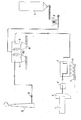
- used catalysts comprising a metal or a combination of metals selected from nickel, cobalt, molybdenum, vanadium, titanium, tungsten and mixtures thereof, and comprising sulfur are introduced into a calcination furnace 1.
- the Calcined catalysts are collected in an afterburner chamber 2.
- the fumes from the calcination of the catalysts are cooled to about 200 ° C. in a cooling chamber 3. They are then filtered in a primary filtration chamber 4 comprising a bag filter 5.
- the dust and metals extracted from fumes during this filtration step primary material are collected in an extraction system 6 and then recalibrated by fusion.
- the filtered fumes are then brought into contact with bicarbonate of sodium previously stored in a silo 7 and possibly ground in 8.
- the fumes loaded with sodium sulphate resulting from the reaction of sulfur oxides with sodium bicarbonate are then filtered in a first filtration chamber 9, and the solid sodium sulfate is collected in an extraction system 10.
- the fumes resulting from this secondary filtration can then possibly be contacted again with sodium bicarbonate in excess and filtered again in a second filtration chamber 11.
- the fumes from this double secondary filtration are then removed by the chimney 12.
- An exhaust fan 13 allows the circulation of fumes throughout the device.
- a mixture of used catalysts for example in the form of beads, comprising a combination of molybdenum and nickel (Mo-Ni), whose supports are alumina, at a rate of 1 t / h (ton / hour).
- the sulfur content in the breast of a catalyst was 10% by weight, based on the weight of the catalyst.
- the calcined catalysts were collected to be recycled by fusion.
- the dusts included 10 to 30% of metal oxides, relative to the weight of the dust.
- the fumes were put in contact for 2 seconds with the sodium bicarbonate. After reaction with sodium bicarbonate, sodium sulfate product is collected on the filter sleeves through from which the fumes pass.
- a mixture of used catalysts comprising a combination of nickel, molybdenum and vanadium (Ni-Mo-V), whose supports are made of alumina, at a rate of 2 t / h (ton / hour).
- the sulfur content in a catalyst was 10% in weight, based on the weight of the catalyst.
- the calcined catalysts were collected to be recycled by fusion.
- the dusts included 10 to 30% of metal oxides, relative to the weight of the dust.
- the fumes were put in contact for at least 1 second with sodium bicarbonate. After reaction with sodium bicarbonate, the sodium sulphate produced is collected on the filter sleeves through from which the fumes pass.
Landscapes
- Chemical & Material Sciences (AREA)
- Organic Chemistry (AREA)
- Engineering & Computer Science (AREA)
- Materials Engineering (AREA)
- Inorganic Chemistry (AREA)
- Catalysts (AREA)
- Inorganic Compounds Of Heavy Metals (AREA)
Applications Claiming Priority (2)
| Application Number | Priority Date | Filing Date | Title |
|---|---|---|---|
| FR0315393 | 2003-12-24 | ||
| FR0315393A FR2864529B1 (fr) | 2003-12-24 | 2003-12-24 | Procede de preparation de sulfate de sodium |
Publications (2)
| Publication Number | Publication Date |
|---|---|
| EP1550495A2 true EP1550495A2 (de) | 2005-07-06 |
| EP1550495A3 EP1550495A3 (de) | 2013-04-03 |
Family
ID=34566349
Family Applications (1)
| Application Number | Title | Priority Date | Filing Date |
|---|---|---|---|
| EP04356204A Withdrawn EP1550495A3 (de) | 2003-12-24 | 2004-12-22 | Verfahren zur Herstellung von Natriumsulfat |
Country Status (2)
| Country | Link |
|---|---|
| EP (1) | EP1550495A3 (de) |
| FR (1) | FR2864529B1 (de) |
Cited By (1)
| Publication number | Priority date | Publication date | Assignee | Title |
|---|---|---|---|---|
| CN101970084A (zh) * | 2007-09-20 | 2011-02-09 | 斯凯约尼克公司 | 通过碳酸盐和/或碳酸氢盐矿物的联产从废气流去除二氧化碳 |
Family Cites Families (7)
| Publication number | Priority date | Publication date | Assignee | Title |
|---|---|---|---|---|
| US4448674A (en) * | 1979-04-02 | 1984-05-15 | Engelhard Corporation | Control of emissions in FCC regenerator flue gas |
| US4435281A (en) * | 1980-09-15 | 1984-03-06 | Standard Oil Company (Indiana) | Catalytic cracking with reduced emission of noxious gas |
| US4621069A (en) * | 1983-10-03 | 1986-11-04 | Hri, Inc. | Continuous process for catalyst regeneration by staged burnoff of carbon and sulfur compounds |
| US5108968A (en) * | 1990-04-06 | 1992-04-28 | Recat, Inc. | Process for treating a material wherein the material is suspended in a gaseous atmosphere |
| IT1269193B (it) * | 1994-01-20 | 1997-03-21 | Solvay | Composizione reattiva e procedimento per la purificazione di un gas contenente cloruro di idrogeno |
| EP0869845B1 (de) * | 1995-03-20 | 1999-10-27 | Shell Internationale Researchmaatschappij B.V. | Verfahren zur regeneration von katalysatoren |
| FR2751560A1 (fr) * | 1996-07-26 | 1998-01-30 | Solvay | Procede pour epurer une fumee contenant du chlorure d'hydrogene, un oxyde d'azote ou du dioxyde de soufre |
-
2003
- 2003-12-24 FR FR0315393A patent/FR2864529B1/fr not_active Expired - Fee Related
-
2004
- 2004-12-22 EP EP04356204A patent/EP1550495A3/de not_active Withdrawn
Cited By (2)
| Publication number | Priority date | Publication date | Assignee | Title |
|---|---|---|---|---|
| CN101970084A (zh) * | 2007-09-20 | 2011-02-09 | 斯凯约尼克公司 | 通过碳酸盐和/或碳酸氢盐矿物的联产从废气流去除二氧化碳 |
| CN101970084B (zh) * | 2007-09-20 | 2013-05-29 | 斯凯约尼克公司 | 通过碳酸盐和/或碳酸氢盐矿物的联产从废气流去除二氧化碳 |
Also Published As
| Publication number | Publication date |
|---|---|
| FR2864529A1 (fr) | 2005-07-01 |
| EP1550495A3 (de) | 2013-04-03 |
| FR2864529B1 (fr) | 2006-12-15 |
Similar Documents
| Publication | Publication Date | Title |
|---|---|---|
| EP0858428B1 (de) | Verfahren zur behandlung von rauchgasen auf basis von schwefeloxiden | |
| EP0487368B1 (de) | Verfahren zur umweltfreundlichen Behandlung eines Raffinierungskatalysators sowie Rückgewinnung von Metallen | |
| FR2608618A1 (fr) | Procede de recuperation de fluorures de matieres residuaires | |
| EP0858429B1 (de) | Zusammensetzung die mindestens natriumbicarbonat enthält, verfahren zu deren herstellung und deren verwendungen | |
| FR2864529A1 (fr) | Procede de preparation de sulfate de sodium | |
| EP0487379B1 (de) | Verfahren zur umweltschützenden Behandlung eines verbrauchten Raffinierungskatalysators und vollständige Rückgewinnung der metallischen Bestandteile des Katalysators | |
| EP3310713B1 (de) | Verfahren zur stabilisierung von metallischem quecksilber | |
| CA2430145C (fr) | Procede d'elimination du soufre d'une charge contenant de l'hydrogene sulfure et du benzene, toluene et/ou xylenes | |
| FR2912759A1 (fr) | Procede de valorisation des poussieres et boues de hauts fourneaux. | |
| EP1922425A2 (de) | Verfahren zur herstellung von calciumsalzen | |
| WO1993006915A1 (fr) | Procede pour epurer un gaz contenant de l'oxyde nitrique et du dioxyde de soufre | |
| EP1149049B1 (de) | Wiederverwertung von feinen calcium fluorid pulvern | |
| FR2624879A1 (fr) | Procede de regeneration d'un additif de piegeage du soufre utilise dans la preparation d'une emulsion d'hydrocarbure dans l'eau formant un combustible et procede de recuperation de l'additif de piegeage du soufre a partir d'une cendre de combustion | |
| EP0290308B1 (de) | Verfahren für die Rekuperation von Vanadium | |
| BE1006509A3 (fr) | Procede pour obtenir des produits susceptibles d'evacuation aux dechets a partir de chlorures metalliques sans fractions inertes. | |
| FR2671104A1 (fr) | Procede de traitement antipollution d'un catalyseur desactive contenant au moins un metal noble et recuperation totale dudit metal et de l'alumine du support. | |
| EP0190116B1 (de) | Sorptionsmasse zur Entschwefelung von Gasen | |
| WO2000029095A1 (fr) | Procede pour epurer une fumee contaminee par du chlorure d'hydrogene et des metaux lourds, inerter lesdits metaux lourds et valoriser ledit chlorure d'hydrogene | |
| LU80831A1 (fr) | Procede de traitement de scories residuaires | |
| FR3166912A1 (fr) | Procédé de lixiviation acide d'un laitier de ferronickel | |
| FR2756754A1 (fr) | Composition de traitement de fumees et utilisations | |
| EP2042246B1 (de) | Verfahren zur Entgiftung und Absaugung von Metallen, Schlacken und Flugasche, die bei der Verbrennung entstehen | |
| FR2724328A1 (fr) | Composition reactive et procede pour l'epuration d'un gaz contenant de l'oxyde nitrique | |
| FR2989285A1 (fr) | Procede et installation d'epuration de fumees de combustion par voie humide | |
| EP1404465A1 (de) | Stabilisierungsbehandlung, insbesondere für abfallverbrennungsrückstände |
Legal Events
| Date | Code | Title | Description |
|---|---|---|---|
| PUAI | Public reference made under article 153(3) epc to a published international application that has entered the european phase |
Free format text: ORIGINAL CODE: 0009012 |
|
| AK | Designated contracting states |
Kind code of ref document: A2 Designated state(s): AT BE BG CH CY CZ DE DK EE ES FI FR GB GR HU IE IS IT LI LT LU MC NL PL PT RO SE SI SK TR |
|
| AX | Request for extension of the european patent |
Extension state: AL BA HR LV MK YU |
|
| 111L | Licence recorded |
Free format text: 0100 VALDI LE PALAIS Effective date: 20051219 |
|
| RAP1 | Party data changed (applicant data changed or rights of an application transferred) |
Owner name: VFE |
|
| RAP1 | Party data changed (applicant data changed or rights of an application transferred) |
Owner name: AFE VALDI |
|
| RAP1 | Party data changed (applicant data changed or rights of an application transferred) |
Owner name: VALDI |
|
| PUAL | Search report despatched |
Free format text: ORIGINAL CODE: 0009013 |
|
| AK | Designated contracting states |
Kind code of ref document: A3 Designated state(s): AT BE BG CH CY CZ DE DK EE ES FI FR GB GR HU IE IS IT LI LT LU MC NL PL PT RO SE SI SK TR |
|
| AX | Request for extension of the european patent |
Extension state: AL BA HR LV MK YU |
|
| RIC1 | Information provided on ipc code assigned before grant |
Ipc: B01D 53/50 20060101ALI20130228BHEP Ipc: C01D 5/02 20060101AFI20130228BHEP |
|
| 17P | Request for examination filed |
Effective date: 20131001 |
|
| RBV | Designated contracting states (corrected) |
Designated state(s): AT BE BG CH CY CZ DE DK EE ES FI FR GB GR HU IE IS IT LI LT LU MC NL PL PT RO SE SI SK TR |
|
| 17Q | First examination report despatched |
Effective date: 20131028 |
|
| AKX | Designation fees paid |
Designated state(s): AT BE BG CH CY CZ DE DK EE ES FI FR GB GR HU IE IS IT LI LT LU MC NL PL PT RO SE SI SK TR |
|
| STAA | Information on the status of an ep patent application or granted ep patent |
Free format text: STATUS: THE APPLICATION IS DEEMED TO BE WITHDRAWN |
|
| 18D | Application deemed to be withdrawn |
Effective date: 20140308 |